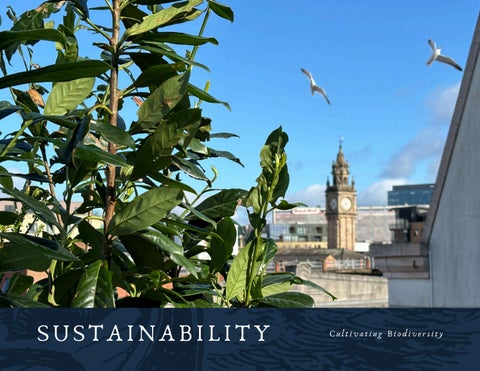
SUSTAINABILITY
Cultivating Biodiversity
CULTIVATING BIODIVERSITY A SEAFOOD RESTAURANT'S GREEN OASIS IN THE CITY CENTRE
I
n the heart of Belfast’s bustling city centre, where brick,
EMBRACING NATIVE BEAUTY
glass and concrete dominates the landscape, Fish City is
With limited space on the premises, the restaurant creatively
making waves in the realm of ecological responsibility. With
utilised the planters around its Terrace outdoor dining area to
a focus on sustainability, the award-winning Belfast seafood
introduce a stunning display of winter- and spring-flowering
restaurant recently embarked on a mission to transform its
heather, providing an important early source of food for
outdoor dining space into a vibrant haven for pollinators by
pollinators. Embracing the beauty of Northern Ireland's native
planting heather– low-growing, evergreen shrubs typically
evergreen heathers, the restaurant planted nine carefully selected
found on heathland across the island. This initiative not only
varieties. Each variety, such as Springwood Pink and Golden
adds a bright splash of colour to the surroundings but also
Starlet, have earned the Royal Horticultural Society's (RHS)
aligns with the restaurant's overarching commitment to
Award of Garden Merit (AGM) and is recognised by RHS
sustainability and environmental stewardship.
researchers as an excellent pollinator plant, one which provides nectar and pollen for bees and many other types of pollinating insects.
A BUZZWORTHY EFFORT
GREEN SPACE ENHANCEMENT
Recognising the crucial role pollinators play in our ecosystem, Fish
Fish City’s commitment to green space enhancement goes beyond
City recently joined the All-Ireland Pollinator Plan, an initiative of
street-side planters. As part of the business’s wider biodiversity
the National Biodiversity Data Centre to create a landscape across
plan, the objective is to integrate native plants throughout the
the island where pollinators can survive and thrive. Supporting
restaurant's surroundings. Native plants, well-adapted to the local
pollinators is important because one-third of Ireland’s wild bee
environment, provide food and shelter for local wildlife and foster
species are threatened with extinction, the result of human land
biodiversity. Harebell (Campanula rotundifolia), a pollinator-
use that has drastically reduced the amount of food and safe
friendly perennial, is another plant added to the restaurant’s
nesting sites that support pollinators. Fish City has pledged their
display. With its pale blue bell-shaped flowers that grow on
green space for pollinators. By planting pollen-rich heather, Fish
basaltic cliffs and dunes, the harebell grows wild on the
City is actively contributing to the plan's goal of creating more
Causeway Coast. By adopting this approach, Fish City aims to
pollinator-friendly spaces across the island. Heather's pink-purple
create a more harmonious coexistence between urban living and
flowers are a delightful treat for bees and other insects, adding a
the natural world.
burst of colour to the urban landscape.
ROOFTOP OASIS The restaurant's rooftop serves as an additional haven for pollinators and other animals. A bee hotel installed in a no-mow area of wild grass provides nesting habitat for these essential insects. A section of planters are intentionally left wild, with grasses and weeds such as dandelions, hawksbeard, knapweed and clover allowed to grow, and only trimmed once a year. Dandelions are a favourite of the heath bumblebee, which nest in small colonies in old birds’ nests, mossy beds, and even roofs. Large evergreen hedging plants are stationed on the rooftop as an additional habitat and food source. And a wren nest box is installed to provide an ideal shelter for breeding season and hibernation. With a remarkably loud voice for such small birds, wrens are the most common UK breeding bird and a common garden visitor. Another recognisable garden visitor, Blue Tits have been spotted in the roof garden inspecting the planters for insects, caterpillars, and seeds, which make up their diet. Due to the restaurant’s location near Belfast Harbour, coastal birds such as herring gulls and lesser black-backed gulls frequent the rooftop and are often seen perched atop the ridge of the building and the gables of neighbouring premises. Their presence is noticed from mid-February when they return from their winter migration to Southern Europe and North Africa. Many of
Northern Ireland’s gull species have significant nesting populations up the Antrim Coast on Rathlin Island.
BEST PRACTICES FOR A GREENER FUTURE The commitment to environmental sustainability extends to the restaurant's planting practices. Adhering to the All-Ireland Pollinator Plan's best practice pesticide code, Fish City refrains from using herbicides and opts for peat-free compost. By making these conscientious choices, the restaurant ensures that every aspect of its operations aligns with principles of ecological responsibility. Through its thoughtful planting of pollinator-friendly heather, commitment to the All-Ireland Pollinator Plan, and the creation of rooftop habitats, Fish City is demonstrating that even city centre businesses with limited space can play a vital role in preserving and enhancing our natural world and supporting Northern Ireland’s biodiversity and native wildlife. This green oasis in the heart of the city serves as an inspiring example of how sustainable practices can be seamlessly integrated into daily operations, paving the way for a greener, more harmonious future.
◼
www.fish-city.com/sustainability
B E L F A S T