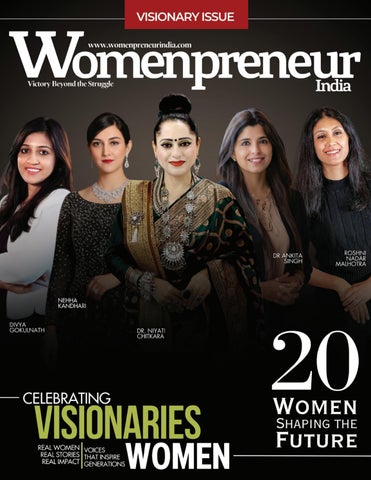
The Visionary Issue-20 Women Shaping the Future
Womenpreneur India
1
The Brief
2
Womenpreneur India
The Visionary Issue-20 Women Shaping the Future
Womenpreneur India
3
The Brief
4
Womenpreneur India
Womenpreneur India
The Visionary Issue-20 Women Shaping the Future
EDITOR’S NOTE
The Vision Edit A celebration of the women who imagine differently and act decisively Vision isn’t a gift — it’s a discipline. It’s the quiet courage to imagine what doesn’t yet exist and the persistence to bring it to life. The women featured in this issue don’t just follow trends; they sense what’s next and move toward it long before the rest of the world catches on.
Their stories aren’t about speed or scale — they’re about clarity, conviction, and creation. They remind us that leadership begins with the ability to see possibilities where others see limits, and to act on that vision with both head and heart. From redefining workplaces to reimagining communities, these women are proof that real progress starts with perspective.
This issue celebrates the thinkers and dreamers who turn foresight into action — who build with intention, lead with empathy, and prove that vision, when nurtured, becomes legacy. Each story reminds us that true vision is timeless — its courage in motion, and it always begins with a spark.
Here’s to women who look ahead, lift others with them, and keep their eyes firmly on the horizon.
CEO/Founder Vivek Malik
Managing Director Deepak Malik
Editors
Dr Shraddha Ruhela Nisha Lamba
Writer
Rosario De Sousa
Visual Storytelling & layout Design Priya Darshni, Tejpal Rawat
Sales & Marketing Consultant Gaurav Kundu, Tanuj seth
Legal Team
Nyaya Shastra legal
Publisher
Firstread Media Private Limited
Contact us FOR ADVERTISING INFO +971 58 575 1048 www.womenpreneurindia.com
Dr. Shraddha Ruhela Editor, Womenpreneur India Follow us partnerships@womenpreneurme.com www.instagram.com/thewomenpreneurind/ www.linkedin.com/company/womenpreneur-india/ posts/
The Brief
Powerful and inspiring events by Womenpreneur events@womenpreneurme.com
The Visionary Issue-20 Women Shaping the Future
contents
Contents
8
Womenpreneur India: Visionary Issue 20 Women visionaries Shaping the Future 13 16
The Brief The Rise of Conscious Capitalism: Profit Meets Purpose
In Focus From Listing to Leadership: How Women Listed is Redefining Visibility for Women Entrepreneurs in India
22
Trends
58
Shebuilds
66
The Digital CEO: Women Dominating Digital-First Business Models
Parul Shekhawat, Priyanka Shewani
Niraamaya Life Wellness In Tune with Her Rhythm: Niraamaya’s Journey in Female Wellness
Womenpreneur India
Contents
Womenpreneur India
32
Roshni Nadar Malhotra
33
Arundhati Bhattacharya
34
Ghazal
35
Meghna
36
Upasana Taku
37
Divya Gokulnath
38
Richa kar
39
Shanti Ekambaram
40
Dr. Ankita Singh
42
Dr. Niyati Chitkara
44
Harliin Sachdeva
45
Nehha Kandhari
47
Zarin Daruwala
48
Saily Lad
Leading HCL with Vision and Empathy
Reinventing Leadership from Banking to Tech
Building a Brand That Cares
the IndiQube Story: Reinventing Office Culture
Building Fintech with Grit and Heart
Redefining Learning and Leadership at BYJU’S
The Woman Who Made India Talk About Lingerie
A Trailblazer in Indian Banking
Empathy as a Strategy, Equity as an Advantage
Designing the Future
Leading India’s Clean Beauty Revolution
Painting Positivity, Healing, and Abundance
Steering Banking Through Change
Building Smart Cities with Vision and Grit 9
The Brief
The Visionary Issue-20 Women Shaping the Future
The Brief
12
Womenpreneur India
THE BRIEF
The Visionary Issue-20 Women Shaping the Future
The Rise of Conscious Capitalism: Profit Meets Purpose
Exploring the new wave of womenled brands built on ethical supply chains, sustainability, and social impact, from circular fashion to climate-tech startups.
W
The Brief
hen we think of capitalism, many imagine profit-first businesses, cutthroat competition, and relentless growth. But in recent years, a quietly powerful wave has been rising—conscious capitalism, where profit and purpose not only coexist but feed each other. At the heart of this movement are women-led brands that redefine success through ethics, sustainability, and social impact. From circular fashion houses to climate-tech startups, these founders are creating new business DNA—ones that generate financial returns while healing communities, ecosystems, and value systems.
The Shift from “Do Well” to “Do Right”
A few years ago, building a business with a mission was a niche narrative. Today, it is increasingly mainstream. Consumers, especially younger generations, demand accountability—not just in what they buy but in who they support. Amid climate crises, awareness about labor justice, and rising social inequities, brands anchored in values are gaining not just moral currency but commercial traction.
In India, a new generation of women entrepreneurs is leading this change. Textile visionary women are weaving sustainability into every seam. Startups are developing tools that allow brands to measure and manage environmental footprints. Ethical beauty, circular fashion, climate-tech, and social enterprises no longer sit on the fringes—they are edging into the mainstream. Take the fashion sector. Labels like Boito, founded in 2023 by Richa Maheshwari, fuse Odisha’s handwoven heritage with modern luxury, emphasizing eco-friendly materials and supporting local weavers. In similar spirit, brands like I Was a Sari and No Nasties are transforming textile waste or using organic fabrics to produce garments that carry a story, not just style. These brands do more than look good—they carry meaning. Beyond fashion, climate-tech is becoming a bat14
tleground for ethical innovation. Indian startups are developing digital tools to help manufacturers track water usage, greenhouse gas emissions, and supply chain impact. Investors are starting to back women-led climate ventures in greater numbers, finding that gender diversity correlates with more resilient capital efficiency and deeper community impact.The movement is not just about reducing harm—it is about reshaping industry norms from the inside out.
Why Women Are Emerging as Leaders in Conscious Capitalism
Women frequently navigate life under extra scrutiny, with fewer second chances. Many have faced structural barriers, cultural expectations, and reduced access to capital. Yet these constraints have also instilled a sharper lens on justice, empathy, and equity. When women lead conscious enterprises, their choices often carry a deep sense of responsibility—to people, planet, and purpose. According to a recent analysis by RMI, investing in female founders in the climate-tech sector is not charity—it is smart investing. Women-led climate ventures tend to deliver higher returns, stronger capital efficiency, and more impactful community outcomes. In Southeast Asia, IFC and New Energy Nexus recently selected 26 women-led climate startups to join a fast-
Womenpreneur India
The Visionary Issue-20 Women Shaping the Future track accelerator—an affirmation that climate entrepreneurship is not gender-blind, but deeply gender-informed. In India, voices like these are becoming more visible. Women in sustainable retail, design, and social business are not only launching brands— they are reshaping supply chains, industrial norms, and consumer expectations. Each founder becomes a living counterexample to the idea that ethics must cost you growth.
How Purpose Becomes Profit
Of course, integrating purpose into business is not easy. It is often more expensive, more regulated, and more scrutinized. But women-led conscious brands are proving that thoughtful strategies and transparency can build longevity and loyalty. 1. Vertical transparency and traceability
Brands that insist on recording every step—from fiber to finished product—invite both accountability and consumer trust. When a consumer can look up where cotton was grown, by whom, under what conditions, that transparency becomes a competitive edge. 2. Circular and regenerative models
Rather than disposing waste, these brands find ways to loop it back—through refurbishing, recycling, or redesigning business models to use waste as input. That means reducing cost leakage and generating secondary revenue streams. 3. Community partnerships and shared ownership Many conscious brands embed profit-sharing, cooperative models, or training programs for artisans. Ownership becomes collective, and success becomes plural, not singular.
Challenges and the Road Ahead
Even as optimism grows, roadblocks remain. Scaling ethical supply chains can strain logistics and cost. Regulatory ambiguity can slow adoption of circular models. Consumer price sensitivity can disrupt premium positioning. And funding is still harder to secure for mission-first ventures, especially in capital-intensive areas like climate-tech. Moreover, some brands suffer from “purpose fatigue”— where consumers or investors accuse them of virtue signaling. That is why authenticity matters. Without internal alignment, mission becomes a hollow shell.
To survive and thrive, these women leaders must combine tenacity with adaptability. They must network across borders, partner with unconventional allies, stay transparent about failures, and keep their mission alive in every product, decision, and hire. The total addressable market for conscious brands is expanding fast. Governments are tightening ESG compliance. Global supply chains are under pressure for disclosure and carbon footprint limits. In India, startups that were once niche are now stepping into a much bigger stage.
4. Technology as enabler, not just differentiator
A Vision for the Future
5. Storytelling with integrity
Profit will no longer be the sole bottom line—it will be intertwined with purpose in the DNA of enterprise. In that landscape, women-led conscious businesses are not exceptions—they are the prototype. Because when profit meets purpose, you get not just growth—but regeneration.
Women in climate-tech are designing tools that bridge data and ethics—platforms for emissions accounting, supply chain audits, or efficient resource usage. These tools are sold as services, but they embed impact into users’ operations. In conscious business, branding is not a veneer but a mirror. These founders speak openly about constraints, trade-offs, and lessons learned. Storytelling becomes trust-building, not marketing.
Womenpreneur India
In the next decade, the brands that will dominate are not those with sheer scale, but those with resilient values. Women who choose empathy over shortcuts, equity over exclusion, and sustainability over speed are writing a new business grammar. As they do, they are shifting not just markets, but mindsets.
15
In Focus
I
ndia today is home to over 13.5–15.7 million women-owned enterprises, contributing nearly 20% of all MSMEs. Yet, the vast majority remain small, unregistered, and invisible in mainstream business ecosystems. For many women, entrepreneurship begins as a side hustle— selling handcrafted goods, food items, or services via local networks, WhatsApp groups, or word of mouth. But in a hyper-digital economy, invisibility translates to lost opportunities. Without discoverability, even the most innovative product struggles to reach its market. This is where Women Listed, India’s first curated visibility and discovery platform for women entrepreneurs, is making a bold difference.
Founded by Meeta Gutgutia, co-founder of Ferns N Petals and Sipping Thoughts, Women Listed was built on a simple insight: “Women don’t need more motivation to start; they need platforms that showcase them, amplify them, and connect them.”
The Power of a Digital Storefront
At its core, a Women Listed profile is much more
16
Womenpreneur India
The Visionary Issue-20 Women Shaping the Future
than a directory listing. Think of it as a 24/7 digital storefront, designed to make businesses not only visible but also credible. A well-crafted profile includes:
• Brand Visuals – Logo or professional images for instant recognition.
• Business Description – Concise, compelling, and custom-
er-friendly. Accurate Categorisation – Ensuring placement in relevant search results. Product Showcases – Photos, videos, or links that create purchase intent.
Updated Contact Information – Critical for trust and conversions.
In a digital-first marketplace, this combination works like a business card, brochure, and mini-website rolled into one. For women founders with limited technical expertise or budgets, Women Listed provides a simple yet professional stage to be discovered.
WhatsApp Communities: Networking with Intent
One of Women Listed’s most powerful tools lies in its curated WhatsApp entrepreneur communities. Unlike generic chat groups, these are moderated spaces for meaningful networking, collaborations, and knowledge exchange. Active members use these groups to:
• Introduce themselves and their businesses.
• Share offers, upcoming workshops, or exhibitions.
• Crowdsource recommendations, vendors, or solutions.
• Collaborate with fellow entrepreneurs on co-branded initiatives.
For many solopreneurs, especially those outside metros, this direct peer-to-peer access opens doors that traditional networking events often fail to provide.
As Gutgutia notes, “A WhatsApp introduction today can become tomorrow’s business partnership, supplier, or anchor client.”
Events: Beyond Exhibitions, Into Ecosystem Building
Visibility doesn’t end with a profile—it must be brought to life through real-world engagement. Women Listed has created a strong events calendar designed to spotlight women-led ventures in high-visibility contexts. Key events include:
• Elevator Pitch Sessions – Where en-
trepreneurs learn to articulate their business vision in minutes.
• Business Mastery Workshops – Cover-
Womenpreneur India
17
In Focus ing essentials from branding to finance.
• Curated Exhibitions & Pop-ups – Like Bazaar: The Gift
Edit or Women Food Festival, which showcase women-owned brands to thousands of conscious consumers.
• Networking Mixers – For collaborations across industries.
Unlike traditional trade fairs, these events are curated, niche, and conscious, attracting not just customers but also mentors, collaborators, and potential investors.
Premium Subscriptions: Scaling with Structure
Recognising that women entrepreneurs are at different stages of growth, Women Listed offers tiered premium plans.
• HIP Plan – Ideal for beginners. Offers a verified listing, access to events, and basic visibility.
• GROW Plan – Adds Zoom learning sessions, enhanced
listings, and exposure through Women Listed’s digital channels.
• IMPACT Plan – For scaling businesses. Includes featured spotlights, blog mentions, marketing consultations, and priority access at flagship events.
For a fraction of the cost of traditional marketing campaigns, these subscriptions systematise visibility and create measurable ROI in terms of leads, collaborations, and brand awareness.
Why Visibility Matters: Beyond Marketing
Visibility is often mistaken for mere marketing. In reality, it has three deeper functions for women entrepreneurs: Trust Building
• Customers are wary of unknown brands. A verified list-
ing on a curated platform creates instant legitimacy. Searchability & SEO
• Being listed provides valuable backlinks and NAP
(Name-Address-Phone) consistency, boosting search
18
rankings. Community & Ecosystem Access
• Visibility is not just about being seen by custom-
ers—it’s about being known by peers, mentors, and enablers. Thus, a Women Listed profile becomes both a credibility signal and a growth engine.
Case in Point: Stories of Impact
Take the case of Anita Sharma, a home-based baker from Jaipur. Before Women Listed, Anita relied on friends and neighbours for referrals. Post her profile listing and a pitch session, she collaborated with a Delhi-based café chain for weekend dessert pop-ups. Today, 40% of her revenue comes from collaborations discovered through Women Listed. Or Radhika Iyer, who runs a small organic skincare brand. Being featured on Women Listed not only brought her customers but also connected her to a Mumbai-based wellness retreat that now stocks her products in bulk.
These stories underline a critical truth: visibility accelerates growth far faster than traditional advertising for small businesses.
A CEO’s Perspective: Why Ecosystem Platforms Matter
For CEOs, CXOs, and ecosystem leaders, Women Listed offers more than just inspiration—it presents a framework for inclusive growth.
Womenpreneur India
The Visionary Issue-20 Women Shaping the Future
Talent Pipeline – Women entrepreneurs are a reservoir of innovation and resilience. Platforms like Women Listed surface this talent for collaborations and acquisitions.
CSR & ESG Alignment – Partnering with women-owned businesses directly supports SDG 5 (Gender Equality) and enhances ESG ratings. Market Expansion – Women entrepreneurs often serve niche, under-penetrated markets—collaborating with them helps corporates diversify supply chains.
The Larger Movement: Democratizing Entrepreneurship
Women Listed is not an isolated initiative. It is part of a larger movement to democratize entrepreneurship in India by: Lowering entry barriers through affordable digital tools. Normalising women in business by mainstreaming their visibility.
Building solidarity through commuWomenpreneur India
nity-driven discovery and collaboration. In many ways, it’s not just a platform but a parallel economy of women-led enterprises, rewriting the narrative from “side business” to “scalable venture.”
Future Roadmap: Tech + Community Looking ahead, Women Listed plans to integrate: AI-driven discovery tools to match businesses with relevant customers and partners. Localized cohorts to spotlight regional entrepreneurs in tier 2 and 3 cities. Investor showcases to connect growth-ready women-owned businesses with capital.
The vision is clear: to make discoverability and credibility universal, not optional for every woman entrepreneur.
Final Word: Visibility as Empowerment
For women entrepreneurs in India, the journey from idea to enterprise is often lonely. Platforms like Women Listed serve as allies, amplifiers, and accelerators.
By offering curated visibility, active communities, structured events, and scalable premium tools, Women Listed transforms the challenge of invisibility into the power of discoverability. For women entrepreneurs, the message is simple: “Don’t wait for opportunities to find you—list yourself where you can be found.” For CEOs, the takeaway is strategic: “The future of business growth in India is not just digital-first but inclusivity-first.”
And for the larger ecosystem, Women Listed stands as proof that when women are seen, they are not just heard—they lead.
19
20
Womenpreneur India
Womenpreneur India
21
Trends
I
n a world where innovation moves at the speed of a click, a new wave of leaders is rewriting the rules of business. These are the Digital CEOs — women who are not just adapting to the online economy but mastering it. From launching e-commerce empires in their living rooms to steering global tech startups from the cloud, they are proving that the future of business leadership is not only digital but also distinctly feminine. The digital revolution has done more than change how we work. It has changed who gets to lead. Freed from the old gatekeepers of industry, women across the world are seizing the opportunity to build, scale, and lead businesses that reflect their values, creativity, and ambition. The modern Digital CEO is visionary yet grounded, data-driven yet human-centered, ambitious yet collaborative. She is redefining power in a space where authenticity, agil-
22
ity, and innovation matter more than hierarchy and tradition.
The Digital Shift: Why Women Thrive Online
When the pandemic forced the world to move online, it did more than accelerate digital transformation. It leveled the playing field. From small towns in India to major cities in Europe and the United States, women began using the digital space to launch side hustles, scale existing enterprises, or build entirely new ventures from scratch. Digital-first business models have opened doors that were once firmly shut. Entrepreneurs no longer need a physical storefront, a large office, or traditional venture capital to reach their customers. The tools of success are now within reach: a laptop, a reliable internet connection, and a compelling idea.
Womenpreneur India
The Visionary Issue-20 Women Shaping the Future Women have embraced this shift with remarkable energy and creativity. Studies show that women-owned digital businesses have grown at nearly twice the rate of those led by men in the past five years. Platforms such as Shopify, Etsy, and Instagram have become powerful launchpads for female founders who blend business acumen with personal storytelling and community building. What distinguishes many of these women is not just their use of technology but their ability to connect with people. The digital world rewards empathy, collaboration, and authenticity — qualities that have long been undervalued in traditional business settings.
“The digital economy rewards those who can build trust and tell a story,” says Maya Chen, founder of a wellness-tech company that offers AI-powered health solutions. “Women have always been natural storytellers and community builders. Online, those qualities translate directly into success.”
Redefining the Digital-First Business Model
A digital-first business is one that operates primarily online, engaging customers, managing operations, and scaling through digital tools. Yet this definition encompasses a broad range of industries and models.
Some women are leading e-commerce brands that reach thousands of customers around the world, often from small home studios. Others are creating educational platforms that teach millions of learners. Some have built technology startups that offer software solutions, while others are influencer-entrepreneurs who have turned their personal brands into thriving business ecosystems.
Consider Ankita Bose, co-founder of Zilingo, who built a digital fashion marketplace connecting small manufacturers in Southeast Asia with global retailers. Or Huda Kattan, who transformed her passion for makeup blogging into Huda Beauty, a billion-dollar cosmetics brand that began on Instagram. Another example is Rachel Rodgers, founder of Hello Seven, who turned her expertise as a lawyer into a digital education company that helps women
Womenpreneur India
entrepreneurs build wealth online.
What unites these women is their ability to leverage technology not only to sell products or services but to scale their impact. They use data, automation, and social media engagement to grow smarter and faster than ever before. These women are not simply going digital. They are building digital ecosystems that thrive on agility, real-time feedback, and the ability to pivot quickly. In a post-pandemic world where uncertainty is constant, these qualities are the foundation of resilience and growth.
Profiles in Digital Leadership: Women to Watch Tobi Lou, Founder of HerTech Collective
Tobi Lou began her career in corporate IT and quickly noticed how few women occupied leadership roles in the field. Determined to change that, she launched HerTech Collective, a mentorship platform designed to connect women in technology across the globe. The business, entirely digital from day one, grew into a thriving community of more than fifty thousand members. It offers mentorship, online courses, and job placements. “I built this business with purpose and a Wi-Fi connection,” Lou says. “Technology gave me the tools, but purpose gave me the drive.” Lina Marquez, CEO of Casa Verde Living
When Lina Marquez lost her hospitality job during the pandemic, she turned her passion for sustainable home décor into a business. Using Shopify and social media, she launched Casa Verde Living, a digital-first lifestyle brand that now serves cus-
23
Trends ing rather than as threats. They experiment constantly, adapt to feedback, and welcome change. In a fast-moving online economy, resilience and curiosity are worth as much as financial capital. Digital Fluency
They may not all be coders, but they understand the language of digital business. They know how to use analytics dashboards, automation tools, and AI-driven insights to make informed decisions. They understand the importance of user experience, search optimization, and engagement metrics. Storytelling as Strategy
These women know that connection drives conversion. They use storytelling not only to market products but also to humanize their brands. By sharing their journeys, struggles, and values, they turn audiences into loyal communities. Purpose-Driven Leadership tomers in fifteen countries. Marquez attributes her success to experimentation and perseverance. “I did not have investors or a marketing team,” she says. “But I had creativity, Instagram, and a belief that beauty and sustainability can coexist.” Dr. Nisha Rao, Founder of MindfulTech
A neuroscientist by training, Dr. Rao wanted to bring mental wellness tools to the digital era. Her app, MindfulTech, uses artificial intelligence to personalize mindfulness exercises for users. With more than two million downloads, it has become one of the fastest-growing wellness apps in Asia. “Digital-first does not mean impersonal,” she says. “It means scalable empathy. It means using technology to reach people where they are, whenever they need support.” Each of these women illustrates a new kind of leadership that combines technological fluency with emotional intelligence. They prove that innovation and empathy are not opposing forces but complementary strengths.
The Playbook: What Makes a Successful Digital CEO
Although every entrepreneurial journey is unique, certain patterns appear consistently among women who excel in digital-first business models. A Growth Mindset Digital CEOs see challenges as opportunities for learn-
24
Most women-led digital businesses have a mission that extends beyond profit. Whether focused on sustainability, inclusivity, or empowerment, their purpose gives them clarity and fuels long-term commitment. Collaboration Over Competition
In the digital landscape, collaboration has replaced competition as the main growth driver. Many women founders form partnerships, co-host webinars, or share audiences through social media campaigns. They understand that success grows exponentially when shared.
The Challenges Behind the Screen
Despite all the opportunities the digital economy provides, women entrepreneurs still face obstacles, both familiar and new. Online visibility can be empowering but also exposes female founders to harassment and criticism. The constant demand to stay active online often leads to burnout. For many women balancing entrepreneurship with caregiving or household responsibilities, the pressure to always be available becomes overwhelming. Funding remains another significant challenge. Although women are building high-growth digital businesses, they continue to receive less
Womenpreneur India
The Visionary Issue-20 Women Shaping the Future
than two percent of global venture capital funding. Many are forced to bootstrap their ventures or rely on crowdfunding and community-driven financing. Technological change is relentless. Algorithms shift, platforms evolve, and new tools emerge almost daily. Staying relevant requires ongoing learning, experimentation, and strategic flexibility. “Being a Digital CEO means living in a constant state of evolution,” says Lina Marquez. “You are always improving not just your business but yourself.”
The Future Is Female and Digital
The momentum is impossible to ignore. According to recent reports, women-led digital businesses are expected to grow faster than their maleled counterparts by the end of this decade. As digital access expands globally, women from diverse backgrounds are entering entrepreneurship through new online pathways. Emerging technologies such as artificial intelligence, Web3, and digital finance offer even
Womenpreneur India
greater possibilities. Women are already at the forefront of building ethical AI solutions, creating decentralized finance communities, and establishing digital collectives that combine commerce with social activism. However, to sustain this progress, structural support must continue to improve. Governments, investors, and private companies have begun recognizing the potential of women entrepreneurs and are investing in programs that promote inclusion. Initiatives like Google’s Women Techmakers and Meta’s SheMeansBusiness are helping women gain digital skills and confidence to grow their ventures. The rise of the Digital CEO is not just an economic trend. It is a cultural transformation. It is changing how society perceives leadership, success, and influence.
Redefining Success on Her Terms
For decades, success in business was measured by size, speed, and scale. The women leading digital-first companies are adding new dimensions: freedom, purpose, and impact.
The Digital CEO does not necessarily dream of becoming the next corporate giant. She may instead want to build a business that allows her creative freedom, uplifts her community, and supports her lifestyle. In her world, growth is measured not only in profits but also in the number of people empowered, the ideas realized, and the values upheld. In a digital economy that rewards authenticity and adaptability, this approach is not an exception. It is becoming the standard.
The Final Word
The world of business is no longer confined to corner offices or glass boardrooms. It is being built in home studios, in co-working spaces, and on laptops by women who believe in the power of possibility. The Digital CEO is not waiting for permission. She is creating her own path, leading with empathy, innovating with intelligence, and proving that the next chapter of global entrepreneurship will not only be digital but also profoundly shaped by women.
25
Leadership
F
or decades, leadership was defined by control, charisma, and the ability to make tough calls. The ideal leader was decisive, confident, and unshakeable under pressure. But the world of work has changed. Today’s employees expect not just direction but connection. They want to be seen, heard, and valued. In this new era, emotional intelligence, not authority, is emerging as the true currency of leadership.
At the heart of this shift is a simple truth. Leadership is no longer about commanding teams, it is about understanding them. It is not about knowing all the answers, but about knowing how to ask the right questions and truly listen to the answers. Across industries, emotionally intelligent leaders are proving that empathy and excellence are not opposites, they are interdependent forces driving innovation, loyalty, and long-term growth.
Why Emotional Intelligence Matters More Than Ever
The workplace is more complex, diverse, and distributed than ever before. Hybrid models have blurred boundaries between professional and personal lives. Global teams collaborate across cultures and time zones. In this fluid environment, technical expertise is no longer enough. The leaders who thrive are those who can navigate emotions, both their own and those of others, with clarity and grace. Emotional intelligence, or EQ, is not about being nice. It is about self-awareness, empathy, communication, and the ability to manage relationships effectively. According to a 2024 study by the World Economic Forum, emotional intelligence now ranks among the top three skills defining the future of leadership, alongside analytical thinking and resilience. Leaders with high EQ are found to have stronger decision-making abilities, lower turnover rates in their teams, and higher engagement scores. The data is persuasive, but the human stories are even more telling. During the pandemic, many organizations discovered that the most effective leaders were not the loudest voices in the room, but those who led with compassion. They were the ones who checked in before checking up, who asked “How are you?” before asking “Where’s the report?” That shift may have started as a crisis response, but it has since evolved into a permanent redefinition of what leadership looks like.
The New Model: Leading with Empathy and Clarity Empathy is the foundation of emotional intelligence, but effective leadership requires balance. Being empathetic does not mean avoiding hard conversations, it means approaching them with understanding and fairness. It means recognizing that performance and well-being are deeply connected. Modern leaders are learning that empathy and accountability go hand in hand. When leaders listen and act with compassion, their teams become more open, creative, and resilient.
Womenpreneur India
The Visionary Issue-20 Women Shaping the Future The result is not just a happier workplace but a more productive one. According to Harvard Business Review, companies led by empathetic leaders report up to twenty percent higher performance outcomes and significantly improved retention rates.
Dr Ankita Singh, Chief People Officer at Relevance Lab, captures it perfectly in her leadership philosophy: “Empathy is not the opposite of efficiency, it is the enabler of it.” Her approach reflects a growing recognition that emotional intelligence is not a soft skill, it is a strategic advantage.
Women and the Emotional Intelligence Edge
It is no coincidence that many of the most admired leaders of this generation are women. Studies consistently show that women score higher on most dimensions of emotional intelligence, including empathy, social responsibility, and interpersonal relationships. This natural ability to connect, communicate, and collaborate is reshaping leadership norms. Take, for instance, the women leading India’s technology, education, and sustainability revolutions. Whether it is Aditi Avasthi of Embibe blending AI with emotional insight in education, or Roshni Nadar Malhotra driving purpose-driven innovation at HCL, women leaders are proving that emotional awareness can coexist with strategic rigor.
This shift is not about gender advantage but about leadership evolution. As organizations become more human-centric, the qualities that women leaders often bring to the table, empathy, adaptability, and inclusive thinking, are becoming the very qualities businesses need to thrive.
How Leaders Can Cultivate Emotional Intelligence
Emotional intelligence is not innate, it can be developed through awareness and practice. The most effective leaders are those who continually reflect, learn, and adjust. Here are a few ways forward-thinking executives are cultivating EQ in the workplace. 1. Practicing Self-Awareness
The first step in leading others is understanding yourself. Leaders are increasingly investing time in reflective practices such as journaling, meditation, or executive coaching to identify their emotional triggers and biases. Awareness creates choice, and choice enables better reactions
Womenpreneur India
under pressure.
2. Building Psychological Safety Teams innovate when they feel safe to speak up. Leaders who foster openness and vulnerability create cultures where mistakes become lessons, not punishments. This environment encourages creativity, risk-taking, and continuous learning. 3. Listening to Understand, Not to Respond Active listening is one of the most underrated leadership skills. In a world that rewards speed, slowing down to truly understand others’ perspectives can transform communication and trust.
4. Leading with Transparency Authenticity is the new authority. Leaders who communicate openly about challenges, goals, and decisions create deeper alignment and respect. Transparency builds credibility faster than perfection ever could. 5. Coaching Instead of Commanding Today’s employees do not want bosses, they want mentors. Leaders who guide rather than dictate inspire more ownership and initiative. Coaching conversations replace annual reviews, turning feedback into an ongoing dialogue.
Emotional Intelligence and the Future of Work
As AI and automation reshape industries, human-centered skills will become the ultimate differentiator. Machines can process data, but they cannot feel empathy. Algorithms can optimize performance, but they cannot inspire trust. The leaders of tomorrow will be those who blend intelligence with intuition, data with empathy, and precision with purpose. Emotional intelligence also plays a crucial role in managing diversity and inclusion. In global teams, cultural sensitivity and the ability to navigate differences are essential. EQ-driven leaders create inclusive spaces where varied voices are valued and diverse perspectives fuel innovation.
The rise of remote and hybrid work has made emotional intelligence even more essential. When teams are physically apart, emotional connection becomes the glue that holds them together. Leaders who can sense disengagement, loneliness, or burnout, even through a screen, are the ones who sustain team cohesion 27
The Brief
28
Womenpreneur India
The Visionary Issue-20 Women Shaping the Future
Womenpreneur India
29
The Brief
20 WOMEN VISIONARIES SHAPING THE FUTURE
The Visionary Issue-20 Women Shaping the Future
Womenpreneur India
31
The Visionary Issue
When Roshni Nadar Malhotra talks about AI, she often begins not with jargon, but with surprise. “People don’t realise,” she said at Davos in 2025, “that AI may be the most democratised technology yet.” It’s a line that reveals much about her mindset: she sees tech not as a barrier, but as a gateway, something meant to be woven into everyday life, not hoarded at the top. Today, as Chairperson of HCL Technologies, she stands as a symbol of what leadership can be bold, humane, and purpose-driven. She is also India’s first woman to lead a listed IT firm. That status comes with expectations and scrutiny, but for Roshni, it’s simply another opportunity to shift the narrative. Her earliest chapters were far from tech. After a media degree at Northwestern University, she explored journalism, content, and storytelling. Over time, she found her path wasn’t fixed, it wove through narrative, business, and purpose. That fluidity shaped how she leads: recognising the power of communication, culture, and clarity in steering organizations through change. When Roshni stepped into HCL’s leadership circles, she confronted a lifelong learning curve. She once told Egon Zehnder, “Being comfortable with being uncomfortable is something I 32
worked on … being one of the youngest in the room teaches you a lot.” Over time, those early insecurities gave way to conviction, that leadership is not about knowing everything, but about listening, adapting, and lifting others.
Under her watch, HCL has doubled down on people-centric initiatives. She’s championed programs like TechBees, which engages Grade 12 students through structured training. These students work in billable roles while pursuing their engineering degrees on weekends. Roshni calls this shift a cultural transformation in the making. She has also pushed HCL to marry AI with everyday service lines, building labs globally, expanding managed services, and embedding AI into the software lifecycle. But she refuses to let tech eclipse humanity. In her view, people will always be at the heart of it all, discussions of P&L, attrition, performance must always walk side by side with conversations about inclusion, psychological safety, and diversity.
Womenpreneur India
The Visionary Issue-20 Women Shaping the Future
Arundhati Bhattacharya has always been a name synonymous with leadership, resilience and change. For over four decades she built her career in banking, eventually making history as the first woman to lead the State Bank of India. Many would have ended their journey there, content with leaving behind a legacy that already broke barriers. But Arundhati is not one to stand still. In 2020 she surprised many by stepping into the world of technology as the Chairperson and CEO of Salesforce India. It was a leap across industries, but one that revealed her belief in lifelong learning and reinvention. She has often said that curiosity is a survival tool, and her time at Salesforce has reflected exactly that. In interviews she speaks about asking hard questions, about being willing to unlearn and relearn, and about the importance of staying open
Womenpreneur India
even after decades of experience. This approach has allowed her to steer Salesforce India through years of rapid transformation. Revenue has multiplied several times under her watch, growing from about 1,500 crore to more than 9,000 crore, and the company has kept up hiring even during uncertain economic cycles. For Arundhati, numbers alone are never enough. She insists that the customer must be at the centre of every decision. Technology, in her view, is not about complexity but about making life easier for the people who use it. That clarity has helped Salesforce India strengthen its role in fields like cloud services and artificial intelligence, especially as India positions itself as a hub for digital innovation. She is also candid about workplace culture. Having experienced the bureaucracy of the public sector, she was amused to discover her own version of red tape in the private world. She has spoken openly about the need to break down hierarchies, encourage young voices and lead with empathy. At Salesforce India she has worked to build an environment where innovation is matched with inclusivity and where people feel they can bring their best selves to work.
33
The Visionary Issue
When Ghazal Alagh co-founded Mamaearth in 2016, she was not trying to build a billion-dollar company. She was simply trying to find safe products for her newborn son. What began as a mother’s concern soon grew into one of India’s most powerful stories of purpose-driven entrepreneurship. Today, Mamaearth stands as a household name and a movement that changed how Indian consumers think about personal care, proving that empathy can be the strongest business strategy of all. Before becoming an entrepreneur, Ghazal was an artist and corporate professional. But motherhood changed everything. When she realized that most baby products available in India contained harmful chemicals, she decided to create what she could not find—a brand that was safe, honest, and transparent. Partnering with her husband, Varun Alagh, she built Mamaearth from her living room, guided by one simple mission: “Goodness inside matters—whether in ingredients or in intention.” Mamaearth’s success lies not just in its clean and cruelty-free prod34
ucts but in the trust it has earned. Ghazal understood early on that modern consumers, especially women, care deeply about what they put on their skin and in their homes. By building India’s first “MadeSafe” certified brand, she gave people something more than products—she gave them peace of mind. Her leadership style mirrors her brand philosophy. Calm, grounded, and deeply empathetic, Ghazal leads by listening. She believes that a great business grows when its people and customers are heard. Her background as an artist helps her bring creativity to strategy, shaping campaigns that feel personal and authentic. From storytelling to packaging, every element of Mamaearth reflects her belief that beauty and wellness can coexist with purpose and responsibility. Ghazal’s journey also breaks stereotypes about women in business. As a mother, entrepreneur, and leader, she often speaks about balance as a myth and passion as the real anchor. Her advice to young women entrepreneurs is simple: “Don’t wait for perfect conditions. Start where you are, with what you have, and build from there.” Today, Mamaearth’s parent company, Honasa Consumer, has gone public and continues to expand globally. Yet Ghazal remains rooted in the same mission that started it all—to build with heart. In a world full of products that promise to care, she built one that truly does.
Womenpreneur India
The Visionary Issue-20 Women Shaping the Future
Meghna Agarwal’s path to founding IndiQube feels almost accidental, but the impact she has created is anything but unplanned. With an MBA in Finance from IMT Ghaziabad, her early ventures included a mineral manufacturing firm and co-founding HirePRO. During these years she and her team frequently moved offices. In 2013, they leased a large building—not just for themselves but began subleasing unused space to other businesses. That modest experiment planted the seed of what would grow into IndiQube, a platform reimagining how workspaces should feel and function. What strikes you about Meghna is how she leans into ambiguity. She didn’t come from real estate or property management. Instead, she saw a gap—a mismatch between standard office markets and what fast-growing companies truly needed: flexibility, integrated amenities, transparent management. Today, IndiQube is publicly listed out of Bengaluru, with its model spanning leased spaces, renovated buildings, and managed services. In its Q1 FY ’26 earnings, Meghna stepped forward as Chief Operating Officer and Executive Director to present a bold growth narrative, and the company
Womenpreneur India
reported revenues of over ₹1,100 crore and more than 2,000 employees across India.
Scale has not diluted the human core of the venture. Meghna still talks about designing environments that feel safe, predictable and alive. She believes trust is built not through polish but through consistency and empathy. Under her leadership, IndiQube has backed offerings like flexible pay-as-you-go models, smart renovations so Grade B buildings become Grade A experiences, and value-added services like food or transit for tenants. These moves reflect her insistence that a workspace must serve life, not just work. She is candid about challenges too. In investor calls, she acknowledges occupancy dips during ramp phases and the grit required to balance margins across newer and mature centers. She also accepts the responsibility of guiding a female-led leadership presence in a male-dominated real estate tech sector. Her belief is that change begins when you show up— not waiting for perfect conditions, but building them where you stand.
In a world where founders often chase the next big pivot, Meghna seems grounded in making the everyday better. Her story is not of sudden breakthrough but of incremental courage, of turning what other people see as messy into momentum. She reminds us that innovation is not always about new things, but about doing the ordinary with care, respect and scale.
35
The Visionary Issue
Upasana Taku seems to carry within her both the precision of an engineer and the empathy of a storyteller. With roots in Gandhinagar, Gujarat, she began life in a home that valued education and discipline, and she carried those values forward as she charted her path into fintech. She did her B.Tech in Industrial Engineering from NIT Jalandhar and then went on to earn a master’s degree in Management Science at Stanford. These academic credentials read like a roadmap, but her real journey began when she decided to come back to India. After stints at PayPal and HSBC in the US, where she absorbed lessons in payments, risk systems and product thinking, Upasana returned home with a vision: to make digital payments simpler, fairer and more accessible. In 2009 she co-founded MobiKwik with Bipin Preet Singh, and from small beginnings, she worked side by side in every function—product, finance, operations—building credibility not by titles but by delivery. She also co-launched Zaakpay as part of the MobiKwik universe, extending her influence into payment gateways for e-commerce. Upasana has always spoken openly about the challenges she faced as a woman founder in fintech. She recalls investor meetings where she was mistaken for an assistant and personal questions about her marital status would surface. When such biases emerged, she confronted them with clarity. She continued working
36
through pregnancy, led board meetings even when admitted in hospital, and insisted that performance and outcomes speak louder than gender assumptions. Under her financial leadership, the company has charted milestones: evolving from a recharge and wallet service to a platform offering UPI, credit, lending and more. When MobiKwik went public in December 2024, it was a testament to her resolve and the trust she had built over years. But for Upasana, the IPO was never the finish line. She often says that success is a continuum, not a moment to rest. What stands out about Upasana is how she combines ambition with rootedness. She remains connected to the everyday users of her platform, understanding the friction they face, and designing features that ease lives. Her mantra—kick up a storm or die trying—reflects both her grit and humility.
Upasana Taku’s story is not one of overnight success. It is a narrative of perseverance, vision and building with care. She reminds us that building legacy is less about grand gestures and more about showing up every day for the people who trust you.
Womenpreneur India
The Visionary Issue-20 Women Shaping the Future
Divya Gokulnath is more than a co-founder at BYJU’S. She is one of the driving forces behind how students in India learn today. Born and raised in Bengaluru, Divya came into the world of education in a way that merged curiosity, empathy, and ambition. She studied biotechnology at RV College of Engineering and early on showed a fascination for both science and people. When BYJU’S began in 2011, Divya stepped in not just as a partner but as someone who would shape its soul. She wasn’t there just for business. She taught video lessons, led content and brand marketing, and made sure the platform stayed rooted in what students actually needed. During the COVID-19 lockdown, she played a pivotal role in making BYJU’S lessons free, enabling millions to keep learning from home. The platform added 13.5 million users in just two months—and would grow from 50 million to 70 million in that same year.
One thing that stands out in Divya’s journey is how she blends the personal and the professional. She has talked about juggling her newborn, her son’s
Womenpreneur India
online classes, recording lessons, and board meetings all in the same day during the pandemic. She also faced the tougher challenges that women founders often face—questions about credibility, balancing roles, navigating expectations—and met them with clarity and conviction.
Today, Divya lends her voice to broader discussions. She writes about education reform, women in STEM, and equity in learning. She has been recognized among India’s most powerful businesswomen and was appointed Chair of the FICCI EdTech Taskforce in 2022. Even with BYJU’S scale and influence, Divya often says she still sees room to grow. For her, the challenge isn’t to simply build big—it’s to build well, with depth, integrity, and impact that lasts beyond metrics.
37
The Visionary Issue
There are entrepreneurs who launch businesses, and then there are those who start conversations that change a culture. Richa Kar belongs to the latter. As the founder of Zivame, she did something that was almost unheard of in India a decade ago. She made women talk openly about lingerie. When Richa started Zivame in 2011, the idea of buying intimate wear online was met with skepticism. Back then, most women in India hesitated to even say the word “bra” out loud, let alone walk into a store and ask for their size. Shopping for lingerie was awkward, uncomfortable, and far from empowering. But Richa saw an opportunity to change that narrative. She wanted to create a space where women could shop for themselves, on their terms, without embarrassment or judgment. What started as a simple e-commerce platform soon became a movement. Zivame not only offered products but also education. It introduced size guides, style tips, and a tone that felt friendly rather than transactional. The brand spoke to women the way a trusted friend would, helping them understand their bodies and choices. In doing so, Richa turned a taboo into a
38
category worth talking about. Her background in engineering and retail consulting helped her spot the gap in the market. But it was empathy that made her vision work. Richa understood that Indian women did not just need better lingerie, they needed confidence. They needed to feel seen. She often says that Zivame was never just about products; it was about making women feel comfortable in their own skin. The journey was not easy. Convincing investors to fund a lingerie brand in a conservative market was a challenge. So was explaining to potential employees that they would be working in an industry that most people did not even discuss. But Richa stayed focused, backed by her belief that empowerment often begins with small, personal choices. Today, Zivame stands as a household name that redefined how Indian women shop for intimate wear. It is also a testament to what happens when courage meets vision. Richa Kar did not just build a brand, she built a movement that taught millions of women to own their choices, their comfort, and their confidence. Her story reminds us that sometimes, true entrepreneurship is not about chasing trends but about changing mindsets.
Womenpreneur India
The Visionary Issue-20 Women Shaping the Future
For nearly three decades, Shanti Ekambaram has been a name synonymous with leadership at Kotak Mahindra Bank. As President of Consumer Banking, she has steered one of India’s leading financial institutions through times of expansion, transformation and digital reinvention. Her journey is remarkable not just for its longevity but for the way it has shaped modern banking in India. Shanti began her career at Kotak in investment banking and quickly became a pioneering figure. She played a part in bringing global best practices to Indian markets, helping to introduce the country’s first book-built IPO and handling landmark equity issuances and advisory mandates. Her ability to bridge global standards with local realities made her a trusted advisor to both companies and investors. When she transitioned to consumer banking, her focus shifted from large corporate deals to individual customers. This was not a step down in scale but a recognition that India’s retail banking landscape was poised for revolution. Under her leadership, Kotak’s consumer banking business expanded rapidly, with millions of new customers, deeper penetration of digital platforms and a much stronger presence in both deposits and retail lending. She also oversaw the integration of ING Vysya Bank’s retail operations into Kotak, a complex merger that required vision, empathy and a steady hand. Shanti’s leadership has always been defined by
Womenpreneur India
clarity and conviction. She has often spoken about the need for banking to remain customer-centric, even as technology transforms the industry. For her, innovation is not about gadgets but about delivering trust, transparency and efficiency at scale. This balance of digital adoption and human connection is what has helped Kotak build loyalty in an increasingly competitive market. Her influence has been widely recognised. Business Today and Fortune India have repeatedly listed her among the most powerful women in business. Yet, for Shanti, recognition has never been the goal. She has devoted significant energy to philanthropy as well, raising funds for education and healthcare causes through events like the Mumbai Marathon.
Now, as she prepares to retire in October 2025, Shanti leaves behind more than financial results. She leaves behind a legacy of pioneering leadership, of pushing Indian banking toward global benchmarks while never losing sight of the everyday customer. For the many women in finance who followed her path, she remains proof that persistence, vision and empathy can change the shape of an entire industry.
39
The Visionary Issue
Some leaders chase numbers. Others chase applause. Dr. Ankita Singh, Board Director and Chief People Officer at Relevance Lab, chases purpose.
For her, leadership is not a choice between people and performance. It is the understanding that when people are placed at the center, performance follows naturally and exponentially. With over twenty-five years in the ITES industry, Dr. Singh has built a reputation for transforming businesses by transforming people. At Relevance Lab, she reimagines HR as a true business lever, introducing frameworks that protect profitability while fostering innovation, inclusion, and trust. Her belief is simple yet powerful: empathy is not the opposite of efficiency, and equity is not a hindrance to growth. When practiced with intention, they become the foundation of success.
Beyond corporate leadership, Dr. Singh is the Founder of the HR Association of India, a platform that unites HR professionals across the country to learn, share, and grow together. What began as a small initiative has evolved into a movement that redefines HR as a strategic partner in business. Her creativity extends far beyond leadership and HR. With Wordscape Publishing, Dr. Singh helps aspiring authors bring their stories to life, proving
40
once again that inclusion and empowerment are not just professional principles but personal values. Whether in business, education, or art, she continues to create ecosystems where every voice is valued and every idea has the potential to grow.
Her influence has earned recognition from Forbes and GMI as a Great People Manager for four consecutive years. As a member of the Forbes HR Council, she contributes to global conversations shaping the future of work. Yet beyond the accolades, her legacy lies in how she leads, with authenticity, grace, and conviction. Dr. Singh’s approach to leadership blends empathy with precision. She believes success is not about commanding attention but about creating conditions where others can thrive. Her mantra captures it best: when passion meets compassion, magic happens. That magic is not a metaphor but something tangible, reflected in stronger teams, innovative organizations, and communities that grow together. In every role she plays as a leader, founder, and mentor, Dr. Ankita Singh continues to prove that empathy is good business and purpose is the ultimate strategy.
Womenpreneur India
When Ashwini Asokan talks about AI, she doesn’t start with algorithms or models. She begins with people, what they feel, what they need, how AI can quietly smooth their daily lives. That perspective is what makes her leadership at Vue.ai (under parent company Mad Street Den) so compelling: technology with empathy at its core.
Ashwini’s journey is not a simple upward line. She earned her credentials at Carnegie Mellon University and went on to lead innovation portfolios at Intel Labs in Silicon Valley. But she always kept one foot in human stories. In around 2013, she returned to India, co-founded Mad Street Den with her husband, and began building AI solutions grounded in real-world problems. What stands out about her vision is how she refuses to dichotomize “cutting edge tech” and “everyday usability.” Vue.ai’s platform works across visual intelligence, retail automation, product tagging, personalization and workflow automation. It’s not built for tech’s sake, it’s built to help retail-
Womenpreneur India
ers scale smarter, faster, with less friction.
She also speaks honestly about the challenges of scaling AI in India. She notes that most AI work tends to be “Western model applied” without adapting to local languages, local visual styles, or the messiness of data that comes from real life. She calls for AI that is “AI-native”, meaning systems that understand our culture, context, and nuance. In funding rounds and strategy calls Ashwini often emphasizes clarity over complexity. Investors, she has said, respond to conviction, customer stories, and repeatable metrics. She also points out that in AI, both value creation and cost savings matter, helping customers grow revenue while cutting repetitive work.
Today, Vue.ai’s reach extends far beyond India. The company works with global brands, integrating intelligent workflows across merchandising, catalogues, image tagging, and customer experiences. But for Ashwini, scale is never the end goal. She measures success by how many businesses become stronger, more efficient, more human in their interface. Her story reminds us that AI isn’t about replacing humans. It’s about amplifying human insight, connection, and trust. And in a world of rapid tech evolution, that blend of intelligence and heart may be the edge we need most.
41
The Visionary Issue
Featured in Forbes India as one of the nation’s visionary entrepreneurs in education, Dr. Niyati Chitkara has redefined what it means to build schools for the future. As Vice President of Chitkara International Schools, she has created ecosystems where learning feels less like a burden and more like an exploration—where play meets research, where innovation is second nature, and where global exposure is built into the very foundation of education. In 2014, Dr. Chitkara was recognized as a Bill and Melinda Gates Scholar at TEDActive in Canada, a milestone that cemented her reputation as a forward-thinking reformer on the world stage. It seems only fitting that she was born on Teacher’s Day, a symbolic beginning for a life dedicated to turning education into a mission that transforms learners into leaders.
Her ideas about assessment have been captured in her internationally published book Assessment Quotient, which challenges one-dimensional grading systems and promotes a more human-centric approach. But perhaps her boldest contribution is the pioneering PhD-to-Playway model, a reverse-integrated framework that flips the conventional script of schooling. Instead of saving research, entrepreneurship, and real-world exposure for higher education, she brings them into classrooms from the earliest years. The results speak for themselves: under her leadership, students and teachers have filed more than 18 patents, living proof that innovation flourishes when curiosity is nurtured early. Dr. Chitkara’s philosophy also goes beyond academic achievement. She advocates for a balance of four quotients—Intelligence (IQ), Emotional (EQ), Skill (SQ), and 42
Happiness (HQ). This holistic model ensures that education does not just produce capable professionals but empathetic, resilient, and joyful human beings. At her schools, this vision takes tangible shape in Knowledge Walkways, Joy Hubs, Learning Studios, and Sustainability Centres—spaces designed to spark creativity, collaboration, and well-being.
Her impact extends far beyond India. She has spearheaded over 250 international collaborations, opening doors for students to engage with global institutions and industries. From introducing empathy and social-emotional learning through UNESCO MGIEP to weaving design thinking with the World Design Council, UK, Dr. Chitkara has consistently placed her students at the intersection of innovation and compassion. Strategic partnerships with global giants like Google, Canva, Adobe, Microsoft, IDP, and Access USA further ensure her learners are ready to thrive in an interconnected world. At the heart of it all lies her conviction that education is not linear. It is not a race of degrees and diplomas but a living, evolving blueprint that shapes individuals who can imagine, build, and lead. Dr. Niyati Chitkara has built more than schools—she has built a legacy of inquiry, creativity, and resilience. And in doing so, she has shaped a generation of learners who are prepared not only to succeed but to reimagine the future itself.
Womenpreneur India
Priyanka Goswami built WOORAY not just as a business, but as a statement: that children’s play deserves elegance, safety, and delight all at once. After fifteen years in the corporate world, she turned her gaze to a gap she saw in children’s entertainment in India, one that prioritized quality, hygiene, and a curated experience over mere fun. In 2022, she launched a boutique play area in Gurugram. Since then, WOORAY has grown rapidly through company-owned centers and franchises, driven by a vision that play is not trivial, it’s foundational. What sets WOORAY apart is how Priyanka blends design, premium service, and thoughtful operations. Every center emphasizes spacious layouts, impeccable hygiene, gourmet food, and safety protocols designed for discerning families. The brand aims to earn the trust of parents who demand more than slides and swings, they want an environment that nurtures joy, creativity, and peace of mind.
Womenpreneur India
Her growth plan is ambitious. As WOORAY strengthens its presence in Delhi–NCR, Priyanka is eyeing Tier-2 and Tier-3 cities, expanding the reach of premium children’s spaces. In 2025 alone, WOORAY Elite is set to launch in Hyderabad, followed by Chandigarh, with additional projects in Punjab. The brand’s early momentum is powered by a belief that parents will gladly trade up when quality meets purpose.
But growth isn’t just about numbers for Priyanka. It’s about upholding a promise: to offer something better than what the market has seen so far. In a field flooded with generic play zones, WOORAY aspires to be a benchmark, where safety, aesthetics, service, and experience coalesce.
Priyanka’s journey is a reminder that entrepreneurship sometimes begins not with radical ideas, but with noticing what’s missing right beside you. She teaches us that building for young lives means thinking deeply about trust, care, environment, and detail.
43
The Visionary Issue
Harlin Sachdeva did not start House Of Makeup because it was trending. She started it because she could not look away. After years in beauty and e-commerce with roles at Nykaa, Sugar Cosmetics and Unilever, she saw a gap few acknowledged. Most makeup in India still contained ingredients that she believed were harmful. That realization turned into a mission. She founded House Of Makeup to create a truly clean, vegan and cruelty free brand that does not make users compromise.
Her earliest inspiration came from childhood, watching her mother apply makeup in the evenings. It was a ritual of beauty and connection, one that left a lasting impression. As she moved through her career building digital and product teams in the beauty industry, she absorbed lessons about consumers, ingredients and trust. The spark for her own brand came when she began hearing women ask questions like, “Is this safe for sensitive skin?” or “Is this toxin free?” Those concerns became her guiding principles. What makes House Of Makeup stand out is its uncompromising commitment to global standards. Harlin has explained that the brand follows the European Cosmetic Directive, which bans more than 1300 ingredients. The
44
first customer for every launch is her mother, who tests products long before they reach the market. Each formulation undergoes months of sampling, heat and stability testing, efficacy checks and packaging compatibility reviews. Sourcing happens worldwide, from Korea to Germany, ensuring each product balances purity, performance and price. The road to growth has not been easy. Cosmetics is a capital intensive business where manufacturers demand payments up front, inventory cycles are long and demand can be unpredictable. Launching new products requires patience, and scaling too quickly risks compromising quality. Harlin embraces these challenges as part of the process, using them as feedback to improve rather than setbacks to fear.
What drives her is impact. She envisions House Of Makeup as the brand that women trust every single day, one that removes doubt and gives confidence even to those with sensitive skin. She believes women deserve better than to settle for “good enough” in beauty. Her journey reflects conviction, discipline and creativity, building a brand ingredient by ingredient and standard by standard until it can truly claim the title of clean beauty.
Womenpreneur India
The Visionary Issue-20 Women Shaping the Future
Some artists create for beauty. Others create meaning. For Nehha Kandhari, painting is a bridge between spirituality and creativity, an art form that carries the power to heal, uplift, and transform. Recognized as the world’s first Vastu compliant painter, Nehha’s journey is as unconventional as it is inspiring. Based in Mumbai and internationally known for her unique approach, Nehha believes that the purpose of her art is rooted in both spiritual practice and creative expression. Her philosophy stems from the idea that knowledge and energy transcend lifetimes, and that each brushstroke can channel positivity into a space. For her, painting is not only about aesthetics, it is about creating an environment filled with abundance, comfort, and harmony.
artwork aligns with the client’s environment and needs. Discretion and ethics, she insists, are at the heart of her practice.
Her efforts have not gone unnoticed. Nehha has been honored with multiple accolades, including the Iconic Woman in Arts and Creativity 2022 award by the Governor of Maharashtra, the Times Business Award for Culture and Art, and recognition as one of the Economic Times Most Influential Leaders. She has also been featured in Forbes India for her groundbreaking contribution to art and design.
With demand for her work growing rapidly, Nehha continues to balance her roles as an artist, entrepreneur, and mother of two. Each painting she creates is a labor of love and patience, designed to not just fill a space, but to transform it. For her clients, the result is more than art — it is an experience of healing, prosperity, and joy.
Her personal story adds weight to this belief. Nehha recalls the first time she placed one of her paintings in her own home, aligned to the correct Vastu direction. What followed was nothing short of astonishing. Her children began excelling academically, her husband experienced stronger business relations and clearer decision-making, and the family felt a renewed sense of harmony. It was as though the artwork had become a conduit for positive energy. “When I think back to that time, I still get goosebumps,” she says. This transformative experience set her on a new path. Today, every piece she creates is designed as a medium to emit positivity into society. Rooted in the ancient Indian science of Vastu Shastra, her process is deeply meditative. Each painting is made with focus, intention, and positivity imbibed into every stroke, so that the final artwork doesn’t just decorate a wall, but influences the energy of the entire space. Nehha also personalizes her work for each client. Through detailed consultations, she listens to their challenges and goals, and designs paintings tailored to their homes or offices. From size to imagery to colors, every element is chosen with care to ensure the
Womenpreneur India
45
The Visionary Issue
Sanhita Baruah doesn’t just write. She deciphers the heart. As an author and trauma-informed life and business coach, she weaves her own story into a mission: helping others rewrite theirs. Her LinkedIn describes her as a writer and transformation coach working with a trauma-informed approach to emotional resolution and mindset shifts.
Her literary work includes The Art of Letting Go, a book many have turned to in moments of transition. She also published Little Miss Happening, her debut novel, and has published poetry and notes across platforms. Over the years, she has built a reputation for speaking with honesty about pain, healing, and the strength in vulnerability. What makes Sanhita different from many coaches is her grounding in trauma-informed care. Rather than applying blanket solutions, she listens to the unspoken wounds—those that linger beneath surface choices and habits. On her Instagram, she introduces herself as a trauma-informed life and business coach helping people navigate the subconscious mind, emotions, energy, and mindset. She has coached over a
46
thousand minds, blending spiritual, psychological, and practical tools into her framework. Her journey itself reflects this blend of creativity and transformation. Growing up in Assam and later moving to Bangalore, Sanhita has merged her roots with global thinking. She founded SoulVersing, a platform that complements her coaching and writing, where she shares reflections and workshops on emotional wellbeing and self-discovery.
Sanhita’s approach is gentle but radical. She believes growth does not always mean pushing hard—sometimes it means creating space for what’s been suppressed. She advises business founders and creators alike that healing and ambition can walk side by side, not at odds. Her work encourages clients to lean into their stories, mend their relationship with their internal voices, and build meaningful change from within.
In a world that often equates success with output and metrics, Sanhita offers a counterpoint: that transformation begins with inner liberation. She shows that when we heal ourselves, we shift not just our stories but how we impact others. Her path—from Assam to author, coach, and voice for emotional clarity—is a testament to what happens when courage meets empathy.
Womenpreneur India
Zarin Daruwala has always navigated the currents, not just followed them. Over a banking career spanning more than 35 years, she rose through complex markets and leadership roles, eventually becoming CEO of Standard Chartered India and South Asia. In October 2024, the bank announced that she will retire on April 1, 2025 — marking the end of a defining chapter for the institution.
When she joined Standard Chartered in 2016, India was already a core market for the bank. Under her leadership, it became one of the group’s largest franchises by volume, reputation, and innovation. She brought focus to cross-border solutions in corporate and investment banking, wealth, and retail operations — pushing the bank to balance depth and reach in all its verticals. Zarin’s move to the top was no accident. She had long built her reputation in banking’s heavy-lift zones — spearheading large private credit deals such as transactions for Shapoorji Pallonji ($1.7 billion) and Vedanta
Womenpreneur India
($1.25 billion). Her ability to lead deals of scale, while remaining attuned to market risk, set her apart. What many remember is her candor about balancing the legacy of regulation with a digital-first future. She often speaks of culture change as being as critical as strategy — of flattening hierarchies, opening channels to younger talent, and leading with empathy as much as metrics. In internal circles, she was known to push for stronger synergies between businesses, insisting that each arm of the bank should help lift another, not just aim for individual excellence.
Her tenure was also defined by discipline in times of turbulence. In markets that faced volatility, she kept the compass on risk, even as she pushed growth. And as she prepares to hand off leadership, she insists that the real legacy is in strengthening institutions rather than cementing personal footprints. “India is not just a market to me,” she once said, “it’s a story I want to be part of.”
In retirement, Zarin is expected to take on new roles — including a board position at PhonePe, where she has recently been appointed. For many in banking, she will be remembered as a leader who saw banking as more than finance. She saw it as architecture for growth — for people, for markets, and for the trust that binds them.
47
The Visionary Issue
When Saily Lad talks about security and urban infrastructure, the energy in her voice gives away something deeper, this is personal. As Founder and Director of Volksara Techno Solutions, she is leading a mission to transform how cities operate, making them safer, smarter, and more responsive to citizens’ needs. Saily’s educational journey took her from the UK, with a BA in Strategic Management and Consulting from Nottingham Trent University and an MSc in Business Consulting from Royal Holloway, University of London, to the heart of India’s tech ecosystem. Armed with that foundation, she dove head first into solving real problems in the integrated security space.
Volksara started its journey as part of the Krystal Group. Its genesis came from a gap she noticed: traditional facility services lacked deep integration with technology. In 2016, Volksara emerged to serve that intersection, offering solutions in surveillance, systems integration, IoT, and smart city infrastructure. What began as a small crux in the security domain has now worked on highstakes projects across states and cities. The firm has been pivotal in smart city initiatives in Nashik, Pimpri Chinchwad, Namchi, Odisha and other regions, contributing to public safety, waste management, environment monitoring, and more.
coordination, local dependencies—and how persistence often outweighs perfection. “Don’t wait to seek approval, believe in yourself,” she shared in an interview. At Volksara, she has built a culture of inclusivity, integrity and collaboration. She calls her team a family of young professionals who share her passion and values. Every system they build is custom-designed: surveillance solutions aligned with city layouts, waste systems built with IoT, integrated command centers that act not as glorified control rooms, but as responsive engines for clean, safe urban life. One of the proudest achievements under her leadership is her work during important civic events like the Kumbh Mela in Nasik, where Volksara’s systems contributed to crowd management and surveillance safety. Saily’s vision is not confined to business. She speaks passionately about women in technology—about building your own table rather than waiting for someone to invite you. In a domain that’s often male dominated, she stands out not just for her accomplishments, but for her voice, her grit, her refusal to shrink.
Saily believes growing a tech-enabled security business In the coming years, she sees Volksara playing a key role is as much about trust and resilience as it is about senin India’s smart city roadmap—bridging public service sors and software. She speaks openly about the chalgaps with scalable, secure, citizen-first solutions. lenges of working on government contracts—approvals,
48
Womenpreneur India
Aditi Avasthi isn’t just another EdTech founder. She is the woman who dared to remake learning for millions. As the Founder and CEO of Embibe, she’s built a platform that marries artificial intelligence with deeply human insights, making education smarter, not harder. Her journey began in Ludhiana, where she graduated with an engineering degree from Thapar University. But the real turning point came after earning her MBA in finance and marketing at the University of Chicago Booth School of Business. Before launching Embibe in 2012, she worked across geographies and industries, from Tata Consultancy Services in the UK to Barclays in Africa, giving her a wide lens over tech, strategy, and business. Embibe began with humble beginnings, backed by a small group of angel investors. Yet under Aditi’s leadership, it grew into a powerhouse in Indian EdTech. In 2018, Reliance Industries made headlines by acquiring nearly 73% of the company, funding its expansion and scaling its mission. What stands out about Aditi is that she saw a problem many dismissed: education systems were one-sizefits-all, unresponsive to individual needs. Embibe’s AI engines track student learning, identify gaps, and adapt content in real time. Rather than pushing rigid curricula, she built tools that listen to the learner’s rhythm. She’s also known for bringing creative thinking into a data-driven world. In interviews, Aditi speaks about how art, narrative, and visual storytelling inform team culture at Embibe. She believes that education isn’t just logic, it’s emotion, inspiration, trust. Her impact is measurable. Over a decade, Embibe has touched the lives of more than 190 million students, across public and private educational systems. Alongside scale, she’s earned awards: BBC’s 100 Women (2017), Vogue’s Woman of the Year, Fortune’s 40 Under 40, and more.
Womenpreneur India
Yet she doesn’t speak of arrival. She often reflects that her personal journey, from missing an IIT seat to building an AI education company, fuels her commitment to creating equitable learning for all. She once said that her struggles made her recognize that education must no longer rigidly dictate life, but must adapt, empower, and uplift. Aditi Avasthi’s story is proof that disruption and compassion aren’t opposites. When technology listens before it speaks, when growth cares as much as scale, the future of education becomes not just possible but inevitable.
Aditi’s vision for Embibe goes far beyond improving test scores or academic outcomes. She imagines a world where technology can democratize education, reaching students regardless of geography, background, or privilege. Through partnerships with schools, governments, and educators, Embibe is creating a learning ecosystem that personalizes education at scale. Her focus on inclusivity and access ensures that even students in rural or underserved communities can experience the same quality of learning as those in urban centers. For Aditi, true innovation in education is not just about smarter algorithms but about equal opportunity—the belief that every child, if given the right tools and guidance, can thrive.
49
The Visionary Issue
When we think of AI products, we often imagine massive teams, deep pockets, and years of development. Palak Behal turned that script on its head. She saw a problem many overlooked, small and mid-sized businesses drowning in Instagram DMs and comment threads, losing potential customers simply because they didn’t have the bandwidth to respond fast enough. She decided to build a solution. The result is Groaa AI, an AI chatbot that automates meaningful engagement on Instagram, without needing an army behind it.
Palak’s journey to founding Groaa was not fueled by venture capital or a large engineering staff. She started lean, using freelancers and existing automation tools to test ideas. She prioritised real-world conversations over tech showpieces. She believes that AI must solve real problems, not be built for the sake of building. In her own words: “We didn’t hire a support team — we built an AI that talks like our best sales rep.” Her approach has consistently echoed across her work: build fast, stay close to users, iterate with intention. Groaa’s value is that it understands voice, sentiment, context — and responds quickly, in multiple languages.
50
It acts like a 24/7 extension of a brand’s team, turning every message into an opportunity. On LinkedIn, Palak has explained that Groaa wasn’t built to showcase AI — it was built to help real businesses “sell better without hiring more people or chasing every DM manually.” What stands out is her refusal to sacrifice simplicity for sophistication. The tool is powerful yet usable — designed to help, not haunt. She’s also transparent about constraints. In a Medium article she recounts how she built Groaa without a fancy budget. She didn’t wait for perfect funding, she didn’t demand perfection — she just started with what she had. That perspective has given Groaa the kind of agility many startups envy. But Groaa is more than a chatbot. It’s part of Mindverse Labs, Palak’s broader vision to bring AI into business operations where it matters the most. She’s working to integrate ERP transformations, automate workflows, and bring enterprise AI to real teams — not just as an experiment, but as a tool that scales.
Palak Behal’s story reminds us that innovation doesn’t always begin in unicorn funding rounds. Sometimes it starts with noticing what people are struggling with, and choosing to show up anyway. In the world of AI chatbots, Groaa might be one among many — but its foundation in empathy, user focus and purpose makes it hard to ignore.
Womenpreneur India
If you have followed India’s fashion and lifestyle scene over the last decade, chances are you have seen Pankhuri Harikrishnan’s work, even if you did not know her name.
She is the Founder and Director of Fetch India, a boutique communications consultancy that has quietly but powerfully shifted the way brands tell their stories. Unlike the large agencies built on scale, Fetch thrives on sharp instincts, cultural context, and the ability to marry digital agility with timeless storytelling. Pankhuri’s journey spans more than 20 years in fashion, beauty, and lifestyle. In 2015 she set up Fetch, determined to prove that a boutique firm could lead conversations on the global stage. Eight years later, Fetch is doing exactly that. From Cannes Film Festival to Paris Haute Couture Week to becoming the official media agency for Lakmé Fashion Week, Fetch has been behind some of the most talked-about brand moments in recent memory. At Cannes this year, for instance, Fetch curated a collaboration that felt more like art than PR. Artist Paresh Maity and collector Shalini Passi walked the red carpet in a Manish Malhotra look inspired by Maity’s own work. It was striking, emotional, and unapologetically Indian. Joining them were entrepreneurs like Kanika Tekriwal of JetSetGo and Devangi Parekh of Aza Fashions, creating a moment that went beyond glamour and became a celebration of Indian creativity.
That is where Pankhuri excels. She does not just secure placements for her clients. She places them inside stories that matter, stories that resonate, stories that last. Back home, Fetch has been equally present, steering campaigns for Boddess Beauty, Nine West with Bata, and Bombay Sapphire, and shaping Lakmé Fashion Week’s 25-year milestone. What ties these projects together is not just visibility but cultural relevance. “It has never been about numbers for me,” Pankhuri says. “It is always about resonance. Influence that actually moves people.” Womenpreneur India
Fetch is proudly women-led, and that spirit is reflected in the way it works. Strategy is paired with empathy, execution with intuition. The result is an agency that attracts brands looking for something more meaningful than a moment of noise. Over two decades into her career, Pankhuri has seen influence evolve from glossy magazine spreads to Instagram reels and everything in between. Through it all, she has stayed focused on the one thing that never changes: storytelling.
“The future belongs to creators and brands that can connect across borders without losing their essence,” she says. “And that only happens when you build real stories, not just campaigns.” That belief has made Fetch one of the most compelling communications consultancies in India today. And it is a reminder that the most powerful influence is not always loud or fleeting. Sometimes it is subtle, carefully built, and deeply human. Much like the woman who leads it.
51
The Brief
52
Womenpreneur India
The Visionary Issue-20 Women Shaping the Future
Womenpreneur India
53
Co-working spaces
T
he rise of women entrepreneurs in India has created a demand for workspaces that are not only professional but also safe, inclusive, and inspiring. Across the country, women-focused and women-friendly coworking spaces are providing exactly that — places where ideas grow, networks expand, and creativity flourishes. Here are some of the best coworking spaces designed to empower women.
54
Wsquare – Banjara Hills, Hyderabad India’s first women-centric coworking brand, Wsquare, has built a name for safe and empowering workspaces. With 24/7 security, wellness rooms, and curated networking events, it is more than just an office — it is a hub for women-led innovation. Womenpreneur India
HerSpace – Jubilee Hills, Hyderabad HerSpace combines elegant interiors with practical facilities for women professionals. Located in a safe and vibrant area of Hyderabad, it offers not just desks but also workshops and events that encourage collaboration and growth.
SheLounge – HITEC City, Hyderabad Strategically located near Hyderabad’s tech hub, SheLounge caters to women working in digital and technology-driven industries. The space blends professional infrastructure with a strong sense of community, designed to help women in tech connect and collaborate.
Womenpreneur India
GoodWorks CoWork – Whitefield, Bengaluru Known for its premium facilities and vibrant community, GoodWorks CoWork is a preferred choice for women entrepreneurs. Its focus on mentorship, collaboration, and wellness makes it more than just a workspace — it’s a launchpad for growth.
55
The Brief
The Hatchery – Koramangala, Bengaluru The Hatchery stands out for its inclusivity and support ecosystem. Beyond desks and offices, it offers mentorship programs, funding guidance, and peer groups specifically aimed at supporting women founders in Bengaluru’s buzzing startup scene.
Urban Cabin Cowork – New Delhi Urban Cabin is designed with women in mind, offering safe access, flexible desks, and private offices. It provides a calm and collaborative atmosphere in the heart of South Delhi, making it a reliable choice for women professionals.
Wizdom Women’s Hub – Gurgaon A coworking hub dedicated exclusively to women, Wizdom creates an environment where collaboration and safety are top priorities. With thoughtfully designed interiors and a strong community ethos, it has become a trusted name among Gurgaon’s women entrepreneurs.
The Visionary Issue-20 Women Shaping the Future
The Daftar – Pune Popular with women-led startups and solopreneurs, The Daftar blends professional infrastructure with community-building. Its events, wellness initiatives, and mentorship programs ensure that women feel both supported and inspired while working here.
WeWork – Multiple Locations With offices across Mumbai and Pune, WeWork remains a global leader in coworking. Its inclusive policies, safe infrastructure, and dedicated women’s programs ensure that female founders and professionals have both the visibility and support they need.
A New Era of Workspaces These coworking spaces reflect a larger movement: women demanding and creating professional spaces that are safe, inclusive, and empowering. Whether it’s through mentorship programs, wellness initiatives, or dedicated women-only floors, these hubs are not just offices but communities where women entrepreneurs can thrive.
Womenpreneur India
57
SheBuild
Ruar is a brand that is strong about the slow and the everlasting Indian fashion it showcases. Every garment/jewel is a piece…
I
n an age where fashion often chases trends, Parul Shekhawat stands apart as a designer who weaves stories, not just silhouettes. As the founder of RUAR, a wedding-inspired ethnic Indian label rooted in heritage, Parul is on a mission to preserve the spirit of Indian craftsmanship while giving it a modern heartbeat. Her creations are not just garments; they are heirlooms in motion—stitched with culture, emotion, and timeless artistry. Growing up in Rajasthan, Parul was surrounded by the colors, textures, and traditions that define India’s rich craft legacy. The gleam of old jewelry, the intricate patterns of handmade textiles, and the grace of traditional attire shaped her design sensibility from an early age. “The idea of a fashion house manifested in my mind very young,” she says. “I was always drawn to the beauty of our heirlooms and the stories they carried.” That early fascination turned into RUAR, a brand that celebrates India’s heritage through handwork, craftsmanship, and sustainability. Parul’s design philosophy marries indigenous crafts with contemporary aesthetics, creating pieces that are timeless yet relevant. Every ensemble reflects her deep respect for artisans, culture, and the environ-
58
“
“
Parul Shekhawat ment. “Revival of our traditions and culture in garments and jewelry is of utmost importance,” she shares. “I take pride in being part of this extravagant and rich Indian heritage.” For Parul, wellness and creativity flow from the same source—a calm, grateful, and positive mind. “Like the designs of every RUAR garment, my wellness regime is also ‘old skool’ and simple,” she says with a smile. “Meditation, gratitude, and a positive outlook are what keep me grounded. Creativity flows through a positive mind.” Her mantra for success is equally grounded in wisdom and perseverance. “Consistency and hard work are what carry you through,” she believes. “We live in a fast-paced world where making your mark can feel overwhelming. The only hack that truly works when times get rough is persistence. Time rewards those who keep going.” But behind every success story lies a few lessons learned the hard way. Parul admits that one of her biggest realizations came from forgetting to acknowledge those who helped her along the way. “As a designer and entrepreneur, it’s easy to get caught up in the pursuit of goals. But I learned that it’s important to cherish the helping hands that supported you—your team, your
clients, your family, your artisans. Staying humble and grateful is everything.” Her message to women everywhere is clear and powerful. “Educate yourself to be independent,” she says firmly. “We are often raised to be dependent on fathers, husbands, or sons. It’s time to break that barrier. Let’s raise our daughters to stand tall on their own feet and be the masters of their destiny.” Through RUAR, Parul continues to create fashion that tells a deeper story—a story of revival, respect, and resilience. Each piece she designs carries the imprint of her culture, her values, and her belief that true luxury lies in emotion, not excess. As she looks ahead, Parul dreams of taking RUAR to greater heights while keeping its roots firmly in tradition. “There’s still so much to learn and explore,” she reflects. “My goal is to create faith in every woman’s heart to become self-made and confident, while keeping alive the art forms that define who we are.” In her work, tradition meets transformation. Every thread holds a memory, every motif a message. And in Parul Shekhawat’s world, fashion is not just about what you wear—it is about what you carry within you. Womenpreneur India
The Visionary Issue-20 Women Shapingto the Future From Borrowers Builders
SheBuild
Priyanka Shewani
60
Womenpreneur India
The Visionary Issue-20 Women Shaping the Future
A
t 24, Priyanka Shewani isn’t following the usual script. While most of her peers are focused on placements or first jobs, she’s building a brand that’s quietly reshaping how India dresses for its biggest moments. She’s the founder of Tavanjo, a rental wear label from Vadodara that challenges the idea that luxury is about owning. For her, fashion is about the experience—the joy of feeling celebrated without the baggage of cost or waste. Even the name has roots in meaning. Tavanjo, a Sindhi word for “truly yours,” captures her vision: an outfit may be shared, but the memory it creates is deeply personal.
From Family Roots to a Bold Idea
Priyanka’s fashion journey began early, growing up surrounded by her father’s clothing business. She was always encouraged to wear something new, and that sparked a thought: why shouldn’t everyone get to feel that special? What started as a small idea in 2016 has now grown into a design studio offering curated outfits and styling solutions. Her long-term vision? To expand Tavanjo into a full wedding styling agency that caters to everything— women’s wear, men’s wear, kids’ wear, hair, makeup, even décor guidance.
Building From Vadodara, Dreaming Beyond
While most fashion brands emerge from Mumbai or Delhi, Priyanka is proud that Tavanjo is rooted in Vadodara. For her, it proves that good ideas don’t need big-city addresses. Her brand has already caught the eye of creators and celebrities, but what excites her most is the everyday customers—brides, students, and professionals—who connect deeply with her vision. Tavanjo is grounded, relatable, and quietly shifting how small-town India approaches celebration.
Looking Ahead
For Priyanka, the goal isn’t just to grow a business—it’s to spark a shift in how people see fashion itself. With Tavanjo, she envisions a world where weddings and festivals feel lighter, where style is celebrated without guilt, and where individuality shines through every outfit. She’s building more than a rental brand; she’s building a mindset where looking good doesn’t have to come at the cost of your pocket, your environment, or your peace of mind.
Why Rental Fashion Works
In India, weddings often demand a different outfit for every function—beautiful lehengas that cost a fortune but are rarely worn again. Priyanka saw this cycle as wasteful and limiting. Tavanjo breaks that pattern. By offering luxury rentals, she’s making style both affordable and sustainable. “You don’t need to be an influencer to wear something new every time,” she says. “Everyone deserves that feeling of confidence.” It’s not just about the clothes—it’s about removing pressure and creating space for selfexpression.
Womenpreneur India
61
The Brief
62
Womenpreneur India
The Visionary Issue-20 Women Shaping the Future
Womenpreneur India
63
Finance
In recent years, women entrepreneurs in India have made remarkable progress. As more women lead businesses, manage investments, and take charge of finances, financial planning becomes not just a skill, but a necessity. For women entrepreneurs in India, having clear business finance tips and personal wealth strategies can mean the difference between struggling month-to-month and building sustainable success.
2. Separate Business & Personal Finances
Why Financial Planning Matters
3. Build an Emergency Safety Net
A recent survey by DBS Bank India and Haqdarshak revealed that 90% of rural women entrepreneurs save a portion of their income, but only 11% use fixed deposits or recurring deposit products and just 5% invest in gold. This points to a saving habit, yet also a gap in investment and planning. Meanwhile, reports show that almost 87% of women entrepreneurs in India self-finance their businesses, with many unable to access formal credit due to lack of documentation or collateral. These findings underscore the importance of financial literacy, informed decision-making, and strategic planning.
Key Components of Financial Planning for Women Entrepreneurs Here are practical financial planning strategies for women entrepreneurs India can adopt to strengthen both business and personal wealth:
1. Set Clear Business and Personal Goals
Start by writing your specific short-term and longterm goals. Do you plan to expand operations in six months? Launch a new product line next year? Or save for children’s education or retirement? De fining goals helps create a roadmap, set budgets, and measure progress.
64
Mixing business and personal funds can lead to accounting confusion, tax problems, and emotional stress. Women entrepreneurs who maintain sep arate bank accounts, track expenses rigorously, and keep personal liabilities distinct tend to make more precise decisions. Getting clarity here enables ease in scaling and in accessing loans. Business cycles have unexpected dips. Ensuring you have savings that cover 3-6 months of business expenses, or an emergency fund equivalent, is crucial. This financial buffer helps sustain operations during downturns, health emergencies, or personal challenges.
4. Invest Wisely and Diversify
Instead of holding cash or informal savings alone, look into formal financial instruments. SIPs (systematic investment plans), mutual funds, government schemes, fixed or recurring deposits, and even safe real-estate assets can help build wealth. Watch for risks, match investment choices to your risk appetite, and diversify across instruments. With SEBI pushing for sachet-size SIPs (₹250 and up) to bring more first-time women investors, these ave nues are becoming more accessible.
5. Maintain Good Financial Records & Credit
Keeping accurate records — invoices, expenses, profit & loss statements — helps when seeking loans or
Womenpreneur India
The Visionary Issue-20 Women Shaping the Future financing. A strong credit history reduces borrowing costs and improves chances of approval. Many women entrepreneurs are declined credit because of lack of documentation, so proactively maintaining good records is both a shield and an asset.
Challenges & How to Overcome Them • Access to Formal Finance: Many women face
difficulties getting loans or credit due to lack of collateral or business registration. Overcoming this involves building documentation, applying to women-friendly finance schemes, and sometimes partnering or network-building to meet eligibility.
6. Leverage Available Schemes & Institutional
Support
Government and non-government schemes like the Pradhan Mantri Mudra Yojana, Stand-Up India, and bank packages aimed at women exist. Also new financial inclusion efforts are geared toward women entrepreneurs. Exploring these, engaging in financial literacy programs, and applying for credit guarantee schemes helps reduce dependency on personal savings.
7. Forecast & Plan for Future Expenses
Think ahead: new hires, office expansion, technological upgrades, marketing, and regulatory changes cost money. Having forecasts helps avoid unpleasant surprises and ensures you’re prepared for growth. Regularly revisit and update your financial plan as your business grows.
•
Financial Literacy Gaps: Not knowing how investments work, or how interest and credit terms are structured, can lead to poor decisions. Participating in workshops, reading credible resources, or working with mentors helps bridge the gap.
•
Irregular Cash Flow: Especially in small or emerging businesses, revenue can be unpredictable. Managing cash flow, keeping expenses lean, and holding reserves are vital strategies to avoid crises.
The Way Forward
W
omen entrepreneurs India stands to gain a lot by treating financial planning as a core business capability rather than an afterthought. With incentives like SEBI’s push for low-minimum SIPs for women investors, and increasing programs aimed at bridging the gender credit gap, the environment is improving. When women plan, invest, manage risk, and seek support, they not only secure their personal financial health, they also strengthen their businesses, communities, and the economy as a whole.
Conclusion
For women entrepreneurs in India, financial planning is the foundation of sustainable growth. Whether you are starting out or scaling up, following these business finance tips — from goal setting to proper investing, strong records to leveraging schemes — will help you build both personal wealth and business success.
Womenpreneur India
65
Wellness
By Aswathi AP, Assistant Manager, PR & Content writing, Niraamaya Life
To every woman embracing her own cycle, in her own way—we see you, and we celebrate you. At Niraamaya Life, female wellness is more than a programme—it is a priority. In today’s world, where women balance countless roles, their own health often takes a backseat. Niraamaya Life responds with thoughtfully designed Female Wellness Programmes that honor a woman’s natural rhythm, supporting her through every stage of life. At the heart of these programmes lies a holistic approach that addresses the essentials of sleep, hormonal balance, gut health, and emotional well-being. From easing the transitions of menopause to guiding new mothers through postnatal recovery, each element is designed to nurture both body and mind. 66
Our wellness instructors—including Ayurveda doctors, spa therapists, and yoga educators—blend the timeless wisdom of Ayurveda with modern medical practices. The Ayurveda doctors’ postnatal programme goes beyond physical healing, offering personalized dietary plans, therapeutic massages, and yoga sessions to restore strength and vitality after childbirth. Equally important is the focus on mental well-being, with counseling and emotional support woven into the journey. To complement this, the retreat also provides care for skin, hair, and overall aesthetics, helping women feel renewed and confident. But wellness at Niraamaya is not confined to therapies alone—it is built into the very spaces that Womenpreneur India
The Visionary Issue-20 Women Shaping the Future surround you. Every space here is designed with a single intention: to support your wellness journey. With large windows and open balconies that invite the sunlight and forest breeze in, your room becomes a quiet conversation with the world outside, creating a natural flow between your inner and outer self. Here, the clutter falls away, replaced by stillness, as you absorb the presence of nature. This is also a place where every woman is seen
and celebrated. From solo travellers seeking stillness, mothers and daughters weaving new memories, grandmothers passing down wisdom, to women who arrive as strangers and leave as friends—each journey is welcomed with care. For Niraamaya, a woman’s journey is a path of balance, rooted in the quiet wisdom she carries within. When she pauses to heal and to grow, her well-being becomes a source of harmony, radiating into her family, her community, and the world.
Womenpreneur India
67
Noor Sweid, Guest
Sharon Missah, Host
Founder, Global Ventures Judge - Shark Tank Dubai
Founder let’s Talk DXB
The Womenpreneur ME Podcast Podcast Episode 01 Visionary Voice “Keeping your heart and eyes open"
AL HABTOOR CITY
The Brief
HOTEL COLLECTION
STAY LONGER AND SAVE MORE Your family’s perfect summer — all in one place. DISCOVER MORE
80 Insider AI Seha
The Visionary Issue-20 Women Shaping the Future
Al Habtoor City, Sheikh Zayed Road, Dubai, United Arab Emirates
Insider AI Seha 81
The Brief
Luxury Redefined
Al Habtoor City, Sheikh Zayed Road, Dubai, United Arab Emirates Tel: +971 4 435 5555 ~ reservations@habtoorpalace.com www.habtoorpalace.com ~ @alhabtoorpalace