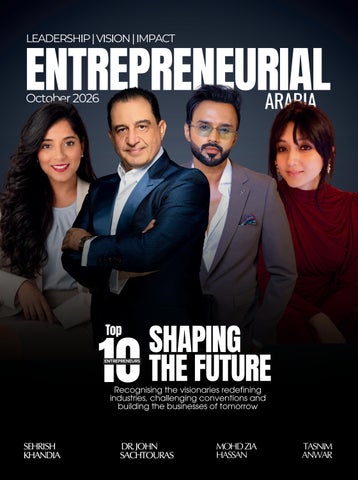
ENTREPRENEURIAL LEADERSHIP | VISION | IMPACT
ARABIA
October 2026
10 Top
ENTREPRENEURS
SHAPING THE FUTURE
Recognising the visionaries redefining industries, challenging conventions and building the businesses of tomorrow
SEHRISH KHANDIA
DR. JOHN SACHTOURAS
MOHD ZIA HASSAN
TASNIM ANWAR
Event AD
ENTREPRENEURIAL ARABIA TEAM
FOUNDER & CEO (Chief Executive Officer) VIVEK MALIK
CEO, Womenpreneur Foundation FAHBIN ANWAR
COO (Chief Operations Officer) DIVESH SINGH
CCO (Chief Creative Officer) NIDHI KUNDU
CTO (Chief Technology Officer) UTKARSH SINGH
CLO (Chief Legal Officer) DEEPAK MALIK
Creative Director SUMAYRA FAROOKI
Partnering Agency BIG DATA MARKETERS
Creative Executives AYESHA SEEDAT SHARON MISSAH AFSHAN HUSSAIN NAHEED MALIK AFREEN MAHABOOB
Publisher
FIRSTREAD MEDIA LLC
CONTENTS
Page 28: The People Shaping What Comes Next
“Different paths. Different industries. One shared instinct: to keep building what comes next.” FEATURES
13 THE BRIEF Seven things shaping business in the Gulf this month
28 COVER STORY INTRODUCTION The People Shaping What Comes Next
18 IN FOCUS The Creator Economy Goes Corporate
30 SEHRISH KHANDIA Redefining Food, Health & Wellness Through AI
22 INVESTMENT SPOTLIGHT AI Infrastructure: The New Investment Frontier
32 DR. JOHN SACHTOURAS The Multiplier Effect: Building Trust, Leadership
10 ENTREPRENEURIAL COVER
34 Mohd Zia Hassan Building Across Industries, Creating Across Possibilities
36 Tasnim Anwar Turning Global Experience Into Educational Opportunity
42 AI-Native Entrepreneurship: The New Way of Building a Business
48 Pierre Luxe Luxury Property Adviser & Cross-Border Real Estate Specialist
50 Dahlia Mahmood Interior Designer, Developer & Builder
E
56 Dame Ellen Mannaert Serial Entrepreneur, Investor & Founder
58 Samara Iqbal Founder, Aramas International Lawyers
60 Maitri Somaia Presenter, Emcee & AwardWinning CNN Academy Fellow
62 Sonali Basu Roy Technology, Transformation & Modern Womanhood
52 Dr. Sana Sajan Business Leader, Entrepreneur & Women’s Empowerment Advocate
64 Iman Essam Mostafa Founder, Maison Imma
54 Silia Said Building a More Transparent World of Gemstones
66 Simimol Lifestyle Influencer, Emcee, Actress & TV Host
Firstread Media LLC, headquartered in Dubai under the Sharjah Media Authority, is a global media house redefining how stories of leadership, innovation, and entrepreneurship are told. With a portfolio that spans Womenpreneur Middle East, CEO Weekly UAE, Entrepreneurial Arabia, Skyline Middle East, and Insider Al Seha, we create platforms that celebrate visionaries, empower changemakers, and spotlight industries shaping tomorrow. As publishers, our mission is simple: to inform, inspire, and influence. From exclusive interviews with global leaders to in-depth industry reports, our magazines and digital platforms bridge regions, industries, and ideas. We believe media is not just about reporting the present - it is about shaping the future. Firstread Media also curates high-impact events, summits, and awards that bring leaders and entrepreneurs together under one vision: growth with purpose.
ENTREPRENEURIAL COVER 12 NOTE FROM THE EDITOR
EDITOR’S NOTE
Top 10 Shaping The Future There is a version of business writing that tells one story on repeat: someone has an idea, the idea works, everything after that is scale. Almost nobody in this issue fits it. This month’s issue of Entrepreneurial Arabia is centred on Top 10 Shaping the Future - ten individuals whose work, choices and ambitions offer a glimpse of where business, culture and professional life are heading next. They are not necessarily working in the same industries or following the same playbook. What connects them is their willingness to build, question and move before the outcome is obvious.
Afreen Mahaboob Editor, Entrepreneurial Arabia
Four people share our cover - Sehrish Khandia, Dr. John Sachtourus, Mohd. Zia Hassan and Tasnim Anwar. They work in different fields and arrived by very different routes, and what connects them is harder to name than an industry. The closest I can get is a refusal to treat the first success as the finished one. Dr. Sachtourus, who has spent close to five decades and ninety-two countries building businesses, told us that he believes his greatest contribution is still ahead of him. Said by someone with that record, it is not modesty. It is a working method, and some version of it runs through all five.
Our Top 10 Shaping the Future widens that lens. Pierre Luxe, Dahlia Mahmood, Dr. Sana Sajan, Dame Ellen Mannaert, Samara Iqbal, Maitri Somaia and Simimol Raijo join two of our cover names on the list. Some are building companies, some are building institutions, and a few are quietly changing the terms their industries operate on. Reading their entries together, what stands out is how little any of them waited for permission. That idea of shaping what comes next also runs through the rest of this issue. We turn to the forces reshaping business across the region: entrepreneurship, finance, artificial intelligence and development. We have tried to treat AI as a business question rather than a technology one, because that is how it actually arrives for most people reading this - not as a breakthrough to admire, but as a decision about what to change, what to keep, and how quickly. On finance and development, the same instinct applies. The interesting question is rarely what is possible. It is what is worth doing, and who is prepared to go first. There is also a quieter lesson in this month’s profiles. Shaping the future does not always mean
predicting it. Sometimes it means building something that did not exist before, taking an established idea into a new market, changing how an industry approaches its work, or simply refusing to accept that the existing way is the only way. That last part is the thread I keep pulling on. The Gulf has spent a decade being described as a place of opportunity, which is true and has become slightly meaningless through repetition. Opportunity on its own does nothing. It needs someone willing to act on it before the outcome is obvious, usually without a map, frequently while being told it is early. Everyone in these pages did that. The future, ultimately, is not something that simply arrives. It is shaped by the people willing to make decisions before certainty catches up. I hope you find something here that makes you reconsider a plan of your own.
OCTOBER ISSUE
ENTREPRENEURIAL ARABIA - FRONT OF BOOK
FULL SPEED AHEAD Women entrepreneurs are reshaping industries, driving innovation, and expanding
Seven Things Shaping Business In The Gulf This Month
13
14 ENTREPRENEURIAL COVER Market, H1 2026
Raised
Rounds
Change y/y
Share of MENA
UAE
$895m
79
+53%
66%
Saudi Arabia
$219m
72
−74%
16%
MENA total
$1.35bn
214
−22%
—
tax, and a simplified return instead of the full computation. The extension came through Ministerial Decision No. 131, issued in July. A few details worth knowing. You still have to register and file, even if you owe nothing. Someone running a business in their own name only enters the corporate tax system once turnover passes AED 1 million in a calendar year. And a free zone company already using the 0% qualifying regime cannot claim this relief as well - it
is one or the other.
Less Money, And Far Fewer Deals Startups across the Middle East and North Africa raised $1.35 billion in the first half of 2026, according to the venture data firm MAGNiTT. That is 22% less than a year earlier. The bigger drop is in how many companies got money at all: 214 deals, down 41%, the lowest in at least four years. So the money did not disappear. It went to fewer companies. Two very large rounds alone accounted for
$480 million, and the ten biggest deals took 58% of everything raised. The UAE and Saudi Arabia went in opposite directions. The UAE now takes two thirds of all the money invested in the region. Both countries did roughly the same number of deals, which means UAE cheques were much bigger. In Saudi Arabia, no company raised more than $100 million, and no established business raised at all - only young ones did.
A year earlier, big rounds there were worth $414 million. One more change matters. Investors based in the region put up about
81% of the money, the highest share in more than five years. Money from outside the region fell by roughly half. You can read that two ways. Either local investors are now strong enough to hold the market up on their own, or the region is losing foreign investors at exactly the moment prices are being reset. Small Firms Get Three More Tax-Free Years The Ministry of Finance has extended Small Business Relief to the end of 2029. It had been due to run out at the end of this year. Here is what it does. A business with revenue of AED 3 million or less in a tax period can choose to be treated as having no taxable income at all. In practice that means 0% corporate
The timing sits alongside the first real test of the system. For companies with a 31 December 2025 yearend, the corporate tax return was due on 30 September 2026, nine months after the period closed. Advisers spent the month repeating the same warning: owing no tax is not the same as having nothing to file. Why it matters. The UAE brought in corporate tax in 2023 without wanting to lose what had made it
OCTOBER ISSUE
15
attractive to founders in the first place. Extending this relief by three years is the clearest signal yet of how it plans to hold both collect from businesses large enough to pay, and leave small ones alone while they grow. The Government Is Betting Big On Ai Most governments are still arguing about how to control AI. The UAE is putting it to work. Sheikh Mohammed bin Rashid Al Maktoum has announced that half of federal government services and operations will run on “agentic” AI within two years. Agentic means the software does the work itself - it decides and acts, rather than just answering questions. The UAE has also put one body in charge of all of it: the Artificial Intelligence and Data Authority, which reports straight to the Cabinet. It takes over the work of the Office of AI, the UAE Data Office and the digital government arm of the telecoms regulator. Until now it was not always clear who was responsible for what. Now it is. Why this matters for business. Two reasons, and neither is about government services. First, a government rebuilding half its operations in two years has to buy a great deal - software, integration work, security checks - on a tight deadline. That is a very large customer. Second, the standards this new authority sets for itself will shape the rules private companies are
held to later. Watch what it does in its first year, not what the strategy says. There is a risk in moving this quickly. When software makes real decisions at this scale, something will go wrong somewhere. How openly that gets handled will matter more to the UAE’s reputation than hitting the 50% target. New rules for funds in both financial centres ADGM and DIFC are both rewriting the rules for fund managers, within weeks of each other. ADGM went first. New rules published on 16 September took effect the same day. The main change: a foreign fund manager must now accept ADGM law and ADGM courts. Before, they could pick from several other legal systems. They must also appoint a locally licensed firm to receive legal documents for them. DIFC is not far behind.
Its regulator closed a consultation on a full rewrite of its own fund rules on 7 September, and it is heading in a similar direction.
issuing and moving it as a digital record rather than through the usual chain of paperwork and intermediaries.
What it means. The rules are getting lighter in places, better matched to the size and risk of each manager. But they are also getting firmer about where you belong: fewer choices about which law applies to you, and more local presence required.
Be clear about what was signed. It is a memorandum of understanding: a framework for working together on research, market education and future projects. No product has been approved and none is announced.
If you run a fund in either centre, have the changes checked now. The ADGM rules are already in force. Dubai Is Building The Plumbing For Tokenised Assets On 3 September, Dubai’s Virtual Assets Regulatory Authority signed an agreement with Securitize, an American firm that turns ordinary financial assets funds, bonds, shares - into tokens held on a blockchain. Tokenising an asset means
The context around it is more telling. VARA issued its 50th licence to a virtual asset service provider in July, to a tokenisation platform. Securitize manages roughly $5 billion in tokenised assets by its own count, against a global total of about
$38.5 billion - a real market, but still a small one. Why it matters. Dubai is not trying to win the
16 ENTREPRENEURIAL COVER Here is why. Deals take six to nine months to close. So most of the money counted in the first half came from decisions made well before conditions changed. July to September is the first full quarter negotiated under the conditions we are in now, and the first honest look at what is really happening. Three things to check when it lands. Does the UAE do more deals again, after its deal count fell 37%? Does any established Saudi company raise money, after six months in which none did? And do foreign investors return, or keep pulling back?
trading volume. It is trying to own the rulebook: to be the place institutions choose when tokenisation does become normal, because the regulatory questions were settled here first. That is a slower position to build than a trading hub, and a harder one for a rival to take away. The Wealthy Keep Arriving, And They Want Different Things About 10,000 millionaires moved to the UAE in 2025, according to HSBC, and more are expected. They come from South Asia, increasingly from East Asia, and from other Gulf countries. The reasons are the familiar ones: safety, stability, no personal income tax, good residency options. One reason on that list is newer. DIFC and ADGM have built proper
frameworks for family offices - the private firms that manage a wealthy family’s money. That changes the kind of business this creates. Buying a villa is a one-off. Setting up a family office needs lawyers, accountants, fund administrators, trustees, tax advisers and private bankers, every year. ADGM said in September that the money it oversees grew 54%, and that it now has around
4,000 active licences. If you work in professional services, this is where the demand is building. For everyone else, the shift is worth noting: the UAE’s wealth story has moved from attracting
money to looking after it. What To Watch: October’s Numbers MAGNiTT publishes its July-to-September figures in October. They matter more than the half-year report did.
If deal numbers recover while cheques stay large, this was a healthy correction. If they keep falling, the worst of it is still ahead. Figures: MAGNiTT (venture funding), UAE Ministry of Finance (corporate tax), HSBC (wealth migration), ADGM and the DFSA (fund rules).
OCTOBER ISSUE
LINA CAHILL www.linacahill.com
17
18 ENTREPRENEURIAL COVER Across the Middle East and beyond, creators are increasingly moving from sponsored posts to something much more ambitious: building businesses around the communities they have created. Some are launching consumer products. Others are building production companies, podcasts, media platforms, events, agencies, education businesses and technology ventures. The creator is no longer simply the person appearing in the content. Increasingly, the creator is becoming the founder, publisher, marketer, distribution channel and brand. The shift matters because an audience is no longer only an advertising asset. It can become a customer base, a distribution network, a research community and, potentially, the foundation of an entire company.
In Focus
The Creator Economy Goes Corporate
From followers to companies, creators are turning audiences into media businesses, consumer brands and commercial ecosystems. There was a time when becoming a creator meant building an audience and finding brands willing to pay for access to it. That model is changing.
The numbers reflect how quickly the commercial model is developing. Redseer estimates that the MENA region has around 1.5 million active creators, with approximately $300 million in earnings across the GCC. It also reports that eight in ten small and medium-sized businesses in the region collaborate with creators monthly. Importantly, 80% of the creators identified in its research have fewer than 10,000 followers, suggesting that the creator economy extends far beyond the handful of personalities with enormous audiences. The UAE is an especially interesting market within this transformation. Visa’s 2025 creator research found that approximately one-third of UAE creators had launched new ventures following their content success, while many already had plans for further growth. The creator economy is therefore beginning to look less like a
OCTOBER ISSUE collection of individual social-media careers and more like an emerging layer of entrepreneurship.
entrepreneurial creator begins asking, “What can I build because I have this audience?”
The Creator Is Becoming The Company
From Sponsored Content To Owned Assets
The most important change may be conceptual. For years, the creator’s primary asset was attention. A large following could translate into sponsored content, appearances, affiliate income or advertising revenue. But attention alone is difficult to control. Platforms can change algorithms. Reach can fluctuate. Advertising budgets can move elsewhere. A creator can be highly visible one year and struggle to maintain the same commercial momentum the next. Building a business changes the equation. A creator who launches a product owns something beyond an audience. A creator who develops a production company owns infrastructure. A creator who builds a newsletter, podcast network or media platform creates an intellectual property portfolio. A creator who launches a community or educational business creates a direct relationship with customers. The audience becomes the starting point rather than the end product. That distinction is at the heart of the creator-tofounder transition. Instead of asking, “How much can I earn from my audience?”, the
Brand partnerships are not disappearing. In fact, they are becoming more sophisticated. IAB projected U.S. creator advertising spend at $37 billion in 2025, up 26% year on year, and estimated it could reach $44 billion in 2026. Nearly half of creator advertising buyers surveyed by IAB considered creators a “must buy,” while brands increasingly use creators not only for awareness but across the purchase journey. The important development is that creators are gaining more ways to participate in the commercial value they generate. YouTube, for example, has increasingly connected content with commerce. In 2025, the platform said YouTube Shopping’s gross merchandise value had grown fivefold year over year, with more than 500,000 creators enrolled globally as of July 2025. The platform has also introduced tools designed to make sponsorships more measurable and reusable. One planned format allows creators to dynamically insert brand segments into long-form videos, potentially turning existing content into an asset that can be monetised across different campaigns and markets rather than being tied permanently to one sponsor.
This is an important evolution. Content is becoming inventory. A video is no longer necessarily a one-time post that disappears down a feed. It can remain searchable, generate affiliate sales, host sponsorships, promote a product and continue attracting an audience months or years after publication. For creators who understand this, the content library itself can become part of the business. The Uae Creator Is Becoming An Entrepreneur The UAE offers an unusually interesting environment for this transition because its creator economy is developing alongside a broader entrepreneurial ecosystem. Visa’s 2025 study, which surveyed more than 1,000 TikTok creators across five markets including the UAE, found that around one-third of UAE creators had launched new ventures after finding success with
19
their content. The study also found that 35% used secondary personal accounts to separate business expenses, highlighting an interesting tension: creators are increasingly behaving like businesses while many still lack the financial infrastructure of established companies. That gap is likely to become increasingly important. Once a creator starts hiring editors, photographers, managers, designers, assistants or production teams, the operation changes. • • • • •
It needs accounting. It needs contracts. It needs cash-flow management. It needs intellectualproperty protection. It needs payroll, budgeting and potentially investment.
In other words, the creator starts encountering the same operational questions as any other entrepreneur. The creator may still
20 ENTREPRENEURIAL COVER appear on camera, but behind the camera there can now be a small company. The Rise Of The Creator Team The idea of the lone influencer is becoming increasingly outdated. As audiences grow, content expectations grow with them. A creator may need a videographer to maintain production quality, an editor to manage volume, a socialmedia strategist to adapt content across platforms, a manager to negotiate commercial opportunities and an accountant or financial adviser to manage the business. The creator becomes the visible face of an increasingly invisible operation. This is already evident in the UAE, where creators have increasingly begun hiring production and management teams as brand partnerships and audience expectations expand. That creates a secondary economic effect. Creators are not only generating income for themselves. Successful creator businesses can create employment for editors, photographers, designers, stylists, producers, writers, publicists, community managers, event professionals and other specialists. The creator economy therefore has the potential to become a small-business ecosystem in its own right. And that is one reason the distinction between “creator” and “entrepreneur” is
becoming increasingly difficult to maintain. The Audience Is The New Distribution Network Traditional companies spend enormous amounts of money trying to build awareness. Creators begin with something companies often struggle to manufacture: a relationship with an audience. This relationship is particularly valuable when it is built around a clear area of expertise or identity. A beauty creator can introduce a skincare line. A fitness creator can develop training products. A food creator can build a restaurant concept, cookbook or food brand. A finance creator can create educational products or subscription communities. A travel creator can develop experiences or travel services. A parenting creator can build a consumer brand around products their audience already understands and trusts. The important point is not that every creator should launch a product. It is that the audience can provide a form of market intelligence. Creators spend years watching what their communities respond to. They see questions repeatedly asked in comments. They understand which problems people struggle with. They can test ideas through content before committing significant
capital to a product. In that sense, content becomes a form of continuous market research. From Personal Brand To Consumer Brand The natural next step for some creators is commerce. The creator has already established a voice. The audience understands their taste. Trust has been built over time. The product becomes an extension of that relationship. But this is also where the creator economy becomes more complicated. A personal brand can survive on personality. A company cannot rely on personality alone. A consumer business requires product quality, supply chains, customer service, pricing, distribution, inventory management and repeat purchases. The creator therefore has to learn a new skill: building something that can succeed without the creator personally selling it every day.
That is the difference between influence and enterprise. Influence depends heavily on the individual. Enterprise requires systems. The most interesting creator businesses may ultimately be those that can make this transition successfully - preserving the trust and personality that created the audience while developing a business capable of operating beyond the individual. The Media Company Hiding Inside The Personal Brand There is another direction that deserves attention: creators becoming media companies. A creator with a large audience can eventually produce multiple formats short-form video, long-form video, podcasts, newsletters, live events, documentaries, books and branded content. The individual becomes the centre of a content ecosystem.
OCTOBER ISSUE
21
22 ENTREPRENEURIAL COVER
Investment Spotlight
AI Infrastructure: The New Investment Frontier
Why investors are looking beyond the AI application Artificial intelligence may be most visible through chatbots, copilots and consumer applications, but some of the most significant investment opportunities are developing far beneath the interface. Every AI model, application and automated workflow depends on infrastructure: computing power, data centres, cloud platforms, networking, semiconductors, energy, cooling systems and cybersecurity. As businesses move from experimenting with AI to deploying it at scale, this infrastructure is becoming an increasingly important part of the global technology economy. For investors, that is creating a shift in focus - from asking which AI application will win? to asking what infrastructure will every AI company need? The opportunity is particularly relevant to the Middle East, where sovereign capital, government-backed technology strategies and rapidly developing digital
infrastructure are converging around artificial intelligence. The Capital Is Already Moving The scale of the regional AI investment story is becoming increasingly visible. According to MAGNiTT, AI and AI-enabled companies across MENA raised
$678 million in the first half of 2026 an 81% increase compared with H1 2025. AI represented half of all MENA venture funding during the period, despite accounting for only 25% of transactions. The UAE captured 93% of the region’s AI funding, while FinTech attracted the largest share of AI capital at $269 million. The figures also reveal an important characteristic of the current market: capital is becoming concentrated in fewer, larger opportunities. For investors, that concentration can indicate
growing conviction around AI, but it also means the market is becoming more selective. The question is no longer simply whether AI will grow. It is increasingly about which parts of the AI value chain will capture the economic value created by that growth.
•
•
From Models To The Infrastructure Behind Them The AI economy requires a surprisingly broad physical and digital foundation. At the centre are data centres and computing capacity, followed by cloud infrastructure, networking, semiconductors and specialised hardware. Around these sit supporting industries such as energy, cooling, cybersecurity, data management and infrastructure services. This creates multiple investment layers. •
•
Compute is required to train and run increasingly sophisticated AI models. Data centres provide the physical
•
•
environments in which that compute operates. Semiconductors and specialised processors provide the underlying computational capability. Cloud platforms allow businesses to access that capability without owning the infrastructure themselves. Energy and cooling become increasingly important as computing density rises. And cybersecurity becomes critical as more valuable data and business processes move into AI-enabled environments.
The investment opportunity therefore extends well beyond the companies developing the AI models themselves. Abu Dhabi’s Ai Investment Strategy The UAE has emerged as one of the region’s most significant centres for AI capital.
OCTOBER ISSUE manufacturing of datacentre power equipment, server racks and cooling equipment. One listed opportunity for data-centre power equipment has an indicative investment size of approximately SAR 50–80 million and an estimated addressable demand of SAR 3.3 billion through 2030.
Abu Dhabi-based MGX, an investment company focused on AI and advanced technology, announced the final close of MGX Fund I at
$49 billion in total commitments in July 2026, above its initial $45 billion target. The fund invests across areas including semiconductors, AI infrastructure and AIenabling technologies and platforms. MGX’s investment activity also illustrates the scale of the infrastructure opportunity. In July 2026, MGX, BlackRock’s Global Infrastructure Partners and the Artificial Intelligence Infrastructure Partnership completed the acquisition of Aligned Data Centers at an enterprise valuation of approximately $40 billion. The transaction was described by the consortium as one of the largest private investments in digital infrastructure to date.
For the region, these investments signal something larger than participation in the AI boom. They point towards an ambition to become part of the infrastructure layer that enables the boom. Saudi Arabia Is Building The Ai Stack Saudi Arabia is pursuing a similarly broad approach. In May 2025, the Public Investment Fund launched HUMAIN, a company designed to operate across the AI value chain. Its activities include nextgeneration data centres, AI infrastructure, cloud capabilities, advanced AI models and applications. HUMAIN is also developing Arabic-language AI capabilities, including the ALLAM large language model. The investment opportunity extends into the supporting ecosystem. PIF currently identifies opportunities linked to HUMAIN that include local
This is a useful reminder that the AI investment story is not limited to technology companies. It can create opportunities for manufacturers, infrastructure providers, engineering firms, energy companies, logistics businesses, cybersecurity providers and specialist service companies. The Energy Question One of the less visible parts of the AI investment story is energy. AI systems require substantial computing power, and computing requires electricity. As datacentre capacity grows, access
23
to reliable and competitively priced energy becomes an increasingly important consideration. This creates another layer of opportunity for the Middle East. The region has significant energy resources, established infrastructure and growing ambitions around renewable energy. The intersection between AI, data centres and energy could therefore become an important investment theme in its own right. Saudi Arabia’s HUMAIN strategy explicitly identifies data-centre infrastructure as a core part of its AI ambitions, while PIF’s private-sector opportunities include power systems required to support anticipated data-centre capacity. The implication is straightforward: the AI economy may increasingly become an energy economy as well.
24 ENTREPRENEURIAL COVER What Investors Should Watch
The Entrepreneurial Opportunity
01 | Compute Demand for computing capacity is at the centre of the AI infrastructure boom. Investors are watching how quickly demand grows and which technologies can provide computing more efficiently.
The infrastructure boom does not belong exclusively to billion-dollar investors. For entrepreneurs, it creates a much wider ecosystem of opportunities. A founder does not necessarily need to build a data centre to participate in the data-centre economy.
02 | Data centres The physical infrastructure supporting AI will require significant capital, land, energy and specialised engineering. 03 | Semiconductors Advanced processors remain fundamental to AI development. Semiconductor manufacturing, packaging, networking and related technologies are therefore strategically important. 04 | Energy & cooling High-density computing creates requirements for reliable power and sophisticated cooling systems, opening opportunities beyond traditional technology investing. 05 | Cybersecurity As AI becomes embedded into critical business infrastructure, protecting models, data and systems becomes increasingly important. 06 | Regional AI Arabic-language models and applications tailored to Middle Eastern markets could create a distinct regional layer within the global AI economy.
There are opportunities in cooling technology, energy efficiency, cybersecurity, data management, hardware maintenance, specialised software, infrastructure monitoring, cloud services and AI-specific professional services. The same principle applies to AI models. Entrepreneurs can build applications around regional languages, industries and regulatory environments without necessarily competing to develop a general-purpose foundation model. This may be one of the most interesting characteristics of the Middle East’s AI opportunity: the ecosystem around AI could become as important as AI itself. The Investor Lens AI infrastructure is attractive because it sits upstream of many different applications. If AI adoption continues across finance, healthcare, logistics, manufacturing, government and consumer services, those applications will require underlying infrastructure. That creates a potentially
different investment proposition from betting on a single consumer application. But infrastructure also brings its own risks. Capital requirements can be enormous. Technology can become obsolete. Datacentre projects depend on energy and connectivity. Semiconductor supply chains remain complex. AI demand could evolve faster or slower than infrastructure projects can be built. Investors therefore need to look beyond headline AI growth and examine fundamentals: utilisation, customer demand, power availability, capital expenditure, technological durability, regulatory conditions and the economics of the underlying asset. The Bigger Picture The most important shift in AI investing may ultimately be this: The AI opportunity is becoming an infrastructure story. The companies consumers see - the applications,
platforms and AI assistants - represent only the visible layer. Behind them sits a much larger ecosystem of chips, servers, data centres, cloud platforms, energy systems, cooling technologies, networks and security infrastructure. For the Middle East, that ecosystem presents an opportunity to move beyond being a consumer of AI technology and become a participant in the infrastructure that enables it. The UAE is attracting global AI capital and building investment platforms around the technology stack. Saudi Arabia is developing AI infrastructure, models and supporting industrial capabilities. Across the region, governments, institutional investors and entrepreneurs are increasingly positioning AI as part of a broader economic transformation. For investors, the question is therefore becoming more nuanced than “Who will build the next big AI company?”
OCTOBER ISSUE It is also: Who will build, finance and supply everything that the next thousand AI companies will need? That may be where the next chapter of the AI investment story begins. Investment Spotlight | The Numbers
$678M AI and AI-enabled funding raised across MENA in H1 2026.
93% Share of MENA AI funding captured by UAE companies in H1 2026.
$49B Total commitments at the final close of MGX Fund I.
$40B Enterprise valuation of Aligned Data Centers in the acquisition completed by AIP, MGX and GIP in July 2026.
SAR 3.3B Indicative addressable demand through 2030 for data-centre power equipment identified by PIF.
The Takeaway AI may be the technology story. But infrastructure could be the
investment story. As artificial intelligence moves deeper into the global economy, the demand for computing, data centres, energy, networking and
25
specialised infrastructure is likely to create opportunities far beyond the companies developing AI applications themselves.
26 ENTREPRENEURIAL COVER
OCTOBER ISSUE
27
28 ENTREPRENEURIAL COVER
THE PEOPLE SHAPING WHAT COMES NEXT
COVER STORY The following conversations explore the experiences and ambitions behind their journeys - and what they are building next.Entrepreneurship has never been one story. It is shaped by people who come from different industries, carry different experiences and recognise opportunity in very different places. What makes certain entrepreneurs worth watching is not simply what they have built, but how they think about what comes next. This is what brings Sehrish Khandia, Dr. John
Sachtourus, Mohd. Zia Hassan and Tasnim Anwar together. Their journeys are remarkably different, yet each reflects something important about entrepreneurship today: the ability to adapt, build across boundaries and turn experience into new possibilities. Sehrish Khandia sits at the intersection of technology, food, nutrition and health. Through Byondbites, she is building an AI-powered food and health-tech platform
OCTOBER ISSUE
focused on making personalised nutrition and healthier everyday choices more accessible. Dr. John Sachtourus brings nearly five decades of international entrepreneurship, with experience spanning 92 countries and more than a billion dollars in global sales. Yet his focus today extends beyond achievement to mentorship, education and creating opportunities for the next generation. Mohd. Zia Hassan represents the increasingly diversified nature of modern entrepreneurship. With ventures across real estate, hospitality, beauty, fragrances, consultancy, entertainment and media, his approach is rooted in recognising opportunities and building businesses around changing markets and customer needs. Tasnim Anwar offers a story of reinvention. Having built experience across sports, real estate and family business, she is now using that knowledge through GoGee8 to expand access to education across Myanmar, India, Palestine and beyond. These four entrepreneurs have not followed the same formula, and that is precisely the point. One is exploring what happens when AI meets food and
29
health. Another is turning decades of global experience into a legacy of mentorship. Another is building across industries, while another is transforming a diverse career into greater access to education. Together, they offer a broader picture of what entrepreneurship can look like today. There is no single route to building a meaningful business, and no fixed point at which an entrepreneur has truly “made it.” The more interesting question is what comes next. The following conversations explore the experiences, decisions and ambitions behind these four journeys - and the ideas that continue to shape what they do next. These four entrepreneurs have taken very different paths - from AI and health-tech to global business, diversification and education. Together, they show the many ways entrepreneurship is evolving today: building differently, thinking bigger and creating what comes next.
30 ENTREPRENEURIAL COVER
EXCLUSIVE INTERVIEW
OCTOBER ISSUE
31
Sehrish Khandia Redefining Food, Health & Wellness Through AI
S
ehrish Khandia is an entrepreneur, certified nutritionist, and Founder of Byondbites, a Saudibased AI-powered food and health-tech platform available globally. With over 18 years of corporate experience spanning marketing, supply chain, brand strategy, sourcing, and business development, she brings a broad understanding of consumer behaviour, brand development, and business execution to her entrepreneurial ventures. Throughout her professional journey, Sehrish has developed an understanding of how consumers behave, how brands grow, and how businesses move from ideas to execution. Her experience across different business functions has shaped her approach to building ventures that connect strategic thinking with practical solutions. Today, she is channeling this experience into her work at the intersection of food, nutrition, health, technology, and entrepreneurship. Building a Personalized Food and Wellness Ecosystem Sehrish’s primary focus is building Byondbites into more than a food app. Her vision is to create an intelligent, personalized food, nutrition, and wellness ecosystem that helps people make better everyday decisions. The platform is designed around the relationship between what people eat, how they cook, and how they manage their health, bringing these everyday activities into a more connected experience. Byondbites combines AI-powered food discovery, personalized nutrition, health goals, and practical everyday guidance. By bringing these elements together, the platform aims to make healthier living simpler and more accessible. Its approach reflects Sehrish’s interest in connecting technology with everyday human needs, helping people navigate their food and wellness decisions through a more personalized experience. For Sehrish, the opportunity lies in developing a platform that brings different aspects of food and health together. Rather than focusing solely on food discovery, Byondbites aims to connect food choices, nutrition, and wellness within a broader ecosystem. This vision places personalization and practical guidance at the centre of the platform’s purpose, with the goal of making everyday decisions more manageable for its users. Based in Saudi Arabia and available globally, Byondbites reflects her ambition to build a platform that can serve a wider audience. Her focus on culturally relevant and practical solutions is central to her approach, ensuring that
the ideas behind her ventures remain connected to the needs and experiences of real people. Connecting Strategy, Branding and Experiences Alongside Byondbites, Sehrish is the Co-Founder of Allign Marketing KSA, a strategy-led branding and experiences agency. The agency helps businesses build stronger brands through marketing, creative strategy, activations, and memorable event experiences. Her involvement in this venture reflects another dimension of her professional experience, bringing together brand strategy, consumer understanding, and business development. Her background across marketing, sourcing, supply chain, and brand strategy provides a broad perspective on how businesses develop and grow. These areas of experience have contributed to her understanding of how brands position themselves, how consumers engage with them, and how ideas can be translated into execution. Through Allign Marketing KSA, this experience connects with the agency’s focus on helping businesses strengthen their identities and create meaningful experiences for their audiences. Although Byondbites and Allign Marketing KSA operate in different areas, both ventures reflect Sehrish’s interest in understanding people and building solutions around their needs. One focuses on connecting food, nutrition, health, and technology, while the other supports businesses through branding, marketing, creative strategy, and experiences.
“Creating solutions that are practical, culturally relevant, and built around real human needs.”
Building for a Global Audience Sehrish is passionate about the intersection of AI, food, health, consumer behaviour, and entrepreneurship. Her professional interests bring together her experience in business and branding with her focus on nutrition and technology. She is particularly interested in creating solutions that are practical, culturally relevant, and built around real human needs.
32 ENTREPRENEURIAL COVER
EXCLUSIVE INTERVIEW
Dr. John Sachtouras The Multiplier Effect: Building Trust, Leadership and Global Impact
I
n 1979, a young Greek man travelled from Athens to Paris with curiosity, ambition, and no clear sense of where life would take him. For Dr. John Sachtouras, that journey became a turning point, introducing him to different cultures, new people, and opportunities beyond the boundaries of his upbringing. Nearly five decades later, his journey spans 92 countries, more than a billion dollars in global sales, and a community of over a million people across 65 countries. Alongside entrepreneurship, his work has extended into mentoring, education, strategy, and film production. Despite these achievements, Dr. Sachtouras describes himself not through titles alone, but as an entrepreneur, strategist, mentor, educator, and student of people. His journey reflects a philosophy shaped by relationships, cultural understanding, and the belief that success becomes meaningful when it creates value for others.
involves challenges, he sees the UAE as an environment where ambitious people can develop ideas into something significant. Trust Doesn’t Scale. People Do. Building a community of more than a million people across 65 countries has reinforced his belief that trust develops through individual relationships. Technology can expand reach, but meaningful influence depends on the principles behind those connections. For Dr. Sachtouras, a person’s title may establish their position, but their actions reveal their character. This philosophy also shapes his understanding of leadership. People judge leaders by the distance between what they say and what they do. Consistency, integrity, and the ability to honour commitments create the foundation for lasting trust.
Relationships Before Transactions His entrepreneurial journey began with a small travel agency. Although he had limited understanding of business risk, he had the courage to begin and discovered his passion for serving people. As his businesses expanded into different markets, he learned that understanding people was essential to understanding business. Numbers and spreadsheets could not replace an appreciation of local cultures, expectations, and relationships. Across borders, he believes that trust, respect, integrity, and keeping one’s word remain fundamental. His first major breakthrough was significant not simply because of the revenue involved, but because it demonstrated that a business model could be replicated and scaled. For him, growth begins when businesses focus on the value they create rather than becoming distracted by the size of individual deals. Why Dubai Having worked across cultures, Dr. Sachtouras chose Dubai for its ability to create opportunities. He credits the vision of His Highness Sheikh Mohammed bin Rashid Al Maktoum and the leadership’s willingness to think decades ahead. The UAE’s diverse population, with more than 200 nationalities living and working together, offers an extraordinary exchange of ideas and perspectives. He believes Dubai provides entrepreneurs with leadership, stability, infrastructure, market access, and talent, alongside a sense of momentum. While entrepreneurship always
“Success is not simply about how far you travel personally; it is about the impact you leave behind as you travel.”
Rethinking Leadership Earlier in his career, Dr. Sachtouras measured leadership through growth, performance, targets, and revenue. While he continues to value results, his understanding of leadership has evolved. He now believes that developing people’s ability to think independently is one of a leader’s greatest responsibilities. He measures progress by whether people become more capable, confident, and willing to make decisions without constantly seeking approval. His mentoring approach begins with mindset and character, particularly how individuals respond when circumstances do not go according to plan. He also believes that continued learning requires stepping outside one’s comfort zone and avoiding the assumption that yesterday’s success guarantees tomorrow’s progress.
OCTOBER ISSUE
33
34 ENTREPRENEURIAL COVER
EXCLUSIVE INTERVIEW
OCTOBER ISSUE
35
Mohd Zia Hassan Building Across Industries, Creating Across Possibilities
M
ohd Zia Hassan is a Canadian entrepreneur and business leader who has built a diverse portfolio across real estate, hospitality, retail, professional services, beauty, fragrances, entertainment and media. Born in Canada and raised in Dubai, his understanding of both global perspectives and the UAE’s rapidly evolving business environment has shaped an entrepreneurial journey defined by diversification and expansion. As Chairman of Infinity Group UAE and Infinix Infinity Real Estate, Zia approaches business with a strong emphasis on customer relationships, opportunity identification and practical execution. His portfolio now spans multiple sectors, reflecting a philosophy that entrepreneurship does not have to be confined to one industry. From beginning his career in sales to building a growing group of businesses, Zia’s journey offers insight into what it takes to recognise opportunities, adapt to changing markets and build ventures around different aspects of modern consumer and business life. From Sales To Entrepreneurship Q: Your career began in sales. How did that experience influence the entrepreneur you became? Sales gave me an understanding of people before it gave me an understanding of business. When you work directly with customers, you learn very quickly that every person has different motivations, expectations and concerns. You learn to listen, understand what someone actually needs and then create value around that need. That experience became an important foundation for everything I did afterwards. Whether you are selling a product, a property, a service or an experience, the fundamentals remain similar. You need to understand your customer, build trust and deliver on your promise. Sales also taught me resilience. Not every opportunity converts, and not every idea works exactly as planned. You learn to keep moving, learn from the experience and become better at recognising the right opportunities. Q: You entered the electronics industry in 2010. What did that period teach you about business and the market? The electronics industry was an important stage in my entrepreneurial journey because it was a highly competitive and constantly changing environment. Technology evolves quickly, consumer expectations change quickly, and businesses have to respond quickly. It taught me the importance of understanding market behaviour rather than simply following trends. You need
to know what customers want today, but you also need to think about what they are likely to want tomorrow. That experience gave me the confidence to explore other industries. I realised that the principles of business, customer experience, operational discipline, sales, relationships and execution, can be transferred across sectors.
“Success is not about building one business and stopping there. It is about recognising opportunities, understanding people and creating something that continues to grow with the market.” Why Diversification? Q: Today, your portfolio spans real estate, hospitality, gold and diamonds, beauty, fragrances, consultancy, immigration, events and media. What drives such diversification? For me, diversification comes from identifying opportunities and understanding where our capabilities can create value. I don’t believe an entrepreneur should be restricted to one industry simply because that is where they started. Different businesses also allow you to understand different parts of the market. Real estate gives you exposure to investment and long-term assets. Hospitality is about experience. Consultancy is about solving problems. Beauty and fragrances are closely connected to lifestyle and consumer behaviour. Media and entertainment are about storytelling and connecting people. There are different dynamics in each sector, but there are also common principles. If you have the right team, understand the customer and remain focused on execution, you can build businesses across different categories. Q: Does operating across so many sectors create challenges? Absolutely. Diversification can create opportunities, but it also requires discipline. You cannot assume that what works in one industry will automatically work in another. Every business needs its own strategy, people, systems and understanding of the market.
36 ENTREPRENEURIAL COVER
EXCLUSIVE INTERVIEW
Tasnim Anwar Turning Global Experience Into Educational Opportunity
T
A Career Shaped by Diverse Experiences
asnim Anwar’s professional journey reflects the value of exploring different industries, learning from new environments, and recognising opportunities where experience can create meaningful change. Educated at the University of Auckland, she developed a broad perspective that has continued to influence her approach to business, leadership, and entrepreneurship. Her career has taken her across sports, real estate, family business, and education. Rather than following a single, predictable path, Tasnim has embraced the lessons each chapter offered, using them to build a versatile professional foundation. These varied experiences have helped shape her understanding of people, business operations, and the importance of identifying needs that can be transformed into practical opportunities.
“Every chapter of my career has given me something different - experience, perspective and, most importantly, the ability to recognise where an opportunity can create value for others.”
Building Experience Across Industries One of the defining chapters of Tasnim’s career was her 11 years in Dubai’s real estate sector. Working in a dynamic international environment gave her valuable professional exposure and broadened her understanding of business and customer relationships. Her experience across different industries also allowed her to develop a flexible outlook, adapting to changing circumstances while remaining focused on long-term possibilities. Alongside her work in real estate, Tasnim’s involvement in family business added another dimension to her professional development. It offered opportunities to understand business from different perspectives and reinforced the importance of responsibility, adaptability, and sustained effort. Her connection with the sports industry further reflects the breadth of her interests, including her ownership of a tennis company.
Each experience contributed to a wider vision of entrepreneurship-one that goes beyond building a business and focuses on recognising where skills, resources, and ideas can make a difference. GoGee8: Expanding Access to Education As Founder and CEO of GoGee8, Tasnim has channelled her accumulated experience into an education-focused venture. The company is driven by the aim of expanding access to learning and creating opportunities for communities that may face barriers to education. GoGee8’s reach extends to Myanmar, India, Palestine, and other communities, reflecting a vision that looks beyond geographical boundaries. For Tasnim, education represents an important area where opportunity can have a lasting impact. By focusing on access to learning, her work seeks to connect people with possibilities that can support their development and future aspirations. The initiative also represents a natural progression in her professional journey. Her experience across multiple industries has given her different ways of understanding challenges, while her entrepreneurial outlook enables her to explore how those insights can be applied to a purposedriven business. Turning Experience Into Opportunity Tasnim’s journey highlights how professional growth can emerge from varied experiences rather than a single specialisation. Moving between industries has allowed her to develop a broader understanding of business, while her work in education demonstrates how entrepreneurial thinking can be directed towards a wider purpose. Her leadership approach is rooted in recognising value across different experiences and using those lessons to identify new possibilities. Whether through real estate, family business, sports, or education, each chapter has contributed to the perspective she brings to her ventures today. Through GoGee8, Tasnim continues to focus on making learning more accessible and creating pathways for communities to benefit from educational opportunities. Her work reflects the belief that experience becomes especially valuable when it is used to address real needs and help others move forward.
OCTOBER ISSUE
37
42 ENTREPRENEURIAL COVER
AI-Native Entrepreneurship:
The New Way of Building a Business
For decades, the conventional path to building a company followed a familiar formula: identify an opportunity, raise capital, hire a team, develop a product, acquire customers and gradually scale operations. Artificial intelligence is beginning to rewrite that formula. A founder can now research a market, analyse competitors, build an early product, generate marketing assets, automate customer support, analyse financial information and test different business ideas with a fraction of the resources traditionally required. But the real change is bigger than productivity. Artificial intelligence is creating a new category of company — one in which AI is embedded into the business from the beginning rather than introduced later as a technology upgrade. This emerging model is increasingly described as the AI-native or AI-driven enterprise. MIT Sloan defines an AI-driven enterprise as an entrepreneurial venture that embeds AI into strategy, operations and talent to create scalable capabilities
beyond the limitations of traditional startups. Its researchers describe it as a third model of entrepreneurship alongside conventional small and medium-sized enterprises and innovation-driven enterprises. The distinction is important. A traditional company may use AI. An AI-native company is built around what becomes possible because AI exists. And that difference could have profound implications for the next generation of entrepreneurs. From using AI to building with AI
how many employees are needed for each department. Instead, they may map the company’s functions — research, sales, customer service, marketing, finance, operations and product development — and determine which activities require human judgement and which can be augmented or automated by AI. This creates a different organisational structure. The company becomes less dependent on large numbers of people performing repetitive tasks and more dependent on a combination of human specialists, software, data and AI agents.
The first wave of business AI was largely about efficiency. Businesses introduced chatbots, automated emails, AI-generated content and productivity tools. Employees used AI to write, summarise, research, analyse and communicate faster. The next phase is more fundamental. AI is beginning to influence how companies are designed from day one. An entrepreneur launching an AI-native business might not begin by asking
MIT Sloan describes emerging AI-driven organisations as networks containing both human and AI nodes, with some AI agents already being used to perform functions within real businesses. That does not mean humans disappear. Quite the opposite. The entrepreneur’s role may become more strategic. Human beings remain responsible for vision, relationships, ethics, judgement, creativity, leadership and
understanding customers. AI becomes the force multiplier that helps those people execute at greater speed and scale. The founder is no longer simply building a team. They are building a system of intelligence. The economics of a smaller company One of the most significant implications of AI-native entrepreneurship is economics. Historically, rapid growth usually required rapid hiring. A company that gained more customers needed more salespeople. More customers meant more support staff. More transactions meant more operations staff. More markets meant more management and administrative infrastructure. AI can change the relationship between revenue and headcount. If software can perform portions of customer service, research, accounting, marketing, coding or sales development, a company can potentially grow without increasing its workforce at the same rate.
OCTOBER ISSUE This is already changing how some investors and entrepreneurs think about business performance. MIT Sloan notes that annual recurring revenue per full-time employee is becoming a useful metric for evaluating AI-driven companies because it highlights how efficiently businesses can convert a relatively small workforce into revenue. The implication for founders is significant. A company does not necessarily need to become large in headcount to become large in revenue. That could make entrepreneurship more accessible to individuals and small teams that previously would have needed substantial capital simply to build an organisation capable of competing. It may also change venture capital itself. If startups can achieve more with less capital, founders may need to raise less money in the earliest stages. Smaller initial rounds could allow entrepreneurs to retain more ownership while proving the business before seeking significant external investment. In other words, AI may not only change how companies operate. It could change who gets to own them. The rise of the oneperson or small-team company The idea of the extremely lean company is not new. Entrepreneurs have always built businesses with small teams.
What is changing is the capability available to those teams. Consider a founder launching a digital business today. Market research that once required consultants can be accelerated with AI-assisted research. Initial product concepts can be prototyped rapidly. Software development can be supported by AI coding systems. Marketing campaigns can be drafted and tested faster. Customer enquiries can be partially automated. Financial information can be analysed continuously. The founder still has to make decisions. But the cost and time required to reach those decisions can fall dramatically. MIT Sloan’s recent research on entrepreneurship in the age of AI argues that AI is shrinking the cost and time required to research markets, build products and test hypotheses, allowing founders to concentrate more heavily on paying customers, judgement, relationships and experimentation. This creates an intriguing possibility: The company of the future may be smaller on the inside but larger in its reach. A team of ten could potentially serve a global customer base that would once have required dozens or hundreds of employees. That changes the traditional relationship between scale and size.
Why the Middle East matters For the Arab world, this transition comes at an interesting moment. The region is already investing heavily in AI infrastructure, digital transformation and technology entrepreneurship. The UAE’s National AI Strategy 2031 aims to position the country as a global leader in artificial intelligence and includes objectives around AI investment, talent, research, infrastructure and governance. Dubai has also established an AI-focused economic agenda designed to accelerate adoption across strategic sectors, attract AI companies and talent, develop AI incubators and support the city’s positioning as a global centre for AI governance and innovation. The investment environment is moving in the same direction. According to MAGNiTT, AI and AI-enabled companies across MENA raised
$678M in H1 2026, an 81% increase from H1 2025. AI accounted for 50% of all MENA venture funding during the period despite representing only 25% of transactions. The UAE captured 93% of MENA’s AI funding, while FinTech was the leading sector by AI funding with $269 million.
43
These figures tell an important story. The region’s AI ecosystem is not simply expanding through a growing number of startups. Capital is becoming concentrated around companies that investors believe can scale. MAGNiTT’s 2025 review similarly found that AI funding and deal activity reached record levels, with AI accounting for 22% of MENA’s total venture funding and 29% of deal volume. Enterprise software, FinTech and IT solutions emerged as major AI investment areas. For entrepreneurs, that means the opportunity is growing — but so are expectations. From AI tools to AInative businesses There is an important distinction between an AIenabled company and an AI-native company. An AI-enabled company may take an existing business and add AI to selected processes. A real estate company might use AI to write property descriptions. A retailer might use AI for customer service. A marketing agency might use AI to produce content. A bank might use AI to detect unusual transactions. All of these businesses can benefit from AI. But an AI-native company starts with a different question: What business becomes possible if AI is at the centre of the model? That might mean an accounting company where
44 ENTREPRENEURIAL COVER much of the analysis and reporting is automated. A financial platform that continuously interprets financial information for customers. A healthcare company that uses AI to organise and personalise information around a patient’s journey. An education platform that adapts learning to each student. A logistics company that continuously optimises routes, inventory and delivery. The technology is not simply an additional feature. It is part of the company’s operating DNA. The new role of the founder This transition also changes leadership. The founder of an AInative company does not necessarily need to be the person who knows everything about AI. But they do need to understand what AI changes. They need to know which problems are worth solving, which processes can be automated, where human judgement remains essential and how technology affects the economics of their business. That requires a different kind of technological literacy. Entrepreneurs do not necessarily need to become machine-learning engineers. But they increasingly need to understand data, models, AI agents, automation, cybersecurity, intellectual property and responsible deployment. More importantly, they
need to understand where AI creates actual value. The danger is building a business simply because something can be automated. The strongest AI-native companies will not start with the technology. They will start with a meaningful problem. The end of the traditional department? One of the more interesting questions raised by AI-native entrepreneurship is whether the traditional corporate structure will remain as relevant. Consider a conventional startup. It might have a marketing department, sales department, finance team, operations team, customer support team and technology team. An AI-native organisation could instead operate through interconnected workflows. A customer interaction could trigger an AI system to update a CRM, prepare a follow-up, notify a salesperson and generate an internal summary. A financial transaction could automatically update forecasts and flag unusual activity. A marketing campaign could continuously analyse performance and adjust targeting. A software system could identify a technical issue, generate a proposed solution and send it to an engineer for approval. Instead of departments operating in silos, information can move
between systems. The result could be a company that behaves more like a network than a hierarchy. Human employees become responsible for the decisions where context, accountability and judgement matter most. AI systems handle increasing amounts of information processing and execution. This does not eliminate management. It changes management. AI agents: the next organisational layer The emergence of AI agents could accelerate this transformation. Generative AI initially became popular because it could produce content in response to prompts. Agents go a step further. They can potentially plan a sequence of actions, interact with software and complete tasks with less continuous human instruction. For an entrepreneur, this opens the possibility of having specialised AI systems perform different business functions. A research agent could monitor competitors. A sales agent could identify prospects. A finance agent could analyse cash flow. An operations agent could monitor inventory. A customer service agent could manage routine enquiries. Humans would remain responsible for oversight, strategy and decisions that require accountability. This is still an evolving field, and the practical
capabilities and reliability of agents vary considerably. But the direction is clear enough to force entrepreneurs to rethink what an organisation actually is. If software can perform work traditionally associated with an employee, the question becomes: What should a company hire people for? The answer may increasingly be creativity, judgement, trust, relationships, leadership and the ability to navigate ambiguity. What happens to investment? AI-native entrepreneurship could also change the venture capital model. Traditional venture capital often rewards companies capable of achieving rapid growth through hiring, geographic expansion and capital-intensive scaling. AI may allow some companies to demonstrate significant traction before requiring comparable levels of investment. That could shift investor attention toward different indicators. Revenue per employee. Speed of product development. Customer acquisition efficiency. Cost of serving each customer. Proprietary data. Model performance. Automation levels. And perhaps most importantly, how difficult the company is to replicate. Because access to AI models is becoming
OCTOBER ISSUE increasingly widespread, simply using AI may not create a competitive advantage. A startup that relies on the same publicly available model as thousands of competitors needs another source of defensibility. That could be proprietary data, specialised expertise, unique distribution, regulatory approvals, customer relationships, workflow integration or technology that is difficult to reproduce. The AI-native entrepreneur therefore faces a paradox: AI makes it easier to build — but potentially harder to differentiate. The danger of the AI wrapper This is one of the biggest challenges facing the current startup ecosystem. When new technology becomes widely available, entrepreneurs naturally look for ways to build businesses around it. But attaching an AI interface to an existing product does not automatically create a durable company. If a competitor can reproduce the same functionality in a weekend, the business may have limited long-term value. The question founders should ask is not: “Can AI do this?” It is: “Why will customers continue choosing us when everyone has access to AI?” The answer needs to be deeper than the model itself. A strong company might own unique data,
understand a specialised industry better than its competitors, possess a powerful distribution network or embed itself deeply into a customer’s workflow. AI may be the engine. But the business still needs a moat. Trust will become part of the product As AI moves deeper into finance, healthcare, education and other sensitive industries, trust becomes increasingly important. A customer may be comfortable allowing AI to draft an email. They may be less comfortable allowing an AI system to make a financial decision, interpret medical information or determine access to a service without human oversight. That is why responsible AI will become an increasingly important part of entrepreneurship. The UAE’s financial sector, for example, is already developing frameworks around responsible AI adoption, including considerations such as transparency, accountability, explainability, bias and data privacy. For founders, this means governance cannot be treated as something that happens after a product becomes successful. It needs to be considered during product design. The companies that can demonstrate that their AI systems are reliable, secure and appropriately governed may find it easier to win the trust of large enterprises and regulated industries.
Building for the Arab market AI-native entrepreneurship also creates a particularly interesting opportunity for regional founders. Global technology companies can build general-purpose AI models. But regional entrepreneurs understand problems that global companies may overlook. Arabic-language applications are one example. The region has enormous linguistic and cultural diversity, and many business processes are deeply connected to local regulations, customs and consumer behaviour. This creates space for entrepreneurs to develop AI applications specifically for the Arab market. The opportunity extends far beyond language. AI-native companies could emerge around: Real estate — intelligent property discovery, valuation and transaction management. Healthcare — personalised health platforms, clinical workflow tools and preventative health systems. Finance — AI-powered financial planning, compliance, fraud prevention and wealth management. Education — adaptive learning and personalised tutoring. Logistics — predictive supply chains and autonomous operations. Hospitality — intelligent guest experiences and operational optimisation. Media — automated research, production and personalised content.
45
The advantage of regional entrepreneurs may therefore not be competing with Silicon Valley on generalpurpose AI. It may be understanding where global AI meets regional problems. Five principles for the AI-native entrepreneur 1. Start with the problem, not the technology AI is not a business model by itself. Find a problem people are willing to pay to solve. 2. Design the company around AI from day one Don’t simply add AI to an existing workflow. Ask how the workflow would look if it were designed today. 3. Keep humans where judgement matters Automation should not remove accountability. The most effective systems will combine machine speed with human judgement. 4. Build a real moat Access to an AI model is not a competitive advantage. Proprietary data, specialised expertise, distribution, trust and customer relationships can be. 5. Measure efficiency differently Headcount is no longer the only indicator of scale. Revenue per employee, customer acquisition efficiency, automation and capital efficiency may become increasingly important measures of business quality.
46 ENTREPRENEURIAL COVER
OCTOBER ISSUE
47
48 ENTREPRENEURIAL COVER
EXCLUSIVE INTERVIEW
OCTOBER ISSUE
49
PIERRE LUXE Luxury Property Adviser & Cross-Border Real Estate Specialist
P
ierre Luxe is a luxury property adviser operating across the United Kingdom and the United Arab Emirates, working with internationally mobile entrepreneurs, professional athletes, entertainers, and technology founders. His work brings together prime real estate, wealth preservation, and the evolving needs of clients whose professional success and lifestyles increasingly extend across borders. Based in Northwest London, Pierre has more than a decade of experience in the property market. His interest in real estate began when he purchased his first home at the age of 23, an experience that introduced him to property as a pathway to financial independence. That early milestone became the foundation for a career built on understanding property values, investment opportunities, and the importance of making informed decisions. Over the years, Pierre has developed expertise across Northwest and West London, Hertfordshire, Berkshire, and Buckinghamshire. His work encompasses residential and commercial properties, appraisals, and investment opportunities, giving him experience across different aspects of the property market. Today, he advises clients whose requirements often extend beyond finding a suitable property to considering how real estate fits into their broader financial and personal plans. His clientele includes Premier League footballers, professional athletes, technology founders, entertainers, and first-generation entrepreneurs. For these individuals, property can serve several purposes: a family home, an investment, a second residence, or a component of a wider wealth strategy. Understanding these different priorities is central to Pierre’s approach. He considers each client’s goals, career trajectory, lifestyle, and long-term plans before helping them navigate property decisions. Discretion and precision remain central to his work. With experience handling properties valued between £1 million and £7 million, Pierre combines local market knowledge with data-led valuations and considered negotiation. His objective is to provide clients with a realistic understanding of property value while helping them make decisions that remain relevant beyond the immediate transaction. For Pierre, luxury property advisory involves more than presenting properties or negotiating prices. It requires understanding the person behind each decision and
recognising that a property purchase can have implications for a client’s future plans, lifestyle, and financial priorities. This perspective shapes his emphasis on relationships, careful advice, and an approach tailored to individual circumstances. Pierre has also embraced a modern approach to luxury property marketing. Through cinematic video, lifestyle-led photography, digital campaigns, and property tours, he presents each home as a story designed to reach the right audience. Rather than relying solely on traditional property presentation, he uses visual content and digital platforms to help potential buyers discover, evaluate, and engage with prime real estate.
“I don’t see myself as simply selling property. I see myself as protecting the futures my clients have worked to build wherever those futures take them.” His growing presence in digital content reflects the changing expectations of property buyers. As audiences increasingly discover properties through online channels, the way a home is presented becomes an important part of connecting it with suitable buyers. Pierre’s approach combines property expertise with contemporary marketing methods to communicate the appeal of each listing. His expansion into the United Arab Emirates has developed naturally from his existing client relationships. As UK-based athletes, founders, and entrepreneurs establish connections with the Emirates, Pierre has extended his ability to advise clients across both markets. His international network supports buyers and sellers whose property interests are no longer limited to one city or country.
50 ENTREPRENEURIAL COVER
EXCLUSIVE INTERVIEW
OCTOBER ISSUE
51
DAHLIA MAHMOOD Interior Designer, Developer & Builder
D
ahlia Mahmood is a globally recognised interior designer, developer, and builder whose career reflects more than two decades of creative entrepreneurship, ambitious design, and purposedriven leadership. An Iraqi-American entrepreneur with over 25 years of experience, she has built an international design firm known for transforming ambitious visions into highly personalised spaces that combine creativity, craftsmanship, and individual expression.
continued contribution to the field. Beyond awards, Dahlia’s influence extends through media coverage and the international reach of her designs. Her work has been featured in The Wall Street Journal, The Washington Post, HGTV, Bravo TV, and Haute Residence, among other leading platforms. These features have introduced her creative approach to a broad audience, highlighting the different ways design can combine imagination, functionality, and personal expression.
Her entrepreneurial journey began at just 17, when she founded Dahlia Design in Washington, D.C. Driven by her talent, determination, and instinct for design, she turned her creative vision into the foundation of what would become a multi-award-winning, full-service design and construction firm. From the beginning, her approach focused on bringing different aspects of a project together, allowing creative direction, design expertise, and construction capabilities to operate under one roof.
Her imaginative children’s bedroom designs, in particular, have attracted an extensive global audience, becoming some of the most widely shared interiors on Pinterest. These projects demonstrate her ability to bring storytelling and creativity into interior spaces while maintaining an emphasis on craftsmanship. Through these designs, she has shown how a room can become more than a functional environment, offering an opportunity to create an imaginative and personal experience.
Today, Dahlia leads projects across continents, working with an international clientele that includes royalty, elite athletes, and influential families. Her work reflects a belief that exceptional interiors should be more than visually appealing. They should be deeply personal, capturing the character, preferences, and aspirations of the people who inhabit them. Rather than simply following prevailing trends, she focuses on creating spaces that feel individual and meaningful to those who call them home.
At the centre of Dahlia’s design philosophy is the understanding that a home is deeply personal. Her work seeks to bring beauty into people’s lives through thoughtful design that reflects individual needs and identities. For her, the relationship between a space and the people who inhabit it is central to the creative process. This perspective also informs her leadership, which is shaped by empathy, integrity, and a commitment to excellence.
“I work to bring beauty into people’s lives, and there is nothing more personal than a home.” Her achievements have earned recognition across the global design industry. Dahlia has been recognised by Fixr. com as one of the industry’s exciting leaders and has been consistently featured among leading design experts. Most recently, she represented the United States at the iDogi® International Design Awards in Venice, Italy, where she won in the Residential Project Over 1,000 sqm category. This recognition reflects her work in residential design and her
Her entrepreneurial journey reflects the importance of trusting a vision and developing the capabilities needed to bring it to life. Building Dahlia Design from its early beginnings into an international design and construction firm demonstrates her long-standing commitment to creative entrepreneurship. Her experience also highlights the value of bringing design and construction expertise together to execute complex projects through an integrated approach. For aspiring women entrepreneurs, Dahlia’s journey carries a message of courage, initiative, and continued growth. She encourages women to begin before they feel completely ready, trust their vision, and grow into the leaders their ambitions demand. Through her design practice and entrepreneurial leadership, she continues to create opportunities, challenge expectations, and encourage the next generation of women to build boldly while leading with purpose and heart.
52 ENTREPRENEURIAL COVER
EXCLUSIVE INTERVIEW
OCTOBER ISSUE
53
DR. SANA SAJAN Business Leader, Entrepreneur & Women’s Empowerment Advocate
D
r. Sana Sajan is a business leader, entrepreneur, TEDx speaker, and advocate for women’s empowerment whose career spans healthcare, aesthetics, real estate, philanthropy, and community building. Currently serving as Director of Agency Relationships at Danube Properties, she plays an important role in strengthening broker partnerships, driving strategic engagement, and supporting the company’s regional and international growth. Coming from a strong medical family, Dr. Sana initially pursued dentistry, an experience that shaped her detailoriented and people-centric approach to leadership. Her understanding of healthcare and patient needs later became the foundation for her entrepreneurial journey. In 2019, she founded the American Aesthetic Medical Centre in Dubai, a premium healthcare establishment offering advanced surgical and non-surgical aesthetic treatments. Under her leadership, the centre developed a reputation for combining clinical excellence, innovation, and a strong focus on patient confidence. Her career has since expanded beyond healthcare into business leadership, real estate, and professional engagement. At Danube Properties, her role involves strengthening relationships with brokers and supporting strategic engagement across markets. Her professional journey reflects an ability to bring together different industries while maintaining a focus on relationships, collaboration, and business development.
“Leadership is not only about what you achieve for yourself; it is about the opportunities you create for others to grow, lead and make a difference.” As a frequent speaker, Dr. Sana shares her perspectives on leadership, entrepreneurship, and the advancement of women across professional and academic platforms. Her contributions have received recognition through several honours, including Most Influential Woman at the
Global Women’s Conference 2023, Most Powerful Women 2025 by Womenpreneur Middle East, and recognition among the Super 100 Women Achievers in MENA. These acknowledgements reflect the breadth of her professional involvement and her engagement with women’s leadership. Her commitment to empowerment also extends into advocacy and community initiatives. Dr. Sana previously served as a Brand Ambassador for the Dubai Women’s Run and the Global Goals World Cup, supporting causes connected to education and women’s empowerment. Through these roles, she has contributed to initiatives that bring attention to important social causes and encourage broader participation in community activities. Beyond her corporate and advocacy work, Dr. Sana is the Founder of ALIF (Art Lovers’ International Festival), a philanthropic initiative supporting thalassemia awareness and other community causes. This initiative reflects another dimension of her work, bringing together her entrepreneurial outlook and commitment to supporting causes that affect people’s lives. Literature and intellectual exchange are also important parts of her journey. As the founder of Bookwarm Book Club, Dr. Sana has created a community where readers come together to discuss books, exchange ideas, explore different perspectives, and engage in personal growth. Her involvement reflects a commitment to learning and dialogue that extends beyond her professional responsibilities, creating opportunities for people to connect through shared interests and conversations. She also serves as President of the EVFI Ladies Wing, a Board Member of SNF, and a panel member across academic and professional platforms. Through these positions, she contributes to spaces that encourage collaboration, mentorship, and meaningful discussions. Her involvement across these different organisations demonstrates the varied ways she engages with professional networks and community initiatives. What distinguishes Dr. Sana’s journey is the range of fields she has brought together, from dentistry and aesthetic healthcare to entrepreneurship, real estate, public speaking, literature, and philanthropy.
54 ENTREPRENEURIAL COVER
EXCLUSIVE INTERVIEW
OCTOBER ISSUE
55
SILIA SAID Building a More Transparent World of Gemstones
S
ilia Said, founder of Ahjar Al Thuraya in Muwaileh, Sharjah, is building a business around gemstones, transparency, and customer education. With a family history in the gemstone industry spanning more than 45 years and over 12 years of her own hands-on experience, she brings together inherited familiarity with the trade and practical knowledge developed through sourcing, supplier relationships, and retail. For Silia, gemstones represent far more than colour, brilliance, and luxury. Their value is connected to their origins, characteristics, craftsmanship, and the knowledge required to understand them. Her vision is to create a space where customers can explore gemstones with confidence, learn about what they are purchasing, and appreciate the qualities that distinguish one stone from another. Her entrepreneurial journey has been shaped by a desire to make the gemstone experience more accessible. Although her connection to the industry began through her family, she has developed her own expertise through years of learning about stone selection, sourcing markets, supplier relationships, and retail. This experience has shaped the philosophy behind Ahjar Al Thuraya, where education and transparency are central to the customer experience. Rather than positioning herself simply as a seller, Silia wants customers to understand the products they choose. She believes people should feel comfortable asking questions about a gemstone’s origin, quality, treatment, and characteristics before making a purchase. For her, knowledge should encourage curiosity rather than create confusion, allowing customers to make decisions based on their preferences, understanding, and budget. A defining part of her work is her direct involvement in sourcing. Her travels to Brazil have allowed her to explore an important gemstone-producing region, meet suppliers, and personally select stones. These experiences have strengthened her understanding of the people and processes behind the products she presents to customers. Sourcing, in her approach, is more than choosing a stone from a catalogue. It involves examining gemstones in person, understanding their individual characteristics, and building relationships with the people involved in bringing them to market. While colour, clarity, and cut remain important considerations, Silia also looks for character, recognising
the qualities that make each stone distinctive. This close involvement reflects her belief that transparency begins with understanding the supply chain. Customer education also extends into her digital presence. With more than 130,000 followers on TikTok, Silia reaches an audience beyond traditional jewellery enthusiasts. Through her content, she introduces people to gemstones, explains their characteristics, and encourages questions about their origins, quality, and significance. Her approach creates an opportunity for people to move beyond simply admiring a stone and begin understanding what makes it special.
“A gemstone is not only about how beautiful it looks. To truly understand its value, you need to know where it comes from, how it was sourced and what you are actually buying.”
The UAE offers a distinctive environment for this approach. Its international population brings together different cultures, traditions, and relationships with jewellery and precious stones. As consumers become more interested in authenticity, origin, craftsmanship, and value, Silia sees an opportunity to make gemstone purchasing more transparent and informative. She also challenges the perception that gemstones must be inaccessible or reserved for a particular kind of buyer. Natural stones are available in different colours, qualities, and price ranges. Rather than focusing exclusively on the most expensive option, she believes the objective should be to find a stone that suits the customer’s preferences, purpose, and budget. This perspective allows Ahjar Al Thuraya to connect the beauty of gemstones with accessibility and informed choice.
56 ENTREPRENEURIAL COVER
EXCLUSIVE INTERVIEW
OCTOBER ISSUE
57
DAME ELLEN MANNAERT Serial Entrepreneur, Investor & Founder
D
ame Ellen Mannaert is a serial entrepreneur, investor, and keynote speaker with more than 25 years of experience building companies across the Netherlands, the Caribbean, and the Middle East. Her career reflects an international approach to entrepreneurship, shaped by experience across different markets, industries, and business environments. Through her ventures, she brings together business development, investment, leadership, and personal growth, with a focus on creating opportunities that extend beyond individual achievements. At the centre of Ellen’s work is The Architecture of Who You Are, a personal and professional framework built around identity, purpose, and the foundations that influence how individuals lead and build. Her approach explores the connection between personal development and professional success, emphasising that the way people understand themselves can shape their decisions, leadership, and longterm impact. For Ellen, entrepreneurship is not limited to establishing companies or pursuing commercial growth. It also involves understanding the person behind the business, recognising the values that guide decisions, and developing the qualities required to lead effectively. Through her framework, she brings attention to the relationship between individual identity, purpose, and the work people choose to create. Her commitment to bringing people together is also reflected in Era Of You, the invitation-only community she founded for women entrepreneurs. The platform is designed to connect ambitious women founders who are building businesses and shaping their own professional paths. By creating space for meaningful connections, conversations, and opportunities, Ellen encourages women to engage with one another and become part of a community that supports their entrepreneurial journeys. Her business portfolio extends into hospitality, travel, investment, and communication. Ellen is the Co-Founder and Chief Advisory Board Member of Boat Trips Club and Best of Places, while also serving as Director of Mannaert Investment and Communication. These roles reflect the breadth of her professional interests and her involvement in ventures that bring together strategic thinking, business development, communication, and investment.
Across these different areas, her experience demonstrates an approach to entrepreneurship that extends across industries and geographical boundaries. Her work combines the practical demands of building and developing businesses with an interest in leadership, relationships, and the broader impact of professional decisions. As a keynote speaker, Ellen has shared her perspectives on entrepreneurship, leadership, and personal transformation at internationally recognised institutions and platforms, including Davos, Oxford, Cambridge, the Palace of Westminster, Harvard, and the Burj CEO Summit. Through these speaking engagements, she brings her experience across markets and ventures into conversations about how individuals develop as leaders and approach the process of building something meaningful.
“Your greatest asset is not what you build, but the person you become while building it.” Her achievements have also received international recognition. She was shortlisted for Inc. Arabia’s 30 Women of Influence 2026 and was invested as a Dame of the Order of Saint James. These distinctions form part of a professional journey spanning more than two decades of entrepreneurship, investment, leadership, and engagement with communities across different regions. An important part of Ellen’s work is the belief that professional development and personal growth are closely connected. Building businesses requires strategic thinking and the ability to navigate different environments, but it also calls for an understanding of identity, purpose, and the responsibilities that accompany leadership. Her work brings these elements together through entrepreneurship, speaking, and the communities she creates.
58 ENTREPRENEURIAL COVER
EXCLUSIVE INTERVIEW
OCTOBER ISSUE
59
SAMARA IQBAL Founder, Aramas International Lawyers
S
amara Iqbal is an internationally recognised family lawyer and the founder of Aramas International Lawyers, a specialist international family law firm supporting expatriate individuals and families across the UAE, the UK, and the wider Middle East. Her practice focuses on complex cross-border matters, including international divorce, child custody and arrangements, financial settlements, and other multi-jurisdictional family law issues. Through her work, she helps clients navigate sensitive legal situations that often involve different jurisdictions, cultural expectations, and family circumstances.
Her early legal career provided experience across different areas of law and opportunities to work alongside respected practitioners. Over time, she identified international family law as the area where she could make the greatest impact. She recognised that expatriate families often require more than conventional legal advice. Their circumstances may involve overlapping jurisdictions, differing legal procedures, cultural expectations, and the practical challenges of living abroad. Addressing these matters requires careful consideration of the individual situation and a clear understanding of the issues involved.
Founded in 2018, Aramas International Lawyers was established with a clear purpose: to provide specialist legal advice to expatriate families navigating the intersection of different legal systems, cultures, and jurisdictions. Under Samara’s leadership, the firm has developed a strong regional presence, combining technical legal expertise with a practical and culturally sensitive approach. Its work reflects the importance of understanding not only the legal complexities of a case, but also the personal realities facing the individuals and families involved.
Today, Samara advises international and high-net-worth clients across the UK and the Middle East, helping them navigate sensitive family disputes with clarity and strategic direction. Her work encompasses divorce, children’s matters, and financial settlements, areas that can involve significant personal and practical considerations. Through her practice, she focuses on helping clients understand their circumstances and approach complex legal decisions with greater clarity.
Samara’s academic background has played an important role in shaping her approach to international legal practice. She completed her Graduate Diploma in Law and Legal Practice Course at BPP Law School, alongside a Master’s degree in Islamic Education from the University of Winchester. She also studied classical Arabic in Damascus, developing a broader understanding of the cultural and religious contexts that can influence family law matters across the Middle East. This combination of academic and cultural experience contributes to her perspective when advising clients whose circumstances cross national and legal boundaries.
“International family law is not only about navigating complex legal systems; it is about helping families find clarity, protection and a way forward during some of the most difficult moments of their lives.”
Aramas International Lawyers also provides dedicated wills, guardianship, and probate services. These services allow expatriates to consider how their families and assets can be protected while planning for the future. By addressing both immediate family law concerns and longer-term arrangements, the firm supports clients dealing with different stages of family and personal life across jurisdictions. Samara’s expertise and the work of Aramas International Lawyers have received recognition in leading legal directories, including Chambers UK and SPEARS 500. This recognition forms part of the firm’s professional journey and its work in specialist international family law. Alongside her legal practice, Samara remains committed to supporting independent businesses, women’s empowerment, and female-founded enterprises, reflecting interests that extend beyond her direct professional responsibilities. Through Aramas International Lawyers, Samara has developed a practice centred on specialist expertise, accessibility, and compassion. Her approach recognises that international family law matters can be technically demanding while also carrying substantial emotional and personal consequences.
60 ENTREPRENEURIAL COVER
EXCLUSIVE INTERVIEW
OCTOBER ISSUE
61
MAITRI SOMAIA Presenter, Emcee & Award-Winning CNN Academy Fellow
M
aitri Somaia is a presenter and emcee with more than 100 events across the UAE to her credit, bringing experience across film festivals, wellness events, corporate awards, sports activations, and high-profile gatherings. Known for her energy, intellectual agility, and natural sense of humour, she brings a versatile presence to every stage, adapting her approach to the tone, audience, and objectives of each event. Having lived in Abu Dhabi for more than 27 years, Maitri has developed a deep understanding of the UAE and its diverse cultural landscape. This local perspective, combined with her experience across different event formats and audiences, enables her to connect naturally with guests while maintaining the professionalism and confidence required for high-profile occasions. Her familiarity with the region also informs the way she approaches events, recognising the importance of creating an experience that feels engaging, relevant, and appropriate to its audience. For Maitri, hosting goes beyond delivering scripts, introducing speakers, or keeping a programme on schedule. She sees herself as an extension of the brand she represents, taking time to understand its values, audience, and objectives before stepping onto the stage. Whether facilitating a corporate conversation, energising an awards ceremony, or guiding audiences through a large-scale gathering, she focuses on bringing clarity, warmth, and confidence to the experience. Her approach combines preparation with adaptability. Different events require different styles of communication, and her versatility allows her to move between professional discussions, celebratory occasions, wellness gatherings, and public-facing activations. By adjusting her energy and presentation to the setting, she works to create an atmosphere that supports the purpose of the event while keeping audiences engaged. Maitri’s background in journalism adds another dimension to her work. An award-winning climate journalist through CNN Academy, Abu Dhabi, she brings an interest in storytelling, current affairs, and meaningful conversations to her role as a presenter. Her journalistic experience complements her hosting work, connecting the ability to communicate clearly with an interest in understanding people, ideas, and the subjects being discussed.
She is also licensed through the Creative Media Authority, Abu Dhabi, and the UAE National Media Authority, reflecting her professional standing within the UAE’s media and creative ecosystem. These credentials accompany an expanding portfolio that brings together presenting, journalism, and event hosting, allowing her to work across different formats and professional environments.
“Great hosting is about more than being on stage. It is about understanding the room, the audience and the story, and bringing them together with confidence and authenticity.” From intimate professional gatherings to large-scale public events, Maitri’s experience spans a broad range of settings. Film festivals call for an understanding of storytelling and creative expression, while corporate awards and professional gatherings require a polished presence and an ability to communicate with clarity. Wellness events and sports activations bring different audiences and energy levels, requiring a host who can adapt while remaining connected to the event’s objectives. Her ability to balance energy with substance has made her a sought-after presence for brands and organisations looking for a host who can command a stage while creating genuine audience connection. Rather than treating each engagement as simply another appearance, she approaches hosting as an opportunity to represent a brand, guide a conversation, and bring people together around a shared experience. With more than two decades of experience living in Abu Dhabi and an expanding portfolio as a presenter, journalist, and emcee, Maitri represents a modern style of hosting that is informed, engaging, and adaptable. Her work combines professional preparation, cultural understanding, and an approachable personality, helping events feel both polished and personal.
62 ENTREPRENEURIAL COVER
EXCLUSIVE INTERVIEW
OCTOBER ISSUE
63
SONALI BASU ROY Technology, Transformation & Modern Womanhood
S
onali Basu Roy represents a generation of women redefining success through professional achievement, personal growth, and self-expression. An awardwinning cybersecurity marketing professional in the Middle East, she has built her career in one of the region’s dynamic sectors, combining strategic thinking, brand leadership, and an understanding of the evolving technology landscape. Her journey reflects a belief that ambition and individuality can exist together, allowing women to pursue different interests without being limited to a single professional identity. While her corporate career remains an important part of her story, Sonali is embracing a new chapter through pageantry, fashion, and personal branding. As a finalist in prestigious pageants across the Middle East, she is using this platform to explore confidence, representation, and the importance of allowing women to evolve. For her, this journey is not about replacing one identity with another, but about discovering new dimensions of herself while continuing to value her professional accomplishments. Her experience in cybersecurity marketing has given her an understanding of the demands of a competitive and rapidly changing industry. Through her work across the Middle East, she has contributed to marketing excellence and brand transformation, developing a professional identity shaped by strategic leadership and achievement. Working in technology has also formed an important part of her journey, demonstrating her ability to navigate a specialised field while continuing to explore new opportunities for personal development. However, Sonali’s ambitions extend beyond the traditional boundaries of a corporate career. She believes that growth can take different forms and that reinvention does not require a person to abandon the experiences, values, or achievements that have shaped them. Instead, it offers an opportunity to bring different interests together and discover how they can complement one another. Her transition into fashion and pageantry reflects this perspective, presenting personal expression as another dimension of an already established professional life. As an Indian woman living and contributing to the Middle East, Sonali also places importance on cultural identity and representation. She sees herself as part of a growing community of Indian women making contributions across
technology, business, entrepreneurship, and leadership while maintaining a connection to their heritage. Her journey reflects the possibility of embracing new environments and opportunities without losing sight of the values and experiences that remain central to one’s identity. For Sonali, fashion and pageantry offer more than glamour or competition. They provide opportunities to develop confidence, explore personal branding, and participate in conversations about women’s empowerment and individuality. Through these platforms, she hopes to encourage women to take up space, pursue new ambitions, and move beyond the limitations they may have placed on themselves. Visibility, in this context, becomes an opportunity to express different aspects of womanhood rather than conform to a single expectation.
“A woman does not have to choose between ambition, authenticity and self-expression. She can embrace every dimension of who she is.” Authenticity remains central to her understanding of success. Professional titles and recognition are important milestones, but they do not define the entirety of a person’s identity. For Sonali, continuing to grow while remaining grounded in personal values is equally significant. Nurturing relationships, contributing to communities, and having the courage to explore unfamiliar possibilities are all part of building a life that reflects individual priorities and aspirations. Her journey offers a broader perspective on what modern womanhood can represent. Professional accomplishment can coexist with creativity, personal expression, family values, and cultural identity. A woman can build expertise in technology while exploring fashion, embrace visibility while remaining authentic, and develop new ambitions without diminishing the achievements that came before them.
64 ENTREPRENEURIAL COVER
EXCLUSIVE INTERVIEW
OCTOBER ISSUE
65
IMAN ESSAM MOSTAFA Founder, Maison Imma
I
man Essam Mostafa is the founder of Maison Imma, an Egyptian fashion house built around contemporary elegance, thoughtful design, and a distinctive brand identity. Her journey into fashion began with curiosity and a natural interest in discovering new things, learning different skills, and exploring different fields. This openness to experience gradually shaped her entrepreneurial mindset and inspired her to transform a personal vision into a fashion business of her own.
However, Iman’s vision extends beyond designing beautiful clothing. She understands that building a fashion house also means creating a recognisable identity that can remain consistent as the business evolves. Each aspect of the brand, from its collections to its presentation and customer experience, contributes to the wider impression Maison Imma seeks to establish. Developing this identity is an important part of turning a creative idea into a lasting business.
For Iman, the ambition was never limited to working within the fashion industry. She wanted to create something that reflected her perspective, translated her ideas into collections, and developed a recognisable identity. Building Maison Imma meant turning that ambition into a tangible reality, requiring creativity alongside an understanding of fabrics, silhouettes, production, branding, presentation, and customer experience.
Curiosity has remained a defining part of Iman’s approach to entrepreneurship. Rather than waiting until she had every answer before beginning, she allowed experience to become part of the learning process. Each stage of building the brand offered opportunities to develop her understanding of business, navigate challenges, and make decisions that moved the original vision forward.
What began as an idea gradually developed into a fashion house with its own collections, physical showroom, and growing community. For Iman, watching her vision move from imagination into reality has been one of the most meaningful achievements of her entrepreneurial journey. It represents the process of taking an initial concept and developing it through the many decisions involved in establishing a business.
This willingness to learn has been particularly relevant in fashion, where creative ambitions must work alongside commercial realities. Establishing a brand requires experimentation, responsiveness to challenges, an understanding of customers, and commitment to a clear direction. For Iman, the process reinforces the importance of taking action rather than allowing the pursuit of perfection to delay progress. Sometimes, having the courage to begin is the most important step towards making an idea real.
Maison Imma’s collections reflect Iman’s preference for modern elegance, clean silhouettes, refined styling, and quality. Through its ready-to-wear and mid-couture offerings, the brand aims to appeal to women seeking clothing that combines sophistication with contemporary wearability. The emphasis is on creating pieces that reflect a clear aesthetic while remaining connected to how women want to express themselves through fashion.
Her ambitions for Maison Imma extend beyond establishing a successful local label. Iman hopes to develop the brand into a recognised Egyptian fashion house with a global presence. International growth, in her vision, does not require the brand to move away from its Egyptian identity. Instead, it creates an opportunity to introduce that identity to wider audiences through contemporary design and a distinctive fashion perspective.
“Fashion is not only about what people wear. It is about creativity, confidence, identity, and the courage to turn an idea into something tangible.”
As Maison Imma continues to develop its collections and strengthen its presence, the focus remains on consistency, quality, customer trust, and a recognisable brand language. These elements form part of her ambition to take the fashion house from a promising concept towards an enduring name. Maintaining a clear identity while allowing the business to evolve remains central to this direction.
66 ENTREPRENEURIAL COVER
EXCLUSIVE INTERVIEW
OCTOBER ISSUE
67
SIMIMOL Lifestyle Influencer, Emcee, Actress & TV Host
S
imimol is a Dubai-based lifestyle influencer, emcee, actress, and TV host whose professional journey brings together education, entertainment, fashion, and digital storytelling. Known for her vibrant personality and confident stage presence, she has developed a multifaceted career that moves between the classroom, camera, stage, and social media. Her journey reflects the belief that professional success does not have to be limited to a single field, and that different interests can come together to create a distinctive personal identity. Behind her creative career is a strong academic foundation. Simimol holds a Master’s degree in Information Technology and works full-time as a Computer Science teacher at an international school in Dubai. Her role in education forms an important part of her professional life, demonstrating her commitment to teaching alongside her involvement in media and entertainment. Balancing these responsibilities requires discipline, organisation, and the ability to move between different professional environments while continuing to pursue her creative interests. Her experience in front of the camera includes feature films and more than 70 international commercials, providing opportunities to work across different productions and reach audiences in diverse markets. These experiences have contributed to her versatility as a performer and strengthened her presence in the entertainment industry. Whether appearing on screen or participating in commercial productions, she brings another dimension to a career that extends well beyond her work in education. As an emcee and television host, Simimol brings energy, spontaneity, and an ability to connect naturally with audiences. Live hosting requires a different set of skills from acting or creating digital content, allowing her to engage with people in real time while adapting to the atmosphere and purpose of an event. Her experience across these formats reflects her ability to move between different forms of communication while maintaining a confident and engaging presence. Her multifaceted professional journey has also attracted media attention. She has been featured in Friday Magazine by Gulf News and Vanitha Malayalam Magazine, highlighting her work across different fields. These features reflect the distinctive nature of her career, which challenges the conventional idea that professional achievement must
follow one clearly defined path. Instead, her experiences demonstrate how education, performance, and personal interests can exist alongside one another. On social media, Simimol brings these different dimensions of her life together through content covering fashion, travel, lifestyle, event hosting, and behind-the-scenes moments from her professional experiences. Her digital presence offers audiences a glimpse into both her public-facing work and the personality behind it. Rather than presenting glamour in isolation, she combines polished visual storytelling with experiences drawn from her professional responsibilities and everyday life. This approach allows her personal brand to reflect more than one aspect of her identity. Her work as a teacher, performer, host, and digital creator contributes to a broader narrative about balancing different interests and making room for multiple ambitions. Each area offers a different way to communicate, connect with people, and express her personality.
“I have never believed that we need to fit into just one role. Every part of who we are can become part of the story we choose to create.” What distinguishes Simimol’s journey is the way she brings these roles together without allowing one to define the whole of her professional identity. She is an educator with a creative career, a performer comfortable on screen and on stage, and a digital creator who shares different aspects of her life with an audience. Her journey illustrates how varied skills and experiences can complement one another rather than compete for attention. In a world where people are often encouraged to specialise in a single role, Simimol represents the possibility of building a career around multiple strengths.
68 ENTREPRENEURIAL COVER
OCTOBER ISSUE
69
70 ENTREPRENEURIAL COVER
OCTOBER ISSUE
71
72 ENTREPRENEURIAL COVER