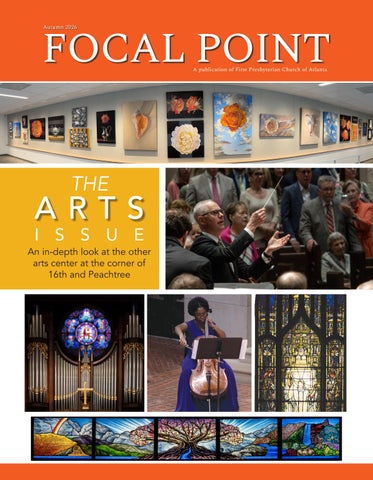
FOCAL POINT Autumn 2026
A publication of First Presbyterian Church of Atlanta
THE
ARTS I S S U E
An in-depth look at the other arts center at the corner of 16th and Peachtree
FROM THE PASTOR
The Art of Glorifying God I love the way the Book of Psalms concludes. After 150 psalms filled with joy and sorrow, gratitude and lament, doubt and trust, the final word is praise. And not just any praise! The psalmist imagines a magnificent symphony of sound—trumpets, harps, strings, pipes, tambourines, cymbals, and even dancing. It is as if all creation has been invited to participate in a grand celebration of God’s glory. But music is hardly the only artistic expression Scripture celebrates. In Exodus 31, God calls Bezalel by name and fills him with the Spirit, giving him wisdom, creativity, and skill to work in gold, silver, bronze, stone, and wood. Think about that. One of the first people Scripture explicitly describes as being filled with God’s Spirit is an artist! His calling was to create beauty for the Tabernacle, the sacred place where God’s people would gather in worship. Taken together, these passages remind us that music and art are not ornamental additions to the life of faith. They are expressions of our God-given creativity, ways 2
of glorifying God and edifying the church. Think about how the arts shape our faith. Long after we have forgotten a sermon, a hymn remains in our memory. A familiar melody gives us words when prayer becomes difficult. A painting challenges our assumptions. A sculpture invites us to see something familiar in an entirely new way. Sometimes beauty communicates something about God’s grace that words alone cannot capture. I am deeply grateful for the musicians, artists, staff, and volunteers who enrich the life of First Presbyterian Church through our Music and Arts Ministries. Their gifts do far more than beautify our worship and campus. They awaken wonder, deepen faith, stir our imaginations, and help us encounter the beauty of God. Blessings, Tony
4
TABLE OF CONTENTS 4 Meet the Bara Brothers 10 Reflecting on the origins of the School of Fine Arts 16 The Wirth Scholarship propels students to new levels 18 The story behind our newest stained glass window
10
24 Peering into the history of the pipes of FPC’s magnificent organ 28 FPC’s Arts Council nurtures creativity and connection 32 Linger, look, and learn from our sanctuary’s storied stained glass 38 FPC News & Notes 39 In Focus: Photography from Church Life
1328 Peachtree Street NE, Atlanta, Georgia 30309 www.firstpresatl.org
18
from Strawberries to
. Symphonies FPC’S DIRECTOR OF CHOIR AND
ORCHESTRA AND FPC’S DIRECTOR OF WORSHIP, THE ARTS, AND ORGANIST SHARE MORE THAN A PASSION FOR MUSIC. THEY SHARE A LAST NAME. MEET THE BARA BROTHERS. 4
H
olt, Michigan, sits about a 15-minute drive southeast of Lansing. Growing up, Tom and Dan Bara spent long days working in their father’s strawberry fields just outside town. The 40-acre farm produced plump, rich strawberries, but, as with anything beautiful, the harvest required devotion, attention to detail, and diligent work. During the spring and long summers, they had to watch the weather closely. The hours were long. And picking strawberries was not easy. As a ground-cover fruit, strawberries required work that was arduous, physical, and intense. “Tom and I also had an intense childhood experience growing up on a family farm,” Dan said. “We had that shared experience of that manual labor alongside our parents. It helped that Tom was my boss, and that led to us working as a team.” The risks, hard work, and long hours taught them the value of devotion, a strong work ethic, and diligence. For members who have witnessed Dan and Tom perform on Sunday mornings, the lessons of those strawberry fields are still evident in the music that fills the sanctuary. Devotion to detail. A robust work ethic. Diligence in ensuring every note is sounded by every voice and every instrument. Brothers who play together in musical ensembles or bands do not always have the happiest storybook endings. Think of Oasis, The Isley Brothers, The Everly Brothers, or Atlanta’s own The Black Crowes. Their histories are filled with stories of verbal acrimony, fistfights, and, in many cases, brothers who stopped speaking to one another for years, if not decades. Such is not the story of the Baras. The two work side by side every week, but if you are looking for animosity, you will have a difficult time finding it. The “a” word that best describes their relationship is “admiration”—as in mutual admiration. The brothers grew up in a household with a deep affinity for music. Their mother played flute in high school. Their father did not play an instrument but harbored a deep love for music. Both parents also sang in the church choir. The brothers were drawn to it and dove in. Tom, older by
6
two and a half years, gravitated toward the piano and organ. His musical development came quickly, earning him local notice and, eventually, scholarships. “Tom flourished really quickly,” Dan recalls. For Dan, the music bug took a little longer to bite. In the meantime, he explored other aspects of arts and culture, including participating in high school drama. Like Tom, he eventually began dedicating himself fully to music, focusing on piano and singing. Like Tom, local recognition and scholarships soon followed. Their combined talent and work ethic earned both brothers scholarships, but there were still significant financial hurdles to overcome. Their parents believed in them. The strawberry farm? Their father sold it to help pay for their education. “That’s a herculean gift our parents gave us,” Dan said. “They stood back, and they were mighty courageous to do that.” During college, the brothers had the unusual opportunity to overlap for a time at the University of Michigan, even living in the same dorm. “Through time, we both ended up at The University of Michigan and lived in the same dorm,” Dan said. “That was a real overlap in our lives and that really built our friendship. Tom was a welcome balm and friendly face as I adjusted to the stresses of swimming in a much bigger pond.” If you are searching for stories of wild parties and brothers getting into mischief,
you may be looking in the wrong place. Instead, some of their fondest memories involve long nights practicing music, followed by running to burn off the stress. “That was a fun year,” Tom said. “We would practice until midnight, close the school, jump in the pick-up truck and go run a 5K. Then, we would go back to the dorm and do homework.” After college, the two went their separate, yet successful, ways, earning accolades and distinction in their respective careers. Tom built a distinguished career as an organist, church musician, educator, and performer. His work included positions at prominent institutions such as St. Thomas Church Fifth Avenue and the Cathedral Church of St. John the Divine in New York, as well as teaching roles at Interlochen Arts Academy and Arts Camp, where he mentored generations of young musicians. Along the way, he received numerous honors, including first prize in the Arthur Poister National Organ Competition. Dan had his own remarkable successes, serving on the faculties of the University of Michigan and the University of Wisconsin–Madison before joining the University of Georgia in 2010 as Hugh Hodgson School of Music Top: The brothers hard at work in the strawberry fields. Dan drove the tractor as Tom loaded the planter attachment with the young strawberry transplants. Above, backstage at a University of Michigan choir concert. Tom, a senior, and Dan, a freshman, sang next to each other in the baritone section.
7
Director of Choral Activities and Professor of Music. Today, he serves as Associate Dean for Academics in the Franklin College while continuing as Director of Choral Activities in the School of Music. In 2016, Dan joined the FPC staff. Seven years later, Tom joined him. There was some natural apprehension for Tom. Eventually, however, the once-ina-lifetime opportunity to work alongside his brother won out. It helped that his early visits were filled with meaningful memories. Tom recalls how warmly his mother was welcomed by Rev. Dr. Tony Sundermeier. Later, after she died, their father was able to come to FPC and experience the brothers’ first Christmas Eve together. “You sense right away that this is a wonderful place. There is the obvious architecture, but to be part of a place in Christ’s ministry, not just in worship but in Community Ministries, is amazing,” he said. “We have a great music staff, and it is so much about community. I felt a real kinship with Tony. His upbringing is analogous to ours, and I feel a real camaraderie with him.” Since joining the FPC staff, Tom has experienced a deep joy in his vocation and describes working alongside his brother as “dreamy.” “Working with Dan as a fellow musician, it feels great. Dan is internationally at the pinnacle of 8
his craft. And I knew him when,” he says with a warm smile and laugh. “I have the utmost respect for him as a musician.” The brothers also did not have to overcome the usual hurdle of building a system of trust and communication. “Because he’s my brother, there hasn’t been that whole ‘get to know you.’ There is immediate trust. I know the feedback he has for me is true,” Tom said. Dan echoed his brother’s comments. “It’s a blessing to work at this level with someone you love. Tom will always be someone I will look up to as a big brother. There is lifelong trust. I will always want to make Tom proud,” he said. “I want to collaborate with our work at First Presbyterian. That makes me proud, makes Tom proud, and serves the church in a meaningful way.” What began in strawberry fields outside Holt has become a partnership shaped by habits their parents taught them decades ago: devotion, trust, discipline, and care.
The brothers working on a deck together several years ago. Outside of their work at FPC, the brothers have an added bonus in their relationship. They both live north of Atlanta, with Tom in Lilburn and Dan in Tucker. The proximity provides them and their families extra opportunities to connect outside of work. ‘Tom is an amazing cook and host and grill master. Family celebrations are surrounded by meals,’ Dan said. Dan also lauds Tom’s handiwork. Through the years, Tom has used those same hands that play our organ to build decks and install a variety of craftwork.
Beyond the walls of 16th and Peachtree Streets While we enjoy the gifts of the Bara brothers at FPC, the reach of their talent extends beyond the walls of the church. Dan Bara served as Interim Director of the Hugh Hodgson School of Music at the University of Georgia for two academic years, from Fall 2024 through August 2026, before being appointed Associate Dean for Academics in UGA’s Franklin College of Arts and Sciences on August 1, 2026. In his current role, he serves as Associate Dean for Academics in the Franklin College, where the Hugh Hodgson School of Music is housed, while also serving as Director of Choral Activities in the School of Music. Bara is also the John D. Boyd UGA Foundation Professor of Choral Music. Throughout his career, he has collaborated with renowned artists including Kathleen Battle, Andrea Bocelli, The King’s Singers, Tenebrae, and The Knights Chamber Orchestra. His recordings with the UGA Hodgson Singers have been released internationally through Naxos and Gothic Records. Tom Bara is an accomplished organist, conductor, and church musician who served more than two decades as Director of Music at Central United Methodist Church in Traverse City, Michigan. A graduate of Interlochen Arts Academy and the University of Michigan, he is passionate about worship, choral music, and organ performance.
reludes A look back at the
people and vision that shaped the School of Fine Arts
T
he story of the origins of First Presbyterian’s School of Fine Arts is one in which few people sought the spotlight. Finding photographs and firsthand documentation of its creation has been surprisingly challenging, not because the work was insignificant, but because those who built the program were more focused on bringing it to life than documenting their own contributions. That spirit of humility was evident in our interviews. Again and again, those involved redirected credit to others, declined recognition, and emphasized the collective effort behind the school’s creation. Their approach echoes the familiar sentiment often attributed to President Harry S. Truman: “It is amazing what you can accomplish if you do not care who gets the credit.” The idea for the School of Fine Arts
emerged in 1999, when members of First Presbyterian Church were considering how to expand the church’s role in the growing Midtown community. One proposal was a basketball gymnasium, a place for exercise, fellowship, and community. But with numerous athletic facilities already serving Midtown, the concept offered little that was distinctive. Instead, the conversation turned toward the arts. As Midtown’s arts community continued to flourish, church leaders recognized an opportunity to create something that met a unique need and could have a lasting impact. That vision became reality in 2003 with the opening of the FPC School of Fine Arts. More than two decades later, its origins reflect the same spirit that shaped it from the beginning: a commitment to the arts, the community, and the work itself instead of personal recognition. This is the story of how the school began, the people who helped bring it to life, and what comes next.
Rev. Dr. George B. Wirth First Presbyterian Church Pastor Emeritus
The lore of the genesis of the school is often traced to Rev. Dr. George B. Wirth, who was senior pastor at the time. While there are some truths to that, it is more nuanced and complex. “There was no other music school that we could determine in Midtown, and we realized we had an opportunity,” said Wirth, pastor emeritus of FPC, in a recent interview. Wirth recalls that in the early 1990s, church leaders were discussing a potential capital campaign with several goals: building a gymnasium where the parking lot was located, developing an expanded ministry to the unhoused community—which eventually became the Smith Center—and creating some type of music school that would parallel the church’s weekday preschool. “That dream took a decade, and it became a significant outreach to Midtown,” he said. But Wirth is quick not to take sole credit for the school, and he quickly cedes credit to Charles “Charlie” and Diane, “D.J.” Whittaker. “They were the ones who envisioned it, dreamed it,
Wirth with late Atlanta Mayor and church member Ivan Allen Jr. circa 1995.
and helped move it forward through the laypeople at the church and into the Midtown community,” Wirth said. When pressed again about his own role, Wirth again points to others, including Julianne Erbrecht and church member Lee Edwards, who played important leadership roles. He is glad to have been part of the effort, but he is quick to emphasize that the school was the result of a shared vision and the work of many people.
Julianne Erbrecht
Director of Music Ministries at Burke Presbyterian Church in Virginia
Charles (Charlie) & Diane “D.J.” Whittaker Retired
The Whittakers pictured circa late 90s.
Erbrecht, pictured above, in 2026.
We caught up with Julianne Erbrecht, who currently serves as Director of Music Ministries at Burke Presbyterian Church in Virginia. During the early discussions of the School of Fine Arts, she was working at FPC as the associate director of music, where she sang in the choir and led two children’s choirs. She was enrolled in graduate school at Emory University. Following graduation, leadership at FPC reached out to her to assist in starting the school. She served as the founding director of music and the school’s first administrator from 2002 to 2003. “There was such great energy from the Wirth ministry and the Session. The church was super supportive,” she said. “The church was known for its strong music program with the choirs and orchestra, so it sort of made sense, and we had facilities that were available. It just made sense. It did seem like a good opportunity and building on the children’s strengths.” Shortly before our interview, she had scanned the website and was thrilled to read about the Wirth Scholarship for Music. “I think I’m very pleased to see it still exists and has grown and has expanded. I think when it began, we really didn’t know much about it or how it could be sustained. I’m very pleased to see that it is so vibrant and educating the community.”
Charlie and D.J. Whittaker now live in Williamsburg, Virginia. When they served at FPC, Charlie was Director of Music and Organist, and his wife, Diane, served as Associate Director of Music. Reflecting on the school’s founding and emergence, Charlie echoes many of Wirth’s thoughts. “We saw a need in the Midtown area for a music school, but for more than that, our vision was to create a community of artists. The school is for students and also teachers,” he said. “Private teachers are a bit on their own. Our thought was that if we could utilize the empty rooms the church has during the week for lessons, we could also establish a camaraderie to create their own community.” Following a series of positive surveys and reactions, the Session approved the plan, and things began to move forward. To launch the school and gain traction, the couple not only relied on word-ofmouth within the congregation and community but also contacted all of their connections throughout their sphere, including a local radio icon. “I also got good cooperation from [Atlanta NPR icon] Lois Reitzes,” he said. “She actually did a couple of plugs on the radio.” The Whittakers retired in 2010.
Jens Korndörfer
Joyce O. Bowden Professor of Music and Associate Professor of Organ at Baylor University Jens Korndörfer was not there at the beginning of the School of Fine Arts. By his own account, that credit belongs to Charlie Whittaker and Will and Kate Breytspraak. Korndörfer joined the institution a couple of years after the school was founded, eventually serving as Director of Worship and the Arts at FPC. But his years with the School of Fine Arts gave him a perspective on what the program could become. Among his favorite memories are the annual scholarship auditions. He remembers watching young musicians walk into the room, often nervous but determined. “Seeing those kids walk into the room and give their best was just awesome,” he recalled. Korndörfer also valued the relationships he developed with the school’s teachers. Many were involved in FPC’s choir and orchestra, allowing him to work with them not only as educators but as fellow musicians. For Korndörfer, however, the significance of the School of Fine Arts extended beyond individual performances or programs. His time at FPC raised
Korndörfer now serves at Baylor University.
larger questions about the purpose of arts education: How do you pass on the passion and love for the arts that motivates you to people in a changing society? How do you find the right person for the right role? And how do you extend arts education to people who might otherwise have limited access to it? “It takes a village,” he said. Those questions have stayed with Korndörfer. The experience he gained working with the School of Fine Arts team continues to inform his work in academia today.
Sindhu Giedd
Director of School of Fine Arts Looking ahead, Sindhu Giedd sees exciting opportunities for the School of Fine Arts to grow and deepen its ministry at First Presbyterian Church of Atlanta. As director, she is focused on strengthening relationships with teachers, expanding opportunities for students, and helping connect the school more closely with the life of the church. This fall, the school introduced a new songwriting and music studio curriculum, giving students additional ways to develop their creativity and musical gifts. Giedd is also exploring more opportunities for students to participate in worship and concerts, including through the Wirth Scholarship program. With approximately 50 students currently enrolled, Giedd hopes to grow the school while maintaining the personal connections
that make it special. She is especially encouraged by the number of FPC members and families who participate. “First and foremost, it’s a ministry,” she said.
SAVE THE DATES IMPORTANT UPCOMING DATES IN THE LIFE OF OUR CHURCH
NOVEMBER 1: ALL SAINTS’ SUNDAY NOVEMBER 15: COMMUNITY MINISTRIES SUNDAY NOVEMBER 22: WREATH MAKING FOLLOWING 11 A.M. WORSHIP NOVEMBER 29: FIRST SUNDAY OF ADVENT DECEMBER 6: SECOND SUNDAY OF ADVENT/ANNUAL CHOIR AND ORCHESTRA CHRISTMAS CONCERT DECEMBER 13: THIRD SUNDAY OF ADVENT/CHRISTMAS PAGEANT DECEMBER 20: FOURTH SUNDAY OF ADVENT DECEMBER 24: CHRISTMAS EVE SPECIAL SERVICES AT 11 A.M., 3 P.M., 5 P.M., AND 7 P.M. DECEMBER 25: CHRISTMAS DAY SERVICE AT 10 A.M. IN THE CHAPEL DECEMBER 27: ONE SERVICE AT 11 A.M.
15
Wirth Every Moment: Scholarship invests in next gen of SFA students
C
indy Candler was a core part of the committee that helped bring the School of Fine Arts to life. When the Rev. Dr. George B. Wirth, who played a key role in the school’s creation, announced his retirement, Candler and the other members of the committee wanted to find a meaningful way to honor his vision and his work in establishing the school. Rather than simply holding a reception or naming a classroom in his honor, Candler and her colleagues decided to create something that would have a longer-lasting and more tangible impact. They created a scholarship. “Let’s encourage young musicians. Let’s give scholarships,” Candler said. Established in 2013, the Wirth Scholarship for Music was designed to remove financial barriers for talented young musicians who wanted to develop their skills but whose families had limited financial resources for private instruction. The scholarship provides private music lessons at the School of Fine Arts for students ages nine to 18, with awards of up to $2,000 during the school year. Students who receive the scholarship are expected to demonstrate a commitment to their 16
musical development by consistently attending lessons and meeting or exceeding the expectations established by their private teacher. As their skills develop, scholarship recipients may also be invited to perform at church services and events. For students auditioning for the scholarship, the process reflects the school’s commitment to serious musical development. Applicants submit an application, a teacher recommendation and a video audition before interviewing with members of the Wirth Scholarship committee. Instrumental students are asked to demonstrate their abilities through contrasting works from different periods, scales, and a brief statement about why the scholarship is important to them. Vocal applicants perform contrasting selections, including at least one work from the standard classical repertoire. In other words, the scholarship is about more than simply providing a lesson. It is an investment in a young musician’s potential. Since its establishment, the Wirth Scholarship has helped 78 students pursue that potential. The scholarship is supported through a combination of First Presbyterian Church funds, individual donations, and fundraising efforts. The School of Fine Arts also benefits from its close connections within Atlanta’s broader musical community, including its relationship with the Atlanta Symphony Orchestra and the ASO’s Talent Development Program (TDP), which identifies and trains exceptional middle and high school music students of Black and Latino heritage who aspire to careers as professional classical musicians. And the scholarship’s impact can sometimes be heard much closer to home. Chances are, if you have attended a worship service at First Presbyterian, you have heard a Wirth Scholarship recipient
Cindy Candler and Rev. George Wirth catch up after a recent Bible study at the church.
78
the number of students who have been helped by the scholarship through the years
performing the prelude or participating in the music of the service. Candler can point to numerous stories of students whose commitment to music was matched by the commitment of their families. One student, she recalls, had a mother who drove the young musician from northwest Georgia to Atlanta every week for lessons. “These kids are very committed,” Candler said. That commitment is precisely what Candler and the other founders hoped to encourage when they decided how best to honor George Wirth. What began as a desire to recognize one man’s contribution to the School of Fine Arts became a way to invest in generations of young musicians. The Wirth Scholarship ensures that Wirth’s legacy is not simply remembered. It continues to make music. Learn more: SFAFirstPres.com/scholarship
A NEW VISION ON
PEACHTREE
A
t the corner of 16th and Peachtree Streets, First Presbyterian’s beautiful sandstone Sanctuary rises above the vibrant streets of Midtown Atlanta. In addition to its notable architecture, the Sanctuary features ten remarkable stained-glass windows. Each stained-glass window tells a biblical story from the Christian tradition, from Abraham to the spread of the Gospel by the apostles. The decision to incorporate these windows, with their deliberate historical narrative, into the church’s architecture was led by the same man who led the church’s move to its current location, the Rev. Dr. John Sprole Lyons. Lyons conceptualized the windows, which were created in collaboration with Louis Comfort Tiffany and Nicola D’Ascenzo. While those stained-glass pieces might be the most visible to worshipers on a Sunday morning, there are other stained-glass pieces on campus, including works by Willet Studios. In December 2025, another piece of stained glass was added to the edifice. It tells a part of the biblical story, but through a new lens and in a new location. Located just above the main entrance to The Correll Family Commons, the piece shines a vibrant light of color and story onto Peachtree Street. The piece was created by Scottish Group Companies, a stained-glass company with roots in Scotland and a studio in Denver. The design was a joint creation by the Rev. Dr. Tony Sundermeier, Scottish Group Companies glass painter Maria Sheets, and Scottish Group Companies Founder and CEO Martin Faith. Sundermeier approached the project with a similar zeal as Lyons had decades before. “I had the same conviction as Lyons and many other pastors and members of FPC that sacred art can teach, inspire, and bear witness to the gospel. That rich heritage helped shape the vision for this piece, which was part of our On the Way Capital Project,” he said. Throughout the process, Sheets, Faith, and Sundermeier met often via Zoom to discuss the project, make changes, add color, and make sure the finished project was in line with the message Sundermeier wanted to convey. “If the Sanctuary windows tell the story of God’s saving work from Abraham through the apostles, this new window turns our eyes toward where that story is ultimately headed: the renewal of all creation, the New Jerusalem, the river and Tree of Life, the healing of the nations, and the promise that God will dwell with God’s people and ‘wipe every tear from their eyes,’” Sundermeier said. 18
19
“I had the same
conviction as Lyons and many other pastors and members of FPC that sacred art can teach, inspire, and bear witness to the gospel. That rich heritage helped shape the vision for this piece, which was part of our On the Way Capital Project.”
- Rev. Dr. Tony Sundermeier, Senior Pastor
In that sense, the new window does not begin a different story. It completes the arc already being told throughout our church. The panel is also unique, as it incorporates distinct images from the Atlanta skyline and nature that is distinctive to Georgia, including pine trees, pecans, Vidalia onions, peaches, melons, red clay, deer, and a red-tailed hawk. For Faith and the crafters at Scottish Group, the introduction of objects such as Vidalia onions opened an entirely new world. “Everything our company does is unique on every project. We had never even heard of Vidalia onions, never mind featured them in a stained-glass window,” he said. “We started by listening to what Pastor Tony was telling us about his vision for the five panels and then started doing our own research into unique aspects of the scenes we were portraying. We like to make our stained glass meaningful from a biblical 20
aspect, but also meaningful to the local members of any given church. When God laid the foundation for the creation of the Earth, we believe part of the plan might have been to create uniqueness in the various regions of the Earth and probably the entire Universe. Vidalia onions are just one small thing that makes Georgia a unique and special place.” The resulting five-panel window overlooks the Memorial Garden and draws its inspiration from the closing vision of Scripture, especially Revelation 21:1–4 and the imagery that continues into Revelation 22. For Sundermeier, the goal was always not just to add another beautiful window, but to continue a tradition established generations ago: using stained glass to tell the biblical story in a way that speaks to the church in its own time and place.
Inside the Scottish Group Companies workshop where artisans work to craft and create dynamic and inspiring works of stained glass.
PANEL ONE: The Holy City Coming Down The first panel is an homage to John’s vision of the New Jerusalem descending from heaven. The rainbow, luminous sky, and golden city suggest that the future God promises is not an escape from creation but its renewal. Woven into the imagined city are recognizable elements of the Atlanta skyline. That choice intentionally brings the biblical vision close to home. Revelation does not ask us simply to dream about some distant heavenly city; it invites us to imagine what it means for God’s promised future to break into the cities and communities where we actually live. Atlanta itself is placed within the horizon of God’s redemption. The city we know—with all of its beauty, struggle, history, division, hope, and possibility—is held within the promise: “See, the home of God is among mortals.”
PANEL TWO: The River of Life The second panel begins the movement from the city toward the garden. Water courses through mountains and valleys beneath a radiant sky, recalling the “river of the water of life” that flows from the throne of God. Water throughout Scripture is a sign of cleansing, renewal, baptism, abundance, and life. Here, it suggests that God’s grace does not remain contained within the holy city. It flows outward, bringing life wherever it goes. The movement of the water also draws the eye toward the center of the window, reminding us that the new creation is alive, dynamic, and overflowing with the goodness of God.
PANEL THREE: The Tree of Life At the center stands the Tree of Life, its enormous roots reaching deeply into the earth and its branches spreading outward in every direction. It is the theological and visual heart of the composition. The tree recalls Eden, but it also points beyond Eden to the consummation of God’s purposes in Revelation, where the Tree of Life appears again in the renewed creation. What was fractured in the beginning is restored at the end. The tree therefore becomes a symbol of reconciliation, permanence, abundance, and resurrection life. Its great roots and expansive branches suggest a creation firmly rooted in God while making room beneath its canopy for the whole human family.
PANEL FOUR: The Healing of The Nations The fourth panel continues the Tree of Life and the river as they extend outward into the world. The many-colored leaves evoke Revelation’s remarkable promise that “the leaves of the tree are for the healing of the nations.” Their variety is intentional. The nations are not erased or made indistinguishable in God’s future; the richness and diversity of humanity are gathered into a reconciled creation. The leaves suggest peoples, cultures, languages, and nations in all their difference, now no longer divided by hostility but brought together within the healing purposes of God. The flowing water beneath them reinforces the sense that divine grace continually nourishes this work of reconciliation.
PANEL FIVE: Georgia within the New Creation The final panel brings the vision all the way home. The landscape is an homage to Georgia, filled with elements of the natural world that identify this particular place: pine trees, pecans, Vidalia onions, peaches, melons, red clay, deer, and a red-tailed hawk, all gathered around flowing water and the abundance of the land. The panel makes a theological claim through very local imagery: the creation God loves is not generic. Redemption embraces actual places, landscapes, creatures, communities, and histories. Just as Atlanta appears within the New Jerusalem in the opening panel, Georgia appears within the renewed creation in the final one. The biblical story therefore moves from the universal to the particular—from a new heaven and a new earth to this city, this land, these creatures, and this community.
Seen as a whole, the window moves from city to garden, from promise to fulfillment, from the nations to our own particular place. And because it overlooks the Memorial Garden, that movement carries an additional resonance. In a place where we remember those who have died, the window directs our gaze toward the Christian hope that death will not have the final word: “Death will be no more; mourning and crying and pain will be no more.” The garden below remembers lives we have loved; the glass above announces the future God has promised—a creation healed, reconciled, alive, and filled with the presence of God.
PIPES
and what makes them speak A Whether b r i e f inh the i s tgrandeur o r y o fofFSaint-Saëns, P C ’ s m a the g nfire i f i cofeVierne, n t o rorgthe an Whether is performing the grandeurGrace,” of Saint-Saëns, fiery strains of Vierne, or the quiet quietitfamiliarity ofmusical “Amazing thethe instrument reflects the familiarity of “Amazing Grace,” First Presbyterian Church of Atlanta’s organ reflects the full life of the full life the ofbright the congregation: the procession ofthe weddings, congregation: procession of weddings, thebright quiet gravity of funerals, and many Sundays of worship when music speaks where words fall short. quiet gravity ofat funerals, andthe the many moments between Onthe the Third Sunday of Lent First Presbyterian, music that swelled from thein organ during the postlude was not what some might typically expect during that liturgical season of reflection. when music speaks where words fall short. The piece was the “Finale” of Louis Vierne’s Symphony No. 1, a relentless, driving piece that requires precision, endurance, and complete command of the instrument. Several people drifted down toward the chancel to catch sight of organist Tom Bara as he played, including Doug Ellis, arguably the church’s most faithful postlude observer. They watched as Bara’s wellLent leansshoes contemplative, a quiet season across of worn organist’s movedglided purposefully the worn organist’s moved purposefully the pedalboard and shoes his hands across across the organ’s reflection before resurrection. The Third Sunday in pedalboard. His hands moved across four keyboards, four keyboards with precise expertise. First Presbyterian washis that way asinto well,the butmanuals called manuals, with quiet AsLent Baraat pressed the tips of fingers for the final chord, theexpertise. sanctuary organ still had the music that carried the service to its close was “To watch Tom Bara reading music and playing something to say. Sound reverberated through the rafters and rolled across the floor. The pews quivered not what some would expect during the season. The on these various levels of keyboards, and his feet are slightly. smattering ofofapplause followed, which briefly acknowledged. pieceAwas the “Finale” Louis Vierne’s Symphony No.Bara dancing up and down the pedals, playing not only Moments like that say something about the place of the in the lifeheels… of a church. 1, a relentless, driving piece that requires precision, withorgan his toes, but his he’s got his whole body endurance, andhear complete command of thefeel instrument. involved,” Ellis said later. “Itt really is a wonder to “You don’t just it,” Ellis said. “You it.” Several people drifted down toward the chancel to catch sight of organist Tom Bara as he played. Doug Ellis, the sanctuary’s most faithful postlude observer, stood in his usual place. They watched as Bara’s well-
24
watch him play.” As Bara pressed the tips of his fingers into the manuals for the final chord, the sanctuary organ still had something to say. Sound reverberated through the
25
The pipes at FPC At nearly 110 years old, our organ has pipes that are placed in both the front and back of the sanctuary. Its pipes—some stretching more than 30 feet into the air, others no larger than a pencil—are arranged in ranks that fill its chambers. The blowers and bellows are housed in a chamber underneath the sanctuary. Many Sundays, the instrument works without drawing much attention to itself. It supports the congregation’s singing, accompanies the choir, and fills the spaces between spoken words as it carries the emotional language of the church. With more than 6,000 pipes, the organ is one of the most formidable in metro Atlanta. For scale, it is roughly four-fifths the size of the famous organ at Notre Dame Cathedral in Paris. A Machine That Breathes Our organ is the product of meticulous design and intricate rebuilding. Generations of builders and musicians have devoted time and care to the instrument that can whisper beneath a prayer or fill a sanctuary with thunder. These collections of pipes are the heart of the instrument. One rank might sound like a flute. Another might imitate the brightness of a trumpet. Another carries the clear, foundational tone organists call the principal chorus, the sound most people recognize when a hymn fills the room. Layered together, those ranks behave very much like sections of an orchestra. The gentle voice of flutes lends a softer resonance to prayer. Strings shimmer quietly beneath a choir. Reeds provide brilliance and urgency when the music calls for it, while the principals anchor the entire structure with clarity and strength. With 112 ranks, the number of possible combinations 26
for the First Presbyterian sanctuary organ is far more than any one organist might use in a lifetime. “It’s not about using everything,” Bara said. “It’s about choosing the right sound for the moment.” A Century in the Making The instrument that is heard today is the result of more than a century of evolution. When First Presbyterian Church opened its Peachtree Street sanctuary in 1919, the congregation installed a large pipe organ built by Henry Pilcher’s Sons. The instrument supported congregational singing and accompanied the choir through the early decades of the church’s life in the new sanctuary. By the late 1960s, the musical ambitions of the church had outgrown the original instrument. In 1969, the Pilcher organ was replaced with a new instrument built by the M. P. Möller Pipe Organ Company, then the largest organ builder in the United States. Portions of the pipework from the earlier organ were retained, while the new instrument expanded the tonal palette of the sanctuary in keeping with the style popular in American church organs at the time. Another major update, this time in 1992, added a new control system, façade, and additional stops, expanding the instrument’s capabilities for both worship and concert use. The most recent transformation came between 2016 and 2018, when the German builder Klais Orgelbau, working with the Georgia-based firm A. E. Schlueter, undertook a comprehensive renovation and enlargement. The organ was cleaned and revoiced, new ranks were added, and a newer, state-of-the-art control system was installed.
Part of what makes the organ distinctive is its layout within the sanctuary. Much of the instrument speaks from the chancel, but additional divisions are placed elsewhere in the building, allowing sound to answer from different directions in the room. In effect, the organ has both front and rear voices, giving the organist the ability to let music move across the sanctuary itself. Ellis, who has heard the organ through its various iterations, describes a performance as the coming together of four parts: the composer, the sanctuary itself, the instrument, and the organist. For years, he said, the room “favored the spoken word,” with batting in the ceiling and carpet on the floor that muffled the sound. Then the church decided, as he put it, “to bring the sanctuary into the music program.” Once the upholstery came down, “all of a sudden, it became alive.”
carrying them forward when the line of a hymn stretches just a little longer than expected. In that sense, the organ becomes more than a source of sound. It becomes a kind of partner in the act of worship itself, one that helps the congregation not only hear the words, but inhabit them. In those moments, the instrument does not stand apart from the service, but moves within it, shaping the experience as much as it accompanies it. As Bara plays, “I sing along with each stanza,” he said. “It’s my chance to preach from the console.”
T h e O r g a n’s R o l e i n Wo r s h i p For more than 20 years, Bara labored among the Methodists, where he developed an instinct for the role of music in the life of the church. In Methodist congregations, people are raised on singing. The tradition traces back to John Wesley’s encouragement that believers should sing boldly and together, treating music not as ornament but as a way the faith itself is carried—something spoken, shared, and embodied in the act of worship. At most Presbyterian churches, where worship is shaped as carefully as it is studied, that instinct meets a tradition equally serious about form. Here, music is considered with the same care as theology itself—chosen, placed, and interpreted within the larger structure of the service. The organ does not simply accompany; it supports, frames, and, at times, gently directs the congregation’s voice, giving shape to what is being said and sung. For Bara, the instrument is not separate from the people in the pews, but in conversation, responding to their voices, sustaining them when they falter, and
Above, longtime member Doug Ellis is one of many members who linger to listen to the postlude following worship on Sundays. At the console, Bara becomes, all at once, architect of sound, engineer of an intricate machine, and resident artist of a building within a building. What Bara loves about this organ is not simply its scale, but ‘the range in color and dynamics’ available within it.
27
Cultivating & C E L E B R A T I N G
For Shay Herman, the connection between art and faith has always felt natural.
After spending 39 years teaching students with special needs in Baltimore, Herman found a new way to engage her love of the arts during retirement: volunteering as a docent at the High Museum of Art. The experience introduced her not only to Atlanta’s art community but also to fellow First Presbyterian Church of Atlanta members who shared her passion. Among them were FPC members Bryan Brooks and the late James “Jim” Patrick Wise, both of whom also served as High Museum docents. One Sunday, Wise recognized Herman from the museum and encouraged her to become involved with the church’s Arts Council. “I recognize you, I’ve seen you at The High!” Herman remembers Wise telling her. “We have an arts council here, and you should be on it.” 29
Shay Herman, left. Opposite page: The opening of the art gallery drew a sizeable crowd. The gallery is just one of multiple ways in which the arts council enriches the church.
Herman did not need much convincing. She joined the Arts Council about three years ago and, in May 2026, succeeded Brooks as its Ministry Leader. For Herman, serving on the Arts Council is about more than an appreciation for beautiful things. It is about the way art can deepen faith. “I think for one thing art enhances worship,” she said. “You can worship anywhere. For me, being in a beautiful space that glorifies God adds to the worship experience. I look at the soaring ceiling and the stained glass and it adds to my worship experience.” She also sees creativity as one of the ways humanity responds to the gifts God has given. “God gave us gifts,” Herman said. “We are lucky enough as humanity to have people create provocative, beautiful things. That makes us think about the world we have been given.” For Herman, artists can use those gifts to point beyond themselves. “If you can touch someone’s heart or soul and maybe help them think, ‘This is evidence of God’s presence in the world,’” she said, “then I think that’s a wonderful thing.” A Blank Canvas The roots of FPC’s Arts Council stretch back nearly two decades. In 2007, Rev. Dr. George B. Wirth formed the Fine Arts Committee as part of a broader vision for the church’s Midtown location. Wirth saw an opportunity to engage 30
FPC members who were professionals, patrons, and donors in the visual arts, music, and theater while creating new connections between the church and Atlanta’s vibrant arts community. He began by inviting potential participants to a series of lunches. Among those involved were Cary Benham, Cindy Candler, Katherine Davis and, later, Lynne Jenkins, along with leaders from the Woodruff Arts Center, including High Museum of Art Director Michael Shapiro and curator David Brenneman. The committee’s early work reflected an expansive understanding of what an arts ministry could be. Programs included lectures, museum visits, and collaborations with Atlanta’s cultural institutions. The group worked with the High Museum of Art and Friends of Florence around the exhibition of the Ghiberti Doors. It supported the dedication of the Nancy Kerwin Memorial Garden’s wrought-iron work and organized programs exploring Atlanta architecture, including tours focused on Neel Reid and homes in Ansley Park. The programming soon moved beyond visual art. Working with Spalding Nix, the committee developed a multi-week Lenten Sunday School program exploring artistic depictions of the faces of Jesus. The program included large-format reproductions of works by Leonardo da Vinci as well as presentations from religious scholars. Music and theater also became part of the conversation. Over time, the Fine Arts Committee grew in both scope and ambition. Eventually, it evolved into the Arts Council, reflecting the increasingly broad role the arts played in the life of the church. Nearly 20 Years Later Today, the Arts Council remains an active part of FPC’s ministry rather than simply a group that organizes occasional art programs. The council includes 10 members, along with three staff liaisons who help connect its work with the broader ministry of the church. Its responsibilities span much of FPC’s arts programming. The council supports the Concerts@ First series through publicity, ushering and providing feedback and perspective to staff. Members have supported work connected to the bell tower and provide advice and insight to the School of Fine Arts, including support for projects such as the Wirth Scholarship.
The council also organizes art talks on campus and hosts the church’s Symphony Experience, bringing members together for a talk and dinner in Fifield Hall before heading to the Woodruff Arts Center for a performance. And now, the council is helping usher FPC into a new chapter of its visual arts ministry through the Grace & Light Gallery. The gallery, located near The Correll Family Commons, gives the church a dedicated space to bring art, faith, and community together. Its inaugural exhibition honored the life and work of longtime FPC artist and member James “Jim” Patrick Wise—the same person who, years earlier, encouraged Herman to join the Arts Council. That connection is fitting. Wise’s encouragement helped bring Herman into the council, and now Herman is helping lead the council as it supports a new space devoted to the intersection of faith and art.
among FPC members, museum docents, artists, and arts professionals have created a natural network between the church and the city’s cultural institutions. For Herman, that kind of serendipitous connection is part of what makes the council meaningful. The council provides a place for people with different experiences and perspectives to come together around a shared conviction: that the arts can enrich the life of a congregation. That work is also increasingly connected to the School of Fine Arts, FPC’s community arts education program. Through music and arts instruction for children, youth, and adults, the school extends the church’s commitment to nurturing creativity across generations. The Arts Council provides another layer of support, advocacy, and perspective for that work. Together, these ministries create a larger ecosystem in which art is not treated as an accessory to church life, but as one of the ways the church teaches, gathers, celebrates and worships.
A Community of Artists and Ideas
An Invitation to Participate
The Arts Council’s relationship with Atlanta’s broader arts community has also continued to grow. Its connection with the High Museum is less formal than it was during some of the council’s earlier collaborations, but relationships
Herman believes the Arts Council is one of the many places where members can turn an interest or passion into meaningful service. “You can join the Arts Council or join one of the committees,” she said.
LYONS’ LUMINOUS LEGACY First Presbyterian’s stained-glass windows reveal themselves in layers. A first look might be overwhelming in their color and beauty. But linger more and the windows reveal figures, symbols, and connections that draw one more deeply into the biblical story they proclaim. The Rev. Dr. J. Sprole Lyons understood that concept when he conceived the series of windows more than a century ago. Working first with artists at Tiffany Studios and later with D’Ascenzo Studios, Lyons envisioned a sequence that would surround worshipers with the story proclaimed from the pulpit and encountered in Scripture. The story begins with God’s covenant with Abraham and moves through Law, Psalms, and Prophets; Advent; the ministry, Passion, Resurrection, and Ascension of Christ; Pentecost; the witness of the martyrs; and finally Christian Missions. No window stands entirely on its own. Figures, symbols, colors, and biblical references connect one scene to another, revealing Scripture as an unfolding story of God’s covenant and redemption. The Rev. Saranell Hartman, Associate Pastor for Engagement, suggests approaching the windows through the practice of visio divina, or “divine seeing.” Related to lectio divina, which invites us to linger prayerfully over the words of Scripture, visio divina asks us to slow before an image, notice what draws our attention, and remain with it in reflection and prayer. Choose a window. Resist the temptation to understand everything in it at once. Look first at the whole composition. Then allow your attention to settle on a figure, expression, gesture, symbol, color, or detail. What do you notice? Stay with it for a moment. What does that detail suggest? What part of the biblical story does it illuminate? What might God be inviting you to notice that a hurried glance would miss? Then pray. Your prayer might arise from something depicted in the window, a memory it has stirred, a question it has raised, or simply the experience of sitting quietly in its light. When you are ready, look again. Moving from window to window reveals another dimension of Lyons’ vision. The windows do not culminate in an image of heaven or even with Christ’s Ascension. The final window depicts Christian Missions. That ending changes the experience of viewing everything that precedes it. God’s covenant with Abraham, the prophets’ witness, the coming of Christ, the cross and empty tomb, Pentecost, and the
1. Abrahamic Covenant
The story begins with God’s covenant with Abraham—a promise of faithfulness extending beyond one person to generations yet to come. Here begins a theme that runs through all 10 windows: God makes promises, calls people to trust, and remains faithful as the story unfolds. witness of the early Church all lead somewhere: outward. The final window turns the story toward us. After lingering with the windows, the last question of visio divina may, therefore, be the most important: Having seen the story, where is God inviting you to enter it? There are a total of 20 windows in four locations. Seven windows are by Tiffany, four by D’Ascenzo, and nine by Willet. The 10 most dominant stained-glass windows surround the Sanctuary, tracing a biblical story from God’s covenant with Abraham to the Church’s continuing mission. Viewed in sequence, they reveal the larger vision conceived by the Rev. Dr. J. Sprole Lyons: not 10 separate works of sacred art, but chapters in one unfolding story of promise, redemption, and response. That distinction matters. Lyons conceived the windows as a unified biblical narrative, while the studios translated that vision into glass—using color, figures, symbols, composition, and light to give visual form to the story he wanted generations of worshipers to
2. Law, Psalms & Prophets
God’s covenant takes shape in the life of Israel through the Law, the worship and longing of the Psalms, and the voices of the prophets. Together they reveal a people learning what it means to live in relationship with God while anticipating the fulfillment of God’s promises. encounter. The theological vision for the windows belonged to Lyons. Bringing that vision to life required the services of some of the most accomplished stained-glass artists and craftsmen of the period. Executed over time, the series begins with work by Louis Comfort Tiffany and continues with windows created by the D’Ascenzo Studios. The first six windows were executed by Tiffany. The next four by D’Ascenzo. The result is both a significant collection of American stained glass and something more particular to First Presbyterian: a visual theology created for this Sanctuary and the congregation gathered within it. In the next several pages, we provide a broad focus on the ten most dominant stained-glass windows and The Rose Window. If you would like a deeper dive, you may pick up one of our extensive history books from The Archives Room. You may also visit www.firstpresatl.org/ stained-glass or scan the QR code.
3. Advent
Centuries of promise and expectation turn toward the coming of Christ. Advent marks both waiting and arrival: God enters human history in Jesus, fulfilling what came before while beginning something altogether new.
4. Jesus’ Ministry
Christ moves among the people—teaching, healing, welcoming, forgiving, and calling others to follow. His ministry reveals not only who Jesus is, but what the kingdom of God looks like when lived among ordinary people.
5. Passion
The story moves toward Jerusalem, the cross, and Christ’s suffering and sacrificial love. What appears to be defeat becomes central to the Christian understanding of redemption and the depth of God’s love for humanity.
34
6. Resurrection
Death does not have the final word. The empty tomb announces Christ’s victory over death and gives rise to the hope at the heart of Christian faith: because Christ lives, death cannot bring the story to an end.
7. Ascension
The risen Christ ascends, but his departure does not end the story. Instead, attention begins to turn toward the disciples who remain—and toward the work Christ entrusts to those who will continue his ministry in the world.
8. Pentecost
The Holy Spirit comes upon the gathered disciples, transforming them from followers into witnesses. Empowered to proclaim the Gospel beyond the boundaries of language, geography, and culture, they become the Church sent into the world.
35
9. Martyrs
The Gospel moves outward through generations of faithful witnesses, some of whom give their lives rather than abandon their faith. Their stories testify both to the cost of discipleship and to a faith carried forward despite persecution and death.
10. Christian Missions
The final window offers an unexpected conclusion: Christian Missions. Rather than ending with heaven or the completion of history, the story ends with the Church carrying the Gospel into the world. It represented First Presbyterian’s calling when the window was installed and still does today. The final window turns the story toward each new generation, inviting the Church to enter it and carry it forward.
A S I M P L E G U I D E T O V I S I O D I V I NA LOOK Choose one window and spend a few moments simply looking. Take in the entire image before concentrating on individual details. NOTICE Where does your eye settle? A face? A hand? A color? A symbol? Something unexpected? Don’t rush to interpret it. REFLECT What does what you notice evoke in you? How does it
deepen, or perhaps challenge, your understanding of the Scripture depicted? PRAY Let what you have seen become prayer. Speak to God about whatever has surfaced, then allow time for silence. LOOK AGAIN Return to the whole window. What do you see now that you did not see before?
You may take a deeper dive into the history of the windows, other stained glass on campus and more artistic features of the sanctuary by visiting our J. Sprole Lyons History Room on the first floor. The primary source for detailed information about the stained glass is the book The First Presbyterian Church of Atlanta: 150th Anniversary, published in 1998. You may also visit www. firstpresatl.org/stained-glass.
The Rose Window Historically, the Rose Window is particularly remarkable because it represents a later chapter in the sanctuary’s stained glass collection. While many of the sanctuary’s windows date to the early 20th century, the Rose Window was dedicated in 1992 and brings a vivid, theologically rich vision of the Book of Revelation into the historic sanctuary. The window was installed on May 3, 1992, through the generosity of the Frank Carter family. Its imagery portrays Christ seated upon a rainbow and surrounded by angels, with the river of life flowing from his feet and the Book of Life open in his hand. The piece is influenced by French Gothic architecture.
FPC NEWS & NOTES
Romero joins staff as Director of Hospitality For Eddy Romero, hospitality has never simply been a profession. It is a way of life. Now serving as Director of Hospitality at First Presbyterian Church of Atlanta, Romero brings decades of experience welcoming, serving, and connecting people to his new role on the FPC staff. A longtime member of the church, Romero has spent much of his career creating meaningful experiences for guests and finding ways to make people feel seen, valued, and cared for. Romero’s hospitality career includes 10 years as Guest Services Manager at Atlantic Station, as well as work with The World of Coca-Cola, the Fox Theatre, Avalon, and Fenton. At Atlantic Station, he helped lead a concierge program designed to anticipate the needs of residents, tenants, and visitors. Whether arranging transportation, picking up lunch, or helping with a last-minute request, Romero believes the smallest acts of service can make a lasting
impression. His story begins with his Cuban heritage. His family immigrated to the United States, and his father was a professional musician who accompanied many well-known Spanish singers. His mother, one of 14 children, became a licensed beautician and manicurist in Miami. After his parents divorced, Romero went to work after high school to help support his mother. Outside of work, Romero has spent more than 40 years singing with the Barbershop Harmony Society, competing internationally and earning three medals at the International Competition level. At FPC, he serves as a Stephen Minister, sings in the church choir, and leads tours of the church’s Tiffany stained-glass windows and historic campus.
Culmer joins FPC as Director of Youth and College Ministries Jason Culmer joined our staff in early summer and serves as Director of Youth and College Ministries. Culmer brings a deep passion for helping young people explore their faith, build authentic community, and discover how their faith can shape the way they live and engage the world around them. He earned his Master of Divinity from Emory University’s Candler School of Theology in 2024, where his studies explored the connections between theology, community, and social transformation. Before joining First Presbyterian, he served in ministry and community-engagement roles with Historic Ebenezer Baptist Church, contributing to work focused on social justice, criminal-justice reform, community empowerment, and ecumenical and interfaith relationships. 38
ALL CHURCH RETREAT Our All Church Retreat took place at Montreat Conference Center in September. We celebrated community, worshiped together, and enjoyed an array of activities and events together.
ALL CHURCH RETREAT
40
GRACE & LIGHT GALLERY OPENING We opened our Grace & Light Gallery in late September following worship. Our first installation honored longtime member James “Jim” Wise and featured an array of his work.
41
VBS 2026 FPC’s Vacation Bible School was a success, thanks to the hard work of our volunteers and staff.
42
VBS 2026
43
Autumnal Equinox, 2024, Oil on Canvas, 24x36. Painting by James “Jim” Wise. One of the paintings hung in our new Grace & Light Gallery.