FirstBike - West Berkshire Edition

Page 1


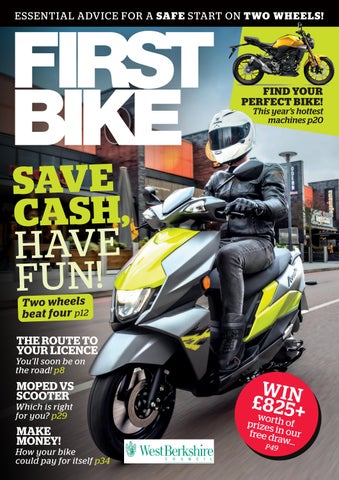
THE ROUTE TO YOUR LICENCE MOPED VS SCOOTER MAKE MONEY!

You’ll soon be on the road! p8 Which is right for you? p29 How your bike could pay for itself p34

Two wheels beat four p12 P49 worth of prizes in our free draw...

WELCOME

We’re going to help you get started on two wheels. From the CBT all the way to your A licence, FirstBike is here to guide you. Whether you are looking for affordable insurance, want to master maintenance basics, or need some help choosing your first moped, there’s lots of advice packed into these 52 pages. Mopeds and motorbikes are more than just transport. Choosing two wheels rather than four is a one-way ticket to adventure. Enjoy it!

Editor: David Motton

Contributor: Al Suttie

Art director: Caroline Creighton-Metcalf

Commercial director: Richard Storrs

Publisher: James Evans

Cover photograph: Suzuki

info@firstcar.co.uk 08451 308853

The contents of this magazine are copyright © First Car Ltd and may not be reproduced or transmitted, in any form in whole or in part, without written consent from the editor. Neither FirstCar Ltd nor its staff can be held responsible for the accuracy of the information herein or for any consequence arising from it. (03/26)

LEARNING TO RIDE FROM PUTTING ON L-PLATES TO YOUR FULL LICENCE PAGE 8

P49 worth of prizes in our free draw... WIN £825+

SCOOTER VS MOPED WE’LL HELP YOU CHOOSE THE RIGHT TYPE OF BIKE! PAGE 29

INSIDE VS

8 GET STARTED

From the CBT to earning your A licence, here’s what to expect, what you can ride and how much you’ll need to pay.

14 SAFETY KIT

Check out our rundown of all the essential kit you need to stay fully protected, from helmets to jackets.

18 BUYING ADVICE

BUYING LOOKING FOR THE IDEAL FIRST BIKE? LET US HELP! PAGE 18

STAYING SAFE... WATCH OUT FOR EVERY RISK PAGE 30

Scooter or bike? Second-hand or new? Getting it right is crucial. Our advice will help you find the perfect first bike.

30 STAYING SAFE

Top riding tips to keep you safe in the saddle and avoid becoming a statistic. Learn without the pain!

34 MAKING MONEY

Working as a delivery rider could turn your moped into a way to earn cash. Here’s what you need to know.

38

SECURITY

How to keep your bike secure, at home and while you’re on the road. Don’t give thieves an easy ride!

42 INSURANCE

Finding affordable cover isn’t easy. These tips will help.

46 FIRST AID

What to do if you are first on the scene and another biker needs your help.

48 MAINTENANCE

Regular TLC will keep your bike in good condition and help you stay safe.

49

PRIZE DRAW

Win loads of great prizes in our free-to-enter prize draw!

50 JOIN THE CLUB

Become a better rider and discover the social side of biking.

There’s a lot to take in during the CBT but you’ll enjoy the experience!

CBT LET’S GET STARTED

Compulsory Basic Training is exactly that and is the bare minimum you need to get on the road to stay legal and safe

WHAT WILL IT COST?

CBT and any further training costs are dependent on the approved training body you use: budget £135-£185 for your CBT and around £100 per half day for any further training you require to pass the Module One and Module Two sections of your full licence test.

EXTRA COSTS:

■ THEORY TEST - £23.00

■ MODULE ONE - £15.50

■ MODULE TWO - £75.00 WEEKDAYS OR £88.50 AT WEEKENDS/EVENINGS

Before you can even think about taking any form of motorcycle training, you need to ensure you have a provisional licence with ‘Category A’ provisional motorcycle entitlement. You’re able to apply for this online at

BEFORE YOU START PROVISIONAL RIGHT GEAR

Wear clothes suitable for riding. Don’t turn up in shorts and a T-shirt even if it’s hot. Also, avoid wearing trainers or soft shoes. A decent jacket, boots, gloves and jeans are the minimum, along with a helmet,

VISION

COMPULSORY BASIC training, or CBT, was introduced to help reduce the high accident rate among inexperienced motorcyclists. It’s required training for all would-be bikers before they’re allowed on UK roads. Qualified trainers take you through every aspect of riding, so as well as being a legal requirement, CBT ensures you have the skills and knowledge to stay safe. Expect to pay around £135-£185 depending on where you’re based and whether you bring your own bike.

Before the CBT course can start you’ll be given an eyesight test. You must be able to read a number plate at a distance of around 20 metres. You’re allowed to wear glasses or

gov.uk/apply-firstprovisional-drivinglicence, where there’s further information on how to apply: the licence will cost you £34. Anyone who passed their car test before 1 February 2001 will automatically have ‘Category A’ entitlement, which means they’re already eligible to undertake the CBT.

which is in good condition and meets BSI 6658 and ECE 22-06 standards (there should be a sticker indicating this) although many training schools can hire you helmets, gloves and a high-vis bib.

contact lenses if you normally wear them, but if you fail the eyesight test the course will not continue.

WHAT’S INVOLVED?

THE COURSE 1

Currently, there are five key sections. There’s no time limit; 6-8 hours is normal, but it can be spread over two days. A classroom-based introduction spells out the legal aspects of riding (see tinyurl.com/ qcf3tjk), checks you have a licence and roadworthy bike with tax, insurance and MOT (if applicable) plus L-plates front and rear. Most centres will rent you a bike with insurance. After the briefing, the practical on-site training begins where you’ll learn:

■ Basic controls & checks

■ Starting/stopping the engine

■ Using the stands

■ Wheeling the bike

■ Using the brakes

2

GET RIDING

You’ll then move onto an off-road area to start riding. Here you’ll learn:

■ Using the clutch & gears

■ Riding in a straight line, circles and figures of eight

■ Slow, controlled riding

■ Emergency stops and how to deal with skids

■ Dealing with turns and junctions

A classroom-based briefing follows on the Highway Code, staying visible, road signs and riding defensively.

ON THE ROAD

You’ll next ride for at least two hours on various roads that take in traffic lights, junctions and roundabouts. When your instructor feels you’re safe to ride solo, you’ll be issued with the DL196 (CBT) Certificate. This is valid for two years and entitles you to ride on the road with L-plates but not carry a pillion or ride on motorways. You’ll need to re-take the CBT if you don’t pass both the theory and practical tests before the CBT Certificate expires.

CAN I RIDE OFF ROAD?

Taking a motorbike off road is great fun, provided you are on a bike designed for the job and you stay the right side of the law. But riding on footpaths, bridleways or in public parks is a big no-no. There are a range of measures the police could take if you ignore the rules. Under the Police Reform Act 2002, they could even seize your bike!

This is where you can ride off road, so long as you give space to others.

■ Byways open to all traffic (check the key on an OS map).

■ Private land, with the owner’s permission (check insurance still covers you).

The Trail Riders Fellowship www.trf.org.uk is a great resource for responsible trail riding.

Mopeds and motorbikes give you the ultimate in freedom when you need to go from A to B. Best of all, two wheels are cheaper than four, more fun and can help cut down your commuting time to work!

BETTER THAN 4!

ROUTES TO RIDE...

AGE: 16

You can now ride any 50cc moped restricted to 28mph and fitted with L-plates. You can’t carry passengers and you’re also not allowed on motorways.

THEORY

TEST TAKES JUST30 MINS

AGE: 17+

You can now ride any machine up to 125cc as long as it is fitted with L-plates. No passengers are allowed and you’re also not allowed to ride on motorways.

THEORY TEST

You must hold a valid motorcycle theory test certificate before you take your practical tests.

PRACTICAL TEST

Two-part test MODULE 1 - off road MODULE 2 - on road

AGE 16

AM - MOPED LICENCE

You can now ride a 50cc moped restricted to 28mph. No need for L-plates and passengers are allowed, but you can’t use the motorway.

YOUR OPTIONS NOW. . .

■ Keep riding a moped (limited to 50cc).

■ At 17 years or over, take a motorcycle test so you can graduate to a larger, more powerful machine.

AGE 17-18 AGE 19 CBT ONLY VALID FOR 2 YEARS

A1 LICENCE

You can now ride an 11kw (14.8bhp) 125cc bike. There’s no need to have L-plates and passengers are allowed. You can now use the motorway.

YOUR OPTIONS NOW. . .

■ Keep riding a 125cc motorcycle.

■ At 19 years or over, you can now take your category A2 test and ride a bike of up to 35kW (46.6bhp).

A2 LICENCE

You can now ride any bike up to 35kW (46.6 bhp). No L-plates need to be fitted, and passengers are allowed. You can use the motorway.

YOUR OPTIONS NOW. . .

■ Keep riding a motorcycle of up to 35kw (46.6bhp).

■ After 2 years, or on reaching 24 years of age, you can take a Category A motorcycle test to ride any machine you like.

PLAY IT SAFE

Wearing the right kit while riding keeps you comfortable and safe.

Here’s what you need...

HELMET

A helmet is your most important line of defence when riding. It will keep you warm and dry, and potentially save your life. Wearing a helmet is a legal requirement in the UK, so buy the best you can afford. Look for helmets tested

WHAT IT’S MADE OF

A helmet is made of several protective layers: a thin hard, outer shell typically made from plastic or a composite material, then an impactabsorbing inner, followed by a soft, inner liner for cushioning, often removable for cleaning.

by SHARP (Safety Helmet Assessment and Rating Programme) – sharp.dft.gov. uk. There are several goodvalue helmets with five-star ratings. Check any helmet you buy meets British Standard 6658:1985 or ECE Regulation 22.06. This will be on a label inside the helmet. Buy a helmet from a reputable retailer and never

buy used as you don’t know if it’s been in a crash.

The LS2 Stream II is an affordably priced full-face helmet. It meets the ECE 22.06 homologation standard, so you know it will offer good protection in a crash. The Stream II is fitted with an antiscratch visor with a drop-down sun visor. It comes in many sizes, so most riders should find one that fits comfortably.

HELMET BUYING TIPS

Try before you buy – wear the helmet for several minutes in the shop to make sure it’s comfy and there are no tight spots. Snug fit – make sure the helmet is not loose or moves when you turn your head. Check the securing strap fits

neatly under your chin. Noise – earplugs help protect your ears from excessive noise while riding. Go to UltimateEar.com for a range of custom-made earplugs and earphones. A full-face helmet – gives better protection. Be sure the

PRICE £99.99

COLOUR

Choose bright colours as these help other road users to see you coming.

EYE COVER

Wear a visor or goggles with an ECE, CE or BSI approval mark. In daylight a tint of up to 50% is okay; a clear visor must be used after dark.

visor is ECE or BSI approved. Only use a dark-tinted visor in daylight. Tough stuff – helmets soften impacts using multiple layers of composite material, foam and padding. A removable inner liner makes cleaning easier.

JACKETS & TROUSERS

There’s a huge choice of motorcycle jackets and trousers, and that’s before you decide whether you prefer leather or textile for the material.

Leather has been the traditional choice thanks to its abrasion-resistance, but modern textiles are now every bit as good while offering better protection from the wind, rain and cold. Textile clothing can also be cooler in warm weather. Look for textile clothing made from Cordura and Gore-Tex.

Whichever material you opt for, make sure the jacket and trousers come with CEapproved armour. This should be a comfortable fit in all of the most vulnerable spots, including shoulders, elbows, back, hips and knees. Also allow for some space under the motorcycle clothing so you can wear extra layers in colder weather – adjustable straps on the jacket and trousers help keep them

snugly fitted.

MATERIAL MATTERS

Clothing can be made of leather or a textile such as Cordura; all should be at least double-stitched and have integral CE-approved armour in the most ‘at-risk’ areas, such as elbows and shoulders. Often, back protection costs extra.

For outstanding value, the Oxford Montreal 4.0 MS Dry2Dry is hard to beat. With a high-density polyester outer shell and a breathable

CLOTHING BUYING TIPS

Fit – before buying a jacket or trousers, try sitting on a motorcycle with the kit so you know it’s comfortable. Armour – only buy clothing with CE-approved armour, and make sure the armour doesn’t move around as you wear the kit.

Stitch up – only buy clothing that is double- or triplestitched on the seams so it

resists splitting if you fall off. Zip it – always zip up your jacket when riding to give maximum protection. Check the zip is not directly touching skin in case it transmits friction heat if you fall off.

Leather – leather clothing should be at least 1.2mm thick, but make sure you are happy with comfort

Dry2Dry membrane, this jacket is works well across a wide range of temperatures and weather. Pair it with the matching Montreal trouser for similar leg protection.

and weight.

Textile – look for layers that can be added or removed to make the clothing more waterproof or warmer depending on riding conditions.

Jeans – armoured jeans reinforced with Kevlar are another option, but offer less protection from the elements.

GLOVES & BOOTS

As a motorcyclist, your hands and feet are among the most exposed parts of your body. Leather is the most common material for gloves. Extra protection on the knuckles and wrist from plastic or carbon-fibre inserts is desirable. Lighter weight gloves for summer will keep your hands cool,

while insulated or electrically heated gloves are ideal for winter temperatures.

These Richa Artic gloves are a safe and comfortable choice across a wide range of temperatures. They feature an abrasion-resistant textile construction, a fully waterproof internal membrane, TPU knuckle armour, and reflective panels for nightime visibility.

There are 26 bones in each foot, so protecting them is vitally important. Forget trainers or work shoes and invest in good quality motorcycle boots. Most are made from leather or Lorica synthetic leather for excellent abrasion-resistance. Make sure they cover and support your ankles.

The RST Tracetech Evo 3 is a microfibre boot with TPU external protection and a breathable membrane so your feet shouldn’t overheat.

Fit like a… gloves should feel tailored to your hands, but not tight. Make sure you can curl your fingers, while a wrist strap helps secure the glove.

Protection – look for gloves and boots with extra protection around knuckles and ankles to take care of these vulnerable areas.

FIT AND COMFORT

Shoes must be comfortable as you could be wearing them for hours at a time. Don’t wear regular shoes, however comfy, as they won’t offer enough protection.

PROTECTION

PRICE£99.99 PRICE £159.99

Your hands are vulnerable in a crash and you can easily lose a finger, so always wear specialist motorcycling gloves –a strong protective layer is essential.

Type of use – choose the right boots and gloves for the riding you do. Racing kit is great on track, but can be uncomfortable on a long trip. Sew good – check any gloves or boots for good quality double or triple stitching as it makes the kit strong in a crash.

HELMET CAMS

Filming your ride can be fun, and it can also be crucial if you’re involved in a collision. There’s a wide range of helmet cams available, differing in size, quality and price, so look for one that’s suited to your

needs as well as your budget.

As the camera is going to be used outside, it has to be waterproof. Make sure you can operate it while wearing gloves – this is where voice activation or using the camera via Bluetooth on your phone helps a lot.

HELMET CAM BUYING TIPS

Weight – choose a helmet camera that’s not too heavy so it doesn’t cause any strain as you ride.

Safety – a study by the UK’s Transport Research Laboratory shows helmet cams pose no additional risk

to rider safety in a crash. Resolution – pick a helmet cam with a high-resolution lens to capture clear, sharp images.

Long life – battery life should match your typical ride. Up to three hours of charge

Look for 1080p cameras, which means they have 1080 lines of vertical resolution to give a clear image. For the same reason, a 60 frames per second (FPS) camera gives much sharper pictures, and check the battery life will last long enough to capture your usual rides.

A memory card is essential to record what you film, so count this into your budget. Check out the editing options, too, as some systems are easier to use than others.

The Innovv H5 helmet cam is good value compared with the latest models from some better-known names like GoPro. It can record for up to five hours using the internal battery, or if your bike has a USB port it need never run out of power. Despite the sensible price tag, this camera records in 4k and has image stabilisation.

SAFETY

When they first became popular, there was a question mark over the safety of cameras in a crash. But so long as the camera is correctly mounted that shouldn’t be a problem.

time is usual. Hands-free – operating the camera with voice commands or through your smartphone makes life simpler, but always make sure you concentrate fully on your riding.

BUYING ADVICE

There is no better feeling than buying your first bike. But if you want that silly grin to last for mile after mile, you need to choose carefully

ASK YOURSELF…

1 CAN I AFFORD IT?

Saving money is one of the big advantages of travelling on two wheels rather than four, but don’t throw away the saving by spending more than you can really afford. It’s more important to budget for a high-quality helmet, shoes, jacket, gloves and trousers to keep you safe.

2 HOW MUCH WILL IT COST TO INSURE?

Get some quotes before you commit to buying a particular bike, as insurance for young and inexperienced riders can be pricey.

3 WHAT WILL THE BIKE COST TO RUN?

Bikes use much less fuel than cars, but petrol isn’t cheap. The better the bike’s fuel economy, the more money you’ll keep in your pocket.

4 DOES IT SUIT MY STYLE OF RIDING?

On-bike storage can be really handy if you need to take a change of clothes or a laptop with you, so that’s something

to consider. If you’re going to use the bike for long journeys, a bigger fuel tank means you’ll go further between fillups, and a bike with a fairing will protect you from the wind when riding at speed.

5 SHOULD I GO FOR A PETROL OR ELECTRIC BIKE?

Petrol bikes are usually a lot cheaper to buy than the electric equivalent, although the cost of charging a battery is a lot less than the price of a tank of unleaded.

One thing to remember is that while the petrol bikes are rated by ‘peak’ power, the regulations around electric models use ‘continuous’ power (measured over a set period). The upshot is electric bikes can be quicker than you’d expect.

TOP TIP

Ask to see the bike’s history including bills/ receipts and when it was last serviced. Go to hpicheck.com to check if the bike has been stolen or is on finance.

BUYING USED

FOLLOW THESE TIPS TO BUY WISELY…

● Take a friend. A second pair of eyes is always useful.

● Check the paperwork. Make sure the seller is the owner of the bike, and check it has been serviced properly.

● Test everything. Make sure the engine starts

up cleanly and without odd noises or smoking. Make sure the lights, gauges, horn, brakes and suspension are all working as they should.

● Check the history. Use a service like HPIcheck.com to find out if the bike has been stolen or written-off after a crash.

INSURANCE

Remember to budget for insurance cover. Third party is the minimum, with fully comprehensive the best option for quality cover. New riders will usually face high premiums, but this will drop as your experience and no-claims bonus increases. Sporty bikes will also attract higher premiums, whereas

cover for scooters and commuter bikes is usually more affordable. Be sure to declare everything when applying so you’re definitely covered in the event of a claim.

To get the best insurance ring around or check online to find the most competitive deal. Search for bike insurance specialists to be sure of covering all the bases.

FROM£1949

WK SCRAMBLER 50

Retro has never looked so cool. The WK Scrambler 50 is a great budget buy, with a choice of stealthy black and classy grey finishes. A two-year warranty is standard.

FROM£2610

APRILIA SXR 50

This stylish Italian moped comes in four colours and looks great in all of them. The low seat height makes it ideal for shorter riders, and the auto transmission means it’s easy to ride.

50CC BIKES

FROM £1449.99

Your life on two wheels starts here! From mopeds to supermoto bikes, there’s something for everyone

PEUGEOT KISBEE 50

The stylish Kisbee is ideal around town and has plenty of comfort for you and a pillion when you pass your test. Nimble handling is ideal for commuting.

LEXMOTO ECHO 50

New bikes don’t come much cheaper than the Echo 50. It’s a nippy ride, with sporty looks, nimble handling, and low running costs. There’s plenty of under-seat storage too.

FROM£2199

FROM £3900

RIEJU MRT 50 SM

A supermoto bike with a six-speed gearbox, the MRT 50 SM looks cool and is great fun to ride. It’s not the cheapest first bike, though.

FROM£3599

VESPA PRIMAVERA 50

Timeless good looks and a choice of five colours make the Vespa a stylish way to nip around town. The four-stroke engine sips fuel, but the Primavera costs a little more than some mopeds.

PIAGGIO ZIP 50

Small in size but big on under-seat storage, the Piaggio Zip makes Italian style affordable. Thanks to the twist-and-go transmission, the Zip is really easy to ride.

FROM£2365

YAMASAKI MB50 PHANTOM

You get the looks of a motorbike for moped money with the Yamasaki MB50. Would you guess it’s priced at just over £2k? The MB50 has a four-speed ’box and returns around 120mpg.

SUZUKI BURGMAN

STREET 125EX

Ideal for city riding, the Burgman combines a keen price, low running costs, and more than 20 litres of under-seat storage.

125CC BIKES

The next step on the motorbike ladder, the 125cc class includes sports bikes, commuters, retro and naked machines. Find your passport to freedom here!

APRILIA RS 125

If you want an exciting bike that doesn’t sacrifice comfort, this is it. A true race-replica for the road, the RS 125 is an addictive machine that will soon have you hooked.

FROM £5275 FROM£5000

YAMAHA XSR125

The retro-scrambler styling of the XSR125 is guaranteed to turn heads – it looks like a bigger, more expensive bike.

£2459

KYMCO VSR 125

The VSR 125 delivers naked sports bike looks for moped money. It’s fitted with a combined braking system for confident stopping power, while the 17-inch alloy wheels and LED headlights add to the sporty looks.

HONDA CB125F

Starter bikes don’t get much better. Light, nimble, and very fuelefficient, the CB125F is great around town and not out of its depth on faster roads.

SUZUKI ADDRESS 125

The Suzuki Address 125 offers classic styling at a keen price. Excellent fuel economy makes for low running costs, whether you are shopping, commuting, or just enjoying life on two wheels.

KAWASAKI NINJA 125

Ninja is one of the most famous names in the world of sports bikes, and the Ninja 125 is the junior member of this celebrated family. It’s a proper thrill-machine that happens to be A1-licence friendly!

MUTT STRAVAIG 125

FROM£3299

Want to get muddy on a budget? The Stravaig is Mutt’s 125cc adventure bike. You’d never guess it was a 125cc from the rugged styling, and you would struggle to find a bike that’s better equipped for the money.

HONDA CB500 HORNET

This A2-licence friendly naked bike has a punchy twocylinder engine and Honda’s E-Clutch. This clever tech means you don’t need to use the clutch lever to pull away or change gear. It makes riding in heavy traffic a breeze.

MASH TWO FIFTY

The fun doesn’t stop when the road does with the Mash Two Fifty thanks to its scrambler style and chunky tyres. It’s also good around town.

KAWASAKI Z650 RS

Enjoy retro style without the hassle of a classic bike with the Kawasaki Z650RS. With a punchy 68hp from its twocylinder engine, the Z will appeal to A2 licence holders who appreciate old-school looks.

TRIUMPH TIGER SPORT 660

With the sporty character of a threecyinder engine, this punchy and practical bike is ready for whatever two-wheeled adventure you can dream up.

...towards the purchase of a new Speed 400, Scrambler 400 X or Scrambler 400 XC for riders who have passed their motorcycle test within 12 months of the purchase date.

This is your opportunity as a new rider to join the Triumph family and get started on your motorcycling journey.

ZERO LS1

Electric motorbike specialist Zero is launching into the scooter market with the new LS1. With a 70-mile official range in city riding and a top speed of 62mph, it’s an ideal commuter machine.

TOLICENCETHRILL

If you are 17 or over, you can ride an electric bike with up to 11kW of continuous power after taking your CBT. You’ve then got two years to pass your theory and practical, or you’ll need to go through CBT again.

ELECTRIC BIKES

Yadea looks set to shake up the market with its keenly priced electric scooters and motorbikes. The Owin is lightweight and comes with removable batteries for easy charging.

Electric scooters and motorcycles are now more affordable than ever, and they offer no-hassle, low-emissions riding FROM £4500 FROM£6299 FROM£2700

VMOTO STASH

The Stash can be ridden on an A1 licence. It’s super-cheap to run but great fun to ride with an official range of around 90 miles.

YADEA OWIN

E-SCOOTER

VS ELEC-TRICKY DECISION

E-scooters have made a lot of headlines recently, both good and bad. They offer an environmentally sound way to get around towns and cities, helped by a number of official trials. However, you can only legally use one on public streets if you live, work or visit an area where these trials are being conducted. In almost every way, a petrol or electric moped is a much better choice. Here’s why!

E-SCOOTER

✓ Low cost to buy

✓ Quick to re-charge

✓ Easy to carry and store

✗ You can only ride one in public legally if it’s part of an official trial

✗ Ride your own e-scooter in public and you face a £300 fixed penalty and six points on your licence

✗ Almost impossible to insure

✗ Restricted to 15.5mph maximum

✗ No lights or indicators

✗ Smaller wheels mean they are more at risk from potholes and road debris

✗ Less powerful brakes and smaller tyre contact patch on the road, so don’t stop as well as a moped, especially in the wet

✗ No legal requirement for safety gear

VERDICT: Bad idea, unless you live where there’s an official trial

MOPED MOPED

✓ More comfortable to ride, thanks to suspension and bigger tyres

✓ 28mph top speed means a moped is quicker than an e-scooter

✓ If storage and practicality are important to you, a moped is streets ahead

✓ More secure, particularly when you tether it with a good quality

lock or store it in a garage or shed

✓ Cheap insurance

✓ Legal lights make a moped much safer at night

✓ Low running costs

✓ Must wear a helmet, which is vital for safety

✓ Some electric two-wheelers qualify for a plugin vehicle grant

✗ Can’t carry a pillion passenger before A1 pass

VERDICT: Legal, better to ride –we’d choose a moped every time

Riding a bike is exhilarating, but comes with real dangers. Here’s how to enjoy riding while staying safe

IT’S A SOBERING statistic, but motorcyclists make up just 0.8% of the total traffic on the UK’s roads, but account for around 20% of the total numbers killed or seriously injured each year.

Despite the millions of pounds spent developing safer systems on motorcycles such as anti-lock brakes and traction control, motorcycle riders do not have the luxury of side impact bars or crumple zones and only one motorcycle – Honda’s Gold Wing – has ever

1 STAYING SAFE TOP TIPS ON...

been fitted with an airbag system. That’s why the best way to stay intact on a motorcycle or scooter is not get into a dangerous situation in the first place.

This is why motorcyclists need even greater awareness on the road of their own actions, their surroundings, the road surface and the behaviour of others around them.

But don’t worry – you can cope with it all. Here are some golden rules to help you stay safe.

STAY SEEN, STAY SAFE

Visibility isn’t just about how well you can see the road ahead, but it’s also how easily other road users can see you. The Police Rider’s Handbook (Roadcraft) says that a third of drivers involved in a daylight collision with a motorcyclist claim to have not seen the bike or scooter before the crash. At night that figure rises to half. Part of the reason

is that bikes can be hard to see from head-on as they are relatively small compared to most other road traffic, making it difficult for the driver to assess their speed and distance.

Also, if the road is very busy, then motorbike and rider can all too easily get lost against a cluttered background, often with disastrous results. This is why you need to make yourself as conspicuous as possible when you are out on the open road.

Statistically, junctions can be a big hazard. Make eye contact with the driver and watch their wheels as they creep out from the junction

EXPECT THE UNEXPECTED

Defensive riding is all about staying one step ahead of the game, riding in a style and with a mindset that puts you in the safest position to deal with anything that the road – or other road users –can throw at you.

1 LOOK UP

The further you look up the road ahead, the more you’ll see. Move around in your lane if you need a better view and scan the upcoming road conditions a few car lengths ahead, to the road’s ‘vanishing point’. ‘Situational Awareness’ or knowing everything that’s going on around you is key to avoiding dangerous situations.

2 3

GOING ROUND THE BEND

Losing control while going round a bend is one the biggest causes of accidents involving motorcycles. Left-hand bends present a bigger danger, because if you lose control here, you generally end up sliding into oncoming traffic.

2 ANTICIPATE PROBLEMS

The more time you have to react to a hazard the more likely you are to deal with it safely. Police riders recommend commenting aloud on an upcoming hazard, detailing what you intend to do as it gets closer. Try it.

3 PREDICT HAZARDS

A bus stop or parked cars can mean pedestrians; a bouncing ball in the road means children at play; a bare, open road means crosswinds. Experience can help you predict hazards before they appear. Search for the clues and plan accordingly.

ZONES DANGER

According to an in-depth study of motorcycle crashes, the most common accidents involve failing to negotiate bends on a country A-road, collisions at junctions, collisions while overtaking and loss of control!

4 CHECK YOUR BLIND SPOTS

Your rearward safety check can save your skin – hence why it’s known as the ‘lifesaver’.

5 GIVE YOURSELF SPACE

Staying a safe distance behind the vehicle in front gives you a better view ahead and room to stop in an emergency.

5 STEPS TO CORNERING SUCCESS

For each corner you take on two wheels, keep these five tips in mind!

1 INFORMATION

Consider all the information available in front and behind you, turn your head and use those mirrors! Allow for changes in the road surface and the impact that weather conditions have on the road.

2 YOUR POSITION

Your position on the road needs to keep your risk to a minimum and your vision of the bend ahead to the maximum. Be ready to change position in your lane if the situation changes as you go through the bend.

3 YOUR SPEED

Are you going too fast for the corner or your skill level? Ensure you adjust your speed for the bend ahead before you enter it.

4 CHOOSE

YOUR GEAR

On a bike, the correct gear ratio gives you better control and allows the use of the throttle to react to any situation that may occur.

5 STOPPING DISTANCE

Can you stop in the distance you can see ahead? What if anything is in the road? Plan ahead and have an escape route if possible.

Always wear a helmet, eye protection and protective clothing. Yamaha encourage you to ride safely and respect fellow riders and the environment. products as shown here are subject to change without notice and may vary according to

DELIVERING THE FOODS

GETTING PAID TO RIDE YOUR MOPED OR SCOOTER SOUNDS LIKE THE DREAM JOB. Choose a gig with a food delivery company and this could become reality, and you get to pick the working hours that suit you.

With the huge increase in the home food and takeaway delivery market since Covid, there’s been an increasing need for delivery riders. In the UK, this market grew by a quarter in 2021, and it’s estimated an extra 10,000 delivery riders are needed to

Making your scooter pay for itself is possible if you take on a delivery job.
Here’s what you need to know.

keep pace with demand.

For anyone with a moped or scooter, and their CBT completed, it can be a way to make your machine pay for itself. Some riders can earn up to £1000 per week, though £40 per daily shift is more common.

The big players in the home food delivery market are Deliveroo, Just Eat, and Uber Eats. Each works in a similar way where you sign up and agree to their terms, download the work app to your phone, and start delivering food orders. Then the money starts rolling in!

HOW IT WORKS

The phone app will send through delivery orders, and you decide whether to take the job or not. If you do, the companies expect you to collect the food from the restaurant and deliver it promptly and safely. The more orders you deliver, the more you earn. To help with this, the app will always try to bundle together orders from the same restaurant that are being delivered to homes near each other. This saves you making multiple journeys back and forth to collect food and deliver it.

DELIVERING

However, you should remember that there will be slow periods, with Tuesday, Wednesday and Thursday reckoned to be the quietest days. Weekends are always busiest, especially around lunchtime and the evenings. Many riders choose to work only at busy times, though it also means there’s more competition for work.

PROS AND CONS

You have to bear in mind that big cities are where most of the work for food delivery riders will be. If you live in a small rural town, it could be

difficult to earn enough to justify the effort. You should also think about how long it will take to deliver an order. A scooter is ideal for short and medium distance orders, but anything over five miles can make it uneconomic to accept the job through the app.

Many delivery riders sign up to more than one company, maximising the number of orders they can choose to accept. However, you cannot deliver orders from different apps at the same time. Doing this can have you banned from the companies and leave you out of work.

CASE STUDY GETTING PAID TO RIDE

Dom Junec is a 19-yearold student living in London. He’s been riding a scooter for two years and has worked as a food delivery rider since he turned 18. He says:

“There are good and bad sides. The best bit is that I can fit delivering around my university work and social life. If I’m busy with one or the other, I don’t sign on to the app.

“Another upside is if I need a quick boost to my bank account, I can put in a long weekend of delivering and use the instant pay option to have the money straight away. This is really useful if my rent is due or a big bill crops up.

“I love riding my scooter around London, so this is a great job. It takes me to loads of places I would never know about, though I sometimes have to keep an eye on the scooter when I’m delivering, especially at night.

“As a part-time job, delivering food by scooter is good for a student, but it would be hard to earn a proper living. Even working seven days a week, there are slow times, and you have to factor in scooter running costs.”

NEED TO KNOW

WHAT YOU CAN EARN

It’s easy to be lured in by offers of earning up to £1000 per week as a food delivery rider. However, most riders will earn around £40 for a five-hour shift on a weekend evening. The more you work, the more you earn, so it is your decision how many hours to put in. Most food delivery apps pay per delivery, so it can be hard to earn much in quiet periods. At the time of writing, Deliveroo pays between £2.90 and £6 per delivery, and this is worked out on the distance you travel to deliver the food and if you can deliver multiple orders in a single journey. As we’ve mentioned, some riders sign up to several apps to keep themselves busy.

You must remember that you are self-employed, so you

will have to take care of paying any National Insurance. This is on top of paying for courier insurance for your moped or scooter, as well as maintenance and safety kit.

The good news is the delivery apps pay on a weekly basis, so you are not waiting for a long period for your money. You can also use an instant pay feature on most of the apps, where any money you have earned is paid immediately into your bank account. However, there is usually a fee for this and you can only do it a maximum of five times in a single week.

LEGAL STUFF

As a self-employed courier rider, you will have to inform your insurer that you are using your scooter or moped for delivery work. They may offer

OTHER WAYS TO EARN ON TWO WHEELS

If you don’t want to use your own scooter or moped to deliver food, there is still the more traditional option of working for a single restaurant. Many large pizza chains, such as Dominos, employ moped riders to deliver food in an area surrounding each restaurant.

The main advantages of working for this sort of company is they provide the moped, insurance and fuel, and you get a guaranteed wage per shift. For some, the downside is you have less flexibility about when you work and for how long.

an additional insurance for this, though it will be expensive. Or you can take out third-party cover with companies such as Zego, which works out at a around £5 per working day. However, not all insurance companies recognise Zego’s cover, which could leave you liable to paying the costs of another driver if you cause a crash.

To work as a delivery rider, you must be at least 18 years old and have a provisional licence and a CBT certificate, or a full UK licence. Companies will also ask to see valid insurance.

In return, the delivery companies provide liability insurance. They also provide a high-vis vest, an insulated backpack for the food, and a phone mount for your scooter’s handlebars.

LOCK IT, DON’T LOSE IT

Around 2000 motorcycles and scooters are stolen each month, so keep your bike safe from thieves

BWHETHER YOUR BIKE IS AT HOME, or you need to leave it on the street, it’s always a target for thieves. There are lots of simple steps you can take to cut the risk of criminals stealing your bike.

1: LOCK IT INSIDE

Keep your bike garaged. Ideally fit a garage door defender, which makes it

much harder for a thief to open up-and-over garage doors. If you don’t have a garage, a sturdy motorbike storage shed is the next best thing. If the bike is kept securely out of sight it’s a much less obvious target for thieves.

2: KEEP IT CHAINED UP

If possible, install a ground anchor at home and chain the bike to it. If you don’t have a

ground anchor, still use a stout security chain that’s highly rated by the security experts at Thatcham (thatcham.org) and Sold Secure (soldsecure.com). Products which meet Sold Secure’s Diamond and Gold standards will be among the best you can buy.

3: IMMOBILISE IT

Use an alarm and immobiliser (your insurer may insist on

TOPTIP

Think about adding layers of security to your bike. A good lock is just the start. Consider where you park, fit a tracking device and add security marking as well. Every extra layer of security helps beat the thieves.

this). Look for devices with Thatcham approval. Just don’t think an immobiliser will stop a determined criminal. Many stolen bikes are pushed away then loaded into a van.

4: PARK CAREFULLY

Whenever possible, use a dedicated motorcycle parking bay with fixed locking points. Look on parkmark.co.uk to find a car park near your destination which is highly rated by the police for its security.

5: USE A LOCK WHEN YOU’RE OUT

AND ABOUT

A good quality chain or D-lock will slow down a thief or persuade them to pinch another bike that’s less well protected. A disc-lock is a good lightweight option.

6: DON’T FORGET YOUR LID

Helmets are much cheaper than a bike but they’re also a lot easier to nick. Take your helmet with you when you park your bike or buy a lockable helmet bag. The best bags will protect your lid

from bad weather as well as theft, and they only cost £30 or so.

7: FIT A TRACKER

There are dedicated tracking devices from the likes of Tracker (tracker. co.uk). These use satellite, mobile phone, or VHF signals to keep tabs on your machine. Some high-end tracking devices use a combination of all three. A hidden Apple AirTag or Galaxy SmartTag are budget alternatives, but won’t offer all the features of a dedicated motorbike tracking device.

8: MARK IT

Security marks and tags from companies like Datatag (datatag.co.uk) aren’t just about recovering your bike if it’s stolen. Security marking systems that use a variety of different measures also act as a deterrent. If a thief sees that a bike is marked, the chances are they’ll move on to a bike that’s less well protected. Even if they do steal the bike, there’s a much better chance of having your pride and joy back if it’s been security marked. Yes, a criminal will try to find and remove all the tags, but they’ll struggle if the package includes etching that’s only visible under UV light, tiny data dots, and hidden transponders as well as visible warning labels. A Datatag security package will register your bike or moped with a database that can be accessed by the police, making it easy for the authorities to find you once the bike has been recovered.

“A good quality D-lock will slow down a thief or persuade them to pinch a bike that’s less well protected”

Thatcham is the insurance industry’s research body, so they know a thing or two about bike security. It’s easy to be confused by Thatcham security ratings. Category 1 must be better than Category 2, right? Wrong. The various categories are for different types of security product, so one isn’t better than the other – just different.

HERE’S WHAT YOU NEED TO KNOW:

CAT 1: Alarm and immobiliser

CAT 2: Immobiliser only

CAT 2.1: A retrofit alarm upgrade meeting the requirements of Cat 1

CAT 3: No longer available

CAT 4: Locking wheelnuts

S5: Stolen vehicle recovery products with a ‘Driver ID’ fob

S7: Stolen vehicle recovery products

Whether you’ve just passed your CBT or hold a category A, A2 or A1 licence, we can help you find great cover at a lower price than you might think.

Policy benefits can include:

£100,000 of free legal cover

Premiums available for experienced and novice young bikers

Repairs guaranteed for three years*

Direct debit available for 16 year olds (subject to guarantor)

INSURANCE: GET COVERED

Paying for insurance is one of the least fun things about riding a bike. But you’ll be glad you sorted cover if you need to make a claim

If you’re riding a moped or motorbike, it needs to be insured. It’s not just the smart thing to do – it’s a legal requirement. Get caught without insurance and you could be landed with six penalty points and a fine. You could even end up in court. The good news is cover for a moped or small-capacity motorbike is usually cheaper than car insurance. According to Comparethemarket. com, the average price of motorbike insurance is £652 per year, compared with £729 for a car. It’s one of the many ways that choosing two wheels rather than four can save you money.

WHAT TYPES OF INSURANCE ARE THERE?

Third party. The most basic kind of cover, and the minimum legal requirement. Third party covers the cost of damage or injury to another person and their property. It

doesn’t cover any damage to your bike and won’t pay out if your bike is stolen. Third party, fire and theft. If your bike is nicked, or gets damaged by fire, this type of insurance should pay out. Otherwise it offers the same cover as a basic third-party policy. Fully comprehensive. Unless you are on the tightest of tight budgets, this is the type of insurance you want. Not only does it pay out if your bike is stolen or burnt in a fire, it also covers you and your bike if you have a crash or collision, even if it turns out to have been your fault.

TOPTIP

Never choose a bike insurance:beforecheckingthecostof itisabigchunkof whatyouspendtogetonthe insurersroad.Donot‘forget’totell aboutanychanges or modifications to the machine either.

WHAT IF I’M COMMUTING BY BIKE?

If you are going to work on your bike, make sure the policy covers ‘social, domestic, pleasure and commuting’ rather than ‘social, domestic and pleasure’.

It gets a bit more complicated if you are at college or uni. Does heading onto campus for a lecture count as commuting? Different insurers treat this differently, so your best bet is to give them a call.

HOW DO I CUT THE COST OF INSURANCE?

● Limit your annual mileage. If you’re not going to ride far each year, think about a limited

mileage policy.

● Increase the voluntary excess. You should also consider increasing the voluntary excess (the amount you pay out yourself if you make a claim), but only if you can afford it.

● Add security kit.

Fitting security devices to your bike, keeping it in a garage rather than on the road, and avoiding any modifications will also help keep the cost down.

● Use specialist insurers. Comparison sites are time-savers, but for the best deal, we’d recommended going direct to specialists too. Try the likes of Bikesure, Lexham Insurance, and Principal Insurance.

First time rider,

WHAT TO LOOK FOR

AFFORDABLE COVER

When comparing quotes the lowest price is going to be appealing. But price isn’t everything.

VALUE

When looking at different quotes, don’t just focus on the premium. Think about what you are getting for your money.

STRONG CUSTOMER FEEDBACK

Most big insurers will have ratings from real customers on their websites. What do other riders make of them?

WHAT TO DO IF YOU CRASH

Safe riding, great kit and a well-maintained motorcycle are great ways to avoid collisions. However, mistakes do happen, so you need to know what to do when the worst occurs.

The most vital check is to make sure you’re not injured. Immediately after a collision, adrenaline can mask serious wounds, so take the time to assess how you feel. If there’s any pain, call an ambulance as it’s always better to be safe than sorry. Then check anyone else involved.

Even if you’re at fault, it’s best not to admit liability. Stay calm and gather the details. Use your phone to photograph any damage, the surrounding road and area, and video it too. It’s all very helpful when making an insurance claim and if the police become involved.

If you don’t swap details with the other party at the scene, you must give your details to the police within 24 hours. You should contact your insurer as quickly as possible too.

Afterwards, take the time to talk with family and friends. Being in a collision is stressful, so don’t let anxiety build up.

COLLISION CHECKLIST

LIFE SAVINGSKILLS

Take a Biker Down course: it could help you save another rider’s life

Would you know what to do if you came around a corner and found another biker lying in the road? That’s the question posed by Biker Down, a first aid course for motorcyclists. Actually, Biker Down covers more than first aid. Over three hours or so you learn how to keep yourself and others safe at the scene of a crash, as well as tips on being seen by other road users.

SAFETY FIRST

So, back to scene of the collision. There’s not just another biker, but a car as well, with an injured driver and passenger. Whose safety do you need to attend to first? Yours.

Jim Sanderson, the course’s founder and a crew manager with the Kent Fire and Rescue service, explains. “If a fire fighter attends a road traffic collision, their first job is to make sure the scene is safe for the crew to work. It’s the same for a biker. You might have to walk past people who are lying on the ground screaming to go up to the first

bend and stop the next car from coming around the corner.

“If you get caught up helping people and a car comes around the bend and hits everyone, you’ve failed.”

Likewise think carefully before using your own bike with hazard lights on as a warning to other road users. If it is too close to the scene it could be hit by another vehicle causing further injuries – or worse.

LOOK OUT FOR THE QUIET ONES

The first of Biker Down’s three modules tells you all about incident scene management. This includes deciding who needs your help first.

It’s probably not the person making the most noise. Check anyone who is quiet and not moving first for breathing and a pulse.

DOING YOUR BEST BEATS DOING NOTHING

In Module 2, Biker Down moves on to casualty care. You’ll learn all sorts of techniques, including CPR (cardiopulmonary resuscitation).

The best way to learn CPR is on a course where you can practise hands on. But here are the basics:

● Kneel next to the person and place the heel of your hand on the breastbone at the centre of their chest. Place the palm of your other hand on top of the hand on the chest. Interlock your fingers.

● Position your shoulders directly above your hands.

● Use your bodyweight (not just your arms) to press down straight by 5-6cm.

● Keeping your hands on their chest, allow the chest to return to its original position.

● Repeat these compressions 100 to 120 times a minute.

If you haven’t been on a first aid course recently, you may not be confident in the technique. But it’s better to try to save a life than to always wonder if you could have made a difference.

MYTH

“I should never take off another biker’s helmet after a crash.”

Wrong. If a biker’s airway is obstructed or they’re not breathing, you will need to remove their helmet to clear the airway or perform CPR with rescue breaths. Biker Down teaches how to do it.

FIRST AID KIT FOR BIKES

There are first aid kits designed specifically for motorcycle use, such as those from Held and Qbag. They can be stowed under the seat, so they’re always there when you need them. They come with all the basics to deal with cuts

and burns. Look for a kit that meets the DIN 131672014 standard, which is specific to motorcycles. A good quality, compact first aid kit for your bike costs from less than £10, so there’s no excuse for not carrying one.

CHECK IT OUT!

Do these simple checks before each ride to keep your bike working safely and reliably

3 - ELECTRICS

1 - DAMAGE

Check for damage when cleaning your bike, such as loose wires and bolts and cracked light lenses.

2 - PETROL

It’s important to have enough fuel. Also, if you decide to lay your bike up for a long time, either fill your tank with fuel or drain it completely, or risk engine damage.

6 8 1 7 4 5 2 3

Check the lights before each ride, including indicators. Remember to check that both the rear brake pedal and front brake lever operate the brake lights and give the horn a quick toot.

4 - RUBBER

Check the pressures when the tyres are cold because the pressure will read higher when they’re hot. See that the tread depth of both tyres is greater than 1.0mm, as this is the minimum for motorcycle tyres in the UK. Clear out any small stones from within the tread and ensure there’s nothing penetrating the tyre.

5 - DRIVE CHAIN

Check the tension of the chain – it should have around an inch of slack. Clean and lubricate the chain regularly.

7 - COOLANT

If the coolant level is low don’t use tap water! Always top-up with a mix of distilled water and anti-freeze (50% of each). Anti-freeze not only keeps the coolant from freezing in the winter, but also helps to stop your bike from overheating in the summer.

6 - OIL

Check the oil level by using the dipstick or ‘spyglass’ in the side of the engine. Get the bike on its centre-stand or get someone to sit on the bike to keep it vertical. Never overfill your oil tank!

8 - BRAKES

Wheel the bike along and feel for resistance or pulsing at the lever, indicating binding calipers or warped discs. Check the brakes bite when you squeeze the lever and that the pads have plenty of wear left. Make sure the level of the fluid in the brake reservoir is within the marked area.

£825+ WORTH OF

SCAN TO ENTER

PRIZES UP FOR GRABS

We’ve teamed up with some of our partners to offer a range or goodies in our free to enter prize draw. One lucky winner will scoop ALL the prizes listed below worth over £825.

BIKESURE VOUCHER

BIKETRAC

Get £150 off your next motorcycle insurance policy, redeemable against any policy taken out with Bikesure Insurance. bikesure.co.uk

ULTIMATE EAR - FILTERED

Custom-made soft earplugs with filters for clear communication, protecting hearing from wind and engine noise while allowing use of helmet comms. RRP £95 ultimateear.com

SAFE DRIVING FOR LIFE

The Official DVSA Theory Test for Motorcyclists. The Official DVSA Guide to Riding - the essential skills. The Official Guide to Learning to Ride. The Official Highway code & Know your Traffic Signs Bundle. The Official DVSA Theory Test Kit app codes. RRP £70 safedrivingforlife.info

Discreet GPS/RF tracker that monitors the movements of any motorcycle, moped or scooter in real time, 24/7 with notification of unauthorised movements, theft response service. RRP £259 biketrac.co.uk

BMF MEMBERSHIP

A joint membership for two, plus a bobble hat and a fabulous t-shirt, designed by the artist Weeble of Weebles World. RRP £74 britishmotorcyclists.co.uk

FAMILY TICKET MCL

Win a family ticket to MCL 2027, the UK’s largest indoor motorcycle exhibition, with opportunities to ride, buy, try and enjoy all the show has to offer. RRP £64 motorcyclelive.co.uk

DATATAG SECURITY SYSTEM APRILIA APPAREL

The UK’s most trusted theft deterrent for your scooter / moped, consisting of tiny transponders that are hidden in your bike.

RRP £59 datatag.co.uk

Our friends at Aprilia have bundled together some cool kit, including a drawstring bag, water bottle, neck warmer, necklace and rubber keyring. RRP £55 aprilia.com

JOIN THE CLUB

Riding with mates makes biking even better

BIKES ARE MORE THAN A WAY OF GETTING AROUND. One of the best things about biking is the social side.

Whatever you ride and whatever your level of experience, there’s a club for you. If you want to improve your riding skills too, even better.

A CLUB THAT SUITS YOU

A quick search on Google or social media should find a club that meets up locally. It’s a great way to meet up with likeminded people and, for someone who has just passed, you’ll pick up lots of tips.

Many clubs are regional, others are for owners of a particular make or model of

machine. The one-make clubs are really useful for learning more about your bike and how to tackle basic maintenance for yourself.

REPRESENTING BIKERS

There are also some big national organisations which represent bikers and run events. The best know are the Motorcycle Action Group

(MAG) and the British Motorcycle Federation (BMF). Both are keen to attract young riders.

“New and younger riders are the vital lifeblood that will allow motorcycling to outlive us all,” says Colin Brown, MAG’s director of campaigns and political engagement. “We welcome young riders with new members between the ages of 16 and 25 years old receiving a £5 discount on the first year of MAG membership. All our activities and events are family friendly and of course L-plate riders are accommodated on ride outs.”

The BMF also realises that the new generation of riders represent the future of motorcycling. “Young members are particularly important in following on the cause for supporting bikers and the community,” says Peter Laidlaw, BMF’s membership services and events director.

Both groups campaign on behalf of motorcycling, lobbying politicians at national and local levels. It’s important work that makes sure the voices of bikers of all ages are heard.

You don’t have to be into that side of the groups if it’s not your thing. “Campaigning is the core raison d’être for MAG, but we also know the importance of having fun while doing it,” says Brown. “Local groups normally have social/events officers whose role is to ensure we don’t become boring old farts discussing nothing but politics. We are united by a love of motorcycling, not a love of politics!”

MAG has around 30 local branches while the BMF has affiliated clubs, including both

local groups and one-make clubs, which run social events.

CLUB CLASS

It’s not just about standing up for motorcyclists’ rights, though. There are all sorts of benefits to becoming a member of either MAG or BMF.

“The BMF has various partners giving great benefits to bikers, just one in particular is our insurance partner Bikesure,” explains Laidlaw. “Other benefits support legal aspects and a breakdown service which are discounted. The BMF also has links with many organisations that support bikers personally and through road safety initiatives.”

So, although you have to pay to be a member, the more you take advantage of member benefits the more you will save. “In monetary terms it is possible to save the membership fee over and over through discounts,” Laidlaw says. “But the main benefit is to keep informed and get involved in the effort to improve things for riders through government and local councils.”

For the first year, MAG membership costs £25 for 16-25-year-olds. BMF membership is £28 per year.

BECOME A BETTER RIDER

Some of your biker friends may have taken an advanced riding course. This also opens up the social side of biking.

IAM RoadSmart runs advanced rider courses costing £219. That might seem like a lot if you are biking on a budget, but that pays for between six and 12 sessions with an IAM observer, instructional videos, and IAM

I’M AN ADVANCED RIDER

“I was determined to improve my skills and safety, not just for myself, but to set a positive example for other young drivers and riders,” says Aryan Khanna. “I would definitely recommend IAM RoadSmart courses to younger riders and drivers. Some people assume it’s just for mature generations, but the community is far more diverse and welcoming than many expect.”

RoadSmart membership. Local IAM RoadSmart groups run social rides, so there’s a strong community vibe as well as the chance to become a better biker.

At the end of the course you’ll take a test. Don’t let that put you off! It’s a challenge but a fun one, and if you pass you should save money on your insurance. You’ll also have the satisfaction of being a safer and more skilful rider.

THE BOTTOM LINE

Biking is great on your own, but it’s even better with friends. Join us!

INSURANCE FOR YOUNG RIDERS

Turn static files into dynamic content formats.

Create a flipbook
FirstBike - West Berkshire Edition by James Evans - Issuu