V I S I O N Z E R O TO O L B OX & C O M M U N I T Y · M E M B E R D I S PATC H
FIRST//MONDAY
OCT 2026
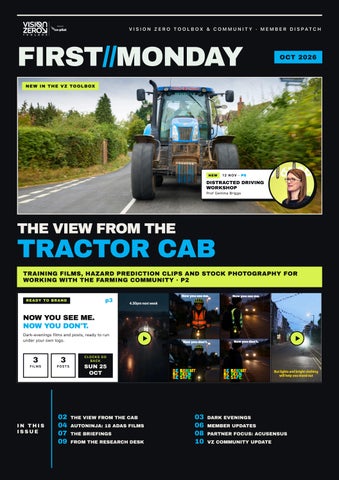
NEW IN THE VZ TOOLBOX
NEW
12 NOV · P6
DISTRACTED DRIVING WORKSHOP
Prof Gemma Briggs
THE VIEW FROM THE
TRACTOR CAB TRAINING FILMS, HAZARD PREDICTION CLIPS AND STOCK PHOTOGRAPHY FOR WORKING WITH THE FARMING COMMUNITY · P2 p3
READY TO BRAND
NOW YOU SEE ME. NOW YOU DON'T.
Dark-evenings films and posts, ready to run under your own logo. 3
FILMS
IN THIS ISSUE
3
POSTS
CLOCKS GO BACK
SUN 25 OCT
02 THE VIEW FROM THE CAB 04 AUTONINJA: 18 ADAS FILMS 07 THE BRIEFINGS 09 FROM THE RESEARCH DESK
03 DARK EVENINGS 06 MEMBER UPDATES 08 PARTNER FOCUS: ACUSENSUS 10 VZ COMMUNITY UPDATE
FIRST//MONDAY
OCT 2026 · PAGE 02
LEAD STORY
THE VIEW FROM THE CAB
Members have been asking for something they can use with the farming community - and with the people who drive tractors and other agricultural vehicles for a living - for a good while now. The new Agricultural vehicles space in the VZ Toolbox pulls it together in three parts: training films, hazard prediction clips and a set of our own photography.
2 FILMS · 2 MIN EACH
TRAINING VIDEOS Made for the people driving the tractor, not the people stuck behind it, by ESITU Solutions - the hazard perception specialists behind HazardSmarter. Overtaking vulnerable road users. Cyclists, horse riders, walkers and runners on narrow rural roads, seen from the cab - and when the right call is simply to wait. Pulling out of a field. Sightlines, mud on the carriageway, trailer length and the time it actually takes to get clear.
3 CLIPS · JU ST OVER 1 MI N
FREE FOR MEMBERS
HAZARD PREDICTION FILMS Filmed from the cab in the HazardSmarter format: the clip stops, “What is most likely to happen next?” appears with four answers, then it replays with expert commentary. The blind bend. Reading the hedge line, and a coach coming the other way. The merge. Two lanes into one, and the drivers who would rather risk an overtake. The right turn. Why a well-meant gesture can leave you partly responsible.
RAW IMAGES Our own commissioned photography of tractors on rural roads and around the farmyard, free to use in your posters, social posts, web pages and presentations.
The full set is in the Stock Media Library on Air - look in the Lorries, Trucks and Agricultural folder.
WHO IT'S FOR WHY HAZARD PREDICTION?
Hazard perception is the one cognitive skill consistently linked to collision risk, and training it helps drivers of all levels of experience anticipate risk earlier. Almost all of that training is built around the view from a car. A tractor and trailer sees the road very differently - the height, the width, the speed differential and the queue behind - so these clips were made from that seat, for that driver.
NEXT
Dark evenings.
Young Farmers' clubs, agricultural colleges and landbased courses, NFU and farm safety events, rural toolbox talks and the social channels your rural communities follow - especially during harvest, silage and ploughing seasons. Branded versions of every film are free for members - email james@co-pilot.org.
FIRST//MONDAY
OCT 2026 · PAGE 03
NOW YOU SEE ME. NOW YOU DON'T. A small set of dark-evenings assets that any member can run under their own branding - three short films and three CLO C K S G O BACK
SUN 25 OCT
static posts, all 9:16 for Stories, Reels and TikTok. STATICS
THREE POSTS
One simple device, three times over: the same person, the same street, the same car, split top and bottom. In the top half they're wearing the kit. In the bottom half, same scene, no kit, and you can barely make them out against the headlights. All three close on Be Bright. Be Seen. Be Safe.
Pedestrian. A child in a hi-vis vest with a reflector clipped to their bag.
Cyclist. A child in an orange vest with a front light.
Runner. A yellow jacket with a reflective strip.
School evening. Aimed at drivers - the school walk once the clocks go back.
Suburban dusk. Aimed at cyclists.
Quaint street. Aimed at runners.
FILMS
THREE SHORT FILMS
One for each audience, all 9:16 and ready to run under your own branding.
GETTING BRANDED VERSIONS
NEXT
The films in the post are unbranded examples with a "Your logo here" placeholder. Email james@copilot.org or DM James with a logo (a PNG with a transparent background is ideal) and he'll send the finished 9:16 files back.
AutoNinja ADAS awareness.
FIRST//MONDAY
OCT 2026 · PAGE 04
AUTONINJA
KNOW YOUR CAR
18
FILMS READY TO DEPLOY
Many drivers are unaware of the safety technology fitted to their own vehicle - or they disable it because they find it intrusive or confusing. The AutoNinja ADAS Awareness intervention offers 18 short explainer videos, each highlighting a different life-saving technology, presented by respected motoring expert Rebecca Jackson. FILM 10 · ADAPTIVE CRUISE CONTRO L
FILM 18 · eC A LL
THE TECH IS FITTED. IS IT SWITCHED ON?
The modern car is packed with safety technology that can brake, steer, warn and even call for help on the driver’s behalf. Advanced Driver Assistance Systems have the potential to prevent crashes and save lives - but that potential is only realised when drivers understand what each system is doing, trust it enough to leave it switched on, and know how to use it well. Too often, that isn’t the case. Some features, like eCall, have been mandatory on new cars since 2018, yet most drivers don’t know their car has it until they need it. Others, like ABS, have been standard for decades but are still misunderstood. And many are
optional extras that drivers may not even realise they’ve paid for. When an unexplained alert beeps or a steering wheel nudges, the instinctive response is to find the off switch. The AutoNinja films tackle both halves of the problem. Each one explains, in plain language and in around a minute or two, what a feature does and why it matters - so drivers are more inclined to keep it on, and more able to get the full benefit from it. Together they give members a credible, ready-made way to put a meaningful slice of the Safe System’s “safe vehicles” pillar into drivers’ hands.
BUILT FOR THE DEALERSHIP
Handovers are rushed and ADAS explanations are usually the first casualty. The dealer tri-fold lets a dealership tick the features fitted to a customer's new car, so they can scan the QR codes at home and get to know the tech that's looking after them. The films also work on social media, in e-learning and in presentations. NEXT
All 18 films overleaf.
MAKE IT YOURS
Everything in the ADAS Awareness space - the films and the dealer tri-fold - can be branded for your organisation. Contact james@co-pilot.org.
FIRST//MONDAY
Presented by Rebecca Jackson · watch them all in the ADAS Awareness space
THE 18 FILMS
01 BRAKING
02 BRAKING
Stops the wheels locking under hard braking, so the driver can keep steering around a hazard.
Brakes automatically if a collision is imminent and the driver hasn’t reacted in time.
Anti-lock braking
04 BRAKING
Recognises an emergency stop and applies full braking force, cutting stopping distances.
Warns of a likely collision with the vehicle ahead, giving the driver vital extra time to react.
Forward collision warning
05 LANES & BLIND SPOTS
06 LANES & BLIND SPOTS
Alerts the driver when the car drifts out of its lane without indicating.
Gently steers the car back into its lane if it starts to drift.
Lane departure warning
Lane keep assist
07 LANES & BLIND SPOTS
08 LANES & BLIND SPOTS
Warns of vehicles hidden in the blind spot before the driver changes lane.
Warns of traffic approaching from the side when reversing out of a space.
Blind spot monitoring
Rear cross traffic alert
09 LANES & BLIND SPOTS
10 SPEED & ATTENTION
Switches main beam on and off automatically, so drivers see further without dazzling others.
Keeps a safe, set gap to the vehicle ahead, easing off and resuming automatically.
High beam assist
Adaptive Cruise Control
11 SPEED & ATTENTION
12 SPEED & ATTENTION
Shows the speed limit and helps the driver stay within it.
Reads road signs and displays them on the dashboard, so limits and warnings aren’t missed.
Intelligent speed assist
Traffic sign recognition
13 SPEED & ATTENTION
14 GRIP & TYRES
Spots the signs of fatigue and prompts the driver to take a break.
Helps prevent skids and loss of control on bends and slippery roads.
Drowsiness detection
Electronic Stability Programme (ESP)
15 GRIP & TYRES
16 PARKING
Warns when a tyre loses pressure, protecting grip, braking and handling.
Shows what’s behind the car, including children and objects below the rear window.
17 PARKING
18 AFTER A CRASH
Guides or steers the car into a space, reducing low-speed knocks and bumps.
Automatically calls the emergency services after a serious crash and sends the car’s location.
Tyre pressure monitoring system (TPMS)
Parking assist
Member updates.
Automatic Emergency Braking (AEB)
03 BRAKING
Brake assist
NEXT
OCT 2026 · PAGE 05
CONTINUED
Reversing cameras
eCall
FIRST//MONDAY
UPDATES
MEMBER UPDATES WORKSHOP
MIND ON THE DRIVE 12 NOV
Prof Gemma Briggs is running a members-only interactive workshop on distracted driving on Thursday 12 November - and if Dr Jonathan Rolison's session earlier this year is anything to go by, you will want to be in the (virtual) room. Distraction is one of those topics where everybody agrees it matters and almost nobody feels they have cracked it. Gemma is an applied cognitive psychologist at the Open University and one of the country's leading researchers on driver distraction, particularly handsfree phone use - the bit of the problem most people are least comfortable talking about.
OCT 2026 · PAGE 06
IN GEMMA'S WORDS
"This workshop will cover the basics of research on distraction and the application of research findings in the real world. You will be asked to consider your own attitude to phone use while driving, and the challenges your organisation faces around phone use by drivers. The session will provide the space to discuss those issues and the approaches to addressing them, including educational interventions and workplace policy. You will leave with a sound understanding of the basis of distraction, the psychological biases which make addressing phone use by drivers so challenging, and practical tips on how to meaningfully encourage attitude and behaviour change." The details: Thursday 12 November. Interactive, so come ready to contribute rather than sit back. Members only, and free as part of your membership. Teams invites have been sent, and the session is listed in the Events space. If you need an invite, email Mark at mark.taylor@co-pilot.org.
GODRIVE
SCRIPT SIGNED OFF, CAMERAS ROLL IN NOVEMBER
The script for the new GoDrive is finished. At 5,000 words it runs to around 35 minutes of presenting to camera, leaving 15 to 20 minutes for interactive tasks, so the whole session fits inside a standard one-hour lesson. Casting is now being finalised, and filming is scheduled for November. Members who would like to read the working script can email james@co-pilot.org.
ALIVE FIVE
ALIVE FIVE GETS ITS LOOK
The branding for Alive Five is complete. The project turns the Fatal Five on its head: five things drivers can do, rather than five to avoid, each now with its own icon. Behind the artwork sits Liz’s intervention plan, built on the COM-B model and systematic review evidence. Partner review and testing come next.
AU TO N I N JA
TAKING THE CHECKLISTS TO THE GARAGE
Garages are the next stop for the checklists from the recent AutoNinja sprint, and there is now a ready-made kit for recruiting them to hand the checklists out to customers. It includes: An engagement email to send to local garages A poster and instructions for garages An evaluation template to measure the results NEXT
The briefings.
S C O OT S M A R T E R
SCOOTSMARTER RECUT FOR A CHANGED MARKET
A new edit of ScootSmarter is out. It reflects the changes among the main rental providers and the minimum age of 18 that now applies in practice because of the providers’ own rules. The new edit can be downloaded from the ScootSmarter space. Members who would like a branded version can request one by emailing james@co-pilot.org or sending a DM.
FIRST//MONDAY
OCT 2026 · PAGE 07
BRIEFINGS
THE POLICY PICTURE, SORTED
Road safety policy rarely moves in one place at a time. A consultation closes, casualty figures land, a select committee takes evidence, Northern Ireland changes its licensing rules - and each one shifts the picture for the others. The Briefings space exists so members don’t have to track all of it themselves. ▶ AUDIO
THE ROAD SAFETY STRATEGY SERIES
OVERVIEW ▶ AUDIO ROAD SAFETY STRATEGY: OVERVIEW
Targets a 65% cut in KSIs by 2035 against a 20222024 baseline, and 70% for children. Five consultations have closed; only vehicle safety technologies has been answered.
SECTION ▶ AUDIO ONE SUPPORTING ROAD USERS
Drivers aged 17-24 hold 6% of licences but were in 24% of fatal and serious collisions in 2024. The answer on offer is a minimum learning period, not graduated licensing.
SECTION ▶ AUDIO TWO TECHNOLOGY AND DATA
All 18 vehicle safety technologies will be mandated, confirmed on 16 July 2026. The Road Safety Investigation Branch still needs primary legislation.
SECTION ▶ AUDIO THREE A SAFER ROAD NETWORK
Rural roads carried 45% of traffic but 60% of fatalities in 2024. There is £24bn for maintenance, but no default 20mph limit.
SECTION ▶ AUDIO FOUR ENFORCEMENT
The 80mg drink drive limit is the highest in Europe and unchanged since 1967. The consultation response is still outstanding.
Updated September 2026 · all briefings
TOPIC BRIEFINGS
BRIEFING CYCLE HELMETS
▶ AUDIO
BRIEFING DRUG DRIVING
▶ AUDIO
BRIEFING MOBILE PHONES
▶ AUDIO
A helmet cuts the risk of serious head injury by about 70%. But mandatory helmet laws suppress cycling, and segregated infrastructure does more to keep cyclists safe.
70% more drivers were killed with an impairing drug in their blood in 2023 than in 2014. Slow lab testing means cases are timing out before they reach court.
A hands-free call is about twice as impairing as being at the drink drive limit. Hand-held penalties reached 40,723 in 2024, the highest since 2016.
NEXT
Every briefing includes an audio read
Partner focus: Acusensus.
BRIEFING ▶ AUDIO DIRECT VISION STANDARD
BRIEFING DRINK DRIVING
BRIEFING E-SCOOTERS
▶ AUDIO
BRIEFING ▶ AUDIO GRADUATED DRIVER LICENSING
BRIEFING THE SAFE SYSTEM
▶ AUDIO
HGV-related deaths in London fell 35%, against 4.5% network-wide. Since October 2024, lorries over 12 tonnes need three stars or a Progressive Safe System.
More than a million private e-scooters in the UK are legal to sell but illegal to ride. The UK and the Netherlands are now the only countries in Europe still banning them.
Sweden recorded 203 road deaths in 2025, its lowest since the Second World War. Norway missed its 2024 target, and New Zealand has walked back from the approach.
▶ AUDIO
16% of road deaths in 2023 were drink driverelated, essentially unchanged since 1989. Alcolocks for offenders carry the strongest casualty evidence.
Up to 44 lives could have been saved in 2022 with GDL for 17-19 year-olds. Northern Ireland introduced it on 1 October 2026; Great Britain has ruled it out.
BRIEFING SEATBELTS
▶ AUDIO
25% of car occupants killed in 2024 were not wearing a seatbelt, rising to 43% of passengers aged 17-29. AI cameras are now catching offenders at scale.
FIRST//MONDAY
OCT 2026 · PAGE 08
PARTNER FOCUS
EYES ON THE ROAD. HEADS UP. Hand-held phone use is one of the ‘fatal five’ - and with smartphone use at an all-time high, there is a real need for PARTNER FOCUS
a practical, effective solution. Acusensus built one. Its ‘Heads-Up’ cameras are now changing behaviour on UK roads.
“
WE WANT ENOUGH CAMERAS ON UK ROADS THAT IT CHANGES BEHAVIOUR SIGNIFICANTLY.
Geoff Collins UK General Manager, Acusensus
Acusensus started in Australia in 2018, where it introduced the world’s first automated system to detect drivers using a mobile phone. Today it has more than 200 staff worldwide, including a new UK office, and five Australian states run large-scale operational programmes. Heads-Up combines cameras and image processors with cutting-edge sensors and software. It is delivered as a service to Safer Roads Partnerships and police forces, generating evidential records that can be used for prosecution or educational diversion - and areawide monitoring has been shown to change behaviour long term. In the UK, Acusensus has run trials with almost half of all police force regions, ten of which have actively
prosecuted detections for hand-held phone use and not wearing a seatbelt. Feedback has been uniformly positive, and the evidence has proved robust enough for prosecution. Devon & Cornwall has run Heads-Up as a long-term operational scheme since 2023. Across one month, three sites saw a 33% reduction in seatbelt misuse and a 50% reduction in handheld phone detections. At one site visited in 2023, 2024 and 2025, both behaviours fell by around 80%. The ambition now goes further: technology to tackle all dangerous driving behaviours, from seatbelts and phones to drug and alcohol impairment, speeding and dangerous driving.
80%
50%
33%
10
fall in both behaviours at fewer hand-held phone one Devon & Cornwall site, detections across three 2023 to 2025 sites in a month less seatbelt misuse across UK police regions the same three sites prosecuting Heads-Up detections
A HEADS-UP D ETECTION
LATEST NEWS
Suffolk Police is the latest UK force to operate the system across a number of locations in the county, offering an educational diversion course or points and a fine. Read Geoff’s Show & tell post (30 July 2026). NEXT
Liz's research and CPD update.
GET IN TOUCH
Geoff Collins, UK General Manager, and Adam Dallimore, UK Operations & Support Manager: uksales@acusensus.com · acusensus.co.uk · Partner page
FIRST//MONDAY
THE RESEARCH DESK
OCT 2026 · PAGE 09
LIZ'S RESEARCH & CPD UPDATE
This month’s additions to the Vision Zero Community Research Library take us across the whole transport system – from how safe women feel making everyday journeys, to survivable speeds, automated vehicles, public transport and the culture that shapes road safety practice. Together, they are a useful reminder that creating a safe system means looking beyond individual behaviour to the environments, technologies, organisations and wider mobility choices that shape risk. DO WOMEN FEEL SAFE ENOUGH TO CHOOSE WALKING, CYCLING AND PUBLIC TRANSPORT?
WHAT LEVEL OF FATALITY RISK SHOULD A 'SAFE' SPEED ACCEPT?
CAN CRASH DATA ALONE TELL US WHETHER SELFDRIVING CARS ARE SAFE?
DOES IT MATTER WHEN AUTOMATED VEHICLES ARE DRIVING?
COULD BETTER PUBLIC TRANSPORT CHANGE OUR LONG-TERM RELATIONSHIP WITH DRIVING?
IS TRAFFIC SAFETY CULTURE ABOUT MORE THAN ROAD USERS?
New research from Australia and New Zealand found a striking drop in women’s feelings of safety after dark. While 88% felt safe walking during the day, only 25% did so after dark; for cycling, this fell from 72% to 34%. Women also frequently changed routes, timings or travel arrangements to manage perceived risk. The findings make an important Safe System point that encouraging active and sustainable travel means considering personal safety across the whole journey, not just protection from road collisions. An analysis of 256 reported automated-vehicle crashes in California found that almost half involved the vehicle being struck from behind, while almost a third involved unexpected actions by other road users. The authors argue that assessing automation solely through collision rates may be insufficient while mileage remains comparatively low. They suggest indicators such as disengagements and hard braking could help identify risks earlier. For achieving Vision Zero, the question is whether automated vehicles can safely accommodate the mistakes, uncertainty and informal interactions that are inevitable on real roads. An Irish study of more than 2,000 people found that those living in areas with better public transport tended to learn to drive later and people who learned later also drove less overall. Someone beginning to learn at 22 rather than 17 was estimated to drive around 1,500 fewer weekday kilometres annually. The study cannot establish causation, but offers an interesting life-course perspective, in that giving young people realistic alternatives to the car may influence not only when they start driving, but their longer-term mobility habits. ALSO IN SHOW & TELL
A systematic review of head-on crashes examined the relationship between changes in vehicle velocity during a collision and occupant fatality risk. Using more recent data, a 1% fatality risk corresponded to a delta-V of around 30 km/h, compared with around 60 km/h for a 5% risk and 73 km/h for a 10% risk. The findings raise an important question for Safe System practitioners - if the ambition is zero deaths, what level of fatality risk should underpin decisions about survivable speeds on undivided roads? New analysis of Waymo’s automated driving system shows why comparisons with human drivers need to account for exposure. Human crash involvement varied substantially by time of day and day of week, with particularly high rates late at night. After adjusting the human benchmark to reflect where and when Waymo actually operated, Waymo had substantially lower crash involvement rates across the outcomes examined. The study concerns one system operating in specific environments, but demonstrates why like-for-like benchmarks are essential when assessing automated vehicle safety. A new framework from the EU-funded TRUST project defines Traffic Safety Culture as the shared values, beliefs, attitudes, norms and behaviours that shape how safety is understood and enacted within groups across the transport system. Crucially, that includes authorities and organisations as well as road users. For achieving Vision Zero, this provides a useful way of thinking about the gap between adopting Safe System principles and actually implementing them and encourages us to ask whether the organisations responsible for delivery have the culture, commitment and shared understanding needed to make them happen.
There are also four research and policy-related additions to the Show & Tell space worth catching up on this month.
COULD CHANGING ROAD TRAFFIC LAW HELP PREVENT ROAD HARM?
WHAT SHOULD GLOBAL HEALTH PRIORITIES LOOK LIKE AFTER 2030?
A NEW NATIONAL APPROACH TO ROADS POLICING
WHAT DO YOUNG DRIVERS THINK WOULD MAKE THEM SAFER?
Professor Sally Kyd’s new policy briefing on legal responses to road violence argues for greater attention to the likelihood of detection, clarity of road traffic offences and use of disqualification, rather than relying primarily on increasingly severe sentences after serious harm has occurred. It also calls for sustained investment in roads policing and considers reforms to careless and dangerous driving offences and the ‘totting up’ system. The Government has announced funding for a National Roads Policing Coordination Centre, alongside a nationwide operation targeting illegal and deliberately obscured number plates. The Centre is intended to improve intelligence-sharing, collaboration and use of data and technology between police forces, connecting road safety enforcement with action against wider criminality on the road network. The initiative forms part of the Government’s 2026 Road Safety Strategy.
WHO, UNICEF, UNFPA and PMNCH are inviting ideas on the issues that should shape future priorities for women’s, children’s and adolescents’ health and wellbeing. For road safety practitioners, it is an opportunity to ensure road traffic injury, safe mobility and the conditions that enable children and young people to travel safely are part of that conversation. Suggestions are open until 18th October.
New polling on measures for young and novice drivers provides an interesting counterpoint to the idea that younger people simply oppose additional measures. Among 17-24 year olds, post-test training attracted the greatest support at 42%, while 34% supported a minimum learning period and 32% supported night-time passenger restrictions. It is a useful reminder that the young driver safety debate can also be about how best to help new drivers build skill and experience safely, rather than simply being framed around restrictions.
As always, full summaries and links to all of the papers are available in the Vision Zero Community Research Library. If you've come across research that you think would be valuable to feature, or you're looking for evidence on a particular topic, do get in touch. NEXT
Over to the Community.
FIRST//MONDAY
OCT 2026 · PAGE 10
OVER TO THE COMMUNITY
MARK'S VZ COMMUNITY UPDATE
HELP & REQUESTS Five posts since the last edition from fellow members asking for help… 🙏
Do you use VR or immersive technology in road safety education? JONATHAN ROLISON
A 10-minute national survey for a Road Safety Trust-funded project developing national guidance on VR and immersive technology in road safety education. Jonathan would like to hear from anyone designing, delivering, commissioning or evaluating VR interventions across fire and rescue, police, local authorities and partners.
Getting the Job Done Safely
SHARON MITCHELL, NATIONAL HIGHWAYS
Sharon offered help with costs for anyone who wanted to attend the PACTS and ARRM conference, ‘Getting the Job Done Safely?’, on making the Government’s Work Related Road Safety Charter a success. LB
Pedestrian safety campaign – ideas please! LOUISE BANNING, NORFOLK COUNTY COUNCIL
Norfolk is planning a pedestrian safety campaign for the darker mornings and evenings, aimed mainly at motorists staying alert, but also at pedestrians themselves. Lou would love to hear about successful campaigns, assets and tips from other areas.
Do you work in child car seat safety or support parents during pregnancy and the early years? REBECCA MORRIS, VISION ZERO COMMUNICATIONS
A child road safety event at the House of Commons on Thursday 19 November (12.30–3pm), looking at safer child car seat choices, keeping children rear-facing for longer and what the UK can learn from Sweden. Expressions of interest are welcome from car seat specialists, midwives, health visitors and early years professionals. Places are limited.
Social Media Management – What do you use?! HANNAH JONES, SURREY ROADSAFE
Surrey RoadSafe is reviewing social media management platforms and would like to hear what other partnerships use, how they’re finding it and any lessons learned along the way – or even arrange a quick demo. SHOW & TELL In case you missed any of interest, here’s what’s been happening in the Show & tell Space since the last
edition…
Tow trailer – selling
LAUREN HAYLLAR, CAMBRIDGESHIRE COUNTY COUNCIL
Having reviewed its road safety offer, Cambridgeshire County Council is selling its vehicle tow trailer, used over the years to take crash cars to events and workshops. It’s sold as seen and the tyres can’t be guaranteed, so collection as recovery rather than towing is advised. Contact Lauren for details.
Dark evenings – three short films and three graphics, ready for members’ branding JAMES EVANS, CO-PILOT
Ahead of the clocks going back on Sunday 25 October: three short films aimed at drivers, cyclists and runners, plus three ‘Now you see me. Now you don’t.’ static posts, all 9:16 for Stories, Reels and TikTok. Send James a logo for branded versions. For sale: Cambridgeshire County Council’s vehicle tow trailer. NEXT
More Show & tell, and members’ webinars, overleaf.
FIRST//MONDAY
OCT 2026 · PAGE 11
CONTINUED
SHOW & TELL · CONTINU ED
National Highways – Road to Zero Harm DR ELIZABETH BOX, CO-PILOT
The new roadmap sets out National Highways’ long-term, Safe System approach to eliminating deaths and serious injuries on England’s Strategic Road Network, with current and emerging actions across all five pillars.
New edition – The Official Highway Code for Northern Ireland
‘Petro Masculinity’ CHRIS LEWIS
Includes the Graduated Driver Licensing changes that came into effect in Northern Ireland on 1 October 2026. Copies are available from Safe Driving for Life.
Chris shared a Guardian article on ‘petro-masculinity’ and eco-masculinity, asking whether this thinking could help explain the high-risk behaviour seen among young male drivers.
Upcoming Procurement Opportunity with Norfolk County Council
A positive result for the latest Op Tramline deployment in Surrey
A Planned Procurement Notice for an Approved Driving Instructors and Trainers Framework is on Find a Tender. Providers are encouraged to register on the portals before it goes live.
Over five days, officers using the National Highways HGV cab stopped 240 vehicles and identified 290 offences, including 155 mobile phone offences – a Surrey record.
KATIE GREEN, TSO
NIKKI HILL, NORFOLK COUNTY COUNCIL
HANNAH JONES, SURREY ROADSAFE
Make Space – a pavement campaign that’s about more than bad parking
Stolen and cloned vehicles – Is your car REALLY yours?
Reframed around everything that blocks a pavement, not just cars. Seven unbranded scenes in four formats, a full Welsh set and Liz’s intervention plan, now in the VZ Toolbox.
Avon & Somerset Constabulary’s video on cloned vehicle fraud – officers there seized at least one a week last year, double 2023 – and what buyers should look for.
JAMES EVANS, CO-PILOT
Devon & Somerset Fire & Rescue Service has relaunched its ‘Top 3’ campaign MARK TAYLOR, VZ COMMUNITY
DSFRS has asked for its Top 3 toolkit for young drivers and their parents to be shared across networks. Contact Annabelle Priest for details.
MARK TAYLOR, VZ COMMUNITY
ScootSmarter – 2026 updates JAMES EVANS, CO-PILOT
The film now reflects the current operator line-up and rider age rules, with a re-recorded voiceover.
MEMBERS' WEBINARS
Our most recent webinar featured Nick Lyes, IAM RoadSmart and Dr Elizabeth Box, ECM Research Solutions, deliver their presentation - ‘Supporting parents, guardians and young drivers: in research and in practice’ followed by a Q&A session. You can access the full recording (presentations and Q&A) here. NEXT ISSUE
MONDAY 2 NOVEMBER
Our next webinar will take place on Tuesday 6th October (2.003.00pm), with Oscar Freeman-Davies, from Devon County Council, presenting ‘From CRaSH to Confidence: A Local Authority Perspective on Collision Validation’. Full details can be found here.