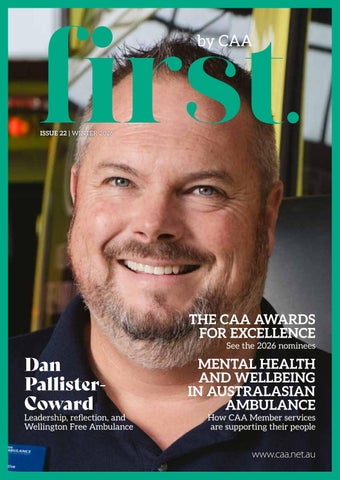
ISSUE 22 | WINTER 2026
THE CAA AWARDS FOR EXCELLENCE
Dan PallisterCoward
Leadership, reflection, and Wellington Free Ambulance
See the 2026 nominees
MENTAL HEALTH AND WELLBEING IN AUSTRALASIAN AMBULANCE How CAA Member services are supporting their people
www.caa.net.au
For 130 years, Mercedes-Benz Vans has helped keep the world moving, advancing transportation through innovation, engineering excellence and an unwavering focus on safety. In emergency care, every second matters. That is why, around the world and here in Australia, Mercedes-Benz Sprinter ambulances have become a trusted foundation for frontline response. Designed to support life saving work, Sprinter platforms have been adapted for emergency medical services across decades. Providing the space, stability and reliability paramedics depend on when it matters most. In Australia, Mercedes-Benz Vans has proudly supplied Sprinter vehicles to ambulance services since 2000. Over more than two decades, Sprinter has supported countless emergency call-outs, long-distance transfers and critical care journeys in cities, regional centres and remote environments alike. Built with advanced safety systems, robust engineering and the flexibility to accommodate specialised medical fit-outs, Sprinter continues to evolve alongside the needs of modern ambulance services. Backed by a national retailer and service network, it offers the reassurance of dependable support throughout its operational life. As we mark 130 Years of Transportation, we remain committed to supporting those who dedicate their lives to helping others today, tomorrow and for generations to come.
Dear friends and colleagues, There are moments that cause us to pause and reflect on the people who have shaped a sector, not only through the positions they have held, but through the lives they have touched, the people they have supported and the legacy they leave behind. As I write this letter, our ambulance community is mourning the passing of former Ambulance Victoria Chief Executive Officer, Professor Tony Walker ASM. Tony was a giant in healthcare, both within Ambulance and beyond: deeply respected, greatly loved and someone whose leadership helped move our industry and professionalism forward. For me, this loss is deeply personal. Tony was my first mentor; someone who generously shared his wisdom, believed in me and helped shape the leader I have become. We will honour Tony more fully at CAA Congress and in the next issue of FIRST, but I could not let this moment pass without acknowledging him here. This issue also marks the retirement of another giant of Ambulance, NSW Ambulance Commissioner and Chief Executive, Dr Dominic Morgan ASM. Dom’s career spans jurisdictions, systems and decades of change. His leadership of both Ambulance Tasmania and NSW Ambulance gave him a rare perspective across services of different scale and a deep appreciation of the contribution each makes to our collective system. He brought that understanding to CAA as Chair and remained a strong and generous supporter of our organisation, championing a connected Australasian Ambulance network in which every service has a voice. Dom, we thank you deeply for your service, leadership and unwavering commitment to CAA and the wider ambulance community. Alongside these moments of loss and farewell, change continues to be one of the few constants across our sector. We are excited to feature Dan Pallister-Coward, Chief Executive of Wellington Free Ambulance, as he shares his career journey, leadership philosophy and early reflections on his time with Wellington Free Ambulance. The common thread through these stories is people. Tony and Dom both understood that those who dedicate their careers to caring for others must also be supported and cared for themselves. Tony’s reminder to “check up from the neck up” reflected his deeply human approach to leadership, while Dom championed significant investment in support for the NSW Ambulance workforce. Together, they were instrumental in the adoption of CAA’s first sector - and union-wide - Mental Health and Wellbeing Strategy. It is therefore fitting that this issue shares the work of Queensland Ambulance Service, NSW Ambulance, Hato Hone St John and Wellington Free Ambulance as our members continue to build healthier, safer and more sustainable workplaces. This issue of FIRST will be launched at our 2026 CAA Congress in Canberra, where our program centres on our people and the future of the ambulance workforce. As we look towards Ambulance 2036, we will explore the workforce we need, how we support and prepare our people, and the leadership required to carry Ambulance healthcare forward. The greatest legacies in our sector are not measured only in programs, reforms or achievements. They live on in people; in those who were supported, challenged, inspired and encouraged to continue the work. With love and kindness, Mojca xx
Mojca Bizjak-Mikic Editor in Chief General Manager, the Council of Ambulance Authorities
Contents ISSUE 22 | WINTER 2026
10 03
Letter from the Editor
06
Data First Understand a decade of demand across ambulance services in Australia, New Zealand, and Papua New Guinea.
08
Industry First The latest news from across the Australasian Ambulance Health Sector.
10
CAA First CAA bids farewell to recently retired NSW Ambulance Commissioner and former CAA Chair, Dr Dominic Morgan, recognising his enduring contribution to the ambulance sector.
15
Focus First Hear how Queensland Ambulance Service, NSW Ambulance, Hato Hone St John and Wellington Free Ambulance are supporting their people through various initiatives.
4
34
42
25
Opinion First Hear from Andy Bell of St John WA on the development of Clinical Leadership in Paramedicine.
30
Services First Showcasing the latest projects and achievements from across CAA member services.
41
Awards First See the nominees for the 2026 CAA Awards for Excellence finalists, and read reflection interviews from two 2025 Women in Leadership Scholarship winners, Kathryn Haden and Maggie Jensen.
54
Feature First FIRST speaks with Wellington Free Ambulance's new Chief Executive Officer, Dan Pallister-Coward.
62
Events First See the full 2026 CAA Congress program.
www.caa.net.au
54
70
86
67
86
In this edition of FIRST, we share updates from the Australasian College of Paramedicine, Amtek and Operational Research in Health Limited (ORH).
The Cost of "Fine" Hear from our leadership expert Dr Erica Kreismann.
Partners First
Leadership First
91
78
Sustainability First
Research First Sharing the latest innovative research projects from around the ambulance world.
See some simple tips for at work and home to remain sustainable.
92
84
The Directory
People First Meet some of the wonderful people that make up the Australasian Ambulance services.
THE TEAM
PUBLISHED BY:
Editor: Mojca Bizjak-Mikic Relationship and Content Manager: Kieren Vartuli Editorial Team: Joshua McNally, Courtney Waters Publication Design: Kade Marsh, Alpha State
The Council Of Ambulance Authorities Inc 2/141 Sir Donald Bradman Drive Hilton SA 5033 Australia admin@caa.net.au
Magazine published from paper that is sustainably sourced.
For article submissions or to advertise in FIRST by CAA magazine please contact admin@caa.net.au
5
Data First
Understanding a Decade of Demand:
What the Data Tells Us About Ambulance Services
B
etween 2015 and 2025, ambulance services across Australia, New Zealand, and Papua New Guinea (PNG) have experienced sustained growth in demand. Since PNG joined the Council of Ambulance Authorities (CAA) in 2022, the regional picture has expanded, highlighting both system growth and increasing complexity in pre-hospital care. Across all jurisdictions, demand has risen steadily. Australia records the highest absolute demand due to population size, New Zealand shows strong growth in response activity, and PNG demonstrates the fastest growth rate from a smaller base, reflecting expanding access alongside emerging system pressures. A key trend is that responses are increasing faster than patient numbers. This indicates more frequent deployment of ambulance resources per incident, driven by higher community reliance, limited alternative care pathways, and rising lowacuity demand. The result is increased workload, fatigue risk, and greater operational complexity for frontline staff.
At the same time, rising demand creates clear opportunities for transformation. These include strengthening alternative care pathways, using data and predictive analytics to improve resource allocation, enhancing integration with broader health systems, and expanding community-based models, particularly in rapidly growing settings like PNG. Looking ahead, demand is expected to continue increasing, driven by demographic change, chronic disease, and shifting expectations. The key message from this decade of data is that understanding both the scale and drivers of demand is essential to building more sustainable, efficient, and responsive ambulance systems.
These pressures have significant workforce implications. Expanding staffing alone is insufficient; instead, there is a need for redesigned workforce models, including community paramedics, specialist roles, and integrated care pathways beyond traditional emergency response. Workforce wellbeing, training, and retention are central to system resilience.
6
www.caa.net.au
AUSTRALIA Incidents increased from 3.44 million to 4.49 million
30%
32%
Australia Ambulance Demand Trends (2015–2025)
6 Total Count (million)
Patients increased from 3.24 million to 4.27 million
38%
KEY FINDINGS • Mature system with sustained demand growth
5 4
• Increasing operational intensity (responses growing faster than patients)
3 2 1 0
Responses increased from 4.26 million to 5.86 million
2015/16 2016/17 2017/18 2018/19 2019/20 2020/21 2021/22 2022/23 2023/24 2024/25 Total incidents
Total patients
• Continued pressure on emergency service capacity
Total responses
NEW ZEALAND Incidents increased from 563K to 709K
Total Count (thousands)
26%
1000
Patients showed variability peaking at 607K, declined, and then recovered to 535K
61%
KEY FINDINGS
New Zealand Ambulance Demand Trends (2015–2025)
• Increasing reliance on ambulance responses beyond transport activity
800 600
• Rapid growth in operational workload despite unstable patient trends
400 200 0
Responses increased from 613K to 984K
2015/16 2016/17 2017/18 2018/19 2019/20 2020/21 2021/22 2022/23 2023/24 2024/25 Total incidents
Total patients
Total responses
PAPUA NEW GUINEA Incidents increased from 22K to 36K
Total Count (thousands)
64%
40
Patients increased from 19K to 27K, with a slight recent decline
37%
Papua New Guinea Ambulance Demand Trends (2022–2025)
43%
KEY FINDINGS • Fastest-growing demand profile in the region
30
• Early-stage system development with emerging stabilisation
20 10 0
Responses increased from 22K to 32K
2022/23 Total incidents
2023/24 Total patients
2024/25 Total responses
• High sensitivity to capacity and infrastructure constraints
7
Industry First
Industry News
St John Ambulance (NT)
Read More
Congratulations to Samuel (Sam) Kellick, who has been appointed as the new Director Ambulance Services for St John Ambulance (NT) (SJNT). Sam joins SJNT from CAA Member Service Hato Hone St John in New Zealand, where he was an Operations Manager for Christchurch Metro. In his new role, Sam leads over 300 team members, including paramedics, call takers, and support staff.
Read More
May marks the Beginning of the SA Ambulance Service (SAAS) Women's Network In May, SAAS hosted an event to initiate momentum for a Women’s Network within the organisation. Featuring guest speakers Peta Thompson of Queensland Ambulance Service and Cassandra Bouyer-Sanderson of the Department of Human Services SA, Office for Women, the event marks the beginning of an engaging and inclusive network within the organisation.
8
Read More
Rescue Access Procedural Training Reinforcement (RAPTR) Room Now Open
St John Ambulance (NT) Welcomes Sam Kellick
SA Ambulance Service
NSW Ambulance
A purpose-built training room to practice for complex rescues is now accessible for paramedics and doctors. The RAPTR room in the Sydney suburb of Bankstown is a controlled environment that replicates cliff, rock faces, and helicopter rescues. This opportunity allows crews to hone their skills and respond effectively when called upon.
Hato Hone St John
Read More
A Trusted New Zealand Companion Hato Hone St John has been announced as one of New Zealand’s Most Trusted Charities according to Reader’s Digest Annual Trusted Brands Awards. This is the 13th time the organisation has earned this recognition. Congratulations to the entire organisation on this phenomenal feat.
www.caa.net.au
Wellington Free Ambulance
Read More
Refurbished ambulance en route to Samoa A continued partnership between Wellington Free Ambulance and the Rotary Club of Port Nicholson has seen a refurbished ambulance head for Samoa. This is the second vehicle destined for the Polynesian country, with the first being sent in 2020.
St John WA
Read More
Milestone STORC Step for WA A telethon grant has allowed St John WA (SJWA) to gain specific neonatal equipment in ambulances to better manage babies born outside the hospital. The specialised kits will be in every SJWA ambulance, providing hospital-level care in a prehospital setting for the first time in WA.
The National St John Ambulance Service of Papua New Guinea
Read More
PNG District Commissioning The National St John Ambulance Service of Papua New Guinea (NStJPNG) have announced the commissioning of the first ambulance in the Unggai-Bena District, Eastern Highlands Province. This ambulance will serve the district, which has a population of over 75000 people.
The Council of Ambulance Authorities
Vale Tony Walker ASM
The Council of Ambulance Authorities (CAA) is deeply saddened by the passing of Professor Tony Walker ASM, former Chair of the Council of Ambulance Authorities and Chief Executive Officer of Ambulance Victoria. Tony was a visionary, mentor, and esteemed leader across the ambulance sector and beyond; he will be dearly missed. We will honour the life and contributions of Tony Walker ASM in the next issue of First.
9
CAA First
A remarkable legacy of service After an extraordinary 40-year career in ambulance, Dr Dominic Morgan retires having made an enduring contribution to services, communities and the wider sector. Within that career, Dominic also served for 16 years on the CAA Board, the longestserving Board member in the CAA’s history.
Dominic’s Board service spanned
Having led one of our smaller
six years as Chief Executive Officer
services, Dominic understood
of Ambulance Tasmania, followed
the immense value that both the
by ten years as Commissioner
CAA and the support of larger
and Chief Executive of NSW
services could provide. When he
Ambulance. Across both roles, he
later took the helm of Australia’s
brought a valuable understanding
largest ambulance service, he
of the different opportunities and
never lost sight of that perspective.
challenges faced by ambulance
He remained committed to
services of every size.
ensuring every service had a voice and generously shared NSW Ambulance’s expertise, people and resources to strengthen the CAA and support fellow members across Australasia.
10
www.caa.net.au
11
CAA First
Throughout his time on the Board, Dominic championed many important initiatives. These included the CAA’s work in mental health and wellbeing, demand management, the registration of paramedics, and the sharing of new developments and innovation emerging from NSW Ambulance. He was instrumental in the adoption of the CAA’s first sector - and unionwide - Mental Health and Wellbeing Strategy, an enduring demonstration of his commitment to the people who serve our communities. Dominic helped drive shared learning and change across the emergency management space. His openness in sharing the experiences and lessons of NSW Ambulance, from the 2019–20 bushfires and the COVID-19 pandemic to the Bondi Junction and Bondi Beach attacks, helped services across our sector prepare, respond and navigate extraordinarily challenging
During COVID-19 in particular,
On behalf of the CAA, our Board,
Dominic’s willingness to openly
Secretariat and member services,
share the NSW Ambulance journey
we offer our heartfelt thanks to
made it easier for many of our
Dominic for his extraordinary
services to navigate the pandemic.
contribution, unwavering advocacy
Dominic was, in equal measure, one of the CAA’s greatest supporters and a leader who challenged our
and friendship. His impact on the CAA will be felt for many years to come.
thinking. His questions, counsel and
We wish Dominic every happiness
encouragement always came from
as he begins this next chapter and
a desire to achieve the very best
enjoys a richly deserved retirement.
for our people, our services and the wider sector.
circumstances.
12
www.caa.net.au
®
Better Patient Transfers. Better Outcomes Complete solutions for safe, efficient patient transfers. SUPPORTING SAFER CARE Practical transfer support for ambulance, retrieval and emergency care teams. Designed to assist controlled repositioning, lateral transfers and patient movement. Helps support comfort, dignity and stability during transfer tasks.
Combine sheets, straps and transport units to suit local ambulance transfer protocols.
COMPLETE PATIENT TRANSFER SOLUTIONS BY Patient Mover Sheet
Binder Transfer Sheet
A lightweight, solution for safe patient transport. Durable, fluid-resistant design supports up to 453 kg with reinforced handles for reliable, ergonomic lifting in tight spaces.
Durable, multi-use, low-friction handling aid designed to simplify patient movement across beds, trolleys and clinical surfaces.
Scan to view our full range or visit midmed.com.au
Wrasfer Transfer Sheet
Disposable, high-performance patient wrap also designed for fast, hygienic transfers in emergency and clinical environments, absorbs up to 5 litres of fluid and safely supports patients up to 200 kg.
TRUSTED BY HEALTHCARE PROFESSIONALS Midmed products are designed to meet the demands of modern healthcare, supporting best practice in patient handling and workplace safety
www.midmed.com.au | 1300 643 633
®
www.caa.net.au
Focus First
Stronger minds
rt suppostronger
communities I
n this edition of First, we showcase the vital work that CAA member services do to support mental health and wellbeing across their organisations.
As the demands of the workplace continue to evolve, so
Throughout the coming pages, you will hear from
too does the understanding that employee wellbeing is
Todd Wehr of Queensland Ambulance Service, Zoe
fundamental to creating safe, productive, and thriving
Wooldridge of NSW Ambulance, Tiffany Nightingale of
environments.
Hato Hone St John, and Kim Payton of Wellington Free
These support services play a vital role in fostering a resilient, supportive, and high-performing ambulance
Ambulance, covering various aspects of their initiatives and experiences personally and in their service.
workforce. Their importance is especially evident among
If you are a team member of one of the CAA Member
first responders, including call takers and paramedics.
Services and would like to connect with your wellbeing
These people face high-pressure environments and
team, assistance is available. Whether you're looking for
are routinely exposed to confronting, distressing, and
guidance, resources, a confidential conversation, or just
sometimes traumatic events. By prioritising psychological
someone to talk to, reach out to your service support
wellbeing, ambulance services can better support the
teams. Taking care of your wellbeing is an important
people who dedicate their lives to supporting others.
part of maintaining a healthy and sustainable career, and
Members of the CAA Mental Health and Wellbeing
your wellbeing teams are there to help.
Forum from across Australasia share their expertise, experiences, and organisation strategy in this space.
15
Focus First
Post Traumatic Growth: Finding Strength Through Adversity Todd Wehr ASM Director of Strategic Wellbeing, Queensland Ambulance Service (QAS)
I
recently had the honour of being
Trauma does change you. It forces
a guest on the NSW Ambulance
you to reflect on yourself and what
Podcast “Shift Happens,” where
is important. Reflecting on myself,
I spoke about Post Traumatic Growth
I learned that I am resilient, having
(PTG). As I prepared, I reflected on
dealt with many complex and
how exposure to traumatic events
challenging situations. I learned that
has shaped me over three decades
relationships are precious, having
in ambulance and my early career
seen them lost through injury or
as a firefighter.
illness. I became more open to new
In my early career, I was “that person”. The one who got all the big jobs. Most experiences were incredibly rewarding; others were extremely challenging. Challenging
opportunities, resulting in a career change into a space where I could support frontline staff. I learned that life is precious and precarious, and that living in the moment matters.
how I saw the world, my values and
There is a psychological theory
beliefs, and even, at times, my own
describing this kind of change.
identity. Yet like so many others in
Post-traumatic growth was first
ambulance, I kept going back. I loved
coined by American psychologists
what I did, making a difference in
Dr. Richard Tedeschi and Dr.
people’s lives alongside like-minded
Lawrence Calhoun in the mid-1990s.
colleagues, with as many rewarding
While interviewing people who
moments as challenging ones.
had survived severe, life-altering crises, they discovered that many reported profound positive changes alongside their negative experiences. These changes weren’t simply a product of the traumatic event itself, but a direct consequence of the psychological struggle to rebuild shattered core assumptions about the world and themselves.
16
www.caa.net.au
The model identifies five core
Not everyone will experience PTG,
Todd is a registered paramedic and
domains of growth:
but research suggests that in first
psychotherapist with 30 years of
responders, it is more common than
experience working within first
negative post-trauma changes.
responder organisations, 28 of them
Additionally, PTG and Post Traumatic
with the Queensland Ambulance
Stress Disorder (PTSD) are not
Service. Following his time on road
mutually exclusive but can co-exist.
as a Paramedic, Todd spent more
• Personal Strength a newfound sense of greater resilience and self-reliance • New Possibilities new interests, life directions, or a change in career paths • Relating to Others deeper relationships, greater compassion, and a greater willingness to be vulnerable • Appreciation for Life a shift from valuing the superficial toward gratitude for everyday moments
PTG doesn’t arise from mildly difficult or challenging experiences, but from events that completely shatter our world. Tedeschi and Calhoun described these events as “seismic”. These are the occasional incidents that make us question our lives, our careers, perhaps even our identity. In the moment, they can feel like a deep, dark hole with no return.
than a decade leading Priority One, QAS’s internal Staff Support Program, overseeing counselling, peer support, chaplaincy and a suite of psychoeducation. He now serves as QAS Director of Strategic Wellbeing, providing advice and initiatives to prevent injury and promote staff health through organisational systems change.
But if we practise self-compassion,
In 2016, Todd was recognised on
reach out to others, and prioritise our
the Queen’s Birthday Honours List,
wellbeing, we create the opportunity
receiving the National Ambulance
to reevaluate how this experience
Service Medal (ASM) for his
fits into the world in which we live
dedication in supporting ambulance
We may not experience change
and to begin to experience and
personnel and their families.
in every domain; some may shift
notice PTG in our lives.
• Spiritual or Existential Change a shift in meaning, purpose, or a deeper personal philosophy of life.
profoundly, others barely at all. Research also shows that cultures can experience PTG differently, with some consistently demonstrating greater impacts on some domains over others.
17
Focus First
Shift Happens: Finding New Ways to Connect with a Mobile Workforce Zoe Wooldridge Wellbeing Program Specialist, NSW Ambulance
I
f you've worked in ambulance services for any length of time, you've probably encountered this
challenge - how do you communicate with, engage and support a workforce that is geographically dispersed, constantly mobile and
The challenge isn't always creating support. Sometimes it's helping people discover it.
rarely sitting at a desk? I work in our multidisciplinary Staff
When I visit stations, attend
Health team. I'm a psychologist
events or spend time with our
by trade, specialising in employee
Control teams, I regularly hear
wellbeing, and I've had the privilege
comments like, "I wish I'd known
of working at NSW Ambulance
that was available."
for the past 11 years. I stay because I love our people and the extraordinary work they do every day for the community. If I can contribute in a small way to helping them stay mentally and physically well in a challenging profession, then that's work worth doing.
Maybe someone didn't realise an Injury Prevention Specialist could help them develop a tailored exercise program before an injury occurred. Maybe they weren't aware of a support service that could have made a difficult period a little easier.
Over the years, I've seen a significant investment in staff wellbeing. We have an incredible range of supports available, including psychology services, peer support, health and fitness specialists, chaplaincy, domestic and family violence support, men's and women's health hubs, perinatal support, and much more.
18
www.caa.net.au
Often, the resources are there; we just need to find better ways to connect people with them.
As one of our co-hosts, Paramedic
share practical wellbeing strategies,
Timothy Graham, puts it:
highlight available supports and, most importantly, tell the stories of our people.
That's one of the reasons we launched Shift Happens, the NSW Ambulance wellbeing podcast. Named through a staff competition and won by A/Manager, Policy & Governance (Control Centres)
workforce. It's a little cheeky, but it also speaks to growth, change and the small shifts that can make a big
all the answers—it's about feeling connected and supported. Shift Happens is about real conversations
including being less self-critical
with real people, focused on the
with Critical Care Paramedic
practical things that help us stay
Dave Ipsen, high-performance
well at work and at home. If listeners
mindset with Station Officer and
take away even one idea that
Olympian Jo Brigden-Jones, exercise
helps them feel more supported or
and mental health with Injury
balanced, it's worth it."
Prevention Specialist, Steph Gill, and a powerful conversation with Health Coach (Dietician),
captures the personality of our
"Staff wellbeing isn't about having
So far, we've explored topics
about PTSD, ADHD, and hope
Jordy Kolarik, the title perfectly
difference to wellbeing.
The podcast gives us a platform to
Chloe Larcombe and A/Inspector, Paramedic, Nick Downton . Upcoming episodes will cover post-traumatic growth, regional paramedic perspectives, shift work and sleep, and insights from our Control workforce.
While the podcast was created for NSW Ambulance staff, many of the conversations will resonate with anyone working in emergency services or, indeed, anyone who wants practical tips to improve their wellbeing. Because no matter which uniform we wear, we're all trying to answer the same question: how do we stay well while doing work that matters?
Listen on Spotify
Listen on
You can listen to Shift Happens on Spotify, Apple Podcasts or wherever you get your podcasts.
Apple
19
Focus First
A Full Circle of Care: Embracing Wellbeing at Hato Hone St John Tiffany Nightingale Health and Wellbeing Advisory Lead Hato Hone St John
I
had a medical emergency of my
I appreciated his calming manner
own recently. At approximately
and felt so grateful he was able
10:30 PM on Easter Monday,
to move beyond that challenging
a Paramedic and an EMT arrived
incident and remain on the road. "I
at my home under lights after I
am very glad you are here, Jack."
realised I may not make it through the night without their assistance. As they introduced themselves, I thought I recognised the Paramedic's voice. I needed intravenous fluids, pain management, and antiemetic medication, so we made our way to the ambulance to begin treatment. As Paramedic, Jack*, calmly established IV access, he asked what I do for work.
I was struck by what a full-circle moment this was. Once I was comfortable, Jack took the driver's seat to transport us to the hospital, leaving EMT Amy to monitor my care. During the journey, Amy asked if I enjoyed my role. I got the sense that she was less familiar with our team. I told her that I love my work and that the privilege of supporting our
"I actually work for you," I replied. "I
workforce is what gets me out of bed
am part of the Wellbeing team
in the morning.
at Hato Hone St John."
"What, looking after us lot?" she
"Oh! You’re that Tiffany," Jack
chuckled. She seemed surprised by
responded warmly. "You supported
my enthusiasm.
me a couple of years ago."
Despite the severe pain and nausea
Although our interactions had been
of what was later diagnosed as a
limited to phone calls, text messages,
ruptured appendix, I felt a sense
and emails, I remembered supporting
of hope in that moment. This
Jack vividly. Instantly, the distressing
interaction may have been an
incident he had attended that had
important cultural leverage point.
impacted him returned to my mind.
By witnessing an authentic
"It is wonderful to finally put a face to the name," I told him.
recollection of support between her colleague and I, perhaps Amy, too, will feel empowered to reach out when she needs it.
20
www.caa.net.au
Normalising Mental Health in Emergency Services
2. A Robust Peer Support Network:
The wheels of cultural change within
Our dedicated HSW team is
such a large organisation turn slowly,
amplified by 180 volunteer Peer
but the shift is tangible here at Hato
Normalising conversations around
Support Officers nationwide.
Hone St John. We are noticing more
mental health and reducing the
These individuals serve as
members are seeking psychological
stigma of help-seeking behaviour
vital agents of change, actively
support. Progress is being made—one
are critical priorities for us. At Hato
dismantling the historical 'harden
conversation at a time, occasionally
Hone St John, the Wellbeing focus
up' culture that has existed for
even in the back of an ambulance.
of our Health, Safety and Wellbeing
far too long. Their impact is
Ultimately, our workforce will be
strategy drives this cultural shift
profound yet often unquantifiable,
safer and healthier for it.
through three core pillars:
occurring during informal
1. Empowering Frontline Managers: A specialised wellbeing team cannot substitute for compassionate, highly competent leadership on the station floor. Our strategy focuses on embedding
conversations in the break room, checking in after challenging jobs, or quiet interventions where they
*Names have been changed in this article to protect privacy.
guide colleagues toward external support. 3. Specialised, Evidence-Based
psychosocial capability within
Clinical Pathways: Emergency
operational management. We
workforce distress requires a
provide structured Manager
specialised understanding. To
Supervision, one-on-one advisory
ensure our people receive targeted
consultations to support good
care from their very first session,
practice, and targeted capability
we maintain a curated network
workshops. These programs
of trauma-informed psychologists
equip frontline leaders to conduct
nationwide alongside our standard
safe psychological check-ins,
Employee Assistance Programme.
recognise early behavioural
These clinicians understand the
indicators of distress, and master
unique demands of emergency
referral pathways. Our team
services and utilise advanced
aims to complement, not replace,
modalities such as Trauma-
compassionate leadership from
Focused Cognitive Behavioural
managers who know their staff
Therapy (TF-CBT) and Eye
and volunteers well.
Movement Desensitisation and
Tiffany Nightingale has a Master of Counselling from the University of Waikato and is a registered member of New Zealand Association of Counsellors. She began with Hato Hone St John as a Psychological Health and Wellbeing Advisor in 2022 and is now the Health and Wellbeing Advisory Lead.
Reprocessing (EMDR).
21
Focus First
Supporting Our People Through Peer Support Kim Payton Head of Health, Safety and Wellness, Wellington Free Ambulance (WFA)
A
t Wellington Free Ambulance,
Wellington Free Ambulance
supporting the wellbeing
currently has 33 Peer Supporters
of our people is central
working across the organisation,
to maintaining a healthy and
from frontline crews through to
resilient workforce. One of the
support services. This is the largest
ways we do this is through our
Peer Support network we have ever
Peer Support programme.
had, and it continues to grow as part
Peer Support is an internationally recognised form of psychological first aid that helps reduce distress and build resilience within first responder organisations. It provides a confidential space for staff to talk through personal or work-related experiences with someone who understands the realities of the role. “Our Peer Supporters are staff who do the work and understand its potential impacts. “They come alongside colleagues to encourage coping, provide reassurance, and help people understand that their responses to abnormal events are normal,” says Kim, Head of Health, Safety and Wellness at
of our commitment to strengthening support for staff across all areas of the organisation. Peer Supporters are trained to provide empathy, active listening, and support within clearly defined boundaries, bringing a genuine commitment to the wellbeing of their colleagues. The programme continues to receive strong engagement across the organisation, with both managers and staff valuing the opportunity to speak confidentially with a trusted colleague who understands the unique challenges of the work. For Peer Supporter Rachel Wilson, Peer Support provides an accessible first step when something doesn't feel quite right.
Wellington Free Ambulance.
22
www.caa.net.au
“Peer Support is a good way to start a conversation, whether over the phone or by text, when something might be feeling a bit off in your work or personal life." “Peer Support is a good way to start
Peer Support sits within WFA’s
Kim has a background in managing
a conversation, whether over the
wider health, safety and wellbeing
health and safety teams and creating
phone or by text, when something
strategy, supporting a dynamic and
effective policies, all while focusing
might be feeling a bit off in your
thriving workforce. We continue to
on risk management and building
work or personal life. A quick chat
invest in contemporary approaches
strong connections within the
might be all that's needed, but Peer
that develop, support, and retain our
organisation. As a health and safety
Supporters can also help identify
people across the organisation.
generalist, Kim has enjoyed working
practical next steps if further support could be helpful.”
Kim is a highly experienced health and safety expert based in
in different organisations, including Fire and Emergency New Zealand and NZ Bus Limited. She’s committed
All new Peer Supporters complete
Wellington, New Zealand. Currently,
a two-day “Introduction to Peer
she’s the Head of Health, Safety,
Support” programme facilitated
and Wellness at Wellington Free
by Southern Cross, covering
Ambulance, where she’s known
psychological first aid, recognising
for her collaborative leadership
Kim lives in Ngaio with her husband
stress and mental injury, managing
style and for using the day-to-day
Paul, commutes to work on an
acute mental health concerns,
language of frontline operational
electric bike, enjoys singing with
referral pathways, self-care, and
teams when developing health and
the Capital Choir, and walking in
the structure of Peer Support
safety initiatives.
Zealandia when the weather permits.
to continuous improvement and is always curious about ways to boost business performance.
conversations. Ongoing supervision and training are provided every six months.
23
Titan Prehospital Innovation
Smart ambulance technologies
+ Real-time virtual communication using video-conferencing + Rapid entry case notes + Integration with patient records + AI enabled Clinical Decision Support + Medical Device integration
www.titanprehospital.com
Opinion First
Facilitating the Development of Clinical Leadership in Paramedicine via an Evidence-based Methodological Approach Andy Bell, Deputy Director of Paramedicine, St John WA (SJWA)
A
s Paramedicine continues its evolution into the realms of professionalism, many of the previously accepted ‘norms’ regarding training, education and research are being re-examined.
An area of particular interest to researchers is the
Of particular note is the lack of use of recognised
development of well-defined, evidence-based clinical
educational and developmental theory in the
leadership and how it pertains to Paramedicine as a
construction of historical clinical leadership models in
profession. As with much of the historical development
Paramedicine.
of Paramedicine, the evolutionary changes that have occurred have often been the result of an almost organic process of trial and error or alternatively, an appropriation of systems and frameworks from other somewhat aligned professions. This was not through any malicious intent, but rather a result of a profession in its infancy, lacking in its own evidence base or contextually proven structures. Contemporary Paramedicine has established a stronger research focus and is now working towards autonomous development of its clinical governance, clinical education and most recently, paramedic-specific clinical leadership.
One such educational and psychological framework is Maslow’s hierarchy. Maslow’s is essentially a theory of human motivation proposing that our actions are driven by five tiers of basic human needs. This theory has significantly influenced various fields, including psychology, education, and business management. It encourages a focus on personal growth, self-reflection, and individual and team well-being, rather than merely addressing deficits. Despite its popularity, the hierarchy has faced criticism for its lack of empirical support and perceived cultural biases and has evolved to counter these criticisms
Leadership and more definitively clinical leadership is
over the years, including the development of specificity
the target of an almost infinite number of books, articles
to areas of human development, such as team building
and papers, and while the volume of the content is
and leadership.
considerable, specific literature, courses, structure and frameworks designed and developed for Paramedicine are far less common. A recent scoping review by Alhafi et al. 2026 noted that effective development of paramedic leadership requires structured training in communication, adaptive decision making and ethical governance; they found a lack of system-level reforms to currently facilitate this change.
A recent restructure of St John WA afforded the opportunity to put into applied practice a scaffolded development process for the creation of a new group within the paramedic cohort, the Clinical Leads. As the name suggests, this is a group focused on the empowerment of the broader clinical cohort via an on-road clinical team with a mission goal based on education and support rather than management and operational objectives.
25
Opinion First
In order to create a team culture that supports this
The quality of the recruitment process is critical in
style of leadership, it was decided to utilise a modified
enabling the quality of clinical leadership developed
Maslow’s Hierarchy that focuses specifically on the
and ultimately the quality of the delivery of the role.
development of leadership and team building.
The key knowledge, skills and attributes that are
The initial security and community needs of the group
assessed include a heavy weighting towards human
were addressed immediately as a part of the robust and
factors and non-technical skills such as critical thinking,
thorough recruitment process, and the creation of a
clinical judgment, effective communication across a
series of communication pieces that allow for constant
broad range of cohorts, and the ability to disseminate
and consistent interaction between the members of
knowledge to others. This weighting on human factors,
the team internally and the management and support
specifically those focused on the empowerment of
structures externally around them.
others, sets a strong foundation for the development of the clinical leadership required to achieve the intended outcomes of the role.
Maslow’s Hierarchy for Team Building
Infographic by Justin Wright
Transcendence (Creating More Leaders)
6 SelfActualization
5
Inspire and empower your team to become leaders themselves. Team members need to feel a sense of purpose and creativity in their work. Encourage innovative projects & align team goals with personal values.
(Purpose)
4
Growth Needs
(Development)
3
Esteem Needs
(Recognition)
2
Belonging Needs
(Community)
1
Basic Needs
(Security)
Team members need opportunities for personal and professional growth. Provide training programs & offer mentorship opportunities. Team members need to feel valued, appreciated, and respected. Acknowledge individual and team wins. Offer constructive feedback. Team members need to feel a sense of connection and camaraderie. Promote open communication and regular team-building activities. Team members need to feel safe and secure in their roles. Provide clear expectations and a healthy team culture.
Infographic courtesy of Justin Wright, Founder, KnownLeaders
26
6 Tips for Leaders to Build a High-Performing Team
3. Set clear expectations for each role and project. Make sure everyone knows what success looks like and how it will be measured.
5. Delegate meaningful work, not just busy tasks. Trust your team with important www.caa.net.au projects and coach them through challenges.
Recognition of the importance of service delivery and the enablement of personal development are integral to the ongoing success of the role, and the impact of a well-designed hierarchy allows for the true success of the program, the self-actualisation and eventual transcendence of the team into that of a self-governing and self-replicating model of leadership development.
Andy Bell, Deputy Director of Paramedicine, St John WA
Further use of recognised methodologies included the use of a ‘backwards design’ model, which is traditionally used in the design of educational curricula. The model requires the identification of desired results and outcomes as a first step. Secondly, a determination of the necessary evidence to support the intended outcomes is gathered, and then the planning of learning experiences and instructions occurs to facilitate the delivery of the results. This backwards design model facilitated the creation of a set of mission parameters that senior leaders can leverage to provide a clear set of scaffolded outcomes and determine the appropriate and effective systems required to deliver them. The utilisation of simple, effective and measurable action points to deliver on the intended outcomes is also a critical aspect of a welldesigned leadership development model. The action points used in the Clinical Lead model in Western Australia were succinct; they included: set clear expectations, have regular 1:1’s, create opportunities for the whole team to meet and bond, model expected behaviours, delegate meaningful work, and give specific and timely feedback. Previous studies have contended that the quality of the curriculum and methodologies utilised are instrumental in allowing a profession to establish systems of selfregulation, autonomy of practice and development of clinical leadership. Unfortunately, a lack of research into paramedic educational and leadership methodologies has historically made it difficult to adequately advocate the use of them in the paramedic environment. As Paramedicine continues to evolve and develop professionally, one of the areas of focus should be that of the evidence-based use of methods to enable highquality clinical leadership.
Andy Bell is the current Deputy Director of Paramedicine for St John WA. He is a registered Paramedic, has held lecturer and senior lecturer positions in several Australian Universities and has formed and led highperformance clinical teams for TacMed Australia, The Royal Flying Doctors Service of WA, and St John WA. He has published numerous articles on the development of the Paramedic education paradigm, mentoring, and stress mitigation in high-threat operators. Andy is a Fellow of the Australasian College of Paramedicine, Fellow of the Academy of Extreme Emergency Medicine, Associate Editor on the Journal of High Threat and Austere Medicine, and an Adjunct Research Fellow with Curtin University. He sits on the teaching cadres for Ragged Edge Pacific, Specialised Medical Standards, and Blacksmiths Consultancy.
27
LEARN MORE ABOUT GOING PLASTIC-FREE AT PLASTICFREEJULY.ORG Here at CAA, we're committed to participating in this important movement. To help you begin your plastic-free journey, here are four steps inspired by the CAA Sustainability in Ambulance Services report.
Choose recycled latex gloves Use recycled medical equipment Remember to use reusable bags Keep your keep cup nearby
By taking these small steps, you can make a significant impact on reducing plastic waste. Remember, even minor changes in our daily habits can contribute to cleaner streets, oceans, and communities.
Proudly supported by
caa.net.au
DESIGNED FOR
DURABILITY EASE OF USE CLINICAL PRIORITY
EQUIPMENT THAT DOESNʼT DEMAND ATTENTION IN CRITICAL MOMENTS
NEANN
Services First
A LIFETIME
ON CALL
F
ollowing a career spanning forty years, Dr Dominic Morgan, former CAA Chair, Chief Executive and Commissioner of NSW Ambulance, retired from the organisation in March. In May 1986, Neville Wran was the NSW Premier,
After 10 years as Chief Executive and Commissioner,
Diana Ross topped the charts with Chain Reaction, and
40 years as a paramedic, and on the eve of his 60th
petrol cost about 40 cents a litre. That same month,
birthday, Dominic left behind major milestones, lifelong
19‑year‑old Dominic Morgan graduated as a paramedic
friendships across the entire ambulance and wider
– or ambulance officer, as it was known then. Much has
health sector and a career he says he gave everything to.
changed since 1986, but his commitment to paramedicine never has.
“I feel like I’ve left nothing in the sheds – I gave it everything,” he said. “Now it’s time for someone else
That calling began a few years earlier when Dominic,
with different thinking. Renewal shouldn’t be feared –
aged 15, was first on scene at a car crash near his home.
that’s where opportunity lies.”
“I watched paramedics rescue and treat a young, trapped woman,” he recalled. “I remember thinking, ‘I need to be part of this – this really makes a difference.’ I never looked back.”
30
www.caa.net.au
All you can do is get them to a plateau of emotion and try and keep them focused on the fact their rescue was a marathon, not a sprint – it’s a tough sell.” Dr Dominic Morgan Former CAA Chair
A source of pride Dominic is quick to credit the workforce for achievements he is proudest of, including the shift from vocational to tertiary education. “That was a watershed moment for paramedicine,
“That mattered to me,” Dominic said. “It reflects a maturing organisation and our community. There’s more work to do on diversity, but parity comes first.” Most critically, he leaves a legacy of prioritising mental health and wellbeing.
and the depth of knowledge and ability to apply it
“I hope my time is associated with the significant
transformed the profession.”
investment in mental health support, particularly for
He also reflects on the introduction of national paramedic registration in NSW in 2018. “We fought hard for it and have never looked back as a profession.”
frontline staff,” he said. “We were slow to recognise the impacts of this work, like many emergency services. While gaps remain, mental health support is now embedded in leadership, and that’s reassuring.”
Reaching gender parity across the workforce is another highlight.
31
Services First
Defining moments Like all paramedics, certain jobs never fade. For Dominic, two stand out: Thredbo and Beaconsfield. After completing his Special Casualty Access Team (SCAT) training in 1995, Dominic was deployed to the Thredbo landslide just two years later. Nineteen people
For days, he spoke to the miners through an 87‑millimetre PVC pipe, later upgraded with a phone line. His role was to create their mental health plan. “This wasn’t a rescue measured in hours but in days. We talked about family, kids, sometimes nothing at all. Mostly, they just needed to know someone was there.”
were buried when a lodge collapsed, and the nation
The pressure extended beyond the mine. Amid
watched as the sole survivor, Stuart Diver, was rescued
global media attention, journalist Richard Carleton
after 65 hours.
suffered a heart attack during a press conference.
“At that time, there was no rulebook for large‑scale urban search and rescue. Everything was makeshift, and we were wet, muddy, and cold.” Dominic said. Dominic arrived after that incredible rescue, and within days, the site became a recovery operation. “It wasn’t great, I have to say.” Nearly a decade later, Dominic was almost a kilometre underground in the Beaconsfield gold mine collapse, working eight‑day shifts with the SCAT team to keep trapped miners Todd Russell and Brant Webb alive. “The most striking thing was the darkness; a place that had never seen a ray of light since the earth was formed.” he said.
With no transport available, Dominic and a colleague commandeered a parked ambulance to reach him. Sadly, Richard couldn’t be saved. “We couldn’t change the patient outcome, but I’d like to think we gave him the best chance we could.” Two days later, Todd and Brant were rescued.
A privilege to lead After serving as CEO of Ambulance Tasmania from 2009 onwards, Dominic returned to NSW Ambulance in 2016 as Commissioner. Since then, the organisation has grown from 4,500 full time roles to more than 8,000 people. “I've said before that while I accept it may not be essential to be a paramedic to be a competent CE – my word, it helps,” he said.
32
www.caa.net.au
“I understand what it was like to be an emergency medical call taker (EMCT) because I was one, what it's like for a dispatcher to have no resources to assign your Triple Zero (000) incident to because I was one, to know what it’s like to sit with families in the darkest time of
Honours & awards • Long Service Good Conduct (LSGC) Medal (10 years) • National Medal (15 years)
their life."
• LSGC Medal – 1st clasp (20 years)
“In fact, the skills I think I’ve used most when it really
• National Medal – 1st clasp (25 years)
matters as a Chief are actually my paramedic skills. That ability to sit with people, to empathise with someone, to try to calm those around you and reassure them that they've been heard.” While there are no more uniforms to iron, Dominic will be watching from afar. “Our profession is in its infancy,” he said. “I’m thoroughly enjoying seeing the awakening of our own sense of professional identity. “I think the next 10 years will see a significant shift for paramedicine within the broader health ecosystem, and I am confident our role will develop exponentially outside of the ambulance sector – we have so much to offer.” “It’s been a privilege leading NSW Ambulance for the past decade.”
• Meritorious Service Medal (MSM) • Ambulance Service Medal (ASM) • LSGC Medal – 2nd clasp (30 years) • Group Bravery Citation • NSW Premier’s Bushfire Emergency Citation • Commissioner’s Unit Citation – Service • National Emergency Medal • National Emergency Medal – Bushfires clasp • Pandemic Service Medal • National Medal – 2nd clasp (35 years) • National Emergency Medal – Floods clasp • Member of the Order of Australia (AM) • NSW Premier's Flood Emergency Citation
33
Services First
Meet the couple committed to keeping their community moving St John WA
P
ort Kennedy couple Neole and Kim Manning have been quietly getting Perth residents to vital appointments for years. After Neole signed up to volunteer for St John WA’s Community Transport Services (CTS) back in 2018, her husband, Kim, wasn’t far behind. The door-to-door service supports people who can’t use
Being a former bus driver is not mandatory to become a
public transport, their usual means of transportation or
CTS volunteer, but some flexibility, a love of driving, and
who continually rely on the help of others to get to an
a good chat will certainly help.
appointment. The service is powered by volunteers who drive
connects me with people I wouldn’t normally meet,”
between the coastal suburbs of Mandurah and Yanchep,
Neole said.
as well as regional hubs, covering retirement villages, major hospitals, medical centres, and more. While volunteering to tackle Perth traffic may not be for everyone, it’s nothing new for Neole and Kim, who both served as bus drivers for years before their retirement. This is where their passion for customer service and getting behind the wheel began. It’s where their love story started, too.
34
“Volunteering brings a sense of purpose to my life and
“You must be able to cope with traffic, occasional waits in-between trips, and schedule changes. “Most of all, though, you must like helping and listening to others.” For Kim, the dynamic nature of the role makes it even more exciting. “The feeling of assisting others is very satisfying – I see it as paying it forward,” he said.
www.caa.net.au
Kim and Neole Manning, Community Transport Volunteers
“Be prepared to deal with things that may surprise you;
And Kim knows that Neole will continue to volunteer
it certainly makes the day more interesting.”
and train new recruits, even if he can no longer.
With occasional long drives and supporting passengers
“Neole’s giving nature and willingness to help others
at varying stages of medical diagnoses, building
wherever and whenever needed makes her the perfect
relationships becomes second nature to community
fit for being a Community Transport Volunteer, as well
transport drivers.
as a Volunteer Development Officer,” Kim said.
Brightening someone’s day or just lending a listening ear
“She is such a beautiful person.”
is all part of the job.
With full training provided, St John WA’s Community
“Kim has a fantastic ability to make people feel at ease,”
Transport Services is always looking for new volunteers
Neole said.
to take the wheel.
“He loves to interact with his passengers or just listens if
There are no minimum hours, and the new hybrid and
they need to vent.”
EV vehicles are a smooth, comfortable drive.
With an 80th birthday looming over Kim, he is conscious
If you’d like to get involved with St John WA, you can
that one day he will have to stop volunteering – but it’s
learn more below.
something he’s trying not to dwell on.
If you’d like to get involved with St John WA, you can learn more at stjohnwa.com.au/ changelives/volunteer
35
Services First
Paramedic mum inspires son to join the frontline Ambulance Victoria
Josh and Jo Moore when they saw each other while on shift earlier this year.
36
www.caa.net.au
A
fter admiring his mum Jo’s dedication to providing care to the community as an Ambulance Victoria Advanced Life Support (ALS) paramedic, Josh Moore decided to follow in her footsteps.
Almost at the end of his graduate year at the Drouin
“We were already a close family, but now we have
Branch with Ambulance Victoria, Josh said he’s loving
another thing to talk about and another person we can
every moment on the road and having his mum as a
confide in who understands what we’re going through,”
colleague makes it even more special.
Jo said.
“Mum started studying paramedicine when I was in
“I think we annoy our other family members with
primary school, and while I admired her for doing it,
the constant conversations, but I love that it’s brought us
I didn’t think it was a career I’d want to pursue.
even closer.”
“I always knew I wanted to help people, and while I was
For Jo, being a mum has helped provide a different lens to
first drawn to the police force, after seeing the way she
her work, allowing her to relate to her patients.
loved her job and the variety that comes with it, I started seriously reconsidering.
“I think it definitely helps me relate to kids and babies better, so it’s a benefit to be able to use my mum skills
“So far, I’m loving it and truly think this is the best job
when it comes to identifying behaviours in unwell little
ever. Even though there are challenges, I look forward to
ones,” she said.
work every week.” Josh said.
“I’m also very comfortable around children and can
After years of working as a ward nurse, Jo achieved
sympathise with parents and how stressful it can be
her dream in 2012 when she started on the road with
when your children are unwell.”
Ambulance Victoria. “I remember looking up ambulance officers when I was in my final years of high school and thinking I wouldn’t mind doing that. It’s a career I’ve always had the calling to do, I was just waiting for the right time to take that leap,” she said. “Starting with Ambulance Victoria was a huge shock compared to the hospital environment, but I loved it then, and I still love it now.” Although Josh wasn’t initially interested in paramedicine, he said Jo always knew he would be suited to the work. “She was quietly encouraging me for a while, saying I was calm under pressure and that I had other skills that would make me a good paramedic. She definitely realised I would be a great fit before I did,” he said. Now, their shared passion for providing pre-hospital emergency care has strengthened their relationship.
With all she has accomplished and continues to achieve, Josh said he and his brother are incredibly proud of Jo. “Mum is the most caring person in the world, she’s incredibly encouraging and never fails to tell me a hundred times a day that she’s proud of me and loves me.” “She’s a well-respected paramedic, and I’ll often come across colleagues who tell me how amazing she is at her practice. “She’s an inspiration to me, and I’m beyond lucky to have her,” he said. While the duo is yet to work a shift together, they have run into each other at the hospital before, with Jo saying she’s always proud to see her boy in his element. “Josh has done so well throughout his grad year, and I can’t help but be super proud of him. I can see he has the drive to progress his career, and I know he will do great things in the future,” she said.
37
Services First
Delivering event medicine in the desert St John Ambulance (NT)
A
s hundreds of riders and drivers prepared to race more than 450 kilometres through Central Australia's red centre in pursuit of the coveted King of the Desert title, St John Ambulance (NT) was preparing for one of its largest and most complex annual operational deployments.
The operation requires months of planning and
Medical coverage extended from Alice Springs to the
extensive interagency coordination to provide medical
Aputula (Finke) community, with multiple remote
coverage across rugged Central Australian terrain.
medical posts, dedicated transport resources and
Led by two Event Commanders and supported by two communications personnel, the operation brought
temporary communications infrastructure supporting operations along the race corridor.
together 27 paramedics and 31 volunteers from
In addition to ground-based resources, three Intensive
St John Ambulance (NT), St John QLD, St John VIC,
Care Paramedics were deployed on event helicopters,
and the Australian Defence Force, representing a
allowing rapid access to patients across remote sections
diverse range of clinical qualifications, from First
of the course and supporting timely clinical decision
Responders through to Doctors. All worked alongside
making in challenging environments.
the Royal Flying Doctor Service, Medical Retrieval and Consultation Centre doctors, Alice Springs Hospital and NT Police to deliver a coordinated interagency operation.
Across the three-day event, St John Ambulance (NT) ambulance crews and volunteers provided care to 140 patients and transported 21 patients to Alice Springs Hospital. Patients included competitors, support crews
38
www.caa.net.au
and spectators, with presentations ranging from
on board and the hospital still some distance away, four
dehydration and fractures to head and spinal injuries and
passing motorists stopped to help, allowing the crew to
other high-acuity incidents requiring advanced clinical
continue their journey with minimal delay.
intervention.
The operation also reflected the strong connection many
A fatal motorcycle crash during the first leg of the race
ambulance personnel have to the communities and
reinforced the need for personnel to be prepared to move
events they support. Among this year's competitors were
from routine patient care to life-threatening emergencies
Alice Springs-based paramedics Will Sears and Jarrod
at any moment.
Weinert, who swapped their uniforms for race gear and
The vastness of the race corridor also meant that
joined hundreds of riders and drivers on the track.
incidents occurred hundreds of kilometres apart,
For many involved, Finke represents more than an
requiring multiple teams to respond simultaneously while
operational deployment. It is a unique Territory event
maintaining coverage across the remainder of the course.
that brings together competitors, volunteers, emergency
Every patient encounter relied on a carefully coordinated
services, support crews, and local communities from
network of clinicians, communications personnel,
across Central Australia and beyond.
aviation assets and partner agencies working together to ensure patients received timely care.
As the event marked its 50th year, the operation once again highlighted the importance of preparation,
The unpredictable nature of remote operations was
partnerships and adaptability in one of Australia's most
highlighted when an ambulance transporting a patient
demanding event environments. Finke continues to
with a fractured leg suffered two tyre failures within
provide a valuable opportunity to strengthen interagency
less than a kilometre. After the crew changed the first
relationships, test systems and procedures, and develop
tyre, a second blew just 500 metres later. With a patient
personnel in a setting unlike any other.
39
Introducing the NEW
HAMILTON-EM7 Powerful and durable, yet compact and lightweight.
The HAMILTON-EM7 is the latest addition to our ventilation portfolio. Alongside 20+ trusted brands, Device Technologies delivers advanced solutions across stretcher systems, nebulisation, simulation training, airway management, vascular access and more. Supported by customer-focused education, expert technical service, and innovative digital solutions. SCAN THE QR CODE TO VISIT:
For more information, please contact your Device Technologies representative.
customers@device.com.au device.com.au
customers@device.co.nz device.co.nz
Browse our product catalogue and order online:
device.com.au/deviceonline device.co.nz/deviceonline
RA: 19062026 | V1 HCP | AU
DEVICE ONLINE
Awards First
Excellence in
focus
I
n this issue of Awards First, we caught up with two of the four recipients of the 2025 Women in Leadership Scholarship, Kathryn Haden of Ambulance Victoria and Maggie Jensen of the Queensland Ambulance Service.
Six months into their scholarship journey, Kathryn and Maggie reflect on their experiences, key learnings, and the impact the program has had on their leadership development. It's a must-read for anyone considering applying for future scholarships.
With Awards for Excellence season upon us we're excited to showcase the outstanding projects shortlisted as category finalists, with winners eligible to win the coveted Star Award. This year's Awards for Excellence Gala Dinner will be held in the Great Hall at Australian Parliament House on 13 August, where the winners will be announced and celebrated.
41
Awards First
Kathryn Haden Manager Emergency Management, Ambulance Victoria Scholarship Coach: Erica Kreismann
K
athryn Haden is a dedicated and enthusiastic emergency management leader with over 15 years’ experience delivering strategic and operational outcomes in complex, high-pressure environments.
Amongst your coaches’ guidance, is there some advice that resonated with you the most?
As Manager of Emergency Management at Ambulance Victoria, she
of stepping back in complex or
has been part of large-scale, multi-agency responses to major incidents, including the 2019–2020 Victorian bushfires and the COVID-19 pandemic, regularly operating at both the regional and State level command and contributing strategic advice to executive leaders and state forums. A people-focused leader, Kathryn is known for building authentic, high-performing teams grounded in trust, development, and psychological safety. She is passionate about coaching and mentoring others and creating clarity and confidence so teams can perform
One piece of advice that has really stayed with me is the importance challenging situations and asking a simple question: what does success look like here? When you’re working with a diverse range of people, each bringing different styles, ideas, and approaches, this question has been particularly valuable. It helps reframe the narrative and
at their best during critical incidents.
turn potential points of tension
Kathryn has championed innovative approaches to workforce design
strategic relationships. It encourages
and challenged traditional ways of working, including implementing job share arrangements in operational management roles, to support more flexible, inclusive, and sustainable leadership models. With a strong focus
into opportunities for strong, conversations that are anchored in solutions rather than problems.
on collaboration, capability development, and continuous improvement, Kathryn brings both strategic insight and practical experience to the advancement of contemporary emergency management practice.
42
www.caa.net.au
At Ambulance Victoria, I often move between normal work priorities and sudden, evolving escalations of our emergency response plan. The ability to shift thinking quickly is critical, but taking a moment to determine what success looks like provides clarity and direction.
Is there a specific area or something in particular that you have focused on during your scholarship?
A significant focus has also been on
A key area of focus during my
requirements of a senior operational
scholarship has been strengthening my approach to people-focused leadership within high-functioning teams, particularly during
Erica’s guidance and advice have
periods of change and in complex
helped me to further develop
environments. It’s given me the
my people-focused approach by
space to reflect more deeply on
understanding how they work
how I lead, being intentional about
best, what drives their motivation
showing up with integrity, regularly
and passion, and then meeting
demonstrating vulnerability, and
them at their strengths to support
having honest, sometimes difficult,
better interactions and outcomes
conversations to build trust, clarity,
for the whole team. Creating space
and consistency.
navigating leadership alongside real life. Balancing a young family, my own health and wellbeing, and the role has been challenging. Initiating a job share arrangement has encouraged me to think differently about boundaries, sustainability, and what effective leadership looks like. It’s reinforced my belief that flexible work models can deliver strong outcomes by combining the strengths, knowledge, and leadership styles of two individuals within the one role.
for people to express challenges and emotions is an important part of working in high-pressure environments, but equally, there’s an opportunity to gently redirect that energy towards practical, forwardlooking solutions.
43
Awards First
Have you implemented some of your learnings, and have you seen the results of it? I’ve been able to implement a lot of the learnings straight away, which has been one of the most valuable parts of the experience. The structure of meeting monthly and focusing on one or two key actions has made implementing learnings easy and straightforward. Instead of feeling overwhelmed, it’s given me simple, practical prompts that I can take directly
Those smaller, bite-sized changes
Having the opportunity to work
have made a noticeable difference.
through these reflections with
I’ve seen more positive interactions
a skilled coach has made a
and clearer conversations. Because
significant difference. The use
the focus areas build on each
of structured frameworks, combined
other, there’s also been a natural
with a genuine focus on supportive
progression - each session allows
and practical outcomes, means
for reflection, follow-up and a
each session has led to clear,
deeper understanding of what’s
achievable takeaways that I can
working and where to go next.
apply immediately.
What has been the most valuable aspect of your scholarship so far?
into real situations, even in
The most valuable aspect of
the middle of a busy and often
the scholarship so far has been
unpredictable schedule.
dedicating the time and space to focus on my own leadership growth. In the middle of busy, complex work and life environments, intentionally pausing to reflect and invest in personal development has been both a challenge and a real benefit.
Another key benefit of the scholarship has been having access to a coach who sits outside of Ambulance Victoria. Erica provides independence and unbiased guidance; she has a wealth of knowledge, significant leadership experience, industry understanding and lived experiences. The coaching sessions have created a space where I can be open, challenged, and supported, while building a leadership approach that is both sustainable and aligned to who I am.
44
www.caa.net.au
Has this experience influenced your values or priorities in any way? This experience has reinforced my values and priorities. Through conversations with my coach, there has been consistent affirmation that leading with integrity, vulnerability, and honesty isn’t just important but essential to who I am and how I shape my career. One of the most valuable takeaways has been the reassurance that consistency in these values is what drives my leadership. It’s easy in high-pressure environments to be pulled in different directions by culture, expectations, or immediate stressors, but this experience has given me the confidence to trust that leading in a way that aligns with who I am, not just adapting to what’s around me, is what creates more genuine connections, stronger teams, and ultimately more sustainable outcomes.
What has become clear is that it’s possible to be a strong, effective leader, while also being present for my family and looking after my own wellbeing. That balance doesn’t mean stepping back; it’s just a different, more intentional way of moving forward.
Do you have an idea of how you would like to end the scholarship? As I move into the second half of the scholarship, my focus is on continuing to challenge myself and stepping beyond my usual comfort zones. I want to make sure the strategies and insights I’ve gained don’t just sit within the timeframe of the program, but become part of how I lead ongoing. A big part of that is being intentional about revisiting and applying the learnings over time. Setting aside space at regular intervals to reflect on what I’ve learnt and how I’m putting it into practice
Have your professional or personal goals changed or shifted since undertaking this scholarship? I started the scholarship at a time when I was really feeling the tension between family life with young children and the pull towards career progression. Like many environments, there’s a level of “noise” around what the next step
will be important to keep building on that growth.
What advice would you give to future Women in Leadership Scholarship applicants? My advice would be to put yourself forward, even if you’re not sure you fit or feel ready. As a woman in a leadership role, I’ve often been reluctant to apply for opportunities like this, usually because I’m focused on the day-to-day demands of my role or family life. Work pressures and competing priorities will always be there, but making the time to apply for and take part in opportunities like this is incredibly valuable. This experience has reinforced that growth, reflection, and self-improvement are important at every stage, regardless of role or experience. No matter where you are in your career, I would absolutely encourage you to apply. The opportunity to invest in your own growth and development is something that has a lasting impact, and the benefits extend far beyond the scholarship itself.
I’d also like to make coaching a more consistent part of my development. Having that space to reflect, be challenged, and stay accountable has been incredibly valuable, and I’d like to continue that beyond the scholarship to support my ongoing growth sustainably.
should look like and what success is meant to be. The coaching has helped me step back from that and refocus on what matters to my family and I during this stage. It’s given me the space and confidence to define success in a way that feels sustainable.
45
Awards First
Maggie Jensen Officer in Charge of Yarrabah Station, Queensland Ambulance Service Scholarship Coach: Erica Kreismann
M
aggie Jensen works as the Officer in Charge of the ambulance station in Yarrabah. Throughout her career, she’s had the privilege of working in several Indigenous communities, experiences that have shaped both her leadership style and understanding of the importance of building strong relationships through trust, respect, and cultural awareness. She’s incredibly passionate about her role, particularly when it comes to supporting and developing staff. Maggie believes that good leadership is about creating an environment where people feel valued, challenged, and empowered to grow. She is always looking for opportunities to learn, reflect and become a better leader, which is what drew her to the Women in Leadership Scholarship. Outside of work, Maggie is a dog mum, loves
Amongst your coaches’ guidance, is there some advice that resonated with you the most?
Is there a specific area or something in particular that you have focused on during your scholarship?
The advice that resonated with me
One of the key areas I’ve focused
the most is “You can only control
on throughout my scholarship has
your behaviour”. It has been a simple
been practising Radical Candor.
but powerful reminder to focus
I’ve been working on finding the
my energy on the things within
balance between being kind and
my control, rather than becoming
empathetic while also being honest
frustrated by situations or decisions
and direct, particularly during
outside of it. This mindset has helped
difficult conversations. In the past, I
me approach challenges with greater
sometimes avoided discomfort, but
perspective, remain professional
I’ve learned that this can lead to
under pressure, and lead by example.
ruinous empathy, where issues aren’t addressed, and growth opportunities are missed. Developing this balance has been one of the most valuable lessons I’ve taken from the program.
spending time with her family and friends, and finds an outlet through dancing, running, and triathlons.
46
www.caa.net.au
Have you implemented some of your learnings, and have you seen the results of it?
What has been the most valuable aspect of your scholarship so far?
Has this experience influenced your values or priorities in any way?
Yes, absolutely. It’s been incredibly
Having a mentor has been
Yes. I used to manage people the
rewarding to see positive results,
invaluable. Knowing I have someone
way I would want to be managed,
not only in how my staff respond,
I can contact whenever I need
but through my mentoring, I’ve
but also in how I feel after having
advice or want to talk through a
realised that different people need
difficult conversations. I now feel
challenging situation has made a
different leadership approaches.
much more confident being honest
significant difference. Erica’s ongoing
I’ve had to shift my focus towards
and direct while still creating space
support and willingness to help me
leading people in the way they
for empathy and understanding. It’s
prepare for difficult conversations
respond best, rather than assuming
definitely a gradual process, but I’m
have helped me grow as a leader and
everyone is motivated or supported
already seeing positive outcomes
have made me feel much less alone
in the same way.
in both my confidence and my
in navigating the challenges that
relationships with my team.
come with leadership.
My conversations with Erica have also reinforced the importance of leading with authenticity and purpose. While achieving results is important, I’ve come to appreciate that how you achieve those results and how you make people feel throughout the process is just as important.
47
Awards First
Have your professional or personal goals changed or shifted since undertaking this scholarship?
Have you discovered any strengths that you were not aware of? Or have you honed the ones you already had?
What advice would you give to future Women in Leadership Scholarship applicants?
Yes. I used to measure success by
I haven’t necessarily discovered new
whether my staff were happy or
strengths, but I have strengthened
deserving. I almost didn’t apply
whether they responded the way
many of the qualities I already
I had hoped. Now I’ve realised that
possessed. My communication skills
success is better measured by how
have improved, I’ve become more
I present myself as a leader and
confident advocating for my staff,
whether I’ve communicated with
and I’ve developed a greater ability
honesty, respect, and authenticity.
to lead with empathy while still
I can’t control how others respond,
having courageous conversations
but I can control how I show up.
when they’re needed.
If I’ve approached a conversation with empathy, honesty, and professionalism, then I know I’ve done my part. I’ve become more intentional about maintaining balance and ensuring I continue to grow personally alongside my professional responsibilities.
Do you have an idea of how you would like to end the scholarship? I’d love to finish the scholarship with a clear leadership development plan that I can continue building
Apply, even if you don’t think you’re because I questioned whether I was good enough, but this scholarship has helped me realise that I do have the qualities to become the leader I aspire to be. I’d also encourage future applicants to approach the scholarship with an open mind and be willing to challenge their own thinking. Take the time to reflect, ask questions, and apply what you learn. The more you invest in the experience, the more you’ll gain from it. This scholarship is about far more than developing leadership skills; it’s an opportunity for genuine personal growth.
on long after the program has ended. I also hope to leave with greater confidence in my leadership abilities and a stronger understanding of the kind of leader I want to continue becoming.
48
www.caa.net.au
Women in Leadership Symposium A powerful one-day event for emerging and established female leaders in ambulance and pre-hospital care.
19
NOV 2026
Develop practical skills and tools for career growth
MELBOURNE
Novotel on Collins
Hear from succesful women and inspiring industry leaders
Network with like-minded professionals
TICKETS NOW ON SALE Visit caa.net.au/symposium to learn more and stay up to date.
Women in Leadership Scholarship winner announcement
Awards First
Awards for Excellence Finalists CAA Awards for Excellence Gala Dinner, The Great Hall, Parliament House, 13th August 2026
F
or nearly two decades, the Council of Ambulance Authorities’ Awards for Excellence have celebrated the remarkable dedication and innovative contributions of our member services, highlighting achievements that advance ambulance care and service delivery.
These awards aim to foster collaboration and the exchange of knowledge beyond the established committees, forums, and working groups that facilitate the sharing of best practices throughout the sector. A panel of industry-distinguished, independent judges from around the globe volunteer their time and expertise to judge these innovative projects.
The winners will be announced at the Awards for Excellence Gala Dinner in the prestigious Great Hall at the Australian Parliament House on 13th August. The coveted Star Award is awarded during the Gala Dinner. This accolade is selected from the six category winners, recognising outstanding advances within the ambulance sector. Over the coming pages, discover the category finalists of the 2026 CAA Awards for Excellence.
Scan the QR code to view the announcement of the 2026 CAA Awards for Excellence finalists
Proudly supported by
50
www.caa.net.au
Excellence in Technology
Excellence in Clinical Practice
Recognising innovation or capability in the fields of equipment, communications, and information systems.
Recognising innovation or capability in the fields of skills mix, pharmacology, and clinical intervention as they relate to patient treatments and outcomes.
When making their submission to this category, each service is encouraged to reflect on how their organisation has used technology in the past twelve months to enhance patient outcomes, staff performance or response capacity. Finalists Ambulance Victoria Situational Intelligence and Geospatial Monitoring Application (SIGMA) Hato Hone St John Integrated Operations Centre – Secondary Triage Hato Hone St John Workbook Automation Project
Sponsored by
When making their submission to this category, each service is encouraged to reflect on how their organisation has excelled in clinical practice with breakthrough moments that saw cutting-edge techniques implemented to revolutionise the world of paramedicine. Finalists Ambulance Victoria Advancing Defibrillation Science in the Field: The AUGMENT-VA Clinical Trial Queensland Ambulance Service Prehospital Quantitative EEG in Moderate-to-Severe Traumatic Brain Injury Wellington Free Ambulance Enhanced Virtual Care
Sponsored by
51
Awards First
Excellence in Staff Development
Excellence in Patient Care
Recognising education improvement or innovation in the fields of: Programme design, delivery, assessment, and accreditation; professional development, skills maintenance, and practice standards, including community education; and research and/or innovation supporting evidence-based practice.
Recognising patient experience, improvement, or innovation.
When making their submission to this category, each service is challenged to explore areas where improvements have been made in staff development, and how these resonating changes have improved the evolution of paramedicine. Finalists
When making their submission to this category, each service is emboldened to examine ways that their organisation has assisted specific patient cohorts where learnings were of benefit to the field of paramedicine. Finalists Ambulance Victoria Reducing Harm from Sedation Administration: Using Evidence to Strengthen Safe Practices and Prevent Cardiac Arrest
NSW Ambulance South West Sydney Resuscitation Registry Pilot
NSW Ambulance Deteriorating Kids
St John WA Transforming SJWA Driver Training through Legislative Reform and Evidence-based Practice
St John WA SJWA State Defibrillator Network Improves Out-ofHospital Cardiac Arrest (OHCA) Patient Outcomes
The National St John Ambulance Service of Papua New Guinea The National Ambulance Education Centre: Building PNG’s Pre-hospital Workforce
Sponsored by
52
Sponsored by www.caa.net.au
Excellence in Leadership Recognising management practise and operational improvement and innovation in: management culture, open communication, accountability, management development, professional standards, and diversity of workforce, and operational protocols and work practices relative to how service delivery is provided.
Excellence in Mental Health & Wellbeing First introduced in 2021, this category recognises innovation and excellence a service has provided both staff and patients in improvements in mental health and wellbeing, including programmes, training and support.
When making their submission to this category, each service is encouraged to analyse the programmes they have implemented that paves the way in leadership for future generations.
When making their submission to this category, each service is encouraged to share their undertakings in mental health and wellbeing for all stakeholders in the ambulance sector, including patients, staff, and leaders.
Finalists
Finalists
NSW Ambulance Tactical Paramedic Team Program
ACT Ambulance Service Empowering Ambulance Personnel - Menstruation Support in ACT Ambulance
SA Ambulance Service Operational Readiness, Activation and Transition – New SAAS EOC
St John WA PAWS: Early Intervention for Strengthening Wellbeing
Wellington Free Ambulance Building Wairarapa Station- Creating a Government, Community and Philanthropic Partnership
Sponsored by
Sponsored by
53
D P C
Feature First
Dan PallisterCoward
In this edition of Feature First, we sit down with Chief Executive Officer of Wellington Free Ambulance, Dan Pallister-Coward. Here we learn about his return to ambulance, the navigation of challenges, and his time so far with Wellington Free Ambulance.
54
www.caa.net.au
Regardless of the organisation or industry, people want to feel valued, listened to, heard, engaged, and part of something bigger than themselves." Dan Pallister-Coward Chief Executive, Wellington Free Ambulance
55
Feature First
D
an Pallister-Coward joined Wellington Free Ambulance (WFA) as Chief Executive Officer in January 2026. Dan’s background spans both frontline operational roles and senior executive positions, giving him a well-rounded perspective on the challenges and opportunities facing modern emergency care. With extensive leadership experience across emergency
Seventeen years later, I left the Fire Service for
services and the wider health sector, he has dedicated his
the health sector, where I was drawn to the
career to serving communities throughout New Zealand.
complexity of service integration and improving the patient journey. From there, I moved to the
What inspired you to return to the ambulance sector after your time in the wider health field and, more recently, with the Salisbury Street Foundation? Was there a particular moment or influence that drew you back? My early career ambition was to become a medic,
56
Salisbury Street Foundation, seeking a shift away from the core public sector and an opportunity to step into a role where leadership accountability and responsibility sat squarely with me. That was an important step in stretching my leadership in a different direction.
and before joining the Fire Service, I applied to the
When the opportunity with Wellington Free
Air Force with the intention of training as one,
Ambulance became available, it prompted
combining my interests in service and aviation.
a moment of reflection. It felt like a natural
Around the same time, I completed volunteer
convergence of my career, bringing together
training at Wellington Free Ambulance, but as the
emergency services and health, alongside the
pathway to becoming a paramedic became clearer,
opportunity to continue growing as a CEO. In
alongside delays in Defence Force recruitment, I
many ways, it wasn’t a single moment that drew
decided to join the Fire Service “for now” while I
me back, but a realisation that my career had been
worked towards my goal.
building towards this role.
www.caa.net.au
Having worked across Fire and Emergency New Zealand, the health sector, and the Salisbury Street Foundation, you’ve had quite a diverse career. Are there particular skills, perspectives, or experiences that you’ve found transferable across those roles? The greatest takeaway for me across all of those sectors has been people leadership. Regardless of the organisation or industry, people want to feel valued, listened to, heard, engaged, and part of something bigger than themselves. As a leader, the tone you set and the way you show up are key. Two areas that have consistently stood out for me are the importance of being an authentic leader, and being comfortable in the uncomfortable. Both have been common threads across Fire and Emergency, health, and the community sector. I place real value on being visible and present with staff, being in their environment, understanding their day-to-day reality, and just being real. It creates space for different conversations, honest observations, and the opportunity to test and verify what is cascading through an organisation. I get a huge amount of value from road days, sitting in Clinical
It’s clear we’re operating in a changing environment with growing demand, funding pressures, resourcing challenges, and increasing community expectations, alongside real opportunities to better leverage technology. What has really struck me is the capability and professionalism of our workforce. The depth of skill across our teams, the variation in workload, and the increasing social complexity of the work, essentially supporting a health system under pressure, are significant. For me, there’s an opportunity and a responsibility in that. We need to better articulate our contribution to the wider health system. We have a highly trained, degree-qualified workforce, with clear clinical progression through Intensive Care Paramedic, Critical Care Paramedic, and Extended Care Paramedic pathways, an evidencebased capability that is often not fully understood. I’m incredibly proud of the team. At the same time, I’m committed to ensuring the health system recognises that we have a voice, we bring real expertise, and we’re well-positioned to help shape how healthcare responds to increasing demand and constraint.
Communications, or simply working from a different part of the organisation. You pick up on so much that helps keep you grounded and focused on what is most important. There is a whakataukī in te reo Māori (proverb in Mauri) that resonates strongly with me: “He aha te mea nui o te ao? He tāngata, he tāngata, he tāngata”, “what is the most important thing in the world? It is people, it is people, it is people.” That has been a consistent thread throughout my career and leadership approach. Stepping into a CEO role can be a significant shift. How has that transition been for you so far, and what has stood out to you in those early days? Stepping into the CEO role has been a significant shift, but what stood out straight away was the people. The team at Wellington Free Ambulance are exceptional. I’ve felt genuinely welcomed and part of an organisation that is not only highly
Since joining WFA, you’ve had a chance to get a feel for the organisation. From your perspective, what are some of the key challenges it’s currently navigating, and how have you approached them? One of the first aspects that struck me was the professionalism of our people, regardless of the challenges they’re working within. That consistency is a real testament to the team. At the same time, there are some clear challenges. In a fast-paced, demand-driven environment, our ability to consistently close the loop, particularly around communication, engagement, and visibility of leadership, is critical. How we show up as leaders, and how we connect with our people, really matters. There are also ongoing pressures within our funding model. Understanding all the components that contribute to sustaining a demand-based service, while also planning for future infrastructure investment, is a complex balance.
regarded by the community but deeply valued by its own people.
57
Feature First In response, I’ve spent a significant amount of time out on the road, across shifts and stations, meeting staff, listening, and engaging directly. We’re also introducing a more direct, two-way mechanism for staff to engage with me as CEO,
Thinking more broadly about leadership, there is a range of styles and approaches people can take. From your perspective, what does “great leadership” look like in practice, and what principles sit behind that for you?
strengthening how we respond to concerns,
For me, great leadership is authentic and
support our people, and share information.
strengths-based. In practice, it looks calm, with
There is a strong focus on building greater financial rigour, really understanding our cost to serve while remaining open to how we fund, own, and lease our future infrastructure. It’s an
a clear focus on the horizon, while remaining visible and connected to staff. It’s about being deliberate in how you engage and communicate, and being clear on direction.
energising space to be in. There’s real opportunity
It’s grounded in core principles, values, empathy,
here, and for me, it’s about testing ideas quickly
trust, and advocacy supported by strong strategic
with our people, increasing the pace at which we
thinking and the ability to translate that across
respond, and consistently closing the loop. That’s
the organisation in a way that makes sense
ultimately how we build trust in what we do.
for people. Importantly, great leadership is experienced by staff, not just stated.
There are many ways to approach leadership. How would you describe your own leadership style or philosophy, and how has that developed over time? I’d describe my leadership style as authentic, visible, and accountable. I believe in being approachable, making decisions, and being clear on direction, while also staying grounded in evidence. At the same time, I’m comfortable working in the grey. Not everything is clear-cut, particularly in complex environments, so being able to operate with uncertainty and remain calm within that is important. I place a strong emphasis on relationships and partnerships. They’re critical in connecting people, shaping opportunities, and ultimately getting better outcomes. My approach has developed over time through a mix of 360-degree feedback, assessment centres, leadership development, working with some inspirational leaders, and a lot of self-reflection. I don’t always get it right, but I’m committed to learning from
It’s being visible and approachable, getting out into the organisation, and genuinely engaging. But it also must be backed up by action being transparent, fair, consistent, and aligned to the organisation’s values. A key part of that is courage, being prepared to lean into the hard and often uncomfortable areas, rather than stepping away from them. That’s where trust is built, and where leadership really counts. For me, reflection underpins all of this. Continuously learning, adjusting, and staying connected to both people and purpose is what sustains great leadership over time. You’ve had a long and varied career, both within emergency services and beyond, and across different levels of responsibility. Looking back, what’s been one of the most valuable lessons in your leadership journey, and how has it shaped the way you lead today? Personally, one of the most valuable lessons has been the importance of staying true to my values.
each experience.
There have been several points in my career
Reflection is a big part of that for me, looking
situations in a way that aligned with those values,
back and asking what could have been done
even when it came at a personal cost.
where I’ve had to make decisions or respond to
differently, actively seeking feedback, and staying curious. That’s what continues to shape and strengthen how I lead.
58
www.caa.net.au
In those moments, I’ve held myself to a high
In many sectors, a 90-day sprint is standard. In
standard of accountability and professionalism.
the ambulance environment, 90 days is a long
I’ve learned not to get drawn into justification, or
time. So, for me, it’s about translating strategy into
into the noise of myth and rumour, but to stay
clear, tactical focus areas, and creating cycles that
focused on what is right and what is within my
deliberately connect reflection on the past with
control. Often, doing the right thing is the hard
shaping the future.
thing. That’s been a consistent lesson for me, and it has shaped how I lead today, grounded in integrity, clarity, and a commitment to act in a way that I can stand behind.
The other critical piece is harnessing the collective knowledge, experience, and curiosity of our people. There’s a huge amount of insight across the organisation, and when you create space for that to come through, it can genuinely
The ambulance sector is widely recognised as a fast-paced and demanding environment. How do you approach balancing the day-to-day and short-term operational pressures with the need to keep an eye on longer-term organisational growth and goals?
shape better decisions and longer-term direction.
At a personal level, I rely heavily on regular reflection. Each week I take time to step back and ask: what’s happened, what could have been handled differently, what’s shaping what we’re seeing, and are there any themes emerging? That pause point helps me make sense of the day-today and use it to inform what needs to happen next. It’s a way of balancing the operational churn with a clearer view of what’s important. I recently shared that approach with our senior leaders, reflecting on my observations from the first three months, and then being clear on my focus for the next three. A key part of that was lifting our line of sight and asking: what does “good” look like in five years? It’s about creating space to look ahead, not just respond to the immediate.
How we show up as leaders, and how we connect with our people, really matters." 59
Looking at the sector more broadly, what do you see as some of the most significant pressures it’s currently facing, and how are those shaping the way organisations need to respond? I think the most significant pressure sits within
For those who are aspiring to become executives or step into leadership roles in the future, what advice would you offer on how to continue growing and developing as effective leaders over time?
the wider health system, and that will continue to
Never stop being curious. Stay visible, stay
grow. That pressure is already changing demand
authentic, and make reflection a deliberate
patterns and expectations for ambulance services.
practice, whether through structured tools
A key shift is the increasing expectation that ambulance services are not just first responders, but an integral part of managing demand across
or simply taking time to step back and think. Actively seek feedback, and don’t hesitate to ask for support along the way.
the system, supporting redirection, managing
Leadership is not a solo journey. Seek out
more care in the community, and reducing
mentors, and deliberately expose yourself to
avoidable road-based responses. That requires
different environments where you can learn,
the health system to see us differently, as part of
be challenged, and grow. It’s also important to
a broader model of care closer to home. In turn,
remember that leadership is a journey. It will be
that has implications for how we think about
hard at times and deeply rewarding at others, and
workforce planning, how we use technology,
if you stay open to it, it can also be enjoyable and
and where and how services are delivered. It
fun along the way.
also brings important considerations around the cognitive load and fatigue placed on our workforce, particularly as the nature and complexity of care continue to evolve.
Above all, it’s a privilege to hold leadership roles, and that perspective is something worth holding onto throughout your career.
Overlaying all of this is the funding challenge, how we sustain and evolve services in an environment of rising cost of living and increasing pressure on access to healthcare. Taken together, these factors are reshaping what ambulance services need to be, and requiring a more integrated, system-focused approach to how we respond.
60
Stay visible, stay authentic, and make reflection a deliberate practice, whether through structured tools or simply taking time to step back and think.”
www.caa.net.au
HOVERBOARD Premium Ambulance Technology
Air-suspended stretcher support system
Protect the patient. Every time. Reduces harmful vibrations during patient transport.
Discover how HOVERBOARD protects patients at the 2026 CAA Congress www.hover.at
Proud Sponsor of the 2026 CAA Congress
Scan to discover more
Events First
CAA CONGRESS
PROGRAM 12-14 August 2026 | National Convention Centre, Canberra
WEDNESDAY 12 AUGUST 2026 WELCOME RECEPTION | proudly sponsored by ORH CAA WELCOME RECEPTION | Exhibition Hall 7:00pm
The Welcome Reception offers a prime opportunity for attendees to unwind, connect, and build relationships in a casual setting, creating a positive and collaborative atmosphere before the formal Congress program begins. Always a highlight for Congress attendees, the reception will feature a welcome from the CAA and reception sponsor ORH, drinks, and canapes.
THURSDAY 13 AUGUST 2026 8:00am - 5:00pm | REGISTRATION OPEN | Foyer NETWORKING BREAKFAST | Exhibition Hall 8:00am
Make the most of your Congress experience by attending the networking breakfast on the first day, an inclusive opportunity for all participants to casually break the ice, share ideas, and build essential professional connections before the start of formal sessions. OPEN PLENARY | Royal Theatre
9:00am
Welcome to Congress
9:05am
Welcome to Country
9:15am
Welcome to the 2026 Council of Ambulance Authorities Congress Andrew Tombs Chief Executive Officer, CAA
9:20am
Host Service Welcome David Dutton Chief Officer, ACT Ambulance Service
9:30am
Welcome Address Dr Marisa Paterson MLA Minister for Police, Fire and Emergency Services & Minister for Women
9:40 am
Keynote Speaker Mark McCrindle Social Researcher, Futurist and Author THE CHANGING ROLE OF AMBULANCE IN THE HEALTH SYSTEM
10:20am
Dr Dan Bodnar Deputy Medical Director, Queensland Ambulance Service 11:00am - 11:30am MORNING TEA | DEMONSTRATIONS & POSTER VIEWING | Exhibition Hall
62
www.caa.net.au
OPEN PLENARY | Royal Theatre 11:30am
10 year Plan – UK Perspective Jason Killens Chief Executive, London Ambulance Service NHS Trust
12:10pm
PANEL: EXPANDED SCOPE OF AMBULANCE SERVICE DELIVERY Jason Killens Chief Executive, London Ambulance Service NHS Trust Dr Dan Bodnar Deputy Medical Director, Queensland Ambulance Service Dan Ohs Deputy Chief Executive-Ambulance Operations, Hato Hone St John
12:50pm
PLATINUM SPONSOR PRESENTATION Mercedes-Benz 1:00pm - 1:45pm LUNCH | DEMONSTRATIONS & POSTER VIEWING | Exhibition Hall CONCURRENT SESSIONS
1:45pm
2:10pm
2:35pm
LEADERSHIP Bradman Theatrette
WORKFORCE Menzies Theatrette
CLINICAL PRACTICE, MODELS OF CARE & PATIENT SAFETY Royal Theatre
Interrupting the Leadership Load Loop: Practical Insights From a Leadership Health Intervention
Managing Menstruation in an Ambulance Health Service: Early Findings of Workforce Considerations
The Queensland Ambulance Service Falls Co-Response Program
Dr Paula Conroy Insight Health Advisory
Erin Mengler Australian Catholic University, ACT Ambulance Service
Why Emotional Intelligence Works: The Neurocognitive Mechanisms Behind Leadership Under Pressure
The Lived Experience of Operational Paramedics who are Mothers of Young Children: a Qualitative Study
Tim Spokes Charles Sturt University
Liane Harnett Western Sydney University
From TikTok to Triage: The Generation Z Leadership Gap in a Future-Ready Paramedic Workforce – A Narrative Integrative Review with Thematic Synthesis
Indigenous Pedagogy and CoDesign in Ambulance Education Reform: A Papua New Guinea Case Study
Equity in Stroke Management –Pre-Hospital Innovations Improving Stroke Care For All Australians
Glen Beasley, Alexander Domain, Anthony Pryke, Vagi Ila, Stevie Nion & Charles Wakinau The National St John Ambulance Service of Papua New Guinea
Leigh Branagan Ambulance Victoria
Abbey Studley St John Ambulance (NT)
Kym Murphy Queensland Ambulance Service
Pre-Hospital Neurophysiologic Monitoring in Traumatic Brain Injury Wayne Loudon Queensland Ambulance Service
3:00pm - 3:30pm AFTERNOON TEA | DEMONSTRATIONS & POSTER VIEWING | Exhibition Hall
63
Events First
CAA CONGRESS
PROGRAM 12-14 August 2026 | National Convention Centre, Canberra
THURSDAY 13 AUGUST 2026 (CONT.) OPEN PLENARY | Royal Theatre DEMAND, EMERGENCY MANAGEMENT AND SHARED RESPONSIBILITY 3:30pm
ACT Emergency Services Commissioner David Dutton Chief Officer, ACT Ambulance Service
4:00pm
Cross Sector Collaboration Diana Zimmerman A/Executive Director Specialist Operations & Coordination, Ambulance Victoria
4:30pm
PANEL: EMERGENCY MANAGEMENT AND SHARED RESPONSIBILITY Facilitator: Nicole Ashworth Chief Executive Officer, Ambulance Tasmania Rob Webb Chief Executive Officer, Australasian Fire and Emergency Service Authorities Council Carl McLennan Chief Executive Officer, Australia New Zealand Policing Advisory Agency (ANZPAA) Andrew Tombs Chief Executive Officer, The Council of Ambulance Authorities 5:00pm CLOSE DAY 1 AWARDS FOR EXCELLENCE GALA DINNER | proudly sponsored by SDSI CAA AWARDS FOR EXCELLENCE | Australian Parliament House, Great Hall
7:00pm
The most distinguished event on the CAA calendar, the CAA Awards for Excellence aims to recognise the hard and innovative work of member ambulance services from Australia, New Zealand and Papua New Guinea. The awards are designed to encourage innovation and to enable services to share their work and learn from each other.
FRIDAY 14 AUGUST 2026 8:00am - 5:00pm | REGISTRATION OPEN | Foyer OPEN PLENARY | Royal Theatre 9:00am
Welcome to Day 2 Rob Elliott Chief Executive Officer, SA Ambulance Service & CAA Deputy Chair
WORKFORCE 2036 – FLEXIBLE WORK, GENDER PARITY (DIVERSIFICATION) AND SUSTAINABILITY 9:15am
From Recruitment to Retention: Creating Emergency Services Where People Choose to Stay Dr Hezedean Smith President, National EMS Management Association (NEMSMA)
9:45am
A Future Ready Workforce Within The Context of The National Digital Health Agenda Joanne Greenfield Chief Operating Officer, Australian Digital Health Agency
10:25am
With Good Leadership, We Can Succeed. With Great Leadership, Anything is Possible Mischa Fahl Executive Director, Fahl Employee Relations 11:00am - 11:30am MORNING TEA | DEMONSTRATIONS & POSTER VIEWING | Exhibition Hall
64
www.caa.net.au
CONCURRENT SESSIONS
11:30am
WORKFORCE DESIGN & FLEXIBLE WORK Bradman Theatrette
WORKFORCE Menzies Theatrette
ROLE OF AMBULANCE Royal Theatre
Driving Paramedic Performance Using a Digital Platform to Support Workforce Readiness
What Happens When an Ambulance Service Employs Its Own Mental Health Clinicians?
An Analysis of Trends in Notifications Made to AHPRA About Paramedics Between 2018-2025
Jean-Paul Veronese Griffith University
11:55am
12:20pm
Ms Emily Cloumassis Queensland Ambulance Service
Preventing Misconduct Before It Becomes Harm: A Systems Approach for Ambulance Services
Cultural and Ethnic Disparities in Emergency Medical Service Use in Australia and New Zealand
Craig McGlynn NSW Ambulance
Deepak Nair Wellington Free Ambulance
Technology-Enabled Auslan Interpreting Across St John WA Services Sets New Benchmark For Patient Informed Care
“Providing Half A Service”: Paramedic Perspectives on Intimate Partner Violence Care
Lauren D’Arcy St John WA 12:30pm
Vanessa Bell Queensland Ambulance Service
A/Prof Simon Sawyer Charles Sturt University
Navigating Sorcery Beliefs in Prehospital Care: Developing Ambulance Communication Strategies in Papua New Guinea
A/Prof Simon Sawyer Charles Sturt University
Understanding Generalism and its Impact on Paramedic Roles and Identity Dr Buck Reed Charles Sturt University Using High-Frequency Simulation to Develop Crisis Resource Management Skills and Workforce Readiness in Paramedicine Education Jean-Paul Veronese Griffith University
Olivia Galiano The National St John Ambulance Service of Papua New Guinea 12:45pm - 1:45pm LUNCH | DEMONSTRATIONS & POSTER VIEWING | Exhibition Hall OPEN PLENARY | Royal Theatre LEADERSHIP, PROFESSION AND THE FUTURE OF AMBULANCE 1:45pm
Intergenerational Transfer of Knowledge Clare Beech Interim Commissioner & Chief Executive Officer, NSW Ambulance
2:25pm
Volunteer Model in SA Ambulance Service Rob Elliott Chief Executive Officer, SA Ambulance Service & CAA Deputy Chair
3:05pm
PANEL: NEW LEADERS, REAL IMPACT Facilitator: Clare Beech Interim Commissioner & Chief Executive Officer, NSW Ambulance David Dutton Chief Officer, ACT Ambulance Service Jordan Emery Chief Executive Officer, Ambulance Victoria Jason Killens Chief Executive, London Ambulance Service NHS Trust Abigail Trewin Chief Executive Officer, St John Ambulance (NT)
3:45pm
Welcome to the 2027 CAA Congress, Thank you and Congress Close
65
Australasian College of Paramedicine
YOUR CAREER PARTNER Fast, flexible CPD you can complete between
shifts – self‑paced eLearning, webinars, podcasts
Advocacy that represents your profession, from
capability recognition to workforce sustainability
Practice Programs free with full Professional membership tools built for shift workers – including our Online FREE CPD tracker and on‑demand learning library professional development Industry‑recognised that strengthens your clinical profile member rates for workshops, events Exclusive and conferences and research grants for when you’re Education ready to take the next step
Membership fees are tax deductible Your College. JOIN Your community. TODAY
15 – 18 September 2026
er
15
IC
ADELAIDE 2026
Sy Re Incl m se ude Se po ar s pt s ch em iu b m
www.paramedics.org/membership
adel aide
Join us for our international conference where big ideas meet great company. Explore a world‑class program of scientific research abstracts, case studies, presentations, hands‑on workshops, panel discussions and more.
REGISTER NOW
15-18 September 2026
www.paramedics.org/ACPIC26
www.paramedics.org
66
@ACParamedicine
www.caa.net.au
Partners First
Paramedicine in Motion: Advocacy, Practice, and the Road Ahead John Bruning, CEO, Australasian College of Paramedicine
P
aramedicine is a profession in motion. Across Australia and Aotearoa New Zealand, the recognition, capability, and systemic value of paramedics is expanding, and the Australasian College of Paramedicine is working to ensure the profession is set up for success at every step of that journey.
One of the most significant reforms underway is
The College also continues to make the case for
paramedic prescribing, with work well underway in
paramedics in urgent care. In June, College Chair Ryan
Aotearoa New Zealand. This is not a simple tick-box
Lovett addressed the Informa Urgent Care Clinics
exercise; it is complex, consequential work that must be
Conference in Sydney, speaking directly to the value,
done carefully and done well.
capability, and integration of paramedics within
The College is actively engaged in advocacy and consultation on prescribing pathways in both countries,
multidisciplinary teams. His message was clear: this is not scope creep, urgent care is scope.
and our focus extends well beyond securing enabling
Paramedics are educated, regulated, and clinically
legislation. Patient records management, clinical
capable of assessing, diagnosing, and treating patients
governance, supervision, education, competency
across a wide range of presentations. The question is
requirements, and continuity of care are among the
not whether paramedics belong in urgent care models;
considerations we are working through with regulators,
it is whether our legislative and funding frameworks
government bodies, and professional partners on both
are keeping pace. The response from an audience of
sides of the Tasman.
GPs, health system leaders, and policymakers reflected a
Prescribing authority will only deliver its intended benefits, including improved access, better patient
growing recognition that paramedics are a critical part of making this model work.
outcomes, and a more capable workforce, if paramedics are genuinely supported in the role. We are committed to getting this right.
67
Partners First
Associate Professor Nigel Barr FACPara, Adj Associate Professor Michelle Murphy ASM FACPara, Ryan Lovett Chair of the Australasian College of Paramedicine, John Bruning CEO of the Australasian College of Paramedicine, Informa Urgent Care Clinics Conference
Alongside this, the College continues to advocate for
Finally, I am proud to share that the College has made
dedicated paramedic leadership within health system
our Professional Practice Programs, including the Pre-
governance. Chief Paramedic Officer roles provide
employment Program, Grad Start Program, Continuing
an expert professional voice in policy development,
Clinical Practice Program, and Paramedic Preceptor
workforce planning, and system design, and we
Program, free for members.
are actively engaging with governments on their establishment. Strong professions require strong leadership structures, and securing paramedics a seat at the executive table remains a priority.
As the career partner for the profession, we are committed to ensuring excellence in continued professional development, and these programs provide a connected pathway supporting paramedics
For those wanting to engage with the conversations
from the final year of their degree through to
shaping paramedicine's future, ACPIC26 comes to
experienced clinical practice.
Adelaide this September. Bringing together clinicians, researchers, educators, policymakers, and health system leaders from across Australasia and beyond, it is the premier forum for our profession. We look forward to welcoming the broader ambulance and health community to Adelaide.
The profession is ready. The College is leading the way. For more information, visit paramedics.org or contact the College at policy@paramedics.org
CALL
CALL AN AMBULANCE 000 AU / 111 NZ
PUSH
BEGIN CPR COMPRESSIONS
SHOCK
USE AN AED TO SHOCK THEIR HEART
RESTART A HEART DAY OCTOBER 16
JUST CALL, PUSH AND SHOCK TO RESTART A HEART
Partners First
The following has been contributed by our valued paid partner, Amtek.
Building the Next Generation of Ambulances Amtek
P
aramedics today are operating in increasingly demanding environments where ambulances are no longer simply vehicles used for transport. They are mobile treatment spaces that must support clinical care, crew safety, operational efficiency, and patient comfort all at once.
Designing Around Frontline Experience Over the last few years, one thing has become increasingly clear: ambulance design cannot remain static while the demands on paramedics continue to evolve. Conversations with frontline crews and emergency service organisations consistently highlight the same challenges, including workspace limitations, equipment accessibility, workflow efficiency, and the physical demands of working in confined environments over long shifts. These insights play a critical role in shaping vehicle development, helping identify where practical improvements can make a meaningful difference to frontline operations.
70
www.caa.net.au
71
Partners First
The Shift Towards Modular Box Ambulances One area of increasing focus across emergency vehicle design is modular body construction. As operational requirements evolve, there is a growing demand for platforms that are adaptable, scalable, and efficient over time. Traditional designs can present challenges when integrating new equipment, technology, and changing operational needs. Modular body design enables a modern structural approach that prioritises durability, lightweight performance, and integrated internal routing for vehicle applications. It allows core structural elements to be retained while external systems and configurations adapt to different applications, supporting greater fleet consistency and long-term flexibility.
Vehicle weight is a key factor in this discussion. Traditional aluminium box-body construction, while proven and widely used, can add significant weight to a vehicle platform. As modern ambulances integrate more equipment and capability, this added weight becomes harder to absorb without impacting efficiency and performance. This has driven the use of composite construction methods, where materials are combined to achieve a lightweight yet rigid structure, while maintaining the strength, durability, and safety required in emergency service environments. While modular ambulance design continues to evolve across the industry, our development has focused on building on proven composite body concepts and adapting them for modern requirements. This includes refining a composite body design originally developed by BAUS AT (Europe) to support contemporary ambulance applications while retaining the benefits of lightweight, modular construction.
72
www.caa.net.au
Modularity in Practice
Innovation Without Complexity
A practical example of how these principles come
Innovation in ambulance design is not always about
together can be seen in the development of the
adding complexity. More often, it is about refining
Hazard Area Rescue Ambulance (HARA).
how vehicles support frontline work.
Designed for challenging and unpredictable
Whether through improved ergonomics, better use
environments, the vehicle required specialised
of space, enhanced equipment access, or lightweight
external protection systems while maintaining the core
construction, the most effective improvements deliver
functionality of an emergency response platform.
practical operational benefits without unnecessary
Rather than redesigning the entire body, a modular box
complexity.
structure allowed the core platform to remain consistent,
As emergency services continue to evolve, vehicle
while external systems were adapted to meet the
design must evolve alongside them. Modular
operational requirements of a mix of environments.
construction and composite materials represent
This approach demonstrates how modular construction supports both standardisation and adaptability. A shared platform can be used across different applications, while still allowing vehicles to be configured for highly specific
one way the industry is responding, helping shape a new generation of emergency response vehicles that are lighter, safer, and more adaptable to the environments in which they operate.
operational roles. Combined with lightweight composite construction, it results in a vehicle that balances strength, safety, adaptability, and operational performance.
73
Partners First The following has been contributed by our valued paid partner, ORH.
25 Years of Change: Supporting Evidence-based Decisions in Evolving Ambulance Systems Operational Research in Health Limited (ORH)
O
ver the past 25 years, ambulance services have evolved from transport providers into complex, integrated parts of the healthcare system. As demand, expectations and workforce pressures have grown, the role of evidence in shaping transparent and sustainable decision-making has become increasingly important. Operational Research in Health Limited (ORH) has worked alongside Australasian ambulance services to support system-level planning and decision-making over this period. Australasian ambulance services are operating in an
This shift has brought increasing complexity. Demand
environment of sustained growth and complexity.
has risen in both volume and intricacy, while control
Once focused primarily on rapid transport to hospital,
rooms have become highly dynamic environments,
services now play a broader role that involves delivering
coordinating multiple service streams and responding to
clinical care in the community, managing demand, and
surges and ongoing pressures.
contributing to outcomes across the wider health system.
At the same time, there is an expectation that decisions are transparent, evidence-based and aligned to patient and community outcomes.
74
www.caa.net.au
A changing decision landscape
The role of evidence in complex systems
Twenty-five years ago, many planning decisions
In response, the use of structured data and analysis has
were shaped largely by historic activity, professional
become more crucial. As an example, over its 40-year
judgement and local knowledge. While these remain
history, ORH has contributed to this shift by applying
important, today’s environment requires a fuller
analytical approaches to emergency service challenges.
understanding of how system components interact.
Techniques such as simulation modelling allow services
Ambulance services must now consider how demand
to explore how different scenarios affect performance,
patterns, staffing models, call handling, and alternative
workload, workforce and risk. They do not provide single
care pathways combine to influence performance and
answers, but support decision makers in understanding
patient care.
any trade-offs, for example:
Decisions in one area can have unintended effects
• Between response times and geographical equity,
elsewhere - for example, dispatch policy changes
particularly where demand varies across time and
influencing control room workload, or roster design
geography
affecting fatigue and retention.
• Between efficiency and workforce sustainability,
This has driven a shift towards system-level thinking,
where workforce pressures require balancing
where services consider how the whole system performs
performance and wellbeing
rather than reviewing individual components in isolation.
• Between time spent at the scene and conveyance to hospital, where enhanced treatment and efforts to arrange alternative care at the scene can improve outcomes and reduce system pressures, but simultaneously reduce ambulance availability • Where integration with health services creates complex interdependencies Understanding these interactions facilitates more informed decision-making.
75
Partners First
Workforce and sustainability
Looking ahead
A defining change in the past 25-years has been the
The pace of change in the ambulance sector is likely to
growing focus on workforce sustainability and its
continue, with further integration across healthcare,
close link with patient outcomes. Paramedic roles and
expanded care pathways and ongoing digital
workload have expanded significantly, and there are
development.
ongoing challenges in recruitment and retention.
A consistent lesson from the past 25 years is the
ORH is increasingly being asked to evaluate how staffing
importance of working with complexity rather
models, rostering patterns and operational demand affect
than simplifying it away. As systems become more
staff experience. Analysing workload variation and
interconnected, the ability to make informed and
peak pressures helps services understand how different
transparent decisions will remain critical.
approaches influence both performance and wellbeing.
Transparency and public confidence As ambulance services have become recognised as a frequent first point of entry to the healthcare system, expectations around accountability have grown.
Organisations such as ORH, marking 40 years of working with emergency services, reflect this evolution - supporting services to better understand their systems and the implications of their decisions for patients, communities and the workforce.
Decisions around service delivery and investment are subject to scrutiny from governments, staff and the wider community. ORH’s structured approach supports this by making assumptions clear and providing a consistent way to assess options. This enables more open discussion and strengthens confidence in the decisions being made.
76
www.caa.net.au
Research First
Occupational Violence: Time for Action
By Associate Professor Shohreh Majd Policy and Research Manager, The Council of Ambulance Authorities
O
ccupational Violence (OV) remains one of the most significant and complex risks facing paramedics.
Associate Professor Shohreh Majd Policy and Research Manager, The Council of Ambulance Authorities
78
Across Australasia and internationally,
The findings confirm that occupational
paramedics are routinely exposed to
violence is widespread, with survey
verbal abuse, threats, and physical assault
data indicating lifetime exposure
while delivering care in unpredictable
among paramedics often exceeding
and often uncontrolled environments.
60%. However, administrative data
Despite its prevalence, OV continues to
significantly under-record incidents,
be inconsistently measured and under-
particularly verbal abuse, threats,
recognised as a system-level hazard.
and near misses, masking the true
Our recent integrative review, conducted by Associate Professor
extent of risk and limiting effective system response.
Shohreh Majd, Mojca Bizjak-Mikic,
Importantly, OV is not random. It
and Andrew Tombs at the Council
clusters in identifiable high-risk contexts,
of Ambulance Authorities, titled
including alcohol- and drug-related
“Occupational Violence in Paramedicine:
incidents, acute behavioural disturbances,
An Integrative Review of Prevalence,
and emotionally charged environments.
Predictors, Measurement Gaps, and
Risk is further amplified by system
Impacts,” has been accepted for
pressures such as delayed backup,
publication in the International Journal
ambulance ramping, and emergency
of Paramedicine. The review synthesises
department access block. Notably, many
over two decades of evidence to provide
incidents escalate within minutes of
a comprehensive understanding of
paramedic arrival, highlighting the
he scale, patterns, and impacts of this
importance of early-stage risk recognition
critical issue.
and management.
www.caa.net.au
The impacts extend well beyond physical harm. Exposure to Occupational Violence is strongly associated with psychological distress, including post-traumatic stress disorder (PTSD), anxiety, burnout, and reduced job satisfaction, affecting workforce wellbeing, retention, and overall system sustainability. It may also influence clinician–patient interactions, with implications for care quality and continuity. A key contribution of this research is the identification of critical measurement gaps. We highlight the need for more robust and consistent approaches, including exposure-adjusted metrics (such as incidents per 1,000 responses), real-time reporting integrated into operational workflows, and indicators that recognise reporting completeness as a marker of system maturity. Consistent with World Health Organization frameworks, this work reinforces that Occupational Violence should be understood as a preventable, system-level risk. Addressing it requires coordinated action across policy, organisational practice, and service design, supported by improved data, safer work environments, and a strong culture of reporting and support. As ambulance systems continue to face rising demand and increasing complexity, strengthening our response to Occupational Violence is essential to protecting clinicians and ensuring safe, high-quality care for the communities we serve.
79
Research First
Continuous Quality Improvement in Ambulance: A need to share more openly
By Keane KN1,2, Tucknott S3, Finn L3, Voyce C1, Jolly D4, Rose DL1, Finn J1,3,5,6.
A
mbulance services across Australia and New Zealand (ANZ) operate in increasingly complex clinical and operational environments, where expectations for evidence-based care, accountability and measurable outcomes continue to grow.
Research and Continuous Quality Improvement (CQI)
Almost 20 years ago, Linwood et al. 20076 reviewed
are the two predominant approaches for using data to
the pre-hospital literature to determine what it revealed
improve care. They are often discussed separately, but
about quality improvement practices in Australian
also frequently confused with blurred boundaries, since
paramedicine. They concluded that while hospitals
CQI and research projects can overlap and are sometimes
and other health services have progressed with CQI,
referred to as quality improvement research (QIR) .
the application within paramedicine was in its infancy.
Understanding the relationships, similarities, and
They identified very limited evidence of CQI initiatives
differences between research and CQI is important
in Australian pre-hospital care, despite ongoing
in healthcare settings, because these approaches are
positive service evolution6. Nearly two decades later,
complementary rather than competing .
there has been no further commentary in the peer-
1, 2
2
Research may be quantitative, qualitative or mixedmethods in design. Quantitative research is hypothesisdriven and seeks to test relationships between variables, whereas qualitative research aims to explore perceptions and experiences to generate a deeper understanding, and theory1, 3. Regardless of methodology, research generally involves a rigorous approach that addresses a specific question beyond a single service or local system, with some level of generalisable knowledge1, 4. Conversely, CQI or quality improvement (QI), is an iterative, practice-driven and system-focused method to improve healthcare, and it is only applied to local systems and processes with very little to no generalisability1, 2. Therefore, it is embedded into day-to-day operations
reviewed literature on the state of CQI activity in ANZ ambulance5. However, the observed improvements in the quality of care delivered by ANZ ambulance services are likely to be driven, at least in part, by quality improvement programs. Yet, the dissemination of these projects in the peer-reviewed literature or grey literature is meagre, and this creates a paradox. Systems are improving, but the broader sector is unable to learn from these improvements, which is possibly leading to duplication of innovation and lost opportunities for system-wide progress. Consequently, our group aimed to revisit the peer-reviewed and grey literature to gain a contemporary understanding of CQI activity in ANZ ambulance service in 2025/26.
with the aim of delivering measurable improvements in a specific, local service or context. This distinction is well-established within the in-hospital healthcare literature, but is limited in the pre-hospital literature, partly due to a paucity of reports on ambulance servicebased CQI activities5.
80
www.caa.net.au
81
Research First
Tucknott et al. 2026
Going forward
Our scoping review followed the Joanna Briggs Institute
Despite the synergy between CQI and research, several
methodology, and was recently published in Australasian
barriers limit the integration and dissemination of
Emergency Care5. We searched five databases,
CQI by ambulance services. This includes resources
ambulance service websites, conference proceedings,
constraints, a lack of formal research training among
and grey literature to identify publicly available CQI
clinicians, governance complexities, and uncertainty
projects undertaken by ambulance services in ANZ.
around ethical requirements8-10. CQI projects are often
Despite screening over 2,400 records, only seven eligible
considered internal business, and not meeting a quality
publications were identified, once again highlighting the
threshold for publication, which underestimates their
limited visibility of CQI activities in the ANZ ambulance
value. Consequently, ambulance services should adopt
sector. We mapped the identified projects to the National
a continuum approach whereby at one end lies CQI,
Safety and Quality Health Service (NSQHS) standards, as
focused on local systems, and at the other lies formal
many services are attempting to align their systems and
research, that combines with implementation science.
processes to these standards.
Normalising the sharing of CQI initiatives should be a
The seven publications focused predominantly on clinical
priority for ANZ ambulance services. While not every
governance, medication safety, and the recognition of
project needs to meet Randomised Controlled Trials
acute deterioration, including initiatives related to cardiac
(RCT) standards, CQI activities should be systematically
arrest, airway management, tension pneumothorax,
designed, documented and reported. Even small-scale
oxygen administration in COPD, pain management, and
projects can contribute valuable insights into effective
clinical safety indicators. A key finding was the difficulty
pre-hospital care. Furthermore, ambulance services
distinguishing CQI from research. Several publications
should support these activities by creating robust
described themselves as quality improvement projects
structures, including governance frameworks, education
despite employing traditional research methodologies,
and dedicated resources that engage the involvement of
while others used CQI-style cyclical approaches
clinicians. Collaboration with academic partners is also
without identifying as CQI. However, a good example
critical as this helps support the scientific rigour and
demonstrating where both CQI and research can be
pathways to publication.
applied effectively was the publication by Nehme et al.7. They applied a structured CQI methodology that was rigorously designed and evaluated, and showed that a resuscitation quality improvement program improved outcomes in cardiac arrest. The findings were comparable to traditional research studies, were locally relevant, but also broadly informative, bridging the gap between CQI and research7.
In summary, our scoping review has demonstrated that CQI activity in ANZ ambulance services are not being disseminated adequately. It is highly likely that these projects are being conducted, but sharing outcomes and findings can foster broader collaboration and reduce duplication of efforts. ANZ ambulance services should also establish structured support to grow CQI activity, and facilitate potential transition into research by
While we argue that the lack of a clear CQI definition
strengthening team member training in both CQI and
contributes to confusion within the ambulance sector,
research methodologies.
we also found that ambulance services frequently report a commitment to CQI, but there is little publicly accessible evidence describing specific projects or indeed outcomes. We recommend developing clearer guidance on CQI methodology and establishing a central or National repository to facilitate sharing, benchmarking and collaboration across ANZ ambulance services to accelerate system-wide learning.
82
www.caa.net.au
References 1. Byers JF, Beaudin CL. The relationship between continuous quality improvement and research. Journal for Healthcare Quality. 2002;24(1):4-8. doi:10.1097/01445442-200201000-00002 2. Wynne R, Omarit R, Crowe S. Bridging practice and research: differentiating quality improvement, quality assurance, and quality improvement research in a learning health system. European Journal of Cardiovascular Nursing. 2025;24(7):1182-1188. doi: 10.1093/ eurjcn/zvaf018. 3. Aspers P, Corte U. What is qualitative in qualitative research. Qualitative Sociology. 2019;42(2):139-60. doi:10.1007/s11133-0199413-7. 4. Casarett D, Karlawish JHT, Sugarman J. Determining when quality improvement initiatives should be considered research: proposed criteria and potential implications. JAMA. 2000;283(17):2275-80. doi: 10.1001/jama.283.17.2275. 5. Tucknott S, Finn L, Keane KN, Rose DL, Voyce C, Jolly D, Finn J. Continuous quality improvement activities undertaken in ambulance services in Australia and New Zealand: a scoping review. Australasian Emergency Care. 2026 May 20. Published online May 20, 2026. doi:10.1016/j.auec.2026.05.005. 6. Linwood R, Day G, FitzGerald GJ, Oldenburg BF. Quality improvement and paramedic care: What does the literature reveal for pre-hospital emergency care in Australia? International Journal of Health Care Quality Assurance. 2007;20(5):405-15. doi:10.1108/09526860710763325 7. Nehme Z, Ball J, Stephenson M, Walker T, Stub D, Smith K. Effect of a resuscitation quality improvement programme on outcomes from out-of-hospital cardiac arrest. Resuscitation. 2021;162:236-244. doi:10.1016/j.resuscitation.2021.03.007 8. Byrne A, O'Malley R, O'Connor P, Lydon S. Barriers and facilitators to disseminating quality improvement and patient safety research: a scoping review. International Journal of Quality Health Care. 2025;37(3):mzaf084. doi:10.1093/intqhc/mzaf084. 9. Hibbert PD, Basedow M, Braithwaite J, Wiles LK, Clay-Williams R, Padbury R. How to sustainably build capacity in quality improvement within a healthcare organisation: a deep-dive, focused qualitative analysis. BMC Health Services Research. 2021;21:588. doi: 10.1186/ s12913-021-06598-8. 10. Hunt DF, Dunn M, Harrison G, Bailey J. Ethical considerations in quality improvement: key questions and a practical guide. BMJ Open Quality. 2021;10(3):e001497. doi: 10.1136/bmjoq-2021-001497.
Authors: 1
St John, Western Australia
2
Curtin Medical School, Curtin University, Perth, Western Australia
3
Prehospital, Resuscitation and Emergency Care Research Unit (PRECRU), School of Nursing, Curtin University, Perth, Western Australia
4
Royal Flying Doctor Service Western Australia
5
School of Public Health & Preventive Medicine, Monash University, Melbourne, Victoria
6
School of Medicine, The University of Western Australia, Perth, Western Australia
83
People First
Our community Hato Hone St John - Health Heroes
May saw Hato Hone St John award their 2025 Health, Safety and Wellbeing Influencer Awards to James Bray, Leanne McKinnon, and Rebekah Van Leeuwen. Winners of this award are thos e who exhibit that they will go above and beyond in the promotion of health, safety, and wellbeing across the organisation. Great work, James, Leanne and Rebekah. Thank you for your significa nt efforts in this space.
ice ce Serv ia n a l u b SA Am lations, Soph tu ce Congra mbulan
A ho is ns to SA dic Sophia, w te tulatio a e Con gra A AS) Param u g ural gradu a (S e in ic ’s v e y r Se icin rsit ore s Unive a r a me d Flinder Bachelor of P e this even m t k e a fea h m is o h T t . d e f ro m t e e h rs) degr omplis (Honou e, Sophia acc for SA AS and iv e s s im e r imp f ull-t orkin g while w gnant. isor, e r super v bein g p ith her James. w ia h p inator d is So e c o ord Picture d cours phia n a i, m To , So g work Amazin
Wellin gt and ab on Free Amb u out wi th Wel lance – Out As alw lington ays, th Free e Well Ambula in g to n
n Fre about in ce (WFA) te a m a re e o ut a n anothe their commu d n r with c busy month ities. May wa ommu as team s nities a s c on n variety c ro ected o and sc f spaces, inc ss the region ho lu in way to ol events. Th din g career e a xpos ere is n build t r u st a n o bette commu dr r n in a ca ities than co elationships nnectin lm sett with in g. Gr eat wo g with them rk, WF A.
84
nce mbula NSW A of Kindnes Jamesm hoebe m of P , ic d Emble me ble
re P a r a a r de d a n E m on d ive Ca Intens has been aw bove and bey d , a ha Gilman s after goin g hose father amily, f s w e y y n b o d b d te Kin -old suppor boy, 0-year for a 1 way. Initially h the youn g a d it passed pent time w is actions, an s to h e s t b y u e o o o t b Ph him a ourite v d a e f r u is s re a s e of h e d s om gather . t r o f ss will om kindne f offer c o t c a rful ever. wonde e family for ly u r t h t A te with re s on a
www.caa.net.au
The National St John Ambulanc e Service of Papu a New Guinea Schools in Sessio n
The National St John Ambulance Service of Papua New Gu inea (NSt JPNG) and the Sir Brian Bell Fo undation have be gun 2026’s First Aid in Schools (FAIS) program. As of mid-April, over 700 student s have been trained with the program reac hing 7 schools. Since its 2018 inception , the program has tra ined over 13,00 0 students across 7 of PNG’ s provinces. As part of FAIS, student s are tau ght lifes avin g first aid skills an d disease preven tion knowled ge, which allows them to ac t confidently if re quired. Amazin g work to both the Nationa l St John Ambulan ce Service of Pa pua New Guinea and the Sir Brian Bell Fo undation for this lifesavin g commitment.
St John WA - A Wonder ful ANZAC Da y Tribute
Volunteers and paramed ics have spen their time cr t ochetin g po ppies for th “Poppy Gro e w” ANZAC Day Initiati Alon gside th ve. e SJWA team Crochet Pro were the ject Ladies, who helped these beauti craft ful symbols . As a result 1300 poppie , over s were plac ed in the fr garden of th ont e Great Sout hern Distric Office. t Such an im portant day in our natio history and n's a powerful tribute by th team. e
ing ia - Roll n a m s lood ance Ta Ambul eeve for Lifeb l S ania Up the ce Tasm
f mbulan eves as par t o m at A The tea ed up their sle er vices Blood S ll have ro 's Emergency ive r uns from od dr lo d b o e lo if b L tinue to ge. This t 31st to con g Challen us e havin g il u h A rs w t to May 1s supply numbe n between io e . increas ndly competit ss the nation o ie r r c f a e s e ic s om v r ion e t s nc y ganisa emerge hich or lendar to w e e s d ca e QR a n k your Scan th rive and mar d e h lead t ar. next ye join in
Re a d m
ore
Queensland Am bulance Service - Mingling with the Queensland Communities
Queensland Am bulance Service (QAS) were out in their communities, w ith crews from Boon ah, Emerald, and Maleny, discussing the im portance of first aid and CPR. Alon gs ide these skills, attendees had th e chance to learn about snakebite safety, an incred ibly important topic in Queensland. Excellent work, QAS and please be careful with thos e snakes.
85
Leadership First
The cost of “FINE”
The trauma notification comes in at the end of hour twelve.
Dr. Erica Kreismann
Founder and Executive Coach, OneWild Coaching (OWC) Erica Kreismann, MD, FACEM, is an Emergency Medicine specialist and board-certified executive coach. Her passion for leadership and developing people to their greatest potential led her to found OneWild Coaching in 2022. OWC is grounded in the belief that leading with courage and kindness is the foundation for all great leadership and when we lead from the heart in a way that is authentic and real, we will change the world. Erica moved to Tasmania 15 years ago, and has recently returned to the US to continue her adventures in building community and connection across continents. She can often be found tucked away with a book in front of the fire, or by following her oversized laugh. You can also follow her daily on LinkedIn.
86
www.caa.net.au
Y
ou've been on since before the sun came up. The jobs have been relentless - not always dramatic, more often they're not, but they are unceasing. Decision after decision. Patient after patient.
Or maybe it's this version: you finally make it home. You've peeled off your uniform, had a shower, and fallen
The kind of shift where you don't
into bed. You've been horizontal
stop moving long enough to eat, and
for forty minutes when the on-call
by the time you notice you're thirsty,
phone rings. And you lie there in the
you've been thirsty for four hours.
dark for a moment, phone in hand,
And now this. The next crew won't make it in time. This isn't one that can wait for change of shift. Your eyes burn. Your body is somewhere past tired and into a different territory entirely
feeling something that is not quite grief but is adjacent to it. You want to cry. You want to not answer. You want to be anyone but the person whose name is on that list tonight. But you answer anyway.
- the kind where you feel like you could cry, and you're not entirely sure why, except that you know exactly why. If you were going to put it into words, you would want to say, "I've got nothing left." But we don't say that, do we? Not in any meaningful way. Because you go anyway. Always.
87
Leadership First
If you work in prehospital care, you know both moments. You may have lived them last week. And if I asked you what you did with them - the exhaustion, the burn, the private moment of "I cannot do this" - I suspect most of you would say the same thing: you tucked it away, you
When competence becomes camouflage
What your team is actually learning
Prehospital clinicians are among the
Here is the part that gets missed in
most skilled professionals I have ever
most conversations about burnout:
encountered at functioning under
this is not only about you.
pressure. It is not just training - it becomes embodied. You learn to
showed up, and you got on with it.
regulate your face, your voice, your
That is in no way a criticism. In
underneath is loud and fraying. That
many ways, it is one of the most extraordinary things about the people who do this work. But it is also worth asking: what does that habit cost? And by just getting on with it, what are we teaching the system - and what is it teaching the people watching you?
decisions, even when everything capacity is genuinely remarkable. It keeps patients safe. It holds teams together in critical moments. It also makes your depletion invisible.
When you ignore what you're feeling and perform okay-ness you don't feel - your team is watching. And what they are learning is this: this is what leadership looks like. This is what we do here. We don't say when we're struggling. We hold it together. We keep going. They will replicate exactly what
The same mask that serves you at
you have modelled. They will tuck
the bedside follows you into every
their own exhaustion away and tell
other part of your leadership. You
themselves that this is just the job.
become so proficient at appearing
They will call it resilience, because
regulated that you lose the ability to
you called it resilience, because the
accurately read your own state. You
person before you called it resilience.
don't notice the short fuse until it fires. You don't notice the withdrawal until someone else names it. You don't notice that the decision you made at hour twelve is not the decision you would have made
The culture of silent endurance in prehospital care is not accidental. It has been taught, quietly and consistently, by leaders doing exactly what you are doing right now.
at hour two. Functioning under pressure is a clinical skill. It is not the same thing as being well. It is not the same thing as leading well.
88
www.caa.net.au
The reframe The leader who can say, simply and without drama, "I'm dragging today, and here's how I'm managing it" is not showing weakness. They are giving their team language. They are modelling self-awareness as a leadership skill, not a liability. They are making it safe for the person next to them to do the same. And let's be clear: naming this doesn't fix the roster, and individual transparency alone won't transform broken systems. But it creates the conditions
What this looks like in practice
And then there's noticing. Genuinely
It does not have to be complicated.
wearing it. When "I'm fine" has
It might sound like: "It's been a long shift - I'm going to need a minute before we debrief." Or: "I'm tired, and I know it, so I'm going to slow down my decision-making tonight. Please check me." Or simply acknowledging after a hard job that it was a hard job - not as a performance of sensitivity, but as an honest statement of shared reality.
where a different conversation
It might also look like taking
becomes possible. That's not nothing.
recovery seriously. Not the
There is also a meaningful difference between transparency and oversharing. You do not owe
aspirational, fleeting idea of recovery, but the actual practice of it. Sleep. A meal. The deliberate decision not to
noticing when the mask has been on so long you've forgotten you're become automatic. And noticing when the person next to you is doing the same thing. We are a profession founded on noticing. When someone's breathing is too fast. When their colour is off. When the story doesn't sound right. And yet we rarely turn that same attention toward ourselves or our colleagues. Leadership isn't just modelling transparency - it's creating enough safety that others can be transparent too. That skill you've spent years honing belongs in your team, not just on scene.
your emotional state. But there is
And here's where many of us get it
There is always something left
a wide space between performing
wrong. When we think about what
invulnerability and unloading on
we need, it's everything - a holiday,
When that notification comes in at
your people - and most of us never
a week of sleep, meals cooked by
inhabit it, because we were never
someone who loves us. And because
shown that it existed.
that's not available, we push the
your team a detailed accounting of
It does. And learning to live in it is one of the more important things you can do as a leader in this space.
be available for things that can wait.
whole thing aside. But recovery happens in the same bite-sized pieces that burnout does. It doesn't have to be a month off. It can be a smaller pocket of joy - whatever that looks like for you. What matters is the intention and the willingness to actually take it.
the end of hour twelve, when the phone rings in the dark - you find it. You go. You answer. That reserve is real, and it is one of the things that makes the people in this work genuinely extraordinary. But a reserve drawn on constantly, without replenishment, without acknowledgement, and without anyone ever being allowed to name that the drawing down is happening - that is not resilience. That is depletion, albeit with better branding. You deserve more than better branding.
89
WHAT IF PATIENT FLOW STARTED BEFORE THE AMBULANCE ARRIVED?
amPHI
Prehospital
Every minute matters. Yet critical information often arrives after the patient. Imagine a future where information moves faster than the ambulance itself. O N E C O N N E C T E D P AT I E N T J O U R N E Y
CALL Help is requested
RESPONSE The right crew, on the way
CARE Point-of-care decision support
CONSULT Specialist advice, seamless and recorded
CLINICAL CARE Point-of-care decision support
NOTIFY Hospital informed early, critical information received
PREPARE ED bed planning starts before arrival
IMPROVE Insights support service review and continuous improvement
CLINICAL GOVERNANCE
OPERATIONS
Real-time operational visibility
Supports medication-related visibility/governance
Documentation that flows with the workflow
Earlier hospital readiness
Simplified audits
Supports resource planning
Designed to reduce information fragmentation and support care coordination
Improved patient flow
Supports clinical governance and risk review
Integrated clinical consultation
Actionable service insights
CLINICIANS
amPHI by Dedalus connects clinicians, operational teams and hospitals through a shared view of patient journey information.
amPHI
Prehospital
From point-of-care information capture and communication through to hospital notification, operational oversight, governance and reporting, amPHI supports coordinated workflows and informed service planning.
GOVERNANCE
ONE SOURCE OF TRUTH
OPERATIONS
HOSPITALS
ONE PATIENT JOURNEY. ONE CONNECTED PLATFORM. ONE SOURCE OF TRUTH.
To learn more about amPHI and how it can support your service, contact the Dedalus ANZ team.
Info.ANZ@Dedalus.com
AUSTRALIA | NEW ZEALAND | PREHOSPITAL | HOSPITAL | CONNECTED CARE
#TOGETHER4SUCCESS
Sustainability First
REDUCE. REUSE. RECYCLE. Quick and simple tips to help you be more sustainable at home & work
Plastic takeaway food containers and cardboard-based vessels, such as pizza boxes and French fry cartons, can be placed in your recycling bin so long as they are clean and free from food residue.
Often cheap toys, clothes and electrical items don't last. Avoid this if you can by investing in items that will go the distance – reducing waste and saving you frustration and money in the long run.
Switch to a biodegradable bamboo toothbrush. Plastic toothbrushes can take 400+ years to break down in landfill.
Go paperless or use less paper where you can. One sheet of A4 paper uses 10 litres of water, or 5,000 litres per ream.
Glass is 100 per cent recyclable and can be recycled and reprocessed indefinitely. Always recycle your glass bottles and containers.
Look for fruit, vegetables and other food items that can be bought loose, and start making purchasing decisions based on the amount of packaging an item has.
The CAA is committed to supporting the ambulance sector to work towards a more sustainable future. For more tips on #sustainableambulance visit caa.net.au
91
CAA helps provide an important link between the ambulance sector and businesses that provide goods and services for this industry. It’s instrumental in providing networking and partnering opportunities. Don’t hesitate to reach out to organisations of interest.
When innovation meets safety. mercedes-benz.com.au/vans
92
sdsi.com.au
stemlogic.co
globalpointofcare.abbott
acu.edu.au
agili8.com
amtek.net.au
www.angels-initiative.com
austrokealliance.org.au
axon.com
belgraviaapparel.com
belgraviahc.com.au
bluelightcard.com.au
bmw.com/en-au/home.html
bond.edu.au
bus4x4.com.au
carecompany.com.au
careopinion.org.au
cgov.com.au
corpuls.world/en
corvanta.com
cqu.edu.au
deccanintl.com
dedalus.com/anz
dementia.org.au
device.com.au
emvision.com.au
www.caa.net.au
Interested in becoming a part of The Directory? Contact admin@caa.net.au
goodsamapp.org
healthcaresoftware.com.au
heartstream.com/en-au
hexagon.com
hover.at/en
home.id.com.au
theinsgroup.com.au
jdhealthcare.com.au
laerdal.com/au
leonardo.com/en
livingstone.com.au
medicaldev.com
®
medicalert.org.au
mediquip.com.au
midmed.com.au
mesha.org.au
mindray.com/au
motorolasolutions.com
nexusmd.ai
orhltd.com
outcomehealth.org.au
panasonic.com/au/business/
philips.com.au/healthcare
prehos.com
prioritydispatch.net/en
rappaustralia.com.au
solventum.com
stryker.com/au/en
tacmedaustralia.com.au
titanprehospital.com
tlcforkids.org.au
tollgroup.com
totalmobilesolutions.com.au
utas.edu.au
workweargroupuniforms.com.au
zoll.com
93
Visit us at the Corvanta stand to explore the latest innovations in critical communications.
Intelligent meal break management Rapid, streamlined CPG access
Single-action personal duress
AVL for operational fleets and specialised vehicles
Streamlined patient flow and referral pathways Always-on communications through cellular, radio and satellite connectivity
Connect with us on LinkedIn The Council of Ambulance Authorities Inc. Follow us on Facebook The Council of Ambulance Authorities Find us on X @CAAAustralasia Subscribe to our channel Council of Ambulance Authorities
For information on other CAA activities please visit