ANNUAL REPORT 2020-21
The council of ambulance authorities


The CAA is the peak industry body representing eleven statutory providers of ambulance services across Australia, New Zealand, and Papua New Guinea.
CAA works to advance the mission of ambulance services to provide excellence in pre-hospital care by pursuing strategic engagement with state, territory, and national governments and allied organisations in the health sector
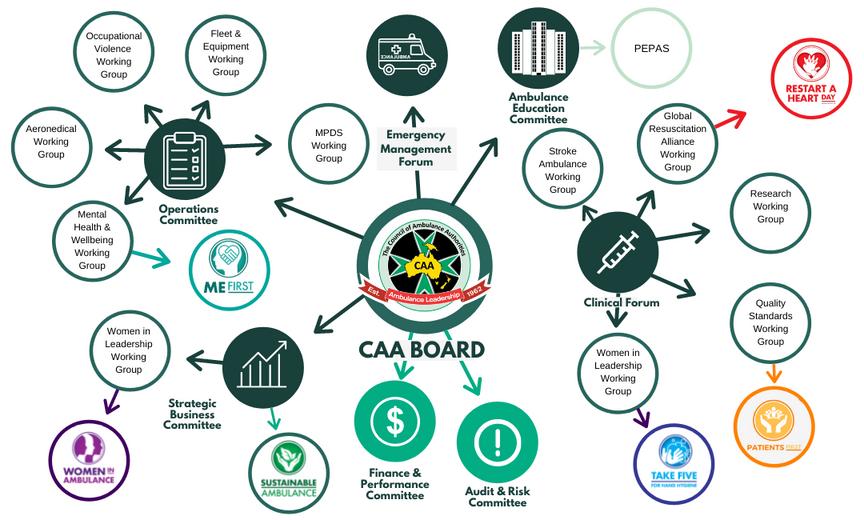
The CAA Board comprises of chief executives from each member service Standing committees are selected from senior executives at each ambulance service according to their expertise, experience, and interest
CAA provides a range of forums and working groups for CAA member services and individuals to share their ground-breaking research for the benefit of peers, the broader health community, and the public

"At the peak of the pandemic, we were met with unimaginable challenges. These challenges were met with determination and matched with skill and capability from the people within our sector."
After a challenging 2019-20 the ambulance sector headed into last year hot on the heels of COVID-19 which did not look to be stopping
An ongoing emergency event such as the COVID-19 pandemic brings with it not only immediate challenges in responding to the public's health needs, but also serious long-term impacts on our teams, ongoing fatigue, mental stress, fears and concerns for their patients, teams and family members. Concerns and issues that flow from work spaces into home environments and the wider community.
And while our teams always stand up to the challenges, we are of course emergency health people, we deal with emergencies, the longevity of COVID-19 has hit us all hard and as such our services needed to look at how we rise to the challenge and do the best we can by our teams.
This year will forever be remembered for lockdowns, closed borders, split families, COVID vaccination rates and the uncertainty of what is to come next.
At the peak of this pandemic, we were met with unimaginable challenges And as is usually the case for ambulance people, these challenges were met with determination and matched with skill and capability
In my second year as the CAA Chair, I was proud to look at our sector and see it once again rise to the new threat, stand firm and become an even better and stronger force looking after the Australian, New Zealand, and Papua New Guinea public
The CAA during these times continued to show the importance of sector collaboration, knowledge sharing and banding together to overcome such unprecedented times.
CAA's numerous groups exchanged experiences, informed one another of upcoming new waves of threats, and looked towards each other for support
The collegiality among ambulance services is truly an inspiring thing to witness and as the CAA's chair, one I will always value
The CAA never stopped working on engaging the sector by providing learning opportunities through the CAA Webinar Series, sharing news stories in CAA's magazine FIRST and on social media and running campaigns such as the Restart a Heart campaign, that in pandemic times became even more important in helping to save lives
I proudly pass on the role of Chair to my colleague Tony Walker, CEO of Ambulance Victoria and know that I leave the CAA in great hands.
An organisation that as it grows in size, grows in recognition and importance in bringing together ambulance services across Australia, New Zealand and Papua New Guinea, and indeed globally. It sets a wonderful example of leadership, knowledge sharing and long-lasting partnerships making the ambulance sector stronger for it.

DAVID WATERS
"And like many other organisations and businesses, we too have pivoted and found new ways to communicate, share and network."
Lockdowns, travel bans, closed borders, video call meetings, missing out on in-person events and networking opportunities have marked the year that was and one that will surely be remembered in the history annals for a pandemic life none of us ever thought to imagine
For an organisation that at our core was established to share knowledge, to provide networking opportunities, to create learning events, COVID-19 sure did disrupt our business model.
Like many other organisations and businesses, we too have pivoted and found new ways to communicate, share and network. And yes we missed seeing people in person, but we got on with work and addressed the challenges 2020-21 brought our way
The ambulance sector continues to play a major role in the response to the pandemic, while at the same time dealing with unprecedented demand for our services, increasing triple zero (000) AUS and triple one (111) NZ/PNG calls, bringing with it challenges for our people and their physical and mental health
Being able to, thanks to technology, bring our services together to discuss and share challenges of the rising pandemic, growing demand and other concerns was rewarding for the CAA team who continued to coordinate meetings across a number of CAA committees, forums and working groups.
The CAA team looked at media channels to utilise networking capabilities and organise opportunities for service members to meet with vendors, exchange innovations in technology, research developments, and connect.
CAA social media which was launched at the start of 2020 has grown into a pivotal industry messaging board, sharing news from across the sector. CAA Linkedin, Twitter, Facebook, YouTube channels in addition to the dedicated Restart a Heart campaign channels, continue to deliver news and provide connection points.
While the CAA Congress 2021 wasn't able to go ahead, our team brought you the CAA Virtual Expo and is momentarily working on bringing you an exciting CAA Congress 2022 in Sydney from 11 - 13 August.
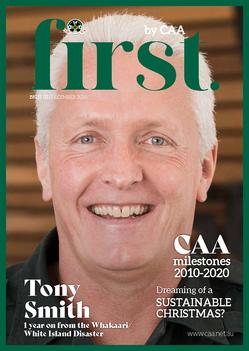
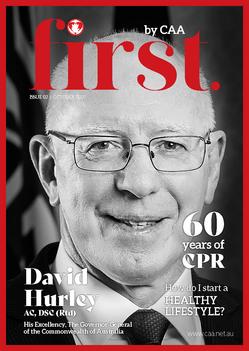
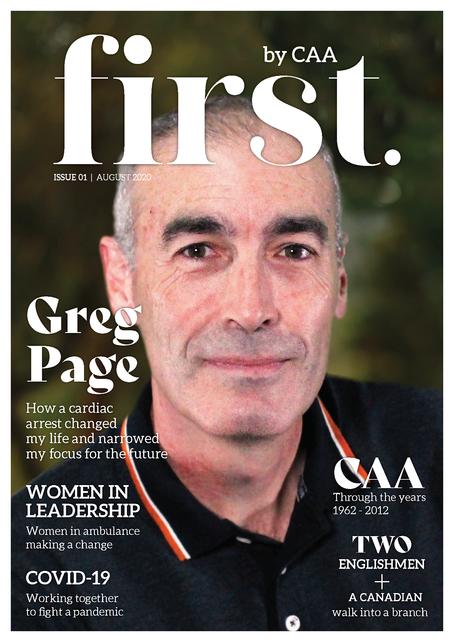
In July 2020 CAA launched our new magazine FIRST, which quickly grabbed the sectors attention and is fast growing into the ambulance magazine to read Filled with sector news, latest happenings and developments, wellness column, research articles and service stories, we are excited to have been able to find a great new avenue to connect the services, vendors, governments and our global friends
Seeing we were not able to bring our members together for CAA's annual Congress, the team looked at how to fill the education/learning gap and in August 2020 we launched our first webinar 'Managing Traumatic Cardiac Arrest' by Prof Richard Lyon in partnership with Philips
Since then the CAA Webinar Series has quickly become a must see monthly education session bringing you the latest in clinical technology, mental health, sustainability, leadership etc.
Virtual Expo held in June 2021 was an extension of our online work and was able to bring together services, vendors and partner organisations who showcased their technology, services and products.
Our team has been extremely busy and with that came some changes and growth for the CAA Secretariat.
In 2021 CAA's General Manager Mojca and Data Analyst Jenna both welcomed baby boys to their families The CAA offices moved to bigger premises in Adelaide and welcomed a few new team members: Anna - Executive Assistant, Savannah and Chantelle - Marketing Assistants.
Despite the challenges brought on by the pandemic we were able to deliver CAA campaigns, and in light of COVID-19 the Take 5 For Hand Hygiene campaign carried extra weight. We launched the good hygiene video in May 2021, a follow up video from the 2020 released bad hygiene video. These showed how bad and good hygiene practices can spread bacteria and germs in an ambulance setting
Our Sustainability campaign saw our Board members planting trees around the countries in recognition of World Environment Day, social media was used to share wellbeing tips to look after one ' s mental health, especially in hard COVID-19 times.
Women in Ambulance recognitions were announced in March 2021, with a new group of inspirational women working in ambulance services recognised for their talents, hard work, drive and passion.
Our Restart a Heart Day campaign was one that provided a biggest challenge in delivering its message, traditionally we utilise live demonstrations and education events through the support of our member services to share the campaign's core message CALL PUSH SHOCK In 2020 we had to come up with a solution that continued the great work done so far yet could work without in-person events.
Restart a Heart Day moved heavily into the online space, with a live digital 4-hour education session, where viewers were able to hear from all our member services and partners on CPR, use of AEDs, experts breaking down differences between cardiac arrest and heart attack, and teaching us about baby and kids CPR. Alongside survivor stories from across Australia and New Zealand, the Restart a Heart Day message was shared far and wide.
While the year was not what we expected, it turned out to be a great year of change, growth, new opportunities and projects that have already solidified their mark on CAA and our member services
As I write this, the pandemic is still raging on and the end is not yet in sight, yet we go on stronger and make a new reality wearing masks and checking in wherever the future takes us.
2020-21 saw CAA committees, forums and working groups continue to respond to COVID-19 pandemic, spending numerous meetings sharing latest developments and news, supporting each other in what turned out to be an extremely challenging year marked by the pandemic and unprecedented demand growth.
The Aeromedical Working Group meet bi-monthly focusing predominantly on COVID-19 related challenges and updates.
On the backend of devastating 2019-20 bushfires, preparation for 2020-21 summer fire season was a big focus with planning for rural fire evacuations of aged care and other facilities.
The group investigated use of PPE in heat, humidity, and cooling interventions rolling into the summer season.
Aeromedical standards, changes to crews, clinical practices in COVID-19 conditions, HEWT training were topics discussed at the groups regular meetings
Ambulance Education Committee continued to look after education of our members while working alongside APHRA Paramedic Board & Universities in ensuring employer requirements are reflected in paramedic courses Australia and New Zealand-wide AEC continued to work with New Zealand Universities in providing accreditations of all relevant paramedic courses.
COVID-19 related discussions revolved around implementation of protocols and clinical training in the post pandemic environment Staff vaccinations began, and a number of services had their staff trained to deliver vaccinations to their teams, first responders and the wider community
Education in 2020 was mainly delivered online, with some return to face-to-face in 2021. A big effort was made to deliver training and activities for staff and volunteers in remote and rural areas as they were impacted by pandemic restrictions
AEC continued to look at requirements and demands for clinical placements, which in most cases resumed towards end the of 202021 to allow for last years students to complete their requirements.
AEC is exploring post graduate paramedic programs accreditation to ensure quality and academic rigour.
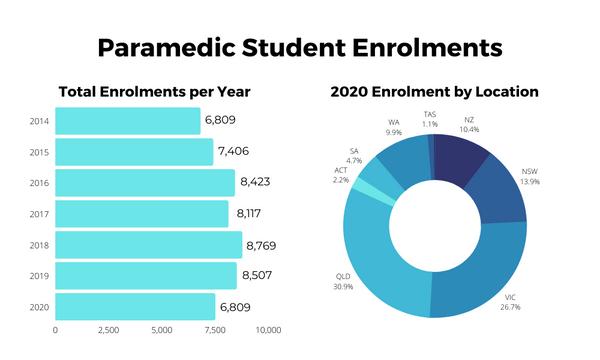
The Clinical Forum met regularly for updates and information exchange during the COVID-19 pandemic and in the later part of 2020 focusing on what the road to recovery looks like.
The group ' s meeting focused on COVID-19 response and management, PPE requirements and protection of patients and staff, staff vaccination, vaccine side effects in staff and patients, ramping at hospitals and increased demand for services.
Plans for post COVID-19 practices were discussed, including PPE use, CPR protocols, heat protection, changes to vehicle cleaning and design, vaccine delivery for staff and the wider community, alternative pathways, etc.
The practicality of AMPDS Protocol 36, IMT, secondary triage was on the agenda as well as representation on the National COVID-19 Clinical Evidence Taskforce
Different models of stoke assessment tools were discussed, as well as assessment of diabetic patients and drugs The grant for modified scanners that can fit into the ambulance vehicle was received and the group reviewed plans for stroke ambulances.
The forum provides wonderful opportunity for members to connect during the meetings and outside planned catch up, sharing knowledge and providing integral support during such unprecedented times. Clinical Forum continues to be an important tool in clinical care and management.
2 aged , and bush s nd nce ew e ements.
2020-21 was a year focused on issues relating to COVID-19 pandemic, from planning large evacuations in case of pandemic outbreaks or natural disasters with aged care facilities high on the priority list, to liaising on handling of anti-lockdown protests, and keeping updated on latest State/Territory Emergency Plans.
During a busy period for emergency management teams, planning for summer season was aimed at fire season, heatwaves, La Nina, flooding, cyclones and all the while trying to be ready for such events while handling a pandemic.
The Forum provides important connection to the Federal, State and Territory governments and their emergency teams, especially over last few years during COVID-19 pandemic
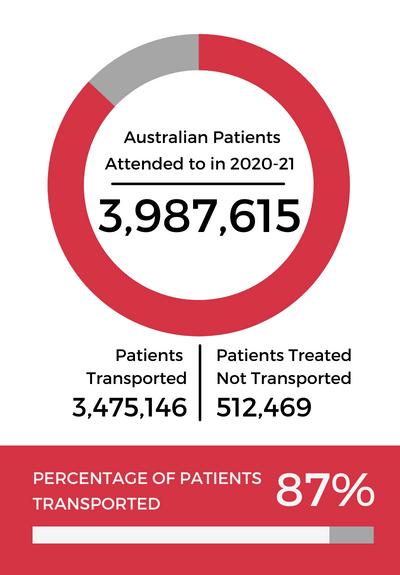
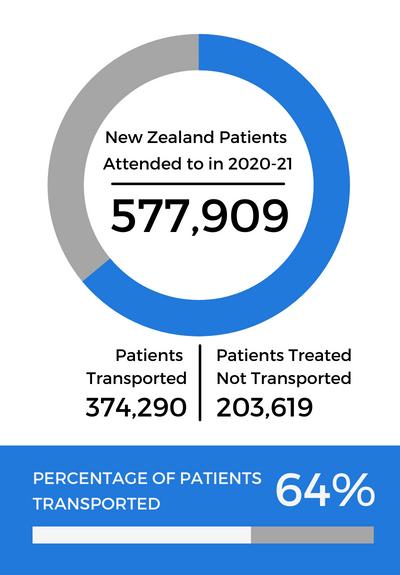
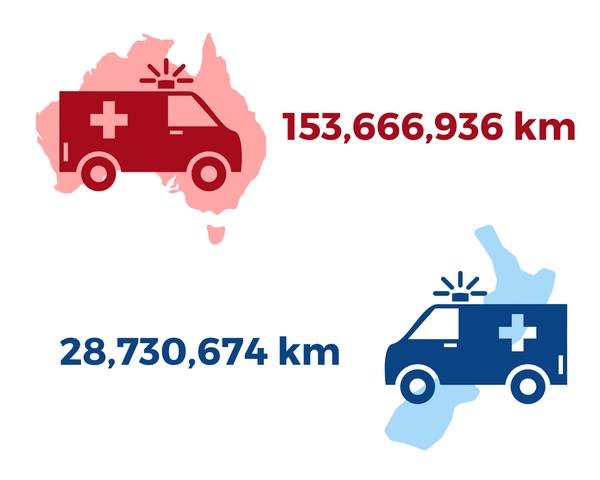
Fleet and Equipment Working Group discussed COVID-19 related impacts on the provision of fleet and equipment, including the effects of pandemic and infection control on vehicle design, materials and cleaning.
The group was working on standardised design for base ambulance vehicles as well as bariatric and multipurpose vehicle standards, new generation of power stretchers, stroke ambulance design, and alternative energy sources and sustainable vehicles
The National Driver Education programme was proposed by the working group, supported by the Operations Committee and the Ambulance Education Committee.
The working group released the 2019 GRA Report detailing progress against the 10 OHCA steps since 2016 when CAA members endorsed the 10-step program and CAA OHCA Strategy. The survey is set to be rerun in second part of 2021, with a focus on understanding impacts of COVID-19 on survival rates and OHCA programs.
2020 Restart a Heart Day campaign took a new approach in light of the pandemic and limitations on live events and was moved to a digital space The CAA main event was an Online Live event that shared stories and videos from our members and partners inspiring the public to learn CPR and up-skill on using AEDs
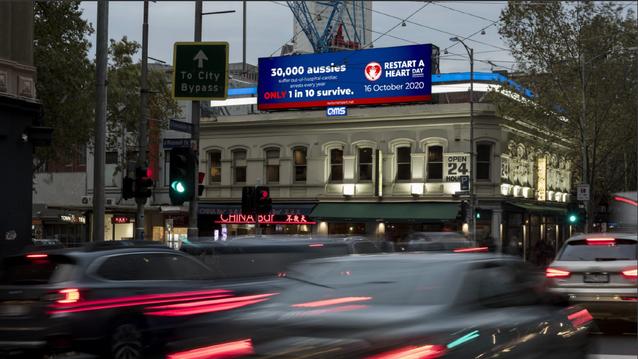
Despite limitations, the 2020 RAHD was a highly successful campaign including sharing the main messages CALL PUSH SHOCK via billboards in major Australian cities.
GRA group will be reviewing cardiac arrest data sets and definitions as part of the CAA Data Dictionary review in FY 202122
The working group continued to meet regularly in tandem with Operations Committee for updates and information exchange on the road to recovery and efforts to ensure staff safety and quality improvements in the areas of infection control and staff vaccination, both COVID-19 and the flu
The group exchanged information and discussed: hand washingdisinfection, wearing of appropriate PPE, vehicle cleaning and ventilation, heat protection, PPE use in hot weather, monitoring of PPE stock and mask fit-testing, amongst others
Members saw strong improvement in all areas of infection control and continued to educate staff to ensure the messaging of “standard” hand hygiene, including reduced reliance on gloves and use of hand sanitizers
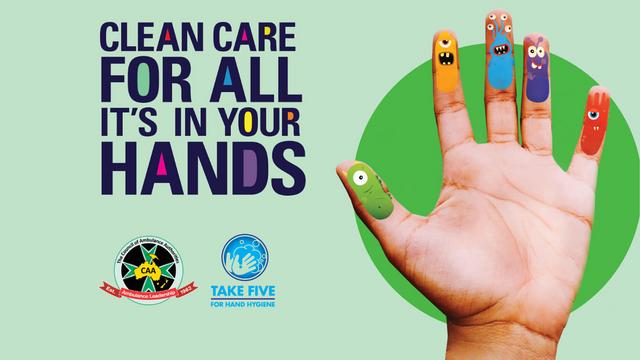
For 2021 Hand Hygiene Day the CAA, together with St John New Zealand, produced a “Good Practice” educational video showing examples of good hand hygiene during a patient encounter and transfer
COVID-19 pandemic brought an increased workload for mental health and wellbeing groups across CAA member services, with demand for support programs reaching an unprecedented access by staff from all parts of the service.
To look after their teams, majority of services introduced new tools to provide extra access to support programs, share latest updates, connect with staff during isolation or while in lockdowns.
The working group continued to look at best practices from external organisations, including Police, and expert groups like Beyond Blue, Phoenix etc
Progress against the CAA Mental Health and Wellbeing strategy was completed via a survey and a report with case studies was prepared for circulation around members.
The CAA Chnnl app was rolled out at St John NZ as a pilot program and roll out to St John WA, Queensland Ambulance Service, Wellington Free Ambulance and Ambulance Tasmania was planned for later in 2021.
With the pandemic continuing to rage on, the wellbeing of ambulance personnel who sit on the frontlines of the response has never been more important and as the pandemic drags on new challenges are presented in ensuring ambulance staff have the support they require.
This working group has continued to work with the Medical Priority Dispatch System to discuss solutions on challenges around the use of their programs in the ambulance and prehospital setting with focus on Protocol 36 usage prevalent during pandemic times.
The Occupational Violence Working Group continued to share developments in the occupational violence space, looking at trials on body-worn cameras, setting up national benchmarking data collections and exchanging knowledge.
Majority of services focused on preventative actions with aims to try and prevent occupational violence and equip staff with risk diffusing strategies and programs that teach how to de-escalate a potentially threatening situation.
The group worked on preparing an annual data collection as well as information matrix, to be able to share details on programs and data on an annual basis, building a pool of occupational violence information.
The Operations Committee agenda continued to be dominated by ambulance response to COVID-19 pandemic and the members met regularly in partnership with the Infection Control & Prevention Management Working Group in the first half of 2020-21. As the situation changed, Operations Committee only meetings restarted at the end of financial year when lockdowns in Sydney and Melbourne emerged.
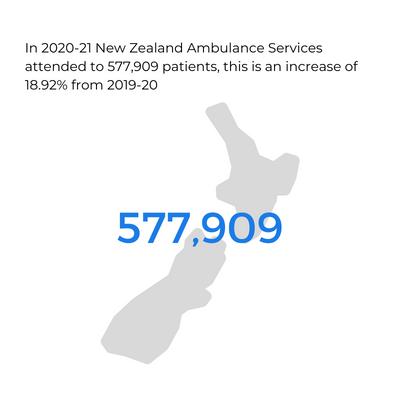
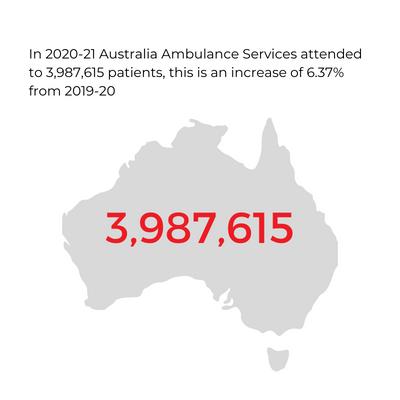
The Operation Committee focused largely on the impact of current demand growth and ramping issues, which saw unprecedented growth over 2020-21 period that continues to cause concern and sees services introducing new programs and initiatives to deal with this rising demand
The Operations Committee in collaboration with the Strategic Business Committee, looked to regularly exchange information on growing demand and new demand management initiatives, providing the services with the opportunity to exchange data on a regular basis.
The Quality Standards Working Group meetings were the same as most other groups, focused on COVID-19 pandemic and obstacles presented to services who are working towards accreditation.
The CAA Patient Quality and Safety Improvement Strategy was published in 2021, the strategy will be a guide for CAA on work in this space.
A workshop lead by NSQSHC on National Standards in Quality and Safety in Ambulance setting was organised and held successfully in December 2020
The CAA Research working group was inactive for the 2020-21 year
The Strategic Business Committee has been actively exchanging updates, COVID-19 impact data and towards the end of 2020 started seeing a heightened demand growth across the majority of services. This paired with intensified ramping (off stretcher times), issues has caused high concerns and required initiations of new projects to tackle both issues.
Strategic Business Committee is set to review the current RoGS ambulance framework in addition to the planed review of CAA Data Dictionary and collections
The group continues to oversee data updates, including Workforce and Gender collection, Patient Experience Survey, RoGS and others.
The 2020 Women in Leadership Survey was published with results for a CAA member wide survey on the standing of women in the ambulance sector. The report is a great first step on capturing issues, concerns, challenges and opportunities facing women in our sector.
The survey will be held regularly on a bi-annual cycle to help gather valuable feedback and data from member services to contribute to necessary changes in gender balance across the ambulance industry.
The work plan set in 2019 has been delivered against the WIL Strategy and the group is set to review and prepare a work plan for the next three years
Scholarship and Career progression are pieces of work that the group will be working on for delivery in 2020-21.
CAA Women in Ambulance Awards were held again in 2021 with another round of deserving and inspirational women celebrated as part of International Women's Day.
Every year brings with it new challenges and opportunities for growth. Riding on the end of what we thought will be one of the hardest years with the introduction of COVID-19 pandemic, we didn't think 2020-21 could be just as hard. And as the year progressed we quickly realised that it will take a few more years to get a handle on what living with this pandemic will look like
2020-21 continued to present new obstacles when dealing with COVID-19, from relentless lockdowns to the promise of vaccines, only to have our hopes slashed by the new strain Delta Travel was still off the cards and that meant missed holidays, celebrations, family reunions, which all started to take a big toll on people's mental health and resilience
And while initially lockdowns brought with them a drop in demand for ambulance services, that too was quickly dashed and demand grew unprecedentedly towards the end of 2020 and into 2021
Ambulance services across Australia and New Zealand have been reporting heavy workload, calls to 000/111 have seen incredible growth and ramping of ambulance crews at emergency department's doorsteps has become the new normal even for services who previously never reported ramping.
"Pandemic paired with unprecedented high demand for ambulance services marked another tough year for our sector."
CAA continued to provide an important forum to exchange updates, experiences and challenges on COVID-19 CAA groups were meeting regularly for service updates. Operations Committee, Clinical Forum, Infection Control & Prevention Management Working Group, Aeromedical Working Group meet monthly and/or fortnightly.
Mental health and wellbeing of our teams became more important than ever, as we started seeing impacts the longevity of the pandemic has started having on staff and their families. Mental Health and Wellbeing Working Group connected regularly to share initiatives and information on looking after their teams. 2 3
"Challenging times always bring about new growth and new opportunities, and it reminds us of the saying "Necessity is the mother of invention", and COVID-19 continues to do this for ambulance and health sectors."
Demand growth in 2020-21 set new records almost daily for some of our services and combined with intensified problems with handing over patients at hospitals, it put a big strain on services
000 lines in Australia have been overwhelmed to the point that combined national action was planned to help with calls.
Services looked towards new initiatives to help ease the strain and while some programs were put in place to tackle demand in COVID-19 times, many will stay here in the future. Virtual spaces and consultations are just some of the initiatives that were taken up in lockdowns and due to great results will continue well past once the pandemic is over.
In 2019 the CAA Infection Control Strategy was prepared and with great timing as the outcomes and topics were helpful in combating the COVID-19 pandemic. The CAA Hand Hygiene video which launched in March 2020, showcased the importance of good hand hygiene in the patient setting and was subsequently followed up with a good practice video in May 2021
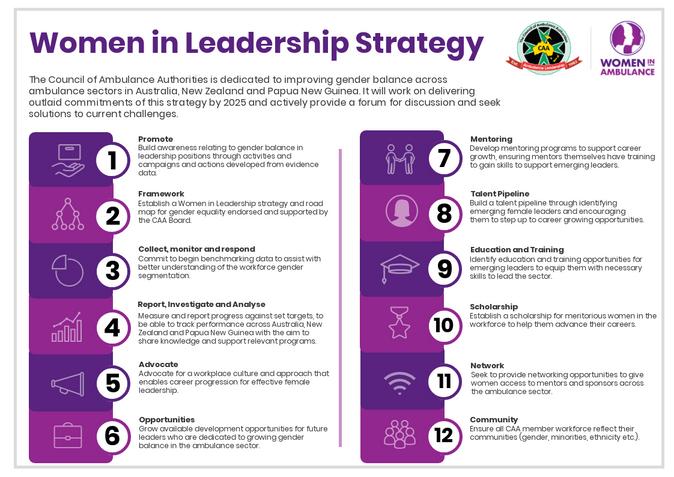
Start of 2020 saw the introduction the CAA Women in Leadership Strategy, an important showing of the industries commitment to improving women ’ s standing in the ambulance world The strategy works to create a better gender balanced workforce that will afford women equal opportunities to progress their career to senior management and executive levels.
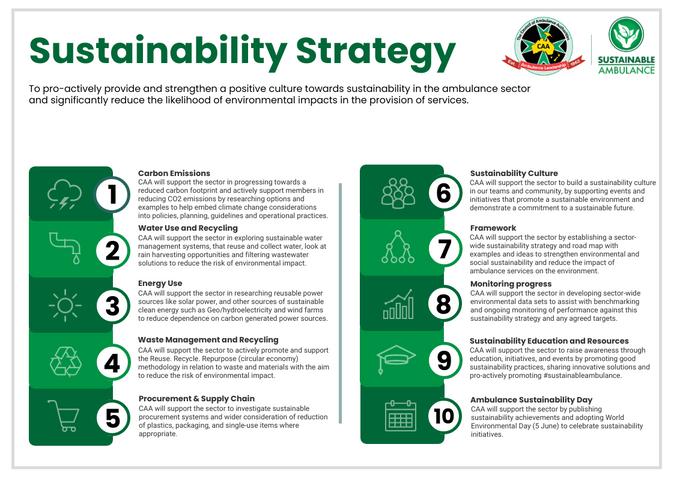
In June 2020 we released the CAA Sustainability Strategy, created to support our members towards a more sustainable future The strategy will work on delivering services ideas and solutions to drive change for a more sustainable workplace and environment.
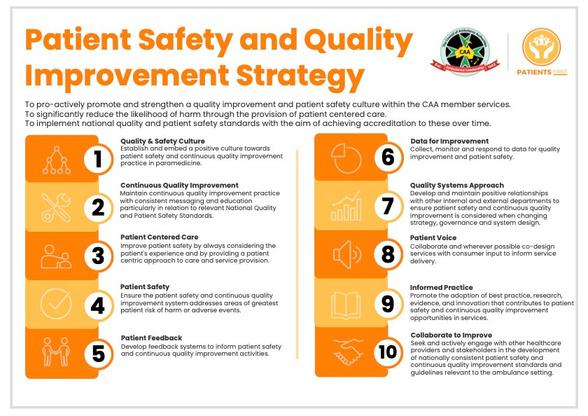
The end of 2020, the CAA released Patient Safety and Quality Improvement Strategy that will pro-actively provide and strengthen a quality improvement and patient safety culture within the CAA member services.
The aim is to significantly reduce the likelihood of harm throughout the provision of patient centred care and to implement national quality and patient safety standards with the goal of achieving accreditation.
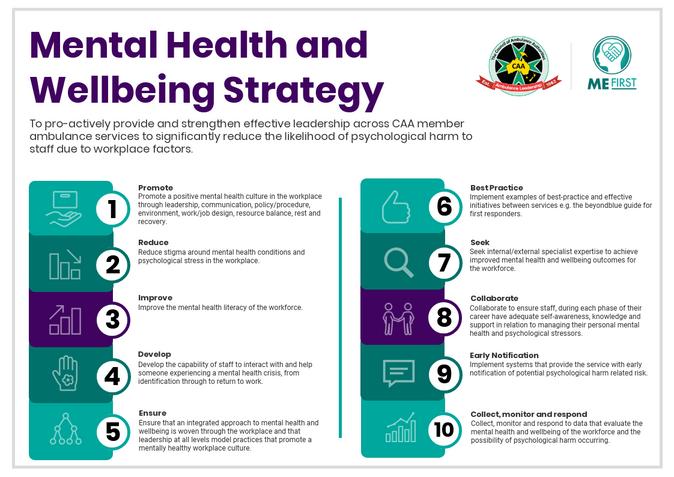
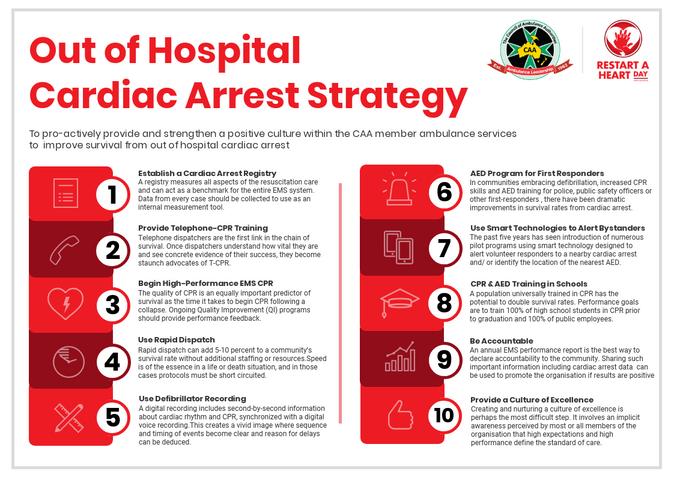
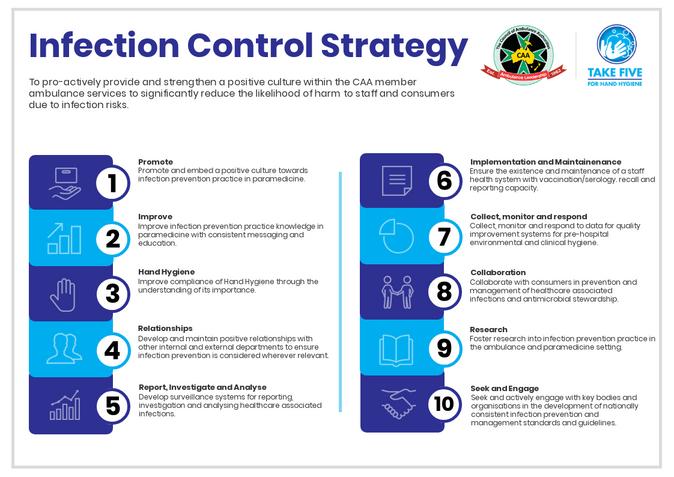
Throughout 2020 - 2021, CAA continued to run campaigns that are created to support the work of the CAA strategies.
The CAA campaigns are designed to engage member services and in the case of the Restart a Heart campaign the public, in activities or by sharing information and learnings around the various topics that are integral to the ambulance sector's benefit and growth.
2021 saw the second year of The Council of Ambulance Authorities inaugural Women in Ambulance Awards. The campaign is designed to highlight successful and hardworking women in ambulance services across Australia, New Zealand and Papua New Guinea.
CAA member services were asked to nominate women from their services from operational, corporate and communication teams
The 2021 Women in Ambulance Awards recognised 60 women as Honour Recipients for their work and career progression and are being championed as role models to the rest of the workforce
Many services held events where the Honour Recipients were announced and awarded their certificate, lapel pin, and an invitation to attend the Women in Leadership Forum in 2022
The CAA Women in Ambulance campaign operates to empower and inspire future generations of women to step into ambulance careers and progress into leadership roles and management levels

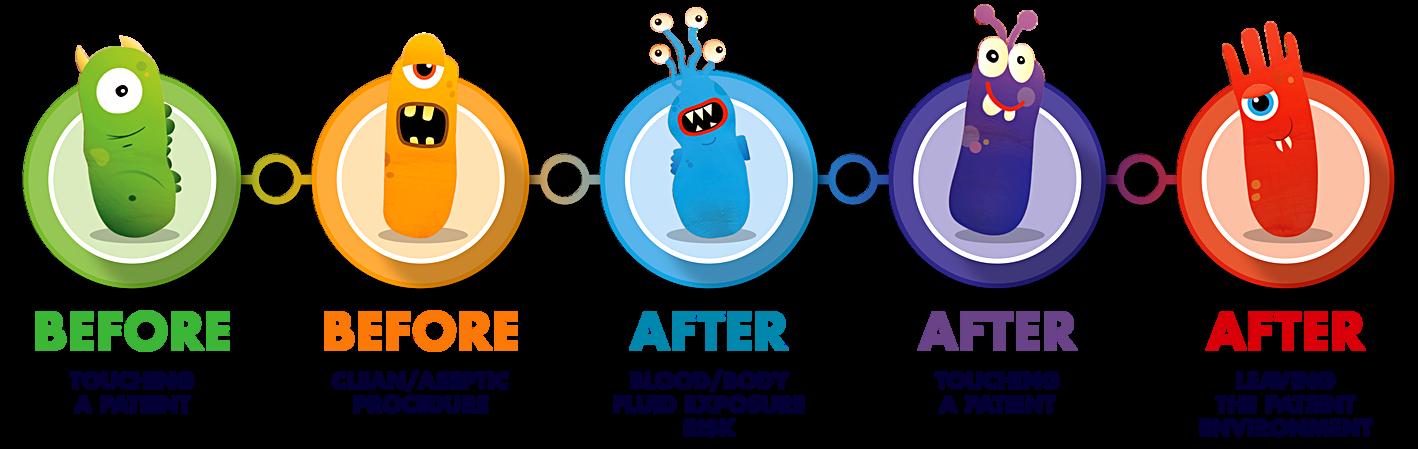
Take Five for Hand Hygiene is an annual campaign created by The Council of Ambulance Authorities to highlight the importance of hand hygiene during paramedic's time with patients.
The campaign is designed to highlight 5 key moments when dealing with patients and importantly speaks about good hand hygiene and the over-reliance on wearing gloves, that, when inappropriately used, can assist in spreading contaminants
On May 5, 2021, a 'Good Practice' hand hygiene video was released which complimented the video released the year prior that highlighted "Bad Practice".
In this video, the CAA similarly takes you through an ambulance trip from when a crew first arrives in a patient's home to where they are handed over to the hospital emergency department. It shows the variety of people the crew comes in contact with and highlights the 5 critical moments in the journey where staff demonstrate good hand hygiene practices. CAA would like to thank St John NZ for producing the video
A special extended webinar was also released in May as part of the campaign on the topic of Infection Control Post Pandemic. This webinar featured Peter Collignon, Edward Johnson and Mark Reggers and ran for 3 hours
June brings a month-long focus on sustainability with the Sustainable Ambulance campaign. The CAA is committed to supporting the ambulance sector to work towards a more sustainable future.
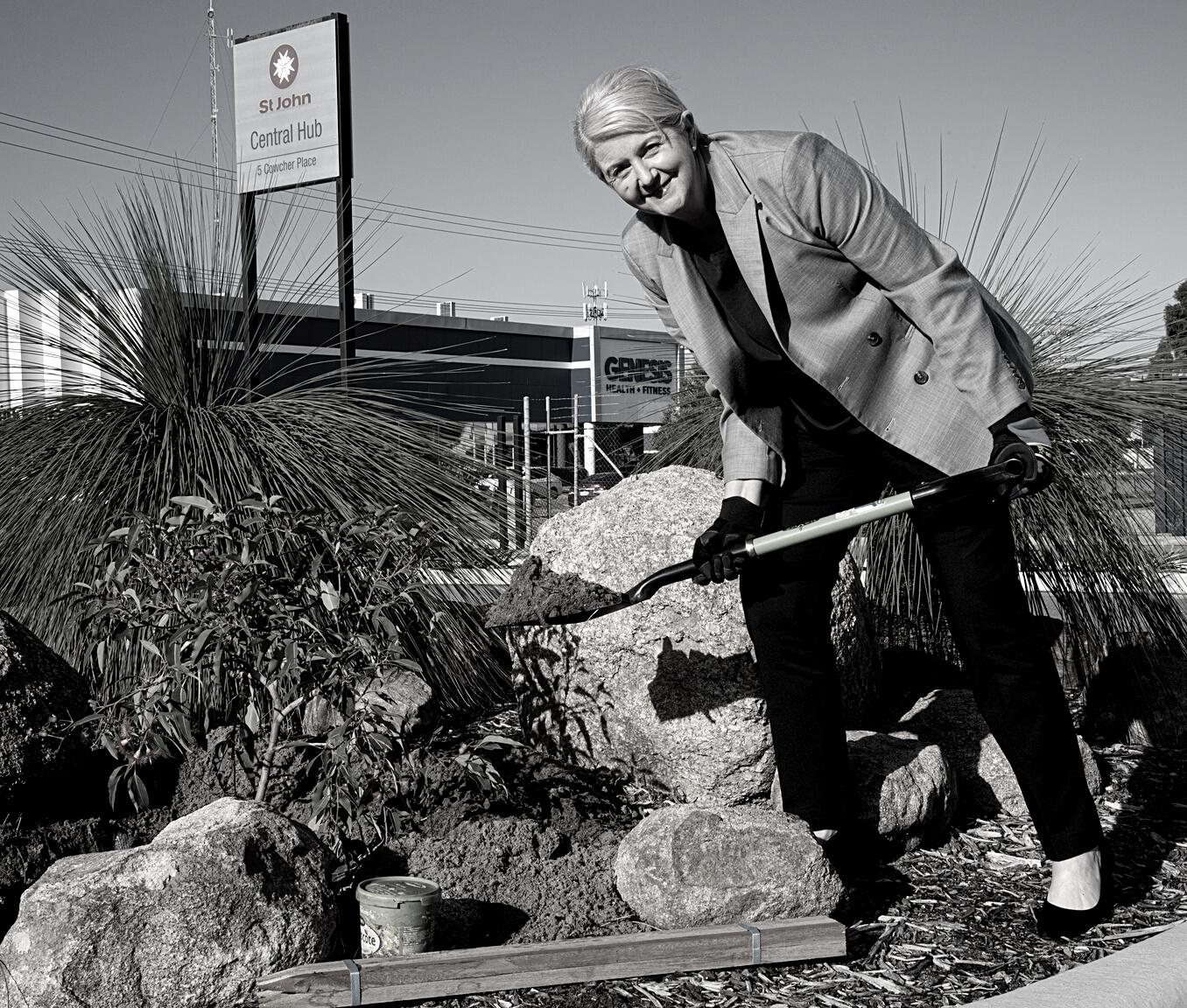
The theme of World Environment Day in 2021 was ‘Reimagine, Recreate, and Restore.’ CAA launched the CEO's planting trees initiative which moves in line with World Environment Day’s theme by addressing that whilst we cannot turn back time, we can grow trees and think of new and creative ways to encourage behaviour that acts to restore the environment. CAA provided each member service with a native tree to plant as a part of the initiative.
A special CAA Webinar was produced with a sole focus around Sustainable Ambulance. Alexis Percival, Environmental and Sustainability Manager for Yorkshire Ambulance Service NHS Trust based in Yorkshire, UK, presented the Webinar. Alexis has over 20 years experience in the environmental field
CAA continues to work on collating best practices from around the globe, vendors and suppliers of sustainable products and solutions, marketing collateral, and ideas on how to start making long-lasting changes for a better environment. CAA shares this information and plays an active role in supporting communities to grow sustainable relationships and work with staff on creating sustainable workplaces. Whilst this campaign is highlighted throughout June, information is continually circulated year-round to assist with ongoing growth in this area in the ambulance sector.
Restart A Heart Day is held annually on October 16. The campaign was created to raise public awareness on outof-hospital cardiac arrest. Currently, 9 out of 10 people will not survive an out-of-hospital cardiac arrest Restart A Heart Day aims to improve this survival rate through CPR and AED education. The campaign forms part of the CAA OHCA Strategy
CAA has been running the RAHD campaign since 2017 and together with our ambulance member services, we have managed to educate over 50,000 members of the public in CPR and AED use
Restart A Heart Day was a little different in 2020 due to the global pandemic but it was still well received and a great success. 2020 RAHD focused mainly on digital platforms with a featured live steamed event on 16th October. The event reached over 40,000 people, received over 800 responses, and demonstrated a true passion for collaboration between Ambulance Services in Australasia.
The CAA Secretariat actively sought out opportunities for growth. Restart A Heart Day direct campaign materials received over 100,000 contacts in the digital realm. The campaign attracted coverage domestically and internationally Thanks to the digital signage supporters, another 5,000,000 people interacted with the campaign on the streets.
Support was additionally received from parliament house with the campaign being supported by CAA patron, His Excellency General the Honourable David Hurley AC DSC (Retd). The Rt Hon Dame Patsy Reddy GNZM, QSO Governor-General of New Zealand, also joined us for Restart A Heart Day 2020.

ME First campaign is created to celebrate World Mental Health day in October and while the CAA and members generally prepare internal facing tools, this year the work in this space was ongoing due to the COVID-19 pandemic.
The biggest challenge in 2020-21, which continues to be the case going forward, is the longevity of the pandemic and the impacts this is having on ambulance staff.
As much as our teams are resilient by their nature, having no break form the relentless two years of pandemic is taking a toll on all levels of ambulance teams and flowing into their private lives.
CAA members have been as always wonderful in sharing their experiences, exchanging plans and new programs, developments and generally supporting each-other thought these difficult times.
Resources for looking after mental health and wellbeing of ambulance staff and their families was shared between services and on CAA platforms
CAA has during last year launched the CAA Mental Health and Wellbineg app, Chnnl, with St John NZ running the pilot since start of 2020. A number of other services were on target to launch in 2021-22
2020 saw CAA venture into new space to bring together our services, partners, vendors in being able to share industry news and developments despite the fact that we won't be able to meet person for a considerable time
Before COVID-19 surprised us at the start of 2020, the CAA team was looking at new opportunities to engage the sector in new networking opportunities and start of 2020 saw us refresh the CAA social media channels.
In July 2020 the new CAA magazine FIRST was launched and in August 2020 we commenced the CAA Webinar series.
June 2021 welcomed a new online networking portal the CAA Virtual Expo, a space created to bridge the gap of missing another CAA Congress with intent to create a sharing space. 3 days of 24hr access saw numerous visits to the portal, checking out latest developments form vendors, new projects from services and learning opportunities from Universities and other education providers
With the postponement of the yearly CAA Congress, the Secretariat sought other opportunities to connect with the ambulance sector, partners, and associated organisations.
Out of this time, FIRST by CAA was created, a magazine designed to provide the opportunity to share the many wonderful and ground-breaking news and programs from across the Australasian ambulance sector.
The release of the first issue was in August 2020 and featured the original 'Yellow Wiggle', Greg Page on the cover. The magazine consists of pillars that bring out the best and most innovative stories and information from the sector such as Industry News, Events First, Research First, and a Wellness column.
FIRST is a quarterly magazine that is viewed digitally on the CAA website with a complimentary small print run that is sent to services and partners
The CAA Webinar Series is designed to inspire and educate with a range of speakers discussing topical issues from around the ambulance world
These 1-hour long webinars were originally devised to fill a gap left behind from postponing the 2020 CAA Congress due to COVID-19 restrictions, and due to their success, they are now a permanent part of the CAA.
The webinars are free to attend and registered paramedics can claim CPD points for attendance to contribute to their ongoing professional development.
The webinars were launched in August 2020 with presenter Dr Richard Lyons and supported by Philips.
Since then topics such as Sustainability, Mental Health and Wellbeing, Clinical Practise and Cardiac Arrest have been covered
June 22 – 24 saw the CAA Virtual Expo bringing together our industry, sharing new innovations, technologies, programs and connecting with the sector. Enter a world-class Virtual Expo delivered on a custom-built online platform offering specialised halls with exhibition booths to explore Ambulance services across Australia and New Zealand, various medical companies and associations all joined the Expo, sharing their latest news, developments, research, projects and technology in creating a wonderful three days of networking and exploring new advances in the ambulance sector
Virtual Expo showcased three halls: Education, Equipment and Technology, and Ambulance Services. The Ambulance Services Hall offered a valuable opportunity for those in the ambulance industry to come and learn more about CAA’s member services and organisations working in the pre-hospital sector.