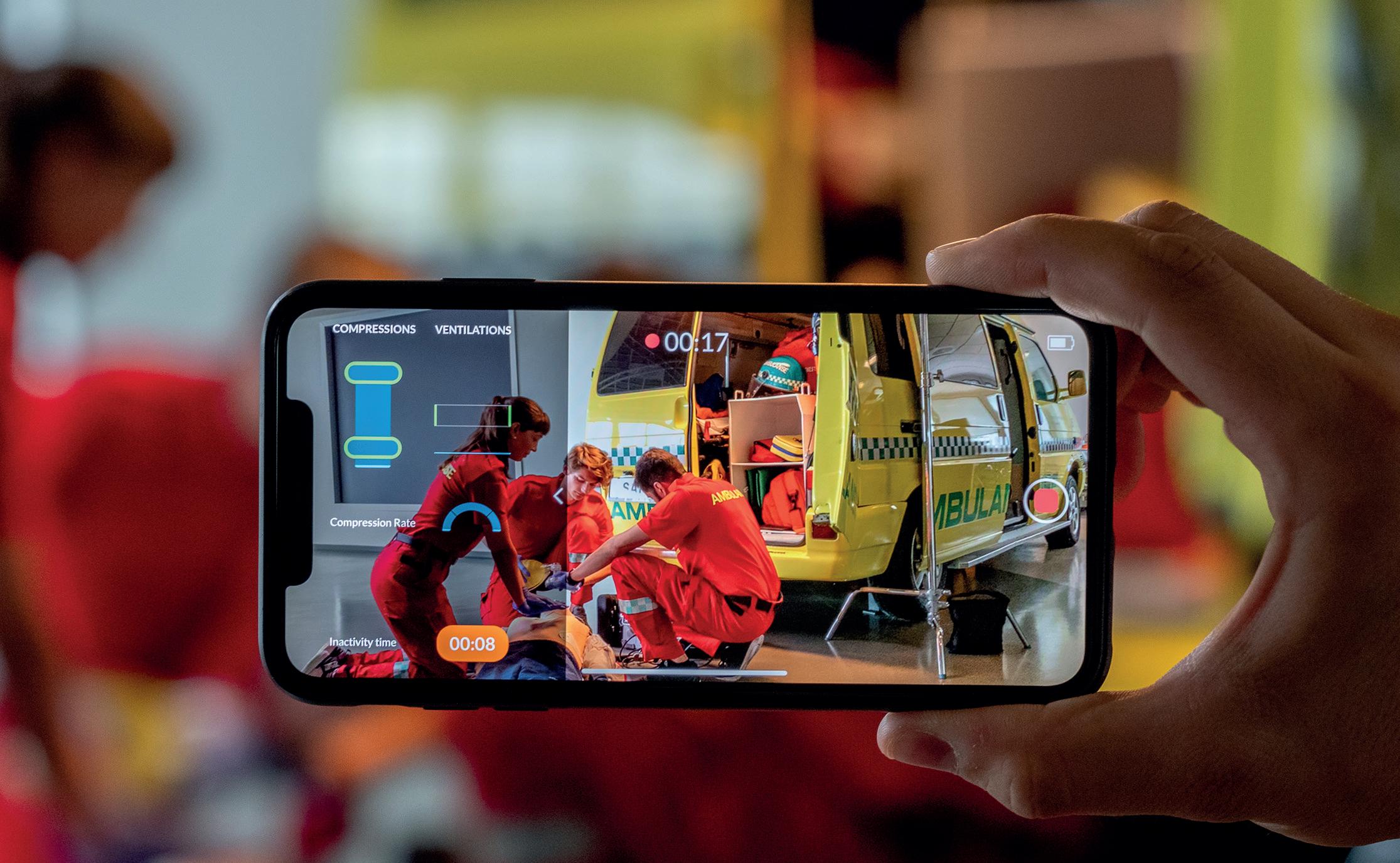

By providing real-time CPR feedback, tips for improvement, and video-based debriefing, the TeamReporter app is your organisation’s “assistant coach” that enables you to build, train, and retrain high-performance CPR teams. Try for FREE at Teamreporter.Laerdal.com
Dear friends and colleagues,
Spring has sprung, and I hope most of us will have an extra spring in our step. Our hearts go out to everyone, knowing just how hard the current COVID situation is for many, and we are reminded to stay kind to one another and look to support each other and regularly check in on our friends, family and colleagues.
On October 10th we marked Global Mental Health Day and this year it is more topical than ever, being stuck in this never-ending pandemic where many people will have a hard time seeing the light at the end of the tunnel.
With this in mind, we look to our wellness column for tips on how to look after yourself and throughout October we have a special feature planned on mental health and wellbeing bringing you more helpful tips and advice.
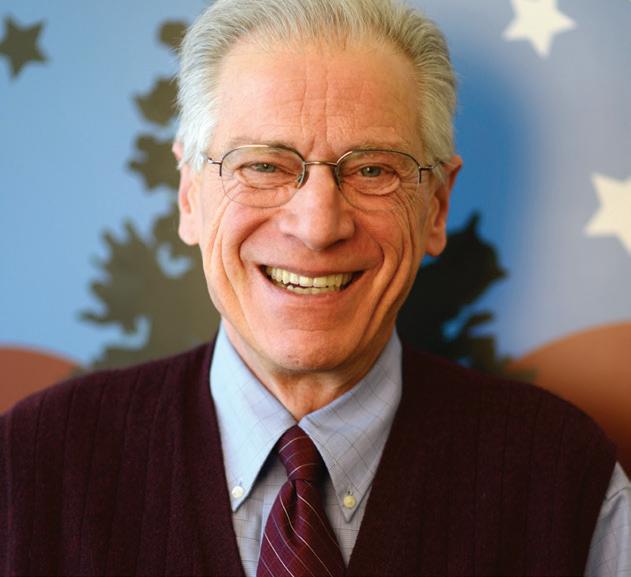
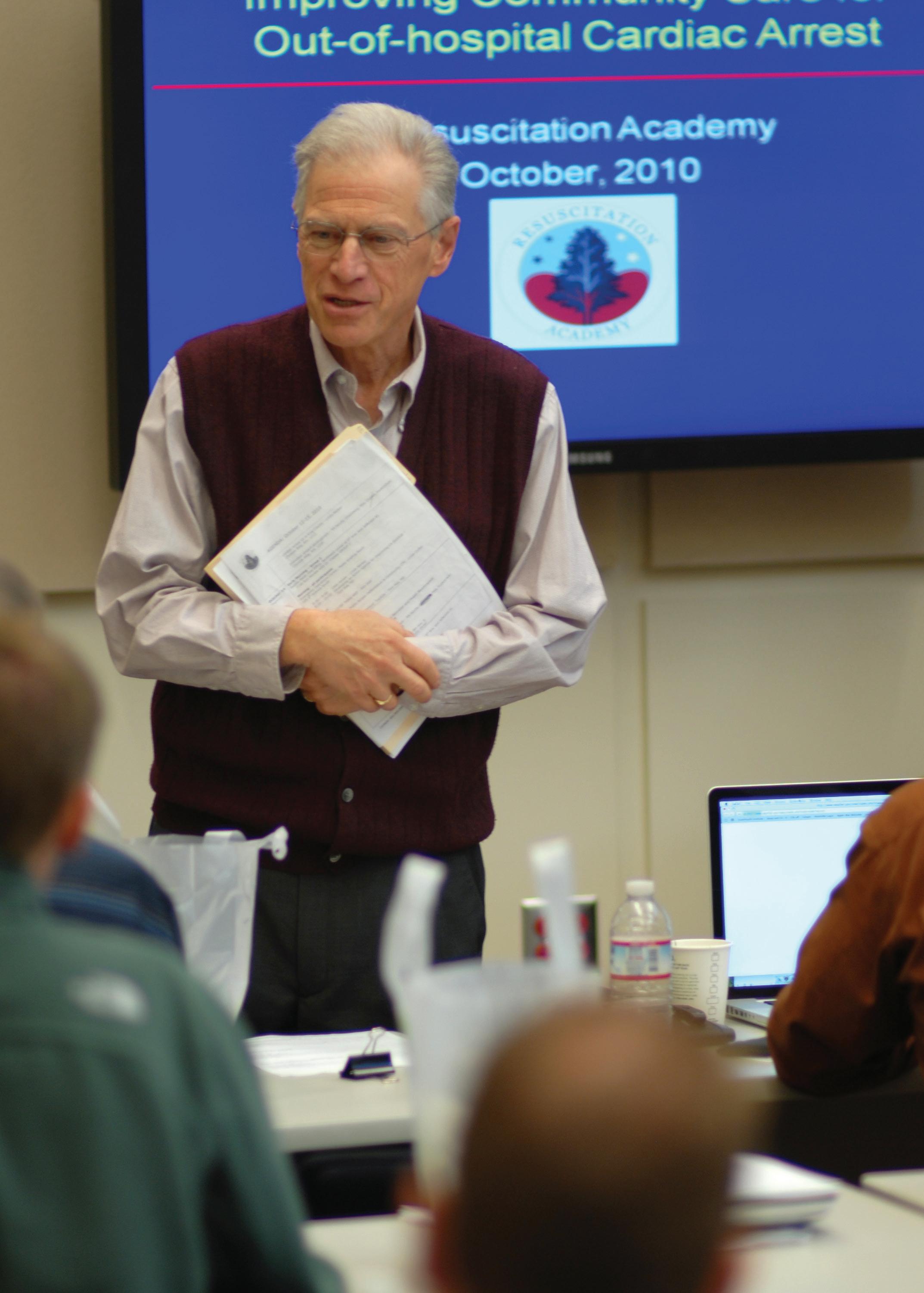
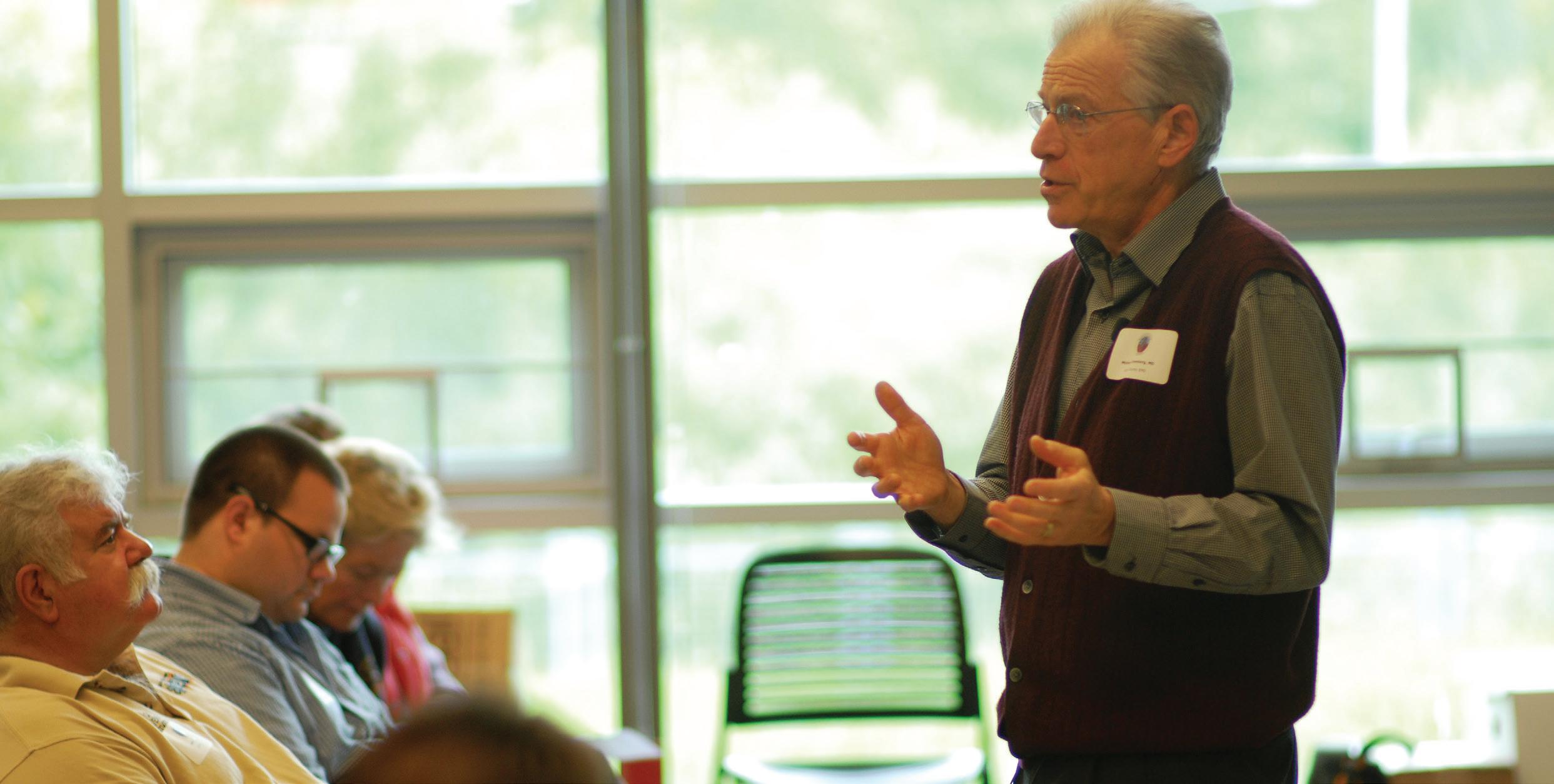
Our Spring cover features a man that needs no introduction, Mickey Eisenberg. Mickey has a long and distinguished medical career and we are excited to be able to interview him in the midst of 2021 Restart a Heart Day and hear his thoughts on cardiac arrest, latest improvements, challenges, the work of the Global Resuscitation Alliance and the Resuscitation Academy.
October 16th is Restart a Heart Day and this year CAA and our members prepared a variety of online and hopefully a few live events to help raise awareness about out-of-hospital cardiac arrest and the importance of knowing CPR and using an AED.
This year, throughout October, help us by sharing #9for9 and recording a short video doing CPR compressions in memory of 9 out of 10 people who suffer an out-of-hospital cardiac arrest and don’t survive.
Latest vehicle innovations, CAA 2021 Award for Excellence finalists and much more are waiting for you inside our September issue as we celebrate a year of FIRST by CAA and CAA Webinar Series.
Lean back, relax, and have a read.


30 Opinion First
A/Prof. Paul Bailey, Medical Director, St John WA shares his take on one of the biggest challenges facing the ambulance world today.
35 Services First
Showcasing the latest ground-breaking projects from across CAA member services.
the ambulance sector.
Catch up on the latest from The Council of Ambulance Authorities.
39 Awards First
Announcing the CAA2021 Awards for Excellence Finalists.
42 Feature First
FIRST interviews Dr Mickey Eisenberg after more than four decades in emergency medicine.
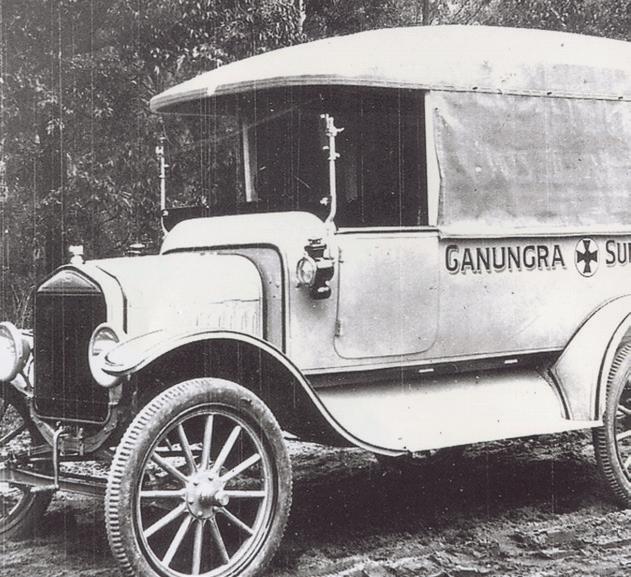
Ambulance vehicles then and now.
49 Events First
CAA Virtual Expo & FNQESA Charity Ball.
60 Partners First
Meet our partners: Global Paramedic Leadership Alliance & Fortem Australia.
66 Research First
Sharing the latest innovative research projects from around the ambulance world.
70 Are they Triple OK?
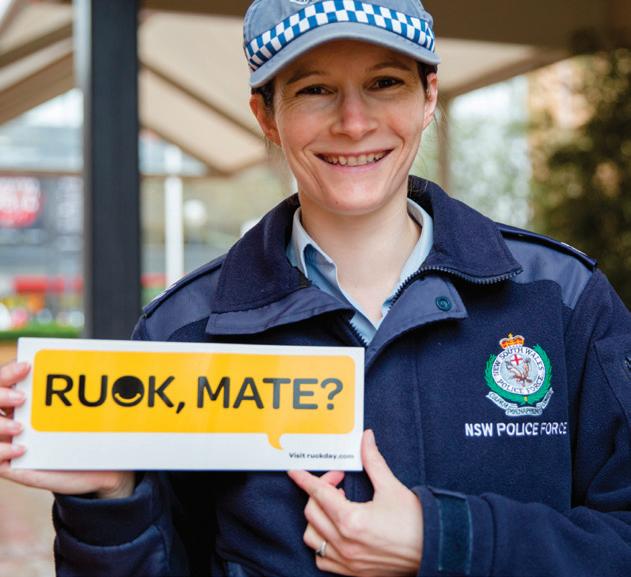
Practical tools to help you have an R U OK? Conversation.
THE TEAM
Editor: Mojca Bizjak-Mikic
Relationship and Content Manager: Stephanie Hartley
Graphic Design: Alpha State
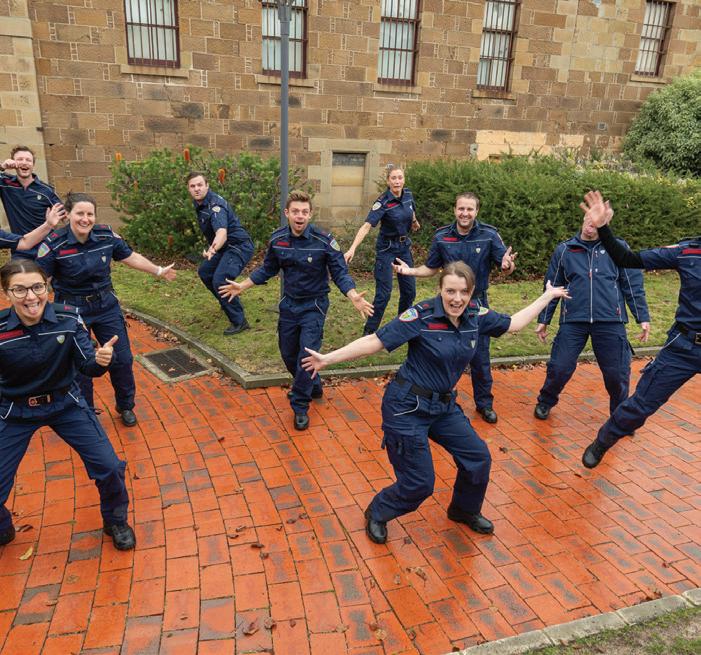
76 Sustainability
Social and Environmental Procurement.
80 People First
Meet the wonderful people that make up the Australasian ambulance services.
82 The Directory
84 Wellness First
Self Compassion; What is it? Why do we need it? And how can we do it?
PUBLISHED BY:
The Council Of Ambulance Authorities 2/141 Sir Donald Bradman Drive Hilton SA 5033 Australia admin@caa.net.au
Magazine published from paper that is sustainably sourced.
Since 2002 the CAA has been running the Patient Experience Survey designed to monitor patient experience across all our members with the aim of identifying the quality of ambulance services as reported by the patient. And in 2021, we again see that our members are doing a wonderful job looking after their patients with overall satisfaction sitting at 96% in Australia, 96% in New Zealand and 94% in PNG.

3,748,835 incidents 3,937,770 operational staff
3,445,506 patients
16,209 volunteers & first responders 13,182
answered in under 10 seconds 92% OF CALLS
rated the level of confidence & trust as high
patients operational staff
597,200 2,946 96% OF CALLS ‘111’ calls 522,957
485,956 1,998 incidents volunteers & first responders answered in under 10 seconds
We are pleased to announce that Tony Walker ASM has been appointed the position of CAA Chair. Tony has three decades experience working in a range of senior clinical, operational and leadership roles within the ambulance sector and is currently the Chief Executive Officer of Ambulance Victoria. We look forward to having you as our chair Tony and are excited for what the future holds with you in your new position at the CAA.
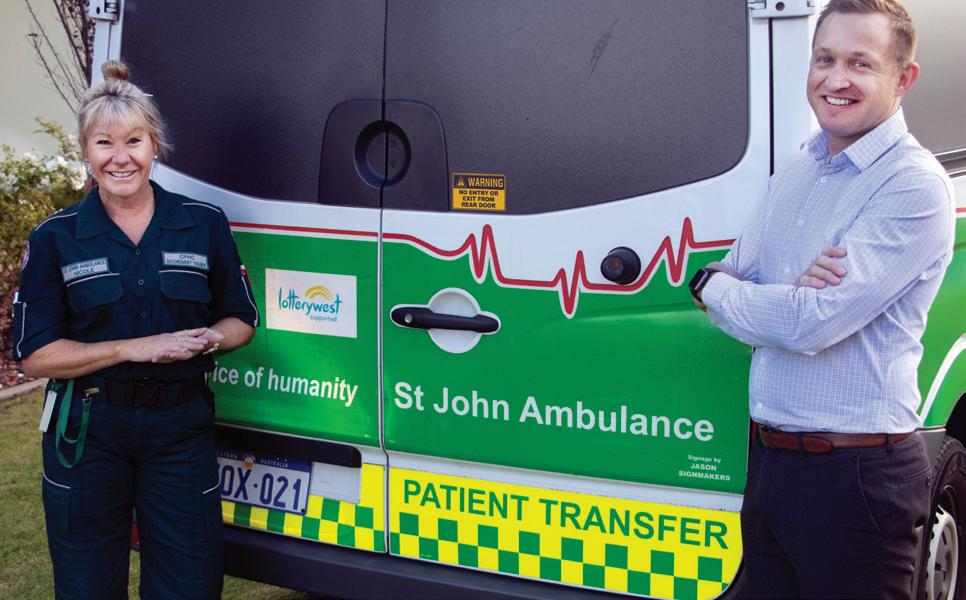
More than 250 Patient Transport Officers at St John WA have just completed a new custom-made training program to support patients living with dementia, thanks to Dementia Training Australia. Dementia poses a unique challenge to healthcare providers, as patients at different stages of dementia will experience the illness differently. The training was focused on building rapport with patients, with the aim of easing the burden of some of the daily challenges they face.
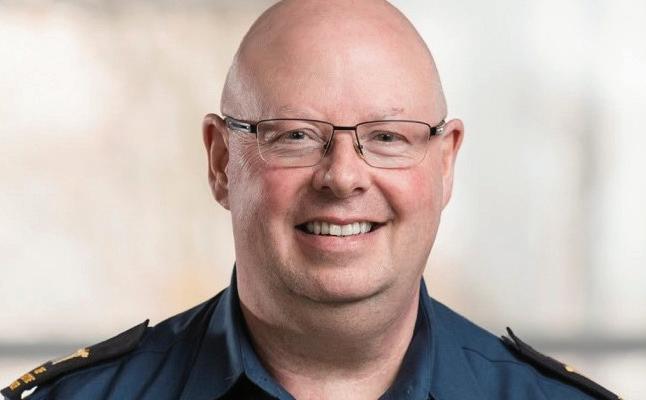
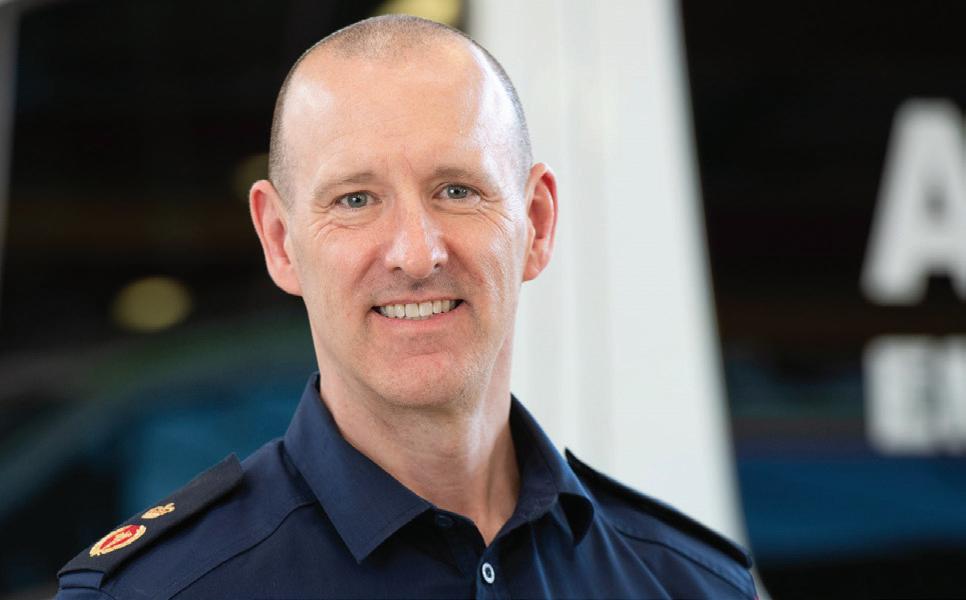
On the 26th of July, Mr Joe Acker was appointed to the position of Chief Executive, Ambulance Tasmania. Appointed the Interim Chief Executive in February 2021, Joe will now take on the Chief Executive role following an extensive recruitment process. Joe comes to Ambulance Tasmania with more than 30 years' experience in paramedic systems, health services and academia.
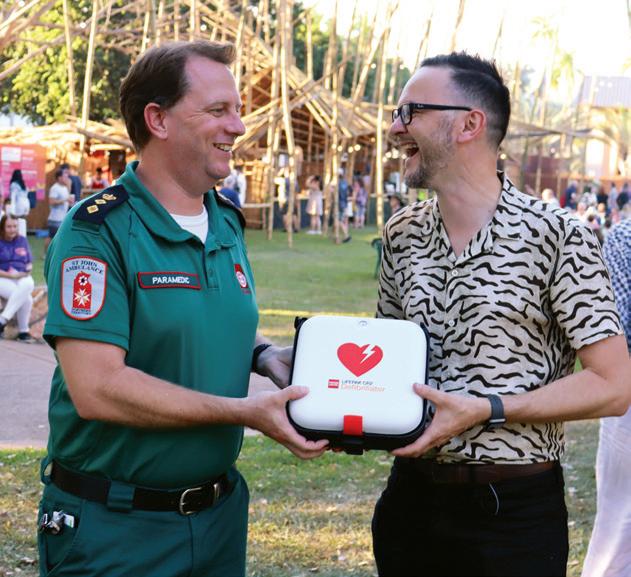
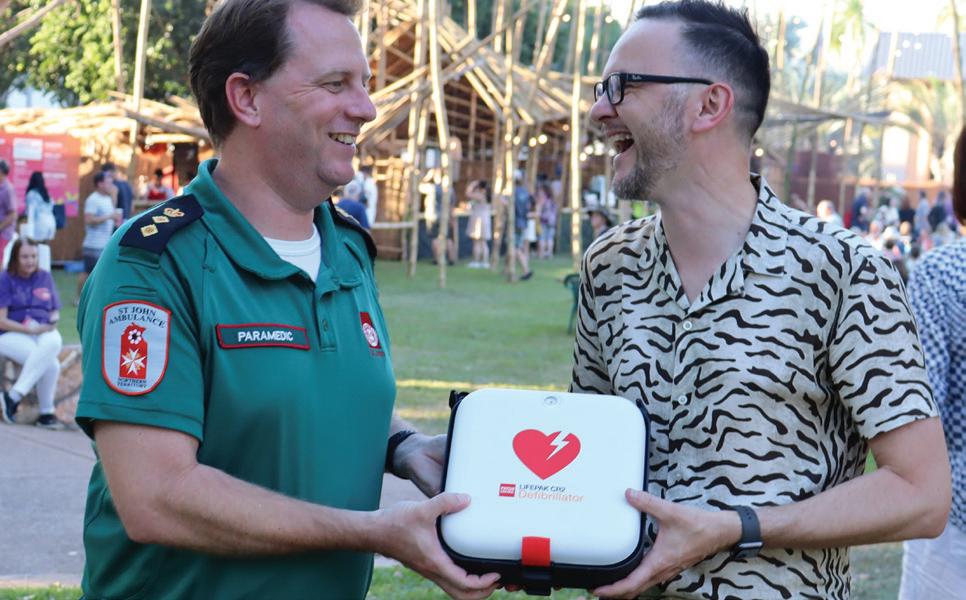
Thanks to a grant from the Northern Territory Government's Community Benefit Fund, St John Ambulance Australia (NT) were able to gift this defibrillator to the Darwin Festival.
“While we have St John NT Event Health Services covering many of our festival dates, this donation allows us greater coverage in emergencies,” said Darwin Festival CEO James Gough. “We have audiences and performers of varying ages and backgrounds who come to enjoy the Festival across 18 days, and we aim to be able to provide the best first aid to all who might require it.”
Commissioner
Ambulance Services Commissioner Russell Bowles ASM is transitioning into retirement after leading the service for over 10 years. It has been a tenure that has seen significant service delivery improvements, enhanced patient care within the service and increased workforce equality and flexibility. Commissioner Bowles is one of the most experienced ambulance leaders in the country, having dedicated more than 40 years to Queensland Ambulance after starting as a cadet in 1981.
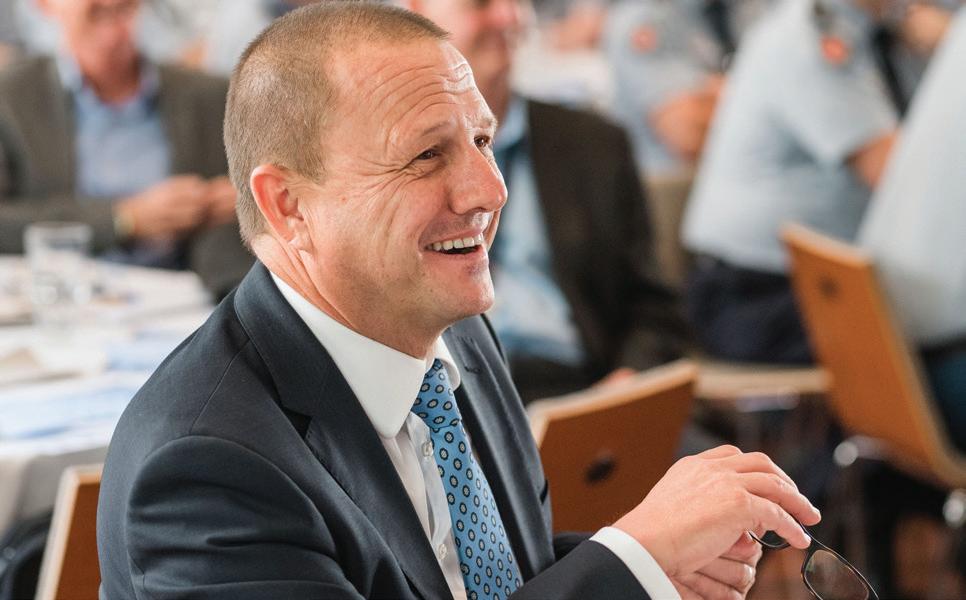
After 45 years with NSW Ambulance, Assistant Commissioner Peter Payne has retired. Peter has played an integral part in the NSW Ambulance story since starting his career at Bankstown in 1976.Over the decades, he has worked across many parts of the organisation, from Clinical Operations and aeromedical to his current role as Director of Data Analytics. He even helped establish the NSW Ambulance media unit.

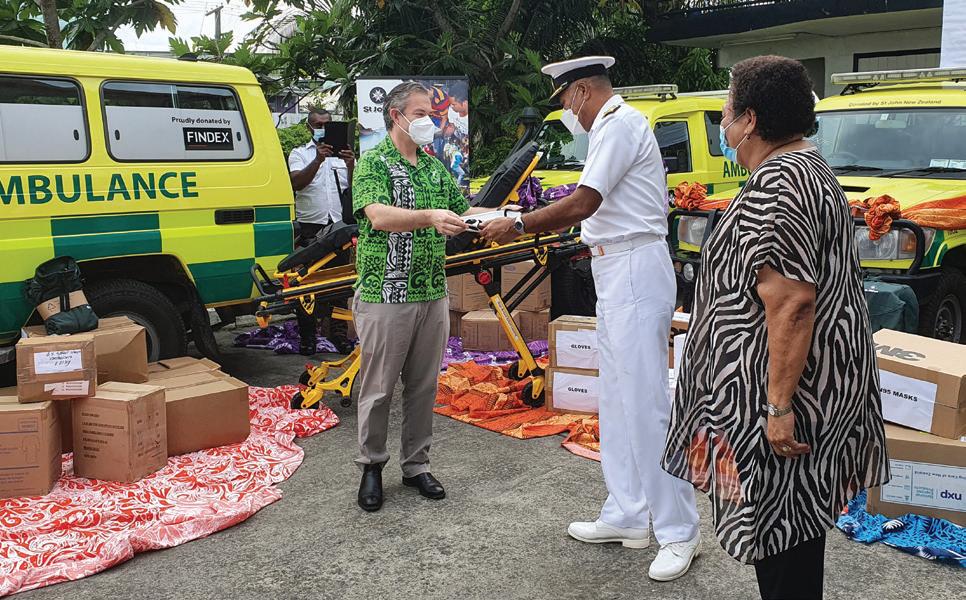
Four all-terrain ambulances donated by St John New Zealand to St. John Association of Fiji have arrived in the country. High Commissioner Jonathan Curr had the pleasure to handover the fleet of ambulances, medical equipment and PPE valued at FJD490,000 to the St John Council representative and RFMF Commander Rear Admiral Viliame Naupoto and CEO of St John Fiji Emma Bovoro. The shipment also included essential supplies such as stretchers, gowns, surgical masks, gloves, wipes, sanitiser and N95 masks.
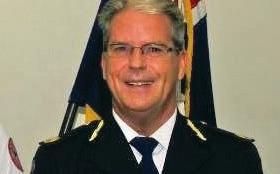
The Board of Directors of the Australasian Fire and Emergency Service Authorities Council (AFAC) has announced that AFAC CEO Stuart Ellis AM has made the decision to retire in November 2021. Stuart’s retirement will conclude a highly distinguished and dedicated career spanning 40 years of service to Australia as both a senior executive leader and senior defence officer.
the Royal Australian Mint’s third and final coin release commemorating Australia’s first responders
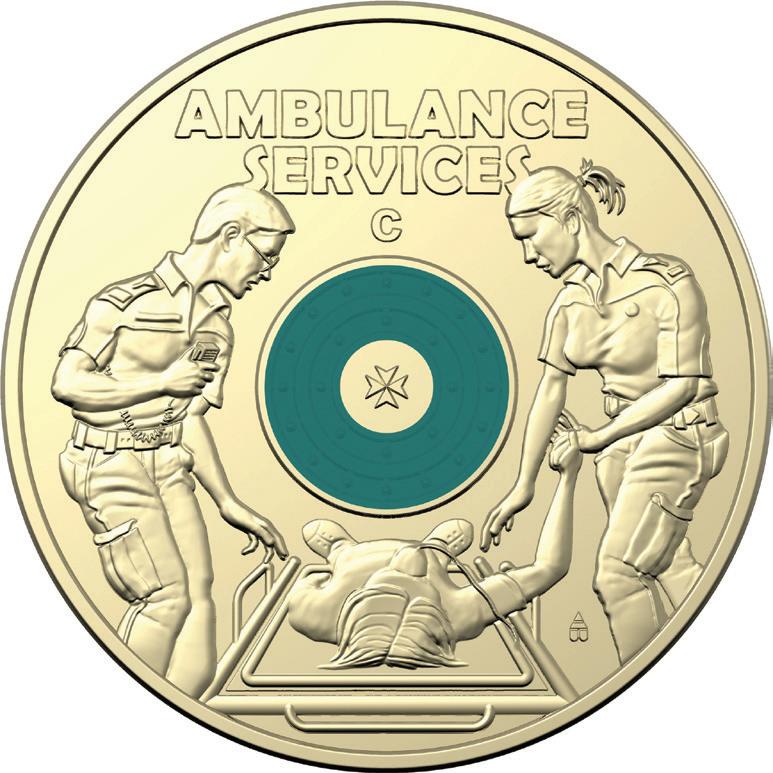

The Council of Ambulance Authorities have been working with the Royal Australian Mint to profuce a commemorative coin dedicated to Australian Ambulance Services.
On Thursday 14th October, 2021 the Mint put out a press release coinciding with the opening of the sale of the coins.
Today, the Royal Australian Mint (the Mint) proudly honours Australia’s Ambulance Services, with the release of a $2 commemorative collectible coin.
Assistant Treasurer Michael Sukkar said this coin is an important tribute to ambulance staff across Australia.
“This coin is dedicated to our brave and skilled ambulance service personnel who have played a pivotal role in the nation’s response to the COVID-19 pandemic and who continue to provide vital, mobile healthcare to all Australians,” said Minister Sukkar”
Following the 2019 Police and 2020 Firefighters coin releases, the Ambulance Services coin is the Mint’s third and final coin release commemorating Australia’s first responders.
From humble and disparate beginnings amongst the separate colonies of 19th Century Australia, Australian ambulance services have evolved into one of the most effective, proficient and far reaching paramedic networks in the world.
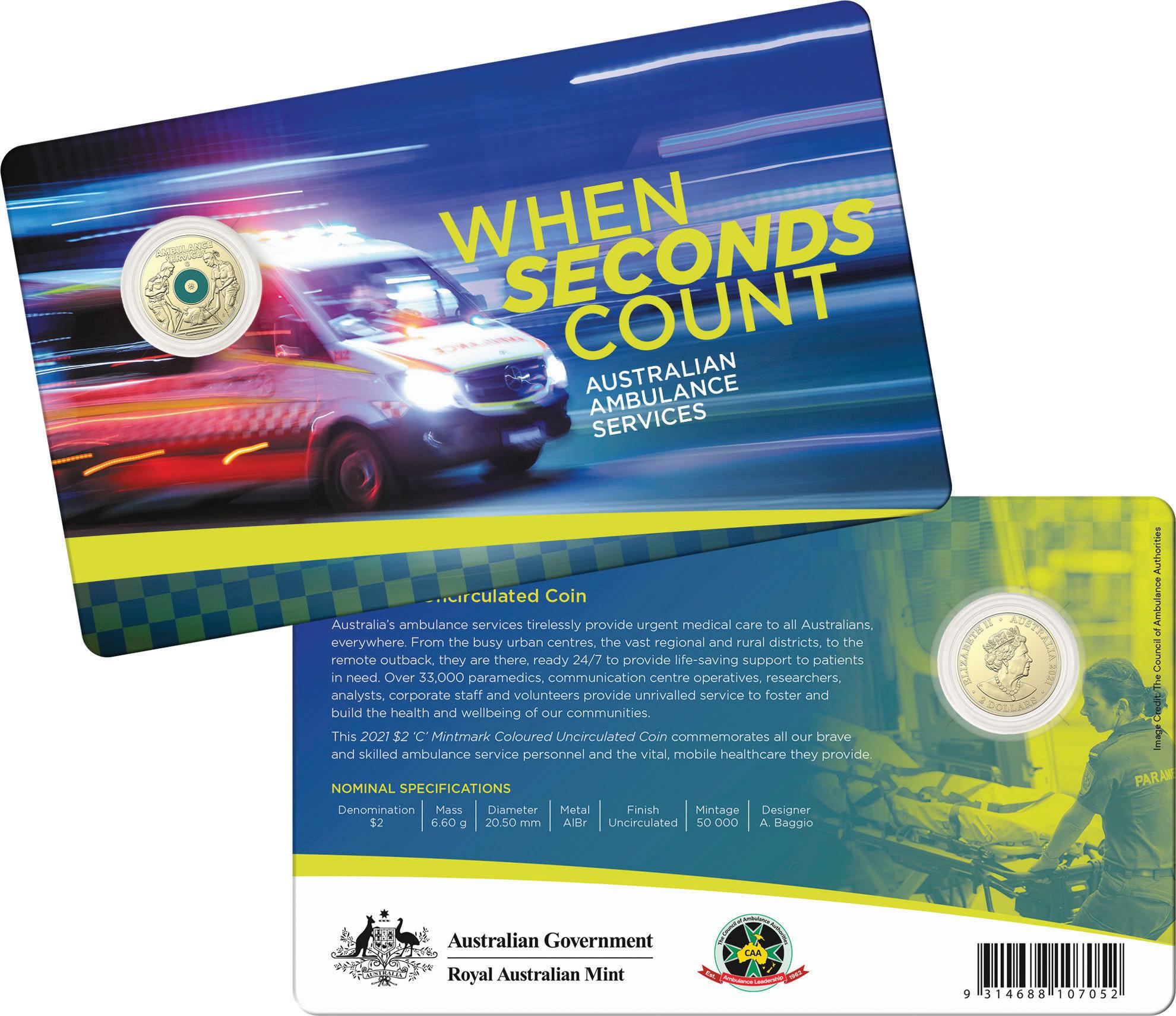
Ambulance services tirelessly provide urgent medical care to Australians everywhere. From the busy urban centres, the vast regional and rural districts, to the remote outback, they are there, ready 24/7 to provide life-saving support to patients in need.
Over 33,000 paramedics, communication centre operatives, researchers, analysts, corporate staff and volunteers provide unrivalled service to foster and build the health and wellbeing of our communities.
David Waters, CEO from the Council of Ambulance Authorities (CAA), on behalf of all emergency ambulance services responding 24 hours a day across Australia, welcomes the addition of the Ambulance $2 coin release by the Royal Australian Mint.
“This coin recognises and celebrates the significant commitment of all the many men and women who are the ambulance staff and paramedics that care for all who live and reside in Australia during their hour of need.”
“This is particularly poignant during these COVID times as the ambulance workforce battles this pandemic on the frontlines of emergency care, always putting their patients first,” said Mr Waters.
The coin design is dominated by the representation of two paramedics administrating care to a patient. In the centre of the coin is a representation of the Maltese Cross, an international symbol for paramedics.
Surrounding the cross is a circle of colour print in the green of many Australian paramedic uniforms. The relief under the print depicts twenty-four dots, one for each hour in the day, symbolising that Australia’s Ambulance services are ready to help 24/7.
The 2021 $2 Colour Circulating Coin has a mintage of two million and is Australian legal tender. It is available in circulation from today.
The coin can be purchased on the Mint’s website for $15.
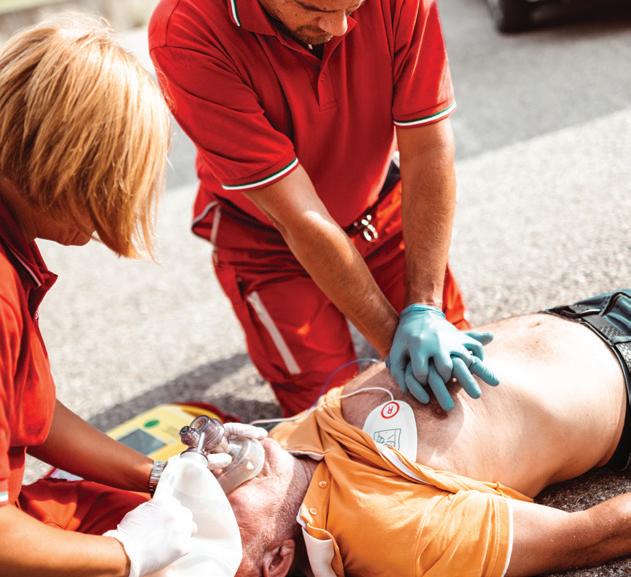
Join us in October and do 9 compressions (CPR) in memory of the 9 out of 10 out-of-hospital cardiac arrests patients who don’t survive. Help us raise awareness around cardiac arrest and the importance of knowing CPR and how to use an AED.
9 in 10 people won’t survive an out-of-hospital cardiac arrest
The second part of the year sees the CAA ramp up our committee and working group activities, and while we still won’t be able to meet in person, we are progressing our work agendas which includes everything from demand management growth, staffing requirements, new vehicle designs and much more.
This time of the year also sees us run the annual data collections, the CAA on behalf of our Australian ambulance services collates and liaises with the Productivity Commission on reporting ambulance data into Report of Government Services (RoGS).
RoGS is an annual report by the Australian federal government that captures data from a range of services, police, fire, health and others to provide data on our work, including workforce data, demand workload and various other important measures. Next RoGS with 2020-21 data will be released end of January 2022. For the full report and more information, please visit www.pc.gov.au/research/ongoing/report-ongovernment-services
Since 2002 CAA has been running our annual Patient Experience Survey, and every year we are pleased to see that our member services continue to achieve outstanding results according to the patients who end up needing ambulance help.
In 2021 Australian services combined received a 96% satisfaction rating, New Zealand matched this at 96% and Papua New Guinea came in at 94%. The report enquires of the patients or their carers of what their experience was, including their overall satisfaction, how they were handled by the call takers, how timely was the ambulance’s arrival, how confident they were in their paramedics’ skills, etc.
The survey is important feedback from our patients and helps improve the work our services do day in day out. It is always lovely to receive great feedback and at the same time it is valuable to hear where improvements can be made.
“They made me feel that I was not wasting their time, that it was ok to call. I always worry that someone else may need them more, everyone has been caring and kind a compassionate calm and re-assuring. Keep doing a wonderful job. I feel safe that this service is available.” – patient, VIC
We are excited that first internal work has commenced on sustainability data benchmarking and several services have this year participated in setting up measures for future data reporting.
Next few months mark the busiest period on CAA’s calendar with Restart a Herat Day, Global Mental Heath Day, committee work, planning for 2022 Congress, CAA Awards for Excellence 2021 planning among our other work.
If you missed out on the CAA 2021 Awards for Excellence finalist announcement jump on CAA website and don’t miss out the 2021 Awards Winners’ event on 17th November 2021. www.caa.net.au/awards-forexcellence-subpage
Global Mental Health Day is held annually on 10 October, and we are working with our resident wellbeing columnist Mitch Mullooly to bring you some examples and tips of looking after your mental health and wellbeing.
Restart a Heart Day is this year getting a new activity to help us raise awareness about out-of-hospital cardiac arrest and the importance of knowing CPR and how to use an AED. This year we are asking you, your friends and family to do 9 CPR compressions in memory of 9 out if 10 people who suffer an out-of-hospital cardiac arrest and don’t survive.
Record a short video and share on your social channels #9for9 and help us raise awareness. And to make this day a bit brighter we partnered with Build-a-Bear toy company to bring you a Restart a Heart Day Bear which you can use to act out CPR, the bear’s heart activates with pulses and vibrates when pushed on.
Keep a close eye on Restart a Heart Day socials and website for events and how to support the campaign. www.restartaheart.net

Performing CPR is actually really easy and could one day save a life.
Perform nine CPR compressions on a pillow, teddy or stuffed toy.
Use hashtags #9for9 #CallPushShock and #RestartAHeart and challenge nine friends.
Together, we can help educate and raise awareness about the seriousness of cardiac arrest and help reduce this terrifying statistic.
BUILD-A-BEAR
Purchase your official Restart a Heart Day bear at restartaheart.net
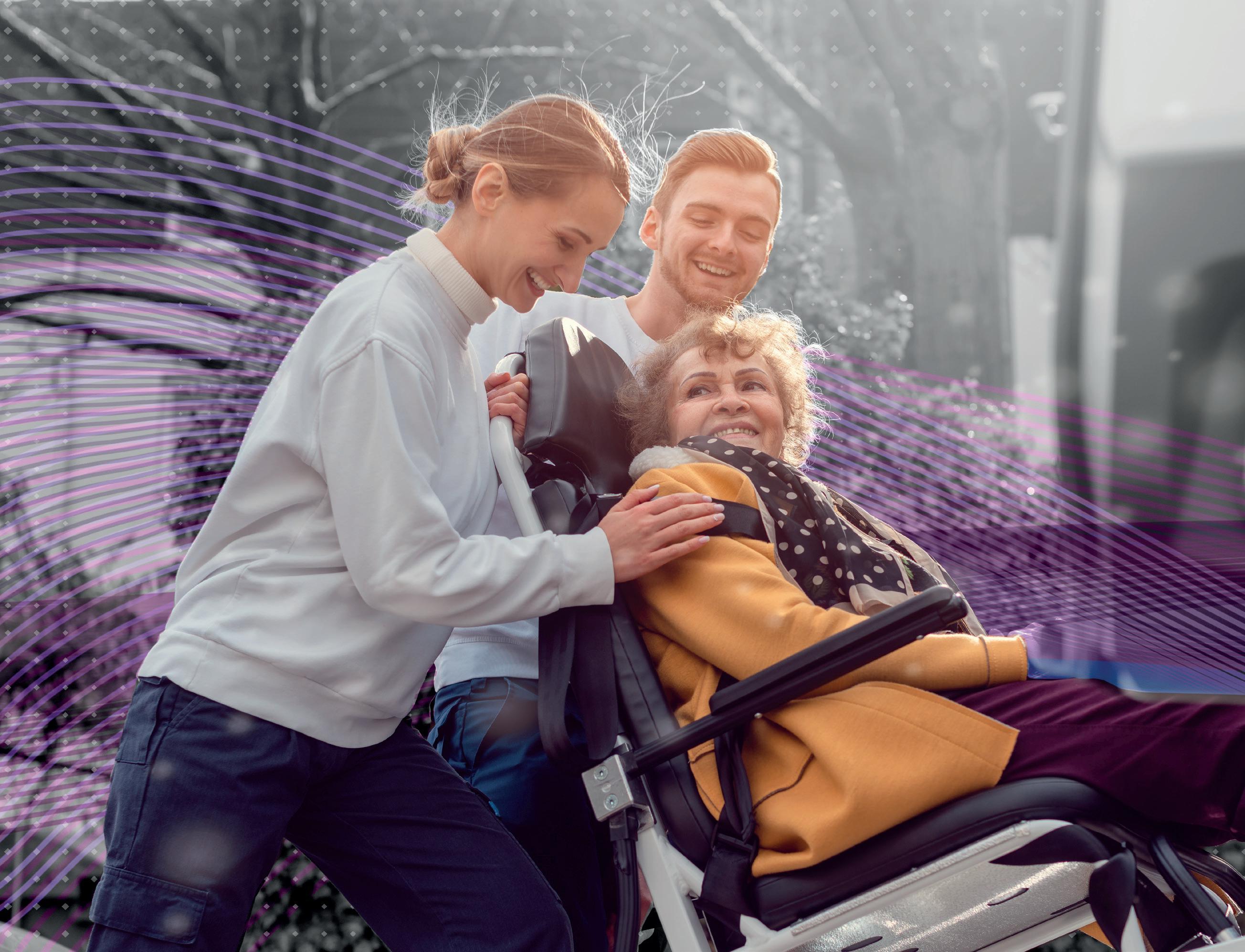
You may be familiar with ORH’s work for EMS providers, but did you know that we also support non-emergency patient transport (NEPT) providers?
Our powerful simulation and optimisation models allow us to quickly evaluate different options for change while providing compelling evidence to support key decisions.
While there are clear parallels with EMS service planning, NEPT providers face their own unique challenges and opportunities for improved efficiency.
DO YOU STRUGGLE TO:
• Find the correct balance of vehicles for different patient mobilities?
• Justify the staff skill mix on your vehicles to meet patient needs?
• Align rosters against irregular levels of transports across the day?
• Understand the impact of changing the number of same day bookings?
• Develop a quantified operational improvement plan?
• Quantify the impact that any of these changes may have on patient experience, service efficiency and timeliness?
ORH has helped NEPT providers in Australia and the UK tackle similar challenges. If any of these issues sound familiar to you, please get in touch.
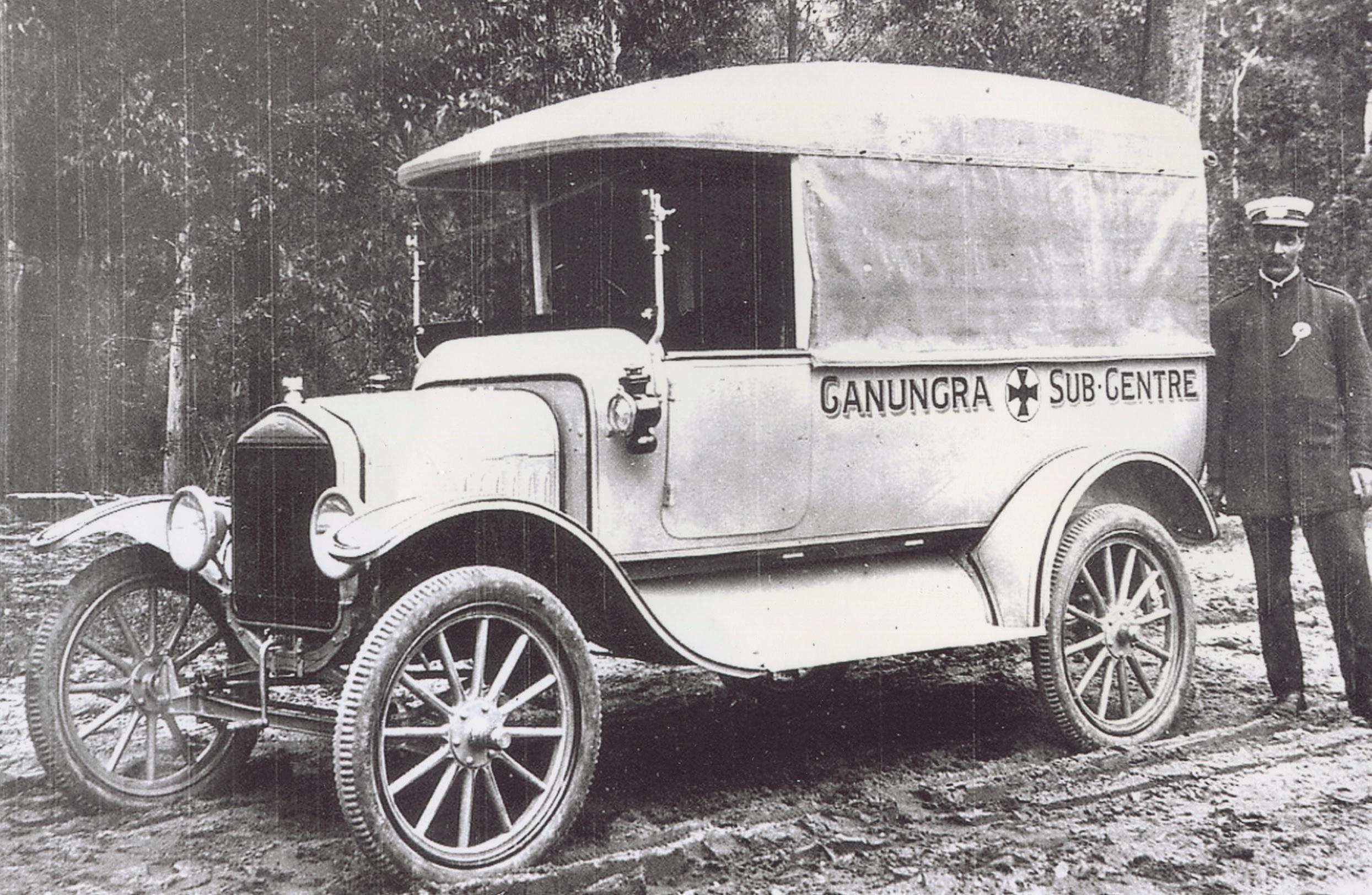
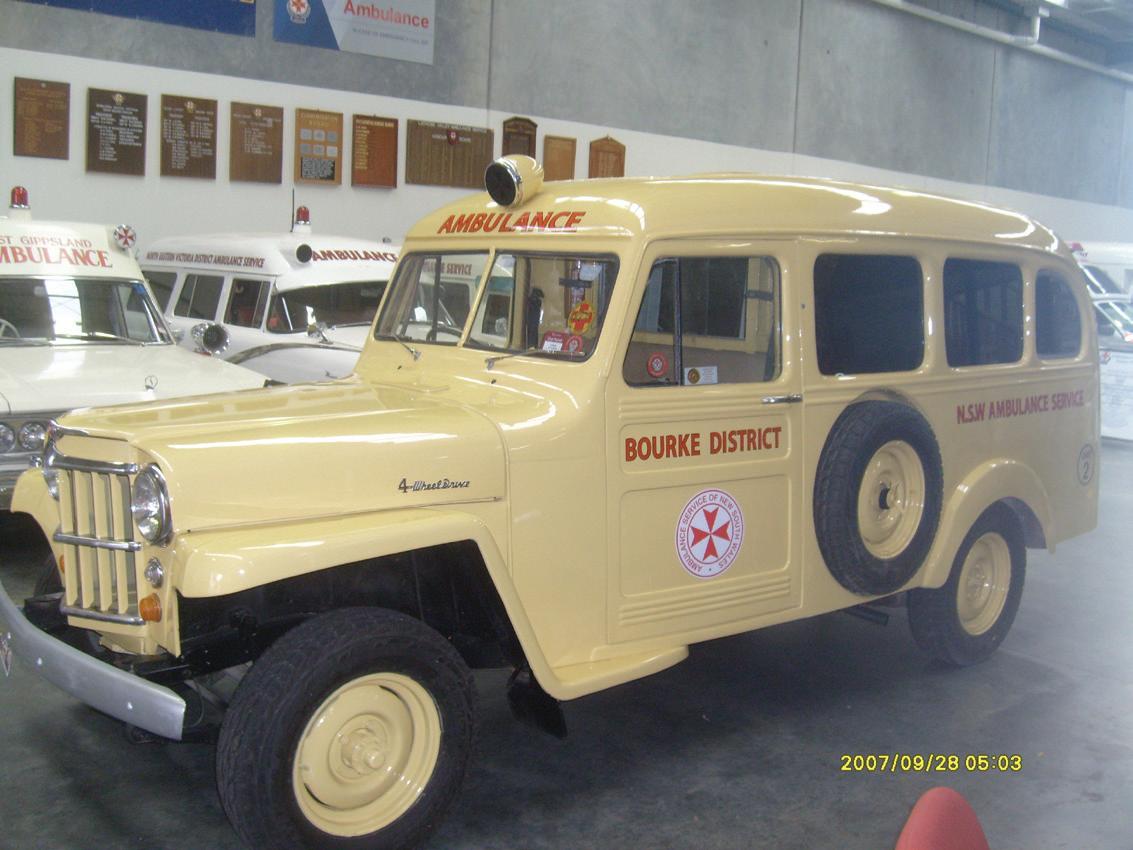
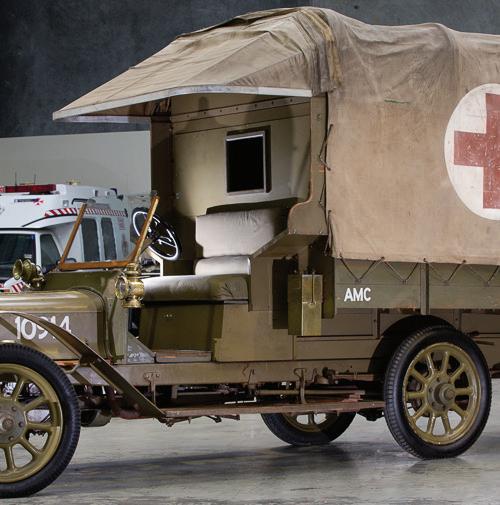
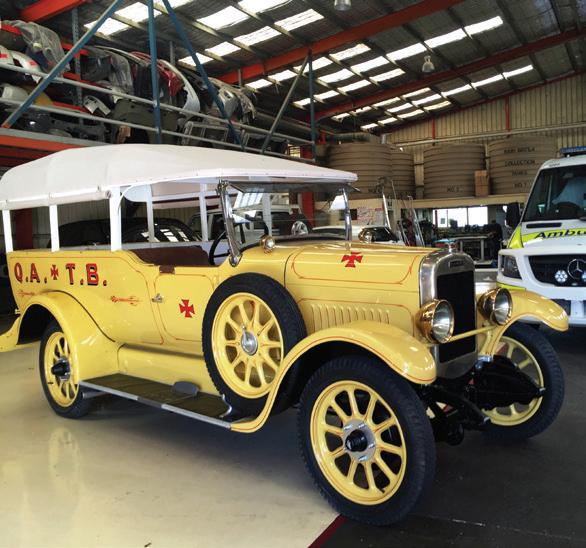
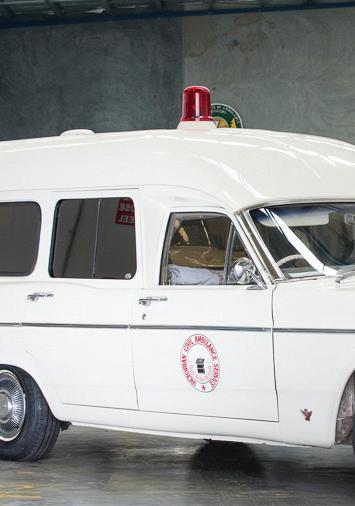
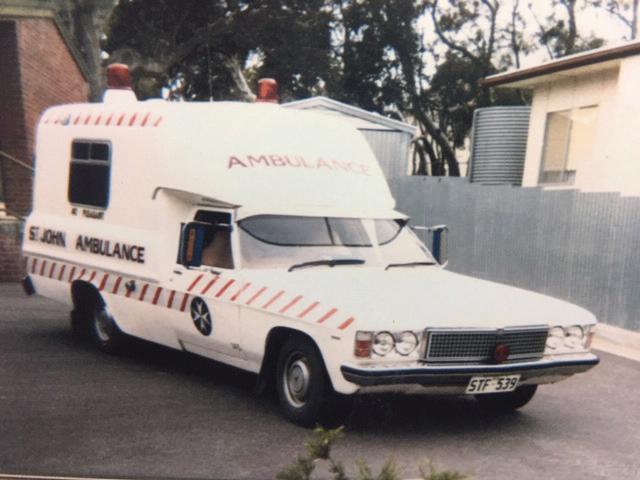
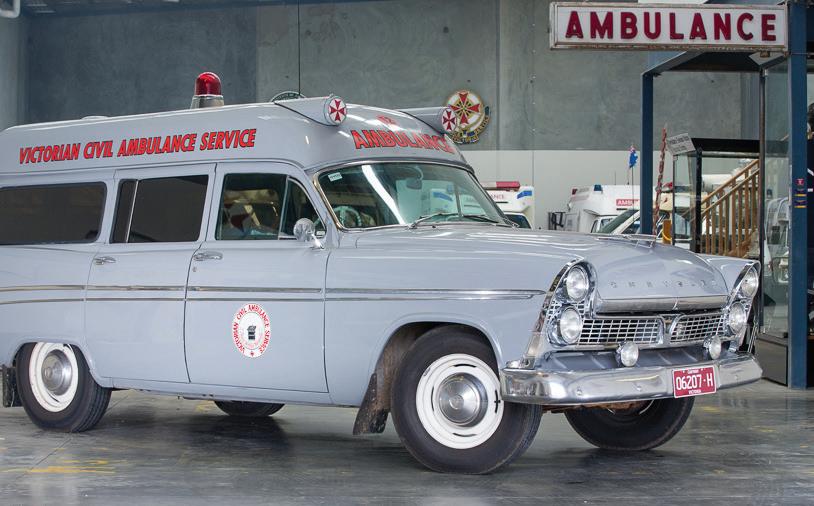
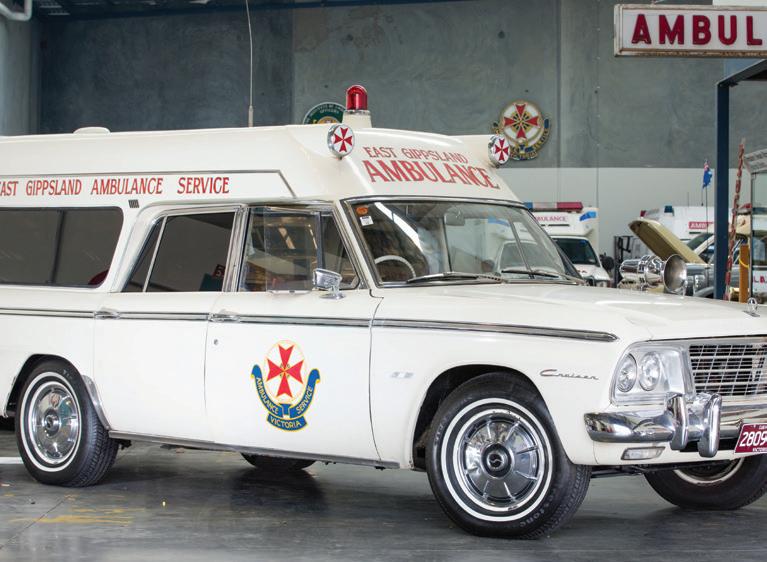
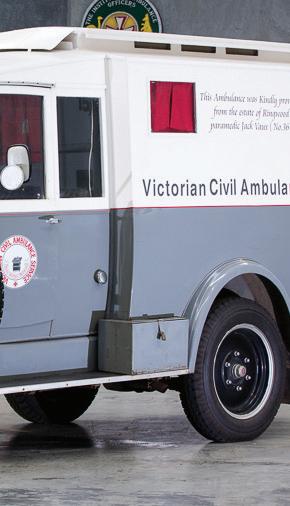
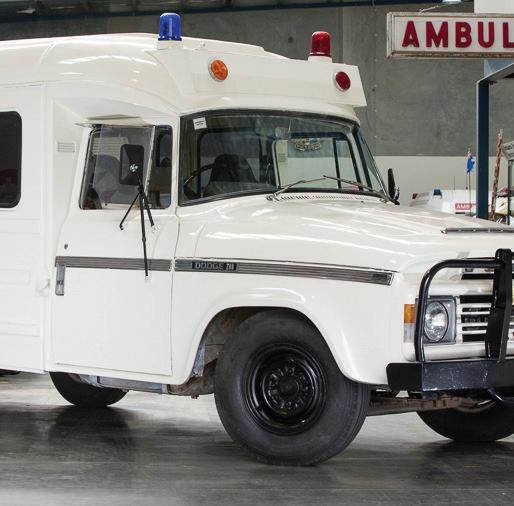
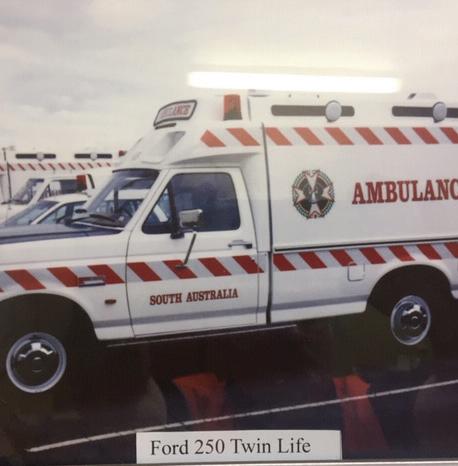
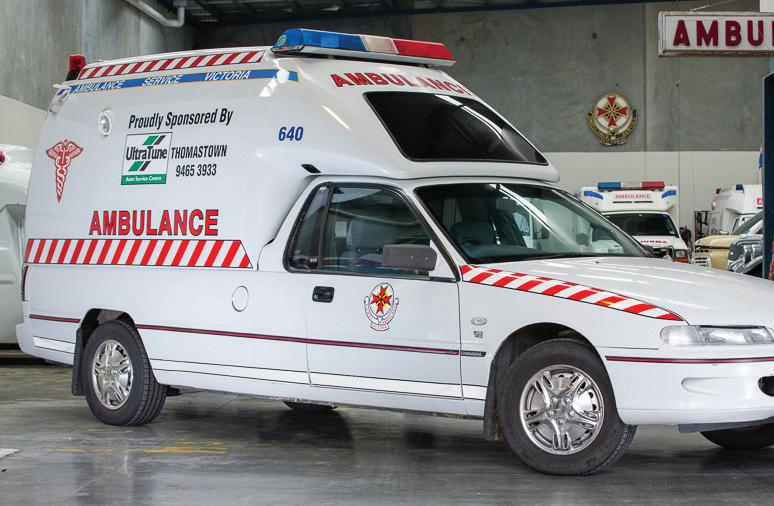
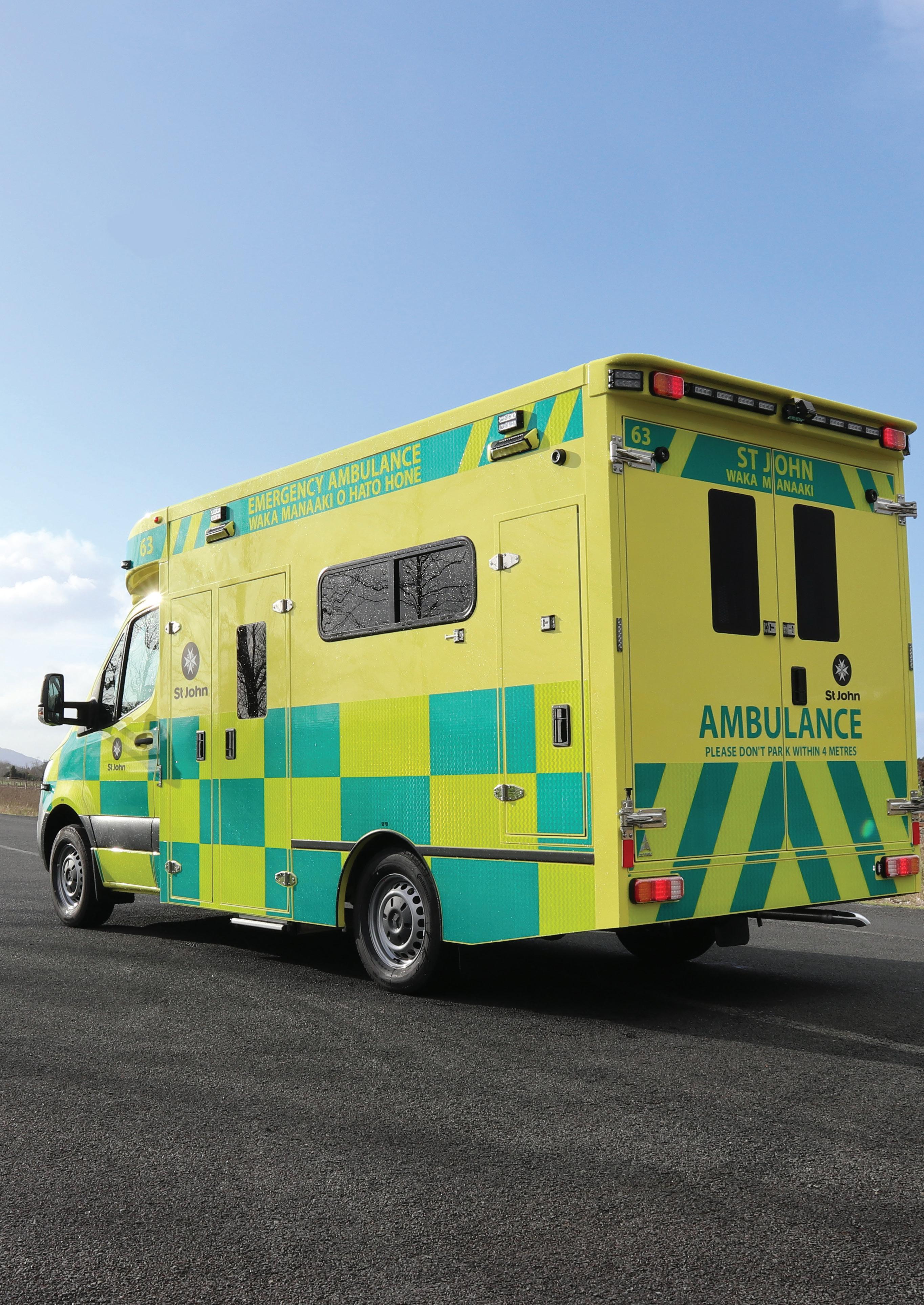
Advancements in ambulance vehicles have seen many changes over the years and nowadays our crews drive and fly around in some seriously impressive cars, vans and helicopters.
We look to our member services and speak with their teams to find out the latest innovations in fleet & equipment. From new bariatric vehicle designs to sustainably designed fleets we get a peek into the world of ambulance vehicles.
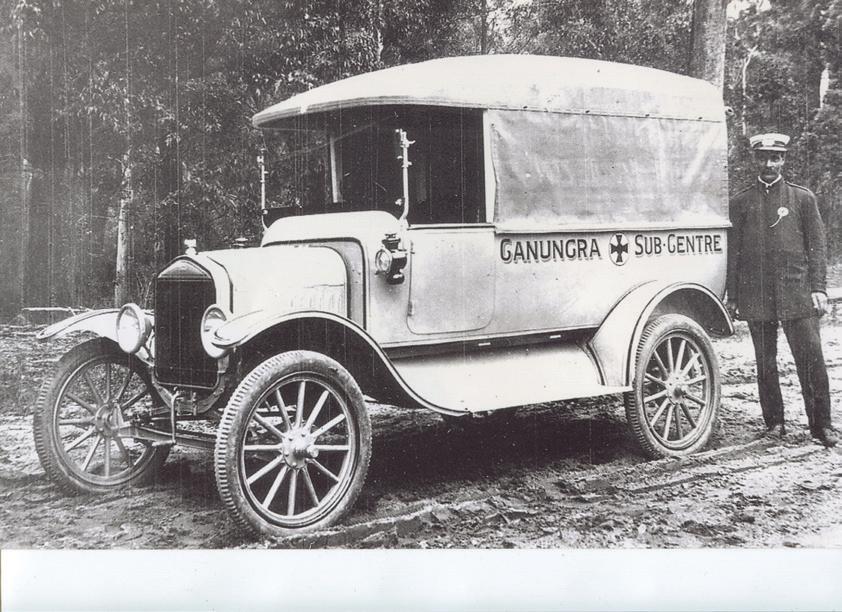
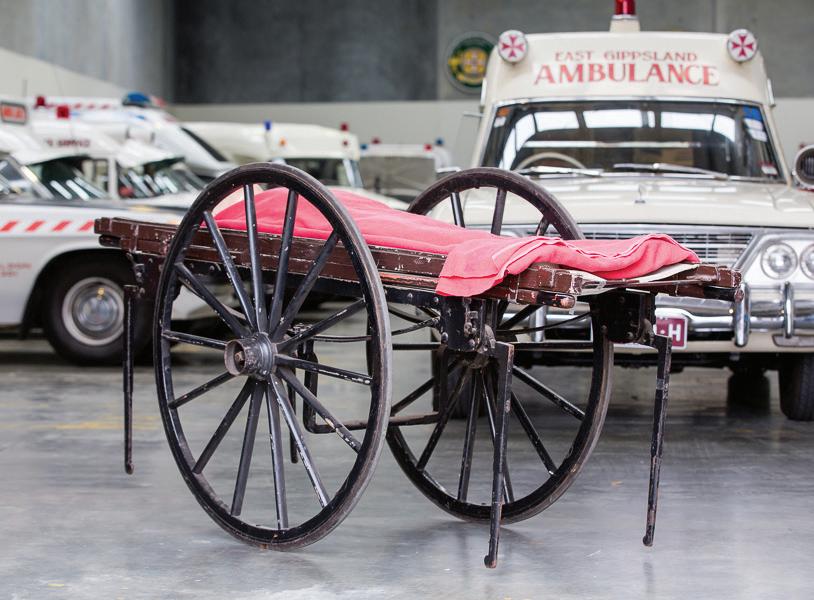
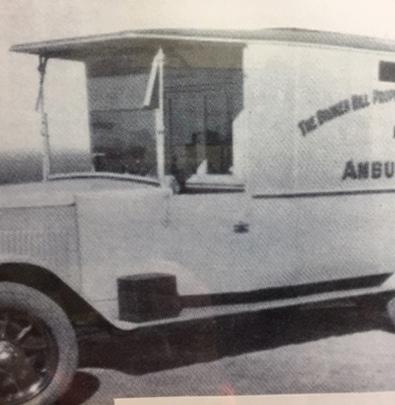
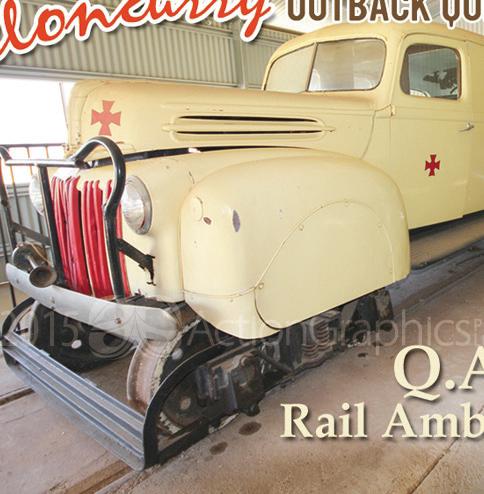
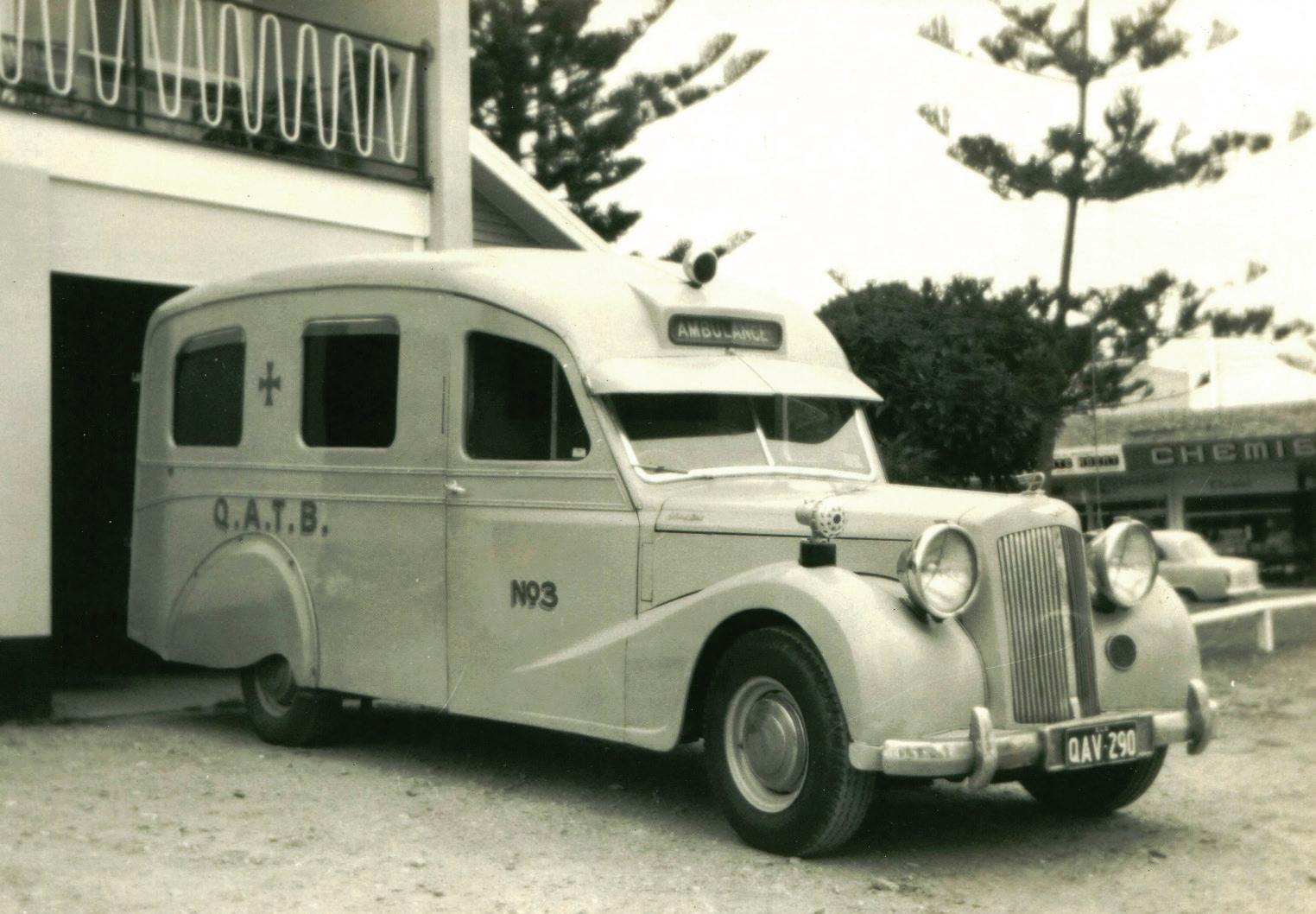
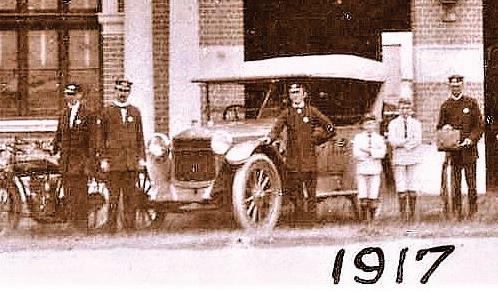
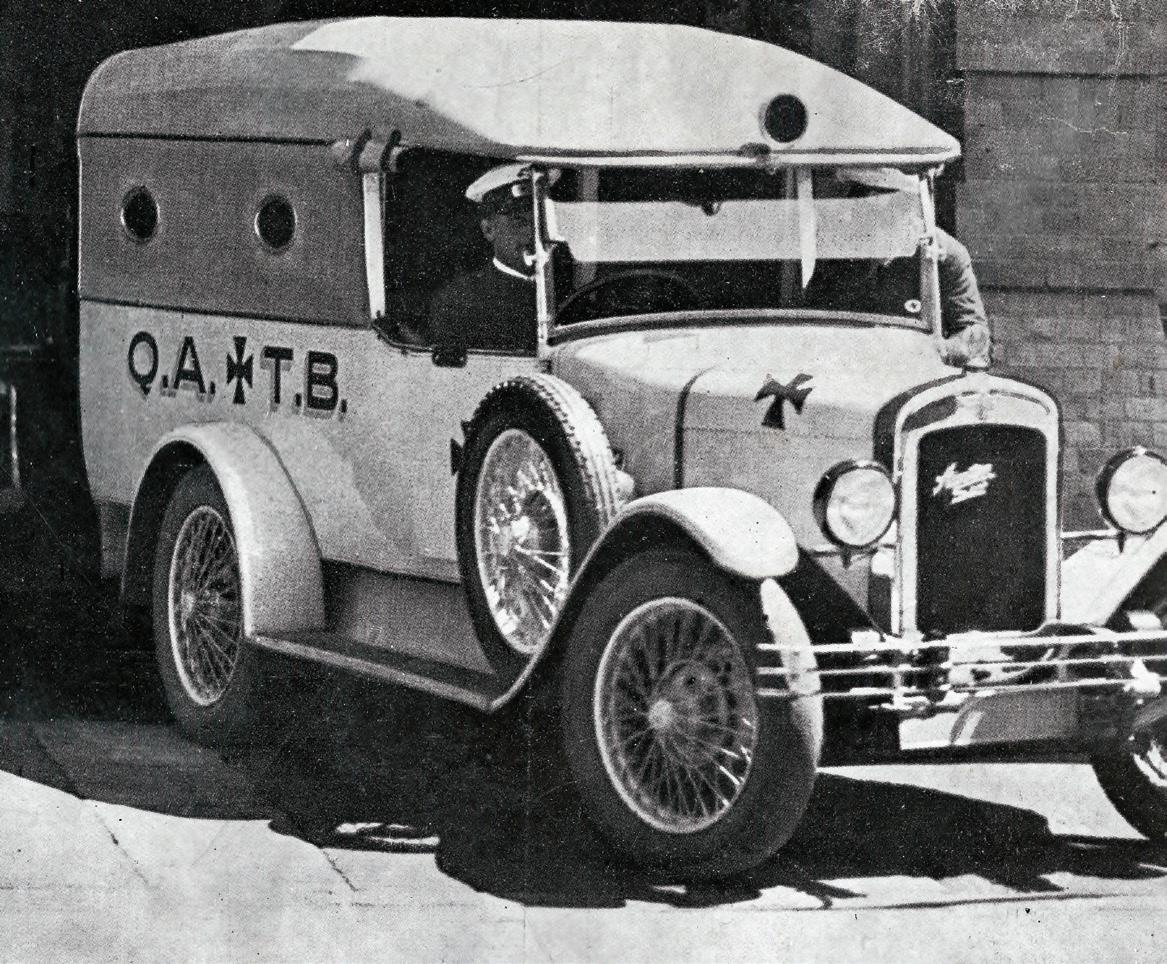
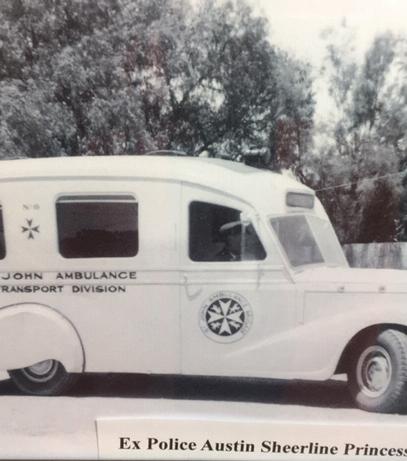
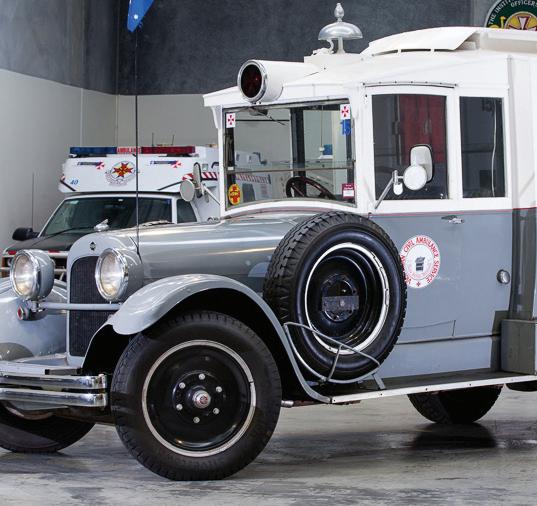
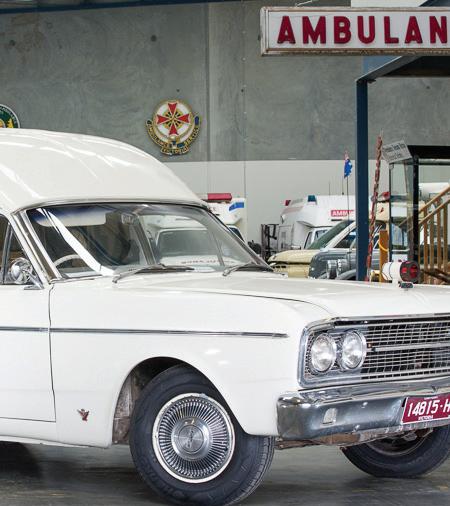
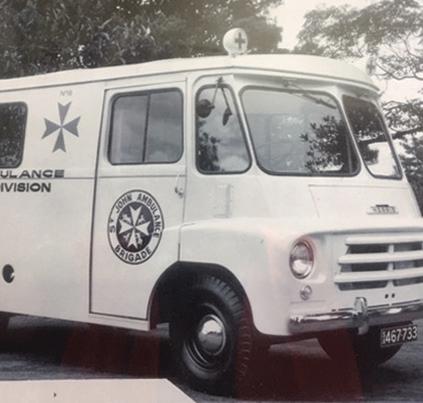
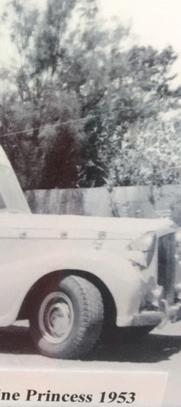
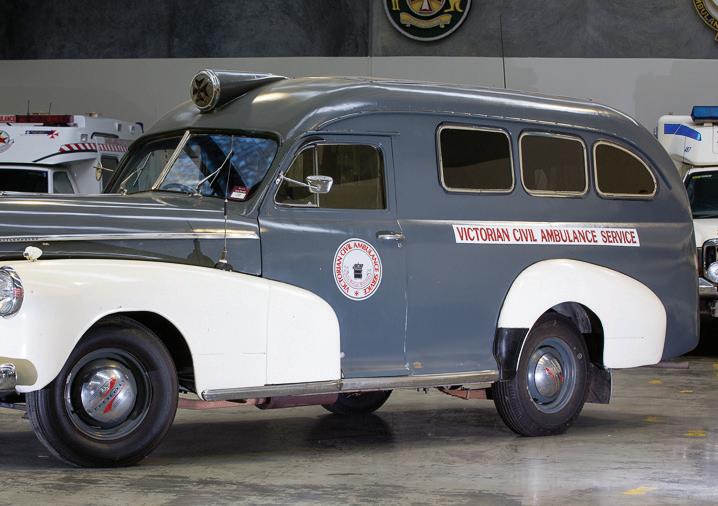
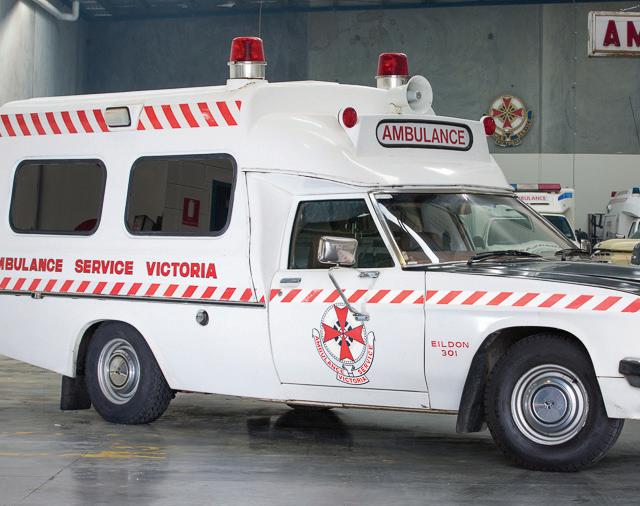
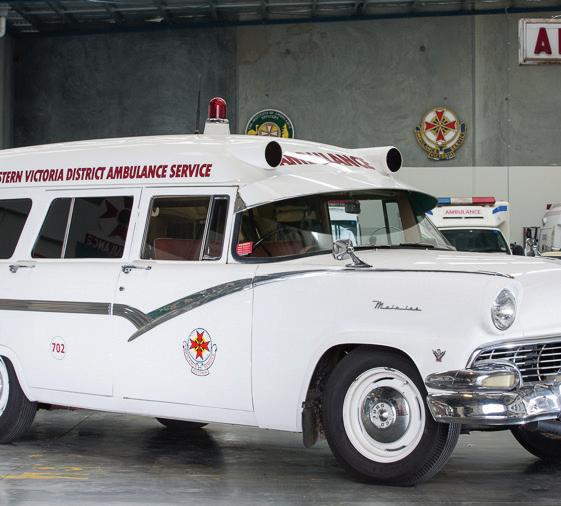
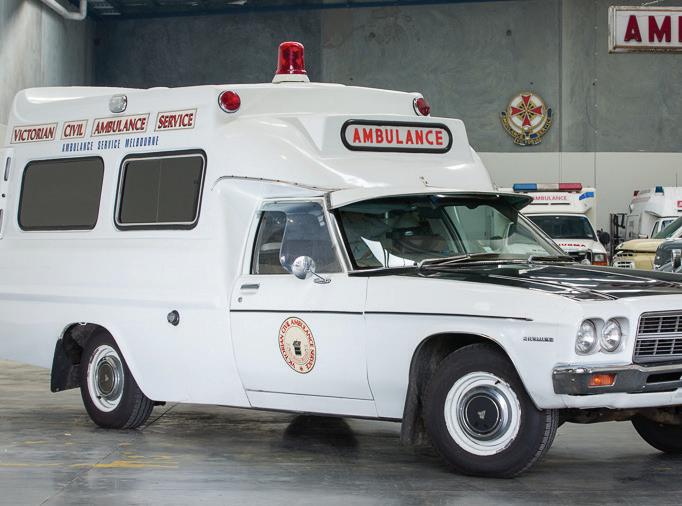
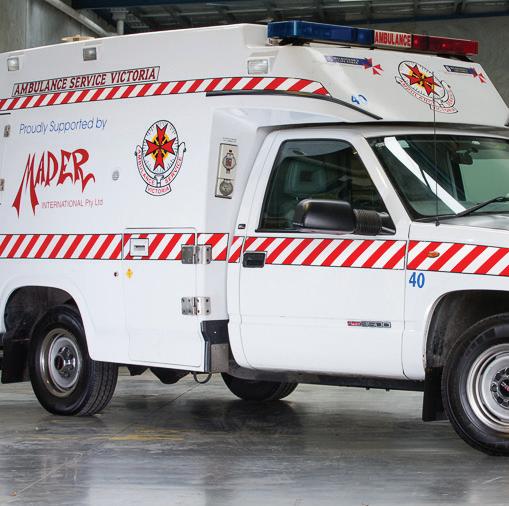
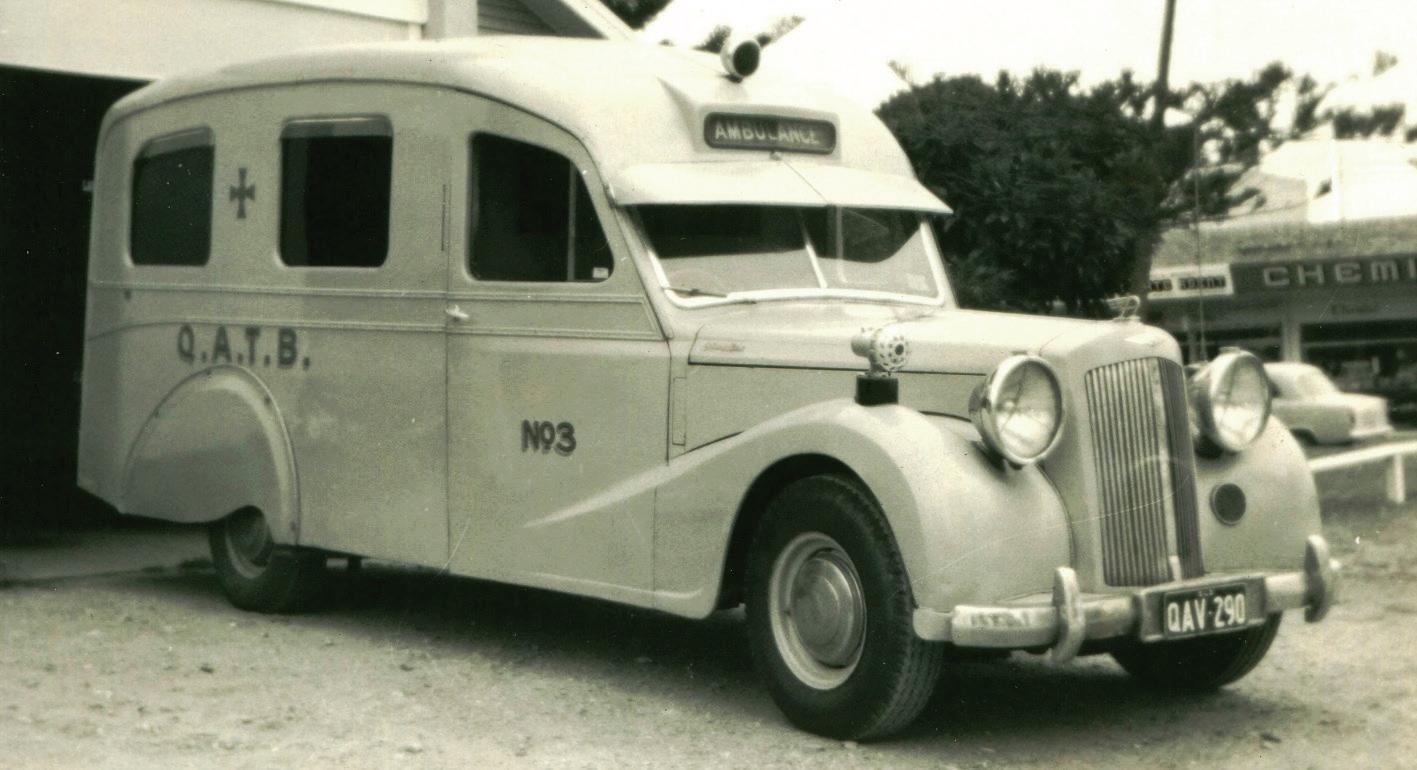
And as a special tribute we bring you photos of past vehicles, which admirably served our patients and crews many decades ago. Thank you to Ambulance Victoria, Queensland Ambulance Service and SA Ambulance Service for sharing with us their archive photos of their historical fleet.
All those cars were once just a dream in somebody’s head.”
Peter Gabriel













Interdev Technologies’ Radius community paramedic software helps paramedics keep communities connected and safe at home.

Community Paramedicine is expanding across the world to keep more people safe in their communities.
To support skilled Community Paramedics in delivering their expert care, Interdev’s Radius software helps to equip paramedics with easily accessible information, so medics get a full picture of each visit.
Radius also improves communications through connectivity with other organizations and healthcare services making it easy to view previous notes, document trends and make referrals.
Radius is one application that will do it all.
It provides dynamic paramedic services with a flexible and customizable software application that is specifically designed for the Community Paramedic. Radius has all the client's information at the paramedic's fingertips.
A place to have: client files attached referrals diagnostics future appointments all the detail of each visit at the patient’s side.
Radius provides real-time patient information flow from registration to discharge.
Our updated, user-friendly interface requires very little instruction time allowing you to get your Community Paramedic program up & running quickly.
By Scott Morris, St John New Zealand
Over the last two years, St John New Zealand has embarked on a revitalisation of its fleet. This has included the introduction of several role-specific vehicles to improve the organisation's effectiveness within the community.
Leasing smaller vehicles alongside transport capable ambulances has been a key part of this piece of work. However, leasing vehicles can present complications for an emergency service provider when it comes to installation. This is mainly centred around how the lease company will allow the vehicle to be modified and what financial impact that would have on the return of the vehicle. From the outset of design, it was decided that the goal of minimal impact on the core vehicle was essential and therefore building around it was key. Research was done on how other emergency services were achieving this and some concepts were considered. The team also reviewed what parts of the vehicle lease companies were keen to include as part of the vehicle contract.
One of St John New Zealand’s first significant exercises was to replace 52 manager vehicles with leased Holden ZB Commodore station wagons, a vehicle that was also being used by New Zealand Police at the time.
The vehicle presented with limited storage for information and communication technology and therefore it was decided the cargo barrier would be used as a storage medium for that equipment.
This medium gives space for storage of the warning systems, Main and Crossband radios, WiFi hubs, fuseboxes and a low voltage disconnect. Using the cargo barrier in this way was then accepted as standard layout for all vehicles moving forward. A dash mount was selected to accommodate mobile data terminals on the dash area without impacting the vehicle or the safety systems. This dash mount forms the front mount for the MDT radio, and the siren controller, all with no cosmetic impact. By switching to the Whelen product, the software enabled the control of lights and siren without the use of relays and time-consuming installation. DUO light head technology enabled a “less is more” philosophy. Following the European lead, St John New Zealand also moved to a number plate bracket that contains intersection lighting which has ensured minimal exterior damage.
As the Commodore project was coming to a close, St John New Zealand embarked on one of its biggest changes in critical care delivery with the introduction of the revised tango unit.
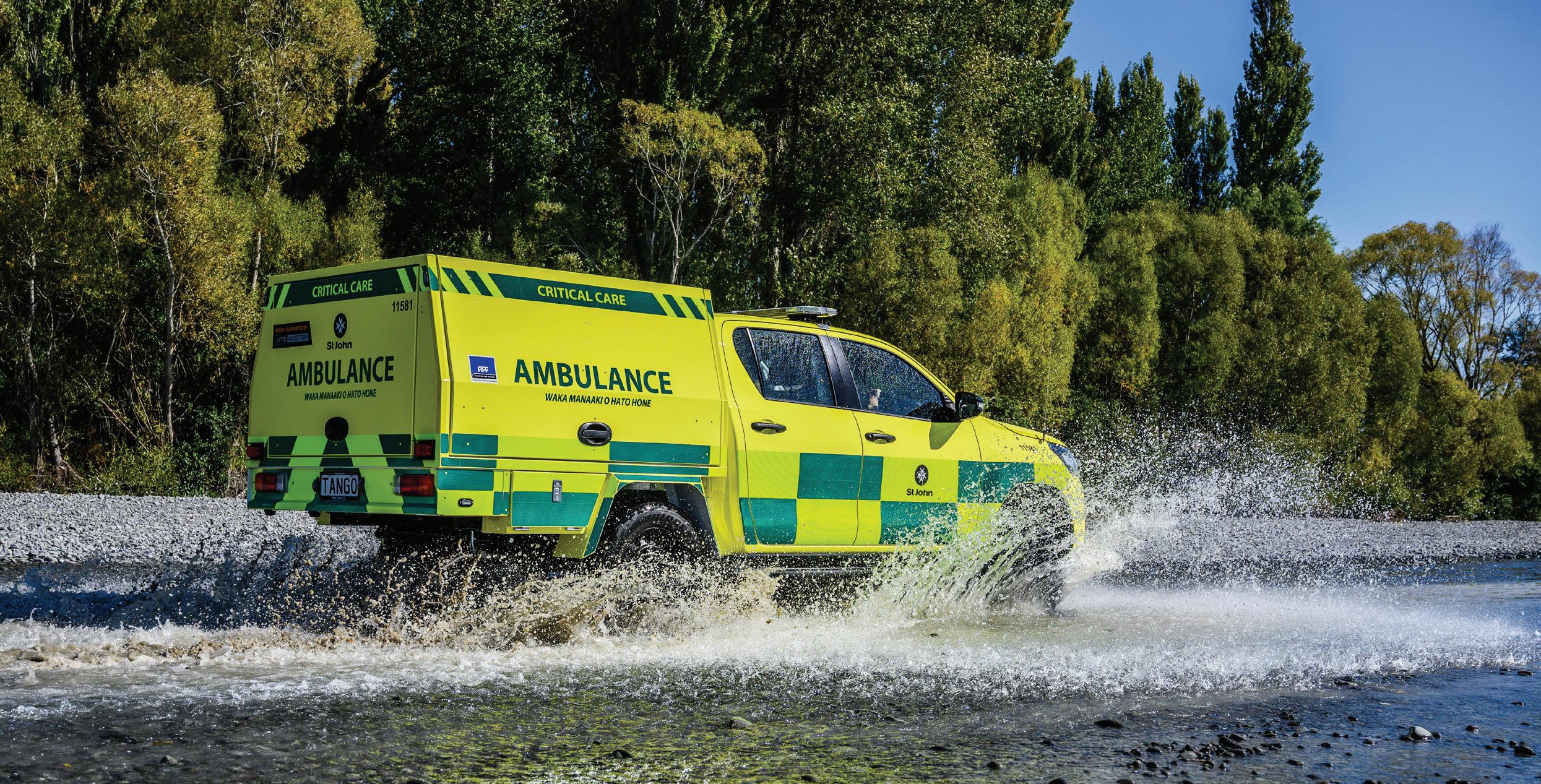
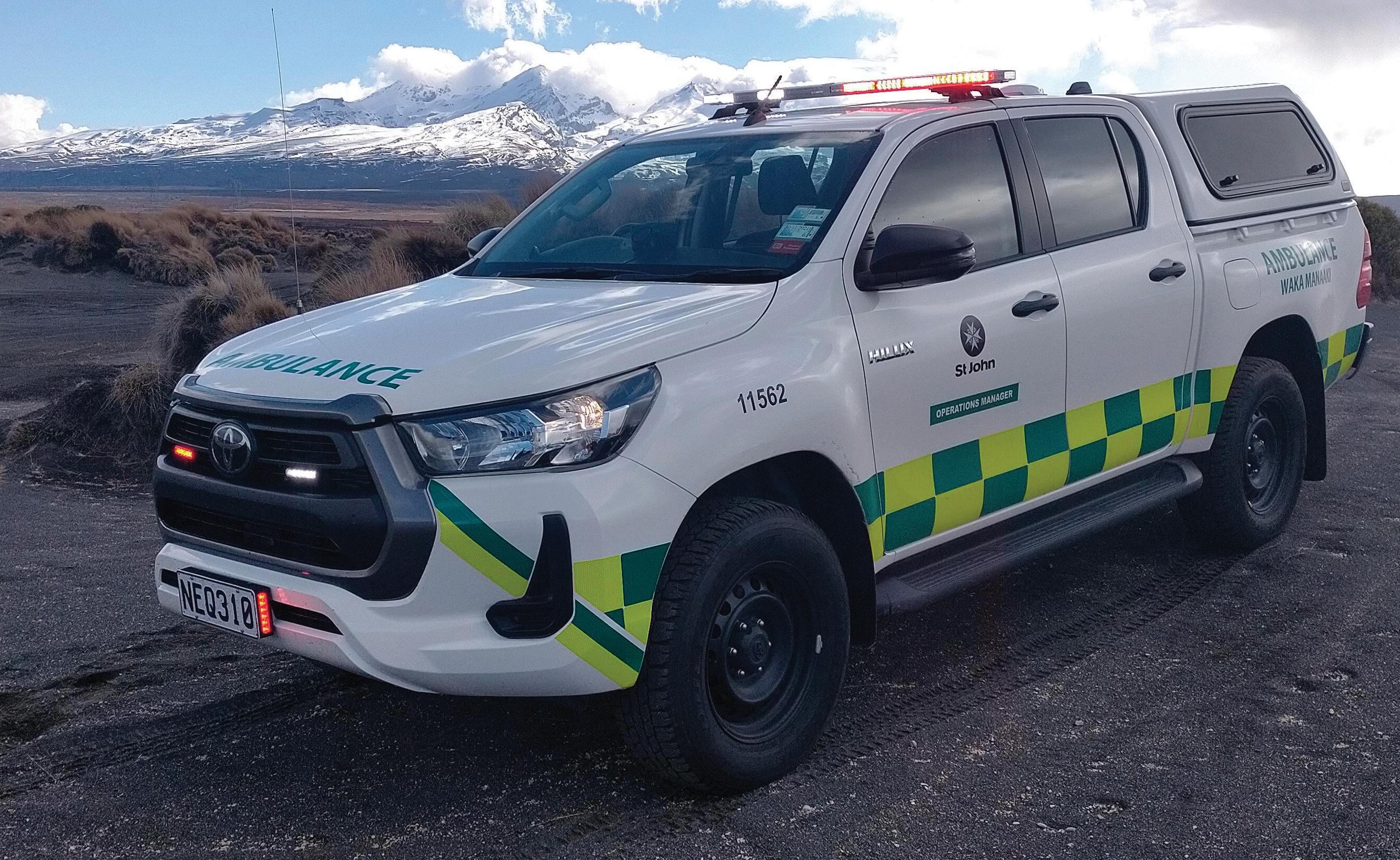
Several models were reviewed but it was decided that the service module style body on a 4WD Toyota Hilux was the way to move forward. By bringing a group of Intensive Care Paramedics on the journey, St John New Zealand was able to deliver a unit that has several critical care items, such as Lucas device, turbine-driven ventilators, syringe drivers, Video laryngoscope and soon ultrasound, over and above the standard kit out. The vehicle can also carry a 10 person mass casualty incident cache, scene lighting, restock consumables and ballistic vests. St John New Zealand will introduce 20 of these vehicles into service this year.
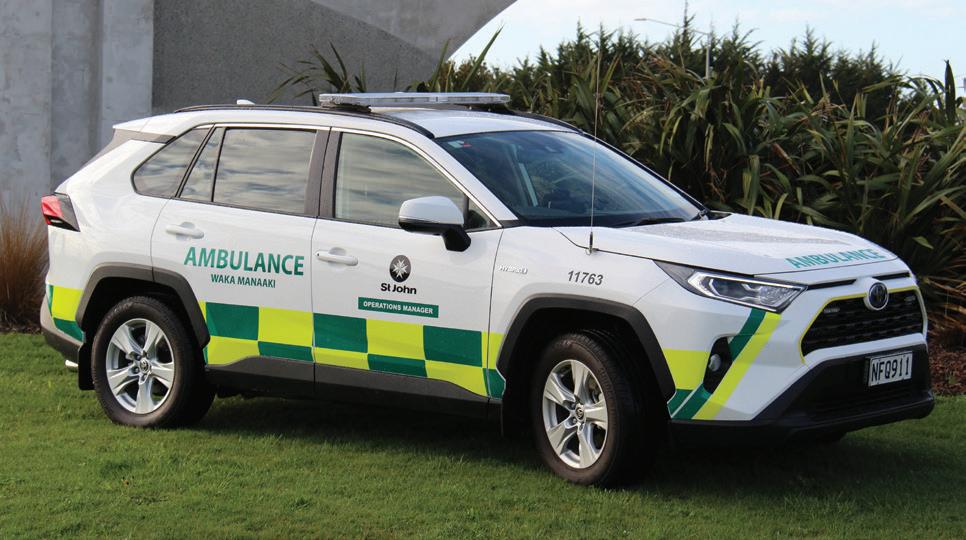
When it comes to new additions to its fleet, St John New Zealand is focusing on using hybrid technology in the first instance until other forms of mobile power mature. New Zealand and its geographical nature and location have not yet allowed the organisation to fully explore EV or hydrogen forms of transport. The Toyota RAV4 Hybrid has been selected as the organisation’s first move towards a response capable, environmentally sustainable vehicle which is about to enter service. They are also currently investigating the new Hybrid Toyota Highlander (Kluger).
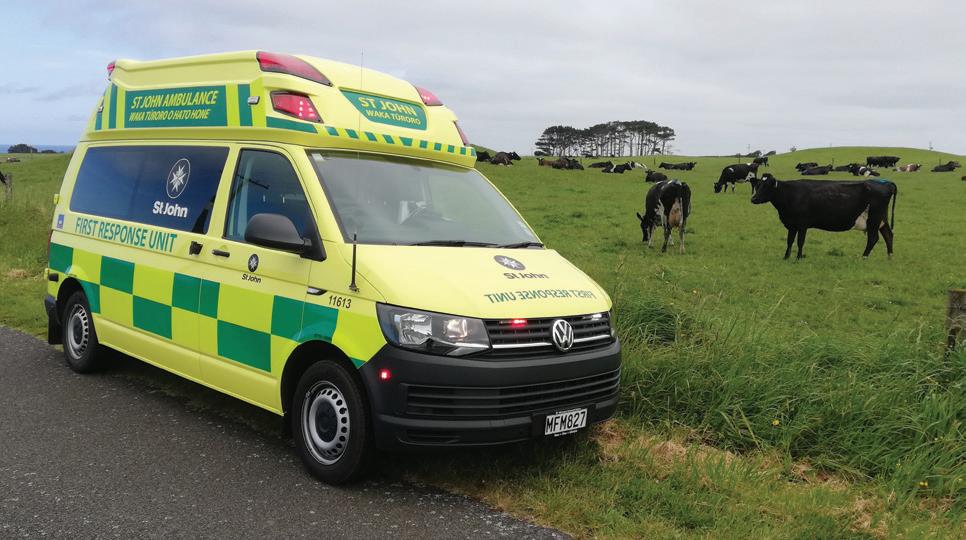
A new St John New Zealand ambulance model designed specifically to support New Zealand’s rural and remote communities arrived in July 2019 and there are now 40 in service, both 2WD and 4Motion versions. Designed as specialist First Response Units for ambulance volunteers, the Volkswagen T6/T6.1 4Motion has ample room for treating and stabilising patients while a transporting ambulance is on the way. A key attribute to the design is being able to transport locally or to meet a helicopter or transporting ambulance.
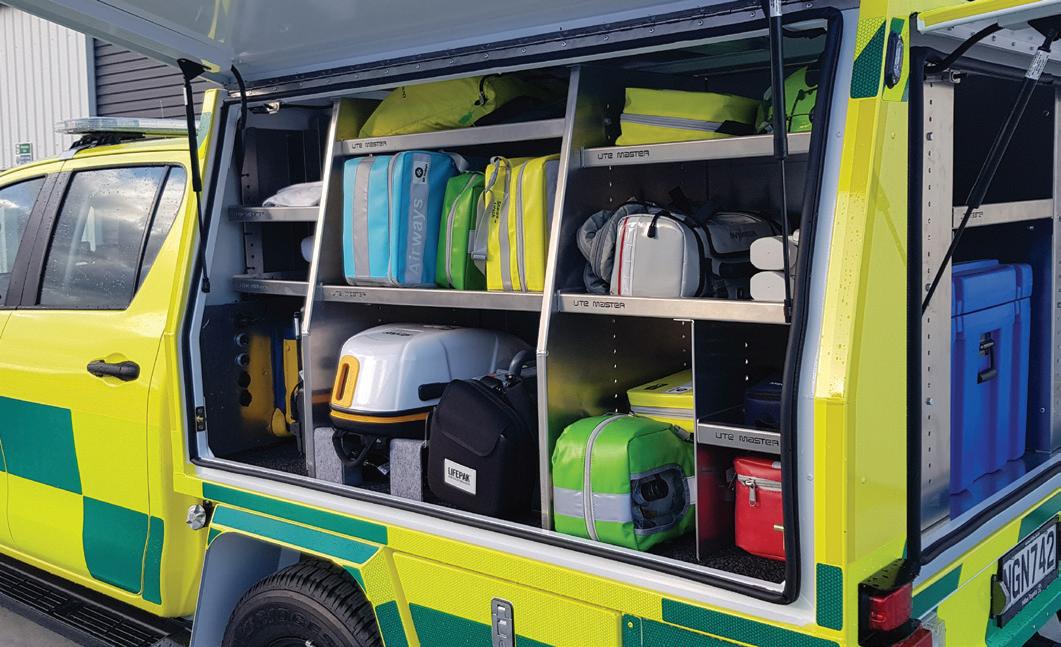
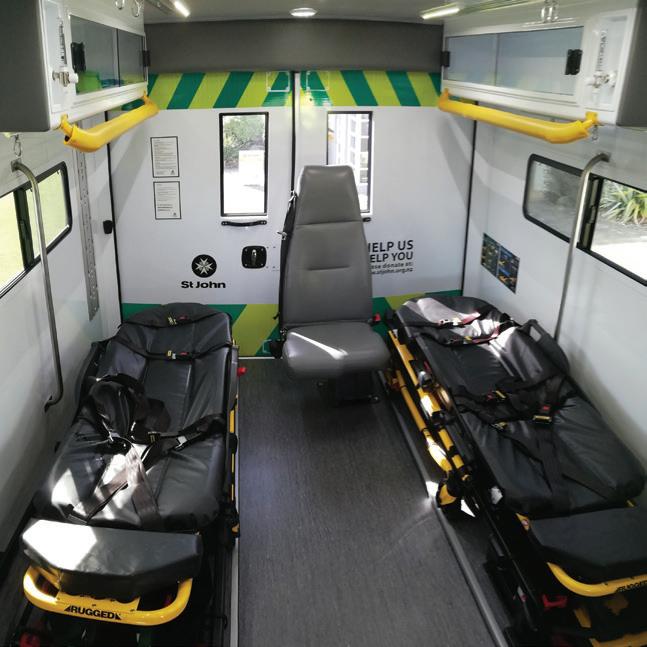
As demand for Patient Transfer Services (PTS) increases, the requirement for specifically designed St John New Zealand PTS ambulances has increased. Reuse of frontline vehicles into the role limits the capability the service can provide. Over the last 18 months, the organisation has worked with their primary ambulance build provider, Action Manufacturing, to develop three new types of ambulances. The use of the new Toyota Hiace has seen the introduction of a cost-effective, single patient transport ambulance that also contains type-specific equipment such as invertors, ferno Intraxx rails and climate control.
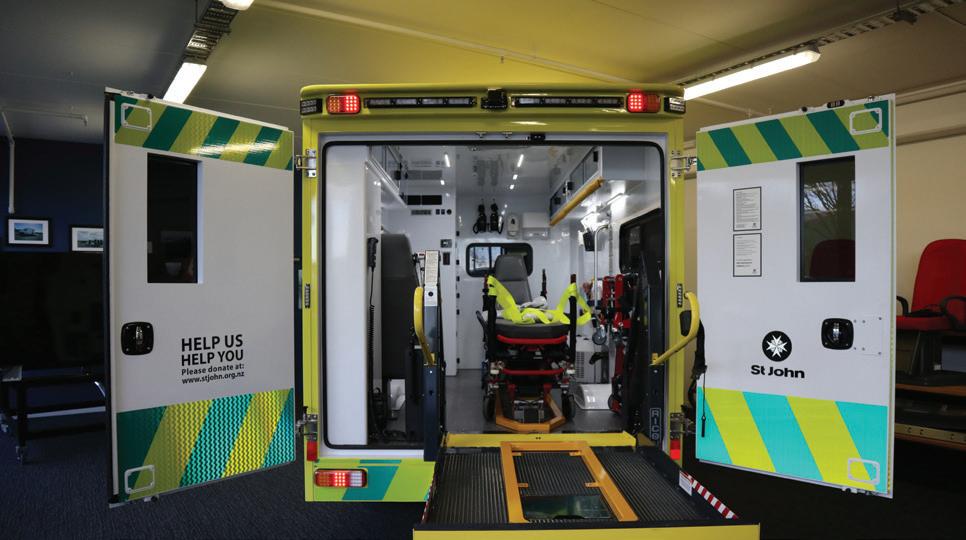
Five tonne Mercedes Benz Sprinters with Dual Power Pro XT/Powerload encompassed in a purpose-built body have also been introduced and have enabled more space for patients and increased comfort with the use of Air Suspension for long haul transports.
Because physical size and patient comorbidities have increased, there is also a need for the organisation to bring on complex patient ambulances and the first of those vehicles is being commissioned in Christchurch. This design incorporates EN1789 standards as well as AS/NZS 4535:1999 and the vehicles enable St John New Zealand to cater for specialist intensive care, bariatric and isolation patients, as well as being suitable for general use. The vehicle has been developed to be as flexible as possible and is built on a 4.3-tonne GVM Mercedes Benz Sprinter Chassis. Ferno Power X stretcher and Power Traxx chairs have been incorporated along with Intraxx railing to enable future pieces of medical gear to be carried. Patient handling equipment such as Hover Evacuation Jack II, Hover Mats and Elk lifting cushions have also been included in the vehicle.
Future fleet developments for St John New Zealand will include new command units, major incident support vehicles and frontline ambulances.
from The Australian Stroke Alliance
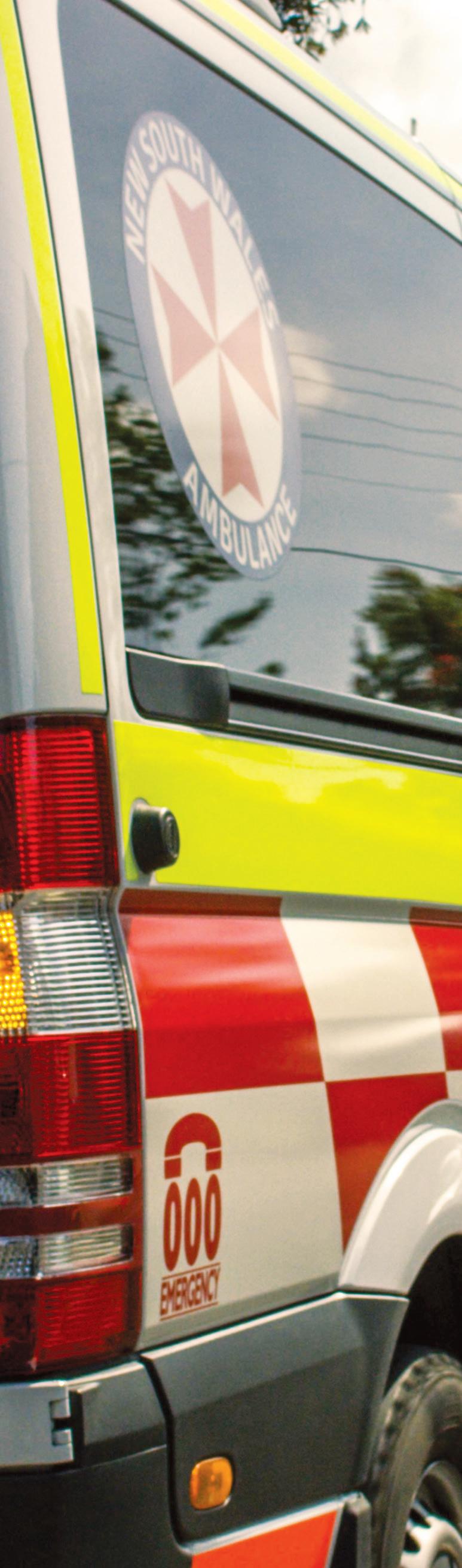
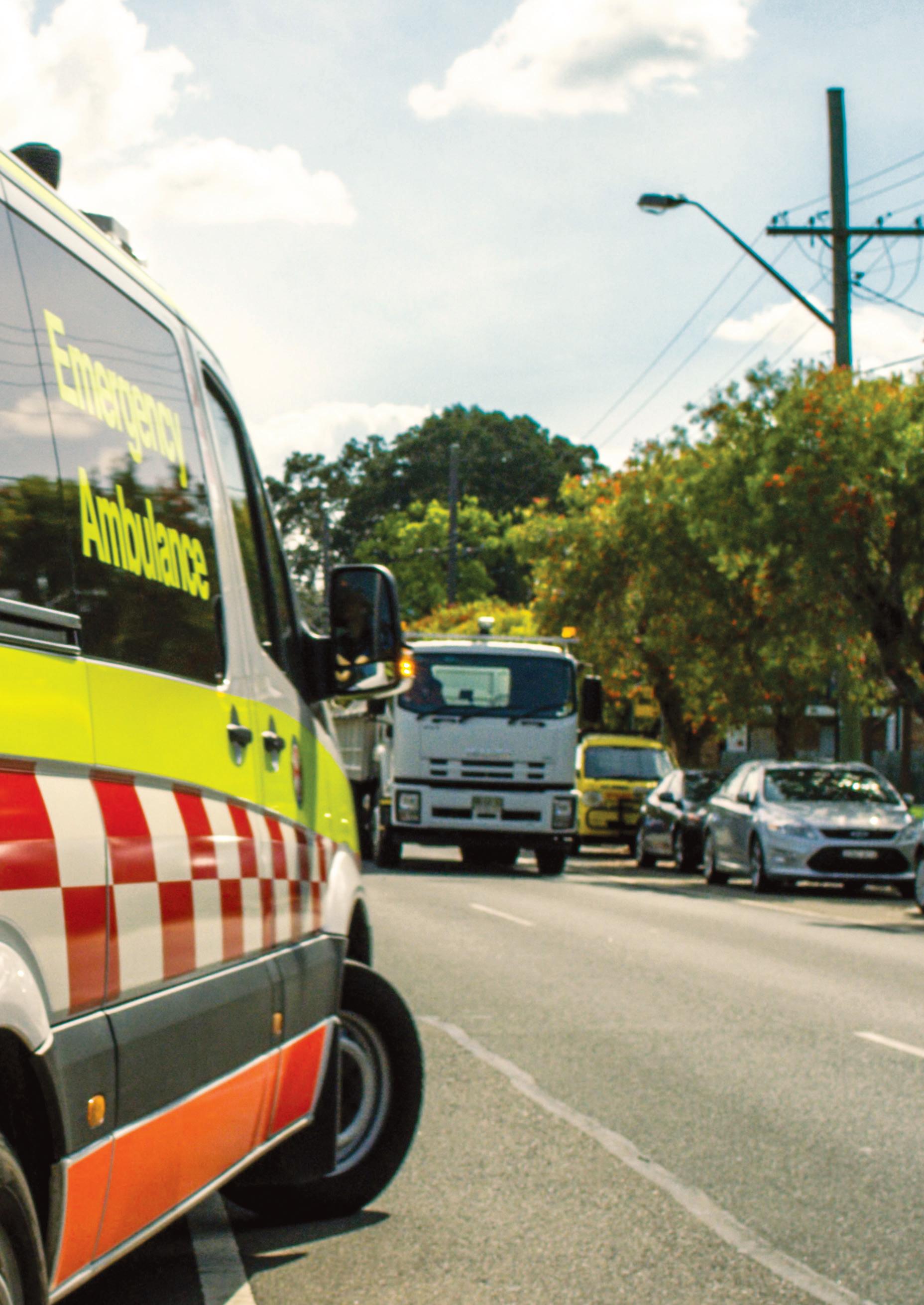
tandard road ambulances, equipped with digital links to a stroke neurologist, are being developed for two very different regions of New South Wales. They will be the first of six to be trialled around the country within the next 18 months under the Australian Stroke Alliance’s Golden Hour program.
Not to be mistaken with the large mobile stroke unit which carries a CT scanner and a medical team including a radiographer, the latest initiative uses standard Mercedes Benz Sprinter ambulances.
Known as stroke-capable road ambulances, the digitally connected vehicles are being designed as part of a collaboration with South Western Sydney Local Health District, The Ingham Institute for Applied Medical Research, and John Hunter Health and Innovation Precinct. The teams aim to have the two enhanced ambulances on the road in the first quarter of 2021.
According to NSW Ambulance Commissioner, Dr Dominic Morgan: "When a patient suffers a stroke, time is critical and early treatment options are vital”.
“The trial of these new stroke-ready ambulances in Sydney's south and Hunter region will allow for important communication between paramedics and offsite neurological teams who can assist in the initial treatment of the patient and in turn have crucial diagnostic information ready for the patient's arrival at hospital,” says Dr Morgan.
The trial of these new stroke-ready ambulances in Sydney's south and Hunter region will allow for important communication between paramedics and offsite neurological teams."
Dr Dominic Morgan, Commissioner, NSW Ambulance
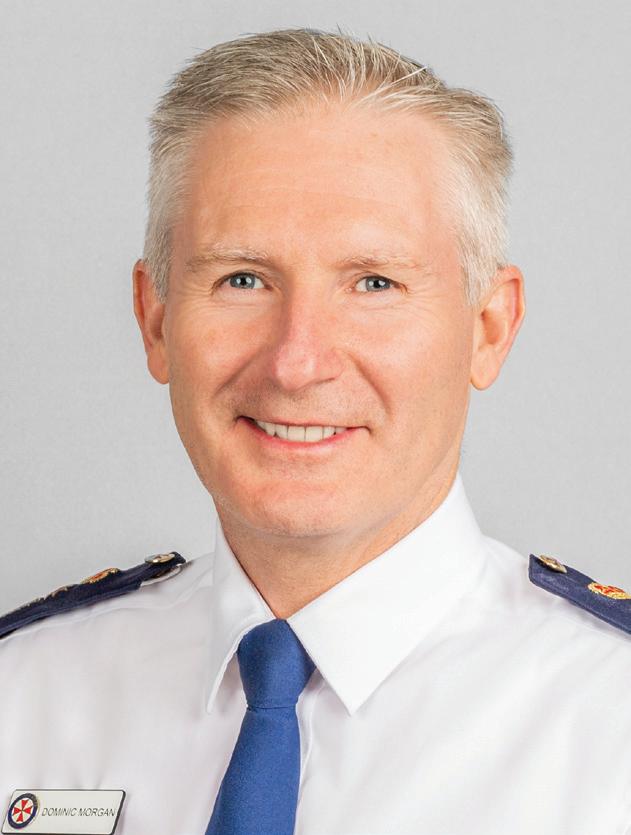
Dr Dominic Morgan
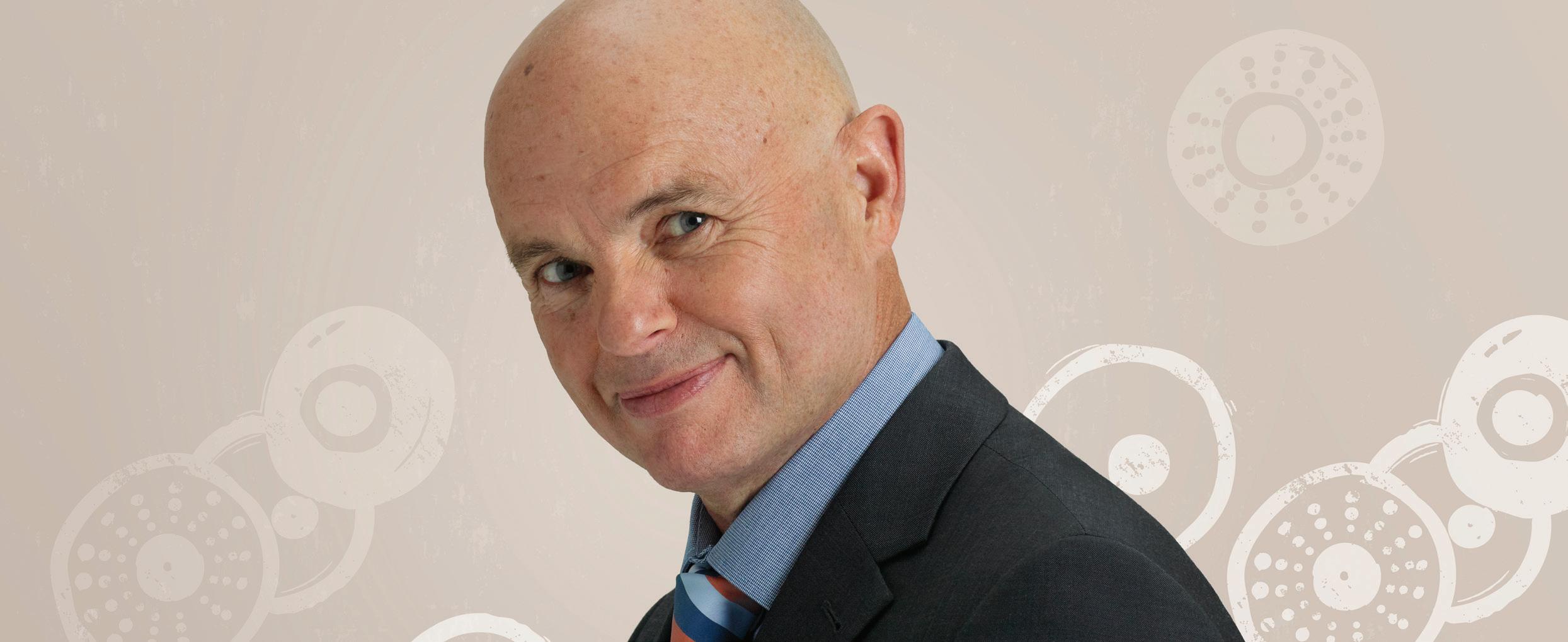
Professor Chris Levi, director of the John Hunter Health and Innovation Precinct, and the NSW statewide advisor for emergency medical records, is driving the project in his region. “We’re creating enhanced stoke diagnosis and treatment support for paramedics without changing the build of any ambulance,” he says.
“It’s essential that we deliver a model that breaks down barriers to urgent pre-hospital stroke care, regardless of location,” he says.
As any paramedic will attest, stroke is a notoriously difficult condition to treat, given the time constraints and the need to accurately diagnose an ischaemic or haemorrhagic stroke.
The stroke-capable road ambulances will use an integrated digital communication platform to assist paramedics in early identification of stroke. The digital platform will be linked via a phone-based app to a cloud-based network and is being co-designed by paramedics, enabling clinical data entry, clinical decision support, and more effective communication between prehospital and in-hospital teams.
This will include video conferencing between the paramedic and off-site neurologist as they make treatment and transport decisions.
The digital platform will pre-notify an incoming stroke patient, ‘scrambling’ the hospital emergency, stroke, radiology, and interventional teams into earlier action and brain-saving stroke treatment.
It will be invaluable for patients suspected of having a large vessel occlusion requiring clot retrieval. Use of the stroke digital platform app will mean an ambulance can potentially go directly to a specialist clot retrieval centre where a neurointerventional team is waiting.
“This has the potential to prevent multiple interhospital transfers in rural areas, saving three or four hours before treatment typically begins,” Prof Levi says.
“The Hunter region, like other parts of regional Australia suffers from inequity of access to advanced stroke care. Bringing neurologists and paramedics together in a virtual care model builds on the Hunter’s foundation work in establishing the platform for hospital-based telestroke now running statewide.”
The digital platform will pre-notify an incoming stroke patient, ‘scrambling’ the hospital emergency, stroke, radiology, and interventional teams into earlier action and brain-saving stroke treatment.
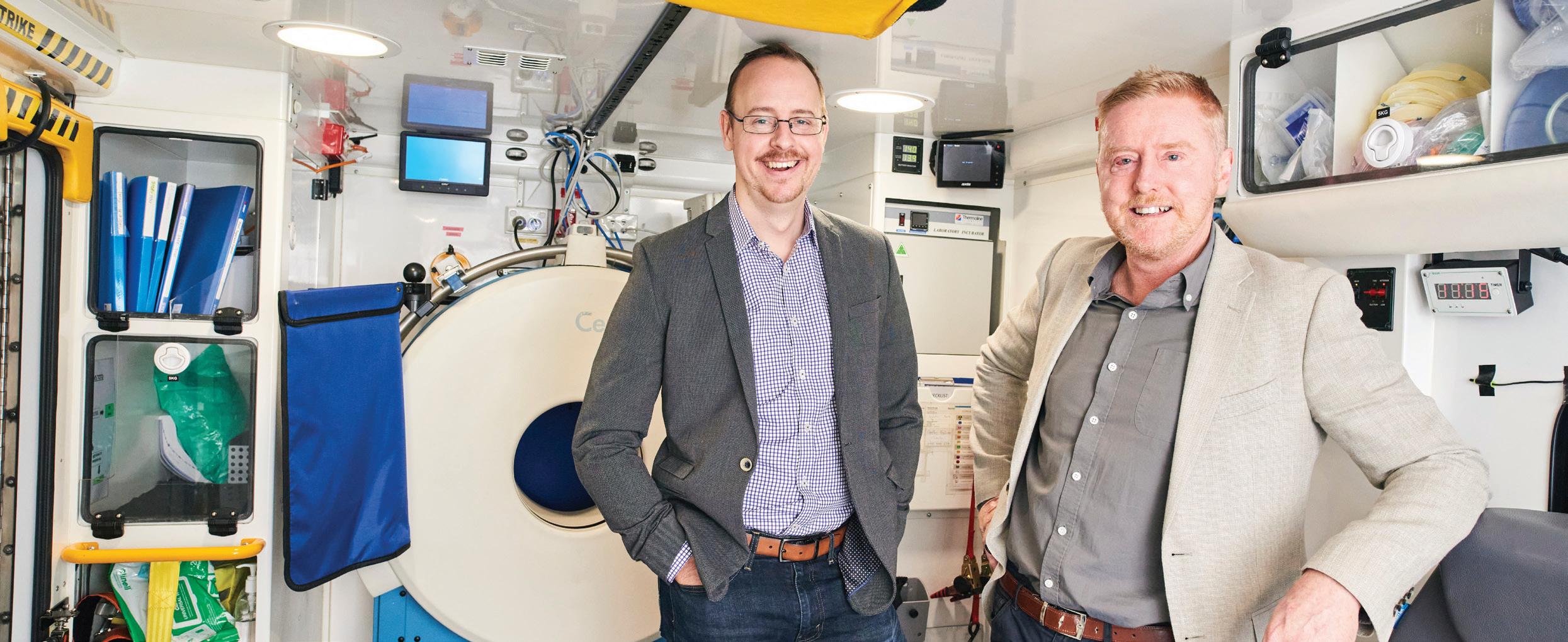
According to Professor Mark Parsons who is spearheading the South Western Sydney rollout, the stroke-capable ambulance digital platform will be a one-stop-shop, allowing paramedics to use clinical scoring tools relevant to their locality, such as the ACT-FAST and HUNTER8 scores.
“Paramedics in different regions have different exposure to stroke scoring tools. For the first time, we’re condensing the dialogue and bringing together the multidisciplinary team involved in the chain of stroke care with a user-friendly application integrating diagnostic tools that our paramedic colleagues are familiar with,” says the Executive Director of the Sydney Partnership for Health Education, Research and Enterprise (SPHERE).
“Southwestern Sydney serves more than 1 million people and is unique for its socioeconomic and cultural diversity. We are determined to ensure our community receives the highest standard of stroke care. Timely access to brain saving acute stroke treatments is the key to better outcomes. This project is an important step to achieve gold standard stroke care.”
The two Hunter and Liverpool vehicles, to be launched in late 2021, will be the first of six to be rolled out across the next 24 months in Victoria, Queensland and South Australia. According to Australian Stroke Alliance CEO, Dr Damien Easton: “We are working closely with ambulance partners to develop solutions for each state and territory as part of our mission to enhance access to early stroke care in regional communities across Australia”.
“We hope NSW and Victoria will be delivering data within 12 months and SA and Queensland within 24 months.”
As reported in First previously, the Australian Stroke Alliance is overseeing the design and construction of lightweight, affordable brain scanning devices for road and air ambulances. It is hoped trials will begin by 2023. The stroke-capable road ambulances will be the first to test the devices.

“We need to ask ourselves as an entire health system: what does “good” look like for unscheduled care in Perth?”
by Dr Paul Bailey Medical Director, St John WA
As the Medical Director for St John WA – which covers the biggest single ambulance jurisdiction in the world – I have a front row seat to observe and guide the provision of care in the prehospital ambulance environment, and to watch the often-difficult transition our patients must navigate from the time they experience a health emergency to accessing the care they need.
I also have the privilege of visiting every emergency department in the Perth metropolitan area each month.
Whether by intention or accident, EDs have strayed a long way from their true purpose. The Australian College of Emergency Medicine defines the discipline as “a medical specialty that equips physicians with the knowledge and skills required to care for patients with very urgent healthcare needs.”
Look around an ED and patients with very urgent healthcare needs are there, but in minority.
Instead, the ED is full of patients awaiting care in other parts of the hospital system that have declared themselves full: patients for whom the system uses the ED as the front door to the broader hospital environment because there is no other door – and many who use the ED because it is an excellent one-stop shop.
What I don’t see are patients who “should have gone to their GP”.
It’s no wonder our EDs are popular. They are open every day, staffed by competent, caring people, who can assess almost any complaint. They see anyone who presents and have access to a vast diagnostic capability. In the public system, they are free.
Much of the care being provided in ED’s has nothing to do with emergency medicine, and they are at capacity – no longer able to plug the gaps that exist in aged care, chronic pain management, post-operative follow-up and mental health.
EDs are the canary in the coal mine. The solution is not to build a bigger canary.
Perhaps the most publicly visible impact of the pressure on EDs is ambulance ramping. Last financial year in WA, patients spent more than 40,000 hours on the ramp waiting for access to a health system operating beyond capacity.
That was about double the rate of the previous year and figures are continuing to worsen.
To address ramping, St John launched a coordinated multidisciplinary campaign that returns about 1,000 hours of ambulance care from the ramp back to community each month.
This includes appointing hospital liaison managers, a new secondary triage service for Priority 3 patients, and working with our emergency services colleagues to determine incidents where an ambulance may not be required at all.
We have also put in place a multiple care model –this means a ramped ambulance crew may care for two patients, freeing up another vehicle to get back on the road. It’s not our preferred model of care but we’re doing everything we can within our control to address ramping.
Clearly, these strategies are not enough, and St John WA cannot address this alone.
We need to ask ourselves as an entire health system: What does “good” look like for unscheduled care in Perth?
Our population needs health pathways that work. Some of these pathways will lead to an ED but many will not.
Patients are good at getting their care pathway right –very few presenting to a general practice are on-referred to an ED.
But they need more choice – as do our non-hospital clinician colleagues – and the capability of those choices needs to be clear.
We need nuance, partnering across the care spectrum, and substantive change.
We need to think radically differently.
The bulk of our patients would be best served by a system built around our GPs, and that would involve ongoing access to outpatient clinics that address the needs of patients who are currently inside our EDs awaiting assessment because they have nowhere else to go.
To do that, we are going to have to partner across medical disciplines, across different types of health providers, and between different types of organisations.
To me, that’s the start of determining what “good” looks like.

Medical Director St John WA
Paul is a highly regarded Western Australian‑trained emergency physician who joined St John WA in 2015. He has held leadership positions at St John of God Healthcare and Ramsay Healthcare. He has a long standing interest in pre‑hospital care and aeromedical transport and is proud to lead St John WA’s Clinical Services team. Paul also has a laboratory biochemistry PhD in jellyfish venomology.
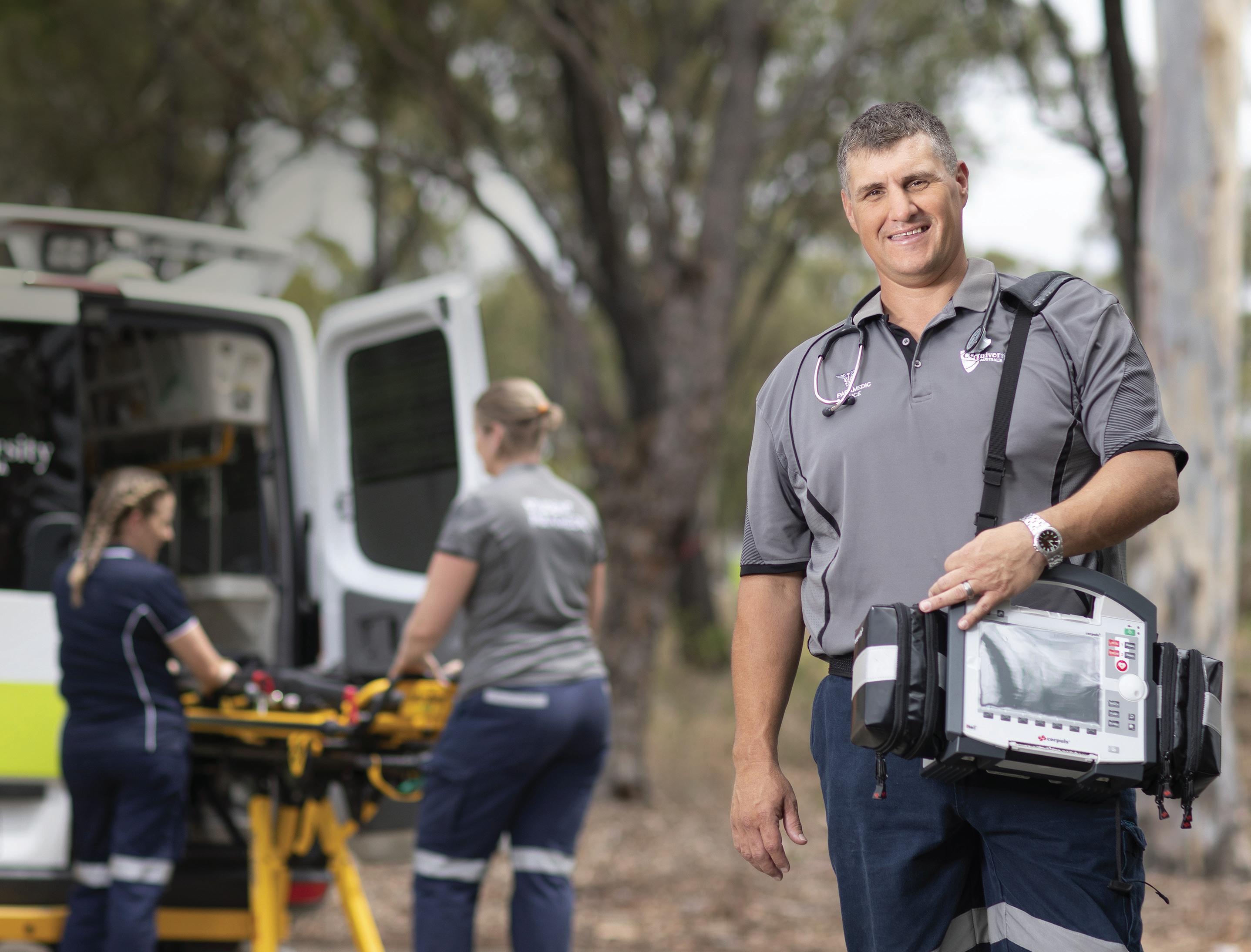
Equip yourself to manage and react to emergencies in resource limited and high-threat environments with graduate certificate or graduate diploma study options from CQUniversity.
Available entirely online, these highly flexible courses are ideal for paramedics and first-responders alike to gain the critical skills needed to assess, plan, prepare and implement strategies for successful operations and patient management within a tactical environment.
ACCESSIBLE, FLEXIBLE STUDY
40+ years distance education experience, plus access to facilities and support at more than 20 national locations.
We’re among the best for postgraduate skills development, starting salary and full-time employment. * The Good Universities Guide 2021
•
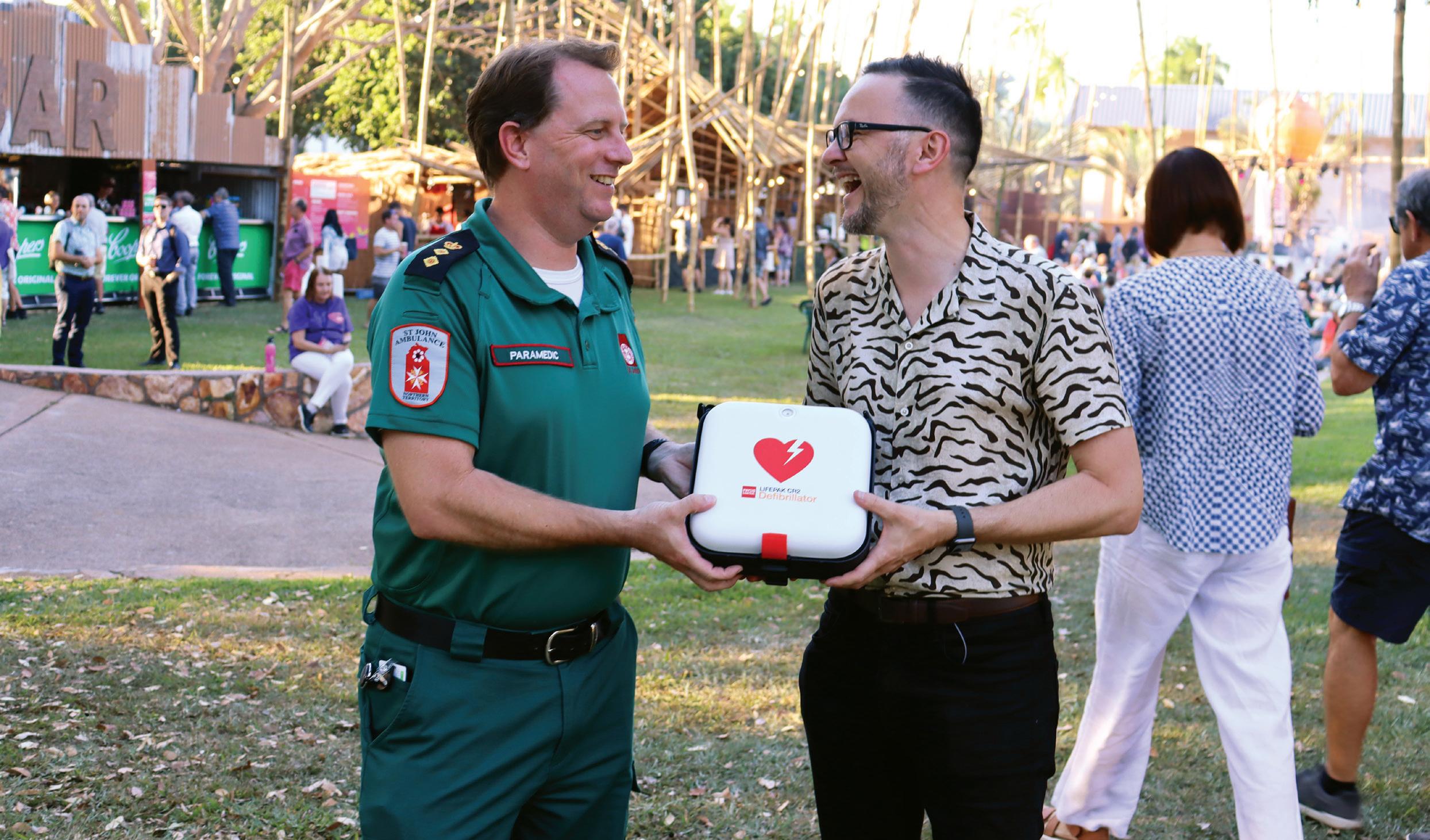
The ‘Friends of St John’ initiative aims to support community organisations to build resilience for the benefit of all Territorians.
Thanks to a grant from the Northern Territory Government’s Community Benefit Fund, St John NT has been able to donate an automatic external defibrillator (AED) to Darwin Festival, one of the Territory’s biggest events.
With over 40% of Darwin Festival staff and 100% of their security being first aid and CPR trained, the addition of an AED and a short training session means the Festival will be well-equipped to handle emergencies.
This is just what being a ‘Friend of St John’ is all abouthelping to equip community organisations to take public safety into their own hands.
“While we have St John NT Event Health Services covering many of our festival dates, this donation allows us greater coverage in emergencies,” said Darwin Festival CEO James Gough.
“We have audiences and performers of varying ages and backgrounds who come to enjoy the Festival across 18 days, and we aim to be able to provide the best first aid to all who might require it.”
Darwin Festival is the first major event in the Territory to become a ‘Friend’, resulting in better resourcing for their event emergency management.
“We want community events and organisations to feel confident in delivering first aid to those who need it,” said St John NT CEO Judith Barker.
“Most organisations have the resources required to deliver their own first aid services, they just need a bit of a jump start, or in this case a defibrillator!"
“We are pleased to be able to provide an AED to such a landmark Territory event – early defibrillation is the key to success in a cardiac event.”
In Australia 33,000 people suffer from a cardiac arrest each year. Contrary to popular belief, sudden cardiac arrest can happen at any age, and without a defibrillation, less than 5% of sufferers will survive.
We encourage all organisations who have a defibrillator to register their device with our First Responder App. This allows people to locate the closest AED should they find themselves in an emergency.
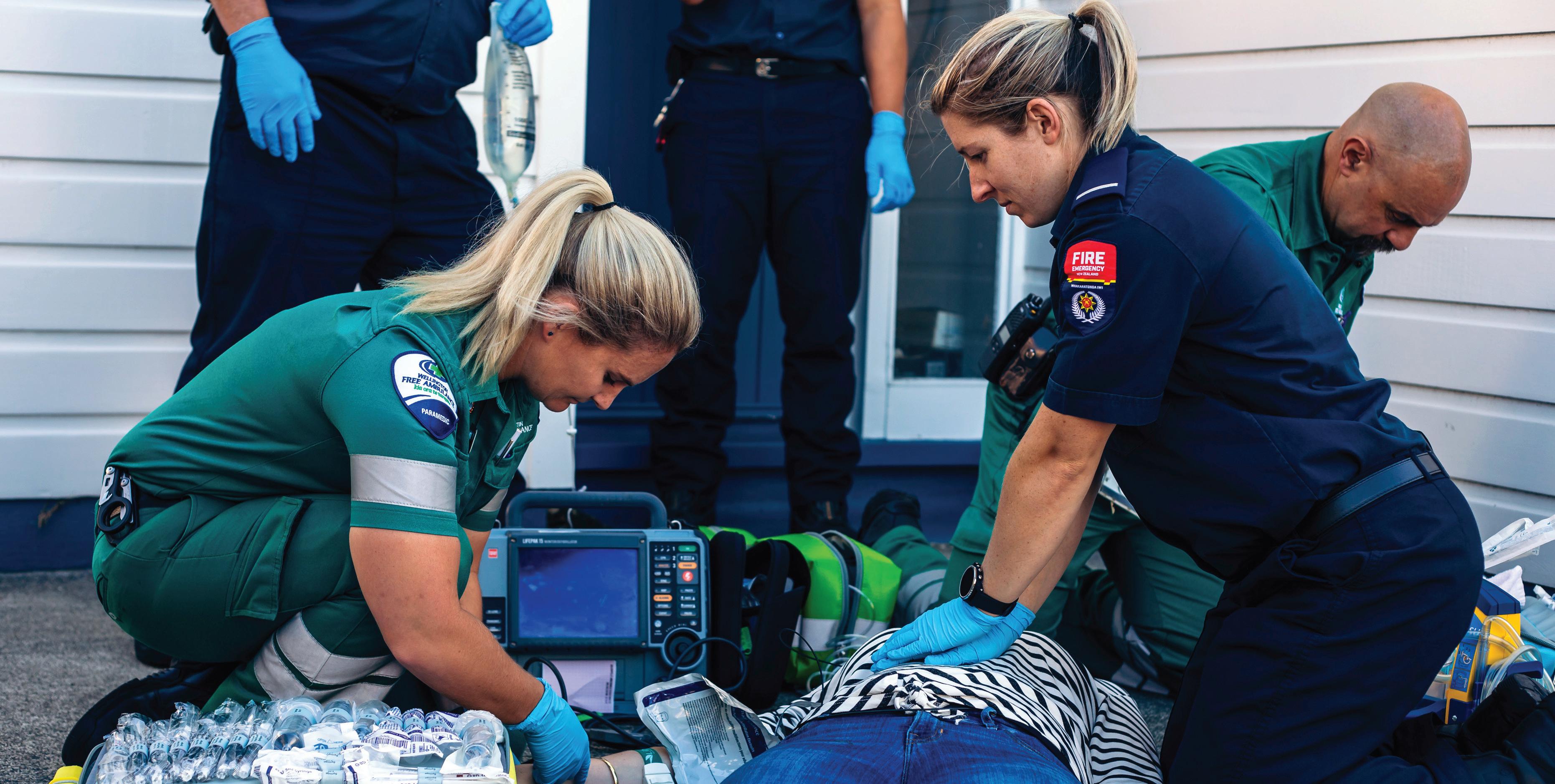
From Wellington Free Ambulance
Thanks to a joint initiative between Fire and Emergency New Zealand (FENZ) and Wellington Free Ambulance, volunteers from the Martinborough fire brigade will soon be medical first responders.
For a long time, FENZ have co-responded alongside paramedics when it comes to serious, life-threatening emergencies, such as cardiac arrests.
In other medical situations, they have been limited as to what they can do from a clinical point of view.
The recent training, led by the Clinical Education team at Wellington Free Ambulance, now gives 10 of this brigade’s volunteers the ability to administer simple pain relief and provide basic medical care.
Wellington Free Ambulance has three double crewed ambulances in the Wairarapa – one that starts in Greytown and another two that start in Masterton –however, because of the Wairarapa’s geography and some communities being harder to reach, time can be of the essence depending on the situation.
Wellington Free Ambulance Wairarapa Shift Manager Jono Rees says the roll out of the Martinborough First Response Unit will enhance the pre-hospital emergency care that is provided to those living in Martinborough.
“By having more first responders in the area, patients will be able to access the best care, regardless of whether it is a paramedic or fire fighter who arrives first.
“The FENZ volunteers have been provided with the training and on-road clinical experience required to provide the most appropriate care when it is needed the most. They will also be supported by the Wellington Free Ambulance Clinical Desk should the team need any specific advice or instruction prior to the arrival of an ambulance.
“This early intervention will undoubtedly benefit the community they serve,” Jono explains.
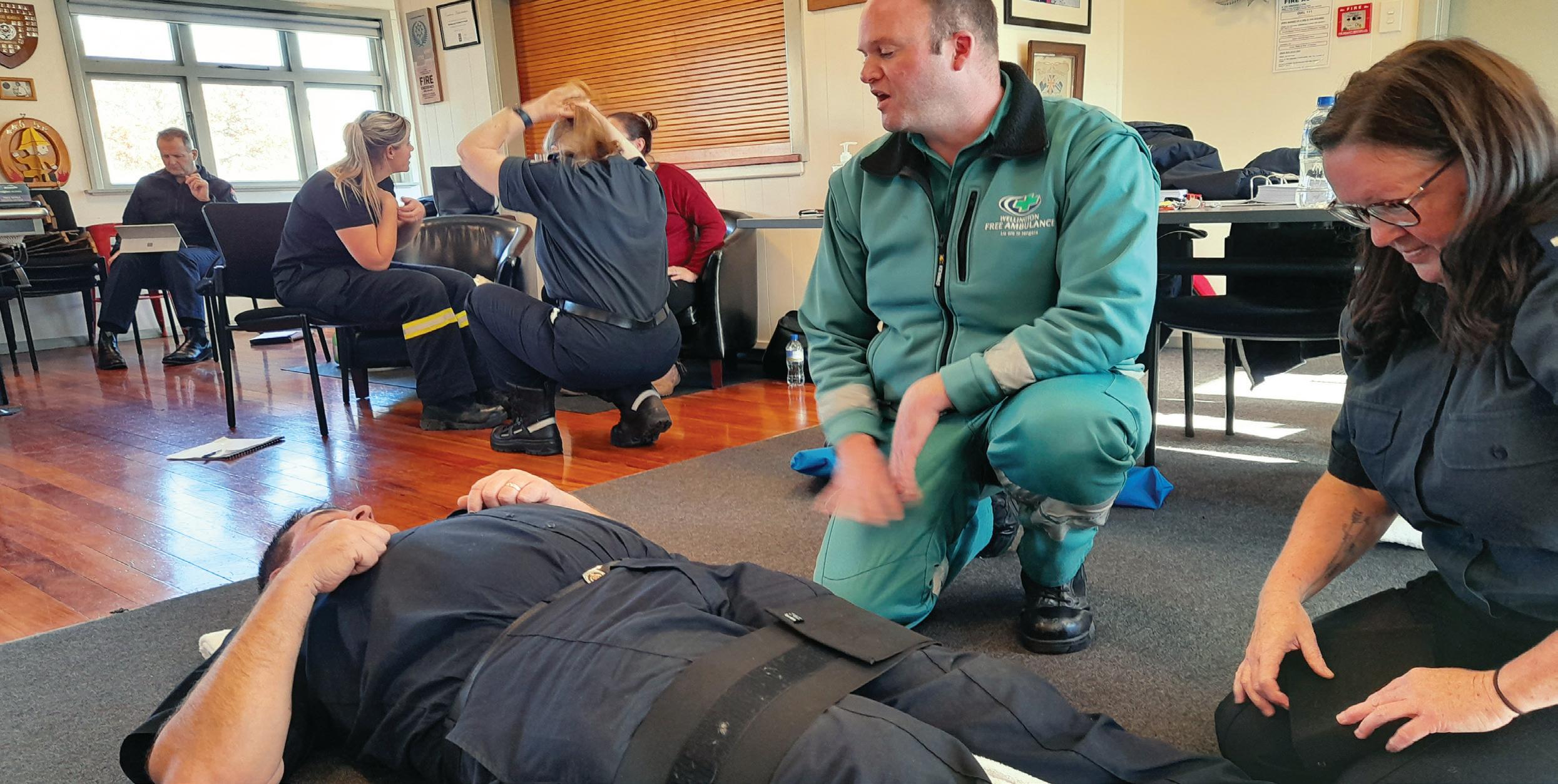
When these 10 volunteers start responding at the end of October – following several on-the-job road days, they will be helping with a range of medical and healthrelated callouts and potentially save lives alongside their colleagues at Wellington Free.
Again, it’s not unusual for firefighters to be first on the scene at a medical event. When someone calls 111 for a life-threatening medical emergency, both ambulance and fire are likely to be dispatched simultaneously. In a cardiac arrest for example, firefighters provide CPR while the paramedics looks after the clinical care to ensure the patient has the best chance of survival.
FENZ Assistant Area Manager for the Wairarapa, Nick Pyatt, says the initiative had been driven by the brigade to meet an identified need in their community and the training was the first of its kind between FENZ and Wellington Free Ambulance.
“This is great news for the Wairarapa community as it will see the number of calls attended by the brigade go from about 120 a year, to around 240, with over half being for medical response.
“It is important for members of the community to know that if they call for an ambulance for a medical emergency, and firefighters turn up, they are trained in medical response and capable of providing medical care, until the arrival of the ambulance,” Nick says.
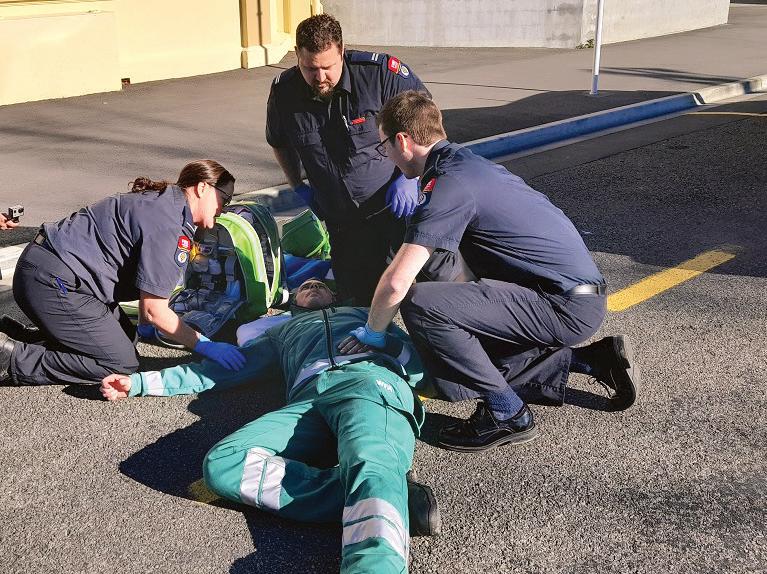
By having more first responders in the area, means patients will be able to access the best care, regardless of whether it is a paramedic or fire fighter who arrives first.
Jono Rees
Wellington Free Ambulance Wairarapa Shift Manager

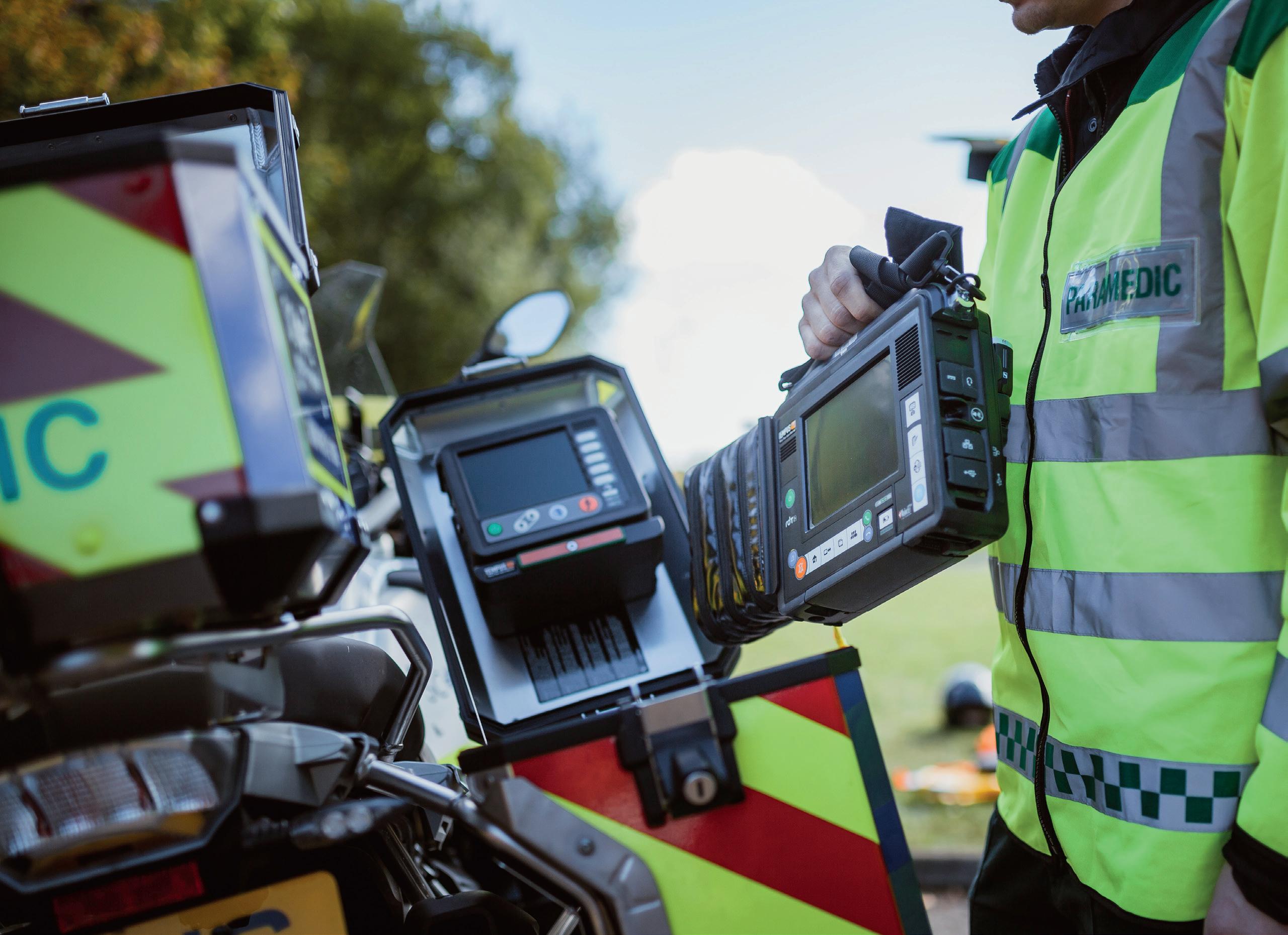
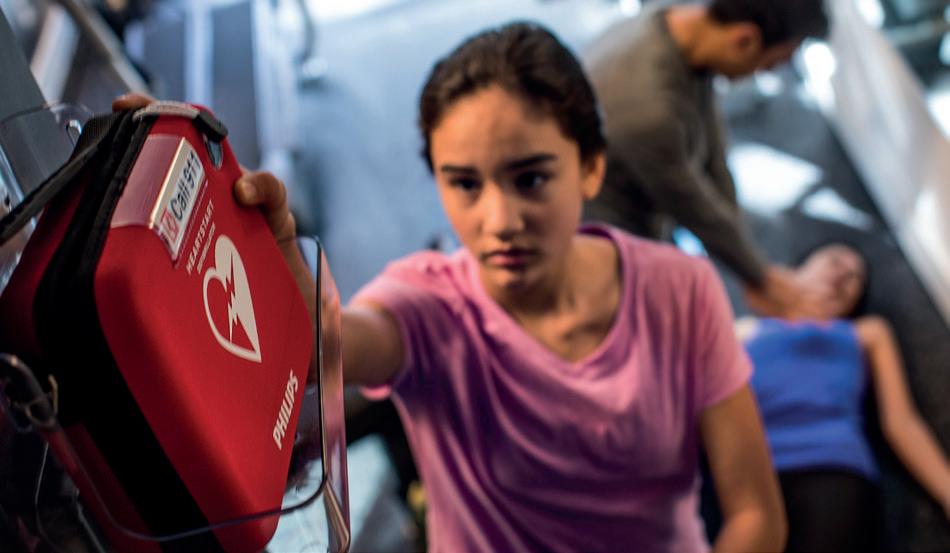
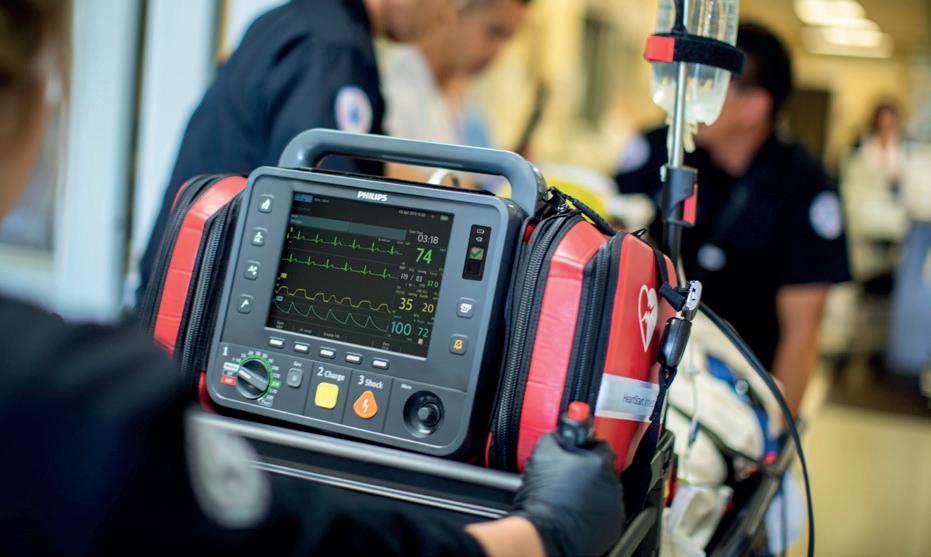
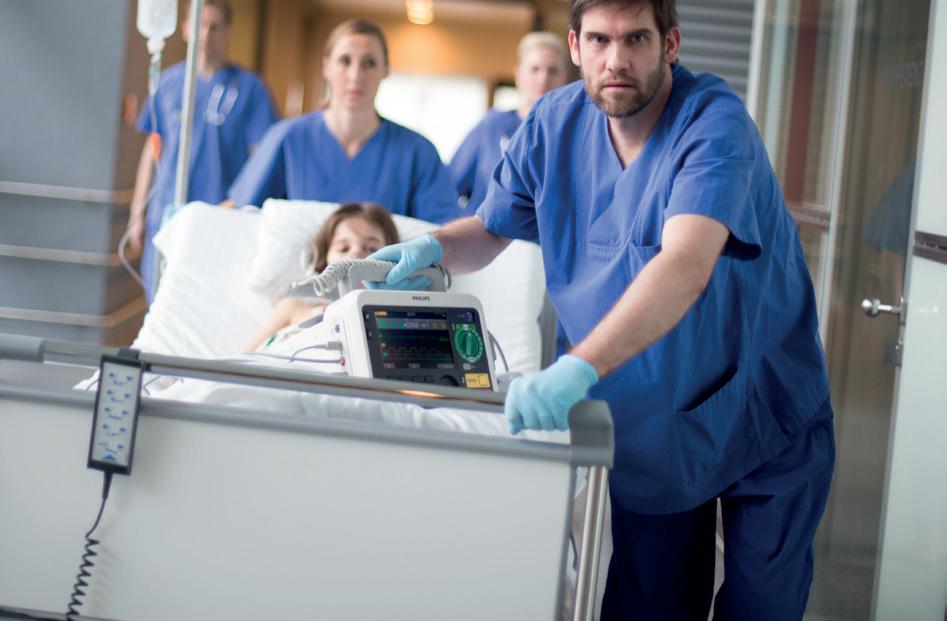
Philips ALS Solutions are designed to be easy to use for rapid response, flexible and rugged enough for a range of environments and patients’ needs. With intuitive, twoway communication capabilities for secure data transfer, Philips ALS Solutions feature tools that enhance confident decision-making. From outside of the hospital to the hospital, from first responders to clinicians, Philips ALS Solutions provide critical connections for life. Celebrating 130 years of innovation, collaboration, and social responsibility, Philips is a trusted partner in EMS.
The Australasian Ambulance Awards for Excellence have been run by the Council of Ambulance Authorities for over 10 years with the aim to recognise the hard and innovative work of member ambulance services from Australia, New Zealand and Papua New Guinea.
The awards are designed to encourage innovation and to enable services to share their work and learn from each other. The awards are independently judged by a panel of industry-respected judges from across the globe. The awards are divided into six categories; technology, clinical practice, staff development, patient care, leadership, and our new 2021 category; mental health and wellbeing. A Star Award is then presented to the overall winner.
(patient experience improvement or innovation)
Ambulance Victoria Melbourne Mobile Stroke Unit
ACT Ambulance
Police Ambulance Clinician Early Response (PACER)
Ambulance Victoria TelePROMPT
This category is looking at patient experience improvement or innovation. Previous submissions looked at mental health responses, individual patient stories, community paramedicine, and assisting high frequency 000 callers. Each service is emboldened to examine ways that their organisation has assisting specific patient cohorts where learnings were of the benefit for the field of paramedicine.
(education improvement or innovation)
NSW Ambulance Elevate Program
St John New Zealand “On Demand” Online Learning Platform
This category is looking at education improvement or innovation in fields of:
• Program design, delivery, assessment and accreditation.
• Professional development, skills maintenance and practice standards, including community education
• Research and/or innovation supporting evidence-based practice.
Previous submissions looked at leadership development, programs implemented around mental health of Ambulance staff, and community education campaigns. Each service is challenged to explore areas where improvements have been made in staff development, and how these resonating changes have improved the evolution of paramedicine.
(management practice and operational improvement and innovation)
SA Ambulance Service
Implementation of the First SAAS Consumer and Community Engagement Framework
St John New Zealand Major Incident Support Teams
Ambulance Victoria
Social and Environmental Responsibility (Framework and Action Plan)
This category is looking at management practice and operational improvement and innovation in:
• Management culture, open communication, accountability, management development, professional standards and diversity of workforce.
• Operational protocols, work practices. (Related to how service delivery is provided)
Previous submissions looked at accountability in leadership, enhancing opportunities for junior managers, taking the lead in occupational violence, and increased health outcomes for ATSI people. Each service is encouraged to analyze the programs they have implemented that pave the way in leadership for future generations of paramedics.
(innovation or capability)
St John New Zealand Responder.One CAD
St John Northern Territory
SoterCoach – Addressing Workplace Injuries
St John New Zealand Using Machine Learning to Inform Helicopter Dispatch
This category is looking for innovation or capability in fields of equipment, communications and information systems. Previous submissions related to electronic PHCRs, demand resourcing for patient transport, integrated CAD programs and improving analytics to drive performance. Each service is encouraged to reflect on how their organisation has used technology in the past twelve months to enhance patient outcomes, staff performance or response capacity.
(innovation or capability)
St John New Zealand Ambulance Pathway Improves Outcomes for STEMI patients in New Zealand
St John Northern Territory SWAB CAR – Efficient and Safe COVID Testing Method
Queensland Ambulance Service
Stroke Prehospital Informed Decision-making using EEG Recordings
This category is looking at innovation or capability in fields of skills mix, pharmacology and clinical intervention. It relates to patient treatment and outcomes. Previous submissions focused on high performance CPR, cardiac arrest outcomes, stroke protocols and improvements in pain management. Each service is encouraged to reflect on how their organisation has excelled in clinical practice with breakthrough moments that saw cutting edge techniques implemented to revolutionize the world of paramedicine.
(innovation or operational improvement)
Ambulance Victoria AV Peer Support Dog Program
SA Ambulance Service
SAAS Mental Health Co-Response (MH CORE)
NSW Ambulance
NSW Ambulance Wellbeing Workshop Program
CAA welcomes the introduction of this new category in 2021. With mental health in our patients and our staff such a prominent focus in the field of paramedicine in the past decade, we are seeing exciting innovation and excellence by all. Each service is encouraged to continue to shine in this field and share with us their innovation and improvements in mental health and wellbeing.
The ‘Star Award’ will be presented to the overall winner selected from these category winners. The winner of this award will be identified as having, or proceeding to have, successfully developed, implemented and evaluated a project that is considered the most valuable for adoption by all CAA members.
"There's a whole lot of families with members sitting around the dinner table tonight and they're there because of your guidance in this space". - David Waters

The most important intervention is the time to the first compression and time to the first defibrillation. Those two are critical and we need to focus on shorting the time these interventions take place.”
Dr.Mickey Eisenberg has been involved in emergency medicine, emergency medical services, and sudden cardiac arrest research for over four decades.
He served as the Director of the Emergency Department at the University of Washington Medical Centre from 1978-2003 and was the Medical Director of the King County EMS from 2001-2015. He has over 200 scientific publications and 15 books on cardiac arrest, including a history of cardiac resuscitation.


When did you realize that to improve survival rates from cardiac arrest it takes a system to save a life?
Well, it was not a eureka moment, it was sort of a gradual awakening. I have to mention that the two founders of the paramedic program in Seattle, Dr Leonard Cobb and Dr Michael Copas began this work in 1971, that's 50 years ago.
They had made a number of changes to their approach to resuscitation and published their results and people began hearing about it and they wanted to come in and visit. There were visitors coming all the time from throughout the country and even the world to see their improvements in cardiac arrest treatments.
I was involved with the King County EM system, which began a little later and we wanted to see if the Seattle programme was transferable to other communities. It became readily apparent that it wasn't a magic bullet, it wasn't one special little thing that made it work so well. It was all the complex interactions that comprise a system, and the system is very easily broken.
And so, the eureka moment was the realisation that it was a system, and every part of it need to be finely tuned and working very well, and you could not pluck out one thing and say this is the reason it works. It's because of the whole doggone system that it works absolutely and this then led to the now famous 10 steps we follow.
Synonymous with The Global Resuscitation Alliance (GRA) and Resuscitation Academy, Dr Eisenberg has been an integral part in the set up and running of these programs including the now famous 10-Steps for Improving Survival form Cardiac Arrest. The CAA works as the Australasian Secretariat for GRA and who better to interview Dr Eisenberg than the CAA CEO David Waters.
At what point did you get to the 10 steps and why ten?
Well, you're right and 10 is certainly a common number, an iconic number even ten fingers, 10 toes, 10 bowling pins, 10 steps for rehab, 10 commandments. We kind of had what we called the core steps which were the first four or five although rapidly it became apparent that well let's just go for 10 and it fit very nicely and all of them have a message, all of their own steps and key messages, each of the ten, and it has stood the test of time. Nobody's come forward and said, I have the eleventh step in here. I anxiously await such a person to tell us.
Tell us how you were able to convince your colleagues firstly around you and then obviously more globally that this programme was the right approach to take.
I have to say it was that partnership between Dr Leonard Cobb and Dr Michael Copas and myself initially, and then others that started the movement. It was a very small group of people, deciding that we've got to come up with a curriculum and formalise the programme into a comprehensive curriculum depending on how much time the trainee could spend with us. We always believe in piloting everything before you go full bore and initial trial of the Resuscitation Academy was a week-long event.
It was a pretty good programme, we thought, but it was just way too intense, way too much and we could not at all honestly expect people to just take a week out of their careers and come to Seattle. So that was what we learned from that first pilot test and we ended up with programme that simply takes two days and we've stuck with that and it seems fine, although I must admit we have put on the occasional one-day academy and they work pretty well too.

Do you remember your first survivor as a result of the 10 steps?
I do and we call him survivor one.
It was soon after we established the surveillance system and that was a county wide system. It was a very vivid event, it was ventricular fibrillation, no surprises he did not have bystander CPR as it was not widely done then. But he had wonderful response times from the paramedics and quick defibrillation, and that's why he survived.
It's amazing that your first survivor has now led to many, many thousands of subsequent survivors across the world. Did you ever envisage your work, and particularly the Resuscitation Academy and now the Global Resuscitation Alliance taking off the way that it has?
No, to be perfectly honest, we never envisioned that it would be a US wide program, let alone a global program. And as you know, because you've been very involved with many of these things from the very beginning, it all happened little step by step, there wasn't an a-ha moment ‘we have to create a global curriculum’. It just was little, tiny increments all along the way and before you know it, wow, we have had lots of interest from lots of different countries.
Do you think, COVID-19 has had an impact on our survival rates around the world?
You know, surprisingly, we had the same anxieties and same concerns and thought for sure it would cause a big decrease in survival. But here in Seattle it's really had a negligible effect on survival rates.
What are your hopes and aspirations for the future?
The most important intervention is the time to the first compression and time to the first defibrillation. Those two are critical and we need to focus on shorting the time these interventions take place.
I think the biggest evolution will be the creation of a consumer defibrillator, that a defibrillator will become as common as a fire extinguisher under the kitchen sink. It just has to happen so that you can get that shock in a matter of minutes instead of waiting for a defibrillator to arrive. But I don't see that happening in the immediate future unfortunately due to US regulations.
One thing which we are starting to see is growing literature on dedicated responders in homes, in neighbourhoods, people who agree to be a responder and be notified of a cardiac arrest with an alert. This hasn't been transformative, but it's certainly been a step in the right direction. Again, the logistical challenges to make these responder programs happen are considerable, and there's a cost factor of having defibrillators out there. But the concept for public responders I think is basically sound and I think we're going to see more and more of those types of programs.
Your partner in

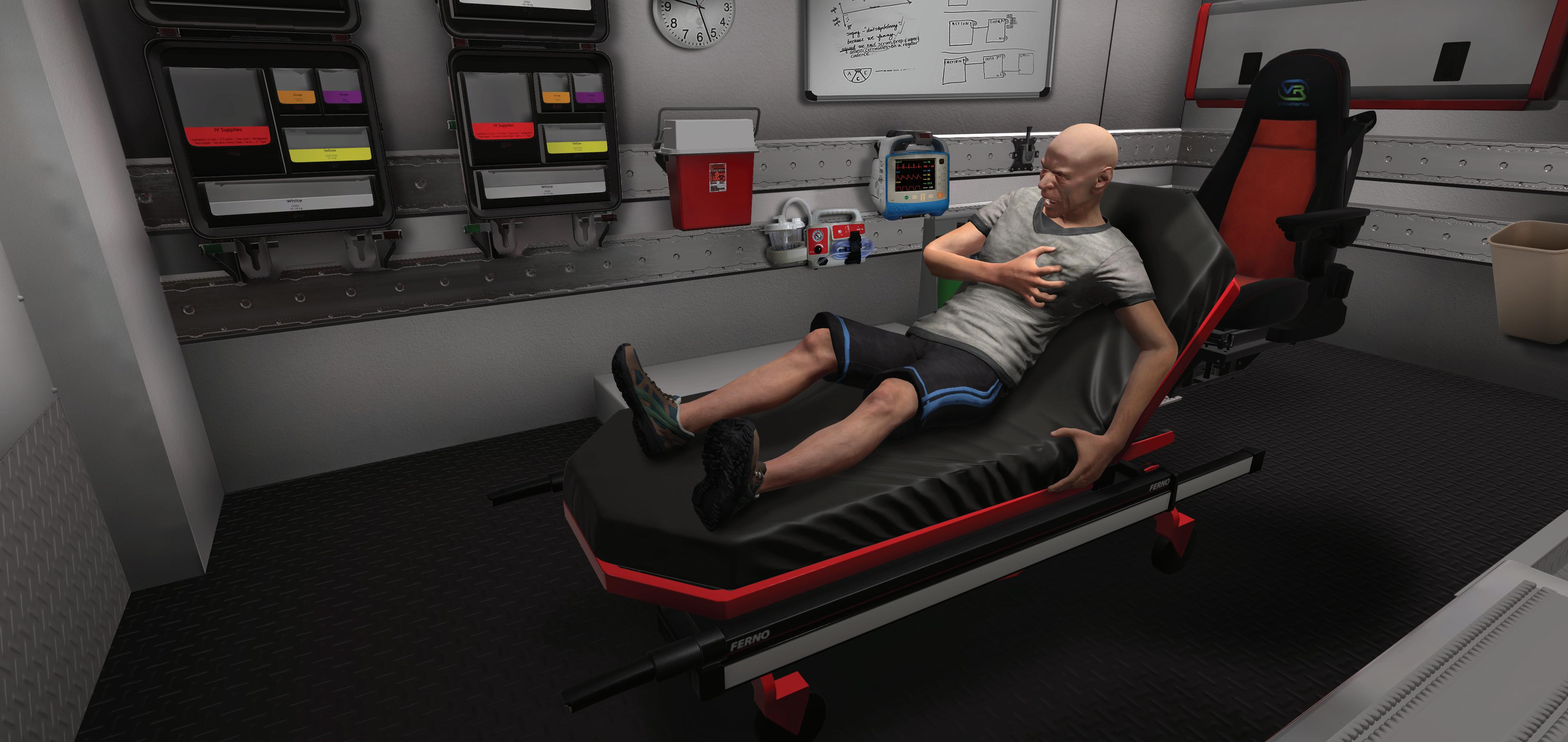
Using protocols predetermined by the trainer, the platform reacts to the chosen course of treatment in real time, providing a consistent experience from user to user.
VRpatients’ enhanced grading rubric provides a computer-generated assessment of the user’s treatment decisions at the conclusion of each case, eliminating trainer subjectivity.
The intuitive medical case authoring tool allows users the unmatched ability to modify existing content or create new content tailored to specific training objectives.
VR engages the senses, emotions and cognitive functions of the brain, tapping into the most powerful aspects of retention.
VR-based teaching makes abstract content more concrete and easier to understand.
VRpatients can be deployed via web or VR anywhere in the world to an unlimited number of users.
INCREASED EFFICIENCY & REDUCED COSTS
Virtual reality training can be done wherever there is WiFi, and in a shorter time frame.
With a dynamic case creation tool, realistic environments, and a robust family of lifelike patient avatars, VRpatients is a turnkey solution to your remote training needs.
VRpatients immerses users into a variety of virtual reality (VR) simulation scenarios that are lifelike, stress-inducing scenarios allowing them to interview, assess, diagnose and treat patients in real time. This type of training is similar to flight simulator training for pilots. The program is accessible through a web-based application or in full immersive VR simulation. www. vrpatients .com


Wednesday 17 November, 2021
Award Categories:
• Excellence in Technology (innovation or capability)
• Excellence in Clinical Practice (innovation or capability)
• Excellence in Staff Development (education improvement or innovation)
• Excellence in Patient Care (patient experience improvement or innovation)
• Excellence in Leadership (management practice and operational improvement and innovation)
New Category:
• Excellence in Mental Health and Wellbeing (innovation or operational improvement)
June 22 – 24 saw the CAA Virtual Expo bringing together our industry, sharing new innovations, technologies, programs and connecting with the sector.
CAA has been for the past decade providing an industry-wide Congress which has due to the pandemic been postponed for last two years. With plans in place for 2022 CAA Congress the CAA was keen to provide a networking opportunity in 2021 for our partners despite the challenges of travel restrictions and lockdowns.
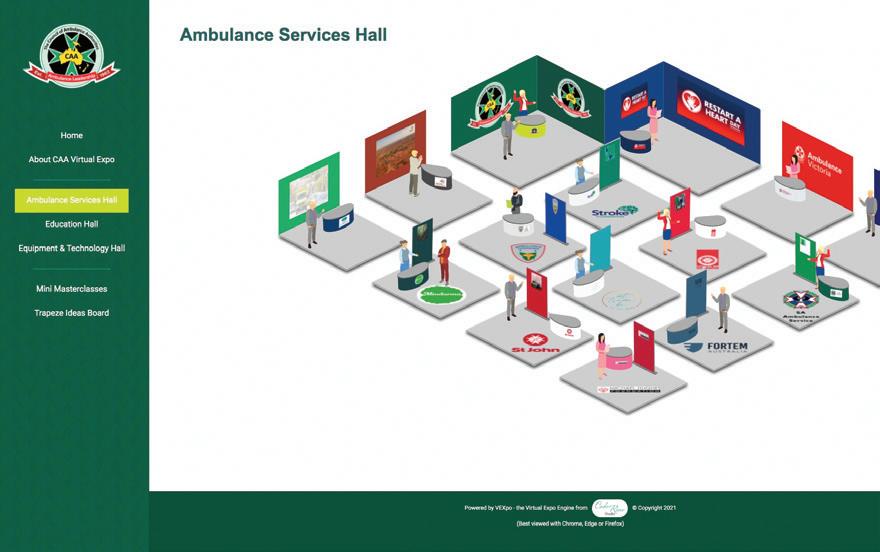
Enter a world-class Virtual Expo delivered on a custombuilt online platform offering specialised halls with exhibition booths to explore. Ambulance services across Australia and New Zealand, various medical companies and associations all joined the Expo, sharing their latest news, developments, research, project and technology in creating wonderful three days of networking and exploring new advances in the ambulance sector.
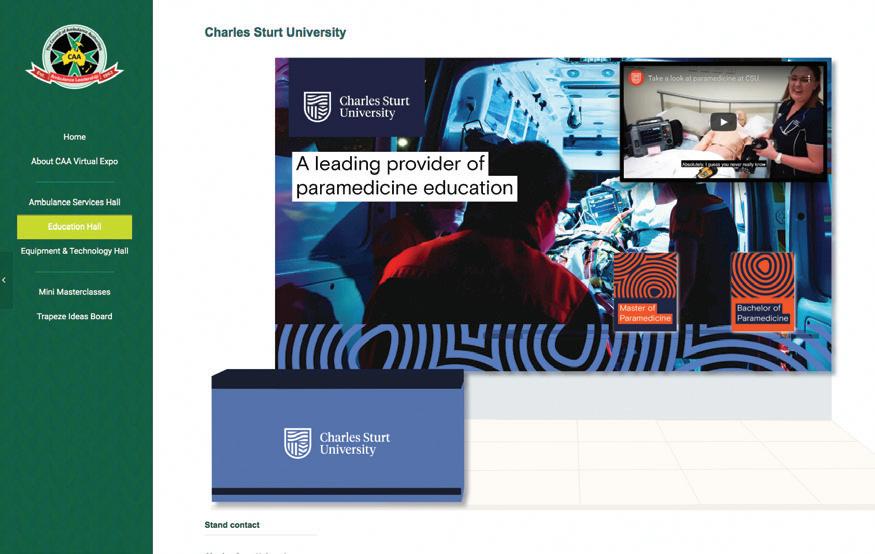
Virtual Expo showcased three halls: Education, Equipment and Technology, and Ambulance Services. The Ambulance Services Hall offered a valuable opportunity for those in the ambulance industry to come and learn more about CAA’s member services and organisations working in the pre-hospital sector, such as the Australian Stroke Alliance and Fortem Australia.
Equipment and Technology Hall showcased a range of innovations from sector leading companies including Pulsara, ORH, Philips, Stryker, RAPP, ZOLL, Interdev, Trapeze and My Workplace Health. CAA has had a longstanding relationship with leading global product companies and valued the chance to share their innovations with CAA members and Expo visitors.
The Education Hall featured top Australian and New Zealand universities focusing on paramedic education, providing opportunity to explore future study and career options. Paramedic studies have always been at the forefront in delivering quality programs and with demand for ambulance services growing at a rapid rate, graduating students are faced with exciting employment opportunities across CAA members and indeed globally.
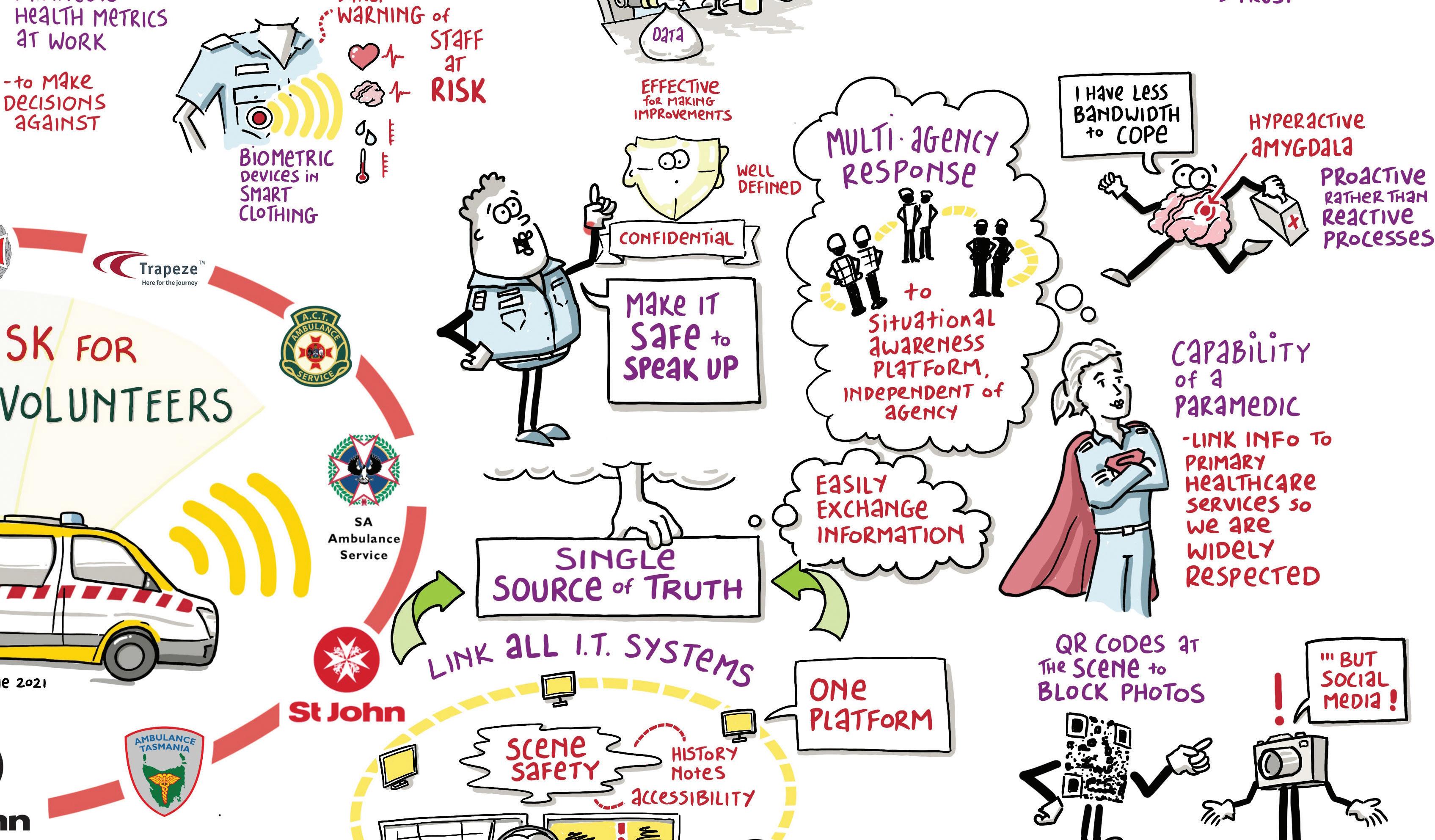
The CAA Virtual Expo brough back the CAA x Trapeze Ideas Board first introduced at CAA’s Perth Congress in 2019 and successfully launched in virtual space in 2020. The topic for 2021 board was mitigating risk for Paramedics and Volunteers, and Expo attendees were asked to submit ideas on how to increase visibility, improve safety and streamline processes for first responders. Over 150 ides were submitted and as was done in 2019 the ideas were designed into a colourful mural by a Trapeze graphic designer.
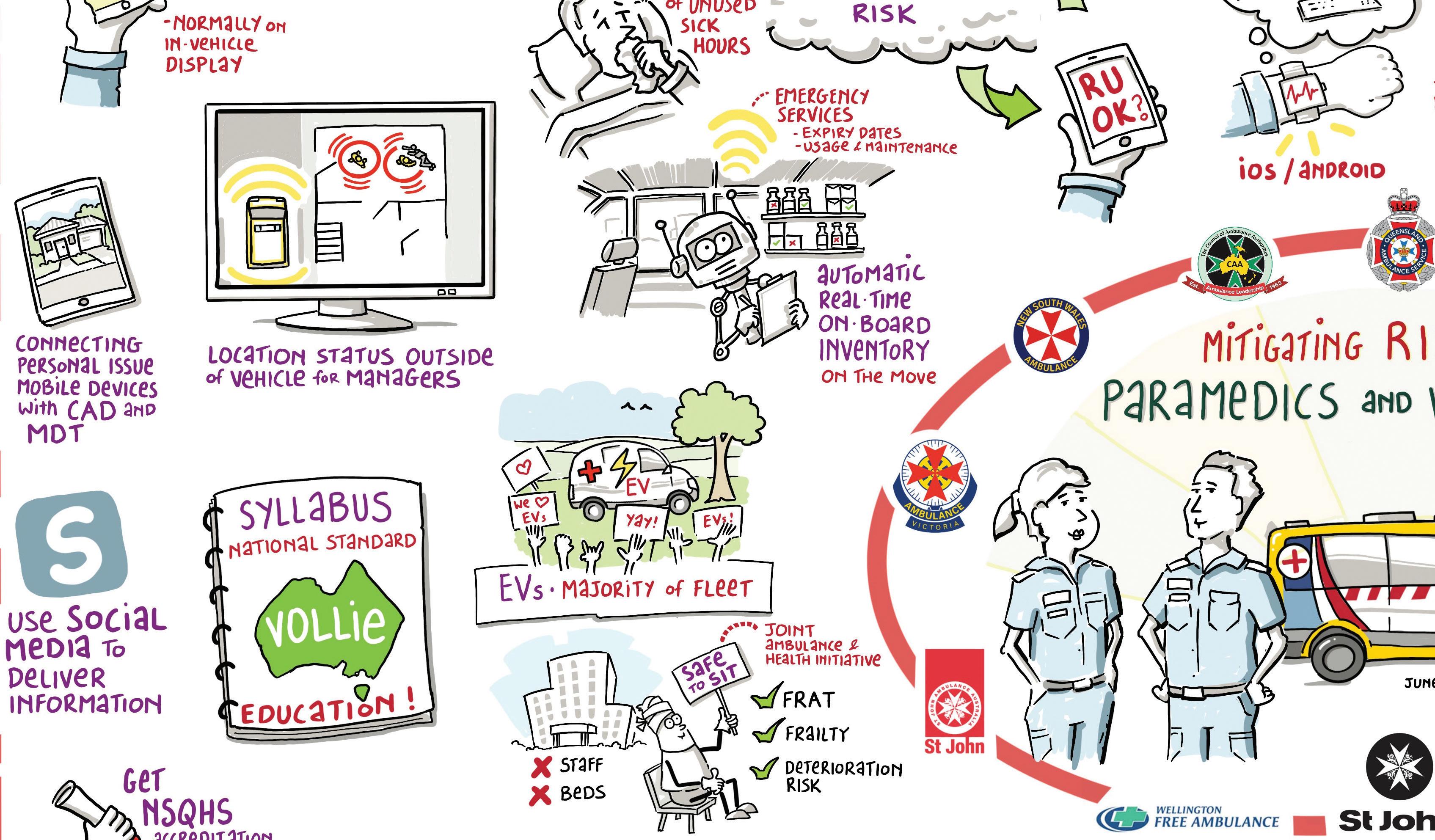
Steve Whitfield from Queensland Ambulance Service/ Griffith University had the winning idea for his suggestion on mental health research. Steve’s idea explained “whilst paramedic and first responder wellbeing are at the forefront of current discussions, our responses are largely based on re-action”. Steve suggested a greater emphasis needs to be placed on pro-action to reduce reoccurrence.
CAA’s Chief Executive Officer, David Waters says “The Virtual Expo was a great success with close to 2000 visitors across the three days. We have received numerous congratulations on the Expo and interactive platform and the ease of navigation, so I am confident we will host the Virtual Expo again even when faceto-face events return and look forward to even more exhibitors and attendees. The CAA Virtual Expo give us an opportunity as an industry to collectively share our knowledge and to continue to support each other and grow together”.
AMBULANCE SERVICES HALL
Ambulance Tasmania www.dhhs.tas.gov.au/ambulance SA Ambulance Service www.saambulance.com.au
NSW Ambulance www.ambulance.nsw.gov.au
Wellington Free Ambulance www.wfa.org.nz
St John WA stjohn.org.au
St John NT stjohn.org.au
Ambulance Victoria www.ambulance.vic.gov.au
Stroke Foundation strokefoundation.org.au
Australian Stroke Alliance austrokealliance.org.au
Fortem Australia fortemaustralia.org.au
Mindarma www.mindarma.com/home
Team EAT TRAIN BE www.facebook.com/ groups/1375168269191426
Michael Hughes Foundation www.mhf.life
University of Southern Queensland www.usq.edu.au
Auckland University of Technology www.aut.ac.nz
Charles Sturt University www.csu.edu.au
CQUniversity www.cqu.edu.au
Edith Cowan University www.ecu.edu.au
Whitireia Community whitireiaweltec.ac.nz/about-us
Monash University www.monash.edu
EQUIPMENT & TECHNOLOGY HALL
Pulsara www.pulsara.com/en-auv
My Workplace Health www.myworkplacehealth.com.au
ORH www.orhltd.com
Philips philips.com
Stryker www.stryker.com
RAPP www.rappaustralia.com.au
ZOLL www.zoll.com.au
Interdev www.interdev.com.au/about
Trapeze www.trapezegroup.com.au

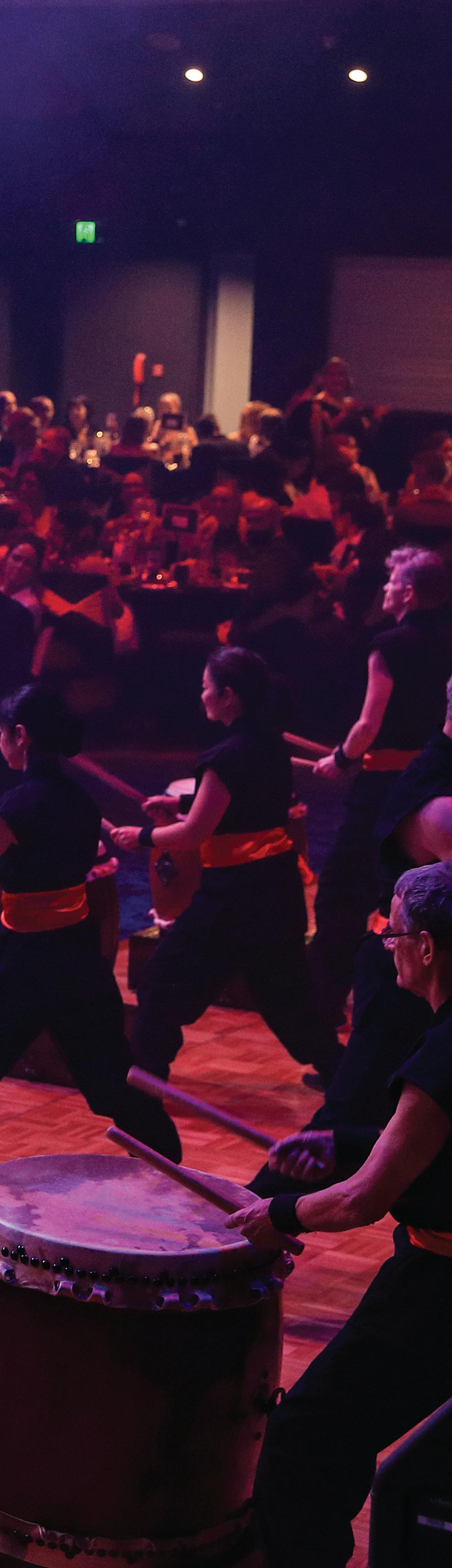
The FNQ Emergency Services Association Inc aims to bring together emergency services across Queensland to raise funds for local charities. The organisation began in 2015 when much needs funds were raised for families and victims of the Ravenshoe Café explosion and since then over $210,000 has been raised for a handful of beneficiaries.
The association’s membership is made up of the following members:
• Queensland Fire and Rescue
• State Emergency Service
• Rural Fire Service Queensland
• Queensland Ambulance Service
• State Emergency Service
• Queensland Police Service
• Cairns Hospital and Nurses
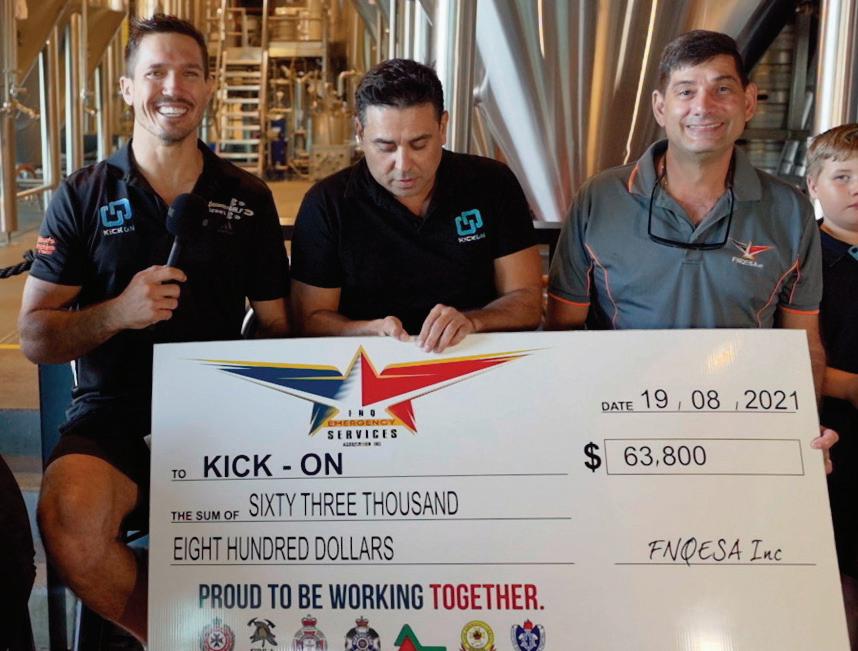
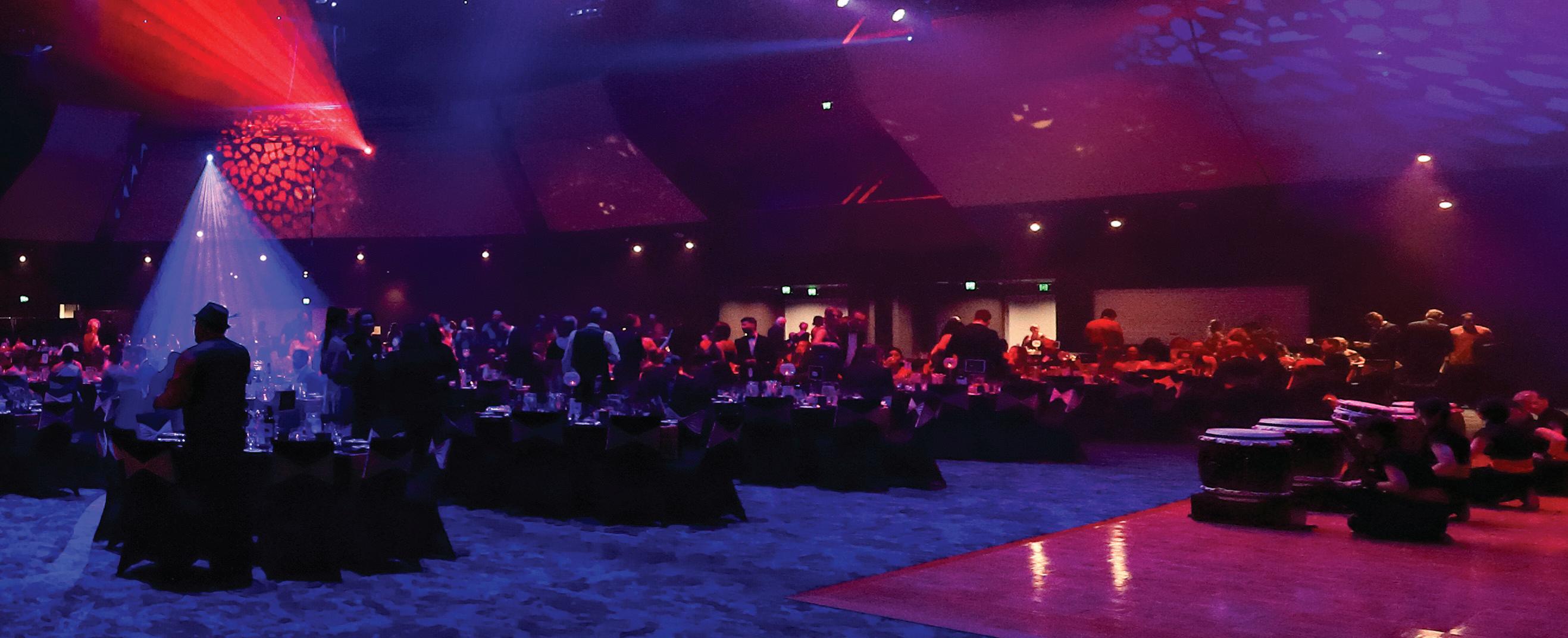
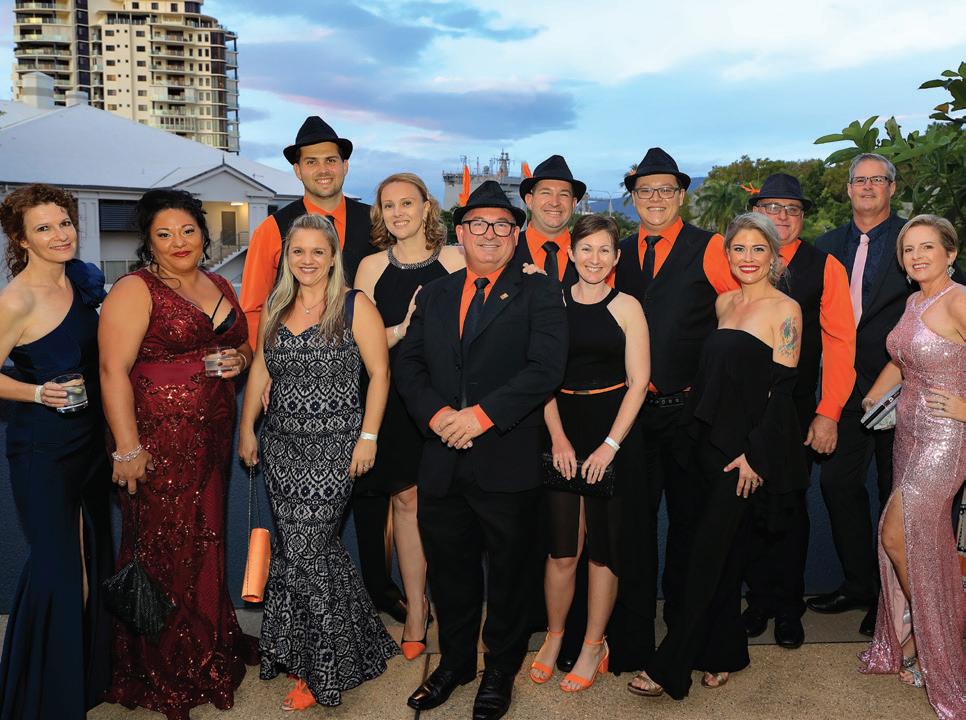
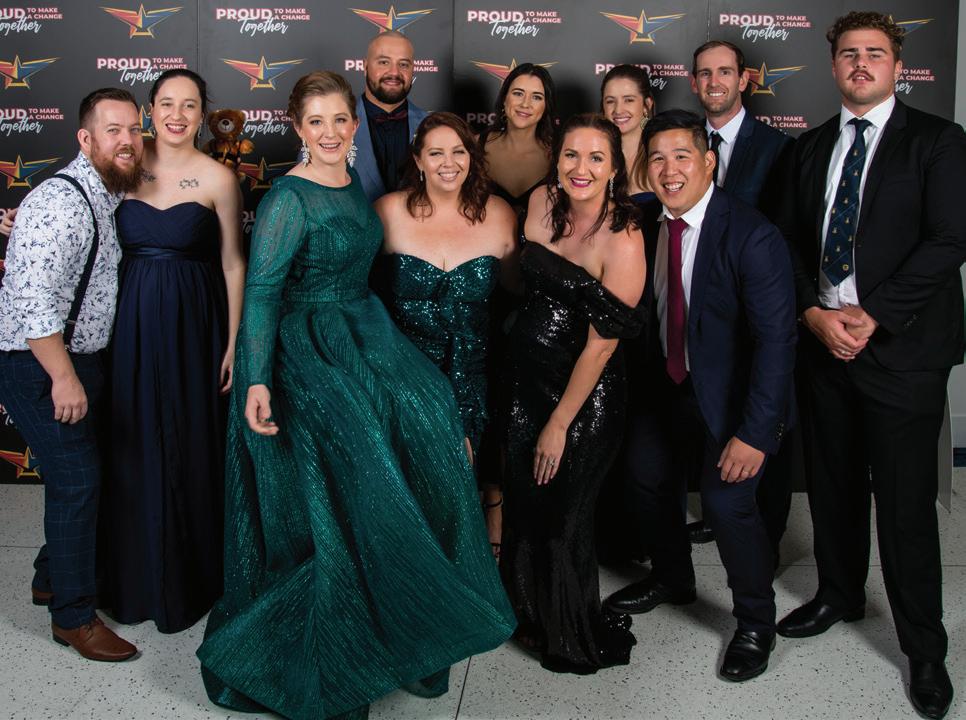
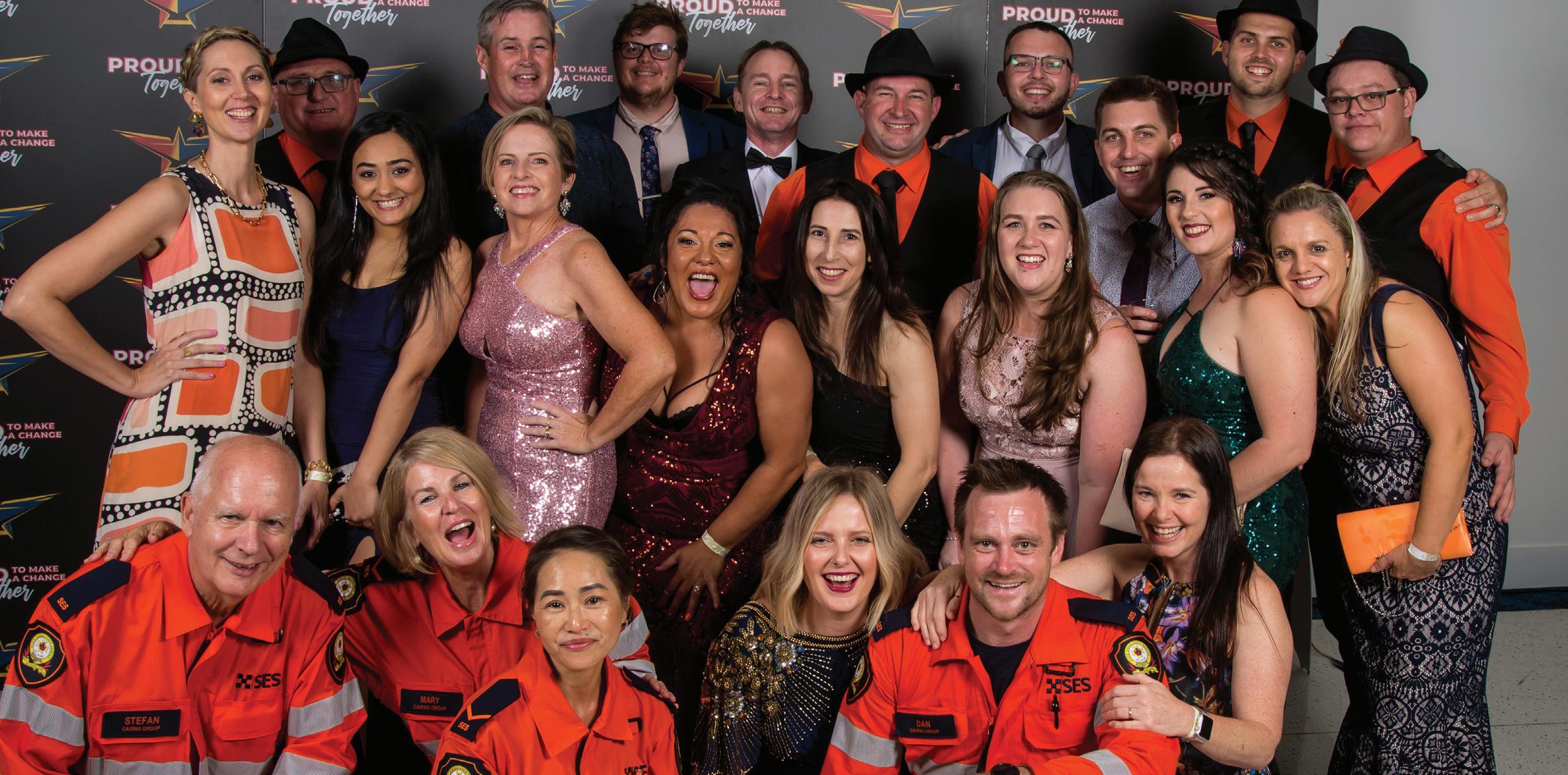
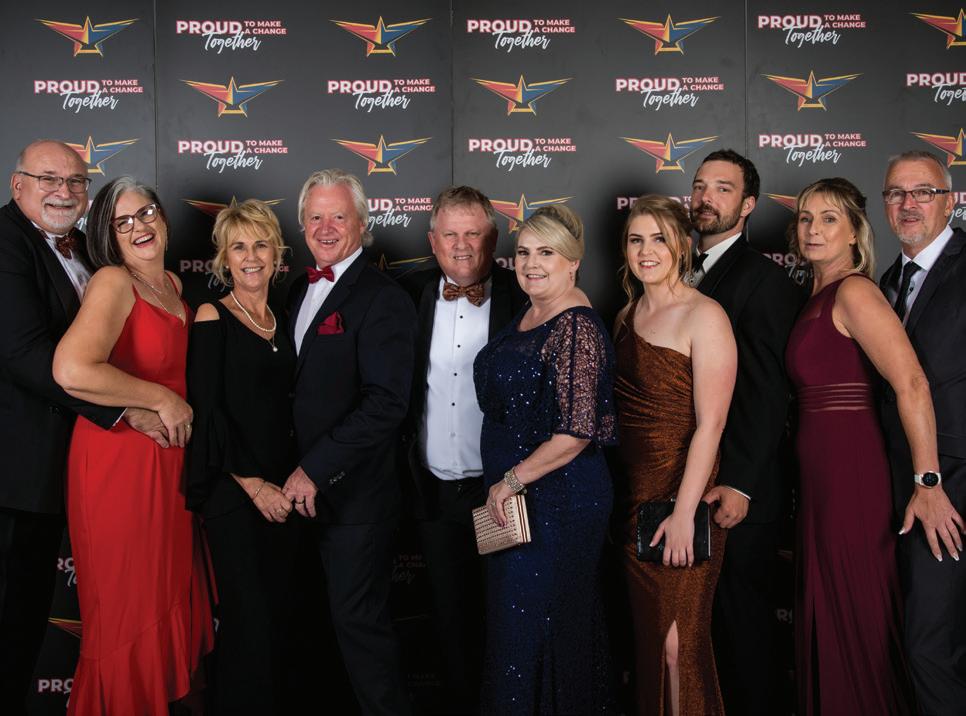
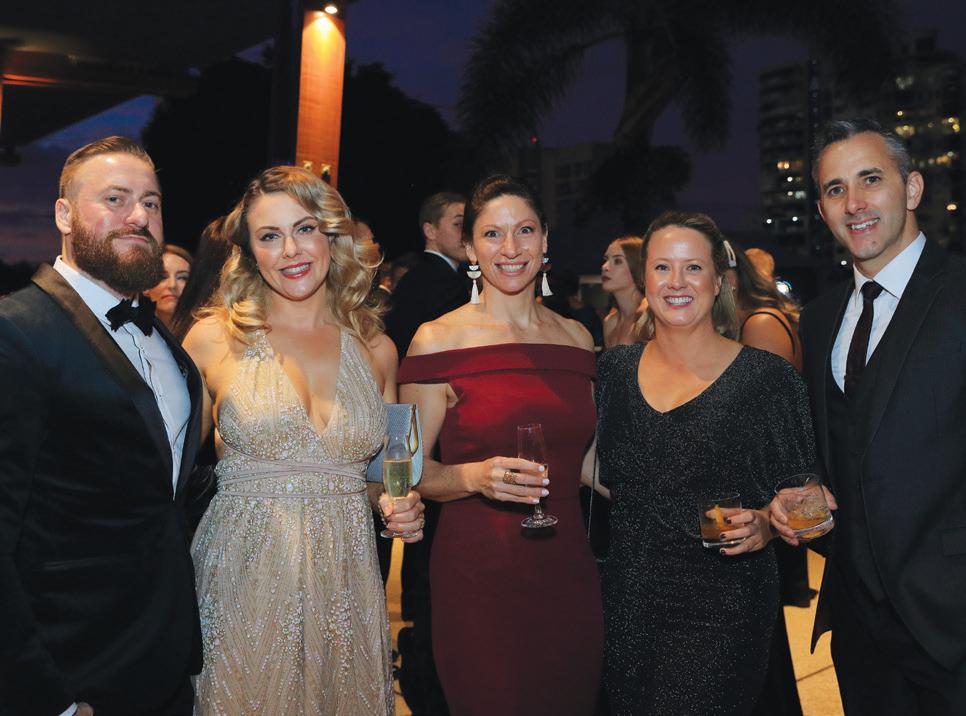
On August 7th the FNQ Emergency Services Association held its annual charity ball, and recorded an astronomical achievement, raising $63,800.
The colossal amount is almost double the result of their previous ball in 2019, a feat which clearly demonstrates the rapidly growing popularity of the event.

Association President John-Byron Bacalakis described the evening as “phenomenal” and thanked the Cairns community for their part in its success.
It’s amazing. Our previous biggest year was the $38,000 we gave to Street Level Youth Care, and obviously this is a substantially bigger figure. It just takes your breath away,”said John-Byron.
“The support from all of our major sponsors and the general support from the attendees on the night with all of the auction items and games was very generous.
“A large thank you to James Mousa, who sponsored the balloon pop. He actually won his share of the game back, but he chose to donate it on to the charity.”
Drew Brauer, co-founder of this year’s beneficiary charity Kick On, said he was blown away by the scaleof the donation.
“This is going to help Kick On so much. Kick On is still operating in an office out of my house, so this is going to move us to the next level where we can actually have a drop-in centre and a proper headquarters.
“This is going to be lifechanging for the whole charity and for the community in Cairns.”
Kick On was established in Cairns to promote positive mental health in Far North Queensland and right across Australia. John-Byron said the charity’s goals aligned well with the work done by members of the Emergency Services.
“Mental health is big in the community, especially with the onset of COVID,” he said.
“As frontline workers or Emergency Services personnel, we do come across the scenarios all the time with mental health issues, both externally and amongst our own peers.
“It’s something that does affect everyone, and even those in the community who appear to be the strongest are affected by it as well.”
It’s amazing. Our previous biggest year was the $38,000 we gave to Street Level Youth Care, and obviously [$63,800] is a substantially bigger figure. It just takes your breath away.”
John-Byron Bacalakis, President, FNQ Emergency Services Association

Mental Health is something that does affect everyone, and even those in the community who appear to be the strongest are affected by it as well.”
Drew Brauer, Co-founder, Kick On
Drew and the rest of the team at Kick On said they plan to put the money towards a host of school talks and events to open up discussions on mental health with some of the most vulnerable age groups.
And after such a successful 2021, the FNQ Emergency Services Association is already looking to make the event bigger and better in 2022.
“We’ve already had 300 event responses for next year,” said John-Byron. “We’re just a week out from the last event, and people are already keen to go to next year’s!
“It’s definitely an event everyone wants to attend, and without a doubt Cairns’ number one event.”
The next FNQ Emergency Services Association Charity Ball will take place on August 6th 2022. Follow us on Facebook to stay up to date on our movements.
Email admin@fnqesa.org.au to register your interest or find out how to sponsor next year’s Charity Ball.
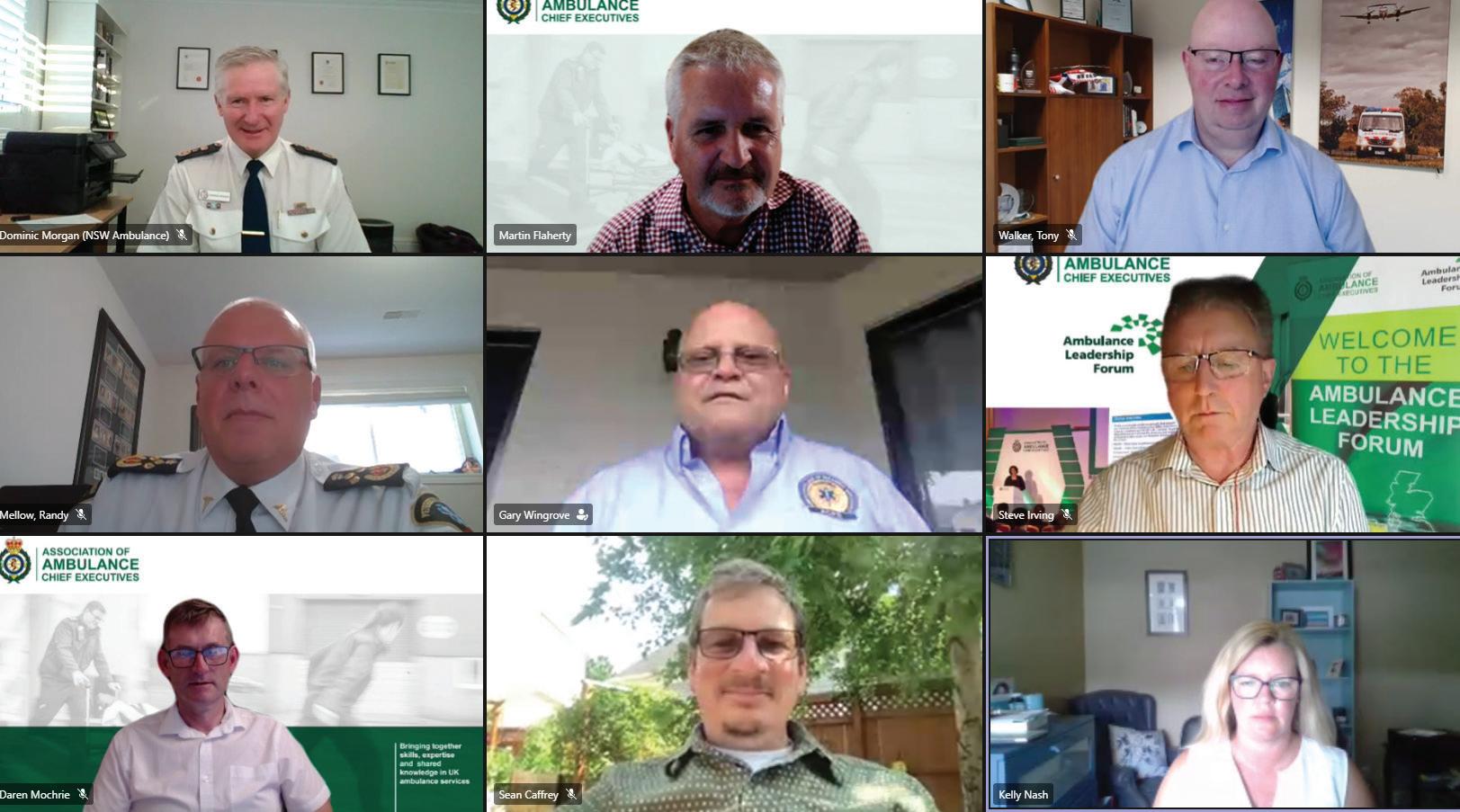
he Global Paramedic Leadership Alliance (GPLA) is a networking alliance of ambulance associations from Australia, New Zealand, the UK, America and Canada with commitment to sharing best practices and research across a wide range of topics impacting the ambulance sectors across the globe.
Members of the GPLA comprises of:
• chair of the International Roundtable on Community Paramedicine
• Association of Ambulance Chief Executives (UK & Ireland)
• Council of Ambulance Authorities (AUS/NZL/PNG)
• National EMS Management Association (USA)
• Paramedic Chiefs of Canada (CAN)
The GPLA’s purpose is to identify and act upon areas where there is perceived benefit in working together and sharing best practice internationally.
On September 1st Chairs and CEOs of GPLA members meet for a video meeting discussing the latest issues impacting ambulance services,
discussing among others the impacts of COVID-19 pandemic, demand management challenges and other. Present for the meeting were:
• David Waters, CEO Council of Ambulance Authorities
• Dominic Morgan, outgoing Chair Council of Ambulance Authorities and CEO NSW Ambulance Service
• Tony Walker, incoming Chair Council of Ambulance Authorities and CEO Ambulance Victoria
• Kelly Nash – ED Paramedic Chiefs of Canada PCC
• Randy Mellow - Past President PCC, Chief of Peterborough Country EMS
• Dale Weiss - President PCC, Executive Director Alberta Health Services
• Martin Flaherty – Managing Director of Association of Ambulance Chief Executives AACE UK
• Daren Mochrie – Chair of AACE & CEO of North West Ambulance Service
• Steve Irvine - Executive Officer, Association of Ambulance Chief Executives UK
• Gary Wingrove – President, The Paramedic Foundation USA
• Pat Songer - Executive Director, National EMS Management Association NEMSMA USA
• Sean Caffrey – President, NEMSMA & CEO/Commissioner Crested Butte Fire Protection District USA
FIRST had a chance to speak to GPLA members to understand what benefits do the Chairs of National/Regional Ambulance Association see from collaborating regularly with their international peers (fellow Chairs)?
The Paramedic Chiefs of Canada (PCC), led by its Board of Directors, empowers members and leaders to make changes nationally in the Paramedic profession. The PCC provides a platform for sharing of information and encourages changes to policy where possible.
‘Our membership is comprised of Paramedic leaders across Canada, including Chiefs, managers, and Paramedics coast to coast. The mission of the PCC is to advance and align Paramedic leadership across Canada. We are the national voice advocating for Paramedic Services in Canada. Collaboration with our global partners is critical to offering an international platform to share information and best practices. It also provides us the opportunity to share research and inform policy. The Global Paramedic Leadership Alliance is a unique forum that allows us to learn from our colleagues around the globe.’
‘Sometimes we all look at our services and the challenges we face as unique, however nothing could be further from the truth. Whilst the environments might be a bit different, in essence we are all facing the same challenges with increasing demand, changing workforce needs and the need to keep innovating to meet the needs of our changing communities. This is where regular collaboration with our international peers can help. It provides a great opportunity to learn from each other, explore different ways of thinking that we can adapt to solve some of the challenges our own organisations are facing and also benchmark our performance.’
The National EMS Management Association (NEMSMA) represents leaders of ambulance services across the United States. As a nation with over 18,000 EMS services it is important for NEMSMA to be a mechanism to connect leaders from across the country and across our diverse landscape of public, private and volunteer services.
‘ Relationships allow us to better understand the current state of paramedicine from a local, state and national context. As we continue to learn, our peers are often our best source of wisdom and advice on how we can run better organizations and provide better care for our communities.
Participation in the Global Paramedic Leadership Alliance (GPLA) allows NEMSMA to extend that leadership network to include colleagues from across the globe. While our context may be different, paramedicine at the end of the day is far more similar than different and our friends across national borders often afford us a level of insight that would be unavailable otherwise. As leaders of NEMSMA we are grateful for opportunities to interact with our colleagues from Australia, Canada, New Zealand the United Kingdom through the GPLA.’
Association of Ambulance Chief Executives (AACE) UK - Daren Mochrie
‘Whilst we experience many common operational challenges such as ever increasing demand, ‘ramping/handover’ delays and shift overruns, it is the leadership and cultural paradigms in each service that present most opportunities for shared learning. As we gain better understanding of leadership behaviours and perhaps back away from traditional ‘command & control’ models, it is helpful to share experiences. This links well with staff welfare programmes, psychological support for staff and even career options for long serving staff. Collaboration across jurisdictions promotes learning and whilst ideas or programmes may not be immediately transferable, the principles may well be. We always have a great deal to learn from colleagues across the globe and the GPLA provides the ideal forum for doing so.’
We wanted to learn from the Chairs what are the challenges/ opportunities facing your paramedic workforce or ambulance }sector that your National Ambulance Association would like to collaborate on globally?
Paramedic Services have experienced challenges since the onset of the COVID-19 Pandemic. Paramedics have proven to nimble, and this has never been more apparent in the last 16 months. Increasing call volumes, offload delays and impacts to maintaining staff have all posed hurdles for Paramedic Services. Paramedic mental health and wellness will continue to be a top priority for our association, and we continue to work with the Canadian Institute for Public Research Safety and Treatment (CIPSRT) to assist in the well-being of our Paramedics. Part of the Government of Canada’s National Action Plan on Posttraumatic Stress Injuries, PSPNET is offering and evaluating Internet-delivered cognitive behaviour therapy, also known as ICBT, specifically tailored for current and former Public Safety Personnel (PSP), including border security agents, correctional workers, call centre operators/dispatchers, firefighters, paramedics, and police.
Violence to Paramedics is a top priority for the PCC, and we know that we can only benefit from sharing information with our international colleagues. We will soon be embarking on a national research study to develop understanding by describing the experience of violence experienced by paramedics, as well as the physical and psychological consequences; attempt to understand what training is currently implemented, frequency with which it is implemented, and perceived efficiency of that training. Global participation on this issue can only benefit the profession.’
‘Right now, the COVID-19 pandemic is front of mind and learning from each other’s responses is invaluable. In addition understanding new and innovative models of care to meet increasing demand and support the health system can also assist us as we collectively deal with this challenge internationally would also be very helpful.
The opportunities for collaboration are immense and the CAA is always keen to share our latest initiatives and learn from others. We have a number of strategies that we are focusing on including Sustainability Strategy, Patient Safety and Quality improvement strategy, work on Stoke capable ambulnaces and other.’
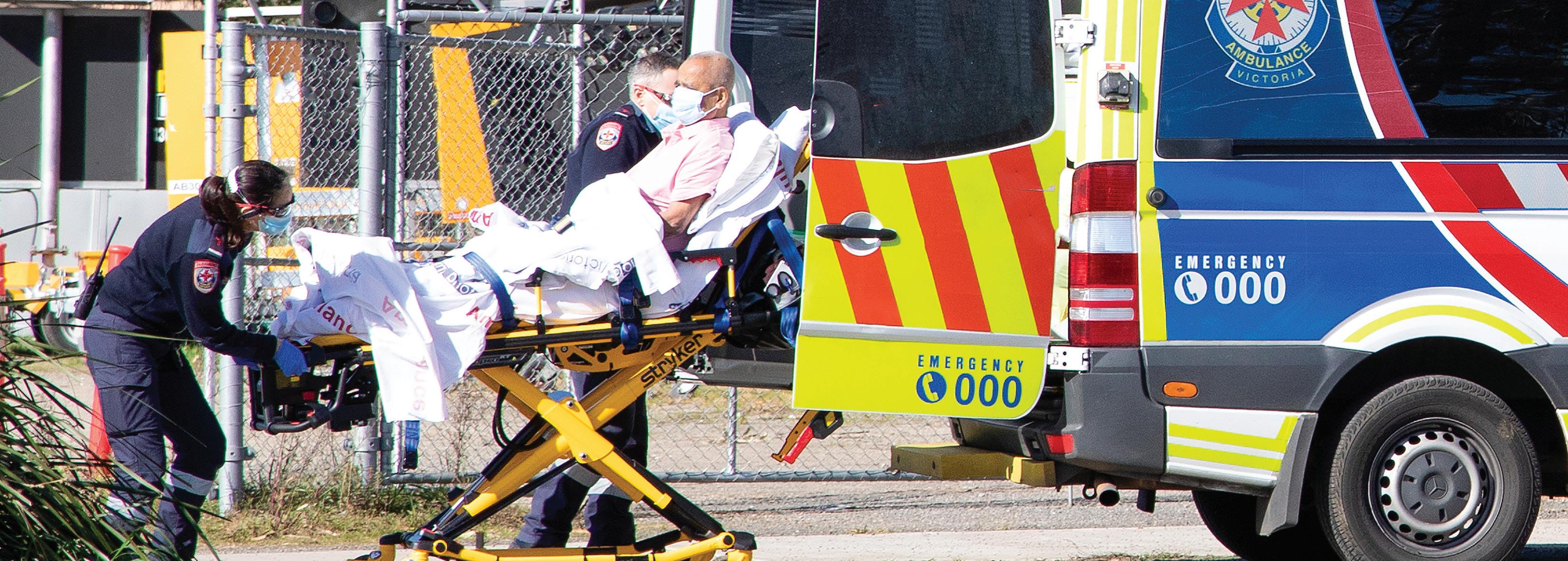
The paramedic workforce in the United States has been significantly challenged since the COVID-19 pandemic came to our shores in March of 2020. As a mostly technical workforce, American EMTs and paramedics have historically received lower pay than their colleagues in other health professions.
Having served on the front line during the pandemic our workforce has experienced significant personal risk, increased work and family stress, and ongoing demands to serve our patients and our communities in a new ways. The pandemic has further exposed ongoing structural and sustainability issues in many of our systems that will likely lead to significant fallout within our workforce.
Understanding the variation in the professional development of paramedics across the GPLA membership, we look forward to learning from our colleagues how to better prepare, professionalize and maintain a strong, respected and resilient workforce moving forward.’
‘Our biggest challenge in the UK is without doubt the ever-increasing demand for our services coupled with historic underfunding to meet that need. The pandemic has impacted on this significantly due to the challenges it created in terms of maintaining staffing levels and its impact on the health and wellbeing of our staff. In addition the pandemic prevented access to routine NHS care for many patients for some 18 months and this has led to a backlog of patients who should have been seen, assessed and treated much earlier which also drives increased demand and acuity.
Handover/Ramping delays are also a massive concern at present and are at an all-time high. AACE is working with the wider NHS to understand the hidden harm that is being caused to patients waiting in the back of ambulances and also to those waiting for an ambulance response in the community and this is an area where global collaboration particularly focused on proven solutions would be very helpful.
We are also keen to collaborate on how best to manage lower acuity calls by safely delivering solutions that avoid the need for an ambulance response and reduce pressure on busy Emergency Departments.
We are working hard on improving the health and wellbeing of our staff at this critical time and this is an area where global collaboration can also be extremely useful.
We are working closely with the wider NHS to help define the role of ambulance services in the provision of integrated urgent and emergency care. Global comparisons here would be very helpful.’
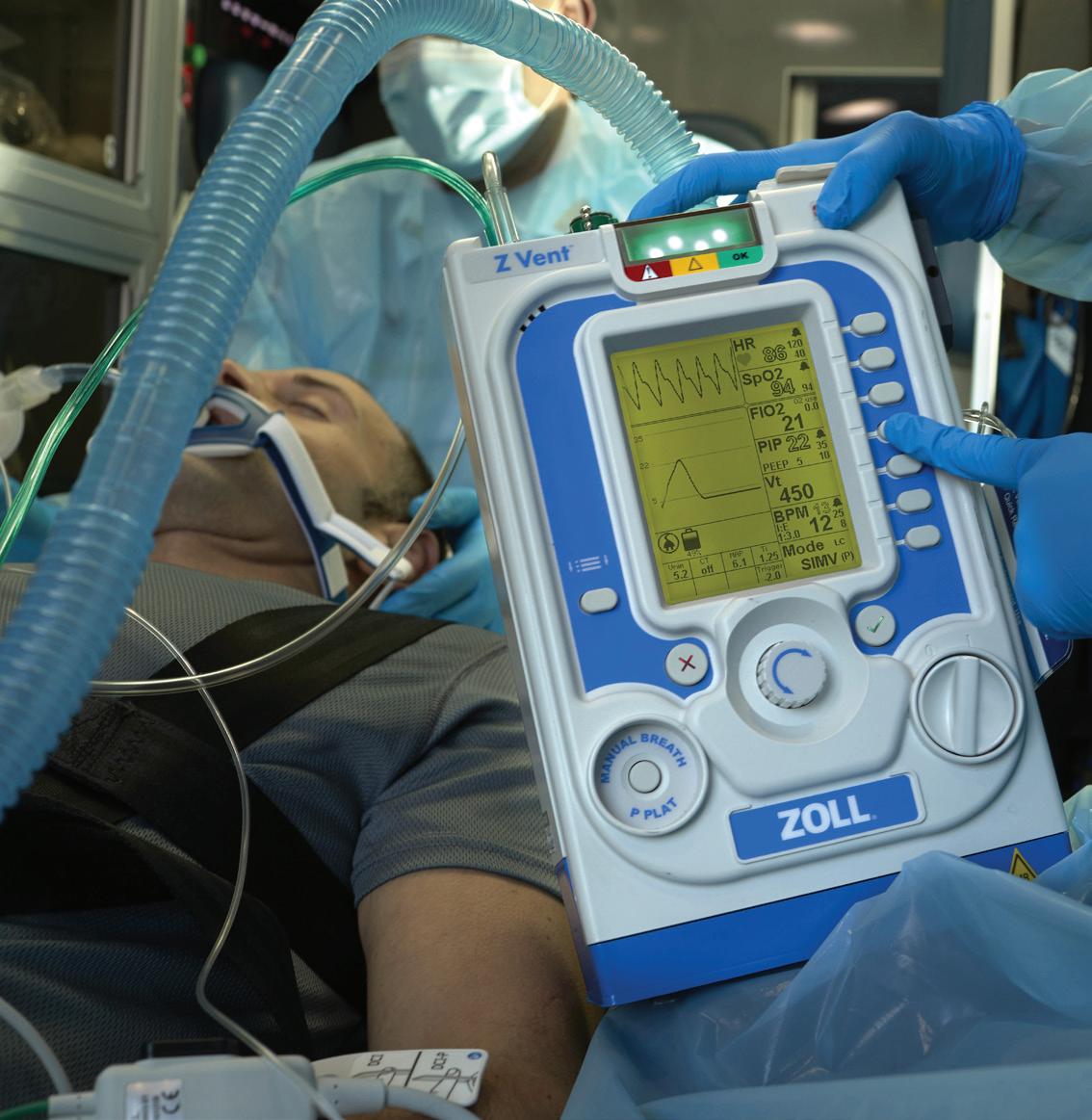
• Easy to us e – Sm ar t Hel p wit h al ar m resolutio n
™ assist s
• P o r tabl e – lig ht and easy to car r y
• D urabl e – designe d to surpas s mil ita r y standard s
Protect patients and providers during treatment
The Z Vent is designed to be used in environments where infectious agents are present, helping protect patients as well as healthcare providers and preventing contamination of the device itself.
Z Vent ® is the ideal transport ventilator designed for pre-hospital and inter-hospital use: For more information, call 1800 605 555 or email: info.aus@zoll.com
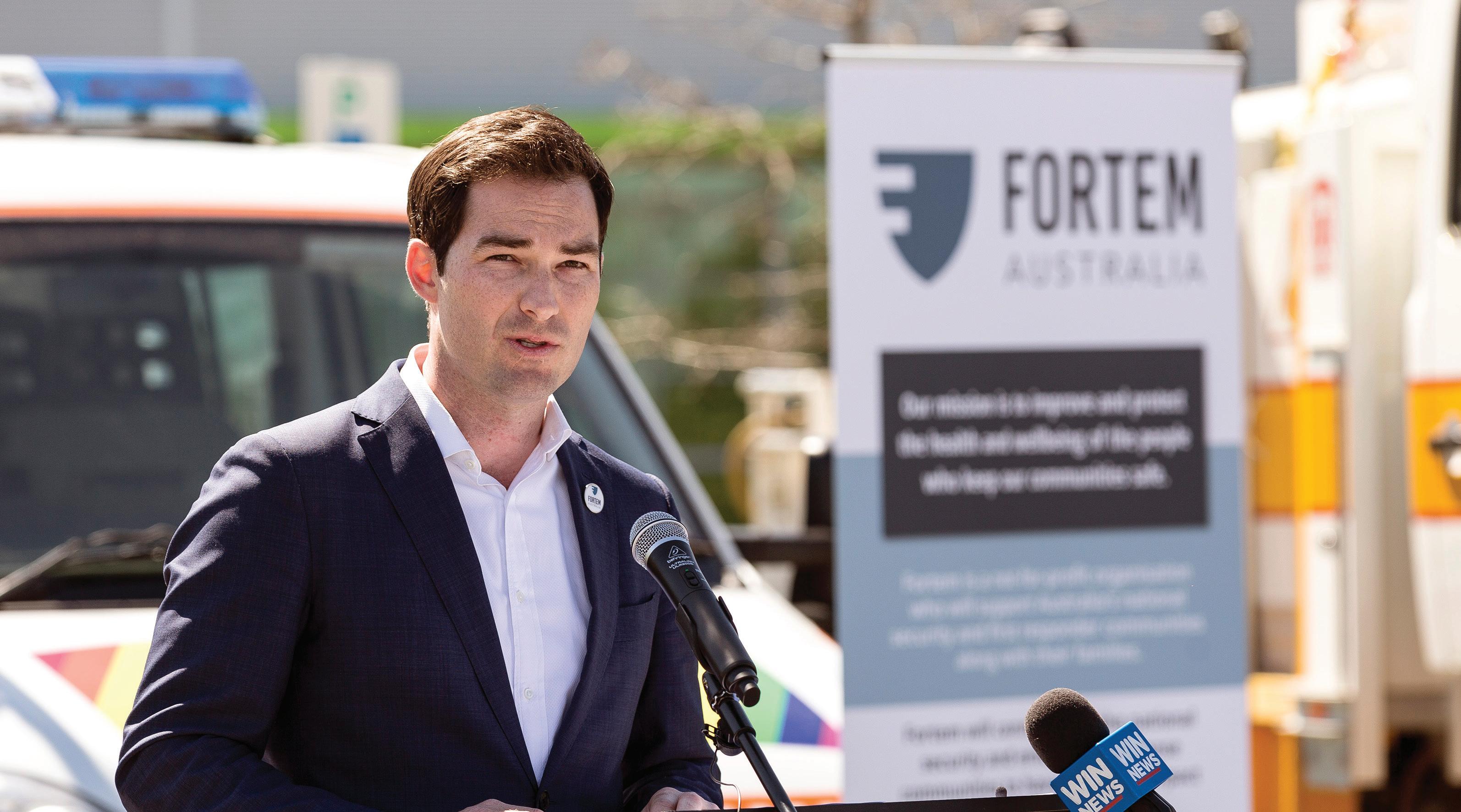
Every day, more than 300,000 first responders across the country keep our communities safe. Fortem Australia is a not-for-profit organisation supporting the mental health and wellbeing of first responders and their families.
“First responders are involved in some pretty horrendous stuff and we as a community don’t really appreciate that fully,” says John Bale, Managing Director of Fortem Australia.
“We know that more than half of all emergency responders are deeply impacted by the traumas they face in the course of their duties.
“The COVID-19 pandemic and recent natural disasters compound their trauma exposure.
“This is especially true not only for first responders themselves, but for the people in their inner circles – who help to carry the load and are often vicariously affected by the trauma of their loved ones’ experiences on duty.
“That is why Fortem is on the ground, in this communities wanting to help.”
Fortem, meaning ‘brave’ in Latin, is government funded and offers free, independent services to eligible first responders and their families, including:
• Wellbeing activities
• Online mental fitness tools and resources
• Clinical support – face to face and via telehealth
• Transition and employment services for those leaving their first responder role.
Fortem is an official partner of The Royal Melbourne Hospital’s 5 Ways To Wellbeing. These strategies are integrated into all activities and services, offering a wholistic approach that empowers first responder families to incorporate simple, lifestyle steps that build mental fitness.
“First responders face repeated, often daily exposure to serious accidents, crime, homicides, completed suicides, physical aggression and natural disasters, and they do that in the name of service to their community,” Mr Bale says.
“That’s a lot to carry and it takes a toll, I am proud of the work Fortem is doing to support these important people.”
To learn more, head to fortemaustralia.org.au, or call the team on 1300 33 95 94.
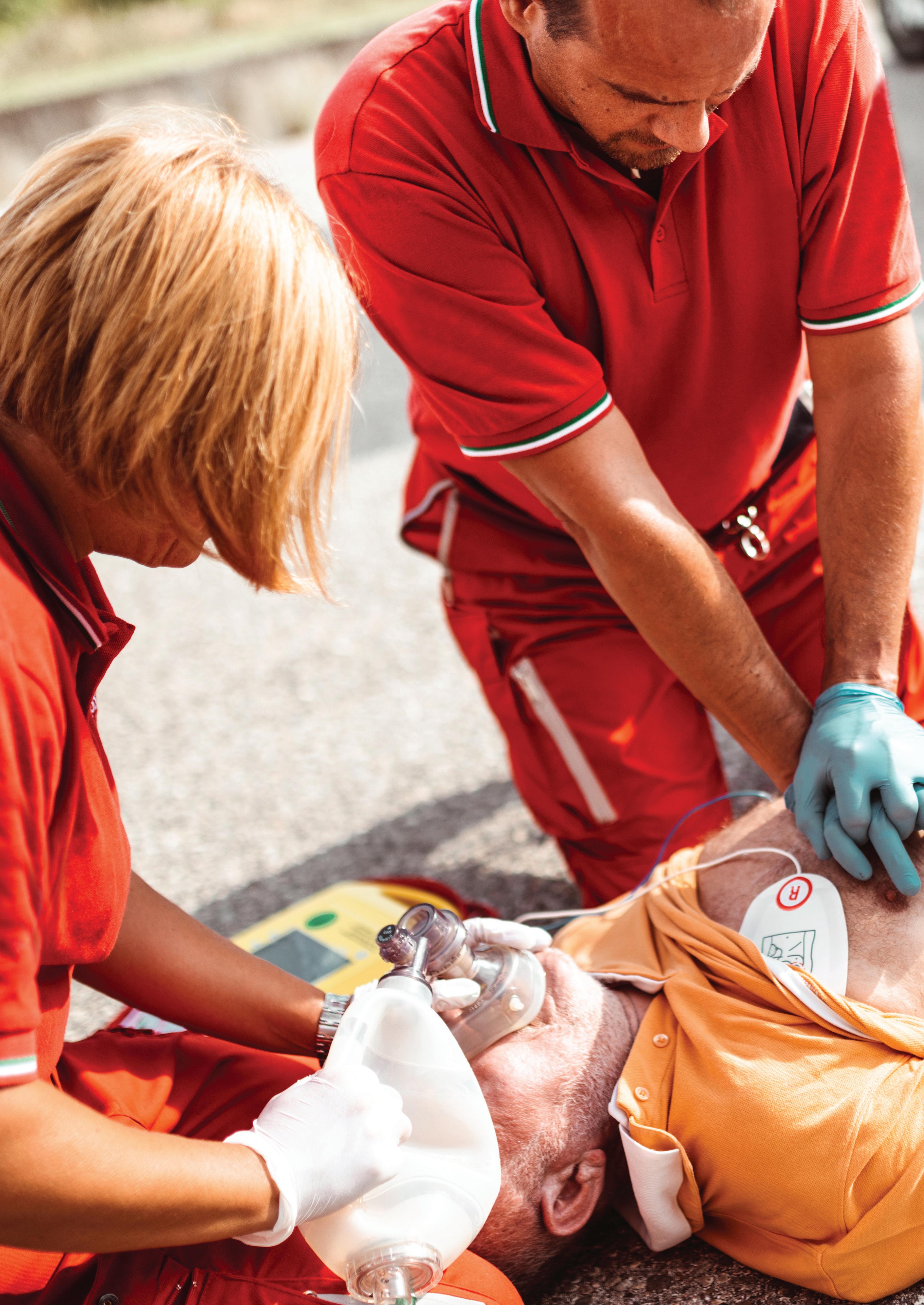
Bystander CPR, does the relationship to the patient or prior medical training impact on survival to hospital discharge?
By Brian Haskins
TThis is a summary of the first research study completed by Brian Haskins as part of his PhD titled ‘The importance of bystander intervention for out-of-hospital cardiac arrest in Victoria, Australia’.
In this study we investigated if the relationship to the patient of the person providing bystander CPR or their prior medical training impacted on survival to hospital discharge. Data for this research was obtained from the Victoria Ambulance Cardiac Arrest Registry (VACAR) which is one of the leading cardiac arrest registries’ in the world. Non-traumatic out-of-hospital cardiac arrests (OHCA) receiving bystander CPR and EMS attempted resuscitation between 2015 and 2017 were included.
Of the 4,464 cases included 53% of bystanders providing CPR were related to the patient, 11% were friends or colleagues of the patient, and 36% were strangers to the patient. Cases who received bystander CPR from a relative were more likely to have occurred at home and less likely to have received public access defibrillation (PAD). Laypersons provided bystander CPR in 83% of cases, with only 17% receiving bystander CPR from a medically trained professional. A greater number of cases receiving layperson bystander CPR occurred at home and presented in a shockable rhythm, however, fewer received PAD compared to those receiving medical bystander CPR.
A multivariate logistic regression model was used to adjust for other variables that influence survival to hospital discharge. We found that for related versus unrelated bystander CPR providers there was no difference in the risk-adjusted odds of survival to hospital discharge. For medical bystander CPR providers, we found a 73% increase in the risk-adjusted odds of survival to hospital discharge for cases presenting in an initial shockable rhythm, when compared to those receiving layperson bystander CPR.
Non-traumatic OHCA with bystander CPR and EMS resuscitation from 1 January, 2015 to 31 December, 2017. OHCA, out-of-hospital cardiac arrest; CPR, cardiopulmonary resuscitation; EMS, emergency medical services.
from 1 January, 2015 to 31 December,
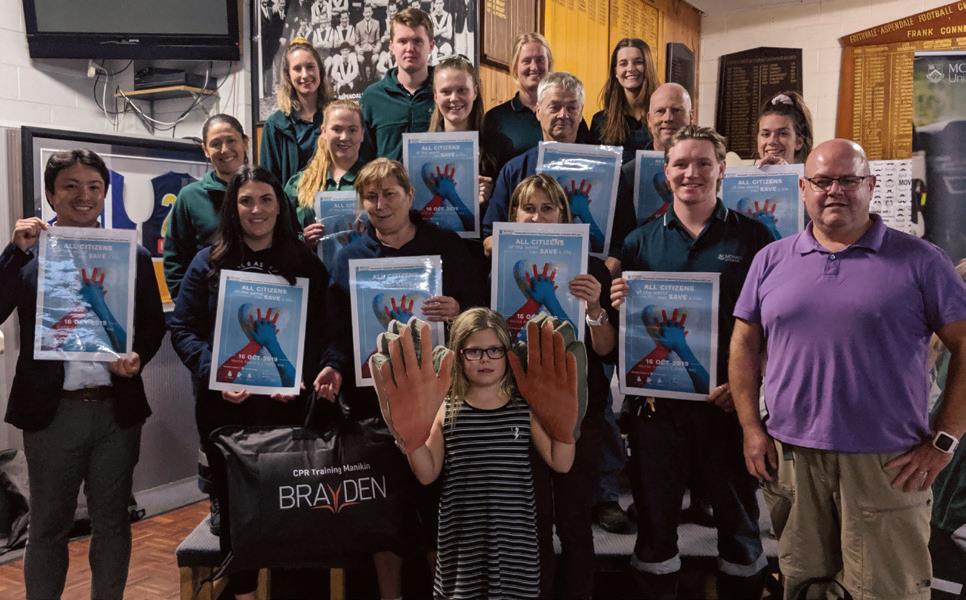
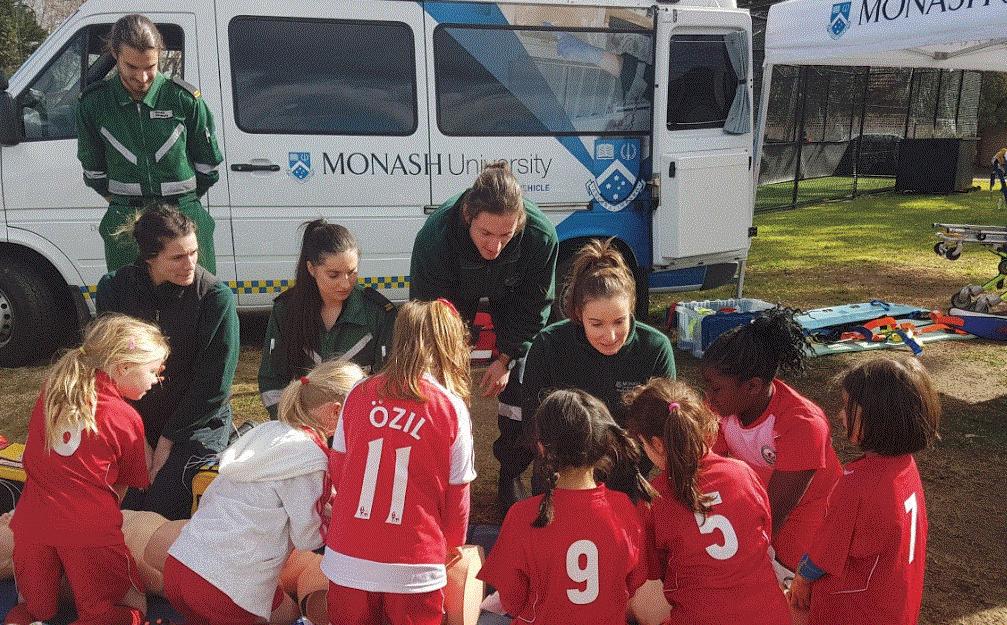
Popula,on of the State of Victoria n=6,500,000
OHCA in Victoria 2015-2017 aQended by EMS n=15,703
Excluded
Eligible OHCA n=4,518
Excluded
OHCA included in analysis n=4,464
Related to pa,ent n=2,385
Trauma,c OHCA n=776
EMS witnessed OHCA n=1,339
No bystander CPR n=8,220
No EMS resuscita,on n=850
Bystander data unavailable n=54
Layperson bystander CPR n=3,703
Medical bystander CPR n=761
Colleague or friend of pa,ent n=468
Stranger to pa,ent n=1,611
OHCA, out-of-hospital cardiac arrest; CPR, cardiopulmonary resuscita,on; EMS, emergency medical services.
OHCA, out-of-hospital cardiac arrest; CPR, cardiopulmonary resuscitation; EMS, emergency medical services.
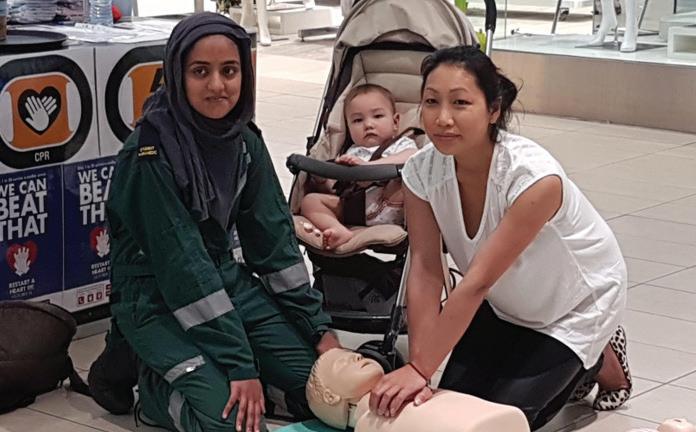
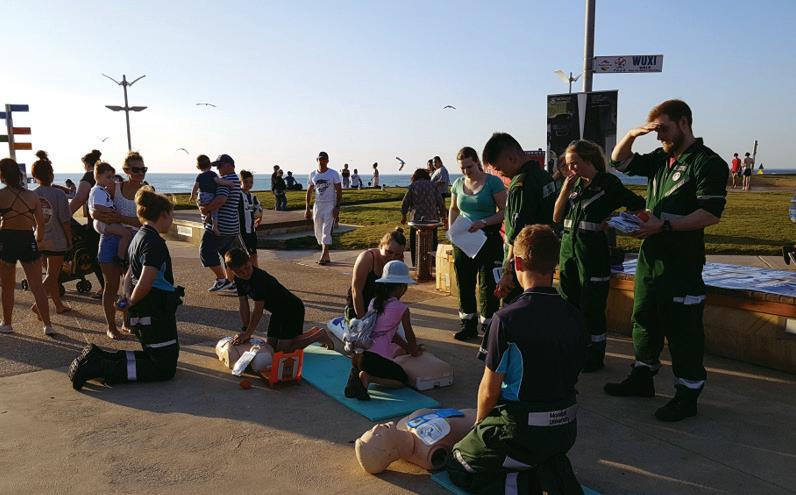
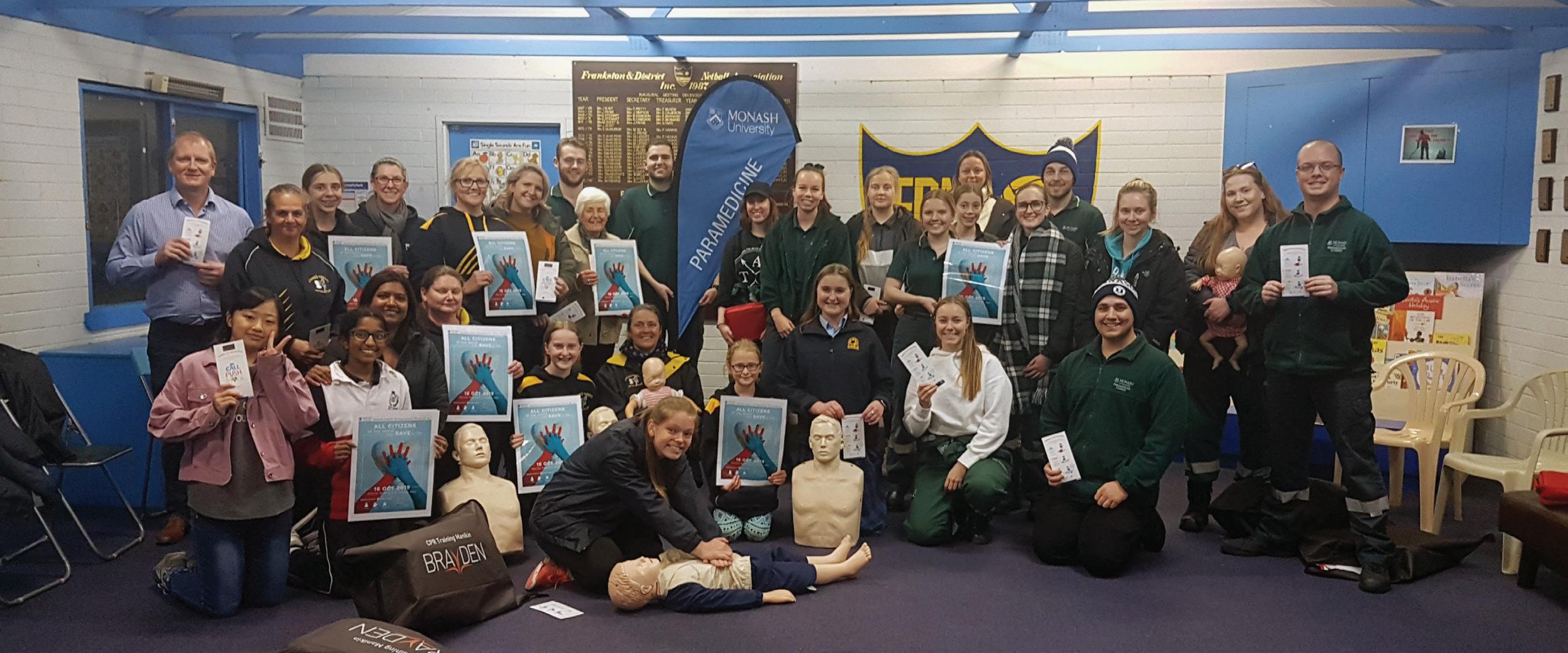
However, when we included PAD as a variable, the effect of medical bystander CPR in initial shockable arrests was significantly reduced. This suggests that the increase in survival associated with medically trained bystanders was partly related to their increased use of PAD. It is therefore likely that a similar effect on survival outcomes could be achieved by laypersons providing high quality bystander CPR and early defibrillation using a PAD.
To increase survival from witnessed OHCA, we must ensure that early bystander CPR and PAD is available quickly. We can increase the probability of immediate bystander CPR for OHCA by introducing bystander CPR training into school curricula, hosting Restart-a-Heart CPR community training events, establishing heart safe communities and ensuring telephone assisted CPR instructions are provided. As 80% of OHCA occur in the home, new strategies to increase the defibrillation rates for these cases need to be considered, such as locating more PADs in residential locations, and equipping volunteer first responders dispatched by smartphone applications with defibrillators.
Article details - Haskins B, Smith K, Cameron P, Bernard S, Nehme Z, Murphy-Smith J, et al. The impact of bystander relation and medical training on out-ofhospital cardiac arrest outcomes. Resuscitation. 2020.
Brian Haskins PhD Scholar
Medical training of bystander n=4464
Relationship to patient n=4464
Brian is a PhD Scholar researching ‘The importance of bystander intervention for out of hospital cardiac arrest in Victoria, Australia’.
He is supported by a PhD scholarship from the Centre of Research Excellence in Pre-hospital Emergency Care Australia and New Zealand (PEC-ANZ), in the School of Public Health and Preventive Medicine at Monash University. He is a lecturer and the director of the Pre-Hospital Trauma Life Support (PHTLS) Program with the Monash Department of Paramedicine. He has over 20 years experience as an advanced paramedic, academic and manager in healthcare organisations and universities in Australia, the United Arab Emirates (UAE), the USA and Ireland.
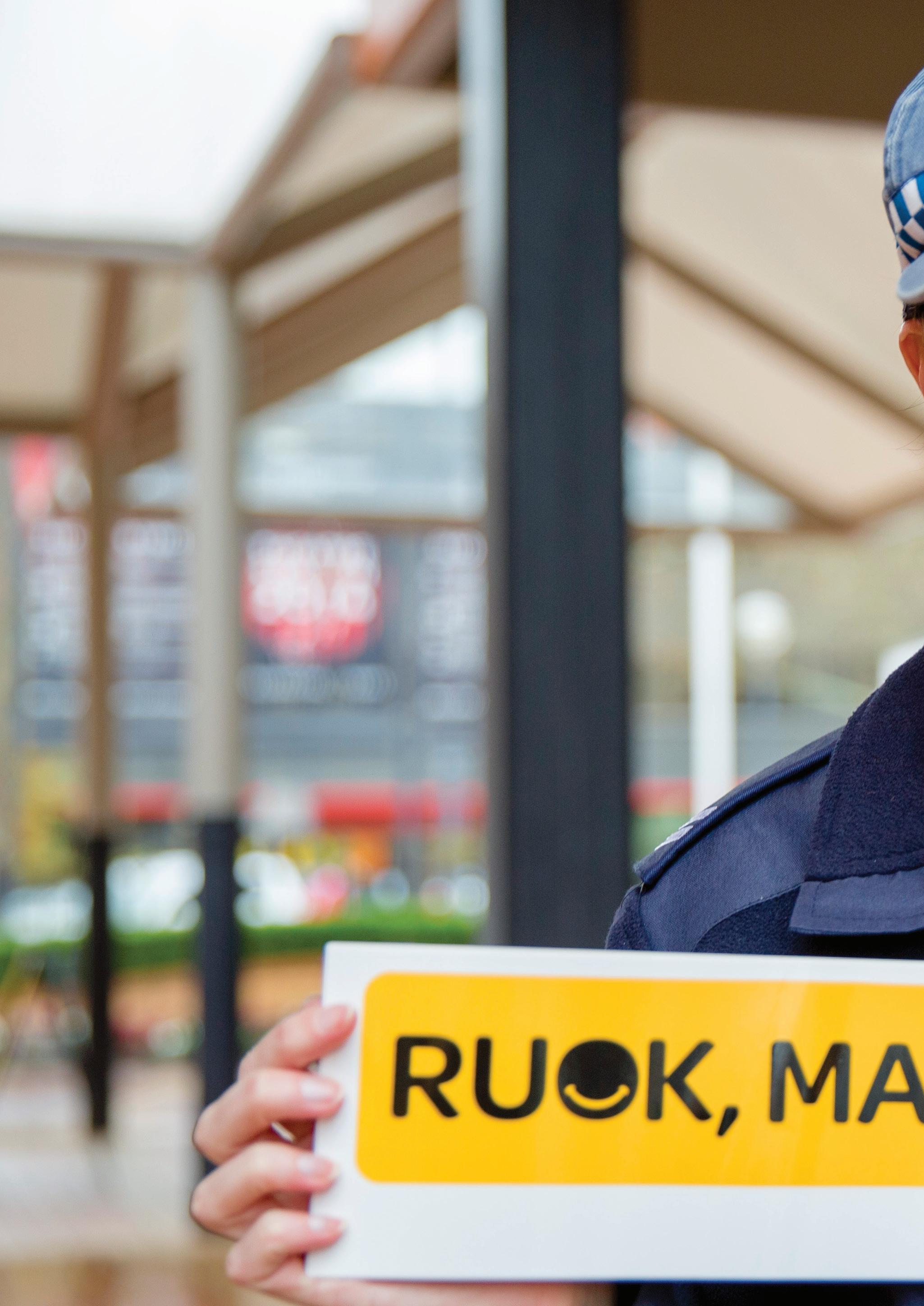
The R U OK? ‘Are they Triple OK?’ campaign encourages higher levels of support from peers, family and friends for current and former emergency services workers and volunteers across Australia.
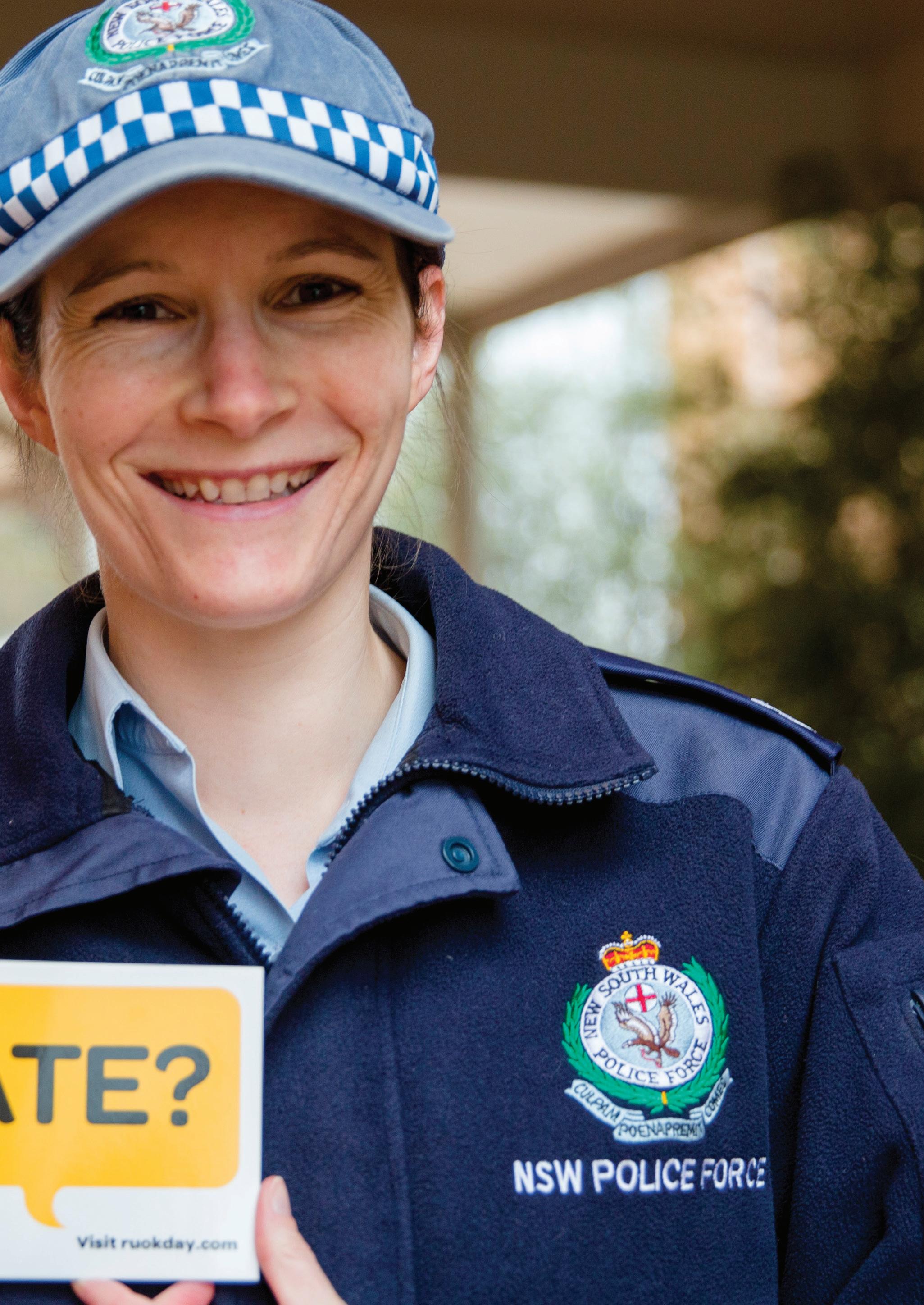
How conversations can make a difference
Family, friends and colleagues are often the first to notice when someone they care about is struggling. The best thing you can do is ask, “Are you OK?”
Even the most resilient police and emergency services personnel can be affected by stress and trauma related to their work, as well as other life challenges. However, employees and volunteers who reported strong social support mechanisms, maintaining healthy levels of physical activity, and obtaining regular good sleep, had higher levels of wellbeing.
Doing something is always better than doing nothing and being prepared to have a meaningful conversation with a colleague, family member or friend who may be struggling is a way you can help them feel supported when they’re confronted with challenges at work and in life. Giving someone a lot of time and space might not help them work through their difficulties.
The signs it might be time to start a conversation
Changes in how someone is thinking, feeling and behaving could be a sign someone is experiencing a mental health or wellbeing issue.
If you’ve noticed a change, no matter how small, trust your gut instinct and ask R U OK?
ready to ask
• Do you understand that your role is to listen and that you may not be able to solve their problems?
• Decide what you would like to say ahead of time – you might like to write down a few key points
• Determine how you will have the conversation – It might be more comfortable for the person to be side-by-side with you e.g. walking together or driving rather than face to face
• Ideally try and put aside at least 30 minutes so the conversation isn’t rushed
• Try to have the conversation when you are both calm, free from immediate pressures and when you are able to focus on listening and being supportive.
Managing emotional reactions during a conversation
Sometimes an R U OK? conversation can bring on strong emotions. If this happens there are some things you can do to minimise any awkwardness and ease the pressure:
• Allow the person to fully express their emotions (i.e. let off steam) and show your support by actively listening to all they say
• Give space to their emotions; you can discuss issues more rationally once emotions are calmed
• Being a good listener is one of the best things you can do for someone when they’re distressed Manage your own emotions by staying calm and not taking things personally.
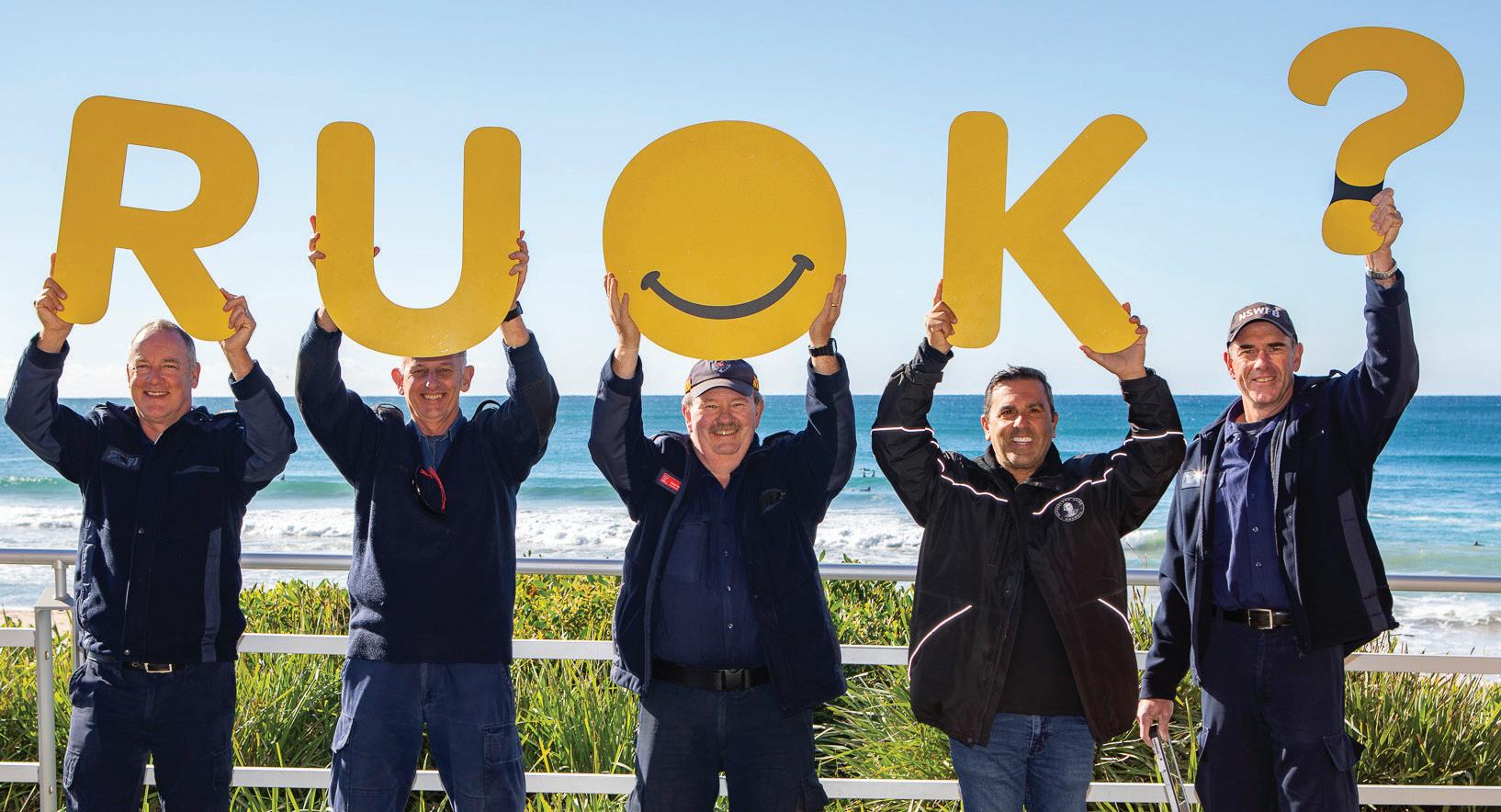

Police and emergency services personnel have higher rates of psychological distress, higher rates of diagnosis of mental health conditions, and higher rates of suicidal thinking and planning than the general adult population in Australia.
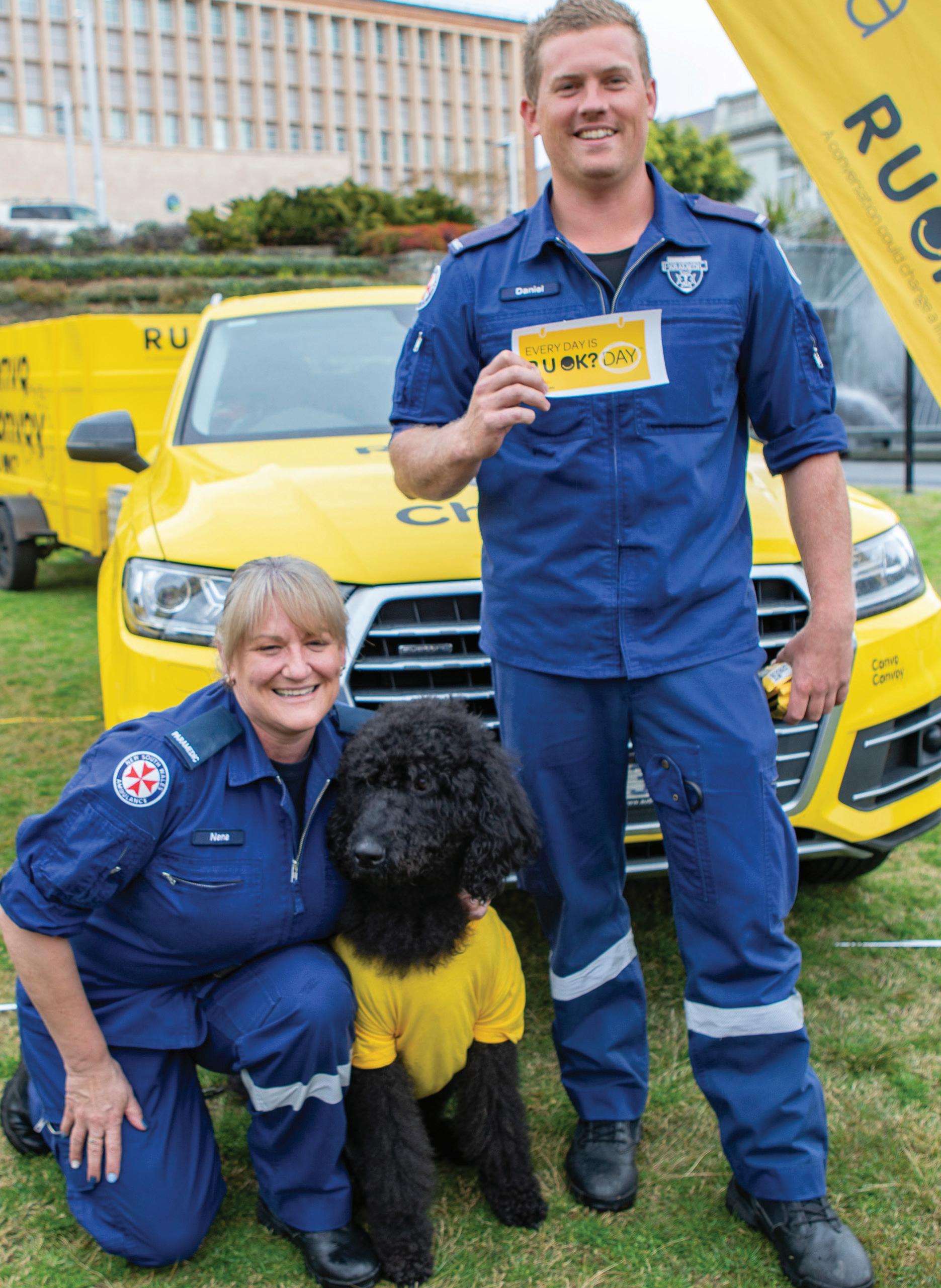
1. Ask R U OK?
• Be relaxed
• Help them open up by asking questions like “How are things going at work?” or “I’ve noticed that you’re not quite yourself lately. Is there anything on your mind that I can help you with?”
• Make an observation.
• Mention specific things you’re concerned about, like “I’ve noticed that you seem really tired lately” or “You seem easily frustrated at the moment. How are you going?”
• Let them know you are having the conversation because you care about them and their wellbeing.
2. Listen with an open mind
• Take what they say seriously and validate their experience. For example, “That must have been a really upsetting job to go to”
• Keep the focus on them
• Don’t interrupt or rush the conversation
• If they need time to think, try and sit patiently with the silence and don’t jump in with your solutions
• Encourage them to explain: – “Have you been feeling this way for a while?” – “So, what was that like?” – “That’s tough. Keep talking, I’m listening.”
• If they get angry or upset, stay calm and don’t take it personally.
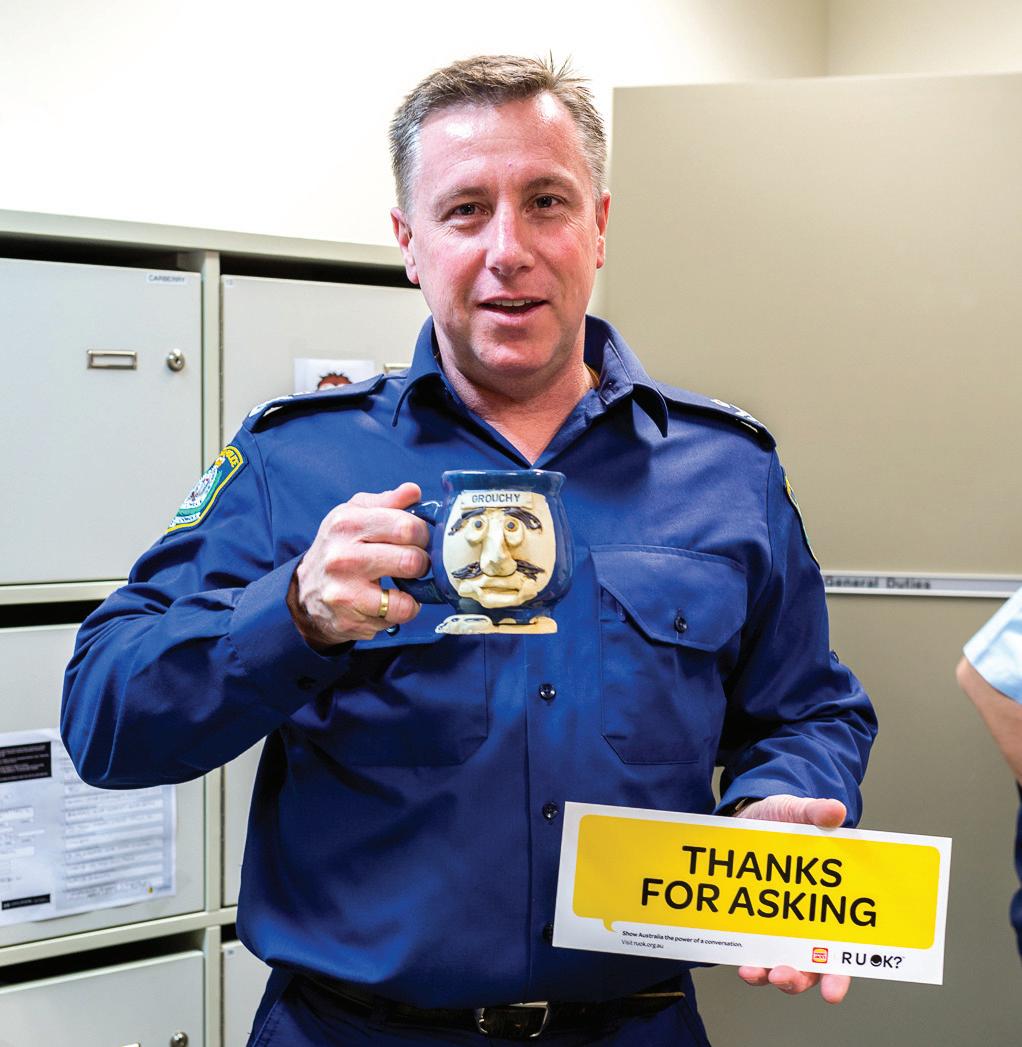
3. Encourage action
• Once they’ve opened up, encourage them to access support or to do something that might lighten the load
• Ask: “Where do you think we can go from here?”
• Ask: “What would be a good first step we can take?”
• Ask: “What do you need from me? How can I help you right now?”
• Ask: “Has anything or anyone helped in the past?”
• Suggest they do something they know helps them relax or brings them joy e.g. go for a walk, see a movie, have a bath, go for a swim, spend time with friends or family etc.
• Some good options for formal or informal action include talking to another family member or trusted friend, their GP, an external professional support service, the Employee Assistance Program or another appropriate support service within their agency such as a peer support program
• Some people might be hesitant to seek professional support if they’ve tried that before and haven’t had a positive experience. It might be helpful to mention that finding a professional suited to their needs and who is the right ‘fit’ might take some time.
4. Check in
• Remember to check in again a few days later, or sooner if you think you need to, and see how they’re doing
• If they haven’t done anything, keep encouraging them and remind them you’re always there if they need a chat
• Understand that sometimes it can take a long time for someone to be ready to see a professional
• Reinforce the benefits of seeking professional help and trying different avenues for support
• You could ask, “Do you think it would be useful if we looked into finding some professional help or other support together?”
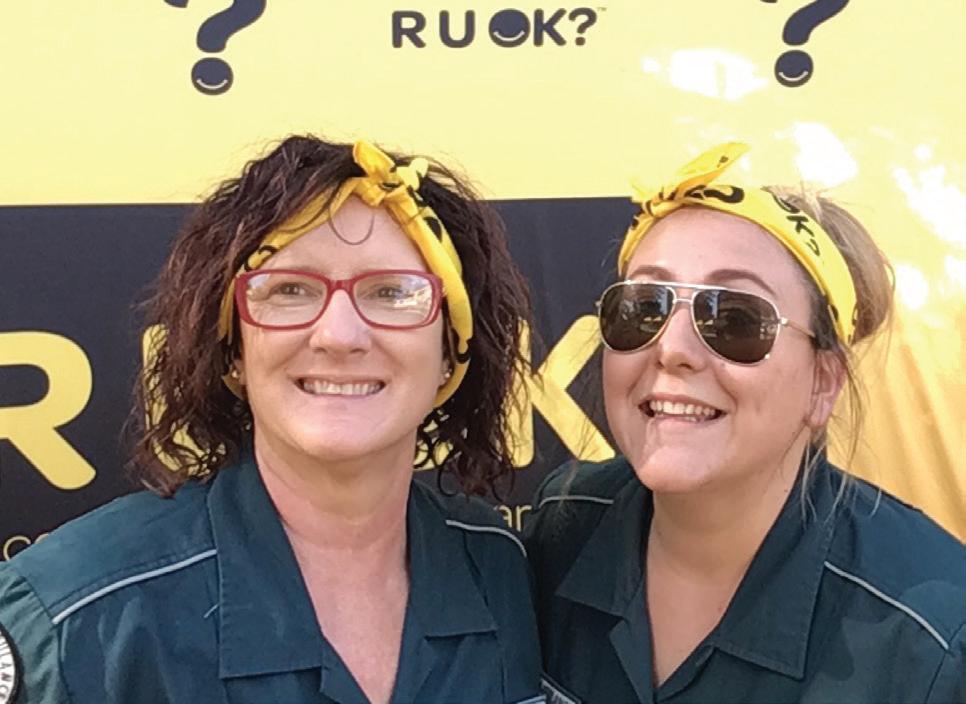
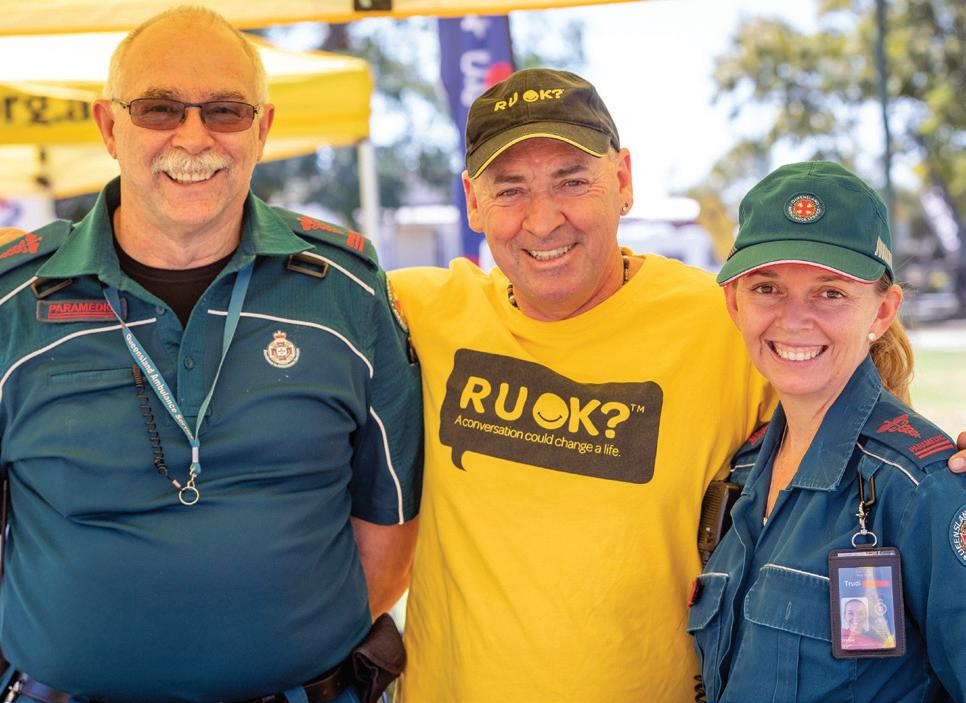
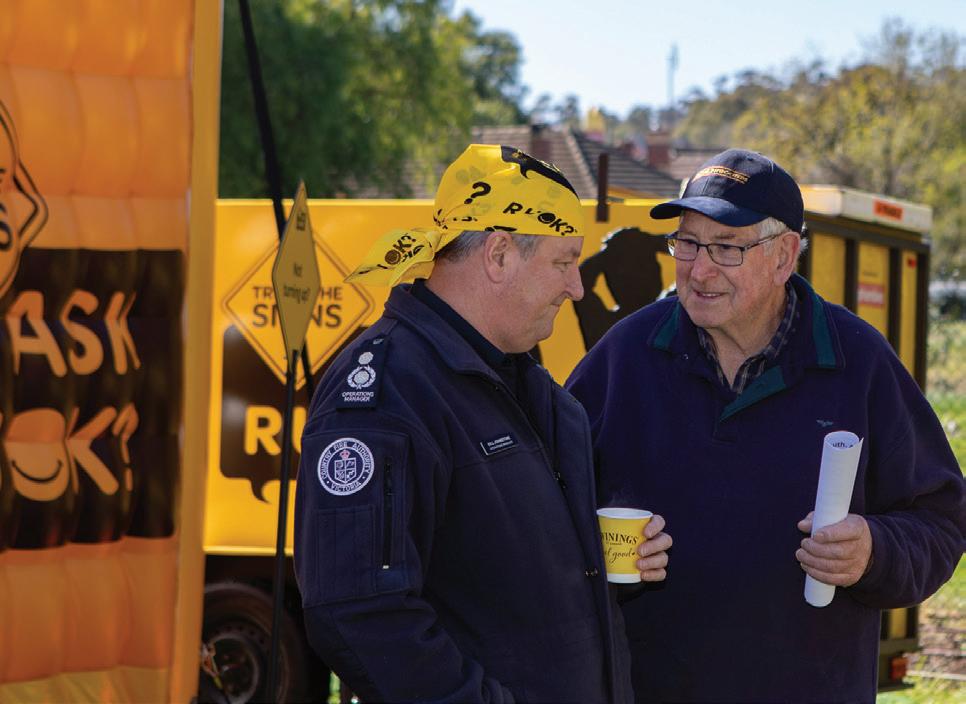
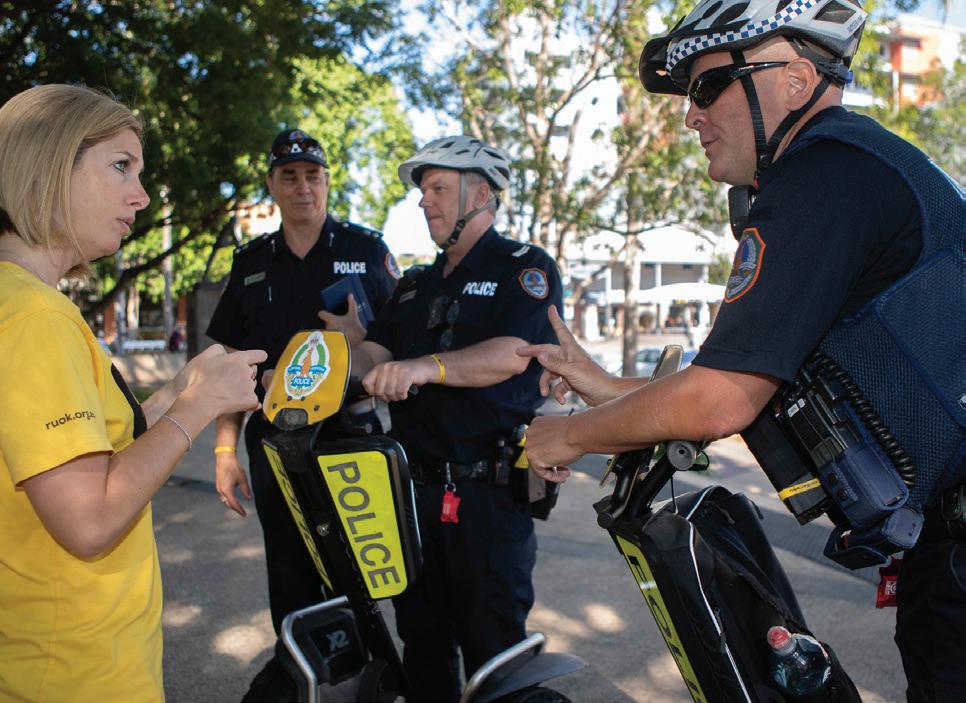
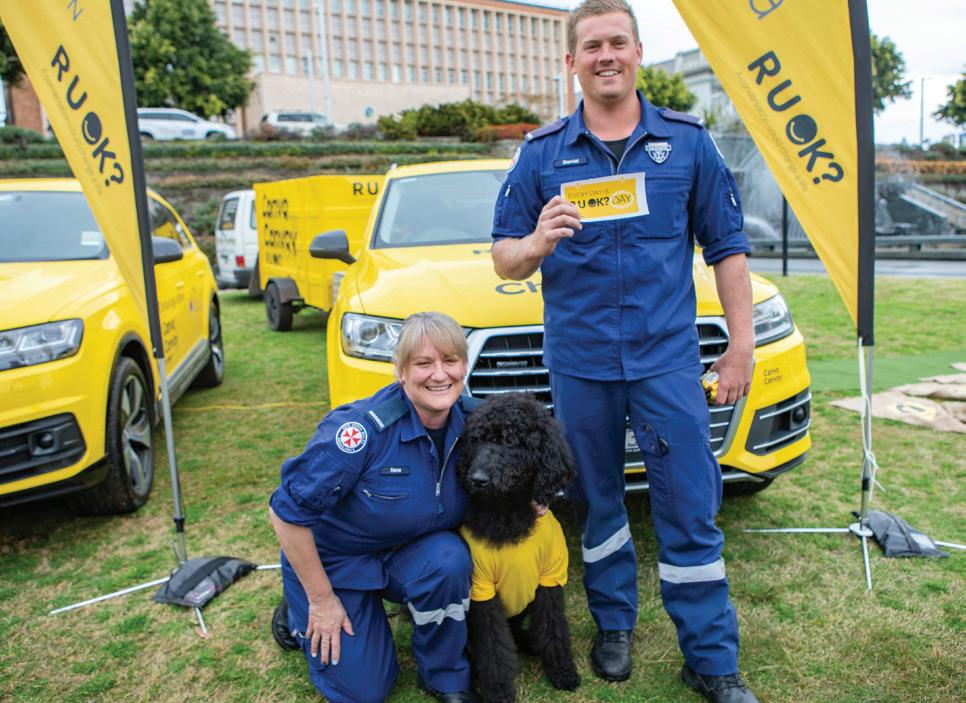
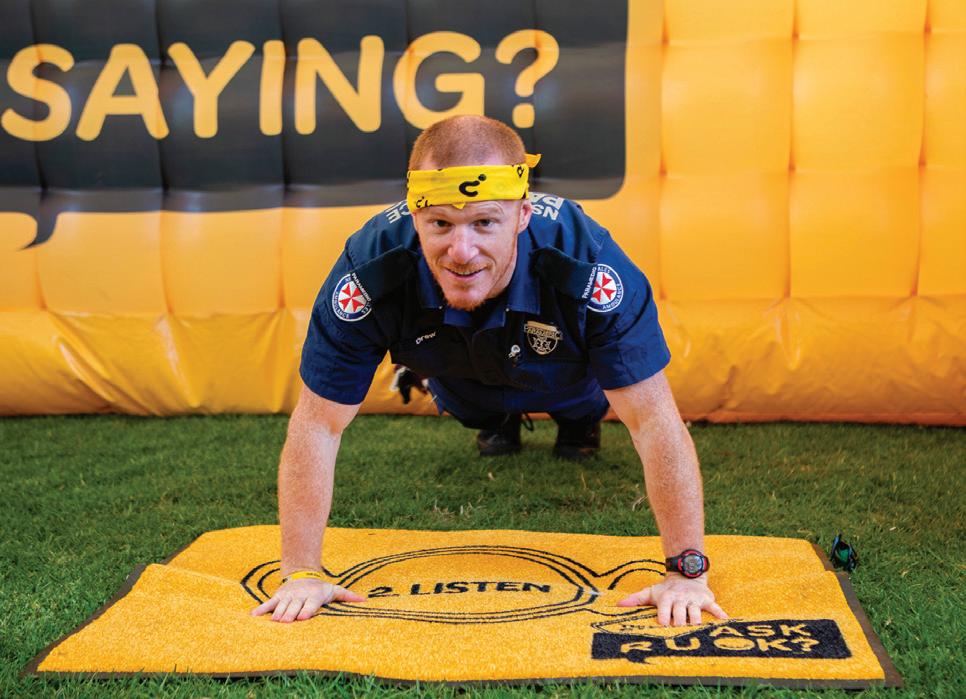
Encourage them to call on these Australian crisis lines and professionals:
• Beyond Blue (24/7) 1300 224 636 beyondblue.org.au
• Lifeline (24/7) 13 11 14 lifeline.org.au
• Suicide Call Back Service (24/7) 1300 659 467 suicidecallbackservice.org.au
• SANE Australia 1800 18 SANE (7263) sane.org
• Mensline (24/7) 1300 78 99 78 mensline.org.au
• More contacts: ruok.org.au/findhelp
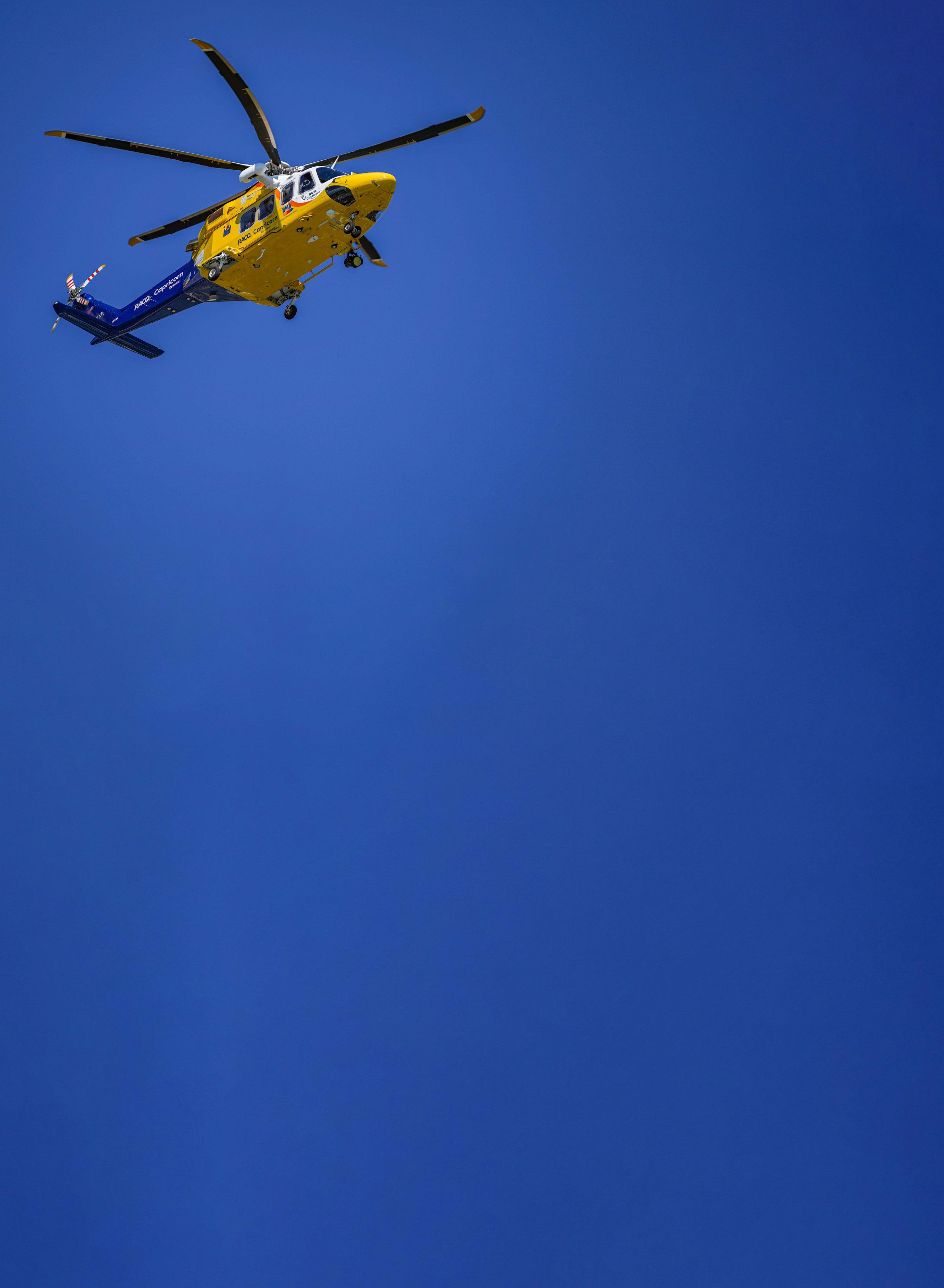

Backed by more than thirty years as a trusted aviation and critical services provider, Babcock delivers tailored, reliable and responsive end-to-end solutions for customers throughout Australia.
“As the leading provider of rotary wing aviation services in Australia, Babcock is trusted by emergency services, law enforcement and government agencies to provide the assets, technical know-how and personnel to support their critical operations,” said Darren Moncrieff, Babcock Australasia’s Managing Director – Aviation & Critical Services.
Babcock’s fleet of rotary wing aircraft play an integral role in delivering world-class emergency aeromedical response, patient care and recovery from remote and challenging environments across Queensland, South Australia and Victoria.
“We have a fleet of ambulance-configured helicopters, which support emergency medical situations in rural and remote regions, where it is difficult to use other means of transport,” said Mr Moncrieff. “These include responding to traffic accidents, remote aeromedical evacuation, rescues and emergency transport between hospitals.”
As part of the company’s long and successful partnership with Ambulance Victoria, Babcock delivers missioncritical helicopter emergency medical services (HEMS) and search and rescue (SAR) operations 365-days-a-year with on-call rapid response times to the rural, regional, and metropolitan Victoria.
“Babcock pilots and aircrew officers work in a close-knit team with Ambulance Victoria’s Mobile Intensive Care Ambulance (MICA) flight paramedics,” said Mr Moncrieff.
“We also provide qualification training to pilots, aircrew and engineers as well as specialist aeromedical crew role training to MICA paramedics.”
Testament to the strong collaboration and partnership between the two organisations, Babcock and Ambulance Victoria recently achieved a significant in-service milestone, with its AW139 helicopter fleet exceeding 20,000 flying hours after just five years.
This same collaborative approach has also been demonstrated in the mission-critical contracts that Babcock manages and operates in Queensland and South Australia. “Our collaborative approach ensures customer benefits are realised through improved aircraft availability, standardised procedures and integrated training protocols to increase safety outcomes,” said Mr Moncrieff.
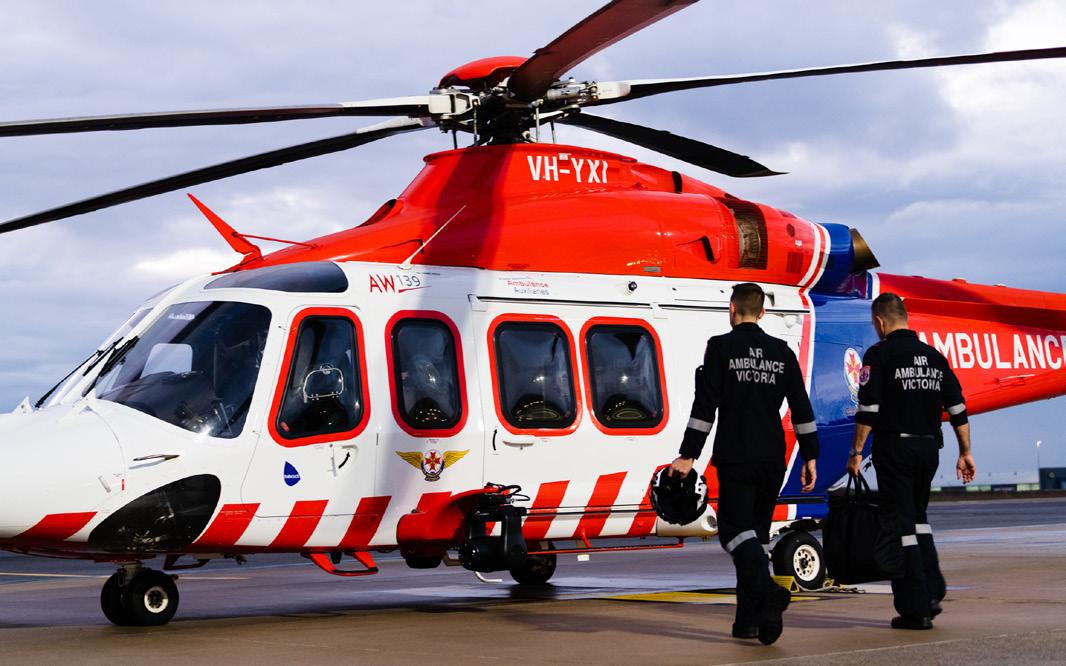
Increasingly, the state-of-the-art Leonardo AW139 twin engine helicopter has become an important component of Babcock’s growing rotary wing capability. A new AW139, extensively modified in Australia for HEMS and SAR tasking, has recently entered service, bringing enhanced capability to the RACQ Capricorn Rescue’s aeromedical services.
Babcock operates, crews and maintains the new aircraft on behalf of Capricorn Rescue from the Rockhampton base in Central Queensland. “The new AW139 represents a lot of hard work and forward-thinking and undoubtedly brings with it a quantum leap in capability and technology,” said Mr Moncrieff.
Committed to its clients’ service delivery and success in the long-term, Babcock continues to focus on customer outcomes. “Leveraging best practice from our local supply chain partners, combined with our own evolved processes, Babcock creates value through tailored solutions and sustainable client relationships,” said Mr Moncrieff.

By Sally Mangan Director Sustainability, Ambulance Victoria
I’m joining you again after our profile in the last edition of CAA First, in what will become a more regular opportunity to update you on different sustainability initiatives in ambulance services. We have a number of programs running in Ambulance Victoria (AV) and across services that I think you’ll be interested in. This edition, we wanted to focus on sharing some of our sustainability supply chain / procurement practices with you (per #5 on the CAA Sustainability Strategy). Victoria has a government framework called the Social Procurement Framework that we have started to implement recently that has both social and environmental improvement objectives.
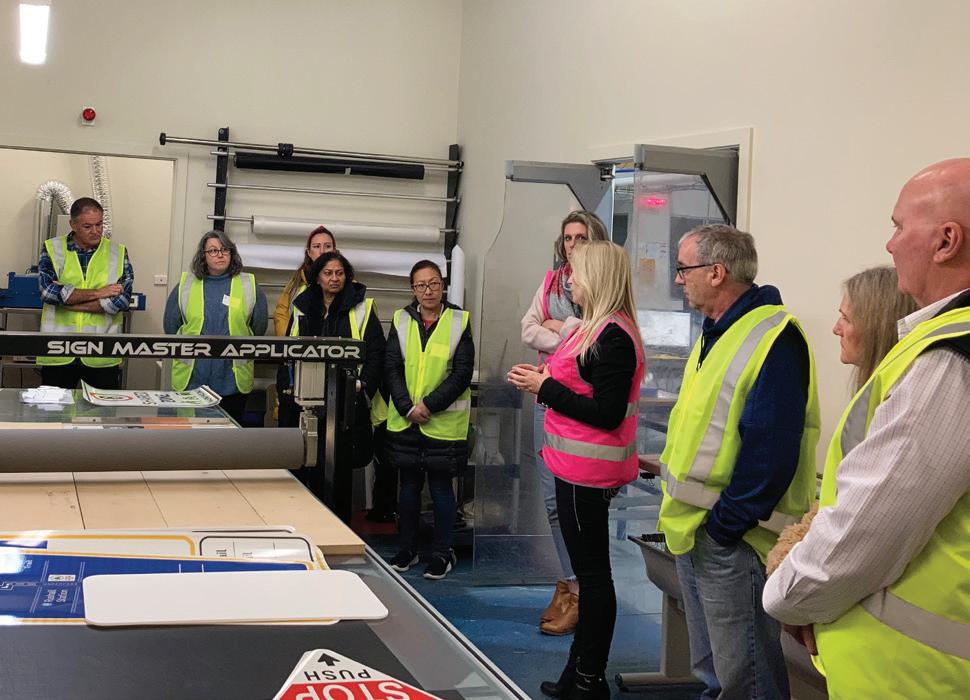
Sally Mangan Director of Sustainability, Ambulance Victoria
Sally is Ambulance Victoria’s Director Sustainability who led the development of Ambulance Victoria’s first social and environmental responsibility framework and action plan. Sally established a dedicated Sustainability team and is working to implement priority action.

In her six years with Ambulance Victoria, she has worked as a Director in different departments supporting strategic projects and change initiatives. Sally has experience across various industries with a background in management consulting. She has managed major organisational transformations projects as both a functional lead and change manager.

What is social procurement?
Social procurement is when organisations use their buying power to generate social value above and beyond the value of the goods, services, or construction being procured. It’s about considering social and sustainability impacts of a supplier, not solely price. Whether it be creating job opportunities or skills-based training in areas of disadvantage or delivering environmental benefits, social procurement can add value that the community can share in.
Why are we focussing on social procurement?
It is a key area of our Social and Environmental Responsibility Framework (sustainability approach) and aligns with our core values – putting our patients and community first. We have significant buying power spending millions of dollars each year. If some of this spend is used to improve our social and environmental impact we can make a huge difference to the community.
What does it look like at an ambulance service?
Social procurement at an ambulance service can be both big and small, from an aviation patient transport tender to events or catering for a training session. At AV, we are committed to using our buying power to generate social, economic and environmental outcomes that benefit the community and the environment.
Our suppliers are now required to meet environmental and social standards, and new suppliers will be asked to explain how their products or services go above and beyond current social and environmental practices. A few examples of social procurement in action for us looks like:
Buying from organisations (direct impact)
• Paper: 100% recycled print paper is now sourced from a First Nations business. They are a 100% privately owned First Nation stationery and office supplies business that are certified by Supply Nation.
• Bottles: The same First Nations business also offer water bottles that we now buy. While we resist the use of single use water bottles where we can, they are necessary in line with protective equipment (PPE) heat management strategies in place particularly over warmer periods. We also source reusable water bottles from another independent Aboriginal-owned and operated business for a reusable bottle trial at branches to trial reductions in wastage over the coming summer period.
• Catering: We have changed the way we think about selecting events catering – for training and other events, with even our Board meeting trying a new social enterprise for one of their pre-COVID meetings.

• Renewables: We have a vision to source 100% of our energy requirements from renewable sources by 2025. To reach this goal, we’ve transitioned to a power purchase agreement at high electricity user sites. From mid-2020 our larger sites switched to 100% GreenPower™ accredited renewable energy from a Victorian wind farm. This represents an approximate 7% reduction in our overall emissions.
AV suppliers making an impact with their practices (indirect impact)
Our new linen and dry cleaning contract identified new suppliers that are making their own impact locally. One of our suppliers is an environmental and sustainability award recipient and partners with a support service that provides opportunities to people with disabilities. Another supplier is a signatory to the Algabonyah Aboriginal Employment Accord and has an ongoing commitment to diversity, working with new migrants and refugees.

Our Procurement and Commercial Department recently visited Latrobe Valley Enterprises in rural Gippsland, Victoria. This is a social enterprise, providing meaningful employment opportunities for people with disabilities. The organisation delivers a range of services including grounds and facilities maintenance, recycling and secure document destruction, business support services and sign making. Over 85% of staff have a disability and they are empowered to develop real life work skills. By seeing firsthand the work Latrobe Valley Enterprises is doing we came away with a greater appreciation of the significant positive impact social procurement can have.
We recently went to market looking for organisations to create a new disposal and donations register for organisations that will improve the social and environmental outcomes associated with disposal of some of our end of life assets. Suppliers are organised into key asset categories: medical equipment and consumables, furniture and household goods, and IT / e-waste items. For example, one social enterprise provider found provides collection and recycling services through employability programs, which aims to improve job prospects for people experiencing or at risk of severe hardship. While just established, we hope that suppliers we identify can be used by our asset owners to make disposals and donations a simpler process so we can gain further impact from our old goods.
Other emerging focus in supply chain includes being mindful of greenwashing (when an organisation markets themselves as environmentally friendly despite their service/ products being no ‘greener’ than alternative products and overstates their impact), social washing, and black cladding (same but for social or indigenous benefits).
We are also looking to develop further analysis of the footprint of what we buy, to help us better understand the social and environmental implications of the products and services we buy.
We’ve also been working on a project lately across the member services around environmental performance benchmarking - stay tuned to hear more about that in a coming edition of CAA First.
Tasmania Brave the cold at the New Norfolk Market
The team set up a stall alongside Tasmania SES to show the community the inside of an ambulance and talk about Volunteer Ambulance Officer recruitment opportunities. Below, from left - Hayden Applebee, Erica Hill and Leith McHarry
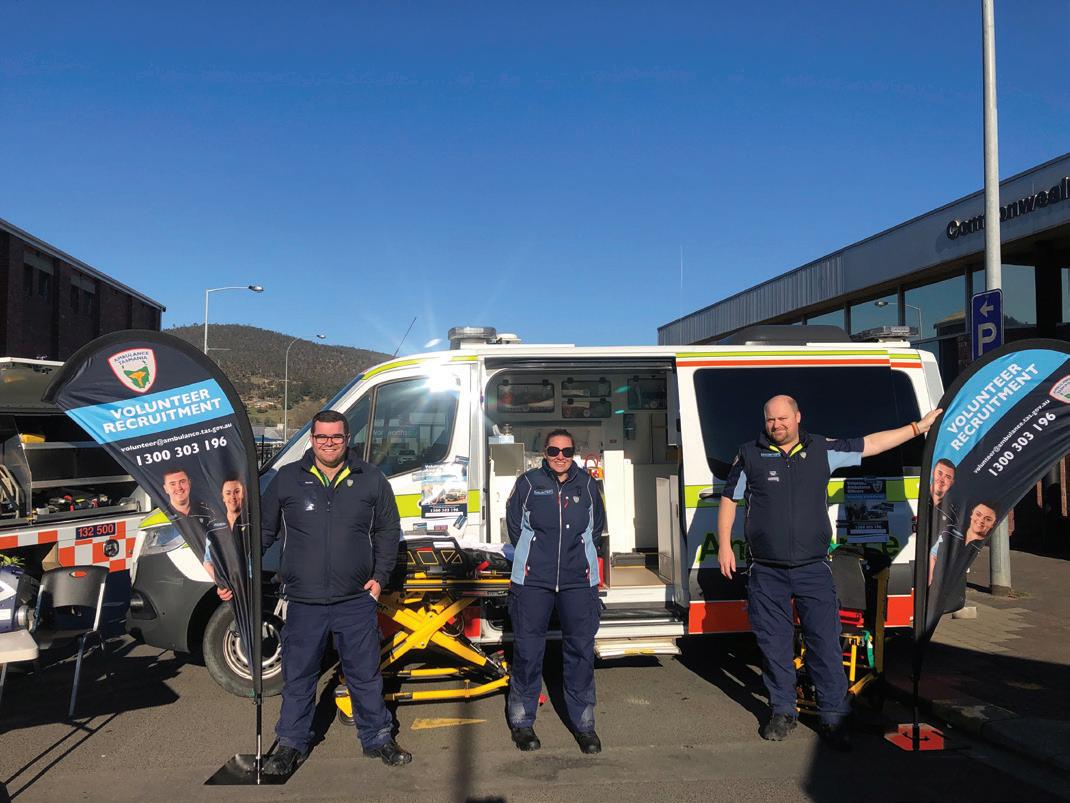
New Paramedics Join Ambulance Tasmania
We would like to extend a warm welcome to the newest paramedics joining the Ambulance Tasmania teams in the north, south and northwest. All eleven are experienced paramedics from interstate Ambulance services.
Left to right, from back row –paramedics Matt, Chris, Alex, Jasmyne, Ellen, Jarath, Josh, John, Alicia, Chloe and Bridey.
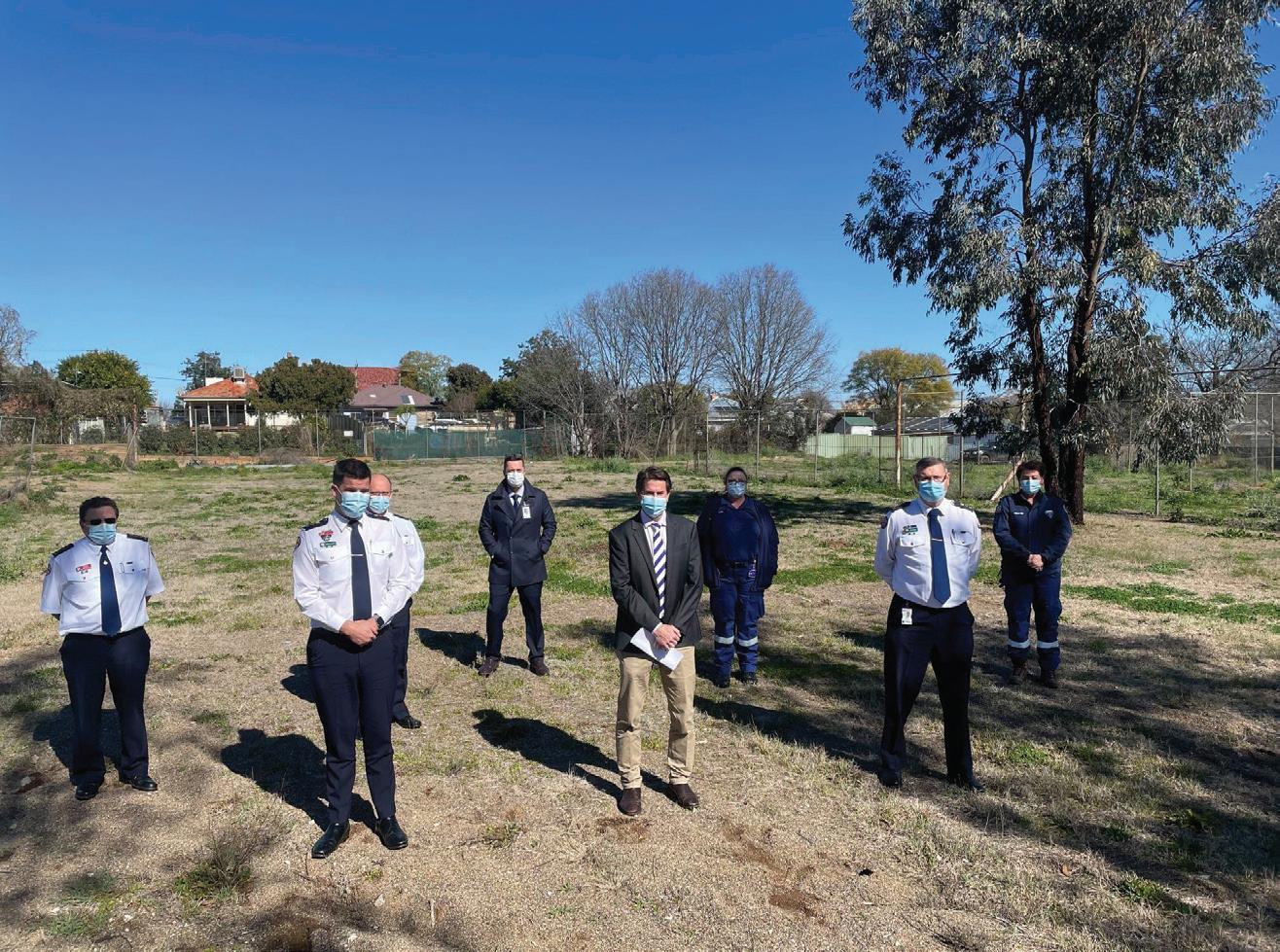
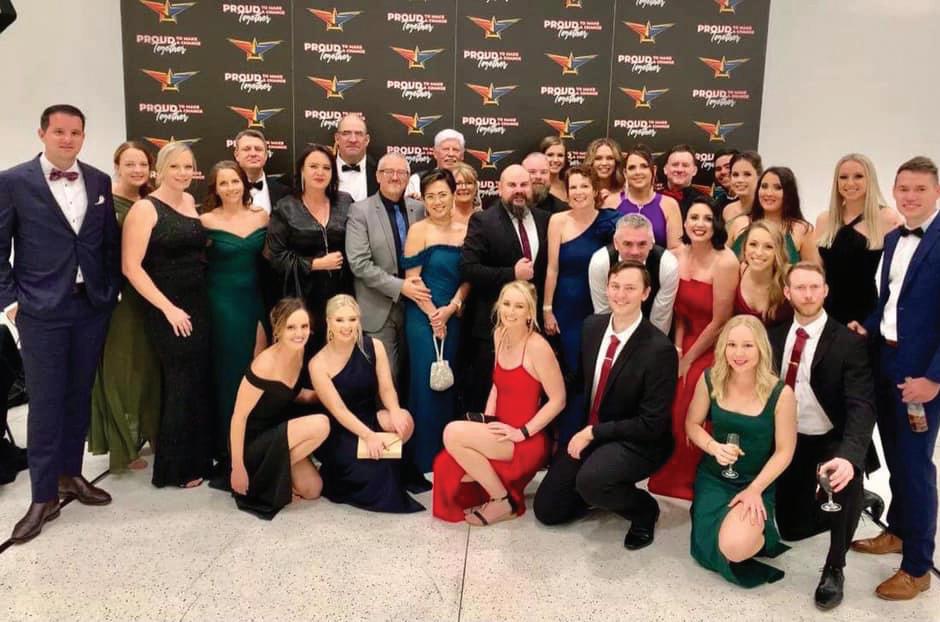
FNQ Emergency Services
Charity Ball
It was great to see so many of the Queensland Ambulance Service Cairns region staff glam up and have the opportunity to let their hair down at the FNQ Emergency Services Charity Ball.
New site for Tamworth Announced Tamworth's new ambulance station has been announced today by NSW Ambulance. Kevin Anderson MP along with the local paramedics got their first look at their new home located on Piper street, North Tamworth.
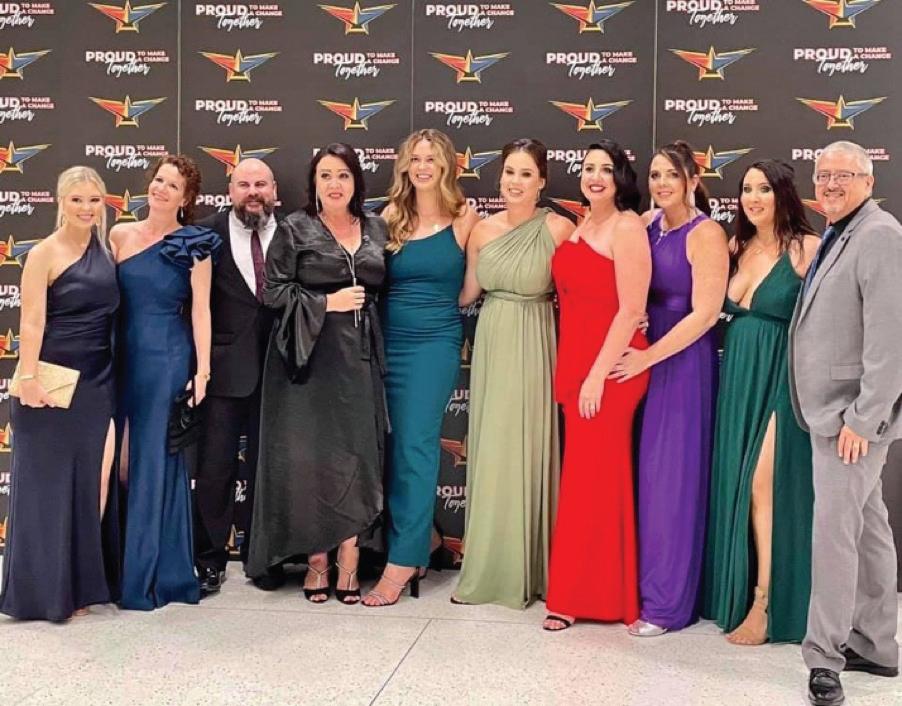
Peter Simpson completes 40 Years of Service with Ambulance Victoria
AdedicatedMICAparamedic,Peterenjoysthe lifestyleofshiftworkandthenewchallengesand hisexperienceseachdaybrings.Whenaskedwhat most memorable moment has been on the job,Petersaid"workingatAirAmbulancefor12 years.Unforgettablemomentswouldbewinching patientsoffcontainershipsintheBassStraitand rescue work." Incredible.
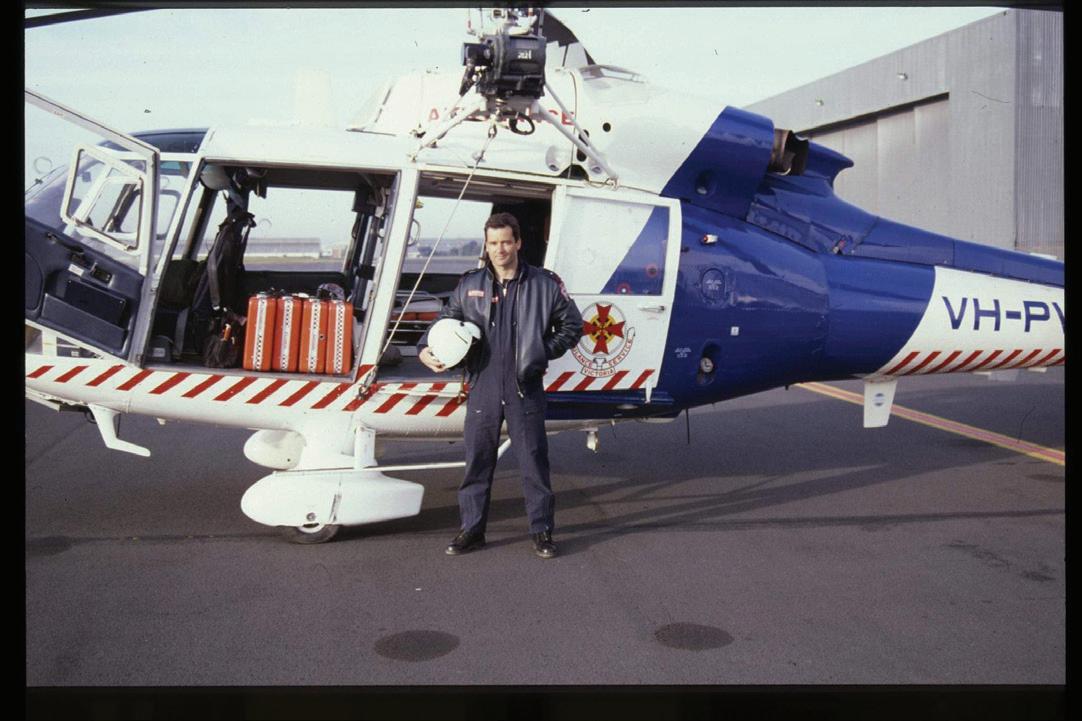
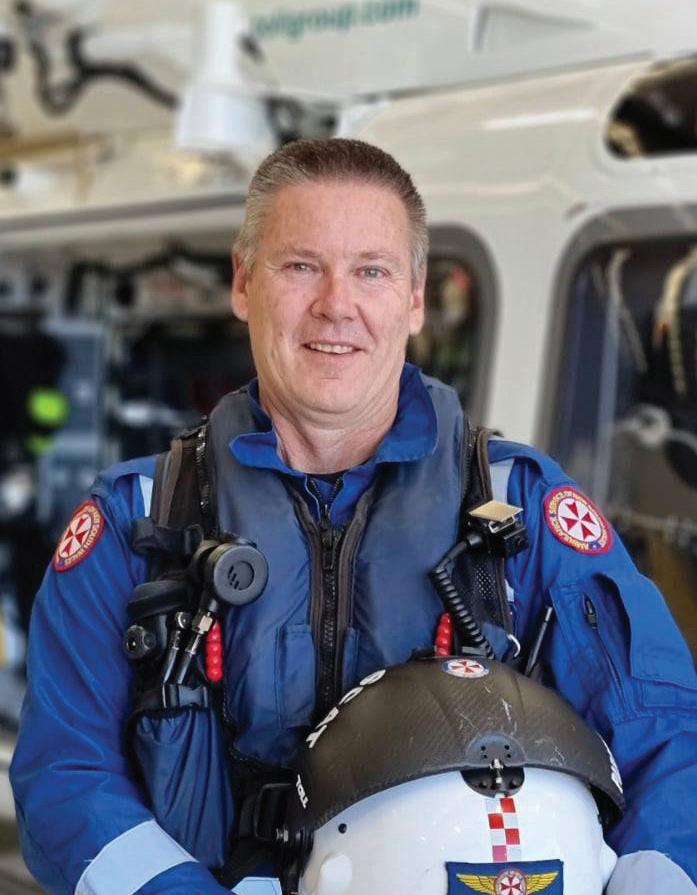
Queensland Ambulance Service: International Friendship Da (30th July)
Queensland Ambulance Services CLEAR favs this #InternationalFriendshipDay were these guys! QAS work collaboratively with Queensland Police Service and Queensland Fire and Emergency Services.
Blackwater Emergency Services Open Day
Looks like a great day out and about under the sunny blue skies for the Blackwater Emergency Services Open Day. A perfect opportunity to see the other agencies in a different setting and to meet the friendly community of Blackwater.
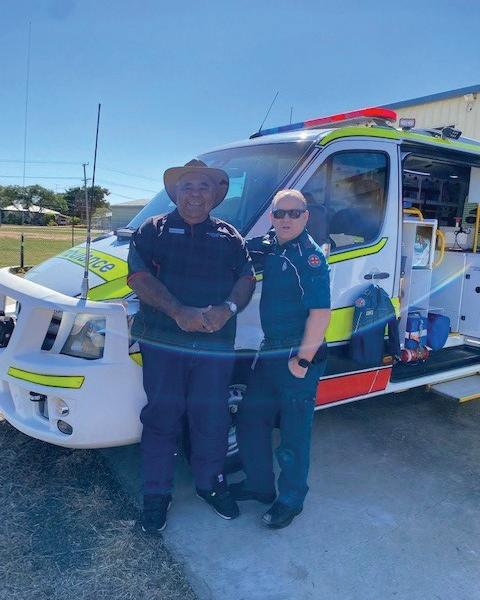
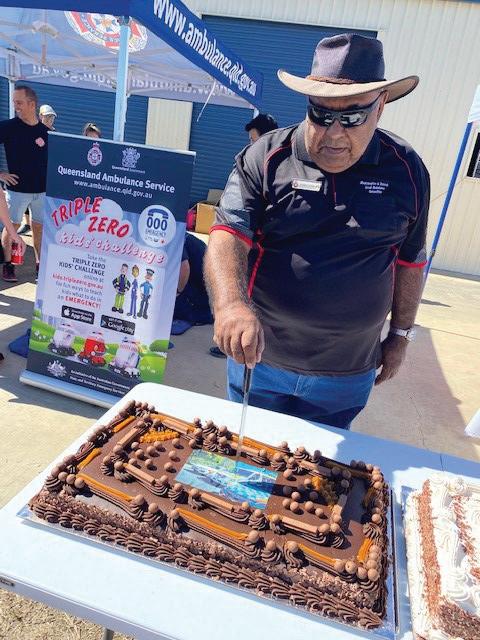
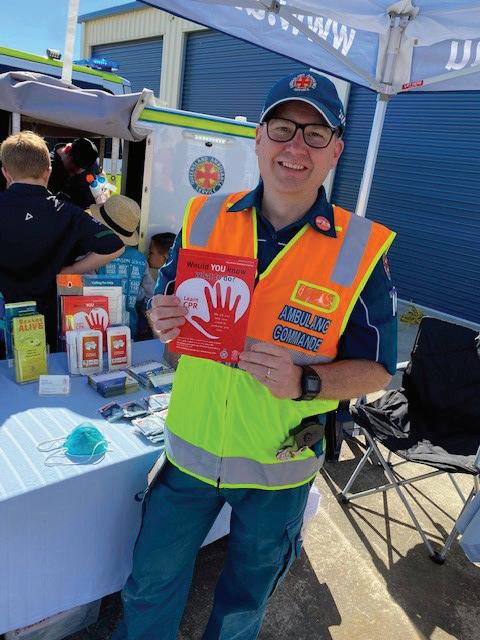
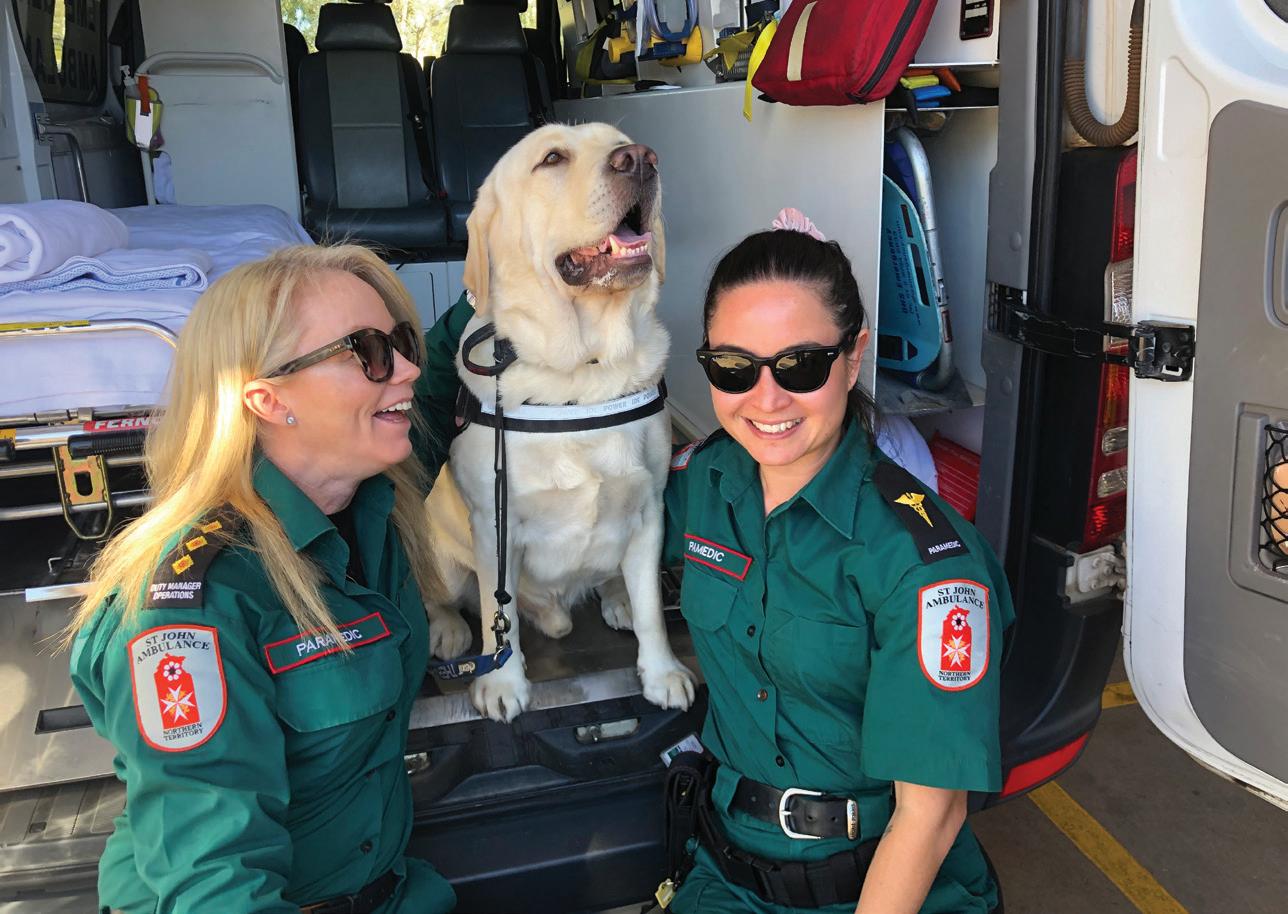
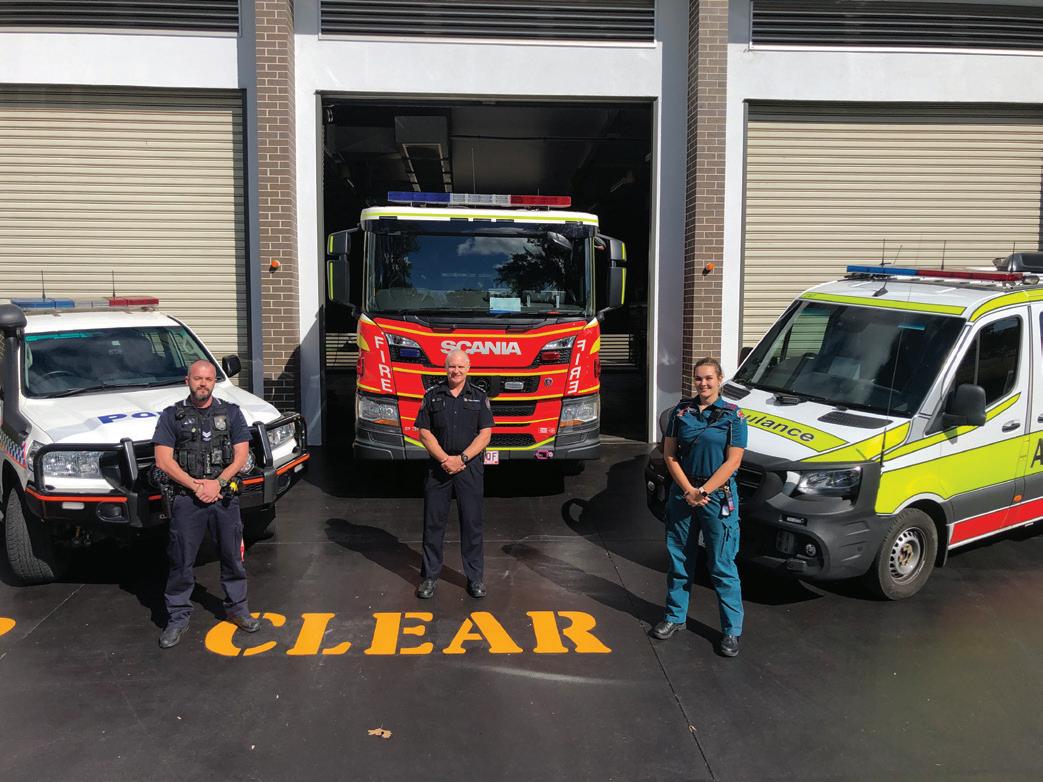
New Emergency Dispatch Officers for SA Ambulance Service
Meet SAAS new Emergency Medical Dispatch Support Officers. This fabulous bunch will soon join the team of people you speak to when you call Triple Zero (000) in SA.to complete their Certificate III in Ambulance Communications. Good luck team!
Therapy Dogs at St John Ambulance Australia NT
Who let the dogs IN? Beautiful Quinton brought some joy to the Alice Springs crew recently. Don’t forget to thank your furry friends this September, which is also Therapy dog awareness month!
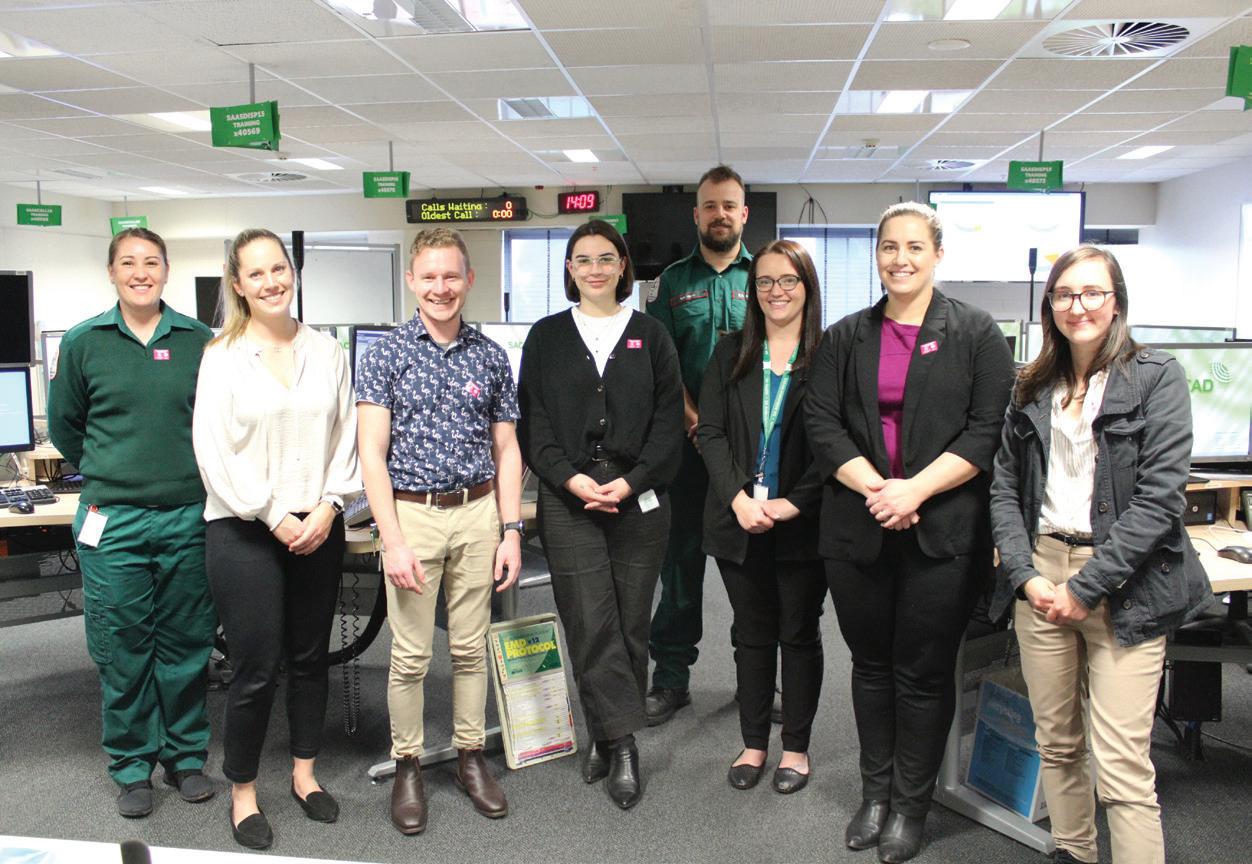
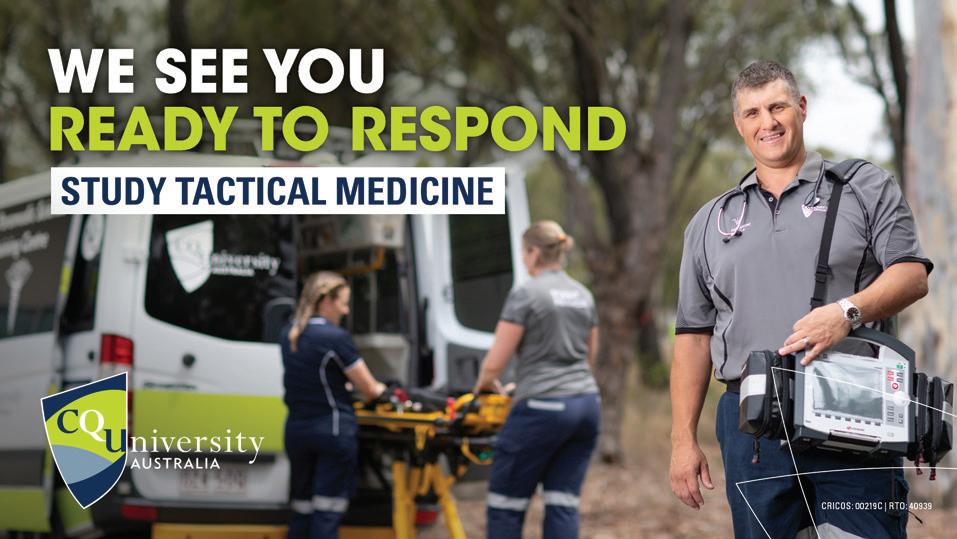
Learn to deal with acute trauma situations and be uniquely qualified to respond in resource limited, dynamic and high threat environments with a qualification in Tactical Medicine from CQUniversity. These online, highly flexible courses are ideal for paramedics and first-responders whose personal safety may be compromised. Gain the critical skills needed to assess, plan, prepare and implement strategies for successful operations and patient management within a tactical environment.
www.cqu.edu.au


Ambulance, emergency, rescue and height safety products
www.ferno.com.au
Code River Studio
High Performance Websites
www.coderiverstudio.net
Known for our work for EMS providers, ORH also support NEPT providers. While there are clear parallels with EMS service planning, NEPT providers face their own unique challenges and opportunities for improved efficiency. Through a data-led consultancy and modelling approach ORH has helped NEPT providers in Australia and the UK tackle these issues.
www.orhltd.com

Real-time communication across healthcare entities
www.pulsara.com/w
Alpha State Advertising & Design Services
www.alphastate.com.au
Australasian College of Paramedicine
Peak professional body representing and supporting Paramedics
www.paramedics.org
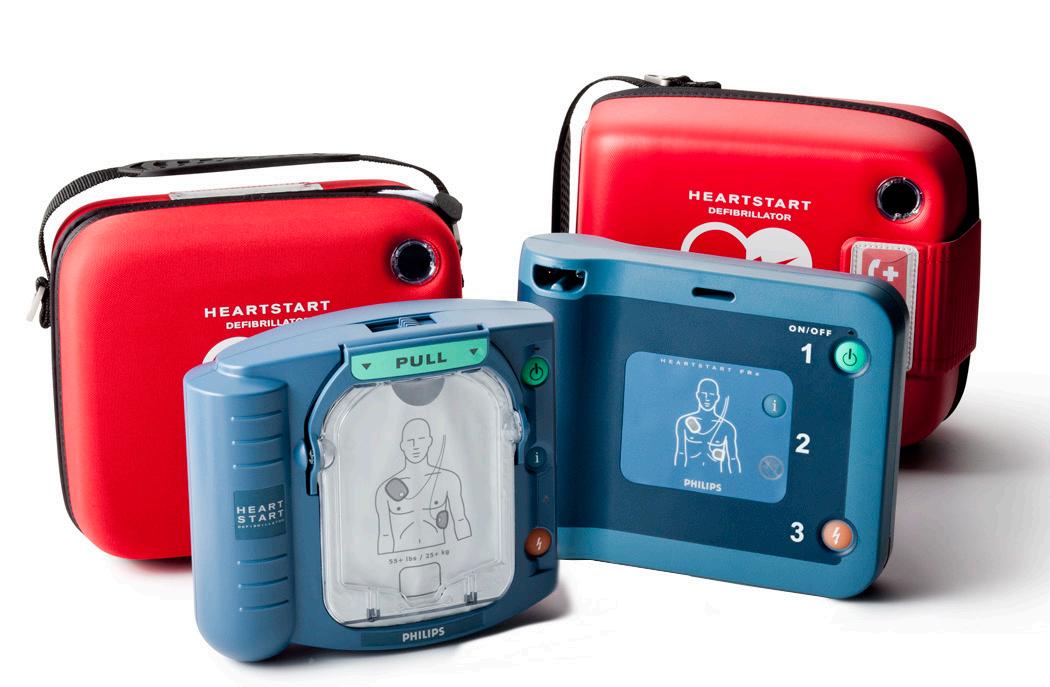
With access to the right equipment and support, everyone can help save a life. Philips AED solutions with Life Guidance act as your personal coach to guide you through a cardiac emergency with a simple, step-by-step process.
https://www.philips.com.au/healthcare
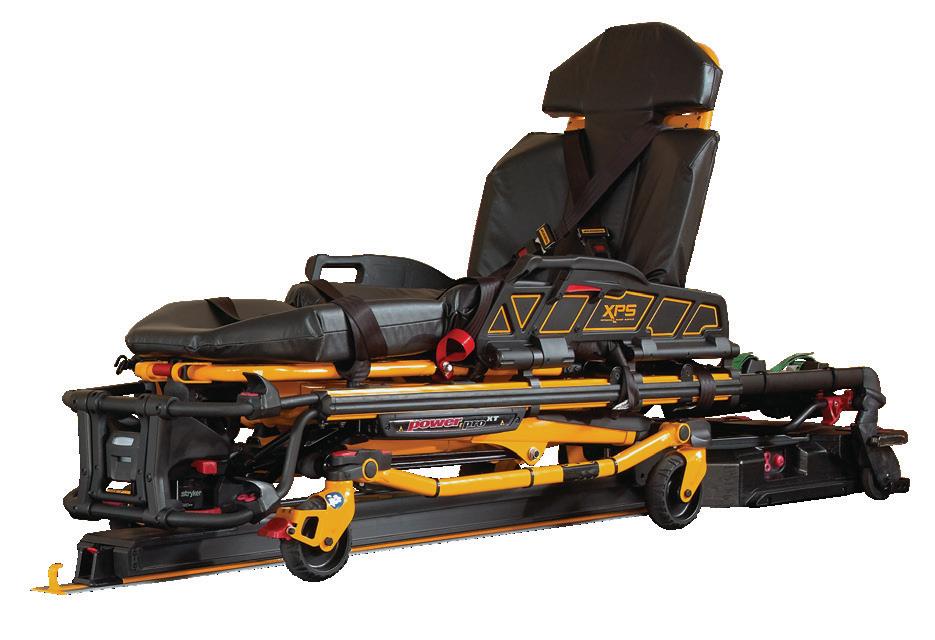
Stryker’s Power-PRO XT powered ambulance stretcher system utilizes a battery-powered hydraulic system to effectively raise and lower patients at the touch of a button. When used with Stryker’s Power-LOAD system, it offers operator and patient safety by supporting the stretcher throughout the loading and unloading process.
https://www.stryker.com/au/en/


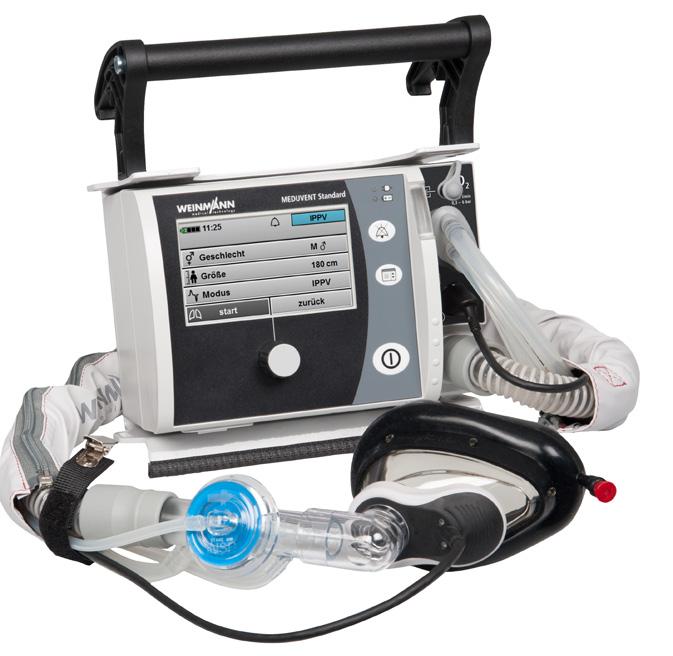
WEINMANN offers the emergency transport ventilators for emergency service vehicles, helicopters, and airplanes. The functions of the devices are perfectly compatible with one another and they can be used with portable systems in almost any combination. The result is portable ventilation that is specially tailored to the respective application.
https://www.neann.com.au/

can we do it?

Mitch Mullooly Health and Wellness Strategist
Specialising in the wellbeing of first responders, Mitch is the Chair of the Australasian College of Paramedicine, Aotearoa New Zealand; Council member of Te Kaunihera Manapou, New Zealand Paramedic Council; Advisory Committee member for Te Kiwi Maia, The Courageous Kiwi; and proud CAA2020 Women in Ambulance honour recipient.
Mitch is also a published author, speaker and feature columnist for several sector related magazines, blogs, webinars, and podcasts.
It’s a bizarre time we find ourselves in. A good majority of us across Australasia are stuck in our homes in another lockdown situation with no idea when, or if, life will ever go back to something that resembles ‘normal.’
The days are all blending together, and we haven’t gone out to a restaurant or seen our friends outside of a Zoom catch-up in weeks (or for some, months). As a result of being stuck at home, and without the natural hustle and bustle of our normal lives, we often become much harder on ourselves, beating ourselves up over thing’s done or not done, said or not said.
With so many of us struggling mentally and emotionally right now, we need to be able to show ourselves some self-compassion, but being the type of people we are, this often doesn’t necessarily come naturally to us. My thoughts - because we are so used to showing compassion and empathy to others that it’s often all used up before we even consider ourselves. But what is self-compassion and why do we need it for our own mental wellbeing more than ever, right now?
Self-compassion is having the same compassion towards yourself that you have towards others. Compassion for others is when you notice that someone is suffering, and you are moved by their experience. Your heart feels for the suffering that they are going through. Compassion for others is not pity; it is about recognising that everyone is human and imperfect. In a way you are identifying with the person you see struggling. Selfcompassion is about taking this feeling and turning it inward towards ourselves.
Seems easy right?
Unfortunately, given today’s society this has become a difficult skill. One only has to turn on any social media platform and see that we do not live in a world that is accepting of imperfection. From body image, to planning a birthday, to relationships, to being an involved parent, we are constantly reminded of what the expectation is and how we fail to meet this expectation every day.

When we are lacking in selfcompassion, we tend to start talking to ourselves negatively. We realise that we cannot meet the expectations that we, or others, have set and we berate ourselves for not doing a better job. Negative selftalk induces the stress hormone, cortisol, in our body. As we know having high levels of cortisol impacts our physical and mental wellbeing. Research shows that people who practice self-compassion are happier, less stressed, and more resilient.
So, you may be asking yourself: “Why do I keep talking to myself this way if it’s not good for me?” There are many reasons we engage in this negative self-talk, the most common one being for motivation. We think that we will be more motivated if we tell ourselves we aren’t doing a good job. The reality is that negative self-talk has the opposite effect. Other reasons may be that we don’t feel we deserve to be kind to ourselves, to punish ourselves, or past experiences have impacted our self-talk.
When we can speak kindly to ourselves and are gracious with ourselves, we are happier, healthier, and more connected to ourselves and others. Overall, we will excel in other areas of our life.
There are three main components, or skills, to self-compassion.
• Self-kindness is being supportive and understanding towards ourselves when we are having a hard time, rather than being harshly self-critical. It is demonstrating to yourself the kindness that you have towards others when you are struggling.
• Common humanity involves acknowledging that everyone suffers. Suffering is a part of life and as humans we all suffer. It’s recognising that if you are suffering it is not because there is something wrong with you, but that everyone has moments of suffering. Inadequacies and imperfection is part of the shared human experience.
• Mindfulness is remembering that everyone makes mistakes and experiences difficulties at times. We are not alone! Self-compassion involves recognising when we are stressed or struggling without being judgemental or over-reacting. It is noticing when we are suffering and attending to our struggle. Being mindful is to observe negative thoughts with openness. As Dr Kristen Neff, the pioneer of self-compassion, states “we can not ignore our pain and feel compassion for it at the same time.” Lastly, a key piece of mindfulness is to remain nonjudgemental when we notice our suffering and negative thoughts.
Here are some tips to help you practice self-compassion.
• Practice the skills of selfkindness, common humanity, and mindfulness when you are feeling overwhelmed or low.
• Create a self-compassion mantra that you can say to yourself when you are struggling. It may go like this “I will be kind to myself in this moment, I will give myself the compassion that I need” or “this is a moment of suffering, everyone suffers, I am okay.”
• When you notice yourself speaking negatively ask yourself if you would speak to a friend like that?
• Reflect on the negative self-talk that you have noticed. This may include if there is a common theme to your self-talk, if it’s related to past experiences, or if you have a tendency to set unrealistic expectations and respond with negative self-talk.
• Engage in relaxation exercises, or guided meditations, that focus on self-compassion. There are a number of videos on YouTube that are self-compassion meditations. Dr Kristen Neff records relaxation videos on her website Self-Compassion (selfcompassion.org).
• Complete self-compassion exercises from Dr Kristen Neff’s website.
The key is to do this every single day, even when times are feeling a bit tough. Just like we show compassion for our patients, our colleagues, our family and friends, we must show compassion towards ourselves, this is self-compassion. Be kind to yourself, you’ve got this!

When you join The Directory by CAA, you will be included in our fortnightly newsletters, on our social media channels, featured on a dedicated webpage on our site among other opportunities. Choose from three tiers that provide options to fit your requirements.
CONTACT NIKKI MURPHY ON NMURPHY@CAA.NET.AU FOR MORE INFORMATION AND TO GET INVOLVED

For those who have been graduated more than 2 years and not practiced, your registration has lapsed, or you are still registered but have had a break from the workforce, or you are shifting from one area of practice to another.
To prepare for practice this 8-week course enables you to build your knowledge, skills, experience and will assist you to meet the requirements of registration as a paramedic in Australia. This course will include a combination of online and on-campus lear ning including practical skills, simulations, and assessments.
The course will cover 8 modules: Foundations, Cardiology, Respiratory, Trauma, Medical, Paediatrics and Obstetrics, Transition to Practice, SWOTVAC and Final Assessments.
All applicants must hold a Bachelor of Paramedicine or Bachelor of Nursing/Paramedicine or equivalent.
Formative and summative MCQ, and short answer assessments. Clinical competency of psychomotor skills, tasks and safe competent practice of clinical simulations. Theoretical assessment will be undertaken online, while all practical skills and clinical scenarios will be undertaken face-to-face.
Online theoretical classes will be held Monday-Thursday, while practical classes will be delivered each Friday of the course from 9-5 pm. However, some exibility exists depending on personal circumstances and recency of practice whether applicants attend these Friday sessions. However, week 8 (SWOTVAC and Final Assessments) is compulsory to attend in person.
monash.edu/medicine/spahc/paramedicine/home
11 October – 3 December 2021
LOCATION
Notting Hill, Victoria COST
$2650
Completing the Re-entry to Practice (Paramedicine) course means you are eligible to apply for registration.
monash.edu/medicine/spahc/para medicine/short-courses
Contact Us
Professor Brett Williams, brett.williams@monash.edu
Ph: 03 9904 4283