

The First 5 Lake County Children and Families Commission (herein referred to as “First 5 Lake” or the “Commission”) has worked in partnership with community service providers to support children aged prenatal through five years of age and their families that live throughout Lake County.
This evaluation report describes the reach that the Commission’s investments have made pertaining to families participating in First 5 Lake funded programs . The report comprises information collected on and from families who participated in programs between July 1, 202 2 , and June 30, 2023.
First 5 Lake formed following the passage of California Proposition 10 (Prop 10). The Prop 10 initiative added a 50-cent tax on tobacco products to fund programs promoting early health, learning and family support for children from the prenatal stage through five years of age. First 5 Lake operates on an annual budget of approximately $653,556, made up primarily of Prop 10 funds. As a small county, First 5 Lake is dependent on Small Population County Augmentation Grant funding provided by First 5 California.
First 5 Lake uses this funding to invest in community programs that support the healthy development of young children and their families. It has a strategic plan to guide its efforts and conducts an annual evaluation to measure its impact.
First 5 Lake uses the following values to drive how it operates in achieving its mission:
• Child & Family Focus
• Inclusive Collaboration
• Efficacy & Accountability
• Meaningful Partnerships
• Integrity
• Sustainability
• Positivity
• Equity
First 5 Lake makes several investments in community service providers to implement its strategic plan. Program specific funding investments are found on the next page, presented in the order in which program data is presented in this report; page numbers indicate where more information on the number of people served, and program impact can be found.
One day Lake County’s success will be measured by the wellbeing of its youngest children.
First 5 Lake builds the early childhood systems and supports needed to ensure Lake County’s youngest children are safe, healthy, and ready to succeed in school and life.
Lake County Office of Education (LCOE): First 5 Lake supports programs administered by LCOE that address parenting, child development, and oral health.
• Nurturing Families Parenting Program (pg. 4): Nurturing Families, operated by the LCOE Healthy Start program, offers community classes and other one-on-one support to help parents understand child development and learn new parenting skills Children and families participate in community classes and are served in home-visiting settings.
• Bloom Parenting Information and Resources Services (pg. 6): Bloom is a community messaging that utilizes social media as well as a webpage to distribute information. Through these mechanisms, families are provided information, tools, and resources that support family habits of talking, playing, and reading with their children.
• Imagination Library (pg. 8): The Imagination Library is a book gifting program that provides free ageappropriate books to children from birth through age four, regardless of their family's income. The program aims to foster a love of reading, improve literacy skills, and promote early childhood development.
• AmeriCorps Early Learning Supports (pg. 10): First 5 Lake funds a percentage of the salary and benefits for AmeriCorps members who provide specialized programs in local preschools. Programs have historically included oral health and nutrition education as well as lessons to build social, emotional, and interpersonal skills based on the Second Step curriculum. 1 This year a higher emphasis was placed on social emotional development.
• Healthy Start Oral Health Project (pg. 12): The Children's Oral Health Project is a collaboration between First 5 Lake and LCOE's Healthy Start program. Funding is provided for dental screenings and oral health education for preschoolers and other children through the age of 5. Referrals for dental treatment, transportation, and assistance obtaining dental insurance are also available.
Easterseals Northern California ChildFind Services (pg. 13): First 5 Lake partners with Easterseals Northern California (ESNorCal) by supporting various family support services described below.
• Early Learning Center: The Early Learning Centers or “ELC”, located in Lakeport and Clearlake are child development centers. The centers offer Lake County families information, training, and resources on child development. They also provide safe, developmentally appropriate spaces for families and their children (ages 0-5) to play and learn. The Centers are spaces that foster and encourage children to interact amongst their peers and offer caregivers opportunities to network with other caregivers and Infant/Child Developmental Specialists.
• ChildFind Transportation Travel stipends are distributed to families with young children needing access to specialized healthcare or to pregnant people with prenatal complications.
1 More information on the Second Step Curriculum can be found here: https://www.secondstep.org/early-learning-curriculum
• ChildFind Toll-free Health Line: The Healthline connects parents and professionals to resources and information about child development.
• Developmental Screenings: ESNorCal utilizes the ASQ and the ASQ:SE to assess age-specific development in multiple learning domains to identify potential developmental delays. 2 Parents who complete an ASQ also receive information to support their child’s development.
The Sutter Health Safe Sleep program which has been historically funded by First 5 Lake was excluded from this evaluation report as the program was not operable for most of the contract term and data collected was insufficient to evaluate efforts.
In addition to investments in direct services to families with young children, First 5 Lake also invests in improved systems of care. These investments include the following:
Smart Start Eligibility Wizard (pg. 14): The Smart Start Eligibility Wizard is a website built for families with young children to identify and help navigate services and resources within Lake County. The Eligibility Wizard allows Lake County families to enter basic demographic information and receive a list of services and programs for which their family may qualify. In many cases, the families are able to opt in to having their information forwarded to a provider who will then follow up with them to address their needs.
Leadership and Advocacy: First 5 Lake regularly participates in various leadership roles as an element of its position as a neutral convener and advocate for young children and their families. Activities during this reporting period included hosting cross-collaborative meetings; recruiting and filling the role of Program Support Specialist to the Commission; continuing to participate in a Racial Equity, Diversion, and Inclusion (REDI) Leadership Cohort for ECE professionals; and leveraging American Rescue Plan Act (ARPA) funding to support an internal database that will enhance report and management functions to include home visiting efforts.
The Executive Director supports cross collaborative efforts and serves on the following boards and commissions:
2 More information on the ASQ and ASQ:SE can be found on page 8 of this report. Additionally, information from the developer of the developmental screening tool can be found on their website: https://agesandstages.com/
As a component of Prop 10 funding, First 5 Lake is required to demonstrate results. As adopted by the First 5 California Commission, the results-based accountability model requires collecting and analyzing data, and reporting the findings, to evaluate the effectiveness of programs and investments.
First 5 Lake has established research questions to drive evaluation efforts. These questions fall within each priority area of the First 5 Lake 2019-2024 Strategic Plan and are aligned with the First 5 California evaluation framework. The table below indicates which programs and investments are associated with each evaluation question, as well as the indicators used to measure success.
AREAS OF EXPLORATION
IMPROVED FAMILY FUNCTIONING / FAMILY SUPPORT
Do f amilies have an increased understanding of parenting and child development?
Number/Percent of families accessing services that report having received positive value (learning new information, improved understanding of parenting or child development, and/or improvements in family functioning) due to participation.
Are families developing reading routines to support literacy and readiness for kindergarten?
Number/Percent of families participating in services that indicate an increase in the amount of time spent reading to their children.
Are children entering kindergarten ready to learn?
Number/Percent of children participating in services who score “ready” for kindergarten entry. 3
IMPROVED CHILD HEALTH
Are children receiving early screening and intervention for developmental delays and oral health?
Number of children receiving a developmental screening. •
Number of children receiving a dental screening and number of those kids connected to additional oral health supports (services, transportation, etc.).
IMPROVED SYSTEMS OF CARE
Are services accessible, integrated, and adaptable to the needs of families with young children?
Number of trainings offered to workforce and caregivers on early care and education topics. 4
Number of families with young children connected to resource and referral information.
3 DRDP data was not provided in a manner that allowed the evaluation team to discern progress made for children preparing to enter Kindergarten in the 2023-2024 school year and therefore is not included in this report.
4 First 5 Lake County has traditionally offered trainings to community service providers These efforts were suspended in FY 20222023 and thus are not included in this report.
Similar to what was reported in the last evaluation report (FY 2021-2022), there was not enough data available from funded programs/investments to assess the impact of services upon families served. For this reason, this report provides a snapshot of the total number of people served by First 5 Lake’s funded programs during the reporting term and a summary of information collected from each funded program and investment.
All First 5 Lake funded programs are required to submit quarterly performance report s with quantitative and qualitative information about overall conditions, activities, people served, and results achieved for program participants.
A variety of data was collected and used in the evaluation process, each of which is described below.



Administrative Data: Each program funded by First 5 Lake is required to submit quarterly reports to track the number of people served, the demographic profile of that population, the number of services provided (in some cases), and program-specific indicators. The reports also offer programs the opportunity to describe issues impacting service delivery.
Parent Surveys: Some programs issue surveys to assess changes in the information, attitudes, or behaviors after having participated in First 5 Lake funded activities.
Developmental Screening Tools: ESNorCal utilizes the Ages and Stages Questionnaire (ASQ) The ASQ is a general developmental screening tool used with parents to assess age-specific development in the following domains: communication, gross motor, fine motor, problem-solving, and personal adaptive skills. There is also a separate tool used to measure the social-emotional development of children called the ASQ: SE.
A number of limitations and contextual conditions should be considered when interpreting the data within this report. These include the following:



Demographic Data Not Available for All Programs: Demographic data is not collected for Imagination Library participants at the time of registration. This is a limitation of the program at the national level. Similarly, an exact number of program participants and their demographic data is not available for Bloom, other than for those who respond to an annual participation survey which is issued to Bloom participants at year-end.
Limited Outcomes Data Available and/or Collected: Programs funded during this reporting period had limited outcomes data The primary driver for this circumstance was the change to program approaches that occurred because of the COVID-19 pandemic Multiple changes to how services were delivered occurred in real time and did not always allow for adjustments to evaluation plans and the corresponding tools to collect data for outcomes purposes.
Staffing Interruptions: Programs have been impacted by staffing vacancies, both within their programs and with partner agencies with whom they are dependent upon for service delivery purpose (e.g. the Oral Health project relies upon the availability of dental assistants to host screening events). This impacted both the delivery of services and the ability of staff to collect data according to the agreed upon program evaluation plans.
First 5 California requires county Commissions to submit data on an annual basis Data elements include the number of children under the age of six; parents, caregivers, and other family members; and providers serviced within specified categories. Additional data elements required for annual reporting include the demographic profile of individuals served, including age, race/ethnicity, and primary language spoken.
The following chart demonstrates the number of people served per funded program/program services Note that the numbers in the charts below represent potential duplication across programs. At this time, the county does not have systems to capture unduplicated counts across programs.
Children between 3 and 5 years old represented the largest age group (1,907 or 64%) of children served by First 5 Lake programing. Children from birth to two years old made up the next largest group (1,059 or 35%). Children under six years of unknown ages made up the smallest percentage (39 or 1%) of children served.
Race/Ethnicity of People Served
Race and ethnicity of individuals served were largely unavailable. Because of that, two charts are provided for each category of individuals served to demonstrate the percentage of individuals served in which race/ethnicity data is available versus the percentage of individuals served in which that information was not available. The second chart only shows the race/ethnic profile of individuals for whom this data was available.
Race/Ethnicity of Children (ages 0 through 5) Served




White, 363
Hispanic, 262
Multiracial, 62
Alaska Native/American Indian, 25
Black/African-American, 36
Pacific Islander, 4
Asian, 8
Other, 2
Race/Ethnicity of Parents, Caregivers, and Other Family Members Served



White, 201
Hispanic, 140
Multiracial, 29
Alaska Native/American Indian, 13
Black/African-American, 13
Pacific Islander, 2
Asian, 1
Other, 4

Race/ethnicity data was unavailable for the 36 providers that were served by First 5 Lake programming and investment activities.
Similar to the race/ethnicity data available, the bulk of individuals served by First 5 Lake did not have their primary language spoken information recorded. For those that did, most individuals spoke English, as demonstrated in the chart below. Those marked with “other” as their language were bilingual, primarily speaking English and Spanish.
First 5 California also requires county Commissions to submit information about outcomes achieved as well as the policy impact of those results. As described earlier, outcomes cannot be reported in this reporting period due to the lack of data to support such an assessment. For that reason, the results provided in the following section speak primarily to the reach of funded programs and investments during the 202 2-202 3 fiscal year rather than outcomes. Programs are aligned to the categories that best describe their activities according to First 5 California requirements.
Nurturing Families Parenting program participants included families and caregivers of children 0 through 5. Between July 1, 2022, and June 30, 202 3, the program served a total of 31 parents and caregivers.

The program served a total of 31 parents and caregivers of children ages zero through five.
The Nurturing Families Parenting program provides community classes, drop-in services, and home visiting to families with young children throughout Lake County. The following number of parents and primary caregivers were served in each modality during the reporting period.
In addition to the primary caregivers who participated in parenting classes, childcare was provided for children ages 0-5, some of which was offered by the older children of families being served.
The Nurturing Families Parenting program has gone through several structural changes since the pandemic, impacting its ability to collect data that can demonstrate the impact of program participation. The only data collected to help the program understand the value of services in this reporting period involved the distribution of participant surveys in a series of parenting classes conducted in community class settings Participation fluctuated, with some parents participating in one session while others at tended multiple sessions. Sessions were offered in Spanish and English. Survey results for each session, customized according to topic, are provided below.
Class participants were asked to rate the extent to which they agreed with the following statements after attending the class:
I listen to my child
I
Class participants were asked to rate the extent to which they agreed with the following statements after attending the class:
I understand the importance of showing my child love and affection frequently
I feel that I learned some new parenting
Class participants were asked to rate the extent to which they agreed with the following statements after attending the class:
I
Class participants were asked to rate the extent to which they agreed with the following statements after attending the class:
I understand my goals and values as a parent
Class participants were asked to rate the extent to which they agreed with the following statements after attending the class:
Class participants were asked to rate the
“I can have more empathy for my child’s emotions.”


“I put into practice praising my son and my husband became very interested.”

“This class really helped me and my family. I would definitely attend again.”
“Whatever I have learned and continue to learn has helped me a lot and I know it will continue to be an asset.”
Bloom program participants are assumed to be parents, caregivers, and other family members of children zero through five utilizing the Bloom Facebook page to access information about tools and resources.
Who Was Served Number of Facebook Followers Over Time

At minimum, 135 parents, caregivers, and other family members of children ages 0 through 5 engaged with the Bloom Facebook page during the reporting period. This number represents self-reporting of utilization via the Annual Participation Survey.
The chart above represents the number of Bloom Facebook followers over the last three years. It is important to note that these individuals may or may not be Lake County residents and may or may not have young children. There is no way of isolating these two conditions.
The Bloom program provides up to twice weekly posting of information specific to young children. The information shared typically includes the following kinds of content:



At the end of the program year a survey is distributed to all Bloom Facebook “friends” to help the program understand more about the families that are accessing the information distributed via the Bloom Facebook page. 135 people responded to the survey, and the information collected is summarized below as well as on the next page.
Bloom Facebook “friends”/survey respondents were asked to indicate which activities/information they used from the Bloom Facebook Pages. Individuals could choose any/all the options presented. The results are provided below and are separated between the English and Spanish Facebook pages.
I haven’t tried any activities or used any information
Bloom Facebook “friends”/survey respondents were also asked to indicate whether they have taken their child(ren) to the library.
65% of survey respondents self-reported having taken their child(ren) to the library within the last six months as demonstrated in the chart below Of those families who have taken their child to the library, most took their child more than three times in the last six months (88/135).
Have taken their child to the library
Have not taken their child to the library
Have taken their child to the library more than 3 times
Have taken their child to the library 2-3 times
Have taken their child once
Number of Families that Have Taken thier Child(ren) to the Library in the Last Six Months
The year-end survey also explores what program participants found most valuable about the information shared on the social media platform for parents of young children

73% (99/135)
Of survey respondents agreed or strongly agreed that they learned new information to support their child(ren)’s development on the Bloom Facebook Page.
Bloom Facebook “friends” survey respondents were asked to identify which of the following supports were most useful on the Bloom Facebook page. Respondents could mark multiple options. Activities to do with their child(ren) was identified by the highest number of survey respondents (98/135) as the most useful Bloom Facebook support.

73% of survey respondents indicated this resource sharing as most useful

69% of survey respondents indicated this

61% of survey respondents indicated this resource sharing as

“I loved the posts [about] activities to do with kids for gross motor development and color or letter recognition. I tried colored pieces of paper with letters of my kids’ names on them. Made them jump or dance to letters. They had fun and learned letters! I screenshot all the posts from that week. It was great to get ideas and wish they happened more often!”
Imagination Library Program participants included children ages 0 through 4 and their caregivers. Between July 1, 2022, and June 30, 2023, the program served a total of 4,132 individuals.
Who Was Served



946
1,248
1,938
Children (ages 0-2)
Children (ages 3-4)
Parents, Caregivers, and other Family Members
The majority of children served by Imagination Library were under the age of three.
Number of Children Served Over Time
Number of Children (ages 0 through 4) Receiving Books from Imagination Library
Imagination Library reached approximately 60% of children between 0 and 4 in Lake County. 5 This represents a slight decrease from the prior year.
The following information is being provided to better understand how families engage with the program.
New Child Enrollments during Report Period
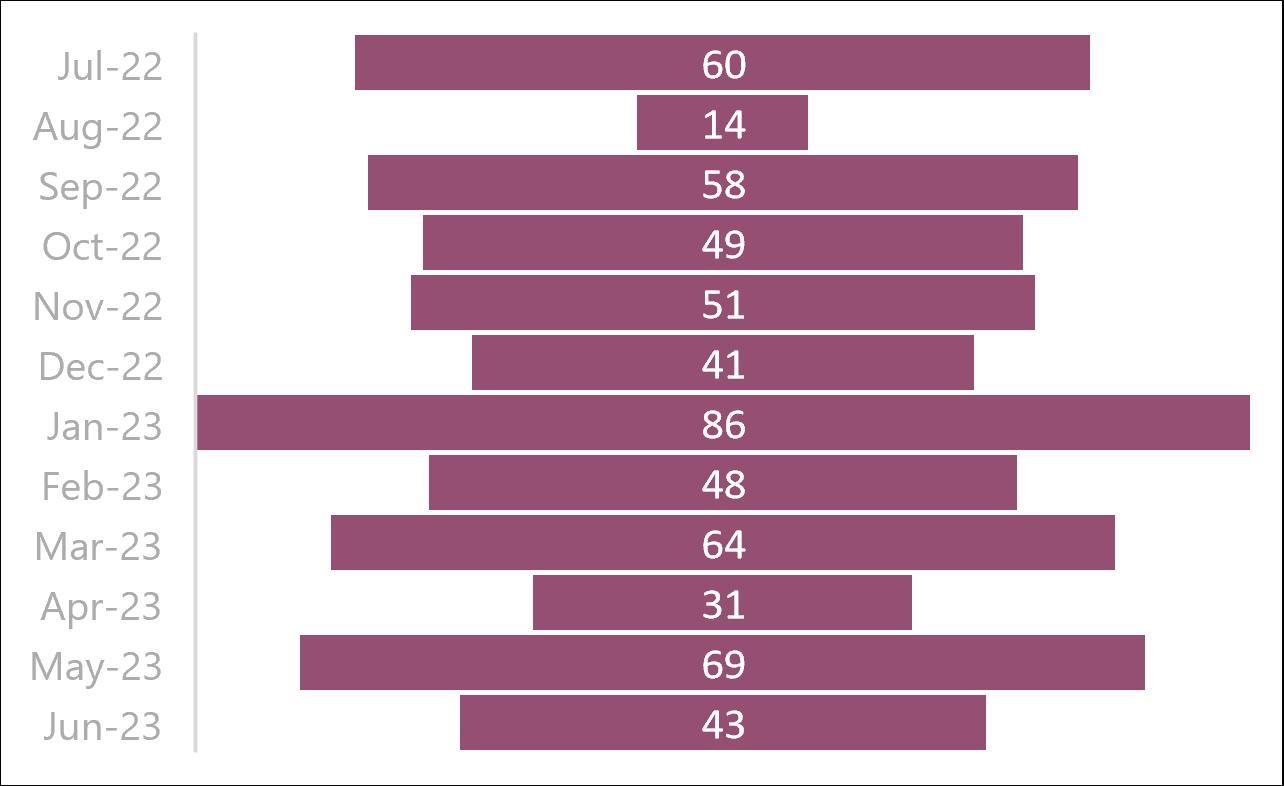
At fiscal year-end families who participated in Imagination Library were asked to complete a survey. One area of inquiry was around where people heard about the program.
Of those participants that completed the year-end survey (190), most indicated finding out about the program through Hospitals (60% or 114/190). Other places where people heard about the program included Social Service Providers (17/190), Doctor Offices (15/190), Friends/Family (16/190), Preschools (12/190), and Social Media (13/190).
of Children Served this Year by Year of Enrollment
Many of the children participating in the Imagination Library program benefit for multiple years in the program as demonstrated in the chart above.
5“P-2B County Population by Age.” California Dept. of Finance, Population Estimates and Projections, which estimates a total of 3 ,654 children 0 through 4 in the County. Retrieved on August 22, 2023 from: https://dof.ca.gov/forecasting/demographics/projections/.
Another area of inquiry that was explored in the year-end survey was around how often families read to their children prior to and after participating in the program The results, as demonstrated in the chart below, indicate that the program effectively increased time spent reading to children in the home for survey respondents (n=190).
Time Spent Reading to Children Before and After Participation in Imagination Library
52% (86/166)
93% (177/190)
Of survey respondents with verbal children, indicated that their child asks to be read to more often than before enrollment in the Imagination Library program.
Of survey respondents noted the program had a positive impact on their family.
One last area of exploration was around the extent to which participating families take their children to the library
58% of survey respondents self-reported having taken their child(ren) to the library within the last six months as demonstrated in the chart to the right. Of those families who have taken their child to the library, most took their child more than three times in the last six months (50/114).
Have not taken their child to the library
Have taken their child to the library
Have taken their child to the library more than 3 times
Have taken their child to the library 2-3 times
Have taken their child once
Number of Families that Have Taken their Child(ren) to the Library in the Last Six Months
“My children have been given doorways and windows to open their minds eyes to endless possibilities of differences and experiences in the world with the books received from the Imagination Library Not only are they diverse and varied in their holistic approach to early child education but they are fun, vibrant and whimsical to read together as a family for all ages.”


“Imagination Library has been such a great impact to my son and me. It’s our lil’ get together / unwind bonding time. Before reading I like to ask him how his day at school was, and what he learned or did that day. Definitely love this program.”
AmeriCorps Early Learning Supports’ participants included preschool participants between the ages of 3 and 5. Between July 1, 202 2, and June 30, 202 3, the program served a total of 30 children. Who Was Served Number of People Served Over Time
3-5)
The LCOE had difficulty securing AmeriCorps members to the program during both the 21-22 and the 22 -23 school year resulting in a significant decrease in the number of students able to be served As a result, it is likely that this kind of educational support will no longer be available in the future.
One AmeriCorps member was placed in the Burns Valley Preschool program and offered the AmeriCorps Health Lessons and Second Step Early Learning Curriculum during the school year. The program focuses on developing socialemotional skills and concepts through short, daily activities that take 5-7 minutes each. Topics included: Health Lessons Skills for Learning






The program reports results of “Walker Assessments” conducted by AmeriCorps members The Walker Assessment is an observational tool that measures the student’s socialization and has historically been used by the First 5 Lake funded AmeriCorps program The chart on this page and the next reflects the growth experienced by preschool students based on AmeriCorps member observations between January 2023 and May 2023.
“There is a student in the afternoon class who has issues with hitting. I redirected hitting by saying "nice touches" and holding out my hand. Instead of hitting me or another student we gave high fives to redirect that hitting urge and keep everyone safe while still getting out that need.”
AmeriCorps Member
Walker Assessment Results for Preschool Children
Compromises when situation calls for it
Has good work habits
Shares laughter with peers
Uses free time appropriately
Other children seek child out to involve her/him in activities
Walker Assessment Results for Preschool Children
Produces work of acceptable quality given her/his skill level
Does seatwork assignments as directed
Invites peers to play or share activities
Keeps conversation with peers going
Attends to assigned task
Can accept not getting her/his own way
Interacts with a number of different peers
Appropriately copes with agression from others
Displays independent study skills
Listens carefully to teacher instructions and directions
Initiaties conversations with peers for extended periods of time
Plays or talks with peers for extended periods of time
Accepts constructive criticism from peers without becoming angry
Responds to teasing or name calling by constructive means
Compromises when situation calls for it
Shares laughter with peers Has good work habits
Uses free time appropriately
Other children seek child out to involve her/him in activities
The Healthy Start Oral Health Program participants included families of children 0 through 5 and children 0 through 5.
Between July 1, 202 2, and June 30, 202 3, the program served a total of 594 individuals. Who Was Served
Number of People Served Over Time




5
537
4
48
Children (ages 0-2)
Children (ages 3-5)
Children (0-5)
Ages Unknown
Parents, Caregivers, & other Family Members
• Early Connections East Lake (12)
• Early Connections Lower Lake (26)
• Konocti East Lake (23)
• Lucerne Elementary (34)
• Middletown Minni Cannon (18)

(ages 0-5) Parents and Caregivers
The lifting of COVID-19 restrictions allowed the program to increase the number of children served over the previous reporting period.
The oral health program provides screenings, oral health education, and case management to children and families at locations throughout Lake County. During this reporting period, services were offered at the following locations:
• Early Connections Kelseyville (30)
• Early Connections Middletown (7)
• Konocti Lower Lake (75)
• Middletown Cobb (16)
• Upper Lake Elementary (26)
The number of people served within each service provision is offered below.
Oral Health Screenings


• Early Connections Lakeport (27)
• Konocti Burns Valley (58)
• Konocti Pomo (33)
• Middletwon Coyote Valley (65)
• WCC Child Development (18)
Oral health screenings are provided in partnership with local dental clinics Each screening is given a rating between 1-4.




parents received follow-up calls from screenings, 10 parents received additional coordination services such as scheduling appointments and transportation assistance.
Easterseals Northern California (ESNorCAL) ChildFind Services Program
ESNorCAL ChildFind Services Program participants included families of and children 0 through 5 as well as community service providers. Between July 1, 202 2, and June 30, 2023, the program served a total of 339 people.
Who Was Served


74
63
16
Children (ages 0-2)
Children (ages 3-5)
Children (0-5)
Ages Unknown
Number of People Served Over Time
Program participation has not yet returned to pre-pandemic numbers.
What Type of Services were Provided?
Early Learning Activities

124 Children Participated in Early Learning Activities
Developmental Screenings

12 Children Received a Developmental Screening (12 ASQs/8 ASQ:SEs)
Transportation Supports

8 Families Served
69 Total Trips Funded
Resource & Referral Healthline

84 Callers were assisted through the Healthline
Children (ages 0-5)

157
Parents, Caregivers and other Family Members
29 Community Service Providers
Number of People Served Over Time
Parents, Caregivers and Other Family Members
Community Service Providers
Families were invited to return to Early Learning Centers operated by ESNorCal in June 2022 employing a hybrid approach of in-person and virtual service delivery Parents had the option of scheduling time for in-person learning and socialization opportunities or participating in virtual circle time activities.
Parents are encouraged to complete the ASQ developmental screening for their children aged 0 through 5 to identify any potential developmental delays early.
This component of service delivery was significantly impacted by COVID and has yet to return to pre-pandemic levels.
Travel stipends are distributed to families with children ages 0 through 5 needing access to specialized healthcare or to pregnant people with prenatal complications.
The Healthline connects parents and professionals to resources and information a84bout child development Through the Healthline, individuals are connected to an Infant/Child Development Specialist who can answer questions about child development, provide information about community resources, and support individuals in getting connected to services/supports.
Smart Start Eligibility Wizard website participants included families of children 0 through 18 with the primary focus on families with children 0 through 5. Between July 1, 202 2 , and June 30, 202 3, the program served a total of 45 individuals. Of those, 38 indicated having a child aged 0 through 5 in their family.

A total of 38 parents, caregivers, and other family members with children (ages 0 through 5) in the household took advantage of the Eligibility Wizard. The information provided in this report includes information for these families alone
The Eligibility Wizard collect s basic socio-demographic information from families to identify local services and resources they may be eligible for. The information provided below is being offered to help the Commission understand the profile of families that were served by the investment.

In Lake County, the median monthly household income is $53,399 6
of families entering income information into the Eligibility Wizard fall below the average monthly household income for Lake County.

of families indicated participation in at least one program that provides supports to families with limited income and resources.
Eligibility Wizard users were also asked if they had children in preschool, if their children needed childcare and didn’t have it, and if they needed to travel to access medical care for their children The results below demonstrate how many of the children (ages 0-5) in households that accessed the Eligibility Wizard fit each criteria.


Families utilizing the Wizard reported living throughout Lake County, with the largest concentrations of users residing in the Kelseyville, Clearlake, Lakeport, and areas.
Service Utilization







Families can use the Eligibility Wizard on their own or may be provided with assistance through a service provider . 35 people entered information into the Eligibility Wizard on their own, while three were provided assistance by a service provider.
35 people entered information into the Eligibility Wizard on their own
3 people used the assistance of a service provider
Utilization of the Eligibility Wizard dropped significantly in the second year of operations Whereas a total of 143 families used the web platform in FY 2021-2022 (during the launch year), only 38 families with children 0-5 used the service in the current reporting period Additionally, while December 202 1 was the month in which the Eligibility Wizard was most utilized, in the current reporting period there was no utilization for either November or December 2022.
Number of Users

This evaluation report was developed to demonstrate the reach of First 5 Lake investments during the reporting period as opposed to the impact/results of said funding investments. The inability to report on outcomes was largely due to issues that were identified in last year’s evaluation report and continued to be present during this report ing period. For the benefit of the reader, those issues are summarized in brief below 7 with additional considerations offered based on this report period.
• Disconnect between the Commission Strategic Plan, the corresponding Evaluation Plan, and program services. The broad nature of the Commission’s existing Strategic Plan (2019-2024), the way investments have been made and managed, as well as the Commission approach to evaluation should be re-evaluated as the strategic plan is being revised.
Additional recommendations offered to the Commission as it revises its strategic plan include:
o Determine Target Populations and Fund Accordingly: Identifying whether the Commission will target its investments on specific populations within Lake County (ages of children being served, socio-demographic profile of families served, and/or geographic distribution of service offerings) or keep its investments broad in nature. While the current strategic plan does identify the desire to focus special attention on “those in crisis or in potentially isolating situations” it is not clear whether it invests with this in mind or to what extent its investments are reaching these populations.
o Apply Funding Criteria and Assess Accordingly: Revisit the funding criteria it has established within its current strategic plan and develop a mechanism to assess how well it is adhering to such commitments if carried over into the new strategic plan For example, one of the Commission’s existing funding criteria involves the use of promising or evidence-based practice; however, most of the (currently) funded programs do not adhere to this expectation. Another funding criteria involves funding efforts aligned to the protective factor’s framework. However, none of the (currently) funded programs provide services within that approach or with enough dosage to allow evaluation efforts to assess outcomes using the framework.
o Intentionally Fund According to Program Result Areas: Consider the extent to which the Commission invests in each of the four “program result areas” as defined by First 5 California. Currently the Commission primarily funds services within the improved family functioning domain, with little support for improved child development and improved child health (and even more limited reach within the priorities defined for these two result areas). In establishing the revised strategic plan, the Commission may want to consider the funding it will set aside for each of the four result areas to be more intentional in its approach moving forward.
• Many First 5 funded progra ms encounter barriers or make programmatic changes without engaging First 5 in the process. Many First 5 funded projects modify their program approach without
7 For a more detailed description of these issues, please refer to the First 5 Lake 2021-2022 Evaluation Report.
proactively engaging with First 5 or the evaluation team. This has resulted in moving away from evidence-based or best practice approaches in both service delivery and evaluation activities.
o Establish Closer Partnerships with Funded P rograms: It is recommended that the Commission monitor program efforts to ensure that any changes made to program services are understood and that the impacts on evaluation efforts are considered. It is also recommended that the Commission engage in more opportunities to work in partnership with programs, identifying opportunities to support families across funding investments.
• Gaps in data collection efforts continue to impede the Commission’s ability to have a clear understanding of services provided and the impact on families served. Among most of First 5 Lake’s funded programming, there is a continuing need to strengthen data collection and reporting activities. While the Commission is currently in the process of securing a database to support data management, the improvement of data reporting will only occur if data collection efforts are comprehensive, accurate and aligned to the evaluation plan for each funded program.
o Support Enhanced Comprehensive Data Collection Efforts with Funded Programs: The Commission may want to consider offering additional technical assistance and support for funded programs to assist with comprehensive data collection and data management efforts.
While the recommendations offered above are directed at the Commission specifically, the following recommendations are geared to support programmatic enhancements The recommendations offered are limited to the programs that the Commission is continuing to invest in for FY 2023-2024:
• Eligibility Wizard: The Eligibility Wizard was developed as a web-based tool designed to help Lake County parents of children (0-5) identify the services and programs for which their family is eligible. Based on current year data, a very limited number of families utilized the tool for these purposes Whereas a total of 143 families accessed the tool in its inaugural year (FY 21-22), only 38 families accessed the tool in the subsequent and current reporting period (FY 22-23). It is recommended that the Commission reconvene the group of community providers that partnered in the development of the tool to re-assess its value and identify the best steps moving forward. If a continued investment in this service is planned, it is recommended that the CQI process originally identified in the development phase of this project be re-instated and that satisfaction surveys for both family participants and providers be used to better understand the reach and impact of this service approach.
• Bloom Parenting Information Distribution: Lake County Office of Education engages parents and distributes parenting information via their Bloom Facebook page and its Spanish equivalent (Bloom en Español) The Bloom Facebook pages provide up to twice weekly posting of information specific to young children and are categorized into four buckets: child development, kindergarten readiness, activities to do with children, and community events. During FY 22-23, the highest reaching post occurred in Q1 regarding upcoming Bloom event information. This post reached over 3,000 views compared to the average Bloom post of about 300-700 views. Bloom staff noted that the high reaching post was shared by local agencies. Therefore, it is recommended that Bloom Facebook
staff, when applicable and appropriate, encourage local agencies to share posts to expand their reach.
Another recommendation regarding Bloom Parenting Information Distribution is to increase collaboration between program staff and the evaluation team to develop and use data collection systems. As data collection helps to paint a clear understanding of services provided and the impact on families served, it is important to have well-defined processes and tools to assist with data gathering. Tools and materials as well as technical support from the evaluation team would help set up Bloom staff for further success. It is recommended that Bloom staff connect with the evaluation team to build this common understanding.
• Healthy Start Oral Health Program: The Oral Health Program organized by Lake County Office of Education provides screenings, oral health education, and case management to children and families at locations throughout the county. As part of the screenings, parents receive a follow-up call if the screening resulted in a rating of 3 or higher on a scale of 1 through 4. This call and follow-up calls, if necessary, constitute the case management component of services. However, current data collection efforts do not include a full picture of the navigation services that parents and children are subsequently connected with and utilize. Knowing this information would help to fully capture the needs of Lake County and pinpoint what services are highly utilized and could be built upon. It is therefore recommended that the services parents are connected with and use are documented and reviewed during data collection.
• Imagination Library: Imagination Library, a program partnered with Lake County Office of Education, distrubutes age-appropriate and high-quality books on a monthly basis to participants’ homes. Program participants include children ages 0 through 4 and their caregivers. Through the Annual Program Survey, it was discovered that the majority of program participants heard about Imagination Library through the hospital system (114 out of 190). On the other hand, only 13 participants heard about the program through social media. This is a potential avenue for Imagination Library to explore in order to expand their reach. It is recommended that the program connect with Bloom and/or Mother-Wise (a 23-24 First 5 Lake grantee) to gain insight into how to expand its social media presence.
The last set of recommendations are centered on how to approach evaluation efforts in particular.
• Consider Use of a Participatory Evaluation Process: As the Commission re-envisions how to evaluate its investments within its new strategic planning framework, it may want to consider adopting a participatory evaluation approach with an emphasis on joint analysis and co-creation of evaluation findings and recommendations. Doing so may more actively engage service participants, program staff and Commissioners, furthering efforts to be responsive to the needs of young children and families in Lake County. It may also be a mechanism to help all partners understand the link between the Commission Strategic Plan, its programs, and how evaluation efforts assist in supporting program improvements and measuring outcomes.
• Establish a Plan for How to Address Evaluation Recommendations: There is no current structure in place to plan or implement changes based on evaluation report recommendations. By establishing a joint plan between the Commission, grantee partners, and the evaluation consultant, it is more likely that quality improvement efforts will occur.