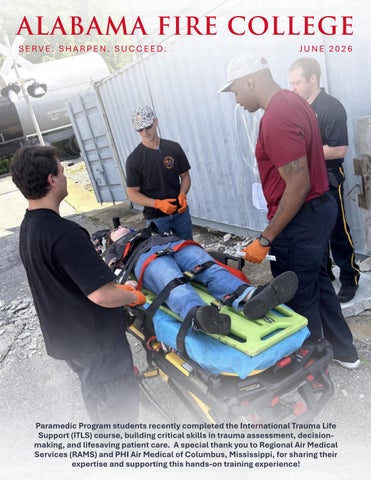
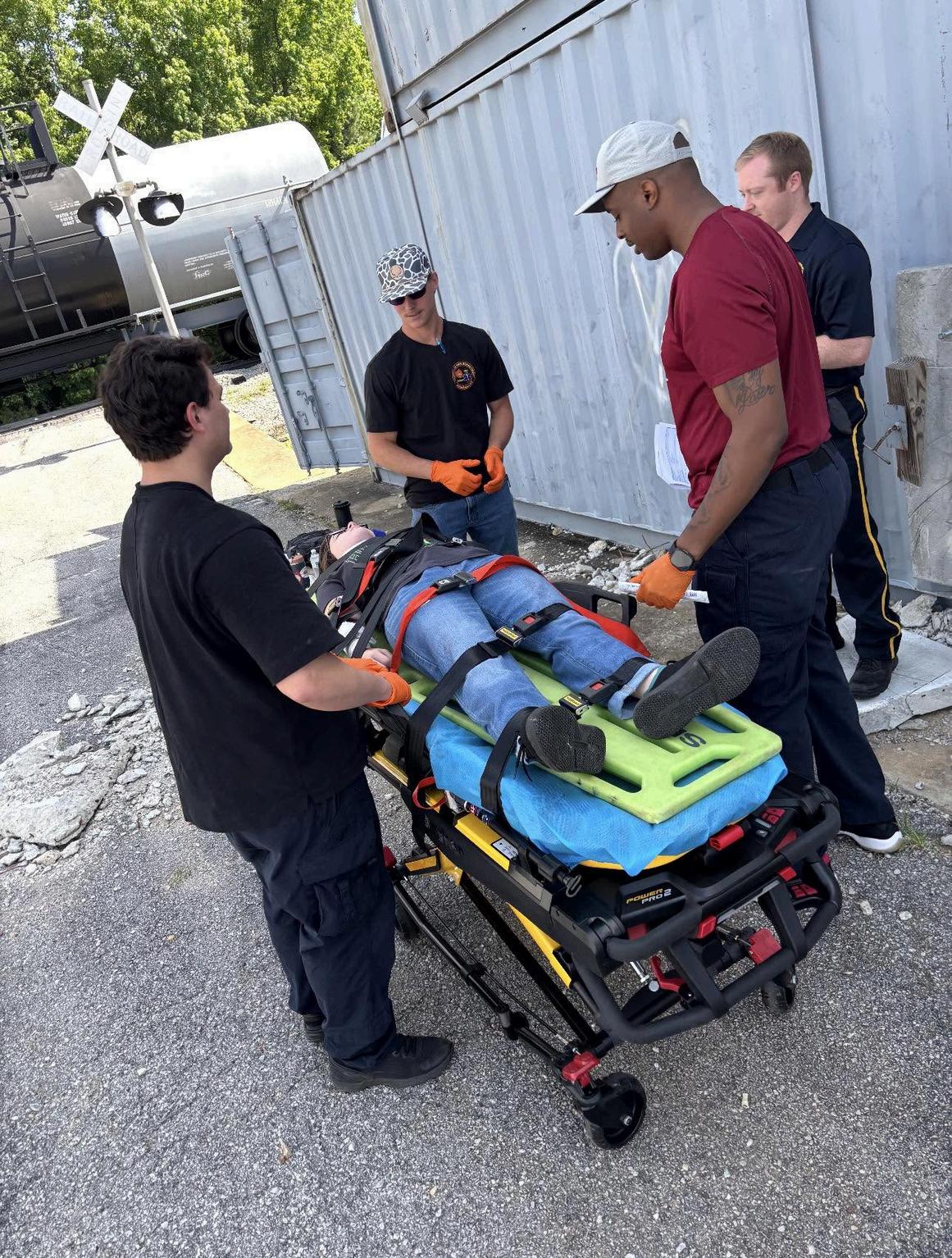
Paramedic Program students recently completed the International Trauma Life Support (ITLS) course, building critical skills in trauma assessment, decisionmaking, and lifesaving patient care. A special thank you to Regional Air Medical Services (RAMS) and PHI Air Medical of Columbus, Mississippi, for sharing their expertise and supporting this hands-on training experience!
PPE Rental
We are always seeking ways to reduce costs for departments and individual students. The current costs for providing and maintaining recruit PPE rentals are exceeding the rate at which the College can replenish its supply. As a result, AFC is exploring alternative options that may help individuals and departments save money while ensuring students have access to appropriate PPE for recruit school
To help address this need, we solicited quotes from several vendors and identified a relatively cost-effective option, particularly for self-sponsored students. Central Alabama Training Solutions offers recruit PPE rental for $600, which includes bunker pants, coat, helmet, and suspenders. Boots, gloves, and hoods may be purchased separately for an additional cost of approximately $400 While few vendors still rent PPE, other vendors within the state are willing to provide boots, gloves, and hoods at a reasonable cost
Description
Electric Vehicle Response
What You Need to Know
The course is designed to bridge the knowledge gap that exists for emergency response to Electric Vehicles so first responders can response confidently and effectively. Topics covered include: types of Electric Vehicles, construction features and identification of Electric Vehicles, burning of lithium-ion batteries, thermal runaway, fire behavior of lithium-ion batteries, suppression of Electric Vehicle battery packs, charging station layouts and hazards, tools available to fire service related to Electric Vehicles, case studies, tactical considerations for scenarios involving Electric Vehicles, Emergency Response Guides, High Voltage Disconnects, and Extrication Hazards
Hours: 6
Cost: $0 in-state / $0 out-of-state (Host department may charge up to $2/hr.)
Prerequisites: None
Required Text & Resources: None
Course scheduling & Instructor selection: Departments interested in hosting this training should contact their Regional Coordinator The Regional Coordinator will then contact the Program Manager, Brandon Mills, (bmills@alabamafirecollege org), to schedule the course and have an instructor assigned
Class size: Due to high demand, departments are encouraged to collaborate with neighboring departments.
Registration: Students may register online in an open class. Some departments may host closed classes with restricted registration.
Helpful links
AWARENESS LEVEL / CLASSROOM
Topics to be discussed:
Identify different types of electric vehicles
Explain construction features and methods for identifying electric vehicles
Examine burning characteristics of lithiumion batteries
Describe thermal runaway, including its warning signs and causes
Analyze fire behavior of lithium-ion batteries
Explain suppression techniques for electric vehicle battery packs
Describe off-gassing and suppression runoff hazards
Review charging station layouts and associated hazards
Identify tools available to the fire service for EV-related incidents
Review case studies
Evaluate tactical considerations for scenarios involving electric vehicles
Interpret Emergency Response Guides
High-voltage disconnects and operation
Extrication hazards associated with EVs
1 Who is my Regional Coordinator? www alabamafirecollege org/regional
2 Learn more about the course: www alabamafirecollege org/evresponse
3 Informational blog post: www alabamafirecollege org/electric-vehicle-response-course-now-available
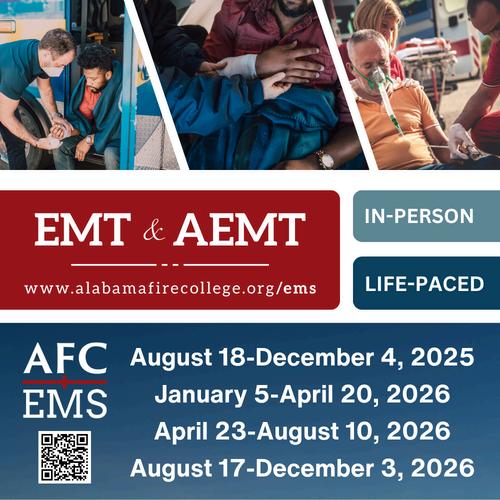
www.alabamafirecollege.org/ems
Emergency
Medical Responder (EMR) (58 hours)
Emergency Medical Responder is the entry certification to the EMS profession. Students will learn skills and gain knowledge to provide immediate life-saving interventions useful prior to higher-level personnel arriving on scene.
Hybrid Course Options:
Instruction can be provided by an Intermediate EMT, Advanced EMT, or Paramedic in a classroom.
Chapters on OLC already contain videos pre-recorded by a Paramedic instructor
Skills can be taught and checked by an EMT instructor
Students must:
Be at least 17 years old
Have a high school diploma/GED/transcript
Meet the Essential Functions of the EMR program
Obtain a CPR certification before course completion
Required Text: Jones & Bartlett’s Emergency Medical Responder: Your First Response in Emergency Care, 7 Edition (available online at www.afcbookstore.org) th
Cost: $100 In-State / $200 Out-of-State
Frequently Asked Questions:
Do I need the textbook? Yes. The slides and videos do not cover all information that will possibly be on the final exam and the National Registry exam.
Do I need to come to campus? No. This course is a hybrid format. Students can learn in a classroom setting or on their own using paramedic-led videos. Classrooms are set up by departments, not the Alabama Fire College.
I have a certification in Fire Instructor I, can I teach this class? No. EMR is a National Registry certification, not a fire certification.
Do I need a CPR certification? Yes. Students will have to complete CPR training before class end or supply proof of existing CPR certification.
Are there clinical rotations? No. EMR is classroom and skills based only.
I have another question not listed here. Who can I contact? Contact Josh Roe, EMS Training Specialist, at 205-391-3775 or jroe@alabamafirecollege.org.
NATURALGASEMERGENCY RESPONSE
Make
the Call. Protect the Scene. Prevent Secondary Hazards.
Alabama natural gas pipeline operators, in cooperation with Alabama Pipeline Emergency Response Initiative and the Alabama Fire College, remind all fire marshals, investigators, fire departments, and law enforcement of the importance of immediate communication with the local gas operator during incidents involving natural gas.
Working together helps protect first responders, the public, and critical infrastructure.
Always notify the gas operator:
When responding to an incident at a natural gas customer location, confirm that the gas operator has been contacted. If not, contact them immediately. This includes:
STRUCTURE FIRE VEHICLE ACCIDENT
GAS LEAK OR ODOR OF GAS
PIPELINE DAMAGE
Early communication allows operators to:
✔ Verify system integrity
✔ Ensure gas flow is safely controlled
✔ P ovide technical expertise to incident command
ANY INCIDENT WHERE NATURAL GAS EQUIPMENT OR SERVICE MAY BE INVOLVED
Do NOT operate other gas system components!
Other components of the gas system should not be shut off by emergency personnel, including:
Curb valves
Street valves
Mainline shutoffs
CURRICULUM + CERTIFICATION UPDATES
Standard on Professional Qualifications for Firefighters (2024) (Release date: June 1, 2026)
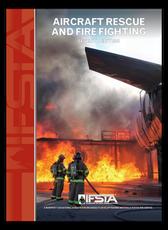
Airport Fire Fighter & Fire Apparatus Operator: ARFF Driver: IFSTA’s Aircraft Rescue & Fire Fighting, 7 Ed , ISBN# 9780879397821 th
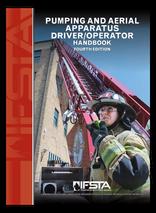
Fire Apparatus Operator: Aerial, Emergency Vehicle Driver, Mobile Water Supply, Pumper: IFSTA’s Pumping and Aerial Apparatus Driver/Operator Handbook, 4 Ed., ISBN# 9780879397623 th
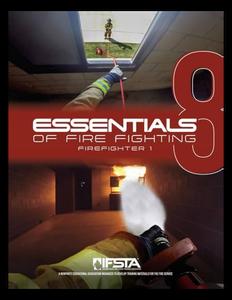
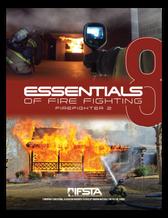
Fire Fighter I & Fire Fighter II: IFSTA’s Essentials of Fire Fighting: Firefighter 1, 8 Ed., ISBN# 9780879397180, and Essentials of Fire Fighting: Firefighter 2, 8 Ed , ISBN# 9780879398309 This change will also affect these courses: Volunteer Fire Fighter, Fire Fighter I/II Recruit School, Fire Fighter I/II Bridge, & Fire Fighter I Recertification. th th
Marine Fire Fighter: IFSTA’s Marine Firefighting for Land-Based Firefighters, 3 Ed., ISBN# 9780879396411 rd Fire Support Person (new level; prospected release TBA)
NFPA 1020, Standard for Fire & Emergency Services Instructor, Fire Officer & Emergency Medical Services Officer
Professional Qualifications (2025) (Release date: January 1, 2027)
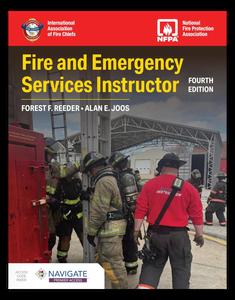
Fire and Emergency Services Instructor series I-III: Jones & Bartlett’s Fire and Emergency Services Instructor, 4 Ed ISBN# 9781284301250 th
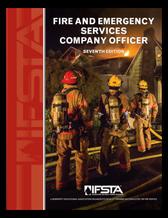
Fire Officer I and II: IFSTA’s Fire and Emergency Company Officer, 7 Ed. ISBN# 9780879397760 th
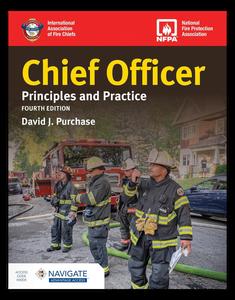
Fire Officer III and IV: Jones & Bartlett’s Chief Officer: Principles and Practice, 4 Ed. ISBN# 9781284317046 th
Live Fire Instructor / Instructor-in-Charge: Jones & Bartlett’s Fire and Emergency Services Instructor, 4 Ed. ISBN# 9781284301250 th
NFPA 1081, Standard for Facility Fire Brigade Member Professional Qualifications (2024) (Release date: January 1, 2027)
Incipient Facility Fire Brigade Member
Advanced Exterior Facility Fire Brigade Member
Interior Structural Facility Fire Brigade Member
Facility Fire Brigade Support Persons
Facility Fire Brigade Leader
NPFA 1550, Standard for Emergency Responder Health & Safety (2024) (Release date: June 1, 2026)
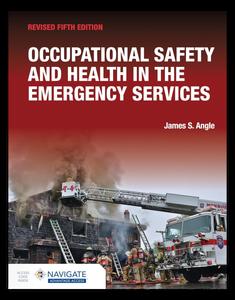
Fire Department Safety Officer: Health & Safety Officer: Jones & Bartlett’s Occupational Safety and Health in the Emergency Services, Revised 5 Ed., ISBN# 9781284309195 th
Fire Department Safety Officer: Incident Safety Officer: Jones & Bartlett’s Fire Department Incident Safety Officer, 4 Ed , ISBN# 9781284172379
Published June 15, 2026.
Subject to change: visit www.alabamafirecollege.org/curriculum-updates
Alabama NERIS Statewide Update
Period of January 1 – May 31, 2026
This update is based on Fire related reported fires. No medical incidents are figured into this update! Data analysis performed by Special Agent Jebb Harrison of the Alabama State Fire Marshal’s Office and NERIS Lead Person for Alabama Need assistance with NERIS? Please contact Jebb Harrison at Jebb Harrison@insurance alabama gov Thank you to every department, firefighter, officer, administrator, and partner agency contributing to Alabama's statewide reporting efforts.
The Alabama Fire Service continues to demonstrate strong participation and reporting performance through the National Emergency Response Information System (NERIS) During the first five months of 2026, Alabama departments submitted approximately 19,800 incident records representing more than 500 reporting fire departments across the state.
These records provide valuable insight into emergency response activity, fire occurrence trends, wildland fire impacts, mutual aid utilization, casualty reporting, and operational demand patterns The information supports statewide planning, resource allocation, risk reduction initiatives, and executive decisionmaking.
Key Statewide Highlights
Approximately 19,800 incident records reviewed
More than 248,000 incidents have been reported this year
More than 500 fire departments participated in reporting
More than 13,000 fire-related incidents reported
Approximately 8,164 vegetation, wildland, brush, and grass fire incidents
More than 8,942 acres reported burned
Peak statewide activity occurred during evening operational periods
Average incident duration exceeded 56 minutes
Mutual aid activity remained strong throughout the reporting period
Operational Activity
Fire departments across Alabama continued to respond to a diverse range of emergencies including structure fires, vegetation fires, rescue incidents, hazardous conditions, emergency medical responses, service calls, and mutual aid assignments.
Analysis indicates that evening hours continue to represent the highest demand period for emergency response resources This trend reinforces the importance of aligning staffing, apparatus availability, and mutual aid agreements with peak operational demand.
Wildland and Vegetation Fire Activity
Vegetation and wildland fire incidents remain one of Alabama's most significant operational challenges More than 3,600 vegetation fire incidents were reported during the reporting period, while wildland, brush, and grass fire incidents exceeded 4,500 responses statewide. These incidents resulted in approximately 8,942+/- acres burned.
As summer temperatures increase and drought conditions fluctuate throughout the state, departments are encouraged to continue emphasizing wildfire prevention efforts, public education campaigns, and regional preparedness planning.
Mutual Aid and Regional Cooperation
Mutual aid remains a critical component of Alabama's emergency response system Thousands of aid-given and aidreceived activities were documented during the reporting period, highlighting the importance of regional partnerships and cooperative response agreements. These relationships continue to strengthen operational readiness and ensure communities receive rapid and effective emergency services regardless of jurisdictional boundaries
Casualty Reporting
Casualty reporting data continues to provide valuable insight into incident outcomes and responder safety. Civilian and firefighter casualty information assists state leadership in identifying injury trends, evaluating prevention programs, and prioritizing training initiatives Continued emphasis on accurate casualty reporting improves statewide situational awareness and supports future risk reduction strategies.
Data Quality and Participation
Alabama continues to demonstrate strong engagement with NERIS reporting requirements While overall data quality remains high, opportunities remain to improve:
Incident approval timeliness
Location and county data completeness
Dispatch timestamp accuracy
Fire acreage reporting consistency
Casualty and rescue documentation
Departments are encouraged to routinely review incident submissions and resolve pending records to ensure the most accurate statewide dataset possible.
Strategic Priorities Moving Forward
State fire service leadership will continue focusing on the following priorities:
Increase statewide reporting participation and compliance
Improve incident data quality and completeness.
Strengthen wildland fire preparedness and mitigation efforts. Support RMS integration and automated reporting solutions.
Enhance mutual aid coordination and regional planning.
Expand data-driven decision making through NERIS analytics
Closing
The Alabama Fire Service continues to lead through professionalism, collaboration, and commitment to public safety The information collected through NERIS provides an unprecedented opportunity to better understand emergency response activity across the state and to make informed decisions that improve firefighter safety, operational effectiveness, and community resilience.
COURSE VACANCIES
Advanced Fire Investigator
14-18
9-13
Airport Fire Fighter AUG 31-SEP 4
RTC OCT 19-23
Rucker RTC NOV 31-DEC 4
Shoals RTC
Alabama Fire & Life Safety Summit SEP 10
Fire & Life Safety Educator I OCT 28-30
Fire & Life Safety Educator II
Fire & Emergency Services Instructor I
Fire & Emergency Services Instructor II
Fire & Emergency Services Instructor III
2-4
20-24
28-OCT 2
11-26 (VFF)
27-31
5-9
16-20
3-7
14-18
12-16
30-DEC 4
FAO: Aerial JUL 13-17
SEP 21-25
SEP 5-6
FAO: Aircraft Rescue & Firefighting
FAO: Mobile Water Supply
FAO: Pumper
FDSO: Health and Safety Officer
FDSO: Incident Safety Officer
Shoals RTC OCT 24-25
5-6
28-29
6-10
14-18
13-17
14-18
6-10
Fire Fighter I/II AUG 31-NOV 6
Rucker RTC
RTC
RTC SEP 7-NOV 13
RTC SEP 7-NOV 13
Shoals RTC
Fire Inspector
Fire Investigator
Fire Officer I
Fire Officer II
Fire Officer III
Fire Officer IV
JUL 13-17 Anniston RTC
AUG 10-14
AUG 17-21 Huntsville RTC
OCT 12-16
NOV 30-DEC 4
OCT 5-9 Anniston RTC
DEC 7-11
JUL 27-31
OCT 5-9
AUG 3-7
OCT 12-16
NOV 16-20
JUL 6-10 Dothan RTC
AUG 10-14 AFC
AUG 17-21 Florence RTC
AUG 24-28 Opelika RTC
SEP 3-30
SEP 21-25 Anniston RTC
OCT 19-23
OCT 26-30 Orange
NOV 2-DEC 2
NOV 30-DEC 4
JUL 13-17 Dothan RTC
JUL 27-31 Prattville RTC
AUG 3-27
AUG 17-21 AFC
AUG 24-28 Florence RTC
SEP 28-OCT 2 Anniston RTC
OCT 5-29
OCT 26-30
NOV 2-6 Orange
RTC DEC 7-11
24-28
5-7
7-9
Public Information Officer
Public Safety Telecommunicator I/II
TRP: Cave Rescue Awareness, Operations, and Technician
TRP: Common Passenger Vehicle Rescue Awareness, Operations, & Technician
TRP: Confined Space Rescue Awareness, Operations, & Technician
JUL 22-24
JUL 22-24
NOV 2-4
JUL 30-AUG 2 (NON-CERT) Huntsville Cave Rescue Unit
AUG 31-SEP 4
Opelika RTC
OCT 5-9 AFC
JUL 20-25
Prattville RTC
SEP 14-18 AFC
OCT 5-9
Shelby County RTC
OCT 19-23 Dothan RTC
TRP: Rope Rescue Awareness & Operations AUG 17-21 Shelby County RTC OCT 19-23 AFC
JUL 6-10
TRP: Rope Rescue Technician
TRP: Surface Water Rescue Awareness, Operations, & Technician
June 26: AFFC’s Introduction to 911 Chaplaincy (McCalla)
June 30: Sports Responder Train-the-Trainer (Madison)
July 3: Closed (Independence Day)
July 14: Commission Quarterly Work Session
July 15: Commission Quarterly Meeting
July 16: Alabama Power Safety Event for First Responders (Livingston)
July 22: Sports Responder Train-the-Trainer (Prattville)
July 22: Alabama EMS Challenge (Madison)
August 1: AFFC’s Introduction to Fire Chaplaincy (Somerville)
August 2-5: AL Fire Chiefs Conference (Perdido Beach)
August 11: Fire Service Briefing
August 12: Combat Ready Fire Training hosted by CAFCA (Vestavia Hills)
August 12: Alabama EMS Challenge (Fultondale)
August 14-15: AFFC’s Assisting Individuals in Crisis (Muscle Shoals)
August 15: Alabama Association of Rescue Squads Quarterly Meeting (Ft. Payne)
August 26: Alabama EMS Challenge (Tuscaloosa)
September 10: Alabama Fire & Life Safety Summit
Join us for the upcoming CRR Kitchen Table! Wednesday, August 5 at 1pm CT: Hear from the team who won the very first NFPA CRR Elevation Team Award! Join us to hear about the impactful initiatives that tipped the scales for this community and learn how they leverage amazing partnerships to take on a challenge that many feel is nearly impossible This will be a don’t miss session! th
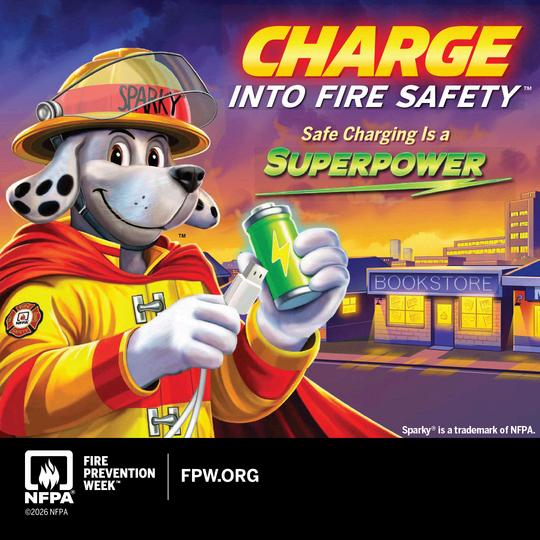
The wait is over. Introducing this year's Fire Prevention Week (FPW ) theme: ™ ™ Charge into Fire Safety : Safe Charging Is a Superpower. ™
FPW 2026, October 4-10, is all about charging safely. Every day, we rely on rechargeable devices to stay connected, informed, and entertained. This year's campaign will help people of all ages learn simple charging habits that can help prevent lithium-ion battery fires. Watch the video and get ready to power up your fire safety knowledge at fpw.org. ™
Would you like to receive this information directly? Email the NFPA CRR team at CRR@nfpa org to be added to the invitation & updates list
Whether you're working in schools, at community events, or online, these materials are designed to help you deliver effective, consistent campaign messaging during Fire Prevention Week and throughout the year Both toolkits also offer select resources in Spanish and French.
Printable Toolkit: Includes official theme art and guidelines, handouts, flyers, and tip sheets for in-person events.
Digital & Social Media Toolkit: Features customizable templates, social media graphics, and sample messaging for online outreach.
The path begins with Fire Support Person, open to individuals who are at least 18 years old and able to read and write in English. The required textbook will be IFSTA’s Essentials of Fire Fighting, 8 Ed Coursework covers Chapters 16 and 1-15, with a required minimum score of 70% on the End of Subject (EOS) assessments In addition to the academic materials, participants must successfully complete a Fire Support Person Task Book. This course spans 70 hours and should be completed within 90 days. th
Traffic Incident Management System (TIMS) courses *
Peer Support *
Hazardous Materials/Weapons of Mass Destruction (HM/WMD) Awareness training *
*This online training can be conducted prior to entering Fire Support Person
Testing covers both cognitive and skills components Once successfully completed, individuals earn the Fire Support Person Certification and HM/WMD Awareness Certification.
The next course is HM/WMD Operations, which delves deeper into hazardous materials response This course requires participants to be at least 18 years old and certified to the HM/WMD Awareness level Participants will complete 40 hours of training within 45 days. Testing covers both cognitive and skills components. Once successfully completed, individuals earn the HM/WMD Operations Certification.
CourseIII(CertifiedVolunteerFirefighter)
To achieve the Certified Volunteer Firefighter certification, candidates must complete the third course, which is skills-based and outlined in the CVFF/FFI Task Book. Prior to beginning this course candidates must have completed certifications in Fire Support Person, HM/WMD Awareness and HM/WMD Operations, and produce a valid Physical Statement (AFC&PSEC FORM-05). This intensive course demands 50 hours of preparation and assessment over a 90-day period Participants undergo Live Fire Skills Testing and CVFF/FFI Skills Testing, overseen by designated test teams Upon successful demonstration of required competencies, the candidate earns the Certified Volunteer Fire Fighter Certification- the culmination of all prior learning and performancebased evaluations.
Conclusion
This training is structured as a progressive program of instruction leading to Certified Volunteer Fire Fighter certification, beginning with entry-level coursework and advancing through required operational and advanced certifications. The program emphasizes standardized training, skill progression, and demonstrated competency in support of public safety and community service
assessment
Coursesrequiredinadditiontothe
FireSupportPersonTaskbook:
NIMS 100, 200, 700, & 800
Peer Support Awareness
TIMS
HM/WMD Awareness
CourseHours: 70 hours / 90 days
CERTIFICATIONTESTING:
HM/WMD Awareness (skills & cognitive) Fire Support Person (skills & cognitive) (submission of Task Book is required) CVFF/FFI (cognitive)
Upon successful completion of CVFF/FFI cognitive testing, the student can continue on to the skills portion of the Volunteer Fire Fighter course
Prerequisites: 18 years of age
NIMS 100, 200, 700, & 800
HM/WMD Awareness
CourseHours: 40 hours / 45 days
CERTIFICATIONTESTING:
HM/WMD Operations (skills & cognitive)
Prerequisites: Fire Support Person
Physical Statement
Completion of CVFF/FFITaskbook
CourseHours: 50 hours/90 days
CERTIFICATIONTESTING:
Live Fire Skills Testing
Skills Testing teams are currently in development. HAZMAT/WMDOPERATIONS
CVFF/FFI Skills Testing (submission of the CVFF/FFI Taskbook is required)
ALABAMA FIRE COLLEGE
Regional Services
www.alabamafirecollege.org/regional
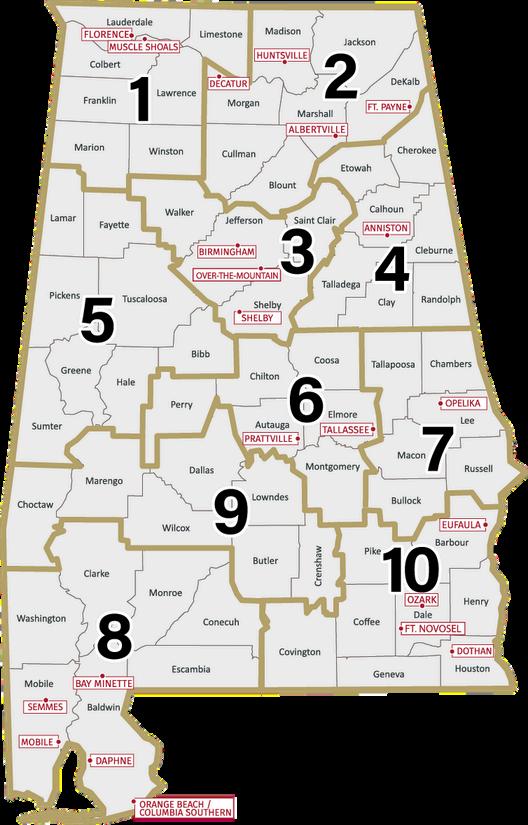
It’s our goal to extend training opportunities into every county in Alabama. To accomplish this objective, we have a network of regional coordinators to facilitate training at the local level. The regional staff is available to answer questions, set up training, and respond to the needs of fire service across the state
REGION 1: Danny Southard dsouthard@alabamafirecollege.org (256)434-0459
REGION 2: Mike Hill mhill@alabamafirecollege.org (256)590-6647
REGION 3: Skip Kittrell skittrell@alabamafirecollege org (205)960-2793
REGIONS 4 & 7: Rudy Rooks rrooks@alabamafirecollege.org (256)463-8469
REGION 5: Jeff Roberts jroberts@alabamafirecollege.org (205)292-5531
REGION 6: Baine Vaughn bvaughn@alabamafirecollege org (334)301-2491
REGION 8: Jeff Ludlam jludlam@alabamafirecollege org (251)680-7883
REGIONS 9 & 10: Dwayne Yelder dyelder@alabamafirecollege.org (334)549-3692