DMISA President Lebogang Mosotho DMISA Deputy President Freda Mathebula DMISA EXCO Chairperson Mduduzi Lancelot Nxumalo
Contents
DMISA EXCO Member: Journal Production and Marketing Shadi Mlokoti Disaster Management Journal Editor Lee Raath-Brownie lee@fireandrescue.co Cell 082 371 0190 Advertising advertising@fireandrescue.co Design and layout Marc Raath marc@fireandrescue.co Finance accounts@fireandrescue.co Circulation subs@fireandrescue.co Administration Kelebogile Thebe Contributions Dr Elias Sithole Jurgens Dyssel Lebogang Mosotho Mduduzi Lancelot Nxumalo Shadi Mlokoti Erika Swart Dr Mal Reddy Associate Professor Neville Sweijd Dr Colin Deiner Kelvin Price Dr Andries J Jordaan Owen Becker Tshilidzi Nthambeleni Dr Niel Rooi Dr Johan Minnie Schalk Carstens Suretha Visser Sindisiwe Nomfundo Moorosi Dr Roman Tandlich Robyn J Bayne Publisher Lee Raath-Brownie FIRE AND RESCUE INTERNATIONAL Tel: 011 452 3135/6 Box 8299 Greenstone 1616 www.fireandrescue.co www.frimedia.org Subscriptions Free of charge
DMISA President’s foreword 2 DMISA President’s foreword by Lebogang L Mosotho DMISA EXCO Chairperson foreword 5 DMISA EXCO Chairperson foreword by Mduduzi Lancelot Nxumalo DMISA EXCO Member foreword 6 DMISA EXCO Member for Journal and Marketing foreword by Shadi Mlokoti National Disaster Management Centre 8 Disaster governance and the principle of legality: From legal mandate to strategy, structure and funding by Jurgens Dyssel Honouring DMISA Presidents 12 DMISA Presidents: Honouring four decades of leadership by Shadi Tsebe and Erika Swart Build Back Better 18 From restoration to recovery readiness: Operationalising Build Back Better through multi-agency in South Africa by Mendi Sigenu and Prof Mal Reddy El Niño 2026 26 The 2026 El Niño – a primer: 13 October 2026 by Associate Professor Neville Sweijd and contributors from the ENSO Reference Group 36 Preparing for the 2026/27 El Niño: Implications for disaster: Risk management in the Western Cape’s winter rainfall region by Dr Colin Deiner Wildfires 42 VitalWeather: Better wildfire intelligence. Better wildfire outcomes by Kelvin Price Land degradation 44 South Africa’s degrading land: A disaster risk we cannot ignore by Dr Andries J Jordaan
Copyright All rights reserved
Volume 8 | No 1
Official Journal: Disaster Management Institute of Southern Africa
Volume 8 No 1
8
Investing in resilience 48 Investing in resilience: Competency is not negotiable by Owen Becker Resilience starts with us 58 Resilience starts with us: Building sustainable South African communities in a multiple-hazard at-risk society by Dr Niel Rooi Consequence management approach to disaster management 64 A consequence management approach to disaster management: Document control - Part 13 of a series by Dr Johan Minnie and Schalk Carstens
48
Call centres and emergency communication 68 The evolution of emergency communication in Cape Town, the City of Hope by Suretha Visser Fire and evacuation simulation in special needs schools 76 Ekurhuleni Municipality fire and evacuation simulation in special needs schools by Sindisiwe Nomfundo Moorosi Pharmacists in disaster risk management 81 The role of pharmacists in disaster risk management in South Africa: An updated perspective focusing on the disaster management cycle by Robyn J Bayne and Dr Roman Tandlich The Sendai Framework FIRE 96 A decade of Sendai in Southern Africa PREPAREDNESS by Dr Johan Minnie and Ms Lebogang Mosotho FOR SPECIAL NEEDS SCHOOLS
Inclusive Resilience Fire Kit
76
A focused school preparedness solution combining fire safety equipment with disability-inclusive evacuation and communication tools.
Drought 104 Beyond rainfall: Towards Impact-Based Drought Classification in South Africa by Dr Andries J Jordaan DMISA contact details 108 Contact details for DMISA
Volume 8 | No 1
Preparedness • Training • Simulation • Evacuation Presented by Sindisiwe Moorosi | God's Purpose Academy (Pty) Ltd | 2026
DiSASTER MANAGEMENT | 1
Back to Contents
Foreword by the DMISA President
FOREWORD BY THE DMISA PRESIDENT By Ms Lebogang L Mosotho, President, Disaster Management Institute of Southern Africa (DMISA)
Ms Lebogang L Mosotho-Segage
W
ith immense pride, gratitude and optimism, I present this edition of the Disaster Management Institute of Southern Africa (DMISA) Journal, reflecting on a transformative and productive period since the current Executive Committee and Board assumed office in 2024. As we near the end of our 2024-2026 term, we do so with a deep sense of achievement, stronger partnerships and renewed determination to advance disaster risk reduction and management as a recognised profession in Southern Africa. Over the past two years, DMISA has remained steadfast
2 | DiSASTER MANAGEMENT
in its mission to promote professionalism, ethical practice, knowledge sharing, research, capacity development and collaboration within the disaster risk management sector. Through the collective efforts of our Executive Committee, Board members, regional leadership structures, members, volunteers and strategic partners, the Institute has significantly strengthened its visibility, credibility and influence at both national and regional levels. A milestone achievement during this period was the South African Qualifications Authority's (SAQA) successful assessment of DMISA and its subsequent re-recognition as a Professional Body. This accomplishment marks a defining moment in the Institute's history and firmly positions DMISA as the custodian of professional standards, ethics and continuous professional development within the disaster risk management profession. This recognition has laid the foundation for the sector's professionalisation and accelerated our efforts to introduce professional designations for practitioners.
Building on this achievement, DMISA convened a strategic planning session to chart the Institute's future direction and align with national and international developments in disaster risk reduction and climate resilience. The strategic engagement provided an opportunity to reflect, assess the organisation and plan for the long term. The Institute subsequently developed a comprehensive strategic report and a three-year implementation plan, providing a clear roadmap for institutional growth, governance strengthening, member development, stakeholder engagement and programme implementation. In line with our professionalisation agenda, the Institute is now well advanced in transitioning from its traditional membership categories to a professional designation framework. The Institute has prepared a draft policy to guide the conversion of existing membership categories into recognised professional designations, ensuring practitioners are appropriately recognised based on qualifications, experience, competence and commitment to
Volume 8 | No 1
Back to Contents
Foreword by the DMISA President ethical practice. This important initiative will further elevate the status and credibility of disaster risk management practitioners across Southern Africa. DMISA has also continued to play a meaningful role in shaping the future of disaster risk management in South Africa. Through our participation in the National Disaster Management Centre- Results Management Office (RMO) and various national technical engagements, the Institute has actively contributed to discussions on revising disaster risk management legislation and the broader overhaul of the disaster management system. As the sector's recognised professional body, DMISA has provided practitioner perspectives and technical expertise to support stronger governance arrangements, institutional frameworks, professional standards and disaster risk reduction practices in the evolving legislative environment. Highlights of this term included successfully hosting the 2025 DMISA Conference and Annual General Meeting in the Bojanala District Municipality, as well as the Mpumalanga Disaster Risk Reduction Seminar 2026. The conference brought together practitioners, academics, policymakers, emergency responders and development partners from across South Africa and beyond. It served as an important platform for professional networking, knowledge exchange, innovation and dialogue on building resilient communities. The Institute further expanded its national footprint by successfully establishing the North West and Eastern Cape Regional Structures, while continuing to strengthen the 4 | DiSASTER MANAGEMENT
operations and influence of our established regions in Limpopo, Gauteng, Free State and the Western Cape. These structures remain critical platforms for professional development, stakeholder engagement, research collaboration and member participation. Regional and international cooperation has also continued to grow. During this term, DMISA strengthened professional relations with counterparts in Namibia, creating opportunities for cross-border collaboration, knowledge sharing and regional learning on common disaster and climate resilience challenges. Our commitment to advancing knowledge and professional excellence has also seen DMISA actively engage with institutions of higher learning through seminars, colloquiums, guest lectures and collaborative initiatives. We have participated in academic engagements at the University of the Free State, the Disaster Management Training and Education Centre for Africa (DiMTEC), the University of Limpopo and other institutions, strengthening links between research, policy and professional practice. The Institute also entered into a strategic Memorandum of Understanding with STADIO Higher Education, reinforcing our commitment to education, research, professional development and the future growth of the disaster risk management profession. Our work would not have been possible without strong partnerships. Throughout this term, DMISA has maintained productive relationships with key stakeholders, including the National Disaster Management Centre (NDMC), SALGA, the
South African Red Cross Society (SARCS), the South African Weather Service (SAWS), Santam and numerous provincial and local government institutions. We are also grateful for growing support from organisations such as the Mpho Mathoho Foundation, Al-Imdaad Foundation and Blake Emergency Services, whose contributions continue to strengthen community resilience and support disaster risk reduction initiatives across the region. The successful hosting of the 2026 Disaster Risk Reduction Conference in Gauteng Province, in partnership with the National Disaster Management Centre, Gauteng Provincial Disaster Management Centre, CoGTA and the City of Tshwane, demonstrated the power of collaborative leadership and collective action in advancing resilience and sustainable development. The Institute's growth is also reflected in its improved financial position. Through sound governance, prudent financial management, and the confidence members and partners place in DMISA, the Institute recorded significant growth in its assets and institutional capacity. This progress provides a solid foundation for sustainability, innovation and future expansion. These achievements would not have been possible without the dedication of our members, regional structures, volunteers, Board members, Executive Committee, sponsors, academic institutions, development partners and stakeholders. Your commitment and support have enabled DMISA to remain the leading professional voice for disaster risk management practitioners in Southern Africa. Volume 8 | No 1
Back to Contents
Foreword: DMISA Executive Committee Chairperson
FOREWORD BY THE EXECUTIVE COMMITTEE CHAIRPERSON, DMISA Mduduzi Lancelot Nxumalo
I
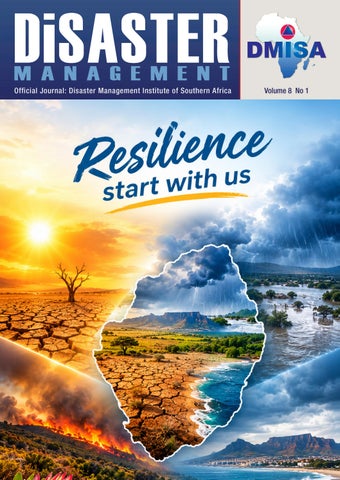
t is an honour to present the 2026 DMISA Conference Journal, a reflection of our collective commitment to advancing disaster risk reduction, strengthening resilience and promoting sustainable approaches to disaster management across Southern Africa. The theme of this year’s conference, “Resilience starts with us,” invites us to reflect on the role each of us plays in building a safer and more resilient society. While resilience is often associated with government policies, institutional capacity and community interventions, its foundation begins with the individual. Before we can build resilient communities, we must first recognise our own responsibility
While we celebrate our accomplishments, we remain mindful of the increasingly complex risks facing our communities. Climate change, environmental degradation, rapid urbanisation, public health emergencies, technological hazards and socio-economic vulnerabilities continue to challenge resilience efforts across the region. These realities underscore the need for stronger partnerships, innovation, evidence-based decision-making and a highly professional disaster risk management sector. Volume 8 | No 1
to understand risks, prepare for emergencies and contribute to a culture of prevention. This message is reinforced by the 2026 International Day for Disaster Risk Reduction theme, “Resilience Starts at Home,” which highlights the importance of household preparedness in reducing disaster risks. Our homes are the starting point of resilience, where awareness, preparedness and practical action can make the difference between vulnerability and the ability to withstand and recover from adversity. As disaster management practitioners, we are called upon to translate this principle into action. Resilience requires more than responding effectively when disasters occur; it demands
As we reflect on this remarkable journey, we are confident that DMISA is stronger, more influential and better positioned than ever to advance the disaster risk management profession. DMISA's recognition as a professional body, progress toward professional designations, our contribution to legislative reform and strengthened strategic partnerships collectively mark a significant chapter in the Institute's history. As we move forward, DMISA will continue to champion professional excellence, ethical
Mduduzi Lancelot Nxumalo proactive risk assessment, investment in prevention, effective early warning systems, public awareness, resilient infrastructure and inclusive planning. It also requires us to recognise the different vulnerabilities experienced by individuals and households, ensuring that our interventions leave no one behind.
practice, research, knowledge sharing, capacity development, advocacy and collaborative action. Together, we will strengthen the profession and contribute meaningfully to building safer, more resilient, adaptive and sustainable communities throughout Southern Africa. Resilience starts with us. Ms Lebogang L Mosotho President Disaster Management Institute of Southern Africa (DMISA) 2024-2026 Term DiSASTER MANAGEMENT | 5
Back to Contents
DMISA EXCO Member for Journal and Marketing
A WORD FROM THE EXCO MEMBER: JOURNAL PRODUCTION AND MARKETING
By Shadi Tsebe, DMISA EXCO Member: Journal and Marketing is where our profession's knowledge, experience and voice come together. Each article reflects the dedication of practitioners who work, often behind the scenes and under pressure, to protect lives, livelihoods and communities across Southern Africa. DMISA EXCO Member: Journal and Marketing
I
t is a privilege to welcome you to this edition of the DMISA Journal. More than a publication, the Journal
The evolving disaster risk landscape in Southern Africa further emphasises the importance of collaboration, innovation and knowledgesharing. Climate-related hazards, urbanisation, socio-economic inequalities and other emerging risks require coordinated responses that bring together government, academia, the private sector, civil society and communities. Through these partnerships, we can strengthen institutional capacity, share good practices and develop solutions that respond to the realities of the communities we serve. DMISA remains committed to advancing professional excellence, promoting continuous learning and strengthening the disaster management profession. This journal provides a valuable 6 | DiSASTER MANAGEMENT
A year that tested us 2026 has reminded us why our work matters. In January, heavy rain and flooding hit Limpopo, Mpumalanga and other provinces and the government declared a national disaster. Dozens of lives were lost, thousands of
platform for sharing insights, experiences and practical approaches that contribute to the development of knowledge and the improvement of disaster risk management practice. I encourage our members, practitioners, researchers and partners to use the insights contained in this publication to challenge existing approaches, embrace innovation and strengthen their contribution to resilience-building. Let us move beyond viewing resilience as an institutional responsibility and recognise it as a shared commitment that begins with every individual, every household and every community. I extend my sincere appreciation to the conference organising team, our sponsors, partners,
families were displaced, and roads, bridges and homes were washed away. The floods also closed the Kruger National Park and affected neighbouring Mozambique and Zimbabwe, where the death toll across the region passed 100. In May, a second series of storms and floods struck six provinces. Cape Town's informal settlements were hit hardest, with more than 10,000 structures damaged, and a further disaster was declared. The rest of the world faced its own tests. Europe endured a run of winter storms, including
contributors and all stakeholders whose dedication and support have made this conference and publication possible. Your continued partnership is instrumental in advancing our shared vision of a disasterresilient Southern Africa. As we reflect, learn and engage through this conference, let us remember that resilience is built through the decisions we make today and the actions we take together. Resilience starts with me. Resilience starts with you. Together, resilience starts with us. Mduduzi Lancelot Nxumalo Executive Committee Chairperson Disaster Management Institute of Southern Africa (DMISA) Volume 8 | No 1
Back to Contents Storm Kristin on the Iberian Peninsula, followed by record heat in the northern summer. In Germany alone, more than 5,000 heat-related deaths were estimated between April and June. Floods in central and southern China in May claimed about 45 lives and bushfires burned in southeastern Australia. Then, on 24 June 2026, a double earthquake of magnitudes 7.2 and 7.5 struck Venezuela, causing thousands of deaths. By Munich Re's early estimate, natural disasters caused about US$112 billion in losses worldwide in the first half of the year and roughly 60% of that was uninsured. Behind these numbers are people and behind the response are disaster management practitioners, many of them our own members. These events show how vital preparedness, early warning and professional capacity are and how much work remains to be done.
DMISA EXCO Member for Journal and Marketing Earlier this year, about 120 delegates met in Mbombela for the DMISA seminar on disaster risk reduction, Early Warning for All and the professionalisation of disaster management. I encourage you to attend and to bring a colleague, especially someone new to the field. Honouring those who built DMISA In this edition we also pause to honour the past presidents who have led DMISA since 1985 and to acknowledge our current President, Ms Lebogang Mosotho. The Institute has grown from a Civil Defence association into a SAQA-recognised professional body and that growth is the work of many hands over more than 40 years. Your Journal needs you Producing the Journal and
promoting DMISA is a shared task. I encourage you to contribute articles, case studies, lessons from recent disasters and news from your regions. Your stories strengthen the profession and inspire those who come after us. My thanks go to our authors, our contributors and the team who brought this edition together. I hope you find this edition informative and inspiring. Warm regards Shadi Tsebe EXCO Member: Journal Production and Marketing Disaster Management Institute of Southern Africa (DMISA) “Alone we can do so little; together we can do so much.” ~ Helen Keller
Coming together at the DMISA conference This is why our annual conference matters. The DMISA Disaster Risk Reduction Conference, held every year since the 1980s, brings together practitioners from government, academia, the private sector and humanitarian organisations to share lessons, build networks and strengthen the profession. Last year's conference was held at Sun City, and this year we gather again for the DMISA Disaster Risk Reduction Conference 2026 21 to 22 October 2026, Southern Sun Hotel, Pretoria, City of Tshwane under the theme: Resilience starts with us: Building sustainable communities and advancing the SDGs for a safer future. Volume 8 | No 1
DiSASTER MANAGEMENT | 7
Back to Contents
National Disaster Management Centre
DISASTER GOVERNANCE AND THE PRINCIPLE OF LEGALITY: FROM LEGAL MANDATE TO STRATEGY, STRUCTURE AND FUNDING
By Mr Jurgens Dyssel, Chief Director: Policy, Institutional Development and Compliance Management, National Disaster Management Centre (NDMC)
P
riority 2 of the Sendai Framework for Disaster Risk Reduction ‘Strengthening disaster risk governance to manage disaster risk’, guides national, regional and local authorities to build clear, accountable and wellcoordinated systems that can handle disaster risks before, during and after a crisis. It aims to shift disaster management from a reactive response to a proactive, well-governed strategy. This article seeks to elucidate how this priority finds traction in the South African Constitutional framework.
has been lawfully conferred upon it. Often referred to as the principle of legality, this doctrine requires that every exercise of public power must originate from a valid legal authority. Government institutions do not possess inherent powers; rather, they derive their powers and responsibilities from constitutions, legislation, regulations and other legally recognised instruments. Consequently, public institutions must be able to demonstrate not only what they do but also the legal basis upon which they do it.
identify the legislative provision that authorises such an activity. For example, a disaster management centre, health department, a police service or environmental authority cannot simply assume responsibility for a particular function because it appears necessary or beneficial. Rather, the institution must identify the enabling provisions contained within legislation that establish its powers, duties and responsibilities. Any action taken outside those legal powers may be challenged as unlawful and may be set aside by a court.
Governance is defined as a system, a set of rules and processes used to direct, control and hold an organisation, corporation, or nation accountable. In order to Govern “something” or being responsible to govern “something”, we first need to understand the principle of legality moving from legal mandate to strategy, structure and funding.
The principle serves several important purposes. First, it protects citizens from arbitrary exercises of power. Second, it promotes accountability by ensuring that public officials act within clearly defined boundaries. Third, it creates certainty regarding the roles and responsibilities of different institutions, thereby reducing duplication, overlap and conflict. Finally, it ensures that public resources are utilised only for purposes that have been authorised by law.
The legal mandate therefore becomes the starting point for institutional planning and organisational development. A mandate defines what an institution is legally required or permitted to do. It describes the outcomes the institution must achieve, the functions it must perform and the authority it possesses to execute those functions. However, legislation generally identifies the “what” rather than the “how.” Institutions must therefore translate legal requirements into practical actions that can be implemented and managed. This translation occurs through the development of strategy.
A foundational principle of our Constitutional democracy and public administration is that no organ of state, public institution or public official may perform a function unless that function 8 | DiSASTER MANAGEMENT
In practical terms, the principle means that before an institution undertakes any activity, it must
Volume 8 | No 1
Back to Contents A strategy represents the institution's deliberate plan for fulfilling its legal mandate. The strategy interprets legislative requirements and converts them into measurable objectives, priorities and programmes of action. In essence, the strategy answers the question: “How will the institution fulfil the responsibilities assigned to it by law?” For example, if legislation requires an institution to promote disaster risk reduction, the institution must develop a strategy that identifies the risks to be reduced, the mechanisms through which risks will be reduced, the stakeholders that must be engaged and the outcomes that must be achieved. Similarly, if legislation requires environmental protection, the responsible authority must develop strategic objectives relating to monitoring, enforcement, compliance, education and conservation.
Volume 8 | No 1
National Disaster Management Centre In both cases, the strategic plan derives directly from the legal mandate. The relationship between law and strategy is therefore hierarchical. The law establishes the mandate. The mandate informs the strategy. The strategy identifies objectives and programmes. These programmes then determine the institutional arrangements necessary for implementation. Once a strategy has been developed, attention shifts to organisational structure. An institution cannot effectively implement a strategy unless it possesses the appropriate organisational capabilities. The structure of an institution should therefore be designed around the functions required to deliver the strategic objectives. Structure refers to the arrangement of people, units, divisions, reporting relationships and governance
mechanisms within an organisation. The principle of legality remains important at this stage because institutions may only establish structures that support legally authorised functions. A department should not create units or posts for functions that fall outside its mandate. For example, where legislation requires disaster risk assessment, preparedness, response coordination and recovery planning, the organisational structure may include specialised units responsible for risk analysis, early warning systems, emergency operations, recovery planning, stakeholder coordination and information management. Each unit exists because it contributes to the execution of a legally mandated function. An improperly designed structure can undermine
DiSASTER MANAGEMENT | 9
Back to Contents
National Disaster Management Centre the implementation of a mandate. A structure that lacks technical expertise, coordination mechanisms or sufficient staffing may be unable to achieve strategic objectives despite having a clear legal mandate, as is the case with the many of our Disaster Management Centres across the three spheres of government. Conversely, a structure containing units with no connection to the legal mandate may result in inefficiencies, duplication of effort and misuse of public resources. The alignment between mandate, strategy and structure therefore becomes critical. Every position, function and reporting line should be traceable to a strategic objective and every strategic objective should ultimately be traceable to a legal requirement. This creates a clear chain of accountability from legislation through to operational implementation. The final component in this chain is funding. Funding is not merely a financial exercise; it is the allocation of resources to enable the execution of legally mandated functions. Public finance principles generally require that public funds be spent only on activities that are authorised by law. Consequently, budgeting must also originate from the legal mandate. Once strategic priorities have been identified and organisational structures established, institutions can determine the resources required to implement their programmes. These resources include personnel, infrastructure, equipment, technology, operational expenditure, training and stakeholder engagement activities. The cost of these resources informs the budget. A useful way of understanding this 10 | DiSASTER MANAGEMENT
relationship is to view funding as following function. If a function is required by law, resources must be allocated to perform that function. Conversely, if a function is not required or authorised by law, public funds should not be allocated to support it. For example, where legislation requires the establishment of an emergency operations centre, the institution must budget for facilities, communications systems, information technology, staffing, maintenance and operational costs. Similarly, if the law requires risk assessments and early warning systems, funding must be allocated to technical experts, monitoring systems, data collection, modelling tools and community awareness programmes. This creates a direct line of sight between legal obligations and financial planning. Legislatures, treasury authorities and oversight bodies can assess whether funding requests are justified by demonstrating their connection to a statutory mandate. Likewise, accountability mechanisms can evaluate whether allocated funds were used for the purposes for which they were approved. The relationship can therefore be summarised as a logical progression: Legal mandate → Strategy → Structure → Funding The legal mandate establishes the institution's purpose and responsibilities. The strategy explains how those responsibilities will be fulfilled. The structure provides the organisational capacity required for implementation. Funding supplies the resources necessary for the structure to perform its functions. Where this alignment is absent, governance failures often occur. Institutions may develop strategies
unrelated to their mandates, establish structures that do not support strategic priorities or receive funding for activities that lack legal authority. Such misalignment can result in poor performance, audit findings, wasteful expenditure and legal challenges. Conversely, when mandate, strategy, structure and funding are properly aligned, institutions operate effectively and accountably. Stakeholders can clearly understand why an institution exists, what it aims to achieve, how it is organised, and how public resources are being utilised. This alignment also supports performance management because outcomes can be measured against statutory obligations and strategic commitments. In conclusion, the principle that one may only perform functions legally conferred by law is more than a legal doctrine; it is the foundation of institutional governance. The legal mandate provides legitimacy and authority. That mandate is translated into strategy through the identification of objectives and programmes necessary to fulfil legal obligations. The strategy then informs the design of the organisational structure required to deliver those programmes. Finally, the structure determines the funding and resources necessary for implementation. Effective public institutions therefore demonstrate a continuous and traceable link between their legal authority, strategic direction, organisational design and financial resources, ensuring both lawful governance and efficient service delivery. Feel free to email your comments to Mr Jurgens Dyssel at email: jurgensd@ndmc.gov.za. Volume 8 | No 1
Honouring DMISA Presidents
DMISA PRESIDENTS:
HONOURING FOUR DECADES OF LEADERSHIP Authors: Shadi Tsebe and Erika Swart
O
n 26 April 1985, an association was founded that would grow, over more than 40 years, into the recognised professional body for disaster management in Southern Africa. That association is today the Disaster Management Institute of Southern Africa (DMISA). Its story is one of changing names, expanding mandates and rising professional standards and at every stage it has been carried by volunteer leaders who gave their time to the profession. This article pays tribute to the presidents who have steered DMISA since 1985 and to the woman who leads it today, Ms Lebogang Mosotho. From Civil Defence to Disaster Management DMISA was founded on 26 April 1985 as the Civil Defence Association of South Africa, at a time when civil defence services were governed by the Civil Defence Act (Act 67 of 1977). As thinking about risk evolved, so did the organisation. Its name changed to the Civil Protection Association of South Africa in 1994, the Emergency and Disaster Management Association of Southern Africa in 1996 and the Disaster Management Association of Southern Africa in 1998. In 2000 it became the Disaster Management Institute of Southern Africa, the name it carries today. Key milestones along the way include: • 1990: a DMISA study tour to Europe and the United 12 | DiSASTER MANAGEMENT
Kingdom helped shift South Africa's thinking from civil defence to disaster management. The United Nations in Geneva accepted the approach and the UN Disaster Management Training Programme was introduced to South Africa as a result. •
1996: DMISA partnered with Technikon SA to offer Certificate Courses in Disaster Management based on the UN modules. These courses were jointly accredited and certified by Cranfield University (UK), the University of Wisconsin (USA) and the then Civil Protection Association.
•
2005: the Institute resolved to investigate becoming a statutory professional body, a decision that set the direction for the next two decades.
•
Today: DMISA hosts the largest annual Disaster Risk Management conference in Africa, typically drawing more than 350 delegates and meets regularly with the National Disaster Management Centre to share information across the spheres of government.
A recognised professional body Since 18 February 2015, DMISA has been recognised by the South African Qualifications Authority (SAQA) as the professional body for disaster management in South Africa (SAQA professional body ID 940). That recognition was renewed for a further five-year
period, from 20 March 2025 to 19 March 2030, under SAQA decision number 06147/25. As a SAQA-recognised professional body, DMISA administers four professional designations registered with SAQA and reports to SAQA on its governance: • DMT – Disaster Management Technician • DMA – Disaster Management Associate • DMPc – Disaster Management Practitioner • PrDM – Disaster Management Professional These designations link membership to qualifications and experience, set codes of conduct and ethical standards and give practitioners a recognised professional identity. DMISA's vision is to be: “A dynamic professional body for Disaster Management in Southern Africa which is internationally recognised”, with a mission of being “an accountable, qualitydriven, trend-setting body striving towards continuous professional skills development.” Every president named below helped lay a stone in this foundation, from the first civil defence volunteers to those who guided the Institute through professionalisation and SAQA recognition. The Presidents The Pioneers (1985–2000) DMISA's first president, Mr Mynhardt Beukes (1985– Volume 8 | No 1
Back to Contents 1987), established the young association. He was followed by Mr Henk van Elst (1987–1988), Mr André Janse van Rensburg (1988–1989), Mr Rod Douglas (1989–1990), Mr Hennie Fouché (1990–1991) and Mr Johan Swanepoel (1991–1992), each serving for a year or two during the organisation’s formative years. These early presidents led a young, association, most of them alongside demanding full-time careers in civil defence, local government and the emergency services. Theirs was the unglamorous but essential work of any new professional body: drawing in members, building its structures, organising its first gatherings and making the case that protecting communities from disaster deserved an association of its own. Much of what DMISA is today rests on the foundations they laid in those first years. Mr André Janse van Rensburg (1988–1989) also deserves recognition. He was instrumental in writing the DMISA Constitution and in developing many of the Institute’s policies. This work gave the young association the governance framework it needed to grow from a young group into a credible, well-run organisation and it laid the groundwork for the accountability and professional standards that later made SAQA recognition possible. His contribution continues to shape how DMISA is governed today. Mr Henk van Elst deserves special mention. He headed disaster management for the Johannesburg Municipality for about 24 years, after 32 years of service in all, and helped investigate and launch DMISA in 1985. Beyond his presidency he served on the Executive Committee from Volume 8 | No 1
Honouring DMISA Presidents 1985 to 1997 and chaired it from 1992 to 1997 and he was named an Honorary Member in 1998. In 1991 he initiated the move from civil protection to disaster management, which led to the 1993 Bosberaad and the Green and White Papers that shaped modern South African disaster legislation. He also helped establish modular disaster management training at Technikon SA and advised on the Free State University master's programme. He passed away on 9 May 2013.
Algoa Region several times, was awarded Fellowship on 18 September 2001 and championed the DMISA Bursary Programme. She helped shape the Disaster Management Act and the National Framework, and wrote manuals and guidelines for local government and the National Disaster Management Centre. She earned a master's degree cum laude in 2005. Pat Reid passed away on 27 February 2012 and the annual Pat Reid Lecture is named in her honour.
The 1990s brought longer terms and steadier growth under Mr Dirk van Rooyen (1992–1994), Mr Chris van der Westhuizen (1994–1996) and Mr Jorrie Jordaan (1996–1998). This was the decade of the name changes, the Technikon SA courses and the move from civil defence thinking to modern disaster management. Mr Geoff Laskey (1998–2000) then led the Institute to the turn of the millennium. His term brought the Institute to the threshold of its present identity: in 2000, the year he handed over, the organisation adopted the name Disaster Management Institute of Southern Africa.
Mr Anthony Kesten (2002–2004) followed and then Mr Peter Mokoto (2004–2006). Mr Mokoto's term included the 2005 decision to investigate statutory professional body status, and he co-authored, with Pat Reid and Johan Minnie, the 2006 Notes on the History of the Disaster Management Institute of Southern Africa, the account on which much of this article draws. Mr Kesten’s presidency coincided with the passing of the Disaster Management Act (Act 57 of 2002), when practitioners across the country began putting the new legislation into practice and both he and Mr Mokoto guided the Institute as it adapted to this new legal landscape.
A New Millennium (2000–2012) Ms Pat Reid (2000–2002) was one of the Institute's most admired leaders. A professional nurse from 1966, she joined the Red Cross in 1977 and built its disaster preparedness programme, later heading disaster management at the Cacadu District Municipality and working as a consultant whose services were sought across Africa. She joined DMISA in 1989, became a Councillor in 1990, sat on the Executive Committee from 1994 and served as Deputy President from 1998 to 2000 before becoming President. She chaired the
Mr Pat Adams was entrusted with the presidency for two consecutive terms (2006–2010), a sign of the confidence the membership had in him. Mr Schalk Carstens (2010–2012) then took the chair. At the time of his election, he was Director of Risk Management at the Western Cape Provincial Disaster Management Centre. In his acceptance speech he pledged to prioritise disaster management for large events such as the 2010 FIFA World Cup, to press political office-bearers on the importance of disaster management and to seek recognition for practitioners. DiSASTER MANAGEMENT | 13
Back to Contents
Honouring DMISA Presidents Professionalisation and growth (2012–2024) Dr Mal Reddy (2012–2014) is an academic at the Durban University of Technology, where she is Associate Director in the Department of Public Management and Economics. She was part of the national project team that developed South Africa's National Disaster Management Education and Training Framework, served on the steering committee of the USAID/ North-West University Disaster Risk Reduction Knowledge Shop and sits on the editorial board of the Jàmbá: Journal of Disaster Risk Studies. She continues to serve on DMISA's Council and Board and on its Professional Board for Disaster Management. Dr Johan Minnie (2014–2016) presided over a landmark moment: on 18 February 2015, SAQA recognised DMISA as the professional body for disaster management. Dr Minnie has remained a trusted voice in the Institute, serving on its Board and updating the official history of DMISA in 2019 and again in 2023. Mr Bafana Mazibuko (2016– 2018) was a forthright champion of the profession. Speaking as outgoing president at the 2018 Disaster Management Conference in Ekurhuleni, he warned that South Africa was not adequately prepared for a major event such as an earthquake, called for more qualified disaster management staff, urged municipalities to build disaster management into their integrated development plans and stressed a message that remains at the heart of DMISA's work: ’Disaster management is a profession’. Dr Mdu Nxumalo (2018–2020 and 2020–2022) was reelected for a second term, and his leadership spanned the COVID-19 pandemic years. At 14 | DiSASTER MANAGEMENT
the 2019 annual conference in Hartenbos, Mossel Bay, which focused on reducing disaster damage to critical infrastructure and disruption of basic services, he urged delegates: “May we, by keeping these people in mind, work harder towards disaster risk reduction”. Mr Owen Becker (2022–2024) led DMISA in the years following the COVID-19 pandemic, a period in which the sector took stock of hard-won lessons and renewed its focus on preparedness, resilience and the professional standing of practitioners. He steered the Institute’s work with its members, partners and the National Disaster Management Centre through this time and his term ran up to the renewal of DMISA’s SAQA recognition in March 2025. He handed over to Ms Lebogang Mosotho at the 2024 Annual General Meeting in Cape Town, ensuring continuity of leadership. The Institute thanks Mr Becker for his commitment and service. In Memoriam We remember with gratitude the past presidents who have passed on: Mr Mynhardt Beukes, Mr Henk van Elst, Mr Rod Douglas, Mr Johan Swanepoel, Mr Dirk van Rooyen, Mr Chris van der Westhuizen, Mr Jorrie Jordaan and Ms Pat Reid. Many of them led DMISA in the years before the current legislation and professional register existed, and the profession as we know it was built on their work. Their legacy lives on in the Institute and in every practitioner who carries on their work. Our current President: Ms Lebogang Mosotho DMISA is proud to be led today by Ms Lebogang Mosotho, who took office as President on 22 November 2024, following
her election at the Institute's Annual General Meeting in Cape Town. She is a Disaster Management Officer at the Capricorn District Municipality in Limpopo. Congratulating her on her election, the Executive Mayor of Capricorn District Municipality said she had “shown exceptional leadership skills and dedication in her field” and was “a source of inspiration for all those working in the field of disaster management.” Under her presidency, DMISA's SAQA recognition was renewed to 2030 and the Institute has continued to bring practitioners together. In July 2026, about 120 delegates gathered in Mbombela, Mpumalanga, for a DMISA seminar on disaster risk reduction, Early Warning for All and the professionalisation of disaster management. Ms Mosotho described the seminar as an important platform for building disaster resilience and promoting professional excellence and her message to the sector was clear: “Disaster management is everybody's business.” She added that building resilient communities requires collaboration between government, communities and other partners and that the seminar aimed to strengthen partnerships and share lessons from recent disasters. Her vision for her term builds on these themes: strengthening partnerships between government, communities and other role-players; promoting professional excellence through DMISA’s SAQA-registered designations; supporting early warning and disaster risk reduction so that communities are better prepared before disasters strike and growing the next generation of qualified disaster management practitioners across Southern Africa. Volume 8 | No 1
Back to Contents On behalf of the DMISA Board and members, thank you, Ms Mosotho, for your commitment and service to the Institute and to the profession. Thank You To every president named in this article: thank you. You gave your time, your expertise and your
Honouring DMISA Presidents conviction to a profession that protects lives and livelihoods. Your vision and sacrifice are why DMISA stands strong after more than 40 years, a SAQArecognised professional body with internationally respected standards. We honour you, and we look forward to the years ahead.
The Institute recognises that the stories of many of its earlier presidents have not yet been fully recorded. Members who have memories, anecdotes or photographs of past presidents are warmly invited to share them with DMISA, so that this history can be preserved and expanded in future editions of the Journal.
Sources • DMISA: Notes on the History of DMISA • SAQA: DMISA professional body listing (ID 940) • DMISA: Dedications and tributes • DMISA: Vision and mission • Capricorn District Municipality: Executive Mayor congratulates Ms Lebogang Mosotho • Mpumalanga News: DMISA hosts disaster management seminar in Mbombela • Mossel Bay Advertiser: Disaster managers meet (2019) • Cape Times: SA faces disaster management crisis (2018) • Western Cape Government: Schalk Carstens elected DMISA President • Durban University of Technology profile: Dr Mal Reddy Period
President
Note
1985–1987
Mr Mynhardt Beukes
In memoriam
1987–1988
Mr Henk van Elst
In memoriam
1988–1989
Mr André Janse van Rensburg
1989–1990
Mr Rod Douglas
1990–1991
Mr Hennie Fouché
1991–1992
Mr Johan Swanepoel
In memoriam
1992–1994
Mr Dirk van Rooyen
In memoriam
1994–1996
Mr Chris van der Westhuizen
In memoriam
1996–1998
Mr Jorrie Jordaan
In memoriam
1998–2000
Mr Geoff Laskey
2000–2002
Ms Pat Reid
2002–2004
Mr Anthony Kesten
2004–2006
Mr Peter Mokoto
2006–2008
Mr Pat Adams
2008–2010
Mr Pat Adams
2010–2012
Mr Schalk Carstens
2012–2014
Dr Mal Reddy
2014–2016
Dr Johan Minnie
2016–2018
Mr Bafana Mazibuko
2018–2020
Dr Mdu Nxumalo
2020–2022
Dr Mdu Nxumalo
2022–2024
Mr Owen Becker
2024–2026
Ms Lebogang Mosotho
Volume 8 | No 1
In memoriam
In memoriam
Second term
Second term
Current president
DiSASTER MANAGEMENT | 15
Honouring DMISA Presidents
16 | DiSASTER MANAGEMENT
Back to Contents
Volume 8 | No 1
Back to Contents
Volume 8 | No 1
Honouring DMISA Presidents
DiSASTER MANAGEMENT | 17
Back to Contents
Build Back Better
FROM RESTORATION TO RECOVERY READINESS: OPERATIONALISING BUILD BACK BETTER THROUGH MULTI-AGENCY IN SOUTH AFRICA
Authors: Mendi Sigenu and Prof Mal Reddy, Durban University of Technology
Abstract uild Back Better (BBB) has become part of international disasterrisk reduction policy. Still, postdisaster recovery often rebuilds disaster-affected assets without systematically addressing the risks that made them vulnerable. This paper explores the institutional conditions that are needed to shift disaster recovery from restoration to true risk-reducing reconstruction in South Africa. The April 2022 KwaZulu-Natal floods are used as an empirical anchor, through a critical integrative review of recent peer-reviewed scholarship and authoritative policy evidence. The analysis reveals four interrelated obstacles to BBB: the physical reconstruction of resilience is often equated with resilience; recovery financing arrangements are often not conducive to timely and risk-sensitive investment; multi-agency governance is fragmented across the recovery cycle and community vulnerability, local knowledge and accountability are not sufficiently integrated into reconstruction decisions. The paper builds on the emerging international literature on recovery readiness to create a Recovery Readinessto-Resilience Framework, which includes governance readiness, financing readiness, risk-information readiness, inclusive recovery readiness and adaptive learning and accountability. It proposes that
B
18 | DiSASTER MANAGEMENT
BBB should not be perceived as a post-disaster activity; instead, it should be recognised as a process supported through relevant institutional, financial and informational arrangements that are put in place prior to a disaster. The paper concludes that South African municipalities can enhance BBB by incorporating pre-disaster recovery planning into disaster-risk governance, by linking reconstruction funding to future risk reduction and by assessing recovery based on a reduction in residual vulnerability and not just on expenditure or asset replacement. Keywords: Build Back Better; disaster recovery; recovery readiness; multi-agency governance; resilience; KwaZulu-Natal; South Africa 1. Introduction The principle of Build Back Better (BBB) is underscored as one of the most salient commitments in contemporary disaster-risk reduction. Priority 4 of the Sendai Framework for Disaster Risk Reduction 2015-2030 calls for disaster preparedness to support effective response and for recovery, rehabilitation and reconstruction to be used as opportunities to reduce future risk (United Nations Office for Disaster Risk Reduction [UNDRR], 2015). Yet the existence of an international commitment to BBB has
not resolved a persistent implementation problem: reconstruction can restore damaged infrastructure and services while reproducing the conditions that generated vulnerability before disaster. This separation of restoration and risk-reducing recovery is key. Re-establishing essential functionality can be achieved by reopening a road, replacing a bridge, reconstructing housing or repairing stormwater systems. Does not necessarily indicate that future risk has been lowered. Recent scholarship has pointed out that BBB is not yet evenly operationalised, particularly in the case of critical infrastructure, where conceptual consensus has outpaced the practical means of implementation (Der Sarkissian et al., 2023). Zhou et al. (2022) also state that sustainable recovery should be measured in social and community aspects and not just physical and economic reconstruction. This issue is highlighted by the recent floods in KwaZulu-Natal (KZN) in April 2022. Settlements, roads, water and sanitation, public infrastructure and livelihoods were all severely affected by the disaster. Later studies reveal gaps in preparedness, coordination and capacity of stakeholders and more recent studies show that the majority Volume 8 | No 1
Back to Contents
Build Back Better
The analytical problem can be expressed simply:
Figure 1: Conceptual distinction between post-disaster reconstruction and Build Back Better (BBB) (Authors’ Own Construction, 2026) of disaster vulnerability is found in socioeconomically marginalised and informally settled communities (Dlamini et al., 2025; Mudefi, 2023). Meanwhile, disaster recovery has created clear commitments to improve infrastructure to be more resilient. In 2025, eThekwini Municipality reported that roads, bridges, canals and stormwater infrastructure that were damaged in the 2022 floods were being rebuilt with a focus on climate resilience. Official claims are important evidence of policy intent but should not be used as independent evidence of BBB outcomes. This paper poses the question: What institutional conditions are necessary for South African disaster recovery to move beyond restoration of damaged assets towards genuine Build Back Better outcomes? The central hypothesis is that BBB is often presented too late in the disaster cycle. Recovery is not only a process that begins when reconstruction begins. This relies on governance structures, funding models, risk information and stakeholder Volume 8 | No 1
relations and accountability systems that are in place prior to disaster. The paper thus rethinks BBB in the light of the new idea of recovery readiness, which suggests that the ability to build back better is largely shaped prior to the recovery window. 2. From Build Back Better to recovery readiness BBB started as a postdisaster reconstruction tool and has gradually evolved beyond stronger buildings. Contemporary interpretations encompass physical infrastructure, social systems, livelihoods, environmental conditions, governance and future risk reduction. Zhou et al. (2022) demonstrate that sustainable recovery assessment must consider the needs and preferences of communities as well as physical and economic outcomes. Der Sarkissian et al. (2023), reviewing BBB in critical infrastructure, find substantial conceptual and operational gaps and emphasise the need for more systematic mechanisms through which resilience is embedded during reconstruction. An asset may be rebuilt more quickly, at greater cost, or using newer materials without
fundamentally changing the conditions that created its vulnerability. BBB therefore requires evidence that recovery has altered future risk. Recent longitudinal evidence reinforces this distinction. Opabola et al. (2026), examining recovery in lower-income communities over different postdisaster periods, find that early BBB gains can erode through spatial re-encroachment, changes to risk-informed design, return to nonengineered construction and weakening institutional memory. Their findings demonstrate that BBB is not a one-off engineering achievement but a pathdependent process requiring continuing alignment among governance, livelihoods, design and institutional capacity. This insight aligns with an important shift in international recovery policy. In 2025, UNDRR and the International Recovery Platform launched the Priority Actions to Enhance Readiness for Resilient Recovery. The priorities emphasise recovery-readiness assessment, institutional and human capacity, predictable financing, multi-stakeholder DiSASTER MANAGEMENT | 19
Back to Contents
Conceptually:
Build Back Better
Figure 2: Conceptual Pathway Linking Disaster Recovery Readiness, Risk-Informed DecisionMaking, Vulnerability Reduction and Resilience. (Authors’ Own Construction, 2026) partnerships, resilient infrastructure, localisation and adaptive monitoring. UNDRR's Recovery Readiness Framework subsequently organised preparedness for recovery around measurable governance, financing, capacity and information arrangements that can be assessed before disaster occurs.
vulnerability, infrastructure exposure and governance capacity. Mudefi's (2023) scoping review identifies deficiencies in preparedness, mitigation and coordination and concludes that disaster management remained heavily oriented towards response and recovery without sufficiently robust stakeholder capacity.
The implication is significant. BBB should not be treated only as a post-disaster technical question-How should damage REVISEDassets be rebuilt? A prior question is equally important: Was the institutional system prepared to make riskreducing recovery decisions under post-disaster pressure?
The distribution of vulnerability was also highly uneven. Dlamini et al. (2025) demonstrate that informal settlements in KZN combine socioeconomic disadvantage with exposure to flood-prone locations, including river corridors and unsuitable terrain. Their spatial analysis reinforces an important BBB principle: returning households and infrastructure to predisaster spatial arrangements may restore physical assets while reproducing the geography of risk.
The framework adopted in this paper therefore distinguishes recovery readiness from recovery performance. Recovery readiness refers to the institutional conditions existing before disaster. Recovery performance concerns what those institutions achieve after the event. This sequencing shifts attention from the reconstruction project alone to the governance system that makes BBB possible. 3. The 2022 KwaZulu-Natal floods as an empirical anchor The 2022 KZN floods are useful analytically because they demonstrate the interaction between severe hazard, social 20 | DiSASTER MANAGEMENT
The financial structure of the response and recovery process also needs to be taken into consideration. In 2022, National Treasury confirmed that disaster response would include specific provincial and municipal response grants, emergency housing grants and the potential for reprioritisation of existing conditional grants. However, funding does not necessarily equal timely deployability. Lefutso's (2026) analysis of the KZN and Eastern Cape flood
response revealed that nearly 94% of the available floodrelief funding was not spent during the critical response period, partly due to what the study calls institutional priority lock-in, which is budgetary commitments and fiscal procedures that limit the speed of resource reallocation. This difference between resources and deployable resources is critical to BBB. Funding for recovery programmes can be formally available without having mechanisms to make resources available, redirect or increase resources in time to take advantage of the window of opportunity for recovery following a disaster. At a more general level, Pharoah's (2026) study of BBB in the Western Cape of South Africa shows that institutional and legislative frameworks for the allocation, release and monitoring of recovery funding can hinder risk reduction even if there is political will and technical capacity. The issue is thus not a uniquely KwaZulu-Natal (KZN) one. It is a symptom of a more general problem in South African disaster recovery: systems that are properly structured to provide for fiscal accountability can, if they are not sufficiently flexible, limit the ability to integrate risk-reduction into reconstruction promptly. Volume 8 | No 1
Back to Contents 4. Methodology The paper uses a critical integrative literature review and documentary policy analysis. This design is suitable as it is not intended to estimate the causal effect of any single recovery intervention but to combine the growing evidence on BBB implementation, recovery finance, institutional governance and community vulnerability. Peer-reviewed articles from the last five years (2022-2026) were given preference. Previous material has been kept where it was essential to the policy, mainly the Sendai Framework. Academic sources were complemented with authoritative primary evidence selectively sourced from UNDRR, National Treasury, the AuditorGeneral of South Africa and eThekwini Municipality. The KZN floods are used as an empirical anchor and not as a primary case study, as this was not new fieldwork. Sources were analysed in four domains: riskinformed reconstruction, recovery finance, multi-agency governance and inclusive recovery and accountability. These domains are used to structure the analysis that follows. 5. Why Build Back Better breaks down in practice 5.1 Replacing assets is not equivalent to reducing risk The first is conceptual but with operational implications. Reconstruction performance is often visible and easily
Build Back Better measurable – kilometres of road repaired, bridges reopened, houses delivered or funds spent. Risk reduction is more difficult to see as it is about losses that have not yet happened. This provides a motivation to equalise successful recovery with restoration of function. However, BBB needs a counterfactual question: Is the reconstructed system less vulnerable than the system that failed? This can involve changes to engineering standards, increased drainage capacity, redundancy, changes to siting, slope stabilisation, ecosystem-based solutions, or relocation for critical infrastructure. Der Sarkissian et al. (2023) reveal that BBB in critical infrastructure is still relatively underdeveloped and operationally limited. Opabola et al. (2026) provide a critical temporal caution: even if reconstruction is initially good, if maintenance, institutional learning and riskinformed practices are not maintained, they lose resilience. Whether an asset has been restored is therefore not the appropriate measure of BBB. It is whether residual risk following reconstruction is less than the risk prior to the disaster. 5.2 Recovery finance can reproduce vulnerability The second barrier is financial architecture. BBB is typically more expensive than like-for-like replacement
in the short term, as resilience upgrades may involve new design requirements, different locations, stronger materials and/ or additional risk reduction work. Funding rules that only consider restoration costs can thus result in a structural bias towards rebuilding past vulnerability. This is illustrated in South Africa by Pharoah (2026), who highlights how rules and institutional procedures for recovery funding can limit opportunities for integrating mitigation into rehabilitation. A similar issue in the 2022 flood response was the deployability of finance when needed, as identified by Lefutso (2026). A genuine BBB financing system should thus address two questions: Is there a rapid enough flow of money? And is there enough money to cover the extra steps needed to mitigate future risk? A system that is weak in any of these dimensions can fund reconstruction but not resilience. 5.3 Emergency coordination does not guarantee recovery governance The third barrier is institutional fragmentation. Post-disaster recovery is not limited to emergency operations. Different resources or decisions may be under the control of engineering units, infrastructure departments, finance authorities, disaster-management centres,
The difference can be expressed as:
Figure 3: Financial and operational dimensions of disaster recovery readiness and resilience. (Authors’ Own Construction, 2026) Volume 8 | No 1
DiSASTER MANAGEMENT | 21
Back to Contents
Build Back Better human-settlement agencies, utilities, provincial and national departments, private contractors, civil-society organisations and communities. The central governance issue thus becomes: Who owns recovery once the emergency phase ends? Recent South African evidence indicates that inter-sectoral partnerships can complement public capacity but are not necessarily a solution to governance issues. Mokhele's (2026) study on public-private partnerships in South African disaster recovery highlights the potential advantages and ongoing challenges, such as continuity of partnerships, funding, accountability and risksharing. The study calls for more institutionalisation of the crosssector arrangements and not just ad hoc partnerships during crises. Thus, there is a need for recovery governance, not just response coordination, in the case of BBB. The roles and responsibilities need to be well defined in the damage assessment, finance applications, procurement,
technical redesign, reconstruction and relocation decision-making and monitoring. 5.4 “Better” must be socially and spatially inclusive The fourth barrier is the tendency to evaluate BBB through physical assets while under-examining who benefits from the recovery. The KZN evidence shows that vulnerability is both geographically and socioeconomically differentiated. Dlamini et al. (2025) demonstrate that many informal settlements are characterised by low socioeconomic capacity and are located in hazardous terrain. The reconstruction of physical structures without taking into account location, infrastructure gaps and social vulnerability can thus recreate risk even if individual assets are improved. This inevitably raises a normative and empirical issue: better for whom? Technically resilient relocation projects can disconnect households from jobs and social networks. Reconstructed
infrastructure may improve metropolitan connectivity while leaving highly vulnerable settlements exposed. Conversely, maintaining communities in place may preserve livelihoods while perpetuating unacceptable physical risk. BBB therefore requires participatory mechanisms capable of identifying such trade-offs before irreversible reconstruction decisions are made. Zhou et al. (2022) reinforce this position by arguing that citizens' needs and preferences should form part of sustainable recovery assessment rather than treating recovery primarily as an engineering and economic optimisation problem. Residual risk persists after protection measures, disproportionately affecting vulnerable coastal communities. Evidence shows inadequate flood-risk studies on lived experiences, weak early warning communication and fragmented multi-stakeholder collaboration. Strengthening resilience depends on cross-sector cooperation between government, private
Readiness dimension
Pre-disaster requirement
Intended recovery effect
Governance readiness
Defined recovery authority, agency roles, escalation arrangements and cross-sector coordination
Faster, coherent decisions across reconstruction stages
Financing readiness
Pre-agreed funding routes, contingency mechanisms and provision for resilience increments
Timely finance that can fund upgrading rather than replacement only
Risk-information readiness
Current hazard, infrastructure, vulnerability and settlement information
Reconstruction decisions informed by prospective rather than historical risk
Inclusive recovery readiness
Established community, civil-society and private-sector participation mechanisms
Recovery priorities better aligned with differentiated needs and local knowledge
Learning and accountability readiness
Baselines, BBB indicators, after-action review and monitoring systems
Ability to determine whether recovery actually reduced future vulnerability
22 | DiSASTER MANAGEMENT
Volume 8 | No 1
Build Back Better The logic is intentionally prospective:
Figure 4: Conceptual pathway linking pre-disaster readiness to risk-informed recovery and long-term resilience. (Authors’ Own Construction, 2026) sector and communities, with integrated knowledge systems, green infrastructure and inclusive recovery planning to manage residual risk and achieve the SDGs (Govender, Reddy & Pillay, 2025).
alone. UNDRR's recent framework similarly stresses governance, finance, institutional capacity and information systems as matters that should be assessed before disaster strikes.
6. A Recovery Readiness-toResilience Framework The preceding analysis suggests that BBB should be operationalised through a predisaster Recovery Readiness-toResilience Framework (RRRF).
This also addresses the long-term problem identified by Opabola et al. (2026): BBB should not end when reconstruction is physically complete. Monitoring must determine whether resilience gains persist as infrastructure ages, settlements change and institutional memory weakens.
Olanrewaju and Reddy (2022) found that analysing the Standardized Precipitation Index (SPI) across one-, three- and six-month periods identified rainfall patterns preceding historic eThekwini floods. Short-term SPI can support flashflood early warning, while longerterm monitoring informs planning for saturated catchments and rising water levels. This evidence supports risk-information readiness by effectively sharing rainfall intelligence across meteorological, engineering and disaster-management institutions. The dimensions of RRRF are consistent with but not identical to, the 2025 UNDRR recovery-readiness agenda. The contribution of the framework is to translate recovery readiness into a municipal BBB logic in which post-disaster reconstruction is judged by measurable risk reduction rather than restoration Volume 8 | No 1
7. Implications for municipal disaster-risk reduction The implication for municipal practice is that recovery should be planned in advance of disaster and not improvised in response to disaster. Municipal disaster-management arrangements should thus have a standing recovery-readiness protocol in place, which is connected to infrastructure planning, financing, spatial planning and community engagement. The protocol should include provisions for leadership of recovery, linkage of damage assessment to future risk assessment, inter-agency data sharing, conditions for resilient redesign instead of like-for-like replacement, funding for resilience increments and assessment of recovery outcomes.
This also alters the definition of success. Expenditure rates and completed projects are important for accountability but are not enough BBB indicators. Recovery evaluation should assess the extent to which reconstructed assets have less exposure or susceptibility, vulnerable communities have greater access to essential services, institutional coordination has improved and risk information has been updated. The relevance of this approach is increasingly recognised internationally and nationally. Recovery readiness became a formal priority within global resilient-recovery initiatives in 2025 and South Africa's G20 Presidency gave specific attention to disaster recovery, rehabilitation and reconstruction and to the development of a Recovery Readiness Assessment Framework. The opportunity is therefore to connect these high-level initiatives to local government practice. For municipalities facing recurrent floods, fires, storms or drought, the question should not be whether a recovery framework can be assembled after the next event. It should be whether the arrangements required to make BBB possible are already operational DiSASTER MANAGEMENT | 23
Back to Contents
Build Back Better 8. Conclusion Build Back Better is often described as an opportunity created by disaster. This paper argues that the ability to seize that opportunity is largely determined before disaster occurs. The 2022 KwaZulu-Natal floods reveal that reconstruction is shaped by pre-existing vulnerability, institutional coordination, fiscal arrangements and the quality of risk information. Recent South African research further illustrates that funding can be available
but not easily accessible and that institutional processes can limit the scope to include risk reduction in recovery (Lefutso, 2026; Pharoah, 2026).
as issues to be addressed in the reconstruction phase. In this formulation, BBB is no longer just a construction principle but an institutional capability.
The key difference is thus between restoring what was lost and changing the conditions that made the loss possible.
The message is clear for municipal disaster-risk reduction: resilience is not created just when damaged infrastructure is rebuilt. The capacity to Build Back Better must be developed and sustained before a disaster occurs, through proactive investment in institutional, financial, governance and riskinformation systems.
The proposed Recovery Readiness-to-Resilience Framework puts governance, finance, risk information, inclusion and learning at the front of the disaster instead of
References Der Sarkissian, R., Diab, Y., & Vuillet, M. (2023). The “Build-Back-Better” concept for reconstruction of critical infrastructure: A review. Safety Science, 157, 105932. https://doi.org/10.1016/j.ssci.2022.105932 Dlamini, S., Nhleko, B., & Ubisi, N. (2025). Understanding socioeconomic risk and vulnerability to climate change-induced disasters: The case of informal settlements in KwaZulu-Natal, South Africa. Journal of Asian and African Studies, 60(7), 4594–4613. https://doi.org/10.1177/00219096241275398 eThekwini Municipality. (2025, July 13). EThekwini rebuilds flood-damaged infrastructure to be more resilient. eThekwini Municipality. Govender, I.H., Reddy, M. & Pillay, R.P. (2025). A review of residual flood risks in South African vulnerable coastal communities: Opportunities to influence policy. In Climate Policies – Modern Risk-Based Assessment of Investments in Mitigation, Adaptation and Recovery from Residual Harm. IntechOpen, p. 143. Lefutso, D. (2026). Institutional priority lock-in and the limits of disaster response financing: Evidence from South Africa's 2022 floods. International Journal of Disaster Risk Reduction, 143, 106286. https:// doi.org/10.1016/j.ijdrr.2026.106286 Mokhele, M. O. (2026). Assessment of the effectiveness of public-private partnerships in collaborative projects in South Africa: Building back better in post-disaster recovery. Progress in Disaster Science, 30, 100553. https://doi.org/10.1016/j.pdisas.2026.100553 Mudefi, E. (2023). Disaster management ‘deeds’ in the context of April 2022 KwaZulu-Natal floods: A scoping review. International Journal of Disaster Risk Reduction, 98, 104122. https://doi.org/10.1016/j.ijdrr.2023.104122 National Treasury. (2022). Funding framework for the response to the national disaster. Republic of South Africa. Olanrewaju, C. C., & Reddy, M. (2022). Assessment and prediction of flood hazards using standardized precipitation index—A case study of eThekwini metropolitan area. Journal of Flood Risk Management, 15(2), e12788. https://doi.org/10.1111/jfr3.12788 Opabola, E. A., Baiguera, M., Raby, A., Rossetto, T., Pomonis, A., Meilianda, E., Idris, Y., Nurdin, S., Adams, K., McGovern, D. J., Acikgoz, N., Mistry, H., & Marafini, F. (2026). Diagnosing long-term divergence in Build Back Better outcomes in low- and lower-middle-income communities. International Journal of Disaster Risk Reduction, 141, 106190. https://doi.org/10.1016/j.ijdrr.2026.106190 Pharoah, R. (2026). Missing the window: Barriers to building back better in the Western Cape, South Africa. In W. Seibel, A. Butt, M. Buxton, & J. Blahak (Eds.), Natural hazards and public management (pp. 24 | DiSASTER MANAGEMENT
Volume 8 | No 1
Back to Contents
Build Back Better
181–209). Palgrave Macmillan. https://doi.org/10.1007/978-3-031-98257-6_6 United Nations Office for Disaster Risk Reduction. (2015). Sendai Framework for Disaster Risk Reduction 2015–2030. United Nations. United Nations Office for Disaster Risk Reduction. (2025a). Priority actions to enhance readiness for resilient recovery. UNDRR. United Nations Office for Disaster Risk Reduction. (2025b). Recovery readiness framework and assessment tool. UNDRR & International Recovery Platform. Zhou, B., Zhang, H., & Evans, R. (2022). Build back better: A framework for sustainable recovery assessment. International Journal of Disaster Risk Reduction, 76, 102998. https://doi.org/10.1016/j.ijdrr.2022.102998
Bio: Dr Mal Reddy Professor Mal Reddy is a Senior Academic and Associate Director in the Department of Public Management and Economics, at the Durban University of Technology (DUT). She possesses extensive academic and professional experience in Disaster Risk Management, Public Management and Leadership, with a strong commitment to advancing effective governance, institutional capacity development and societal resilience. Mal actively contributes to university–government Bio: Mendi Sigenu Ms Mendi Sigenu is a South African Risk Manager and PhD researcher specialising in Disaster Risk Management at the Durban University of Technology. She works in local government at Sol Plaatje Municipality in Kimberley, Northern Cape, where she contributes to enterprise risk management, strategic risk monitoring, occupational health and safety and organisational resilience. Her doctoral research explores multi-agency collaboration in disaster management, focusing on bridging the gap between Volume 8 | No 1
collaboration, representing DUT across various international, national, provincial and local government platforms. Her work reflects a sustained commitment to strengthening public sector capabilities through training and development, knowledge sharing and collaborative engagement with government and other stakeholders. Through her academic leadership, teaching and professional contributions, she champions transformative practices, promotes good governance and advances context-responsive approaches to disaster
risk reduction, sustainable development and public sector effectiveness.
policy and practice in selected KwaZulu-Natal municipalities, particularly in the context of the devastating 2022 floods. Her research interests include collaborative governance, disaster risk reduction, climate change adaptation, early warning systems and intergovernmental coordination.
exchange and comparative learning as important avenues for advancing disaster risk governance and building resilient communities.
Mendi is passionate about strengthening collaboration among government institutions, non-governmental organisations, the private sector, and communities to improve disaster preparedness, response and recovery. She values international academic
Dr Mal Reddy
Mendi Sigenu DiSASTER MANAGEMENT | 25
Back to Contents
El Niño 2026
THE 2026 EL NIÑO – A PRIMER: 13 OCTOBER 2026
Compiled by Associate Professor Neville Sweijd, School for Climate Studies, Stellenbosch University, representing co-authors and contributors from the ENSO Reference Group
E
NSO Reference Group contributors: Neville Sweijd (ACCESS / Stellenbosch University) – convener, Ross Blamey (University of Cape Town), Hector Chikore (University of Limpopo), Christien Engelbrecht (South African Weather Services),Francois Engelbrecht (WITS University), Peter Johnston (Independent Researcher), Willem Landman (University of Pretoria), Dawn Mahlobo (South African Weather Services), Johan Malherbe (Agricultural Research Council), Mokhele Moeletsi (Agricultural Research Council), Katlego Ncongwane (South African Weather Services), Chris Reason (University of Cape Town), Wandile Sihlobo (AgriBiz) and Pumeza Tyali (NMDC). In September 2026, UN Secretary General António Guterres said "El Niño is being supersized before our eyes. The science leaves no room for doubt: the planet is in uncharted waters and those waters are heating up”. That essentially sums up where we as we head into the peak of the 2026/2027 “super El Niño” event.
deterministically established, they are probabilistically forecast with a varying likelihood of actual occurrence. Therefore, we must remain circumspect, yet prepared for the worst. In South Africa, our worst droughts have occurred during El Niño years, heat-wave days are statistically more frequent during El Niño summers and flooding has occurred in association with La Niña events. So, ENSO itself can be a very impactful phenomenon. Nevertheless, there is a great deal of hyperbole in the broad media landscape regarding this event and our role is therefore to present a sober assessment of what is known and what can be reliably forecast regarding its impact. I am writing as convener of the ENSO Reference Group (ERG), comprised of several experts from various research institutions and agencies in South Africa. The ERG has convened several times this year to consider and produce statements on the development of the 2026 El Niño. This culminated on the 10th of September 2026 where we hosted a summit and presented a statement and an updated version here.
Much has been written about the 2026 El Niño, as it has shaped up to become the largest such event in recorded history. This in itself – the manifestation of the anomaly – is technically important and interesting. However, as we will show below, the impacts of El Niño are not
What precisely is ENSO, El Niño and La Niña? The El Niño Southern Oscillation is largest of several ocean oscillations and dipoles that occur on the planet. These phenomena describe naturally occurring events where the oceans and the atmosphere
26 | DiSASTER MANAGEMENT
interactions in a particular region can naturally oscillate along a continuum between two opposing extreme states, in one season relative to another season ie interannually. These states, usually observed as Sea Surface Temperature Anomalies (SSTA) ie departures from longterm average, either cooler than average or warmer than average. In the case of ENSO, this occurs in a vast expanse of the equatorial region of the Pacific Ocean. It is generally understood to be driven by anomalies of the strength of the trade winds (although what drives that variability is less certain). Stronger than average trade winds in any one season cause the warmer surface ocean water to pool on the western side on the Pacific basin, resulting in the upwelling of cooler than average water in the west. These are La Niña conditions (Figure 1). A weakening of the trade winds creates the opposite conditions where the warmer water pools on the eastern side of the Pacific Ocean creating El Niño conditions. In the transition between these two states, occasionally we experience “ENSO neutral conditions” which are more or less average. For an actual ENSO event to be declared (usually by an organisation such as the US National Oceanographic and Aeronautical AdministrationNOAA), the SSTA should meet a threshold. For an El Niño, the Volume 8 | No 1
Back to Contents
El Niño 2026
Figure 1: Typical ENSO variability. On the panel on the left, examples of the strong ENSO events demonstrated the respective patterns of anomalies of the sea-surface temperatures during the two extreme phases of ENSO (El Niño on the bottom left, La Niña top left). On the panel on the right, the idealised composite of the respective effect on atmospheric circulation are demonstrated for the two states of ENSO (El Niño top right, La Niña bottom right). Both images are reproduced from this website the noaa.gov accessible here.
SSTA must be ≥ +0.5° Celsius and persist for five consecutive three-month periods eg JJA, JAS, ASO, SON, OND…. For a La Niña, SSTA ≤ -0.5° Celsius, persisting for the same period. Any state which falls within these parameters are sometimes referred to as “El Niño – like or La Niña-like” near neutral. Also, ENSO events are classified as weak (close to threshold), moderate or strong ENSO events. This is significant because there are occasions when these less extreme versions are associated with extreme impacts. There is some debate about the term “super El Niño” which during this season, is used to mean an event which with an SSTA of ≥ +2° Celsius, which the 2026 El Niño most certainly qualifies as. For completion, we must also note that ENSO (El Niño in particular) comes in different “flavours” – namely the classic “Eastern Pacific El Niño”, as we are seeing this year and the Volume 8 | No 1
“Central Pacific El Niño” also known as the El Niño Madoki. It is also worth recording that the El Niño derived its name from the fact that it peaks around Christmas time and the El Niño (little boy) is attributed to a reference to aby Jesus. Additionally, the term La Niña (little girl), was named later as its counterpart and the naming is attributed to a South African climatologist Professor George Philander. The area over which the ENSO occurs is vast; hence it impacts the entire global circulation system. Figure 1 depicts the displacement of atmospheric circulation patterns among the two states. The impact of ENSO is very widely experienced across the entire planet (see figure 2). Note that ENSO is but one dipole or oscillation. Each of these has some effect on local, regional, hemispheric or even global atmospheric circulation. Cumulatively and in concert, they modulate seasonal climate and
weather and therefore no season is precisely similar to any other, due to the cumulative variability of interacting systems. Given that ENSO is the loudest voice in the choir, we can say that generally there are seasonal climate and weather patterns that are often associated with it (figure 2). Measuring ENSO As explained above, ENSO is primarily monitored using SSTA, which is usually calculated from satellite remote sensing data. There are a series of additional metrics and observations which include the temperature of near surface water and the depth of the thermocline (a heat-related thermal density barrier below the surface of the ocean). There are specifically demarcated regions of the ocean that have been used to calculate the anomaly, an integrated special SST index expressing departure from a long-term average. One common index is the Oceanic Niño Index (ONI) calculated using a rolling 3-month DiSASTER MANAGEMENT | 27
El Niño 2026
Back to Contents
Figure 2: These composite illustrations show effects of ENSO globally with conditions relative to long term averages for the austral summer (December to February), El Niño on the left an La Niña on the right. Images reproduced from weather.gov average of these sea surface temperature anomalies from a 30-year average base period in the Niño 3.4 region (figure 3). Figure 4 shows a time series of ONI to date an illustrates the oscillation between states.
Figure 3: "Nino regions used for calculating various ENSO indices. Nino 3.4 is a region statistically associated with variability in southern African climate. Reproduced from NOAA National Centres for Environmental Information.
Figure 4: Oceanic Nino Index from1945 to 2026. Note the strong El Niño in 1982/83; 1997/98; 2015/16 and 2026 28 | DiSASTER MANAGEMENT
It should be noted that ONI as a metric of ENSO state is being discontinued and has been replaced by a new metric, the Relative Ocean Niño Index (RONI). The reason for this is that the entire global ocean is warming and hence a temperature spike in the Niño 3.4 region is not as distinct as it could be. As a result, ONI (based on a 30-year average) has been "drifting warmer" potentially triggering El Niño false alarms. RONI strips out the background warming trend by subtracting the average temperature anomaly of the global tropics (as a whole) from the specific Niño 3.4 region. ENSO and global warming It is indisputable that the planet is warming and that new temperature records are being established almost every year. The warmest year (global average surface temperature) ever recorded is 2024 and the warmest day occurred on 22 Volume 8 | No 1
Back to Contents
El Niño 2026
July 2024 (17.16° Celsius). It is no coincidence that 2024 was an El Niño year. In fact, the combination of ENSO and general global warming conspire to cause significant shifts in global temperature as illustrated in the figure 5 below. What’s special about the 2026 El Niño and what is its status as of October 2026? The 2026 El Niño has turned out to be the largest ENSO anomaly that we have on record. This is apparent from both the speed at which it has developed and by virtue of the magnitude of the anomaly. Generally, ENSO events become apparent from the ongoing surveillance of the ENSO indices and observations around March-May in ENSO seasons. This year the models that are routinely run were predicting an ENSO state as early as February 2026. As the year progressed, the forecast certainty and the magnitude began to show that this would be an extreme season. In figure 6 the trajectory of the ONI anomaly for the strongest eight previous El Niño events is presented. This illustrates both the early manifestation of the 2026 El Niño and also its current trajectory which is unprecedented for the current stage of development and appears to be heading for a new record on the assumption that its development follows the typical ENSO pattern. There are a range of institutions, laboratories that produce models that are used to project how the ENSO will develop each year. Usually, these models are combined into ensembles or plumes and a consensus model result (a sort of average) is produced and used to forecast the extend of the anomaly. In South Africa, one of these contributing models, which is included in the Volume 8 | No 1
Figure 5: The annual distribution of global average temperature anomalies showing significant El Niño and La Niña events (and other climate impacting phenomena) over time, illustrating the general warming trend and the combined effect of ENSO
Figure 6: Temperature anomaly trajectory of the largest 8 previous El Niño events in the past relative to that of this year’s El Niño event. Adapted from the NOAA Physical Science Laboratory ENSO dashboard (https://psl.noaa.gov/enso/dashboard.html) global assessment, has been developed and is operated at the University of Pretoria (see https://www.up.ac.za/
geography-geoinformaticsand-meteorology/seasonalforecast-worx). In figure 7 below, we show the results of DiSASTER MANAGEMENT | 29
Back to Contents
El Niño 2026
Figure 7: Model forecast plots of the ENSO anomaly in produced in September 2023 (left panel), September 2026 (middle panel) and October 2026 (right panel). Reproduced from Seasonal Climate Worx at the University of Pretoria, supplied by Professor Willem Landman.
the UP model from September 2023 (El Niño 2023) and compare this with the results from September 2026 and October 2026. Note that the scale on the Y axis has had to be increased to accommodate the projected magnitude of the anomaly. These data show that the El Niño is likely to peak
in the November-DecemberJanuary season and then slowly decay. Nevertheless, it is predicted that the El Niño state will continue into the austral autumn season, which is itself somewhat unusual. For completion, it is worthwhile to record the current status
of the El Niño in situ. Figure 8 shows an SSTA anomaly map of the global oceans showing the location and extent of the current El Niño. What is noticeable is that the entire world’s oceans’ SSTA are, in general, positive, with extraordinarily warm anomalies in the core of the El Niño region.
Figure 8: SSTA distribution for the 11th of October 2026. Reproduced from NOAA's National Environmental Satellite, Data and Information Service (NESDIS), Coral Reef Watch (https://www.nesdis.noaa.gov/). 30 | DiSASTER MANAGEMENT
Volume 8 | No 1
Back to Contents
El Niño 2026
Figure 9: Global average SSTs showing all years, global averages (2 period, stippled lines), the 2025 trace is highlights in orange and 2026 in the rust colour. Reproduced from https://climatereanalyzer.org/.
The result of this is that global average SSTs have now breached all-time records. Figure 9 shows all the previous years’ global SST temperatures on one chart. This illustrates a few features – one is that the oceans have been steadily warming with earlier years below the long-term averages (stippled lines) increasing steadily. The warmest previous year was 2023/24 (2025 was a weak La Niña year). How have ENSO events impacted South Africa in the past? As explained above, the impact of ENSO on South Africa is probabilistic, resulting from the fact that the teleconnections between the ENSO region and our regional climate are complex and modulated by a number of factors. One of these factors is not only the strength of the ENSO event but also its “flavour”. Generally, during El Niño events, the Volume 8 | No 1
climate in southern Africa is drier and warmer than average. This manifests mostly in the summer rainfall regions where rainfall is reduced or fails, resulting in a summer drought (dry summers are normal in the south-western winter rainfall region). Additionally, we generally experience warmer summer seasons during El Niño phases.
There are, noticeably, both positively and negatively anomalous years, which are not associated with ENSO events (this does not preclude ENSOlike events). This reinforces the message that El Niños are statistically (but is not always) associated with drier than average rainfall and La Niñas are similarly associated with wetter than average rainfall.
Figure 10 illustrates the rainfall anomaly for each year from 1980 to 2024 for South Africa; the El Niño years are presented in squares (dark squares represent strong El Niños and yellow squares indicate weak ones) and the La Niña years are indicated with an LN superscript. What is apparent from this chart is that most the of El Niño years are associated with negative rainfall anomalies (but not all and not all to the same degree), while most of the La Niña years are associated with positive rainfall anomalies.
In summary then and with a broader perspective, the statistical relationship with ENSO is provided in figure 11 (Steinkopf and Engelbrecht, 2025[1]). This shows a correlation map showing for interpolated rainfall and NOAA DJF El Niño 3.4 SSTs from 1954/55–2013/14. The stippling represents locations where correlation values are statistically significant at the 5% level, confirming the statistical relationship between ENSO and rainfall variability and demonstrating how the effect DiSASTER MANAGEMENT | 31
Back to Contents
El Niño 2026
Figure 10: Rainfall anomaly distribution across South Africa during ENSO years. El Niño years are presented in squares (dark squares represent strong El Niños and yellow squares indicate weak one) and the La Niña years are indicated with an LN superscript. Supplied by Dr Ross Blamey, University of Cape Town
differs between southern Africa and central east Africa.
of heat wave days associated with different El Niño strengths.
In terms of temperature associations with ENSO, again we rely on previous experiences and observations of temperature variability relative to typical seasonal weather. As explained above, temperature effects are more ubiquitous than rainfall, across the country. In figure 12, we show an association between El Niño and the number of heat wave days for six El Niño events in the past. This shows consistently elevated, but nevertheless varying, numbers
What are the likely impacts in South Africa in the summer of 2026/27? The assessment of likely impacts of the 2026 El Niño is based on both the experience of previous similar events and based on seasonal climate model forecasts. As anticipated, the forecast models are projecting a higher likelihood of a drier and warmer summer season for South Africa. While these models do not predict the strength of the anomaly
32 | DiSASTER MANAGEMENT
(how much drier and warmer), previous events have indicated that a severe impact is likely. Figure 13 shows the model based increasing likelihood of drier and warmer seasons as the summer progresses. Going into the summer season, South Africa is fortuitously in a decent position with respect to water provisions. We have had two preceding weak La Niña seasons and a relatively wet late winter/early spring – particularly in September with heavy rainfall in the east (not uncommon in strong El Niño years). (see figure 14) Volume 8 | No 1
Back to Contents
El Niño 2026
The consequence is that dam levels are relatively high (see table 1); in the 90% bar for some regions of the Western Cape. Nevertheless, water resource officials and managers must anticipate increased demand for water in the coming summer season, both for domestic and for agricultural use. However, a rainfall deficit or failure does have significant implications for the water security situation in the subsequent seasons. This also does not address the significant water reticulation and supply issues being experienced in various regions and also the access to water in places where this has been a persistent constraint. Another ameliorating factor is that agricultural production in this last season has seen record crop yields in 2025/2026 summer. Together with reduced exports, this has resulted in a surplus of some products, providing somewhat of a buffer for food
Figure 11: Correlations between rainfall and ENSO 3.4 SSTs. Stippled lines reprsent statistcial signicance at the 5% level (supplied by Professor Francois Engelbrecht, WITS University) supply. This does not guarantee that any production losses in the coming season can be offset, and a variety of factors,
including external geopolitical and economic factors, can threaten the yield in the next season. Added to this is the risk of increased heat
Figure 12: Number of heat wave days in summer months, associated with respective El Niño events. Supplied by Dr Christien Engelbrecht (SAWS). Volume 8 | No 1
DiSASTER MANAGEMENT | 33
Back to Contents
El Niño 2026
Figure 13: Top row, projected rainfall anomaly likelihood. Bottom row, projected heat anomaly likelihood. Left column, SON; middle column OND; right column NDJ. Supplied by Dr Christien Engelbrecht (SAWS)
Figure 14: Rainfall anomaly in July (left), August (middle) and September (right). Obtained from Dr Johan Malherbe (ARC). impact on crop and livestock in the coming summer. The impact of the El Niño on livestock feed is also a recognised risk. These factors have a range of economic implications for both farming strategy and its knock-on effects on the broader economy. Despite these factors, there is a compelling need for every sector, enterprise, organisation and household to consider what these developments mean for their livelihoods and assets. Given this outlook, it is important for all citizens to pay careful 34 | DiSASTER MANAGEMENT
attention to the weather forecasts and associated warnings and to consider what impacts and adaptation actions are required to ensure the safety of people, their families, animals, livelihoods and assets. Also, it must be recalled that lower rainfall conditions do not mean the absence of rainfall or (extreme) rainstorms – these are still possible even in a dry season. The South African government should direct a process of preparation through its respective departments, institutions and agencies, at all
levels of government to raise awareness and to prepare contingencies. The National Disaster Management Centre (and their Provincial counterparts) have already commenced with planning around this. Take home message We anticipate that the 2026/27 El Niño event will breach previous records and emerge as the strongest such event on record. This is based on its trajectory and stage of development and on model projections. Although we are entering into Volume 8 | No 1
Back to Contents
El Niño 2026
Table 1: Dam levels as of 12th of October 2026. Table reproduced from the Department of Water and Sanitation Dam level report (https://www.dws.gov.za/drought/weeklystatus.aspx). an unprecedented situation, the likely impact of this event is based on what has occurred during similar events previously. This suggests (with model projections in support) that a drier (lower rainfall in the summer rainfall region) and warmer summer season (throughout the country) should be anticipated. While water and food supplies are in relatively good shape, the risks of severe drought and heat events are not offset. Hence, we need to pay careful attention to ongoing developments and to shorter-term weather forecasts and consider in advance what
precautions each of us need to take, to cope with what may be a very challenging summer season. [1] Steinkopf, J. and Engelbrecht, F., 2025. The El Niño–Southern Oscillation teleconnection to southern Africa in a changing climate. Environmental Research Letters, 20(8), p.084001. *This article is an adaptation of the ENSO Reference Group statement issued on the 10th of September 2026. The ENSO reference group, comprising several experts from various research institutions and agencies in South Africa, convenes with the purpose of
communication with stakeholders regarding the past, current and projected status of the El Niño Southern Oscillation (ENSO). This is due to the fact that the southern African regional climate is significantly influenced by the state of the ENSO whether in a El Niño or La Niña state (or in fact neutral). Disclaimer: Note that this article was drafted on the 14 October 2026 and refers to information and data available at the time of drafting. Given the dynamic and changing situation with regards to the 2026 El Niño and its impacts, this information is likely to be out of date in a short time.
Bio: Associate Professor Neville Sweijd Associate Professor Neville Sweijd is the Strategic Lead at The School for Climate Studies (SCS) at the University of Stellenbosch. He also serves in the role of Director of the Alliance for Collaboration on Climate and Earth Systems Science (ACCESS), a CSIRhosted national platform for earth systems research, education and training. He holds a PhD
in marine science from the University of Cape Town. Before being appointed at the SCS and ACCESS at the CSIR, he directed the intergovernmental BENEFIT programme in Namibia from 2001 to 2007 and earlier worked at the International Ocean Institute at the University of the Western Cape. His research looks at trends in seasonal climate and how they reflect inter-annual variability and climate change, with a
particular interest in the links between climate and health. He also serves as Deputy President of the international Scientific Committee on Problems of the Environment (SCOPE). He has led ACCESS’s growth into a network of research partners across South Africa and internationally, including its Habitable Planet education and training programme, which aims to broaden participation in earth system science.
Volume 8 | No 1
DiSASTER MANAGEMENT | 35
Back to Contents
Risk preparedness: El Niño implications
PREPARING FOR THE 2026/27 EL NIÑO:
IMPLICATIONS FOR DISASTER: RISK MANAGEMENT IN THE WESTERN CAPE’S WINTER RAINFALL REGION By Dr Colin Deiner, DEng (honoris causa) Stellenbosch, chief director, Disaster Management and Fire Brigade Services, Western Cape Government
Introduction t the global scale, the frequency, extent and severity of natural disasters have increased notably over recent years. Economic losses from weather- and climate-related events continue to rise, placing mounting pressure on governments, communities and disaster management systems. In South Africa’s Western Cape Province, home to the country’s primary Winter Rainfall Region (WRR), these global trends intersect with local climate dynamics, recent extreme events and the emerging 2026/27 El Niño–
A
36 | DiSASTER MANAGEMENT
Southern Oscillation (ENSO) episode. This article reflects on the Western Cape Disaster Management Centre’s approach to the developing El Niño, its limited but non-negligible influence on the Western Cape, the residual risks that remain even when seasonal rainfall signals are weak and the practical preparedness priorities for the forthcoming summer season. The analysis is framed for disaster management practitioners, municipal risk managers, emergency services and climateadaptation professionals.
Recent experience: May 2026 flooding as a reminder of vulnerability The Western Cape is no stranger to rapid-onset hydrometeorological disasters. In May 2026, intense storms produced severe flooding across the Garden Route and Karoo. Infrastructure and transport corridors were heavily affected, with flooded houses, destroyed bridges, roads and agricultural infrastructure and people rescued from rooftops. These events underscore the province’s exposure to extreme rainfall, even outside the classic summer convective season, and Volume 8 | No 1
Back to Contents
Risk preparedness: El Niño implications
the capacity of local systems to be overwhelmed by sequential or compound hazards.
background climate state and local atmospheric conditions all modulate outcomes.
Such incidents reinforce a central message: disaster risk in the Western Cape is shaped not only by long-term climate drivers but by short-term weather variability, land-use patterns, infrastructure condition and the interaction of multiple hazards.
ENSO’s limited direct influence on Western Cape rainfall A key scientific takeaway for disaster managers is that the direct effect of ENSO on seasonal rainfall in the Winter Rainfall Region is weak. ENSO primarily influences the summer rainfall region of South Africa, where El Niño is typically associated with below-average rainfall and La Niña with above-average rainfall. This regional differentiation arises largely from timing: ENSO tends to peak around December and exerts its strongest atmospheric influence in the subsequent months, precisely when the summer rainfall region receives the bulk of its precipitation.
Understanding ENSO and the 2026/27 event El Niño is the warm phase of the El Niño–Southern Oscillation, a natural climate pattern characterised by warmerthan-average sea-surface temperatures in the central and eastern equatorial Pacific Ocean and a weakening (or occasional reversal) of the normal east-towest trade winds. These oceanic and atmospheric changes alter jet-stream positions and global rainfall distribution. Typical consequences include drought conditions in parts of Southern Africa and Australia and heavy rainfall or flooding in portions of the Americas. El Niño events occur irregularly, on average every two to seven years. The 2026/27 episode exhibits several notable features relative to historical events: • It began earlier than many previous episodes. • By September 2026 it was already among the strongest events on record for that stage of development. • Climate models projected a peak anomaly of approximately 3.6 °C, substantially higher than the previous record of 2.75 °C recorded during the 2015/16 event. Importantly, a strong El Niño does not automatically translate into strong regional impacts. Intensity of the oceanic signal is only one factor; teleconnection strength, Volume 8 | No 1
The Western Cape, by contrast, receives most of its rainfall in the austral winter (May–September) through mid-latitude frontal systems. Consequently, the classic ENSO rainfall signal is muted. Nevertheless, ENSO can still modulate temperatures and wind patterns over the province. These secondary effects are highly relevant to disaster risk. Expected conditions for the 2026/27 Season in the Western Cape Although seasonal rainfall totals are not expected to be strongly dictated by the developing El Niño, several weather-related impacts warrant heightened preparedness: • Elevated air temperatures and an increased likelihood of heat-wave events. • Heightened wildfire risk, compounded by a relatively dry winter season already experienced by September 2026. • More variable wind regimes, although overall conditions are likely to be less windy than average.
These projections shift the risk focus toward heat, fire and cascading socio-economic pressures rather than a classic drought-driven water crisis of the type sometimes associated with strong El Niño events elsewhere in the country. Challenges in seasonal climate prediction for the Winter Rainfall Region Two structural difficulties complicate reliable seasonal forecasting and risk planning in the Winter Rainfall Region: 1. High inter-annual rainfall variability (“whiplash” behaviour), in which the region can swing rapidly from drought conditions to flooding within successive seasons. 2. Increasing wind variability and extremes, alongside a clear upward trajectory in heatrelated hazards. These characteristics mean that even when large-scale climate drivers such as ENSO provide only weak guidance, local and sub-seasonal monitoring, early-warning systems and flexible response capacity remain essential. Provincial high-risk profile for the coming season Risk mapping conducted ahead of the Summer Readiness Workshop identified three primary ENSO-related risks for the Western Cape: extreme heat, water insecurity and wildfire. These core risks sit within a broader suite of summer pressures and potential impacts that disaster managers must also address: • Increased tourism and visitor influx • Elevated road-traffic incidents • Drownings and other waterrelated emergencies • Public events and mass gatherings • Informal-settlement fires DiSASTER MANAGEMENT | 37
Back to Contents
Risk preparedness: El Niño implications Service-delivery disruptions Electricity-supply interruptions • Communicable-disease outbreaks • Humanitarian impacts and the potential for complex humanitarian emergencies • •
While operational focus will centre on the three mapped ENSO-related risks, stakeholders must maintain awareness of the wider summer risk environment that can amplify or interact with primary hazards. Compound and cascading impacts: Heat as a multiplier Particular attention is given to the interaction between extreme heat and other hazards. Heat stress exacerbates wildfire behaviour, increases water demand, strains electricity systems through higher cooling loads, elevates health risks among vulnerable populations, and can degrade the performance of emergency responders
38 | DiSASTER MANAGEMENT
themselves. Understanding these compounding pathways is critical for realistic scenario planning and resource allocation. Priority actions and the Provincial Summer Readiness Action Plan Planning starts at the end of the previous summer The Western Cape’s planning philosophy emphasises that seasonal readiness does not begin two or three months before summer; it begins at the close of the previous season. The annual formal public launch or briefing in December is therefore the culmination of a much longer planning cycle. Lessons from the preceding summer—fires, weather events, resource shortages, aircraft performance, municipal response, inter-agency cooperation, water availability, public-safety problems and operational experience—form the foundation for the next season’s planning.
In this context, a Summer Readiness Workshop was held at the Western Cape Provincial Disaster Management Centre. It brought together more than 40 organisations spanning local to national government, volunteer rescue groups, the Universities of Cape Town and Stellenbosch, NGOs and the private sector. The workshop was attended by the Premier of the Western Cape, Premier Alan Winde, several provincial cabinet ministers and Heads of Departments. Informed by stakeholder input and focused on ENSO projections, the workshop’s strategic intent was to translate scientific insight and risk mapping into concrete, time-bound preparedness measures before the onset of the high-risk summer period. Learning from the 2025/26 Fire Season Planning for 2026/27 is shaped by the exceptionally severe 2025/26 fire season, in which approximately 132 000 hectares
Volume 8 | No 1
Back to Contents
Risk preparedness: El Niño implications
had burned by January 2026—the worst season since 2015 at that stage. More than 1 600 municipal firefighters and approximately 1 000 Working on Fire personnel were involved. Key issues identified for attention included resource limitations, prolonged fire activity, hot, dry and windy conditions, water-security problems and the possibility that the fire season could extend into May. The 2026/27 plan is therefore being developed against the background of a very recent operational stress test, not solely from a theoretical risk assessment. A networked multi-hazard approach An important characteristic of the Summer Readiness Plan is that the Western Cape does not regard “summer readiness” as synonymous with “fire readiness.” The 2025/26 readiness programme already incorporated wildfire, aerial firefighting, drowning prevention, sea rescue, inland-water safety, floods, emergency response and other seasonal hazards. It involved municipalities, CapeNature, SANParks, Working on Fire, fire protection associations, volunteer groups, the National Sea Rescue Institute (NSRI), Lifesaving Western Cape and private-sector contractors. The seasonal plan is therefore intended as a networked disaster-management framework rather than a provincial fireservice operational plan alone. Integrating scientific information The 2026 process has increasingly incorporated scientific information into operational planning. For the 2026/27 season the province drew on South African Weather Service products covering seasonal rainfall and temperature forecasts, ENSO information, Volume 8 | No 1
fire-weather considerations and severe-weather warnings. In parallel, detailed climate modelling undertaken with the University of Cape Town has identified trends including increasing temperatures, increasing frequency and intensity of drought, more hot days, fewer cold days, changes in rainfall and changing wind characteristics. This represents an important evolution in methodology. Planning is no longer based solely on “what happened last year”; it increasingly asks what the changing climate suggests should be prepared for in the future. ENSO information was monitored as the climate system evolved rather than inserted late into a pre-existing plan. By August 2026 the province was already warning that El Niño was strengthening, increased temperatures were
possible, fire risk was elevated, the winter had been relatively dry and water resources were under additional pressure. Adaptive operational readiness Seasonal planning provides the preparedness framework, but actual operational readiness is continuously adjusted according to the latest risk information. The May 2026 severe weather system—involving heavy rainfall, strong to gale-force winds, dangerous seas, flooding, possible snow and infrastructure risks—illustrates this principle. The Provincial Disaster Management Centre (PDMC) activated the multi-hazard Joint Operations Centre (JOC), coordinated preparedness with municipalities and emergency services and engaged the Extended Premier’s Coordinating DiSASTER MANAGEMENT | 39
Back to Contents
Risk preparedness: El Niño implications
pre-existing plan. By August 2026 the province was already warning that El Niño was strengthening, increased temperatures were possible, fire risk was elevated, the winter had been relatively dry, and water resources were under additional pressure.
Adaptive Operational Readiness Seasonal planning provides the preparedness framework, but actual operational readiness is continuously adjusted according to the latest risk information. The May 2026 severe weather system—involving heavy Forum Cabinet. purpose and defined Cross-cutting enablers rainfall,and strong to Municipal gale-force winds, dangerous seas,core flooding, possible snow and infrastructure leaders provided assurance TheDisaster overarching enabling areasactivated support the risks—illustrates this principle. Theoutcome. Provincial ManagementFour Centre (PDMC) regarding the mobilisation of objective is to establish all pillars: multi-hazard Joint Operations Centre (JOC), coordinated preparedness with municipalities and emergency emergency resources. The JOC a proactive, coordinated People and capacity — Frontline services, and engaged the Extended Premier’s Coordinating Forum and Cabinet. Municipal leaders provided remains the primary mechanism and communicationworker training; community assurance regarding the mobilisation of emergency resources. The JOC remains the primarymunicipal mechanism through which the seasonal plan driven Summer Readiness volunteer networks; through which seasonal plan from preparedness and response. transitions fromthe preparedness intotransitions Programme that enables into active monitoring capacity support; sector-specific
active monitoring and response.
government, communities, guidance (health, agriculture, businesses and stakeholders tourism, education). Summer Preparedness: Strategic Pillars Framework Summer preparedness: to anticipate, prepare for Funding and resources — The planning process culminated inand seven strategic pillars, to each with aMobilise clear purpose defined core Strategic pillars framework respond effectively existingand funding streams; outcome. Theprocess overarching objectiveextreme is to establish a proactive, and public–private communication-driven The planning heat, water insecuritycoordinated strengthen culminated in seven strategic wildfire risks acrosscommunities, the partnerships; sponsorships Summer Readiness Programme thatand enables government, businesses explore and stakeholders to pillars, each with a for clear Western Cape. and business-sector support; anticipate, prepare and respond effectively to extreme heat, water insecurity and wildfire risks across the Western Cape. #
Pillar
Strategic Focus
Core Outcome
1
Risk Intelligence & Early Warning
Anticipate risks, strengthen monitoring, improve impact-based warnings and standardise dissemination.
Earlier action through timely, actionable risk information.
2
Community Awareness, Communication & Behaviour Change
Coordinate provincial messaging and target high-risk groups and sectors.
Communities understand risks and take protective action.
3
Protection of Vulnerable Communities
Identify vulnerable people and places and strengthen targeted protection measures.
Reduced heat-related illness, mortality and social impacts.
4
Infrastructure & Service Resilience
Strengthen water, electricity, public facilities, transport and critical infrastructure.
Essential services remain operational during disruptions.
5
Water Security & Demand Management
Reduce water vulnerability through conservation, monitoring, alternative sources and catchment management.
Reliable and sustained water supplies.
6
Wildfire Prevention & Response Readiness
Strengthen prevention, rapid attack, specialised capacity and urban-wildland interface preparedness.
Faster containment and reduced wildfire impacts.
7
Governance, Partnerships & Coordination
Align government, municipalities, sectors and partners through integrated planning and readiness.
One coordinated summer readiness effort.
Table 1. The seven strategic pillars of the Western Cape Summer Readiness Programme.
40 | DiSASTER MANAGEMENT
Cross-Cutting Enablers
Volume 8 | No 1
Back to Contents leverage existing provincial programmes and resources. Monitoring and evaluation — Track outreach and awareness activities; measure behavioural change and preparedness levels; monitor heat-, wildfireand water-related impacts; produce regular Summer Readiness status reports. Collaboration and partnerships — Work with all spheres of government; engage communities, businesses, academia and civil society; align with sector strategies and local plans; communicate, coordinate and act together. Priority actions before the Summer Season Priority actions developed from stakeholder inputs at the Summer Readiness Workshop have been incorporated into the Provincial Summer Readiness Action Plan. Implementation is coordinated across provincial and municipal stakeholders through existing governance structures. The actions are organised in four sequential phases: Communicate ® Prepare ® Coordinate ® Respond Communicate • Summer readiness campaign • Water-saving campaign Bio: Dr Colin Deiner, DEng (honoris causa) Stellenbosch Dr Colin Deiner is the Chief Director of Disaster Management and Fire/Rescue Services for the Western Cape Government, a position he has held since September 2010. With over 40 years in emergency services, including 19 years as a frontline firefighter and Intermediate Life Support practitioner, he previously served as Head of Fire and Disaster Management for the Gauteng Provincial Government. A highly experienced Urban Search and Rescue leader, Colin Volume 8 | No 1
Risk preparedness: El Niño implications • •
Heat-health advisories Fire-smart community awareness
Prepare • Hotspot mapping • Vulnerability identification • Early warning systems • Health facility readiness Coordinate • Provincial Wildfire Action Plan • Municipal emergency readiness plans • Volunteer networks • Private sector partnerships Respond • Resource readiness • Emergency repair readiness • Critical service preparedness • Monitoring and reporting Conclusions and implications for practice The 2026/27 El Niño episode is projected to be among the strongest on record in terms of Pacific sea-surface temperature anomalies. For the Western Cape’s Winter Rainfall Region, however, the most significant implications are not a wholesale shift in seasonal rainfall, but rather elevated temperatures, increased fire danger and a complex web of secondary and cascading risks. participated in South Africa’s first international urban search and rescue (USAR) deployment to the 1999 Turkey earthquake and has since led national teams to major disasters in seven countries in various parts of the world. He also managed high-profile provincial operations including the 2017 Knysna Fire Disaster, the 2018/19 Western Cape drought and the 2024 George Building Collapse. In December 2025, he was awarded an honorary doctorate in Engineering by Stellenbosch University for his outstanding contributions to disaster
Disaster management agencies should therefore: • Maintain robust monitoring of temperature, fire-danger indices and water-resource status. • Strengthen heat-health early-warning and response protocols. • Ensure wildfire readiness is elevated, taking account of the dry winter already experienced. • Plan for compound events and the interaction of heat with tourism peaks, informal settlements, critical infrastructure and public health. • Embed the priority actions emerging from the September 2026 workshop into operational plans and exercise them before summer arrives. In an era of rising global disaster losses and increasing climate variability, the Western Cape’s experience illustrates both the value of regionally differentiated climate science and the necessity of translating that science into practical, multi-hazard preparedness. The coming season will test the province’s ability to manage not only the direct signals of a strong El Niño but the more subtle - and often more dangerous - interactions between heat, fire, water and society. management and fire and rescue services in South Africa.
Dr Colin Deiner DiSASTER MANAGEMENT | 41
Back to Contents
Wildfires
VITALWEATHER: BETTER WILDFIRE INTELLIGENCE. BETTER WILDFIRE OUTCOMES
Be prepared. Be informed. Be ready to protect your community from the growing threat of wildfires.
N
o community or business is immune to the increasing threat of major wildfires. Effective preparedness and informed decision-making are essential to reducing risk, protecting lives and property and supporting resilient communities. We provide the tools and intelligence required to stay ahead of wildfire risk through early detection, rapid response and strategic recovery. 42 | DiSASTER MANAGEMENT
Integrated, localised weather intelligence Build your own network of VitalWeather weather stations, providing continuous, localised meteorological data through a centralised platform. All data is processed and consolidated into a single point of access, enabling Fire Managers and authorised users to monitor conditions and access accurate, real-time Fire Danger Index (FDI) values.
An effective FDI system must also provide forecasting capabilities, enabling users to anticipate conditions for the coming day and make informed decisions before risks escalate. Supporting incident management and responder safety For incident commanders and emergency managers, localised meteorological data is no longer optional. It is a fundamental Volume 8 | No 1
Back to Contents
component of effective risk and incident management, operational planning, resource allocation and responder safety. Weather intelligence supports safety throughout the emergency management cycle — from initial planning and PPE requirements to resource allocation, situational awareness, operational decision-making and public protective actions. Weather intelligence throughout every phase Emergency response teams can utilise localised weather data across all phases of an incident: 1. Historical assessment Evaluate historical weather
Volume 8 | No 1
Wildfires
conditions to support planning, preparedness, risk assessment and operational evaluation. 2. Response assessment Assess current and forecast weather conditions — including normal and severe weather — to support safe transport, access, deployment and approach to incident areas. 3. Continuous monitoring Monitor changing meteorological conditions throughout an incident to maintain situational awareness and support the ongoing safety of responders, emergency personnel and the public.
DiSASTER MANAGEMENT | 43
Back to Contents
Land degradation
SOUTH AFRICA’S DEGRADING LAND: A DISASTER RISK WE CANNOT IGNORE
By Dr Andries J Jordaan (PhD) PrSciNat; PrDM; MMM; DWD
W
hen we think about disasters in South Africa, droughts, floods, fires and severe storms immediately come to mind. Land degradation receives far less attention. Yet degraded land can significantly intensify the impacts of these hazards and undermine communities', farmers’ and ecosystems' ability to recover. This is particularly important in South Africa. Approximately 91% of the country is classified as dryland, making much of the landscape inherently vulnerable to desertification, land degradation and drought. Agriculture occupies roughly 100
44 | DiSASTER MANAGEMENT
million hectares, while only about 14% of the country is suitable for crop production. Healthy land is therefore one of South Africa’s most important natural assets and an important component of disaster resilience. An ambitious commitment for 2030 In 2018, South Africa adopted voluntary Land Degradation Neutrality (LDN) targets under the United Nations Convention to Combat Desertification. The basic principle is straightforward: by 2030, degradation should be balanced by measures that avoid new degradation, reduce
existing pressures and restore degraded land. The targets were ambitious. They included improving productivity and soil organic carbon across six million hectares of cropland; rehabilitating forests, grasslands, savannas, fynbos and other biomes; rehabilitating wetlands; clearing invasive alien vegetation and bush encroachment; and rehabilitating artificial areas. Our assessment addressed a straightforward question: How well is South Africa doing? The answer is mixed — and concerning.
Volume 8 | No 1
fEs2026
SAVE THE DATE
5th Fire in the Earth System conference Dates: 4-6th November 2026 Kruger Park, South-Africa Pre-and Post conference excursions (2-3/7-10th November 2026) FIRE DYNAMICS & FIRE RISK MANAGEMENT FIRE EFFECTS ON ATMOSFERA, BIOTA, SOIL & WATER FIRE IN SOCIETY (SOCIO-ECONOMIC, HISTORICAL, GEOGRAPHICAL & POLITICAL PERCEPTION) POST-FIRE LAND MANAGEMENT APPROACHES
Website: www.firecongress.eu Any questions please email to: organizing.committee@terraenvision.eu
Back to Contents
Land degradation After the first five years, approximately 2.97 million hectares had been reported as restored, rehabilitated or sustainably managed, representing only about 17% of the overall target. More concerning is the pattern behind that figure. With the exception of thicket rehabilitation, wetland rehabilitation and alien invasive species clearing, the assessed targets remained below 25% achievement. Some results are particularly worrying Progress in improving cropland productivity and soil organic carbon was reported at only 0.42% of the target. Forest rehabilitation reached only 0.97%. The Coastal Belt stood at 5.78%, desert rehabilitation at 8.3% and clearing and management of bushencroached land at just 10.18%. Grasslands and savannas deserve particular attention from a disaster-risk and foodsecurity perspective. These are critically important livestockproduction landscapes. Grassland rehabilitation reached approximately 24.23% of its target, while savanna rehabilitation was only 14.01%. The trends are also concerning. Instead of seeing restoration gathering momentum as programmes mature, several indicators show slowing progress. The assessment concluded that, without substantial acceleration, most of the 2030 targets are unlikely to be achieved. But there are important success stories The picture is not entirely negative. South Africa exceeded its target for the rehabilitation and sustainable management of the thicket 46 | DiSASTER MANAGEMENT
biome, reaching approximately 106.5% of the original target. Wetland rehabilitation reached about 81.6%, although the assessment identified inconsistencies in the reporting data that need to be resolved. Perhaps the clearest success is the clearing of alien invasive vegetation. Approximately 1.25 million hectares were reported cleared against a target of about 1.06 million hectares — roughly 118% of the original target. Programmes such as Working for Water, together with interventions by agricultural departments and landowners, contributed to this achievement. These successes matter because they show that large-scale environmental rehabilitation is possible with an established programme, institutional responsibility and sustained implementation. Why should disaster managers care? Land condition influences disaster risk long before a disaster is declared. Degraded grazing land reduces livestock farmers' capacity to withstand drought. Poor vegetation cover can increase erosion and runoff. Degraded wetlands lose some of their capacity to regulate water and provide ecosystem services. Invasive alien plants can place additional pressure on scarce water resources, while bush encroachment can reduce productive grazing capacity. Land degradation, biodiversity loss and climate extremes are therefore interconnected. The report emphasises that degradation reduces ecosystem services and affects food security, water, livelihoods and climate resilience. This means that land restoration should not be regarded only as
an environmental conservation activity. It is also disaster risk reduction. For drought management in particular, this distinction is important. Disaster management frequently focuses on rainfall deficits and emergency response. But the same rainfall deficit can have very different consequences on a healthy, well-managed landscape compared with an already degraded one. Reducing vulnerability before the drought arrives is central to disaster risk reduction. Restoration also has economic value One key finding of the assessment is that simply counting hectares does not provide sufficient information. Restoration programmes compete for limited public and private resources, so decision-makers also need to understand the economic and social value generated by restoring different landscapes. The report's economic assessment found substantial differences across ecosystems. Estimated annual restoration benefits exceeded costs for savanna and thicket, whereas the economics were less favourable or more uncertain for some other ecosystems. The available evidence also shows that much more research is required before restoration priorities can be set confidently on economic returns alone. Nevertheless, applying available cost-benefit estimates to selected areas restored between 2018 and 2023 yields an estimated net benefit of approximately US$259 million or R4.93 billion. That changes the conversation. Land rehabilitation should Volume 8 | No 1
Back to Contents not simply be seen as a cost to government. In many circumstances, it is an investment in productive landscapes, ecosystem services and resilience. We also need better information A further finding should concern disaster managers: in some cases, we do not know whether poor reported performance reflects inadequate implementation or inadequate measurement. Gaps and inconsistencies remain in the available data. Wetland figures, for example, appear in some years to confuse the number of wetlands rehabilitated with hectares rehabilitated. Data were unavailable for one of the artificial-area targets and Coastal Belt reporting appears incomplete. There are also methodological problems. South Africa’s SDG reporting has warned that some land-productivity indicators can produce “false positives”: invasive plants and bush encroachment can appear as increased vegetation
Bio: Dr Andries J Jordaan (PhD) PrSciNat; PrDM; MMM; DWD Dr Andries Jordaan (PrDM 0014; PrSciNat 400204/07) is the Executive Director of Résilience Globale (Pty) Ltd and an international consultant specialising in disaster risk reduction, drought risk and resilience. He holds a PhD in Agricultural Economics (drought risk assessment) and served as Director/Professor at UFSDiMTEC (2003–2018), where he supervised over 100 master’s and 11 PhDs from 17 African Volume 8 | No 1
Land degradation productivity, even though they represent forms of land degradation. Short-term changes in rainfall can similarly be mistaken for changes in the underlying land condition. For disaster risk management, this is a familiar lesson: You cannot manage risk effectively if you cannot measure it reliably. From hectares restored to resilience created South Africa now has an opportunity to improve the next generation of LDN targets. The assessment recommends setting more specific targets linked to actual land use, adopting spatially explicit target setting, reviewing whether the original 2018 targets remain realistic, involving additional stakeholders such as commercial farmers and municipalities and integrating LDN more closely with biodiversity and Sustainable Development Goal reporting. Importantly, it also argues that hectares alone are insufficient: restoration priorities should
countries. Widely published, he has advised the UN SecretaryGeneral, UNCCD, SADC, WRC, NDMC and the Presidential Climate Commission on climate resilience, disaster risk and response management and land degradation. His expertise bridges academia, policy and practice, supporting integrated risk governance and sustainable land management across Africa.
consider both the productive and environmental value created for society. This is where disaster management can contribute. Land degradation neutrality, drought risk reduction, climate adaptation, biodiversity conservation, sustainable agriculture and rural development should not operate as separate policy domains. They are different parts of the same resilience challenge. The first five years of implementation show that South Africa can achieve large-scale restoration when programmes are properly organised. However, progress across much of the landscape remains far too slow. As climate variability and pressure on South Africa’s natural resources increase, restoring degraded land is no longer simply an environmental objective. Land degradation neutrality is an investment in reducing disaster risk before the next drought, flood or ecological crisis occurs.
Pipeline and Aggregation Mechanism for South Africa.
He is currently a UNDP consultant developing an Agricultural Climate Finance DiSASTER MANAGEMENT | 47
Back to Contents
Investing in resilience
INVESTING IN RESILIENCE: COMPETENCY IS NOT NEGOTIABLE By Owen Becker
D
isaster Risk Management Professionals have a pivotal role to play in ensuring that vulnerable individuals and communities are assisted to build their ability to anticipate, survive and recover from the hazards and shocks that they are exposed to. The paper examines competency in the knowledge, skills and experience of Disaster Risk Management Professionals in the context of Disaster Risk Management and sector legislation and policy and the understanding and application of concepts, principles and models that assess and manage disaster risk. The application of this knowledge and skill will enhance 48 | DiSASTER MANAGEMENT
the planning and coordination of multi-sectoral disaster preparedness, response and recovery, so that avoidable damage, loss and death is reduced. The roles and responsibilities of employers in ensuring competency will also be examined. Poor decisions and inadequate action are open to scrutiny by the media, Auditor General, Parliament and the courts. Actual cases will be presented to emphasise the seriousness of making sound decisions. What is competency? Competence moves the emphasis from the systems approach where human capacity is one component of the total
system, to the ability of the person to perform the work at an acceptable standard. Employers must recognise the value of employing and retaining competent professionals. The key components of competence are: • Knowledge • Skills • Application/experience. Each of these will be examined in more detail. Knowledge Knowledge is the theoretical component of competency and consists of formal (courses that result in National Qualifications Framework (NQF) approved Volume 8 | No 1
Back to Contents certificates, diplomas and degrees as well as credit bearing Continuing Professional Development (CPD) activities. Informal knowledge is no less important because it adds to the depth of subject knowledge. This includes: • Reading of theoretical books, journals and articles • Attending short courses, conferences, colloquia and workshops • Watching video footage on work related topics. Informal knowledge may accumulate NQF or CPD credits. In a disaster risk management context knowledge will include: • Hazard, vulnerability and capacity in context • Legal framework • Disaster risk management concepts, terminology and models. Strategic, financial and human resource management are knowledge that are required at higher levels and will not be addressed in this paper. Hazard, vulnerability and capacity in context Disaster professionals must understand the nature, frequency, magnitude, exacerbating circumstances and consequences of hazards and their relationships to vulnerability and capacity. Hazards are the trigger that exposes vulnerable elements to disasters. There are five categories of disasters: • Hydro-meteorological: these are weather and water related disasters and include tropical storms, tornadoes, floods, drought, snow and sea level rise. • Geological: these are related to the earth and include earthquakes, volcanoes and landslides (these may also trigger tsunamis) and erosion. • Biological: human, animal Volume 8 | No 1
Investing in resilience and crop disease, veld and forest fires. • Technological: air, water, road and rail transport, chemical, nuclear, dam failure and erosion. • Anthropogenic: caused by human acts and omissions including crowd disasters, riots and sabotage. There is no such thing as a natural disaster only natural phenomena, that may become disasters if they impact on lives and livelihoods. Poor planning and maintenance are the greatest trigger of disasters. Vulnerability There are three types of vulnerability that apply to disaster risk: • Vulnerable elements • Vulnerable groups • Exposure Vulnerable elements Resilience is determined by the inverse relationship between vulnerability and capacity, ie the greater the capacity of the elements at risk the greater the resilience and less capacity will result in greater vulnerability and less resilience. There are 11 elements to vulnerability: • Economic • Social • Human • Institutional • Political • Legal • Physical infrastructure • Physical services • Spatial • Technological • Environmental Vulnerable groups Within any community there will be individuals who will be more vulnerable for numerous reasons. Poverty is the root cause of vulnerability as it
restricts access to essential goods and services that are critical for resilience. Vulnerable groups include: • Women • Children • The aged • People with disabilities • Sexual orientation • Religion • Political • Ethnic • Xenophobia • Migrants • Internally displaced people Multiple vulnerabilities such as, an elderly, disabled lady, compound the vulnerabilities and require greater assistance. It is at a household and community level that Disaster Risk Management must address these groups in their planning. Vulnerability/exposure The third meaning of vulnerability is the degree of exposure. A settlement in a riverbed will be more vulnerable (exposed) to flooding than one on top of a hill. Likewise, a settlement on a steep slope will be more vulnerable (exposed) to landslides than one on level ground. Disaster Risk Management must identify and map the areas that are exposed eg 1:100 floodlines and slopes steeper than 1:5. Capacity As mentioned previously capacity is the inverse of vulnerability. The same elements listed under vulnerability also apply to capacity. Legal Disaster management occurs in a highly regulated environment. Disaster Management Professionals must have a sound knowledge of the Disaster Management Act and Disaster Risk Management Framework, as well as the 50 DiSASTER MANAGEMENT | 49
Back to Contents
Investing in resilience plus Acts that address aspects of Disaster Risk Management as addressed in Section 2(1)(b) of the Disaster Management Act. It is the responsibility of the disaster management professional do advise and assist sector professionals covered by other national legislation to identify and manage the disaster risk in their mandated space. Concepts, terminology and models Disaster managers must be innovative and strategic thinkers. This requires a thorough understanding of the concepts, terminology and models that informed the profession, so that they can be analysed, dissected, compared, combined and applied into the diverse and complex challenges of managing disasters. Concepts The concepts of hazards and risk management must be fully understood so that they can align to the concepts that inform sector professionals and communities.
Terminology Terminology including abbreviations and acronyms are used in every aspect of life but often have a different or even opposite meaning to different professionals. OTP could mean Office of the Premier, Offer to Purchase or One Time Pin. IDP can be an Integrated Development Plan or Internally Displaced Person. Where possible acronyms and abbreviations must be avoided or at least defined to avoid any misunderstanding. Disaster risk managers must be aware of jargon used in other professions, as they apply to the field of Disaster Risk Management. Models Models are a graphic depiction of concepts and relationships. Not every situation is addressed by a single model and it may be necessary to modify or even combine models. The greater the knowledge of the models, the easier it will be to make the correct decisions. The following are some of the models that apply to Disaster Risk Management: • Disaster Management
•
•
•
•
•
•
Continuum: describes the key concepts of disaster risk management Pressure and Release Model (PAR): describes the progression of vulnerability and the progression of safety Preparedness Framework: outlines the 9 key activities of preparedness; Sustainable Livelihood Model (SLM): provides a pathway from shocks, trends and seasonal triggers to resilience including five capitals Disaster and Development Matrix: demonstrates the relations between disasters and development Sendai and National Disaster Management Policy Frameworks: establish Disaster Risk Management pillars (KPAs and enablers) that provide a framework for Disaster Risk Management implementation EW4ALL: is a four-pillar United Nations model for early warning systems.
Skills Skills are the tools through which disaster risk management knowledge is applied. This can range from basic to high technology. Tools Basic tools include hard copy maps, charts and plans. Technological skills include Geographic Positioning Systems (GPS) satellite imagery, still and video photography, geographic and information management systems, drones and remote sensing, automatic weather stations, radio and other mobile communication. Smartphones have most of this functionality on one device. Technology is vulnerable to hazards and may fail at critical times, making redundancy and back alternate systems essential to ensure resilience.
50 | DiSASTER MANAGEMENT
Volume 8 | No 1
Back to Contents AI Cloud computing and AI have opened vast data sources and analytical modelling and place them in our hands on tablets and smartphones within minutes. Disaster professionals must embrace this technology and use it beneficially. It is equally important to understand the data and information that is generated and exercise quality control to mitigate errors and fake news. Experience/application Knowledge and skill without the correct application is of no value. Using the skills and tools to apply the knowledge will create greater understanding and build capacity. Real value is when the knowledge and skill can be adapted and applied in different scenarios eg risk assessment in highrisk communities, informal settlements, a hospital and a shopping centre. Application reinforces knowledge and skills and builds capacity and competence. This is captured in the Chinese proverb: “I hear and I forget I see and I remember I do and I understand.” Continuing professional development (CPD) Disasters occur in a volatile and dynamic environment and disaster risk management professionals must ensure that their knowledge and skills keep pace with the changes in disaster tops and profiles and the technology that is available to effectively manage them. Continuing Professional Development (CPD) is not about compliance, it is about a daily lifestyle where professionals prepare themselves to be the best that they can be. Examples of Continuing Professional Development (CPD) include: Volume 8 | No 1
Investing in resilience •
• • •
•
Courses, conferences, seminars, colloquia and workshops Reading, journals and product information Watching videos and other visual material Engaging with other professionals and technical experts as well as daily programmes, projects and incidents.
There are three components to Continuing Professional Development (CPD), these can be identified by the following questions: • What existing knowledge and skills were refreshed or refined? • What new knowledge and skills were gained? • What gaps were identified? This identifies areas requiring further development. • Keep a diary and record Continuing Professional Development (CPD) on a daily basis. Employers have an obligation to support their professionals in their Continuing Professional Development (CPD). Disaster risk reduction Disaster risk reduction involves the identification, quantification and geospatial reference of hazards, vulnerability and capacity and disaster risk reduction measures to address the identified risks and vulnerabilities. Disaster risk assessment The Disaster Risk Assessment is the foundation of Disaster Risk Management. It is not a single event but a continuous process that informs every Disaster Risk Management action from prevention and mitigation, preparedness, response, rehabilitation and reconstruction including Built Back Better.
All assessments must be quantified and given geospatial context. Provincial section 38(1)(a) and municipal section 52(1)(a) organs of state must conduct a risk assessment for their functional areas to inform provincial section 39(1)(a) and municipal section 53(1)(a) assessments. Assessments must address the hazards which expose, vulnerable elements and groups to disaster and their capacity to cope, including geospatial context. It is equally important that communities, households and livelihoods also conduct risk assessments to inform the sector and municipal assessments. Disaster risk reduction Once the hazard, vulnerability end capacity is quantified and mapped, disaster risk reduction must follow. The following are examples of disaster risk reduction interventions: Risk-informed development All existing and new development should be constantly assessed and monitored so that development is informed by the risks associated with it. Sector disaster risk reduction The Disaster Management Centre is the catalyst for sector Disaster Risk Reduction and must establish structures that address disaster risk reduction and reflect this in the Integrated Development Plan (IDP). At a sector level the focus is on measures that support communities and enhance community initiatives including: • Providing awareness and training • Enhancing early warning systems • Assist with preparation DiSASTER MANAGEMENT | 51
Back to Contents
Investing in resilience for response Calculation and marking of floodlines • Service delivery to support community interventions such as waste management. •
Building standards and control • Structural measures by which sectors provide medium to long term solutions include: • Urban redesign and regulation • Improved stormwater management, roads and bridges • Berms and swales • Flood control dams and weirs. Community based risk reduction Disaster management centres must establish disaster risk reduction structures in communities together with the ward councillor and committee, non-governmental organisations (NGOs) and community-based organisation (CBOs) that are active in the community at risk. This is the level where the greatest impact is experienced but also where the least resources exist. Creating awareness of the risk will also identify root causes that the community can address. This includes: • Awareness and training • Early warning systems (EWS) • Emergency response planning and preparedness
YEAR 1
SECTOR
6
Planning Despite all the risk reduction measures disasters will occur and disaster risk management professionals must be prepared to address the consequences that arise. Sections 38 and 52 of the Disaster Management Act outline the planning and budgeting that provincial and municipal organs of state must undertake. These plans must be consolidated into the provincial and municipal plans as outlined in sections 39 and 53. Guidelines exist on the phased development of plans.
Disaster management policy framework Section 6 of the Disaster Management Act requires the development of a National Disaster Management Framework and Section 7 prescribes the contents. Provinces must establish and implement a policy framework that is aligned to the National Legislation and Policy Framework. Metropolitan and District Municipalities must develop policy frameworks that align to national and provincial legislation and policy. Districts must develop Disaster Risk Management Policy Frameworks in conjunction with local municipalities. The Disaster Risk Management Policy Framework is meant to provide strategic direction for the implementation of Disaster Risk Management at each level. The policy framework must not be confused with the disaster management plan that is the risk informed management of disasters. Institutional and instruments Disaster Risk Management is “voluntary” as there are no consequences for nonperformance. This is further compounded by the lack of accountability. National DISASTER PLAN
MUNICIPAL
SECTOR
LEVEL 1
LEVEL 1
LEVEL 2
LEVEL 1 LEVEL 2
LEVEL 2
LEVEL 3
LEVEL 2 LEVEL 3
LEVEL 3
7 7 ONWARDS 52 | DiSASTER MANAGEMENT
MUNICIPAL
LEVEL 1
4 5
Preparedness Preparedness is a set of actions and interventions taken to prepare for the occurrence of a disaster. It can be considered part of disaster mitigation as it will facilitate a rapid and effective response to disaster threats. This may include the following:
DISASTER RISK ASSESSMENT
2 3
Low level structural interventions including: - Berms and swales - Elevation or relocation of vulnerable structures - Regular clearing of stormwater channels - Improved waste management; - Rainwater harvesting - Greening - Vegetation and litter control. •
LEVEL 3 MONITORING AND REVISION Volume 8 | No 1
Back to Contents and provincial levels view themselves as superior to municipalities and instead of providing direction and support, they focus on monitoring and evaluation. Section 2(1)(b) of the Disaster Management Act has only been assigned to organs of state during the COVID-19 National Disaster Declaration. Institutional arrangements where the highest office is mandated to manage disasters and overarching structures must be created at both political and administrative levels in all spheres of government. These structures must explore enforceable instruments that govern and regulate relationships and create accountability. Disaster management contingency and business continuity plans Every disaster management centre must develop contingency plans that: • Establish responsibility and accountability • Identify potential impacts and consequences • Allocates resources to predetermined scenarios; • Establishes measures for rapid and effective deployment. In addition to contingency plans, business continuity plans must be developed to address the capacity and challenges that each stakeholder anticipates could hamper their ability to deliver on the plans and explore alternatives to prevent failure and collapse during disasters. Integrated development plan (idp) The Disaster Management Act requires disaster management plans of the province and municipality to form part of Development Planning of provinces section 39(2)(a) Volume 8 | No 1
Investing in resilience and Municipality Integrated Development Plans (IDP) section 53(2)(a). This is further strengthened in section 26(g) of the Municipal Systems Act. This highlights the strategic importance of Disaster Risk Management as it must inform all Development Planning and municipal budgets and must be prioritised in line with the Integrated Development Plan (IDP). Training and capacity building Each role player must understand their roles and responsibilities in disasters and have the capacity to execute their mandate. This is achieved through training and capacity building. Economic and political circumstances must never be allowed to compromise competency by reducing or preventing access and funding for training and capacity building. “Failure to Invest in Capacity Building is Investing to Fail”. Early warning systems The United Nations have initiated EW4ALL aimed at making early warnings accessible to everyone by 2027. This means that Disaster Management Centres must identify and quantify different levels of exposure faced by communities, households and livelihoods. These data must be mapped and early warnings must be developed for all communities at risk. Awareness and training on the early warning system and the required responses must take place with the communities at risk. Annual exercises should be conducted to reinforce awareness and identify shortcomings. Auditing and evaluation All preparedness planning
must be regularly tested to determine the level of awareness and to identify and correct shortcomings of the plans. Evaluation should be realistic and well planned. Each evaluation must begin with objectives of what will be tested. The following are some of the methodologies that can be used in exercises and drills: • Table/desktop exercises • Communication exercises with feedback • Communication exercises with limited response • Communication exercises with full response • Simulations of one or more specific components of the plan • Full scale simulations. Where possible photographic and/or video footage should be captured during the exercise. It is important to conduct a debrief within a week of the evaluation to answer the following questions: • What worked well? • What did not work well? • How can it be done better next time? Plans must be revised to address any shortcomings identified by the evaluation and stakeholders must be made aware of any changes. Coordination The post disaster role of the disaster risk management professional is the coordination of multi sectoral and multidisciplinary response, rehabilitation and reconstruction. Response There are three phases to response: • Warning- to indicate the possibility of the need to respond. This provides lead time for preparation. • Standby- a situation that could require response is developing. This will trigger DiSASTER MANAGEMENT | 53
Back to Contents
Investing in resilience
•
actions by stakeholders. Activation- this indicates the situation requires response.
Activation should occur within the framework of well prepared and tested plans. The objective of response is to ensure that the appropriate goods and services reach those who require them at the time and place that they are needed. Response is determined by the quality of the information provided therefore those receiving the information must ensure that they obtain as much detail as possible to make informed decisions. Continuous assessment and reassessment must take place from the receipt of the information to the conclusion of the response. Some or all of the following may occur during response: • Evacuation • Search and rescue • Provision of lifeline services • Humanitarian assistance. Incident management is essential to ensure a rapid integrated and coordinated response. The role of the Disaster Risk Management professional is coordination. Rehabilitation Rehabilitation is the temporary restoration of functionality to ensure that lifeline and other services continue to function at an acceptable level. Each sector department will address the services that they are mandated to provide and assist other services where possible. Preplanning will facilitate response. Business continuity is essential to ensure the continuation of operations in terms of crisis. The role of the Disaster Risk Management professional is coordination. 54 | DiSASTER MANAGEMENT
Reconstruction Reconstruction is the medium to long term rebuilding to restore community functionality. This requires multiple role players to address their areas of expertise. Effective planning and project management by numerous stakeholders working together or in competition to each other will determine the success of the project. Once again, the Disaster Risk Management professional assists with the planning and coordination of reconstruction. Risk-informed development/BBB All development must be risk informed. This requires a risk assessment that identifies all possible risks associated with the development so that their reduction can be addressed during planning and construction. Risk informed development must be the starting point for all: • New development • Existing development • Post disaster rehabilitation and reconstruction. It is important to remember the following disaster and development relationships: • Disasters provide opportunities for development • Disasters can set back development • Development must not create vulnerability and disasters • Development must strive to reduce vulnerability and disasters. The disaster risk management professional must be a catalyst for risk informed development. BBB should start with all new developments by “Begin Building Better” and ensure that disasters do not reoccur by “Building Back Better” after a disaster.
Everybody is watching In the management of disasters every action or failure to act is under scrutiny. This includes: • Parliament • The Courts • Non-Governmental Organisations (NGO) and Community Based Organisations (CBO) • The media • General public • And the Chapter 9 Institutions: - Public Protector - South African Human Rights Commission (SAHRC) - Commission for the Promotion and Protection of the Rights of Cultural, Religious and Linguistic Communities (CRL Rights Commission) - Commission for Gender Equality (CGE). This paper will briefly discuss the Auditor General, parliament, the courts, the media and the general public. Auditor general The Auditor General, through three comprehensive audits, scrutinised the COVID-19 interventions and a realtime disaster audit of the repercussions of the 2022 floods in Kwa-Zulu Natal and Eastern Cape. The audit reports underscore the pressing demand for prompt and efficient action in post-disaster response, relief, rehabilitation and reconstruction. They explicitly criticise the lapses in addressing these crucial aspects and condemn the failure to adhere to financial legislation, policy and established practices. The Auditor General emphasises that even amid crises, transparency and accountability in government spending must not be neglected, as they directly impact the well-being of citizens. Volume 8 | No 1
Back to Contents The powers of the Auditor General allow them to refer matters to the Hawks, the Finance Intelligence Centre (FIC), the Special Investigating Unit (SIU) and the National Prosecuting Authority (NPA). Parliament The South African Parliament plays a crucial role in disaster resilience and response by overseeing disaster management legislation, allocating resources, and holding the executive branch accountable for its actions. Parliament establishes committees to perform oversight, which includes: • The Portfolio Committee on Cooperative Governance Traditional Affairs (COGTA) that receives briefing and reports from the minister and head of the National Disaster Management Centre (NDMC). • The committee also held public hearing and debated a Private Member’s Bill to amend the Disaster Management Act. The proposed amendment was not supported. • National Assembly and National Council of Provinces establish a Joint ad hoc Committee on Flood Disaster Relief and Recovery, to oversee response to flooding in 2022. Courts There is an increasing awareness of “people's rights”. The Courts are the legal route to ensure these rights and to pursue restitution and compensation. The following are only a sample of the Disaster Management cases that have been brought before our Courts: • February 2023 Democratic Alliance challenges Section 27 powers of the Minister to declare National State of Disaster without oversight by parliament. This relates Volume 8 | No 1
Investing in resilience
•
•
•
•
• •
to the “Eskom National State of Disaster”. July 2020 Freedom Front Plus challenges constitutionality of the Disaster Management Act to empower the Minister to declare National State of Disaster for COVID-19. North Gauteng Division of the High Court. Constitutional Court slams uncaring attitude of government Constitutional Court of South Africa- Case CCT 53/24. Rules that “disaster is when the magnitude exceeds the capacity to cope with own resources” as defined in Section 1 of the Disaster Management Act Local Government has primary responsible until otherwise classified Section 27(7). No declaration is required Section 49. No post disaster assessment was conducted in terms of Section 49(1)(a).
The Courts are only able to rule on what is in front of them. Evidence is based on affidavits and arguments prepared and presented by lawyers. Disaster Management Professionals have an obligation to provide them with factual information based on the law. Media Journalists are looking for stories that will appeal to their audience. Stories that are current and close to the audience will usually receive the greatest interest. Other important aspects that are newsworthy include: • Magnitude or impact • Conflict or scandal • Prominence of people and places • Human interest. Disasters and their consequences have all of these attributes making them newsworthy and attracting the interest of journalists. Building
an open and honest relationship with journalists will foster trust and result in greater credibility. Disaster Risk Management professionals must work with journalists to ensure that the best information based on facts is communicated to those who depend on it. General public The proliferation of cell phones has placed a camera with an Internet link in the hands of a large part of the population. A single click and an act or mission can be posted and go viral around the world in seconds. The disaster risk management professional must strive to project the image of a competent professional at all times. How competent are you? The professional disaster manager is responsible for their own development and competency. Personal and professional development starts by understanding oneself (strengths and weaknesses) and the environment in which they work (opportunities and threats). Understanding strengths will help to understand how these can be enhanced to perform even better, while understanding weaknesses will guide on activities that need assistance to become stronger. Understanding opportunities and threats that could be faced with in the short, medium and long term will enable the professional to focus their strengths and weaknesses on what will best prepare them to cope and excel in the future. A self-SWOT assessment should be conducted every three to six months so that the professional can adapt and adjust as circumstances change. Current knowledge, skills and experience The key components that must be examined in the SWOT assessment are the current DiSASTER MANAGEMENT | 55
Back to Contents
Investing in resilience knowledge and experience, skills and how they contribute to the current and future workplace opportunities and challenges. Keeping a daily log or diary of the activities and challenges will provide focused input into the SWOT assessment. Gaps The SWOT assessment will identify gaps in the current knowledge, skills and experience and will identify challenges that can be anticipated in the future. It is essential that the gaps are further analysed to arrive at the “root cause”. Action to close the gaps The gaps that are identified in the SWOT assessment and root cause analysis will highlight knowledge, skills and experience that are required. Once the gap is understood remedial action can be explored in a personal development plan. The plan must be: • Specific • Measurable • Achievable • Realistic and • Time bound. Lifelong learning is your responsibility Disaster Risk Management
occurs in a dynamic environment where disasters and their impact, frequency and complexity are constantly changing. Likewise, the knowledge and tools at the disposal of the professional are evolving and improving at a phenomenal rate. It is important for professionals to remain at the cutting edge of their profession so that they are able to predict and prepare as well as respond and recover by building resilient communities and minimizing loss and damage. The objective of every Disaster Risk Management Professional must be to strive to stay ahead in their professional practice. What did I learn today? Disaster Risk Management Professionals must reflect daily by asking these questions: • What new knowledge, skills and experience was acquired? • What existing knowledge, skills and experience was updated and/or refreshed? • What gaps in existing knowledge, skills and experience have been identified? The answers must be recorded to inform professional development. Lifelong learning is the
responsibility of every Disaster Risk Management Professional. Conclusion Disaster risk management is everybody's business towards a disaster resilient South Africa, province, municipality, community, household and livelihood. The disaster risk management professional must ensure that they are competent to inform and assist decision makers, sector officials, communities, households and individuals, to identify and understand the risk, vulnerability and capacity facing them, so that they can build communities and households that are resilient to disasters. Regular SWOT assessments we'll provide valuable information on the competency of the disaster management professional. This will also provide forward thinking on knowledge and skills that will be required in the future. Employers have an obligation to ensure that they employ competent disaster risk management professionals and support their Continuing Professional Development. Lifelong learning is not negotiable for every disaster management professional and their employer.
Reading list https://earlywarningsforall.org/site/early-warnings-all/about-ew4all https://mg.co.za/politics/2020-05-21-disaster-vs-separation-of-powers/ https://www.wits.ac.za/news/latest-news/opinion/2023/2023-03/power-cuts-south-africas-state-ofdisaster-is-being-contested-in-court.html https://www.gtac.gov.za/wp-content/uploads/2021/09/Ch-3.2-Legal-challenges-v1.0-20-May.pdf https://businesstech.co.za/news/government/463992/court-cases-mount-against-south-africas-lockdown-rules/ https://pmg.org.za/committee-meeting/30483/ https://juta.co.za/blog-details/covid-19-the-courts-and-access-to-justice-issue-9 https://www.gov.za/news/media-statements/government-welcomes-dismissal-high-court-challengesdisaster-management-act Democratic Alliance v Minister of Co-operative Governance and Traditional Affairs and Others [2026] ZACC 8 [Final judgment] CCT 53-24 Mawethu Lawrence Saziwa and Others v Mhlontlo....pdf (524.69 KB) AG 3RD C-19 REPORT: eBook Third Special Report (agsa.co.za) AG 1ST C-19 REPORT: Special report interactive _final.pdf (agsa.co.za) AG 2ND C-19 REPORT: Second special report on financial management of government's Covid19 inititatives - FINAL PDF (interactive).pdf (agsa.co.za) 56 | DiSASTER MANAGEMENT
Volume 8 | No 1
Back to Contents
Investing in resilience
https://pmg.org.za/committee/301/ https://www.gov.za/documents/disaster-management-act https://www.gov.za/documents/disaster-management-amendment-act-16-2015-15-dec-2015-0000 https://www.gov.za/sites/default/files/gcis_document/202307/48874gon3635.pdf https://www.unisdr.org/we/coordinate/sendai-framework
Bio: Owen Becker, retired Disaster Management Professional, former President and Interim Registrar of DMISA Mr Owen Becker is a retired disaster management professional whose career spans more than four decades in emergency medical services, ambulance training, fire and emergency services, and municipal disaster management. His professional journey reflects a longstanding commitment to public safety, emergency preparedness, disaster risk reduction and the development of disaster management capacity in South Africa. Mr Becker spent 35 years serving the East London Municipality and subsequently the Buffalo City Metropolitan Municipality, where he held various responsibilities before serving as Manager: Disaster Management from 1987 to 2022. In this role, he contributed to the development and implementation of municipal disaster management functions, supporting institutional preparedness, emergency response and coordinated approaches to disaster risk management. His career began in 1979 in ambulance emergency care with the East London Municipality. Between 1982 and 1987, he was involved in ambulance training, helping to strengthen the knowledge and practical skills required in emergency medical services. These early experiences provided a strong Volume 8 | No 1
operational foundation for his subsequent work in disaster management, where effective planning, coordination, training and response are essential. Mr Becker has continually invested in his professional development. His qualifications include an Ambulance Medical Assistant qualification from the Ambulance College, Cape Province (1979); an Associate Diploma from the South African Fire Services Institute (1996); a Diploma in Disaster Management, comprising five options, from the Bureau of Public Management Development at Technikon SA (1999) and a Postgraduate Diploma from the University of the Free State (2018). These qualifications reflect his progression from frontline emergency care into specialised disaster management and leadership. Following his retirement from municipal service in 2022, Mr Becker continued to contribute to the advancement of the disaster management profession through the Disaster Management Institute of Southern Africa (DMISA). Having served as President of the Institute, he subsequently took on the roles of Immediate Past President and Interim Registrar, with his interim registrar responsibilities commencing in 2022. He has also remained involved in DMISA’s Executive Committee (EXCO) and various disaster-related platforms and forums, contributing his experience and institutional
Mr Owen Becker knowledge to professional collaboration and the continued development of the sector. Mr Becker’s career demonstrates the value of combining practical emergency services experience with formal education, municipal leadership, and professional institutional service. His work across ambulance services, training and disaster management has provided him with a broad understanding of the interconnected elements required to protect communities and strengthen resilience. As a retired professional who remains active in the work of DMISA and the wider disaster management community, Mr Owen Becker continues to represent a wealth of experience in South Africa’s disaster management field. His professional legacy is grounded in decades of public service and an enduring contribution to the development, coordination and advancement of disaster management practice. DiSASTER MANAGEMENT | 57
Back to Contents
Resilience starts with us
RESILIENCE STARTS WITH US:
BUILDING SUSTAINABLE SOUTH AFRICAN COMMUNITIES IN A MULTIPLE-HAZARD-AT-RISK SOCIETY An opinion article using evidence-based reasoning by Dr Niel Rooi, City of Johannesburg
adapt to, anticipate, withstand and alter in response to hazards while maintaining essential functions and advancing development outcomes. Therefore, in my view, resilience is continual, more an enduring pathway to sustainability than a destination.
Introduction ommunities in the twenty-first century are increasingly characterised by complex, interconnected and cascading risks. Evidence suggests that urbanisation, climate change, environmental degradation, water insecurity and socioeconomic inequalities are converging to create what Hochrainer-Stigler et al. (2023) describe as a "multiple-hazard risk society." Communities are no longer exposed to a single hazard in isolation but to overlapping, compounding threats whose impacts amplify vulnerability and undermine
C
58 | DiSASTER MANAGEMENT
sustainable development. Within the international discourse, resilience has emerged as one of the most important concepts in disaster risk reduction, sustainable development and climate adaptation. Resilience is often misunderstood or reduced to merely the ability to ‘bounce back’ after a disastrous incident or disaster. Authors such as Cutter (2014), Lv (2024) and Zhao (2025) suggest that resilience involves much more. They argue that resilience encompasses the capacity of systems, institutions, individuals and communities to
This article argues that resilience starts with us, the compact individuals, practitioners, institutions and communities and the actions they take, long before disasters occur. Drawing on international literature and policy frameworks, including the Sustainable Development Goals (SDGs), the Sendai Framework for Disaster Risk Reduction 2015-2030, Southern African regional perspectives and South African Disaster Management policy, this article offers a perspective on what practitioners and communities can do to build resilience for posterity. The central question is: If resilience starts with us, what practical actions can practitioners and communities take to build sustainable, resilient communities in a multiple-hazard risk society? Understanding resilience in a sustainable development context Resilience and sustainable development are increasingly recognised as mutually reinforcing concepts. Paton Volume 8 | No 1
Back to Contents and Johnston (2006) assert that resilience is not solely a technical issue but a social process. They argue that communities are resilient only when members participate in decision-making, trust institutions, have relevant disaster-risk knowledge and maintain strong societal stakeholder relations and networks that enable collective action before, during and after disasters. According to Cutter (2014), resilience supports sustainability by reducing vulnerability and enabling societies to absorb, adapt to and recover from shocks while maintaining longterm development trajectories. Similarly, Imperiale and Vanclay (2022) argue that disaster risk reduction and resilience building are prerequisites for sustainable development because disasters can erase decades of development gains in a matter of hours. Recent conceptual analysis by Lv, Sarker and Firdaus (2024) underscores that resilience is multidimensional, encompassing social, economic, environmental, institutional and infrastructural capacities. Resilient communities typically have robust governance systems, social cohesion, diversified livelihoods, environmental stewardship and effective risk communication. These academic interpretations therefore support the view that resilience is a shared societal responsibility requiring wholeof-government and whole-ofsociety approaches. Resilience starts with us: What can disaster management practitioners do? The answer to "What can we do as practitioners?" starts with recognising that disaster risk largely results Volume 8 | No 1
Resilience starts with us from developmental (in) decisions. Every individual involved in development, such as engineers, planners, risk specialists, environmental practitioners, health officials, social workers, educators, municipal managers and disaster management professionals, affects or influences resilience outcomes. What can practitioners do? (i) Promote risk-informed development Practitioners must lobby to ensure risk considerations are integrated into planning and decision-making. Disaster centres must build capacity to screen development projects against existing and emerging risks, including floods, rural and urban droughts, heatwaves and fires. According to Cutter (2014) and Danaa and Thorlund (2022), risk-informed planning ensures that infrastructure, housing projects, transport systems and public services do not inadvertently create new vulnerabilities. (ii) Strengthen evidence-based decision-making Disaster management centres must improve data, records and information management by consolidating risk assessment datasets and linking internal organisational disaster loss databases with climate projections and vulnerability studies to guide resource allocation and policy development. Empirical evidence enables proactive, rather than reactive, risk management. The Sendai Framework for Disaster Risk Reduction 20152030 underscores this view by emphasising that understanding disaster risk underpins effective resilience building.
(iii) Invest time in community capacity development Communities cannot participate meaningfully in resiliencebuilding initiatives without the requisite information, knowledge and awareness. Disaster management practitioners should facilitate training programmes, public awareness campaigns, simulation exercises and school-based disaster education programmes. Paton and Johnston (2006) and Rijal (2023) argue that informed communities are more likely to engage in protective behaviours and act collectively during crises. (iv) Foster multi-stakeholder partnerships Government alone cannot address complex risks. Effective resilience requires partnerships involving civil society, academia, non-governmental organisations, the private sector and communities. Fitzpatrick and Molloy (2014) note that non-governmental organisations play a critical role in strengthening local resilience through community mobilisation, advocacy and capacity development. (v) Champion inclusive disaster governance Resilience initiatives should prioritise vulnerable groups including women, children, older persons, persons with disabilities and informal settlement residents. Building resilience requires including those most affected by hazards in planning and decision-making processes. Rooi (2025) states that “disaster governance is the collective system of laws, policies, institutions, leadership arrangements, stakeholder partnerships and accountability mechanisms that guide DiSASTER MANAGEMENT | 59
Back to Contents
Resilience starts with us the prevention, mitigation, preparedness, response, recovery and adaptation processes required to manage disaster risk effectively and sustainably”. (vi) Advance nature-based solutions Environmental degradation increases disaster risk. Practitioners should promote wetland conservation, catchment management, biodiversity protection, urban greening and sustainable landuse practices. These interventions simultaneously support disaster risk reduction, climate adaptation and sustainable development objectives (Bang, 2024). What can communities do to build resilience? The concept of ‘charity begins at home’ applies here: resilience also begins at the household and community level. Communities are often the first responders to disasters and therefore play a pivotal role in resilience building. (i) Seek information, awareness and knowledge Communities should seek information from their Disaster Management Centres to understand their local hazards, vulnerabilities and available resources in their immediate environment. Knowing local risks improves preparedness and enables timely action during emergencies, increasing the chances of sustained resilience. In this regard, Bang (2024) argues that indigenous knowledge remains an underutilised asset in resilience-building and supports information and awareness. Traditional weather forecasting practices, water conservation methods and local environmental 60 | DiSASTER MANAGEMENT
knowledge can significantly complement scientific approaches and improve riskreduction outcomes. (ii) Participate in social structures and collective action Strong community cohesion and networks increase adaptive capacity and resilience. Communities with high levels of cooperation and mutual support generally recover faster following disasters. (iii) Household preparedness Households should maintain domestic emergency plans, evacuation procedures and awareness of early warnings. Preparedness reduces exposure and enhances response effectiveness. (iv) Environmental stewardship Involving existing communitybased structures in environmental management initiatives such as river clean-up campaigns, treeplanting programmes and wetland restoration projects reduces hazard exposure while improving environmental sustainability and resilience. Advancing the Sustainable Development Goals through resilience The 17 Sustainable Development Goals (SDGs) provide a comprehensive framework for resilience building. Several goals directly and indirectly require disaster management involvement. In this article, we focus on five goals the author believes are directly linked to this theme. SDG 1: No poverty Poverty remains a key driver of vulnerability and reduced resilience. Poor households often live in hazard-prone areas, lack insurance and have limited capacity to recover.
Resilience-building interventions should support livelihood diversification, social protection systems, financial inclusion and economic empowerment programmes. Reducing poverty could significantly and directly enhance resilience. SDG 3: Good health and well-being Health systems must be resilient to disasters and climate shocks. Strengthening public health infrastructure, disease surveillance systems, emergency medical services, and mental health support significantly contributes to resilience. The recent COVID-19 pandemic demonstrated the importance of resilient health systems in safeguarding development gains. SDG 11: Sustainable cities and communities Rapid urbanisation requires cities to invest in safe infrastructure, resilient housing, risk-sensitive spatial planning and inclusive governance. Disaster-resilient cities are more sustainable, equitable and economically productive. SDG 13: Climate action Climate change is a significant risk multiplier. Resiliencebuilding measures should include climate adaptation, emissions reduction, climateresilient infrastructure and enhanced early warning systems. Climate action and resilience-building are therefore inseparable. SDG 15: Life on land Healthy ecosystems can provide natural protection against hazards, including floods, rural and urban droughts and erosion. Protecting biodiversity, restoring degraded land and conserving ecosystems strengthen both environmental sustainability and disaster resilience. Volume 8 | No 1
Back to Contents Advancing the SDGs through South Africa's disaster management policy framework The National Disaster Management Policy Framework includes four Key Performance Areas (KPAs) and three Enablers, providing a practical mechanism to advance sustainable development and resilience.
An abridged regional perspective on resilience
Resilience starts with us The SADC regional perspective on resilience The Southern African Development Community (SADC) faces increasing disaster risks from droughts, floods, cyclones, food insecurity and climateinduced hazards in rural and urban areas. Recent regional experiences with cyclones, in particular Idai, Ana and Freddy, along with recurring rural and urban drought events, have highlighted the interconnected relationship between disaster risk and sustainable development.
According to a study by Kalonga et al. (2025) on regional policy coherence, the authors reason that achieving resilience in SADC requires better alignment among disaster risk reduction, climate adaptation and sustainable development policies. Fragmented, uncoordinated policy implementation undermines resilience outcomes and the effectiveness of development efforts. Kalonga et al. (2025) further highlight the importance of policy coherence, regional
Table 1: Perspective alignment of South Africa's disaster management framework with the SDGs Policy framework component
Contribution to resilience
Key SDGs advanced
KPA 1: Integrated institutional capacity for disaster risk management
Strengthens governance, coordination and partnerships for resilience
SDG 11, SDG 13
KPA 2: Disaster risk assessment
Identifies and maps hazards, vulnerabilities and exposure to guide sustainable planning
SDG 1, SDG 11, SDG 13
KPA 3: Disaster risk reduction
Reduces underlying vulnerabilities through prevention and capitalintensive and non-capitalintensive mitigation measures
SDG 1, SDG 11, SDG 13, SDG 15
KPA 4: Response and recovery
Protects lives, livelihoods and development gains following disasters
SDG 3, SDG 11
Enabler 1: Information management and communication
Supports disaster data and information harvesting, awareness, early warning and evidence-based decision-making
SDG 3, SDG 11, SDG 13
Enabler 2: Education, training, public awareness and research
Builds community and institutional capacity for resilience
SDG 3, SDG 4, SDG 11
Enabler 3: Funding arrangements
Provides sustainable resources for preparedness, mitigation and recovery
SDG 1, SDG 11, SDG 13
Table 1 shows that South Africa's National Disaster Management Policy Framework is well positioned to advance resilience and sustainable development by aligning its four KPAs and three Enablers with the directly linked goals. The framework promotes an integrated approach in which governance, risk assessment, risk reduction, response, recovery, information management, capacity building and sustainable financing collectively reduce vulnerability while strengthening community resilience. Consequently, disaster management centres at national, provincial and municipal levels are strategically positioned to act as catalysts for sustainable development by embedding risk-informed planning and resilience-building measures across all sectors of society. Volume 8 | No 1
DiSASTER MANAGEMENT | 61
Back to Contents
Resilience starts with us cooperation, diversified financing mechanisms, knowledge sharing and coordinated governance structures in strengthening resilience across member states. For SADC, resilience cannot be achieved solely through disaster response. It requires sustained investment in risk-informed development, climate adaptation, social protection systems and environmental sustainability. South Africa's perspective on building sustainable communities South Africa has developed a progressive disaster risk reduction structure through the Disaster Management Act 57 of 2002 (as amended) and the National Disaster Management Policy Framework of 2005. The policy framework adopts a strategic developmental
approach to disaster risk management, recognising that reducing vulnerability and promoting sustainable development are essential for disaster risk reduction. Viewed through the lens in Table 1, the country's disaster management system generally aligns with international principles in the SDGs and as embedded in the Sendai Framework. These principles are operationalised through national, provincial and municipal disaster management centres, mandated to develop disaster management plans and promote integrated disaster risk reduction across government sectors. Overarching, South Africa's approach acknowledges that resilience is not merely about incident or emergency response but about reducing underlying
vulnerabilities and risk drivers, including poverty, inequality, environmental degradation and inadequate infrastructure. Consequently, sustainable communities emerge when development planning, environmental management, economic development and disaster risk reduction are integrated. Conclusion: Resilience as a legacy for posterity Resilience does not begin when sirens sound, when the Disaster Management Centre is activated, or when disaster declarations are issued. Resilience begins with daily choices made by individuals, governments, practitioners, communities and households. It begins with how cities are planned, how corrective development planning is adopted, how ecosystems are protected, how communities cooperate and how risks are understood and managed. The question, therefore, is not whether resilience matters. The question is whether we are prepared to assume responsibility for building it. If resilience starts with us, practitioners must champion risk-informed development and research that support evidence-based decisionmaking and sustainable disaster governance. Communities must become active participants in preparedness, environmental stewardship and collective action. Governments must continue integrating disaster risk reduction and sustainable development into every aspect of planning and implementation. Societies' future resilience will not be determined solely by the hazards they face but by their capacity to anticipate, adapt, transform and learn. In a world
62 | DiSASTER MANAGEMENT
Volume 8 | No 1
Back to Contents
Resilience starts with us
increasingly characterised by uncertainty and complexity, resilience represents both a practical necessity and a moral
obligation to future generations. By advancing the SDGs through integrated disaster risk reduction and sustainable
Bio: Dr Niel Rooi Dr Niel Rooi is an Information Management and Communication Manager at the City of Johannesburg Disaster Management Centre. He holds qualifications in Communication Science (Development Studies), an honours degree in Business Administration, a Master of Arts in Development and Management, a Master of Management focused on Disaster Risk Management and a PhD in Social Science
with Social Transformation and Management. His academic and professional interests focus on disaster governance, disaster risk management, sustainable development and institutional transformation. As a researcher and practitioner, he is committed to advancing evidence-based policy, strengthening resilience and contributing to scholarly discourse on strategic disaster management and disaster governance in complex urban environments.
References Bang, H.N., 2024. Sustainable Development Goals, Disaster Risk Management, and Indigenous Knowledge: A Critical Assessment of the Interlinkages. Sustainable Earth Reviews, 7(1), p.29. Cutter, S.L., 2014. Building Disaster Resilience: Steps Toward Sustainability. Challenges in Sustainability, 1(2), pp.72-79. Danaa, S. and Thorlund, A., 2022. Strengthening disaster risk reduction and resilience for climate action through riskinformed governance. A policy Brief No. 139. Switzerland, United Nations. Fitzpatrick, T. and Molloy, J., 2014. The Role of NGOs in Building Sustainable Community Resilience. International Journal of Disaster Resilience in the Built Environment, 5(3), pp.292-304. Hochrainer-Stigler, S., Trogrlić, R.Š., Reiter, K., Ward, P.J., de Ruiter, M.C., Duncan, M.J., Torresan, S., Ciurean, R., Mysiak, J., Stuparu, D. and Gottardo, S., 2023. Toward a framework for systemic multi-hazard and multi-risk
assessment and management. IScience, 26(5) p1-18. Imperiale, A.J. and Vanclay, F., 2022. Enhancing Disaster Risk Reduction and Community Resilience for Sustainable Development. Sustainable Development, 30(4), p.784. Kalonga, C.H.,Van Niekerk, D., & Nemakonde, L. D. 2026. Regional Policy Coherence for Resilience and Sustainable Development Frameworks in the SADC Region. Potchefstroom: North-West University. Lv, Y., Sarker, M.N.I. and Firdaus, R.R., 2024. Disaster resilience in climate-vulnerable community context: conceptual analysis. Ecological Indicators, 158, p1-13. Paton, D. and Johnston, D.M. (eds.), 2006. Disaster Resilience: An Integrated Approach. Springfield, Illinois: Charles C Thomas. Rijal, S., 2023. The importance of community involvement in public management planning and decision-making processes. Journal of Contemporary Administration and Management (ADMAN), 1(2), pp.84-92. Rooi, N. V. (2025). Disaster
Volume 8 | No 1
development approaches, societies can create safer, healthier and more sustainable communities for posterity.
Dr Niel Rooi
governance: A conceptual framework for integrated disaster risk management. Master’s Dissertation. STADIO College. Southern African Development Community (SADC), 2026. Ministerial Roundtable on Advancing the Resilience Dividend in the SADC Region. Gaborone: SADC Head Office. Southern African Development Community (SADC), 2026. Regional Dialogue on Loss and Damage and Recovery Readiness. Gaborone: SADC Head Office. United Nations Office for Disaster Risk Reduction (UNDRR), 2015. Sendai Framework for Disaster Risk Reduction 2015-2030. Geneva: United Nations. United Nations, 2015. Transforming our World: The 2030 Agenda for Sustainable Development. Zhao, G., Hui, X., Zhao, F., Feng, L., Lu, Y. and Zhang, Y., 2025. How does social capital facilitate community disaster resilience? A systematic review. Frontiers in Environmental Science, 12 (1496813), pp.1-13 DiSASTER MANAGEMENT | 63
A consequence management approach to disaster management
Back to Contents
A CONSEQUENCE MANAGEMENT APPROACH TO DISASTER MANAGEMENT: PART 13 DOCUMENT CONTROL
of a series
By Dr Johan Minnie and Schalk Carstens
Introduction his article is the thirteenth article within this series of articles on consequence management.
T
Consequence management planning enables the combination of disaster preparedness, response and relief in a single, all-hazard, operational, tactical and strategic plan. Consequencebased planning ensures the involvement of multiple stakeholders (hazard owners or custodians) in preparing for and responding to multiple types of incidents through the execution of predetermined standardised activities. Consequence-based planning enables coordination and management of disparate entities, entities both experienced and inexperienced, educated and uninformed of incident command and control into a unified command and multi-agency coordination structure. In the previous article, Part 12, we discussed training, exercises and drills. In this article, Part 13, we take a look at the surprisingly
important subject of document control. The next article, Part 14, will move on to service and resource identification.
the plans provides the authority and mandate to implement the actions assigned to role-players in the plan.
Effective consequence management is made possible by all-hazard preparedness and response planning involving multiple stakeholders contributing to documented common plans and procedures which are effectively executed. Document control is a vital administrative component of preparedness and response planning, and even more so if that preparedness and response planning encompasses multiagency, all-hazard preparedness and response. Basically, all copies (both electronic and hard-copy) of plans and procedures must be maintained and kept current. In cases where plans must be distributed to multiple stakeholders, document control becomes a significant challenge. It is also possible that preparedness and response planning may contain sensitive information that should be controlled through security classification and accessed only by appropriately authorised persons.
The required level or seniority of approval authority will be determined by the contents of the plan. For example, a simple plan that deals with the response by a small organisational unit at operational level could be authorised by the supervisor of such a unit but plans that contain references to national response by national departments would require approval at a national level.
Approval of a plan A plan is not official and legally actionable if it is not approved by someone who has the authority to do so. In the case of preparedness and response plans, approval and sign-off of 64 | DiSASTER MANAGEMENT
Approval becomes more complicated when multiple organisations are involved and a long list of signatories may be required. The collection of signatures from the senior management of a large variety of participating organisations can be time-consuming and should be carefully managed to make the process as painless and efficient as possible. A specific signing event which brings together all participating organisations could be arranged to optimise final approval or signing authority could be delegated to persons who are more readily available. In cases where elected political bodies, such as municipal councils, must approve a plan, the ability to get approval and signoff becomes limited to the Volume 8 | No 1
Back to Contents
A consequence management approach to disaster management
times when such bodies meet and further restricted by the need to compete with other matters for discussion on a limited agenda. Due to possible delays in decision-making and the need to provide decision-makers with enough time to consider the contents of plans, a planning group should factor approval processes and delays into its schedule for the development of a preparedness and response plan. Assignment of a plan custodian Every plan should have a custodian, a position in an organisation that is assigned with the responsibility to maintain the plan and perform all administrative duties regarding the storage, distribution and control of the document. The custodian should be clearly indicated in the plan itself. The planning group that compiles the plan should decide which participating organisation is the custodian organisation for the plan and which position in that participating organisation should become the custodian for the plan and through the senior management of the custodian organisation will provide the custodian with the mandate to perform the duties required to control and maintain the plan. Legal mandates should determine the custodian organisation for a specific plan. Version control It will be necessary to assign responsibility for the maintenance of a register and version control list of all copies of a plan, as well as the replacement of amended sections of the plan. When sections of the plan are to be replaced in hard-copy plans, the Volume 8 | No 1
new section must be distributed and inserted in a controlled manner and old sections must be removed and destroyed in a controlled manner. Records must be maintained of all changes made to the plan. Versions of the plan and its sections will be indicated by a version number that is advanced to the next number with each new approved version. The custodian should have final authority to assign version and copy numbers. The date on which the latest version of the plan or section is approved must always be indicated with the version number. With electronic storage and distribution of plans, saving and storage of complete new versions of a document is more practical than only replacing sections. The composition and structure of the plan will dictate the most practical storage and update arrangements. Plan review and auditing The approval of changes to plans could be delegated to the custodian for the updating of contact details and similar information but major reviews of
the substance of the plan and its procedures should be approved by at least the planning group that originally developed the plan. Specific arrangements for the approval of specific types of updates or reviews can be made to ensure that the whole plan does not need to be approved at the highest level of approval if only minor changes are made. Depending on specified approval level, an amended plan with approved amendments can be signed off by the custodian or a senior manager of the custodian organisation, can be accepted at a meeting of the planning group responsible for the plan or may have to be referred upwards to higher management levels of the participating organisations for approval. Upon approval the new version of the plan will become the official new version of the plan except if a phasingin period is specified in the plan. Annual review In order to ensure that a plan and its procedures are properly updated, each individual and group with an assigned responsibility under the plan should review the applicable procedures and portions of the plan on at least an annual DiSASTER MANAGEMENT | 65
A consequence management approach to disaster management
Back to Contents documented and corrective actions prescribed and completed under stewardship of the plan custodian, the custodian organisation, the planning group and the senior management of participating organisations. Conclusion In this article we covered document control and this concludes this thirteenth article in this series of articles about the wider consequence management practice.
basis by a date as determined by the custodian and/or the planning group and may provide annual review requests to the custodian/planning group on or before such a date. The planning group or the senior management of the custodian organisation should be responsible for an annual review of a plan and its procedures to ensure overall functionality and will call for review requests from all stakeholders on an annual basis by a date as determined by the planning group. The results of all reviews will be documented and the reviewed plan will be submitted for the approval of the planning group and the custodian organisation. The frequency of review can be adjusted by the planning group or mandated decisionmakers according to the speed of expected changes in the environment and other legislative or practical considerations. Requests for review Any party mentioned in a plan should at any time have the right to request, in writing, an amendment to- or review of, the plan or any part thereof. Requests for review should be directed to the plan custodian 66 | DiSASTER MANAGEMENT
or the custodian organisation who should then submit the request for consideration by the planning group. The planning group can then consider the request and on a consensus basis, decide whether the request will be accepted as is, will be rejected, or will be accepted with amendments. This decision-making authority may be delegated to another body if more practical, especially for minor updates such as contact details or incumbents of positions. Audits In order to ensure that the requirements of a plan and its implementing procedures are met, audits may periodically be performed by an appropriate higher authority, suitably qualified external auditors or appropriate internal audit teams. These audits should ensure that all copies of the plan and its procedures are current and that the needed supplies and equipment are present and functional. Audits may be conducted against appropriate standards depending on the nature and objectives of the plan and whether the plan forms part of any specific management system. All deficiencies noted during these audits should be
In the next article, part fourteen, we will be moving on to service and resource identification, another key requirement for effective consequence management. Bio: Schalk Carstens Schalk Carstens (MDM PrDM) retired as Director: Disaster Risk Reduction at the Western Cape Provincial Disaster Management Centre in 2024 and is currently part of the Results Management Office (RMO) Disaster Management Stream contracted by the National Disaster Management Centre (NDMC). He is a Board and past Exco member as well as a past President of the Disaster Management Institute of Southern Africa (DMISA). Schalk has 39 years of Disaster Management experience at Provincial level with extensive experience as university lecturer. Bio: Johan Minnie Johan Minnie PhD PrDM is the Head of the City of Cape Town Metropolitan Disaster Management Centre. He is an EXCO Member and Past President of the Disaster Management Institute of Southern Africa. Johan has 29 years of experience in Disaster Management at local, provincial, national and international levels. Volume 8 | No 1
Back to Contents
Call centres and emergency communication
THE EVOLUTION OF EMERGENCY
COMMUNICATION IN CAPE TOWN, THE CITY OF HOPE By Suretha Visser, Manager: Public Emergency Communication Centre, City of Cape Town.
T
he primary emergency call centre in Cape Town, is known as the public emergency communication centre or PECC for short. Some of you might know it as the 107 centre from the 2000s. Building a lifeline Emergency call-handling in Cape Town dates to the early 1980s, when fragmented systems routed calls manually between services. The need for a unified approach led to a milestone in May 2000, when the Cape Metropolitan Council was authorised to use a single emergency number. The 107 service, launched on 1 August 2000, became one of the first 68 | DiSASTER MANAGEMENT
metropolitan-wide emergency numbers in the country.
dedicated technical, training and operational support staff.
Operating from 44 Wale Street, Cape Town, the centre functioned 24/7, connecting residents to Fire and Rescue, Ambulance Services, Police and municipal support services. With a modest team of 32 staff, it supported a population of 2.7 million—an early demonstration of scalable public service delivery.
In February 2018, PECC transitioned to its current facility in Goodwood, marking a shift from a functional call centre to a modern, integrated emergency communication hub. Today, with 104 staff, PECC supports a population of 5.1 million, reinforcing its role as a critical pillar of public safety.
Innovation was introduced early, including panic poles in underserved areas and text-based services for the hearing impaired. Over time, the centre matured into a structured operation with
Designed for resilience — Inside Cape Town’s modern emergency communication centre Relocating the Public Emergency Communication Centre (PECC) in 2018 was Volume 8 | No 1
Back to Contents not simply a move—it was a strategic transformation. Previously based in the Cape Town CBD, the decision to move followed a comprehensive risk assessment. The goal was to enhance operational resilience, reduce vulnerability and improve working conditions. The new facility was purposebuilt with efficiency and staff wellbeing in mind. Its singlefloor design allows for seamless supervision and communication, while natural lighting and openplan layouts contribute to a calmer working environment, critical in high-pressure roles. The current interior is in light colour schemes with a touch of bright green to set the tone for this day. The centre also incorporates a dedicated training facility and on-site staff amenities and proximity to safe evacuation areas. The stuff amenities include a locker room with individual units large enough for personal belongings. There is also a dedicated resting area. This resting area was originally
Call centres and emergency communication designed as a canteen and it's got tables and chairs. From the balcony it has a view of Table Mountain. To the inside it is deliberately kept clutter free so that the staff can enjoy their own meals there. At this stage they prefer it to be very quiet using the time to scroll on the phones and to have individual conversations. Inside the call centre there is a secondary rest area. This area is more like a sitting room. This room has comfortable chairs and large pillows that the staff can use to sit on for a change in body position as sitting in a call takers chair for long periods can make the body tired. This room also hosts a treadmill as research has shown us that getting rid of stress is accelerated by doing physical exercises. The store is encouraged to walk on the treadmill to reduce stress. Over time they've had some competitions on it as well. We even had the staff members put on mascots uniforms and did a couple of minutes of running; it is creating a very interesting TikTok video.
In this room there's also a table with various items on the firstly they are plants on secondly, they are the adult colouring books and word search games. All of this is for the staff to take a break and let their minds dwell on something different to rest and switch off for a small while. In the centre itself, except for the formal call taking chairs, there are also different types of chairs scattered throughout the centre. This gives the staff member the option to change seating styles or pull in a light chair when a supervisor is called in to advise. Opened officially on 27 March 2018, the facility reflects a shift toward human-centred design in emergency services, recognising that effective response begins with a well-supported workforce. Today, the PECC stands as a benchmark for modern emergency communication infrastructure. Managing the call load — Operational realities of a highvolume emergency centre Handling over half a million calls annually, the Public Emergency
Back: Wendy Siyotula, Crizelle Dempers, Leonie Du Plessis, Coleman Mfini, Mark February, Patricia Harmse Front: Bongeka Ntlemeza, Russell Fish, Elouise Vivier, Jaco Groenewald (Head: Operations), Genevieve Rowan, Yvette Martin Volume 8 | No 1
DiSASTER MANAGEMENT | 69
Call centres and emergency communication
Back to Contents
Support staff including the technical team, subject matter experts, public education, service quality, administration and finance
Communication Centre (PECC) runs at the frontline of crisis response. The centre manages approximately: 650 000 calls per year. This is on average 44 000 calls per month and 1 400 calls per day. Over half of these calls are medical related. As PECC is integrated with the Ambulance services, these calls are pushed through to Caremonx (Caremonix from Valencia system) automatically and there is no need for a telephonic handover between two entities. The second group of most calls are Law Enforcement calls that are related to by-laws. PECC’s reach extends beyond Cape Town, covering the broader 021 dialling code -region, including Paarl, the southern parts of Malmesbury and some parts of Grabouw. Operational demand is dynamic. Peak periods occur 70 | DiSASTER MANAGEMENT
over weekends—particularly at month-end—while weather conditions, public holidays and large-scale events significantly influence call volumes. Contrary to expectations, both summer (due to increased activity) and winter (due to weather-related incidents) present equally high demand. day shifts are normally busier than night shifts. Staffing reflects this variability. Supervisors must balance staffing against multiple variables, including forecast demand, leave patterns and external risks. A larger compliment of call takers is kept during the day than at night. PECC is currently running a skills programme for the younger generation using the EPWP programme. In addition to the training that is provided while the member is on shift a heavy investment is also made in external training
that would include customer services, communication skills, administrative skills, conflict resolution and computer courses. The goal of these skilled programs is to prepare the staff members to be ready at PECC but also to be able to get a good job once the project comes to an end. The result is a highly adaptive operational model—one that combines real-time decisionmaking with structured planning to ensure continuity of service. Training for the unpredictable — Developing emergency communication professionals In emergency communication, there is no margin for error. Training at the PECC reflects this reality. New recruits must have a typing capability of 25 words per minute. During the interview phase they are assessed for typing and they also go through a test to Volume 8 | No 1
Back to Contents evaluate their ability to multi task and to be observant. New recruits undergo a structured development pathway beginning with a fourweek induction focused on theory, systems and service principles. This is followed by intensive systems training, where simulation-based exercises replicate real-world emergencies. Progression requires a minimum 80% pass in theory and 100% competency in practical assessments. New call-takers then enter a supervised environment, working alongside experienced communicators for at least two weeks before transitioning to independent call handling. Continuous development is equally emphasised. More on this will be explained in the agent quality management section. Further training extends beyond technical skills to include stress management, conflict resolution, advanced communication skills and all call takers are trained in First Aid level 1 – 3. Due to limited formal qualifications in this field, PECC has developed bespoke inhouse programmes, ensuring staff are equipped to meet the unique demands of emergency communication with the hope or registering a formal learnership in the near future. Driving excellence — The role of quality management in emergency calls Quality is not optional in emergency communication—it is essential. At the PECC, Agent Quality Management (AQM) ensures that every call meets defined standards. All calls are managed through a standard operating procedure. Each Volume 8 | No 1
Call centres and emergency communication agent is assessed monthly based on key criteria: How long was the call in the queue? How much time did the call taker take to pick up the call? Accuracy of information: was the contract number captured correctly? Was the location captured correctly? And then professional conduct. Calls per agent are evaluated by a small team of resolute with structured feedback provided through supervisors. This system ensures continuous improvement while supporting accountability.
Reaching the public — Education and awareness in emergency communication An effective emergency system depends not only on response but also on public understanding. The PECC promotes two primary numbers: The old 107 number, which is still accessible from a Telkom SIP phone and the 021 480 7700 from all mobile phones. With only 30% of calls now originating from landlines, there is a clear shift toward mobile communication, alongside a gradual national transition to the universal 112 number.
AQM also supports broader organisational goals by showing systemic weaknesses, informing targeted training interventions and recognising top performers. The training interventions are seen as refresher training and is done on shift. A full set of training material is available on the desktop of the call taker.
Since 20 April 2026, the City of Cape Town has also expanded the citizens application to include more categories for citizens to log a call on the app. An activity of about 150 is seen per week and with future public education, it is seen that this will increase as an ease-of-use portal.
Recognition programmes, including Agent of the Month and annual awards, reinforce a culture of excellence. AQM ensures that every interaction contributes to the centre’s mission: delivering fast, correct and professional emergency response.
Public awareness strategies include school outreach programmes, community workshops and events and media campaigns and social media engagement. PECC has its own X (Twitter) account but the social media platforms of
Wendy Siyatula DiSASTER MANAGEMENT | 71
Call centres and emergency communication
Back to Contents distribution, simultaneous dispatch to multiple services within the city as well as to the ambulance services due to an integration project since 2021, integration with field-level devices that are carried by a person or a team.
One of the call takers
the city are also used extensively. The decline of traditional communication tools has also required adaptation. Campaigns have evolved to remain relevant, particularly for younger audiences. Through continuous engagement, PECC ensures that communities understand when and how to access emergency services, improving response outcomes. Communicating in crisis — Media strategy in emergency services Clear communication is critical during emergencies. The PECC employs a structured media approach to ensure consistent and correct messaging. This is done in collaboration with sister departments as well as Corporate Communication. A dedicated communications resource coordinate: media releases, social media content, public information campaigns to schools, libraries, vehicle licence testing facilities, old age home and events. This function is supported by the City of Cape Town’s Corporate 72 | DiSASTER MANAGEMENT
Communications Department, ensuring alignment with broader municipal messaging. Primary goals include promoting correct use of emergency numbers, keeping public trust, providing prompt updates during incidents. With the rise of digital platforms, social media has become a key tool in real-time communication and public engagement. In an environment where misinformation can spread rapidly, PECC’s media strategy plays a crucial role in keeping clarity, credibility and public confidence. Powered by technology — The digital backbone of emergency response Technology has transformed emergency communication from manual processes into integrated, real-time systems. The PECC’s current platform, Emergency Policing Incident and Control (EPIC), is on an SAP-based system enabling seamless information sharing across services. Key capabilities include real-time call logging and
This reduces reliance on radio communication and improves response accuracy and speed. Equally critical is system resilience. PECC maintains multiple fully equipped backup (hot) sites, regular redundancy testing and comprehensive recovery planning. In an era of cyber risks and infrastructure instability, technological resilience ensures continuity of service. Beyond the call — Supporting the people behind the system Behind every emergency call is a human operator managing intense pressure. The PECC recognises this and prioritises staff wellbeing. During the recruitment process care is taken to appoint the best candidate who will fit into this very challenging environment. The training period further prepares the call taker to be as prepared as possible. Continuous training keeps them current and operationally ready. From a physical perspective the call centre needs to be as comfortable as possible to the call taker. Great care it taken to create the right environment and to ensure that the call taker is as comfortable as possible by having what is needed ergonomically. To augment this, peer counselling is available on request. Wellness initiatives are run at least once a year and the staff has the choice to join Volume 8 | No 1
Back to Contents added programs within the city. Although stress management is part of the basic training, the city offers wellness programmes during the week that is available to the staff. Physical wellbeing is also encouraged through talks and sessions within PECC. Some of the staff are very active in their private capacities and they have created WhatsApp groups to support one another. Chair exercises are also available and can be used while sitting in your chair. Alternatives to chairs have been used in the past like an exercise ball. This has some success but they do not last long but a good alternative for some staff. A strong organisational culture further supports staff through: • Recognition programmes: As all the staff are scored, a top call taker of the month can be named and a top shift of the month. This creates good
Call centres and emergency communication competition among the staff and creates an environment where personal improvement is valued. This score culminates in top call taker for the year and top team for the year. Recognition for those is given at special year end function that are normally accompanied by a certificate, a trophy and a gift. • Internal communication platforms: All staff have computers and electronic communication is the preferred choice. PECC also has a monthly internal newsletter that also shares some more personal stories and motivations for all. • Regular engagement sessions: Each shift has a white board on which goals are depicted. Short sessions are done on a regular basis in a huddle format to convey critical and strategic information instead of long conventional meetings. This ensure that critical
information is conveyed in bursts and issues are addressed as it comes up. If needed one-on-one meetings will be held to address a specific issue. • Each shift makes time to have fun – inside and outside work. During special shifts they may decide on a theme to dress up or to celebrate an occasion. They may also decorate the space. This creates a fun atmosphere but this is all done while on shift and behind the computer. Outside of work they might go on a hike together of just plan a nice activity that might include even their own family members. Over the years PECC has developed a strong sense of belonging and care. These initiatives reflect a comprehensive approach, recognising that effective emergency response depends on resilient, supported personnel.
Service Quality team including public education, training and agent quality management Volume 8 | No 1
DiSASTER MANAGEMENT | 73
Call centres and emergency communication
The next frontier — The future of emergency communication centres Emergency communication centres are entering a new era shaped by technology and integration. In South Africa, the shift toward the universal 112 emergency number will probably streamline access across platforms. At the same time, advancements in digital technology are redefining how emergencies are reported and managed.
speech recognition. Realtime agent support will have past call summaries and show key emotional indicators. There will be AI powered panic buttons. It will have intelligent dispatch in-routing.
Future developments are likely to include multi-channel communication like voice, text, app-based reporting, Enhanced data integration across services, predictive analytics for incident management. Artificial intelligence is still in its infancy but it might change how we do business. AI does not replace people but helps them to make faster, better-informed decisions. It will aid with multilanguage speech analysis, Realtime transcription and
The challenge will be balancing technological advancement with human ability, ensuring that innovation enhances, rather than replaces, the critical role of emergency communicators.
74 | DiSASTER MANAGEMENT
Back to Contents
For the PECC, this presents an opportunity to evolve beyond a call centre into a fully integrated command and coordination hub, to still use technology to build further trust with the citizens to ensure a speedy response.
Bio: Suretha Visser Suretha Visser is the Manager of the Public Emergency Communication Centre at the City of Cape Town, South Africa. An experienced emergency management professional, she has worked across the fields
of emergency management, disaster management, risk management and emergency communications. Prior to joining the City of Cape Town, she served as Manager: Disaster Management and Manager: Protection Services at the West Coast District Municipality, where her responsibilities included disaster management and oversight of fire services functions. Among other qualifications, she holds a master’s degree from the University of the Free State. Volume 8 | No 1
Back to Contents
Fire and evacuation simulation in special needs schools
EKURHULENI MUNICIPALITY FIRE AND EVACUATION SIMULATION IN SPECIAL NEEDS SCHOOLS: THE IMPORTANCE OF MODELLING AND SIMULATION IN THE COST-EFFECTIVE MANAGEMENT OF DISASTER RISK PREPAREDNESS AND RESPONSE Abstract his document serves as the Ekurhuleni Municipality's response strategy for a possible fire disaster and the importance of simulation exercises. It covers the tasks and responsibilities of the staff, the tools and resources required, the methods for collaboration and communication, as well as the procedures for evaluation. To test the disaster simulation exercise, constant testing and evaluation are essential because a plan is only as good as its execution. Disaster simulations reflect the circumstances and difficulties of a real disaster (IFRC 2017: 56).
T
FIRE PREPAREDNESS FOR SPECIAL NEEDS SCHOOLS
The simulation exercise is a small-scale indoor exercise where the team will put objects and equipment that simulate a fire disaster in a classroom setting and the plan will be put into action and involve outside partners like community organisations and emergency services. The fire disaster simulation exercise is designed to evaluate the plan's, strengths and weaknesses, spot gaps and potential development areas, teach Ekurhuleni team their responsibilities and increase collaboration and coordination with other stakeholders. Students with disabilities have been left behind in
school and other sectors of society for far too long. They are frequently separated and given fewer resources to live. When vulnerability issues are mentioned, children with special needs are not considered. The assumption that special needs children are only capable of so much promotes the negative notion that they should not be regarded in higher education or the labour market. If disasters are everyone's concern, then the department of education and health must recognise that children with disabilities must come first. What precautions are done during school fire drills to ensure that children in wheelchairs, autistic, and the
Inclusive Resilience Fire Kit A focused school preparedness solution combining fire safety equipment with disability-inclusive evacuation and communication tools.
Preparedness • Training • Simulation • Evacuation Presented by Sindisiwe Moorosi | God's Purpose Academy (Pty) Ltd | 2026
76 | DiSASTER MANAGEMENT
Volume 8 | No 1
Back to Contents disabled are safely evacuated from the building? This is why real-life simulations are important and must be used to ensure that efforts are taken to limit potential fatalities when such events occur (Jamie 2012: 4). Introduction Real life simulations signify different things. They allow participants to practice or improve contingency plans, standard operating procedures, disaster preparedness and response mechanisms. They simulate high-pressure environments where knowledge is limited or contradictory, demands are high and time is limited. Most importantly, simulations are an effective tool for developing trust among individuals and teams. They put their communication, coordination, leadership and management skills to the test. Furthermore, they assist people to better understand their own and others' roles and responsibilities. The Ekurhuleni forum will go through the process of learning the importance of real-life simulations particularly in special needs schools, planning, designing, facilitating and debriefing of the simulation. This exercise is cost-effective however it requires more collaboration and support (IFRC 2020: 3). Structure and agenda The goal of this simulation is to put normal operating procedures, contingency plans and fire preparedness and response mechanisms in all special schools based in Ekurhuleni to the test. This is an inclusive disaster response strategy that priorities vulnerable groups such as disabled, autistic and children with down syndrome. The goal is to also plan for fire hazards in a costeffective manner. This will also provide the Ekurhuleni, Volume 8 | No 1
Fire and evacuation simulation in special needs schools the Department of Education and the Department of Health with the essential expertise to prioritise special needs schools with the appropriate resources and skills to deal with fire disasters. The goal will be communicated to co-facilitators and participants from the start, ensuring that everyone is aware of the procedures and outcome. Simulation objectives provide ways in which people or groups are able to improve their knowledge, skills, skills, or behaviour. These simulation objectives, which should be simple and easily understood, will be discussed with facilitators and participants at the commencement of a simulation (IFRC 2017: 56). The objectives include: • Test if fire detectors safety equipment’s and measures are put in place in all special schools in Ekurhuleni • Test readiness of staff and learners in disaster situations • Facilitate a review of the key issues, and gaps identified from the simulation. • Prepare cost effective disaster planning and response for fire disasters in special needs schools in Ekurhuleni Real-life fire simulation exercise demonstration Participants and stakeholders will face difficulties relevant to their positions and responsibilities over the course of the three-day simulation exercise. Simulation exercises in preparedness and response are followed by a comprehensive debrief on what went well and what needs to be improved before a real disaster event arises. Because these exercises take into account the South African economic climate, they are less expensive and require fewer resources.
On the first day of simulation, firefighters will hide smoke machines in classrooms that will be activated during class time. The smoke machines will also be used to determine whether the smoke detectors in the building are operational as a safety precaution. The following test is a response exercise; when the educator begins her lesson, the fire fighters will trigger the smoke machine and fire alarm and they will remain on standby with the team to watch both the learners' and the teacher's reactions during the exercise. This exercise will also allow the team to simulate a real-life fire hazard and assess what steps the staff and learners will take if a fire disaster occurs. The second day of simulation includes educator and staff training. Sharing knowledge is critical since it prevents incompetent behaviours during disaster situations (IFRC 2020: 3). The fire department will have oversight for conducting fire response training with the school, teachers, and all staff members, including security guards and cleaners, who will be responsible for evacuating disabled and wheelchair-bound learners. To prevent potential fatalities, it is critical to appoint someone who will account for every learner in the event of a crisis. The psychologists will train educators to teach each learner about fire disasters based on their level of comprehension. This demands that the academia and research team to use a mixed method evaluation approach to observe how each learner responds and cooperates during the simulation. It is also important to note that some learners require different methods of teaching and comprehension of the subject matter. Therefore, it is critical for DiSASTER MANAGEMENT | 77
Back to Contents
Fire and evacuation simulation in special needs schools researchers to identify how each learner processes information so that educators at the school can distribute the information effectively (Education Week 2004: 5). On the last day of the exercise a classroom will be set up with four smoke machines, one in each corner, to simulate a fire. Cotton threads with fire images connected to them using pegs will be placed up like washing lines across the classroom and along the pathways till the door exists to show where the actual fire will be. This will both deter and challenge victims to respond quickly and discover additional open spaces to safely leave the classroom throughout the practice. The smoke machines will be engaged, the fire alarm will sound, and the simulation will begin. Facilitators will be
on standby to monitor the simulation and cameras will record every step. During the simulation, participants will also be assigned roles and responsibilities to avoid future fire disasters, such as staying low to avoid smoke, fumes, and super- heated gases that may have entered. Close all doors and windows as they leave to keep the fire contained as possible because incoming air may worsen the fire and, lastly, to activate the fire alarm. These steps must be taken as soon as possible in order for victims to survive. All staff members will be given walkie-talkies as a mean of communication and to alert each other if they encounter any hazards or require assistance to move children who are disabled. Equipment such as masks, fire blankets and sand
NGO and Funders
Academia
Parents and community members
School learners
Staff members Ekurhuleni municipality
Participants
Psychologists and paediatrician
Fire and rescue Student volunteers
78 | DiSASTER MANAGEMENT
DRM practitioners
bags for victims to utilise when escaping the room are safety preventions that will be used during simulation and for future purposes (IFRC 2020: 3). According to studies, the shock and psychological trauma of a fire disaster have a significant impact on the victims. Therefore, the goal of this exercise is to prepare special needs children for the unexpected. The drills will prepare the children for emergencies, boost their confidence and reduce anxiety during crises. The children will play a role in their own safety, learning life-saving skills, escape routes and communication skills (Emerg 2010: 8). Participants and facilitators Because simulations reproduce reactions, several role players are essential for the successful implementation of simulation activities (IFRC 2017: 56). Collaboration and stakeholder management are essential components of any preparedness and response plan because disasters affect everything, including the environment and the economy. NGO and stakeholder participants, as well as community members, will be involved to promote awareness about disasters and the issues encountered by individuals with disabilities. This simulated exercise has the potential to save the lives of many disabled people who are already targets of isolation and stigma (Education Week 2004: 5). The simulation will also educate the Ekurhuleni municipality, disaster practitioners, academia and research team, members from the department of education, health and psychology practitioners who work with children with disabilities, Ekurhuleni fire department Volume 8 | No 1
THE GAP
Back to Contents
Fire and evacuation simulation in special needs schools
When Warnings & Evacuation Plans Become Barriers.
Most fire evacuation do not accommodate people who are living with mobility, visual and hearing impairments.
!
!
and members of staff and learners. It is critical to notify all stakeholders and participants of their upcoming roles and responsibilities. Members of the fire and rescue service, as well as disaster practitioners, will oversee and facilitate planned challenges, as well as managing their release and monitoring. Mode of communication Response to disasters requires effective communication. It is crucial to be aware of any possible disadvantages associated with disaster management. Every classroom will have a walkie-talkie so that teachers, as well as the department head and school principal, may interact with one another. This will lessen the possibility of a communication breakdown, such as when every school needs to have emergency buttons to let people know when there's a problem. In the event of a disaster, this may be a very useful communication tool. Disaster preparedness means providing whistles to students who have trouble communicating (IFRC 2017: 56). This means that training on using this tool in an emergency will be necessary for these learners. During a disaster teachers may not have access to their phone or can't reach it due Volume 8 | No 1
to a fire or dead battery therefore alternatives like whistles and walkie talkies are necessary. In order to find better ways to evacuate the students following the simulation exercise, it is also crucial that all classrooms have cameras. Prioritising the installation of these cameras will help to detect potential dangers and hazards before they become disastrous situations. Having the facilitators wear a badge or ribbon to identify themselves as monitors is the second method of keeping an eye on a simulation. The monitors should be regarded as invisible and are not permitted to engage with the participants. A great approach for evaluating the pace and flow of the simulation is to watch the participants as they engage (IFRC 2020: 3). Since the simulation will take place in a classroom, the team must make sure that there are separate rooms for the participants and the facilitator. The layout of both rooms should be identical to that of an emergency operations centre. The following supplies should be sufficiently kept in the rooms: • Access to phones (landlines or mobiles)
• • • • •
• •
A list of staff phone numbers Walkie-talkie access between facilitators and participants Evacuation maps and directions IT support such as cameras Flip chart paper to write new details that had to be created on the spot. Cotton, pegs and fire emoji pamphlets Smoke machines
Evaluating and debriefing A simulation's aim and objectives should be assessed at the debriefing in order to make sure participants have enough time to discuss the lessons they learned and have a clear understanding of what worked and what didn't. It is important to provide simulation facilitators the chance to share their findings, either by participating in the participant debrief or by leading one on their own. The foundation of gathering data is effective facilitation. Establishing a transparent and interactive atmosphere that encourages communication and dialogue is crucial. When evaluating the lessons learned teams need to emphasise methods to improve while also celebrating what went well. This will open more room for team building. During the debriefing, the facilitators can divide the DiSASTER MANAGEMENT | 79
Fire and evacuation simulation in special needs schools participants into groups of three to four people who have worked closely together throughout the day. Each member of the group should write one item they are personally happy of having accomplished and come up with three ideas for how the team will improve for the next simulation (IFRC 2020: 3).
Back to Contents to handle disasters effectively (IFRC 2020: 3).
Conclusion Having the right training, knowing what to anticipate, controlling the risks involved and being able to act swiftly to protect people and property are all necessary for disaster preparedness. Operations for response and
recovery need a lot of resources, take time, and are expensive. For this reason, real-world simulations keep raising the bar for participant preparedness and emergency response. Although the real-world fire evacuation drill requires few resources and is also cost-effective, its results and effects are significant. Teachers also have a big influence on how prepared students with disabilities are, and disaster management professionals can lower the vulnerability level in special needs schools by giving special needs students priority and teaching and training staff members and students on how
References Jamie, F. 2012.Harvard Family Research Project. “Family Engagement and Children with Disabilities: A Resource Guide for Educators and Parents.” Available:http://pattan.netwebsite. s3. amazonaws. com/images/2016/02/04/05_ Epstein_3_of_3. pd (Accessed: 14 October 2023). Education Week. 2004. Quality Counts 2004: “Count Me in: Special Education in an Era of Standards”. 23(17). Available:https://www.edweek.
org/media/ew/qc/archives/ QC04full.pdf (Accessed: 21 October 2023). IFRC. 2017.IFRC Secretariat Emergency Response Framework -Roles and Responsibilities. Available: https://www.ifrc.org/sites/ default/files/2021- 07/IFRC%20 Emergency%20Response%20 Framework%20-%202017.pdf (Accessed: 15 October 2023). Emerg, J. 2010. Trauma Shock. 3(4): 348–352.Available: https://www.ncbi.nlm.nih.gov/ pmc/articles/PMC2966567/
(Accessed: 17 October 2023). IFRC. 2020.Prepareness and Response simulation Guide. Available:https://www.google. com/url?sa=t&rct=j&q=&esrc=s &source= web&cd=&cad=rja&u act=8&ved=2ahUKEwihsL6Jzo yCAxXtTaQEHX0JDAoQ FnoEC BUQAQ&url=https%3A%2F%2 Fcash-hub.org%2Fwp- content %2Fuploads%2Fsites%2F3%2 F2020%2F11%2FM1_2_10_2Simulation-training-guide- 1.do cx&usg=AOvVaw146IVNJ3vhJ wIR2n3Xq31W&opi=89978449 (Accessed: 21 October 2023).
Bio: Sindisiwe Nomfundo Moorosi Sindisiwe Nomfundo Moorosi is a South African Disaster Risk Management practitioner focused on institutional resilience, inclusive preparedness and community development. She holds an Advanced Diploma in Public Administration, specialising in Disaster and Risk Management, from Durban University of Technology. At eThekwini Municipality, she served as an Enterprise Risk Management
and Business Continuity Junior Advisor and participated in the Joint Operations Committee (JOC). Her work included consulting the Fire Department and Disaster Management Department risk registers, supporting risk assessments, business continuity planning and crisis-response readiness.
National Disaster Management Centre, leading to an invitation to present her research at the National Disaster Seminar. In 2026, she was named a Top 10 Pitch Winner for Innovation at the Green Youth Indaba. Through youth mentorship and her disability-inclusive resilience work, Sindisiwe promotes accessible emergency communication and practical disaster preparedness for people with disabilities and vulnerable communities. She is a corporate member of IRMSA and DMISA.
80 | DiSASTER MANAGEMENT
She has contributed to the IRMSA 2025/26 Report on community resilience, and her Disability Inclusive Resilience Kit initiative was recognised by the
This simulation exercise will assist Ekurhuleni municipality forum during implementation, it also demonstrates the importance of real-life simulations in general but particularly with vulnerable communities or groups like children who suffer from disabilities. Resources are limited and budget constraints are an issue within the local government therefore this exercise considers this and allows flexibility to maximise efficiency and effectiveness.
Volume 8 | No 1
Back to Contents
Pharmacists in disaster risk management
THE ROLE OF PHARMACISTS IN DISASTER RISK MANAGEMENT IN SOUTH AFRICA: AN UPDATED PERSPECTIVE FOCUSING ON THE DISASTER MANAGEMENT CYCLE Authors: Robyn J Bayne1, Dr Roman Tandlich1,2,3*
Disaster Management and Ethics Research Group, Faculty of Pharmacy/Biotechnology Innovation Centre, Rhodes University, Artillery Road, P.O. Box 94, Makhanda 6140, South Africa. *corresponding author’s email: email roman.tandlich@nhlstenden.com; roman.tandlich@gmail.com. 2 The International Emergency Management Society (TIEMS), Rue Des Deux Eglises 39 B - 1000 Brussels, Belgium. 3 Disaster Management Programme, Stenden South Africa, 1 Grand Street, Port Alfred 6170, South Africa. *corresponding author’s email: roman.tandlich@nhlstenden.com, tel. 00-27-46-604-2200. 1
Introduction Disasters and emergencies lead to disruptions in healthcare, supply chain interruptions, and reduced access to essential medicines. The disruptions caused by both natural and anthropogenic events necessitate the involvement of pharmacists beyond their profession of dispensing to perform central roles in disaster risk management and health system resilience (Raza, M.A., et a., 2021). Pharmacists’ unique relationship with communities positions them to support the continuity of healthcare and medication management throughout all phases of disasters (Watson, K.E., et al., 2023). Pharmacy and disaster risk management are closely connected as disasters disrupt access to medication, weaken health systems, and increase patient vulnerability (International Pharmaceutical Federation., 2025). As disasters increase in intensity and Volume 8 | No 1
frequency due to climate change and urbanisation, the role of a pharmacist in disaster risk management continues to increase, necessitating its inclusion in pharmacy curriculums and teaching (Watson, K.E., et al., 2023). Disaster risk management is the understanding, reduction, and management of the factors that turn hazards into disaster events (Bin, L., Xu, K., Pan, H., Zhuang, Y., and Shen, R., 2023). Disaster risk is an interaction between hazards, potentially damaging events; exposure, people, infrastructure, services, and assets located in areas where a hazard may occur; and vulnerability, the susceptibility of people or systems to social, economic, physical, and environmental harm and the conditions that reduce their ability to cope (Cardona, O.D., et al., 2016). Disaster risk management is therefore the policies and
practices implemented to prevent new risk, reduce existing risk, and manage risk that remains through mitigation, preparedness, response, and recovery and rehabilitation. It is not only about responding to a disaster but reducing the conditions that enable disaster events to occur (Tay, H.L., Banomyong, R., Varadejsatitwong, P., and Julagasigorn, P., 2022). These phases describe the disaster management cycle. The disaster management cycle consists of four phases and forms a practical framework to organise disaster risk management across time (Tay, H.L., et al., 2022). Mitigation, also known as reduction or prevention, involves reducing the impact of hazards before they occur, such as identifying supply chain weaknesses. Preparedness is the phase including planning, training, early warning systems, drills, DiSASTER MANAGEMENT | 81
Pharmacists in disaster risk management and increasing capacity before a disaster strikes. Response refers to the immediate action taken during or immediately after a disaster occurs to save lives, protect health and meet urgent needs (Tay, H.L., et al., 2022). The recovery and rehabilitation phase occurs after the immediate response, and involves the restoration of services, rebuilding of systems, and increasing of future resilience (Cardona, O.D., et al., 2016). These interconnected phases enable health systems, including pharmacy, to reduce harm and restore function (Tay, H.L., et al., 2022). Disaster risk management and pharmacy share a common phase-based language based on their core purpose of reducing harm prior to an event, preparing systems in advance, responding during disruption, and restoring services in the aftermath of disruptions (International Pharmaceutical Federation., 2016). In pharmacy guidelines, as outlined by the International Pharmaceutical Federation in 2016, the cycle-based language includes the phases of reduction or mitigation, readiness or preparedness, response, and recovery, and overlap with disaster risk management rather than occurring in strict isolation. The phases in the disaster management cycle coincide with those outlined in pharmacy guidelines; mitigation, preparedness, response, and recovery. For mitigation, the disaster management term refers to the reduction of the potential for harm or the severity of an impact prior to a disaster occurring (Nurlita, D., Widayanti, A.W., and Alim, S., 2026). In pharmacy, this includes the identification of medicinerelated risks, and protection of 82 | DiSASTER MANAGEMENT
systems to form the first layer of resilience to reduce disruptions from an event (International Pharmaceutical Federation., 2016). Preparedness refers to the development of plans, training of staff, and building of operational capacity. In pharmacy, preparedness includes emergency Standard Operating Procedures (SOP’s), staff training, alternative operational plans and logistics that happens continuously (International Pharmaceutical Federation., 2016). Response refers to the immediate action before, during or directly after a disaster event to limit damage and save lives. In pharmacy, this includes emergency dispensing, restoring access to essential treatments, and support as a central medicine management role in the acute disruption (Watson, K.E., et al., 2019). Recovery refers to the coordinated efforts aimed at restoring normalcy or improved function after a disaster. In pharmacy, this involves restoring treatment, replacing damaged stock, and assisting communities in reestablishing stable access to healthcare (Nurlita, D., et al., 2026). Pharmacy adopts the same structure as disaster risk management as medicine access is dependent on risk reduction, preparation, rapid response, and service restoration (Nurlita, D., et al., 2026). Disaster risk management and pharmacy language overlap as both fields are systems based, with disaster management considering how communities react to disasters, while pharmacy considers how medicine as an essential health system function adapts to disruptions (Raza, M.A., et al., 2021). Being process driven, both disaster risk management and
Back to Contents pharmacy operate as a cycle for planning. Disaster management following the disaster cycle, and pharmacy following planning, procurement, receipt, storage, distribution, use, monitoring, evaluation, and disposal (Nurlita, D., et al., 2026). Both fields further strengthen this connection by recognising the overlap of phases as well as interoperability, using this to emphasise the importance of continuous preparedness (Watson, K.E., 2019; International Pharmaceutical Federation., 2016; Nurlita, D., et al., 2026). Disasters result in the production of medication interruptions, displaced populations, damaged infrastructure, and heightened health needs, making pharmacy a disaster-relevant discipline (Lydon, E., et al., 2025). Pharmacy ethics and professional duty provide the moral basis for involving pharmacy in disaster risk management. Core principles, including beneficence, nonmaleficence, autonomy, justice, honesty, and professional competence require pharmacists to have knowledge of all phases of the disaster management cycle to ensure patient well-being is protected, ethical judgement is maintained, and fair access to medicines during disruptions are facilitated (International Pharmaceutical Federation., 2016; 2025). As a set of guiding principles, ethics assist pharmacist decision-making during disaster situations when patient needs, public needs, and limited resources compete (Watson, K.E., 2019). The primary duty of a pharmacist is to protect and promote patient health and assist patients in obtaining maximum benefit from medication therapy (Pharmacy Volume 8 | No 1
Back to Contents Council of New Zealand., 2011). During a disaster, supporting the continuity of chronic therapies, emergency supplies, and safe medication use is essential to fulfill this duty (International Pharmaceutical Federation., 2025). This makes disaster management training an ethical issue as well as technical as protecting health, preserving dignity, maintaining competence, and acting in the public interest, are core duties in pharmacy. Pharmacy ethics and professional duty disaster management phases Formal pharmacy frameworks bridge ethical obligations and practical disaster action. Internationally, the International Pharmaceutical Federation (FIP) policy and humanitarian guidance position pharmacists throughout all phases of the disaster management cycle (International Pharmaceutical Federation., 2016). The Pharmacy Act, South African Pharmacy Council (SAPC) Good Pharmacy Practice Standards, and competency frameworks in South Africa establish the legal and professional basis for translating these expectations into local practice (South African Pharmacy Council., 2019). In an international context, the FIP emphasises the link between the fields of disaster risk management and pharmacy by providing professionwide logic to link knowledge, skills, and professional behaviours to public health, patient care, management, and personal development in disasters and disruptions (International Pharmaceutical Federation., 2025). South African competency standards for pharmacists align with the FIP framework, resulting in a recognised structure for translating global expectations Volume 8 | No 1
Pharmacists in disaster risk management of disaster risk management inclusion into local pharmacy practice and curriculum (Mosiane, T., Nkhonde, K., Mahlatsi, G., and Mncwangi, N.P., 2022; van Huyssteen, M., Bheekie, A., Srinivas, S.C., and Essack, A., 2020). International guidance on the inclusion of disaster risk management training into pharmacy is prevalent both in FIP policies, frameworks, and guidelines, and throughout literature (Watson, K.E., et al., 2019). The FIP Statement of Policy on the Role of Pharmacists in Disaster Management positions pharmacists in all phases of disaster management, while arguing for legislative support, training and education (International Pharmaceutical Federation., 2016). In the 2016 FIP Responding to Disasters: Guidelines for Pharmacy, disaster pharmacy is operationalised into practical guidelines for professional actions through the definition of preparedness plans, emergency roles, supply continuity and service restoration (International Pharmaceutical Federation., 2016). The FIP HumanityRx is a global humanitarian programme created to support individuals in the pharmacy sector during disasters, crises and disruptions. This humanitarian guidance explicitly calls for disaster and emergency management topics in pharmacy education and links pharmacy to humanitarian crises and emergency response (International Pharmaceutical Federation,, 2025). These frameworks, policies, and guidelines are supported by peer-reviewed disasterpharmacy research, which indicates international expert agreement across prevention, preparedness, response and
recovery and reinforces the contribution of pharmacists to medication access, continuity of care, and public health support during disaster events (Watson, K.E., 2019; Raza, M.A., et al., 2021; Lydon, E., et al., 2025). In South Africa, the Pharmacy Act 53 of 1974, SAPC Standards, competency standards, and clinical pharmacy practice guidelines provide the building blocks for disaster-related pharmacy practice (Mosiane, T., et al., 2022). The Pharmacy Act 53 of 1974 outlines the professional authority, scope and obligations to enable pharmacists to operate within legal and regulatory boundaries (see https://www. pharmcouncil.co.za/Media/ Default/Pharmacy%20Act/ Pharmacy%20Act%2053%20 of%201974.pdf for details; website accessed on 16th October 2026). SAPC Good Pharmacy Practice standards emphasise how quality, safety, record-keeping, storage, and patient care should continue despite service disruptions. This document provides the main framework for pharmacy practices in South Africa (SAPC., 2019). In alignment with the FIP global framework, South Africa has developed competency standards for the local context. This emphasies the potential for disaster preparedness to be incorporated into professional competence in the pharmacy field and not as a separate topic (van Huyssteen, M., et al., 2020). The practice guidelines for clinical pharmacists provide an additional link between routine care and disaster-related continuity of care. It outlines the expectations of a pharmacist’s contribution to rational medicine use, pharmaceutical care, and patient-centered practice, which DiSASTER MANAGEMENT | 83
Pharmacists in disaster risk management are critical in disaster situations (Bronkhorst, E., Gous, A.G.S., and Schellack, N., 2020). Global norms, established by FIP documents and disasterhealth research establish the international expectation of pharmacist participation throughout all phases of a disaster, which extends to local application in South African law, SAPC standards, and competency frameworks that make the guidelines actionable and professionally binding (Watson, K.E., 2019). Through the existence of a legal framework, professional standards, competency standards, and clinical practice guidelines, South Africa has the necessary basis for disaster related pharmacy practice (Bronkhurst, E., et al., 2020). However, international guidance can still be utilised to support local reform through the explicit integration of disaster risk management into education curriculums, planning, and routine service design (Mosiane, T., et al., 2022; International Pharmaceutical Federation., 2025). The incorporation of disaster resilience and training into the pharmacy curriculum is further supported by the United Nations Standard Development Goal 3 (UN SDG 3) and health-system resilience literature, which emphasises disaster resilience as an integral element to achieve good health and well-being (Witter, S., Thomas, S., Topp, S.M., Barasa, E., Chopra, M., Cobos, D., Blanchet, K., Teddy, G., Atun, R., and Ager, A., 2023). UN SDG 3, Good Health and Well-Being, describes the importance of resilient health systems with the ability to prevent, prepare for, detect, adapt 84 | DiSASTER MANAGEMENT
to, respond to, and recover from public health threats while maintaining essential routine services (Arendse, A., Levendale, C., Madlala, D., Le Roux, J., Dumakude, N., Matthews, T., and Ngqwala, N., 2025). Pharmacy sits at the center of SDG 3 as medicines are core inputs for healthy lives and functioning health systems. When disasters interrupt this functioning, pharmacists become critical in preserving continuation of care and preventing avoidable harm, making disaster risk management and resilience a vital topic in pharmacy education as part of the profession’s contribution to SDG 3 (Copeland, S., HinrichsKrapels., S., Fecondo, F., Santizo, E.R., Bal, R., and Comes, T., 2023). SDG 3 provides a policy goal outlining health system resilience as an operational framework that can be achieved through pharmacy education as a capacitybuilding mechanism. For South Africa to achieve greater resilience in communities and increased community health, pharmacists need training to ensure functioning is maintained despite disruption. Disaster resilience is a curriculum issue, a workplace issue, and a public health issue simultaneously (Olu, O., 2017; Witter, S., et al., 2023). Role of pharmacists in disaster risk management cycle Introduction to the role of pharmacists Events that cause social, environmental, or economic damage beyond the coping capacity of the affected community are considered disasters. As disasters increase in intensity and frequency due to climate change and urban growth, all health professionals
Back to Contents need to be prepared to contribute to disaster management (Alfadl, A.A., Alkhuwailed, R.A., Aldekheel, Z.D., and Alfurayh, Z.W., 2024). Disaster risk is reliant on three variables; hazards (natural and anthropogenic), vulnerability and community resiliency, and community exposure. As disaster prevalence and severity increase, so do their impacts on health systems, thus necessitating the inclusion of pharmacists in all phases of the disaster management cycle (Lydon, E., Scahill, S., Arakawa, N., Cox, A.R., Schneider, C.R., and Hanning, S.M., 2025). Pharmacists unique positioning in the community as the most widely distributed healthcare professional, presents an opportunity in their role of being communication hubs, community landmarks, and often the first point of contact between the patients and the healthcare system (Watson, K.E., Singleton, J.A., Tippett, V., and Nissen, L.M., 2019). Although pharmacists are globally the third largest healthcare professional group, training and inclusion of disaster and emergency management in pharmacy is not common, and the role of pharmacists in disaster risk management is often non-traditional and undocumented (Lydon, E., et al., 2025). In a disaster setting, pharmacist roles often extend beyond dispensing to include coordination, communication, triage support and risk reduction activities, making pharmacists important stakeholders in disaster risk management (Raza, M.A., Aziz, S., Noreen, M., and Raza, S.M., 2021). In a disaster situation, the prevention or limitation of suffering and loss for affected communities and individuals Volume 8 | No 1
Back to Contents is vital, and consequently, the need for healthcare increases. For pharmacists, the International Pharmaceutical Federation (FIP) delineates their capacity as trained healthcare professionals capable of assisting in disasters according to their individual scope of practice, competencies and expertise (Suleiman, M.A., Magaji, M.G., and Mohammed, S., 2022). In 2016, the FIP emphasized the importance of pharmacists’ involvement in preparedness activities for the possibility of a disaster, and in responding to disasters in accordance with the pharmacist’s expertise (Suleiman, M.A., et al., 2022). The 2023 FIP Statement of Policy on the role of pharmacists in disaster and emergency management calls for pharmacists to be involved in all phases of disaster and emergency management, including mitigation, preparedness, response, and recovery (International Pharmaceutical Federation., 2023). Prevention and mitigation In the prevention phase of disaster risk management, actions are taken to reduce exposure and vulnerability and mitigate avoidable harm prior to the disaster occurring. A pharmacist’s role in disaster prevention or mitigation extend beyond the basic prevention of disease to incorporate the protection of medicine and prevention of medicine-related harm caused by disasters and their associated damages (Raza, M.A., et al., 2021). Pharmacists also present as professionals in risk reduction; keeping medicines safe, accessible, and usable, despite abnormal pressure on healthcare and other systems (Watson, K.E., McCourt, E.M., Babigumira, Volume 8 | No 1
Pharmacists in disaster risk management P.A., and Ashira-Oredope, D., 2023). A resilient society is reliant on the continued fulfillment of pharmacy roles in disaster situations. Pharmacists play a vital role in the identification of risks and reduction of vulnerabilities to enable greater mitigation of disaster impacts. Pharmaceutical knowledge of vulnerability for both patients and supplies or equipment, enables greater planning capacities (Raza, M.A., et al., 2021). Vulnerability linked to medicines such as insulin, anticoagulants, antiepileptics, asthma inhalers, and other life-sustaining products, are identified. Additionally, the impacts of heat, water, loss of power, transportation delays, and other disaster related obstacles, are mapped across the supply of medicines to determine which are most likely to fail (International Pharmaceutical Federation (FIP)., 2025). Knowing which patients, medicines, equipment, and supply chains are vulnerable in a disaster aligns with the broader concept of prevention through early hazard and vulnerability identification (International Pharmaceutical Federation., 2023). To enhance mitigation actions, pharmacists can prevent the loss of medicines and equipment in a disaster by advising on safe storage conditions, temperature control, and measures to protect against smoke, heat, moisture, contamination, and other variables (Raza, M.A., et al., 2021). This preventative action is especially important in fire-related events, as both the fire (heat and smoke) and the response (water and fire extinguishing matter) have the potential to compromise stock, beyond the risk of direct burning
(Kaplan, W.A., Hamer, D.H., and Shioda, K., 2025). In addition to physically protecting medical supplies, pharmacists can extend this impact by educating individuals and facilities on how to prevent the loss of medical supplies in disasters through backup refrigeration, correct storage, and other safe handling procedures. This practical prevention strategy reduces the risk of a disaster situation being compounded by a medication crisis (Watson, K.E., et al., 2023). A similar prevention task that plays a major role in reducing the likelihood of medical access failing is supply chain and service continuity planning (International Pharmaceutical Federation., 2023). Pharmacists can assist with the design of alternative sourcing and delivery routes, stock rotation, and inventory thresholds for essential medical supplies (Watson, K.E., et al., 2023). Contingency plans, in the form of deliberate redundancies in systems, can prevent disruptions to service continuity. This preventative function reduces the probability of a disruption becoming a full-scale interruption of treatment and exceeding the capacity of pharmacies (Raza, M.A., et al., 2021). After identifying potential patient, supply, product, and equipment vulnerabilities, pharmacists can assist in reducing or mitigating the risks of a disaster through the control of public health and chronic disease (Aburas, W., and Alshammari, T.M., 2020). Pharmacists have the potential to mitigate harm from disasters is through population-level prevention activities such as vaccinations, promotion of health, screening referrals, and medicine counselling (Aburas, W., et al., 2020). Through the reduction of health DiSASTER MANAGEMENT | 85
Pharmacists in disaster risk management vulnerabilities in the population, communities have greater resilience in disaster settings. Widespread displacement, crowding, increased exposure to contaminants, and reduced access to healthcare facilities can be mitigated by reducing secondary health risks such as infection, misuse of medication, and poor adherence, therefore allowing not only for the direct prevention of harm from the disaster, but also the subsequent health consequences (Watson, K.E., 2022, pp. 85). Population vulnerability can be further reduced through chronic disease control.
medication, doses, allergies and prescription information (International Pharmaceutical Federation., 2025). When appropriate, pharmacists can encourage patients, such as those with chronic illnesses or mobility challenges, to keep an emergency supply of chronic medications. During a disruption, pharmacists can advise on lost, damaged or inaccessible medicines to ensure safe substitutions and continuation of treatment. In addition to maintaining population health, this measure has additional benefits of reducing panic through public guidance (Raza., M.A., 2021).
Through long-term therapies, such as control and management of blood pressure, diabetes, asthma, human immunodeficiency virus (HIV), treatment adherence and other activities, pharmacists reduce fragility in disaster events (Raza, M.A., et al., 2021). By lowering the risk of complications during a disaster, consistent medicine management can reduce pressure on healthcare systems should services be interrupted. Alternatively, poorly controlled disease is more likely to deteriorate and exacerbate the impacts of a disaster (Watson, K.E., 2022). Pharmacists play a vital role across all types of disaster risks as they keep populations stable enough to survive disruption (International Pharmaceutical Federation., 2023).
By being an accessible source of accurate information in a disaster setting, pharmacists can prevent panic and the spread of misinformation. To further aid the prevention of disaster impacts on society, pharmacists can provide accurate information in high-risk periods to reduce the spread of misinformation that flourishes when services and the public norm is disrupted. Recent examples include dealing with the HIV/AIDS and COVID19 pandemics in South Africa. As trusted professionals, they can assist in calming communities and guiding patients towards safe, evidence-based actionspreventing actions such as panic buying and inappropriate use of medicines (Aburas, W., et al., 2020). This form of prevention mitigates avoidable harm before it starts.
Pharmacists further assist in disaster risk management prevention through education and information management. Prior to a disaster event, pharmacists can prepare patients with personal medication plans, such as maintaining a list of
Throughout all prevention and mitigation efforts, pharmacists can address fairness and enable ethical and equity-based prevention. In addition to the management of stock, storage, and patients, pharmacists can ensure vulnerable people are protected, as these populations
86 | DiSASTER MANAGEMENT
Back to Contents experience disproportionate effects of disasters (International Pharmaceutical Federation., 2023). Older communities, disabled people, low-income households, and rural populations can be assisted by ensuring their inclusion in preparedness information and medicine protection plans. Pharmacists can ensure prevention mechanisms plan for access in addition to efficiency (Cuthbertson, J., and Penney, G., 2023). Through the inclusion of pharmacists in the prevention phase of disaster risk management, the likelihood of disasters becoming medicine crises, patient safety events, or service breakdowns is reduced through the early identification of risks, patient education, protection of supplies, and strengthening of continuity systems (International Pharmaceutical Federation., 2025; Watson, K.E., 2022). Preparedness In the preparedness phase, pharmacists can assist systems, staff, and communities to readying themselves prior to the disaster occurring in a manner that best reduces harm through forward planning. Preparedness as a disaster risk management phase refers to the actions taken prior to a disaster to increase readiness, reduce confusion, and protect life, property and service continuity (Watson, K.E., 2022). Disaster frameworks include the identification of risks, development of plans and strategies, assembling of resources, and training and development, under the category of preparedness. In pharmacy, preparedness includes communication, coordination, continuity of care, Volume 8 | No 1
Back to Contents and planning for disruption, in addition to medicine stock management. Through preparing for disasters, pharmacists can increase or maintain a populations capacity to respond to and recover from a specific disaster (International Pharmaceutical Federation., 2023). To begin with the preparedness phase in disaster risk management, pharmacists should identify how disasters are likely to affect their environment and interactions. In this phase patients, medicines, and services are evaluated to identify vulnerabilities in a disrupted setting, this includes fires, storms, unrest, power supply interruptions, industrial accidents, transportation disruptions and other interferences with normal practice (Suleiman, M.A., et al., 2022). Pharmacists must ensure their planning is based off local hazards as opposed to general assumptions to ensure the preparedness activities have the highest efficiency and effectiveness potential (Erdoğan, Ö., Turhan, B., Çalışkan, C., Koçak, H., and Kınık, K., 2026). Every area should have a unique preparedness plan to account for local risks and hazards with the potential to impact medicines and their supply, patients, and continuation of care. One central preparedness task is ensuring adequate stock of essential medicines and emergency supplies is available in the event of a disaster. In ensuring medicine stock readiness, high-priority medication such as chronic disease medication, emergency care supplies, and common disaster related injury or illness products, should be identified and flagged (International Volume 8 | No 1
Pharmacists in disaster risk management Pharmaceutical Federation., 2025). Stock rotation, stock level buffers, and identification of alternative suppliers to account for disruptions to traditional supply routes are also tasks included in preparedness. Taking care not to overstock, pharmacists should balance stock to ensure reliable access should regular transport, supply chains, or procurement be impacted by a disaster (Watson, K.E., et al., 2023). Involvement in the preparedness phase enables pharmacists to ensure essential services are sustained throughout and after a disaster event through the development of continuity plans (Watson, K.E., et al., 2023). Business continuity plans should identify which functions must remain operational, such as dispensing, cold storage, prescription records, emergency contact lines, and stock control. This includes accounting for contingency plans for backup electrical, refrigeration, communication and transport needs (Lydon, E., Scahill, S., Arakawa, N., Cox, A., Schneider, C.R., and Hanning, S.M., 2025). Business continuity planning extends beyond pharmacy buildings to ensure operations and functions are sustainable despite disruptions. The continuity plans must account for cold chain and storage planning. To ensure preparedness, pharmacists must plan for essential medication that requires refrigeration or controlled storage. As power failures are common in both natural and anthropogenic disasters, managing heat fluctuations is essential to prevent stock damage (Watson, K.E., 2022). Backup power, temperature monitoring, emergency relocation of affected stock, and the development
of comprehensive Standard Operating Procedures (SOP’s) for managing temperature excursions are some of the activities pharmacists can assist with to ensure pharmaceutical resilience (Suleiman, M.A., 2022). These precautions can be necessary prior to the disaster even making direct contact, such as with fires, floods, and prolonged power outages, which impact safe storage conditions (International Pharmaceutical Federation., 2025). Medicine integrity is a major preparedness issue in a disaster setting as damaged stock has the potential to cause hidden patient harm (Watson, K.E., et al., 2023). To extend preparedness beyond the individual pharmacies and professionals, pharmacists can help patients prepare personally to increase their individual resilience. Patient preparedness can include advising patients on how to maintain an updated medicine list, knowing their diagnosis, having emergency contact details accessible and planning how to refill prescriptions and medications in the case of displacement (Watson, K.E., 2022). In the case of patients with chronic diseases, refill strategies and emergency supply plans can be created where it is clinically and legally appropriate to do so. These actions will reduce the risk of a disaster interrupting treatment or forcing unsafe self-medication practices (Raza, M.A., et al., 2021). This measure can be further enhanced with the development of communication plans. Communication systems for staff, patients, emergency managers, and health authorities are essential for pharmacists to prepare to remain operational during and after a disaster. DiSASTER MANAGEMENT | 87
Pharmacists in disaster risk management Being able to access colleagues, suppliers, prescribers, and disaster coordinators in the event of cell phones, internet, or transport routes fail, enables continuity in treatment undeterred by the surrounding environment (Suleiman, M.A., 2022). Pharmacy communication plans should include emergency contact lists, alternative channels and methods of communication, and SOP’s for obtaining and issuing reliable public information (International Pharmaceutical Federation., 2023). Trust and patient relationships are dependent on a pharmacist’s ability to combat misinformation and confusion that arises in disasters with reliable and accessible guidance (Lydon, E., et al., 2025). Contingency communication systems should be practiced ensuring their efficiency and effectiveness in the face of a real disaster.
pharmacists and pharmacy staff should be included in broader disaster coordination activities. Interaction with hospitals, clinics, emergency services, local government, and community responders will strengthen pharmacists’ position in disaster risk management as not only are their plans and SOPs aligned with wider community engagements, but other services and responders will have a greater understanding of a pharmacist’s role and capacity in disaster risk management (Watson, K.E., et al., 2023). Direction, coordination, resource management, and formal response agreements are key elements in preparedness, and are especially prominent in large-scale disasters where medication needs cross facility and district boundaries (International Pharmaceutical Federation., 2025).
Training in disaster procedures is essential for pharmacists and pharmacy staff to receive prior to a disaster occurring. Evacuation drills, emergency dispensing practices, recovery of documentation, protection of stock, and protection of essential stock in a pressured environment should be covered in training and development to ensure staff are able to act appropriately should a disaster event occur. Physical rehearsals and drills in addition to SOP awareness assist in creating stronger preparedness. Exercises during training drills also provide an opportunity for gaps in emergency plans, such as missing contacts, unclear roles, or insufficient backup systems, to be identified in a consequence free environment (International Pharmaceutical Federation., 2025.; Raza, M.A., 2021).
In a similar way to prevention activities, preparation actions should focus on populations and individuals most likely to be negatively impacted by disruptions caused by disasters, such as the elderly, children, disabled persons, rural communities, and patients dependent on regular medication (International Pharmaceutical Federation., 2025). Pharmacists can assist in identifying these vulnerable groups and planning tailored support to ensure greater equity. Preparedness that only protects well-resourced groups fails in real disasters (Cuthbertson, J., et al., 2023). This is particularly relevant in a South African context, where disaster impacts often intersect with existing inequalities.
In addition to independent drills and exercises, 88 | DiSASTER MANAGEMENT
Preparedness not only impacts response but support a faster recovery after a disaster. Activities
Back to Contents such as backing up records, maintaining supplier contacts, protecting documentation, and being able to re-establish service efficiently means that preparedness is not separate from recovery, but rather that it provides a foundation for restoring normal pharmacy function after a disaster occurs (International Pharmaceutical Federation., 2023). The better preparedness, the less time patients spend without access to essential medicines (Watson, K.E., et al., 2023). In the preparedness phase, pharmacists reduce future harm by identifying risks, securing medicine systems, educating patients, training staff, and developing comprehensive continuity plans to protect service delivery across all types of disasters (International Pharmaceutical Federation., 2023). Response The response phase in disaster risk management includes the actions taken during and immediately after a disaster to protect life, reduce harm, and restore essential services and functioning (Watson, K.E., 2022). Response differs from the mitigation and preparedness phases as the focus is on immediate needs under urgent and unstable conditions (International Pharmaceutical Federation., 2025). Pharmacists have the potential to contribute to response in all disaster types, including fires, floods, storms, social unrest, industrial incidents, and pandemics (Raza, M., et al., 2021). Pharmacists play a valuable role in disaster response. Contrary to the disruption and uncertainty of normal system functioning during and immediately after a Volume 8 | No 1
Back to Contents
Pharmacists in disaster risk management
disaster, pharmacists assist in maintaining access to essential medicines (Watson, K.E., et al., 2019). Pharmacists assist in response by supporting emergency dispensing, therapeutic substitution, counseling, and continuation of chronic therapy and care (Raza, M.A., 2021). A pharmacist’s core role is especially valuable in a specific disaster setting as they are accessible and trustworthy to the communities in which they operate and are often among the first healthcare professionals to detect medicine related problems or challenges in a disaster (Watson, K.E., et al., 2023).
medicines are most critical in the specific disaster, enable faster and more impactful decision-making by disaster managers (Khadka, S., Saleem, M., Usman, M., Hashmi, F.K., Giri, S., Adnan, M.A.J., and Malik, U.R., 2022). Stock limitations in disaster settings necessitate fast and fair decision-making, especially in cases of chronic disease, asthma, diabetes, epilepsy, and other essential treatments (Watson, K.E., et al., 2023.; Aburas, W., et al., 2020). Resource scarcity makes prioritisation and triaging procedures both a clinical and an ethical task.
During a disaster, patients experiencing displacement, household damage, or any disruption to normal daily functioning are at risk of losing prescriptions, medicines, or records due to disaster conditions (Aburas, W., et al., 2020). Pharmacists are able to combat this disruption with temporary refills, emergency supply decisions, and assisting in finding safe alternatives when a product is unavailable (International Pharmaceutical Federation., 2025). This function of providing immediate medicine access is particularly important in non-health disasters, such as fires, where access to healthcare and health-related supplies is interrupted by damage, road closure, evacuation and displacement, or power failure (Watson, K.E., 2023). Their position in the community also enables pharmacists to play a role in triaging and prioritization.
Pharmacists further assist in the response phase in disaster risk management through ensuring supply chain continuity. Pharmacists fill the role of tracking shortages in medicines, recording damaged stock, and noting supply interruptions (Raza, M.A., et al., 2021). Pharmacists may need to communicate with suppliers, hospitals, district teams, and emergency or disaster managers to ensure essential supply lines are restored, and critical care functions are resumed (International Pharmaceutical Federation., 2023). This role is essential in all disasters as supply chain failure is often one of the first health-system breakdowns, even in nonmedical disasters (International Pharmaceutical Federation., 2025). Pharmacists play a coordination role by connecting patients and communities with essential healthcare services.
In the response phase, pharmacists assist in identifying critical patients, vulnerable populations, and essential medicines to prioritise. Patients requiring urgent medicine support, as well as which
In and immediately after a disaster, communication and public advice are crucial in reducing panic and compounding disaster impacts with social responses such as stockpiling or unnecessary
Volume 8 | No 1
evacuations. Pharmacists position in the populations and established relationships with the community provide an invaluable line of communication between responders and the affected individuals. Pharmacists should provide clear, practical advice to patients during this phase (Watson, K.E., et al., 2023). Guidance on safe medicine use, procedures for lost or spoiled medicine, and where to seek help connect patients and community members with reliable healthcare information. Through clear communication channels and public advice, pharmacists can assist in countering misinformation, panic buying and unsafe selfmedication, all of which are common during and after disasters (Watson, K.E., 2022). In addition to providing an established communication channel between healthcare workers and the community, pharmacists also collaborate with emergency and disaster responders. Coordination with doctors, nurses, emergency services, public health officials, and local disaster structures is critical for a strong response (Watson, K.E., et al., 2023). Pharmacists are involved in reporting medicine needs, supporting temporary care sites, and assisting with patient referrals (International Pharmaceutical Federation., 2023). For an integrated disaster response, pharmacists should be included in the wider incident management system beyond the pharmacy counter (International Pharmaceutical Federation., 2025). Just as a pharmacist’s role in disaster response extends beyond their traditional functions in a pharmacy, so do their activities assist beyond DiSASTER MANAGEMENT | 89
Pharmacists in disaster risk management healthcare emergencies, playing a vital role in all disaster response (International Pharmaceutical Federation., 2023). In non-health disasters, pharmacists act as response actors in any event that disrupts medicine access and continuity or detriments human health (Watson, K.E., et al., 2023). In a wildfire, evacuation, stock loss, smoke damage, and patient displacement will impact a pharmacist’s operations. In the event of flooding, pharmacists may manage wet stock, transport interruptions, and access barriers for medications. Unrest and social disasters such as infrastructure failure may result in closures, security risks, and broken supply routes (International Pharmaceutical Federation., 2023). An important part of response phase of the disaster management cycle is stabilisation of human wellbeing and prevention of its further deterioration. Pharmacists must have first aid level 3 by the time they graduate. Maybe what needs to be added are basic training in search and rescue and INSARAG guidelines. Light USAR training should be the minimum. Propose how this could be integrated into emergency scope of the pharmacists’ scope of practice….this can be done via Ministerial regulations being issued under National Health Act no. 61 of 2003, section 52 (see https://www. frontiersin.org/journals/ public-health/articles/10.3389/ fpubh.2025.1542448/full for details; website accessed on 16th October 2026). Recovery In the recovery phase of disaster risk management, pharmacists are essential in ensuring service and system recovery for affected populations after the immediate 90 | DiSASTER MANAGEMENT
disaster response has passed (International Pharmaceutical Federation, 2025; Watson, K.E., et al., 2019). Pharmacists contribute to disaster recovery and rehabilitation by restoring access to essential medicines, ensuring continuity of patient’s care, and guiding patients as healthcare services stabilise and return to normal operations. Pharmacists play an important role player in community health system recovers after a disaster as their role extends beyond dispensing medicines, to include activities such as assisting in patient counselling, recovering supply chains, coordinating with other health professionals, and reestablishing pharmacy services (Watson, K.E., et al., 2023). Pharmacists could be used as a first-point of contact to file claims for disaster insurance claims and reimbursement for recovery. This would be based on the limited interlinking of the disaster risk management system and the health insurance information systems for accessing the patients’ and disaster victim data. Disasters can have a dramatic impact on healthcare accessibility, quality, and availability, which disrupts patient care. After the immediate disaster response, pharmacists assist in restoring access to chronic medicines, such as antihypertensives, insulin, inhalers, antiretrovirals, and psychiatric medicines (Alfadl, A.A., Alkhuwailedb, R.A., Aldekheel, Z.D., and Alfurayh, Z.W., 2025). In addition to restoring disrupted supply chains, pharmacists review therapy interruptions, identify gaps, and support the safe refilling of scripts or substitutions when original products are unavailable
Back to Contents (Khadka, S., et al., 2021). These actions prevent avoidable deterioration in vulnerable patients with noncommunicable diseases and other chronic conditions (Watson, K.E., et al., 2023). Pharmacists play a central role in the continuation of medication therapy, an activity that requires processes such as restoring impacted supply chains (Alfadl, A.A., et al., 2025). After the immediate disaster response, pharmacists assess the impact the event had on the accessibility and availability of medicines and health services. Any damaged or contaminated stock is identified and disposed of along with any compromised or expired medicines (Raj, D., Gayathri, R., and Babu, N., 2023). Essential inventory is restocked to ensure services can resume efficiently. This involves reestablishing pharmaceutical supply chain processes such as ordering, storing, labelling, and distribution controls (Raza, M.A., et al., 2021; International Pharmaceutical Federation., 2025). Additional safety measures are taken to safeguard temperature-sensitive products and ensuring coldchain integrity where necessary (International Pharmaceutical Federation., 2025). Just as supply is important, patients often require additional support and follow-ups in the aftermath of a disaster event (Alfadl, A.A., et al., 2025). Pharmacists contribute to disaster recovery and rehabilitation by providing patient follow-ups and rehabilitation support (Raj, D., et al., 2023). As patient routines are interrupted by disaster events, pharmacists provide ongoing counselling, support with medication adherence, Volume 8 | No 1
Back to Contents and monitoring of vulnerable patients (Alfadl, A.A., et al., 2025). Medication-related problems are identified, as are adverse effects and barriers to recovery. This is especially essential in patients with chronic diseases or mental health needs (Watson, K.E., et al., 2023). Roles in recovery, such as community health needs checking and supporting continuation of care in collaboration with clinicians and other healthcare workers were identified in Delphi consensus work (Watson, K.E., 2019). Community health activities include health education and community re-engagement (Raza, M.A., et al., 2021). For the recovery and rehabilitation of communities in the aftermath of a disaster event, pharmacists provide an essential connection to affected populations and therefore hold a central role in the dissemination of healthcare information (Khadka, S., et al., 2021). Patients are educated about safe medicine use, the timing of refills, and processes to follow for further medical attention if required. These services assist in transitioning communities back to normal care (Raza, M.A., et al., 2021). This position further enables them to address misinformation, reduce panic, and reinforce self-care and adherence following a disaster (Raza, M.A., et al., 2021). Pharmacists in communities often become accessible rehabilitation points for affected populations as they provide trusted, accessible links to healthcare (Watson, K.E., et al., 2023). As the link between communities and health services, pharmacists play a coordinating role in the recovery and rehabilitation phase of disaster risk management (Raza, M.A., et al., 2021). Volume 8 | No 1
Pharmacists in disaster risk management Effective healthcare in disaster recovery and rehabilitation requires an effective collaboration between various healthcare role players, including pharmacists (Watson, K.E., et al., 2019). Clinicians, public health teams, and local authorities are facilitated to reestablish the connection to primary care and specialist services for patients by pharmacists (Raza, M.A., et al., 2021). They contribute valuable medication expertise to post-disaster care plans to ensure all therapy decisions are practical and evidence-based (Khadka, S., et al., 2021). This coordination assists in reducing duplication of efforts, reducing treatment gaps, and support the organized recovery and restoration of healthsystem services (Raza, M.A., et al., 2021).
and rehabilitation phase, pharmacists contribute to mental health and psychosocial support in communities. Disasters and disaster events are often associated with distress, anxiety, grief, and trauma. Pharmacists can assist with these impacts by screening for medication needs and referring patients to further care if necessary (Alfadl, A.A., et al., 2025). During periods of instability, pharmacists play a crucial part in supporting the continuity of psychotropic medication and reinforcing adherence. Despite not being mental health specialists, pharmacists are often the first point of contact in communities, making their contribution to mental health and psychosocial support central in disaster recovery and rehabilitation (Watson, K.E., et al., 2023).
Pharmacists assist in restoring services and health-system recovery by providing access for affected communities and identifying interruptions in the availability of healthcare to facilitate efficient recovery procedures. By reopening pharmacy services, pharmacists increase wider healthcare accessibility to impacted communities. Operational damages and interrupted routine workflows are identified to assist in evaluating lessons learned in post-disaster reviews and after-action reports. Identifying what worked and what didn’t, pharmacists can contribute to strengthen disaster plans (Raj, D., et al., 2023; Watson, K.E., 2019). All of these activities increase broader healthsystem resilience to improve preparedness for future events (Watson, K.E., et al., 2023).
In the recovery and rehabilitation phase, it is essential for efforts to extend beyond rebuilding what was damaged in the event, and to include the restoration of functioning and improvement of resilience for future preparedness (Watson, K.E., et al., 2023). Pharmacists contribute to this phase by restoring access to medicines, supporting vulnerable patients, and assisting in identifying and recommending safer systems and procedures for future disaster events (International Pharmaceutical Federation., 2025). Literature indicates the strongest post-disaster contributions for pharmacists are in ensuring medication continuity, the recovery of supply chains, counselling, service restoration, and in creating Build Back Better strategies to improve disaster resilience (Alfadl, A.A., et al., 2025; Watson, K.E., et al., 2019; Watson, K.E., et al., 2023;
In alignment with improving health-services in the disaster risk management recovery
DiSASTER MANAGEMENT | 91
Pharmacists in disaster risk management International Pharmaceutical Federation., 2025). Pharmacists contribute to the recovery and rehabilitation phase of disaster risk management through a variety of critical operational, clinical, coordination, and system tasks (International Pharmaceutical Federation., 2025). Pharmacists extend beyond their core function of restoring medicines access and facilitating the continuity of care through multiple activities that leverage their role as the first point of contact with healthcare for many communities (Watson, K.E., et al., 2023). They fulfill operational tasks including restocking, disposing of damaged or expired stock, managing dispensing, and reviewing supply chains (Alfadl, A.A., et al., 2025). Counselling patients, monitoring therapies, supporting adherence during
disruption, and identifying medicine-related issues are clinical tasks fulfilled by pharmacists in disaster recovery (Raza, M.A., 2021). Coordination tasks include liaising with clinicians, public health teams, and local authorities to increase accessibility and availability of healthcare to affected and vulnerable populations (Watson, K.E., et al., 2019). Finally, system tasks include the reopening of services, evaluation of response efforts, and the strengthening of resilience (Raj, D., et al., 2023). Beyond improving response, pharmacy knowledge can assist in preventing medicine and healthcare related damage from occurring (Watson, K.E., 2019). A specialty of the public health pharmacist has been promulgated by the South African Pharmacy Council but uptake of the training has been
Back to Contents limited. The Pharmacy Act of 1974 and related regulations contain the requirement for each community pharmacy, as well as other pharmacy care providers, to have a disaster management plan. This could be the starting point of a massive rollout of the disaster risk reduction role of pharmacists to be updated and brought in line with the continuity of care as outlined in this article. More policy options must be brought online and become part of the pharmacy profession in order for the disaster management cycle roles of pharmacy professionals, as proposed in this article and other body of literature in South Africa and globally, to be successful. A natural link of DMISA and the South African Pharmacy Council is the professional nature of both organisations and their members.
References Aburas, W., and Alshammari, T.M. (2020). Pharmacists’ roles in emergency and disasters: COVID-19 as an example. Saudi Pharmaceutical Journal. 28(12). Pp. 1797-1816. DOI: https://doi.org/10.1016/j. jsps.2020.11.006 Alfadl, A.A., Alkhuwailed, R.A., Aldekheel, Z.D., and Alfurayh, Z.W. (2025). The Role of Pharmacists in Disaster Management: A Qualitative Study Exploring the Experience of Saudi Pharmacists during the COVID-19 Pandemic. The Open Public Health Journal. 18. DOI: http://dx.doi.org/10.2174/01187494453 98464250707074718 Alfadl, A.A., Alkhuwailed, R.A., Aldekheel, Z.D., and Alfurayh, Z.W. (2024). Role of pharmacists in disaster management: a qualitative study exploring the experience of Saudi pharmacists during COVID-19 pandemic. Research Square. 1. DOI: https://doi.org/10.21203/rs.3.rs-4424284/v1 Arendse, A., Levendale, C., Madlala, D., Le Roux, J., Dumakude, N., Matthews, T., and Ngqwala, N. (2025). Strengthening Disaster Resilience and Responses. 11th G20 Parliamentary Speakers’ Summit. Retrieved from https://p20.parliament.gov.za/storage/app/media/p20/Research%20Papers/P20%20 Strengthening%20DRR%20Aug%2025.pdf (Accessed on: 8 September 2026). Bin, L., Xu, K., Pan, H., Zhuang, Y., and Shen, R. (2023). Urban flood risk assessment characterizing the relationship among hazard, exposure, and vulnerability. Environmental Science and Pollution Research. 30. Pp. 86463-86477. DOI: https://doi.org/10.1007/s11356-023-28578-7 Bronkhorst, E., Gous, A.G.S., and Schellack, N. (2020). Practice Guidelines for Clinical Pharmacists in Middle to Low Income Countries. Frontiers in Pharmacology. 11. Pp. 978. DOI: https://doi.org/10.3389/fphar.2020.00978 Copeland, S., Hinrichs-Krapels., S., Fecondo, F., Santizo, E.R., Bal, R., and Comes, T. (2023). A resilience view on health system resilience: a scoping review of empirical studies and reviews. BMC Health Service Research. 23. DOI: https://doi.org/10.1186/s12913-023-10022-8 Cuthbertson, J., and Penney, G. (2023). Ethical Decision Making in Disaster and Emergency Management: A Systematic Review of the Literature. Prehospital and Disaster Medicine. 38(5). Pp. 622627. DOI: https://doi.org/10.1017/S1049023X23006325 92 | DiSASTER MANAGEMENT
Volume 8 | No 1
Back to Contents
Pharmacists in disaster risk management
Erdoğan, Ö., Turhan, B., Çalışkan, C., Koçak, H., and Kınık, K. (2026). Evaluation of Disaster Preparedness Levels of Community Pharmacies. Disaster Medicine and Public Health Preparedness. 20(137). DOI: https://doi.org/10.1017/dmp.2026.10411 International Pharmaceutical Federation (FIP). (2025). Global Situation Report on Pharmacy 2025- Workforce, Practice, Policy. Netherlands. Available at https://www.fip.org/files/content/ publications/2025/FINAL_VF-CH4_Pharmacy_in_humanitarian_crises_and_emergency_response.pdf (Accessed on: 30 August 2026). International Pharmaceutical Federation. (24 September 2023). FIP Statement of Policy on the Role of Pharmacists in Disaster and Emergency Management. The Hague. Available at https://www.fip.org/ file/5622 (Accessed on: 29 August 2026). International Pharmacy Federation. (2016). Responding to Disasters. The Hague, The Netherlands. Retrieved from https://www.fip.org/files/content/pharmacy-practice/military-emergency-pharmacy/ emergency-activities/2016-07-responding-to-disasters-guideline.pdf (Accessed on: 7 September 2026). Kaplan, W.A., Hamer, D.H., and Shioda, K. (2025). The potential impact of climate change on medication access and quality deserves far more attention. One Health. 20. DOI: https://doi.org/10.1016/j. onehlt.2024.100957 Khadka, S., Saleem, M., Usman, M., Hashmi, F.K., Giri, S., Adnan, M.A.J., and Malik, U.R. (2022). Medical Preparedness and Response Aspect: Role of Pharmacists in Disaster Management. Disaster Medicine and Public Health Preparedness. 16(5). Pp. 1723-1724. DOI: https://doi.org/10.1017/dmp.2021.217. Lydon, E., Scahill, S., Arakawa, N., Cox, A.R., Schneider, C.R., and Hanning, S.M. (2025). Preparing pharmacists for disaster management and practice: A participatory scoping review. Currents in Pharmacy Teaching and Learning. 18(1). DOI: https://doi.org/10.1016/j.cptl.2025.102482 Mosiane, T., Nkhonde, K., Mahlatsi, G., and Mncwangi, N.P. (2022). A Review on Pharmacy Practice in South Africa—A Higher Education Perspective. Pharmacy (Basel). 11(1). DOI: https://doi.org/10.3390/ pharmacy11010003 Nurlita, D., Widayanti, A.W., and Alim, S. (2026). Pharmaceutical Management in Response to Natural Disasters: A Systematic Literature Review. Journal of Management and Pharmacy Practice. 16(1). DOI: http://dx.doi.org/10.22146/jmpf.101622 Olu, O. (2017). Resilient Health System As Conceptual Framework for Strengthening Public Health Disaster Risk Management: An African Viewpoint. Frontiers in Public Health. 5. DOI: https://doi. org/10.3389/fpubh.2017.00263 Pharmacy Council of New Zealand. (2011). Safe Effective Pharmacy Practice: Code of Ethics 2011. Retrieved from https://pharmacycouncil.org.nz/wp-content/uploads/2021/03/Code-of-Ethics-web.pdf (Accessed on: 8 September 2026). Raj, D., Gayathri, R., and Babu, N. (2023). Multiple Roles of Pharmacists in Disaster Management. International Journal of Research Publication and Reviews. 4(8). Pp. 2653-2656. Retrieved from https:// ijrpr.com/uploads/V4ISSUE8/IJRPR16409.pdf Raza, M.A., Aziz, S., Noreen, M., and Raza, S.M. (2021). Role of Pharmacist in Disaster Management: A Quantitative Content Analysis Approach. Innovations in Pharmacy. 12(4). DOI: https://doi.org/10.24926/ iip.v12i4.4359 South African Pharmacy Council. (2019). Good Pharmacy Practice in South Africa. Good Pharmacy Practice Manual and Associated SAPC rules. Retrieved from: https://www.pharmcouncil.co.za/Media/ Default/Documents/Rules%20published%20in%20terms%20of%20section%2035A%20of%20the%20 Pharmacy%20Act%2053%20of%201974.pdf (Accessed on: 8 September 2026). Suleiman, M.A., Magaji, M.G., and Mohammed, S. (2022). Evaluation of pharmacists’ knowledge in emergency preparedness and disaster management. International Journal of Pharmacy Practice. 30(4). Pp. 348-353. DOI: https://doi.org/10.1093/ijpp/riac049 Tay, H.L., Banomyong, R., Varadejsatitwong, P., and Julagasigorn, P. (2022). Mitigating Risks in the Disaster Management Cycle. Advances in Civil Engineering. 2022(1). DOI: https://doi. org/10.1155/2022/7454760 Van Huyssteen, M., Bheekie, A., Srinivas, S.C., and Essack, A. (2020). Continuous Professional Development for Public Sector Pharmacists in South Africa: A Case Study of Mapping Competencies in a Pharmacists’ Preceptor Programme. Pharmacy. 8. Pp. 96. DOI: http://dx.doi.org/10.3390/pharmacy8020096 Watson, K.E., McCourt, E.M., Babigumira, P.A., and Ashira-Oredope, D. (2023). Pharmacy Practice and Emergency Preparedness, Resilience, and Response. Encyclopedia of Evidence in Pharmaceutical Public Health and Health Services Research in Pharmacy. Springer, Cham. DOI: https://doi. org/10.1007/978-3-030-50247-8_118-1 Volume 8 | No 1
DiSASTER MANAGEMENT | 93
Pharmacists in disaster risk management
Back to Contents
Watson, K.E. (30 December 2022). Disaster and Emergency Pharmacy: A Guide to Preparation and Management. Routledge. New York, NY. DOI: https://doi.org/10.4324/b23292 (Accessed on: 30 August 2026). Watson, K.E. (2019). The Roles of Pharmacists in Disaster Health Management in Natural and Anthropogenic Disasters. [Doctoral Dissertation, Queensland University of Technology]. Retrieved from: https://eprints.qut.edu.au/130757/1/Kaitlyn_Watson_Thesis.pdf Watson, K.E., Singleton, J.A., Tippett, V., and Nissen, L.M. (2019). Defining pharmacists' roles in disasters: A Delphi study. PLOS ONE. 14(12). DOI: https://doi.org/10.1371/journal.pone.0227132 Witter, S., Thomas, S., Topp, S.M., Barasa, E., Chopra, M., Cobos, D., Blanchet, K., Teddy, G., Atun, R., and Ager, A. (2023). Health system resilience: a critical review and reconceptualization. The Lancet Global Health. 11(9). Pp. 1454-1458. DOI: https://doi.org/10.1016/S2214-109X(23)00279-6
Bio: Robyn J Bayne Robyn J Bayne is currently a lecturer in the Disaster Management Programme at Stenden South Africa. She graduated with a Bachelor of Business Administration degree in Disaster Relief Management from Stenden South Africa in 2023 and with a Master of Science in Pharmacy (focus on disaster ethics and epidemiology) in October 2026. Robyn is avid researcher and specialist in GIS,
real-world learning, exercise development and evaluation, as well as coordinator of elective courses in the Stenden South Africa academic system. She has co-authored 5 academic papers and presented at international disaster management conferences in China and beyond. She is the President of the Student Wing of the International Emergency Management Society (TIEMS) based on Belgium.
Bio: Dr Roman Tandlich Dr Roman Tandlich has been working in the field of emergency and disaster management since 2011. With background in biotechnology, Dr Tandlich got involved in the development of low-cost and decentralised sanitation technologies. During the rollout of one such technology, policy and technical skills shortages at local government level. This resulted in the shift of focus of Dr Tandlich's research towards disaster management approaches towards shift action to address water, sanitation and hygiene challenges in developing countries. This has led to the development of new teaching and research tools to deal with
public health, disaster risk reduction and Development.
94 | DiSASTER MANAGEMENT
Roman is originally from Slovakia where he completed his education up to Masters level. This occurred in 1998 and his background was originally in Biotechnology. He then continued on to complete his PhD in Pharmaceutical Sciences at North Dakota State University in Fargo, USA. After two postdoctoral fellowships, Roman joined the Faculty of Pharmacy at Rhodes University in South Africa in 2008. He has been with the same department since then and has recently been promoted there to the rank of Associate Professor. He has expertise in public health, water and sanitation and Disaster
Robyn J Bayne
ethics. Currently, Dr Tandlich is the President of the International Emergency Management Society (TIEMS) based on Belgium and a Senior Lecturer in the Disaster Management Programme at Stenden South Africa.
Dr Roman Tandlich Volume 8 | No 1
Held under the patronage of H.H. Sheikh Mansoor bin Mohammed bin Rashid Al Maktoum, Chairman of Dubai Ports and Borders Security Council
12 – 14 January 2027 Dubai World Trade Centre
The World’s converging platform for safety, security and resilience.
44,764 Trade visitors
151
Visiting countries
1,198 Exhibitors
56
Exhibiting countries
REGISTER NOW FOR YOUR FREE VISITOR PASS www.intersecglobal.com
intersecglobal@uae.messefrankfurt.com
Back to Contents
The Sendai Framework
A DECADE OF SENDAI IN SOUTHERN AFRICA
By Dr Johan Minnie (DMISA EXCO, Past President) and Ms Lebogang Mosotho (DMISA President) DMISA DRRC 2025
DMISA DISASTER RISK REDUCTION CONFERENCE 2025
Sun City, Bojanala Platinum District, North West Province, South Africa 22-23 October 2025
Ms Lebogang Mosotho, President: DMISA
A DECADE OF SENDAI IN SOUTHERN AFRICA
T
he purpose of this short presentation is just to set the scene – remind us about where we are on the track between 2015 and 2030 and look at progress, gaps and the road ahead. History The Sendai Framework (2015–2030) is the successor to the Hyogo Framework for Action (HFA) (2005–2015), providing a broader scope and a greater emphasis on implementing actions to build resilience against a wider range of hazards. Key differences include its scope, goals, defined targets and the greater shared responsibility among stakeholders. 96 | DiSASTER MANAGEMENT
Before the Hyogo Framework for Action (2005–2015), the main international strategy for disaster risk reduction was the Yokohama Strategy and Plan of Action for a Safer World. This framework was established at the first World Conference on Natural Disaster Reduction in Yokohama, Japan, in 1994 and guided global efforts in the late 1990s. The Yokohama Strategy emerged from the International Decade for Natural Disaster Reduction (IDNDR) (1990–1999). A review indicated limited progress during the IDNDR, with the Yokohama Strategy raising awareness but not significantly reducing disaster losses. This, combined with events like the
2004 Indian Ocean tsunami, led to the adoption of the more action-oriented Hyogo Framework in 2005. A definitive framework to follow the Sendai Framework after 2030 has not yet been formally adopted. However, the United Nations has a "Pact for the Future" in development. Discussions are underway within the United Nations Office for Disaster Risk Reduction (UNDRR) and among various stakeholders to shape the successor framework based on lessons learned from past decades. It is expected that the next framework will not be an isolated agreement but will build on the Volume 8 | No 1
Back to Contents integrated approach established by the Sendai Framework, working closely with the Sustainable Development Goals (SDGs) and other global agreements. Since the adoption of the Sendai Framework in 2015, Southern Africa has seen an increase in institutional commitment to disaster risk reduction (DRR), largely guided by the Southern African Development Community (SADC). However, this period was characterised by a widening gap between national-level planning and effective local implementation, frequently overwhelmed by accelerating climate change impacts, persistent socioeconomic vulnerabilities and the disruptive effects of the COVID-19 pandemic. Phase 1: Strategic alignment (2015–2018) Regional commitment African Union (AU) and SADC member states quickly committed to the Sendai Framework's four priorities. This led to the development of an Africa Programme of Action (2017) to guide implementation.
The Sendai Framework Initial national efforts Many countries began aligning their existing policies and legislation with the Sendai Framework. Some, like South Africa, used this period to advance early warning systems (EWS) for weather-related events.
resources toward public health emergencies. It also exposed underlying systemic vulnerabilities, highlighting the interconnected nature of biological hazards and socioeconomic issues.
Institutional awareness The initial phase fostered greater institutional awareness and regional cooperation, particularly in areas like knowledge sharing and peer reviews.
SADC resilience strategy In response to these shocks, SADC adopted its Regional Resilience Framework (2020– 2030) to guide coordinated action in adapting to climate change and managing risks.
Phase 2: Climate impacts and growing gaps (2019–2021) Escalating climate shocks The region experienced a series of devastating, climate-driven events, most notably Cyclone Idai in 2019, which caused widespread devastation across Mozambique, Malawi and Zimbabwe. These events starkly revealed the shortcomings of existing DRR measures.
Phase 3: Acceleration and mid-term review (2022–2025) Mid-term reflection The Sendai Framework Midterm Review in 2023 prompted member states to reflect on their progress. While some countries reported developing national strategies, overall progress on tangible targets like reducing economic losses and damage remained uneven.
Pandemic disruption The COVID-19 pandemic significantly disrupted implementation, diverting financial and technical
South Africa's initiatives South Africa, in particular, made strides in coordinating national responses to disasters, as seen during the 2022 floods in
Progress. The first ten years showed that while Southern Africa has the political will and regional frameworks to implement the Sendai Framework, these were often insufficient to overcome the increasing frequency and intensity of climatedriven disasters and persistent socioeconomic vulnerabilities. Gaps. The key lessons are the need for greater investment in proactive risk reduction, strengthening local implementation capacity, addressing the systemic drivers of vulnerability, and ensuring all DRR strategies are firmly integrated with climate adaptation and sustainable development goals.
Volume 8 | No 1
DiSASTER MANAGEMENT | 97
DMISA DRRC 2025
A decade of Sendai in Southern Africa
Back to Contents
The Sendai Framework
A decade of learning – key lessons Climate change is a threat multiplier
Persistent socioeconomic vulnerabilities undercut progress The implementation gap is a major barrier Financing for prevention remains inadequate Data gaps hinder effective planning
KwaZulu-Natal. The country also began developing a roadmap for "Early Warnings for All," emphasising impactbased forecasts. Persistent challenges Studies and reviews continued to highlight weak institutional capacities, inadequate funding for proactive measures, poor governance and limited decentralisation as key challenges hampering implementation across the continent. Progress The first ten years showed that while Southern Africa has the political will and regional frameworks to implement the Sendai Framework, these were often insufficient to overcome the increasing frequency and intensity of climate-driven disasters and persistent socioeconomic vulnerabilities. Gaps The key lessons are the need for greater investment in proactive risk reduction, strengthening local implementation capacity, 98 | DiSASTER MANAGEMENT
addressing the systemic drivers of vulnerability and ensuring all DRR strategies are firmly integrated with climate adaptation and sustainable development goals. After 10 years of the Sendai Framework, Southern Africa has learned that while there has been an increase in institutional commitment and early warning systems, these efforts are often overwhelmed by escalating climate change impacts and systemic weaknesses. The progress has been uneven, with the benefits of planning not consistently translating into reduced vulnerabilities on the ground, especially for marginalised communities in informal settlements. Key lessons from the first decade Climate change is a threat multiplier Climate change has driven more frequent and severe disasters like droughts and cyclones, increasing their intensity and frequency to levels that easily
overwhelm existing capacity. This highlights the need for a deep integration of climate adaptation and disaster risk reduction (DRR) strategies. Persistent socioeconomic vulnerabilities undercut progress Despite national-level policies, underlying issues of poverty, inequality and rapid, often unplanned urbanisation persist. These factors concentrate vulnerability among the poor and marginalised, demonstrating that technical and institutional solutions alone are insufficient without addressing the systemic drivers of risk. The implementation gap is a major barrier A significant gap exists between national policy and local implementation, often due to under-resourcing, limited capacity and a lack of political will at the municipal level. This reinforces the need to move beyond aspirational policy towards concrete action, with robust accountability and financing mechanisms. Volume 8 | No 1
Back to Contents
The Sendai Framework
Financing for prevention remains inadequate There is a persistent challenge in securing adequate, sustainable, and transparent funding for proactive DRR measures. Governments often face significant financial gaps, especially in the aftermath of major disasters like the 2022 KwaZulu-Natal floods, which strains national and local budgets. Data gaps hinder effective planning The lack of reliable and disaggregated data on risk, vulnerabilities and disaster impacts remains a significant challenge. Improving data collection and management, as highlighted by South Africa's initiatives, is crucial for evidence-based decisionmaking and for effective monitoring of Sendai targets. The evolution of disaster management International policy has shifted from reactive measures (IDNDR, Yokohama) to a proactive, riskinformed approach, moving
from the Hyogo Framework (focused on reducing losses) to the Sendai Framework (focused on preventing and reducing systemic disaster risks). Key changes in this evolution include a broader scope of hazards, clearer global targets and an emphasis on integrated, multistakeholder governance. Implementation challenges in Southern Africa While Southern African countries like South Africa have shown increasing commitment to aligning their national and regional disaster management policies (such as with the SADC Strategy), implementation is hampered by significant challenges. These include escalating climatedriven disasters, persistent socioeconomic vulnerabilities, an implementation gap at the local level, and insufficient and uneven funding for proactive measures. Governance challenges and funding solutions There is a tension between centralised and decentralised
approaches in disaster management, as seen in India and Brazil. Centralisation can lead to slower decisionmaking and reduced local responsiveness, while decentralisation risks underresourced local implementation. To address local funding shortfalls, governments should use strategies like equitable intergovernmental transfers, diversifying local revenue streams and enhancing financial management and accountability. South Africa's District Development Model (DDM) attempts to address these issues by improving intergovernmental coordination. The foundational role of OHS and incident management Occupational Health and Safety (OHS) is the most fundamental level of disaster risk reduction (DRR) in commerce and industry. A strong OHS foundation is a prerequisite for business continuity, informs Enterprise Risk Management (ERM) and is critical for both emergency response and
The evolution of disaster management
Volume 8 | No 1
Implementati on challenges in Southern Africa
Governance challenges and funding solutions
The foundational role of OHS and incident management
Adapting policy for future risks
DiSASTER MANAGEMENT | 99
DMISA DRRC 2025
Choosing our way - five key points to ponder
Back to Contents
The Sendai Framework
Towards one plan working with… Local Government
• • • • • •
Translating strategy into action Strengthening urban resilience Investing in local infrastructure Community engagement Building local capacity Inclusive planning
long-term resilience. Similarly, good incident management, though reactive, provides a vital feedback loop for continuous improvement in DRR strategies by identifying root causes and informing future mitigation efforts. There is a fundamental and crucial relationship between good incident management and disaster risk reduction (DRR). Adapting policy for future risks To prepare for post-2030 developments, Southern African policy instruments like South Africa's National Disaster Management Framework (NDMF) must be updated to reflect recent learning. This requires broadening the scope to include systemic and multi-hazard risks, formalising intergovernmental coordination like the DDM and creating resilient financing mechanisms. The update should also strengthen community empowerment and ensure the full integration of DRR into broader development and climate adaptation planning. 100 | DiSASTER MANAGEMENT
The Private Sector • Integrating private sector ERM • Harnessing business continuity • Enabling private investment
Local government As the sphere closest to the community, local government is responsible for the direct and practical implementation of DRR. Their focus must be on: • Translating strategy into action: Translate national and provincial DRR strategies into concrete, community-based actions. This requires the empowerment of communities through decision-making responsibilities. • Strengthening urban resilience: For urban areas, this means mainstreaming risk assessments into landuse policies, urban planning and addressing informal housing to create more resilient urban centres. • Investing in local infrastructure: Upgrade and maintain critical infrastructure, such as stormwater systems, to withstand hazards. Municipalities should invest in technology, like GIS mapping, to better understand local risks.
Community engagement: Promote public awareness and education campaigns that provide residents with understandable and actionable information. This includes strengthening communication channels between local authorities and communities. • Building local capacity: Address the shortage of skilled personnel in DRR management at the municipal level by providing regular training and fostering collaboration with NGOs and other local partners. • Inclusive planning: Embed accessibility and inclusivity into planning, paying special attention to women, youth and other vulnerable populations who are disproportionately affected by disasters. •
Private sector The District Development Model (DDM) explicitly recognises the need for private sector involvement, especially in developing the "One Plan" Volume 8 | No 1
Back to Contents
The Sendai Framework
for districts and metros. The integration of BC, ERM and resilience within this model is a practical way to achieve this: • Integrating private sector ERM: By engaging businesses and financial institutions, the government can better understand a district's full risk profile, from supply chain vulnerabilities to infrastructure dependencies. • Harnessing business continuity: The DDM can leverage the private sector's expertise and resources, such as transport logistics or financial services, during and after a disaster. • Enabling private investment: By providing a coherent, district-level plan, the DDM creates a stable policy environment that encourages long-term private investment in resilient infrastructure and risk reduction. Building on the lessons from the Hyogo, Sendai and postSendai discourse, Southern Africa must adapt its policy
and governance structures for disaster risk reduction (DRR) to address systemic vulnerabilities and the accelerating impacts of climate change. This adaptation requires moving beyond siloed, compliance-based approaches toward integrated, proactive, and equitable governance. Governance adaptations Enforce multi-level and crosssectoral integration • Reform planning instruments: Mandate the full integration of multi-hazard risk assessments, climate change adaptation (CCA), and DRR into all development plans, including South Africa's Integrated Development Plans (IDPs). The SADC Regional Strategic Development Plan already emphasises this. • Strengthen intergovernmental models: Formalise and legally mandate intergovernmental coordination models like South Africa's District Development Model (DDM) across the region. This ensures consistent
action, clear accountability and streamlined resource allocation among national, provincial and local governments. Bolster sub-national authority and capacity • Address funding shortfalls: Allocate dedicated, transparent and equitable DRR funding directly to local government level, especially for vulnerable municipalities with small tax bases. This counters the historical trend of under-resourcing local DRR efforts. • Invest in local capacity: Fund and standardise training, technology, and staffing for local disaster management centres. A skilled, permanent local workforce can enhance risk assessment and preparedness and better manage the specific hazards faced by their communities. Promote systemic thinking and transboundary cooperation • Adopt multi-hazard protocols:
DMISA DRRC 2025
The Road Ahead Governance adaptations • Enforce multi-level and cross-sectoral integration – Reform planning instruments – Strengthen intergovernmental models
• Bolster sub-national authority and capacity. – Address funding shortfalls – Invest in local capacity
• Promote systemic thinking and transboundary cooperation – Adopt multi-hazard protocols – Strengthen transboundary coordination Volume 8 | No 1
Policy adaptations • Shift to a 'risk-informed' and 'build back better' culture – Reform national frameworks – Align with global targets
• Focus on resilient and inclusive solutions – Prioritize nature-based solutions – Enhance inclusive participation
• Integrate financing and accountability – Develop robust financial instruments – Strengthen accountability frameworks
DiSASTER MANAGEMENT | 101
Back to Contents
The Sendai Framework Develop and implement regional protocols for multihazard risk management, including climate, biological (like pandemics) and technological hazards. • Strengthen transboundary coordination: Formalise and empower SADC bodies, such as the Disaster Risk Reduction Unit and Climate Services Centre, to better coordinate regional preparedness for transboundary hazards like cyclones, floods and drought. Policy adaptations Shift to a 'risk-informed' and 'build back better' culture • Reform national frameworks: Update national disaster management frameworks to explicitly align with the holistic, risk-informed approach of the Sendai Framework, focusing on prevention, mitigation and building back better. • Align with global targets: Formally adopt and set national targets that align with the Sendai Framework's global goals and monitoring indicators,
including reducing mortality, economic losses and damage to critical infrastructure. Focus on resilient and inclusive solutions • Prioritise nature-based solutions: Incorporate and budget for nature-based solutions, like restoring wetlands and mangrove forests, into DRR policy. These approaches provide costeffective, multi-purpose benefits for both climate adaptation and disaster mitigation. • Enhance inclusive participation: Implement policies that mandate the active and meaningful participation of communities, particularly women, youth and marginalised groups, in disaster planning and decision-making. Integrate traditional and indigenous knowledge into DRR strategies where appropriate. Integrate financing and accountability • Develop robust financial
instruments: Explore innovative financing mechanisms, such as regional risk pools or parametric insurance, that can provide rapid access to liquidity for post-disaster recovery, alongside dedicated budget allocations for proactive risk reduction. • Strengthen accountability frameworks: Develop clear and measurable accountability frameworks for all spheres of government and other stakeholders, ensuring consistent investment and transparent reporting on DRR efforts. Future The next framework will not be an isolated agreement but will build on the integrated approach established by the Sendai Framework, working closely with the Sustainable Development Goals (SDGs) and other global agreements. Based on the Midterm Review of the Sendai Framework and
DMISA DRRC 2025
Future music • • • • • • • • •
Systemic and cascading risk A broader vision of resilience Enforceable accountability Risk-informed finance and investment Addressing the underlying drivers of risk Early warning and anticipatory action Inclusive governance Strengthening disaster law More integrated frameworks
102 | DiSASTER MANAGEMENT
Volume 8 | No 1
Back to Contents
The Sendai Framework
• Phase 1: Strategic alignment (2015–2018) • Phase 2: Climate impacts and growing gaps (2019–2021) • Phase 3: Acceleration and mid-term review (2022–2025)
other ongoing dialogues, the next framework is expected to focus on the following: • Systemic and cascading risk: The COVID-19 pandemic highlighted how hazards can trigger a cascade of secondary risks across different sectors. The next framework will need to address this interconnected, systemic nature of risk. • A broader vision of resilience: The future framework is expected to promote a vision of resilience that is more central to sustainable socioeconomic development, moving beyond the voluntary nature of current agreements. • Enforceable accountability: There is a push to move beyond aspirational goals toward legally binding instruments and enforceable guidelines. The UN General Assembly committed in Volume 8 | No 1
2024 to developing a legally binding instrument by 2027 to protect people during disasters. • Risk-informed finance and investment: A major focus will be on directing public and private investment away from creating new risks and toward building resilient systems. This includes promoting innovations in disaster risk finance, such as parametric insurance. • Addressing the underlying drivers of risk: The next framework will need to make greater strides in tackling core issues such as poverty, inequality, urbanisation and climate change, which are the root causes of vulnerability. • Early warning and anticipatory action: While significant progress has been made with early warning systems under Sendai, the next frontier is expanding these systems to
more remote and conflictaffected areas to trigger anticipatory action. • Inclusive governance: Continuing the Sendai approach, future efforts will promote a "whole-of-society" approach, with specific attention to strengthening local governance and ensuring marginalised groups are included in planning. • Strengthening disaster law: The growing legal recognition of disaster risk reduction is expected to continue, potentially with more legally binding agreements that clarify state obligations to citizens. • More integrated frameworks: The close alignment of DRR frameworks with other international agendas, such as the SDGs and climate agreements, is expected to become more robust, ensuring a coherent global strategy. DiSASTER MANAGEMENT | 103
DMISA DRRC 2025
A decade of Sendai in Southern Africa
Back to Contents
Drought
BEYOND RAINFALL:
TOWARDS IMPACT-BASED DROUGHT CLASSIFICATION IN SOUTH AFRICA Dr Andries J Jordaan (PhD), PrDM, PrSciNat
D
rought remains one of South Africa’s most persistent and difficult disasters to manage. Unlike floods, fires or severe storms, drought seldom has a clearly identifiable onset. It develops gradually, often over months or even years and its impacts vary considerably across places, sectors and communities. This creates a fundamental challenge for disaster management: When does a dry period become a drought and when does a drought become sufficiently serious to require formal intervention? South Africa has access to increasingly sophisticated climate, satellite and hydrological information. Yet difficulties remain in translating this information into consistent decisions on drought severity, early action and disaster declarations. The problem is not necessarily a shortage of data. The greater challenge is integrating different types of information into a coherent picture of how drought affects people, agricultural systems and local economies. Drought is more than a rainfall deficit Drought monitoring has traditionally relied heavily on meteorological indicators. The Standardised Precipitation Index (SPI), for example, is an important measure of rainfall conditions across different 104 | DiSASTER MANAGEMENT
time periods. Remote sensing has significantly expanded our capabilities by providing indicators of vegetation condition, soil moisture and other environmental variables. These remain essential components of drought early warning. However, no single indicator adequately describes drought severity. The same rainfall deficit may have very different consequences across farming systems and communities. A well-resourced commercial livestock farmer with access to groundwater, stored fodder and financial reserves may withstand conditions that could already constitute a serious livelihood crisis for a resourcepoor farmer who depends on communal grazing and limited water infrastructure. Remote sensing presents similar challenges. Poor vegetation condition may indicate drought but it can also result from overgrazing, fire, pests or longterm land degradation. This has important implications for disaster management: Hazard information alone does not describe disaster risk or impact. A credible drought assessment therefore requires integrating meteorological and remotely sensed information with hydrological, agricultural, economic and social evidence.
What is happening on the ground? Farm-level observations provide an important bridge between scientific monitoring and the actual impacts of drought. In livestock areas, deteriorating grazing conditions, increased supplementary feeding, declining livestock condition, reduced weaning weights, forced sales and eventually increased mortality provide progressively stronger evidence of drought impacts. In cropping areas, soil-moisture deficits, crop stress, declining yield expectations and eventual crop failure provide similar evidence. Water availability adds another dimension. Falling groundwater levels, declining farm dams and reduced streamflow may indicate that a short-term meteorological drought is developing into a more persistent agricultural or hydrological drought. These indicators are particularly valuable because they show the consequences of climatic conditions rather than simply describing the climate anomaly. Local and indigenous knowledge can further strengthen this assessment. Farmers and rural communities often recognise changes in vegetation, animal behaviour and other environmental conditions before the consequences become visible Volume 8 | No 1
Back to Contents in formal datasets. When properly documented and validated, these observations can complement scientific earlywarning information. Drought also leaves an economic footprint One of the most important lessons from drought research is that drought impacts extend well beyond physical indicators. As drought intensifies, agricultural businesses observe shifts in farmers' spending patterns. Capital expenditure is deferred. Farmers buy more feed and water. They may draw on savings to cover operating expenses. Credit requirements rise. Payments to suppliers may be delayed and debt restructuring may be considered. Eventually, farmers may begin to dispose of productive assets or core breeding stock. These changes ripple through the rural economy. Agricultural input suppliers experience changing sales patterns. Livestock auction volumes may increase as farmers reduce herds. Agricultural service businesses lose turnover. Rural fuel consumption and vehicle purchases may decline. Credit stress increases and
Volume 8 | No 1
Drought employment may eventually be affected. The economic signals therefore provide valuable additional evidence about both the severity and spatial extent of drought impacts. Social consequences may also become apparent as household financial stress rises and livelihoods deteriorate. A drought assessment that considers rainfall but ignores these impacts offers only part of the picture. An integrated approach to classification The Résilience Globale Integrated Drought Classification and Response Tool (IDCRT) was developed to bring these different dimensions together within a structured decision-support framework. The objective is not to replace existing meteorological, satellite or hydrological monitoring systems. Instead, the tool integrates their outputs with evidence from farms, communities and rural economies. Five broad groups of information contribute to the assessment: 1. climatic and remotely sensed indicators 2. hydrological and soil-moisture conditions
3.farm-level production and water indicators 4.socio-economic impacts on farming households and 5.broader impacts on agribusinesses and rural economies. Indicators are converted to a common severity scale and weighted to produce component scores and ultimately an overall drought classification. The approach provides a progression from relatively minor dry conditions through to exceptional drought: The important principle is not the numerical score itself. It is the ability to combine multiple sources of evidence through a transparent and repeatable process. From early warning to early action For disaster management practitioners, the greatest potential value of an integrated classification system may be its ability to connect monitoring with action. Too often, drought management focuses on whether to declare a disaster. By that stage, significant losses may already have occurred. A graduated classification system
DiSASTER MANAGEMENT | 105
Back to Contents
Drought
This is particularly important where commercial, emerging, smallholder and communal farming systems coexist in the same droughtaffected area. Impact-based assessment offers an opportunity to evaluate the consequences each system experiences, rather than assuming that a climatic anomaly affects everyone equally.
provides an opportunity to intervene much earlier. D0 or D1 conditions should not necessarily trigger disaster relief. They can, however, trigger increased monitoring, communication and preparedness activities. As conditions progress towards D2, interventions could increasingly focus on protecting livelihoods and productive assets and preventing further deterioration. D3 and D4 conditions provide progressively stronger evidence for more substantial interventions and, where statutory requirements are met, consideration of disaster classification and declaration processes. The critical shift is therefore from asking: “Has the situation become bad enough to declare a disaster?” to asking: “What action is appropriate at the current level of drought risk and impact?”
administrative consequences. They can affect emergency funding, agricultural support and the allocation of scarce public resources. The evidence underpinning these decisions should therefore be transparent, consistent and auditable. An integrated drought classification framework can provide a common evidence base for agricultural departments, disaster management centres, water authorities and other relevant institutions. It can also reduce reliance on subjective assessments and help address another persistent challenge: areas or groups with the strongest institutional voice should not necessarily take priority over communities experiencing the greatest impacts.
A practical way forward The IDCRT has deliberately been developed as a practical decision-support tool rather than another stand-alone scientific drought index. Its potential application should nevertheless be tested and refined through implementation. A logical next step would be to pilot-test in selected drought-prone districts, involving provincial agriculture departments, disaster management centres, extension personnel, farmers and other relevant stakeholders. Such pilots could assess the availability and reliability of indicators, appropriate weighting, spatial scale, reporting frequency and the relationship between drought categories and specific contingency actions. Ultimately, the objective should be to integrate with existing drought early-warning and disaster risk management processes rather than to create another parallel monitoring system.
This is much closer to the disaster risk reduction principles promoted through the Sendai Framework. Supporting more defensible drought decisions Drought declarations can have significant financial and 106 | DiSASTER MANAGEMENT
Volume 8 | No 1
Back to Contents
Drought
From drought response to drought risk management South Africa will continue to experience drought. The question is how effectively we recognise, classify and respond to it. Meteorological and satellite technologies have dramatically improved our ability to monitor drought. But observing a rainfall deficit or a vegetation anomaly is not the same as understanding its consequences.
Effective drought risk management requires connecting what is happening in the atmosphere, what is happening to the environment, what is happening on the farm and what is happening to livelihoods and local economies. That integrated picture can give disaster management authorities a stronger basis for early action, resource allocation and, when necessary, disaster classification
Bio: Dr Andries J Jordaan (PhD) PrSciNat; PrDM; MMM; DWD Dr Andries Jordaan (PrDM 0014; PrSciNat 400204/07) is the Executive Director of Résilience Globale (Pty) Ltd and an international consultant specialising in disaster risk reduction, drought risk and resilience. He holds a PhD in Agricultural Economics (drought risk assessment) and served as Director/Professor at UFSDiMTEC (2003–2018), where he supervised over 100 master’s and 11 PhDs from 17 African countries. Widely published, he
has advised the UN SecretaryGeneral, UNCCD, SADC, WRC, NDMC and the Presidential Climate Commission on climate resilience, disaster risk and response management and land degradation. His expertise bridges academia, policy and practice, supporting integrated risk governance and sustainable land management across Africa.
Volume 8 | No 1
He is currently a UNDP consultant developing an Agricultural Climate Finance Pipeline and Aggregation Mechanism for South Africa.
and declaration. Most importantly, it can help shift drought management away from repeated emergency response towards a more anticipatory approach. The objective should not be to become better at declaring drought disasters. It should be to recognise emerging drought risk early enough to prevent conditions from becoming disasters in the first place.
Dr Andries
DiSASTER MANAGEMENT | 107
THE DISASTER MANAGEMENT INSTITUTE OF SOUTHERN AFRICA (DMISA)
Founded in 1985, the Disaster Management Institute of Southern Africa (DMISA) advances the disaster management discipline through learning and networking. DMISA collaborates closely with the South African National Disaster Management Centre (NDMC), ensuring a direct flow of information between government sectors, enhancing cooperation. As a self-governing body focused on standardisation, DMISA hosts Africa's largest annual Disaster Risk Management conference, attracting over 350 delegates.
CONTACT DETAILS Office administrator Lerato Monyela Email: office@disaster.co.za Mobile number: 078 565 0873 Postal address DMISA PO Box 1593 Brackenfell, 7560 South Africa Registrar Owen Becker Website www.disaster.co.za
108 | DiSASTER MANAGEMENT
Volume 8 | No 1