
A PUBLICATION FROM REDMAYNE BENTLEY SUMMER 2026
INVESTING FOR A LIFE WELL LIVED

GEOPOLITICS ARE HOTTING UP: WHAT DOES IT MEAN FOR INVESTORS? STOCK FOCUS: BELLWAY IN THIS ISSUE
SWITCHING OFF AUTOPILOT: INVESTING FOR A LIFE WELL LIVED
CONTENTS
GEOPOLITICS ARE HOTTING UP: 3 WHAT DOES IT MEAN FOR INVESTORS?
Alastair Power, Investment Research Manager, discusses the Middle East and Labour’s turbulent start to 2026.
TOPIC OF THE MONTH 4
Switching O Autopilot: Investing for a Life Well Lived
How can investors make the most of what they have while keeping one eye on the next generation? Morven Whyte, Investment Manager, gives her thoughts.
STOCK FOCUS 6
Bellway
Ruth Harris, Investment Research Analyst, asks whether UK housebuilder Bellway presents risk or opportunity.
OPENING HOURS
Monday–Friday, 08:00–17:00
GIVE FEEDBACK publications@redmayne.co.uk
HEAD OFFICE 0113 243 6941
FOR MORE DETAILS redmayne.co.uk
RISK WARNING
Investments and income arising from them can fall as well as rise in value. Past performance and forecasts are not reliable indicators of future results and performance. There is an extra risk of losing money when shares are bought in some smaller companies. Redmayne Bentley has taken steps to ensure the accuracy of the information provided.
Please note that this communication is for information only and does not constitute a recommendation to buy or sell the shares of the investments mentioned.

GEOPOLITICS ARE HOTTING UP: WHAT DOES IT MEAN FOR INVESTORS?

ALASTAIR POWER | INVESTMENT RESEARCH MANAGER
• Geopolitical instability still lingering
• UK markets settle after new Chancellor appointed
• Overseas interest in UK fi rms remained undeterred
WILL THE IRAN WAR HAVE FURTHER IMPACT ON INVESTORS?
As we progress through the third quarter of 2026, the year has seen positive returns for investors across key asset classes, despite ongoing tensions between the US and Iran. De-escalations and peace agreements have been positive for markets and general sentiment. However, at the time of writing, renewed US airstrikes on Iran and the resumption of hostilities have increased geopolitical uncertainty.
Despite geopolitical events, equity markets have been reaching and surpassing all-time highs, with ongoing positive expectations for strong earnings growth. This has been particularly true within Asian and emerging market economies.
The price of a barrel of oil has retraced by nearly US$40, alleviating some of the infl ationary concerns associated with elevated energy prices. Only the European Central Bank took action to curtail potential issues, raising its three key interest rates by 0.25%. Neither the Bank of England nor the US Federal Reserve followed suit to the time of writing, but all three have commented on the uncertainty of the outlook, with upside risks of infl ation and downside risks to economic growth.
ARE POLITICS AFFECTING UK MARKETS?
Within British politics, Labour had a turbulent fi rst half of the year, with Andy Burnham eventually becoming the new Prime Minister. With the new cabinet announced, concerns around a left-leaning high tax and high spending Chancellor have been alleviated by the unforeseen appointment of John Healey. Clarity around the fi nancing of key policies, adherence to fi scal rules and growth plans, however, remain lacking.
In the lead-up to Burnham appointing his cabinet, Government borrowing costs reflected concerns around uncertainty. 10-year government bonds continued to be priced at a higher yield than G7 peers, which has the potential to increase government borrowing costs and impact consumer fi nances. It is worth noting that political volatility and fi scal credibility concerns were just part of the reason for this pricing.
VALUE STOCKS ATTRACTING INVESTOR INTEREST
Somewhat undeterred by political issues, foreign buyers continue to see value in UK markets with an ongoing stream of takeover approaches. EasyJet, the budget airline, was the latest to announce a takeover deal with US private equity company Apollo Management following multiple approaches and a prior agreement in principle with rival US fi rm Castlelake.
Tate & Lyle, the food and beverage ingredients manufacturer with a history dating back more than 165 years, agreed to a takeover with US group Ingredion. Segro, the industrial property-focused real estate investment trust, rejected a bid from US peer Prologis citing significant undervaluation of the business and future growth prospects. Each situation highlights the perceived disparity between share prices and underlying company values and future prospects, indicating ongoing value on offer within UK markets.
IN SUMMER’S EDITION OF 1875…
Within this edition, our Stock Focus article continues the theme of price and value disparity, exploring housebuilders. 2026 has thus far proved challenging at both company and sector levels.
Our Investor Insights article from long-standing Redmayne Bentley Investment Manager, Morven Whyte explores intergenerational gifting and making the most of the wealth you have, today.
Please note that this communication is for information only and does not constitute a recommendation to buy or sell the shares of the investments mentioned. Investments and income arising from them can fall as well as rise in value. Past performance and forecasts are not reliable indicators of future results and performance. The information and views were correct at time of publication but may have changed at the point of reading.
SWITCHING OFF AUTOPILOT: INVESTING FOR A LIFE WELL LIVED

MORVEN WHYTE | INVESTMENT MANAGER
Morven Whyte is an Investment Manager at Redmayne Bentley with more than 30 years’ experience in helping clients reach their fi nancial goals. Here, she shares her thoughts on: why people invest; how to make the most of what you have; and the importance of keeping one eye on the next generation.
Returning from a three-month sabbatical has given me something that is often in short supply in our industry: perspective. Stepping away from screens, markets, and the daily rhythm of portfolio management provided an opportunity to reflect not just on how we invest, but why we invest at all.
During that time, I came across Bill Perkins’ book Die with Zero. It is a book which challenges many of the instincts ingrained in professional investors and clients alike. We are conditioned – often very successfully – to accumulate, preserve, and compound wealth over the long-term. Discipline, patience, and a long-term mindset are rightly celebrated. Perkins, however, poses a simple, uncomfortable question: what is the point of building wealth if you never meaningfully use it?
THE AUTOPILOT PROBLEM
Many investors operate on what I would describe as a fi nancial autopilot. They save diligently, invest prudently, and review performance periodically. Over time, portfolios grow – sometimes significantly. Yet, in many cases, the purpose of growth becomes blurred.
The default position is ‘carry on accumulating’. There is comfort in the familiar: reinvest the income, review asset allocation, stay invested, don’t deviate.
But autopilot has its drawbacks. It can quietly turn a purposeful fi nancial plan into a perpetual accumulation exercise, with no clear end point.
The reality, of course, is that wealth unspent is not value realised. If anything, it risks becoming someone else’s opportunity to decide what happens next – be that beneficiaries without context or the taxman.
REFRAMING WEALTH: FROM NUMBERS TO MEMORIES
One of the most powerful ideas in Die with Zero is the concept of ‘memory dividends’. Experiences – travel, shared time with
family, meaningful life events – create value that compounds in a very different way to fi nancial returns. They enrich our lives repeatedly through recollection and shared stories.
As investors, we often defer enjoyment in favour of future security. That is sensible to a point – but there comes a stage where additional capital adds little to security and could add significantly to quality of life.
Encouraging clients to think in these terms is not about abandoning prudence. It is about balance. It is about recognising when ‘more’ is no longer the objective, and when ‘better’ should take its place.

Morven with her husband Mack and youngest daughter Orla on the South Island of New Zealand during her sabbatical.
GIVING WHILE LIVING
Traditionally, wealth transfer is something that happens at the end of life. But there is a growing case for doing more, earlier.
Providing fi nancial support to children or grandchildren at a stage in life when it can make a meaningful difference –be that helping them onto the property ladder, supporting education, or enabling life experiences – can be far more impactful than a larger inheritance received decades later.
In doing this, you can see the benefit of your wealth in action. There is a tangible satisfaction in witnessing how fi nancial support can shape opportunities, rather than imagining it from afar.
A CHANGE IN CONVERSATION
Having returned to working with clients, I fi nd myself more focused on these broader questions.
Of course, investment performance, asset allocation, and risk management remain fundamental. They always will be. But they are means to an end, not the end itself.
The more important conversation is about outcomes:
Switching o autopilot, even briefly, can be transformative. It allows us to reconnect financial decisions with real-life outcomes.
THE ROLE OF FINANCIAL PLANNING
None of this is about impulsiveness or abandoning structure. In fact, quite the opposite. The confi dence to spend, give, and enjoy wealth comes from knowing that doing so is sustainable.
This is where good fi nancial planning becomes essential. A robust plan allows clients to understand what they truly need for their lifetime – factoring in longevity, infl ation, income requirements, and contingencies. Once that baseline is clearly established, it becomes far easier to identify surplus capital and to deploy it with purpose.
It creates a framework for prioritisation: when to spend, when to gift, and when to retain capital for security. This is not about reaching zero necessarily, but about avoiding the opposite outcome – fi nishing with significantly more than intended, having missed opportunities along the way.
• What does a well-lived life look like for you?
• What experiences matter most?
• When would fi nancial support have the greatest impact on your family?
FINAL THOUGHTS
The discipline to build wealth is admirable and, for many, hard-earned. But there is a risk that, without reflection, that discipline becomes inertia.
Switching off autopilot, even briefl y, can be transformative. It allows us to reconnect fi nancial decisions with real-life outcomes.
My sabbatical has reinforced a simple but powerful idea: money is at its most valuable when it is used with intention. Not just preserved, not just grown, but actively deployed to enhance life – our own and that of those around us.
For clients who recognise that they may have ‘enough’, the opportunity is significant. With the right planning and guidance, it is entirely possible to maximise both fi nancial security and life experience.
After all, the ultimate measure of success is not the number on a fi nal statement – it is what that number enabled along the way.
Please note that this article is for information only and does not constitute a recommendation or fi nancial advice. The value of investments and any income derived from them may go down as well as up and you could get back less than you invested. Please note that tax treatment depends on the specific circumstances of each individual and may be subject to change in the future. The Financial Conduct Authority does not regulate tax or estate planning.
If you want to talk about how we could help you with your fi nancial goals, please do reach out to our Investment Management team on: 0344 259 0001 or info@redmayne.co.uk
Alternatively, you can speak to one of our experienced Financial Planners by calling 0344 259 0002 or emailing fi nancialplanning@redmayne.co.uk
STOCK FOCUS BELLWAY

RUTH HARRIS | INVESTMENT RESEARCH ANALYST
• Does the housebuilding industry present an opportunity or risk for investors?
• Supply and demand issues persist in the UK housing market
• Should investors look beyond the market’s current challenges?
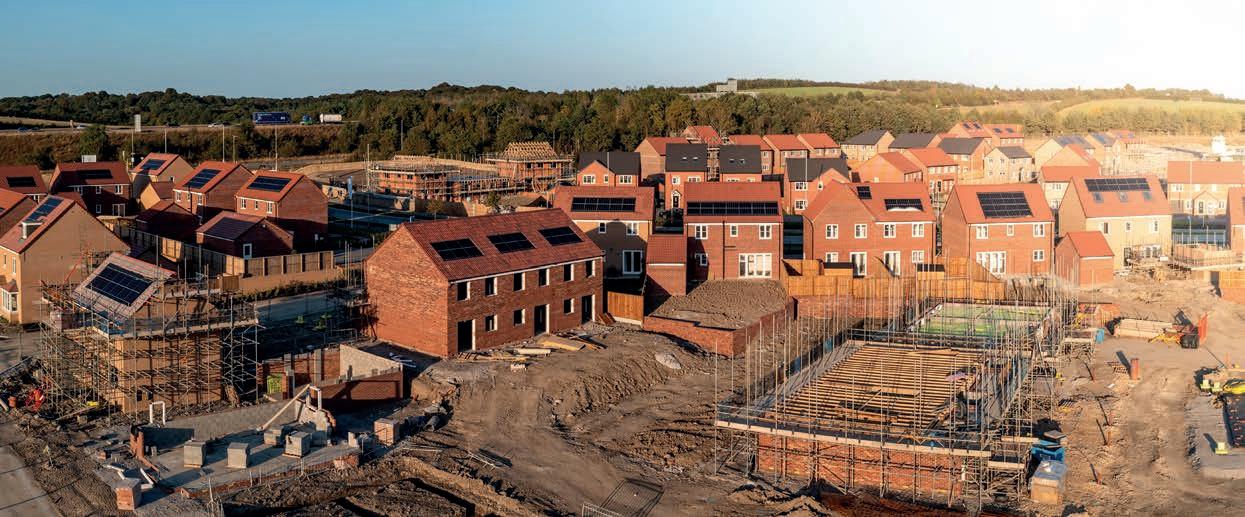
WHAT’S HAPPENING IN THE HOUSE BUILDING MARKET?
Despite attempts to reform the planning system, the UK housing market continues to face a structural imbalance between supply and demand.
New Prime Minister Andy Burnham has previously said that the UK is in a housing crisis, while a pledge to build 1.5 million homes over the current Parliament was a key feature of the 2024 Labour Manifesto, recent forecasts from real estate group Savills suggest that this is unlikely to be achieved.
The report expects an average of 167,500 new homes to be delivered annually over the five years to March 2030, well below the government’s ambition of 300,000. According to the Office for National Statistics, 300,000 houses haven’t been built in a calendar year since 1969.
ARE HOUSEBUILDING FIRMS AN OPPORTUNITY FOR INVESTORS?
While planning reforms should help, the sector continues to grapple with shortages of skilled construction workers, stretched local authority planning departments, and elevated labour and material costs.
Against this backdrop, the UK’s listed housebuilders offer exposure to long-term housing demand despite a challenging short-term operating environment. Bellway is one of the country’s largest residential developers, with a market capitalisation of around £2.1bn.
Although every listed housebuilder follows broadly the same business model of acquiring land, securing planning permission, constructing homes, and selling them to buyers, each has a slightly different strategy. Bellway’s approach combines nationwide diversification with a broad range of house types and a long-standing emphasis on build quality.
ALL UK DWELLINGS COMPLETED 2000-2025
ARE THERE CONCERNS FACING THE HOUSEBUILDING SECTOR?
Bellway, like the wider housebuilding sector, has experienced significant recent headwinds. The sharp rise in inflation and interest rates since the pandemic reduced buyers’ strength and contributed to a slowdown in housing transactions. The withdrawal of the Help to Buy scheme impacted fi rst-time buyers and, more recently, the war in Iran has reignited inflation concerns and created further uncertainty in the housebuilding sector.
Bellway’s latest trading update reflected these challenges. While management reiterated guidance for full-year operating profit of £320m to £330m, the outlook beyond the current fi nancial year has become less certain. The company cited geopolitical tensions alongside an increasingly unpredictable domestic political environment as factors that could weigh on consumer confidence and construction costs.
Higher build cost inflation, rising commodity prices and greater use of sales incentives all threaten pressure on operating margins over the coming years. Several analysts have subsequently reduced profit forecasts, reflecting expectations that margins could be under significant pressure in the medium term.
As with most housebuilders, Bellway remains highly sensitive to interest rates and wider economic conditions. As of 13th July, the share price had fallen over 30% year-to-date, reflecting growing investor concern.
However, there is some cause for optimism. Bellway has historically maintained a relatively disciplined approach to land acquisition and geographical diversification. Management has also focused on improving capital efficiency in recent years. Alongside standardising house types and exploring more efficient construction methods, Bellway aims to balance reinvestment for future growth with regular cash returns to shareholders through dividends and share buybacks.
Despite these strengths, investors should recognise that housebuilding remains an inherently cyclical industry. While Bellway cannot control mortgage rates, inflation, or consumer confidence, its management remains focused on the factors it can control.
Please note that this communication is for information only and does not constitute a recommendation to buy or sell the shares of the investments mentioned. Investments and income arising from them can fall as well as rise in value. Past performance and forecasts are not reliable indicators of future results and performance. The information and views were correct at time of publishing but may have changed at point of reading.
Source: O ce for National Statistics