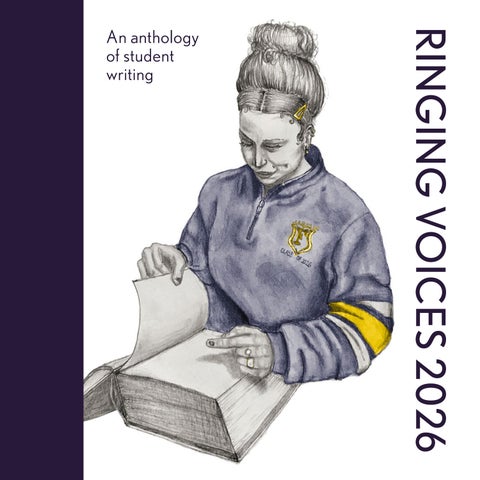
RINGING VOICES 2026
An anthology of student writing
Contents
The Girl Who Drank the Moon
3
I Met God And She Is An Atheist
31
Children Should Not Do Homework Every Night of the Week
4
The Cost of Kindness
32
Not Everything Matters, So What Does
5
The Geometry of a Human Life
33
The Door
8
The Thief
34
Solving the Climate
11
What We Share in Hong Kong
36
The Qualities I Value Most in Friendship
12
Community and Connection, Served Unequally
37
The Significance of Insignificant Things
14
The Lodgepole Pine
39
The Life Of an Inuit Child
16
One 40
The Moon’s Dance
19
Be True
A Taste of Freedom
20
Scrabble 45
43
Memoir 22
The Art of Living
47
The Power of Love
23
Sign this Petition
49
Across the Water
26
Apparently 51
Sailing through life
27
Evolution or Revolution?
Curtain Call
28
Acknowledgements 57
Poetry Can Save your Life
29
54
Ringing Voices 2026
In the age of AI-generated writing, the significance of the human voice is paramount. We live at a time when automated responses are increasingly dominant, and the art of writing risks being lost beneath them. Yet this anthology stands as a beacon of hope, a testament to the fact that the human voice can still be captured, and that writing remains, at its core, a profoundly human endeavour. When given the opportunity, time, and space, the human voice can flourish in writing. So why does the human voice matter so much in the writing process? The French philosopher Voltaire captured it best when he wrote, ‘Writing is the painting of the voice.’ It suggests that written words should capture the living qualities, rhythm, and tone of spoken speech, just as a painter captures an image on canvas. These words speak to the deeply creative and personal nature of writing, an act through which human thought, feeling, and imagination are given vibrant form. This potential comes to life in the student work featured throughout this year’s anthology. From heartfelt reflections to imaginative storytelling, each piece captures a distinct sense of joy and depth drawn from the act of writing. With contributions from students across Years 5 to 12, the anthology showcases the creativity, insight, and individual perspectives of our young writers. Throughout this year, our English program has continued to build on the momentum established in last year, with a focus on broadening students’ familiarity with a range of writing forms and styles. Drawing on carefully chosen mentor texts and supporting resources, students have been inspired to explore their own voices and refine their craft through a variety of prompts and stimuli. Central to our curriculum is the aspiration to cultivate confident, capable communicators, young people prepared to take creative risks and engage thoughtfully with the world around them through language. Alongside the written pieces, this anthology also features an impressive collection of student artwork. These visual stories enhance the reading experience, each one offering its own interpretation and emotional depth. The cover, designed by Alaina Rumpf, our Year 12 Art Captain, captures the essence of this creative journey, depicting a Fintona student fully immersed in creation. She is turning the pages of a large book, yet the pages are blank, symbolising the boundless potential of the untold story. Her index finger is pointed towards the blank page, further representing the moment of creative decision, the instant before imagination takes shape and words begin to emerge. We invite you to take your time with each page, letting the words and images carry you into the rich imagination and authentic voices of our students.
Michelle Maglitto English Learning Area Leader
I N T RO D U C T I O N
1
Tessie Wei
2
Y EA R 5
The Girl Who Drank the Moon Have you ever been stuck staring at a bookshelf for so long that you feel like you’ve spent more time looking for a book than you have actually reading a book? Well, I have a solution to that. My name is Isha and I am here to put an end to staring at bookshelves forever, well the Girl Who Drank the Moon is. The Girl Who Drank the Moon is a perfect mix pf moon magic, witches and swamp monsters. It teaches you how to be a better person and is widely acknowledged as a miraculous book that can work wonders. It’s filled with dragons, a town of sorrow, and a girl trying to find her mother. It is told in such a thrilling way that as you read it, you’ll be sitting on the edge of your seat. I can 100% confirm this as I have read it nearly 4 times without ever getting bored of it. The girl who drank the moon can also teach you very valuable life lessons. After reading this book I felt like a better person. This book taught me how to be more compassionate, optimistic and to always try and see the glass half full. Not all books can do this which is what makes this book unique and special. It’s so entertaining and valuable it’s almost like a whole new genre on its own. “This beautifully written darkly funny coming of age story, will enchant and entertain, and there’s a teeny tiny dragon too” as quoted the Daily Mail. The girl who drank the moon has also won a very prestigious medal called the John Newberry medal. So, if you won’t believe me when I say The Girl Who Drank the Moon is the greatest book in all of history, then believe the newspapers and the people that present awards, because why would a bad book win awards? This book is so amazing that even after reading it will be the only thing you will be able to talk and think about for ages. In a nutshell The Girl Who Drank the Moon is written perfectly, teaches you how to be a better person and has gotten so many praises from all around the world. So, what are you waiting for? Go put an end to staring at bookshelves forever and start reading something that’s actually interesting. Thank you for your time and have fun reading.
Isha Srivastava
Y EA R 5
3
Children Should Not Do Homework Every Night of the Week Did you know that doing homework all the time without breaks causes a lot of stress and emotional damage? Many poor innocent students are forced to do endless homework without a single moment of rest. Don’t you think they deserve to rest? I strongly believe that we most certainly should not have to do homework every night of the week. Doing homework all the time causes stress, doesn’t allow students to rest or have a single bit of time for themselves and provides an absurd amount of work for the already very busy teachers. First of all, doing homework all the time and never resting can make students extremely tired and unhappy. Never taking a break is bad for your brain and very tiring. I know from personal experience that being forced to do the exact same thing over and over again is never fun or enjoyable. Experts have proven from research that the longest period of time children can effectively do work, and focus is 25 minutes if you continue, your mind will eventually stop taking in the information and you will be wasting precious time. Imagine you’re forcefully having to do something you don’t want to, would you like that? I’m sure you wouldn’t. Homework is already very challenging for many students, it would become very overwhelming for them to have to do it every night of the week, it would become very frustrating, like watching a movie so many times that it’s no longer interesting anymore. Children shouldn’t have to do endless work. Another point is children absolutely must rest. It’s a child’s nature to play. Parents often say we grow up too quickly; the simple solution is to give us time to play and act like a child. Rest makes children happier, more willing to listen to feedback and take in more information at school, that would give us a better education too. Doesn’t everyone want that? We can refresh our brains instead of having an unclear head. Taking breaks and having chill time is much better than working without end. Children would be excited and happy to take regard to school, instead of annoyed and sad. Students should have time to themselves, they could play games, spend quality family time, meet up with friends or try out something new! School is about unlocking a child’s potential with new opportunities and enjoyable lessons. Wouldn’t you rather be walking into a classroom of smiling happy faces, not walking in and everyone is sad and would rather be anywhere else? We need to rest and play; it is something all children must have.
4
Teachers are such great people, they do so much for us, being so great, but there is a ton of work to do. Teachers are extremely busy, giving them even more work to do is a terrible idea marking homework requires detail and effort. Teachers always want to do their best and make minimal mistakes, but if there was so much homework, it just could not be done. We mustn’t give teachers the extra work. If there was not that much homework though, teachers could give accurate feedback, the students will then get a better education. Isn’t that such a better contrast to teachers and students being overwhelmed? Teachers could start feeling that they are failing their jobs and letting everyone down. You wouldn’t wish this fate upon your worst enemy. Let’s not forget teachers also need time to themselves; they have their own personal lives too. Teachers might even have to sacrifice their own time and work late to ensure that they have managed to mark all the homework and set new homework for the next day as well. Plus, teachers already are working well above the recommended work time. We should not provide extra work for our amazing teachers. Stop wasting time immediately and talk to all the principals and teachers to ensure that this terrible idea never ever happens. Do you really want to do extra work? Are you just going to stand by and watch as children are forced to do things they don’t want and teachers suffer? We mustn’t let children do homework every single night of the week. This would make students hate school, never get enough rest and the teachers are very overwhelmed. We cannot ever let this horrible idea happen.
Tessie Wei
Y EA R 5
Not Everything Matters, So What Does All of a sudden, my brain just went...blank. I couldn’t breathe. Couldn’t think. ‘B-b-because, uh...’ my voice trailed off. My pulse roared in my ears and my hands trembled violently, barely able to hold my cue cards. Looking across the massive sea of faces in the room, the sense of panic and nausea was so strong I felt as if I would be sick. Earlier that day, I had been up at one in the morning, chanting my speech over and over again like a mantra. I had felt confident, my mind imagining what would happen. I would walk onstage, deliver my speech perfectly, and walk off while the audience gave a standing ovation. But that wasn’t what happened. My knees banged together as I desperately scanned my cue cards. There. ‘As I was saying, we need to act NOW. This isn’t just about helping ourselves. It’s about giving future generations the best future we can give.’ I exhaled as I walked offstage. The hall was silent. No clapping or cheering. But...what did I expect? As the crowd slowly streamed out of the hall, I stood there in a daze, stuck replaying what I could have done better. What if it was because I didn’t practice enough? Or maybe...it was meant to be that way. Maybe I had never been destined to shine.
At last, I reached my destination. Sweat pouring down my face, I grasped the cool silver metal of the door and slowly pushed it open. The room went deadly silent. Heads turned to stare as the teacher rushed over, pulling me through the open door and into the deserted corridor before shutting it with a soft click. ‘You can’t take the exam,’ she panted. Shock, disbelief, and betrayal flared on my face. ‘Why?’ I managed to rasp. Apparently, latecomers couldn’t take the exam and received an automatic disqualification. Tears blurred my eyes as I turned away. And they spilled over as I walked back the corridor, stunned and devastated. Why? Why did this have to happen to me? Why now? Blue and grey and white clouded my eyes as I forced myself to move. One foot after the other. One step at a time. I rubbed my eyes furiously as my shaking hands pushed open the cold ivory gate that opened into the desolate parking lot, trying to pretend I was okay. But I wasn’t.
And then I realized.
I didn’t bother to ask how he knew as I took my father’s calloused hand, walking side by side for a little while before slumping into the back seat of the car and staring blankly at the ceiling. I didn’t care. Didn’t care about anything. Not anymore.
It was today.
‘We’re here,’ my father’s rich, deep voice announced.
And it wasn’t just any exam. It was THE exam. The final Year 12 state certificate exam. And I had completely forgotten.
I didn’t reply as I stumbled out of the vehicle, my knuckles white as I clutched my bag. This morning seemed like an eternity ago, when I had thought...maybe everything would be alright. ‘Things change, don’t they?’ I had hoped.
Sharp, piercing chimes shot me back to reality. The bell.
Frantic, I dashed to my classroom. Everywhere ached and my feet throbbed, but I still pushed myself to go faster. I couldn’t miss this.
Y EA R 5
5
Not Everything Matters, So What Does ‘Apparently not,’ I thought, kicking the heel of my newly polished school shoe against a large, jagged rock. I didn’t feel the pain. I felt...numb. Numb with grief. Numb with shock. And numb with change. I wasn’t that small, terrified girl afraid to start at a new school anymore. Nor was I that confident girl who always knew what to do.
It was indescribable, turning everything blue and red and grey. Reality rushed back like a blast of cold air, and I gasped for air. Iron shackles chafed against my arms and legs, and a thick rope bound me to an ice-cold, metal chair. I shivered as the chill from the cold; tiled floor seeped into my skin and my back throbbed against the sharp back of the chair. Then I remembered.
‘We’re here,’ my father urged again. I looked up reluctantly. I struggled to reach my pocket, thrashing and twisting. As I twisted desperately again, I heard bone snap. The fresh surge of pain had me sucking in a breath and gritting my teeth.
Confusion rippled through me. Then shock. ‘This...isn’t, where are we?’ I stuttered, my mind whirling into a hodgepodge of colours. This wasn’t home. The gnarled obsidian trees didn’t look familiar. Neither did the bleak, towering mansion looming over me. Then I realized.
But I was rewarded when the tips of my fingers brushed the leather hilt of my grandmother’s pocketknife. I stretched my fingers and grasped the knife, my hands shaking – from fear or exhaustion, I wasn’t sure.
‘You’re not my father.’ I whispered, my voice ice-cold and steely with certainty.
Sparks flew as I sawed it back and forth against the rope. It felt like hours before it finally gave a quiet snap and unravelled.
He didn’t blink. Before I knew what was happening, he bound my hands and feet in one swift motion. I gagged as he pressed a cloyingly sweet-smelling sedative over my nose and mouth. ‘Indeed, I am not.’ he said, his precise as smooth and velvety as ever.
I crawled across the room, spotting a glint of metal hung low on the white alabaster wall. It was just above my reach. I stretched, and my fingers grazed the serrated edge of the key. It swung from side to side, my heart sinking with each passing second.
Then everything faded to black. Then, it fell. The first thing I felt was the pain. So.
My heart soared as my fingers caught the falling key, then, almost immediately, I jammed it into my shackles and watched as they fell off with a soft clink.
Much. I didn’t hesitate for long. Pain. I jumped to my feet, fear rampaging inside me as the door slid open and the man who had brought me here entered.
6
Y EA R 5
Not Everything Matters, So What Does His cold, piercing eyes analysed the broken rope and the unlocked shackles. And I knew I only had seconds before he made his move. So I made mine. I darted past him, past the open door, and into the courtyard. Blood roared in my ears as I ran, faster than I ever had before. I could hear heavy footsteps thumping on the sidewalk behind me. I could feel his hot breath on the back of my neck, and his fingers scrabbled for my jacket. I ripped it off desperately, gaining me a few precious seconds, and ran faster, feeling adrenaline surge through my veins. I didn’t know where I was going. Didn’t care. Couldn’t think or see through the blurry fog that clouded my eyes. Until I ran straight into the waiting arms of my father again – except he was my real father this time. Instinctively, I realized, I had run into the school pickup zone. The bell chimed as students filed out of their classrooms and into the courtyard. And then I knew. I was safe. Loved. Appreciated, no matter what. And that was the only thing that mattered.
Isabelle Chong
Y EA R 5
7
The Door “Almost there.” The taxi driver announced. I moaned and rested my head against the window. The streets were loud; too loud for my preference. Strange black birds ruled the streets, and the faint smell of gas intruded the air. “Where’s Dad?” I asked myself for the 46th time.
“Yes?” He asked, looking me up and down with confusion. “Do you know where Principal Margaret’s office is?” I questioned, looking around the campus.
I didn’t know where I was. But I knew what was going to happen.
The boy laughed. “You must be new. Mrs. Margaret doesn’t have an office. ‘Works in the library.” He replied, pointing at a small brick building.
Only yesterday did Mum announce she was taking me to Adelaide – permanently. All I could smell was her perfume and sweat when she took me under her arm. It smelt like lemon grass. The flight felt like eternity – and it was. 10 hours stuck next to the woman who separated me from my father. All I could think about was home in Japan. Dad was probably suffering, surviving off the local convenience store and leftover sashimi. I’ve always been above average, not a genius. Albert Einstein was a genius. I’m not at that level yet, I hope I will soon. I like philosophy, also known as questioning life. And that’s what I do, at least most of the time. I enjoy doing random equations in my head when I’m bored. Mum calls it ‘natural brain training.’ Sometimes she takes it too far and calls me a ‘brainiac.’ I don’t think it’s funny. In fact, I think it’s pretty rude coming from my own mother.
Before I could even process what was happening, I was standing outside a tall door wearing the same thing I had been for a day and a half. “1892,” the silver plate above it said. “Alright.” Mum said triumphantly. “You can’t be late!” She dragged me into the elevator and onto the sidewalk. “Where are we going?” I asked her, constantly being interrupted by her sudden jolts. “New school. Try out.” She panted, shoving me in front of an open black gate. “Go see Principal Margaret.” She knows you’re coming.” Mum panted, throwing me a cream coloured backpack that felt like a boulder on my back. What was in there making it so heavy?
“Excuse me? Mrs. Margaret?” I called, looking around the small room. The ‘library’ was more a living room than anything. There were beanbags everywhere, with piles of books scattered across the white carpet. I couldn’t hear any reply. I tiptoed to the back corner and threw myself onto a jade green armchair. “My favourite colour.” I thought. To my left was a large bookshelf that covered the entire wall, mostly historical fiction, some sci-fi. I didn’t feel like reading, nor talking to Mrs. Margaret. This was too much. In only one hour had my mum just donated me to a school that I hadn’t even heard about. Me walking into the campus was like the only pencil in a pack of fluorescent highlighters. I could feel everyone staring at me, and I knew Dad was staring out our small apartment window, the small cars passing by. What had happened to Mum to make her so rebellious to emotionally destroy my dad and throw her daughter onto a whole different continent? A book caught my eye. It was gold and embroidered with black flowers, almost shimmering. I pulled it out, expecting a big, fancy title written on the front cover. What I didn’t expect was for a part of the bookshelf to turn into a door and slide open. Inside was a silver portal that looked like the inside of a blender. I felt myself being sucked in, still holding on to the armchair. I heard a faint voice crooning. “If I leave, I’ll never see him again. Yes. Good.” It sounded like Mum. The way she would speak in short sentences when she was planning to do something. The way she would never identify the person she was talking about. It all made sense. Mum was talking about Dad. “Can’t believe he spent all of my money. Never want to see his face again.” Mum continued.
“Excuse me.” I whispered. The boy turned around.
8
Y EA R 5
The Door I found myself lying on the armchair, dazed. I already knew what I was going to do, but Mum wouldn’t like it. “It’s for my own good.” I sighed, sliding the book back into the shelf.
I walked up to Mum, confidently saying, “I’m done. It leaves tonight.” I showed her my one way ticket back home to Japan. “My bags are already packed.” I continued, carrying my backpack to the front door. “You can’t do this. I’m your legal guardian.” Mum argued, pointing a finger at me. “And my ‘legal guardian’ took me from the other.” I mumbled, slamming the front door. I was free, but at what cost?
I knocked on Dad’s door, expecting a teary-eyed man wearing white slippers. Instead, Dad happily opened the door and welcomed me in. Confused, I walked inside. “Hey kid! What are you doing here?” Dad asked, not waiting for a reply. “Bet it’s your mother. She was diagnosed with some mental condition a month ago and now she’s gone mad.” I nodded, putting my things down on the couch “Great to see you Dad. Feels like forever since I’ve been here.” I murmured, staring out the window and watching the tiny cars go by.
Kaitlyn Lu
Y EA R 5
9
Lauren Huynh
10
Y EA R 6
Solving the Climate Our planet is facing a steep challenge. Earth is slowly deteriorating, being choked off by humanity’s wasteful tendencies, and will eventually fail us unless we do something about it. In this world, some countries are more privileged than others, with greater wealth and influence, which allows them to do more to help the climate crisis. So why are the wealthier countries pulling out of the Paris Agreement? Our planet needs saving, but if these privileged countries refuse to help, then who will bear the responsibility of this problem? It makes society question whether certain countries deserve this power if they will not do something for the sake of the future generation. They should be the ones who put in more effort into solving this crisis, because they possess this ability, and often are part of the problem themselves. A major factor which contributes to the global warming crisis is the manufacturing of products. Many wealthy countries outsource the manufacturing to a developing country for cheaper labour, then have the items be shipped to them. This speeds up pollution and global warming in the developing countries, as the recipient of the actual items leaves the consequences to the other country. Creating these products using gigantic factories or heavy machinery causes significant damage to their ecosystem. So, if these developing countries don’t have the technology or resources to reduce their pollution which was caused because the demand of the products, we need those more fortunate countries to step up to this challenge, as it was their demand that progressed this issue. It isn’t that the less privileged countries refuse or aren’t willing to contribute but are sometimes unable to due to the economic or financial state of their country. When these countries cannot help solving the problem, it is up to the ones that can take on this burden, for the sake of our beautiful planet and the future generation. If they refuse to do something to help to preserve their homeland for the future population to enjoy and protect, then we need to collectively question if they deserve the ability to benefit and help everyone if they won’t. The UN’s goal is to cut greenhouse emissions to half as much what is produced to by 2030, and to achieve net zero, meaning to lower our greenhouse emissions to as close to zero as possible, but one of the major barriers in the way of us achieving the goal of net zero are fossil fuels. Fossil fuels include oil, natural gas and coal, and burning these release carbon dioxides into the atmosphere. Unfortunately, they produce a lot of the energy used in today’s world, and to reach the UN’s goal, we need to find a sustainable solution. A great substitution
would be sustainable energy, including solar and wind power, but to successfully replace fossil fuels with renewable energy, we would need to invest four trillion US dollars or more than five and a half trillion Australian dollars annually by 2030 to achieve the net zero goal. Some countries are simply unable to put in their share, so our governments need to step up and act on the best interest of Earth. The Earth is priceless, and we absolutely cannot live without it, so is spending money to save it so hard? Is it not worth it to save the planet so your children can enjoy it as well? Money is simply a human-made object that society has chosen to value, but are the lives of dying out species, the extinction of the plants that provide the oxygen that keeps us alive and the suffocation of the gorgeous planet that has provided for us and nurtured us since the beginning of time not worth our time and effort? The International Union for Conservation of Nature (IUCN) Estimates that there are 882 extinct species of both animals and plants. Do we not care enough about Mother Nature enough to use our laminated paper to save her? This is unacceptable. As the Secretary-General Ban Ki-moon said, ‘There is no Plan B as there is no Planet B.’ The Earth has sustained us for countless generations, but one of our greatest fears is that there won’t be an abundant planet left for the future. In the words of the influential Greta Thunberg, ‘You are failing us. But the young people are starting to understand your betrayal. The eyes of all future generations are upon you. And if you choose to fail us, I say: We will never forgive you. We will not let you get away with this. Right here, right now is where we draw the line. The world is waking up. And change is coming, whether you like it or not.’ If you won’t put in all you have for your own sake, then do it for us. The big question is whether the countries who can improve the state of the Earth and have more money or influence should take on the heavier burden. If they can do more to help the Earth and prevent more harm being done to the ecosystems and the living beings living in it, than absolutely they should. It is a privilege to be able to repay our planet after all she has done for us. While it is not denied that money may be an issue in the way of our collective mission to help rehabilitate the Earth, this isn’t a matter that can be delayed or set aside until later. We need to take charge and take responsibility. As Greta Thunberg once said, “Our house is on fire. I am here to say, our house is on fire.” We need take it as our personal mission to save the Earth.
Olivia Xu
Y EA R 6
11
The Qualities I Value Most in Friendship “Who do you trust?”
But even the strongest friendships face challenges.
Not, “Who do you sit next to in class?” Not, “Who has the funniest jokes?” And certainly not, “Who has the most followers on social media?”
That’s why the second quality I value is supportiveness.
Who do you trust?
Life isn’t a straight road. Sometimes we achieve our goals. Other times we fail spectacularly.
It’s a surprisingly difficult question. Because friendship isn’t measured by how many people know your name, it’s measured by who stays when life becomes difficult.
During those moments, a supportive friend becomes something far greater than just someone who stands beside you; they become someone who helps you stand again.
Every single one of us will make hundreds of friends throughout our lives. Some will only stay for a season. Others will remain for years. But what determines whether a friendship lasts isn’t luck. It’s the qualities we choose to bring into it.
A supportive friend celebrates your successes without jealousy. For example, when a friend of mine was able to congratulate me even though she was a little disappointed that she didn’t get the role herself. Not only did this make me feel good, but it also made me see her in a better light. They encourage you after disappointment instead of saying, “I told you so.” Sometimes they don’t even need the perfect words. Simply sitting beside someone and reminding them they aren’t alone can mean everything.
For me, those qualities are trustworthiness, supportiveness, and inclusiveness. They don’t just create meaningful friendships; they shape the kind of communities we all want to live in.
Support doesn’t only change a bad day. Trust is invisible. You can’t hold it, buy it, or borrow it. Yet once it’s broken, everyone notices.
It changes lives.
Think about a piece of glass. It takes only one crack for it to never quite look the same again. Trust works in much the same way. One lie, one broken promise or one shared secret can change a friendship forever.
Finally, the quality I value most is inclusiveness.
A trustworthy friend gives you something incredibly valuable: the freedom to be yourself. You don’t have to carefully choose every word or wonder if your mistakes will become tomorrow’s gossip. Instead, you feel safe enough to laugh louder, dream bigger and be honest about your struggles.
Walking into a room where everyone already has a group.
I think we’ve all experienced that feeling.
Looking around, hoping someone notices you. Waiting for an invitation that never comes.
And trust doesn’t stop with friendships. Schools depend on trust. Families depend on trust. Communities depend on trust. When people trust one another, they communicate openly, solve problems together and create environments where everyone feels secure. Without trust, relationships begin to crumble.
12
It only takes a few seconds to make someone feel invisible. But it also only takes a few seconds to make someone feel seen.
Y EA R 6
The Qualities I Value Most in Friendship An inclusive friend notices the person standing alone. They move over. They make space. They ask someone to join the conversation. They understand that kindness isn’t about grand gestures—it’s often found in the smallest actions.
So, when someone asks, “What makes a great friend?” I hope our answer isn’t measured by popularity. I hope it’s measured by trust.
Inclusion creates something powerful: belonging. By support. And belonging is something every human being deserves. By inclusion. When we include others, we reduce loneliness, challenge prejudice, and create schools where people feel accepted for who they truly are rather than who they think they have to become.
Because the friendships that change our lives are never built on popularity. They’re built on character.
Trustworthiness.
Hayley Porter Supportiveness. Inclusiveness. Three simple qualities. Yet together, they build friendships that survive disagreements, celebrate successes, and overcome challenges. More importantly, they build something much bigger than friendship. They build communities where people feel safe. Where people feel valued. Where people feel that they belong. Now I know that you’ve listened to me for nearly 4 minutes straight, so, I’d like to leave you with one final question. Years from now, people probably won’t remember the mismatched socks you wore, how many followers you had or whether you won every award. But they will remember how you made them feel.
Y EA R 6
13
The Significance of Insignificant Things It was simple, if I got straight As, kept my room clean and ignored the sound of my parents arguing everything would be ok. I thought this was the gravity that held our house together. The cold shining armour that protected our family but the problem with armour is that eventually you have outgrown it. You can stay inside and let your bones break or step out into the uninviting world. It was a normal morning in my household but normal in my house meant walking on eggshells. I woke up at 5:00 am. Smoothened out the creases in my bed until my fingers ached. Studied for my maths test until my brain was fried. Went for a run until my legs couldn’t walk. And then made breakfast. I could hear my parents’ downstairs, drinking coffee while an argument lingered on top of them like a cloud bursting to let rain out. Clash! The spoon fell, it seemed insignificant, but it meant something. Suddenly a wave of panic took over me. Did I scare my parents up? Did make a dent in the floor? Would it cost my parents thousands of dollars to fix? I was fine, it was just a spoon falling. It was insignificant. Meant nothing but then again, it did. I arrived at school. “Hi Audrey!”. “Hey Audrey!”. “Yo Audrey”. “Audrey!”. Every morning that’s all I heard. Thousands of students greeting me over and over again. You would think it was exhausting but I need it to get School Captain. “Hi Kenna”. “Hey Willow”. “Your hair looks good, Siara”. Saying hi, giving compliments. That’s exactly what I need to get School Captain. Finally, I heard the voice I actually wanted to hear. “Hi Audrey! Are you ok?”. A rush of relief swept over me. “Arya! OMG, I missed you so much, I’m totally fine, thanks for asking!”. Until the bell rang, we just kept gossiping and talking about our lives. Soon I find myself rushing about my day, printing practice exams, writing a piece for a competition and going to my classes. By the time I went to my French class I was dead. Nearly my whole class was. The halls went from loud chatting to so quiet you could hear a pin drop. As my teacher went on about how we have a test on Monday and what was on it, I was anxiously taking notes. Then, somehow, I dozed off. In no universe that would ever happen! Never! Yet it did! My teacher knowingly tapped her white board marker on my desk making me wake in an instant. “Come talk to me after class”. Oh no, what if she tells my parents? What if she sends me to detention, ruining my perfect record? But then, just for a second, I saw a smile from her. Could she tell I was anxious from my face?
14
The smile was so insignificant yet at the same time it made my day. “Audrey, I think you are putting too much pressure on yourself”. My teacher goes on and on about mental health and such. “Are you sleeping enough? Is something going on at home? You don’t have to be perfect all the time! Nobody can!”. I quickly say I’m ok. Tell her I’m fine. Try to reassure her. Yet she doesn’t look quite convinced. I run out of the French classroom desperate to get home. I have so much to do, cook dinner, clean the house, do my homework, study for my upcoming tests. Then suddenly Siara came up to me. My heart did a panicked flip, like getting caught passing a note by a teacher, before I recognised her face. “Audrey could you please give me your science notes. You said you would yesterday, but I think you must have forgotten”. Oh my god! How did I forget? I specifically made a note in my calendar. I rush to the dusty old photocopier, that must get replaced while quickly saying I was “very sorry” multiple times. She didn’t seem to care, but I did. It seemed insignificant, but the that third mistake in front of somebody was significant. I photocopy my notes as fast as I can and rush of. “Bye Siara, I’ll see you tomorrow! Hope the notes help” I walk home; my parents have forgotten to pick me up again. Typical. I don’t really mind though. It’s one of the times I get to relax and not focus on my short comings. I hear the birds in the trees as the wind flows through my hair. I start humming my favourite song, Depressed my Anne-Marie. Then I hit the line, ‘I say I’m okay, I’m fine, all jokes aside’ and my throat tightens. Right there in the middle of the road. All the insignificant things come rushing back. Like they’re significant. The spoon falling, me dozing off in French class, me forgetting to give Siara my notes. They come spinning taking my mind over. I feel my amour closing in around me. Telling me I must step out. So, I do and at that moment I feel like the middle of the road is the most desolate place in the world. Suddenly I hear footsteps on the concrete. Fast ones. Then I feel a hand on my shoulder, I turn around. Against all odds she’s here. My best friend. Arya. “Audrey, are you ok?”. This time I wasn’t perfect, but I told the truth. “To be honest, no”. She stayed. And that’s all I ever wanted. Someone who will stay with me. Tell me I’m trying to be perfect. Trying too hard. That I’m just a kid. I can make mistakes.
Y EA R 6
The Significance of Insignificant Things Then I remember the other insignificant thing that happened today, my teacher smiling at me. And my heart fills up with happiness. I couldn’t imagine my life without all the insignificant things because when you’re older you won’t remember what you got on your test, how much you studied every day. You won’t remember all the things that seemed significant, but you will remember the insignificant things. When your teacher smiled at you, when someone made you laugh. I guess there is nothing insignificant in the world. It all depends on how one looks at it (Johann Wolfgang von Goethe).
Ira Kamath
Y EA R 6
15
The Life Of an Inuit Child I stretched my legs in my bed. I really needed to fix the bed; I could feel the willow twigs poking around the caribou furs. My parka was hanging on a branch near the entrance of the domed house, which had a polar bear pelt in front of it so that we wouldn’t be too cold at night. The other three beds in the room were empty, which meant that I was late. I flopped off the bed and put on my sealskin boots, grabbed my parka and thick pants, and clomped out into the snow. It was a rather clear day, knowing that most days a dense, grey fog seemed to settle everywhere. Pure white snow spread out as far as the eye could see, and I inhaled the sharp, chilling scent of it, my breath coming out in small clouds. “Come here, Mishka,” said my Anaana, my mother. My name means Little Bear, and I am proud of it. Anik, my older brother, always said that it suited my breath. The first time he said that I pushed him into the snowdrifts and he got frostnip. He didn’t call me Bear Breath for a whole moon cycle. I sniffed the air. Wow! I had always assumed Anaana could read my mind, but this pretty much confirmed it. She knew that I had been dreading taking my turn to scrape the snow off the roof of our stone house, and she had made my favourite: auk eggs and crowberries! It’s been half a year since the last crowberry harvest, but Anaana was always pretty smart, so she dug a hole in that freezing ice and put in the berries! She found out that if you put something in the snow, it’ll last a really long time. I inhaled the food and took the advantage of the extra Siqiniq Season (Sun Season) energy to start scraping the overnight snow off the pelts from the roof. It’s important, I told myself, to scrape the snow off the roof because if I don’t, then the roof will cave in and all the snow from one night will fall on top of me when I wake up. I will most likely get frostnip and maybe frostbite, and then I will die from the cold. Alright, fair trade. My Ataata (father) and Anik were at the seaside, hunting for seals, which are usually easier to find and hunt in Nilak Season, Ice season. The reason why we didn’t just make a meal out of our dried polar bear meat is because at sunset, people from the Tunumiit and Kalaallit groups were going to come and have a meeting and a meal with us to discuss how our groups were going. Ataata is a very important person in our Inughuit clan, so he and his family were invited, which means we had to prepare the food for their arrival. Anaana and I are the women in our family, so naturally we dug up the berries and started preparing them, and Ataata and Anik were hunting.
16
I pulled my caribou fur gloves higher and plunged my hands into the snow drift next to our house. After a bit of rummaging around, I got to the still fresh berries and popped one in my mouth, and then I remembered that they’re frozen, which is why we needed to heat them up a little. I spat out the mushy frozen thing and Anaana chuckled. I grumbled and carried the berries inside. I always have a stone lamp which I keep running with seal blubber, and it’s flickering. I hoped that Ataata and Anik would get home with a big seal otherwise the lamp would run out and I would have to go through the trouble of finding some wood that wasn’t wet, and that is harder than it sounds. I find an even rock and put the berries on it next to the lamp and head outside again. We have nothing to do until the berries get reasonably soft again, so Anaana tells me my favourite story: The one about a woman who adopted a polar bear cub, naming him “Kunik”. The woman and Kunik formed a strong bond quickly, with the village children loving him as well. As the years went by, Kunik became smarter and stronger, learning to fish and bringing back lots of food for his mother. However, before long, the village men became jealous and plotted a scheme to kill Kunik. A child overheard this plot and warned the woman, who with tears in her eyes, begged the bear to run away so that he would be away from danger. After a few days of separation, the woman became determined to track down her child and so she went out to find him. She lost hope after a couple hours, but soon saw she Kunik running towards her, and embraced him. Kunik, seeing that his mother was hungry, ran to hunt some fresh meat and fish, which they shared. The mother vowed to return the next day to meet him, so she did, day after day, with the villagers growing to understand the strong bond between the woman and bear. I love this story, which has a happier ending than the other one that was similar to the one about Kunik that Anik used to like, where the woman turned to stone. By the time Anaana had finished, footsteps crunching the snow told me that Ataata and Anik had come back. “Hey, Bear-Breath!” grinned Anik, slinging a seal off his shoulder. It landed with a muffled thump on the ground. It seemed like they had a rather successful catch, judging by the fat seal and enormous caribou they’ve brought back. Anaana immediately got to work skinning the caribou, muttering about “needing more furs for the roof”. I ignored Anik and got out my stone knife and to start cutting out some seal blubber from the carcass.
Y EA R 6
The Life Of an Inuit Child I immediately ground the fatty gel up and added some to the bottom of my lamp. It spluttered and glowed brighter than before, which made me happy. The berries had thawed, so I took them out to Anaana. By sunset, we had prepared a gorgeous feast and Anik was bored, so he had even went out to find some firewood, and by the time there were a few little dots in the distance, I had fed some fire from my lamp to the bundle of wood in front of the house and we had a beautiful crackling fire. When the dots had gotten closer, I noticed that they all looked as old as Ataata and maybe even older. There was one man who already had wrinkles and didn’t look very fit for travelling. Since Anik is technically a man now, I felt very left out, and I sat quietly in the corner next to the house nibbling on my sweet and salty seal and crowberry jerky on a warmed rock and listened to the men jabbering in foreign dialects that Anaana and Ataata seemed perfectly comfortable with. Anik knows a bit of Kalaallit, but he still looked as confused as I felt. Eventually, I had a sip of warm water and excused myself, saying that I wasn’t hungry. I went into the house and sat on my bed, writing down everything that had happened today on a thin piece of bark, which I am doing now. I hear the men stop talking and hear the rummaging of furs, which means that they are leaving, and they are thanking Ataata for his hospitality. Once the last fur is off the ground, I will snuggle into my covers and go to sleep.
Erisa Chen
Y EA R 6
17
Angela Fei
18
Y EA R 7
The Moon’s Dance The moon is radiating yellow, its buttery surface casting a syrupy, golden hue across the azure sky. It is a dandelion-coloured delight, lighting a pathway to hope, a beacon, spreading its warm gaze over things still raw, undiscovered, nature’s gifts to us in their purest form. The ocean laps at the sand, a sea of navy blue in the daytime, now an expanse of black fabric, folds casting shadows deeper into its depths. A breeze tousles my hazel hair, whipping sand around me, blowing the edges of my embroidered cherry dress to one side. I hear footsteps pounding on cool sand, and I see my brother sprinting towards me, a smile splitting his face, his emerald eyes crinkled at the corners. I let a small giggle escape my lips, a trickle of sweetness as I turn towards the forest, sand soft, crumbling, an everchanging cushion beneath my feet. Jade vines greet me, brush against my face, trees, sinewy trunks towering above me, leaves forming an emerald canopy above embrace me. My brother dashes forward, finally reaching me, his chuckle gentle yet strong, as he flings his arm around me, our smiles mingling, our heads pressed together as we watch the moon dancing on the horizon, canary light playing on the surface of the ocean. We are together, united, our minds turned to nothing but the beauty of the night. We are together, united, living in a time of bliss.
Now, the moon is clouded by shadows, darkness too thick to break through. It is consumed, devoured by obsidian tentacles that curl across its surface. The beach I used to love, the forest on its outskirts has been burnt, trees reduced to piles of ash, rubble, the smell of fire heavy in the air. My brother is gone; I do not know where. But I do not feel sadness. I do not feel anything, not ever. Not happiness, not sorrow. All emotions are foggy, distant. Now, I have been drowned by shadows. And the light may never creep its way back in.
Sofia Hartnett
*** That night is now but a bitter memory, a fragment of my childhood, afloat in the darkness that is my life. An image blurring at the edges, soon to be vanquished to the toils of time. A relic of everything I have lost, everything I shall never get back. It all started when the moon changed. *** It becomes silver, adorned with slithering cracks, bringing shards of grey to its ghostly surface. It is a splash of white, surrounded by a film of dust, lost in the silky surface of the navy-blue night. It marks my first heartbreak, a tear snaking down my pale cheek, leaving a trail yet to clear. It marks something that has stayed, solidified. Something that cannot be left in the past and will follow me to the future and beyond. It marks anguish, grief, scars carved, leaving ugly patterns in their wake. It marks a destiny I cannot escape. ***
Y EA R 7
19
A Taste of Freedom The crisp, juicy apple released a fresh, fruity taste into my mouth. The apple juice leaked onto my hands, sweet-smelling and scented like the thrill of spring. I rode my bike along the streets of the community, heading to my next session with The Giver. How wonderful it is, I marvelled, to be able to taste! I lifted my hand, so that the sticky juice would trickle down me and leave me smelling like the beautiful, sweet fruits. But, as the waxy sheen caught the light, the world suddenly burst into colour. The sheer vividness of everything scorched my eyes, and I shut them in shock. The imprint of the surreal vision, the bright redness of the apple, slowly faded from my mind, but so did my control over the bike.
“Hello?” I called out into the immense, yet claustrophobic confinement. Yet, as the words left my mouth, they disappeared, I strained to listen, to hear the confirmation of my existence. But sound was savagely stripped from me, leaving me conscious of things that weren’t there before. My breathing. My heartbeat. I screamed out, yet my desperate cries were absorbed and neglected by the white, white walls. I threw my body against the walls, trying to escape this horror.
As I veered uncontrollably, I heard a familiar voice yell, “Rosemary!” I flung my eyes open to a drab monochrome world, and my father frantically waving his arms. “Stop!” he yelled. I pulled to a stop, careening out of the way to avoid crashing into him. My chest hurt and my head felt dizzy, and it felt like freedom, but not quite. Yet the last few tendrils of exhilaration faded away when my father, The Giver, helped me down.
But in my crazed reality, I scratched my skin, tore out my hair and bled all over. Yet the pain never reached me, as my mind had already been corrupted. I sobbed, aware of the blood leaking into my mouth. Yet my strongest sense failed me, leaving nothing but a sticky, tasteless liquid. It was insanity, fuelled by a total sensory deprivation. This was the memory of a prisoner, exiled from humanity. It was an old method of psychological torture.
“Cycle carefully,” he chastised. But, as euphoria replaced exhilaration, I excitedly told him, “I saw colour! The world! It was like…like…,” I trailed off, unable to describe the phenomenon. “Magic?” He suggested. Not entirely sure what that was, I just nodded. He smiled at me proudly, with the face of my father. “Well done, Rosemary.” He led me into our training room in the Annexe, where after he crossed the threshold, became The Giver. “You’re ready. Lie down on the bed for me, please.” He said. I let out a deep breath, shedding the role of Rosemary. It felt a little more like freedom, exhaling and releasing my breath. As I lay on the couch, The Giver’s hands pressed firmly against my back, I inhaled as the Receiver of Memory. The Giver seemed to mumble something about ‘be prepared,’ but I was already too far into the memory to hear. The taste of ash and emptiness choked me. I was inside a room, white walls, white floor, white lights, and a white ceiling. At first my eyes took time to adjust to the scorching brightness, but soon, I was a prisoner inside this vast, yet seemingly confining room. Freedom, I thought, from my release as a prisoner. That must be the experience The Giver is trying to show me. But as I waited for a door to appear, someone to lead me out, I began to grow bored.
20
Distantly, in my mind Elsewhere, a father watched his daughter thrash in agony, knowing in horror that he brought about this pain.
As I lay there, empty-minded and dull, I woke back up in the room in the Annexe. I abruptly stood up, shocking The Giver. “What are your thoughts?” He asked gently. I couldn’t bear to look into his eyes, to recall what had happened. So, I lied. “I was lonely. There were no people to talk to. If you’ll excuse me, I need some time alone.” And there, I walked out of the room, leaving everything behind. I didn’t want to linger on what I just witnessed, what I just lived through. I didn’t want to look behind me, for my father would have chased after me, but The Giver would have let me go. As I walked away, I decided to reroute my path to the Chief Director. “May I see the Chief Director?” I asked, with as much decorum as I could muster. “As the Receiver of Memory, we need to talk.”
Y EA R 7
A Taste of Freedom Throughout the next few days, or weeks, my schedule consisted of nonstop thinking about it. Always thinking about it. The Giver, racked with guilt, transferred memories of fun times, human connections, even an animal companion. But it was no use. You can’t change the sea by spitting in it, nor can you make something that’s bitter sweet with a few grains of sugar. I had made up my mind. On the last day before it, I had my final lesson with The Giver. My last encore of memories, before my freedom. I knew my father could see something had changed in my eyes, yet The Giver stayed silent. Maybe he knew what I was going to do. But maybe, just maybe, he knew that it was better that way. I have the path of escape he will never experience. As I stood in the room of my fate, I stared at it. The syringe, containing my escape. It was Release, my only salvation. “Are you sure about this?” The doctor asked me for the last time, but I had already inserted it into my arm with a confirming smile. As I collapsed, I felt the freeing feeling of the memories being released from my mind, like an apple releasing flavour. As I let go of them, they scattered to the world. It finally brought me freedom.
Evelyn Jiang
Y EA R 7
21
Memoir One dot, two dot, three dot. I looked at my phone, waiting for a reply. “I’m here.” I ran towards the front door, in my pyjamas, and wore the first pair of shoes I saw. I walked outside, immediately I felt goosebumps, it was freezing cold, I could turn into a statue. I help held my rough piece of paper in front of me trying to block the wind. I walked up the to the front gate and opened it with my shaky hands. I looked left, I looked right. No one was there? I looked around frantically, “where is she?” Finally, I saw a dark figure in the distance, it was night, so it was hard to see. I squinted my eyes as the figure slowly stepped into the light. It was Jessica!
We waved goodbye for the last time, as I walked onto the grass, the grass tickled as it brushed against my bare leg. I took out my phone and took one last photo of the sky, and walked back, thinking of all the memories I had with Jessica. I still look at photos from that night, wishing I could stop time at that moment. Even though she has left now, and we both moved on, I will always recognise her as my dearest friend. Thank you, Jess.
Angela Fei
I waved at her and smiled as she waved back, I awkwardly handed my rough piece of paper to her. It was a drawing I drew of me and her. She smiled, but it seemed… sad. “Thanks.” she said quietly, but the air felt different. She was smiling, but the air had a sense of regret. Her smile faded, and we both stood there awkwardly, not making any eye contact. Silence filled the air, we both waited for anyone, anyone! to break the silence, I sighed and finally asked “so… when is your flight?” She looked down, then looked up at me “6 am… in the morning.” I looked at my fingers, as I fiddled. “So, this is the last time I’ll see you?” Silence filled the air once more, but suddenly a wind blew by and broke the silence, we both shivered at the same time, we looked at each other and chuckled. “I guess this is the power of friendship,” I smiled at her. She didn’t see, she just stared at my house and said, “I’m going to miss you…” I turned towards the other direction in an instant. I was trying so hard to hold my tears in, trying to keep my cool. I took out my phone. “How about we take a photo together?” I pressed the button, as we both made a silly face. We laughed at how silly our photo turned out, and it actually turned into a nice conversation, just like how we always did. The smell of dinner filled the air as we talked. “I guess dinner… is ready…” but instead of just waving goodbye, she held out her arms. This was the first time she had ever done this. Jessica isn’t a touchy person and doesn’t hug anyone. But maybe, just maybe, this time was necessary. I stared at her and ran towards her, giving her a big hug. “I will miss you too” I said, nearly in tears.
22
Y EA R 7
The Power of Love How many of you have heard of Romeo and Juliet? Or Orpheus and Eurydice? Or maybe even more modern characters like Shrek and Fiona or Emily and Victor from Corpse Bride? If I asked what they all had in common what would your answer be? No wait- let me guess it would beLove. One word. Four letters. Yet this word’s definition is so strong that it has the power to defy even death and even control one’s life. These days people think love is overrated, they say it’s too hard to love someone who has flaws or to put effort into a relationship. “I love you’s” are exchanged without any actual meaning behind those three words and online dating is becoming more and more common. So, in a world where love has lost its meaning, how do we let ourselves to value this raw and exquisite emotion? To value something first you need to understand what it exactly means. So, what does it mean to love someone? Is it to appreciate what someone can do for you? Is it to appreciate someone’s appearance or is it to feel butterflies in your stomach when you’re looking at someone? Royston Allen wrote in her poem “Love Is” “Love will hope beyond the improbable and will always do the impossible. For love never fails and continues on and it will be there when all else has gone.” Loving allows you to discover new parts of yourself that you never knew existed before. As Leo Buscaglia said, “Love and the self are one and the discovery of either is the realisation of both.” Loving someone else and loving yourself is intertwined and by loving someone else you begin to love yourself too. Phycologists have made statements on how the things you judge about others are also parts of yourself that you haven’t fully accepted. But the thing is after learning to love the flaws in someone else you learn the skill to be able to love yourself and accept your own impurities. Love is scary, it uncovers the ugly part of you the part that you have desperately tried to hide from the rest of the world. It puts you in the most vulnerable position and reveals every side of you to your partner. It helps you learn more about yourself and become familiar with your boundaries, your insecurities and your ways of loving. People often envisage that someone who’s right for them will just complete them like a puzzle piece. They have this image of “the one” in their mind and their standards are set so high that it’s often unrealistic. Movies, tv shows and love stories have made us set these expectations in our mind that the perfect person would never make any mistakes and that they would
fulfill our every need. That, however, is most often not the case. People make mistakes, they do things that hurt you even when they don’t mean to. We think that our soulmate would just complete us without having to change and we shouldn’t be expected to change either because if they’re the right person for us then why would we need to become a different person for them right? But to love someone you must be prepared to change for them. Both must change to fulfill one another’s needs and wants. And that brings me to my second point. How love can change you for the better. Since no two people or things fully complete each other therefore both must change in order to meet one another’s needs and wants. Love requires you to fight for the person or people you love, it shapes you into someone else, teaching you things that you didn’t ask to learn and forcing you to mature. In year 6 in order to pursue my love of public speaking I had to force myself out of my introverted shell. I remember being so afraid of public speaking that I would physically shake whenever I had to speak in front of a crowd of people. In the end, after constantly practising in front of my classmates slowly but surely I overcame my fear of public speaking. To summarise my point, sometimes to love something you have to change for it so that you can go on loving it. People often overlook the fact that loving something not only gives you a more positive mindset towards things but also gives you the hope and strength you never knew you lacked until you received it. In the bible it states “-------” meaning that love and hope aren’t possible without one another. I remember when I was younger when one of my relatives were devastated over the loss of another family member. They had stopped eating and were constantly in bed, their interest in everyday activities had declined drastically and they were no longer the happy energetic self that I had come to know. I watched as grief consumed them bit by bit, their love for the diseased relative had been so strong that after he had died it seemed that they began to lose hope too. Then suddenly one day I saw that family member start to get out of bed and engage in the things that they had once loved. Slowly but surely, they began to regain hope once again. Hope for a better future, hope for moving on and hope for becoming themselves once again. And as they started hoping I realised that they started loving again. Before they would shun everyone out and refuse to even touch the activities or things they once loved dearly before, but now little by little they started to find interest in things and they started finding beauty in life again. Loving someone gives you hope, and hoping in things give you love.
Y EA R 7
23
The Power of Love I remember one night I was in the car with my mum; it was a day like any other. The sun was slowly setting and we were on the way to picking up my sister from her art class. It was calmingly quiet in the car; no music was playing and we both weren’t speaking. Then she suddenly said to me “You know, there was this guy that really liked me in high school, he was originally going to go this university in China but as soon as he heard that I was going abroad to study in Melbourne he applied to the same university as me in Melbourne too.” I wasn’t sure what to make of this information so instead I just asked her if she regretted not marrying him. A smile slowly formed on her lips and she steadily replied “Well, how do you know I never married him?” In that moment I didn’t know whether to be disgusted or touched by this, but later that night I pondered about this for quite some time. Eventually, I came to the conclusion that no matter how much I tried I would never quite understand the peculiar and wonderous way that love works. And I guess that in itself is what makes love so beautiful.
Queeny Yang
24
Y EA R 7
Lydia Wang
Y EA R 8
25
Across the Water And as the rhythm fills my ears, I slowly realise something the maps forgot to tell me.
When they ask me what I am The question hangs in the air for a moment; its gravity threatening to crush me whole. I search for the shortest version of myself, the simplest coastline I can draw – but my story stretches far beyond a single shore. I was born in the Netherlands, though my memory of the place is limited to the ephemeral touch of snow against my skin and half-remembered tales. Indonesia lives vividly in my tongue, Bahasa wafting softly through the kitchen air, sharp with the piquant scent of sambal and freshly steamed rice. But my heart is faithful to the sunburnt country, the land I call home – where the deep cerulean skies contend against the coppery dirt of the Australian bush. Three places, three currents, three cultures flow through me. When they ask me what I am I shorten my answer. But it feels as though I’m doing more than merely trimming words from a response, but mutilating a vast network of roots, planting them in one place at the expense of killing another. If I say I am Australian, Indonesia grows silent for a moment. If I say I am Indonesian, the Netherlands is reduced to a distant footnote in the snow. If I say I am all three, I reflect who I truly am, but the answer becomes long-winded and tangled, spinning itself into a spiderweb of travel routes; crossed, confused, conflicted.
I am not one shoreline only, Nor a single patch of land. My veins are an atlas opening, Three oceans in my hand. Different winds have shaped me, Different suns have shone; Rice paddies green in thought, Red dust beneath my bones. No border marks my spirit, No single flag defines, Oceans do not divide me They expanded all my lines. I searched for home through distant lands, Across the restless sea. Then slowly came to understand, The oceans traced their paths in me.
Shalina Hananto When they ask me what I am They sometimes smile and call me a citizen of the world, as if it is a privilege, an honour, a title embroidered in gold stitching. But the world is a wide place and belonging is not easy. Everywhere feels familiar but nowhere feels entirely mine. Still, the pieces of my identity remain. My memories of different lands spread like dye across cloth, bleeding into one another to form a motley of beautiful designs. Sometimes I hear the steady beat of Indonesian drums pound in my heart, harmonising with the natural chirp of all Australia’s creatures and the hushed whisper of Dutch winds. Altogether, creating a sonorous cacophony of sound: separate notes, separate instruments, yet somehow a single song.
26
Y EA R 8
Sailing through life Two wolves in the night growl at each other over the difficulties of their woven lives But under the covers, I am safe Under the covers, I am home And the seas roar at me viciously Waiting to knock my ship over once day breaks again But under the covers, I am safe Under the covers, I am home Fan hums her quiet lullaby to me And off I go
Wearily, I stand on the boat that sails me through life It sways and heaves and rocks and wobbles There’s never been a time where it hasn’t But who can blame me? When my grip is weak on the helm When the souls of my feet throb, when my heart stings with cold and I see those lovely ladies perched up on those rocks with pretty faces and even prettier voices offering me a deprived warmth After all, I am nothing but a foolish sailor, travelling these seas alone So, I ask again, who can blame me? Who can blame me for wanting comfort? I steer my ship right to them
Anushka Haveri
They sing to me in their sweet siren voices Reeling me in with their sweet promises And I shouldn’t, oh, I really shouldn’t But the temptation wraps around me like a snake And at sea, there is so much to do, So much So much So much But there’s not an ounce of self-control left in me When they part their lips and call out to me Blanket looks soft and docile like a fawn She hugs me tight and it feels like we’re old friends Mattress tells me to lay on her And she promises to carry me through my dreams Pillow speaks to me lovingly, telling me to rest my head on her shoulder And as I do that, I feel the tension starting to slowly bleed out God knows I’ve gone too deep, that I’m too far gone to turn back But what does God have in heaven that I can’t have here with Blanket, Mattress and Pillow?
Y EA R 8
27
Curtain Call If life is a performance What happens when it ends? When actors break and masks fall off are we still breathing nonetheless? If life is merely a play Who writes the script we recite? With every part written out and lines we’ve memorised If life is our own story when is the next chapter written? is it when the page gets turned – or even perhaps since the very day we’re born If life is like a song, does the chorus endlessly repeat? stuck in the musical interlude a cycle of hope, despair and deceit If life is just a paltry film when do the credits roll? is it when we’re laid to rest, our skin cold and pale ‘till the end of time? ‘till opening hour? ‘till the sun shows its last light? Since life is our performance what show will you share? the tragedy? the comedy? or even just a mockery? Spinning lies on the wheel, embellishing this pathetic fairytale the authentic – the plain
28
the entertaining – the lame nihility – elation, fleeting – eternal After all, life is the performance we crave but who is our dear audience? Who we suffer, hope, and perform for the ones sitting in the seats
Louisa Fung
Y EA R 8
Poetry Can Save your Life many of you have heard. In these Japanese three-line poems, they often talk about the seasons and how they pass, highlighting simple details about nature you may have missed.
I was angry with my friend: I told my wrath, my wrath did end. I was angry with my foe: I told it not, my wrath did grow. This snippet of a poem that I just read to you is titled The Poison Tree, written by William Blake, who passed away nearly 200 years ago. In this poem, Blake discusses the way we solve conflicts with our friends through conversation, however, when it comes to our enemies, we keep it all bottled up and our conflict only ends up growing. This poem is one of the many examples that I imagine would resonate with everyone here today. Unfortunately, poetry has developed a bad reputation among students, when in fact poetry can save your life. That is right, your life. Poetry has a unique way of giving words to feelings you cannot quite explain. It is almost as if you can let everything out in an artistic form that persuades you that you are okay for feeling however you may feel. Whether you’re overwhelmed by grief, loneliness, fear or joy, poetry can express emotions that you may not be able to speak aloud to the people around you. This way, you feel understood by the paper, the words, and the abstract places that your pen takes you. An example of the many poems that put emotions into words is titled The Peace of Wild Things, written by Wendell Berry. In this poem, Berry discusses his anxiety about the future and how changing our fates is something out of our grasp. There is a line: I rest in the grace of the world, and I am free. This line illustrates that we should merely go with the flow, as you may call it.
As well as this, poetry reminds you that your story matters. Writing or reading any form of poetry allows people to reflect on their own lives and experiences. It can help process difficult memories, celebrate identity and imagine a better future. For many, poetry becomes a way of surviving hardship by turning pain into something meaningful. For example, in The Guest House, written by Rumi, it is suggested that every emotion that a person experiences in their life should be acknowledged rather than ignored. Another example is a poem written by Nusrat Khan, which doesn’t have a complete English translation. However, it depicts that one’s spiritual journey with God is to be congratulated and looked towards as personal guidance. Still I Rise, by Mary Angelou shows her progress of gaining confidence back after being oppressed and unappreciated for who she is. No matter where you come from, or whoever you are, your story deserves to be heard, and poetry allows you to do that. Your life matters. It may be hard to believe that such a small thing can have such a heavy impact on your life, but in fact that’s the beauty of it. Whether you go home and let out all your messy thoughts on the paper or you listen to your favourite artist on Spotify, these are all examples of incorporating poetry into your life, and that’s why poetry can save your life.
Fatima Anwar
Moreover, poetry changes the way you view the world. Rather than following society and its ambitions to move on with all the latest technology and standards, poetry encourages one to slow down and notice the simple beauty, meaning and hope in what may seem to just be an ordinary moment on the outside. A simple poem can make you look towards a sunset, a conversation with a friend, tea with buttered biscuits, the sand in between your toes at the beach, or even your own struggles differently, helping you see what you may not have seen before. A famous example of noticing natural beauty is the poetic form known as Haiku, which I’m sure
Y EA R 8
29
Rebecca Ang
30
Y EA R 9
I Met God And She Is An Atheist God sits on the windowsill outside my bedroom. Smoke billows from her lips, weaving nebula clouds above her head. I crawl out to meet her, eyes still puffy from the last “breakup” with my girlfriend. Her skin shines with the resplendence of a thousand stars; her hair is lush and green. She looks at me and her eyes are dull, duller than the tombstones decorating the cemetery near my house. And her skin is carved with words, jagged and red, none of them nice. God smiles at me, an altruistic patient. I smile back, hesitant and sympathetic. “I’m an atheist,” I say, apologetic. She laughs and laughs, voice raw from screaming for eons. “I am too.” Her teeth are stained with blood. There are raindrops running down both of our faces. Or maybe it’s blood. Her blood, my blood, same difference. All of it is red. She gives me her hair, earthy and long, to wipe the crimson away. “I think the world is ruined.” She looks devastated at this for one solemn moment; millions of years of grief worn like medals on her face. Never, though, does she say I’m wrong. For all my faults and all her wins, we sit here eating the same rotten fruit. There is an apple tattooed on her wrist. I ask her about it. “For my first love,” she replies. I let it be. I know all about that vein of heartbreak. God offers me a smoke. I decline. My ex-girlfriend is the only addiction I will ever need. She smiles and presses one to her lips, the burning glow at the end brighter than the spark in either of our eyes. She looks wistful for a second, and I am blanketed by solidarity. I shake my head. Who wants to be a slave to something powerful enough to trap a god? The smoke glows a sickly green, tainted by the colour of our poisoned oceans and the money that is meant to help. I wonder if she knows about that. There is a bullet hole over her heart. It’s the same rounds they use in the wars. Everyone knows a soldier now. The scars of a thousand suffocated voices are scribbled onto her ribs, hasty love letters sent from the shadows of closets, signed “destroy once read”.
Her dry, cracked lips curve upwards and white ink spills out of her eyes, consuming the constellations scattered across her dark cloudy skin, the stories indigenous people trusted to guide them for generations. I wipe it away with the palm of my hand and lean closer to peer into the smoke, almost toppling off the ledge. God’s magnetic allure pulls me back and she brings me closer with one skeletal wing. She smells like sickly sweet peaches and sour milk. “Don’t fall,” she whispers, “you’ll break your heart.” The chemical burns staining her legs match the tiny fractures running through mine. She continues to stare into the smoke. I stare too, trying to catch a glimpse of what’s got her so enamoured, but all I can see is my ex-girlfriend, from before it all fell apart. God pulls it out. It’s a photograph. She gives it a long, hard glance before handing it to me. “Here, keep it. Put it to good use.” And she’s gone, her only remains being a pile of lifeless cigarette ashes in the corner. I stick the photo on my wall, next to the drawings my ex-girlfriend made for me. I haven’t taken them down yet because I know in a night or two, she’ll call, apologies spilling from her lips, me drinking in the poison. I wish we could go back to when she gave me those drawings. The photograph calls out to me one more time, emitting a rosy glow, a sunrise, the first fruit of spring, the birth of humanity, love at first sight. I think of the scars carved into God, of the fractured mess her heart must be. I guess we all have our vices.
Katara Haran
Y EA R 9
31
The Cost of Kindness Think of your mind, your time, and your energy as a cup full of water. Every day, you use that water to take care of your life, your goals and yourself. But imagine that every time someone approaches you with a request, a favour, or a problem, you pour a little bit of your water into their cup. By mid-afternoon, your cup is completely empty - and I mean bone-dry. Yet, someone else walks up to you, asks for a favour, and instead of saying that you don’t have anything left to give, you tip your empty cup over theirs and pretend something is coming out. We live in a world that deeply values kindness. From when we are little, we are taught to be helpful, polite, and easy-going. But there is a point where healthy kindness changes into something else entirely: people pleasing. While genuine kindness comes from a place of having lots to share, people-pleasing comes from a place of worry. To understand the costs of people pleasing, we first have to look at what it actually is. It’s not just being a good friend. People-pleasing is a pattern where we feel an overwhelming amount of pressure to make others happy, usually at the expense of our own needs, time, or mental health. So, why do we do it? Usually, it comes down to a few very human fears: the fear of being left out, the fear of conflict, or the belief that people will only like us if we are useful to them. We tell ourselves we’re just being nice, but in reality, we’re trying to control how other people see us so we can feel safe. While it feels like we are keeping the peace by keeping everyone else’s cups full, always saying ‘yes’ carries three major costs:
The final cost is overthinking EVERYTHING. And I know, this one can happen whether you people please or not! But people pleasing creates a different kind of overthinking. When your main goal in making a decision is “What will make everyone else happy?” instead of “What is the right choice for me?”, your brain goes into overdrive. You spend hours stressing over variables you can’t control—like how someone else might react. So, where do we draw the line? How can we tell the difference between genuine kindness and chronic pleasing? The difference lies in why we do it. Kindness is a choice. It comes from a place of care. When you’re being genuinely kind, you feel good about doing it, and you don’t expect anyone to give you a gold star. Your cup is full enough to share. People-pleasing is a reaction, driven by obligation and wanting to avoid an uncomfortable moment. When you people-please, you just feel relieved that nobody is angry at you, but you also feel totally drained. Kindness knows when to say no; people-pleasing doesn’t know how. We often think of boundaries as walls meant to keep people out. But really, they’re just maps. They let people know where your limits are. They let people know how much water you actually have left to give. Choosing to stop people-pleasing doesn’t mean becoming selfish. It simply means recognizing that you cannot pour from an empty cup—and that you deserve to be taken care of just as much as everyone else.
Esha Thomas The first cost is hidden anger. When we constantly say “yes” even though we desperately want to say “no,” frustration starts to build. We start to resent the person asking, even though they have no idea they’re pushing our limits. It’s exhausting and draining. The second is losing our true selves. Here is the ironic part: we peopleplease to get closer to others, but it actually keeps them at a distance. If you never share your real opinion, your true preferences, or your actual limits, people aren’t really connecting with you. They’re connecting with the version of you that you created just to keep them happy.
32
Y EA R 9
The Geometry of a Human Life Before we dive in, could I have a show of hands from people who have heard of Tetris before? Pretty much everyone, right? But in case you don’t know, Tetris is a 40-year-old game originally played on a Gameboy where the goal is to move falling pieces of different-shaped blocks so that they can perfectly fit in with each other. Prior to writing this speech, I was lost. I had this vision of having an ‘out of the box’ topic that could tie to an abstract analogy. And when I thought of Tetris, I realised I hadn’t even played the game before. So, I delved into some research, learnt the strategies, the features, the limitations. And the more I learned and thought about Tetris, I thought, wait, what if Tetris could tie to life? The blocks could represent pieces of our own lives. And I went into this rabbit hole that humans these days fight for perfection, which could somehow tie to Tetris. I know… it sounds like a mouthful, but I thought at the time that the idea was quite fascinating. So today, I’m going to give you four steps to win a game of Tetris. Step one: Force the pieces to fit. Try your hardest to cram them together, even when you almost know for certain they don’t fit. Because how else are you supposed to win the game? Isn’t that what we do in life? Forcing yourself into places you don’t want to be in? Because it scares us when we don’t have people to sit with at lunch. It scares us when people take a mental note that you’re not capable of fitting in. It scares us to a point where you try and mingle with a group that you don’t even like. But you can’t complain because then you might get forced to leave. Step two: Reset the game when necessary. Just press the reset button when you mess up. It’s so easy right? The button is right there. Isn’t that what we want in life? A simple press of a button at your convenience could erase the horrible memories or events that you want destroyed. If one day you wrongly make an impulsive joke leaving you unpopular and alone, you could reset the day. Admit it. We have all wished for a reset at one point in our lives, haven’t we?
Step four: Well actually...there is no step 4. But let me just ask you… after the past three steps, how did you feel? Did you feel inspired, so inspired by how much Tetris represents our lives? Or did it feel forced? Did it feel as though my speech was missing something? If you were thinking that, well, you’re right. In fact, I didn’t mean a word I said before this. Because none of those steps would make life worth living. Life is entirely unrelated to Tetris. Life is the antithesis of Tetris. We play this game hoping to reach an end goal. But there are no flakes of confetti waiting for you at the finish line. The game just keeps going, the blocks come down faster and faster and faster until you can’t function…and it crashes. Now, when I was writing this speech, I, myself, spent hours trying to perfect my words. But then I came across this article, it was from the Ox Journal, that revealed how 70% of a large group of university students agreed that stress and negative self-talk decreased their academic performance. On the other hand, a group of senior adults shared that the greatest advice they could give young high achievers is to live in the moment and appreciate life’s flaws and imperfections. And maybe that’s the lesson. Because it is truly impossible to forget horrible memories. It is impossible to force yourself to fit in everywhere. And above all, it is impossible to live a life without imperfection. So, I ask you to take in the beautiful flair of life, take in the ups and downs. Because when you care too much about perfection... you disappear. And then you start to wonder if it was all worth it, trying so hard to carve life’s imperfections into a geometric shape, only to see your own identity disappear before your eyes. And unlike Tetris, life does not possess a reset button. So please… accept the life that’s given to you. And try to remember that it is alright to make mistakes, as that is how we as humans learn in life. So… are you going to continue that endless Tetris game… or are you willing to build a perfectly imperfect life?
Caitlin Huang Step three: Don’t make mistakes. Now, Tetris is possible to complete without making mistakes or creating gaps. In fact, 13-year-old Willis Gibson had reached a level so high that the game had crashed, meaning he made little to no mistakes. Isn’t that what we want in life? No mistakes at all. Imperfection? Non-existent. Just perfect, smooth-sailing days.
Y EA R 9
33
The Thief What if I told you that there is a thief in this room? What if I said it is responsible for stealing something extremely valuable? Well, that would be true – its name is comparison, and it robs us of happiness. Subconsciously, we allow it to live, and to thrive, in the back of our minds every single day. It feeds on our insecurities and detracts enjoyment from personal achievements. Because the unfortunate truth is this: No matter how well we are doing in any aspect of life, from sport to academics, there will always be someone better. And comparison is the psychological tendency to hyper fixate on this fact, making personal accomplishments feel inadequate. My first point addresses a commonly overlooked idea: The concept of comparison is entirely rigged. Everyone has been born into different families, attended different schools, and been led by different hopes and aspirations. We all follow unique and individual timelines. Yet still we compare ourselves, and our achievements, to those of others. We have no idea where they sit on their timeline – whether it’s their greatest or smallest achievement. But still, we hold significance to it and criticise ourselves against it. I can remember countless times when I have compared my achievements in basketball to my teammates, feeling disheartened when I haven’t scored as much as them or been allocated as much court time. But I don’t know exactly how long they have played for, and how long they will continue to play for. I have no clue where they sit on their timeline, yet I draw this toxic comparison. Comparing our lives to others is like a race, where everybody begins at a different starting position, yet all that we care about is their final placing. Pouring our energy and focus into a rigged game is extremely unfair to ourselves, and it sacrifices our enjoyment of life. Today, comparison is becoming increasingly dominant. Why? Because social media is a breeding ground – it spreads and emphasises it. Influencers share their “perfect” morning routines consisting of healthy matchas and beach yoga, which can make someone’s attempt at a simple morning run feel insignificant and inferior. It can make us start to think “I wish I had her life” or “I’ll never be that good.” We are told so many times: “You never know what’s going on behind the scenes.” But do we actually consider this when we scroll on our phones? It’s incredibly easy to fall back into the deceptive traps of social media, but we must remember that the content shared online is carefully crafted and edited – highlight reels are ingenuine and designed to evoke envy. They make us feel like we need to be more perfect. But nobody’s life is perfect.
34
Perfection has no limit. The truth is, perfectionism is a disease – a pursuit towards an unattainable goal, which forces us into this ongoing cycle of dissatisfaction. Now, I’m not saying that we should all hide in a cave, blocking out the world and focusing solely on ourselves, because that’s simply impossible and counterintuitive. Humans are social beings, designed to interact with one another. Social media is a dominant part of modern-day society. But I do believe that there is a subtle mindset shift that can make all the difference: Recognising the difference between comparison and admiration. Comparison means drawing a toxic relationship between personal achievements and those of somebody else, using it to harshly criticise ourselves. It makes us feel like we can never be good enough. A recent study published by Newport Academy shows that teenagers who compare themselves to others on social media experience reduced self-esteem, self-image, and wellbeing. Don Grant, a PhD at the Academy, describes this cycle as “comparing and despairing”. On the other hand, when we admire someone, we see their achievements as positive and motivational. We aspire to work hard and achieve similar goals because we are inspired. We don’t try to correlate their accomplishments with our own. While using social media or even when socialising with friends and family, our brain will subconsciously fall back into the habit of comparison. But we must actively remind ourselves to view others’ successes as inspiration and encouragement to improve. So now you know who the thief is. How manipulative and powerful it is. But you have the power to protect your happiness. You have the ability to celebrate personal success and improvement – something that will always be more fulfilling than hyper fixating on how you fall short against others. As put by famous Japanese author Zen Shin, “A flower does not think of competing with the flower next to it. It just blooms.” Thank you
Surya Gupta
Y EA R 9
Karen Sun
Y EA R 1 0
35
What We Share in Hong Kong I’ve always believed that the soul of a city lies in the temperature of its kitchens. In the deep, blue hours of the morning, before the sun has found its place amongst the skyscrapers, the city belongs to the steam. The low rumble of the underground trains hastily make way for the bustling day to come, and the city rushes to its feet. To the uninitiated, Hong Kong is a city of piercing glass and empty faces. The morning rush of two million footsteps, simultaneously trudging as if racing against the clock. In the subway station, if you travel just a footstep slower than the person in front, a collective stare of a thousand eyes will be felt, piercing through your spine like a vicious stab. The city appears before you as a hostile glacier of ice. However, this is merely the facade of Hong Kong, which hides the city’s true warmth behind cold, concrete wall. To many foreigners, the culture and heart of the city is easily overlooked and clouded by the thick haze of its blinding lights and menacingly quick pace. But in my experience, I have found that the only way to truly immerse yourself in its culture is by finding solace in the local culinary scene. There is a specific warmth about places that do not try to be beautiful. Within the cluttered space of a small Cha Chaan Teng, you can hear the banging of chairs and rough yelling of waiters, hurriedly slamming heaped dishes of all colors on tables. Before sliding yourself between a table booth against the wall, a middle-aged man, wrinkled with decades of burdens, hastily tosses a plastic cup of tea on your table. The cracked cup, discolored with age, vaguely reflects the old waiter. The food is humble, free from the commercialized garnishing of the outside world. Simple dishes like buttered toast and macaroni with ham in soup are served, offering more to customers than mere aesthetics, but rather an authentic warmth. Hong Kong Cha Chaan Teng cafes are not the flashy restaurants that draw you in from social media reels, they are the places that you go to on a rainy day, when life does not go your way. These traditional cafes mean subtle comfort to the people of Hong Kong and tell a historical tale about the city’s bold soul. It communicates the message that amongst the hardships of life, we all need to eat, we all need to feel warmth, and we all need love. Amongst the flashing lights and bustling paths of Hong Kong, the scent of homemade foods can be smelt in the steam that glides through the windows of apartment blocks. I still remember my grandmother’s kitchen. How the room was compacted tightly beside the living room of her nineteenth-floor apartment. The pots would overflow out of the cupboards, and jars of dried seafood seemed to cover the entirety of the tiled floor.
36
She would often spend hours coxing a soup in the kitchen, carefully adding vegetables, meats, Chinese herbs and all sorts of preserved pruduce. Over the slowly simmering pot, she would stir the soup, leaving the apartment filled with the haze of Chinese herb scents. When she deemed the soup “ready to drink”, she would always offer the first bowl to me, and I would eagerly taste the soup with excitement. It tasted like a hundred words of love, each spoonful expressing a different message of comfort. My grandmother was a woman of few words, however, the flavors of her soups and meals were more meaningful than any words could ever express. This is the Hong Kong heart. In Hong Kong, where words cannot keep up with the city’s fast pace, humble sustenance is the method in which love is shared. The warmth of our citizens is hidden in the Dai Pai Dongs, the open-air stalls where the “breath of the wok”, known as Wok Hei, seasons the humid air. There the steam is the thickest, carrying the scent of seared ginger and fermented beans. It acts as the city’s communal atmosphere, creating a humble space where citizens of all places in society unite to share food. In the Dai Pai Dongs, small circular tables, cluttered around by dozens of plastic stools seem like a temporary solution to the world’s prejudices. Here, a businessman wearing a tailored suit and a humble laborer sit shoulder-to-shoulder on one table. Dai Pai Dongs are the uniting heart of Hong Kong, warming the city with its thick steam, which rises from its wok. But the air is changing. As the city reaches higher towards the sky, it seems to be losing its grounding. The once glistening lights of Hong Kong’s golden era are being replaced by emotionless, cold LED lights. Authentic family run food stalls are being forced out of business to make space for sanitized food courts, where the steam seems manufactured. Hong Kong’s beauty lies in its messy, authentic food scene, not in clinical, polished restaurants that reward online review ratings. We must hold on to the flavors that define who we are. In a world of increasing uniformity, the grit of Hong Kong kitchens is an act of resistance in itself. When I sit in a Cha Chaan Teng, I don’t feel the cold rush of the city, rather I feel the rhythm of a people who know life is hard, but the steam is soft. Hong Kong may seem like a fortress of ice on the outside, but as long as the woks are firing and the lids are lifting, the heart of Hong Kong will live on unmistakably warm.
Jacqueline Ho
Y EA R 1 0
Community and Connection, Served Unequally “A kitchen and its food are a woman’s kingdom.” Food is the language my family speaks the most fluently. In Sri Lankan culture, love is rarely announced aloud; instead, it comes with the steaming bowls of dhal, the second servings pressed on to already full plates, and the strong lingering scent of curry leaves that rest upon your fingertips hours after dinner has ended. Food is not merely consumed in my culture, as a community, it is exchanged, inherited and remembered. In Sri Lankan communities, food is never an individual experience. Food gathers people together whether they are celebrating, grieving or simply surviving another ordinary day. During weddings, aunties drift amongst guests with sweet-filled trays, and tea is endlessly poured into tiny cups. At funerals, rice and curry are served in enormous quantities, because feeding people becomes the only way to provide solace or comfort to them. To eat together is to remind on another that nobody should endure hardship alone. The dining table becomes more than a mere piece of furniture – it becomes a second home for a larger community. Despite this glorious idea of connection, as I grew older, I noticed that a figure was always missing and absent. When I was a child, I used to believe that food “magically appeared across tables, and that food would effortlessly rest itself upon arrays of pattern cloth and paper. As the years passed, I began to hear the clinking of bangles against bench tiles submerged beneath the hissing of hot oil. I noticed the swollen hands after hours of cutting onions, and the sweat that gathered beneath saree blouses as they pressed upon the many pots to wash. I noticed the pure frustration hidden beneath forced smiles when asked to serve more food for guests, while their food grew colder and colder. I noticed that beneath the generosity and the full tummies that wove the Sri Lankan community together was an unsettling dilemma women had faced for decades. I realised that the food was always made by a woman. In Sri Lankan culture, food and a kitchen is a woman’s home before anything else. These traditions and ideas create a strong, believable sense of community and connection, but the roles and labour sustaining them remain unchanged and unequal across generations. At functions, while uncles gather around dining tables feeding themselves with laughter and food, women often quietly disappear into kitchens and hover across the dining table, cleaning and serving. Always, cleaning and serving. I noticed
how naturally it occurred, as though generations of repetition had turned labour into instinct. Compliments were less directed toward women themselves, and gravitated more towards the food they could produce, like the fluffy rice untouched by mistakes or the bubbling curry with just enough spice. Somewhere within those praises was an unspoken expectation that a women’s value in such a society was dictated by her ability to feed and nurture others. A sense of community and connection built upon food often utilises unseen labour by women to sustain it and is then mistaken for as connection to ancestral traditions and communities. This contradiction bothered me as food is supposedly one of the greatest forms of human connection. Yet a strong sense of this connection, in Sri Lankan culture, requires the unequal sacrifice and expectations of women. I once heard the phrase “a kitchen and its food are a women’s kingdom”, spoken by a close relative. Although intended as admiration, even as a child I pondered why a community associated with such warmth and affection, felt like confinement when referred to as “kingdom”. Historically, food has always reflected these confining societal structures, and the values communities preserve. In many South Asian countries, women have always been expected to nourish others before themselves. Mothers and youthful daughters often ate last or slept with an empty stomach after hours of serving others. Entire families would connect over shared meals, while women creating the connection were often too busy sustaining it to fully participate in it themselves. Women are, to this day, locked and confined within food and the expectation to produce connection through it. These traditional values in Sri Lankan stem from religious beliefs such as Buddhism and Stri Dharma. In Hinduism, through the practice of Stri Dharma, women are taught to be the best woman they can in society, through selfless acts of hospitality, otherwise understood as the production of sacrificial nourishment in the kitchen. These values of Stri Dharma were so deeply etched into the daily lives of many women that the exhaustion, pain and suffering were mistaken as connection to ancestral tradition. Traditions built upon food to form a strong community require the disproportionate expectations of sustenance by women. So, I began to wonder whether the food I consumed was produced largely due to obligation rather than mutual care for the community women served.
Y EA R 1 0
37
Community and Connection, Served Unequally Nonetheless, my family showed me a new possibility. My parents share the responsibility of cooking. Some days when the sun has set, the sound of my mum singing in the kitchen while cooking among the fresh steam of sambar can be heard. Other nights, with no conflict or discussion, my parents swap, and my dad excitedly creates new meals to savour. The food still tastes the same. The table still fills itself with the same familiar laughter and conversation. Through this, their partnership taught me that food does not lose its cultural meaning or its ability to connect with others when the task of creating it is shared more equally. If anything, there is a greater sense of community since no one is silently carrying the burden alone. I realised that community and connection produced by food grows stronger as we evolve it. Traditions may unite people but that doesn’t automatically make it fair.
Every shared meal tells us a story of the community who created and cherished it. That story now asks whether communal traditions should remain untouched, or if the deepest form of connection to our community is allowing expectations to evolve. I find the answer to this quite simple, because I believe that there is a greater sense community and ‘kingdom’ beyond a woman’s kitchen and its food.
Kalyani Shasitharan
This is the pinnacle point of my frustration regarding Sri Lankan cultural traditions surrounding food. It preserves a weak and unjust community at the cost of equality. It transitions a community into one where food not only symbolises culture or hospitality, but where it reflects who was expected to cook, serve and sacrifice in order for that togetherness to coexist. The dining table, holding fragrant curries, turns into a place of love and imbalance. So, I now propose this question to all South Asian communities who still teach and expect women to cook and provide hospitality for everyone. If food can adapt across generations whilst still preserving community and connection, then why can’t the roles sustaining it evolve as well? Every day I wonder how many women stood before me in a kitchen, believing that pain and exhaustion was simply a part of love. I wonder how many daughters watched silently, absorbing such expectations without realising it. I wonder whether future generations will be taught these same rituals and traditions unchanged or whether they will inherit something gentler, kinder and fairer. A sort of tradition where no one carries the ‘burden’ alone, and where community is synonymous with affection, empathy and equality.
38
Y EA R 1 0
The Lodgepole Pine Every forest has a hidden rhythm, a process of survival unfolding quietly among the trees. And hidden within some forests is one particular tree, with perhaps the most unsettling strategy of all. The Lodgepole pine. This tree produces what biologists call serotinous cones. For years, these cones hang from the branches, completely sealed shut by a thick, rock-hard layer of resin. Inside are the tree’s seeds. They are fully formed, packed with life. The tree can bask in years of perfect weather and ease, and yet, those seeds will remain completely trapped. The only way those seeds are ever released is through a forest fire. As the devastating blaze sweeps through, the intense, terrifying heat melts the resin away. The cone opens up, and the seeds drop into the ash to grow an entirely new forest floor. Now, I know a pine tree might seem like an unusual place to begin but stick with me. The easy mistake to make is to believe that the fire created the seeds. It’s the exact mistake we make when we look at human capability. And, when we interpret the words: “Only when we’re drowning do we understand how fierce our feet can kick”. We read those words and think; crisis is what gives us power. Perhaps that’s because we have this cultural obsession with the idea that crisis builds character, that adversity somehow injects us with power. And sure, it’s a nice idea. But that understanding is completely backwards. Think back to that lodgepole pine. The fire doesn’t invent the seed; it merely releases it. Much like a suffocating body of water doesn’t enable a drowning person to swim; it simply forces them to remember that they already can. Our strength doesn’t suddenly manifest out of thin air because we are in trouble. It is built into us. A crisis; a fire, drowning, it merely ends the luxury of our comfort. But of course, this comfort has a much darker side. When life is safe, we can afford to drift. We have the luxury of playing small, of hiding our potential because nothing more is demanded from us. So, we treat our highest potential like those locked seeds, letting it sit dormant because remaining sealed is more comfortable than breaking apart.
Okay, perhaps this idea of the tree feels distant. But what if I were to tell you this concept is not as unfamiliar as it may seem. So, think back to our favourite year yet, 2020. When the pandemic hit, the narrative we were told was that we were too fragile to handle it. That the ground beneath our feet would crumble as routines shattered, and society braced for a complete, collective breakdown. But look at what happened. When the luxury of normal life was stripped away and the heat was turned up, we adapted. We adapted at a speed that should have been logistically impossible. Scientists mapped out viruses in a matter of months. Global workforces re-engineered themselves overnight. Teenagers, locked in their rooms, found entirely new ways to communicate. But where we go wrong is that we love to look back and say that the pandemic changed us. That the crisis made us innovative. That is the illusion of the fire. The pandemic didn’t suddenly grant humanity the intelligence to reshape the world. That intelligence, that capacity to survive was sitting right there, trapped beneath the surface of our ordinary lives. We were just so deeply comfortable that we allowed our best attributes to sit behind our wall of resin until a fire broke out, until we could no longer pretend we were helpless. Think about how terrifying that logic really is. If we only access our fierce kicks when we are drowning, if we only open up when our world is on fire, it means, we demand a tragedy just to see who we actually are. And do you know the most fascinating part about the Lodgepole pine is? The entire tree is highly flammable. From its needles to its bark, it has evolved around the very thing that seems destined to destroy it. This is where humans make the same mistake. We sabotage our own ability by operating under the dangerous assumption that we shouldn’t act, we mustn’t act, until we are forced to survive. And with this, we have completely misunderstood what we were made for. Because after all, the seed does not need the fire to exist; the fire is merely the moment it must stop hiding. Your true potential is already sitting somewhere, deep within you at this very moment. And so, you do not need to drown to prove that you can fiercely kick, and you do not need your world to burn to the ground to justify your worth. The lodgepole pine waits for a fire because it has no other choice, but we do.
Megan Clarke
Y EA R 1 0
39
One The first thing my father touches every morning is not his phone, but the kettle.
rainwater. I would angle my lunchbox away whenever someone walked past, subtly shielding it with my arm.
Before sunlight fully settles into our kitchen, before the birds outside my window begin their sharp morning arguments, there is already the sound of water boiling and porcelain clinking softly against the counter. My grandmother used to say, “If you want a way to someone’s nature, play mahjong with them. If you want a way to someone, eat with them, and observe.” Back then, I thought she meant table manners. Whether someone chewed too loudly, whether they reached across the table, whether they remembered to use serving chopsticks. I did not understand that food reveals the parts of ourselves we try hardest to hide.
“What did your mum pack today?” someone once asked casually, leaning over.
For years, I treated food like an obligation. Something functional. Separate from me. Every morning, I rushed through breakfast as though time itself were chasing me down the hallway. My alarm would ring three times before I finally dragged myself out of bed, uniform half-buttoned, hair still damp from hurriedly splashed water. In the kitchen, steam curled from a freshly boiled egg while my father stood waiting beside the kettle.
“Nothing much.” I closed the lid too quickly. Inside had been leftover dumplings, still fragrant with sesame oil and chives. Sometimes fried rice. Sometimes soy sauce chicken with rice still warm from the morning cooker. Foods rich with smell, colour, history. Foods that carried my home inside them. But all I could think about was how different they looked from everybody else’s sandwiches and chips. So I hid. Not just my lunch, but parts of myself. Dinner, however, was impossible to hide from. Especially when guests came over.
“Hurry up,” my mother would call from the living room. The dining table would transform on those nights. Plates layered edge to edge: steamed fish with ginger and shallots, braised pork glossy with soy sauce, stir-fried vegetables and leeks glistening under warm kitchen light.
“I know,” I’d snap back, already irritated. I never had enough time. Not enough time to sit down properly, not enough time to peel my own egg, not enough time to pour my own hot water. My father always did it for me. His fingers, roughened from years of work, carefully cracked the shell against the bench before peeling it clean in one unbroken spiral. He would slide the egg silently into my bowl while I shoved books into my bag with growing frustration. At the time, I only saw breakfast as another thing slowing me down. I never noticed the small acts of care hidden inside it. At school, food became something else entirely: exposure.
I remember one dinner particularly clearly because I sat beside an older sister from a family friend’s household. She ate slowly, almost elegantly. Small bites. Straight posture. Phone untouched beside her bowl. Meanwhile, I ate the way I lived back then: quickly, distractedly, as if someone might take things away from me before I could finish them. My grandmother’s words returned to me unexpectedly that night. Observe.
In year 6, while everyone else crowded noisily around the courtyard or sat in circles beneath the staircase, I ate alone in the corner beside the concrete steps. The air there always smelled faintly of dust and old
40
I noticed how the older girl always used serving chopsticks before taking food. How she waited before reaching for the last piece. How she
Y EA R 1 0
One alternated between vegetables and meat instead of devouring only what she liked best. There was restraint in the way she ate, but not shame. Care, but not fear. And suddenly, everyone at the table seemed exposed in ways far deeper than conversation.
Now, I wake up earlier. Not every morning perfectly, but enough to sit at the table sometimes instead of rushing past it. Enough to pour my own hot water while my dad stands silently besides me, something new in his gaze. Enough to taste breakfast rather than swallow it absentmindedly between complaints.
One uncle stabbed impatiently through dishes searching only for meat, barely acknowledging others speaking around him. A younger child guarded his favourite food possessively beside his rice bowl. My father quietly refilled everyone’s cups before his own. My mother rotated dishes toward guests first, eating last without complaint.
At school, I no longer hide my lunchbox beneath my arm. Sometimes my friends ask for a bite. Sometimes they tell me my food smells good. Sometimes I even feel proud when they do.
The table became a mirror.
To how people eat.
Food revealed greed, patience, discipline, gratitude, distraction, generosity. It revealed childhood habits and family dynamics. People who grew up fighting siblings for food naturally ate faster. People who respected others naturally used serving chopsticks. People constantly attached to their phones naturally carried that same fractured attention into dinner.
To how I eat.
Even the order people ate in revealed something. Those who consumed their favourite dishes immediately seemed driven by impulse, by immediate satisfaction. Others saved the best for last, practicing a kind of quiet discipline, delaying pleasure because they trusted it would still remain.
And at dinner, I pay attention.
To the invisible things revealed between mouthfuls and silence. Because my relationship with food was never separate from my relationship with myself. Learning to accept food meant learning to accept the parts of me I didn’t want to confront: my culture, my family, my body, my history. Food is everything we are.
And me?
It is cultural acceptance and personal character. It is habit, love, sacrifice, memory. It is the language my parents spoke when words failed them. It is proof that identity can be carried in something as ordinary as a lunchbox or as fleeting as steam rising from rice.
I realized I treated food carelessly because I treated myself carelessly too.
So food, what are we?
For so long, I had viewed food as something to control. Calories. Appearance. Restriction. I thought distancing myself from food meant discipline, but really, it distanced me from everything attached to it: my parents’ love, my culture, even my understanding of myself.
I am you. You are me. We are one.
Lancy Zhang Because food was never just food. It was my father peeling eggs before sunrise. My mother waking earlier than me to pack lunch.
Y EA R 1 0
41
Tanishq Kapadia
42
Y EA R 1 1
Be True You smooth your accent flat beneath your breath as the ceremony begins, silently rehearsing the pledge before the councillor reaches the microphone, though your pulse continues underneath it unchanged. Around the chamber, conversations rehearse themselves back into careful English while tiny Australian flags tremble between rows of metal chairs like stage props waiting for their cue. Bodies straighten instinctively as the projector screen flickers awake at the front of the hall, pale blue light washing across rows of faces waiting quietly for transformation. Beside you, your mother sits perfectly still.
Such an intimate word for something built from paperwork and rehearsed allegiance. You think suddenly of the practice booklet still sitting open at home, its pages crowded with highlighted dates and circled questions about mateship and democracy. Your mother quizzing you softly while steam fogged the kitchen windows, correcting your pronunciation between folding laundry and packing tomorrow’s lunch. So much preparation for a word spoken so effortlessly through a microphone.
WELCOME NEW AUSTRALIAN CITIZENS
Beside you, your mother smooths invisible creases from her skirt again. Calmly. Absentmindedly.
Ten years narrow strangely inside rooms like this. Years of swallowing certain vowels before they fully leave your mouth. Years of teachers pausing briefly at your surname during roll call before attempting it anyway. Years of meat pies in school canteens and fairy bread at recess. Years of pretending not to notice dumplings leaking through your school bag by lunchtime. Years of rehearsing small things.
The chamber rises all at once. Metal chairs scrape sharply against the floor as bodies stand shoulder to shoulder beneath the flag. From this time forward— The sentence hangs strangely in the air. Around you, voices gather in careful unison, some trembling with untouched accents, others polished smooth through repetition. You mouth the words too, each line pressing carefully against the older rhythms already circulating beneath your skin.
How loudly to laugh. How quickly to answer.
“I pledge my loyalty to Australia and its people.” Which parts of yourself to offer first. Enough years that ceremonies like this begin feeling less like formalities and more like confirmations. As though all the careful adjustments, softened edges, flattened vowels, practised smiles, had been slowly carrying you towards a version of yourself no longer requiring explanation.
Your mother had always taught you that identity was not something to trade away for acceptance. Yet the word loyalty suddenly sounds frighteningly singular. You glance sideways at her.
The councillor lifts his hand towards the Australian flag above the stage, the movement practised enough to feel detached from the words themselves.
She isn’t mouthing the pledge along with the councillor like the others around you. She doesn’t need to. Just smiling softly. Nodding you onwards.
Today, the microphone carries across the chamber, you officially become a part of the Australian family.
The gesture pulls memories loose too quickly to stop.
Family.
Her chuckling softly when you begged her to stop packing dumplings because the smell clung stubbornly to your blazer long after recess ended.
Y EA R 1 1
43
Be True Her quietly replacing them with sandwiches anyway, though neither of you really liked them.
Inside you, the longing simply changes shape. Not gone.
Her speaking to you in Mandarin beside crowded school corridors while you delayed your response just long enough to make English feel like the more natural language between you Her smiling quietly whenever laughter pulled you back into Mandarin by accident, as though she had been waiting all day for the language to return naturally.
Not fulfilled. Only quieter now, drifting softly through your ribs like smoke that cannot find anywhere permanent to settle.
Always the same gentle response afterwards.
Beside you, your mother reaches over instinctively to flatten the bent corner of the certificate where your thumb has already begun curling it inward.
It’s alright. Just be you.
Such a small familiar gesture.
At the time, the words had felt too small against the slow stitching of performance beneath your skin.
The kind that asks nothing from you. The kind that never cared how Australian you sounded.
The pledge continues around you. Around you, voices gather in careful unison as mouths move with almost devotional precision, each sentence dissolving softly into static and echo.
And for the first time all morning, you stop adjusting the shape your mouth makes around the word Australian. You let it leave naturally.
Behind the stage curtains, rows of certificates wait in neat alphabetical order. Your name somewhere among them. Ink pressed firmly onto thick cream paper. Identity compressed into signatures and seals and official emblems embossed hard enough to feel permanent beneath your fingertips.
Rachel Wang
The applause arrives suddenly. It crashes through the hall in one violent swell, hands colliding, chairs scraping backwards, paper flags shivering above people’s shoulders. Bodies rise. Smiles break open everywhere around you. Your own certificate rests heavily between your palms. For years, this moment had lived inside your family like the final piece of something unfinished. Yet now that it sits here in your hands, the edges refuse to seal cleanly around the emptiness beneath them.
44
Y EA R 1 1
Scrabble
COVER Every year like clockwork, as the second full moon after the winter solstice approached, the house was disguised in red. Red lanterns hung from any hook that could bear the weight and Chinese characters, which I could hardly comprehend, sprawled all over the walls. Growing up I did not understand why we could not wash our hair or sweep the floors. I did not understand why we could not cut anything or say unluck words like “death”. I did not understand these superstitions yet I obeyed anyway. I went through the motions, creating distance with my total self, because the Chinese world forces you to be well-versed in traditions, even if you do not know why. This Chinese world was a place where respect and obedience were like trophies of a well-raised child. For dinner, my extended family would gather at my auntie’s house for a Chinese New Year celebration. As soon as we stepped into the house, the rich aroma of the braised pork belly, steamed fish and nian gao (glutinous rice cake), was breathed in like oxygen. I approached my elders and carefully recited, “xing nian kuai le, shen ti kian kang” (happy new year, I hope you stay healthy). Relief washed over me and my heart slowed to a normal rate again, once the red pocket brushed over my fingertips. Not for long however, as my mother swiftly whisked it away for “safekeeping”.
SHAME
Year after year, as my relatives engaged in animated discussion around the dinner table, I found myself disassociating from the conversation. Words that flowed freely from my relatives’ lips were only processed in my ears as scattered sounds with no meaning. Facial expressions and hand gestures were fragmented clues as to what they were saying. I forced myself to smile and nod, concealing my true, white-washed identity. I pretended to know what was being said so I could hide parts of my total self that the Chinese world would shame. My attempt to overcome this language barrier was like trying to finish a puzzle with half the pieces missing. I remember this one year, one of my uncles asked me “what year level are you in?”, to which I confidently replied, “no, I’m full thank you”. The puzzled look on my uncle’s face was followed with heat rushing to my
face as I realised my mistake. This interaction lingered long after the laughter rang out in my ears. This moment was an unwelcome reminder, constantly knocking at the door in the back of my mind, insisting that I did not belong in a Chinese setting. That it was not enough to just be myself. This exchange, a brief question and answer, served as a painful reflection of my muddled identity, where my total self was torn between two worlds, and belonging was undeniably out of reach. This feeling of misplacement is like when you take a cream-coloured piece of paper and hold it against a white background. Suddenly, the paper seems more yellow and discoloured. If you take that same piece of paper and hold it against a yellow background, it appears a crisp white. I am that piece of paper. I look out of place no matter what setting you compare me to. My surroundings encourage me to camouflage yet no matter how hard I try, I can never fully blend in. Starting to believe that it is shameful to be totally myself.
DISCOVERY
During my primary school years, my connection to family and culture was through playing board games such as Scrabble. Playing Scrabble meant friendly competition with my cousins. Playing Scrabble meant my eight-year-old self could flaunt her developing English vocabulary. Playing Scrabble meant I could freely speak in English, liberated from the frustration of stumbling through Chinese. Competition, laughter, joy, belonging, Scrabble was our special game. I still remember the thrill that shock through my body as my cousin’s agreed to abandon their dinner just to play with me. The delight as I scurried down the stairs to the spider-infested basement to retrieve the battered, green box. The way my heart skipped a beat as I triumphantly placed a six-letter word on a double-word tile. The pride as my name sat comfortable at the top of the ladder, much to my older brother’s dismay. In these moments, I loved my culture and the way it drew my family together. I was playing an English-based board game with my Australian-born cousins, surrounded by Chinese New Year celebrations reflecting my Chinese heritage. I discovered my total self beyond the identity distorted by worldly cultural expectations. I was not divided between Chinese and Australian, as two halves make a whole, I simply felt complete.
Y EA R 1 1
45
Scrabble As I entered my high school years, the bustle of life quickly took over and the green box started to collect dust. My cousins got married, found jobs and were even expecting children of their own. Whenever I asked to play “our game”, they would excuse themselves apologetically, saying they were “too tired”. Each rejection left a quiet ache in my chest though I masked my disappointment with understanding replies such as “oh it’s alright, I was tired too”. Beneath the politeness, I mourned the gradual fading of something that once made me feel so deeply connected. Something that empowered me to just be myself. That even for just a moment, I felt like I truly belonged.
UNASHAMED
Soon later, my turn had begun. My turn to be the older cousin racing Hot Wheels dramatically down the corridor or belting K-Pop Demon Hunter songs in the living room with my cousins’ children. The baton had been passed on. The transfer of traditions, experiences and memories from one generation to the next is what truly defines my culture. I feel honoured to be able to offer the same joy and comfort I once received. These moments remind me of the true meaning of my heritage. Being ‘cultured’ is not measured by the number of Mandarin phrases I know or whether the way I dress is acceptable in my Chinese world. Rather, nationhood lives in my family who have raised me and the relationship that have shaped who I am, allowing me to be unashamed of my authentic self.
ABC
As a child, I learnt that A is for apple, B is for banana and C is for carrot -the ABCs. Not to me though, ABC was Australian Born Chinese. Even in a world that constantly tries to make me either just the ‘A’ or just the ‘C’ in the ABCs, I can finally be totally and unapologetically myself. I am proud to be an ABC.
Lauren Ho
46
Y EA R 1 1
The Art of Living “I CAN’T DO THIS!” I yelled for the tenth time on that sunny Saturday afternoon. Lying on a picnic blanket at our local park, my friend and I were attempting to paint. She was an incredible artist, not because she had a perfectly steady hand, but because she wasn’t a chronic perfectionist like me. The second she painted something “wrong”, she changed the direction of her brush, tilted her canvas, and somehow made the mistake look beautiful. Meanwhile, I was sweating over a reference picture I had found online. The moment I messed up a single flower petal: wrong colour, wrong shape, just wrong, I gave up. I gave up when I saw a single imperfection, something that didn’t align with my original plan. Those who know me know that I am, and always have been, deeply stressed about what is to come. What will be, rather than what is. I know a lot of us in this room share that exact same anxiety. It’s that small, persistent scratch at the back of your brain that says: “You have to make something of yourself. You have to have a successful life.” For me, it stems from my immigrant blood. My parents started with absolutely nothing and built a life for themselves and for us from scratch. Because everything has been handed to me on a silver platter, I feel like I had no excuse to fail. But what does failure actually mean? I used to think failure meant not getting that A+, missing out on my dream university course, or not landing a high-paying job. I thought success was a straight, clinical line to wealth. But wealth isn’t just about the prosperity of your bank account. What is the point of having a pristine, gold-plated frame if the canvas inside is completely empty? What is a life absent of true meaning and spontaneity? As a growing teenage girl, I have inevitably faced the heavy, constant pressure of a society that demands my future be planned out to absolute perfection. From a young age, we are fed a relentless timeline: we are told in primary school to push ourselves because high school will be harder. Then, the moment we step into high school, the stakes are raised, we must work tirelessly because our grades supposedly dictate the rest of our lives. We go to university to study for a job we will likely spend the rest of our lives in. We are constantly reminded that we are working for our future; we are asked as children, ‘What do you want to be when you grow up?’, then we are questioned as teenagers ‘what university do you want to go to?’. We are conditioned to always look to the next horizon, constantly sacrificing
our present peace for a future reward. We work, we stress and we burn ourselves out chasing a moving finish line. It becomes a tiring cycle. But when does it all stop? When do we finally earn the right to just breathe, look around, and appreciate who we are right now, rather than who we are trying to become? Driven by my fear of a ruined canvas, I became obsessed with planning, organising every hour of every day, spiralling at the slightest disruption to my perfected schedule. I often skipped unexpected family dinners or cultural functions simply to avoid the exhaustion of rearranging my timeline, unaware I was draining my life of its colour. But as I’ve started giving in to these spontaneous moments, I’ve noticed a pattern: those very interruptions are where the real memories are made. Whether it’s a sudden family road trip to or a late-night talk with a friend, these detours aren’t mistakes. They are life itself: the beautiful, accidental brushstrokes on my canvas. In his song, Beautiful Boy, John Lennon sings ‘life is what happens to you while you’re busy making other plans’. We are all so completely consumed by preparing for the future that we forget to inhabit the present. We act like the magic of life is waiting for us at some distant finish line, completely ignoring the unpredictable turns, filled with memories, that get us there. It sounds daunting, but it’s a truth we all have to face: nothing is guaranteed. We might have fifty years left or we might only have tomorrow. Every fleeting second, every quiet minute, every hour of every single day carries weight. They all make up a life that we cannot ever relive. Once we accept that our time is finite; that once a moment passes, it is gone forever, the burden of planning a flawless future begins to lift. Of course, the long-term goals still matter. But they cannot be allowed to consume the only moment you can actually possess, right now. When we eventually look back at our lives, the memories of laughing at a birthday parting or sharing a quiet dinner with family will be infinitely more valuable than the hours we spent isolated in our rooms, chasing an impossibly perfect standard.
Y EA R 1 1
47
The Art of Living Art is a metaphor for life. If life is a canvas, then we need to stop trying to paint a perfectly straight, rigid line. The most breathtaking masterpieces are the ones with raw texture, unpredictable colours, and bold brushstrokes. We are the artists. We choose the fate of our canvas. We paint our own lives. My canvas is far from perfect, and that’s how it’s supposed to be. I still have time to paint my story, and I know the final piece will be beautiful, as long as I stop trying to force every brushstroke to be flawless. Life isn’t about creating the perfect painting, it’s the beautiful mess that happens while you’re trying to create one. A beautiful mess that can only be achieved if you stop chasing perfection and start living in the moment. Thank you.
Ghaanavy Yathavan
48
Y EA R 1 1
Sign this Petition Dearest members of AASAP, Our very name, the Australian Association of South Asian Pakistanis will no longer hold true as of the 7th of July 2026. In a quiet but significant shift, the World Bank has placed Pakistan in the Middle East and North Africa regional classification in a bureaucratic move carrying symbolic and geopolitical weight, ending its longstanding placement in South Asia. At first glance, this may appear to be a technical adjustment in classification, an administrative realignment to better organize data. But such reassignments have detrimental impacts on our perception of culture, identity and nationhood. Being Pakistani in the 21st century is already difficult as it is. We will never be Bollywood enough for the Hindus of India. We will never be the true owners of the Kashmir land sitting between Pakistan and India. We will never be dark or ‘cultured’ enough for the Sri Lankans. We will never be hardworking enough for the Bangladeshis. South Asian culture was never truly ours, but we made it ours. We integrated Islamic messages in our movies rather than blindly following Bollywood’s agenda. We signed petitions to end the conflict in Kashmir, to back what is rightfully ours. We saw culture as a shared love for our land rather than the melanin in our veins. We worked relentlessly, some through poverty, others through charity. No matter what, South Asia has pulsed in our hearts, blood thick and marrow deep, since the partition in 1947. If we part again, it will tear our insides until we are nothing but flesh and bones. Suppose we do become a part of the Middle East. Do you think we would be accepted? The same rollercoaster of conflict would ensue; we will never be Muslim enough for the Saudis. We will never be refined enough for the Emirates. We will never be humble enough for the North Africans. The World Bank creates regions such as South Asia, the Middle East and the “Euro-African region” to instigate peace, harmony and unity between neighbouring nations. Our very own chair of AASAP described the regions as “human bodies, in which each country is a limb.” Picture it, a silhouette of a human body; the Indian flag painted across the head, the Sri Lankan flag on one leg and the Bangladeshi one on the other. The vibrant emerald of Pakistan’s flag should be splashed across the silhouette’s
wingspan. The white crescent and star of our beloved flag , humara dil (our heart), should be placed over the heart of the heart of the silhouette, but no. The World Bank has erased us from the only place we have ever called home. On multiple occasions, we have discussed in our meetings what would be happened if Pakistan never came to be? What if Ali Jinnah never demanded that the Muslims of Hindustan (name of present-day India/ Pakistan, pre-partition) needed a place of refuge? A play where they could pray without being bombed? A place where they could fast in Ramadan without being arrested by authorities? A place where they could wear the hijab without it being ripped off their heads? And finally, after the floods of bloodshed, mountains of deceased bodies and stolen children, we had it. Pakistan. The Land of the Pure. We had finally made peace with India and were able to practice our religion freely, while still indulging in the cultural practices we had brought from India. After all, our ancestors were Indian. That culture is still a part of us. We have moulded, stretched and shaped it to be ours, weaving threads of the Islamic empire into the silhouette of South Asia. The World Bank is tearing it all apart. We as Australian Pakistanis can prevent this cause from taking action. The World Bank’s resolution can be combatted if we are able to present a petition pleading our case. The people of Pakistan have been silenced, but we can be their voice. My brothers and sisters, this is our chance to stay firm, to finally take our stance and not surrender to culture being ripped out of our hands. Sign the petition, educate the wider community, and snatch our culture back. Because we will not be changing our minds this time.
Maheen Akhtar
Y EA R 1 1
49
Amelie Ashley (Year 11)
50
Y EA R 1 2
Apparently Holding hands. First kiss. Marriage. Vows. Yes, I do. The script was simple. Linear. Foolproof. The process was rehearsed over and over again by each of my Barbie dolls. One at a time, they’d take turns walking down an invisible aisle towards the same Ken, because he was the only one I had. Proudly directed by me. Sometimes I wonder what if actress Barbie married police Barbie instead since I think Ken is really, really, really ugly. Idea rejected. Marriage only occurs between different genders. Look at mum and dad, look at grandma and grandpa, look at Romeo and Juliet. It is what always happens, so it must also be what is “natural”, what should always be right. My Barbies should be able to live the life that everyone else lives. I’ve learnt this at too young an age, that the ability to blend into the crowd is a blessing. And I could have just been, perhaps, the poor kid that missed out and was never quite baptised into the same kind of certainty.
They always talk about love like it is an open door. But is it that simple? Meeting at a party or through friends and talking and hanging out maybe watching a movie together, fingers accidentally touching and suddenly feelings begin to take shape; it becomes something romantic— ROMANTIC? Confess accept change your profile pictures tag each other’s names take photos make gifts write letters that are supposed to mean love—LOVE? Talk all day every day because you are meant to be each other’s priority— PRIORITY? And then more dates dates dates because that’s what couples should do and more talking because that’s what couples should do and more sharing sharing sharing your life until two separate lives merge into one single shape even when you don’t want to do it anymore but that’s what couples should do and---No. I can’t endure to be like that.
Being a responsible “director”, I’ve made sure all my Barbies find their Ken. Or at least, a Ken. Of some sort. And me? I didn’t find my Ken, and don’t think I was ever meant to. It didn’t happen all at once. There was no sudden metamorphosis that shaped me into who I am today, no cinematic zoom-ins where everything finally made sense. It was quieter than that. More dangerous, maybe? Like how I noticed her laugh before I noticed his; how her scent gave me more comfort than it should have; how my stomach twisted at friend group discussions about someone else’s boyfriend; how every conversation circles back to who had a crush on who, who texted back, who didn’t, as if it was the most important thing that there was.
I understand the structure. I really do. I could probably follow it if I tried hard enough. But every time I imagine myself inside it, something feels slightly off, like I’m forcing myself into a shape that almost fits but never quite does. And the more I tried to ignore that, the more obvious it became that this wasn’t something I could just correct and move past. So I started to question it instead. What is this thing they call love, now? Do you love her, or do you love what she looks like? The bright colour of her lipstick, the way her hair falls perfectly over her shoulders, the short skirts, the soft voice, everything that fits so neatly into a templated heteronormative relationship? But do you see her? Do you love her tears during the middle of the night, her wonders about life and what comes after it, her insecurities and her favourite books?
Y EA R 1 2
51
Apparently People like to say things have become more open now. That you can be whoever you want and love whoever you want. I hear that often, usually in classrooms or in passing conversations that sound confident enough to feel true. But openness does not always mean understanding. Sometimes it just means a new doorway exists, while everyone still expects the journey beyond it to look the same. Because even now, love is still explained through the same sequence I once rehearsed without thinking. There are words for everything, but not always space for everything. Just like my Barbies. They can be police, firefighters and vets, but eventually all of them are squeezed into the same framework of a single love story. The “you can be anything” quote shines so brightly on the hot pink boxes that it’s a joke. I started noticing how much of what I was supposed to want, had already been decided for me long before I ever had the chance to consider otherwise. How easily it blends into everyday life. How it can hide inside movies, conversations, memes, even childhood games. Silently squeezing me into a pre-designed shape. Trying to force a fish to fly. I think about my Barbies again. How I used to line them up carefully, assigning them futures that always made sense in the same way. How I thought I was being creative, when really I was just repeating something I had already absorbed. How even playing was a rehearsal for a life I had been taught to recognise before I ever understood I had choices. And now I wonder what would happen if I didn’t direct it that way anymore. If actress and police Barbie didn’t have to end up with Ken. If they could just stand there for a moment, finally allowing them to flourish into their natural form that society has been suppressing all along. A caterpillar need not change itself to become a butterfly. It beheld the form of a butterfly within it from the start. Some time to recognise those wings was all it needed.
52
Y EA R 1 2
Apparently For a long time, I thought my role was to make sure everything matched the script. But I am starting to realise that I was never just the director. I was also part of the script. Holding hands. First kiss. Marriage. Vows. Yes, I do. Maybe not in that shape. Solo trips. Quiet mornings. Lawns drowning in sunshine. Butterflies gently visiting my fingers. ... And to this I will say: yes, I do.
Shirley Li
Y EA R 1 2
53
Evolution or Revolution? Fire The world had a fever called order. Genocide was a season. Massacre was a Tuesday. Slavery wore no chains — it wore hunger and silence and the hollow eyes of children who had never seen a door that opened outward. The government was a fist. The fist was always clenched. It crushed villages. It turned the rivers red. It built prisons from the bones of the disappeared. The nation groaned at its foundations. Cracks spread through its cities like veins of gangrene. The fabric of democracy had been torn so long ago that no one remembered its weave. And from the cracks came fire — not clean, not righteous, but ragged and desperate and beautiful. People who had nothing left to lose rose with fists instead of flags, with screams instead of speeches. The old government burned. The iron fist burnt and crumbled. In the ashes, something stirred. Something that looked, for one trembling moment, like a new beginning. Hope Her name was Eira. She was not a hero carved from marble — just an archivist with bad eyesight and a slight tremor in her left hand. After the fire, she stood on the rubble and spoke seventeen words: “We will not replace the fist. We will build a city out of its flesh.” And somehow, she did. Her government dismantled the slave quarries and turned them into libraries. It redistributed land without bloodshed. It poured wealth into housing, medicine, schools. Within five years, every child could read. Within ten, hunger became a museum exhibit. Eira promised total freedom: speech, movement, safety, joy. The cameras captured her tears. The people captured her words in their hearts. For the first time in living memory, the sun did not set on grief. Everyone believed the future was an open door.
54
Y EA R 1 2
Evolution or Revolution? Darkness But doors can close without a sound. The city grew faster than conscience. Skyscrapers of mirrored glass shot up like silver weeds. Between their reflective surfaces, something thin as shadow began to move — not soldiers, not thugs. Cameras. First at intersections. Then in lobbies. Then on every bench, disguised as ornamental orbs. “For your safety” was their slogan . Then came the feed. News arrived filtered and perfumed. Protests in the east became weather events. Strikes at the ports became cooking shows. Wrong words did not lead to prison — just a dip in social credit, a slight chill in the apartment heat. People noticed. They did not speak of it. Not from fear. Because the feed taught them that naming a problem gave it power. It’s better to scroll. The protest movement that once filled a million streets now filled a single chat room. And Eira — where was Eira? The woman who had promised freedom from fear — her face no longer appeared on any screen. Her speeches had been archived. Her name, when spoken, triggered a soft chime and a recommendation for a calming nature documentary. Someone once thought to call Eira’s old office. The number had been reassigned to a premium hotline for celebrity gossip. Glass Cage The city no longer has citizens. It has an audience. People float from one stimulation to the next, eyes half-lidded, mouths half-smiling. They laugh on command — not from joy, but because the air expects it. A tragedy occur; the feed follows it with a dancing figure. The crowd claps along. The tragedy dissolves. The beat remains. They play a game without rules. “Justice!” — a pose. “Already solved!” “Freedom!” — arms spread. “Already experienced!” They have forgotten these words once meant something more than choreography. No one protests. Not because protest is illegal. Because protest would require stopping. And stopping would mean hearing the silence. So the feed fills every gap. A citizen pauses, brow furrowing — and a new dance challenge appears. The question evaporates. Children learn to speak from advertisements. A genocide and a parking ticket receive the same response: a scroll, a shrug, a cat video. The exits are still there. No one guards them. But the door leads to a world without endless entertainment . And a world without instant satisfaction, they have been trained to believe, is the only real horror. They stay. They dance. The cage is open. No one walks through.
Y EA R 1 2
55
Evolution or Revolution? The Crack Once in a while, someone stops. A woman on a transit pod glances up and notices the advertisements have been repeating for three years. A teenager turns off her headphones and hears, for the first time, the silence between the songs. A man thinks: Is any of this real? These are the cracks — fragile, hair-like, almost invisible. People who read old books found in basements. Who whispers in dead chat rooms. Who wonder whether the “weather events” were once called strikes, marches, revolutions. For a moment, a crack widens. The woman almost speaks. The teenager almost deletes her feed. Then — a notification. A breaking story. A celebrity scandal. A new game. A fire in a distant province rebranded as “spontaneous combustion festival — tickets still available.” The attention scatters. The woman laughs at a joke. The teenager downloads the game. The cracks heal themselves — not because they are strong, but because the cage has learned to coat every fracture in gold. And gold, as everyone knows, is very, very distracting. Inferno The city does not burn. That would require someone to notice heat. Instead, it glows. Five billion lights — neon, holographic, electric — pulse in a slow, hypnotic rhythm. Orange bleeds into pink bleeds into blue. From a distance, the city looks like a single flame. Up close, it is a dance floor. A casino. A parlor where no one removes their headset. The nation’s real state — collapsing bridges, children who no longer know what a tree looks like — worsens by the hour. But the hour is invisible beneath the weight of entertainment. A financial crash becomes a slot machine. A plague becomes a medical drama with a happy ending. The slow suicide of a civilization becomes Wednesday. In the grand ballroom, bodies writhe to music without melody — only rhythm, the rhythm of forgetting. Outside, the lights merge into a single, gorgeous, terrible orange. It looks exactly like an inferno. It is an inferno. But no one screams. No one looks up. Because looking up would mean pausing the game. And pausing might lead to a thought. A thought might lead to a crack. So they dance. They swipe. They laugh. The orange glow climbs higher. The music never stops. It is, everyone agrees, the most beautiful fire they have ever not seen.
56
Y EA R 1 2
ACKNOWLEDGEMENTS
Alaina Rumpf (2026 Art Captain) The Fintona English Faculty The Fintona Art Faculty Rachael Falloon -Principal Zoe Alexiades - Marketing and Communications Manager Ellikon Fine Printers - Designer and Printers
57
Ringing Voices published by Fintona Girls’ School Wurundjeri, Woi Wurrung Country 79 Balwyn Road, Balwyn Victoria, 3103 Australia P: 03 9830 1388 E: fgs@fintona.vic.edu.au W: fintona.vic.edu.au