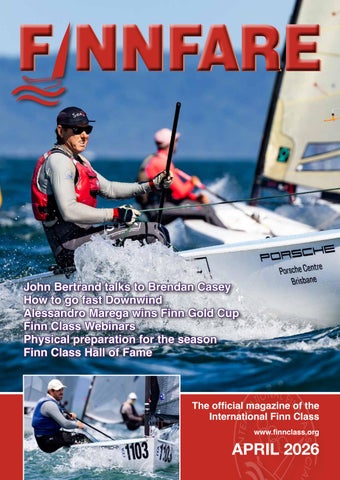
John Bertrand talks to Brendan Casey How to go fast Downwind Alessandro Marega wins Finn Gold Cup Finn Class Webinars Physical preparation for the season Finn Class Hall of Fame
The official magazine of the International Finn Class www.finnclass.org
APRIL 2026
Opening shot: U
nbridled emotio
n as Alessandro
PRESIDENT’S LETTER
Marega wins th
e Finn Gold Cup
Dear Finn sailors and friends, The Last Six Months of Finn Sailing
S
ince the conclusion of the 2025 European season, Finn sailing has demonstrated once again why our class continues to be one of the strongest, most resilient and most passionate communities in world sailing.
The second half of 2025 and the opening months of 2026 delivered some of the largest and most competitive Finn events we have seen for many years. From the powerful conditions of the Australian Finn Nationals, to the exceptionally challenging Finn Gold Cup, and finally the subtle and tactical Finn World Masters on Moreton Bay, sailors were tested in every possible way. In Cascais, Deniss Karpak became the first Estonian ever to win the Finn Gold Cup, whilst in Brisbane Alessandro Marega became the first Italian to win the Finn Gold Cup. Alessandro’s contribution to the class extends well beyond his sailing through his work with Olimpic Sails. We congratulate him on adding the Finn Gold Cup to his 2024 Finn Europeans victory. The Finn World Masters has been equally inspiring. Pieter‑Jan Postma claimed his second World Masters title in Medemblik, whilst Brendan Casey became the first Australian ever to win the Finn World Masters in Brisbane. At a time when many traditional sailing classes are struggling to maintain their relevance and international reach, the Finn continues to broaden its appeal. Despite the commitment required for the major events in Brisbane, the class still managed to muster a credible entry. We extend our sincere thanks to the Royal Queensland Yacht Squadron, the remarkable army of volunteers and the local members of the Australian Finn class who made these events possible. In particular, we recognise the immense effort of Stuart Watson. Without Stuart’s extraordinary work and persistence, these
events may not have happened at all. Looking ahead, we now turn our attention to the 2026 Finn Europeans in Gdynia. At this stage, we believe we will be able to accommodate almost everyone who has expressed interest in attending. The event has already acted as a catalyst for a significant increase in the number of Polish Finn sailors, much as Brisbane has generated record numbers in Australia. What is even more remarkable is that the increase in Finn sailing in Australia has not faded following the regattas. Demand for training, boats and parts remains exceptionally strong. You will recall that we recently delayed further consideration of GPS technology and electronic devices within the Finn class. Many members have expressed a desire for us to revisit this subject and we have decided that we will undertake a series of trials. The primary benefit we are seeking is the more accurate identification of OCS boats by the race committee in order to improve the fairness and quality of our racing. continued over...
FINNFARE APRIL 2026
3
Future Championships Back Issues Sets of back issues of FINNFARE dating back to the late 1990s are available in the Finn Shop. In total there are about 60 editions available, totalling more than 1500 pages. There are less than 10 sets left, which include some of the Masters Magazine are available. £25 plus shipping. See finnclass.org for more.
The following venues and dates are confirmed. 2026 Open Europeans, Gydnia, POL, 20-27 June 2026 Finn European Masters, Mar Menor, Murcia, ESP, 16-23 October 2027 Open and Masters Europeans, Estartit, ESP, 9-16 April 2027 Finn World Masters, Forio d’Ischia, ITA, 4-11 June 2027 Finn Gold Cup, La Rochelle, FRA, 20-27 August 2028 Finn World Masters, Pula, CRO, Dates TBD June To bid for events please contact the IFA Office. See: https://finnclass.org/event-page/calendar All events can be found under THE events TAB on finnclass.org
PHOTOS
#FINNTALKS
Most of the photos in this issue and from the major events can be obtained as prints or downloads from: http://robertdeaves.smugmug.com
Most months there is a new #Finntalks on the Finn Class YouTube channel. If you want to talk Finns, please get in touch. https://finnclass.org/finn-tv/finntalks
IFA Executive Committee 2025-26 President of Honour Gerardo Seeliger ESP Mob: +34 609 20 10 20 Email: gerardo.seeliger@gmail.com President Rob McMillan AUS Mob: +61 405 177 207 Email: finnports@live.com.au Vice-President – Development Arkadii Kistanov ITA Tel: +39 388 950 4915 Email: arkadiikistanov@gmail.com Vice-President – Sailing Remko Boot NED Tel: +31 6 29720170 Email remkoboot@me.com Vice-President – Masters’ Fleet Andy Denison GBR Tel: +44 (0)1202 484748; +44 (0)7802 355 522 Email: andy@denisons.com Hon Treasurer David Bull AUS Tel: +61 411 071 833 Email: davidannb@icloud.com Chairman Technical Committee Tim Tavinor GBR Tel: +44 7590 043459 Email: timtavinor@gmail.com 4
FINNFARE APRIL 2026
Special Projects Andrzej Romanowski POL Mob: +48 501 371 281 Email: andrzej.romanowski@buildingenergy.info Chief Measurer Andre Blasse AUS Tel: +61 438 347 398 Email: finnmeasurer@gmail.com IFA Office (Executive Director, FINNFARE Editor, webmaster) Robert Deaves 2 Exeter Road, Ipswich IP3 8JL, England WhatsApp/Mob: +44 7936 356663 Email: robert@finnclass.org
IFA website: finnclass.org Finnshop: finnclass.org/shop YouTube: finnclass.org/finn-tv Facebook: Finn-Class Instagram: finnclass FB Finn Class Events: FinnClassEvents Facebook Group: https://www.facebook. com/groups/848887039847759/ Instagram: finnclass Next issue: November 2026 Online issues: issuu.com/finn-class
is the official publication of the International Finn Association
No. 178 • APRIL 2026 FINNFARE is a non-profit publication that is distributed free of charge to all IFA members and interested parties connected to the International Finn Class around the world. Articles, race results, photographs and reports from countries are always welcome. Please include FINNFARE in your news mailing. All advertisement enquiries should be addressed to the Editor. A media pack is available on www.finnclass.org
Cover photo: Brendan Casey in Brisbane. Inset: Alessandro Marega (Photos: Robert Deaves)
We also nominated two new entrants to the Finn Class Hall of Fame and, in Brisbane, we were delighted to welcome Rafael Trujillo and Tim Tavinor. Rafa was recognised for his achievements in the Finn and his later contribution as a coach, including his work with Jorge Zarif, Jake Lilley, Nicholas Heiner and Matt Wearn. Tim’s contribution spans his sailing career, his close relationship with David Howlett and his later work through Victor Boats, Devoti Sailing, Petticrows and TT2. We also have our AGM online in May. If you have views, ideas or proposals that you would like to discuss, please do so through your National Finn Association or contact us directly. I hope to see many of you at the Europeans and wish you all the very best for the season ahead. Rob McMillan IFA President AUS 2
2026 WORLD TOUR FOR FINNS 07-Feb 10-Feb 13-Feb 19-Feb 17-Feb 20-Feb 20-Feb 27-Feb 13-Mar 15-Mar 28-Mar 29-Mar 28-Mar 29-Mar TBD 17-Apr 19-Apr 18-Apr 21-Apr 25-Apr 26-Apr 25-Apr 26-Apr 01-May 03-May 02-May 03-May 09-May 10-May 14-May 17-May 14-May 16-May 15-May 17-May 23-May 25-May 23-May 24-May 23-May 24-May 30-May 31-May 30-May 01-Jun 20-Jun 27-Jun 26-Jun 28-Jun 29-Jun 04-Jul 03-Jul 05-Jul 04-Jul 05-Jul 04-Jul 12-Jul 10-Jul 12-Jul 17-Jul 19-Jul
National Championship Finn Gold Cup Semaine Int de Finn Finn World Masters Mandelli Trophy North Islands (date tbc) South Islands (date tbc) Queensland States Mediterranean Finn Cup National Championship Jollenregatta Mammern UK Masters Second Event Dutch Masters Pálavská regatta National Championship Second Event National Championship Copper Cup Spring Cup/Baltic Cup Grand Slam Helmuth-Gubi-Memorial National Championship Finn Europeans National Championship National Championship National Championship Nord Cup Warnemünde Woche THE Olympic Regatta Mid Winters
AUS Brisbane NC INT Brisbane, AUS WC INT Cannes, FRA INT INT Brisbane, AUS AGE INT Torbole, ITA INT NZL North Island SEC NZL South Island SEC AUS TBD SEC INT Palamos, ESP INT BRA Rio de Janeiro NC SUI L. Constance SEC GBR Hayling Island SEC GER Steinhude SEC NED Muiden SEC CZE Nové Mlýny SEC AUT Dellach NC FRA La Rochelle SEC USA Alamitos Bay NC BEL Ostend NC DEN Rungsted SEC POR Cascais SEC AUT Lake Mondsee SEC ITA Cannigione NC INT Gdynia, POL CONT POR Cascais NC FRA Canet NC GBR Brixham NC POL Gdansk SEC INT Warnemünde, GER INT HUN Tihany SEC AUS Australia SEC
08-Aug 09-Aug 13-Aug 18-Aug 14-Aug 16-Aug 21-Aug 23-Aug 21-Aug 23-Aug 21-Aug 23-Aug 28-Aug 30-Aug 02-Sep 06-Sep 04-Sep 06-Sep 04-Sep 06-Sep 05-Sep 07-Sep 07-Sep 11-Sep 12-Sep 13-Sep 12-Sep 13-Sep 12-Sep 14-Sep 16-Sep 20-Sep 18-Sep 20-Sep 18-Sep 20-Sep 02-Oct 04-Oct Oct TBD 16-Oct 23-Oct 18-Nov 22-Nov 05-Dec 07-Dec Nov/Dec TBD 11-Dec 13-Dec
Aristo Regatta FIN Turku SEC National Championship BEL Grevelingen SEC National Championship NOR Larvik NC North American Masters INT Marblehead AGE National Championship DEN Varberg, SWE NC National Championship SWE Varberg NC National Championship CZE Lipno NC National Championship SUI Silvaplana NC Open Nordics INT Tampere, FIN INT National Championship FIN Tampere NC Second Event - Masters BRA Sao Paulo SEC National Championship GER Berlin NC Coppa Italia ITA Scarlino SEC Second Event - Sola Cup SWE Karlstad SEC Pacific Coast Champs USA San Diego SEC National Championship HUN Balatonfoldvar NC National Championship NED Medemblik NC National Championship POL Puck NC International Finn Cup INT Malcesine, ITA INT National Championship ESP Mar Menor NC Finn European Masters INT Los Alcazares, ESP AGE South Americans INT Rio de Janeiro CONT National Championship NZL Qn Charlotte YC NC North Americans INT Coconut Grove CONT Christmas Race 50th An. ESP Palamos INT
FINNFARE APRIL 2026
5
Built for Your Mainsheet. The A2040Tii is the go-to block for high-performance dinghy mainsheet systems.
SCAN FOR INFO
FINN NEWS EQUIPMENT USED AT THE 2026 FINN GOLD CUP
2026 WEBINARS
EQUIPMENT USED AT THE 2026 FINN WORLD MASTERS
In January and February the Finn Class ran two webinars with long time Finn sailor and 2012 Olympian, Piotr Kula Piotr brought some of his extensive knowledge from Finn sailing and coaching and provided useful tips and insights for all levels of Finn sailing. WEBINAR 1 focussed on ‘Turning a lead into a win’ WEBINAR 2 was on ‘Manoeuvres and techniques’. Both webinars were free to attend for all National Finn Association members. The recordings of both webinars are on the Finn Class YouTube channel (https://www.youtube.com/@ TheFinnChannel) for further viewing. Piotr is also offering a master class for Finn sailing on his website here: www.kulasailing.com
2026 ANNUAL MASTERS MEETING The 2026 Annual Masters Meeting was held in Brisbane in February. The main buisness was to decide the venue for the 2028 Finn World Masters, which was unanimously awarded to Pula, Croatia. The minutes of the meeting are available on finnclass.org under CLASS.
2026 IFA AGM TOP 10 EQUIPMENT – 2026 FINN GOLD CUP Sail Helm Hull Rudder Mast Boom 1 ITA 1103 Alessandro Marega Fantastica Wilke Wilke AoR 2 NOR 1 Anders Pedersen Fantastica DEM Wilke AoR 3 AUS 11 Brendan Casey Fantastica Thorpe Wilke Devoti 4 FRA 111 Valerian Lebrun Fantastica Devoti Wilke AoR 5 AUS 221 Anthony Nossiter Fantastica NR Wilke NR 6 ESP 100 Rafael Trujillo Fantastica Thorpe Wilke AoR 7 NZL 111 Karl Purdie Fantastica Devoti Concept AoR 8 USA 16 Rodion Mazin Fantastica Devoti Wilke AoR 9 AUS 2 Rob McMillan Fantastica DC Wilke AoR 10 AUS 37 James Bevis Fantastica DEM Wilke AoR
Sail1 Sail2 Olimpic Olimpic North WB North North WB WB North North Doyle Doyle North North North North WB North Doyle Doyle
TOP 10 EQUIPMENT – 2026 FINN WORLD MASTERS Sail Helm Hull Rudder Mast Boom Sail1 1 AUS 11 Brendan Casey Fantastica Thorpe Wilke Devoti North 2 ESP 100 Rafael Trujillo Fantastica Devoti Concept AoR North 3 NZL 111 Karl Purdie Fantastica Devoti Concept AoR North 4 GBR 74 Lawrence Crispin Fantastica Devoti Wilke AoR North 5 POR 21 Filipe Silva Fantastica NR HIT Devoti PL 6 AUS 221 Anthony Nossiter Fantastica NR Wilke NR North 7 GBR 790 Nick Craig Fantastica Devoti Wilke Allen North 8 ITA 40 Marko Kolic Fantastica Wilke HIT Devoti North 9 AUS 98 Lucas Prescott Fantastica Devoti Wilke AoR North 10 NED 148 Peter Peet Fantastica DEM Wilke AoR North
Sail2 North North North North PL North North North North North
The 2026 IFA Annual Generral Meeting will be held online on Tuesday 12 May at 20.00 CEST. The meeting is open to attend, though priority will be given to Council members and only Council members may vote. There is a lot to discuss, so please provide feedback to your national representatives. The main buisness is on upcoming events and dicussing the class policies on various matters The agenda and papers are on finnclass.org under CLASS.
BEWARE Please be aware there are a LOT of fake Facebook groups impersonating official Finn pages and our championships. Many Finn sailors already follow them. Beware.
NR = Not recorded
FINNFARE APRIL 2026
7
the keys that enabled him to turn failures into comebacks, rivals into allies, and his pursuit of performance into a collective journey. He wrote about this extensively in the May 2025 issue of FINNFARE.
Through a sincere and insightful narrative, he demonstrates that collaboration is not an idealistic stance, but a demanding and winning strategy even in the most competitive environments. Jonathan invites us on an initiatory journey, enriched with real-life experiences and practical methods, to build teams that are more united, high-performing, and human.
SHARING IS WINNING!
The secrets of an Olympic sailing medalist on the power of collective performance in business By Jonathan Lobert
J
onathan Lobert, the London 2012 Finn Olympic silver medalist, a two-time World Championship silver medalist, and a European Champion has published a book on his experiences in sailing, sharing
EXCERPT FROM THE FOREWORD “Writing this book was a bit like choosing to sail one last leg back to port, even after the regatta is over. Not to win another medal, I’ve already had that privilege, with an Olympic medal in London in 2012, podium finishes at the highest international competitions, and more than twenty-five years of high-level sailing, mainly in single-handed classes: Optimist, then Europe, Laser, and finally Finn. I’m taking this leg to pass something on. To share what sport has taught me about myself, about others, and above all, about the power of the collective. Because despite the appearance of a solitary sport, I was never alone. Behind every individual performance were coaches, engineers, training partners… sometimes even rivals who became allies. It is this often invisible reality that I want to bring to light.
EXCERPT FROM THE INTRODUCTION “What you are about to read is not a fixed method, a framework to apply, or a series of ready-made solutions. It is a journey. Through my experience as a high-level athlete, I have learned to trust, to open up, and to cooperate. This book tells what sailing has taught me about individual responsibility, the strength of the collective, and the power of human connections. I revisit concrete situations: the collaborations that shaped my path, the productive rivalries, the tensions overcome, and the decisions that changed everything. I also share what I have discovered as an entrepreneur and as a speaker working with teams in the professional world. Because the parallels are many. Whether in sport or in business, the same questions keep coming up. This book is an invitation to experiment with a different way of succeeding together. A demanding, dynamic, and deeply human approach. Because sharing also means committing, taking a stand, and owning your part. It means stepping out of the comfort of restraint and into motion – the motion of progress, connection, and transformation. In a fast-changing world, collaboration is no longer a “nice to have”: it is a decision, an effort, a direction.” Jonathan’s book was released in French in March, with an English edition expected later this year.
2026 WORLD TOUR FOR FINNS GRAND SLAM The Finn Class is delighted to launch the World Tour for Finns Grand Slam 2026. The inaugural Grand Slam year will include a series of key European events during the year including many of the iconic class events and venues along with some enticing new venues. The concept
8
FINNFARE APRIL 2026
is simple – encourage participation, showcase the class, highlight the class rock stars and have some Finn fun. The World Tour for Finns (WTF) is now in his fourth season, so it seemed an ideal time to extend this concept to focus attention on specific events. The WTF includes 60 events in 25 countries worldwide, while the WTF Grand Slam, at least in its inaugural year will have a European focus. Sponsorship and support are being sought to expand and develop the Grand Slam in future years. More than 1,200 Finn sailors take part in the WTF, and it is expected that around 3-400 will qualify for the Grand Slam. It is also intended to distribute prizes through the fleet, not just the usual superstars, but to encourage those mid-fleet and back of the Finn fleet to create a fully inclusive and shared experience for all. For this first year, the class has tentatively put forward significant prizes and prize money and included as many countries and regions as possible with the objective to focus interest, attendance and
media exposure on specific events to build greater visibility for national class events, which together with prize money will be a first for the class. For the inaugural series: • Nine events in eight countries • Four events to count • Extensive prizes and prize money • U23 and U29 categories • Focus on extended media coverage • Grand Slam prizegiving, The 2026 WTF Grand Slam 2026: Leg 1: 17-19-Apr, Palamos, ESP Leg 2: 30 May-1 Jun, Sardinia, ITA Leg 3: 20-27 June, Gydnia, POL Leg 4: 3-5 Jul, Brixham, GBR Leg 5: 21-23 Aug, Varberg, SWE Leg 6: 2-6 Sep, Silvaplana, SUI Leg 7: 7-11 Sep, Berlin, GER Leg 8: 18-20 Sep, Medemblik, NED Leg 9: 2-4 Oct, Malcesine, ITA More details on finnclass.org
FINN CLASS HALL OF FAME REVISTED T
he Finn Class Hall of Fame is an acknowledgement of many of the legends of the class, from Paul Elvstrøm, Jørg Bruder, Hubert Raudaschl and Willy Kuhweide through to John Bertrand, Lasse Hjortnaes and Jose Doreste to Ben Ainslie, Mateusz Kusznierewicz and Fredrik Lööf. They are all absolute icons of the class and being inducted into this exalted list is the highest honour the class can bestow, both for exceptional skill on the water, or for being instrumental in the amazing legacy and success of the Finn Class.
The last inductions were made in 2015, so on the occasion of the 70th Finn Gold Cup, the International Finn Association has started to reinvigorate this fantastic celebration of class heroes and legends. Ther4e are more to follow…
RAFA TRUJILLO Rafa Trujillo was inducted into the Finn Class Hall of Fame during the closing ceremony of the Porsche Centre Brisbane 2026 Finn Gold Cup at the Royal Queensland Yacht Squadron, in Brisbane, Australia. Trujillo is most famous in the Finn class for having won the silver medal at the 2004 Olympic Games in Athens, the 2007 Finn Gold Cup in Cascais, Portugal, and the 2016 Finn World Masters on Garda. He famously lost the Gold Cup twice on the final day before finally clinching it in 2007. After finishing in eighth place in the Star class at Sydney 2000, he sailed three Olympic Games in Finn, winning the Silver in 2004 in Athens, then ninth in Beijing in 2008 and eighth in London 2012. After four Olympic Games appearances he turned to coaching and was behind the youngest ever winner of the Finn Gold Cup, Jorge Zarif, in 2013. Since then, he has become a coach for Australian Sailing, most notably coaching Matt Wearn to Olympic Gold in Paris 2024. His other sailing achievements and awards are well renowned.
TIM TAVINOR Tim Tavinor was second inductee into the Finn Class Hall of Fame in Brisbane, inducted during the opening ceremony for the Finn World Masters There are few people who have had such a huge impact on the Finn class as Tim Tavinor. In the early 1990s, alongside Luca Devoti, he helped create Victor Boats and the Devoti hull that transformed Finn sailing worldwide. It is no idle statement that without this development the class is unlikely to have thrived in the way it has over the past 30 years. After helping move the boatbuilding operation, by then called Devoti Sailing, to Eastern Europe, in 2005 he moved away from Finn building and bought Petticrows boatyard in Burnham-on-Crouch, where he carried on the company’s tradition of building world beating Dragons. In 2014 he returned to Finn production, with the release of the Petticrows Finn, which was later sold to DC Composites in The Netherlands to produce the world beating TT2 Finn. In 2022 Tim then became chair of the Technical Committee of the International Finn Association. Tim was also a formidable opponent on the race course, and campaigned Finns through the 1980s and 1990s, and narrow missed Olympic selection. It would be remiss to not mention Luca Devoti in the same story, so even if he was not present in Brisbane, he will join Tim Tavinor in the Hall of Fame at a later date. Their story is inseparable in the development of the Finn, as Luca continues to play a vital role in the life of the class. Luca, of course, won the silver medal at the Athens 2000 Olympic Games as well winning as the 1997 European Championship. He also placed 16th in the Finn at the 1996 Olympics He took two further European silver medals in 1994 and 2002, and Finn Gold Cup silver in 1997. Their collective impact on Finn sailing worldwide is immeasurable and this overwhelming acknowledgment from the class is long overdue.
During the events in Brisbane in February 2026, Rafa Trujillo and Tim Tavinor were inducted into the Finn Class Hall of fame.
Finn Class Hall of Fame Gerardo Seeliger Nikos Kouklelis Rickard Sarby Jörg Bruder Paul Elvstrøm Gilbert Lamboley Willy Kuhweide Hubert Raudaschl John Bertrand Lasse Hjortnæs Jose Luis Doreste Fredrik Lööf José Maria van der Ploeg August Miller Mateusz Kusznierewicz Ben Ainslie Richart Hart Jüri Saraskin Rafael Trujillo Villar Tim Tavinor They are all listed here:
https://finnclass.org/thefinn/hall-of-fame
FINNFARE APRIL 2026
9
Alessandro Marega wins 70th Finn Gold Cup
T
he 70th Finn Gold Cup, sponsored by Porsche Centre Brisbane, was hosted by the Royal Queensland Yacht Squadron in Brisbane, Australia from 12-19 February. 68 sailors from 14 nations made the journey to Queensland.
For the first time ever the Finn Gold Cup and Finn World Masters were being held in consecutive weeks, preceded by the Australian Nationals, for three weeks of Finn sailing. Alessandro Marega became the first Italian to list the title after fighting back following Anders Pedersen’s dominance in the windier conditions over the first three days. Anthony Nossiter spent most of the week in third place only to also struggle in the lighter winds at the end of the week. Brendan Casey Made the best of those conditions to climb to third
BRUTAL OPENING DAY Anders Pedersen was the stand our performer on the brutal opening day. Pedersen took two race wins in some very challenging conditions in Moreton Bay. Marega was in second with Anthony Nossiter third. It was not exactly the Brisbane in the brochure, with strong winds, heavy rain and temperature reduced from the normal 28-30 degrees to 19-20 degrees.
10
FINNFARE APRIL 2026
Two races were sailed on Sunday afternoon on Bravo course area, outside Green Island, a 75-minute sail from the club. It was tough just to make the start line and only 46 sailors finished both races. The forecast of 15-20 knots and higher gusts was not far wrong. Short steep waves made for some tough upwind sailing and then when the tide turned and the wind increased for the final race for some great downwind sailing. It was not a day for the faint hearted, but everyone returned to shore with a smile for a day well spent. In race 1, Jan Dietmar Dellas led at the top mark from the left side, ahead of Lawrence Crispin and Joe Spooner. Crispin had taken the lead by the gate but Marega passed him upwind to lead round the final top mark. Pedersen had started badly and was fighting through, but was up to second at the top, and then took the lead at the bottom of the run to lead into the finish from Marega, with Australia’s Brendan Casey in third. Little by little, the wind started cranking. It became more challenging with each passing minute, until for many it was a battle to survive. By the top of the first upwind in Race 2, the wind was up to 25 knots with the Finns balls of spray flying downwind. This time Nossiter led round from David Ellis and Pedersen. Pedersen found second gear downhill to take the lead and eventually a second race win. Nossiter crossed in second with Marega third. Nossiter: “That was a great day’s sport out there. I feel like a master though. Quite spent, quite exhausted. The boys were hiking
2026 FINN GOLD CUP 1 ITA1103 Alessandro Marega 2 NOR 1 Anders Østre Pedersen 3 AUS 11 Brendan Casey 4 FRA 111 Valerian Lebrun 5 AUS 221 Anthony Nossiter 6 ESP 100 Rafael Trujillo 7 NZL 111 Karl Purdie 8 AUS 2 Rob McMillan 9 USA 16 Rodion Mazin 10 AUS 37 James Bevis 11 POR 21 Filipe Silva 12 NED 148 Peter Peet 13 GBR 790 Nick Craig 14 AUS 110 Marcus Whitley 15 NZL 54 Joe Spooner 16 AUS 98 Lucas Prescott 17 AUS 55 Lewis Davies 18 FRA 75 Laurent Hay 19 AUS 222 Paul McKenzie 20 GER 501 Fabian Lemmel 21 GER 193 Thomas Schmid 22 AUS 73 Kane Sinclair 23 USA 7 Nikita Mazin 24 DEN 21 Otto Strandvig 25 NZL 4 Mark Perrow 26 ITA 40 Marko Kolic 27 AUS 21 Bucky Smith 28 GBR 74 Lawrence Crispin 29 NED 29 Bas de Waal 30 AUS 333 David Ellis 31 NZL 93 Richard Hawkins 32 AUS 26 Ian McKillop 33 ESP 76 Alejandro Cardona 34 AUS 95 Hayden Barney (U29) 35 GER 81 Jan-Dietmar Dellas 36 ITA 706 Sebastian Mazzarol 37 AUS 111 Sam Ede (U29) 38 NZL 30 Andrew Duncan 39 NZL 5 Brendon Hogg 40 USA 2 R. Phillip Ramming 41 SUI 99 Laurent Chapuis 42 GER 477 Harald Leissner 43 NZL 9 Rob Coutts 44 NZL 81 Paul Bamford 45 SUI 12 Franz Bürgi 46 GBR 13 Roman Khodykin 47 AUS 43 John Croston 48 AUS 169 Jason Wilson 49 AUS 343 Edward Louis 50 AUS 342 Tim Ede 51 DEN 212 Jan Peetz 52 AUS 24 Greg Solomons 53 NZL 20 Chris Wells 54 AUS 12 Roger Best 55 AUS 270 Michael Hughes 56 GER 202 Rolf Elsässer 57 AUS 292 Anthony Wood 58 CZE 149 Vladimir Vogltanz 59 CZE 222 Petr Vinkl 60 NZL 19 Denis Mowbray 61 ISV 11 John Hourihan 62 AUS 3 Larry Kleist 63 AUS 5 Matt Visser 64 GUA 1 Juan E Maegli 65 NZL 1 Raymond Hall 66 GBR 5 Jeremy White 67 POR 58 Henrique JS Da C Silva 67 USA 5286 Charlie Buckingham 67 USA 975 August Miller 67 GBR 4 Russell Ward
1 2 1 3 4 7 8 10 14 11 (25) 12 9 21 18 6 17 19 42 23 35 22 20 29 26 13 34 31 5 28 27 24 15 38 33 16 30 32 (45) 40 43 49 44 36 48 46 51 52 47 (dns) (dns) (dnc) (dnc) (dns) (dns) 39 (dnc) 50 (dnc) (dns) (dns) (dnc) (dns) (ret) 37 41 (dnc) (dnc) (dnc) (dnc) (dnc)
2 3 4 5 6 7 8 3 2 5 2 2 2 3 1 1 1 15 1 6 4 8 3 7 (39) 13 1 2 7 12 8 (32) 9 3 1 2 8 2 4 5 4 (13) 5 9 3 5 4 7 6 4 (ocs) 16 9 3 21 7 6 4 4 23 10 (24) 5 14 11 15 10 14 11 16 10 6 10 8 8 15 18 9 10 19 13 15 14 17 23 19 17 6 (ufd) 12 15 15 26 (28) 22 7 8 11 11 23 11 26 6 13 23 24 13 6 11 28 22 21 25 (28) 18 14 12 23 12 (37) 21 12 18 16 10 19 17 29 20 27 27 5 (ufd) 27 (33) 21 30 25 16 8 28 17 26 (42) 21 25 9 12 24 (30) 28 23 20 29 33 5 34 17 32 17 30 13 20 23 24 18 28 14 20 25 22 29 (42) 19 20 19 22 13 16 39 (41) 31 26 7 32 3 (ufd) 9 10 29 27 14 7 30 18 34 21 16 31 12 20 (bfd) 22 35 40 (dnc) 20 34 29 27 22 34 24 52 11 27 26 16 15 33 38 19 32 32 18 14 9 1 17 (dsq) 24 44 32 27 34 26 35 25 42 42 39 21 31 26 (45) 32 35 25 36 35 (54 47) (dnc) 31 36 31 41 39 39 40 30 29 44 22 45 38 31 39 35 41 37 43 36 30 (dnc) dns 54 29 38 28 43 38 rdg (51 45 40 49 (dnf) 43 40 59 47 33 ufd 39 36 38 37 50 (53) 50 38 (ret) 41 62 44 34 37 41 (dnf) dns 61 43 36 41 46 (dnc) dnc 43 54 46 53 45 (dnc) dnc 47 46 42 40 34 18 37 45 (dnf) 44 dns 47 (dnf) dns 48 40 56 42 dnc 37 42 64 58 52 46 dnc 41 dns 33 49 51 52 dnc dnc dnc 57 51 30 35 dnc dnc dnc 35 36 37 54 dnc dnc dnc 49 24 31 33 dnc dnc dnc 50 55 57 48 (ret) dns dns 46 48 58 55 dnc dnf ret 63 53 49 43 36 (dns) dns 40 52 55 dns dnc dnc dnc 60 57 48 56 dnc dnc dnc 56 56 47 44 dnc dnc dnc 58 38 50 dns dnc dnc dnc 53 dnf bfd 51 dnc dnc dnc 25 33 dnc dnc dnc dnc dnc 19 dns dnc dnc (ret) dnc dnc dnc dnc dnc dnc (dnc) dnc dnc dnc dnc dnc dnc dnc dnc dnc 55 dns dnc dnc dnc dnc dnc dnc dnc dnc dnc dnc dnc dnc dnc dnc dnc dnc dnc dnc dnc dnc dnc dnc dnc dnc dnc dnc dnc dnc dnc dnc
9 10 Total (8) 8 29 (26) 6 36 1 4 42 3 1 48 5 13 50 6 (20) 53 2 14 86 10 21 97 7 (30) 109 18 17 110 (22) 9 118 9 18 128 16 3 129 (32) 19 150 24 (31) 155 28 12 161 25 28 168 4 2 173 21 7 178 11 10 182 14 27 199 12 (bfd) 200 31 (bfd) 200 34 11 206 27 26 206 dne 15 209 19 (ret) 209 15 bfd 215 23 5 241 20 (ret) 243 (43) 34 243 ret dns 244 17 (bfd) 278 35 16 285 48 39 313 33 35 315 38 (dns) 318 37 41 340 30 29 351 29 25 356.14 13 22 379 49 43 386 36 bfd 401 40 33 416 39 24 424 47 36 427 dnc dnc 449 57 40 450 41 46 459 50 42 464 55 23 470 44 45 470 42 bfd 471 54 32 515 51 bfd 516 46 44 517 dnc dnc 525 56 37 533 53 dsq 548 45 bfd 556 52 38 559 dnc dnc 569 dnc dnc 603 dnc dnc 621 dnc dnc 625 dnc dnc 639 dnc dnc 657 dnc dnc 657 dnc dnc 657 dnc dnc 657
FINNFARE APRIL 2026
11
1998. It’s good to get back out there today. Not sure what we saw for max breeze but must have been 25 to 30 at max peak. It was a tough course. The legs are still hanging in. Good to go around the track and a really good fleet with quality sailing.” Brendan Casey: “What an amazing four races we’ve had. Anders from Norway, well how do I say this, he’s like the Porsche GTS Turbo. He’s won all four races and is doing awesome.” Rafa Trujillo: “Anders is in another league. The rest of the people are pretty tight battling with the conditions and fitness and trying to survive.”
all the way in. Unbelievable. It was windy in the second race and the righting moment was good for that. It’s great to see everyone out there crossing the tacks and hanging in there, and plenty of smiling faces, even when the pins are hurting.” Pedersen: “The day was hard. It was very windy when we got out, and the wind dropped a bit. I think I had the worst start of the whole fleet in the first race, so I started all the way in the back. So, it was a hard race to work my way back. I had good speed on the downwinds, so I managed to catch up and win the race on the last downwind leg. It was very shifty out there, so it was hard to see which side was paying off. But nice day. Norwegian weather.”
WHEN THE GOING GETS TOUGH… Pedersen extended with two more race wins in somewhat hairy conditions on the second day. The top three remain the same. With a forecast of 15-25 knots, with gusts on the water of already 28 knots, the slightly reduced Finn Gold Cup fleet set sail for two more races in Moreton Bay. With a stiff 25 knots on arrival some boats turned around and went home, though the conditions did moderate as more rainclouds came in and then the second race was sailed in a steadier 15-18 knots, including some intermittent sunshine. Kane Sinclair led the first race of the day in the longest first upwind in living memory at 2.2 nautical miles, after a GPS error on the mark boat, rounding ahead from Pedersen and Rob McMillan. However, Pedersen took the lead on the second much shorter beat to lead into the finish from Marega and Brendan Casey. The second race was more normal with Pedersen starting well at the pin and building a sizeable lead round the course to win from Nossiter and Rafa Trujillo. Only 42 boats finished both races. However, the cold, wet weather has hopefully now gone and sailors were pleased to see the return of the sunshine and temperatures in the mid 20s. Joe Spooner: “It was a tough day on the water today. I haven’t sailed these things for 28 years. My last gold cup was Athens in
12
FINNFARE APRIL 2026
SUNSHINE STATE FINALLY WARMS UP After Day 3 Pedersen held a six-point lead over the ever-consistent Merega, with Nossiter a further nine points back in third. It was a much nicer day than many expected with sunny skies, rising temperatures and hot 12-15 knots winds, despite the fleet launching into a stiff 20 knot breeze. After several days of rain and cold air, the sunshine state finally lived up to its name. The day was charactered by huge wind shifts that left many front-runners fighting back from mid fleet. Ian McKillop was the runaway winner in race 5, leading all the way for a huge win after a big right shift. He won from Marega and Marko Kolic. Regatta leader Pedersen struggled to recover from mid fleet to 15th at the finish. However, by the second race, Pedersen had the measure of the conditions, starting at the pin end and being one of the first to tack across to the right. He led at the top mark and extended away for a huge win. Marega finished with another second with Karl Purdie in third. Ian McKillop: “The first race today was a pretty good race. Whenever you get a race win, it always keeps you coming back. In the second race, the right didn’t come in so well, and the left was pretty strong. So, it didn’t happen twice in a row, unfortunately, but that’s sailing.” Karl Purdie: “In the first race it was shifty. It was back and forth. The oscillations here, there’s a long time between them, probably like 15 minutes. So, you just got to hang in there, and eventually it’ll come back for you. You’ve just got to be patient.” CONDITIONS CHANGE AND POINTS TIGHTEN It was all change on Day 4 with scorching hot weather, wind from 7-12 knots, and free pumping only turned on for the second race. The wind rose from 7-8 knots in the first race to 10-12 in the second but dropped again on the final downwind to 7-8 knots. The shift to lighter northerlies produced many changes through the fleet. However, the day belonged to Australia’s Brendan Casey with a 1, 2 while Valerian Lebrun picked up a 3,1. Pedersen was left playing catch up in both races for a 6, 4, which reduced his lead over Marega, who scored a 2,3, to just one point. Despite this, the top three remained the same again with Marega in second, one point behind Pedersen, while Australia’s Anthony Nossiter is in third, another 16 points back. Casey led all the way in Race 7, extending for a sizable win from Marega and Lebrun. The wind was trying to build and though the bottom of the course was 10 knots the top was only 7-8. However, Oscar was raised for Race 8. McMillan rounded first just ahead of Casey who initially took the lead downwind, only to be passed by Lebrun. Casey then took the lead up the second beat
only for Lebrun to again pass him downwind as the wind dropped. Casey crossed in second with Marega in third. Rodion Mazin: “I had a good first race, well, good start. Downwind was tougher, no pumping, a lot of shifts, and a lot of working with controls. The second race was not as good, not that good of a start, but I was able to crawl back out. Very challenging conditions for everybody.” Nick Craig: “It was a great day sailing today. We had 10 to 12 knots, 30 degrees, sunny, and what was nice for me was the tide was the other way round, so it was wind against tide, so the upwinds were short, downwinds were long, which suits me because I’m very light for a Finn. The race officer did a very good job of getting us off, using the black flag when needed and not chucking too many people out the way, so that was good.” ALESSANDRO MAREGA WINS Thursday brought the lightest winds of the week, under 10 knots all day, but there with all to play for and with 30 degrees temperature, the competition was hot. In Race 9, Karl Purdie made the best of the first upwind to round just ahead of Casey and Mazin. Casey took the lead downwind and extended for a comfortable win from Purdie and Lebrun. Both Marega and Pedersen were deep at the top mark, but Marega was going faster and worked through to top 20 at second top mark and then took more down last run to cross in eighth place. With Pedersen still well back it was enough for Marega to win the Finn Gold Cup with a race to spare. The final race settled the other medals with Lebrun leading round the whole race to win the race from Laurent Hay and move up to fourth overall. Craig had his best race to cross third, while Casey had another good race to cross in fourth, which lifted him up to third to take the bronze medal, a spot occupied that had been by Nossiter all week, who dropped to fifth overall. So, Alessandro Marega won the Porsche Centre Brisbane 2026 Finn Gold Cup after an incredible week of world class sailing at the Royal Queensland Yacht Squadron. In doing so he became the first Italian ever to win the Finn World Championship. Long time leader Anders Pedersen had to settle for the silver while an almost perfect performance over the last two days from Brendan Casey, moved him up the third and the first Australian. Casey: “I’m happy to say I finished third. I’m pretty happy about that. I must say Anders and the Italian sailor, they sailed a class series and deserved to get their first and second position. The weather has been at both ends. We’ve had the extreme of the south easter and then the lighter nor’easters over the last couple of days, but I really enjoyed sailing on Moreton Bay.” Pedersen, “Overall, I’m happy with my sailing, except for today. The Italian did a very good job taking me out in race one, and
yeah, so kudos to him. He deserved the gold and he’s been super consistent. I’ve been struggling in the lighter breeze. When the wind was up, I had control, but not the fully right setup and probably a lack of training for the lighter stuff. The sailing in Brisbane was beautiful. The yacht club is very nice. Conditions have been awesome. The people here are super friendly and helpful. I couldn’t ask for more. I’m pretty broken in my body right now, so I need to do more fitness to get back. So, I’m probably gonna do less office work and be a bit more in the gym and hopefully you see me more in the future.” Marega, “I’m very happy about the result and the week. I sailed very good, also in the situations when I was not so good with the speed and other things, and I stayed calm all the week. We had three days with rain and three days of sun and good breeze. For me it is a perfect place, and we have tough race all he week with strong wind from the south and then less wind from the north. We also had a good level. Many people have done the Olympics and America’s Cup. For me it’s a point that makes me happy.” For the U29 Silver Cup, Hayden Barney and Sam Ede were locked together most of the week. However, Barney had the better final day to end up 34th overall and first U29. The outside course on Moreton Bay hs proved to be a fitting challenge for the ultimate challenge, the pinnacle of Finn sailing that is the Finn Gold Cup. The week provided a range of conditions to test all the sailors, and the battle at the top was so tight that no mistakes went unpunished. IFA President Rob McMillan summed up: “What a week and a new country gets to write its name on the Finn Gold Cup. It couldn’t happen without the amazing RQ machine. It was hard at times, but so worth it and as tough as I can recall at any Finn Gold Cup. It was amazing.”
FINNFARE APRIL 2026
13
FINN CLASS WEBINARS 2026 WITH PIOTR KULA
KEY POINTS FOR THE BIGGEST IMPROVEMENT IN YOUR RACING
A
s much as I love sailing for its complexity, it also means there is a lot to remember about in the race. It gets even harder when you want to introduce new tricks to your skill set. I see it especially when I work with sailors, who don’t have as much time for practice as they would like to. That is why I am a big fan of applying the Pareto principle when learning/ teaching new skills.
This year’s Finn Class webinars host, London Olympian Piotr Kula, brings out key points, which, when used, guarantee considerable gains.
It roughly means that 80% of the desired effect comes from 20% of the input. That’s why I chose only two things from each webinar we had early this year, for you to remember. Try to use it in your racing, and you will see a visible improvement in the quality of your sailing. No doubt, better results and racing satisfaction will follow! WEBINAR 1 “FINN RACE TACTICS - TURNING A LEAD INTO A WIN” Key point no.1: Use the prestart area to your advantage. Many sailors do their warm-up by sailing up and down, and then they ‘float’ below the starting line without engaging much in a race preparation. As far as it’s good to slow down for a moment, exhale,
and relax your head before the race, you can set yourself up for an easier job by doing simple things in the correct areas of prestart space: Place yourself above the starting line, at least as time gets closer to the actual starting sequence. This way you will have: • Clear wind, uninterrupted by other boats, to measure the angles of port and starboard tack. • Write those angles down on your deck with a pencil or memorise them. • Repeat the measurement a few times to see the wind oscillation - it will help you make decisions on the upwind. • From this area, it is also easy and quick to get to any spot of the starting line you choose for starting, because you sail downwind.
14
FINNFARE APRIL 2026
How to set it: Release vang fully, bear away to downwind and tighten teh vang control line gently. Observe the leech. You may pull the mainsheet to see sail’s reaction. You need to find the spot where a leech generally holds air in the sail when you pull gently, but still flicks (as you would pull to hold pressure or you would pull the sail to catch a wave). • If you pull and sail opens, releasing air = vang is too loose • If you pull and the vang is as tight as a guitar string (doesn’t flick) = vang is too tight. Key point no.2: Prepare for mark roundings in advance Before the top mark: Otherwise, if you would be far below the starting line, or far away to the side: • You hardly hear RC signals • You have to sail upwind in covered air or go around the boats that already took the spots they desired for starting - it lowers your chance to claim a good spot • You are not in contact with the actual wind right before the race - less proper information for you to base your tactics on. SUMMARY: Where you are before the race determines the quality you bring to your own race. Key point no. 2: Sail inside the “Tactical Candy” Tactical candy is a term I use (I am not sure if I named it like this or heard it from someone) to depict the beneficial and undesired areas of upwind. Essentially, it comes down to risk management while racing upwind. Use it especially on the first upwind: The green area of the diagram shows where it’s good to be racing. Whatever happens here, you can respond with tack or continuing straight, and you have your options open. • If the wind shaft is a lift - continue and gain • If the wind shift is a header - tack and gain However, if you are in the red zone of the race course, you condemn yourself to a game of chance. The closer to the layline, the more gambling it is. Imagine you “hit the corner”. Any beneficial shift puts you over the mark. Any negative shift puts you below the mark. You can tack then, but you only place yourself even more to the extreme spot of upwind. At the same time, boats that race more conservatively (in the green zone) can respond to shifts, using each of them for gains. The diagram has the shape of a candy, because before the top mark, you may choose from which line to approach the mark. But here it’s not a gamble anymore. You can make the decision based on the current wind and the opponent’s situation. Yes, going extreme may win you a race. Or just upwind. Winning regattas is based on the average low score coming from a solid job. Not one lucky win and nine “bad lucks”.
• Check if your mainsheet isn’t tangled (otherwise, other boats will bear away fully, and you will be dealing with tangled rope) • Release Inhaul and Cunningham right before the mark Effect: Right after passing the mark, you can focus on catching a wave, playing your tactics, and aiming at the next mark. Not placing your focus inside your boat. I have seen many sailors taking way too long to gain full speed and full focus on the downwind, way too long after they passed the mark. Be prepared in advance. Before the bottom mark: • Drop the centreboard first. • Pull Inhaul (at least) and Cunningham (if enough time) - sail is ready for upwind before the mark. Do the fine-tuning later. • Grab the mainsheet through the ratchet block - this makes you ready for pulling sail as needed on the upwind. A very big mistake is to hold mainsheets 1-to-1 (over the ratchet block) to the last moment and then try to swap as you round the mark. Even worse if you also need to do the gybe to round the mark. You would drift down, lose speed, and precious distance and places. Again, be prepared in advance. Have a great sailing season! To explore those and more topics in detail, find articles about Finn Class 2026 webinars on the IFA website. If you wish to learn more about Finn sailing to gain an extra advantage in simple tips, check Piotr’s online racing courses at www.kulasailing.com
SUMMARY: Playing in the green zone of the Tactical Candy is a long-term recipe for winning regattas. WEBINAR 2: “MANOEUVRES AND TECHNIQUES” Key point no.1: Set your vang well for the downwind: One of the most common errors is a too-tightly pulled vang on the downwind. This influences the boat negatively the most in light and medium wind. If you pull the vang too much, your sail won’t breathe. The leech will be stiff, too tight. It won’t respond to the gusts, to your moves, to the waves. And it must! A leech must do in the air what a fin of a fish does in the water. It must be able to flick a bit. Only then will the boat move gently through the water.
FINNFARE APRIL 2026
15
HOW TO GO FAST DOWNWIND IN A FINN PHYSICS, MODES, TRANSITIONS AND DATA-DRIVEN TRAINING by Arkadii Kistanov
M
any sailors I coach ask the same question: what is the fastest way to sail downwind in a Finn?
This article is my attempt to answer that question clearly and practically. Downwind speed in a Finn is not just about ‘feeling fast’, it is about understanding how the sail works, choosing the correct mode for the wind strength, and using heel, sheet and body movement in the right way to get more speed and VMG. 1. THE PHYSICS YOU ACTUALLY NEED To sail fast downwind, you first need a simple and correct picture of how the sail produces force. A sail works because of the pressure difference generated by different speed of the airflow across its two sides (Bernulli Principle Picture 1). As long as the flow stays attached, the sail can generate useful aerodynamic force. Once the flow separates, the sail loses efficiency: drive drops, drag rises, and the boat slows down. This is not only true upwind, it is also true downwind, even if the geometry looks less intuitive. A common mistake is to think that downwind speed comes only from presenting sail area to the wind. In reality, a Finn is usually
faster when the sailor maintains a stable and efficient airflow on the sail rather than simply aiming the bow straight at the leeward mark. In practice, that usually means sailing in one of two active modes: • Broad reaching • By-the-lee A prolonged dead run may be tactically useful at times, but as a performance baseline it is usually slower. 2. THE THREE DOWNWIND MODES
Broad reaching
In broad reach mode, the airflow is organised in conventional way. The telltales stream aft, and the masthead windex points from the mast side toward the leech side. The sail is being asked to stay loaded and efficient while the boat is driven at speed.
By-the-lee
In by-the-lee mode, the flow pattern is effectively reversed compared with broad reaching. The leech telltales indicate flow from leech toward luff, and the windex confirms the same pattern. This is a distinct mode, not just a mistake or an unstable version of running.
Dead run
A straight run can be useful tactically, for example to protect a lane, compress a fleet situation, or approach a mark. But over a long period, it is not the fastest performance mode because the sail is less efficient, and the boat loses the dynamic response available in broad reach or by the lee. See Picture 2 3. HOW TO IDENTIFY YOUR MODE ON THE WATER A simple and reliable way to identify whether you are broad reaching or by the lee is to combine two references: • Leech telltales • Masthead wind indicator If the telltales stream aft and the windex points from the mast toward the leech, you are in broad reach mode. If the telltales stream from the leech towards the luff and the windex confirms the same direction, you are sailing by-the-lee. If the two references disagree, or neither is stable, then the flow is probably not organised well enough. That usually means the mode is unstable, the sail is not fully attached, and the boat is leaving speed on the table.
16
FINNFARE APRIL 2026
Picture 1 - Bernoulli principle
Picture 2 - Modes and Heel for modes
Picture 3 - Speed and VMG graph in time
Picture 4 - Graphs from Ktool
4. VANG, SHEET AND HEEL
Vang
Vang tension should support the aerodynamic mode you are trying to sail. In by-the-lee mode, the leech needs to stay alive and responsive. The sail should still work dynamically, but the boom must remain controlled enough that the rig can transmit the right amount of energy into the boat. In broad reach mode, vang tension is higher. The aim is to keep the upper leech from becoming too open and to help the sail retain energy without the flow spilling upward too easily.
Heel
Heel angle is one of the most underappreciated controls downwind. In broad reach mode, the boat should be sailed either flat or with a slight heel to leeward. Windward heel here is deadly slow because of increasing inductive drag and spanwise flow. As well, sideways forces on the daggerboard becoming less stable, and you lose boat surface contact with the water, so your boat simply stays lower in the water and it more difficult to start planing. In by-the-lee mode, the boat should normally be sailed either flat or with a slight heel to windward — typically around 3 to 5 degrees. In effect, that windward heel functions like a reversed leeward heel because the flow is arriving from the leech side. Too much windward heel is always slow. The good heel on the straight line should not exceed 3-5 degrees.
is only true if the pumping is effective. If the sailor is working hard without visible boat response, then effort is being wasted. As the wind rises further, load and fatigue increase again. In very strong breeze, the theoretical power advantage of reaching can be offset by control limits, fatigue and the difficulty of maintaining clean, repeatable mechanics. In those conditions, the best mode becomes highly dependent on the sailor, the wave pattern and the ability to keep the boat free and stable. 6. THE LOGIC OF TRANSITIONS AND S-TURNS The purpose of a transition is not simply to move the bow around. The purpose is to improve VMG. For a transition to pay, two conditions must be met. First, the boat must already be sailing close to its maximum speed in the current mode. In that case the only way to increase VMG is to change the course to go closer to the mark. If it is not, there is no reason to transition — the boat should first be sailed faster in its present mode.
5. WHICH MODE IS FASTER? In lighter and medium conditions, a well-controlled by-the-lee mode is often faster than passive broad reaching because it allows leech to pump legally, as well as mast not letting the airflow to spill upward, keeping more energy into the sail. This method is veery popular among ILCA classes. However, Finn class has permission for pumping, rocking and ooching after 10 knots of wind speed, when Oscar flag is displayed. That means that in practice, once free pumping is enabled and the sailor is physically able to convert effort into acceleration, activepumping reaching becomes the preferred high-power mode. But this
FINNFARE APRIL 2026
17
Martijn van muyden Cascais, Portugal photo: Robert deaves
18
FINNFARE APRIL 2026
Second, the gain in downwind angle must outweigh the speed loss caused by turning and by disturbing the flow. This is why good S-turns are difficult. During a transition, the apparent wind direction relative to the sail changes, the rig has to reorganise the flow, and the boat is always at risk of creating extra drag. The sailor’s job is to let the boat change mode smoothly, quickly and with as little unnecessary resistance as possible. A useful way to think about it is this: • If speed is near maximum, the only way to improve VMG is to sail slightly deeper; • Because the boat has inertia, speed does not fall instantly; • Therefore VMG may briefly improve as the sailor goes deeper; • The sailor must then return to an efficient broadreach or by-the-lee mode before VMG decays below the baseline. If the transition is slow, abrupt or poorly coordinated, the losses are greater than the gain and the S-turn becomes expensive rather than fast. Filled area on the Picture 3 demonstrates win in VMG distance. 7. HOW TO STEER TRANSITIONS Transitions should be led by heel and sheet, not by rudder. To luff, the sailor should first create heel to leeward and then trim the mainsheet. That helps the boat head up with less drag and less braking from the rudder. To bear away, the sailor should first roll the boat to windward and then ease the sheet. That allows the boat to turn down more naturally and keeps the movement connected to the aerodynamic change in the sail. If heel change, sheet movement and heading change are not synchronised, the boat slows down and the transition becomes visible in the data immediately. 8. DATA-DRIVEN TRAINING I use Ktool Sailing Analytics together with an onboard tracking device to analyse downwind performance and transitions. The key is not just to look at average speed. The key is to understand the sequence: heel change -> heading change -> speed response -> VMG effect What I want to see in a good transition is: • Heel changes first, • Heading responds immediately after, • Speed follows with only a small delay, • VMG improves without a deep speed collapse. If heading changes before heel, the sailor is often steering too much with the rudder. If heel changes but heading reacts late, the boat is not being released properly.
If the heading changes but speed never responds, the manoeuvre is probably too aggressive or the sail is not reorganising efficiently.
Free pumping analysis
When free pumping is allowed, I want to see a very specific pattern. A strong pump should: • Be short in time, • Create a clear acceleration response, • Not change heading, • And not break the overall mode of the boat. If the sailor rolls from approximately -20 to -25 degrees of leeward heel back toward flat, while keeping course over ground broadly stable, and each pump produces a measurable speed increase, then the mechanics are likely effective. If there is no boat acceleration after the effort, the pump is inefficient. In that case, the sailor is usually better off stopping, resetting the mode, and saving energy. This is one of the biggest advantages of data analysis: it tells the sailor whether the work is actually producing speed, or only producing fatigue. 9. FINAL POINT Fast downwind sailing in a Finn is not one fixed technique. It is the ability to move intelligently between the modes. You are fast if you: • Understand the airflow, • Recognise whether they are broad reaching or by the lee, • Use heel and sheet to support the mode, • Transition only when the VMG logic is there, • And use data to confirm whether their mechanics are really working. That is how downwind speed becomes repeatable rather than accidental.
FINNFARE APRIL 2026
19
IT’S FINALLY AVAILABLE FOR ALL. THE TOKIO OLYMPIC GAMES WINNING RUDDER DESIGN, BUILD FROM ONE OF THE MOST SUCCESFUL AND OFTEN COPIED MODELS IN THE CLASS; THE ICHIBAN BLADE. THE NEW FINN RUDDER DELIVERS OUTSTANDING BALANCE, SMOOTH STEERING, AND EXCEPTIONAL CONTROL A TRUE BENCHMARK DESIGN. -
HIGH MODULUS RUDDER STOCK SUITABLE FOR BOTH THE TT2 FINN AND THE FANTASTICA CUSTOM ANGLED FITTINGS MEASURES TO IFA CLASS MEASUREMENT RULES
FINNSHOP
BOOKS • FINNALIA HALF MODELS • FINNFARE
www.finnclass.org/shop 20
FINNFARE APRIL 2026
U29 CLINIC IN TORBOLE
T
he third IFA U29 Training Camp was held at Torbole on Lake Garda from 10-12 March and run by IFA Development VP, Arkadii Kistanov. All costs of the camp for U29 sailors (coach, coach boat, use of club) were again covered by IFA. It was held just before the Manelli Trophy from 13-15 March. Jonus Jung describes his experience.
This March marks the second year that the IFA U29 Programme provided a clinic for young sailors at Lake Garda to prepare for the season. This year – same as for the camp in Cascais in August 2025 – the coach was Arkadii Kistanov. We started on Tuesday at noon with some basics on the drawing board. After an intense theory session, we set individual goals for the clinic as well as for the regatta at Cicrolo Vela Tobole, held immediately after the clinic. After that, we headed out on the water. Arkadii provided us with two Vakaros, which were mounted on the boats. After an intense session focusing on manoeuvres and downwind sailing, we returned to shore, where Arkadii analysed our data using KTool. This, along with the video analysis, provided all of us with many insights as well as key points to work on. Since we were exhausted after the day, all of us went to load up on carbohydrates for the next few days (in my case, one 500g pack of pasta each night) and then got some early rest. On Wednesday, we worked specifically on the points that had been analysed the day before. We also dove deeper into the technical aspects of the Finn. Thursday morning marked the last day of the clinic and the final preparation for the regatta over the following days. Thus, we agreed on having a shorter, less intense training session. After the – as always, very organised debriefing – this time including tactical tips for Lake Garda – Antonio Rutoli held a Rule 42 clinic, as he is an IJ and national umpire. There, we received useful information on what we should and shouldn’t do in the following days. The regatta itself started on Friday afternoon. After a short but informative skippers’ meeting, we headed out to race in southerly winds. The races were beautiful – fair and square – with perfect conditions at around 12 knots of wind speed. I personally had a good start to the series, placing third in the first race and winning the second. The second day was the opposite. We were supposed to start at 1 in the afternoon, and after the race committee assured us we would surely go out to race, about half of the fleet got changed (including me), only to see AP raised on shore. After sitting in the
CVT for two hours, drinking coffee, sweating and stinking, I decided to get changed again. That was the right decision, as the committee shortly afterwards displayed AP over A. The third day (to me) seemed like it would be the same. However, this time we met to race in the morning, and much to my surprise, the north wind blew at 22 knots with a perceived temperature of 2 degrees. Three intense races were held. I performed slightly below my expectations – also due to the fact that I UFD’d in the first race – and, contrary to last season, I started the next two races more conservatively instead of more aggressively. My finishes of fourth and fifth were enough to keep my second place overall. The winner was the dominant Christoph Burger (SUI 7), with Bartosz Szyldowski (POL 6) coming third. It’s a result I’m proud of and one that surely would not have been possible without the U29 programme.
IFA intends to run more U29 camps this year and next. The coaching for U29 sailors is fully funded through the IFA, all you need to do is organise your logistics and bring your boat. Please make contact with Arkadii to express interest. FINNFARE APRIL 2026
21
BRENDAN CASEY LANDS 2026 WORLD MASTERS
W
ith barely time to take breath, the 56th Finn World Masters started three days after the Finn Gold Cup, from 23 to 27 February, with 101 entries from 18 countries. Sailed in the flatter water and more protected Waterloo Bay, it still turned into a test of endurance with several days approaching 20 knots of breeze, which is the limit for this event. The forecast of very strong winds luckily proved incorrect with seven out of the scheduled eight races completed, with the winds on the final day just under the limit for starting.
Brendan Casey made the best of the early races with Rafa Trujillo never far behind. The thrilling final day was a battle of wits and prowess on the water with Casey winning by a single point after Trujillo pushed to the end. Casey became the first Australian to ever win the title, the first time the event had ever been held in Australia, or the southern hemisphere. Meanwhile, Karl Purdie put on a great show of consistency after a poor first race to take the bronze. BRENDAN CASEY SETS THE PACE ON OPENING DAY Brendan Casey picked up where he left off in the Finn Gold Cup by winning both races on the opening day. The 2016 Masters World Champion Rafael Trujillo was second with Lawrence Crispin in third. After some early rain, the opening day brought a building wind
from 8-15 knots, high temperatures, sunshine with cloudy patches and two great races inside Waterloo Bay. Race 1 started in 9-10 knots with Rob McMillan leading Casey and Trujillo around the top mark. Casey made the best of the downwind to lead up the second beat, after which the positions stayed the same. However, McMillan was OCS, so Trujillo ended up second with Filipe Silva, the 2023 World Masters champion in third. The wind increased to 14-15 knots for Race 2. Casey led at the top from Crispin and Joe Spooner. Casey again sailed away for a second race win, while Trujillo climbed from about sixth at the top to cross second while Karl Purdie crossed in third. Casey said: “We had a magic day today. We sailed in an 8-12 knot easterly in flat water conditions, which suited my sailing style. With 100 boats on the line, it was pretty awesome to finish in front of everyone.” Trujillo: “It was quite challenging with a big fleet. You need to execute well the start and choose a side to approach the top mark. But I think that everyone had quite a lot of fun. Not big waves, quite flat water, but nice conditions. It was a pretty nice day.” MARKO KOLIC WINS ONLY RACE ON SECOND DAY The second day was a day of two halves. The fleet set out for a 13.00 start but on arrival the wind speeds were well above the 20knot limit for the Masters. After a short wait the fleet was sent back to the harbour to wait for the wind to subside. In the end only one late race was possible with the wind looking like it might increase, but then the opposite happened and it died during the race to 7-9 knots. Trujillo made the best of the first upwind to round ahead of Crispin and Marko Kolic. The first downwind still had free pumping
22
FINNFARE APRIL 2026
FINN WORLD MASTERS 2026 1 2 3 4 5 1 AUS 11 Brendan Casey (M) 1 1 2 1 (15) 2 ESP 100 Rafael Trujillo (GM) 2 2 3 5 2 3 NZL 111 Karl Purdie (GGM) (29) 3 6 6 1 4 GBR 74 Lawrence Crispin (GGM) 6 4 4 8 (34) 5 POR 21 Filipe Silva (M) 3 12 (13) 7 3 6 AUS 221 Anthony Nossiter (GM) 15 6 9 9 (30) 7 GBR 790 Nick Craig (GM) 4 7 (21) 13 14 8 ITA 40 Marko Kolic (M) 8 13 1 10 (23) 9 AUS 98 Lucas Prescott (GM) 11 8 16 (22) 8 10 NED 148 Peter Peet (GGM) 5 18 10 (28) 7 11 GER 501 Fabian Lemmel (GM) 19 16 5 3 4 12 AUS 2 Rob McMillan (GGM)(ocs) 11 12 33 5 13 NZL 4 Mark Perrow (M) 14 5 (54) 15 9 14 NZL 54 Joe Spooner (GM) 7 9 23 12 (57) 15 AUS 37 James Bevis (M) 18 14 7 (27) 20 16 FRA 75 Laurent Hay (GGM) 21 17 8 4 16 17 AUS 21 Bucky Smith (GM) (28) 21 15 11 10 18 AUS 333 David Ellis (GGM) 12 22 14 14 12 19 AUS 73 Kane Sinclair (GM) 9 19 (32) 19 6 20 NED 29 Bas de Waal (GGM) (34) 15 11 18 32 21 NZL 93 Richard Hawkins (M) 16 10 33 (36) 33 22 SWE 72 Peter Overup (GM) 25 29 18 21 (75) 23 GER 193 Thomas Schmid (GGM) 20 25 20 20 25 24 AUS 75 Phil Chadwick (GGM) 31 28 (39) 17 13 25 AUS 72 Christopher Links (GM) 13 31 22 30 31 26 NOR 55 Arild Heldal (GGM) 10 20 31 39 26 27 FRA 38 Michel Audoin (GGM) 17 23 28 25 (43) 28 NOR 64 Petter Fjeld (GM) 35 37 24 (59) 22 29 ESP 76 Alejandro Cardona (GM) 22 26 34 31 24 30 GBR 90 Richard Sharp (GM) 33 33 25 (64) 39 31 AUS 77 Trevor Martin (GGM) 30 27 45 (55) 18 32 AUS 43 John Croston (GM) 24 24 48 43 (50) 33 AUS 93 Tristan Perez (GM) (51) 43 50 44 17 34 FRA 66 Philippe Lobert (GGM) (56) 54 38 24 21 35 SUI 99 Laurent Chapuis (GGM) 32 30 36 (45) 41 36 AUS 305 Steven Shale (GM) 55 32 26 38 38 37 NZL 30 Andrew Duncan (M) (57) 47 49 29 36 38 NZL 5 Brendon Hogg (GM) 27 (dsq) 29 54 rdg 39 USA 2 R. Phillip Ramming (L) 26 35 40 32 (61) 40 AUS 231 James Mayjor (GGM) 23 34 19 26 (46) 41 AUS 88 Andrew Coutts (GGM) 49 53 35 51 27 42 NZL 20 Chris Wells (GGM) 36 48 43 (56) 51 43 NZL 9 Rob Coutts (L) 39 45 44 50 28 44 NOR 77 Peder Nergaard (GM) 42 41 27 16 19 45 AUS 20 Tony Arnold (GM) 37 40 42 61 35 46 USA 5286 Charlie Buckingham (GGM) 38 59 47 34 (60) 47 MAS 188 Rolf Heemskerk (GGM) 45 38 61 41 42 48 NOR 3 Arild Holt (GM) 46 74 (83) 23 48 49 GBR 9 Tim Tavinor (GGM) 54 49 53 57 (74) 50 AUS 245 Gary Van lunteren (M) 64 36 63 (75) 45 51 GER 81 Jan-Dietmar Dellas (GM) 48 39 65 46 (72) 52 AUS 169 Jason Wilson (GM) (63 60 52 47 49 53 SUI 12 Franz Bürgi (GGM) 41 50 59 35 (73) 54 USA 3 Robert Kinney (GGM) 53 69 51 (70) 37 55 NZL 81 Paul Bamford (GGM) 44 42 57 58 (67)
6 7 3 11 6 (12) 5 7 9 4 8 6 4 1 13 2 2 20 7 8 11 9 14 (21) 1 3 17 13 19 15 16 10 20 (ret) 15 16 (25) 24 28 18 12 14 10 5 18 19 23 (40) 32 17 (36) 25 (40) 27 33 32 29 22 (39) 36 24 26 45 33 21 44 26 28 38 35 41 34 30 (63) 31 39 22 37 55 46 dne 30 27 (dnc) 35 29 (bfd) 38 (bfd) dnc 47 (dnc) 52 43 (62) 49 43 45 37 31 34 41 44 47 50 42 65 55 46 54 58 52
Total 19 20 28 35 39 44 53 54 58 60 61 65 73 85 85 86 88 98 99 102 107 130 133 138 152 153 158 169 173 180 198 204 208 210 214 219 231 234 234 241 242 242 244 254 262 273 276 279 281 283 289 300 305 310 311
Super Legends: 1 AUS 8 Dirk Seret; 2 USA 975 August Miller
Legends: 1 USA 2 R. Phillip Ramming; 2 NZL 9 Rob Coutts; 3 NZL 19 Denis Mowbray
Great Grand Master: 1 NZL 111 Karl Purdie; 2 GBR 74 Lawrence Crispin; 3 NED 148 Peter Peet (not shown)
Grand Master: 1 ESP 100 Rafael Trujillo; 2 AUS 221 Anthony Nossiter; 3 GBR 790 Nick Craig
Master: 1 AUS 11 Brendan Casey; 2 POR 21 Filipe Silva (not shown); 3 ITA 40 Marko Kolic
FINNFARE APRIL 2026
23
and I thought today it was only fitting that too not only have a timber Finn, but a Bruder mast and a boom. And the sail was made by Florian Raudaschcl. So, this is a Raudaschl tribute day for Hubert and the family. It’s 60 years old. It doesn’t go as fast as the new boats, but it’s easy to handle and it’s beautiful in the sea because it’s so quiet. It quite surprised me today. It actually went faster today with the wooden rig than it did yesterday with the modern carbon fibre rig. You can sail any number of boats, but if you can get an original, traditional, beautiful piece of machinery like this and keep it going, I love it. It’s the best thing I’ve done in years.” NO RACING ON THURSDAY The fourth day was a day off with 25-30 knots sweeping the bay. Racing was called off early so the competitors could make other plans for the day. turned on and Kolic made a gain to round the gate less than a boatlength ahead of Trujillo but then extended up the second beat to win the race, with Casey then passing Trujillo on the last leg to cross second. At the top, Casey extended his lead to three points from Trujillo in second and Crispin in third. Kolic: “Today I’m very happy with my performance. I made a fantastic start on the pin and my strategy on the upwind and downwind went very well. It was not easy because the wind was a little bit shifty.” Fabian Lemmel: “Today was a tough day because the conditions changed a lot. My downwind speed was pretty good, so I made a lot of positions on the downwinds and finished fifth, so I’m really happy. On the second round the wind dropped down to maybe seven knots, so it was really hard to sail, to trim like for all the different kinds of wind. But I was doing pretty good in the end.” CASEY STILL LEADS AFTER TRICKY THIRD DAY After two more races on Wednesday, Casey, had built a four-point lead over Trujillo with Karl Purdie up to third. Two races were scheduled to catch up Tuesday’s lost race, with a much better forecast in place. Race 4 was a tricky affair with those on the sides coming in deep. Casey rounded with a nice lead from Matt Visser and Lemmel. Most favoured the middle right on the second upwind but while some sailed themselves back through the fleet, the top three remained the same. There was a long wait for the next race as the wind began shifting through 50 degrees. Boats from the right rounded first with Rob McMillan rounding first from Purdie and Filipe Silva. Purdie had the lead at the gate and just held off Trujillo at the top to lead down to win. Silva crossed third with Casey struggling to cross in 15th. Kerry Spencer was sailing the only wooden boat in the fleet: “I bought this beautiful timber Raudaschl Finn about five years ago
24
FINNFARE APRIL 2026
BRENDAN CASEY WINS Two more races were sailed on the final day. In a very tight finish, Rafa Trujillo nearly caught Casey, with Karl Purdie in third. Two races were scheduled with a forecast on the wind limit. The day was won by McMillan who nearly won both races. In Race 6, sailed in 15-16 knots he led all the way, to win from Kolic and Casey. Trujillo crossed in sixth to keep the challenge alive. Going into the final race and Trujillo did all he could to take Casey down the fleet as he had the worse discard. While the race started in 16 knots, it soon turned into survival with a 27 knots squall passing over. McMillan had the early lead from Anthony Nossiter and Nick Craig, but misjudged the changing tide on the final round to let Nossiter through for the win, with Craig second. Trujillo was in control of Casey at the top mark, with both boats in the late 30s, enough for the Spaniard to win. Trujillo took him into the spectator fleet at the top, but Casey dived low, took the inside at the spreader mark and had some space to build a gap by the gate. Trujillo reeled in Casey on the final downwind, to finish one place behind, but Casey had moved up to 11th, just enough to win the title by one point. It was a very close finish to a very exciting and challenging series. Trujillo: “I tried with all my power to bring down Brendan Casey. In the first race my plan was, because we don’t know if we are going to have a second race because of the weather, just try to ensure that I will start the second race leading. I managed to bring him to the left line. Brendan managed to escape from me in the downwind twice. And he just made enough points to extend the lead. “In the second race the plan was to beat him a little bit harder in the start and push him back. I managed to do that. The plan worked but he escaped in the beginning of the downwind again and at the bottom mark he was already world champion. “I’m not sure what else I could to do, but I’m pretty proud of this second and congratulations to Brendan Casey because he was untouchable from the middle day of the Finn Gold Cup. He was the best sailor in this water, and an amazing performance.” Casey: “It’s been an amazing month of sailing, but this
56 AUS 3 57 NZL 19 58 AUS 256 59 GBR 20 60 AUS 326 61 AUS 33 62 GER 477 63 CZE 211 64 DEN 212 65 AUS 50 66 AUS 8 67 CZE 222 68 AUS 94 69 CZE 149 70 AUS 58 71 AUS 303 72 GER 202 73 AUS 270 74 AUS 343 75 ISV 11 76 AUS 292 77 AUS 9 78 AUS 31 79 AUS 7 80 AUS 60 81 AUS 14 82 AUS 5 83 AUS 27 84 USA 975 85 AUS 66 86 NZL 94 87 AUS 36 88 AUS 71 89 AUS 342 90 AUS 12 91 GBR 5 92 AUS 28 93 AUS 42 94 AUS 215 95 AUS 70 96 AUS 6 97 KA 45 98 AUS 265 99 POR 58 100 SWE 20 101 GBR 4
Larry Kleist (GGM)(dsq) ocs 30 40 11 bfd 23 Denis Mowbray (L) 43 52 41 72 (86) 64 53 Simon Paul (GM) 75 75 46 52 40 49 (ret) Andy Denison (GGM) 65 66 60 (69) 55 54 51 Nicholas Armstrong(Smith(M) 47 63 56 42 65 79 (dnf) Stuart Skeggs (GM) 40 55 (79) 73 78 56 56 Harald Leissner (GGM) 59 (77) 72 68 58 60 50 Martin Kalos (GGM) 79 68 37 49 76 (bfd) 59 Jan Peetz (GM) 61 64 (ufd) 37 56 42 dnf Jason Passey (GM) 60 (73) 62 66 54 68 62 Dirk Seret (SL) 85 (89) 73 48 29 77 69 Petr Vinkl (GGM) 66 44 66 (84) 83 71 58 Guy Maegraith (GGM) 71 46 69 76 68 61 (dns) Vladimír Vogltanz (GM) (86) 67 74 53 52 76 70 Robert Biscoe (GGM) 72 (82) 70 65 82 48 61 Darren McPherson (GGM) 62 72 55 74 77 59 (dnf) Rolf Elsaesser (L) 73 (87) 67 60 84 66 57 Michael Hughes (GGM) 52 57 81 (87) 47 dne 64 Edward Louis (GM) 69 71 78 (86) 66 70 65 John Hourihan (L) 70 70 (ufd) 88 80 53 60 Anthony Wood (GM) 68 86 (dnc) 81 90 57 48 David Royle (GGM) 50 65 64 63 79 (bfd) dnc David Clayton (GM) 58 56 82 85 89 63 (dnc) Greg Clark (L) 67 79 58 78 44 (dnc) dnc Brad Newton (GM) 87 78 71 92 53 67 (ret) David Champtaloup (L) 74 62 76 62 70 (dnc) dnc Matt Visser (GGM) (ret) dns 17 2 dns ret dnc Craig Padman (L) 90 76 75 82 64 73 (dnc) August Miller (SL) (94) 93 85 71 91 74 68 Nicholas Kennedy (L) 78 58 (ret) 79 62 dnc dnc Tony Bierre (L) 84 61 84 77 87 (dnc) dnc Brett Wilkinson (GGM) 91 90 86 91 (92) 78 66 Andy Harcourt (GM) 76 51 (dnc) dnc dnc 51 ret Tim Ede (GGM) 80 81 68 (ret) dnc 69 dnf Roger Best (GM) (dns) 83 dnc 83 69 72 dnf Jeremy White (GGM) 83 (dns) dnc 67 59 dnc dnc Robert Brown (GGM) 77 85 77 80 (dns) dnc dnc Patrick Meehan (GM) 89 84 (dnc) 89 63 dnc dnc Paul Cornwell (M) 88 92 (dnc) 90 88 81 dnc Peter McCallum (GGM) 95 (dnf) dnc dns dnc 75 67 Bob Buchanan (L) 82 80 80 (dns) dnc dnc dnc Kerry Spencer (L) 92 (dns) 87 97 ret 80 dnc Drew Carruthers (GGM) 93 88 (dnc) 93 85 dnc dnc Henrique JS Da C E Silva (GGM)(dnf) 91 dnc 95 81 dnc dnc Gosta Eriksson (L) 96 (dns) dnc 94 93 dnc dnc Russell Ward (GGM) 81 (dns) dnc 96 ret dnc dnc
week I’ve had a great battle for this title with Rafa, who sailed exceptionally well in conditions that probably aren’t his. And then today we had a real ding-dong battle match race to decide the title. “When I crossed the line I actually thought Rafa was the victor and I was actually happy that he would have won because he’s put in the effort, we’ve put in the effort and we’ve really risen the bar here at RQ for everyone.”
322 325 337 351 352 358 367 368 369 372 381 388 391 392 398 399 407 410 419 421 430 430 433 435 448 453 455 460 482 495 502 502 505 516 525 536 537 543 548 564 569 574 577 594 610 613
and staff, as well as the local Finn sailors making a huge effort to make the three events come together and work so successfully and seamlessly.
AGE IS NO OBJECT Even with the lower than usual entry, there were 15 over 70-yearolds taking part. The over 80 category, the Super Legends was won by Dirk Seret, who hasn’t sailed a Masters for more than a decade. Gus Miller was second. There is some discord within the class for creating a new division for over 90s, called the Immortals, which would have been won by Miller, as some think it might be inappropriate to encourage more to turn up! Phil Ramming, won the Legends (70-80) from Rob Coutts and Denis Mowbray. Karl Purdie won the Great Grand Master (60-70) from Lawrence Crispin and Peter Peet. Rafael Trujillo won the Grand Master (5060) from Anthony Nossiter and Nick Craig. Finally, Casey won the Masters category (40-50) from Filipe Silva and Marko Kolic. It’s worth noting that all the top three Masters, Grand Masters and Great Grand Masters finished in the top 10, while the first Legend was top 40. Thus ended a long three weeks in Brisbane and there were many broken bodies heading home. The Royal Queensland Yacht Squadron was the perfect host, with its vast team of volunteers
FINNFARE APRIL 2026
25
JUST KEEP SHOWING UP
A
career does not have to follow a conventional timeline to be complete. Sometimes it unfolds later, in different ways, with a deeper sense of meaning.
Brendan Casey burst onto the international scene as a teenager with back-to-back Laser Radial World Championships in 1995 and 1996. This was the kind of breakout success that usually sends a young sailor smoothly into an Olympic campaign. Most Olympic campaigns follow a simple formula: spot talent early, commit fully, and build toward one shining moment. Brendan Casey’s path never followed that script. Looking back, it is hard not to wonder how it might have unfolded under a different set of choices. The talent was always there. The skill never left him. With a narrower focus or better guidance, it is easy to imagine him standing on an Olympic podium. Yet his career unfolded differently. In Australia, there’s a familiar figure in sport. Not always the most celebrated, rarely the most resourced, but widely respected — the one who keeps showing up. Brendan has spent a lifetime doing exactly that. After 18 years away from top-level competition, Brendan returned to win the ILCA 7 Masters World Championship, the Finn Masters World Championship, and a bronze medal at the Finn Gold Cup — all within the span of just under two years. Of those, it was the Finn Masters that meant the most to Brendan. Not because it was the biggest title, but because of what it represented — a return to the class that had defined much of his career, and a victory that came after years away from the highest level of competition. I coached Brendan in the lead-up to the 2012 London Olympic
John Bertrand looks at the story behind Brendan Casey’s win at the 2026 Finn World Masters. He writes: “I had a front-row seat to Brendan Casey’s Olympic campaign. I coached him leading into London 2012, and over the years, I got to know not just the sailor, but the person behind it. The resilience, the stubbornness, the ability to keep showing up when things didn’t go his way. What’s always stood out is that Brendan never followed the typical path. He was a youth world champion, had the talent to go all the way, but his career didn’t unfold in a straight line. There were missed selections, setbacks, time away from the sport, building a business, and starting a family. And then, years later, he came back. To see him now win the 2026 Finn World Masters, after everything that came before it, says a lot about who he is. Not just as a sailor, but as a person. This is a deeper look at that journey and the lessons along the way.” Games and saw firsthand his mental toughness and levelheadedness under pressure. Time and again, he found another gear when it mattered most. He is universally liked, but that never made him a pushover on the racecourse. To survive in the Finn, you need a certain edge, ego, and machismo in exactly the right proportions, and he has it. His sportsmanship is impeccable, yet when he felt someone was leaning on him or taking advantage of him, he pushed straight back. Brendan was never the least bit intimidated when the breeze turned nasty. THE OLYMPIC CAMPAIGNS Listening to Brendan describe his Olympic campaigns, I was struck by how close things came to unfolding differently. Some of it was bad luck, most notably the ankle injury that derailed his 2004 selection push. But Brendan is also candid about the bigger lesson. At that stage of his career, he admits he was not fully committed. For the 2008 Olympic cycle, Brendan believed the Finn would ultimately suit him better physically. But the Australian program initially wanted him to remain in the Laser. His plan was pragmatic. First qualify for Australian Sailing Team support in the Laser, then try to make the transition to the Finn from within the program. When Tom Slingsby won the 2006 and 2007 world titles, it created the opening Brendan had been waiting for. The opportunity
26
FINNFARE APRIL 2026
finally came a year before the Olympics, at a Finn test event in China, where he stepped into the elite class for the first time. From there, the learning curve was steep. Anthony Nossiter had already represented Australia at two Olympic Games and was the established Finn sailor in the program. “At the Gold Cup, he finished tenth, and I finished fourteenth,” Brendan recalled. “He met the performance criteria, and I didn’t, so he was selected.” For Brendan, the Olympic dream would have to wait. THE 2012 PUSH Brendan’s final Olympic campaign began in 2010 after a two-year break from serious racing. When he returned, he went directly to Australian Sailing high-performance director Peter Condi and asked a simple question: What would it take to get back onto the team? The answer was blunt. “If you don’t finish in the top ten at the Gold Cup,” Condi told him, “You won’t get any support from the team”. The 2010 Gold Cup, the Finn class world championship, was scheduled for San Francisco later that year. For Brendan, it became a clear line in the sand. He built a plan around the event. Brendan organized a small training group with some of the best Finn sailors in the world, including Ed Wright, Rafael Trujillo, and Zach Railey. The four boats trained together intensely - “three days on, one day off,” he said. Still, funding remained uncertain. Over coffee, Brendan asked Condi whether the program would support the Gold Cup by sending coach Mike Fletcher. The answer was cautious. “There’s probably a low probability you’ll make the top ten,” Condi told him. Brendan pushed back. “So, when I get top ten, you’ll fund me, right?” Condi agreed. That’s all he needed to hear. Meanwhile, the small Australian Finn group rallied behind the effort. Brendan and Rob McMillan bought boats in Europe and eventually shipped nine boats in a 40-foot container to the United States. McMillan helped run the campaign logistics, while Henry Bagnall and Chris Caldecott supported the team on the water. When the racing finished, Brendan had delivered exactly what he promised. He finished 10th! “Victor Kovalenko, the renowned super coach, called me the moment the regatta ended,” Brendan recalled. “He said congratulations and welcome back to the team.” From that point forward, the 2012 Olympic campaign was officially underway. HYÈRES: THE FULL CIRCLE MOMENT For Brendan, the final Olympic qualification regatta in Hyères was his last chance. After falling short of the selection criteria in earlier events, the equation was simple: he had to win. Second would not be enough for the Australian team. It also carried a deeper significance than most realized. It was the same venue where his 2004 Olympic campaign had unravelled. During the selection series eight years earlier, Casey had rolled his ankle badly while competing in Hyères. The injury disrupted the remainder of the trials and sent his results into a downward spiral. The Olympic opportunity slipped away. Now, in 2012, the road back to the Games once again ran through the same stretch of water on the French Mediterranean coast. This time, the stakes were clear. The 2012 Hyères World Cup would determine whether Brendan would earn Australia’s Finn berth for the London Olympics. For him, it represented both a final opportunity and a chance at redemption. The medal race was sailed in classic Finn conditions. The wind was pushing past 30 knots, and the sea state was chaotic, and the final regatta places would be decided. Peter Condi and I were in the coach boat watching the race unfold. Sitting no higher than third place all week, Brendan stole the regatta by winning the last two races in the strongest winds of the week. As Brendan sailed past before the start, the last thing I said to him was simple. “Be aggressive downwind. Go for it.” In a Finn, that is the only way to sail off the wind in those conditions. You have to commit completely. If you hesitate, that is when the boat punishes you. “Rafa” Trujillo appeared to have the regatta wrapped up going into the medal race, but Brendan still had a mathematical chance if the points fell the right way.
Brendan attacked the race. He sailed the downwind legs aggressively by the lee, flirting constantly with the edge of control while much of the fleet chose the safer option. The approach worked. Brendan won the medal race convincingly while Trujillo struggled deep in the fleet. Trujillo had almost done enough to win, but Alexey Selivanov (RUS) screamed across the finish line just metres ahead of the Olympic silver medalist to deny Trujillo the title by just 0.4 points. Condi and I looked at each other in disbelief. Brendan had won the regatta by less than a point. After more than a decade chasing the Olympic dream, Brendan had finally secured his ticket to the Games. The symmetry of the moment was impossible to ignore. The same venue that had once derailed his Olympic campaign had now delivered it. LONDON At age 35, Brendan finally arrived at his first Olympic Games. For most sailors, the Olympics represent the culmination of a long campaign. For him, it felt more like the end of a long road just to reach the starting line. The Australian Sailing Team entered the London Games as one of the strongest squads in the world. Expectations were high across several classes, and the team would ultimately finish the regatta as the most successful sailing nation of the 2012 Olympics. Brendan’s own regatta began with an immediate setback. On the opening day of racing, the hull-to-deck joint on his Finn failed, forcing him to retire from the early races. In a fleet where every race matters, the damage proved difficult to overcome. Casey fought through the remainder of the regatta and eventually finished 13th overall. It was not the result he had hoped for, but the experience itself carried lasting meaning. Looking back now, Brendan sees the Olympic campaign as part of a much longer journey rather than a single moment. One regret stands out. During the Games, he followed the team’s advice to limit distractions and keep his circle small, focusing entirely on performance. In hindsight, he wishes he had done the opposite. “I was told not to have too many people around,” he said. “But when
FINNFARE APRIL 2026
27
Winner Finn Gold Cup 2024
European Champion 2025
Masters World Champion 2025
Winner Finn Gold Cup 2025
Finn Grand Slam: The last four major events — Finn Gold Cup in 2024 and 2025, Master Worlds in 2025, and Europeans in 2025 — have all been won with WB-Sails by four different sailors: Oskari Muhonen, Valérian Lebrun, Pieter-Jan Postma, and Deniss Karpak. We congratulate the winners and humbly remind that it is the sailors, not the sails, who win the regattas.
28
FINNFARE APRIL 2026
you see everyone else with their families there, you realize how much energy that support can give you. It was a lesson that would shape how he approached the Finn Gold Cup and Master World Championship. THE RETURN The return to the Laser, now the ILCA 7, did not begin with a grand plan. It started almost on a whim. Brendan was in Adelaide over Christmas visiting family, with no expectations beyond getting back on the water. “I took my sailing gear with me just to go for a couple of sails,” he said. He hadn’t been in a Laser in 18 years. With a minimal amount of training, Brendan found himself back at the front of the fleet, winning the Adelaide 2024 ILCA 7 Masters World Championship. But the Laser was only the beginning of the story. What began as a tentative return to competitive racing became something more substantial with the Finn Gold Cup and Master World Championship in less than two years. Brendan found himself back in the Finn fulltime, preparing for a different challenge on Moreton Bay. The Championship was one of the most competitive Masters fleets in recent years. Brendan set the tone early in the championship with wins in the first two races, adding a third victory midway through the regatta to establish himself as the sailor to beat. The championship came down to the final day. PREPARING THE BODY Racing a Finn on Moreton Bay, Australia, demands a level of physical preparation that few other dinghies require. The breeze is often strong, the chop relentless, and the boat itself unforgiving on the body. Brendan approached his preparation no differently than he had during his Olympic campaigns. He began building fitness in June, mixing gym work with rowing sessions designed to rebuild endurance for the physically demanding class, which allows unlimited pumping in windy conditions. “I did a lot of rowing—both sprint work and longer sessions,” Brendan said. He also committed to sailing the Royal Queensland Yacht Squadron club series nearly every weekend, using the regular racing as structured training. THE CHAMPIONSHIP WEEK The Finn World Masters series was a 7-race regatta, and the opening days put Brendan firmly in control of the regatta. Strong starts and consistent results gave him an early advantage in the standings. But Finn regattas rarely unfold without complications. One difficult race midway through the series nearly changed the shape of the championship. A hard right-hand shift caught Brendan on the wrong side of the course, forcing him to fight back through the fleet to finish 15th while Spain’s Rafael Trujillo scored a third. Suddenly, the door to the championship was open. Old rivalries rarely disappear in the Finn class, and it quickly became clear that the regatta would come down to Brendan and Trujillo just like it did more than a decade earlier in Hyères. THE FINAL DAY DUEL The final day opened with Brendan leading the regatta, but in a far more vulnerable position than the standings suggested. His series included a 15th-place finish that he was carrying, while Trujillo was discarding a sixth. It left Brendan exposed. The equation was simple. If Trujillo could push him back to 13th or worse in the final race, the title would be his. In that position, the pressure shifts. You are no longer racing the fleet. You are racing one boat. The breeze settled into the 15 to 18 knot range, conditions that favored Trujillo’s upwind speed. “It was Rafa’s breeze,” Brendan said. “He was always going to be faster upwind. My strength was downwind.” In the first race of the day, Trujillo edged ahead early, but Brendan stayed close enough to respond. The last race became exactly what the situation demanded. A two-boat battle. Both sailors ended up on the unfavored right side of the course
while the rest of the fleet split left. It was the perfect situation for Trijillo. When the breeze built toward 25 knots, Trujillo made his move. “Rafa just planted one right on me,” Brendan said. The rivalry briefly turned “conversational” as the two sailors traded comments about their battle at the Hyères World Cup years earlier, as the tension came to the surface. From that point on, they were no longer racing the fleet. They were racing each other. In covering and controlling one another, they gave away positions to the rest of the fleet, slipping deeper than either would have in a normal race. Trujillo did not need to win the race; he only needed to control Brendan and push him back to 13th place. By the final run, both sailors had been pushed well back, a direct consequence of racing each other instead of the fleet. At the top mark, they were buried deep in the fleet. Downwind, Brendan made his move. “I waited for a puff and went at him.” Brendan crossed the line in 11th, Trujillo followed in 12th. It was enough. After seven races, the Finn World Masters Championship was decided by a single point. AFTER THE FINISH In the moments after racing ended on Moreton Bay, there was no immediate sense of celebration. The result had come down to a single point, and for a few minutes it was not entirely clear how it had fallen. Brendan didn’t know if he had done enough. The numbers were being checked. The reality of it took time to settle. Then it became clear. Brendan had won. “I crossed the finish line and didn’t know if I’d won,” he said. “I’d put everything out there and was completely spent, not just from that race but from the whole month of sailing.” There was no outward release. No dramatic reaction. Just a quiet understanding of what it meant. “When it finally became clear, it was relief more than anything. And satisfaction. Not just with the result, but with how it all came together.” For someone who had spent decades chasing results that never quite came at the right time, there was a symmetry to it. This one had. “Sharing it with family, friends, and the people who supported me made it a really special experience.” MY REFLECTION As an Olympian, looking back and having watched Brendan’s career up close, it is hard not to wonder how it might have unfolded under a different set of choices. The talent was always there. The skill never left him. With different guidance or a narrower focus, it is easy to imagine a version of the story in which he is standing on an Olympic podium. But that is not how Brendan sees it. His career was never defined by chasing a single outcome at the expense of everything else. It unfolded differently. At times, he stepped away, built a business, coached, started a family, and lived a life beyond the narrow lane of Olympic campaigning. In doing so, he gained something many athletes only come to understand much later. Perspective. Racing success in Brendan’s case did not follow a straight line. After a promising early career, eventual success came later, shaped by experience, balance, and a deeper understanding of what mattered. The full article can be found at John’s substack blog at: https://insidethelaylines.substack.com/
FINNFARE APRIL 2026
29
FROM STRENGTH TO PERFORMANCE Preparing Finn sailors for the season and major events Tomas Mihalik,PhD. Sport Scientist | Strength & Conditioning Coach | Finn Sailor
I
n my previous article, I focused on why strength is the foundation of performance in the Finn. Scientific evidence and on-water experience both show that stronger sailors fatigue less during hiking, maintain better posture, and perform more consistently across races. A stronger sailor not only produces more force, but does so at a lower relative intensity, allowing him to delay fatigue and stay effective for longer. But strength is not just about performance. It is also a key factor in injury resilience and longevity in the class. For Masters sailors in particular, strength training plays a critical role in maintaining muscle mass, protecting joints, and supporting spinal stability under load. Over multiple days of racing, this becomes the difference between simply getting through the regatta and remaining competitive until the final race.
Strength doesn’t just make you faster — it keeps you sailing for longer.
WHY STRENGTH CHANGES EVERYTHING A stronger sailor not only produces more force, but does so at a lower relative intensity. If two sailors generate the same righting moment, the stronger one is working at a lower percentage of his capacity. This reduces vascular restriction during hiking, slows the accumulation of fatigue, and allows him to stay effective for longer. In simple terms: Strength makes hiking “cheaper”. This translates directly into better boat handling late in the beat, clearer tactical decisions under pressure, and more consistent performance across a full regatta. WHY YOUR LEGS BURN One of the defining sensations in the Finn is the “burn” in the legs during a long upwind. This comes from prolonged isometric contraction. While hiking, muscles generate force without relaxing, compressing blood vessels and reducing oxygen delivery. At the same time, metabolic byproducts accumulate. The result: • Burning sensation • Heavy legs • Reduced responsiveness Unlike dynamic sports, there is no real recovery phase — fatigue builds continuously.
In the Finn, your legs fail before your lungs do.
30
FINNFARE APRIL 2026
FATIGUE DECIDES PERFORMANCE Research shows that performance in dinghy sailing is primarily limited by local muscular fatigue, not just aerobic fitness. Stronger sailors: • Maintain hiking position longer • Preserve technique under load • Make fewer mistakes late in the race As fatigue builds: • Hiking angle drops • Boat control decreases • Tactical execution suffers This is where races are decided — not at the start, but at the end. STRENGTH AS INJURY PREVENTION Strength is not only about performance — it is about resilience. Finn sailing places repeated stress on: • Lower back • Knees • Hips • Shoulders Without sufficient strength, passive structures absorb more load, increasing injury risk. A strong sailor: • Stabilises joints • Distributes load efficiently • Handles repeated effort For Masters sailors, this becomes critical for surviving 4–5 days of racing. Open vs Masters: Same Boat, Different Priorities The physical demands of Finn sailing do not change with age. A long upwind in 18 knots requires the same hiking force whether you are 25 or 55. What does change is how the body responds to that load, and therefore how we should train. Understanding this difference is key to both performance and longevity in the class. For Masters sailors, the goal shifts slightly — not away from performance, but toward sustainable performance. The key question becomes: How do I stay strong, effective, and injury-free across a 4–5 day regatta?
OPEN SAILORS For younger sailors in the Open fleet, the priority is clear: maximise physical capacity. This includes: • Increasing maximal strength (especially lower body) • Developing high strength-endurance • Tolerating higher training volumes • Pushing physical limits closer to maximum Open sailors generally: • Recover faster between sessions • Adapt more quickly to high loads • Can tolerate more frequent high-intensity training Because of this, their training can include: • Higher volume strength work • More frequent hiking intervals • Greater total load across the week The goal is simple: raise the ceiling. MASTER SAILORS: protecting performance through function For Masters sailors, the goal shifts slightly — not away from performance, but toward sustainable performance. The key question becomes: How do I stay strong, effective, and injury-free across a 4–5 day regatta?
With age, several physiological changes occur: • Slower recovery between sessions • Reduced muscle mass (if not trained) • Reduced tendon stiffness • Increased injury risk (especially back, knees, hips) This means that simply copying Openlevel training is often counterproductive. Why “functional strength” matters more with age Masters sailors do not just need strength — they need strength that: • Transfers directly to hiking • Supports joint stability • Maintains posture under fatigue In the Finn, this is critical because: • Hiking is a whole-body task, not just legs • Fatigue in the trunk or hips quickly transfers stress to the lower back • Small losses in control lead to large losses in efficiency Over a 4–5 day regatta, this becomes decisive. The goal is not just to produce force — but to hold your body together under load, repeatedly, for days.
FINNFARE APRIL 2026
31
Power endurance 6–8 × 500 m / 1 min rest Mixed session 2 min steady • 1 min hard • 30 sec sprint OPEN VS MASTERS Open sailors: • Higher volume and intensity Masters sailors: • Lower volume • Focus on quality
The real challenge: accumulation of fatigue Most sailors can handle one hard race day. The difference in the Masters fleet appears: • On day 3 • In the last race • In the final upwind leg This is where: • Local muscular fatigue accumulates • Joint stiffness increases • Recovery capacity is tested Sailors who lack functional preparation will: • Struggle to maintain hiking position • Experience increasing discomfort or pain • Lose efficiency and focus PREPARING FOR THE SEASON PRE-SEASON (8–16 WEEKS) Build your foundation: • Maximal strength (legs + core) • Strength-endurance (Rowing - Pulling Exercises) • Aerobic base (Bike) • Mobility (Hips, knees, back, shoulders)
In stronger winds, this becomes decisive. Pumping is: • Dynamic • Explosive • Repetitive It demands: • Upper body pulling strength • Core stability • Anaerobic + aerobic capacity WHY ROWING WORKS Rowing is one of the most effective tools for developing pumping capacity because it closely matches these demands: • Pull-dominant movement • Strong core involvement • Repeated power output It trains the ability to produce force repeatedly under fatigue.
32
FINNFARE APRIL 2026
PEAKING FOR A MAJOR EVENT Performance improves when: • Volume is reduced by 40–60% • Intensity is maintained • Duration is 8–14 days KEY PRINCIPLES Maintain intensity, reduce volume Keep strength and hiking work, reduce total load
IN-SEASON Shift towards: • Maintaining strength (High intensity Low volume) • Increasing specificity (Exercise that’s matter) • Reducing unnecessary load (to much and to intense) BUILDING FREE PUMPING CAPACITY (DOWNWIND POWER) While upwind is dominated by hiking, downwind performance depends on free pumping.
If you cannot maintain power output when pumping, you cannot stay competitive downwind.
Increase specificity Hiking intervals, race simulations, maneuvers HOW TO TRAIN IT Short intervals 8–10 × 30 sec HARD / 30 sec EASY
Stay sharp, not tired Short, high-quality sessions Prioritise recovery Sleep, mobility, nutrition
3. CORE — BACK RESILIENCE • Planks / anti-rotation • 20–40 sec holds SAMPLE CIRCUIT 3–4 rounds: • Quad hold – 40 sec • Row erg – 40 sec hard • Core hold – 30 sec • Rest – 60 sec THE FINN CIRCUIT: PUTTING IT ALL TOGETHER To bring everything together, combine the key physical demands into one simple session. 1. LEGS — HIKING (QUADS) • 3–5 × 30–60 sec holds • Wall sit / hiking bench 2. ROWING — PUMPING • 6–10 × 30 sec HARD / 30 sec EASY
PRE-EVENT MICROCYCLING OPEN SAILORS • 2 strength sessions (low volume, high intensity 45 min, 4-5 exercises, 3 sets (6-8reps) medium high resistance) • 2–3 sailing-specific sessions (1-1,5 hour) • 1 race simulation • 1–2 recovery days MASTERS SAILORS • 1–2 short strength sessions (low volume, medium intensity, 30 min 4-5 exercises, 3 sets (6-8 reps) medium low resistance) • 2 specific sailing sessions • More recovery
Focus: quality over quantity
WHY IT WORKS This reflects real Finn demands: • Sustained leg load • Repeated pulling effort • Core stability under fatigue Train the way you sail: hold, pull, stabilise — and repeat.
FINAL THOUGHT Finn sailing combines technical precision with extreme physical demand. The science is clear: • Strength reduces fatigue. • Fatigue determines performance. • Preparation builds consistency. • And consistency only comes when you stay injury free. Strength reduces fatigue. Fatigue determines performance. Preparation builds consistency — and consistency comes from staying injury free. Be the sailor who is still hiking hard on the final day — and still enjoying the ride.
The winners are the sailors who are still hiking hard on the final day.
FINNFARE APRIL 2026
33
WORLD RANKING LIST - MARCH 2026 Pl
Name
1 2 3 4 5 6 7 8 9 10 11 12 13 14 15 16 17 18 19 20 21 22 23 24 25 26 27
Alessandro Marega Laurent Hay Valerian Lebrun Peter Peet Nick Craig Rob McMillan Fabian Lemmel Marko Kolic Lawrence Crispin Paul Mckenzie Bas De Waal James Bevis Thomas Schmid Arkadii Kistanov Kristóf Kaiser Filipe Silva Karl Purdie Anthony Nossiter Christoph Burger Peter Overup David Terol Brendan Casey Akos Lukäts Otto Strandvig Rafa Trujillo Tibor Pallay Rodion Mazin
28 29 30 31 32 33 34 35 36 37 38 39 40 41 42 43 44 45 46 47 48 49 50 51 52 53 54 55 56
Jürgen Eiermann Florian Faucheux Alejandro Cardona Anders Pedesen Roberto Strappati Kristian Sjoberg Lucas Prescott R. Phillip Ramming Jonas Jung Peter Sigetty Bøje Simon Bovay Laurent Chapuis Lewis Davis Domonkos Németh Matouš Čevenka Andreas Franke Martijn van Muyden David Ellis Marco Buglielli Richard Hawkins Fredrik Tegnhed Xavier Penas Zsigmond Kantor Petter Fjeld Peder Nergaard Eric Bakker Roberto Benamati Tony Delava Jürg Wittich
34
Sail
Total Evnt
ITA 1103 1073.34 9 FRA 75 1056.44 17 FRA 111 1047.68 8 NED 148 1044.19 18 GBR 790 1011.44 9 AUS 2 1009.29 13 GER 501 981.16 14 ITA 40 962.71 6 GBR 74 948.53 15 AUS 22 913.96 7 NED 29 903.90 17 AUS 37 891.45 8 GER 193 851.83 13 ITA 5 831.37 5 HUN 808 826.30 8 POR 21 818.00 11 NZL 111 798.72 5 AUS 221 798.12 9 SUI 7 790.66 8 SWE 72 789.10 10 ESP 7 787.87 13 AUS 11 774.81 4 HUN 50 768.82 12 DEN 21 767.28 9 ESP 100 761.55 4 HUN 5 755.03 9 USA 16 752.47 6
GER 8 FRA 96 ESP 76 NOR 1 ITA 115 FIN 201 AUS 298 USA 19 GER 323 DEN 117 SUI 59 SUI 99 AUS 255 HUN 80 CZE 54 GER 488 NED 6 AUS 333 ITA 2 NZL 93 SWE 5 ESP 71 HUN 30 NOR 64 NOR 77 NED 703 ITA 788 BEL 41 SUI 83
FINNFARE APRIL 2026
751.59 741.59 740.67 726.75 721.79 718.66 713.63 693.73 692.35 670.36 664.87 664.76 662.80 658.63 657.36 656.75 644.52 639.97 638.97 634.29 624.95 619.76 619.14 618.68 618.17 611.47 610.61 606.86 601.01
9 9 12 5 7 8 7 10 9 11 9 18 6 7 14 8 7 6 8 5 8 8 9 14 14 7 9 13 7
57 58 59 60 61 62 63 64 65 66 67 68 69 9 70 71 72 73 74 75 76 77 78 79 80 81 82 83 84 85 86
Antal Székely HUN 7 598.00 8 Rudolf Lidarík CZE 3 585.53 7 Thilo Durach GER 60 584.20 8 Marcus Whitley AUS 110 582.31 4 Michel Audoin FRA 38 578.67 7 Joe Spooner NZL 54 575.78 3 Cees Scheurwater NED 7 575.11 12 Brendon Hogg NZL 5 574.25 8 Pedro Lodovici BRA 32 574.13 7 Florian Raudaschl AUT 3 567.60 5 Olof Lundqvist SWE 32 566.00 8 Joonas Harju FIN 12 562.04 7 Markus Schneeberger AUT 73 561.80 Dominique Wälchli SUI 59 Sigurd Vergauwe BEL 18 Nanno Schuttrups NED 98 Kane Sinclair AUS 73 Ronald Van Klooster NED 43 Deniss Karpak EST 2 Zdenek Gebhart CZE 2 Adrián Bedoya Mey ESP 22 Szebasztián Kaloczy HUN 3 Andrè Budzien GER 711 Joost Houweling NED 68 Michael Good SUI 95 Peter Mosny SVK 1 Nikita Mazin USA 7 Arild Heidal NOR 55 Steffen Emhjellen NOR 26 Philippe Lobert FRA 66
87 Michael Gubi AUT 88 Jan-Dietmar Dellas GER 89 Ewout Meijer NED 90 Richard Sharp GBR 91 Franz Bürgi SUI 92 Robert Rittscher BRA 93 Fernando Bello POR 94 David Huet FRA 95 Gergely Gerencsér HUN 96 Sam Ede AUS 97 Tomas Mihalik SVK 98 Lars Hall DEN 99 Stefan Marechal NED 100 Bartosz Szydłowski POL 101 Tobias De Haer NED 102 Michael Ziller GER 103 Antonio Moreira BRA 104 Rob Coutts USA 105 Nicola Capriglione ITA 106 Sebastian Mazzarol ITA 107 Gerhard Weinreich AUT 108 Maximilian Trommer GER 109 Jens Kristian Andersen DEN 110 Phil Chadwick AUS 111 Vladimir Skalicky CZE 112 Gwyn Hagenaers BEL
7 81 66 90 12 11 61 61 180 21 271 6 86 6 133 65 115 9 45 706 333 286 246 75 75 99
Following his win at the 2026 Finn Gold Cup in Brisbane, Alessandro Marega, is back at No.1 in the first Finn World Rankings of 2026, a place he previously occupied from November 2024 and July 2025. Laurent Hay, from France, drops to second with Valerian Lebrun remaining in third.The 11th Finn World Ranking release includes 1,413 sailors from 43 nations and is based on results from the World Tour for Finns.
556.71 553.78 553.43 552.37 551.64 549.41 548.46 548.36 547.64 546.82 545.06 543.70 536.10 535.76 530.59 529.25 523.74
7 14 7 3 12 3 11 7 7 5 9 8 8 4 14 10 10
113 Freddy Markelin FIN 114 Zsombor Majthényi HUN 115 Paolo Cisbani ITA 116 Fabian Rossbacher GER 117 John Greenwood GBR 118 Roman Khodykin GBR 119 Andrea Lino ITA 120 Jesse Kylänpäà FIN 121 Ville Aalto-Setälä FIN 122 Martin Jozif CZE 123 Ladislav Hyrš CZE 124 Andrzej Romanowski POL 125 Daniel Uhl GER 126 Andreas Gillwald GER 127 Goncalo Castro NumesPOR 128 Mark Perrow NZL
523.32 521.23 519.77 512.09 510.41 502.97 502.48 497.21 495.78 495.43 493.55 493.01 490.35 488.99 482.93 482.12 482.03 479.89 478.45 475.54 475.30 473.64 472.73 470.22 470.02 467.71
9 8 7 8 11 9 7 5 5 7 10 9 7 6 8 11 5 5 4 7 6 6 8 7 11 8
129 David Evetović HUN 45 442.41 7 130 Attila Szabo LEI 1 441.62 8 131 Jan Willem Kok NED 1037 441.39 7 132 Bernhard Seger SUI 33 441.13 7 133 Bernhard Klingler AUT 400 440.20 8 134 Paul Bamford NZL 81 432.54 7 135 Rudolf Baumann SUI 57 432.26 8 136 Harri Veivo FRA 373 432.00 7 137 Hans Zuurendonk NED 31 430.90 7 138 Peter Drodofsky GER 996 430.60 8 139 Yves Bassette BEL 4 426.38 6 140 Ted Duyvestijn NED 147 424.86 6 141 Harald Leissner GER 477 422.95 13 142 Jason Wilson AUS 169 422.62 9 143 Jaroslaw Radzki POL 1 422.37 6 144 Nuno Es Silva POR 73 420.56 6 145 Juan Grau Cases ESP 555 420.02 6 146 Andrew Duncan NZL 30 419.60 4 147 Ricardo Santos BRA 97 419.53 5 148 Jan Heinrich Meyer GER 137 418.12 6 149 Felipe Gil CHI 21 417.51 6 150 Christian Dahl NOR 41 415.83 12 151 Harald Weichert GER 52 415.21 6 152 Francesco Faggiani ITA 4 411.92 6 153 Udo Murek GER 909 410.27 5 154 Gyula András Mönus HUN 972 408.97 13
50 88 11 595 5 13 30 99 234 80 43 73 309 334 26 4
467.36 466.89 466.37 462.64 462.09 460.70 457.96 455.88 452.07 451.81 450.99 450.90 448.39 447.94 446.16 445.56
6 6 7 8 8 8 5 6 6 5 8 6 4 7 6 6
155 Robert Kinney USA 47 156 Chris Frijdal NED 111 157 Rainer Haacks GER 111 158 Jorge P De Melo POR 55 159 Cristiano Ruschmann BRA 108 160 Andrew Coutts AUS 88 161 Aubert Lerouge FRA 85 162 Allen Burrell GBR 2 163 Karel van Hellemond NED 41 164 Stefan Sandahl SWE 12 165 Jelte Baerends NED 1 166 Jan Zetzema NED 50 167 Ray Hall NZL 2 168 Geza Huszar HUN 1 169 Attila Szilvássy HUN 211 170 Paco Castaner ESP 86 171 Larry Kleist AUS 3 172 Claus Wimmer GER 164 173 Jan Goderis BEL 81 174 Bernd Rimmele GER 277 175 Räcz Bence Zsolt HUN 18 176 Tadeusz Bartlewski POL 13 177 Peter Theuer SUI 67 178 James Golden USA 186 179 Therry van Vierssen NED 117 180 Martin Kaloš CZE 211 181 Chris Wells NZL 20
407.56 6 407.26 11 405.29 5 405.24 8 404.77 8 403.89 6 401.56 8 399.78 6 394.81 5 392.62 7 390.16 5 389.58 7 381.55 5 381.42 5 381.28 4 380.81 4 379.20 5 379.05 5 378.41 8 376.14 5 374.33 4 373.84 5 372.99 6 370.61 3 369.87 6 368.16 10 366.01 5
182 Xavier Mayoral Jove ESP 118 364.08 6 183 Volodymyr Stasyuk UKR 7 363.92 4 184 Aleksi Saarni FIN 235 360.24 4 185 Sami Salomaa FIN 233 360.15 7 186 Hans Fatzer SUI 1 359.89 9 187 Marek Jarocki POL 100 358.31 5 188 Ian Mckillop AUS 26 355.92 2 189 Stijn Helsen BEL 2603 355.32 4 190 Matthieu Moerman NED 149 355.17 3 191 Hans Stöckli SUI 39 354.44 12 192 Václav Cinti Sn CZE 70 353.63 5 193 Martin Hughes GBR 567 352.32 8 194 Marco Eeman NED 116 350.52 4 195 Jan Peetz DEN 212 350.39 8 196 Michael Huellenkremer GER 84 348.52 8 197 Jordi Tur Casadoi ESP 182 345.94 3 198 Charles Buckingham USA 5286 344.29 5 199 Gerhard Schwendt AUT 511 343.83 8 200 John Croston AUS 43 341.09 5 201 Peter Kilchenmann SUI 13 340.37 9 202 Remko Boot NED 67 340.02 5 203 Scott Griffiths USA 1138 338.82 6 204 Kasper Sandstrøm DEN 322 338.54 8 205 John Mackie GBR 68 335.23 5 206 Rolf Elsaesser GER 202 330.51 8 207 Uwe Barthel GER 62 329.17 11 208 Giacomo Giovanelli ITA 202 328.97 4 209 Tim Tavinor GBR 9 327.10 7 210 Paul Goossens BEL 76 326.05 8 211 Francisco P De Melo POR 56 325.43 6 212 Matt Visser AUS 5 323.19 5 213 Patrick Cummin AUS 250 322.94 4 214 Per Olav Bernhardsen NOR 5 321.98 6 215 Simon Percival GBR 635 321.36 4 216 Alberto Romano ITA 920 320.93 2 217 Pasquale Orofino ITA 29 320.05 2 218 Pierre-Loius Bossart FRA 69 318.96 6 219 Uwe Fernholz GER 226 318.41 6 220 Pedro Trouche BRA 53 316.45 4 221 Rick Bomer NED 56 313.13 10 222 Elemér Péter Haidekker HUN 11 312.84 2 223 Kamil Ščerba CZE 63 312.39 7 224 Peter Gudsøe DEN 909 309.40 5 225 Trevor Martin AUS 77 309.35 3
226 Boguslaw Nowakowski POL 26 227 Michael Staal DEN 80 228 Tim Ede AUS 342 229 Svante Collvin SWE 2 230 Petter Fjellstad NOR 18 231 Germano Lucchetta ITA 168 232 Herbert Straub GER 5 233 Nicola Menoni ITA 872 234 Andreas Bollongino GER 19 235 Zoltán Csányi HUN 150 236 Andrew Kern USA 741 237 Bruno Schwab SUI 34 238 Oskari Muhonen FIN 8 239 Bucky Smith AUS 21 240 Roman Hladny SVK 14 241 Pär Friberg SWE 91 242 Darrell Peck USA 35 243 Eric Åberg SWE 69 244 Rudolf Gerzer AUT 19 245 JF Cutugno FRA 60 246 Michael Perband GER 275 247 Marc van Eriks NED 962 248 Istvän Rutai HUN 51 249 Róbert Poór SVK 5 250 Bernd Moser AUT 11 251 Bob Buchanan AUS 6 252 Hayden Barney AUS 95 253 Mikko Tiilikka FIN 269 254 Patrik Ščerba CZE 98 255 Steven Shale AUS 305 256 Arjan Vos NED 995 257 Maurits Homan BEL 86 258 R Mrózek-Gliszczynski POL 80 259 Peter Sipos HUN 2 260 Paul Kamphorst NED 27 261 Peter Frissell USA 101 262 Sebastien Godefroid BEL 7 263 Augustin Juarez ESP 107 264 Jonathan Pyke GBR 18 265 Vojtech Nalezenec CZE 61 266 Søren Kjær DEN 16 267 Karsten Eskelund NOR 73 268 Chris Links AUS 72 269 Bucky Smith AUS 21
308.59 5 307.37 6 307.32 6 307.03 6 306.22 5 302.96 7 302.77 5 302.11 4 302.09 6 301.11 9 299.15 5 298.90 6 296.98 2 296.61 2 296.27 7 295.62 7 294.79 3 294.48 4 293.90 7 293.30 3 292.89 7 292.09 6 291.91 6 291.34 7 289.37 4 289.32 11 288.36 2 288.14 4 287.47 6 283.95 3 283.57 4 282.69 5 279.09 5 278.67 8 277.45 4 276.53 4 276.06 3 275.78 2 275.31 11 275.08 7 273.54 5 270.91 9 270.54 3 270.29 2
270 Martin Vacula CZE 271 Tristan Perez AUS 272 Arend Van Wamelen RSA 273 Claude Got FRA 274 Andrej Holák SVK 275 Andy Couch GBR 276 John Condie AUS 277 Sinan Sumer TUR 278 Tim Carver GBR 279 Michael de Courcy GBR 280 Huub De Haer NED 281 Vítėzslav Moučka CZE 282 Morvan Bourbin FRA 283 Ondrej Teply CZE 284 David Saha GER 285 Ignacio Taramona ESP 286 Niels Schoenrock GER 287 Michael Beyeler SUI 288 Balázs Szúcs HUN 289 John Hourihan ISV 290 Denis Mowbray NZL 291 Michael Mark USA 292 Bernd Stoll GER 293 Frederico Melo POR 294 Hartwig Gfreiner AUT 295 Henry Sprague USA 296 Sander Jorissen NED
266.97 266.72 265.28 265.26 263.64 263.63 263.19 262.50 262.45 261.42 261.36 260.28 260.25 258.00 257.82 257.51 257.22 257.22 255.18 254.09 253.47 253.11 251.81 251.30 251.17 250.12 250.08
92 93 600 511 470 79 10 21 8 21 13 16 57 82 37 73 94 20 64 11 19 117 93 68 8 74 966
4 4 4 7 6 3 6 4 5 4 5 5 2 3 5 4 4 4 7 6 4 5 5 2 6 5 5
297 Csaba Stadier HUN 298 Carlo Varelli ITA 299 Herve Brillaud FRA 300 Charles Rudinsky USA 301 Jelle van den Brande BEL 302 Mark Mulligan AUS 303 James Mayjor AUS 304 Jan-Mark MeeuwisseNED 305 Andriy Podvezko UKR 306 Fernando Saux ARG 307 Mathias Tallberg FIN 308 John Heyes GBR 309 Jan Čajčík CZE 310 Enrico Passoni ITA 311 Szabolcs Kardos HUN 312 Michael Knoll GER 313 Miguel Fernandez Vasco ESP 314 Petr Vinkl CZE 315 Michal Gonciarz POL 316 Guillermo Altadill ESP 317 Frederico Colaninno ITA 318 Martin Plecitý CZE 319 Bastiaan Brouwer ITA 320 Tony Bierre NZL
69 147 880 40 78 65 231 49 13 20 145 61 21 6 78 811 161 222 2 777 71 318 33 94
249.86 249.80 249.53 249.29 248.96 248.42 248.21 248.16 247.05 246.87 246.16 244.10 243.54 243.28 241.30 241.21 240.90 240.87 240.67 238.40 238.00 237.54 237.33 237.23
6 2 5 5 5 1 3 4 3 3 6 5 4 3 4 4 3 5 2 3 1 4 5 7
321 Peter Scheidegger SUI 79 322 Sebastian Knasiecki POL 46 323 Guy Maegraith AUS 94 324 David Rivero ESP 739 325 Gregory Solomons AUS 24 326 Milan Loukota SVK 6 327 Henk Jan de Heer NED 136 328 Gerd-Uwe Hillers GER 479 329 Tony Arnold AUS 20 330 Vladimír Vogltanzs CZE 149 331 Gerd Wayrethmayr AUT 303 332 Andy Harcourt AUS 71 333 Klaus Reffelmann GER 206 334 Franz Stengele GER 100 335 Ignaz Stäheli SUI 16 336 John Alexander AUS 69 337 Mats R Karlsson SWE 21 338 Jan De Jager NED 17 339 Christoph Boog GER 315 340 Henk De Jager NED 11 341 Leonardo Seger BRA 17 342 Jean Pierre Weber SUI 69 343 Pierre le Chatelier FRA 117 344 Jack Jennings USA 81 345 Zoltän Horväth HUN 33 346 Frank Hansen DEN 1 347 Andy Denison GBR 20 348 Ole Vorm DEN 323 349 Michael Hughes AUS 270 350 Michiel van Dis NED 980 351 Błażej Wyszkowski POL 83 352 Arthur va den Hoven NED 468 353 Michael Sandstrøm DEN 325 354 Jakub Micewski POL 151 355 Atilla Svastits HUN 131 356 Martin Nash ARG 112 357 Rick Kampschreur NED 200 358 Olli Ovaskainen FIN 6 359 Franco Martinelli ITA 52 360 Morten Helgesen NOR 88 361 Søren Holm DEN 7 362 Przemysław MarczakPOL 38 363 Jiri Hyža CZE 9 364 Kai Weindl GER 144 365 Gerrit Jan van Ommen NED 115 366 Jírí Outrata CZE 8 367 Walter Mai GER 3
237.20 234.89 234.81 233.00 232.76 232.54 231.88 231.55 230.22 230.18 229.41 229.40 229.32 229.09 228.97 227.75 226.95 226.82 226.81 224.71 224.67 223.37 222.98 222.73 222.28 221.76 221.48 221.41 220.57 219.79 218.88 218.81 218.27 217.17 216.52 216.32 215.58 215.43 215.27 213.34 213.07 213.02 212.96 211.94 211.86 211.46 211.46
5 4 6 4 3 6 5 4 3 5 4 5 2 5 3 4 5 3 4 4 5 5 5 3 5 5 6 3 3 6 4 3 3 4 4 7 3 9 4 4 3 2 3 2 5 6 5
FINNFARE APRIL 2026
35
WORLD CHAMPION CHAT
F
ollowing his historic victory at the Finn Gold Cup in Brisbane, Alessandro Marega received a hero’s welcome back home in Italy. Francesca Fazza talked to him on his reflections of the event and the impact on his sailing community.
FF: Winning the Finn Gold Cup is a big honour, how are you processing this moment now that it’s sunk in a bit? I read the names on the trophy case and got chills. There are names that made the history of sailing, not just the Finn class, but the sport as a whole. It had been my dream for some time, and I’m grateful to have had the opportunity and to have seized it. I hope this is yet another starting point in my sailing career, not a finishing line. FF: Looking back at your regatta, what does this victory represent for you personally and professionally? On a personal level, it represents confirmation that all the preparation work over these years has been done well. I’ve put in a lot of effort and sacrificed time with my family, so I’m really happy to have given meaning to all of that. The approach to the regatta became more complicated when, on December 26, in an unfortunate incident while launching the boat, I tore my left bicep. Fortunately, with the help of the right professionals, I managed to arrive in Brisbane in excellent overall shape; obviously with less strength in my left arm, but still enough to pump effectively. For me, it’s also a major achievement as a sail designer, because in the early years the competition seemed unreachable. With commitment and dedication, I’m proud to have created a product that is both valid and competitive. Moreover, my performances can always be seen as confirmation, or not, of the speed of the sails, for better or worse; so overall, this has been a great accomplishment. FF: Was there a specific moment during the regatta when you felt “this could really happen”? I think the key moment of the championship was race number five, when Pedersen finished 15th and, thanks to my consistency and the discard system, I found myself with a virtual advantage over him. That’s when I realised that, with the changing weather conditions, I had a chance to reopen the game. There was definitely a ‘before and after’ that race. FF: How does this win compare to other milestones in your career so far? It is undoubtedly the highest point of my career so far. My phone ‘exploded’ in those days, and I received congratulations from some of the biggest names in sailing, which made me realise I had achieved something truly significant. I had already won international championships, but this is different.
36
FINNFARE APRIL 2026
FF: At one stage, it looked like Anders Pedersen had a strong lead; what was going through your mind at that point? In the first few days he seemed unbeatable, and I even told a friend of mine: “Every year I find someone I just can’t beat, it seems impossible.” But I kept telling myself: “The championship is long, and you’re sailing well, just keep going.” That turned out to be my strength. FF: What adjustments, technical, tactical, or mental, did you make to close the gap and take control? From a technical point of view, in the final days with lighter wind I switched to a sail with slightly lighter fibre, which helped. In terms of race management, I always competed with the mindset of winning, staying positive and confident in my work and abilities. Tactically, I sailed in my usual way, with a solid and consistent approach. I’m not an athlete who tries to maximise potential gains; instead, I focus on minimising possible losses. This gives an advantage in terms of consistency, even if it sometimes limits peak performances; especially in championships with few races, like Cascais last year. FF: Was there a decisive race or manoeuvre where you felt the momentum shift in your favour? The decisive race was undoubtedly the second-to-last one, where I engaged in a match race with Pedersen with the goal of discarding a result for both of us and capitalising on his bad race earlier in the championship. I managed to force a bad start from him, and after freeing myself from the other competitors, I crossed ahead of him on the right side during the first upwind leg. From there, we made dozens of tacks, rounding the first mark beyond 25th place. My fortune was being able to recover up to eighth place and mathematically win the championship—but that was absolutely not in my plans. My plan was for both of us to discard that race and then fight it out in the final one. It went better than expected.
FF: Do you feel this achievement can inspire more young sailors in your town or region to take up the sport? I’m convinced of that. I train all year with younger sailors from the ILCA and Optimist classes, and I’m very happy to show them that with commitment and seriousness, great results can be achieved, even though sometimes they beat me off the start line or tactically in training, so I don’t always have something to teach. I’m also proud to see that they look up to me as an ‘idol,’ just as I used to look up to some sailors years ago. Even many adults who had stopped sailing are now thinking about returning to competition. Other photos: Patrizia Bagat/Società Vela Oscar Cosulich
FF: How important was staying calm under pressure when it seemed like the title might slip away? It was fundamental. Never give up. My girlfriend is a sports psychologist, and one of the key principles is to maintain as balanced a psychological level as possible throughout a championship, trying to limit the highs and lows that positive or negative circumstances can bring. Of course, we’re human, so pressure is natural. FF: What kind of messages have you received from your sailing club and community since the win? When I returned, I was welcomed with a surprise party at my club, complete with smoke flares, music, and confetti worthy of a football stadium. It was a huge emotion, I admit – I’m grateful to all of them. We also had a big celebration at the sail loft, and sailors I’ve always considered ‘gods’ of the sport came to celebrate me – people whose autographs I had collected as a child. I honestly didn’t expect such recognition. ƑF: Can you describe what this victory means for your home club and the people who supported you from the beginning? As I said during the award ceremony, it’s the second time that a member of my club has reached the Finn Gold Cup podium. At our headquarters, we have a display case with the bronze Finn Gold Cup won by Adelchi Pelaschier and a report of that regatta. That was the peak of a group of sailors from my club who built their own boats and sails, experimented, trained, and improved. It was a very different world of sailing compared to today, but I see a lot of myself in that pioneering spirit. I’m proud to carry that story forward. FF: Did you have a chance to speak with family, friends, or coaches back home, what was their reaction? Constantly, throughout the entire championship. I received many messages saying it could be done well before the final day. The only ‘regret’ I have is not being able to share all of this with my father, who is no longer here. We sailed together a lot, and in a strange reversal of roles, I was the one who passed on my passion for sailing to him after starting with my first sailing courses and early years in the Optimist class. He would have been proud. FF: What does it mean to represent Italy at this level and bring home such a prestigious title? It is, of course, a great source of pride, as are the congratulations I received from the top leadership of the Italian Sailing Federation.
FINNFARE APRIL 2026
37
WHEN AGE BECAME NO EXCUSE...
G
us Miller is the oldest Finn sailor to take part in the Finn Gold Cup and Finn World Masters. At 91 years of age, he finished every race in last month’s Porsche Centre Brisbane 2026 Finn World Masters, returning to Brisbane 50 years after he competed in the 1976 Finn Gold Cup.
While in Brisbane he sat down for a fascinating #Finntalks with Francesca Frazza, reliving his life time of Finn sailing, revealing a few stories, and how the Finn class shaped his life, his understanding of sailing and his friendships. “I started sailing when I was three, and my father taught me how to steer by pulling a little punt with steering ropes on it up and down the beach. After that, he would take me sailing, but put me in a seat and say, stay out of the way. “And then a little later, I was allowed to sail a small punt with leeboards. But I was given a great deal of freedom. I sailed all over Narragansett Bay on my own. The wind back then, the sou’wester would go 20, 25 knots, so I grew up learning to sail in a lot of wind.” “I sailed in my first ocean race when I was 12, and I really have a great interest in that, so I started doing a lot of ocean racing besides racing dinghies. I’ve sailed dozens and dozens of different kinds of boats and learned a lot from each of them, and particularly the people that I met. “There are some superb seamen that I sailed with that really guided you. There is a culture of seamanship and sailing that I was a part of without all of the legalistic legislation that goes on in sailing now. So going up in that culture, there are just things you’re
expected to do. The only rules I had were take care of the boat first, take care of yourself, don’t get drowned, and be home for supper. Take care of the boat first and take care of yourself was excellent because if you take care of the boat, it’ll take better care of you than you will of yourself. The culture of sailing worldwide is a marvellous thing to be part of. “Along the way, John Bertrand came to Pewaukee to learn how to be a sailmaker, and he and I teamed up as training partners, so I learned a lot about that. The first thing he did is make me design three sails and build them myself, so I knew how to translate what I saw on the water onto the loft floor. We experimented with all kinds of things. “I also learned a great deal from David Howlett, who I had met in 1973 at the pre-Olympics in Kingston, Ontario, and we really took to each other. We had a common way of looking at the world. At one point in 1973, he sat me down with David Hunt, who designed the Needlespar mast. And we spent an evening with David leading me through the design process for engineering a Needlespar mast. That coupled with what I learned from David and from John and from Bob Scoville, I began to understand the rig a lot better. “I went to Acapulco to the pre-Olympics and Paul Elvström was there. I watched him and before he went out every day, he’d spend about a half hour with a rig, adjusting the controls and then he’d walk around the boat and study the rig. And he kept that process up every morning. He’d study what he was looking at. “And I realised he had a precision and a depth of insight into the rig and what he was doing was unusual. So, I’ve kind of followed his lead since then, spending a lot of time just looking very carefully at what I was seeing. And I kept a diary throughout. It’s an intellectual adventure. Developing the theory of the Finn rig has been invaluable and applied it to all the other boats I’ve sailed. I think you can learn more from the Finn than any other single boat I’ve ever sailed. “I had to come back here [to Brisbane] because I’d been here for the Finn Gold Cup 50 years ago. John Bertrand and Sid Howlett, my training partners, both beat me in that. And I realised that I was not strong enough to beat them. So, I went back to Ann Arbor, got permission to use football team’s training room and the trainers who had a set of brand-new equipment. And for two months, they pushed me with other exercises that built up my strength. So, when I got to the Europeans, I beat John and all the others that had beaten me here. So that started a 50-year process of continuing to train. “And then I thought I wanted to come back here to this anniversary.” The full Gus Miller #Finntalks can be found on The Finn Channel here:
38
FINNFARE APRIL 2026
MAKING A SPLASH ON THE LAST PAGE Thanks to Fabian Lemmel (GER 501), Nicholas Armstrong-Smith (AUS 326) and Arild Heldal (NOR 55)
Art of Racing Booms STIFFER • HIGHER • FASTER Auckland • Potsdam • Waldringfield • Amsterdam • Miami Melbourne • Stockholm • San Diego • North Shields • La Rochelle www.artofracing.co.nz • aor@artofracing.co.nz european agent • greg@artofracing.co.nz