2026-27 | £4.50
Latvia
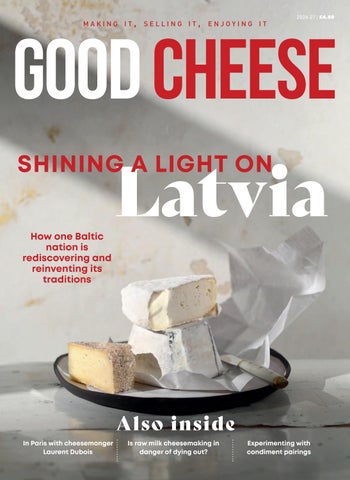
SHINING A LIGHT ON How one Baltic nation is rediscovering and reinventing its traditions
Also inside In Paris with cheesemonger Laurent Dubois 1
GOOD CHEESE 2017-18
Is raw milk cheesemaking in danger of dying out?
Experimenting with condiment pairings
T R E A SUR E
of t he c av e
+ N A T U R A L LY
10
GOOD CHEESE 2026-27
C AV E-A G E D +
welcome
D
o you consider yourself an explorer? If you’re here, that means you have some interest in cheese. And, whether that’s a personal or a professional mission, that means your answer would probably be “yes”. Perhaps the better question to ask is: what kind of explorer are you? However you answer that, this edition of Good Cheese has you covered. If we’re talking about explorers in the most CONTENTS traditional sense – people who want to travel to somewhere new and undiscovered – look 4 NEWS no further than our cover feature about the Adapting to food inflation, cheesemaking scene in Latvia. grants for DRS Sometimes exploring is a by-word for investigating the historical. If you’re the 9 VIEWPOINTS kind of person that wants to know what The Veg Lord, farm gate cheesemaking was like 100 years ago, then vending machines have a look at our feature on L’Etivaz AOP, the 15 CHEESE
experiment at their own tables and on Swiss cheese still crafted over log fires halfway themselves in the name of discovery. Our up a mountain by small family units. tasting session in this magazine focusses Other people explore, in search of the very on trying out both traditional and more best. And we’ve got that too, via a profile of experimental combinations of cheese and Parisian cheesemonger Laurent Dubois – a condiments, like chutneys and preserves. man who has redefined his profession in a And when you’re done with all of the country where cheese excellence is par for the exploration in this publication, you can go course. on a little wander You can also explore a topic. We’ve done of your own using this with one of the most pressing issues in our directory of cheesemaking globally: the declining use of UK retailers (all unpasteurised milk. It can be very hard to strip the context Speaking of raw milk, we’ve also interviewed members of the away and see the actual joy andGuild of Fine Food) one of its biggest proponents in Jake Goldstein and seek at Primrose Creamery. Thanks to a slew of purpose in our independent food & out some cheese for yourself. accolades, he also happens to be one of the drink retail lives. hottest properties in British cheesemaking, so he’ll tick the boxes for those readers looking to Michael Lane find something new closer to home. By Michael Lane, editor editor Then, there are those who like to
WELCOME
inside?
the Farm Shop & Deli Show, one your social media or click on a link Even though I’ve been around for of the highlights was encountering and it’s very easy to be hit with quite a while and I’ve worked at the those new producers – smiling and the feeling that everything is bad. Guild of Fine Food for more than a horizon, The Rennet Works enthusing about their creations. There’s always a story about cost quarter of that time, it’s struck me No one is bothered by the noise of pressures (a lot of them linked to BALTIC recently that you’re never too old to FEELING 21 BRITISH & IRISH the outside its world, you’re all just wars and oil), a new law that will take things for granted. We visit Latvia to uncover cheesemaking CHEESE AWARDS sampling, discovering and (whisper make it harder to run your business It’s a very human flaw and one traditions and see how this young country is it) enjoying things. that creeps up on us. You don’t even or just general economic gloom that developing newer ideas, too. It makes you think about the will hamper your sales. I dare say, know you’ve been doing it until you 25 DRINKS prospects for your business in you’ll find some of those things if step away from your desk/counter/ 2025, the year for English COUNTER CULTURE JUST A DOLLOP? a healthy way. Where will this you turn beyond this ACCOMPANIMENTS very page. premises/mobile device (delete as and Welsh still wines New cheeses and cheese shops, award winners applicable). Chutneys, preserves and condiments arebe allvery hardAtoround-up products adorn product sit onto the shelf?your Is it good It can strip theseof new and expansions – all in our round-up of news cheeseboard staples, butthat is it better reach cheeseboard. enough to share with my customers awayto and see the actual joy and It also helps if you increase CATEGORY FOCUS from the world 28 of cheese. for thefrom classics, or athat jar grips of something different? but also make a margin? Will they purpose in our independent food & distance the thing buy it? How could I use it in the drink retail lives. you so tightly in place. By this, I PRIMROSE CREAMERY Snacks, preserves, café?been in business for barely During the production mean travelling –DUBOIS and preferably MEET A CHAMPION LAURENT Jakecycle Goldstein has charcuterie course, all the world’s heavy this issue, going abroad. year, but this rawOf milk adovcate is already Switzerland’s Pius Hitz is the man behind the Talking retail, affinage and addedofvalue withI’ve beena fortunate context important and so are the enough to escape the racking clutches of old friend I was to ancheesemongers. upmy awards and isplaudits. top entry at last year’s World Cheese Awards. one ofspeaking Paris’s top 35 FROZEN numbers (apart from the calculation laptop a couple of times. The most that hasn’t lived in the UK for NPD and merchandising I’ve just done about the percentage relevant was a trip that many of you more than 20 years and he told me: RAW MILK DILEMMA L’ETIVAZ AOP CHEESE, NEAR YOU of my life I’ve spent at Fine Food reading this probably made too – to “You don’t know how lucky you advice Unpasteurised cheesemaking is on the decline Find out some facts about the Swiss cheese Browse our directory of UK-based specialist Digest. No one needs to know that). the NEC in Birmingham. are. England is such a green place, globally. But why? And can it be saved? that’s still made over open fires in the Alps. shops with counters. But just stop yourself occasionally, It takes some time but once compared to the rest of the world.” 43 FOODSERVICE think about the aspects of the job you’re in that hall there is an He’s, literally, not wrong. The return of the humble that make you happy and then it infectious and protected energy But could he also be right, might feel a little easier to keep about trade events (this is certainly metaphorically? jacket spud going. something that never gets old). At Turn on your TV, swipe through Bovine TB vaccine on the
34
WHAT’S
5
20
43
9
27
47
11
30
53
20
11
45 MEET THE PRODUCER Yalda Tea Co
47 PRODUCTS & MERCHANDISING
28
50 DELI OF THE MONTH Y Groser Harlech
55 ADVICE Is marketing worth EDITORIAL
2026-27 | £4.50
editorial@gff.co.uk spending money on?
It’s no secret that I love croissants. My friends even bought me a chain with a pastry pendant on it for my birthday. I’m also a bit of a purist (snob), inclined to sniff at “takes” on the classic. I don’t need a Tanwen Dawntiramisu-flavoured breakfast. I don’t want Hiscox, deputy editor it to be custard-filled. I frown at the mere mention of Dubai chocolate. So why am I am on board with these? I’m punctually setting my moral principles aside for their deep caramel coating, Palmier-like flakiness, Fleur de Lan and slight saltiness (with the decency not to be labelled ‘Salted Caramel’). Sometimes ADVERTISING GENERAL ENQUIRIES PUBLISHED BY it’s good to be flexible. More on opportunities@gff.co.uk Tel: +44 (0) 1747 825200 The Guild of p.29 Fine Food Ltd
EDITOR’S CHOICE
Croissant Crisps
Editor: Sales & publishing Michael Lane director: SHINING A LIGHT ON Accounts assistant: Julie Coates editorial@gff.co.uk Deputy editor: Sally Coley Ashley Editor: MichaelTanwen Lane Dawn-Hiscox Finance director: Senior salesWarden support@gff.co.uk Deputy editor: Art Director: account manager: Tanwen Dawn-Hiscox Mark Windsor Becky Haskett Managing director: John Farrand Art director: Mark Windsor Associate managing director: Contributors: Lynda Searby,Nick Contributors: Sales executive: Christabel Cairns Baines, Stefanos Aktipis, Patrick Claire Bullen, Henry Coley Partner relations director: McGuigan, Greg Pitcher, Patrick McGuigan, Sales support: Also inside Tortie Farrand Pip Hibbert Tina Nielsen, Pip Hibbert Tamsin Bullock Chairman: Bob Farrand Cover photo: opportunities@gff.co.uk Head of marketing & digital: Ieva AndersoneSales and publishing director: How one Baltic nation is rediscovering and reinventing its traditions
In Paris with cheesemonger Laurent Dubois
1
Latvia
Is raw milk cheesemaking in danger of dying out?
Experimenting with condiment pairings
GOOD CHEESE 2017-18
Sally Coley Senior sales account manager: Becky Haskett Sales executive: Henry Coley Sales support: Tamsin Bullock
30 47
info@gff.co.uk www.gff.co.uk gff.co.uk © The Guild of Fine Food PR & partnerships officer: PublishedLtd by 2026. Reproduction Guild of Fine Food, Guild Claire Fry House, 23b KingsmeadThe Guild of of whole Fine Food or Ltd part of this Data strategy & insight manager: Fine Food Digest is published 11 Business Park, Gillingham, magazine without the Lindsay Farrar times a year and is available on SP8lead: 5FB UK publisher’s prior permission Operations Dorset & logistics subscription for £50 p.a. inc P&P. Chris Farrand is prohibited. The opinions Operations PRINTED & judges lead: © The Guild of Fine Food BY expressed in articles and Sepi Rowshanaei Ltd 2026. Reproduction of Blackmore advertisements are not Operations & membership lead: whole or part of this magazine gff.co.uk necessarily Chloë Warren-Wood without the publisher’s those prior of the+44 (0)1747 825200 editor or publisher. Operations & events lead: permission is prohibited. The
Zara Williams Jenna Morice Operations assistants: Marketing executive: Thomas Jackson, Jos Holmes Frances Coleman Warehouse lead & operations Marketing & operations executive: support: James McCall Ophelia Fortescue
opinions expressed in articles and advertisements are not necessarily those of the editor or publisher. Printed by Blackmore, Dorset
Guild House 23b Kingsmead Business Park Gillingham, Dorset GOOD CHEESE 2026-27 SP8 5FB United Kingdom
Vol.27 Issue 4 | May 2026
3
3
IT ALL RESTS ON A G R E AT C R A C K E R
AWA R D - W I N N I N G SO U R D O U G H C RAC K E R S
F O R M O R E I N F O R M AT I O N O N O U R R A N G E O F S O U R D O U G H C R A C K E R S G O T O W W W . P E T E R S YA R D . C O M O R E M A I L I N F O @ P E T E R S YA R D . C O M
10
GOOD CHEESE 2026-27
news
culture
COUNTER
NEWS FROM AROUND THE CHEESE WORLD The Wisconsin Cheese Makers Association and the Center for Dairy Research has opened registrations for CheeseCon 2027. The Madison conference welcomes professionals in the cheese, butter, whey and cultured dairy trade, and is set to take place from 20th-22nd April 2027. A documentary called ‘Raw: The Story of a Small Cheese’ was released this month (November), following Jake Goldstein of Primrose Creamery as he prepared to enter the Artisan Cheese Awards earlier this year. Filmed at the Welbeck Estate in Nottinghamshire, it offers a glimpse of the realities and challenges of raw milk cheese production. It is available to stream on YouTube.
The 15th edition of the Bra Cheese Festival will take place in the Piedmont city in Italy on September 17th-20th 2027. The event, which is run by the non-profit organisation Slow Food, is the world’s only festival that celebrates raw milk cheese. White Lake Dairy’s Tuppence was named The People’s Cheese 2026 in a competition created by The Real Cheese Project to champion British cheese. The Ewe’s milk lactic-set cheese, made in Somerset by Roger Longman, was publically elected among 21 new British cheeses by Chiswick Cheese Market visitors earlier this year.
bTB vaccine and test could provide boost to raw cheesemaking Government research into a new bovine tuberculosis (bTB) vaccine and test aimed at helping eradicate the disease could make a “huge difference” to dairy farmers and cheesemakers in terms of costs and using raw milk. It’s estimated that the disease costs English farms around £100m a year through lost sales and slaughtered livestock, with more than 60,000 cattle put down in 2023/24. High rates of bTB in areas such as Wales and the West and South West of England mean many farmhouse cheesemakers are also forced to pasteurise or must go through the costly process of switching between raw and pasteurised milk. However, the Animal and Plant Health Agency has been conducting field trials of a vaccine and new Detect Infected amongst Vaccinated Animals (DIVA) skin test. The vaccine is almost 90% effective, while the test distinguishes between vaccinated cattle and those infected with the disease, something the current skin test cannot do. The initial two phases of the initiative have been successful, with the third and final on-farm stage to be completed this summer, ahead of a potential rollout, subject to official approval. If successful, the vaccine and skin test would “make a huge difference” to farmhouse cheesemakers, said Jane Quicke, MD of Quicke’s, which currently makes pasteurised cheddar. “If DIVA was approved then we could protect our cows against the disease in the first place. A win for welfare as well as raw cheese production.” she said. “If we could clear TB as a county, or even a country, this
would take the risk levels down to an acceptable level and we could make raw milk cheddar once again.” Somerset raw milk cheddar producer Westcombe splits its herd between two farms to mitigate the risk of bTB. “Our passion is raw milk – it’s a flavour of a specific place – but it’s a hell of a lot more work,” said owner Tom Calver. Montgomery’s, which also makes raw milk cheddar in Somerset, has had to pasteurise on occasion because of bTB. Owner Jamie Montgomery was less optimistic about the scheme, arguing it needs more robust testing in areas with higher rates of bTB and to see how it reacts with other vaccines. “DNA testing for bTB could provide much higher accuracy, but the Government is dead-set against anything that might get in the way of skin tests.”
Protected status rules amended for cheesemakers due to extreme heat This summer’s successive heatwaves forced producers of some of Europe’s most famous protected cheeses to seek derogations, or stop production altogether as pastures dried up. In late August, French government agency L’Institut National de l’Origine et de la Qualité (INAO) had approved 10 requests and was considering another four for temporary amendments to PDOs and PGIs, as record temperatures decimated pastures. During the hot summer of 2022, more than 20 temporary amendments were granted to protected cheeses, including Comté, Roquefort and Fourme d’Ambert, relaxing rules around buying in feed, the type of forage allowed and minimum numbers of grazing days. The PDO covering Comté was
permanently changed in 2024 to increase the amount of pasture per cow from 1 hectare to 1.3 hectares, specifically to mitigate against climate risks. In the Auvergne, production of the summer cheese Salers has halted this year because there is no longer enough grass for grazing (a requirement of the PDO). The pressure from drought is affecting other countries. In Italy, cheese consortia, including Piave, Murazzano and Quartirolo Lombardo, applied for temporary
amendments to allow more imported feed to be used. In Switzerland, producers of AOPprotected Gruyère d’Alpage have brought cattle down early from mountain pastures because of the lack of forage, according to cheese consultant Emma Young. She visited producers in Switzerland in the summer, many of whom had already used up feed stocks that would normally last until the winter. “This could have a knock-on effect with shortages next year,” she said. “One producer told us that next spring could be catastrophic.” She predicted that PDOs could be adapted for good to help producers manage extreme heat. “PDOs have always evolved and as we see temperatures rise, we might see them being changed accordingly.”
GOOD CHEESE 2026-27
5
Diversity of British cheese counters strengthened by raft of new products 2026 has been another industrious year for artisan cheesemakers across the UK. Several new styles have been introduced by established makers, and new producers have joined the fold. In the spring, Welsh cheesemaker Usk Valley Cheese Company, which is best known for making Gouda-style cheeses, launched Blorenge, a Brie-style cheese made with pasteurised Jersey milk from a local farm, which will be available March through to December. Also in Wales, Caws Cenarth, the Carmarthenshire-based maker of a broad range of styles including Caerffili, Brie-style Perl Wen, the mellow cow’s milk blue, Perl Las, and washed rind Golden Cenarth, has introduced a ewe’s blue called Carreg Las. Made with milk from a single flock of sheep in Machynlleth, it is more like a Roquefort-style than Perl Las, slightly saltier with more of a friable and melting texture. After introducing Reblochonstyle cheese, Raedwald, last autumn, Suffolk’s Fen Farm Dairy has added another seasonal cheese to its roster. Punch, which takes its name from a local working
horse breed, is a 175g, washed-rind lactic cows’ milk cheese similar to Époisses and Maroilles. It will only be available during the summer months when the farm has a surfeit of milk. Gloucestershire’s King Stone Dairy, meanwhile, made the decision to stop making sheep’s milk cheeses, but relaunched a redeveloped version of Evenlode, a washed-rind cheese not dissimilar to Langres. It had introduced Ossau-Iraty-style Bibury and soft lactic Hidcote in 2024, using milk from former Berkswell producer Ram Hall Dairy, but founder David Jowett said the operation would now be focusing on its cow’s milk cheeses. In positive news for British territorials, Farm on the Fell recently became the third
producer of traditional clothbound Lancashire, joining Mrs Kirkham’s and relative newcomer Lowfields Lancashire, who started making it in 2024. The Preston farm’s as-yetunnamed cheese, of which owners Michael and Lisa Kelsall made a first batch in September to be ready for Christmas, will be in full production from spring 2027. Also in September, Devonbased Quicke’s launched a limitededition cheese, coated in Bobek hops. Hops Cheddar comes in 8kg and is matured for 12 months, promising citrus and pine notes from the rind. And finally, last month (October), Sharpham Dairy in Devon launched a new washed curd cow’s milk cheese called Dartmoor 75, to celebrate 75 years of Dartmoor’s National Park status.
FOUR NEW BOOKS ABOUT CHEESE Cheesemonger, educator and Academy of Cheese fellow Hero Hirsh has written her first book. The Curious Cheese Eater, published by Welbeck (a Headline imprint), takes readers on a journey through the science, stories and secrets of some of the world’s best cheeses. headline.co.uk Food writer and cheese podcaster Jenny Linford’s new book, The Cheese Lover’s Guide, published by DK, explores cheese history, production and styles with profiles of 100 cheeses and advice on perfect pairings and cheeseboards. dk.com 6
GOOD CHEESE 2026-27
Michael Finnerty’s book, The Cheese Cure, tells the story of how the Canadian-born radio reporter and presenter, on the verge of burnout in 2019, was hired to work on the Mons cheese stall in London’s Borough Market. His time in the capital’s oldest food market was life affirming, and the book shows that there’s no such thing as an ordinary day in the life of a cheesemonger. harpercollins.co.uk The Courtyard Dairy’s Andy Swinscoe this year published Wensleydale Cheese and other Dales’ cheeses. A comprehensive guide to the classic British territorial cheese, including its history, recipes and a look at current farmhouse makers and their different approaches. thecourtyarddairy.co.uk
The Courtyard Dairy took the top honours in the Academy of Cheese’s 2026 Affineur of the Year competition. Shop manager Simon Ferro and cheesemonger James Spence aged their winning Quicke’s Cheddar to create a cheddar-alpine hybrid. They washed it in a brine and bacteria solution known as a ‘morge’ over the early months of maturing, before brushing it and carefully controlling the environmental factors, storing it in a wooden Port box. The Yorkshire cheese shop also took prizes in the Blue category for its clothbound Cropwell Bishop Stilton, and the Soft category, with an annatto-washed Baron Bigod. The prize this year was a week‑long course at Murray’s Cheese shop and maturing caves in New York. UK-based wholesaler Neal’s Yard Dairy recently completed an experiment called the Cheddar Workshop, to measure how different variables alter the way it tastes. It invited eight cheesemakers to Westcombe Dairy to make a batch of clothbound cheddar, dividing a vat into four, then ‘cheddaring’ it using a different method. Everything else was held constant, showing how technique, and serving order affect the sensory experience when eating it. Nine years after introducing its artisan cheese box subscription service, CheeseGeek has made the decision to shut down its delivery service and focus on its retail offer. The company, founded by Edward Hancock, will now solely distribute cheese, made by King Stone Dairy, Village Maid Cheese, Cashel Farmhouse Cheesemakers and Quicke’s, exclusively under the CheeseGeek brand, to 155 Sainsbury’s stores across the UK. Kent-based Blackwoods Cheese Company, which is well known for its marinated Feta-style cheese Graceburn, is up for sale. Founder Dave Holton, who hails from Australia and started making Graceburn in 2013, said he was “moving on to new pastures” after “an intense few years” following a devastating flood in December 2022 which wiped out his Christmas stock and damaged the dairy. The company went on the market in September, but Holton is open to selling just the assets, equipment, intellectual property and customer lists associated with Graceburn.
GOOD CHEESE 2026-27
261021 Good Cheese Magazine.indd 1
23
21/10/2026 13:16
PURE CHEESE INDULGENCE Award-winning, handcrafted cheese & accompaniments range using the finest natural and fresh ingredients producing extraordinary depth of flavour.
SCAN FOR SALES ENQUIRIES GOOD CHEESE 2026-27 23
world cheese awards
CHAT WITH THE
champ
At the 2025 World Cheese Awards in Bern, Pius Hitz of Bergkäserei Vorderfultigen collected the top prize. Good Cheese catches up with him, 12 months on from his spectacular victory. Interview by Michael Lane
It’s been nearly a year since your Spezial Le Gruyère AOP was named Best Cheese in the World. How have the last 12 months been?
That’s a good question. I always say the medal has two sides. It was special in Bern [at World Cheese Awards 25-26], to be there in the room and then everything went a bit out of control. In the beginning, it was not easy to handle all these emails and all the media. That was a big challenge. But, as I said in many interviews, we have a seven-day, 365 days-a-year job, and to be honoured for that hard work – what I do daily – is something I’ve really enjoyed. What has been very interesting is becoming more connected to people in the industry as a result. I’ve recently been in London, getting to know customers and retailers – and it’s great to have that level of interest in me as a cheesemaker.
Have you had a lot of demand for the winning cheese?
That cheese, as its name implies, was a very special thing. It always stayed in our own cellar here, because for the last few years I have kept a little amount for customers that like their cheese that old – 18 months. Normally it’s 12 or 14 months of ageing before the cheese is sold. And, yes, many international customers asked, but I couldn’t satisfy a lot of the orders. They wanted to buy cheese from us in France and Italy and the US. It’s a bit of a tricky situation and so I gave everybody that I could a little bit. Don’t forget, we also had fourth place in the World Cheese Awards, our Bergkäse (mountain cheese) and not as many people are talking about this cheese.
What’s a normal day in your life like?
Ultimately I’m a cheesemaker. We start at 5am in the dairy and work until production is done. I have a very good cheesemaker working with me, so when I’m not around, he is in charge of the production so it’s easier for me to handle. My job is not just production, though. It’s also a passion of mine to sell cheese and to have contact with customers. And now that I have the World
Cheese Awards win, I don’t have to explain myself and my cheeses every day. So, in the last year I have built up the business. Plus there are always emails. Somebody told me that I should get a secretary, but you have to reply yourself – you also can’t get AI to do it.
Like you were saying, you are making more than just Le Gruyère at the dairy, aren’t you?
Yes, as well as the Bergkäse, we make a raclette. We have a creamy younger cheese, and some flavoured and smoked cheeses, but the base is always the same. And then we do some seasonal versions with spring garlic, with dried tomatoes, olives & basil. And in the autumn, we do one with mushrooms.
How do you balance what to make, when, and how much?
That’s the big question. You can sort of plan it, but you also just have the feeling for the market. For example, in 2025 we made 2.5 tonnes of raclette and this year we made 8 tonnes. Raclette is selling well. Sometimes Gruyère production levels are restricted. This year it was down 5%, so we had more milk for other cheese, because our farmers that supply the dairy are still producing the same amount. In total we produce around 100 tonnes of cheese a year, but it depends on the farmers. I have a cooperative of six farmers and that is it. I could buy additional milk in but then there could be quality issues. The supply of milk is affected by the weather - it was dry this year so far, so milk production was less, but perhaps we’ll get more milk with a good autumn.
And it looks like your raclette could be the next big thing, after another major award…
There is a company here in the next town that sells dried mushrooms that are collected here in this region, so I made a forest mushroom mix and added it to our raclette and a semi-hard cheese. They sold well last Christmas so I did it again and entered them into the Swiss Cheese Awards. The Gruyère and Bergkäse both won prizes but the mushroom raclette won first place. That was just amazing – it is not easy to win anything at the Swiss Cheese Awards – and proves I
don’t just produce good Gruyère. We produce other good cheeses also.
So where is the best place in the UK to get hold of your cheeses?
We sell some of the Gruyère into the UK through Gourmino, but lots of our cheeses are available through the wholesaler and importer KäseSwiss.
What’s your personal favourite of all the things you make? We always have breakfast after we put the rennet in the milk. And for breakfast, we also still like to eat cheese! We produce this creamy, buttery cheese we call Crémeux. And in the morning, I like this one. I don’t start my day with Le Gruyère 18 months! But in the evening, with a good beer or a nice glass of wine, I still love having that aged cheese.
Given your many successes, what do think the secret to making good cheese is?
It’s a lot of things coming together. You have to have a good basic ingredient. We use a good quality milk, and it is raw, unpasteurised. I do not think I need to explain the benefits of that to your readers. Hard work is another thing and then passion – if you don’t like the job, you can’t do it well. And I also don’t make or sell any cheese that I don’t like myself. When I’m working with seasonal cheeses, I alter the amounts of herbs and things. I do trial runs of recipes until I have the perfect amounts of added ingredient. I don’t know the English word, I am a “Tüftler” [which translates as “tinkerer”] – or maybe you could say a perfectionist.
What else have you been working on? New products? Or will next year be more about growth?
Well, I’m trying to bring out one new cheese a year. That’s the sort of the thing I like. And, yes, the whole production volume will probably be increased. It’s not always the main priority to grow, but we probably naturally will. But still the quality and the consistency are the most important things to maintain. berg-kaeserei.ch GOOD CHEESE 2026-27
9
Our taste for excellence goes on and on.
Burrata di Andria PGI
Smoked Burrata
Burrata with White Truffle
SILVER AWARD
Mozzarella di Gioia del Colle PDO
Get in touch prodottideliziosa.it
Stracciatella Piping Bag
Cave-aged Caciocavallo
Deliziosa wins 6 awards at the International Cheese & Dairy Awards 2026.
FROM FLOWER MEADOWS TO YOUR COUNTER Fleuri
Flower meadow cheese by Affineur Walo and l’Antoine – the Cheese Artist: Natural raw milk refined with passion – creating true happiness.
L'ANTOINE
THE CHEESE-ARTIST
10
DON’T JUST SELL CHEESE – SHARE A STORY.
Exclusive available for the independent trade at:
Walo von Mühlenen LTD • walo@affineurwalo.ch +41 79 217 54 11
www.finecheese.co.uk 01225 424212
GOOD CHEESE 2026-27
The Fine Cheese Co. • BATH ENGLAND
IS THE TEMPERATURE ...
...rising? In recent years, there has been a decline in raw milk cheesemaking – both in the UK and on the Continent. Good Cheese decided it was time to investigate the reasons behind this shift towards pasteurisation and what it means for the future of artisan producers. By Patrick McGuigan
L
ast September, five of France’s most powerful dairy associations joined forces to send a letter to the Ministers of Agriculture and Health about the future of raw milk cheese. The wording of the message couldn’t have been any more dramatic. “Raw milk, if nothing is done, risks extinction,” was how the official letter started, before it went on to outline the crippling financial, food safety and
bureaucratic challenges faced by French raw milk cheesemakers. It ended with a call for a national plan of action to “save raw milk cheese”. France has long been seen as the spiritual home of raw milk cheese, where the use of ‘lait cru’ is enshrined in powerful appellations protecting famous cheeses, from Comté and Roquefort to Brie de Meaux and Valençay. But cheesemakers are struggling against a rising tide of food safety requirements resulting in more frequent food recalls
and even bans on their products, while climate change, the cost-of-living crisis and consumer apathy are also taking their toll. It’s a similar story in other countries around the world where more and more cheesemakers are deciding to pasteurise (more on this later).
a
GOOD CHEESE 2026-27
11
Raw milk is a shared resource, and the industry is determined to defend it, or else it will disappear, taking with it an entire part of our gastronomic heritage and identity.
Raw milk is mandatory in 28 of the 46 French PDO-protected cheeses, with around 7,200 farms and 355 dairies involved in making raw milk PDOprotected cheeses. But these impressive figure don’t tell the whole story. Almost 90% of all cheese made in France is produced with pasteurised milk, and the number of raw milk cheesemakers has been steadily falling as producers give up in the face of increasingly strict regulations and emerging threats.
Outbreaks and action
This includes new strains of Shiga Toxin-producing Escherichia coli (STEC), and zoonotic diseases including bluetongue, avian flu and lumpy skin disease. The last of these, which is spread by insects and affects cattle, has been particularly devastating, with an outbreak in 2025 resulting in more than 3,300 cattle being slaughtered and a ban on importing soft, raw cows’ milk cheeses from France to the UK. Raw milk cheeses have also been involved in a series of well-publicised food-borne illness outbreaks in France, most notably a fatal outbreak linked to STEC in raw milk Morbier, plus outbreaks in schools that led the French government to ban raw milk cheese in school canteens for children under five. It was against this backdrop that France’s five main dairy associations, which represent dairy PDOs, goats’ and sheep’s milk cheesemakers and the wider dairy industry, wrote their joint letter to the Ministry of Agriculture and Health as part of a rearguard action to defend raw milk cheese. “Raw milk is a shared resource, and the industry is determined to defend it, or else it will disappear, taking with it an entire part of our gastronomic heritage and identity,” said the letter to the ministers, as reported by French cheese publication, Profession Fromager. “The industry and operators need support, a sympathetic and attentive ear, and sustained guidance. The industry cannot achieve this alone.” Representatives from the associations met with Annie Genevard, Minister of Agriculture and Food Sovereignty, in January to discuss an action plan 12
GOOD CHEESE 2026-27
built on four foundations: better scientific research and risk assessment; financial and technical support; improved communication with consumers; and collective management of health crises. At the same time, other industry groups are lobbying to have raw milk cheese added to UNESCO’s Intangible Cultural
a
10
GOOD CHEESE 2026-27
Heritage list (see box-out). The battle to save raw milk cheese in France is rooted in ‘terroir’ – the idea that food and wine can express the place where they are made. The microbes found in raw milk, which translate into unique flavours in cheese, are an integral part of the concept. “It has been scientifically established that making cheese from raw milk best reflects the ‘terroir’ – the unique characteristics of a specific region – and the adaptation of cheesemaking expertise to that local environment. It therefore represents true biodiversity,” says renowned French cheesemonger Laurent Dubois, who operates four eponymous fromageries in Paris. “Raw-milk cheese is a natural, fermented product that cannot simply be relocated - unlike manufactured goods or industrial cheeses, whose recipes can be moved from one geographic location to another.”
A decline in the UK
It’s not just France where raw milk cheeses are under threat. The UK has seen a decline in numbers in the past 10 years. The Courtyard Dairy in Yorkshire estimates that the percentage of raw milk cheeses on its counter has fallen from 85% to 60%, while at Neal’s Yard Dairy, technical director Bronwen Percival says there has been a noticeable drop in soft raw milk cheeses in particular, as producers decide to pasteurise. Baron Bigod, Ragstone, Dorstone, Sinodun Hill and and Gorwydd Caerphilly are just some of the previously raw milk cheeses that are now made with pasteurised milk. “Making raw milk cheese is harder,” says Percival. “Your milk has to be much more carefully produced. You have to do a lot more testing to verify that things are as they should be. It’s very expensive. A lot of producers have decided it’s not worth the trouble, particularly because the price of raw milk cheeses isn’t necessarily that different on the counter. Without the price incentive, why should anyone bother long term?” The other issue is the emergence of STEC. British raw milk cheeses, including Hebridean Blue and Kirkham’s Lancashire, have been recalled in recent years because of concerns about STEC, which has made cheesemakers more wary. STEC has now “entered the conversation in a serious way”, says Percival, partly because government labs now test all cheese samples sent in by EHOs for STEC as a matter of course. “It’s not a test that’s particularly good, in that often it will give a presumptive result that is then not confirmed, which makes everyone nervous,” she says. “Or, when it does isolate an STEC, it’s often a strain with no known record of pathogenicity, but because of EFSA guidance and the precautionary principle, any strain, regardless of whether it’s a known highly pathogenic strain, requires the cheese to be recalled or destroyed.” Not all cheesemakers are deterred however. Jake Goldstein, owner of Primrose Dairy on the Welbeck Estate in Nottinghamshire, launched last year with two soft raw cow’s milk cheeses called Eggleston and Lindley. He is also the focus of a new documentary called ‘Raw: The Story of a Small Cheese’. “For me it’s about the connection to the farm and using the authentic raw material, which translates into flavour, and flavour is the most important part of anything we do,” he says. “I can smell the difference in the milk, and that translates in the final cheese. You don’t get that with pasteurised milk.” 14
GOOD CHEESE 2026-27
He adds that dwindling numbers of soft raw milk cheeses have also left a gap in the market. “We’ve had interviews with trade customers who want to support raw milk and see that as a point of a difference.” That extends beyond wholesalers to the general public. While most supermarket shoppers are not well informed about raw milk, Primrose’s cheeses are aimed at a more clued-up consumer. “Our customers are people who shop in local farm shops or cheesemongers and have their finger on the pulse. We get a lot of the older generation at markets who remember raw milk cheese from when
they were growing up, and they’re almost angry about pasteurisation. Younger people see it as a health food for gut health and microbiome benefits.”
Indifference in the USA
It’s a similar story across the Atlantic in the US, where there is support for raw milk cheeses from a small minority of the population, but the vast majority are
a
The third way? Thermisation Battle lines drawn up between raw and pasteurised milk don’t tell the whole story when it comes to cheese. It could be argued that much of the raw milk produced today has been stripped of its ‘terroir’ through modern hygiene practices in milking parlours and dairies, which has significantly reduced the ‘microbial load’. According to the book Raw Milk Cheese: Mission Reconquer, the total bacteria count of raw milk in France in 1980 was between 40,000 and 90,000 colony forming units (CFU) per ml. Today the number is often less than 5,000 CFU/ml, due to the widespread use of antibacterial cleaning products, leading some older cheesemakers to talk of “milk with no soul” and RINO (Raw In Name Only) cheeses. There is also a third way when it comes to cheesemaking that is neither raw or pasteurised. Thermisation involves heat treating, but not fully pasteurising, milk to reduce the microbial load at temperatures of between 57°C and 68°C. It is becoming an increasingly attractive option for French cheesemakers who are worried about the challenges involved in using raw milk, but don’t want to pasteurise. Cheesemakers in the Franche-Comté and the Savoie have recently commissioned research into the consequences of using thermised milk for protected cheeses made in their respective areas, according to Profession Fromager.
Bwyd a Diod Cymru | Food and Drink Wales food_drink_wales FoodDrinkWales
This is Wales. This is Food and Drink. From Great Taste award winners to Traditional Welsh Caerphilly (PGI), Welsh cheese combines heritage, craftsmanship and innovation to deliver exceptional flavours recognised across the UK and beyond.
foodanddrink.wales
10
GOOD CHEESE 2026-27
Raw milk cheese: an Intangible Cultural Heritage? Raw milk cheese may soon feature on UNESCO’s Intangible Cultural Heritage list, which protects living traditions, expressions, knowledge, and skills handed down from generation to generation. Two French bodies – La Fondation pour la Biodiversité Fromagère (Foundation for Cheese Biodiversity) and the RMT Fromages de Terroirs, have joined forces to push through the application under the stewardship of anthropologist Élise Demeulenaere. All types of raw milk cheeses have been included in the application, which has been submitted to the French Ministry of Culture. This must be accepted into France’s National Inventory before it can be put to UNESCO. The application could also be strengthened by broadening it to include other European countries. It’s thought the process could take at least 10 years, but if successful, it would help protect raw milk cheese, giving it more legal power, better access to funding and increased awareness and tourism opportunities.
We will see fewer new raw milk cheeses in the USA and more switching to pasteurised milk. 16
GOOD CHEESE 2026-27
largely oblivious to the issue. The situation is also complicated by the FDA’s 60-day rule, which means cheese aged for less than 60 days, such as Brie de Meaux and Vacherin Mont d’Or, are not permitted. “I would say the public doesn’t care; not even for those who say they love raw-milk cheese,” says cheese writer and monger Carlos Yescas, who spent many years in the US as the head of the Oldways Cheese Coalition, which promotes traditional cheeses. “If a producer decides it is time to change to pasteurisation to fend off the regulators or better access a market, we will still support and eat their cheese.” The US does make renowned raw milk cheeses, such as Pleasant Ridge Reserve, Bayley Hazen Blue and Appalachian, but according to the American Cheese Society, there has been a marked decline in numbers. The share of cheesemakers using raw milk in the North East of the country slumped from 60% in 2017 to 34% in 2021, while there were similar declines in the South, West and Midwest. But it’s a complicated picture, says Yescas, with differences depending on where a cheesemaker is located. “In some states, [inspections of dairies and farms] become the responsibility of the state authorities, in others of federal agents. You may end up in a hostile environment for production or a more relaxed one. “This uncertainty has made many producers re-think their exposure and some have switched to pasteurising milk for their cheeses. There is almost no new raw milk cheese coming to the market. Especially none from companies selling nationally.” The same is true of Latin America, adds Yescas, where most countries’ food safety rules are often
heavily influenced by the US. “Many countries have basically copy and pasted the 60-day ageing rule by the FDA. Others, like Brazil, have been on a journey to define their own rules. “The other way the US influences these regulations is through its purchasing power. Many national governments have sought for their dairy industries to be able to sell in the US, and therefore they have made changes nationally to address the difference that once existed.” Looking ahead, Yescas is pessimistic about the future of raw milk cheesemaking in the US. “We will see fewer new raw milk cheeses and more switching to pasteurised milk to appeal to a wider market. Cheese buyers are not looking for just raw milk cheeses; they also want a more complex story. “Is it local, made with the milk of a heritage breed? Is the land management sustainable, do you have a net-zero plan for your farm? Raw milk is no longer the only green flag.” Back in France, there is still plenty of stomach for the fight to save raw milk cheese. Speaking last September, ahead of petitioning the French government, the president of the Conseil National des Appellations d’Origine Laitières (CNAOL, the National Council of Dairy Appellations) Hubert Dubien, summed up what was at stake. “We are at a pivotal moment,” he said. “Once you stop making cheese with raw milk, you can never go back.” For now, the task at hand seems to be just halting the obvious decline, before any kind of revival can take place.
10
GOOD CHEESE 2026-27
Great for Grilling - Fab to Fry
Meditterranean-Style Cheese Made on our farm in the village of Silian with the freshest milk from our award-winning, free range Holstein cows, who roam the green hills of West Wales.
18
GOOD CHEESE 2026-27
CRAFTED IN SOMERSET SINCE 1833 Cheddar that is powerfully intense and complex with an exceptional depth of flavour. The slightly brittle and sometimes crunchy texture is a natural result of its long and slow ageing.
10
GOOD CHEESE 2026-27
CAN YOU REALLY BEAT A
classic? It may predominantly be a British habit to serve your cheeseboard with a spoonful or two of chutney, but jarred condiments are certainly an established form of accompaniment across the world. With trends evolving all the time, it made sense to road-test both quintessential matches and more modern ideas in this edition’s exploration of pairings. By Patrick McGuigan Photography by Tanwen Dawn-Hiscox
T
ake a peek into any kitchen cupboard in Britain and you are almost certain to find a couple of jars of chutney. There’s also a good chance you’ll find some tomato relish, Branston Pickle or onion marmalade lurking at the back too. Brits have a passion for dolloping stuff onto their cheeseboard that is unrivalled around the world. India, of course, is the original home of chutney, and remains a bastion of spicy preserves and pickles,
20
GOOD CHEESE 2026-27
but it was during the British Raj in the late-19th and early-20th century that condiment-makers in the UK started to take inspiration from the subcontinent to create new cheese-friendly accompaniments. The joy of cheese and chutney is no longer just a British quirk either. US cheesemongers are no stranger to a dab of this or a drizzle of that, while even the French have started to see the light. Jars of fig jam and onion confit are an increasingly common sight in fancy fromageries.
Despite all this, cheese and condiments is a strangely under-investigated topic. So, I teamed up with Good Cheese deputy editor Tanwen DawnHiscox to carry out some important research, involving five well-known British cheeses covering key styles: goats’ cheese, brie, cheddar, washed rind and blue. We then paired each one with two different condiments – a classic accompaniment and a leftfield alternative – and spent an afternoon considering which were the best.
pairings Golden Cross Goats’ Log X Orange Marmalade (classic) or Pilpelchuma Chilli Paste (left-field) It wasn’t just cheddar and pineapple skewered on cocktail sticks that were a mainstay of dinner parties in the 1980s. This was also the heyday of the grilled goats’ cheese canapé, comprising slices of industrial chèvre grilled on French bread, finished with a sophisticated blob of orange marmalade. They clearly had brilliant minds beneath their poodle perms, because the combination still works a treat today. The strips of orange rind provide a pleasantly chewy contrast to the soft, fudgey cheese, while the bittersweet flavours offsets the goaty acidity. The marmalade also seems to add structure and new angles to the creamy mouthfeel of the cheese. Our second pairing is a more exotic affair. Pilpelchuma is a Libyan chilli paste, made with garlic, red pepper and fiery spices, including smoked paprika, chipotle and Aleppo chilli flakes. There’s a Mediterranean harmony between the nutty goats’ cheese and the garlicky paste, while the smoky chilli heat brings out hidden savoury notes. A word at this point on ratios. The amount of cheese in relation to condiment is a vital calculation. With goats’ cheese, you need more cheese than marmalade. 60:40 is about right. But the Pilpelchuma threatens to overpower, so just a dab is advised with a ratio of 80:20. It’s close, but the 1980s wins the day. WINNER: Goats’ Cheese & Orange Marmalade
Baron Bigod Brie X Chilli Jam (classic) or White Miso (left-field) There’s something about a touch of bright red chilli jam on a slowly collapsing brie that just works. The sweet heat stands up to the mushroomy, vegetal notes of the cheese. At least, that’s how conventional thinking goes. But the reality is strangely disappointing. Our brie isn’t fully ripe, but is still too powerful for the jam. The two are somehow less than the sum of their parts, with the flavour of the chilli jam quickly dying out. At the same time, the earthy flavour of the cheese is lost, replaced by a slightly acidic finish. A dot of miso paste on the other hand seems to turboboost the experience and bring beguiling notes of salted brown butter. Rather than contrasting with the cheese, the miso dials up the flavour to create an umami explosion. Not subtle, but effective. But be warned a little goes a long way. A 95:5 brie:miso ratio is more than enough. WINNER: Brie & White Miso
a
GOOD CHEESE 2026-27
21
Add some Characters to your range with Clawson Farms deliciously characterful cheeses. A flavour packed range of six truckles each made from premium ingredients and represented by a unique personality.
Available to order NOW Contact our sales team to find out more enquiries@clawson.co.uk +44 (0) 1664 822332
www.clawsonfarms.co.uk
Due to popular demand Horgans have launched its long-time deli counter favourite in a convenient retail pack.
Horgan’s Delicatessen Supplies is proud to celebrate 50 years in business in Co. Cork, Ireland. Since the 1970’s, when the company was founded, Horgans have been dedicated to sourcing the finest quality food products around the globe and providing an exceptional and personalised service to our customers, with whom we work with as partners in shared success. Today, this vision has seen the business evolve into one of the premier speciality food distributors on the island of Ireland. Horgan’s Delicatessen Supplies is a supplier to all of the retail multiples, discounters and symbol groups in Ireland via Central Distribution. Horgans Van Sales Fleet also deliver directly to hundreds of valued independent customers nationwide. Horgans continuously invest in the latest technology for our chilled warehouse. The facility also offers a clean room environment for cheese cutting, waxing and packing. This unique service offers the option to cut large-format (Irish and Continental) cheeses into various convenient retail specific sizes. Our professional production team is trained in the art of proper cutting of various shapes and sizes of cheese, and the cuts are consistent, well-wrapped, and visually appealing. Here’s to 50 years of success and the next chapter ahead!
www.horgans.com 22
GOOD CHEESE 2026-27
pairings Montgomery’s Cheddar X Ploughman’s Pickle (classic) or Rendang Sauce (left-field) As all good cheese historians know, the ploughman’s lunch was a marketing ploy dreamed up by the industry-backed Cheese Bureau in the 1950s to sell more cheddar. Ploughmen never did take crusty bread, cheddar and pickles into the fields for lunch. But the marketing executives were on to something when it came to pairing sharp pickles with cheddar. The crunch of the vegetables against the waxy cheese is a winner, while the acidity and spice pierces the cheddar’s brothy tang. We settle on a 70:30 cheese:condiment split. Perhaps we are over-excited by the earlier success of miso, but the idea of a smear of rendang sauce seems like a good idea on paper. In practice, the tropical hit of lemongrass, lime leaves and shrimp paste is all wrong. The spicy, fermented notes feel incongruous with the traditional English cheese. A meeting of food cultures that was never meant to be. WINNER: Cheddar & Ploughman’s Pickle
King Stone Dairy Rollright X Caramelised Onion Chutney (traditional) or Crunchy Peanut Butter (left-field) The pungent aromas of soft washed rind cheeses are notoriously tricky to pair with wine. Too strong for delicate whites, they can also clash with the tannins in red wine. It’s a little easier when choosing a condiment. The crunch of pickled vegetables or the spice of mustard are often recommended, as are sweet accompaniments, as proved by some caramelised onion chutney. It is an easy fit for the smoky, meaty notes of Rollright. Like tucking into a sausage sandwich with fried onions. A jar of crunchy peanut butter might not sound like an obvious first choice for a cheeseboard, but there’s a roasty, salty quality to washed rinders that feels like it needs exploring. It’s a surprisingly good match. A tiny fleck of the spread brings a sweet nuttiness that is right at home with the savoury cheese. The downside is the texture. Even a smidge of peanut butter makes the cheese feel sticky and tacky in a slightly unpleasant way. Some roasted nuts on the side would be a much better option. WINNER: Washed Rind & Caramelised Onion Chutney
a
GOOD CHEESE 2026-27
23
Colston Bassett Stilton X Fig Chutney (classic) or Lemon Curd (left-field) Fig chutney feels like a no-brainer for Stilton. The sweet, fruity flavour is a sure-fire winner against the saltiness of Britain’s most famous blue. But the match falls flat. The chutney has a sharp streak that ramps up the acidity of the cheese in a spiky way, while the sweet-salty contrast feels one dimensional, flattening out the nuances of the Stilton. The lemon curd is a lovely surprise. An 80:20 cheese:condiment ratio allows the custardy texture of the curd to meld into the dense body of the cheese. There is also a delicate sweetness and zesty tang that brings lift and lightness. It’s a pairing that feels fun and sophisticated, and has everyone smiling. WINNER: Stilton & Lemon Curd
conclusion
THE
So, after our admittedly unscientific experiment, what have we learned about the rules of cheese and condiment matching? Well, on a basic level there are two types of matches. Those that contrast basic flavours, such as sweet versus salty or sweet versus sour, and those that are more complementary with the accompaniment amplifying flavours already found in the cheese. The best condiments for cheese are those that have a mix of sweet, sour and spicy notes,
which cut across the creamy, salty and umami notes found in many cheeses. And getting the right ratio of condiment to cheese was also key. Sometimes less is more. With all this in mind, it’s not a surprise that the top three favourite matches in ascending order are the washed rind cheese with a comforting spoonful of caramelised onion chutney, followed by the more unusual combo of Stilton and lemon curd in second place. But it was good old cheddar and pickle
at the top, proving that traditional pairings are classics for a reason. Even if the tradition was actually invented by a cheese marketing agency. TOP 3 1. Cheddar & Ploughman’s Pickle 2. Stilton & Lemon Curd 3. Washed Rind & Onion Chutney
Good Cheese would like to thank Symington and the Hambledon Wine Estate for their assistance with this feature. symington.com 24
GOOD CHEESE 2026-27
MO KIE
*FR
EE S
AM PLE
OF EDE NS
C se on n ta sa d ct m yo us pl u e a tod of co a Ed m y a en pli nd m Sm e w ok nta e’ll i e ry .
AWARD-WINNING CHEESE FROM THE LAKE DISTRICT Smoked in-house in the traditional manner using a subtle mix of apple and oak woods, our Eden Smokie develops a warm, gentle smokiness that complements the cheese’s natural creaminess. The flavour offers a perfect balance with rustic refinement and a smooth, mellow finish. Available on pre-order, it complements the wide range of awardwinning cheese that we have to offer. cheese@applebycreamery.com | 01768 392949
WWW.APPLEBYCREAMERY.COM * Subject to availability and while stocks last. We may have to amend or withdraw at any time without prior notice.
GOOD CHEESE 2026-27
25
PARMIGIANO REGGIANO: TRADITION BECOMES INNOVATION
T
Y PROJEC
TERRITOR
AIN MOUNT CT P RODU
T Y PROJEC TERRITOR
AIN MOUNT CT P RODU
From the heart of the Reggio Emilia Apennines comes a top quality Parmigiano Reggiano. In mountain cheese factories, master cheesemakers work hard every day to help craft a full range of different aged cheeses. Together with our milk suppliers, we keep innovating within tradition and support the monitoring of animal welfare conditions through regular checks at cowsheds carried out by independent, qualified professionals.
Find out more at dalterfood.com 10
GOOD CHEESE 2026-27
00001-26_DALTER_ADV_FINE_FOOD_DIGEST_230x315_PR_EN_EXE.indd 1
07/10/26 15:54
Laurent Dubois
MasterAT work Parisian cheesemonger Laurent Dubois has spent the past three decades building a business that preserves and shares the extensive heritage of cheese while expressing his own creative vision. Words and photos by Tanwen Dawn-Hiscox
I
f you don’t look too closely when you walk past the Laurent Dubois shop in Paris’ Bastille quarter, you might mistake it for a pâtisserie. Ornate ‘créations’ – which are actually cheeses layered with various fruits, nuts and mushrooms – fill the glass cabinets outside, intricate as anything you might see rendered in pastry in the French capital. Step inside, however, and any doubts will vanish as to where you are. Everywhere you look are shrines to cheese – mottled-grey little wrinkly rounds, densely veined blues and hefty great wheels. It’s fair to say that Dubois is an ‘artisan’, the French word for a craftsman. A third-generation fromager, he has been working in cheese for the past 40 years, and now operates four shops under his own name in Paris. Though his father and uncle were both established figures in French cheese circles, he still had to make a name for himself. After working in markets, dairies and cheese shops around France, in 1996, he sold his apartment to help fund his first shop. Located on rue
de Lourmel in Paris’ 15th Arrondissement, it opened its doors with a selection of 50-odd cheeses and just one employee. Affinage, or cheese maturation, has been integral to Dubois’ business from day one. “Having worked with producers early in my career, I saw how difficult cheesemaking was,” he tells Good Cheese, “And the passion that went into it – that stayed with me. I felt I owed it to them to show their cheeses at their very best, whether through affinage, presentation or the knowledge we share with customers.” “That’s the pleasure of craftsmanship,” he adds. “The individual gets to determine the direction, the editorial line and the artistic vision of their business.” He received the ultimate seal of approval in 2000, when he became a Meilleur Ouvrier de France (MOF) – a national competition which rewards the best in their trade. As he never wanted backing from investors, Dubois’ physical expansions have matched the duration of his bank loans: in 2006, he opened a
second shop in Maubert; a Bastille store followed in 2012, then finally he opened his fourth in Auteuil in 2020. The high-footfall placement of his shops matters a great deal, as he needs roughly 200-300 customers to step through the door every day to keep those doors open. With that in mind, each shop has the same configuration: retail space, a kitchen, a cold room, and maturing caves below – for the all-important affinage. Cheese is the sole focus across the business, and the way Dubois selects his cheeses is based first and foremost on “their organoleptic quality, and the emotion they provoke when you taste them”. Just as important are his relationships with producers. “The idea is always to work in partnership,” he says, rather than maintain a strained buyer-
a
GOOD CHEESE 2026-27
27
supplier relationship. After all, small farms and artisanal dairies, he explains, often face the same constraints as his own business, so they are well suited to working together. The cheeses he chooses – like the scarce and rather tricky to produce Salers Tradition AOP, or Ossau-Iraty d’Estives AOP – are, in his opinion, often “too cheap, considering the energy and investment they take to produce”. He sees it as his job is to communicate that. He also sets his margins to ensure cheesemakers are properly rewarded for their work, while ‘créations’ are priced between 15-25% higher, to account for the time, labour and skill needed to make them. Central to this added value are his affinage spaces: temperature- and humidity-controlled rooms below the shops. The main ‘cave humide’ is artificially maintained at 90-92% for bloomy-rind cheeses, some hard cheeses, goat’s milk cheeses and sheep’s milk tommes. An adjacent, colder ventilated space holds fresh goat’s cheeses and certain blues, for slow-maturing or to interrupt affinage. Every one of his cheeses stays down there until it is exactly to his standard. The ‘créations’ offer another form of added value, which he says were conceived “to elevate the cheeses, to bring out their qualities through a little fantasy, without ever destroying them or losing their original flavour and character.” They include a Roquefort cut and layered with ‘pâte de coing’ (membrillo), and his trademarked Pomcalva, a Camembert filled with butter-sautéed apples then macerated in Calvados,
28
GOOD CHEESE 2026-27
I saw how difficult cheesemaking was – I felt I owed it to them to show their cheeses at their very best. sandwiched in cream. The attention to detail that goes into cheese selection, affinage and preparation governs the shop floor’s layout and merchandising decisions, too. Lighting is warm; plinths are invisible. Nothing is left to chance: counter heights, custom-built stations for cutting and wrapping; cheeses that are pre-wrapped – in cellophane, not cling, because it looks more refined – like Comté, are displayed like this because of the very high throughput. Decisions are aesthetic, but they are commercial, too: “When a shop is badly set up on a Saturday, people who would have bought six cheeses buy three,” Dubois says. “It’s not just about making things look pretty or taking a photograph.” Dubois has always been very conscious of creating an association between his name and quality – he points to his Art Deco-inspired bags, as well as to his team’s black (rather than traditional white) uniforms.
While he mostly sells cheese to a handful of restaurants, most of them local to his shops, his most prestigious clients include La Tour d’Argent – one of Paris’s most famous restaurants, often cited as the city’s oldest and an inspiration for the fictional restaurant in the much-loved Pixar film Ratatouille – as well as the Stade de France’s VIP booths. Dubois is in a position of confidence. Four shops, which he can visit daily, and give him the buying power to support his suppliers, are enough. He would have up to six, he says, “but no more”. “I see expansion more in terms of the wider ecosystem,” he adds. “Building something around the brand, perhaps a whole world of training and discovery.” The fromager is broadly positive about how the cheesemongering profession has evolved since he began his career. As well as being more international, he sees stronger trade bodies, better technical knowledge and more role models. His daughter Camille joined the business last year, and he hopes that she, and her generation, will find their own way of standing out, of putting their stamp on it. “They will have to go beyond what we’ve established”, he says, meaning “that model of finding very good cheeses, maturing them, selling them, talking about them well and concentrating on expertise.” Just imagine what we’ll mistake their shops for when we breeze past them. fromageslaurentdubois.fr
Supplying award winning cheese for over 140 years
Proud to support World Cheese Awards www.bradburyscheese.co.uk Buxton, England 10
GOOD CHEESE 2026-27
GET TO KNOW:
L’Etivaz Switzerland is revered for its Alpine cheese, but this one is probably not as famous as it should be. If you’re unfamiliar, this will get you up to speed. By Michael Lane L’Étivaz was the very first Swiss cheese to obtain AOP (Appellation d’Origine Protégée) status in 1999 – known as AOC (Appellation d’Origine Contrôlée) until 2010. But it first came into existence in the 1930s, when cheese-making families in the Vaud Alps joined together to form a producers’ association, and L’Etivaz was registered as a commercial name in 1934. Since the mid-70s, this group has officially been a cooperative. Today there is a central cellar that receives up to 20,000 wheels of the cheese every summer, with production taking place between May and October.
The rules of the AOP are very important in ensuring that this cheese is a product of its region – specifically made in just 10 municipalities in Switzerland’s Vaud Alps. Producers must use raw milk and this cannot be pooled with other farmers, as the cheese is made at the same location where the cows are milked. They are milked twice a day – morning and evening. Production can only take place on the mountain pastures themselves (at altitudes between 1,000m and 2,000m). There are only around 70 small family producers of the cheese in total.
The AOP also governs specific production techniques and equipment, including the most famous and impressive aspect: the heating of the milk in a copper vat using only wood fires. Initially, skimmed evening milk is combined with morning milk and they are heated to 32°C over the fire. After rennet is added and the resulting curds are cut, these are heated to 57°C. The curds are lifted out and drained through a linen cloth, then placed into a circular press to drain. The cheeses are stored and turned for a few days on site before being delivered by the maker to the central maturing cellar. 30
GOOD CHEESE 2026-27
L’Etivaz AOP
Making L’Étivaz is truly a family affair. There are only around 70 of these small units, travelling up to their chalets and pastures with their herds – to literally live and breathe the process for the entire summer. Often they have several locations at different altitudes where they graze their herds and carry out milking and making. Across the entire production area, there are around 100 chalets. Over 50% of the family members involved in Étivaz production are under 40 – and children also live on site and get involved.
Eggle
Wheels of Étivaz can vary in size between 18kg and 38kg. Every batch is unique, thanks to variables like altitude, some 230 different flower varieties in the pastures and the cheesemaker themselves (there are even nine accredited organic producers). Some of the flavours you should expect are nutty, fruity, herbal – and of course smoky. The maturation process also plays a big part. This takes a minimum of 135 days (stages include brining, washing and turning) but L’Étivaz can be matured for up to 24 months. The oldest version is “à Rebibes” – a 36-month aged cheese, served in thin rolls.
insp
Of course, this cheese would be nothing without its cows. There are some 2,680 in total across all of the Étivaz producers’ herds. Every summer they produce roughly 6 million litres of milk, and it takes 12 litres of milk to make a single kilo of cheese, or 280 litres for one whole wheel. At the end of the production season, the cows are centre stage at Désalpe festival – which is when they are decorated and celebrated as they descend from their mountain pastures into the village of L’Étivaz.
GOOD CHEESE 2026-27
31
Perfecting the humble craft of cheesemaking
Carwyn and his team have made it their mission for the last thirty-five years to produce the best Continental style cheeses from their organic dairy in the heart of West Wales. To find out more about our range and stockists please get in touch 01239 710432 | cheeseshop@cawscenarth.co.uk
www.cawscenarth.co.uk GOOD CHEESE 2026-27
39
Belhaven Smoked Butter
Three stars. One seriously good smoked butter. Traditionally smoked in East Lothian, Scotland. Our Great Taste 3-star Smoked Butter is made for people who believe the simplest ingredients can be the most memorable. Sourced from the Edinburgh Butter Co, this cultured butter is lightly salted with Blackthorn Salt and is transformed by smoke into something deeply savoury, distinctive and exceptionally versatile. At Belhaven Smokehouse, we produce a range of traditionally smoked foods in East Lothian, from our award-winning hot and cold smoked salmon, cheeses and butter, to trout, haddock and more, supplying independent retailers, farm shops, delis, hospitality and foodservice across the UK. Interested in stocking our award-winning range? Get in touch for samples, trade pricing and product information. Email sales@belhavensmokehouse.co.uk or Call 01368 864025
www.belhavensmokehouse.co.uk Other Awards: ★★ Classic Hot Smoked Salmon | ★★ Belhaven Smoked Goat’s Cheese | ★ Belhaven Cure Cold Smoked Salmon | ★ Lammermuir Smoked Cheddar
Low Land - Oud Bruin - Flemish Brown Ale Séasúr - Mixed Ferm Saison
Terra Nocturne - Imperial Stout
Do You Wanna Funk? NEIPA Pressure To Pick - Italian Pilsner Untamed - Wild Ale V1 In Tension Rhubarb Saison It’s Own Pace - Red Flanders Souvenir De Cassis Frankie & Eileens Craft Gin
GOOD CHEESE 2026-27
33
Latvia: COMING OF AGE Having gained its independence less than 40 years ago, this small Baltic nation is still rediscovering its traditions and cultural heritage. Its cheesemaking scene is no different, with a small band of producer’s reviving old recipes and developing new styles – all while servicing a growing export market. By Tina Nielsen
34
GOOD CHEESE 2026-27
Kaspars Upmanis on Unsplash
T
here is a “before” and “after” in Latvia’s cheese story. The small country on the eastern shores of the Baltic Sea was under occupation for large parts of the 20th century, first by the Nazis and then the Soviets, and only gained its independence in the early 1990s. Since that moment, its cheese producing community has been on a journey to rediscover lost recipes from a long history of dairy farming. And today, cheese (or “siers” as it is known in its native tongue) is becoming part of the cultural heritage of Latvia. This is partly down to people like Asnate Ziemele, the president and founder of Latvia’s Country Tourism Association, which has developed a Cheese Route, bringing together cheese producers to encourage culinary tourism. Ziemele is deeply involved in promoting cheese through food tourism. “There are actually more smaller producers all over the country, and we also have a cooperation with other Baltic and Finnish countries on marketing and promotion of all our special cheeses, especially gathering information for visitors,” she explains. In 2021, Latvia had 55 registered companies whose principal activity was dairy processing and cheese production, according to business data
compiled by business information provider Lursoft. One of these smaller producers – the smallest, in fact – is Inga Āriņa-Vilne, owner of Soira, the only artisanal cheese factory in Latvia, combining traditional methods with an understanding of the fast-developing organic food market. “We are somewhere in between industrial dairies and farmhouse cheesemakers who use their own milk,” she says. “We buy milk from a good farm and we produce our cheese, which is very slowly aged with natural rinds.” Soira produces more than 20 varieties, ranging from fresh and mild cheeses to distinctive, longmatured Tomme-style cheeses. It is also the producer behind the soft white mould ripened cheeses that grace the cover of this magazine. Some of its creations are made with raw milk, a rarity in Latvia. Cows’ milk is the most popular base ingredient with Latvian cheesemakers by some measure. “We even have our own breed – Latvian brown,” says Āriņa-Vilne. “I’d say 90% of the cheese made in Latvia is made with cows’ milk.” However, there is a healthy group of goats’ cheesemakers too, a segment mainly made up of small producers. “There is a growing market for goats’ cheese in Latvia, the milk is becoming more and more popular because of its health benefits,”
says Āriņa-Vilne. “People have more allergies. They are lactose intolerant and goats’ milk is better for those people. Those kinds of demands also develop the market.” An even smaller proportion of the country’s cheese is made with sheep’s milk – there are currently only two producers of sheep cheese in Latvia. Ziemele explains: “Wool sheep are not the same sheep as those used for milk and it is not easy to breed them here because they can’t live in a cold climate.” Both of the farms making sheep cheese are in the south of the country. While this is still a developing industry, the country’s cheesemaking goes back centuries, when ancient dairy farmers started processing surplus milk. The first cheeses to appear were lactic cheeses – reportedly the result of someone accidentally heating curdled milk, which would become an early version of cottage cheese, leading to the development of so-called sour milk cheeses.
a
Latvia Cows are the main source of milk in Latvia, where cheese plays an important part in Midsummer Solstice festivities. Jāņu siers, a round cheese flavoured with caraway seeds, is eaten at this time of year. Other typical native cheeses are the semi-hard Latvijas and the curious, powder-like Green Cheese made with fenugreek leaves (all pictured middle left). There are dairies such as Soira also turning out classic European-style cheeses (pictured bottom right).
Valdis Osins
Eggle
insp
Valdis Osins
Valdis Osins
GOOD CHEESE 2026-27
35
Līcīši, owned and run by Liga Marcinkoniene (pictured in red coat and in production unit) , is one of the country’s few goats’ milk producers and cheesemakers. Her family initially inherited the farm after Latvia gained independence from the Soviet Union, and they began rearing goats due to Marcinkoniene’s allergies. Today they produce a range of organic soft and Feta-style cheeses.
Prominent among those early cheeses is the Janu Siers, also known as Midsummer’s Solstice Cheese made from milk and curd and flavoured with caraway seeds. In 2015 it was added to the European Union’s Traditional Speciality Guaranteed (TSG) register of protected products.
Emerging from the shadows
The events of the 20th century have left a mark on the small nation: first the Second World War and then the Soviet occupation, which lasted until 1990. During the latter period, larger dairies were nationalised and processes standardised. The 1990s represented a transition from collective farming to a market economy, the 2000s saw modernisation and standardisation with moves to higher quality and differentiation of products – in a way, preparing the ground for artisanal cheeses. The 2010s were when an identity started to form, and production volumes continued to grow. In 2009, Latvia produced about 29,000 tonnes of cheese, a number that had grown to 56,000 tonnes by 2023. Over the years, new cheese niches emerged and cheesemakers recovered forgotten styles. Today, more than 35 years after independence, the craftsmanship of Latvian cheese continues to grow and mature, driven in part by small producers working in small batches, using locally-sourced milk and trying out longer periods of natural maturation. “You have to remember that during the 50 years of the Soviet Union they destroyed a lot,” says 36
GOOD CHEESE 2026-27
Āriņa-Vilne. “There was a mainstream of cheese, which tasted the same and looked the same and even then there was a lack of it; we couldn’t get it. So, we had to renew traditions and some cheeses are now being reborn.” The mainstream cheeses she refers to were the two kinds that were produced by the large state-run dairies during the Soviet years. “During the late 1940s and up until the 1990s, all the larger factories were nationalised and merged into big combines,” she adds. “They were forced to produce just two kinds of cheese: one was called Russian cheese and the other Dutch cheese.” Both of these were everyday cheeses – the Russian style based on a modified Tilsit cheese, while the Dutch was based on Edam. “There was
During the late 1940s-1990s all the larger factories were nationalised and merged into big combines.
nothing special about them,” says Āriņa-Vilne. Interestingly, during those years, the large dairy Smiltenes Piens continued to produce Latvian cheese – Latvijas siers – which sets itself apart with a pungent aroma and a milder, creamier taste. “What was surprising was that they kept the name, Latvian Republic Cheese. And this cheese actually goes back centuries, it is very special,” says Ziemele. “It’s a semi-hard cheese, and it’s aged with Brevibacterium. Everybody knows it makes this pungent and stinky skin around the cheese, and the flavour is very mild but really tasty.” Smiltenes Piens is still the only dairy to produce the Latvian cheese today. It is also a dominant force in large-scale dairy processing. This year, it established itself as the country’s largest cheese producer when it acquired a 99.9% stake in AS “Cesvaines piens”, making it one of the country’s top three dairy processors, processing approximately 220 tonnes of fresh Latvian milk every day. Commercial director Anrijs Vazdikis says Latvia is growing as an exporter. “In recent years, Latvia has produced around 60,000 tonnes of cheese annually, with production volumes continuing to grow year-on-year,” he says. “Latvia exports more cheese than it imports, with approximately 55% of all domestically produced cheese destined for international markets. Cheese export volumes continue to increase each year.”
a
Exceptional British & Continental Cheeses, paired with specialist cheese knowledge to help you build a distinctive range, rooted in provenance.
We believe eating well is an essential pleasure of everyday life. That's why we go the extra mile to find stunningly good cheeses and speciality foods. We have an unrivalled range of speciality cheeses and the largest selection of British farmhouse cheeses in the UK.
harveyandbrockless.co.uk
GOOD CHEESE 2026-27
37
According to Latvia’s central statistics portal, the country produced 64,400 tonnes of cheese in 2025, up from 57,000 tonnes in 2024. In terms of domestic consumption, the same organisation reports an average annual consumption per person of 14.07kg of cheese and cottage cheese, also in 2025.
Small-scale cheesemakers
While Latvia’s large dairy processors continue to expand production, a smaller community of producers is carving out a place for more specialised cheeses. Among them is Liga Marcinkoniene, owner of Līcīši, one of Latvia’s pioneering goat farms and a long-established producer of goats’ milk cheese. “We are the oldest goat farm and the oldest cheese producer of goat’s cheese,” says Marcinkoniene. When the family inherited the farm after the Soviet Union, her mother decided to farm goats, due to her daughter’s sensitive immune system. “I’m very allergic and it helped me – there was finally something that I could eat, apart from potatoes,” she says, with a laugh. “My mother is the person who started the goat breeders organisation, and always talking about the health benefits.” The organic farm makes a range of feta-style
cheeses and soft goats’ cheese, available plain or with added herbs and spices. But developing a market for these products has not always been straightforward. Marcinkoniene reflects on how goats’ cheese used to be a product that people didn’t really want to taste, but it has grown over time, and a market has emerged. While no longer supplying supermarkets, where it was challenging to compete with cheeses from Poland and Spain, Līcīši focuses on restaurants and selling direct to consumer. “It was nice when the borders to the EU opened, but in our case it opened the market for everyone else, too,” she says. “In Latvia, there are no requirements from the government that supermarkets must stock a certain percentage of local products like there are in other countries like Norway and Sweden.” What exists today in Latvia is a developing cheese industry, shaped by family traditions, home cheesemaking, and entrepreneurs exploring new products. The knowledge was often passed down through generations while years of scarcity encouraged people to find new ways to feed themselves. “During the Soviet era, we didn’t have much choice in the shop – we often had nothing – so
Five Latvian cheeses to try DUTCH CHEESE – HOLANDES SIERS
A classic semi-hard cheese with a mild, slightly tangy favour. This continues to be one of Latvia’s most popular varieties.
38
GOOD CHEESE 2026-27
RUSSIAN CHEESE – KRIEVIJAS SIERS A semi-hard cheese with small holes, which develops a more pronounced flavour as it matures.
MAASDAMSTYLE CHEESE – MAAZDAMER
A semi-hard cheese with a sweet, nutty flavour and large holes.
everyone was producing something at home anyway,” says Asnate. “Compared with the average European country, we make much more food at home than anyone else. We have that knowledge, so many families in the countryside know how to make cheese.” EU membership brought new opportunities for Latvians to travel and encounter different foods, affecting change in customer expectations. “In the 1990s we didn’t have much money to travel. But when we joined the EU [in 2004], people started to have more money and they travelled more,” says Āriņa-Vilne. “The borders opened for us, which led to people learning what they liked.” Slowly demand started to change. Now, as Latvia’s cheese production continues to grow, its makers are exploring what the culture can become. “Only now, in the past 10 to 15 years, have makers been developing new recipes, new cheeses, experimenting with hard, long-aged cheeses,” says Ziemele. More than three decades after independence, Latvia’s cheese industry is continuing to evolve, balancing modern production with a nascent blossoming appetite for distinctive cheeses rooted in the country’s own long traditions.
MIDSUMMER CHEESE – JANU SIERS
A traditional fresh cheese made from milk and curd, with eggs, butter or cream, salt and caraway seeds, associated with Latvia’s Midsummer Solstice celebrations.
GREEN CHEESE – ZALIAS SIERS
Green due to the inclusion of fenugreek in the cheese, the dry crumbly cheese is known for its strong characteristic flavour, and is often used grated as seasoning.
Kentish Handmade Cheese A traditional unpasteurised, cloth bound cellar matured hard cheese from the county of Kent.
Lightly Oak Smoked Smooth, delicate and gently smoked, with a distinctive caramel-coloured rind and a beautifully mellow flavour. An award-winning cheese, crafted for those who appreciate quality
One of the most local farm produced cheeses to London and now carbon neutrally produced www.winterdale.co.uk +44 (0)1732 820021 Winterdale, Platt House Lane, Wrotham, Sevenoaks, Kent TN15 7LX
www.lyburncheese.co.uk 01794 399982
Handmade, mould-ripened
BLUEMIN WHITE
Discover more
ORDER NOW FOR CHRISTMAS
FROM YOUR SPECIALIST CHEESE WHOLESALER HANDCRAFTED CREAMY & MILD BLUES
SHEPHERDSPURSE.CO.UK GOOD CHEESE 2026-27
39
Nurturing Knowledge, Celebrating Cheese
10
EDUCATION
EVENTS
AWARDS
GRANTS
GOOD CHEESE 2026-27
a promotion feature for comté
Comté: the cheese that tells a story
Discover this unique French cheese’s 800-year heritage, traditional production and remarkable flavour diversity. Stocking different ages offers customers a unique tasting experience, while creating exciting opportunities to increase sales.
W
Pics: Matt Austin
ith a rich history and heritage, Comté is a cheese with countless fascinating stories to share with your customers. From its unique origins to the traditional craft behind its production, every detail offers an opportunity to bring this exceptional cheese to life. By sharing these stories, you can invite customers into the world of Comté, creating a tasting experience that goes beyond the cheese itself and gives them something memorable to share with friends and family around the cheeseboard or dinner table. One of the greatest advantages of stocking Comté is the opportunity to offer a range of ages, each with its own distinctive character, flavour and texture. Imagine a cheeseboard featuring nothing but Comté, where every piece offers a completely different tasting experience. But what makes this remarkable diversity possible? It all begins with how Comté is made… For over 800 years, farmers, fruitières and affineurs of the Jura Mountains of Eastern France have been lovingly producing the internationally popular
Comté cheese every single day of the year. As such, this is a cheese for all seasons, whether that’s being the star of the show on the Christmas or dinner party cheeseboard, or enjoyed in a variety of mouthwatering dishes. With its ability to melt easily, Comté is a firm favourite of chefs and home cooks all over the world. Comté’s delicious flavour originates from the raw milk of the Montbéliarde and French Simmental cows of the Jura Mountains, each of which has 1.3 hectares of land to graze on. The cows eat grass and a wide range of plants and flowers out on the pasture in the summer, and locally harvested hay in the winter, producing high-quality milk and giving Comté its very special taste, scent, colour and texture. Every single day, the milk is collected from the nearest local farms and transformed into large 40kg wheels of Comté cheese by small village dairies, the fruitières. The wheels are moved to local ageing caves and cellars, where affineurs take care of the wheels of Comté during the ageing process, regularly turning, salting and rubbing each one with brine solution for up to 24+ months. Their experience and expertise,
passed down from generation to generation, dictates when the cheese is ready for consumption. As a result, one piece of Comté might have a firmer texture with a nuttier taste and another might be smoother with a more floral flavour, dependent on several factors such as the altitude the cows were grazing at, the time of year and the skills of the affineur during ageing. Each wheel and bite of Comté is therefore completely unique. No fewer than 83 different flavour profiles in six flavour ‘families’ have been identified in Comté. These flavour profiles are as diverse as walnut, buttered toast, artichoke, leather and vanilla. By stocking different ages of Comté, your customers can experience this first-hand for themselves, encouraging them to decide which age of the cheese they prefer, including whether their palate preference leans more towards a winter or a summer flavour. It’s a fun and engaging tasting experience to create a cheeseboard made up solely of different ages of Comté, offering a wider range of flavours and textures that simply couldn’t be achieved with another cheese. Comté has been awarded AOC status, following the traditional rules that generations have been using to create the cheese exclusively in this region of France, that has integrated Comté into every aspect of the community life. If you would like to stock Comté and enjoy a slice of the potential profits of this wonderfully unique cheese, head to www.comtecheese.co.uk/areyou-a-cheese-reseller GOOD CHEESE 2026-27
41
Drivers SFF 128x95 AYR 2026.pdf
C
M
Y
CM
MY
CY
CMY
K
42
GOOD CHEESE 2026-27
1
Discover the full range at cottagedelight.co.uk 09/10/2025 09:15 sales@cottagedelight.co.uk
+44 (0)1538 382020
accompaniments
more
MAKE
OF IT
While cheese will always be the centrepiece, sometimes it’s good to enhance the experience with accompaniments. Here is a selection to help you raise your game. By Michael Lane
Made with the colder months in mind, Mrs Darlington’s has two offerings to complement any festive feast. Warming Winter Chutney (340g) combines red onions and spicy chilli with a dash of port & balsamic vinegar for a robust accompaniment, while Redcurrant & Rosemary Jelly with Gin (212g) will add a tangy, aromatic lift to any board. mrsdarlingtons.com
The latest launches from Diforti in 150g pots would fit very nicely on a cheeseboard. Nocellara Olives with Orange & Fennel Seeds will add some aromatic and spicy notes, while there is also a zestier twist on these Green Sicilian olives with a Lemon & Basil variety. Completing the new trio is Chilli & Garlic Olives, if stronger flavours are required. RRP £3.05. diforti.com
Notes of citrus and pine, excellent mouthfeel and good levels of bitterness – and it’s alcoholfree. What’s more, BRULO’s Lust For Life IPA won a 2-star in Great Taste this year. The brewer says it is a versatile match for cheese, able to complement rich cheddars and salty blues. 4 x 330ml per pack, RRP £6.50. brulobeer.com
If you’re going to serve cheese properly, you’ll need a decent all-purpose knife. Look no further than Blok’s Sheffield 4” Paring Knife. Precision machined using high carbon stainless steel, this blade can do it all – whether you’re trimming rinds, prepping accompaniments or just portioning cheeses for guests. And there are a variety of colour options for the handle. RRP £120. blok-knives.co.uk
For a more modern twist on your pickles, look no further than Goat Rodeo Goods. Rodeo Disco Pickles ((RRP £10 for a 500g jar) are billed as a “party in a jar”, adding colour and a heady blend that includes dill and pink peppercorns to the classic cucumber pickle. goatrodeogoods.com
Spiced Pear Fruit Cheese (120g, RRP £4.70) has been specifically designed by Tracklements for accompanying cheese. Just as likely to offset the earthy flavours of a Manchego as it is to elevate the decadent finish of a camembert, it offers up subtle spice, sweetness and tartness all in one friendly package. tracklements.co.uk
a
GOOD CHEESE 2026-27
43
Dipeat’s gluten-free, flour-free Seed Crackers will tick the right boxes for guests with dietary requirements, but these creations are also certified on the flavour front with a Great Taste 1-star. The blend of 90% organic seeds makes for a decent crunch and nutty flavour that will work well alongside cheese. Available in 100g sharing packs (RRP £6.50) and 30g snack packs (RRP £3.50). dipeat.uk
Our Brewery by Get Er Brewed in Northern Ireland ages its awardwinning wild ales, saisons and historic beer styles in oak barrels, and brews them with food in mind. Each beer spends months in the wood, picking up tannin, a little vinous depth and sweetness along the way. Beers like Rhubarb Saison, a classic Belgian-style brown beer or Wild Lager all have something special and complex to contribute to a cheeseboard. ourbrewerygeb.com Tamarind Jam is one of the lesserknown products to come out of RoniB’s Kitchen. But the sweet and sour preserve, inspired by Filipino flavours, has a tangy, fruity acidity and botanical notes from an added splash of gin that cuts through both rich hard cheeses and creamier softer styles. 190ml, RRP £5.99. ronibkitchen.co.uk
Fireside Chutney (205g, RRP £3.27) from The Bay Tree is a fruity vegetable chutney with whisky. The combination of fruits and vegetables gives it a smooth richness with the added pop of fig seeds and just a hint of warmth. It’s said to be a formidable partner to strong cheddar and blue cheese. thebaytree.co.uk
44
GOOD CHEESE 2026-27
Those looking for a slightly different tipple to go with their board might consider this West Country alternative to vermouth, made with The Somerset Cider Brandy Company’s aged apple spirit and infused with home-grown botanicals. Burrow Hill Botanical can be enjoyed neat over ice or with tonic and offers an abundance of fresh apple and bitterness on the palate. 50cl, £26. somersetcider brandy.com
Cottage Delight has teamed up with Mr Trotter’s to create Chilli Bacon Relish – a condiment that offers both smoky savouriness and a sweet chilli kick to cheeseboards. Whether you’re looking to complement creamier varieties or bolder blues and strong cheddar, this is said to be up to the task. cottagedelight.co.uk
Launched in collaboration with The Garlic Farm by Dorset based charcuterie producer The Real Cure, this Black Garlic Salami could offer an umami-rich counterpoint to a cheese selection. Made using fermented black garlic and perfectly balanced with hints of black pepper, it works well with creamy or nutty and slightly tangy cheeses. 55g, RRP £5.10. therealcure.co.uk
Mariangela Prunotto’s Miele con Frutta Secca (300g) combines Italian blossom honey with whole Italian almonds, hazelnuts and walnuts to create an accompaniment packed with sweetness and crunch. Available from Carnevale, it pairs very nicely with firm, savoury sheep’s cheeses like Sardinian Pecorino. carnevale.co.uk
WWW.HAWKSHEADRELISH.COM
GOOD CHEESE 2026-27
45
Raw milk, hand-crafted, full of character – farmhouse cheeses made on our family farm in Fife CLASS GOLD
CATEGORY SILVER
2025
2025
St Andrews Farmhouse Cheddar
SILVER AWARD
Anster St Andrews Farmhouse Cheddar
FOR MORE DETAILS OR TO PLACE AN ORDER, PLEASE E-MAIL TODAY!
01333 312580 info@standrewscheese.co.uk
Cheese Is For Life, Not Just For Christmas Cheese to tickle your taste buds!
Multi-award winning Goat’s Cheese Pearls with flavoured centres. Sprinkle on Salads, Perfect for Pizzas, Snack & Share, Cheese Boards and Crackers. www.flavourmoments.com
www.croomecheese.co.uk 46
GOOD CHEESE 2026-27
@flavourmomentswales
Primrose Creamery
Jake Goldstein set up Primrose Creamery barely 12 months ago, but in that time he has already picked up multiple awards for his soft cheeses and become a poster boy for raw milk cheesemaking in the UK. By Claire Bullen Photos by Richard Faulks
blooming
ALREADY a
GOOD CHEESE 2026-27
47
The Home of Traditional Stilton & Shropshire Blue
AWARD-WINNING FLAVOUR YOU WILL NOT FORGET
MOUNT LEINSTER CLOTHBOUND
www.colstonbassettdairy.com E : S T I L T O N @ C O L S T O N B A S S E T T D A I R Y. C O M T: 01949 81322 | : @COLSTONBASSET T
48
GOOD CHEESE 2026-27
COOLATTIN MATURE CHEDDAR coolattincheddar.ie
F
or a one-year-old cheese business, Primrose Creamery has been uncommonly fortunate. “It’s pretty damn lucky, the position I’ve found myself in,” says owner Jake Goldstein. For starters, there’s its location: Goldstein works in a unit at the School of Artisan Food on the Welbeck Estate, an opportunity that practically fell into his lap. Being based there means he also has one of the country’s foremost cheesemakers – Joe Schneider of Stichelton Dairy – as his on-site peer and confidant. Then there’s the fact that, in its inaugural year, Primrose Creamery has already swept the awards circuit. In addition to picking up 3-star awards and Golden Forks in this year’s Great Taste, his cheeses also earned multiple medals at both the 2026 British & Irish Cheese Awards and the Artisan Cheese Awards, where Goldstein himself was also crowned Young Cheesemaker of the Year. Still, the circumstances that led to Primrose Creamery’s founding seemed anything but fortuitous at the time. Goldstein had originally made his career in nightclubs and live music venues. “I was in Brighton for university, but I dropped out to pursue my true love of drinking,” he says with a laugh. After logging time at top cocktail bars such as The Plotting Parlour, he went on to open Trashed Panda and then Cease & Desist, which he describes as “a party bar, but with really nice things”. Then the pandemic hit. His partner had just sold her clothing shop business, while Goldstein’s venues weren’t eligible for the Government’s support packages. “Our combined income living in Brighton was £300 a month between the two of us,” he says,
Primrose Creamery
I didn’t want to stay out till 3 o’clock in the morning anymore. So, I looked at other careers. “which was not ideal.” The couple soon relocated to his mother’s summerhouse – “a glorified shed, basically” – where they remained for a year. One upside to this sudden reversal of fortune was having time to think about what should come next. “I didn’t want to stay out till 3 o’clock in the morning anymore, quite frankly,” Goldstein says. “So, I looked at other careers.” He thought about becoming a chef, but “it sounds pretty rubbish”. He even tried butchery for six months, but found it too “laddy”. Then, a thought occurred to him: What about cheese? “I just always really loved it,” he says. “It’s a very niche thing to get into. But having that niche was quite advantageous, because there aren’t that many of us out there.” Goldstein decided to train at the Academy of Cheese under the Brighton-based cheese writer and educator Patrick McGuigan, whom he describes as his “cheese fairy godmother”. Afterwards, he spent
several years working at Monkland Cheese Dairy in Herefordshire and at Neal’s Yard Creamery, where he fell in love with lactic-set, mould-ripened cheeses. To ensure his knowledge was well-rounded, he worked as a cheesemonger at Cheeseworks in Cheltenham one day a week, and made time to visit dozens of dairies around the UK. Eventually, he felt ready to give entrepreneurialism another shot, and start his own cheese business. That’s when fate intervened. “Normally, as a new entrant to cheesemaking, you have two choices: You have a farm in the middle of nowhere, or you have an industrial estate next to a car garage and a plumber’s workshop,” says Goldstein. Neither option appealed. Instead, he managed to find an elusive third path: setting up shop at the School of Artisan Food’s dormant dairy space (and doing double-duty as the school’s cheese instructor). The gig was the result of pure serendipity. His partner’s boss at the time was best friends with the managing director of the School of Artisan Food, and put Goldstein’s name forward when the school was looking for someone to rent the dairy unit. For a start-up cheesemaker, it’d be hard to dream up a better space. The dairy facilities were already equipped with all the features that would cost a fortune to install from scratch – from maturation rooms to floor drains and electrics. There was also the built-in community: In addition to Stichelton Dairy, the Welbeck Estate is home to a brewery, a distillery, and a bakery. “To have that kind of foodie landscape and community is a very, very unique
a
The lactic, orange-rinded Eggleston (pictured) and the Jersey cream-enriched Lindley were both inspired by classic French makes
GOOD CHEESE 2026-27
49
Because of the way we age it, it has this real boozy, fruity, yeasty character. situation,” says Goldstein. Then there was the direct access to exceptional raw milk. “To have Joe [Schneider] lay the groundwork, for literally two decades, to create really clean milk that’s suitable for raw milk cheese,” says Goldstein. “Having that confidence in the milk is the best thing.” Both of Primrose’s flagship cheeses are celebrations of raw cows’ milk. “We have a gap in this country for cows’ milk, lactic cheese,” he says. “In France, there’s St. Marcellin, St. Félicien, all these cheeses. Here, it’s all goats’ milk.” Eggleston is his attempt to close that gap. Washed with annatto, which gives it a friendly orange hue, it’s zesty with notes of lemon and fresh cream when young. When fully ripe, it turns fudgy – almost spoonable – and tastes of pear, straw, and butter. Then there’s Lindley, which Goldstein bills as “a cheese that I wanted to create from when I first started cheesemaking”. It’s inspired by the decadent
50
GOOD CHEESE 2026-27
triple-crème cheeses of France, such as Délice de Bourgogne and Brillat-Savarin, and is enriched with Jersey cream. While it’s straightforward on paper, however, Lindley has evolved into a more complex, even funky cheese. “Because of the way we age it, it has this real boozy, fruity, yeasty character,” Goldstein says. Some even verge on banana or spiced rum notes. “You walk into the maturing room and it stinks of rum in there.” (Evidence, perhaps, that Goldstein’s bartending career has come back to haunt him.) Goldstein has put nearly as much thought into both cheeses’ names – and their branding – as their makes. He describes both products as “cheese for the people”, and he’s named them after commonfolk who have had a significant, if under-sung, impact on cheese history. Lindley is a tribute to Elizabeth Lindley, a dairymaid who worked at the Welbeck Estate in the 19th century, while Eggleston is named for
William Eggleston, who was killed by soldiers during the Nottingham Cheese Riot of 1766. “He wasn’t even rioting, he was just there selling his cheese,” Goldstein says. Primrose’s branding, too, takes a different tack than most. Inspired by tinned-fish packaging, both cheeses feature colourful wrapping decorated with whimsical illustrations of a mouse. This is a nod to Primrose Woodmouse, a character from the Brambly Hedge children’s books. The creamery’s name additionally references the fact that “primroses were hung on dairy doors to scare the fairies as a folklore tradition,” as Goldstein explains. “They’re also the first flowers to bloom in spring, so it’s that lovely full cycle of seasonality, referencing back to raw-milk cheese.” There is a real distinctiveness in Goldstein’s approach to his cheeses and his fledgling business. There’s also hunger to do more. He has a cultured butter in the works, as well as the upcoming Tasting Table initiative, which will see him release four experimental, small-batch cheeses annually – during the solstices and equinoxes – to be shared with a small audience of subscribers. “It allows us to work on things that would never be viable to do as continuous production,” he explains. It hasn’t all been smooth sailing. There are still day-to-day hiccups, scrapped releases, and false starts. But Primrose’s lucky streak doesn’t feel like it’s going to run out anytime soon. “The luck of [our location], the luck of the milk, everything,” says Goldstein. “The stars really did align.” primrosecreamery.com
BOLD. MATURE. IRRESISTIBLE.
48
GOOD CHEESE 2026-27
Discover our Weydeland Specials
Discover Weydeland’s four delicious aged cheeses, each with its own maturation time and distinctive flavour. Crafted according to a family recipe and carefully matured, every one is full of character, with a wonderfully crumbly texture and delightful ripening crystals.
Discover Spain’s finest cheeses
Get in touch with us to find out more and place an order: Sales@brindisa.com 10
GOOD CHEESE 2026-27
brindisa.com
find a retailer
good cheese
WHERE TO BUY
Find your nearest Guild of Fine Food retail member with this list, organised by region
East Anglia CAMBRIDGESHIRE C A Leech & Son Royston leechandsons.com Rennet & Rind Stamford rennetandrind.co.uk The Gog Cambridge thegog.com The Larder at Burwash Manor Cambridge burwashlarder.com Victoria’s Cheese Ely victoriascheese.co.uk
Willow Grange Farm Shop & Café Cambridge willowgrangefarmshop.co.uk Essex H. Gunton Colchester guntons.co.uk NORFOLK Archers Butchers Norwich archersbutchers.com Goodies Food Hall Diss goodiesfoodhall.co.uk The Norfolk Cheese Company Downham Market thenorfolkcheesecompany.co.uk
SUFFOLK Alder Carr Farm Shop Ipswich alder-tree.co.uk Ferguson’s Deli Ipswich fergusonsdelicatessen.co.uk Friday Street Farm Shop Saxmundham fridaystfarm.co.uk Hollow Trees Farm Shop Ipswich hollowtrees.co.uk Mills and Sons Southwold @millsandsonsbutchers Suffolk Food Hall Ipswich suffolkfoodhall.co.uk
The Cheese Hole Company Bury Saint Edmunds thecheesehole.co.uk
London Andreas of Chelsea Green Chelsea andreasveg.co.uk Brindisa Balham & Borough Market brindisa.com Buchanans Cheesemonger Connacht Village buchananscheesemonger.com Cheese at Turnpins Greenwich cheeseatturnpins.com Cheeses of Muswell Hill Muswell Hill cheesesonline.co.uk
a
GOOD CHEESE 2026-27
53
Gladwell’s Camberwell gladwells.co.uk Greensmiths Waterloo greensmiths.co.uk Hamish Johnston Clapham hamishjohnston.com Harrison’s Wines Ealing harrisonswines.co.uk Jeroboams Holland Park jeroboams.co.uk La Fromagerie Bloomsbury, Highbury & Marylebone lafromagerie.co.uk Laura’s Larder Orpington lauraslarder.co.uk
DERBYSHIRE Croots Farm Shop Duffield croots.co.uk The Hartington Cheese Shop Hartington hartingtoncheeseshop.co.uk Dunston Hall Chesterfield dunstonhall.co.uk/food-hall/
Farmers Fayre Farm Shop Kenilworth farmersfayre.co.uk WEST MIDLANDS Anderson & Hill Birmingham andersonandhill.co.uk Essington Farm Shop Essington essingtonfarm.co.uk
North of England
Epicerie Ludo Chorlton epicerieludo.co.uk The Cheese Hamlet Didsbury thecheesehamlet.co.uk Tyromancer Cheesemonger Oldham tyromancer.co.uk MERSEYSIDE
HEREFORDSHIRE
CHESHIRE
Birkdale Cheese Centre Southport birkdalecheese.com
Ceci Paolo Ledbury cecipaolo.com
Bene Cibo Frodsham @benecibofrodsham
Delifonseca Dockside Liverpool delifonseca.co.uk
Drapers Lane Delicatessen Leominster draperslanedeli.co.uk
Dutsons Stockport dutsons.co.uk
NORTH YORKSHIRE
LEICESTERSHIRE
The Lambing Shed Farm Shop & Café Knutsford thelambingshed.com
Lidgate Butcher Holland Park lidgates.com
Darby Bryer Loughborough bryerseastleake.com
Mouse and Grape Pinner mouseandgrape.com
The Melton Cheese Board Melton Mowbray meltoncheeseboard.co.uk
Panzer’s Delicatessen St John’s Wood panzers.co.uk
NOTTINGHAMSHIRE
Partridges South Kensington partridges.co.uk
Delilah Fine Foods Nottingham delilahfinefoods.co.uk
The Stores Hartford Hartford cuddingtonvillage.com CUMBRIA Dales Traditional Butchers Carnforth dalesbutchers.co.uk
eatTelfit Leyburn eattelfit.co.uk Fodder Harrogate fodder.co.uk Hunters of Helmsley Helmsley huntersofhelmsley.com Lewis & Cooper Northallerton lewisandcooper.co.uk Real Meals Cleveland facebook.com/realmeals.uk
Welbeck Farm Shop Near Worksop welbeckfarmshop.co.uk
The Cheese Delicatessen Keswick Keswick keswickcheesedeli.co.uk
SHROPSHIRE
EAST RIDING OF YORKSHIRE
The Cheese Press Richmond thecheesepressrichmond.co.uk
Selfridges & Co Oxford Street selfridges.com
Broad Bean Ludlow broad-bean.com
Drewton’s South Cave nr Brough drewtons.co.uk
The Cheeseboard of Harrogate Harrogate thecheeseboard.net
The De Beauvoir Deli Company Hackney thedebeauvoirdeli.co.uk
Ludlow Farmshop Ludlow ludlowfarmshop.co.uk
Stella’s Larder Driffield stellas-larder.co.uk
The Courtyard Dairy Settle thecourtyarddairy.co.uk
The Larder Deli Ladywell thelarderdeli.com
WARWICKSHIRE
GREATER MANCHESTER
Aubrey Allen Leamington Spa aubreyallen.co.uk
Barbakan Delicatessen Chorlton Cum-Hardy barbakan-deli.co.uk
The Yorkshire Deli Whitby theyorkshiredeli.com
Cobbs at Stratford Stratford-upon-Avon cobbsfarmshops.co.uk
Chorlton Cheesemongers Chorlton chorltoncheesemongers.co.uk
Paxton & Whitfield Chelsea & Piccadilly paxtonandwhitfield.co.uk
The Real Cheese Shop Barnes Valentina Deli & Wines East Sheen valentinadeli.co.uk Yield N1 Wine Shop & Bar Islington & Newington Green yieldlondon.com 54
Midlands
GOOD CHEESE 2026-27
Town End Farm Shop Skipton North Yorkshire townendfarmshop.co.uk
a
48
GOOD CHEESE 2026-27
find a retailer Northumberland Cheese Room at Alnwick Deli Alnwick alnwickcheeseroom.co.uk The Blagdon Farm Shop Blagdon theblagdonfarmshop.co.uk Tully’s of Rothbury Rothbury rothburydeli.co.uk
SOUTH LANARKSHIRE
McCartney’s of Moira Moira mccartneysofmoira.com
Errington’s Barn Lanark erringtoncheese.com
Quails Fine Foods Banbridge quailsfinefoods.co.uk
WESTERN ISLES
Scotland
South East
KENT
BERKSHIRE Cobbs Farm Shop Englefield & Hundgerford cobbsfarmshops.co.uk
Crumb & Deli Westgate-on-Sea crumbanddeli.co.uk
Porter Brook Deli Sheffield theporterbrookdeli.com
Harris & Co Castle Douglas harrisandco.uk
TYNE AND WEAR
EAST LOTHIAN
Nicholsons Butchers Whitley Bay nicholsonsbutchers.co.uk
The Cheese Lady Haddington, North Berwick thecheeselady.co.uk
The Deli Around the Corner North Shields Tyne and Wear thedeliaroundthecorner.co.uk
EDINBURGH
Bay Leaves Larder Chandlers Ford bayleaveslarder.co.uk
Herbie of Edinburgh Stockbridge herbieofedinburgh.co.uk
Cobbs Farm Shop Winchester cobbsfarmshops.co.uk
The Big Cheese Store New Town thebigcheese.store
Harvey’s of Hythe Southampton harveysofhythe.co.uk
FIFE
Hockey’s Farm Shop Fordingbridge hockeys-farm.co.uk
Cryer & Stott Cheesemongers Castleford cryerandstott.co.uk Farmer Copleys Pontefract farmercopleys.co.uk George & Joseph Cheesemongers Leeds georgeandjoseph.co.uk Hinchliffe’s Farm Shop Huddersfield hinchliffes.com Three Trees Farm Shop Chiseldon threetreesfarm.co.uk
Northern Ireland ANTRIM Colemans Garden Centre & Farm Shop Ballyclare colemansgardencentre.co.uk
GOOD CHEESE 2026-27
Elie Deli Elie eliedeli.co.uk
HAMPSHIRE
HIGHLANDS
Newlyns Farm Shop Hook newlyns-farmshop.co.uk
Connage Highland Dairy Ardesier connage.co.uk
Sky Park Farm Petersfield skyparkfarm.com
Merchant’s Delicatessen Inverness merchantsdelicatessen.co.uk
Thyme & Tides Stockbridge thymeandtidesdeli.co.uk
MORAY
Wellington Farm Shop Hook wellingtonfarmshop.co.uk
The Spey Larder Aberlour-on-Spey speylarder.com PERTH AND KINROSS The House of Bruar Pitlochry houseofbruar.com/food-hall
The Fleetville Larder St Albans fleetvillelarder.com ISLE OF WIGHT
DUMFRIES AND GALLOWAY
Crag House Farm Shop Leeds craghousefarm.com
Lannock Farm Hitchin Lannockfarm.com
The Good Food Boutique Stornoway thegoodfoodboutique.co.uk
SOUTH YORKSHIRE
WEST YORKSHIRE
56
DOWN
HERTFORDSHIRE Bury Lane Farm Shop Royston burylanefarmshop.co.uk
SCOTTISH BORDERS
French & Day Delicatessen Ware frenchandday.co.uk
The Mainstreet Trading Company Melrose mainstreetbooks.co.uk
Halsey’s Deli Hitchin halseysdeli.co.uk
Harvey Brown’s Farm Shop Newport harveybrowns.co.uk
Finnian’s Canterbury finnians.co.uk Macknade Food Hall & Cafe Faversham macknade.com Ohlssons Fine Food Sandwich @ohlssons_fine_food Picnic Deli Margate @picnicdeli_margate The Cheese Shop Tunbridge Wells thecheeseshoptw.co.uk OXFORDSHIRE Kitchen Food Company Oxford kitchenfoodco.co.uk Lesley Ford Deli, Hampers and Lifestyle Wantage lesleyford.co.uk The Cheese Shed at Nettlebed Creamery Henley-On-Thames nettlebedcreamery.com Pavilion Foods Henley-on-Thames pavilionfoods.co.uk The Cotswold Cheese Co. Burford cotswoldcheese.com The Granary Delicatessen Watlington granarydeli.co.uk
LEARN | TASTE | UNDERSTAND | COMMUNICATE
RETAIL CHEESE TRAINING Our one-day course for anyone sourcing or selling cheese, delivered by industry and retail experts. Understand how cheese is made, how it should be stored and sold, gain skills to help communicate with customers and sell more cheese from a position of knowledge.
Find out more and book a place on our courses: www.gff.co.uk/training
WITH THANKS TO OUR SPONSORS AND SUPPORTERS
gff.co.uk/training | +44 (0)1747 825200 | @guildoffinefood
GOOD CHEESE 2026-27
57
SURREY
DORSET
WILTSHIRE
GLAMORGAN
Priory Farm Estate Redhill prioryfarm.co.uk
Gullivers Farm Shop Ferndown gulliversfarmshop.co.uk
Allington Farm Shop Chippenham allingtonfarmshop.co.uk
ENOTECA Cardiff enotecadeli.com
Secretts Farm Shop Godalming secretts.co.uk
Ogilvy & More Sherborne ogilvyandmore.com
Bloomfields Fine Food Highworth & Shrivenham bloomfieldsfinefood.co.uk
Flynn’s Delicatessen Swansea flynnsdeli.co.uk
WEST SUSSEX
The East Street Deli Wimborne theeaststreetdeli.co.uk
Compton McRae Semley comptonmcrae.com
Neath Deli Neath neathdeli.shop
The Shaftesbury Deli Shaftesbury theshaftesburydeli.co.uk
Mauls Wine & Cheese Bar Salisbury maulswinebar.com
The Gower Deli Swansea
The Truckle Truck Shaftesbury thetruckletruck.com
Salt Deli Kitchen Salisbury saltdeli.co.uk
The Udder Farm Shop East Stour theudderfarmshop.co.uk
Stourhead Farm Shop Warminster stourhead.com
GLOUCESTERSHIRE
Roves Farm Shop Sevenhampton rovesfarm.co.uk
Cowdray Farm Shop Midhurst cowdray.co.uk Pallant of Arundel Arundel pallantofarundel.co.uk Swains Farm Shop Henfield swainsfarmshop.com
South West BRISTOL L’affinage du Fromage Westbury Park laffinage.co.uk Meanwhile Bedminster meanwhiledeli.co.uk
Forest Deli Coleford forest-deli.co.uk
The Bristol Cheesemonger Bishopston bristol-cheese.co.uk
The Cotswold Cheese Co. Moreton-in-Marsh & Stow-on-theWold cotswoldcheese.com
Zest Deli and Café Westbury-on-Trym zestdeliandcafe.co.uk
The Fine Cheese Co. Dyrham finecheese.co.uk
CORNWALL
SOMERSET
Bellinis Deli Kitchen Bude bellinisdelikitchen.co.uk
Farm Shop Somerset Bruton farmshop.co.uk
DEVON
Paxton & Whitfield Bath paxtonandwhitfield.co.uk
Johns of Instow and Appledore Instow johnsofinstow.co.uk Quickes Cheese Shop Exeter quickes.co.uk South West Cheese Barnstaple southwestcheeseuk.com The Ashburton Delicatessen Ashburton ashburtondelicatessen.com
58
Daylesford Organic Kingham daylesford.com
GOOD CHEESE 2026-27
Pinsents Castle Cary pinsentsdeli.co.uk Teals South Cadbury teals.co.uk The Fine Cheese Co. Bath finecheese.co.uk The Little Cheese Shop Taunton thelittlecheeseshop.uk
Three Trees Farm Shop Swindon threetreesfarm.co.uk
Wales CEREDIGION Ultracomida Deli Aberystwyth ultracomida.co.uk
Wally’s Delicatessen Cardiff wallysdeli.co.uk GWYNEDD Blas Ar Fwyd Cyf Llanrwst blasarfwyd.com Isle of Anglesey & Caws Menai Bridge andcaws.co.uk MONMOUTHSHIRE Morris’ of Usk Usk uskgardencentre.co.uk
LOGISTICS IS COMPLICATED. THAT’S WHY RELATIONSHIPS MATTER.
Transport, warehousing and customs aren’t always straightforward. We help our customers navigate the challenges with practical solutions, industry expertise and a team that genuinely cares.
UK & EU Logistics | Warehousing | Customs www.petergreenchilled.co.uk | 01749 830824 | sales@petergreenchilled.co.uk GOOD CHEESE 2026-27
57
GOOD CHEESE 2026-27
57