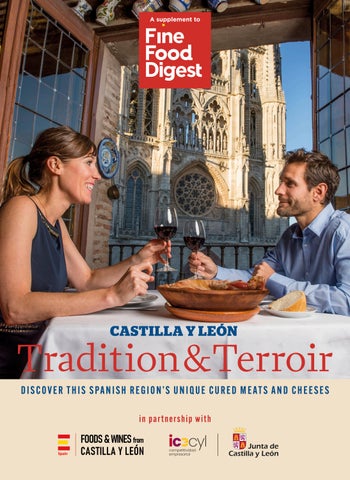
A supplement to
CASTILLA Y LEÓN
Tradition&Terroir D I S C O V E R T H I S S PA N I S H R E G I O N ’ S U N I Q U E C U R E D M E AT S A N D C H E E S E S i n p a r t n e rs h i p w i t h
REGIONAL OVERVIEW
OTECTED PR
•
Many international consumers associate the name Castilla y León with wine. The region has over 600 registered vineyards and its internationally recognised denominations of origin, including Ribera del Duero, Bierzo and Rueda, have made wine its most prominent ambassador abroad. Yet the food identity of Castilla y León stretches far beyond the vineyards. Across the different provinces producers are crafting a vast breadth of products rooted in tradition and innovation, from sheep’s milk cheeses and Iberian meat products such as cured ham with the quality stamp from Guijuelo in Salamanca (which makes up more than half of the Iberian ham sold) through to honey, legumes, vegetables and even a vibrant micro-brewing segment. Beyond their obvious culinary appeal, these products are also playing a strategic role in the global reach of Castilla y León. Food & drink have a universal appeal and a unique ability to communicate a sense of place, so they are often the first to open the doors to new market. In Castilla y León, says Tobalina the food & drink industry is the engine powering the effort to gain ground in international
•
Carlos Martín Tobalina Deputy Regional Minister for Economy
International ambassadors
N
2
More and more products from Castilla y León have a place in the kitchens and on the shelves of restaurants and specialist shops all over the world
ORIGI
S
into innovative, appealing products for international markets. “Our strength is that we have that capacity to transform that tradition into something competitive through innovative thinking and an ability to adapt to different markets,” says Carlos Martín Tobalina, Deputy Minister for Economy and Competitiveness in Castilla y León’s regional government.
OF
Protected quality: the certifications behind the region's food identity
Tradition, innovation and terroir combine in Castilla y León to showcase the best of the region via its food & drink. And it’s not something the locals want to keep secret. In fact, they want to share it far and wide.
pain’s largest autonomous community, Castilla y León, is a land of contrasts. Stretching from the mountains of León to the plains of Zamora and the vineyards of Ribera del Duero, its varied landscapes are home to one of the country’s richest food-producing regions. The region’s rivers, lakes, mountains and rolling fields do more than create a striking backdrop. Together they shape the terroir and climate that underpin Castilla y León’s renowned food & drink industry. Few products illustrate this better than the region’s celebrated cured meats – chorizo, ham and the unique cured beef Cecina. The climatic qualities of Castilla y León are ideal for curing meats. The region experiences cold winters and dry summers, which provide the perfect conditions for a slow, natural curing process. Yet climate is only part of the story. These favourable natural conditions have been combined with generations of agricultural knowledge and culinary mastery to establish one of Spain’s most diverse food-producing regions. There is remarkable scope of products, from cheeses and cured meats to legumes, honey and vegetables. The region also dominates Spain’s sheep’s milk production, accounting for 66% of national output and providing the foundation for some of the country’s best-known cheeses, such as Queso Castellano and Queso Zamorano. While its geography affords Castilla y León a unique position in producing food products of high quality, it is only the beginning of the story. The region’s strength is the ability of its producers to transform many years of culinary tradition
SIGNATIO
N
From gastronomic heritage to global markets
DE
markets. “They are very often the first point of access to new markets and they contribute significantly to the positioning of this region as a competitive and innovative region with genuine commitment to excellence.” Food & drink acts as a calling card for the region, sparking new business opportunities along the way. “It helps to stimulate export, positions us favourably for investments and paves the way for other segments here can increase their international presence.” Alongside these more established products, an expanding range of gourmet products is emerging, developed by companies that are focused on innovation to stand out on an international level. “More and more products from Castilla y León have a place in the kitchens and on the shelves of restaurants and specialist shops all over the world,” says Tobalina. He notes that the smaller companies lead the way when it comes to positioning Castilla y León as a producer of exclusive and speciality goods with a strong sense of identity – exactly the type of thing that the international consumer today demands, he says. “Our objective is for these small exclusive companies to be able to access the most attractive markets with more ease.”
Awards and certifications
Food producers in Castilla y León are gaining international recognition with products regularly receiving accolades from Great Taste and resounding recognition at the World Cheese Awards. These are a source of pride and a symbol of quality that helps the region’s many products stand out in international markets. A SUPPLEMENT TO FINE FOOD DIGEST
“The Great Taste awards and the World Cheese Awards help to reinforce the message of quality that we want to send to the world,” says Tobalina. The awards provide independent endorsement of prizes that are instantly recognised across the world and well known for a rigorous judging process can be an important tool in breaking into international markets. “To have the validation of independent and recognised judges in highly competitive markets, helps new distributors to open access, it increases consumer trust and simply improves the positioning of these brands in high-value segments,” he notes. Alongside the award recognitions, Castilla y León benefits from protected quality schemes (see box-out) that help producers respond to the demand for authenticity, traceability and provenance when entering new markets. “These are certification programmes that reinforce the trust of international markets and help to consolidate a strategy that is based on quality, innovation and differentiation, and they help us avoid having to compete on price only,” says Tobalina. Conscious of the visibility that comes with international recognition, companies across Castilla y León are not standing still: they are investing in technology, digitalisation and sustainability measures to continually improve their processes and thus ensure they remain responsive to the fastchanging demands of a global market. “They are immersed in new ways of working to improve processes that can help them to respond to market requirements at pace,” concludes Tobalina.
Castilla y León’s food producers benefit from a robust network of quality certifications that help to protect and preserve the region’s gastronomic tradition and heritage while communicating the provenance to consumers around the world. The region is home to 21 Protected Geographical Indications (PGIs) and 19 Protected Designations of Origin (PDOs), covering products ranging from meats and cheeses to wines and other speciality foods. Examples include: • Cecina de León PGI – air-dried cured beef from León; • Lechazo de Castilla y León PGI – suckling lamb, one of the region’s most iconic products., • Guijuelo PDO – among Spain’s most recognised names for charcuterie. • Queso Zamorano PDO – sheep’s cheese made using milk from local breeds • Ribera del Duero PDO – one of Spain’s best-known wine regions, famous for red wines mainly using the Tempranillo grape.
EDITORIAL Editor: Michael Lane Features: Tina Nielsen Art director: Mark Windsor ADVERTISING advertise@gff.co.uk Sales director: Sally Coley GENERAL ENQUIRIES Tel: +44 (0)1747 825200 info@gff.co.uk www.gff.co.uk Guild of Fine Food, Guild House, 23b Kingsmead Business Park, Gillingham, Dorset sp8 5fb uk
PUBLISHED BY The Guild of Fine Food © The Guild of Fine Food Ltd 2026. Reproduction of whole or part of this magazine without the publisher’s prior permission is prohibited. The opinions expressed in articles and advertisements are not neacessarily those of the editor or publisher. Managing director: John Farrand PRINTED BY Blackmore, Dorset
FOOD & DRINK FROM CASTILLA Y LEÓN 2026
3
CHEESE
Quality, volume and variety
The centuries-old dairy tradition in Castilla y León is reflected in a cheesemaking sector that continues to gain international recognition – particularly for its protected regional specialities made from sheep’s milk.
T
o understand the importance of dairy and cheese to Castilla y León, you only have to speak with some of the people engaged in the sector. There is a proud tradition at all levels, from industrial producers to artisanal dairies, and the region produces around a third of Spain’s cheeses. Castilla y León is an enormous region and its landscapes are more diverse than the image of a flat plain that people might imagine when they think of it. “The reason the milk here is of such stellar quality is found in the grass, the terroir and the great variety of landscapes,” says Alberto Manzanares, general manager of
4
FOOD & DRINK FROM CASTILLA Y LEÓN 2026
the Federation of Dairy Industries in Castilla y León. “People often think of Castilla as being flat but we have one of the most prominent mountain ranges in Spain. The sheep feed on different vegetation and herbs depending on where they graze, and that obviously influences the flavour of the milk.” That character ultimately transfers to the cheese itself. Above all, says Félix Vicente Pastor from Quesería Vicente Pastor, a family-run artisanal business in Zamora, sheep’s cheeses in Castilla y León are steeped in a very important tradition. “There is a great deal of know-how and excellent sheep farming in the region,” he says. “When you combine the high quality milk with excellent raw materials from very well-organised and well-managed farms, and a high level of artisanal craft, you get a cheese with a distinctive quality.” It is this combination of landscape, livestock and cheesemaking expertise passed down through generations that has made this one of Spain’s most important regions for dairy. Castilla y León is Spain’s biggest producer of sheep’s milk and home of cheeses known
and loved by consumers all over Spain and beyond. The region is also the country’s second largest producer of cows’ milk and in the top five for goats’ milk – a dairy culture that is reflected in innovative mixed milk cheeses. The scale of the sector is supported by a cheesemaking tradition that runs deep. “As early as the reign of Alfonso X in the thirteenth century, there were written records documenting this region’s cheesemaking tradition,” says Manzanares. “In the Middle Ages, cheese was even used as a form of currency in exchange for other goods. The difference between then and now is that today the production process is fully controlled, with complete quality guarantees from beginning to end,” he adds.
Protecting tradition
Castilla y León has a multiple EU-recognised quality-labelled cheeses, Queso Zamorano, holds the Protected Designation of Origin (PDO), as does the sheep’s milk Arribes de Salamanca. There are also several with Protected Geographical indication (PGI) status. These include Queso Castellano; Queso de A SUPPLEMENT TO FINE FOOD DIGEST
Burgos – a soft fresh mixed cows’ and sheep’s milk cheese; and Queso de Valdeón – a blue cheese made in the Valdeón Valley. Two of these offer interesting examples of how the producers are working to preserve and protect the cheesemaking heritage: Queso Castellano and Queso Zamorano. The most recent to be awarded a PGI status is Castellano cheese, in 2021. It is characterised by a smooth and creamy flavour, with subtle notes of nuts and fresh grass. Manzanares, says the Castellano cheese sector brings together around 1,000 livestock farmers, 18 industrial producers and 16 cooperatives. “That is what Castellano Cheese is: the coming together of the region’s cheesemakers and livestock farmers, specialising in the finest product we have in Castilla y León, which is pure sheep’s milk,” he says. Because it is a PGI everything is produced in the region. There is complete traceability from the farm right through to the consumer. There are currently 510,000 sheep registered and monitored for the production of the milk while annual sales reach 1.5 million cheeses. Whereas Castellano cheese from Castilla A SUPPLEMENT TO FINE FOOD DIGEST
y León is the best-selling cheese nationally, international consumers are still discovering it – until the PGI was awarded, around 90% of the product was sold on the domestic market. This is changing now, says Manzanares. “In 2025, we reached 13% of production being exported,” he says acknowledging that the challenge is getting it into the market. “Once it reaches consumers, it succeeds because it is a very different cheese from the milder, softer cheeses, or mixed-milk cheeses, or cows’ milk and sheep’s milk cheeses that you generally find on the international market.” Another, more established, EU-designated protection is that of cheese from Zamora, in the west of the region, which is designated PDO since 1993. If Castilla y León is Spain’s largest sheep’s-milk-producing region, the province of Zamora is the country’s leading producer, accounting for 30% of the region’s sheep’s milk. “In Zamora, cheese is the main driving force, both economically and territorially speaking, because 90% of the cheese dairies are located in rural areas,” says Israel García Vaquero from the Escuela de Industrias Lácteas (a dairy industries school). There are around four sheep for every inhabitant, he says to illustrate the point. “So, you simply could not imagine Zamora without sheep,” he says. “The agri-food sector, and specifically the dairy sector, is the economic engine of the province.” The Zamorano cheese must be made with milk from the traditional Churra and Castellana breed of sheep and is aged for at least 100 days, but can be matured for well over a year. The main difference between Castellano and Zamorano cheeses is found in the breed of sheep. “The cheeses in themselves are very similar,” says García Vaquero. While Zamorano must be made using milk from Churra and Castellana sheep breeds, there is more flexibility in the production of Castellano cheese, which can be made using other breeds present in the region. The designation is a nod to the tradition, which is also reflected in the family businesses that continue to make the cheese today. Vicente Pastor who runs Quesería Vicente Pastor with his brothers is the sixth generation of his family to farm sheep. For the past 40 years, the family dairy has produced cheeses exclusively using milk from their own herd of 2,800 Castellana sheep. They are known for a raw-milk, pressed-curd cheese with a natural mould-ripened rind,
The dairy sector is the economic engine of the province.
Queso Zamorano and Queso Castellano both have protected status and showcase the region’s prized sheep’s milk.
following their grandmother’s method. “Cheese comes from the animal’s udder and if the milk is hygienic and clean, the result can be good,” he explains. “If the milk is of mediocre quality, it won’t be.”
A new showcase for an old tradition
García Vaquero is also one of the people behind Fromago, Zamora’s new international cheese fair, which was first staged in 2022. Its scale reflects the significant importance of cheese to the province and the increasing profile of the producers. Around 200,000 people attended the first edition of the fair – more than three times the number of people who live in Zamora city. It takes over the historical centre of Zamora, which is famous in Europe for its Roman architecture. The first edition also attracted 35 international importers, and this year organisers are aiming to bring 50, to reflect the broad representation of countries there. This year, there will be 414 stands selling directly to the public, totaling more than 300 producers. Around 80% of the stalls will be cheesemakers, while the remaining 20% account for products that complement cheese. The rapid growth of the new event is testament to the enduring appeal of the region within the world of cheese. For Manzanares, however, the strongest evidence of Castilla y León’s growing reputation comes from the cheeses themselves. “One of the best indicators is the success our cheesemakers are having by entering numerous national and international competitions, where they are continually winning awards for their 100% sheep’s milk cheeses,” he says. FOOD & DRINK FROM CASTILLA Y LEÓN 2026
5
CURED MEAT within the province, where the climate and traditional curing conditions contribute to the finished product, which should have a toasted or brown exterior; while internally the colour can range from cherry red to crimson, with some fat marbling. “Cecina is a product of very similar quality to ham,” says Raquel Alonso, technical director of the regulatory board for Cecina de León. “However, when it comes to prestige, ham has an advantage in every respect. In Spain there are six designations of origin for ham: four for Iberian ham and two for white ham. So the word jamón is known all over the world while the word cecina isn’t known everywhere.” The only comparable PGI for cured beef is Bresaola in Italy, which is made in the Italian Alps. It differs from cecina only in the preparation and maturation period.
The certifications at a glance Jamón de Guijuelo • Must be ham or shoulder from Iberian pigs or authorised Iberian cross-breeds • Animals must come from registered holdings within the PDO • Controlled feeding: for the bellota breed, the pigs are fed on acorns while Cebo de campo breed are fed grain and pulse feed • There are specifications on salting, washing, resting, drying and ageing • Curing must take place within the designated geographical area, mainly the province of Salamanca
Pork perfection
Just add salt and time Castilla y León has developed a rich array of charcuterie shaped by its ideal climate and diverse landscapes, producing cured meats of exceptional quality.
C
ured meats are truly a product of their environment in Castilla y León. The prized hams of Guijuelo and the cecina of León are just two examples. But the region's charcuterie tradition extends far beyond these two celebrated products, encompassing sausages including chorizo and salchichón, alongside a wealth of regional specialities. At first glance, the ham and the cecina are quite different from one another. One is made from Iberian pork, the other is beef. One is synonymous with the dehesa – the oak pastures – around Salamanca, the other with the province of León. Both, however, showcase the principles of traditional Spanish charcuterie: high-quality raw ingredient, salt, time and a deep understanding of place. “The two are jewels of Spanish gastronomy with very distinct personalities and
6
FOOD & DRINK FROM CASTILLA Y LEÓN 2026
expressions,” says Eduardo Hernandez, export manager of Cecinas Pablo. “The difference is beyond the animal they come from – they are also expressed in the sensory details and the production techniques. And of course in the pleasure they offer on the palate.”
Product of pride
Cecina may not have the international fame of Spain's great hams, but in León, the air-dried beef is a product of equal pride. Benefiting from a Protected Geographical Indication (PGI), cecina de León is made according to a tightly defined tradition that places the quality of the meat – and the skill of curing it – at its core. What makes Cecina de León distinctive is not an elaborate recipe but a markedly constrained one: specific cuts of beef from adult cattle, plus salt, time and the particular
conditions of León. The PGI permits only four principal cuts from the hindquarters of adult cattle: tapa (topside), contra (eye of round), babilla (knuckle) and cadera (rump). They are salted and cured for at least seven months, while a Reserva version is aged for at least 12 months. The cattle do not have to originate in León, but the production must take place
Guijuelo ham and Cecina of León both showcase the principles of traditional Spanish charcuterie A SUPPLEMENT TO FINE FOOD DIGEST
While Cecina is still being discovered by consumers, the cured ham of the region, and particularly Jamón de Guijuelo – a PDOprotected cured ham from the province of Salamanca – is much better known beyond Spain’s border. Guijuelo is synonymous with some of Spain's most celebrated cured hams, produced within a long-established tradition deeply shaped by the landscape and climate of Salamanca. The PDO Guijuelo protects Iberian hams and shoulders produced under tightly defined requirements governing the animals, their feed and management, as well as the salting, curing and ageing of the meat. “Guijuelo has a unique climate, combining long, cold winters with low precipitation, which favour a natural curing process, with short but warm summers that enhance the aroma, texture and flavour of Iberian products,” says Fernando Garcia, CEO of Julián Martín, a family business based in Guijuelo in operation since 1933. “This is due to its location at more than 1,000 metres above sea level, surrounded by three mountain ranges and the local tradition of drying rooms and cellars designed to make natural use of the air currents that circulate through them.” Julian Martín produces hams as well as other cured meats and is the holder of a 3-star Great Taste award for his 100% acorn ham. The company exports to over 30 countries across the world, a clear indication of the status of the ham.
Prime cuts
On the global level where jamón leads the way, cecina de León follows, and markets such as the Middle East and Asia are of great interest to cecina producers. “The Japanese market for ham was opened quite a few years ago, for example,” says Alonso. But comparing these two gems of the Castilla y León culinary palette is missing the point. There are significant differences in the scale and size of the markets. “Cecina is behind the ham industry,” says Alonso. “But there is a huge number of ham-producing companies around the world, and a huge number of workers employed in the sector.”
Cecina de León There are tightly defined requirements cecina producers must meet • Adult cattle – the meat must come from specific cuts of adult cattle • There are minimum weights for each cut: Tapa must weigh 4kg; contra, 5kg; babilla, 3.5kg and cadera 3kg • Production must take place in León but the cattle doesn’t have to originate from the province • The stages of production are regimented, from shaping and salting to washing, resting and drying • The meat must be cured for at least seven months – a higher category, cecina reserva, is cured for at least 12 months
Meanwhile, León has 300,000 inhabitants, out of the 45 million national population of Spain. “It’s a very small province, and we produce just over 100,000 pieces a year,” says Alonso. “If you add up all the ham produced in Spain, it’s millions of hams.” According to Hernandez from Cecinas Pablo, two products so special should be considered on their own merits. He calls the ham “pure seduction and elegance” and says the cecina boasts “character and depth” – it may be less well known outside of Spain but offers a gourmet experience that surprises many. “Let’s not forget,” he concludes. “They are both significant pillars of the Spanish culinary heritage.”
The region’s 2026 Great Taste 3-star winners Black Angus Cecina & Cecina De León PGI Embutidos Ferju ferju.net Deluxe Spanish Castellano PGI Traditional Cheese Co traditionalcheese.ie
A SUPPLEMENT TO FINE FOOD DIGEST
Castellano PGI Quesos Revilla quesosreviques.com
Wagyu Beef Ham Entrepeñas embutidosentrepenas.es
Redondo de Cecina de Vaca Embutidos Artesanos La Pradera de Fontún embutidoslapradera.com
Wagyu Pastrami Cecinas Pablo cecinaspablo.com
FOOD & DRINK FROM CASTILLA Y LEÓN 2026
7
Castilla y León Roadshow “Taste the Land” brings the authentic flavours of Castilla y León to the United Kingdom, Belgium and the Netherlands in 2026 and 2027.
Upcoming events
2026 >>
FOLLOW US ON SOCIAL MEDIA Discover the flavours, producers and stories behind every stop of the journey.