
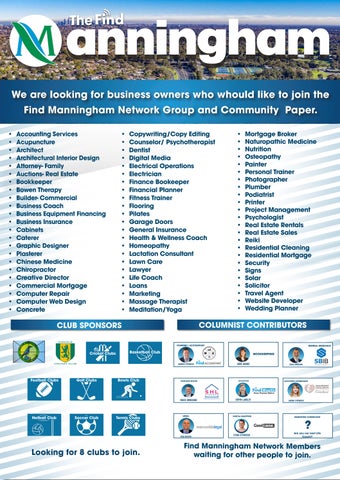
We are looking for business owners who whould like to join the Find Manningham Network Group and Community Paper.
• Accounting Services
• Acupuncture
• Architect
• Architectural Interior Design
• Attorney- Family
• Auctions- Real Estate
• Bookkeeper
• Bowen Therapy
• Builder- Commercial
• Business Coach
• Business Equipment Financing
• Business Insurance
• Cabinets
• Caterer
• Graphic Designer
• Plasterer
• Chinese Medicine
• Chiropractor
• Creative Director
• Commercial Mortgage
• Computer Repair
• Computer Web Design
• Concrete


• Copywriting/Copy Editing
• Counselor/ Psychotherapist
• Dentist
• Digital Media
• Electrical Operations
• Electrician
• Finance Bookeeper
• Financial Planner
• Fitness Trainer
• Flooring
• Pilates
• Garage Doors
• General Insurance
• Health & Wellness Coach
• Homeopathy
• Lactation Consultant
• Lawn Care
• Lawyer
• Life Coach
• Loans
• Marketing
• Massage Therapist
• Meditation/Yoga













• Mortgage Broker
• Naturopathic Medicine
• Nutrition
• Osteopathy
• Painter
• Personal Trainer
• Photographer
• Plumber
• Podiatrist
• Printer
• Project Management
• Psychologist
• Real Estate Rentals
• Real Estate Sales
• Reiki
• Residential Cleaning
• Residential Mortgage
• Security
• Signs
• Solar
• Solicitor
• Travel Agent
• Website Developer
• Wedding Planner













By Warren Strybosch
The Find Manningham is a community paper that aims to support all things Manningham. We want to provide a place where all Not-For-Profits (NFP), schools, sporting groups and other like organisations can share their news in one place. For instance, submitting up-andcoming events in the Find Manningham for Free.
We do not proclaim to be another newspaper and we will not be aiming to compete with other news outlets. You can obtain your news from other sources. We feel you get enough of this already. We will keep our news topics to a minimum and only provide what we feel is most relevant topics to you each month.
We invite local council and the current council members to participate by submitting information each month so as to keep us informed of any changes that may be of relevance to us, their local constituents.

EDITORIAL ENQUIRES: Warren Strybosch | 1300 88 38 30 warren@findnetwork.com.au
PUBLISHER: Issuu Pty Ltd

We will also try and showcase different organisations throughout the year so you, the reader, can learn more about what is on offer in your local area.
To help support the paper, we invite local business owners to sponsor the paper and in return we will provide exclusive advertising and opportunities to submit articles about their businesses. As a community we encourage you to support these businesses/columnists. Without their support, we would not be able to provide this community paper to you.
Lastly, we want to ask you, the local community, to support the fundraising initiatives that we will be developing

and rolling out over the coming years. Our aim is to help as many NFP and other like organisations to raise much needed funds to help them to keep operating. Our fundraising initiatives will never simply ask for money from you. We will also aim to provide something of worth to you before you part with your hard-earned money. The first initiative is the Find Cards and Find Coupons – similar to the Entertainment Book but cheaper and more localised. Any NFP and similar organisations e.g., schools, sporting clubs, can participate.
Follow us on facebook (https://www. facebook.com/findmanningham) so you keep up to date with what we are doing.
We value your support,
The Find Manningham Team.
POSTAL ADDRESS: 248 Wonga Road, Warranwood VIC 3134
ADVERTISING AND ACCOUNTS: editor@findmanningham.com.au
GENERAL ENQUIRIES: 1300 88 38 30
EMAIL SUPPORT: support@manningham.com.au
WEBSITE: www.findmanningham.com.au
The Find Manningham was established in 2019 and is owned by the Find Foundation, a Not-For-Profit organisation with a core focus of helping other Not-ForProfits, schools, clubs and other similar organisations in the local community - to bring everyone together in one place and to support each other. We provide the above organisations FREE advertising in the community paper to promote themselves as well as to make the community more aware of the services these organisations can offer. The Find Manningham has a strong editorial focus and is supported via local grants and financed predominantly by local business owners.
The City of Manningham is a local government area in Victoria, Australia in the north-eastern suburbs of Melbourne. Manningham had a population of approximately 125,508 as at the 2018 Report which includes 27,500 business and close to 45,355 households. The Doncaster and Templestowe Council administered the area until December 15, 1994.
The Find Manningham acknowledge the Traditional Owners of the lands where Manningham now stands, the Wurundjeri people of the Kulin nation, and pays respect to their Elders - past, present and emerging - and acknowledges the important role Aboriginal and Torres Strait Islander people continue to play within our community.
Readers are advised that the Find Manningham accepts no responsibility for financial, health or other claims published in advertising or in articles written in this newspaper. All comments are of a general nature and do not take into account your personal financial situation, health and/or wellbeing. We recommend you seek professional advice before acting on anything written herein.
By Joe Lam
As the End of the Financial Year (EOFY) approaches, workers, families, sole traders, and businesses across Victoria are preparing for tax time. With the Australian financial year ending on 30 June 2026, early preparation is more important than ever. This year brings significant reforms from the Australian Taxation Office (ATO) and new cost of living measures in Victoria, making it crucial to stay organised and informed.
From 1 July 2026, employers must pay superannuation contributions at the same time as wages, rather than quarterly. Payments must reach the employee’s super fund within seven business days. Late payments will trigger the Superannuation Guarantee Charge (SGC), now calculated daily with stricter penalties. Payroll systems must be updated to handle Qualifying Earnings (QE) reporting via Single Touch Payroll (STP) at each pay event.
The government funded Paid Parental Leave scheme will extend to 26 weeks from 1 July 2026, paid at the National Minimum Wage. This applies to births and adoptions from that date, giving families greater flexibility and support.
From 1 July 2026, the personal income tax rate of 16% drops to 15%, with a further cut to 14% scheduled for 2027. Updated PAYG withholding tables will apply, and thresholds for the Seniors and Pensioners Tax Offset (SAPTO) will adjust accordingly.
The Fair Work Commission’s Annual Wage Review will set new National Minimum Wage and award rates effective from the first full pay period after 1 July 2026. The Superannuation Guarantee rate remains at 12%, but employers must ensure contracts correctly reflect whether super is inclusive or exclusive of base pay.
Small businesses will benefit from the $20,000 instant asset write off and loss carry back provisions, helping improve cash flow and resilience in the new financial year.
Small businesses will benefit from the $20,000 instant asset write off and loss carry back provisions, helping improve cash flow and resilience in the new financial year.
The Victorian Government has announced several initiatives to ease financial pressure and strengthen services:
• Cost of Living Relief: Free public transport until May 2026, half price fares until year end, and 20% off car registration.

• Health & Education: $1 billion allocated to hospital operations and $718.9 million for schools and early childhood services, alongside major infrastructure upgrades.
• Housing & Community: Nearly $500 million directed to housing and community services.
• Jobs & Skills: $353.9 million to support employment, training, and industry programs.
Getting organised before June can make a significant difference. Experts recommend:
• Gathering receipts, invoices, and BAS records early.
• Reviewing deductions carefully for workers.
• Monitoring cash flow and super contributions for sole traders and business owners.
• Updating payroll systems to comply with Payday Super and STP changes.
• Budgeting for tax obligations to avoid late payment interest or unnecessary debt.
Reliable accounting software can reduce reporting errors, while consulting a registered tax agent ensures deductions are maximised and compliance is maintained.
EOFY 2026 marks one of the most significant compliance shifts in decades. With Payday Super, extended Paid Parental Leave, tax cuts, and Victorian cost of living relief all taking effect, preparation is key. By acting now—updating payroll, budgeting for tax changes, and leveraging new schemes— Victorians can avoid penalties and enter FY2026–27 with confidence.
Don’t wait until the last minute. Start organising your finances today, seek expert advice, and take advantage of new reforms before the EOFY rush begins.

Warren Strybosch
The Federal Government has introduced proposed tax law changes through the Treasury Laws Amendment (Tax Reform No. 1) Bill 2026. These reforms mainly affect capital gains tax (CGT) and negative gearing rules for investment properties.
If passed, many of these changes will start from 1 July 2027.
Below we hope to help explain the proposed changes in simple terms and provide an example to help investors understand how the reforms may work in practice.
Capital Gains Tax (CGT) Changes
What is Capital Gains Tax?
Capital gains tax applies when an asset such as an investment property, shares, or other investments is sold for more than it originally cost.
Currently, individuals and trusts that hold an asset for more than 12 months generally receive a 50% CGT discount. This means only half of the profit is taxed.
What is changing?
From 1 July 2027, the Government proposes to remove the standard 50% CGT discount for most assets and replace it with a system called “cost base indexation”.
Cost base indexation increases the original purchase price of an asset to account for inflation. This means tax is only paid on the “real” gain above inflation.
The Government also proposes a minimum 30% tax on capital gains for many taxpayers. This is designed to reduce the benefit of delaying the sale of assets until retirement or lower-income years.
How will the new rules apply?
The changes are proposed to apply to:
• Assets bought before or after 1 July 2027
• Capital gains that arise after 1 July 2027
• Pre-1985 assets, but only for gains that occur after 1 July 2027
Importantly, gains accumulated before 1 July 2027 may still qualify for the current rules and concessions.
The small business CGT concessions are not changing.
Special treatment for housing
To encourage investment in housing supply:
• Investors in new residential properties may choose between the existing 50% discount or the new indexed method.
• Affordable housing investors may still access discounts of up to 60%.
Sarah purchased an investment property in Melbourne in 2018 for $600,000.
By July 2027, the property is worth $850,000. Sarah later sells the property in 2030 for $950,000.
Under the current rules, Sarah may have been able to apply the 50% CGT discount to the full capital gain.
Under the proposed rules, the gain up to 1 July 2027 may still receive the old treatment, while the growth after 1 July 2027 may instead use indexed cost base calculations.
For example, if inflation increased the indexed cost base from $850,000 to $900,000 between 2027 and 2030, Sarah may only pay tax on the $50,000 increase above inflation rather than the full $100,000 growth during that period.
However, the proposed minimum 30% tax rate may still apply to the taxable gain.
This means the calculations may become more complex and professional advice may become increasingly important.
What is negative gearing?
Negative gearing occurs when the costs of owning an investment property — such as loan interest, maintenance, rates, and depreciation — are greater than the rental income received.
Currently, many investors can use these losses to reduce tax on their salary or other income.
What is changing?
Under the proposed reforms, losses from residential investment properties will generally no longer be able to reduce salary or other unrelated income.
Instead, these losses will be “quarantined”. This means the losses can only be used against:
• Future rental income from residential properties
• Future profits from selling residential properties
Who is exempt?
The proposed quarantining rules will not apply to:
• Newly built residential properties
• Properties purchased before 12 May 2026
• Certain businesses or activities determined by the Government
• Superannuation funds and some large trusts
This appears designed to encourage investment in new housing while reducing tax benefits for existing residential properties.
Example of Negative Gearing Changes
John owns an investment property that earns $25,000 in rent each year. His expenses, including loan interest and maintenance, total $35,000.
This creates a $10,000 rental loss. Under the current rules, John may reduce his taxable salary income by $10,000, lowering his overall tax bill.
Under the proposed rules, if the property was purchased after 12 May 2026 and is not a new build, John may no longer be able to offset this loss against his salary.
Instead, the $10,000 loss would be carried forward and used against future rental profits or future capital gains from property sales.
These proposed reforms represent one of the largest changes to investment taxation in decades. While the Government argues the changes will improve housing affordability and fairness in the tax system, investors may face more complicated tax calculations and reduced after-tax investment returns.
Importantly, these measures are still proposed legislation and may change as they move through Parliament.
Anyone with investment properties, shares, trusts, or long-term investment plans should consider seeking professional financial and tax advice before making decisions based on the proposed reforms.


By ETHAN STRYBOSCH
What if your next fundraising campaign didn’t just meet expectations—but shattered them? If you’re aiming to boost donations, expand your reach, or build lasting donor relationships, it’s not about working harder—it’s about working smarter. These five powerful campaigns aren’t just ideas—they’re proven strategies that inspire action and deliver real, measurable results.
Peer-to-peer (P2P) fundraising remains one of the most effective ways to organically grow your nonprofit’s donor base. It empowers supporters to fundraise on your behalf, tapping into personal networks to spread your mission. In 2025, the top 30 U.S. peer-to-peer programs raised $1.17 billion, with participation climbing to 2.63 million individuals.
The key to success is equipping fundraisers with social media templates, email scripts, and easy-to-use donation pages. Recognising top fundraisers with shoutouts or rewards keeps motivation high.
Success Story: Movember’s global campaign has raised over $1 billion worldwide, proving the power of personal stories and community-driven fundraising.
Seasonal campaigns align with highgiving periods like GivingTuesday, EOFY appeals, and the holidays. GivingTuesday 2025 broke records with $4.0 billion donated in the U.S. by 38.1 million participants—a 13% increase from 2024. December remains the most generous month, with nearly 30% of annual donations occurring then.
Urgency tactics—like countdowns, donation matches, and specific goals— can significantly boost results.
Success Story: The Salvation Army’s Red Kettle Campaign raises over $100 million annually during the holidays, combining physical kettles with online giving.

Social Media Campaigns: Harness Storytelling
Social media thrives on authentic storytelling. Short, emotional videos on TikTok, Instagram, and Facebook perform especially well. Encourage followers to share their own stories and use hashtags to expand reach.
Success Story: Charity: Water’s #WhyWater campaign has helped over 15 million people by turning personal stories into a global movement.
Recurring Giving Campaigns: Build Long-Term Support
Recurring giving creates reliable income streams. Monthly donors give 42% more than one-time donors and have retention rates up to 90%, compared to just 42.9% overall donor retention.
Highlighting convenience and impact, plus offering exclusive updates, can turn casual supporters into lifelong advocates.
Success Story: World Vision’s Child Sponsorship Program fosters emotional connections through regular updates, sustaining donor relationships for years.
Event-Based Fundraising: Create Memorable Experiences
Events—both in-person and virtual— remain powerful. Fundraising events accounted for significant growth in 2025, with fitness and sports events alone raising over £200 million via JustGiving. Virtual formats continue to expand reach, increasing participation by about 30%.
Combining ticket sales with raffles, auctions, or donation challenges maximises revenue while strengthening community ties.
Success Story: The Global Citizen Festival blends entertainment with activism, driving donations, awareness, and even policy changes.
Key Takeaways for Campaign Success
• Personal Connections Matter: Authentic stories resonate more than generic appeals.
• Urgency Drives Action: Timesensitive goals and matches boost results.
• Diversify Channels: Use email, social media, events, and paid ads together.
• Consistency Builds Trust: Regular communication strengthens donor relationships.
Ready to Elevate Your Next Fundraising Campaign?
If you’re looking to launch campaigns that drive donations and build lasting donor relationships, we’re here to help.

By Kathryn Messenger
If bloating, discomfort, or sluggish digestion is a regular concern, what you eat can make a big difference. Some foods actively soothe the gut, support liver function, stabilise blood sugar, and even help regulate hormones, all of which play a role in digestion.
Here are my top 10 foods to calm digestion and support overall gut health:
Oats are a gentle, soluble-fibre-rich food that feeds good gut bacteria and helps maintain smooth bowel movements. They also help stabilise blood sugar, which reduces digestive stress after meals. Overnight oats or porridge with chia seeds and almond butter is a simple, nourishing option.
2. Ginger
Ginger has natural anti-inflammatory properties and stimulates digestion. It can help to relieve bloating, nausea, and sluggish motility. Freshly grated in teas, broths, or lightly sautéed in vegetables is ideal for ginger consumption.
3. Peppermint
Peppermint is calming for the digestive tract and can ease spasms and bloating. Peppermint tea after meals or in small doses throughout the day can provide gentle relief. People with acid reflux should avoid peppermint, as it can sometimes worsen symptoms.
4. Leafy Greens
Bitter greens such as kale, rocket, and dandelion leaves stimulate bile flow, supporting fat digestion and liver function. They are also rich in fibre and micronutrients, helping maintain energy and hormonal balance. Lightly sauté or include them in salads.
5. Papaya
Papaya contains an enzyme called papain, which aids protein digestion and reduces gas and bloating. It’s a great addition to breakfast, smoothies, or as a naturally sweet dessert.

6. Fennel
Fennel seeds or lightly cooked fennel can reduce bloating and gas. Fennel supports gentle digestion and has calming effects on the gut nervous system. Try fennel tea after meals or roasted fennel with dinner.
Rich in gelatine and minerals, bone broth supports the gut lining and overall digestive health. It is particularly helpful if digestion feels fragile or if you are dealing with occasional gut inflammation.
8. Fermented Foods
Probiotic-rich foods like kefir, Greek yoghurt, sauerkraut, and kimchi are key to restoring microbiome balance. It is important to start slowly, as too much at once can create gas in particularly sensitive individuals. Fermented foods also support immune and metabolic health.
9. Pumpkin and Sweet Potato
These are gentle, fibre-rich starches that provide soluble fibre to nourish the gut without causing excessive gas. Pumpkin and sweet potato also support steady blood sugar, which reduces digestive stress.
10. Turmeric
Turmeric contains curcumin, a natural anti-inflammatory compound that can help calm an irritated digestive system. Add this spice to soups, stews, or golden milk. Additionally, pairing turmeric with a little black pepper will improve absorption.
Combine fibre, protein, and healthy fats at each meal to support digestion and blood sugar.
Focus on whole, minimally processed foods, they are easier on your liver and hormones.
Drink water consistently, but not with a meal, as it can dilute digestive enzyme.

By JODIE MOORE
As the end of the financial year rolls around, it’s easy to feel a bit overwhelmed. Whether you’re a sole trader, running a small business, or managing the books for a growing operation, EOFY (end of financial year) is crunch time. The good news? With a bit of organisation and a clear plan, preparing your books for tax time doesn’t have to be stressful.
First things first get your records in order. This means making sure all your income and expenses are accurately recorded and up to date. If you’ve been keeping on top of your bookkeeping throughout the year, you’re already ahead. If not, now’s the time to catch up. Go through your bank statements, invoices, receipts, and any other financial documents to ensure nothing is missing. It’s much easier to deal with discrepancies now than when your accountant is chasing you for answers.
Next, reconcile your accounts. This is a crucial step that often gets overlooked. Reconciling means checking that your bookkeeping records match your bank accounts, credit cards, and other financial statements. It helps catch errors like duplicate entries, missed transactions, or incorrect amounts. While it might feel tedious, it’s one of the best ways to ensure your numbers are accurate before lodging your tax return.
Don’t forget to review your expenses. EOFY is the perfect time to categorise everything correctly and make sure you’re claiming all allowable deductions. Think about things like office supplies, software subscriptions, vehicle expenses, and even a portion of your home office costs if you work from home. Just make sure you’ve got the documentation to back it all up—receipts are your best friend here.
Another important step is checking your accounts receivable and payable. In simple terms, who owes you money, and who do you owe? Chase up any outstanding invoices so you can bring in as much income as possible before the books close. At the same time, consider whether you want to pay any outstanding bills before the end of the financial year, as this may impact your deductions.

If you’ve got employees, there are a few extra things to tick off. Make sure your payroll is up to date, including wages, superannuation contributions, and any leave balances. Super payments need to be processed on time if you want to claim a deduction this financial year, so don’t leave that to the last minute.
It’s also a good idea to review your asset register. If you’ve purchased equipment, vehicles, or other assets during the year, ensure they’re recorded correctly. Depending on the value, you may be able to claim an immediate deduction or depreciate the asset over time. This is one area where a quick chat with your accountant can really pay off.
Speaking of accountants, don’t wait until the last minute to get them involved. A quick check-in before EOFY can help you identify any last-minute opportunities to minimise your tax bill or tidy up your records. They can also flag any compliance issues before they become a bigger problem.
Will you be claiming vehicle expenses in your tax return? Ensure you have a valid logbook so you can claim all related expenses. A logbook must run for 84 full days.
You need to enter every single trip whether it be for business or personal and label each trip as such. This means you might have 5 trips recorded in one day! The logbook also needs to record the date, start and end odometer reading for each trip, what the trip was for and the location (ie visit client for meeting - Croydon or school pickupRingwood). A logbook can be valid for 5 years provided the type of travel and the usage doesn’t change. If you change vehicles, you can usually continue using the same logbook. If you use two cars for work, you need to do a logbook for both cars for the 84 days at the same time.
Finally, back everything up. Whether you’re using cloud-based software or spreadsheets, make sure your financial data is securely stored and easily accessible. Losing your records right before tax time is a headache you definitely don’t need.
At the end of the day, EOFY bookkeeping is all about preparation. Staying organised, reviewing your numbers, and asking for help when you need it can make the whole process far smoother. And once it’s all done, you can breathe a sigh of relief—and maybe even enjoy a well-earned break.

She closes her laptop at the end of the meeting and pauses, just for a moment.
Ten minutes earlier, she had lost her train of thought mid-sentence—something that never used to happen. She laughed it off, blamed a “busy week,” and kept going. No one questioned it. Why would they? On paper, she’s at the height of her career: experienced, capable, leading teams and making decisions that matter. What no one sees is that she slept three hours the night before. Or that her heart sometimes races for no clear reason. Or that the sudden wave of heat rising during a presentation isn’t anxiety—but it feels like it could be.
Across workplaces, women in their 40s and 50s are navigating a transition that remains largely invisible. Perimenopause and menopause are not new—but the conversation around them, especially at work, still is.
Perimenopause can begin in the 40s, bringing hormonal changes that affect sleep, concentration, mood, and physical comfort. Menopause marks the end of menstrual cycles, but it is often the
years leading up to it that present the greatest challenges. For many Australian women, this stage of life unfolds during some of the most demanding years of their careers.
Women in midlife are often in leadership roles, managing teams, making decisions, and balancing responsibilities at work and at home. At the same time, they may be dealing with fatigue after restless nights, difficulty concentrating in meetings, anxiety, or sudden waves of heat in professional settings. These experiences are common, but rarely spoken about.
Because the symptoms are often invisible, they can be misunderstood. A lapse in memory may be seen as a lack of focus. Exhaustion may be mistaken for disengagement. In workplaces that value constant productivity, it can feel risky to speak openly about what is really going on. As a result, many women push through quietly, adapting without support.
This silence comes at a cost. Some women reduce their hours, step back from leadership opportunities, or leave the workforce earlier than planned.
Over time, this affects financial security, retirement savings, and the presence of experienced women in leadership.
Yet this is not simply a personal health issue—it is a workplace and community issue. When organisations fail to recognise and support women through this stage of life, they risk losing valuable skills, knowledge, and leadership.
Small changes can make a meaningful difference. Flexible work options, greater awareness, and open, respectful conversations can help create environments where women feel supported rather than sidelined.
Menopause is not the end of contribution—it is a transition. With the right understanding, Australian workplaces have an opportunity to better support women to continue thriving, leading, and participating fully at every stage of life.
The question is not whether this is happening.
It already is.
The question is whether workplaces are ready to see it.





By Warren Strybosch
The Federal Government’s proposed tax reforms could significantly change the way many retirees structure their investments and receive income in retirement.
For decades, discretionary family trusts have been a popular investment vehicle for Australians approaching retirement. Combined with the existing capital gains tax (CGT) discount rules, trusts have provided a flexible and tax-effective way to distribute investment income to family members and retirees with little or no taxable income.
However, the proposed reforms announced in the 2026–27 Federal Budget may alter many of these long-established strategies.
Under the proposed legislation, distributions from trusts to adult beneficiaries will generally be subject to a minimum tax rate of 30%, regardless of the beneficiary’s personal marginal tax rate.
Historically, trust income distributed to beneficiaries was taxed at the beneficiary’s own tax rates. This meant that retirees with little other income could often receive trust distributions taxfree or at very low tax rates.
For example, a retired couple may have owned a portfolio of shares and investment properties through a family trust. If the trust generated $30,000 of income each year and the couple had little other taxable income, they may have paid very little tax on those distributions.
Under the proposed changes, that same trust income could potentially be subject to a minimum 30% tax rate before reaching the beneficiaries.
For retirees who deliberately structured their affairs to generate modest levels of tax-effective income in retirement, this could represent a substantial increase in annual tax liabilities.
Many Australians have spent decades building wealth outside of superannuation through family trusts.
In some cases, business owners sold their businesses and invested the proceeds through trusts. Others accumulated share portfolios, managed funds, or investment properties within family trust structures.
The attraction was often flexibility. Trust income could be distributed among family members according to changing circumstances and individual tax rates.
If a 30% minimum tax applies to trust distributions, much of that flexibility may disappear.
Retirees who were expecting to draw income from trust investments while remaining within the tax-free threshold may find themselves paying significantly more tax than anticipated.
This could force some retirees to reconsider how they fund retirement and whether existing structures remain appropriate.
The proposed reforms also introduce a minimum 30% tax on capital gains.
Currently, individuals and trusts that hold assets for more than twelve months generally receive a 50% CGT discount. As a result, only half of the gain is included in taxable income.
This concession has long been an important retirement planning tool.
Many retirees intentionally delayed selling investments until retirement when their taxable income was lower. By combining the 50% discount with low marginal tax rates, they could often realise substantial gains while paying relatively modest amounts of tax.
The Government’s proposal seeks to reduce this benefit by introducing a minimum 30% tax on capital gains.
As a result, even retirees with little or no other income may no longer be able to access the low effective tax rates that have historically applied to long-term investments.
Consider John and Susan, both retired and aged 70.
They own a family trust holding a share portfolio worth $1.5 million. The trust earns $40,000 of dividend income each year and they also intend to sell investments periodically to supplement their retirement income.
Under the previous rules, the trust could distribute income to them and, depending on their overall taxable income, much of that income may have been taxed at low rates.
If the trust distributions become subject to a minimum 30% tax, their annual tax bill could increase significantly.
Suppose they also sell shares and realise a $200,000 capital gain. Under the existing rules, the 50% CGT discount may have reduced the taxable gain to $100,000 before applying their personal tax rates.
Under the proposed system, a minimum 30% tax on the gain could result in a substantially higher tax liability, regardless of their retirement status.
At this stage, the legislation remains proposed and may be amended as it passes through Parliament.
However, retirees and pre-retirees who rely on family trusts, investment portfolios, or future capital gains should begin reviewing their structures and long-term plans.
The proposed changes could have significant implications for retirement income, estate planning, investment strategies, and intergenerational wealth transfer.
While it is too early to make major decisions solely based on proposed legislation, understanding the potential impact now may help retirees prepare for a very different tax landscape from 1 July 2027 onwards.
Warren Strybosch Award Winning Financial Adviser

Financial Planning, SMSF, Super, Insurance, Pre-Retirement & Retirement Planning (Financial Planning) are offered via Find Wealth Pty Ltd ACN 140 585 075 t/a Find Wealth, Find Insurance and Find Retirement. Find Wealth Pty Ltd is a Corporate Authorised Representative (No 468091) of Alliance Wealth Pty Ltd ABN 93 161 647 007 (AFSL No. 449221). Part of the
Centrepoint Alliance group (www.centrepointalliance.com.au/fsg/aw).
Warren Strybosch
Authorised Representative (No. 468091) of Alliance Wealth Pty Ltd.
This information has been provided as general advice. We have not considered your financial circumstances, needs or objectives.You should consider the appropriateness of the advice. You should obtain and consider the relevant Product Disclosure Statement (PDS) and seek the assistance of an authorised financial adviser before making any decision regarding any products or strategies mentioned in this communication.
Whilst all care has been taken in the preparation of this material,it is based on our understanding of current regulatory requirements and laws at the publication date. As these laws are subject to change you should talk to an authorised adviser for the most up-to-date information. No warranty is given in respect of the information provided and accordingly neither Alliance Wealth nor its related entities, employees or representatives accepts responsibility for any loss suffered by any person arising from reliance on this information.



By Warren Strybosch
The introduction of the Support at Home program represents one of the most significant reforms to Australia’s aged care system in decades. Introduced as part of the broader Aged Care Act 2024 reforms, the program commenced on 1 November 2025 and replaced the former Home Care Package Program.
The objective of Support at Home is straightforward: help older Australians remain living independently in their own homes for longer while receiving the care and support they need. While most Australians support the concept of ageing at home, many are unaware of the costs involved or the financial contribution they may be required to make.
For financial advisers, accountants and retirees, understanding how the new system works is becoming an increasingly important component of retirement planning.
Support at Home provides government-funded assistance for older Australians who require support to continue living safely at home.
Services can include:
• Personal care
• Nursing services
• Physiotherapy and allied health services
• Domestic assistance
• Transport
• Social support
• Home modifications
• Assistive technology
• End-of-life care support
Unlike the previous Home Care Package system, Support at Home offers eight funding classifications, providing greater flexibility and allowing support to better reflect an individual’s changing needs over time.
Accessing Support at Home generally involves five key steps.
The process begins by contacting My Aged Care online or by telephone.
An assessor evaluates the person’s:
• Health
• Mobility
• Independence
• Living arrangements
• Care requirements
The outcome of this assessment determines eligibility and the appropriate funding classification.
Once approved, participants are allocated a funding classification based on their care needs.
The participant chooses an approved Support at Home provider who will coordinate and deliver services.
The provider works with the participant and their family to establish a care plan that aligns with their assessed needs and available funding.
The annual funding amounts currently available under Support at Home are:
In addition, separate funding pools may be available for home modifications, assistive technology, restorative care and end-of-life support.
To understand how the system works in practice, consider John.
John is a 78-year-old self-funded retiree with the following assets:
Support at Home contributions are only one component of John’s annual spending.
Assume John also incurs:
At first glance, John appears financially comfortable. However, like many retirees, most of his wealth is tied up in his family home.
Following a decline in mobility and a recent hospital admission, John undergoes an aged care assessment and qualifies for Support at Home Classification 4, providing annual government funding of approximately $29,696.
One of the biggest changes under Support at Home is the introduction of co-contributions.
Not all services are treated equally.
Under the current framework:
Clinical care generally remains fully government funded, while services such as cleaning, gardening and meal preparation require significant client contributions.
This demonstrates a key challenge facing many retirees.
While John has assets approaching $1.5 million, he only has $25,000 in cash reserves. Ongoing care costs may require him to draw down investments, increase pension withdrawals or consider accessing home equity.
As John ages, his care requirements may increase significantly.
Assume he progresses to a higher funding classification and receives services costing approximately $50,000 annually. His
Over a ten-year period, these contributions alone could exceed $220,000 before allowing for inflation, increasing care needs or additional home modifications.
While government assistance may be available, many retirees still need to fund part of these expenses themselves.
Historically, aged care planning was often viewed as something that occurred late in life after a health event.
The Support at Home reforms change that approach.
Many Australians may spend years receiving home-based care before ever entering residential aged care. During this period, they may face:
• Ongoing co-contributions
• Home maintenance expenses
• Assistive technology costs
• Home modification costs
• Increased health-related expenditure
For self-funded retirees like John, the challenge is often not whether they have sufficient wealth, but whether they have sufficient liquidity and cash flow to sustain care costs over an extended period.
This is why aged care planning is increasingly becoming a core component of retirement planning. By considering future care costs early, retirees can make informed decisions regarding investments, superannuation, estate planning and the family home, ensuring they maintain both quality of life and financial security throughout retirement.
Sources
Australian Government Department of Health and Aged Care
Warren Strybosch Award winning Financial Adviser
Part of the Find Group of Companies
Financial Planning, SMSF, Super, Insurance, Pre-Retirement & Retirement Planning (Financial Planning) are offered via Find Wealth Pty Ltd ACN 140 585 075 t/a Find Wealth, Find Insurance and Find Retirement. Find Wealth Pty Ltd is a Corporate Authorised Representative (No 468091) of Alliance Wealth Pty Ltd ABN 93 161 647 007 (AFSL No. 449221). Part of the
Centrepoint Alliance group (www.centrepointalliance.com.au/fsg/aw).
Warren Strybosch
Authorised Representative (No. 468091) of Alliance Wealth Pty Ltd.
This information has been provided as general advice. We have not considered your financial circumstances, needs or objectives. You should consider the appropriateness of the advice. You should obtain and consider the relevant Product Disclosure Statement (PDS) and seek the assistance of an authorised financial adviser before making any decision regarding any products or strategies mentioned in this communication.
Whilst all care has been taken in the preparation of this material,itisbasedonourunderstandingofcurrentregulatory requirements and laws at the publication date. As these laws are subject to change you should talk to an authorised adviser for the most up-to-date information. No warranty is given in respect of the information provided and accordingly neither Alliance Wealth nor its related entities, employees or representatives accepts responsibility for any loss suffered by any person arising from reliance on this information.










MND Victoria is the only non-profit providing no-cost care and support services to people living with motor neurone disease (MND) in Victoria and Tasmania. Started by volunteers 45 years ago, the charity is now relied upon by 600-700 people living with MND.
Motor neurone disease is a progressive and terminal disorder of the neurons responsible for muscle movement. As the disease progresses, people with MND lose the ability to use any of their muscles, including those used for moving, speaking, swallowing, and breathing.
When a person is diagnosed with MND, they’re told two harrowing facts: the average life expectancy is 27 months from diagnosis, and there’s no cure.
MND doesn’t discriminate. While some cases do have a family history, and a lot of research is going into identifying risk factors, we don’t know what causes MND. It can affect any person at any stage of life. We’ve seen people diagnosed at 9, and at 90.
35-year-old Riley is one of the people MND Victoria is supporting today. He was diagnosed with MND in early 2025. When he was diagnosed, he largely felt lost, confused, and directionless. He and his wife weren’t immediately directed to MND Victoria, and instead spent many sleepless nights googling and worrying about what was to come.
MND Victoria exists to help guide people through their disease, providing them with the best quality of life possible. The first

point of call for most people will be our Access and Information team, who help answer any pressing questions about the disease, let them know of pertinent resources, and get them registered in our system.
Once registered, every person is assigned an individual MND Advisor and Support Coordinator.
Riley credits those first phone calls to our Access and Education team, and the first lot of contact they had with the MND Advisor and Support Coordinator (Advisor), as being the first time he felt like they had a way forward.
“We felt like we didn’t have any direction or roadmap to navigate what was going on. As soon as we signed up to MND Victoria, we straight away had a sense of direction. We had an idea of what to do, who to see, and where to start.
“They talked us through the support that was available, which was really reassuring from a financial point of view, considering services, equipment, and things you might need both short and long term.”
Right now, we have a team of 27 MND Advisors and Support Coordinators supporting 638 people. The number of people needing support has been growing year on year.
Our Advisors can be thought of as the project managers of someone’s disease journey. They help guide people through complex support systems, such as the NDIS or My Aged Care,




connect them with the right allied health, provide education and information, act as a friend or shoulder to cry on, anticipate their needs, and organise what’s needed to live the rest of their life as well as possible.
Riley’s Advisor, Elsa, has become like a part of his family. His wife emails, calls, or texts to get advice or give updates on how they’re managing. His kids love showing off their latest tricks whenever she comes over, and wave hi to her over regular zooms.
Advisors are the gateway to accessing the range of services MND Victoria offers, such as specialist counselling, carer programs, and vital assistive equipment.
Recently, Riley told Elsa that he wasn’t able to cuddle up in bed and read his kids a bedtime story any more, due to how his MND was limiting his movements. Knowing how important this was, Elsa helped ensure that a workaround was found.
Now Riley has an electric bed, so his kids can come get their bedtime story with him, before their mum tucks them in. This freely provided electric bed has the added bonus of being better for what his body needs now, too.
As Riley’s disease progresses, Elsa and MND Victoria will continue being there for him and his family, to ensure they have the best possible care.
If you’re interested in hearing more about Riley’s story, please visit mnd.org.au/care-matters



MND Victoria’s services include:
• Carer programs
• Support Groups and social connection opportunities
• Education for people living with MND and health professionals
• MND specialised counselling
• Genetic counselling
• Assistive Equipment loans, which are delivered by an inhouse team every day of the week, all around Victoria
Support is offered at no cost to people living with MND and their loved ones, thanks to our generous donors and fundraisers.
To find out more about MND Victoria, please visit mnd.org.au
On May 16th 2026, we held our 5th annual Great MND Relay! The Great MND Relay is the largest single fundraising event for MND care in Australia. Started by MND Victoria, every year the MND community comes together to raise awareness of the impact of MND, while helping to raise vital funds.
2026’ event saw 1500 people gather at Lakeside Stadium to keep ‘Care in Motion’.
Stay informed about the next Great MND Relay at mndrelay. org.au




Manningham Council has developed its proposed 202627 Budget and draft 10-Year Financial Plan, which have been shaped by the community, for the community.
Manningham Mayor, Cr Jim Grivas said the community’s insights on where they would like to see council spending prioritised were vital in helping to shape the draft documents – which are now available for public viewing.
“We’re proposing an operating budget of $163 million this coming financial year, which will be used to deliver more than 100 important services – including waste collection, libraries, community programs, and infrastructure,” said Cr Grivas.
“With global events and the rising cost of living putting pressure on many of our ratepayers, we know that every cent counts.
“This budget includes practical measures to support our community while continuing to deliver our vital services in an environment of economic uncertainty.
“We’ve kept rates in line with the Victorian government’s mandated rate cap, frozen the waste component of the waste service charge, and maintained assistance for ratepayers experiencing financial hardship.
“I’m proud to say we have continued to carefully manage spending, and as a result have been able to do this while remaining debt-free.
“We also want to keep your waste costs down, which is why we are calling on the state government to pause the mandatory rollout of a fourth kerbside bin for glass, and instead expand the Container Deposit Scheme.
“Through this budget we’re planning ahead, positioning Manningham for long-term success, and directing funding to priority areas that matter most.
“These documents focus on financial sustainability and set out how we’ll deliver the priorities in our second year of our Council Plan 2025-2029, while working toward our Community Vision,” said Cr Grivas.
Visit Your Say Manningham to view the proposed 2026-27 Budget and proposed 10-Year Financial Plan.
The final documents will be considered for endorsement by Council at its meeting on Tuesday 30 June 2026.


We’ll be working with Warrandyte Scouts to investigate options for them to remain in their current hall.
This is one of the key outcomes following consultation on the draft Warrandyte Community Facilities Review Report.
The Consultation Outcomes Report was presented to Council on 26 May 2026.
Manningham Mayor, Cr Jim Grivas, said that in response to feedback, we would work directly with the community on agreed priority focus areas.
“The community has been very clear, and we’ve listened,” Cr Grivas said.
Other priority focus areas include:
• Supporting a dedicated, long-term solution for the Warrandyte Men’s Shed
• Retaining and progressively upgrading the Warrandyte Historical Society Museum in its current location
• Further exploring options to expand early years services together with the kindergarten, childcare, the State Government and schools.
Improvements to other local facilities, such as sporting facilities at Warrandyte Reserve and Coleman Park, will be undertaken progressively in consultation with user groups and the community, guided by Council plans, policies and the Capital Works Program.
Council received 38 detailed submissions during the consultation process, as well as a petition of 1611 signatures regarding the Warrandyte Scout Hall.
The Consultation Outcomes Report summarises community feedback and outlines how it will guide next steps for improving Warrandyte’s community facilities.
“I’d like to thank everyone for their feedback, and we’ve welcomed the ongoing and positive discussions we’ve had with community groups, facility users and key stakeholders that have helped us determine these next steps,” Cr Grivas said.
“This process has helped us to better understand what matters most to the Warrandyte community. We’re committed to working together to progressively improve facilities to meet local needs.”
A working group will be established with the Warrandyte Scouts and Scouts Victoria to reinvestigate what options are available to upgrade the current Scout Hall.
Further options for the Men’s Shed will be investigated at Warrandyte Reserve, including a possible expansion of the Warrandyte Community Hall or Tennis Club. A feasibility study will include further consultation and detailed site planning.
Improvements to other facilities, such as sporting facilities at Warrandyte Reserve and Coleman Park, will be addressed progressively with user groups and the community, guided by Council plans, policies and capital works budgets.

Local businesses are set to be recognised, with nominations now open for the inaugural Manningham Business Awards.
Delivered in partnership by Manningham Council and Rotary Manningham City, the awards celebrate outstanding achievements across the business community.
Manningham Mayor, Cr Jim Grivas said the awards recognise those who have demonstrated innovation, leadership and excellence over the past 12 months.
“There are so many outstanding businesses in Manningham –and now is the time to acknowledge them,” Cr Grivas said.
“Every day, these amazing businesses help shape our economy, create jobs and bring our neighbourhoods to life.
“If you know a business that deserves recognition, or if you run one yourself, please help us shine a light on its success.
“Let’s come together to celebrate the businesses that make Manningham thrive,” Cr Grivas said.
Nominations are now open in 8 categories, with one category winner to be named Manningham Business of the Year at the awards ceremony on 22 October. The categories are:
Community Contribution: Recognises businesses and business groups that have supported the community through volunteering, sponsorship or sustainable practices.
• Emerging Business: Recognises new businesses that have demonstrated early success, innovative ideas and clear plans for growth.
• Everyday Services: Recognises service-based businesses such as hairdressers, beauty services, tailors, shoe repairers and laundromats that have delivered high-quality service and contributed to positive customer experiences.
• Health and Fitness: Recognises gyms, personal trainers, wellbeing services and allied health providers that have supported the health and wellbeing of the community through quality programs and care.
• Home-Based Business: Recognises home-based businesses that havedemonstrated creativity, innovation and strong local impact over the past 12months.
• Hospitality and Retail: Recognises cafes, restaurants, shops and localretailers that have delivered high-quality customer experiences andcontributed to Manningham’s vibrant hospitality and retail sector.
• Professional Services: Recognises professional businesses such as accountants, consultants, real estate agents and designers that have provided outstanding services and strengthened the local economy.
• Trades: Recognises trades and construction businesses such as plumbers, lectricians, builders and related services that have demonstrated quality workmanship and contributed positively to Manningham.
Ian Goldsmith, Treasurer of Rotary Manningham City, said the awards build on the legacy of Rotary’s previous awards program.
“This is part of our ongoing commitment to support of our local Manningham community,” Mr Goldsmith said.
“The awards are an opportunity to recognise businesses making a real impact — through exceptional service, innovation and their contribution to our community.”
Nominations are open until 5 pm on Wednesday 19 August 2026
To nominate or find out more, visit manningham.vic.gov.au/ business-awards

Last year, nearly 150 community members told us where they’d like to see Council spending prioritised. You told us you want investment focused on these 5 crucial areas:
• maintaining and cleaning public spaces
• sporting facilities (such as courts, ovals, fields and pavilions)
• parks, reserves and open spaces
• local roads
• community safety
This feedback has directly shaped our proposed 2026-27 Budget and 10-Year Financial Plan, which will be considered by Council for endorsement at the Council meeting on Tuesday 30 June 2026.

We are thrilled to launch these awards to recognise outstanding achievement across our business community, celebrating those who demonstrate innovation, leadership and excellence.
Presented in partnership with Rotary Manningham City, the awards feature 8 unique categories. Nominations open on Wednesday 3 June.