


We are looking for business owners who like to join the
Manningham Network Group and Community Paper.
• Accounting Services
• Acupuncture
• Architect
• Architectural Interior Design
• Attorney- Family
• Auctions- Real Estate
• Bookkeeper
• Bowen Therapy
• Builder- Commercial
• Business Coach
• Business Equipment Financing
• Business Insurance
• Cabinets
• Caterer
• Graphic Designer
• Plasterer
• Chinese Medicine
• Chiropractor
• Creative Director
• Commercial Mortgage
• Computer Repair
• Computer Web Design
• Concrete


• Copywriting/Copy Editing
• Counselor/ Psychotherapist
• Dentist
• Digital Media
• Electrical Operations
• Electrician
• Finance Bookeeper
• Financial Planner
• Fitness Trainer
• Flooring
• Pilates
• Garage Doors
• General Insurance
• Health & Wellness Coach
• Homeopathy
• Lactation Consultant
• Lawn Care
• Lawyer
• Life Coach
• Loans
• Marketing
• Massage Therapist
• Meditation/Yoga













• Mortgage Broker
• Naturopathic Medicine
• Nutrition
• Osteopathy
• Painter
• Personal Trainer
• Photographer
• Plumber
• Podiatrist
• Printer
• Project Management
• Psychologist
• Real Estate Rentals
• Real Estate Sales
• Reiki
• Residential Cleaning
• Residential Mortgage
• Security
• Signs
• Solar
• Solicitor
• Travel Agent
• Website Developer
• Wedding Planner













By Warren Strybosch
The Find Manningham is a community paper that aims to support all things Manningham. We want to provide a place where all Not-For-Profits (NFP), schools, sporting groups and other like organisations can share their news in one place. For instance, submitting up-andcoming events in the Find Manningham for Free.
We do not proclaim to be another newspaper and we will not be aiming to compete with other news outlets. You can obtain your news from other sources. We feel you get enough of this already. We will keep our news topics to a minimum and only provide what we feel is most relevant topics to you each month.
We invite local council and the current council members to participate by submitting information each month so as to keep us informed of any changes that may be of relevance to us, their local constituents.

EDITORIAL ENQUIRES: Warren Strybosch | 1300 88 38 30 warren@findnetwork.com.au
PUBLISHER: Issuu Pty Ltd

We will also try and showcase different organisations throughout the year so you, the reader, can learn more about what is on offer in your local area.
To help support the paper, we invite local business owners to sponsor the paper and in return we will provide exclusive advertising and opportunities to submit articles about their businesses. As a community we encourage you to support these businesses/columnists. Without their support, we would not be able to provide this community paper to you.
Lastly, we want to ask you, the local community, to support the fundraising initiatives that we will be developing

and rolling out over the coming years. Our aim is to help as many NFP and other like organisations to raise much needed funds to help them to keep operating. Our fundraising initiatives will never simply ask for money from you. We will also aim to provide something of worth to you before you part with your hard-earned money. The first initiative is the Find Cards and Find Coupons – similar to the Entertainment Book but cheaper and more localised. Any NFP and similar organisations e.g., schools, sporting clubs, can participate.
Follow us on facebook (https://www. facebook.com/findmanningham) so you keep up to date with what we are doing.
We value your support,
The Find Manningham Team.
POSTAL ADDRESS: 248 Wonga Road, Warranwood VIC 3134
ADVERTISING AND ACCOUNTS: editor@findmanningham.com.au
GENERAL ENQUIRIES: 1300 88 38 30
EMAIL SUPPORT: support@manningham.com.au
WEBSITE: www.findmanningham.com.au
The Find Manningham was established in 2019 and is owned by the Find Foundation, a Not-For-Profit organisation with a core focus of helping other Not-ForProfits, schools, clubs and other similar organisations in the local community - to bring everyone together in one place and to support each other. We provide the above organisations FREE advertising in the community paper to promote themselves as well as to make the community more aware of the services these organisations can offer. The Find Manningham has a strong editorial focus and is supported via local grants and financed predominantly by local business owners.
The City of Manningham is a local government area in Victoria, Australia in the north-eastern suburbs of Melbourne. Manningham had a population of approximately 125,508 as at the 2018 Report which includes 27,500 business and close to 45,355 households. The Doncaster and Templestowe Council administered the area until December 15, 1994.
The Find Manningham acknowledge the Traditional Owners of the lands where Manningham now stands, the Wurundjeri people of the Kulin nation, and pays respect to their Elders - past, present and emerging - and acknowledges the important role Aboriginal and Torres Strait Islander people continue to play within our community.
Readers are advised that the Find Manningham accepts no responsibility for financial, health or other claims published in advertising or in articles written in this newspaper. All comments are of a general nature and do not take into account your personal financial situation, health and/or wellbeing. We recommend you seek professional advice before acting on anything written herein.

By Joe Lam
On Anzac Day, the 25th of April, the community of Manningham will rise before sunrise, gathering at memorials across the municipality to honour a tradition deeply embedded in Australian life. Descendants of veterans will stand alongside residents, united in reflection as dawn breaks and remembrance begins.
Commemorations will be supported by local Returned and Services League branches, including the Doncaster–Templestowe RSL Sub-Branch and nearby partner RSL communities, which are expected to lead dawn services and marches across key locations in the area. Community organisations such as Rotary clubs, local CFA brigades, Scout groups, and school communities will also play an important role in the day’s events, contributing to both services and commemorative marches.
Anzac Day commemorates the 1915 landing of the Australian and New Zealand Army Corps at Gallipoli. Though the campaign did not achieve its military aims, it became a defining chapter in national identity. Of the more than 50,000 Australians and 13,000 New Zealanders who served, around 8,700 Australians and 2,700 New Zealanders lost their lives. Many more were wounded, and the broader toll of the campaign was profound, with over 140,000 Allied casualties and significant losses among Ottoman forces.
In Manningham, a municipality of more than 125,000 residents in Melbourne’s north-eastern suburbs, this history is honoured through strong community participation. Dawn services typically take place around 5:30am at local war memorials across Doncaster, Templestowe, and Warrandyte, followed by morning marches and commemorative gatherings supported by veterans, cadets, and community groups. Schools, families, and local organisations also hold their own ceremonies across the day, ensuring younger generations understand the meaning behind the occasion.
What sets Anzac Day apart in Manningham is its deeply personal nature. For many, it is not a distant historical event, but a living family legacy. Stories of service and sacrifice are passed down, keeping history alive in ways that resonate far beyond textbooks
Yet Anzac Day is not only about looking back. It is also a moment to reflect on the values that continue to guide the community—resilience, empathy, unity, and a strong sense of belonging.
As poppies are placed at memorials and silence falls across the city, Manningham honours not just those who served, but the enduring lessons they leave behind. Anzac Day 2026 will be more than a commemoration—it will be a reaffirmation of community, identity, and the ties that connect generations.

MEDIA
By Ethan Strybosch
For not-for-profit organisations (NFPs), standing out online can be tough— especially with limited marketing budgets. But imagine having AUD $156,000 every year to boost your visibility, attract supporters, and grow donations.
That’s exactly what the Google Ad Grants offers. This program provides eligible NFPs with free Google Ads credit to reach the right audience at the right time. If your organisation isn’t taking advantage yet, here’s what you need to know.
The Google Ad Grants gives eligible nonprofits up to AUD $13,000 per month in advertising credit—adding up to AUD $156,000 annually.
This credit allows you to run targeted text ads that appear in Google search results, connecting your mission with people actively looking for causes like yours. Whether your goal is raising awareness, increasing website visits, or driving donations, this grant can significantly amplify your digital reach.
Your organisation must:
• Be a registered not-for-profit in Australia
• Hold a valid charity status
• Agree to Google’s non-discrimination and donation policies
Visit Google for Nonprofits for full eligibility details.
Once eligibility is confirmed, you can apply directly through Google for Nonprofits. The process is simple, and guidance is available at every step.
GoodCause.au can also support your organisation in navigating the

application, ensuring all requirements are met and maximising your grant potential.
After approval, you’ll create your Google Ads account. Google offers guided setup to ensure your campaigns comply with program rules.
Approval is just the beginning—ongoing optimisation is key.
Use tools like Google Keyword Planner to find terms your audience is searching for. Focus on phrases that match your mission and services.
Craft clear, compelling ads with strong calls to action like “Donate Today” or “Get Involved.”
Ensure the pages your ads link to are relevant, easy to navigate, and include clear calls to action, such as donating or signing up for newsletters.
Common Mistakes to Avoid
Low Click-Through Rates (CTR)
If your ads aren’t being clicked, test new keywords and refine your messaging. Small adjustments can make a big difference.
Poor Quality Scores
Google evaluates how relevant your ads are to your landing pages. Alignment between ads and pages is essential for strong performance.
Non-Compliance Risks
Accounts must meet minimum performance standards (like a 5% CTR). Regular monitoring is crucial to maintain your grant.
Ready to Grow Your Impact?
With AUD $156,000 in free advertising annually, the Google Ad Grants offers NFPs a unique opportunity to boost visibility, engagement, and donations.
Partnering with GoodCause.au can make the process easier, ensuring your organisation gets the most from this grant and turns online traffic into realworld impact.
Your cause deserves to be seen—start today.



By Warren Strybosch
This month we want to talk about a government scheme that enables young people to own their own home sooner and help them get out of the rental rate race.
It is called the Australian Government 5% Deposit Scheme.
The Australian Government 5% Deposit Scheme—now commonly referred to as part of the Home Guarantee framework—is designed to help firsthome buyers enter the property market sooner by reducing the deposit required to purchase a home. Traditionally, lenders required a 20% deposit to avoid paying Lenders Mortgage Insurance (LMI). For many Australians, saving this amount while paying rent has been one of the biggest barriers to home ownership. The government scheme addresses this challenge by allowing eligible buyers to purchase a home with as little as a 5% deposit.
Under the scheme, the Australian Government provides a guarantee to participating lenders for a portion of the loan, allowing borrowers to access a home loan of up to 95% of the property value without paying LMI.
This can save buyers many thousands of dollars in upfront costs and significantly reduce the time needed to enter the housing market.
The scheme is generally available to first-home buyers who have saved at least a 5% deposit, are over the age of 18, and are purchasing a property to live in as their principal place of residence. Buyers must also meet property price caps that vary by location and must obtain a home loan through an approved participating lender.
There is also an expanded option under the broader program for single parents or legal guardians, who may qualify to purchase a home with a deposit of as little as 2%, again supported by the government guarantee.
In October 2025, the scheme was expanded with several key changes, including the removal of income caps and the introduction of unlimited places, making the program more widely accessible to aspiring home buyers across Australia.
To access the scheme, borrowers must apply through participating lenders approved by the government. These include major banks and smaller lenders such as:
• ANZ
• Commonwealth Bank of Australia
• Westpac
• National Australia Bank
• Bank Australia
• P&N Bank
• Health Professionals Bank
These lenders offer home loan products supported by the government guarantee, subject to their own lending criteria and credit assessments.
Since its introduction, the scheme has helped hundreds of thousands of Australians purchase their first homes and continues to play a significant role in supporting housing accessibility, particularly for younger buyers who struggle to save a traditional deposit. While the program can accelerate entry into the housing market, prospective buyers should still carefully assess affordability, as they will be borrowing a larger portion of the property value and must manage the ongoing repayment obligations.
Overall, the Australian Government 5% Deposit Scheme provides an important pathway for first-home buyers to achieve home ownership sooner while reducing the significant upfront cost associated with lenders mortgage insurance.

By JODIE MOORE
You could say the Chart of Accounts is where bookkeeping truly begins. When starting a business, one of the first steps is to establish your Chart of Accounts. Simply put, it’s a structured list of all the accounts you’ll use to categorise your financial transactions and record them in your general ledger. Think of it as a map that organises your finances into five key areas: assets, liabilities, equity, income, and expenses.
Each of these categories is then broken down into individual accounts. For example, under Assets you might include Cash at Bank, Accounts Receivable (Debtors), and Inventory. Income could include Sales, Service Fees, and Interest Received. Liabilities might cover items such as a Mortgage, Accounts Payable (Creditors), and GST collected. Expenses typically include Wages, Marketing, Electricity, and Rent, while Equity accounts
often include Capital and Drawings. Each account is usually assigned a number and a short description to help keep everything organised.
Setting up your Chart of Accounts properly from the beginning is important. Your bookkeeper can guide you through this process and help tailor it to your business needs. Once established, it generally won’t need major changes— aside from occasionally adding a new account if a new type of transaction arises, such as a subscription or a new supplier or customer.
Every transaction in your business is supported by a source document. When you make a purchase, you’ll typically receive an invoice or receipt. When you provide a service, you issue an invoice to your client. Other examples of source documents include cheque butts and credit notes for returned items where no refund was given. In some cases— particularly when goods or services are provided before payment is made
(creating a debtor or creditor situation)—there may be multiple source documents, such as an invoice at the time of the transaction and a receipt when payment is completed. Both are essential, especially when using the accrual method of accounting.
When you provide your source documents and bank statements to your bookkeeper, they review each transaction and allocate it to the appropriate account. Using accounting software like Xero can make this process significantly more efficient. While there is a monthly subscription cost, it is generally tax deductible and can reduce the time your bookkeeper and accountant spend organising your records—potentially lowering your overall accounting fees.
Once transactions have been categorised using your Chart of Accounts, your bookkeeper records them in your general journal and posts them to the general ledger, ensuring your financial records are accurate and up to date.
By MAREE SMITH
For a long time, I didn’t see it happening. Working in a high-demand nursing role, I became the person everyone turned to — the think tank. The one who could problem-solve, hold the pressure, support the team, and keep things moving when everything felt stretched.
I wore that role with pride.
Like many nurses and carers, being everything to everyone didn’t feel unusual — it felt expected. It felt like part of the job. And, if I’m honest, part of my identity.
There was always one more thing to do. One more person to support. One more problem to solve.
So, I kept going.
What I didn’t realise at the time was how quietly it was costing me.
The mental load. The constant responsibility. The emotional weight of always being “on.” It didn’t arrive all at once — it built slowly, in the background, until it became normal. So normal that I stopped noticing it.
It wasn’t until I stepped away from that role that the clarity came.
For the first time, I could really feel the difference.
The exhaustion I had pushed aside. The tension I had carried for years. The impact it had been having on my health — physically, mentally, emotionally. I realised how much I had been running on empty, believing I could just keep pushing through.
And with that clarity came a hard but important truth:
Work should never come at the expense of your health.
In caring professions especially, that line can become blurred. When your role is to care, to give, to hold others, it can feel uncomfortable — even selfish — to step back. To set boundaries. To admit that you, too, need care and support.
But what this experience taught me is not that we should care less — it’s that we must also learn to care for ourselves with the same compassion we so freely offer others.
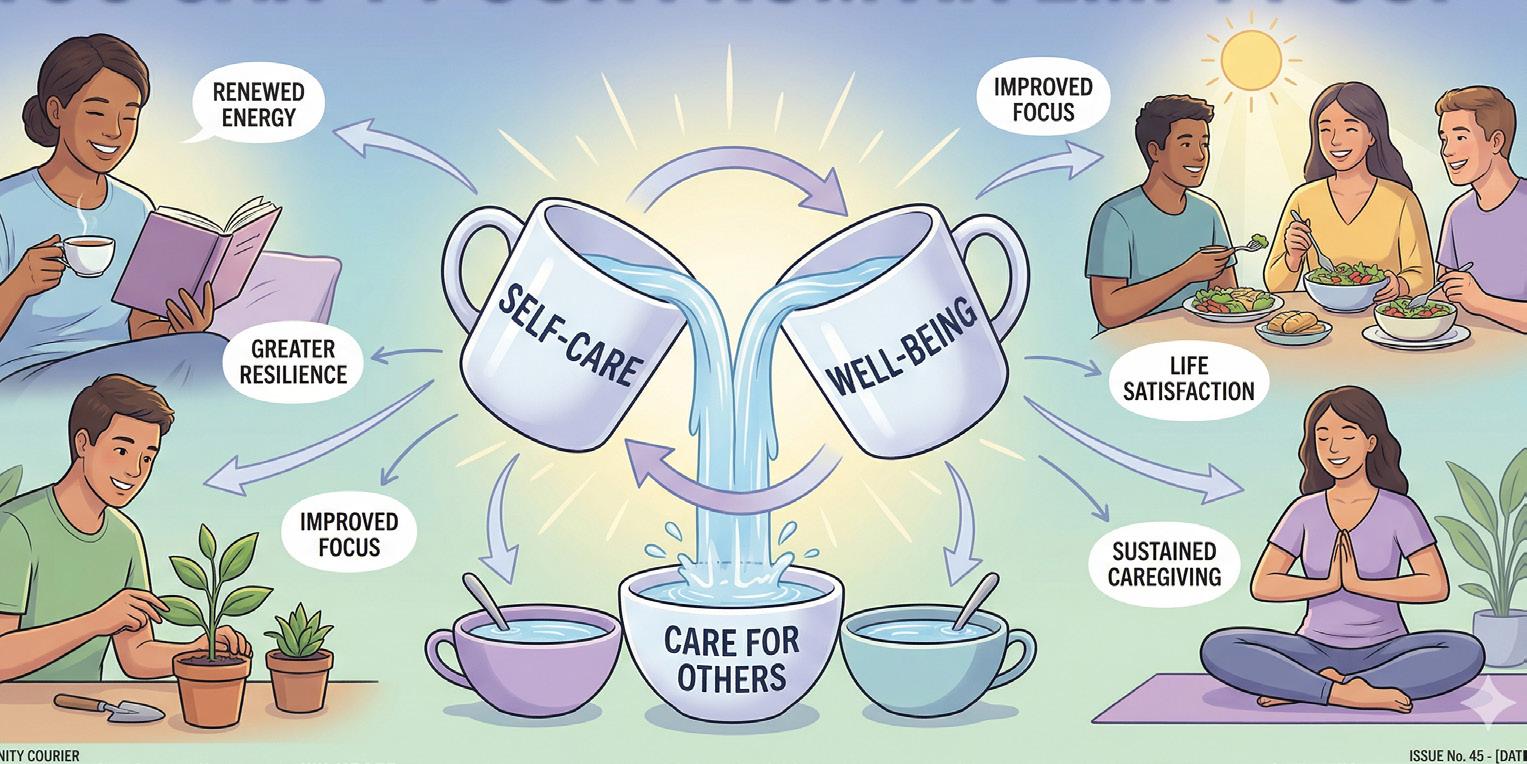
Organisations like Lifeline remind us that wellbeing is about regularly “recharging our battery” — through sleep, movement, connection, nourishment and doing things that bring us joy. Self-care doesn’t have to be expensive or time-consuming; it can be as simple as resting, talking things through with someone you trust, or taking a moment to pause and breathe. [lifeline.org.au]
Northern Health’s 5 Ways to Wellbeing captures this beautifully. It reminds us that wellbeing isn’t built through grand gestures, but through small, everyday actions that protect our mental health over time.
5 Ways To Wellbeing
Connection - Having people in our circle — friends, family, colleagues — who know us well enough to notice when something doesn’t seem quite right. People we can lean on, talk to, or simply sit alongside. We aren’t meant to do life alone, even though many of us have learned to try.
Being active — not in a punishing or prescriptive way, but through movement that feels kind to our bodies. A walk, stretching, gardening, or simply getting outside. Movement can help release tension we don’t even realise we’re holding.
Take notice — to pause, breathe, and be present. In busy lives, especially caring roles, we can live on autopilot. Taking notice helps us reconnect with how we’re really feeling and what we might need.
Keep learning is another gentle way we care for ourselves. Learning doesn’t have to mean formal study — it can be trying something new, staying curious, or rediscovering interests that bring a sense of purpose or joy.
Giving to others — which so many carers already do instinctively — can also support wellbeing when it comes from a place of choice, not depletion. Giving kindness, time or support can strengthen connection, especially when we are also allowing ourselves to receive care in return.
Sometimes looking after our wellbeing also means checking in with ourselves honestly. Beyond Blue offers a free, confidential online wellbeing checkin that can help people reflect on how they’re feeling and whether extra support might be helpful. It’s a simple way to pause and take stock, without judgement.
Our wellbeing isn’t something we “get to later.” It isn’t a luxury or an afterthought. It’s what allows us to keep showing up — for our work, our families, and our communities — with energy, clarity and heart.
Sometimes caring for ourselves looks small. But those small acts matter. They refill our cup. They help us stay well enough to keep living the life we want — not just getting through it.
Because wellbeing isn’t something we can afford to sacrifice.
Not in the long term.
Not for anyone.
If this article has raised anything for you, or if you’re feeling overwhelmed, you don’t have to face it alone. Lifeline is available 24/7 on 13 11 14 for confidential support.
RESOURCES:
Self-care for mental health and wellbeing | Lifeline
Wellbeing Action Tool - Beyond Blue 5 Ways To Wellbeing - Five Ways To Wellbeing Australia | Home



By Warren Strybosch
The general transfer balance cap is $2,000,000 from 1 July 2025. While this cap generally dictates the amount of super a person can transfer to a pension account, it also influences the amount of non-concessional contributions a person can make.
A non-concessional contribution is a personal contribution a person makes to superannuation for their own benefit, or for the benefit of their spouse. Non-concessional contributions are generally made from after-tax income or from other savings. A personal tax deduction is not claimable for nonconcessional contributions.
The non-concessional contribution cap is currently $120,000 per annum. In addition, a person aged 74 or younger at the start of a financial year can generally bring forward up to three years contributions and make a non-concessional contribution of up to $360,000.
This three-year bring forward cap is triggered when nonconcessional contributions made in a financial year exceed $120,000. When this occurs, the maximum that can then be contributed during the balance of the current financial year, and the next two financial years is capped at $360,000.
The ability to make non-concessional contributions and access the three-year bring forward opportunity is limited by a person’s total superannuation balance.
The total superannuation balance is the total of all superannuation accumulation and pension accounts a person holds, calculated on the previous 30 June.
Where a person’s total superannuation balance exceeded the general transfer balance cap (currently $2,000,000) they are unable to make any non-concessional contributions.
Where the total superannuation balance is between $1,760,000 and $2,000,000, the amount of non-concessional contributions that can be made under the three-year bring forward opportunity, is reduced.
Tony is 67 years old. He has some money available and would like to maximise his non-concessional contributions. His total superannuation balance on 30 June 2025 was $1,800,000.
Provided Tony had not triggered his three-year bring forward cap in the previous two financial years, he could make a non-concessional in the current (2026) financial year of $240,000.
Tony is unable to use the full three-year bring forward cap of $360,000 as his total superannuation balance on 30 June 2025 was between $1,760,000 and $1,880,000).
The following table sets out the maximum non-concessional contributions (NCC) that can be made depending on a person’s total superannuation balance (TSB).
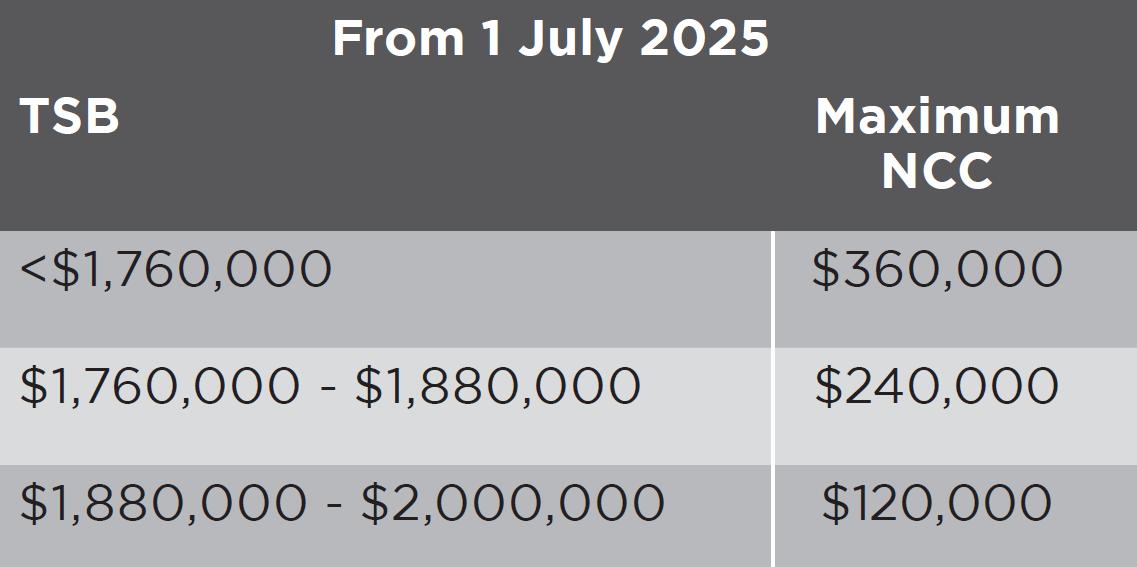
Referring to our previous example, if we assume Tony’s total superannuation balance on 30 June 2025 is less than $1,760,000, Tony would be able to make a nonconcessional contribution from July 2025 of up to $360,000.
But remember, irrespective of how much Tony can contribute into his super fund, if he wishes to commence drawing an income from his super, the maximum he will be able to transfer to a pension account will be $2,000,000.
Maximising contributions to superannuation, particularly for people with larger account balances, can be confusing. The essential ingredients to understanding the maximum nonconcessional contributions that can be made is the total superannuation balance calculated on the previous 30 June, and the history of non-concessional contributions made in the current and previous two financial years.
An appropriately qualified financial adviser should be consulted if planning to make significant contributions to superannuation as exceeding the contribution caps can have tax consequences.

Financial Planning, SMSF, Super, Insurance, PreRetirement & Retirement Planning (Financial Planning) are offered via Find Wealth Pty Ltd ACN 140 585 075 t/a Find Wealth, Find Insurance and Find Retirement. Find Wealth Pty Ltd is a Corporate Authorised Representative (No 468091) of Alliance Wealth Pty Ltd ABN 93 161 647 007 (AFSL No. 449221). Part of the
Centrepoint Alliance group (www.centrepointalliance.com.au/fsg/aw).
Warren Strybosch
Authorised Representative (No. 468091) of Alliance Wealth Pty Ltd.
This information has been provided as general advice. We have not considered your financial circumstances, needs or objectives. You should consider the appropriateness of the advice. You should obtain and consider the relevant Product Disclosure Statement (PDS) and seek the assistance of an authorised financial adviser before making any decision regarding any products or strategies mentioned in this communication.
Whilst all care has been taken in the preparation of this material,itisbasedonourunderstandingofcurrentregulatory requirements and laws at the publication date. As these laws are subject to change you should talk to an authorised adviser for the most up-to-date information. No warranty is given in respect of the information provided and accordingly neither Alliance Wealth nor its related entities, employees or representatives accepts responsibility for any loss suffered by any person arising from reliance on this information.





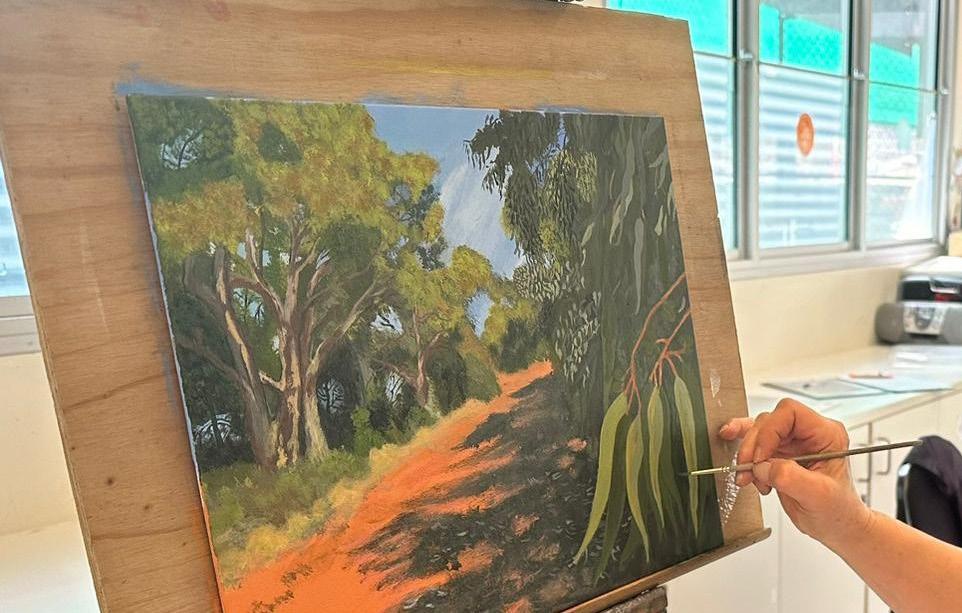
Art of Painting and Drawing Returns 20 April
Mondays 10am - 12pm
9 sessions | Full $226 Conc $210

Gentle Yoga Returns 20 April
Mondays 6.30pm - 7.30pm 9 sessions | Full $146 Conc $136

Applique Guild of Australia
Fourth Saturday every month
9.30am - 3pm
$5 per session

Introduction to using computers (Windows)
Begins 21 April
Tuesdays 9.30am - 12.30pm 9 sessions | ACFE $57 Conc $32

Gardening Employability Skills Returns 20 April
Mondays 10am - 1pm 9 sessions. ACFE $57 Conc $32

Walking Group Returns 21 April
Tuesdays 9.30am - 11.30am $3 per session

Cook with Teta Begins 8 May Fridays 10am - 12pm 4 sessions | $10 per session

Playgroup (parent-led)
Returns 4 February
Wednesdays during Term 10am11.30am

For More Info on other Work Shops at ANH, kindly Scan the QR code.
Monday
9.15am Hatha Yoga (Class 1)
10am Art of Painting & Drawing
10am Gardening Group
10.30am Hatha Yoga (Class 2)
1.30pm Smartphones and Devices
2pm Tai Chi / Qigong
5pm Social Fitness
6.30pm Gentle Yoga
9.30am Walking Group
9.30am Introduction to Computers
9.30am Mediterranean Summer Cooking Class
1pm Bridge Club
2.30pm Choir
4.30pm Ukelele
6.15pm Circuit Exercise
Thursday Friday
9.30am EmpowerAbility Social Enterprise Skills
10am Onemda Work Skills
10.15am International Women’s Group
12.30pm Office Essentials
6.30pm Life Drawing (1 Thursday each month) st
7pm Restorative Yoga
9am Active Ajani
10am Cook with Teta Saturday
9.30am Applique Guild (4 Saturday each month) th
10am Sewing Guild (2 Saturday each month) nd
2pm Carer Connections (3 Saturday each month) rd
2pm Coloured Threads (2 Saturday each month) nd
www.facebook.com/ajanineighbourhoodhouse

9am Ajani Active
9am Live Fit For Men
10am Playgroup
10am Balance, Posture & Stretching
2.30pm Meditation
12pm Watercolour Painting for Beginners 5pm Social Fitness
Not sure which class to try?
Our $5 trial pass lets you try out any of our regular Term classes to see which one suits you best.



The Manningham community is set to benefit from a $2 million investment in road safety through the Victorian Government’s Safe Local Roads and Streets Program.
Manningham Mayor, Councillor Jim Grivas, said the funding will help deliver carefully planned local infrastructure improvements to enhance safety for all road users.
“We’ve worked closely with the Transport Accident Commission and the Department of Transport and Planning to identify priority projects that will deliver the greatest safety benefit for our community,” Cr Grivas said.
“Projects have been selected based on a range of criteria, including risk ratings, project readiness and alignment with best-practice road safety design.
“This funding allows us to focus on practical, data-led improvements that make a real difference to how people move around Manningham, whether they’re walking, cycling or driving,” Cr Grivas said.
Eleven projects have been identified to deliver critical safety improvements across low-speed, mixed-use roads and intersections, as well as high-speed local roads.
Construction is planned to begin in May, with works delivered progressively over approximately 10 months at the following locations:
• Stintons Road Corridor, Park Orchards
• Jackson Court Shopping Centre, Doncaster East
• Egan Drive, Bulleen
• Tower Street, Doncaster East
• Doncaster Hill side streets, Doncaster
• Donburn Shopping Centre, Doncaster East
• Rosella Street, Doncaster East
• Serpells Road, Templestowe
• Harris Gully Road and Beauty Gully Road, Warrandyte
• Harris Gully Road and Tindals Road, Warrandyte
• Reynolds Road and Tindals Road, Donvale
Manningham Council will work closely with residents, traders and road users to minimise disruption during construction, with advance notice provided ahead of works at each location.
For more information, including maps for each project, visit Safe Local Roads and Street Program | Manningham Council or contact Council on 9840 9333 or at manningham@manningham. vic.gov.au.

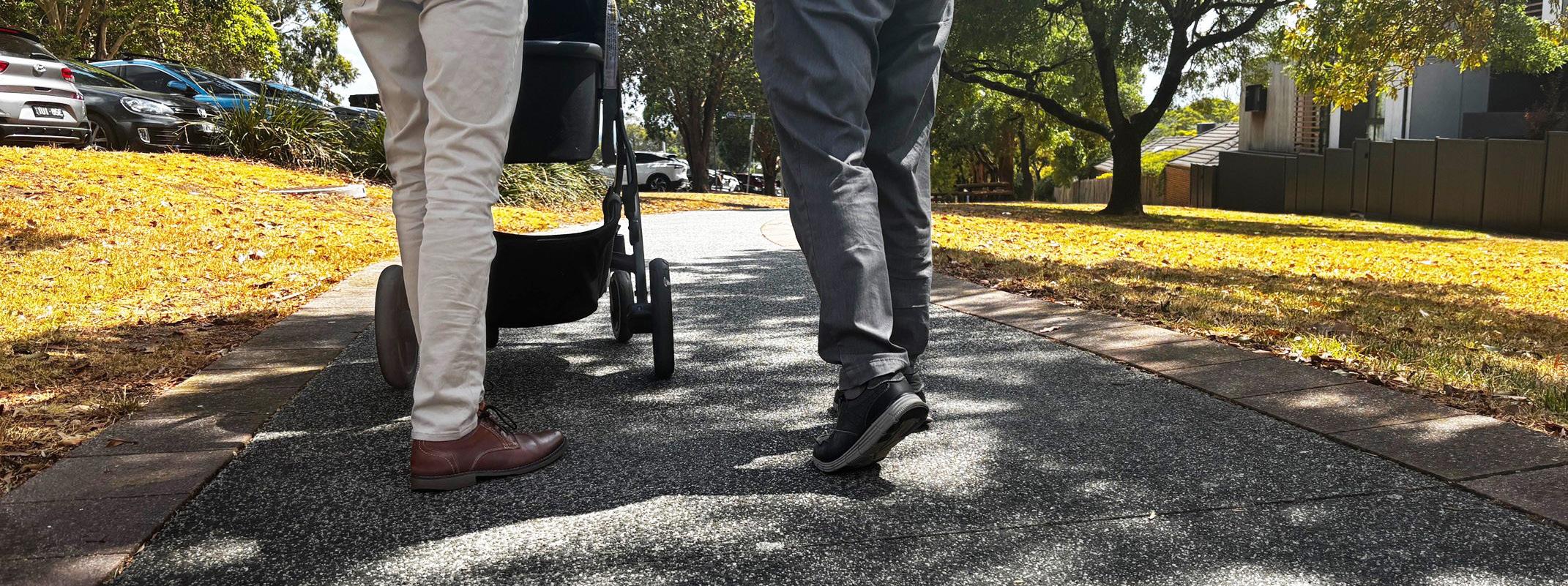

Manningham Council is inviting residents to help shape the future of local footpaths by sharing their insights into how they use footpaths and providing feedback on a new draft Footpath Policy.
The draft policy aims to establish criteria for where new footpaths should be provided and outline a fair and transparent approach to funding and prioritisation.
Manningham Mayor, Councillor Jim Grivas emphasised the importance of community input in shaping the future of the Manningham’s footpath network.
“Footpaths play a big role in everyday life, whether you’re walking to the local shops, heading to the nearest bus stop, walking children to school or simply getting some fresh air and exercise,” Cr Grivas said.
“While our current system has served us well, we want to make sure our longer term planning reflects what matters most to our community.
“Your feedback will guide improvements to help Council plan, prioritise and invest in footpaths that meet the needs of the community now and in the future – creating a more connected and inclusive Manningham,” Cr Grivas said.
Feedback on the draft policy and community experiences using footpaths will be considered together to help shape the final policy.
Have your say yoursay.manningham.vic.gov.au/footpathpolicy-2026 by Sunday 19 April 2026.

Manningham Council has officially launched nominations for the 2026 Manningham Community Awards.
Mayor, Councillor Jim Grivas, encouraged Manningham residents to get behind the awards program, which has 8 categories available for nomination.
“We have so many amazing people and groups doing incredible things in Manningham,” Cr Grivas said.
“This is our opportunity to recognise the efforts of those truly special people and groups who make such a difference and thank them for their service to our community,” Cr Grivas said.
Winners will be announced at a gala Awards Ceremony on Thursday 13 August 2026. One overall winner will be named Manningham Citizen of the Year.
The award categories are:
• Doreen Stoves Excellence in Volunteering
• Active Community
• Ageing Well
• Artistic Achievement
• Community Excellence
• Community Health and Wellbeing
• Inclusive Community
• Young Achiever
Cr Grivas commended the winners of 2025 awards, including Citizen of the Year and Doreen Stoves Excellence in Volunteering Award winner, Leon Moore.
Leon Moore is a passionate volunteer who established the Laughing All Abilities Really Friendly Singers (LAARFS) choir.
Leon said that LAARFS had grown from a group of 5 stroke survivors to more than 100 people, including those with chronic conditions such as Parkinson’s disease, dementia, multiple sclerosis and cancer, as well as others seeking connection and community.
“We have wonderful stories, we have had folks here who have had a traumatic brain injury, who have started speaking again. People who feel they can now make a noise,” Leon said.
“We have only 2 rules, no negativity, no criticism. The benefit is to allow people to grow … to find their own strengths.
“We don’t see disabilities, we only see abilities and focus entirely on that,” Leon said.
Nominations for the Manningham Community Awards are open until 5:00pm on Wednesday 3 June.


Request of Government
We ask the Federal and State Governments to provide $15 million in funding to assist in the delivery of this project.
• Aquarena is Manningham’s sole aquatic centre. The outdoor area (built in 1960s) is a much-loved space, however, is at the end of its lifespan and requires a total refresh.
• This facility serves the entire municipality and the broader eastern region, receiving 1.14 million visits annually. Without this redevelopment, Manningham Council will struggle to effectively accommodate the growing demands of the community and the delivery of essential health and wellbeing outcomes.
The solution
In 2023, we asked our community what was important to them when visiting Aquarena and their priorities were; an improved café space, water play and dedicated space for school carnivals.
Following this feedback, high level designs were prepared to bring Aquarena up to a contemporary standard, which include:
• New 50m outdoor pool with swim wall to provide flexibility to run 50m and 25m lanes, plus an accessibility ramp into the water.
• New family zone – interactive water play, splash pad and toddler pool.
• Spectator seating and dedicated change rooms for schools and squads.
• Sun-smart shade structures throughout the site Improved spaces for social connections with a new cafe to serve into the indoor pool hall, new indoor seating area and outdoor deck
• Our wellbeing
• Removal of gas boilers, and replacement with energy efficient electric plant to future-proof the facility and better meet our emissions targets.
• Ideally construction would commence in early 2026 and will take approximately fifteen months to complete.
Project benefits
• These enhancements aim to create a more welcoming, modern and functional environment for all visitors.
• The redevelopment will promote active participation, fitness, social connection and a sense of belonging.
Project contact
• Emma Michie, Manager Community Participation