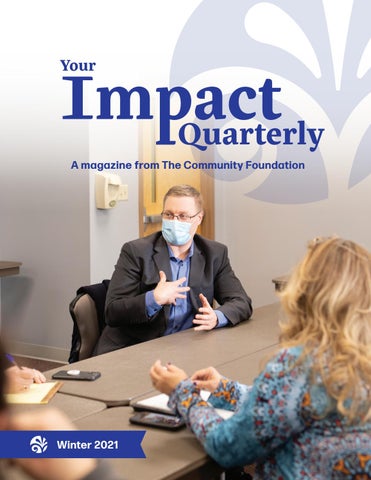
A magazine from The Community Foundation
Winter 2021
Letter from the Foundation President I am pleased to present Your Impact Quarterly, a new magazine publication from The Community Foundation. You will receive a printed magazine like this one twice per year along with our e-newsletter. If you don’t already receive the e-newsletter you can sign up on our website. Through this magazine, we will share stories of projects, collaborations and change that you, our donors, made possible. This month marks one year since the world turned upside down due to the coronavirus pandemic. In a year unlike any other, the Foundation continued pursuing our mission to improve the quality of life in Hancock County by partnering with you to serve those in need. In the inaugural issue of Your Impact, we tell a story of the eviction prevention program, a collaborative effort to keep our family, friends and neighbors safe in their homes during this critical time. This is just one example of how your gifts have changed, and potentially saved lives. I cannot overstate how grateful I am. From your support to the work of local nonprofits organizations, to the service of healthcare workers, frontline responders and many more, there are too many people to thank by name. But know that you made a difference in the lives of many in 2020 and will continue to do so in 2021. As we continue to navigate the impact of the pandemic, the Foundation will support the work taking place to care for our neighbors and recover from the aftereffects. I invite you to give to the Community Emergency Support Fund to be a part of this work as well. So far, nearly $300,000 has been awarded from this fund and we hope to continue to make grants so long as dollars are available. Yours in service,
Brian P. Treece, Ed.D. President & CEO – The Community Foundation
Table of Contents
04 09 10 11
Averting Catastrophe Foundation Coronavirus Response New Funds Established Financials, Events and Updates
Averting Catastrophe Eviction Prevention Collaboration Alleviating Pandemic-induced Housing Plight By Joy Brown Hope House personnel are accustomed to empathetically addressing the region’s most sorrowful housing situations, but the COVID-19 pandemic has added a layer of anguish that makes them pause and choke up when articulating the problem. With lives and livelihoods threatened in unprecedented ways, more people here are hurting like never before, they said. Locking eyes in passing in a Hope House hallway with a fellow mask-clad, middle-class mother hammered home for Director Sue Lehman the heightened level of Hancock County eviction hardship. Counseling a solidly self-sufficient but recently laid-off grandmother, responsible for raising her grandchild solo, in the ways of 4 | Averting Catastrophe
financial assistance to avoid getting forced out of their home shook program supervisor Starr Laytart, L.S.W. Contending with a client whose fear of exposing his immunocompromised child to the virus therefore prevented him from going to work has been a heartbreaking example of calamitous love, explained Missy LaRocco, pro bono director/managing attorney of Legal Aid of Western Ohio, Inc. “The numbers have risen astronomically” since the pandemic, said Lehman of people accessing Hope House services. For the first two weeks of October, the organization’s intake load increased by 75% more than it did for the entire month of September.
Systemic Support The region’s disastrous eviction situation immediately drew the attention of The Community Foundation and several other nonprofits. During a virtual meeting TCF hosted this past spring, representatives unanimously agreed that eviction was, and continues to be, the most pressing pandemicinduced public assistance imperative. Economic contraction, the resulting unemployment spike and, in some instances, health-related hardships have exponentially exacerbated the region’s already-problematic rental housing market. Far more individuals, many of them long-established financially stable wage earners, can no longer afford to pay their rent. Those working throughout the nation within the nonprofit sector point out that two federal eviction moratoriums haven’t been enough to stave off the surge. “Even with the moratorium, Hancock County continues to see evictions,” said newly appointed TCF President Brian Treece, who was instrumental in gathering nonprofit partners at the pandemic’s start to pinpoint how organizations could best leverage their offerings and CARES Act dollars. Many available rentals to those with an eviction on their record are substandard or even dangerous, said LaRocco. To make matters worse, the eviction problem isn’t expected to let up any time soon. When the second moratorium expires at the start of 2021, an estimated $25.1 billion to $34.3 billion in back rent will be owed, and up to eight million people will be facing eviction filings, according to a housing tracking tool developed by the global advisory firm Stout Risius and Ross. To place that last figure in perspective, an Oct. 19 Reuters story reported, “In a typical year, 3.6 million people face eviction cases, according to the Princeton University Eviction Lab, a national housing research center.” The local problem’s criticality necessitated a rapid response. The result: Housing Help Line establishment through the new Eviction
Prevention Task Force (EPTF). The group, led by Hope House, is focused on offering direct rental relief to keep people in their homes while they continue to find jobs and identify other bill payment options. In April, $255,000 was secured for this effort, including $155,000 from TCF’s William D. Frack Field of Interest Fund, M. Margaret Foster Women and Children Field of Interest Fund, a COVID-19 fund and unrestricted funds; $20,000 from Hope House CARES Act money from the Ohio Development Services Agency; and $50,000 from the HHWP Community Action Commission. Another funding infusion came in September from Hancock County government, which awarded $500,000 for emergency assistance for individuals and households facing a COVID-19-related eviction and/or utility shut off. The county commissioners are well aware of residents’ dire situations created by job loss, reduced work hours, daycare closings, quarantining, illness, and caregivers to immunocompromised individuals. Treece expressed gratitude for the monetary assistance made possible thanks to Hancock County Commissioners Timothy Bechtol, Mark Gazarek and Brian Robertson; county Auditor Charity Rauschenberg; and City of Findlay Mayor Christina Muryn. “This need is far bigger than charity alone” can accommodate, Treece said. Also contributing expertise and resources to this significant and complicated community wide endeavor are Legal Aid of Western Ohio, Inc.; Habitat for Humanity of Findlay/Hancock County; Hancock County Metropolitan Housing Authority; Hancock Christian Clearing House; FOCUS; Hancock Properties Foundation; the University of Findlay; area landlords; and United Way of Hancock County. During the first funding round, 2,000 tenants in need of assistance was too much for the EPTF to immediately handle. Therefore, a sliding fee scale was developed to provide 150 families with three months of rent assistance ($200,000 total) and 50 families with one-time assistance of $25,000.
Your Impact Quarterly | 5
By the Numbers: The local statistics speak for themselves Shortage of 2,500 units
70% of individuals
161 school-aged children
3.8% to 17.3% increase
for individuals making less than $35,000 annually, prior to the pandemic
who are homeless here were working before the pandemic began and had income upon intake at Hope House
in Hancock County were homeless in 2018.
The pandemic caused Hancock County’s unemployment rate to spike from March 2020 to April
• A local government and multiagency 2020 housing market study found a 97% multifamily apartment occupancy rate and only 30% of rental homes designated as single family. • The EPTF estimated 2,000 households would need emergency rental assistance come late summer 2020, with many more expected down the road. • Six months was the average relayed in a recent survey that asked local nonprofits how long they think they’ll be able to last without having to tap into additional resources or altar their operations. • More than 80% of those completing intakes for COVID-19-related assistance at Hope House have never accessed services in the past, which means the pandemic has forced many middle-class families into the low-income spectrum • Of the 9,509 Hancock County renters in spring 2020, 4,111 were paying more than 30% of their gross income on housing costs, putting them into the cost-burdened category.
Hundreds have received Housing Help Line assistance thus far. As of Oct. 16, more than $220,000 in emergency rental assistance funds had been used to serve 97 households comprised of 247 people. There had been 140 intakes totaling 361 people, said Lehman. All have different stories to tell, and all have desperately needed the support. Carla (name changed to ensure privacy) is a case in point. In January, Carla, a single mom to two young children, had just entered the workforce after her marriage ended. Between her job as an elementary school aid and child support, she was able to make ends meet. That changed in March with her pandemicrelated layoff. With no safe and affordable childcare alternatives, no job, and being ineligible for unemployment because she had only worked a short time, Carla found herself in an unprecedented Catch-22 situation. Hope House employees said she had never used 6 | Averting Catastrophe
any support services and had no idea where to ask for help. Her landlord, a Hope House ally, directed her to the agency, which was able to provide her with emergency assistance and prevent a catastrophic event of homelessness for her family.
Service Sector and Societal Consequences A portion of the local grant funding is being used to pay for additional staffing needs; Lehman said some part-time nonprofit workers’ hours have been increased. This eviction prevention collaborative is being conducted as an additional community service, thereby further extending a traditionally busy network. But the long-term benefits are clear. Organization members say that, along with directly assisting families in need, like Carla’s, this stabilization funding will, in turn, lessen the burden on area nonprofits.
Evictions can detrimentally affect families for decades or indefinitely and can have a generational impact. A legal eviction leaves a permanent record, which often prevents people from finding future housing. Even an eviction filing can harm an individual’s chances at alternative housing; Hope House workers say some landlords won’t dig further into court records to find out if the eviction actually occurred.
with other agencies if needed, gain trust, and otherwise guide first-timers through this traumatic experience. “We serve the whole person. We don’t just serve a house. In a nonpandemic year, this is hard work,” she said. “We treat people no matter who they are or where they come from… with dignity and respect. If you don’t qualify for something, we will work hard to connect you with where you need to be.”
Homelessness can then cause a hardship Some have only needed one month of rent cascade that is difficult to mitigate, and the to stabilize themselves. Others, however, are pandemic is exacerbating more tapped out. those issues. Children “People are coming to us required to learn online well behind” on payments lose internet access, are We treat people no of all kinds, said Lehman. often forced to switch matter who they are or Nationally, approximately schools, and are further 63% have sold off assets where they come from… exposed to the virus. The to pay for rent by actions physical health and mental with dignity and respect. such as cashing out well-being of all involved retirement accounts, If you don’t qualify for can take its toll. Moreover, paying with credit cards the societal costs rise something, we will work and depleting their savings exponentially as more hard to connect you with accounts. seek public assistance. where you need to be. Researchers at New Assistance that’s tied York University and the to federal funding can Federal Reserve Bank of often be confusing and Philadelphia examined the costs of homeless frustrating for anyone because it often comes shelter provision, emergency room use and with parameters that can deny needed help diminished earnings to estimate the average to people who acquire mere pennies more social cost of each eviction filing: $8,000 in than the cutoff, LaRocco said. It’s called the New York state, or approximately $5,000 when “benefits cliff,” and it refers to the sudden adjusted for Ohio costs. Conclusion: it costs decrease or denial in public benefits that can less to try to prevent an eviction than it does occur when individuals experience a minute to help someone financially, physically and earnings increase. Even some who were emotionally recover from one. receiving federal housing assistance before the pandemic are forbidden to provide a comfy Nonprofits are taking note of the sharp couch for friends and relatives to sleep on increase in traditionally middle-class families temporarily because of strict guidelines that asking for assistance. Their first-time status prohibit any extra occupants, she said. If they means they must not only be educated about do offer such help, they could face eviction the aid process from the ground up but are struggling mightily with the humbling and what themselves. some consider to be humiliating act of having to ask for such help. “We treat people no matter who they are or where they come from… with dignity and “There are a lot of tears,” said Laytart, who respect,” said Laytart. “If you don’t qualify detailed the great effort it takes for nonprofit for something, we will work hard to connect workers to listen, sympathize, encourage, you with where you need to be. We never just explain how things work, connect people
“
“
Your Impact Quarterly | 7
do things halfway here. We don’t want to see this together,” said Treece. people come back. It’s a beautiful thing to offer “The collaboration has been phenomenal,” hope, guidance, support and a listening ear.” said Lehman. “Relationships were good before, Who is listening to nonprofit employees as but this has heightened those. We’ve been able they adjust to this new normal? to forge trust in a process. We’re willing to take on whatever is needed to make this work.” “Our staff are facing our own personal challenges with COVID-19. We’re watching Consequently, in hundreds of instances so our case managers” for burnout, said far, tears that have fallen from frustration and Lehman. “They’re doers, they feelers, they’re fear have turned into tears of relief as families professionals and their hearts are invested.” receive essential stopgap help with rental payments. do things halfway here. We don’t want to see people come back. It’s a beautiful thing to offer Given the problem’s extent, and the pandemic’s hope, guidance, support and a listening ear.” uncertain effect on future economic developments, Eviction Prevention Task Force Who is listening to nonprofit employees as members say they are committed to offering they adjust to this new normal? rental assistance through the end of this year. “Our staff are facing our own personal Hope House workers say they’re grateful challenges with COVID-19. We’re watching for this year’s funding that has provided our case managers” for burnout, said emergency relief and much-needed longer Lehman. “They’re doers, they feelers, they’re term stabilization for individuals and professionals and their hearts are invested.” community nonprofits.
Relief Pitchers The rental crisis, however, has also strengthened community partnerships and encouraged organizations to work together in uncommon ways. Local leaders partly credit the Center for Civic Engagement with laying the groundwork for such collaboration; the Center’s mission is to connect resources for enhanced services to address challenges ranging from food insecurity to illiteracy.
“January 2 holds the key to how the beginning of 2021 will play out as it marks the end of the current moratorium on evictions,” said Lehman. Statistics and empirical evidence shows there are many households still in need of rental assistance who have not yet reached out for help, she noted. “We know the economic impact of the pandemic will not be short-lived,” Lehman said.
Hancock County’s eviction prevention effort “is only possible because everyone is doing
How You Can Help Donate directly to individual community nonprofits that are assisting with the housing crisis. At The Community Foundation, give to the Community Emergency Support Fund. At Hope House, visit www.findlayhopehouse.networkforgood.com. 8 | Averting Catastrophe
Foundation Coronavirus Response $300,000
10
$145,000
$1.3M
awarded in grants
number of grants awarded
contributed by donors
awarded in Donor Direct Grants
$2M
5
state/federal dollars leveraged through advocacy work
trainings focused on pandemic response and recovery offered to nonprofit organizations
Nonprofit Spotlight Humane Society & SPCA of Hancock County Despite the challenging times we’re living in, the Humane Society continues to care for our furry friends and neighbors. Consider any of the following funds at www.community-foundation.com to help to advance their mission to educate the public on care and responsible treatment of animals; to humanely provide for and protect unwanted, lost and abused animals; and, to create a quality environment for all animals through its policies and presence in the community. • Daisy Fae Grieser Legacy Fund for Humane Society • Humane Society & SPCA of Hancock County Fund • libbi and friends >^^< legacy fund • Louie Foster Humane Society Fund
Your support of their work is appreciated! Your Impact Quarterly | 9
New Funds These funds are new to the Foundation since our last publication in June 2020. John G. and Pauline A. Andrews Memorial Fund
This fund, established by the Andrews’ family, will support several nonprofit organizations they were passionate about including Christian Clearing House, Findlay City School District’s school nurses department, First Presbyterian Church of Findlay, Habitat for Humanity of Findlay/Hancock County, Hancock Historical Museum, and Hancock Parks District’s Riverbend Recreation Area.
John G. and Pauline A. Andrews Memorial Scholarship
This scholarship fund, established by the Andrews’ family, will support a graduating senior from Findlay High School.
Community Emergency Support Fund
This fund will be used for response and recovery efforts during community emergencies, like the coronavirus pandemic.
Catherine and DeBow Freed Community Support Fund
The Freeds established this fund through their estates to support organizations close to their hearts, including the University of Findlay; Mazza Museum; Town and Campus Club; City Mission; Girl Scouts of Western Ohio; Boy Scouts of America, Black Swamp Area Council; Hancock County 4-H; and Hancock County FFA programs.
Judy Hall Music Scholarship
This scholarship, established by friends and family in honor of Judy’s outstanding career, will support a Findlay City Schools graduate pursuing a degree in music.
Hancock Literacy Fund
This fund benefits Hancock Literacy and its programs providing lifelong literacy support to all Hancock County residents.
Kathy Kreuchauf Future Generations Fund
This fund was established in celebration of Kathy’s 12 years of leadership of The Community Foundation. In her time as President, Kathy helped the organization triple in size and develop its community leadership platform.
Katherine L. and Roy R. Schwinn Scholarship
This scholarship was established by Katherine Schwinn through her estate plan to benefit a graduating senior from Findlay High School who will major in music or business.
Roy R. and Katherine L. Schwinn Scholarship
This scholarship was established by Roy Schwinn through his estate plan to benefit a graduating senior from Cory Rawson High School who will major in agriculture or business. 10 | New Funds
Finance Update The Foundation Pooled COMPOSITE returns vs. the benchmark as of December 31, 2020 were as follows: •
For the 1-yr period, the Total Return was +14.8% vs.+13.0%.
•
For the 3-yr period, the Total Return was +8.1% vs. +8.2%.
•
For the 5-yr period, the Total Return was +9.6% vs. +9.5%, and the FHCCF Hurdle ROR of 7.5%
•
For the 10-yr period, the Total Return was +7.3% vs. +6.9%, and versus the FHCCF Hurdle ROR of 7.3%
Upcoming Events Handbags That Help Celebration Meeting Wednesday, April 14 at 5 p.m. (via Zoom) Public Listening Tour Meetings Tuesday, March 23 at 12 p.m. Thursday, April 24 at 6 p.m. Via Zoom – RSVP on our website
Foundation Updates The Foundation is excited to announce changes coming to our website soon. We will implement a new, userfriendly giving platform and a portal for fundholders. Stay tuned for more.
Design AR Marketing Printing Millstream Kennedy Writing Joy Brown & Genna Freed Photography AR Marketing Your Impact Quarterly | 11
www.community-foundation.com 101 W. Sandusky St., Suite 207, Findlay, OH 45840 | (419) 425-1100