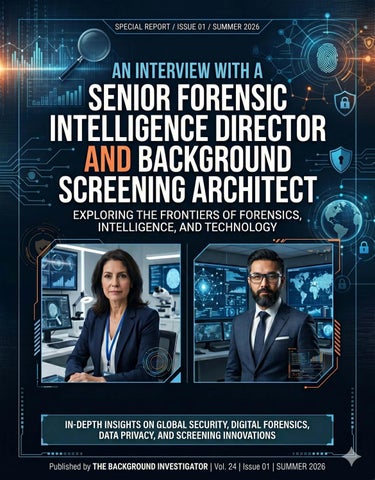
“An Interview with a Senior Forensic Intelligence Director and Background Screening Architect”
Editor’s Note: To protect ongoing risk-mitigation operations and client confidentiality, the screening pioneer interviewed for this piece spoke under the condition of anonymity. They are referred to here as Forensic Director
The modern workplace has completely decoupled from geography. Companies in New York can hire Virtual Research Assistants (VRAs) in Manila, developers in Berlin, and data managers in Austin. But this borderless, remote-first ecosystem has spawned a dark side: a massive surge in sophisticated identity fraud, resume manipulation, and corporate espionage. To understand how the background screening industry must evolve, we sat down with Forensic Director, to discuss why traditional public-record checks are failing, and how the integration of criminalistics and digital forensics is defining the future of workplace security.
Interviewer: Let’s start with the hard truth. Most companies believe their current background check process keeps them safe. Why do you argue that the traditional system is broken? Forensic Director: The traditional background check model was built for a world that no longer exists. It is a commoditized system. An employer pays $30, a software platform scrapes automated commercial databases, and a "clean" or "hit" report is generated. This worked fine when people walked into a physical office with local references. In a remote-first economy, that $30 automated check is a dangerous illusion of security. If a sophisticated threat actor uses a stolen or synthetic identity that has no criminal history attached to that specific name, the database returns a perfectly clean result. Automated checks verify text on a screen; they do not verify the authenticity of the human or the data behind it. Interviewer: You frequently talk about the rise of "Virtual Research Assistants" and remote resource associates introducing massive vulnerabilities. What are the specific threats employers are missing?
Forensic Director: We are seeing a massive increase in two specific scams: digital credential forgery and "double-brokering." With generative AI and basic image editing, creating flawless fake diplomas, employment letters, or altered federal and military discharge papers is incredibly easy. Standard screeners just look at the PDF and mark it as "verified." Even worse is double-brokering. A company interviews and hires a qualified, vetted virtual assistant. Once onboarded, that assistant silently hands their login credentials and access keys over to an unvetted, cheaper sub-contractor overseas to do the actual work. The employer thinks their data is with a trusted asset, but it has actually been outsourced to an unknown third party. Standard background checks are completely blind to this. Interviewer: Your firm advocates for a "forensic screening process." How does treating a background check like a criminal investigation change the workflow? Forensic Director: Traditional screening asks “Does this person have a record?” Forensic screening treats the applicant’s identity, credentials, and digital footprint as electronic evidence that must be scientifically validated. We focus on four forensic pillars: 1. Digital Evidence & Metadata Auditing: We don’t just read a submitted resume or diploma; we run deep metadata extraction. If a PDF’s internal creation dates, editing timestamps, or author names don't align with the candidate's stated timeline, it’s flagged as a digital forgery. 2. Geographic Telemetry: We track the physical routing of the applicant's digital footprint during onboarding. By analyzing IP histories, network headers, and device fingerprinting, we ensure their actual digital location matches their claimed physical residence. This instantly kills double-brokering scams. 3. Deep-Web OSINT: We look beyond Google. We use Open-Source Intelligence to scour data breach repositories and alternative forums to see if the candidate's emails or usernames are linked to darknet marketplaces, credential-selling rings, or corporate data leaks. 4. Modus Operandi (MO) Analysis: If a candidate has a past criminal hit, we don't just check a box. We send researchers to pull the original police narratives and court dockets to analyze the method of execution. Did the past offense involve social engineering, tech abuse, or systematic fraud? That’s how you predict insider-threat risks.
Interviewer: This sounds highly intensive. The obvious counter-argument from HR departments is going to be the cost. Forensic vetting can cost hundreds of dollars per candidate compared to a cheap automated sweep. How do you justify that expense? Forensic Director: It is an expensive process, and we are very transparent about that. High-level digital forensics, manual court pulls, and specialized software licensing drive up the price. Because of that, you don't use this for every entry-level, low-risk role. But if you are hiring a VRA who handles proprietary intellectual property, a remote financial manager with access to capital, or an IT developer who can inject code into your infrastructure, a single hiring blind spot can result in catastrophic financial or legal ruin. In those high-consequence sectors—like FinTech, aerospace, healthcare, and critical infrastructure—the cost of a forensic check is rounding error compared to the cost of a multi-million dollar data breach or a corporate espionage lawsuit. Interviewer: Looking ahead, how do you see the background screening business adapting? What is the ultimate takeaway for business leaders? Forensic Director: The future lies in tiered screening architectures. Screening firms must stop selling a one-size-fits-all product. Employers should use fast, automated sweeps for low-risk, localized positions, but mandate rigorous, forensic-level vetting for high-access, virtual, or executive roles. Identity has become incredibly fluid in the digital age. If business leaders want to protect their companies, they must stop viewing background screening as a simple administrative checkbox and start treating it as a critical branch of forensic intelligence.