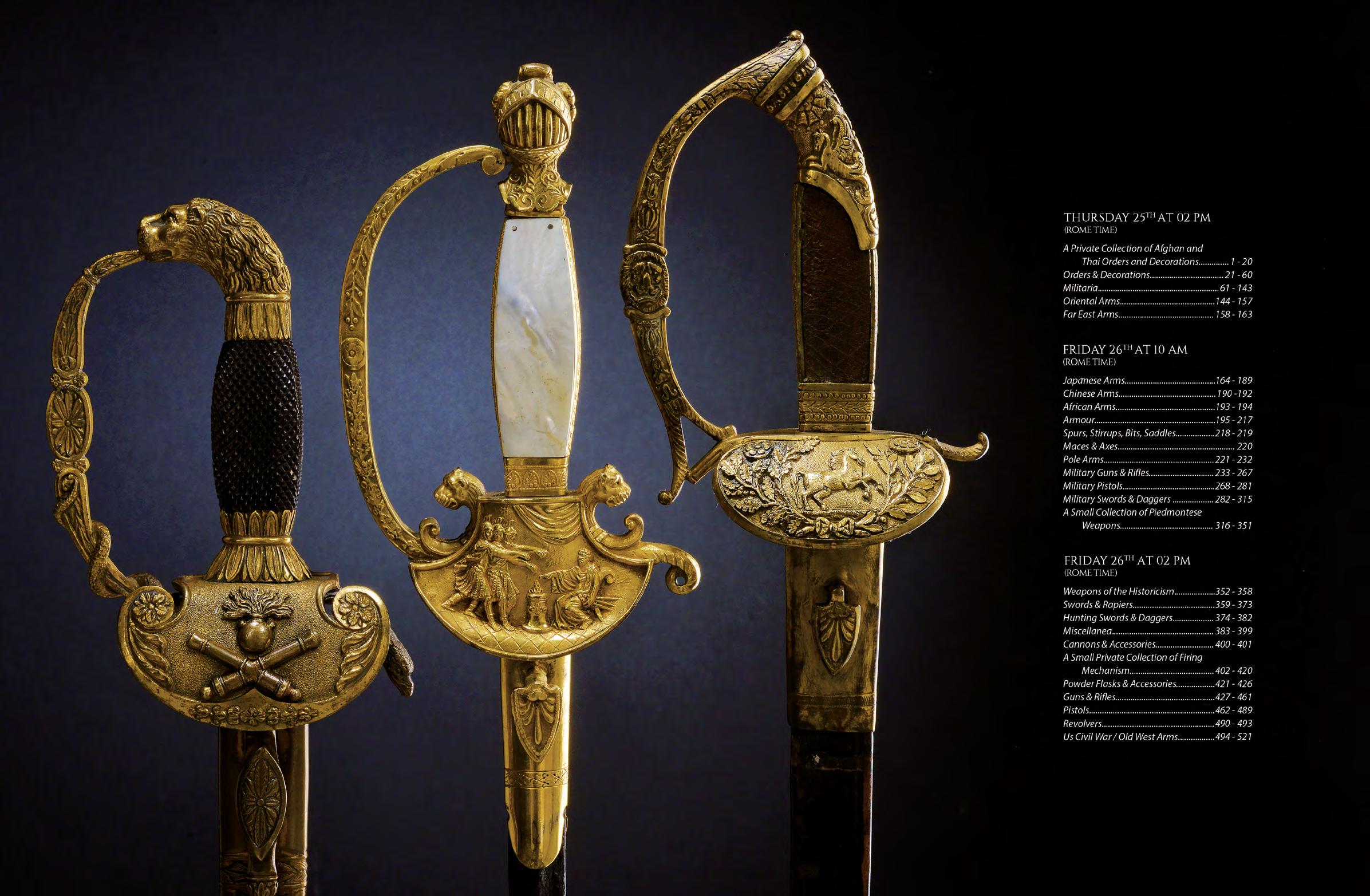
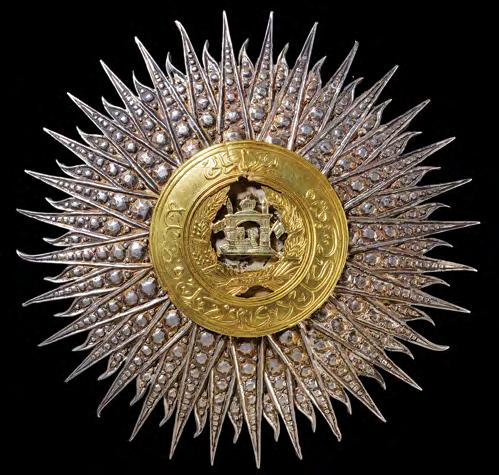
1 ORDER OF THE SUPREME SUN (NISHAN-I-LMAR-IALA)
Afghanistan, 1973 - 1978
Silver plate with a gilded medallion; on the back, a vertical brooch engraved between two hooks. Mohammad Daoud Khan Republic period.
ORDINE DEL SOLE SUPREMO (NISHAN-ILMAR-I-ALA)
Afganistan, 1973 - 1978
Placca in argento con medaglione dorato, sul retro spilla verticale incisa e posta tra due ganci. Periodo: Repubblica di Mohammad Daoud Khan.
Conditions very good Diameter 7.8 cm.
€ 40/80
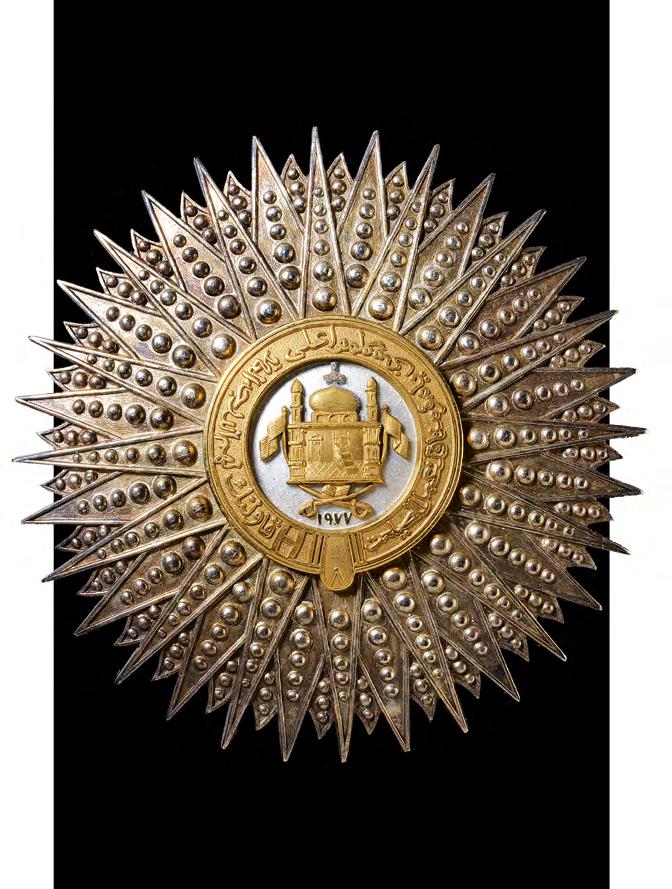
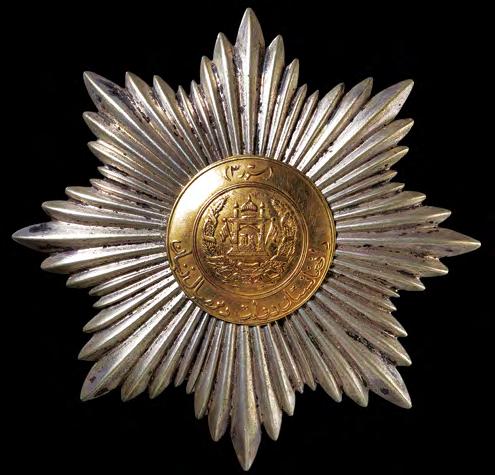
2 ORDER OF THE SUPREME SUN (NISHAN-I-LMAR-IALA)
Afghanistan, 1919 - 1973
Silver pendant necklace with an openwork medallion. Inscription in Arabic on the back.
ORDINE DEL SOLE SUPREMO (NISHAN-ILMAR-I-ALA)
Afganistan, 1919 - 1973
Pendente da collo in argento con medaglione traforato. Sul retro iscrizione in caratteri arabi.
Conditions good Diameter 5.5 cm.
€ 50/100
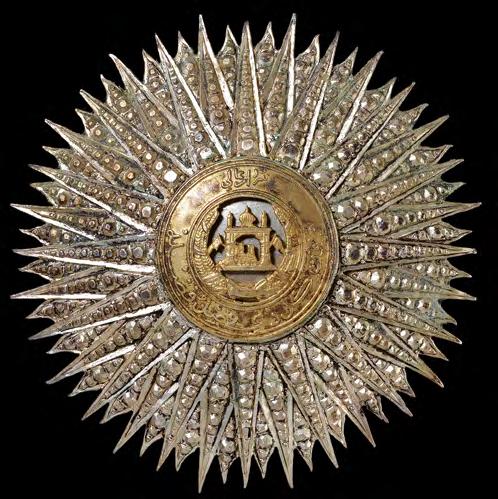
3 ORDER OF THE SUPREME SUN (NISHAN-I-LMAR-IALA)
Afghanistan, 1919 - 1973
Plaque made of silver with a gilded centre; the centre is slightly damaged. There is a horizontal pin on the reverse. Rare.
ORDINE DEL SOLE SUPREMO (NISHAN-ILMAR-I-ALA)
Afganistan, 1919 - 1973
Placca in argento con medaglione centrale dorato, il centro lievemente danneggiato. Sul retro una spilla orizzontale. Raro.
Conditions good Diameter 8.8 cm.
€ 80/120
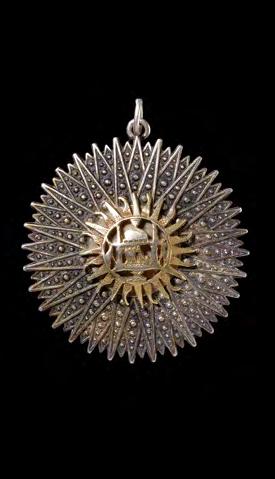
4 ORDER OF THE SUPREME SUN (NISHAN-I-LMAR-IALA)
Afghanistan, 1919 - 1973
Silver order plate with a gold medallion; the border is provided with four rings for attachment. Probably the second type (1901–1923).
ORDINE DEL SOLE SUPREMO (NISHAN-ILMAR-I-ALA)
Afganistan, 1919 - 1973
Placca dell’Ordine in argento con medaglione dorato, munito al bordo di quatto anelli per il fissaggio. Probabilmente del secondo tipo, 1901-1923.
Conditions good
Diameter 4.4 cm.
€ 50/100
5 ORDER OF THE SUPREME SUN (NISHAN-I-LMAR-IALA)
Afghanistan, 1919 - 1973 Plaque made of silver with a gilded centre. A vertical pin on the reverse. Rare.
ORDINE DEL SOLE SUPREMO (NISHAN-ILMAR-I-ALA)
Afganistan, 1919 - 1973 Placca in argento con centro dorato. Sul retro una spilla verticale. Raro.
Conditions good Diameter 9 cm.
€ 100/200
6 ORDER OF THE STAR (NISHAN-I-ASTOUR)
Afghanistan, 20th Century Order plaque made of silver with a gold medallion. On the reverse, a vertical pin and a screw for the medallion.
ORDINE DELLA STELLA (NISHAN-I-ASTOUR)
Afganistan, XX Sec. Placca dell’Ordine in argento, con medaglione dorato. Sul retro spilla verticale e vite di ritenzione del medaglione.
Conditions good
Diameter 8.6 cm.
€ 50/100
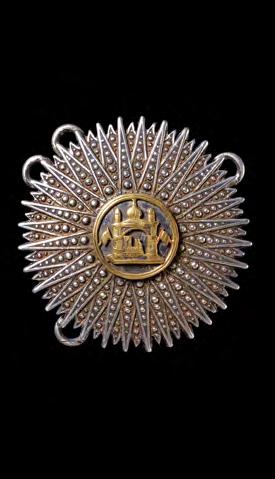
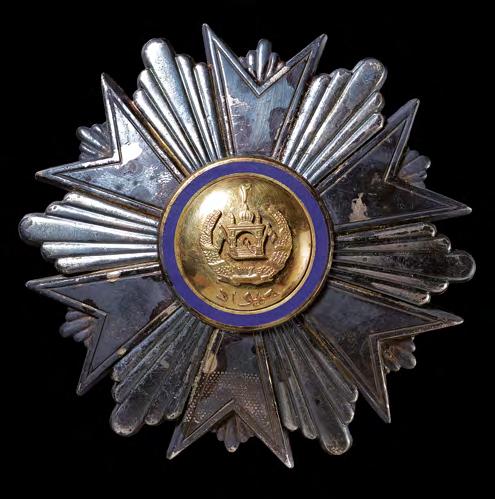
7 ORDER OF THE STAR (NISHAN-I-ASTOUR)
Afghanistan, First half of the 20th Century Silver plate with eightpointed rays and a six-armed cross, the central gold medallion surrounded by a ring of blue enamel. With patina. Vertical pin on the reverse marked “925” for silver.
ORDINE DELLA STELLA (NISHAN-I-ASTOUR)
1 4
Afganistan, Prima metà del XX Secolo Placca in argento con raggi a otto punte e croce a sei bracci, il medaglione centrale in oro con un anello in smalti blu. In patina. Sul retro spilla verticale marcata “925”, per l’argento.
Conditions medium Diameter 7.8 cm.
€ 100/200
8 ORDER OF THE STAR (NISHAN-I-ASTOUR)
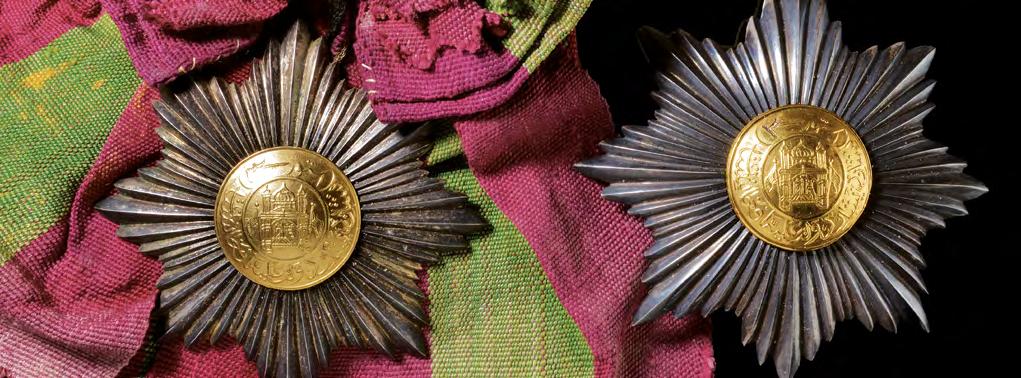
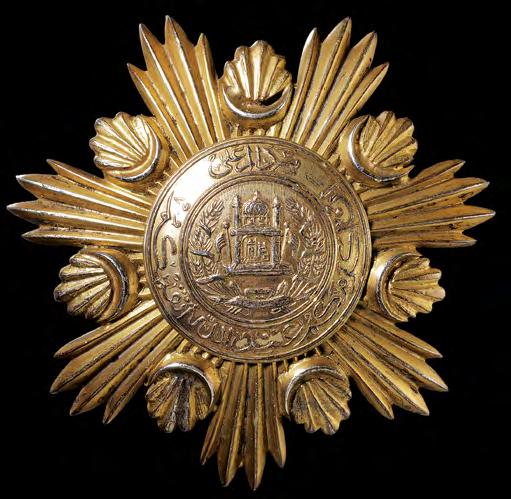
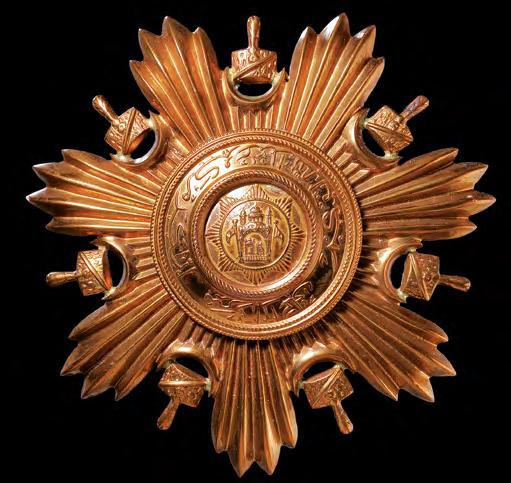
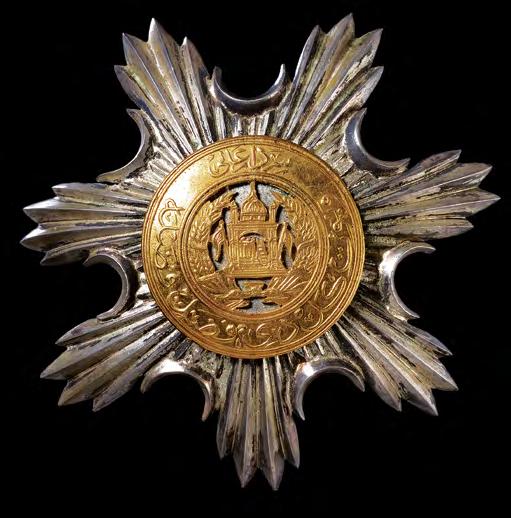
Afghanistan, 1973 - 1978 Silver Grand Cross set with a gold medallion. The pendant features an Arabic inscription and a ribbon; the plate has a spring clasp. From the Republic of Mohammad Daoud Khan. Rare.
ORDINE DELLA STELLA (NISHAN-I-ASTOUR)
Afganistan, 1973 - 1978 Set di Gran Croce, in argento, con medaglioni centrali in oro. Il pendente con iscrizione in caratteri arabi e sciarpa, la placca con chiusura a molla. Periodo: Repubblica di Mohammad Daoud Khan. Raro.
Conditions good
Diameter 7.8 - 8.3 cm. € 150/250
9
ORDER OF THE LEADER (NISHAN-I-SADARI)
Afghanistan, 20th Century Plaque of Grand Cross, First Class (Civilian). Made of gilded metal. On the reverse, a vertical pin and a detachable medallion.
ORDINE DEL CAPO (NISHAN-I-SARDARI)
Afganistan, XX Sec.
Placca di Gran Croce prima classe, civile. In metallo dorato. Sul retro spilla verticale e medaglione staccato.
Conditions good
Diameter 7.9 cm.
€ 80/120
10
ORDER OF THE LEADER (NISHAN-I-SADARI)
Afghanistan, 20th Century Military Grand Cross, Second Class. Made of gilded metal. With a vertical pin on the reverse.
ORDINE DEL CAPO (NISHAN-I-SARDARI)
Afganistan, XX Sec.
Placca di Gran Croce, seconda classe militare. In metallo dorato. Sul retro spilla verticale.
Conditions good
Diameter 7.6 cm.
€ 80/120
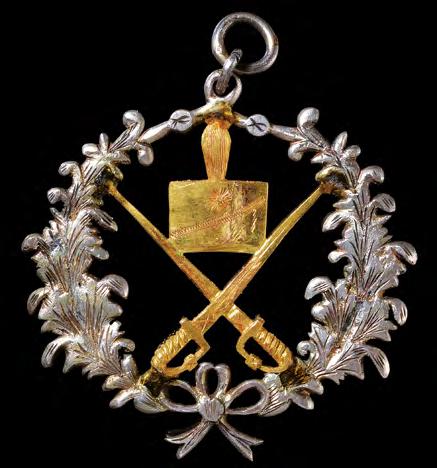
11
ORDER OF THE LEADER (NISHAN-I-SADARI)
Afghanistan, 20th Century Military Order pendant. In the centre, a fur hat above finely gilded crossed swords within a circle of silver leaves. Rare.
ORDINE DEL CAPO (NISHAN-I-SARDARI)
Afganistan, XX Sec. Pendente dell’ordine, sezione militare. Elemento centrale dorato effigiante un colbacco sopra spade incrociate, entro un serto di foglie in argento. Raro.
Conditions good
Dimensions 6 x 5.7 cm.
€ 80/120
12
ORDER OF THE LEADER (NISHAN-I-SADARI)
Afghanistan, 20th Century Grand Cross, Second Class, 4th type (1931–1960). Made of silver with a gilded medallion. With a vertical pin on the reverse.
ORDINE DEL CAPO (NISHAN-I-SARDARI)
Afganistan, XX Sec. Placca di Gran Croce, seconda classe, 4° tipo (1931-1960). In argento con medaglione centrale dorato. Sul retro spilla verticale.
Conditions good
Diameter 8.5 cm.
€ 100/200
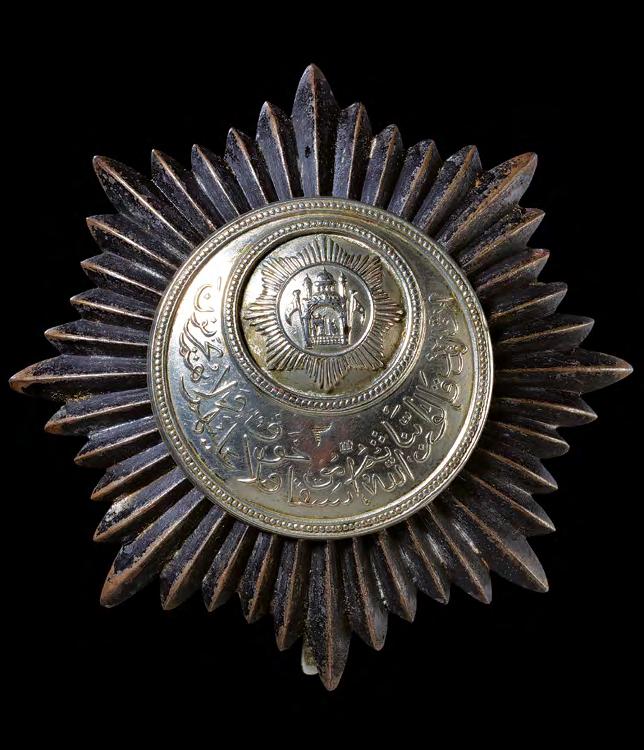
13 ORDER FOR BRAVERY OR VALOUR (NISHAN-I-SHUJAAT)
Afghanistan, First half of the 20th Century Iron plaque with a medallion made of silver for peacetime. Vertical pin on the reverse.
ORDINE AL CORAGGIO O AL VALORE (NISHAN-I-SHUJAAT)
Afganistan, Prima metà del XX Secolo Placca in ferro, con medaglione in argento per periodo di pace. Sul retro spilla verticale.
Conditions good
Diameter 7.6 cm.
€ 40/80
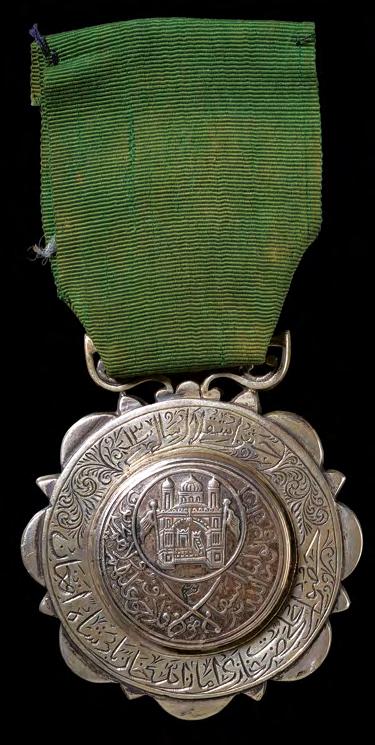
14
ROYAL ORDER OF INDEPENDENCE (NISHAN-IISTIQLAL)
Afghanistan, First half of the 20th Century War Medal made of silver with crossed sabres. On green ribbon.
ORDINE REALE DELL?INDIPENDENZA (NISHAN-IISTIQLAL)
Afganistan, Prima metà del XX Secolo Medaglia in argento per periodo di guerra, con sciabole incrociate. Con nastro verde.
Conditions good
Diameter 6.1 cm.
€ 50/100
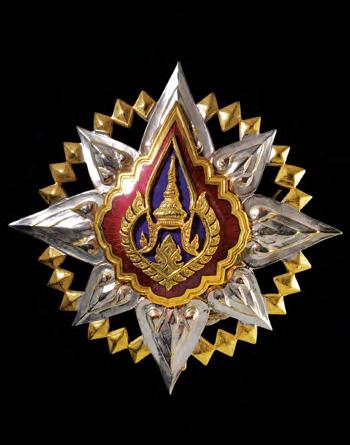
15
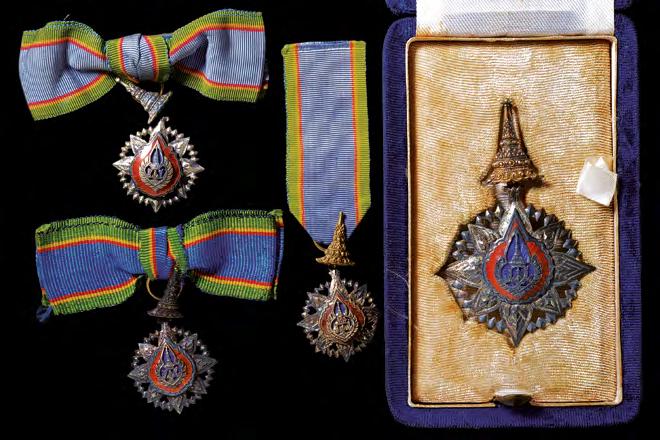
THE MOST NOBLE ORDER OF THE CROWN OF THAILAND
Thailand, Second half of the 20th Century Commendatore’s medal. Made of gold- and silverplated metal, partially enameled. Featuring a vertical pin on the reverse.
MOLTO NOBILE ORDINE DELLA CORONA DI THAILANDIA
Thailandia, Seconda metà del XX Secolo Placca da Commendatore. In metallo dorato ed argentato e parzialmente smaltato. Sul retro spilla verticale.
Conditions very good
Diameter 8.2 cm.
€ 100/200
16
THE MOST NOBLE ORDER OF THE CROWN OF THAILAND
Thailand, Third quarter of the 20th Century
A set of four decorations of the Order, including a Commander’s pendant in a box. Also including two Knight’s decorations on a bow and one on a ribbon.
MOLTO NOBILE ORDINE DELLA CORONA DI THAILANDIA
Thailandia, Terzo quarto del XX Secolo Lotto di quattro decorazioni dell’Ordine: un pendente da commendatore in scatola, insieme con due decorazioni da cavaliere con fiocco e una con nastro.
Conditions good
Dimensions various cm.
€ 100/200
17
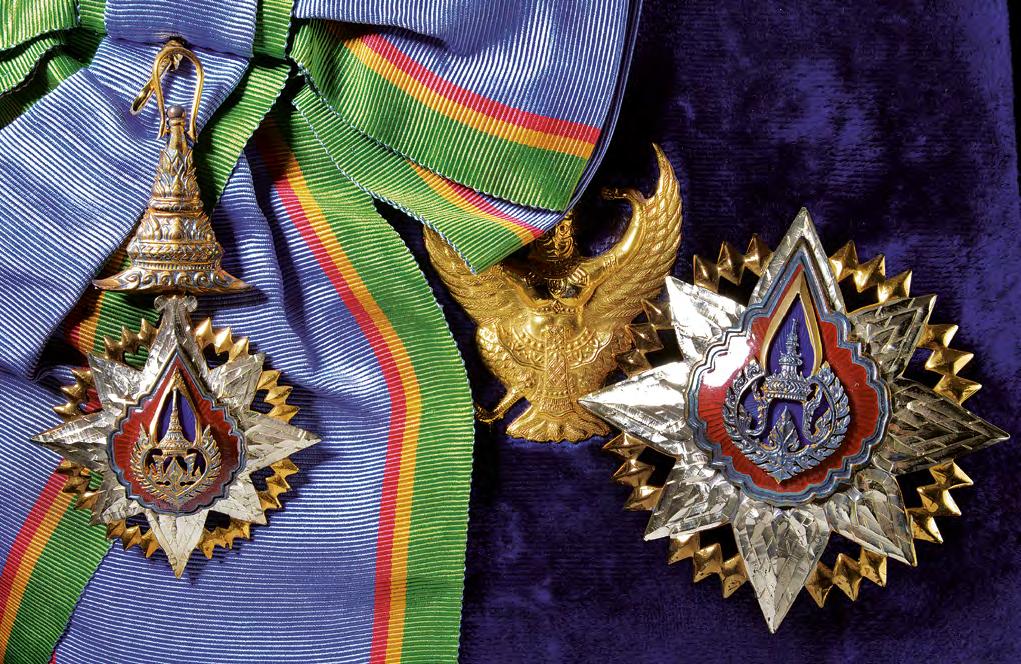
ORDER OF THE THAI CROWN
Thailand, Third quarter of the 20th Century Set of Grand Cross made of silver, partially gilded and enameled. The plate has the silver mark “950”. The set comes in its original box and includes a sash.
NOBILISSIMO ORDINE DELLA CORONA DEL THAI
Thailandia, Terzo quarto del XX Secolo Set di Gran Croce in argento, i due fregi parzialmente dorati e smaltati. La placca anche con punzone “950” per l’argento. Insieme nella loro scatola originale e con sciarpa.
Conditions very good
Dimensions 5.5 x 9 - 8.2 x 8.2 cm.
€ 300/600
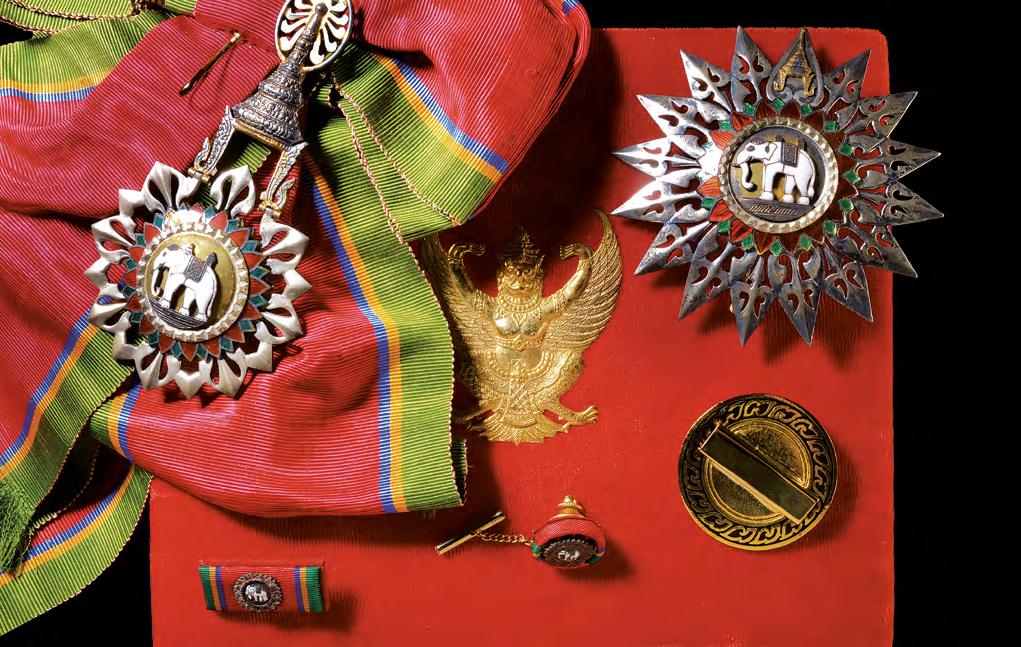
18
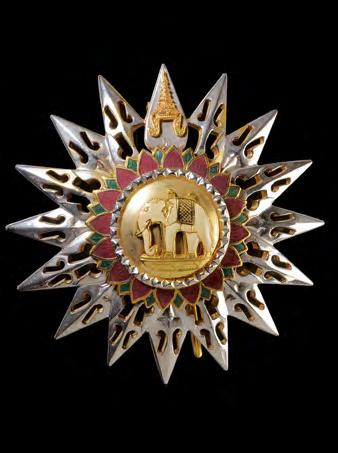
ORDER OF THE WHITE ELEPHANT
Thailand, Second part of the 20th Century Grand Cross plaque, second type. Made of silver- and gold-plated metal, partially enameled. Featuring a vertical pin on the reverse.
ORDINE DELL’ELEFANTE BIANCO
Thailandia, Seconda metà del XX Secolo
Placca di Gran Croce del secondo tipo. In metallo argentato e dorato, parzialmente smaltato. Sul retro spilla verticale.
Conditions very good
Diameter 8.1 cm.
€ 100/200
19
ORDER OF THE WHITE ELEPHANT
Thailand, Third quarter of the 20th Century
Set of the Grand Cross, second class. The pendant is made of gilded metal, silver and enamel, with a ribbon. The plaque is made of gilded silver and enamel. On the reverse, vertical pin and mark. In its original box with two miniatures and a pin for fastening the plaque Rare.
ORDINE DELL’ELEFANTE BIANCO
Thailandia, Terzo quarto del XX Secolo
Set di Gran Croce secondo tipo. Il pendente in metallo dorato, argento e smalti, con sciarpa. La placca, in argento dorato e smaltato. Sul retro una spilla verticale e punzone. Nella sua scatola originale con due miniature e una spilla per il fissaggio della placca. Raro.
Conditions very good
Dimensions 6 x 10.8 - 8.2 x 8.2 cm.
€ 400/800
20
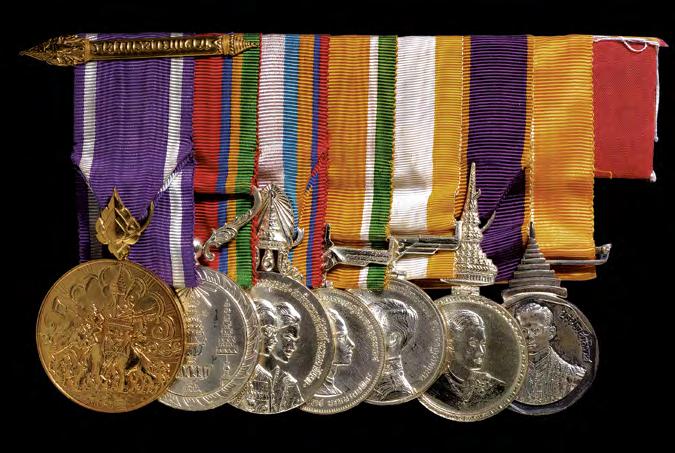
AN ORDER CLASP WITH SEVEN DECORATIONS
Thailand, Second part of the 20th Century Rama IX period.
BARRETTA CON SETTE DECORAZIONI
Thailandia, Seconda metà del XX Secolo Epoca Rama IX.
Conditions very good
Dimensions various cm.
€ 70/120
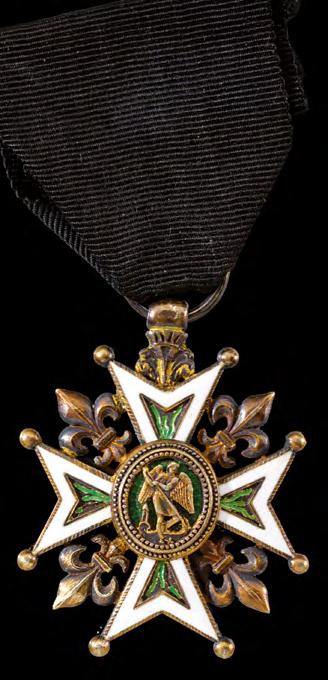
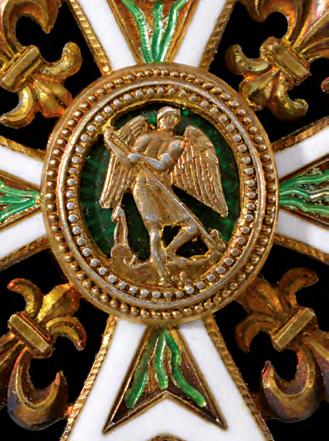
21
ORDER OF SAINT MICHAEL
France, 19th Century Gold-plated silver and enameled Knight’s Cross (minor missing parts in the flames). On a black silk ribbon.
ORDINE DI SAN MICHELE
Francia, XIX Secolo
Croce di cavaliere, in argento dorato e smaltato (piccole mancanze nelle fiamme color verde). Con nastro in seta nera.
Conditions medium
Dimensions 3.8 x 4.7 cm.
€ 150/250
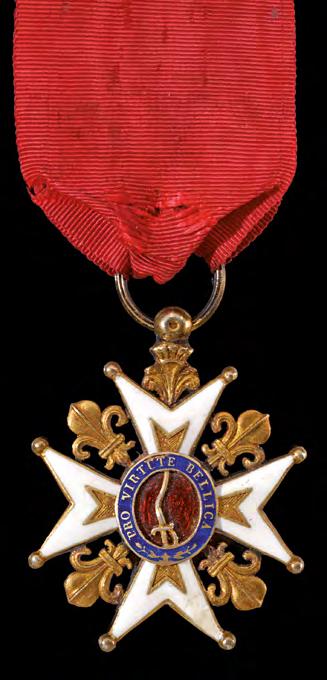
22
ORDER OF MILITARY MERIT
France, 19th Century Knight’s cross, made of gold-plated silver with enamel (minor damage). Mounted on an antique red silk ribbon.
L’INSTITUTION DU MERITE MILITAIRE (ISTITUZIONE AL MERITO MILITARE)
Francia, XIX Secolo
Croce di cavaliere, in argento dorato e smaltato (piccoli danni). Con antico nastro in seta rossa.
Conditions medium
Dimensions 3.7 x 4.5 cm.
€ 300/500
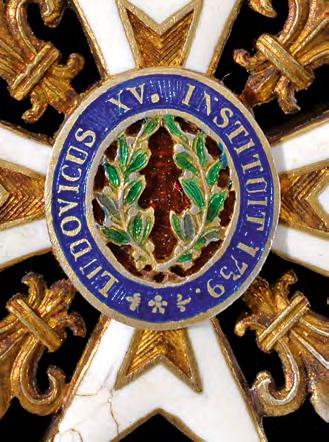
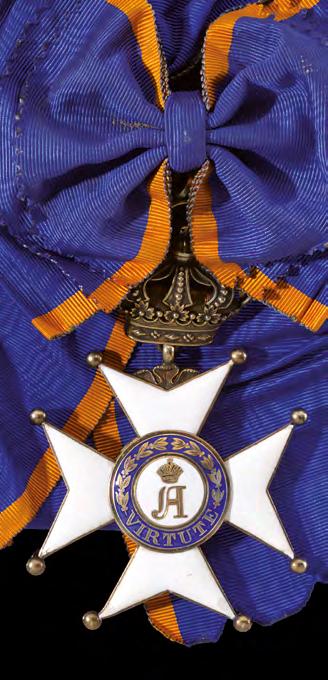
23
ORDER OF ADOLPHE OF NASSAU Luxenburg, last quarter of the 20th Century Grand Cross pendant made of bronze and enamel, with crown and sash.
ORDINE MILITARE E CIVILE DI ADOLFO DI NASSAU
Lussemburgo, ultimo quarto del XX Sec. Pendente di Gran Croce in bronzo e smalti, sotto corona e con sciarpa.
Conditions good
Dimensions 6.6 x 9.5
€ 100/200
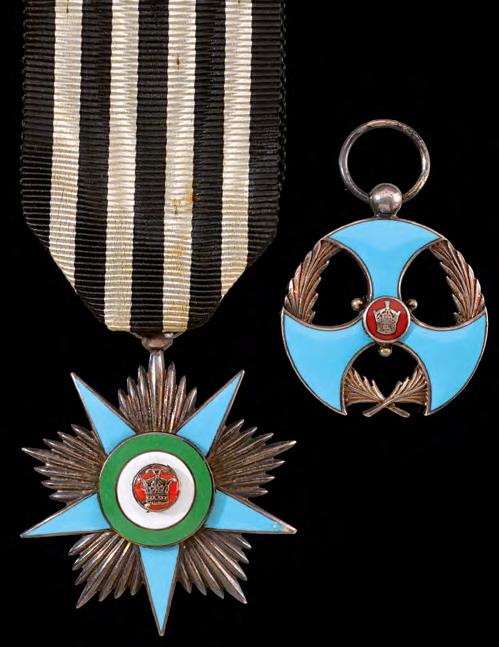
24
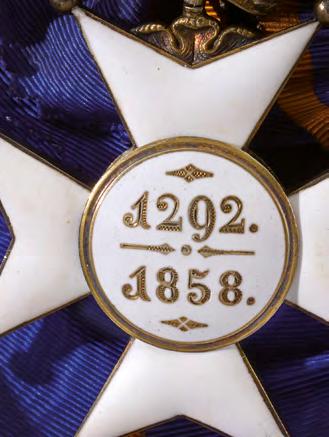
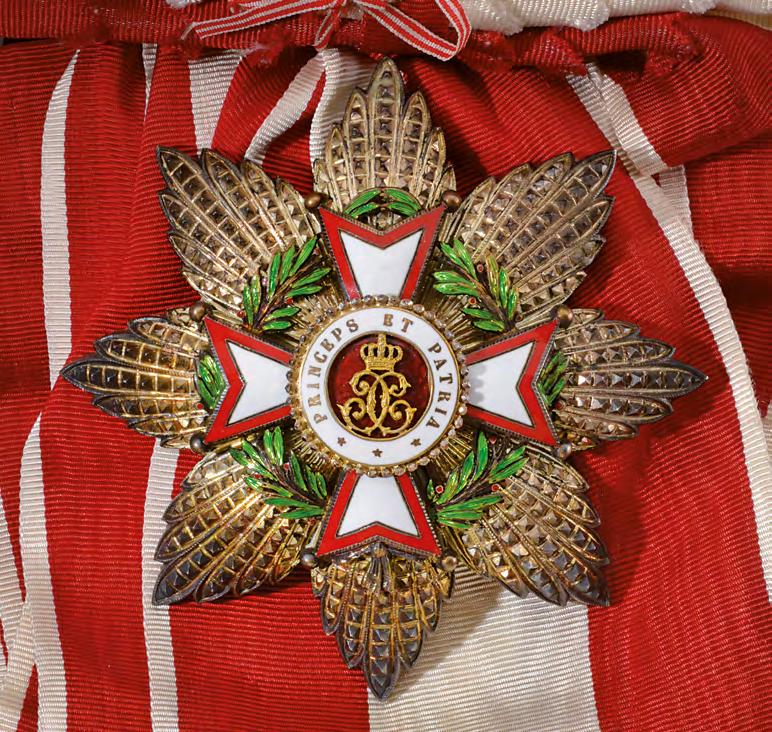
ORDER OF SAINT CHARLES
Monaco, Mid 20th Century
Beautiful silver Grand Cross plate with an enameled and gilded center. On the back, a vertical pin with two marks. With its sash.
ORDINE DI SAN CARLO
Monaco, Metà del XX Secolo
Bella placca di Gran Croce in argento, smaltata e dorata al centro. Sul retro spilla verticale con due punzoni. Insieme con la sciarpa.
Conditions very good
Dimensions 9.7 x 9.7 cm.
€ 250/450
25 A LOT OF TWO ORDERS
Persia, 1935 - 1979
Order of Glory (Nishan-I-Iftikhar), Silver Star, made of enameled silver, marked “Huguenin” on the reverse, with mark and “925”, on a ribbon with black and white vertical stripes. Order of Military Merit made of metal and enamel. The first was established in 1935, the second in 1937, and both were abolished in 1979 following the Islamic Revolution.
LOTTO DI DUE ORDINI
Persia, 1935 - 1979
Ordine della Gloria (Nishan-IIftikhar), Stella d’Argento, in argento smaltato, al retro marcato “Huguenin”, punzone e “925”, su nastro a righe verticali neri e bianche. Ordine al Merito Militare in metallo e smalti. Il primo istituito nel 1935, il secondo del 1937 ed entrambi aboliti nel 1979 dopo la rivoluzione islamica.
Conditions good
Dimensions 4.5 x 4.5 - diam: 3.3 cm.
€ 100/150
26
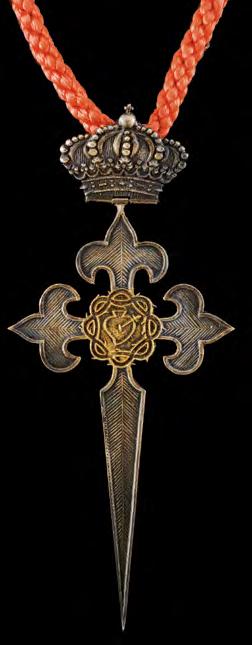
ORDER OF SANTIAGO
Spain, Mid 19th Century
In silver with a central gilded medallion, surmounted by a crown with a hinged attachment and equipped with a long red cord. Rare.
ORDINE DI SANTIAGO
Spagna, Metà del XIX Secolo Insegna dell’ordine in argento con medaglione centrale dorato, sormontato da corona con attacco snodato e dotato di lungo cordoncino rosso. Raro.
Conditions good
Dimensions 5.7 x 13.3 cm.
€ 550/750
27
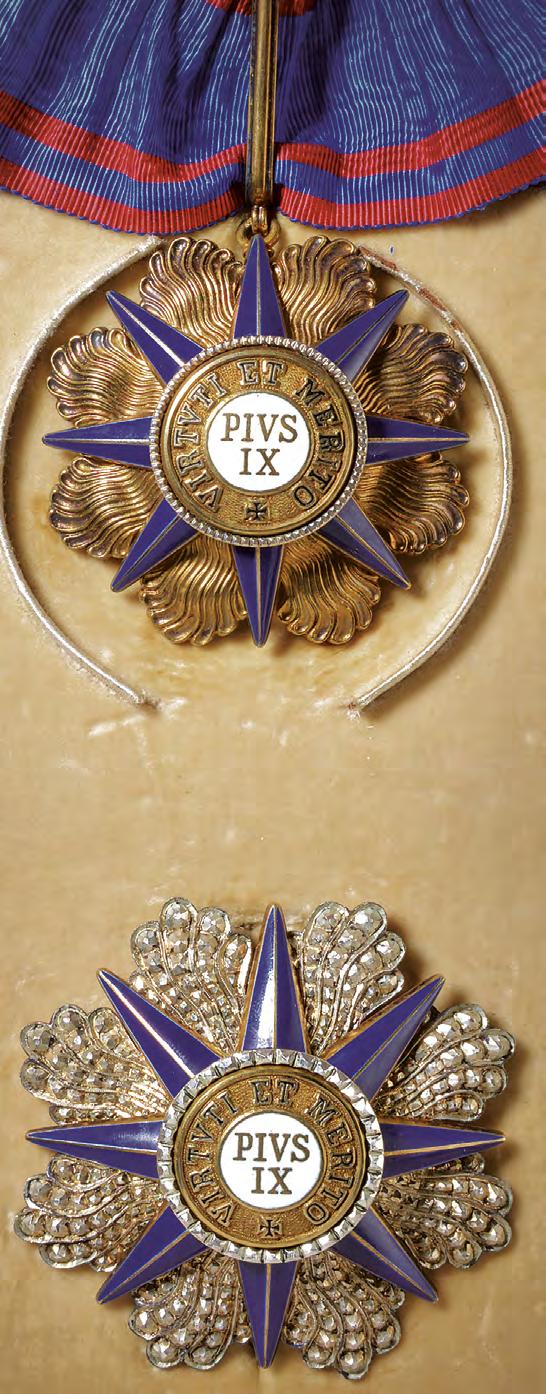
ORDER OF PIUS IX
State of the Vatican City, 1945 circa A Commander’s set in its original case, covered in red morocco leather and embossed in gold with the coat of arms of Pope Pius XII (1939–1958). Inside, the manufacturer’s name is inscribed: “TANFANI & BERTARELLI”.
ORDINE PIANO
Stato Città del Vaticano, 1945 circa Set da commendatore, in astuccio originale rivestito in marocchino rosso, con impresso in oro lo stemma di Papa Pio XII (1939-1958). All’interno il nome del fabbricante “TANFANI & BERTARELLI”.
Conditions excellent
Diameter 5.9 - 8.5
€ 800/1.200
28
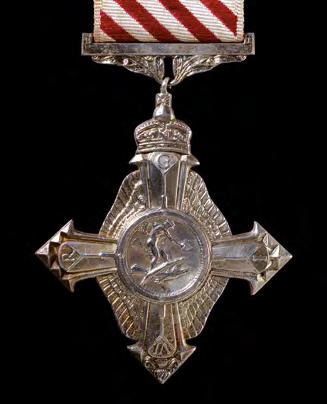
AIR FORCE CROSS
Great Britain, 1947
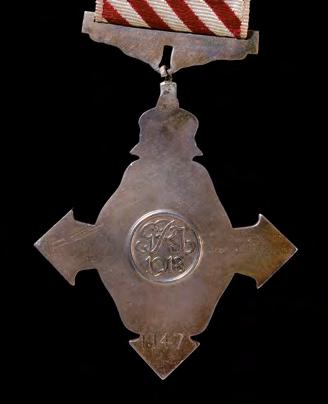
Made of silver. Bearing the cypher of George VI (reigned 1936–1952). The reverse with central badge and the engraved date “1947” below. Complete with ribbon. Possibly with an old repair to the suspension ring.
AIR FORCE CROSS
Gran Bretagna, 1947
In argento. Recante le cifre di Giorgio VI (in carica 1936-1952). Il retro con il fregio centrale e in basso la data “1947” incisa. Completa del nastrino. Forse una vecchia riparazione all’anello.
Conditions good
Height medal only 65 mm.
€ 200/300
29 BALTIC MEDAL
British Empire, Mid 19th Century
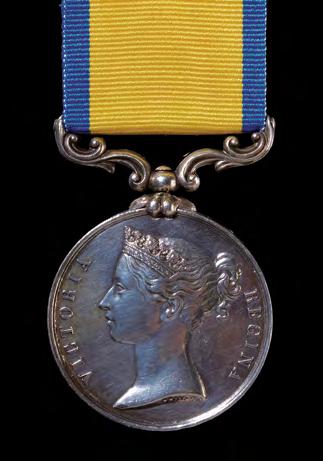
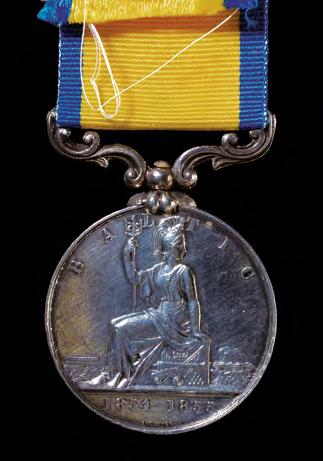
Made of silver. With effigy of young Queen Victoria. On the reverse,“BALTIC”, and in the exergue “1854–1855” and “L.C. WYON”. Two-coloured ribbon. Light scratches and signs of use. Unnamed.
BALTIC MEDAL
Impero Britannico, Metà del XIX Secolo
In argento. Con effige della giovane Regina Vittoria. Sul retro “BALTIC”, in esergo “1854-1855” e “L.C. WYON”. Nastrino bicolore presente. Leggeri graffi e segni d’uso. Non assegnata.
Conditions good
Height 38 mm. € 40/80
30
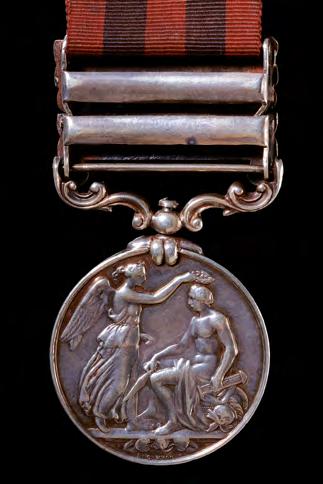
INDIA GENERAL SERVICE MEDAL / BURMA
British Empire, Late 19th Century
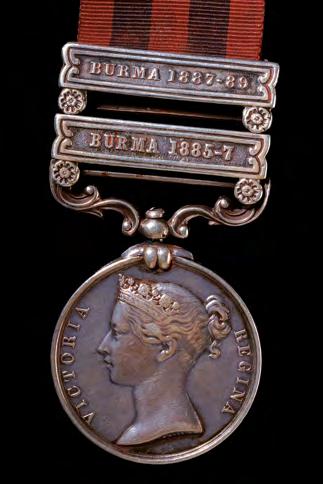
Made of silver. With effigy of the young Queen Victoria. On the reverse, in the exergue: “L.C. WYON F.”The suspension with two silver clasps: “BURMA 1885-7” and “BURMA 1887-89”. Two-coloured ribbon, the blue faded. Light signs of use. Named on the edge to a member of the “1st Rifle Brigade”.
INDIA GENERAL SERVICE MEDAL / BURMA
Impero Britannico, Fine del XIX Secolo
In argento. Con effige della giovane Regina Vittoria. Sul retro in esergo “L.C. WYON F.” L’attacco con due barrette in argento: “BURMA 1885-7” e “BURMA 1887-89”. Nastrino bicolore, il blu sbiadito. Leggeri segni d’uso. Nominativa, con assegnazione sul taglio per un membro del “1st B.n Rif. Brig.”
Conditions good
Height medal 28 mm.
€ 50/100
31
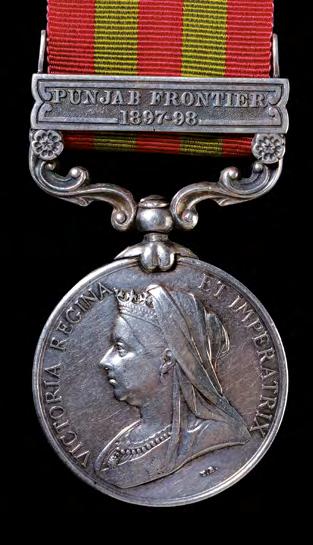
INDIA GENERAL SERVICE MEDAL / PUNJAB FRONTIER
British Empire, 1895
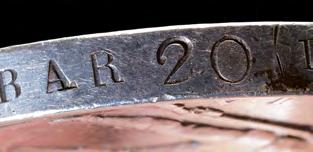
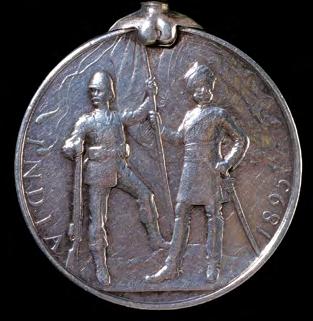
Made of silver. With the effigy of Queen Victoria the Empress, marked “TB”. On the reverse,“INDIA 1895”. Suspension with silver clasp: “PUNJAB FRONTIER 1897-98”. Two-coloured ribbon. Slight signs of use. Named on the edge to a member of the “20 D.C.O. P.1” and a serial number.
INDIA GENERAL SERVICE MEDAL / PUNJAB FRONTIER
Impero Britannico, 1895
In argento. Con effige della Regina Vittoria Imperatrice, marcatura “TB”. Sul retro “INDIA 1895”. L’attacco con barretta in argento: “PUNJAB FRONTIER 1897-98”. nastrino bicolore. leggeri segni d’uso. Nominativa, con assegnazione sul taglio per un membro del “20 D.C.O. P.1” e numero di serie.
Conditions good. Height 38 mm. € 50/100
32
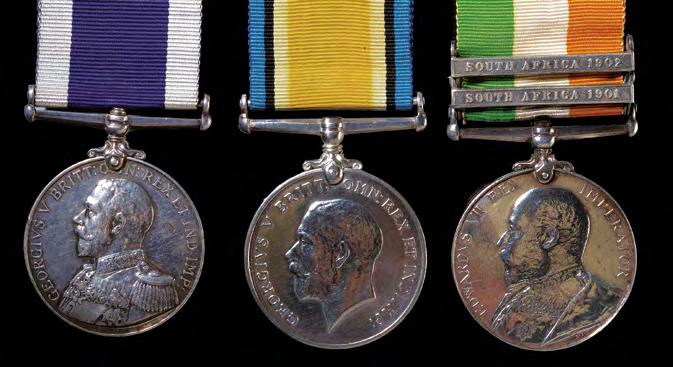
KING’S SOUTH AFRICA / LONG SERVICE / BRITISH WAR
British Empire, first quarter of the 20th Century Lot of three silver medals. King’s South Africa Medal with ribbon and two clasps (1901–1902). Named and with serial number. Medal for Long Service and Good Conduct, with ribbon. Named and with serial number. British War Medal 1914–1918, with ribbon. Named and with serial number. Some signs of use and time.
KING’S SOUTH AFRICA / LONG SERVICE / BRITISH WAR
Impero Britannico, primo quarto del XX Sec. Lotto di tre medaglie d’argento. King’s South Africa Medal con nastrino e due barrette (1901 - 1902). Nominativa e con numero di serie. Medal for Long Service and Good Conduct, con nastrino. Nominativa e con numero di serie. British War Medal 1914 - 1918, con nastrino. Nominativa e con numero di serie. Qualche segno d’uso e del tempo.
Conditions good. Height medals circa 37 -38 mm. € 50/100
33
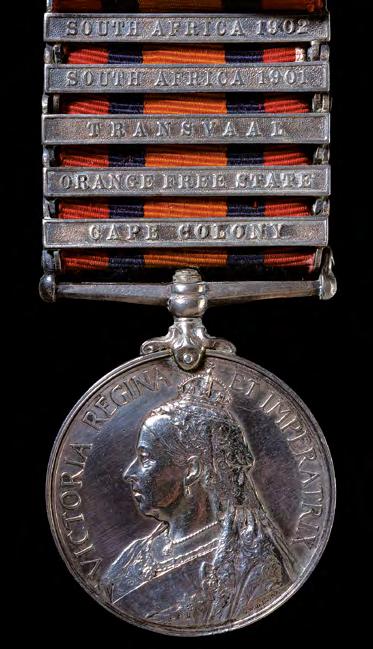
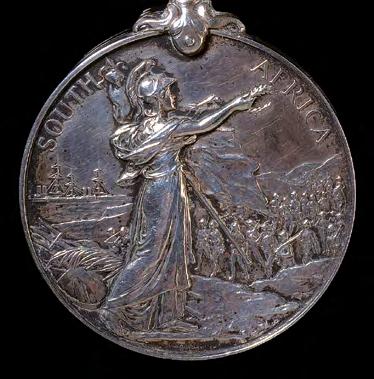
QUEEN’S SOUTH AFRICA MEDAL
British Empire, circa 1900
Made of silver. With the effigy of Queen Victoria the Empress. Undated model. On the reverse: “SOUTH AFRICA.”The clasp with five bars: “SOUTH AFRICA 1902”,“SOUTH AFRICA 1901”,“TRANSVAAL”, “ORANGE FREE STATE”,“CAPE COLONY”. Complete ribbon, with pin, probably antique. Slight signs of use. Personalised, with an inscription on the edge for a member of the “6th IMP YEO” and with serial number.
QUEEN’S SOUTH AFRICA MEDAL
Impero Britannico, 1900 circa In argento. Con effige della Regina Vittoria Imperatrice. Modello senza date. Sul retro “SOUTH AFRICA.” L’attacco con cinque barrette: “SOUTH AFRICA 1902”, “SOUTH AFRICA 1901”,“TRANSVAAL”,“ORANGE FREE STATE”,“CAPE COLONY”. Nastrino completo, con spilla, probabilmente antico. leggeri segni d’uso. Nominativa, con assegnazione sul taglio per un membro del “6th IMP YEO” e con numero di serie.
Conditions good. Diameter circa 36.5 cm.
€ 50/100
34
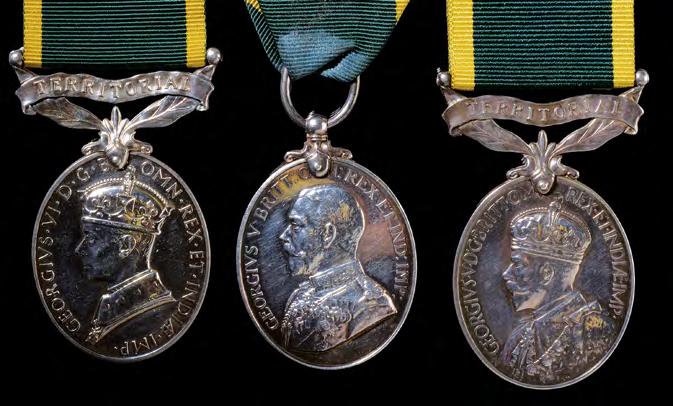
TERRITORIAL EFFICIENCY MEDAL
British Empire, First half of the 20th Century
Lot of three silver medals. Two from the George V period, one from the George VI period. Complete with ribbons. All named and featuring serial numbers.
TERRITORIAL EFFICIENCY MEDAL
Impero Britannico, Prima metà del XX Secolo Lotto di tre medaglie d’argento. Due d’epoca Giorgio V, una epoca Giorgio VI. Complete di nastrino. Tutte nominative e con numero di serie.
Conditions good. Height medals circa 45 - 50 mm.
€ 60/100
35
INDIA GENERAL SERVICE MEDAL / AFGHANISTAN
- NORTH WEST FRONTIER
British Empire, early 20th Century
Lot of two silver medals: One from the Edward VII era with clasp inscribed “NORTH WEST FRONTIER 1908,” complete with short ribbon; named for a member of the “23rd Sikh Pioneers” and featuring serial number. One
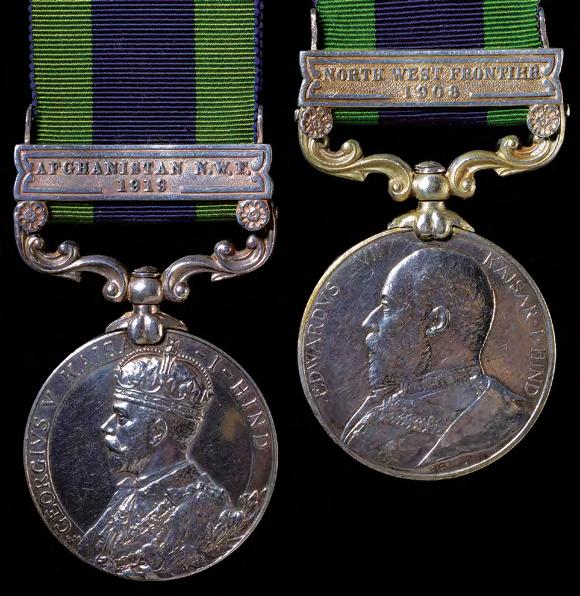
from the George V era with clasp inscribed “AFGHANISTAN N.W.F. 1919” and ribbon; named on the edge to a captain of the “5th Infantry” without serial number. Light signs of use and time.
INDIA GENERAL SERVICE MEDAL / AFGHANISTAN - NORTH WEST FRONTIER
Impero Britannico, inizio del XX Sec. Lotto di due medaglie d’argento: Una d’epoca Edoardo VII con barretta “NORTH WEST FRONTIER 1908”, completa di nastrino corto; nominativa per un membro del “23rd Sikh Pioneers” e con numero di serie. Una epoca Giorgio V con barretta “AFGHANISTAN N.W.F. 1919” e nastrino; nominativa anche questa per un capitano del “5/Inf.” senza numero di serie. Leggeri segni d’uso e del tempo.
Conditions good. Height medals circa 38 mm.
€ 60/100
36
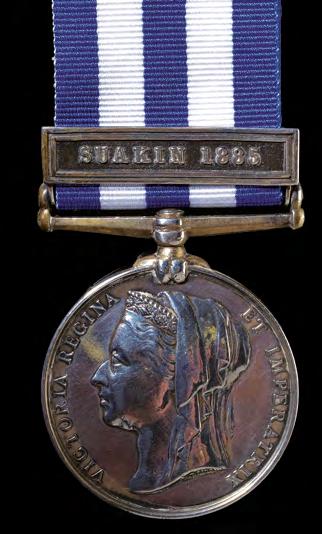
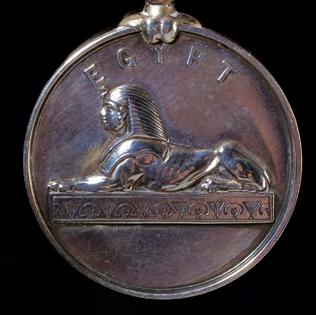
EGYPT MEDAL / SUAKIN
British Empire, 1885
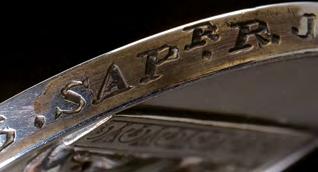
Made of silver. With the effigy of Queen Victoria Empress. On the reverse inscribed “EGYPT”. Suspension with silver clasp: “SUAKIN 1885”. Two-coloured ribbon. Small signs of use. Named on the edge to a member of the “24th C.O. R.E.” and featuring serial number.
EGYPT MEDAL / SUAKIN
Impero Britannico, 1885
In argento. Con effige della Regina Vittoria imperatrice. Sul retro “EGYPT”. L’attacco con barretta in argento: “SUAKIN 1885”. Nastrino bicolore. Leggeri segni d’uso. Nominativa, con assegnazione sul taglio per un membro del “24th C.O R.E.” e numero di serie.
Conditions good. Height medal circa 38.3 mm.
€ 60/100
37
SECOND CHINA WAR MEDAL
British Empire, 1860
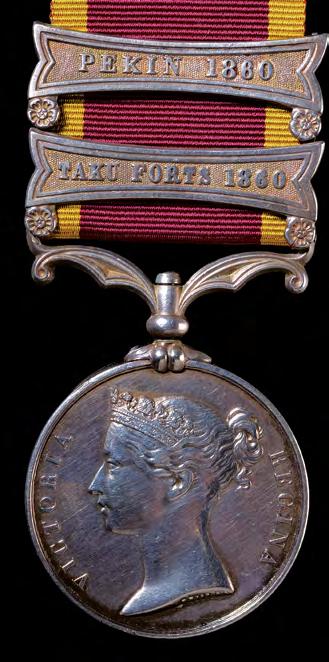
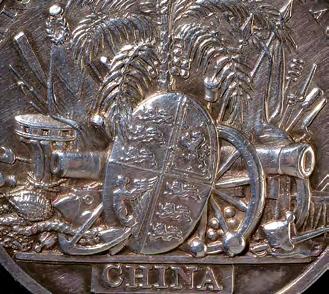
Made of silver. With effigy of young Queen Victoria. On the reverse,“ARMIS EXPOSCERE PACEM” and, in the exergue,“CHINA.” Suspension featuring two clasps: “PEKIN 1860” and “TAKU FORTS 1860.”Twocoloured ribbon. Light scratches and signs of use. Named on the edge to a driver of the “4th B.de R.L. Artillery.”
SECOND CHINA WAR MEDAL
Impero Britannico, 1860
In argento. Con effige della giovane Regina Vittoria. Sul retro “ARMIS EXPOSCERE PACEM” e, in esergo “CHINA”. L’attacco con due barrette: “PEKIN 1860” e “TAKU FORTS 1860”. Nastrino bicolore. Leggeri graffi e segni d’uso. Nominativa, con assegnazione sul taglio per un guidatore del “4th B.de R.L ART.y”
Conditions good
Height medal 39 mm.
€ 80/120
38
SUTLEJ MEDAL
British Empire, 1846
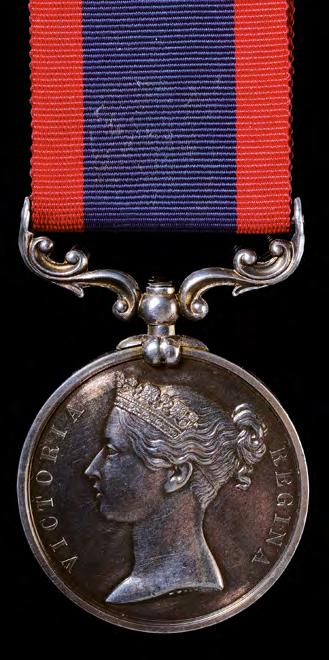
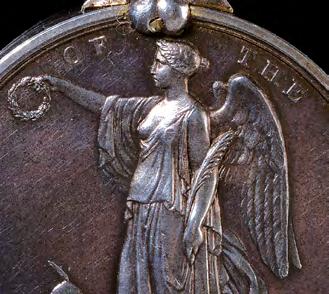
Made of silver. With effigy of young Queen Victoria. On the reverse,“ARMY OF THE SUTLEJ”; in the exergue,“SOBRAON 1846”. Two-coloured ribbon. Slight scratches and signs of use. Unnamed.
SUTLEJ MEDAL
Impero Britannico, 1846
In argento. Con effige della giovane Regina Vittoria. Sul retro “ARMY OF THE SUTLEJ”, in esergo “SOBRAON 1846”. Nastrino bicolore presente. Leggeri graffi e segni d’uso. Non assegnata.
Conditions good
Height 37.6 mm.
€ 80/120
39
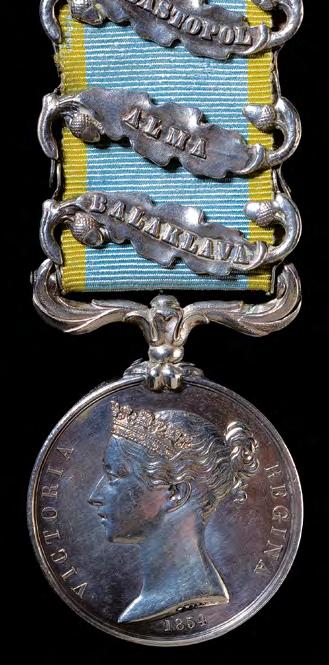
CRIMEA MEDAL
British Empire, 1854
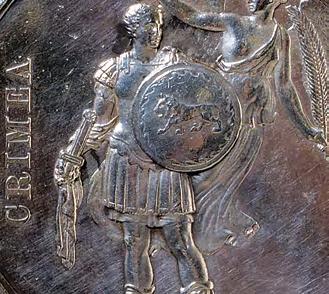
Made of silver. With effigy of young Queen Victoria above the date “1854”. On the reverse,“CRIMEA” and “B. WYON SC.” Suspension featuring four clasps: “INKERMANN,”“SEBASTOPOL,”“ALMA,” “BALAKLAVA.”Two-coloured ribbon, slightly faded. Signs of use and scratches; a drop impact mark on the edge. Unnamed.
CRIMEA MEDAL
Impero Britannico, 1854
In argento. Con effige della giovane Regina Vittoria soprastante la data “1854”. Sul retro “CRIMEA” e “B. WYON SC.” L’attacco con quattro barrette: “INKERMANN”,“SEBASTOPOL”,“ALMA”, “BALAKLAVA”. nastrino bicolore leggermente sbiadito. Segni d’uso e graffi, un colpo da caduta al bordo. Non assegnata.
Conditions medium
Height medal 37.7 mm.
€ 80/120
40
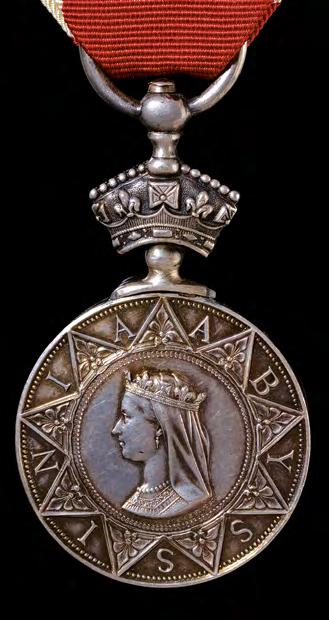
ABYSSINIAN WAR MEDAL
British Empire, 1868
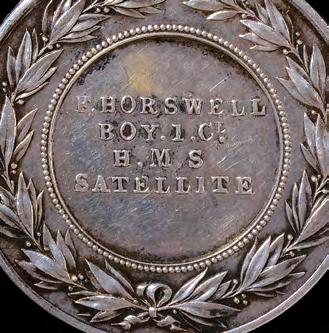
Made of silver. With effigy of young Victoria surrounded by the inscription “ABYSSINIA.” On the reverse, the inscription: “F. HORSWELL BOY 1 C.L H.M.S. SATELLITE.”The ring suspension with crown. Two-coloured ribbon. Slight signs of use.
ABYSSINIAN WAR MEDAL
Impero Britannico, 1868
In argento. Con effige della giovane Vittoria circondata dalla dicitura “ABYSSINIA”. Sul retro l’assegnazione: “F. HORSWELL BOY 1 C.L H.M.S. SATELLITE”. L’attacco dell’anello con corona. Nastrino bicolore. Lievi segni d’uso.
Conditions good
Height medal 33 mm.
€ 80/120
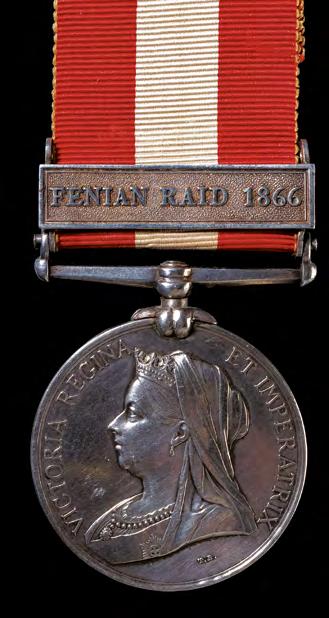
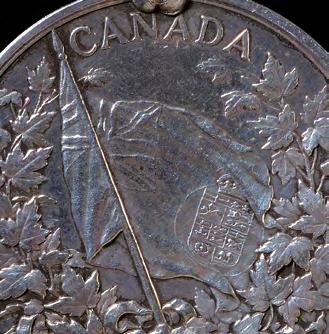
41
CANADA GENERAL SERVICE MEDAL / FENIAN
British Empire, 1866
Made of silver. With the effigy of Queen Victoria, the Empress, and the mark “T.B.”. On the reverse, “CANADA”. The clasp with bar: “FENIAN RAID 1866”. Two-tone ribbon. Slight signs of use. Personalised, with the name of a private soldier from the “18th BATTALION” on the neck cut, without serial number.
CANADA GENERAL SERVICE MEDAL / FENIAN
Impero Britannico, 1866
In argento. Con effige della Regina Vittoria Imperatrice, con marchio “T.B.”. Sul retro “CANADA”. L’attacco con barretta: “FENIAN RAID 1866”. Nastrino bicolore. Leggeri segni d’uso. Nominativa, con assegnazione sul taglio ad un soldato semplice del “18th BATTALION”, senza numero di serie.
Conditions good
Height medal circa 38 mm.
€ 80/150
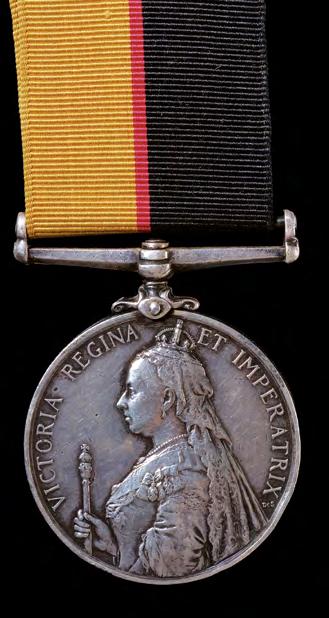
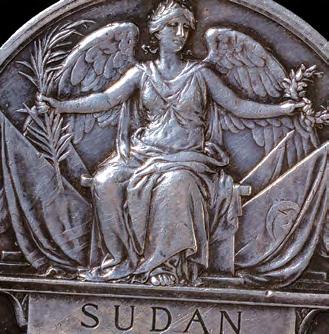
42
QUEEN’S SUDAN MEDAL
British Empire, 1899
Made of silver. With the effigy of Queen Victoria the Empress.“SUDAN” on the reverse. Two-tone ribbon. Minor scratches and signs of use. Personalised, with serial number.
QUEEN’S SUDAN MEDAL
Impero Britannico, 1899
In argento. Con effige della Regina Vittoria Imperatrice. Sul retro “SUDAN”. Nastrino bicolore. Leggeri graffi e segni d’uso. Nominativa e con numero di serie.
Conditions good
Diameter circa 36.5 mm.
€ 100/150
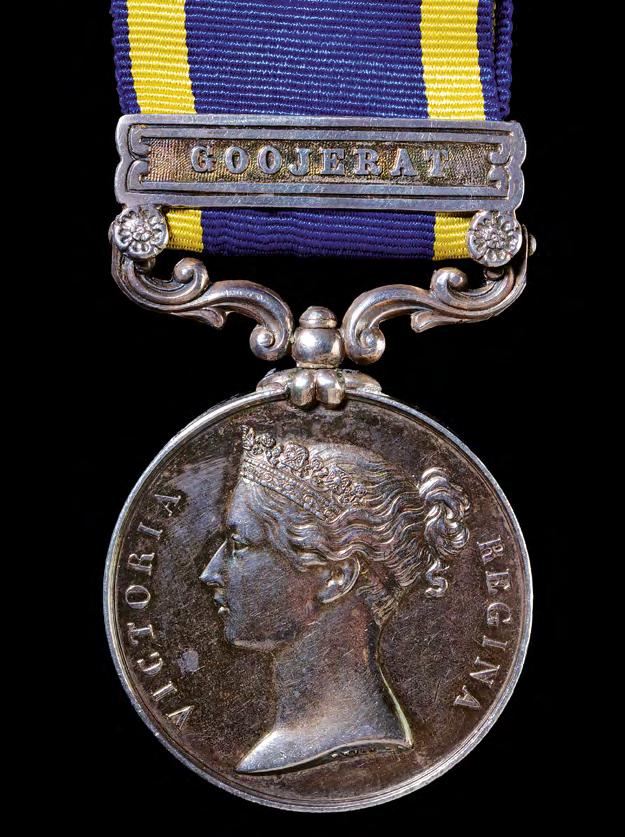
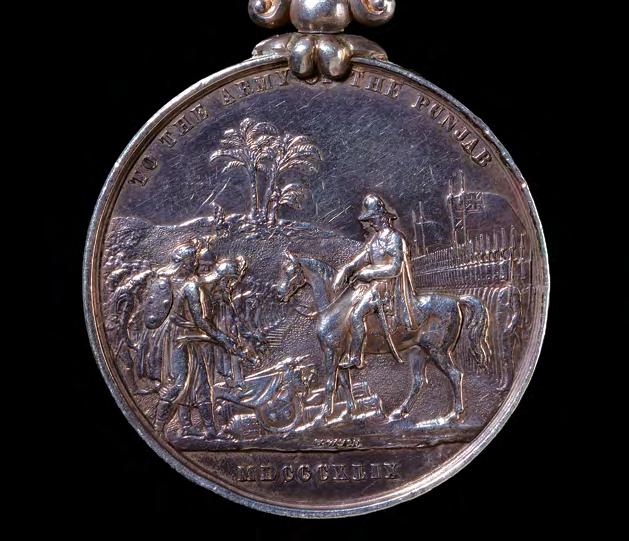
43
PUNJAB MEDAL / GOOJERAT
British Empire, Mid 19th Century
Made of silver. With effigy of young Queen Victoria. On the reverse, the motto “TO THE ARMY OF THE PUNJAB” and, in the exergue, the date “1849” in Roman numbers. Suspension with clasp “GOOJERAT.”Two-coloured ribbon. Slight signs of use and scratches. Named on the edge to a member of the “53rd Foot”.
PUNJAB MEDAL / GOOJERAT
Impero Britannico, Metà del XIX Secolo
In argento. Con effige della giovane Regina Vittoria. Sul retro motto “TO THE ARMY OF THE PUNJAB” e in esergo la data “1849” in numeri romani. L’attacco con barretta “GOOJERAT”. Nastrino bicolore. Leggeri segni d’uso e graffi. Nominativa, con assegnazione sul taglio per un membro del “53rd Foot”.
Conditions good
Height medal 38 mm.
€ 120/200
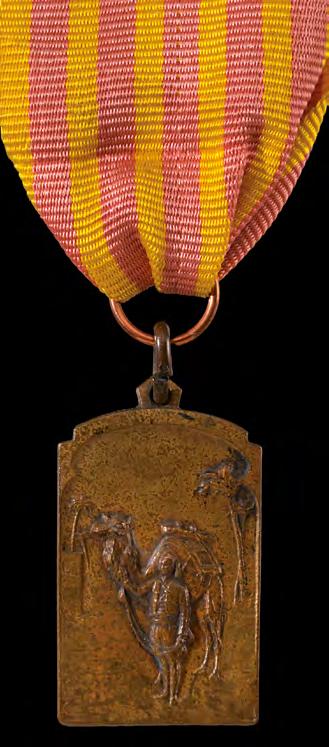
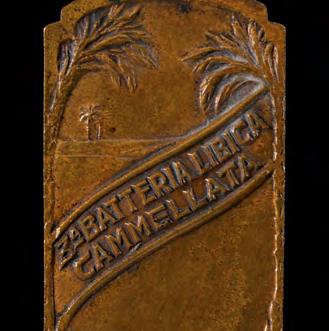
44
AFRICAN CAMPAIGN MEDAL
Kingdom of Italy, About 1940 Bronze medal of the “3a Batteria Libica Cammellata”. On ribbon.
MEDAGLIA CAMPAGNA D’AFRICA
Regno d’Italia, 1940 circa Medaglia in bronzo della 3a Batteria Libica Cammellata. Con nastro.
Conditions good
Dimensions 2 x 3.1 cm.
€ 30/50
45
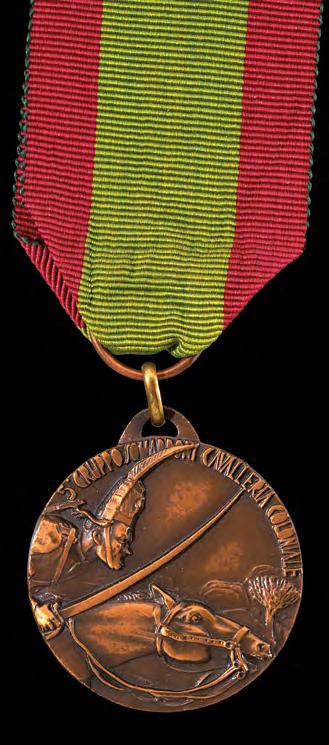
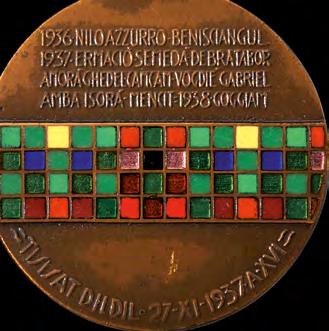
AFRICAN CAMPAIGN MEDAL
Kingdom of Italy, 1937
Bronze medal, partially enamelled, of the “5 Gruppo Squadroni Cavalleria Coloniale”. On ribbon.
MEDAGLIA CAMPAGNA D’AFRICA
Regno d’Italia, 1937
Medaglia in bronzo, parzialmente smaltata, del 5 Gruppo Squadroni Cavalleria Coloniale. Con nastro.
Conditions good
Diameter 3 cm.
€ 50/100
46
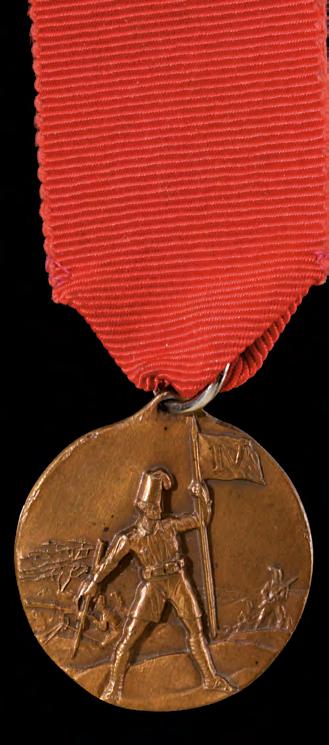
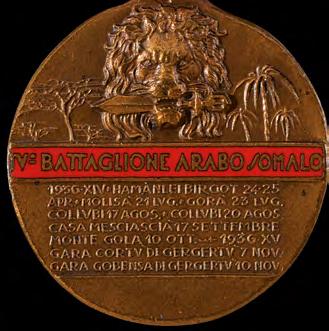
AFRICAN CAMPAIGN MEDAL
Kingdom of Italy, 1936
In brass, with the inscription “IV Battaglione Arabo Somalo” (enamelled) on the reverse, together with the dates of the various battles. On the obverse, a Somali figure holding a flag. On a red silk ribbon.
MEDAGLIA CAMPAGNA D’AFRICA
Regno d’Italia, 1936
In ottone, con iscrizione “IV Battaglione Arabo Somalo” (smaltata) sul rovescio e con date delle varie battaglie. Un somalo con bandiera sul recto. Con nastro in seta rossa.
Conditions good
Diameter 3.1 cm.
€ 70/120
47
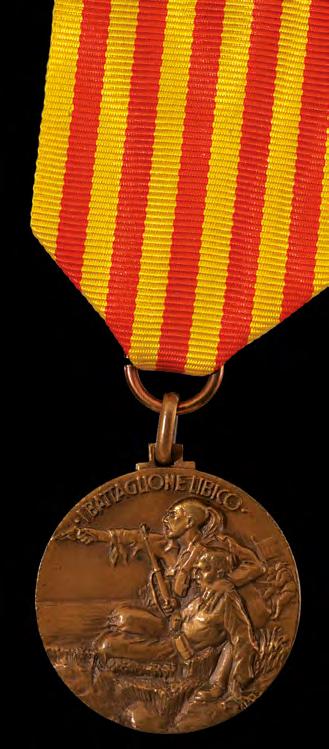
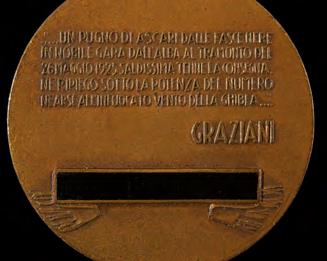
AFRICAN CAMPAIGN MEDAL
Kingdom of Italy, About 1940
Bronze medal, on the obverse “I Battaglione Libico”, on the reverse a motto by Graziani, partially enamelled. On ribbon.
MEDAGLIA CAMPAGNA D’AFRICA
Regno d’Italia, 1940 circa Medaglia in bronzo, sul recto “I Battaglione Libico”, sul verso una frase di Graziani, parzialmente smaltato. Su nastro.
Conditions good
Diameter 3 cm.
€ 70/120
48
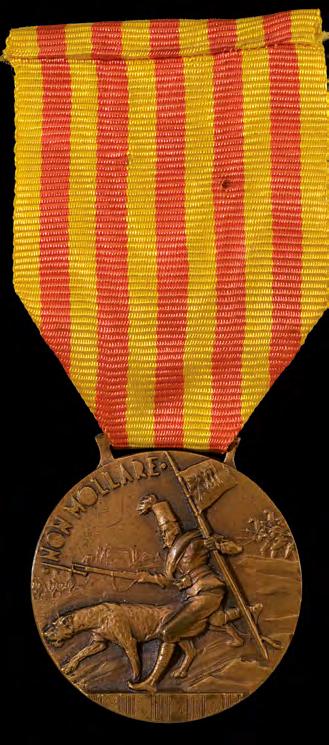
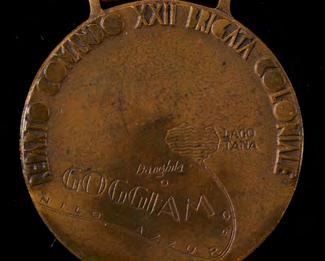
AFRICAN CAMPAIGN MEDAL
Kingdom of Italy, About 1940
Made of bronze, with the inscription “Reparto Comando XXII Brigata Coloniale” on the obverse and the motto “NON MOLLARE” on the reverse. Mounted on a ribbon.
MEDAGLIA CAMPAGNA D’AFRICA
Regno d’Italia, 1940 circa In bronzo con iscrizione “Reparto Comando XXII Brigata Coloniale” sul recto e motto “NON MOLLARE” sul verso. Con nastro.
Conditions good
Diameter 3.1 cm.
€ 100/150
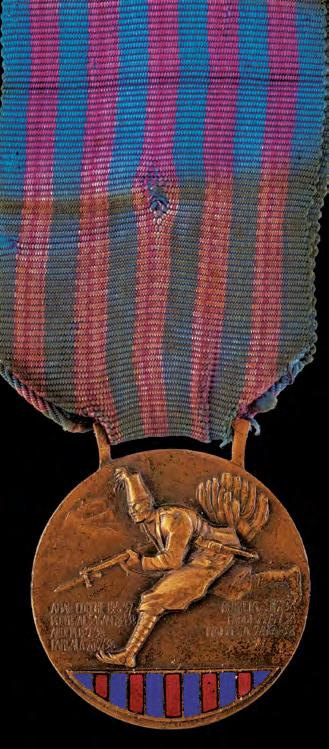
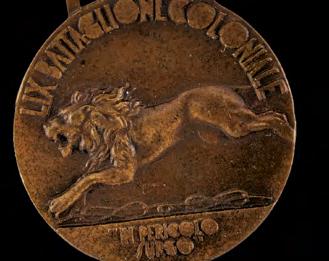
49
A MEDAL FOR THE AFRICAN CAMPAIGN
Kingdom of Italy, About 1940
Bronze medal, partially enameled in the battalion’s colours, complete with ribbon. Also included is the rare sash in the battalion’s colours, worn by the Eritrean Askari soldiers around the waist. Finally, a colour postcard listing the dates of the battles in which the battalion took part in 1937 and 1938.
MEDAGLIA CAMPAGNA D’AFRICA
Regno d’Italia, 1940 circa La medaglia in bronzo, parzialmente smaltata nei colori del battaglione, completa di nastro. Insieme con la rara fascia nei colori del battaglione, usata dagli ascari eritrei intorno alla vita. Infine, una cartolina a colori con le date degli scontri ai quali il battaglione partecipò nel 1937 e nel 1938.
Conditions very good
Diameter 3.1 cm.
€ 100/200
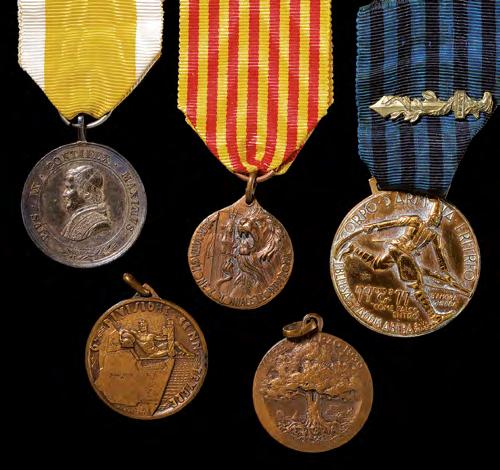
50
A LOT OF FIVE MEDALS
Kingdom of Italy, First half of the 20th Century “PIUS IX PONTIFEX MAXIMUS” Medal of Merit, made of silver, with ribbon; colonial medal of the 49th Battalion; medal of the Eritrean Army Corps, on a ribbon with a sword; Tevere Division medal; and Gran Sasso Division medal.
LOTTO DI CINQUE MEDAGLIE
Regno d’Italia, Prima metà del XX Secolo Medaglia Benemerenti “PIUS IX PONTIFEX MAXIMUS” in argento con nastro, medaglia coloniale del XLIX battaglione, medaglia del CORPO D’ARMATA ERITREO, su nastro con gladio; medaglia Divisione Tevere e medaglia Divisione del Gran Sasso.
Conditions medium
Diameter 2.6 x 3.7 cm.
€ 150/250
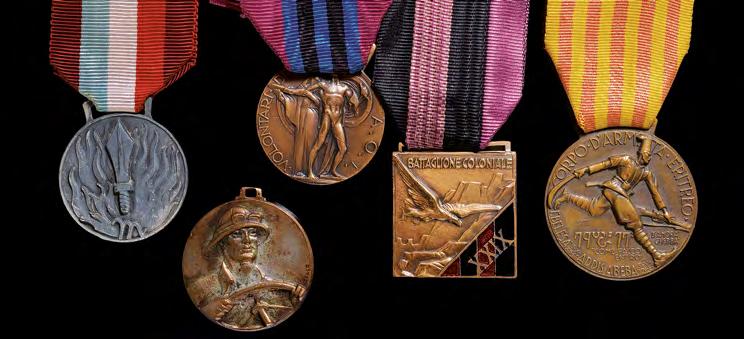
51 A LOT OF FIVE MEDALS
Kingdom of Italy, First half of the 20th Century Medal of the 29th Colonial Battalion, partially enameled; medal of the Eritrean Army Corps; A.O.I. War Volunteers medal; Fire Department Medal of Merit. All with ribbons. And one other medal.
LOTTO DI CINQUE MEDAGLIE
Regno d’Italia, Prima metà del XX Secolo Medaglia del XXIX Battaglione Coloniale, parzialmente smaltata; medaglia del CORPO D’ARMATA ERITREO; medaglia
A. O. I. Volontari di Guerra; medaglia al merito di servizio dei Vigili del Fuoco. Tutti con nastro. E un’altra medaglia.
Conditions good
Diameter 3.2 - 3.7 cm.
€ 150/250
52 A LOT OF FIVE MEDALS
Kingdom of Italy, First half of the 20th Century Medal of the 35th Colonial Battalion, partially enameled; medal of the 56th Colonial Battalion, partially enameled; medal of the Eritrean Army Corps; medal “ROMA RIVENDICATA AI SOCI LIBERATORI”; medal of the “GRANATIERI DI SAVOIA - ADDIS ABEBA”. All with ribbons.
LOTTO DI CINQUE MEDAGLIE
Regno d’Italia, Prima metà del XX Secolo Medaglia del XXXV battaglione coloniale, parzialmente smaltato; medaglia del LVI
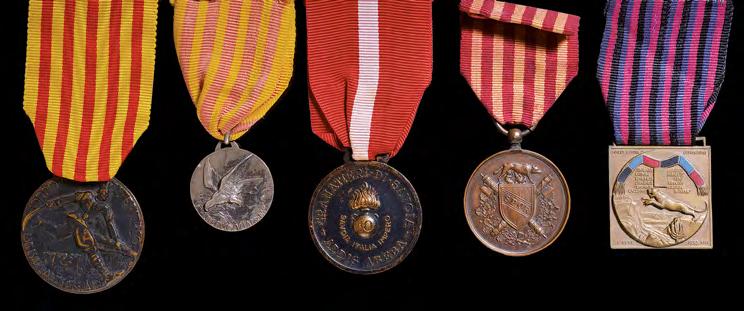
battaglione coloniale, parzialmente smaltato; medaglia del CORPO D’ARMATA ERITREO; medaglia “ROMA RIVENDICATA AI SOCI LIBERATORI”; medaglia dei “GRANATIERI DI SAVOIA - ADDIS ABEBA”. Tutti con nastro.
Conditions good
Diameter 2.5 - 3.7 cm.
€ 150/250
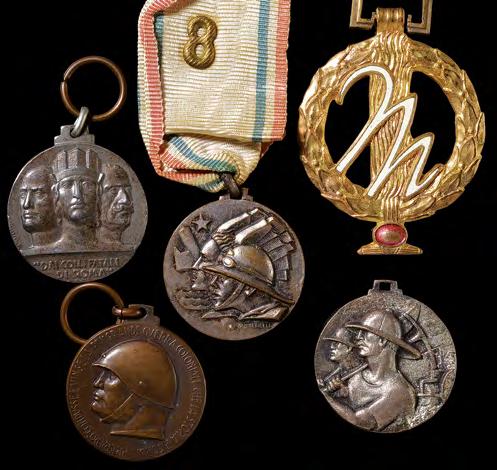
53 A LOT OF FIVE MEDALS
Kingdom of Italy, First half of the 20th Century Italian Ethiopia Medal 1935/36 with ribbon and the number “8” on the ribbon; a Fascist commemorative
medal marking the conquest of Ethiopia; another one featuring Mussolini’s head; and two other medals from the Fascist era.
LOTTO DI CINQUE MEDAGLIE
Regno d’Italia, Prima metà del XX Secolo Medaglia Etiopia Italiana 1935/36 con nastro e numero “8” sul nastro; medaglia commemorativa fascista legata alla conquista dell’Etiopia; un’altra ma con testa di Mussolini; e due altre medaglie dell’epoca fascista.
Conditions good
Diameter 3.2 - 4.2 cm.
€ 150/250
54
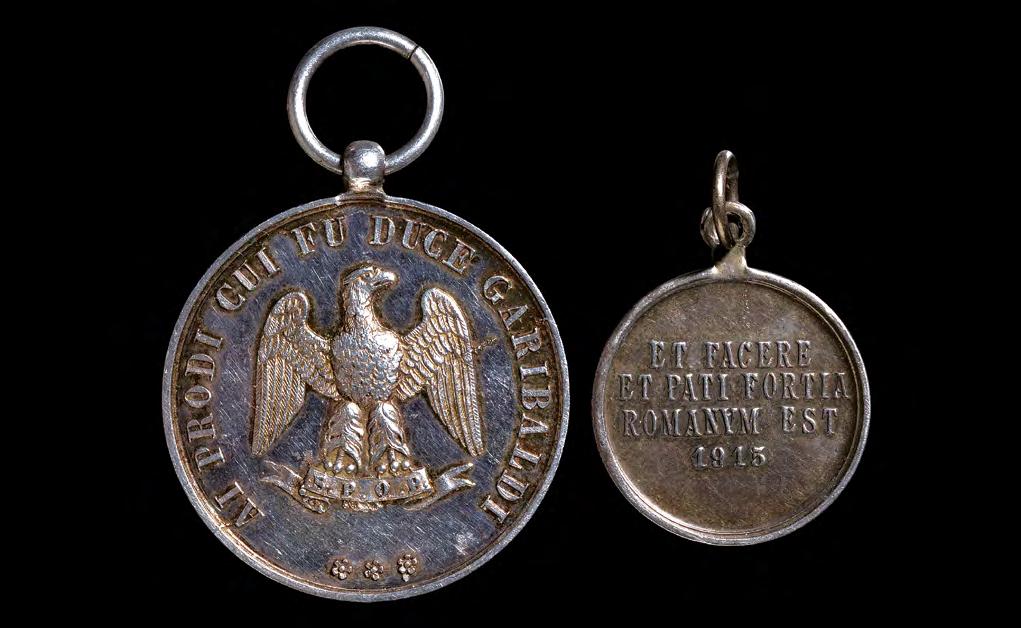
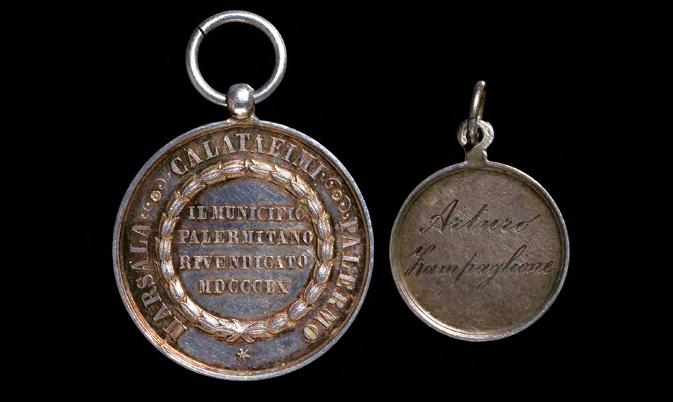
A RARE MEDAL AWARDED FOR THE “EXPEDITION OF THE THOUSAND” Kingdom of Italy, 1860 Made of silver. Second type. Obverse: eagle surmounting the cartouche “S.PQ.P.”, surrounded by the inscription “AI PRODI CUI FU DUCE GARIBALDI”. Reverse: “IL MUNICIPIO PALERMITANO RIVENDICATO MDCCCLX” within a wreath. Around: “MARSALA - CALATAFIMIPALERMO”. Missing its ribbon.Accompanied by a small later medal, with the inscription on the obverse “ET FACERE ET PATI FORTIA ROMANUM EST 1915”, with a named award inscription engraved on the reverse, probably of Masonic origin.The owner has stated that the two medals share the same provenance.
Medal of the second type (known as the Johnson type, after the Milanese establishment where they were probably struck). Recognizable by the obverse inscription extending below the cartouche and by a small striking flaw at the eagle’s wing (see Brambilla, Vol. I, pp. 284–285).The Expedition of the Thousand, probably among the most
celebrated military enterprises in Italian history, was led by Giuseppe Garibaldi in 1860. Departing from Quarto, approximately one thousand volunteers landed at Marsala, in Sicily, with the aim of overthrowing the Bourbon Kingdom of the Two Sicilies. Following several victories, including Calatafimi and the uprising of Palermo, Garibaldi conquered Sicily and advanced up the peninsula as far as Naples.The expedition decisively accelerated the process of Italian unification. The enterprise enabled the annexation of Southern Italy to the Kingdom of Sardinia and paved the way for the proclamation of the Kingdom of Italy in 1861. It also demonstrated the strength of patriotic volunteerism and established Garibaldi as a central figure of the Risorgimento.The Medal of the Thousand was awarded to the volunteers who took part in Garibaldi’s expedition of 1860, namely the original members of the enterprise and others officially recognized as participants.
The exact number of medals conferred remains uncertain; they were distributed first in Palermo and later in Naples. The decoration, initially instituted by the Municipality of Palermo, was subsequently authorized in 1861 by the Ministry of War.
RARA MEDAGLIA DEI MILLE
Regno d’Italia, 1860
In argento. Secondo tipo. Al recto: aquila soprastante il cartiglio “S.P.Q.P.” attorniata dall’iscrizione “AI PRODI CUI FU DUCE GARIBALDI”. Al verso: “IL MUNICIPIO PALERMITANO RIVENDICATO MDCCCLX” entro un serto. Attorno: “MARSALACALATAFIMI - PALERMO”. Priva di nastrino. Accompagnata da una piccola medaglia più tarda, con iscrizione al recto “ET FACERE ET PATI FORTIA ROMANUM EST 1915”, con assegnazione nominativa incisa sul retro, probabilmente di origine massonica.Il proprietario ha dichiarato che le due medaglie hanno la stessa provenienza.
Medaglia del secondo tipo (detto Johnson, dallo stabilimento milanese dove probabilmente vennero coniate). Riconoscibile per l’iscrizione al recto che scende al di sotto del cartiglio e per un piccolo difetto di conio all’ala dell’aquila. (vedi Brambilla, volume primo, pag. 284-285). La Spedizione dei Mille, probabilmente una fra le più celebri imprese militari della storia italiana, fu guidata da Giuseppe Garibaldi nel 1860. Partiti da Quarto, circa mille volontari sbarcarono a Marsala, in Sicilia, con l’obiettivo di abbattere il Regno delle Due Sicilie dei Borbone. Dopo varie vittorie, tra cui Calatafimi e l’insurrezione di Palermo, Garibaldi conquistò la Sicilia e risalì la penisola fino a Napoli.La spedizione accelerò in modo decisivo il processo di unificazione italiana. L’impresa permise l’annessione del Sud al Regno di Sardegna e preparò la nascita del Regno d’Italia, proclamato nel 1861. Mostrò inoltre la forza del volontariato patriottico e rese Garibaldi una figura centrale del Risorgimento.La Medaglia dei Mille fu concessa ai volontari che parteciparono alla spedizione garibaldina del 1860, cioè ai componenti originari dell’impresa e ad altri riconosciuti ufficialmente come partecipanti. Non è certo l’esatto numero di medaglie conferite, che vennero distribuite prima a Palermo, poi a Napoli. L’onoreficenza, istituita dapprima dal Municipio palermitano venne poi autorizzata nel 1861 dal Ministero della Guerra.
Conditions good
Diameter 30.8 mm.
€ 600/900
55
FRANCIS II (1859-1861)
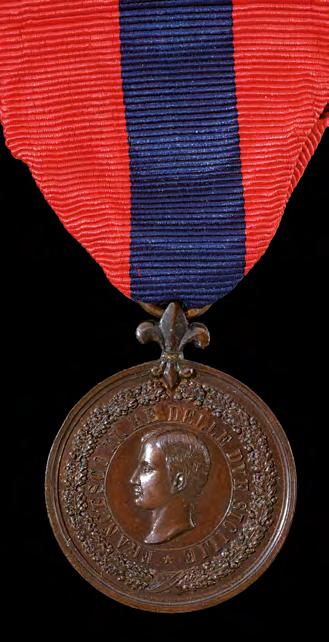
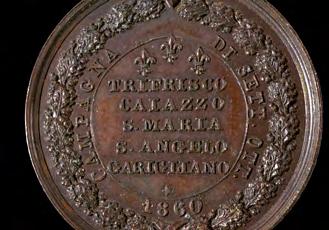
Kingdom of the Two Sicilies, 1860 Bronze medal for the campaign of SeptemberOctober 1860 (Trifrisco medal). On the obverse, “FRANCESCO II . RE DELLE DUE SICILIE”, the head of the King (left) inside oak and laurel branches closed at the bottom by a ribbon. On the reverse “CAMPAGNA DI SETT.OTT.1860”, in oak and laurel wreath closed at bottom by ribbon three Bourbon lilies and “TRIFRISCO CAIAZZO S. MARIA S. ANGELO GARIGLIANO”. Complete with ribbon. Rare.
FRANCESCO II (1859-1861)
Regno delle Due Sicilie, 1860 Medaglia per la campagna di settembre - ottobre 1860 (medaglia di Trifrisco), in bronzo. Al dritto “FRANCESCO II. RE DELLE DUE SICILIE”, nel campo testa del Re a sinistra entro una corona di fronde di quercia e di alloro chiusa in basso da un nastro. Al rovescio “CAMPAGNA DI SETT.OTT.1860”, entro corona di quercia e di alloro chiusa in basso da nastro, tre gigli Borbonici e “TRIFRISCO CAIAZZO S. MARIA S. ANGELO GARIGLIANO”. Completa di nastro. Rara.
Conditions good
Diameter 2.8 cm.
€ 150/250
56
FERDINAND II (1830-1859)
Kingdom of the Two Sicilies, 1847
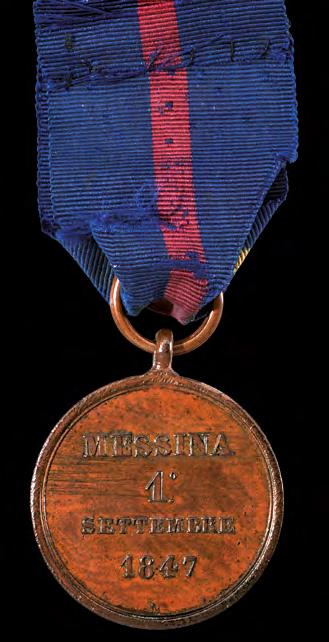
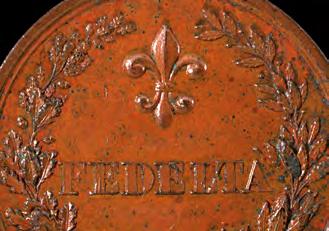
Bronze medal to the defenders of Messina during the events of 1st September 1847. On the obverse, “MESSINA 1° SETTEMBRE 1847”. On the reverse, “FEDELTÁ” under lily and between oak branches. On ribbon.
FERDINANDO II (1830-1859)
Regno delle Due Sicilie, 1847
Medaglia ai difensori di Messina durante i fatti del 1° Settembre 1847. In bronzo. Al diritto “MESSINA 1° SETTEMBRE 1847”. Al rovescio “FEDELTÁ” sotto giglio e tra fronde di quercia. Con nastro.
Conditions good
Diameter 3.1 cm.
€ 150/250
57
FERDINAND II (1830-1859)
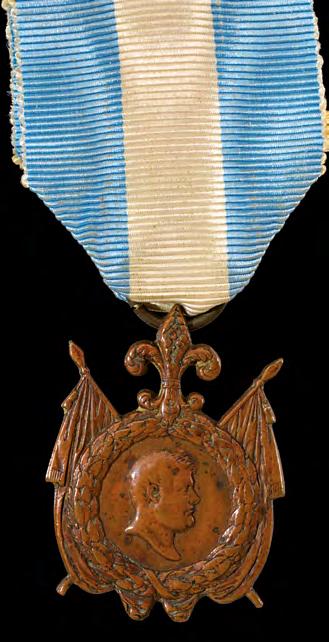
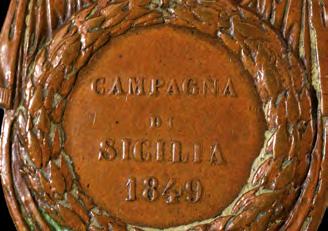
Kingdom of the Two Sicilies, 1849
Badge commemorating the suppression of the Sicilian uprisings; made of bronze, on the obverse the head (right) of Ferdinand II beneath a lily. On the reverse the inscription “CAMPAGNA DI SICILIA 1849” in four lines. With ribbon.
FERDINANDO II (1830-1859)
Regno delle Due Sicilie, 1849
Distintivo per la repressione dei moti di Sicilia; in bronzo, al dritto testa di Ferdinando II a destra sotto al giglio. Al rovescio “CAMPAGNA DI SICILIA 1849” in quattro righe. Con nastro.
Conditions good
Dimensions 2.9 x 3.8 cm.
€ 200/300
58 A LOT OF THREE MEDALS AND A STAR
Italy, 20th Century
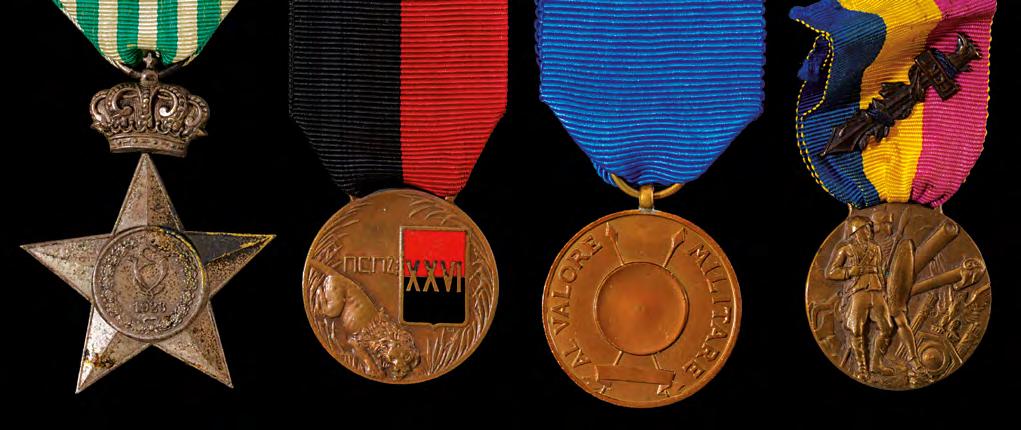
Cross of Merit 1927 for Native Troops of the Italian Colonies. With crown and ribbon.Bronze medal of the VIII Artillerymen’s Rally in Fiume, 1940, on ribbon with “FERT” clasp.Colonial medal of the XXVI Battalion, in bronze, partially enamelled and with ribbon.Medal for Military Valour with shield and crossed lances (never issued or of post-war manufacture). On ribbon.
LOTTO DI TRE MEDAGLIE E UNA STELLA
Italia, XX Sec. Croce al Merito 1927 per Militari Indigeni delle Colonie Italiane. Con corona e nastro. Medaglia in bronzo del VIII raduno artiglieri a Fiume 1940, con nastro con spilla “FERT”. Medaglia coloniale del XXVI battaglione, in bronzo parzialmente smaltato e con nastro. Medaglia al Valore Militare con scudo e lance incrociate (mai usata o di produzione postbellica). Su nastro.
Conditions good
Diameter 3.2 - 3.2 - 3.3 - 4.2 cm.
€ 120/160
59 A LOT OF TWO MEDALS
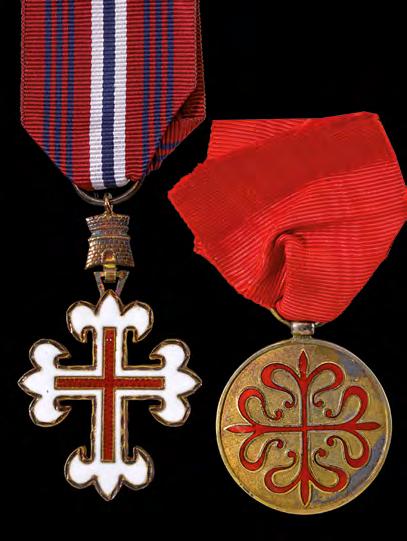
Different countries, Late 19th Century Spain: Medal of the Order of Calatrava. Circular, slightly convex, made of gilded silver with enamel. Mounted on the remains of a red silk ribbon. Portugal: Knight’s Cross of the Order of Military Merit. Made of gilded metal with enamel, mounted on a tower and ribbon. In good condition.
LOTTO DI DUE MEDAGLIE
Paesi vari, Fine del XIX Secolo Spagna: Medaglia dell’Ordine di Calatrava. Di forma circolare lievemente convessa in argento dorato e smaltato. Su resti di nastro in seta rossa. Portogallo: Croce da cavaliere dell’Ordine al Merito Militare. In metallo dorato e smaltato, su torre e nastro. Di buona qualità.
Conditions good Dimensions diam 3.1 - 3.2 x 5 cm.
€ 80/120
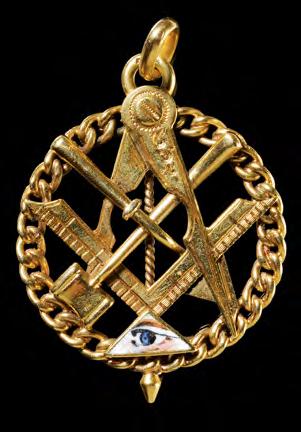
60 A SMALL MASONIC GOLD PENDANT
Central Europe, First half of the 20th Century A beautiful piece featuring four Masonic tools set in a circle of chains, with an enamel eye above. 2 g.
PICCOLO CIONDOLO MASSONICO IN ORO Europa centrale, Prima metà del XX Secolo Bellissimo lavoro con quattro attrezzi massonici in un cerchio a catene, sotto l’occhio in smalti. 2 gr.
Conditions very good
Diameter 2 cm.
€ 100/200
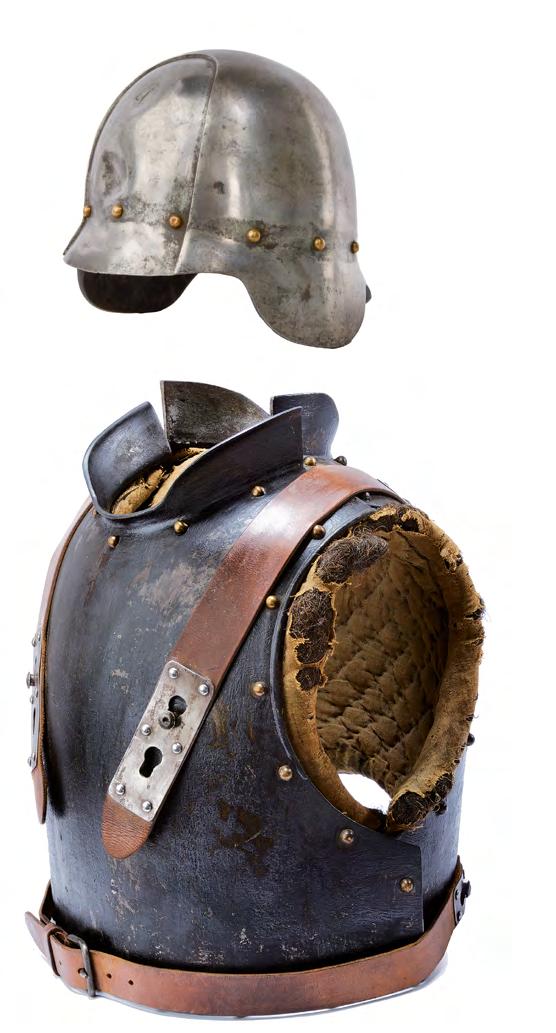
61 AN 1833 MODEL PIONEER’S CUIRASS AND HELMET
France, 1840 circa
Made of black-painted iron (the finish missing in some areas); rounded breast-plate featuring slightly raised edges around the neckline and gusset, fitted with brass rivets. The back is worked en suite, with a slightly lowered surface element in the lower part and a pronounced neck plate, also with rows of rivets and equipped with leather straps with iron buckles. The interior is completely lined with thick fabric (defects).

ELMO E CORAZZA DA GENIERI MOD. 1833
Francia, 1840 circa
L’elmo con pesante coppo in ferro, strutturato a caschetto e con giro di rivetti con testa liscia in ottone, la parte frontale leggermente ribassata e con botta di prova; l’interno presenta ancora il rivestimento in tessuto (alcune mancanze e difetti) e le due cinghie in cuoio. La corazza in ferro, tinta di colore nero (alcune mancanze alla finitura); il pettorale di forma tondeggiante recante bordi leggermente rilevati attorno a scollo e giri ascellari, munito di ribattini in ottone. La schiena lavorata en suite, con elemento di superficie lievemente ribassato nella parte inferiore e collo pronunciato, anche questa con giri di ribattini e dotata di cinghie in cuoio con fibbie in ferro. L’interno completamente rivestito in spesso tessuto (difetti).
Conditions medium
Height 43.5 cm.
€ 600/900
62
SN38/39 “LENINGRAD PATTERN” BODY ARMOUR
Soviet Union, 1938/39
Consisting of four iron helmets of different shapes. Surface with rust and some missing parts.
Experimental Soviet SN-38/39 “Leningrad Pattern” body armour, a rare preliminary variant of the famous Stalnoi Nagrudnik developed on the eve of the Second World War. Made from stamped steel with a front plate configuration and an original strapping system, it was intended for assault units and operational trials on the Leningrad/Karelia Front. Production was extremely limited and predated the standardisation of the SN-42 model. A specimen of great historical and collectable interest, belonging to the earliest Soviet experiments in modern body armour. A rare item and difficult to find on the international market for WWII military memorabilia.
ARMATURA DA CORPO SN 38/39 “LENINGRAD PATTER”
Unione Sovietica, 1938/39
Costituita da quattro elmetti di forma differente, in ferro. Superficie con ruggine e piccole mancanze.
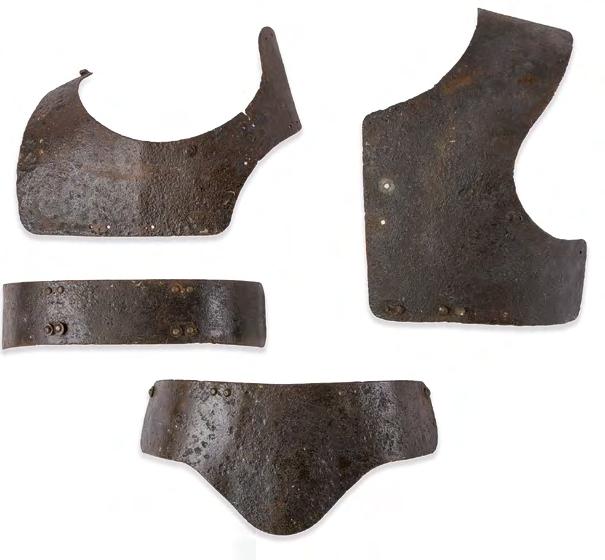
Corazza sovietica sperimentale tipo SN-38/39 “Leningrad Pattern”, rara variante preliminare del celebre Stalnoi Nagrudnik sviluppata alla vigilia della Seconda guerra mondiale. Realizzata in acciaio stampato con configurazione a piastra frontale e sistema originale di cinghiaggio, destinata a reparti d’assalto e prove operative sul Fronte di Leningrado/ Karelia. Produzione estremamente limitata e precedente alla standardizzazione del modello SN-42. Esemplare di grande interesse storico e collezionistico, appartenente alle prime sperimentazioni sovietiche di “body armour” moderno. Oggetto raro e difficilmente reperibile sul mercato internazionale della militaria WWII.
Conditions mediocre
Dimensions various cm.
€ 250/450
63
A CUIRASSIER’S HELMET
France, Third quarter of the 19th Century
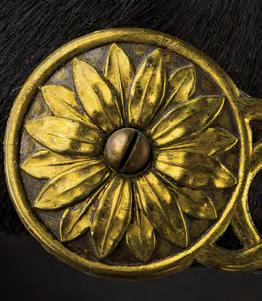
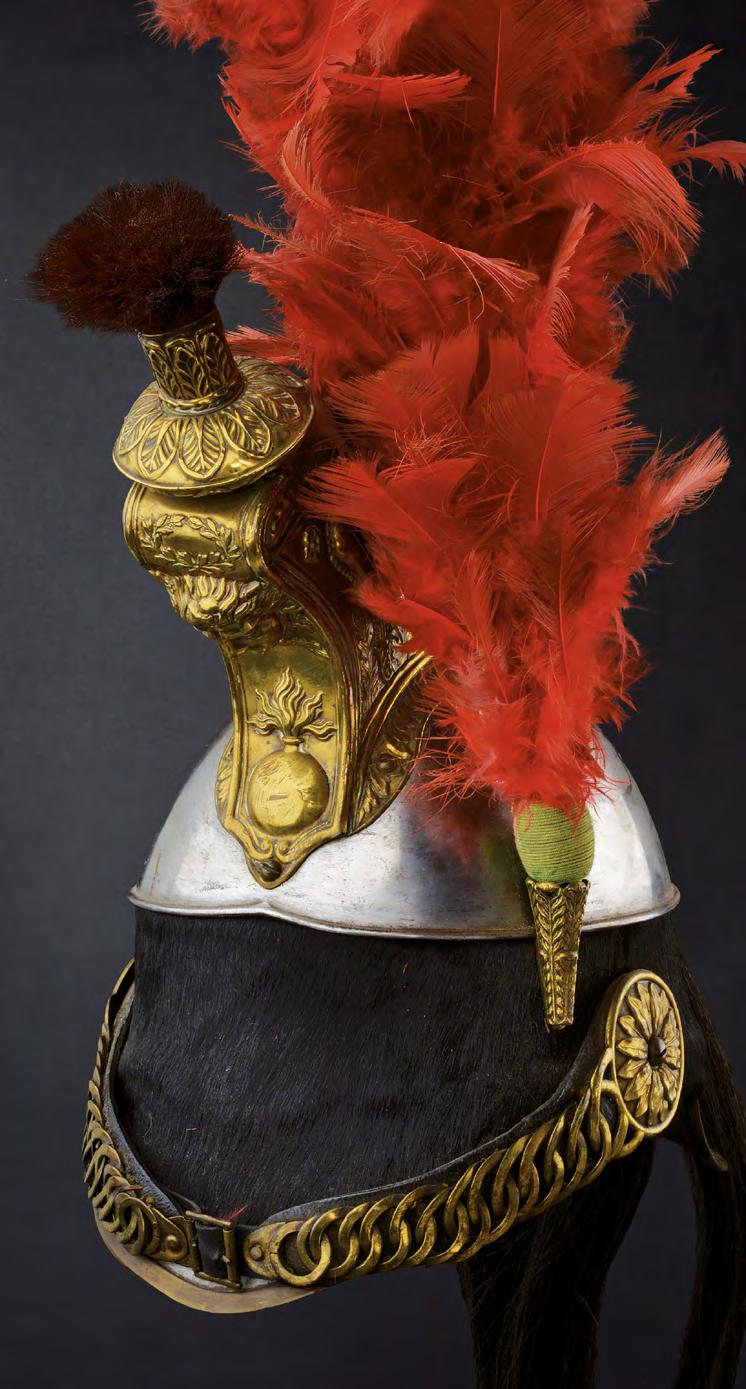
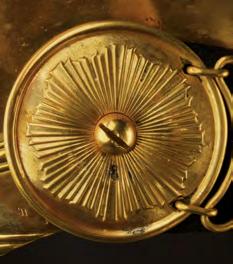
Iron skull with black fur-lined turban; brass crest decorated with floral motifs, featuring a face and a pomegranate, with black horsehair malmousette, like the back tail; visor and nape-guard edged in brass; chin straps with intertwined rings and large rosettes with raised leaves, all in brass; side plume-holder with an original tall red plume. Interior with leather-lined visors and a segmented leather cap.
ELMO DA CORAZZIERE
Francia, Terzo quarto del XIX Secolo Coppo in ferro con turbante in pelliccia nera; cimiero in ottone decorato a motivi floreali, con volto e granata, malmousette in crine nero, come pure la coda posteriore; visiera e gronda bordate in ottone; soggoli con anelli intrecciati e grossi rosoni con foglie a rilievo, il tutto in ottone; porta pennacchio laterale con alto piumetto originale di colore rosso. Interno con visiere rivestite di pelle e cuffia in cuoio a spicchi.
Conditions good
Height 32 cm.
€ 800/1.000
64
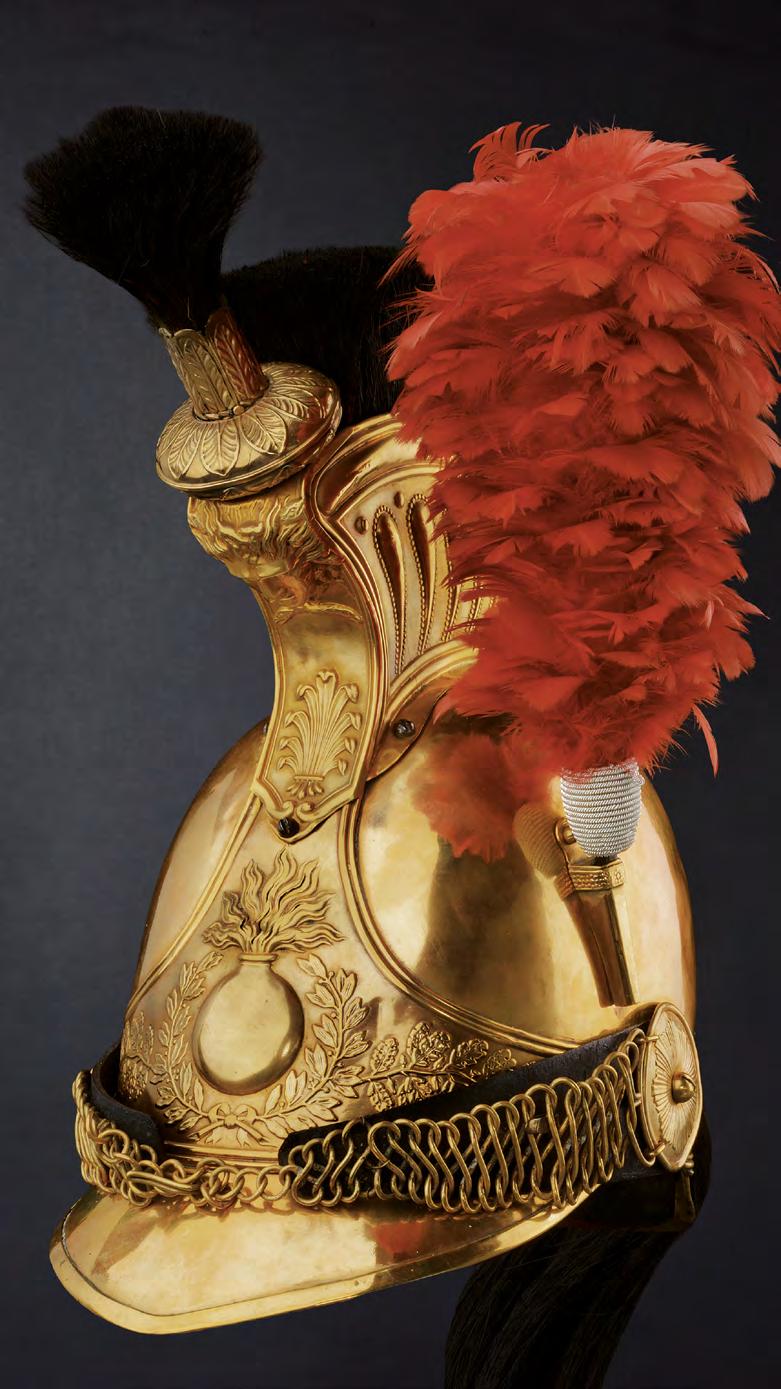
AN NC OFFICER'S HELMET OF THE LINE DRAGOONS, MODEL 1825, MODIFIED IN 1830 France, 1830 circa Brass skull with refreshed gilt finishing (some small dents), stamped crest with an anterior band of palmettes and a raised Medusa head; the marmouset probably restored; horsehair brush and black tail. Frontal frieze with a grenade between oak and laurel leaves, complete with an old red plume. Chin-strap of braided brass wire on leather band. Interior with leathercovered visors, leather sweat band with a dark cotton bag.
ELMO DA SOTTUFFICIALE DEI DRAGONI DI LINEA MOD. 1825 TRASFORMATO NEL 1830 Francia, 1830 circa Coppo in ottone con doratura rinfrescata (alcune piccole ammaccature), cimiero stampato con fascia anteriore con palmette e testa di medusa a rilievo; marmouset probabilmente di restauro; spazzola in crine e coda nera. Fregio frontale con granata fra foglie di quercia ed alloro, completo di pennacchio antico di colore rosso. Sottogola in filo di ottone intrecciato su banda in cuoio. Interno con visiere rivestite in pelle, alluda in cuoio con sacchetta in cotone scuro.
Conditions good
Height 37 cm.
€ 1.200/1.600
65
A HELMET OF THE EMPRESS’ DRAGOONS
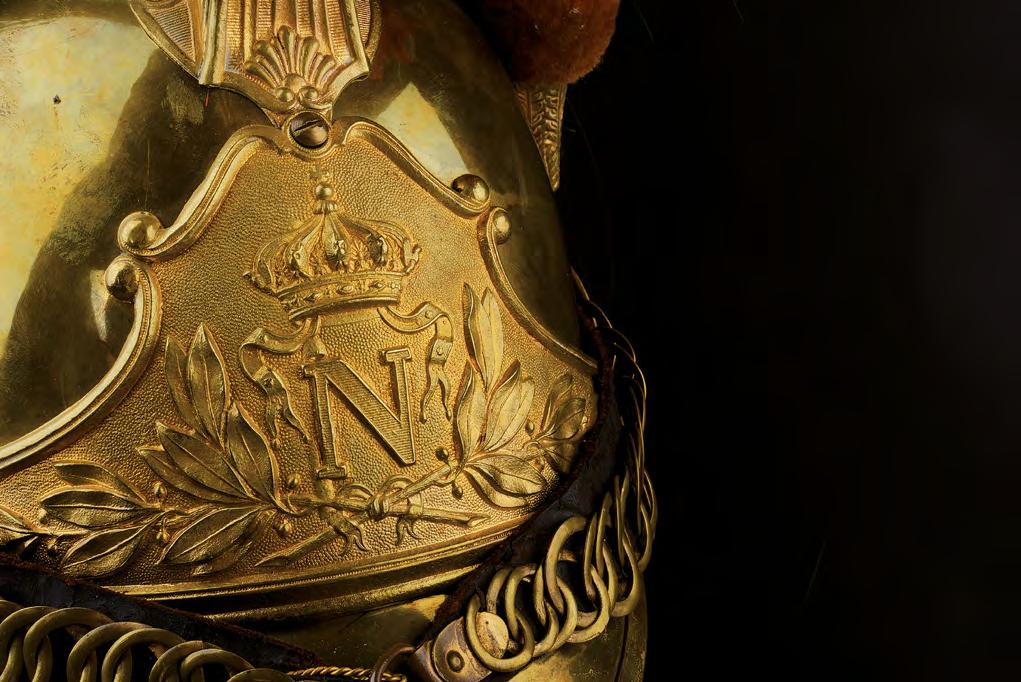
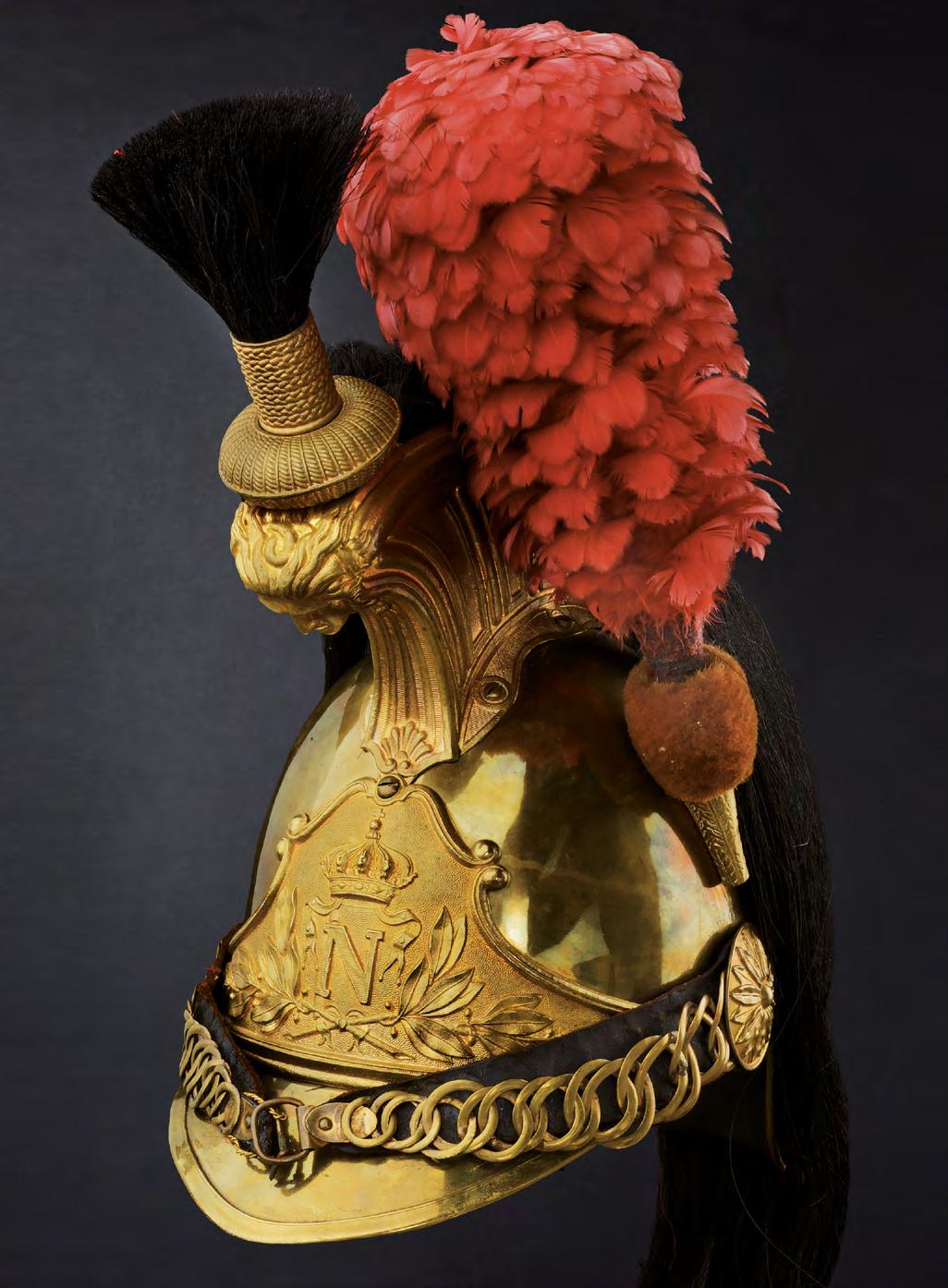
France, Late 19th Century Brass skull, polished, with stamp at the rear, provided with typical gilt mounts; frontal frieze with a crowned “N” between laurel branches; crest with embossed Medusa head; complete with marmouset and black horsehair tail. Chin-straps of braided rings on a leather band, cheek-pieces embossed as laurel leaves. Original red plume and orange wool pompon. Inside with leathercovered visors and a segmented leather sweat band.
ELMO DA DRAGONE DELL’IMPERATRICE
Francia, Fine del XIX Secolo Coppo in ottone lucido con punzone al retro, con tipici fornimenti già dorati; fregio frontale con “N” coronata tra fronde di lauro; cimiero con testa di medusa a sbalzo; completa di marmouset e coda nera in crine di cavallo. Soggoli ad anelli intrecciati su banda in cuoio e orecchioni sbalzati a foglie di alloro. Pennacchio originale rosso e pompon in lana arancione. Interno con visiere rivestite in pelle e alluda a spicchi sempre in cuoio.
Conditions excellent
Height 41 cm.
€ 2.500/3.500
66 A RARE DRAGOON OFFICER’S HELMET
France, First Empire
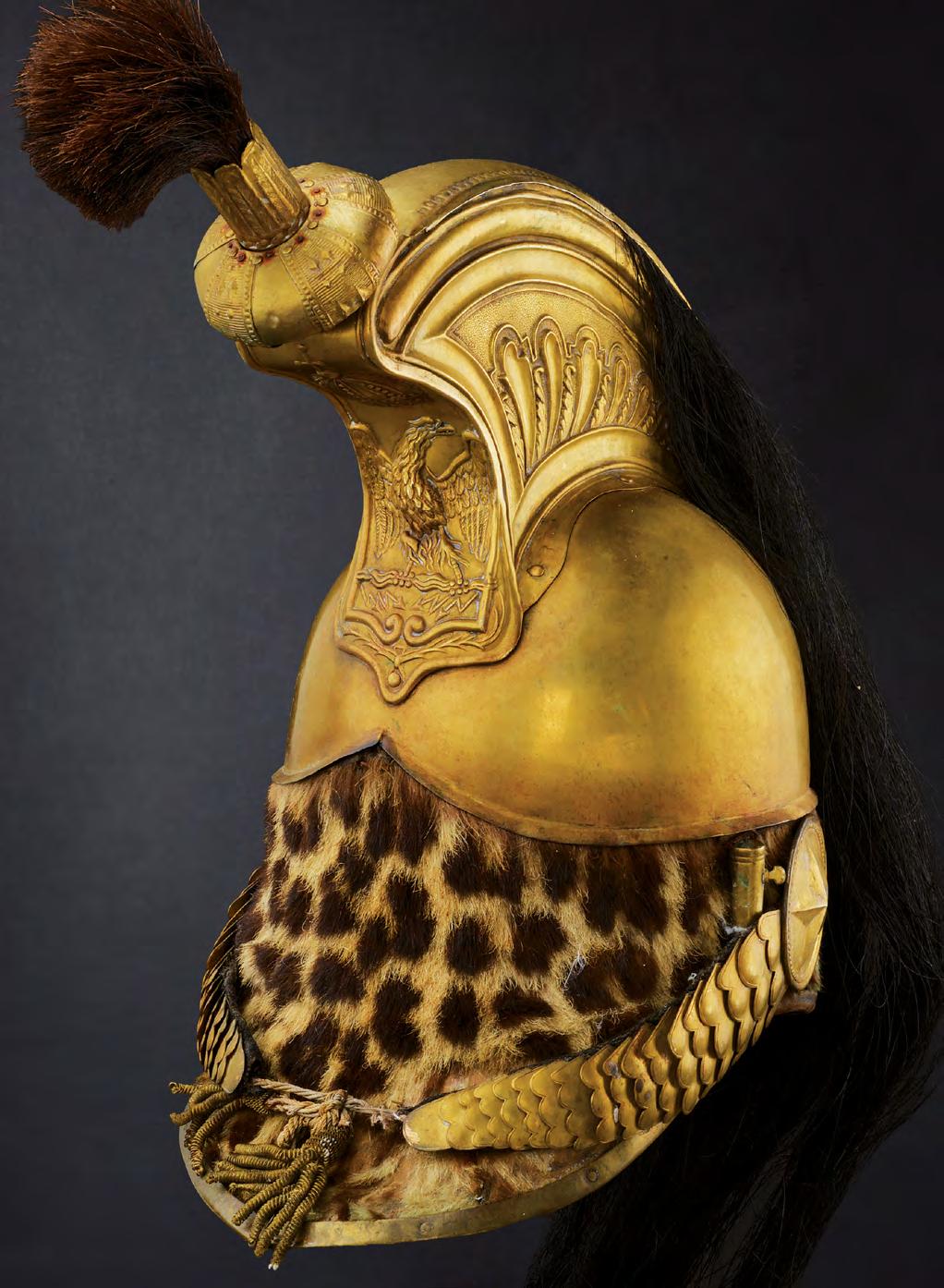
Gilded, brass skull, very slender at the front in the style of the late Empire. Fur turban. Brass crest (partially restored), secured to the skull with eight screws; elaborately embossed with typical motifs on the sides; on the front, an eagle on lightning bolts is stamped in high relief and surmounted by a crown. Black horsehair marmousette; on the back of the crest, long horsehair in the same colour. Visor edged and riveted with thin brass sheets (Bardin regulations of 1812). Complete with brass-scaled chin straps with velvet lining, held together by a cord with fringes of gilded threads; large cheek-pieces with a star in relief at the centre. On the left side, the plume-holder with wing screw. Interior with leather sweatband; the rear of the turban with strongly fold towards the visor.
This lot includes a CESAR certificate confirming its authenticity and that it was produced before 1947
RARO ELMO PER UFFICIALE DEI DRAGONI
Francia, Primo Impero
Coppo in ottone dorato, molto slanciato sul davanti secondo la moda del tardo Impero. Turbante in pelliccia. Cimiero (alcuni restauri) in ottone, fissato al coppo con otto viti; elaborato a sbalzo con motivi tipici sulla superfici laterali; nella parte frontale è stampata in forte rilievo l’aquila su saette sormontata da corona. Marmousette in crine di cavallo nero, sul retro del cimiero lungo crine di cavallo nello stesso colore. Visiera bordata e rivettata in lamierino d’ottone (regolamento di Bardin del 1812). Completo di soggoli a scaglie in ottone con interno in velluto, tenuti assieme da una corda con frange in canutiglia dorata; grandi orecchioni recanti al centro una stella in rilievo. Sul lato sinistro la pennacchiera con vite a galletto. Interno con alluda in cuoio; la parte posteriore del turbante con forte piega verso la visiera.
Il presente lotto è accompagnato da un certificato CESAR che ne attesta l’autenticità e la produzione pre 1947.
Conditions good
Height 40 cm.
€ 5.000/8.000
67
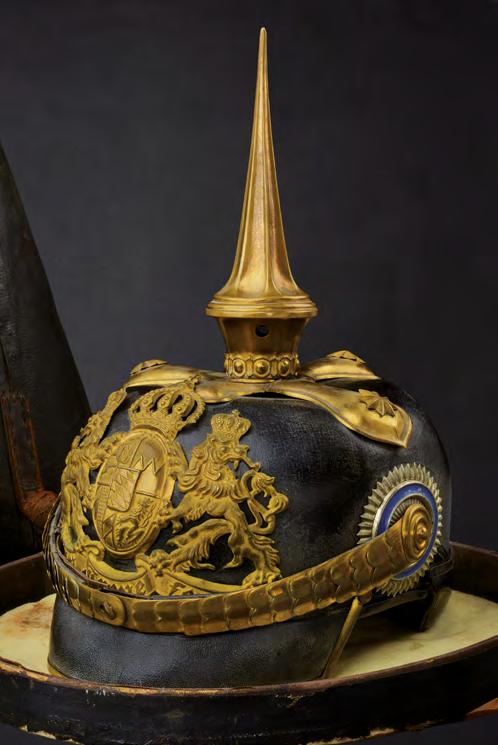
A CAVALRY OFFICER’S OR MINISTRY OF WAR PICKELAUBE, WITH BOX Bavaria, about 1910
Leather body (some craquelure), surmounted by a grooved tip with cylindrical base featuring a raised frame decoration, lobed cross base (one arm restored) with eightpointed star-headed rivets; frontal frieze with the Bavarian coat of arms and bandeau “In Treue Fest.” Convex scale chin-straps, with internal leather band. Both cockades are present. Sewn visors, the front one reinforced at the edge with brass (broken part). Interior with brown Moroccan leather sweatband and cloth cap. Complete with leather-covered case.
A Pickelaube that may have belonged to the 1st, 3rd, 5th or 7th Cavalry Regiments; to the 2nd Heavy Cavalry Regiment; or to an officer of the War Office.
PICKELAUBE PER UFFICIALE DI CAVALLERIA O DEL MINISTERO DELLA
GUERRA , CON SCATOLA
Baviera, 1910 circa Corpo in cuoio (alcuni craquelet), sommità con puntale scanalato con collo cilindrico dotato di decoro a cornice in rilievo, base a croce lobata (restauro ad un ramo) con rivetti a testa di stella a otto punte; fregio frontale con stemma della Baviera e bandeau “In Treue Fest.” Soggoli a squame convesse, internamente con banda in cuoio. Entrambe le coccarde presenti. Visiere cucite, quella anteriore con rinforzo in ottone al bordo (rottura). L’interno con alluda in marocchino marrone e cuffia in tessuto. Con scatola rivestita di cuoio.
Pickelaube che poteva appartenere al primo, terzo, quinto o settimo reggimento di cavalleria; al secondo reggimento di cavalleria pesante oppure ad un ufficiale del ministero della guerra.
Conditions medium
Height 29 cm.
€ 800/1.200
68 A CUIRASSIER TROOPERS HELMET
Prussia, about 1910
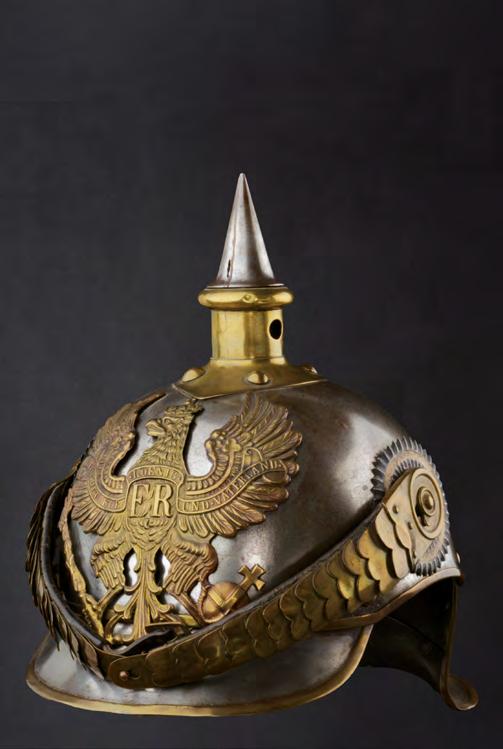
Skull with round visor and iron nape-guard (with slight signs of oxidation), featuring brass mounts. Smooth iron and brass tip on oval base. Regimental eagle on the front. Flat-scale chin straps, with both cockades. Inside, a segmented leather sweat-band.
ELMO DA TRUPPA DEI CORAZZIERI
Prussia, 1910 circa Coppo, visiera tondeggiante e gronda in ferro (zone con leggere ossidazioni) dotati di fornimenti in ottone. Puntale liscio in ferro e ottone su base ovale. Sulla fronte l’aquila di linea. Soggoli a squame piatte, entrambe le coccarde presenti. L’interno con alluda a spicchi in pelle.
Conditions medium
Height 26 cm.
€ 1.000/1.500
69 AN OFFICER’S MITRE HELMET FOR THE FIRST GUARD FOOT REGIMENT
Prussia, circa 1900
Large embossed and silvered badge with an eagle armed with sword and lightning bolts, surmounted by the bandeau “SEMPER TALIS” and crown, surrounded by trophies and placed above the royal monogram “FR”. Silvered metal mounts also at the sides and rear, all with flaming grenade motifs. Body in yellow fabric with silver-thread stripes. Chin-straps of silver-coloured metal with flat scales on Model 91 button. White and red cotton pompon (of later date). Brown Moroccan leather sweat band divided into segments. There is another bandeau with the inscription “PRO GLORIA ET PATRIA”.
This is an interesting and rare item. The “SEMPER TALIS” inscription on the bandeau corresponds to the 1st or 2nd battalion, whereas the inscription on the bandeau of the rifle battalion is “PRO GLORIA ET PATRIA”. This example features both inscriptions and may therefore relate to someone who was transferred from the 1st or 2nd battalion to the rifle battalion at the time.The mitre body is red for the 1st and 2nd battalions, and yellow for the 3rd battalion.The seams are trimmed with white wool edging for other ranks and silver braid for officers, as in this case.
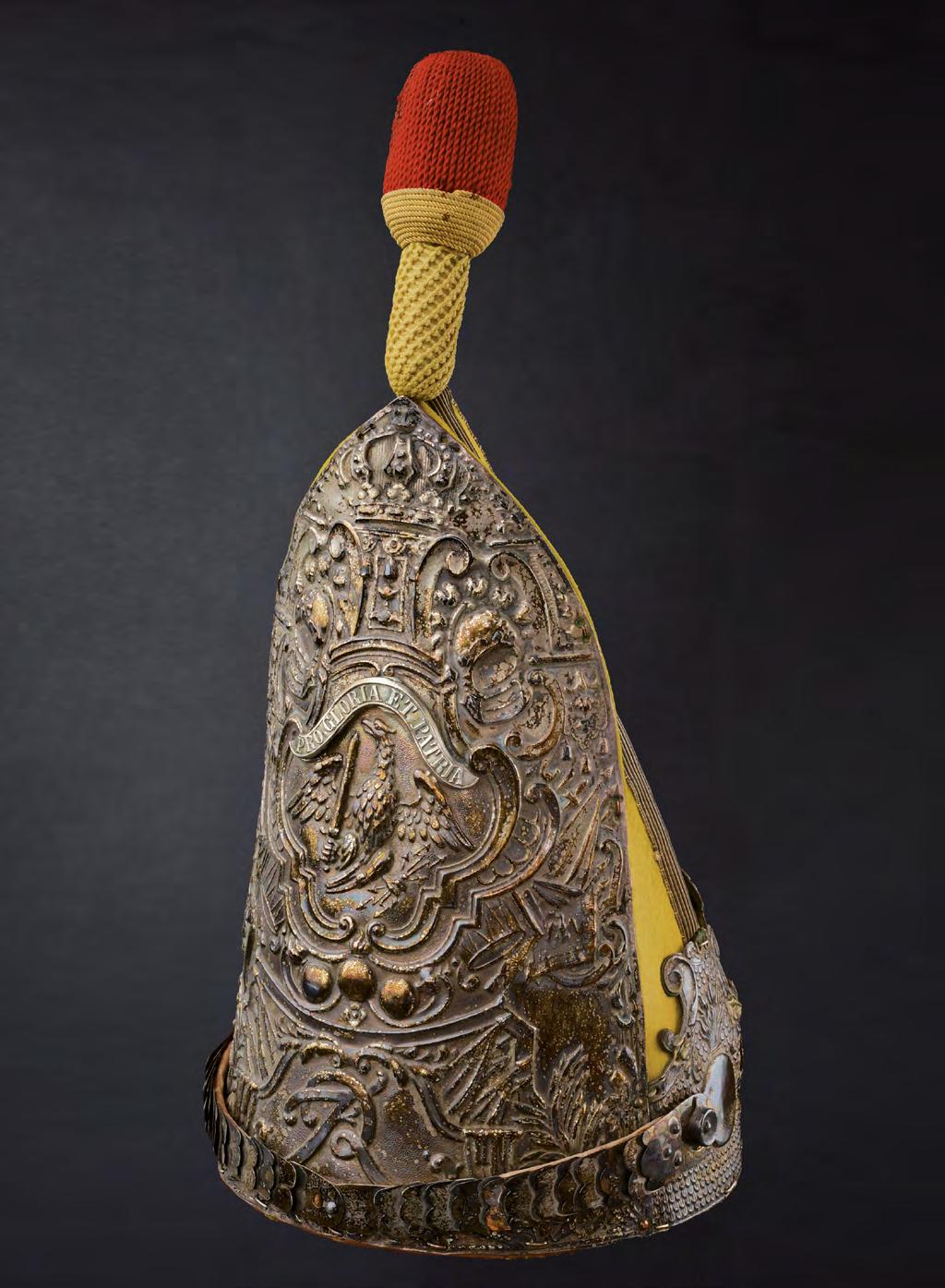
MITRIA DA UFFICIALE PER IL 1° REGGIMENTO
DELLA GUARDIA A PIEDI
Prussia, 1900 circa Grande fregio sbalzato e argentato, con aquila armata di spada e saette sormontata dal bandeau “SEMPER TALIS” e dalla corona, circondata da trofei e sovrastante il monogramma reale “FR”; metallerie argentate anche ai lati e nella parte posteriore, tutti con granata fiammeggiante. Corpo in tessuto giallo con galloni in filo d’argento. Soggoli in metallo color argento con squame piatte su bottone mod. 91. Pompon in cotone bianco e rosso (di epoca successiva). Alluda in marocchino marrone a spicchi. Presente anche un altro bandeau con iscrizione “PRO GLORIA ET PATRIA”.
Interessante e raro copricapo: il bandeau “SEMPER TALIS” corrisponde al I o II battaglione, nel battaglione fucilieri invece il bandeau reca l’iscrizione
“PRO GLORIA ET PATRIA”; nel lotto da noi proposto vi sono entrambe le scritte, probabilmente si tratta di un personaggio che al tempo fu trasferito dal I o dal II battaglione al battaglione fucilieri. Per quanto riguarda il corpo della mitria, è rosso nel I e II battaglione e giallo nel III battaglione. Le cuciture sono guarnite con bordo in lana bianco per la truppa e da gallone argentato, come in questo caso, per gli ufficiali.
Conditions good
Height 30 cm.
€ 1.800/2.500
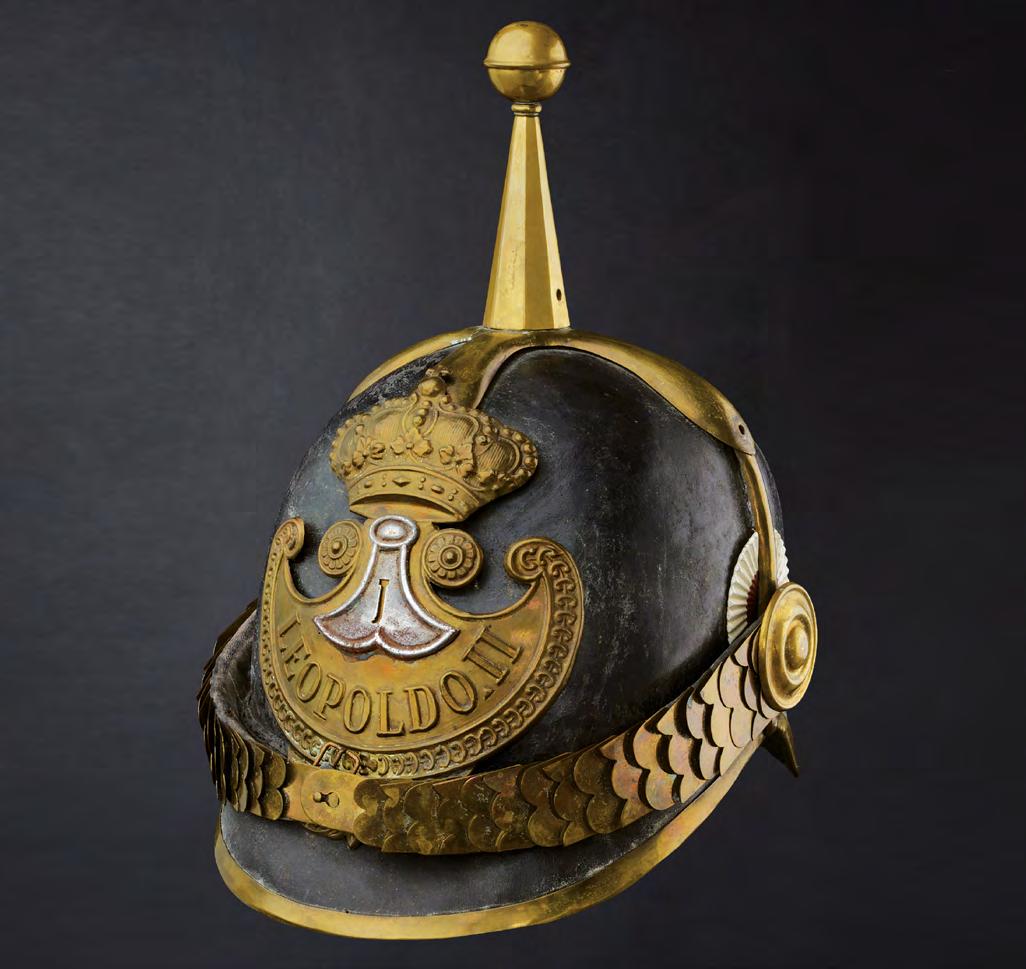
70 A RARE CIVIL GUARD HELMET
Grand Duchy of Tuscany, circa 1848
Black stiff leather skull, with a metal front band depicting a shell-guard featuring the inscription ‘LEOPOLDO II’ under crown; a cusp-shaped faceted tip surmounted by a sphere and resting on a cross-shaped base; a metal cockade on the left side; leather chin straps reinforced with brass scales. Leather cap inside.
RARO ELMO DELLA GUARDIA CIVICA
Granducato di Toscana, 1848 circa Coppo in cuoio rigido nero, fregio frontale metallico, effigiante pelta caricata con l’iscrizione “LEOPOLDO II” sormontata da corona. Puntale a cuspide faccettata sormontata da sfera e con base a croce; sul fianco sinistro coccarda metallica. Soggoli in cuoio e corazzati con scaglie in ottone. All’interno cuffia in cuoio.
Conditions medium
Height 29.5 cm.
€ 600/900
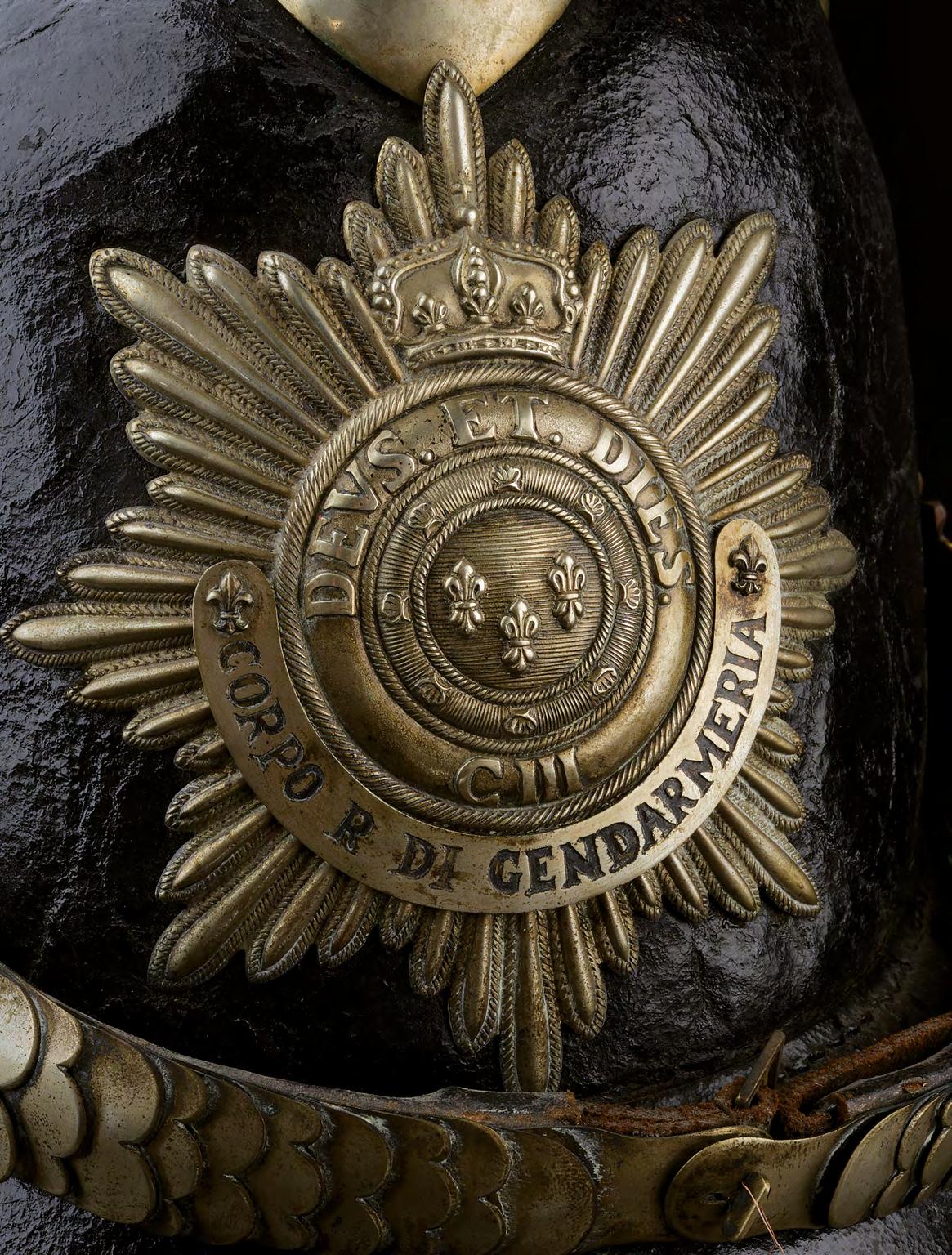
A RARE GENDARMERIE
HELMET
Duchy of Parma, Mid 19th Century High, boiled-leather skull (with some defects and old restoration), featuring an angled brim and a white metal border; the napeguard is also made of stitched leather. White metal mounts; featuring at the top a flaming grenade on a cross-shaped base with lilies (one fastening screw is detached but still present); on the front, a large star with a coat of arms featuring three lilies and the motto “DEVS ET DIES” and “C III” under crown; an additional pierced plaque with the inscription “CORPO R DI GENDARMERIA,” secured with two small, finely crafted lilies. Convex-scaled chin straps lined in leather on rosettes with lily; featuring a stave decorated with two lilies at the rear. Iron cockade with the Duchy’s colours: yellow and blue. Inside, featuring segmented leather sweat-bands and label with red lettering.
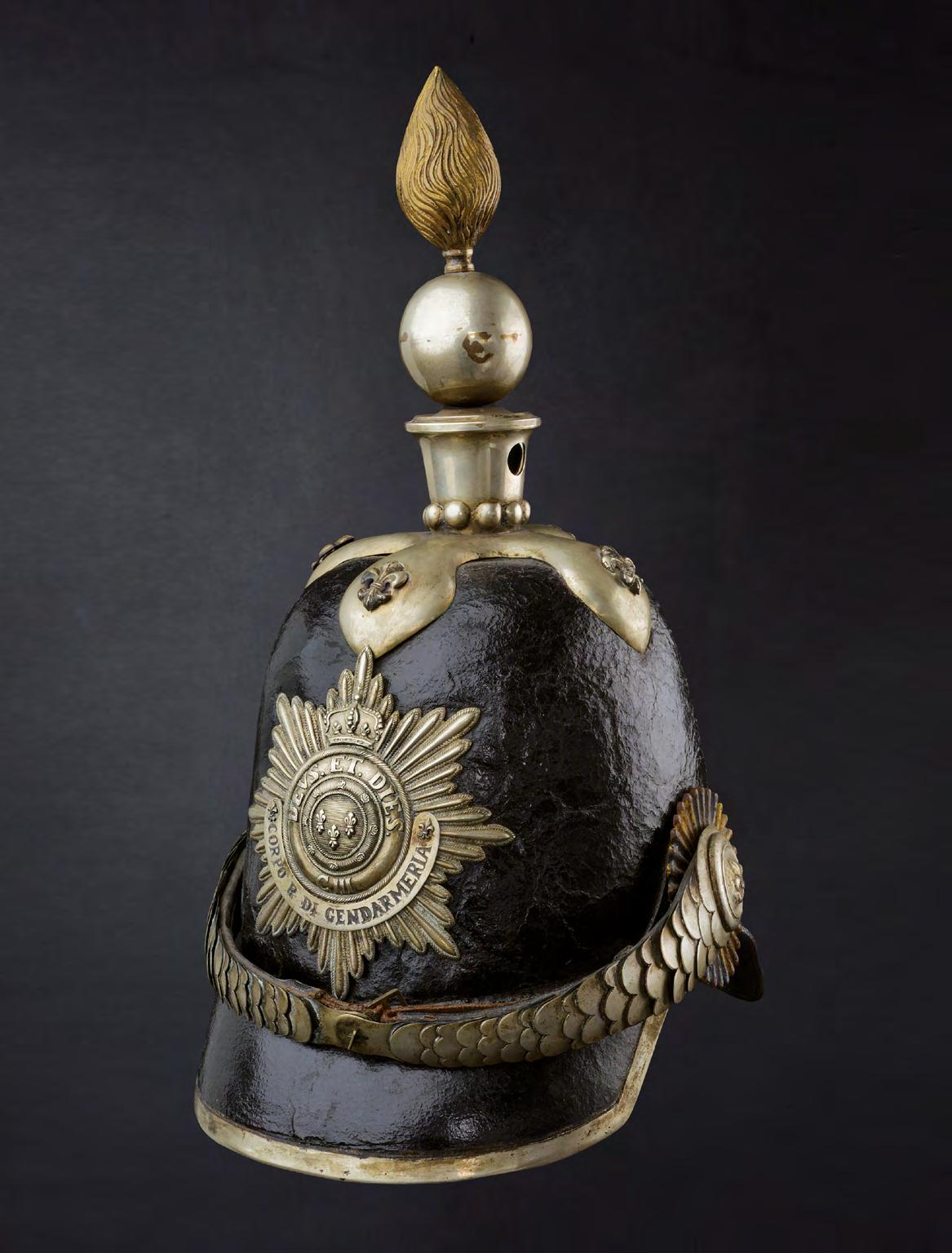
RARO ELMO DA GENDARMERIA
Ducato di Parma e Piacenza, Metà del XIX Secolo Alto coppo in cuoio bollito (alcuni difetti e antico restauro), con tesa angolata e bordo in metallo bianco, la gronda anche in cuoio cucito. Fornimenti in metallo bianco, con puntale a granata fiammeggiante su base cruciforme caricata con gigli (una vite di fissaggio staccata ma presente).
Sulla fronte grande stella con stemma a tre gigli recante motto “DEVS ET DIES” e “C III” sotto corona, un’ulteriore placca traforata reca la scritta “CORPO R DI GENDARMERIA”, questa fissata con due piccoli gigli ben lavorati. Soggolo a squame convesse foderato all’interno in cuoio su rosette con giglio. Il retro con doga decorata con due gigli. Coccarda in ferro nei colori del ducato: giallo e blu. L’interno con alluda in cuoio a spicchi ed etichetta con iscrizioni in colore rosso.
Conditions medium
Height 39 cm. € 2.800/4.000
72
A CAVALRY HELMET, VICTOR EMMANUEL III EPOCH Kingdom of Italy, about 1930 Iron skull with a fur band (restored) featuring a rounded frieze with Savoy cross; crest with gilded brass comb featuring a fine lion’s head in relief and, at the base, an olive-shaped finial with the crowned monogram “VE”. Armoured chin-straps with brass plates. Tricolour fabric cockade (not original). Inside, a black leather cap.
ELMO DA CAVALLERIA, EPOCA
VITTORIO EMANUELE III
Regno d’Italia, 1930 circa Coppo in ferro con turbante in pelliccia (di restauro) recante fregio bombato a croce sabauda; cimiero con cresta in ottone dorato recante bella testa di leone in rilievo e alla base oliva con monogramma “VE” coronato. Soggoli corazzati con placche in ottone. Coccarda tricolore in tessuto non pertinente. All’interno cuffia in cuoio nero.
Conditions Height 29 cm.
€ 400/600
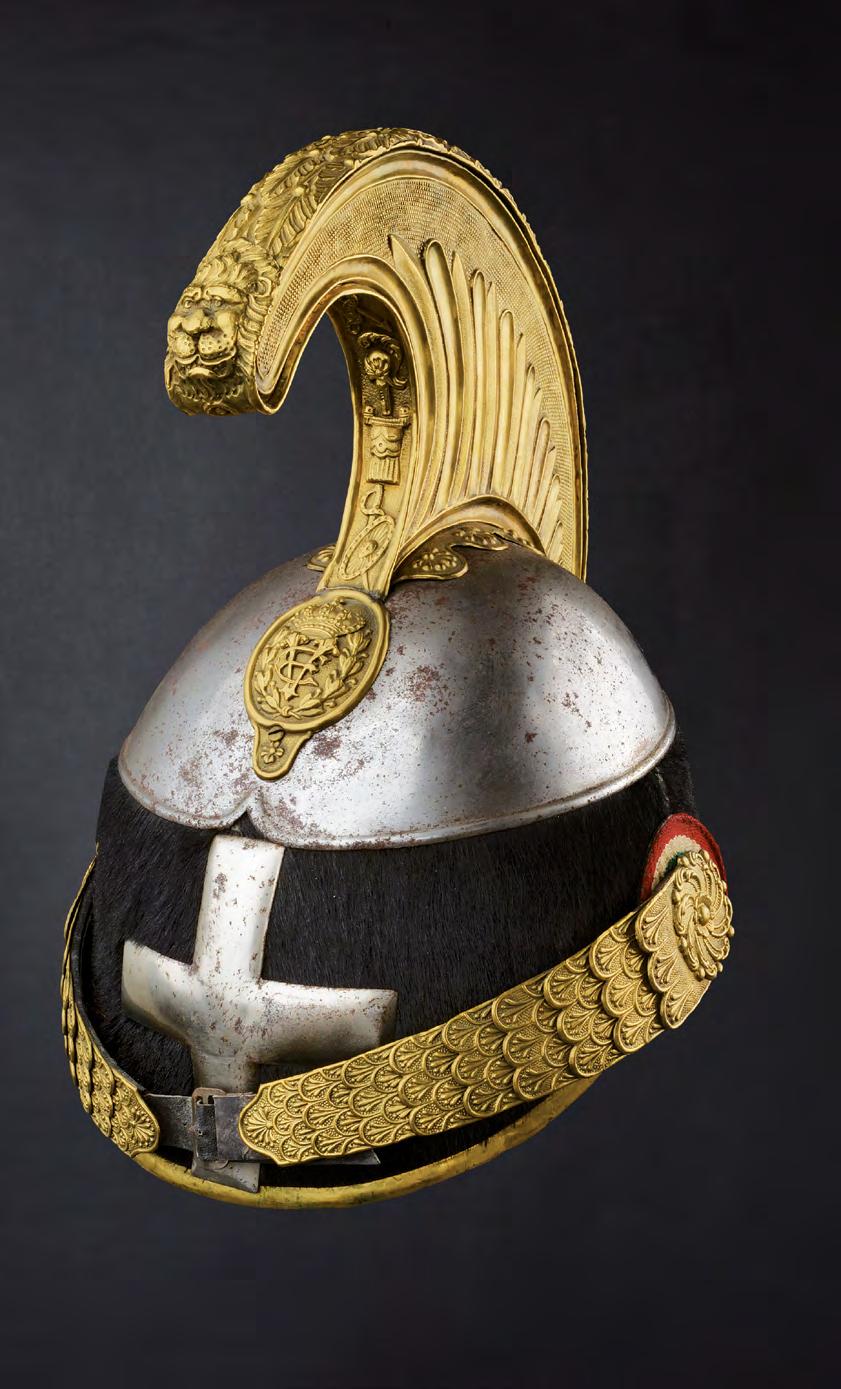
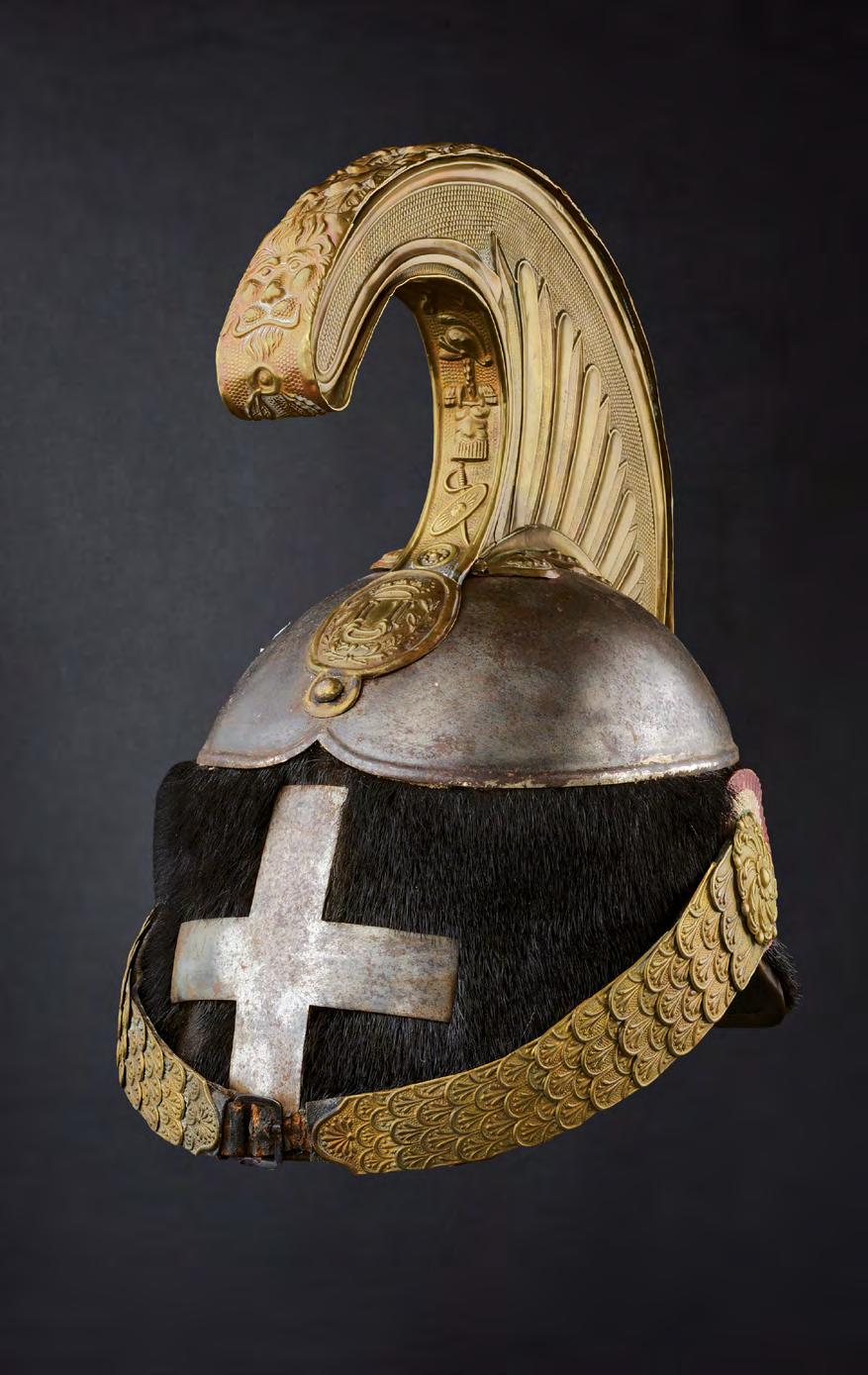
73 A CAVALRY TROOPER’S HELMET, UMBERTO I EPOCH
Kingdom of Italy, Late 19th Century Black iron skull with seal skin in good condition; brass crest with olive-shaped finial featuring the crowned letter “U”. Frontal frieze shaped as a flat cross. Armoured chinstrap with brass scale pattern. On the left side, a leather cockade painted in the colours of the kingdom. Inside, leather sweat band with segments.
ELMO PER TRUPPA DI CAVALLERIA, EPOCA UMBERTO I
Regno d’Italia, Fine del XIX Secolo Coppo in ferro nero con pelliccia in phoca vitulina in buono stato di conservazione; cimiero in ottone con oliva recante la cifra “U” coronata. Fregio frontale a croce piatta. Soggolo corazzato con struttura a scaglie in ottone. Sul lato sinistro coccarda in cuoio dipinta nei colori del regno. All’interno alluda a spicchi in cuoio.
Conditions medium
Height 31 cm.
€ 600/900
74
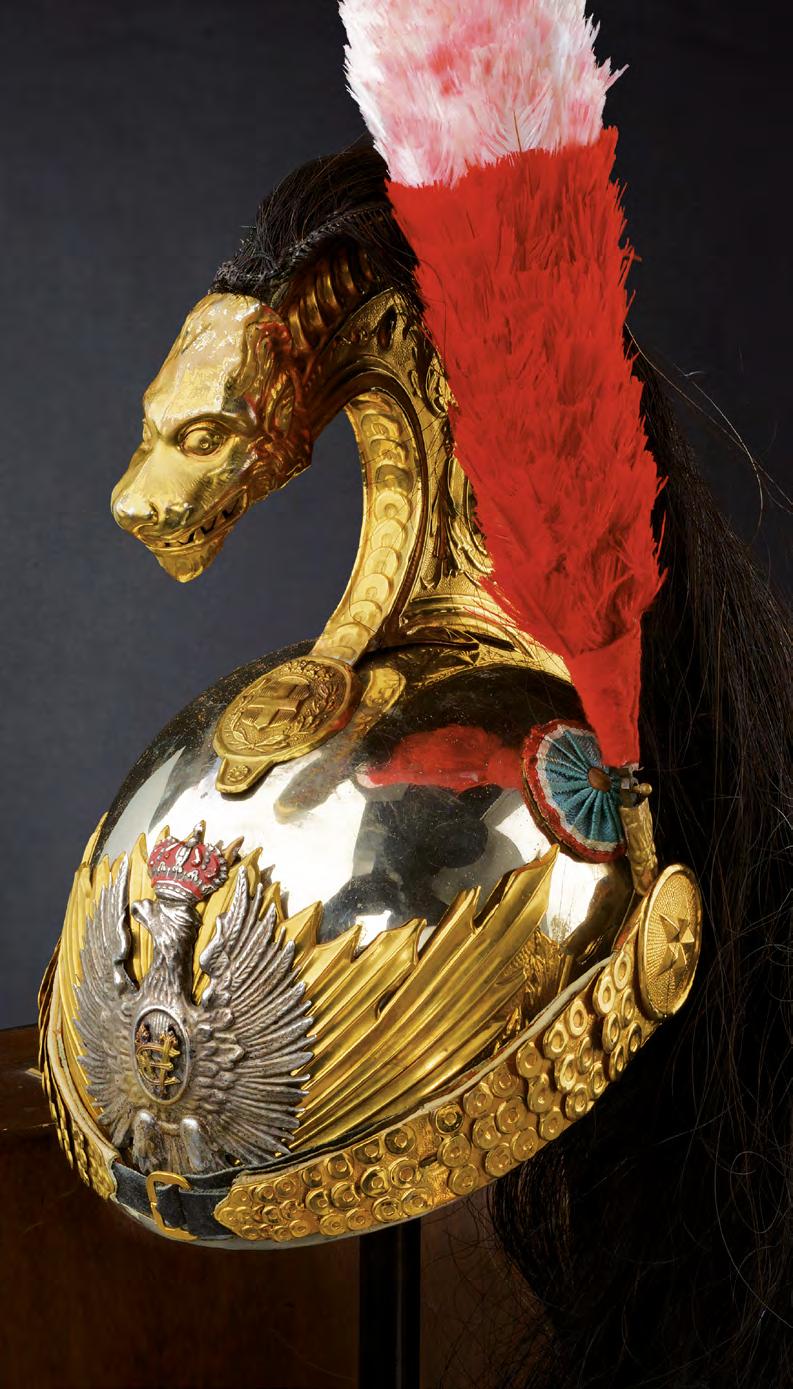
A CURASSIER TROOPER’S HELMET, WITH CASE Kingdom of Italy, 1945 circa Nickel-silver skull, gilded brass crest with typical decorations in relief, an olive-shaped finial with crowned shield among oak and laurel branches. Complete with lion’s muzzle featuring a long black mane. Front frieze shaped as a crowned eagle made of silver, surmounted by the monogram “VE” for Vittorio Emanuele III on the chest; gold rays and leaves at the front, scaled chin straps and star-shaped cheek-pieces also in gold. Tricolor cotton cockade and the plume-holder complete with original plume with clutch for the bayonet. Inside, featuring visors lined in red morocco leather and a segmented leather cap. Red cardboard plume-holder and original wooden box with brass mounts.
ELMO PER TRUPPA DEI CORAZZIERI, CON SCATOLA Regno d’Italia, 1945 circa Coppo in alpacca, cimiero in ottone dorato con tipici decori in rilievo, oliva con scudo coronato entro serto di quercia ed alloro. Completo di ceffo a leone con lunga criniera nera. Fregio frontale a aquila coronata, in argento, caricata sul petto del monogramma “VE” per Vittorio Emanuele III; raggiera frontale e fronde sempre dorate, come anche i soggoli a squame e gli orecchioni a stella. Coccarda in cotone tricolore e la pennaccheira completa di piumetto originale con attacco a baionetta. L’interno con visiere rivestite in marocchino rosso e cuffia in pelle lavorata a spicchi. Porta piumetto in cartone rosso e scatola originale in legno con fornimenti in ottone.
Conditions excellent
Height 32 cm circa.
€ 1.800/2.500
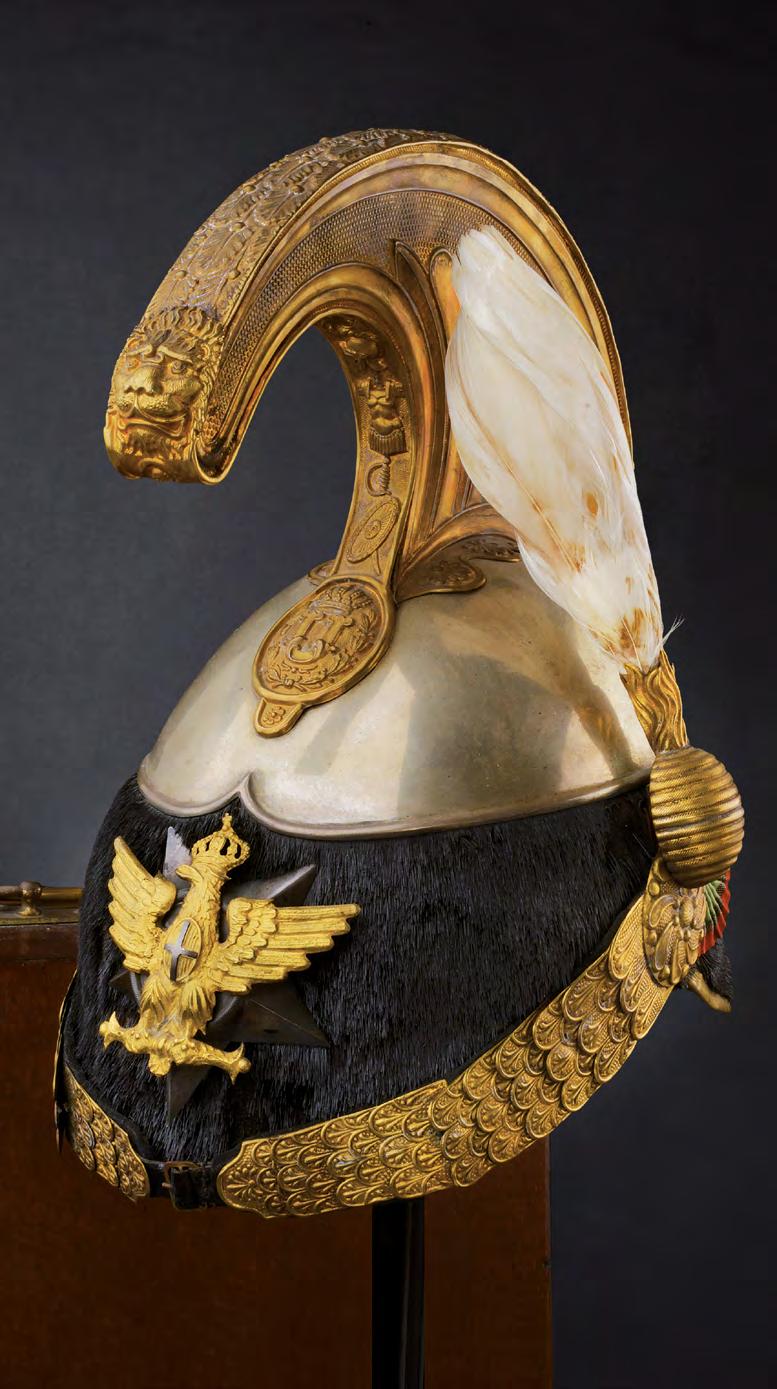
75 A CAVALRY STAFF OFFICER’S HELMET, BY CESATI Kingdom of Italy, about 1880 Silver skull with the typical gilt-brass crest, bearing within the oval reserve the crowned “U” monogram of King Umberto I; turban covered with black-dyed seal skin. Front frieze in the form of a silver star charged with a gilt and crowned eagle bearing the Savoy cross on its breast. Gilt scale chin-strap as well as ear rosettes; on the left side, a special staff officer’s tulip ornament, complete with original plume. Tricolour cockade of silk and silver thread.Interior with visors and black Moroccan leather sweat band; crimson silk cap with leather maker’s label inscribed “GIACOMO CESATI & FIGLI / MILANO”.Complete with original wooden box with brass handle and oval nameplate featuring the inscription “G. B. Enrico Lauger” in italics surmounted by a baronial crown.
Enrico De Laugier, orderly officer to Victor Emmanuel II, died in 1877. As the sovereign himself died shortly thereafter, on 9 January 1878, it is plausible that the helmet presented here either passed to his son Lorenzo or belonged to the latter, presumably also an orderly officer to H.M. It may therefore be hypothesized that the helmet belonged to Lorenzo, although preserved in its original case, apparently of slightly earlier date and thus perhaps pertaining to the father.
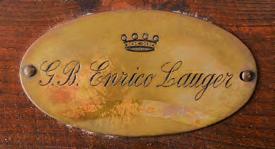
Regno d’Italia, 1880 circa Coppo in argento con tipico cimiero in ottone dorato, recante nell’oliva il monogramma con la “U” coronata per Re Umberto I; turbante rivestito in pelle di phoca vitulina tinta di nero. Fregio frontale a stella argentata caricata di aquila dorata e coronata con croce sabauda sul petto. Sottogola a squame dorate come anche gli orecchioni, sul lato sinistro particolare tulipa in uso allo stato maggiore e completa del suo piumetto originale. Coccarda tricolore in seta e filo d’argento. Interno con visiere e alluda in marocchino nero; cuffia in seta cremisi con targhetta in cuoio recante il nome del fabbricante
“GIACOMO CESATI & FIGLI / MILANO”. Completo di scatola originale in legno con maniglia in ottone e targhetta ovale recante il nome in corsivo “G. B. Enrico Lauger” con corona baronale.
Enrico De Laugier, ufficiale di ordinanza di Vittorio Emanuele II, morì nel 1877. Poiché il sovrano scomparve poco dopo, il 9 gennaio 1878, è plausibile che l’elmo qui presentato sia o passato al figlio Lorenzo o sia del figlio, verosimilmente anch’egli ufficiale di ordinanza di S.M. Si può pertanto ipotizzare che l’elmo appartenga a Lorenzo, pur essendo conservato nella scatola originale, apparentemente di data leggermente anteriore e quindi forse pertinente al padre.
Conditions very good
Height 30 cm.
€ 4.000/5.000
76
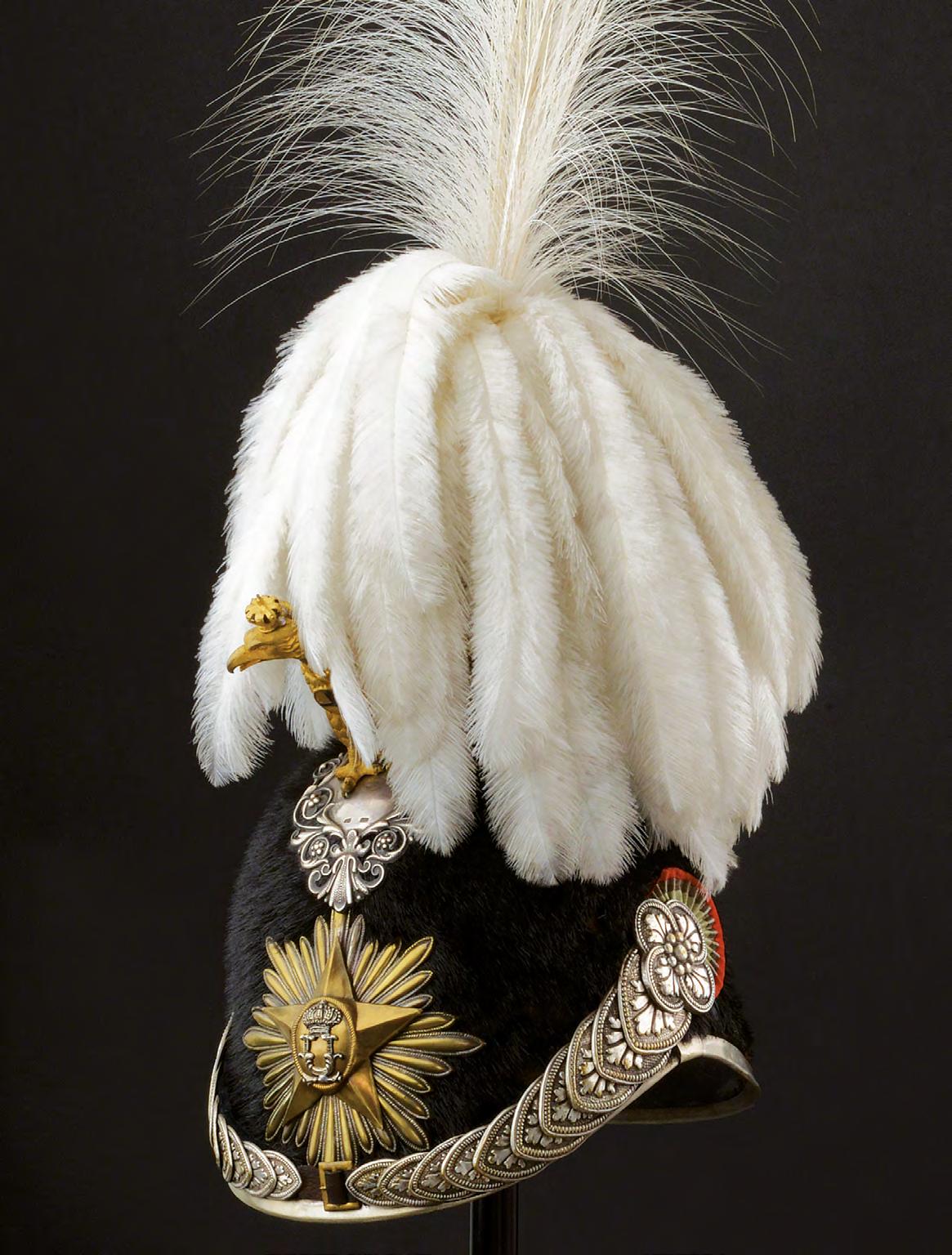
A GENERAL’S HELMET FROM KING UMBERTO PERIOD
Kingdom of Italy, late 19th Century
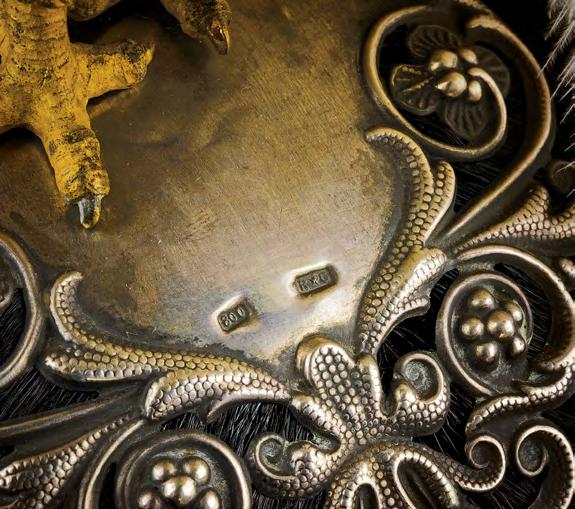
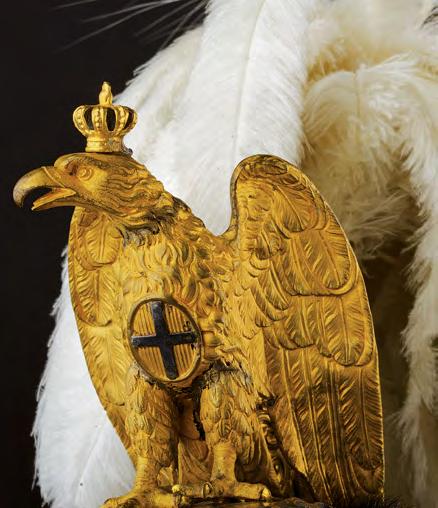
Compressed skull covered with black fur (small missing parts); marked silver mounts, gilt crest (small restored broken part), like the star featuring the crowned monogram “U”, and scale chin-straps; the radial pattern of formerly silvered brass. On the upper left side, a tricolour cockade of cotton and silver thread. Interior with brown Moroccan leather and remains of a silk cap. Complete with the extremely rare plume of aigrette and heron feathers. Very rare.
ELMO DA GENERALE UMBERTINO
Regno d’Italia, fine del XIX Sec.
Coppo in galletta rivestito di pelliccia nera (piccole mancanze); fornimenti in argento punzonato, cimiero dorato (piccola rottura restaurata) come anche la stella che reca il monogramma coronato “U”, soggoli a squame; la raggiera probabilmente in ottone già argentato. Sul alto sinistro coccarda tricolore in cotone e filo d’argento. Interno in marocchino marrone e resti di cuffia in seta. Completo del rarissimo piumaggio di aigrette e penne di airone. Molto raro.
Conditions medium
Height total 67 cm.
€ 4.500/6.500
77 A VERY RARE PIEDMONTESE INFANTRY OFFICER’S HELMET
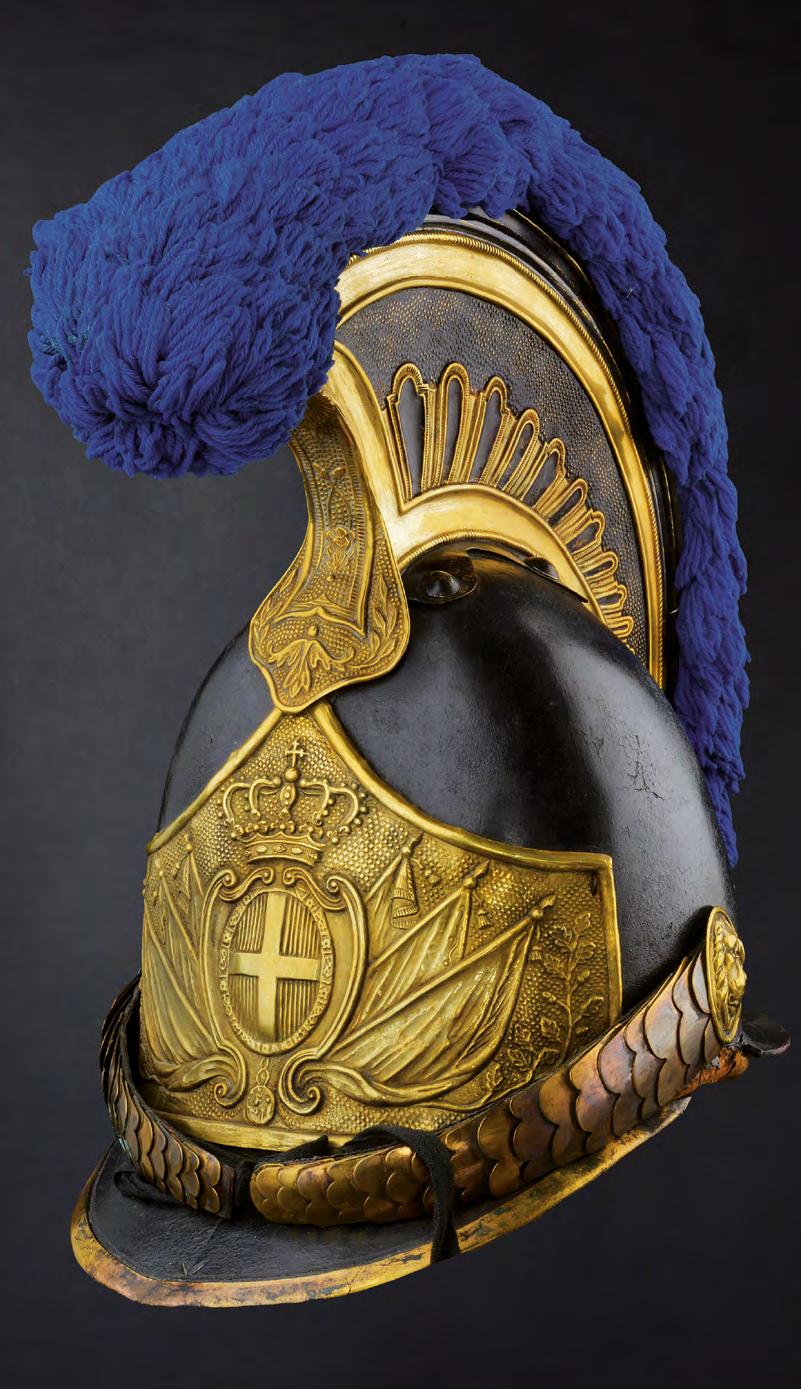
Piedmont, 1814 circa Skull and black-dyed, boiled leather visor; gilded brass crest (one of the fastening rivets is missing but still present), of regulation shape with modern blue wool chenille; front frieze decorated in relief with leaves, flags, and a Baroque-style shield surmounted by an oval shield with the Savoy cross and the Collar of the Annunciation, beneath a royal crown (first-type frieze). French-made chin straps which are not original (this particular and rare model did not feature chin straps with brass scales, but a simple leather band); cheek-pieces shaped as lion’s heads. Visors painted green inside; with dark, morocco leather sweatband (defects and signs of use and time). Some restoration and small missing parts.
RARISSIMO CASCHETTO PIEMONTESE PER UFFICIALE DI FANTERIA
Piemonte, 1814 circa Coppo e visiera in cuoio bollito tinto di nero, cimiero in ottone dorato (uno dei ribattini di fissaggio staccato ma presente), di forma regolamentare con ciniglia moderna in lana azzurra; fregio anteriore ornato a rilievo da fronde, bandiere e uno scudetto di stampo barocco caricato da scudo ovale con la croce sabauda e il collare dell’annunziata, sotto corona reale (fregio di primo tipo). Soggoli di manifattura Francese non pertinenti (questo particolare e raro modello non portava i soggoli con scaglie in ottone, ma una semplice fascetta in cuoio); orecchioni a teste di leone.
L’interno delle visiere verniciate di verde; con alluda in marocchino scuro (defetti e segni d’uso e del tempo). Alcuni restauri e piccole mancanze.
Conditions good
Height 34 cm.
€ 3.500/4.000
78
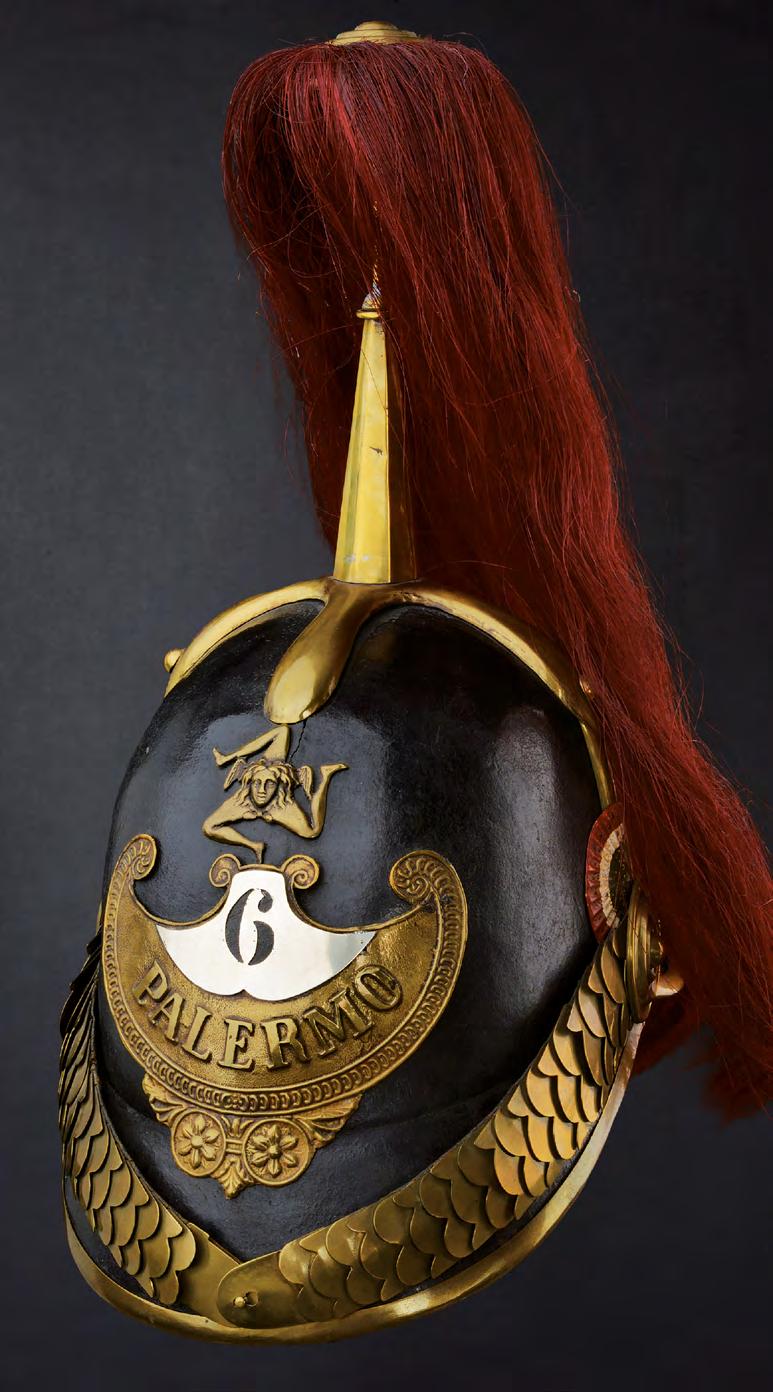
A HELMET OF THE CIVIC GUARD OF PALERMO, 1848 PERIOD
Interim Goverment of Sicily, 18481849
Black rigid leather skull, surmounted by a faceted brass cusp with a spherical tip on a raised crossshaped base, complete with red horsehair; brass shell-guard frieze surmounted by a Trinacria, with a silver-colored metal plate, pierced, featuring the number “6”; below, the inscription “PALERMO” in relief. The brass border (partially detached on the left side), on the side a metal cockade with the green-white-red tricolor, leather chin straps with brass scales. Inside, a segmented leather cap.
This is a rare artefact from the shortlived Provisional Government of Sicily (1848–49). Similar items can be seen at the Risorgimento Museum in Palermo.
ELMO DELLA GUARDIA CIVICA
DI PALERMO, PERIODO 1848
Governo Provvisorio di Sicilia, 1848 - 1849
Coppo in cuoio rigido nero, sormontato da cuspide faccetta in ottone con puntale sferoide su base cruciforme rilevata, completo di crine color rosso; fregio a pelta in ottone sormontato da trinacria, con placchetta in metallo color argento, traforata recante il numero “6”; al di sotto la dicitura “PALERMO” in rilievo. Il bordo in ottone (parzialmente staccato sul lato sinistro), sul fianco coccarda metallica con tricolore verde-biancorosso, soggolo in cuoio con squame in ottone. All’interno cuffia in cuoio a spicchi.
Raro cimelio del brevissimo Governo Provvisorio di Sicilia (1848-49). Esemplari simili sono conservati al Museo del Risorgimento di Palermo.
Conditions medium
Height 32 cm.
€ 1.800/2.500
79 A FINE CUIRASSIER’S HELMET FROM THE FIRST YEARS OF THE ITALIAN REPUBLIC
Italian Republic , 1950-60
German silver skull, with gilt brass crest featuring typical raised decoration, oliveshaped finial with large star. Complete with lion’s face with long black mane. Front frieze shaped as trophy-of-arms (early republican type) of silvered metal; front ray pattern and branches also gilt, like the scale chin-straps and star-shaped ear cheek-pieces. Tricolour cotton cockade complete plume-holder with original plume. The skull has numerous holes behind the cheek-pieces, which witness the reuse of an earlier helmet adapted during the transition from monarchy to republic. Interior with red cloth-covered visors and a (later) leather cap. Complete with original wooden case with brass mounts.
BELL' ELMO DA
CORAZZIERE DEI PRIMI
ANNI DELLA REPUBBLICA
Repubblica Italiana, 1950-60 Coppo in alpacca, cimiero in ottone dorato con tipici decori in rilievo, oliva con stellone. Completo di ceffo a leone con lunga criniera nera. Fregio frontale a forma di trofei d’armi (Repubblica, di primo tipo) in metallo argentato; raggiera frontale e fronde sempre dorati, come anche i soggoli a squame e gli orecchioni a stella. Coccarda in cotone tricolore e la pennaccheira completa di piumetto originale. Il coppo presenta numerosi fori dietro agli orecchioni, che testimoniano l’utilizzo di un elmo leggermente più vecchio trasformato al passaggio della monarchia alla repubblica.
L’interno con visiere rivestite tessuto rosso e cuffia (più recente in) in pelle. Completo di scatola originale in legno con fornimenti in ottone.
Conditions good
Height 30 cm.
€ 2.000/2.500
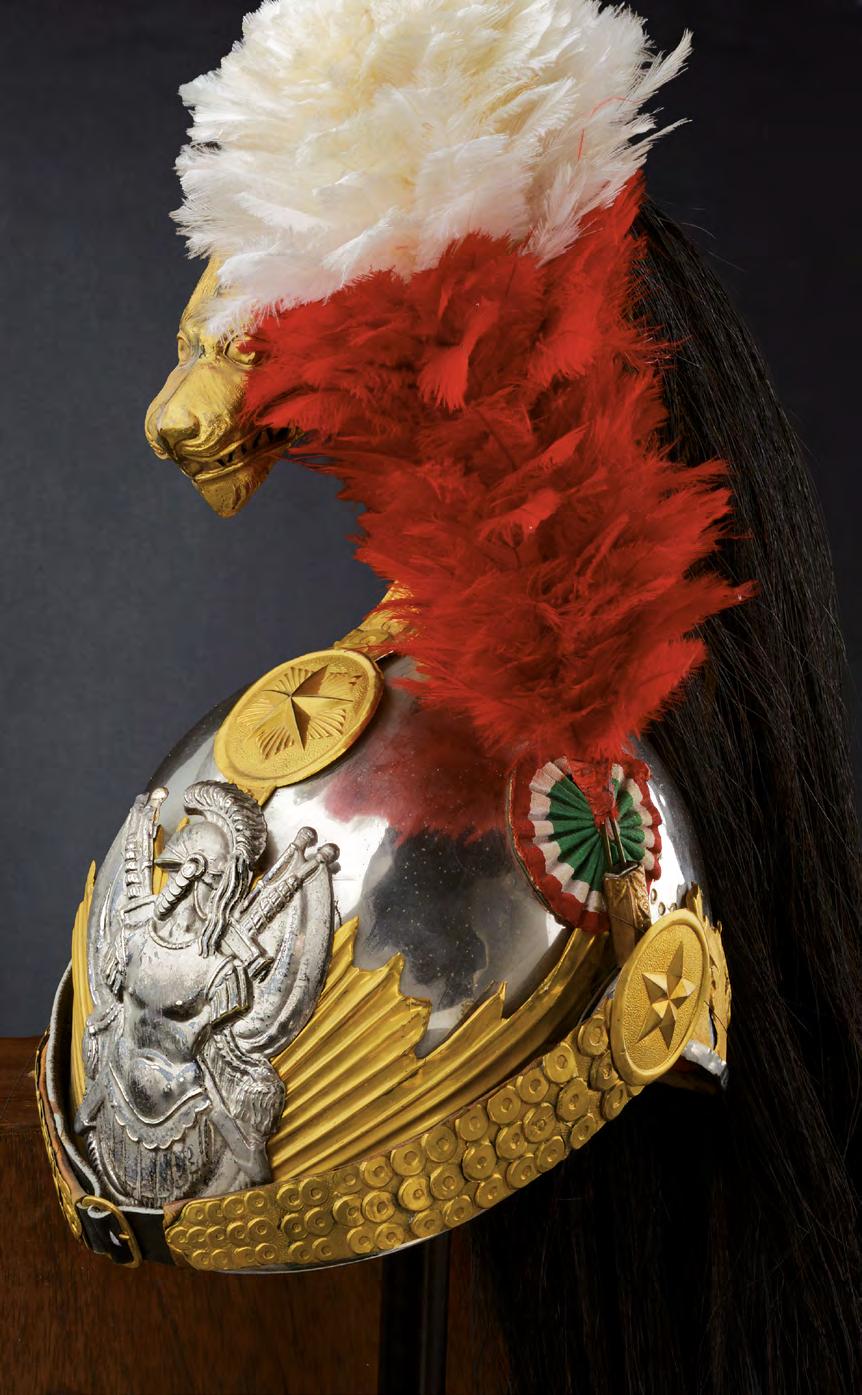
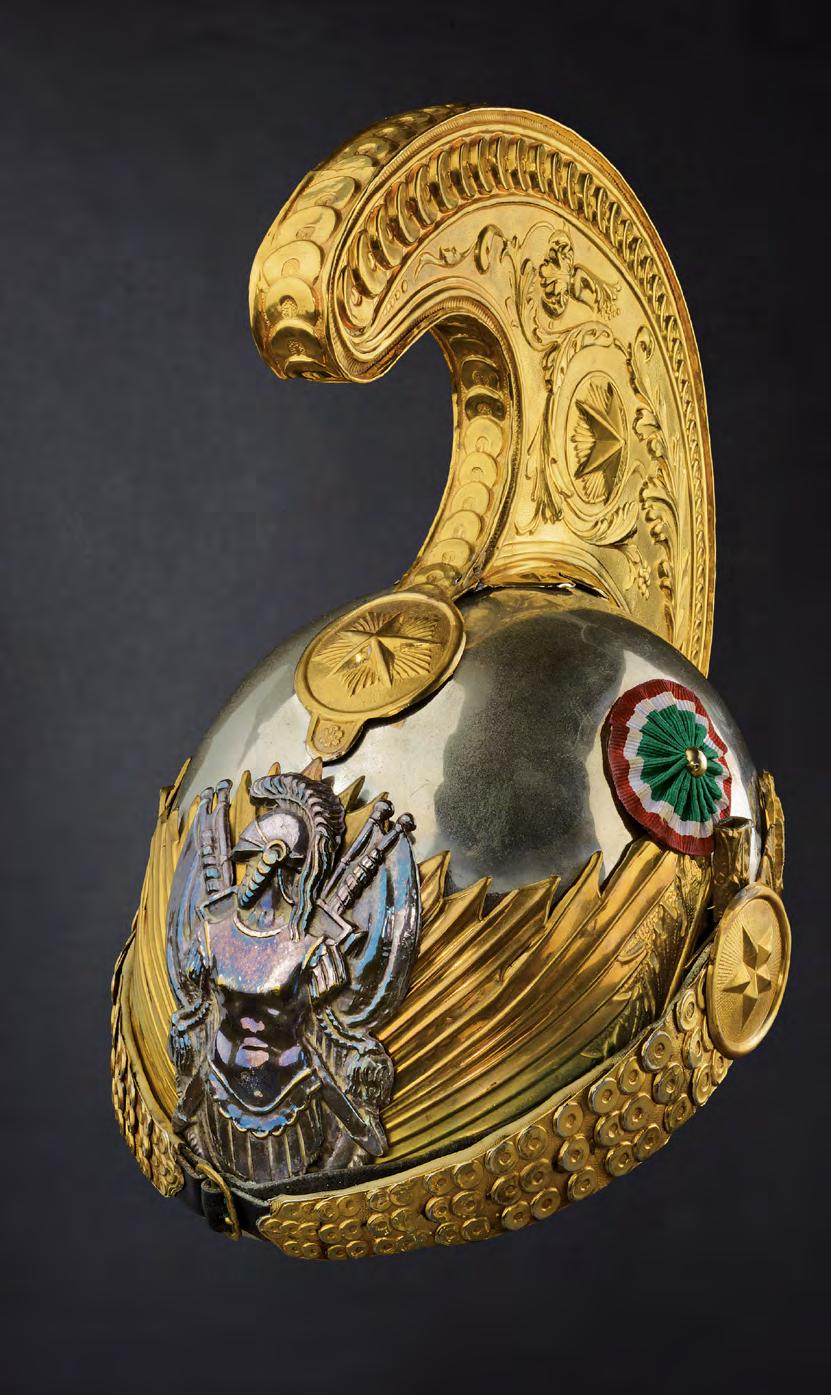
80
A FINE CUIRASSIER’S HELMET FROM THE FIRST YEARS OF THE ITALIAN REPUBLIC
Italy, 1955-1960
German-silver skull, gold-plated brass mounts; the crest is gilded with the typical stamped motifs, with stars along the sides amidst embossed floral designs. On the front, the olive-shaped finial featuring the star of the Republic in relief. Radial pattern decorated with a frieze of military trophies. Scaled chin-strap with star-shaped rosettes. Inside, visors lined with red morocco leather and brown leather cap with segmented detailing.
BELL' ELMO DA CORAZZIERE DEI PRIMI ANNI DELLA REPUBBLICA
Italia, 1955-1960
Coppo in alpacca, fornimenti in ottone dorato; il cimiero dorato con i tipici motivi stampati, stelle lungo i fianchi fra motivi floreali sbalzati. Al frontale l’oliva che reca la stella della repubblica in rilievo. Raggiera caricata da fregio con trofei d’armi. Sottogola a squame con rosoni a stella. All’interno visiere foderate in marocchino rosso e cuffia in cuoio marrone lavorato a spicchi.
Conditions very good Height 31 cm.
€ 2.000/2.500
81
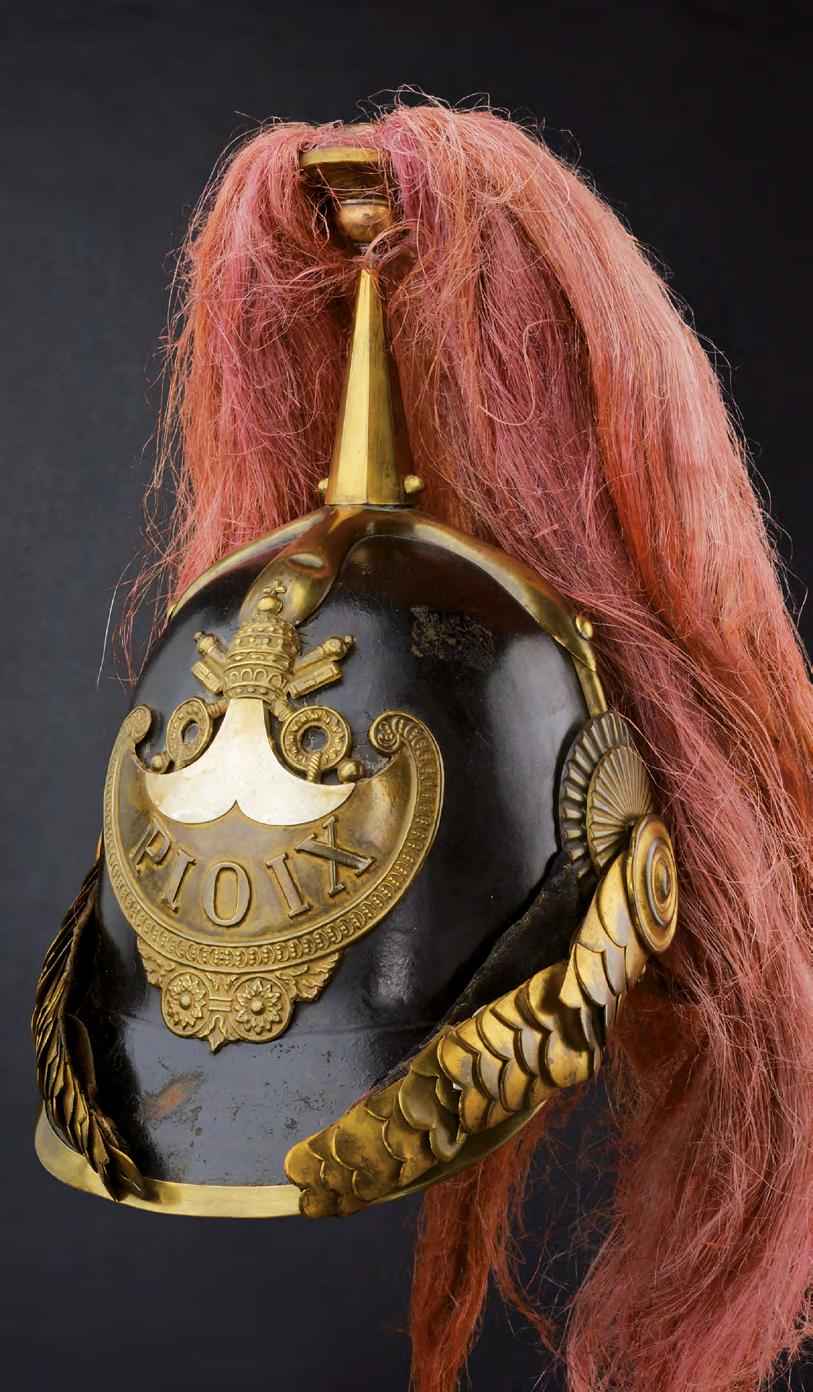
A PAPAL CIVIC GUARD
OFFICER’S HELMET
Papal States, Mid 19th Century Black lacquered boiled leather skull (finishing with some defects), brass mounts. Leather chin straps provided with brass scales. Front frieze featuring the inscription “PIO IX” in relief, with a smooth metal plaque and a triple crown with crossed keys surmounting it. Two-plate brass cockade on the left side. Cusp shaped as a truncated cone with horsehair, a brass cross at the base. Inside, brown leather segments; the nape-guard and brim lined with green leather. Signs of time.
ELMO PER UFFICIALE
DELLA GUARDIA CIVICA
Stato Pontificio, Metà del XIX
Secolo Coppo in cuoio bollito laccato nero (qualche mancanza alla finitura), metallerie in ottone. I soggoli in cuoio, muniti di squame in ottone. Fregio frontale recante in rilievo “PIO IX”, con placchetta in metallo liscio e triregno con chiavi decussate a sormontare il tutto. Coccarda a due lamine in ottone sul lato sinistro. Cuspide di forma troncoconica con crine, la base a croce in ottone. All’interno alluda a spicchi in cuoio marrone; la gronda e la tesa rivestite in cuoio color verde. Segni del tempo.
Conditions good
Height 31 cm.
€ 600/900
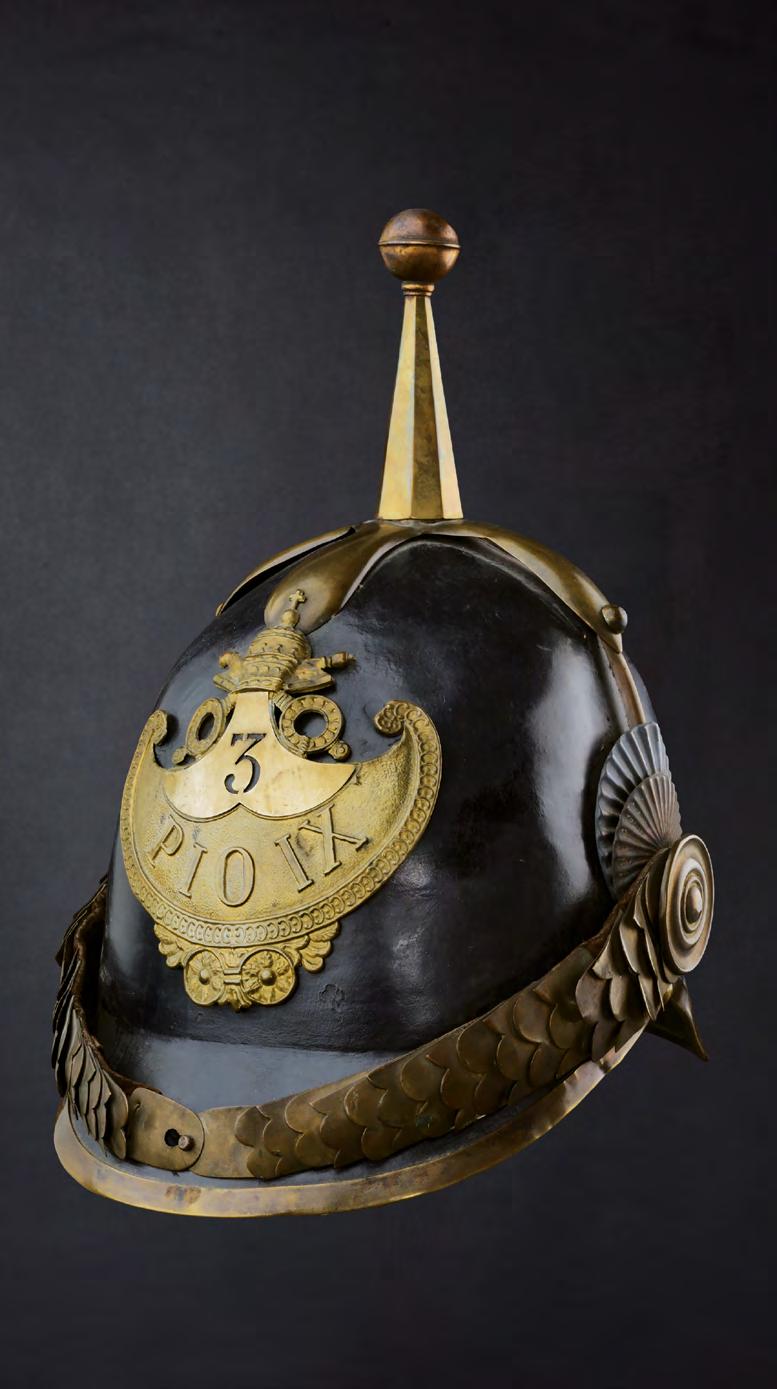
82
A RARE PAPAL CIVIL GUARD HELMET
Papal States, 1850/60
Black-lacquered, boiled leather skull (finishing with missing parts), brass mounts. Leather chin straps, provided with brass scales. Front frieze featuring the raised inscription “PIO IX,” with brass plaque provided with the number “3” and a triple crown with crossed keys surmounting the whole. Two-foil, silver-plated, metal cockade on the left side. Cusp shaped as a truncated cone with sphere at the top; crossshaped, brass base. Inside, missing cap and black leather sweat band; old label with inventory number “163” (missing parts and defects); nape-guard and brim covered with green leather. In patina.
RARO ELMO DELLA GUARDIA CIVICA
Stato Pontificio, 1850/60
Coppo in cuoio bollito laccato nero (qualche mancanza alla finitura), metallerie in ottone. I soggoli in cuoio, muniti di squame in ottone. Fregio frontale recante in rilievo “PIO IX”, con placchetta in ottone caricata da “3” e triregno con chiavi decussate a sormontare il tutto. Coccarda a due lamine in metallo argentato sul lato sinistro. Cuspide di forma troncoconica con sfera alla sommità, la base a croce in ottone. All’interno cuffia mancante e alluda in cuoio nero, vecchia etichetta con numero d’inventario “163” (difetti e piccole mancanze); la gronda e la tesa rivestite in cuoio color verde. In patina.
Conditions medium Height 32 cm.
€ 750/1.000
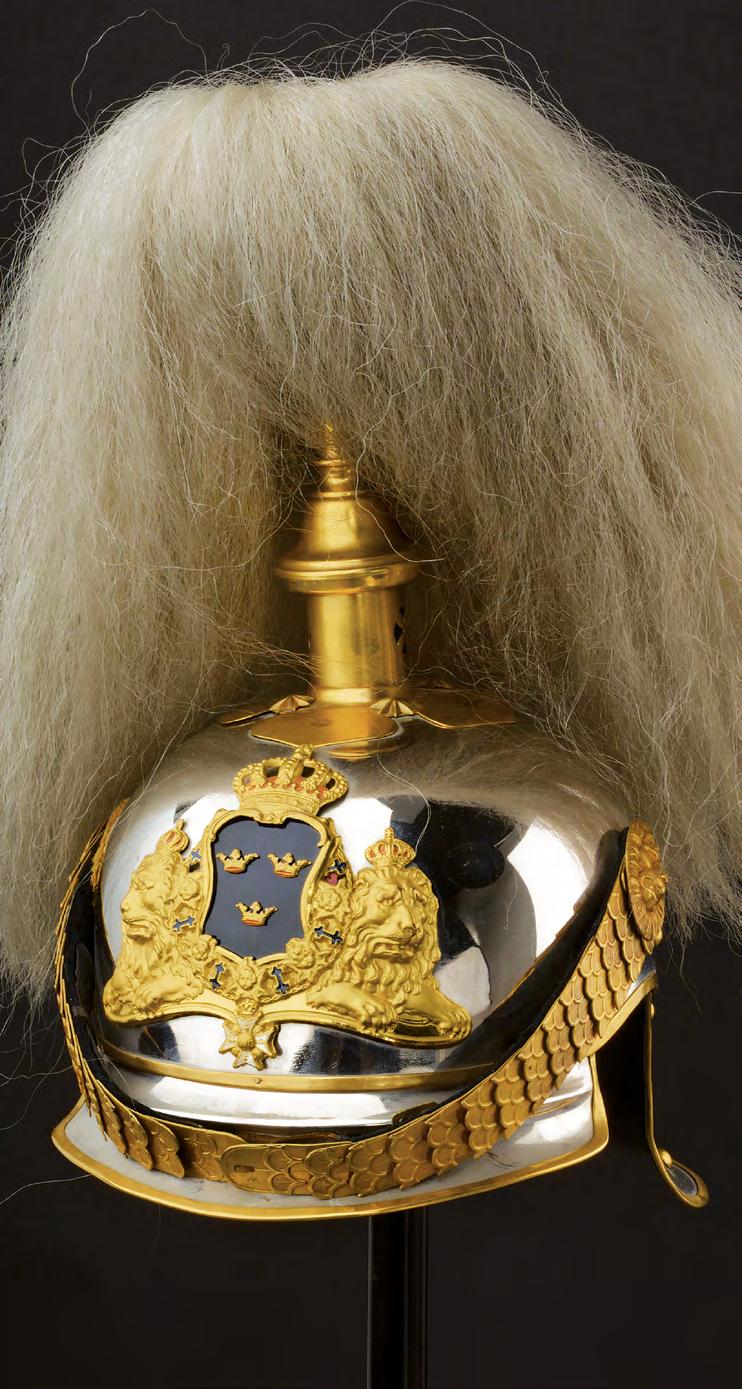
83 AN 1877/1928 MODEL HELMET FOR OFFICERS OF THE MOUNTED LIFE GUARDS
Sweden, circa 1900
Nickel-plated metal skull, at the top a gilded tip on a lobed base with eightpointed star-shaped rivets; complete with light-coloured yak-hair haarbusch. Frontal frieze of gilded metal with blue enamel inlays, surmounted by three crowns. Chin strap with gold scales and rosettes shaped as a lion’s head; on the right side, a fabric cockade. Interior with green leather visor and black velvet nape-guard. Brown leather sweat-band and fabric cap.
ELMO MOD. 1879-1928 PER UFFICIALE
DALLA GUARDIA DEL CORPO
CAVALLO
Svezia, 1900 circa Coppo in metallo nichelato, alla sommità un puntale dorato su base lobata con rivetti a testa di stella a otto punte; completo di haarbusch in crine di yak chiaro. Fregio frontale in metallo dorato con rimessi in smalto blu caricato da tre corone. Sottogola a squame dorati con rosoni a testa di leone, sul lato destro una coccarda in tessuto. Interno con visiera in pelle verde e gronda in velluto nero. Alluda in pelle marrone e cuffia in tessuto.
Conditions very good
Height 36 cm.
€ 1.200/1.400
84
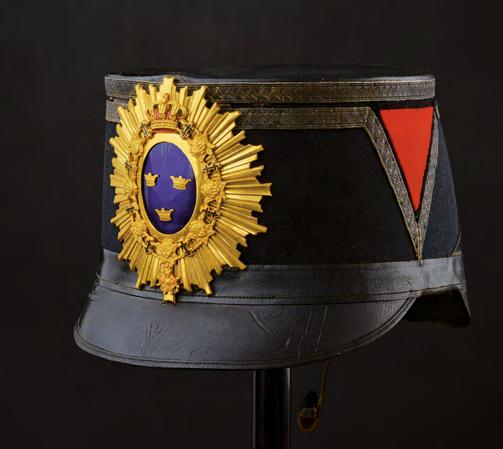
A HUSSARS’S KEPI
Sweden, circa 1900
Made of leather with borders lined with black and red cloth, silver-plated (oxidized) piping; on the front, a gilded and enameled frieze featuring a shield with three crowns surmounted by another crown and surrounded by the collar of the Order of the Seraphim, all surrounded by a ray pattern; double leather visor; lined inside with light blue silk and brown leather, and complete with chin straps.
KEPI DA USSARO
Svezia, 1900 circa
In cuoio, con bordi foderati in panno nero e rosso, profilature argentate (ossidate); sul lato anteriore un fregio dorato e smaltato, recante scudo con tre corone sormontato da un’altra corona e circondato dal collare dell’Ordine dei Serafini, il tutto raggiato; doppia visiera in cuoio. Fodera interna in seta azzurra e cuoio marrone. Completo di soggoli.
Conditions good Height 14 cm. € 100/150
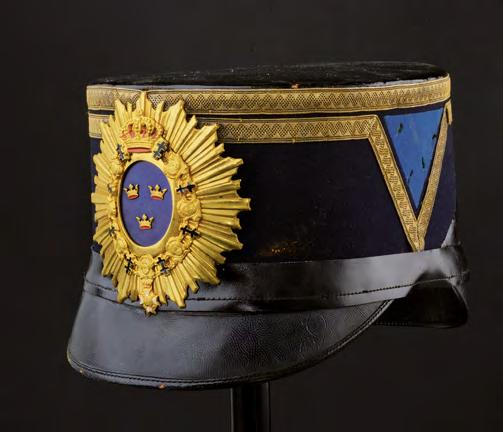
85 A HUSSARS’S KEPI
Sweden, circa 1900
Made of leather with borders lined in dark blue and light blue cloth, featuring gold piping; on the front, a gold and enamel frieze featuring a shield with three crowns surmounted by another crown and surrounded by the collar of the Order of the Seraphim, all surrounded by a radial pattern; double leather visor; lined inside with silk and brown leather, and complete with chin straps.
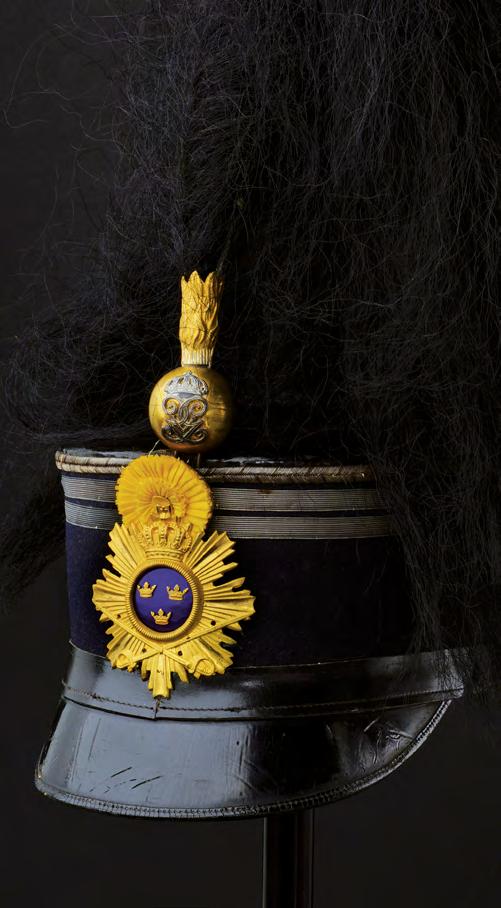
KEPI DA USSARO
Svezia, 1900 circa
In cuoio, con bordi foderati in panno blu scuro e azzurro, profilature dorate; sul lato anteriore un fregio dorato e smaltato, recante scudo con tre corone sormontato da un’altra corona e circondato dal collare dell’Ordine dei Serafini, il tutto raggiato; doppia visiera in cuoio. Fodera interna in seta e cuoio marrone. Completo di soggoli.
Conditions good
Height 14.5 cm.
€ 100/150
86 A MODEL 1895 HUSSAR OFFICER'S KEPI
Sweden, early 20th Century
Made of leather with borders lined with black cloth and silver piping; on the front, a gilded and enameled frieze featuring a shield with three crowns mounted on a radial pattern with crossed swords at the bottom; leather visor; with black horsehair and a ball-shaped tassel featuring the monogram of Gustav V of Sweden, crowned and silver-plated; lined inside with light blue silk and brown leather.
KEPI DA UFFICIALE DEGLI USSARI MOD. 1895
Svezia, inizio del XX Sec.
In cuoio, con bordi foderati in panno nero, profilature argentate. Sul lato anteriore un fregio dorato e smaltato, recante scudo con tre corone montato su una raggiera con spade incrociate nella parte inferiore; visiera in cuoio; con crine nero e nappina
a palla caricata con il monogramma di Gustavo V di Svezia coronato ed argentato. Fodera interna in seta azzurra e cuoio marrone.
Conditions good
Height total 41 cm.
€ 150/250
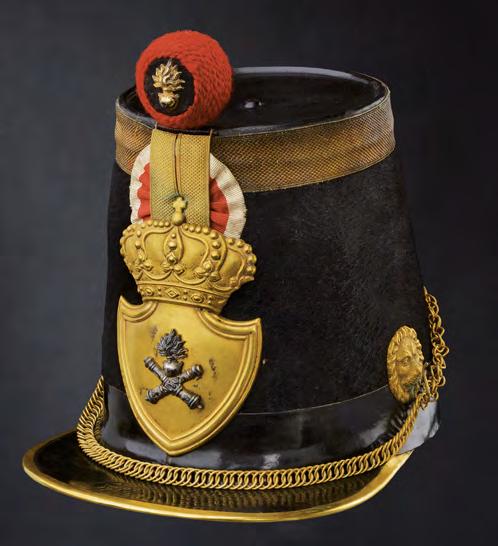
87 A SHAKO FOR FOOT ARTILLERY UNITS
Grand Duchy of Tuscany, 19th/20th Century
Cap modeled after Piedmontese designs, featuring ornaments and friezes inspired by them. Artillery officer’s model with body lined in beaver fur (some missing parts), leather peak and visor, brass shield-shaped frieze with cannons on a white metal (silver?) flaming grenade, surmounted by a crown on a fabric cockade in the colours of the Grand Duchy; gold threads rank stripe; brass chain on three lion heads; at the top, a tassel in braided red fabric surmounted by a flaming metal grenade. The interior with black leather sweat-band and a cap in red leather and cream-colored linen; the brim is painted green.
SHAKO PER CORPO DI ARTIGLIERIA A PIEDI
Granducato di Toscana, XIX/XX secolo
Copricapo di linea rifacentesi ai modelli piemontesi, con ornamenti e fregi ad essi ispirati. Modello da ufficiale d’artiglieria, con corpo rivestito di castorino (alcune mancanze), imperiale e visiera in cuoio. Fregio a scudo in ottone caricato con cannoni su granata fiammeggiante in metallo bianco (argento?), la placca sormontata da corona; sopra ad essa la coccarda in tessuto nei colori del granducato. Gallone di grado in canutiglia dorata; catenella in ottone sorretta da tre teste di leone. Alla sommità nappina in tessuto rosso intrecciato e caricata da una granata fiammeggiante in metallo. L’interno con alluda in cuoio nero, cuffia in cuoio rosso e lino color crema, la tesa verniciata di verde. Bel copricapo integrato con elementi di restauro.
Conditions good
Height 24 cm.
€ 400/600
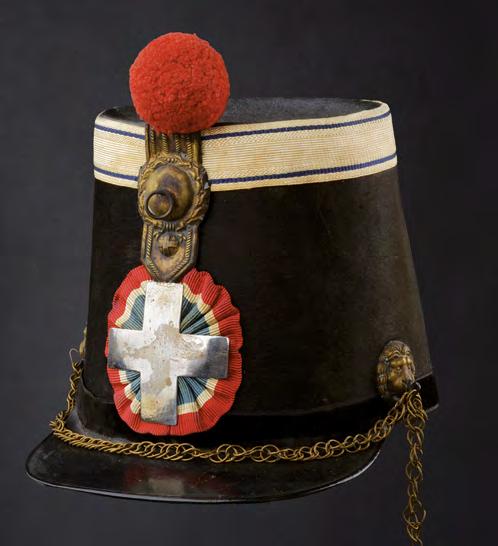
88 A NATIONAL GUARD OFFICER’S KEPI
Sardinian Kingdom, 1848
Rigid body covered with black beaver fur; black felt peak with white and blue cotton rank braid; front decoration featuring the Savoy cross made of iron sheet on a tricolour fabric cockade; embossed brass loop complete with a red tassel. Three small lions to fix the chain, the rear one of a different design. Black leather visor, painted green on the inside. Black leather sweat band and high-quality brown morocco leather caps.
Fine kepi with a small modification to the chin-strap loop, with the addition of a small round bell.
KEPI DA UFFICIALE DELLA GUARDIA NAZIONALE
Regno di Sardegna, 1848
Corpo rigido rivestito di castorino nero, imperiale in feltro nero con gallone di grado in cotone bianco e blu. Fregio anteriore con croce Sabauda in lamierino di ferro su coccarda tricolore in tessuto; cappio in ottone sbalzato e completo di nappina rossa. Tre leoncini per il fissaggio della catenella, quello posteriore di fattura differente. Visiera in cuoio nero dipinta di verde all’interno. Alluda in pelle nera e cuffia in marocchino color marrone di bella qualità.
Bel kepi con una piccola modifica al cappio, con l’aggiunta di una campanellina tonda.
Conditions very good
Height 17 cm.
€ 300/400
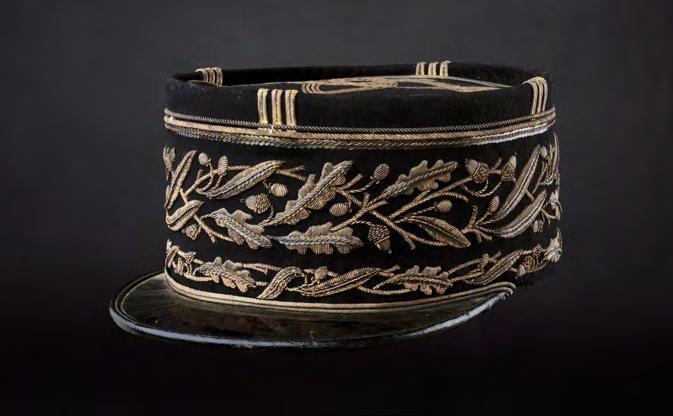
89 A RARE AND REFINED PREFECTORAL-RANK KEPI
France, about 1920
Body made of stiff black felt, imperial style with a Hungarian knot in silver-inlaid braid; the turban is adorned with beautiful decorations of oak and laurel leaves in silver thread, and a rank stripe. Rigid, leather visor. Inside with leather sweat-band featuring the owner’s initials imprint in gold; silk cap with the name and address of the manufacturer (faded) in the centre.
RARO E RAFFINATO KEPI DI RANGO PREFETTIZIO
Francia, 1920 circa Corpo in feltro nero rigido, imperiale con nodo ungherese di grado in canutiglia argentata, il turbante completante con bellissime decorazioni di fronde di quercia ed alloro in filo d’argento, gallone di grado. Visiera rigida in cuoio. L’interno con alluda in pelle recante cifre impresse in oro del proprietario; cuffia in sera recante nella parte centrale il nome e l’indirizzo della manifattura (sbiadito).
Conditions good
Height 11 cm.
€ 300/600
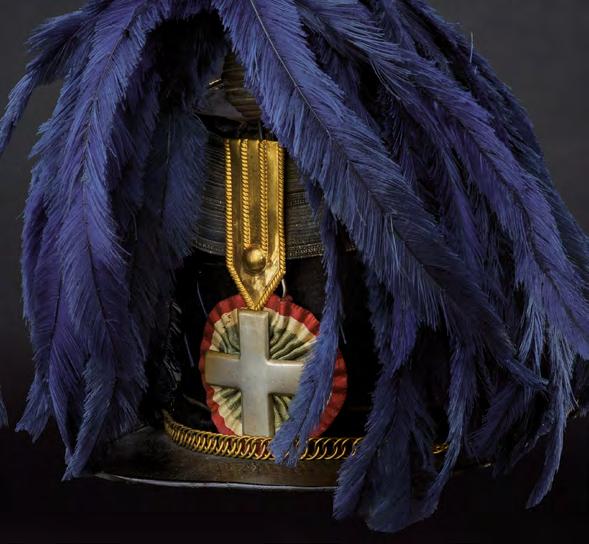
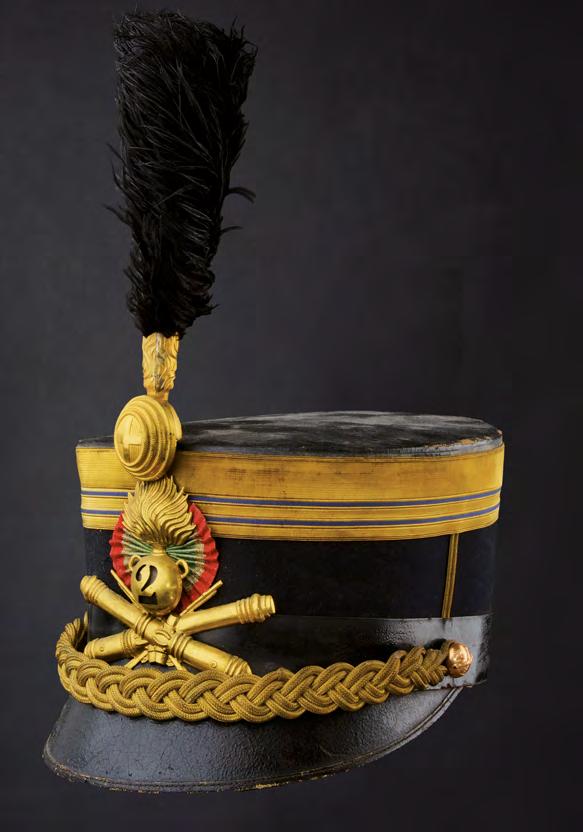
90 A NATIONAL GUARD CAPTAIN'S SHAKO
Sardinian Kingdom, circa 1848
Semi-rigid black felt body with silver threads rank insigna (blackened), peak and black leather visor; on the front, a tricolour fabric cockade decorated with cross; gilded brass loop and metal tassel complete with light blue plume. Three buttons shaped as a lion’s head with brass cord. Inside, red Moroccan leather cap.
SHAKO DA CAPITANO DELLA GUARDIA NAZIONALE
Regno di Sardegna, 1848 circa Corpo semirigido in feltro nero con gallone di grado in canutiglia argentata (brunita), imperiale e visiera in cuoio nero; al frontale coccarda tricolore in tessuto caricata da croce; cappietto in ottone dorato e nappina metallica completa di piumetto azzurro. Tre bottoni a forma di testa di leone con catenella in ottone. All’interno cuffia in marocchino rosso.
Conditions good
Height 16 cm.
€ 400/600
91 A KEPI FOR A LIEUTENANT COLONEL OF THE FORTRESS ARTILLERY
Kingdom of Italy, circa 1900
Rigid black cloth skull with leather peak. Featuring a gold-plated tassel and black feathers. The front decoration is of gold-plated metal, depicting cannons with crossed muskets, surmounted by a flaming grenade with number “2”, tricolour fabric cockade and wire. Golden stripe with blue band. Chin straps with gold braids and buttons featuring crossed cannons on grenade. Inside, sweat-band; small signs of use and time. Accompanied by its original cardboard plume holder.
KEPI DA TENENTE COLONNELLO PER ARTIGLIERIA DA FORTEZZA
Regno d’Italia, 1900 circa Coppo rigido in panno nero con imperiale in cuoio. Con nappa dorata e ciuffo in piume nere. Fregio anteriore in metallo dorato effigiante cannoni con fucili incrociati, sormontati da granata fiammeggiante con numero “2”, coccarda tricolore in tessuto e grovigliola. Gallone dorato con fascia blu. Soggolo a treccia dorata con bottoni recanti cannoni incrociati su granata. All’interno fascia in alluda; piccoli segni d’uso e del tempo. Accompagnato dal suo porta piumetto originale in cartone.
Conditions very good
Height 12.5 cm.
€ 400/600
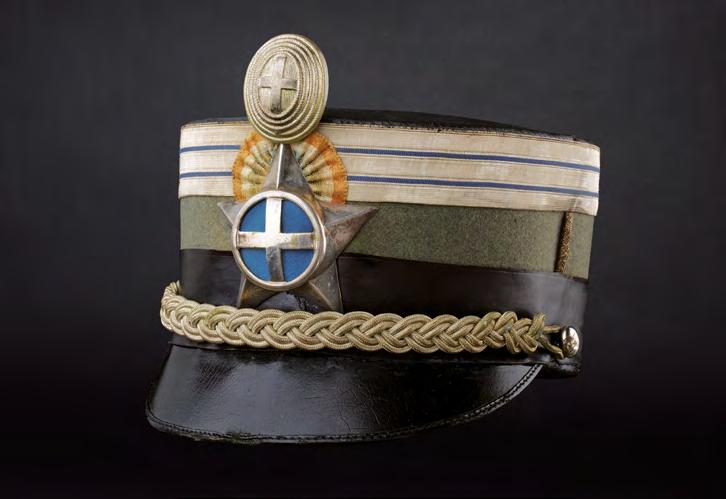
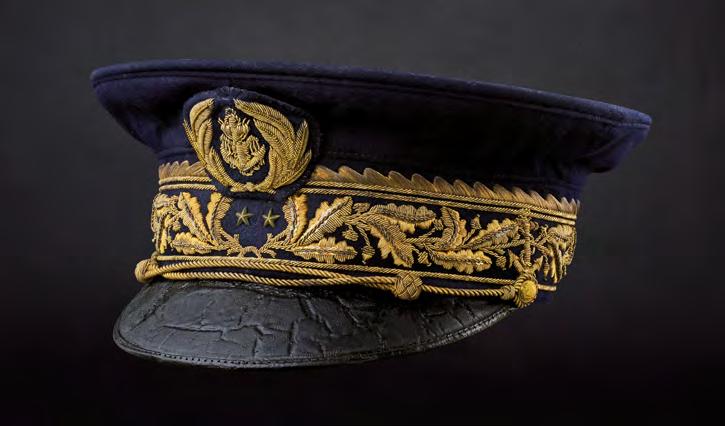
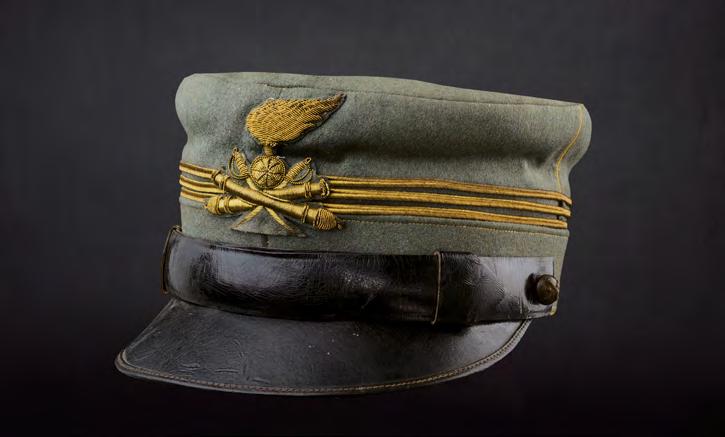
92 A RARE KEPI FOR VETERINARY OFFICER ATTACHED TO THE HORSE ARTILLERY REGIMENT (VOLOIRE)
Kingdom of Italy, early 20th Century Body covered with grey-green fabric with stripe of silvered threads and blue fabric bands; peak, headband and visor of leather. Front decoration featuring a five-pointed star with a central cross on a light blue background; tricolour fabric cockade (faded) and upper tassel of silver-coloured metal. Lacing of interwoven silver wire. Inside, black leather lining (some defects) and blue fabric lining
PARTICOLARE KEPI PER VETERINARIO AGGREGATO ALLE BATTERIE A CAVALLO (VOLOIRE)
Regno d’Italia, inizio del XX Sec. Fusto rivestito in tessuto grigioverde con gallone in canutiglia argentata e bande in tessuto color blu; imperiale, fascia e visiera in cuoio. Fregio frontale con stella a cinque punte, con croce centrale su panno azzurro; coccarda tricolore in tessuto (sbiadito) e nappina superiore in metallo argentato. Cordatura in grovigliola argentata strutturata ad intreccio. All’interno alluda in cuoio nero (alcuni difetti) e rivestimento in tessuto blu.
Conditions good
Height 13 cm. € 250/350
93 AN INTERESTING REAR ADMIRAL’S CAP
France, First half of the 20th Century
Made of dark blue fabric (some moth holes), with a dark blue stripe and dense decoration of oak and laurel leaves in gold-inlaid; front frieze featuring three anchors and two palmettes, with two brass stars below. Goldplated buttons with an anchor in relief, and gold-plated chin-strap. Angled leather visor (damaged). Inside with leather sweat-band and silk covering (some general defects).
INTERESSANTE BERRETTO DA CONTRAMMIRAGLIO
Francia, Prima metà del XX Secolo Realizzato in tessuto blu scuro (alcuni fori di tarma), con gallone di grado e fitta decorazione a fronde di quercia ed alloro in canutiglia dorata; fregio frontale con àncora tre due palmette, al di sotto due stelle in ottone. Bottoni dorati con àncora a rilievo, soggolo in canutiglia dorata. Visiera angolata in cuoio (difetti). L’interno con alluda in cuoio e rivestimento in seta (alcuni difetti generali).
Conditions medium
Height 13 cm.
€ 300/600
94 A MOUNTED ARTILLERY CAP
Kingdom of Italy, about 1930
Body made of grey-green fabric, stripe with gilded threads; the front decoration, also of gilded-threads, represents cannons and crossed swords surmounted by flaming grenade. The visor and chin straps are made of leather, and the buttons featuring crossed cannons. Inside, a brown leather sweat-band and a white silk cap with gold and green stamping from the manufacturer.
BERRETTO DA ARTIGLIERIA A CAVALLO
Regno d’Italia, 1930 circa Corpo in tessuto grigioverde, gallone in canutiglia dorata. Fregio frontale, sempre in canutiglia dorata, effigiante cannoni e spade incrociati, sormontati da granata fiammeggiante. Visiera e soggolo in cuoio, i bottoni con cannoni incrociati. All’interno alluda in cuoio marrone e cuffia in seta bianca con stampigliatura in oro e verde della ditta di produzione.
Conditions very good
Height 11.5 cm.
€ 200/400
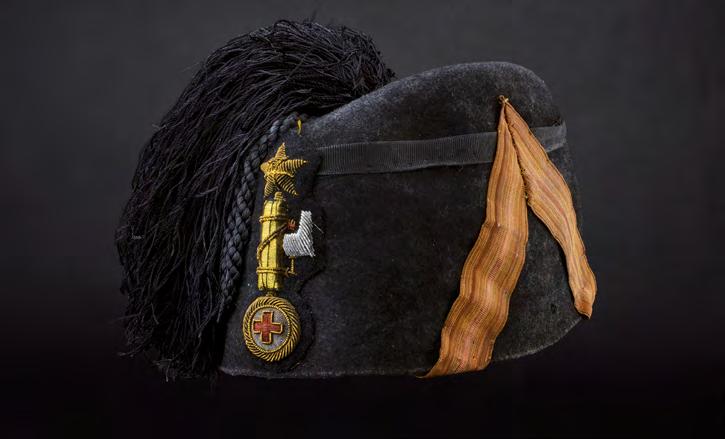
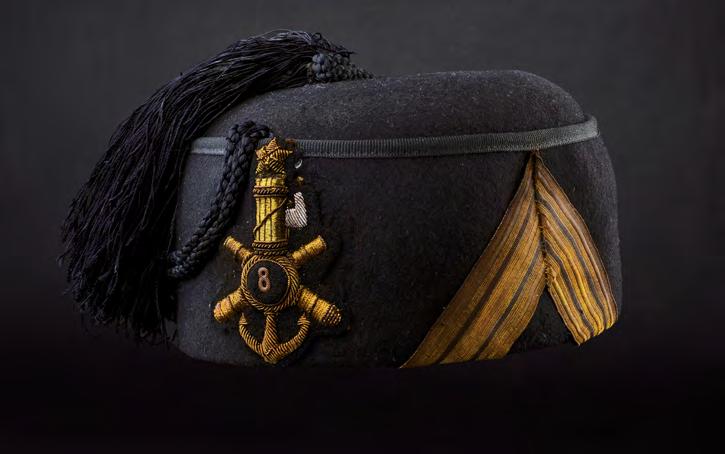
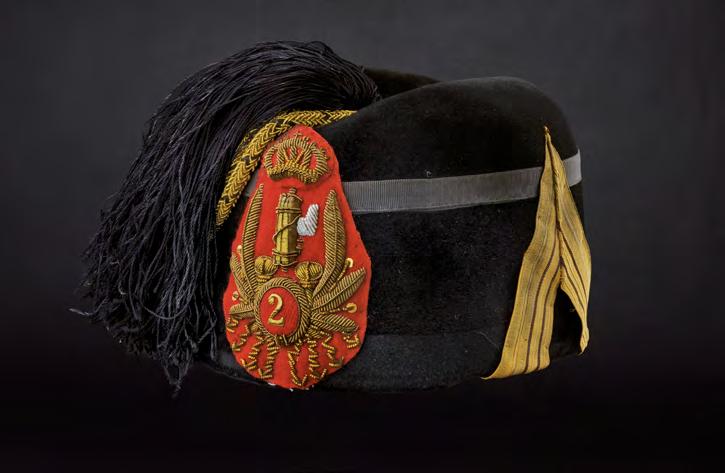
95 A FEZ OF THE “PRIMO SENIORE” OF THE FASCIST MILITIA.
Kingdom of Italy, about 1930
Made from black beaver fur, with fringe and braided cord; on the left, gold insignia; on the front, badge of speciality with cross on a red background. Dark sweat-band inside with mark “PRESIDENT”; silk cap with “PRESIDENT /LINEA PANIZZA”.
FEZ DA PRIMO SENIORE DELLA MILIZIA
Regno d’Italia, 1930 circa Confezionato in castorino nero, frangia e cordone intrecciato, sulla sinistra i gradi dorati; al fronte, il fregio di specialità con croce con fondo rosso. Interno con alluda scura e marcata “PRESIDENT”; cuffia in seta marcata “PRESIDENT /LINEA PANIZZA”.
Conditions medium
Height 12 cm.
€ 300/500
96 A FEZ OF THE COMMANDER OF THE "MILMART" MARITIME AND PORT DEFENSE UNIT.
Kingdom of Italy, about 1930
Made of stiff black felt, with black fringes and braided cords; on the left side are the gold insignia, and on the front the badge of speciality. Inside with black sweat-band and silk cap.
FEZ DA COMANDATE “MILMART” PER DIFESA MARITTIMA E PORTUALE
Regno d’Italia, 1930 circa Confezionato in feltro rigido nero, con frange e cordoni neri intrecciati; sulla parte sinistra i gradi dorati, al fronte il fregio di specialità. Interno con alluda nera e cuffia in seta.
Conditions good
Height 11 cm.
€ 300/500
97
A FEZ OF THE COMMANDER OF THE POSTAL AND TELECOMMUNICATIONS UNIT, 2ND LEGION
Kingdom of Italy, about 1930
Made of black beaver fur, with fringes and a gold-and-mottled cord; the corps’ insignia embroidered on red cloth at the front. Gold rank insignia on the side. Inside, grey leather sweat-band, stamped in gold with “Edelueiß Hut”; silk cap with the manufacturer’s mark “OBERBAYERISCHE HUTFABRIK GMBH / Edelwelß-Velour”.
FEZ DA COMANDANTE DELLE POSTE E TELECOMUNICAZIONI, 2° LEGIONE
Regno d’Italia, 1930 circa Confezionato in castorino nero, con frange e cordone dorato e screziato; fregio anteriore della specialità del corpo ricamato su panno rosso. Sul lato gradi dorati. All’interno alluda in cuoio grigio, marcata in oro “Edelueiß Hut”, la cuffia in seta con marca del fabbricante “OBERBAYERISCHE HUTFABRIK GMBH / Edelwelß-Velour”.
Conditions good
Height 13 cm.
€ 350/550
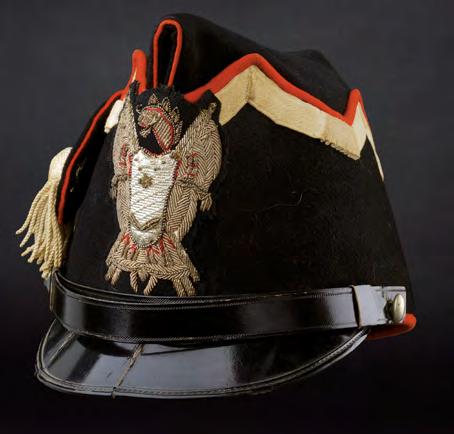
98 A CUIRASSIERS TROOPER’S CAP
Italian Republic , 1950-60
Made of black cloth with a semi-rigid waxed visor, red piping and white band; silvered threads and red threads front frieze depicting a military trophy.Black leather chin strap with smooth silvered buttons. Inside, leather lining and lightcoloured cloth cap.
BUSTINA PER TRUPPA DA CORAZZIERE
Repubblica Italiana, 1950-60
In panno nero con visiera semi-rigida in tela cerata e profilature rosse e con banda bianca, fregio frontale in canutiglia argento e filo rosso, effigiante trofeo d’armi. Soggolo in cuoio nero e bottoni lisci argentati. L’interno con alluda in pelle e cuffia in panno chiaro.
Conditions very good
Height 20 cm.
€ 200/300
99
BICORN FOR A COMMANDER OF THE NOBLE GUARD
State of the Vatican City, First half of the 20th Century
Made of black felt, with brims turned upward and edged with gold floral-embroidered stripe. Silver-thread cockade and yellow-gold cord loop. Gilded button of the Noble Guard bearing the Papal tiara emblem. Black plumes. Missing the sweatband inside, but retaining the moiré silk liner with an indistinct (frayed) Papal emblem. Damages, old repairs, and clear signs of wear and age. Uncommon.
FELUCA DA COMANDANTE DELLA GUARDIA NOBILE
Stato Città del Vaticano, Prima metà del XX Secolo
In feltro nero con falde girate verso l’altro e bordate con gallone dorato a ricamo floreale. Coccarda in filo argento, ganza in grovigliola color oro. Bottone dorato della Guardia Nobile con emblema del Triregno. Ciuffi color nero. Interno con alluda mancante ma cuffia in seta marezzata presente con emblema papale non leggibile (sfilacciato). Danni, vecchie riparazioni ed evidenti segni d’uso e del tempo. Non comune.
Conditions mediocre
Height 24 cm.
€ 200/400
100 A GENERAL’S BICORN
Papal States, about 1870
Made of black felt with wide marbled border sewn with gold thread; stripe with gold wire with gold-plated bronze button featuring keys and a tiara in relief; silver-colored threads cockade. Black feathers. Lined with a red sweat-band.
FELUCA DA GENERALE
Stato Pontificio, 1870 circa
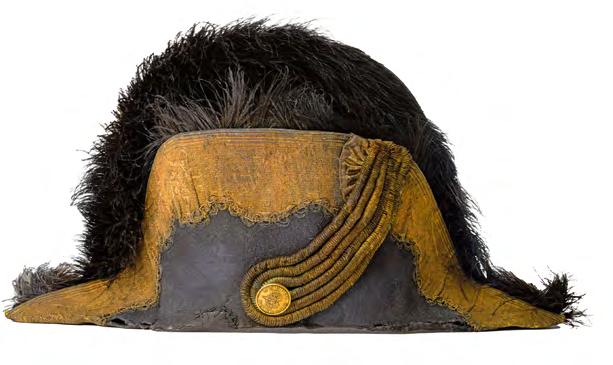
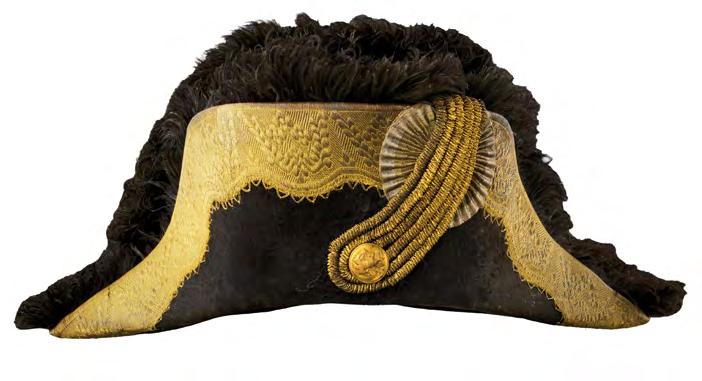
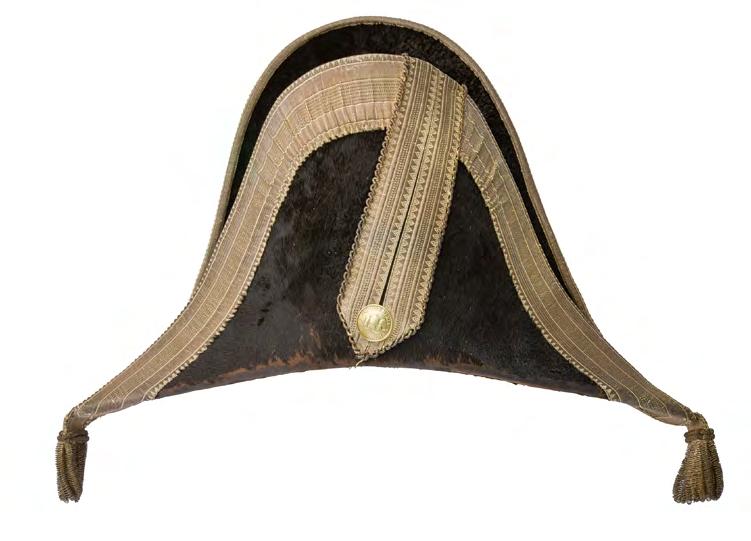
In feltro di colore nero con ampio bordo marezzato cucito in filo dorato, cappietto in grovigliola dorata con bottone in bronzo dorato recante le chiavi e la tiera in rilievo, coccarda color argento in canottiglia. Piume nere. Interno con fascia in alluda color rosso.
Conditions good
Height 17 cm.
€ 250/450
101 A PAPAL GENDARMERIE OFFICER’S BICORN
Papal States, 1830-40
Made of black felt (possibly rabbit), with a semi-rigid structure. Wide brims turned upwards, edged with silver-thread embroidered stripe. Band worked en suite and edged with threaded rope (missing cockade ). Papal gendarmerie button made of white metal, featuring the Tiara surrounded by the raised inscription “GENDARMERIA PONTIFICIA.” On the sides, silver tassels in twisted cords. With leather sweatband and fabric liner featuring label: “FABBRICA CAPPELLI DI FILIPPO MANCINELLI IN ROMA AL CORSO N.383.” Signs of use and time. In an old wooden case, with remains of a paper label. Rare.
FELUCA DA UFFICIALE DELLA GENDARMERIA PONTIFICIA
Stato Pontificio, 1830-40
Realizzata in feltro nero (coniglio?), in struttura semirigida. Con ampie falde girate verso l’alto e bordate da gallone ricamato in filo argento. La ganza lavorata en suite e bordata con cordoncino in canutiglia (la coccarda mancante). Il bottone della gendarmeria papale con il Triregno circondato dall’iscrizione in rilievo “GENDARMERIA PONTIFICIA”, in metallo bianco. Ai lati nappe in grovigliola argento. Interno con fascia in alluda e cuffia in tessuto con etichetta “FABBRICA CAPPELLI DI FILIPPO MANCINELLI IN ROMA AL CORSO N.383”. Segni d’uso e del tempo.. Conservata in una vecchia custodia lignea completa di resti di etichetta in carta. Rara.
Conditions medium
Height circa 30 cm.
€ 600/900
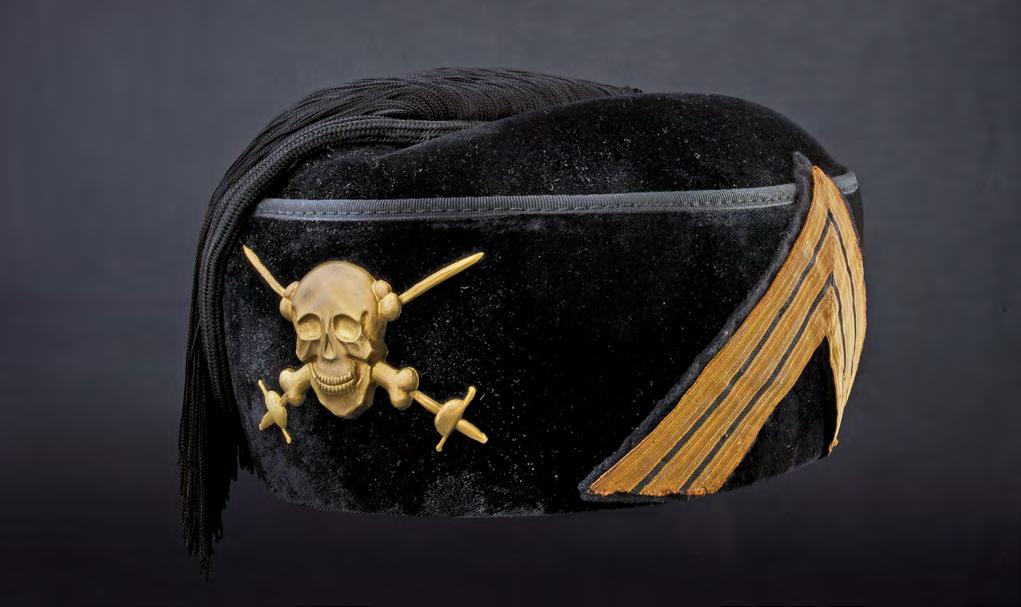
102 A FEZ-COLBAC FOR A COMMANDER OF THE “MOSCHETTIERI DEL DUCE” ELITE UNIT
Kingdom of Italy, about 1930
Cork body covered with black velvet, decorated with the typical cords tied in a double Savoy knot, and with a black fabric tassel. Fine gilt metal frieze composed of a skull over crossed foils, complete with its white-metal fixing nut marked “JHONSON MILANO”. On the left side, rank insignia in gold with black backing. Interior lined with white silk with maker’s mark “Presciutti, Via Leccosa, Roma”, and loops for chin-straps.
The “Moschettieri del Duce” were a special unit of the MVSN. They were entrusted with escorting both the Duce’s command standard and the Duce himself. The unit was directly subordinate to the command of the MVSN. It consisted of 180 men, including professionals, executives and office employees, all former reserve officers. No form of remuneration was provided, as membership in the corps itself was considered a great privilege. They served in their spare time and kept their uniforms at home.
FEZ COLBACCO PER COMANDANTE DEI MOSCHETTIERI DEL DUCE
Regno d’Italia, 1930 circa Fusto in galletta ricoperto da velluto di colore nero, ornato dai tipici cordoni annodati a doppio nodo Savoia, e frangia in tessuto nero. Bel fregio in metallo dorato, costituito da teschio sovrapposto a fioretti incrociati, completo del suo dado di fissaggio in metallo bianco marcato “JHONSON MILANO”. Sul lato sinistro il grado in oro sottopannato nero. Interno in seta bianca con marchio del fabbricante “Presciutti, via Leccosa, Roma”, passanti reggi soggolo.
I Moschettieri del Duce erano un reparto speciale della MVSN. Avevano l’incarico di scortare l’Insegna di comando del Duce ed il Duce stesso .Dipendevano direttamente dal comando della MVSN. Il reparto contava 180 uomini. Facevano parte del corpo professionisti, dirigenti ed impiegati, tutti ex ufficiali di complemento, e non era previsto per loro nessun tipo di remunerazione poiché la stessa appartenenza al corpo era considerato un grande privilegio. Prestavano servizio nel tempo libero e tenevano in casa l’uniforme.
Conditions very good
Height 12 cm.
€ 1.000/1.500
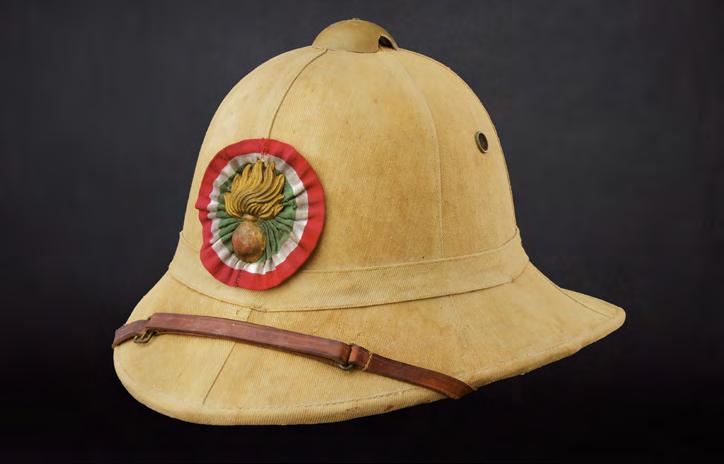
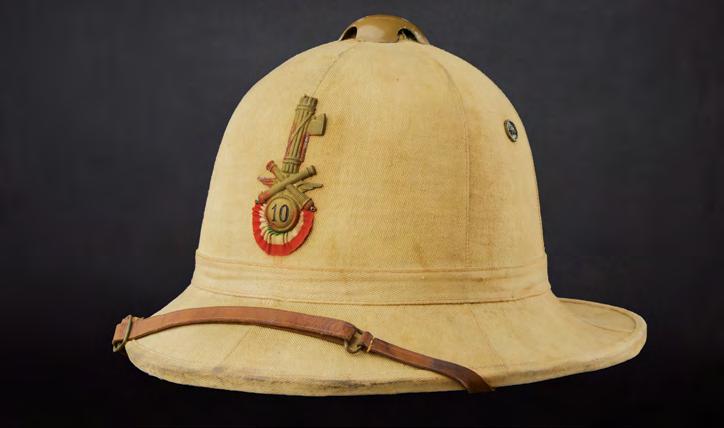
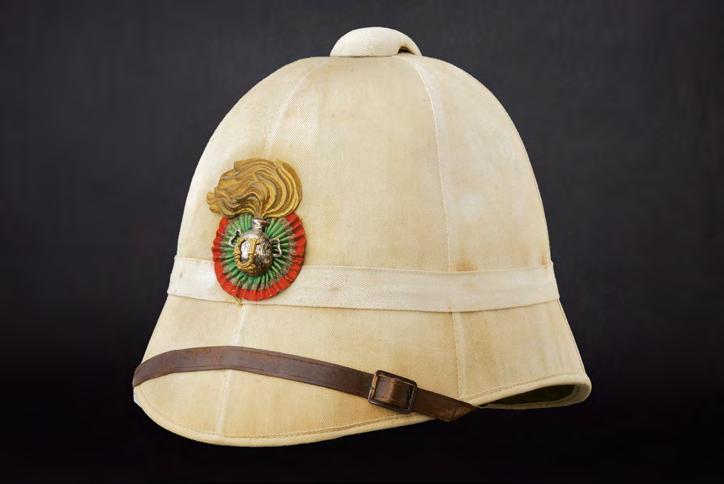
103 A 28 MODEL COLONIAL HELMET
Kingdom of Italy, Second quarter of the 20th Century Cork regulation model covered with khaki canvas; complete with air holes and a plumeholder pocket. Front badge featuring flaming grenade on a tricolour fabric cockade. Green fabric lining (damaged parts), with waxed brown canvas sweat band and cork spacers. Original brown leather strap.
CASCO COLONIALE MOD. 28
Regno d’Italia, Secondo quarto del XX Secolo Modello regolamentare in sughero rivestito in tela Kaki; completo di fori aeratori e taschetta porta pennacchio. Fregio frontale con granata fiammeggiante su coccarda in tessuto tricolore. Interno rivestito in tessuto verde (danni), con alluda in tela cerata marrone e distanziatori in sughero. Cinturino originale in cuoio marrone.
Conditions medium
Height 21 cm.
€ 150/200
104 A 28 MODEL COLONIAL HELMET FOR ANTI-AIR MILITIA
Kingdom of Italy, Second quarter of the 20th Century Cork regulation model made covered with khaki canvas; complete with air holes and plume-holder pocket. Front frieze of the antiaircraft militia with a small tricolour fabric cockade. Lined with green fabric, with brown sweat-band and cork spacers. Original brown leather strap.
CASCO COLONIALE MOD.28 PER MILIZIA CONTRAEREA
Regno d’Italia, Secondo quarto del XX Secolo Modello regolamentare in sughero rivestito in tela Kaki; completo di aeratori e taschetta porta pennacchio. Fregio frontale della milizia contraerea con piccola coccarda in tessuto tricolore. Interno rivestito in tessuto verde, con alluda in tela cerata marrone e distanziatori in sughero. Cinturino originale in cuoio marrone.
Conditions excellent
Height 21 cm. € 300/400
105 A CARABINIERI OFFICER’S COLONIAL HELMET, KING UMBERTO I EPOCH
Kingdom of Italy, Late 19th Century
Very light case lined with beige cotton, with a front decoration featuring a silver pomegranate and a gold flame, surmounted by the letter “U” (for Umberto), also in gold, placed on small tricolour silk cockade. Lined with green fabric, with leather sweat band and cork spacers. Original leather strap
A fine officer’s helmet, probably of private manufacture.
CASCO COLONIALE PER UFFICIALI CARABINIERI, EPOCA UMBERTO I
Regno d’Italia, Fine del XIX Secolo Corpo molto leggero rivestito in cotone beige, fregio frontale con granata in argento e fiamma dorata, caricata dalla cifra “U” per Umberto anch’essa dorata, su piccola coccarda tricolore in seta. L’interno rivestito in tessuto verde, alluda in cuoio e distanziatori in sughero. Cinturino originale in cuoio.
Si tratta di un bel casco da ufficiale probabilmente di manifattura privata.
Conditions very good
Height 26 cm.
€ 700/1.000
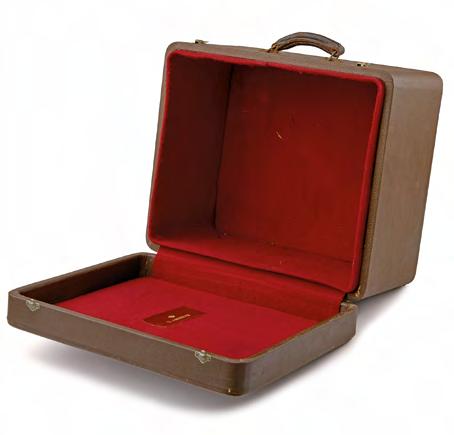
106
A BOX FOR A NOBLE GUARD HELMET
Papal States, first quarter of the 20th Century Rectangular, with a brown faux-leather exterior; complete with a leather handle. The interior is lined in burgundy cloth and features a label imprinted in gold featuring the owner’s name and the “G. Ambrosi” five-pointed crown.
ASTUCCIO PER ELMO DELLA GUARDIA NOBILE
Stato Pontificio, primo quarto del XX Sec. Di forma rettangolare, rivestito esternamente in simil pelle marrone; completo di maniglia in cuoio. Interno in panno bordeaux recante etichetta impressa in oro con il nome del proprietario “G. Ambrosi” sormontato da corona a cinque palle.
Conditions medium
Dimensions 34 x 22 cm.
€ 80/120
107
A SAPPER’S UNIFORM WITH SABRE-BRIQUET AND AXE
Papal States, Second half of the 19th Century
Complete with brown fabric jacket featuring a brown fabric breast-plate and arm guards, and a green collar edged in gold. Sleeves with sapper decorations featuring a flaming grenade surmounted by crossed axes. The jacket has been restored. Original green fabric epaulettes with white edging and fringing. Provided with a large apron made of thick white-dyed leather, probably produced at a later date. A pair of white gloves of later manufacture. The set also includes an antique sapper’s axe (for carpentry and demolition work), complete with rare black leather scabbard adorned with a brass sapper’s decoration, white leather shoulder strap (possibly replaced at a later date). Together with an antique 19th-century sabre-briquet (length 72.5 cm) with a blade marked “PRADIER” at the tang, one-quillon, brass hilt and scabbard, incomplete baldrick with missing fastenings and leather that may have been replaced at a later date. The ensemble mounted on a wooden mannequin of non-recent manufacture. Of pleasing visual appearance.
UNIFORME DA ZAPPATORE CON SABRO E SCURE
Stato Pontificio, Seconda metà del XIX Secolo Completa di giacca in tessuto bruno con pettorale e paramani in tessuto marrone, colletto verde profilato oro. Sulle maniche fregi da zappatore con granata fiammeggiante sormontate scuri incrociate. La giacca con restauri. Spalline antiche in tessuto verde con profili e frange color bianco. Munito di ampio grembiule in spesso cuoio tinto color bianco, probabilmente prodotto successivamente. Un paio di guanti bianchi di produzione più tarda. L’insieme dotato anche di antica scure da zappatore (per lavori di carpenteria e demolizione) completa del raro fodero di trasporto in cuoio nero caricato con fregio da zappatore in ottone, la tracolla in cuoio bianco (forse sostituito successivamente). Insieme con un sabre-briquet antico del XIX secolo (lunghezza 72,5 cm) con lama marcata “PRADIER” al tallone, fornimento monoelso in ottone e fodero, budriere incompleto, con attacchi mancanti e cuoio forse sostituito successivamente. L’ensamble montato su manichino ligneo di produzione non recente. Di gradevole impatto visivo.
Conditions medium
Height as shown circa 180 cm.
€ 2.000/2.500
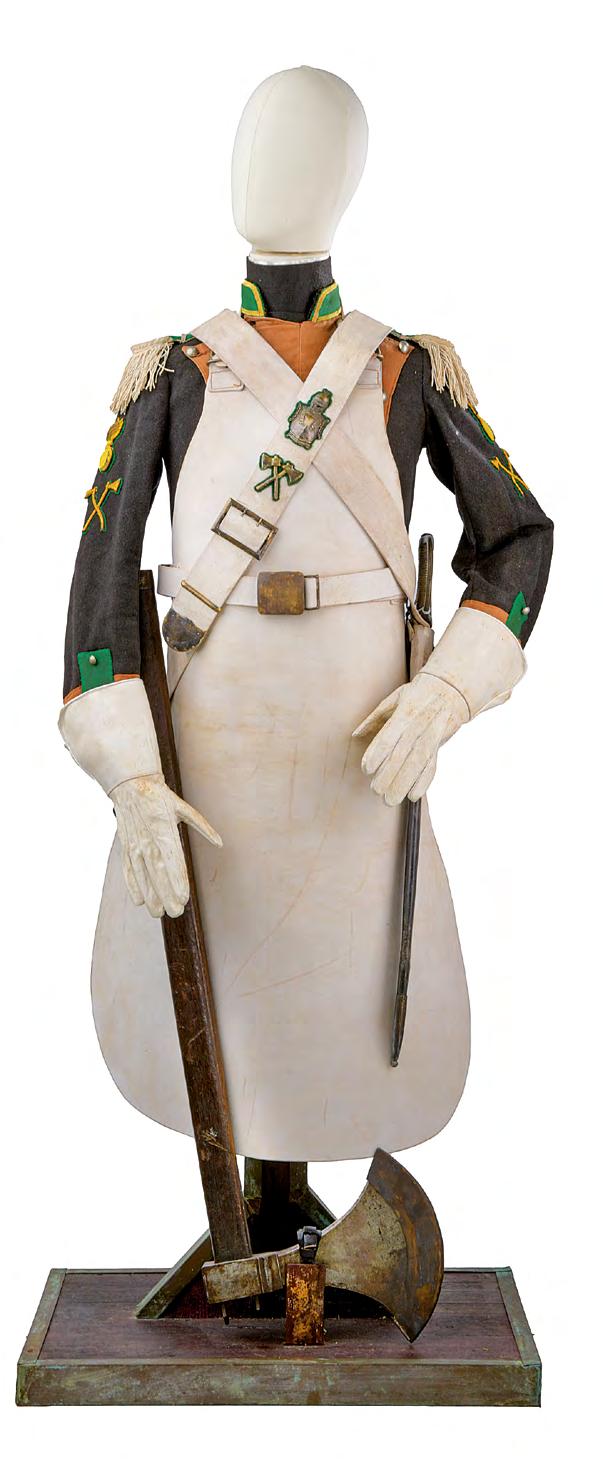
108
MARECHAL DE FRANCE ALPHONSE JUIN (1888 - 1967)
France, 1960 circa Uniform including kepi, tunic and trousers, belonging to a Marshal of France. The kepi with turban and green fabric peak, with seven metal stars on the front. The chin straps are made of fabric decorated with gilded threads; gilded brass buttons (some missing parts). Stiff, waxed leather visor, with plastic border. Beautiful lining with pierced leather sweat-bands, amber-coloured fabric cap, manufacturer’s label “A. BLANCHET / MAITRE - TAILLEUR / FONTANEBLEAU”. Jacket made of green fabric, with two gilded-threads epaulette on the sides. On the right sleeve, a sewn-on polychrome fabric badge of the 3rd French Algerian Infantry Division, 3e DIA, also known as the “Division des Trois Croissants”, i.e. the Division of the Three Crescents. On the left sleeve, the sewn-on badge “RHIN ET DANUBE”. On the chest, five rows of three different ribbons; on the opposite side, a sewn-on paratrooper badge. Four large gold buttons, featuring a relief design of two crossed marshal’s batons within laurel leaves. On both sleeves, seven metal stars, followed by a hem. Inside, the manufacturer’s label reads “UGECO NANTES 1870 / ANTIMITE DEFINITIF”. Trousers of the same fabric with two dark green fasces down the sides.
Important group of French post-war uniform items, comprising a khaki-green tunic with seven stars, gilt buttons bearing two crossed marshal’s batons within laurel wreaths, high-ranking gilt embroidered insignia applied at the shoulder extremities, sewn badges and matching képi likewise with seven stars, complete with the tailor’s internal label “A. Blanchet, Maître-Tailleur, Fontainebleau”; inside the tunic also appears the mark “UGECO Nantes – Antimite Définitif”, indicative of period French military manufacture, while the ensemble of insignia and rank strongly recalls the dignity of a Maréchal de France, traditionally identified precisely by the seven stars and the buttons with crossed batons.Alphonse Juin, born at Bône on 16 December 1888, son of a gendarme, trained at Saint-Cyr, veteran of Morocco and of the First World War, where he was severely wounded in 1915, losing the use of his right arm, was one of the foremost figures of the French Army in the 20th century. Having become a general of the Armée d’Afrique, he commanded in 1939 the 15e division d’infanterie motorisée, covered the Dunkirk retreat in 1940, was taken prisoner, released in 1941 and recalled to command the North African forces; he subsequently distinguished himself in 1942–1943 in Tunisia and above all in 1944 at the head of the Corps expéditionnaire français en Italie, where his offensive plan on the Garigliano opened the road towards Rome and Siena.In the post-war period he served as chef d’état-major général de la Défense nationale from 1945 to 1947, résident général au Maroc from 1947 to 1951, and subsequently as NATO land commander for the Central European sector between 1951 and 1956; he was elevated to Maréchal de France in 1952, elected in the same year to the Académie française, opposed to de Gaulle’s Algerian policy though hostile to the generals’ putsch, and died on 27 January 1967. Within this biographical framework, the reference of the képi to Fontainebleau assumes particular significance, since historical sources concerning the château attest that Juin established his headquarters there during the period of his NATO command, rendering the association between the marshal and Fontainebleau an element of notable attributive coherence.The tunic furthermore bears the “Rhin et Danube” sleeve insignia, correctly positioned on the upper left sleeve and attributable to the 1re Armée française, the historic insignia of the Rhine-to-Danube campaign; this element does not identify Juin personally, since the “Rhin et Danube” campaign refers primarily to de Lattre’s First Army, though it remains perfectly compatible with the military milieu of victorious France in 1944–1945, to which Juin belonged at the highest level. A further badge appears plausibly referable to the Armée d’Afrique and accords well with Juin’s biography, inseparably linked to Morocco, military Algeria and the North African troops of the CEF; at the same time, the right breast bears the military parachutist brevet, an insignia effectively in use in the French Army from 1 June 1946, therefore chronologically compatible with the post-war period of the tunic, though not directly characteristic, according to the present state of sources, of Juin himself. The ribbon bar, mounted on a removable backing, likewise reflects the milieu of French 20th century and post-war campaigns.
MARESCIALLO DI FRANCIA ALPHONSE JUIN (1888 - 1967)
Francia, 1960 circa Uniforme composta da kepi, giubba e pantaloni, da maresciallo di francia. Kepi confezionato con turbante e imperiale in tessuto verde, nella parte frontale sette stelle in metallo. Soggolo in tessuto decorato con fregi in canutiglia dorata, i bottoni in ottone dorato (mancanze). Visera rigida in cuoio cerato, il bordo in plastica. Bell’interno con alluda traforata in pelle, cuffia in tessuto ambrato, etichetta del fabbricante “A. BLANCHET / MAITRE - TAILLEUR / FONTANEBLEAU”. Giubba realizzata in tessuto verde, ai lati due patte d’épaule in canutiglia dorata. Sulla manica destra il fregio cucito, in tessuto policromo, della 3ª Divisione di Fanteria Algerina francese, 3e DIA, detta anche “Division des Trois Croissants”, cioè Divisione dei Tre Crescenti. Sulla manica sinistra il distintivo cucito “RHIN ET DANUBE”. Al petto cinque file di tre nastrini differenti; dalla parte opposta una toppa cucita da distintivo da paracadutista. Quattro grossi bottoni dorati, raffiguranti a rilievo due batons de marechal incrociati entro fronde di lauro. Su entrambe le maniche sette stelle in metallo, segue un orlo. All’interno etichetta del fabbricante “UGECO NANTES 1870 / ANTIMITE DEFINITIF”. Pantaloni realizzati nel medesimo tessuto con due fasce in verde scuro ai lati.
Importante insieme di uniforme francese del secondo dopoguerra, composto da giacca verde kaki con sette stelle, bottoni dorati con due bastoni di maresciallo incrociati entro fronde di lauro, ricami dorati di alto grado applicati alle estremità delle spalle, distintivi cuciti e képi coordinato anch’esso a sette stelle, completo di etichetta interna del sarto “A. Blanchet, Maître-Tailleur, Fontainebleau”; all’interno della giacca compare inoltre il marchio “UGECO Nantes Antimite Définitif”, indice di confezione militare francese d’epoca, mentre l’insieme delle insegne e del grado rimanda con forza alla dignità di Maréchal de France, tradizionalmente identificata proprio dalle 7 stelle e dai bottoni ai bâtons croisés. Alphonse Juin, nato a Bône il 16 dicembre 1888, figlio di gendarme, formato a Saint-Cyr, veterano del Marocco e della Prima guerra mondiale, dove fu gravemente ferito nel 1915 perdendo l’uso del braccio destro, è una delle figure più alte dell’esercito francese del XX secolo; divenuto generale dell’Armée d’Afrique, comandò nel 1939 la 15e division d’infanterie motorisée, coprì la ritirata di Dunkerque nel 1940, fu fatto prigioniero, liberato nel 1941 e richiamato a guidare le forze del Nord Africa, quindi si impose nel 1942-1943 in Tunisia e soprattutto nel 1944 al comando del Corps expéditionnaire français en Italie, dove il suo piano offensivo sul Garigliano aprì la strada verso Roma e Siena. Nel dopoguerra fu chef d’état-major général de la Défense nationale dal 1945 al 1947, résident général au Maroc dal 1947 al 1951, poi comandante terrestre interalleato del settore Centre-Europe dell’OTAN tra il 1951 e il 1956; fu elevato a Maréchal de France nel 1952, eletto nello stesso anno all’Académie française, ostile alla politica algerina di de Gaulle ma contrario al putsch dei generali, e morì il 27 gennaio 1967. In questo quadro biografico, il riferimento del képi a Fontainebleau assume particolare rilievo, poiché le fonti storiche sul castello attestano che Juin vi installò il proprio stato maggiore durante il periodo del suo comando NATO, rendendo il binomio maresciallo più Fontainebleau un elemento di notevole coerenza attributiva. La giacca reca inoltre l’insigne di manica “Rhin et Danube”, posto correttamente sulla parte alta della manica sinistra e riconducibile alla 1re Armée française, insegna storica della campagna dal Reno al Danubio; questo elemento non identifica Juin in modo personale, poiché la campagna “Rhin et Danube” rinvia in primo luogo alla 1ª Armata di de Lattre, ma resta perfettamente compatibile con l’ambiente militare della Francia vincitrice del 1944-1945 cui Juin appartenne ai massimi livelli. Un ulteriore distintivo appare plausibilmente riferibile all’universo dell’Armée d’Afrique e si accorda bene con la biografia di Juin, indissolubilmente legata al Marocco, all’Algeria militare e alle truppe nordafricane del CEF; allo stesso tempo compare sul petto destro il brevetto militare da paracadutista, insegna effettivamente in uso nell’esercito francese dal 1º giugno 1946, dunque cronologicamente compatibile con l’epoca postbellica della giacca ma non direttamente caratteristica, allo stato delle fonti, della persona di Juin. Anche la barretta di nastrini, montata su supporto removibile, riflette il mondo delle campagne francesi del Novecento e del dopoguerra.
Conditions good
Length jacket 83 cm.
€ 400/800
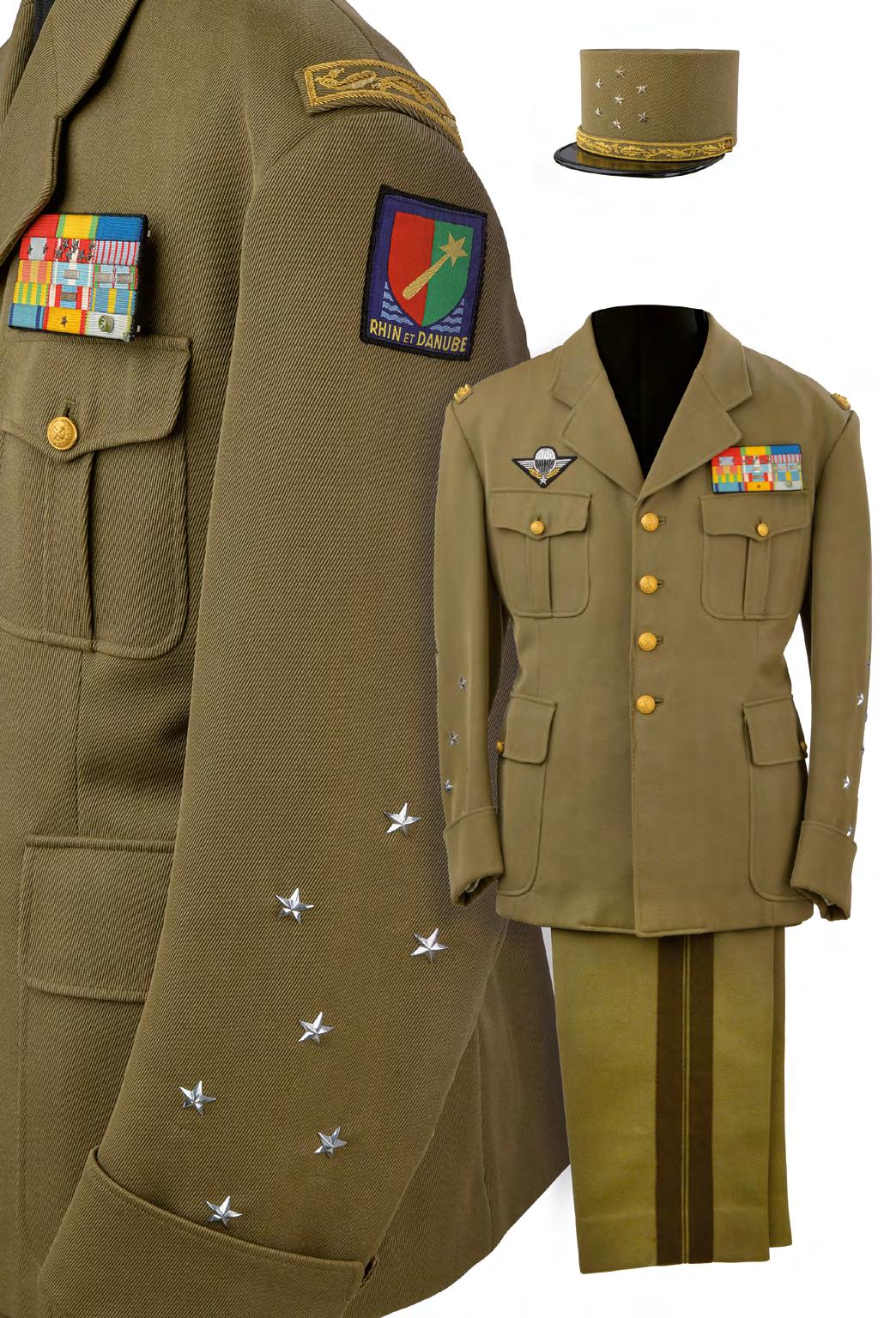
109
A PAIR OF NCO’S SHOULDER BOARDS
Kingdom of Italy, first quarter of the 20th Century
Covered with dark blue cloth, embellished with two silver-thread stars. Silver buttons.
PAIO DI CONTROSPALLINE PER UFFICIALE INFERIORE
Regno d’Italia, primo quarto del XX Sec. Rivestite in panno blu scuro, caricate da due stelle in filo d’argento. Bottoni in argento.
Conditions good Length 14.5 cm.
€ 40/80
110
A PAIR OF SENIOR INFANTRY OFFICER’S SHOULDER BOARDS
Kingdom of Italy, about 1920
Covered with grey fabric with a black border, decorated with rank of braided, silver thread rope. Silver buttons.
PAIO DI CONTROSPALLINE PER UFFICIALE SUPERIORE DI FANTERIA
Regno d’Italia, 1920 circa Rivestite in tessuto grigio con bordo nero, decorate con grado in corda intrecciata realizzata in filo d’argento. Bottoni in argento.
Conditions good Length 14.5 cm.
€ 40/80
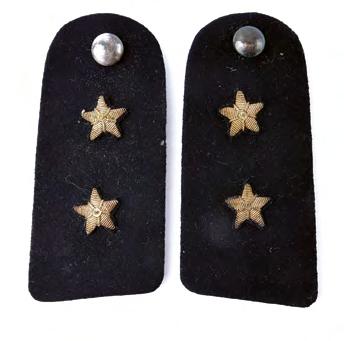
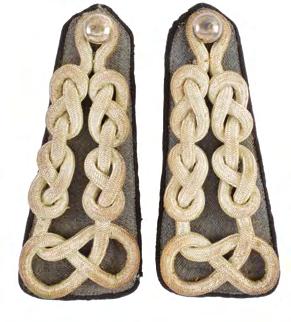
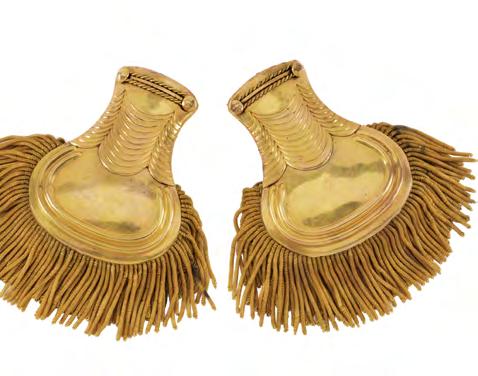
111
A PAIR OF SHOULDER BOARDS FOR GREYGREEN SERVICE UNIFORM
Kingdom of Italy, about 1930 Pentagonal plates covered with silver-plated threads, with frieze on a red fabric depicting an eagle on a bundle of gold and silver fasces. Buttons featuring Savoy eagle surmounted by brass Savoy shield. Backparts are covered with red fabric.
PAIO DI CONTROSPALLINE PER UNIFORME ORDINARIA GRIGIO-VERDE
Regno d’Italia, 1930 circa Piatti pentagonali rivestiti in canutiglia argentata, fregi ad aquila su fascio littorio in filo dorato ed argentato sottopannati in color rosso. Bottoni con aquila caricata al petto dallo scudo sabaudo in ottone. Il retro rivestito color rosso.
Conditions very good Length 13 cm.
€ 150/300
112
A PAIR OF SHOULDER BOARDS FOR A MILITIA GENERAL, SUMMER OR COLONIAL UNIFORM
Kingdom of Italy, Second quarter of the 20th Century Pentagonal plates covered with silver thread; the borders, the star and the eagle frieze are in
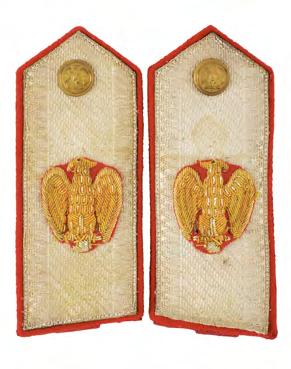
gilded threads; gilded brass buttons featuring a raised eagle with Savoy coat of arms on its breast. The reverse is lined with red fabric (some missing parts), with fastening loop provided with button.
PAIO DI CONTROSPALLINE PER GENERALE DELLA MILIZIA, TENUTA ESTIVA O COLONIALE
Regno d’Italia, Secondo quarto del XX Secolo Piatti di forma pentagonale rivestiti con filo d’argento, i bordi , la stella e il fregio ad aquila in canutiglia dorata; i bottoni in ottone dorato recanti aquila rilevata con scudo Sabaudo al petto. Il retro foderato in tessuto rosso (alcune mancanze), con passante di fissaggio munito di bottone.
Conditions very good
Length 13.5 cm.
€ 200/400
113
A PAIR A RARE EPAULETTES OF THE ROYAL PIEDMONT CAVALRY REGIMENT
Sardinian Kingdom, 1830 circa Gilded metal plates with numerous mobile fringes made of gold wire. Lined with red fabric.
PAIO DI RARE SPALLINE DEL REGGIMENTO PIEMONTE REALE CAVALLERIA
Regno di Sardegna, 1830 circa Piatti in metallo dorato con numerose frange mobili in grovigliola dorata. Sottopannatura color rosso.
Conditions good
Length 16.5 cm.
€ 200/400
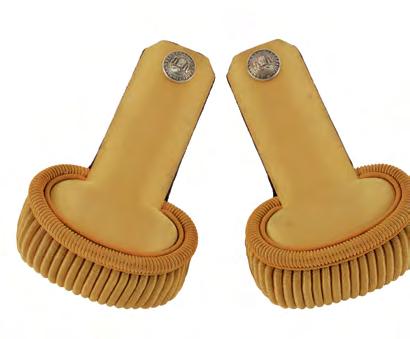
114
A PAIR OF PAPAL GENDARMERIE
EPAULETTES
State of the Vatican City, about 1930 Metal bodies with gold-thread fabric rivets and stiff fringes in gilded threads; large silver buttons featuring the inscription “GENDARMERIA
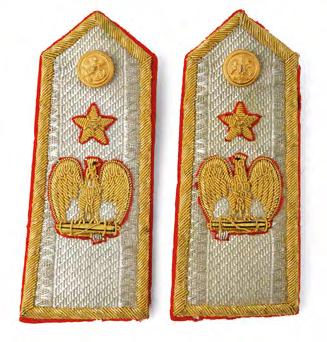
PONTIFICIA” with tiara; the interior lined with black velvet. In their original wooden and cardboard box.
SPALLINE DELLA GENDARMERIA
PONTIFICIA
Stato Città del Vaticano, 1930 circa Corpi in metallo, rivetti in tessuto in filo dorato, frange rigide in canutiglia dorata; grandi bottoni in argento recanti la scritta “GENDARMERIA
PONTIFICIA” con tiara; la parte interna rivestita in velluto nero. Nella loro scatola originale in legno e cartone.
Conditions good Length 19
€ 80/120
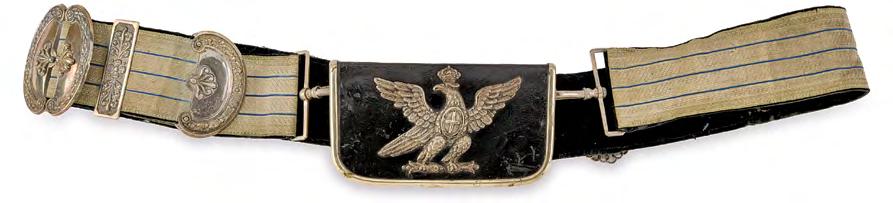
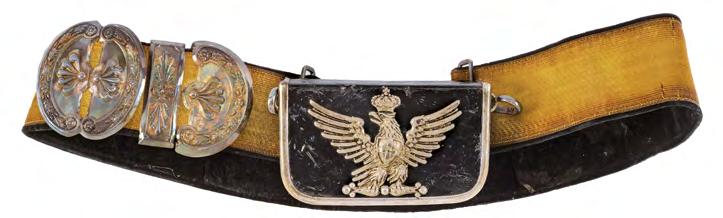
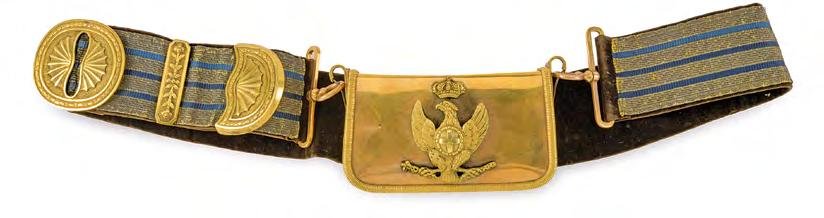
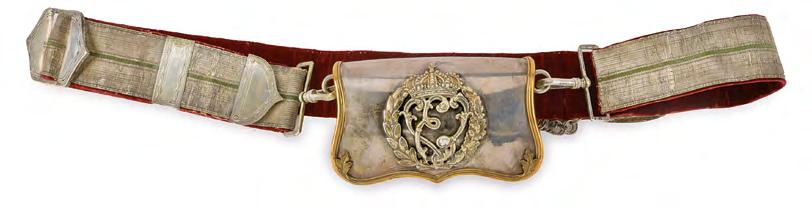
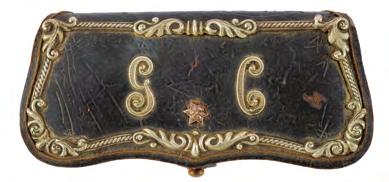
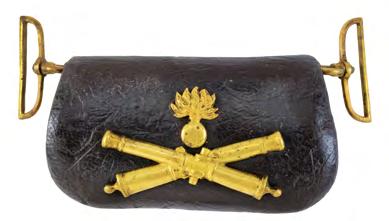
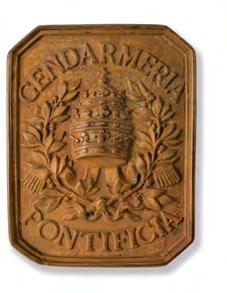
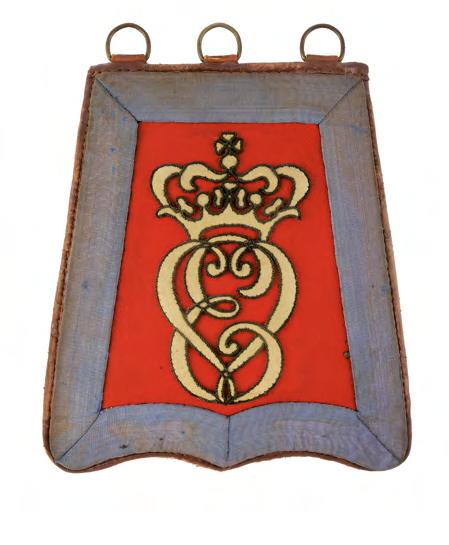
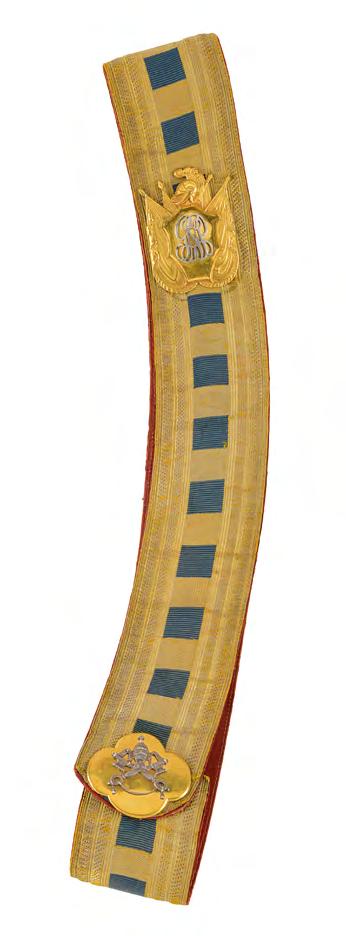
115
A CIVIL GUARD CARTRIDGE BOX
Spain, Second half of the 19th Century Wooden body lined with crimson leather on the inside. Black leather flap featuring the“G C”monogram with a star, all framed by an embossed silver-plated metal border.
GIBERNA DELLA GUARDIA CIVILE
Spagna, Seconda metà del XIX Secolo Corpo in legno rivestito di pelle cremisi nella parte interna. Patta anteriore in cuoio nero recante il monogramma“G C “ con una stella, il tutto rinchiuso in una cornice ornata a sbalzo in metallo argentato.
Conditions good
Dimensions 16 x 7 cm.
€ 100/150
116
A CARTRIDGE BOX AND A BANDOLEER, KING VITTORIO EMANUELE III EPOCH
Kingdom of Italy, about 1930
A leather bandoleer covered in gold-coloured fabric and lined with black velvet; mounts made of silver, notably a small shield with crowned monogram“VEIII”. Metal cartridge box covered with oilcloth, with silver mounts, featuring a frieze with crowned Savoy eagle with open wings, provided with a shield with Savoy cross.
GIBERNA CON BANDOLIERA, EPOCA VITTORIO EMANUELE III
Regno d’Italia, 1930 circa Bandoliera in cuoio rivestita con tessuto dorato ed internamente con velluto nero; metallerie in argento, in particolare lo scudetto con monogramma coronato“VEIII”. Giberna in metallo rivestito in tela cerata, con fornimenti in argento bollato, fregio con aquila Sabauda coronata ad ali spiegate, caricata al petto con uno scudo munito di croce Sabauda.
Conditions very good
Length 14.5 x 7.5 cm.
€ 100/120
117
AN 1852/61 MODEL ARTILLERY CARTRIDGE BOX
Sardinian Kingdom, about 1855
Made of black leather with brass mounts, featuring a frieze with crossed cannons and a flaming grenade. Two loops on either side for the bandoleer.
GIBERNA DA ARTIGLIERIA MOD. 1852/61
Regno di Sardegna, 1855 circa In cuoio nero con fornimenti in ottone, fregio con cannoni incrociati e granata fiammeggiante. Ai lati due passanti per la bandoliera.
Conditions very good
Dimensions 16 x 10 cm.
€ 250/300
118
A CARTRIDGE BOX AND BANDOLEER, KING VITTORIO EMANUELE II EPOCH
Kingdom of Italy, about 1860 Light leather bandoleer, covered with silver-coloured fabric with three blue bands; black velvet lining; silver mounts; the badge featuring the golden monogram of Victor Emmanuel II. A metal cartridge box featuring a crowned eagle with open wings, surmounted by an oval with Savoy cross.
GIBERNA E BANDOLIERA PER CAVALLERIA, EPOCA VITTORIO EMANUELE II
Regno d’Italia, 1860 circa Bandoliera in coietto leggero rivestito da tessuto argentato con tre bande blu; interno in velluto nero; fornimenti in argento, lo scudetto con monogramma dorato di Vittorio Emanuele II. Giberna in metallo con fornimenti argento, recante sulla patta un’aquila coronata ad ali spiegate caricata sul petto di un ovale con croce sabauda.
Conditions good
Dimensions 16 x 8.5 cm.
€ 350/450
119 A GENDARMERIE BELT BUCKLE
State of the Vatican City, 1950 circa Made of bronze, featuring a tiara, oak leaves and the inscription“GENDARMERIA PONTIFICIA”. There is a loop on the reverse.
FIBBIA PER GENDARMERIA PONTIFICIA
Stato Città del Vaticano, 1950 circa In bronzo, con Triregno, fronde di quercia e dicitura “GENDARMERIA PONTIFICIA”. Sul retro un passante.
Conditions very good
Dimensions 6.5 x 8.5 cm.
€ 150/180
120 A BANDOLEER FOR THE NOBLE GUARD
Papal States, circa 1900
Made of gold-coloured thread decorated with small square openings of blue fabric, as well as gold-coloured metal motifs, one featuring a heroic shield surmounted by the silver initials“GNP”and the other by a papal tiara. The interior is lined with red morocco leather (with some defects and signs of use), and the owner’s name is no longer clearly legible.
BANDOLIERA DELLA GUARDIA NOBILE
Stato Pontificio, 1900 circa Realizzata in filo dorato e decorata con piccole finestre quadrate in tessuto blu, fregi in metallo dorato, uno con scudo all’eroica caricato dalle cifre“GNP”in argento e l’altro con una tiara papale. L’interno in marocchino rosso (alcuni difetti e segni d’uso) con nome del proprietario non più chiaramente leggibile.
Conditions good Length 111 cm.
€ 220/260
121
A CARTRIDGE BOX AND BANDOLIER FOR A CAVALRY OFFICER“PIEMONTE REALE”, KING CARLO ALBERTO EPOCH
Sardinian Kingdom, 1840 circa Light leather bandoleer covered with silvered fabric with three blue stripes, the reverse lined in brown-black velvet; mercury-gilt bronze mounts with a silver“CA”monogram. Chains with missing arrow pendants. Wooden cartridge box covered in brown leather, the flap in gilt brass featuring a crowned eagle with open wings in relief.
GIBERNA E BANDOLIERA PER UFFICIALE DI CAVALLERIA“PIEMONTE REALE”, EPOCA CARLO ALBERTO
Regno di Sardegna, 1840 circa Bandoliera in coietto leggero rivestito da tessuto argentato con tre bande blu; sul retro rivestimento in velluto marrone-nero. Fornimenti in bronzo dorato al mercurio con monogramma“CA”in argento; catenelle con frecce mancanti. Giberna in legno rivestita di coietto marrone, la patta anteriore in ottone dorato, recante in rilievo un’aquila coronata ad ali spiegate.
Conditions good Dimensions 15.5 x 8 cm.
€ 800/1.000
122 A CARTRIDGE BOX AND BANDOLIER FOR AN OFFICER OF THE HUSSARS OF PIACENZA Kingdom of Italy, 1860-70 Burgundy velvet and silver-threaded fabric bandoleer (some defects) with green band; silver mounts (some stamped) with engravings, shield with gilded monogram of King Victor Emmanuel II. Cartridge box made of wood covered in red striped Moroccan leather, silver clasp with a small leaf-patterned frame, in the centre the large crowned monogram of Victor Emmanuel II among oak and laurel leaves.
GIBERNA E BANDOLIERA PER UFFICIALE DEL REGGIMENTO USSARI DI PIACENZA Regno d’Italia, 1860-70 Bandoliera in velluto bordeaux e tessuto in filo d’argento (alcuni difetti) con banda verde; fornimenti in argento (alcuni bollati) incisi; lo scudetto riportante il monogramma dorato del Re Vittorio Emanuele II. Giberna in legno rivestita con marocchino rosso rigato, patta anteriore in argento con cornicetta fogliata, recante al centro grande monogramma coronato di Vittorio Emanuele II fra fronde di quercia ed alloro.
Conditions medium
Dimensions 15 x 8 cm.
€ 1.200/1.500
123
A RARE SABRETACHE OF THE HUSSAR OF PIACENZA
Kingdom of Italy, 1860-70
Made of brown leather with a small diamond pattern. The flap is lined with red cloth featuring the monogram of Victor Emmanuel II in light-coloured fabric with green borders. At the top, three large brass suspension rings. The border with small signs of repair.
An extremely rare item; please see lot 122, which also features a bandoleer with an officer’s cartridge box from the same regiment.
RARO SABRETACHE DA USSARI DI PIACENZA
Regno d’Italia, 1860-70
In cuoio marrone stampato a piccole losanghe. Patta rivestita di panno rosso con cifre di Vittorio Emanuele II in tessuto chiaro con bordi verdi. Alla sommità tre grossi anelli di sospensione in ottone. Il bordo con piccoli restauri.
Oggetto estremamente raro, si veda il lotto 122 dove è proposto anche il set di bandoliera con giberna da ufficiale del medesimo reggimento.
Conditions very good
Dimensions 24 x 25.5 cm.
€ 1.500/2.000
124
UMBERTO I OF SAVOY (1844 - 1900)
Kingdom of Italy, Late 19th Century Oil on canvas depicting the King in uniform with orders and medals, the Order of the Annunciation, the Order of the Crown of Italy and others. In a fine gilt oval frame, carved with floral scrollwork. At the crest, a fine coat of arms with Savoy shield surmounted by a crown and flanked by two lions. The painting with a tear and restorations on the reverse.
UMBERTO I DI SAVOIA (1844 - 1900)
Regno d’Italia, Fine del XIX Secolo Olio su tela raffigurante il Re in uniforme con decorazioni, fra le quali l’Ordine dell’Annunziata, l’Ordine della Corona d’Italia e altri. In bella cornice dorata di forma ellittica, scolpita a volute floreali. Al colmo un bello stemma con scudo Sabaudo sormontato da corona e posto fra due leoni. Il dipinto con taglio e restauri nella parte posteriore.
Conditions medium Dimensions 77 x 112 cm.
€ 200/250
125
VICTOR EMMANUEL II OF SAVOY (1820 -1878)
Kingdom of Italy, 19th Century Oil on canvas depicting the King in uniform, wearing the collar and badge of the Annunziata, alongside a group of medals. Numerous signs of restoration on the reverse. Set in a beautiful gilded frame, the border featuring relief decorations of vine tendrils and floral scrolls.
VITTORIO EMANUELE II DI SAVOIA (1820 -1878)
Regno d’Italia, XIX Secolo Olio su tela raffigurante il Re in uniforme con collare e placca dell’Annunziata, insieme anche un gruppo di medaglie. Sul retro numerosi segni di restauri. In bellissima cornice dorata, il bordo con decori a tralci e volute floreali a rilievo.
Conditions medium
Dimensions 81 x 97 cm.
€ 200/250
126
VICTOR EMMANUEL II OF SAVOY (1820 -1878)
Kingdom of Italy, 19th Century Oil on canvas depicting the King in civilian attire; several restorations on the back. In a fine gilt frame with moulded and finely worked border. The upper short side surmounted by a fine gilt Savoy shield topped by a crown.
VITTORIO EMANUELE II DI SAVOIA (1820 -1878)
Regno d’Italia, XIX Secolo Olio su tela, effigiante il Re in abiti civili; sul retro diversi restauri. In bella cornice dorata con bordo modanato e ben operato. Il lato superiore porta al colmo un bello scudo sabaudo dorato sormontato da corona.
Conditions good
Dimensions 96 x 106 cm.
€ 200/250
127
VICTOR EMMANUEL II (1820 -1878)
Kingdom of Italy, 19th Century Oil on canvas, depicting the King as a young man, in uniform with decorations and sash; in particular, wearing the Grand Cross of the Order of the Annunciation. The inner edge of the gilded frame is painted black.
VITTORIO EMANUELE II (1820 -1878)
Regno d’Italia, XIX Secolo Olio su tela, effigiante il Re da giovane, in uniforme con decorazioni al petto e fascia; in particolare con il set di gran croce dell’Ordine dell’Annunziata. Il bordo interno della cornice dorato, la parte esterna dipinta di colore nero.
Conditions good
Dimensions 98.5 x 114 cm.
€ 150/250
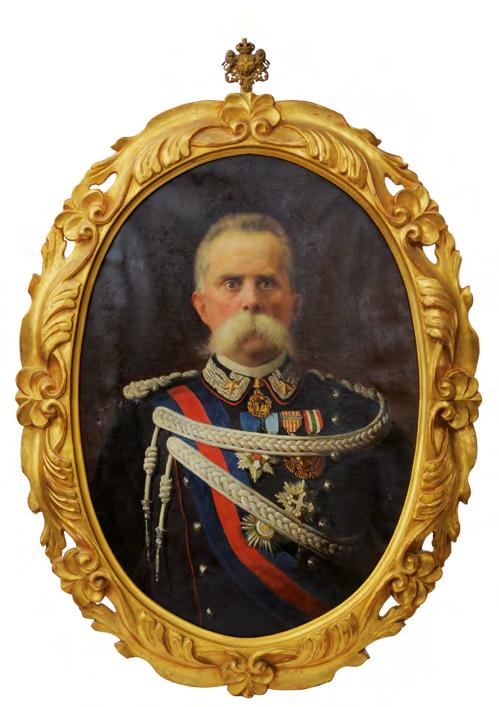
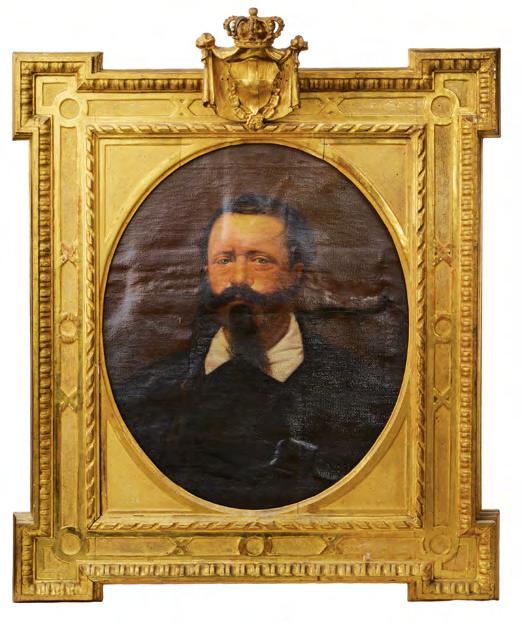
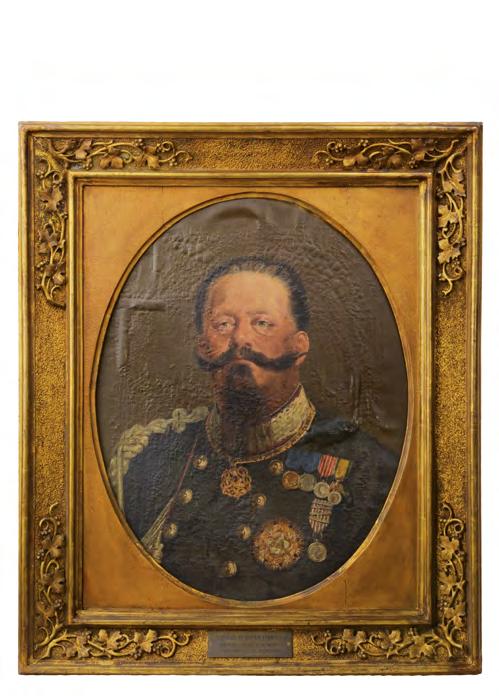
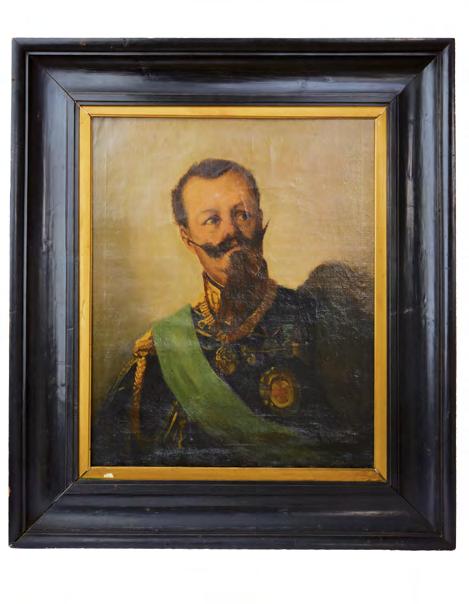
128
BARTOCCI, ALFREDO / SALVATICI, LUCIANO
Italy, last quarter of the 20th Century “Armamento Individuale dell’Esercito Piemontese e Italiano 1814 - 1914”. Two volumes. Volume 1: published by Edibase in 1978; 200 pages with black-and-white illustrations; softcover. Volume 2: published by Edibase in 1987; 303 pages with black-andwhite illustrations; hardcover with cloth binding.
BARTOCCI, ALFREDO / SALVATICI, LUCIANO
Italia, ultimo quarto del XX Sec. “Armamento Individuale dell’Esercito Piemontese e Italiano 1814 - 1914”. Due volumi. Volume 1: ed. Edibase 1978; 200 pagine con disegni in b/n; copertina morbida. Volume 2: ed. Edibase 1987, 303 pagine con disegni in b/n. Copertina rigida telata.
Conditions good
Height 35 cm.
€ 150/200
129
ZEZON, ANTONIO
Naples, 1969
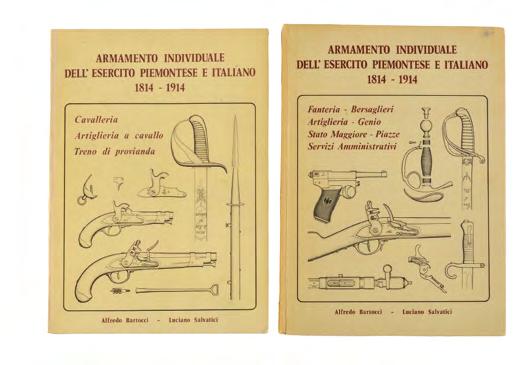
Set of 90 loose, high-quality facsimile color plates. A facsimile edition of the original work published in Naples in 1850,“Uniformi militari del Real Esercito e Armata di Mare del Regno delle Due Sicilie”. In its original box (small defects).
ZEZON, ANTONIO
Napoli, 1969
Lotto di 9O tavole a colori in facsimile su carta forte sciolte. Edizione anastatica dell’opera originale pubblicata a Napoli nel 1850,“Uniformi militari del Real Esercito e Armata di Mare del Regno delle Due Sicilie”. In cofanetto originale (piccoli difetti).
Conditions good
Height 44 cm.
€ 100/150
130 AN INTERESTING DESIGN PIECE OF THE FASCIST ERA
Kingdom of Italy, 1930/40
Made in two pieces from non-magnetic metal, featuring a gilded mirror finishing at the base, topped by a beautifully crafted eagle with open wings, with remains of gilding. An object with a fine structural design, likely intended to be placed on a marble base.
INTERESSANTE OGGETTO DI DESIGN DI EPOCA FASCISTA
Regno d’Italia, 1930/40
Realizzato in due pezzi in metallo non magnetico, base con fascio speculare dorato, alla sommità bella realizzazione di aquila ad ali spiegate, resti di doratura. Oggetto con bella linea strutturale, probabilmente da inserire su una base in marmo.
Conditions good
Height 19 cm.
€ 350/550
131 A FINIAL FOR A MILITIA BANNER POLE
Kingdom of Italy, 1922 - 1945
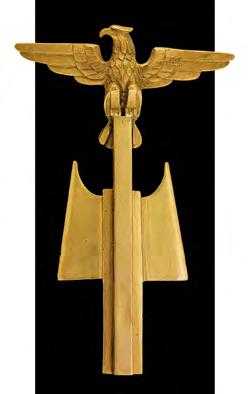
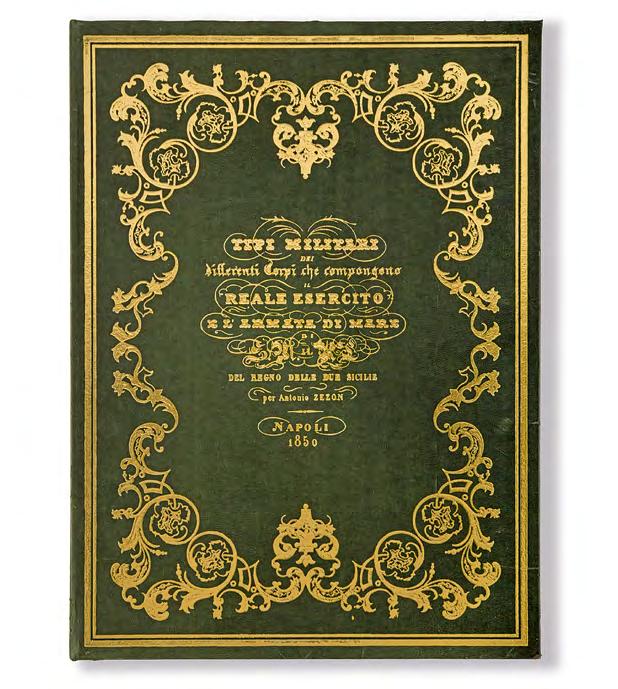
Gilt-brass finial depicting an eagle with outspread wings upon a fasces. Shaft in nonmagnetic metal, in three sections; the first fitted with two small lateral arms; complete with gilded-thread tassels.
PUNTALE SU ASTA PER LABARO DELLA MILIZIA
Regno d’Italia, 1922 - 1945
Puntale in ottone dorato, raffigurante aquila ad ali spiegate su fascio. Asta in metallo non magnetico in tre pezzi; il primo con due piccoli bracci; completo di nappine in canutiglia dorata.
Conditions medium
Dimensions 20 x 9 cm.
€ 250/350
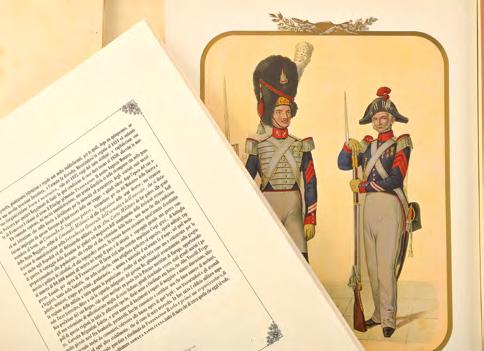
132 A FINIAL FOR AN MVSN BANNER POLE
Kingdom of Italy, 1922 - 1945
Brass finial with traces of gilding, depicting an eagle with outstretched wings, perched on a bundle and surrounded by a laurel wreath. Two-piece, nonmagnetic, metal shaft.
PUNTALE SU ASTA PER LABARO DELLA MVSN
Regno d’Italia, 1922 - 1945
Puntale in ottone con resti di doratura, raffigurante aquila con ali spigate, su fascio ed entro corona di alloro. Asta in metallo non magnetico in due pezzi.
Conditions good
Dimensions 15 x 12 cm.
€ 600/1.000
133
A FINIAL FOR A PNF BANNER POLE
Kingdom of Italy, 1922 - 1945
Gilded brass finial depicting a fasces on a sphere. A nonferrous, metal shaft in two separate sections.
PUNTALE SU ASTA PER LABARO PNF
Regno d’Italia, 1922 - 1945
Puntale in ottone dorato, raffigurante fascio littorio su sfera. Asta in metallo non ferroso in due differenti pezzi.
Conditions medium Dimensions 4 x 14 cm.
€ 100/150
134 A FINIAL FOR A BANNER POLE OF THE "ARDITI"
Kingdom of Italy, 1922 - 1945 Brass finial depicting an eagle with outstretched wings perched on a grenade. Twopiece, non-ferrous, metal shaft; the top section is missing.
PUNTALE SU ASTA PER LABARO DEGLI ARDITI
Regno d’Italia, 1922 - 1945
Puntale in ottone raffigurante aquila ad ali spigate su granata. Asta in metallo non ferroso in due pezzi, manca il segmento finale.
Conditions medium Dimensions 12.5 x 6 cm.
€ 200/300
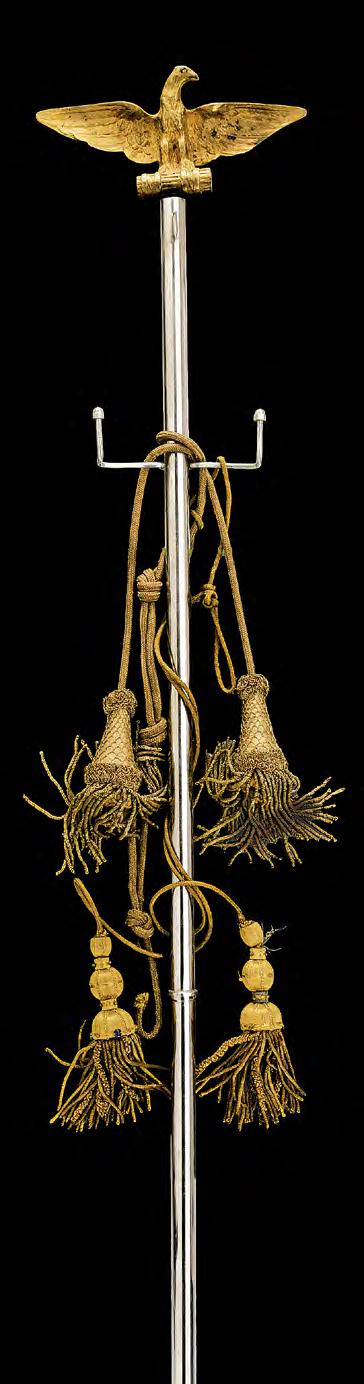
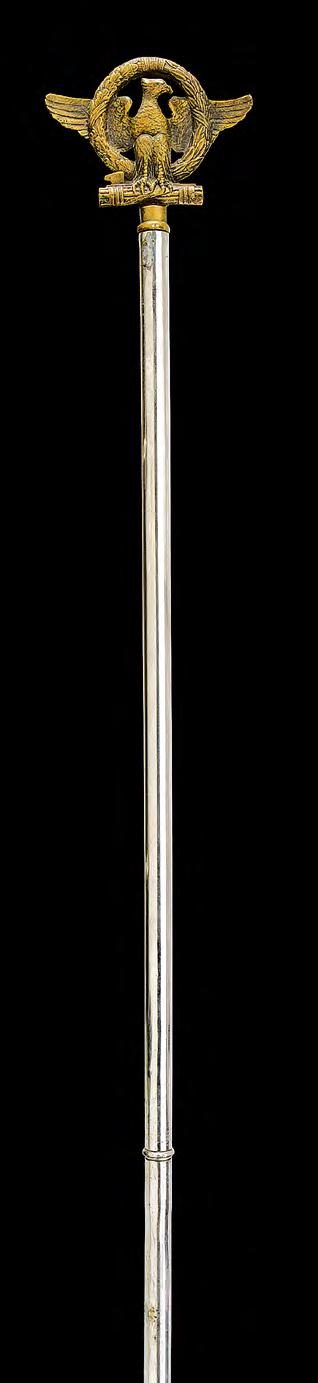


135 A LOT OF THREE TOY FIGURES
GUSTAVE VERTUNNI
France, About 1940
Characters: Marshal Lannes, General Castella, and General Colbert. Made of metal, finely painted in polychrome.
LOTTO DI TRE PERSONAGGI
GUSTAVE VERTUNNI
Francia, 1940 circa Effigiati: il Maresciallo Lannes, il generale De Castella e il generale Colbert. In metallo, finemente dipinti in policromia.
Conditions good
Height 6.2 - 7.2 cm.
€ 70/100
136
A LOT OF FOUR TOY SOLDIERS BY GUSTAVE VERTUNNI
France, About 1940
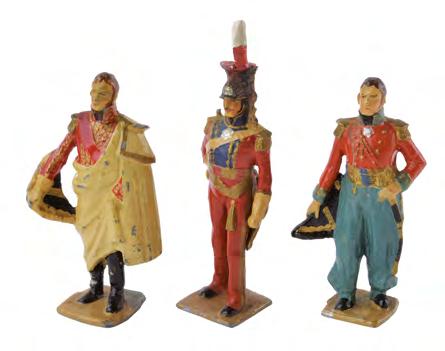
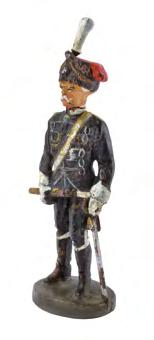
Chevauleger, Cuirassier, infantry officer and Dragoon, all of the First Empire period. In metal, finely painted in polychrome colours.
LOTTO DI QUATTRO SOLDATINI GUSTAVE VERTUNNI
Francia, 1940 circa Un cavalleggero, un corazziere, un ufficiale di fanteria e un dragone, tutti del Primo Impero. In metallo, finemente dipinti in policromia.
Conditions good
Height 7 - 7.5 cm.
€ 80/120
137 A LINEOL TOY SOLDIER
Germany, About 1940
Depicting Göring, with a field marshal’s baton. Made of composite material, finely painted in polychrome, and marked“Lineol.”A rare example, in Lineol’s typical high quality.
PERSONAGGIO LINEOL
Germania, 1940 circa Raffigurante Göring con bastone da Feldmaresciallo. In pasta, finemente dipinto in policromia e marcato “Lineol”. Esemplare raro, nella tipica alta qualità di Lineol.
Conditions good Height 7.8
€ 50/80
138 AN ELASTOLIN TOY SOLDIER
Germany, About 1940
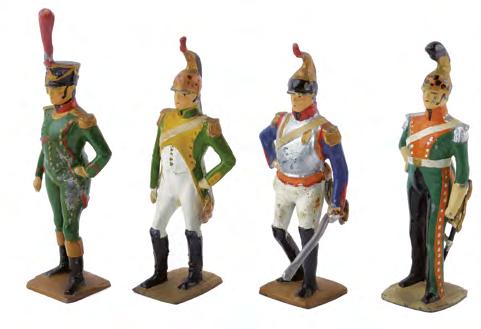
e marcato“Elastolin”. Esemplare raro, nella tipica alta qualità di Elastolin.
Conditions good
Height 8.8 cm.
€ 50/80
140 AN ELASTOLIN TOY SOLDIER Germany, About 1940
Depicting Hess, with his right arm raised. Made of composite material, finely painted in polychrome, and marked“Elastolin.”A rare example, in the high quality typical of Elastolin.
PERSONAGGIO ELASTOLIN Germania, 1940 circa Raffigurante Hess, con braccio destro alzato. In pasta, finemente dipinto in policromia e marcato“Elastolin”. Esemplare raro, nella tipica alta qualità di Elastolin.
Conditions good Height 7.3 cm. € 60/90
141 AN ELASTOLIN TOY SOLDIER Germany, About 1940 Depicting Adolf Hitler, with his right arm raised. Made of composite material, finely painted in polychrome, and marked“Elastolin.”A rare example, in the high quality typical of Elastolin.
PERSONAGGIO ELASTOLIN Germania, 1940 circa Raffigurante Adolf Hitler, con braccio destro alzato. In pasta, finemente dipinto in policromia e marcato “Elastolin”. Esemplare raro, nella tipica alta qualità di Elastolin.
Conditions good Height 7.1
€ 70/100
Depicting Franco, with a movable right arm and a porcelain head. Made of composite material, finely painted in polychrome, and marked“Elastolin.”A rare example, in the high quality typical of Elastolin.
PERSONAGGIO ELASTOLIN
Germania, 1940 circa Raffigurante Franco, con braccio destro movibile e testa in porcellana. In pasta, finemente dipinto in policromia e marcato“Elastolin”. Esemplare raro, nella tipica alta qualità di Elastolin.
Conditions good
Height 7.7 cm.
€ 70/100
139 AN ELASTOLIN TOY SOLDIER
Germany, About 1940
Depicting Field Marshal von Mackensen in hussar uniform. Made of composite material, finely painted in polychrome and marked“Elastolin.”A rare example, in the high quality typical of Elastolin.
PERSONAGGIO ELASTOLIN
Germania, 1940 circa Raffigurante il Feldmaresciallo von Mackensen in uniforme da ussaro. In pasta, finemente dipinto in policromia
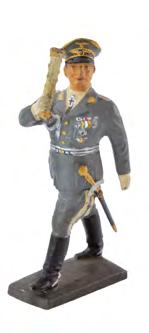
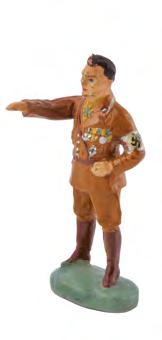
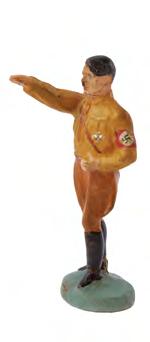
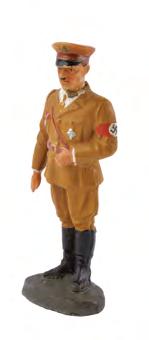
142 AN ELASTOLIN TOY SOLDIER Germany, About 1940 Depicting Adolf Hitler, with a movable right arm, wearing a party uniform and featuring a porcelain head. Made of composite material, finely painted in polychrome, and marked“Elastolin.”A rare example, in the typical high quality of Elastolin.
PERSONAGGIO ELASTOLIN
Germania, 1940 circa Raffigurante Adolf Hitler, con braccio destro movibile in uniforme del partito e con testa in porcellana. In pasta, finemente dipinto in policromia e marcato“Elastolin”. Esemplare raro, nella tipica alta qualità di Elastolin.
Conditions good
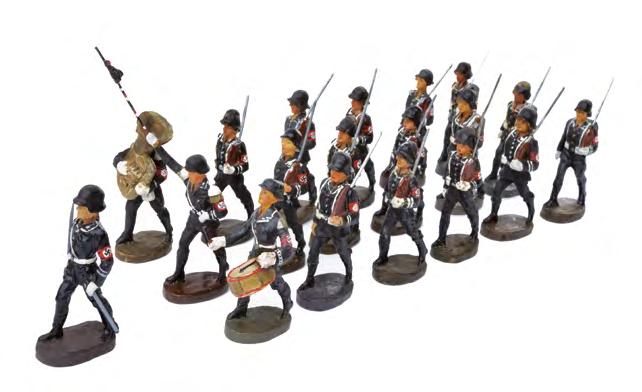
Height 7.8 cm.
€ 120/150
143 A LOT OF NINETEEN ELASTOLIN TOY SOLDIERS
Germany, About 1940
A company of SS soldiers consisting of 15 riflemen, three musicians, and one officer. A polychrome painting (restored) marked“Elastolin.”Rare examples, in the typical high quality of Elastolin.
LOTTO DI DICIANNOVE FIGURE ELASTOLIN
Germania, 1940 circa Una compagnia di soldati delle SS con quindici membri armati di fucile, tre musicisti e un ufficiale. Dipinto (con restauri) in policromia e marcato “Elastolin”. Esemplari rari, nella tipica alta qualità di Elastolin.
Conditions medium
Height 7.6 - 11.8 cm.
€ 150/250
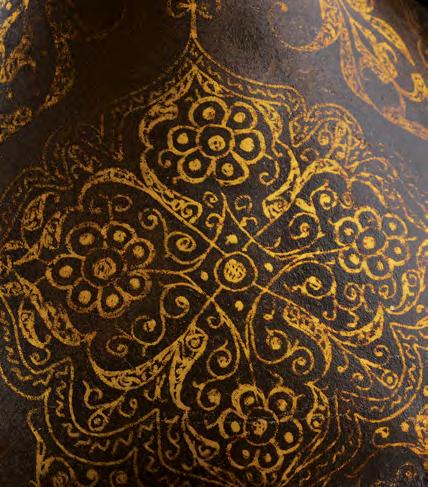
144
A RARE AND ELEGANT HELMET WITH GOLD DECORATIONS Indopersia, early 18th Century
A skull worked in one piece (small pittings on one side and a hole in the front) with an inverted cup structure, the top with cusp of square section and resting on a base shaped as a truncated cone and decorated with rays; the entire surface finely painted in gold with floral cartouches and stars, the base slightly lowered and of circular shape, also gilded and with holes for the lining, the lower edge with a mail neck-defense, which is made up of numerous small rings, worked with a fringed pattern in the final part .
RARO ED ELEGANTE ELMO CON DECORAZIONI IN ORO Indopersia, inizio del XVIII Sec. Coppo lavorato in un unico pezzo (piccole intaccature su un lato e foro nella parte anteriore) con struttura a coppa rovesciata; la sommità con cuspide di sezione quadra a base troncoconica e decorata a raggi; tutta la superficie finemente dipinta in oro con cartigli floreali e stelle, la base del coppo leggermente rastremata, di forma circolare, anch’essa dorata e con fori per la fodera. Il margine inferiore con camaglio, questo costituito da numerosi piccoli anelli, lavorati nella parte finale con trama a frange.
Conditions good
Height 58 cm.
€ 2.500/3.000
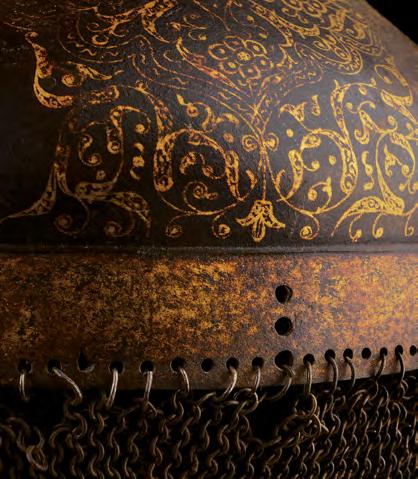
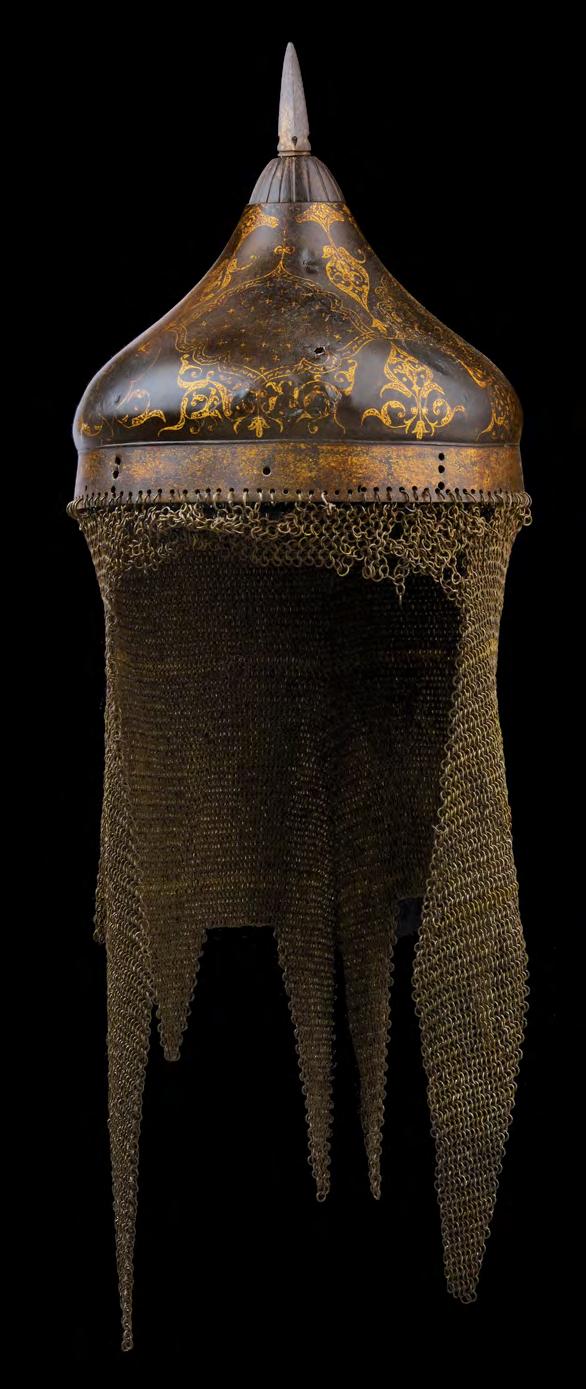
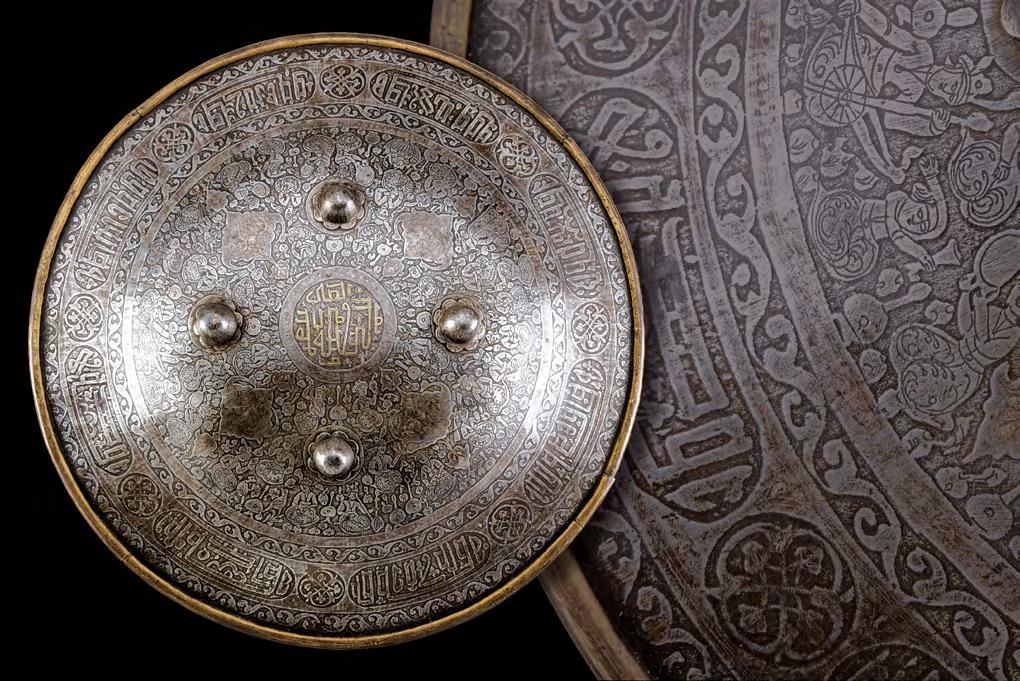
145 A FINE SIPAR
Indopersia, 19th Century
Made of iron, of circular shape, provided with four flower-shaped studs and raised border with a riveted brass ring. The surface finely engraved with figures, cartouches featuring inscriptions in Arabic and floral motifs on a dark background. Cartouche at the center, with a gold-inlaid inscription. Four rings at the back for the (missing) handles.
BEL SIPAR
Indopersia, XIX Secolo
In ferro, di forma circolare, munito di quattro borchie a fiore e bordo rilevato tramite una banda in ottone fissata con ribattini. Tutta la superficie anteriore finemente incisa con personaggi, cartigli recanti iscrizioni in caratteri arabi e a disegni floreali su sfondo scuro. Al centro un cartiglio con iscrizione rimessa in oro. Sul retro quattro anelli per le maniglie (mancanti).
Conditions good
Diameter 40.7 cm.
€ 400/600
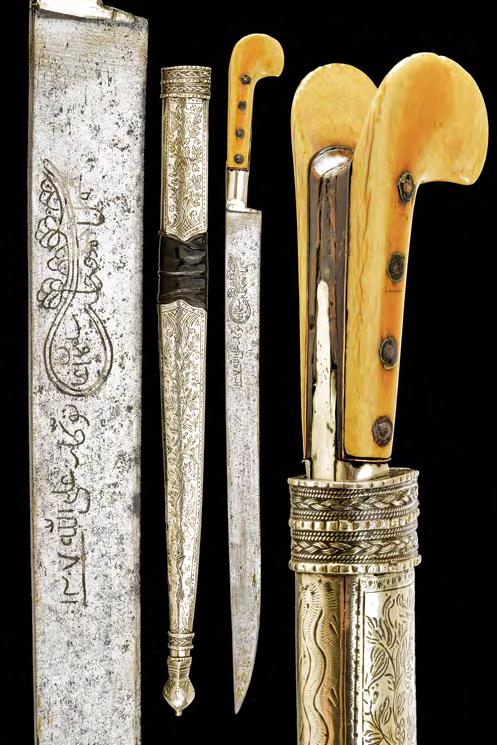
146
A SMALL AND ELEGANT DATED YATAGAN
Ottoman Empire, late 18th Century
Curved, single-edged blade with dents, signs of use and time, featuring at the forte on the right side e remains of a floral cartouche with traces of inlay; on the left side, an inscription in Arabic (Ottoman Turkish?) divided into several segments, partially legible. The first segment probably reads ‘I put my trust in God’, preceded by numbers, perhaps the date 1207? (circa 1792). The neck and central band of the hilt with remains of silver-coloured metal plates, with an underlying structure of copper and brown horn. The grips are made of warthog tusk, featuring small ears and held with rivets. Scabbard with long silver-coloured metal mounts that leave a short central section of black leather (antique) exposed. Cap with muzzle decorated with filigree frames, embellished with cluster engravings and bearing the date ‘1789’ above the Latin letters ‘Z. L.’. Small articulated suspension eyelet. The tip worked en suite with racemes and flowers.
PICCOLO ED ELEGANTE YATAGAN DATATO
Impero Ottomano, fine del XVIII Sec. Lama leggermente incurvata a un filo, con intaccature, segni d’uso e del tempo, recante al forte sul lato di terza resti di un cartiglio floreale con tracce di agemine, sul lato di quarta una iscrizione in caratteri arabi (turco-ottomano?) divisa in vari segmenti, parzialmente leggibile. Il primo segmento probabilmente”Mi affido a Dio”, preceduto da numeri, forse la data 1207? (circa 1792). Il collo e la banda centrale dell’impugnatura con resti di placche in metallo color argento, con struttura in rame e corno bruno, sottostante. Le guancette in dente di facocero, dotate di piccole orecchie e tenute con ribattini. Fodero con lunghi fornimenti in metallo color argento che lasciano scoperto un breve segmento centrale in cuoio nero (antico). La cappa con imboccatura ornata con cornicette in filigrana, arricchita con incisioni a racemi e dotata di data “1789” soprastante le lettere in alfabeto latino “Z. L.” Piccolo occhiello di sospensione snodato. Il puntale lavorato en suite a racemi e fiori.
Conditions medium
Length 50.8 cm.
€ 500/800
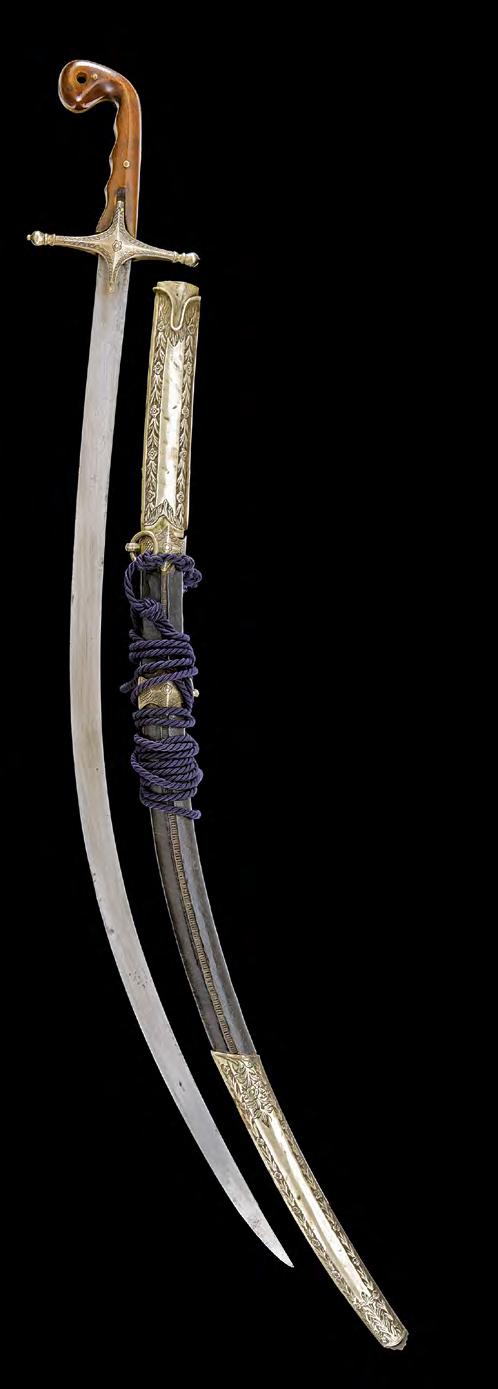
147 A KILIJ
Turkey, 19th Century Curved, iron blade with flat sides and some light pitting. Silver-colored metal hilt with quillon decorated with floral motifs. Ergonomic grip with central band also made of silver-colored metal, engraved with leaves. Angled pommel. Grip scales with open-works. In its wooden scabbard lined with leather and featuring large mounts decorated with floral motifs. Two lugs.
KILIC
Turchia, XIX Secolo Lama curva in ferro a facce piane con qualche lieve intaccatura. Fornimento in metallo color argento con elso a decoro floreale. Impugnatura anatomica con banda centrale sempre in metallo color argento inciso a foglie. Pomo angolato. Guancette in corno con sforatura. Nel suo fodero in legno rivestito di cuoio e con grandi fornimenti a decoro floreale. Due campanelle.
Conditions good
Length 94 cm.
€ 500/800
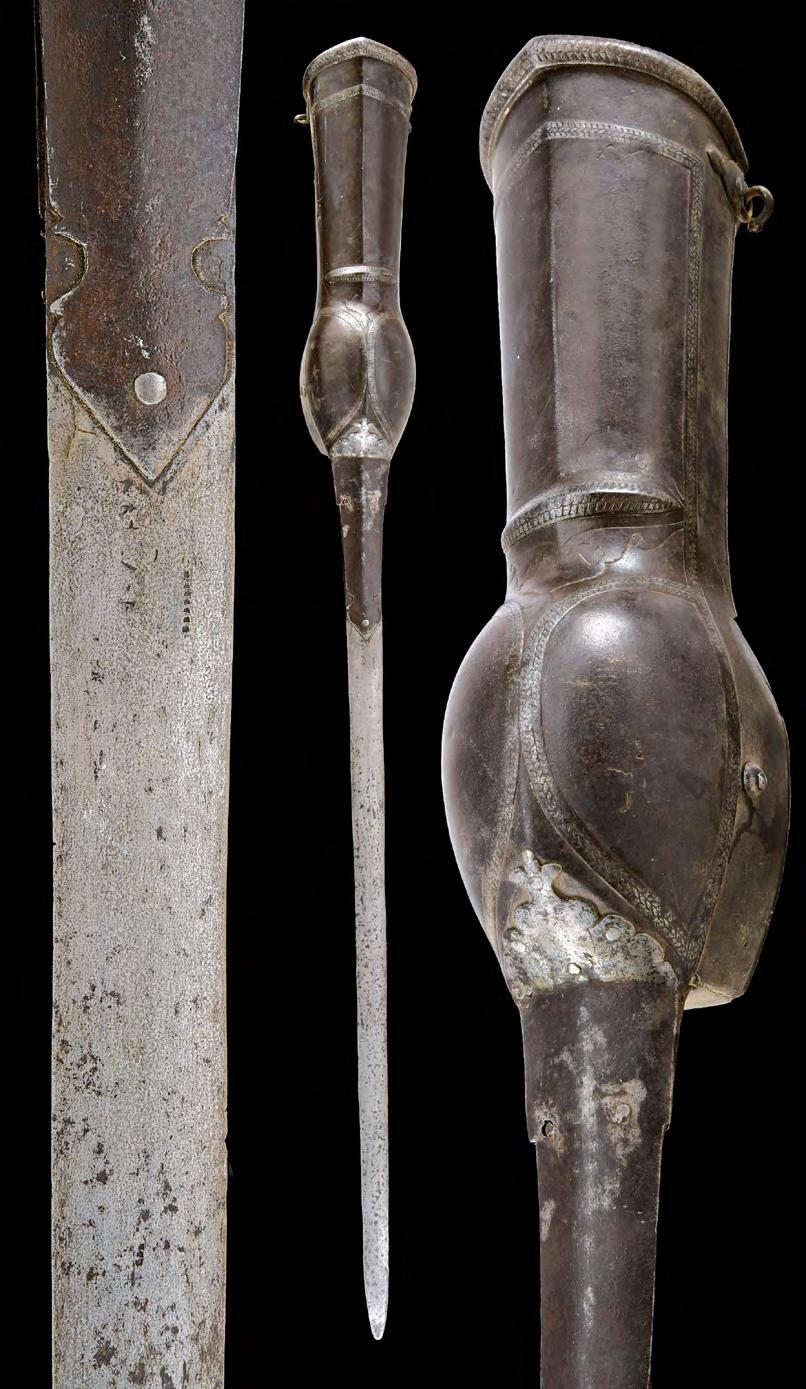
148 A PATA
India, Late 18th - Early 19th Century
Long straight double-edged blade of lenticular section, the base with remains of markings and with long bands that stabilize the blade. Browned iron glove with decorations, bands and raised iron-colored border decorated with geometrical motifs, the central part decorated with floral motifs in bas relief. The interior featuring a smooth closure buckle, a cylindrical transverse handle, and is lined with red velvet.
PATA
India, Fine XVIII inizio XIX Secolo
Lunga lama dritta a due fili di sezione lenticolare, con resti di marcature, tenuta da lunghe bandelle di ritenzione. Il guanto in ferro brunito con decorazioni, bande e bordo rilevato color ferro decorato a disegni geometrici, la parte centrale ornata con decori floreali in bassorilievo. L’interno con fibbia di chiusura liscia. Il manico cilindrico trasversale foderato con velluto rosso.
Conditions good
Length 121.5 cm.
€ 300/500
149 A SILVER MOUNTED SHASQUA, PERIOD TSAR NICHOLAS II (1894-1917)
Russian Empire, End of 19th beginning of 20th Century Curved, single-and short false-edged blade, with three dorsal grooves, the base with acid etching and floral spirals, the monogram of Nicholas II and a doubleheaded eagle. Grip of typical shape, entirely covered in silver, partly nielloed, and decorated with embossed floral spirals and geometric motifs; beaded borders. Wooden scabbard covered in leather with elegant, fine silver mounts decorated en suite at the grip. Two suspension rings.
SHASQUA CON FORNIMENTI IN ARGENTO NIELLATO, EPOCA NICOLA II (18941917)
Russia imperiale, Fine XIX inizio XX Secolo
Lama curva a un filo e breve controfilo, dotata di tre scanalature dorsali, incisa all’acido alla base con volute floreali, recante il monogramma di Nicola II e aquila bicefala. Impugnatura di forma tipica, completamente ricoperta in argento in parte niellato, e decorata a sbalzo a volute floreali e motivi geometrici, i bordi perlinati. Fodero in legno rivestito di cuoio con eleganti e fini fornimenti in argento decorati en suite all’impugnatura. Due anelli di sospensione.
Conditions very good
Length 93.5 cm.
€ 3.500/5.500
150 A RARE QAMA OF EXCEPTIONAL LENGTH
Caucasia, Late 19th Century
Broad, long, straight, double-edged blade with light central fuller framed by a narrow groove; the entire surface engraved with a sun, floral scrolls, interlacing, geometric patterns, and inscriptionlike decorations. Typical handle with large horn grip scales, carved with shallow grooves at the center and secured by two iron rivets with pointed heads. Iron side straps engraved with triangular motifs. Wooden scabbard fully covered in leather (some missing parts and defects) decorated with geometric patterns. Iron band with cylindrical loop at the top.
Qama of impressive size, finely crafted in every detail; likely made as an exhibition or presentation piece. Extremely rare.
RARO QAMA DI DIMENSIONI STRAORDINARIE
Caucaso, Fine del XIX
Secolo
Ampia lama dritta a due fili, con leggero sguscio centrale entro cornice scanalata; tutta la superficie incisa, con sole, volute floreali, bande intrecciati, disegni geometrici e decori a fingere iscrizioni. Impugnatura di forma tipica con grosse guancette in corno, operate nella parte centrale a sgusci e fissate da due rivetti con testa a cuspide in ferro. Le bandelle laterali in ferro incise a triangoli. Fodero in legno completamente rivestito di cuoio (mancanze e difetti) operato a motivi geometrici. Alla sommità banda in ferro con passante cilindrico.
Qama di dimensioni ragguardevoli, elaborato in ogni sua componente; realizzato forse come pezzo da esplosione; molto raro.
Conditions good
Length 108.5 cm.
€ 1.500/2.500
151
A RARE AND UNUSUAL KANDSHAR
Turkey, 19th Century
Curved, double-edged blade with central rib (probably of damask); grip with an iron ring nut and gold inlays featuring two cartouches inscribed in Arabic characters. Cylindrical nephrite grip, decorated with gold-inlaid frames and floral motifs. Ring-shaped ring nut and flattened round pommel, decorated with blue and pink enamels (small missing parts) in the champlevé style, in the Caucasian taste.
An interesting dagger, likely a gift to some prominent European dignitary during the 19th century.For similar items, see “Islamic Weapons: Maghrib to Moghul” by Anthony C. Tirri, 2003, p. 135, ill. 91B.
RARO ED INUSUALE KANDSHAR
Turchia, XIX Secolo
Lama curva a due fili con costola centrale (probabilmente in damasco); impugnatura con ghiera in ferro e agemine in oro con due cartigli iscritti a caratteri arabi. Impugnatura cilindrica in nefrite, ornata da cornici e fiorami rimessi in oro. Ghiera ad anello e pomo tondeggiante schiacciato, ornati da smalti azzurri e rosa (minime mancanze) in stile champlevé, di ispirazione Caucasica.
Interessante pugnale, probabilmente un dono a qualche dignitario importante europeo durante il XIX secolo. Per esemplari simili si veda “Islamic Weapons Maghrib to Moghul” di Anthony C. Tirri, 2003, a pagina 135, ill. 91B.
Conditions very good
Length 43.5 cm.
€ 800/1.200
152
A LONG SILVER-MOUNTED JAMBIYA
Turkey, 19th Century
Large, curved, double-edged blade with central rib; remarkable silver-coated grip (missing part), in the typical double “T” shape, completely decorated with floral motifs in bas-relief; pommel with a raised decoration in the middle. Wooden scabbard entirely covered with finely worked silver foil frames on one side and carved with geometric motifs, on the other with smooth and beaded frames, in one of the smooth ones there are two marks (sultan’s tugra); the tip with a dense pattern of beaded rings. One suspension ring.
LUNGA JAMBIYA IN ARGENTO
Turchia, XIX Secolo
Larga lama curva a due fili, con nervatura centrale. Notevole impugnatura rivestita d’argento (mancanza), di tipica forma a doppia “T”, completamente decorata a motivi floreali in bassorilievo; pomo con dorso recante al centro una decorazione in rilievo. Fodero in legno interamente ricoperto con lamina d’argento finemente operata su un lato a cornici con intagli in rilievo a carattere geometrico, sull’altro a cornici lisce e perlinate; in una di quelle lisce due punzoni (tughra del sultano). Il puntale con fitta trama ad anellature perlinate. Un anello di sospensione.
Conditions good
Length 50.5 cm.
€ 800/1.200
153 A BIG JAMBIYA
Turkey, 19th Century
Curved, made of damask, double-edged blade, with flat sides and ribbed in the middle, gold inlaid koftgari, spirals at the forte. Walrus ivory grip shaped as a double T (some minor defects). Wooden scabbard covered in black leather stitched at the back. Metal tip with ends shaped as a monster head.
GRANDE JAMBIYA
Turchia, XIX Secolo
Lama curva in damasco, a due fili, a facce piane e nervata al centro, ageminata in oro koftgari, al forte a volute. Impugnatura in avorio di tricheco a doppia “T” (alcuni piccoli difetti). Fodero in legno rivestito di cuoio nero cucito sul retro. Puntale metallico con estremità a testa di mostro.
Conditions good
Length 51.6 cm.
€ 1.400/1.800
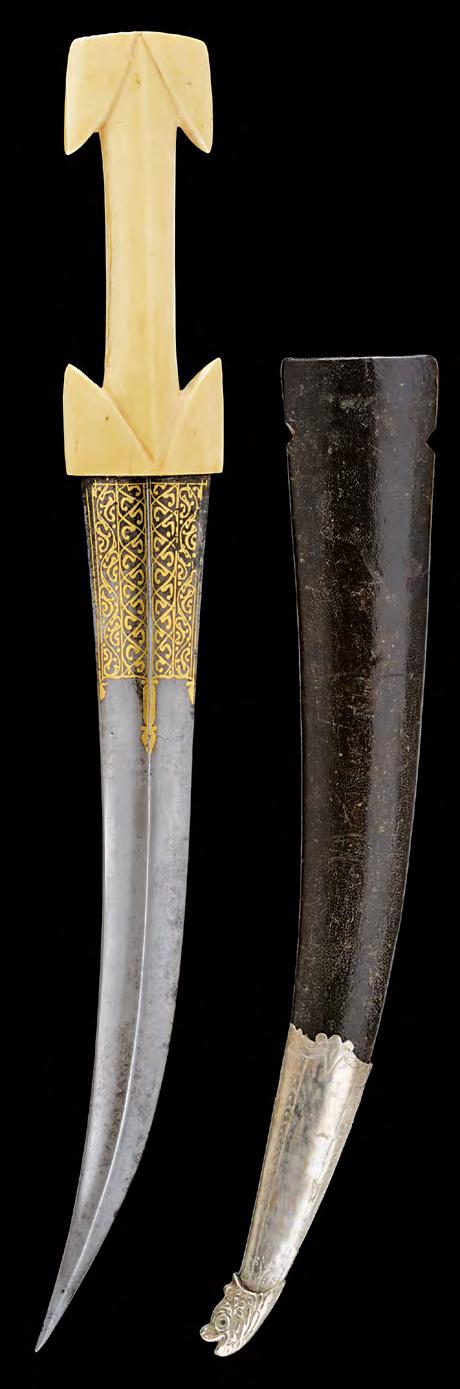
154
AN INTERESTING AND LONG KHYBER KNIFE
Afghanistan, circa 1900
Very long, straight blade, with “T”-shaped back, with floral spiral engravings, some of which are gilded at the forte. Iron hilt decorated en suite, back tang with stave featuring inscriptions (?). Grip of typical shape with grip scales made of walrus tusk. Beautiful wooden scabbard lined with green silk (worn) with iron mounts decorated with engravings and openwork depicting elephants, horses, birds, floral motifs, and other animals; some elements in gold and silver, the back with gilded and silvered inscriptions, and provided with a loop.
INTERESSANTE E LUNGO COLTELLO KHYBER
Afganistan, 1900 circa Lunghissima lama dritta con dorso a “T”, recante incisioni a volute floreali in parte dorate al forte. Fornimento in ferro decorato en suite, il codolo dorsale con una doga recante iscrizioni (?). Impugnatura di forma tipica con guancette in zanna di tricheco. Bel fodero in legno rivestito in seta verde (lisa) con fornimenti in ferro decorato ad incisioni e trafori, effigianti elefanti, cavalli, volatili, motivi floreali ed altri animali; alcune elementi in oro ed argento, il dorso con iscrizioni dorate ed argentate, e munito di passante.
Conditions very good
Length 67 cm.
€ 450/650
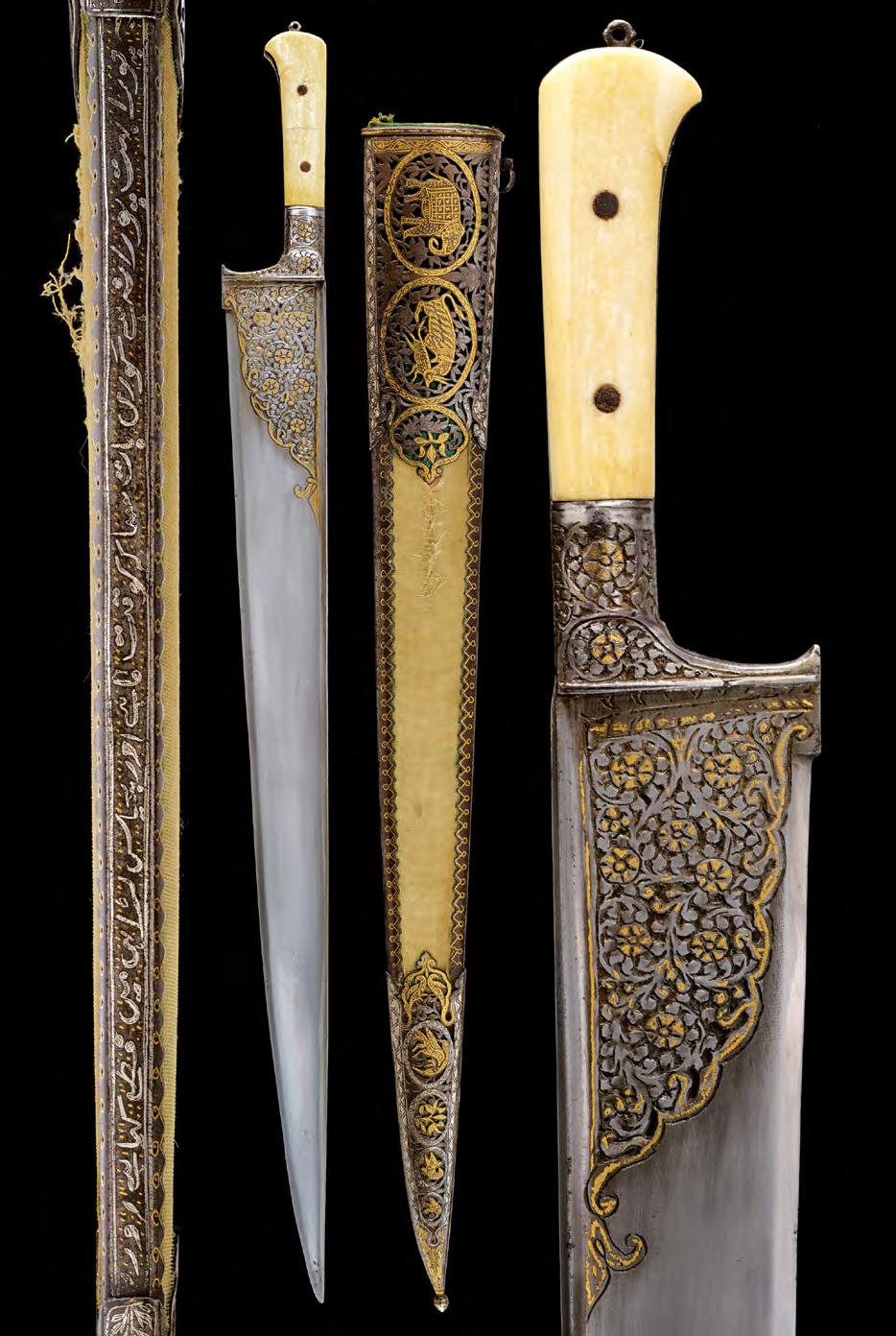
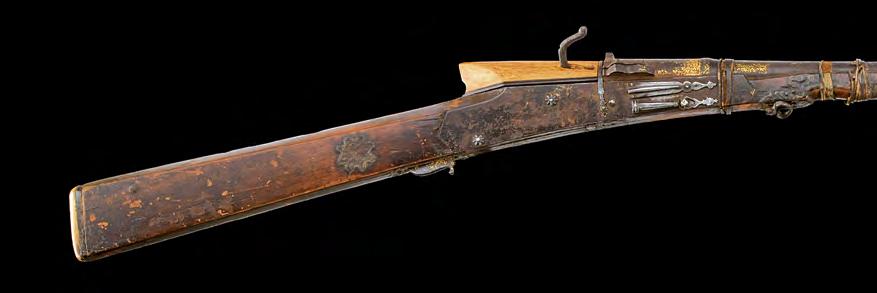
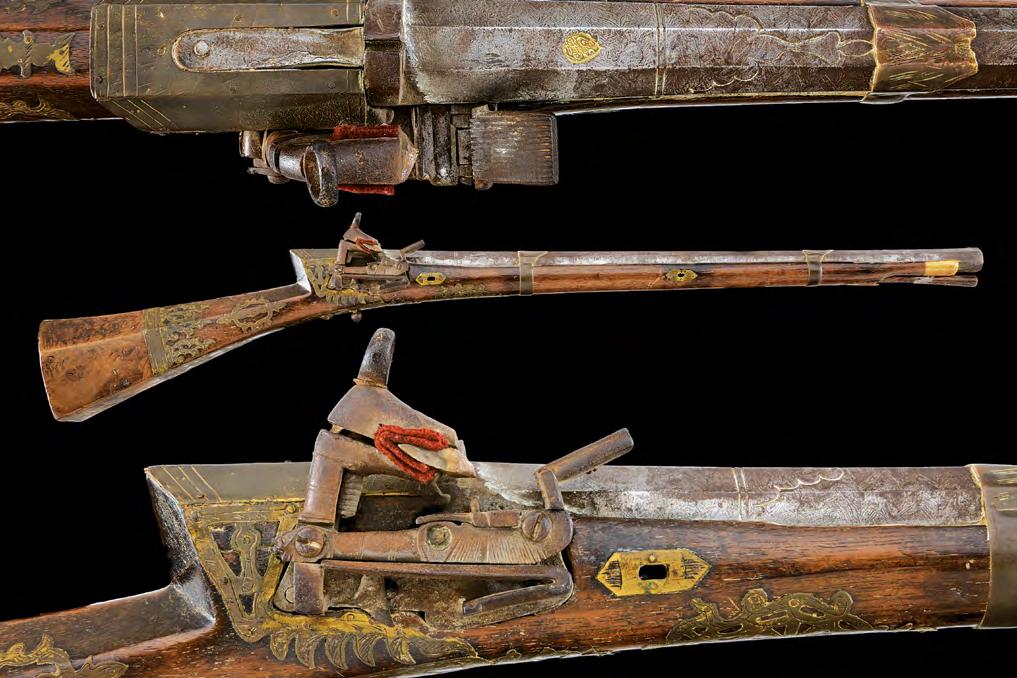
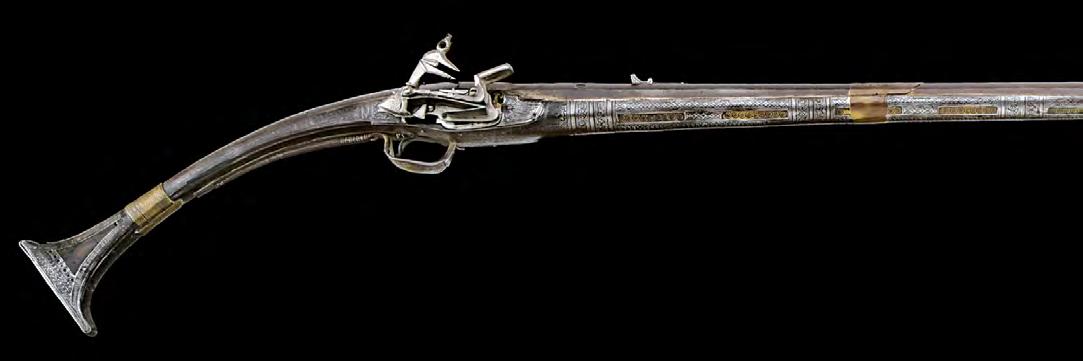
155
A MATCHLOCK TORADOR
India, Late 18th - Early 19th Century Smoothbore, round, three-stage, 13 mm cal. barrel, all round but of decreasing diameter; with double ribbing at the first part, provided with rear sight and pan with pan cover; grooved nozzle; the first two sections and the nozzle are inlaid with gold floral motifs; the section behind the barrel, which houses the cock, is of modern origin. Wooden full stock with dark patina; the side plates are made of iron, the right one provided with two small “scabbards”, one for the ventpricker and the other for a tool. The trigger is decorated with gold. The mechanism is not working. Iron ramrod. Small defects and missing parts, signs of time and use.
TORADOR A MICCIA
India, Fine XVIII inizio XIX Secolo
Canna tonda liscia a tre ordini, tutti tondi ma di sezioni decrescenti; prima parte con doppia nervatura tipo bindella, munita di alzo e scodellino con copriscodellino; la volata scanalata. I primi due segmenti e la volata ageminati in oro a motivi floreali, cal. 13 mm. Il fornimento dorsale alla culatta, che ospita il cane, sostituito in epoca moderna. Cassa intera in legno in patina scura, le piastre laterali in ferro, quella di destra dotata di due piccoli “foderi”, uno per l’ago di pulizia del focone, l’altro per un attrezzo. Il grilletto con decorazioni in oro. Meccanismo non funzionante. Bacchetta in ferro. Piccoli difetti e mancanze, segni del tempo ed uso.
Conditions mediocre
Length 164 cm.
€ 300/600
156 A TUFENK
Turkey, Late 18th - Early 19th Century
Octagonal damask barrel, rifled, with polygonal bore (heptagonal), provided with small brass foresight at the slightly bell-mouthed nozzle and a thick rear sight at the breech. On the back, a cartouche with brassinlaid Arabic inscription and light carved frame decoration. 12.1 mm cal. at the nozzle. Iron Morlach lock, (probably working mechanism, but it needs revision). Wooden full stock (with some cracks), with the typical butt of irregular hexagonal section, enriched with various brass plates engraved and pierced with floral motifs and scrolls, with slight traces of gilding. One hilt on the back of the butt has another cartouche with raised Arabic characters. Brass barrel brackets. Bone stock muzzle. Simple wooden ramrod (it needs fixing). The barrel retaining pins are missing. Typical iron trigger with cusped bulb-shaped form. Slightly damaged and with missing parts, signs of use and time.
TUFENK
Turchia, Fine XVIII inizio XIX Secolo Canna ottagonale in damasco, rigata, con anima poligonale (a eptagono), dotata di piccolo mirino in ottone alla volata, che è leggermente strombata, e di spessa tacca di mira in culatta. Al dorso un cartiglio con iscrizione in caratteri arabi rimessa in ottone e lievi intagli scorniciati. In volata cal. 12,1 mm. Batteria alla morlacca in ferro (meccanica probabilmente funzionante ma da rivedere). Cassa intera in legno (qualche crepa) con tipico calcio a sezione di esagono irregolare, arricchita da varie placche in ottone, incise e traforate a motivi floreali e volute, con lievi tracce di doratura. Un fornimento al dorso della pala reca un altro cartiglio con caratteri arabi in rilievo. Anche i reggicanna in ottone. La bocca della cassa in osso. Semplice bacchetta in legno (da riparare). Mancano le spine di ritenzione della canna. Tipico grilletto in ferro lavorato a bulbo cuspidato. Lievi danni e mancanze, segni d’uso e del tempo.
Conditions medium
Length 95 cm.
€ 500/800
157 A MIQUELET LOCK MUSKET
Albania, Second quarter of the 19th Century Smoothbore, double-stage, 15 mm cal. barrel; octagonal at the first part with Arabic mark, inscription and stars; engraved and carved, iron rear sight; then round with an engraved and slightly thickened nozzle; foresight; engraved tang. Miquelet flintlock mechanism engraved with geometric motifs (some missing parts). Wooden full stock entirely covered with iron and brass mounts, finely engraved with floral and geometric motifs. Defects and missing parts on the butt plate. Iron ramrod. Sling swivel.
BEL FUCILE ALLA MORLACCA
Albania, Secondo quarto del XIX Secolo
Canna a due ordini liscia, ottagonale nella prima parte e recante un punzone arabo, un’iscrizione e stelle, dotata di alzo inciso e intagliato in ferro, poi di sezione tonda e con volata incisa e leggermente ingrossata, mirino, cal. 15 mm; codetta incisa. Batteria alla micheletta a pietra focaia incisa a motivi geometrici (mancanze). Cassa intera in legno ricoperto completamente con fornimenti in ferro ed ottone, finemente incisi a motivi floreali e geometrici. Difetti e mancanze alla coccia. Bacchetta in ferro. Anello da sella.
Conditions good
Length 171.5 cm.
€ 600/900
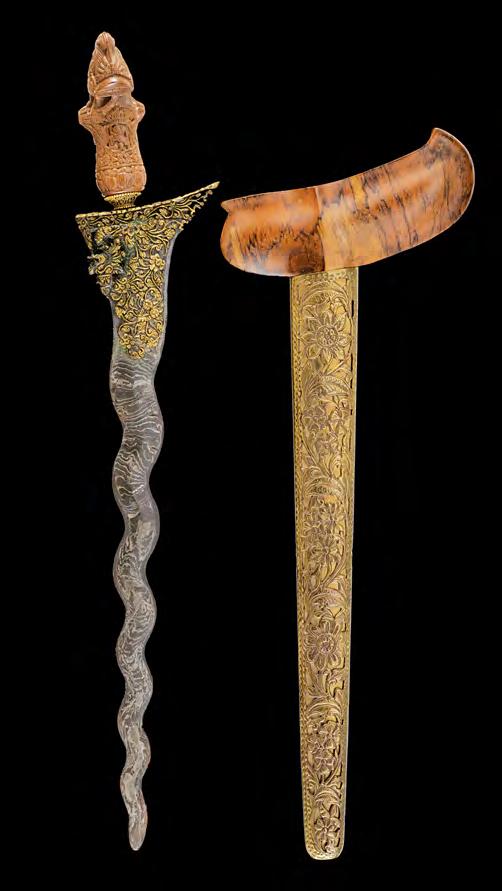
158 A FINE KRIS
Madura Island, circa 1900
Wavy double-edge blade, made of pamor, the base with beautiful gold-inlaid decorations with floral motifs and a finely crafted Naga’s head. An elegant mendak decorated with beads. Made of light-colored wood ukiran, fully sculpted. Wooden warangka. Gandar fully covered by the pendok, densely decorated with brass sheet metal, fretworked with plant motifs.
BEL KRIS
Madura, 1900 circa Lama in pamor, di forma ondulata, a due fili, con belle decorazioni ageminate in oro a motivi floreali alla base e con testa ben elaborata di Naga. Elegante mendak decorato a perline metalliche. Ukiran in legno chiaro, completamente scolpito. Wrangka in legno. Gandar con pendok in lamina di ottone fittamente decorata e messa a giorno a motivi fitomorfi.
Conditions good
Length 49 cm.
€ 250/450
159 A KRIS
Bali, circa 1900
Wavy double-edged blade, made of pamor, the base slightly carved; wooden ukiran carved with embossed silver mounts featuring floral motifs, metal mendak decorated with stones (some missing parts). Beautiful scabbard with wrangka and gandar completely covered in finely embossed silver leaf with floral motifs.
KRIS
Bali, 1900 circa Lama a due fili ondulati, in pamor, con base leggermente intagliata. Ukiran in legno scolpito, con fornimenti in argento sbalzati a motivi floreali, mendak in metallo arricchito con pietre (mancanze). Bellissimo fodero con wrangka e gandar completamente rivestiti con lamina d’argento finemente sbalzata a motivi floreali.
Conditions good Length 41.7 cm.
€ 300/500
160
A VERY RARE KRIS
Surakarta, XV - XIX century
Smoothbore, double-edged blade in fine pamor (very old blade from the 14th-16th century). Important Ukiran made of gilded silver (90% gilding), partially engraved with floral motifs, worked in one piece with selut, engraved silver mendak. The sandang walikat scabbard made of wood, completely covered in silver and finely engraved with floral and geometric motifs. Definitely an important family heirloom.
RARISSIMO KRIS
Surakarta, XV - XIX secolo
Lama dritta a due fili lisci, in fine pamor (lama molto vecchia, del XIV-XVI secolo).
Importante Ukiran in argento dorato (doratura al 90%), parzialmente inciso a motivi floreali, lavorato a un pezzo con il selut, il mendak in argento inciso. Il fodero sandang walikat in legno, completamente rivestito d’argento e finemente inciso a motivi floreali e geometrici. Sicuramente un importante cimelio di famiglia.
Conditions good Length 46 cm.
€ 2.000/3.000
161
A FINE PARANG
Sumatra, Late 19th Century
Solid, straight, single-edged blade with double groove. Wooden hilt finely sculpted as an animal’s head. Wooden scabbard with engraved silver mounts.
BEL PARANG
Sumatra, Fine del XIX Secolo
Robusta lama dritta a un filo con duplice scanalatura.
Bel fornimento in legno scolpito a testa di animale. Fodero in legno con fornimenti in argento inciso.
Conditions good
Length 61 cm.
€ 200/300
162
A BEAUTIFUL SILVER-MOUNTED PIHA-KAETTA
Ceylon, 19th Century
A strong single edged blade with deep, back groove; grip with long ring nut that extends onto the blade, finely engraved and openwork in silver and brass, horn grip with elegant floral carvings, and silver mounts decorated en suite. Minor defects.
BELLISSIMA PIHA-KAETTA CON FORNIMENTI IN ARGENTO
Ceylon, XIX Secolo
Robusta lama a un filo con profonda scanalatura dorsale; impugnatura con lunga ghiera che entra anche sulla lama, finemente incisa e traforata in argento e ottone, impugnatura in corno con eleganti intagli floreali e fornimenti in argento decorati en suite. Piccoli difetti.
Conditions good
Length 29 cm.
€ 300/500
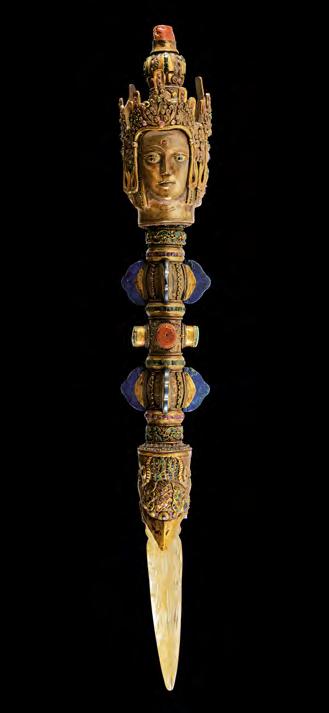
163
A RICHLY DECORATED PHURBA
India, End of 19th beginning of 20th Century
With brass-coloured metal structure. The large pommel in relief with the three faces of Vajrakilaya (joyful, peaceful and wrathful), each wearing a richly decorated crown with scrolls in relif. At the rear of the pommel, a long knop decorated in relief with floral and architectural motifs. The long hilt characteristically formed as interlaced knots, with the two vajras made from blue stone plaques flecked with gold (lapis lazuli?), and with a central knot with turquoise- and red-coloured stone cabochons. The base of the blade shaped as a Garuda’s head. Various rings decorated with filigree work and green/red-coloured stones (semi-precious stones? glass paste?). Numerous elements enriched with faceted red and green stones, from the crowns and small frames to the Garuda head, set and glued (small missing parts). Several elements keep their earlier gilding.Blade of triangular section (ceremonial, with flat tip and unsharpened), made of transparent stone (glass? rock crystal?) carved with flame motifs.
PHURBA RICCAMENTE DECORATO
India, Fine XIX inizio XX Secolo
Con struttura in metallo color ottone. Il grande pomo sommitale decorato in rilievo recante i tre volti di Vajrakilaya (uno gioioso, uno pacifico, uno irato), ciascuno cinto da una corona riccamente decorata a volute in rilievo. Al dorso del grande pomo un lungo bottone decorato in rilievo a elementi floreali e architettonici. La lunga impugnatura tipicamente lavorata a nodi, con i due Vajra realizzati da placche in pietra blu screziata oro (lapislazzuli?) e con un nodo centrale recante cabochon di pietre color turchese e rosso. L’imboccatura della lama lavorata a testa di Garuda.Varie anellature con decorazione in filigrana con pietre color verde o rosso (semipreziose? Pasta vitrea?) Svariati elementi arricchiti con pietre faccettate color rosso e verde, presenti dalle corone dei volti alle cornicette, alla testa di Garuda, incassate e incollate (minime mancanze).Diversi elementi conservano la doratura antica.La lama di sezione triangolare (di rappresentanza, a punta piatta e non affilata) realizzata in pietra color trasparente (vetro? cristallo di rocca?) intagliata a fiamme.
Conditions good
Length 44.5 cm.
€ 500/800
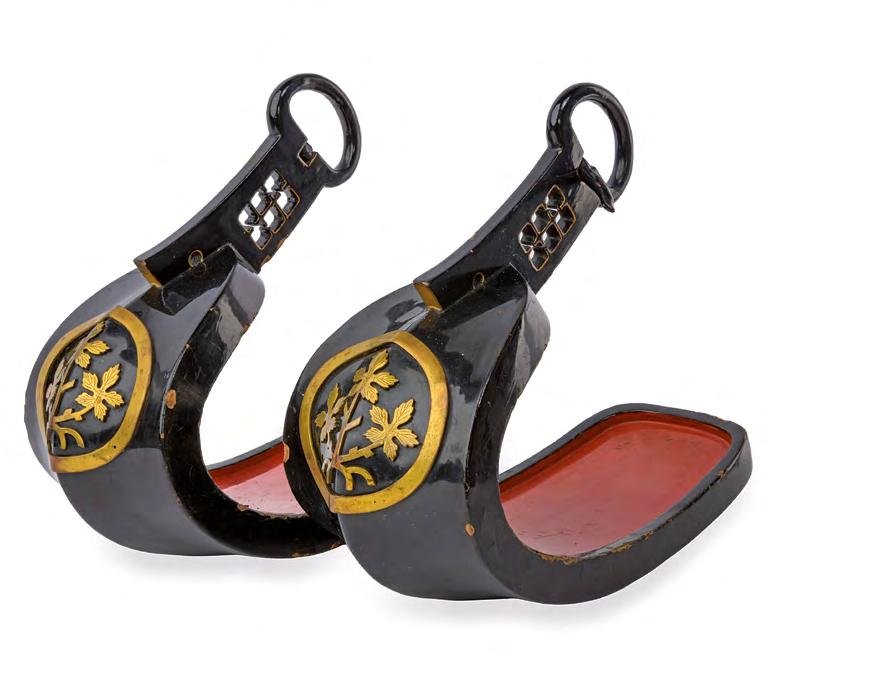
165 A PAIR OF ABUMI SIGNED "TOMOMASA" WITH CERTIFICATE
Japan, Edo Period (1603-1867)
Of strong iron construction, with silver inlays (missing parts) on an aged iron-finish surface. Decorated with a sayagata pattern. Also featuring narabi-kuginuki-mon at the centre front. With large suspension clasps on bases pierced with eleven openings. The threads retain raden (mother-of-pearl) inlays, missing parts. Inlaid signature “Tomomasa” on the reverse of the fungoni threads, within an unusual flowing design resembling drifting cherry blossoms on water. This large signature on the reverse of the threads is known as tanzaku-mei and represents the maker’s signature of the abumi. Abumi signatures are usually found on the front of the suspension bases. Beginning of the 18th Century.
This pair of abumi is accompanied by a Nihon-Katchu-BuguKenkyu-Hozon-Kai (NKBKHK) certificate, dating it to the middle Edo period and qualifying it as Tokubetsu-KichoShiryo (especially important complement of armour).
PAIO DI ABUMI FIRMATI "TOMOMASA" CON CERTIFICATO
Giappone, Periodo Edo (1603-1867)
Solida struttura in ferro, con agemine in argento (mancanze) su superficie in ferro con finitura antichizzata. Decorati con motivo sayagata. Presentano inoltre narabikuginuki-mon sul lato frontale. Completi di grandi attacchi di sospensione su base traforata a undici aperture. Le filettature conservano inserti in raden (madreperla), con mancanze. Sul retro delle filettature fungoni è ageminata la firma “Tomomasa”, entro un disegno ondulato irregolare, simile a un corso d’acqua con fiori di ciliegio trasportati dalla corrente. Questa ampia firma apposta sul retro delle filettature è detta tanzaku-mei ed è la firma del fabbricante dell’abumi. Normalmente le firme degli abumi si trovano sul lato anteriore delle basi di sospensione. Inizio del XVIII secolo.
Questa coppia di abumi è corredata da certificato NihonKatchu-Bugu-Kenkyu-Hozon-Kai (NKBKHK), che la data al medio periodo Edo e la qualifica come Tokubetsu-Kicho-Shiryo (complemento d’armatura di particolare importanza).
Conditions good
Height 27 cm.
€ 1.100/1.500
164
A RARE PAIR OF EMINASHI ABUMI WITH CERTIFICATE
Japan, Edo Period (1603-1867)
An extremely rare eminashi form (without the front groove). Of strong iron construction, with a glossy black-lacquered wooden body. With a maruni-kajinoha-mon (suwa-kajinoha-mon) precisely cut from a brass plate approximately 1.5 mm thick at the centre front. Fitted with large suspension clasps on chigiri-mon pierced bases. The threads retain their original red lacquer throughout. Small defects. First half of the 18th Century.
This pair of abumi is accompanied by a NihonKatchu-Bugu-Kenkyu-Hozon-Kai (NKBKHK) certificate, dating it to the middle Edo period and qualifying it as Tokubetsu-Kicho-Shiryo (especially important complement of armour).
RARO PAIO DI ABUMI EMINASHI CON CERTIFICATO
Giappone, Periodo Edo (1603-1867)
Di rarissima forma eminashi (ovvero privi della scanalatura frontale). Con solida struttura in ferro, con corpo in legno laccato nero lucido. Entrambi decorati nella parte frontale con un marunikajinoha-mon (suwa-kajinoha-mon) precisamente ritagliato da una piastra in ottone di circa 1,5 mm di spessore. Completi di grandi attacchi di sospensione su base traforata chigirimon. Le filettature conservano integralmente la laccatura rossa originale. Piccoli difetti. Prima meta del XVIII secolo.
Questa coppia di abumi è corredata da certificato Nihon-Katchu-Bugu-Kenkyu-Hozon-Kai (NKBKHK), che la data al medio periodo Edo e la qualifica come Tokubetsu-Kicho-Shiryo (complemento d’armatura di particolare importanza).
Conditions good Height 28.3 cm. € 350/550
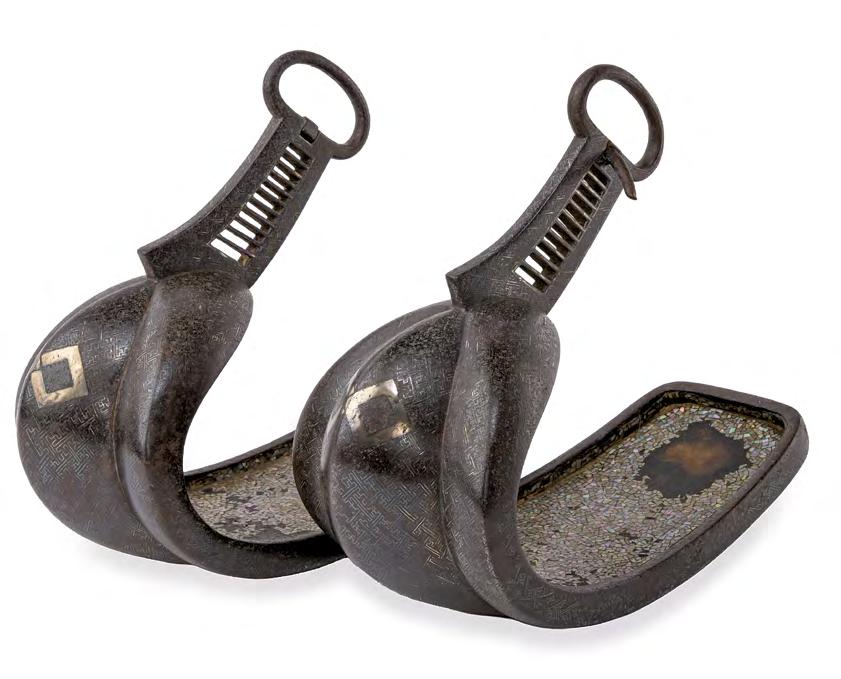
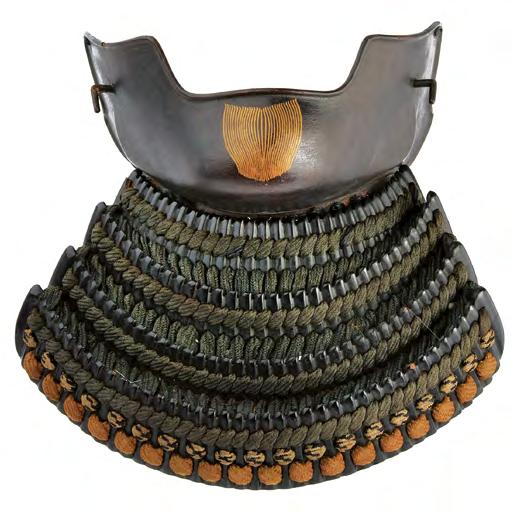
166
A BLACK-LACQUERED IRON HANBO WITH GOLD MAKI-E GOATEE
Japan, Edo Period (1603-1867)
Made of iron, in semi-matte black lacquer. Small orikugi on the cheeks. Goatee finely rendered in gold maki-e lacquer. Asenagashi-no-ana (sweat-drain hole) beneath the jaw. Interior lacquered dark red with an uneven finish. Tare (suga) of four iron kiritsukekozane plates. Olive-green kebiki lacing. Multicoloured uname and ochre hishinui on the last plate.
HANBO IN FERRO LACCATO NERO CON PIZZETTO IN MAKI-E DORATO
Giappone, Periodo Edo (1603-1867)
In ferro, con finitura laccata nera opaca. Piccoli orikugi sulle guance. Pizzetto finemente raffigurato in maki-e
dorato. Asenagashi-no-ana (foro per il drenaggio del sudore) sotto la mandibola. Interno laccato in rosso scuro con finitura irregolare. Tare (suga) con quattro piastre in ferro kiritsukekozane. Allacciatura kebiki di colore verde oliva. Uname policromo e hishinui color ocra sull’ultima piastra.
Conditions very good. Height 19 cm. € 500/800
167 A BLACK-LACQUERED IRON NERIKAWA RYUBU MENPO
Japan, Edo Period (1603-1867) Of the men-no-shita-menin type, made of black-
lacquered boiled leather, some elements made of iron. Face with noble expression. Removable nose-piece. Large mouth openings without teeth. Iron ears pierced with rosette. With odour-kugi on the sides of the chin, large odayori-no-ita on the cheeks. Lacquered in red (missing parts) inside. Yodare-kake with three blacklacquered nerikawa plates.
NERIKAWA RYUBU MENPO IN FERRO LACCATO IN NERO Giappone, Periodo Edo (1603-1867)
Del tipo men-no-shita-menin, in cuoio bollito laccato nero, alcuni elementi in ferro. La faccia con espressione nobile. Naso amovibile. Grande apertura della bocca, priva di denti. orecchie in ferro traforate a rosetta. Ai lati del mento odome-kugi, grandi odayori-no-ita sulle guance. L’interno laccato in rosso (mancanze). Yodarekake a tre lame nerikawa laccate in nero.
Conditions medium.
Height 24.5 cm.
€ 400/600
168
A SABINURI-FINISHED NERIKAWA RYUBU MENPO
Japan, Edo Period (1603-1867)
Of the me-no-shita-men type, made of nerikawa (hardened leather), finished in sabinuri on the exterior and lacquered red on the interior. The face displays a noble Ryobu expression. Removable nose-piece. Orikugi on the cheeks. Long, straight boar-hair mustachios and beard. Open mouth with red lips. Large asenagashi-no-ana (sweat-drain hole). Tare (suga) of three iron plates, finished to match the menpo body. Navy-blue sugake lacing. The reverse in black lacquer indicates an early style.
UN RYUBU MENPO IN NERIKAWA CON FINITURA
SABINURI
Giappone, Periodo Edo (1603-1867)
Del tipo me-no-shita-men, in nerikawa (cuoio indurito), con finitura sabinuri all’esterno e laccatura rossa all’interno. Volto dall’espressione nobile di tipo Ryobu. Naso amovibile. Orikugi sulle guance. Lunghi baffi diritti e barba in crine di cinghiale. Bocca aperta con labbra rosse. Ampio asenagashi-no-ana (foro per il drenaggio del sudore). Tare (suga) con tre piastre in ferro, in finitura uniforme con il corpo del menpo. Allacciatura sugake di colore blu. Il retro in lacca nera indica uno stile antico.
Conditions good.
Height 24 cm.
€ 500/800
169
A RYUBU MENPO IN SABINURI LACQUER.
Japan, Edo Period (1603-1867)
Me-noshita-men type. Iron frame covered with Sabinuri lacquer (rust effect). The head has a noble and composed expression. Complete with removable nose, it retains moustache and lace (probably horsehair). Orikugi on the sides. Open mouth decorated with gold teeth. Under the chin there is an Asenagashi-no-ana for sweat. The ears are pierced with six small holes
each. Inside made of glossy red lacquer. Suga / Yodarekake with four plates made of black lacquer with dark blue silk cording. Lacquer well preserved with minimal cracks or missing parts.
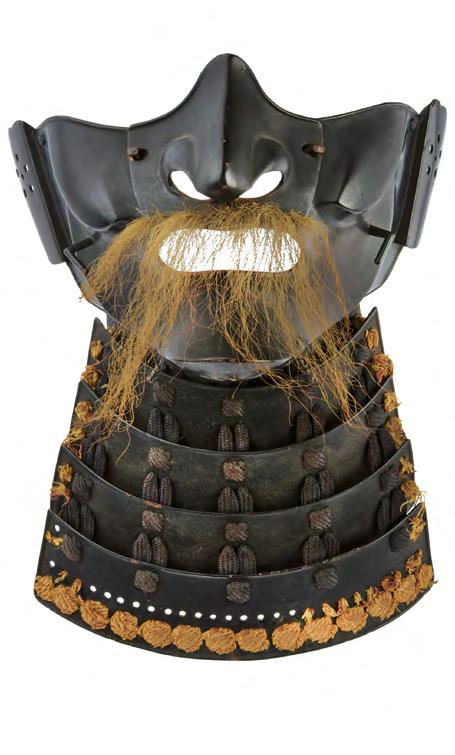
RYUBU MENPO IN LACCA SABINURI
Giappone, Periodo Edo (1603-1867)
Del tipo Me-noshita-men. Con struttura in ferro rivestita da una lacca Sabinuri (effetto ruggine). Il volto presenta un’espressione nobile e composta. Completo di naso rimovibile, conserva mustacchi e pizzo (probabilmente in crine di cavallo). Orikugi sulle guance. Bocca aperta ornata con denti dorati. Sotto il mento è presente l’Asenagashi-no-ana per il sudore. Le orecchie sono forate con sei piccoli fori ciascuna. Interno in lacca rossa lucida. Suga / Yodare-kake a quattro lame in lacca nera con cordonatura in seta blu scuro. Lacca ben conservata con minime crepe o mancanze.
Conditions good.
Height total circa 22 cm.
€ 900/1.100
170 A RUSTY-BROWN LACQUERED RESSEI MENPO WITH INTRICATE TARE
Japan, Edo Period (1603-1867)
Of the me-no-shita-men type, made of iron, lacquered in rusty brown on the exterior and red on the interior. Removable nose-piece. Wrinkled cheeks. Mustachios and beard, the goatee missing. Open mouth without teeth. Pronounced chin with asenagashi-no-ana (sweat-drain holes) on either side. Tare (suga) of three lames in Renzan style, with dark blue kebiki lacing. The lames are made of nerikawa (hardened leather), dark lacquered, and cut in a wave-shaped pattern recalling iyozane. The lower lame is covered in shrunk leather, with a protruding central section, gilt upper edge, tricoloured hishinui, and red-lacquered interior. Beginning of the 18th Century.
UN RESSEI MENPO LACCATO IN MARRONE RUGGINE CON TARE FINEMENTE LAVORATO
Giappone, Periodo Edo (1603-1867)
Del tipo Me-no-shita-men, in ferro, laccato color ruggine all’esterno e rosso all’interno (mancanze e crepe). Nasello removibile. Guance corrugate. Baffi e barba (pizzetto mancante). Bocca aperta senza denti. Mento pronunciato, munito di Asenagashi-no-ana (foro per il drenaggio del sudore) sui lati del mento. Tare (suga) a tre lame, in stile Renzan, con allacciatura Kebiki blu scuro. Le lame sono in nerikawa (cuoio indurito), laccate scure, tagliate con un motivo ondulato che ricorda lo Iyozane. La lama inferiore con rivestimento in cuoio shrunk, parte centrale sporgente, bordo superiore
dorato, hishinui tricolore e interno laccato rosso. Inizio del XVIII secolo.
Conditions medium
Height 22 cm.
€ 1.000/1.300
171
A BEAUTIFUL BLACK LACQUERED IRON RYUBU MENPO
Japan, Edo Period (1603-1867)
Of the me-no-shita-men type, made of black-lacquered iron. The face displays a noble Ryobu expression, with prominent cheekbones and a finely modelled facial contour. Removable nose-piece with large inomeshaped openings. (Inome, literally “boar’s eyes,” refers to a heart-shaped motif believed in Japan to ward off evil spirits.) Long brown mustachios. Open mouth without teeth. Orikugi on the cheeks. Pronunced chin with asenagashi-no-ana (sweat-drain hole). Two odayorino-ibo on the sides of the chin. Well-made and unusual ears, with lobed upper edges and openwork of five holes. Lacquered red on the inside. Tare (suga) of four black-lacquered iron itamono plates. Dark-coloured sugake lacing. The reverse in glossy black lacquer indicates an early style. Gilt mimi-ito, uname, and hishinui running along the edges of each plate. Partially missing. Early Edo Period.
PREGEVOLE RYUBU MENPO IN FERRO LACCATO NERO
Giappone, Periodo Edo (1603-1867)
Del tipo Me-no-shita-men, realizzato in ferro laccato nero. Volto con espressione nobile Ryubu. Zigomi pronunciati e un contorno del viso elegantemente profilato. Naso amovibile con grandi fori a forma di inome. (Inome significa “occhi di cinghiale”: ricordano una forma di cuore e in Giappone si riteneva che allontanassero gli spiriti maligni). Lunghi baffi marroni. Bocca aperta senza denti. Orikugi sulle guance. Mento sporgente con Asenagashi-no-ana (foro per il drenaggio del sudore). Due Odayori-no-ibo ai lati del mento. Orecchie ben eseguite e insolite, con bordi superiori lobati e trafori con cinque aperture. Laccato in rosso all’interno. Tare (suga) con quattro piastre di ferro laccate nere itamono. Allacciatura sugake di colore scuro. Il retro in lacca nera lucida indica uno stile antico. Mimi-ito dorato, uname e hishinui lungo i bordi di ciascuna piastra (parzialmente mancante). Primo periodo Edo.
Conditions good.
Height 23 cm.
€ 1.000/1.300
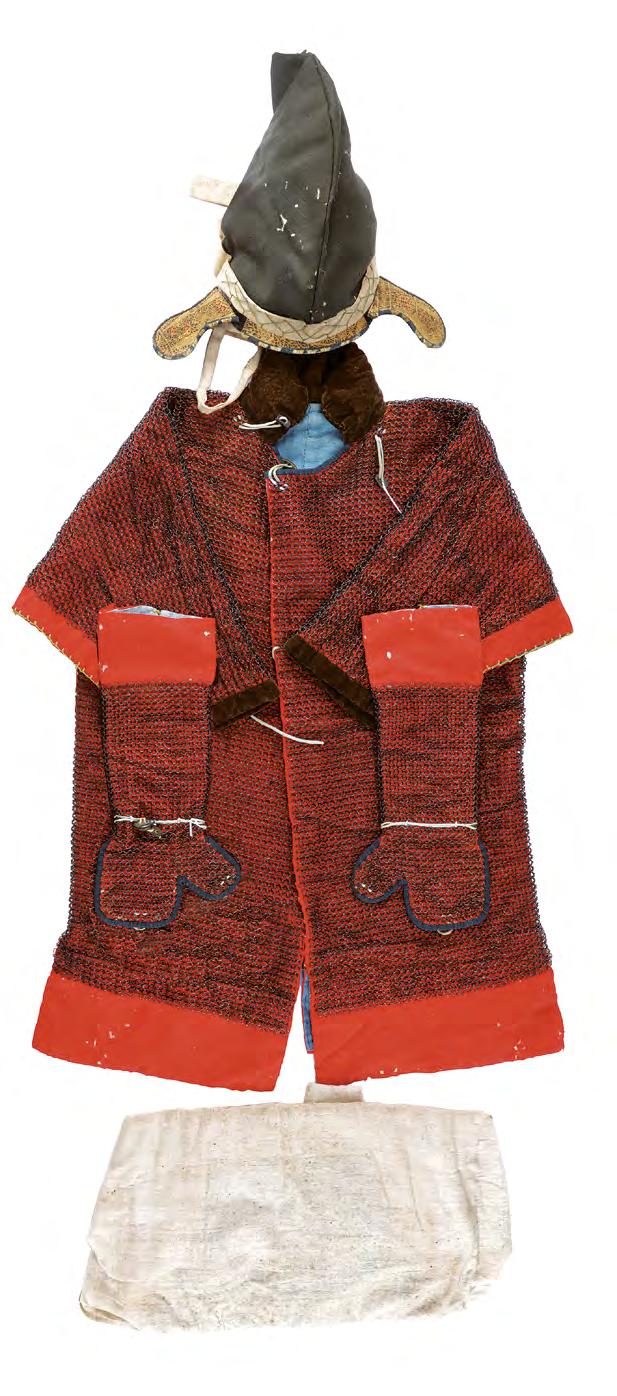
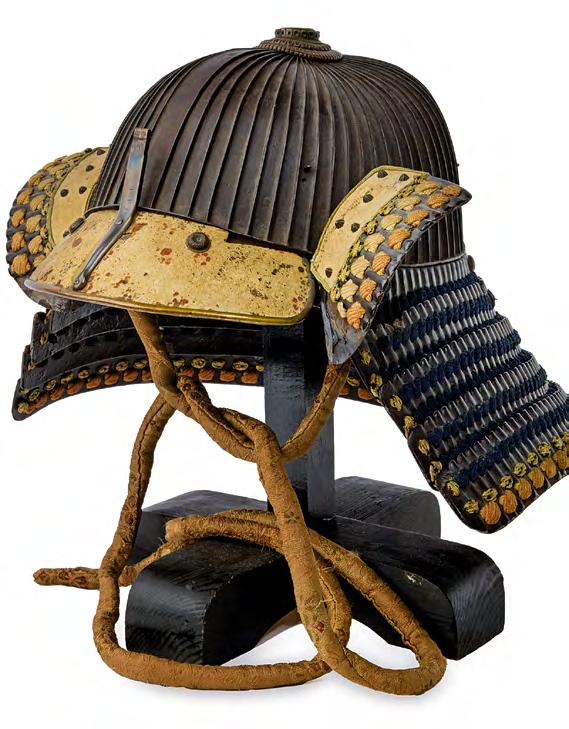
172
A KUSARI-KATABIRA WITH EBOSHI CAP AND KOTE
Japan, Edo Period (1603-1867)
Mail armour with associated eboshi cap (showing moth holes), hanamaki and a pair of kote. Complete with red cloth lining. Late Edo period.
KUSARI-KATABIRA CON CAPPELLO EBOSHI E KOTE
Giappone, Periodo Edo (1603-1867)
Armatura di maglia con cappello Eboshi abbinato (presenti fori di tarme), Hanamaki e un paio di Kote. Completa di fodera in panno rosso. Tardo periodo Edo.
Conditions medium
Height circa 80 cm.
€ 400/600
173
A FINE SUJI-BACHI KABUTO
Japan, Edo Period (1603-1867)
With a 63-ken hemispherical bowl, provided with a four-piece tehen kanamono. The slightly projecting visor (mabizashi), secured with exposed engraved rivets, is covered in light-coloured leather with traces of paint. A slender vertical maedate-dai is attached to the front. Wide side fukigaeshi covered in decorated light-coloured leather, edged and finished with braided side tassels.The neck guard (shikoro) consists of five overlapping plates, finished in dark brown lacquer and bound in dark blue cord, with the lower border finished with ochre-coloured braid. Inside with original or antique padding and ties, with clear signs of wear and missing parts due to use.Beautiful overall patina and a very elegant decorative appearance.
BEL SUJI-BACHI KABUTO
Giappone, Periodo Edo (1603-1867)
Con coppo emisferico a 63 ken, munito al sommo di tehen kanamono in quattro pezzi. La visiera (mabizashi) leggermente aggettante, fissata con ribattini incisi a vista, rivestita in cuoio chiaro con resti di pittura. Sulla fronte è applicato un sottile maedate-dai verticale. Ampi fukigaeshi rivestiti in cuoio chiaro decorato, bordati e completati da pendagli laterali in treccia.La gronda (shikoro) è a cinque lame sovrapposte, finita in lacca bruno-scura e legata in cordame blu scuro, con bordo inferiore rifinito da passamaneria ocracea. Interno con imbottitura e legacci originali o antichi, con evidenti usure e lacune d’uso.Bella patina generale e aspetto decorativo molto elegante.
Conditions good
Height 22 cm.
€ 1.800/2.400
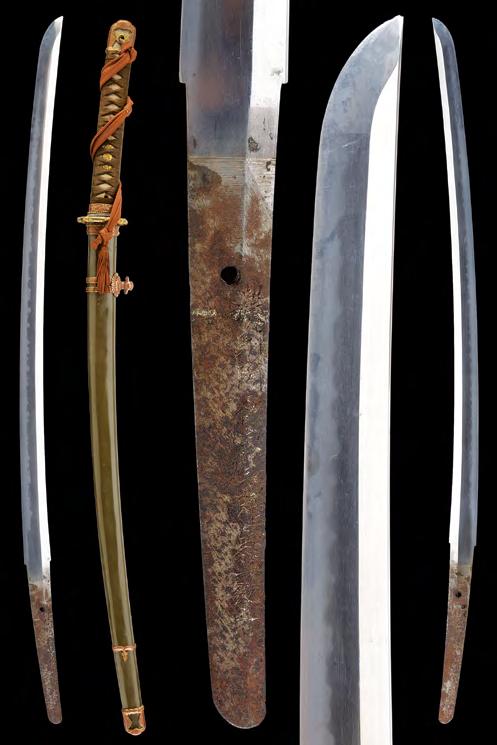
174 A SHIN-GUNTO
Japan, Showa Period (1926-1989)
Blade with 64 cm nagasa. Hamon: midare, not visible hada. Nakago with a mekugiana (missing mekugi), mei: Noshu Seki Masa Toshi. Brass habaki.Typical shingunto koshirae with chrysanthemum-shaped menuki, tsuka slightly damaged at the base.
SHIN-GUNTO
Giappone, Periodo Showa (1926-1989)
Lama con nagasa di 64 cm. Hamon: midare; hada non visibile. Nakago con un mekugi-ana (mekugi mancante), mei: Noshu Seki Masa Toshi. Habaki in ottone. Tipico koshirae shin-gunto con menuki a forma di crisantemo, tsuka leggermente danneggiate alla base.
Conditions good
Length 93.5 cm.
€ 1.200/1.500
175 A SHIN-GUNTO
Japan, Showa Period (1926-1989)
Blade with 65.6 nagasa. Hamon: suguha, not visible hada. Nakago mei: Showa 18 year 10 month - October 1943 Kiyo Nao, a mekugi-ana. Brass Habaki.Typical shingunto koshirae with dragon-shaped menuki.
SHIN-GUNTO
Giappone, Periodo Showa (1926-1989)
Lama con nagasa di 65.6 cm. Hamon: suguha, hada non visibile. Nakago mei: Showa 18° anno 10° mese - ottobre 1943 Kiyo Nao. Un mekugi-ana. Habaki in ottone. Tipico koshirae shin-gunto con menuki a drago.
Conditions good
Length 96.3 cm.
€ 1.200/1.500
176 A KATANA SIGNED IPPEI YASUYO
Japan, Edo Period (1603-1867)
Nagasa (length 61.5 cm), featuring a gunome-midare togari hamon and a hada faintly visible. Double copper habaki. Nakago with one mekugi-ana, signed “Ippei Yasuyo” (一平安 代). In shirasaya. Period Kyoho era (c. 1716–1736).
KATANA FIRMATA IPPEI YASUYO
Giappone, Periodo Edo (1603-1867)
Nagasa di 61,5 cm. Hamon a gunome-midare togari, hada poco visibile. Doppio habaki in rame. Nakago con un mekugi-ana e firma 「一平安代」 (Ippei Yasuyo). In shirasaya. Periodo Kyoho (ca. 1716–1736).
Conditions good Length 86.8 cm. € 1.250/1.750
177 A VERY RARE KATANA ATTRIBUTED TO THE KOMIHARA SCHOOL
Japan, Nanbokucho Period (1336 - 1392)
Nagasa (length 66.6 cm), hamon: Suguha; fine copper habaki. Nakago mumei with two mekugi ana. In shirasaya. The koshirae with sukashi tsuba made of iron, fuchi with horses and kashira with shishi in shakudo and gold, goldplated shishi-shaped menuki, black silk tsuka-ito. Saya lacquered black. Accompanied by an NBTHK Tokubetsu Hozon certificate dated 14 December 2022 classifying the blade as Tokubetsu Hozon (particularly worthy of preservation).
The Ko-Mihara school, which was active in Bingo Province, is considered one of the most significant traditions of the late Kamakura and early Nanbokucho periods. Founded towards the end of the 13th century, the school is generally attributed to Kokubunji Sukekuni and soon attained considerable prestige thanks to the work of masters such as Mihara Masaie and his son, Masahiro. Blades attributed to this school are distinguished by their formal balance, elegant simplicity, and the quality of their forging, which fully reflects the classical taste of ancient provincial traditions.The katana presented here is mumei and attributed to Ko-Mihara. It is accompanied by an NBTHK Tokubetsu Hozon certificate, which confirms its particular historical and artistic interest. In terms of proportions and overall design, the blade is a significant example of the sword-making art that developed in Bingo between the late Kamakura and early Nanbokucho periods, fitting coherently within the school’s output.
RARISSIMA KATANA ATTRIBUITA ALLA SCOLA KOMIHARA
Giappone, Periodo Nanbokucho (1336 - 1392) Lama con nagasa di 66.6 cm. Hamon: Suguha; bel habaki in rame. Nakago mumei con due mekugi ana. In shirasaya. Il koshirae con sukashi tsuba in ferro, fuchi con cavalli e kashira con un shishi in shakudo e oro, menuki dorati lavorti a shishi, tsuka-ito in seta nera. Saya laccata di nero. Accompagnata da certificato NBTHK Tokubetsu Hozon datato 14 dicembre 2022 che classifica la lama Tokubetsu Hozon (particolarmente degno di conservazione).
La scuola Ko-Mihara, attiva nella provincia di Bingo, figura tra le più importanti tradizioni del tardo periodo Kamakura e degli inizi del Nanbokuchō. Fondata verso la fine del XIII secolo, è generalmente ricondotta alla figura di Kokubunji Sukekuni, e raggiunse notevole prestigio attraverso l’opera di maestri quali Mihara Masaie e suo figlio Masahiro. Le lame attribuite a questa scuola si distinguono per equilibrio formale, sobrietà elegante e per una qualità di forgiatura che riflette pienamente il gusto classico delle antiche tradizioni provinciali.La katana qui presentata, mumei e attribuita a Ko-Mihara, è corredata da certificato NBTHK Tokubetsu Hozon, riconoscimento che ne conferma il particolare interesse storico e artistico. Per proporzioni e impostazione generale, la lama si inserisce coerentemente nella produzione della scuola, offrendo un significativo esempio dell’arte spadaiola sviluppatasi a Bingo tra la fine del Kamakura e il primo Nanbokucho.
Conditions very good
Length 90.8 cm.
€ 5.500/7.500
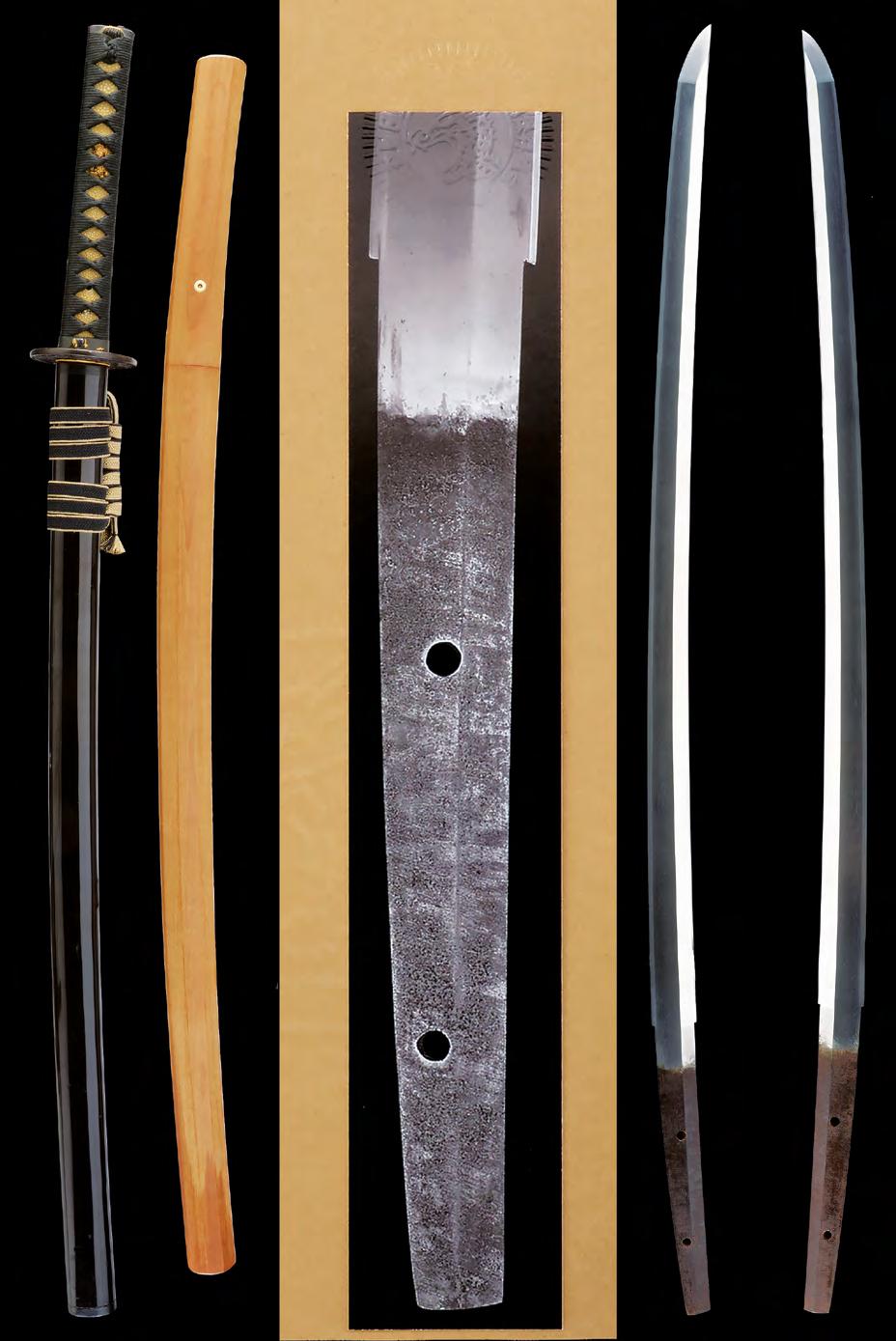
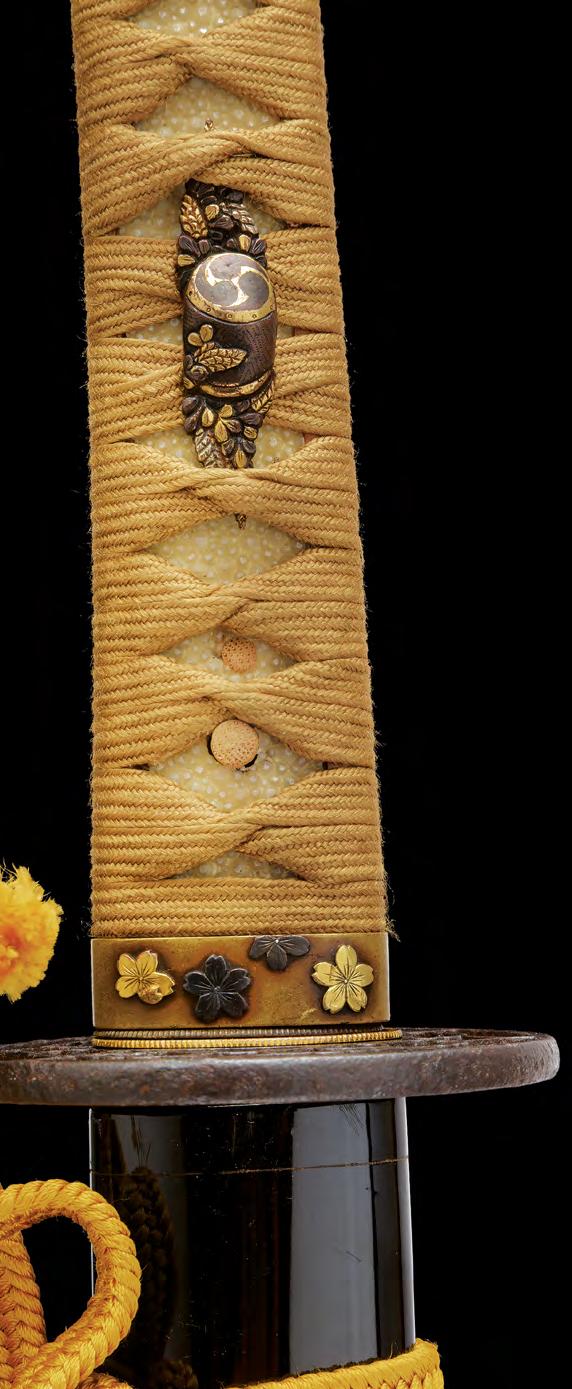
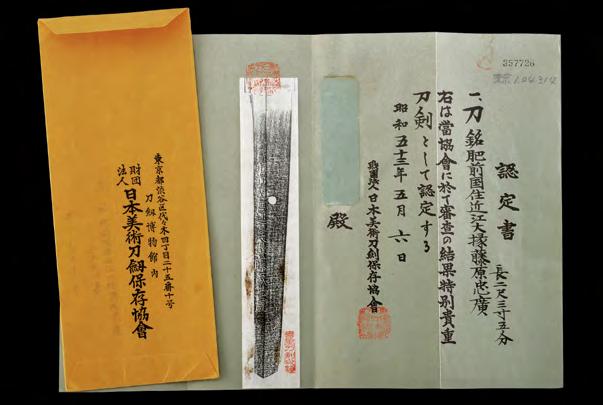
178 AN EXCELLENT KATANA SIGNED HIZEN NO KUNI JU OMI DAIJO FUJIWARA TADAHIRO
Japan, Edo Period (1603-1867) Nagasa (length 70.7 cm), Motohaba: 2.81 cm; Sakihaba: 1.89 cm; Motogasane: 0.61 cm; Sakigasane: 0.29 cm; Sori: 2.8 cm, Hamon: Suguha nie deki. Double habaki made of gilded metal. Nakago with one mekugi ana, mei “Hizen no Kuni ju Omi Daijo Fujiwara Tadahiro”. In shirasaya. Beautiful koshirae with iron sukashi tsuba, fuchi-kashira made of yellow metal with gold flowers and shakudo. Beautiful, partially gilded menuki. Beige silk tsuka-ito. Black lacquered saya. Date: circa 1648–1652. Together with NBTHK certificate, classified as Tokubetsu Kicho Token (particularly valuable sword).
Hizen no Kuni jū Ōmi Daijō Fujiwara Tadahiro belongs to the great tradition of Hizen swordsmiths and is one of the most representative figures of the celebrated Tadayoshi school. The son and successor of the first Tadayoshi, he continued his father’s work at the highest level, playing a decisive role in consolidating the prestige of the school during the early Edo period. In 1641, he received the honorary title of Ōmi Daijō, by which he is known in his more mature signatures.His production is generally regarded as among the finest expressions of the Hizen tradition, characterised by refined workmanship, remarkable purity of forging, and great formal elegance. Tadahiro’s blades display the compact and harmonious quality for which the school became famous, combined with an uncommon consistency of execution. His long career, supported by a period of stability and prosperity, also helped spread his reputation widely, and his works are today rightly considered among the most important of the Tadayoshi lineage.The example presented here fully embodies this tradition and stands as a significant testament to the production of one of the most highly esteemed masters of the Hizen school.
ECCEZIONALE KATANA FIRMATA HIZEN NO KUNI JU OMI DAIJO
FUJIWARA TADAHIRO
Giappone, Periodo Edo (1603-1867)
Lama con Nagasa di 70.7 cm, Motohaba: 2.81 cm; Sakihaba: 1.89 cm; Motogasane: 0.61 cm; Sakigasane: 0.29 cm; Sori: 2.8 cm. Hamon: Suguha nie deki. Doppio habaki in metallo dorato. Nakago con un mekugi-ana, mei “Hizen no Kuni ju Omi Daijo Fujiwara Tadahiro”. In shirasaya. Bel koshirae con sukashi tsuba in ferro, fuchi-kashira in metallo giallo con fiori in oro e shakudo.
Bei menuki parzialmente dorati. Tsuka-ito in seta color beige.
Saya laccata di nero. Epoca circa 1648-1652.
Con certificato NBTHK Tokubetsu Kicho Token (spada particolarmente preziosa).
Hizen no Kuni jū Ōmi Daijō Fujiwara Tadahiro appartiene alla grande tradizione degli spadai di Hizen ed è una delle figure più rappresentative della celebre scuola Tadayoshi. Figlio e successore del primo Tadayoshi, ne proseguì l’opera ai massimi livelli, contribuendo in modo decisivo al consolidamento del prestigio della scuola nel primo periodo Edo. Nel 1641 ricevette il titolo onorifico di Ōmi Daijō, con il quale è noto nelle sue firme più mature.La sua produzione è generalmente considerata tra le più alte espressioni della tradizione di Hizen, caratterizzata da una lavorazione raffinata, da una notevole purezza di forgiatura e da una grande eleganza formale. Le lame di Tadahiro mostrano infatti quella qualità compatta e armoniosa che rese celebre la scuola, unita a una costanza esecutiva non comune. La sua lunga attività, favorita anche da un periodo di stabilità e prosperità, contribuì a diffondere ampiamente il suo nome, e le sue opere sono oggi giustamente ritenute tra le più importanti della linea Tadayoshi.L’esemplare qui presentato si inserisce pienamente in questa tradizione e costituisce una testimonianza significativa della produzione di uno dei maestri più apprezzati della scuola di Hizen.
Conditions very good
Length 96 cm.
€ 6.000/8.000
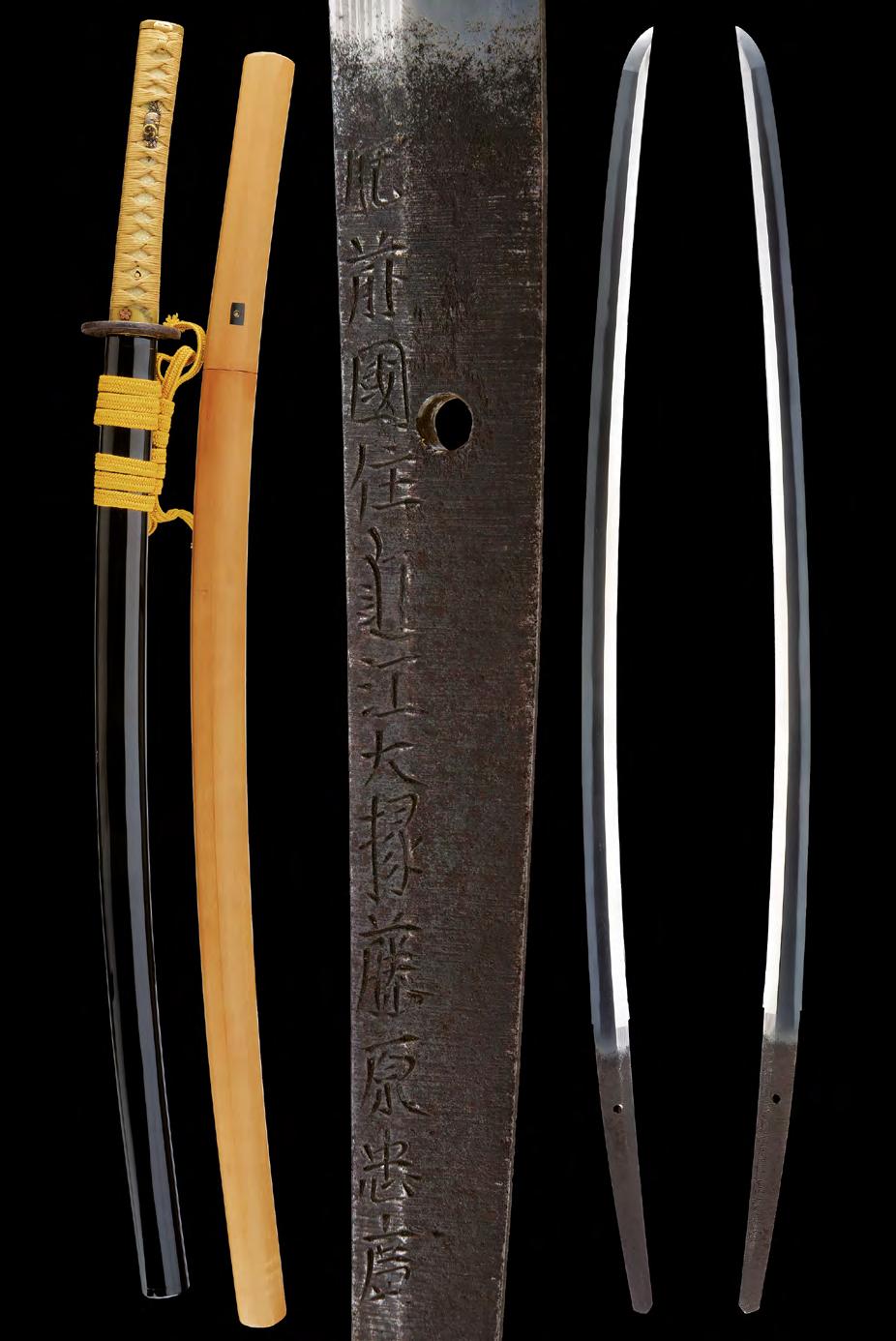
179 AN IMPOSING YARI IN SHIRASAYA
Japan, Edo Period (1603-1867)
Robust and heavy point of triangular section with a flat, grooved lower band in the middle, narrow and faceted at the base, long nakago of rectangular section, decreasing towards the tip with a mekugi-ana. In shirasaya.
IMPONENTE PUNTA DI YARI IN SHIRASAYA
Giappone, Periodo Edo (1603-1867)
Robusta e pesante cuspide di sezione triangolare con faccia principale piatta e scanalata in mezzeria, la base rastremata e faccettata; lungo nakago di sezione rettangolare, decrescente verso la punta, con un mekugi-ana. In shirasaya.
Conditions good Length 68.2 cm. € 650/950
180 AN IMPORTANT YARI IN SHIRASAYA
Japan, Muromachi Period (1392-1573)
Straight blade of slightly lanceolate shape, (nagasa 55.7 cm) of triangular section. One side with horimono. Hada: itame masame. Hamon: hoso-suguha, nioi deki. Small defects. Nakago-mei (not clearly legible) with date 1508. In modern shirasaya.
IMPORTANTE YARI IN SHIRASAYA
Giappone, Periodo Muromachi (1392-1573)
Lama dritta di forma lievemente lanceolata, (nagasa 55,7 cm.) di sezione triangolare. Una faccia con horimono. Hada: itame masame. Hamon: hoso-suguha, nioi deki. Piccoli difetti. Nakago-mei (non chiaramente leggibile) con data 1508. In shirasaya moderno.
Conditions
€ 900/1.200
181 A RARE YARI SIGNED KUNISUKE
Japan, Edo Period (1603-1867)
Long, straight blade of lanceolate shape (nagasa 53 cm), of triangular section, one facet with red-painted groove (hi). Hada: itame with various Kizu due to forging. Hamon: suguha with nijuba kinsuji. Some defects. Nakago suriage and remains of singono ana. Mei: “Kawachi no Kami Kunisuke”. Copper habaki. Preserved in shirasaya.
RARA YARI FIRMATA KUNISUKE
Giappone, Periodo Edo (1603-1867)
Lunga lama dritta di forma lanceolata (nagasa 53 cm.), di sezione triangolare, una faccia con scanalatura tinta di rosso (hi). Hada: itame con diversi Kizu dovuti alla forgiatura. Hamon: suguha con nijuba kinsuji. Alcuni difetti. Nakago suriage e resti di un singono ana. Mei: “Kawachi no Kami Kunisuke”. Habaki in rame. Conservata in shirasaya.
Conditions medium
Length 83.2 cm.
€ 1.200/1.600
182 A TSUBA FOR TANTO
Japan, Edo Period (1603-1867)
Made of shibuichi, tate-maru-gata with fine nanako-ji and kozuka-hitsu-ana. Kept in a kiri-box from modern era. Late Edo period.
TSUBA PER UN TANTO
Giappone, Periodo Edo (1603-1867)
In shibuichi; tate-maru-gata con fine nanako-ji e kozukahitsu-ana. In kiri-box di epoca moderna. Tardo periodo Edo.
Conditions very good
Dimensions 4.1 x 5.7 x 0.5 cm.
€ 150/250
183 A TSUBA WITH AOI AND MYOGA MOTIFS
Japan, Edo Period (1603-1867)
Made of iron, tate-maru-gata with carving in relief, jisukashi, and polychrome inlays (iore). Kept in a kiri-box from modern era and with a certificate. Late Edo period.
TSUBA CON MOTIVO DI AOI E MYOGA
Giappone, Periodo Edo (1603-1867)
In ferro; tate-maru-gata con intaglio in rilevo, ji-sukashi e con applicazioni policrome (iore). In kiri box di epoca moderna e con un certificato. Fine periodo Edo.
Conditions good
Dimensions 6.7 x 6.9 x 0.5 cm.
€ 200/300
184
FUCHI-KASHIRA
Japan, Edo Period (1603-1867)
Made of shakudo nanako-ji, with takabori decoration, nunome-zogan, and gold details, featuring a floral design. Mid-19th century. Kept in a kiri-box from the modern era.
FUCHI-KASHIRA
Giappone, Periodo Edo (1603-1867)
In shakudo nanako-ji con decoro in takabori, nunomezogan e dettagli in oro e con decoro vegetale. Metà XIX secolo. In kiri-box di periodo moderno.
Conditions very good
Dimensions 2.2 x 3.7 - 1.8 x 3.3 cm.
€ 100/200
185
FUCHI-KASHIRA
Japan, Edo Period (1603-1867)
Fuchi-mei in shakudō and gold with two figures in high relief; kashira with silver decoration. The signature is not clearly legible, probably reading in part: “Shoeisai” on one side and on the other “... lacking talent”. Circa 1800. In a recently made kiri-box.
FUCHI-KASHIRA
Giappone, Periodo Edo (1603-1867)
Fuchi-mei in shakudo e oro con due figure in bassorilievo, kashira con decorazione in argento. La firma non ben leggibile, probabilmente in parte: “Shoeisai” su un lato e sull’altro “.....privo di talento”. 1800 circa. In kiri-box di produzione recente.
Conditions good
Dimensions 2.2 x 3.8 - 1.8 x 3.2 cm.
€ 150/250
186
FUCHI-KASHIRA
Japan, Edo Period (1603-1867)
With shakudo and gold decorations depicting dragons. Late Edo period. Kept in a kiri box from modern era.
FUCHI-KASHIRA
Giappone, Periodo Edo (1603-1867)
Con decorazioni in shakudo e oro raffiguranti draghi. Fine del periodo Edo. In kiri-box di epoca moderna.
Conditions good Dimensions 2.2 x 3.9 - 1.8 x 3.4 cm.
€ 250/350
187
A LOT OF FOUR FUCHI
Japan, Edo Period (1603-1867)
Made of shakudo, all different; three with mon decorations, one is a beautiful piece with a fan and flowers made of shakudo and gold. Late Edo period. Kept in a kiri-box from modern era.
LOTTO DI QUATTRO FUCHI
Giappone, Periodo Edo (1603-1867)
In shakudo, tutti diversi: tre con decorazioni a mon, uno bellissimo con ventaglio e fiori in shakudo ed oro. Fine del periodo Edo. Conservati in un kiri-box moderno.
Conditions good
Length 3.8 3.8 - 3.9 - 4 cm.
€ 150/250
188
A PAIR OF MENUKI
Japan, Edo Period (1603-1867)
Made of shakudo and gold, depicting a tomato on a leafy stem. Around 1800. Kept in a kiri box from the modern era.
PAIO DI MENUKI
Giappone, Periodo Edo (1603-1867)
In shakudo ed oro, raffiguranti un pomodoro su tralcio vegetale. Periodo 1800 circa. In kiri-box di epoca moderna.
Conditions good
Dimensions 1.4 x 3.9 - 1.3 x 4 cm.
€ 100/200
189
MAEDATE
Japan, Edo Period (1603-1867)
Circular, with a yellow metal part at the front, in the center, a separate circle with two crossed arrows on a silver background. The back with a loop to attach it to a helmet. Around 1800. Kept in a kiri-box from the modern era.
MAEDATE
Giappone, Periodo Edo (1603-1867)
Di forma circolare, la parte anteriore in metallo giallo, dotato al centro di un altro cerchio recante un Mon a due frecce incrociate su fondo in argento. La parte posteriore con passante per il fissaggio all’elmo. 1800 circa. In un kiri-box di epoca moderna.
Conditions good
Diameter 10.2 cm.
€ 300/450
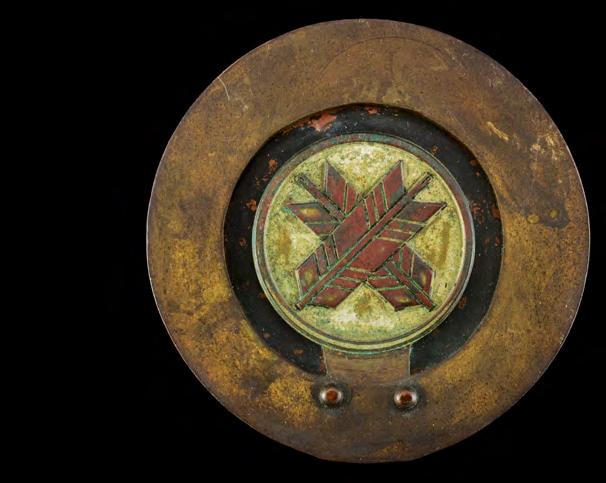
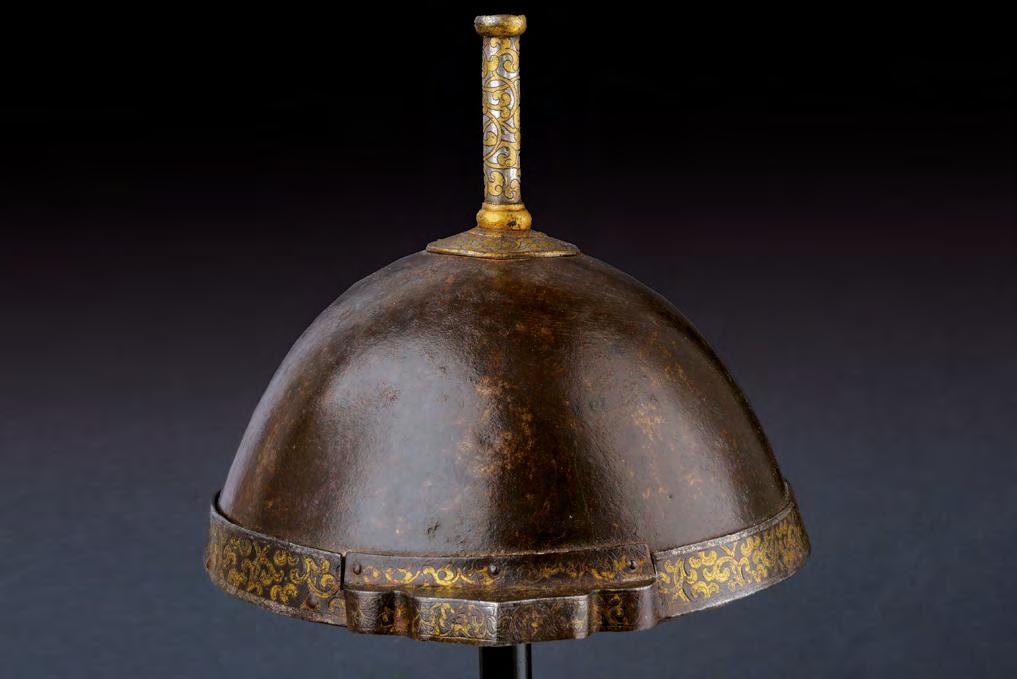
190 A BEAUTIFUL RITUAL BREAST PLATE “THUGS GSAL ME LONG”
Tibet, circa 1700
Convex, circular, flat, made of metal foil; decorated with a beautiful iron frame structured with four triangular branches converging at the centre, worked with a perforated flower pattern and decorated with a red cabochon stone, the entire surface decorated in gold and silver with floral motifs (some missing parts). Rare.
See “Warriors of the Himalayas - Rediscovering the Arms and Armour of Tibet” by Donald J. LaRocca, pages 128 to 131, where you can see examples of the so-called 4 mirrors, which were placed on the breast-plate, backplate and sides of the breastplate. On pages 134-35-36-37 you can also see an armour consisting of coat of mail and the four mirrors, which is kept in the Metropolitan Museum of Art in New York. These objects were used both for defensive purposes in battle and as ornaments worn by oracles.
BELLISSIMO PETTO RITUALE “THUGS GSAL ME LONG”
Tibet, 1700 circa Piatto circolare convesso in lamina di metallo; decorato con una bella cornice in ferro strutturata con quattro rami triangolari convergenti al centro, lavorato a fiore traforato e decorato con una pietra rossa a cabochon, tutta la superficie decorata in oro e argento a motivi floreali (mancanze). Raro.
Vedi “Warrios of the Himalayas - Rediscovering the Arms and Armour of Tibet” di Donald J. LaRocca: da pagina 128 a 131, si possono osservare esemplari dei cosiddetti “quattro specchi”, queste protezioni venivano poste sul petto, schiena e ai lati del busto. A pagina 134-35-36-37 si può anche osservare un’armatura composta da una cotta di maglia e dai quattro specchi, onservata al Metropolitan Museum of Art, New York. Questi oggetti venivano utilizzati sia in battaglia, con scopo difensivo, sia come elemento decorativo indossato dagli oracoli.
Conditions good Diameter 17.3 cm.
€ 850/1.150
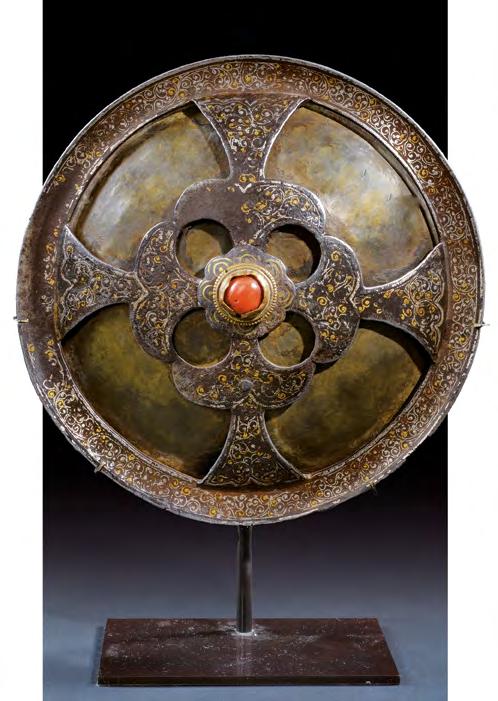
191 A RARE HELMET Tibet, 17th/18th Century Hemispherical skull hammered in one piece, with a cylindrical cusp at the top worked into a plume-holder and resting on two discs, all engraved with phytomorphic motifs in gold and silver. The front with small, pointed brim decorated en suite. The base with riveted ring decorated with floral motifs in gold and silver edges. Inside with row of holes to fix a mail neck-defense. Interesting.
See similar examples in “Islamic and Oriental Arms and Armour” by Robert Hales, pages 336 to 343; see also “Warriors of the HimalayasRediscovering the Arms and Armour of Tibet” by Donald J. LaRocca, pages 68-91.
RARO ELMO Tibet, XVII/XVIII secolo Coppo emisferico martellato in un solo pezzo, dotato alla sommità di una pennacchiera posata su due dischi, il tutto inciso a motivi fitomorfi in oro ed argento. La parte anteriore con piccola tesa appuntita decorata en suite. La base con anello rivettato decorato a motivi floreali in oro e avente margini in argento. La parte interna con giro di fori per il fissaggio di un camaglio. Interessante.
Vedi esemplari simili in “Islamic and Oriental Arms and Armour” di Robert Hales, da pagina 336 a 343; si veda inoltre “Warrios of the HimalayasRediscovering the Arms and Armour of Tibet” di Donald J. LaRocca, alle pagine 68-91.
Conditions good Height 19.5 cm.
€ 4.500/5.500
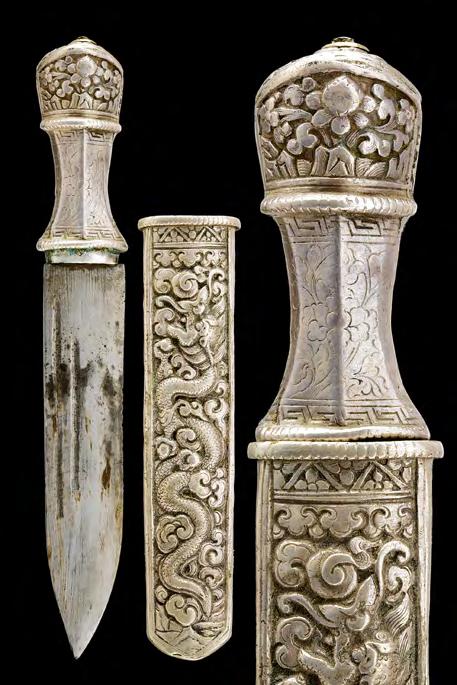
192 A DAGGER
Tibet, Late 19th Century
Straight blade with two fullers along the back, some defects. Wooden handle covered with engraved silver sheet decorated with floral motifs; the pommel of typical shape, the front face worked in repoussé and the reverse engraved. Wooden scabbard covered with silver sheet; the front with a finely raised repoussé dragon among clouds, the reverse engraved with scrolling floral motifs.
PUGNALE
Tibet, Fine del XIX Secolo
Lama dritta con due scanalature dorsali, alcuni difetti. Impugnatura in legno rivestita in lamina d’argento incisa a motivi floreali, il pomo di tipica forma con faccia anteriore sbalzata e quella posteriore incisa. Fodero in legno rivestito con lamina d’argento; la parte anteriore con bel drago a sbalzo ben rilevato, fra nuvole; il retro con incisioni a motivi floreali lavorate a spire.
Conditions good Length 26 cm.
€ 250/350
193
A RAS SHIELD (TAFA GASHA)
Abissinia, Late 19th Century
Made of leather lined with velvet (some areas are worn), of circular shape, raised in the centre (the central stud is missing), decorated with chiselled and pierced gilded brass plates and studs. Lined with red silk (with some missing parts and defects) and featuring a leather handle. Some general defects.
SCUDO DA RAS (TAFA GASHA)
Abissinia, Fine del XIX Secolo
In cuoio rivestito di velluto (alcune zone lise). Di forma circolare, rilevato al centro (con borchia centrale mancante), guarnito da lamine e borchie cesellate e traforate, in ottone dorato. Rivestito sul retro con seta rossa (difetti e mancanze) e dotato di una maniglia, anche questa di cuoio. Alcuni difetti generali.
Conditions good
Diameter 44.5 cm.
€ 250/350
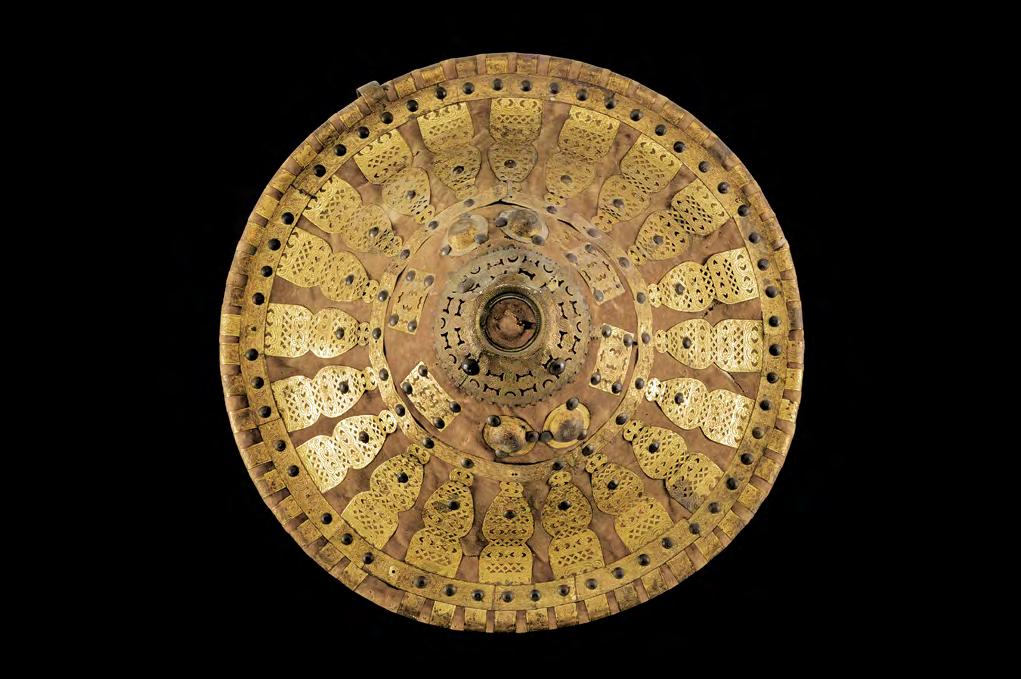
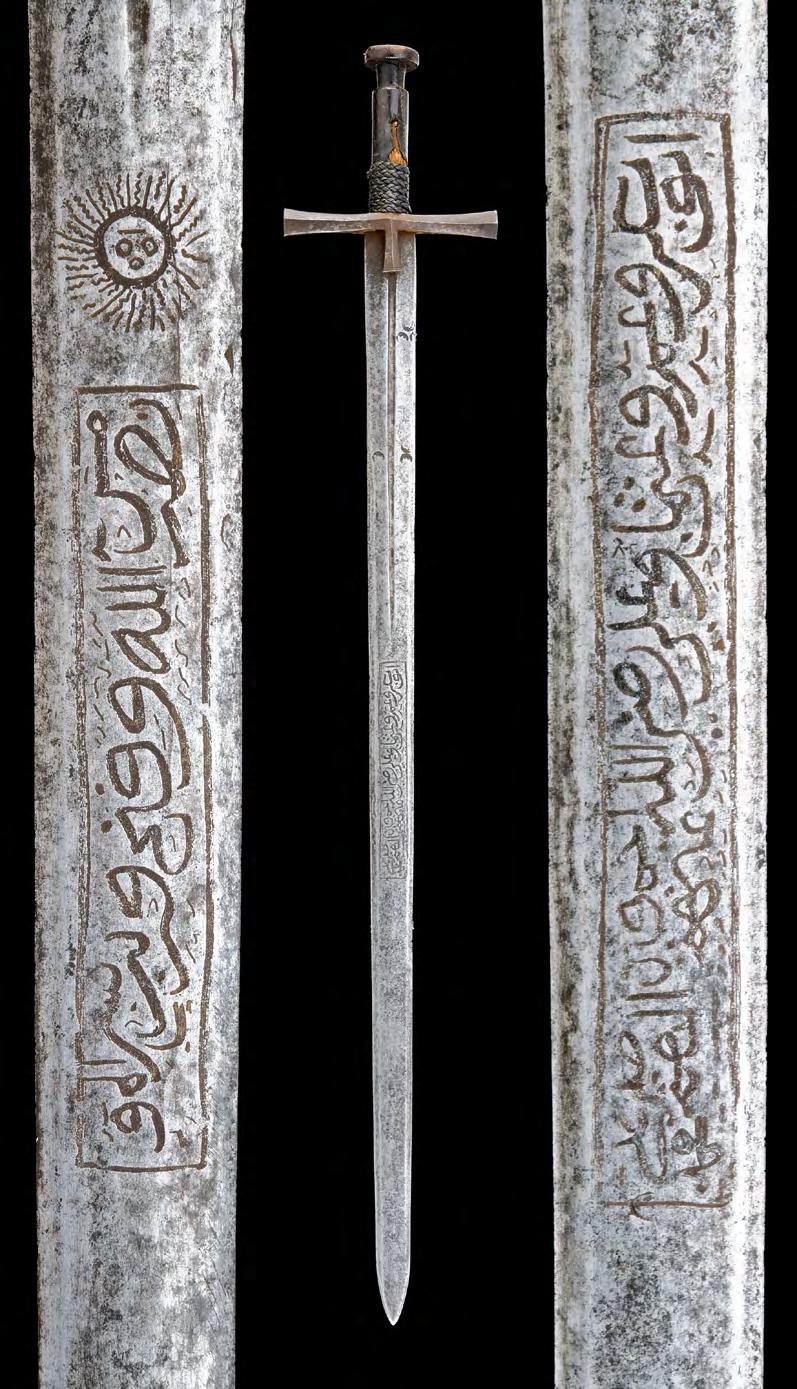
194 A KASKARA
North Africa, 19th Century
Straight, double-edged blade, the first part with central fuller and crescent-shaped marks on one side; then a cartouche with inscriptions in Amharic. Quillon with iron langets, ribbed in the middle. Wooden grip covered in leather (missing parts), as is the pommel.
KASKARA
Africa del Nord, XIX Secolo Lama dritta a due fili, recante al forte sgusciatura centrale e su un lato marche a mezzaluna; più avanti un cartiglio con iscrizioni in Amarico. Elso con alette fermafodero in ferro, costolato in mezzeria. Impugnatura in legno rivestita in cuoio (mancanze), come anche il pomo.
Conditions good Length 103.5 cm.
€ 300/500
195 A FINE PAINTED SHIELD
Spain, circa 1600
Of convex circular shape, made entirely of wood (small missing parts on the borders), covered with parchment and painted with the coat of arms of the Spanish Echavarria-Bengoa family of Gavirla (Guipúzcoa). The painted cross featuring this coat of arms is that of the Military Order of Santiago, founded in 1171. With woodworm holes at the back part with remains of paint, rivets with leather and a label with handwritten inscription. Collection number 48663.
Shields of this type were used in parades, contests and tournaments; carried by aides, they served to proclaim the wealth and prestige of the noble house whose coat of arms they bore.
Provenance: Charles Collection
BELLO SCUDO DIPINTO
Spagna, 1600 circa Di forma circolare e convessa; realizzato interamente in legno (piccole mancanze al bordo), ricoperto di pergamena e dipinto con lo stemma della famiglia spagnola degli Echavarria-Bengoa di Gavirla (Guipúzcoa). La croce dipinta che reca questo stemma è quella dell’Ordine militare di Santiago, fondato nel 1171. Il retro con fori da tarlo e con resti di pittura, rivetti con cuoio ed un’etichetta con iscrizioni vergate a mano. Numero d’inventario di una collezione “48663”.
Scudi di questo tipo venivano utilizzati nelle parate, nei concorsi e nei tornei; portati dagli aiutanti, e avevano lo scopo di proclamare la ricchezza ed il prestigio della nobile casa di cui portavano lo stemma. Provenienza: Collezione Charles.
Conditions medium
Diameter 54 cm.
€ 5.000/9.000
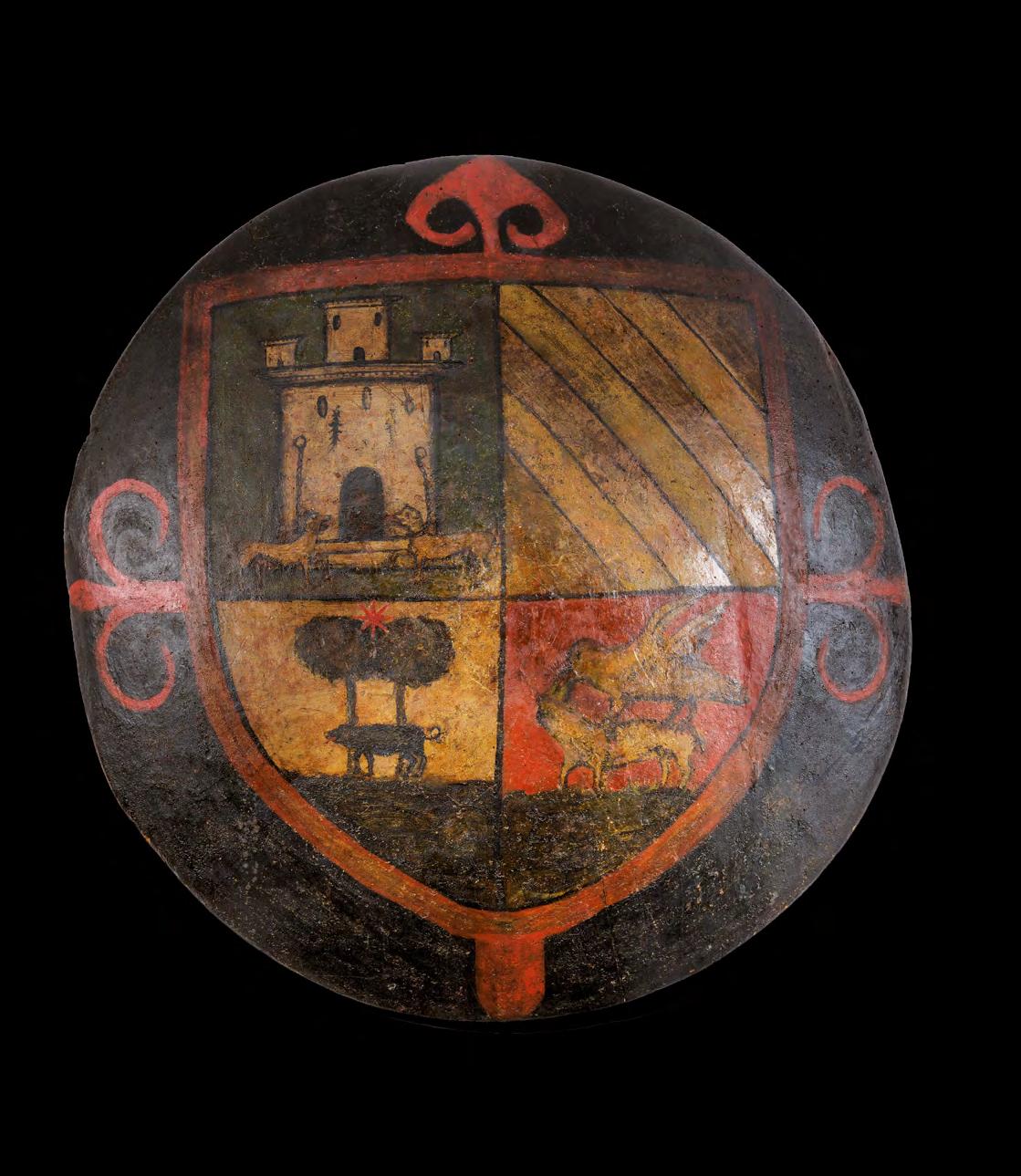
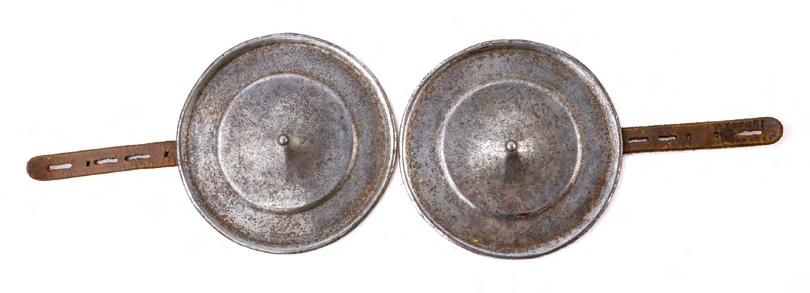
196 A PAIR OF BESAGUES
Europe, first quarter of the 17th Century
Made of iron, circular with swallowtailed border and smooth corded edge. Both plates are slightly raised at the centre and provided with buttons. With leather strings (probably of later manufacture).
PAIO DI ROTELLINE DA SPALLACCIO
Europa, primo quarto del XVII Sec. In ferro di forma circolare, con margine a lista ribassata e bordo cordonato liscio. Entrambe le piastre leggermente rilevate al centro e bottonate. Con coietti (produzione più tarda probabilmente).
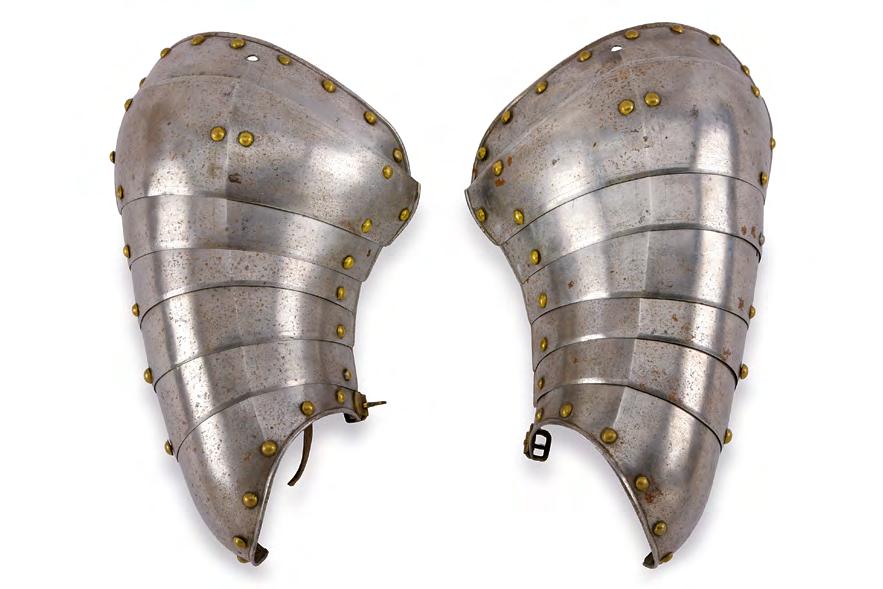
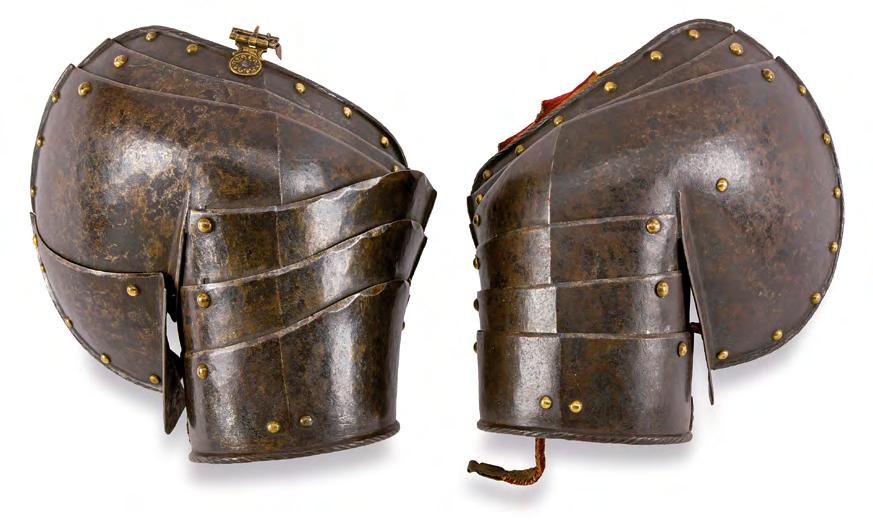
Conditions good
Diameter 15.5 cm.
€ 150/200
197 A PAIR OF PAULDRONS
Germany, early 17th Century
Both composed of seven lames. The edges are rolled only at the upper section and along the lower border. The rivets with brass heads. The plates feature a central rib and traces of outline. Remains of leather strings, probably at least partly replaced at a later date on the inside (with some missing parts). The reverse with black coating.
PAIO DI SPALLACCI
Germania, inizio del XVII Sec. Entrambi costituiti da sette lame. I margini orlati solo nella parte alta e sul bordo inferiore. I ribattini con testa in ottone. Le piastre costolate in mezzeria e con tracce di delineatura. Resti di coietti probabilmente almeno in parte rimpiazzati in epoca più recente all’interno (alcune mancanze). Il retro con tintura nera.
Conditions good
Height circa 38 cm.
€ 200/300
198 A PAIR OF PAULDRONS
Germany, first quarter of the 17th Century Iron plates with ribbed profile along the back. The two pieces consist of an equal number of lames. The cords are well riveted and twisted. Rivets with brass heads. The pauldrons are different: one has an additional strip on the back and some lames with a wavy border at the top, which are not present on the other, and which are also longer. However, both elements share the same patina both outside and inside, the same inventory number marked in red inside, leather and velvet strings of older manufacture, clearly made en suite. One pauldron is also provided with an old leather string reinforced with iron lames, likely original, and a brass inventory tag featuring the same number marked inside the lames. Brass buckles decorated with floral motifs.
PAIO DI SPALLACCI
Germania, primo quarto del XVII Sec. Piastre in ferro a profilo costolato lungo il dorso. I due elementi composti da un numero equivalente di lame. I cordoni ben ribaditi e lavorati a fingere il tortiglione. Ribattini con testa in ottone. Gli spallacci presentano anche alcune difformità: uno è costituito da una lamella aggiuntiva sul retro e presenta alcune lame con bordo ondulato al margine superiore, non riscontrabili sull’altro, che sono inoltre più lunghe. I due
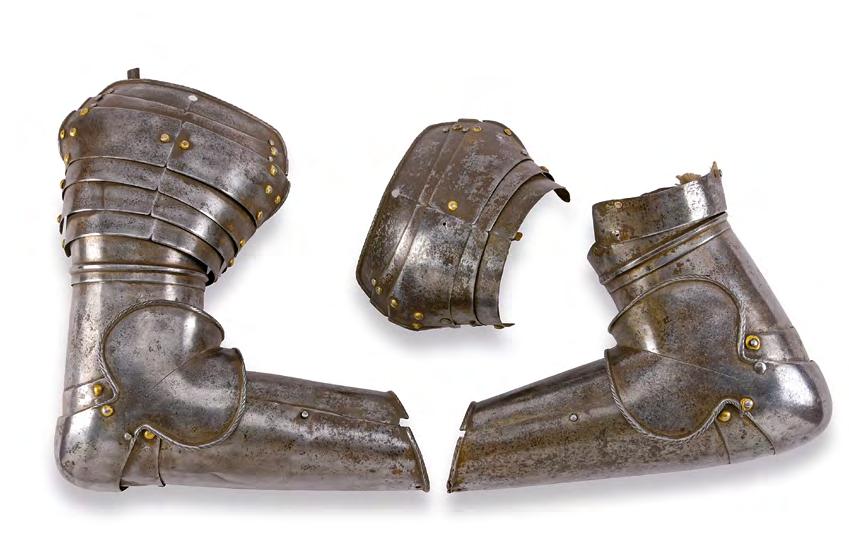
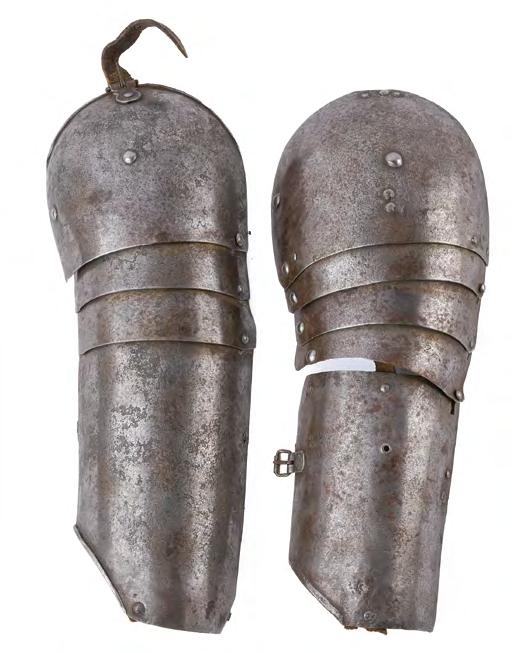
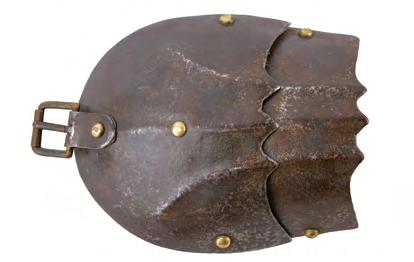
elementi presentano tuttavia la stessa patina sia all’esterno che all’interno, lo stesso numero di inventario marcato all’interno in colore rosso, e coietti sia in cuoio che in velluto di produzione non recente, realizzati chiaramente en suite. Uno spallaccio è anche munito di un vecchio coietto in pelle corazzato con placche in ferro, probabilmente originario, e una targhetta d’inventario in ottone con lo stesso numero marcato all’interno delle lame. Fibbie in ottone decorate a fiorami.
Conditions medium
Height circa 34 cm.
€ 200/300
199
PART OF A SPAUDLER
Germany, circa 1500
The upper circular plate with three converging ribs continuing into the lower plate. The two lower edges formed of triple cusps. With fine old brown patina. Inside, remains of bituminous paint. Rivets and buckle with traces of leather, of non-recent manufacture but probably later than the plates, which are of late Gothic taste.
PARTE DI UNO SPALLETTO
Germania, 1500 circa
La placca superiore circolare nel lato superiore, con tre nervature convergenti che proseguono nell’altra piastra. I due bordi inferiori a triplici cuspdini. Il ferro con bella patina bruna antica. All’interno resti di vernice bitumata. Ribattini e fibbia con resti di cuoio, di produzione non recente ma probabilmente più tardi rispetto alle piastre, queste di gusto tardo gotico.
Conditions medium
Height 13.5 cm.
€ 100/150
200
A LOT OF TWO SPAUDLERS
Italy, First half of the 16th Century
One composed of three lames, the other of four lames. Both with a plate of rounded profile on the back. One of the two spaudlers with an old iron buckle and a slightly outward-rolled edge. The two arm defence plates are almost of rectangular shape, with a lateral cut-out for the inner elbow. Leather strings with missing parts. Partial old patina inside, and leather mounts or rivets at least partly replaced. Possibly Italian.
LOTTO DI DUE SPALLETTI CON PARTE DI BRACCIALE
Italia, Prima metà del XVI Secolo
Uno a tre lame, uno a quattro lame. Entrambi con la placca dorsale a sagomatura tondeggiante. Uno dei due spalletti con vecchia fibbia in ferro e bordo leggermente orlato verso l’esterno. Le due piastre dei bracciali, quasi di forma rettangolare con taglio laterale per l’interno del gomito. Distacchi ai coietti. Parziale vecchia patina all’interno e coietti o ribattini almeno in parte rimpiazzati. Forse italiani.
Conditions medium
Height circa 30 cm.
€ 300/400
201
A PAIR OF FULL-ARM DEFENCES
Europe, circa 1600
Composed of pauldron with five lames, rerebraces with a false sliding channel, three-plate elbow-pieces, and vambraces opening with a push-button fastening. The elbows featuring roped and twisted wings. Profile with a central rib on the entire back. Some rivets with remains of rosette or brass heads. Traces of leather strings on the interior, probably of later replacement. One pauldron has some detached lames.
PAIO DI BRACCIALI COMPLETI
Europa, 1600 circa
Costituiti da spalletti a cinque lame, semicannoni con finto canale di scorrimento, cubitiere a tre lame, antibracci apribili con bottone a pressione. I gomiti con ampie alette cordonate e lavorate a fingere il tortiglione. Tutto il dorso con profilo costolato in mezzeria. Alcuni ribattini con resti di rosetta o testa in ottone. Resti di coietti all’interno, probabilmente più tardi. Una spalla con alcune lame distaccate.
Conditions medium
Height circa 60 cm.
€ 350/500
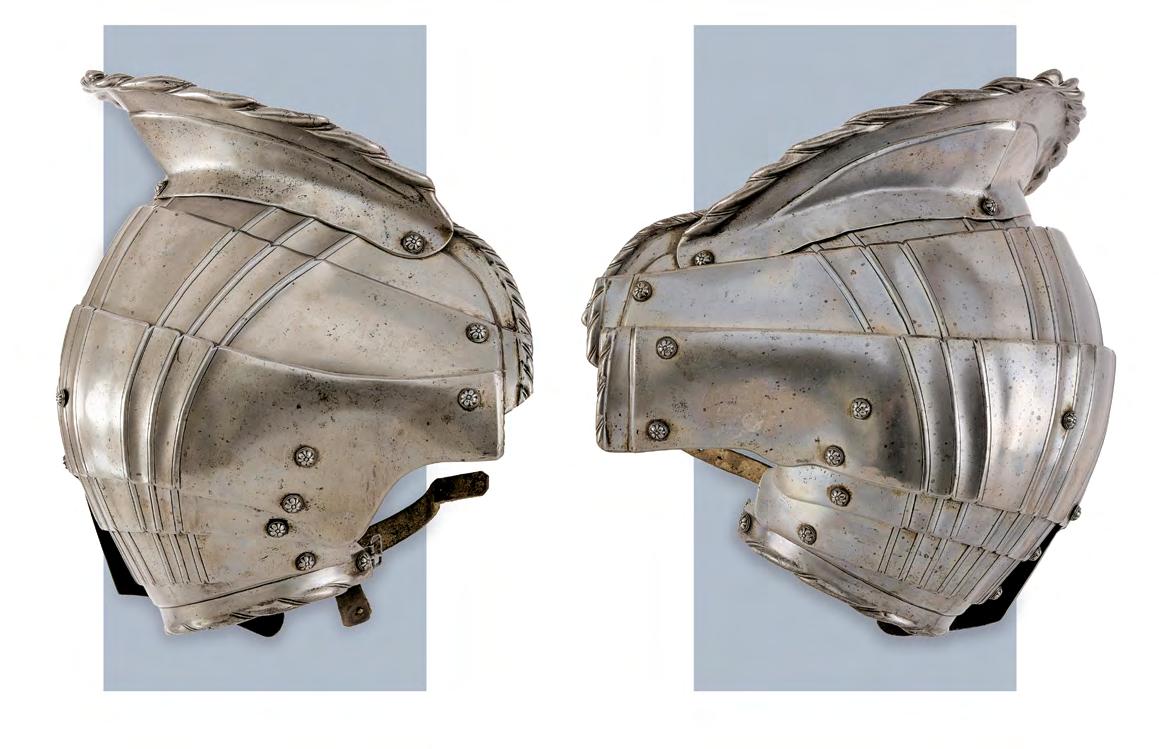
202
A PAIR OF MAXIMILIAN PAULDRONS
Southern Germany, about 1560
A large knife, consisting of finely grooved blades decorated with double lines. The upper blade is smooth, ribbed in the middle, with rebated border and a high twisted border. The lower blade, which is round, also with a rebated, twisted border. Iron rivets shaped as small flowers. The interior is clean and blackened to prevent corrosion. Modern rivets.
PAIO DI SPALLACCI ALLA MASSIMILIANA
Germania del Sud, 1560 circa Di grande volume. Costituiti da lame finemente scanalate e decorate da doppie linee. La parte superiore con guardagoletta lisci, costolati in mezzeria, a margine ribassato e dotati di spesso bordo lavorato a fingere il tortiglione. Il margine inferiore, stondato per accogliere il braccio, presenta ugualmente lista ribassata e bordo lavorato a fingere il tortiglione. Rivetti in ferro con piccola testa lavorata a fiore. L’interno pulito e annerito a scopo anticorrosivo. Rivetti di epoca moderna.
Conditions good
Height 26 cm.
€ 3.000/4.000
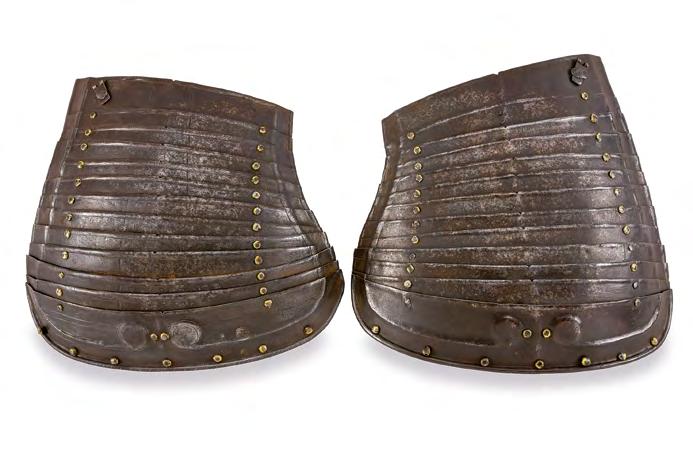
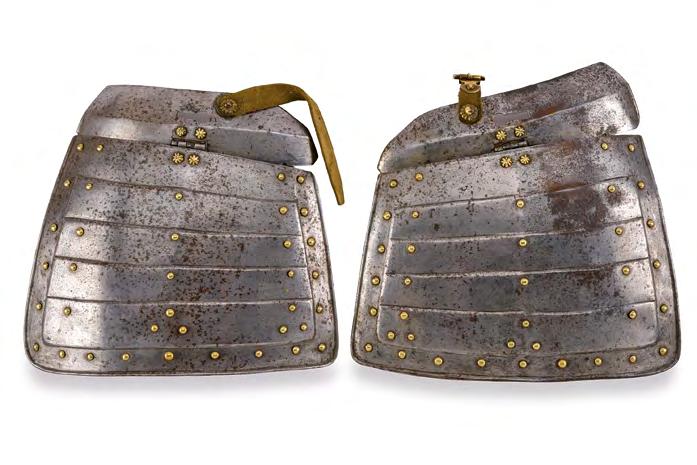
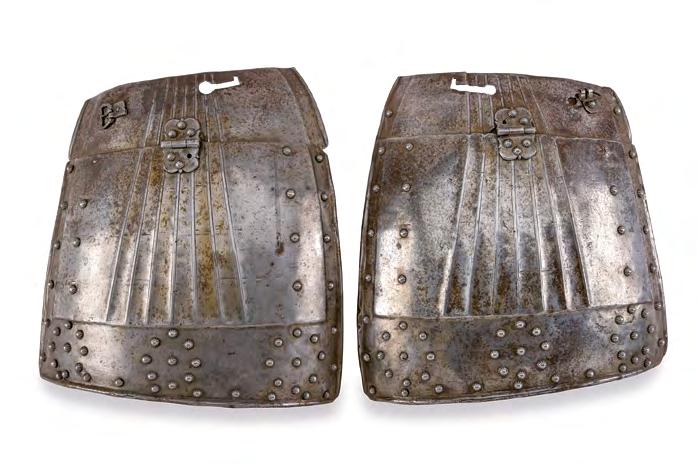
203 A PAIR OF TASSETS
Italy, first quarter of the 17th Century
Both composed of thirteen lames secured by rivets, with traces of brass sheath at the top. The upper edges of the lames and the sides are embossed and roped. The lower edges of the tassets, instead, with a true rope and twisted design.The surface decoration is embossed and roped with swallow-tailed border and featuring two raised circular medallions on the background. Both elements with similar patina on the front side, and small variations in the decorative pattern. Both with a single loop for the mounting.
PAIO DI SCARSELLE
Italia, primo quarto del XVII Sec.
Composte entrambe da tredici lame fissate con ribattini recanti resti di guaina in ottone sulla testa. Il bordo superiore delle lame e i fianchi lavorati sbalzati a imitare il cordone. Invece il margine inferiore delle scarselle con vero cordone lavorato a fingere il tortigilione. Il decoro della superficie con sbalzo a imitare un cordone che delimita un margine a lista ribassata e con due medaglioni circolari rilevati sul fondo. Patina simile sui due elementi sul lato anteriore e leggere differenze decorative. Conservano entrambe un solo passante per il montaggio.
Conditions medium
Height 28.5 cm.
€ 200/300
204 A PAIR OF TASSETS
Northern Europe, early 17th Century
Both composed of two iron plates. The larger plate is worked to simulate overlapping lames, with swallowtailed border, rolled borders, central ribbing, and brass rivets. The smaller plate, positioned dorsally in relation to the other, is provided with a mounting hole for the breastplate and is hinged to the lower plate. On the reverse, remains of a relatively recent lining and leather strings. At the back, another leather string and a brass buckle. Of the type used in pikeman’s armour.
PAIO DI SCARSELLE
Europa del Nord, inizio del XVII Sec. Entrambe costituite da due piastre in ferro, la più ampia lavorata ad imitare lame sovrapposte, con margine a lista ribassata, bordi orlati, costolatura in mezzeria, ribattini in ottone; la piastra più piccola disposta dorsalmente rispetto all’altra, munita di sforatura di montaggio al pettorale e montata con la piastra inferiore tramite un cardine. Sul retro resti di fodera e coietti di produzione non recente. Al dorso un altro coietto e una fibbia in ottone. Del tipo usato nelle armature da picchiere.
Conditions good
Height 22 cm. € 300/400
205 A PAIR OF TASSETS
Northern Europe, 1620 - 1640
Both composed of two plates featuring at the centre a decorated band with longitudinal ribbings, outlined and interspersed with fullers. The two plates are joined by a heavy hinge mounted on the outer side. Swallowtailed border. All margins are either rolled or roped, except for the upper edge. The rivets have nearly cusped and radiating heads, of iron. For mounting, an iron buckle and a shaped mounting hole are present on both tassets. Typical tassets for pikeman’s corslets.
PAIO DI SCARSELLE
Europa del Nord, 1620 - 1640
Entrambe costituite da due piastre recanti al centro banda decorata a nevature longitudinali delineate e inframezzate da sgusci. Le due piastre collegate da uno spesso cardine montato sul lato esterno. Il margine a lista ribassata. Tutti i margini orlati o cordonati a parte il bordo superiore. I ribattini con testa quasi cuspidata e raggiata, in ferro. Per il montaggio sono presenti una fibbia in ferro e una sforatura sagomata su entrambe le scarselle. Tipiche scarselle per corsaletti da picchiere.
Conditions good
Height 31 cm.
€ 400/500
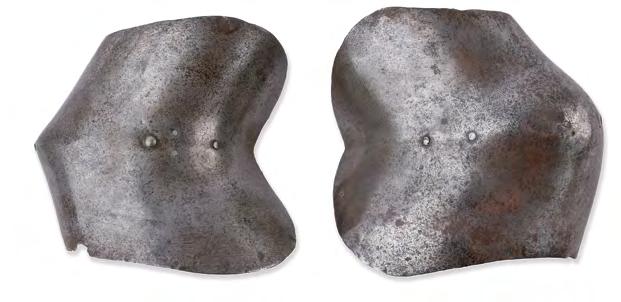
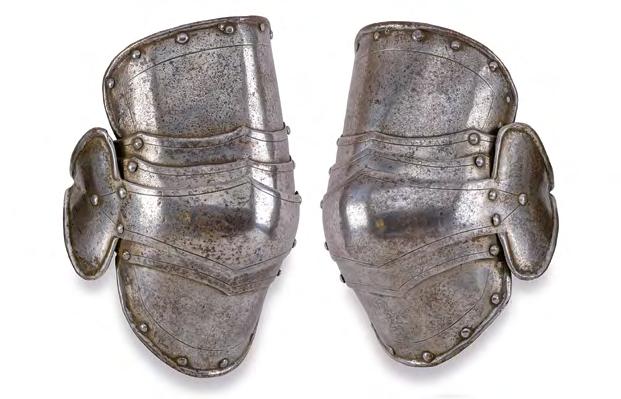
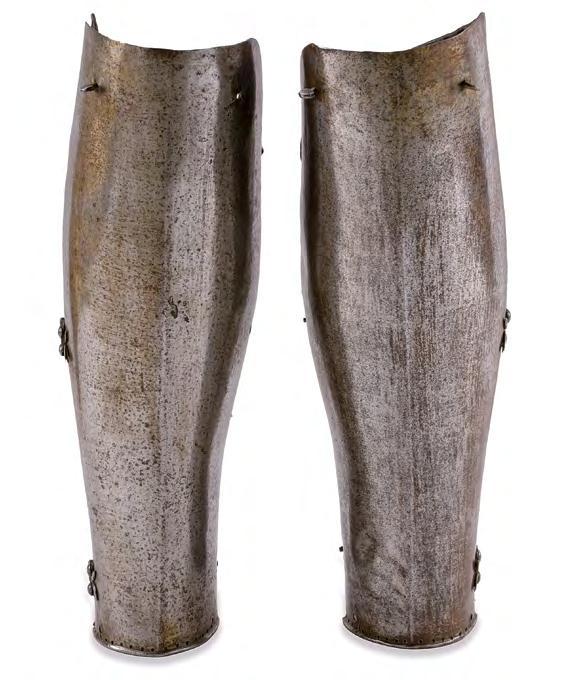
206 A LOT OF TWO ELBOW-PIECES
Italy, early 16th Century
Two iron plates. One with a rounded cupped element (material slightly missing) and a broader wing, the other with a cusped cupped element and a more shaped, enveloping wing. Traces of rivets, probably earlier, on both pieces. Old brown patina inside.
LOTTO DI DUE CUBITIERE
Italia, inizio del XVI Sec.
Due piastre in ferro. Una con coppa stondata (lieve mancanza di materiale) e aletta più ampia, l’altra con coppa cuspidata e aletta più sagomata e avvolgente. Resti di ribattini probabilmente antichi su entrambi i pezzi. Vecchia patina bruna all’interno.
Conditions good
Height circa 16.2 - 17.3 cm.
€ 300/400
207 A PAIR OF KNEE-COPS
Europe, third quarter of the 17th Century
Worked en suite with six iron plates. All outer edges finished with a hem or smooth rope. Lames with simple outline, iron rivets, and cusped central edges. The reverse with dark patina with remains of bituminous black paint; some rivets retain traces of leather.
PAIO DI GINOCCHIELLI
Europa, terzo quarto del XVII Sec.
Lavorati en suite a sei piastre in ferro. Tutti i margini esterni lavorati con orlo o cordone liscio. Le lame con delineatura semplice, ribattini in ferro e bordi cuspidati al centro. Il retro con patina scura e resti di vernice nera bitumata; alcuni ribattini trattengono resti di cuoio.
Conditions good
Height 30 cm.
€ 300/400
208
A PAIR OF GREVAES
Italy, First half of the 16th Century
Both composed of hinged elements joined by iron hinges and secured by a push-button fastening. The lower edges with plain rope, while the upper edges are twisted. There are small differences between the two elements. Both are provided at the upper section with winged buttons for attachment to the knee-cops (one button missing on one of the two greaves), and featuring various mounting holes at the lower section. Small missing part of material on one greave.
PAIO DI SCHINIERI
Italia, Prima metà del XVI Secolo
Entrambi costituiti da piastre congiunte tramite cardini in ferro e dotati di chiusura tramite bottone a pressione. I bordi inferiori con cordone liscio, quelli superiori lavorati a fingere il tortiglione. Alcune minime differenze fra i due elementi. Dotati entrambi di bottoni a galletto in alto per il montaggio ai ginocchielli (un bottone mancante su uno dei due schinieri), in basso varie sforature. Lieve mancanza di materiale a uno schiniere.
Conditions good
Height circa 42 cm.
€ 300/400
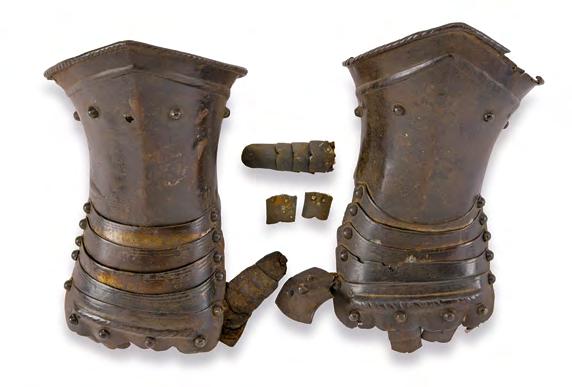
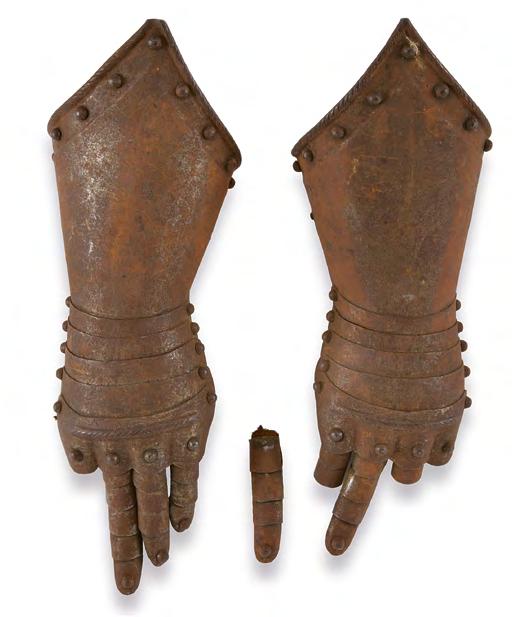
209 A CULET
France, mid-17th Century
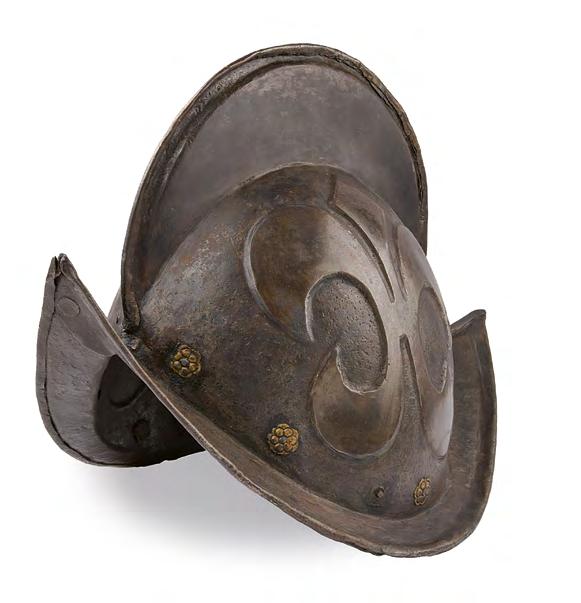
210
A PAIR OF GAUNTLETS
Europe, First half of the 17th Century
With short cuffs of strongly flared form, cusped on the back, with swallowtailed border outlined by an embossed cord with roped and twisted border (missing parts). Iron-headed rivets. Five-plated backs, with outline. The fingers are formed of scales, now almost entirely missing.
PAIO DI MANOPOLE
Europa, Prima metà del XVII Secolo Con corti manichini di forma molto svasata e cuspidati al dorso, dotati di margine a lista ribassata delimitato da un cordone sbalzato e con bordo ribadito a fingere il tortiglione (mancanze). Ribattini con testa in ferro. I dorsi realizzati a cinque lame, con delineatura. Le dita a scaglie quasi completamente mancanti.
Conditions medium
Length without fingers circa 22 cm.
€ 300/400
211
A PAIR OF GAUNTLETS
Germany, circa 1600
With long cuffs featuring cusped edges, worked with swallow-tailed border and roped/twisted border. A row of iron-headed rivets. Five-plated backs are articulated, the fingers formed of overlapping scales (with missing parts). Overall oxidised patina with remains of leather strings.
PAIO DI MANOPOLE
Germania, 1600 circa Con lunghi manichini a bordo cuspidato, lavorati con margine a lista ribassata e con bordo cordonato e lavorato a fingere il tortiglione. Giro di ribattini a testa in ferro. I dorsi articolati in cinque lame, le dita a scaglie (mancanze). In patina ossidata con resti di coietti.
Conditions medium
Length total circa 38 cm.
€ 300/400
212
Structured in three horizontal bands: the upper band consisting of a single lame, the other two composed of two lames joined at the centre by rivets. The outer surface featuring brass-headed rivets, outlines, and engraved small circular motifs. The central and lower bands are provided with an upper edge worked in festoons. Rolled lower margin. Small plates, possibly added at a later date, are riveted to the sides. The upper section has various shaped mounting holes.
BATTICULO
Francia, metà del XVII Sec.
Strutturata in tre fasce: la prima in alto costituita da una lama singola, le altre due composte da due lame congiunte al centro tramite ribattini. La superficie esterna con ribattini a testa in ottone, delineature e incisioni a cerchietti. La fascia centrale e quella più in basso munite di bordo superiore lavorato a festoni. Il margine inferiore orlato. Piccole placche giuntate (più tardi?) ai lati. La parte alta con varie sforature sagomate per il montaggio.
Conditions good
Width circa 40 cm.
€ 200/300
A BLACK AND WHITE MORION
Southern Germany, circa 1600
Heavy skull divided into two halves joined at the comb with smooth border and swallow-tailed border. The skull is dyed black with brass rosette-shaped rivets at the base (some missing). In the centre, raised ornament with a lily decoration worked on a blackened background. Boat-shaped brim with file roped margin.
MORIONE BIANCONERO
Germania del Sud, 1600 circa Pesante coppo in due metà unite alla cresta, a bordo liscio, e con margine a lista ribassata. Il coppo tinto di nero con ribattini a rosette in ottone alla base (alcuni mancanti). Al centro decoro rilevato con fregio a giglio lavorato su fondo annerito. Tesa a barchetta con margine cordonato.
Conditions medium
Height 26.5 cm.
€ 700/900
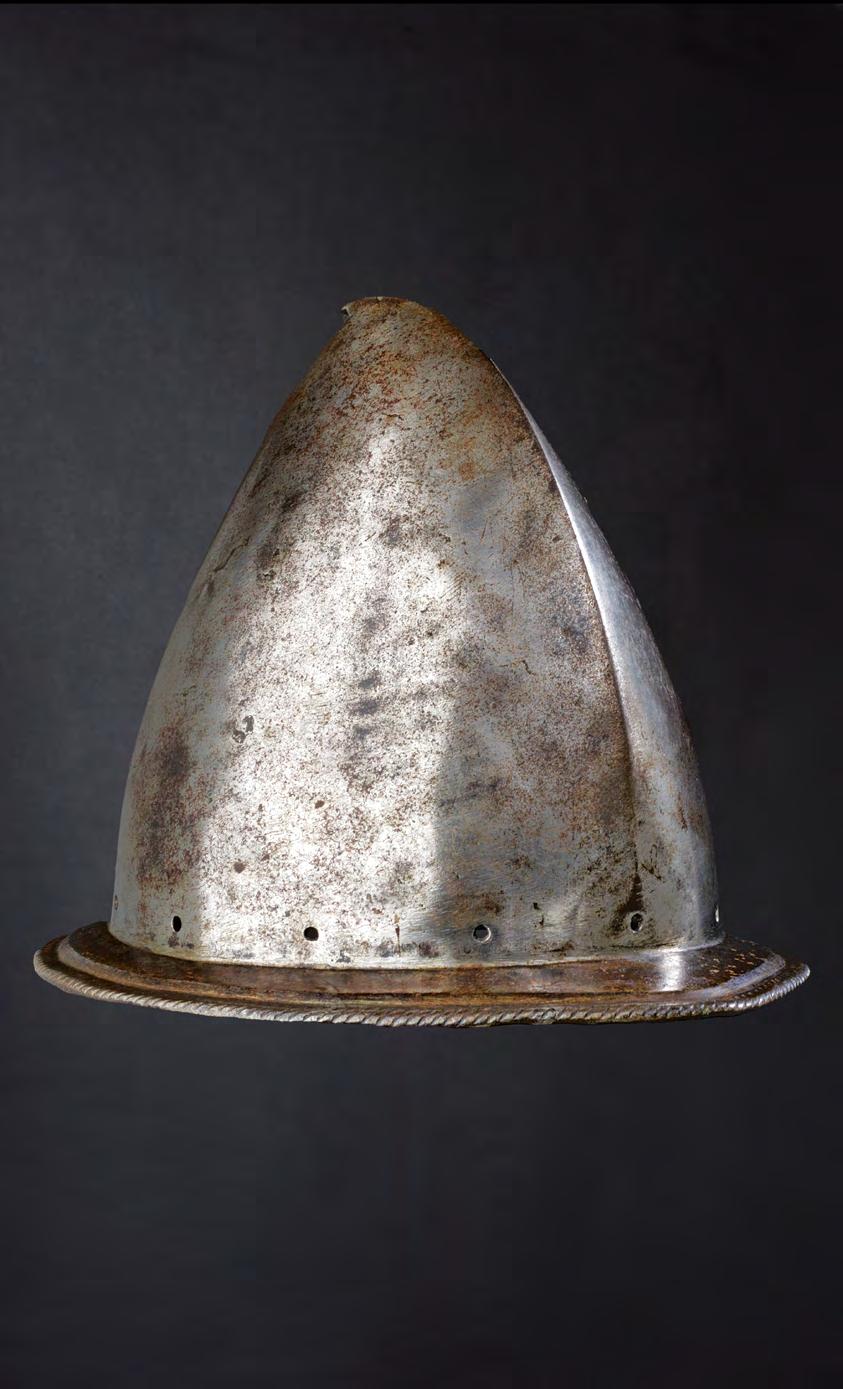
213 A
Second
Conditions good Height 25 cm. € 1.100/1.400
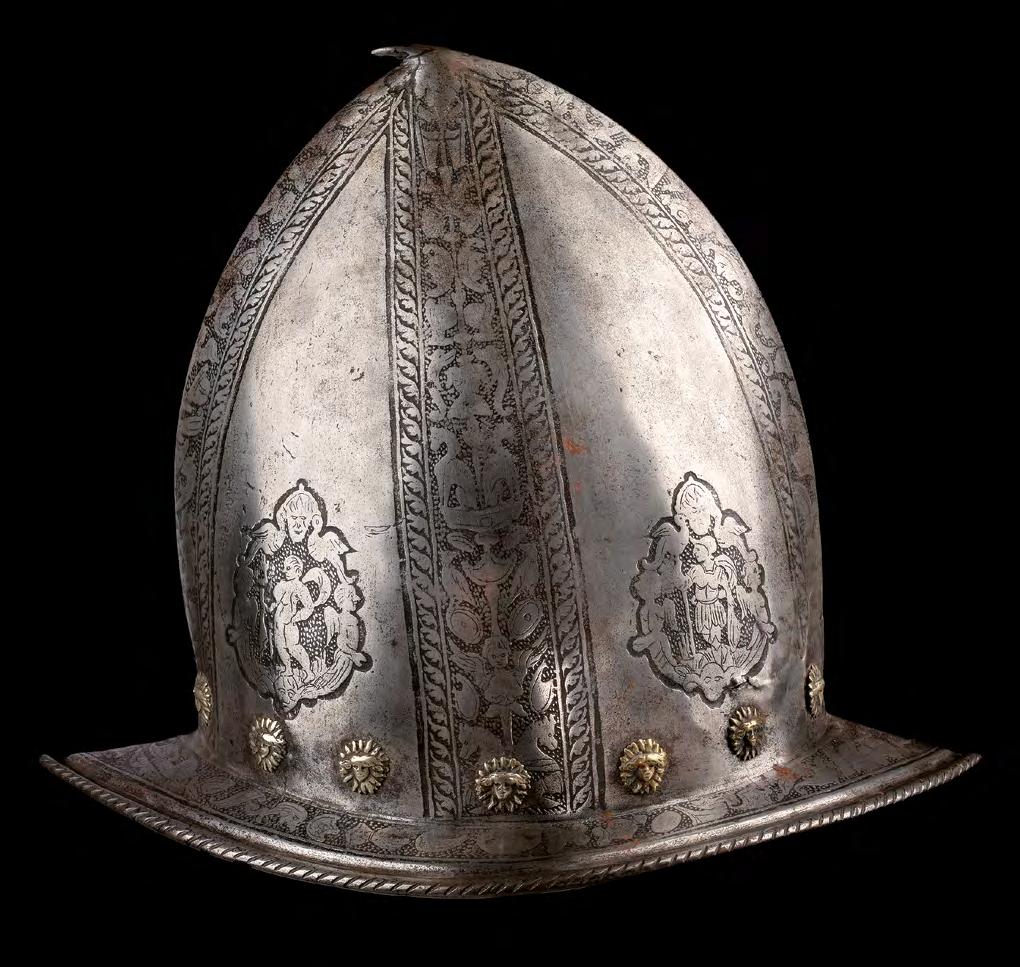
214 AN ENGRAVED CABASSET
North Italy, circa 1600
Iron skull worked in one piece, ribbed in the centre with apex pointing backwards; slightly sloping, pointed and ribbed brim, swallow-tailed and with roped border. The surface engraved with bands and cartouches, featuring figures, weapons, vases, grotesque animals and floral motifs on a dark, granulated background. With round brass rivets decorated with faces on rays at the base. Very few damaged parts. The interior with fine traces of hammering.
ZUCCOTTO AGUZZO INCISO
Italia settentrionale, 1600 circa Coppo in ferro lavorato in un solo pezzo, costolato in mezzeria, con apice rivolto all’indietro; tesa leggermente spiovente, appuntita e costolata, il margine ribassato e con bordo lavorato a fingere il tortiglione. La superficie incisa a bande e cartigli, recanti personaggi, armi, vasi, animali grotteschi e decori floreali su fondo scuro e granulato. La base con giro di ribattini in ottone decorati con volti su raggi. Piccolissimi danni. L’interno con belle tracce delle martellature.
Conditions good
Height 27 cm.
€ 2.400/2.800
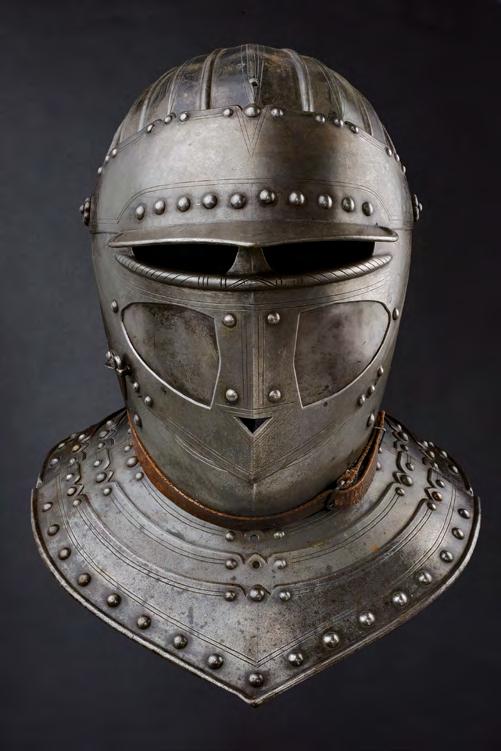
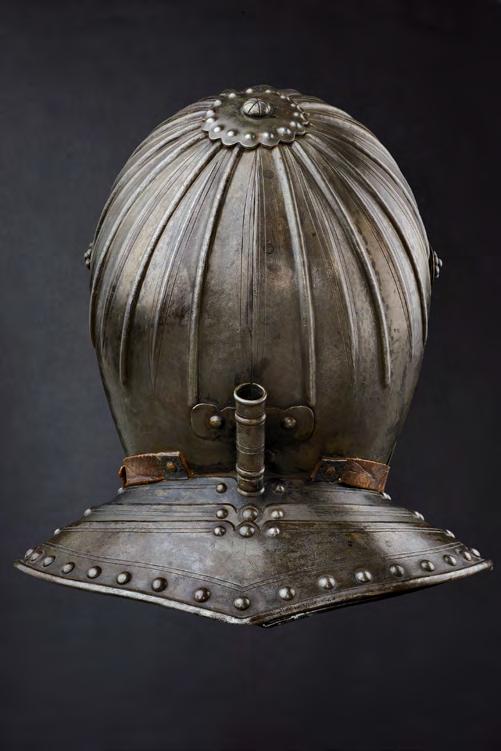
215
A FINE SAVOYARD-TYPE CLOSE HELMET
France, early 17th Century
Skull in two halves with rosette at the apex, decorated in the upper part with fluting and engraved double lines arranged in radiating pattern; lifting peak, ribbed visor, rectangular eye-slits, small triangular ventilation opening at the mouth, bevor with hook fastening. Neck-guard and falling buffe each of three lames, fitted with upper edges cut with scalloped notches, as also the peak; the lower edge turned over. All elements decorated with engraved double lines.
BELL’ELMO CHIUSO ALLA SAVOIARDA
Francia, inizio del XVII Sec.
Coppo in due metà con rosetta al sommo, recante cannellini ed incisioni a doppie linee disposte a raggiera nella parte alta; frontale a tesa rialzabile, ventaglia costolata, fessure oculari rettangolari, piccola sforatura di aerazione triangolare alla bocca, barbozza con gancio; guardacollo e gronda a tre lame ciascuno, dotate di bordi superiori con rintacchi a scaglione come anche il frontale, il margine inferiore orlato. Tutti i pezzi con decorazione a doppie linee.
Conditions
Height 28 cm.
€ 5.000/8.000
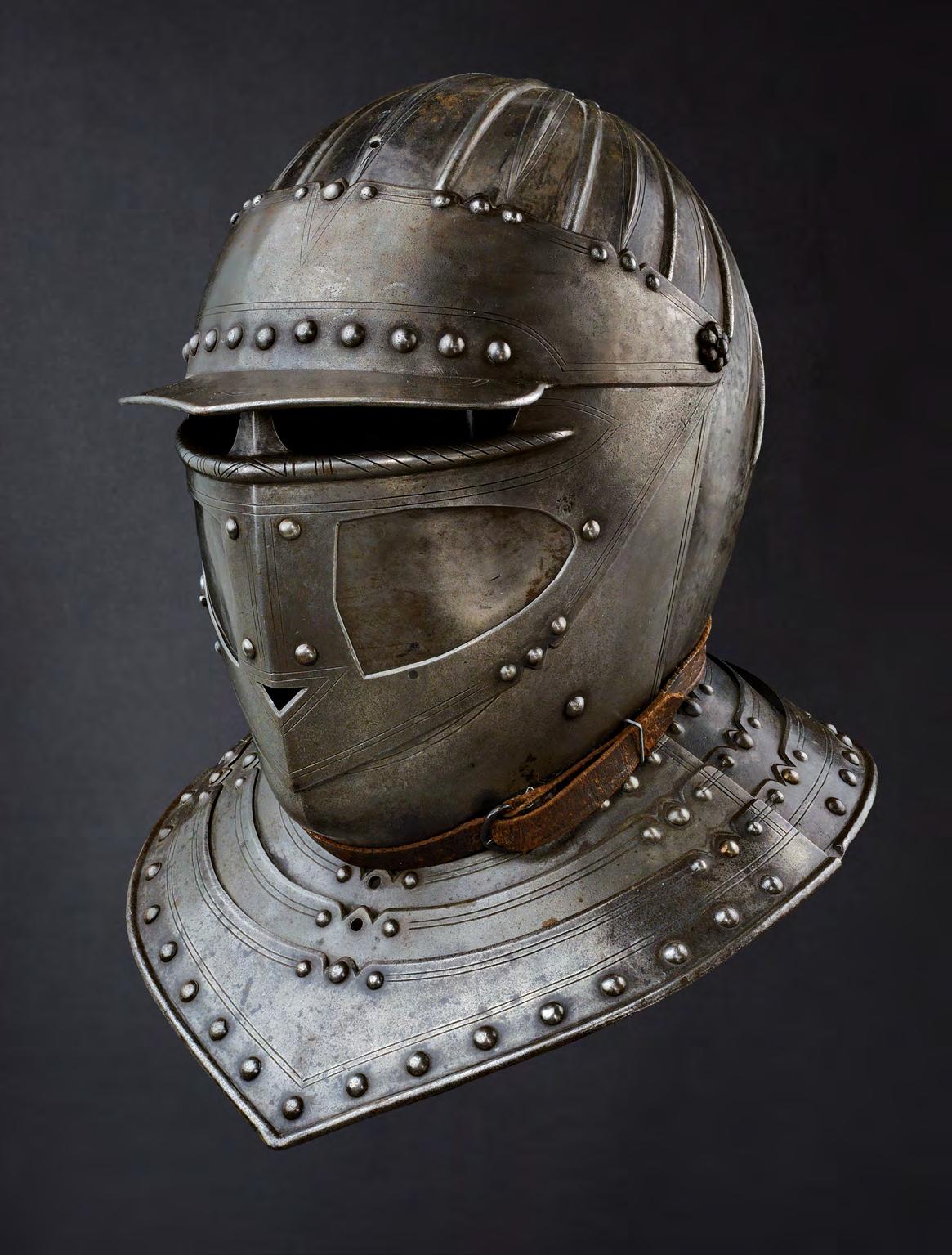
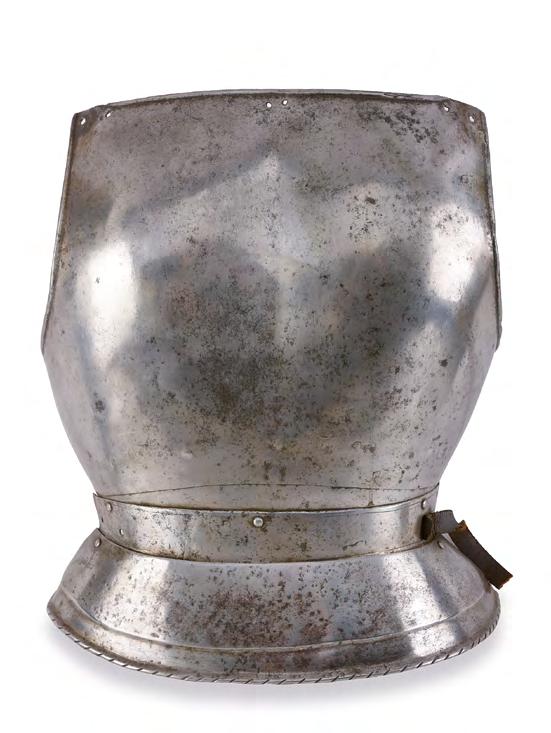
216
A BACKPLATE
Germany, first quarter of the 16th Century
The dorsal plate is shaped and rolled at the neckline and gussets, and is provided with mounting holes at the upper section for the leather strings attachment. The lower edge of the back has been joined/repaired (possibly earlier?) with an iron strip secured by rivets, in order to extend the back length. An additional strip (with a couple of repairs, certainly of later date), similar to a reinforcing strip, has been riveted externally directly onto the extension. Finally, the backpiece is attached to the reinforcing strip with only two rivets (all with iron heads), with swallow-tailed border, corded and twisted.
SCHIENA
Germania, primo quarto del XVI Sec.
La placca dorsale sagomata e dotata di orlo allo scollo e ai giri ascellari, munita in alto di sforature per il montaggio di coietti. Il bordo inferiore del dorso è stato giuntato/riparato (in epoca antica?) con una lamina fissata con ribattini, al fine di prolungare la schiena. Un’ulteriore lamina (questa con un paio di riparazione sicuramente più tarde), tipo guardarene, è stata fissata all’esterno direttamente sulla prolunga, sempre tramite ribattini. Infine la falda, fissata sul guardarene tramite due soli ribattini (tutti con testa in ferro), con margine a lista ribassata e cordonato ma lavorato a fingere il tortiglione.
Conditions medium
Height 41.5 cm.
€ 500/800
217 A LIGHT CAVALRY SENIOR OFFICER’S ARMOUR WITH EFFIGY OF THE VIRGIN MARY
Eastern Europe, Circa 1630 - 1650
Shrimp-tail capeline with rounded skull and ribbed in the centre, two halves joined by rivets. The round frontal brim in one piece with the skull itself is ribbed and worked with notch decorations, with a row of rivets next to the outer border. In the centre, the sliding nosepiece with a beautiful carved and pierced floral top frieze. The stop complete with wingnut screw. The row of rivets, also made of iron, at the base of the skull with remains of old leather strings or fabric lining. The plated cheekpieces, with unroped edges, mounted by rivets on a leather-shaped patch. Three-plated nape-guard, the first is part of the skull, the other two fixed with rivets. Remains of fabric also here. The upper edges of the nape-guard plates with shaped staple borders and double outlines. Inside the helmet, a fine earlier patina. The last plate with hemmed edge with notch decoration. Only one small more recent repair to the inner borders of a nape-guard plate. Two-plated, one-piece neck-collar with neckline. This one with roped border. The outer margin with smooth borders is not roped. Decorated with double outlines. The interior with fine earlier patina and slight traces of leather strings under the rivets. Elegant light breastplate ribbed in the centre, blackened like the rest of the elements, except for the beautiful central medallion engraved to depict the Virgin Mary crushing a dragon (which represents the Devil) surrounded by spirals. The central ribbing, which is also checkered, the beautiful roped cords of the neckline and gussets are also left in the natural metal colour. The double-edged brim is decorated with festooned staple borders and rows of rivets. The lower edge with rope en suite with the other elements. On the back various fragments of old or even earlier lining and leather strings. Apparently only four rivets replaced later. Also here fine old brown patina inside. Backplate with roped cords and simple outlines, twoplated backpiece with straight borders. On the bottom decorative cord. Half brassards with cusped festooned borders and decorated with remains of double outlines. Roped outer borders. The rivets appear to be almost all old, apart from a few replacements in one arm. Black paint refreshed in recent times. Probably Polish (where the Marian cult is particularly popular and Mary is the patron saint) or Hungarian. Elegant and impressive.
See the well-known painting “Our Lady of Łukawiec”, located in the Church of St Mary Queen of Poland in Łukawiec. Painted by an unknown artist at the beginning of the 17th century, it was first placed in the Potocki frame in Tartakov, then moved, and finally placed in the local church. In the 18th century, it was considered miraculous. After various vicissitudes and further relocations, it was finally placed in Łukawiec in 1990.In the painting the Virgin is depicted with her hands clasped in prayer and with her right foot crushing a dragon.
RARO CORSALETTO ALLA LEGGERA DA ALTO UFFICIALE CON EFFIGE DI MARIA IMMACOLATA
Europa orientale, 1630 - 1650 circa Taschetto a coda di gambero con coppo tondeggiante e costolato in mezzeria, in due metà unite da ribattini. La visiera anteriore circolare e in un unico pezzo con il coppo stesso, a margine orlato e lavorato a tacche, con giro di ribattini accanto al bordo esterno. Al centro il nasale scorrevole con bellissimo fregio sommitale floreale intagliato e traforato. Il fermo completo di vite a galletto. Il giro di ribattini, sempre in ferro, alla base del coppo trattiene resti di vecchi coietti o fodera in tessuto. I guanciali a scaglie, con margini non ribaditi, montati tramite ribattini su un pezza sagomata in cuoio. La gronda a tre lame, la prima facente parte del coppo, le altre due fissate con ribattini. Resti di tessuto anche in questo caso. I margini superiori delle lame di gronda con bordo sagomato a graffe e doppie delineature. All’interno dell’elmo bella patina antica. L’ultima lama con margine orlato e lavorato a tacche. Un’unica piccola riparazione più recente al bordo interno di una lama di gronda. Goletta a due lame in un unico pezzo con lo scollo. Questo con bordo cordonato e lavorato a fingere il tortiglione. Il margine esterno con bordo liscio non ribadito. Decorazioni a doppie delineature. L’interno con bella patina antica e lievi tracce di coietti sotto ai ribattini. Elegante pettorale leggero costolato in mezzeria, annerito come il resto degli elementi, ad eccezione del bel medaglione centrale inciso ad effigare la Vergine Marina che schiaccia un drago (raffigurazione del Demonio) circondata da decorazioni a volute. Lasciati in colore naturale del metallo anche la costolatura centrale, che è anche incisa a zigrino e i bei cordoni a tortiglione dello scollo e dei giri ascellari. La falda a due lame, ornate con bordi festonati a graffe e con file di ribattini. Il margine inferiore con cordone en suite con gli altri elementi. Sul retro vari frammenti di fodera e coietti vecchi o addirittura antichi. Apparentemente quattro soli ribattini sostituiti successivamente. Anche qui bella patina bruna antica all’interno. Schiena con cordoni lavorati a fingere il tortiglione e delineature semplici, falda a due lame con bordi dritti. Sul fondo cordoncino decorativo. Mezzi bracciali con lame a bordo festonato a cuspidi e ornate con resti di doppie delineature. I bordi esterni cordonati e lavorati a fingere il tortiglione. I ribattini apparentemente quasi tutti vecchi, a parte alcune sostituzioni in un solo braccio. La vernice nera rinfrescata in epoca recente. Vista la tipologia Probabilmente polacco (anche per via del culto mariano molto diffuso in Polonia, della quale Maria è protettrice) oppure forse ungherese. Elegante e di grande impatto.
Cfr: vedi il noto dipinto “Nostra Signora di Łukawiec” situato nella Chiesa di Santa Maria Regina della Polonia a Łukawiec, di autore sconosciuto, realizzato all’inizio del XVII secolo, dapprima collocato nel castello di Potocki nella città di Tartaków, poi spostato e collocato nella chiesa locale, ritenuto miracoloso nel XVIII secolo. Dopo varie vicissitudini e altri spostamenti venne definitivamente collocato a Łukawiec nel 1990.Nel dipinto la Vergine è raffigurata con le mani giunte nell’atto di pregare e con il piede destro che schiaccia un drago.
Conditions good Height as shown circa 85 cm. € 18.000/22.000
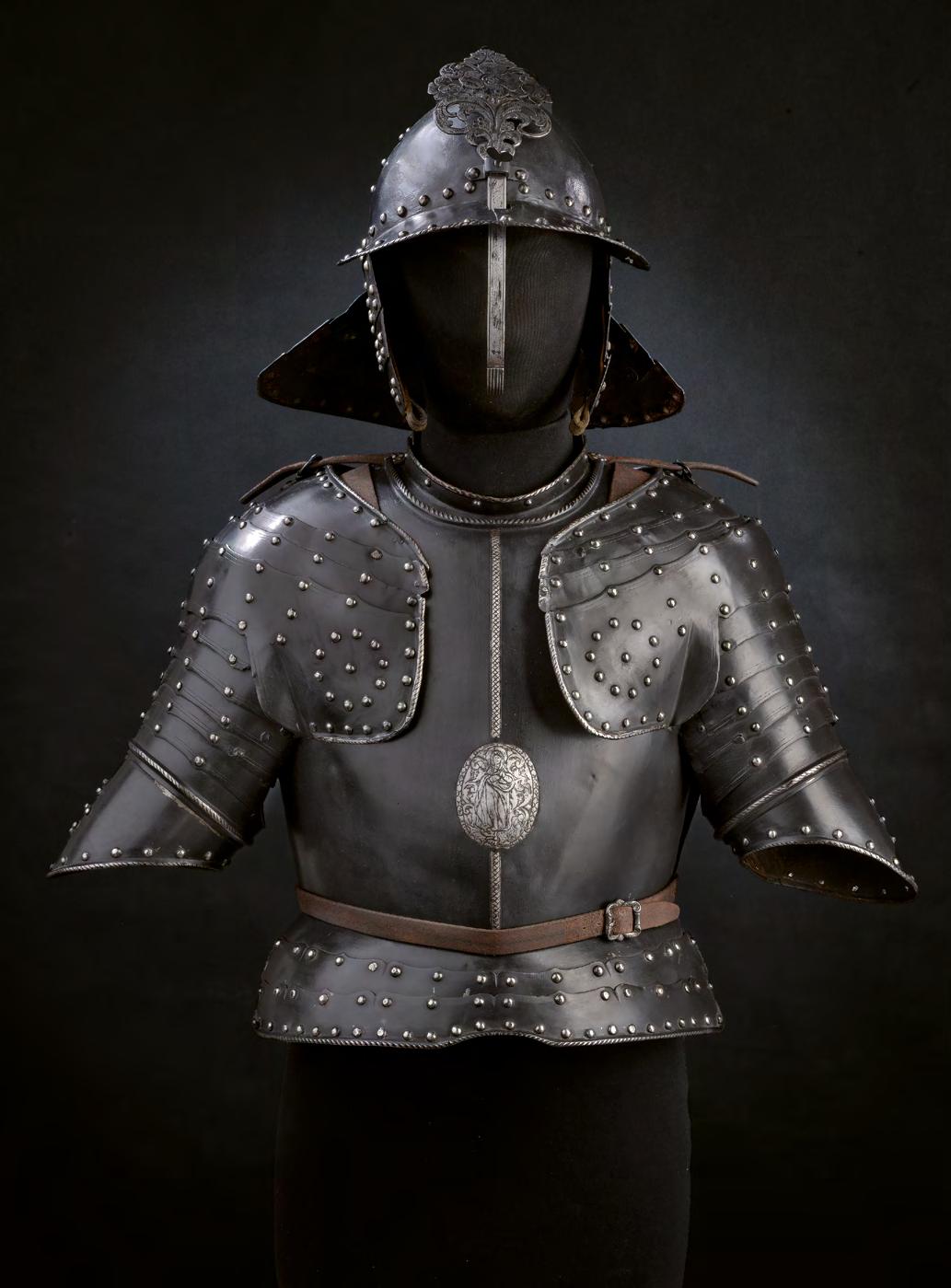
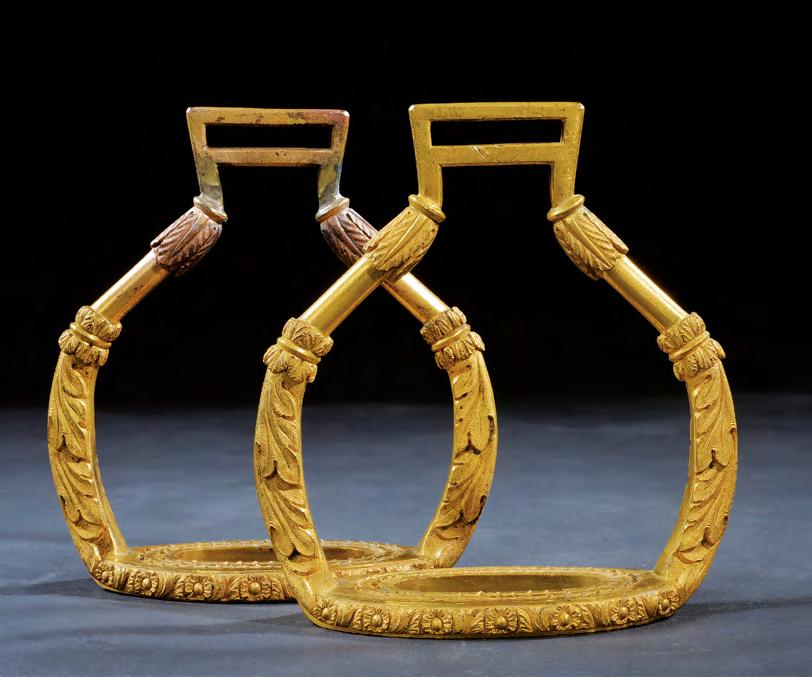
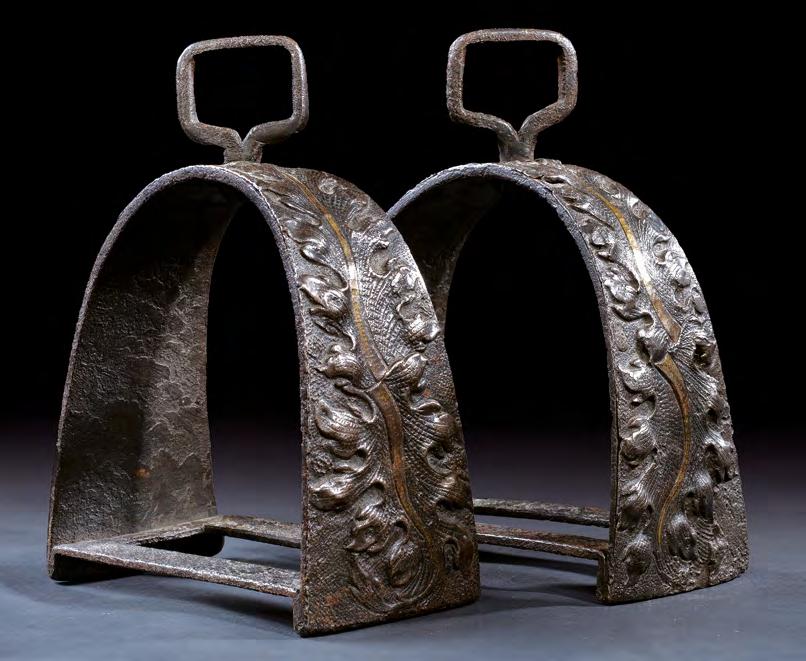
218 A RARE AND ELEGANT PAIR OF STIRRUPS
Spain, 18th Century
Made of fire-gilded bronze, curved quillons decorated with foliage in bas-relief. Treads with oval central opening, borders engraved with flowers. Marked “CABALLERIZAS REALES” underneath and engraved with a royal crown. Rectangular loops.
RARO ED ELEGANTE PAIO DI STAFFE
Spagna, XVIII Secolo
In bronzo dorato a fuoco, bracci curvi decorati a fogliame in bassorilievo. Panche con apertura centrale ovale, bordi incisi a fiori. Marcate in basso “CABALLERIZAS REALES” ed incisa con una corona reale. Occhi rettangolari.
Conditions very good
Height 14 cm.
€ 650/950
219 A BEAUTIFUL PAIR OF STIRRUPS
Italy, 16th Century
Forged in iron with wide arches finely carved and engraved with leaves, the central part gilded, treads with rectangular opening, movable loops. Very rare.
Illustrated and described in “Éperonnerie and parure ducheval”, Racine edition, 2005, no. 83, p. 59.
BELLISSIMO PAIO DI STAFFE
Italia, XVI Sec.
In ferro forgiato, con ampi archi finemente intagliati et incisi a fogliame, la parte centrale dorata, panche con apertura rettangolare, occhi mobili. Molto rare.
Illustrate e descritte in “Éperonnerie e parure ducheval”, edizione Racine, 2005, no. 83, pag. 59.
Conditions very good Height 16 cm.
€ 2.000/2.500
220 AN INTERESTING WAR HAMMER
Germany, 16th Century
Sturdy, tipped beak of triangular section, slightly oblique, with a base featuring four shell-shaped carvings. Hammer of square section with shell-shaped decorations en suite. Solid, iron center of crossguard provided with belt hook. Wooden shaft almost completely covered in iron, with half-spherical rivets. The base reinforced with iron and with a hole for the grip strap, which is made of leather from a later period. Rare.
INTERESSANTE MARTELLO DA GUERRA
Germania, XVI Sec. Robusta penna appuntita, di sezione triangolare, leggermente obliqua, con base recante quattro intagli a sgusci. Martello a sezione quadra con decori a sgusci en suite. Massello massiccio in ferro, munito con gancio da cintura. Fusto in legno quasi completamente rivestito in ferro, munito di ribattini a testa semisferica. La base con rinforzo in ferro e con foro per la cinghia di presa, questa in cuoio di epoca successiva. Raro.
Conditions good Length 50.3 cm.
€ 2.000/3.000
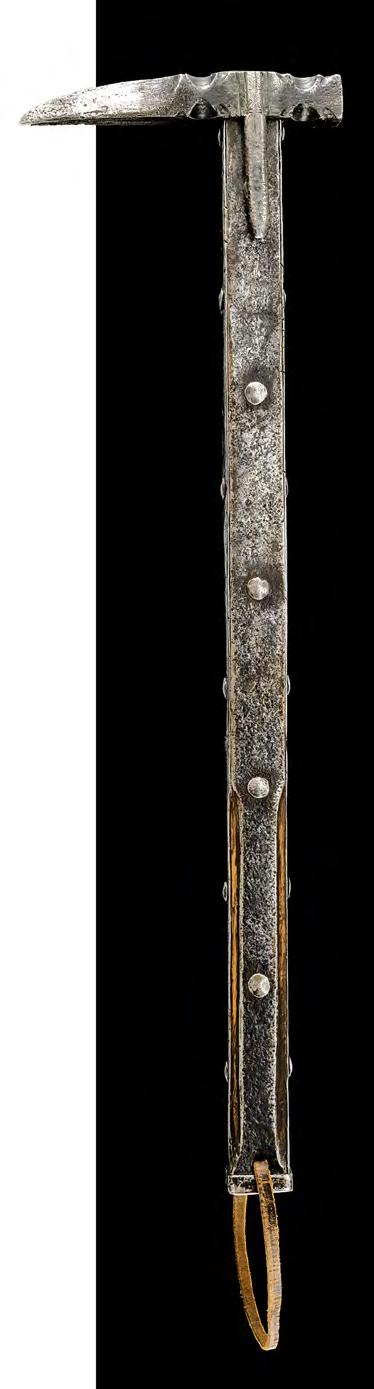
221
A SOCKET BAYONET ON TOP OF A POLE ARM
Sardinian Kingdom, Mid 19th Century
Cylindrical shaft painted sky blue with a socket bayonet as cusp; featuring an iron tip at the base, with rest used to push the shaft into the ground through the shoe. Interesting and rare. Provenance: the Calamandrei collection.
BAIONETTA A GHIERA INASTATA
Regno di Sardegna, Metà del XIX Secolo Asta cilindrica dipinta color celeste, come cuspide una baionetta a ghiera, Il piede in ferro a puntale munito staffa laterale usata per piantare con lo stivale la punta nel terreno. Interessante e rara. Provenienza collezione Calamandrei.
Conditions good Height 202.5 cm. € 150/250
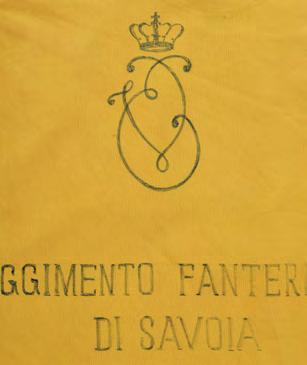
222 A SPEAR WITH UNIT-IDENTIFICATION PENNANT
Sardinian Kingdom, Mid 19th Century
Cylindrical shaft painted sky blue, a lanceolate cusp at the top, ribbed at the middle, and featuring a long ferrule shaped as a truncated cone. Under the ferrule, a yellow drape with the inscription “REGGIMENTO DI FANTERIA SAVOIA” under the royal monogram “VE” under a crown. Featuring at the base an iron tip with rst used to push the shaft into the ground through the shoe. Interesting and rare. Provenance: the Calamandrei collection.
LANCIA CON DRAPPO DI MARCATURA UNITA
Regno di Sardegna, Metà del XIX Secolo
Asta cilindrica dipinta color celeste, dotata al sommo di cuspide lanceolata, nervata in mezzeria e con lunga gorbia troncoconica. Banderuola color giallo con iscrizione “REGGIMENTO DI FANTERIA SAVOIA” sormontato dal monogramma reale “VE” posto sotto corona. Il piede in ferro a puntale munito staffa laterale usata per piantare con lo stivale la punta nel terreno. Interessante e rara.
Provenienza collezione Calamandrei.
Conditions good
Height 236 cm.
€ 200/400

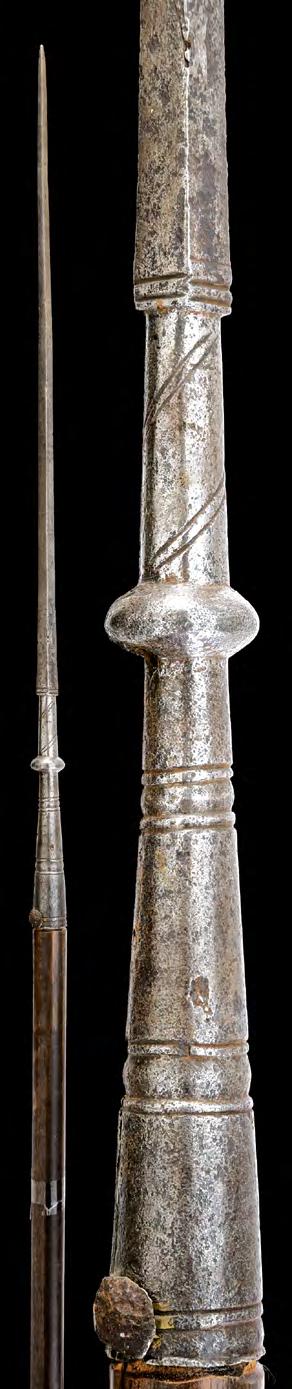
223 A BREACH PIKE
Italy, Late 16th Century
A spearhead with a long, solid square-section cusp, the base featuring a neck shaped as a truncated cone and decorated with engraved spirals; below the neck is a thick circular knob, followed by the ferrule, which is shaped as a truncated cone and ribbed, featuring turned rings. The spearhead is secured to the shaft by an old nail of antique manufacture. Without ribs. The ferrule featuring an old brass joint. Mounted on a cylindrical wooden shaft of more recent manufacture.
QUADRELLONE DA BRECCIA
Italia, Fine del XVI Secolo
Ferro con lunga e robusta cuspide a quadrello munita alla base di collo troncoconico decorato a spirali incise, sotto al collo uno spesso nodo circolare poi la gorbia, troncoconica e con delineature, recante anellature tornite. Il ferro fermato all’asta da un vecchio chiodo di antica produzione. Senza bandelle. La gorbia con vecchia saldatura in ottone. Su asta lignea cilindrica di produzione più recente.
Conditions good
Height 232 cm.
€ 200/300
224 A
LONG SPEAR
Lucca, 16th Century
Spearhead with a long, solid blade nearly triangular in shape and of lozenge section, slightly thickened at the tip. Featuring on both sides remains of two marks and the inscription “LUCCA.” Faceted ferrule shaped as a truncated cone. The spearhead is attached to the shaft with small nails having thick, square heads;missing ribs. Wooden shaft of older manufacture (with woodworm holes and signs of age) and completely covered with fabric (very worn and with several missing parts) held by small brass nails.
LANCIONE
Lucca, XVI Sec.
Ferro con lunga e robusta lama di forma quasi triangolare e di sezione a losanga, leggermente ingrossato in punta. Recante su entrambe le facce resti di due marche e la dicitura “LUCCA”. Gorbia troncoconica faccettata. Il ferro fissato all’asta tramite chiodini a spessa testa quadra; privo di bandelle. Asta lignea di produzione non recente (con fori di tarlo e segni del tempo) completamente rivestita di tessuto (molto liso e con varie mancanze) trattenuto da chiodini in ottone. Interessante.
Conditions good
Height 231.5 cm.
€ 350/550
225 A HALBERD
Austria, early 17th Century
Head with cusp of square section and moderate length, with wings at the base. A relatively small, hollow-edged axe provided with open-works in three groups of repeating circular and wedgeshaped elements, and provided with beak-like lugs. Very wide rear fluke, curved downward, and worked en suite. Faceted ferrule with mediumlength straps. The wooden shaft of octagonal section is solid and of older manufacture. The straps fastenings are covered by a tassel of later manufacture. Iron shoe.
ALABARDA
Austria, inizio del XVII Sec. Ferro con cuspide a quadrello di discreta lunghezza munita di alette alla base. Scure di dimensioni abbastanza contenute, a taglio incavato munita di sforature disposte in tre gruppi di elementi ripetuti circolari e a cuneo e dotata di gobbe a becchetto. Il becco molto ampio, incurvato verso il basso e lavorato en suite. Gorbia faccettata con bandelle di media lunghezza. Fusto in legno di buona sostanza e produzione non recente, di sezione ottagonale. L’attaccatura delle bandelle coperta da una nappina di produzione più tarda. Piede in ferro.
Conditions good
Height 266 cm.
€ 330/500
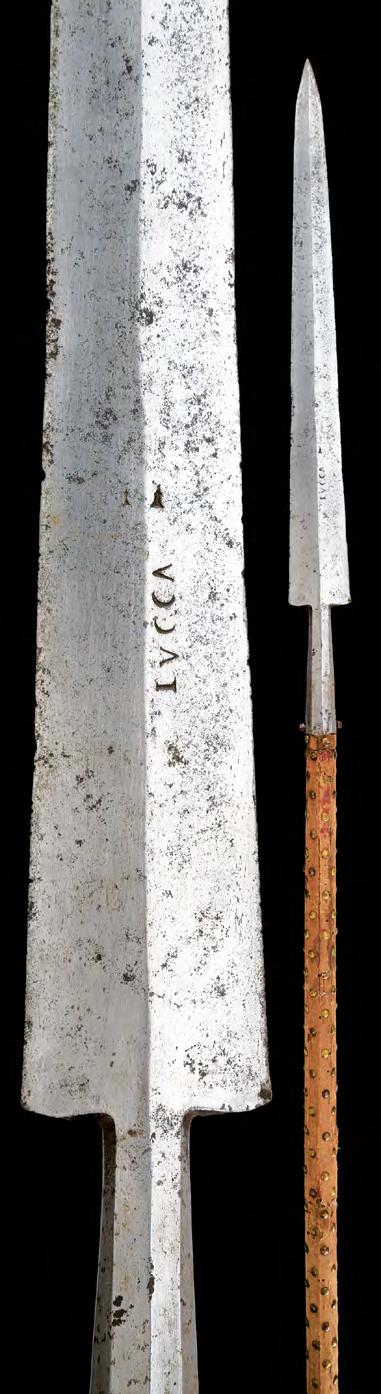


226
A HALBERD
Austria, circa 1600
Head with sturdy cusp of square section, provided with an almost “V”-edged axe with beak-like lugs and open-works in three groups. Straight rear fluke, slightly curved downward, also with openworks and slightly thickened at the tip. Both straps and counterstraps (unequal lengths; shortened?). The base of the straps is not visible because it is covered by a fabric tassel added at a later date. Iron ring nut. Mounted on a wooden shaft, likely of a later date (and shorter), with signs of use and time.
ALABARDA
Austria, 1600 circa Ferro con robusta cuspide a quadrello, munito di scure con taglio quasi a “V” e dotata di gobbe a becchetto e sforature disposte in tre gruppi. Il becco dritto e leggermente appuntato verso il basso, anche questo con sforature, lievemente ingrossato in punta. Presenti sia le bandelle che le controbandelle (lunghezze diseguali, accorciamenti?). La base delle bandelle non visibile perché coperta da una nappa in tessuto applicata in epoca successiva. Presente anche la ghiera in ferro. Su asta lignea probabilmente più tarda (e corta), con segni d’uso e del tempo.
Conditions good Height 212 cm. € 350/500
227
A HALBERD
Austria, circa 1600 Head with long cusp of square section at the top. Strongly hollow-edged axe, with beaklike lugs and circular openworks in three groups. Straight reaar fluke pointed downward. Featuring a clearly visible gunsmith’s mark, with slightly thickened tip. Medium-length straps with not visible base covered by a fabric tassel, added at a later date. Iron ring nut and counterstraps. Wooden shaft of older manufacture, showing defects and woodworm holes, probably shortened.
ALABARDA
Austria, 1600 circa Ferro con lunga cuspide sommitale a quadrello. Scure a taglio fortemente incavato, dotata di gobbe a becchetto e con sforature circolari disposte in tre gruppi sulla superficie. Il becco dritto e appuntato verso il basso. Recante la marca di un armaiolo, ben visibile e con cuspide leggermente ingrossata in punta. Bandelle di media lunghezza con base non visibile perché coperta da una nappa in tessuto, applicata in epoca più tarda. Presente la ghiera in ferro e le controbandelle. Asta lignea di produzione non recente, con difetti e fori di tarlo, probabilmente accorciata.
Conditions good Height 212 cm.
€ 400/600

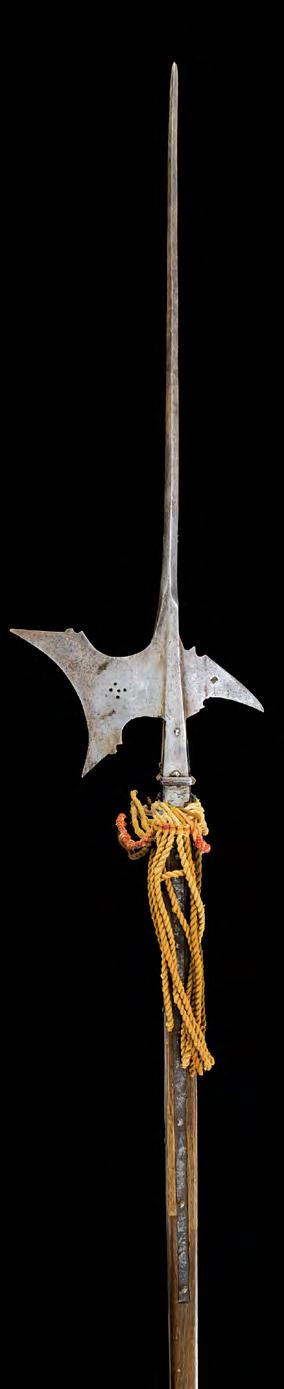



228
A HALBERD
Austria, circa 1600
Head with cusp of square point at the top. Quite wide, hollow-edged axe with regular curve and small, beak-like lugs on the back, featuring a single group of circular openworks in the middle. Rear fluke slightly curved downward, without open-works. Clearly visible gunsmith’s mark. The straps are of good length, covered by a fabric tassel at the base, applied at a later date. Also with ring nut and counterstraps. Wooden shaft of a later date, at least partially, and certainly spliced. Probably Austria or Germany.
ALABARDA
Austria, 1600 circa Ferro con cuspide sommitale a quadrello di discreta lunghezza. La scure abbastanza ampia, a taglio incavato con curva regolare e piccole gobbe a becchetto al dorso, dotata di un singolo gruppo di sforature circolari al centro. Il becco lievemente incurvato verso il basso, senza sforature. Presente ben visibile la marca di un armaiolo. Bandelle di buona lunghezza con base coperta da una nappa in tessuto, applicata successivamente. Presente anche la ghiera e le controbandelle. L’asta lignea almeno in parte più tarda e sicuramente giuntata. Probabilmente Austria o Germania.
Conditions good Height 233.5 cm. € 400/600
229 A STYRIAN HALBERD
Austria, Late 16th Century Head with cusp of square section (slightly bent), strongly hollow-edged axe, with open-works and small beak-like lugs on the back. The rear fluke is slightly curved downward and has three open-works. Not particularly long straps provided with counter-straps (one shorter than the others). Base covered by a fabric tassel added at a later date. Iron ring nut. Signs of use and time. Wooden shaft of older manufacture, with various woodworm holes, spliced at the lower section.
ALABARDA STIRIANA
Austria, Fine del XVI Secolo Ferro con cuspide a quadrello (leggermente piegata), scure a taglio fortemente incavato, con sforature e con gobbe a becchetto al dorso. Becco leggermente incurvato verso il basso e con tre sforature. Bandelle non particolarmente lunghe ma munite di controbandelle (una più corta delle altre). La base coperta da una nappa in tessuto aggiunta successivamente. Ghiera in ferro presente. Segni d’uso e del tempo. Asta lignea di produzione non recente, con vari fori di tarlo, giuntata nel segmento inferiore.
Conditions good
Height 238 cm.
€ 350/450
230 A STYRIAN HALBERD
Austria, last quarter of the 16th Century Iron with long, sturdy cusp of square section, provided with strongly hollow-edged axe lengthened at the top. The axe surface with circular open-works in groups of three and five, engraved with crescent-shaped decorations; small lugs on the back. Straight, sturdy rear fluke curved downward, with three open-works at the base and a slightly thickened at the tip. Clearly visible gunsmith’s mark. Medium-length straps (both broken), covered by a fabric tassel at the base which was added at a later date. Also featuring a square iron ring nut. With counterstraps. Wooden shaft of square section and older manufacture, with evident signs of use and time, probably slightly shortened.
ALABARDA STIRIANA
Austria, ultimo quarto del XVI Sec. Ferro con lunga e robusta cuspide a quadrello, munito di scure fortemente incavata e allungata nella parte superiore. La superficie della scure con sforature circolari disposte a gruppi di tre e cinque e incisioni a falce di luna, il dorso con piccole gobbe. Il becco dritto, robusto e appuntato verso il basso, con tre sforature alla base e leggermente ingrossato in punta. Presente ben visibile il timbro di un armaiolo. Bandelle di media lunghezza (entrambe con rottura) la cui base è coperta da una nappa in tessuto applicata in epoca più tarda. Presente anche una ghiera quadra in ferro. Controbandelle presenti. Asta lignea di sezione quadra di produzione non recente, con evidenti segni d’uso e del tempo, probabilmente un po’ accorciata.
Conditions good
Height 233.5 cm.
€ 450/650
231 A STYRIAN HALBERD
Austria, last quarter of the 16th Century
Fine head with very long and sturdy cusp of square section, provided with small, hollow-edged axe decorated with three groups of circular open-works and with lugs on the back. The rear fluke is slightly thickened toward the tip, with open-works at the base, and curved downward. Featuring a gunsmith’s mark. Straps of good length, with fastenings covered by a fabric tassel added at a later date and featuring an iron ring nut. The counterstraps are present but shorter. Wooden shaft of older manufacture, with signs of use and time, probably slightly shortened.
ALABARDA STIRIANA
Austria, ultimo quarto del XVI Sec. Bel ferro con lunghissima e robusta cuspide a quadrello, munito di piccola scure incavata lavorata con tre gruppi di sforature circolari e dotata di gobbe al dorso. Il becco leggermente ingrossato verso la punta, dotato di sforature alla base e appuntato verso il basso. Presente la marca di un armaiolo. Bandelle di buona lunghezza con attaccatura coperta da una nappa in tessuto applicata in epoca più tarda e con ghiera in ferro. Presenti le controbandelle, più corte. Asta lignea di produzione non recente, consegni d’uso e del tempo, probabilmente un po’ accorciata.
Conditions good
Height 271 cm.
€ 500/700
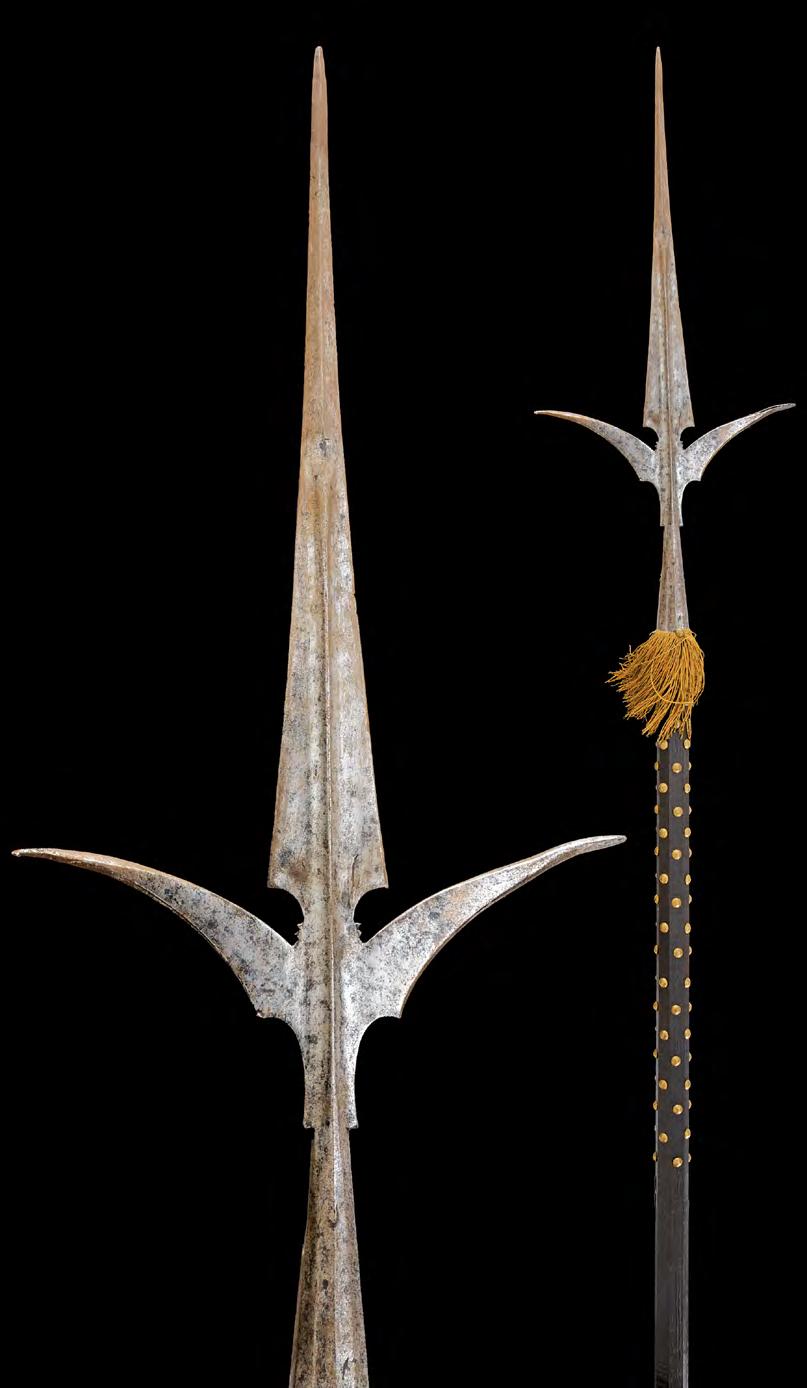
232
A SPETUM
Northern Italy, early 16th Century Spearhead with a cusp featuring a solid tip of square section that tapers and widens toward the base, retaining a thick central rib; at the base of the blade, the neck is equipped with small teeth. The two rake-like wings, initially sloping upward and then running perpendicular to the shaft, are fitted with thickened tips. Faceted pommel shaped as a truncated cone and with a crack on one side. Wooden shaft of much more recent manufacture, with a fabric tassel and decorative studs at the top.
Interesting weapon, likely directly derived from the” spiedo alla furlana” of the previous century, of Venetian origin (it is depicted on the coat of arms of the city of Trieste), which had larger dimensions than the present example, but the same form and proportions.
SPIEDO ALLA FURLANA
Italia del Nord, inizio del XVI Sec. Ferro con cuspide munita di robusta punta a quadrello che poi si assottiglia e si allarga verso la base, mantenendo una spessa nervatura centrale; alla base della lama il collo munito di piccoli denti. Le due ali a raffio, dapprima crescenti poi perpendicolari all’asta munite anche queste di punta ingrossata. La gorbia troncoconica e faccettata, con una crepa su un lato. Asta lignea di produzione assai più recente, con nappina in tessuto e chiodini decorativi nella parte alta.
Interessante arma probabilmente derivata direttamente dallo spiedo alla furlana del secolo precedente, di origine veneta (è raffigurato sullo scudo della città di Trieste), che aveva dimensioni maggiori rispetto all’esemplare da noi presentato, ma stessa forma e proporzioni.
Conditions good Height 252 cm. € 500/800
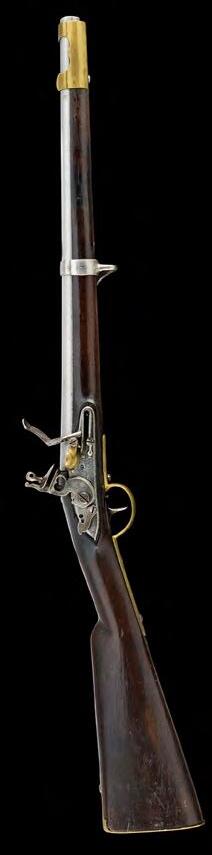

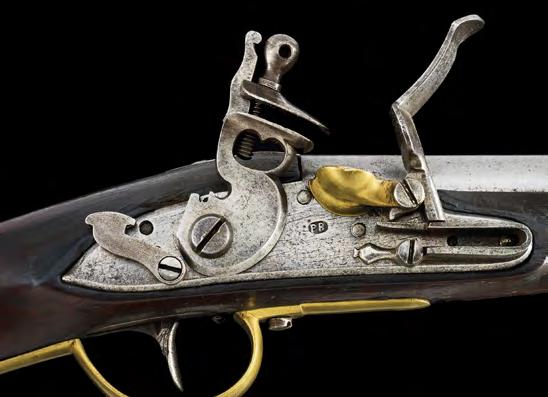
233
A 1798 MODEL HUSSAR’S CARBINE
Austria, circa 1800
Smoothbore, round, 17.6 mm cal. barrel, with flattened sides at the breech and “IS” mark; tang with sight; flintlock with flat lock plate marked “PB” and safety lock, brass pan; wooden full stock marked “PC” and “6” on the counterplate part; trigger guard, counterplate (marked “VP”), brass butt-plate and barrel bracket. Mouthpiece with foresight, all made of brass; saddle hook with ring and iron band. Very rare.
CARABINA DA USSARI MOD. 1798
Austria, 1800 circa
Canna tonda liscia, con fianchi appiattiti alla culatta e il punzone “IS”, cal. 17.6 mm in volata; codetta munita di traguardo. Batteria a pietra focaia con cartella piatta punzonata “PB”, dotata di sicura esterna, con scodellino in ottone. Cassa intera in legno marcata “PC” e “6” sul lato della contropiastra. Ponticello, contropiastra (marcata “VP”), coccia del calcio e reggicanna tutti in ottone. Bocchino con mirino. Gancio da sella con anello e relativa fascetta in ferro. Molto rara.
Conditions good Length 85.5 cm.
€ 750/1.200
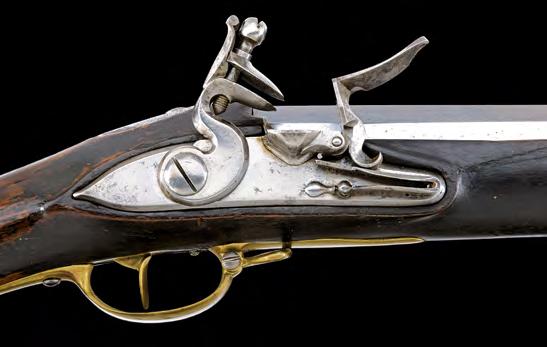
234 AN INFANTRY FLINTLOCK GUN
Europe, 18th Century
Two-stage, smoothbore, 18 mm cal. barrel, octagonal at the first part then round, with foresight on the upper flat of the round section and clutch for the bayonet; tang with sight. Flintlock mechanism with flat lock plate and oblique borders. The two screws on the lock plate are blind. Working mechanism. Wooden full stock (small missing parts) with brass mounts and iron ramrod.
FUCILE A PIETRA FOCAIA DA FANTERIA
Europa, XVIII Secolo
Canna liscia a due ordini, prima ottagonale poi tonda con mirino sulla quarta fascetta e con attacco per la baionetta, cal. 18 mm in volata; codetta dotata di traguardo. Batteria a pietra focaia con cartella piatta e bordi obliqui. Le due viti della piastra non passanti. Meccanica funzionante. Cassa intera in legno (piccole mancanze) con fornimenti in ottone e bacchetta in ferro.
Conditions good
Length 145.5 cm.
€ 700/1.000
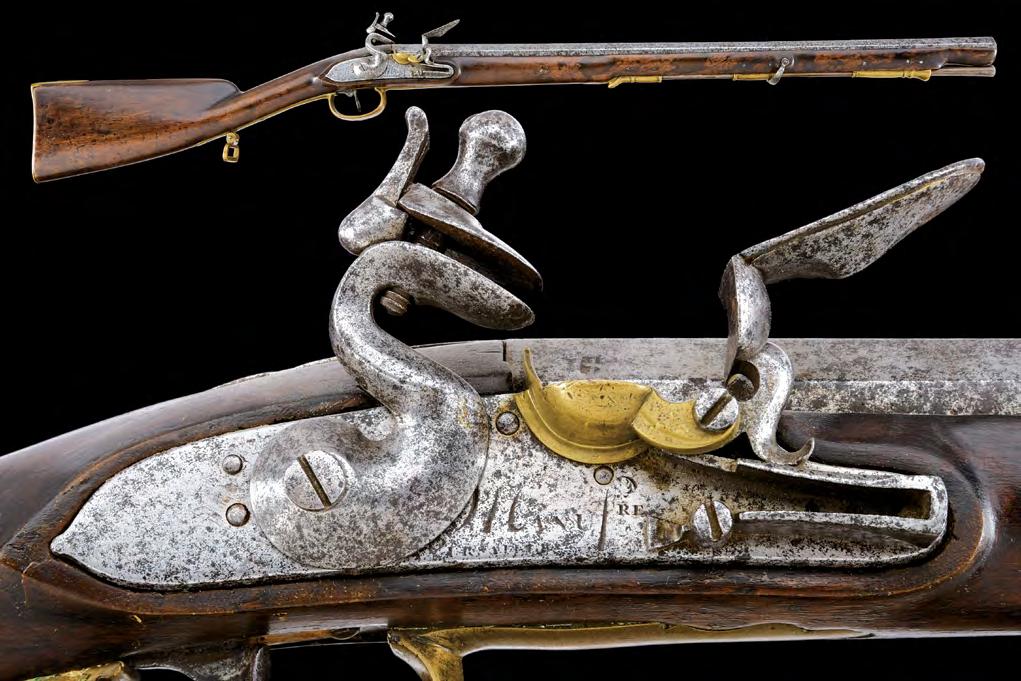

235
A RARE 1793 MODEL INFANTRY CARBINE, "CARABINE DE VERSAILLES"
Versailles, circa 1800
Octagonal rifled 15 mm cal barrel (bore with pitting, visible rifling), two marks and a short groove on the chamber, the latter also on the nozzle. Flintlock with plate marked ‘MANUF.RE VERSAILLES’ (not perfectly legible); brass pan, working mechanism. Wooden full stock (some defects and minor repairs) with brass mounts and iron ramrod. Iron elements with areas of pitting.
RARA CARABINA DA FANTERIA MOD. 1793, “CARABINA DI VERSAILLES”
Versailles, 1800 circa Canna di sezione ottagonale, rigata (anima con pitting, rigatura visibile), alla camera di scoppio due punzoni e breve scanalatura, quest’ultima si trova anche alla volata, cal. 15 mm. Batteria a pietra focaia, cartella marcata “MANUF.RE VERSAILLES” (non perfettamente leggibile); scodellino in ottone, meccanica ben funzionante. Cassa intera in legno (alcuni difetti e piccoli restauri) con fornimenti in ottone e bacchetta in ferro. Gli elementi in ferro con zone di pitting.
Conditions mediocre
Length 102.5 cm.
€ 2.000/3.500
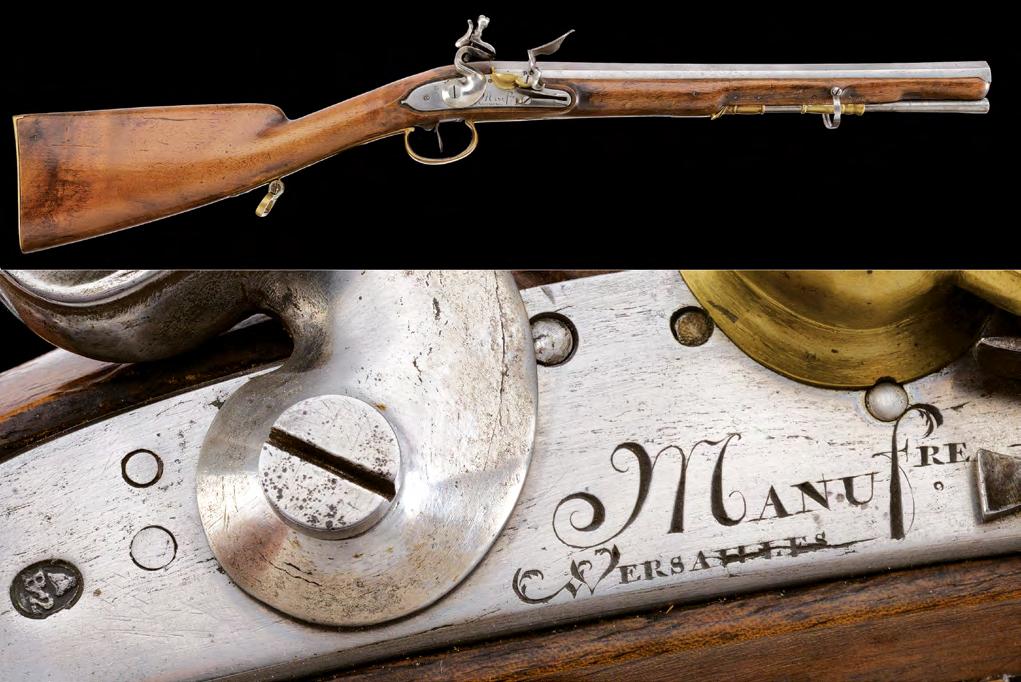

236
AN EXTREMELY RARE 1793 MODEL CAVALRY
CARBINE, "CARABINE DE VERSAILLES"
Versailles, circa 1800
Short, solid, octagonal, rifled, 15 mm cal barrel (bore with slight encrustations, clearly visible rifling), mark on the chamber, ‘RF’ marking and short groove, the latter also found on the nozzle. Flintlock, plate marked ‘MANUF.RE VERSAILLES’ (a scratch on the second word); mark on the tang, brass pan, working mechanism. Wooden full stock with brass mounts and iron ramrod.
RARISSIMA CARABINA DA CAVALLERIA MOD. 1793, “CARABINA DI VERSAILLES”
Versailles, 1800 circa Corta canna robusta di sezione ottagonale, rigata (anima con leggere incrostazioni, rigatura ben visibile), recante alla camera di scoppio un punzone, marcatura “RF” e breve scanalatura, quest’ultima si trova anche alla volata, cal. 15 mm. Batteria a pietra focaia, cartella marcata “MANUF.RE VERSAILLES” (graffio sulla seconda parola); alla coda un punzone, scodellino in ottone, meccanica ben funzionante. Cassa intera in legno con fornimenti in ottone e bacchetta in ferro.
Conditions very good
Length 78 cm.
€ 3.500/4.500
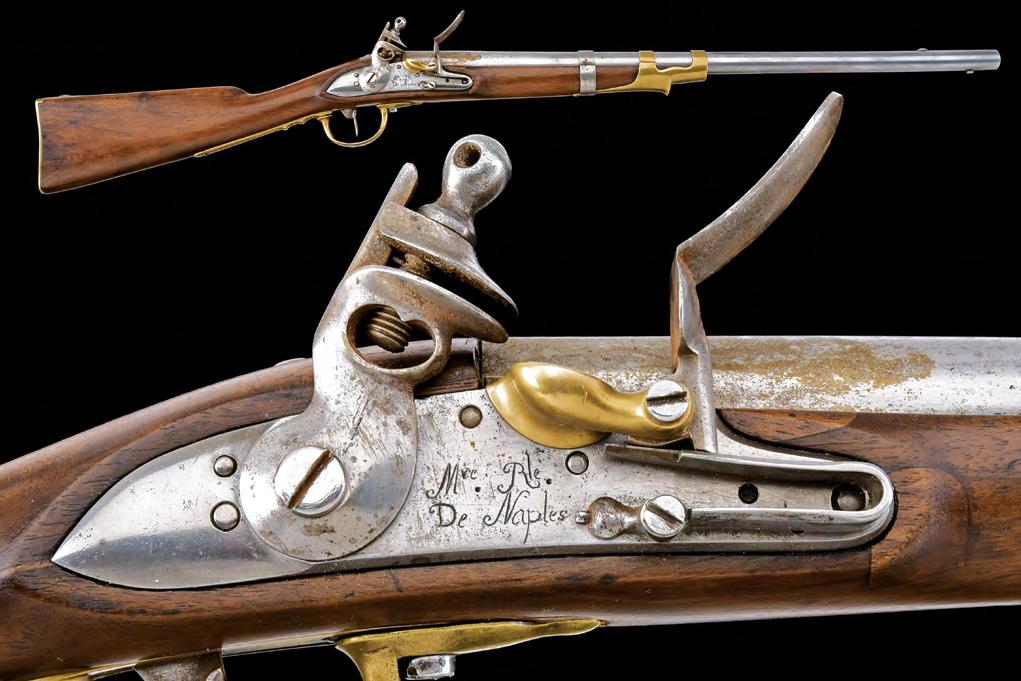
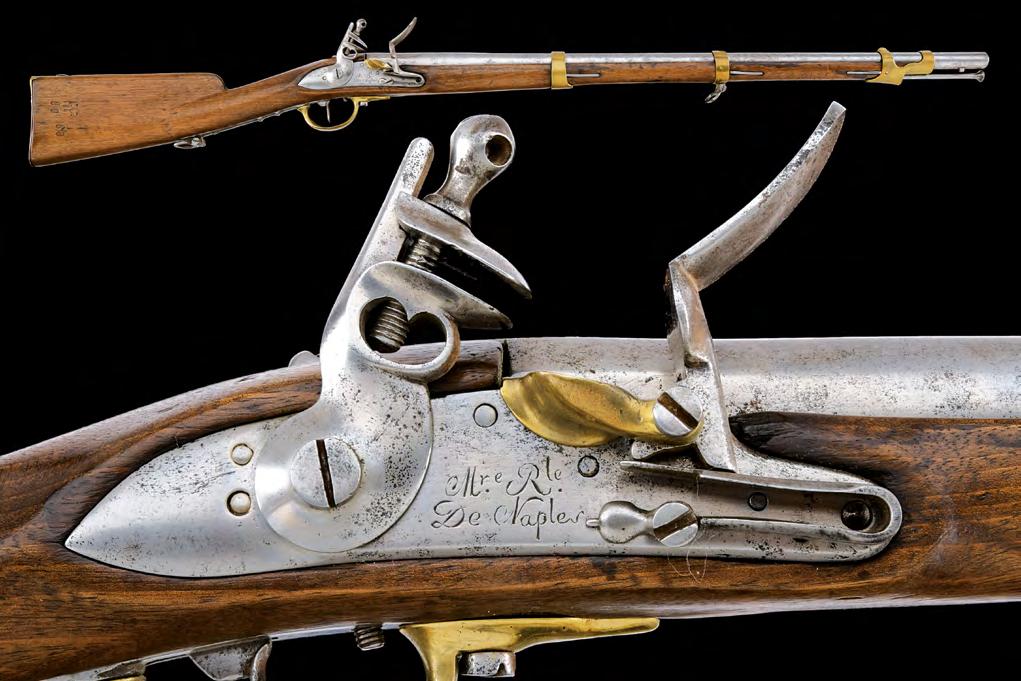
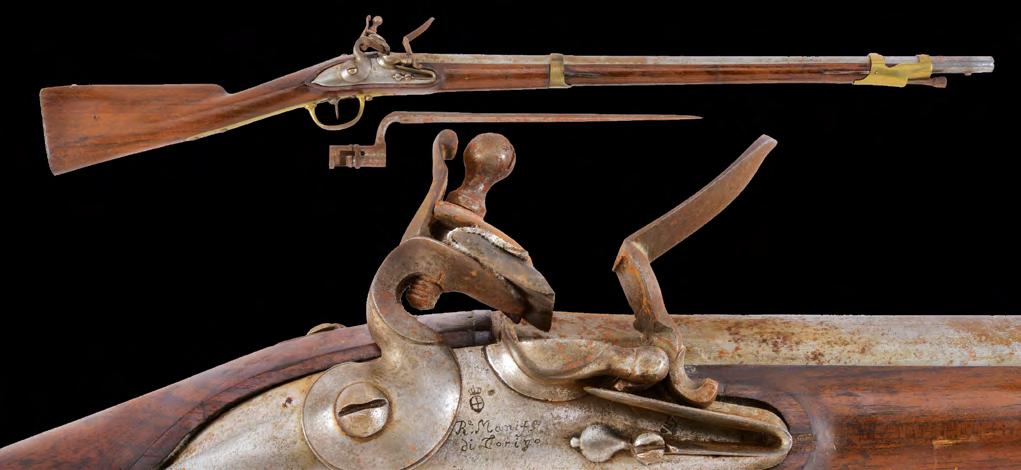
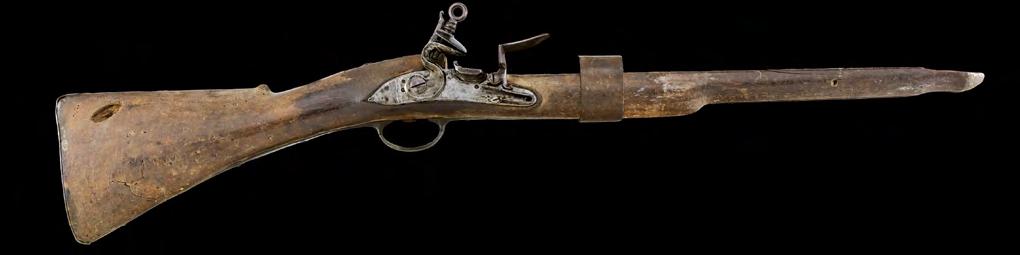
237
A CAVALRY FLINTLOCK MUSKETOON
Kingdom of Naples, first quarter of the 19th Century Smoothbore, round, 17 mm cal. barrel, with octagonal breech, foresight and clutch for the bayonet; lock with flat lock plate and round tang, marked “M.re R.le / de Naples” in cursive, with brass pan; wooden, half stock with brass mounts. Without ramrod. On the left side, iron bar and sling swivel. Rare.
MOSCHETTONE A PIETRA FOCAIA DA CAVALLERIA
Regno di Napoli, primo quarto del XIX Sec. Canna tonda liscia, con culatta ottagonale, dotata di mirino e attacco per la baionetta, cal. 17 mm. Batteria a cartella piatta con codetta tondeggiante, marcata “M.re R.le / de Naples” in corsivo, scodellino in ottone. Mezza cassa in legno con fornimenti in ottone. Privo di bacchetta. Sul fianco sinistro barra in ferro e anello da sella. Raro.
Conditions medium
Length 95.5 cm. € 600/900
238
A RARE FLINTLOCK SHORT MUSKET, MURAT EPOCH Kingdom of Naples, 1809
Smoothbore, round barrel with octagonal breech, featuring clutch for the bayonet, 17.4 mm cal. at the nozzle. The lock plate has the French inscription “M.re R.le de Naples” on the lock plate, provided with brass pan; working mechanism. Marks, number “22” and the date “1809” inside the breech. Long wooden stock with remains of stamps and numbers on the butt stock, with some signs of use and time. Brass mounts. Iron and brass trigger guard. Iron parts with some pitting. Iron ramrod.
Based on the French model for the mounted grenadiers of the Imperial Guard. The item was used by the gendarmerie, the Royal Guard’s cuirassiers, the artillery and the sappers of the First Kingdom of Naples under Murat’s rule.
RARO MOSCHETTO A PIETRA FOCAIA, EPOCA DI GIOACCHINO MURAT
Regno di Napoli, 1809
Canna tonda liscia con culatta ottagonale, dotata di dente d’innesto per baionetta, cal. 17,4 mm in volata. Batteria con iscrizione in lingua francese “M.re R.le de Naples” sulla cartella, dotata di scodellino in ottone; con meccanica funzionante. All’interno della piastra punzoni, numerazione “22” e data “1809”. Cassa lunga in legno con resti di timbri e numerazioni alla pala, con qualche segno d’uso e del tempo. Fornimenti in ottone. Ponticello in ferro e ottone. Le parti in ferro con qualche intaccatura. bacchetta in ferro.
Basato sul modello francese per granatieri a cavallo della Guardia Imperiale. In uso alla
gendarmeria, ai corazzieri della Guardia Reale, all’artiglieria e ai zappatori del primo Regno di Napoli sotto il governo di Murat.
Conditions good Length 113.3 cm.
€ 900/1.200
239
A FLINTLOCK GUN WITH SOCKET BAYONET Turin, First half of the 19th Century Smoothbore, round, 17 mm cal. barrel, octagonal at the base; a mark on the left side; foresight on the barrel bracket; flintlock mechanism with a rounded lock plate marked “R.a Manif.a di Torino”and featuring the Piedmontese mark. Wooden full stock with brass mounts; iron ramrod and bayonet.
FUCILE A PIETRA CON BAIONETTA A GHIERA Torino, Prima metà del XIX Secolo Canna liscia, tonda, con culatta ottagonale, recante sul lato sinistro un punzone, mirino su reggicanna, cal. 17 mm in volata. Batteria a pietra focaia con cartella tondeggiante firmata “R.a Manif.a di Torino”e con marca piemontese. Cassa intera in legno con fornimenti in ottone, bacchetta e baionetta in ferro.
Conditions medium
Length 115 cm.
€ 250/450
240 A LOCK AND STOCK OF A HUGE RAMPART GUN
Europe, 18th Century
Large antique wooden stock, with some old repairs and several worm holes. The stock still retains its original flintlock stamped“FF”inside. Still present are the trigger, the trigger guard (in non-ferrous metal), the butt-plate made of non-ferrous metal, and a single iron barrel bracket. Unfortunately, the barrel and the counter plate are missing. Maybe austrian? Rare and interesting.
CASSA E BATTERIA DI UN GRANDE FUCILE DA RAMPARO
Europa, XVIII Secolo
Cassa antica in legno, di ragguardevoli dimensioni, con alcune antiche riparazioni e diversi fori di tarlo. La cassa conserva ancora la batteria originale a pietra focaia timbrata “FF”all’interno. Presenti ancora il grilletto, il ponticello (in metallo non ferroso), il calciolo, sempre in metallo non ferroso e un singolo reggicanna in ferro. La canna purtroppo non presente, cosi come la contropiastra. Forse di tipologia austriaca. Raro e interessante.
Conditions medium
Length 124 cm.
€ 150/300
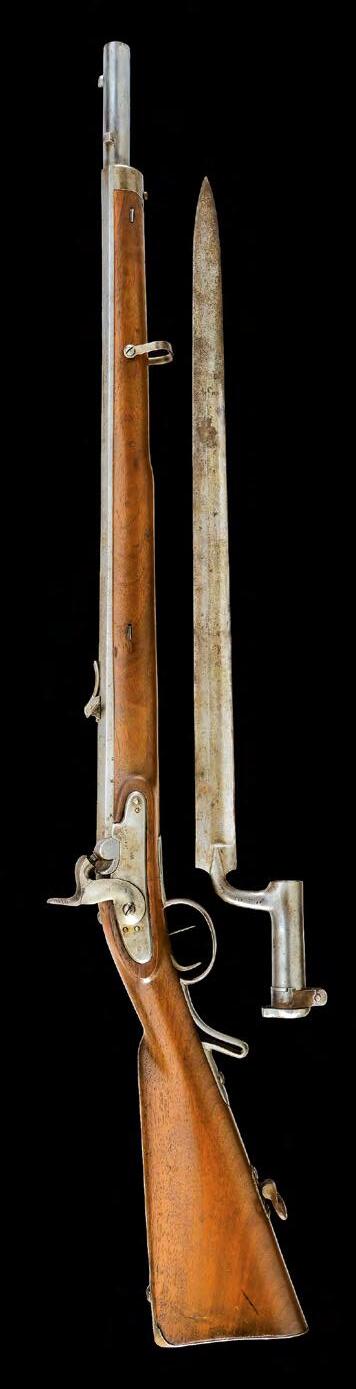
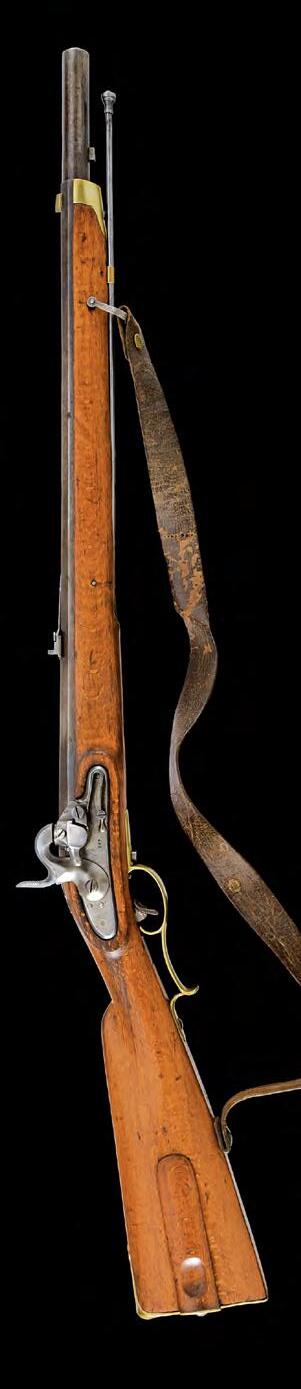
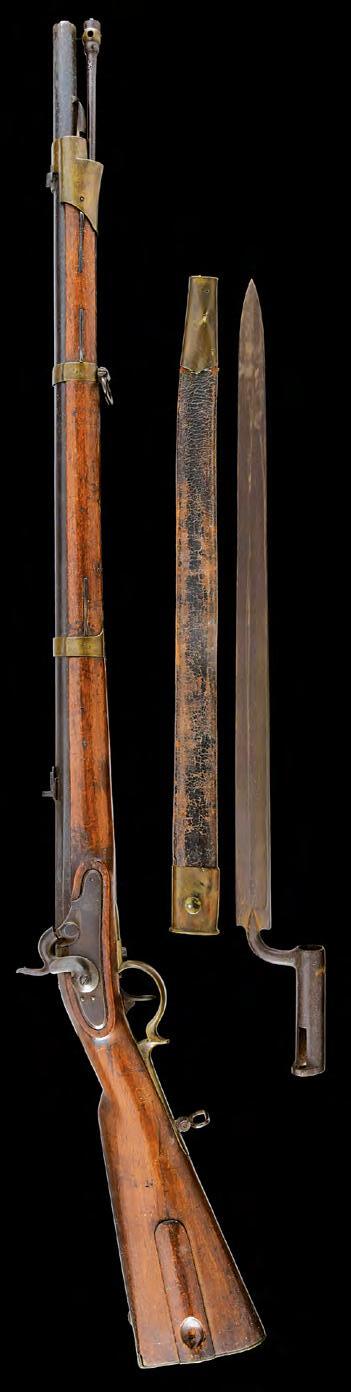
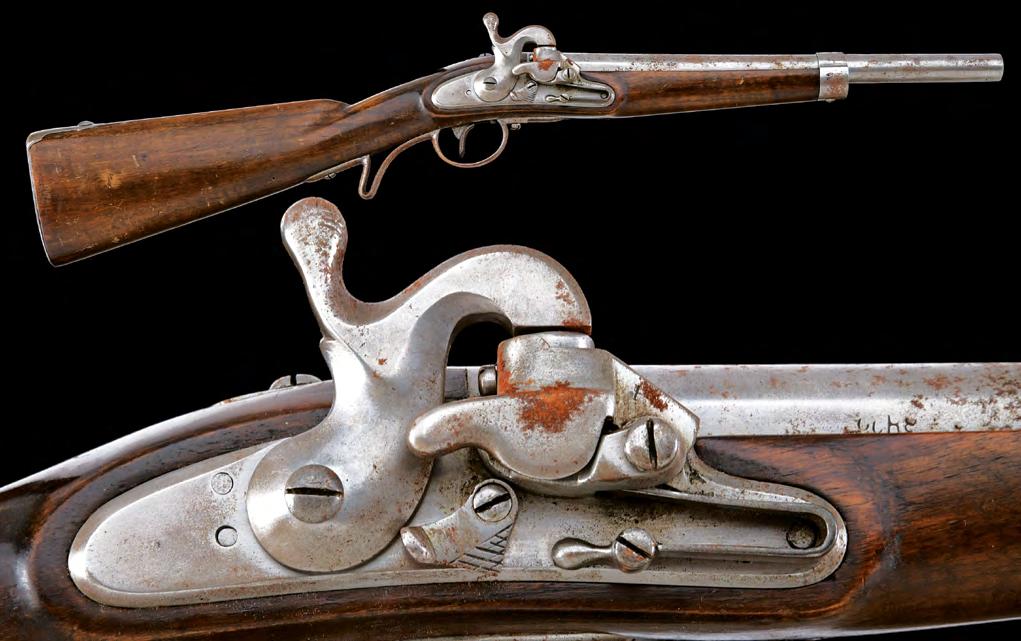
241
A RARE 1854 MODEL LORENZ JAEGERSTUTZEN WITH STECHER
Austria, 1860
Octagonal, rifled barrel (clean bore, slight pitting in some areas, visible rifling) with cylindrical nozzle, provided with adjustable rear sight, foresight and clutch for the bayonet, 13.9 mm cal. at the nozzle. Marked “F. LMFAHRER” on the powder chamber, with “W” mark surmounted by the double eagle. Forward spring percussion lock, lock plate featuring the date “860” (for 1860) and imperial mark. Working mechanism. Provided with working trigger and set trigger. Wooden, full stock (light signs of use and time) with iron mounts, butt-plate featuring remains of mark. With haubajonett with remains of mark (length: 71.5 cm). Large trigger guard, probably modified, with one missing screw. Model without ramrod compartment.
An interesting item with modifications made to the trigger and the trigger guard to place a set trigger. Perhaps an experimental prototype.
RARO JAEGERSTUTZEN MOD. 1854 LORENZ MUNITO DI STECHER
Austria, 1860
Canna ottagonale rigata (anima pulita, leggero pitting in qualche punto, rigatura visibile) con volata cilindrica, dotata di alzo regolabile, mirino e dente di innesto per la baionetta, cal. 13.9 mm in volata. Sulla camera di scoppio marcatura “F. LMFAHRER”, punzone “W” sormontato dall’aquila bicipite. Batteria a luminello a molla in avanti, cartella con data “860” (per il 1860) e punzone imperiale. Meccanica funzionante. Munito di grilletto e stecher funzionanti. Cassa intera in legno (leggeri segni d’uso e del tempo) con fornimenti in ferro, calciolo con tracce di marcatura. Con haubajonett recante resti di marcatura (lunghezza: 71,5 cm). Ampio ponticello probabilmente modificato, con una vite mancante. Modello privo dell’alloggiamento per la bacchetta.
Interessante esemplare con modifica apportata allo scatto e al ponticello per alloggiare uno stecher. Forse un prototipo sperimentale.
Conditions good
Length 109.6 cm.
€ 300/500
242 AN 1851 MODEL CAVALRY CARBINE WITH AUGUSTIN SYSTEM
Austria, 1853
Short, round, smoothbore, 17 mm cal barrel, square at the base with remains of markings on both sides; smooth tang; forward spring lock with Augustin system, lock plate with date “853”. Wooden stock with iron mounts. Sling swivel. Rare.
CARABINA DA CAVALLERIA MOD. 1851 CON SISTEMA AUGUSTIN
Austria, 1853
Canna liscia, corta, tonda, con base quadra avente resti di marcature su entrambi i lati, cal. 17 mm; codetta liscia. Batteria a molla in avanti con sistema Augustin, cartella con data “853”. Cassa in legno con fornimenti in ferro. Anello da sella. Rara.
Conditions good
Length 75.5 cm.
€ 400/800
243 A KAMMERBUECHSE RIFLE WITH LORENZ PERCUSSION CONVERSION, WITH BAYONET
Austria, Third quarter of the 19th Century Round, rifled barrel, with octagonal breech, dated 846 (for 1846) and “41 V”, provided with cutch for the bayonet, foresight and rear sight with two adjustable sight leaves, fixed rear sight. 18,1 mm cal. at the nozzle. It needs cleaning inside, visible rifling. Percussion lock with working mechanism, without marks. Wooden, full stock with some signs of use and time, remains of stampings. Butt stock with patchbox containing two cartridge extractors inside. Brass mounts browned by time, several marked “21”, as are some screws. Complete with ramrod. In beautiful patina of time, barely used. With a 71.5 cm haubajonett with scabbard (worn leather).
KAMMERBUECHSE CON CONVERSIONE LORENZA A LUMINELLO, CON BAIONETTA
Austria, Terzo quarto del XIX Secolo
Canna tonda rigata, con culatta ottagonale, datata “846 (per 1846) e “41 V”, dotata di dente d’innesto per baionetta, mirino e alzo a due fogliette abbattibili e una tacca di mira fissa. Cal. 18,1 mm in volata. L’interno da pulire, rigatura visibile. Batteria a luminello con meccanica funzionante, senza timbri. Cassa intera in legno con qualche segno d’uso e del tempo e resti di stampigliature. Pala con patchbox che conserva due cavastracci all’interno. Fornimenti in ottone bruniti dal tempo, vari timbrati “21” come anche alcune viti. Completo di bacchetta. In bella patina del tempo toccata poco o nulla. Con haubajonett di 71,5 cm dotato di fodero (con cuoio usurato).
Conditions medium
Length 122.5 cm.
€ 800/1.200
244 A RARE 1807/42 MODEL JAEGERSTUTZEN WITH AUGUSTIN SYSTEM
Austria, 1847
Octagonal, rifled (bore with moderate pitting, seven clearly visible grooves), 13.9 mm cal. barrel with round nozzle, the breech featuring various marks including “V”, “FG” (or “FC”),“A”, an imperial mark, and others; two-leaf rear sight, brass foresight, clutch for the bayonet; tang numbered “196”. Augustin system lock dated “847” with imperial mark. Wooden full stock with patch-box, brass mounts, iron ramrod, and leather strap.
RARO JAEGERSTUTZEN MOD. 1807/42 SISTEMA AUGUSTIN
Austria, 1847
Canna ottagonale con volata tonda, rigata (anima con moderato pitting, le sette rigature ben visibili), recante vari punzoni alla base, fra i quali: “V”,“FG” (o FC),“A”, il marchio imperiale e altri timbri; dotata di alzo a due fogliette, mirino in ottone, attacco per la baionetta, cal. 13.9 mm; codetta con numero “196”. Batteria con sistema Augustin datata “847” e con punzone imperiale. Cassa intera in legno con patch-box, fornimenti in ottone, bacchetta in ferro e cinghia in cuoio.
Conditions good
Length 104.5 cm.
€ 800/1.200
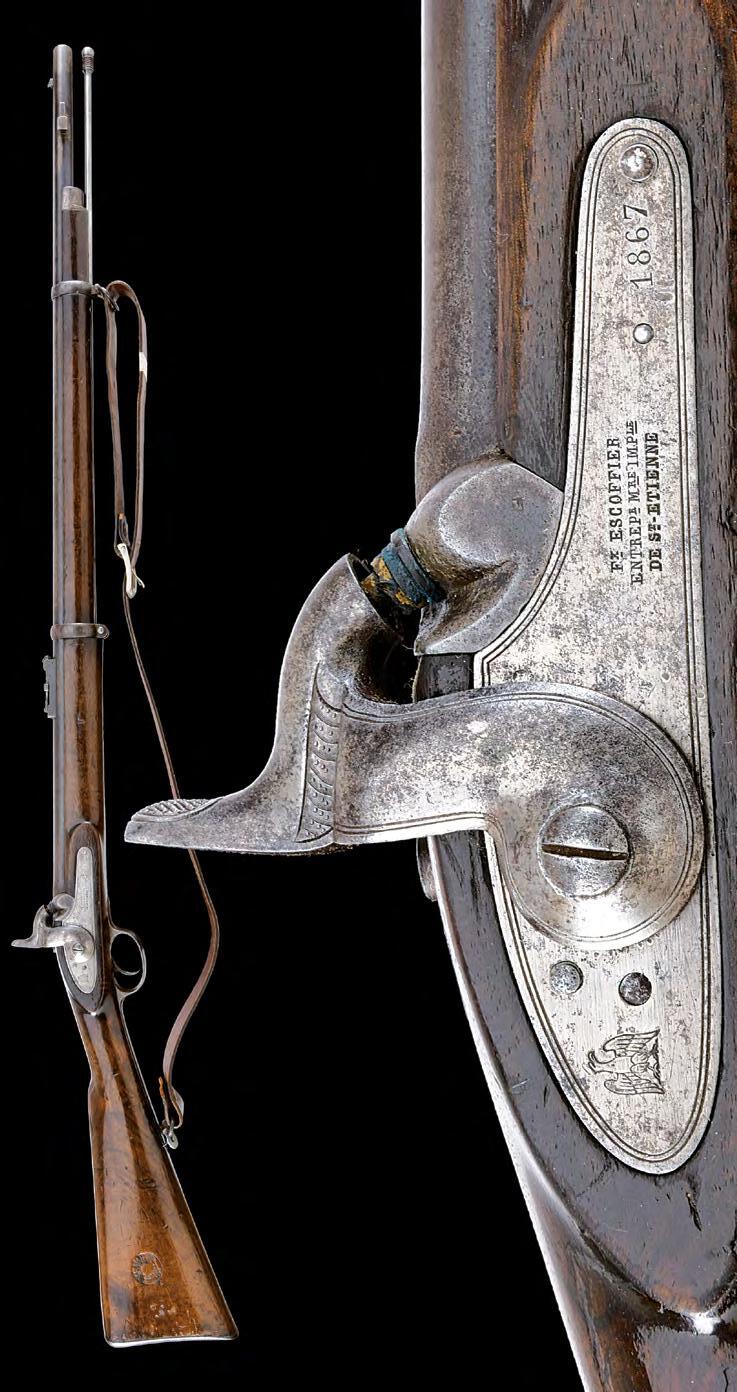
245 A P53 PATTERN PERCUSSION MUSKET BY ESCOFFIER
France, 1860-70
Round, rifled barrel with octagonal breech, provided with foresight and club guide for the bayonet, featuring an adjustable rear sight and the date “1867” on the back. .59 (15.2 mm) cal. at the nozzle. Also featuring the “GM” mark surmounting a crescent moon, and marks “D” and crowned “P”. Bore with visible rifling; various encrustments inside which need cleaning. Lock marked “F.x ESCOFFIER ENTREP.E M.re IMP.le De ST. ETIENNE,” with eagle on the tang and the date “1867.”Working two-snap mechanism, the first snap with working safety lock. Stock of walnut wood with small defects, signs of use and time, featuring Escoffier’s circular stamp on the butt stock, no longer clearly legible but with matching date; remains of other stamps on the wood, including the “GM” mark above the crescent moon. Iron mounts and ramrod. Uncommon.
FUCILE A LUMINELLO SUL TIPO P53 DI ESCOFFIER
Francia, 1860-70
Canna tonda rigata con culatta ottagonale, dotata di mirino e di guida d’innesto per la baionetta, recante al dorso l’alzo regolabile e la data “1867”. In volata cal. .59 (15,2 mm). Presente anche marchio “GM” sormontante una falce di luna, punzone “D” e “P” coronato. Anima con rigatura visibile, varie incrostazioni da pulire all’interno. Batteria marcata “F.x ESCOFFIER ENTREP.E M.re IMP.le De ST. ETIENNE”, con aquila alla codetta e con data “1867”. Meccanica funzionante, due scatti, il primo con sicura funzionante. Cassa in noce con piccoli difetti, segni d’uso e del tempo, recante alla pala bollo circolare di Escoffier, non più chiaramente leggibile ma con data coeva; resti di altri timbri sul legno fra i quali il marchio “GM” soprastante la falce di luna. Fornimenti e bacchetta in ferro. Non comune.
Conditions good
Length 128.5 cm.
€ 200/300
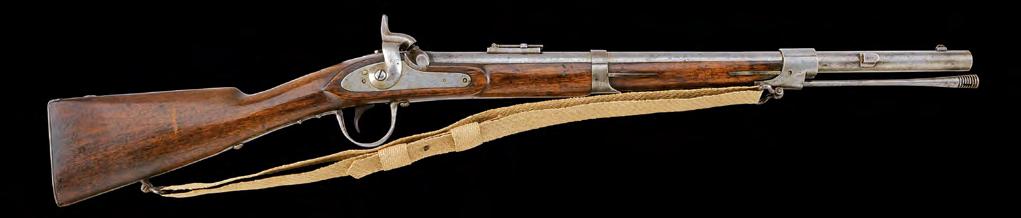

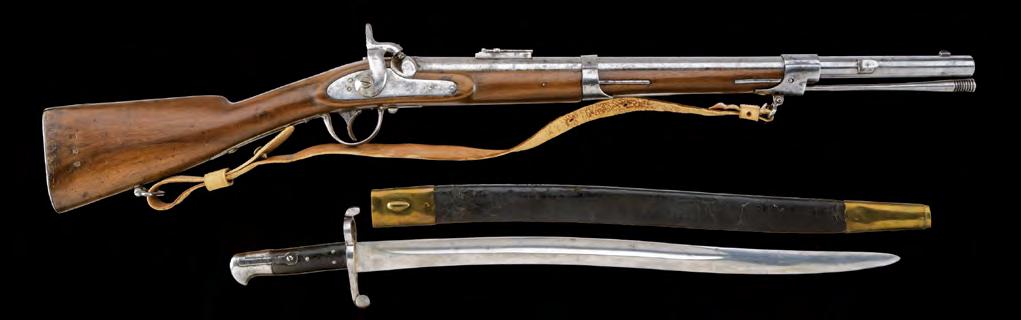
246
AN INTERESTING PERCUSSION CAVALRY CARBINE BY BARRET
Great Britain, Mid 19th Century Round, rifled, 18 mm cal barrel, the breech with short rib and marked with numerous proof marks, among them “V” and “P” beneath crown and with the number “144”; adjustable folding rear sight, clutch for the bayonet and front sight. Forward spring percussion lock, internally signed “BARRET” and with another inscription (scarcely legible). Full wooden stock, the left side of the butt stamped with well-marked “GN”. Iron mounts and ramrod.
INTERESSANTE CARABINA A LUMINELLO DA CAVALLERIA DI BARRET
Gran Bretagna, Metà del XIX Secolo
Canna tonda rigata, dotata di breve bindella alla camera di scoppio e marcata con numerosi punzoni, fra i quali “V” e “P” sotto corona e con il numero “144”; alzo variabile ed abbattibile, dente d’innesto per la baionetta e mirino; cal. 18 mm. Batteria a luminello a molla in avanti, internamente firmata “BARRET” e con un’altra firma poco leggibile. Cassa intera in legno, la guancia sinistra della pala con timbro ben marcato “GN”. Fornimenti e bacchetta in ferro.
Conditions good
Length 99 cm.
€ 200/300
247 A PERCUSSION RIFLE WITH A BAYONET
Great Britain, Second quarter of the 19th Century Smoothbore, round barrel, provided with foresight, marked “GR” with crown and Broad Arrow, and with another mark (Birmingham?)19.1 mm cal. at the nozzle. Pitting. Tang stamped “39” under crown. Forward spring percussion lock (pre-Lovell?) marked “TOWER” with crown surmounting the initials “GR” (William IV?) and with marks. Working mechanism. Wooden full stock stamped on the butt stock “1805” under crowned Broad Arrow. Other marks in various places: 53 crowned, eight-pointed star within a circle. Brass mounts. Possibly a Brown Bess converted to percussion. Missing ramrod. With heavily engraved socket bayonet (length: 55.3 cm). Interesting.
FUCILE A LUMINELLO CON BAIONETTA
Gran Bretagna, Secondo quarto del XIX Secolo Canna tonda liscia, dotata di mirino, punzonata “GR” con corona e Broad Arrow e con un altro punzone (Birmingham?), cal. 19,1 mm in volata. Intaccature. Codolo timbrato “39” sotto corona. Batteria a luminello a molla in avanti (pre-Lovell?) con marcatura “TOWER” con corona sormontante le iniziali “GR” (Guglielmo IV?) e con punzone. Meccanica funzionante. Cassa intera in legno timbrata sulla pala “1805” sotto a Broad Arrow coronata. Presenti altri punzoni in varie parti: 53 coronato, stella a otto punte entro un cerchio. Fornimenti in ottone. Forse un Brown Bess convertito a percussione. Bacchetta mancante. Con baionetta a manicotto fortemente intaccata (lungh. 55,3 cm.) Interessante.
Conditions medium
Length 139.5 cm.
€ 250/400
248
A PERCUSSION RIFLE WITH BAYONET
Great Britain, Mid 19th Century Round, rifled, 18 mm cal. barrel, with short rib at the base, marked with marks of the London test bench, with foldaway and adjustable rear sight, foresight and clutch for the bayonet; flat, percussion, forward spring lock. Working mechanism. Wooden stock with iron mounts and ramrod. White lacquered leather strap. With bayonet and scabbard.
FUCILE A LUMINELLO CON BAIONETTA
Gran Bretagna, Metà del XIX Secolo Canna tonda rigata, con breve bindella alla base, marcata con punzoni del banco di prova di Londra, munita di alzo regolabile e abbattibile, mirino e attacco per la baionetta, cal. 18 mm; batteria piatta, a luminello con molla in avanti. Meccanica funzionante. Cassa in legno con fornimenti e bacchetta in ferro. Cinghia in cuoio laccato color bianco. Completa di baionetta con fodero.
Conditions good
Length 99 cm. € 200/300
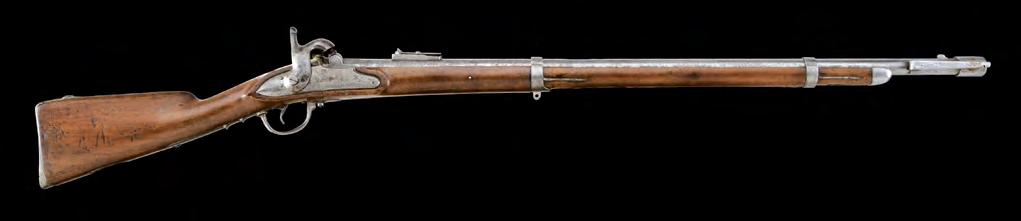
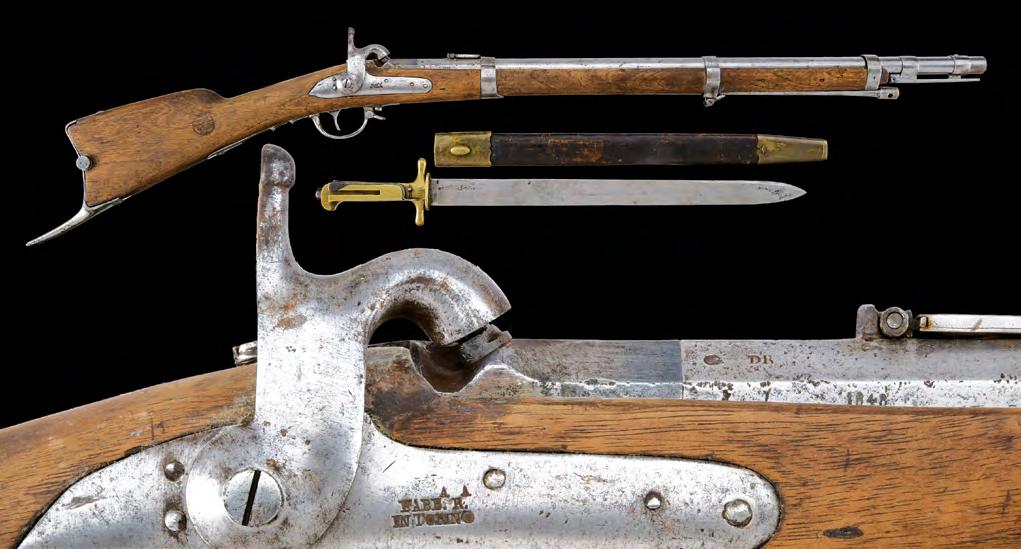
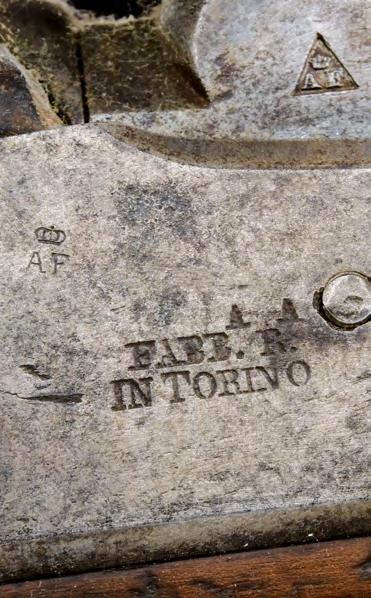
249 A RARE 1856 MODEL PERCUSSION CARBINE FOR “BERSAGLIERI”
Turin, 1850/60
Round, rifled barrel with octagonal breech, marked “MF” and featuring another mark, both surmounted by crown; provided with a foldaway, adjustable rear sight and foresight. Clean bore with visible rifling. 18.2 mm cal. at the nozzle. Typical clutch for the bayonet with side shaft and socket at the nozzle. Percussion featuring an “AF” mark at the base, crowned within a triangle. Forward spring lock marked “FABB.A R.A IN TORINO” and with crowned “AF” mark. Working mechanism. Long wooden stock. Iron mounts. Ramrod and the eyelet plate under the butt stock are missing. Condition between fair and good. Some pitting and signs of use and time.
RARA CARABINA A LUMINELLO DA BERSAGLIERI MOD. 1856
Torino, 1850/60
Canna tonda rigata, con culatta ottagonale, punzonata “MF” e con un altro marchio, entrambi sormontati da corona, dotata di alzo abbattibile e regolabile, e con mirino. Anima pulita con rigatura visibile. Cal. 18,2 mm in volata. Tipica imboccatura per la baionetta con asta laterale e manicotto in volata. La base del luminello con timbro “AF” coronato ascritto in un triangolo. Batteria a molla in avanti marcata “FABB.A R.A IN TORINO” e con punzone “AF” coronato. Meccanica funzionante. Cassa lunga in legno. Fornimenti in ferro. Mancanti la bacchetta e la piastrina per l’occhiello sotto alla pala. Condizioni fra medie e buone. Qualche intaccatura e segni d’uso e del tempo.
Conditions good Length 126.8 cm. € 350/700
250 AN 1848 MODEL PERCUSSION CARBINE FOR “BERSAGLIERI” , WITH BAYONET
Turin, 1848
Round, rifled, 16.9 mm cal barrel, octagonal at the base, marked “DR”, with three marks (not clearly visible) and dated 1848”, adjustable rear sight, clutch for the bayonet with foresight; forward spring percussion lock, signed “FABB.A R.A IN TORINO”; wooden full stock with stamp on the butt, iron mounts with pen-shape butt-plate featuring an opening with screw-closure marked “65”. Complete with ramrod and bayonet with scabbard. Rare.
CARABINA A LUMINELLO DA BERSAGLIERI MOD. 1848 CON BAIONETTA
Torino, 1848
Canna rigata, tonda, con base ottagonale, marcata “DR”, recante tre punzoni poco visibili e data “1848”, munita di alzo regolabile, attacco per la baionetta con mirino, cal. 16.9 mm. Batteria a luminello a molla in avanti firmata “FABB.A R.A IN TORINO”. Cassa intera in legno con timbro sul calcio, fornimenti in ferro con coccia a penna con scomparto dotato di chiusura a vite marcata “65”. Completa di bacchetta e baionetta con fodero. Rara.
Conditions medium
Length 119.5 cm. € 1.200/1.600
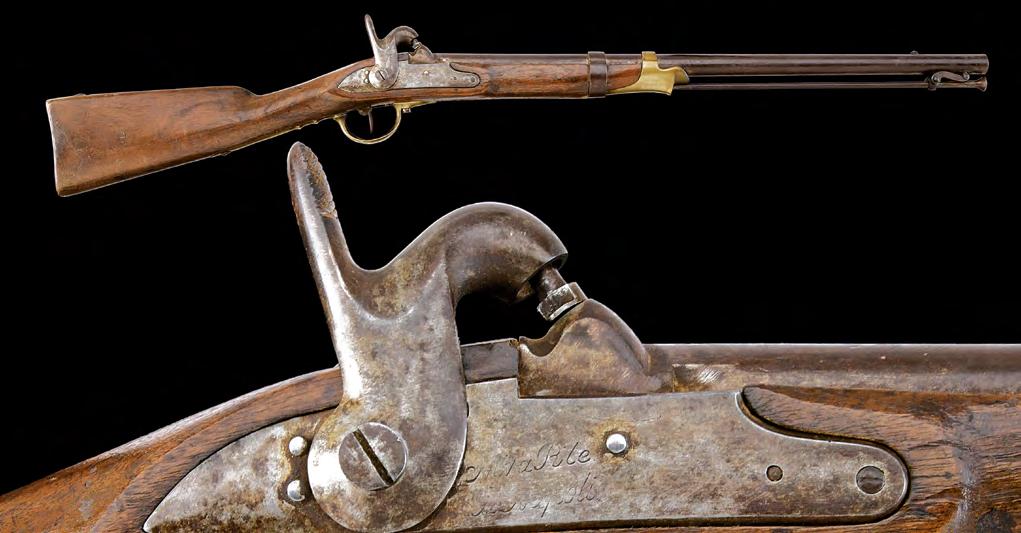
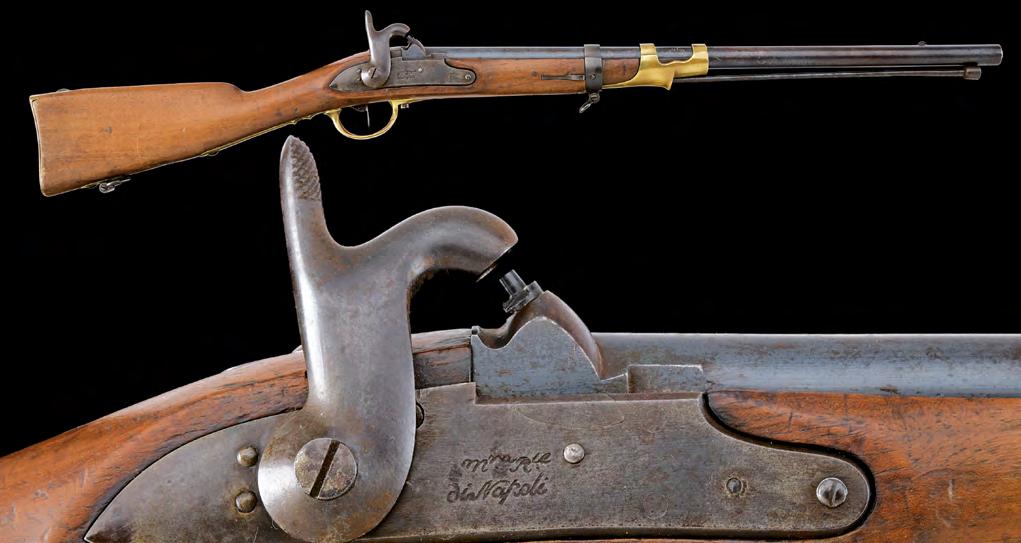
251
A FLINTLOCK CAVALRY MUSKETOON CONVERTED TO PERCUSSION
Kingdom of Naples, first quarter of the 19th Century Round, smoothbore, 17 mm cal. barrel, with octagonal base and foresight; flintlock marked “M.ra R.le di Napoli”; stock made of wood with brass mounts. On the left side, a bar with an iron sling swivel. Articulated iron ramrod. Rare.
MOSCHETTONE DA CAVALLERIA DA 22 POLLICI CONVERTITO A LUMINELLO
Regno di Napoli, primo quarto del XIX Sec. Canna tonda, liscia con base ottagonale, dotata di mirino, cal. 17 mm. Batteria a luminello marcata “M.ra R.le di Napoli”. Cassa in legno con fornimenti in ottone. Sul lato sinistro barra con anello da sella in ferro. Bacchetta a snodo in ferro. Raro.
Conditions medium
Length 96.5 cm.
€ 450/650
252 A FLINTLOCK CAVALRY MUSKETOON CONVERTED TO PERCUSSION Kingdom of Naples, first quarter of the 19th Century Round, smoothbore, 17 mm cal. barrel, with octagonal base marked “S” beneath the crown and with two faint marks, foresight; percussion lock marked “M.ra R.le di Napoli”; wooden stock, on the left side various stamps including “R a N”,“DA” and “1836” with brass mounts (all with “A” mark). The bar with sling swivel with strap loops (from the gendarmerie?). Iron ramrod.
MOSCHETTONE DA CAVALLERIA DA 22 POLLICI CONVERTITO A LUMINELLO
Regno di Napoli, primo quarto del XIX Sec. Canna tonda, liscia con base ottagonale marcata “S” sotto corona e con due punzoni poco visibili, con mirino, cal. 17 mm; batteria a luminello marcata “M.ra R.le di Napoli”; cassa in legno, sulla guancia sinistra vari timbri tra loro “R a N”,“DA” e “1836” con fornimenti in ottone (tutti con punzone “A”). Invece della barra con anello da sella con magliette porta cinghia (da gendarmeria?). Bacchetta in ferro.
Conditions medium
Length 96 cm.
€ 450/650
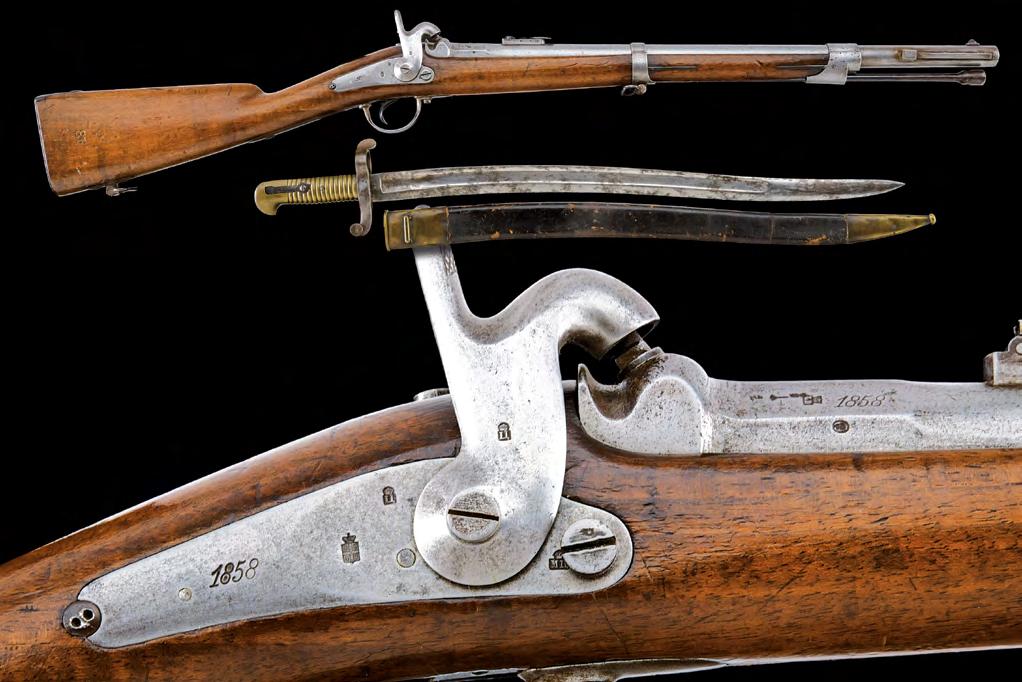
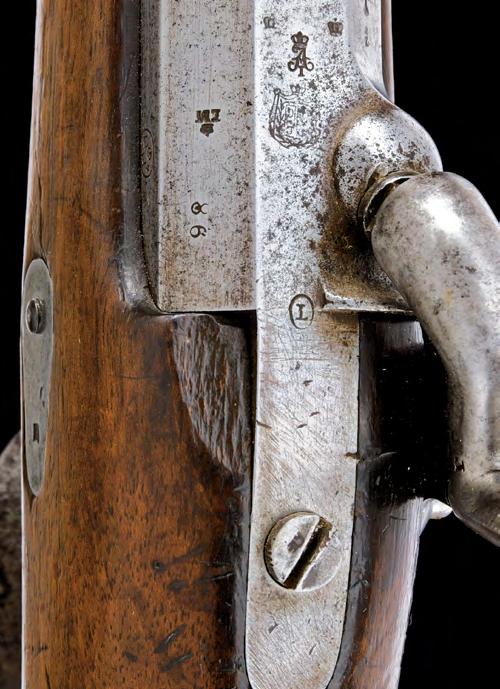
253
A RARE AND INTERESTING PERCUSSION CARBINE OF THE MINIE-PETROVICFRANCOTTE TYPE
Principality of Serbia, 1850/60
Round, rifled barrel, provided with club guide for the bayonet, foldaway and adjustable rear sight, marked with stamp of the Principality of Serbia (a crowned shield within a canopy) on the breech and with marks of the Liegi test bench as well as other stamps (likely from a Serbian arsenal or test bench), dated “1858”. 17.7 mm cal. at the nozzle. Clean bore, visible rifling, some pitting and signs of use inside. Backward spring lock with a dated trigger mechanism dating to “1858,” featuring an emblem depicting the shield surmounted by the Serbian cross and crowned; there is also the crowned “U” mark, also on the hammer throw. Single-snap, working mechanism. Wooden full stock with light signs of use and stamps on the butt stock which are still clearly visible, including the emblem of the Principality of Serbia (namely the shield with the Serbian cross within a wreath of laurel and oak, all surmounted by a crowned canopy). Iron mounts. With a yatagan-style saber-bayonet (length: 69.3 cm) with scabbard. Signs of use and time.
This is undoubtedly a rare example of a Francotte Model 1849/56 rifle, which was manufactured for the army of the Principality of Serbia and known as the ‘Carabine de Vincennes’ (Serbian: ‘Vensenske puške’). In our opinion, this is the first example of this type of rifle to appear on the market in a long time.
RARA E INTERESSANTE CARABINA A LUMINELLO DI TIPO MINIE-PETROVICFRANCOTTE CON BAIONETTA
Principato di Serbia, 1850/60
Canna tonda rigata, dotata di guida d’innesto per baionetta, alzo abbattibile e regolabile, marcata con timbro del Principato di Serbia (scudo coronato entro baldacchino) in culatta e con punzoni del banco di Liegi oltre ad altri timbri (probabilmente d’arsenale o di prova serbi), datata “1858”. In volata cal. 17,7 mm. Anima pulita, rigatura visibile, qualche intaccatura e segno d’uso all’interno. Batteria a molla indietro datata “1858”, con emblema effigiante lo scudo caricato con la croce serba e coronato, presente anche il punzone “U” coronato, anche su collo del cane. Meccanica funzionante, ad un solo scatto. Cassa intera in legno con leggeri segni d’uso e timbri sulla pala ancora ben visibili, fra questi l’emblema del principato di Serbia (ovvero lo scudo con croce serba entro serto di lauro e quercia, il tutto sormontato da baldacchino coronato). Fornimenti in ferro. Con una sciabolabaionetta a yatagan (lungh. 69,3 cm) dotata di fodero. Lievi segni d’uso e del tempo.
Si tratta senz’altro di un raro esemplare di fucile Francotte Mod.1849/56, prodotto per l’esercito del Principato di Serbia, dove si usava la denominazione “carabine de Vincennes” (in serbo: Венсенске пушке, Vensenske puške). A nostro avviso si tratta del primo esemplare di questo tipo di fucile presente sul mercato da molto tempo a questa parte.
Conditions good
Length 101 cm.
€ 600/800
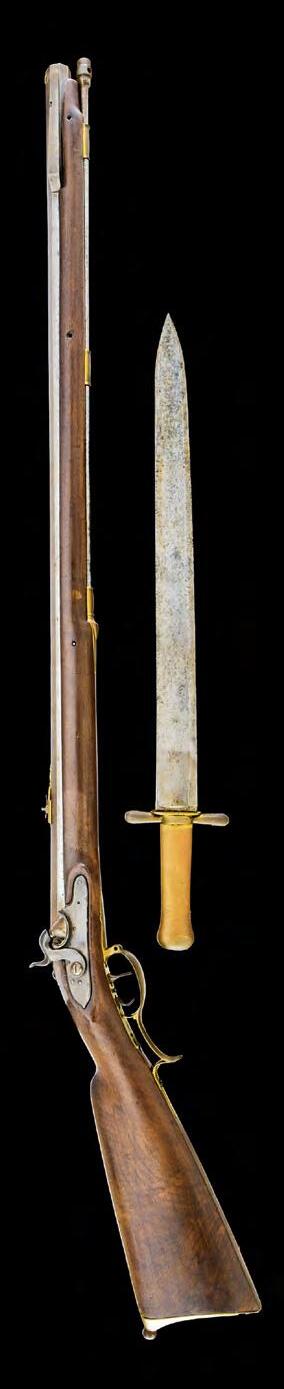
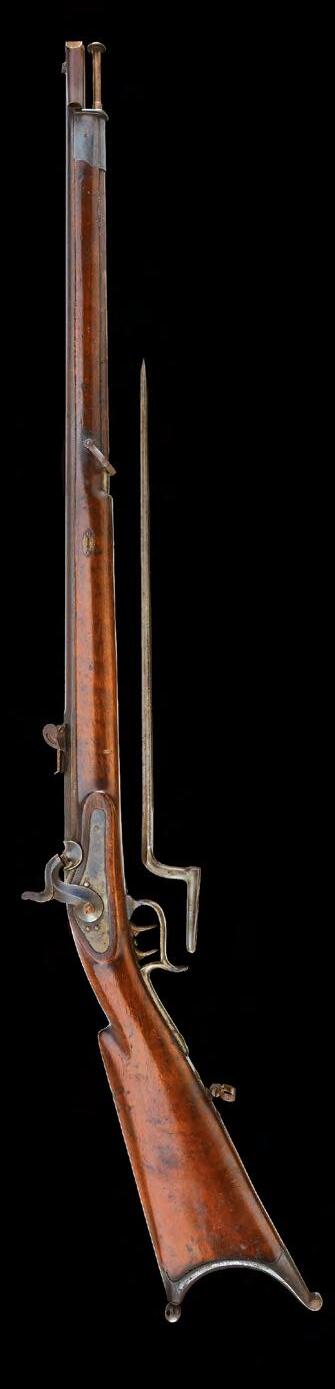
254
A CANTONAL PERCUSSION CARBINE WITH BAYONET
Switzerland, Second quarter of the 19th Century Heavy, octagonal, rifled, barrel, provided with brass foresight and a two-leaf foldaway rear sight, marked on the back with the inscription “PL 304”, an illegible mark and the emblem of the canton of Bern. On the right side, a long club guide for the bayonet. The bore needs cleaning. Forward spring lock (conversion from a flintlock?) with working mechanism. Wooden full stock (some restored woodworm holes and missing parts on the counterplate), with brass mounts. Working trigger and set trigger. Not pertinent ramrod. One suspension ring and one barrel retaining pin are missing. The item is sold with a rare straight-bladed sabre-bayonet, with numbered brass hilt; grip with missing spring. Signs of use and aging.
CARABINA CANTONALE A LUMINELLO CON BAIONETTA
Svizzera, Secondo quarto del XIX Secolo
Pesante canna ottagonale rigata, dotata di mirino in ottone e alzo a due fogliette abbattibili, marcata al dorso con la dicitura “PL 304”, un marchio non leggibile e con l’emblema del cantone di Berna. Sul fianco destro lunga guida d’innesto per la baionetta. Anima da pulire. Batteria a molla in avanti (trasformazione di una piastra a pietra?) con meccanica funzionante. Cassa intera in legno (qualche foro di tarlo restaurato e mancanza alla contropiastra), con fornimenti in ottone. Grilletto e stecher funzionanti. Bacchetta non pertinente. Mancanti un passante e una spina di ritenzione della canna. Con una rara daga-baionetta a lama dritta, con fornimento in ottone numerato, l’impugnatura con molla mancante. Segni d’uso e del tempo.
Conditions medium
Length 131.7 cm.
€ 200/300
255
AN 1851 MODEL FEDERAL CARBINE WITH BAYONET
Switzerland, Mid 19th Century
Round barrel with octagonal breech, provided with adjustable rear sight, foresight and tubular club guide for the bayonet. Visible rifling; the bore needs cleaning to determine its condition. 11.4 mm cal. at the nozzle. Liege mark and crowned “BF”. Forward spring lock with working mechanism marked “BEURET FRERES LIEGE” and marked en suite. Working mechanism. Surface with traces of the original finishing. Full stock made of walnut wood with iron mounts, these also featuring remains of finishing. Working trigger and set trigger. Condition between fair and good, in old patina, probably never touched. The bayonet (57.7 cm) is marked “PJ” and the retaining spring is missing (pertinent? very difficult to fit).
CARABINA FEDERALE MOD. 1851 CON BAIONETTA
Svizzera, Metà del XIX Secolo
Canna tonda con culatta ottagonale, munita di alzo regolabile, mirino e con guida d’innesto tubulare per baionetta. Rigatura visibile, anima da pulire per determinarne lo stato di conservazione. Cal. 11,4 mm in volata. Punzone di Liegi e “BF” coronato. Batteria a molla in avanti con marcatura “BEURET FRERES LIEGE” e punzonata en suite. La meccanica funzionante. La superficie con tracce dell’antica finitura. Cassa intera in noce con fornimenti in ferro, anche questi con tracce di finitura. Grilletto e stecher funzionanti. Condizioni tra medie e buone, in vecchia patina probabilmente mai toccata. La baionetta (57,7 cm.) punzonata “PJ” e mancante della molla di ritenzione (pertinente? inserimento molto difficoltoso).
Conditions good
Length 126 cm.
€ 250/400
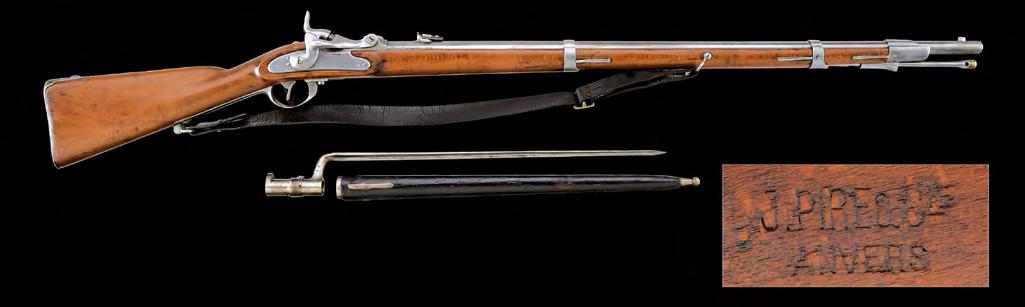
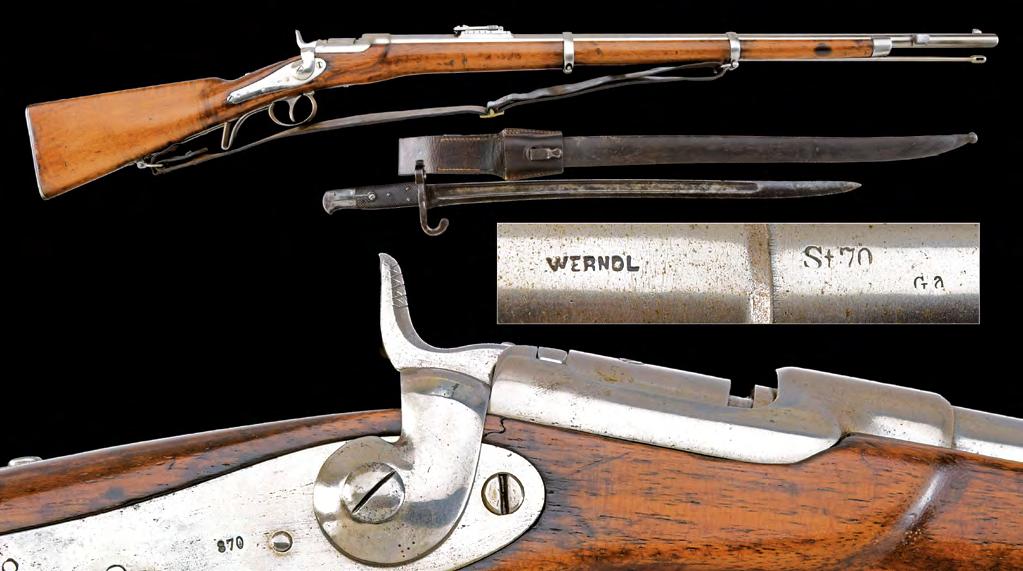
256
AN 1854/67 MODEL WANZEL BREECHLOADING RIFLE WITH BAYONET
Austria, 1857
Rifled, round, 14 mm cal. barrel (clean bore, visible rifling), provided with foresight, adjustable and foldaway rear sight, octagonal breech stamped with the imperial eagle and “68”; on the left side,“878” and “4”. Wänzel-type bolt, marked “4” and with a not clearly legible mark. Tang marked “G” and “WEITZER AZ”. Forward spring lock, dated “857” and featuring the Austrian imperial mark. Wooden full stock, iron mounts (marks) and ramrod. Working mechanism. Socket bayonet with leather scabbard.
See “Die Hand- und Faustfeuerwaffen der habsburgischen Heere”, Gabriel, pages 344/5.
FUCILE DA FANTERIA A RETROCARICA WANZEL MOD. 1854/67 CON BAIONETTA
Austria, 1857
Canna rigata (anima pulita, rigatura visibile), tonda, dotata di mirino, alzo regolabile e abbattibile, culatta ottagonale punzonata con aquila imperiale e “68”; recante sul lato sinistro “878” e “4”; cal. 14 mm in volata. Otturatore a sistema Wänzel, marcato “4” e con un punzone poco leggibile. Codetta con dicitura “G” e “WEITZER AZ”. Batteria a molla in avanti, datata “857” e con punzone imperiale austriaco. Cassa intera in legno, fornimenti (punzonati) e bacchetta in ferro. Meccanica funzionante. Baionetta a ghiera con fodero in cuoio.
Vedi “Die Hand- und Faustfeuerwaffen der habsburgischen Heere”, Gabriel, pag. 344/5.
Conditions very good
Length 133 cm.
€ 600/900
257
AN 1867 MODEL WERNDL RIFLE FOR INFANTRY AND JAGER UNITS, WITH BAYONET
Austria, 1870
Round, rifled, 11 mm cal. barrel (clean bore, with slight pitting, visible rifling), breech marked “St 70” and “Ga”, provided with foresight and club guide for the bayonet, featuring an adjustable and foldaway rear sight marked “M”. Rolling block bolt with frame marked “WERNDL,” backward spring lock dated “870” and featuring the imperial mark. Wooden full stock (restored due to use on the side of the counterplate) with iron mounts and ramrod. Working mechanism. Complete with first-type bayonet with iron scabbard and leather belt frog.
FUCILE WERNDL MOD. 1867 DA FANTERIA E CACCIATORI, CON BAIONETTA Austria, 1870
Canna tonda rigata (anima pulita, con leggero pitting, rigatura ben visibile), base marcata “St 70” e “Ga”, dotata di mirino e guida d’innesto per baionetta e con alzo regolabile e abbattibile munito di punzone “M”, cal. 11 mm. Otturatore a blocco rotante con castello marcato “WERNDL”, batteria a molla indietro datata “870” e recante il punzone imperiale. Cassa intera in legno (con riparazione realizzata in epoca d’uso, sul lato della contropiastra) dotata di fornimenti e con bacchetta in ferro. Meccanica funzionante. Completo di baionetta del primo tipo con fodero in ferro e taschetta in cuoio.
Conditions very good Length 127.5 cm.
€ 600/800
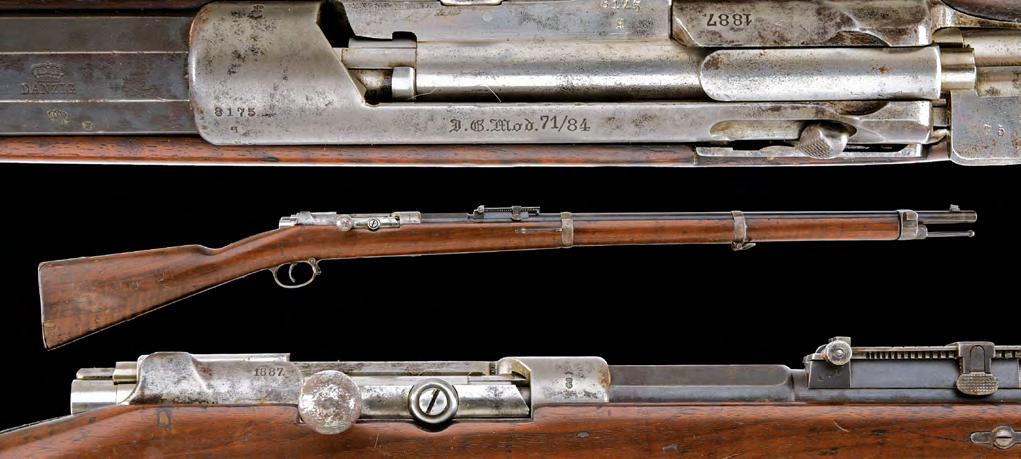
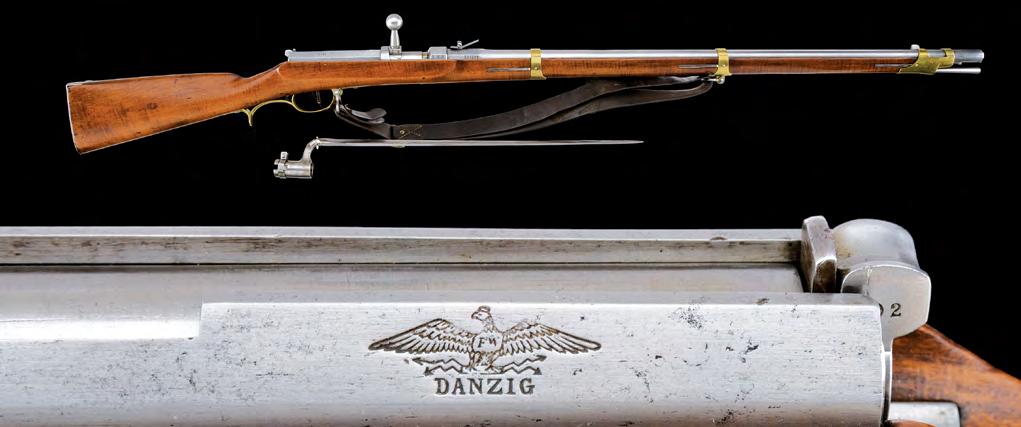
258
AN 1871/84 MODEL BOLT-ACTION MAUSER RIFLE
Danzig, 1887
Round, rifled, 11 mm cal barrel (clean bore and visible rifling), browned, with octagonal breech, marked “DANZIG”, with serial number “81xx”,“FW” beneath crown and various other proof marks, fitted with adjustable rear sight, front sight and clutch for the bayonet. Typical bolt with production year “1887” and model designation “J. G. Mod: 71/84”. Wooden stock (signs of use and age; minor restorations) with stamps, iron mounts and ramrod.
FUCILE MAUSER M. 71/84 A RETROCARICA
Danzica, 1887
Canna tonda rigata (anima pulita e rigatura visibile), brunita, con culatta ottagonale, marcata “DANZIG”, con matricola “81xx”,“FW” sotto corona e con vari altri punzoni, munita di alzo regolabile, mirino, attacco per la baionetta, cal. 11 mm. Otturatore tipico con anno di produzione “1887” e dicitura del modello “J. G. Mod: 71/84”. Cassa in legno (segni d’uso e del tempo; piccoli restauri) con timbri, fornimenti e bacchetta in ferro.
Conditions good
Length 129.5 cm.
€ 600/900
259
A RARE 1841 MODEL DREYSE BOLT-ACTION RIFLE WITH BAYONET
Danzig, 1859
Round, rifled barrel (bore with light pitting; clearly visible rifling), octagonal at the base, provided with adjustable rear sight, foresight, and clutch for the bayonet; featuring various marks, serial numbers “9068” and “9683”, the crowned “FW” mark, as well as the inscriptions “0.59” and “192”. Dreyse system bolt marked “DANZIG”, under eagle with “FW” monogram and the date “1859”. Wooden full stock with brass mounts (with marks; screws featuring the same serial number) and iron butt plate marked “45 L. I. 3. 186.”. Iron ramrod with mark, provided with cartridge extractors. Socket bayonet marked “12.62”. Leather strap.
RARO FUCILE A RETROCARICA DREYSE MOD. 1841 CON BAIONETTA
Danzica, 1859
Canna tonda con base ottagonale, rigata (anima con leggero pitting; rigatura ben visibile), munita di alzo regolabile, mirino e attacco per baionetta; reca diversi punzoni, le matricole “9068” e “9683”, il marchio “FW” sotto corona, nonché le indicazioni “0.59” e “192”. Otturatore con sistema Dreyse marcato “DANZIG”, sotto aquila con monogramma “FW” e data “1859”. Cassa intera in legno con fornimenti in ottone (con punzoni; viti recanti la stessa matricola) e coccia in ferro marcata “45 L. I. 3. 186.” Bacchetta in ferro con punzone, munita di cavastracci. Baionetta a ghiera marcata “12.62”. Cinghia in cuoio.
Conditions very good Length 142 cm.
€ 800/1.200
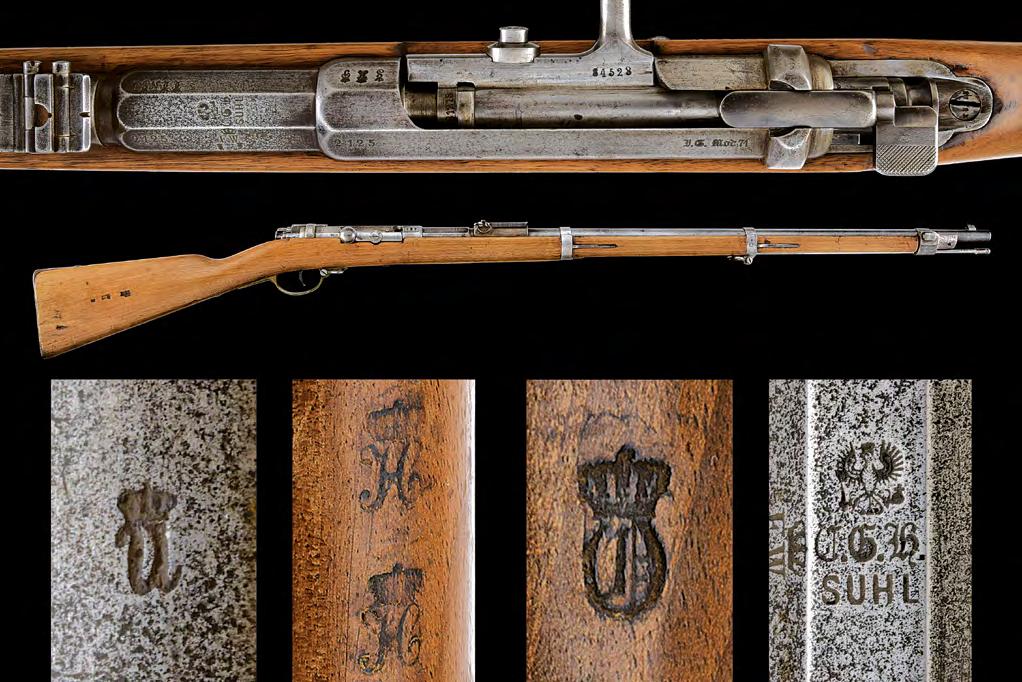
260 AN 1871 MODEL MAUSER RIFLE
Spandau, 1875
Round, rifled, 11 mm cal barrel (clean bore and clearly visible rifling), with octagonal base, marked “SUHL”, with serial number “212x”,“FW” beneath crown and various other proof marks, with adjustable rear sight, front sight and clutch for the bayonet. Typical bolt with production year “1875” and model designation in Gothic numerals “Mod. 71”. Wooden stock with various stamps, iron mounts and ramrod. Rare in such fine condition.
FUCILE MAUSER MOD. 1871
Spandau, 1875
Canna tonda rigata (anima pulita e rigatura ben visibile), con base ottagonale, marcata “SUHL”, con matricola “212x”,“FW” sotto corona e con vari altri punzoni, dotata di alzo variabile, mirino, attacco per la baionetta, cal. 11 mm. Otturatore tipico con anno di produzione “1875” e con dicitura del modello in cifre gotiche “Mod. 71”. Cassa in legno con vari timbri, fornimenti e bacchetta in ferro. Raro in condizioni così buone.
Conditions good
Length 134.5 cm.
€ 600/1.000
261 AN 1866 MODEL CHASSEPOT RIFLE
Tulle, 1868
Rifled, two-stage, 11 mm cal. barrel, with octagonal breech, various marks, date “T1868,”“M,”“I,”“ES,” and serial number “292xx,” with adjustable rear sight and foresight, clutch for the bayonet; sliding-revolving bolt, marked “MANUFACTURE IMPERIALE TULLE Mle. 1866” with various marks and same serial number; long, wooden stock with iron mounts, two bands, complete with ramrod and bayonet with scabbard.
FUCILE CHASSEPOT MOD. 1866
Tulle, 1868
Canna rigata, a due ordini, con culatta ottagonale, recante vari punzoni, data “T1868”,“M”,“I”,“ES” e matricola “292xx”, munita di alzo regolabile e mirino, innesto per baionetta, cal. 11 mm. Otturatore girevole scorrevole marcato “MANUFACTURE IMPERIALE TULLE Mle. 1866”, con vari punzoni e matricola coeva. Cassa lunga in legno con fornimenti in ferro; due fascette. Completo di bacchetta e baionetta con fodero.
Conditions good Length 130 cm.
€ 600/900
262 AN 1866 MODEL CHASSEPOT RIFLE
Mutzig, 1868
Round, rifled, 11 mm cal. barrel (clean bore, visible rifling), octagonal at the base, marked with various marks including “AF”,“C”,“M” (both under crown), “MI”, serial number “D-468xx”, and date “M 1868”; adjustable rear sight, foresight, and clutch for the bayonet. Typical bolt with the same serial number and markings “MANUFACTURE IMPERIALE Mutzig M. LE 1866” and marks. Wooden full stock (stamped) with mounts (stamped) and iron ramrod. Leather strap.
FUCILE CHASSEPOT MOD. 1866
Mutzig, 1868
Canna tonda, rigata (anima pulita, rigatura ben visibile) con base ottagonale, marcata con vari punzoni quali “AF”,“C”,“M” entrambe sotto corona,“MI”, con matricola “D-468xx” e data “M 1868”; munita di alzo variabile, mirino ed attacco per la baionetta, cal. 11 mm. Tipico otturatore con la stessa matricola, marcature “MANUFACTURE IMPERIALE Mutzig M.LE 1866” e punzoni. Cassa intera in legno (timbri) con fornimenti (punzonati) e bacchetta in ferro. Cinghia in cuoio.
Conditions good Length 131 cm.
€ 400/600
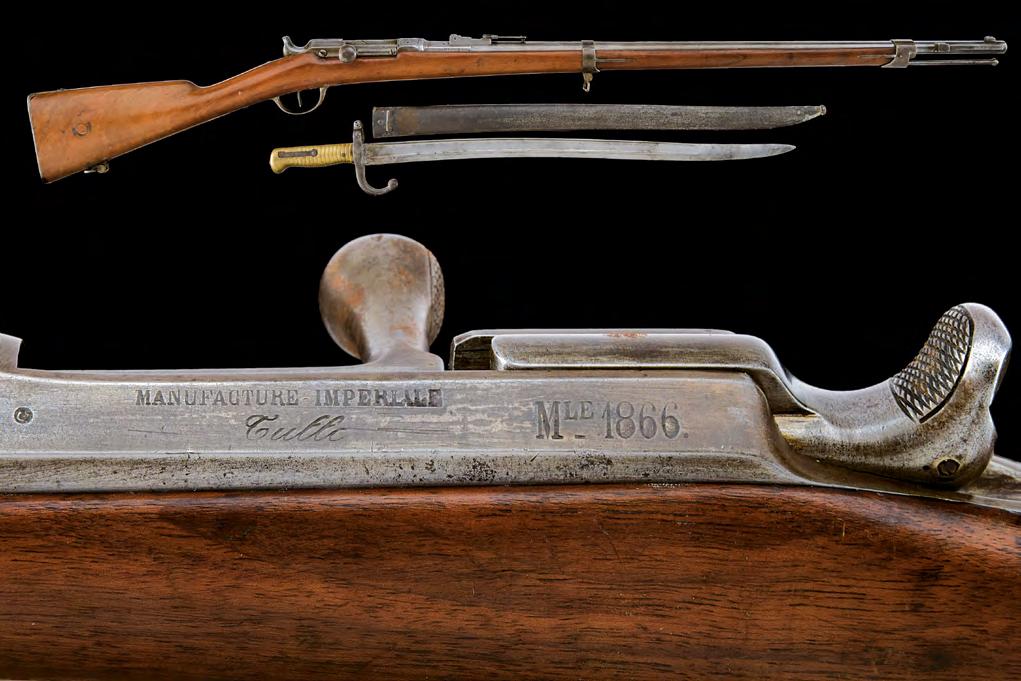
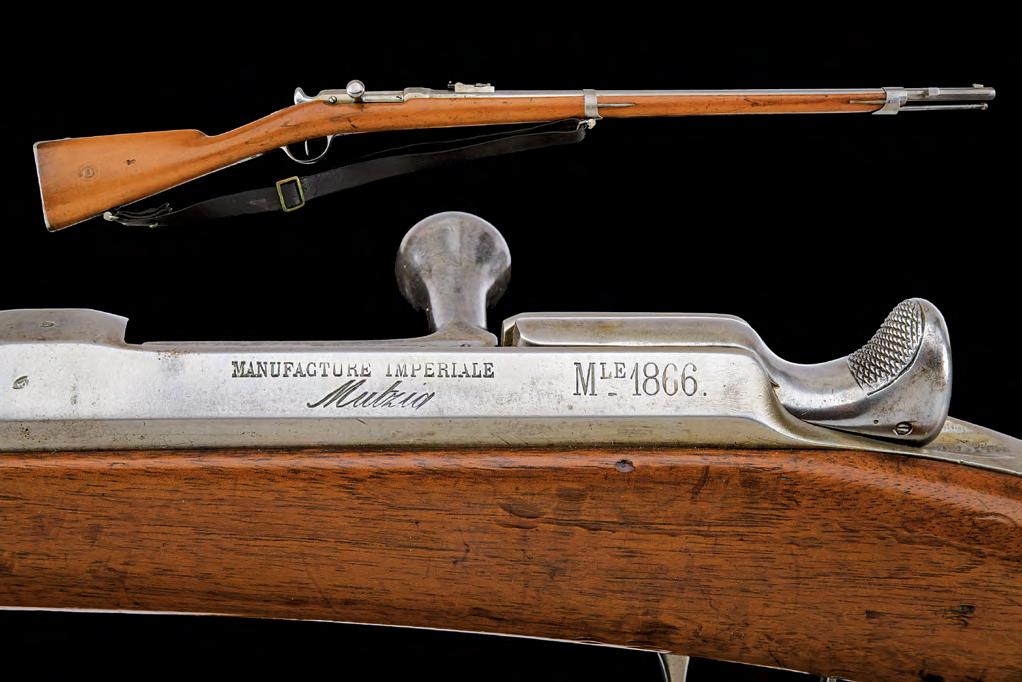
263
A SNIDER-ENFIELD SPORTING CARBINE BY RODDA & CO.
British Empire, about 1870
Cylindrical, rifled barrel, provided with foresight and a fixed rear sight with two folding leaves (marked “200” and “300,” respectively), featuring the marking “R.B. RODDA & CO. / GUN MAKERS BY APPOINTMENT TO HIS EXCELLENCY THE VICEROY / LONDON & CALCUTTA“. Breech with reinforcement ring and caliber marking ”REGULATION 577 BOXER”. 14.9 mm cal. at the nozzle. Clean bore with visible rifling, some signs of use and time inside. Folding bolt with Snider patent marking, an “S” mark pierced by an arrow, marks of the London test bench, and bolt block with central firing pin. Working mechanism. Forward spring lock marked with “R.B. RODDA & Co.” Outlines on cock, bolt and lock plate. Half stock of walnut wood (briarwood?) with straight grip and checkered segments (one crack on the grip and a small missing part on the fore-end side). Iron mounts. Pitting on the metal parts, especially on the butt-plate. Signs of use and time. Remains of old browning.
CARABINA DA CACCIA SNIDER-ENFIELD DI RODDA & CO. Impero Britannico, 1870 circa Canna cilindrica rigata, dotata di mirino e con alzo a una tacca di mira fissa e due fogliette abbattibili (marcate rispettivamente “200” e “300”), recante marcatura “R.B. RODDA & CO. / GUN MAKERS BY APPOINTMENT TO HIS EXCELLENCY THE VICEROY / LONDON & CALCUTTA”. La culatta con anello di rinforzo e marcatura del calibro “REGULATION 577 BOXER”. 14,9 mm in volata. Anima pulita con rigatura visibile, qualche segno d’uso e del tempo all’interno. Otturatore a tabacchiera con marcatura del brevetto Snider, marchio a “S” trafitto da freccia, punzoni del banco di Londra, blocco otturatore a percussione centrale. Meccanica funzionante. Batteria a molla in avanti marcata “R.B. RODDA & Co.” Delineature sia al cane, che all’otturatore che alla cartella. Mezza cassa in noce (radica?) con collo dritto e segmenti zigrinati (una crepa al collo e piccola mancanza sul fianco dell’astina). Fornimenti in ferro. Alcune intaccature alle parti metalliche, soprattutto al calciolo. Segni d’uso e del tempo. Tracce di vecchia brunitura.
Conditions medium
Length 102.8 cm.
€ 180/250
264 AN INTERESTING 1849/55 INFANTRY KAMMERLADER WITH SCHEEL SYSTEM
Norway, about 1855
Round, rifled barrel (bore with pitting, clearly visible rifling), provided with adjustable rear sight, foresight, and clutch for the bayonet, 17 mm cal. at the nozzle; frame marked “IIK”,“I”,“G”, serial “1156” (all matching numbers) and with other markings. Cock with mark on the lower section. Working percussion mechanism. Wooden full stock with brass mounts and iron trigger guard. Safety lock. Butt plate marked “FN. M. C_D83”. Very rare.
INTERESSANTE KAMMERLADER DI FANTERIA MOD. 1849/55 SISTEMA SCHEEL
Norvegia, 1855 circa Canna tonda, rigata (anima con pitting, rigatura ben visibile), dotata di alzo regolabile, mirino e attacco per la baionetta, cal. 17 mm in volata. Il castello marcato “IIK”,“I”,“G” matr.“1156” (monomatricola) e con altre marcature. Cane nella parte inferiore, con punzone. Meccanismo a percussione funzionante. Cassa intera in legno con fornimenti in ottone e ponticello in ferro. Sicura. Il calciolo marcato “FN. M. C_D83”. Molto raro.
Conditions good Length 141.5 cm. € 800/1.200
265 AN 1886 MODEL STYER KROPATSCHEK BOLT-ACTION RIFLE
Portugal, 1886
Round barrel (the bore needs cleaning, visible rifling) provided with foresight and foldaway, adjustable rear sight, marked with crown, 8 mm cal. at the nozzle. Bolt with frame featuring King Louis I of Portugal’s initials (reigned 1861–1889) “L I°”, the model designation “M1886”, and the manufacturer’s mark “CE.W.F.G. STEYR 1886”. Working mechanism, it needs cleaning. Barrel and bolt frame with matching serial number; bolt with different numbering. Wooden full stock with remains of stamps that are not clearly legible on the butt stock, signs of use and time. Iron mounts. Remains of browning on the barrel, probably earlier. Some areas with pitting (especially on the butt-plate). It needs cleaning. Signs of use and time.
FUCILE STEYR KROPATSCHEK MOD. 1886
Portogallo, 1886
Canna tonda (anima da pulire, rigatura visbile) dotata di mirino e con alzo abbattibile e regolabile, punzonata con corona, cal. 8 mm in volata. Otturatore con telaio recante le cifre di re Luigi I del Portogallo (in carica 1861-1889) “L I°”, la dicitura del modello “M1886” e quella della fabbrica “CE.W.F.G. STEYR 1886”. Meccanica funzionante, da pulire. Canna e telaio otturatore con matricola coeva, otturatore con numerazioni differenti. Cassa intera in legno con resti di timbri non chiaramente leggibili sulla pala, segni d’uso e del tempo. Fornimenti in ferro. Resti di brunitura probabilmente antica sulla canna. Alcune aree intaccate (molto intaccato il calciolo). Da pulire. Segni d’uso e del tempo.
Conditions medium
Length 132.2 cm.
€ 180/250
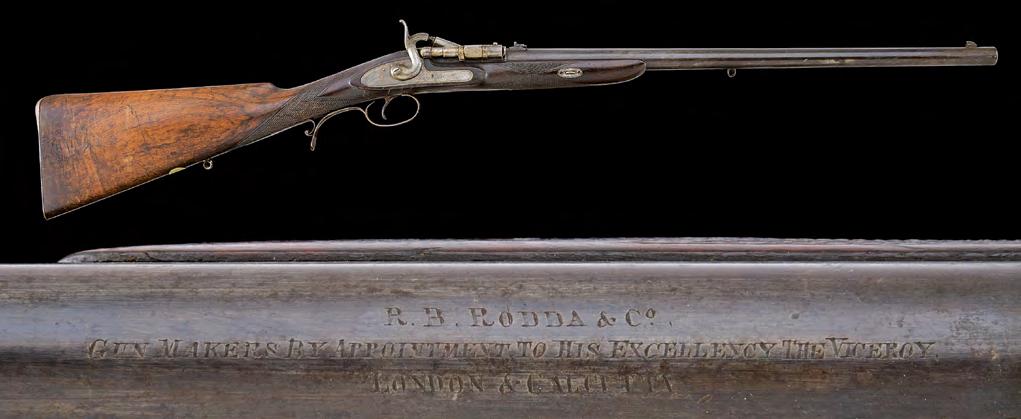
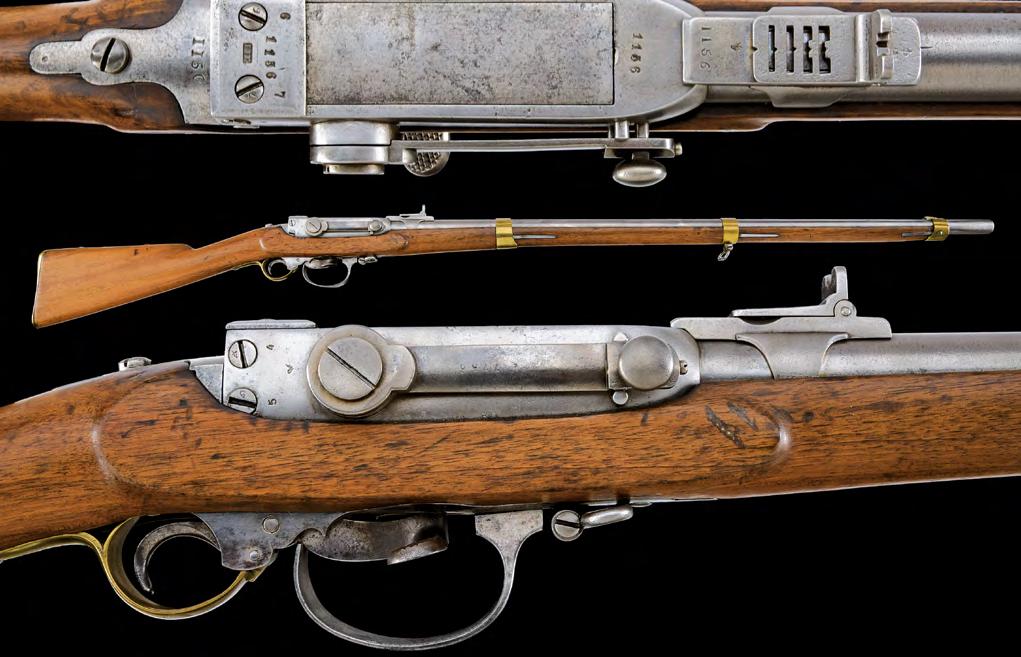
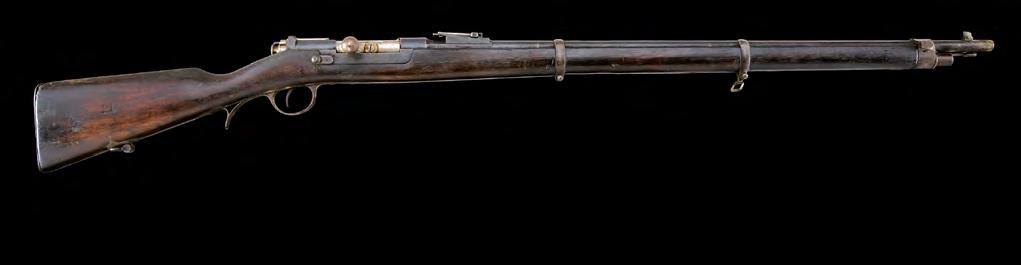
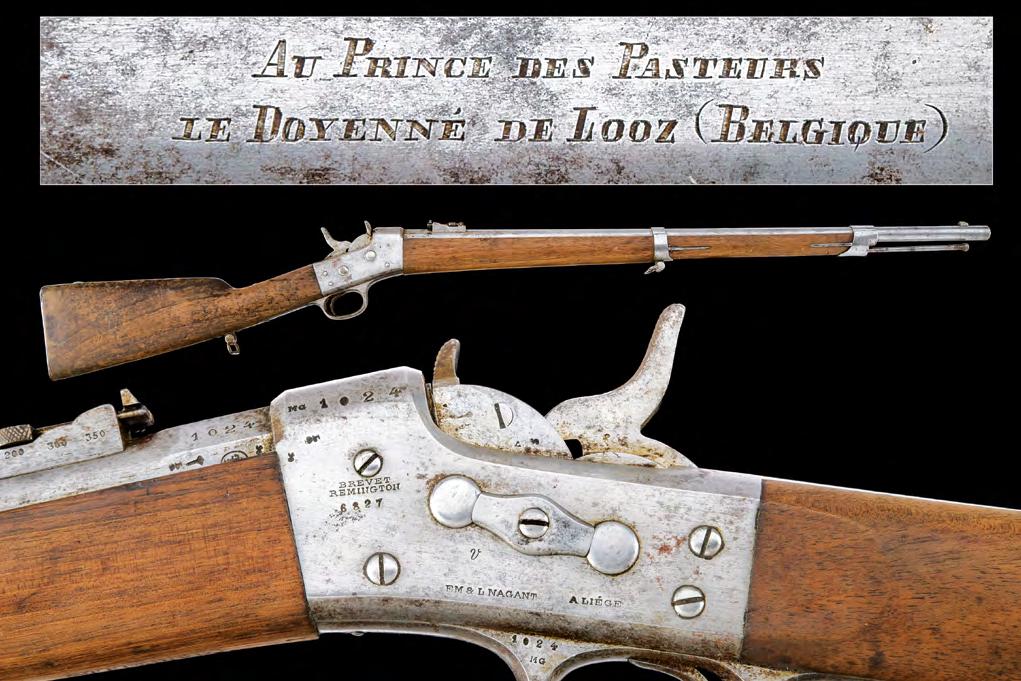
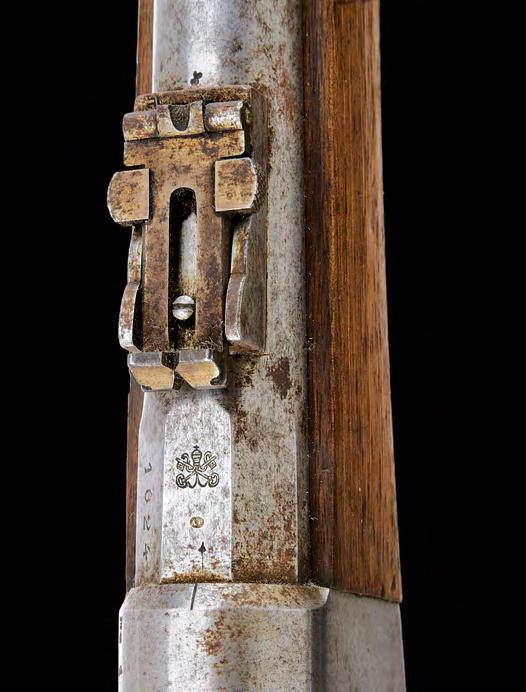
266
A REMINGTON ROLLING BLOCK RIFLE
Papal States, Third quarter of the 19th Century Round, rifled, 12 mm cal. barrel (bore clean but still visible rifling) octagonal at the base marked with a papal mark, mark of the Liegi test bench, serial number “10xx,” and other marks; provided with foresight, a clutch for the bayonet, foldaway and adjustable rear sight. Iron frame marked “BREVET REMINGTON,” below “E. M. & L. NAGANT A LIEGE,” various marks including “P,”“V,” and “S,” serial number matching the barrel. Rolling block featuring marks. Working mechanism. Tangs with rare marking “AU PRINCE DES PASTEURS LE DOYEBBE DE LOOZ (BELGIQUE)”. Wooden butt and forend; the stamp “CATHOLIQUES BELGES” with the date “1868” is still visible on the right side of the butt stock. Iron mounts and ramrod.
FUCILE REMINGTON ROLLING BLOCK
Stato Pontificio, Terzo quarto del XIX Secolo
Canna tonda rigata (anima pulita con rigatura ancora visibile) con base ottagonale marcata con punzone pontificio, punzone del banco di prova di Liegi, matricola “10xx” e con altri punzoni; dotata di mirino, dente d’innesto per la baionetta, alzo abbattibile e regolabile, cal. 12 mm. Castello in ferro marcato “BREVET REMINGTON”, sotto “E. M. & L. NAGANT A LIEGE”, vari punzoni fra cui “P”,“V” e “S”, matricola coeva alla canna. Otturatore a blocco rotante recante punzoni. Meccanica funzionante. Codetta con rara marcatura “AU PRINCE DES PASTEURS LE DOYEBBE DE LOOZ (BELGIQUE)”. Calcio ed astina in legno, ancora visibile sul lato destro della pala il timbro “CATHOLIQUES BELGES” con data “1868”. Fornimenti e bacchetta in ferro.
Conditions medium
Length 114 cm.
€ 600/900
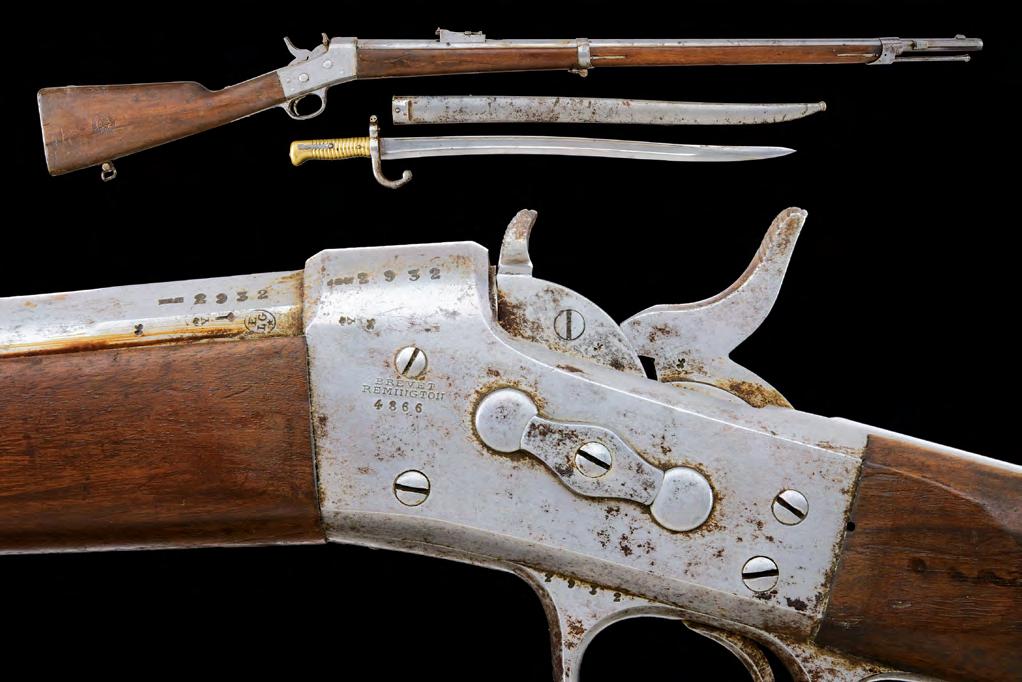
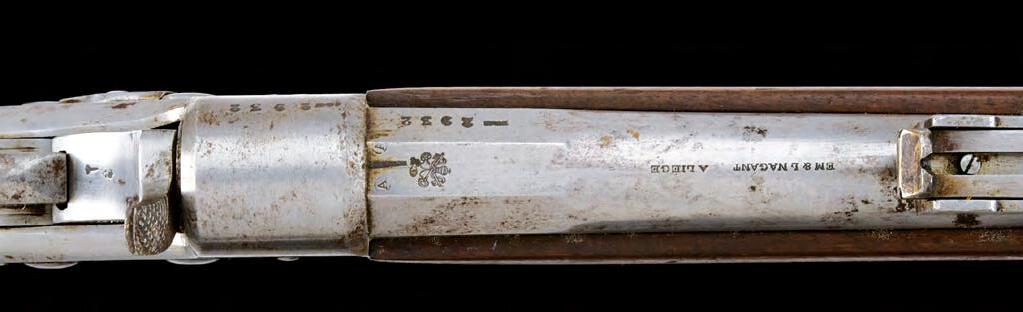
A REMINGTON ROLLING BLOCK RIFLE WITH BAYONET
Papal States, Third quarter of the 19th Century Round, rifled, 12 mm cal. barrel (bore with slight pitting and visible rifling) octagonal at the base marked with a papal mark, the mark of the Liegi test bench, the serial number “29xx,” and other marks; slightly further, there is the inscription “E. M. & L. NAGANT A LIEGE”; provided with foresight, clutch for the bayonet, foldaway and adjustable rear sight. Frame marked “BREVET REMINGTON,” various marks including “Y,”“O,” and “S” under crown, serial number matching the barrel. Rolling block bolt featuring marks and a serial number also matching the barrel. Working mechanism. Wooden butt and forend (forend with a long crack); the stamp “CATHOLIQUES BELGES” with date “1868” is still visible on the right side of the butt stock. Iron mounts and ramrod. With a yatagan bayonet with iron scabbard.
FUCILE REMINGTON ROLLING BLOCK CON BAIONETTA
Stato Pontificio, Terzo quarto del XIX Secolo
Canna tonda rigata (anima con leggero pitting e rigatura visibile) con base ottagonale, marcata con punzone pontificio, marchio del banco di prova di Liegi, matricola “29xx” e con altri punzoni, poco più avanti la marcatura “E. M. & L. NAGANT A LIEGE”; dotata di mirino, dente d’innesto per la baionetta, alzo abbattibile e regolabile, cal. 12 mm. Castello in ferro marcato “BREVET REMINGTON”, recante vari punzoni fra cui “Y”,“O” e “S” sotto corona, matricola coeva alla canna. Otturatore a blocco rotante recante punzoni e numero di serie anch’esso coevo alla canna. Meccanica funzionante. Calcio ed astina in legno (astina con lunga crepa), ancora visibile sul lato destro della pala il timbro “CATHOLIQUES BELGES” con data “1868”. Fornimenti e bacchetta in ferro. Insieme con una baionetta a yatagan con fodero in ferro.
Conditions medium
Length 131 cm.
€ 700/1.000
268 AN AN XIII TYPE FLINTLOCK
PISTOL
France, Second quarter of the 19th Century Smoothbore, two-stage, 17 mm cal. barrel, with mark at the base; tang marked “3”; flintlock with brass pan; wooden stock with brass mounts and iron ramrod. Naples?
PISTOLA A PIETRA FOCAIA TIPO
AN XIII
Francia, Secondo quarto del XIX
Secolo
Canna liscia a due ordini, con base recante punzone “P”, cal. 17 mm in volatta; codetta marcata “3”. Batteria a pietra focaia con scodellino in ottone. Cassa in legno con fornimenti in ottone e bacchetta in ferro. Napoletana?
Conditions medium
Length 36 cm.
€ 300/500
269 A 1770 MODEL GENDARMERIE FLINTLOCK PISTOL
Maubeuge, 1793
Round, smoothbore, 15 mm cal barrel, with square base marked “93” for the year 1793; smooth tang bearing the model writing, lock signed “Maubeuge Maf.re N.le” and “A” beneath a star. Wooden stock (very small missing parts) with iron mounts and ramrod, inspection marks.
PISTOLA A PIETRA FOCAIA DA GENDARMERIA MOD. 1770
Maubeuge, 1793
Canna tonda liscia, con base quadra marcata “93” per l’anno 1793, cal. 15 mm. Codetta liscia recante dicitura del modello. Batteria firmata “Maubeuge Maf.re N.le” e “A” sotto stella. Cassa in legno (piccolissime mancanze) con fornimenti e bacchetta in ferro, con punzoni.
Conditions good
Length 25 cm.
€ 350/450
270 AN IX GENDARMERIE FLINTLOCK
PISTOL
Maubeuge, circa 1800
Smoothbore, round, 16 mm cal. barrel, marked “ARNO”,“M” and “13” at the base, tang with model. Lock with flat lock plate marked “Maubeuge / M.uf.re N.le”. Wooden, full stock. Iron mounts and ramrod.
“ARNO” is the name of the Italian department where a company of the Gendarmerie was based. During this period, Napoleonic Italy was divided into departments named after major rivers.
PISTOLA DA GENDARMERIA A PIETRA FOCAIA MOD. AN IX Maubeuge, 1800 circa Canna tonda liscia, marcata “ARNO”, “M” e “13” alla base, codetta con modello, cal. 16 mm. Batteria a cartella piatta marcata “Maubeuge / M.uf.re N.le”. Cassa intera in legno. Fornimenti e bacchetta in ferro.
“ARNO” è il nome del dipartimento italiano dove prestava servizio una compagnia di Gendarmeria. L’Italia napoleonica in questo periodo era divisa in Dipartimenti che corrispondevano ai nomi dei fiumi importanti.
Conditions good
Length 25 cm.
€ 350/450
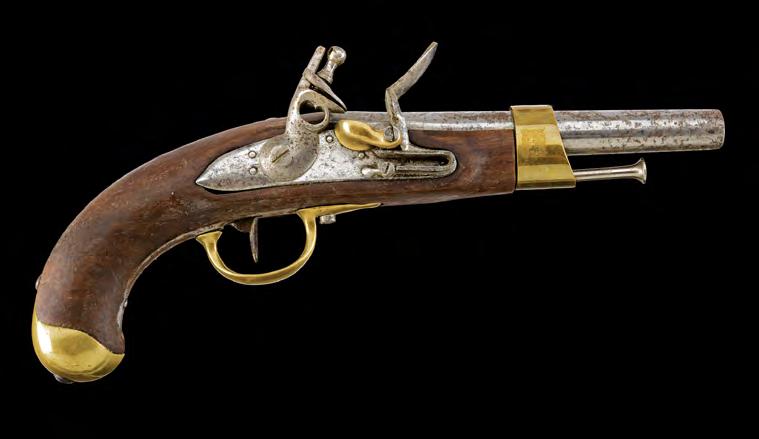
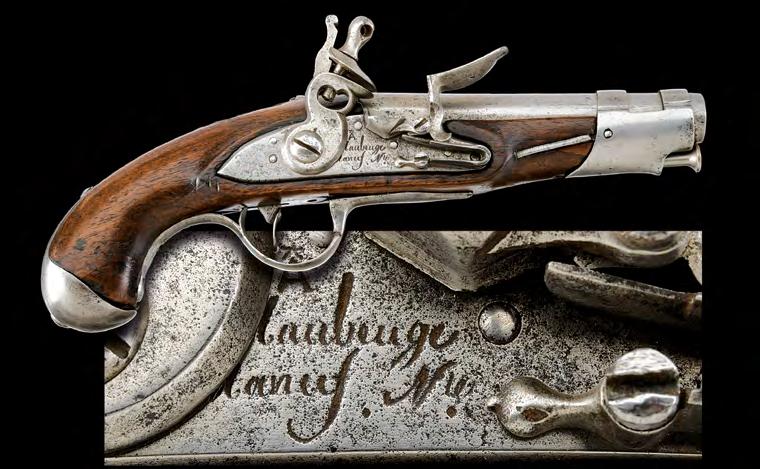
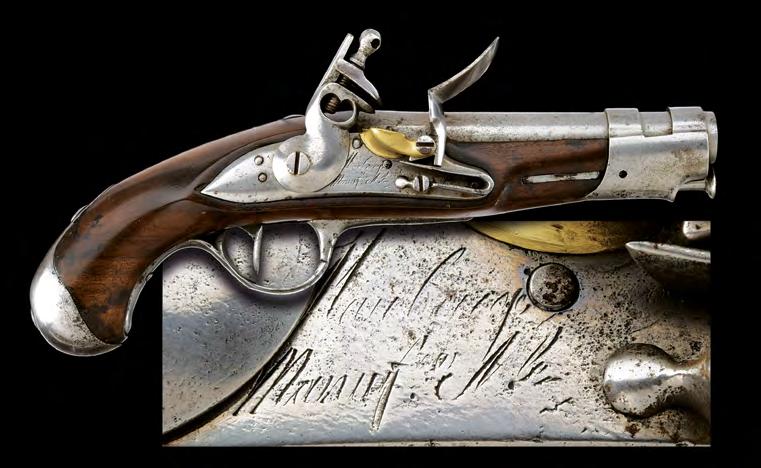
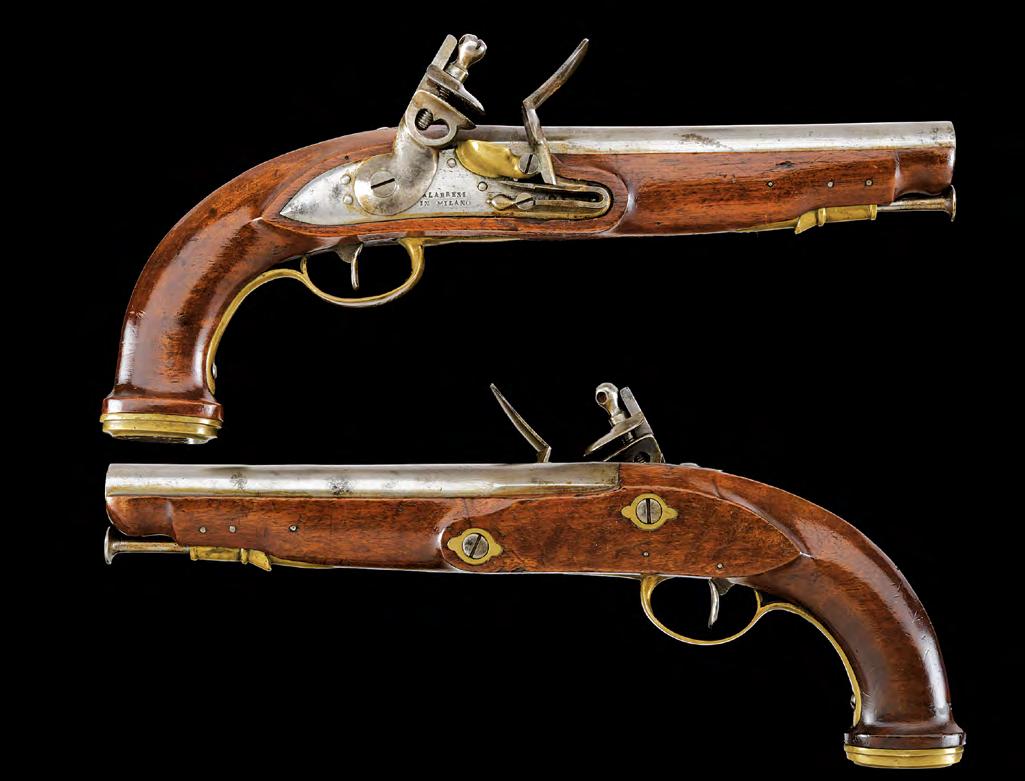
A RARE AND INTERESTING PAIR OF ROYAL GUARD OFFICER’S FLINTLOCK PISTOLS Kingdom fo Italy (Napoleonic), 1805 - 1814
Round, smoothbore, 18 mm cal. barrels with octagonal breech. French military type locks, with flat lock plate and marked “CALABRESI IN MILANO”, brass pan. Well working mechanism. Lock plates marked “FS” inside and with identification stamps “IIII” and “IIIIV”, each with its mark on the wood to prevent them from being reversed during assembly. Smooth, wooden, full stocks, both with remains of a not clearly legible stamp between the trigger guard and the lock tang. French-style brass mounts with flat butt-plates. Iron ramrods.
One pistol of this wonderful pair is published on the volume “Armi e Armaioli nella Milano del XIX Secolo” by Ulisse Gobbi, page 29, and coloured plate nr. 13.
RARO E INTERESSANTE PAIO DI PISTOLE DA UFFICIALE DELLA GUARDIA REALE
Regno Italico, 1805 - 1814
Canne tonde lisce, con culatta ottagonale, cal. 18 mm in volata. Batterie di tipo francese militare con cartella piatta e marcatura “CALABRESI IN MILANO”, scodellini in ottone. Meccaniche ben funzionanti. Le cartelle marcate “FS” all’interno e con timbri “IIII” e “IIIIV” di riconoscimento, con marchio corrispettivo sul legno per non invertirle nel montaggio. Casse intere, lisce, in legno, entrambe con resti di un timbro non chiaramente leggibile fra ponticello e codetta della batteria. Fornimenti in ottone di gusto francese con cocce piatte. Bacchette in ferro.
Una pistola facente parte di questo elegante paio è pubblicata sul volume “Armi e Armaioli nella Milano del XIX Secolo” di Ulisse Gobbi (pag. 29, tavola a colori 13).
Conditions good Length 33.5 cm.
€ 1.400/1.800
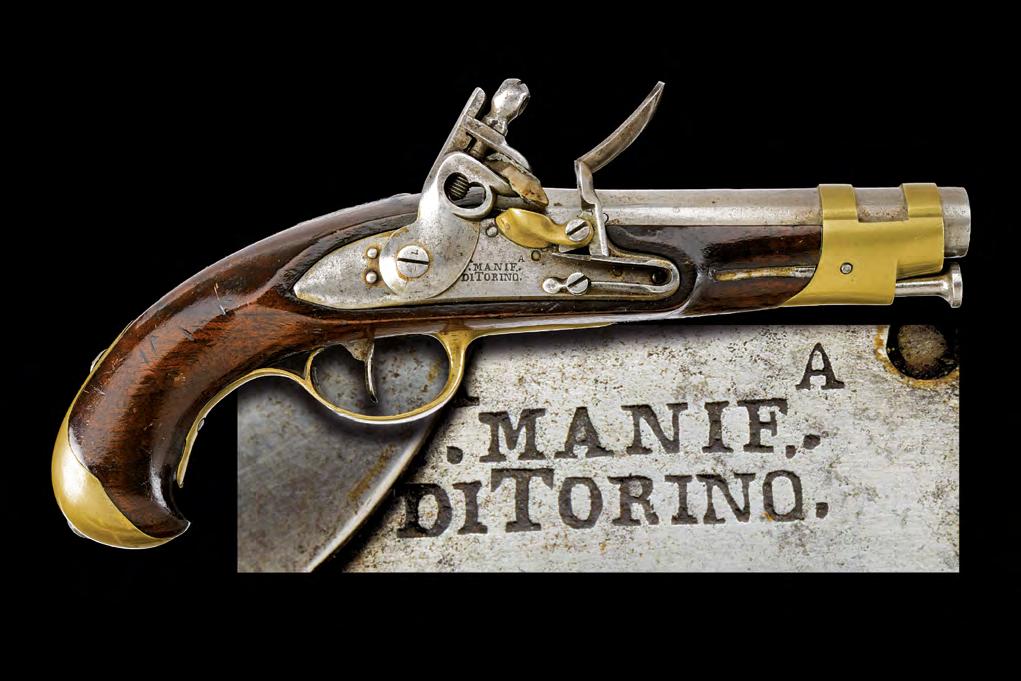
272 AN 1814 MODEL GENDARMERIE FLINTLOCK
PISTOL
Turin, 1822
Smoothbore, round, 15 mm cal. barrel, with square base marked “FP”, dated “1822” and with the Piedmontese mark. Flintlock, lock plate marked “R.A MANIF.A DI TORINO”. Full stock, the part of the counterplate with the stamps “ST UARD”,“BL” and “9”, brass mounts with a double-ring muzzle, ramrod shaped as a nail head. Rare.
PISTOLA DA CARABINIERI REALI MOD. 1814
Torino, 1822
Canna tonda liscia, con base quadra marcata “FP”, datata “1822” e con il punzone piemontese, cal. 15 mm in volata. Batteria a pietra focaia, la cartella con marcatura “R.A MANIF.A DI TORINO”. Cassa intera, il lato della contropiastra con timbri “ST UARD”,“BL” e “9”. Fornimenti in ottone con bocchino a doppio anello, bacchetta a testa di chiodo. Rara.
Conditions very good
Length 25 cm.
€ 300/500
273 AN AN XIII DRAGOON’S FLINTLOCK PISTOL
Naples, first quarter of the 19th Century Smoothbore, two-stage, 18 mm cal. barrel, marked with “R” at the octagonal part and with another not clearly legible mark; lock marked “m.ra R.le di Napoli”, brass pan. Wooden stock with brass mounts, suspension ring and iron ramrod. Marks “ME” and with another mark in a shield.
PISTOLA A PIETRA FOCAIA AN XIII PER DRAGONI Napoli, primo quarto del XIX Sec. Canna liscia a due ordini, con culatta ottagonale marcata “R” e con un altro punzone poco leggibile, cal. 18 mm in volata. Batteria marcata “m.ra R.le di Napoli”, con scodellino in ottone. Cassa in legno con fornimenti in ottone, anello di sospensione e bacchetta in ferro. Recante punzoni “ME” e con un altro timbro entro uno scudetto.
Conditions medium
Length 36 cm.
€ 300/600
274 A GENDARMERIE FLINTLOCK PISTOL ON THE FRENCH AN IX MODEL
Naples, 1827
Smoothbore, round barrel, with square base marked “RS” (Raffaele Scarpati, inspector) and the date “1827”. Tang with traces of mark. Lock marked “M.re R.le di Napoli” in italics, with the date “1816” inside. Wooden, full stock with mounts and wooden ramrod.
PISTOLA A PIETRA FOCAIA DA GENDARMERIA SUL MODELLO AN IX FRANCESE Napoli, 1827
Canna liscia, tonda, con base quadra marcata “RS” (Raffaele Scarpati, controllore) e la data “1827”. Codetta con resti di un punzone. Batteria marcata “M. re R.le di Napoli” in corsivo, all’interno datazione “1816”. Cassa intera in legno con fornimenti e bacchetta in legno.
Conditions good
Length 25.5 cm.
€ 300/500
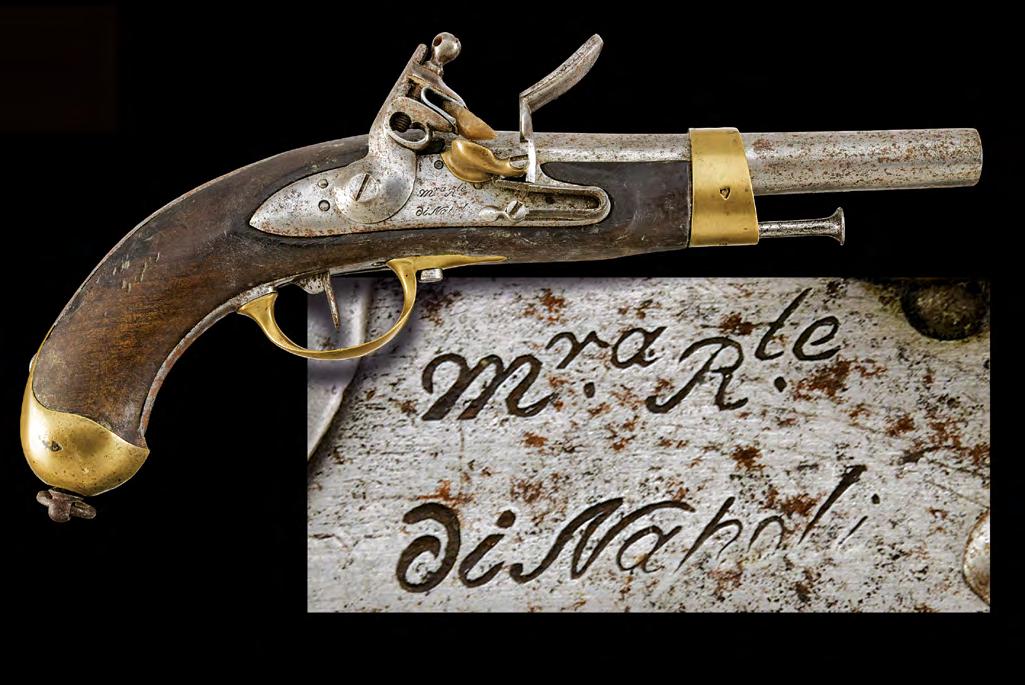
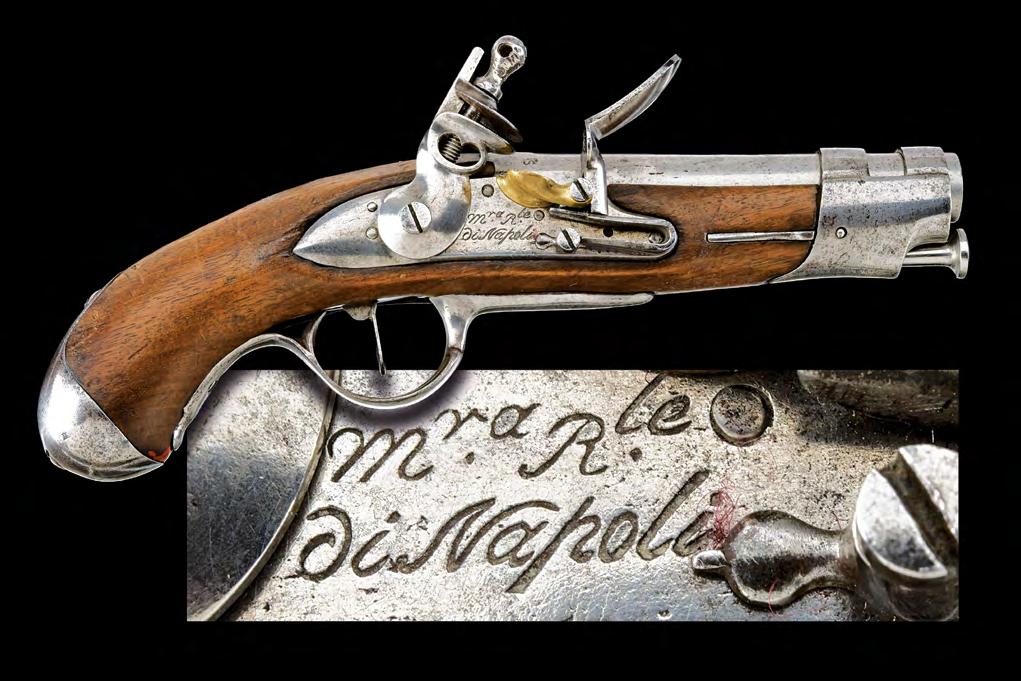
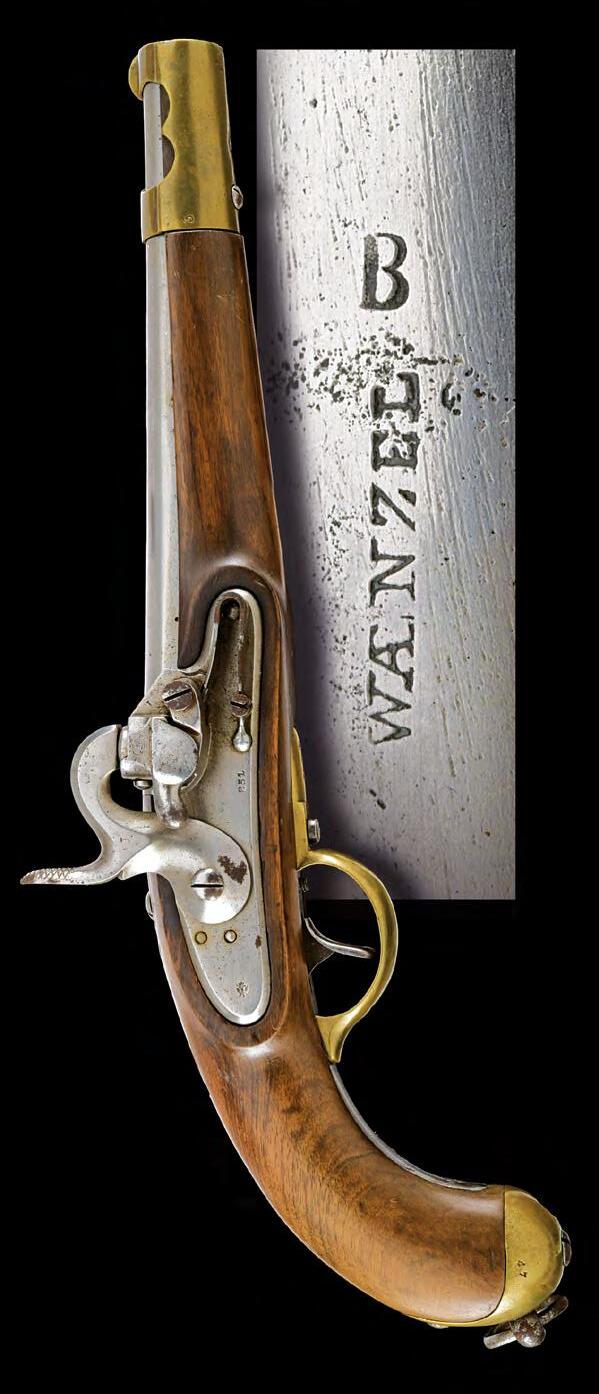
275 AN 1851 MODEL CAVALRY PISTOL WITH AUGUSTIN-SYSTEM
Austria, 1851
Round, smoothbore, 17 mm cal. barrel, signed “WENZEL” and marked “B”. ; areas damaged by superficial rust. Forward spring lock with “Augustin” system, lock plate dated “851” and stamped with double eagle; wooden stock with brass and iron mounts marked “3 47 W”. Rare model with iron suspension ring.
See “Die Hand- und Faustfeuerwaffen der habsburgischen Heere” by Erich Gabriel, pages 462/3.
PISTOLA DA CAVALLERIA CON SISTEMA
AUGUSTIN MOD. 1851
Austria, 1851
Canna tonda, liscia, firmata “WENZEL” e con punzone “B” , cal. 17 mm. Zone con danni da ruggine superficiale. Batteria a molla in avanti con sistema “Augustin”, cartella datata “851” e punzonata con aquila bicipite;. Cassa in legno con fornimenti in ottone e ferro marcati “3 47 W”. Raro modello con anello di sospensione in ferro.
Vedi “Die Hand- und Faustfeuerwaffen der habsburgischen Heere” di Erich Gabriel, pag. 462/3.
Conditions good
Length 43 cm.
€ 600/900
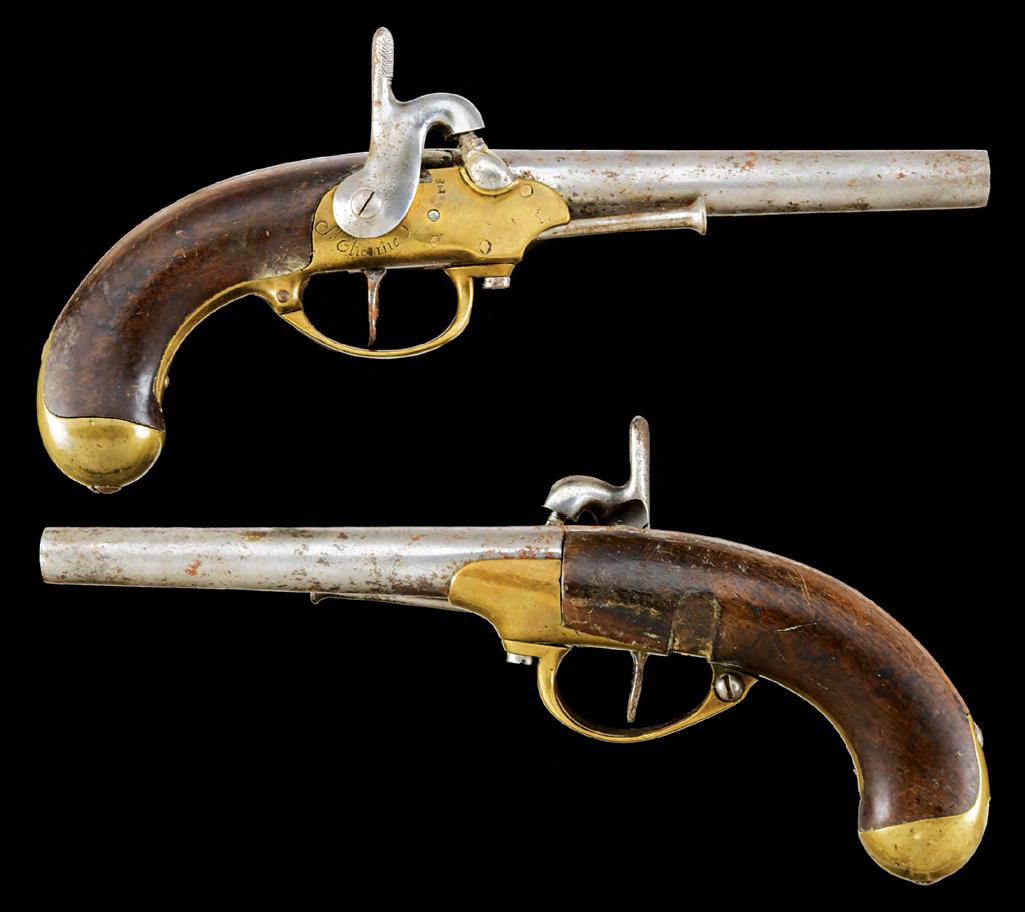
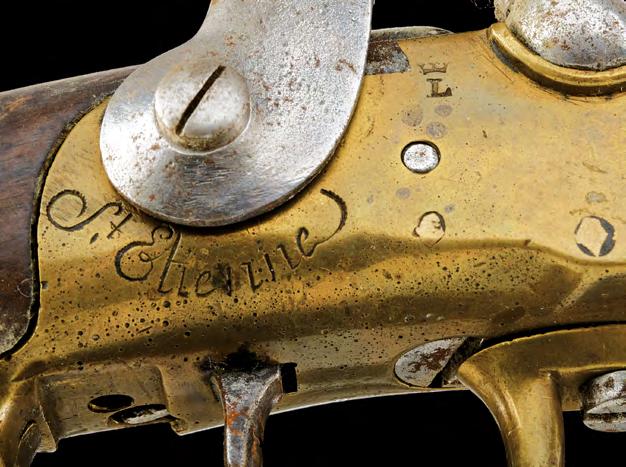
276
A RARE PAIR OF 1777 MODEL PISTOLS CONVERTED TO PERCUSSION
St. Etienne, circa 1777-1850
Smoothbore, round, 17 mm cal. barrels, remains of numbers at the base; locks with brass frame marked “St. Etienne” and “L” under crown, regularly converted to percussion, iron cock and piston. Wooden butts with brass mounts and iron ramrod.
RARO PAIO DI PISTOLE MOD. 1777 RIDOTTE A LUMINELLO
St. Etienne, 1777-1850 circa Canne tonde lisce con resti di numeri alla base, cal. 17 mm. Batterie con castello in ottone marcate “St. Etienne” e “L” sotto corona, con trasformazione regolamentare a luminello, il cane ed il pistone in ferro. Calci in legno con fornimenti in ottone e bacchetta in ferro.
Conditions good
Length 34 cm.
€ 600/900
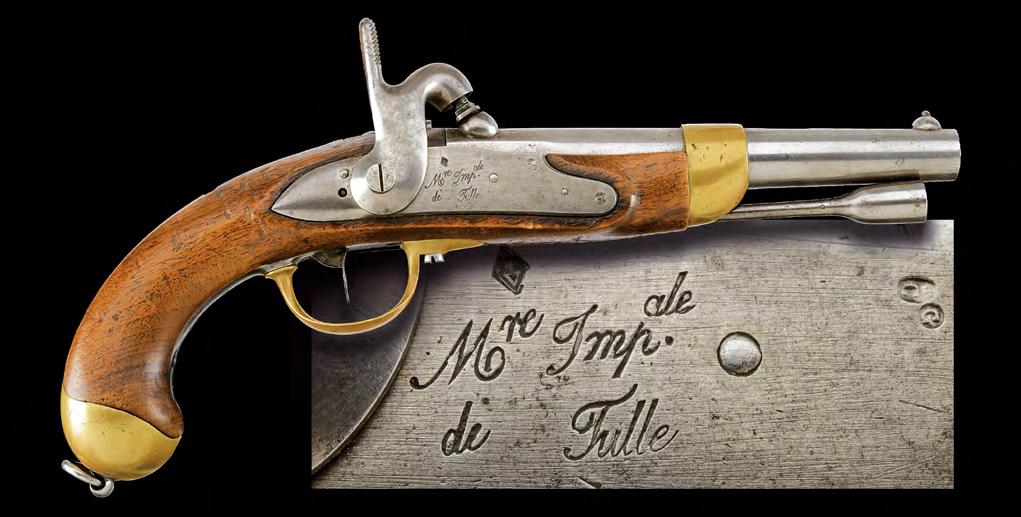
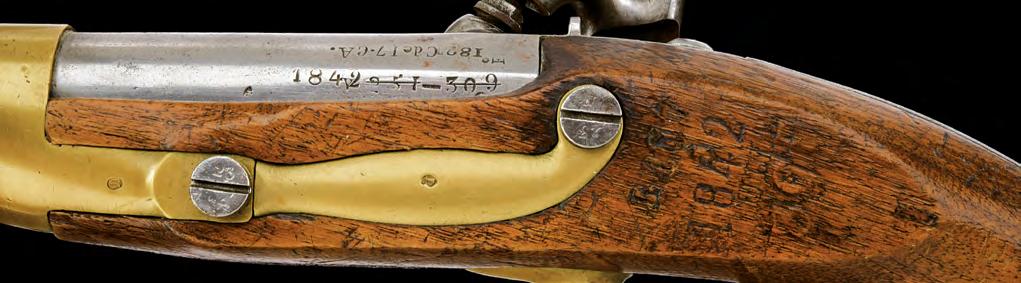
277 AN 1816 T BIS MODEL PISTOL CONVERTED TO PERCUSSION
Tulle, first quarter of the 19th Century
Rifled (bore with encrustments, visible rifling) round, 17 mm cal. barrel, octagonal at the base; marked “1821 C DE 17 CA”,“1842 251 309” and with various marks at the first part; with foresight; tang with model inscription and rear sight. Lock converted to percussion signed “M.re Imp.ale de Tulle” and with marks “C” under crown,“G” and “V” within rhombus; marked “L 137” on the back. Wooden stock, date stamp “1842” behind the counterplate. Iron and brass mounts with numerous marks. Suspension ring. Iron ramrod provided with marks and date “1842”. Rare.
PISTOLA CONVERTITA A LUMINELLO MOD. 1816
T BIS
Tulle, primo quarto del XIX Sec.
Canna rigata (anima con incrostazioni, rigatura visibile), tonda, con base ottagonale, marcata nella prima parte “1821 C DE 17 CA”,“1842 251 309” e con vari punzoni, dotata di mirino, cal. 17 mm in volata. Codetta dotata di alzo e marcata con dicitura del modello. Batteria ridotta a luminello, firmata “M.re Imp.ale de Tulle” e con punzoni “C” sotto corona, “G” e “V” entro rombo; il dorso marcato “L 137”. Cassa in legno recante timbro con data “1842” dietro alla contropiastra. Fornimenti in ferro ed ottone con numerosi punzoni. Anello di sospensione. Bacchetta in ferro munita di punzoni e data “1842”. Rara.
Conditions good
Length 35.5 cm.
€ 250/450
278 AN 1844 MODEL PERCUSSION PISTOL Turin, Mid 19th Century Round, smoothbore, 18 mm cal. barrel with octagonal
breech. Lock converted to percussion with flat lock plate, marked “FA... / IN TORINO”. Wooden threequarter stock, with stamp “BC” inside a circle and a cross-shaped mark on the left side. Iron mounts with remains of marks, beak-shaped butt-plate with ring for the strap.
PISTOLA A LUMINELLO MOD. 1844
Torino, Metà del XIX Secolo
Canna tonda liscia, con culatta ottagonale, cal. 18 mm. Batteria ridotta a luminello con cartella piatta marcata “FA... / IN TORINO”. Cassa a tre quarti in legno, con timbro “BC” entro un cerchio e un marchio a croce sul fianco sinistro. Fornimenti in ferro con tracce di punzoni, coccia a becco con anello porta correggiolo.
Conditions medium
Length 33.5 cm.
€ 200/400
279 AN 1844 MODEL "CARABINIERI" PERCUSSION
PISTOL
Turin, Mid 19th Century Round, smoothbore, 15 mm cal. barrel with octagonal breech, featuring the crowned Savoy mark at the base. Pitting. Lock converted to percussion with marking “R.A. Manif. a di Torino”. Working mechanism. Wooden full stock. Broken part at the muzzle ring stop. Brass mounts, iron ramrod. Areas damaged by rust.
PISTOLA A LUMINELLO DA CARABINIERI REALI
MOD. 1844
Torino, Metà del XIX Secolo
Canna liscia tonda, con culatta ottagonale, recante punzone sabaudo coronato alla base. Intaccature. Cal. 15 mm. Batteria ridotta a luminello con marcatura “R.A. MANIF. A DI TORINO”. Meccanica funzionante. Cassa intera in legno. Rottura al fermo
del bocchino. Fornimenti in ottone, bacchetta in ferro. Zone con danni da ruggine.
Conditions medium
Length 24.8 cm.
€ 200/300
280 AN INTERESTING MILITARY PISTOL CONVERTED TO PERCUSSION
Papal States, Mid 19th Century Rifled, 18 mm cal. barrel, provided with foresight, double-numbered. Tang featuring the “1822 T Bis” model inscription and fixed rear sight. Forward spring lock marked “M.ra Reale di Napoli”. Wooden half stock with matching stamp on the barrel. Brass mounts, butt-plate marked “2S.113.” Remains of marks. Ring for the strap. Iron ramrod. Working mechanism. Probably a former Neapolitan flintlock pistol transformed to percussion to be used among the papal troops.
INTERESSANTE PISTOLA MILITARE RIDOTTA A LUMINELLO
Stato Pontificio, Metà del XIX Secolo Canna rigata, dotata di mirino, recante doppia numerazione, cal. 18 mm. Il codolo con dicitura del modello “1822 T Bis” e munito di alzo fisso. Batteria a molla in avanti con marcatura “M.ra Reale di Napoli”. Mezza cassa in legno con timbro coevo alla canna. Fornimenti in ottone, coccia marcata “2S.113.” Resti di punzoni. Anello porta correggiolo. Bacchetta in ferro. Meccanica funzionante. Probabilmente una pistola a pietra focaia napoletana convertita per l’uso a luminello presso le truppe pontifice.
Conditions good Length 35 cm.
€ 200/400
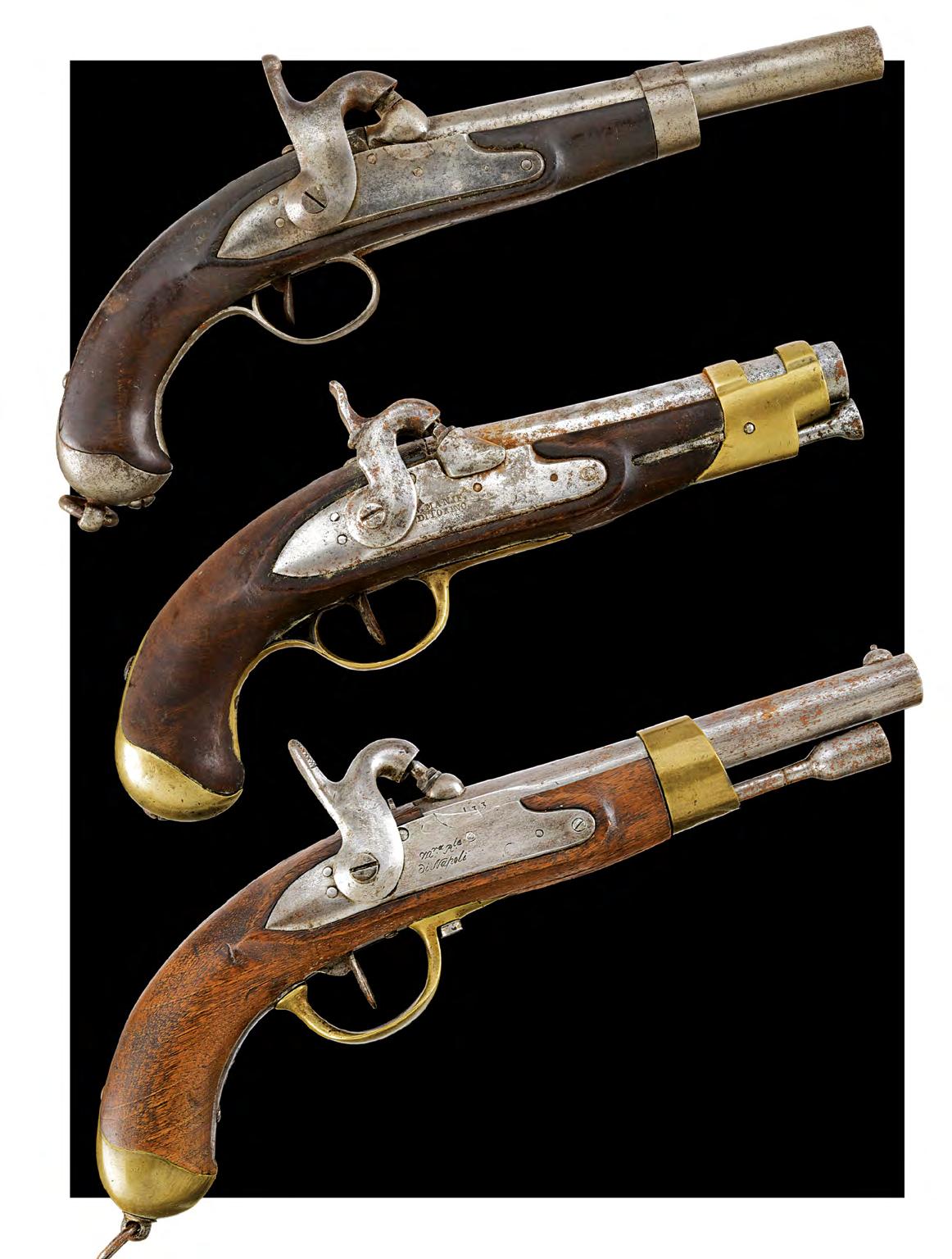
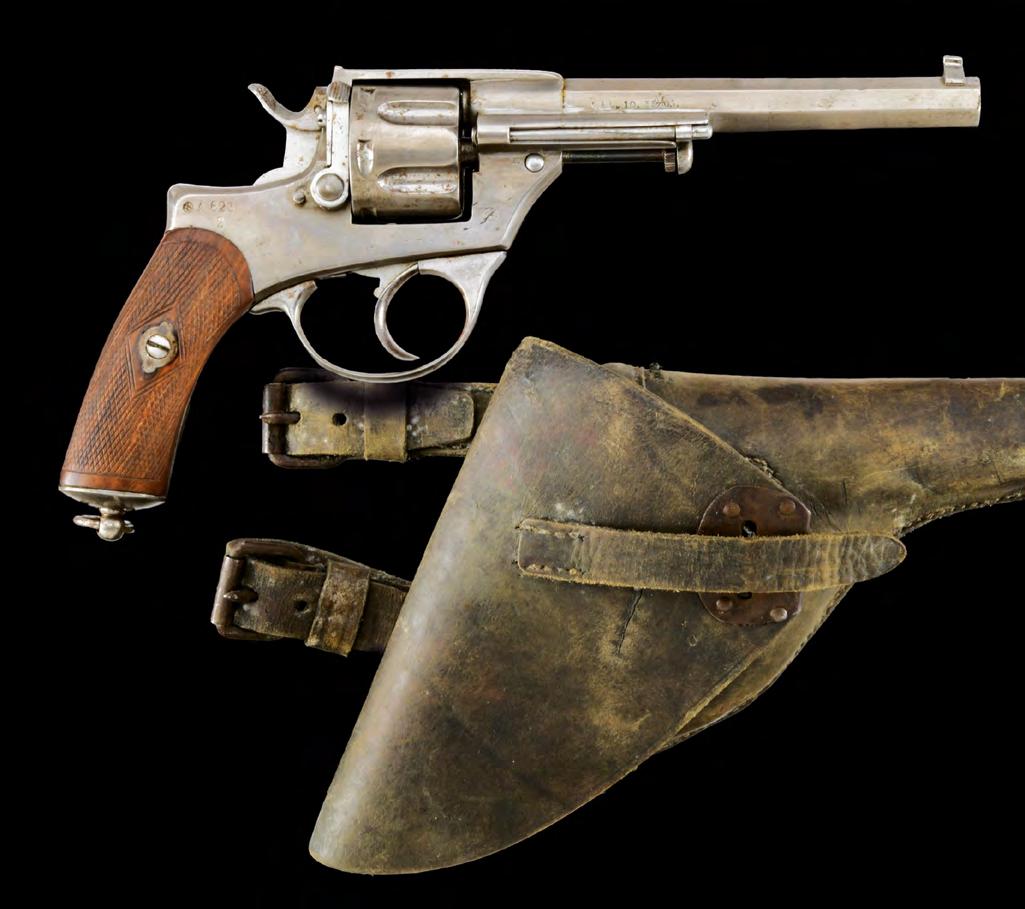
281
AN 1874 MODEL PIRLOT REVOLVER WITH HOLSTER Kingdom of Italy, 1875 - 1889 circa Octagonal, rifled barrel (clean bore, visible rifling), featuring the caliber inscription (10.35) on the side. Six-shot cylinder. Working mechanism. Marked “PIRLOT FRERES A LIEGE”.“CDS” stamp within an oval (Chamelot-Delvigne-Schmidt) and crowned “N” inspection mark; “M.A.” on the hammer. Checkered wooden grip scales. Metal and wood surfaces with signs of use and time. Ring for the strap. In an old military-style holster (matching? Fits very well), made of leather with iron mounts. Interesting.
This item was probably purchased by the Royal Italian Army, which initially bought pistols directly from Pirlot for its troops and later commissioned Glisenti to manufacture them in Italy. For more information, see the relevant chapter in “Pistole Militari Italiane” by L. Salvatici (Olimpia, 1985).
REVOLVER PIRLOT MOD. 1874 CON FONDINA Regno d’Italia, 1875 - 1889 circa Canna ottagonale rigata (anima pulita, rigatura visibile), recante sul fianco dicitura del calibro (10,35). Tamburo a sei colpi. Meccanica funzionante. Marcatura “PIRLOT FRERES A LIEGE”. Timbro “CDS” entro un ovale (Chamelot-Delvigne-Schmidt) e marchio d’ispezione “N” coronato; sul cane “M.A.” Guancette zigrinate in legno. Le superfici del metallo e legno con segni d’uso e del tempo. Anello porta
correggiolo. In una vecchia fondina di tipo militare (coeva? Calza molto bene), in cuoio con fornimenti in ferro. Interessante.
L’esemplare è probabilmente un acquisto del Regio Esercito italiano, che inizialmente comprò direttamente esemplari da Pirlot da fornire alle proprie truppe, per poi farli produrre successivamente in Italia dalla Glisenti. Vedi il relativo capitolo in “Pistole Militari Italiane” di L. Salvatici (ed. Olimpia 1985).
Conditions good
Length 29.7 cm.
€ 300/500
282 A 1768 MODEL LIGHT CAVALRY SABRE
Austria, late 18th Century
Wide, curved, single-and-false-edged blade with a wide fuller and tang, engraved at the base with a double eagle on both sides, featuring an incomplete mark “WeiZ...” on the back. Iron mounts with langets, single loop guard and long cap. Wooden grip covered with leather, without wire binding. Imposing iron scabbard with two suspension rings on bands. Areas damaged by rust on both the sabre and scabbard, scabbard with restoration at the upper part.
Provenance: Iammarino Collection
SCIABOLA PER CAVALLERIA LEGGERA MOD. 1768
Austria, fine del XVIII Sec.
Larga lama curva a un filo e con controfilo, con ampio sguscio e tallone, incisa alla base con aquila bicipite su entrambi i lati; il dorso con marcatura incompleta “WeiZ...”. Fornimenti in ferro con alette fermafodero, un ramo di guardia e cappetta lunga. Impugnatura in legno rivestita in cuoio, priva di trecciola. Imponente fodero in ferro con due anelli di sospensione su fascette. Zone con danni da ruggine su sciabola e fodero, fodero con restauro nella parte superiore.
Provenienza: Collezione Iammarino
Conditions good Length 98 cm.
€ 500/800
283
AN ARTILLERY OFFICER’S SWORD Europe, First half of the 19th Century Straight double-edged blade of hexagonal section, with light fuller at the base and featuring a mark (imperial orb). Fine brass hilt with flaming grenade over crossed cannons on the valve; loop guard entwined by a serpent. Pommel shaped as a lion’s head, chequered wooden grip. Leather scabbard with brass mounts engraved with floral motifs.
SPADA DA UFFICIALE DI ARTIGLIERIA Europa, Prima metà del XIX Secolo Lama dritta a due fili di sezione esagonale, lievemente sgusciata al forte e recante marca a globo crucigero.
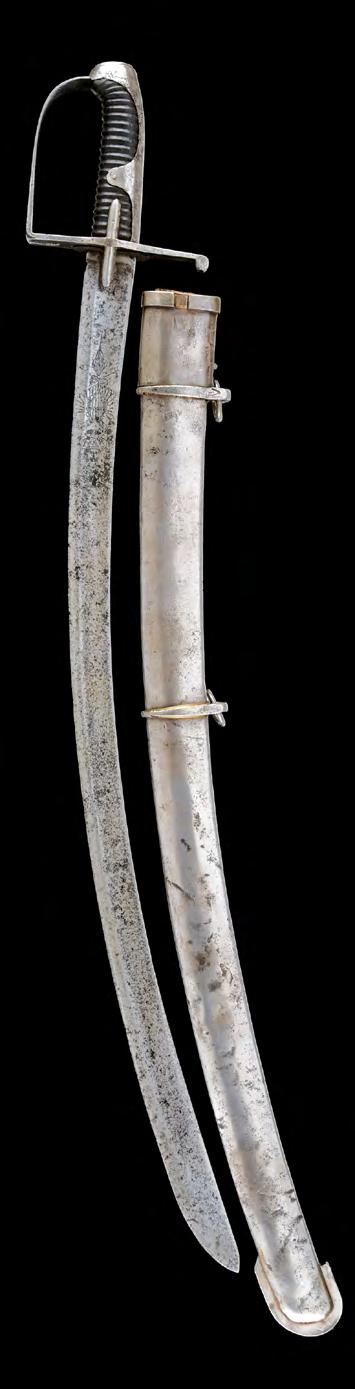
Bel fornimento in ottone con granata fiammeggiante sopra cannoni incrociati sulla pelta; ramo di guardia avvolto da un serpente. Pomo a testa di leone, impugnatura in legno zigrinato. Fodero in cuoio con fornimenti in ottone incisi a motivi floreali.
Conditions good Length 89.3 cm. € 150/250
284 A RARE CAVALRY
OFFICER’S SABRE
Europe, First half of the 19th Century
Slightly curved, single-and short false-edged blade with wide central fuller; engraved and gilded with a crowned coat of arms with three crowns, a lion rampant at the first part, and three lions in the third segment (England or Sweden), along with trophies, a crown, and the motto “VIVAT”, all on a blue background. Bronze hilt with remains of original gilding, grooved quillons and loopguard, pommel with lion’s head and long cap. Wooden grip covered with fish skin and wire binding with bands of gilded metal. Leather-covered wooden scabbard and brass mounts. Two lugs.
RARA SCIABOLA
DA UFFICIALE DI CAVALLERIA
Europa, Prima metà del XIX Secolo Lama leggermente curva a un filo e breve controfilo con ampio sguscio centrale, incisa e dorata su fondo blu al forte, con stemma coronato recante tre corone, un leone rampante e tre leoni nel terzo segmento (Inghilterra o Svezia), trofei, corona e motto “VIVAT”.
Fornimento in bronzo con resti di doratura originale, bracci dell’elso e ramo di guardia scanalati, pomo con testa di leone e cappetta lunga. Impugnatura in legno rivestita con pelle di pesce e con trecciola a bande in metallo dorato. Fodero in legno rivestito di cuoio con fornimenti in ottone. Due campanelle.
Conditions medium Length 93 cm.
€ 300/600



285 A RARE SWORD
Eastern Europe, 18th Century
An interesting straight, double-edged blade; with fuller at the base doubling further; tang with gold mark; scabbard with motto “Vincere Aut Mori - Deo Gloria” on one side and “Deus Pro....” (not entirely legible) on the other side. Blackened iron hilt with knuckle-guard fastened by a band to the loop-guard, langets, a thumb ring, and long cap. Leather-covered wooden grip. Scabbard (earlier, matching?) in leather with bronze mounts with two lugs. Probably Poland or Hungary.
RARA SPADA
Europa orientale, XVIII Secolo
Interessante lama dritta a due fili, con sguscio al forte che si sdoppia in seguito, il ricasso con marca dorata, nello sguscio inciso un motto, su un lato “Vincere Aut Mori - Deo Gloria”, sull’altro “Deus Pro....” (non del tutto leggibile). Fornimento in ferro annerito, dotato di vela fissata al ramo di guardia tramite una banda controcurvata; alette fermafodero, anello da pollice e cappetta lunga. Impugnatura in legno rivestita di cuoio. Fodero (antico, pertinente?) in cuoio con fornimenti in bronzo a due campanelle. Probabilmente Polonia o Ungheria.
Conditions medium
Length 94.5 cm.
€ 800/1.200
286
AN OFFICER’S SABRE
France, Second quarter of the 19th Century
A beautiful, broad blade, single-and-false-edged with wide fuller; engraved and gilded with trophies and floral motif on a blue background at the first part. Brass hilt with three loop-guards, langets, and long cap. Leather-covered wooden grip with metal wire binding. Iron scabbard with two lugs (blackened and partially gilded in modern times).
SCIABOLA DA UFFICIALE
Francia, Secondo quarto del XIX Secolo
Bella lama larga, curva, a un filo e controfilo con ampio sguscio, incisa e dorata nella prima parte su fondo blu a trofei e motivi floreali. Fornimento in ottone a tre rami di guardia, alette fermafodero e cappetta lunga. Impugnatura in legno rivestita di cuoio con trecciola metallica. Fodero in ferro a due campanelle (annerito e parzialmente dorato in epoca recente).
Conditions medium Length 98.5 cm.
€ 300/600
287 AN ELEGANT AND RARE GENERAL SABRE, MODEL VENDEMIAIRE
AN XII
France, First Empire
Single-and short false-edged blade, with fuller almost along its entire length; the right side engraved with floral spirals and gilded trophies, all against a blue-tinted background (some missing parts in the finishing). Magnificent gilt-brass hilt in the typical Empire style. Solid guard finely chased with the effigy of a pelta bearing two crowned cock’s heads, placed among flags. Langets with borders adorned with small spheres, at the centre a finely executed and raised representation of Medusa. Knuckle-guard finely worked with laurel foliage at the base, fluted neck and terminal fully modelled as a lion’s head; the rear quillon worked en suite but without the lion’s head and elegantly joined to the main guard branch, this of rectangular section, slender and fashioned as a column, terminating in a lion’s head. The joining arm between pommel and guard with deep and finely executed palmette carving. Pommel widening towards the top, the outer surface worked in low relief with leaves, the upper part engraved en suite. Rectangular ferrule with flower within a circle. Ebony grip carved with scale pattern (some losses). Smooth gilt-brass scabbard with two lugs. Iron, sail-shaped shoe.
ELEGANTE E RARA SCIABOLA DA GENERALE, MODELLO
VENDEMIAIRE AN XII
Francia, Primo Impero Lama curva a un filo e breve controfilo, sgusciata per quasi tutta la lunghezza, incisa al forte a volute floreali e trofei dorati, il tutto su sfondo azzurrato (alcune mancanze alla finitura). Magnifico fornimento in ottone dorato nel tipico gusto dello Stile Impero. Massello finemente cesellato con effige di una pelta recante due teste di gallo coronate, posta fra bandiere. Alette fermafodero con cornice adornata da piccole sfere, al centro una raffigurazione bene eseguita e rilevata di Medusa. Elso con braccio di parata finemente elaborato con base a fronde di alloro, collo scanalato ed estremità lavorata a tuttotondo a testa di leone; il braccio di guardia elaborato nello stesso modo ma privo della testa di leone e elegantemente raccordato al ramo guardia, questo a sezione rettangolare, slanciato e lavorato a colonna, culminante nella testa di leone. Il braccetto di raccordo fra pomo e guardia presenta un profondo e ben eseguito intaglio a palmetta. Pomo di sezione crescente verso l’alto, con superficie esterna lavorata in bassorilievo a foglie, la parte sommitale con incisioni en suite. Ghiera rettangolare con fiore entro un cerchio. Impugnatura in ebano scolpito a scaglie (alcune mancanze). Fodero liscio in ottone dorato a due campanelle. Il battisasso a forma di vela, in ferro. Conditions good
3.000/6.000
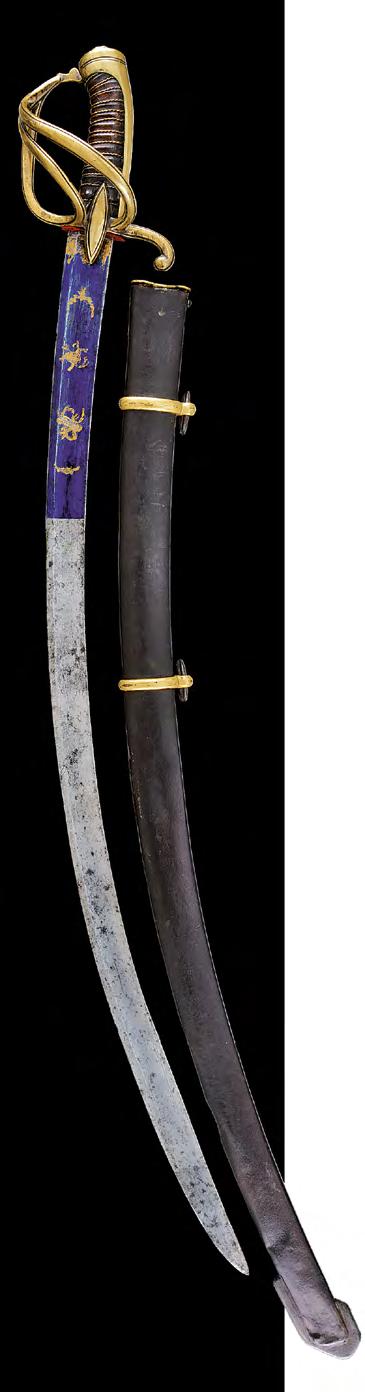
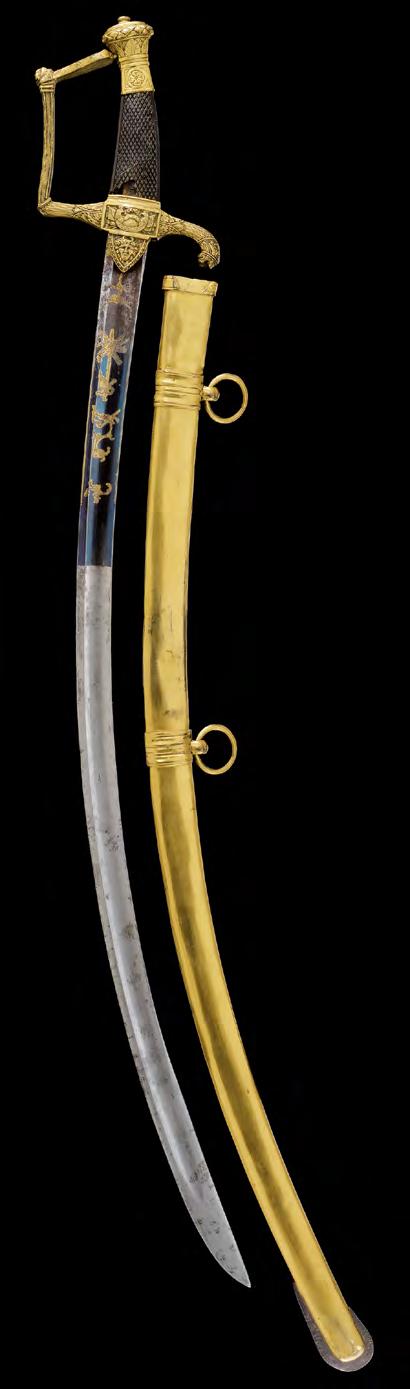
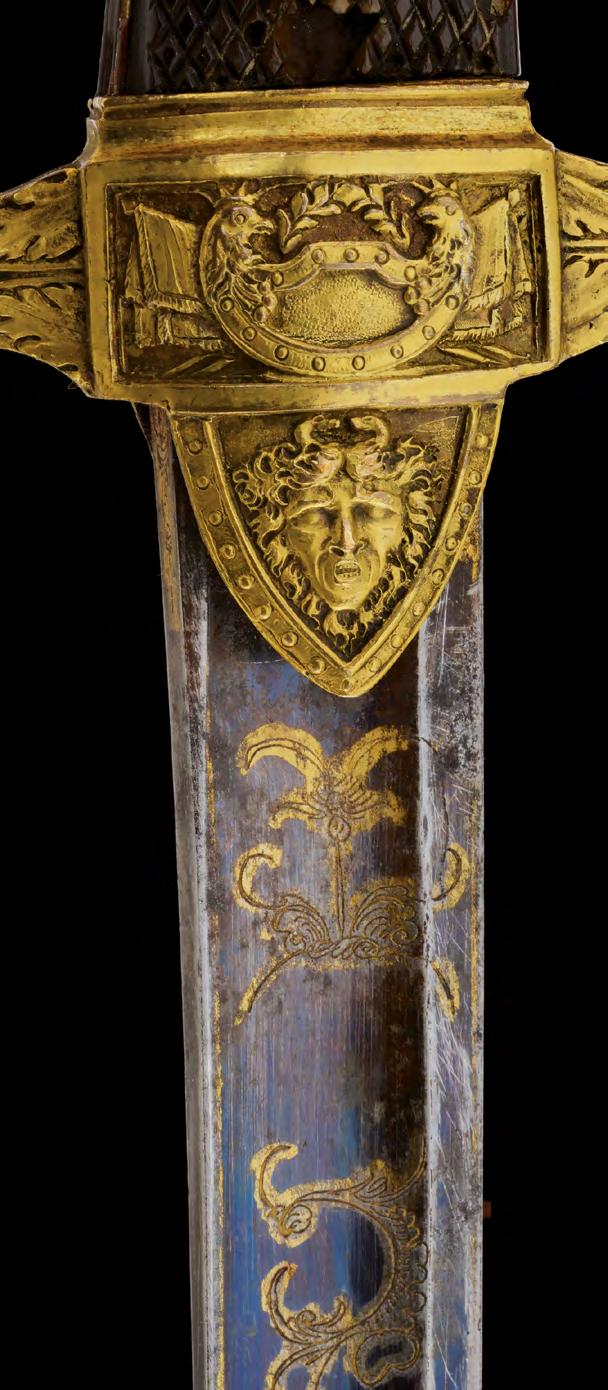
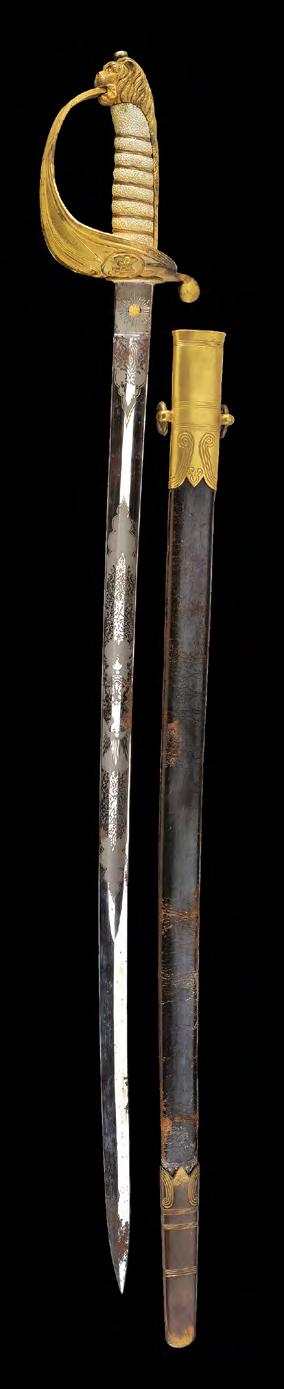
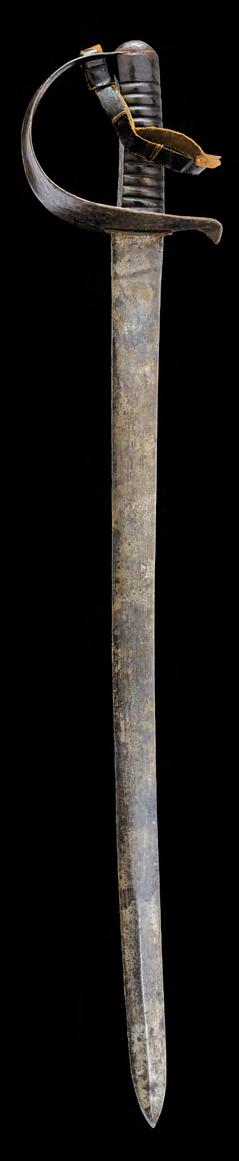
288 A NAVY OFFICER'S SABER
England, 19th Century
Slightly curved, single-and false-edged blade with fuller; richly decorated with etched motifs featuring racemes and a crowned eagle; on the tang, the maker’s mark “WILSON 31 LOMBARD ST LONDON” on one side, and on the opposite side the mark “PROVED” in gold. Typical gilded hilt with a crowned anchor in the oval. Handle covered in white fish skin featuring a brass wire binding. Pommel carved in the shape of a lion’s head. Leather scabbard with standard brass mounts, two lugs.
SCIABOLA DA UFFICIALE DI MARINA
Inghilterra, XIX Secolo
Lama leggermente curva, sgusciata, a un filo e controfilo, ben decorata a incisioni all’acquaforte con racemi ed aquila coronata, recante al tallone la marca del fabbricante “WILSON 31 LOMBARD ST LONDON”, su un faccia, dalla parte opposta il punzone “PROVED” rimesso in oro. Tipico fornimento in ottone dorato con àncora coronata nell’ovale. Impugnatura con rivestimento in pelle di pesce color bianco munita di trecciola in filo d’ottone. Pomo lavorato a testa di leone. Fodero in cuoio con fornimenti regolamentari in ottone, due campanelle.
Conditions good
Length 89 cm.
€ 350/450
289
A NAVY CUTLASS, PATTERN 1889
United Kingdom, End of 19th beginning of 20th Century
Slightly curved, single-and short-false-edged blade, with a tip ribbed at the center. No marks. Iron hilt with remains of bituminous paint, also present on the handle. Remains of a lace. Missing scabbard. Signs of wear and age.
SCIABOLA DA MARINA DEL TIPO DA ABBORDAGGIO, MOD. 1889
Regno Unito, Fine XIX inizio XX Secolo
Lama leggermente curva a un filo e breve controfilo, con punta costolata in mezzeria. Priva di marcature. Fornimento in ferro a vela con resti di vernice bitumata, presenti anche all’impugnatura. Resti di un laccio. Fodero mancante. Segni d’uso e del tempo.
Conditions medium
Length 81.2 cm.
€ 50/100
290
A RARE HUSSAR OFFICER’S SABRE
Cisalpine Republic, late 18th Century
Wide, curved, single-and-false-edged blade at the weak, with fuller, (length 82.5 cm). Brass hilt with stirrup guard. Crossbar with a parry quillon slightly curved downwards and faceted, bulbous-shaped head. Long, brass cap shaped with three longitudinal planes. Grip with wire wrapping and copper wire binding. Dorsal button. Scabbard made of sheet brass simply roped in a profile, with some dents, signs of use and time. Small drag. Two lugs.
The construction features are typical of gunsmiths working in the Brescia area during the period of the Cisalpine Republic and the Italian Republic (1802–1805), but it is rare in its use of brass mounts instead of iron ones.
RARA SCIABOLA DA UFFICIALE DEGLI USSARI A CAVALLO
Repubblica Cisalpina, fine del XVIII Sec.
Ampia lama curva sgusciata, a un filo e con controfilo al debole (lunghezza 82,5 cm). Fornimento in ottone con guardia a staffa. Crociera con braccio di parata lievemente incurvato verso il basso e con testa a bulbo faccettato. Cappetta lunga sempre in ottone sagomata a tre piani longitudinali. Impugnatura con rivestimento in filo e trecciola di rame. Bottoncino dorsale. Fodero in lamiera dottone semplicemente ribadita su un profilo, con qualche bozzo, segni d’uso e del tempo. Piccola vela battisasso. Due campanelle.
Le caratteristiche costruttive sono tipiche degli armieri operativi nell’area bresciana nel periodo della Repubblica Cisalpina e in quello della Repubblica Italiana (1802-1805), ma è rara per l’impiego dei fornimenti in ottone, al posto di quelli in ferro.
Conditions good
Length 95.5 cm.
€ 800/1.200
291
A DRAGOON TROOPER’S SWORD
Kingdom fo Italy (Napoleonic), 1810 - 1815 circa
Straight single-edged blade with double fuller running for the entire length and central ridge; short ricasso. Brass hilt, plain shell-guard, guard with three quillons (one broken) ending in scrolls. Wooden grip covered in leather (missing parts) with twisted brass wire binding. Leather scabbard with brass mounts, two lugs.
SPADA PER TRUPPA DEI DRAGONI
Regno Italico, 1810 - 1815 circa Lama dritta a un filo, con doppio sguscio a tutta lunghezza e con nervatura centrale; munita di breve tallone. Fornimento in ottone, coccia liscia, guardia a tre rami (uno fratturato) con estremità a ricciolo. Impugnatura in legno rivestito in cuoio (mancanze) con trecciola in filo d’ottone. Fodero in cuoio con fornimenti in ottone, due campanelle.
Conditions good Length 112.5 cm.
€ 1.200/1.800
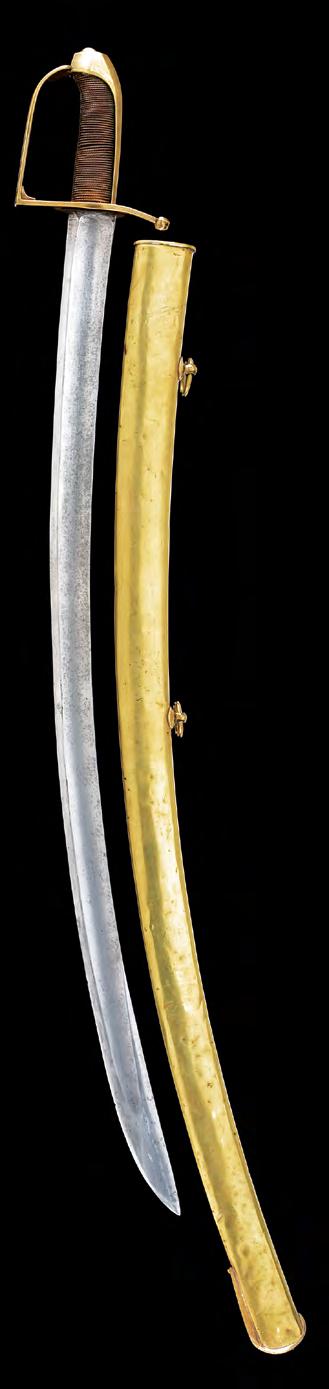
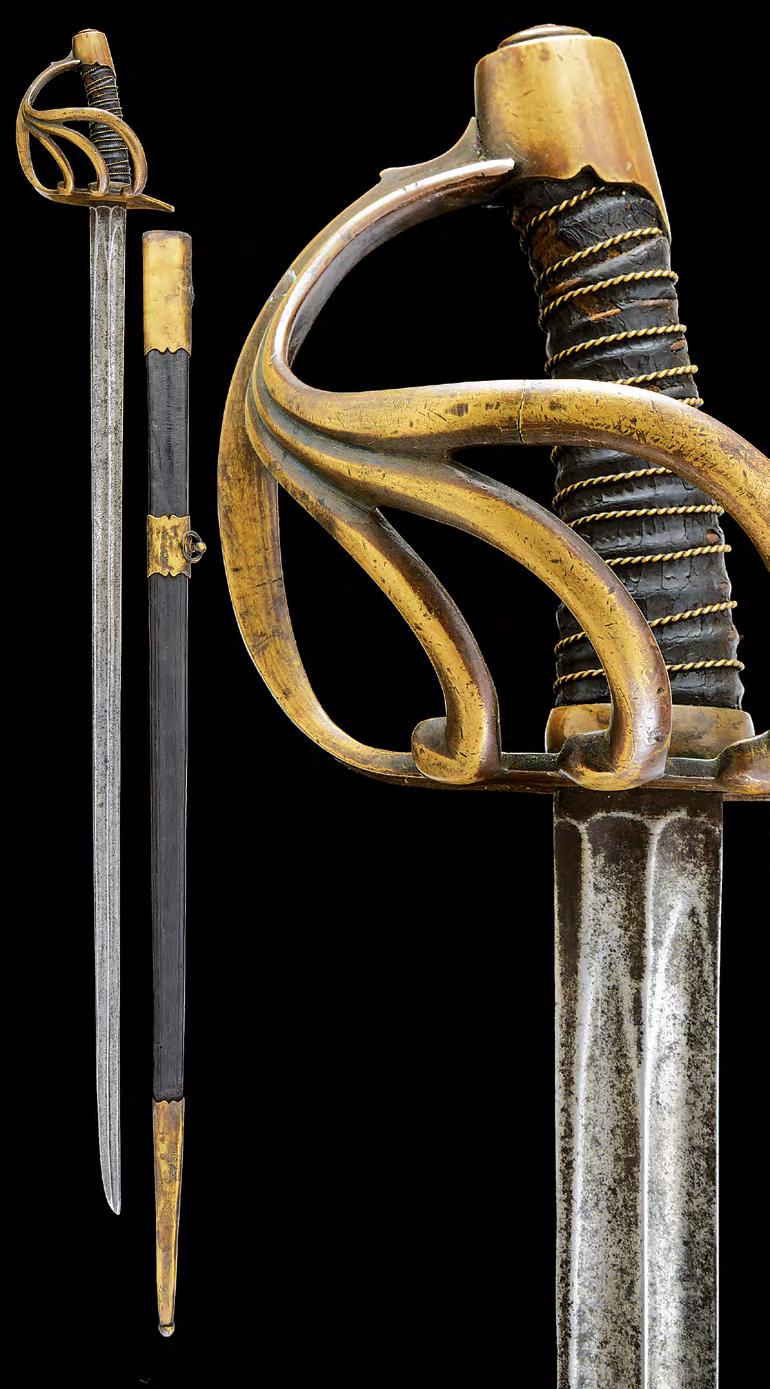
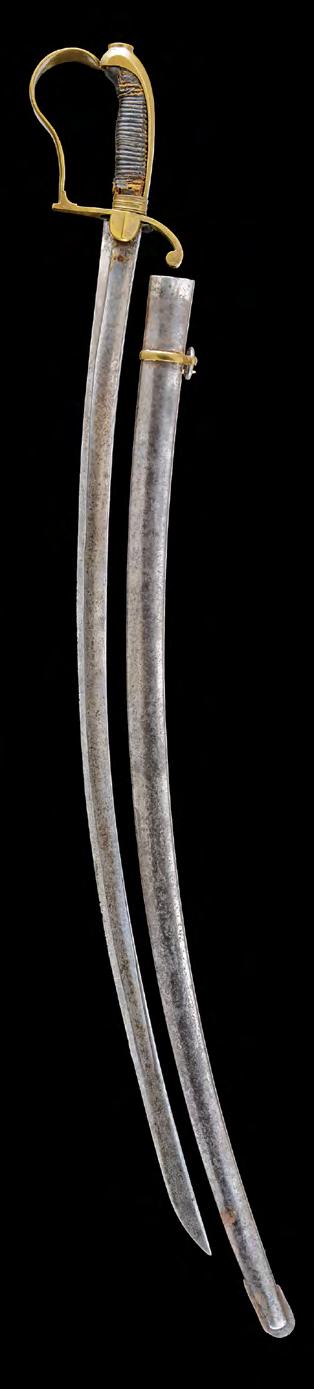
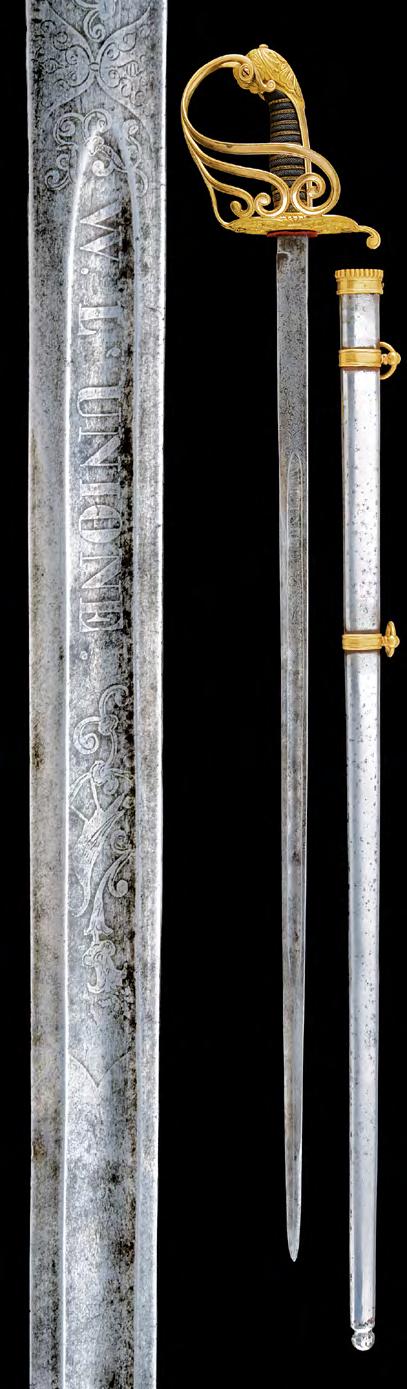
292 A SABRE
Italy, Mid 19th Century
Curved, tipped, single-and short-false-edged blade; tang. Brass hilt with parry quillon featuring a curl and domed guard. Long, brass cap with the top shaped as an elliptical button. Wooden handle covered in leather (missing parts and defects). Iron scabbard with a brass band provided with an oval lug.
SCIABOLA
Italia, Metà del XIX Secolo Lama curva sgusciata, a un filo, punta e controfilo; con breve tallone. Fornimento in ottone con braccio di parata a ricciolo e guardia bombata. Cappetta lunga in ottone con sommità a bottone ellittico. Impugnatura in legno rivestita di cuoio (mancanze e difetti). Fodero in ferro con una fascetta in ottone munita di campanella ovale.
Conditions medium
Length 96.5 cm.
€ 200/300
293 A CIVIC GUARD GENERAL-TYPE SWORD Italy, about 1860
Single-and-false-edged blade, flat and engraved with the motto “W L’UNIONE / W L’ITALIA” and decorated with floral motifs at the first part, then with fuller and ribbed in the middle at the weak. Gilt brass hilt with large rain-guard worked with architectural motifs in relief; the main loop-guard is decorated in relief and provided with three other loop-guards ending in curls. The guard with typical forked end and pommel shaped as a lion’s head. Iron hilt with gilt brass mounts, two lugs.
SPADA SUL TIPO DA GENERALE DELLE GUARDIA CIVICA
Italia, 1860 circa Lama dritta a un filo e controfilo, prima piatta ed incisa con motto “W L’UNIONE / W L’ITALIA” e decorata a motivi floreali, in seguito sgusciata e al debole costolata in mezzeria. Fornimento in ottone dorato con ampia coccia lavorata in rilievo a motivi architettonici, il ramo principale di guardia decorato in rilievo e munito di altri tre rami terminanti a ricciolo. La guardia con tipica terminazione biforcata e pomo a testa di leone. Fodero in ferro con fornimenti in ottone dorato, due campanelle.
Conditions good Length 97 cm.
€ 800/1.200
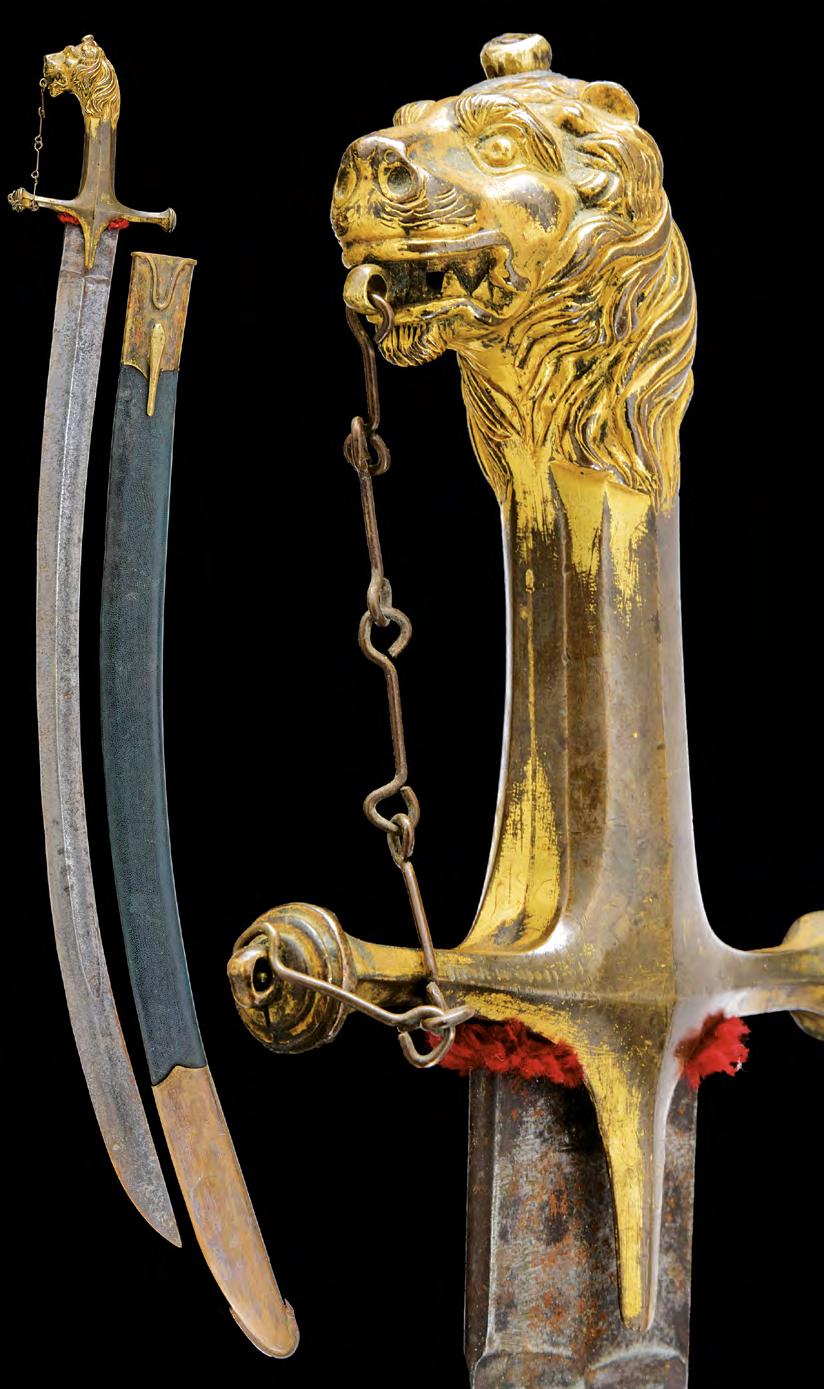
294 AN OFFICER’S SABRE FROM THE MURAT EPOCH Naples, first quarter of the 19th Century Broad, curved, single-andfalse-edged blade with wide fuller; two deep, faintly legible markings at the tang, placed under the langets. Fine bronze hilt with remains of the original gilding, featuring a crossshaped quillon with straight, faceted quillons thickened at the ends. Pommel shaped as a lion’s head with chain; robust and faceted grip. Wooden scabbard covered with leather with orientalstyle seam and smooth brass mounts, the cap with hook. Rare.
SCIABOLA DA UFFICIALE D’EPOCA MURATTIANA Napoli, primo quarto del XIX Sec.
Larga lama curva a un filo e controfilo con ampio sguscio; al tallone sono presenti due profonde marcature, poco leggibili, situate sotto l’aletta fermafodero. Bel fornimento in bronzo con resti della doratura originale, munito di elso a croce con bracci dritti, faccettati e ingrossati alle estremità. Pomo a testa di leone con catenina; impugnatura massiccia e faccettata. Fodero in legno rivestito in cuoio con cucitura imitante modelli orientali e con fornimenti lisci in ottone, la cappa con gancio. Rara.
Conditions medium
Length 96.5 cm.
€ 400/800
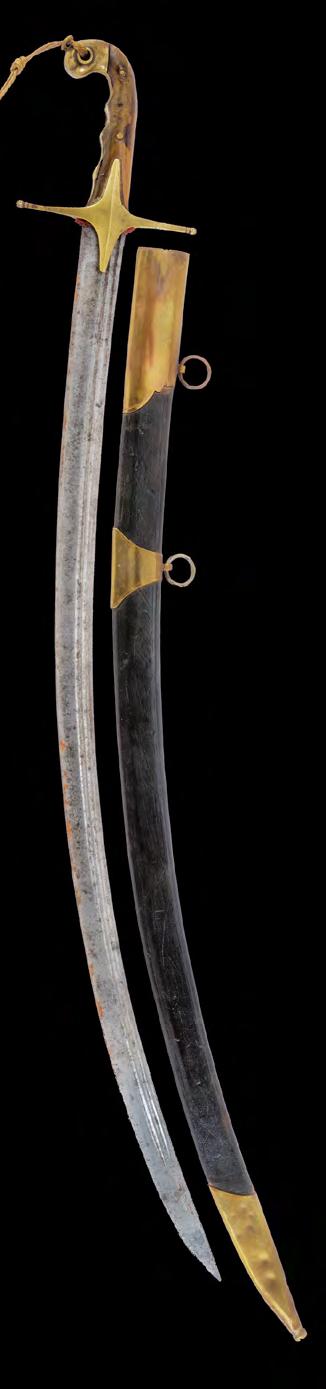
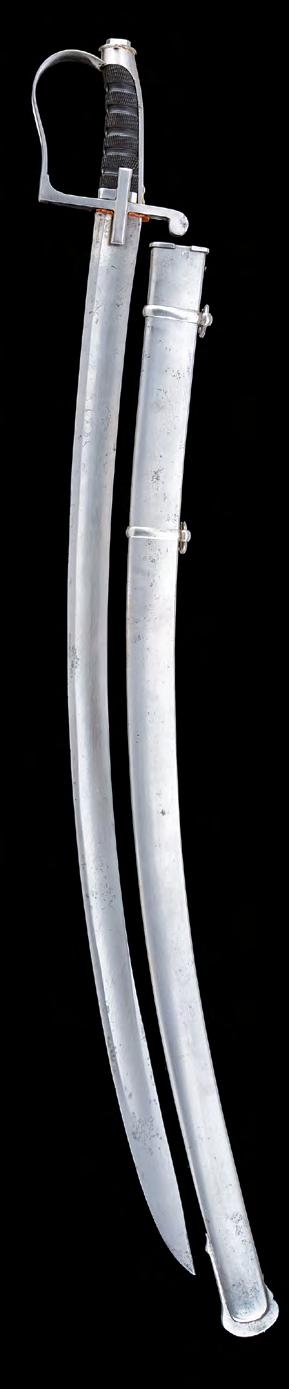
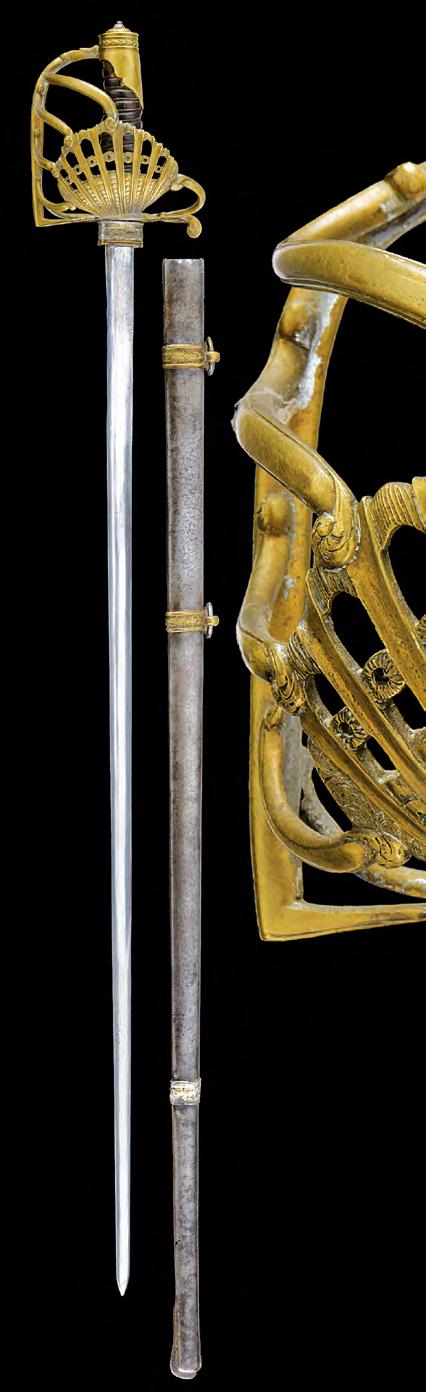
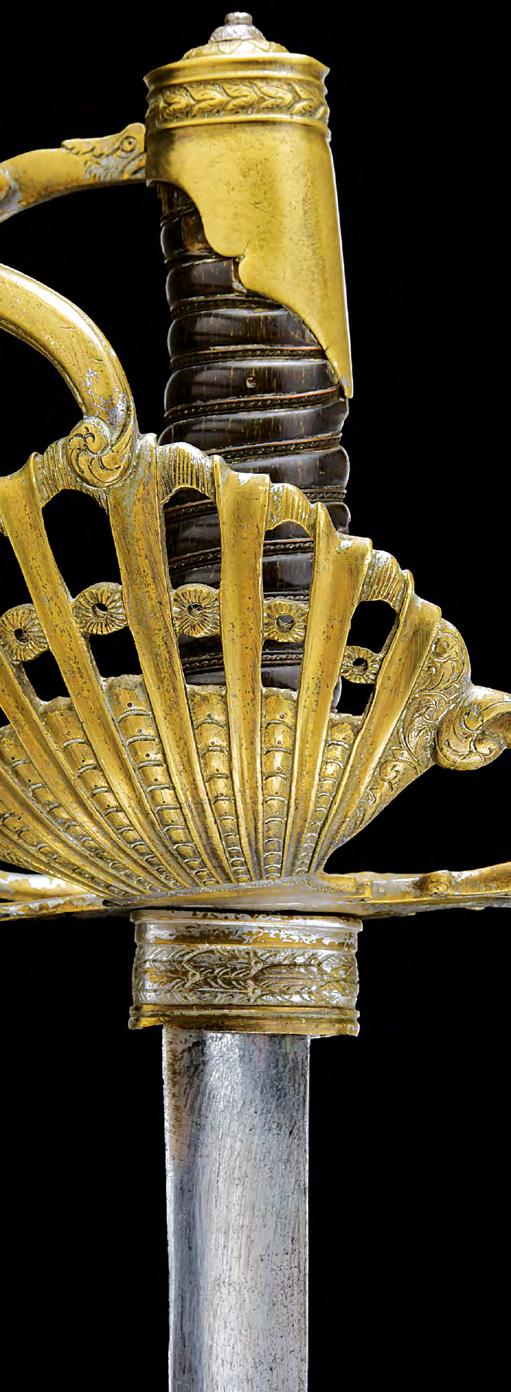
295 ORIENTAL-STYLE OFFICER’S SABRE, PERIOD OF CARLO ALBERTO
Sardinian Kingdom, 1830-40
Single-and short false-edged, curved blade with short grooves, featuring two grooves under the fuller. Oriental-style brass hilt with cross-shaped quillon and angled pommel. Anatomical horn grip (missing parts). Leather scabbard with brass mounts and two lugs.
See a similar item in “Storia dell’arma bianca italiana” by Cesare Calamandrei, Florence, 1999, page 44.
SCIABOLA ALL’ORIENTALE DA UFFICIALE D’EPOCA CARLO ALBERTO
Regno di Sardegna, 1830-40
Lama curva a un filo, con breve controfilo provvista di due scanalature sotto al dorso che è sgusciato. Fornimento in ottone all’orientale con elso a croce e pomo angolato. Impugnatura anatomica in corno (piccole mancanze). Fodero in cuoio con fornimenti in ottone e due campanelle.
Vedi un simile esemplare in “Storia dell’arma bianca italiana” di Cesare Calamandrei, Firenze, 1999, pagina 44.
Conditions medium
Length 94 cm.
€ 150/250
296 AN 1855 MODEL SABRE WITH HUSSAR’S BLADE
Sardinian Kingdom, Third quarter of the 19th Century
Wide, curved,single-and-false-edged blade with wide fuller, with remains of engraved elements depicting a mounted hussar, trophies and floral motifs at the first part. Typical hilt with stirrup guard, langets. Ebony grip with checkered sections. Complete with iron scabbard, two suspension rings on bands. Rare.
SCIABOLA MOD. 1855 CON LAMA DA USSARO
Regno di Sardegna, Terzo quarto del XIX Secolo
Larga lama curva a un filo e controfilo con ampio sguscio, con resti di incisioni al forte, recante un ussaro a cavallo, trofei e disegni floreali. Fornimento di tipica foggia, con guardia a staffa, alette fermafodero. Impugnatura in ebano a settori zigrinati. Completa di fodero in ferro, con due anelli di sospensione su fascette. Rara.
Conditions good Length 100 cm.
€ 500/700
297 A "GARDE DU CORPS" OFFICERS SWORD
Kingdom of the Two Sicilies, Mid 19th Century
Single-and-false-edged blade with central fuller and of lenticular section toward the weak. Garde de Bataille-style brass hilt with pierced, engraved shell-shaped knuckle-guard, five loop-guards, rear valve, and short cap, with remains of silver plating. Horn grip with coils and metal wire binding. Featuring a cover for the scabbard at the base. Iron scabbard with two brass fasces engraved with floral motifs and lugs. Signs of old restoration at the lower part. Rare.
SPADA DA UFFICIALE DELLA GUARDIA DEL CORPO
Regno delle Due Sicilie, Metà del XIX Secolo Lama dritta a un filo e controfilo con sguscio centrale e di sezione lenticolare verso il debole. Fornimento in ottone del tipo Garde de Bataille con vela a conchiglia traforata e incisa, cinque rami di guardia, valva posteriore e cappetta corta, resti di argentatura. Impugnatura in corno a spire con trecciola metallica. La base con copertura per il fodero. Fodero in ferro a due fasce in ottone inciso a motivi floreali con campanelle. La parte bassa con vecchio restauro. Rara.
Conditions medium
Length 97 cm.
€ 250/450


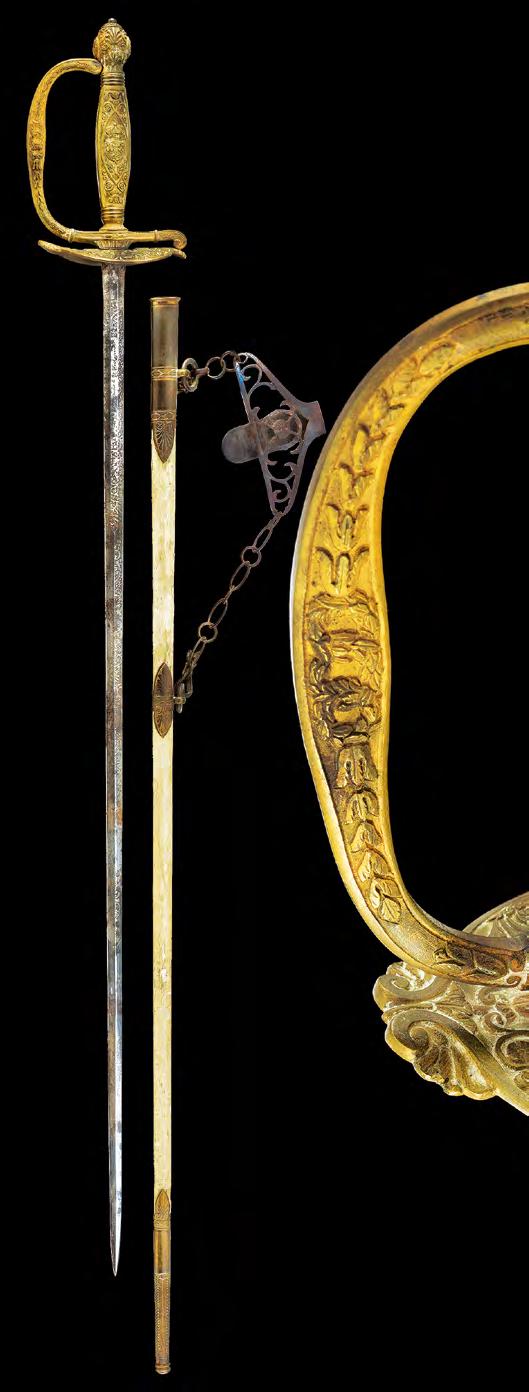
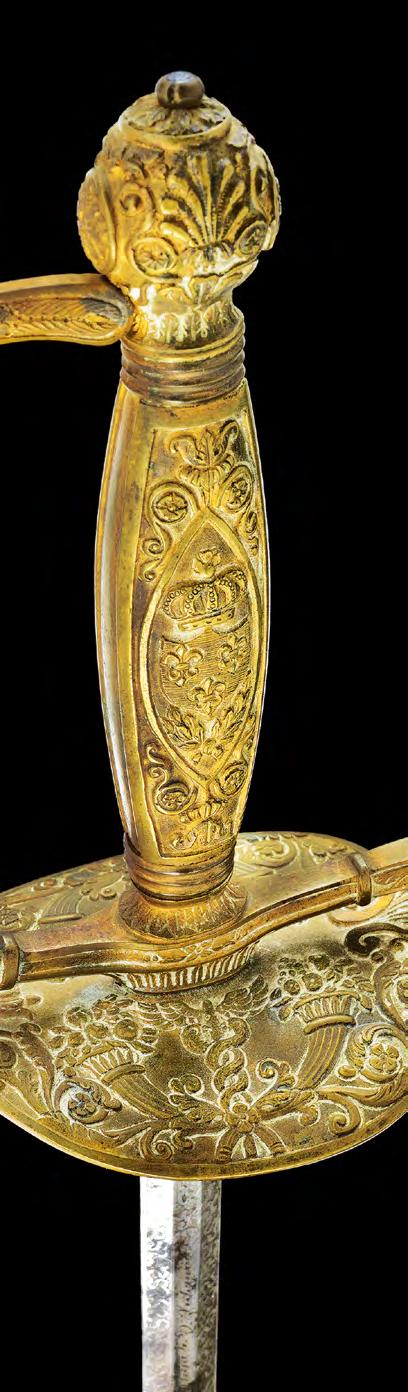
298 A SMALL SWORD
Kingdom of the Two Sicilies, First half of the 19th Century Straight, single-and false-edged blade; decorated over the first part with gilt engravings on a blued ground. Hilt of formerly gilt bronze, with flat rain-guard and folding valve. Quillon with straight quillons and swollen terminals. Smooth guard. Grip covered in silvered metal (missing parts). Flat pommel. Leather scabbard (defects) with brass mounts.
Probably for an aide-de-camp of the Company of the Royal Foot Guards.
SPADA
Regno delle Due Sicilie, Prima metà del XIX Secolo Lama dritta, sgusciata, a filo e controfilo; decorata con incisioni dorate su fondo blu al primo terzo. Fornimento in bronzo già dorato, con coccia piatta e valva pieghevole. Elso a bracci dritti con terminali ingrossati. Guardia liscia. Impugnatura con rivestimento in metallo argentato (alcune mancanze). Pomo a guardia piatta. Fodero in cuoio (difetti) con fornimenti in ottone.
Probabilmente da aiutante della Compagnia delle reali guardie del corpo a piedi.
Conditions medium
Length 98 cm.
€ 250/350
299 AN OFFICER’S SWORD OF THE NEAPOLITAN CHASSEURS
Kingdom of the Two Sicilies, Mid 19th Century Straight, single-and short false-edged blade, with fuller. With small engravings at the strong, remains of gilding on a blue-tinted background. Some pitting. Brass hilt with remains of gilding. Shell-guard with horn in relief, guard decorated with knots. Brown horn grip with piping. Iron scabbard with two lugs. Some signs of use and time.
SPADA DA UFFICIALE DEI CACCIATORI NAPOLETANI
Regno delle Due Sicilie, Metà del XIX Secolo
Lama dritta a un filo e breve controfilo, sgusciata. Con piccole incisioni al forte recanti resti di doratura su tracce di fondo azzurrato. Qualche intaccatura. Fornimento in ottone con resti di doratura. Pelta con cornetta in rilievo, guardia ornata a nodi. Impugnatura in corno bruno con profilature. Fodero in ferro a due campanelle. Qualche segno d’uso e del tempo.
Conditions good
Length 1 cm.
€ 300/400
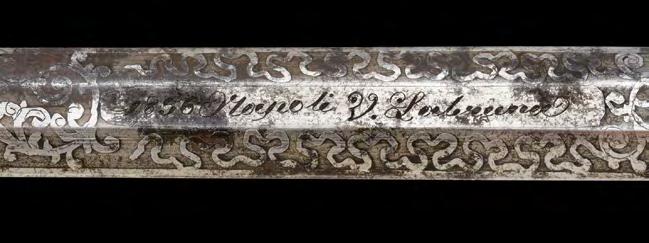
300 A SMALL SWORD
Kingdom of the Two Sicilies, 1856
Double-edged blade, etched and signed by Labruna. Bronze mounts, formerly gilded; shell-guard decorated in relief with a cornucopia and caduceus; flat guard with floral decorations in relief. Bronze handle, formerly gilded, with relief decorations; on one side the initials ‘F II’. Round pommel eb suite. White gutta-percha scabbard featuring engraved mounts; the cap bears a signature. Complete with clutch for the belt.
SPADINO
Regno delle Due Sicilie, 1856
Lama a due fili incisa all’acquaforte e recante firma di Labruna. Fornimenti in bronzo già dorato, pelta ornata in rilievo con cornucopia e caduceo; guardia piatta con decori floreali in rilievo. Impugnatura sempre in bronzo già dorato con decori a rilevo, su un lato le cifre “F II”. Pomo tondo lavorato en suite. Fodero in guttaperga bianca con fornimenti incisi; la cappetta con firma. Completa dell’attacco da cintura.
Conditions medium
Length 89 cm.
€ 300/400



301
A CIVIL OFFICER’S SMALL SWORD
Kingdom of the Two Sicilies, First half of the 19th Century Straight, single-and false-edged blade with gilded engraving on a blue background on the first part. Gilded bronze hilt; shell-guard with a rearing horse amidst oak and laurel branches; guard with bas-relief decoration; wooden hilt with mother-of-pearl scales (one missing). Gilded bronze pommel with relief decoration. Leather scabbard with gilded brass tip and cap. General defects.
SPADINO DA FUNZIONARIO
Regno delle Due Sicilie, Prima metà del XIX Secolo Lama dritta sgusciata a un filo e controfilo, con incisioni dorate su fondo blu al primo terzo. Fornimento in bronzo dorato, pelta con cavallino rampante fra rami di quercia e alloro; guardia con decori in bassorilievo; impugnatura in legno con una guancetta di madreperla (l’altra mancante). Cappetta in bronzo dorato, sempre con decori in rilievo. Fodero in cuoio con puntale e cappa in ottone dorato. Difetti generali.
Conditions medium
Length 89 cm.
€ 400/500
302
A DRUM MAJOR SWORD
Kingdom of the Two Sicilies, 19th Century Straight, single-and-false-edged blade, with fuller; some areas with rust. Quillon of gilded brass decorated with floral and architectural motifs; grip covered with gilded brass with a pattern of diagonal bands; pommel featuring a monster’s or animal’s head. Wooden scabbard lined with velvet and provided with brass mounts; cap with two suspension rings. Some missing parts of the gilded finishing. Rare.
SPADA DA TAMBURO MAGGIORE
Regno delle Due Sicilie, XIX Secolo Lama dritta a un filo e controfilo, sgusciata; con alcune zone rugginose. Elso in ottone dorato elaborato a motivi floreali ed architettonici; impugnatura rivestita d’ottone dorato operato a bande oblique; pomo con testa di mostro/animale. Fodero in legno rivestito di velluto con fornimenti in ottone; cappa con due anelli di sospensione. Alcune aree mancanti della finitura dorata. Rara.
Conditions good Length 93.5 cm.
€ 500/600
303 AN OFFICER’S SWORD
Kingdom of the Two Sicilies, Mid 19th Century Straight, double-edged blade of rhomboidal section, decorated with etched designs. Gilded brass hilt (refurbished finish); pierced shell-guard and a guard featuring two snakes. Spiral-shaped hilt, pommel with a crown. Leather scabbard (broken) with brass mounts.
SPADINO DA UFFICIALE
Regno delle Due Sicilie, Metà del XIX Secolo Lama dritta a due fili a sezione romboidale, decorata con incisioni all’acquaforte. Fornimento in ottone dorato (la finitura rinfrescata); pelta traforata e guardia lavorata a due serpenti. Impugnatura a spirale, pomo con corona. Fodero in cuoio (con rottura) con fornimenti in ottone.
Conditions medium Length 90 cm.
€ 500/600
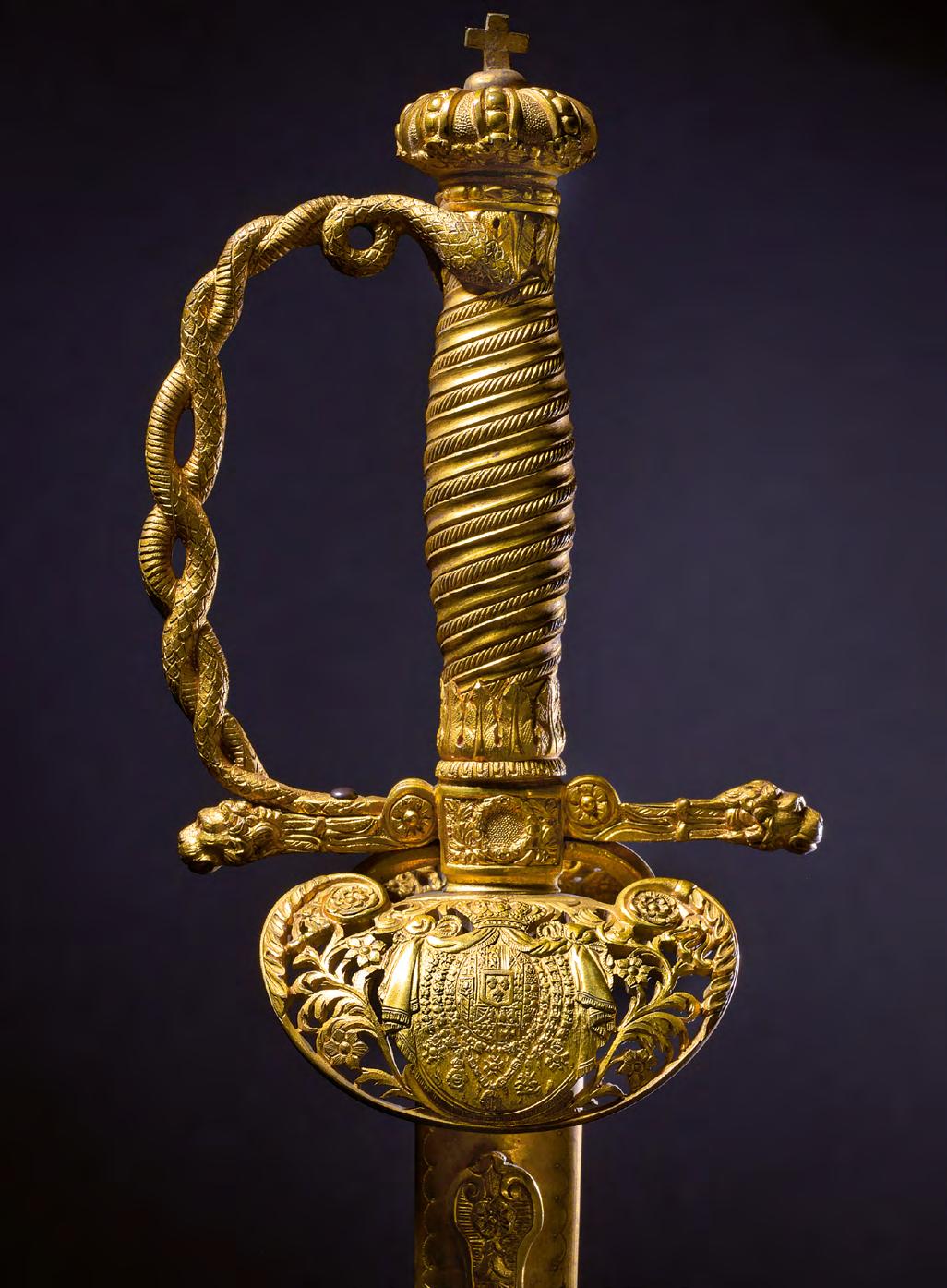
304
A SMALL SWORD
Kingdom of the Two Sicilies, First half of the 19th Century Straight, triangular-shaped blade withgrooved sides; etched with typical Neapolitan motifs; in a cartouche, the motto in cursive script: ‘Ne me tirez pas sans raison / Ne me remettez pas sans Honneur’. Gilded brass hilt featuring a female figure amidst trophies of arms. Guard decorated with a lion at the top. Handle with mother-of-pearl grips adorned with wire binding. Lobed pommel with a warrior’s head in relief. Leather scabbard with mounts en suite.
SPADA DA FUNZIONARIO
Regno delle Due Sicilie, Prima metà del XIX Secolo Lama dritta di forma triangolare con facce sgusciate; incisa all’acquaforte con tipici decori napoletani; in un cartiglio il motto in corsivo “Ne me tirez pas sans raison / Ne me remettez pas sans Honneur”. Fornimento in ottone dorato con pelta recante una figura muliebre fra trofei d’armi. Guardia decorata con leone al colmo. Impugnatura con guancette di madreperla e ornate da trecciola. Il pomo lobato con testa di guerrieri in rilievo. Fodero in pelle con fornimenti en suite.
Conditions medium
Length 95 cm.
€ 500/600
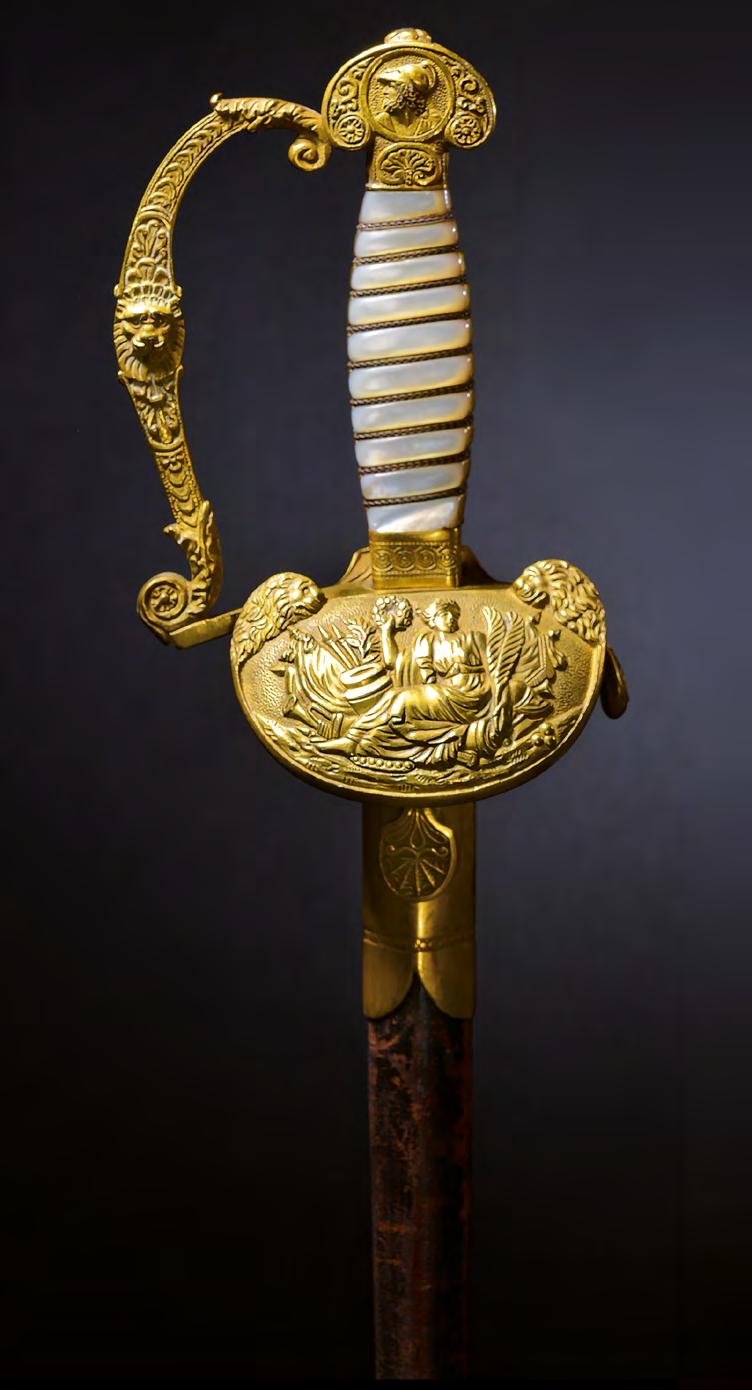


305

A MAJOR STAFF OFFICER’S SABRE
Kingdom of the Two Sicilies, 1830 circa Single-and-false-edged blade with structure of damask; featuring engraved trophies with remains of gilding at the base. Quillon with straight quillons, the ends shaped like a stylised sea serpent’s head. Pommel carved as a sea serpent with chain-guard. Long cap. Horn grip (small missing parts). Iron scabbard with brass bands and lugs. The scabbard is signed “Labruna Napoli 1831”
SCIABOLA PER UFFICIALE DELLO
STATO MAGGIORE
Regno delle Due Sicilie, 1830 circa Lama curva a un filo e controfilo, con struttura di damasco, la base recante trofei incisi con resti di doratura. Elso con bracci dritti, le estremità a forma di testa di serpente marino stilizzata. Pomo lavorato a testa di serpente marino con guardia a catenella. Cappetta lunga. Impugnatura in corno (piccole mancanze). Fodero in ferro con fascette e campanelle in ottone. La cappa firmata “Labruna Napoli 1831”.
Conditions good Length 90 cm.
€ 600/900
306
A DRUM MAJOR SABRE
Kingdom of the Two Sicilies, First half of the 19th Century
Single-and false-edged blade with fuller. Mamalucca-style brass quillon with langets (one of the two heads has an old repair). Ergonomic grip with brown horn scales featuring round brass studs. Brass cap with a hole and clutch for a chain, now missing. Smooth brass scabbard with two lugs (some dents).
SCIABOLA DA TAMBURO
MAGGIORE
Regno delle Due Sicilie, Prima metà del XIX Secolo
Lama sgusciata a un filo e controfilo. Elso in ottone alla mamelucca con alette fermafodero (una delle due teste con antica riparazione). Impugnatura anatomica con guancette in corno bruno recanti bullette tonde in ottone. Cappetta in ottone con foro ed attacco per la catenella (ora mancante). Fodero liscio in ottone con due campanelle (alcune ammaccature).
Conditions good Length 94 cm.
€ 600/900
307
A RARE TROOPER’S SABRE FOR THE ROYAL GUARD’S HUSSARS
Kingdom of Naples, Early 19th Century Large, curved, blade with fuller and signs of use and cleaning (length: 78 cm). Brass hilt with a stirrup guard. Long, smooth cap. Grip covered with leather. Iron scabbard (well cleaned, with defects, signs of use, and time) with two lugs.
RARA SCIABOLA DA TRUPPA DEGLI
USSARI DELLA GUARDIA REALE
Regno di Napoli, Inizio del XIX Secolo Ampia lama curva sgusciata con segni d’uso e di pulizia ( lungh. 78 cm).
Fornimento in ottone con guardia a staffa. Cappetta lunga liscia. Impugnatura con rivestimento in manica di cuoio. Fodero in ferro (fortemente pulito, con difetti, segni d’uso e del tempo) a due campanelle.
Conditions good Length 92 cm.
€ 700/1.000
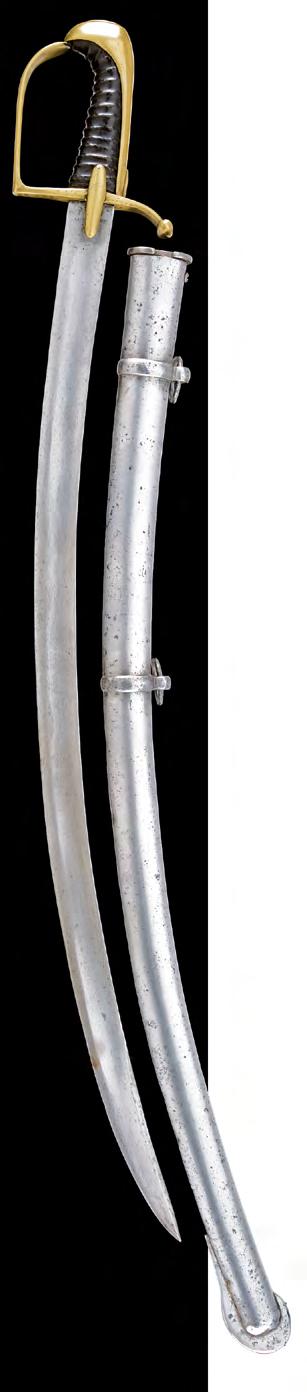
308
AN INTERESTING AND RARE KANJAR Poland, about 1810
Large, solid, slightly countercurved, single-edged blade; with slightly raised borders on the back; featuring gilded depictions of military trophies, star, moon, sun and the figure of a Pandur at the first half on a blue background (some missing parts in the finishing). Simple brass hilt with langets and quillon heads of round section. Beautiful grip with thick jade grip scales, crafted in the Karabela style, with brass rivets and bands. Complete with its wooden scabbard, lined with fish skin and provided with brass mounts.
INTERESSANTE E RARO CANGIARRO Polonia, 1810 circa Larga e robusta lama leggermente controcurvata, a un filo, con dorso munito di bordi leggermente rilevati; la prima metà recante incisioni a trofei d’armi, una stella, la luna, il sole e l’effige di un Pandur dorate; lo sfondo azzurrato (alcune mancanze alla finitura). Semplice fornimento in ottone con alette fermarono e teste dei bracci a sezione circolare. Bellissima impugnatura con spesse guancette in giada, strutturate nello stile della Karabela, con rivetti e bande in ottone. Completa del suo fodero in legno rivestito con pelle di pesce e munito di fornimenti in ottone.
Conditions good
Length 72.5 cm.
€ 2.000/3.500
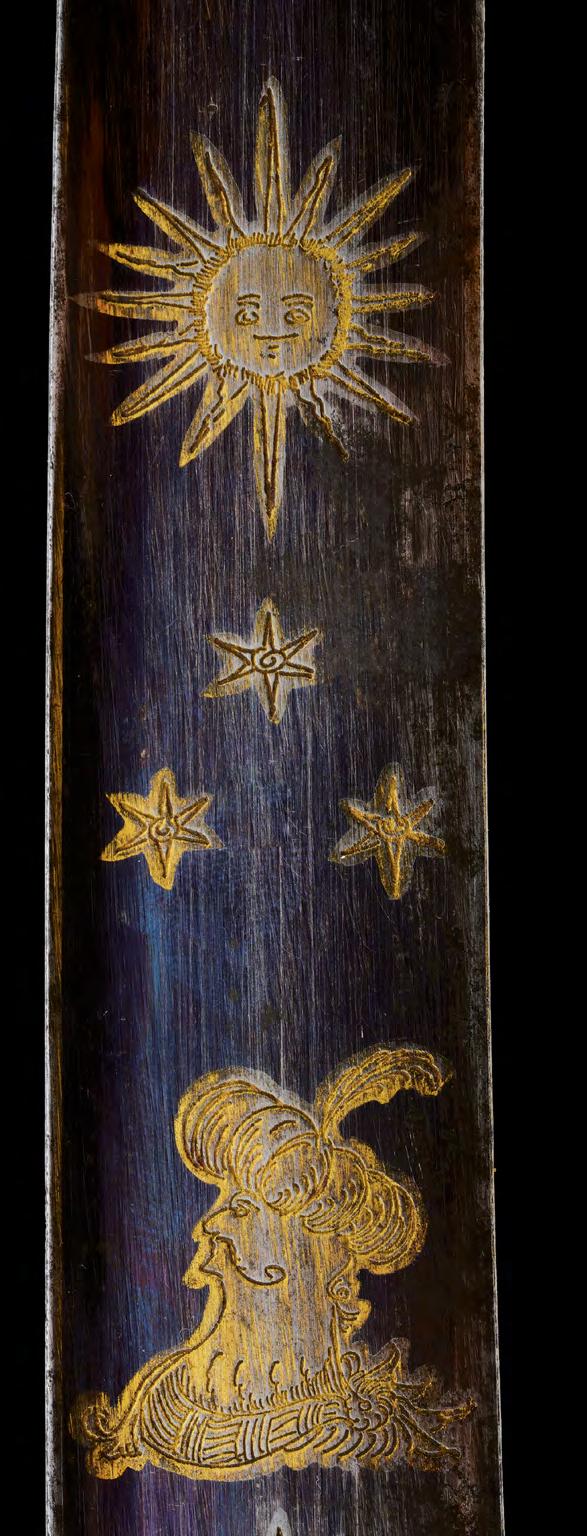
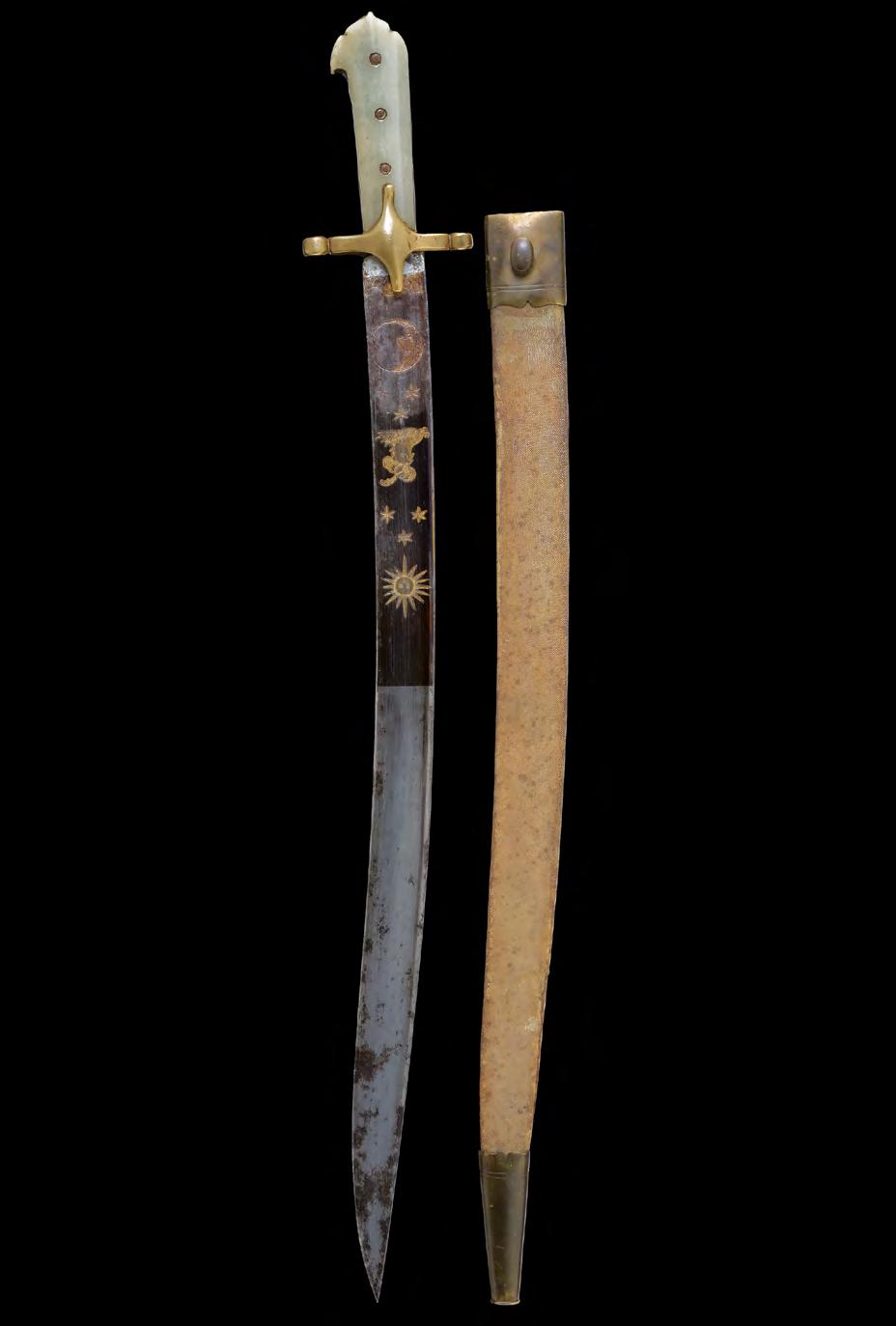
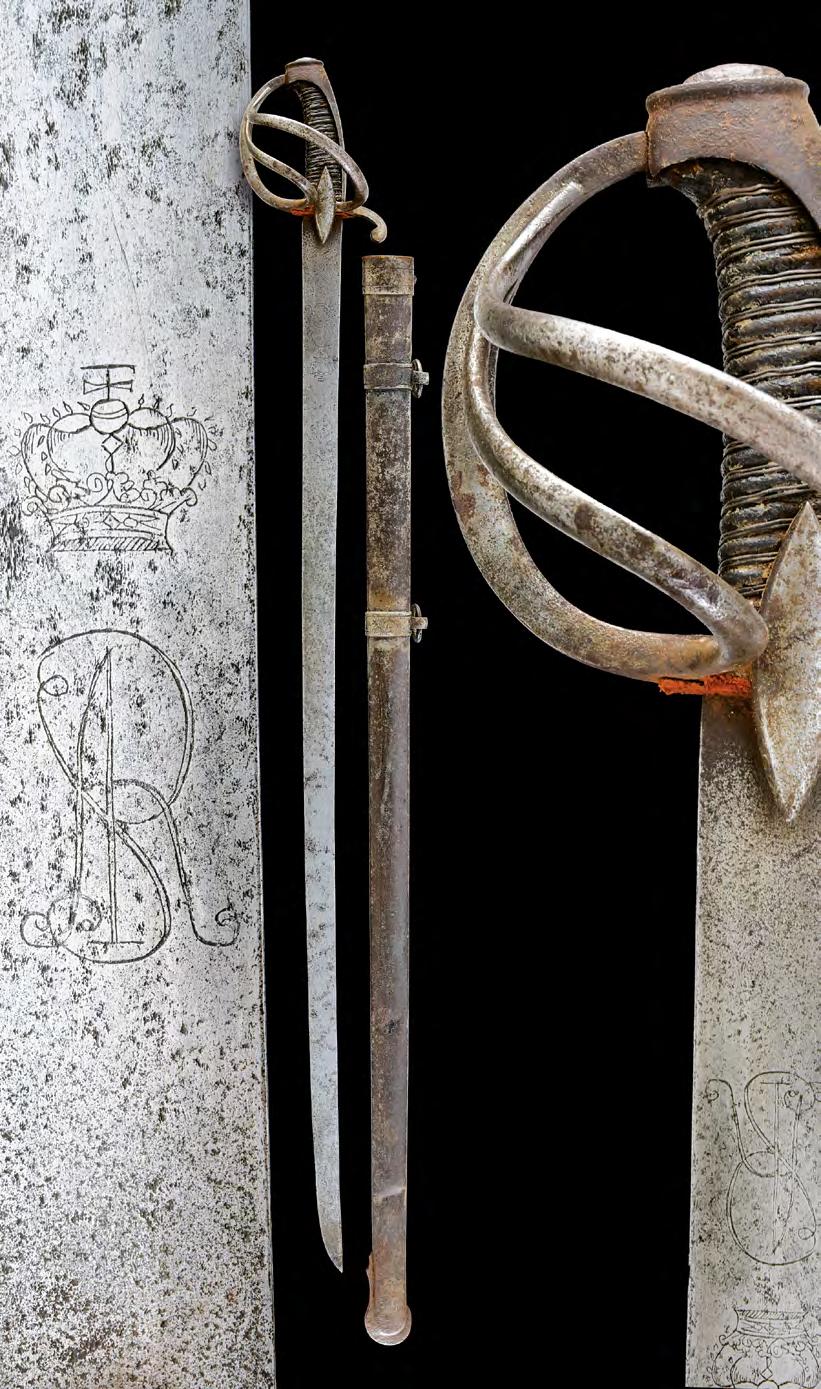
309 A RARE SABRE, DUCHY OF WARSAW PERIOD (1807?1815)
Duchy of Warsaw, about 1810 Slightly curved, single-and short-false-edged blade; on the forte on both sides, the royal monogram ‘AR’ beneath a crown. Elegant iron mounts, two quilllons, elliptical langets and a parry quillon with a curled head facing the blade. Wooden hilt covered in leather and embellished with iron wire. Long, smooth pommel. Iron scabbard with two bellshaped lugs. General rust damage.
RARA SCIABOLA, EPOCA DUCATO DI VARSAVIA (1807 - 1815)
Ducato di Varsavia , 1810 circa Lama leggermente curva a un filo e breve controfilo, recante al forte su entrambi i lati il monogramma reale “AR” sotto corona. Elegante fornimento in ferro con due rami di guardia, alette fermafodero ellittiche e braccio di parata con testa a ricciolo rivolta verso la lama. Impugnatura in legno rivestita di cuoio e arricchita da filo di ferro. Cappetta lunga liscia. Fodero in ferro a due campanelle. Danni da ruggine.
Conditions mediocre Length 110 cm. € 1.000/2.000

310 A DRAGOON TROOPER’S SHASQUA
Russian Empire, 1908
Curved, single-and-false-edged blade, with wide fuller, tang with Zlatoust mark,“40”, “A”,“A” under crown and others. Brass hilt marked “Fabbrica di Zlatoust” in Cyrillic,“A”, “A” under crown, and dated “1908”. Grip made of wood carved with oblique spirals. Complete with scabbard with brass mounts marked “A”.
SHASQUA DA TRUPPA DEI DRAGONI
Russia imperiale, 1908
Larga lama curva a un filo e controfilo con ampio sguscio, il tallone con marchio di Zlatoust,“40”,“A”,“A” sotto corona e altri timbri. Fornimento in ottone marcato “Fabbrica di Zlatoust” in cirillico,“A”,“A” sotto corona e con data “1908”. Impugnatura in legno scolpito a spire oblique. Completa di fodero con fornimenti in ottone marcati “A”.
Conditions good
Length 96.5 cm.
€ 350/550
311 AN 1847 MODEL CIVIC GUARD
OFFICER’S SWORD
Papal States, circa 1850
Straight, tipped, single-and short falseedged blade; flat at the first part featuring the motto “VIVA ITALIA” between trophies and floral motifs, then with double fuller with floral motifs along the edge. Brass hilt with remains of gilding, featuring a typical forked guard and pommel shaped as a lion’s head. Horn grip with metal wire binding. Iron scabbard with two brass lugs (some areas damaged by rust).
SPADA DA UFFICIALE SUBALTERNO
DELLA GUARDIA CIVICA MOD. 1847
Stato Pontificio, 1850 circa Lama dritta a un filo, punta e breve controfilo, piatta al forte, recante il motto “VIVA ITALIA” tra trofei e disegni floreali, poi con doppio sguscio con decorazioni floreali lungo il filo. Fornimento in ottone con resti di doratura, tipica guardia biforcuta e pomo a testa di leone. Impugnatura in corno con trecciola metallica. Fodero in ferro a due campanelle in ottone (qualche zona con danni di ruggine).
Conditions good
Length 100.5 cm.
€ 200/400
312 AN 1847 MODEL OFFICER'S SWORD FOR THE CIVIC GUARD
Papal States, 1847 - 1850
Single-and-false-edged blade with a double groove in the middle, etched with trophies, floral motifs and the motto “VIVA PIO IX”.
Fine gilt brass hilt (some spots with missing gilding) with a finely chiselled rain-guard featuring floral motifs; the guard is decorated in the same style; the upper end splits into two quillons connecting to the pommel, which is shaped like a lion’s head. Horn grip with wire binding and simple metal wire. Iron scabbard with gilded brass mounts decorated with leaves, two lugs.
SPADONA DA UFFICIALE SUPERIORE
DELLA GUARDIA CIVICA MOD. 1847
Stato Pontificio, 1847 - 1850 Lama dritta a un filo e controfilo con duplice scanalatura nella parte centrale, incisa ad acido a trofei, fiorami e motto “VIVA PIO IX”. Bel fornimento in ottone dorato (alcune mancanze alla finitura) con coccia finemente cesellata a motivi floreali, la guardia decorata en suite con estremità superiore divisa in due bracci che si collegano al pomo, questo lavorato a testa di leone. Impugnatura in corno con trecciola e filo semplice metallico. Fodero in ferro con fornimenti in ottone, dorati e decorati a fogliame; con due campanelle.
Conditions good Length 101 cm.
€ 600/900


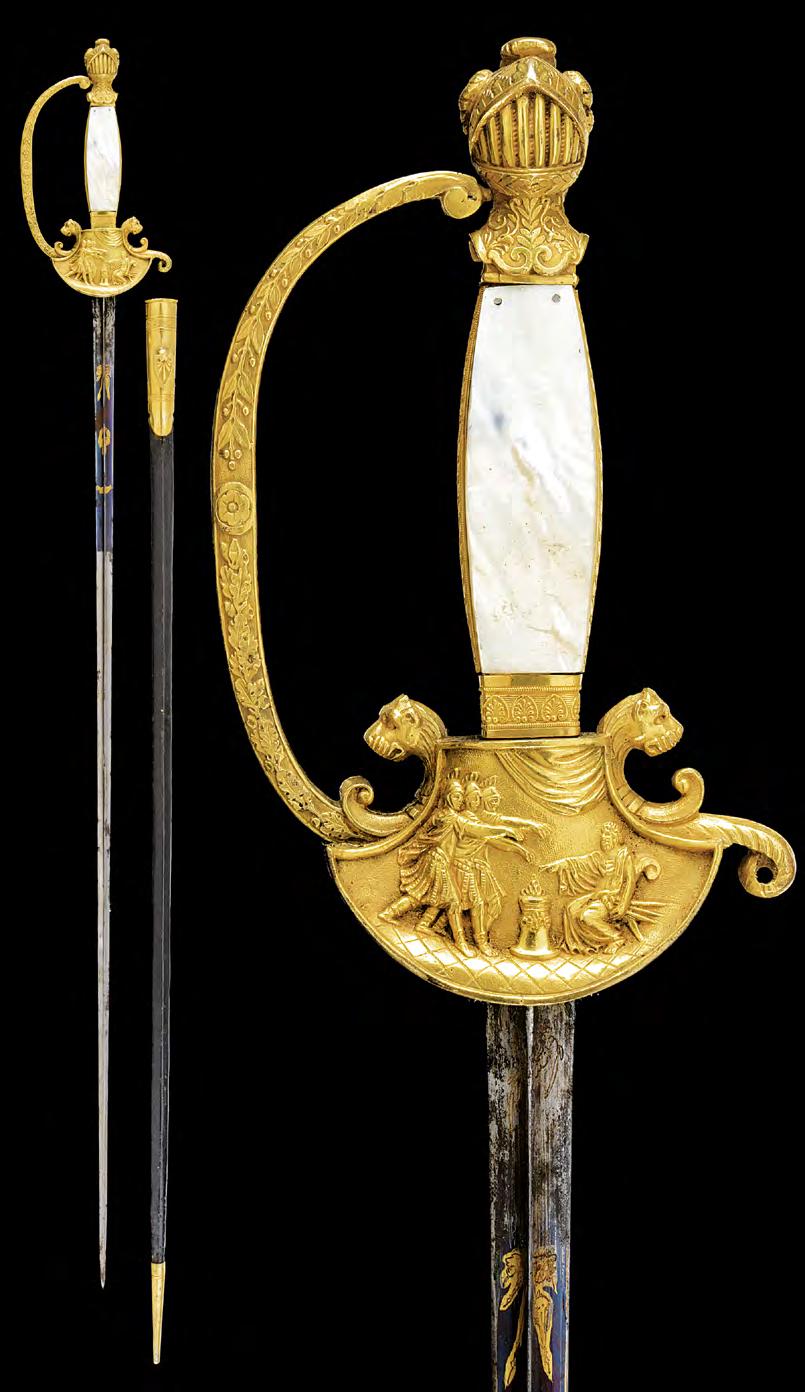
313 A FINE SMALL SWORD
France, First half of the 19th Century Straight blade of triangular section with hollow sides, engraved and gilt at the base on a blue ground with trophies and floral motifs, and marked “ISB”. Gilt-brass hilt with broad shellguard depicting an antique scene with three men in armour standing before a fourth, all engaged in a salute, with a brazier at the centre of the scene (Oath of the Horatii?), lion heads at the sides of the shell-guard. Loop-guard decorated with oak and laurel fronds. Pommel in the shape of a plumed helmet. Grip with mother-of-pearl grip scales (small missing parts and restoration). Leather scabbard with gilt-brass mounts.
BELLO SPADINO
Francia, Prima metà del XIX Secolo Lama dritta di sezione triangolare con facce incavate, incisa e dorata alla base su fondo blu, con trofei e motivi floreali e marcata “ISB”. Fornimento in ottone dorato con larga pelta raffigurante una scena antica con tre uomini in armatura stanti di fronte ad quarto, tutti intenti a effettuare un saluto e con un braciere al centro della scena (Giuramento degli Orazi?), ai lati della pelta teste di leone. Ramo di guardia decorato con fronde di quercia e alloro. Pomo a forma di elmo piumato. Impugnatura con guancette in madreperla (piccola mancanza e restauro). Fodero in cuoio con fornimenti in ottone dorato.
Conditions good Length 96 cm. € 300/600
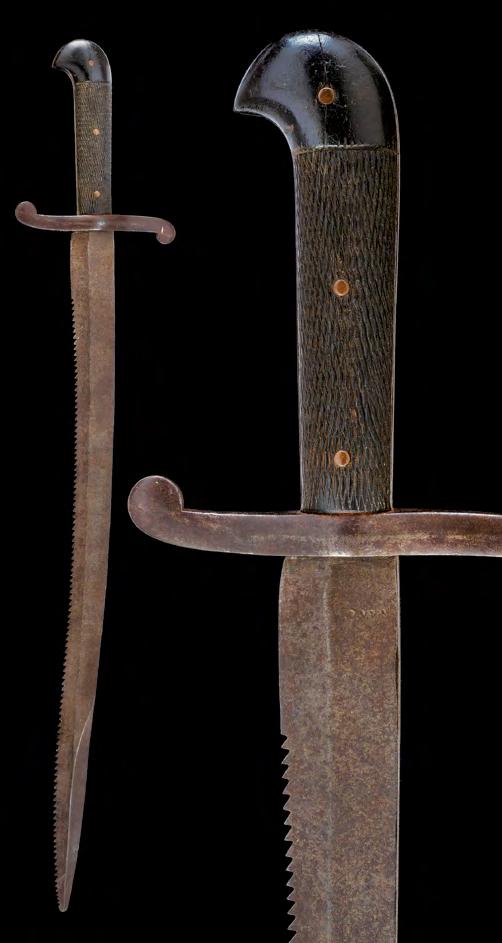
314
A RARE SAPPER’S SHORT SWORD
Milan, 19th Century
“Yatagan”-style, counter-curved, serrated single-and short false-edged blade at the tip. The base marked “IZAR MILANO.” Iron crossguard with slightly counter-curved quillons. Brown wooden grip scales with checkering. Well-made.
RARA DAGA DA ZAPPATORE
Milano, XIX Secolo
Lama controcurvata “a yatagan” a un filo seghettato e con breve controfilo in punta. Alla base la marcatura “IZAR MILANO”. Crociera in ferro a bracci lievemente controcurvati. Guancette in legno bruno con zigrinatura. Di buona fattura.
Conditions good
Length 64.3 cm.
€ 150/250
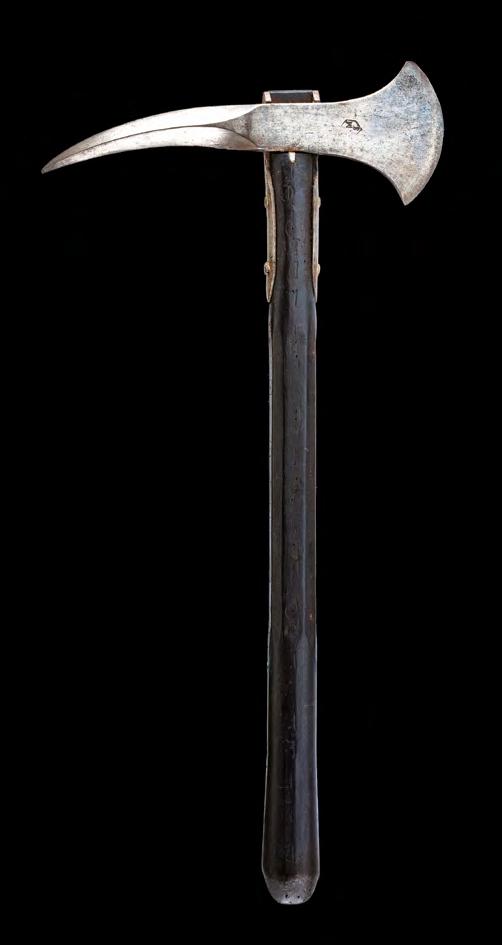
315 A BOARDING AXE
Piedmont, Mid 19th Century
Convex-edged axe, long and strong beak, marked twice “R M S”, with an anchor. The shaft is made of blackened wood with an engraved anchor. With belt loop. Rare.
SCURE D’ABBORDAGGIO
Piemonte, Metà del XIX Secolo
Scure con taglio convesso e lunga e robusta penna, marcata due volte “R M S” e con ancora. Fusto in legno annerito con ancora incisa. Gancio da cintura. Rara.
Conditions good
Length 55.5 cm.
€ 200/400
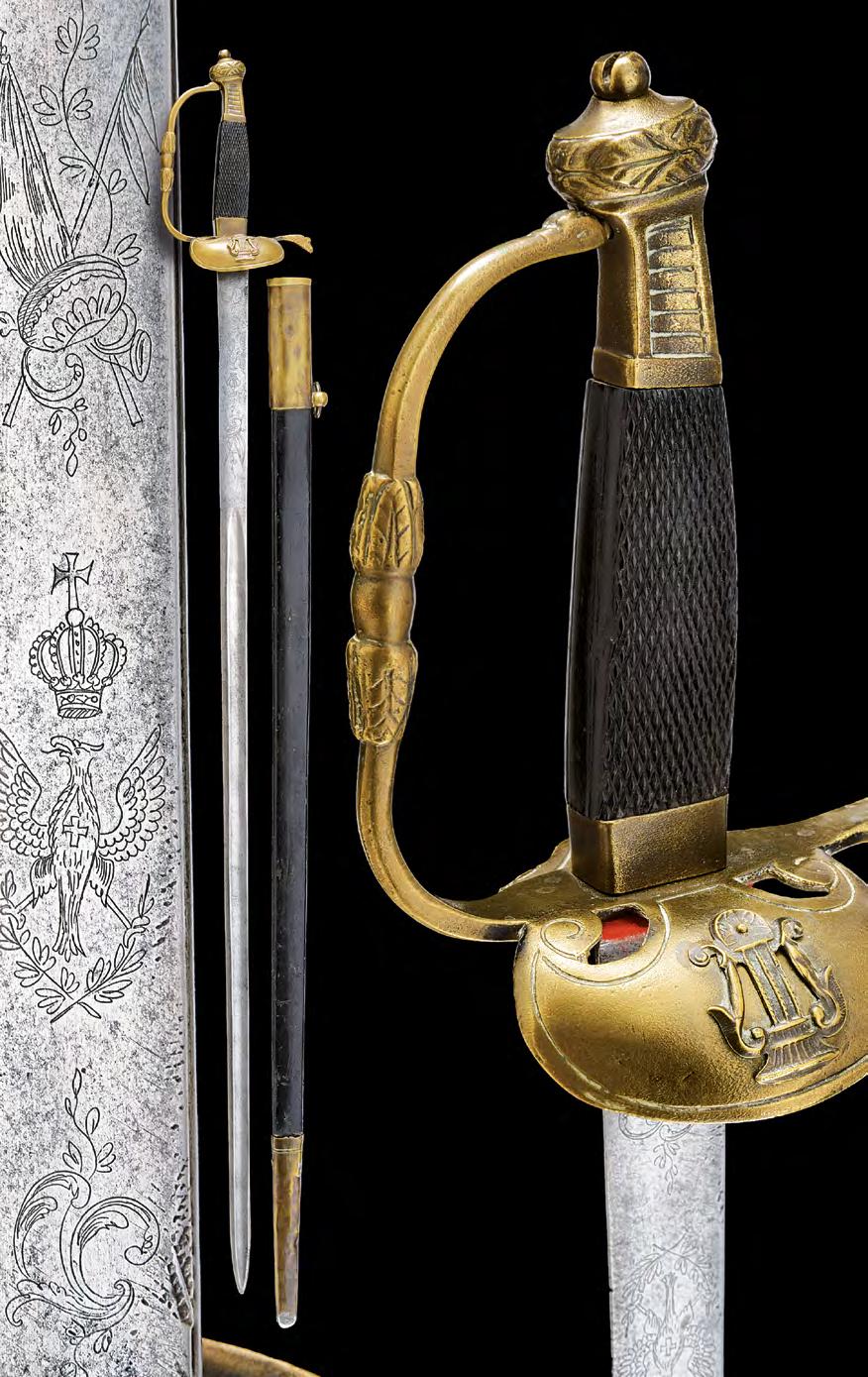
316 A MUSICIAN’S SMALL SWORD
Sardinian Kingdom, Mid 19th Century Straight blade, initially flat and engraved with the Savoy eagle under crown, trophies, and floral motifs, then with fuller toward the weak. Brass hilt, including shell-guard with lyre, quillon and loop guard ending in a snake’s head. Pommel with leaves, checkered wooden grip. The ring nut at the rear with remains of the button which opens the scabbard. Blackened iron scabbard with brass mounts. A suspension ring.
SPADINO DA MUSICISTA
Regno di Sardegna, Metà del XIX Secolo Lama dritta, prima piatta, incisa con aquila Sabauda sotto corona, trofei e a motivi floreali, poi sgusciata fino al debole. Fornimento in ottone, pelta con lira, braccio dell’elso e ramo di guardia con estremità a testa di serpente. Pomo a fogliame, impugnatura in legno zigrinato. La ghiera sulla parte posteriore con resti del pulsante per l’apertura del fodero. Fodero in ferro annerito con fornimenti in ottone. Un anello di sospensione.
Conditions medium Length 91 cm. € 100/200
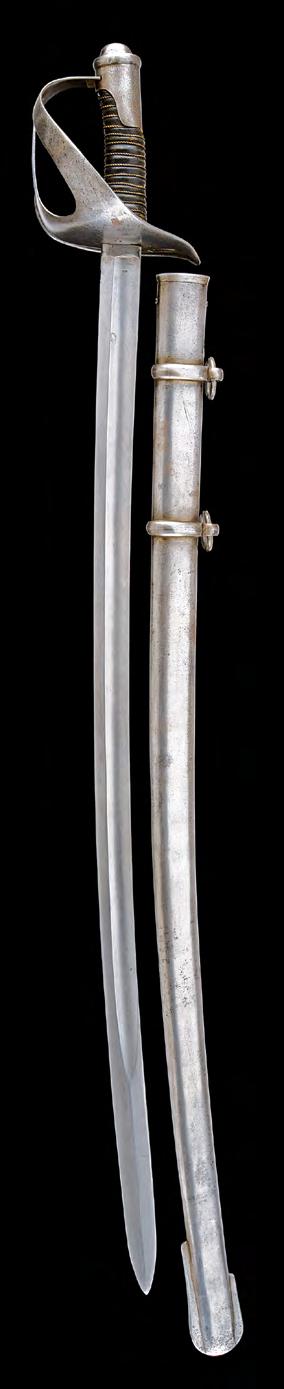
317 AN 1860 MODEL CAVALRY SABRE
Kingdom of Italy, Third quarter of the 19th Century
Curved, single-and-false-edged blade with fuller. Stamped “F.R.” at the base, tang featuring remains of the maker’s mark. Iron hilt with wide guard provided with drop-shaped slot. Short iron cap; leather-covered grip with copper wire binding. Iron scabbard with two lugs.
SCIABOLA DA CAVALLERIA MOD.
1860
Regno d’Italia, Terzo quarto del XIX
Secolo
Lama curva a un filo e controfilo, sgusciata. La base con punzone “F.R”, il tallone con resti di marcatura del fabbricante. Fornimento in ferro con ampia guardia munita di spacco a goccia. Cappetta corta in ferro, impugnatura con rivestimento di manica di cuoio e trecciola in rame. Fodero in ferro a due campanelle.
Conditions good Length 104.5 cm.
€ 150/250
318 AN 1843 MODEL SENIOR OFFICER’S SABRE
Sardinian Kingdom, Mid 19th Century
Single-and-false-edged blade with central fuller and groove on the back; iron hilt featuring straight quillons with sphere at the end, langets, long faceted cap, and an anatomical black wooden grip. Leather scabbard with two lugs. Rare.
SCIABOLA PER GLI UFFICIALI DELLO
STATO MAGGIORE MOD. 1843
Regno di Sardegna, Metà del XIX Secolo Lama ad un filo e controfilo, con sguscio centrale e scanalatura dorsale; fornimento in ferro con elso a bracci dritti culminanti a sfera, alette fermafodero. Cappetta lunga faccettata, impugnatura anatomica in legno color nero. Fodero in cuoio a due campanelle. Rara.
Conditions medium Length 91.5 cm.
€ 150/250
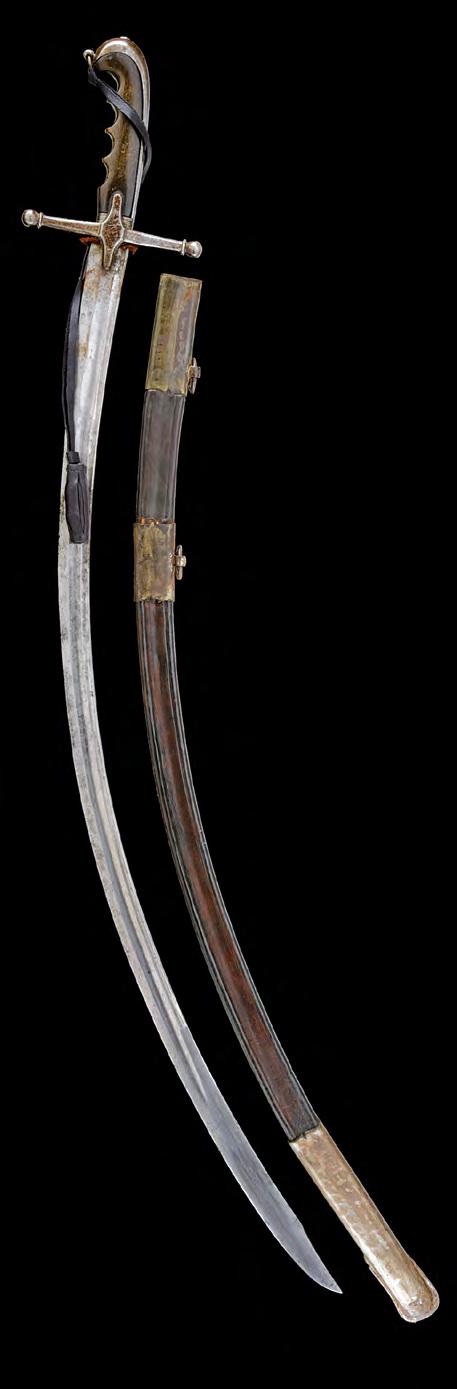

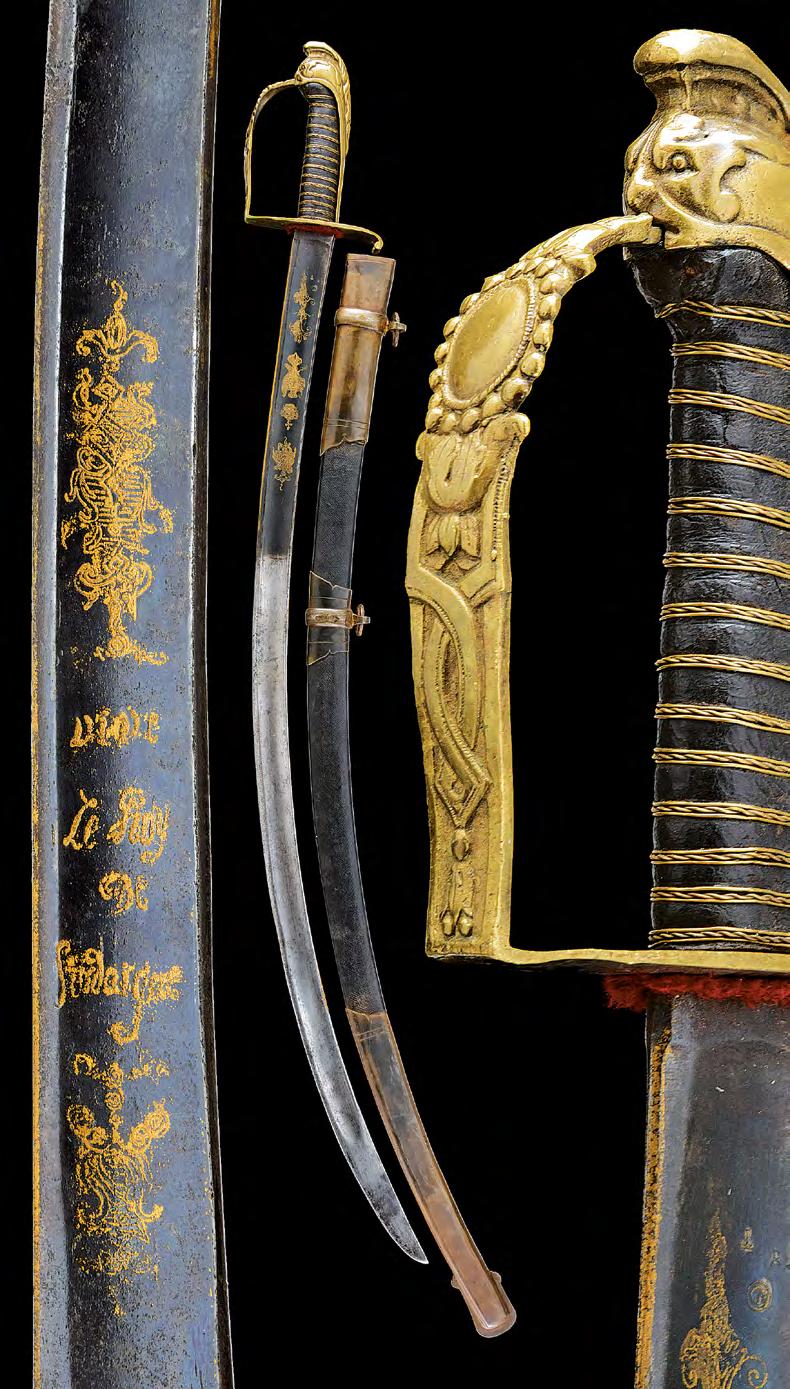
319
AN 1833 MODEL “ALBERTINA” SWORD
Piedmont, 1840 circa
Straight single-and-false-edged blade with wide central fuller; engraved and gilded with trophies and floral motifs at the first part on a blue background; base marked “LG”. Typical brass grip with knuckle-guard and ring, silvercovered, wooden grip (small damaged parts); leather scabbard with brass mounts, the cap featuring the monogram “IE”.
SPADA ALBERTINA MOD. 1833
Piemonte, 1840 circa Lama dritta a un filo e controfilo con ampio sguscio centrale, la prima parte incisa e dorata su fondo blu a trofei e motivi floreali, la base marcata “LG”. Tipica impugnatura in ottone con vela ed anello, impugnatura in legno rivestito in argento (piccoli danni); fodero in cuoio con fornimenti in ottone, la cappa con monogramma “IE”.
Conditions mediocre
Length 101 cm.
€ 150/250
320 AN OFFICER’S SABRE
Sardinian Kingdom, late 18th Century
Single-and-false-edged blade with wide fuller; engraved and gilded with the Savoy eagle, the motto “Vive Le Roy de Sardegna,” and decorative motifs (all restored or of a later period) at the first part, on a blue background. Onequillon, brass hilt with pommel shaped like a helmet with comb and long cap. Wooden grip; the covering and wire binding are likely from a later period. Leather-covered, wooden scabbard (from a later period) with three brass mounts; the two lug bands are engraved with floral motifs.
SCIABOLA DA UFFICIALE
Regno di Sardegna, fine del XVIII Sec. Lama curva a un filo e controfilo con ampio sguscio, incisa e dorata su fondo blu al forte, con aquila Sabauda, motto “Vive Le Roy de Sardegna” e decorazioni (il tutto rinfrescato o successivamente). Fornimento monoelso in ottone con pomo a elmo con cresta e cappetta lunga. Impugnatura in legno il rivestimento e la trecciola probabilmente di epoca successiva. Fodero in legno rivestito di cuoio (di epoca successiva) con tre fornimenti in ottone, le due fasce delle campanelle incise a motivi floreali.
Conditions medium
Length 99.5 cm.
€ 200/400
321 A SABRE ISSUED IN 1819 FOR OFFICERS OF THE LINE INFANTRY
Sardinian Kingdom, first quarter of the 19th Century Single-and-false-edged, sturdy, curved blade with wide central fuller and without tang. Interesting bronze hilt with small front valve, screwed back valve, loop guard and long, smooth cap; grip with coils in the lower section and anatomical in the upper part. Leather scabbard with bronze mounts. Two lugs.
SCIABOLA ADOTTATA NEL 1819 PER GLI UFFICIALI DI FANTERIA DI LINEA
Regno di Sardegna, primo quarto del XIX Sec. Robusta lama curva a un filo e controfilo, con ampio sguscio centrale e priva di tallone. Interessante fornimento in bronzo con piccola valva anteriore, valva posteriore avvitata, ramo di guardia e cappetta lunga e liscia; impugnatura a spire nella parte inferiore e anatomica in quella superiore. Fodero in cuoio con fornimenti in bronzo. Due campanelle.
Conditions medium Length 98 cm.
€ 200/400
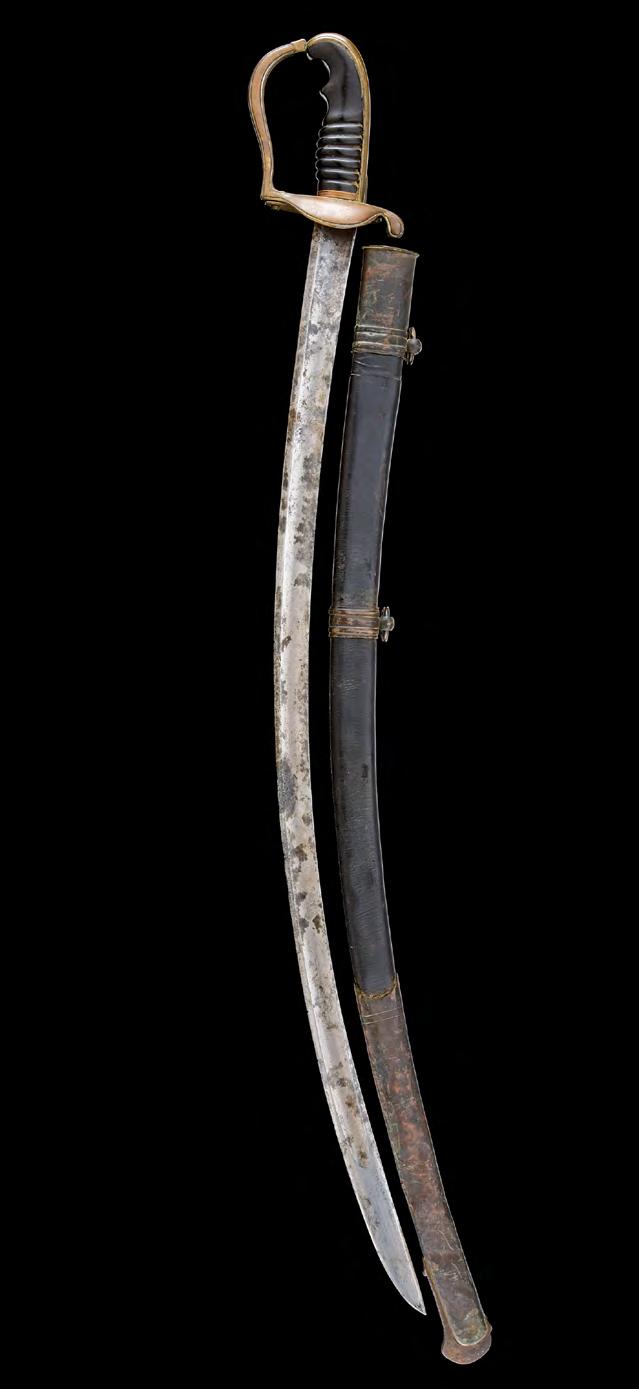
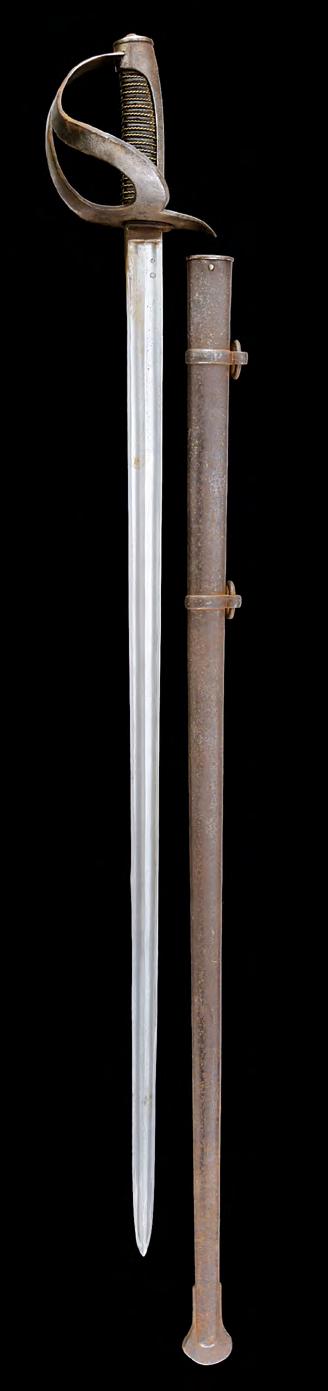
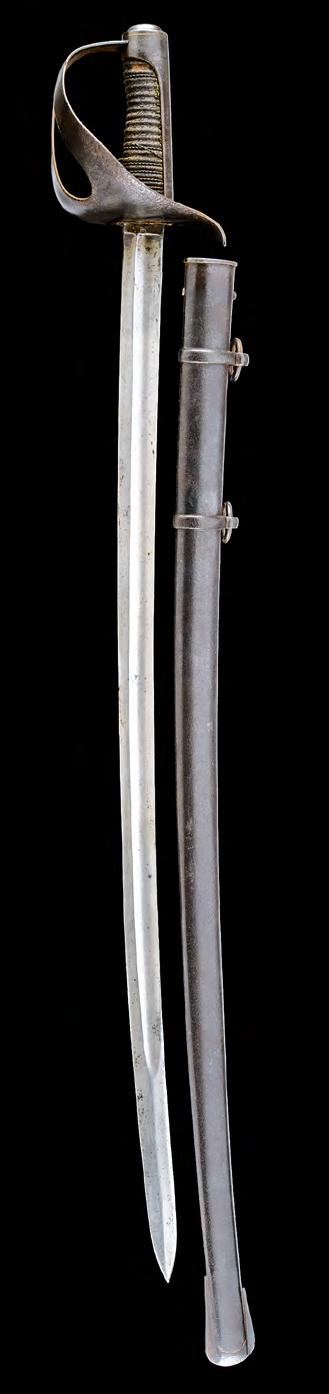
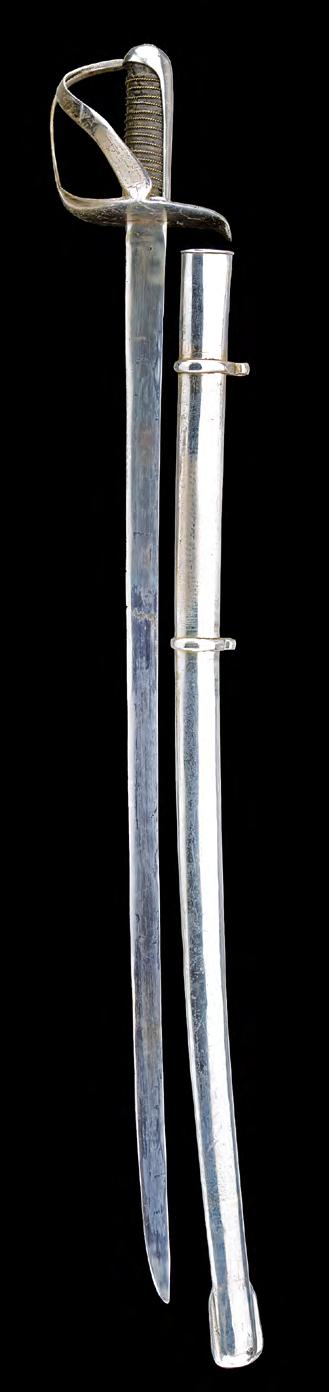
322 AN 1834 MODEL LIGHT CAVALRY TROOPER’S OR MOUNTED ROYAL "CARABINIERI" SABRE
Sardinian Kingdom, 1840 circa Wide, French, re-used, single-edged blade with double groove; marked “B” and “L.” at the base. Klingenthal mark from 1813 on the back. Iron hilt with a tear-shaped slot, long smooth pommel, and leather-covered grip with metal wire binding. Iron scabbard with two suspension rings.
SCIABOLA DA TRUPPA DI CAVALLERIA LEGGERA E DA CARABINIERI REALI A CAVALLO MOD. 1834
Regno di Sardegna, 1840 circa Larga lama francese di riutilizzo, dritta, a un filo con duplice scanalatura, marcata “B” e “L” alla base. Il dorso con marcatura di Klingenthal del 1813. Fornimento in ferro con spacco a goccia, cappetta lunga liscia ed impugnatura rivestita di cuoio con trecciola in filo metallico. Fodero in ferro a due anelli di sospensione.
Conditions medium
Length 112 cm.
€ 200/400
323 AN 1829 MODEL CAVALRY SABRE
Sardinian Kingdom, Second quarter of the 19th Century
Slightly curved, tipped, single-and false-edged blade, with fuller for two thirds, marked “C. PUTSCH SOHN” at the tang and stamped “ZC”. Iron hilt, large guard with central, drop-shaped slot. Straight grip with long, iron cap. Leather-covered grip and remains of iron wire binding. Iron scabbard with two lugs.
SCIABOLA DA CAVALLERIA MOD. 1829
Regno di Sardegna, Secondo quarto del XIX Secolo Lama leggermente incurvata a un filo, punta e controfilo, sgusciata per due terzi, marcata al tallone “C. PUTSCH SOHN” e punzonata “ZC”. Fornimento in ferro, ampia guardia con spacco centrale a goccia. Impugnatura dritta con cappetta lunga in ferro e rivestimento di cuoio con resti di trecciola in ferro. Fodero in ferro a due campanelle.
Conditions good Length 104 cm.
€ 250/450
324 AN 1843 MODEL SENIOR OFFICER’S SABRE WITH FINE BLADE
Sardinian Kingdom, Mid 19th Century
Single-and short false-edged blade with cylindrical back; engraved and gilded with the motto “Long live the King” among trophies and floral motifs at the first part, on a blue background. Typical iron hilt with cross-shaped quillon and anatomical ebony grip. Iron scabbard with two lugs.
SCIABOLA DA UFFICIALE DEL CORPO DI STATO MAGGIORE
ADOTTATA NEL 1843 CON BELLA LAMA
Regno di Sardegna, Metà del XIX Secolo Lama curva a un filo e breve controfilo con dorso a bacchetta, incisa e dorata su fondo blu al forte, con motto “Viva il Re” tra trofei e disegni floreali. Tipico fornimento in ferro con elso a croce e impugnatura anatomica in ebano. Fodero in ferro a due campanelle.
Conditions medium Length 100 cm.
€ 250/450
325 A RARE 1829 MODEL LIGHT CAVALRY TROOPER’S SABRE Sardinian Kingdom, Third quarter of the 19th Century Slightly curved, single-and short false-edged blade (some dents in the centre and traces of use, signs of fighting?), with remains of a mark at the tang. Iron hilt with two loop-guards. Long, smooth cap. Wooden grip with well-preserved earlier leather covering (but with some small missing parts) and brass wire binding. Remains of finishing. With iron scabbard with two loops without lugs.
See Calamandrei “Storia dell’Arma Bianca Italiana”, ed. Olimpia 1999, p. 43.
RARA SCIABOLA DA TRUPPA DI CAVALLERIA LEGGERA MOD. 1829 Regno di Sardegna, Terzo quarto del XIX Secolo Lama leggermente curva, a un filo e breve controfilo (qualche dente al centro e tracce d’uso, forse segni d’uso in combattimento), recante resti di un punzone al tallone. Fornimento in ferro a due rami di guardia. Cappetta lunga liscia. Impugnatura in legno con rivestimento di cuoio antico ben conservato (ma con un paio di piccole mancanze) e spirale di trecciola in filo d’ottone. Resti di finitura. Con fodero in ferro a due passanti mancante delle campanelle.
Cfr: vedi Calamandrei “Storia dell’Arma Bianca Italiana”, ed. Olimpia 1999, pag. 43.
Conditions good
Length 101.5 cm.
€ 400/600
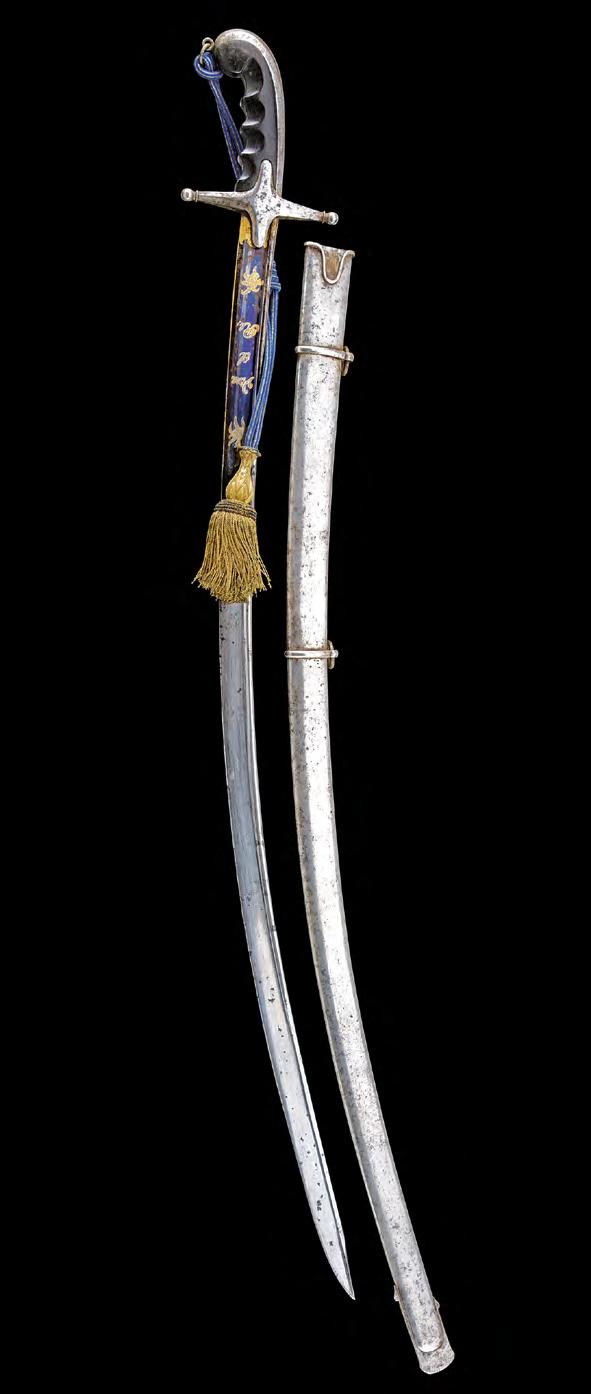
326 AN 1833 MODEL
ALBERTINA SWORD WITH RARE BLADE Piedmont, Mid 19th Century Wide, straight, doubleedged blade of hexagonal section and a triple groove at the base, featuring the inscription “NO ME SAQUES SIN RAZON” on one side and “NI ME ENTRES SIN ONOR” on the other; at the tang, “KNECHT & STAMMSOLINGEN”. Typical brass grip with a knuckle-guard and ring; silver-covered, wooden grip; iron scabbard with two lugs.
SPADA ALBERTINA
MOD. 1833 CON RARA LAMA Piemonte, Metà del XIX Secolo
Larga lama dritta a due fili di sezione esagonale con triplice scanalatura alla base recante la scritta “NO ME SAQUES SIN RAZON” su un lato e,“NI ME ENTRES SIN ONOR” sull’altro lato, al tallone “KNECHT & STAMMSOLINGEN”. Tipica impugnatura in ottone con vela ed anello, impugnatura in legno rivestito in argento; fodero in ferro con due campanelle.
Conditions good
Length 103.5 cm.
€ 300/600
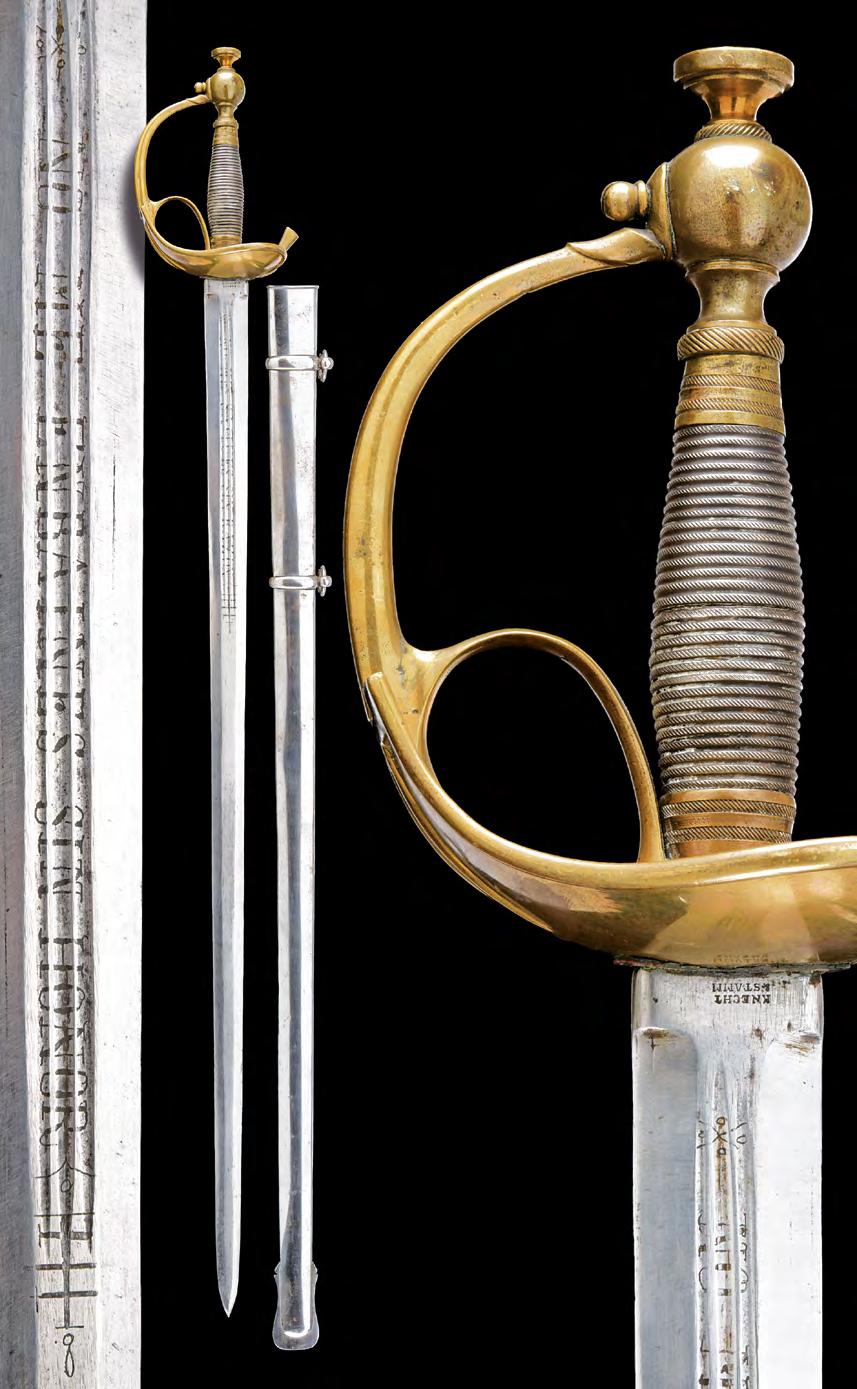
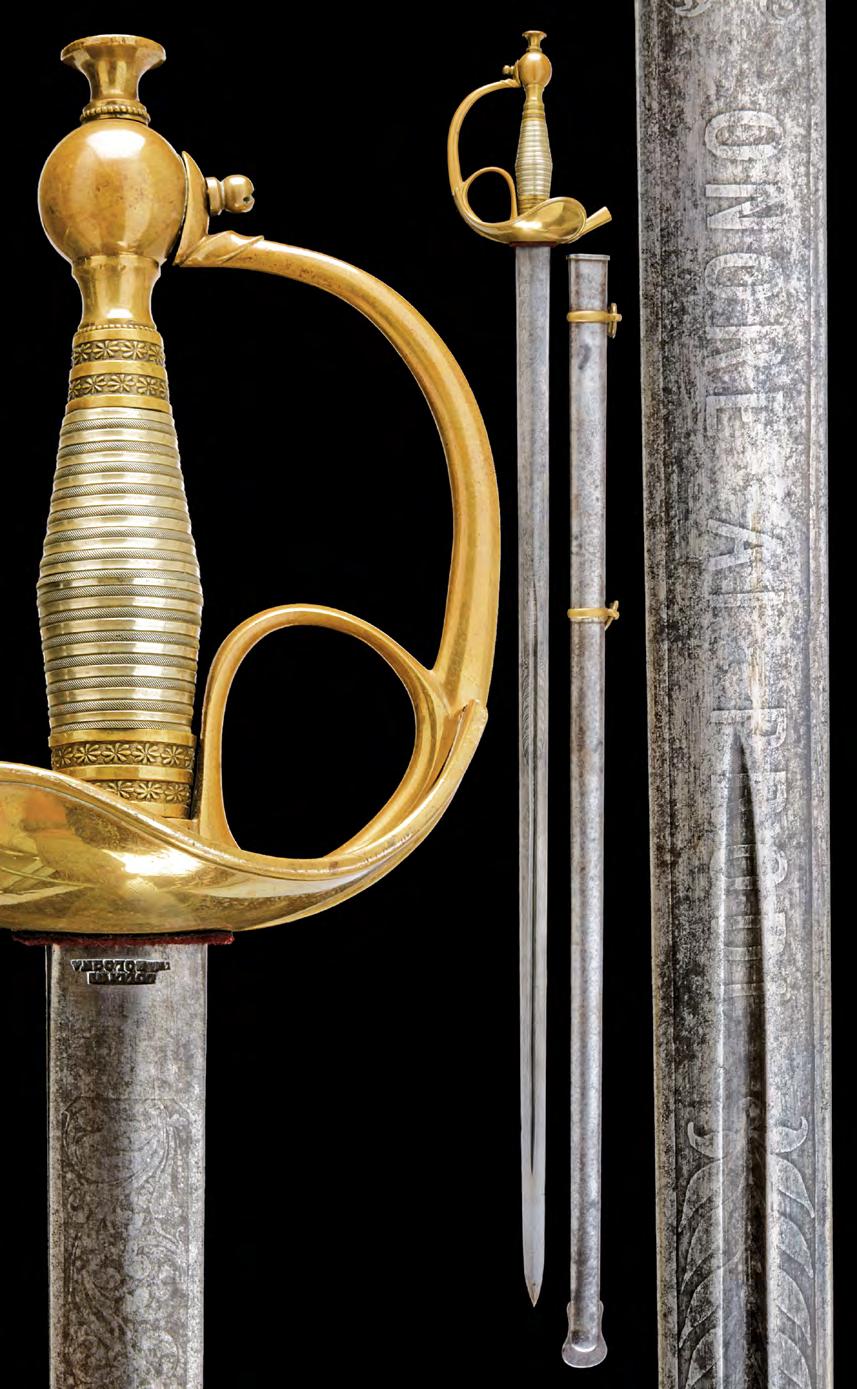
327 AN 1833 MODEL ALBERTINA SWORD Piedmont, Mid 19th Century Interesting straight, double-edged blade with central fuller, remains of engravings, and the motto “VIVA L’ITALIA - ONORE AI PRODI”; tang featuring the maker’s name; typical brass grip with knuckle-guard and ring, and silver-covered wooden grip; iron scabbard with two brass lugs.
SPADA ALBERTINA MOD. 1833 Piemonte, Metà del XIX Secolo Interessante lama dritta a due fili con sguscio centrale, resti di incisioni e motto “VIVA L’ITALIA - ONORE AI PRODI”, tallone con nome del fabbricante; tipica impugnatura in ottone con vela ed anello, impugnatura in legno rivestito in argento; fodero in ferro con due campanelle in ottone.
Conditions good Length 100 cm. € 300/500
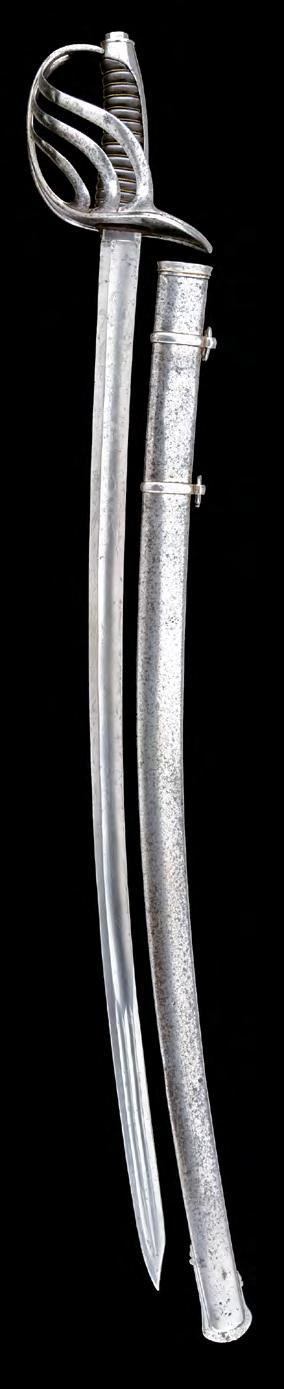
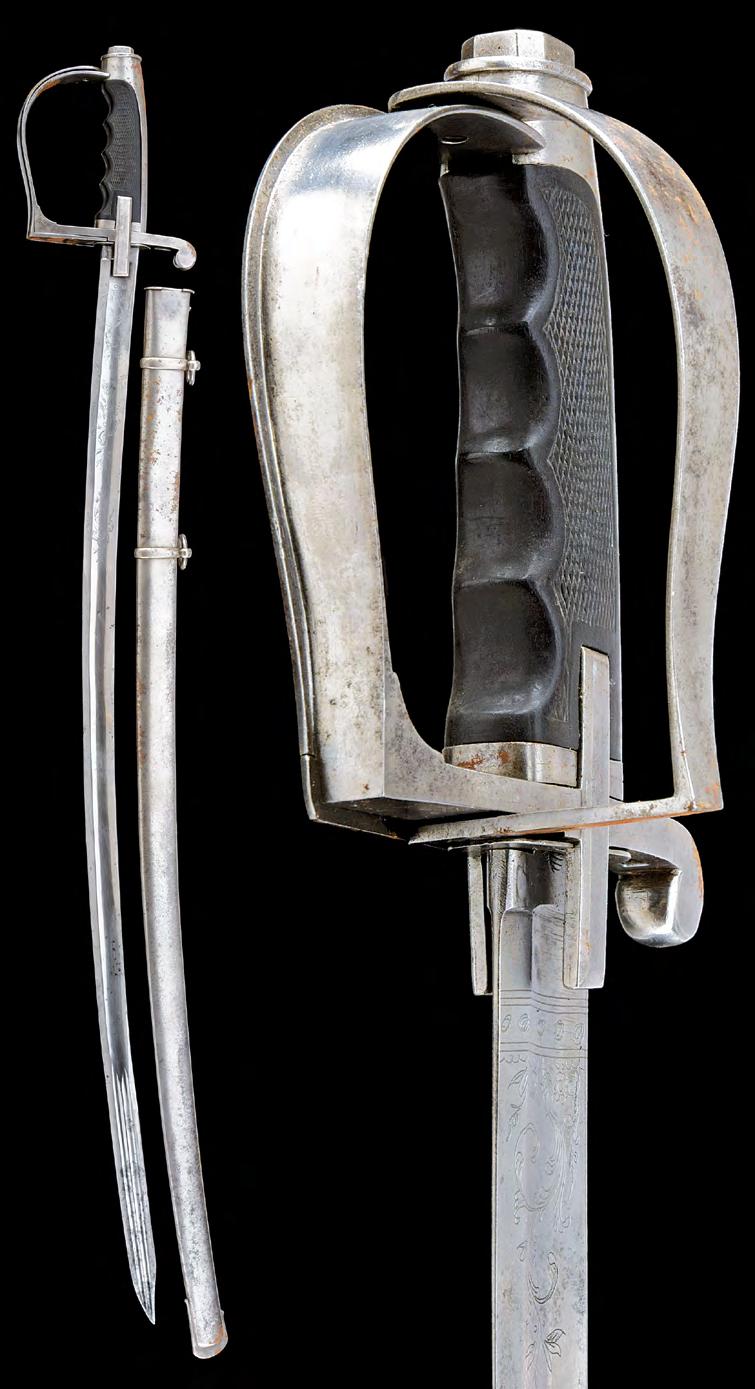
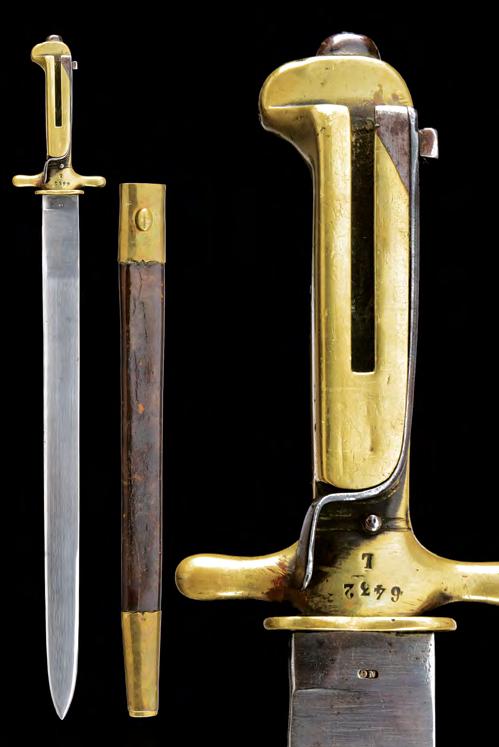
328
A SABRE
Sardinian Kingdom, 19th Century
Curved, single-and false-edged blade with large fuller doubling toward the weak, finely engraved with Savoy coat-of-arms, trophies and floral motifs at the first part, signed “Bleckmann in Solingen”; tang. Iron hilt, guard with four loop-guards, rain guard marked “AJMINO TORINO”, leather-covered grip with brass wire binding. Iron scabbard with two suspension rings.
SCIABOLA
Regno di Sardegna, XIX Secolo
Lama curva a un filo e controfilo con ampio sguscio che si duplica verso il debole, finemente incisa nella prima parte, con stemma sabaudo, trofei e disegni floreali, firmata “Bleckmann in Solingen”, dotata di tallone. Fornimento in ferro con guardia a quattro rami, la coccia marcata “AJMINO TORINO”, impugnatura ricoperta di cuoio con trecciola in filo d’ottone. Fodero in ferro a due anelli di sospensione.
Conditions good Length 102 cm.
€ 350/550
329 A VERY RARE 1855 MODEL OFFICER’S SABRE WITH TURNING HILT
Sardinian Kingdom, Third quarter of the 19th Century
Curved, single-and-false-edged blade with wide fuller doubling towards the weak, engraved with floral motifs at the first part. Iron hilt with fixed loop-guard and another turning. Long, faceted cap and anatomical, checkered wooden grip. Scabbard with two suspension rings.
RARISSIMA SCIABOLA DA UFFICIALE MOD. 1855 CON ELSO TORNANTE
Regno di Sardegna, Terzo quarto del XIX Secolo Lama curva a un filo e controfilo con ampio sguscio che si sdoppia verso il debole, incisa a motivi floreali al forte. Fornimento in ferro con un ramo di guardia fisso e uno tornante. Cappetta lunga faccettata e impugnatura anatomica e zigrinata in legno. Fodero a due anelli di sospensione.
Conditions good
Length 99.5 cm.
€ 400/800
€ 350/550 330 331
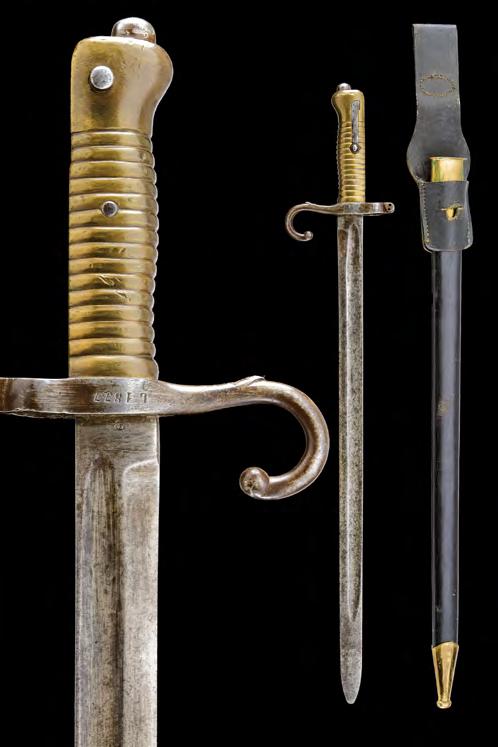
330 AN 1836 MODEL BAYONET FOR "BERSAGLIERI"
Sardinian Kingdom, Mid 19th Century
Tang marked “MC”; brass grip marked “6432 L” with iron spring. Leather scabbard with brass mounts.
BAIONETTA PER BERSAGLIERI MOD. 1836
Regno di Sardegna, Metà del XIX Secolo
Tallone marcato “MC”; impugnatura in ottone marcato “6432 L” con molla in ferro. Fodero in cuoio con fornimenti in ottone.
Conditions good
Length 60 cm.
€ 200/400
331 A RARE 1870 VETTERLI BAYONET, FIRST MODEL
Kingdom of Italy, Third quarter of the 19th Century
Straight, single-and short false-edged blade, with fuller, provided with tang. Iron crossbar with curved quillon provided with a tooth (damaged parts) and ring. Brass grip with short spring. Working iron button. Leather scabbard with brass mounts; cap mounted upside down. Leather belt frog.
RARA BAIONETTA VETTERLI MOD. 1870, PRIMO TIPO
Regno d’Italia, Terzo quarto del XIX Secolo Lama dritta a un filo e breve controfilo, sgusciata, dotata di tallone. Crociera in ferro con braccio incurvato munito di dente (danni) e con anello. Impugnatura in ottone con molla corta. Pulsante in ferro funzionante. Fodero in cuoio con fornimenti in ottone, la cappa montato al rovescio. Taschetta in cuoio.
Conditions good
Length 64 cm.
332 A PERCUSSION PISTOL
Sardinian Kingdom, Mid 19th Century Rifled, round, 17 mm cal. barrel, octagonal at the base with remains of Piedmontese marks; long forward spring lock. Iron mounts. Missing ramrod.
PISTOLA A LUMINELLO
Regno di Sardegna, Metà del XIX Secolo Canna rigata, tonda, con base ottagonale recante resti di punzoni piemontesi, cal. 17 mm; lunga batteria a molla in avanti. Fornimenti in ferro. Bacchetta mancante.
Conditions good
Length 35 cm.
€ 150/250
333 AN 1833/60 MODEL PERCUSSION
CAVALRY’S PISTOL
Turin, Mid 19th Century
Barrel with remains of rifling and octagonal at the base, lock converted to percussion, marked “R.a Manif.a di Torino” and with Savoy shield under crown. Wooden, three-quarter stock, with stamps and numbering. Iron hilt. At the butt-plate, ring for the strap.
PISTOLA RIDOTTA A LUMINELLO DA
CAVALLERIA MOD. 1833/60
Torino, Metà del XIX Secolo Canna con resti di rigatura e base ottagonale, batteria ridotta a luminello marcata “R.a Manif.a di Torino” e con scudo sabaudo sotto corona. Cassa a tre quarti in legno con timbri e numerazione.
Fornimenti in ferro. Alla coccia anello porta correggiolo.
Conditions medium
Length 35 cm.
€ 150/250
334 AN AN XIII CAVALRY FLINTLOCK
PISTOL
Turin, Second quarter of the 19th Century Smoothbore, two-stage, 17 mm cal. barrel, octagonal at the base with “GB” mark in italics and crown mark, then round; flintlock marked “FABB.A R.A IN TORINO”. Wooden stock without ramrod hole, with iron mounts.
PISTOLA A PIETRA FOCAIA DA
CAVALLERIA AN XIII
Torino, Secondo quarto del XIX Secolo Canna liscia a due ordini, con base ottagonale recante punzone “GB” in corsivo e punzone a corona, poi tonda in calibro 17 mm. Batteria a pietra focaia marcata “FABB.A R.A IN TORINO”. Cassa in legno senza alloggiamento per la bacchetta, con fornimenti in ferro.
Conditions medium
Length 35 cm.
€ 200/400
335 AN 1844 MODEL NAVY FLINTLOCK
PISTOL
Sardinian Kingdom, Mid 19th Century Smoothbore, two-stage, 17 mm cal. barrel made of iron, octagonal at the first part then round; flintlock with brass pan; wooden full stock (small restorations) with brass mounts, iron belt hook with slightly legible mark, wooden ramrod.
PISTOLA A PIETRA FOCAIA DA
MARINA MOD. 1844
Regno di Sardegna, Metà del XIX Secolo Canna in ferro, liscia, a due ordini, ottagonale nella prima parte poi tonda, cal. 17 mm. Batteria a pietra focaia con scodellino in ottone. Cassa intera in legno (piccoli restauri) con fornimenti in ottone, gancio di cintura in ferro con punzone poco leggibile, bacchetta in legno.
Conditions good
Length 36 cm.
€ 350/550
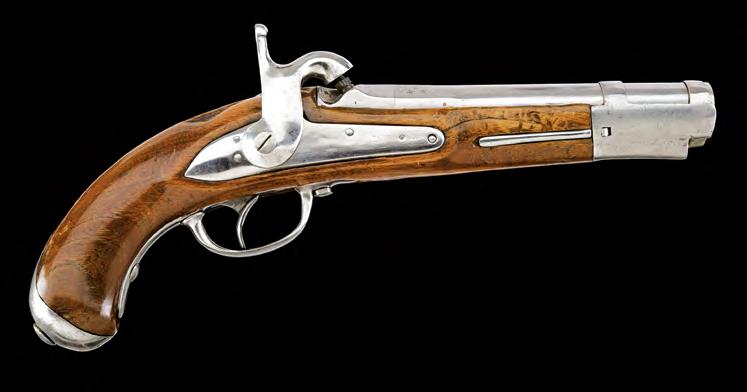
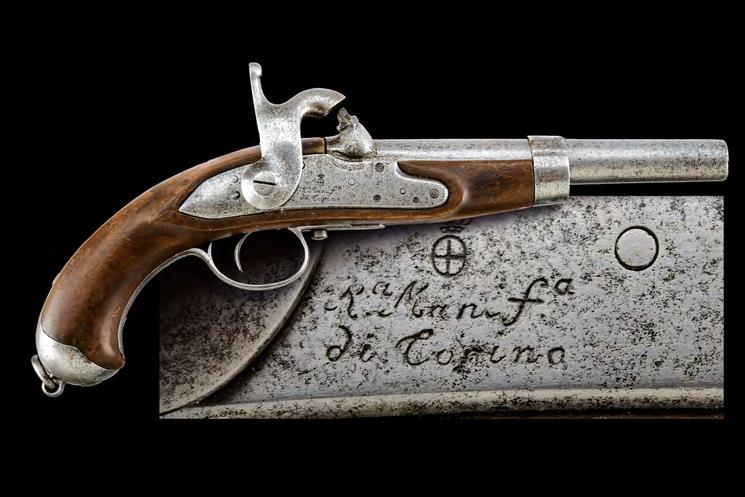
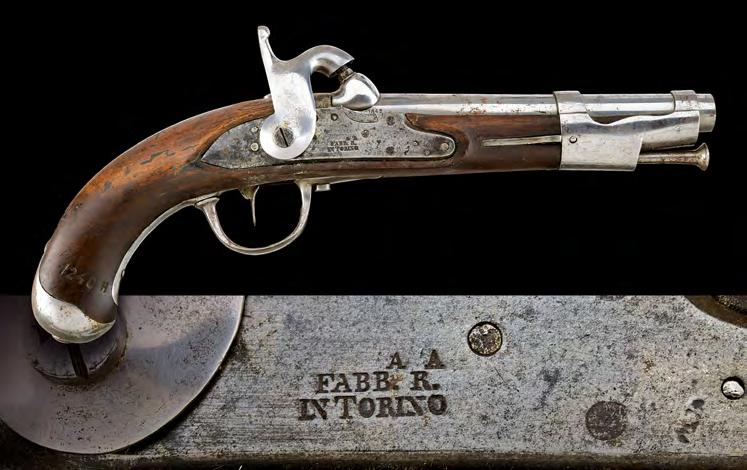
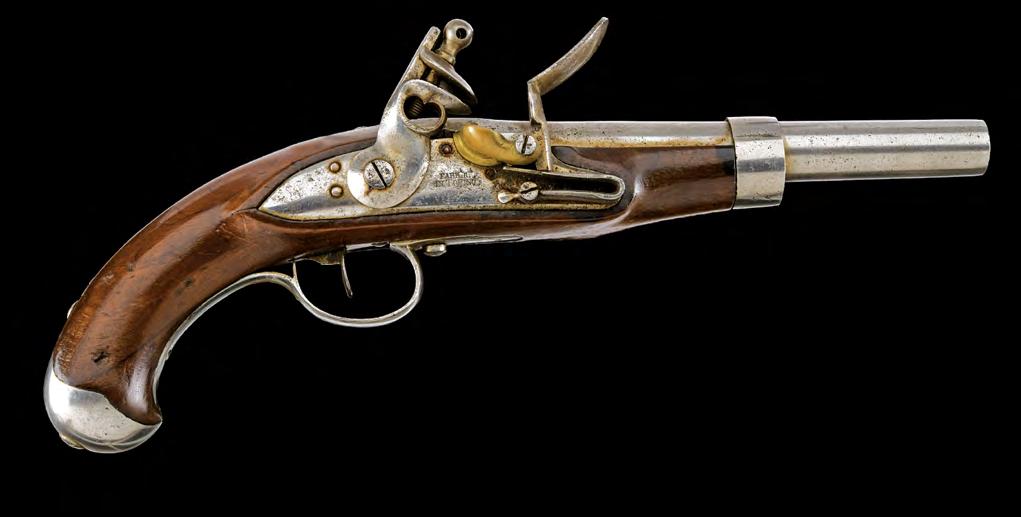
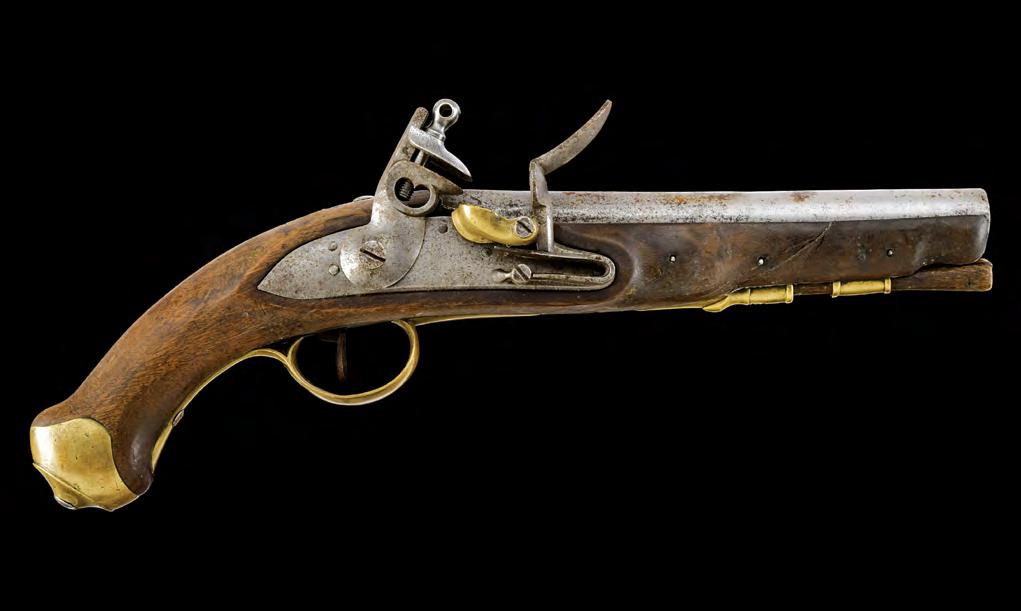
336
AN 1814 MODEL CAVALRY PISTOL CONVERTED TO PERCUSSION
Sardinian Kingdom, First half of the 19th Century Smoothbore, round, 17.6 mm cal. barrel with octagonal breech, dated “1842”. Lock converted to percussion marked “FABB. A R.A IN TURIN”. Working mechanism. Long wooden stock (restorations) with stamp “TORINO 1842” and “1240H”. Iron mounts and ramrod. All screws stamped “11”.
PISTOLA DA CAVALLERIA MOD. 1814 RIDOTTA A LUMINELLO
Regno di Sardegna, Prima metà del XIX Secolo
Canna tonda liscia con culatta ottagonale, datata “1842”, cal. 17,6 mm. Batteria ridotta a luminello marcata “FABB.A R.A IN TORINO”. Meccanica funzionante. Cassa lunga in legno (restauri) con timbro “TORINO 1842” e “1240H”. Fornimenti e bacchetta in ferro. Tutte le viti timbrate “11”.
Conditions
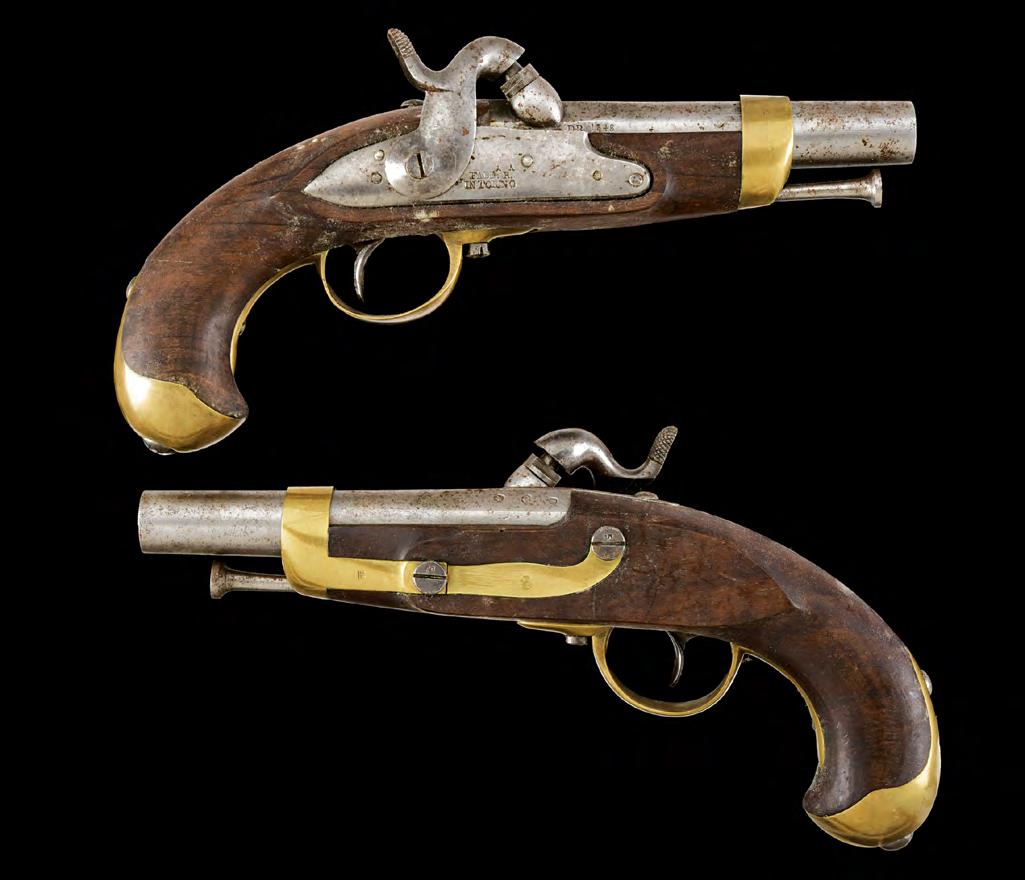
337
A PAIR OF 1847 MODEL “CARABINIERI” PERCUSSION PISTOL
Piedmont, Mid 19th Century Round, smoothbore barrels, with octagonal breech, with Savoy marks, marked “DR” and dated “1848”. Forward spring locks marked “FABB. A: R.A. IN TORINO”. Wooden, three-quarter stock. Brass mounts with marks. Iron ramrods.
PAIO DI PISTOLE A LUMINELLO DA CARABINIERI MOD. 1847
Piemonte, Metà del XIX Secolo
Canne tonde lisce con culatta ottagonale, recanti punzoni sabaudi, marcate “DR” e datate “1848”. Batterie a molla in avanti marcate “FABB. A: R.A. IN TORINO”. Casse a tre quarti in legno. Fornimenti in ottone con punzoni. Bacchette in ferro.
Conditions medium Length 24 cm. € 400/800
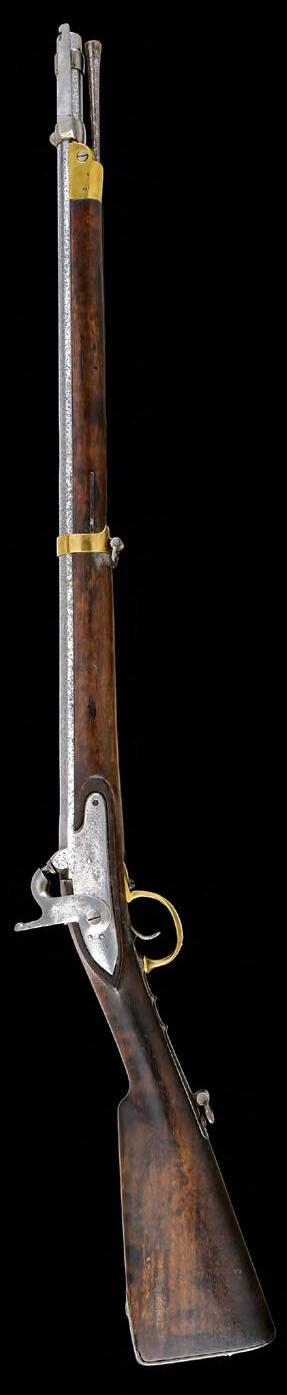


338 AN 1844 MODEL ARTILLERY
MUSKET
Turin, Mid 19th Century Rifled, round, 18 mm cal. barrel square at the base; mouthpiece with clutch for the bayonet and foresight. Forward spring lock marked “FABB.A R.A IN TORINO”. Wooden full stock with iron and brass mounts and iron ramrod.
MOSCHETTO A LUMINELLO
DA ARTIGLIERIA MOD. 1844 Torino, Metà del XIX Secolo Canna rigata, tonda, con base quadra, cal. 18 mm; bocchino con innesto per la baionetta e mirino. Batteria a molla in avanti marcata “FABB.A R.A IN TORINO”. Cassa intera in legno con fornimenti in ferro ed ottone e bacchetta in ferro.
Conditions medium Length 108.5 cm.
€ 100/200
339
A PERCUSSION GUN
Turin, 1860
Smoothbore, round, 17 mm cal. barrel, octagonal at the base, featuring three marks, and “GS 1860” on the side; foresight; tang with rear sight. Forward spring lock with marked “Torino 1863” under Piedmontese mark. Wooden full stock with iron mounts with “PI” marks; missing ramrod.
FUCILE A LUMINELLO
Torino, 1860
Canna liscia, tonda, con base ottagonale recante tre punzoni e sul fianco “GS 1860”, mirino in volata, cal. 17 mm; codetta con alzo fisso. Batteria a molla in avanti marcata “Torino 1863” sotto punzone piemontese. Cassa intera in legno con fornimenti in ferro con punzoni “PI”, bacchetta mancante.
Conditions good Length 114.5 cm.
€ 100/200
340
AN 1844 MODEL ARTILLERY GUN CONVERTED TO PERCUSSION
Turin, Mid 19th Century
Smoothbore, round, 17 mm cal barrel square at the base; tang provided with rear sight; forward spring lock converted to percussion, marked “FABB.A R.A IN TORINO”. Wooden full stock with stamp under the butt, iron and brass mounts, the butt-plate with remains of marking. Iron ramrod.
MOSCHETTO RIDOTTO A LUMINELLO PER ARTIGLIERIA MOD. 1844
Torino, Metà del XIX Secolo Canna tonda liscia con base quadra, cal. 17 mm; codetta munita di alzo. Batteria a molla in avanti ridotta a luminello marcata “FABB.A R.A IN TORINO”. Cassa intera in legno con timbro sotto al calcio, fornimenti in ferro ed ottone, la coccia con resti di marcatura. Bacchetta in ferro.
Conditions good Length 108.5 cm.
€ 150/250

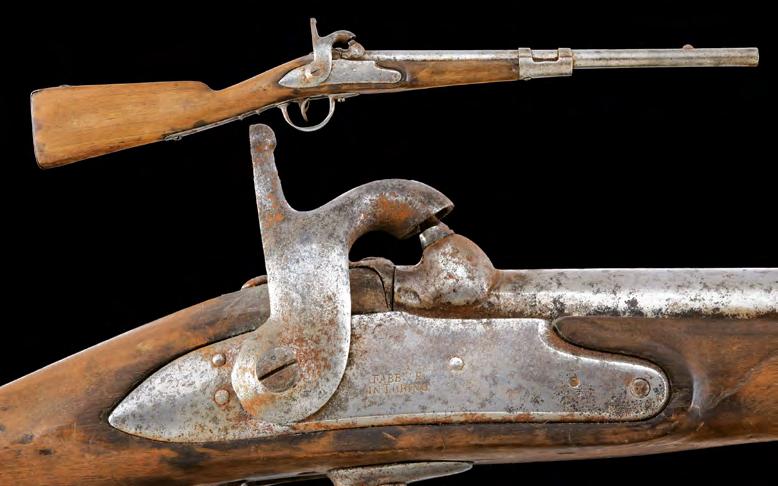
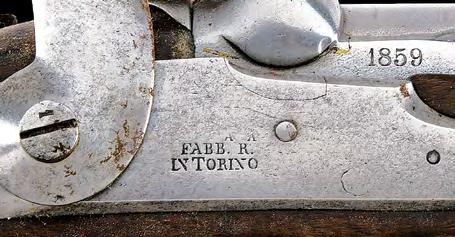
341 A PERCUSSION GUN
Turin, 1859
Round, smoothbore, 18 mm cal. barrel, provided with foresight, clutch for the bayonet, octagonal breech with traces of marks, date “1859”. Tang with fixed rear sight. Lock converted to percussion, marked “FABB.A R.A IN TORINO”. Wooden full stock. Brass and iron mounts, with remains of marks. Iron ramrod.
FUCILE A LUMINELLO
Torino, 1859
Canna tonda liscia, dotata di mirino, dente d’innesto per baionetta, culatta ottagonale con tracce di punzoni, data “1859”, cal. 18 mm. Codolo con alzo fisso. Batteria ridotta a luminello marcata “FABB.A R.A IN TORINO”. Cassa intera in legno. Fornimenti in ottone e ferro, con resti di punzoni. Bacchetta in ferro.
Conditions good Length 104 cm. € 200/400
342 AN 1844 MODEL "CHEVAUX LEGER" MUSKETOON CONVERTED TO PERCUSSION
Sardinian Kingdom, Mid 19th Century
Smoothbore, round, 17 mm cal. barrel, with octagonal breech; foresight. Tang provided with rear sight and marked “6”. Lock converted to percussion, on the lock plate the engraving “FABB.A R.A IN TORINO”. Wooden half stock (signs of use and time), butt with stamp. Iron mounts, a small curved bar with sling swivel attached to the counterplate. Working mechanism.
MOSCHETTONE DA CAVALLEGGERI MOD. 1844 RIDOTTO A LUMINELLO
Regno di Sardegna, Metà del XIX Secolo Canna liscia, tonda, con culatta ottagonale; mirino, cal. 17 mm. Codetta munita di alzo e marcata “6”. Batteria convertita a luminello, sulla cartella l’incisione “FABB.A R.A IN TORINO”. Mezza cassa in legno (segni d’uso e del tempo), il calcio con timbro. Fornimenti in ferro, alla contropiastra è attaccata una piccola sbarra curva con anello da sella. Meccanica funzionante.
Conditions medium
Length 83.5 cm.
€ 250/450
343
AN 1823 MODEL INFANTRY FLINTLOCK GUN
Turin, Second quarter of the 19th Century
Smoothbore, round, 18 mm cal. barrel, square at the base with mark; tang numbered “710”; lock with flat lock plate marked “FABB.A R.A IN TORINO”, brass pan; wooden full stock with stamp, the butt with missing parts near the butt plate, iron mounts and ramrod.
FUCILE A PIETRA FOCAIA DA FANTERIA MOD. 1823 (CORTO)
Torino, Secondo quarto del XIX Secolo
Canna tonda liscia con base quadra punzonata, cal. 18 mm; codetta numerata “710”. Batteria a cartella piatta marcata “FABB.A R.A IN TORINO”, scodellino in ottone. Cassa intera in legno con timbro, il calcio con mancanze vicino al calciolo, fornimenti e bacchetta in ferro.
Conditions good
Length 141 cm.
€ 250/450
344
AN 1814 MODEL FLINTLOCK GUN
Turin, about 1820
Smoothbore, round, 17 mm cal. barrel, square at the base provided with various marks and number “828”, clutch for the bayonet, foresight on the muzzle ring; tang with the model. Flintlock marked “R.a Manif.a di Torino”, with Piedmontese mark and another mark; brass pan. Marked inside with “C”,“BB” and all pieces with “11”. Wooden full stock, on the right side stamp with Savoy shield and inscription “VIVA V. EMANUELE”. Iron mounts and ramrod.
FUCILE A PIETRA FOCAIA MOD. 1814
Torino, 1820 circa Canna liscia tonda con base quadra munita di vari punzoni e numero “828”, attacco per la baionetta, mirino sul bocchino, cal. 17 mm; codetta con dicitura del modello. Batteria a pietra focaia marcata “R.a Manif.a di Torino”, con punzone piemontese ed un altro marchio; scodellino in ottone. All’interno marcatura “C”,“BB” e tutti pezzi con “11”. Cassa intera in legno, sulla guancia destra timbro con scudo sabaudo ed iscrizione “VIVA V. EMANUELE”. Fornimenti e bacchetta in ferro.
Conditions good
Length 146.5 cm.
€ 250/450
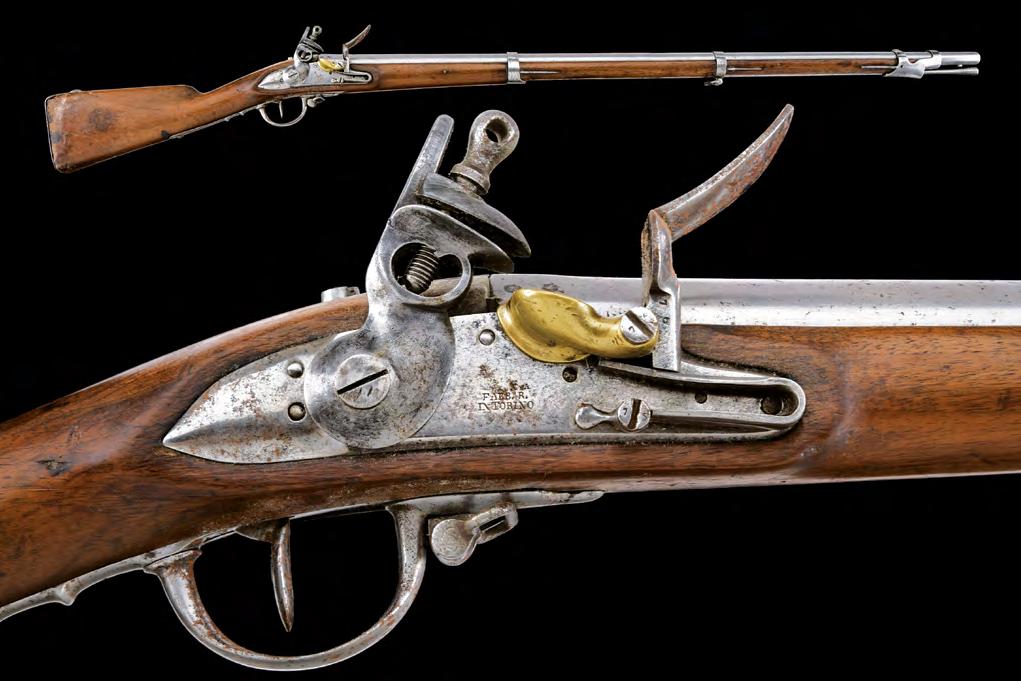
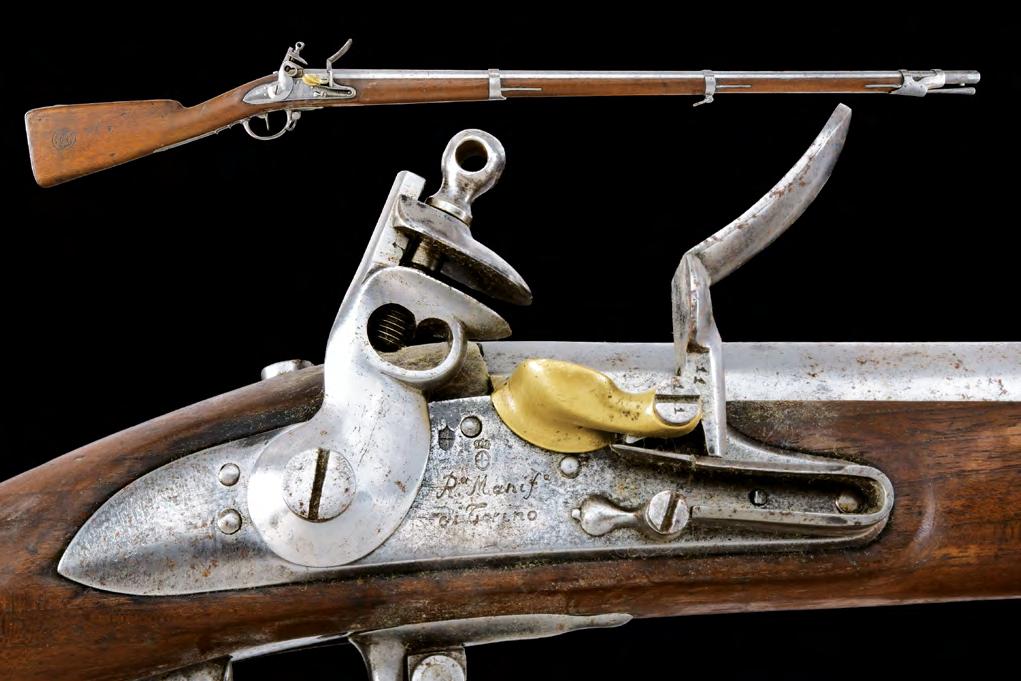
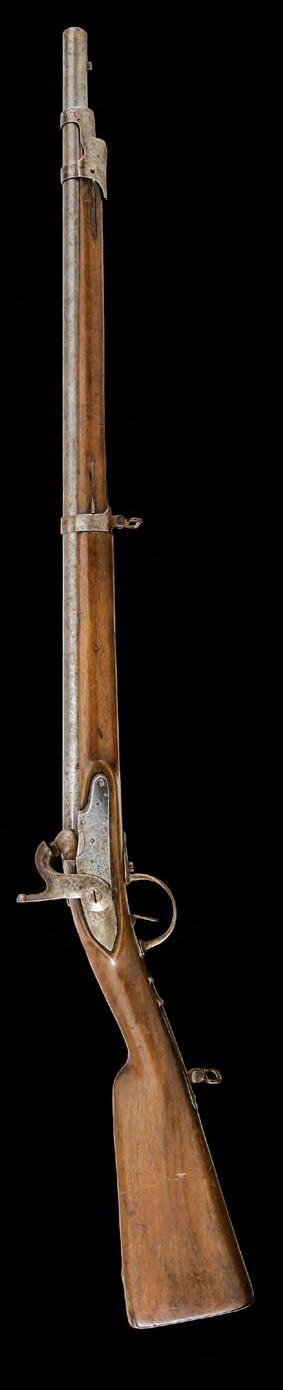
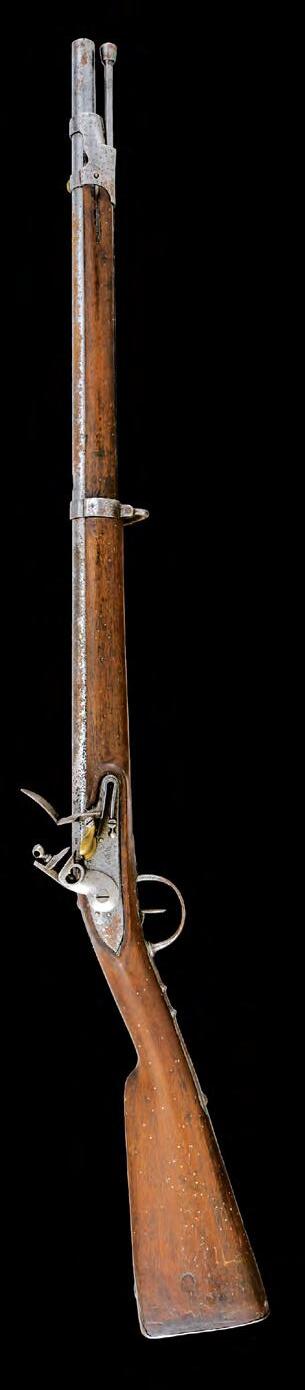
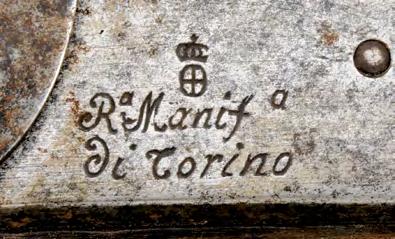
345
AN 1814/42 MODEL HEAVY CAVALRY PERCUSSION GUN
Sardinian Kingdom, Second quarter of the 19th Century Smoothbore, round, 18 mm cal. barrel, square at the base, clutch for the bayonet; lock converted to percussion marked “R.a Manif.a di Torino” in italics. Wooden full stock with iron mounts. Missing ramrod.
MOSCHETTO A LUMINELLO DA CAVALLERIA PESANTE
MOD. 1814/42
Regno di Sardegna, Secondo quarto del XIX Secolo Canna tonda liscia con base quadra, attacco per la baionetta, cal. 18 mm. Batteria ridotta a luminello marcata in corsivo “R.a Manif.a di Torino”. Cassa intera in legno con fornimenti in ferro. Bacchetta mancante.
Conditions medium
Length 109 cm.
€ 300/600
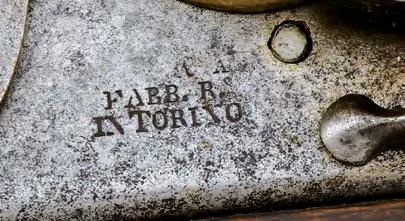
346
AN 1814 MODEL HEAVY CAVALRY FLINTLOCK MUSKET
Sardinian Kingdom, about 1820
Smoothbore, round, 17 mm cal. barrel, octagonal at the base with Piedmontese marks; barrel bracket with foresight; flintlock mechanism marked “FABB.A R.A IN TORINO,” with brass pan. Wooden full stock with iron mounts and ramrod. Butt-plate marked “653” and with marks. The counterplate side featuring a long ramrod with sling swivel. Damaged parts on the barrel and lock.
MOSCHETTO A PIETRA FOCAIA DA CAVALLERIA PESANTE
MOD. 1814
Regno di Sardegna, 1820 circa Canna liscia, tonda, con base ottagonale, munita di punzoni piemontesi, il reggicanna con mirino, cal. 17 mm in volata. Batteria a pietra focaia marcata “FABB.A R.A IN TORINO”, scodellino in ottone. Cassa intera in legno con fornimenti e bacchetta in ferro. Coccia marcata “653” e con un punzone. Il lato della contropiastra munita di lunga asta con anello da sella. Danni da ruggine su canna e batteria.
Conditions medium
Length 108 cm.
€ 300/500
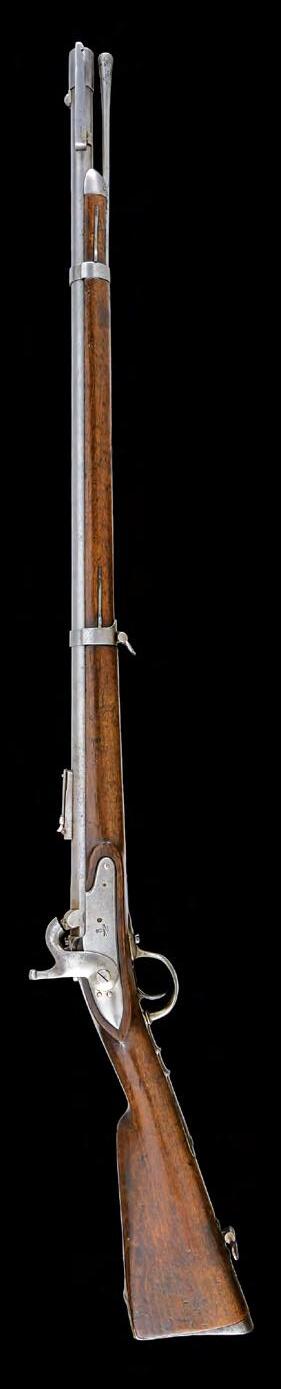
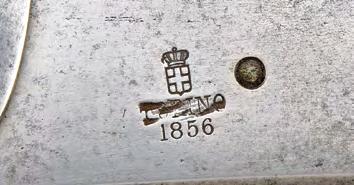
347
A VERY RARE 1856 MODEL PERCUSSION CARBINE FOR “BERSAGLIERI”
Turin, 1856
Round, rifled barrel (clean bore, clearly visible rifling), octagonal at the base marked with marks “GL”,“GV”, “LECCO” and the Piedmontese mark, provided with foresight, with foldaway and adjustable rear sight and clutch for the bayonet, 18 mm cal. at the nozzle. Tang provided with rear sight. Forward spring lock marked “TORINO 1856” (not clearly legible) under Savoy shield. Working mechanism with two snaps. Wooden full stock with butt stock marked “13745”. Iron mounts and ramrod.
RARA CARABINA A LUMINELLO DA BERSAGLIERI
MOD. 1856
Torino, 1856
Canna tonda rigata (anima pulita, rigatura ben visibile), con base ottagonale, marcata con punzoni “GL”,“GV”, “LECCO” e il punzone piemontese, dotata di alzo abbattibile e regolabile, con mirino ed attacco per la baionetta, cal. 18 mm. in volata. Codetta munita di alzo. Batteria a molla in avanti marcata “TORINO (dicitura poco leggibile) 1856” sotto scudo sabaudo. Meccanica funzionante a due scatti. Cassa intera in legno con pala marcata “13745”. Fornimenti e bacchetta in ferro.
Conditions good Length 126 cm.
€ 400/800
348 A 1752 MODEL FLINTLOCK GUN
Sardinian Kingdom, Third quarter of the 18th Century Long, smoothbore, round, 18 mm cal. barrel, with ring at the breech and remains of a mark, clutch for the bayonet also working as a foresight; flintlock completely made of iron, with fine Piedmontese mark in the centre of the lock plate; wooden full stock marked on the side of the counterplate “G.N”, on the right side of the butt stock “C. FONTANIEV” and on the opposite side “C. DAPVRIL”. Iron mounts and ramrod. Rare.
FUCILE A PIETRA FOCAIA, MOD. 1752
Regno di Sardegna, Terzo quarto del XVIII Secolo Lunga canna tonda, liscia, con anellatura in culatta e resti di un punzone, attacco per la baionetta che funge anche da mirino, cal. 18 mm. Batteria a pietra focaia completamente in ferro con bel punzone piemontese al centro della cartella. Cassa intera in legno marcata “G.N” accanto alla contropiastra, sul lato destro della pala “C. FONTANIEV” e sul lato opposto “C. DAPVRIL”. Fornimenti e bacchetta in ferro. Raro.
Conditions medium Length 150 cm.
€ 400/800
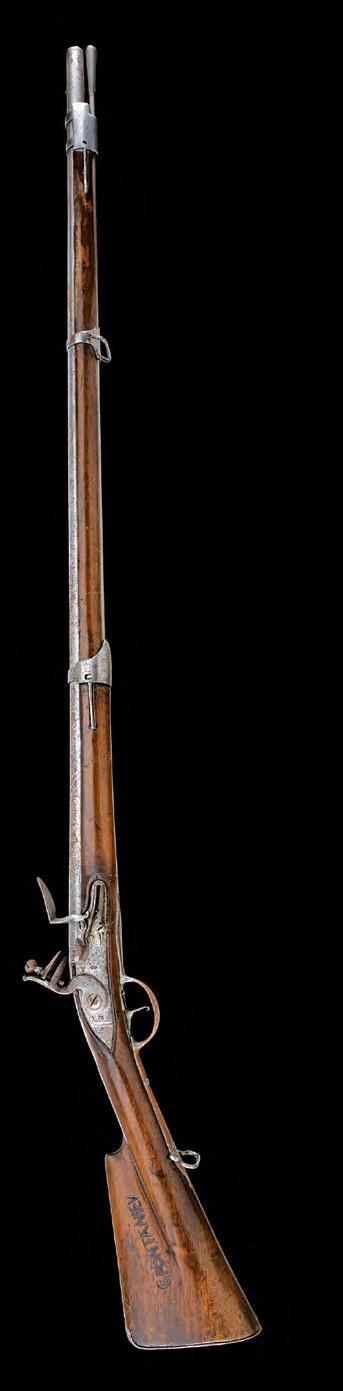
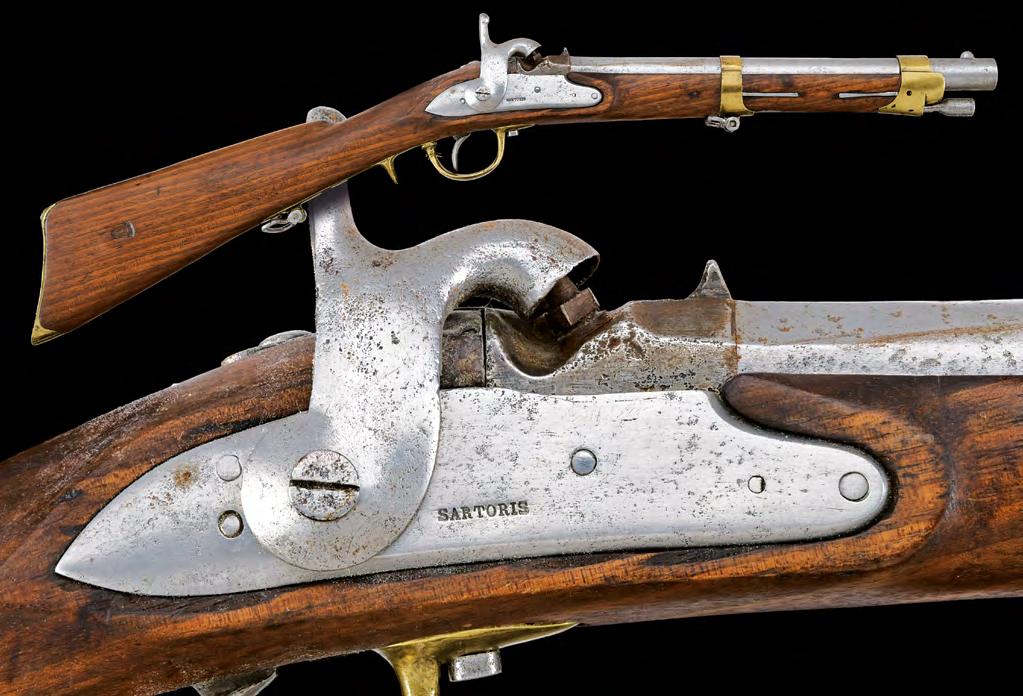
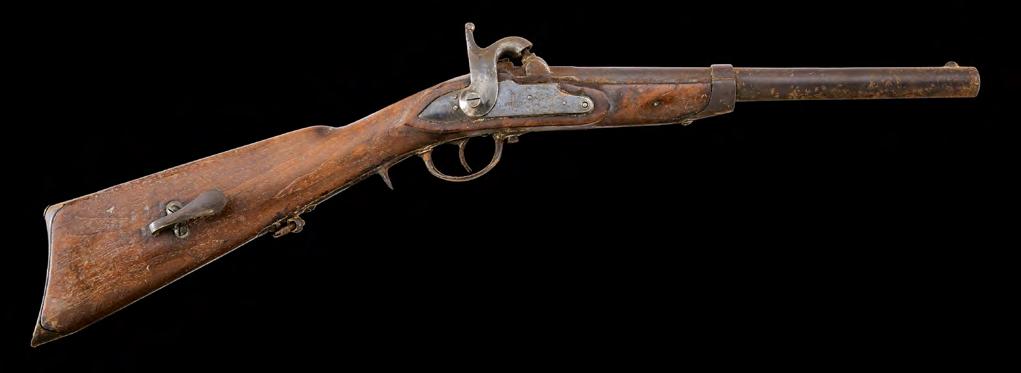
349 AN 1845 MODEL INFANTRY CARPENTER’S PERCUSSION SHORT CARBINE
Sardinian Kingdom, Third quarter of the 19th Century Round, rifled barrel, with octagonal breech provided with fixed rear sight, 12.7 mm cal. at the nozzle. Percussion lock with working mechanism, lock plate marked “SARTORIS”. Wooden full stock featuring Savoy shield stamp crowned on the butt stock. Brass mounts. Iron ramrod with repairing. Some areas with pitting on the iron parts. Rare.
PISTOLONE DA FALEGNAMI DI FANTERIA MOD. 1845 A LUMINELLO
Regno di Sardegna, Terzo quarto del XIX Secolo
Canna tonda rigata, con culatta ottagonale, munita di alzo fisso e con mirino, cal. 17,2 mm. in volata. Batteria a luminello con meccanica funzionante, cartella marcata “SARTORIS”. Cassa intera in legno recante timbro a scudo sabaudo coronato alla pala. Fornimenti in ottone. Bacchetta in ferro con riparazione. Alcune aree intaccate alle parti in ferro. Raro.
Conditions good
Length 67.5 cm.
€ 500/800
350 A RARE 1860 MODEL CAVALRY PERCUSSION SHORT CARBINE
Sardinian Kingdom, 1863
Round, rifled, 18 mm cal. barrel, with foresight, octagonal at the base, marked with crowned Savoy shield and remains of another mark. Tang with sight. Forward spring lock, marked “BRESCIA”, dated “1863” and with crowned Savoy shield above. Wooden, half stock with iron mounts. Butt stock with hook, suspension ring.
RARO PISTOLONE DA CAVALLERIA MOD. 1860
Regno di Sardegna, 1863
Canna tonda rigata, con mirino, base ottagonale, punzonata con scudo sabaudo coronato e con resti di un altro marchio, cal. 18 mm. Codolo con traguardo. Batteria a molla in avanti marcata “BRESCIA”, datata “1863” e con scudo sabaudo coronato in alto. Mezza cassa in legno con fornimenti in ferro. Pala con gancio, anello di sospensione.
Conditions medium
Length 69 cm.
€ 500/800
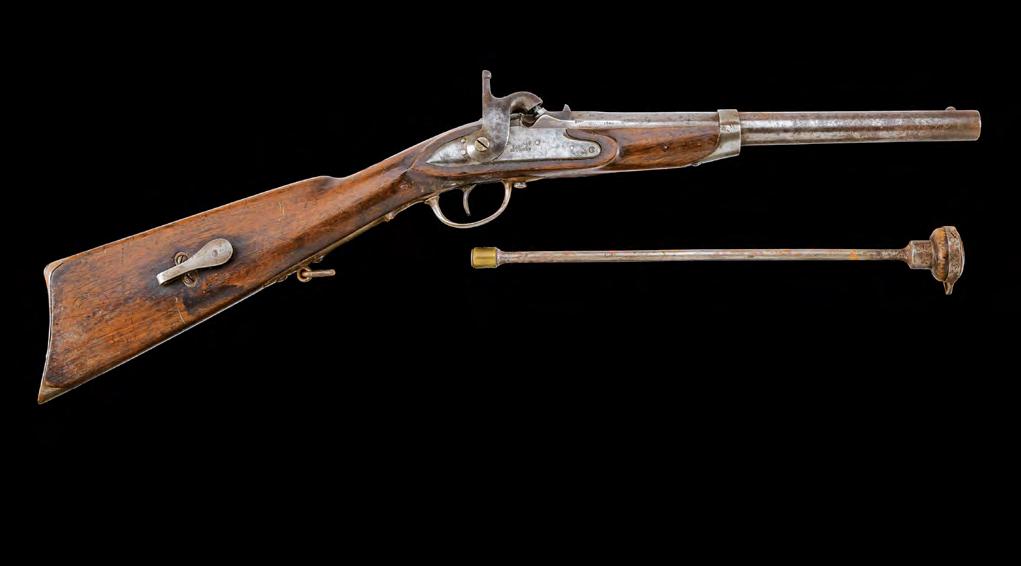
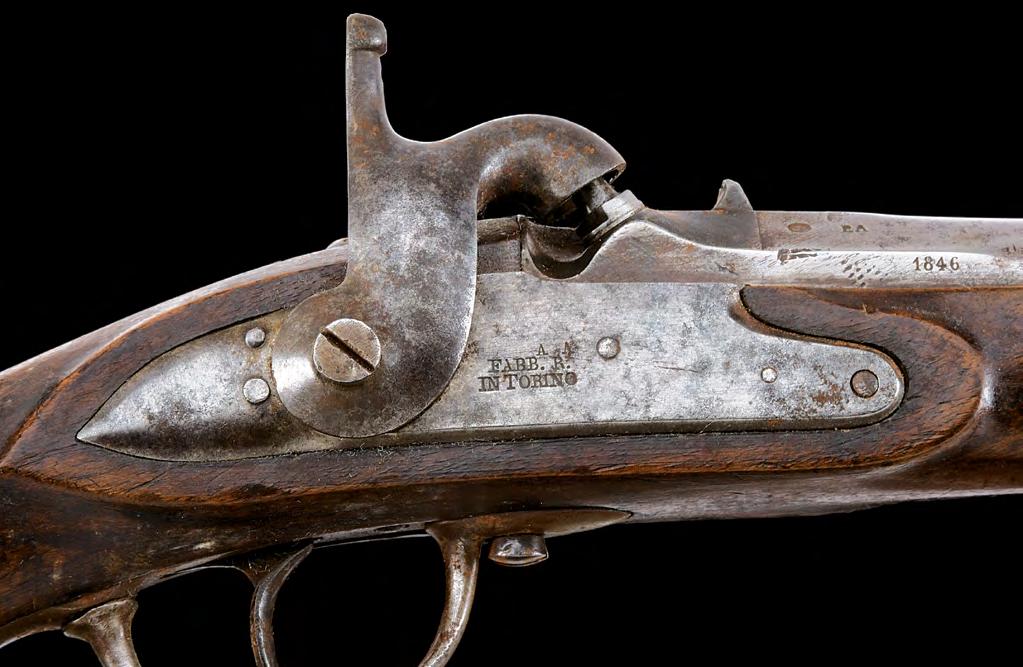
351 A RARE MODEL 1843 PERCUSSION SHORT CARBINE WITH SEPARATE RAMROD
Turin, 1846
Round, rifled, 17 mm cal. barrel, with octagonal breech, foresight and sight, featuring various marks and dated 1846; forward spring lock with flat lock plate, slightly round at the rear, marked “FABB.A R.LE IN TORINO”; wooden half stock, iron mounts, belt hook with mark “BI”. With its very rare iron, brass and wooden ramrod.
RARO PISTOLONE DA CAVALLERIA A LUMINELLO MOD. 1843 CON BACCHETTA DISGIUNTA
Torino, 1846
Canna tonda, rigata, con culatta ottagonale, mirino e traguardo, recante diversi punzoni e datata “1846”, cal. 17 mm. Batteria a molla in avanti con cartella piatta, leggermente tondeggiante nella parte posteriore, marcata “FABB.A R.LE. IN TORINO”. Mezza cassa in legno, fornimenti in ferro, gancio da cintura con punzone “BI”. Completo della rarissima bacchetta in ferro, ottone e legno.
Conditions medium
Length 69.5 cm.
€ 700/1.200
352 A BARBUTE IN THE STYLE OF THE 1500S
Italy, 19th Century
Made of iron, worked in one piece, ribbed in the middle, an easy opening, and a reinforced border. The right side with a movable trunnion. Row of holes for the lining. A fine replacement for a very expensive original.
BARBUTA NELLO STILE DEL 1500
Italia, XIX Secolo
In ferro, lavorato in un unico pezzo, costolata in mezzeria, l’apertura facciale ed il bordo con rinforzo. La parte destra con orecchione mobile. Giro di fori per la fodera. Bel sostituto per un costosissimo originale.
Conditions medium
Height 26 cm.
€ 550/850
353 A FROG MOUTH HELMET "STECHHELM"
Germany, 20th Century
Consisting of three riveted parts; the chanfrin with visor and air holes; remains of chin-straps and hinges. Together with its original leather and fabric lining. This type of helmet was used in jousts from the 15th to the 16th century.
BOCCA DI RANA "STECHHELM"
Germania, XX Sec.
Composto da tre parti rivettate; il frontale con vista e fori di aerazione; resti di chiavarde e cerniere. Insieme con il suo vecchio interno in cuoio e tessuto. Questo tipo di elmo veniva usato per la giostra fra il XV e il XVI secolo.
Conditions mediocre
Height 35 cm.
€ 800/1.200
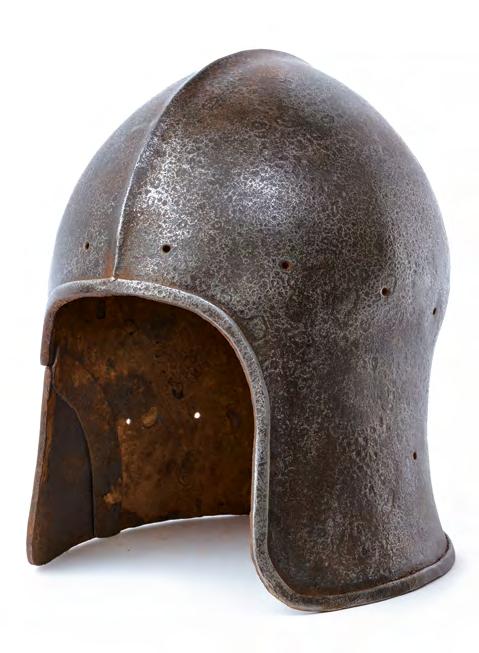
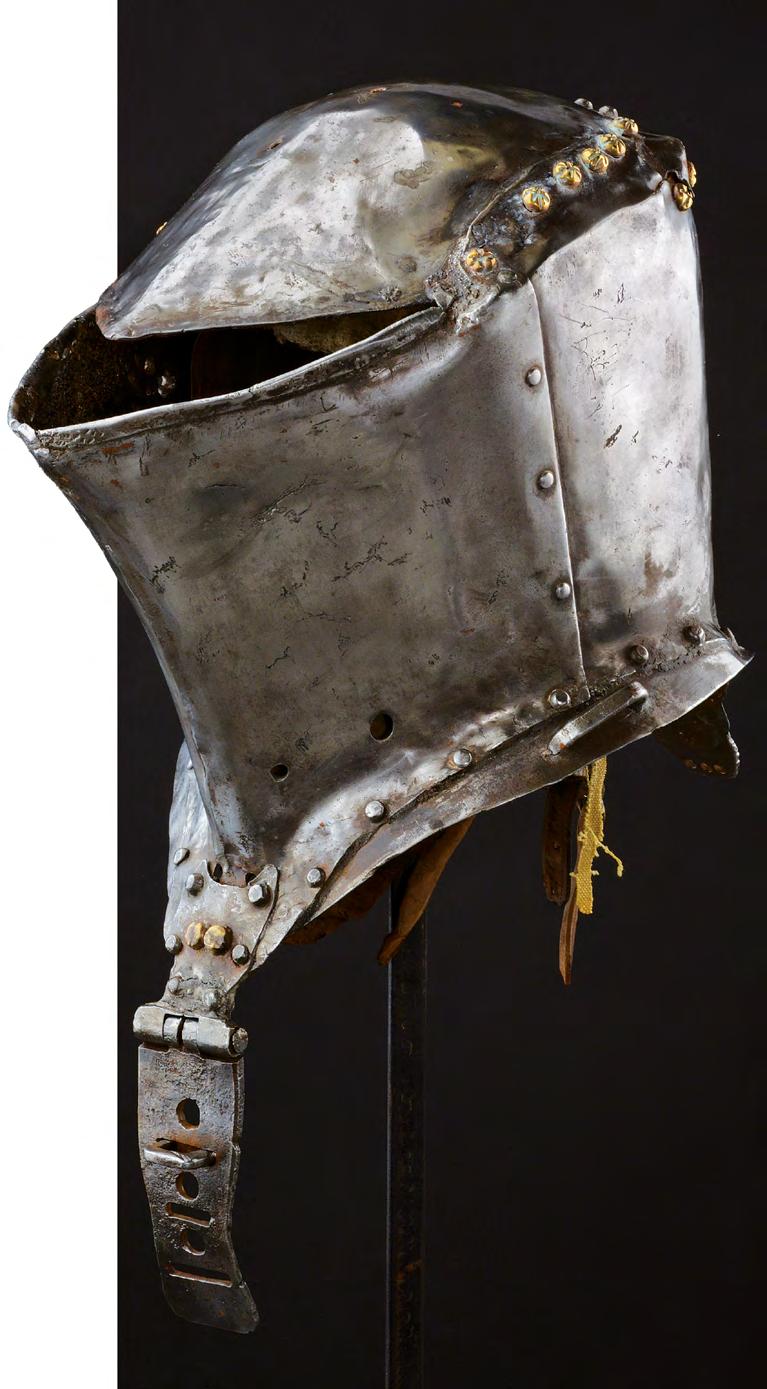


354
A RAPIER IN THE 16TH CENTURY STYLE
Europe, 19th Century
Straight double-edged blade with central fuller; thin rectangular ricasso with recessed borders; iron mounts with trigger guard, two side-rings and three-quillon counter-guard. Fluted barrel-shaped pommel. Grip wrapped with iron wire binding with Turk’s heads. In patina.
SPADA NELLO STILE DEL TARDO
XVI SECOLO
Europa, XIX Secolo
Lama dritta a due fili con sguscio centrale; sottile ricasso rettangolare con brodi scorniciati; fornimenti in ferro con ponticello, due archetti e controguardia a tre rami. Pomo a tino scanalato. Impugnatura rivestita in filo di ferro con teste di moro. In patina.
Conditions good
Length 121 cm.
€ 200/300
355 A FINE KATZBALGER IN THE 16TH CENTURY STYLE
Switzerland, 19th Century
Wide, straight, double-edged blade, with rounded tip, tang with four grooves, the blade with two grooves in the middle. Beautiful iron hilt with typical quillon with strongly curved quillons, finely carved with lozenges; center of crossguard, like the entire grip, with deep grooves; pommel widened towards the sides, at the center of the grip an ebony segment. Button with flower-shaped, brass rivet.
BEL KATZBALGER IN STILE DEL
XVI SECOLO
Svizzera, XIX Secolo
Larga lama dritta a due fili con punta arrotondata, recante quattro scanalature al tallone con le due sole in mezzeria che proseguono lungo la lama. Bellissimo fornimento in ferro con tipico elso a bracci fortemente incurvati e finemente intagliati a losanghe; il massello come tutta l’mpugnatura con profonde scanalature, il pomo ingrossato verso i lati, al centro dell’impugnatura un segmento in ebano. Il bottone con rivetto in ottone a forma di fiore.
Conditions good
Length 80.8 cm.
€ 600/900
356 A CINQUEDEA
Italy, 19th Century Ox-tongue blade, ribbed near the tip at the weak, with two fullers at the middle and three at the forte, partially engraved and gilt on both sides. Quillon with quillons curved downward, ending with gilt buds in relief. Grip with bone grip scales and gilt brass mounts. Discshaped pommel raised at the centre and decorated with partially gilt coils.
CINQUEDEA
Italia, XIX Secolo Lama a lingua di bue, costolata in punta al debole, con due sgusci al medio e tre al forte, parzialmente incisa e dorata su entrambi i lati. Elso a bracci incurvati verso il basso, con estremità recanti boccioli dorati in rilievo. Impugnatura con guancette in osso e fornimenti in ottone dorato. Pomo a disco rilevato al centro, con decoro a spire parzialmente dorato.
Conditions good Length 62 cm.
€ 400/800
357 A TWO-HANDED SWORD
Europe, 19th Century
Long straight blade of lenticular section; covered at the forte with leather sleeve. At the base, two cusp-shaped stops perpendicular to the blade, smooth ricasso. Large iron quillon with quillons enlarged towards the terminals and decorated with fullers; two rings of equal circumference. Grip enlarged at the centre, covered with fine leather . Fig-shaped pommel with button finial. Fine 19thcentury example of good workmanship.
SPADONA A DUE MANI
Europa, XIX Secolo
Lunga lama dritta di sezione lenticolare; rivestita al forte da manica di cuoio. Alla base due arresti a cuspide perpendicolari alla lama, il ricasso liscio. Grande elso in ferro a bracci ingrossati in testa e ornati a sgusci; due anelli di uguale circonferenza.
Impugnatura ingrossata al centro, rivestita con bella manica di cuoio. Pomo a fico rovescio bottonato. Bell’esemplare ottocentesco di buona fattura.
Conditions good Length 151 cm.
€ 400/600
358 A FINE DAGGER
Italy, 19th Century Blade of triangular section, the base with deep grooves, then ribbed in the middle. Iron quillon and pommel finely carved with floral motifs. Wooden grip covered in wire binding and metal wire Moor’s heads.
BEL PUGNALE
Italia, XIX Secolo
Lama di forma triangolare, con base recante tre profonde scanalature, in seguito costolata in mezzeria. Elso e pomo in ferro, finemente intagliati a motivi floreali. Impugnatura in legno rivestita con trecciola e dotata di teste di moro in filo metallico.
Conditions good Length 43.5 cm.
€ 500/800
359 A CAVALRY OFFICER’S SWORD
Spain, 18th Century Straight, double-edged blade of hexagonal section, with fuller at the forte, featuring the inscription “ENRIQUE COEL - EN ALEMANIA”. Iron hilt with two valves engraved with floral motifs (areas slightly damaged by rust); quillons and guard of round section decorated with knots between rings; disc-shaped pommel carved on the upper side; wooden grip covered with iron wire binding and Moor’s heads. Wooden scabbard covered with leather (missing parts), with iron mounts; chape engraved en suite, cap with belt hook.
SPADA DA UFFICIALE DI CAVALLERIA
Spagna, XVIII Sec. Lama dritta a due fili, di sezione esagonale, sgusciata al forte, recante l’iscrizione “ENRIQUE COEL - EN ALEMANIA”.
Fornimento in ferro a due valve, inciso a motivi floreali (con zone di danni superficiali da ruggine); bracci dell’elso e guardia di sezione tonda decorati con nodi fra anellature; pomo a disco intagliato sul lato superiore; impugnatura in legno rivestita di trecciola e teste di moro in filo di ferro. Fodero in legno rivestito di cuoio (con mancanze), con fornimenti in ferro; puntale inciso en suite, cappa con gancio da cintura.
Conditions medium
Length 109.5 cm.
€ 500/800

360 A BASKET-HILTED
SWORD
Germany, third quarter of the 16th Century Long, straight single-andfalse-edged blade. Basket hilt with lower ring guard, straight quillons of lozenge section widening toward the ends. Heavy, cone-shaped pommel. Leather-covered wooden grip (restored). The surface shows severe corrosion, but the weapon’s beauty remains intact. The leather-covered wooden scabbard with more recent iron mounts.
SPADA CON FORNIMENTO A GABBIA
Germania, terzo quarto del XVI Sec.
Lunga lama dritta a un filo e controfilo. Fornimento a gabbia con ponticello, bracci dell’elso dritti di sezione a losanga e crescenti verso la testa. Pesante pomo a forma di cono. Impugnatura in legno rivestita di cuoio (di restauro). La superficie con forte corrosione ma la bellezza dell’arma è rimasta intatta. Il fodero in legno rivestito di cuoio con fornimenti in ferro di epoca recente.
Conditions mediocre
Length 120.5 cm.
€ 700/900
361 A SILVER HILTED RAPIER WITH SCENES FROM THE LABOURS OF HERCULES
Holland, late 17th
Century Peculiar, straight, doubleedged blade, with triple groove at the first part. Richly pierced and engraved with floral motifs at the borders and ends; then central rib continuing to the tip and with wave decoration.
Three-part hilt, one silver, with fine carvings depicting the scenes of the Labours of Hercules in bas-relief and high relief.
INTERESSANTE SPADA
CON FORNIMENTO IN ARGENTO INTAGLIATO CON LE FATICHE DI ERACLE
Olanda, fine del XVII Sec. Singolare lama dritta a due fili, con triplice scanalatura al forte, riccamente traforata ed incisa a motivi floreali ai bordi e alle estremità; in seguito una sola nervatura centrale che prosegue sino alla punta e con decoro ad onde.
Fornimento in tre elementi, in una argento finemente intagliato, con pregiate raffigurazioni in rilievo delle Dodici Fatiche di Eracle.
Conditions good Length 107 cm.
€ 2.200/1.600

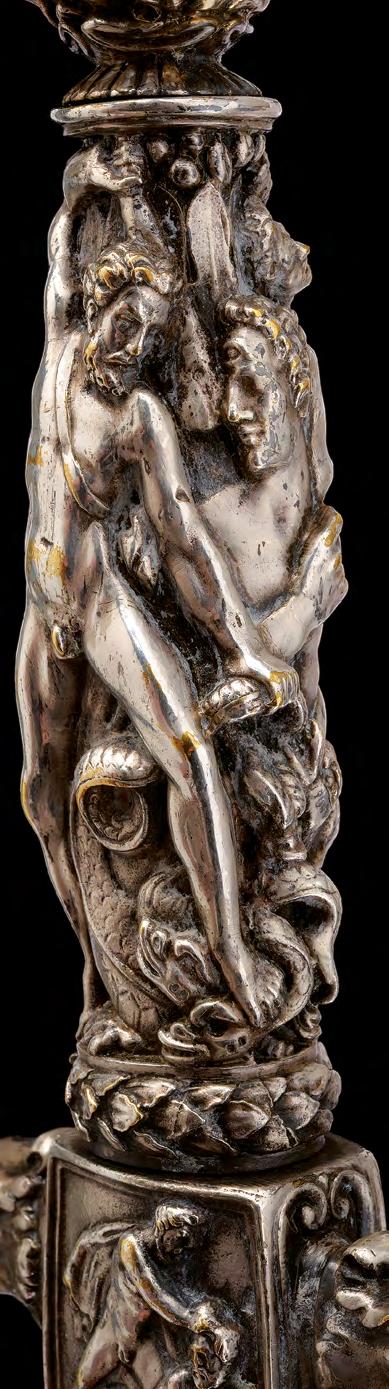
362
A RARE “SCHIAVONESCA”
Republic of VeniceDalmatia, 1400 - 1450
Wide, double-edged blade; the first section, approximately 40 cm long, with triple fuller, the second section with a slight medial ridge, the tip shortened and almost circular.“S”-shaped quillons, the arms narrowing at the base and then with two grooves. Solid tang with two arrow marks. Large rectangular pommel with rounded sides.
This extremely rare schiavonesca differs slightly from those preserved in the Armoury of the Council of Ten in the Doge’s Palace in Venice and may even be one of the rare examples produced in the part of Dalmatia governed by the Republic of Venice from the beginning of the 15th century.
See a “Schiavonesca” with similar blade and pommel in our auction no. 29, lot 2207.
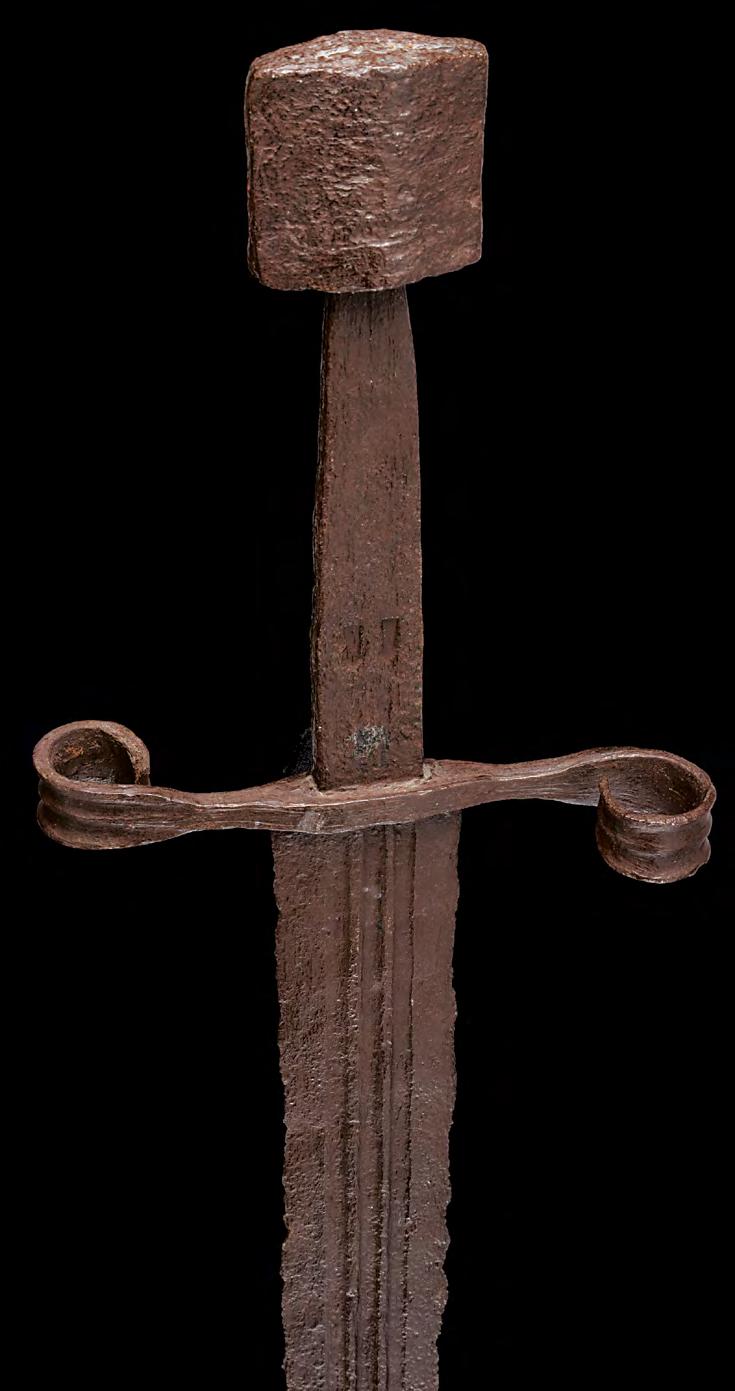
RARA SCHIAVONESCA
Repubblica di VeneziaDalmazia, 1400 - 1450
Ampia lama a due fili; la prima parte, di circa 40 cm, con triplice scanalatura, la seconda parte con leggera costola in mezzeria, la punta accorciata e quasi circolare. Elso a “S”, i bracci ristretti alla base, poi con due scanalature. Il robusto codolo con due marchi a freccia. Il grande pomo rettangolare con lati tondeggianti.
Questa rarissima schiavonesca si distingue leggermente da quelle che sono preservate nell’Armeria del Consiglio dei X nel Palazzo dei Dogi a Venezia e potrebbe addirittura essere uno dei rari esemplari realizzati nella parte della Dalmazia governata dalla Repubblica di Venezia dall’inizio del XV secolo. Vedi una Schiavonesca con lama e pomo simile nella nostra asta no. 29 lotto 2207.
Conditions medium
Length 121.3 cm.
€ 6.000/8.000
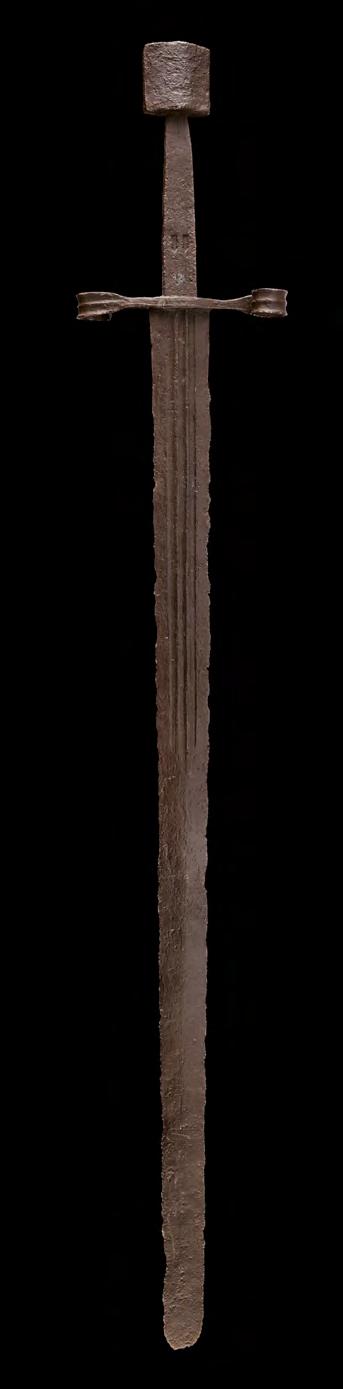
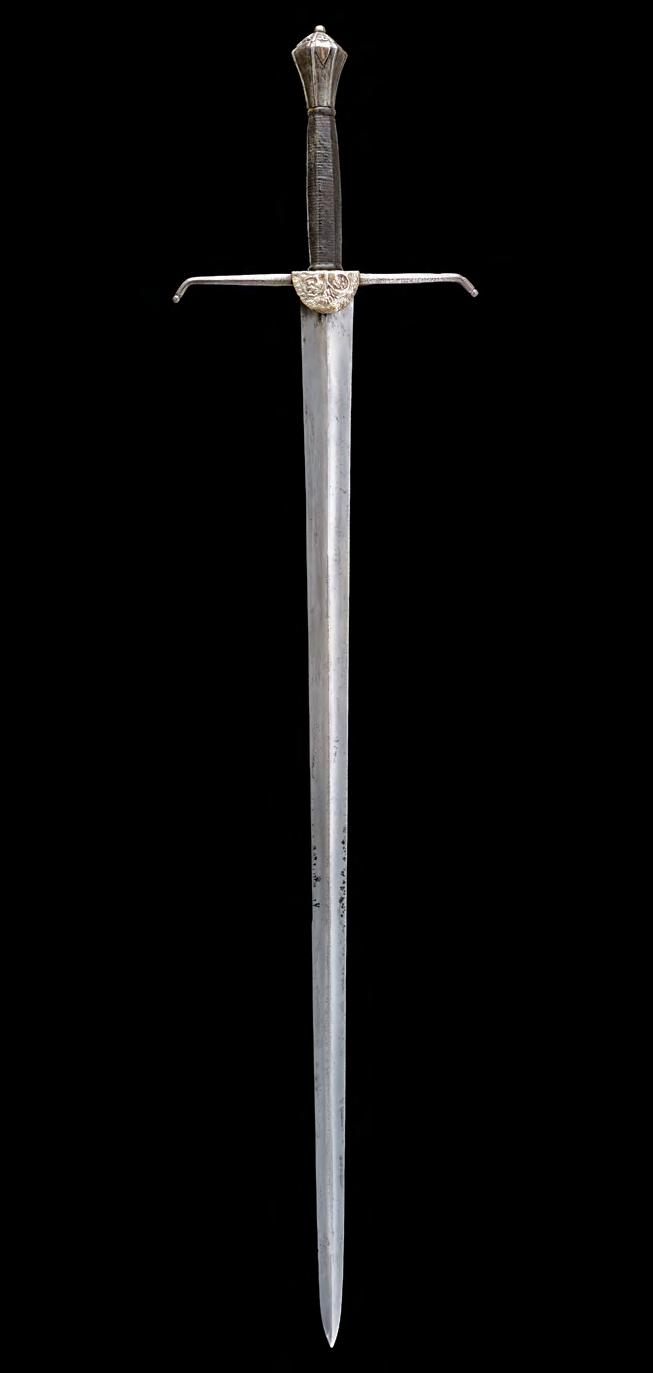
363
AN ESTOC (THRUSTING SWORD)
Switzerland, about 1480
Long, straight, double-edged blade with central fuller. Hilt with straight quillons of hexagonal section, curved terminals ending in faceted buttons. Small semi-circular iron shellguard covered with embossed silver sheet decorated with floral motifs. Hexagonal wooden grip with dark leather covering.
Faceted inverted pear-shaped pommel with double coats of arms within escutcheons, one bearing a cross applied in brass and the other a series of lozenges; the top worked to simulate a radiating cap; hollowed circular tang button.
SPADA DA STOCCO
Svizzera, 1480 circa Lunga lama dritta a due fili con forte nervatura centrale. Elso con bracci dritti a sezione esagonale, estremità incurvate e terminanti a bottoni faccettati. Piccola conchiglia a semicerchio in ferro rivestita da lamina d’argento operata con fiorami a sbalzo.
Impugnatura di sezione esagonale, in legno, con rivestimento in manica di cuoio scuro.
Pomo a pera rovescia faccettata, con duplici stemmi entro scudetti, uno con croce riportata in ottone e l’altro con serie di losanghe; la sommità operata a simulare una cappetta raggiata; bottone tondo sgusciato.
Conditions good Length 120 cm.
€ 6.000/9.000
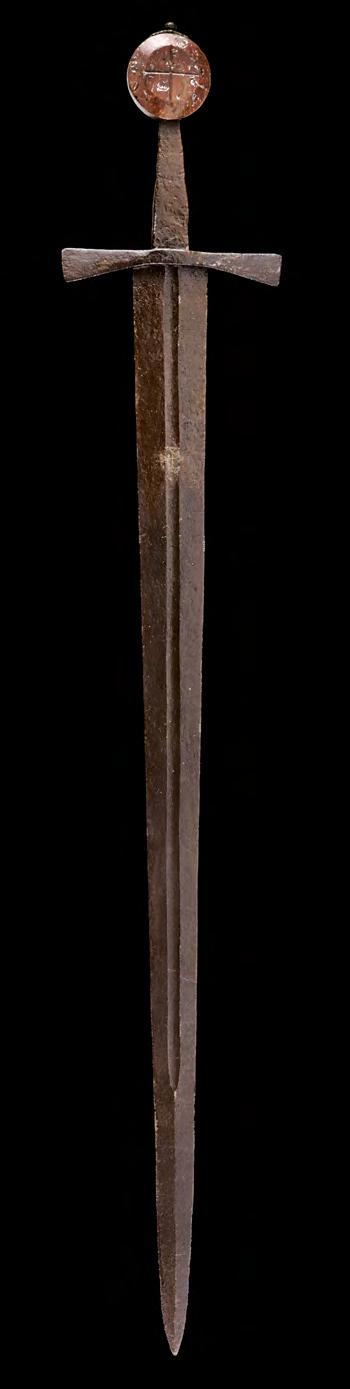
364
A FINE SWORD
Germany or Switzerland, Late 14th CenturyBegin of the 15th Century Wide, straight double-edged blade with central fuller ending approximately 20.5 cm from the tip; the forte with medial rib. On one side is a brass cross pattée, the arms ending in a small triangle with the hypotenuse facing outward; on the opposite side appears a heart. Quillon with quillons slightly inclined towards the blade, palmed and tapering outward. Trapezoidal tang. Fine red jasper disc pommel, engraved with a cross on the front side, was probably added during the Historicist period (19th century), the fastening with bronze leaf-shaped mount.
Interesting sword of fine appearance and elegant profile. Hugo Schneider illustrates in Waffen im Schweizerischen Landesmuseum, Griffwaffen I (page 36, no. 42) a sword bearing a similar cross, although enclosed within a shield, which he identifies as the cross of the Order of Saint John. A heart also appears on two swords dated to the 14th/15th century, described by Cvetkovic/Dodic (2004), likewise in combination with a cross.
BELLA SPADA
Germania o Svizzera, Fine XIV Secolo - Inizio XV Secolo
Larga lama diritta a doppio filo, con sgusciatura centrale che termina a circa 20,5 cm dalla punta; il debole con costolatura mediana. Su un lato è applicata una croce patente in ottone, con bracci terminanti in un piccolo triangolo con ipotenusa rivolta verso l’esterno; sul lato opposto, è presente un cuore. Elso con bracci lievemente inclinati verso la lama, palmati e assottigliati verso l’esterno. Codolo di forma trapezoidale. Il bel pomo a disco in diaspro rosso, inciso a croce sul lato anteriore, è probabilmente stato aggiunto in epoca di storicismo (XIX secolo), la chiusura con fornimento in bronzo a forma di foglia.
Interessante spada di bell’aspetto e di elegante profilo. Hugo Schneider mostra in “Waffen im Schweizerischen Landesmuseum, Griffwaffen I” (a pagina 36, n. 42) una spada che presenta una croce simile, sebbene inscritta entro uno scudo, che egli identifica come croce dell’Ordine di San Giovanni. Un cuore compare anche su due spade datate al XIV/XV secolo, descritte da Cvetkovic/Dodic (2004) anche in combinazione con una croce.
Conditions good
Length 101.5 cm.
€ 6.000/8.000
365
A KNIGHTLY SWORD
Germany, 1270 - 1290
Wide, straight, double-edged blade with central fuller terminating approximately 25 cm from the tip. On one side is still clearly visiblethe engraving of a Cross (with the four quillons ending in a small crossbar) enclosed within a circle. Straight quillon of quadrangular section, with quillons slightly widening towards the terminals. Pommel of pronounced pagoda-roof form, with sturdy tang of trapezoidal profile. On one side a small brass escutcheon with collection number “183”.
Interesting sword of very fine form and in good condition. See a very similar example in Hugo Schneider, Waffen im Schweizerischen Landesmuseum, Griffwaffen I (no. 20). A sword of this type appears on the tomb slab of Ulrich I of Regensburg, datable to circa 1285.
SPADA MEDIEVALE
Germania, 1270 - 1290
Larga lama diritta a doppio filo, con scanalatura centrale che si arresta a circa 25 cm dalla punta. Su un lato è ancora ben visibile l’incisione di una croce (con i quattro bracci terminanti in una piccola traversa) inscritta in un cerchio. Elso diritto, di sezione quadrangolare, con bracci leggermente crescenti verso la testa. Pomo dalla marcata forma di tetto a pagoda, con codolo robusto di profilo trapezoidale. Su un lato piccolo scudetto in ottone con numero di collezione “183”.
Interessante spada di bellissima foggia e in buone condizioni. Si veda un esemplare assai simile in Hugo Schneider, “Waffen im Schweizerischen Landesmuseum, Griffwaffen I” (n. 20) Sulla lapide di Ulrico I di Ratisbona compare una spada di questo tipo, databile attorno al 1285.
Conditions good
Length 99.6 cm.
€ 7.500/9.500
366
AN IMPORTANT AND RARE KNIGHTLY SWORD
Germany or Switzerland, 12th Century Made of iron, wide, straight, double-edged blade, with slight central fuller up to approximately 25 mm from the weak, from where it is ribbed in the middle.
Inscription “INGELRII” still visible in the first quarter. Straight quillon of square section, approximately 13 mm. Well-proportioned and mushroom-shaped pommel.
See a very similar sword with the same inscription in “Waffen im Schweizer Landesmuseum – Griffwaffen I” by Hugo Schneider, on page 18, no. 10. Another similar sword can be found in “A Bon Droyt”, the catalogue of the 2007 exhibition in Aosta, on page 104. Another in “Records of the Medieval Sword” by Ewart Oakeshott, no. 11.
IMPORTANTE E RARA SPADA DA CAVALIERE
Germania o Svizzera, XII Sec.
In ferro con larga lama dritta a due fili con leggero sguscio centrale che corre fino a circa 25 dalla punta; il debole costolato in mezzeria. Nel primo quarto ancora visibile la scritta “INGELRII”. Elso dritto di sezione quadra di circa 13 mm. Pomo ben proporzionato a forma di fungo.
Vedi una spada assai simile con stessa iscrizione in “Waffen im Schweizer Landesmuseum - Griffwaffen I” di Hugo Schneider su pagina 18 no. 10. Un’altra spada simile in “A Bon Droyt”, catalogo della mostra ad Aosta nel 2007, a pagina 104. Un’altra in “Records of the Medieval Sword” di Ewart Oakeshott, nr. 11.
Conditions good
Length 95 cm.
€ 8.000/10.000
367
AN IMPORTANT VIKING SWORD
Northern Europe, 10th Century
Broad, straight, double-edged blade, finely worked in patternwelding, giving the surface a harmonious appearance similar to wood. The central part of the blade featuring a slight fuller at the middle while the tip is oval. On one side, near the forte, there is a ring-shaped silver inlay. Straight quillon with rounded ends; the pommel, made in two pieces and slightly offset in relation to the quillon, and has a large part of its original geometric decoration in silver and copper. The tang, similarly executed in pattern-welding, is straight on one side and oblique on the other.
While today pattern-welding is essentially an aesthetic choice, in the Viking Age it responded above all to the need to make use of every possible fragment of ferrous material (bloom) and to homogenise an iron that was by nature highly heterogeneous and which, after long processes of hammering and consolidation, was carburised in order to be transformed into steel. The beauty of pattern-welded steel was at first merely a by-product of the process, and only later came to be appreciated and deliberately sought for its natural aesthetic value. Our sword represents a remarkable example of this technique of blade construction and moreover preserves, to a large extent, the decoration of its hilt.
BELLISSIMA SPADA VICHINGA
Europa del Nord, X Sec.
Larga lama diritta a doppio filo, finemente lavorata in “patternwelding”, che conferisce alla superficie un aspetto armonioso, quasi simile a quello del legno. La parte centrale della lama presenta una lieve sgusciatura mediana, mentre la punta è di forma ovale. Su una faccia, in prossimità del forte, è presente un’agemina ad anello riportata in argento. Elso diritto con estremità arrotondate; il pomo, realizzato in due pezzi e leggermente disassato rispetto all’elso, conserva, così come l’elso stesso, gran parte della decorazione geometrica originale riportata in argento e rame. Il codolo, eseguito anch’esso in pattern-welding, è leggermente più inclinato su un lato e dritto sull’altro.
Mentre oggi il “pattern welding” è una scelta essenzialmente estetica, al tempo dei Vichinghi rispondeva soprattutto alla necessità di sfruttare ogni possibile frammento di materiale ferroso (bloom) e di omogeneizzare un ferro per natura molto eterogeneo che, dopo lunghi processi di martellatura e compattazione, veniva carburato per trasformarlo in acciaio. La bellezza dell’acciaio lavorato in pattern welding fu inizialmente soltanto un effetto collaterale del procedimento, e solo in seguito venne apprezzata e ricercata per il suo naturale valore estetico. La nostra spada rappresenta un notevole esempio di questa tecnica di lavorazione della lama e conserva inoltre in larga parte la decorazione del fornimento.
Conditions good Length 95 cm.
€ 15.000/18.000
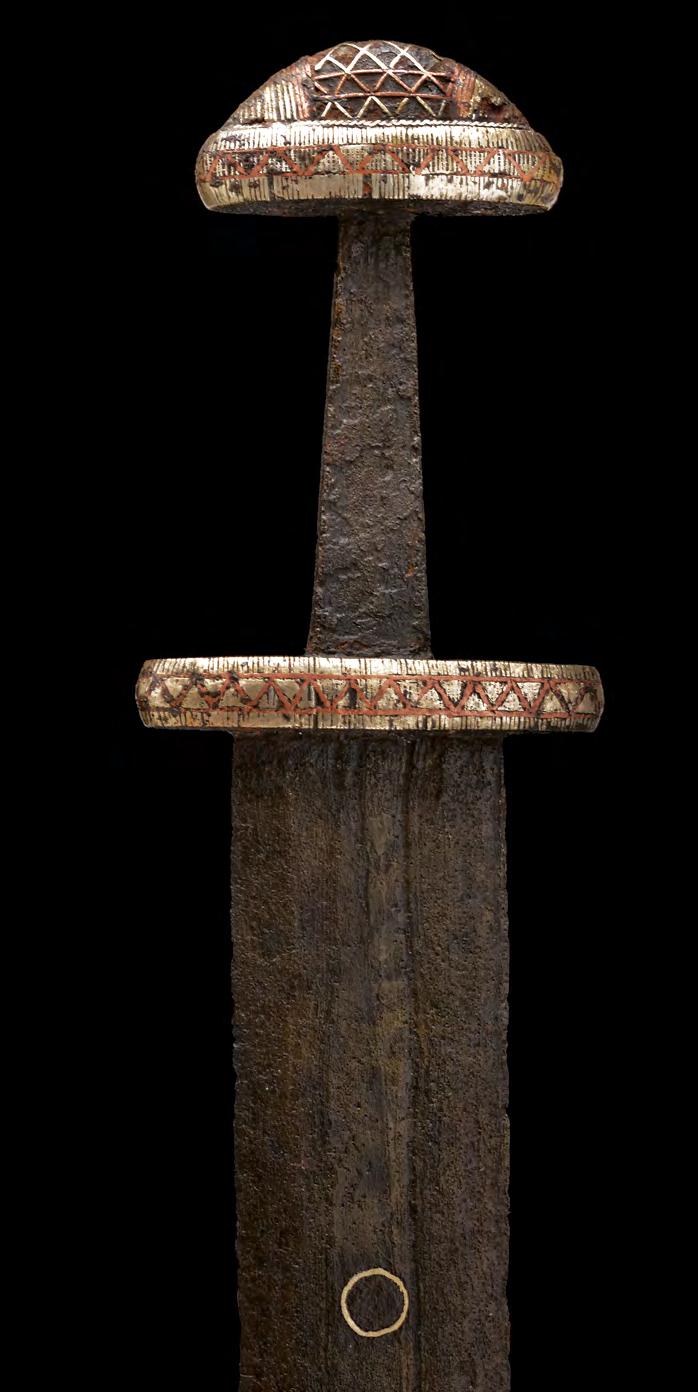
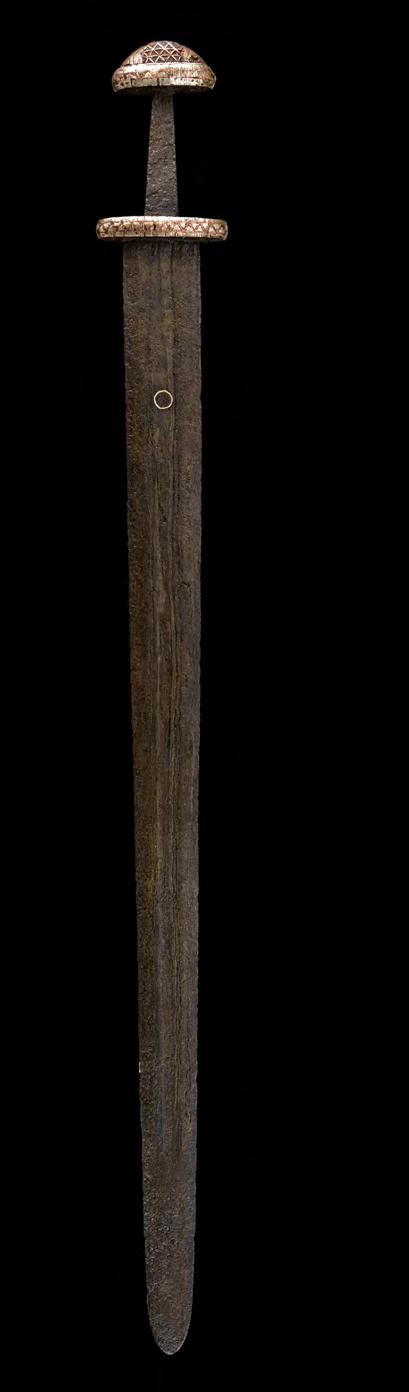
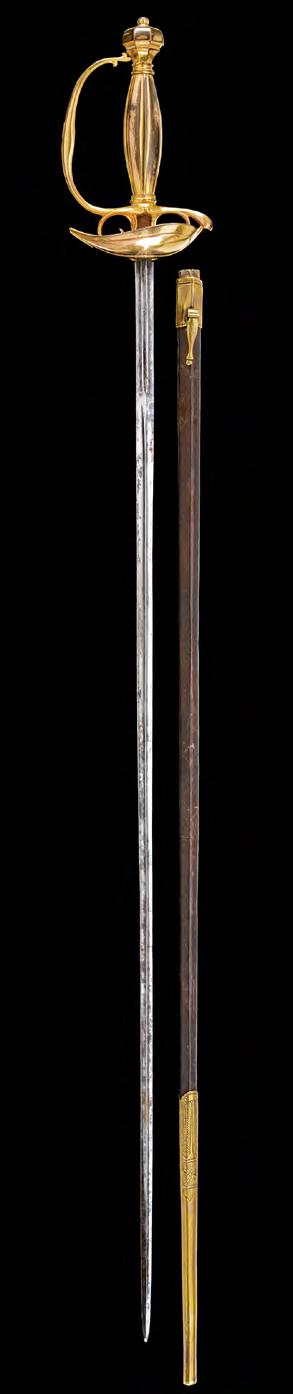
368 A SMALL SWORD
Europe, 19th Century
Straight, cross-shaped blade, hexagonal at the base. Solid gilded bronze hilt (with missing parts caused by use and time), featuring a heart-shaped rain guard decorated with a shell, curled arms of the hilt, quillon, loop-guard, faceted pommel, grip decorated with staves. Leather-covered wooden scabbard with gilded bronze mounts; cap with hook.
SPADINO
Europa, XIX Secolo
Lama dritta, cruciforme con base esagonale. Fornimento in bronzo massiccio dorato (mancanze causate da uso e dal tempo), con coccia a cuore decorata a conchiglia, con archi arricciati, braccio dell’elso, ramo di guardia e pomo faccettati; impugnatura decorata a doghe. Fodero in legno rivestito di cuoio con fornimenti in bronzo dorato, la cappa con gancio.
Conditions good Length 94.5 cm. € 100/200
369 A SMALLSWORD
Europe, early 18th Century
Straight blade of hexagonal section, with some pitting, particularly at the tip. The tang is also of hexagonal section. Iron hilt. The butt-plate consists of two richly carved and pierced valves featuring grotesque motifs, fishes, a trophy of armour and flags, and the effigy of a figure. One valve with missing parts. Pommel with a carved effigy of a plumed helmet on one side and an armour bust on the other. Guard with central knot. Spheroidal pommel, flattened at the top, and decorated with trophies of arms and armour. Smooth brown wooden grip. Pitting, signs of use and time.
SPADINO
Europa, inizio del XVIII Sec. Lama dritta di sezione esagonale, con alcune aree di pitting, soprattutto in punta. Tallone sempre di sezione esagonale. Fornimento in ferro. Coccia a due valve riccamente intagliate e traforate a grottesche, con pesci, un trofeo d’armatura e bandiere e con effige di un personaggio. Una valva con evidente mancanza. Il blocchetto con effige di un elmo piumato su una faccia e di un busto d’armatura sull’altra, lavorati ad intaglio. La guardia con nodo centrale. Il pomo di forma sferoide schiacciata, ornato con trofei d’armi e armature. Impugnatura liscia in legno bruno. Intaccature, segni d’uso e del tempo.
Conditions medium
Length 100 cm.
€ 180/250
370 A SMALL SWORD
Kingdom of the Two Sicilies, late 18th Century
Triangular blade with hollow sides, typical iron hilt with a diamond-shaped grip and an olive-shaped pommel. Wooden scabbard covered in leather with mounts en suite. The blade does not slide out of the scabbard.
SPADINO
Regno delle Due Sicilie, fine del XVIII Sec.
Lama triangolare a facce incavate, tipico fornimento in ferro con impugnatura diamantata come anche il pomo ad oliva. Fodero in legno rivestito in cuoio con fornimenti en suite. La lama non si estrae dal fodero.
Conditions medium
Length 100 cm.
€ 250/350
371 A SMALL SWORD
Europe, 18th Century
Straight, double-edged blade of hexagonal section; with remains of trophies and floral engravings at the forte, alfo featuring short fullers and transversal decorations. Hilt of non-magnetic metal; pierced rainguard like the grip and pommel. Double-curved quillons with pseudo-arms of the hilt decorated with a chain of spherical rings; circular, pierced center of the crossguard featuring a gilded medallion with a lion’s face. The guard is also decorated with a sequence of small spheres, topped by a wheel; olive-shaped pommel pierced with a floral motif and featuring a moulded upper button. Leather scabbard (probably from a later period) with metal mounts; two suspension rings.
SPADINO
Europa, XVIII Secolo Lama dritta a due fili di sezione esagonale, il forte con resti di incisioni a trofei e floreali, recante anche decori a brevi sgusci trasversali. Fornimento in metallo non magnetico, coccia operata a traforo, come anche l’impugnatura ed il pomo. Bracci dell’elso a doppio con pseudo archetti decorati a catena con anelli sferici, il massello traforato di forma circolare recante un medaglione dorato recante un volto di leone. Guardia anch’essa decorata a piccole sfere in sequenza, al colmo una ruota; pomo ad oliva traforata a fiore e con bottone superiore modanato. Fodero in cuoio (probabilmente di epoca successiva) con fornimenti in metallo; due anelli di sospensione.
Conditions medium
Length 93,5 cm.
€ 300/400

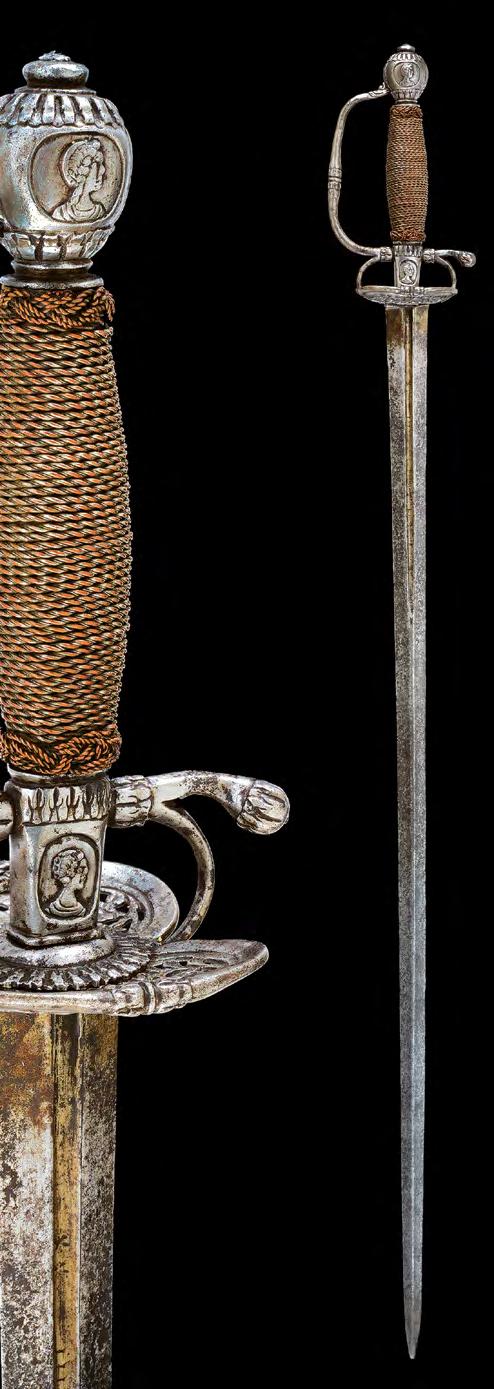
372 AN OFFICER’S SWORD
France, First half of the 18th Century Straight, double-edged blade ribbed at the middle. Iron hilt with double valve featuring carved decorations in the inner border; center of crossguard, quillon, loop guard and pommel carved with floral motifs. Ebony grip sculpted with coils. Wooden scabbard covered with leather with smooth, brass mounts.
SPADA DA UFFICIALE
Francia, Prima metà del XVIII Secolo Lama dritta a due fili con nervatura rilevata al centro. Fornimento in ferro con doppia valva con intagli al bordo interno; massello, braccio dell’elso, ramo di guardia e pomo intagliati a motivi floreali. Impugnatura in ebano scolpito a spire. Fodero in legno rivestito in cuoio con fornimenti lisci in ottone.
Conditions good Length 92.5 cm.
€ 400/800
373
A BEAUTIFUL SMALL SWORD
Italy, First half of the 18th Century Straight, double-edged blade of lozenge section, the first part grooved, with remains of inscriptions. Iron hilt richly carved with busts and floral motifs, and double, openwork valve. Wooden grip covered with wire binding and features Moor’s heads made of metal wire (probably replaced at a later date). Of good quality.
BELLISSIMO SPADINO
Italia, Prima metà del XVIII Secolo Lama dritta a due fili di sezione a losanga, la prima parte scanalata e con resti di iscrizione. Fornimento in ferro riccamente intagliato a busti e motivi floreali, la doppia valva traforata. Impugnatura in legno rivestito di trecciola e teste di moro in filo metallico (probabilmente cambiata in epoca successiva). Di buona qualità.
Conditions good Length 90 cm. € 800/1.200
374 A HUNITNG SWORD
Kingdom of Naples, first quarter of the 19th Century
Double-edged blade with engravings, with the inscription “.... LAS DOS SICILIAS”; brass quillon with straight, grooved quillons; the center of the crossguard with wild boar figures in relief. Checkered, brown horn grip. Brass cap shaped as a lion’s head. Leather scabbard (with defects) with brass chape and missing cap.
SPADA DA CACCIA
Regno di Napoli, primo quarto del XIX Sec. Lama a due fili con incisioni, recante l’iscrizione “.... LAS DOS SICILIAS”, elso in ottone a bracci dritti scanalati, il massello con figure di cinghiali in rilievo. Impugnatura in corno bruno zigrinato. Cappa in ottone a testa di leone. Fodero in cuoi (difetti) con puntale in ottone e cappetta mancante.
Conditions medium Length 88 cm. € 350/450

375
A BEAUTIFUL HUNTING HANGER WITH SILVER MOUNTS
Kingdom of the Two Sicilies, last quarter of the 18th Century Wide blade, slightly curved, single-and-falseedged blade, the base engraved in gold on a blue background with a lily in a cartouche, the effigy of a king under crown, the motto “VIVE LE ROY,” trophies, and floral motifs. Black grip carved and decorated with silver inlays, silver mounts. Wooden scabbard with silver mounts, decorated en suite with the grip; chape with engraved lily. Missing parts and defects.
A rare 18th-century hunting hanger.
BEL PALOSCIO DA CACCIA CON FORNIMENTI IN ARGENTO
Regno delle Due Sicilie, ultimo quarto del XVIII Sec.
Larga lama leggermente curva a un filo e controfilo, incisa dorata su fondo blu al forte con giglio entro un cartiglio, effige di un re sotto corona, motto “VIVE LE ROY”, trofei e disegni floreali. Impugnatura nera scolpita e decorata con tarsie in argento, anche i fornimenti in argento. Fodero in legno con fornimenti in argento, decorati en suite con l’impugnatura; il puntale con giglio inciso. Mancanze e difetti.
Raro paloscio da caccia del XVIII secolo.
Conditions medium
Length 68.5 cm.
€ 500/800
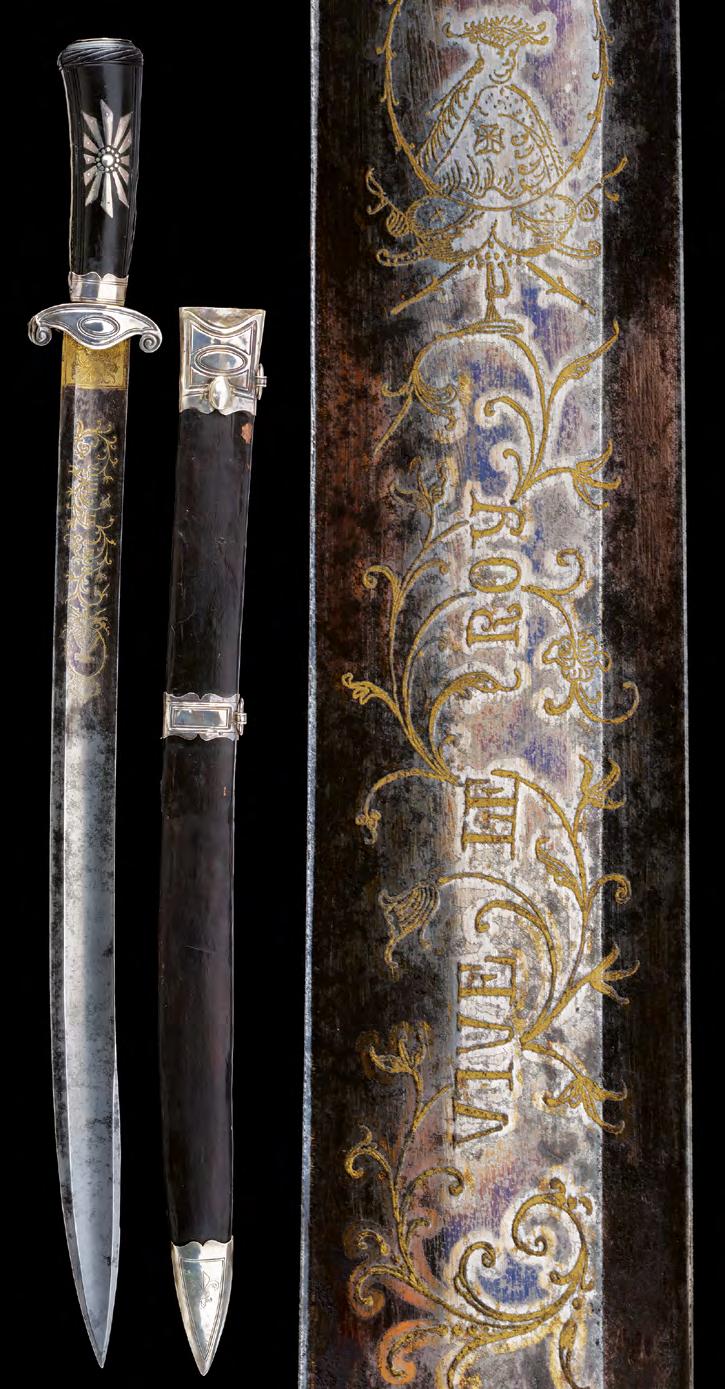
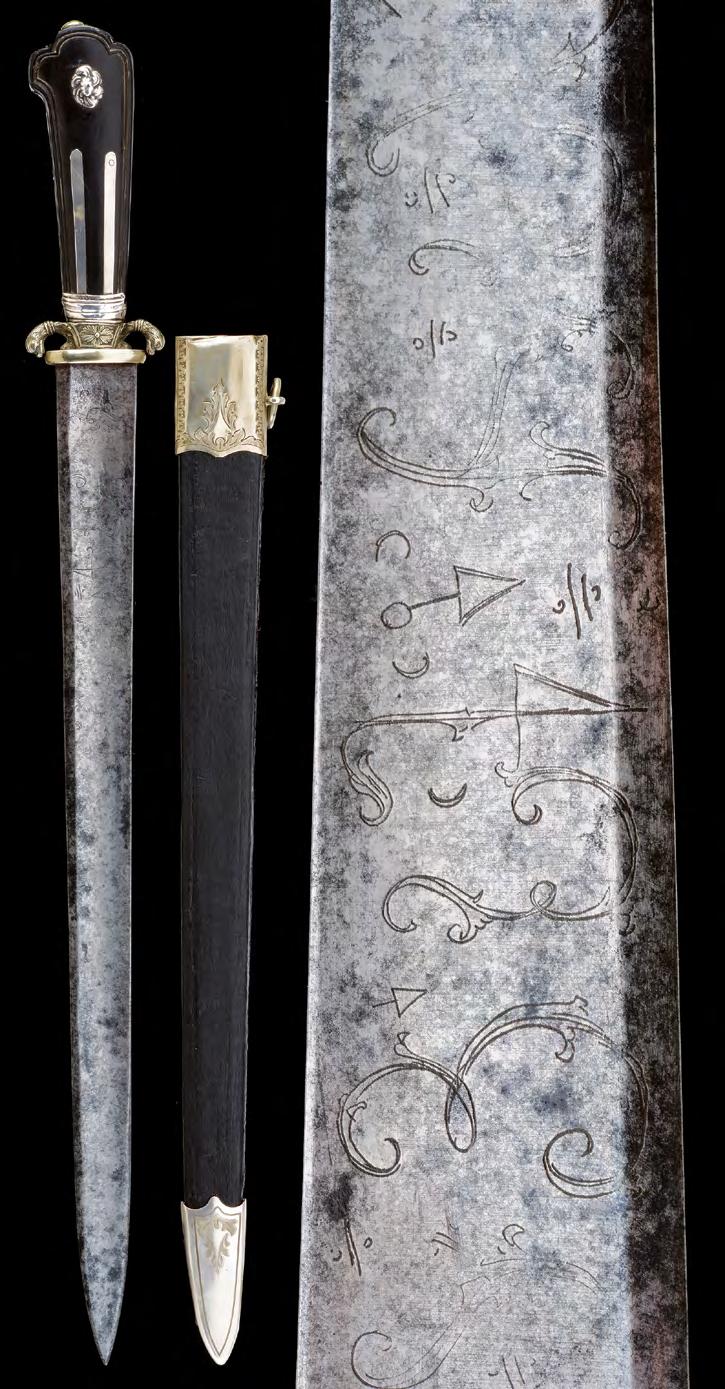
376 A FINE HUNTING HANGER
Austria-Hungary, circa 1800
Wide, straight, single-and-false-edged blade, with central fuller, the first part engraved with pandur’s head, trophies, and Kabbalistic symbols. Silver hilt, curved quillons, with the heads shaped as hound heads; the center of the crossguard with flower. Brown horn hilt with silver mounts decorated en suite.
Complete with its wooden scabbard covered in leather with engraved silver mounts, restored chape, cap with suspension ring.
BEL PALOSCIO DA CACCIA
Impero austro-ungarico, 1800 circa Larga lama, dritta, ad un filo e controfilo, con sguscio centrale, incisa con testa di pandur, trofei e simboli cabalistici nel segmento iniziale. Fornimento in argento, elso con bracci incurvati, operati a testa di segugio; il massello con fiore. Impugnatura in corno bruno con fornimenti in argento, decorati en suite. Completo del suo fodero in legno rivestito di pelle, con fornimenti in argento inciso, il puntale con restauro, la cappa con anello di sospensione.
Conditions medium
Length 66 cm.
€ 500/800
HUNTING HANGER
France, 19th Century
Straight, single-and-falseedged blade, with fuller along its entire length; the first half with gold engravings on a blue background. Beautiful white metal (silver?) hilt with quillons shaped as hound heads; the center of the crossguard with deer and boar head in bas-relief. Wooden grip decorated with longitudinal bands featuring oblique carvings; ring nut and cap with geometric and floral engravings. Leather scabbard (signs of time) with white metal mounts; cap with boar’s head button.
INTERESSANTE
PALOSCIO DA CACCIA
Francia, XIX Secolo
Lama dritta a un filo e controfilo, sgusciata a tutta la lunghezza, con incisioni dorate su fondo blu nella prima metà. Bel fornimento in metallo bianco (argento?) con bracci dell’elso lavorati a testa di segugio, il massello con testa di cervo e cinghiale in bassorilievo. Impugnatura in legno decorata a bande longitudinali con intagli obliqui; ghiera e cappellotto con incisioni a motivi geometrici e floreali. Fodero in cuoio (segni del tempo) con fornimenti in metallo bianco, la cappa con bottone a testa di cinghiale.
Conditions good
Length 68 cm.
€ 500/800
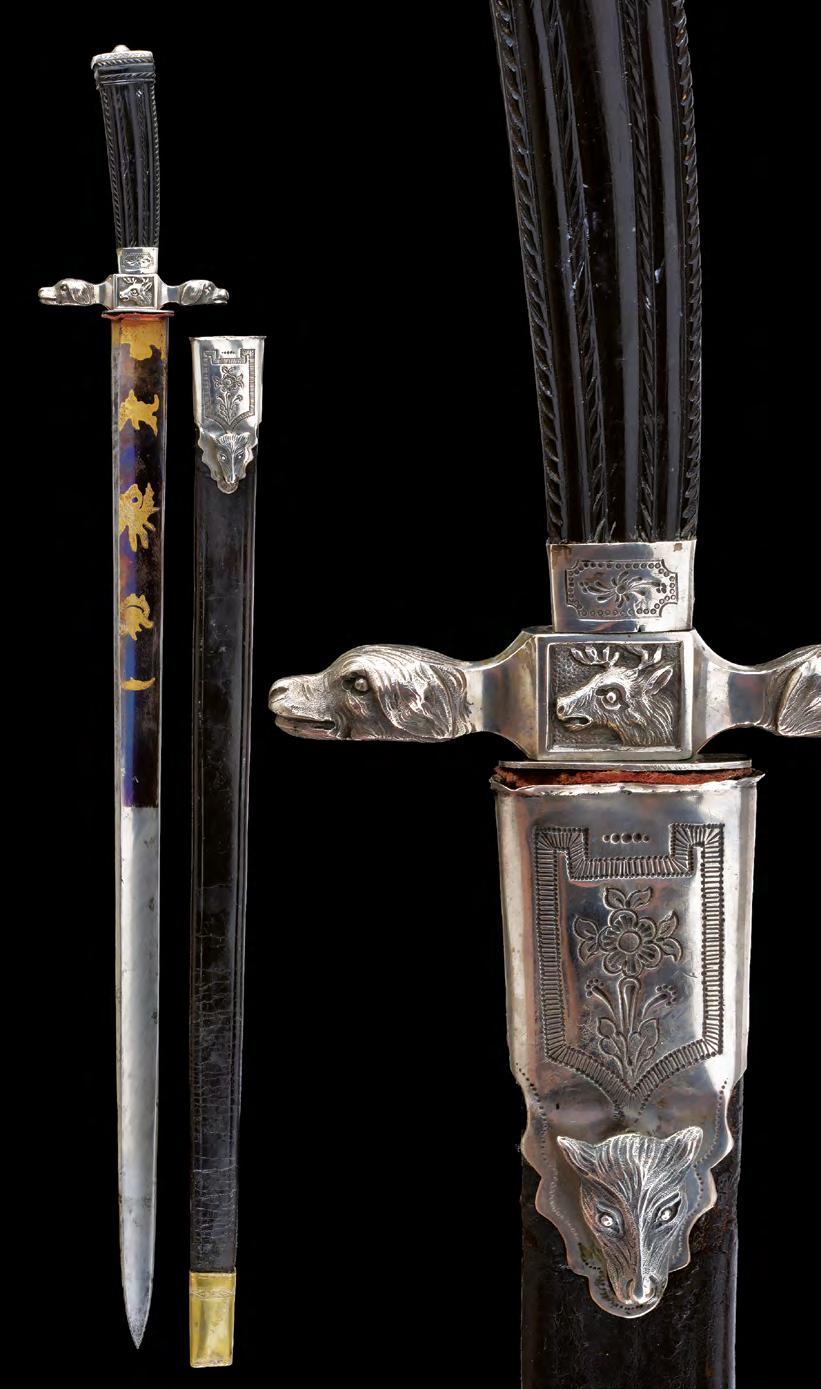
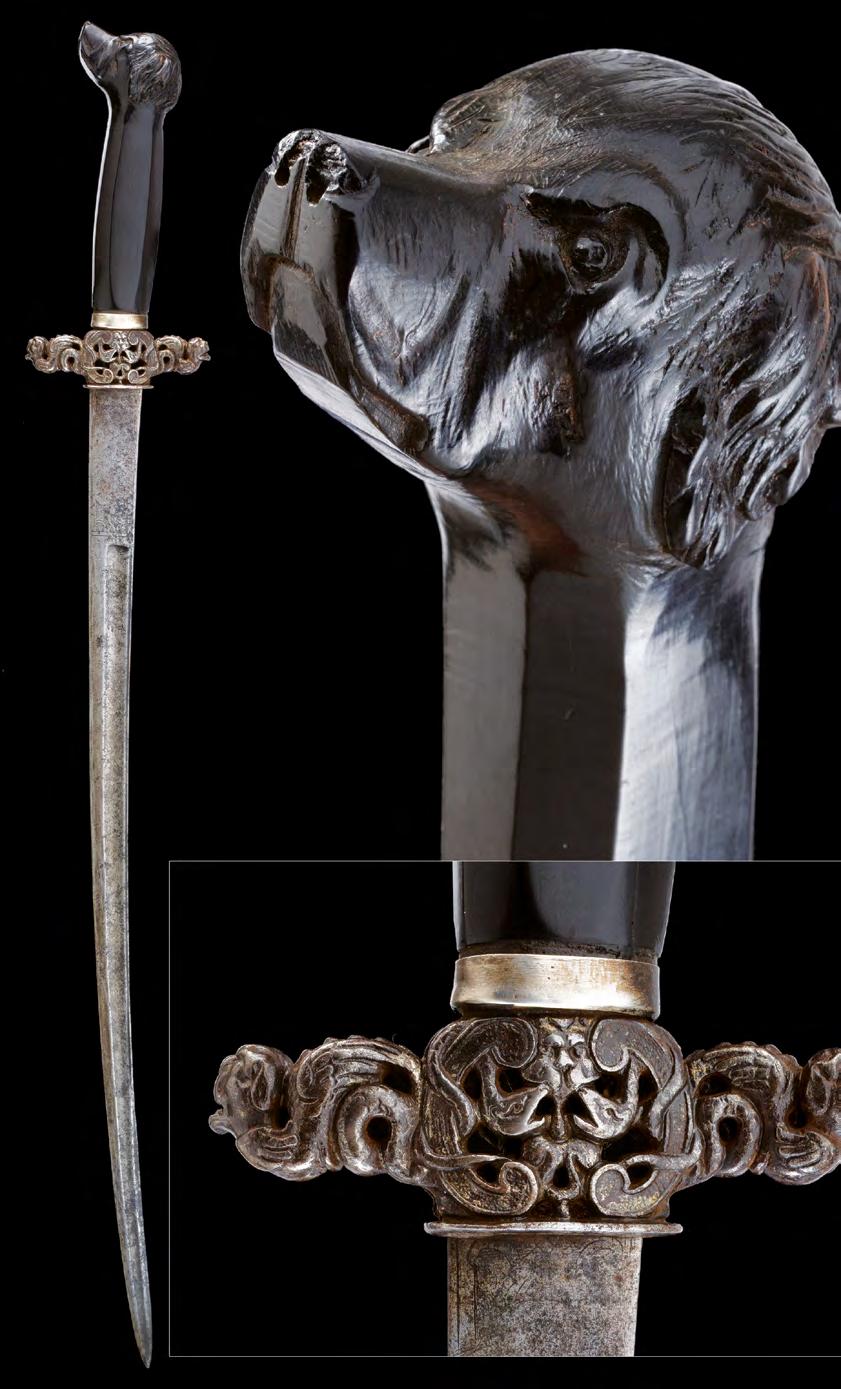
HANGER
Italy, Mid 18th Century Curved, single-andfalse-edged blade, flat and with remains of engravings at the first part, then with central fuller and thin groove on the back. Beautiful carved and pierced iron quillon representing two dragons and snakes. Ebony grip with pommel shaped as a hound’s head and faceted at the base.
BEL PALOSCIO DA CACCIA
Italia, Metà del XVIII
Secolo
Lama curva a un filo e controfilo, piatta al forte e con resti di incisioni, poi con sguscio centrale e sottile scanalatura dorsale. Bellissimo elso in ferro intagliato e traforato raffigurante due draghi e serpenti. Impugnatura in ebano con pomo a testa di segugio con base faccettata.
Conditions good Length 66.5 cm.
€ 500/750
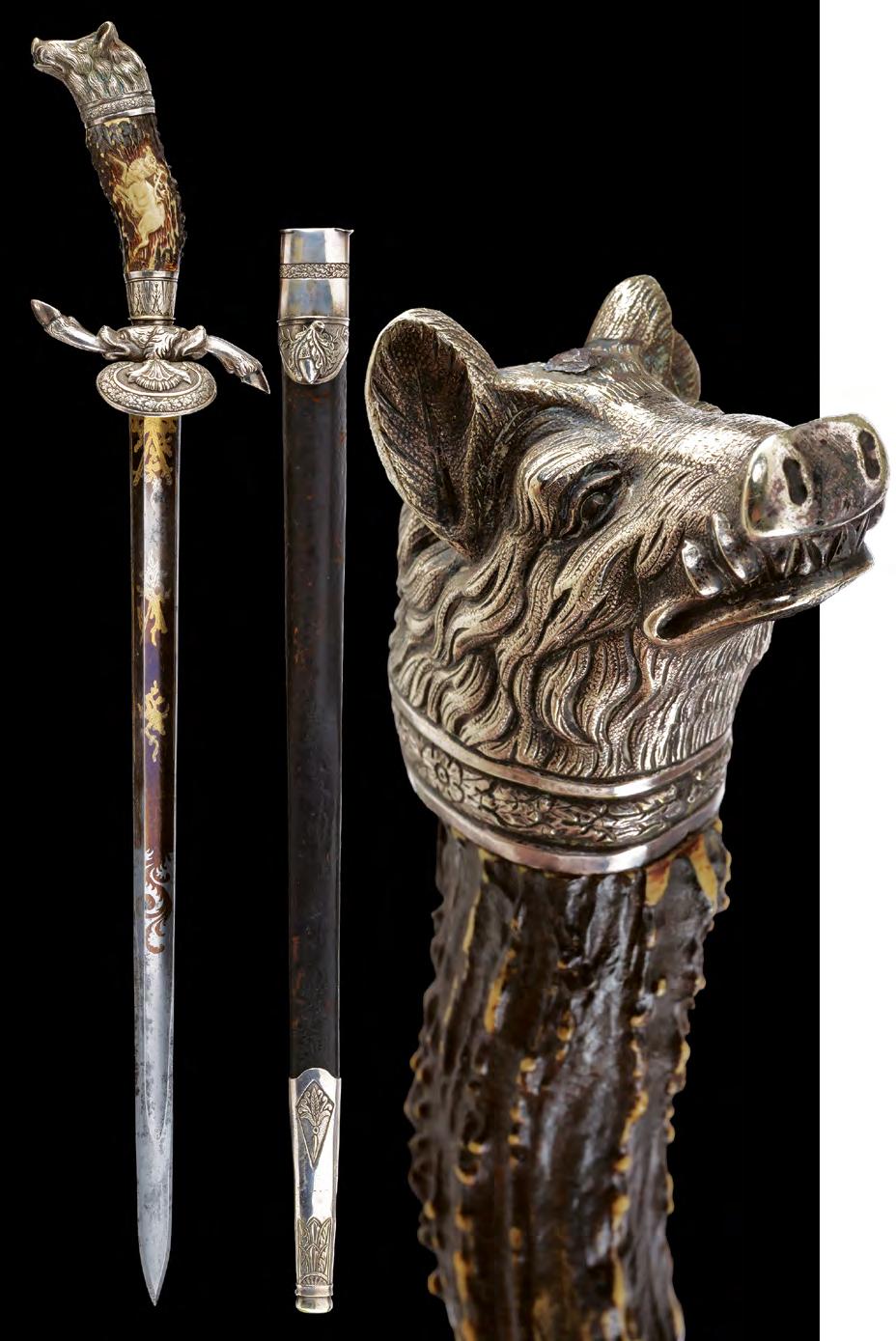
“HIRSCHFAENGER”
Breslau, 19th Century Fine, straight, singleand false-edged blade for more than half of its length decorated with gilt engravings on a browned ground (some missing parts to the finish); the back signed “M/W. Grell in Breslau”; small ricasso. Silver mounts, shellguard with central shell and border worked with laurel fronds; quillonblock with countercurved quillons shaped and worked as hoofed paws, the quillon-block with symmetrical dog’s head, pommel worked as a boar’s head. Deer-horn grip, carved at the centre with a splendid stag. Silver ring-nut, the upper one worked with floral motifs. Leather scabbard with silver mounts, cap with acornshaped stud; small belt frog for the knife, now missing.
Elegant and rare hunting hanger, with signature.
BELLISSIMO PALOSCIO DA CACCIA CON FORNIMENTI IN ARGENTO
“HIRSCHFAENGER”
Breslau, XIX Secolo Bella lama dritta a filo e controfilo, decorata per più della metà con incisioni dorate su fondo blu (alcune mancanze alle finiture); il dorso firmato “M/W. Grell in Breslau”; piccolo tallone. Fornimento in argento, pelta con conchiglia centrale e bordo operato a fronde di alloro; elso con bracci controcurvati e lavorati a zampe di ungulato, il massello con teste di cani speculari. Pomo lavorato a testa di cinghiale. Impugnatura in corno di cervo, scolpita nella parte centrale con bellissima effige di un cervo maschio. Ghiere in argento, quella superiore lavorata a motivi floreali. Fodero in cuoio con fornimenti in argento, cappa con bottone lavorato a ghianda; taschetta per l’alloggiamento del coltello ora mancante.
Elegante e raro paloscio firmato.
Conditions very good
Length 62.5 cm.
€ 1.000/1.500
A BEAUTIFUL AND RARE
HUNTING HANGER
Germany, Second half of the 18th Century Long, straight, single-and-falseedged blade, the first part flat and finely engraved with remains of gilding, with wild boar, deer and floral motifs; then central fuller along almost the entire length and a dorsal groove up to the false edge. Brass hilt with straight quillons ending in small discs, parry ring and loopguard culminating in a dragon’s head. Grip with stag horn plates, a material that also embellishes the other elements of the hilt. Frame and ring nut finely engraved with dragon heads and floral motifs.
Interesting hunting hanger with unusual decoration and high-quality craftsmanship.
BELLISSIMO E RARO PALOSCIO
DA CACCIA
Germania, Seconda metà del XVIII secolo
Lunga lama dritta a un filo e controfilo, finemente incisa e con resti di doratura al forte, con effigi di un cinghiale, un cervo e decori floreali; in seguito con sguscio centrale, che percorre quasi tutta la lunghezza, ed una scanalatura dorsale fino al controfilo. Fornimento in ottone, con bracci dell’elso dritti con testa a piccoli dischi, ramo di guardia culminanti con testa di drago. Impugnatura con placche in corno di cervo, questo materiale impreziosisce anche gli altri elementi del fornimento. La cornice centrale dell’impugnatura e la ghiera finemente incise con teste di drago e a motivi floreali.
Interessante arma da caccia con decorazione inusuale e di pregiata fattura.
Conditions good Length 75.7 cm. € 1.900/2.300
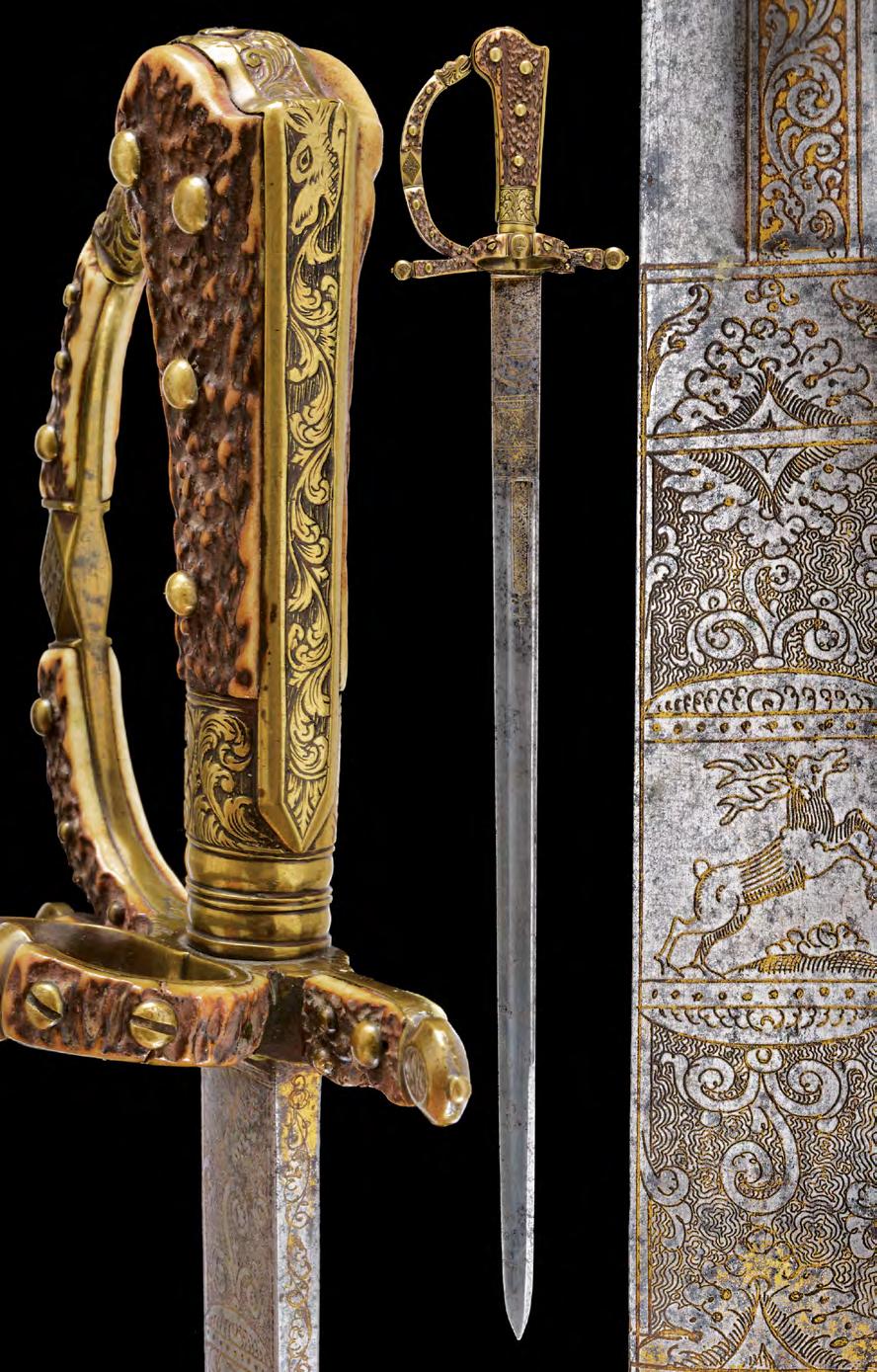
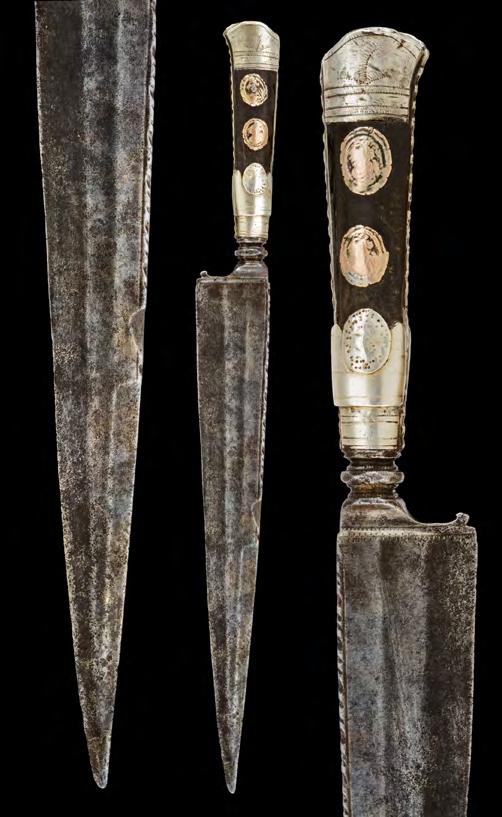
381
A HUNTING DAGGER
Genova, circa 1800
Triangular, single-and-false-edged blade with flat sides, carved on the back with a beaded frame at the tang and a small stylised curl, flattened, round knot and lozenge-shaped decoration between grooved frames. Raised, horn grip with silver mounts and round medallions decorated with small busts in profile. A small old repair to the lower ring nut.
PUGNALE DA CACCIA
Genova, 1800 circa Lama tringolare a pianelle, composta da filo e controfilo, intagliata al dorso, con cornicetta perlinata al tallone e piccolo riccio stilizzato, nodo tondeggiante schiacciato e lavorato a losanghe tra cornici scanalate. Impugnatura in corno a crescere con fornimenti in argento e medaglioni tondi caricati da piccoli busti di profilo. Una piccola vecchia riparazione alla ghiera inferiore.
Conditions medium
Length 33 cm.
€ 300/400
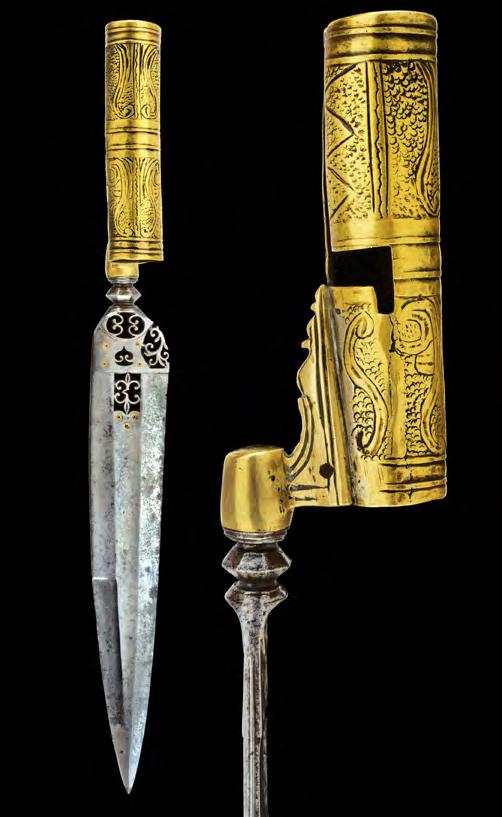
382
A SOCKET BAYONET
Southern Italy, about 1780
Willow-shaped blade with single-and-false-edged flat sides (slightly re-sharpened tip), fretwork strong with beautiful geometric motifs and small circular brass-inlaid inlays. Tang with the same decorations en suite. Flat hexagonal cushion knot with frame. Brass ring nut with slot to the barrel of the rifle, completely punched with geometric motifs.with a slot for attachment to the rifle barrel, fully engraved with geometric motifs.
BAIONETTA A CALZA
Italia meridionale, 1780 circa Lama a foglia di salice con pianelle a filo e controfilo (la punta leggermente riaffilata), il forte messo a giorno con bei motivi geometrici e con piccole agemine circolari rimesse in ottone. Tallone con gli stessi decori en suite. Nodo a cuscino esagonale schiacciato con scorniciatura. Manicotto in ottone con spacco per l’innesto sulla canna del fucile, completamente incisa a bulino a motivi geometrici.
Conditions good Length 36.5 cm.
€ 300/500

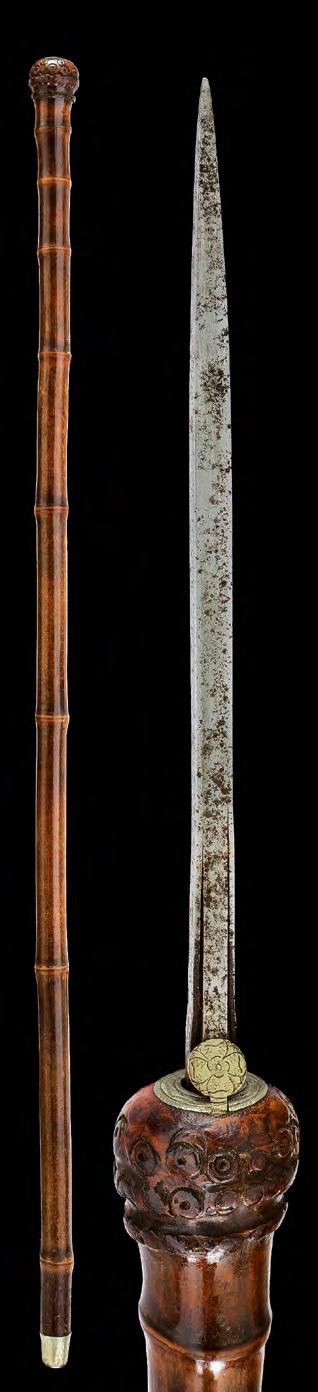

383
A DEFENSE WALKING STICK
Southern Italy, circa 1900
Iron handle in the shape of a hammer. Metal shaft decorated with innumerable horn discs, similar to the decorations of the Southern hunting knives. Rare.
BASTONE DA DIFESA
Italia meridionale, 1900 circa Impugnatura/testa in ferro a forma di martello. Fusto in metallo decorato con innumerevoli dischi in corno, simili alle decorazioni dei coltelli meridionali da caccia. Raro.
Conditions good Length 86.5 cm.
€ 80/120
384
A DEFENCE WALKING STICK
Southern Italy, circa 1900
A heavy, conical horn pommel, tapering upwards. Metal shaft decorated with countless horn and metal discs, similar to the decorations of the southern hunting knives. Rare.
BASTONE DA DIFESA
Italia meridionale, 1900 circa Pesante pomo conico in corno, crescente verso l’alto. Fusto in metallo decorato con numerosi dischi in corno e metallo, simili alle decorazioni dei coltelli meridionali da caccia. Raro.
Conditions good Length 89.5 cm.
€ 80/120
385 A RARE FLICK STICK
Italy, Late 19th Century Shaft imitating bamboo, with small carved pommel. Inside, a small gravity-drawn blade of rectangular section, operating in a manner similar to the Buttafuori of the 16th–17th century.
RARO BASTONE ANIMATO (FLICK)
Italia, Fine del XIX Secolo Fusto che imita il bambù, con piccolo pomo scolpito. All’interno, una piccola lama con estrazione a gravità, di sezione rettangolare, con funzionamento simile a quello del Buttafuori del XVI-XVII secolo.
Conditions good Length 88 cm.
€ 100/200
386 A SWORD STICK
Italy, Late 19th Century
Straight, single-and-false-edged blade, with wide fuller, the first part finely engraved with floral motifs. Wooden grip with angled pommel, carved to resemble a laced fastening. Leather-covered scabbard. Brass tip.
BASTONE ANIMATO
Italia, Fine del XIX Secolo Lama dritta a un filo e controfilo con ampio sguscio, la prima parte finemente incisa a motivi floreali. Impugnatura in legno con pomo angolato, scolpito ad imitare una chiusura a stringhe. Fodero a bastone rivestito di cuoio. Piede in ottone.
Conditions good Length 78 cm.
€ 100/200
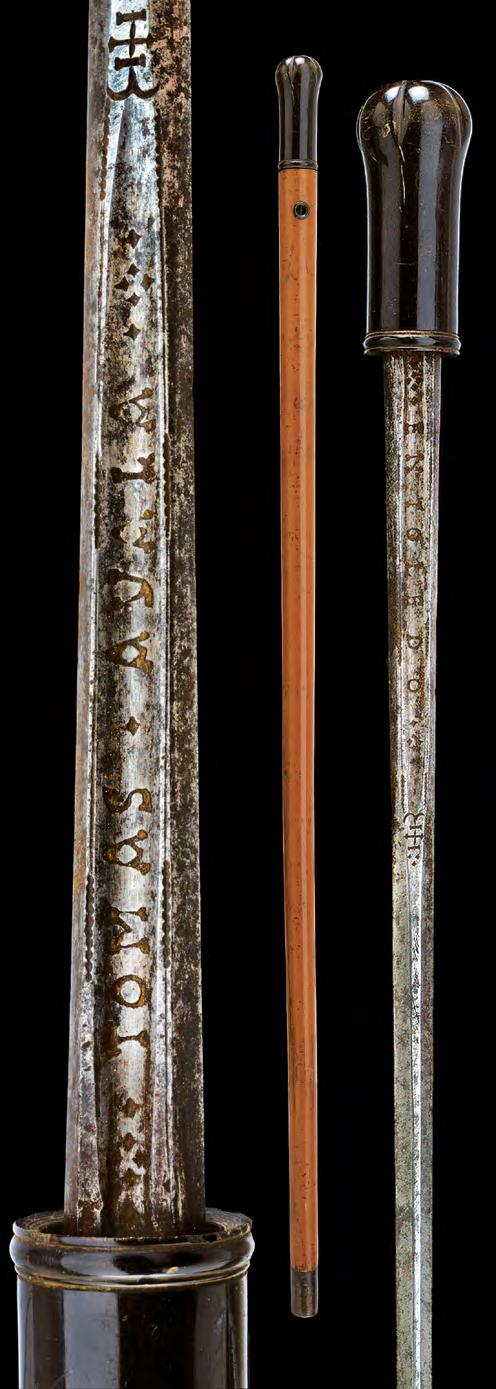

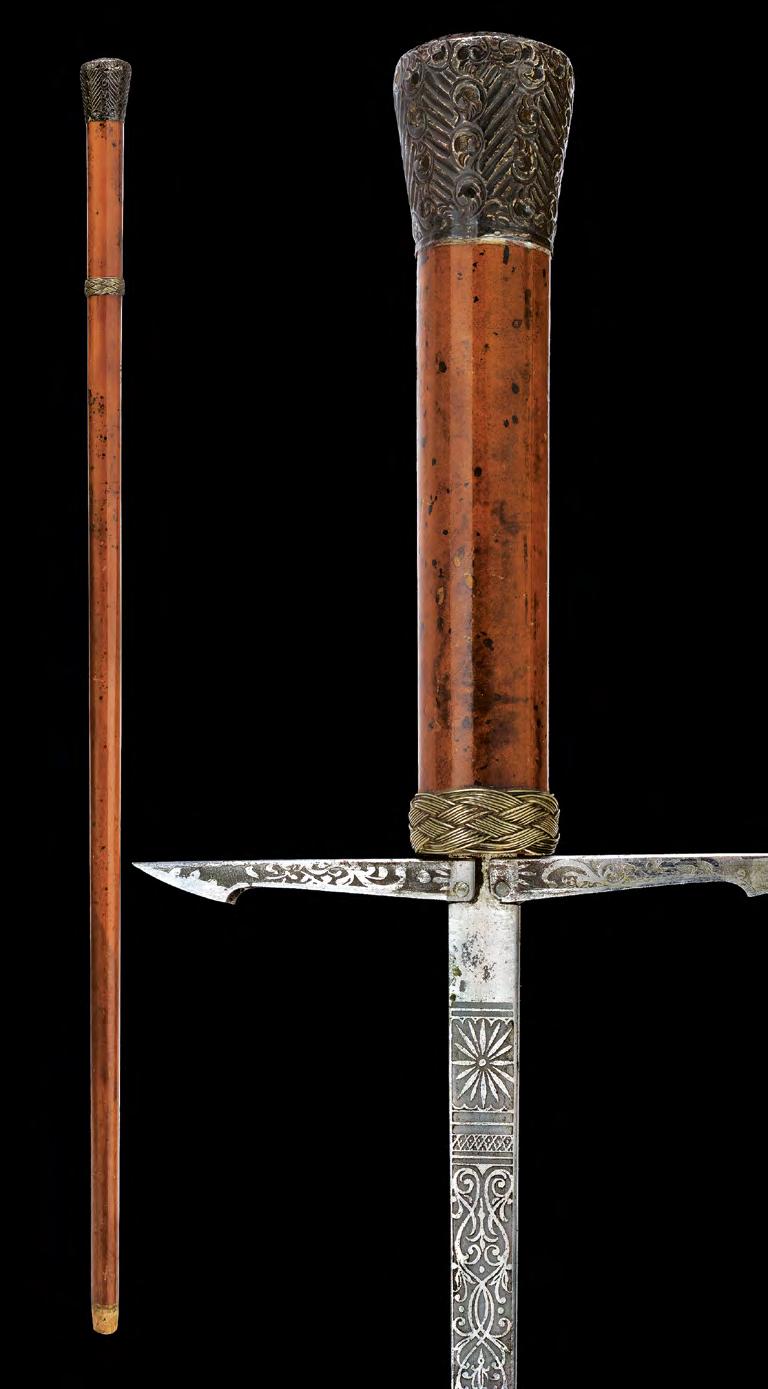
387 A SWORD STICK
Italy, 18th/19th Century
Blade from the late 18th century, signed “TOMAS AIALA EN TOLEDO”; elegant grip made of carved horn. Wooden shaft with metal tip.
BASTONE ANIMATO
Italia, XVIII/XIX Secolo
Lama della fine del XVIII secolo firmata “TOMAS AIALA EN TOLEDO”; elegante impugnatura in corno scolpito. Fodero in legno a bastone con piede metallico.
Conditions good
Length 73.8 cm.
€ 100/200
388
A SWORD STICK
Italy, early 20th Century
Double-edged blade of hexagonal section, long tang of rectangular section. Wooden grip (restored) with an angled pommel depicting a dog’s head with glass eyes. The base with metal ring nuts. Shaft made of wood and covered in leather.
BASTONE ANIMATO
Italia, inizio del XX Sec.
Lama a due fili di sezione esagonale, il lungo tallone di sezione rettangolare. Impugnatura in legno (restauro) con pomo angolato raffigurante la testa di un cane con occhi in vetro. La base con ghiere in metallo. Fusto in legno rivestito di cuoio.
Conditions good Length 84.5 cm.
€ 100/200
389 A SWORD STICK
France, circa 1900
Medium-length blade of cruciform section. Blackened grip with a skullshaped pommel (memento mori). The shaft is worked to resemble bamboo.
BASTONE ANIMATO
Francia, 1900 circa Lama di media lunghezza, di sezione cruciforme. Impugnatura annerita con pomo a teschio (memento mori). Fusto lavorato ad imitare il bambù.
Conditions medium
Length 68 cm.
€ 100/200
390 AN INTERESTING SWORD STICK
Toledo, early 20th Century
Single-and-false-edged blade, with fuller, the first part engraved with trophy and floral motifs; on one side the mark “TOLEDO”; the base with two spring quillons, which open automatically when the wooden shaft is retracted, transforming the stick into a sword. Cylindrical, wooden grip with embossed silver pommel and ring nut made of braided silver wire.
INTERESSANTE BASTONE ANIMATO
Toledo, inizio del XX Sec.
Lama a un filo e controfilo con sgusciatura, incisa a trofei e motivi floreali nel primo segmento, recante su un lato la marcatura “TOLEDO”. La base della lama munita di due bracci dell’elso caricati a molla, che si aprono automaticamente quando la lama viene estratta dal fodero, che è in legno. Impugnatura cilindrica, sempre in legno, con pomo in argento sbalzato e ghiera in filo d’argento intrecciato.
Conditions good
Length 84.5 cm.
€ 100/200
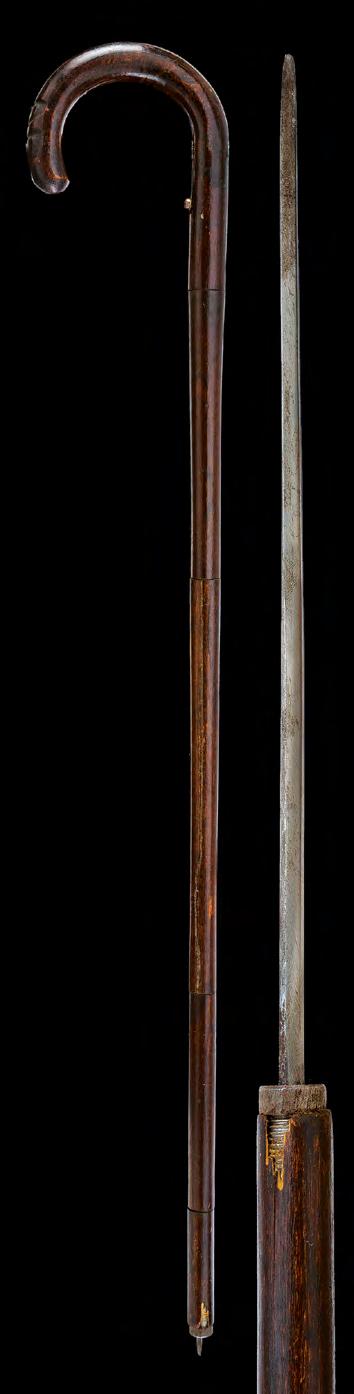
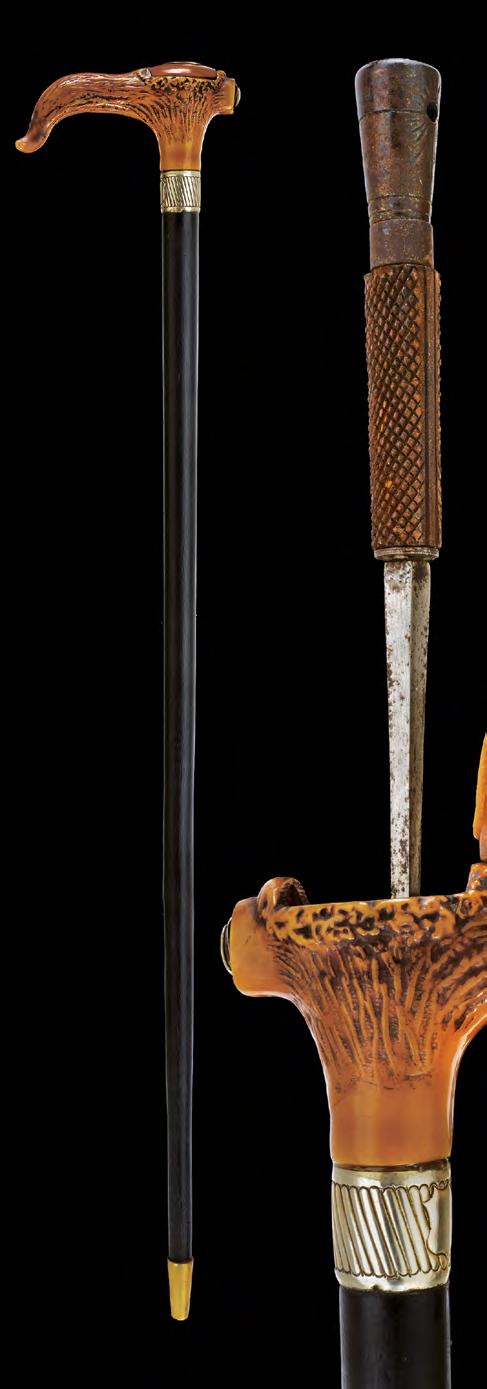


391
A RARE SWORD STICK
WITH SPRING BLADE
France, circa 1900
Cylindrical, wooden shaft and grip with curved grip. At the top, a button releases a blade that extends from the tip to a length of approximately 20 cm.
RARO BASTONE ANIMATO
CON LAMA A SCATTO
Francia, 1900 circa Fusto ed impugnatura cilindrici in legno con impugnatura incurvata. Nella parte superiore un bottone che libera una lama, la quale fuoriesce dal piede del bastone per una lunghezza di circa 20 cm.
Conditions good Length 82 cm.
€ 100/200
392 A SWORD STICK
Germany, About 1940 Grip made of synthetic material designed to imitate deer antler; on one side a button that opens a small flap on the pommel. Inside a smallsword with blade of square section and a typical foil grip. Cylindrical shaft with silver ring nut.
BASTONE ANIMATO
Germania, 1940 circa Impugnatura in materiale artificiale ad imitare il corno di cervo, su un lato un bottone che apre uno sportellino sul pomo. All’interno si trova uno spadino con lama di sezione quadra ed impugnatura tipica da fioretto. Fusto cilindrico con ghiera in argento.
Conditions good Length 63.5 cm.
€ 100/200
393
A SWORD STICK
Germany, circa 1900 Blade with square section, marked “SOLINGEN”. Angled, wooden grip, outside wooden mounts that imitate a leather fastening with buttons. Cylindrical wooden shaft with a metal tip.
BASTONE ANIMATO
Germania, 1900 circa Lama di sezione quadra con marcatura “SOLINGEN”.
Impugnatura in legno angolato, nella parte esterna un fornimento sempre in legno che imita una chiusura in cuoio con bottoni. Fusto cilindrico in legno con piede in metallo.
Conditions good Length 69.5 cm.
€ 100/200
394
AN INTERESTING SWORD STICK
Spain, early 20th Century
Cylindrical grip wrapped in interwoven leather bands; lenticular horn pommel featuring an enamelled medallion featuring the polychrome coat of arms of the Basque regions and the inscriptions ‘Zazpiak Bat’ — ‘the seven are one’ — and ‘Etsaien beldura naiz’ — ‘I am the terror of my enemies’ —

with some missing parts in the enamel. Brass ferrule. The upper section unscrews to reveal a pointed iron blade. Carved wooden shaft and solid iron and brass pommel.
INTERESSANTE BASTONE ANIMATO
Spagna, inizio del XX Sec.
Impugnatura cilindrica rivestita con bande intrecciate in cuoio; pomo lenticolare in corno con medaglione smaltato, recante lo stemma policromo delle regioni basche e le iscrizioni “Zazpiak Bat” (i sette sono uno) ed “Etsaien beldura naiz” (sono il terrore dei nemici) con mancanze allo smalto. Ghiera in ottone. Parte superiore svitabile, che libera una lama appuntita in ferro. Fusto in legno scolpito e robusto piede in ferro e ottone.
Conditions medium Length total 90.5 cm. € 100/200
395 AN ELEGANT WALKING STICK
France, circa 1900
Ebony pommel finely carved with the head of a wealthy man, with beard and top hat (minor loss), the base with embossed silver ring nut. Light bamboo shaft. Metal chape missing.
ELEGANTE BASTONE DA PASSEGGIO
Francia, 1900 circa Pomo in ebano finemente scolpito con la testa di un uomo benestante, con barba e cappello a cilindro (piccola mancanza), la base con ghiera in argento sbalzato. Leggero fusto in bambù. Il piede metallico mancante.
Conditions good Length 85.5 cm. € 50/100
396 AN INTERESTING WALKING STICK WITH INCORPORATED MEASURING RULE AND SET SQUARE
Germany, circa 1900
Wooden grip with curved and slightly carved pommel. Bamboo scabbard/shaft. Inside, a brass linear measuring instrument fitted with a centimetre scale. The upper part of the instrument conceals a folding iron square which may be extended to 90 degrees. Rare.
INTERESSANTE BASTONE CON METRO E SQUADRA INCORPORATI
Germania, 1900 circa Impugnatura in legno con pomo incurvato e lievemente scolpito. Fodero/Fusto a bambù. All’Interno uno strumento di misutazione lineare, in ottone, munito di scala in centimetri. La parte superiore dello strumento nasconde una squadra pieghevole in ferro può essere estesa fino a 90 gradi. Raro.
Conditions good Length 99 cm. € 100/200
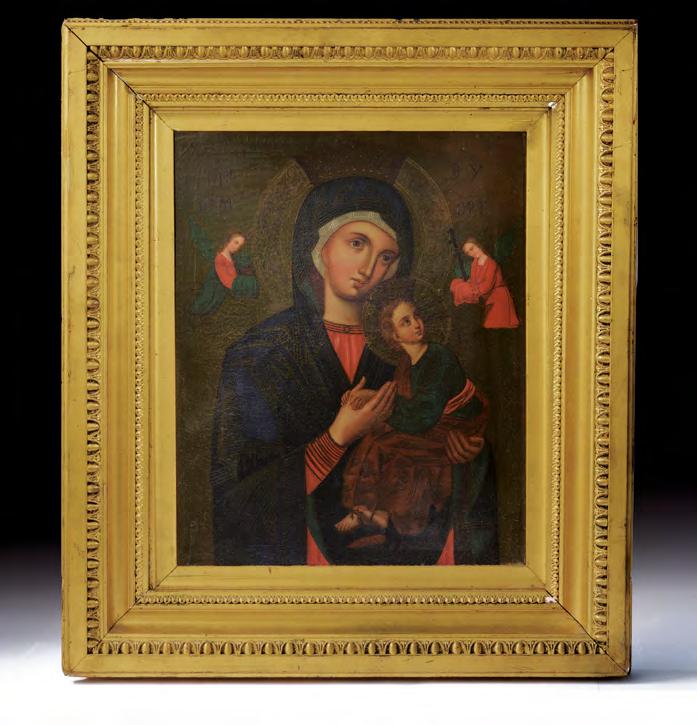
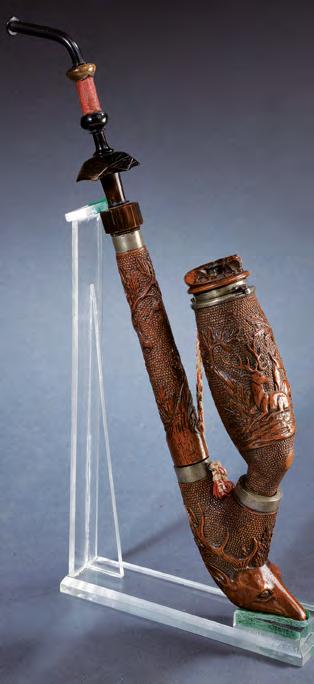
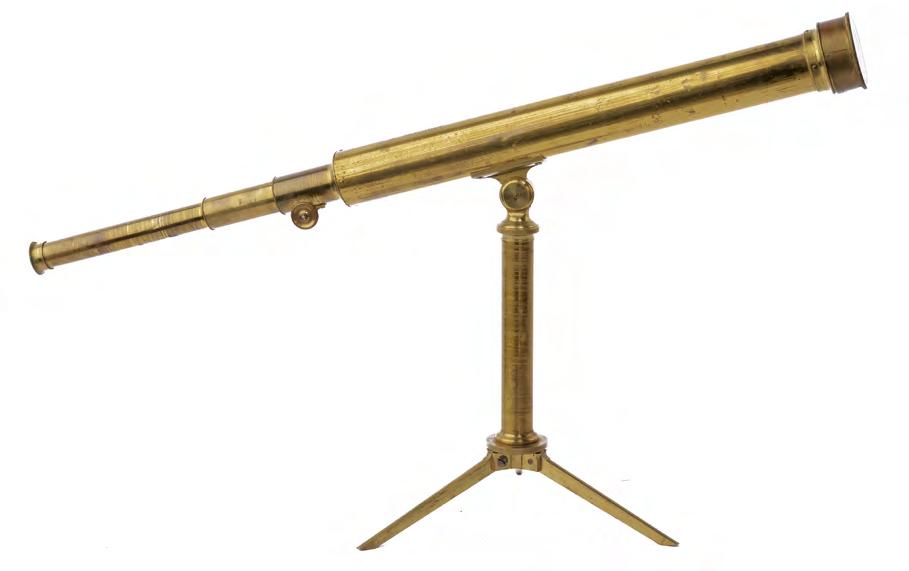
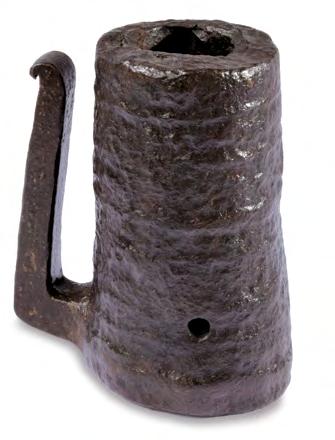
397
AN OIL PAINTING ON CANVAS
Eastern Europe, 19th Century
This icon on canvas is a depiction of the Virgin Mary with the Christ Child, known as the “Virgin of the Passion” or “Our Lady of Perpetual Help.”The Christ Child looks toward two angels who hold instruments of the Passion, a cross and nails, signs of his future suffering. His dangling sandal emphasizes his vulnerability. The Greek inscriptions identify Mary as the Mother of God and the angels as Michael and Gabriel. The style, with its soft features, earthy tones, and red-green contrast, suggests it likely comes from Eastern Europe, particularly Western Ukraine or Southern Poland, where Byzantine tradition blended with local aesthetics in the 18th–19th centuries. In a beautiful contemporary frame in stucco and gilded wood.
OLIO SU TELA
Europa orientale, XIX Secolo
Questa icona su tela raffigura la Vergine Maria con il Bambino Gesù, nota come “Vergine della Passione” o “Madonna del Perpetuo Soccorso”. Il Bambino guarda verso due angeli che tengono gli strumenti della Passione, una croce e dei chiodi, simboli della sua futura sofferenza. Il sandalo che gli pende dal piede sottolinea la sua vulnerabilità. Le iscrizioni in greco identificano Maria come Madre di Dio e gli angeli come Michele e Gabriele. Lo stile, con lineamenti delicati, toni terrosi e il contrasto tra rosso e verde, suggerisce una probabile origine nell’Europa orientale, in particolare nell’Ucraina occidentale o nella Polonia meridionale, dove la tradizione bizantina si è fusa con l’estetica locale tra il XVIII e il XIX secolo. Presentata in una cornice contemporanea in stucco e legno dorato.
Conditions good
Dimensions 53.5 x 43 cm.
€ 300/500
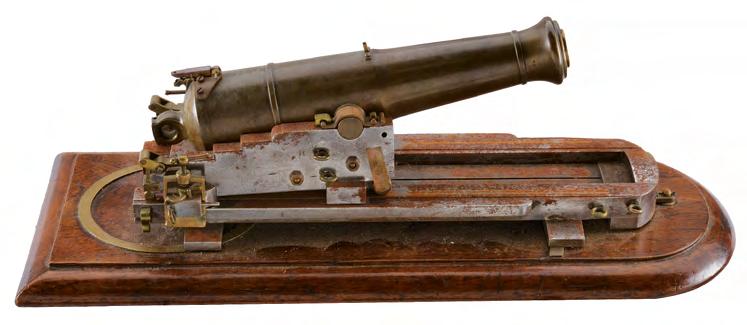
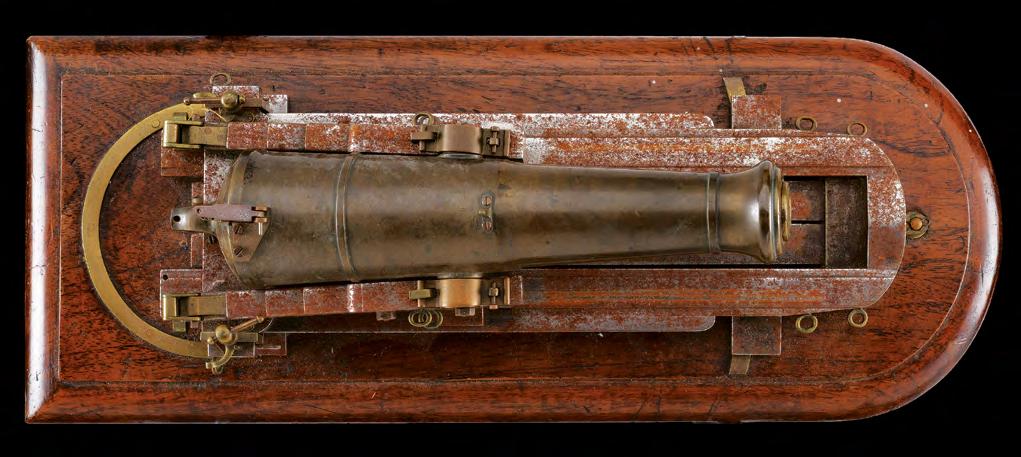
398 A FINE PIPE
Austria, 19th Century
Finely carved boxwood pipe, with a long stem featuring a horn mouthpiece on a hexagonal base, and a collar shaped like an umbrella and a sphere. The angled terminal section with a small bit. The shaft is richly carved with oak foliage. Cylindrical bowl fitted with a hinged metal wind cap (marked “12 LK”) topped by a small animal figure; the body is carved in relief with deer in a forest. The head fully modeled as a stag’s head. Complete with its plastic display stand.
BELLA PIPA SCOLPITA
Austria, XIX Secolo
In bosso finemente lavorato ad intaglio; lungo fusto con bocchino in corno a base esagonale e collo con struttura ad ombrello e sfera, la parte terminale angolata e con piccolo bit, il fusto scolpito a fronde di quercia. Il caminetto cilindrico è chiuso da un coperchio antivento incernierato in metallo (marcato “12 LK”), la sommità con piccola figurina animale, il corpo scolpito con cervi nel bosco. Testa lavorata a tuttotondo a testa di cervo. Completa del suo supporto espositivo in plastica.
Conditions very good
Length 40 cm.
€ 300/500
399 A SCOPE FOR TARGET SHOOTING
Germany, Mid 19th Century Brass body with 20x50 optics, marked “Utzschneider Reichenbach und Fraunhofer in Benedictbeurn”, featuring a rack-and-pinion adjustment system. Mounted on a cylindrical brass base and a brass tripod.
In the early 19th century, Georg Friedrich von Reichenbach and Joseph von Fraunhofer were key
pioneers of Bavarian precision mechanics and optics. Their collaboration, particularly at the Institutes of Mathematical Precision Mechanics and Optics in Benediktbeuern, transformed the production of astronomical instruments and telescopes, establishing Bavaria as a centre of excellence for precision optics.
CANNOCCHIALE PER TIRO A SEGNO
Germania, Metà del XIX Secolo Corpo in ottone con ottica 20x50, marcato “Utzschneider Reichenbach und Fraunhofer in Benedictbeurn” sistema con regolazione a vite “cremagliera”. Su base in ottone di forma cilindrica e treppiede, sempre in ottone.
Georg Friedrich von Reichenbach e Joseph von Fraunhofer furono pionieri fondamentali della meccanica di precisione e dell’ottica bavarese all’inizio del XIX secolo. La loro collaborazione, in particolare presso l’Istituto di Meccanica Matematica di Precisione e l’Istituto di Ottica di Benediktbeuern, rivoluzionò la costruzione di strumenti astronomici e telescopi, rendendo la Baviera un centro di eccellenza per l’ottica di precisione.
Conditions good
Length 76 cm.
€ 800/1.200
400 A RARE AND EARLY CHAMBER PIECE FOR BREECHLOADING CANNON
Europe, 14th Century
Strong, heavy, twisted structure having the shape of a truncated cone; handle of rectangular section with curled ends. Vent at the bottom.
Extremely rare examples dating back to the birth of breechloading cannons. These chamber pieces were inserted into the base of the cannon and secured with a wooden wedge.
RARO E ANTICO MASCOLO DA BOMBARDELLA A BRAGA
Europa, XIV Sec.
Robusta e pesante struttura di forma troncoconica realizzata a torcione; maniglia di sezione rettangolare con estremità a ricciolo. Focone nella parte inferiore.
Rarissimo esemplare risalente all’epoca della nascita dei cannoni a retrocarica. Questi mascoli venivano inseriti alla base del cannone e fissati tramite una zeppa in legno.
Conditions good
Height 19.2 cm.
€ 1.100/1.600
401 A CANNON MODEL
Europe, about 1880
Bronze barrel with vent and foresight, provided with cylindrical trunnions. Mounted on an iron gun carriage and rail with bronze mounts, the rail can move longitudinally to the barrel, which is free to rotate along a plane transverse to the rail. The whole is mounted on a wooden base. The iron parts with surface rust.
MODELLO DI CANNONE
Europa, 1880 circa Canna in bronzo con focone e mirino, munita di orecchioni cilindrici. Montata su affusto e binario in ferro con fornimenti in bronzo, il binario è mobile in direzione longitudinale alla canna, questa invece è libera di ruotare lungo un piano trasversale al binario. Il tutto su base in legno. Gli elementi in ferro con ruggine superficiale. Tappo in bronzo per la chiusura della volata.
Conditions medium
Length total 48.5 cm.
€ 1.800/2.200
402 A WHEEL-LOCK COCK
Europe, 16th - 17th Century
Iron dog-head clamp with hooded jaw, finely worked and in good condition. For wheel-lock pistols with Portuguese-style lockplate. Probably Portuguese or Southern Italian. Rare.”
CANE PER PISTOLA A RUOTA
Europa, XVI - XVII Secolo
In ferro, con ganascia a cappuccio, ben lavorato e in buono stato di conservazione. Per pistole a ruota con cartella alla portoghese. Probabilmente Portogallo o Italia meridionale. Raro.
Conditions good. Height 8.5 cm.
€ 50/100
403 A FLINTLOCK FOR THE 1754/67 MODEL INFANTRY MUSKET
Austria, Second half of the 18th Century Flat, iron lock plate with oblique borders. External cock with back rest. Faceted, iron pan. Engraved “XVIII” inside. Some pitting. Complete mechanism on the back. Rare.
BATTERIA A PIETRA FOCAIA PER FUCILE MOD. 1754/67 DA FANTERIA
Austria, Seconda metà del XVIII secolo Cartella piana in ferro a bordi scantonati. Arresto dorsale del cane esterno. Scodellino in ferro faccettato. Interno inciso “XVIII”. Qualche intaccatura. Meccanica completa sul retro. Rara.
Conditions good. Length 16.5 cm.
€ 100/150
404 A FLINTLOCK FOR THE 1767/74/84 INFANTRY MUSKET
Austria, Second half of the 18th Century
Flat lock plate with oblique borders, made of iron. Cock with external back rest. Pan provided with typical rotating spark arrester. Back with “38” mark on the screw head and “T”-shaped mark (overlaid with an illegible decoration) on the lock plate. Complete mechanism. Signs of use and time. Rare.
BATTERIA A PIETRA FOCAIA PER FUCILE MOD. 1767/74/84 DA FANTERIA
Austria, Seconda metà del XVIII secolo Cartella piatta a bordi scantonati, in ferro. Il cane con arresto dorsale esterno. Lo scodellino dotato del tipico parascintille ruotabile. Il retro con marcatura “38” sulla briglia e punzone “T” (sormontato da un fregio non leggibile) sulla cartella. Meccanica completa. Segni d’uso e del tempo. Raro.
Conditions medium. Length 16 cm. € 100/150
405 A MILITARY FLINTLOCK Europe, late 18th Century
With flat lock plate and rounded tang, featuring the “R” mark within ellipse; brass pan with a small, not clearly legible stamp. Screws marked “6” and with a dot. Complete mechanism on the reverse and the marking (signature?) “L. REBOS,” also featuring a crowned “J,” the mark “P.II,”“MD” inside the pan, and remains of markings on the screws as on the front. Slight traces of browning.
BATTERIA A PIETRA FOCAIA MILITARE
Europa, fine del XVIII Sec.
Con cartella in ferro piana e codetta tondeggiante, recante il punzone “R” entro un ellisse, scodellino in ottone con un piccolo timbro non chiaramente leggibile. Le viti marcate “6” e con un punto. Meccanica completa sul retro e la marcatura (firma?) “L. REBOS”, presente anche una “J” coronata, il marchio “P.II”,“MD” all’interno dello scodellino e resti di marcature alle viti come sul lato anteriore. Lievi tracce di brunitura.
Conditions good. Length 15.3 cm.
€ 80/120
406
A MILITARY FLINTLOCK SIGNED PIHET FRERES
France, Late 18th - Early 19th Century
Flat lock plate with rounded tang; in the center, remains of the “Paris” marking above the remains of the “Pihet frères” signature. Brass pan with traces of a mark. Featuring on the reverse a complete mechanism, various marks and several elements stamped “23,” except for the trigger, which is marked “26.” Some pitting. For a military rifle.
BATTERIA A PIETRA FOCAIA MILITARE FIRMATA
PIHET FRERES
Francia, Fine XVIII inizio XIX Secolo
Cartella piatta in in ferro con codetta tondeggiante, al centro resti di marcatura “Paris” sormontante resti della firma “Pihet freres”. Scodellino in ottone con traccia di un punzone. Il retro, con meccanica completa, recante vari marchi e diversi elementi timbrati “23” a parte lo scatto che è marcato “26”. Qualche intaccatura. Per fucile militare.
Conditions good. Length 15.8 cm. € 80/120
407
A MILITARY FLINTLOCK
France, Early 19th Century
A flat, iron lock plate with rounded tang, featuring the marking “M.re Imp. de St. Etienne” in the center, with “S” mark within lozenge and brass pan. Featuring a complete mechanism and various stamps on the reverse, including “P,”“B,” and a five-pointed star. The cock is a couple of millimeters away from the lock plate. Some signs of use and time.
BATTERIA A PIETRA FOCAIA MILITARE
Francia, Inizio del XIX Secolo Cartella in ferro, piatta ma con codetta tondeggiante, recante al centro la marcatura “M.re Imp. de St. Etienne”, con punzone “S” entro losanga e scodellino in ottone. Il retro con meccanica completa e vari timbri fra i quali “P”,
“B” e una stella a cinque punte. Il cane con un paio di millimetri di distacco dalla cartella. Qualche segno d’uso e del tempo.
Conditions good Length 16 cm.
€ 80/120
408 A HEAVY FLINTLOCK
England, 18th Century
Heavy structure with a slightly rounded iron plate, marked “BARNETT”. Cock with reinforced grip. Iron pan.“ID” mark on the back and complete mechanism. For a springald.
GRANDE BATTERIA A PIETRA FOCAIA Inghilterra, XVIII Secolo Pesante struttura con piastra leggermente tondeggiante in ferro, firmata “BARNETT”. Cane con collo rinforzato. Scodellino in ferro. Sul retro punzone “ID” e meccanica completa. Per una spingarda da spalto.
Conditions good
Length 21.3 cm.
€ 200/300
409 A MILITARY FLINTLOCK Kingdom of the Two Sicilies, 1826
With a flat iron plate and a rounded tang, featuring the inscription ‘M.ra R.le di Napoli’, hammer with reinforced hammer throw, brass trigger guard. On the back, a mark “A” and the date ‘1826’. Complete mechanism on the back.
BATTERIA A PIETRA FOCAIA MILITARE
Regno delle Due Sicilie, 1826
Con cartella in ferro piana e codetta tondeggiante, recante dicitura “M.ra R.le di Napoli”, cane con collo rinforzato, scodellino in ottone. Sul retro punzone “A” e data “1826”. Meccanica completa sul retro.
Conditions good Length 15.8 cm.
€ 70/120
410
A MILITARY FLINTLOCK Kingdom of the Two Sicilies, 1827
With flat iron lock plate featuring rounded tang, bearing the inscription “M.ra R.le di Napoli”, hammer with reinforced hammer throw, brass pan. On the back, crowned “B” mark and date “1827”. Complete mechanism on the back.
BATTERIA A PIETRA FOCAIA MILITARE
Regno delle Due Sicilie, 1827
Con cartella in ferro piana con codetta tondeggiante, recante dicitura “M.ra R.le di Napoli”, cane con collo rinforzato, scodellino in ottone. Sul retro punzone “B” coronato e data “1827”. Meccanica completa sul retro.
Conditions good
Length 16 cm.
€ 80/150
411
A MILITARY FLINTLOCK OF THE MURAT EPOCH
Naples, 1813
With flat, iron lock plate and a rounded tang. Marked “M.ra R.le di Napoli”. Brass pan. Inside, various marks and the date “1813”. Complete mechanism.
BATTERIA A PIETRA FOCAIA MILITARE D’EPOCA MURATTIANA
Napoli, 1813
Con cartella piana in ferro e codetta tondeggiante. Marcatura“M.ra R.le di Napoli”. Scodellino in ottone. All’interno vari punzoni e la data“1813”. Meccanica completa.
Conditions good. Length 16 cm.
€ 100/150
412
A MILITARY FLINTLOCK
Spain, Second half of the 18th Century
Flat lock plate with a date that is not entirely legible (possibly“1789”), marked“A”; tang with a lowered band and a clearly visible“ANGE”mark. Pitting. Complete mechanism on the back. For a rifle.
BATTERIA A PIETRA FOCAIA
MILITARE
Spagna, Seconda metà del XVIII secolo
Cartella piana in ferro con resti di datazione non perfettamente leggibile (forse“1789”), marchio“A”; codetta con banda ribassata e marcatura“ANGE”ben visibile. Pitting. Sul retro meccanica completa. Per fucile.
Conditions medium. Length 16.9 cm.
€ 50/100
413
A MIQUELET LOCK
Spain, Second half of the 18th Century Flat, shaped lock plate. Pitting. Complete action on the back. Most likely for a rifle, given its size.
BATTERIA ALLA MICHELETTA
Spagna, Seconda metà del XVIII secolo Cartella in ferro piatta, sagomata. Intaccature. Sul retro meccanica completa. Sicuramente per un fucile, viste le dimensioni.
Conditions good. Length 13.7 cm.
€ 60/100
414
A MIQUELET LOCK FOR A PISTOL
Spain, late 18th Century
With flat, shaped, iron lock plate, featuring the signature“Juan”followed by the monogram“NR”(also legible NAVR). The screw head of the cock, as well as the jaws, engraved and partially carved with floral motifs; the surface of the pan worked en suite. The back of the batterie also lightly engraved. Spring with beautiful raised carving on the bottom. Complete mechanism on the back. Well made, for a small pistol.
BATTERIA ALLA MICHELETTA PER PISTOLA
Spagna, fine del XVIII Sec.
Con cartella piatta e sagomata, in ferro, recante la firma“Juan”seguita da monogramma“NR”(leggibile anche NAVR). La briglia del cane, così come le ganasce, incise e parzialmente intagliate a fiorami, la superficie dello scodellino lavorata en suite. Leggermente inciso anche il dorso della martellina. La molla con bell’intaglio rilevato sul fondo. Meccanica completa sul retro. Ben lavorata, per un pistola di piccole dimensioni.
Conditions good. Length 6.6 cm. € 70/100
415 A FLINTLOCK FOR THE PATTERN 1801 CAVALRY MUSKET
Spain, Early 19th Century Flat iron plate featuring remains of markings and a mark. Typical hammer with external click. Brass pan. Complete mechanism on the back.
BATTERIA A PIETRA FOCAIA PER FUCILE DA CAVALLERIA MOD. 1801
Spagna, Inizio del XIX Secolo
Cartella in ferro piatta recante resti di marcatura e punzone. Tipico cane con arresto esterno. Scodellino in ottone. Meccanica completa sul retro.
Conditions good Length 16.5 cm. € 80/150
416 A FLINTLOCK FOR THE PATTERN 1801 INFANTRY MUSKET
Spain, Early 19th Century Flat, iron lock plate, with“B”mark. Cock with external stop. Brass pan. Complete mechanism on the back. Some pitting.
BATTERIA A PIETRA FOCAIA PER FUCILE DA FANTERIA MOD. 1801
Spagna, Inizio del XIX Secolo Cartella in ferro piana, recante punzone “B”. Cane con arresto esterno. Scodellino in ottone. Sul retro meccanica completa. Qualche intaccatura.
Conditions good. Length 16.8 cm.
€ 80/150
417 A MIQUELET LOCK MARKED ROVIRA
Spain, Late 17th - Early 18th Century Shaped, iron lock plate. The stirrup of the cock, the jaws, and the pan with remains of raceme engravings. The back of the batterie with the“R/OV/IR/A”(ROVIRA) mark without a crown, above the inscription “IGUALADA”. Complete mechanism on the back.
“Apuntes de la Armeria Espanola - Siglos XVI a XIX” by J. Sagrera Azpillaga mentions a Rovira Pere, “Panyetaire de Igualada,” in 1695. In 1698, he was awarded the honorary title of Royal Armorer by Charles II.
BATTERIA ALLA MICHELETTA
MARCATA ROVIRA
Spagna, Fine XVII - Inizio XVIII Sec. Cartella sagomata, in ferro. La staffa del cane, le ganasce e lo scodellino con resti di incisioni a racemi. Il dorso della martellina con il punzone“R/OV/IR/A”(ROVIRA)
senza corona, soprastante la dicitura “IGUALADA”. Sul retro meccanica completa.
“Apuntes de la Armeria Espanola - Siglos
Madrid del 1745.
Conditions good. Length 13 cm.
€ 100/150
419 A MIQUELET LOCK
Spain, 18th Century
Flat lock plate with oblique borders and buttoned tang. Featuring a crowned mark gold-inlaid“ASTI/ALA ...”(not fully legible). Also marked“HERMUA”.
HERMUA is probably Ermua, in the Basque Country, a center for arms manufacturing and ironworking, located a few kilometers from Eibar.
BATTERIA ALLA MICHELETTA
PUNZONATA
Spagna, XVIII Secolo
Cartella piana a bordi inclinati con codetta bottonata. Recante un punzone coronato e rimesso in oro“ASTI/ALA ...”(non completamente leggibile). E con marcatura “HERMUA”.
HERMUA è probabilmente Ermua, nei Paesi Baschi, centro armiero e della lavorazione del ferro, a pochi chilometri da Eibar.
Conditions good. Length 12.2 cm. € 120/160
420
A MIQUELET LOCK SIGNED CARRERAS
Spain, 1800 - 1830 circa Flat, shaped, iron lock plate, signed in gold “CARRERAS”. The bridle with carved curls, leaves and outlines. Cock’s jaws featuring friezes with leaves in relief. An engraved flower at the top of the pan. Batterie featuring outlined designs and a gold “MALAGA”mark on the back. Complete mechanism on the reverse. In its original, untouched patina, with some pitting.
“Apuntes de la Armeria Espanola - Siglos XVI a XIX” by J. Sagrera Azpillaga reports that the signature “Carreras” appears on an Andalusianstyle flintlock rifle with two barrels finely decorated with gold filigree, also marked “EN MADRID 1830”. The item presented here does not feature a date but is marked with the name of the Andalusian city of Málaga.
BATTERIA ALLA MICHELETTA FIRMA CARRERAS
XVI a XIX” di J. Sagrera Azpillaga, riporta un Rovira Pere “Panyetaire de Igualada” nel 1695. Riceve nel 1698 il titolo onorifico di Armiere Regio da Carlo II.
Conditions good. Length 12.8 cm. € 100/150
418 A MIQUELET LOCK
Spain, Mid 18th Century Flat, shaped, iron lock plate. With a mark in the center that is not perfectly legible, probably“MORINO.”Light carvings and a few outlined details. Complete mechanism on the back.
“Apuntes de la Armeria Espanola - Siglos XVI a XIX” by J. Sagrera Azpillaga reports the following regarding MORINO: Morino Angel, a gunsmith from Madrid in 1745.
BATTERIA ALLA MICHELETTA
Spagna, Metà del XVIII Secolo Cartella in ferro, piatta e sagomata. Con marcatura al centro non perfettamente leggibile, probabilmente“MORINO”. Leggeri intagli e qualche elemento delineato. Sul retro meccanica completa.
“Apuntes de la Armeria Espanola - Siglos XVI a XIX” di J. Sagrera Azpillaga, riporta per MORINO: Morino Angel, armaiolo di
Spagna, 1800 - 1830 circa Cartella in ferro piana, sagomata, firmata in oro“CARRERAS”. La briglia con intagli a ricci, foglie e delineature. Il cane con ganasce che recano fregi a foglie in rilievo. Incisone a fiore in testa allo scodellino. Il dorso della martellina con delineature e marcatura in oro“MALAGA”. Meccanica completa sul retro. In vecchia patina mai toccata, con qualche intaccatura.
“Apuntes de la Armeria Espanola - Siglos XVI a XIX” di J. Sagrera Azpillaga, riporta che la firma “Carreras” compare su un fucile a pietra focaia, in stile andaluso, con due canne finemente decorate in filigrana d’oro, marcato anche “EN MADRID 1830”. L’esemplare qui presentato invece non reca data ma marcatura della città andalusa di Malaga.
Conditions good. Length 12.8 cm. € 120/160
421 A SNAPHAUNCE LOCK FOR A MUSKET
Central Italy, late 17th Century Archaic-style lock plate, with flat hammer throw and batterie, screw head on the spring and sliding pan. Initialed“C.O.”in block letters.
BATTERIA ALLA FIORENTINA DA FUCILE
Italia centrale, fine del XVII Sec. Cartella di foggia arcaica con collo del cane e martellina piatti, briglia sulla molla e scodellino scorrevole. Siglata in stampatello “C.O.”.
Conditions very good. Length 13 cm. € 200/400
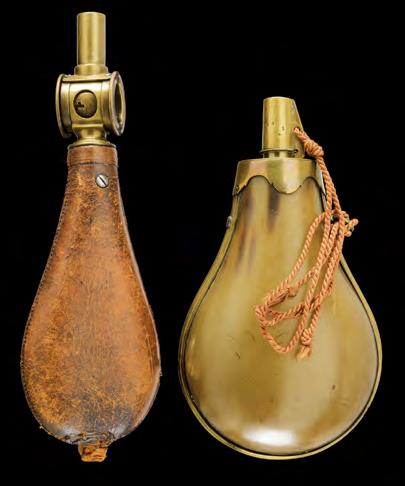
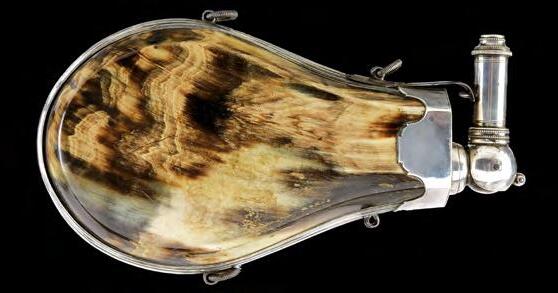
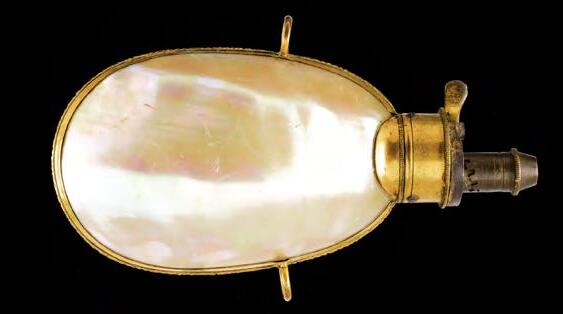
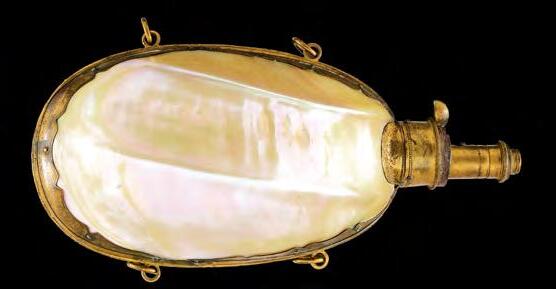
422
AN INTERESTING POWDER HORN
Canada, 1767
Buffalo horn richly engraved with a map of Canada; at the base, a view of the city of Quebec with the inscription “VILLE DE QUEBEC”; on the side, the Bourbon coat of arms featuring three lilies under crown and the date “1775” above the map, a nude woman. Faceted fuse marked “JEAN PIERRE LEGROS 5 FEB. 1769 LAC WINNIPEG”. The horn stopper is also engraved. Screw-off pommel to insert the powder at the wooden base. There are some missing parts and signs of use and age.
INTERESSANTE CORNO DA POLVERE Canada, 1767
Corno di bufalo riccamente inciso, recante la mappa del Canada e, alla base, una veduta della città di Quebec con iscrizione “VILLE DE QUEBEC”, di lato lo stemma borbonico a tre gigli sotto corona e la data “1775”, sopra alla mappa effige di una dama svestita. Il cannello faccettato e marcato “JEAN PIERRE LEGROS 5. FEB. 1769 LAC WINNIPEG”. Anche il tappo in corno ed inciso. La base in legno con pomo svitabile per l’inserimento della polvere. Piccole mancanze e segno d’uso e del tempo.
Conditions medium Length 51 cm.
€ 250/450
423 A LOT OF TWO FLASKS FOR POWDER AND PELLET
Europe, 19th Century
Powder flask with a cow-horn body, screw-on muzzle ring and brass mounts; the pellet flask with a teardrop-shaped leather body (borders almost completely unstitched), brass measuring device with a double glass opening.
LOTTO DI UNA FIASCA DA POLVERE E UNA FIASCA PER PALLINI
Europa, XIX Secolo
La fiasca da polvere con corpo in corno di mucca, bocchino svitabile e fornimenti in ottone; quella per pallini con corpo a goccia in cuoio (i bordi quasi del tutto scuciti), dosatore in ottone con doppia finestra in vetro.
Conditions good
Length 20 - 23.5 cm.
€ 100/150
424
A FINE POWDER FLASK IN BOUTET STYLE
France, circa 1800
With drop-shaped cow horn body, flat at the back. Elegant silver mounts with variable and folding fuse. Four suspension rings (one missing). Rare.
BELLA FIASCA DA POLVERE IN STILE BOUTET
Francia, 1800 circa
Con corpo in corno di mucca, a forma di goccia, piatto sul retro. Eleganti fornimenti in argento con cannello regolabile e pieghevole. Tre anelli di sospensione (il quarto mancante). Rara.
Conditions good
Height 22 cm.
€ 800/1.200
425 A RARE MOTHER-OF-PEARL POWDER FLASK
France, Mid 19th Century
Mother-of-pearl structure with a gilded brass frame decorated with a rib provided with small carvings. Variable cylindrical brass fuse. Two suspension rings.
RARA FIASCA DA POLVERE IN MADREPERLA
Francia, Metà del XIX Secolo Struttura in madreperla con cornice in ottone dorato, decorato con una nervatura munita di piccoli intagli. Cannello regolabile di forma cilindrica in ottone. Due anelli di sospensione.
Conditions good
Height 12.5 cm.
€ 500/750
426 A RARE MOTHER-OF-PERAL POWDER FLASK
France, Mid 19th Century
Mother-of-pearl gilded brass frame, finely engraved with floral motifs. Variable, cylindrical-shaped fuse. Four suspension rings.
RARA FIASCA DA POLVERE IN MADREPERLA
Francia, Metà del XIX Secolo
Struttura in madreperla con montatura in ottone dorato finemente inciso a motivi floreali. Cannello di forma cilindrica, regolabile. Quattro anelli di sospensione.
Conditions good
Height 21.5 cm.
€ 1.000/1.300
427
A BEAUTIFUL AND ELEGANT WHEEL-LOCK TSCHINKE
Teschen, 17th Century
Long, square, rifled barrel of small calibre, with foresight and rear sight, decorated with three sections featuring carved and gilded racemes; slightly bell-mouthed nozzle, 8 mm cal. Typical angled, external wheel lock, provided with a chain and an engraved main spring; flat lock plate with floral carvings; the cock with engraved surface; slotted pan cover. Wooden, full stock made of pear wood, of typical shape, entirely inlaid with bone and mother-of-pearl depicting real and fantastical animals, racemes, floral motifs, dots and bands. Butt with patchbox, smooth, iron trigger guard of anatomical shape; bone tipped wooden ramrod.
It is certainly one of the most beautiful tschinke available on the market in recent years.
BELLISSIMA ED ELEGANTE TSCHINKE A RUOTA
Teschen, XVII Secolo
Lunga canna quadra rigata, di piccolo calibro, con mirino e tacca di mira, ornata da tre settori recanti racemi intagliati e dorati, volata leggermente strombata; cal. 8 mm. Tipica batteria angolata a ruota esterna, munita di catena e mollone inciso, cartella piatta con intagli a fiorami, il cane con superficie incisa; il copriscodellino fessurato. Cassa intera in legno di pero, di forma tipica, completamente intarsiata in osso e madreperla ad animali reali e fantastici, racemi, motivi floreali, puntini e liste. Calcio con patchbox, ponticello in ferro liscio di forma anatomica; bacchetta in legno con battipalla in osso.
Sicuramente una delle tschinke più belle presenti sul mercato negli ultimi anni.
Conditions very good
Length 116 cm.
€ 10.000/12.000
428 A FLINTLOCK GUN BY CLARK England, Late 18th - Early 19th Century Two-stage, smoothbore, 15 mm cal barrel; square and round with rings and a carved decoration at the girdle; the chamber with mark (not clearly legible) and, a little further, the goldinlaid inscription “CANON TORDU” within frame. Broad, iron rear sight and silver foresight. Flintlock mechanism with a flat lock plate featuring angled borders; in the centre, the signature “CLARK”; pan and vent lined in gold. Wooden half stock (small restoration) with smooth iron mounts. Iron-tipped, wooden ramrod with iron cartridge extractors.
FUCILE A PIETRA FOCAIA DI CLARK
Inghilterra, Fine XVIII inizio XIX
Secolo
Canna liscia a due ordini, quadra e tonda con anellatura ed intaglio al cambio; la camera di scoppio con marca (non chiaramente leggibile) e poco più avanti l’iscrizione entro cornice “CANON TORDU” rimessa in oro. Alzo a sella in ferro e mirino in argento; cal. 15 mm. Batteria a pietra focaia con cartella piatta recante bordi angolati, nella parte centrale la firma “CLARK”; scodellino e focone foderati in oro. Mezza cassa in legno (un piccolo restauro) con fornimenti lisci in ferro. Bacchetta in legno con battipalla e cavastracci in ferro.
Conditions good
Length 126.5 cm.
€ 300/500
429 A RARE LEFT-HAND FLINTLOCK GUN BY AUGUSTE BIZALION
St. Etienne, 1825 - 1830
Smoothbore, octagonal, two-stage,15 mm cal barrel, octagonal in the first section, with three marks and silver signature “P. Aug.te Bizalion & Cie. a St. Etienne”; the second section of round shape, with ring mouldings at the girdle, the muzzle fitted with front sight; tang engraved and provided with rear sight, browned screw. Lock on the left side of the firearm, engraved with floral motifs and fitted with anti-friction system and waterproof pan; working mechanism. Wooden stock with chequered fore-end and base, with steel mounts engraved with depictions of buildings and floral designs. Back with oval silver escutcheon. Horntipped, wooden ramrod and brass cartridge extractor.
RARO FUCILE A PIETRA
FOCAIA DA MANCINO DI AUGUSTE BIZALION
St. Etienne, 1825 - 1830
Canna liscia a due ordini, ottagonale nel primo segmento, con tre marchi e con firma “P. Aug. te Bizalion & Cie. a St. Etienne” in argento; il secondo segmento di sezione tonda, con anellature al cambio, la volata dotata di mirino, in cal. 15 mm; codetta incisa e dotata di traguardo, la vite brunita. Batteria posta sul fianco sinistro dell’arma, incisa a motivi floreali e munita di sistema antifrizione e con scodellino a tenuta stagna; meccanica funzionante. Cassa in legno con astina e collo zigrinati, con fornimenti in acciaio incisi con raffigurazioni di edifici e disegni floreali. Dorso con scudetto ovale in argento. Bacchetta in legno con battipalla in corno e cavastracci in ottone.
Conditions good Length 134.5 cm.
€ 350/550
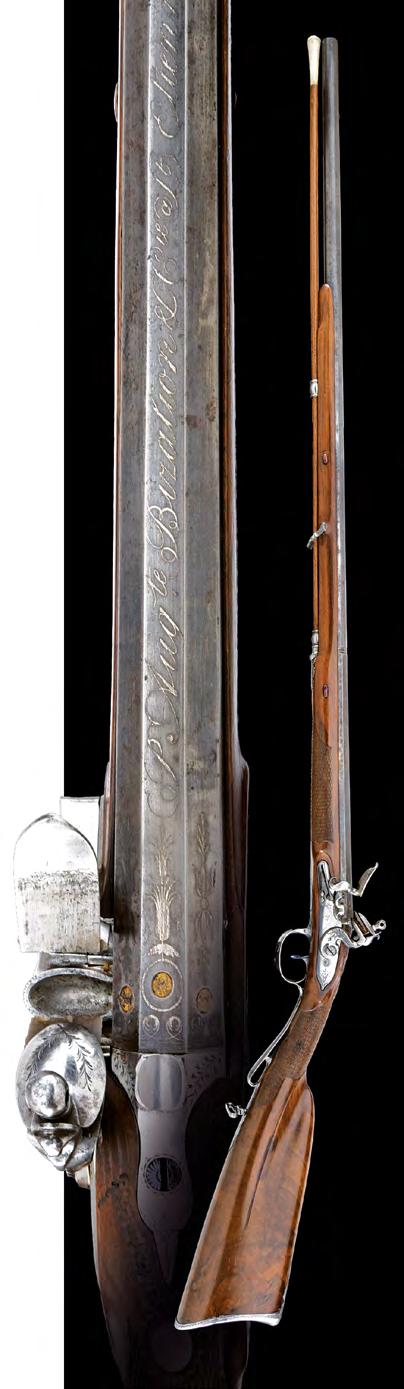
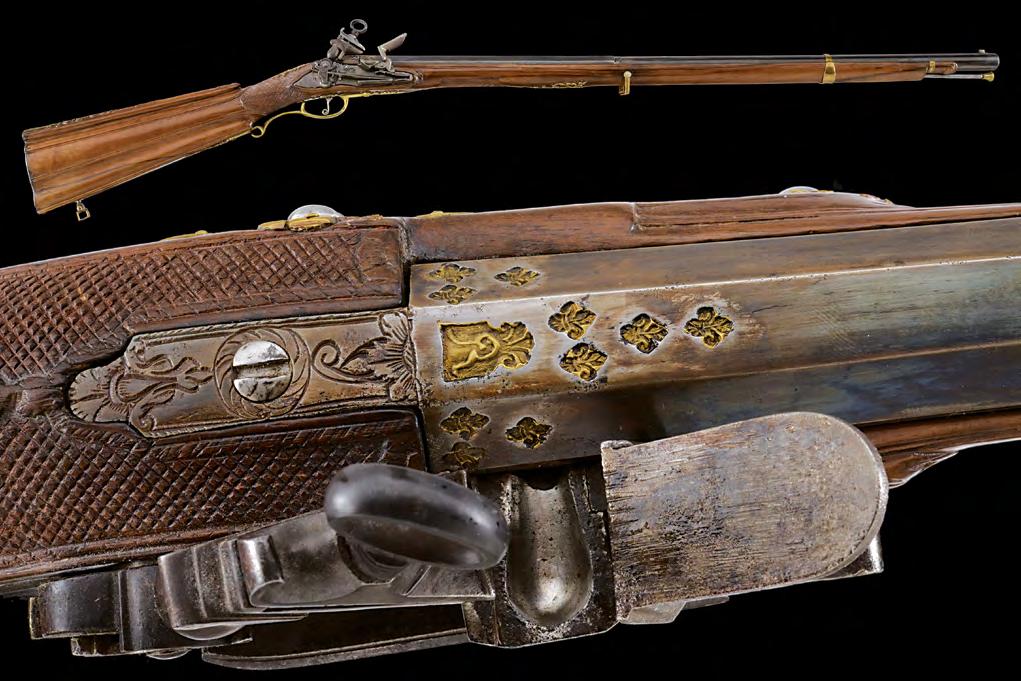
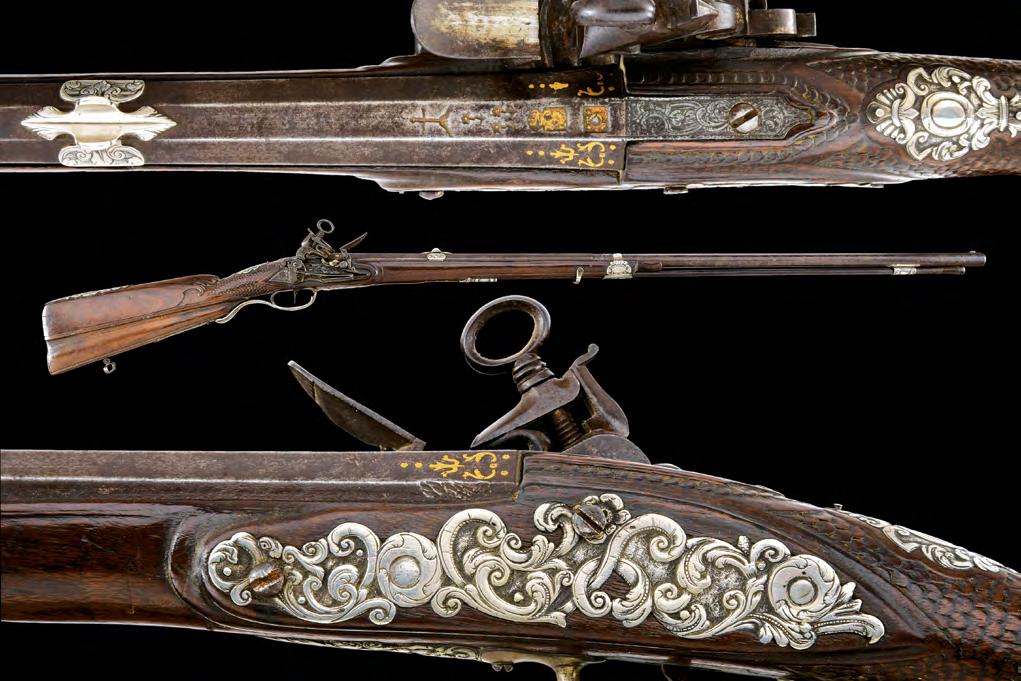
430
A FINE MIQUELET LOCK GUN
Southern Italy, circa 1800 Smoothbore, two stage barrel, square and round, separated by rings and carved floral decoration; powder chamber with deep mark of the Royal Factory of Naples among clearly defined lilies, all the elements brass inlaid; 18 mm cal at the nozzle and foresight; engraved tang. A fine miquelet flintlock with the “MC” mark beneath a crown and within an ellipse. Wooden, full stock (minor restoration) with checkered grip and a well-moulded butt with longitudinal grooves. Fine engraved brass mounts; trigger guard, counterplate and the upper part of the tang with engravings and carvings of floral motifs; on the grip, a perforated brass mount depicting a bird. Brass tipped iron ramrod.
BEL FUCILE ALLA MICHELETTA
Italia meridionale, 1800 circa Canna liscia a due ordini, quadra e tonda, con i due segmenti inframezzati da anellature e decoro floreale intagliato; la camera di scoppio con profonda marca della Real Fabbrica di Napoli fra gigli ben impressi, il tutto rimesso in ottone; in volata mirino e in calibro 18 mm; codetta incisa. Bella batteria alla micheletta a pietra focaia con marca “MC” sotto corona ed entro ellisse. Cassa intera in legno (piccoli restauri) con collo zigrinato e calcio ben modanato a scanalature longitudinali. Bei fornimenti in ottone inciso, il ponticello, la contropiastra ed il codolo superiore del calciolo con incisioni ed intagli a motivi floreali; al collo un fornimento in ottone traforato effigiante un volatile. Bacchetta in ferro con battipalla in ottone.
Conditions good
Length 114.5 cm.
€ 500/800
431
A FINE MIQUELET LOCK GUN BY CASTIGLIONE WITH SILVER MOUNTS
Naples, Mid 18th Century Smoothbore, two-stage, 16 mm cal barrel, octagonal and round with ring mouldings at the girdle, the powder chamber with Spanish marks, marks and decorations inlaid in gold (missing parts), slightly further forward a fine silver saddle rear sight with engraving; the nozzle slightly flared and fitted with front sight on silver dovetail base. Cal. 16 mm. Tang engraved with floral scrolls. Miquelet lock engraved at the tang and with bordered edges, the centre of the plate signed “GEN: CASTIGLIONE”. Walnut halfstock with grooved butt and neck carved with scales. Elegant and very fine silver mounts engraved with floral engraving, including the barrel band and ramrod pipe in silver (small missing parts to the lower tang of the muzzle ring). Horn-tipped wooden ramrod.
BEL FUCILE ALLA
MICHELETTA DI CASTIGLIONE CON FORNIMENTI IN ARGENTO Napoli, Metà del XVIII Secolo Canna liscia a due ordini, quadra e tonda con anellature al cambio, la camera di scoppio con
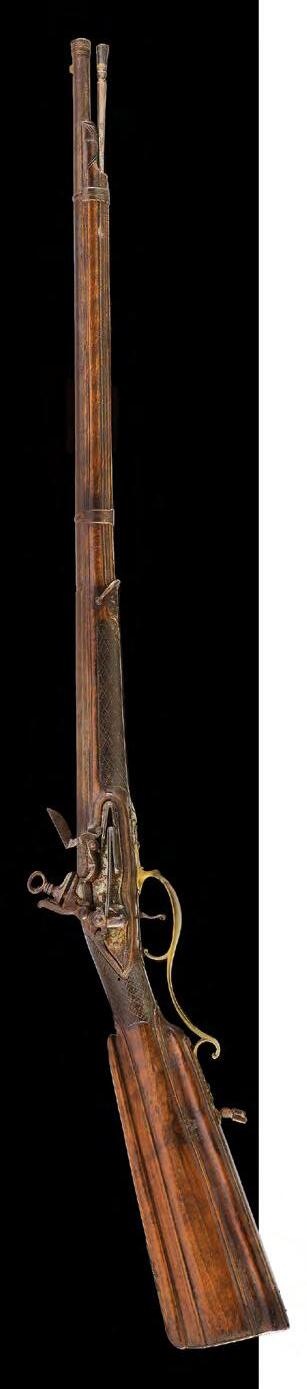
punzoni spagnoli, marcature e decori rimessi in oro (mancanze); poco più avanti un bell’alzo a sella in argento inciso; la volata lievemente strombata e munita di mirino con base a rondine in argento. Cal. 16 mm. Codetta incisa a volute floreali. Batteria alla micheletta recante incisioni alla coda e cornici ai bordi, nella parte centrale della cartella la firma “GEN: CASTIGLIONE”. Mezza cassa in noce con calcio scanalato e collo scolpito a squame. Eleganti e bellissimi fornimenti in argento incisi a volute floreali, anche la fascetta reggicanna e reggibacchetta in argento (una mancanza al codolo inferiore del bocchino). Bacchetta in legno con battipalla in corno.
Conditions medium
Length 139 cm.
€ 500/800
432 A RARE MIQUELET LOCK BOY’S GUN
Kingdom of the Two Sicilies, about 1820
Smoothbore, two-stage barrel, square and round, with foresight and scraped moulded muzzle; miquelet lock with flat lock plate. Beautiful walnut full stock, with a Madridstyle butt and checkered grips. Smooth brass mounts, two Reggiana-style bands, and two belt loops. Horn-tipped original iron ramrod.
RARO FUCILE ALLA MICHELETTA
DA RAGAZZO
Regno delle Due Sicilie, 1820 circa Canna liscia a due ordini, quadra e tonda, con mirino e gioia di bocca scorticata. Batteria a pietra focaia con cartella piatta. Bella cassa intera in noce, con calcio alla madrilena ed impugnature zigrinate. Fornimenti in ottone liscio, due fascette reggicanna e due passanti per la cinghia. Bacchetta in ferro originale, il battipalla in corno.
Conditions medium
Length 91 cm.
€ 600/900
433
A RARE MIQUELET LOCK
CARBINE WITH RIFLED BARREL
Kingdom of the Two Sicilies, about 1820
Heavy, octagonal, rifled, 18 mm cal barrel; in the powder chamber a gold escutcheon and a ‘H’ mark; at the nozzle, a silver foresight and a rear sight now missing. A fine miquelet lock with an engraved plate and a patch mark in the centre; waterproof pan. Walnut full stock, with fluted butt and checkered grip. Smooth brass mounts. Original brass-tipped, iron ramrod.
RARA CARABINA ALLA
MICHELETTA CON CANNA RIGATA
€ 900/1.200 432 433
Regno delle Due Sicilie, 1820 circa Pesante canna rigata di sezione ottagonale, recante alla camera di scoppio uno scudetto in oro e un punzone “H”, alla volata mirino in argento; la tacca di mira mancante; cal. 18 mm. Bella batteria alla micheletta con cartella incisa e punzone a toppa nella parte centrale; scodellino a prova d’acqua. Cassa intera in noce, con calcio scanalato ed impugnatura zigrinata. Fornimenti lisci in ottone.
Bacchetta originale in ferro con battipalla d’ottone.
Conditions good Length 127.5 cm.
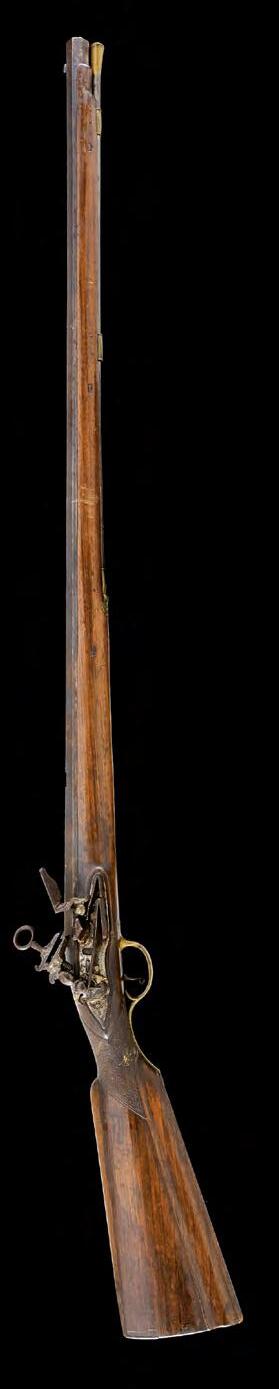
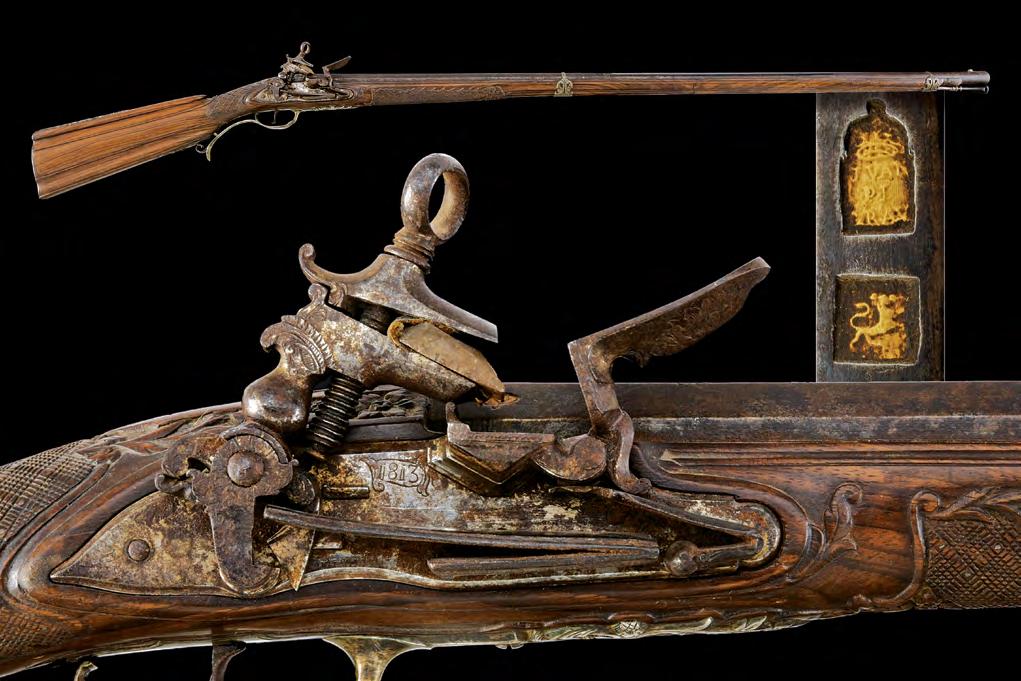
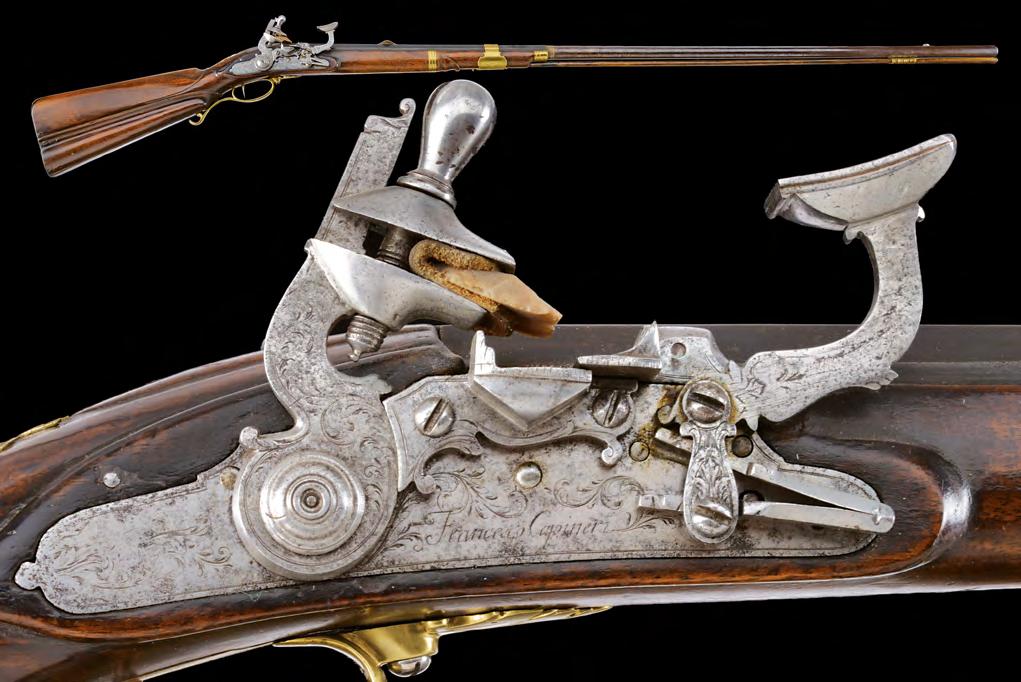
434 A FINE MIQUELET LOCK GUN
Kingdom of Naples, 1813
Two-stage, smoothbore, 15.5 mm cal barrel of square and round section separated by rings; powder chamber bearing re-gilded Spanish marks (some missing parts), the nozzle slightly bell-mouthed and fitted with a silver foresight. Tang engraved with a shell and floral motifs. Beautiful miquelet lock featuring a plate featuring the date ‘1813’ within a frame. Magnificent wooden full stock, Madrid-style butt, neck and handguard carved, knurled and decorated with silver studs. Break in the stock. Engraved silver mounts, two barrel bands en suite. Original, horn-tipped ramrod.
BEL FUCILE ALLA MICHELETTA
Regno di Napoli, 1813
Canna liscia a due ordini, quadra e tonda con anellature al cambio; camera di scoppio con marchi spagnoli rimessi in oro (alcune mancanze), la volata leggermente strombata e munita di mirino in argento; cal. 15.5 mm. Codetta incisa con conchiglia e a motivi floreali. Bella batteria alla micheletta con cartella recante la data “1813” entro cornice. Magnifica cassa intera in legno con calcio alla madrilena, collo e astina scolpiti, zigrinati e decorati con chiodini in argento. Rottura al fusto. Fornimenti in argento messi a giorno ed incisi, come anche le due fascette reggicanna. Bacchetta originale in ferro con battipalla in corno.
Conditions good
Length 144 cm.
€ 1.200/1.600
435 A SNAPHAUNCE LOCK GUN BY FRANCESCO CAPINERI
Tuscany, last quarter of the 17th Century
Two-stage, octagonal and round, 18,5 mm cal. barrel, with small frame at the girdle, signed “Domenico Lorilli di Pistoia” (CLP plus the monogram FM crowned), with a broad sight and silver foresight. An interesting snaphaunce flintlock, signed “Francesco Capineri” and engraved with floral motifs. Tuscan-style stock made of fine walnut carved with 17th-century motifs; brass mounts with traces of original gilding, solid counterplate engraved with a hunting scene, iron tipped original wooden ramrod (repaired in the centre).
The lock was published by Nolfo di Carpegna in “A Summary of Notes on Central Italian Firearms of the Eighteenth Century” and in “Art, Arms and Armour – An International Anthology” by Robert Held, page 321, fig. 14. Provenance: Former private collection in Bologna. Bibliography: Carlo de Vita, “Il trattato di Archibuseria” (by Antonio Tozzi), manuscript held in the Vatican Apostolic Library. For Francesco Capineri, see “Repertorio storico degli archibugiari italiani”, CLUEB, Bologna, by Bruno Barbiroli, page 153, in which the gun we propose is mentioned.
FUCILE ALLA FIORENTINA DI FRANCESCO CAPINERI
Toscana, ultimo quarto del XVII Sec. Canna a due ordini, ottagonale e tonda, con cornicette al cambio, firmata “Domenico Lorilli di Pistoia” (CLP più monogramma FM coronato), con traguardo a sella e mirino in argento, cal. 18,5 mm. Interessante batteria alla fiorentina arcaica, firmata “Francesco Capineri” ed incisa a motivi floreali. Cassa di tipo toscano in bel noce scolpito a motivi seicenteschi; fornimenti in ottone con tracce di doratura originale, contropiastra solida ed incisa con una scena di caccia, bacchetta originale di legno (riparata al centro) con battipalla di ferro.
La batteria è stata pubblicata da Nolfo di Carpegna in “A Summary of Notes on Central Italian Firearms of the Eighteenth Century” ed in “Art, Arms and Armour - An International Anthology” di Robert Held, pagina 321 fig. 14. Provenienza: Antica collezione privata bolognese. Bibl: Carlo de Vita, “Il trattato di Archibuseria” (di Antonio Tozzi), manoscritto conservato nella Biblioteca Apostolica Vaticana. Per Francesco Capineri si veda “Repertorio storico degli archibugiari italiani”, CLUEB, Bologna, di Bruno Barbiroli a pagina 153, nel quale è menzionato il fucile da noi proposto.
Conditions good
Length 172.5 cm.
€ 1.000/1.500
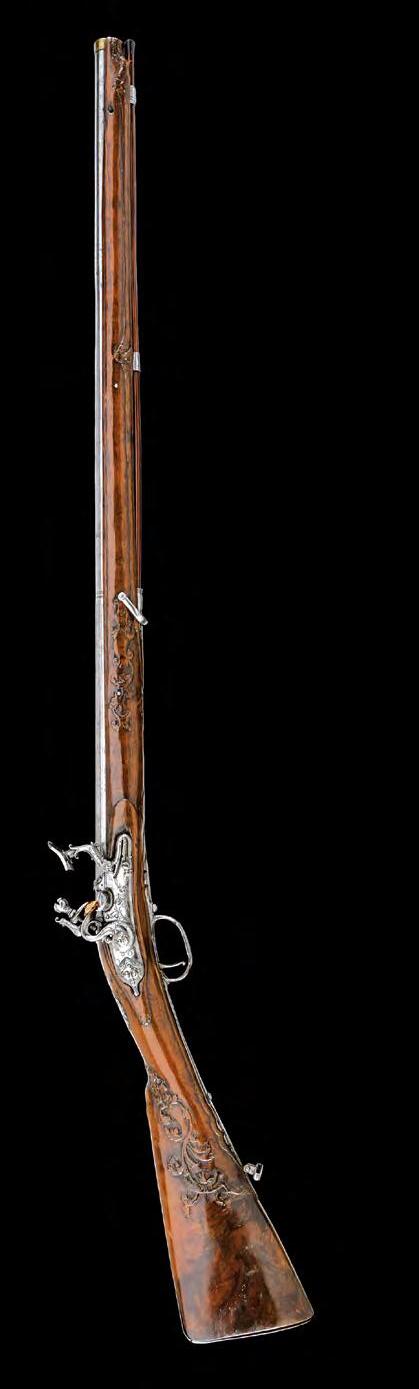
436
A SNAPHAUNCE LOCK GUN
Central Italy, 1828
Smoothbore, two-stage, 16 mm cal. barrel, square with outlines and round; brass moulded muzzle and engraved tang. Snaphaunce lock with rounded lock plate, engraved and decorated with masks in relief in the Tuscan-Emilian style; inside, signed “F.B.”and dated “1828”. Solid full stock of walnut wood (signs of use and time) with molded contours and figures of sphinxes and grotesques sculpted in bas-relief. Iron mounts with matching decorations. Horn-tipped, wooden ramrod.
FUCILE ALLA FIORENTINA
Italia centrale, 1828
Canna liscia a due ordini, quadra con delineature e tonda, con gioia di bocca in ottone e codetta incisa. Cal. 16 mm in volata. Batteria alla fiorentina con cartella bombata, incisa e decorata con mascheroni in rilievo nello stile tosco-emiliano; all’interno della piastra la sigla “F.B.” e la data “1828. Cassa intera in noce (segni d’uso e del tempo) con scorniciature e figure di sfingi e grottesche scolpite in bassorilievo. Fornimenti in ferro con decori en suite. Bacchetta in legno con battipalla in corno.
Conditions mediocre
Length 117 cm.
€ 1.300/1.800
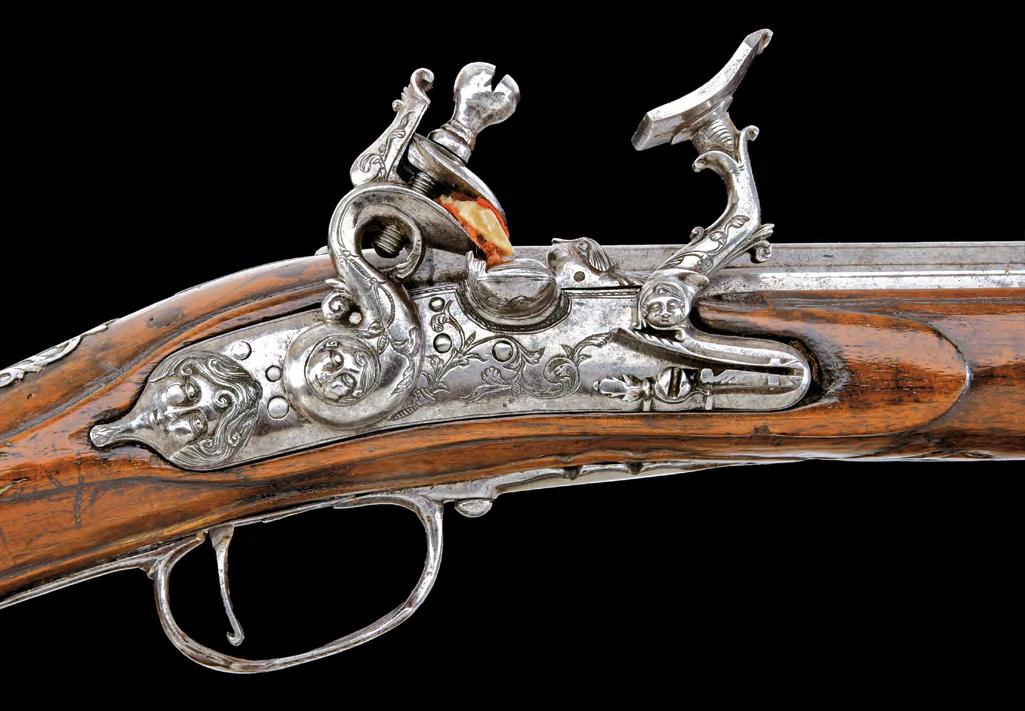
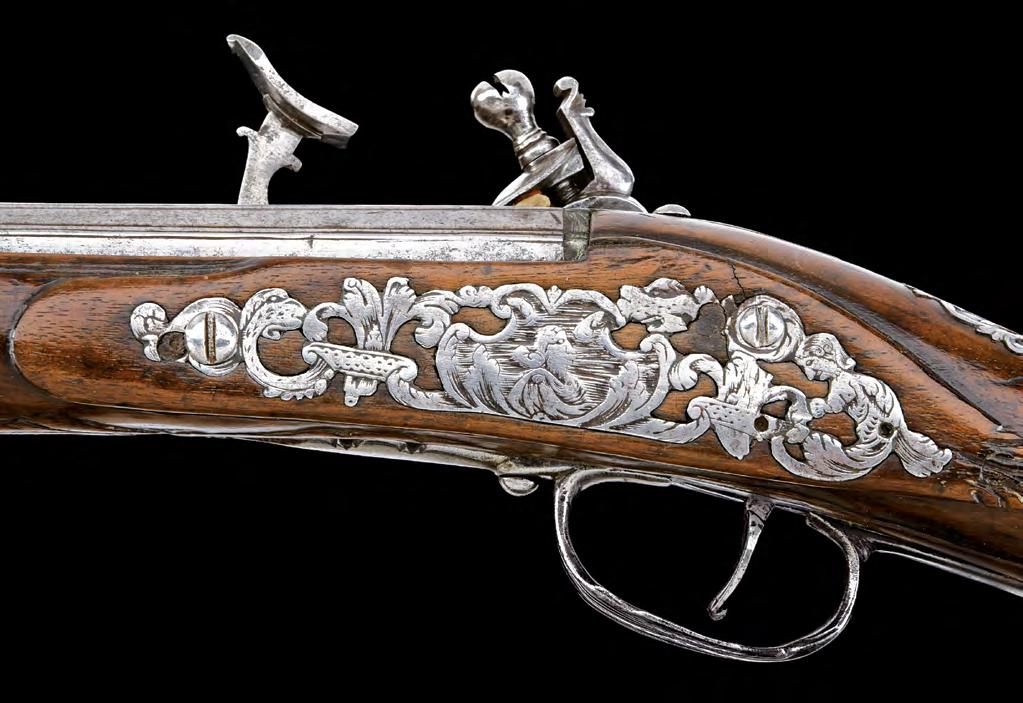
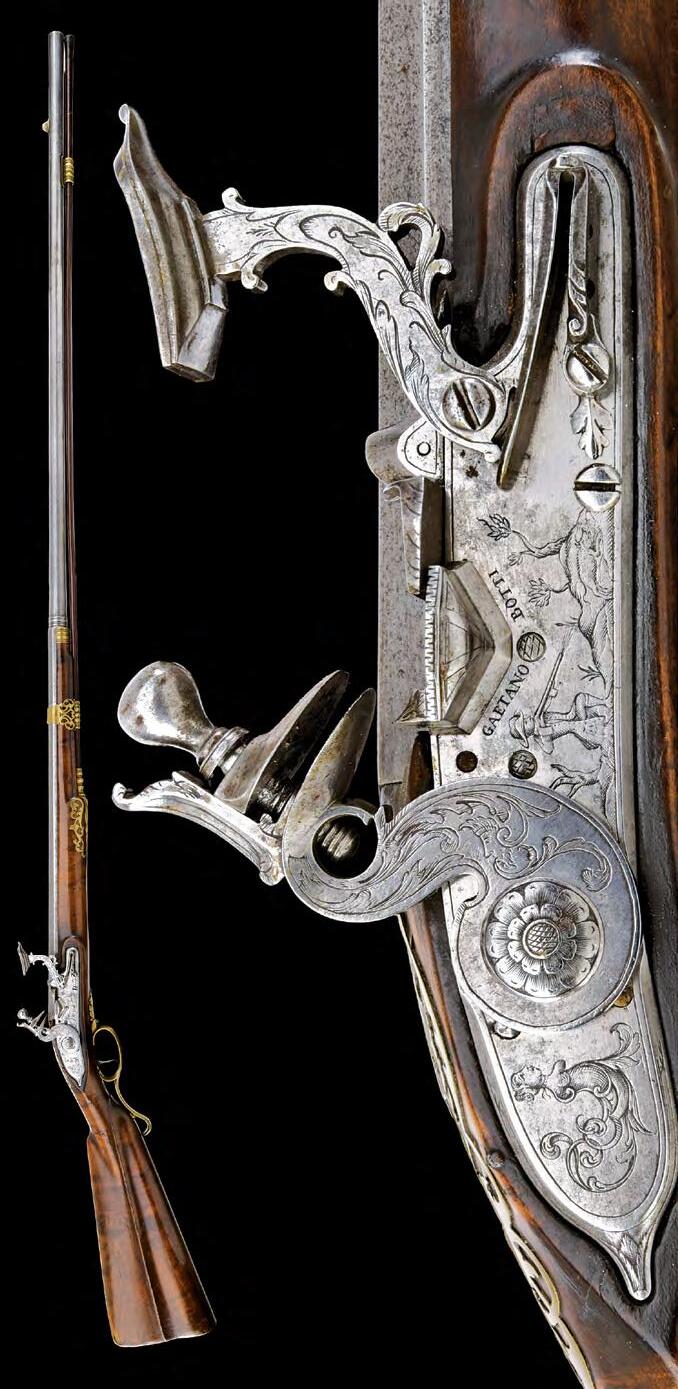
437 A FINE AND LONG SNAPHAUNCE GUN BY GAETANO BOTTI
Italy, Second half of the 18th Century Long, smoothbore, two-stage, 17 mm cal barrel, octagonal and round with fluted and beaded mouldings at the girdle; on the breech, lion proof mark inlaid in brass, and inscription in block letters among stars “CANNA FATTA A ROCCHI”; at the nozzle a large silver front sight. Plate with flat plate, finely engraved with hunting scenes and grotesques, signed in block letters beneath the pan “GAETANO BOTTI”. Halfstock in walnut, with very fine smooth brass mounts masterfully inlaid. Pierced brass barrel band with barrel bracket. Original, horn-tipped wooden ramrod.
BELLO E LUNGO FUCILE ALLA FIORENTINA DI GAETANO BOTTI
Italia, Seconda metà del XVIII secolo
Lunga canna lisca a due ordini, quadra e tonda con cornicette scanalate e perlinate al cambio; sulla culatta punzone rimesso in ottone di Leoni, ed iscrizione in stampatello fra stelline “CANNA FATTA A ROCCHI”; in volata ampio mirino in argento. Cal. 17 mm. Piastra con cartella piatta, finemente incisa con scene cinegetiche e grottesca, firmata in stampatello sotto allo scodellino “GAETANO BOTTI”. Mezza cassa in noce, con bellissimi fornimenti in ottone liscio magistralmente incassati. Fascetta in ottone messa a giorno con tubetto reggibaccehtta. Bacchetta originale in legno con battipalla in corno.
Conditions good Length 170 cm. € 1.600/2.200
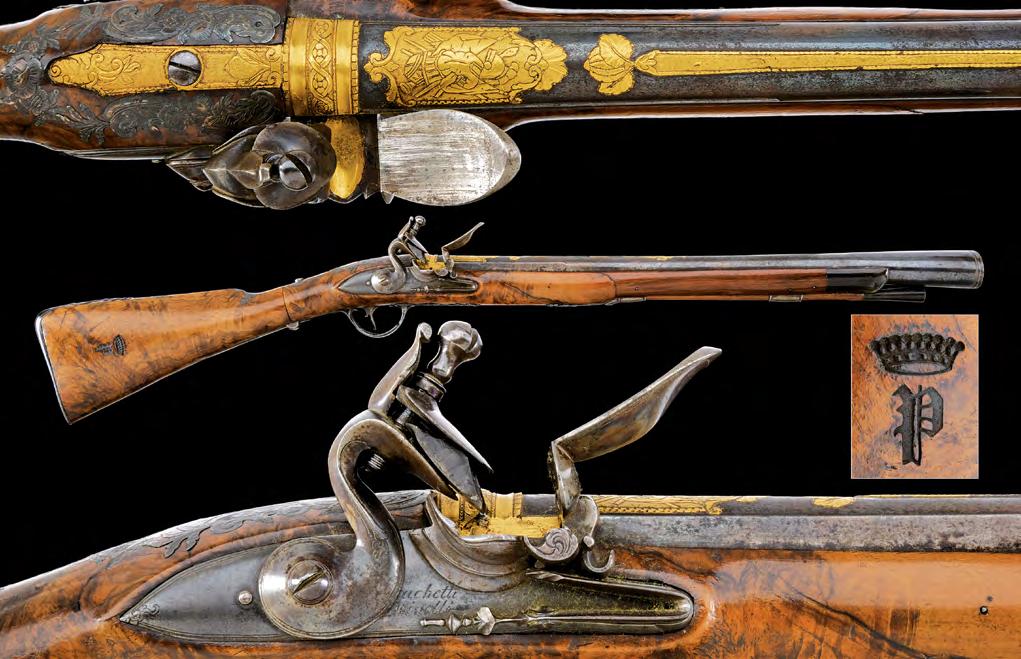

A RARE AND ELEGANT FLINTLOCK BLUNDERBUSS WITH FOLDABLE STOCK SIGNED FRACHETTI E MINELLI
Brescia, Late 18th - Early 19th Century
Iron barrel of round section with flattened sides at the first section and bell-mouthed nozzle. The breech featuring a raised central ring, engraved with floral frame and entirely gold inlaid, including the vent plate. On the back of the barrel, at the powder chamber, an engraved and slightly raised trophy of arms and armor under a canopy, the whole decoration also gold inlaid. Then, after cartridge, a slightly raised rib, decorated at both ends with engraved decorations and also gold inlaid. The remain of the barrel surface still partially keeps its original blueing. The tang is also engraved, bearing a finial-like ornament (shaped as a pinecone?) with the same decoration found at the beginning of the rib; here too the entire surface is gold inlaid.The lock with slight traces of finishing, probably original; the cock is of French style, with swan-neck profile, while the convex lock plate featuring the maker’s signature “Frachetti e Minelli”, with outlines on the borders and small friezes, leaves and rocaille motifs. Working mechanism.Stock of briarwood with fore-end probably replaced during the period of use, provided with folding butt at the grip, complete with well-functioning release button and hook.Along the top of the grip there are several silver-colored metal plaques, shaped and engraved with rocaille and floral motifs. Iron mounts with traces of blueing en suite with the barrel. On the butt plate, the monogram “P” surmounted by a count’s crown. The side plate is provided with belt hook. Horn-tipped ramrod with cartridge extractors, with remains of blueing.
Fracchetti & Minelli was a gunsmithing and arms-trading firm based in Brescia, working between the late 18th century and the early years of the 19th century. The firm produced weapons influenced by French stylistic tastes, particularly those of Boutet. Several pistols featuring the Fracchetti & Minelli signature are known, some featuring gold-inlaid barrels. See “Repertorio Storico degli Archibugiari Italiani” (B. Barbiroli, Clueb 2012), p. 259.
ELEGANTE E RARO SCAVEZZO A PIETRA FOCAIA FIRMATO FRACHETTI E MINELLI
Brescia, Fine XVIII inizio XIX Secolo
Canna in ferro di sezione tonda, con fianchi appiattiti nel primo segmento e volata strombata di sezione ellittica. La culatta con anellatura rilevata al centro, intagliata con cornice floreale e tutta ageminata in oro, anche sul piatto del focone. Al dorso della canna, sulla camera di scoppio un trofeo d’armatura e armi inciso e lievemente rilevato posto entro un baldacchino, anche tutta questa decorazione ageminata in oro. A seguire il cartiglio una bindella, sempre al dorso, leggermente rilevata, arrichita da fregi intagliati alle estremità e anche questa ageminata in oro. Il resto della superficie della canna conserva ancora parzialmente l’antica brunitura color blu. Anche il codolo intagliato, recante un fregio (a pigna?) che riprende un’identica decorazione posta al principio della bindella; anche qui tutta la superficie agemintata in oro.La batteria con lievi tracce di finitura, probabilmente antica; il cane secondo il gusto francese, a collo di cigno, la cartella bombata e recante la firma della manifattura “Frachetti e Minelli”, con delineature ai margini e piccoli fregi a foglie e rocaille. La meccanica ben funzionante.Cassa in radica con astina sostituita probabilmente in epoca d’uso, dotata di calcio pieghevole all’altezza del collo con pulsante di sblocco e gancio ben funzionanti.Sul dorso al collo varie placche in metallo color argento sagomate e incise a rocaille e fiori. I fornimenti in ferro con tracce di brunitura en suite con la canna. Sulla pala il monogramma “P” sormontato da una corona comitale. La contropiastra dotata di gancio da cintura. La bacchetta con battipalla in corno e cavastracci, anche questo con resti di brunitura.
Fracchetti & Minelli, ditta bresciana per la produzione e il commercio di armi attiva fra la fine del XVIII secolo e l’inizio di quello seguente. Produce armi con stile ispirato al gusto francese, in particolare a Boutet. Si conoscono varie pistole con firma Frachetti e Minelli, alcune delle quali con canne ageminate in oro. Vedi “Repertorio Storico degli Archibugiari Italiani” (B. Barbiroli, ed. Clueb 2012) pag. 259.
Conditions good
Length 95,5 cm.
€ 1.800/2.500
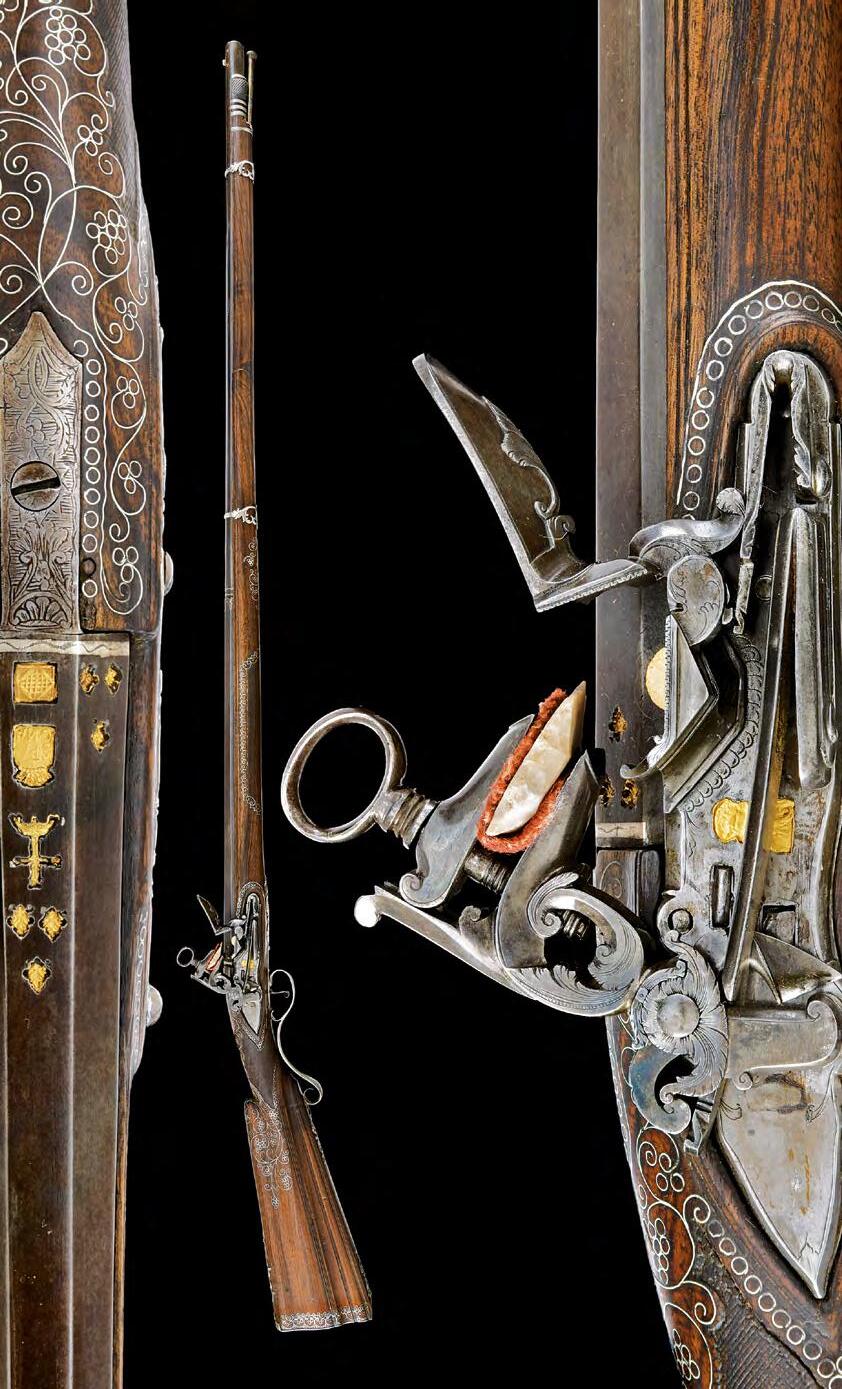
439
AN ELEGANT MIQUELET LOCK GUN
Naples, last quarter of the 18th Century Two-stage, browned, 18 mm cal barrel with smooth bore, octagonal base featuring two gold-inlaid marks, one with inscribed “SPAGNA”, surmounted by a cross and placed among nine fleurs-de-lis. The breech with silver band, as well as the decorations at the girdle. The second part of the barrel of round section, with rings at the girdle and silver dovetailed front sight. Engraved tang. Fine miquelet lock finely chiselled and engraved, bearing the gold-inlaid mark of the Royal Factory of Naples. Full wooden stock (restoration) with chequered base, fluted butt and refined filigree inlays. Beautiful silver mounts decorated with floral motifs and partially gilt. Iron ramrod.
ELEGANTE FUCILE ALLA MICHELETTA
Napoli, ultimo quarto del XVIII Sec. Canna brunita con anima liscia, a due ordini, con base ottagonale recante due marchi rimessi in oro, uno con l’iscrizione “SPAGNA”, sormontati da una croce e posti tra nove gigli. La culatta con banda in argento come anche i decori al cambio. La seconda parte della canna tonda, con anellature al cambio e con mirino a coda di rondine in argento; calibro 18 mm alla volata. Codetta incisa. Bella batteria a pietra focaia finemente intagliata ed incisa, recante il punzone della Real Fabbrica di Napoli rimesso in oro. Cassa intera in legno (restauro) con collo zigrinato, calcio scanalato e raffinati inserti in filigrana. Bellissimi fornimenti in argento decorati a motivi floreali e in parte messi a giorno. Bacchetta in ferro.
Conditions very good
Length 144.5 cm.
€ 1.800/2.500

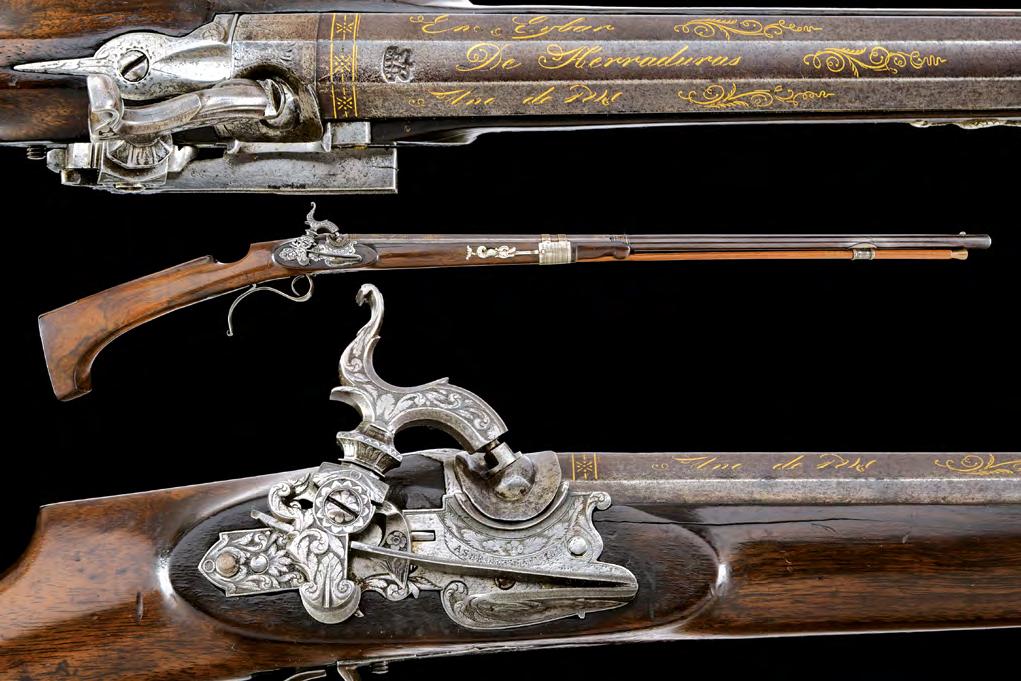
440
A PERCUSSION GUN SIGNED ZLAOUE
France, Mid 19th Century
Smoothbore, two-stage, 17 mm cal. barrel, browned with damascus design; octagonal at the first part with engraved base, then round with foresight; engraved tang with sight. Backward spring lock with signed “Zlaoué” and engraved with floral motifs. Wooden stock with iron mounts decorated en suite. Iron ramrod.
FUCILE A LUMINELLO FIRMATO ZLAOUE
Francia, Metà del XIX Secolo
Canna liscia, brunita e damascata, a due ordini,ottagonale nella prima parte, con base incisa, poi tonda e con mirino, cal. 17 mm; codetta incisa e dotata di traguardo. Batteria a molla indietro firmata “Zlaoué” ed incisa a motivi floreali. Mezza cassa in legno con fornimenti in ferro decorati en suite. Bacchetta in ferro.
Conditions good
Length 128.5 cm.
€ 150/250
441
A FINE CATALAN PERCUSSION GUN
Eibar, 1847
Smoothbore, browned, two-stage, 16 mm cal. barrel; octagonal at the first part, featuring the mark and signature “De Herraduras En Eibar Ano de 1841” in gold among floral decorations; then round after silver rings and partially gilded leaves; with silver foresight and gold decorations; tang engraved with sight; miquelet percussion lock signed “ASPE SEVILLA 1847”, carved and engraved with floral motifs. Catalan-style half stock of briarwood with matching iron mounts, the trigger guard with mark “ASPE”. Silver barrel bracket, barrel wedge decorated with a dragon. Brass-tipped, wooden ramrod.
BEL FUCILE A LUMINELLO ALLA CATALANA
Eibar, 1847
Canna liscia, brunita, a due ordini, inizialmente ottagonale, con marca e firma “De Herraduras En Eibar Ano de 1841” in oro fra decorazioni floreali, poi tonda con anellature in argento e fogliame parzialmente dorato al cambio; dotata di mirino in argento con decorazioni in oro, cal. 16 mm; codetta incisa e munita di traguardo. Batteria alla micheletta, a luminello, firmata “ASPE SEVILLA 1847”, intagliata e incisa a motivi floreali. Mezza cassa alla catalana in radica, con fornimenti in ferro decorati en suite, il ponticello con marca “ASPE”. Reggicanna in argento, il fermo decorato con un drago. Bacchetta in legno con battipalla in ottone.
Conditions good
Length 125.5 cm.
€ 300/600
442
A PERCUSSION TARGET RIFLE BY FIFEL
Chur, Mid 19th Century
Rifled, octagonal, 10 mm cal. barrel, signed in Gothic script “P. FIfel in Chur”, adjustable rear sight and precision foresight; long, smooth tang. Backward spring lock, flat and smooth lock plate. Full stock with checkered grip, iron mounts, anatomical trigger guard, set trigger; Brasstipped, wooden ramrod; horn muzzle ring.
CARABINA A LUMINELLO DA TIRO DI FIFEL
Chur, Metà del XIX Secolo
Canna rigata, ottagonale, firmata in caratteri gotici “P. FIfel in Chur”, dotata di alzo regolabile e mirino di precisione, cal. 10 mm; lunga codetta liscia. Batteria a luminello a molla indietro, cartella piatta e liscia. Cassa intera con collo zigrinato, fornimenti in ferro, ponticello anatomico, stecher; bacchetta in legno con battipalla in ottone; il bocchino in corno.
Conditions very good
Length 120 cm.
€ 300/500
443 AN 1851 MODEL SWISS-PATTERN PERCUSSION CARBINE WITH BAYONET
Genova, 1860
Rifled, 10 mm cal. barrel (clean bore, still visible rifling), round, octagonal at the base with adjustable rear sight, foresight and tubular club guide for the bayonet. Long tang. Forward spring lock signed “MULLER IN GENOVA”. Wooden full stock with some signs of use, and stamp “1” on the butt stock and oval plate with silver inscription “Luigi Malatesta Campagna 1859-1860” (Luigi Malatesta 1859-1860 campaign) with a Savoy knot. Working trigger and set trigger. Iron mounts and ramrod.
The Carabinieri Genovesi were a corps of Garibaldian volunteers formed in Genoa during the patriotic climate of the Risorgimento. They came largely from Genoa’s democratic and Mazzinian circles, and many had gained experience in the Società di Tiro Nazionale, founded in 1852.
At the outbreak of the Second Italian War of Independence in 1859, they formed a volunteer company that fought with Garibaldi’s Cacciatori delle Alpi in Lombardy, distinguishing themselves at Varese, San Fermo, and Malnate.
In 1860, a group of Carabinieri Genovesi also took part in the Expedition of the Thousand, under the command of Antonio Mosto, participating in the main stages of Garibaldi’s campaign, from Calatafimi to the Volturno. Their training, discipline, and marksmanship made them an elite unit, often deployed at the most critical moments.
The Carabinieri Genovesi were armed mainly with the Swiss Federal carbine, Model 1851. Some Swiss-type examples were produced or assembled in Genoa by the gunsmith Pietro Muller; carbines marked “MULLER A GENES” or “P. Muller in Genova” are known.
CARABINA A LUMINELLO DEL TIPO SVIZZERO MOD. 1851 CON BAIONETTA
Genova, 1860
Canna rigata (anima pulita, rigatura ancora visibile) tonda, con base ottagonale, dotata di alzo regolabile, mirino e guida tubolare per innesto della baionetta, cal. 10 mm. Lunga codetta. Batteria a molla in avanti firmata “MULLER IN GENOVA”. Cassa intera in legno con qualche segno d’uso, e timbro “1” sulla pala e targa ovale in argento con iscrizione “Luigi Malatesta Campagna 1859-1860” con un nodo Sabaudo. Grilletto e stecher ben funzionanti. Fornimenti e bacchetta in ferro.
I Carabinieri Genovesi furono un corpo di volontari garibaldini nato a Genova nel clima patriottico del Risorgimento. Provenivano in gran parte dall’ambiente democratico e mazziniano genovese, e molti di loro avevano maturato esperienza nella Società di Tiro Nazionale, fondata nel 1852. Allo scoppio della seconda guerra d’indipendenza, nel 1859, formarono una compagnia di volontari che combatté con i Cacciatori delle Alpi di Garibaldi in Lombardia, distinguendosi a Varese, San Fermo e Malnate.Inoltre nel 1860 un gruppo di Carabinieri Genovesi partecipò alla spedizione dei Mille, sotto la guida di Antonio Mosto, prendendo parte alle principali fasi dell’impresa garibaldina, da Calatafimi fino al Volturno. La loro preparazione, disciplina e abilità nel tiro li resero un reparto scelto, spesso impiegato nei momenti più delicati.I Carabinieri Genovesi erano armati soprattutto con la carabina federale svizzera Mod. 1851. Alcuni esemplari di tipo svizzero furono prodotti o assemblati a Genova dall’armaiolo Pietro Muller: sono note carabine marcate “MULLER A GENES” o “P. Muller in Genova”
Conditions medium Length 128 cm. € 500/800
444 A PERCUSSION TARGET RIFLE SIGNED BINDSCHAEDLER IN KUESNACHT Switzerland, Mid 19th Century Heavy, rifled, octagonal barrel, with precision, tunnel foresight, marked at the back “H. BINDSCHADLER IN KUESNACHT”. 10 mm cal. at the nozzle. Bore with visible rifling but very dirty, needs cleaning to determine its condition. Breech block with frames and engravings. Tang with peep sight. Forward spring lock signed like the barrel and adorned with floral engravings. Cock with double snap provided with safety lock. Working mechanism. Walnut, full stock with a finely carved scaly grip. Two small cracks next to the plate and counterplate; the nozzle gasket may be missing. Iron mounts. Butt plate with ends. Trigger guard with guard, highly elaborate, and with a quick-release screw to remove the snap block. Working trigger and set trigger. Large adjustment screw for the set trigger. The front tang of the trigger guard with open-work housing a grip pommel with a baluster-shaped grip and a wooden knob. Well-fitting wooden ramrod with white metal mounts. In old patina, barely used.
CARABINA DA TIRO A LUMINELLO FIRMATA BINDSCHAEDLER IN KUESNACHT
Svizzera, Metà del XIX Secolo Pesante canna rigata, ottagonale, dotata di mirino di precisione a tunnel, marcata al dorso “H. BINDSCHADLER IN KUESNACHT”. In volata cal. 10 mm. Anima con rigatura visibile ma molto sporca, da pulire per determinarne lo stato di conservazione. Il blocco di culatta con cornicette e incisioni. Il codolo munito di diottra. Batteria a molla in avanti firmata come la canna e ornata con incisioni a fiorami. Il cane a due scatti dotato di sicura esterna. La meccanica ben funzionante. Cassa intera in noce con collo finemente intagliato a squame. Due piccole crepe accanto piastra e contropiastra; forse mancante la guarnizione alla volata. Fornimenti in ferro. Il calciolo con code. Il ponticello a guardia, molto elaborato e dotato di vite di smontaggio rapido per rimuovere il blocco dello scatto. Grilletto e stecher funzionanti. Grande vite di regolazione per il sensibilizzatore. Il codolo anteriore del ponticello con sforatura che alloggia un pomo di presa con collo a balustro e manopola in legno. Bacchetta in legno ben calzante con fornimenti in metallo bianco. In vecchia patina toccata poco o nulla.
Conditions good
Length 121.5 cm.
€ 500/800
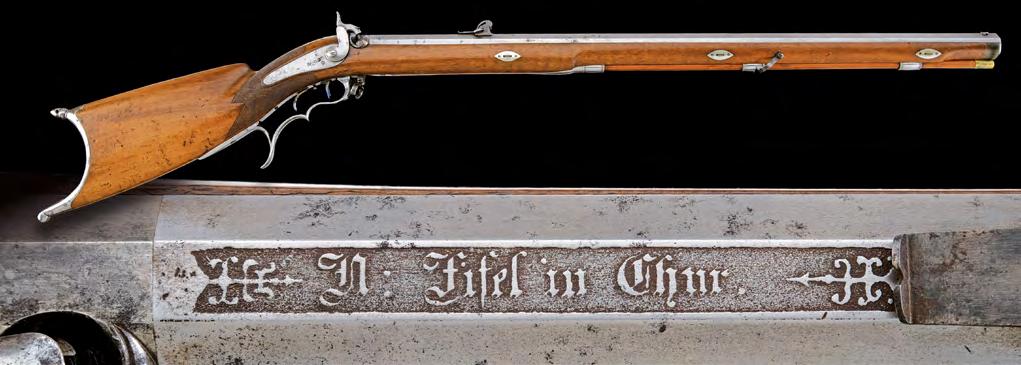
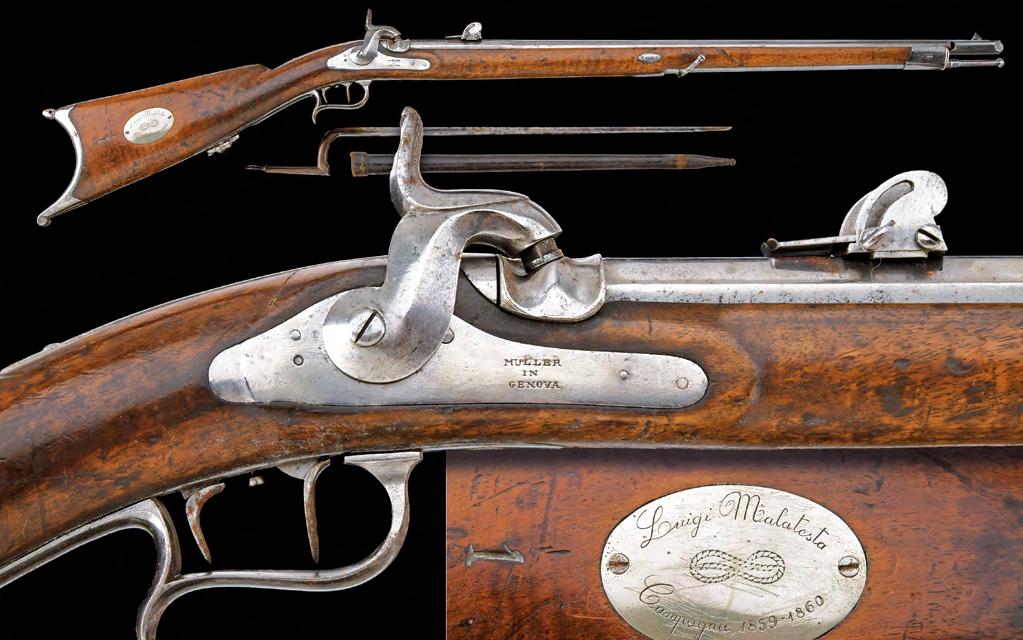
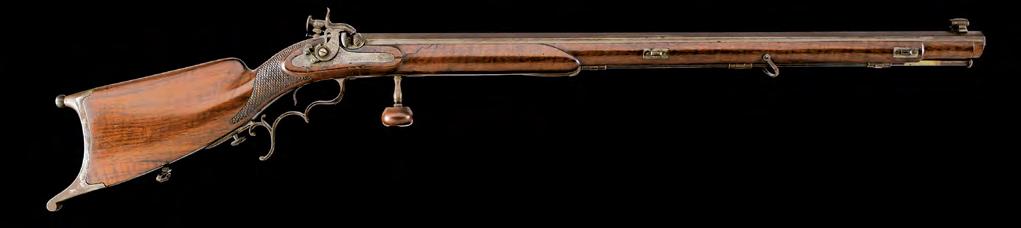

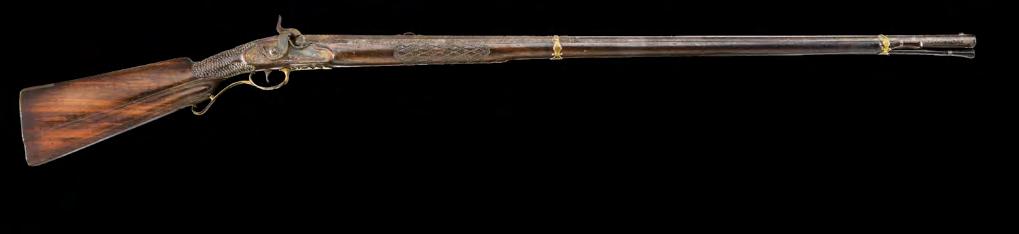
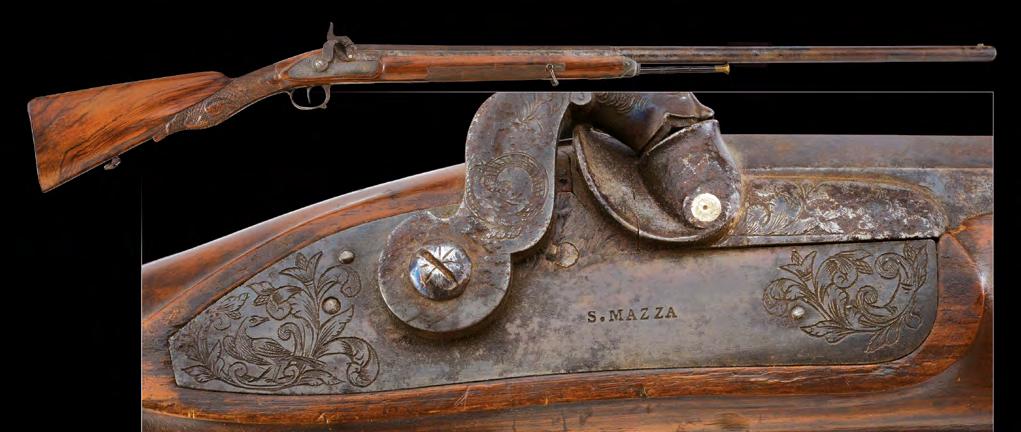
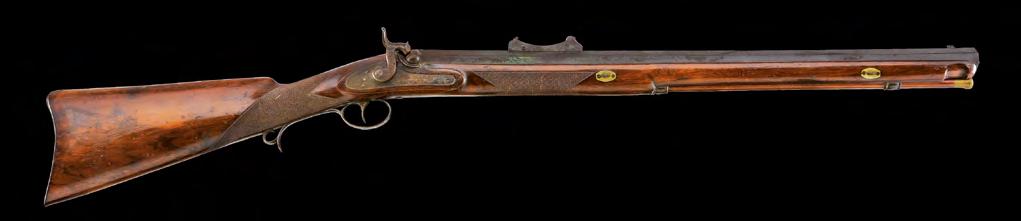
445
A PERCUSSION GUN BY MAZZA
Naples, Mid 19th Century
Smoothbore, two-stage, twisted, rifled barrel with saddle-shaped rear sight and foresight, both in silver; a gold hallmark on the powder chamber; 17 mm calibre at the nozzle. Engraved tang. Forward spring lock engraved with floral motifs and marked in block letters ‘S. MAZZA’. Hammer base with a tang for the safety catch. Wooden full stock, fluted butt and fishscale carved grip, stock hand restcarved with lozenges. Simple engraved brass mounts; the front end of the trigger guard features an openwork double-headed eagle. Original horn-tipped, wooden ramrod.
FUCILE A LUMINELLO DI MAZZA
Napoli, Metà del XIX Secolo
Canna liscia a due ordini, a torcione, con tacca di mira a sella e mirino, entrambi in argento; alla camera di scoppio un bollo in oro; calibro 17 mm in volata. Codetta incisa. Batteria a molla in avanti incisa a fiorami e marcata in stampatello “S. MAZZA”. Base del cane con coda per scatto di sicura. Cassa intera in noce, calcio scanalato ed impugnatura intagliata a squame di pesce, poggiamano del fusto intagliato a losanghe. Sobri fornimenti in ottone incisi; il codolo anteriore del ponticello con aquila bicipite messa a giorno. Bacchetta originale in legno con battipalla in corno.
Conditions good
Length 145 cm.
€ 600/900
446
A PERCUSSION GUN BY MAZZA
Naples, Mid 19th Century
Two-stage, smoothbore, 17 mm cal barrel with small rings at the girdleand a silver foresight; the powder chamber is marked ‘S. MAZZA’, with a gold mark from the Royal Factory of Naples and three lilies. Forward spring percussion lock, plate marked “S. MAZZA” and a fine engraving and floral motifs at the tang. Half-stock made of selected walnut, butt with a neck carved in the shape of a boar’s head and a checkered grip, cheek piece carved with a rosette in relief. Mounts with high-quality floral engravings. Brass-tipped, horn ramrod with missing parts.
FUCILE A LUMINELLO DI MAZZA
Napoli, Metà del XIX Secolo
Canna liscia a due ordini con cornicette al cambio e mirino in argento; alla camera di scoppio marcatura “S. MAZZA”, punzone in oro della Real fabbrica di Napoli e tre gigli; cal. 17 mm. Batteria a luminello a molla in avanti, cartella firmata “S. MAZZA” e bella incisione e fiorami alla coda. Mezza cassa in noce scelto, calcio con collo scolpito a testa di cinghiale ed impugnatura zigrinata, pooggiaguancia intagliato con rosetta in rilievo. Fornimenti in ferro con incisioni floreali di qualità. Bacchetta in corno con alcune mancanze, battipalla in ottone.
Conditions good Length 129 cm. € 600/900
447 A FINE AND UNUSUAL PERCUSSION CARBINE BY ZITO
Kingdom of the Two Sicilies, Mid 19th Century Heavy, octagonal, rifled, 16 mm cal barrel, fitted with sliding, graduated rear sight and front sight at the nozzle; powder chamber bearing a gold-inlaid mark, engraved with racemes and signed “Ios Fruwirt...”; the surface with bluing. Tang decorated with engraved floral scrolls. Forward spring lock with plate engraved en suite, the hammer en suite, signed in block letters “ZITO”. Full wooden stock with chequered base and fore-end. Browned iron mounts engraved with floral scrolls. Brass-tipped, wooden ramrod.
BELLA ED INUSUALE CARABINA A LUMINELLO FIRMATA ZITO
Regno delle Due Sicilie, Metà del XIX Secolo Pesante canna ottagonale rigata, munita di alzo scorrevole e graduato, mirino in volata; la camera di scoppio recante marca rimessa in oro, incisioni a racemi e firma “Ios Fruwirt...”; la superficie con brunitura. Cal. 16 mm. Codetta decorata con incisioni a volute floreali. Batteria a luminello a molla in avanti, cartella incisa en suite, come anche il cane, firmata in stampatello “ZITO”. Cassa intera in legno con collo e poggiamano zigrinati. Fornimento in ferro bruniti incisi a volute floreali. Bacchetta in legno con battipalla in ottone.
Conditions medium Length 107 cm.
€ 800/1.200
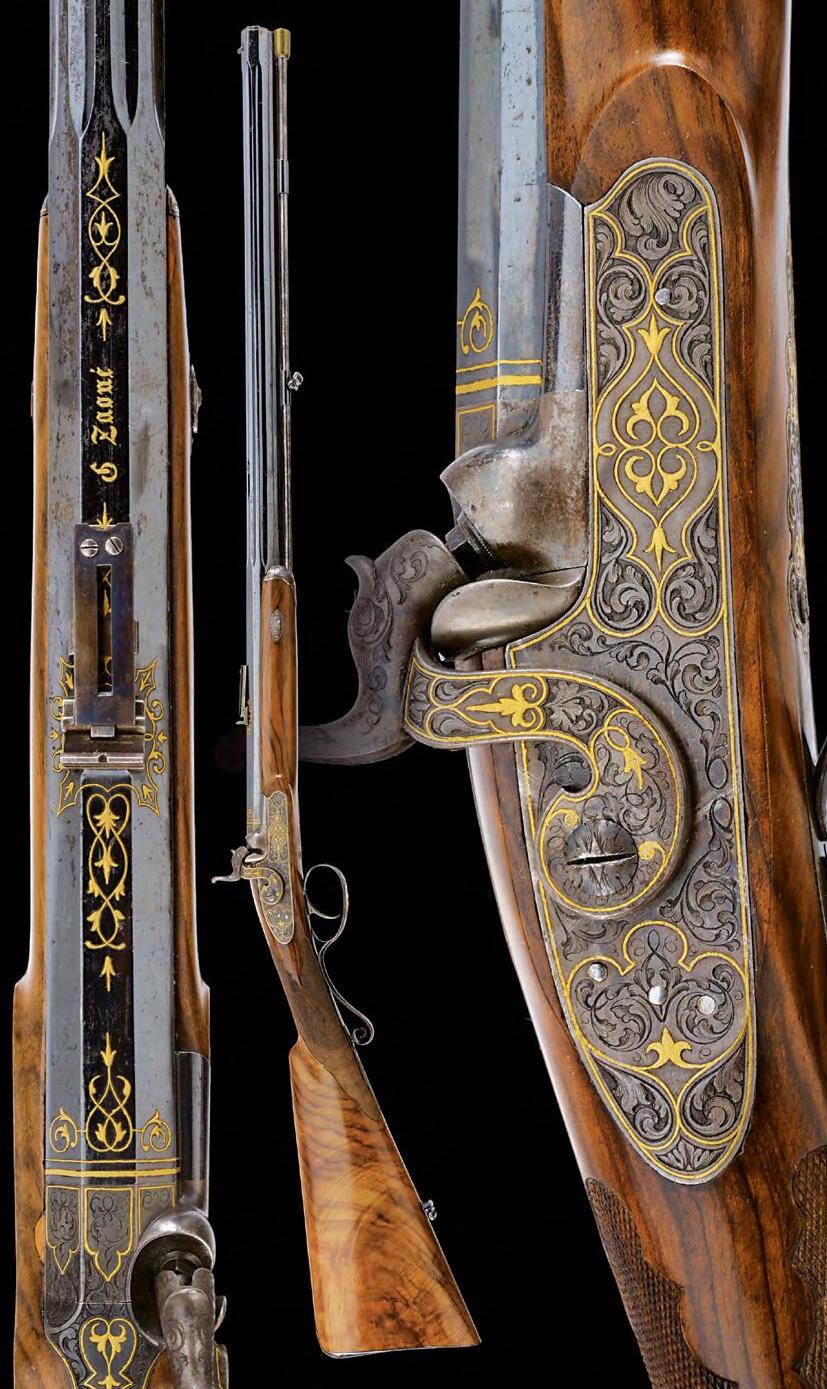
448 A BEAUTIFUL AND ELEGANT TARGET PERCUSSION RIFLE BY G. ZAOUE
France, Mid 19th Century
A beautiful, browned, rifled, two stage, 14 mm cal. barrel; the first part octagonal with the signature “G. Zaoue” in gold Gothic lettering, with refined floral spiral decorations also made of gold and a foldaway, adjustable rear sight; the second order continues to the nozzle, with longitudinal fullers; at the muzzle, precision foresight within a gold frame. At the powder chamber, on the left side, the mark of the Liège test bench. Engraved and partially gilded tang. Beautiful percussion forward spring lock, the lock plate fully engraved with fine floral spirals, the border and some elements gold inlaid, the end slightly lowered. Half stock in fine wood, micro-checkered grip. Iron mounts, partly browned, with engravings en suite and gold inlaid elements. The frame of the pin barrelstock pin is also engraved. Brass tipped iron ramrod, with marks.
A remarkable sporting rifle; browning with some missing parts, otherwise in very good condition.For Zaoue, see “Der Neue Stöckel”, vol. II, p. 1429; the gunsmith is documented in Marseille from 1845 to 1855.
BELLISSIMO ED ELEGANTE FUCILE DA TIRO A LUMINELLO DI G. ZAOUE
Francia, Metà del XIX Secolo Notevole canna brunita, rigata, a due ordini, ottagonale nella prima parte, recante la firma in oro “G. Zaoue” a caratteri gotici, raffinate decorazioni a volute floreali sempre in oro e dotata di alzo abbattibile e regolabile; segue fino alla volata il secondo ordine, strutturato a sgusciature longitudinali; alla bocca un mirino di precisione entro una cornice in oro, cal. 14 mm in volata. Alla camera di scoppio, nella parte sinistra, il punzone del banco di prova di Liegi. Codetta incisa e parzialmente dorata. Bellissima batteria a luminello a molla in avanti, cartella completamente incisa con fini volute floreali, il bordo e alcuni elementi rimessi in oro, la coda leggermente ribassata. Mezza cassa in legno pregiato, il collo micro-zigrinato. Fornimenti in ferro, in parte bruniti, con incisioni en suite ed elementi rimessi in oro. Anche la cornice del perno cannacassa incisa. Bacchetta in ferro con battipalla in ottone, con marcature.
Notevole fucile da tiro, sono presenti alcune mancanze alla brunitura, altrimenti in ottime condizioni. Per Zaoue vedi “Der Neue Stöckel”, vol. II, pag. 1429, l’armaiolo è documentato a Marsiglia dal 1845 al 1855.
Conditions very good Length 108 cm.
€ 1.500/2.500
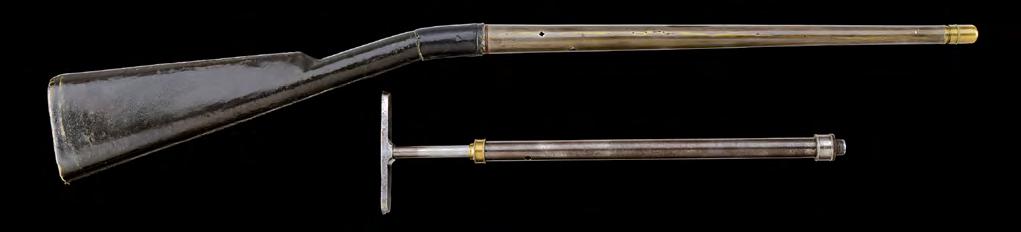
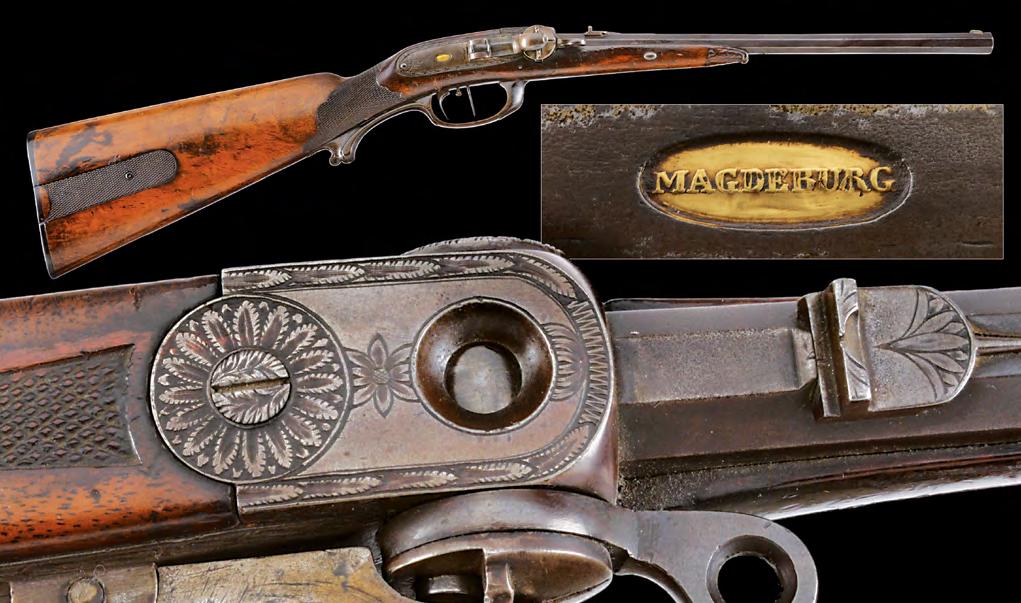
449
AN INTERESTING AIR SALOON GUN WITH ITS RARE PUMP
Europe, Third quarter of the 19th Century Barrel of cylindrical section, tapering toward the nozzle, provided with rear sight, foresight, and rooster-shaped key (present); inside the barrel an additional barrel, that is rifled, turn-off, and made entirely of brass, of a smaller caliber (8 mm). Visible weld marks (and some minor imperfections) on the lower part of the larger-caliber barrel, 8 mm cal. Brass nozzle with a removable brass base provided with brass-tipped wooden ramrod. Iron butt covered in leather (some defects), removable, containing the air magazine. Complete with its iron loading pump with brass insert.
INTERESSANTE FUCILE AD ARIA DA SALA CON RARA POMPA
Europa, Terzo quarto del XIX Secolo
Canna a sezione cilindrica, rastremata verso la volata, munita di alzo, mirino e inserto per la chiave a galletto (questa ancora presente), dotata all’intero di un’ulteriore canna, in questo caso rigata, svitabile e costruita totalmente in ottone, di calibro minore (8 mm). Segni visibili (e alcune piccole mancanze) di saldatura nella parte inferiore della canna di maggior calibro. Volata in ottone con piede in ottone svitabile munito di bacchetta, questa in legno con battipalla in ottone. Il calcio in ferro rivestito in cuoio (alcuni difetti), svitabile, contenente il serbatoio d’aria. Completo della sua pompa di caricamento in ferro con inserto in ottone.
Conditions medium
Length 98 cm.
€ 600/900
450 AN INTERESTING AND RARE FORSYTH TYPE
SALOON GUN BY W. KÖNIG
Magdeburg, 1840 circa Octagonal, 8 mm cal barrel with rear sight, with floral engraving at the base and front sight at the nozzle. Extremely rare detonating-pellet system; the lockplate with floral engravings at the tang and borders, in the centre signed “W. KÖNIG” within a gilt oval, slightly forward a hammer with lateral grip fitted with internal chain; at the front a disc-shaped element bearing the housing for the fulminate pellet, also fitted with a small rotating breech-piece opening the upper loading aperture; the latter positioned on the tang, finely engraved with floral motifs. The counterplate bears the marking “MAGDEBURG” within a gilt oval and is likewise decorated with chiselled engravings en suite with the lockplate. Wooden half-stock with chequered base, trigger-guard and butt-plate made of dark horn. Patchbox on the right side of the butt and cheek-piece on the left. With set trigger.
INTERESSANTE E RARO FUCILE CON
ACCESSIONE TIPO FULMINATO DI W. KÖNIG
Magdeburg, 1840 circa Canna ottagonale munita di alzo con incisione floreale alla base e mirino in volata, cal. 8 mm. Rarissimo sistema tipo fulminato, la piastra con incisioni floreali alla coda e ai bordi, nella parte centrale firmata “W. KÖNIG” entro ellisse dorata, poco più avanti un cane a percusione laterale munito di catena interna; nella parte anteriore un elemento a disco recante l’alloggiamento per la pastiglia di fulminato, questo ha anche una piccola bascula che ruotando apre la finestra superiore per il caricamento; quest’ultima è posizionata alla codetta, finemente incisa a motivi floreali. La contropiastra reca la marcatura “MAGDEBURG” entro ellisse dorata, ed è anch’essa
decorata con incisioni a cesello en suite alla piastra. Mezza cassa in legno con collo zigrinato, ponticello e calciolo in corno bruno. Patchbox sulla guancia destra della pala e poggiaguancia in quella sinistra. Munito di stecher.
Conditions good
Length 77 cm.
€ 500/800
451 AN ELEGANT MARTINI-STYLE PRESENTATION TARGET CARBINE WITH FINE DECORATION Europe, 1870 - 1889 circa Octagonal, rifled barrel, provided with a precision foresight and an adjustable rear sight, 10.6 mm cal. at the nozzle. Clean bore, visible rifling. Frame with Martini-type tilting block mechanism. The frame featuring finely punched floral motifs, frames and nets. The surface with remains of the old casehardening. The bolt cover with remains of the old blueing. Working mechanism. Trigger, set trigger and adjustment screw. Butt and fore-end of walnut wood. The first with cartouche with checkered finishing, on which a floral motif in relief stands out at the centre. The butt is richly carved: the right side of the butt stock with beautiful frieze of intertwined floral spirals, on which a cartouche stands out (it originally housed a plate, now missing) and a cherub, all on a granulated background. The left side of the butt stock with a wide, smooth cheek-piece edged by carved friezes echoing the theme of the opposite side. The cocking lever and the butt-plate are both punched with the same decorative motifs as the other elements. Of remarkable quality, particularly due to the finely executed decorations.
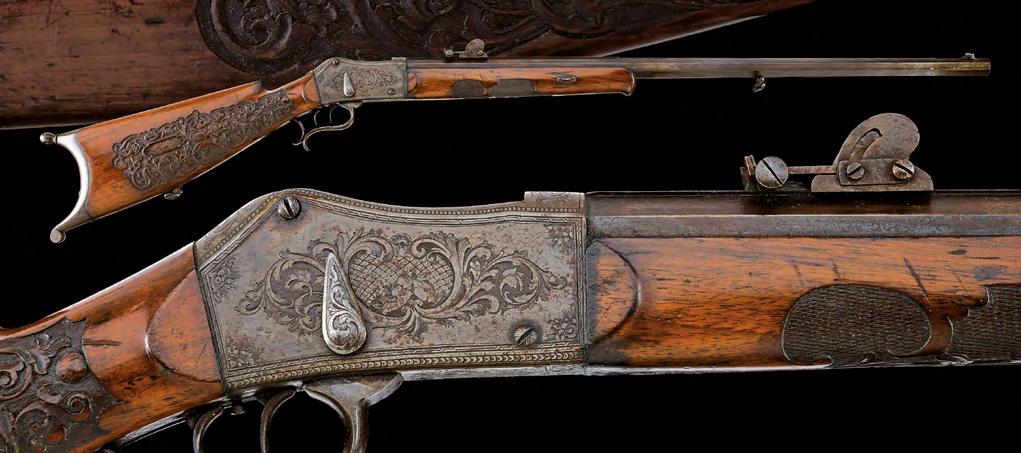
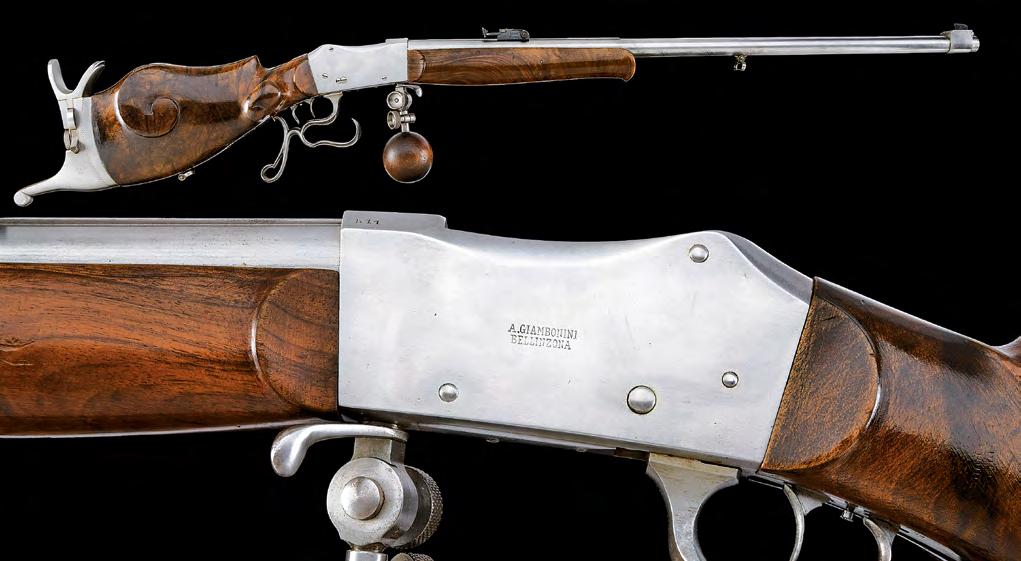
ELEGANTE CARABINA DA TIRO DEL TIPO MARTINI DA PRESENTAZIONE CON DECORI DI PREGIO
Europa, 1870 - 1889 circa Canna ottagonale rigata, dotata di mirino di precisione e di alzo regolabile, cal. 10,6 mm in volata. Anima pulita, rigatura visibile. Castello con meccanica del tipo Martini a blocco basculante. Il telaio con belle incisioni a bulino a temi floreali, cornicette e reti. La superficie con tracce della vecchia tartarugatura. Il coperchio dell’otturatore con resti della vecchia brunitura color blu. Meccanica funzionante. Grilletto, stecher e vite di regolazione. Calcio ed astina in noce. La prima con un cartiglio lavorato a zigrino sul quale spicca un fiorame in rilievo al centro. Il calcio riccamente lavorato ad intaglio: il lato destro della pala un un bellissimo fregio a volute di fiorami intrecciati sui quali spiccano un cartiglio (che originariamente alloggiava una targhetta ora mancante) e un putto, il tutto su fondo a granuli. Il lato sinistro della pala on ampio poggiaguancia liscio bordato da fregi sempre intagliati che riprendono il tema del lato opposto. La leva d’armamento e il calciolo entrambi con incisioni a bulino che proseguono i temi decorativi degli altri elementi. Di notevole qualità soprattutto per la buona esecuzione delle decorazioni.
Conditions good
Length 125 cm.
€ 700/1.200
452 A VERY SCARCE BREECH LOADING MARTINI
SYSTEM TARGET RIFLE BY A. GIAMBONINI
Switzerland, 1880 - 1889 circa Round, rifled, 7.5 cal. barrel; the upper section with rib which allows the adjustable rear sight to slide forwards and backwards; various marks and the Swiss cross at the base; under the rear sight there is the inscription “SPECIAL RIFLE STEEL”; precision foresight mounted on a rectangular block; Martini-type bolt, with the same marks and serial number “51x”. The left lock plate is signed “A. GIAMBONINI BELLINZONA”. Large butt with thumb rest and large wooden foreend. Steel mounts. Anatomical trigger guard with opening lever for loading. Set trigger. Adjustable buttplate marked “101632”,“270” and with Swiss marks. Below, a spherical wooden palm rest with adjustable iron base. With leather case.
A high-quality sporting rifle, accompanied by an import certificate dated 2007 which confirms that it was manufactured in 1888.
RARISSIMO FUCILE DA TIRO SISTEMA MARTINI
DI A. GIAMBONINI
Svizzera, 1880 - 1889 circa Canna tonda, rigata, la prima parte con bindella che permette all’alzo variabile di scivolare in avanti e dietro, la base con vari punzoni e croce elvetica, dopo l’alzo “SPECIAL RIFLE STEEL”, il mirino di precisione si trova su un blocco rettangolare, cal. 7.5 mm in volata; otturatore sistema Martini, con gli stessi punzoni e matricola “51x”. La cartella sinistra firmata “A. GIAMBONINI BELLINZONA”. Grande calcio con poggia-pollice e voluminosa astina in legno. Fornimenti in acciaio. Ponticello anatomico con leva d’apertura per la carica. Stecher. Calciolo regolabile marcato “101632”,“270” e con punzone elvetico. Sotto poggiamano sferico in legno con base regolabile in ferro. Con custodia in cuoio.
Fucile da tiro di grande qualità, con attestato di importazione del 2007 che ne certifica la fabbricazione nell’anno 1888.
Conditions excellent
Length 130.5 cm.
€ 800/1.200
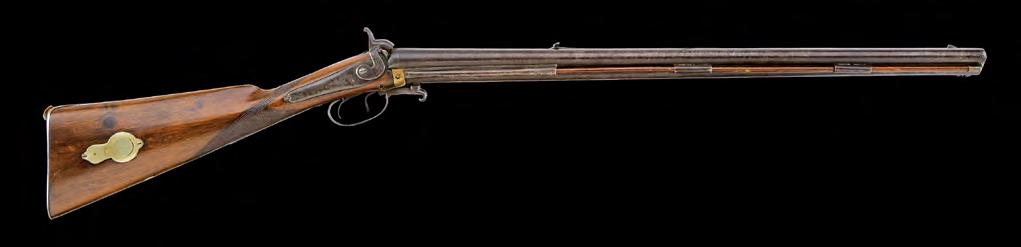
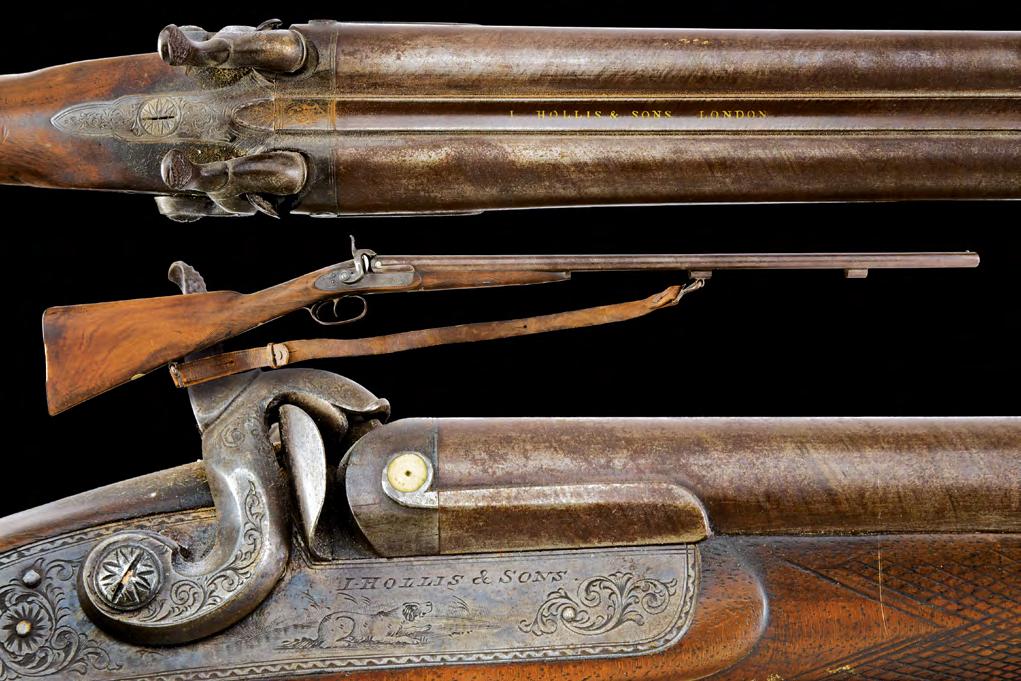
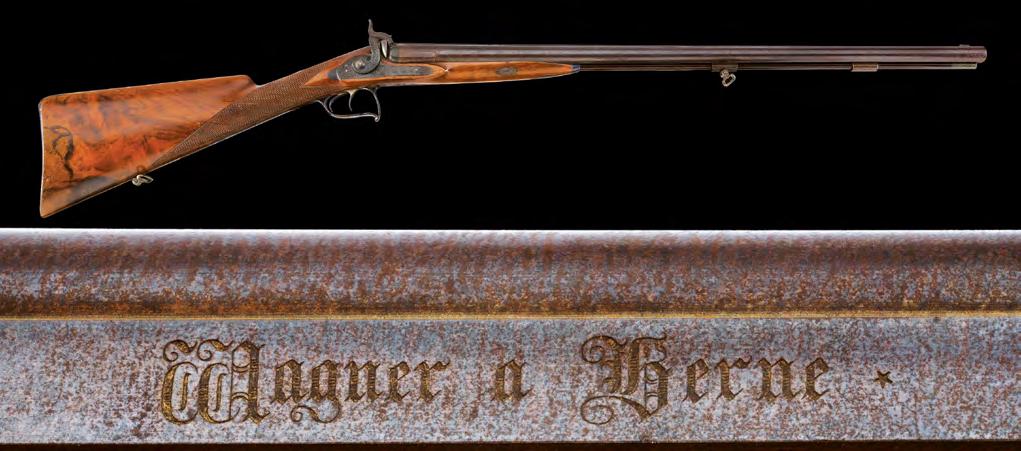
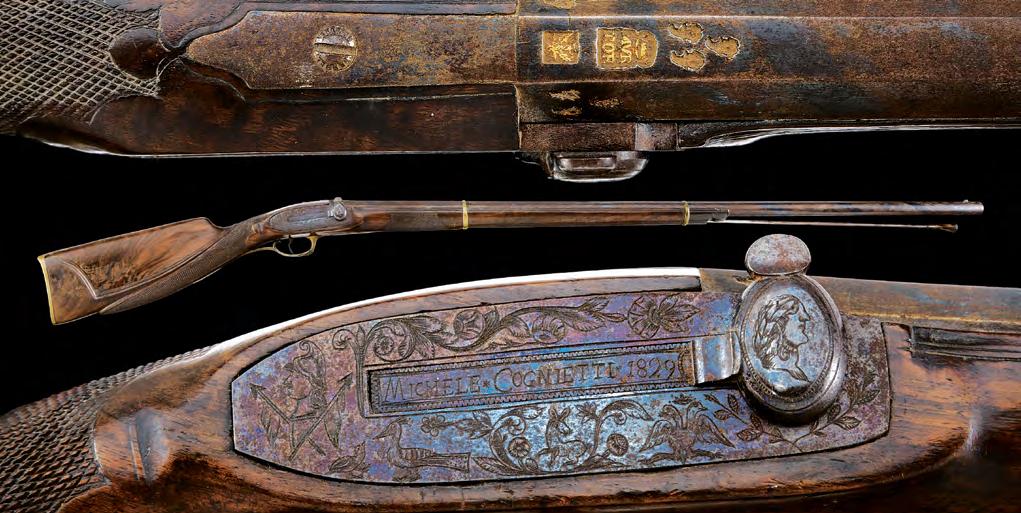
453
A RARE AND INTERESTING PERCUSSION
DRILLING
England, Mid 19th Century
Two twisted smoothbore upper barrels and one rifled lower barrel, with rib (raised in the rear sight area and featuring two holes for an additional rear sight?) marked ‘LONDON FINE...WIS / W.H. BAKER’, fitted with rear sight and foresight, 15 mm and 9 mm cal (the lower barrel). Some defects and a very small crack at the nozzle of the right barrel. Long engraved tang. Backward spring lock decorated en suite, both signed ‘WARD’. Wooden butt with knurled base. Iron mounts engraved en suite. Single trigger for the upper barrels and a second trigger for the lower barrel with an ‘underhammer’ type hammer. Double wooden ramrod, the larger one with a wooden tip and an iron cartridge extractor, the other with a brass tip and an iron cartridge extractor. Some general defects.
Extremely rare percussion drilling, very few muzzleloading examples appear on the market; this particular piece also features a lower barrel of smaller calibre and rifled. It is likely that the two holes present on the rib originally housed the rear sight, later removed and replaced by the one currently mounted in a forward position.
RARO E INTERESSANTE DRILLING A LUMINELLO
Inghilterra, Metà del XIX Secolo
Due canne superiori lisce ed una inferiore rigata, strutturate a torcione, con bindella munita di alzo fisso e mirino, dotata di due sforature (probabilmente l’eventuale montaggio di un alzo regolabile) e marcata “LONDON FINE...WIS / W.H. BAKER”; le volate in cal. 15 mm e 9 mm (quella inferiore). Alcuni difetti e piccolissima rottura nella canna destra in volata. Lunga codetta incisa. Batterie a molla indietro decorate en suite, entrambe firmate “WARD”. Calcio in legno con collo zigrinato. Fornimenti in ferro, decorati nello stesso modo. Singolo grilletto per le canne superiori ed un secondo grilletto per quella inferiore, che è dotata di percussione con cane tipo “underhammer”. Doppia bacchetta in legno, quella a sezione maggiore con battipalla in legno e cavastracci in ferro, l’altra con battipalla in ottone e cavastarcci in ferro. Alcuni difetti generali.
Rarissimo drilling a luminello, pochi esemplari ad avancarica compaiono sul mercato, questo in particolare presenta anche la canna inferiore di calibro minore e rigata. È verosimile che i due fori presenti sulla bindella costituissero l’alloggiamento dell’alzo originale, successivamente rimosso e sostituito con quello attualmente montato in posizione avanzata.
Conditions medium Length 114 cm.
€ 500/1.000
454
A DOUBLE-BARRELELD PERCUSSION SHOTGUN SIGNED HOLLIS
England, Mid 19th Century Smoothbore, juxtaposed, twisted, 17 mm cal barrels provided with a rib featuring the manufacturer’s mark “I. HOLLIS & SONS LONDON” in gold. Forward spring locks with fine engravings of scrolls and animals; engraved “I. HOLLIS & SONS”. Walnut butt with engraved iron mounts. Missing ramrod and original leather sling.
DOPPIETTA A LUMINELLO FIRMA HOLLIS
Inghilterra, Metà del XIX Secolo
Canne lisce giustapposte con struttura a torcione, munite di bindella recante in oro la marca del fabbricante “I. HOLLIS & SONS LONDON”. Cal. 17 mm. Batterie a molla avanti con fini incisioni di volute ed animali; incise “I. HOLLIS & SONS”. Calcio in noce con fornimenti in ferro incisi. Bacchetta mancate e cinghia originale in cuoio.
Conditions medium
Length 116,5 cm. € 550/750
455 A RARE PERCUSSION SHOTGUN
Bern, Mid 19th Century
Juxtaposed, twisted barres, one smoothbore and one rifled, of different calibres, 17 mm and 11 mm (the rifled one); wide rib with a leaf-shaped rear sight and fore-end, marked in Gothic block capitals “WAGNER A BERNE”. Tang engraved with floral motifs. Fine forward spring locks, both signed “WAGNER A BERNE”, with flower-engraved lock plates and cocks (one of the two crests missing). Walnut, half stock, with carved cheekpiece and checkered grip. Browned iron mounts; the trigger guard with XXXXX and the letters “FS” gold-inlaid. Brass-tipped original wooden stock with brass cartridge extractors.
RARA DOPPIETTA COMBINATA A LUMINELLO
Berna, Metà del XIX Secolo
Canne giustapposte strutturate a tortiglione, una liscia e una rigata, di diverso calibro, 17 mm e 11 mm (quella rigata); larga bindella con alzo a foglietta e tacca di mira, marcata in stampatello in caratteri gotici “WAGNER A BERNE”. Codetta incisa a fiorame. Belle batterie a molla in avanti, entrambe firmate “WAGNER A BERNE”, con cartella incisa a fiorami, come pure i cani (uno mancante di cresta). Mezza cassa in noce, con poggiaguancia scolpito e collo zigrinato. Fornimenti in ferro bruniti, il ponticello con corona marchionale e cifre “FS” rimesse in oro. Bacchetta originale in legno con battipalla e cavastracci in ottone.
Conditions good
Length 113 cm.
€ 1.200/1.600
456 A VERY RARE DOUBLE-BARRELED PERCUSSION GUN WITH SIDE COCK BY MICHELE COGNIETTI
Southern Italy, 1829
Smoothbore, two-stage, 18 mm cal. barrel, with tower structure, silver foresight, and powder chamber with gold-inlaid marks; smooth tang. Beautiful flat lock provided with an interesting mechanism, including a side cock, browned and engraved lock plate with floral motifs and animal figures, the hammer throw signed in block letters “MICHELE COGNIETTI 1829,” and its oval, button-shaped head decorated with a female herm. Walnut, half stock with carved and fluted cheekpieces, checkered grips; brown horn muzzle ring. Smooth brass mounts, trigger guard with a stylized arrow design. Horn-tipped iron ramrod (original).
RARO FUCILE A LUMINELLO CON CANE A PERCUSSIONE LATERALE DI MICHELE COGNIETTI
Italia meridionale, 1829
Canna liscia a due ordini con struttura a torcione, mirino in argento e camera di scoppio con punzoni rimessi in oro al dorso; cal. 18 mm. Codetta liscia. Bella batteria piatta con dotata di meccanica con cane a percussione laterale; cartella brunita ed incisa a fiorami, e d effigi di animali; il collo del cane firmato in stampatello “MICHELE COGNIETTI 1829” e con testa a bottone ovale decorata con un’erma muliebre. Mezza cassa in noce con poggiaguancia scolpito e scorniciato, impugnatura zigrinata; bocchino in corno bruno. Fornimenti lisci in ottone, il ponticello codolo anteriore sagomato a freccia stilizzata. Bacchetta originale in ferro con battipalla in corno.
Conditions good
Length 141 cm.
€ 1.200/1.600
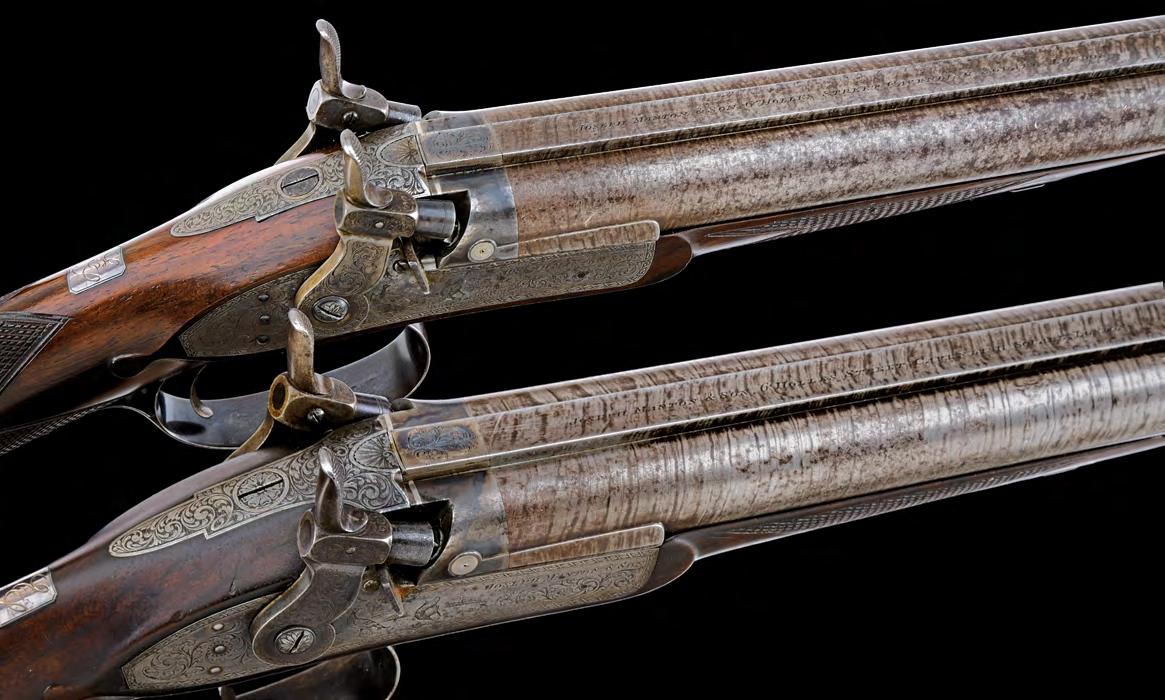
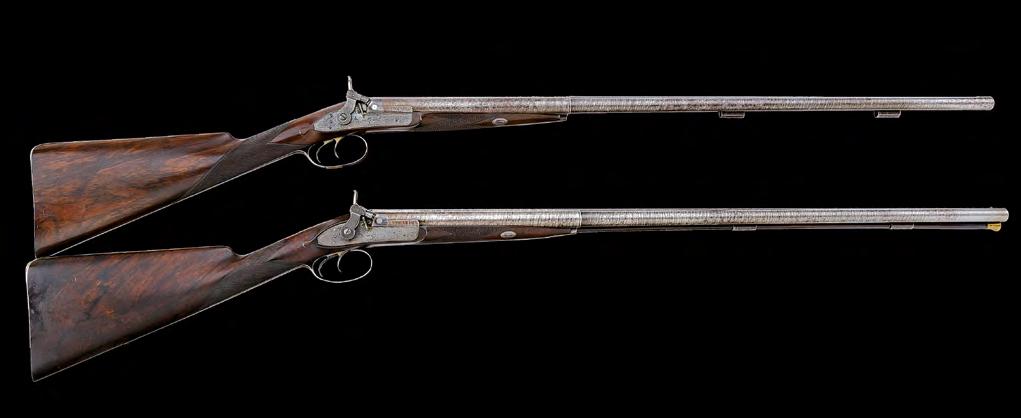
457 A RARE AND INTERESTING PAIR OF PERCUSSION DOUBLE-BARRELED SPORTING GUNS BY JOSEPH MANTON & SON
England, First half of the 19th Century
Both with twisted, two-stage barrels featuring remains of browning, and reinforced in the first segment, 16.2 mm cal at the nozzle. The bores all in good condition with slight signs of use and age; only one shows small defects, possibly resulting from use. Ribs marked “JOSEPH MANTON & SON 6 HOLLES STREET CAVENDISG SQUARE LONDON”.The breech blocks with traces of blueing and finely engraved with scrollwork, also repeated on the tang. On the underside of the barrels, London proof marks and consecutive serial numbers “105xx”. Forward spring locks, all signed “JOSEPH MANTON & SON”, with border engraving and decorated with pheasants or partridges. Working mechanisms.Walnut stocks with chequered grip and fore-end. Both bearing on the grip a silver-plated escutcheon with monogram. Iron mounts. Some elements with traces of old blueing. Trigger guards engraved with pointers and bearing serial numbers corresponding to those on the barrels. Engraved with racemes. Some pitting to the butt plates. Only one double-barrelled shotgun provided with its ramrod.
RARA E INTERESSANTE COPPIA DI DOPPIETTE A LUMINELLO DI JOSEPH MANTON & SON
Inghilterra, Prima metà del XIX Secolo Entrambe con canne a torcione recanti resti di brunitura color marrone, a due ordini tondi e rinforzate nel primo segmento, cal. 16,2 mm in volata. Le anime tutte in buone condizioni con lievi segni d’uso e del tempo, una sola presenta leggeri difetti, forse derivati dall’uso. Bindelle con marcatura “JOSEPH MANTON & SON 6 HOLLES STREET CAVENDISG SQUARE LONDON”. I blocchi di culatta con resti di brunitura color blu ed eleganti incisioni a racemi presenti anche sul codolo. Sul lato inferiore delle canne, punzoni del banco di Londra e matricole consecutive “105xx”. Batterie a molla in avanti, tutte firmate “JOSEPH MANTON & SON”, con cornicette e con incisioni di fagiani o pernici. Meccaniche tutte ben funzionanti. Casse in noce con collo e astina zigrinati. Entrambe recanti al collo scudetto in metallo argentato con monogramma. Fornimenti in ferro. Alcuni elementi con tracce di vecchia brunitura color blu. Ponticelli con incisioni di pointer e con matricole coeve alle canne. Incisioni a racemi. Qualche intaccatura ai calcioli. Una sola doppietta munita di bacchetta.
Conditions good Length 121.5 cm.
€ 1.600/2.000
458
AN ELEGANT JOSEPH MANTON PERCUSSION DOUBLE-BARRELED SPORTING GUN, WITH CASE England, First half of the 19th Century Damask barrels with remains of old browning, 17.4 mm cal. at the nozzle. Clean bores with light signs of use inside. Rib marked “JOSEPH MANTON HANOVER SQUARE LONDON”, serial “90xx”. Marks of the London test bench on the lower side. One barrel with an external scratch. Tang engraved with scrolls and rocaille motifs. Forward spring lock marked “JOSEPH MANTON PATENT”, engraved with floral motifs. Working mechanisms. Half stock of walnut wood with checkered grip. Featuring a silver-coloured metal shield with monogram on the back. Iron mounts with traces of blueing (earlier?), finely engraved. The trigger guard depicts a classical scene of pheasants in a woodland, and with serial number matching the barrels. Butt plate with small pitting. In a wooden case (probably relined), complete with various accessories and key.
ELEGANTE DOPPIETTA A LUMINELLO DI JOSEPH MANTON IN CASSETTA
Inghilterra, Prima metà del XIX Secolo Canne in damasco con resti di vecchia brunitura color marrone, cal. 17,4 mm in volata. Anime pulite con lievi segni d’uso all’interno. Bindella marcata “JOSEPH MANTON HANOVER SQUARE LONDON”. Matr.“90xx” Punzoni del banco di prova di Londra sul lato inferiore. Una canna con graffio all’esterno. Il codolo con incisioni a volute e rocaille. Batterie a molla in avanti recanti marcatura “JOSEPH MANTON PATENT”, ornate con decorazioni a fiorami. Meccaniche ben funzionanti. Mezza cassa in noce con collo zigrinato. Dorso con scudetto in metallo color argento recante monogramma. Fornimenti in ferro con tracce di brunitura color blu (antica?) recanti fini incisioni. Sul ponticello classica scena di fagiani nel bosco e matricola coeva alle canne. Calciolo con un po’ di intaccature. In una cassetta di legno (probabilmente rifoderata), completa di svariati accessori e della chiave.
Conditions good Length 117.3 cm.
€ 1.000/1.500
459
A CASED LUXURY DOUBLE BARRELLED PERCUSSION GUN BY PRELAT
France, Mid 19th Century Smoothbore, round barrels of fine damask (clean bores, with some signs of use inside), provided with signed gilt rib “PRELAT ARQ.ER DU ROI A PARIS”, featuring crowned “NB” marks for Nicolas Boutet on the lower side. The rib is provided with silver foresight, 16 mm cal. at the nozzle. The breech block with traces of old browning, with a raised spark arrester continuing along the sides of the barrels. Tang with remains of browning and engraved floral motifs. Forward spring locks signed in gilt “PRELAT ARQ.ER DU ROI A PARIS”, engraved with fine floral motifs on a browned background with cornucopia. Working mechanisms. Half stock of briarwood with checkered grip (possibly an old repair at the fore-end tip). Iron mounts decorated en suite with remains of browning. Wooden ramrod with brass and iron mounts. In a wooden case (lid damaged) with a Prelat label inside the lid, lined with green cloth, containing various accessories (probably not of the same period) and a key.
BELLA DOPPIETTA A LUMINELLO DI PRELAT IN CASSETTA
Francia, Metà del XIX Secolo
Canne tonde lisce, in fine damasco (anime pulite, qualche segno d’uso all’interno), con bindella firmata in oro “PRELAT ARQ.ER DU ROI A PARIS”, recanti sul lato inferiore punzoni “NB” coronati per Nicolas Boutet. La bindella con mirino in argento, in volata cal. 16 mm. Il blocco di culatta con resti di antica brunitura e parascintille con profilo rilevato che prosegue sul fianco delle canne. Il codolo con resti di brunitura e con incisioni floreali. Batterie a molla in avanti firmate in oro “PRELAT ARQ.ER DU ROI A PARIS” e decorate con bellissime incisioni floreali su fondo brunito e con cornucopie. Meccaniche funzionanti. Mezza cassa in radica con collo zigrinato (forse una vecchia riparazione in punta all’astina). Fornimenti in ferro decorati en suite e con resti di brunitura. Bacchetta in legno con fornimenti in ottone e in ferro. In assetta di legno (danni al coperchio) con etichetta di Prelat dentro al coperchio, foderata all’interno di panno verde, munita di vari attrezzi (probabilmente non coevi) e della chiave.
Conditions good
Length 106.3 cm.
€ 1.500/2.000
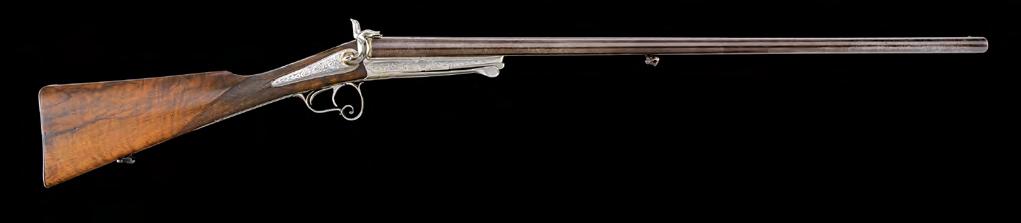
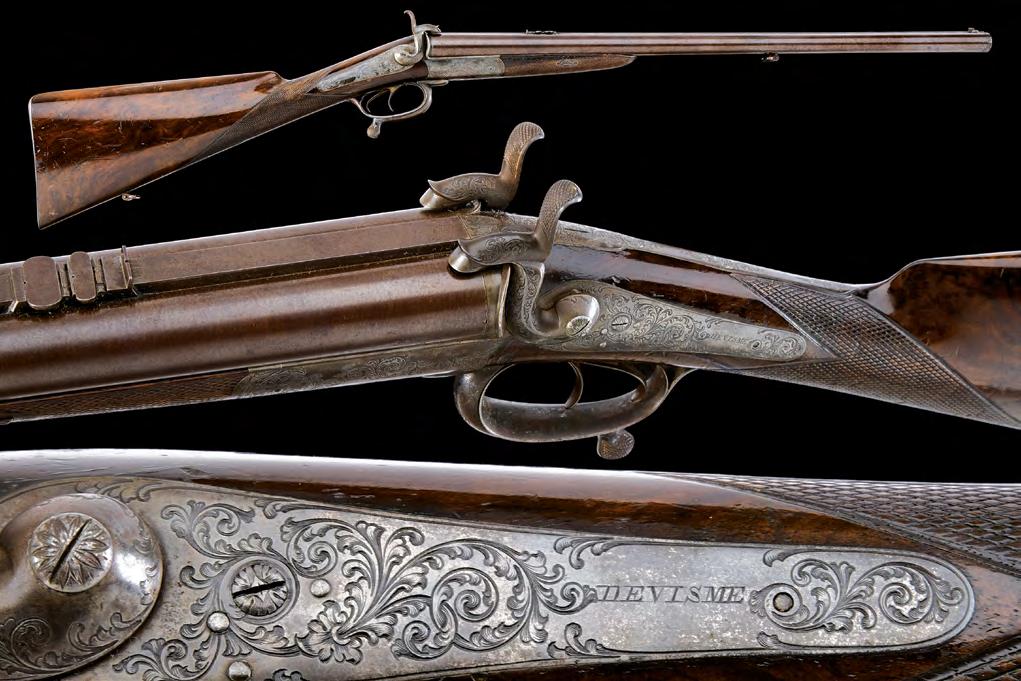
460
A FINE DOUBLE-BARRELED PINFIRE SHOTGUN
St. Etienne, about 1870
Round, smoothbore, 17 mm cal. (16 gauge) barrels (clean bore, with few areas of slight pitting), browned (some missing parts in the finishing), with rib marked “MANUF.RE FRAN.SE D’ARMES ST. ETIENNE”, foresight; long tang engraved with floral motifs. Backward spring locks engraved with floral spirals, like the receiver, the fore-end and all mounts. Wooden butt with checkered grip. Opening lever under the fore-end. Working mechanism.
BELLA DOPPIETTA A SPILLO
St. Etienne, 1870 circa Canne tonde, lisce (anime pulite, scarse le zone con leggero pitting), brunite (alcune mancanze alla finitura), con bindella marcata “MANUF.RE FRAN.SE D’ARMES ST. ETIENNE”, mirino, cal. 17 mm in volata (16 gauge); lunga codetta incisa a motivi floreali. Batterie a molla indietro decorate con incisioni a volute floreali come anche la bascula, l’astina e tutti i fornimenti. Calcio in legno con collo zigrinato. Chiave di apertura sotto all’astina. Meccanica funzionante.
Conditions very good
Length 115.5 cm.
€ 200/400
461 AN INTERESTING EXPRESS RIFLE BY DEVISME
France, 1870
Round, rifled barrels (bores in good condition with slight signs of use and time), juxtaposed, in damask, with dorsal rib featuring the signature “Devisme 36 Boulevart des Italiens A PARIS”, with foresight and rear sight with one fixed sight leaf and two foldaway sight leaves. The finishing with traces of old browning. 17 mm cal. at the nozzle. On the lower part, the marks “DV” crowned and crowned Legion d’Honneur, date “AN 1870” and marks “CANON DE PARIS / FAIT PAR DEVISME”. The receiver features traces of old casehardening (as does the cross) and with serial number and date matching the barrels. The outer surface finely engraved with racemes, as are the dorsal tang and the locks. Backward spring locks, with the signature “DEVISME”. Working mechanism. Butt and fore-end made of walnut, both checkered. Iron mounts worked en suite. The key with rotating opening lever under the trigger guard.
INTERESSANTE EXPRESS A SPILLO DI DEVISME
Francia, 1870
Canne tonde rigate (anime in buono stato con leggeri segni d’uso e del tempo), giustapposte, in damasco, con bindella dorsale recante firma “Devisme 36 Boulevart des Italiens A PARIS”, dotata di mirino e alzo a una foglietta fissa e due abbattibili. La finitura con resti di vecchia brunitura marrone. In volata cal. 17 mm. Nella parte inferiore i punzoni “DV” coronato e a Legion d’Onore coronata, datazione “AN 1870” e marcature “CANON DE PARIS / FAIT PAR DEVISME”. La bascula recante all’interno tracce di vecchia finitura tartarugata (cosi come la croce) e con matricola e datazione coeva alle canne. La superficie esterna finemente incisa a racemi, cosi come il codolo dorsale e le batterie. Queste a molla indietro, recanti anche la firma “DEVISME”. Le meccaniche ben funzionanti. Calcio ed astina in radica di noce, entrambi zigrinati. Fornimenti lavorati en suite, in ferro. La chiave con leva d’apertura a rotazione sotto al ponticello.
Conditions good
Length 101.5 cm.
€ 700/1.000
462
A PERCUSSION PISTOL
France, Mid 19th Century
Octagonal, micro-rifled barrel, slightly bellmouthed at the nozzle, with traces of goldcoloured outlining at the ends and remains of the “CANON TORDU” inscription, also in gold, as well as spirals and raceme decorations. 13,6 mm cal. at the nozzle, with foresight. Tang with fore-end and faint traces of a blue finishing, probably antique. Forward spring lock with working mechanism; lock plate with the signature “Malaure a St. Etienne”. Wooden, half stock with small carvings and a checkered grip. Smooth, iron mounts. Trigger with an adjustment screw. Some signs of use and time.
PISTOLA A LUMINELLO
Francia, Metà del XIX Secolo
Canna ottagonale microrigata, leggermente strombata in volata, recante tracce di delineature dorate alle estremità e con resti di marcatura “CANON TORDU” sempre in oro, oltre a decori a volute e racemi. la volata in cal.13,6 mm, dotata di mirino. Il codolo con tacca di mira e lievi tracce di finitura blu probabilmente antica. Batteria a molla in avanti con meccanica funzionante; la cartella con firma “Malaure a St. Etienne”. Mezza cassa in legno con piccoli intagli e con impugnatura zigrinata. Fornimenti lisci in ferro. Grilletto con vite di regolazione. Qualche segno d’uso e del tempo.
Conditions good Length 37.7 cm.
€ 150/250
463
A FINE AND ELEGANT PERCUSSION
POCKET PISTOL BY W. SMITH
London, Mid 19th Century Smoothbore, 12 mm cal. barrel of round section, turn-off, browned; the chamber engraved with floral motifs and with two English marks; nozzle with ring and an engraved geometric decoration. Box-lock frame engraved with trophies; on one side, the signature “W. SMITH” within a gold ellipse; the other marked “LONDON”. Central upper cock with working mechanism. Wooden butt with silver mounts, depicting a cornucopia and trophy on the back. Foldaway trigger.
BELLO ED ELEGANTE MAZZAGATTO A LUMINELLO DI W. SMITH
Londra, Metà del XIX Secolo
Canna lisca a sezione tonda, svitabile, brunita, la camera di scoppio con incisioni floreali al dorso e due punzoni inglesi, la volata con anello in oro e decorazione geometrica incisa; cal. 12 mm. Castello del tipo box-lock recante incisioni a trofei, su una faccia la firma entro ellisse dorato “W. SMITH”, l’altra faccia marcata “LONDON”. Il cane al dorso, in posizione centrale, con meccanica funzionante. Calcio in legno con fornimenti in argento, effigianti cornucopia e trofeo al dorso. Grilletto a scomparsa.
Conditions very good
Length 15.5 cm.
€ 250/450
464
A FLINTLOCK PISTOL BY ROUGE
Belgium, circa 1800
Octagonal, micro-rifled, 18 mm cal. barrel, browned with damascus design, signed “A. Rougé” in gold, with mark of the Liegi test bench, with foresight; engraved tang provided with rear sight. Flintlock mechanism, signed en suite and engraved with floral motifs. Wooden full stock with checkered butt and iron mounts engraved with floral motifs. Horn-tipped wooden ramrod. Working mechanism.
PISTOLA A PIETRA FOCAIA DI ROUGE
Belgio, 1800 circa Canna ottagonale, micro-rigata, brunita, damascata, firmata “A. Rougé” in oro, con punzone del banco di prova di Liegi, dotata di mirino, cal. 18 mm; codetta incisa e munita di alzo. Batteria a pietra focaia,
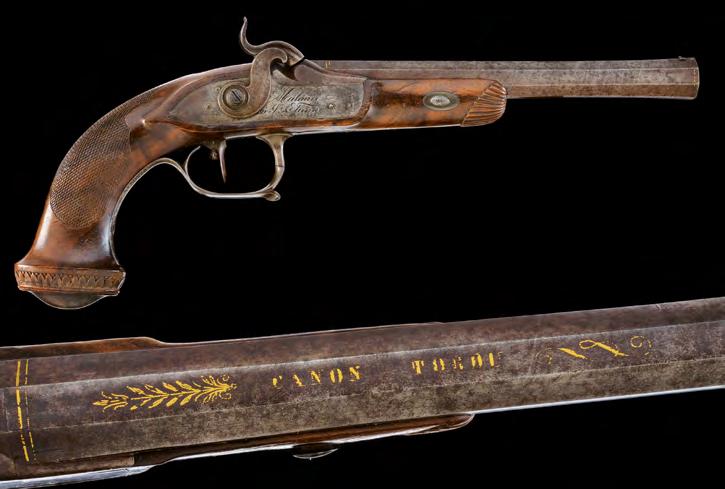
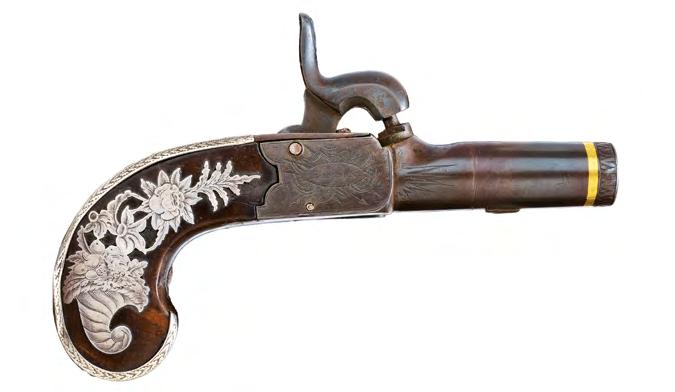
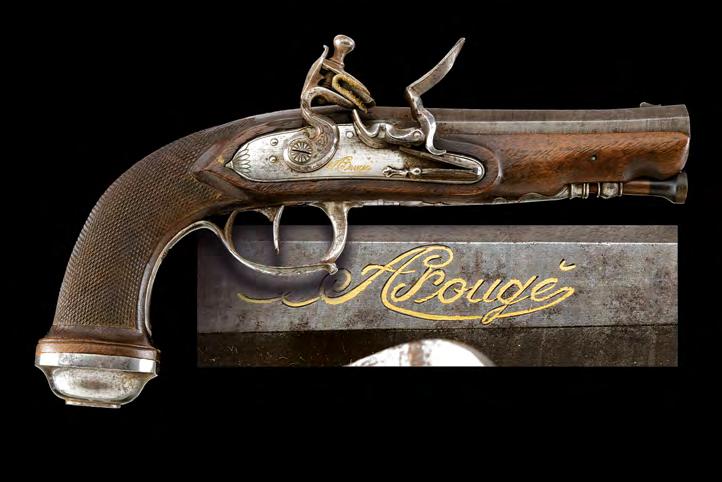
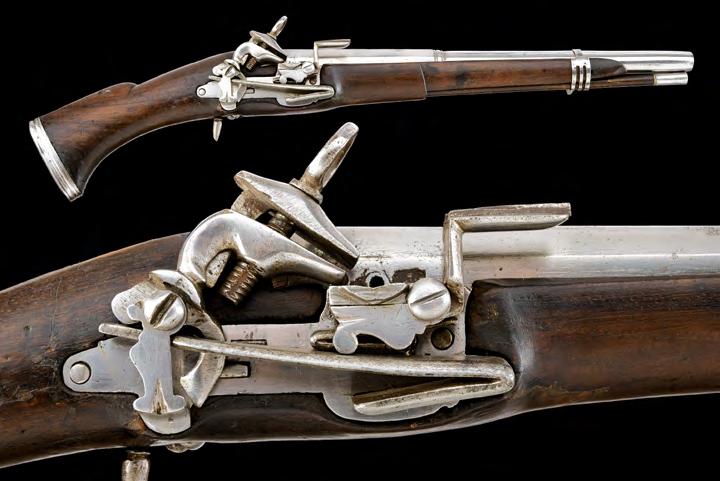
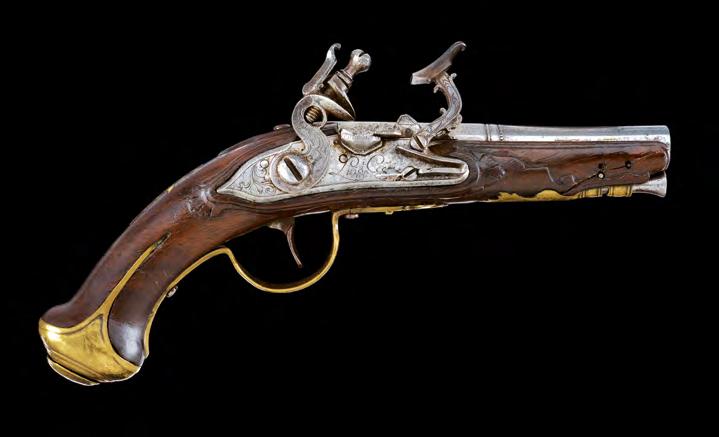
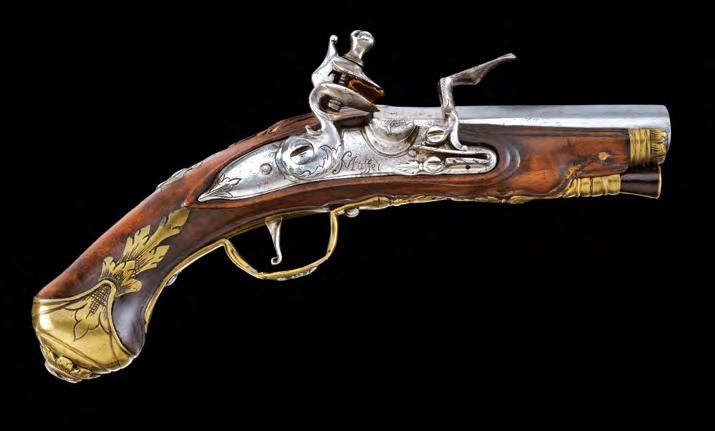
firmata en suite ed incisa a motivi floreali. Cassa intera in legno con calcio zigrinato e fornimenti in ferro incisi a motivi floreali. Bacchetta in legno con battipalla in corno. Meccanica funzionante.
Conditions good Length 27 cm.
€ 250/450
465
A MIQUELET LOCK PISTOL
Italy, Second half of the 17th Century Smoothbore, two-stage, 12 mm cal. barrel, octagonal and round, with rings at the girdle. Catalan-style lock entirely made of iron. Long wooden stock with Brescian-style butt. Iron butt-plate with rings, cusp-shaped trigger without trigger guard. Neapolitan-style, iron barrel bracket. Iron-tipped wooden ramrod. Long belt hook.
PISTOLA ALLA MICHELETTA
Italia, Seconda metà del XVII Secolo Canna liscia a due ordini, ottagonale e tonda, con anellature al cambio, cal. 12 mm. Batteria alla catalana interamente in ferro. Cassa lunga in legno con calcio alla bresciana. Coccia con anellatura in ferro, grilletto a cuspide senza ponticello. Reggicanna di gusto napoletano, in ferro. Bacchetta in legno con battipalla in ferro. Lungo gancio da cintura.
Conditions good Length 52.3 cm.
€ 350/550
466
A SMALL SNAPHAUNCE LOCK PISTOL SIGNED LUIGI CECCI
Tuscany, Third quarter of the 18th Century Smoothbore, two-stage,10 mm cal. barrel, square and round with a beaded frame at the girdle; powder chamber featuring a brand name and marks, already gilded. Florentinestyle lock plate with flat receiver, signed in italics “Luigi Cecci” and finely engraved with plant motifs. Full stock of walnut wood with small frames and grooves. Simple, smooth brass mounts. Original iron ramrod.
PICCOLA PISTOLA ALLA FIORENTINA FIRMATA LUIGI CECCI
Toscana, Terzo quarto del XVIII Secolo Canna liscia a due ordini, quadra e tonda, con cornicetta perlinata al cambio, sulla camera di scoppio marca e punzoni già dorati. Cal. 10 mm. Batteria a pietra con cartella piatta, firmata in corsivo “Luigi Cecci” e ben incisa a motivi fitomorfi. Cassa intera in noce con cornicette e scanalature. Sobri fornimenti lisci in ottone. Bacchetta originale in ferro.
Conditions medium Length 18 cm.
€ 400/700
467
A FLINTLOCK POCKET PISTOL BY MAFFEI Central Italy, Mid 18th Century Smoothbore, round, 10 mm cal. barrel, flat on the back decorated with engraved elements. Engraved tang. Modern flintlock, rounded lock plate, signed “Maffei” in block letters. Sull stock of walnut wood, slightly sculpted; brass mounts engraved with plant motifs and spirals, trigger guard, butt-plate and counterplate surmounted by small silver busts. Brass-tipped, wooden ramrod. Working mechanism.
PISTOLA DA VIAGGIO A PIETRA FOCAIA FIRMATA MAFFEI
Italia centrale, Metà del XVIII Secolo Canna liscia, tonda con dorso piatto decorato con incisioni; cal. 10 mm. Codetta incisa. Batteria a pietra focaia alla moderna, cartella bombata, firmata “Maffei” in stampatello. Cassa intera in noce leggermente scolpito, fornimenti in ottone incisi a volute fitomorfe; ponticello, la coccia e la contropiastra caricati da piccoli busti in argento. Bacchetta in legno con battipalla in ottone. Meccanica funzionante.
Conditions good Length 18 cm.
€ 600/900
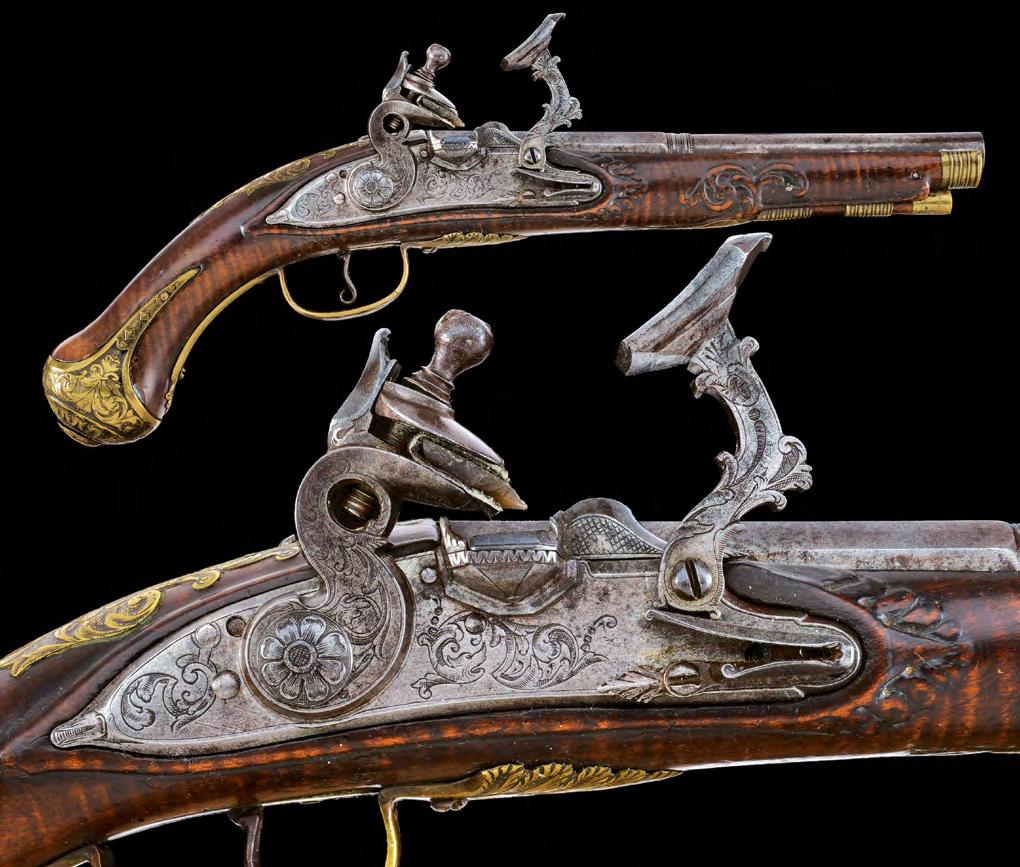
468
A SNAPHAUNCE LOCK PISTOL SIGNED BRAMANTI
Umbria, Mid 18th Century
Two-stage, smoothbore, 11 mm cal. barrel, square and round, with a grooved and beaded frame at the girdle; stamped in block letters on the square section “CANNA A TORTIGLIONE” (twisted barrel) and with square brass mark. Lock with a flat lock plate, finely engraved with floral motifs, signed on the inside in italics “Bramanti”. Tiger maple case, with some molded contours and racemes in basrelief on the body. Brass mounts with fine burin engravings. Counterplate without its belt hook. Brass-tipped, original wooden ramrod with iron cartridge extractors.
Barbiroli lists three known Bramanti, all from the mid-18th century and from Umbria; two are named Antonio (from Celalba and Foligno) and one is Giovanni Antonio Battista. The known items by these three gunsmiths (archibug makers or azzali makers) have various signatures, similar to ours (one documented pair is even dated 1752). Barbiroli admits that this may be the same gunsmith, who signed his works with different markings. See “Repertorio Storico degli Archibugiari Italiani” (Clueb, 2012), pp. 136–137.
PISTOLA ALLA FIORENTINA FIRMATA BRAMANTI
Umbria, Metà del XVIII Secolo
Canna liscia a due ordini, quadra e tonda, con cornicetta scanalata e perlinata al cambio; marcata in stampatello sulla parte quadra “CANNA A TORTIGLIONE” e con punzone quadro rimesso in ottone. Cal. 11 mm. Batteria con cartella piatta ben incisa a fiorami, firmata all’interno in corsivo “Bramanti”. Cassa in acero tigrato, con alcune scorniciature e racemi in bassorilievo al fusto. Fornimenti in ottone con fini incisioni a bulino. La contropiastra mancante di gancio da cintura. Bacchetta originale in legno con cavastracci in ferro e battipalla in ottone.
Barbiroli riporta tre Bramanti noti, tutti della metà del XVIII secolo ed umbri, due hanno nome Antonio (di Celalba e Foligno) uno Giovanni Antonio Battista. Gli esemplari conosciuti dei tre armaioli (archibugiari o azzalinieri) presentano varie firme, simili alla nostra (una coppia documentata è datata addirittura 1752). Barbiroli non esclude che possa trattarsi dello stesso armaiolo, che sigla le proprie opere con marcature diverse. Vedi “Repertorio Storico degli Archibugiari Italiani” (ed. Clueb 2012) pagg. 136-137.
Conditions good
Length 31,5 cm.
€ 900/1.200
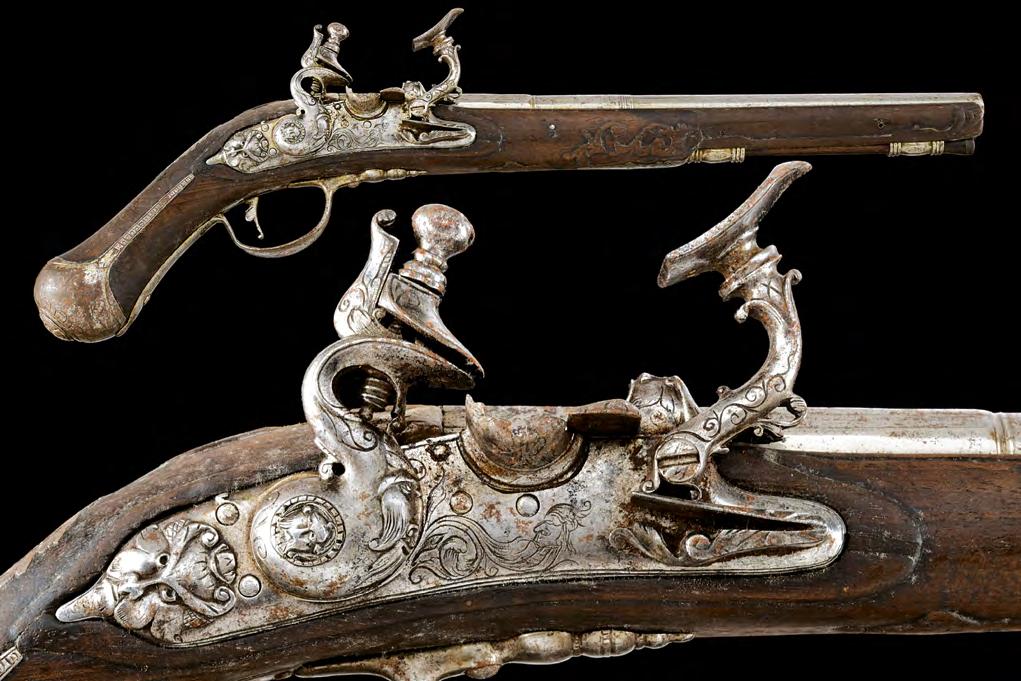
469 A SNAPHAUNCE LOCK PISTOL
Tuscany, First half of the 18th Century Smoothbore, three-stage, 12 mm cal barrel, octagonal at the first part, signed “..... COMINAZZO”, then with two round sections. Beautiful snaphaunce lock engraved at the centre with a blowing mask (Aeolus?), the tang with a finely sculpted mask, the cock with a mask on the profile of the base, and the screw also with a mask in relief; pan cover with carved face, the batterie decorated with floral motifs. Full wooden stock (minor defects), iron mounts engraved with floral motifs, the pommel with mask. Belt hook. Horn-tipped, wooden ramrod and iron cartridge extractor.
PISTOLA ALLA FIORENTINA
Toscana, Prima metà del XVIII Secolo
Canna liscia a tre ordini, prima ottagonale, firmata “..... COMINAZZO” poi con due segmenti tondi, cal.12 mm. Bellissima batteria alla fiorentina incisa al centro con mascherone che soffia (Eolo?), la coda con un mascherone ben rilevato, il cane con mascherone sul profilo del collo, e anche la vite con un mascherone in rilievo; copriscodellino con volto intagliato, la martellina decorata a motivi floreali. Cassa intera in legno (piccoli difetti), fornimenti in ferro incisi a motivi floreali, la coccia con mascherone. Gancio da cintura. Bacchetta in legno con battipalla in corno e cavastracci in ferro.
Conditions medium
Length 42 cm.
€ 500/800
470 A SNAPHAUNCE LOCK PISTOL
Tuscany, Mid 18th Century
Smoothbore, two-stage, 12 mm cal. barrel square and round, with longitudinal grooves at the first section. Fine lock with flat lock plate decorated with engraved floral spirals. Full stock of dark walnut wood, decorated with sphinxes in bas-relief on the fore-end. Elegant iron mounts, with bas-relief medallions. Wooden ramrod with baluster-style iron butt tip.
PISTOLA ALLA FIORENTINA
Toscana, Metà del XVIII Secolo
Canna liscia a due ordini, quadra e tonda, il primo segmento con delineature longitudinali; cal. 12 mm. Bella batteria con cartella piatta, ornata con elementi incisi a volute fiorite. Cassa intera in noce scuro, decorata con sfingi in bassorilievo al fusto. Eleganti fornimenti in ferro, con medaglioni in bassorilievo. Bacchetta in legno con battipalla in ferro operato a balaustro.
Conditions medium
Length 40 cm.
€ 750/1.200
471 A FINE SNAPHAUNCE LOCK PISTOL BY MASTER “FERRETTI A FILIGARE”
Tuscany, Mid 18th Century
Smoothbore, two-stage, square and round, 13.5 mm cal barrel with small frames at the change and breech; on the square part, marks and countermarks of the gunsmith among nine golden lilies. Engraved tang. Florentine-style lock, with semi-convex plate, decorated with bas-relief figures in the central part and a beautiful mask in the tail; hammer neck, spring and hammer also engraved and chiselled. Full stock in grained maple. On the grip, a beautiful shield with a bust between two sphinxes and grotesques below. Horn-tipped, wooden ramrod.
BELLA PISTOLA ALLA FIORENTINA DEL MAESTRO “FERRETTI A FILIGARE”
Toscana, Metà del XVIII Secolo
Cana liscia a due ordini, quadra e tonda con cornicette al cambio e alla culatta; sulla parte quadra marche e contromarca di armaiolo tra nove gigli dorati; cal. 13.5 mm in volata. Codetta incisa. Batteria a pietra, con cartella semi-bombata, ornata da figure in bassorilievo nella parte centrale e un bel mascherone nella coda; collo del cane, molla e martellina anch’esse incise e cesellate. Cassa intera in acero venato.
Sull’impugnatura un bello scudetto con un bustino fra due sfingi e sotto grottesche. Bacchetta in legno con battipalla in corno.
Conditions very good
Length 34 cm.
€ 1.200/1.500
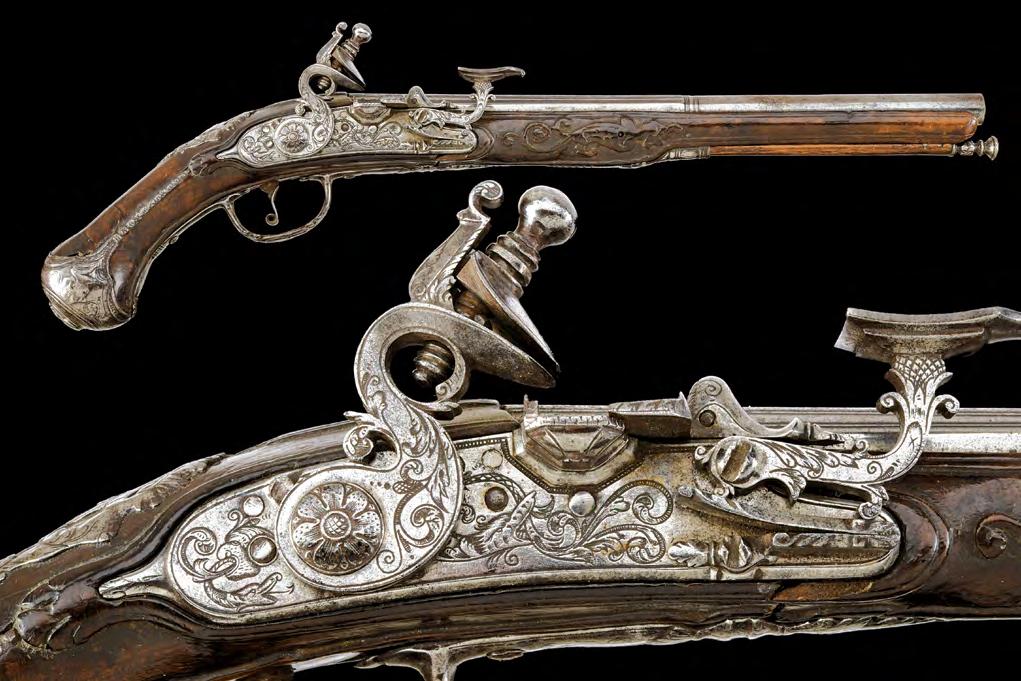
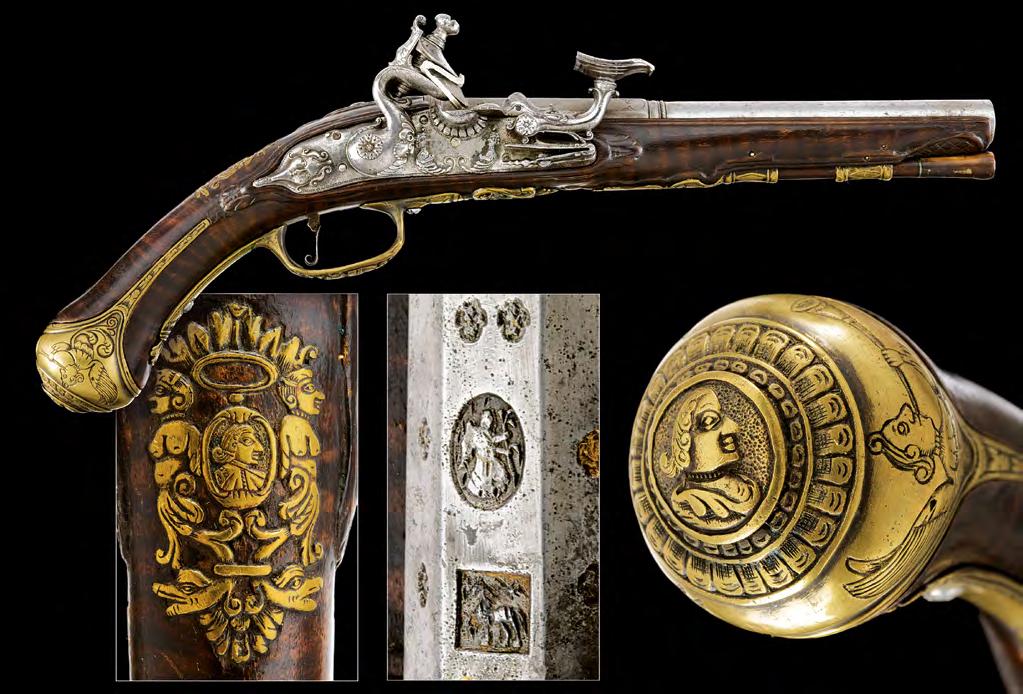
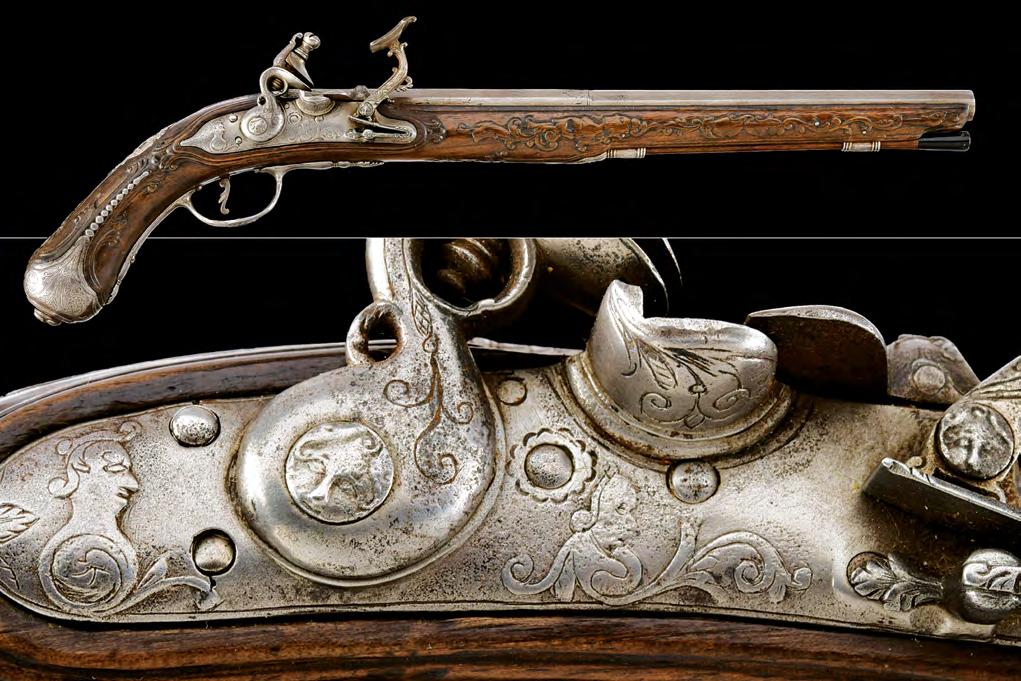
472
A SNAPHAUNCE LOCK HOLSTER PISTOL
Anghiari, First half of the 18th Century Smoothbore two-stage barrel, square and faceted, with small frames at the breech and foliage engraving; caliber 13 mm. Snaphaunce lock with rounded plate, decorated with engravings of sphinxes and scrolls in bas-relief. The hammer and batterie screw carved in the shape of a mask. Wooden full stock with Anghieresestyle carvings. Iron mounts, a badge on the back and counterplate exposed and chiseled with figures and profiles. Carved and engraved volute stock. Dark-horntipped wooden ramrod with iron cartridge extractor.
PISTOLA DA FONDA ALLA FIORENTINA
Anghiari, Prima metà del XVIII Secolo
Canna liscia a due ordini, quadra e faccettata, con cornicette alla culatta e incisone di fogliame (anche al cambio d’ordine); cal. 13 mm. Batteria alla fiorentina con cartella bombata, decorata da incisioni a sfingi e volute in bassorilievo. La vite del cane e della martellina intagliate a mascherone. Cassa intera in noce con intagli alla moda Anghierese. Fornimenti in ferro, stemma sul dorso e contropiastra messi a giorno e cesellati con figure e profili. Coccia intagliata ed incisa a volute. Bacchetta in legno con cavastracci in ferro e battipalla in corno bruno.
Conditions good
Length 46 cm.
€ 1.200/1.500
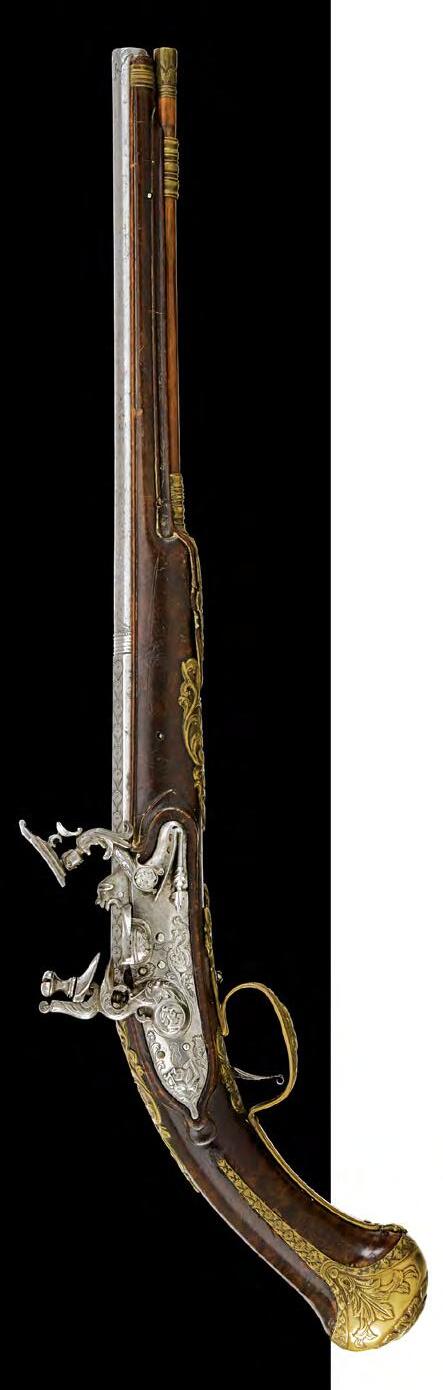
473
A SNAPHAUNCE LOCK PISTOL
Umbria, First half of the 18th Century Smoothbore, two-stage, 10 mm cal. barrel, square and round with a grooved frame at the girdle; the square section is engraved with floral spirals on all sides, like the nozzle. A beautiful snaphaunce lock, semi-curved, engraved with grotesques and carved with masks and busts in bas-relief. The base of the batterie is fretworked with a sphinx. Full stock is made of tiger maple. Beautiful carved mounts carved en suite. The counterplate featuring an iron saddle hook. Brass-tipped, wooden ramrod with iron cartridge extractors.
PISTOLA ALLA FIORENTINA
Umbria, Prima metà del XVIII Secolo Canna liscia a due ordini, quadra e tonda con cornicetta scanalata al cambio, la parte quadra incisa a volute floreali su tutte le facce, cosi come anche alla volata; cal. 10 mm. Bellissima batteria alla fiorentina, cartella semibombata, incisa con grottesche ed intagliata con mascheroni e bustini in bassorilievo. Il collo della martellina messa a giorno con una sfinge. Cassa intera in acero tigrato. Bei fornimenti intagliati en suite. La contropiastra con gancio da arcione in ferro. Bacchetta in legno con battipalla in ottone e cavastracci in ferro.
Conditions very good
Length 51 cm.
€ 1.200/1.600
474
A LONG SNAPHAUNCE LOCK PISTOL
North Italy, about 1690 Long, two-stage, 13 mm cal. barrel, square and faceted with grooved frame at the girdle; snaphaunce lock with semi-dome lock-plate, engraved with floral motifs on the end, hammer throw and batterie with carvings in basrelief. Walnut, full stock (the front part of the shaft restored). Smooth, iron mounts with some moldings. Counterplate with a stirrup hook. Turned-tipped wooden ramrod and turned cartridge extractors.
LUNGA PISTOLA ALLA FIORENTINA
Italia settentrionale, 1690 circa Canna lunga a due ordini, quadra e faccettata con cornicetta scanalata al cambio d’ordine; cal. 13 mm. Batteria a pietra con cartella semibombata, incisa sulla coda a motivi floreali, il collo del cane e la martellina con intagli in bassorilievo. Cassa intera in noce (la parte anteriore del fusto restaurata). Fornimenti lisci in ferro con alcune modanature. Contropiastra con gancio da arcione. Bacchetta in legno con cavastracci e battipalla tornito.
Conditions medium
Length 66 cm.
€ 1.500/2.000
475
A SNAPHANCE HOLSTER PISTOL
North Italy, third quarter of the 17th Century Long, smoothbore, two-stage, 13 mm cal. barrel, the first part octagonal with frame, signed “LAZARI COMINAZ” and decorated with floral engravings (refreshed), then round with a ring. Tang with engravings en suite. Long, narrow lock with flat lock plate, carved with mask at the base, cock screw with mask, and batterie carved with floral motifs; sliding pan cover. Wooden, full stock decorated with finely perforated and engraved iron inlays featuring floral and serpent motifs; counterplate decorated en suite; mounts made of carved iron with floral motifs. Replaced ramrod. Restoration under the barrel.
PISTOLA ALLA FIORENTINA DA FONDA
Italia settentrionale, terzo quarto del XVII Sec.
Lunga canna liscia a due ordini, ottagonale nel primo segmento, con cornice in culatta, firma “LAZARI COMINAZ” e superficie decorata con incisioni floreali (rinfrescate); il secondo segmento di sezione tonda con anellature al cambio, cal. 13 mm. Codetta con incisioni en suite. Batteria lunga, stretta e con cartella piatta, intagliata con mascherone alla base, vite del cane a mascherone e martellina intagliata a fiorame; copriscodellino scorrevole. Cassa intera in legno decorato con tarsie in ferro finemente traforate ed incise a motivi floreali e serpenti, contropiastra decorata en suite; fornimenti in ferro intagliati a motivi floreali. Bacchetta di ricambio. Restauro sotto la canna.
Conditions medium
Length 55 cm.
€ 1.800/2.500
476
A LONG AND BEAUTIFUL FLINTLOCK PISTOL
Brescia, Second half of the 17th Century Smoothbore, double-stage, 12 mm cal. barrel; octagonal at the first part, with the signature “LAZARINO COMINAZZO” and ribbing, then round with narrow rib. Flintlock mechanism partially carved with floral motifs in bas-relief. Slightly carved wooden full stock, with beautiful steel mounts richly sculpted with grotesques and plant motifs in bas-relief; the band of the barrel bracket and the muzzle are finely decorated. Iron belt hook with heart-shaped pierced head. Iron-tipped, wooden ramrod worked as a baluster and iron cartridge extractors.
An elegant, long Brescian flintlock pistol with remarkable mounts, finely crafted in bas-relief.
BELLA PISTOLA A PIETRA FOCAIA
Brescia, Seconda metà del XVII Secolo
Canna liscia a due ordini; la prima parte ottagonale con firma “LAZARINO COMINAZZO” e munita di nervature, la seconda parte tonda con sottile bindella, cal. 12 mm. Batteria a pietra focaia parzialmente intagliata a motivi floreali in bassorilievo. Cassa intera in legno leggermente intagliato, con bellissimi fornimenti in acciaio riccamente scolpiti a grottesche e motivi fitomorfi in bassorilievo; anche la fascetta reggibacchetta e il bocchino ben decorati. Gancio da cintura in ferro con testa traforata a cuore. Bacchetta in legno con battipalla in ferro ben operato a balaustro, e cavastracci in ferro.
Elegante e lunga pistola Bresciana a pietra focaia con notevoli fornimenti ben operati in bassorilievo.
Conditions good Length 56 cm.
€ 3.000/3.800
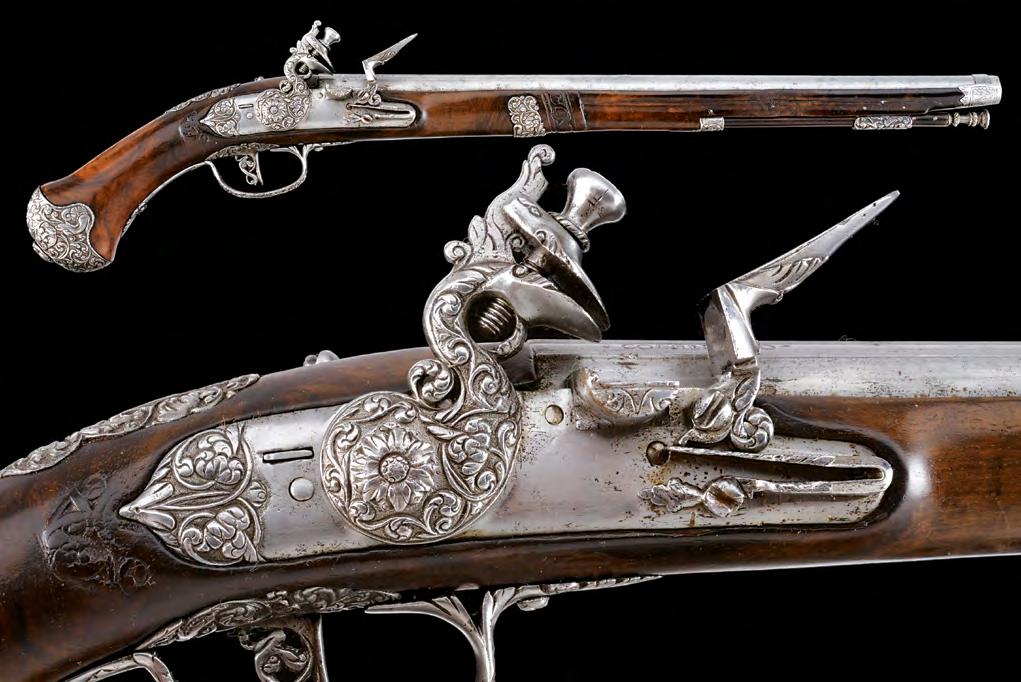
477
A CHARMING PAIR OF POCKET FLINTLOCK PISTOLS SIGNED D. DE ORAZIO
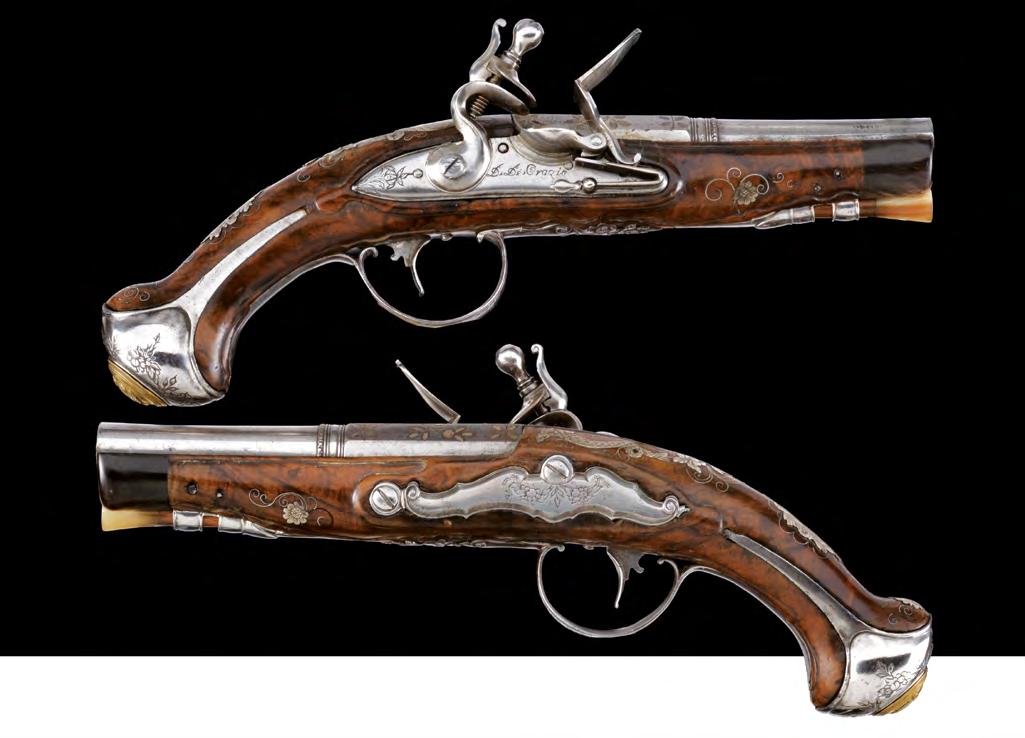
Italy, Second half of the 18th Century Elegant, smoothbore, two-stage, 14 mm cal. barrels, square and round, with smooth and beaded rings at the girdle; the powder chambers with silver-inlaid decorations with floral motifs; tangs with defined borders and floral motifs. Flintlock with round lock plates; the ends with engraved flower, in the centre the signature “D. De. Orazio” in cursive. Wooden, full stocks with magnificent steel and silver mounts; the steel parts, as well as the trigger guard, butt-plate, and counterplate, with simple engravings of plant motifs, particularly the butt-plates of elliptical shape with a gilded metal element at the top; the silver elements are found mainly on the upper part of the butt, between the tangs two beautiful sea serpents, on the back a frame with elliptical medallion, this featuring an engraved house with a palm tree; just before the horn muzzle ring, on both sides, two additional silver flower mounts; some missing parts. Light-colored horn-tipped wooden ramrods. Excellent quality.
DELIZIOSO PAIO DI PISTOLE DA VIAGGIO A PIETRA FOCAIA FIRMATE D. DE ORAZIO
Italia, Seconda metà del XVIII secolo Eleganti canne lisce a due ordini, quadre e tonde con anellature lisce e perlinate al cambio; le camere di scoppio con decorazioni rimesse in argento a motivi floreali al dorso; cal. 14 mm in volata. Le codette con bordo delineato e recanti incisioni a fiori. Batterie a pietra focaia con cartella tondeggiante, le code con fiore inciso, nella parte centrale la firma “D. De. Orazio” in corsivo. Casse intere in legno con magnifici fornimento in acciaio ed argento; i primi, come il ponticello, la coccia e la contropiastra con sobrie incisioni a motivi fitomorfi, in particolare le cocce, di forma ellittica con elemento in metallo dorato al colmo. Gli elementi in argento si trovano principalmente nella parte superiore del calcio: fra le codette due bei serpenti marini, al dorso una cornice con medaglione ellittico, questo recante incisa un edificio con palma; poco prima del bocchino in corno, su entrambi i lati, due ulteriori fornimenti in argento a fiore; alcune mancanze. Bacchette in legno con battipalla in corno chiaro. Di ottima qualità.
Conditions good
Length 24 cm.
€ 1.600/2.200
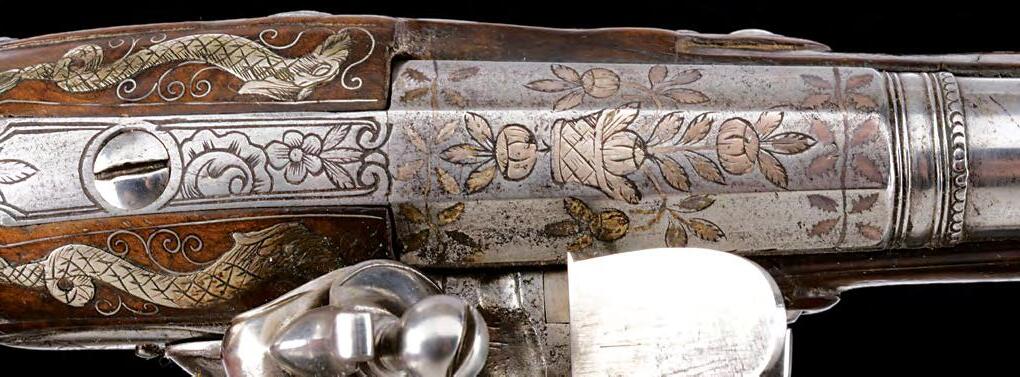
478
A PAIR OF SNAPHAUNCE LOCK PISTOLS BY PIETRO TOMASI
Tuscany, last quarter of the 18th Century Smoothbore, two-stage, 11 mm cal. barrels, ribbed at the first part marked “G. L. P.”, then round after rings; locks signed “PIETRO TOMASI” and engraved and carved with floral motifs. Wooden full stocks, with brass mounts. Horn-tipped wooden ramrods.
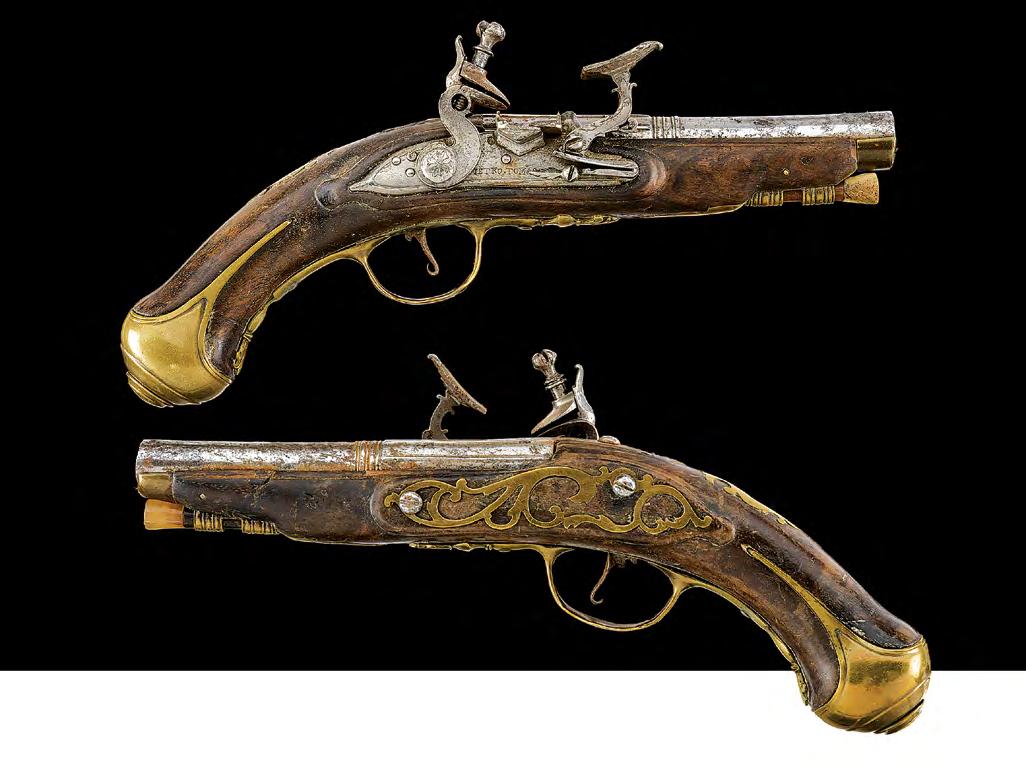
Illustrated in “Pistole” by A. Sala, pages 60/61.
PAIO DI PISTOLE ALLA FIORENTINA DI PIETRO TOMASI
Toscana, ultimo quarto del XVIII Sec. Canne lisce a due ordini, nervate nella prima parte e marcate “G. L. P.”, poi tonde e con anellature al cambio, cal. 11 mm. Batterie firmate “PIETRO TOMASI” ed incise ed intagliate a motivi floreali. Casse intere in legno con fornimenti in ottone. Bacchette in legno con battipalla in corno.
Illustrate in “Pistole” di A. Sala, pagine 60/61.
Conditions medium
Length 23 cm.
€ 500/800
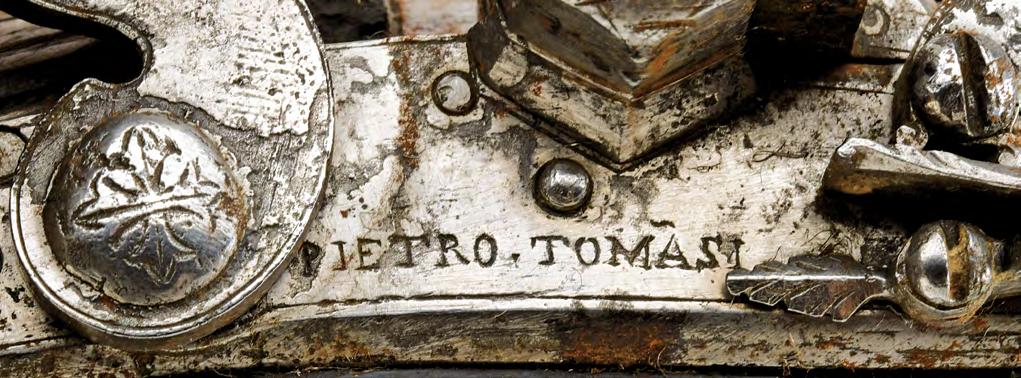
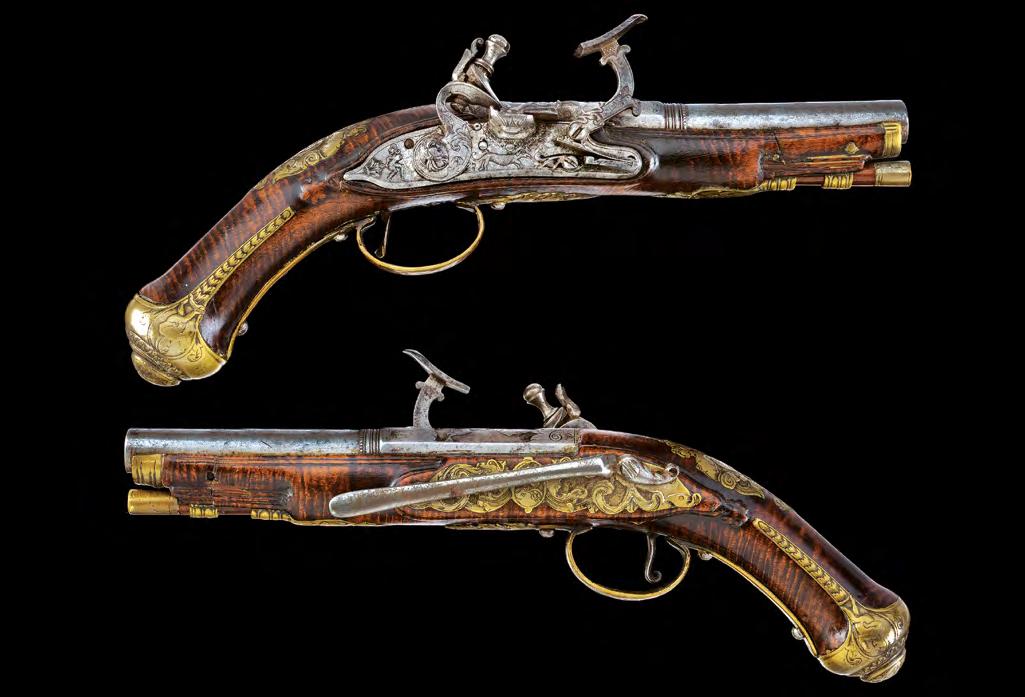
479
A PAIR OF SNAPHAUNCE LOCK PISTOLS
Tuscany, Mid 18th Century Smoothbore, two-stage barrels, square and round with grooved and beaded frames at the breech; powder chambers carved in bas-relief with fine male figures playing the trumpet. 12 mm cal. at the nozzle. Engraved tangs. Lock plate with flat lock plates, engraved with human and animal figures; the trigger screw carved in bas-relief with a male profile. Wooden full stock in tiger maple (one with small defects and missing parts). Fine brass mounts with engraved decorations and figures carved in bas-relief. Iron saddle hooks on the counterplates. Brass-tipped, wooden ramrods with iron cartridge extractors.
PAIO DI PISTOLE A PIETRA FOCAIA ALLA FIORENTINA
Toscana, Metà del XVIII Secolo
Canne lisce, a due ordini, quadre e tonde con cornicette scanalate e perlinate al cambio, le camere di scoppio intagliate in bassorilievo con belle figure maschili intente a suonare la tromba. Cal. 12 mm in volata. Codette incise. Batteria con cartelle piatte, incise con figure umane e animali, la vite del cane intagliata in bassorilievo con un profilo maschile. Casse intere in legno di acero tigrato (una con piccoli difetti e mancanze). Bei fornimenti in ottone con incisioni e figure intagliate in bassorilievo. Alle contropiastre con ganci da arcione in ferro. Bacchette in legno con cavastracci in ferro e battipalla in ottone.
Conditions good
Length 26 cm.
€ 700/1.000
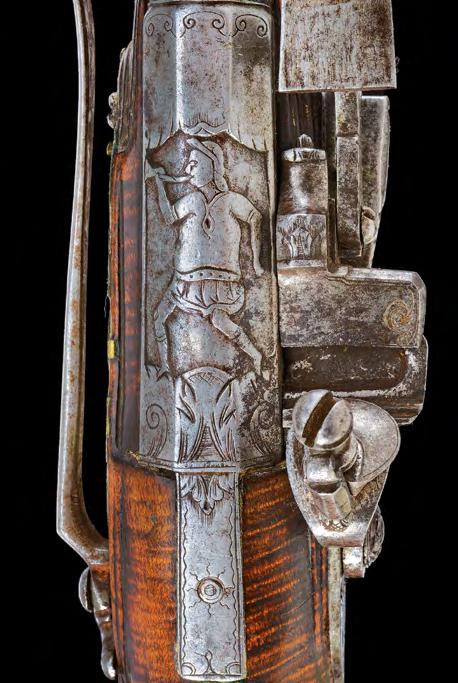
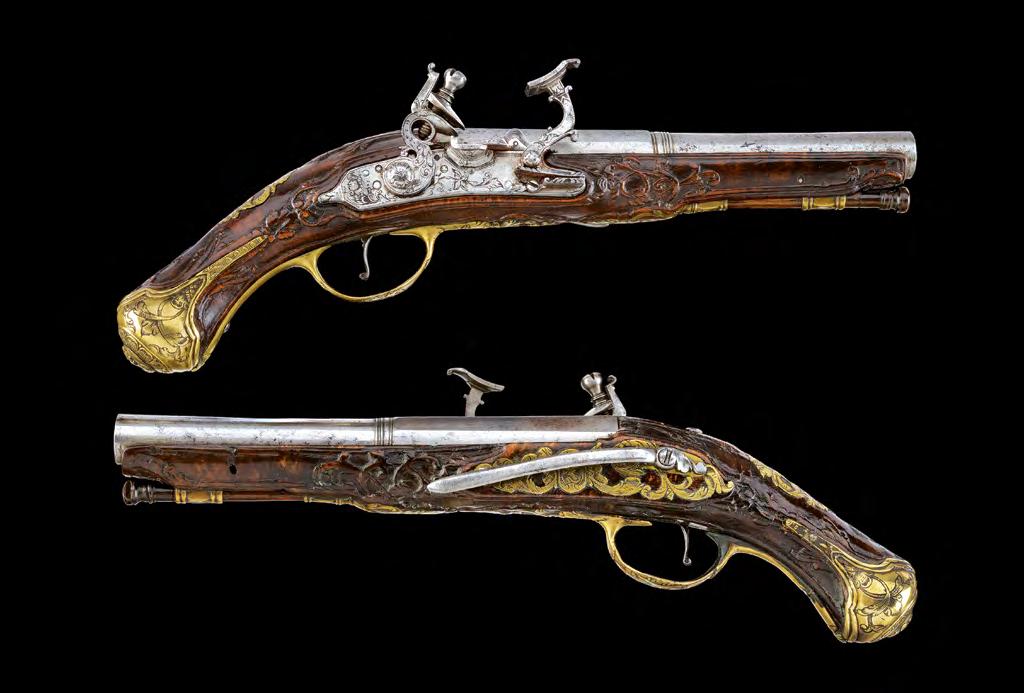
480 A PAIR OF SNAPHAUNCE LOCK PISTOLS
Central Italy, Mid 18th Century Smoothbore, two-stage, 13 mm cal. barrels, square and round, with grooved frames at the girdle; powder chamber featuring a crowned Medici monogram. Beautiful lock plates with flat surfaces, elegantly engraved with burin featuring frames and small plant motifs, one of the two signed in italics on the inside: “Gio: For..”. Full stock of dark briar, with small frames and floral motifs sculpted in bas-relief. Brass mounts with matching decoration and partially fretworked (one of the counterplates is broken). Iron saddle hooks. Horn-tipped, old wooden ramrods.
PAIO DI PISTOLE ALLA FIORENTINA
Italia centrale, Metà del XVIII Secolo
Canne lisce a due ordini, quadre e tonde, con cornicette scanalate al cambio; camera di scoppio recante al dorso un monogramma mediceo coronato; cal.13 mm. Belle batterie con cartelle piatte, elegantemente incise a bulino con cornici e piccole figure fitomorfe, una delle due firmate in corsivo all’interno “Gio: For..” Casse intere in radica scura, con cornicette e decori floreali scolpiti in bassorilievo. Fornimenti in ottone decorati en suite e parzialmente messi a giorno (una delle contropiastre con rottura). Ganci in ferro da arcione. Vecchie bacchette in legno con battipalla in corno.
Conditions good
Length 27.5 cm.
€ 900/1.300
481
A FINE PAIR OF SNAPHAUNCE LOCK PISTOLS SIGNED C.Z.
Anghiari, 1775
Smoothbore, two-stage, 14 mm cal. barrel with rings at the girdle, featuring grooves and the gold marking “PISTOIA” amongst lilies at the first part, then round engraved with floral motifs; engraved tangs; lock mechanisms finely engraved with floral motifs and carved with masks and fish, with sliding pan covers, marked inside “C.Z.” and dated “1775”; wooden full stocks richly sculpted with floral motifs; iron mounts, pierced counterplates decorated with snakes surrounding a profile portrait, butt-plates and trigger guards with other portraits and floral decorations, beautiful shields on the back featuring busts and a mask; engraved belt hooks with carved bases; horn-tipped, wooden ramrods with iron cartridge extractors.
BEL PAIO DI PISTOLE ALLA FIORENTINA FIRMATE C.Z.
Anghiari, 1775
Canne lisce a due ordini con anellatura al cambio, dotate di scanalature e marca “PISTOIA” in oro fra gigli nella parte quadra, poi tonde, con incisioni floreali alle estremità, cal. 14 mm; codette incise. Batterie a pietra focaia finemente incise a motivi floreali ed intagliate a mascheroni e pesce, con copriscodellino scorrevole, marcate all’interno “C.Z.” e datate “1775”. Casse intere in legno riccamente scolpite a motivi floreali. Fornimenti in ferro, contropiastre traforate e decorate a serpenti che circondano un ritratto di profilo, cocce e ponticelli con altri ritratti e decorazioni floreali, bellissimi scudetti al dorso con busti e un mascherone; ganci da cintura incisi e con basi intagliate; bacchette in legno con cavastracci in ferro e battipalla in corno.
Conditions very good Length 32 cm.
€ 1.800/2.200
482 A FINE PAIR OF SNAPHAUNCE LOCK HOLSTER PISTOLS
Tuscany, circa 1700
Smoothbore, two-stage, 14 mm cal barrels, the first segments octagonal, the following round with rings at the girdle; smooth tangs. Snaphaunce locks with flat, slightly angled plates, decorated with floral engravings, the springs and the base of the batterie lightly chiselled, the mechanisms with sliding pan covers; the plates signed on the inside (inscription scarcely legible as beneath the spring). Full briarwoos stocks (small damaged parts and restorations), lightly carved with floral scrolls beneath the barrel. Iron mounts, the trigger guards and pommels with carved relief rosettes, counter plates with racemes and provided with belt hooks. Iron-tipped, wooden ramrods, one with cartridge extractor.
BEL PAIO DI PISTOLE DA FONDA ALLA FIORENTINA
Toscana, 1700 circa
Canne lisce a due ordini, i primi segmenti di forma ottagonale, quelli successivi tondi con anellature al cambio, cal. 14 mm; codette lisce. Batterie alla fiorentina con cartella piatta e leggermente angolata, decorate con incisioni a motivi floreali, le molle ed il collo della martellina leggermente intagliati, le meccaniche munite di copriscodellino scorrevole; le piastre firmate all’interno (iscrizione poco leggibile perché sotto alla molla). Casse intere in radica (piccoli danni e restauri), leggermente scolpite a volute floreali sotto alla canna. Fornimenti in ferro, i ponticelli e cocce con rosette intagliate in rilievo, contropiastre a racemi, munite di gancio da cintura. Bacchette in legno con battipalla in ferro, una con cavastracci.
Conditions good
Length 51 cm.
€ 3.200/3.800
483
A PAIR OF FLINTLOCK PISTOLS
Germany, 18th Century Smoothbore, three-stage, 10,5 mm cal. barrel. Flintlock with slightly domed lock plates, safety lock located behind the cock. Wooden, full stock, lightly carved with floral motifs, with brass mounts and horn tipped wooden ramrod.
PAIO DI PISTOLE A PIETRA FOCAIA
Germania, XVIII Secolo Canne lisce a tre ordini; cal. 10.5 mm. Batterie a pietra focaia con cartella leggermente bombata, dotate di sicura esterna, posta dietro al cane. Casse intere in legno leggermente scolpite a motivi floreali, con fornimenti in ottone e bacchetta in legno con battipalla in corno.
Conditions medium Length 35 cm. € 800/1.200
484
A PAIR OF FLINTLOCK PISTOLS
Europe, Late 18th - Early 19th Century Smoothbore, round, three-stage barrels, with rings at the breech and girdle, 16 mm cal. at the nozzle. Brass sighting scopes. One barrel has traces of a mark on the back that is no longer legible. Locks with slightly rounded plates. Working mechanisms. One sealing pan, the other is simple. The cocks with minimal differences. Full wooden stocks (one with restored crack) decorated with raised racemes. Brass mounts. Butt-plates with fine raised mask. Grips with crowned shields on the back (minimal differences between the two pistols). Horntipped, wooden ramrods. In the Bohemian style, similar to the Carlsbad productions.
PAIO DI PISTOLE A PIETRA FOCAIA
Europa, Fine XVIII inizio XIX Secolo Canne tonde lisce a ordini, recanti anellature in culatta e al cambio, cal. 16 mm in volata. Mirini in ottone. Una con tracce di un punzone non più leggibile al dorso. Batterie a molla in avanti a cartella lievemente tondeggiante. Meccaniche funzionanti. Uno scodellino a tenuta stagna, l’altro semplice. Cani con lievi differenze. Casse intere in legno (una con crepa restaurata) con decori a racemi in rilievo. Fornimenti in ottone. Cocce con bei mascheroni in rilievo. Al dorso delle impugnature scudetti coronati con lievi differenze. Bacchette in legno con battipalla in corno. Sul gusto boemo, nel genere delle produzioni di Carlsbaad.
Conditions good Length 40.5 cm.
€ 1.000/1.500
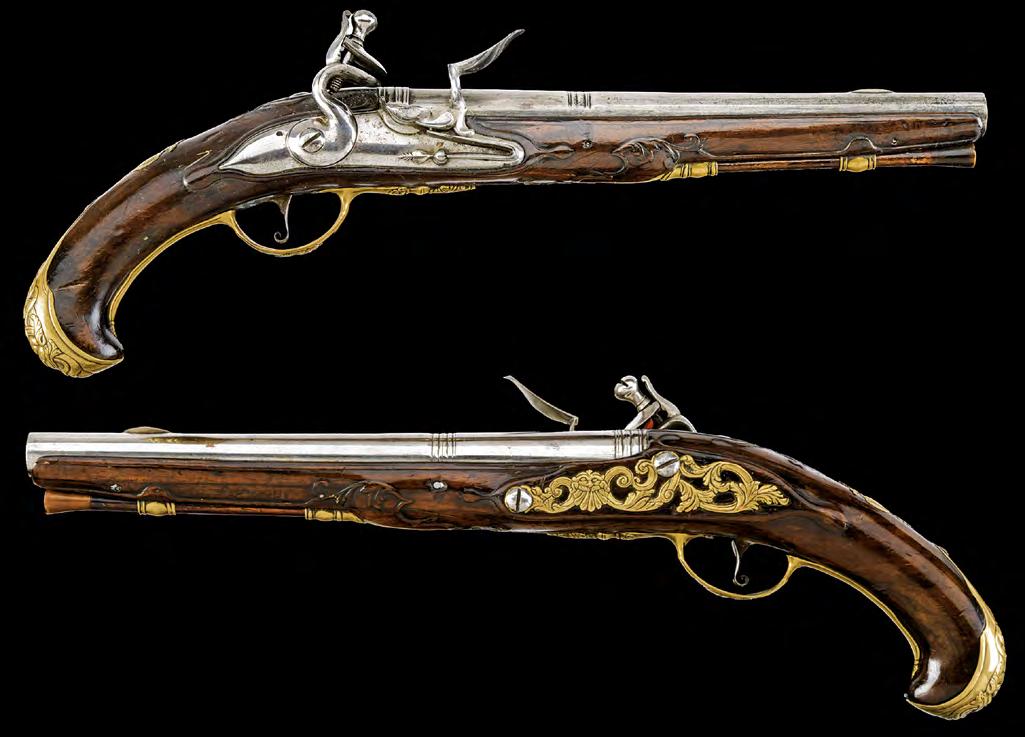
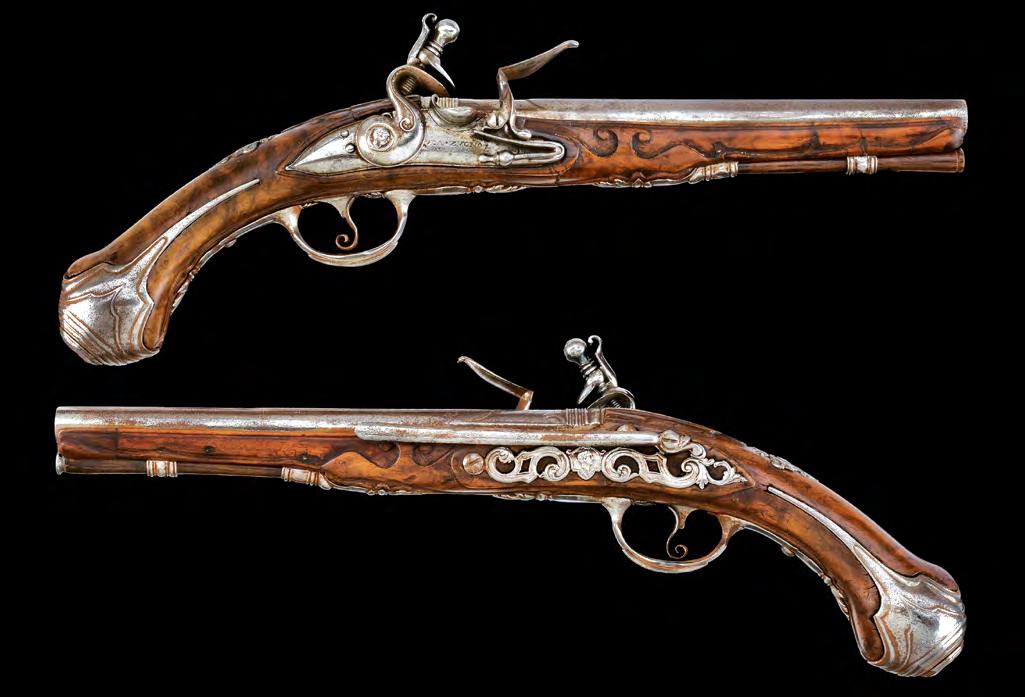

485
A PAIR OF FLINTLOCK PISTOLS BY LUCA ZUGNO
Brescia, Second half of the 18th Century Smoothbore, round, 12 mm cal. barrels, with rib, carved at the base and signed “LAZARO LAZARINO”; engraved tangs; locks with round lock plates, signed “LUCA ZUGNO”, cock’s screw with carved bust; briar-root, full stocks (one with thin crack), with iron mounts, pierced counterplates with carved busts. Belt hook. Iron-tipped wooden ramrods (one replaced, no tip). Strongly cleaned.
For Luca Zugno see Barbiroli, page 554
PAIO DI PISTOLE A PIETRA FOCAIA DI LUCA ZUGNO
Brescia, Seconda metà del XVIII secolo
Canne lisce tonde dotate di bindella, intagliate alla base e firmate “LAZARO LAZARINO”, cal. 12 mm; codette incise. Batterie a cartella tonda firmate “LUCA ZUGNO”, la vite del cane con busto intagliato. Casse intere in radica (una con sottile crepa) con fornimenti in ferro, contropiastre traforate e ornate con busti intagliati come anche le cocce. Ganci da cintura. Bacchette in legno con battipalla in ferro (una sostituita, senza battipalla). Fortemente pulite.
Per Luca Zugno vedi Barbiroli, pag. 554.
Conditions medium
Length 34.5 cm.
€ 1.200/1.600
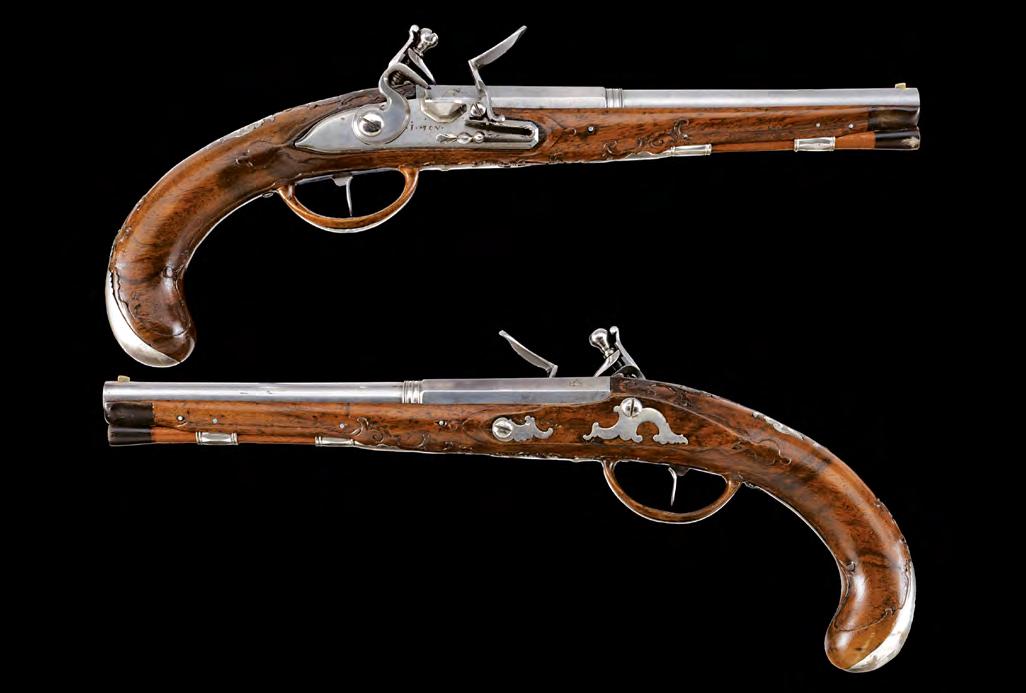
486
A PAIR OF FLINTLOCK PISTOLS BY J. MOND WITH SILVER MOUNTS Munderkingen, Early 19th Century Smoothbore, two-stage barrels, octagonal and round, with rings at the girdle; on the powder chamber of both pistols clearly stamped two silver-inlaid marks, one inscribed “I. MON IN MUNDERKEINGEN”, the other with a crescent moon (“Mond” in German) among three stars; at the sides of the two marks and slightly further forward additional deep decorations; 11.5 mm cal. at the nozzles, fitted with front sights. Tangs fitted with rear sights and respectively marked “1” and “2”. Sober flintlocks, flat plates with oblique edges, bearing the signature “I. MON” engraved with burin; the batteries springs with light chiselling. Full wooden stocks (small restorations) with German-style butts. Plain silver mounts, escutcheons on the back engraved with three keys. Horn-tipped, wooden ramrods, as also the muzzle caps.
For Johann Mond, see “Der Neue Stockel,” Vol. II, p. 820.
PAIO DI PISTOLE A PIETRA FOCAIA DEL MAESTRO J. MOND CON FORNIMENTI IN ARGENTO
Munderkingen, Inizio del XIX Secolo Canne lisce a due ordini, quadre e tonde, con anellature al cambio; sulla camera di scoppio di entrambe le pistole ben impressi due punzoni rimessi in argento, uno con iscrizione “I. MON IN MUNDERKEINGEN”, l’altro con mezzaluna (in tedesco “Mond”) sotto tre stelle; ai lati dei due marchi e poco più avanti ulteriori profonde decorazioni; ale volate in calibro 11.5 mm e dotate di mirino. Codette munite di alzo e rispettivamente marcate “1” e “2”. Sobrie batterie a pietra focaia, cartelle piatte con bordi obliqui, recanti la firma “I. MON” incisa a bulino; le molle delle martelline con leggeri intagli. Casse intere in legno (piccoli restauri) con calcio alla tedesca. Fornimenti lisci in argento, scudetti al dorso recanti tre chiavi incise. Bacchette in legno con battipalla in corno, come anche i bocchini.
Per Johann Mond si veda “Der Neue Stockel”, Vol. II a pagina 820.
Conditions very good
Length 38 cm.
€ 1.500/2.000
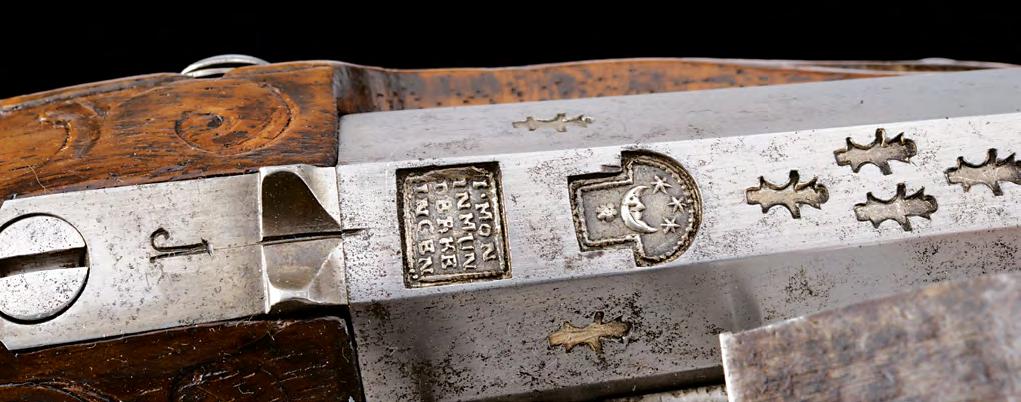
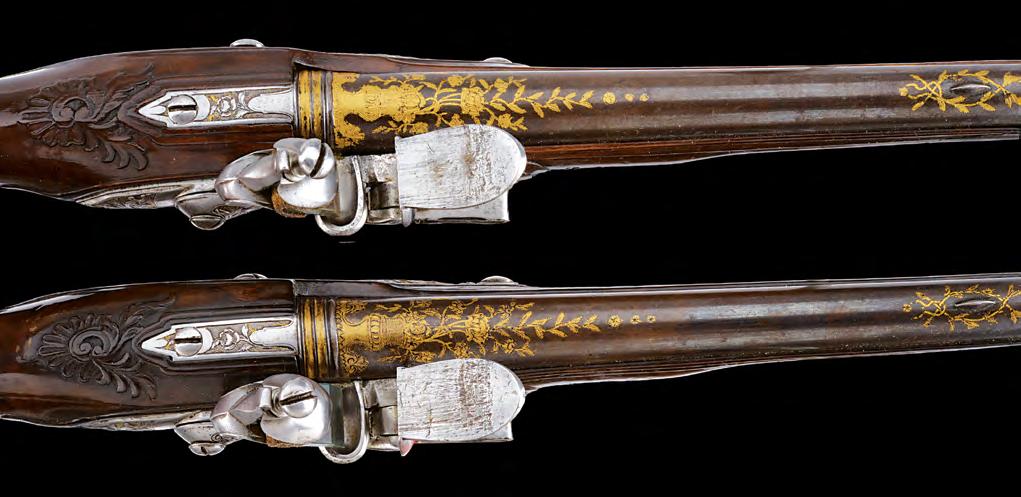
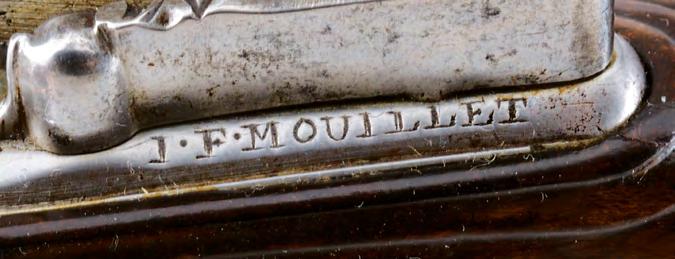
487
A FINE PAIR OF FLINTLOCK PISTOLS BY MOUILLET
Liege, 1740 - 50
Round, smoothbore, browned barrels, at the breeches three rings, two of which are gilded; then beautiful engraved design provided with a vase and flowers, all gold-inlaid; foresights surrounded by gilded engravings; 14.5 mm cal. at the nozzle. Tangs with phytomorphic carving. Beautiful flintlock with round lock plates, decorated with floral spiral carvings and flowers in bas-relief (remains of gilding); below the spring, the signature “I. F. MOUILLET” on both plates. Wooden, full stocks, partially carved with floral motifs. Steel mounts with remains of gilding, engraved and finely carved in bas-relief with floral spirals and flowers. Horntipped wooden ramrods.
For J. F. Mouillet, see “Der Neue Stockel,” Vol. II, p. 837.controlla brunitura
BEL PAIO DI PISTOLE A PIETRA FOCAIA DI MOUILLET
Liegi, 1740 - 50 Cane tonde, lisce, brunite, con tre anellature in culatta due delle quali dorate; in seguito bel decoro dorsale inciso, con vaso munito di fiori, il tutto rimesso in oro; mirini circondati da incisori dorate; calibro 14.5 mm in volata. Codette con intaglio fitomorfo. Belle batterie a pietra focaia con cartella tondeggiante, decorate con intagli a volute floreali e fiori in bassorilievo (resti di doratura); al di sotto della molla la firma “I. F. MOUILLET” su entrambe le piastre. Casse intere in legno, parzialmente operate con decorazioni scolpite a motivo floreale. Fornimenti in acciaio dorato (solo resti della finitura), incisi e ben intagliati in bassorilievo a volute floreali e fiori. Bacchette in legno con battipalla in corno.
Per J. F. Mouillet si veda “Der Neue Stockel” Vol. II a pagina 837.
Conditions good Length 37 cm.
€ 2.500/3.500
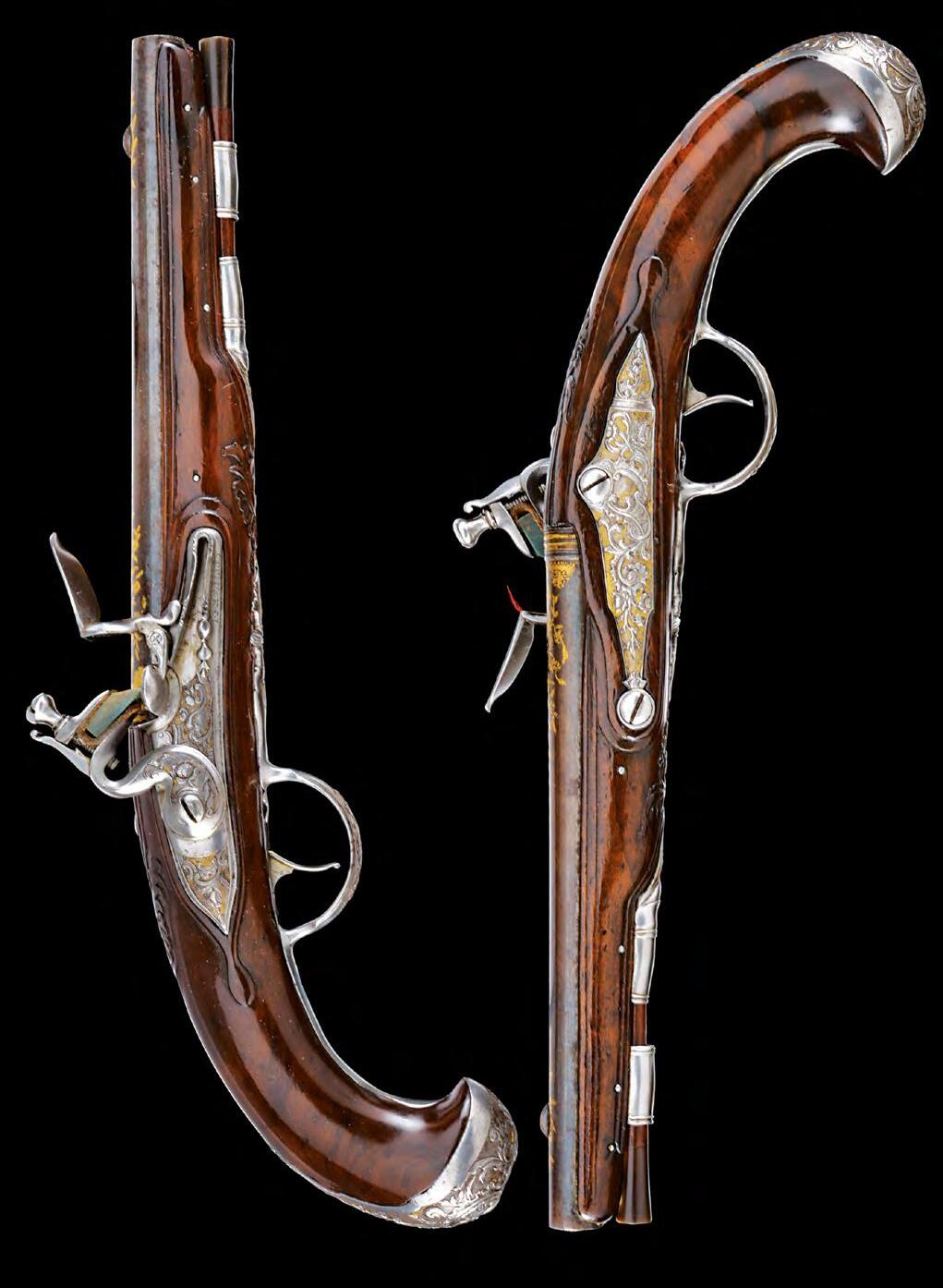
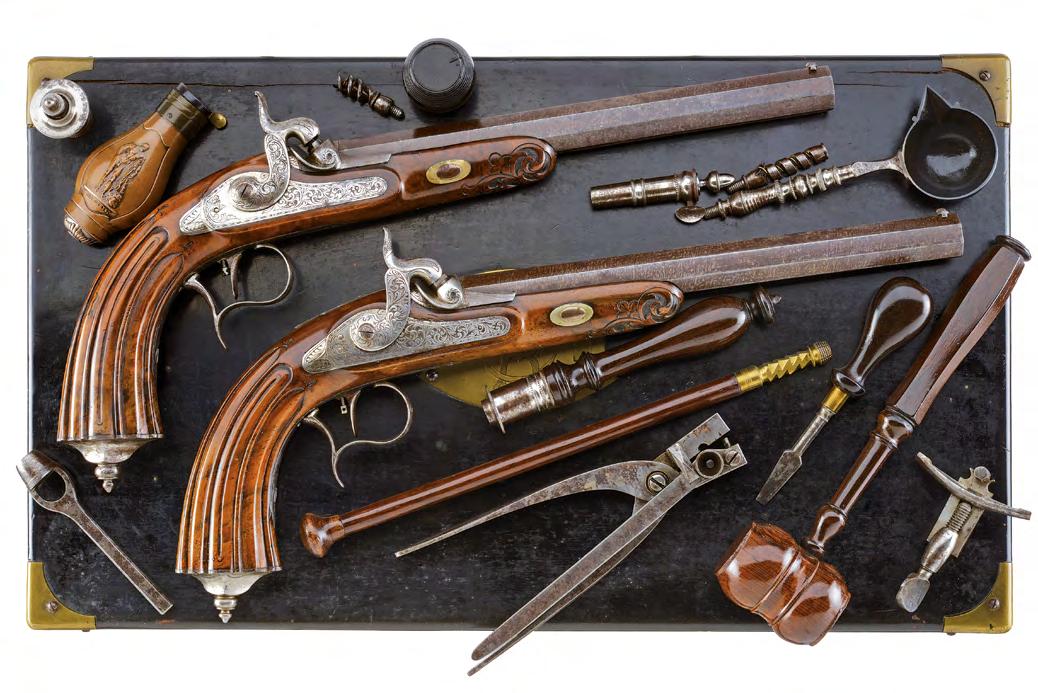
488
A CASED PAIR OF PERCUSSION TARGET PISTOLS WITH MARK OF VICTOR COLLETTE
Liege, Mid 19th Century
Octagonal, twisted, and micro-rifled, 13 mm cal. barrels, provided with foresight and rear sight on the engraved tangs; powder chambers and tangs numbered “1” and “2” respectively (gold-inlaid), and featuring the “VC 19” mark and the mark of the Liegi test bench. Forward spring locks finely engraved with plant motifs and spirals. Triggers provided with set triggers. Butt-plates and trigger guard with finger support decorated in the same style. Half stocks of walnut wood with grooved grips and stock ends sculpted with floral motifs. Stored in their beautiful and original case (some missing parts and defects in the compartment structure) made of blackstained wood, with brass corners and a handle on the lid engraved with “CR” in block letters; lined with purple velvet (with some defects) containing all its original tools; a ramrod with cartridge extractors, a turned hammer, an iron punch, a copper flask with embossed decorations, a screwdriver, a decorated iron measuring device, a spring crimper, two iron cartridge extractors, an oiler, an iron bullet mold pliers, a lead strainer, and a small barrel-shaped primer case. Some minor pitting and traces of patina.
Victor Collette (Colette), a manufacturer from Liegi, lived and worked from 1836 to 1909. See “Der Neue Stoeckel,” vol. 1, p. 230.
PAIO DI PISTOLE DA TIRO IN CASSETTA CON PUNZONE DI VICTOR COLLETTE
Liegi, Metà del XIX Secolo Canne ottagonali, a tortiglione e micro-rigate, munite di mirino e tacca di mira sulla codetta, che è anche incisa; le camere di scoppio e le codette numerate rispettivamente “1” e “2” (i numeri rimessi in oro), e con i punzoni “VC 19” e del banco di prova di Liegi. Cal. 13 mm in volata. Resti di vecchia brunitura. Batterie a molla in avanti finemente incise a volute fitomorfe. Grilletti muniti di vite di regolazione dello scatto. Cocce e ponticelli con poggiadito ornati nello stesso modo. Mezze casse in noce con impugnatura scanalate e terminale del fusto scolpito ad intagli floreali. Custodite nella loro bella ed cassetta originale (alcuni difetti e mancanze alla struttura degli scomparti) in legno tinto nero, con angolari in ottone e maniglia sul coperchio incisa con le cifre “CR” in stampatello; interno foderato in velluto viola (con alcuni difetti) contenente tutti i suoi attrezzi originali: una bacchetta con cavastracci, un martello tornito, una fustella in ferro, una fiaschetta in rame con decori a sbalzo (cannello mancante), un cacciavite, un misurino in ferro con ornamenti, uno stringimolle, due cavastracci in ferro, un oliatore, una pinza fondipalle in ferro, un colino per piombo ed un piccolo astuccio a bariletto porta capsule. Alcune intaccature e residui di patina.
Victor Collette (Colette), fabbricante di Liegi, è documentato dal 1836 al 1909. Vedi “Der Neue Stoeckel”, vol. 1 pag. 230.
Conditions good Length 40,5 cm.
€ 2.000/3.000
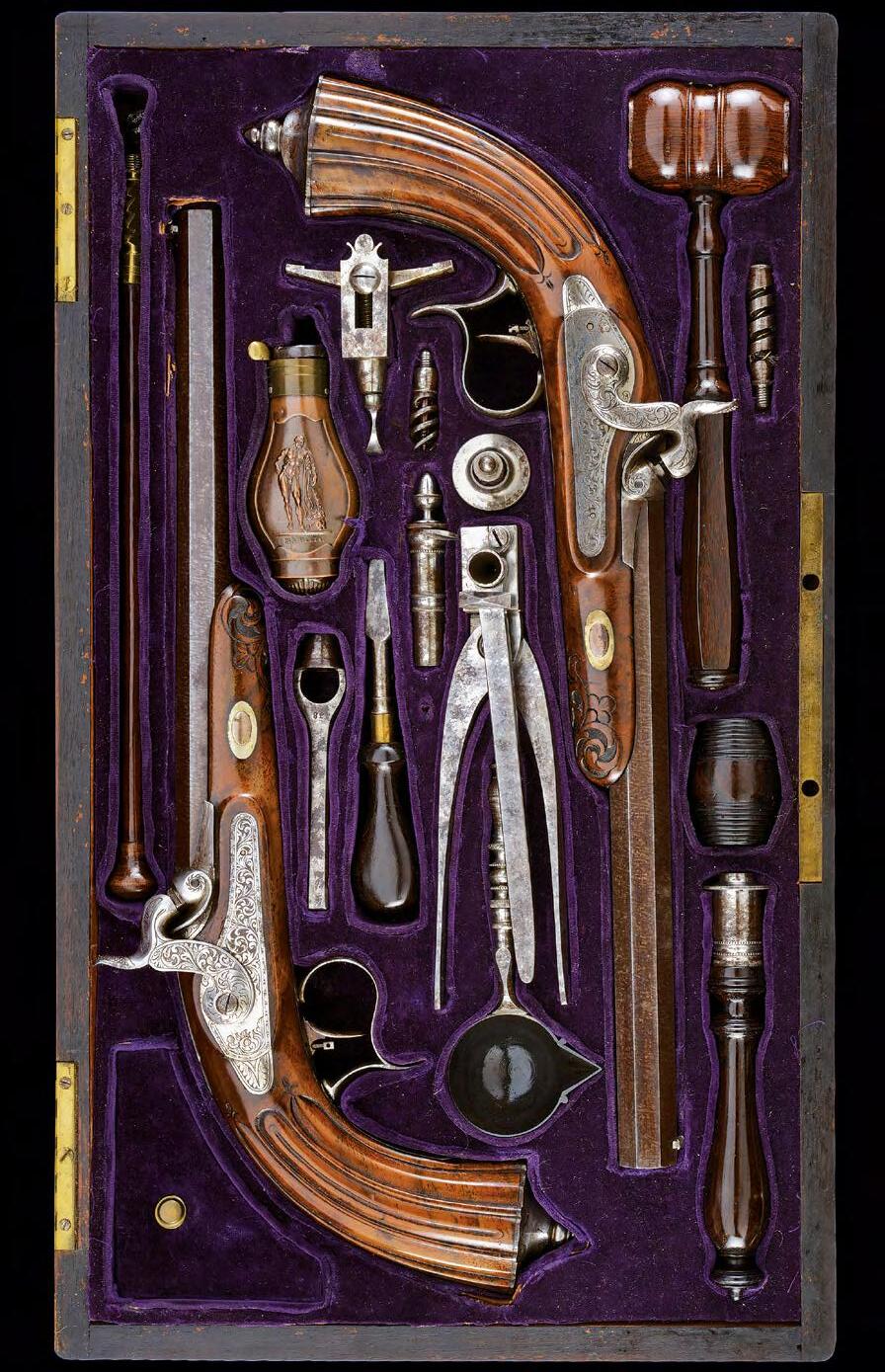
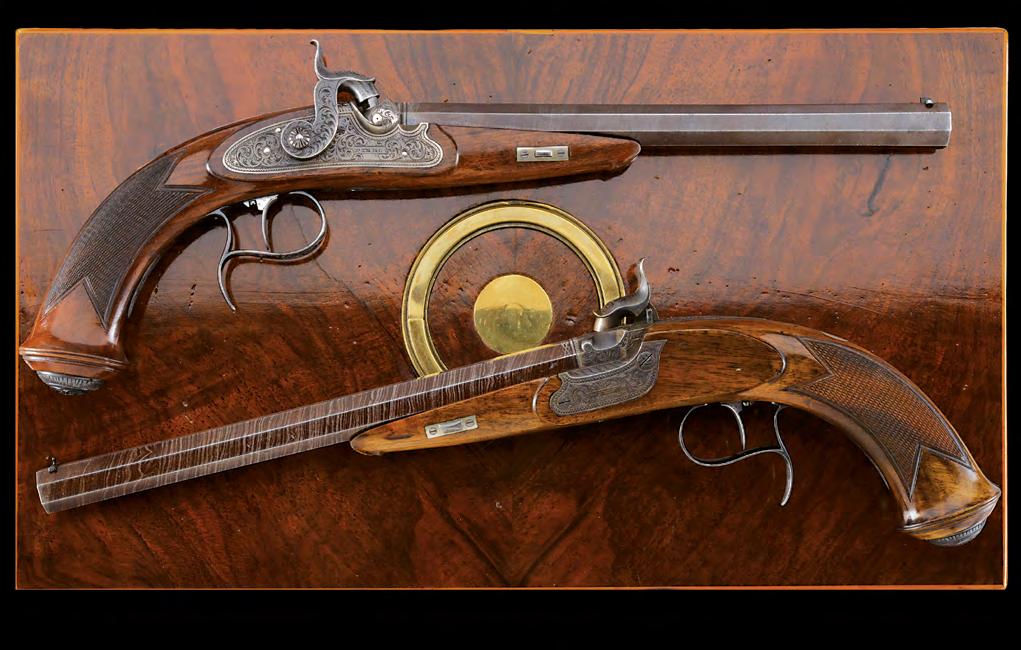
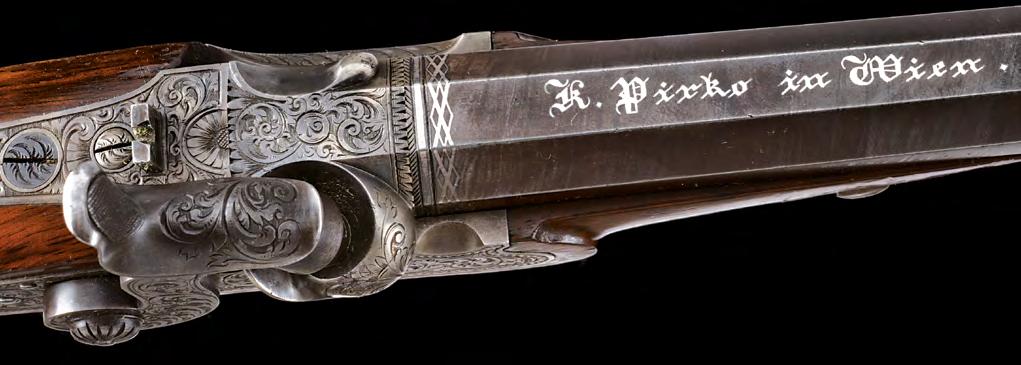
489 A BEAUTIFUL PAIR OF CASED PERCUSSION PISTOLS BY PIRKO
Vienna, Mid 19th Century
Octagonal, rifled barrels (clean bores, rifling clearly visible), damascened (the finish more evident on one of the barrels), fitted with breech blocks engraved with floral motifs, with numbering (“1” and “2” on the respective pistols), and with silver border inlays; further along the back the signature “K. Pirko in Wien.”, likewise in silver. The two barrels fitted with different front sights, both in 12 mm cal. at the nozzle. Engraved tangs fitted with adjustable rear sights.Forward spring lock with richly floralengraved lock plates signed “PIRKO”; cocks and drum decorated in the same manner. Wooden, three quarter stocks, with checkered butt and iron mounts decorated en suite; counterplates marked “WIEN.”Trigger guards with finger support, triggers with set trigger. Boxed models, therefore without ramrod.Kept in their wooden box with retractable brass handle, interior lined in green silk, and complete with high-quality accessories. Complete with a key featuring a triple lock.
See: Karl Pirko – The Viennese Gunsmith – Der Wiener Waffenschmied, by Roberto Vecchi, Ermanno Albertelli Editore, 2003. This pair of dueling percussion pistols is described and illustrated on pages 52 and 53. A copy of the book is included with the lot.
SPLENDIDO PAIO DI PISTOLE A LUMINELLO DI PIRKO IN CASSETTA
Vienna, Metà del XIX Secolo
Canne ottagonali, rigate (anima pulita, rigatura ben visibile), damascate (la finitura più evidente su una delle canne), dotate di blocco di culatta inciso a motivi floreali, con numerazione (“1” e “2” sulle rispettive pistole), e con bordatura a cornice in argento; in seguito al dorso la firma “K. Pirko in Wien.”, anch’essa in argento. Le due canne dotate di mirini differenti, entrambe calibro 12 mm in volata. Codette incise e munite di alzo regolabile.Batterie a molla in avanti con cartella riccamente incisa a motivi floreali e firmata “PIRKO”; anche i cani e i porta-luminelli decorati nello stesso modo. Casse a tre quarti in legno con calcio zigrinato e fornimenti in ferro decorati en suite; contropiastre marcate “WIEN”. Ponticelli con poggiadito, grilletti con sensibilizzatore. Esemplari da cassetta, quindi privi dell’alloggiamento per la bacchetta.Conservate nella loro cassetta in legno con manico a scomparsa in ottone e interno foderato in seta verde, completa di accessori di alta qualità. Munita di chiave con triplice chiusura.
Vedi: Karl Pirko – L’armaiolo viennese – Der Wiener Waffenschmied, di Roberto Vecchi, Ermanno Albertelli Editore, 2003. Questo paio di pistole a luminello da duello è descritto e illustrato alle pagine 52 e 53. Un esemplare del volume accompagna il lotto.
Conditions very good
Length 42,5 cm.
€ 2.500/3.500
490
A PIN-FIRE REVOLVER
Europe, about 1870
Rifled, octagonal barrel, provided with foresight. Clean bore with visible rifling. 7.4 mm cal. at the nozzle. Six-shot cylinder. Working mechanism, in mixed action. Engraved with racemes and traces of silvering. Barrel and cylinder with remains of an old blueing. Ivory grip scales (CITES certificate). Provided with a side extractor.
Note: This item is accompanied by a CITES certificate for commercial purposes, valid within the European Union.
REVOLVER A SPILLO
Europa, 1870 circa Canna ottagonale rigata, dotata di mirino. Anima pulita, rigatura visibile. Cal. 7,4 mm in volata. Tamburo a sei colpi. Meccanica funzionante, con azione mista. Incisioni a racemi e resti di argentatura. Canna e tamburo con resti di vecchia brunitura. Guancette in avorio (con certificato CITES). Dotato di estrattore laterale.
NB: il pezzo è accompagnato da un certificato CITES per attività commerciale, valido sul territorio dell’Unione Europea.
Conditions good
Length 16.4 cm.
€ 150/250
491
A PIN-FIRE REVOLVER
Belgium, about 1870
Short barrel of octagonal section (possibly shortened), provided with foresight and fixed rear sight, featuring the marking “E. LEFAUCHEUX / IN.VR BREVETE”. Calibre XXX. Clear pitting and visible encrustments inside the bore. Working mechanism, in mixed action. Raised decoration with vine-scroll motifs on the surfaces. Light external marks. Marks of the Liegi test bench. Ivory grip scales (CITES certificate). Ring for the strap.
Note: This item is accompanied by a CITES certificate for commercial purposes, valid within the European Union.
REVOLVER A SPILLO
Belgio, 1870 circa Breve canna di sezione ottagonale (accorciata?), dotata di mirino e alzo fisso, recante marcatura “E. LEFAUCHEUX / IN.VR BREVETE”. Cal. Evidenti intaccature e incrostazioni all’interno. Meccanica funzionante, in azione mista. Decori in rilievo a tralci di vite sulle superfici. Leggere intaccature all’esterno. Punzoni del banco di Liegi. Guancette in avorio (con certificato CITES). Anello porta correggiolo.
NB: il pezzo è accompagnata da un certificato CITES per attività commerciale, valido sul territorio dell’Unione Europea.
Conditions good Length 21.5 cm.
€ 150/250
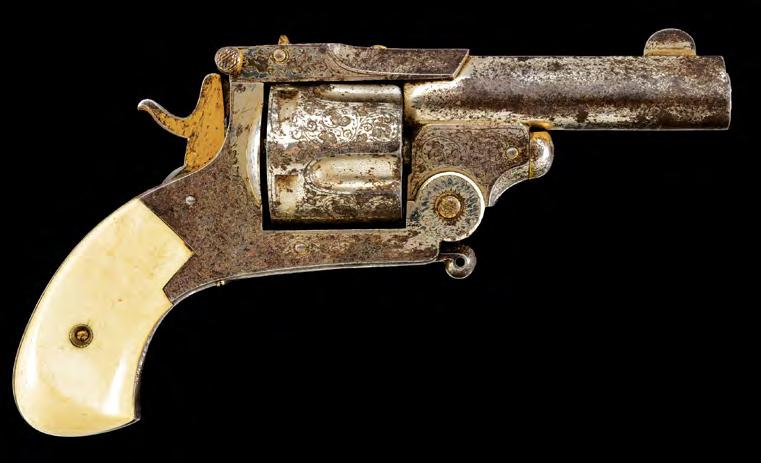
492
A RARE PIN-FIRE REVOLVER BY LORON
Belgium, about 1870
Octagonal, rifled barrel (with pitting and signs of use inside), with foresight and fixed rear sight, with floral and rocaille engravings at the base, mark “LORON BREVETE” and a Belgian inspection mark. 9 mm cal. at the nozzle. Six-shot cylinder with remains of the original bluing, floral and rocaille engravings, and the mark of the Liège test bench. Working mechanism, both single and double action. Frame with engravings en suite and folding trigger. Grip with dark wood grip scales.
RARO REVOLVER A SPILLO LORON
Belgio, 1870 circa Canna ottagonale rigata (intaccature e segni di usura all’interno), dotata di mirino e alzo fisso, con incisioni a fiorami e rocaille alla base, la marcatura “LORON BREVETE” e un punzone d’ispezione belga. Cal. 9 mm in volata. Tamburo a sei colpi con resti della brunitura antica, incisioni a fiorami e rocaille, punzone del banco di Liegi. Meccanica ben funzionante, sia in singola che in doppia azione. Castello con incisioni en suite e grilletto pieghevole. Impugnatura con guancette in legno bruno.
Conditions good
Length 26.5 cm.
€ 250/400
493
A CENTERFIRE REVOLVER
Belgium, about 1880
Rifled, round, 8.8 mm cal. swivelling barrel with rib on the back, provided with foresight. Five-shot cylinder. Clean bore with visible rifling. Working mechanism, in mixed action. Surfaces with remains of an old nickel finishing, and engraved racemes and vine motifs in various areas. The hammer, some screw heads, and the barrel hook with traces of gilding. Marks of the Liegi test bench. Ivory grip scales (CITES certificate). Foldaway trigger.
Note: This item is accompanied by a CITES certificate for commercial purposes, valid within the European Union.
REVOLVER A PERCUSSIONE CENTRALE
Belgio, 1880 circa Canna tonda rigata con bindella dorsale, dotata di mirino, cal. 8,8 mm, basculante. Tamburo a cinque colpi. Anima pulita, rigatura visibile. Meccanica funzionante, con azione mista. Le superfici con resti della vecchia finitura nichelata e con incisioni a racemi e tralci di vite in vari punti. Il cane e la testa di alcune viti e il gancetto della canna con resti di doratura. Punzoni del banco di liegi. guancette in avorio (con certificato CITES). Grilletto a scomparsa.
NB: il pezzo è accompagnata da un certificato CITES per attività commerciale, valido sul territorio dell’Unione Europea.
Conditions good
Length 16.3 cm.
€ 150/250
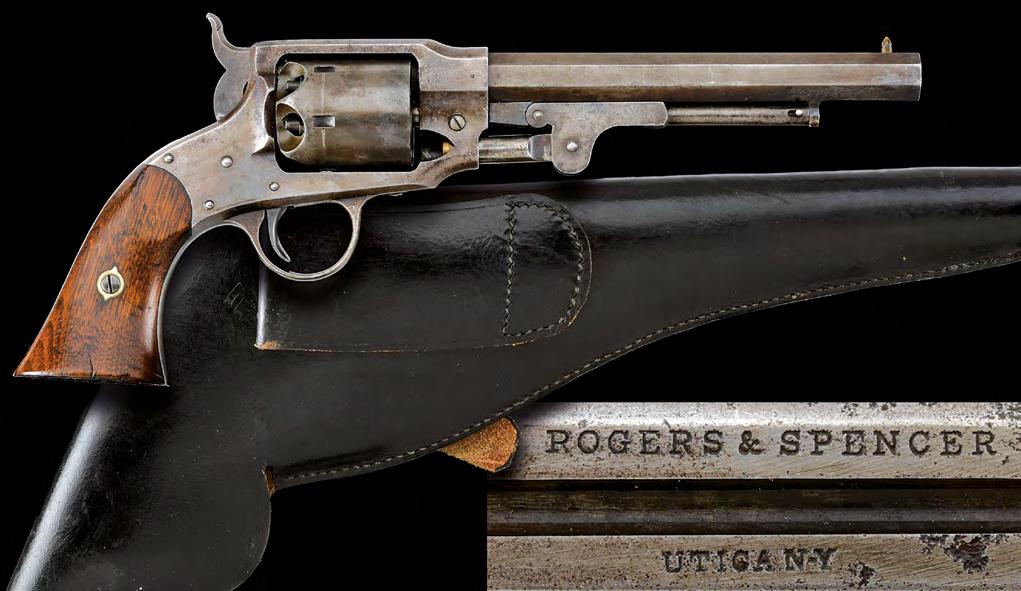
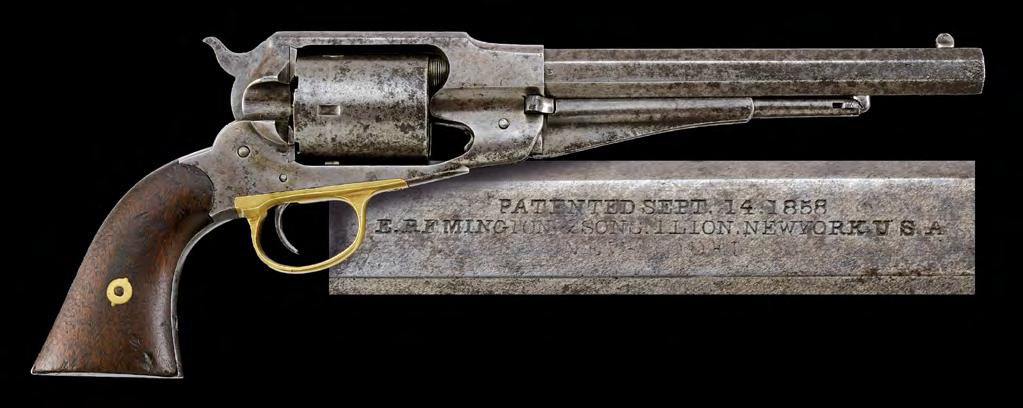
494
A ROGERS & SPENCER ARMY MODEL REVOLVER
USA, Third quarter of the 19th Century Octagonal, rifled, 44 cal. barrel with foresight; six-shot cylinder with serial number “3512,” frame marked “Rogers & Spencer Utica N.Y.,” remains of browning,“B” marks, serial number “3502” (also on the frame); original grip scales made of wood, one with an external “RSB” stamp and both with serial number “3502”. With a black leather holster.
ROGERS & SPENCER ARMY MODEL REVOLVER
USA, Terzo quarto del XIX Secolo
Canna ottagonale, rigata, con mirino, cal. 44. Tamburo a sei colpi con matricola “3512”, castello con firma “Rogers & Spencer Utica N.Y.”, resti di brunitura, punzoni “B”, matricola “3502” (anche nella cornice); guancette originali in legno, una con timbro esterno “RSB” ed entrambi con matricola “3502”. Con fondina in pelle nera.
Conditions very good
Length 33,5 cm.
€ 800/1.200
495
A RIM-FIRE CONVERSION REMINGTON NEW MODEL ARMY REVOLVER USA, 1860 - 1889 circa Octagonal, rifled barrel (bore with encrustments which needs cleaning, visible rifling, bore with a defect at the stop of the cartridge rammer) marked with the patent inscription, company address, and “NEW MODEL,” provided with iron foresight, .44 caliber at the nozzle. Smooth, five-shot cylinder with inspection and marks of the Liegi test bench but without Rollin White patent. Frame with groove to load ammunitions, crowned “M” mark. Hammer with rim-fire. Brass trigger guard. Grip with smooth wooden grip scales. Some pitting. Working mechanism, cylinder with slight play.
REMINGTON NEW MODEL ARMY REVOLVER CON CONVERSIONE RIMFIRE USA, 1860 - 1889 circa Canna rigata ottagonale, (anima con incrostazioni da pulire, rigatura visibile, difetto nell’anima in corrispondenza dell’arresto del calcatoio) marcata con dicitura del brevetto, indirizzo della ditta e “NEW MODEL”, munita di mirino in ferro, cal. 44 in volata. Tamburo liscio a cinque colpi con punzoni d’ispezione e del banco di prova di Liegi ma senza brevetto Rollin White. Castello con scanalatura per inserimento delle munizioni, punzone “M” coronato. Cane con percussore anulare. Ponticello in ottone. Impugnatura con guancette lisce in legno. Qualche intaccatura. Meccanica funzionante, con leggero gioco del tamburo.
Conditions medium
Length 35 cm.
€ 450/650
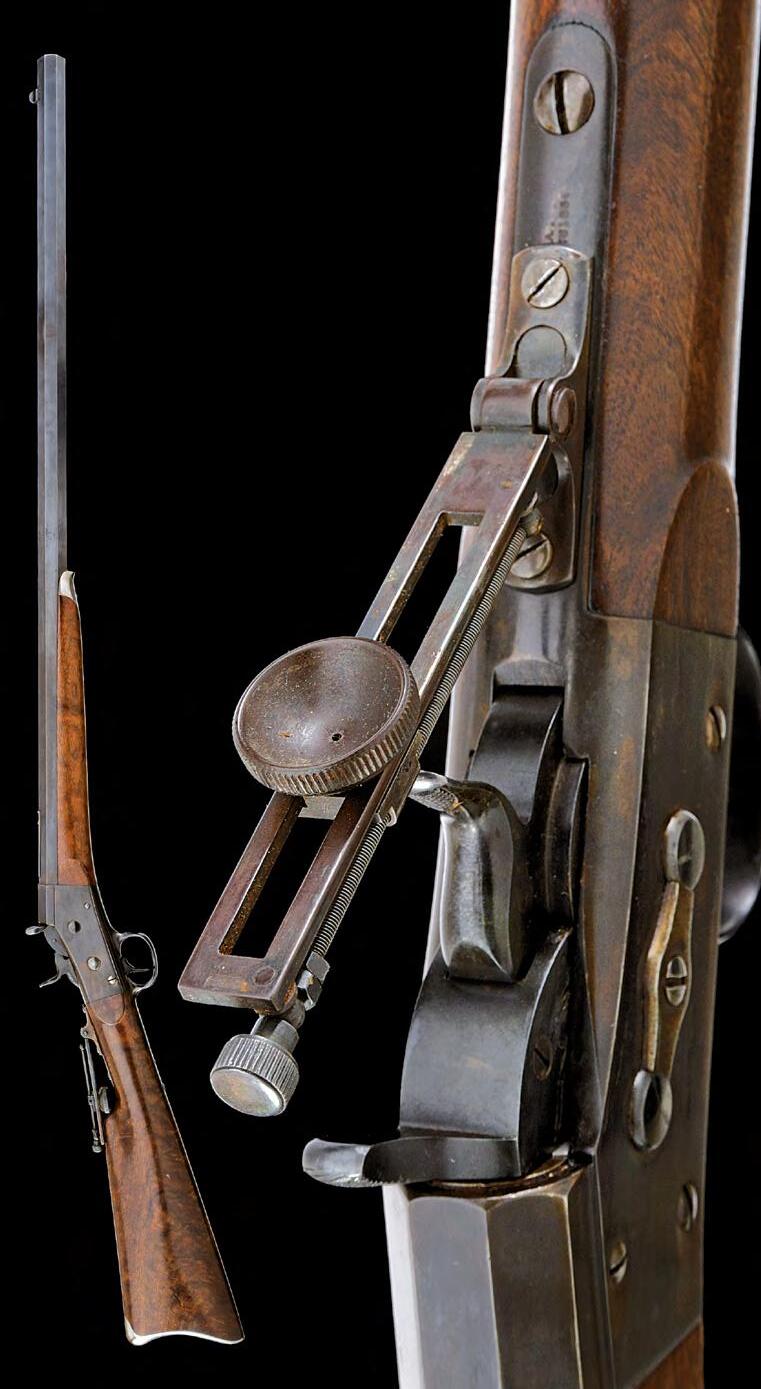
496
A REMINGTON SINGLE SHOT
BREECH-LOADING TARGET RIFLE USA, about 1870
Heavy, rifled (clean bore, clearly visible rifling) octagonal barrel with rear sight and foresight, browned, 10 mm cal. at the muzzle; frame with rotating block mechanism, tang featuring patent marks dating up to 1866, provided with foldaway and adjustable peep sight. Wooden stock and fore-end with partially browned iron mounts; trigger guard tang with serial number “17xx”. Working mechanism.
REMINGTON SINGLE SHOT
BREECH-LOADING TARGET RIFLE USA, 1870 circa Pesante canna, rigata (anima pulita, rigatura ben visibile) ottagonale con alzo e mirino, brunito, cal. 10 mm in volata; castello con meccanica a blocco rotante, codetta con brevetti fino al 1866, munita di diottra abbattibile e regolabile. Calcio ed astina in legno con fornimenti in ferro parzialmente bruniti, la coda del ponticello con matricola “17xx”. Meccanica funzionante.
Conditions excellent
Length 116.5 cm.
€ 300/600
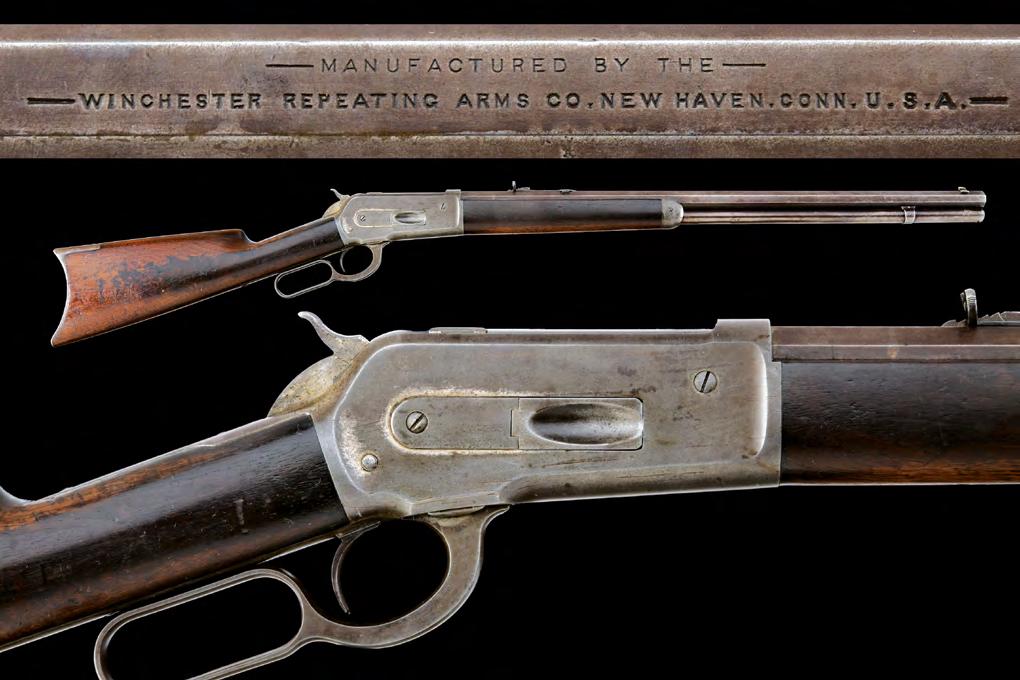
497
A WINCHESTER MODEL 1886 RIFLE
USA, 1888
Rifled, octagonal barrel (some small areas of pitting inside, visible rifling), featuring an address marking in two lines, with the breech marked “40-65 WCF,” adjustable rear sight, and a foresight. It keeps 60% of the original browning. Smooth steel frame with loading gate on the right side; upper tang marked “Model 1886,” lower tang marked with serial number and patents. Working mechanism. Smooth wooden butt and fore-end (signs of use). Steel mounts. Serial number “336xx.”
WINCHESTER MODEL 1886 RIFLE
USA, 1888
Canna rigata (alcune piccole zone con pitting all’interno, rigatura visibile), di forma ottagonale, recante marcatura dell’indirizzo in due righe, con culatta marcata “40-65 WCF”, alzo regolabile e mirino. Conserva il 60 % della brunitura originale. Castello in acciaio liscio con sportellino di caricamento sul fianco destro; codolo superiore con dicitura del modello “Model 1886”, quello inferiore con matricola e brevetti. Meccanica funzionante. Calcio ed astina lisci in legno (segni d’uso). Fornimenti in acciaio. Matr. “336xx”.
Conditions medium
Length 114.5 cm.
€ 1.000/1.300
498
A WINCHESTER MODEL 1873 CARBINE, SECOND MODEL
USA, 1875 - 1889 circa
Round, rifled, 20” barrel, market on the back with a two-line inscription that is only partially visible; no calibre indication. Foresight present; the rear sight has probably been replaced at a later date. Bore needs cleaning. Frame with rear cover guide secured by a screw. Working cock and trigger; bolt seems to be stuck, needs revision. Brass elevator block marked “44 Cal.” (re-stamped?). Rear tang with model inscription, the lower one with serial number “40xxx” (re-stamped/ re-marked?). Walnut butt and fore-end with clear signs of wear, defects and restoration. Iron mounts. Condition between fair and poor. Pitting, signs of use and time. With sling swivel.
WINCHESTER MODEL 1873 CARBINE, SECOND MODEL
USA, 1875 - 1889 circa Canna tonda rigata, da 20”, marcata al dorso con dicitura in due righe della ditta solo parzialmente visibile, indicazione del calibro non presente. Mirino presente, l’alzo probabilmente rimpiazzato successivamente. Anima da pulire. Castello con guida del coperchio dorsale fissata tramite vite. Cane e grilletto funzionanti, l’otturatore apparentemente bloccato, da rivedere. Carrello elevatore in ottone marcato “44 Cal.” (ripassata?). Codolo dorsale con dicitura del modello, quello inferiore con matricola “40xxx” (ritimbrata/ripassata?). Calcio ed astina in noce con evidenti segni di usura, difetti e restauri. Fornimenti in ferro. Condizioni fra medie e mediocri. Intaccature, segni d’uso e del tempo. Presente l’anello da sella.
Conditions medium
Length 99.5 cm.
€ 400/700
499 A WINCHESTER MODEL 1873 MUSKET
USA, 1880 - 1889 circa Round, rifled, 30” barrel, with foresight and a foldaway, adjustable rear sight (likely replaced at a later date and with an unrelated slide; one of the two retaining screws is missing). The two-line back mark is still fairly legible; missing the caliber inscription on the breech. Bore with visible rifling, pitting, and encrustations inside. 11 mm cal. at the nozzle. Iron frame with a slide guide for the back cover in one piece with the frame. Brass elevator block, marked “44 Cal.” (re-engraved mark?). Working mechanism but needs revision (action mechanisms with difficult movement and a firing pin that remains permanently in the forward position). Back tang with remains of model mark; the lower one with the serial number “174xxxA”. Walnut butt and fore-end, with signs of use and time. A wooden plate removed from the butt stock. Iron mounts. Butt plate with a small flap. Pitting, signs of use and time. Traces of browning???, possibly some replacements. Back tang with holes to mount a peep sight.
WINCHESTER MODEL 1873 MUSKET
USA, 1880 - 1889 circa Canna tonda rigata, da 30”, dotata di mirino, alzo abbattibile e regolabile (probabilmente sostituito successivamente e con cursore non pertinente; manca una delle due viti di tenuta). La marcatura dorsale in due righe ancora discretamente leggibile, manca la dicitura del calibro sulla culatta. Anima con rigatura visibile, pitting e incrostazioni all’interno. In volata circa 11 mm. Castello in ferro con guida di scorrimento del coperchio dorsale in un unico pezzo con il telaio. Il carrello elevatore in ottone, marcato “44 Cal.” (marcatura ripassata?). Meccanica funzionante ma da rivedere (cinematismi con scorrimento difficoltoso e ago del percussore che rimane sempre in posizione avanzata). Codolo dorsale con resti di marcatura del modello, quello inferiore con matricola “174xxxA”. Calcio ed astina in noce, con segni d’uso e del tempo. Una placca di legno rimossa dalla pala. Fornimenti in ferro. Calciolo con sportellino. Intaccature, segni d’uso e del tempo. Tracce di brunitura, forse alcune sostituzioni. Il codolo dorsale con sforature per montaggio di diottra.
Conditions medium Length 124.3 cm.
€ 600/1.000
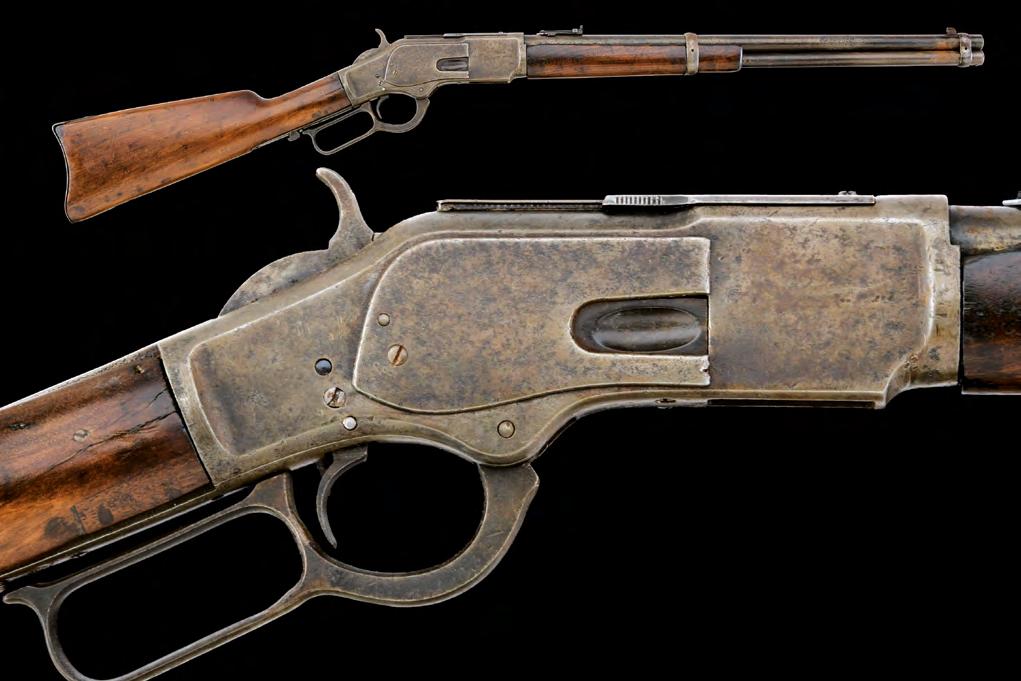
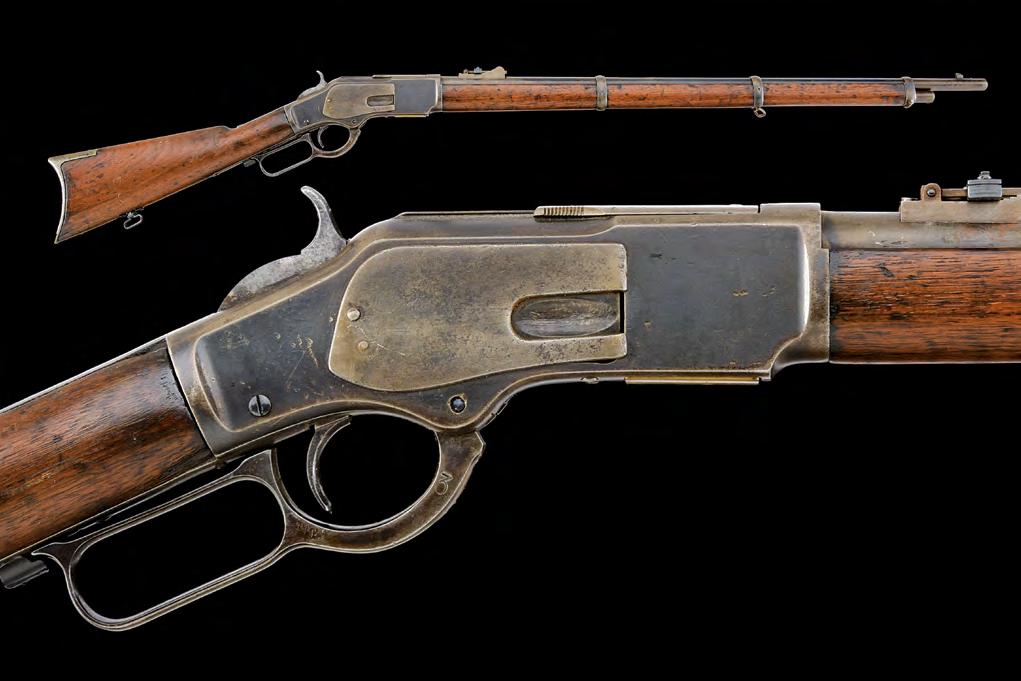
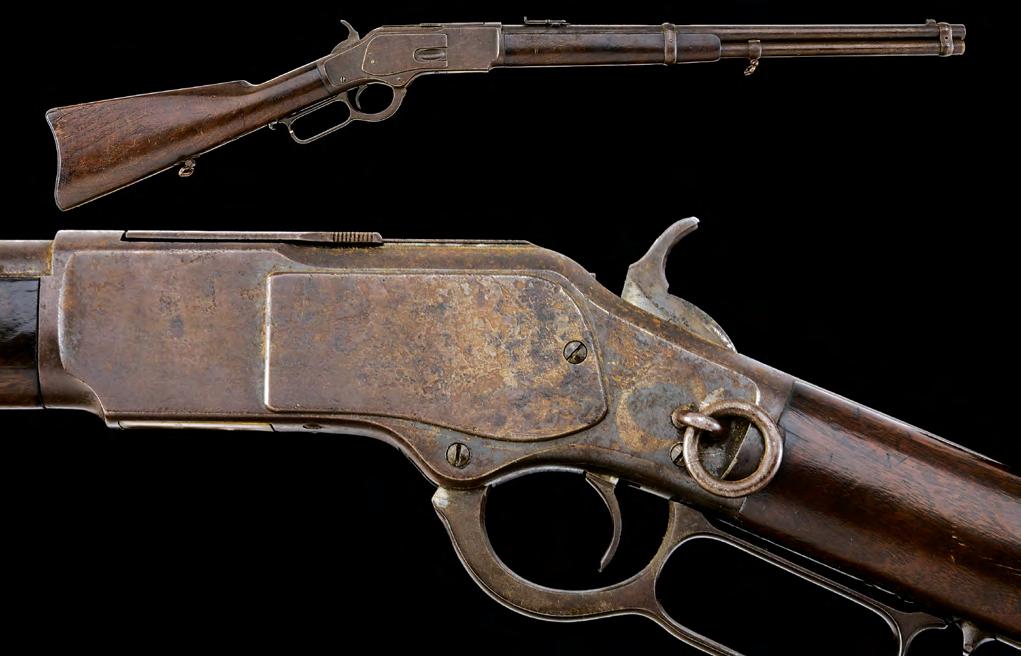
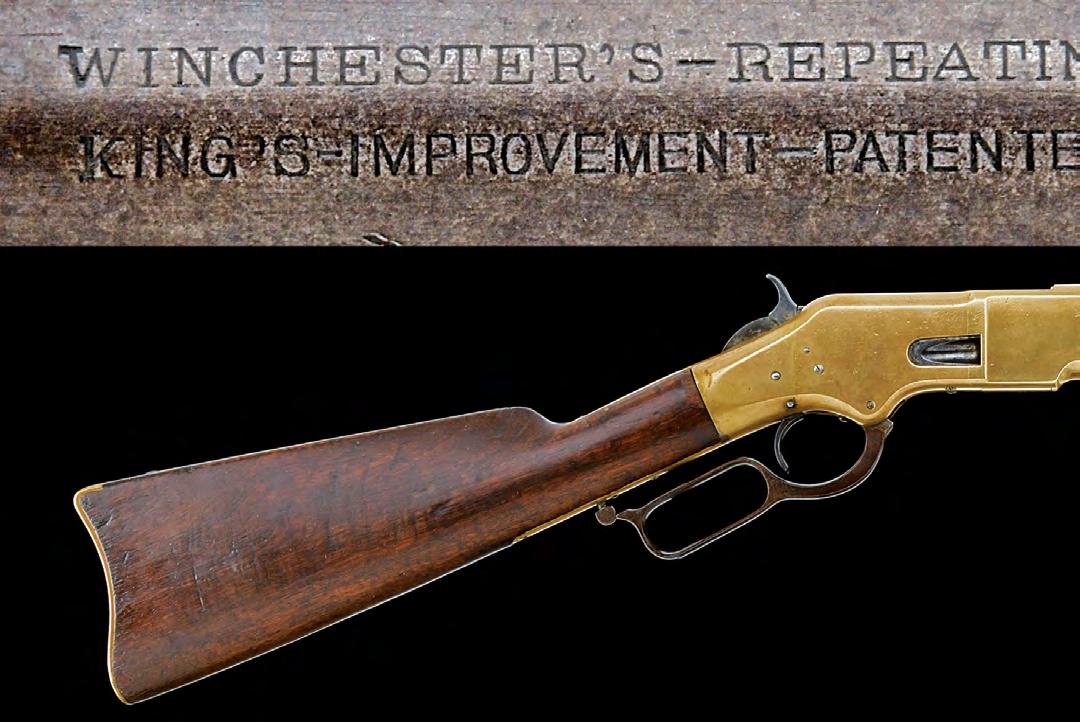
500 A WINCHESTER MODEL 1873 CARBINE USA, 1875 - 1889 circa Round, rifled, 20” barrel, with foresight, foldaway and adjustable rear sight, featuring the manufacturer’s mark in two clearly visible lines, with patents from 1866 and 1860; marked with the calibre “44 W.C.F.” Clean bore, visible rifling, slight pitting inside. Frame with rear cover guide in one piece with the frame. Working mechanism. Elevator block marked “44 CAL.” Pitting. Rear tang with model inscription, the lower one with serial number “438xxxB”. Smooth walnut butt and fore-end. Iron mounts. Butt plate with compartment. A couple of screws missing. Some oxidation and pitting in certain areas. With sling swivel.
WINCHESTER MODEL 1873 CARBINE USA, 1875 - 1889 circa Canna tonda rigata, da 20”, dotata di mirino e con alzo abbattibile e regolabile, recante marcatura della ditta in due righe ben visibile, con brevetti del 1866 e 1860; presente la dicitura del calibro “44 W.C.F.”Anima pulita, rigatura visibile, lievi intaccature all’interno. Castello con guida del coperchio dorsale in un unico pezzo con il telaio. Meccanica funzionante. Carrello elevatore con marcatura “44 CAL.” Intaccature. Codolo dorsale con dicitura del modello, quello inferiore con matricola “438xxxB”. Calcio ed astina lisci in noce. Fornimenti in ferro. Calciolo con scomparto. Un paio di viti mancanti. Qualche ossidazione e intaccature in alcune zone. Anello da sella presente.
Conditions
€ 700/1.000
501 A WINCHESTER MODEL 1866 CARABINE “YELLOW BOY”, THIRD MODEL USA, 1876
20”round, rifled, 44. rimfire cal. barrel (clean bore and visible rifling), marked with two-line address and patent inscription “KING’S IMPROVEMENT,” provided with foldaway rear sight and foresight. Brass frame; serial number “136xxx” on the lower tang, under the lever; inside, number “733,” probably an assembly number. Butt and foreend of walnut wood with brass mounts; the butt with repair on the back of the grip. Sling swivel. Butt-plate with gate. Working mechanism. Rare and in good condition. Probably an old repair at the base of the lower tang of the frame and at the tip of the upper tang. Complete with the rare three-section detachable ramrod.
Serial numbers on the lower tang, shaped frame with foresight, serial numbers under 149,000, King patent on the barrel: third model. See Flayderman’s Guide, 9th edition, pp. 306–307. 5K-031.
WINCHESTER MODEL 1866 CARABINE “YELLOW BOY”, TERZO MODELLO USA, 1876
Canna tonda, rigata (anima pulita e rigatura visibile), da 20”, con marcatura dell’indirizzo e brevetto in due righe con “KING’S IMPROVEMENT”, munita di alzo abbattibile e mirino, cal. 44. rimfire. Castello in ottone; la matricola “136xxx” sul codolo inferiore, sotto alla leva; all’interno il numero, probabilmente di assemblaggio,“733”. Calcio ed astina in noce con fornimenti in ottone, il primo con riparazione al dorso del collo. Anello da sella. Calciolo con sportellino. Meccanica funzionante. Raro e in buone condizioni. Probabilmente una vecchia riparazione alla base al codolo inferiore del castello e in punta al codolo superiore. Completo della rara bacchetta smontabile in tre sezioni.
Numeri di serie sul codolo inferiore, castello sagomato con l’astina, numeri di serie entro il 149000, brevetto King sulla canna: terzo modello. Vedi Flayderman’s Guide, 9th edition, pagg. 306-307. 5K-031.
Conditions good Length 99 cm.
€ 1.300/1.800
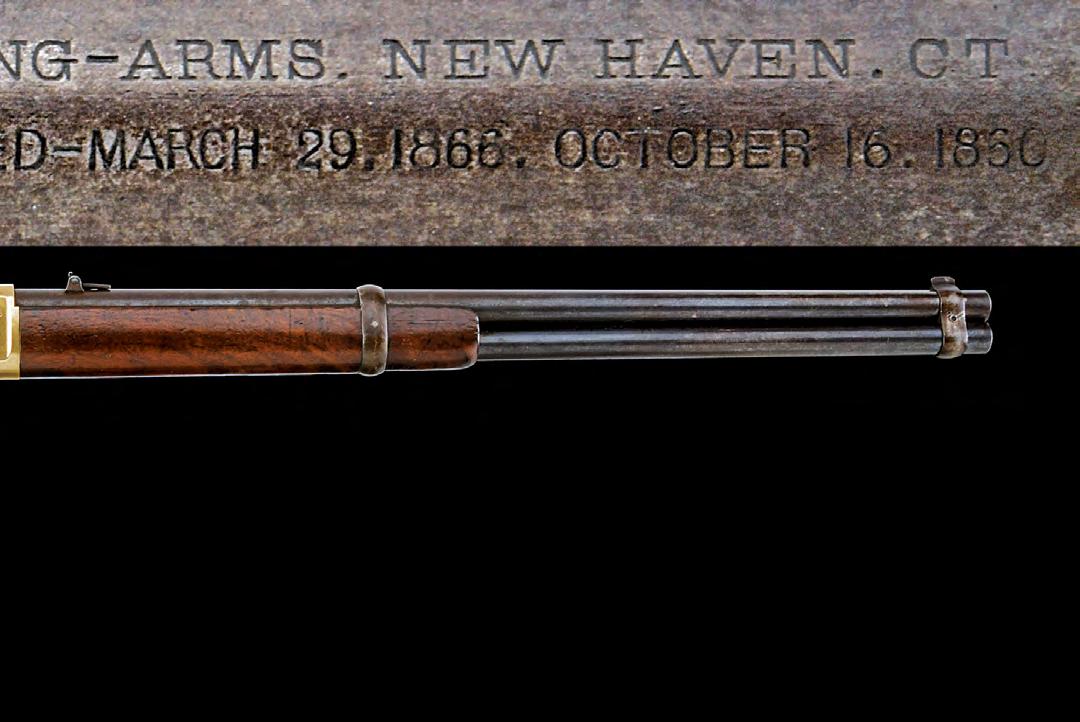
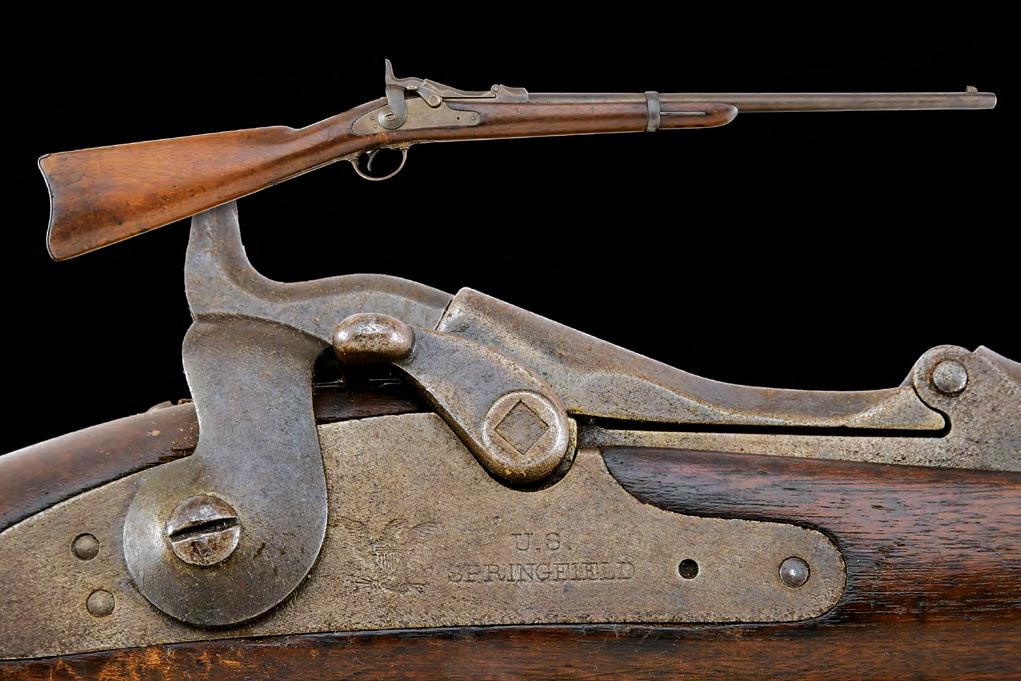
502 AN 1873 MODEL “TRAPDOOR” CARBINE
USA, 1870 - 1889 circa Round, rifled barrel, with foresight, with missing rear sight, marked “V”,“P”, an eagle’s head, and another “P”. 11, 8 mm cal. (.46) at the nozzle. Clean bore with visible rifling; some areas with pitting. Central fire folding bolt. The model inscription has almost completely faded; only “US MODEL ...” is legible. Tang with remains of the old serial number “112541” (a second serial number is present, stamped later on the side of the barrel). Working mechanism, but with signs of wear, needs revision. Lock with remains of the “U.S. SPRINGFIELD” mark; the eagle is still visible. Walnut, half stock with an old repair on the back. Iron mounts. Butt plate with an arsenal modification (addition of a tubular compartment) and marked “US.” Pitting, signs of use and time.
MODEL 1873 “TRAPDOOR” CARBINE
USA, 1870 - 1889 circa Canna tonda rigata dotata di mirino, con alzo mancante, marcata con “V”,“P”, testa d’aquila e ancora una “P”. In volata cal. 11,8 mm (.46) Anima pulita rigatura visibile, qualche zona con intaccature. Otturatore a tabacchiera a percussione centrale. La dicitura del modello quasi completamente svanita, leggibile solo “US MODEL ...” Il codolo con resti della vecchia matricola “112541” (una seconda matricola presente, timbrata successivamente sul fianco della canna). Meccanica funzionante ma con segni di usura e da rivedere. Batteria con resti della marcatura “U.S. SPRINGFIELD”, l’aquila ancora visibile. Mezza cassa in noce con una vecchia riparazione al dorso. Fornimenti in ferro. Il calciolo con la modifica di arsenale (aggiunta di scomparto tubulare) e con marcatura “US”. Intaccature, segni d’uso e del tempo.
Conditions medium
Length 104.7 cm.
€ 200/300
503 AN EVANS LEVER ACTION RIFLE
USA, 1873 - 1879
Round, 28”, rifled barrel (with encrustments, maybe pitting, inside; it needs cleaning), provided with brass foresight. .44 cal.at the nozzle; featuring the marking “EVANS REPEATING RIFLE MECHANIC FALLS ME PAT 8 DEC 1886 & SEP 16 1871 U.S.A.” on the back. Foldaway and adjustable rear sight. Iron frame (screws need tightening?). Working mechanism, fed by a tubular magazine in the butt. Butt stock of walnut wood, made in two halves; fore-end also of walnut wood; all smooth. Iron parts with pitting. Other signs of use and time.
This rare rifle has an inscription on the barrel that is typical of the so-called “Transition Models”, but we believe that the frame is already that of the “New Model”. It is likely to be a New Model Sporting Rifle, which generally had an octagonal barrel and was produced in a run of around 3,000 items. It was one of the first to be manufactured. See Flayderman’s Guide, 9th edition, pp. 694–695.
EVANS LEVER ACTION RIFLE
USA, 1873 - 1879
Canna tonda rigata (anima con incrostazioni, forse anche pitting, all’interno; da pulire), da 28”, dotata di alto mirino in ottone. Cal .44 in volata; recante al dorso marcatura “EVANS REPEATING RIFLE
MECHANIC FALLS ME PAT 8 DEC 1886 & SEP 16 1871 U.S.A.”Alzo abbattibile e regolabile. Castello in ferro (viti da stringere?). Meccanica funzionante, con alimentazione tramite serbatoio tubulare nel calcio. La pala in noce, realizzata in due metà, astina sempre in noce, tutti gli elementi lisci. Le parti in ferro con pitting. Altri segni d’uso e del tempo.
Raro fucile: la dicitura sulla canna appartiene agli esemplari definiti “Transition Models” ma il castello a nostro avviso è già quello del “New Model”. Probabilmente un New Model Sporting Rifle (che però generalmente aveva canna di sezione ottagonale, realizzato in circa 3000 esemplari), fra i primi realizzati. Vedi Flayderman’s Guide 9th Edition, pagg. 694-695.
Conditions medium
Length 120.5 cm.
€ 400/700
504
A SHARPS NEW MODEL 1863 CARBINE, PERCUSSION BREECHLOADER
USA, 1863 - 1865
Round, rifled, 22” barrel (six grooves), with foresight, remains of a three-line mark “SHARPS RIFLE / MANUFG. CO. / HARTFORD CONN.” and remains of the model inscription “NEW MODEL 1863”. 52 cal. at the nozzle. Missing foldaway rear sight. Frame with 1848 Sharps patent mark on the left side; on the right side, the 1859 Lawrence mark and the 1852 Sharps patent mark are still clearly visible (both on the lock plate). Working falling block bolt, with percussion. Upper tang with serial number “C,18xxx”. Walnut butt and fore-end with remains of military inspection stamps on the left side below the sling swivel. Iron mounts. The lever safety lock is missing.
An interesting example that has not been converted to metal cartridge. Model without patchbox. See Flayderman’s Guide, 9th Edition, pp. 198–199. 5F-021.
SHARPS NEW MODEL 1863 CARBINE, VERSIONE A RETROCARICA A LUMINELLO
USA, 1863 - 1865
Canna tonda rigata (sei principi) da 22”, dotata di mirino, recante resti di marcatura in tre righe “SHARPS RIFLE / MANUFG. CO. / HARTFORD CONN.” e resti di dicitura del modello “NEW MODEL 1863”. Cal. .52 in volata. Alzo abbattibile mancante. Castello con marcatura del brevetto Sharps del 1848 sul fianco sinistro, su quello destro ancora ben visibili la marcatura Lawrence del 1859 e quella del brevetto Sharps del 1852 (entrambe sulla cartella). Otturatore a blocco cadente funzionante, con luminello. Codolo superiore con matricola “C,18xxx”. Calcio ed astina in noce con resti di timbri d’ispezione militare sul fianco sinistro sotto alla barra dell’anello da sella. Fornimenti in ferro. Manca il fermo di sicurezza della leva.
Interessante esemplare non convertito a cartuccia metallica. Modello senza patchbox. Vedi Flayderman’s Guide 9th Edition. Pag. 198-199. 5F-021.
Conditions medium Length 99 cm.
€ 600/1.000
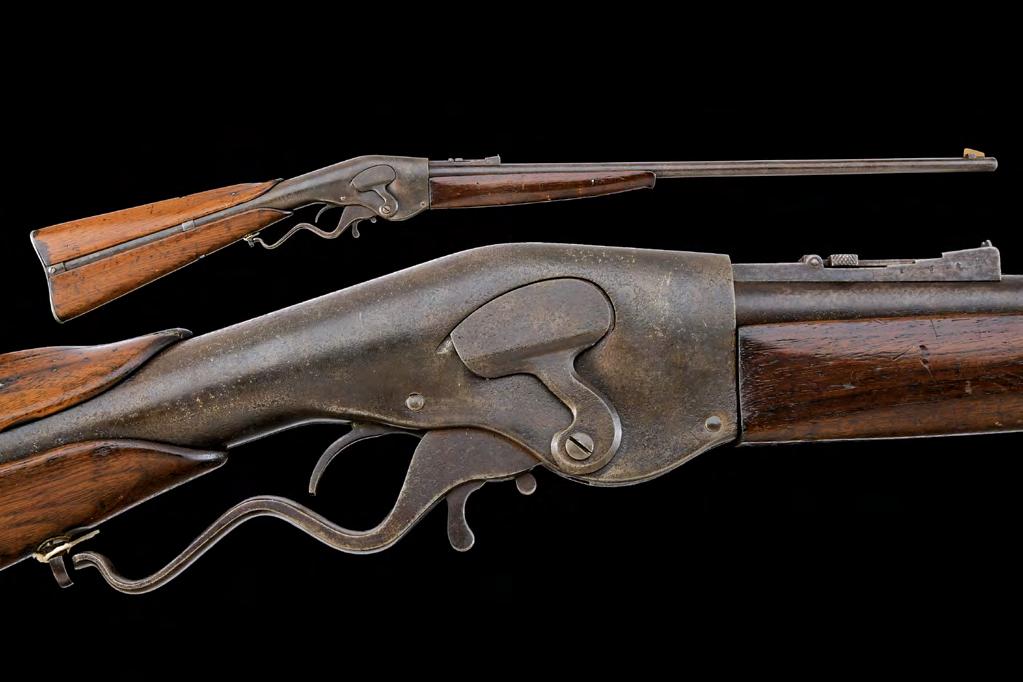
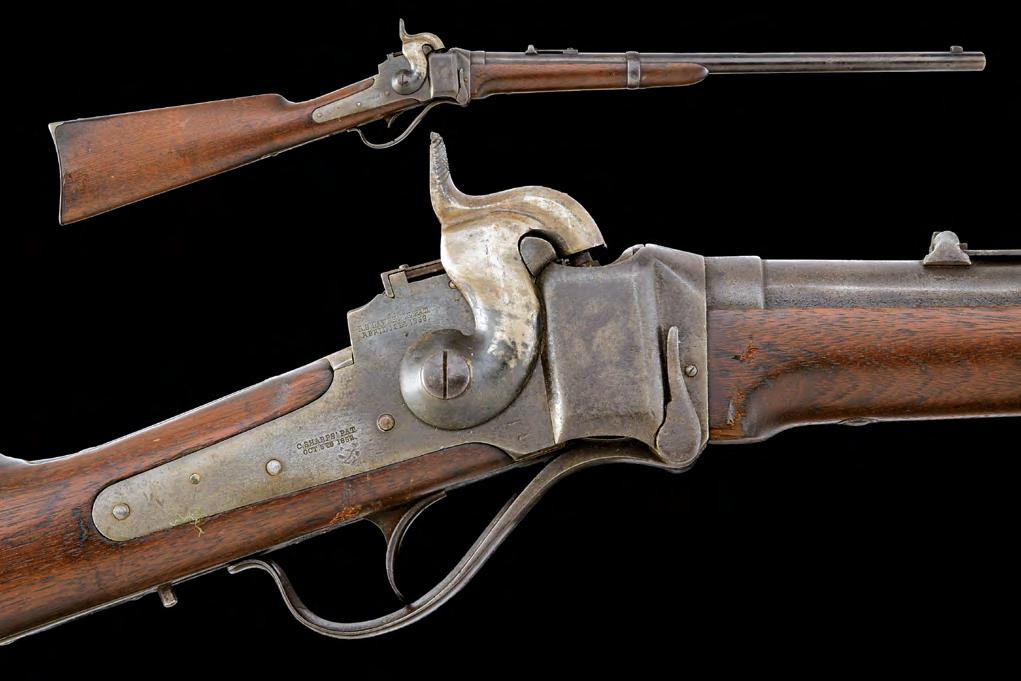
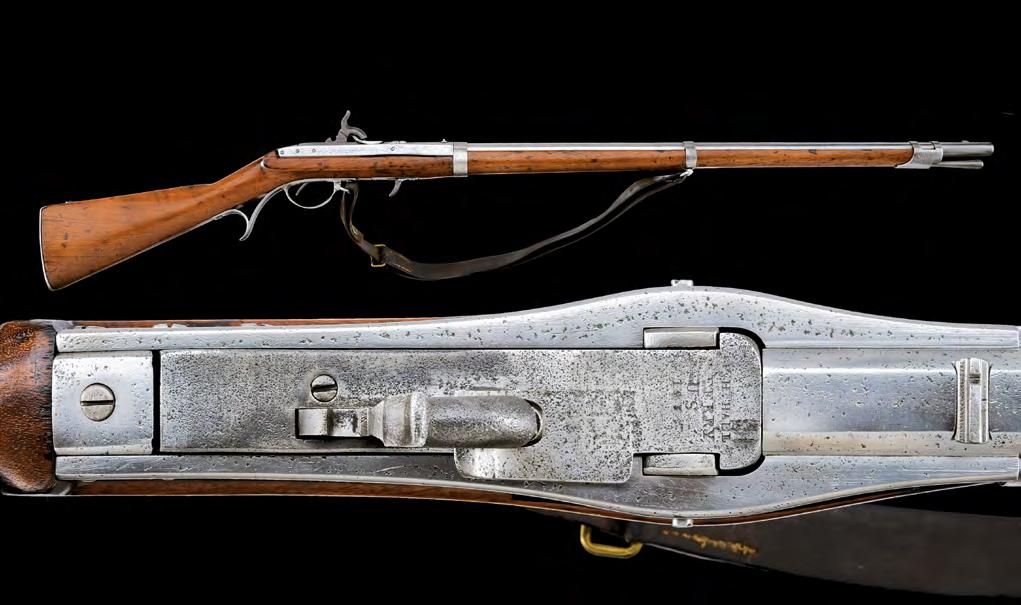
505
AN 1819/31 MODEL U.S. HALL
BREECHLOADING PERCUSSION RIFLE
USA, Second quarter of the 19th Century Converted to percussion. Round, rifled, 13 mm cal. barrel with rear sight and foresight; frame (pitting) marked “H. HALL FERRY US 1831”; under-lever opening system, wooden full stock with iron mounts and ramrod. Leather strap. Rare.
MODEL 1819/31 HALL U. S.
BREECHLOADING PERCUSSION RIFLE
USA, Secondo quarto del XIX Secolo Ridotto a luminello. Canna tonda, rigata, con alzo e mirino, cal. 13 mm; castello (pitting) firmato “H. HALL FERRY US 1831”; leva di apertura inferiore, cassa intera in legno con fornimenti e bacchetta in ferro. Cinghia in cuoio. Raro.
Conditions medium
Length 133.5 cm.
€ 600/900
506
A SPENCER REPEATING CARBINE
USA, 1863 - 1865 Round, six-rifled, 22”, 52 rimfire cal. barrel, with foldaway and adjustable rear sight. Clean bore, visible rifling, some pitting inside. Iron frame featuring the Boston company marking and 1860 patent on the back. Falling-block bolt. Working mechanism.Walnut butt and fore-end apparently without ordinance stamps but with signs of use and time. Iron mounts. Marked “J” on the frame. Serial number “18xxx”. Butt plate with removable reservoir. Sling swivel.
One of the most frequently used and typical weapons of the War of Secession. This example features a serial number in the range of those employed in the war. See ‘Spencer Repeating Firearms’ by R.M. Marcot, p. 62.
SPENCER REPEATING CARBINE
USA, 1863 - 1865 Canna tonda da 22”, a sei rigature, dotata di alzo abbattibile e regolabile, cal. 52 rimfire. Anima pulita, rigatura visibile, qualche intaccatura all’interno. Castello in ferro recante al dorso la dicitura della ditta di Boston e il brevetto del 1860. Otturatore a blocco cadente. Meccanica funzionante. Calcio ed astina in noce apparentemente senza timbri d’ordinanza ma con segni d’uso e del tempo. Fornimenti in ferro. Punzone “J” sul castello. Matricola “18xxx”. Calciolo con serbatoio estraibile. Anello da sella.
Una delle armi maggiormente impiegate e tipiche della Guerra di Secessione. Questo esemplare con matricola nel range di quelli impiegati nella guerra. Vedi “Spencer Repeating Firearms” di R.M. Marcot, pag. 62.
Conditions medium
Length 99 cm.
€ 700/1.000
507
AN INTERESTING SHARPS NEW MODEL 1859 CARBINE, CENTERFIRE CONVERSION USA, 1859 - 1867
Round, rifled, 50-70 CF cal barrel, bearing a few traces of markings along the top, fitted with front sight and with folding, adjustable rear sight with base marked with Lawrence patent. Clean bore with visible rifling (3 grooves). Browning probably refreshed. Receiver with breech-loading mechanism fitted with falling-block action, the trigger guard serving as release lever, and centre-fire striker. In working order. On the left side with Sharp’s 1848 patent marking. Tang with serial number “52xxx”. Walnut butt stock and fore-end, the former bearing on the left side the 1867 arsenal conversion cartouche (DFC within a framed cartouche). Iron mounts. Saddle ring bar plate stamped “A K”. Model fitted with patchbox with iron cover.
Model 1859, factory-converted to metallic cartridge in 1867 at the request of the U.S. Government following the end of the Civil War. Examples converted at the factory were also reblued and, if worn, their stocks were replaced with new ones; replacement stocks were never fitted with patchboxes. This example was evidently in good condition at the time of conversion and has thus retained its original stock. See Flayderman’s Guide, 9th edition, pp. 198–200
INTERESSANTE SHARPS NEW MODEL 1859 CARBINE, CENTERFIRE CONVERSION USA, 1859 - 1867 Canna rigata, tonda, recante al dorso pochi resti di marcatura , dotata di mirino e con alzo abbattibile e regolabile recante base marcata con brevetto Lawrence. Cal. 50-70 CF. Anima pulita con rigatura visibile (3 principi). Brunitura probabilmente rinfrescata. Castello con meccanica a retrocarica dotata di otturatore a blocco cadente con ponticello che funge da leva di sblocco e percussore centrale. Funzionante. Sul lato sinistro con brevetto Sharp’s del 1848. Codolo con matricola “52xxx”. Calcio ed astina in noce, il primo recante sul fianco sinistro il timbro della conversione d’arsenale del 1867 (DFC entro un cartiglio). Fornimenti in ferro. Piastra della guida per l’anello da sella punzonata “A K”. Modello dotato di Patchbox con coperchio in ferro.
Modello 1859 convertito di fabbrica a cartuccia metallica nel 1867 su richiesta del governo US al termine della Guerra Civile. Gli esemplari che venivano convertiti in fabbrica venivano anche ribruniti e, se usurato, veniva anche rimpiazzato loro il calcio con uno nuovo; il calcio di rimpiazzo non aveva mai il patchbox. Questo esemplare evidentemente era in buone condizioni al momento della conversione ed ha conservato così il suo calcio originale. Vedi Flayderman’s Guide 9th edition. pagg. 198-200.
Conditions good Length 99 cm.
€ 800/1.200
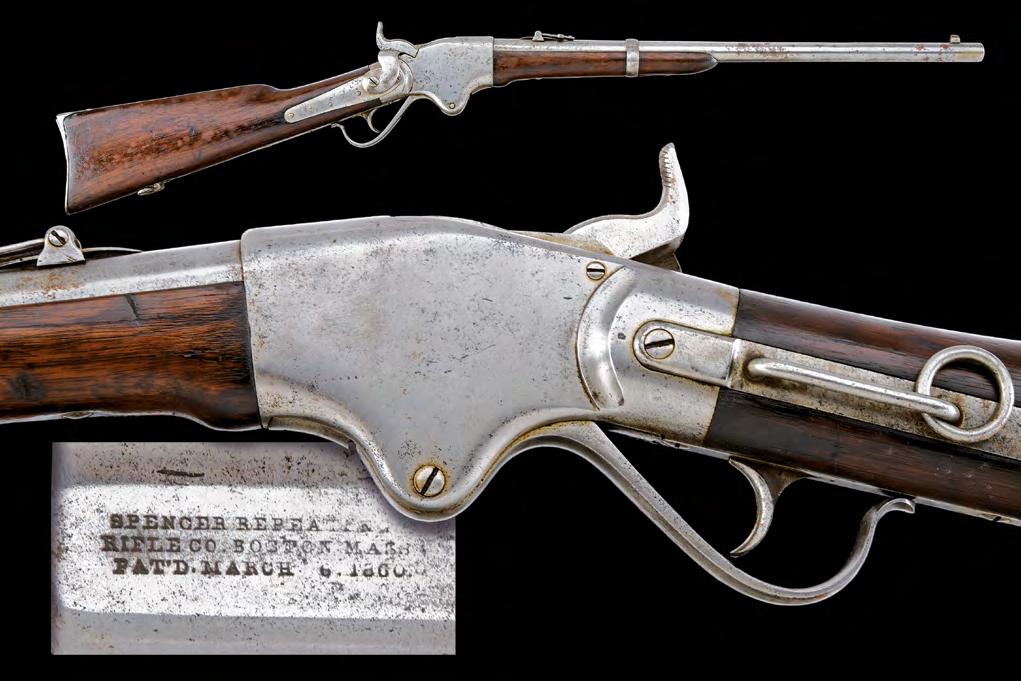
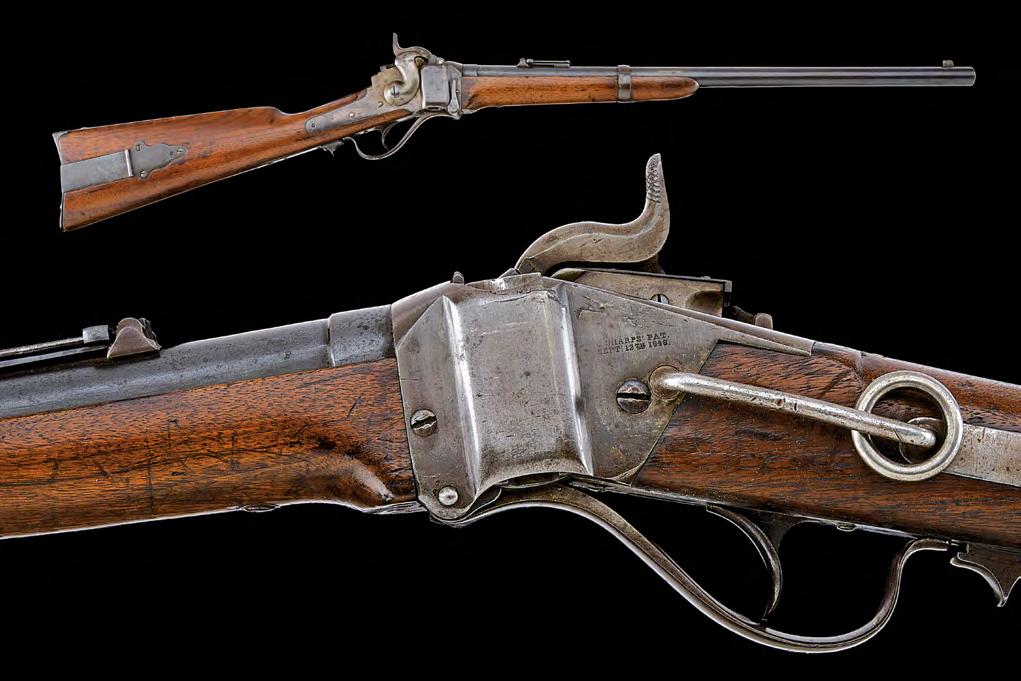
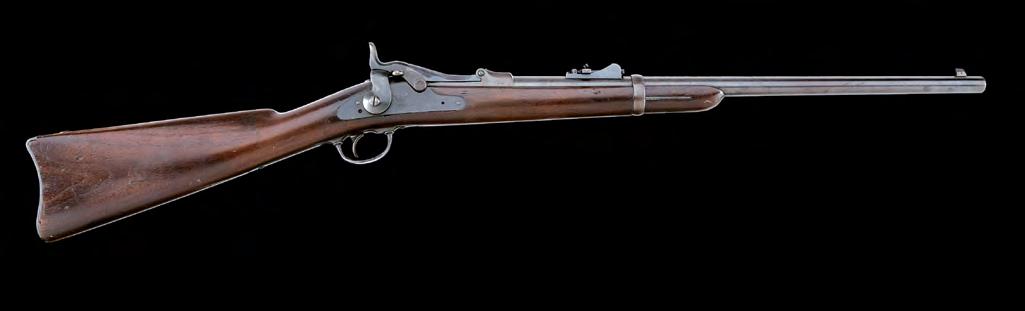
508
A RARE AND INTERESTING “CUSTER RANGE” MODEL 1873 TRAPDOOR CARBINE USA, about 1880 22”, round barrel, with foresight, with foldaway rear sight numbered up to “15”, 45-70 cal. central fire. Clean bore with visible rifling. Trapdoor breech marked “MODEL 1873” surmounted by an eagle’s head on crossed arrows and with inscription “US”. Tang with serial number “410xx”. Lock with lock plate marked “US SPRINGFIELD” and engraved with the US eagle. Working mechanism. Walnut, half stock, apparently without visible stamps. Butt plate marked “US” (pitting) with loading gate, three compartments inside. Iron mounts. Single barrel bracket. Stirrup with sling swivel on the left side. Some re-browning. Slight signs of use and time. On the left side of the butt stock there is a brass plate indicating that it belonged to the Seventh Cavalry.
Carbine produced in 20,000 units. Those with serial numbers below 43700 were manufactured before 1876. See “Flayderman’s Guide,” 9th Edition, pages 582–583. 9A-364. This model was widely used during the Indian Wars. Carbines generally associated with George Custer’s 7th Cavalry (issued before the Battle of Little Bighorn) typically have serial numbers in the range between 33000 and 43700, like our example.
RARO E INTERESSANTE MODEL 1873 TRAPDOOR CARBINE “CUSTER RANGE” USA, 1880 circa Canna tonda da 22”, dotata di mirino, con alzo abbattibile numerato sino a “15”, cal. 45-70 a percussione centrale. Anima pulita, rigatura visibile. Otturatore trapdoor marcato con dicitura “MODEL 1873” sormontante testa d’aquila posta su frecce incrociate e con iscrizione “US”. Il codolo con matricola “410xx”. Batteria con cartella marcata “US SPRINGFIELD” e con l’aquila statunitense incisa. Meccanica funzionante. Mezza cassa in noce, apparentemente senza timbri visibili. Calciolo marcato “US” (intaccature) dotato di sportellino, all’interno tre scomparti. Fornimenti in ferro. Reggicanna singolo. Staffa con anello da sella sul fianco sinistro. Qualche ribrunitura. Leggeri segni d’uso e del tempo. Sul lato sinistro della pala applicata una targhetta in ottone che ne indica l’appartenenza al Settimo Cavalleria.
Carabina prodotta in 20000 esemplari. Quelle al di sotto del numero di serie 43700 costruite prima del 1876. Vedi “Flayderman’s Guide”, 9th Edition, pagg. 582-583. 9A-364. Modello ampiamente usato durante le Guerre Indiane, generalmente le carabine associate al 7° Cavalleria di George Custer (consegnate prima di Little Bighorn) hanno seriali nel range fra 33000-43700 come il nostro esemplare.
Conditions good Length 104.7 cm.
€ 1.200/1.500
509
A COLT LIGHTNING SLIDE ACTION MEDIUM FRAME, FIRST TYPE USA, 1886
Round, rifled barrel (clean bore, small areas with encrustments, visible rifling), marked with the manufacturer’s address and patents from 1883 (first model!), provided with foresight and adjustable, foldaway and browned rear sight, caliber marking: “44 Cal.”Working mechanism. Frame with engraved horse rampant, back without extractor cover, loading gate on the right side, and safety lock on the trigger guard; it keeps approximately 15% of the original browning. Wooden butt and fore-end, the latter checkered. Serial number on the lower tang “18xxx”.
This is an interesting and rare item because it is an early production model; featuring safety lock at the trigger guard and frame back without its cover on the extractor. See Flayderman’s Guide, 9th Edition, pp. 122–123.brunitura?
COLT LIGHTNING SLIDE ACTION MEDIUM FRAME, FIRST TYPE USA, 1886
Canna tonda rigata (anima pulita, piccole zone con incrostazioni, rigatura visibile), marcata con indirizzo della ditta e con brevetti del 1883 (primo modello!), dotata di mirino ed alzo regolabile, abbattibile e brunito, dicitura del calibro “44 Cal.”. Meccanica funzionante. Castello con cavallino rampante inciso, dorso privo di coperchio all’estrattore, sportellino di caricamento sul fianco destro e sicura al ponticello; rimane circa un 15% della brunitura originale. Calcio ed astina in legno, la seconda zigrinata. Matricola nel codolo inferiore “18xxx”.
Interessante e raro esemplare perchè di prima produzione, presenta difatti la sicura al ponticello e il dorso del castello privo di coperchio all’estrattore. Vedi Flayderman’s Guide, 9th Edition. Pagg. 122-123.
Conditions good
Length 109 cm.
€ 700/1.000
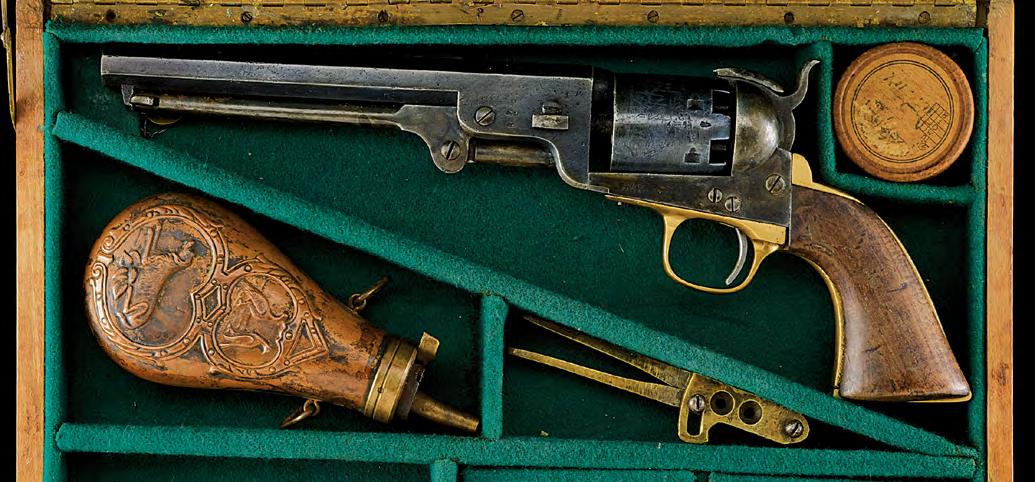
510
A COLT MODEL 1849 POCKET REVOLVER, LONDON COLT
London, Third quarter of the 19th Century Octagonal, 4-inch, rifled, .31 cal. barrel, featuring the inscription“ADDRESS COL COLT LONDON”in two lines in curly brackets, provided with brass foresight. The bore with heavy encrustments, it needs cleaning. Fiveshot cylinder with remains of the Diligence engraving. Working mechanism. Frame marked“COLT PATENT”. Iron grip bands. Wooden grip. Marks of the London test bench. Matching serial number“49xx”on barrel, cartridge rammer, cylinder, frame, trigger guard and grip. Pitting, signs of use and time.
COLT MODEL 1849 POCKET REVOLVER, LONDON COLT
Londra, Terzo quarto del XIX Secolo Canna ottagonale, rigata, da 4”, con indirizzo“ADDRESS COL COLT LONDON”in due righe fra parentesi graffe, dotata di mirino in ottone, cal. 31. Anima con forti incrostazioni, da pulire. Tamburo a cinque colpi con tracce di incisione della diligenza. Meccanica funzionante. Castello marcato“COLT PATENT”. Bande dell’impugnatura in ferro. Impugnatura in legno. Punzoni del banco di prova di Londra. Matricola“49xx”coeva su canna, calcatoio, tamburo, castello, ponticello e impugnatura. Intaccature, segni d’uso e del tempo.
Conditions medium Length 22 cm. € 200/350
511
A COLT MODEL 1849 POCKET
REVOLVER
USA, 1859
6“, octagonal, rifled, 31 cal. barrel, marked with the Colt address in New York City in parentheses on two lines, provided with foresight. Visible rifling, encrustments which need cleaning. Smooth, five-shot cylinder with remains of engravings; hammer and trigger working but the cylinder does not rotate. Frame marked ”COLTS PATENT”. Grip bands with wellpreserved, silver-colored finishing;“L” and ‘M’ marks. Grip of walnut wood. Serial number“159xxx”matching barrel, frame, grip bands, cylinder, and barrel wedge (shortened). Various pitting on the metal parts, especially on the cylinder.
COLT MODEL 1849 POCKET
REVOLVER
USA, 1859
Canna ottagonale da 6”, rigata, marcata con indirizzo Colt di New York City tra parentesi in due righe, dotata di mirino, cal. 31. Rigatura visibile, incrostazioni da pulire. Tamburo liscio con resti di incisioni, a cinque colpi; cane e grilletto funzionanti ma il tamburo non ruota.
Castello marcato“COLTS PATENT”. Bande dell’impugnatura con finitura color argento ben conservata; punzoni “L”e“M”. Impugnatura in noce. Matricola“159xxx”coeva su canna, castello, bande dell’impugnatura, tamburo e fermo canna (abbreviata). Varie intaccature sulle parti in ferro, soprattutto al tamburo.
Conditions medium Length 28 cm. € 300/500
512 A COLT MODEL 1851 NAVY REVOLVER, LONDON COLT
London, Third quarter of the 19th Century Octagonal, 7-1/2“, rifled, 36 cal. barrel, marked ”ADDRESS COL. COLT LONDON”(various encrustments and oxidations, it needs cleaning inside), with marks of the London test bench. Six-shot cylinder with various pitting and remains of markings that are no longer legible; the marks of the London test bench and the remains of sailing ship emblems are still visible. Working mechanism but it jams sometimes. Frame marked“COLTS PATENT.”Grip bands probably replaced later with compatible parts (marked“J. NIKITITS...”) and re-gilded. Decoration on the back of the hammer. Wooden grip. Late rebrowning. Pitting, signs of use and time. Serial number“418xx”on the barrel, cartridge rammer, cylinder, and frame. In a later-production case, complete with some accessories.
COLT MODEL 1851 NAVY REVOLVER, LONDON COLT
Londra, Terzo quarto del XIX Secolo Canna ottagonale rigata, da 7-1/2”, marcata“ADDRESS COL. COLT LONDON”(varie incrostazioni e ossidazioni da pulire all’interno), con punzoni del banco di Londra. Cal .36. Tamburo a sei colpi con varie intaccature e tracce di marcature non più leggibili, ancora visibili i punzoni del banco di prova e tracce di effigi di velieri. Meccanica funzionante ma con inceppamenti. Castello marcato“COLTS PATENT”. Bande dell’impugnatura probabilmente sostituite successivamente con pezzi compatibili (marcatura“J. NIKITITS...”) e ridorate. Applicazione sul dorso del cane. Impugnatura in legno. Tarda ribrunitura. Intaccature, segni d’uso e del tempo. Matr.“418xx”presente su canna, calcatoio, tamburo e castello. In una cassetta di produzione più tarda, completa di alcuni accessori.
Conditions mediocre
Length 33.5 cm.
€ 400/700
513 A COLT MODEL 1851 NAVY REVOLVER USA, 1852
Octagonal, 7-1/2“, rifled barrel (visible rifling, the bore needs cleaning), provided with foresight, featuring a clearly legible standard marking on the back ending in ”NEW YORK CITY”. Barrel and cartridge rammer with serial numbers matching the frame; barrel wedge also featuring a matching but shortened serial number; .36 cal. at the nozzle. Six-shot cylinder with slightly visible remains of a scene depicting the naval battle between Texas and Mexico; the patent and serial numbers are still legible (all matching the frame). Working mechanism (three snaps, the trigger safety is not working). Frame marked“COLTS PATENT”and serial number “19xxx”. Brass grip bands with remains of silver plating, also featuring matching serial numbers. Small, rounded trigger guard with “G”mark. Pitting, signs of use and time. Smooth grip of walnut wood with a small missing part.
An interesting item with low serial number, from the second year of production. Third model. See Flayderman’s Guide, 9th Edition, p. 89. 5B-052.
COLT MODEL 1851 NAVY REVOLVER USA, 1852
Canna ottagonale da 7-1/2”, rigata (rigatura visibile, anima da pulire), dotata di mirino, recante marcatura dorsale standard ben leggibile, terminante in “NEW YORK CITY”. Canna e calcatoio con matricola coeva al castello, il fermo sempre con matricola coeva ma abbreviata; cal. 36 in volata. Tamburo a sei colpi con lievi tracce di scena della battaglia navale tra Texas e Messico, ancora leggibile il brevetto e i numeri di serie (sempre coevi al castello). Meccanica funzionante (tre scatti, sicura al grilletto non funzionante). Castello con marcatura “COLTS PATENT” e Matricola “19xxx”. Bande dell’impugnatura in ottone con tracce di argentatura, sempre con matricole coeve. Il ponticello del tipo tondeggiante e piccolo, con punzone “G”. Qualche intaccatura, segni d’uso e del tempo. Impugnatura liscia in noce con piccola mancanza.
Interessante esemplare con bassa matricola, per il secondo anno di produzione. Terzo modello. Vedi Flayderman’s Guide, 9th Edition, pag. 89. 5B-052.
Conditions medium Length 33.5 cm.
€ 600/900
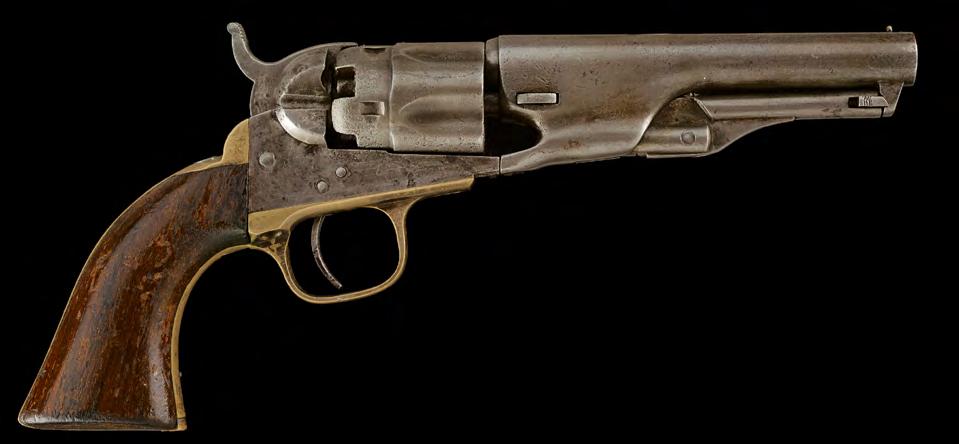
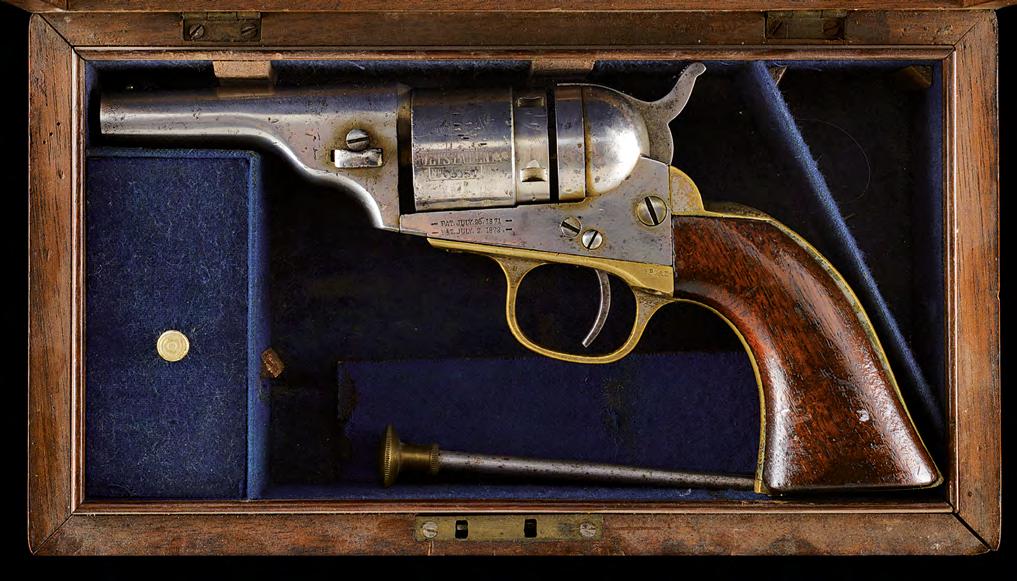
514
A COLT MODEL 1862 POLICE REVOLVER USA, 1863
4-1/2“, round, rifled, barrel, with cusp-shaped foresight, manufacturer’s address on the back, .36 cal. at the nozzle. Bore with visible rifling, some pitting inside. Grooved and rebated, five-shot cylinder, featuring a patent mark. Frame with remains of the ”COLTS PATENT” marking. Brass grip bands with remains of silver plating. Grip of walnut wood.“19xxx” serial number matching barrel, frame, and grip bands. Some pitting. Working mechanism.
COLT MODEL 1862 POLICE REVOLVER USA, Canna tonda rigata da 4-1/2”, con mirino a cuspide, indirizzo della ditta al dorso, cal. 36 in volata. Anima con rigatura visibile, qualche intaccatura all’interno. Tamburo scanalato e ribassato, a cinque colpi, recante brevetto. Castello con resti di marcatura “COLTS PATENT”. Bande dell’impugnatura in ottone con tracce di argentatura. Impugnatura in noce. Matricola “19xxx” coeva su canna, castello e bande dell’impugnatura. Qualche intaccatura. Meccanica funzionante.
Conditions medium
Length 24.5 cm.
€ 500/800
515 A CASED COLT 3-1/2” ROUND (CTG.) BARREL W/O EJECTOR “SOLID BARREL TYPE” USA, circa 1870 - 1880 Round, 3”, rifled .38 centerfire cal. barrel, provided with brass foresight, featuring remains of the manufacturer’s marking in two lines. Clean bore, visible rifling, pitting within the bore at the base of the foresight. Five-shot cylinder with remains of stagecoach markings. Frame with marks from 1871 and 1872. Brass grip bands with remains of earlier silver plating. Trigger guard marked “38 CAL.” Grip of walnut wood. Working mechanism. Model without loading gate. Matching serial number “305xxx” on barrel, frame, and grip bands. Cylinder with shortened matching serial number. In a wooden case (it needs restoration) lined with blue cloth, provided with a ramrod.
COLT 3-1/2” ROUND (CTG.) BARREL W/O EJECTOR “SOLID BARREL TYPE” IN CASSETTA
USA, 1870 - 1880 circa Canna tonda rigata, da 3”, dotata di mirino in ottone, recante resti di marcatura della ditta in due righe. Cal. 38 Centerfire. Anima pulita, rigatura visibile, intaccature all’interno, piccolo difetto nell’anima in corrispondenza della base del mirino. Tamburo a cinque colpi con resti di scena della diligenza. Castello con brevetti del 1871 e 1872. Bande dell’impugnatura in ottone con tracce di argentatura antica. Ponticello con dicitura del calibro “38 CAL.” Impugnatura in noce. Meccanica funzionante. Modello senza sportellino di caricamento. Matr.“305xxx” coeva su canna, castello e bande dell’impugnatura. Tamburo con matricola coeva abbreviata. In una cassetta in legno (da restaurare) foderata all’interno di panno blu, dotata di una bacchetta.
Conditions good
Length 21 cm.
€ 500/800
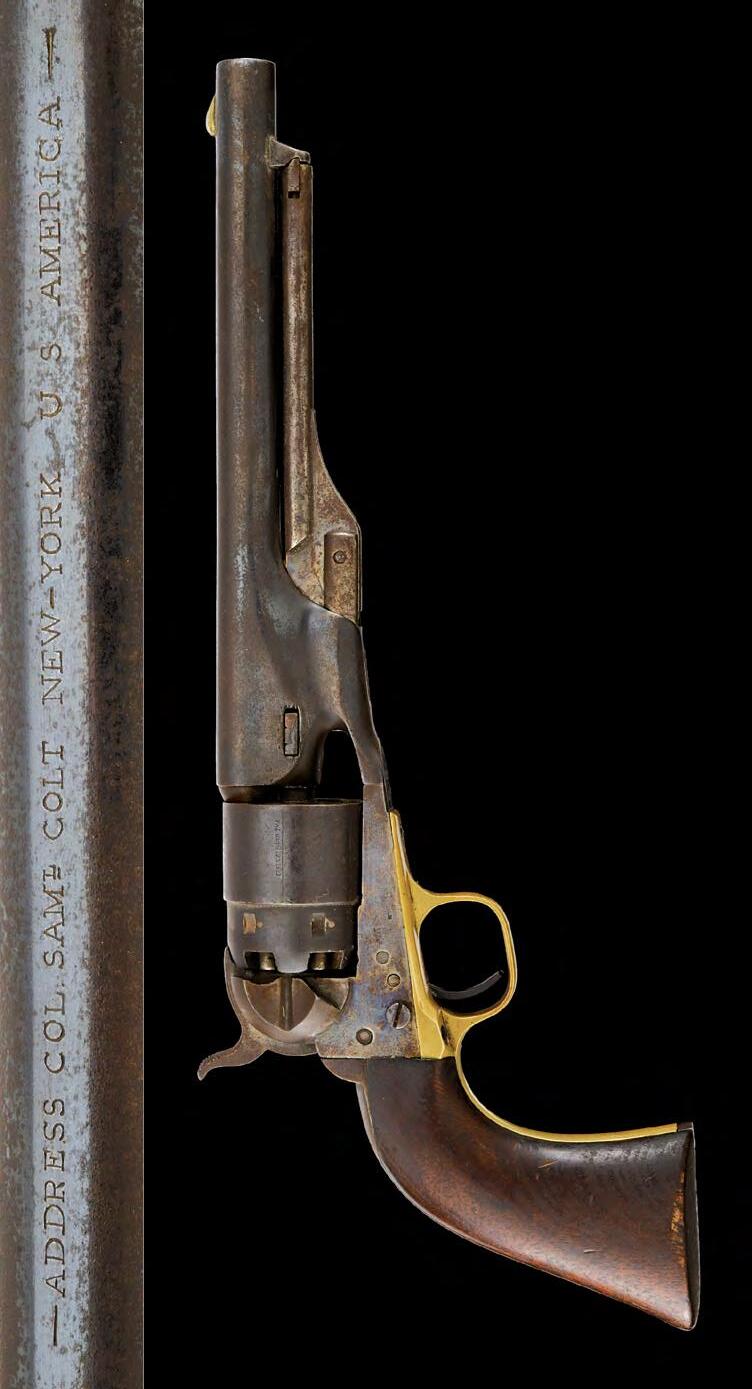
516
INTERESTING, MARTIALLY MARKED, COLT MODEL 1860 ARMY REVOLVER USA, 1862
8“ round, rifled, 44 cal.barrel, marked with New York address, provided with brass foresight, stamped “D” on the lower side and ”L” on the side. The bore needs cleaning; visible rifling. It approximately keeps 30% of its original browning. Sixshot cylinder with rebated tang, featuring remains of browning, with traces of markings and serial number; the patent mark and “L” marks are still visible. An engraving is not visible. Four-screw iron frame, featuring remains of casehardening and “COLT’S PATENT” marking. Provided with cut-outs and raised-head screws to mount the detachable butt. The trigger guard band is made of brass. The back of the grip is made of iron and also features a cut-out for the butt. Grip of walnut wood with remains of a military inspection mark and remains of a stamp (possibly an “S” on the bottom). Three-shot, working mechanism. Matching serial number on the barrel, barrel wedge (shortened), cylinder (shortened and not clearly visible), cylinder pin (shortened), frame, trigger guard, and grip. Light signs of use and time. Remains of browning also on the other parts.
Provenance: formerly from the Bonucci collection.An 1860 Army revolver used for military service, dating to the second year of the American Civil War, in good condition: a rare item, as service-issue weapons are often heavily worn. Featuring elements typical of military issue, including the “cut-outs” for the detachable butt, the unfinished brass, and the inspection marks.See Flyaderman’s Guide, 9th Edition, p. 94. 5B092.
INTERESSANTE COLT MODEL 1860 ARMY REVOLVER, DI IMPIEGO MILITARE
USA, 1862
Canna tonda, rigata, da 8”, marcata con indirizzo di New York, dotata di mirino in ottone, punzonata “D” sul lato inferiore e “L” sul fianco, cal. 44. Anima da pulire, rigatura visibile. Conserva circa il 30% della brunitura antica. Tamburo con coda ribassata, a sei colpi, con resti di brunitura, recante tracce di marcatura e della matricola, ancora visibile la marcatura del brevetto e i punzoni “L”. Incisione non visibile. Castello in ferro a quattro viti, con resti di tartarugatura e marcatura “COLT’S PATENT”. Munito di scassi e viti a testa rialzata per il montaggio del calcio smontabile. La banda del ponticello in ottone. Il dorso dell’impugnatura in ferro, anche questa con scasso per il calcio. Impugnatura in noce con tracce di marchio di controllo militare e resti di un timbro (forse “S” sul fondo). Meccanica ben funzionante, a tre scatti. Matricola coeva su canna, fermo (abbreviata), tamburo (abbreviata e scarsamente visibile), perno del tamburo (abbreviata), castello, ponticello e impugnatura. Leggeri segni d’uso e del tempo. Tracce di brunitura anche sugli altri elementi.
Provenienza: ex collezione Bonucci. Revolver 1860 Army di impiego militare, databile al secondo anno della Guerra di Secessione, in buone condizioni di conservazione: aspetto non comune, poiché gli esemplari di servizio risultano spesso molto usati. Presenta elementi tipici delle forniture militari, tra cui i “cut-out” per il calcio smontabile, l’ottone privo di finitura e i marchi di ispezione.Vedi Flyaderman’s Guide, 9th Edition, pag. 94. 5B092.
Conditions good Length 35 cm. € 1.000/1.500
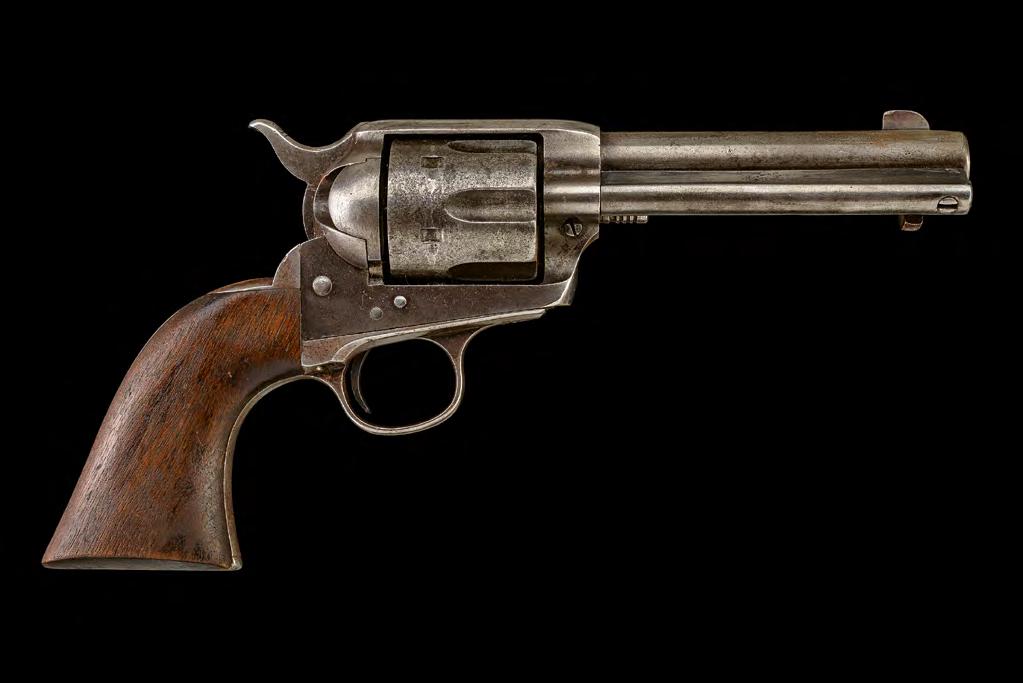
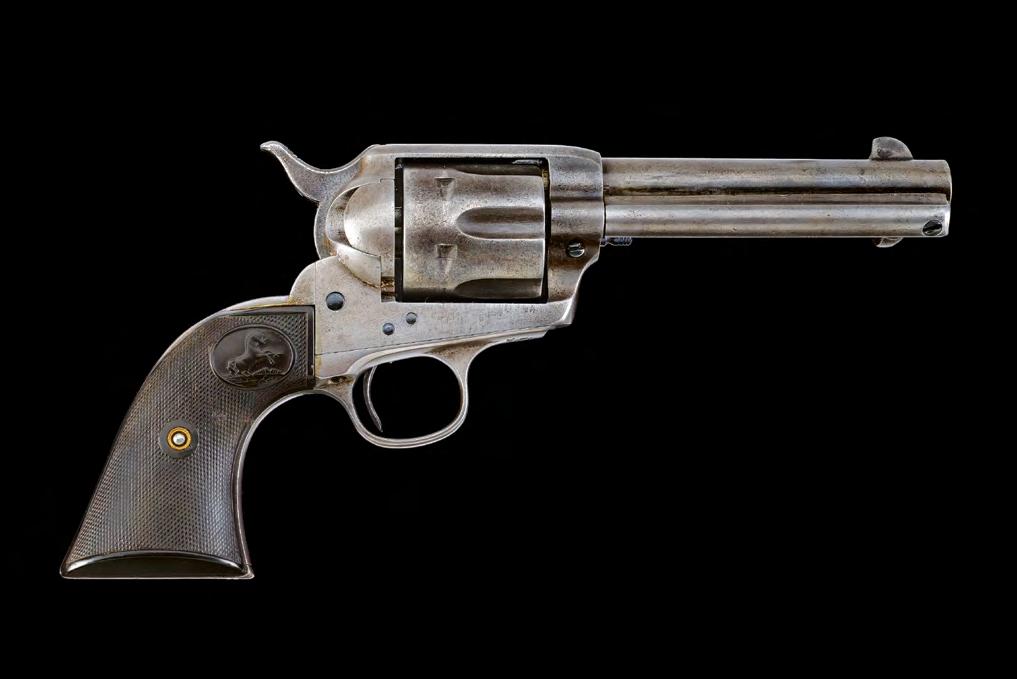
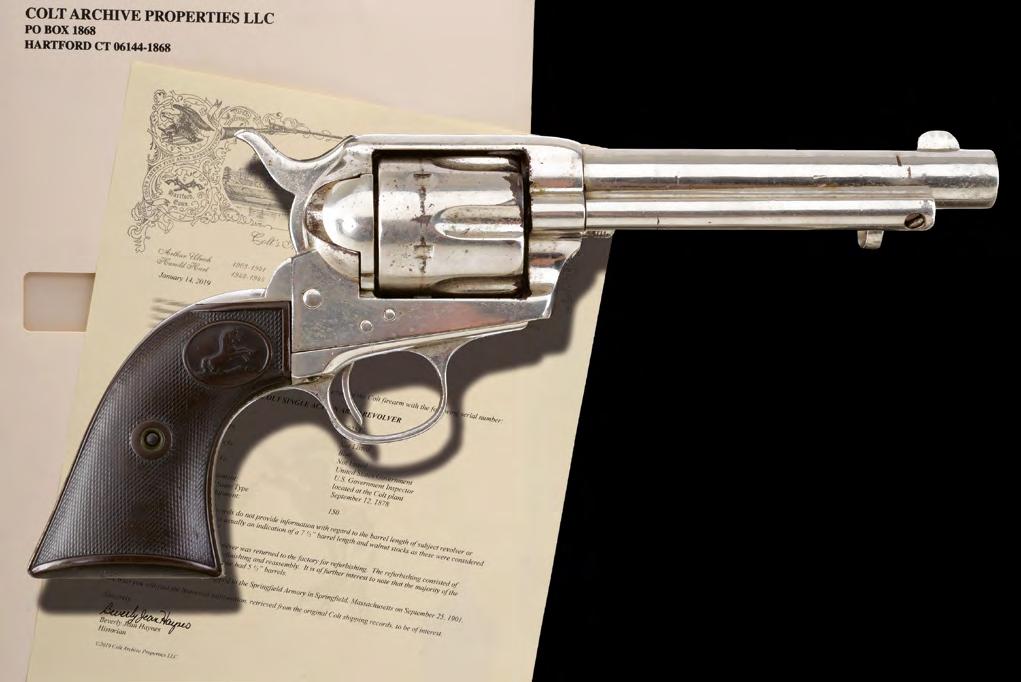
517
A COLT SINGLE ACTION ARMY REVOLVER USA, 1875
Round, 4-3/4“, rifled, 44-40 cal. barrel, with foresight, marked with the company address in two lines and the inscription ”FRONTIER SIX SHOOTER” on the left side. Visible rifling on the bore, some encrustments which need cleaning, signs of use inside. Grooved, sixshot cylinder, working mechanism, four snaps. Frame marked with patents up to 1875 and with the horse rampant stamp. Matching serial number “202xxx” on the frame and grip bands. Smooth wooden grip. Signs of use and time.
COLT SINGLE ACTION ARMY REVOLVER USA, 1875
Canna tonda rigata da 4-3/4”, con mirino, marcata con indrizzo della ditta in due righe e con dicitura “FRONTIER SIX SHOOTER” sul fianco sinistro, cal. 44-40. Anima con rigatura visibile, qualche incrostazione da pulire, segni d’uso all’interno. Tamburo scanalato a sei colpi, meccanica funzionante, quattro scatti. Castello marcato con brevetti sino al 1875 e con timbro del cavallino rampante. Matr. “202xxx” coeva su castello e bande dell’impugnatura. Impugnatura liscia in legno. Segni d’uso e del tempo.
Conditions medium
Length 26 cm.
€ 900/1.200
518
A COLT SINGLE ACTION ARMY REVOLVER. MOD. 1873
USA, circa 1880 - 1890
Rifled, 38 cal. barrel with bore in good condition, marked “Colt” and “38 W. C. F”. Six-shot, grooved cylinder, frame with patent marks up to 1875 and the Colt mark. Serial number “198xxx” on the frame, trigger guard and frame. Mechanism in excellent condition. Checkered grip scales of hard rubber with support (the checkering on the left grip is very worn).
COLT SINGLE ACTION ARMY REVOLVER. MOD. 1873 USA, 1880 - 1890 circa Canna rigata con anima in buone condizioni, indirizzo Colt e “38 W. C. F”, cal. 38. Tamburo scanalato a sei colpi, castello con brevetti fino al 1875 e marchio Colt.
Matricola “198xxx” su castello, ponticello e cornice. Meccanica in condizioni eccellenti. Guancette in gommadura zigrinata e con cavalletto (la zigrinatura della guancetta sinistra molto consumata).
Conditions good
Length 28 cm.
€ 1.200/1.600
519
A RARE AND INTERESTING COLT SINGLE ACTION ARMY “ARTILLERY” REVOLVER USA, 1878
5-1/2”, cylindrical, 45 cal. barrel, provided with foresight, featuring remains of the manufacturer’s markings in a single line. Clean bore, visible rifling, some signs of use inside.“P” mark on the lower side. Six-shot, grooved cylinder, marked “O” and “C”. Working mechanism, four clicks (the first very light and without trigger block, the second correctly unlocks the cylinder and locks the trigger). The frame with patents from 1871, 1872, and 1875 on the left side. The military mark “US” is also visible. Featuring the serial number “50xxx” and the inspection mark “H.N.” on the lower side of the frame. Trigger guard and grip with different serial numbers. Checkered hard rubber grip scales featuring the company’s embossed horse rampant; the left grip scale with three engraved notches; both without marks or stamps. Nickel finishing on approximately 85% of the surface. Some small pitting, signs of use and time.
The “H.N.” stamp stands for Henry Nettleton, who was an inspector for Colt Cavalry between 1876 and 1879.This rare revolver is accompanied by an official letter from the Colt archives in Hartford which certifies that it was originally made in 1878 and subsequently refurbished at the factory, with worn components being replaced with ones in good condition. This makes it a multi-serialnumbered weapon, which was typical of many so-called “Artillery” models. For these items, the official identification number is on the frame.For more information, see “Colt Cavalry, Artillery and Militia Model Revolvers” by K. Cochran, pp. 24–32.This item’s serial number was assigned to the troops of the 1st Nevada Volunteer Cavalry at the turn of the century. See “Colt Cavalry & Artillery Revolvers: A Continuing Study” (by J. A. Kopec), p. 125.Research conducted by the owner at the Springfield Research Service confirms that the
revolver was assigned to the aforementioned unit.This is undoubtedly a rare and interesting piece for collectors in this field.
RARO E INTERESSANTE COLT SINGLE ACTION ARMY “ARTILLERY” REVOLVER
USA, 1878
Canna cilindrica da 5-1/2”, dotata di mirino, recante resti di marcatura della ditta in una riga sola. Cal. .45. Anima pulita, rigatura visibile, qualche segno d’uso all’interno. Punzone “P” sul lato inferiore. Tamburo scanalato a sei colpi, marchi “O” e “C”. Meccanica funzionante, quattro scatti (il primo molto leggero e privo di blocco del grilletto, il secondo correttamente sblocca il tamburo e blocca il grilletto). Il castello con brevetti del 1871, 1872 e 1875 sul fianco sinistro. Presente anche il marchio militare “US”. Il lato inferiore del castello con matr.“50xxx” e punzone d’ispezione “H.N.” Ponticello e impugnatura con seriali differenti. Guancette in gommadura zigrinata recanti il cavallino rampante della ditta in rilievo, quella sinistra con tre tacche incise; entrambe prive di punzoni o marcature. Finitura nichelata presente all’85% circa. Qualche piccola intaccatura, segni d’uso e del tempo. Il timbro “H.N.” sta per Henry Nettleton, ispettore per le Colt Cavalry fra il 1876 e il 1879.Questo raro revolver è accompagnato da una lettera ufficiale dell’archivio Colt di Hartford, nella quale si attesta la sua iniziale fabbricazione nel 1878 e la successiva rimessa a nuovo sempre in fabbrica, rimpiazzando i componenti usurati con altri in buono stato, rendendolo un multi-matricola, come tipicamente erano molte delle cosiddette “Artillery”, in questi esemplari il numero di identificazione ufficiale è quello sul castello.Vedi anche “Colt Cavalry, Artillery and Militia Model Revolves” di K. Cochran, pagg. 24-32.La matricola di questo esemplare risulta assegnata alle truppe del 1st Nevada Volunteer Cavalry a fine secolo. Vedi “Colt cavalry & artillery revolvers: A continuing study” (di J.A. Kopec) pag. 125.Da ricerche in possesso al proprietario effettuate presso il Springfield Research Service risulta conferma dell’assegnazione del revolver all’unità menzionata.Sicuramente un pezzo di grande rarità e interesse per i collezionisti in questo ambito.
Conditions Length 27.5 cm.
€ 3.500/4.500
520 A CASED S&W MODEL NO. 1 SECOND ISSUE REVOLVER
USA, 1860 - 1868
Rifled, octagonal barrel with rib featuring the manufacturer’s address and foresight, .22 RF short cal. Bore with some encrustments that need cleaning; visible rifling. Smooth, seven-shot cylinder with patent markings (not clearly legible). Brass frame with a spur trigger. Serial number “965xx”. Grip scales of rosewood. Barrel and cylinder keep approximately 60% of their original blueing; the frame keeps approximately 70% of its silver plating. In a wooden box (slightly warped, with small defects) lined with blue cloth, featuring a brass plate on the lid with inscription “R. POTTS 1865”. Provided with bullet mold, container, and key.
S&W MODEL NO. 1 SECOND ISSUE REVOLVER IN CASSETTA
USA, 1860 - 1868
Canna rigata, ottagonale, con bindella recante indirizzo della ditta e mirino, cal. 22 RF short. Anima con qualche incrostazione da pulire, rigatura visibile. Tamburo liscio con marcatura brevetti (poco leggibile), a sette colpi. Castello in ottone con grilletto a sprone. Matricola “965xx”. Guancette in legno di rosa. Canna e tamburo con brunitura vecchia ancora presente al 60%, il castello con argentatura al 70% circa. In cassetta di legno (leggermente imbarcato, con lievi difetti) foderata in panno blu, recante sul coperchio una targhetta in ottone con dicitura “R. POTTS 1865”. Munita di un fondipalle, di un contenitore e della chiave.
Conditions good Length 18.5 cm. € 350/500
521 AN S&W MODEL NO. 2 OLD MODEL REVOLVER
USA, 1861 - 1874
Rifled, octagonal, 6” barrel with rib featuring the manufacturer’s markings, with foresight; smooth, six-shot cylinder with patent marks. The hammer firing pin was modified to fire as a central fire. Originally, the revolver fired .32 Rifle Long. Clean bore (with various signs of use) and visible rifling. Six-shot cylinder, marked with patents from 1855 to 1860. Working mechanism. Spur trigger. Serial number “677xx”. Grip scales of rosewood with small chip. Signs of use and time.
S&W MODEL NO. 2 OLD MODEL REVOLVER
USA, 1861 - 1874
Canna rigata da 6”, ottagonale, con bindella recante marcatura della ditta e mirino tamburo liscio a sei colpi con brevetti. Il percussore del cane è stato modificato artigianalmente per sparare cartucce a percussione centrale. Originariamente il revolver sparava il 32 rinfire long. Anima pulita (con vari segni d’uso) e rigatura visibile. Tamburo a sei colpi, marcato con brevetti dal 1855 al 1860. Meccanica funzionante. Grilletto a sprone. Matr.“677xx”. Guancette in legno di rosa con piccola sforatura. Segni d’uso e del tempo.
Conditions medium Length 28 cm.
€ 400/700
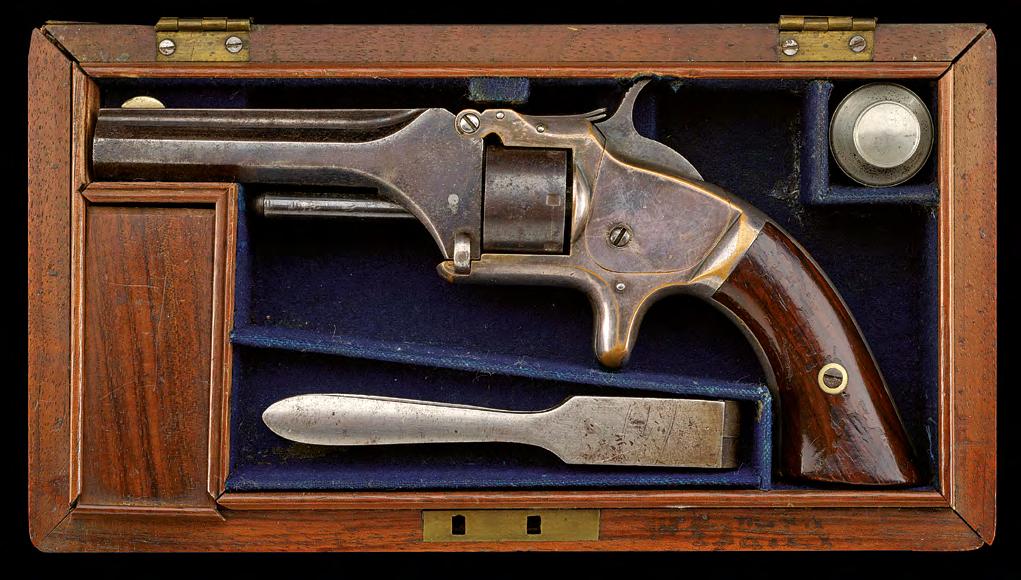

CONDIZIONI GENERALI DI CONTRATTO
1. Condizioni di generali di vendita: Le presenti condizioni generali sono dirette agli acquirenti e fornitori della casa d’Aste Czerny’s International Auction House (di seguito: Casa d’Aste Czerny’s), sono esposte nella Sala d’Aste, riportate nel catalogo relativo ad ogni singola asta e pubblicate sul portale ufficiale della casa d’aste www.czernys.com alla pagina web www.czernys.com/condizioni-di-vendita/ . La partecipazione all’asta implica l’integrale accettazione delle condizioni, senza eccezione o riserva alcuna. Gli acquirenti e i venditori sono tenuti, se richiesti, a sottoscrivere le presenti condizioni in termine di previo impegno contrattuale.
2. Natura del contratto: La Czerny’s International Auction House S.r.l. opera in nome e per conto dei legittimi proprietari degli oggetti offerti in asta: essa non si obbliga ne’ acquista diritti in proprio e gli effetti del contratto si producono direttamente tra acquirente e venditore . La Casa d’Aste Czerny’s non assume nei confronti dei venditori, degli acquirenti o dei terzi alcuna obbligazione o responsabilità diversa da quelle derivanti dalla sua qualità di mandataria e con le riserve e le precisazioni di seguito esposte.e derivanti dalla sua qualità di mandataria e con le riserve e le precisazioni di seguito esposte.
3. Identità del venditore: La Casa d’Aste Czerny’s tutela la riservatezza dell’identità e dei dati personali dei venditori; essa non è tenuta a fornirli all’acquirente aggiudicatario, salva l’ipotesi in cui insorga tra gli stessi un contenzioso relativo all’oggetto acquistato. E’ fatta comunque salva la facoltà di comunicazione e trattamento dei dati per le finalità previste dalle disposizioni per la prevenzione del riciclaggio.
4. Descrizione ed esposizione degli oggetti: Presentazione, descrizioni e fotografie degli oggetti contenute nel catalogo d’asta e sul portale www.czernys.com, pur essendo espressione della miglior scienza e coscienza degli esperti incaricati dalla Casa d’Aste Czerny’s, hanno l’esclusiva finalità di identificare il lotto. In nessun caso eventuali incompletezze o errori delle descrizioni ovvero, in particolare, la mancata individuazione di difetti o imperfezioni (quali, ad esempio: rotture, restauri, mancanze o sostituzioni), possono costituire motivo di reclamo o contestazione successiva alla vendita. Al fine di consentire agli acquirenti l’esame di ogni singolo lotto e di verificarne personalmente tutte le qualità, ciascuna asta è preceduta da una esposizione aperta al pubblico di almeno due giorni consecutivi, secondo gli orari esposti in sede e pubblicati sul portale ufficiale della casa d’aste www.czernys.com e nel rispetto di eventuali limitazioni imposte dalle competenti Autorità per il rispetto della salute. Il Direttore di vendita sarà a disposizione, prima dell’apertura della gara d’asta, per fornire ogni utile spiegazione in merito agli oggetti i quali, previo accordo con la Casa d’Aste Czerny’s, potranno essere esaminati con ogni mezzo di indagine che non arrechi nocumento alle cose esaminate e che non le sottragga alla possibilità di esame da parte di altri interessati. L’acquirente che piazzi una o più offerte senza una precedente ispezione personale del lotto, ma si basi solo sulle fotografie, la descrizione del catalogo e la scheda pubblicata sul portale www.czernys.com, lo fa a proprio rischio e pericolo. Resta comunque fermo che, ove non sia diversamente specificato, tutti gli oggetti venduti in asta sono usati e in tali condizioni sono venduti, con tutti i possibili difetti e imperfezioni che possono presentare, quali rotture, restauri, mancanze o sostituzioni. Non sono pertanto ammissibili, dopo l’acquisto in asta, reclami sullo stato di conservazione, classificazione, descrizione, datazione, attribuzione degli oggetti acquistati, ovvero per vizi, anche occulti, salva l’ipotesi di doloso occultamento da parte del venditore. Gli oggetti di antiquariato e le armi antiche per loro stessa natura possono presentare restauri o modifiche, tali interventi non possono essere in alcun caso considerati difetti nascosti o falsi. Lo stato di funzionamento meccanico degli oggetti e delle armi da fuoco in vendita non vengono garantiti dalla Casa d’Aste e l’acquirente li acquista a proprio rischio e pericolo, senza riserve e rinunciata ogni eccezione.
5. I venditori e gli acquirenti sono tenuti allo scrupoloso rispetto delle norme di legge, anche internazionali, che disciplinano la vendita, l’acquisto e la detenzione degli oggetti posti in asta. In particolare, è responsabilità del venditore e dell’acquirente disporre di tutte le autorizzazioni o licenze necessarie per l’acquisto, il trasporto e la detenzione di armi ancorchè antiche o storiche: ove richiesto, l’acquirente si impegna ad esibire e fornire in copia alla Casa d’Aste Czerny’s i predetti titoli abilitativi. L’acquirente è inoltre tenuto a informarsi precedentemente all’acquisto in merito alle leggi e i limiti di importazione vigenti nel proprio paese in relazione a armi antiche, armi bianche e da fuoco e oggetti di antiquariato, anche in relazione ai materiali di cui sono composti i medesimi. Al fine di garantire il rispetto della L. 150/92 e successive modifiche e integrazioni, gli oggetti che presentino parti o componenti in avorio, o comunque derivate da specie protette dalla cosiddetta convenzione CITES, sono muniti di attestazione che ne certifica la produzione o lavorazione in data anteriore al 1947. La Casa d’Aste Czerny’s, i suoi agenti o il suo personale non potranno essere ritenuti responsabili per qualsiasi danno incorso dall’acquirente a causa di importazione di beni dei quali il suo paese d’origine vieta o limita l’importazione.
6. Restrizioni alla circolazione di determinati beni: La Casa d’Aste Czerny’s richiama l’attenzione dei venditori e degli acquirenti al rispetto delle norme vigenti in tema di divieto o limitazione all’esportazione di oggetti di interesse storico e artistico, con particolare riferimento alle disposizioni del D. Lgs 22/1/2004 n. 42 (Codice dei Beni Culturali) e successive modificazioni e integrazioni. In nessun caso la Casa d’Aste Czerny’s può essere ritenuta responsabile del mancato rilascio dell’attestato di libera circolazione di un bene, delle restrizioni determinate dall’eventuale notifica della dichiarazione di interesse culturale, ovvero dall’esercizio del diritto di prelazione da parte dello Stato.
7. Registrazione dei partecipanti all’asta: Al fine di garantire il rispetto delle vigenti disposizioni in materia di prevenzione del riciclaggio, chiunque sia interessato a partecipare all’asta dovrà registrarsi, fornendo alla Casa d’Aste Czerny’s i dati e i documenti necessari a identificarlo, inclusi: residenza, indirizzo di spedizione, email, numero di telefono, copia di carta d’identità o passaporto in corso di validità, codice fiscale, eventuale partita I.V.A. e coordinate bancarie. A discrezione della Casa d’Aste, potrà essere richiesto all’acquirente un deposito cauzionale e ulteriori informazioni o referenze. Per i clienti italiani che intendano acquistare o vendere armi, sarà necessaria copia di un titolo valido per il possesso di armi antiche quale porto d’armi uso tiro a volo o licenza di collezione di armi antiche. Tale documentazione potrà essere inviata anche tramite email all’indirizzo info@czernys.com. I dati inviati verranno trattati nel rispetto del Regolamento UE 2016/679 (GDPR). Sarà cura dei clienti inviare documentazione aggiornata qualora i documenti dovessero scadere. Agli utenti registrati verrà rilasciato un codice o numero identificativo personale necessario per la formulazione delle offerte.
8. Partecipazione all’asta: La partecipazione all’asta è possibile mediante la formulazione di offerte in sala, attraverso il deposito o l’invio di offerte scritte ovvero mediante comunicazione telefonica o telematica. Le offerte scritte pervenute prima dell’apertura della gara devono contenere la chiara indicazione del lotto e del prezzo offerto. Le offerte scritte saranno eseguite al prezzo minimo che risulterà possibile in riferimento alle altre offerte e al prezzo di riserva. Non è consentito l’acquisto di lotti per persona da nominare ovvero il trasferimento a terzi dei lotti aggiudicati.
9. Servizio di offerta telefonica: La Casa d’AsteCzerny’s mette a disposizione dei propri clienti il servizio di offerta telefonica. Il cliente che desidera essere chiamato durante lo svolgimento dell’asta ad un numero in precedenza accordato per uno o più lotti a cui è interessato, può farne richiesta per iscritto tramite email all’indirizzo info@czernys.com, oppure compilando la ‘Scheda per le Offerte’ inserita in ogni catalogo Czerny’s o scaricabile dal sito web www.czernys.com. Per ogni lotto per il quale si vuole usufruire del servizio di offerta telefonica il cliente accetta incondizionatamente sin dal momento della propria richiesta di offrire per il lotto stesso il valore di base d’asta, e più precisamente il primo dei due prezzi indicati nel catalogo e sul portale web. Nel caso in cui nessuna altra offerta pervenga durante l’asta, i lotti stessi verranno aggiudicati al richiedente del servizio anche nel caso in cui il medesimo non abbia confermato telefonicamente durante l’asta la propria offerta. La Casa d’aste Czerny’s non è responsabile per eventuali problemi di natura tecnica che dovessero impedire o limitare durante l’asta il servizio di offerta telefonica. Il servizio di offerta telefonica è fornito a condizione che l’importo complessivamente offerto non sia inferiore ad euro 500.
10. Offerte a mezzo web applet o piattaforme di terze parti: E’ possibile effettuare offerte, previa registrazione e inserimento dei dati personali, anche tramite il sito www.czernys.com e la relativa web applet oppure tramite piattaforme web di terze parti . Le offerte effettuate con queste modalità implicano l’incondizionata accettazione delle presenti condizioni generali. L’utente che partecipa all’asta tramite la web applet del portale www.czernys.com o piattaforme di terze parti è consapevole che nel corso dell’asta vengono battuti circa 100 lotti ogni ora: non è pertanto garantita la corrispondenza dei dati relativi alle offerte mostrati dalla web applet della Casa d’Aste Czerny’s o da piattaforme web di terze parti con le eventuali offerte in aumento effettuate in sala, con la conseguenza che le seconde possono risultare superiori e prevalere. Il Direttore di vendita presente in sala, è l’unico soggetto titolato a ratificare l’offerta in aumento durante l’asta.
11. Uso del portale e dei servizi telefonici e telematici: L’uso del portale www.czernys.com è gratuito ed avviene a rischio dell’utente. La Casa d’aste Czerny’s, i suoi agenti o il personale non possono essere ritenuti responsabili per danni o inconvenienti dovuti a problemi relativi all’utilizzo del portale web www.czernys.com ne’ per problemi tecnici relativi a linee telefoniche o connessione internet, ovvero per la mancata esecuzione di offerte inoltrate per via telefonica o telematica. E’ fatto divieto agli utenti del portale www.czernys.com di utilizzare il portale stesso e i relativi servizi per scopi illeciti o contrari alle presenti condizioni contrattuali. La Casa d’Aste Czerny’s si riserva il diritto di escludere, a proprio insindacabile giudizio, qualsiasi utente dall’accesso al portale www.czernys.com e ai relativi servizi. Tutto il materiale messo a disposizione dalla Casa d’Aste Czerny’s sul portale www.czernys.com e sui relativi servizi (includendo: testi, grafiche, fotografie, immagini pubblicitarie, ecc.), è protetto, anche penalmente, dalla vigente normativa italiana sul diritto di autore. La Casa d’Aste Czerny’s non può essere ritenuta in alcun caso responsabile per problemi e danni subiti dai clienti a causa di link a siti di terze parti presenti sulla piattaforma www.czernys. com ne’ per danni derivati dall’utilizzo di piattaforme di terze parti.
12. Esclusione dall’asta: Il Direttore di vendita, a proprio insindacabile giudizio, ha il diritto di escludere dalla partecipazione all’asta persone che ne possano turbare il regolare svolgimento come, a titolo esemplificativo ma non esaustivo: i soggetti che arrechino disturbo, che facciano commercio in sala, che siano in ritardo nei pagamenti dovuti, a qualsiasi titolo, alla Casa d’Aste Czerny’s o che con essa abbiano un contenzioso aperto sia in via giudiziale che stragiudiziale, ovvero i soggetti che siano stati condannati per reati concernenti il commercio o il patrimonio.
13. Modalità dell’asta: I singoli lotti sono posti in vendita al maggior offerente, per contanti e in euro. Le offerte in aumento nel corso della gara d’asta non potranno essere inferiori al 5% circa dell’offerta precedente. Eventuali offerte d’acquisto per prezzo inferiore a quello di riserva d’asta (che, se non ulteriormente specificato, non sarà mai inferiore al prezzo minimo di offerta), potranno essere prese in considerazione soltanto fuori asta e dopo di essa, ad insindacabile giudizio della Casa d’Aste Czerny’s e previo assenso scritto del proprietario venditore. I lotti sono aggiudicati dal Direttore di vendita che ne decreta la aggiudicazione. Le contestazioni in ordine alla priorità o tempestività dell’offerta sono decise al momento, ad insindacabile giudizio del Direttore di vendita. Nel caso in cui due offerte vincenti si equivalgano, l’assegnazione del lotto a una delle due offerte avviene a discrezione del Direttore di Vendita. In tutti i casi di contestazione, è fatta salva la facoltà del Direttore di vendita di annullare le operazioni contestate e ripetere l’incanto, nella stessa sessione d’asta o in quella immediatamente successiva, per un prezzo di partenza pari alla più alta offerta ricevuta in sala o per iscritto e non contestato.
14. Modifiche ai lotti: Il Direttore di vendita ha facoltà di ritirare lotti dall’asta, variare l’ordine dei lotti, accorpare più lotti fra quelli in vendita, ovvero scindere in più lotti gli oggetti già catalogati come unico lotto, stabilendo i nuovi prezzi originati da tali iniziative.
15. Diritti d’asta e accessori: Al prezzo di acquisto che risulterà dalla gara dovranno sempre aggiungersi i diritti d’asta, pari al 25 (venticinque per cento) del prezzo raggiunto in asta o espresso nell’offerta scritta di acquisto già comprensivo dell’I.V.A. nella misura di legge. Inoltre sarà addebitato all’acquirente ogni eventuale ulteriore onere fiscale e/o spesa accessoria. Restano comunque ad esclusivo carico dell’acquirente eventuali dazi, imposte o spese connesse all’esportazione o importazione dei beni acquistati.
16. Termini e modalità di pagamento: Il pagamento del prezzo di aggiudicazione e dei diritti d’asta relativamente ai lotti aggiudicati, con rispettivi accessori, deve essere effettuato nel termine di giorni 10 dalla conclusione dell’asta, previa emissione di preavviso di fattura in formato cartaceo o digitale. Il pagamento dei preziosi deve avvenire entro il giorno successivo all’aggiudicazione. L’acquirente presente in sala dovrà provvedere immediatamente dopo l’aggiudicazione al pagamento del prezzo di acquisto, dei diritti d’asta e dei relativi accessori. Il trasferimento della proprietà del bene aggiudicato si perfeziona al momento
del pagamento del prezzo di acquisto, dei diritti d’asta e dei relativi accessori. In caso di mancato o tardivo pagamento la Casa d’Aste Czerny’s può procedere legalmente al fine di richiedere l’esecuzione coattiva dell’obbligo di concludere il contratto ovvero rimettere in vendita il lotto aggiudicato mediante asta o trattativa privata, addebitando all’aggiudicatario inadempiente ogni maggiore costo e danno e trattenendo a tal fine eventuali acconti ricevuti. In ogni caso di mancato o tardivo pagamento, il lotto rimarrà in deposito presso la Casa d’Aste Czerny’s a rischio e spese dell’aggiudicatario, sino a quando non verrà venduto ovvero ritirato dal venditore. Costituiscono eccezione gli oggetti preziosi che, salvo specifico accordo col venditore, non possono essere trattenuti in deposito. Gli acquirenti stranieri sono tenuti a pagare le tasse italiane sul servizio (I.V.A.).
17. Ritiro dei lotti acquistati: La merce acquistata deve essere ritirata presso la Casa d’Aste Czerny’s entro 48 ore dal pagamento del preavviso di fattura di cui al precedente punto 15) a cura, rischio e spese dell’acquirente. Gli oggetti preziosi possono essere ritirati di persona il giorno successivo all’asta: successivamente saranno inviati mediante spedizione assicurata a cura della custode società Ferrari Group e a spese dell’acquirente.
18. Spedizione dei lotti: La Casa d’Aste Czerny’s non effettua la spedizione dei lotti: ove richiesto, il servizio può essere affidato ad uno spedizioniere esterno convenzionato con la Casa d’Aste, rispetto al quale l’acquirente ha un rapporto diretto anche al fine dell’emissione della relativa fattura comprensiva di amministrazione, imballaggio, manodopera, spedizione e assicurazione, con pagamento immediato. La spedizione di lotti qualificati quali armi antiche dalla legge italiana avverrà subito dopo il pagamento del corrispettivo per l’aggiudicazione e per la spedizione, e dopo che le competenti autorità avranno evaso le formalità per il trasporto o l’esportazione all’estero degli oggetti. Le formalità amministrative per la spedizione ed esportazione verranno evase dalla Casa d’Aste Czerny’s a spese dell’acquirente. L’acquirente dichiara di essere consapevole che i tempi per il rilascio delle necessarie autorizzazioni non dipendono dalla Casa d’Aste Czerny’s che non può essere ritenuta responsabile di eventuali ritardi. Indipendentemente dal servizio offerto dalla Casa d’Aste Czerny’s, i clienti residenti all’estero sono obbligati ad usufruire del servizio di uno spedizioniere, in quanto non autorizzati per legge a trasportare sul suolo italiano armi, ancorchè antiche.
19. Spedizione a cura dell’acquirente: Nell’ipotesi in cui lo spedizioniere venga direttamente individuato dall’acquirente, è onere di quest’ultimo comunicarne immediatamente l’identità alla Casa d’Aste Czerny’s; l’acquirente è altresì tenuto a rilasciare specifico nulla osta scritto alla Casa d’Aste Czerny’s per la consegna allo spedizioniere o corriere dei lotti acquistati, ferma la necessità di disporre di tutte le necessarie autorizzazioni per il trasporto e l’esportazione dei singoli oggetti.
20. Regole particolari per la spedizione delle armi da fuoco verso paesi extracomunitari: Le spedizioni vengono di norma effettuate in tutto il mondo, tranne i paesi che ne vietano per legge l’importazione. L’acquirente dichiara di essere consapevole che la spedizione di armi da fuoco antiche al di fuori della Comunità Europea può richiedere tempi e costi aggiuntivi.
21. Imballaggio: La Casa d’Aste Czerny’s si riserva il diritto di specificare allo spedizioniere particolari modalità d’imballaggio per specifici lotti. La merce spedita fuori dall’Italia deve sempre essere accompagnata da una fattura commerciale completa indicante il valore e il tipo di merce.
22. Danni alla merce spedita: La Casa d’Aste Czerny’s non risponde dei danni subiti dalla merce dopo la consegna allo spedizioniere. Eventuali diversi danni attribuibili alla Casa d’Aste devono essere segnalati nel termine di giorni cinque dalla scoperta, al fine di ottenere l’intervento della compagnia assicuratrice, fermo restando l’obbligo dell’acquirente di adottare tutte le misure idonee ad evitare l’aggravarsi del danno. La denuncia del danno dovrà essere indirizzata alla Casa d’Aste Czerny’s a mezzo lettera raccomandata o posta elettronica certificata (PEC) all’indirizzo czernys@legalmail.it , e dovrà essere corredata da adeguato materiale fotografico o video. La Casa d’Aste Czerny’s non risponde ad alcun titolo dei danni denunciati oltre il termine sopra indicato.
23. Natura dei beni in asta: Tutti i beni posti in asta devono intendersi usati e forniti quali pezzi d’antiquariato ovvero come prodotti da riparare e rimettere a nuovo ai sensi e per gli effetti dell’art. 3 comma 1 lett. e) del D. Lgs 206/2005 (Codice del Consumo) e successive modificazioni.
24. Esclusione del diritto di recesso: Ai sensi dell’art. 59 del D. Lgs 206/2005 e successive modificazioni è escluso il diritto di recesso relativamente a qualunque lotto.
25. Oggetti riferibili al periodo fascista o nazista: La Casa d’Aste Czerny’s precisa che gli oggetti posti in vendita costituiscono semplice testimonianza storica e documentale di un determinato periodo; pertanto, con particolare riferimento ad oggetti peculiari del periodo storico o comunque riferibili al regime nazista o fascista la descrizione, le fotografie e la pubblicazione sul catalogo d’asta avviene sempre e comunque per fini di commercio e scientifici ed esclude qualunque intendimento apologetico.
26. Estensione delle condizioni di vendita: Le presenti condizioni generali si applicano, per quanto compatibili, anche agli eventuali acquisti successivi all’asta di lotti non aggiudicati.
27. Modifiche alle condizioni generali: La Casa d’Aste Czerny’s si riserva il diritto di modificare, a suo esclusivo e insindacabile giudizio, in qualsiasi momento e senza alcun preavviso, le presenti condizioni. E’ onere dei partecipanti alle aste verificare gli aggiornamenti pubblicati secondo le modalità previste al punto 1.
28. Foro competente: Qualunque controversia relativa all’applicazione, interpretazione o violazione del presente contratto è devoluta alla competenza esclusiva del Foro della Spezia.
GENERAL TERMS OF AGREEMENT
1. General terms of sale: These general terms of sale are aimed at buyers and suppliers of Czerny’s International Auction House (hereinafter referred to as Czerny’s Auction House); these terms are available in the Auction Room, listed in the catalogue relating to each auction and published on the auction house’s official website www.czernys.com under the following URL: www.czernys.com/condizioni-di-vendita/. Taking part in auctions implies full acceptance of these terms, without any exceptions or reserves. Buyers and sellers are required, if requested, to sign these terms prior to entering into any contractual commitments.
2. Nature of the agreement: Czerny’s International Auction House S.r.l. operates in the name and on behalf of the legitimate owners of items offered at auctions: it does not oblige nor acquire rights in its own right and the effects of the agreement occur directly between the buyer and seller. Czerny’s Auction House does not assume any obligation or liability other than those deriving from its status as agent and with the reservations and clarifications set out below in respect of sellers, buyers or third parties.
3. Sellers’ identity: Czerny’s Auction House protects the confidentiality of sellers’ identity and personal data; it is not obliged to provide this information to successful bidders, except in cases where a dispute concerning the purchased item arises. This without prejudice to the possibility of processing personal data for the purposes in the context of Anti-Money Laundering.
4. Description and display of items: Presentation, descriptions and photographs of items contained in the auction catalogue and on the portal www.czernys.com, despite being expressions of the best knowledge and skills of experts appointed by the Czerny’s Auction House, their sole purpose is to identify lots. Under no circumstances shall any incompleteness or errors in descriptions or, in particular, the failure to identify defects or imperfections (such as: breakages, restorations, deficiencies or substitutions), constitute grounds for claims or disputes subsequent to the sale. In order to allow buyers to examine each individual lot and to personally verify its properties, each auction is preceded by an exhibition open to the public for at least two consecutive days, according to the times shown on-site and published on the auction house’s official website www.czernys.com and in accordance with any limitations imposed by the Authorities on health protection. Prior to the launch of an auction, the Sales Manager will be available to provide any useful explanations regarding items which, upon agreement with Czerny’s Auction House, can be examined by any means of investigation that do not cause damage to them and that do not affect the possibility of being examined by other interested parties. Buyers who make one or more bids without a prior personal inspection of the lot, but bid based only on photographs, the catalogue description and the form published on the website www.czernys.com, do so at their own risk. It must be understood that, unless otherwise specified, all items sold at auction are used and in such conditions as sold, with all possible defects and imperfections that may arise, such as breakages, restorations, deficiencies or substitutions. Therefore, following a purchase during auction, claims are not admissible based on the state of conservation, classification, description, dating, attribution of purchased items, or due to defects, even if hidden, except for cases of malicious or intentional concealment by a seller. Antiques and antique weapons by their very nature may present restorations or modifications, such interventions can in no case be considered as hidden or latent defects. The state of mechanical operation of items and firearms for sale is not guaranteed by the auction house and buyers purchase them at their own risk, without reserves and waiving all exceptions.
5. Licenses, authorizations and permissions: Sellers and buyers are required to strictly comply with the law, including international laws, governing the sale, purchase and holding of items placed at auction. In particular, sellers and buyers shall be liable for obtaining all the authorizations or licenses deemed necessary for the purchase, transport and possession of weapons, even if antique or historical: where required, the buyer undertakes to display and provide a copy to Czerny’s Auction House of the aforementioned permits. Buyers are also required to inform themselves prior to making purchases regarding laws and import restrictions in force in their country in relation to antique weapons, sidearms and firearms and antiques, also in relation to the materials of which these are made of. In order to respect of l. 150/92 and subsequent amendments and additions, objects featuring parts or components made of ivory, as well as of species protected by the CITES convention, are provided with a certificate attesting the production and the manufacturing before 1947. Czerny’s Auction House, its agents or its staff cannot be held liable for any damages incurred by buyers due to the import of goods which are prohibited or limited by their country of origin.
6. Restrictions on the movement of certain goods: Czerny’s Auction House draws the attention of sellers and buyers to compliance with current regulations regarding the prohibition or limitation for exporting items of historical and artistic interest, with particular reference to the provisions of Italian Legislative Decree no. 42 of 22/1 / 2004 (Italian Cultural Heritage Code) and subsequent modifications and additions. Under no circumstances shall Czerny’s Auction House be held liable for the failure to issue a certificate on the free movement of a given good, restrictions determined by notifying the declaration of cultural interest, or by exercising the right of pre-emption on behalf of the Italian Government.
7. Registration of auction participants: In order to ensure that the existing provisions in the context of Anti-Money Laundering are fulfilled, anyone interested in taking part in the auction must register, providing Czerny’s Auction House with the information and documents deemed necessary to identify them, including: residence, shipping address, email, telephone number, copy of a valid identity card or passport, tax code, VAT reg. number and bank account details. At the Auction House’s discretion, a security deposit and additional information or references may be requested from buyers. For Italian customers wishing to buy or sell weapons, a copy of a valid permit for keeping antique weapons including shooting firearms or a license for antique firearms will be required. The above documentation can also be sent by email to the following address info@czernys.com. Data sent will be processed in compliance with EU Regulation 2016/679 (GDPR). Customers will be required to send updated documentation if documents expire. Registered users will be issued a personal identification number or code which is necessary for submitting bids.
8. Taking part in auctions: Taking part in an auction is possible by making bids in the room, depositing or submitting written bids or by telephone or on-line communications. Written bids received before the opening of the tender must contain clear information on the lot and the price offered. Written bids shall be made at the minimum possible price with reference to other bids and at the reserve price. The purchase of lots by a person to be appointed or the transfer to third parties of lots won is not permitted.
9. Telephone bidding service: Czerny’s Auction House offers its customers a telephone bidding service. Customers who wish to be phoned during auctions to a previously notified telephone number previously for one or more lots of interest, can request this in writing by email at info@czernys.com, or by filling in the Bid sheets included in each Czerny’s catalogue or which can be downloaded from the website at www.czernys.com. For bidding on lots where bidders wish to make use of the telephone bidding service, the customer unconditionally accepts from the moment of his request to bid for the lot itself the basic auction value, and more precisely the first of the two prices indicated in the catalogue and on the website. In the event that no other bid is received during the auction, lots will be awarded to the person/entity that requested the service even if the latter has not confirmed their bid by telephone during the auction. Czerny’s Auction House shall not be held liable for any technical issues that may prevent or limit the telephone bidding service during auctions. The telephone bidding service is provided on condition that the total amount offered be not less than Euro 500.
10. Bids through web applets or third-party platforms: It is possible to submit bids, after registering and entering personal data, also through the website www.czernys.com and the relevant web applet or by means of third-party web platforms. Bids submitted as above imply the unconditional acceptance of these general terms. Users who take part in auctions through the web applet of the website www.czernys.com or third-party platforms are aware that during the auction about 100 lots are auctioned per hour: therefore, the correspondence of data on bids shown by the web applet of Czerny’s Auction House or by third-party web platforms with any increasing offers made in the Room cannot be guaranteed, with the consequence that the latter may be higher and prevail. The Sales Manager present in the room is the only party entitled to ratify rising bids during auctions.
11. Use of the website and telephone and on-line services: The use of the www.czernys.com website is free and takes place at the user’s risk. Czerny’s Auction House, its agents or staff cannot be held liable for damages or inconveniences due to problems related to the use of the website www.czernys.com nor due to technical problems related to telephone lines or internet connection, or for the non-execution of bids submitted by telephone or on-line. It is forbidden for users of the website www.czernys.com to use the site itself and the relevant services for illicit or purposes contrary to these contractual terms. Czerny’s Auction House reserves the right to exclude, at its sole discretion, any user from accessing the website www. czernys.com and relevant services. All equipment made available by Czerny’s Auction House on the website www.czernys.com and by means of the relevant services (including: texts, graphics, photographs, advertising images, etc.), is protected, even criminally, by the current Italian copyright law. Czerny’s Auction House cannot be held liable in any case for issues and damages suffered by customers due to links to third-party sites on the www.czernys.com platform or for damages deriving from the use of third-party platforms.
12. Exclusion from auctions: The Sales Manager, at his sole discretion, has the right to exclude from participation in the auction persons who may disrupt its normal exercise as, by way of example but not limited to the following: parties who interfere, who trade in the room, who are late in making payments, regardless of the reason, due to Czerny’s Auction House or that have a dispute open both in court and out of court, or those who have been convicted of crimes concerning trade or patrimony.
13. Auction mode: Individual lots are sold to the highest bidder, for cash and in Euro. Bids on the increase during the bidding process cannot be less than 5% of the previous bid. Any purchase offers for a price lower than the auction’s reserve price (which, if not further specified, shall never be lower than the minimum bid price), may be considered only outside the auction and after that, at the sole discretion of Czerny’s Auction House and prior written consent of the seller or owner. Lots are awarded by the Sales Manager who ratifies their award. Disputes regarding the priority or timeliness of bids are decided on the spot, at the Sales Manager’s discretion. In the event that two winning bids are equivalent, the assignment of the lot to one of the two bids is at the Sales Manager’s discretion. In all cases of dispute, it remains understood that the Director of Sales may cancel disputed transactions and repeat an auction, in the same auction session or in the one immediately following it, for a starting price equal to the highest bid received in the room or in writing and not disputed.
14. Changes to lots: The Sales Manager has the right to withdraw lots from the auction, change the order of lots, merge multiple lots among those for sale, or divide items already catalogued as single lot into several lots, establishing new prices generated by these initiatives.
15. Auction fees and ancillary charges: Auction fees, equal to 20% (twenty percent) of the price reached at auction or expressed in the written purchase bid, increased by the V.A.T in the legal measure (currently equal to 22%) must be added to the purchase price that results from the event. In addition, any additional tax and / or ancillary charges shall be borne by the purchaser. Any duty, tax or rate, as well as any cost to export or import the purchased goods will be charged to the buyer.
16. Terms and methods of payment: Payment of the auction price and auction fees for lots awarded, with the relevant ancillary expenses, must be made within 10 days from the end of the auction, upon issuance of invoice notice in paper or digital format. The payment of precious goods must be done within the day ensuing the awarding. Buyers present in the room must make payment of the purchase price, auction fees and relevant ancillary expenses immediately following the award of an item. The transfer of ownership of awarded property is finalized at the time of payment of the purchase price, auction fees and relevant ancillary expenses. In the event of non-payment or late payment, Czerny’s Auction House can proceed legally in order to request the compulsory execution of the obligation to conclude the agreement or to sell the lot awarded through auction or private treaty, charging the defaulting bidder every greater cost and damages and withholding any advance payments received for this purpose. In all cases of non-payment or late payment, lots will remain in storage at Czerny’s Auction House at the successful bidder’s risk and expense,
until sold or collected by the seller. Unless specifically agreed with the Seller, the precious objects that cannot be kept on storage constitute an exception. Foreign buyers are required to pay Italian taxes on the service (V.A.T).
17. Collection of purchased lots: Purchased goods must be collected at Czerny’s Auction House within 48 hours of payment of the invoice notice referred to in section 15 above) at the buyer’s expense and risk. Precious objects can be collected in person the day ensuing the auction: afterwards they will be sent via insured shipping by the Society Ferrari Group and at the buyer’s expense.
18. Lot shipments: Czerny’s Auction House does not ship the lots. If required, the service can be assigned to an external shipping agency that has an agreement with the Auction House; the buyer will have a direct relationship with the agency, also in the context of releasing the invoice that includes costs for administration, packing, labour, shipping and insurance and has to be paid immediately. The shipping of lots defined as antique arms by the Italian law will be completed after the payment of the awarding and shipping prices, and after that the competent authorities process the legal formalities to transport, ship or export the goods abroad. The administrative formalities to ship and export the goods will be dealt by Czerny’s Auction House at the buyer’s expense. Buyers state to be aware that the time required for issuing the necessary authorisations does not depend on Czerny’s Auction House which cannot be held liable for any delays. Regardless of the service offered by Czerny’s Auction House, customers residing abroad are obliged to use the service of a forwarder, as they are not authorized by law to transport weapons, even antique ones, to Italy.
19. Shipping by the buyer: In a situation where the carrier is identified by the buyer, it is the latter’s responsibility to immediately notify the identity to Czerny’s Auction House; the buyer is also required to issue specific written clearance to Czerny’s Auction House for delivery to a courier of purchased lots, without prejudice to the need to have all the necessary authorisations for transporting and exporting individual items.
20. Special rules for the shipment of firearms to non-EU countries: Shipments are normally carried worldwide, except for countries that prohibit their import by law. Buyers state to be aware that shipments of antique firearms outside the European Community may require additional time and costs.
21. Courier packaging: Czerny’s Auction House reserves the right to provide the shipping agency with any information and recommendation on the lots’ packing procedures. The goods shipped outside Italy must be provided with a commercial invoice indicating value and type of goods.
22. Damage to shipped goods: Czerny’s Auction House is not responsible for any damage suffered from the goods after the delivery to the shipping agency. Any damage suffered by shipped goods must be reported to Czerny’s Auction House and to the carrier within five days of discovering it, in order to obtain the assistance of the insurance company, without prejudice to the buyer’s obligation to take all measures suitable to avoid aggravation of damages. Damage must be reported to Czerny’s Auction House by registered letter or certified e-mail (PEC) at the address czernys@legalmail.it, and must be accompanied by appropriate photographic material or video. Czerny’s Auction House shall not be liable for any damages beyond the mentioned above period.
23. Nature of auctioned goods: All goods placed at auction must be considered as used and supplied as antiques or as products to be repaired and refurbished in accordance with and for the purposes of Art. 3 paragraph 1 lett. e) of Italian Legislative Decree 206/2005 (Italian Consumer Code) and subsequent amendments.
24. Exclusion of the right of withdrawal: Pursuant to Art. 59 of Italian Legislative Decree 206/2005 and subsequent amendments the right of withdrawal with respect to any lot are excluded.
25. Items which refer to the fascist or Nazi period: Czerny’s Auction House clarifies that the items offered for sale are simple historical and documental evidence of a given period; therefore, with particular reference to items which are specific to the historical period or in any case referable to the Nazi or fascist regime, the description, photographs and publication on the auction catalogue always take place for commercial and scientific purposes and excludes any apologetic understanding.
26. Extension of sales terms: These general terms apply, to the extent compatible, also to any subsequent purchases following the auction of lots not awarded.
27. Changes to the general terms: Czerny’s Auction House reserves the right to modify these terms and conditions at its own absolute discretion, at any time and without prior notice. Auction participants shall be liable for checking updates published according to the procedures set out in point 1.
28. Jurisdiction: Any dispute concerning the application, interpretation or breach of this agreement shall be referred to the exclusive jurisdiction of the Court of La Spezia.