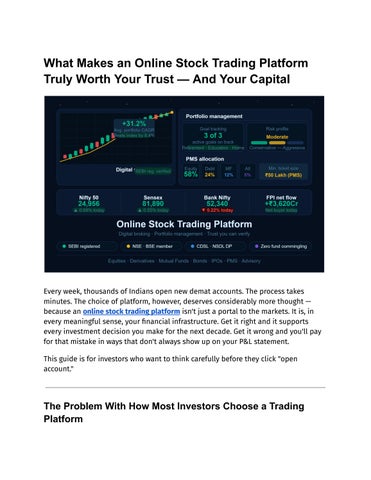
What Makes an Online Stock Trading Platform
Truly Worth Your Trust — And Your Capital
Every week, thousands of Indians open new demat accounts. The process takes minutes. The choice of platform, however, deserves considerably more thought because an online stock trading platform isn't just a portal to the markets. It is, in every meaningful sense, your financial infrastructure. Get it right and it supports every investment decision you make for the next decade. Get it wrong and you'll pay for that mistake in ways that don't always show up on your P&L statement.
This guide is for investors who want to think carefully before they click "open account."
The Problem With How Most Investors Choose a Trading Platform
Most platform comparisons start and end at brokerage fees. That's understandable fees are visible, easy to compare, and feel controllable. But they're rarely the most important variable in your long-term investing success.
The "Lowest Brokerage" Trap
Discount broking has been genuinely transformative for Indian retail investors. Flat-fee models have democratized market access and forced the industry to become more cost-conscious. But here's what gets lost in the conversation: brokerage is only one component of your total cost of investing. There's also the spread between buy and sell prices, the quality of order execution, the cost of poor research, and the very real expense of not having access to advisory when markets turn volatile.
An investor who saves ₹15 per trade on brokerage but makes three emotionally-driven decisions a year because they had no guidance to lean on has not made a financially smart choice.
What You Should Actually Be Comparing
Before signing up for any platform, compare these: execution quality and uptime during high-traffic sessions, depth and independence of research offerings, access to human advisory support, product breadth across asset classes, and the regulatory track record of the broker. Brokerage should be on the list — but not at the top of it.
The Non-Negotiables of a Reliable Digital Stock Broking Platform
There are certain standards that every serious digital stock broking platform must meet. These aren't premium features — they're the baseline.
Regulatory Standing and Transparency
Any platform you consider must be registered with SEBI as a stockbroker, with its registration number prominently displayed. It should also be a member of BSE and NSE, and ideally a Depository Participant (DP) with CDSL or NSDL. Verify this directly on the SEBI website don't rely on the platform's own claims.
Beyond registration, look for transparency in fee disclosures. A trustworthy platform will clearly explain every charge brokerage, DP charges, STT, exchange transaction charges, GST, and SEBI turnover fee without burying them in footnotes.
Platform Stability When It Matters Most
Platform downtime during normal market hours is annoying. Platform downtime during a budget announcement, a US Fed decision, or a surprise RBI rate change is financially damaging. Before committing to any broker, research their outage history. Check social media, app store reviews over the past 12 months, and forums like Traderji or ValuePickr where traders discuss platform reliability candidly.
The best digital stock broking platforms invest heavily in server infrastructure, redundancy, and load capacity precisely because they know that trust is lost in minutes and takes years to rebuild.
Security Infrastructure You Can Verify
Two-factor authentication, OTP-based login, automatic session timeouts, and encrypted data transmission are non-negotiable in 2025. Additionally, check how the platform handles client fund segregation — your money should always be held in a separate client account, never commingled with the broker's own funds. This is a SEBI requirement, but compliance levels vary.
Research and Intelligence — The Feature Most Platforms Get Wrong
This is where the real differentiation lies and where most platforms disappoint.
The Difference Between Data and Insight
Real-time price feeds, charts, and basic technical indicators are table stakes. Every platform has them. What separates a good platform from a great one is the quality of interpretive intelligence it provides.
Look for: dedicated in-house research teams with sector specialization, morning and evening market notes that go beyond recapping yesterday's news, earnings analysis that puts results in context rather than just listing EPS figures, and portfolio-level risk alerts that tell you when your exposure is drifting from your intended allocation.
If the "research" section of a platform looks like a news aggregator with a buy/sell tag attached, that's a signal not a feature.
How Portfolio Management Services Elevate the Trading Experience
There comes a point in every investor's journey where self-directed trading starts to feel limiting not because they lack the interest, but because the complexity of managing a growing portfolio across multiple goals demands more than a trading terminal can offer.
When You Move Beyond Self-Directed Trading
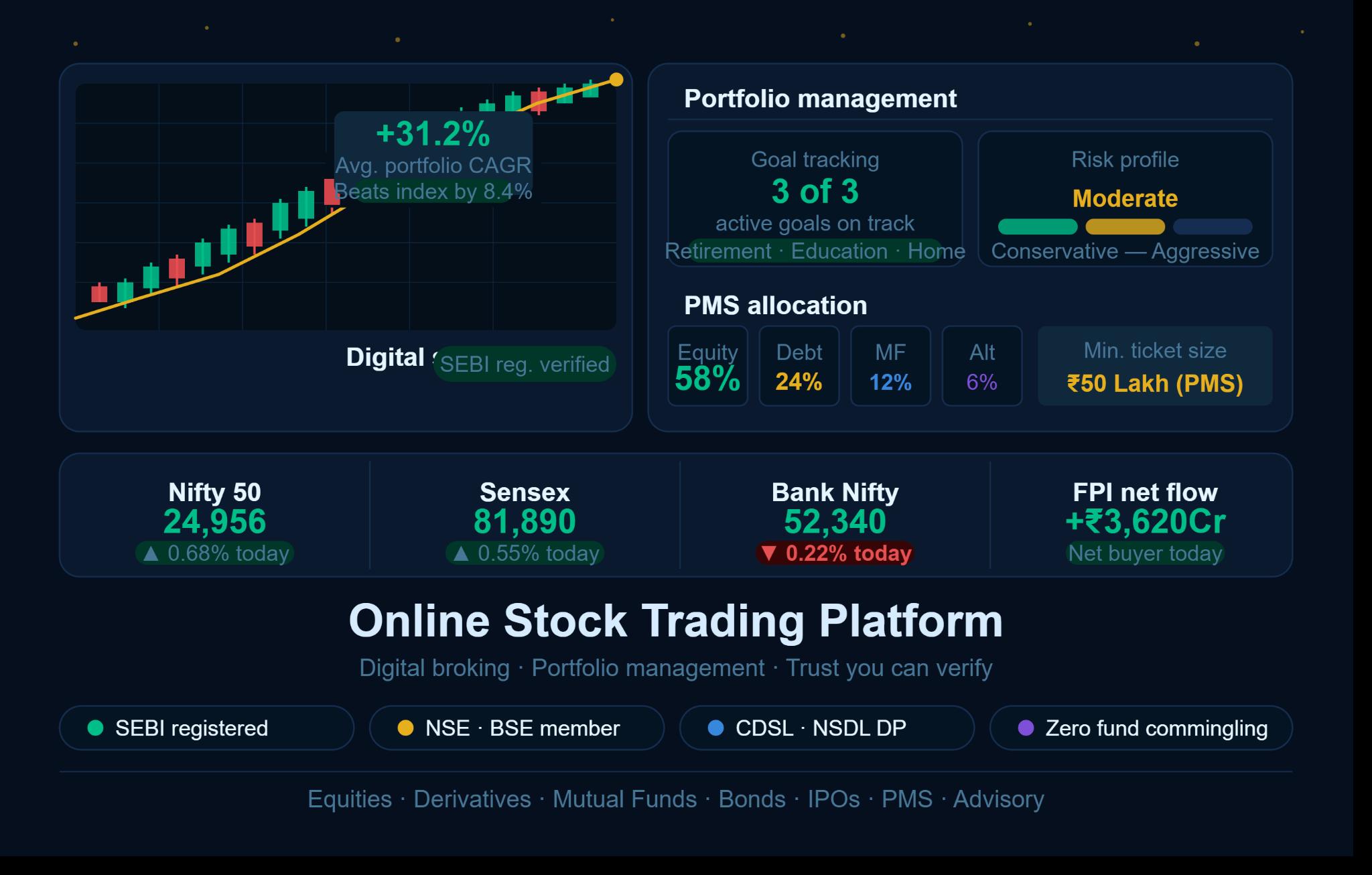
This is where portfolio management services become relevant. PMS in India is regulated by SEBI and available to investors with a minimum ticket size of ₹50 lakhs. It puts your capital in the hands of professional fund managers who construct and actively manage a bespoke portfolio on your behalf — reporting transparently on every decision.
For investors who have accumulated meaningful wealth but lack the time or bandwidth for active management, PMS offers a bridge between self-directed investing and institutional-grade money management.
PMS vs. DIY — Understanding the Line
The decision between managing your own portfolio and opting for portfolio management services isn't binary. Many investors do both actively trading in a portion of their portfolio while placing a larger, more strategic allocation under professional management. The right online stock trading platform should support both approaches within the same account ecosystem, giving you visibility across your full financial picture.
The Ecosystem Question — Can Your Platform Grow With You?
This is a question most investors don't think to ask and one they often wish they had.
Your financial needs at ₹5 lakhs of investable capital are very different from your needs at ₹50 lakhs, and different again at ₹2 crores. A platform that serves you well as a beginner may not have the research depth, advisory access, or product sophistication to serve you as a seasoned investor.
The best platforms are ecosystems offering equities, derivatives, mutual funds, bonds, IPOs, and portfolio management services under one umbrella, with the ability to add advisory layers as your wealth grows. Choosing such a platform from the start saves you the disruption and switching cost of migrating later.
Ask yourself: does this platform have a clear offering for who I want to be as an investor in five years not just who I am today?