www.financialit.net • Winter Issue • 2025
THE FUTURE OF PAYMENTS IS RESPONSIBLE Miranda McLean, Chief Marketing Officer, Ecommpay
THE DATA-DRIVEN BANK: TURNING INTELLIGENCE INTO GROWTH Brandon Sailors, VP, CX Strategic Accounts, CSG Richard Ullenius, VP, Global Banking & Financial Services, CSG
LAYERS OF TRUST: HOW TO PROTECT FINANCIAL DATA FROM THE INSIDE OUT Grant Fritchey, Product Advocate, Redgate Software
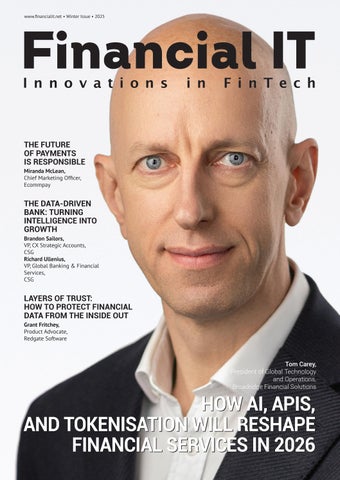
Tom Carey, President of Global Technology and Operations, Broadridge Financial Solutions
HOW AI, APIS, AND TOKENISATION WILL RESHAPE FINANCIAL SERVICES IN 2026 Back to the Table of Contents
Back to the Table of Contents
Back to the Table of Contents
2
Editor’s Letter
THE NEW FINANCIAL ARCHITECTURE: BUILT FOR SPEED, GUIDED BY VALUES Fintech is no longer evolving. It is accelerating. As we close out 2025 and look ahead to 2026, speed defines the industry, speed of innovation, adoption, and expectation. We are moving faster than ever. At the same time, the questions facing fintech are becoming deeper, more human, and more complex. That tension shapes this Winter Edition.
Technology remains central AI has moved from support tool to core intelligence layer. We are now in the era of AI agents. These systems manage tasks once handled by humans, reconciliation, compliance, onboarding, and even parts of lending decisions. This is not just automation. It is orchestration. Hyperpersonalisation is no longer optional. Products that adapt to behaviour and life context are becoming the baseline.
Blockchain is maturing The conversation has shifted from “Why blockchain?” to “What’s next?” Asset tokenisation, CBDCs, and stablecoins are moving from pilots into production. Crossborder transfers are becoming faster and cheaper. Fractional ownership is opening markets that were once exclusive. Finance is becoming programmable.
Infrastructure is catching up Cloud-native core banking is now essential. After cautious migration in 2023 and 2024, 2025 has delivered full adoption. Product launches that once took months now
take weeks. Speed is the new standard. Meanwhile, early quantum computing experiments hint at future breakthroughs in risk modelling and portfolio optimisation. That future is still emerging, but no longer abstract.
Experience is the differentiator Embedded finance is dissolving old boundaries. Financial decisions now happen inside everyday moments, at checkout, in healthcare apps, and across travel platforms. Open banking and open finance are giving consumers clearer control. Super apps continue to rise, merging communication, commerce, and finance into single ecosystems.
DeFi remains a catalyst It is controversial at times, but undeniably influential. By replacing intermediaries with smart contracts, DeFi continues to test what financial systems can become.
Responsibility is rising alongside innovation Cybersecurity is now both a technical and cultural challenge. Biometrics are replacing passwords. Post-quantum security is moving from theory to necessity. At the same time, RegTech is accelerating. Regulation is no longer just a constraint; it is a system that demands innovation.
banking, micro-lending, and AI-driven credit scoring are not just products. For millions, they are essential infrastructure.
So is sustainability Green fintech is gaining momentum. Carbon tracking, ESG-aligned tools, and impact investing are moving into the mainstream. Technology is becoming a mechanism for accountability, not only growth.
A cultural shift underpins it all We live in an age of digital abundance and growing fatigue. Consumers expect services to be instant and intelligent. They also demand transparency, trust, and alignment with their values. The industry must ask more than “Can we build it?” It must ask “Should we?” and “Who does it serve?” As you explore the insights, forecasts, case studies, and conversations in this Winter Edition, I invite you to reflect on that balance. Fintech is shaping modern life. It is also being shaped by our collective priorities. Here’s to a 2026 that is not just more innovative, but more intentional. Warm regards, Tawney Kruger Editor, Financial IT
Inclusion remains critical Across emerging markets, fintech is expanding access to finance. Mobile-first Back to the Table of Contents
Winter Issue • 2025
Although Financial IT has made every effort to ensure the accuracy of this publication, neither it nor any contributor can accept any legal responsibility whatsoever for consequences that may arise from errors or omissions or any opinions or advice given. This publication is not a substitute for professional advice on a specific transaction. No part of this publication may be reproduced, in whole or in part, without written permission from the publisher. Entire contents copyrighted. Financial IT is a Finnet Limited publication. ISSN 2050-9855 Finnet Limited 137 Blackstock Road, London, N4 2JW, United Kingdom +44 (0) 208 819 32 53 Publisher Chris Principe chris.principe@financialit.net Editor Tawney Kruger tawney.kruger@financialit.net Research Abdu Turdialiyev Jamshid Samatov Production/Design Timur Urmanov PM & Marketing Nilyufar Sodikova nilyufar.sodikova@financialit.net Founder Muzaffar Karabaev
Back to the Table of Contents
4
Publisher’s Letter
Chris Principe, Publisher, Financial IT
Here we are as the curtain comes down on 2025. Focus is on 2026 and what is coming. Everywhere, we are wrapping up the year and setting our sights on what’s next. Here at Financial IT, I want to give you some insight into the leading trend for the new year and beyond. Instant Everything is not a big shift or even a defining moment. It is the continuation of a natural process that has been ongoing and will continue. Expectations for the trend are shaping how we will function in 2026. This is the modern expectation of on-demand information, products, entertainment, business services, facilitated by digital technology. My eye is on this trend and it is clear that people won’t want fast; they’ll want instant. Yes, clearly, faster is better, simpler is easier making instant is everything. Intelligent immediacy is the building block. By adapting early will give a competitive advantage to our lives and our
INSTANT EVERYTHING work. This applies to people and business of all kinds. That edge will make lives easier and companies simpler. This is the promise and this is the delivery. AI becomes the superstar as it moves into daily practice. AI will handle more daily tasks moving into more complex work. Not just command control, more into anticipation of those tasks without us issuing a command. AI will take an active role, moving from passive communication to directly addressing disputes, negotiations, resolutions and selection. AI will provide predictive insights from vacation plans to business trips; from scheduling to purchase optimization. Guiding us to the best travel times to best times to call customers and visit relatives. This deeper integration into our personal and business lives means that everyone can have their own personal assistant. Payments and finance will be instant and real time, anytime. No more will the
banks decide when you can use your money and how much you can us and where you can use it. Under the disguise that they are protecting you. The truth is bank protect themselves first, not you. They do this to insure control of your hard-earned money. It was never about you. That changes now. Real-Time pay is now normal. Lending on demand and at your terms real. The unbanked do not need banks. They need a fast and easy way to pay and get paid, done. The next battle is unbanking the banked. Bank accounts are replaced by universal wallets that you control. Wallets allow you to see all your assets and to interact with all of them when and in the way you want to. Bank accounts with their bank-imposed rules are on the road of extinction. They are the dinosaurs of finance. Cryptocurrency, DeFi, Embedded Finance and Web4 will set us Free. Expansion is powered by integration. The most connected will be the most successful. The ease of directly accessing your money, home, work, stores, data, and importantly each other is the key. We will move from buying more software to connection tools. Going direct, cutting out middlemen, will provide direct benefits to people, businesses, governments and dare I say banks, if they ever get it. The most successful people and businesses in 2026 generally don’t have to be the biggest. Just the best connected. This new phase will enable instant everything, where everything can be run at a higher level of efficiency than ever before. Be forewarned and forearmed. Win the instant everything battles before they begin.
Back to the Table of Contents
Winter Issue • 2025
Back to the Table of Contents
Publisher’s Letter
5
6
Contents
PUBLISHER’S LETTER
EDITOR’S LETTER 2
THE NEW FINANCIAL ARCHITECTURE: BUILT FOR SPEED, GUIDED BY VALUES
4
INSTANT EVERYTHING Chris Principe, Publisher, Financial IT
Tawney Kruger, Editor, Financial IT
LEAD STORY COVER STORY
10 THE FUTURE OF PAYMENTS IS RESPONSIBLE Miranda McLean, Chief Marketing Officer, Ecommpay
12 THE DATA-DRIVEN BANK: TURNING INTELLIGENCE INTO GROWTH Brandon Sailors, VP, CX Strategic Accounts, CSG Richard Ullenius, VP, Global Banking & Financial Services, CSG
16 LAYERS OF TRUST: HOW TO PROTECT FINANCIAL DATA FROM THE INSIDE OUT 8
HOW AI, APIS, AND TOKENISATION WILL RESHAPE FINANCIAL SERVICES IN 2026
Tom Carey, President of Global Technology and Operations, Broadridge Financial Solutions
Grant Fritchey, Product Advocate, Redgate Software
FEATURED STORY 18 THE YEAR FINTECH MOVES FROM EXPERIMENTATION TO EXECUTION Lux Thiagarajah, Chief Commercial Officer, OpenPayd
FEATURED STORY 24 FINTECH AT SCALE: WHY 2026 WILL BE THE YEAR OF CONSOLIDATION Michael Boel, Co-Head of Clearing Technology, Banking Circle
26 BNPL’S COMING OF AGE: WHAT IT TELLS US ABOUT THE UK’S FINTECH MATURITY AND THE PEOPLE BEHIND IT Tom Rickards, VP Software Engineering, Affirm
28 EMPOWERING SMES: HOW FINTECHS ARE TRANSFORMING BUSINESS FINANCE Lucy Huntley, EMEA Banking Success Director, nCino Adrien Rehmat, EMEA Solutions Consultant, nCino
30 NEVER MIND THE BRIT CARD: WHY BANKS STILL NEED THEIR OWN DIGITAL ID STRATEGIES Chris Lewis, Head of Solutions, Synectics Solutions
34 PREVENTING ACCOUNT TAKEOVER FRAUD: THE FALL OF SMS OTPS AND THE FUTURE OF NETWORKLEVEL AUTHENTICATION
Alex Walling, Head of Business Development for Network as Code, Nokia
36 EXPERT ADVICE FOR FINANCIAL SERVICES CIOS TACKLING DATA CHALLENGES Chris Gorton, MD and SVP EMEA, Syniti, part of Capgemini
20 THE CAMOUFLAGED COST OF TRUST: WHY AI-DRIVEN FRAUD DEMANDS A NEW ANTIFRAUD ARCHITECTURE
40 FIVE PREDICTIONS SHAPING FINANCIAL SERVICES IN 2026
22 VERMEG: PIONEERING TOKENISED COLLATERAL MANAGEMENT FOR FINANCIAL MARKETS
42 HOW TO RESPOND WHEN GEOPOLITICAL UNCERTAINTY IS PUTTING FINANCE IN THE LINE OF FIRE
David Stauffer, North America Regional Director, Veridas
Wassel Dammak, Head of Collateral Solutions Strategy, Vermeg
Simon Axon, Global Financial Services Industry Strategist, Teradata
Rob Israch, President, Tipalti
Back to the Table of Contents
Back to the Table of Contents
8
Featured Story
Tom Carey, President of Global Technology and Operations, Broadridge Financial Solutions. Tom has led Broadridge’s Global Technology and Operations business since 2018, covering capital markets, wealth, and asset management solutions. In 2024, his role was expanded to include oversight of Broadridge’s India operations, and in July 2025, he also took on responsibility for overseeing Enterprise Product Management. Tom has held various leadership roles across Broadridge, including serving as President of Broadridge International where he was responsible for the growth and distribution across our businesses in Europe and Asia.
Back to the Table of Contents
Cover Story
Winter Issue • 2025
9
HOW AI, APIS, AND TOKENISATION WILL RESHAPE FINANCIAL SERVICES IN 2026 As we look toward 2026, the financial services industry is standing at another important juncture. The emerging technologies of just two years ago such as artificial intelligence (AI), tokenisation, and distributed ledger technology (DLT) are no longer experimental, they are now becoming increasingly embedded in the market structure itself and fundamentally changing how financial institutions operate and compete. This acceleration we are experiencing is not accidental. Rapid technological advances have often been triggered by important events or crises. The shift to T+1 settlement in 2024 was such a catalyst. When the U.S. SEC moved to next-day settlement, it created ripple effects across global markets. The FCA followed suit, implementing T+1 for UK equities in October 2024 to maintain alignment with international standards and reduce settlement risk. This coordinated shift forced market participants on both sides of the Atlantic to adopt automation, enhance data management, and embrace cloud computing and SaaS solutions. Now, as regulators consider T+0 settlement, we are seeing another wave of innovation. With capital markets still plagued by trade breaks and failed settlements, these kinds of operational frictions will no longer be acceptable in a same-day settlement environment.
The platform imperative Over the coming period we will likely see the industry's move away from monolithic, top-to-bottom technology solutions and towards true platform architectures. This will open up more capabilities so that financial institutions can innovate at their own pace while leveraging shared infrastructure. The foundation of this approach rests on three pillars: a common data ontology that standardises information across systems, well-defined APIs that enable codevelopment, and integrated workstation frameworks that create cohesive user Back to the Table of Contents
experiences. This matters because AI, which will be central to 2026's technology landscape, requires clean, hygienic data to operate effectively and reduce risk. Without standardised data, the substantial investments firms are making in AI and other emerging technologies simply will not deliver their promised value. What we are seeing now is that firms want the flexibility to build discrete capabilities when they need them, using APIs to solve specific problems while maintaining long-term partnerships with their infrastructure providers. The payback periods for technology investments have shortened dramatically, from multi-year timelines down to 12 to 18 months. This shift toward component-based solutions allows institutions to meet transformation milestones without compromising other objectives.
AI as an operational reality The conversation around AI in fintech has matured considerably. In our 2025 Digital Transformation study, 72% of financial services firms reported making moderate to large investments in generative AI – up from just 40% the previous year. But the excitement has now shifted from speculation to practical implementation. We are already seeing AI agents autonomously identify, research, and remediate high-volume operational tasks. The focus for 2026 will be on AI delivering measurable improvements in three key areas: enhanced employee productivity, better reporting and analytics, and reduced operational costs. The firms that succeed will be those that view AI not as a standalone innovation but as a capability that requires proper data infrastructure and integration frameworks to deliver real value and identify the right partners to work with who can provide industry-level scale. The pace of innovation in Generative AI and other frontier technologies means firms must commit to new capabilities to adapt
to rapid shifts in the competitive landscape or be left behind. Companies that prioritise digital transformation and invest in a culture of innovation are the ones seeing the most success.
Tokenisation: from promise to practice While much of the industry continues to discuss tokenisation as a future opportunity, 2026 will likely be the year when talk turns to more action. We are already seeing some institutions transacting on tokenised platforms, having built these capabilities organically over the past few years. Broadridge itself leads the way with the largest global institutional tokenisation platform by value. According to Broadridge’s data, the percentage of firms investing in blockchain and distributed ledger technology jumped from 59% in 2024 to 71% this year. These platforms are already delivering tangible benefits: intra-day repo trades that were previously impossible are now saving billions of dollars annually. DLT enables nearinstantaneous settlement, cutting costs, reducing counterparty risk, and potentially freeing up trillions of dollars in capital.
The bottom line As we move into 2026, the financial institutions and participants that will lead are those thinking how to do so at scale with partners, continuing to innovate, and ensuring they are competitive for the rapidly evolving market structure ahead. Next year, and the years beyond, belong to firms that can balance operational excellence with the agility to adopt new capabilities quickly, turning technological possibility into business reality.
10
Lead Story
Miranda McLean, Chief Marketing Officer, Ecommpay
Back to the Table of Contents
Lead Story
Winter Issue • 2025
11
THE FUTURE OF PAYMENTS IS RESPONSIBLE Payments have always been about speed and convenience. But today people expect more. They want to know that the companies they use and the technology behind them are taking responsibility for both people and the planet. They want payments that do more than move money – they want them to reflect values they can stand behind. At Ecommpay, we believe progress should never come at the cost of either. Responsibility shapes how we innovate, work with partners and grow. It is not a checklist. It is a mindset that guides everything we do, from product design to partnerships and beyond.
Turning sustainability into a service Every transaction has a footprint. Data centres, travel, hardware, energy consumption – behind every tap or online checkout there is an environmental cost. At Ecommpay, we are not just aware of that impact, we are measuring it. Our carbon-neutral checkout, built with ekko, brings that accountability to life. Shoppers can see the carbon footprint of their purchase and offset it immediately. For merchants, sustainability becomes part of daily business. For consumers, it becomes a visible, simple way to make a difference. Each choice may feel small, yet together they create measurable impact. We are embedding carbon data tracking into our systems so that every transaction carries a score. This turns sustainability into something tangible – not a promise on a page, but a live service with real-time impact. Back to the Table of Contents
Building inclusion into innovation
proof that sustainability in FinTech can be tangible, measurable and customer-facing.
Caring for people matters as much as caring for the planet. Payments should be accessible to everyone, and workplaces should reflect those values. Through our Ecommpay for Good initiative, we focus on accessibility, inclusion and social impact. We are proud to hold the RNIB Visibly Better Employer Standard, recognised for inclusive workplaces for blind and partially sighted people. We are also a Disability Confident Committed Employer, ensuring recruitment is accessible, reasonable adjustments are provided, and employees with disabilities or long-term conditions are supported to thrive. When people feel valued and supported, they bring better ideas and create more thoughtful products. Responsibility begins inside our organisation and extends outward into the services we provide.
ESG as a catalyst for innovation
Understanding and reducing our footprint Real progress starts with measurement. That is why we partnered with Net Zero Now to track and reduce our carbon emissions. We know the impact comes from unexpected places – data centres, office energy, travel, the way our platforms run – and we take steps to address each one. Transparency is crucial. We monitor total emissions, emissions per transaction and per £1 of revenue, renewable energy usage, and Scope 1 and 2 breakdowns. These are not vanity metrics. They are
ESG principles drive better thinking. Considering sustainability pushes us to find smarter ways to operate. Designing for accessibility makes products simpler and more intuitive for everyone. Embedding ESG into strategy and product design ensures that the tools we build do more than move money – they move the industry forward responsibly.
A shared responsibility for the future Sustainability is a journey, not a destination. No one has all the answers. What matters is curiosity, honesty and the courage to keep improving. For Ecommpay, ESG is not an obligation. It is an opportunity to innovate with purpose, to support our people, and to help merchants and their customers make a positive difference. Every payment can leave an impression – just not on the planet. When payments are responsible, they do more than move money. They move the industry, the people in it, and the world around it.
12
Lead Story
THE DATADRIVEN BANK: TURNING INTELLIGENCE INTO GROWTH
HOW RETAIL, COMMERCIAL AND INSTITUTIONAL BANKS ARE USING INTELLIGENCE AND TRUST TO TURN DATA INTO MEANINGFUL GROWTH. As digital transformation enters its next phase, banks across retail and institutional segments face the same challenge: how to modernise fast without breaking trust. We sat down with Richard Ullenius, VP Global Banking & Financial Services, and Brandon Sailors, VP CX Strategic Accounts at CSG, to explore how data-driven intelligence, orchestration and human connection are reimagining what growth looks like in today’s hyper-connected, data-driven financial landscape. Financial IT: How are banks reimagining digital transformation to meet the demands of today’s market? Richard Ullenius: Commercial and institutional banking is reaching a turning point. Growth now depends on reimagining what speed and simplicity really mean. This is not about faster transactions, but intelligent, real-time
and multi-product financial experiences that help businesses grow while others stand still. For years, banks poured billions into digital initiatives, but many focused on digitising processes rather than purpose. The next phase is about unifying what the last era fragmented: systems, data and relationships. This shift from siloed products to boundaryless banking connects every data point to serve customers holistically, not just portfolios. The payoff is agility and growth, with faster decision-making, sharper insights and experiences built around customers rather than products. Brandon Sailors: On the retail side, it’s a similar story. Customers now compare their bank to the best digital experiences anywhere, not just other banks. The pragmatic way forward isn’t a costly rip-and-replace but layering
intelligence and orchestration on top of existing systems. That approach lets banks add capabilities such as realtime onboarding and fraud detection while reducing their reliance on legacy systems. Strategic partnerships with fintechs and technology providers are essential here. One U.S. bank, for example, increased sign-ups for its AI investment tool by 14% simply by removing friction from the application journey. And the upside is much bigger. According to Boston Consulting Group, AI could unlock up to $370 billion in annual value by 2030, proving the ROI of modernisation that’s both intelligent and incremental. Financial IT: What strategies help banks deliver consistent, high-quality experiences across all channels? Back to the Table of Contents
Lead Story
Winter Issue • 2025
13
Brandon Sailors, VP, CX Strategic Accounts, CSG Brandon Sailors has 20+ years of experience in customer experience and engagement, advising brands on the strategic use of interactive technologies. He helps brands build a digital transformation roadmap, manages personalised engagement strategies and leads a team that looks after CSG’s largest accounts.
Richard Ullenius, VP, Global Banking & Financial Services, CSG Richard Ullenius, an experienced global business builder, is Vice President, Global Banking & Financial Services at CSG, responsible for the company’s new banking and financial services business units that take CSG’s SaaS platforms to market with leading system integration partners in this vertical. With 25+ years of experience in the communications industry, from large companies like British Telecom to innovation start-ups, Richard is a trusted advisor for building new business models, transforming business architectures and developing new operating models.
Brandon Sailors:Customers don’t think in channels but experiences. Consistency is what cuts through the noise and builds trust. Too many banks still operate in silos, which leads to confusion and erodes both trust and confidence. The solution is orchestration. When banks break down silos, align compliance and give front-line staff the same intelligence as digital touchpoints, they can deliver unified journeys in real time. This proactive approach deflects contact centre calls, reduces cost and strengthens loyalty. Take one North American bank that unified its collections strategy across branches, its app and the call centre. Customers were given consistent options wherever they engaged, leading to fewer calls, less confusion and higher repayment rates. Back to the Table of Contents
Richard Ullenius: In commercial and institutional banking, that challenge gets even tougher because relationships and products are so much more complex. The leaders are tackling it by connecting portfolios through unified data layers that create a true 360-degree customer view. That enables faster lending decisions, smarter treasury management and experiences that feel intuitive because they’re built around the customer, not the product. Increasingly, this also means offering instant payments and introducing digital currencies alongside fiat currencies. The result is one seamless experience across both the payment and lending sides. Transformation today is more than building another app. Success depends on removing the boundaries that fragment data, relationships and
experience across lending, trade finance, cash management and payments. Financial IT: How can Agentic AI and automation be embedded into banking journeys to drive measurable outcomes? Richard Ullenius: As AI becomes embedded in banking, the question isn’t whether to use it but how to orchestrate it responsibly. Unified, high-quality data lays the foundation for explainable, auditable models that align with frameworks such as DORA and the EU AI Act. AI delivers speed and scale, but trust remains banking’s greatest asset. The real advantage comes from the humanAI partnership, when AI acts as a simplifier and accelerator and humans serve as stewards of trust. Together, they create intelligent transparency that defines the next era of digital growth
14
Lead Story
and sets a new benchmark for connected banking experiences. Brandon Sailors: In retail, trust and regulation are the gatekeepers, too. Most banks start with inward-facing AI, such as fraud detection, compliance monitoring and risk management, where accuracy and explainability are essential. Customers will only embrace AI if it’s transparent, ethical and genuinely improves their experience. The best place to start is where customers feel the most friction: payments and collections, onboarding and compliance and service journeys. One North American bank, for example, reduced fraud cases by 25% and saved $54 million annually by embedding intelligence directly into fraud workflows. The lesson is that Agentic AI isn’t about doing more but doing what matters most, in the right moment, with the right context. Financial IT: What does pragmatic modernisation look like for banks of different sizes and segments? Brandon Sailors: Smaller banks often struggle with limited IT budgets and staff, especially in areas like fraud protection and payments. Larger banks, though better resourced, battle long IT backlogs. Both need pragmatic modernisation to close the customer expectation gap. Even small steps, such as adding intelligent reminders to legacy billing systems, can dramatically improve repayment rates. The future of banking will be modular, composable and ecosystem-driven, with Agentic AI as a force multiplier for personalisation and orchestration. Richard Ullenius: I’d build on that, because modernisation doesn’t have to mean disruption. The smartest banks are proving you can transform quickly without breaking customer or regulatory trust. Instead of risky, multi-year core replacements, they’re starting with two or three high-impact
use cases, such as dynamic deal pricing or digital experience management, and modernising those first. I call this a “keyhole surgery” approach. It’s where banks layer modular SaaS and API-based solutions on top of what they already have, extending capability without a full rip-and-replace. It’s faster, safer and more scalable, and it unlocks innovation without tearing out what already works. Financial IT: What are the implications for risk, compliance and customer trust in the next era of banking? Richard Ullenius: As frameworks like DORA and the EU AI Act raise expectations for transparency and resilience, innovating confidently within these guardrails is becoming a genuine competitive advantage. The leaders will treat compliance as a design principle, not a constraint. When regulatory awareness and automation are built in from the start, compliance and customer experience move together, enabling simpler journeys, faster decisions and lower cost to serve. That’s regulation by design: turning control into a catalyst for trust and growth and setting the pace for the next era of leadership. Brandon Sailors: For retail banks, compliance and trust go hand in hand. Guardrails aren’t limits; they’re what make innovation sustainable. The leaders will be those who embed AI and automation directly into customer journeys, so every action is intelligent, transparent and human at its core. Whether serving millions of consumers or a handful of institutional clients, the opportunity is the same—to build smarter, faster, more trusted banking ecosystems that connect intelligence with intent and turn intelligence into growth. The future won’t belong to the banks that transform the fastest, but to those that modernise with meaning. Back to the Table of Contents
Winter Issue • 2025
Back to the Table of Contents
Featured Lead Story
15
16
Featured Story
Grant Fritchey, Product Advocate, Redgate Software Grant Fritchey is a seasoned IT professional with over 30 years of experience in database administration, development, and DevOps. He is a Microsoft Data Platform MVP and an AWS Community Builder currently working as a Product Advocate at Redgate Software, where he helps organisations automate database deployments and improve database lifecycle management. Grant is a well-known author on SQL Server and PostgreSQL topics, including execution plans and query performance tuning, and is a frequent speaker at global conferences and user groups. Back to the Table of Contents
Lead Story
Winter Issue • 2025
17
LAYERS OF TRUST: HOW TO PROTECT FINANCIAL DATA FROM THE INSIDE OUT Prior to working for a software company, I spent most of my career working for financial organisations. I have lots of friends who still do. Talking with one the other day, the question came up, what keeps you up at night? Her one word response was a little surprising: Fraud. Understand, she’s in charge of managing data at a bank. You’d expect maybe uptime, performance, high availability, any of the standard data management worries. Instead, it’s fraud. Who has access to what kind of data within their databases is one of her biggest concerns. Let’s talk about data security for just a minute.
It Goes Way Past Logins You’re worried about who has access to your database? Not a problem. Make sure there’s a strong password on the application login and also one on the administrators' login and you’re good to go, right? Not even a little bit. We’re not going to stop with only talking about logins, but, let’s start there. Are you following the least privilege principles? Meaning, you only give the bare minimum of permissions to the system. People who connect to your systems, regardless of where they’re coming from (remember, this threat, fraud and thievery is an internal concern as well as external), should only be able to do the single thing they are connected to do, nothing more. You’ll need a way to understand who can connect to your database, for certain, but you’ll also need a way to understand what they can do when connected. Further, you’re going to want to know when permissions on your databases change. If access is suddenly changed at 3AM on a Saturday, was that intentional? However, it goes beyond simple logins and permissions as I said. It’s also about database and server configurations. Take for example Microsoft SQL Server databases. A mechanism Back to the Table of Contents
introduced, but not widely adopted, was the ability to run external code through a process called Common Language Runtime (CLR). Some organisations found uses for this (I know of a bank that ran some pretty serious math as part of a data validation routine, that could only be done efficiently through the use of the CLR). However, most places have disabled the CLR because of two reasons. First, they’re simply not using it. Second, it’s a possible attack vector for infiltrating a system. You should have a mechanism in place that allows you to monitor your server configurations and report to you when they have changed, especially when it’s not something relatively benign like a memory allocation or some other performance related setting. Further still, what kind of data are you using to build and test your systems? The very best data for development and testing is, of course, production data. However, it should be insanely obvious that moving production data outside the secure fortress that is your production system, means that you’re opening yourself up to another attack vector. If anyone in IT can access production data outside of production, then your systems are certainly open to fraud of all sorts. But hey, let’s say we have implicit trust in our people, so it's OK if they have access, right? Well, are your non-production systems as locked down as production? Do they have as many layers of protection? Are people working offsite, maybe leaving their laptop open at home? Anyone ever left one in the coffee shop or on the train? It's absolutely happened, and with it, your data, maybe your access, and certainly the ability for bad actors to fraud the system. So, generated or sanitised data is a must for your nonproduction systems. We can easily keep going. I think it’s legally required that I mention AI, but the Large Language Models (LLM) do enable people who
don’t even have any skills to attempt to attack your systems for the purposes of stealing. Further, the LLM tools you’re no doubt creating for internal and external use are subject to Prompt Injection (similar to SQL Injection & other coding attack vectors), model poisoning, or even a lack of output filtering. Outdated and unpatched software exposes your systems to attack. There’s still more that could be listed here, but I think this hammers home the point.
What’s Needed? The simple question is, what do we do? The answer is not as simple as the question. What is required is defense in depth. Defense in depth is a strategy that employs multiple, layered, security measures in order to ensure that should one defense get breached, others are in place to mitigate threats and reduce the overall risk. This means that, yes, secure passwords are a great place to start. Moving on then to least privilege principles adds to it. Having monitoring in place to let you know what version your software is on, who has access, when that access changes, what the server configuration is and whether or not that is being changed is a vital aspect of defense in depth. Then, following coding best practices to sanitize both input and output. Ensuring that you’re not moving sensitive out into the wider world also will help. Feel free to check out Redgate Monitor and let’s connect on how we help the biggest banks and financial institutions in the world protect their data, reduce risk, and sleep a little easier. You may still lose sleep over these problems, but you can ensure that you don’t lose your data.
18
Featured Story
Lux Thiagarajah, Chief Commercial Officer, OpenPayd Lux Thiagarajah joined OpenPayd in 2024 as the Chief Commercial Officer. He’s responsible for driving commercial development across the global business, bringing with him two decades of industry experience. Prior to OpenPayd, he’s held roles at JP Morgan, BCB Group and FalconX.
THE YEAR FINTECH MOVES FROM EXPERIMENTATION TO EXECUTION Back to the Table of Contents
Featured Story
Winter Issue • 2025
This time last year, I said 2025 would be the year the financial ecosystem began to rebuild itself. Regulation was finally starting to catch up with innovation, institutions were preparing to move from proof of concept to production, and digital assets, particularly stablecoins, were edging closer to the mainstream. 12 months later, that rebuild is underway. The question for 2026 isn’t if this transformation will happen, but how quickly it scales and who will power the distribution infrastructure that converts on-chain liquidity into everyday money movement.
Regulation: Progress, not perfection The regulatory landscape has shifted significantly over the past 12 months, though we’re still in the early stages of implementation rather than full adoption. In the U.S., the GENIUS Act, signed in July 2025, established the first federal framework for payment stablecoins, mandating 1:1 liquid reserves and monthly attestations. It’s a critical milestone, but the market is still adjusting to what compliance looks like in practice. Europe’s MiCA framework, in full effect since December 2024, has given eurostablecoins a single passport across 27 states. Meanwhile, the UK has a registration framework in consultation, though progress has been slower. A delayed framework isn’t inherently a problem if it aligns with MiCA and GENIUS principles. But, if it diverges, the UK risks seeing innovation and investment migrate to more favourable jurisdictions. This wave of regulatory development – consultations, draft frameworks, and first-stage implementations – even if we don’t yet have finished rulebooks, it has given institutions enough certainty to move forward. The real test for 2026 will be how quickly financial institutions convert that regulatory runway into operational infrastructure.
From capacity to utility Stablecoins have proven their staying power. What began as a crypto-native instrument is now a core tool for treasury and payments. In 2024, they processed $27.6 trillion – more than Visa and Mastercard Back to the Table of Contents
combined – yet less than 7% of that volume represented real-world payments. That gap between capacity and utility is where the opportunity lies. The infrastructure exists to move value instantly, but we’re only just beginning to see it embedded into the systems that businesses already use. 2026 is the year that practical integration becomes the priority. Financial institutions are using stablecoins to fund accounts, settle crossborder transactions, and manage liquidity. Emerging use cases – from payroll to on-chain FX – are moving from pilot to production. The technology works; now, it’s about reach, reliability, and regulation. As history has shown, reach beats share. Visa succeeded not by dominating issuance, but by being accepted everywhere. Stablecoins will follow the same logic: ubiquity, not exclusivity, is the real marker of progress.
What does that infrastructure look like in practice? In 2026, the focus must shift from innovation for its own sake to building the connective tissue that makes innovation usable. • Rail-agnostic APIs that let treasurers switch seamlessly between fiat rails and multiple blockchains based on liquidity, cost, and settlement speed – not because they’re blockchain experts, but because the orchestration layer handles the complexity. • Local payment rail integration that delivers predictable settlement into domestic accounts. EUR, GBP and USD rails are largely solved for, but the next growth wave lies in emerging markets. We’re seeing rising demand for new connections across LATAM, Asia and Africa, where correspondent banking capacity is shrinking and cross-border costs remain high. In 2026, success will be defined by how many local rails you can on- and off-ramp through. • Programmability that embeds conditional logic into payments, something legacy rails struggle to match. Think automated escrow releases, milestone-based disbursements, or currency hedges built into the payment instruction itself. This is how on-chain capacity becomes off-chain utility – and how the financial
19
system evolves from static banking rails to programmable, real-time infrastructure.
Opportunities ahead: Realtime, rail-agnostic and regulated For financial institutions and fintechs evaluating their 2026 roadmap, 3 priorities stand out: 1. Build for real-time settlement as standard. Customers increasingly expect instant value transfer. Whether it’s a fiat wire or a tokenised payment, speed and transparency will separate leaders from laggards. 2. Invest in rail-agnostic infrastructure. The future of payments isn’t about choosing between fiat and blockchain rails – it’s about using both interchangeably to optimise for cost, liquidity, and speed. 3. Treat compliance as a growth enabler, not a constraint. As innovation accelerates, regulatory alignment will be a differentiator. The ability to offer compliant access to multiple ecosystems, across jurisdictions, will determine who scales and who stalls.
Using 2026 to get ahead In 2026, the winners won’t be those who control the rails, but those who become indispensable across them – the universal connectors who turn headline growth into everyday infrastructure. Over the next few years, the distinction between fintech, payments, and digital assets will become increasingly blurred. Perhaps even disappear completely. Businesses won’t care whether they’re using a stablecoin or a traditional payment rail; they’ll just expect money to move instantly, transparently and compliantly. That’s the opportunity before us. The financial system is being rebuilt in real time, and the next generation of winners will be those powering this change – the ones turning innovation into infrastructure and distribution into everyday utility.
20
Featured Story
David Stauffer, North America Regional Director, Veridas
Back to the Table of Contents
Featured Story
Winter Issue • 2025
21
THE CAMOUFLAGED COST OF TRUST: WHY AI-DRIVEN FRAUD DEMANDS A NEW ANTIFRAUD ARCHITECTURE In 2025, identity fraud isn’t new, but it has changed everything. What was once a manual, isolated act has become an industrialised, global operation. What used to take weeks of preparation and deep expertise now takes just a few minutes and barely any technical skill. And what could once be seen and stopped has learned to blend in, hiding in plain sight behind trusted processes and familiar behaviors. How did we get here? The answer lies in the rise of AI generative tools. Between Q1 2023 and Q1 2024, the trade of deepfake-related tools on dark web forums surged by 223% (Accenture, 2024). From fake faces to cloned voices, AI systems can impersonate anyone and exploit weaknesses across entire ecosystems. Just two years ago, most fraud attempts targeted documents. Today, AI makes it as easy to fake a face as it is to fake a passport. As independent fraud expert Simon Marchand, CFE, warns, this "democratization of fraud tools," combined with rising living costs, is fueling an underground economy of "everyday fraudsters" using AI to orchestrate complex schemes at minimal cost. This is not a futuristic threat; it is a familiar one, supercharged by AI. The biggest and most damaging attacks are old tricks: forged documents, reused selfies, credential-stuffing bots, now industrialised by automation. At Veridas, recent detections show signs of injection activity in about 1.4% of verification processes at some clients, confirming how fraud now hides within legitimate data flows. The scale of this new economy is staggering. In a recent Mastercard report, it is estimated that fraud has become a $9.5 trillion global economy of its own, and the FBI’s IC3 (2024) reports that 83% of all financial losses stem from identity fraud. The roots of this problem remain stubbornly physical. Every forged passport becomes a gateway to a synthetic identity; every stolen phone, a key to a digital account. The real problem is that most organisations are already processing this fraud within their systems; Back to the Table of Contents
they just can’t see it because it camouflages itself as legitimate activity. Our internal estimates that between 1% and 6% of all ID verifications are fraudulent. For an organisation processing millions of verifications, this means tens of thousands of fraud attempts are being stopped – or missed – every month.
The Failure of Patchwork Protection For years, fraud detection depended on static rules and manual reviews – systems designed for a slower world. As AI accelerates the speed and complexity of fraud, these traditional defenses are drowning in alerts. The result is a costly trade-off between security and customer experience. A 2025 report from Liminal notes that 79% of organisations are drowning in manual reviews, proving that their patchwork tools simply do not scale. Worse, the AEECF’s 2025 Fraud Trends Report found that 67% of companies say the customer experience has become the main casualty of their own antifraud tools. Too much friction, too many false rejections, and too little trust. This model is broken.
What Great Antifraud Looks Like The new generation of antifraud systems works differently. It doesn't just react; it connects signals across every stage of the customer journey to understand who is behind each interaction. True protection no longer comes from isolated tools. It comes from a complete architecture that brings every layer – document verification, biometric checks, device integrity, and behavioral signals – into one continuous defense. This modern approach is built on a few key principles: 1. Start at the Source: The most effective defense begins at onboarding. This requires technology that can analyze documents for the smallest signs of
tampering and verify that the person is real and physically present, not a replayed image, synthetic selfie, or deepfake. 2. Defend All Entry Points: Fraud moves to the path of least resistance, flowing between websites, mobile apps, and call centers. A strong system must apply unified protection across all touchpoints, using facial biometrics seamlessly in-app or voice biometrics to secure both call centers and mobile interactions. 3. Eliminate the Fraud You Already Have: Leading antifraud frameworks continuously monitor their own databases, searching for duplicate or synthetic identities that may have entered through other channels. By clustering shared patterns, they reveal suspicious networks that no single tool could detect. 4. Operate as One Architecture: Great antifraud happens when every layer communicates. A unified architecture transforms isolated defenses into a living system that is continuous, adaptive, and frictionless.
The Antidote: Why Ownership of Technology is Non-Negotiable You cannot rent a defense against an enemy that mutates daily. In the era of Generative AI, you either own your technology or become outdated. At Veridas, we believe the only antidote to AI-driven fraud is to build and own the entire technology stack. This is more than a philosophy; it’s a technical necessity. The AI fraud pandemic will continue to evolve. Defenses must evolve faster. The future of fraud is not inevitable. It can be stopped, but only by moving away from fragmented tools and embracing a unified architecture built on a foundation of proprietary, interconnected technology.
22
Featured Story
Wassel Dammak, Head of Collateral Solutions Strategy, Vermeg
VERMEG: PIONEERING TOKENISED COLLATERAL MANAGEMENT FOR FINANCIAL MARKETS Back to the Table of Contents
Featured Story
Winter Issue • 2025
Wassel Dammak, Head of Collateral Solutions Strategy at Vermeg, outlined how the company is using tokenisation and artificial intelligence to redefine the infrastructure of collateral management. As global finance moves closer to a tokenised future, Vermeg, a longstanding provider of financial software, is positioning itself at the heart of one of the industry’s quietest yet most significant transformations: the digitisation and automation of collateral management.
Rewiring the Core Infrastructure of Finance Vermeg has long operated behind the scenes of the financial system, building the architecture that underpins clearing, settlement, and asset servicing. The company is a key technology contributor to the Eurosystem Collateral Management System (ECMS), a project led by the European Central Bank to harmonise how 20 national central banks manage collateral. “ECMS is about bringing consistency and transparency across borders,” said Dammak. “Once you have achieved that level of harmonisation, the next step is digitisation, transforming the same infrastructure into something faster, more intelligent, and interoperable.” This evolution is not simply about technology adoption. It signals a fundamental shift in how capital, liquidity, and risk are managed across financial institutions.
Collateral as a Strategic Asset Collateral management has traditionally been a back-office function focused on regulatory compliance and operational accuracy. However, growing market complexity and tightening liquidity have pushed it into the strategic spotlight. “Over the past decade, new regulatory regimes, from EMIR to Dodd-Frank, have created an unprecedented need for highquality collateral,” Dammak explained. “The challenge now is that these assets are increasingly scarce. Institutions are looking Back to the Table of Contents
for smarter ways to mobilise what they already have.” Tokenisation, he believes, offers a solution. By converting real-world assets such as bonds or money-market funds into digital tokens, firms can move and pledge them instantly. “Instead of waiting for the next-day settlement, tokenised collateral can be transferred in seconds. That is a profound shift in liquidity management,” he said.
The Role of AI in Real-Time Decision-Making To complement this new digital layer, Vermeg is embedding AI-driven optimisation tools into its collateral management systems. “These algorithms analyse exposures, credit quality, and operational costs to determine the most efficient collateral to use and where,” Dammak said. “The AI can recommend or even execute optimal settlement routes, whether via traditional custodians or blockchain-based ledgers.” Such automation, he argued, does not replace human judgment but augments it. “The goal is not to remove people from the process but to remove friction,” he said. “AI brings precision and speed, and humans bring oversight and strategic thinking. Together, they create resilience.”
Bridging Traditional and Digital Worlds For tokenised collateral to reach scale, interoperability remains the defining challenge. “A collateral transaction always involves two parties, a giver and a receiver,” Dammak noted. “We need to ensure both operate across networks that can talk to each other seamlessly.” Vermeg’s approach focuses on building connectivity across major blockchain ecosystems while maintaining compatibility with established market infrastructures. “We are developing bridges that allow institutions to experiment safely without disrupting their existing operations,” he said. He expects a transitional period where traditional and tokenised assets coexist.
23
“Markets do not evolve in a straight line,” he added. “We will see a hybrid model first, where digital and legacy systems operate side by side until trust, regulation, and scale fully align.”
A Measured March Toward Autonomous Markets Looking ahead, Dammak envisions a world where AI-driven, token-based ecosystems run continuously, adjusting collateral in real time based on risk, exposure, and market movements. “In the next three to five years, we will start to see autonomous collateral networks, systems capable of self-adjusting while maintaining transparency and compliance,” he predicted. “Humans will still set the rules and boundaries, but the execution will be almost entirely automated.” He cautioned, however, that the pace of change will depend on industry coordination and regulatory clarity. “Technology is moving fast, but financial adoption relies on trust and governance. Those elements take time.”
An Evolution Rooted in Trust For Vermeg, innovation has always been incremental rather than revolutionary. Its success stems from quietly modernising the backbone of financial markets, not by replacing systems overnight but by evolving them to meet new realities. “Transformation in finance is about building trust, not disruption,” Dammak concluded. “Tokenisation and AI are the tools that will redefine efficiency, but it is collaboration and transparency that will ultimately drive adoption.” As institutions grapple with the twin pressures of liquidity and digitalisation, Vermeg’s work suggests that the next major breakthrough in global finance may not come from a new currency or exchange, but from the modernisation of the systems that move value behind the scenes.
24
Featured Story
Michael Boel, Co-Head of Clearing Technology, Banking Circle
Back to the Table of Contents
Featured Story
Winter Issue • 2025
25
FINTECH AT SCALE: WHY 2026 WILL BE THE YEAR OF CONSOLIDATION As the sector matures, the focus is shifting from disruption to disciplined scale. Michael Boel, Co-Head of Clearing Technology at Banking Circle, explains why 2026 will be defined by consolidation, collaboration and cloud-driven resilience. For much of the past decade, fintech has been defined by its appetite for disruption, but as we look ahead to 2026, the narrative is changing. From our position as a regulated bank integrating fintech technology at its core, we see the next phase as less about breaking convention and more about building the scale, resilience and trust that long-term financial infrastructure demands.
From disruption to consolidation Across payments, infrastructure and technology, 2026 will be the year of consolidation. The sector is maturing, and that maturity demands a shift in priorities; rather than inventing new systems, institutions are working to integrate and strengthen the frameworks that already underpin cross-border finance. Across Europe, we are seeing infrastructures merge, banks collaborate, and central banks take a more active role in standardising systems. The adoption of the European Central Bank’s TIPS instant payments platform and the streamlining of clearing through established EBA Step2 rails – where DKK will become the first non-EUR currency to convert its batch scheme – are just some examples of how the industry is simplifying rather than reinventing infrastructure. These developments are not about slowing innovation but instead, about enabling sustainable growth. Disruption today means fitting solutions together, not pulling them apart. Back to the Table of Contents
“Efficiency and resilience depend on how well infrastructure players consolidate and standardize. The cost of running multiple proprietary systems is high, so the future is about pooling resources, achieving economies of scale, and ensuring reliability across markets.” – Michael Boel, Co-Head of Clearing Technology at Banking Circle.
Cloud and AI as foundations for scale Cloud technology and artificial intelligence continue to transform the financial ecosystem, but their real value lies in enabling scale, not creating shortcuts. The cloud allows financial institutions to operate globally with local resilience, while AI helps teams automate complex tasks and enhance decision-making. At Banking Circle, we are working closely with technology partners such as Microsoft, advancing our cloud infrastructure to support real-time processing, to develop next-generation infrastructure that is always available, compliant and efficient. AI, which has been one of the buzzwords of 2025, is helping us elevate practical capability across the business, from developers generating code to analysts managing data. These tools are enhancing productivity and broadening skillsets, but we see human expertise remaining essential – automation is not an initiative; it is part of our DNA.
Regulation as a driver of modernisation It may not grab headlines, but regulation is one of the most powerful forces shaping
fintech in 2026. The introduction of PSD3, the Instant Payments Regulation and the forthcoming AML reforms are raising the bar for the entire industry by compelling all participants to modernize their platforms, improve response times, and strengthen risk controls. Far from holding innovation back, this regulatory wave is pushing the market to advance together, creating the foundations for a more secure, transparent and connected global payments ecosystem.
Building the next chapter Fintech’s early years were defined by experimentation. Its next chapter will be built on resilience, collaboration and intelligent automation. 2026 will not be the year fintech disrupts banking but it will be the year fintech and banking converge to deliver the infrastructure that modern commerce depends on.
26
Featured Story
BNPL’S COMING OF AGE: WHAT IT TELLS US ABOUT THE UK’S FINTECH MATURITY AND THE PEOPLE BEHIND IT After more than a decade of growth in North America, it was time for us to expand. When exploring which European country to enter first, the decision was clear: the UK is one of the most dynamic fintech ecosystems in the world. Twelve months on, despite global economic headwinds, the UK continues to stand apart as a hub of innovation. Deep technical talent and supportive regulation have helped fintechs evolve from disruptors into durable, trusted parts of the financial landscape. Nowhere is that transformation clearer than in the growth of Buy Now, Pay Later (BNPL).
The UK’s evolving fintech landscape From open banking to embedded finance, the UK has consistently led the charge in reshaping how people pay, plan, and borrow. Fintech isn’t an experiment in the UK – it’s part of the national fabric. BNPL – a term often used to describe our product – is a case in point. What began as an alternative payment method has become a mainstream budgeting tool, used by millions to manage their spending responsibly. According to UK Finance, a quarter of all UK adults now use it. That shift reflects not just adoption, but adaptation: consumers now expect flexible payment options that enable them to pay on their own terms. As the model matures, conversations are moving from growth to governance – BNPL regulation will come into effect next year, and that’s a positive step. We support thoughtful regulation that promotes greater choice and transparency for consumers. We’ve seen how putting transparency at the heart of our products – with no late fees or hidden charges – builds trust for everyone involved.
The talent behind BNPL The BNPL evolution is powered by the people building it – the engineers, data scientists, and product minds. Since expanding beyond North America, we’ve been fortunate to attract some exceptional talent who combine technical depth with a passion for our mission and understand the task ahead: building products that set a high standard for financial clarity and platforms that can scale to meet the growing consumer demand for those products. This talent will define the next phase of growth in the industry. The UK’s workforce in particular – diverse, highly skilled – is uniquely equipped to lead it. Our focus is on finding highly motivated and talented product builders who will help us deepen our partnerships and shape a fintech ecosystem that truly puts customers first. Hiring the best talent is, of course, competitive, but that's a sign the UK fintech ecosystem is running at full steam.
Tom Rickards, VP Software Engineering, Affirm
The path ahead In the UK, BNPL now sits at the intersection of technology, regulation, and consumer trust. With new frameworks emerging and public understanding improving, the sector is entering a new era. This journey is analogous to the UK’s fintech story as a whole, which has proven the ability for disruptive ideas to be refined through rapid and responsible growth. We must keep that momentum while holding firm to the principles that built it – honesty, fairness, and customer choice. At Affirm, those principles have guided everyone of us from the start. We believe responsible lending isn’t just good for consumers; it’s the foundation of a healthier financial ecosystem. As the UK continues to evolve as a global fintech leader, we’re proud to play our part. Back to the Table of Contents
Winter Issue • 2025
Back to the Table of Contents
Featured Story
27
28
Featured Story
EMPOWERING SMES: HOW FINTECHS ARE TRANSFORMING BUSINESS FINANCE Small and medium-sized businesses (SMEs) are vital to economic growth, contributing significantly to GDP. And yet they continue to face persistent challenges accessing business finance. Finance that can unlock growth, innovation, and employment opportunities.
Mind the gap Recent Bank of England data suggests there’s a £22 billion SME funding gap. Others suggest this figure could actually be as could be as high as £56 billion. The problem doesn’t lie with the SMEs themselves. There certainly isn’t a lack of viable, creditworthy businesses seeking finance. The problem lies with the commercial lending sector, and the persistent lack of data-driven decisionmaking in small business relationship banking.
Fintechs are stepping in to fill the data void For too long financial institutions (FIs) have been hampered by fragmented data, legacy systems, and manual processes. This
has translated into lengthy onboarding times, risk-averse decision-making, high rates of application rejection, and poor customer experiences. In fact, according to research from Experian, up to 22% of declined SME loan applications are from businesses that would have performed reliably. The issue is a lack of visibility. Financial institutions often lack a holistic view of an SMEs financial health, particularly in a multi-banked world. The result is a reactive approach and missed opportunities to support a vital sector of the commercial finance market. Fintechs are moving fast to address this visibility gap with platforms that bring together data, intelligence, and decisionmaking tools in real time. Transforming access to finance via a unified view of cash flow, indebtedness, affordability, credit exposure, and transaction behaviours across multiple providers. For relationship managers and credit teams this means: • A clear understanding of risk and opportunity. E.g. seasonal cash flow fluctuations prompting an offer of invoice financing or early signs of
income decline triggering timely intervention. • Smarter and more intuitive decisionmaking. Identify hidden lending potential, offer timely and relevant products, and mitigate emerging portfolio risks • Operate at scale. Continuously visualise risks and opportunities across the entire SME portfolio No more gut instinct or risk averse decision-making. Instead, new opportunities to empower businesses by improving access to finance, supporting those under financial stress, and strategically aligning capital with growth areas, all without increasing risk exposure or cost to serve. Game changing.
Getting the basics right, but smarter and faster When we talk transformation, we often lose sight of the basics. FIs still need to deliver across the four core pillars – profit, people, product, and proposition. The difference is that now they can do it faster Back to the Table of Contents
Featured Story
Winter Issue • 2025
29
Lucy Huntley, EMEA Banking Success Director, nCino With over 30 years in the banking industry, Lucy's expertise covers mortgage advice, wealth management, and commercial banking, having worked at prominent institutions including HSBC and NatWest. At nCino (formerly FullCircl), Lucy focuses on improving customer satisfaction, retention, and relationships, particularly in corporate and commercial financial services. As a recognised thought leader, she regularly authors articles on SME funding, digital transformation, and banking innovation, while contributing to product development initiatives including nCino’s Customer Lifecycle Intelligence proposition and ProBanker solutions. She's committed to fair, sustainable, and ethical customer service, always aiming to help drive growth for clients. Adrien Rehmat, EMEA Solutions Consultant, nCino With expertise in fintech solutions and pre-sales consultancy, Adrien works closely with prospects across the Finance Industry to demonstrate how FullCircl's propositions can drive acquisition, retention and revenue growth while addressing regulatory compliance challenges. Before his current role, Adrien spent over 7 years at FullCircl, now nCino, where he developed his deep expertise in FinTech solutions and client enablement through roles including Platform Pre Sales Consultant, Director of Learning and Online Enablement, and Senior Training Consultant.
and smarter, without increasing total cost to serve. When it comes to transforming SME business finance this means: • Profit: Identifying and converting previously overlooked opportunities to generate new revenue opportunities without expanding risk appetite. • People: Better customer experiences at every stage of the finance lifecycle – acquire, onboard, originate, monitor, retain and grow. • Product: Appropriate funding solutions, products and services identified based on customer preferences, needs, and relevance. • Proposition: Better and faster access to funding to empower businesses.
First impressions matter Shockingly, over 50% of SMEs whose applications are declined do not seek alternative lenders. Not very empowering. Even worse, according to The British Business Bank’s latest Business Finance Survey, there’s been a marked increase in the number of businesses who gave up, cancelled plans, or put their plans on hold Back to the Table of Contents
due to issues accessing funding. Issues such as complexity, poor onboarding experience, lack of follow-up, or unnecessary delays in the application process. This undermines lender performance and competitiveness – a recent British Business Bank IPSOS survey suggested that 24% of SMEs currently do not go to their main banker for their debt. Many of these applications could have been saved if the lender were equipped with the data-driven intelligence to spot hidden opportunities, drive more accurate decision-making in terms of risk vs. reward, and become more proactive around customer engagement. Again, fintechs are giving lenders the confidence to lend more and lend smarter to small businesses with: • Real-time intelligence that cuts through the inefficiencies of complex application processes. • Dynamic monitoring that ensures decisions are based on the latest financial picture of financial health and affordability. • Automated compliance capabilities that reduce friction without compromising experience.
This is relationship banking, revolutionised by data Lenders already adopting this data-driven approach are seeing the benefits. You only have to look at the latest CMA rankings to see that leaders understand what their customers want, use technology as a differentiator to perfectly align compliance and experience, and importantly for SMEs, deliver speed and simplicity. After all – they just want to focus on growing their companies. With over 1.7 million SMEs having sought finance in the last three years, the opportunity is vast. If lenders rise to the moment, they will not only close the huge and persistent SME funding gap, but also reinforce their role as enablers of growth, resilience, and innovation.
30
Featured Story
Chris Lewis, Head of Solutions, Synectics Solutions
Back to the Table of Contents
Featured Story
Winter Issue • 2025
31
NEVER MIND THE BRIT CARD: WHY BANKS STILL NEED THEIR OWN DIGITAL ID STRATEGIES With the government’s “Brit Card” on the horizon, banks are asking whether to slow (or even stop) their digital-identity plans. Chris Lewis says they shouldn’t – because fraud won’t pause, and banks that keep building will stay in control of trust and the customer relationship. The UK’s renewed push for a national digital ID, informally dubbed the “Brit Card”, has revived debate about how identity should be verified and managed in financial services. For banks already investing in digital wallets and verification systems, it poses an understandable question: should they continue, or wait for the government to deliver? Recent commentary, including from leaders in the UK digital ID space, highlights just how mixed the government’s messaging currently is. This situation is in flux and as of October 2025, clarity remains lacking as to whether the Brit Card would serve as a universal credential, a gateway to other identity schemes, or simply one option within a broader trust framework. That uncertainty, however, reinforces opportunity: while government direction remains fluid, there’s clear space for banks and other private-sector players to shape differentiated, trusted propositions of their own. In fact, a chance to define what trusted digital identity looks like in practice – combining security, convenience and customer control in ways that go well beyond government baselines. My advice? Don’t press pause just yet. A national digital identity credential could bring real benefits. Done well, it could streamline access to services, reduce duplication, and raise assurance levels. The UK has lagged behind its peers on digital identity, and this initiative represents overdue progress. But it’s still in its infancy. The details, from governance and interoperability Back to the Table of Contents
to data-sharing and AML alignment, are far from finalised, and rollout is likely years away. Fraud, meanwhile, is not standing still.
ID verification + fraud prevention: the dynamic duo of trust Trust remains the cornerstone of digital identity, and banks already possess it. Surveys consistently rank financial institutions among the most trusted custodians of personal data. That credibility gives them an advantage no new entrant, public or private, can easily replicate. There is an opportunity to capitalise on this. Now. But there is an important caveat. Studies also show that trust will quickly be eroded if banks are perceived as losing pace with the fast world of fraud. Recognising and taking steps to address this is key. Trust today is dynamic, and verifying someone is who they claim to be is only the start. The harder task is recognising when that same, verified identity starts behaving abnormally – when it becomes part of a mule network, or a conduit for broader criminality. Identity verification (in the context of Know Your Customer) and fraud prevention cannot (and should not) operate in silos. Verification establishes who someone is; fraud and AML systems monitor what that identity then does. They’re distinct functions but inseparable in practice and banks that reflect this in their system will stand out. A national ID could strengthen that ecosystem. But it won’t replace it.
Risk isn’t standing still, neither should we The State of Fraud 2025: Banks & Building Societies report also shows why banks can’t afford delay.
32
Featured Story
Identity fraud rose sharply again last year, now almost level with misuse of facility as the most common typology. “False identity” filings increased by 60%, while reports of accounts “used to receive fraudulent funds” rose by 17%. Synthetic profiles, fabricated from fragments of real data and often powered by AI, are a growing factor. They highlight why static, one-off digital ID verification no longer provides adequate assurance. Identity and behaviour need to be monitored in motion. Even with a national credential in place, banks will remain responsible for their own KYC, AML, and customer due-diligence obligations. They’ll still need to evidence decision logic, assurance levels, and audit trails. A central credential can inform those processes, but it can’t absorb accountability for them.
There’s commercial value in owning the digital relationship The business case for developing digitalidentity capabilities is more than just to satisfy regulatory demands whilst reducing fraud exposure. It’s a route to differentiation. The same investment can strengthen customer trust, open new partnership opportunities, and cement a competitive edge. A bank-issued digital wallet, for instance, has potential far beyond onboarding and verification. It can become a secure, customer-controlled gateway – a trusted space to store credentials, approve authorisations, and access financial and nonfinancial services. Imagine being able to use a bank-verified credential to prove your identity when signing up for a subscription, applying for a rental, or accessing a service. That convenience builds trust and keeps the bank central to a customer’s online interactions. Each time a bank-branded wallet becomes the trusted route to another service, it keeps the bank at the heart of the digital
relationship. If institutions pause now, that interface could easily shift elsewhere. The result would be lost visibility, weaker data insight, and erosion of a long-held advantage: direct trust. Consider the amount of investment made into brand loyalty and ensuring your card is front of wallet. Instead, digital identity lets you be the whole wallet. That being said, and using the same analogy, consider the impact of losing your debit card or it being cloned – but scaled up to your entire wallet. Increased utility inevitably increases risk exposure if appropriate safeguards are not embedded at the same time. Another important example as to why digital ID verification and fraud detection systems have to be linked.
What to do now – some development essentials The goal is to build digital-identity systems that also embed fraud and money laundering detection from day one – delivering measurable risk assurance today, while remaining adaptable as regulation, technology and criminal tactics continue to evolve. Build for flexibility (wallets): Design bank-issued wallets to accept multiple credentials without re-engineering. If and when a Brit Card arrives, it can sit alongside existing credentials as another source of trust – not a replacement. The wallet remains the customer’s trusted hub. Engineer for assurance: Ensure identity proofing itself is engineered to recognise assurance guidance (e.g., GPG45, DIATF), with live risk scoring, auditready decision trails and traceable, authoritative data sources. Verification should be real-time and regulation-ready, providing consistent evidence-based identity confidence. Detect continuously: Consider connecting identify verification and behavioural monitoring in one continuous workflow – linking ‘who this is’ with ‘what they’re
doing’. Real-time orchestration between fraud, AML and KYC layers ensures changes in behaviour trigger immediate red flags enabling appropriate responsive action. Don’t go solo: Strengthen accuracy and decisioning with consortium insights and cross-institution data. Shared signals and collaborative analytics surface up synthetic profiles, mule activity and compromised identities faster, and with greater precision than isolates systems ever could. Keep customers in control: Maintain transparent controls in the wallet: what credentials are stored, when they were verified, and how they’re being used, with simple ways to revoke or refresh. That’s how the trust advantage is kept, not assumed. Banks that advance in this way, combining real-time decisioning, regulation-ready assurance and high-accuracy identity/ behavioural signals, will be best placed to plug into any national credential architecture, maintain control of their customer relationship, and stay ahead of fraud.
A national digital ID is a supplement, not a substitute The UK’s digital-ID initiative represents meaningful progress and should be welcomed. But amid continuing uncertainty about scope and delivery, it won’t replace the work already underway in banking. Fraud and digital-risk dynamics are changing faster than policy, and customer expectations faster still. Banks that continue investing – in flexible architecture, collaborative intelligence, and user-centric wallets, with embedded fraud monitoring, alerting and shared signals – will be best positioned to integrate whatever national system emerges while retaining ownership for their trusted digital space, and that of their customers.
References: https://cpl.thalesgroup.com/sites/default/files/content/campaigns/trust-index/2025-thales-consumer-digital-trust-index.pdf https://bankingjournal.aba.com/2025/03/survey-most-customers-trust-their-banks-to-keep-their-data-secure/ https://cloudsecurityalliance.org/blog/2024/09/25/betting-on-the-bank-why-people-trust-banks-with-their-data? State of Fraud 2025: Impact on 150+ financial services organisations https://www.openbankingexpo.com/news/crif-uk-consumers-trust-in-banks-to-keep-data-safe-dented-by-fraud-fears/ Back to the Table of Contents
Winter Issue • 2025
Back to the Table of Contents
Featured Story
33
34
Featured Story
Alex Walling, Head of Business Development for Network as Code, Nokia Alex Walling serves as Nokia’s Head of Business Development for Network as Code, where he leads go-to-market strategy and enterprise adoption for Nokia’s global network API platform. Drawing on deep experience in the API economy, Alex helps partners across industries, from financial services to automotive, leverage 5G network capabilities like real-time location, identity verification, and differentiated connectivity. Before Nokia, Alex was Chief Strategy Officer at RapidAPI, where he helped scale the company’s enterprise footprint across Fortune 500 customers. Back to the Table of Contents
Featured Story
Winter Issue • 2025
35
PREVENTING ACCOUNT TAKEOVER FRAUD: THE FALL OF SMS OTPS AND THE FUTURE OF NETWORK-LEVEL AUTHENTICATION The rise of mobile banking in the 2010s cemented one-time passwords (OTPs) as the global standard for identity verification. However, the telecom infrastructure behind them was built on decades-old signaling protocol and never designed for secure, encrypted communication. Hackers quickly learned to exploit this weakness, and by 2020 cybersecurity firms were documenting large-scale breaches where attackers intercepted OTPs in transit without ever touching the user’s phone. What began as an extra layer of protection has turned into a direct avenue for theft. According to Juniper Research, over $367 million will be lost to account takeover fraud in 2025, rising to $423 million by 2029. Despite efforts to stem the tide, current fraud mitigation techniques and the real-time signals used are not sufficient deterrents.
The Structural Flaws of OTPs The issues with OTPs go beyond network vulnerabilities. They’re fundamentally designed for ease of use, not resilience, exposing them to a variety of weaknesses: • Network interception: Attackers exploit SS7 flaws or man-in-the-middle tactics to read OTPs mid-transit. • SIM swapping: Criminals trick mobile carriers into transferring a victim’s number to their SIM, rerouting OTPs and draining accounts. • Phishing: Users unknowingly share OTPs on fake websites or calls; because codes Back to the Table of Contents
aren’t tied to a session or device, they’re easily reused. • Delivery failures: SMS delays, roaming restrictions or blocked messages can prevent users from receiving their OTPs, often pushing them to use less secure backup methods. • Lack of context: OTPs don’t validate device, behavior or location, allowing attackers to mimic legitimate logins undetected. Unfortunately, SMS OTPs still protect over 75% of mobile banking sessions, underscoring how dependent the industry remains on a fragile system. Over the past year, for instance, a SIMswap attack drained $38,000 from a customer’s account at a large U.S. bank, sparking classaction scrutiny. Exposed API keys enabled mass SIM swaps and crypto thefts targeting high-value users of a major U.S. telecom. And in the UK, unauthorised SIM swaps rose to 3,000 cases, a tenfold annual increase. It’s no surprise that regulators from the FCC to Ofcom have since urged financial institutions to reconsider SMS-based twofactor authentication altogether.
The Shift to Network-Centric Authentication The industry is now moving toward silent, network-based verification using standardised application programming interfaces (APIs) that leverage real-time carrier data. Projects such as GSMA’s CAMARA initiative – a global telco API alliance – and platforms such as
Network as Code make this possible, offering secure, frictionless authentication without relying on SMS. Key network APIs in the fight against fraud include: • SIM Swap/Device Swap: Detects the recent number or device changes and triggers stronger authentication. • Number Verification: Confirms device ownership silently, avoiding delivery risks. • “Know Your Customer” Match and Device Location: Validates subscriber data and detects anomalies using network signals. These APIs enable passive authentication, a security that operates invisibly in the background while maintaining user experience. They also align with compliance frameworks like PSD2 and FFIEC, supporting risk-based authentication and reducing exposure to regulatory penalties.
The Road Ahead The decline of SMS OTPs is more than just a technical shift – it’s a turning point for digital trust. As financial institutions replace legacy methods with API-based network intelligence, authentication will become proactive and painless, ushering in a safer, more resilient future for the digital economy.
36
Featured Story
Chris Gorton, MD and SVP EMEA, Syniti, part of Capgemini
Back to the Table of Contents
Featured Story
Winter Issue • 2025
37
EXPERT ADVICE FOR FINANCIAL SERVICES CIOS TACKLING DATA CHALLENGES Financial IT: Financial institutions are under immense pressure to modernise while remaining compliant. From your vantage point at Syniti, what are the biggest data-related challenges CIOs in financial services are facing right now? Chris Gorton: The most common challenge we see is poor data quality it’s a major barrier to modernisation and compliance, and can undermine business success. Inaccurate, inconsistent or incomplete data delays reporting, stifles decisionmaking and increases risk – but it’s often overlooked. Improving quality requires clear ownership, consistent rules and embedded governance, not just technical fixes. Organisations that take a Data First approach – prioritising their data at all stages of a transformation and governance – can reduce risk, accelerate transformation and ensure compliance, turning trusted, high-quality data into a strategic asset that drives better outcomes across the business. Financial IT: As banks and insurers prepare for major system migrations, what Back to the Table of Contents
common pitfalls do you see around data readiness – and how can organisations avoid them? Chris Gorton: Although it’s widely accepted that data is one of a financial institution’s most valuable assets, I still see data quality considered an IT task rather than a business priority. And when data is treated as an afterthought, instead of a core component of a migration, activities like cleansing, harmonisation and validation can be left too late, leading to surprises during testing or cutover. To make sure your migration has the strongest start, prioritise data from day one. Kick off with a clear data readiness assessment and link in the C-suite for strong business ownership. Embed governance early and maintain data quality throughout the programme to save time, reduce cost and ensure S/4HANA is built on trusted information. A well run data migration during major system migrations is a once in a generation opportunity to deliver high quality, data in context that deliver business benefits and will allow institutions to continue to innovate
and have more agility even in a highly regulated environment. Financial IT: Data governance is often viewed as a compliance exercise rather than a business enabler. How can financial organisations shift that mindset to see governance as a driver of innovation and resilience? Chris Gorton: Financial organisations can only make that shift when senior leaders really understand how governance directly supports business outcomes and start to expect more from their data. CIOs and IT teams looking to influence leadership should link governance to tangible benefits: faster product launches, better customer experiences and stronger risk management. Then embed governance into everyday operations, involve business owners as data stewards, and highlight success stories where good governance enabled innovation. When senior leaders and teams see governance and clean, connected and business-ready data as tools for agility, not just compliance, they become a driver of growth and resilience rather than a box ticking exercise.
38
Featured Story
Financial IT: With increasingly stringent regulatory demands – from ESG disclosures to Basel III and beyond – how can financial institutions build “compliance by design” through stronger data foundations? Chris Gorton: Regulations can feel like a burden, especially if the right structures aren’t in place. But with strong data governance, compliance becomes simpler: you’ll experience fewer breaches and reporting becomes far easier. If you’re starting from scratch, I’d recommend kicking off with an assessment of your current data governance: identify gaps in ownership and controls. Next, map critical data flows to understand where sensitive data moves and why. Then, embed policies in systems and processes, and automate controls so compliance happens by default. Financial IT: Many large enterprises still struggle with fragmented data landscapes. What are the first practical steps leaders should take to break down silos and create a single source of truth across the organisation? Chris Gorton: Even with strong data-quality initiatives, fragmented systems and data spread across business lines or regions can slow reporting, increase risk and undermine trust. To address this, the starting point has to be establishing clear data ownership. This does not have to be the IT team, accountability is stronger when data owners are the people who generate and use it. Next, introduce standardised quality rules and embed governance. This can help to unify and integrate data sources, for a single, trusted view that supports compliance and better decision-making. Financial IT: What distinguishes a successful S/4HANA migration project from one that runs into cost overruns or data quality issues? Could you share examples of best practices from recent Syniti engagements? Chris Gorton: Many S/4HANA migrations continue to struggle with delays, cost overruns and data-quality issues. From our experience, the most successful projects invest early in data readiness, engage business users as data owners and include continuous governance and quality measurement. Using a unified platform
for migration, quality and governance can reduce time taken on data cleansing and remove the risk of human error. The projects we’ve seen that follow this approach consistently deliver on time, on budget and with confidence in their new S/4HANA systems. Financial IT: How does trusted data contribute to operational resilience – particularly in today’s volatile market and regulatory environment? Chris Gorton: In financial institutions, operational resilience really comes down to having trusted data. When information is accurate, consistent and traceable, you can respond quickly to market shocks, regulatory changes or unexpected system issues. Poor-quality data, by contrast, can lead to incorrect decisions, unreliable reporting and gaps in continuity planning. In today’s volatile, highly regulated environment, being able to act with confidence depends on having data you can trust. Financial IT: With the rise of AI-driven analytics, how can firms ensure their data is not only clean but ethically managed and fit for AI training purposes? Chris Gorton: AI has such potential, but it often fails to deliver on its promise. As ever, data quality and governance are the foundation. AI models are only as accurate, reliable and ethical as the data they learn from. The first step is identifying which data to feed models and establishing clear policies and guidelines for its use. That data must be accurate, complete and representative and ethically sourced. Without this, firms risk biased or flawed outputs, regulatory breaches, legal penalties and loss of trust. Treating AI data as a strategic asset ensures better models, compliance, and confidence.
cloud migration – while ensuring data integrity throughout. This gives clients a coordinated team that can deliver complex, multi-entity, multi-region programmes with the governance, controls and auditability that FS demands. It strengthens our ability to de-risk major change, accelerate time to value and ensure that every downstream process – whether it’s customer experience, capital management or compliance – is built on trusted data. It’s a powerful combination of scale and specialisation. Financial IT: What do you see as the next frontier for data management in financial services – and what should CIOs start preparing for today? Chris Gorton: It’s really heartening to see that organisations are finally starting to understand that data management isn’t just about generating more data; it’s about having better, high-quality data – trusted and ready to drive growth. This shift in perspective opens up a whole new automated approach to data quality: using AI to predict, detect and fix quality issues before they impact operations. Get this right, and data will become even more valuable. Unified platforms that integrate migration, quality and governance provide the foundation for this, ensuring AI can act on clean, consistent and well-governed data. To be part of this move, CIOs should start exploring how these capabilities can support their transformation and futureproof their data strategy.
Financial IT: Syniti is now part of Capgemini. How has this partnership strengthened your ability to deliver largescale transformation programmes for financial institutions? Chris Gorton: Bringing Syniti and Capgemini together combines deep data expertise with global delivery capability. For financial institutions, that means we can support the full lifecycle of transformation – from core banking modernisation and risk-data aggregation to regulatory reporting, finance transformation and Back to the Table of Contents
40
Featured Story
Simon Axon, Global Financial Services Industry Strategist, Teradata
Back to the Table of Contents
Featured Story
Winter Issue • 2025
41
FIVE PREDICTIONS SHAPING FINANCIAL SERVICES IN 2026 This year, we’ve seen digital transformation accelerating with more businesses leveraging advanced technology to streamline their operations. Agentic AI was one of the topics that has monopolised conversations with many notably expressing their enthusiasm about the technology while others their skepticism about its limitations. Thinking about the year ahead, banks will face a defining paradox. Despite AI’s numerous capabilities, businesses are more eager to prove its value. Especially now that the generative AI (GenAI) hype has subsided, board leaders require to see tangible results from its adoption. Along with this, innovation is accelerating, but so is regulatory scrutiny. The EU AI Act, ECB and Bank of England guidelines have come into force which means that businesses should be able to balance AI-driven growth with AI governance. As the new year unfolds, there are several predictions that we’ll see shaping financial services.
The transformation of Chief Data & Analytics Officers Research by Gartner predicts that the role of up to 75% of Chief Data & Analytics Officers (CDAOs) could be restructured if they’re unable to align AI initiatives to both measurable ROI and regulatory assurance. This means that in the new year, we’ll see more CDAOs stop just relying on data and instead focus on both the AI value agenda and the AI governance framework. It’ll be vital, especially in the financial services setting, to be able to link every data and model investment to commercial impact and compliance readiness. CDAOs who quantify value and confirm compliance will become strategic architects enhancing growth and trust within the business. Back to the Table of Contents
Agentic AI Becomes more Prevalent In 2025, agentic AI was the new exciting “toy” that everyone was talking about. The autonomous agents were seen as a valuable tool that reasons, plans and acts 24/7, grounded in enterprise knowledge, improving customer service, call centers as well as employee efficiency. In the year ahead, we should expect more leading banks to use the technology to prepare client materials, model financial scenarios, and initiate proactive outreach. When it comes to abiding by the EU AI Act, agentic AI will be considered as highrisk which means it’ll need to be traceable, auditable, and have human oversight. Financial institutions that embed compliant agentic AI will not only achieve faster client onboarding and significantly enhance productivity but they will also see higher client engagement and be considered a trusted partner.
The Take Over of Data Fabric In 2026, we’ll see a lot more financial institutions relying on data fabric. The intelligent and governed data layers standardise and democratise data access which is especially valuable in this sector’s complex environment. Data fabric will also better support real-time analytics, AI, and cross-border regulatory reporting. Additionally, it will speed up time-to-insight, minimise data infrastructure fees, and make sure compliance is transparent.
Amplified Risk Prevention AI will further amplify risk protection. We’ll see risk tools transform from reactive to predictive and preventative. Behavioural
analytics and real-time data will enable banks to anticipate vulnerabilities, identify illicit incidents earlier than usual, and adjust exposures dynamically. We should expect a more robust implementation of "predictive risk" metrics. These should be aligned by regulatory expectations for model explainability and stress testing under AI governance frameworks. As a result, financial businesses will improve their capital efficiency, eliminate credit losses, and boost supervisory confidence.
Generative AI – Impact versus Novelty GenAI’s hype over the past two years has now settled and board leaders are now expecting to see how its success will be measured by enterprise-scale and compliant outcomes. In the year to come, we should expect a stronger focus on human-in-the-loop controls, bias detection, and training-data documentation under the EU AI Act. When it comes to banking, GenAI will drive significant impact in marketing efficiency, compliance automation, and bespoke recommendations; provided it's auditable and explainable. Enterprises will also concentrate on scaling AI technologies across the entire organisation rather than limiting them to isolated teams. 2026 will be the year financial services move from AI experimentation to enterprisescale impact. Leading institutions will industrialise AI responsibly whilst embedding governance, accelerating time-to-value, and transforming compliance into competitive advantage.
42
Featured Story
Rob Israch, President, Tipalti
Back to the Table of Contents
Featured Story
Winter Issue • 2025
43
HOW TO RESPOND WHEN GEOPOLITICAL UNCERTAINTY IS PUTTING FINANCE IN THE LINE OF FIRE International expansion remains a key growth driver, yet finance teams are increasingly challenged by geopolitical uncertainty. Shifting regulations, trade tensions, and global economic instability are creating new obstacles for CFOs. More than half (51%) of UK finance professionals say US-related tariffs have already affected, or will soon affect, their international expansion plans. According to our recent research, only 35% of UK companies plan to expand globally in the next few years, compared with 56% of firms worldwide. While the appetite for growth is there, operational and geopolitical challenges are holding them back. To reignite those ambitions, finance leaders need to adapt. This begins with modernising the finance function. Over two-thirds (70%) of finance leaders admit that a lack of automation could cap their ability to scale. By embracing automation and AI, CFOs can transform potential barriers into opportunities for scalable growth. Embedding AI into the invoice-topay workflow—automating tasks like supplier intake, coding, matching, and risk detection—turns financial complexity into clarity. Similarly, streamlining cross-border payments and multisubsidiary management, gaining real-time visibility into spend and suppliers, and accelerating the monthly close cycle time, enables finance teams to navigate global operations with greater agility. Outdated, manual systems are a hidden drag on productivity. Finance teams still spend too much of their time on supplier data entry, purchase requisitions, invoice approvals, PO matching, and reconciliations; work that adds minimal strategic value but increases operational Back to the Table of Contents
costs. In today’s volatile environment, these inefficiencies are amplified. Recent economic and policy shifts have forced finance teams to become more dynamic, with 37% increasing scenario planning and 29% having to shift company financial priorities. The pressure on finance to be agile and forward-looking has never been greater. As a result, the CFO’s role is rapidly evolving. Gone are the days of reportingcentric roles. Today’s finance leader is a strategic partner to the CEO, providing insights that steer the company. Just as the CFO empowers the CEO, automation now empowers the CFO. In a world marked by policy shifts and regulatory complexity, manual processes alone are no longer sustainable. Intelligent automation is no longer just a tool for efficiency; it’s a critical imperative for efficient growth, resilience, and talent retention. Yet while 68% of finance teams say regulatory and compliance complexities have prompted them to reconsider their accounts payable (AP) processes, only 54% have invested in technology to strengthen control and compliance. Those that have fully adopted automation and AI report clear benefits: time savings (54%) and productivity gains (34%). In AP alone, automation can accelerate invoice processing, enhance fraud detection, and minimize payment errors—freeing finance teams to focus on insightful analysis, rather than administrative tasks. Geopolitical uncertainty isn’t going away anytime soon. But with automation and AI, finance teams can cut through volatility, strengthen decision-making, and build resilience into every process, turning global complexity into a catalyst for scalable growth.
44
Featured Story
Back to the Table of Contents
Winter Issue • 2025
Back to the Table of Contents
Featured Story
45
46
Featured Story
Back to the Table of Contents