What would happen if technology existed mainly for the benefit of fraudsters?
Financial IT focuses on the intersection of financial services and technology with the assumption that innovation will be deliberate – and for the benefit of businesses and people.
Now suppose that we went over to the dark side, and assumed that innovation is deliberate – and for the benefit of fraudsters and other bad actors.
As one of the contributors to this edition notes. “Data from industry body UK Finance shows that losses from unauthorised transactions increased by 2% in 2024 to £722 million, with a 14% increase in the total number of cases to 3.13 million.
Given the speed of instant payments and the growing complexity of fraud schemes, risk approaches that require long post-transaction windows will become powerless as fraudsters put emerging technology to the test.
UK Finance reveals that criminals are utilizing agentic AI at an ever-increasing pace, simplifying and cutting the cost of fraud schemes in the process. To fight fire with fire, banks will also need to employ the speed and power of AI to keep fraudsters in check and
protect instant payment integrity, as well as bank profitability.”
Another of our contributors discusses the findings of a new report that that company had commissioned. “Firstly, we saw that current fraud prevention creates competitive disadvantage and market distortion, as smaller players are unable to compete on a level playing field with more established businesses.
Secondly, fraudsters are now primarily exploiting human psychology to get their hands on funds, and fraud prevention technology and regulation are not built to address the relevant human vulnerabilities.
Finally, within current frameworks, regulation cannot evolve as rapidly as criminal operations, and businesses incur the cost of abiding by laws the criminals successfully evade. Conflicts are inherent, and cannot be resolved at an institutional level, and the Financial Ombudsman may become the de facto regulator for such cases.”
All this has serious implications for banks. As a third contributor to this edition notes, fraud “has moved beyond opportunistic activity into something that increasingly resembles a structured industry.
The scale of the issue is overwhelming as global scam losses have reached an estimated
$442 billion in just one year, which is only the tip of the iceberg, with the majority of adults experiencing at least one attempt and nearly a quarter losing money. These figures point to a model of financial crime that has changed at its core.
Behind that staggering figure for global scam losses lies an uncomfortable truth: banks green-lit every single one of those transactions, unwittingly funnelling that money directly to criminals.”
So, what is the good news?
Even if Financial IT were to go over to the dark side, we would be forced to concede that the victory of the fraudsters is not assured. As the organisers of this year’s Money20/20 Europe event in Amsterdam (2-4 June) note, “in a year where fraud dominates headlines and AI raises existential questions, the regulatory race will decide who leads and who falls behind.
Regulators are no longer lagging innovation; they’re accelerating it. The rules are being rewritten at breakneck speed, yet unevenly across borders and often fiercely contested, creating both opportunities and headaches for global players.
From MiCA to the UK’s APP fraud reimbursement rules and the looming European Anti-Money Laundering (AML) package deadline, the pace of regulatory change can either fuel innovation or choke it, deciding who thrives and who stalls.”
Fortunately, there are opportunities for good actors. Some have in fact been able to keep up with the pace of regulatory change. As one of our contributors notes: “Technologies once seen as disruptive alternatives have become embedded in the financial lives of millions of consumers and businesses. For example, recent predictions have suggested that digital payments will make up 79% of global eCommerce value by 2030.”
The same contributor notes highlights the rise of account-to-account (A2A) or Pay by Bank payments. Sovereignty [i.e. the question of who actually controls defence, supply chains, energy and payments] “depends not just on rails, but on the innovation of the businesses adopting infrastructure and translating it into trusted, widely used payment experiences.”
It is not yet certain what will be the role of stablecoins in these changes. As yet another contributor to this edition of Financial IT notes, “with the global stablecoin market
capitalisation surpassing $300 billion in late 2025, it is easy to see why treasurers, fintechs and some forward-looking banks are paying attention.” Nevertheless, “traditional payment rails are quietly becoming real-time, tokenised and borderless themselves, and they are doing so with the regulatory foundations, consumer protections and settlement finality that stablecoins still lack.”
However, we are sure of three things. Financial IT is not going to go over to the dark side. The forces of good and right will prevail in the world of payments. Money20/20 Europe, which we are pleased to support as a media partner, will provide answers to all the questions raised in this edition of Financial IT (and more). We wish everyone who is involved a most successful event in Amsterdam.
Andrew Hutchings, Editor-in-Chief, Financial IT
Although Financial IT has made every effort to ensure the accuracy of this publication, neither it nor any contributor can accept any legal responsibility whatsoever for consequences that may arise from errors or omissions or any opinions or advice given. This publication is not a substitute for professional advice on a specific transaction.
No part of this publication may be reproduced, in whole or in part, without written permission from the publisher. Entire contents copyrighted. Financial IT is a Finnet Limited publication. ISSN 2050-9855
Yes! The obvious answer is Yes! But is it really? Let’s take a look…
In a relatively short time and for the short-term future, Cryptocurrencies have established their role in the world’s economy. They are the de facto currency of the Internet. However, they are still accessed and used by a minority of the population only. They are gaining popularity throughout the financial community. Let’s review the Crypto universe as it is today. Then we can see the future.
Let’s start with the product make-up of the market:
• Free-Floating Cryptos – These are non-pegged, market driven cryptos which started with BitCoin, Ether, Litecoin, etc. They are by nature volatile. BTC, ETH, LTC
• Utility/Governance – Protocol-specific tokens that provide access to services or voting rights within a specific blockchain project and can also be volatile. UNI, AAVE
• Security Tokens – Asset-backed; represent ownership in a real-world asset, like company equity or debt. Subject to securities regulations. These are real asset-pegged cryptos. Tokenized Stocks, Real Estate Tokens
• Stablecoins – Fiat-pegged cryptos that aim for price stability, usually 1:1 with a fiat currency. USDT, USDC, DAI
• CBDCs (Central Bank Digital Currencies) – State-issued; a digital form of a nation's fiat currency, controlled by a central bank. Digital Yuan (e-CNY), Digital Rupee (e₹)
• Commodity-backed Tokens (RWAs) – This are pegged to a realworld asset that represents ownership of a physical commodity like gold or oil. PAX Gold (PAXG), Tether Gold (XAUT)
• Meme Coins – Community and Hype-driven; often started as a joke, with value based on social media sentiment and community support,
lacking a clear technical or economic use case. Dogecoin (DOGE), Shiba Inu (SHIB)
Of course, this is not a static list – as the Crypto world evolves rapidly. New categories of Crypto are constantly emerging. For instance, a significant recent development is the rise of Restaking Tokens (like those from EigenLayer), which can secure multiple networks simultaneously.
• Underlying Principle – Coins vs. Tokens: A fundamental technical distinction is whether an asset is a coin (with its own independent blockchain, e.g., BTC, SOL) or a token (meaning that it is built on top of an existing blockchain, like most utility, governance, and meme coins, which are often ERC-20 tokens on Ethereum).
So, what is the Crypto future going to look like? Change is a constant. It will push technology ever forward. The Crypto world will continue to develop, which is a good thing.
However, I do have some concerns about the the future of Crypto –and, in particular, the dangers that lie ahead. The most eminent threat to Crypto is one that is not talked about enough. There is a horizon ahead that could be the end of Crypto as we know it today. There is a threat that may make all Crypto vulnerable to complete loss.
That threat is Quantum computing. Quantum computing has the potential to break through the cryptography that make all Cryptos safe. A quantum computer has the potential to make what is our safest method of record, the blockchain, unsecure.
There are already a number of Cryptos whose promoters state that they are quantum-proof. Well?! What is this based on? There is no standard at this time. There is no independent body that sets standards for quantum-proofing, let alone a test that certifies quantum-proofing. In my view, Crypto promoters who say that their Cryptos are quantumproof are just good marketeers.
In other words, the future of Crypto may be shaky at best. Quantum computing is on the rise, and we don’t know when it will really affect the world of Crypto.
Is this bad news? No! Indeed, quantum computing should bring new ways of advancing the global financial system – just as Crypto has done. As ever, the smart move is to watch for the next big and rapidly changing thing.
The title of this letter is, simply: “Is CRYPTO (sic) the futureWhat do you think? How long is it before the question becomes: “Is Crypto the future…safe”?
EDITOR’S
2 GOING OVER TO THE DARK SIDE
Andrew Hutchings, Editor-in-Chief, Financial IT
4 Is CRYPTO the Future?
Chris Principe, Publisher, Financial IT
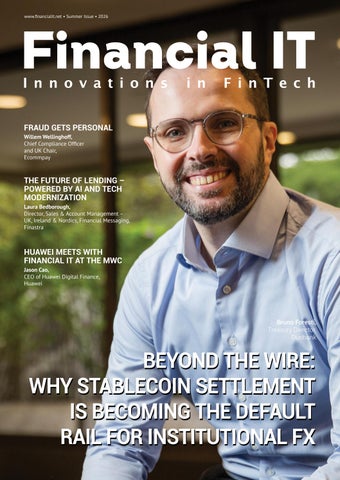
8 BEYOND THE WIRE: WHY STABLECOIN SETTLEMENT IS BECOMING THE DEFAULT RAIL FOR INSTITUTIONAL FX
Bruno Foresti, Treasury Director, Ouribank
12 FRAUD GETS PERSONAL
Willem Wellinghoff, Chief Compliance Officer and UK Chair, Ecommpay
14 DEVELOPING AN EFFECTIVE FRAUD TOOLKIT FOR INSTANT PAYMENTS
Laura Bedborough, Director, Sales & Account Management – UK, Ireland & Nordics, Financial Messaging, Finastra 16 HUAWEI MEETS WITH FINANCIAL IT AT THE MWC
Jason Cao, CEO of Huawei Digital Finance, Huawei
20 WHY COMPANIES NEED TO RETHINK THE PAYMENT MANAGER ROLE
Denys Kyrychenko, Co-founder & CEO, Corefy
22 RETAIL BANKING’S BIGGEST AI OPPORTUNITY IS SIMPLICITY
Brandon Sailors, VP of CX Strategic Accounts, CSGS
Saurabh Joshi, President, CSG Forte
24 FROM ACCESS TO CONNECTION: THE OPEN-LOOP FUTURE OF DIGITAL WALLETS
Ani Sane, Co-founder & Chief Business Officer, TerraPay
28 WHY TOKENISED PAYMENTS ARE THE DATA FOUNDATION FOR AI-FIRST COMMERCE
Robert Kraal, Co-founder, Business Development, Silverflow
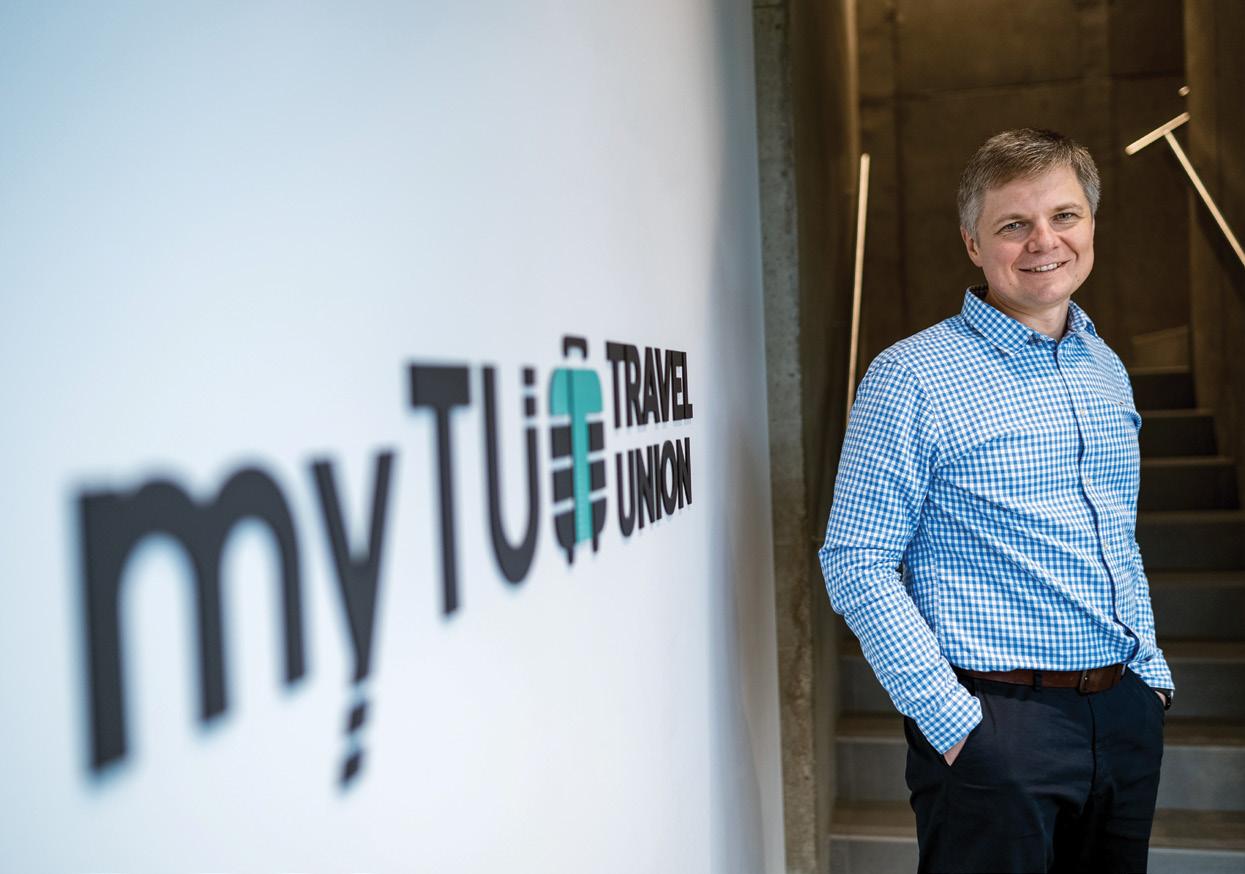
30 THE AUTOMATION GAP BANKS CAN'T CLOSE EVEN WITH A $4 BILLION BUDGET
Raman Korneu, CEO, myTU
32 STABLECOINS VS. TRADITIONAL RAILS FOR THE FUTURE OF BORDERLESS PAYMENTS
Radi El Haj, CEO, RS2
FEATURED
34 FRAUD HAS INDUSTRIALISED AND BANKING DEFENCES MUST DO THE SAME
Sandy Lavorel, Head of Fraud Intelligence, Vyntra
36 THE CASE FOR A HOMEGROWN EUROPEAN PAYMENTS SOLUTION
Lena Hackelöer, Founder and CEO, Brite Payments
38 HOW INSTANT PAYMENTS RAILS ARE FORCING THE FRAUD AND AML MERGER
Dagan Osovlansky, Head of Business Development, ThetaRay
40 WITH STABLECOINS ON THE HORIZON, ARE UK BANKS READY?
Steve Round, Co-Founder & President, SaaScada
44 TAKING FINANCIAL SERVICES GENAI FROM BASICS TO BREAKTHROUGH
Martin Schirmer, GVP NEMEA, Cloudera
Bruno Foresti, Treasury Director, Ouribank
Bruno Foresti is Treasury Director at Ouribank, where he has spent over a decade focusing on payments, derivatives, and treasury management. He holds a degree in International Relations with an emphasis in Marketing and Business from ESPM, a specialisation in foreign exchange and derivatives from B3, and a postgraduate degree in Finance from Insper.
BEYOND THE WIRE: WHY STABLECOIN SETTLEMENT IS BECOMING THE DEFAULT RAIL FOR INSTITUTIONAL FX
The infrastructure that underpins most international payments today was designed for a different era. SWIFT messaging, correspondent banking chains, and T+2 settlement cycles were built for a world in which financial flows moved more slowly than the businesses they served. That gap has narrowed, and in many sectors, it has reversed entirely.
For treasury teams managing crossborder foreign exchange operations, the consequences are tangible. Settlement delays introduce intraday liquidity risk. Correspondent banking fees compound across transaction chains. And the lack of real-time visibility over payment status creates operational blind spots that grow more costly as transaction volumes scale.
The emergence of stablecoin-based settlement infrastructure offers a credible alternative, not as a speculative asset class, but as a programmable, auditable, and near-instant settlement mechanism for institutional FX flows. The question is no longer whether this infrastructure will be adopted, but how quickly regulated financial institutions will integrate it into their core operating models.
Rethinking the Architecture of Cross-Border Payments
The Bank for International Settlements estimates that the average cost of a crossborder payment remains three to five times higher than a domestic transaction of equivalent value. Much of that premium is absorbed by the correspondent banking layer: each intermediary adds processing time, a margin, and a potential point of failure.
Yet the goal is not to dismantle that architecture – it is to optimise the part of the journey where inefficiency is most concentrated. "The way I see it, the first and last mile of international payments will continue to operate in fiat," says Bruno Foresti, Treasury Director at Ouribank. "But the cross-border leg – the part that today relies on correspondent chains, delays, and layered fees – is precisely where virtual assets can add the most value. The two models coexist, and that coexistence is what makes this practical."
This framing reorients the conversation away from disruption and toward architecture. Fiat on-ramps and off-ramps
remain the interface for corporate clients operating in regulated local markets. The stablecoin layer sits in the middle: handling the cross-border transfer with speed, transparency, and lower intermediation costs, before converting back to local currency at the destination.
Stablecoins Enter the Institutional Mainstream
Institutional adoption of stablecoin settlement has accelerated in parallel with the maturation of regulatory frameworks across major financial markets. In Brazil, this trajectory has been supported by a regulatory environment that has moved with unusual clarity and pace. Law 14.478/2022 created the legal foundation for virtual asset service providers, while subsequent Banco Central do Brasil regulations brought digital asset operations within the supervised perimeter of the national financial system.
These developments have had a practical effect on institutional risk appetite. Stablecoin instruments operating within a regulated framework carry a different risk profile than those operating outside it, and for compliance-sensitive treasury operations, that distinction is decisive. Ouribank has been an active participant in this evolution, developing stablecoin settlement capabilities as a direct response to the demand its corporate clients were already expressing. According to the IMF, settlement latency reduction in cross-border transactions can lower liquidity costs for intermediaries by up to 30%, a figure that speaks directly to the operational case that institutions like Ouribank are now building around.
"Brazil has created the regulatory conditions for institutions to move with confidence," notes Foresti. "That matters enormously for the adoption curve. Treasury directors do not adopt new settlement infrastructure because it is innovative, they adopt it because the riskadjusted case is sound."
Integration, Not Replacement
The most effective implementations of stablecoin settlement in institutional FX do not replace existing infrastructure, they extend it. The value lies in creating a parallel settlement layer that can be activated where its advantages are greatest: high-frequency corridors, time-sensitive operations, and markets where correspondent banking coverage is thin or expensive.
For financial institutions operating as FX intermediaries, this requires investment on two fronts simultaneously: the technical capability to process and settle via tokenized rails, and the compliance architecture to ensure that virtual asset flows meet the same AML, KYC, and reporting standards as their conventional equivalents.
This is precisely the model Ouribank has been building through its Solutions Hub, an integrated environment that connects foreign exchange, trade finance, international payments, and now stablecoin settlement for corporate clients. Rather than offering these capabilities as separate products, the hub operates as a single operational layer, enabling treasury teams to manage multi-currency positions, settlement timing, and FX exposure within one unified interface. "Clients do not want to manage two parallel financial systems," says Foresti. "They want a single
environment where the best available settlement mechanism is selected automatically, based on the characteristics of each transaction."
A Structural Shift, Not A Trend
The trajectory of stablecoin adoption in institutional FX settlement is increasingly hard to categorize as experimental. Major global custodians, payment networks, and central banks are advancing tokenization initiatives that will, over the coming years, make programmable settlement a standard feature of cross-border financial infrastructure. Brazil's early regulatory clarity positions it as a significant node in that evolving architecture.
For corporate treasury teams, the practical implication is straightforward: the financial institutions they work with must be capable of operating across both the traditional and tokenized layers of international payments, not as a future capability, but as a present one.
"The companies expanding internationally today are making decisions about their financial partners that will define their operational efficiency for the next decade," concludes Foresti. "Stablecoin settlement is part of that equation and the institutions ready to offer it, within a compliant and integrated model, are already ahead."
Ouribank is positioning itself as one of those institutions. By embedding stablecoin settlement within its Solutions Hub, alongside FX, trade finance, and international payments, the bank is delivering the integrated infrastructure layer its corporate clients need to operate globally with speed, compliance, and full visibility.
Willem Wellinghoff, Chief Compliance Officer and UK Chair, Ecommpay
Willem Wellinghoff has over 20 years’ professional experience in the financial services, financial crime and technology sector, focused on payments and lending, and multi-faceted experience in senior legal and compliance roles in start-up, scale-up and high-growth financial services firms. He is also a mentor and member of Advisory Boards and Working Groups across the industry, providing advice and strategic direction regarding changes in consumer credit and payments and the shift to new regulatory bodies.
FRAUD GETS PERSONAL
The fraud landscape is shifting beneath our feet, moving from technical exploitation to human manipulation. A new report from Ecommpay examines fraud through the lens of systemic human vulnerabilities and highlights how merchants can protect themselves and their customers, as Willem Wellinghoff, Chief Compliance Officer and UK Chair explains.
As fraud detection and prevention technology evolves and shuts down previously lucrative schemes, criminals are forced to innovate so they can continue to profit from unsuspecting businesses and consumers. Uninhibited by regulation and technological constraints, they shift strategy and approach rapidly, leaving previously successful anti-fraud tools floundering.
Legitimate businesses hoping to protect their customers, their reputation and, ultimately, their profits, are often held back from keeping pace or getting ahead simply because they must comply with regulation that was put in place in a previous iteration of the fraud landscape. Looking at the rapid evolution of fraud techniques, it is clear that more needs to be done to bring about real change and future-proof fraud protection solutions.
At Ecommpay we are committed to staying up to date on all things fraud, and tackling challenge head-on. We recently gathered unique insights from fraud, compliance and regulation experts to examine fraud from a different perspective. We published the findings, and the actionable insights gained, to help merchants make changes that will help protect their businesses.
Three uncomfortable truths
During our discussions, we identified three key truths, which make for decidedly uncomfortable reading:
1. Firstly, we saw that current fraud prevention creates competitive disadvantage and market distortion, as smaller players are unable to compete on a level playing field with more established businesses.
2. Secondly, fraudsters are now primarily exploiting human psychology to get their hands on funds, and fraud prevention technology and regulation are not built to address the relevant human vulnerabilities. 3. Finally, within current frameworks, regulation cannot evolve as rapidly as criminal operations, and businesses incur the cost of abiding by laws the criminals successfully evade. Conflicts are inherent, and cannot be resolved at an institutional level, and the Financial Ombudsman may become the de facto regulator for such cases.
Artificial Intelligence (AI) is a significant threat to security. We can add as many verification methods as we like, but criminals will find a way around those. Synthetic identities are being created and sold on the dark web, with deepfakes capable of fulfilling facial recognition requirements, legitimising the synthetic identity. AI is being used to enact a wide range of scams, from romance and job applications to investment, crypto and chargeback.
Although the relationship, the job or the irresistible investment opportunity may not be real, the customer is, and in each of the scams the fraudster will simply manipulate that customer into carrying out a legitimate financial transfer. They will successfully pass all their bank’s verification checks because it is the genuine customer sending the money, and they are convinced the recipient is as genuine as they are.
Unfortunately, scammers are no longer opportunistic kids looking to make a bit of extra cash; they are often part of large,
organised crime gangs with substantial resources and sophisticated infrastructure available to carry out profitable scams at scale. They have time to invest in building fake relationships – and trust – with vulnerable consumers, before convincing them to send money.
Not a competitive differentiator
In recognition of growing fraud threats, the big banks are already collaborating: sharing intelligence and building fraud tools. Smaller institutions also benefit from collaboration, often supported by the big banks, so information is being shared for mutual benefit across the sector. This momentum is vital and must grow, ensuring fraud is never seen as a competitive issue. As well as cross-industry collaboration, market-wide regulation would help to level the playing field and enable financial institutions of all sizes to better protect their customers.
The first of our two-part report, Beyond the Black Box: Why human-centric fraud demands ecosystem-wide transformation’, also examines the challenges businesses face in detecting fraud, market fragmentation, operational challenges, social engineering as a threat, the impossible balance of regulation and fraud prevention, and much more. The second part will be published in June 2026, looking at how the fraud landscape can be transformed.
Our hope is that the insights in the reports will stir the industry into action, that all stakeholders will seek to join forces with competitors, industry bodies, regulators and government to bring about long-overdue change.
DEVELOPING AN EFFECTIVE FRAUD TOOLKIT FOR INSTANT PAYMENTS
Global adoption of instant payments is accelerating thanks to a growing demand for faster, more cost-effective payment capabilities. Datos Insights reports that 90% of European business organizations consider instant payments an important financial function for improving customer satisfaction, cash flow management and payroll efficiency. What often goes unsaid in the discussion surrounding instant payments is the risk of fraud. The general industry assumption is that instant payments are more secure and far more adverse to tampering than traditional payment rails. As it turns out, this attitude isn’t unwarranted. Business respondents to a recent PYMNTS Intelligence report indicated only a 2% fraud rate on instant payments compared to rates of 63% when paying with checks. The question is, will the resistance to fraud last?
At present, layered encryption features and critical verification tools, such as Confirmation of Payee (CoP), make faster payments relatively secure. However, fraudsters are hard at work, using the lightning-fast settlement speeds of instant payments to batter the current defences, and banks will need an allnew toolkit to protect against evolving fraud risks.
A wolf is waiting at the door –criminals develop new tactics
Uptake of instant payments continues to grow. In the EU alone, McKinsey & Company estimated an increase in the number of instant payments from around 3 billion at the end of 2023 to 30 billion by 2028, an average annual growth rate of 50 percent. For European banks, regulatory mandates are supporting that level of growth with real-time clearing platforms. Banks realize lower transaction costs, compared to legacy batch systems, as well as the option to layer on fee services that further drive revenue growth.
But a wolf is waiting at the door, ready to steal profitability directly from bank balance sheets. Employing a familiar bag of tricks,
fraudsters are attacking instant payments and exploiting rapid settlement features in unexpected ways. The most prominent is the shift from large, one-off payments to lowvalue transactions executed at high volumes.
Since traditional fraud systems were built to flag unusually large transfers or sudden large-scale changes in account balances, this approach is effective, easily outmanoeuvring legacy controls. Data from industry body UK Finance shows that losses from unauthorised transactions increased by 2% in 2024 to £722 million, with a 14% increase in the total number of cases to 3.13 million.
Given the speed of instant payments and the growing complexity of fraud schemes, risk approaches that require long posttransaction windows will become powerless as fraudsters put emerging technology to the test. UK Finance reveals that criminals are utilizing agentic AI at an ever-increasing pace, simplifying and cutting the cost of fraud schemes in the process. To fight fire with fire, banks will also need to employ the speed and power of AI to keep fraudsters in check and protect instant payment integrity, as well as bank profitability.
Creating the ultimate fraud toolkit
Many traditional risk assessments gather customer data and compare it against transaction activity, but identifying fraud in real-time will require deeper behavioural analysis and introspection. AI is rapidly moving the needle toward tighter controls, creating dynamic customer profiles that update in real time. While traditional profiles are based on known behaviour – such as who the customer pays and when transactions are typically made – AI-driven models can explore an expanded world of signals to identify pattern deviations in milliseconds.
Say a commercial customer regularly pays a high-value invoice to a vendor using instant payments, and suddenly, the business receives
a request from a vendor to divide the payment into eight smaller instant payments all made on the same day. Because the transactions are below callback thresholds and fully authorized by the business, traditional risk platforms would view these as acceptable transactions. AI behavioural analysis sees it differently. Irregular patterns in payment interval frequency and the clustered nature of the transactions add up to a significant behavioural deviation in the eyes of AI-enabled risk systems. Identifying the fraud pattern then triggers a micro-delay in processing the instant payment, taking time to warn the customer of likely fraud or to halt the transaction entirely, awaiting an approval override.
Behavioural biometrics are another critical tool in identifying fraud patterns, building unique customer profiles based on signals such as typing rhythm, mouse movement, and even interaction speed during digital banking sessions. When an instant payment is initiated, behavioural biometric models compare live data against the customer’s established baseline profile in real time. Subtle deviations increase risk scores and prompt action before an instant payment is authorised.
As criminals take aim at instant payments, it’s clear that banks need advanced tools to identify and stop fraud. Finastra’s collaboration with FraudAverse brings an advanced, AI-driven fraud prevention solution to its Financial Messaging customers, delivering real-time protection against emerging threats and reducing operational costs. As payment volumes grow and fraud tactics become more sophisticated, financial institutions must tap into robust, cloud-ready prevention solutions, optimized for today’s fast-moving payments landscape.
Laura Bedborough is Director, Sales & Account Management – UK, Ireland & Nordics for the Financial Messaging team at Finastra. She has over 20 years’ experience in the financial technology sector, specialising in payments for the last ten years. Prior to joining Finastra she was a strategic relationship manager for the global partner team at Swift. She has also held partnership and business development roles at ApplyFinancial and AccessPay.
Jason Cao is the CEO of the Huawei Digital Finance. He manages Huawei's business in the global financial industry. The Digital Finance Team strives to meet the needs of financial industry customers through ongoing innovation, works with partners to develop leading solutions, and aims to shape smarter and greener finance through full connectivity and intelligence.
Jason Cao, CEO of Huawei Digital Finance, Huawei
Jason
Cao, CEO of Huawei Digital Finance BU, speaks with Chris Principe, Publisher of
Financial IT
at MWC Barcelona 2026
Since 1987, MWC Barcelona has connected the world's hardware with the digital fabric of ingenuity and Huawei has long been among its most prominent participants. Ranked #10 in Clarivate's Top 100 Global Innovators and recognised as an Enabler in the Clarivate AI-50, Huawei is consistently cited in Forbes, Time100, and Gartner Magic Quadrant reports as a leading technology force. At this year's conference, Chris Principe, Publisher of Financial IT sat down with Jason Cao, CEO of Huawei's Digital Finance Business Unit, to discuss the infrastructure, ecosystem strategy, and AI-first philosophy shaping the next generation of banking.
Financial IT: Jason, thank you for making time during MWC. Let's start with the direction of Huawei Digital Finance — what is driving your approach right now?
Jason Cao: Within Huawei Digital Finance, we are very deliberate about our path for financial institutions. AI is moving rapidly from an auxiliary tool into an advanced productive force, and that demands a different kind of ambition from banks. Our role is to bring the technology into alignment so that banks can focus on what this means for their productivity and their business. We want to do this through a sharp partnership focus — one that exceeds expectations with innovation and leading solutions that shape a smarter, more connected, and intelligent financial system.
Financial IT: Banks are playing catch-up with AI. Where does Huawei position itself in that ecosystem?
Jason Cao: The Digital Finance BU is, at its core, an infrastructure provider. We see our role as laying the foundational building blocks — technology that is sound, strong, and critically, resilient. Over the years we have built upon several key initiatives. Our 'Bank 4-Zeros' framework — Zero Downtime, Zero Touch, Zero Trust, and Zero Wait — establishes the resiliency baseline. Our AI-powered RAAS framework — Reliability, Availability, Autonomy, Security that empowers banks with an extremely secure and robust infrastructure. Together, RAAS and the 4-Zeros provide the foundation upon which everything else can be safely built. The goal is Non-Stop Banking through what we call the Intelligent Bank.
Financial IT: How do you define what banks — particularly the top 100 — actually need to be prepared for? Digitisation was the focus for years, but AI seems to have shifted the goalposts entirely.
Jason Cao: This gets to the heart of the issue. The changes driven by AI have pushed banks beyond a tools conversation — this is about moving from digital to Agentic Banking. We have introduced an AI framework where users become super Stewards and employees become super Avatars through AI agent deployment, improving operational efficiency at scale. It begins with an AI-First Mindset. My view is straightforward: in the future, there will be two types of banks — AI banks and other banks. That distinction underscores the urgency.
Financial IT: Can you go deeper on Huawei's approach here? The RONGHAI programme in particular seems to operate differently from a standard vendor model.
Jason Cao: That really gets to the spirit of what we are doing. Huawei recognised early on that we alone could not deliver endto-end financial transformation and that is not false modesty. It is strategic clarity. Our RONGHAI programme is our flagship financial ecosystem initiative. It balances Huawei's global infrastructure capabilities with local partnerships, collaborating across proven solution providers and system integrators. Each partner brings unique strengths to the total project.
RONGHAI represents our deliberate pivot from a Huawei-centric model to a partnerled one — and it has been highly effective.
Financial IT: You speak about winning in a specific way — the 4-Win model. Can you explain what that means in practice?
Jason Cao: At Huawei we are focused on success but we define it in a way that distributes value across the whole ecosystem. The 4-Win model involves four parties: Customers, Independent Software Vendors, System Integrators, and Huawei itself. No one is commoditised or treated as interchangeable. Huawei cannot replicate the local market relationships, regulatory knowledge, or product expertise that our partners have built over time — those are genuine competitive
advantages that we respect and publicly credit. The complementary nature of these relationships is the key: each party is accountable for their layer. The beauty of the model is the sequence — the customer wins first, then the software provider, then the systems integrator, which becomes the total win. That is the 4-Win outcome we are working toward.
Financial IT: Finally — what should readers understand about your leadership approach and where Huawei Digital Finance is headed?
Jason Cao: This is, above all, a team story. The vision and commitment of Huawei's senior leadership continually provides the resources that underpin our success. My own path has been from technology into business, and that shapes how I think about building a team: talent, quality, and knowledge are the traits we look for. Our team's proficiency spans bank business expertise, core banking modernisation, data intelligence, and AI agent deployment — all critical to our financial vertical. Huawei's combination of experience, scale, innovation, and execution is distinctive. Going forward, Huawei Digital Finance will remain true to our convictions around Agentic Banking, the 4-Zeros, RAAS, and the RONGHAI ecosystem with our 4-Win philosophy. Research and development is our foundation — and it is what allows us to keep advancing the capabilities that banks need today.
Denys Kyrychenko, Co-founder & CEO, Corefy
Denys Kyrychenko is the founder of Corefy, the unified payment operating system, and PayAtlas, a payment community platform connecting providers and merchants. With nearly two decades of experience in software development, system architecture, and management, he brings deep expertise in online payments and fintech innovation. Over the course of his career, Denys has helped launch numerous PSPs and e-wallets and co-founded Interkassa, a payment aggregator. A graduate of Kyiv Polytechnic Institute and KyivMohyla Business School, he is dedicated to building scalable, efficient payment infrastructure that enables businesses worldwide to optimise conversions, reduce costs, and expand seamlessly into new markets.
WHY COMPANIES NEED TO RETHINK THE PAYMENT MANAGER ROLE
In many businesses, payment ownership is still defined narrowly: manage providers, handle issues, and keep operations stable. That work still matters, but it no longer covers the full job. Payments now affect revenue, customer experience, product decisions, and operational risk much more directly than they did a few years ago.
That shift came through clearly in our new research on the Payment Manager role. We analysed 112 payment-related job descriptions across 15+ countries and 19 industries. What stands out is the gap between how the market names the role and what companies actually expect. Across the dataset, we found more than 80 title variants for roles that often share a lot of the same core responsibilities.
The scope has expanded beyond payment operations
The strongest signal in the research is the role of data. Reporting and analytics are the top responsibility cluster in the research, with 191 mentions. It appears 69% more often than PSP management, which ranked second. In the hard skills data, Data & analytics is also the largest cluster at 15.4%. Companies still need people who can keep payment operations stable. More of them now also expect those people to read the data, spot where performance is slipping, and help fix it.
The KPI data points in the same way. Approval rate ranks as the top KPI in the report, followed by payment success rate, processing cost, and chargeback rate. These are business-facing measures. They sit close to revenue, customer experience, and payment quality. That tells many companies already measure Payment Managers against outcomes, even if they still describe the role in operational terms.
More
payment
work now happens with Product and Engineering
Among internal stakeholders, Engineering ranks first at 30.2%, and Product ranks second at 22.4%. Finance isn’t the main centre of gravity. That matches what many payment professionals already see in real life. The hardest payment problems are often solved through product changes, technical fixes, integration work, retry logic, routing updates, or better payment flows.
This is where many companies still underscope the role.
When a business hires a Payment Operations Manager, or even a Head of Payments, the wording often still sounds heavily operational: ‘monitor’, ‘coordinate’, ‘escalate’. But once the person joins, the real expectation is often wider. Along with managing activity, they’re also expected to improve outcomes.
It makes the role harder to benchmark and the progression less clear. Someone may be hired to manage payment operations, then quickly find themselves expected to improve approval rates, support implementation work, shape payment method decisions, and work closely with Product and Engineering.
In many cases, the role becomes broader after the hire, even if the job description never made it clear.
What this means for payment leaders and businesses
Industry still shapes the job. Banking roles put more weight on compliance and rails such as SWIFT and SEPA. Gaming roles lean more heavily on PSP management and
approval rates. E-commerce roles prioritise conversion, payment success, and cost.
Even with those differences, the overall direction is clear. The role is getting broader. Data is becoming a bigger part of the day-today work. And payment ownership is moving closer to the centre of the business.
For businesses, the message is simple: define the role around the real job. If this person is expected to improve performance, shape provider decisions, support product changes, and keep payment operations reliable, that should be clear in the hiring brief, team structure, and success metrics. The title matters less than the actual scope.
For payment professionals, the bar is rising too. Knowing the provider side still matters, but the role now reaches well beyond that. The people who add the most value are those who can connect operational details to data, systems, and commercial impact.
At Corefy, we spend a lot of time speaking with payment professionals who already work in that reality every day. The titles vary. The contexts vary. But the direction is the same: payments are becoming more central to business decisions, and the people managing them are expected to carry more weight.
That’s why I believe the Payment Manager role deserves more attention than it usually gets. It sits close to revenue, risk, customer experience, and infrastructure change. Very few roles sit that close to all four at once.
RETAIL BANKING’S BIGGEST AI OPPORTUNITY IS SIMPLICITY
Banks are clear on the value of AI. We’re seeing banks across the globe pour billions into AI investments – JPMorgan Chase alone has said it is investing more than $2B a year in AI. But the biggest ROI levers might be closer than they think.
The future will be defined by the simplest, easiest experiences.
Customers stop short when they encounter friction. They don’t pay right away. They ignore an urgent notification. Even the Pope has had a banking experience so frustrating that he walked away
The most valuable AI use cases are the experiences that customers already expect to be easy. Fraud, on-time payments, and customer engagement sit exactly where trust and revenue meet. If those experiences are repetitive, slow, or unclear, customers feel the drag immediately. If those experiences are timely, relevant, and context-aware, banks earn confidence and loyalty.
Out with ‘New’; In with ‘Easy’
Loyalty is driven by ease, relevance, and consistency. Customers remember fewer handoffs, faster resolution, and clearer next steps. They rarely remember a feature launch unless it made something meaningfully easier.
Even when the institution is coordinating payment routing, risk checks, servicing logic, and compliance requirements in real time, the customer expects an experience as intuitive as ordering an Uber.
This is already changing how banks should think about payments. Too often, the customer is forced to jump to a different channel, re-enter information, or navigate a maze of disconnected systems. The banks that win long-term loyalty are the ones that make the billing experience – whether paying, resolving, or disputing a charge –feel intuitive.
We see this in the rise of embedded payments, for example. Consumers increasingly expect payments to sit naturally inside the experience instead of off to the side as a separate task. That’s where AI can come in: Embedded payments can only scale well when banks can automate and accelerate decisions that used to be manual –including risk review, merchant onboarding, and reconciliation. With a native payment experience, the interaction feels lighter, payment completion improves, and working capital grows with it.
When banks achieve simplicity in the customer experience, AI investments will pay off.
We’ve seen this ROI in action:
• Double-digit conversion gains by removing unnecessary steps from onboarding and application journeys.
• 10% more payments captured thanks to better-timed, contextual reminders.
Brandon Sailors, VP of CX Strategic Accounts, CSGS
Brandon Sailors is the VP of CX Strategic Accounts at CSGS, a leading provider of customer relationship management (CRM) software solutions. With over 15 years of experience in the CRM industry, Brandon plays a vital role in driving strategic partnerships and delivering exceptional customer experiences for CSGS's top-tier clients.
Saurabh Joshi,
President, CSG Forte
Saurabh Joshi is president of CSG Forte, where he leads the company’s strategic vision, driving product innovation, revenue growth and operational excellence. Saurabh previously served as senior VP and GM for North America at Western Union. Earlier roles include VP and GM for the Home Purchase Business at Better Mortgage, and global head of revenue planning and operations at PayPal. He has also held leadership positions at SecondMarket, Rocket Internet and Goldman Sachs, working across North America, South America and Asia.
• 660% increase in customer engagement with a smarter, automated mix of SMS and email communications.
Fortunately, banks don’t need to rip out and replace their tech stack to get there. Start with the small improvements that customers can feel. Ask: Where can we make an action easier for the customer?
Fraud Is the Proving Ground
If there is one journey that can make or break the customer’s trust, it is fraud. Static fraud rules are no longer enough to keep up with fraudsters, boldened and amplified by AI. When banks rely on blunt controls, they create painful experiences for customers: false declines, unnecessary stepups, delayed access, and confusion.
Instead, the strongest systems use AI to evaluate identity, behavior, device signals,
transaction history, and velocity together, in real time, to determine whether a payment fits the customer’s normal pattern. With continuous, cross-channel signals, banks can remove unnecessary stops while staying vigilant and responsive to threats.
Think about how automation and intelligence can change the fraud notification experience as well.
Too often, banks fail to provide customers with clear, timely explanations for why their transactions were declined. This can slow resolution, when time is of the essence. Fraud messaging should give customers clear, actionable touchpoints that help them stay safe.
One bank we work with was able to reduce fraud cases by 25%, reduce inbound questions about fraud by 12%, and achieved 95% customer satisfaction by embedding intelligence directly into fraud workflows. Automated notifications reduced the bank’s
costs, increased revenue, and allowed its fraud agents to focus on legitimate fraud threats.
When banks embed intelligence into the heart of high-stakes journeys, the experience stops lurching from one disconnected decision to the next and starts moving with the customer. Banks show up clearer, faster, and steadier in the moments when trust is on the line.
Ani Sane, Co-founder & Chief Business Officer, TerraPay
Aniruddha Sane, a seasoned entrepreneur, is a founding member of TerraPay Payment Services, a licensed digital payment infrastructure and solutions provider. With over 20 years of experience in global business development for electronic payments and services, Ani, as he is more popularly known, holds the position of Chief Business Development Officer at TerraPay.
In 2015, Ani made his entrepreneurial debut by co-founding Rêv Worldwide, a leading payment products and service provider. During his tenure of over 6 years, he served as Country Manager and Board Director across various subsidiaries worldwide. His exceptional business development skills and dynamic approach played a pivotal role in establishing Rêv's successful business presence in India and the Middle East.
Before Rêv, Ani was Director of Sales at Fidelity Information Services (FIS), where he oversaw the financial payment products and services business in the Indian market. Throughout his career, he has also engaged with multiple startups as a financial and strategic investor and has collaborated with industry giants such as Diebold, Canon, and Motorola.
Ani is a graduate of Mumbai University, holding an MBA, as well as bachelor's degree in business management and engineering. His comprehensive educational background and extensive experience position him as a leading figure in driving business development in the digital payments sector.
FROM ACCESS TO CONNECTION: THE OPEN-LOOP FUTURE OF DIGITAL WALLETS
When the push to bring the world's unbanked populations onto digital rails began in earnest, the goal seemed straightforward enough: replace cash with something faster, cheaper, and more traceable. When that mission took hold across emerging markets, we soon saw a boom in mobile money accounts, with digital wallets reaching populations that correspondent banking never had. The infrastructure of everyday financial life, for hundreds of millions of people, moved off paper and onto devices.
Then came a new challenge.
Wallets work smoothly within their own ecosystems, moving money quickly and reliably at lower cost than the cash and informal transfer systems they have replaced. But they move in circles. Closed loops serve closed communities, and a digital wallet in one market can’t always easily reach a bank account in another, can’t settle across borders without friction, and can’t participate in the broader infrastructure of global finance on equal terms. Access had been built, but connection had not. The distance between those two things turned out to be considerable, and it is now where the industry's sharpest thinking is focused – drawing banks and fintechs toward each other in ways that the old banks-versusfintechs narrative never anticipated.
The story the industry told itself
That competition narrative had real force. Banks and fintechs occupied genuinely different positions: banks as custodians of trust, liquidity, and regulatory standing; fintechs as distributors of speed, reach, and interface. The assumption running beneath the rivalry was that progress meant one side winning ground the other had lost, and that the future of payments would be decided by displacement rather than design. What that framing missed was the degree to which each side held something the other fundamentally needed – and that customer expectations were moving faster than either institution could satisfy independently.
Embedded finance, AI-driven operations, and real-time rails have made that interdependence structural rather than optional. The question occupying boardrooms today is not who disintermediates banks, but who owns the customer experience while remaining compliant – and that question has no clean answer without collaboration. Banks anchor trust, compliance, and balance sheets; fintechs bring distribution, speed, and last-mile reach. The value emerges at the intersection of the two, not at either pole. McKinsey's 2025 Global Payments Report puts the industry's
revenue opportunity at $2.5 trillion , built across 3.6 trillion transactions – a scale at which distribution and connectivity are structural advantages. BCG similarly forecasts payments revenue topping $2.4 trillion by 2029 , with real-time account-toaccount flows and digital assets entering mainstream rails as defining features of that growth. At that scale, no single institution can own every piece of the chain.
What co-creation looks like in practice is more nuanced than the language of partnership sometimes suggests. The most durable arrangements are built around shared market constraints –designing corridors, settlement models, and compliance frameworks together so that the output fits the system rather than bending it. Innovation, in this reading, is less a starting point than a side effect: what emerges when institutions remove barriers they couldn't overcome working independently.
Rails that extend, not rails that retire
There is a structural dimension to this evolution that reinforces the commercial one. The push from regulators and standards bodies is consistently toward open standards and interoperability – not parallel ecosystems operating in isolation. ISO 20022 – the global financial messaging standard now being adopted across major payment networks – is the most visible expression of that push, bringing richer payment data, better compliance traceability, and a common language across networks that makes cross-border flows more legible to everyone in the chain.
SWIFT reports that 90 percent of crossborder payments on its network now reach the destination bank within an hour, ahead of G20 targets – evidence that legacy rails are modernising and extending their reach, not retreating from it.
This matters because it clarifies what collaboration between banks and fintechs is actually building toward. The goal is not a replacement architecture; it is a layered one, where established infrastructure carries the trust and governance that newer entrants cannot replicate, while connectivity layers extend that trust to endpoints the original systems were never designed to reach. Banks retain control, visibility, and regulatory standing even as money reaches non-bank users and new digital endpoints. Funds move within regulated frameworks throughout –governance doesn't get left behind as the network grows.
Access was phase one
The rise of digital wallets makes the interoperability challenge both more urgent and more concrete. More than two-thirds of the world's population is forecast to hold a digital wallet by 2029 – approximately 5.6 billion people – and wallets are rapidly becoming the primary interface for everyday money movement across much of the developing world. Yet for much of their development, those wallets have remained digitally rich and globally isolated – siloed from the broader infrastructure that governs cross-border flows.
The natural evolution from digital adoption, then, is interoperability: the capacity for money to move across systems, brands, and borders without the friction created by closed-loop design. Where phase one was about access – getting people and businesses onto digital rails – phase two is about connection, ensuring that access translates into genuine participation in the global financial system. Access without connection is, in the end, a more sophisticated form of isolation.
The ITU has stressed that digital wallets need to be interoperable, secure, and useful wherever their holders travel, with open standards as the path to that outcome. The
move from closed-loop to open-loop wallet ecosystems is now an industry expectation, not a distant aspiration.
New surfaces, not lost ground
The framing of interoperability as a threat to established institutions misreads both the direction of the market and the nature of institutional advantage. Banks do not lose relevance because wallets or fintechs exist. Relevance erodes when institutions choose not to participate in how money is actually moving; when they observe the ecosystem from outside rather than helping to shape it. Just as Swift connected banks globally and became the gold standard for interbank trust and messaging, the next layer of connectivity extends that trust outward to wallets, cards, and digital endpoints that the original architecture was never designed to reach natively. Banks don't lose ground in that extension; they gain new transaction surfaces and volumes, serving users they may never have directly onboarded through ecosystems built on the regulatory foundations only they can provide.
In the coming years, banks will, in many cases, reach customers through corridors designed in partnership rather than through direct presence alone. Relevance will travel through ecosystems and connectivity layers, not only through owned customer bases –and the trust, compliance infrastructure, and balance sheet strength that banks bring to these arrangements are not incidental to that expansion; they are its foundation.
The organising principle that replaces competition, then, is not partnership as a diplomatic gesture. It is co-creation as a commercial and infrastructure imperative. It’s a recognition that the payments ecosystem is now too consequential and too interconnected to be navigated by any single institution working alone. The distance money can travel is no longer a question of infrastructure. It's a question of imagination and who's willing to share it.
Robert Kraal, Co-founder, Business Development, Silverflow
Robert Kraal is one of the few people in the world with over 25 years of experience in online payments.
After completing his degree in Geophysics, he started his career at Bibit, the first global Payment Service Provider (PSP) which was acquired by RBS/Worldpay. At RBS/Worldpay he went on to lead account management, before moving on to Google Netherlands. He joined Adyen in 2010 in the role of COO, where he was responsible for building and running the global acquiring and processing service.
As Co-founder and Business Development of Silverflow, Robert is responsible for maintaining relationships with the card schemes, acquirers, PSPs and regulators.
WHY TOKENISED PAYMENTS ARE THE DATA FOUNDATION FOR AI-FIRST COMMERCE
Most of the conversation around tokenisation has focused, rightly, on security. Replacing a 16-digit card number with a meaningless string makes stolen card data far less useful to a fraudster, and that case is well made. But as payments move into a genuinely AI-first era, with agents booking travel, reordering groceries and rebalancing merchant treasuries in the background, the more interesting story is not what tokens hide. It is what they carry. Every tokenised transaction now produces a far richer stream of structured data than the card payments of five years ago, and that data is exactly what modern AI models need.
Beyond the 16-digit number
A traditional card authorisation needed the bare minimum: the PAN, an expiry date, a CVV, the amount and the merchant category. There was little contextual detail to tell a good transaction apart from a bad one. Tokenised transactions look completely different. Each carries a unique network token, a dynamic cryptogram generated per transaction, a token requestor identifier, a token assurance level describing how rigorously the card was verified, and device-binding and merchant-binding signals that tie the credential to a specific environment. Visa now operates tokens in 198 countries and has provisioned more than 12.6 billion since 2014.
The difference is more than cosmetic. A legacy PAN tells an issuer that a card number exists. A network token tells the issuer that this specific credential, on this specific device, provisioned through this specific requestor, has been verified to a known assurance level and is backed by a cryptographic proof of authenticity. That is a qualitatively different input for a risk model.
Why AI models are hungry for this data
Machine-learning models live or die on the quality of the data they are given. Feed a modern fraud or authorisation model thin, inconsistent data and its best output is a glorified rules engine. Feed it tokenised, structured transaction data at scale and it starts to find patterns humans cannot. The results are already showing up: Visa reports that tokenbased transactions drive roughly a 30 per cent reduction in online fraud and a four per cent uplift in authorisation rates compared with raw PAN. Mastercard’s latest research found that 42 per cent of issuers and 26 per cent of acquirers have saved more than $5 million each in attempted fraud losses over two years thanks to AI, with 83 per cent reporting a material reduction in false positives.
None of those numbers are possible without tokenisation sitting underneath. The cryptograms, device signals and assurance levels are the features the models learn from. Take them away and you are back to a 16-digit string and a yes-or-no answer.
Agentic commerce will not work without tokens
The clearest demonstration of this new data stack is agentic commerce, where an AI agent acts on a consumer’s behalf to find, choose and pay for something. The networks have been explicit that this cannot happen on legacy rails. In April 2025, Visa and Mastercard both launched dedicated agentic-commerce programmes within 24 hours of each other: Visa Intelligent Commerce and Mastercard Agent Pay. Both are built on agent-specific network tokens rather than card numbers, and both add new data elements: the user’s original instruction, the parameters under which the agent can spend, and a commerce signal describing the outcome. Mastercard’s first live agentic payment took place in September 2025.
What matters for everyone else is what sits inside those messages. An agentic token is not just a safer PAN. It is a self-describing credential that tells every party in the chain who authorised the purchase, under what conditions, on which device, and against which user-defined limits. That is the structured context AI models in fraud, personalisation, reconciliation and dispute management have been starved of for decades.
Platforms that can read the data will win
The catch is that most merchants and many acquirers still run on infrastructure that was never designed to surface this level of detail. Legacy stacks aggregate, flatten and discard transaction data before it reaches the teams that could use it. A richer tokenised message arrives, and the legacy system quietly throws away everything not required to post a ledger entry. The AI opportunity is lost at the pipework.
This is the problem that cloud-native, data-rich platforms are built to solve. At Silverflow, our single API connects merchants and acquirers directly to the card networks, so the full tokenised message, cryptograms, assurance levels, commerce signals and all, flows through intact to the AI, fraud and analytics systems that need it.
Tokenisation started life as a security story. It is rapidly becoming the data story, and in the age of AI-first commerce the winners will be those that treat every tokenised transaction as what it really is: a richly structured piece of intelligence, not just a number being moved from one account to another.
THE AUTOMATION GAP BANKS CAN'T CLOSE EVEN WITH
A
$4 BILLION BUDGET
Raman Korneu, CEO, myTU
Raman Korneu is CEO and co-founder of neobank myTU, an AI-native, cloud-first digital bank designed around full automation and scalability. With more than 25 years of experience in banking and finance, he combines deep regulatory and operational expertise with a clear focus on using AI and cloud technology to rethink how digital banking is built and delivered.
What do we talk about when we talk about AI in financial services? More often than not, we talk about customer-facing and readily visible tools like chatbots, conversational interfaces, and virtual assistants.
But despite hogging the spotlight and shaping public perception, these tools are not the drivers of the most significant transformations in the space. Fintech’s biggest shifts are happening behind the scenes, primarily through invisible AI assistants that are upending how companies operate and scale.
Embedded deep within a company’s core infrastructure, these agents operate at a decision-making level, continuously analyzing data, generating recommendations, and executing complex tasks in real time. There are no prompts, and they do not escalate issues to human operators unless deemed appropriate. They operate autonomously in line with defined parameters, each acting as an intelligent layer stitched into the fabric of the business itself.
Since many of its most ambitious players are already AI-native by design, fintech has emerged as a natural environment for this autonomous model. Digital banks that tread the line between AI-native and more establishment players are already taking the AI plunge with varying degrees of success. By going all-in on AI, Klarna has reportedly cut its headcount by more than a third in three years and increased salaries by 60% Solaris, the troubled German neobank that was rescued from insolvency by a €100M funding round in 2024, recently announced its intention to become AI-native this year and subsequently cut 80 roles from its 400-person headcount. Whether it will save the company from its highly publicized financial woes remains to be seen.
Traditional finance’s AI problem
Traditional finance isn’t AI-averse by any stretch of the imagination. But actual adoption is no simple task.
In order to be effective, invisible AI assistants need an environment conducive to operations. AI-native fintechs invest early in clean, unified data models in order to sustain a cloud-native infrastructure for seamless, real-time access to structured data. Once in place, information flows consistently across the organization, giving
AI systems immediate context without the need to repeatedly reconcile fragmented sources.
The rapid analysis and decision-making that this enables is far from the norm for traditional financial institutions. Most of these are operating on decades-old infrastructure composed of layered systems, siloed databases, and a smorgasbord of legacy technologies. Deploying AI in one such environment becomes less about innovation and more of a drawn-out process of chockablock adaptation. Their data must be extracted, cleaned, translated, and routed before it can even be used effectively, meaning there’s added latency every step of the way. Each new AI initiative requires additional engineering effort and coordination, which in turn demands more personnel. A vicious cycle ensues.
In traditional finance, adding AI frequently increases complexity and headcount rather than reducing it. Retrofitting intelligence into fragmented systems almost always creates operational drag well before it creates efficiency. And the promised efficiency is not even guaranteed.
How AI-native fintechs got supercharged
The invisible AI assistants of AI-native fintechs enable real-time insight into every aspect of the business. They monitor product performance as it evolves, track user adoption patterns, analyze spending behavior, and assess uninterrupted engagement metrics. This constant awareness makes decision-making an ongoing process.
Once that happens, product iteration cycles compress dramatically. Months of analysis, coordination, and approval shrink down to weeks; strategy refinement leaps from quarterly to continuous. Newly dynamic pricing strategies and service models respond to live conditions rather than static assumptions. In an AI-native fintech, the growth this produces can happen without making headcount the primary lever for scaling.
Acceleration and expansion once went hand-in-hand with hiring. More customers and more products meant more operational demands to be managed by more people. This is no longer the case with operating models built around a small and highly technical team overseeing a system of
automated intelligence. Invisible AI can absorb bigger and bigger shares of the workload from analysis to execution to monitoring. The volume of tasks expands disproportionately to the need for human intervention. In other words, revenue increases without a corresponding rise in headcount. Scaling becomes a function of system capability rather than organizational size.
Deployment for all?
Efficiency is the obvious benefit here, but not the only one. Lean teams are inherently more flexible, unencumbered by the friction inherent to complex hierarchies or entrenched processes. Teams at AI-native fintechs stay in control of costs without sacrificing structural agility.
Traditional financial institutions are not so lucky, facing a much steeper and costlier path to achieving similar outcomes. Bank of America’s spending on “strategic technology initiatives,” namely AI, hit $4 billion last year. Introducing automation into these environments isn’t a oneand-done deployment job. Entire roles, responsibilities, and structures have to be refashioned alongside it. Multiple layers of management with entrenched interests can make this process a slog.
It’s possible that these teams will get bigger before they get smaller. Despite a Citigroup report that some 54% of banking jobs are threatened by automation, the expected layoffs have failed to meaningfully materialize. JPMorgan added 2,000 employees in a single quarter in 2024; Goldman Sachs’ headcount in 2025 was 1,800 employees higher than the year prior.
Fintechs can scale in a way that traditional institutions struggle to replicate; traditional financial institutions may eventually close the gap, but this will be a resource-intensive and complex process. Scaling will look vastly different in the next era of financial services thanks to these fintechs. The most successful companies will not be those with the biggest boats, but those who have figured out how to captain (and row together with) the most intelligently automated systems.
Radi El Haj, CEO, RS2
Radi El Haj is the Chief Executive Officer and Executive Director of RS2, bringing over 25 years of payments industry expertise spanning issuing, acquiring, clearing, and financial architecture. Since joining RS2 in 1997 and stepping into the CEO role in 2013, he has driven the company’s evolution from a technology provider into a global strategic infrastructure partner. Under his leadership, RS2 has expanded across Europe, the Middle East, North America, Latin America, and Asia-Pacific, delivering a unified, globally compliant platform that modernizes core payment environments for international banks and financial institutions.
STABLECOINS
Few topics in payments have generated more column inches over the past two years than stablecoins. Starting approximately in late 2024, interest has more than tripled , and a large part of that is moving away from marketing stablecoins at consumers as an ‘on-ramp’ into the larger crypto ecosystem and instead showing how they can be used by international businesses.
The pitch is powerful: instant settlement, round-the-clock liquidity and an escape from the slow, expensive correspondent banking model that has defined international payments for decades. But the real challenge in cross-border payments has always been infrastructure – not just settlement speed.
With the global stablecoin market capitalisation surpassing $300 billion in late 2025 , it is easy to see why treasurers, fintechs and some forward-looking banks are paying close attention.
One thing is getting more traction every day: traditional payment rails are quietly becoming real-time, tokenised and borderless themselves, and they are doing so with the regulatory foundations, consumer protections and settlement finality that stablecoins still lack.
The real cross-border problem
The case for reform is undeniable. World Bank data shows that sending a $200 remittance still costs, on average, well over six per cent of the amount transferred. The Financial Stability Board’s 2025 progress report on the G20 cross-border payments roadmap concluded that, despite five years of coordinated international work, the targets for cheaper, faster and more transparent cross-border payments are unlikely to be met on time. Only a minority of retail cross-border payments currently arrive within the hour, and costs in the most expensive corridors remain stubborn. Into that gap have rushed stablecoin proponents, arguing that on-chain value transfer bypasses the correspondent banking layer entirely and settles in seconds. The solution is promising, but less complete than it first appears..
What stablecoins do not yet solve
Two structural weaknesses have been on display over the past 24 months: stability and regulation. Fiat-backed stablecoin USDC briefly depegged to around 87 cents in March 2023 , when questions arose about the reserves Circle held at Silicon Valley Bank, and in October 2025 the synthetic stablecoin USDe traded as low as $0.65 on Binance during a broader market sell-off. The 2022 collapse of TerraUSD remains the reference point for what happens when confidence in a peg evaporates entirely. Regulators have noticed. The European Central Bank’s November 2025 Financial Stability Review flagged de-pegging and run risks, along with the potential for stablecoin growth to drain deposits from the banking system. A recent Federal Reserve FEDS Note cautioned that payment stablecoins, even at scale, do not eliminate the foreign-exchange, compliance and on-ramp or off-ramp costs that drive cross-border pricing. Around 99 per cent of outstanding stablecoin supply is dollar-denominated , which raises obvious monetary-sovereignty questions outside the United States. Speed, in short, is not the same thing as systemic safety.
Traditional rails, already tokenised
While the crypto-native narrative has dominated headlines, the deeper infrastructure work has been happening elsewhere. On 22 November 2025, the global financial community completed its migration to ISO 20022 for cross-border payment instructions, giving banks the rich, structured data that enables straightthrough processing, sharper compliance screening and faster exception handling. In parallel, Swift has begun building a blockchain-based shared ledger, built on an Ethereum-compatible Hyperledger Besu architecture, that will allow tokenised bank deposits to move between institutions 24/7. At the wholesale end, the BIS Project Agorá is testing the same logic with seven major central banks and over 40 private financial institutions, combining
tokenised commercial bank deposits with tokenised central bank money on a single, programmable ledger.
Domestic instant rails are stretching across borders, too. The US Federal Reserve has now consulted on opening FedNow to cross-border use, bringing it closer into line with Europe’s SEPA Instant scheme and the UK’s Faster Payments Service. Project Nexus, backed by central banks across Southeast Asia and Europe, is designed to interlink these domestic instant schemes directly. The rails that some commentators still dismiss as legacy are, in reality, being rebuilt as realtime, tokenised and interoperable, with the difference that they come with central bank money as the ultimate settlement asset, proper consumer protections and a mature compliance regime.
Orchestration, not replacement
The practical lesson for banks, fintechs and enterprises is that the choice is not really “stablecoin or SWIFT”. The more useful question is how to orchestrate across every rail, old and new, so that each payment is routed through the option that is cheapest, fastest and most compliant for that particular transaction, sender and receiver. At RS2, this is how we approach our cloud-native processing platform: a single integration into issuing and acquiring that sits across card networks, instant payment schemes, correspondent banking, ISO 20022 messaging and, in time, tokenised settlement on shared ledgers.
The future of borderless payments will almost certainly be tokenised, real-time and always on. But that future will be built on the foundations of regulated money, not around them. For institutions planning the next five years, the smart bet is not to chase a single technology, but to invest in the orchestration infrastructure that allows them to operate across all rails securely, efficiently and at scale.
FRAUD HAS INDUSTRIALISED AND BANKING DEFENCES MUST DO THE SAME
WHY THE CURRENT ISSUE OF FINANCIAL CRIME WILL NOT BE STOPPED BY INCREMENTAL CHANGE
Fraud is often described as a growing problem for financial institutions, but in reality, that framing no longer reflects what is happening.
What we are seeing today is not simply more fraud taking place, but a shift in how it operates. Fraud has become faster, more organised and significantly more scalable. It has moved beyond opportunistic activity into something that increasingly resembles a structured industry.
The scale of the issue is overwhelming as global scam losses have reached an estimated $442 billion in just one year, which is only the tip of the iceberg, with the majority of adults experiencing at least one attempt and nearly a quarter losing money. These figures point to a model of financial crime that has changed at its core. Behind that staggering figure for global scam losses lies an uncomfortable truth: banks greenlit every single one of those transactions, unwittingly funnelling that money directly to criminals.
For banks, the implication is clear: if fraud has industrialised, existing approaches to prevention are no longer sufficient.
From Volume to Scale
For years, fraud was understood primarily in terms of volume. More attacks required more controls, and institutions responded by refining detection rules and strengthening authentication and transaction monitoring. Yet today, the defining characteristic is scale. Fraudsters now operate with a level of coordination and efficiency that mirrors legitimate businesses. They test and refine their methods, reuse successful tactics
and share intelligence across networks. Campaigns are designed, measured and optimised for performance.
Artificial intelligence (AI) is accelerating this shift, but it is important to know that it is not the root cause; it simply enhances what already exists. It allows faster targeting, more convincing communication and greater personalisation, which is a devastating combination for victims. Messages that once contained obvious warning signs are now increasingly indistinguishable from legitimate interactions, while campaigns that once took hours can now be executed in minutes.
The Limits of Traditional Controls
This development in fraud tactics exposes a structural gap in how fraud is still being addressed. Most fraud prevention frameworks remain focused on authentication and are designed to detect unauthorised access, identify compromised credentials and block suspicious transactions. That approach still matters, but it is no longer enough.
Modern scams are built around manipulation, and they follow a consistent pattern. Emotion is triggered first, often through urgency, fear, or trust. The victim is then guided through a sequence of steps designed to bypass safeguards. Finally, the payment is authorised by the customer themselves.
From a system perspective, the transaction appears legitimate; authorisation succeeds; the payment is confirmed, and there is no obvious breach. Yet the fraud has already taken place.
This is the defining challenge of authorised push payment (APP) scams. The system is working as intended, but it is being used against itself. Without an understanding of context and intent, traditional controls are left reacting too late. Effective prevention must now operate on both sides of the payment: outbound monitoring protects the payer, but detecting and disrupting mule accounts on the receiving side has long been the structural gap.
Speed Defines Success and Safety
Timing has become one of the most important factors in modern fraud, but it operates across two distinct phases. The manipulation phase is increasingly prolonged, with grooming-based scams such as romance baiting schemes unfolding over weeks or even months as trust is carefully built. By contrast, once a payment is initiated, execution is rapid. Funds are transferred and then quickly moved through mule networks, converted into other assets or withdrawn, often within minutes.
At the same time, payment systems are becoming faster and more interconnected. Instant payments are expanding globally, reducing the window for detection and intervention. However, fraudsters are adapting in step. They create urgency, compress decision-making, and push victims towards immediate action. In doing so, they exploit the very speed that modern payment infrastructure is designed to deliver. For financial institutions, this makes real-time detection and response essential, and delayed intervention is no longer an option.
The Human Layer Remains the Primary Target
Despite advances in technology, fraud will continue to begin with people. Social engineering remains at the core of most attacks, and the uncomfortable reality is that the human has become the weakest link in the security chain. Increasingly, the point of vulnerability is not within the bank’s infrastructure, but at the customer level, where individuals are being systematically manipulated into authorising transactions themselves.
AI has removed many of the traditional warning signs: poor grammar, inconsistent tone and obvious errors are all becoming less common. In their place are highly personalised and context-aware interactions that feel credible and urgent.
Fraudsters are not just trying to deceive; they are looking to systematically influence behaviour. As a result, the distinction between legitimate and fraudulent interaction is becoming increasingly difficult to identify, both for consumers and for professionals within financial institutions.
Regulation is Changing Incentives
Regulators are beginning to respond to this shift. In the UK, mandatory reimbursement for APP fraud, effective from 7 October 2024, has placed responsibility on both sending and receiving institutions for scams executed via Faster Payments and CHAPS, fundamentally altering incentives. Across Europe, the forthcoming PSD3 and the Payment Services Regulation (PSR)
Sandy Lavorel, Head of Fraud Intelligence, Vyntra
Sandy is a financial crime fighter with more than 10 years of experience spanning fraud prevention, anti-money laundering (AML), financial crime investigations, and AI-driven detection strategies. As Head of Fraud Intelligence, he helps financial institutions strengthen their defences against evolving threats through practical, data-driven solutions and innovative technologies.
A Certified Fraud Examiner (CFE), CAMS specialist, and CAFS instructor, Sandy is recognised for his expertise in fraud risk management, scam prevention, transaction monitoring, and emerging financial crime trends. He regularly speaks at industry conferences and events, sharing insights on the intersection of financial crime, technology, and artificial intelligence.
will extend similar expectations, requiring payment service providers to reimburse victims of APP fraud in cases such as impersonation scams, where prevention standards have not been met.
These developments are important. They reinforce the need for stronger solutions and greater accountability. However, regulation does not prevent fraud; it determines how the consequences are shared. The underlying challenge remains unchanged. Institutions must detect and stop fraudulent activity before funds leave the system.
From Isolation to Collaboration
One of the clearest lessons from the current landscape is that fraud cannot be addressed in isolation. Fraudsters operate as networks, sharing infrastructure, data and tactics. When one institution blocks an approach, it is quickly adapted and deployed elsewhere. Banks, by contrast, have traditionally operated within their own data environments, creating a serious disadvantage.
Many of the most valuable fraud signals exist beyond a single institution. Suspicious beneficiary accounts, mule networks, behavioural anomalies, and emerging scam patterns are all part of a broader ecosystem. When this intelligence is shared and applied in real time, both detection and investigation improve significantly. When it is not, fraud simply shifts to the next institution.
This is why collaborative approaches to fraud detection are becoming increasingly important, enabling institutions to benefit from shared insight rather than isolated data sets. In practice, this is already taking shape through network-level intelligence
services such as EBA CLEARING’s Fraud Pattern and Anomaly Detection (FPAD) for SEPA, as well as community frameworks like Community Scoring & Intelligence, which allow participants to identify and respond to threats collectively.
A New Baseline for Fraud Prevention
Denys
Kyrychenko,
Co-founder & CEO, Corefy
Addressing modern fraud requires a shift in approach. Static rules and post-event analysis are no longer sufficient in an environment where fraud evolves in real time. Instead, institutions need to focus on behaviour, context and real-time decision-making.
This means moving towards systems that can assess risk dynamically, identify anomalies as they emerge, and intervene before transactions are completed. It also means extending visibility beyond internal systems to the wider payment ecosystem, across all payment rails. This requires a shift from isolated systems to interoperable solutions that can ingest external intelligence and apply risk scoring across both internal and network-level signals in real time.
Fraud has become an organised and scalable industry. To respond effectively, financial institutions must match that level of coordination, intelligence and speed. The challenge is no longer simply to detect fraud after it occurs, but to prevent it before it succeeds.
THE CASE FOR A HOMEGROWN EUROPEAN PAYMENTS SOLUTION
Lena Hackelöer, Founder and CEO, Brite Payments
Lena Hackelöer is the Founder and CEO of Brite Payments, a Stockholm-headquartered fintech that uses open banking to enable instant account-to-account (A2A) payments and payouts across 27 European markets. A fintech leader with ~15 years’ industry experience, Lena previously held senior roles at Klarna and served as CEO of a publiclylisted Swedish fintech focused on consumer credit solutions. She founded Brite in 2019, and in 2023 led a $60M Series A round, the largest Series A by a female fintech founder in 2023. She is passionate about building the next generation of instant bank payments with Brite.
One theme that has stayed firmly on my radar recently is the growing demand for sovereign systems across the infrastructure that underpins Europe. In an increasingly fractured world, concerns about dependence on systems beyond our control are becoming harder to ignore, whether in energy, defence or technology. Payments deserve to be part of that same conversation. They are a critical part of economic infrastructure, yet are still often overlooked in wider debates around resilience, control and long-term strategic autonomy.
The risks associated with over-reliance on payment systems controlled outside Europe are wide-ranging. This is not just a political concern. It also carries operational and commercial consequences. Europe already has much of the underlying infrastructure in place. The priority now is to strengthen it further and ensure that more of the innovation, adoption, and value creation around it is driven by European businesses. That is how sovereignty becomes real in practice, through a stronger ecosystem of homegrown companies helping Europe build on the infrastructure it already has.
Europe doesn’t need to start from scratch
Thankfully, Europe is well placed to do exactly that. Payment innovation has been accelerating across the region for some time, and in the past year, that momentum has only intensified. Technologies once seen as disruptive alternatives have become embedded in the financial lives of millions of consumers and businesses. For example, recent predictions have suggested that digital payments will make up 79% of global eCommerce value by 2030.
One of the clearest examples of that shift is the rise of account-to-account (A2A), or Pay by Bank, payments. What makes A2A particularly relevant to the sovereignty debate is that Europe is not starting from zero. The underlying infrastructure already exists, and European-grown providers are already building scaled solutions on top of it for merchants and consumers across the region. That is what makes this more than a theoretical opportunity. Sovereignty depends not just on rails, but on the innovation of the businesses adopting infrastructure and translating it into trusted, widely used payment experiences. In the current climate, backing that ecosystem is becoming a strategic imperative.
Regulation
as a catalyst
Regulation is playing an important role in advancing that movement. The most notable example is probably the Instant Payments Regulation, which has helped establish instant euro transfers as a more consistent standard across the banking system, creating a pan-European baseline for speed, liquidity, and realtime settlement. That matters because it reduces uncertainty for banks, providers and merchants alike. It also creates better conditions for A2A payments to scale across Europe as a more unified proposition, rather than growing in isolated national pockets with very different levels of maturity.
In practice, this has created a meaningful opening for merchants. For many businesses, the value of A2A is better terms, faster settlement and improved cost efficiency, all of which matter at a time when margins remain under pressure, and customer expectations continue to rise. Just as importantly, greater control over payment flows can help merchants build more resilient operating models and reduce dependence on legacy systems that were not designed for today’s digital commerce environment.
As this framework strengthens, a number of important market dynamics are becoming more visible. The first is that digital business models are becoming less dependent on cards alone, with the global value of A2A expected to reach $3.8 trillion by 2030. For years, cards were the default option for online commerce because they offered broad acceptance, familiarity, and cross-border reach. That remains true in many cases. However, as A2A connectivity improves and real-time infrastructure becomes more reliable, merchants are gaining access to a credible alternative that sits alongside cards and wallets.
Innovation becoming mainstream
At the same time, Europe’s border A2A landscape is also maturing, with clearer standards, stronger bank connectivity and more capable providers able to support pan-European use cases. That kind of market development is important because it allows the category to move beyond fragmentation and into a more dependable phase of adoption. A clearer
market structure should ultimately make it easier for merchants and consumers to confidently and consistently engage with these payment methods.
This is no longer a story about pilot use cases. In the UK, Pay by Bank has already appeared in the checkout flows of major merchants, including Amazon and eBay, showing that A2A payments are starting to secure real commercial ground. That is significant because it suggests adoption is no longer being held back by theory or infrastructure alone. Where regulation, user experience and merchant demand align, A2A can move into the mainstream.
The turning point
Taken together, 2026 represents a critical inflection point for European payments. While Europe has cultivated the ideal environment for homegrown alternatives, the challenge now lies in scaling them with conviction. We must be clear-eyed about this. For merchants, commercial viability, not sovereignty or any other factor, will always remain the ultimate decider in how they structure the checkout.
However, sovereignty and commercial viability are not mutually exclusive. In fact, the former enables the latter. A more robust and independent European ecosystem does more than improve resilience. It keeps more value circulating within the region. When merchants pay less to process payments and receive funds faster, they have more room to reinvest in growth, whether that means building better products, hiring talent or expanding into new markets. This is where sovereignty becomes increasingly commercially meaningful. It ensures the economic value generated by European commerce remains a fuel for European growth.
For more information about Brite, please visit: https://britepayments.com/. For more information on Pay by Bank, go to: https://britepayments.com/pay-by-bankexplainer/.
Dagan Osovlansky, Head of Business Development, ThetaRay
As Head of Business Development at ThetaRay, Dagan Osovlansky focuses on expanding strategic partnerships, strengthening the company’s global ecosystem, and creating new growth opportunities that support long-term business expansion. With over 20 years of experience in banking and banking technology, Dagan joined ThetaRay as Chief Product Officer. Prior to joining ThetaRay, Dagan worked for 15 years at Fundtech, which became the Finastra Payments business. Here, he held a variety of positions as Global Head of Product Management, VP Head of Product Strategy and VP Product Management. Dagan oversaw product management and managed a group of product managers responsible for the payments product strategy and roadmap across all regions. Dagan also worked as Operation Team Leader and Business Analyst at Citi for five years. Dagan holds an MBA from the Interdisciplinary Center of Herzliya and a BA in Finance from the College of Management.
HOW INSTANT PAYMENTS RAILS ARE FORCING THE FRAUD AND AML MERGER
Thanks to instant payments, speed is the new normal in banking and consumers are loving it. Unfortunately, so are bad actors. Payment fraud across the EEA reached EUR 4.2 billion in 2024, up from EUR 3.5 billion in 2023, a 20% year-on-year jump.
Financial criminals are taking advantage of how banks and fintechs are currently structured. Most institutions still treat fraud prevention and anti-money-laundering (AML) compliance as two separate disciplines, maintained by different teams, powered by different technology stacks, and governed by different regulatory reporting lines. At times, they don’t even know each other. Instant payment rails are making that separation untenable, and PSD3 is about to make it illegal in practice.
For banks to stay ahead of bad actors, they must unify their fraud and AML data and communications, a strategy increasingly known as FRAML. In order to bridge this gap at scale, AI tools are indispensable. Moving forward, the most resilient financial institutions will be those that embrace unified tools and ecosystem partnerships between technology players specialized on fraud and AML to replace the fragmented systems of the past.
The Instant Payments Tipping Point
Instant payment rails are eliminating the buffer that once separated fraud interception from AML investigation. When a payment settles in seconds, there is no window to review, recall, or flag the transaction manually.
The traditional AML model was built to process alerts in batches, filing a Suspicious Activity Report (SAR) within 30 days and reviewing alert queues weekly. However
instant rails compress that timeline to zero. If a mule account receives and forwards funds in under 10 seconds, the fraud event and the money-laundering event are functionally simultaneous. This results in two separate teams chasing two separate alerts on two separate timelines, a structural failure that criminals exploit daily. Financial institutions can no longer afford this lag, especially as they face increasing pressure to reimburse impersonation and APP scam victims when adequate controls are not demonstrated.
PSD3 Codifies the Collapse Argument
PSD3 and the Payment Services Regulation (PSR) represent the most significant EU payments regulatory overhaul in a decade. They introduce stricter fraud-prevention obligations and shift liability toward banks and PSPs for impersonation fraud. Crucially, they mandate controls such as Name-to-IBAN verification and stronger, consistent monitoring across all payment interactions.
While the regulation may not explicitly use the word convergence, it creates operational obligations that are impossible to meet without it. Banks will face unprecedented pressure to prove the effectiveness of fraud detection systems, and greater scrutiny of transaction monitoring and customer-risk scoring models. Under PSD3, the siloed approach isn’t just inefficient but a compliance risk.
Connected AI Is the Path to Convergence at Speed
Regulatory demands for continuous, real-time, explainable monitoring across
both fraud and AML make rules-based approaches structurally inadequate.
AI is the only technology capable of operating at the speed and complexity PSD3 requires. However, even the most advanced AI is limited if it is trapped with disconnected fraud and AML teams. To minimize risk and maximize operational efficiency, financial institutions must seek out connected AI tools that bring fraud and AML under one umbrella. This integration creates synergies that transform compliance from a defensive hurdle into a driver of consumer trust and business growth.
The Wall Is Already Down
Criminals don’t distinguish between fraud and money laundering. For them, it is one continuous, fluid operation. Instant payment rails have made that operational reality visible to the rest of the industry. PSD3 has made the regulatory response explicit. The era of fragmented defense is over. The banks that thrive in this new reality will be those that stop defending two separate walls and start building one integrated defense.
Faster payments have turned a marathon of detection into a sprint. Banks that do not converge FRAML are essentially trying to win a Formula 1 race while their pit crew is still reading a paper manual from the 1990s. The only way to combat machinespeed crime is with machine-speed defense.
Steve Round, Co-Founder & President, SaaScada
Steve Round is the co-founder and President of SaaScada, the core banking platform that enables financial institutions to launch products at speed, learn from real-time data and iterate fast. Its data-driven, cloud-native architecture delivers scalability, AI readiness and flexible reporting, with unmatched product configurability across product types.
For 30 years, Steve has worked globally in inclusive banking, delivering affordable and accessible retail financial services for society’s poorest, with major brands including The Big Issue Foundation, GE Money, Centenary Bank and Ecology Building Society. He also chaired the Governing Board Forum of the GABV and was named Director of the Year at the 2024 UK Fintech Awards.
WITH STABLECOINS ON THE HORIZON, ARE UK BANKS READY?
Stablecoins are shifting from niche crypto tools into mainstream financial infrastructure, with issuance doubling between 2024 and 2025 . Against persistent inflation and inefficient, costly crossborder payment systems, businesses are turning to stablecoins for real-time settlements. Unlike traditional payment rails, which rely on a complex web of correspondent banks and take days to settle, stablecoins enable real-time transfer of funds on blockchain networks. By transferring actual value rather than just a promise of eventual payment, stablecoins are primed to fundamentally reshape the global payments landscape. As this market continues to evolve, UK banks will need to adapt quickly to keep pace.
Stablecoins to reshape global money flows
Stablecoins are taking hold at very different speeds around the world, depending on the economic stability, financial infrastructure, and regulatory openness of the region.
The most strategic shift is unfolding in high-growth regions like the Middle East, where governments have thrown the kitchen sink at digital asset innovation. Stablecoins here are not just a payment tool, but a means to attract capital, strengthen trade corridors, and position the market at the forefront of financial
innovation. The number of active wallets using stablecoins in the United Arab Emirates (UAE) reached over 30 million in February 2025, rising by 53% on the previous year.
In emerging markets, where currency volatility and limited financial access persist, stablecoins offer a more stable and accessible way to save and send money. Tokenised money lets businesses and individuals store value and bypass costly cross-border rails by replacing payment instructions that settle days later with immediate transfer of funds, while also broadening access to financial services without traditional banking constraints. Take South African-based payments gateway, Onafriq, which recently introduced USDC-based settlement to its network. Spanning 200 million bank accounts across more than 40 African countries, Onafriq hopes to reduce the complexity and costs associated with cross-border payments through the adoption of stablecoins.
Yet we are also seeing traction in developed markets, where the gains may be less dramatic, but still commercially impressive. Think faster settlement times, reduced transaction costs for cross-border payments, and an improved customer experience for international financial transactions. For businesses operating globally, even marginal improvements in speed and cost can give them a competitive
advantage. As these use cases gain traction, established players in traditional banking are beginning to get involved. Just last year, a consortium of nine European banks , including ING and UniCredit, agreed to form a new company to launch a euro-denominated stablecoin to support Europe’s growth and financial sovereignty.
The UK is falling behind as the stablecoin horse bolts
Stablecoins are creating a new layer of slick payment networks, but UK banks have yet to embrace the technology. They risk being left on the sidelines if they can’t act fast to embed stablecoin technology into their own architecture. Yet adoption is being held back by three main barriers:
1. Regulatory uncertainty
Regulatory uncertainty remains a key issue when it comes to consumer protection, fraud risk, and depository safeguards. Without a clear, regulated framework, users would have nowhere to turn if a stablecoin issuer becomes insolvent or suffers a cyberattack that compromises its reserves, making it difficult to recover cross-border funds. Institutions such as the Bank for International Settlements (BIS) are already urging global alignment in stablecoin regulation to avoid fragmentation.
2. Legacy banking infrastructure
While the technology behind stablecoins continues to advance rapidly, UK banks are shelling out more than £3 million annually to manage legacy core systems that are already buckling under pressure. Decades-old banking infrastructure was never designed with the flexibility, transparency, or real-time data required to support tokenised payments. When the UK stablecoin boom starts, UK banks will need to move fast to keep up with the competition. But with
current legacy tech, they risk struggling to get off the starting line and losing out on market share. UK banks cannot delay modernising core systems – rethinking how to access, process, and act on data in real time must start now.
3. Risk-averse culture
A further barrier is the risk-averse culture that permeates many UK banks, with boards and senior leadership reluctant to sign off on new projects. In fact, 71% of innovation leaders at UK banks believe innovation is impossible when risk-averse culture and red tape kill experimentation.
This resistance to change not only slows progress but often grinds it to a halt. Many leaders are holding off on making changes they know are needed, while others baulk at the prospect of having to alter how they operate.
From intermediaries to infrastructure providers
UK banks that can overcome these challenges have a golden opportunity to reposition as the regulated infrastructure layer connecting traditional finance with tokenised money. Here, banks can differentiate by enabling money movement. Payments are the most immediate entry point. By integrating stablecoin payment networks into existing systems, banks can reduce cross-border friction, accelerate settlement cycles, and remain competitive against newer, agile providers operating on real-time infrastructure.
But the opportunity extends far beyond payments. As businesses demand greater control over money moving across markets, banks can develop treasury and cash management services that provide real-time visibility, instant settlements, and automated movement of funds. These products will keep banks at the centre of clients’ financial operations, rather than
relegated to the sidelines. There is also a clear role for banks to play in licensing, reserve management, and anti-money laundering for fiat-backed and Sterling stablecoins – areas where regulatory trust, balance sheet health, and operational resilience are critical.
The banks best placed to capture these opportunities will be those who can adapt quickly as UK demand for tokenised finance evolves.
By taking a cloud-native approach to their banking architecture, banks can capture every transaction and interaction in real time while maintaining accuracy, trust, and operational stability. Banks that begin to modernise now will be far better placed to decide how they participate in a stablecoin-driven ecosystem – those that don’t risk being held back by systems that can no longer keep up.
From potential to practical adoption
Stablecoins are moving from speculative tools to becoming embedded in financial infrastructure. While adoption will not be uniform, the direction of travel is clear. For UK banks, the risk is not disruption from stablecoins themselves but losing their competitive streak if infrastructure and payment systems fail to evolve at the same pace.
Modern, cloud-native infrastructure gives banks the flexibility to integrate new payment networks, launch innovative services faster, and respond to evolving customer demands without rebuilding systems from scratch. In a market increasingly defined by speed and interoperability, the ability to evolve quickly will be essential to remain competitive.
Those who invest in modernisation now will be best placed to capture efficiency gains, unlock new revenue models, and maintain share of wallets in a stablecoin future.
Rising customer expectations, relentless efficiency pressures, and harsher regulatory scrutiny are forcing financial institutions to make clearer and more deliberate AI decisions. Customers expect seamless digital experiences. Executives expect productivity gains. Regulators expect robust governance and airtight data protection.
AI deployment is now a strategic priority. For banks, wealth managers and other financial organisations, the question is no longer “Should we adopt AI?” but “Where does AI deliver real value – and at what cost?”.
However, many firms remain stuck in what can only be described as an implementation loop, past experimentation but short of full implementation. A recent survey revealed that 48% of financial organisations find themselves in this middle ground. They’ve moved beyond experimentation, but AI/ML is not fully integrated – creating an implementation gap. AI pilot programmes show promise, and the impact of entry-level use cases has been measurable. But translating these early successes into more advanced applications that drive real value remains a challenge.
Scratching the surface of GenAI potential
Across the financial services industry, generative AI is starting to permeate in early-stage applications, aimed largely at customer engagement and employee support.
Customers increasingly expect naturallanguage interactions when managing their accounts and seeking assistance. They want to ask questions in plain English and receive clear, context-backed answers. They don’t want rigid selection menus or long waits in call queues. GenAI has enabled this shift, delivering conversational experiences that feel intuitive and immediate, reducing resolution times and improving customer satisfaction.
Martin Schirmer, GVP NEMEA, Cloudera
TAKING FINANCIAL SERVICES GenAI FROM BASICS TO BREAKTHROUGH
GenAI also enables always-on access to information spanning loans, deposits, policies and documentation, which is driving faster, more accurate, proactive customer service. Instead of searching for data across fragmented internal systems, teams can retrieve information backed by context in seconds. In wealth management, GenAI analyses portfolio data, market movements and client behaviour to surface insights and summarise complex information. This has freed up time for advisors to focus on client relationships and offer tailored advice.
While there is value in these use cases, they only scratch the surface of GenAI’s potential. For financial institutions to stop here is to miss the technology’s full power – unlocking nextgeneration applications that can fundamentally reshape business functions. Settling for less is an opportunity competitors won’t ignore.
The GenAI implementation loop
As an industry, financial services is innately risk-averse. The highly sensitive customer data financial institutions hold is bound by strict compliance and regulations. Implementing GenAI and allowing it access to this data introduces new governance challenges. Customer information could be accessed by the wrong AI system, appear in prompt responses it shouldn’t, or cross geographical borders. For most financial services organisations, potential regulatory and customer trust ramifications outweigh the benefits of using AI for more complex tasks.
Fragmented data also hinders financial institutions’ ability to innovate with GenAI. Customer information can be dispersed across retail, corporate and investment divisions, compliance and risk teams, legacy systems, and multiple cloud and on-premises environments – each with their own governance rules. Global operations add further complexity. As a result, models are trained on incomplete data, undermining accuracy and business value.
Closing the implementation gap demands a unified, connected view of customers and systems. This provides a single source of truth that enables accurate, contextual AI responses and governance at global scale. Data unification isn’t enough though; GenAI needs to be built with privacy at its core. Strong access controls and auditability need to be embedded from day one, with data lineage and compliance monitoring in models across all environments. This is how organisations reduce risk and move beyond data architecture into true AI governance.
Experiment to Advantage
GenAI has the potential to completely transform financial services, but sustainable value depends on secure, enterprise-wide implementation that can drive efficiency and innovation. Financial institutions must treat GenAI as a core capability that is tightly integrated with their data strategy and governance, and they need to determine what success will look like. That means having measurable outcomes: productivity gains, cost reductions, increased revenue and demonstrable ROI. These measures prove that GenAI is being deployed on the right foundations.
To achieve this, organisations must unify their data, establish consistent governance, and deploy private AI. This gives financial institutions a platform to deliver faster, more accurate insights for both customers and employees, providing the context-rich, seamless, secure and auditable experience that the financial services sector demands. Failing to do so could have devastating consequences. Without unified data and strong governance, organisations can’t deliver accurate or valuable AI insights. These don’t just undermine GenAI, they leave organisations making poor decisions, expose them to compliance failings, and damage customer trust.