•
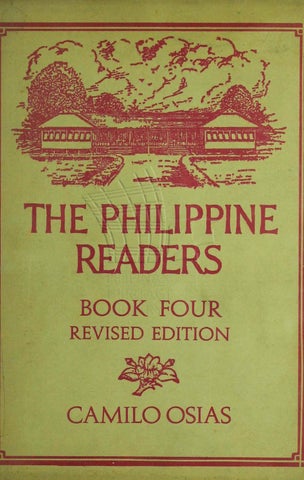
THE ~H IPPINE READERS BOOK FOUR REVISED EDITION
~ ~ CAMILO OSIAS ~iiiiiiiiiiiiiiiiiiiiiiiiiiiiiiiiiiiiiiiiiiiiiiiiiiiiiiiiiiiiiiiiiiiiiiiiiiiiii::· I
The Philippine Readers BOOK FOUR -
By CAMILO OSIAS First Filipino Division Superintendent 0/ Sclwols President, National University
AND OTHERS PHILIPPINE ILLUSTRATIONS BY FERNANDO
C.
REVISED EDITION
GINN AND COMPANY BOSTON • NEW YORK • CHICACO • LONDON ATLANTA· DALLAS· COLUMBUS· SAN FRANCISCO
AMORSOLO
COPYRIGHT, 1932, BY CAlIllLO OSIAS
PHILIPPINES COPYRIGHT, 1932, BY CAMILO OSIAS ALL RIGHTS RESERVED
861.5 PHILIPPINES COPYRIGHT, 1922, BY CAMUO OSIAS COPYRIGHT, 1922, 1924, BY CAMILO OSIAS
or
THE READER IN ITS PRESENT FORM IS BASED ON AN EVALUATION EACH SELECTION MADE BY THE FOLLOWING TEACHERS AND OFFICIALS:
GERONIMA P. DANAAN, N. Vizcaya FILOMENA BALDOMIR, Ilocos Norte ISABEL TABANGCAY, Ilocos Norte ANTERO MONTERO, Ilocos Sur PACIENCIA RIVERA, 1I0cos SUI CRISTINA CADENA, Ilocos Sur ANDREA ROBINO, Ilocos Sur TOMASO C,UUNO, Abra FLORENCIA E. DACANAY, La Union ROSALIA ROGAYAN, Zambales TEO:FILO DIZON, Bataan JosE B. BISLIZ, Bataan GREGORIA BANAAG, Pangasinan VALENTIN D. Vl(;TORIO, Pangasinan INEs BUENVIAJE, Pampanga VALENTIN DE GUZ;MAN, Bulacan SEGUNDA BENIGUET, Rizal NIEVES BALTAZAR, Laguna ]OSEFA OLGADO, Batangas ANGEL BALCE, Camarines Norte Hn:ARlON ORBITA, Camarines Sur
VISITACION Roco, Albay RAMON V. GoNZALES, Sorsogon CARIDAD DANGALAN, Masbate ANDRES BATICA, Samar IGMEDIO A. CALDA, Leyte SOCORRO CASTILLO, Cebu PANFILO SALAZAR, Cebu SE9UNDINO ABAIS, Cebu BRIGIDA ABELLANA, Cebu NICOMEDES GANADE, Bohol DIONISIA SIENES, Oriental Negros LEONOR D. TEJADA, Capiz ADORACION E. MARZONA, Antique CONCHITA UMALI, Romblon FEDERICO VIDUYA, Oriental Misamis LUIS PAWID, Mountain Province AGUSTIN GRAMATA, Mountain Province' LEOCADIO TAMIN, Bukidnon PEDRO C . RAMOS, Davao PILAR M. SoBERANO, Palawan
AND THE SUPERINTENDENT OF ALBAY
MANUFACTUBED IN THE PHILIPPINES
BY GOODWILL TRADING Co., INC. BY SPECIAL AGREEMENT WITH GINN AND COMPANY
I
PREFACE The nationalization of our education system has been definitely adopted, and the Philippine Readers have been written with this policy in view. The demand for things Philippine is met in Book Four by the inclusion of native folk tales and legends with which many of the children are already familiar in the vernacular, biographies of' great men, Filipino and foreign, and poems and selections calculated to develop patriotism. The author has, however, avoided anything that makes for race feeling, petty sectIonalism, or narrow nationalism. This is a~ age of internationalism, and it will not do to deny our future citizens the privilege of adjusting themselves to modern conditions. Hence much of the book is devoted to folk tales amd legends of peoples the world over, biographies of heroes of other lands, and poems and selections that inculcate ethical lessons. To develop power of thought and expression; to create a love for good reading; to arouse appreciation of the beautiful; to cultivate worthy motives and interests; and to develop civic spirit and patriotism-these are the principal purposes which were kept in mind in the selection of material for the text. The material has been tried out in the classroom, and appropriate illustrations have been selected or have been drawn by Fernando Amorsolo. The vocabulary of the previous books of the series has been repeated, >and new words have been introduced gradually. A list of the new words and many helpful iii
iv
THE PHILIPPINE READERS . BOOK FOUR
suggestions will be found in the Manual to accompany Books Two, Three, and Four. A Little Dictionary, with a simple scheme of diacritical marks, gives the children help with difficult new words and lays a foundation for the use of a larger dictionary. Beginning with Book Four, introductions and helps for study are provided for the selections. The concepts and materials of the previous books have been carried into Book Four and enlarged. Hence teachers should refer the pupils to related selections in Books One, Two, and Three. Review of the Rizal material in the previous books is especially important. Thanks are due to Marion I. Noyes, Blanche H. Ray, Mrs. A. S. Hardy, and Martha A. L. Lane, all of whom have given kind permission to use selections from their works. "Tan Shoes," by Alvaro L. Martinez, and "What does the Parrot Say?" retold by Percy A. Hill, from the Philippine Magazine, are used with the permission of the authors and by special permission of the publishers. "I'd like to be a Lighthouse" is printed with permission from "Taxis and Toadstools," by Rachel Field, t:opyright, 1926, by Doubleday, Doran & Co., Inc. The selections by Henry Wadsworth Longfellow are used by permission of and by special arrangement with Houghton Mifflin Company, the authorized publishers. Grateful acknowledgment is made to the evaluators named on the copyright page; to Miss Muzetta Williams, Miss Mary MacDonald, and Mr. Jose Balagot, critic teachers, Philippine Normal School; and to Mr. Hugo H. Miller and Mrs. Bertha Shanks Chaney, with whom I "Worked in the revision of the entire series. CAMILO OSIAS
CONTENTS PAGE
THE RICEBIRD.
•
•
•
Filipino Folk Tale
•
THE Boy SAMUEL.
•
•
•
THE TENDER SHEPHERD.
•
WHERE THE FIRST RICE PLANT GREW • NENITA'S LAMPS
•
•
•
Retold from the Bible Mary L. Duncan Filipino Folk Tale •
•
WHY THE FIRE TREE LOVES THE RAIN THE STORY OF CLYTIE
I
2
THE STORY OF A SWALLOW •
•
.
.
.
.
.
•
Filipino Folk Tale Creek Myth
MAGELLA."l"
4 7 8 10 12
16 19
THE BATTLE OF MACTAN
22
My NATIVE LAND.
26
•
.
How THE CARABAO BIRD PAYS FOR I'l'S RIDE THE KIND STRANGER
•
.
.
.
••
WHY THE BEAN's COAT HAS A SEAM.
28
Retold from the Bible Crimm
36
Mrs. A. S. Hardy
39 42 44 49
THE CIRCLE THAT GIOTTO MADE OLIVIA SALAMANCA SECRETS ABOUT GROWING R"ICE
A PARABLE
•
.
.
ABOUT THE CORAL. BUILDERS
TAKE CARE OF THE TREES. THE SILVER PESO.
~
•
•
•
•
•
•
•
•
.
.
I
THE FROGS THAT ASKED FOR A KING .
52 55 .Esop
THE NEWS • • • • . • • • • • MANUEL AND HIS HANDS.
•
•
•
.
WHO ARE THE ENEMIES OF . THE MONKEYS? JAC~ AND THE BEANSTALK.
•
WHEN I'M A MAN
•
•
•
•
65
79 83
.
WHY THE GOBLINS COME No MORE THE Boy WH9 SUCCEEDED.
•
59 63
66 English Folk Tale 71 76
THE Boy WHO LOVED BIRDS . THE GREAT WHITE BELL.
32
•
WHAT THE LITTLE TRUCK DID •
. v
Richard Newton
89 93
......
96
vi
THE PHILIPPINE READERS . BOOK FOUR PAOli
A CHILD'S CHRISTMAS HYMN.
•
100
WHAT JOSE RIZAL DID FOR HIS COUNTRY
101
WHERE THE CATERPILLAR SLEPT
•
•
•
106
fHE ENCHANTED SWORD.
•
•
•
•
•
•
•
109
II4
THE KNIGHTS OF KING ARTHUR'S COURT • A Boy's TRIUMPH
•
•
•
•
.
•
•
How FIRE FIRST CAME TO THE INDIANS NOAH AND THE ARK .
•
•
THE LIGHTHOUSE LAMP •
•
•
I'D UIiE TO BE A LIGHTHOUSE TAN SHOES SHOES
•
•
I 17
American indian Legend Retold from the Bible , • Alicia Aspinwall . . • ,Rachel Field • • Alvaro L. Martinez · Louise Ayres Garnett
120
12$ 128 131 132 140
HIAWATHA • • • •
· . I. . . . . . .
141
HIAWATHA'S FRIENDS
· Henry W. Longfellow
144
WHEN HIAWATHA WAS If. BOY
Marion i . Noyes and Blanche H. Ray THE STORY WITHOUT
t~
END
THE SWORD OF DAMOCLES FERN ANDO AMORSOLO
•
160
THE RACE OF THE TREES •
164
THE FOUNTAIN OF YOUTH
168
THE FAIRY ApPLES. lIl.i'RT
No
•
14 6
ISO ISS IS7
WHERE DO LoCUSTS COME FROM? •
•
,
171
Christina G. Rossetti
LIVING THING •
SAINT FRANCIS
179 18 3
THE FILIPINO FLAG TELLS ITS OWN STORY •
1 87
WHEN GEORGE WASHINGTON WAS A Boy THE Ox THAT WON THE FORFEIT • SHEIK CHILLI
•
•
WHAT DOES THE PARROT SAY?
•
•
•
•
•
A SAFE PLACE TO KEEP ~ONEY THE TwENTY-THIRD PSALM GENERAL LUNA
•
•
•
178
East Indian Folk Tale
191
A Simla Tale
19S
•
198
The Bible
209
•
'.
•
•
20S 210
A GENTLEMAN
214
LITTLE DICTIONARY
216
,
THE PHILIPPINE READERS BOOK FOUR
J.
THE RICEBIRD What happened to the little girl who took the rice?
One day a woman waS" pounding out rice to cook for supper. Her little girl cried, ((Please give me some rice." ((No," said the mother~ ((rice is not good to eat before it is cooked. Wait until supper is ready." When the woman had finished pounding the rice, she poured it. into a flat basket and tossed it many times into the air. Soon the rice was clean. She emptied it into a deep basket and covered it with the flat one. Then she placed a jar on her head and started for the spring. As soon as her mother was out of sight the child ran to the basket of rice. She reached in to take some rice, but the cover slipped. She fell in and was covered up. When the woman came back to the house, she heard a bird crying, (( King, king, nik! nik I nik I" The sound seemed to come from the basket. She took off the cover, and out'" hopped a brown ricebird. As it flew away it called back, (( Good-by, mother, good-by 1" Filipino Folk Tale
Helps for Study and Enjoyment I. 2.
What happened to the little girl ? What kind of story is this called? I
2
THE PHILIPPINE READERS, BOOK FOUR
THE STORY OF A SWALLOW Why do swallows and other birds travel from one land to another? What did the man in Japan want to find out? How far do some birds fly ?
Once a swallow started qn a long journey. His home was in Japan. The cold weather was coming, and it was time for him to travel to a warmer land. There he would find plenty of food to eat. A swallow 1 a small bird, but he can travel for a long distance. His body is not heav(y, and his wings are strong. For many days this little traveler flew over strange seas. Perhaps, as he flew, he thought of the homeland he had left. His wings became tired, but he could not find any place to rest. Below him was the dark sea. Must he go on and on until he dropped into the waves? Suddenly the swallow saw something which made his heart beat faster with hope. There were green trees and the houses of men'. There was the land he hoped to find t The little bird flew on and soon came to a town on the island of Luzon. How happy he was to reach the land t He saw other swallows flying about in the sunny street, catching flies and insects. It was not long before he joined them.
THE STORY OF A SWALLOW
3
As the swallows flew here and there, chirping together, a boy with a new air gun came by. He saw the birds, and up went his gun. II Bang 1 bang 1" Down fell one of the swallows. When the boy ran to pick it up, he found that it waS alive, but one wing was broken. In a few minutes its bright eyes closed. It was dead. On its right leg there was a metal band. The boy looked closely and saw on it a man's name. A short time before this a man in Japan had set four swallo~s free. H~ wanted to find out how far they would fly. He put a metal band on each bird, hoping that when they reached another land someone might see them and write to him about it. The dead swallow was one of the four. It had come all the way from Japan to the Philippines. What became of the other three, no one knows. How do you think the boy felt who had shot at the harmless birds and killed the brave little traveler?
Helps for Study and Enjoyment How far do some birds fly? Why was the swallow flying away from its homeland? 3. Why did the man in Japan set the four swallows free? 4. What became of the other i'three swallows? 5. What answer do you give to the last question in the story ? I.
2.
4
THE PHILIPPINE READERS . BOOK FOUR
THE BOY SAMUEL Did anyone ever call you in the night when you were asleep? This story tells about a boy who heard his name called in the night. What was the boy's answer?
Many years ago, in a country far across the sea, a little boy was born. He was named Samuel. His father and mother loved him dearly, and they wanted him to serve God all his life. In a town that was a long distance from the home of Samuel's father and mother, there was a large church. An old priest who was called Eli had charge of this church. When Samuel was still very young, his mother took him to the church. There he was left to live with the old priest Eli and help him. Every year Samuel's mother made him a beautiful little coat. When she went to the 'fiesta in the town where her little boy was, she gave Samuel the coat. Although Samuel was still a little boy, he did many things to help Eli. He always slept near the church so that he could open the door in the morning. One night, after he had gone to bed, he heard a voice calling him. He got up and ran to Eli to see what he wanted. (tHere I am," he said. . Eli said: (( I did not call thee. Go back and sleep."
THE BOY SAMUEL
THE PHILIPPINE READERS . BOOK FOUR
6
Samuel went back to his bed, but soon he heard the voice again. A second time he ran to Eli. Again the priest answered him: tt I did not call thee, my son. Go back and sleep." When the voice called the third time, Eli knew that it must be God who was calling Samuel. He told Samuel what to say if the voice called again. Samuel fell asleep, but it was not long before he awoke again. (( Samuel, Samuel," he heard the voice call. This time he answered in the way t.hat Eli had told him to do, ((Speak, Lord, for Thy servant heareth." Then God gave Samuel an important message for Eli. Many times after that the boy Samuel heard the voice . of God. As Samuel grew up he was known for his goodness. Even when he was an old man he listened for the voice of God. He was always ready to answer, ((Speak, Lord, for Thy servant heareth." Retold from the Bible
Helps for Study and Enjoyment How did Samuel answer the voice that called him? 2. What voice called the boy Samuel? 3. How did Samuel answer the priest Eli? 4. How did Samuel answer the voice of God? 5. When he became older how did Samuel always answer 'the voice of God? I.
THE TENDER SHEPHERD
7
THE TENDER SHEPHERD Jesus, tender Shepherd, hear me, Bless Thy li tIe lamb tonight; Through the darkness be Thou near me, Watch my sleep tilL morning light. All this day Thy hand has led me, And I thank Thee for Thy care; Thou hast sheltered, clothed, and fed me; Listen to my evening prayer. Let my sins be all forgiven; Bless the friends I love so well; Take me, when I die, to heaven, Happy there with Thee to dwell. MARY r'
L.
DUNCAN
8
THE PHILIPPINE READERS, BOOK FOUR
WHERE THE FIRST RICE PLANT GREW In the old days many stories were told about where things first came from. This story tells of the time when people did not have rice to eat. They had only wild fruits and plants, Find out where the first rice plant grew.
Once upon a time there came to the home of the gods a very beautiful girl. When the god Siwa saw her he called her Bright Jewel. Aftet a while he wanted to marry her. SQ he told the other gods how much he wanted to have Ulright Jewel for his wife. ((Oh, no) no!" said all the other gods. ({Gods do not marry. You must not think of marrying Bright Jewel." But Siwa loved Bright Jewel so much that he would not give her up. The gods had many long, long talks about the matter. At last they said that Siwa might ~ake Bright Jewel for his wife. Still Siwa.'s troubles were not over. Bright Jewel would not marry him until he had found for her a food better than any that was known at that time. ((I will go down to the earth and hunt everywhere for one," said Siwa. {t I am afraid that I shall never find any food that is better than what we have now. If I do find such a food, I will come back to you." VJeeks went by, but Siwa did not come back. Bright
WHERE THE FIRST RICE PLANT GREW
9
Jewel thought about him every day and was sorry that she had sent him away. She grew thin and pale. At last she started out to look for him. To and fro on the earth she went, sad and lonely, looking for the lost Siwa. She could not find him anywhere. She could not find anyone who had seen him. After a while Bright Jewel became so tired and weak that she felt she could not live much longer. One day she lay down on the ground and closed her eyes. It was not long before she was dead. The gods covered her with earth. The sun shone and the rain fell on the grave of Bright Jewel. Then a beautiful green plant grew from it. This was the first rice plant. The people of the earth took seed from the plant and put it in a seed-bed. Since that time rice has become one of the most important of all foods. Ft1ipino Folk Tale
Helps for Study and Enjoyment Where did the first rice plant grow? 2. Find the paragraph in which the gods said that Siwa should not marry Bright Jewel. 3. Find the paragraph that tells what Siwa had to do before Bright Jewel would marry him. 4. Find the para~raphs, that tell what happened to Bright Jewel. I.
10
THE PHILIPPINE READERS路 BOOK FOUR
NENITA'S LAMPS Name all the things you can that give us light at night. How many of these were in N enita's home? What happened to Nenita's little ,lamps? '
N enita was a little girl only five years old. She was the youngest in the family. One evening her father and mother and the other children were out on the balcony. But Nenita was not with them. Where could she be? Her mother !Ieard the pit-pat of her chinelas in the sala. Then the sound stopped. ((Nenita, are you there?" called her mother.
NENITA'S LAMPS ~(Yes,
II
mother, I am here," replied Nenita. ((Why don't you ';ome out here on the balcony with the rest of us?" asked her mother. (( I think I'll stay in the sala. I am not afraid. My lamps make it light," said Nenita. ((You didn't touch the matches, did you, Nenita?" ((No, mother, I did not touch them. I found my lamps in the garden. They make a pretty light, but it does not stay. It keeps going out and coming back again." When her mother went into the house, she found Nenita sitting on the floor. In her hands was a glass jar with fireflies n it. ((It is time for you to go to bed now," said her mother. (Let us have the real lamp lighted, and then you can let the pretty fireflies go." (Oh, mother, I do not want to let them go. It was very hard to catch them," answered N enita. Nenita was soon ready for bed. Before she lay down to sleep she went to look at her iamps. Something strange had happened to them. Each little light had spread its brown wings and gone away, nobody knew where.
Helps for Study and Enjoyment Did you find out what happened to N enita's lamps? 2. Have you ever put fireflies into a glass jar? 3. What happened to your fireflies? I.
12
THE PHILIPPINE READERS . BOOK FOUR
WHY THE FIRE TREE LOVES THE RAIN Have you ever seen a fire tree? What color are its flowers? Why do the flowers come out when the rains first come? This story will tell you. Once, in the old days, the people of the Philippines were in great trouble. There had been no rain for a long time. The earth became brown and dead. The trees lost their leaves, and the brooks and wells became dry. Worst of all, there was very little paJay left in the houses: It seemed as if it would never rain again. Every day men and women looked at the sky, but there was not a cloud in its clear blue. One day they came together to talk about what they should do. At last an old man said: « It must be that the Rain Maker is angry with us. Sometimes in the past when the gods have been angry a maiden has promised to serve them all her life. If there is a maiden here who will make such a promise~ perhaps the Rain Maker will answer our prayers. If the rain does not come, we and our animals shall soon die. Is there no maiden who will save her people by promising to serve the Rain Maker all her life?" «I will promise I" said Aurora, most beautiful of all the maidens. «I will serve him if he will send the rain."
WHY THE FIRE TREE LOVES THE RAIN
13
,
So Aurora was chosen to serve the Rain Maker. A beautiful long dress was put on her, and she was given flowers and fruit to take to the altar. She made the flowers into garlands and hung them by the altar. She put the fruit in front of it. For many days the rain did not come, but she brought her gifts every day. Often the people came to pray and sing. At last a little cloud appeared in the sky. Quickly it grew large and dark, and soon the rain began to fall. (eWe are saved I We are saved I" the people cried. ((The Rain Maker has heard our prayers." Long and hard the rain fell. The thirsty earth drank it up. The ponds and brooks began to fill. Life came again, and the dean brown earth became a living green. Rice and maize were planted. When the people saw their fine green fields, they thought only of what a big harvest they should have. But Aurora did not forget her promise. Every day she carried gifts to the altar. One day a stranger came to the barrio. He passed the altar and saw the beautiful girl bringing fruit and garlands of flowers. As soon as he saw her he loved her. The next day he came again and watched Aurora as 'she worked at the altar. The m~iden looked up from her work and saw the young man. As the days went by and he came again and again, she began to watch for his coming. At last he told her Of his love.
14
THE PHILIPPINE READERS . BOOK FOUR
((Will you -not eave the altar and come with me? " he asked. ((The rains have come. You do not need to bring gifts to the Rain Maker now." After a while Aurora forgot her promise to the Rain Maker and told the stranger she would go with him. No sooner had they left the altar than the earth began to shake. The sky became dark. The voice of the Thunder God was heard, speaking in anger. Aurora felt water falling on her shoulders. She put her hands up to her hair, and a 路shower fell about her. She felt herself rising into the air. She was oeing changed into a rain cloud. She tried to catch hold of the young man's hand, but she could not do so.
WHY THE FIRE TREE LOVES THE RAIN
IS
As. she rose slowly from the earth, the young man tried to follow her. But he could not move. The god was changing him into a tree. He begged the maiden not to leave him. Then the voice of the Rain Maker was heard. (( A promise must never be broken, not even for love," he said. ((The maiden must leave you because she has not kept her promise to the gods." The young man was so sad that the Rain Maker said: ((I will not take her away from you forever. Once each year I will let her come to gladden your heart and comfort you." And so it is that when the rainy season begins in the Philippines, the fire tree is glad. He covers himself with beautiful red flowers so that Aurora, the maiden, may know that he still loves her. Filipino Folk Tale
Helps for Study and Enjoyment Why do the flowers come out on the fire tree when' the rainy season begins? 2. Is the name of this story a good one? Why? 3. What is the most exciting part of the story? 4. Perhaps you would like to draw one of the pictures you see in the story. Bring it to class, and let someone else read the part that tells about the picture you have made. I.
16
THE PHILIPPINE READERS, BOOK FOUR
THE STORY -OF CLYTIE Have you seen sunflowers growing-in a garden? Should you like to find out why they turn toward the sun?
Once upon a time, an old story tells us, there was a maiden named Clytie who lived in a cave at the bottom of the sea. The floor of her house was covered with white sand. She slept in a large shell. Her pillow was made of soft green sea plants. The sun never shone into Clytie's cave, but she had always lived in a dim light, and she did not think it was dark. She was a happy little maiden and never thought of saying anything about the darkness.
THE STORY OF CLYTIE
17
The sea was almost always quiet around the cave where Clytie lived. Storms do not go far down in the sea; so Clytie did not know that above her head there were often storms on the sea. One day there was a storm which was greater than any that had troubled the sea during Clytie's life. It was so great that even her shell bed was dragged out of the cave and carried far away. When she awoke she found he!'Self on a large green island. Never had she seen anything like the trees. They were much more beautiful than the plants she had known. Flowers were all around her. Birds filled the air with their songs. Most wonderful of all, a clear light shone over the ocean and the land. The light was so bright that Clytie had to hide her face in her hands. It was made by the sun king driving his horses across the sky. In a little while Clytie became used to the shining light made by the sun king. She loved it even more than the land maidens did. It Oh, how I should like to stay on the land I I wish I never had to go back to my home in the cave I" she said. One evening she stood on the shore watching the sun set. The last light of day seemed very beautiful. At last she turned to go, but she found that her feet had grown into the ground. In a minute her dress of
18
THE PHILIPPINE READERS, BOOK FOUR
dark green changed to the stem of a plant. Her golden hair turned into a beautiful yellow flower. No longer was Clytie a sea maiden. She had become a sunflower. The next morning her brown eyes looked out from the yellow flower and followed the sun across the sky. This is why' the sunflower always turns its fact' toward the sun, whom Clytie loved so much. Greek Myth
Helps for Study and Enjoyment Why does the. sunflower turn its face toward the sun? What other naIDe would be a good one for this story? 3. What things should you know in order to understand this story very well? 4. In which paragraph is told the most important thing that happened? S. Copy these sentences. Find in the story the right ending for each one. I.
2.
a. Clytie's home was in ______ . b. Storms do not go ______ . c. Clytie found herself on ______ . d. Birds filled the air ______ . e. The sun king was driving ______ . f. She stood on the shore ------. g. Her dress was changed to ______ . h. Clytie had become ______ . i. The sunflower always turns ______ .
MAGELLAN
19
MA!GELLAN What d~d Columbus think a.bout the shape of the world? Did he ever sail around it? Find out what Magelfan did. Long ago Ferdinand Magellan lived in a country of Europe. One day, when he was a boy, he was sailing a small boat near the seashore. {{ Some day I am going to sail big ships," he said to the boys who were playing with him. {{ I shall sail across the sea as Columbus did. But I shall do more. The world is mund. My ships are going to sail around the world!" The boys laughed at him. ttThe world is fiat, and you will fall off the edge of it," they said, just as boys had said to Columbus years before. {{ But Columhusdid not fall off," Magellan answered. tt He went across the sea and came home again."
20
THE PHILIPPINE READERS, BOOK FOUR
As Magellan grew older, the boys did not laugh at him any more. He became a great sailor and traveled to many countries. He studied books and maps about them. All this time he wanted to sail around the world. At last the king of Spain became his friend. He gave Magellan five ships and three hundred sailors. When all was ready the five ships sailed away. The families and friends of the sailors cried when they saw them go. They thought they should never see them again. In the days when Magellan lived, ships did not travel so fast as our ships do now. They were sailing ships. If the wind did not blow, they would stand still in the ocean until it began to blow again. In a storm it was hard to make them go in the right direction. Magellan's ships had a hard voyage. Often the wind was strong and the waves were high. After long weeks had passed, th~ sailors were afraid to go on. One ship started for home. But Magellan was not afraid. Sometimes the sailors had very little to eat. Many of the men became sick. Some of them died. The others begged Magellan to tum back, but he only said, ÂŤWe must go on and finish 'what we started out to do." For months Magellan and his ships sailed the sea. They crossed one ocean and visited strange countries. They found the way to another ocean, and on this they sailed for weeks without seeing any land.
MAGELLAN
21
How glad they were when one day they saw the shore of an island covered with green grass and tall palm trees I It was the island of Samar. As the ships came near the island, the people went out to them in their bancas, carrying young coconuts and bananas to the sick and hungry men. For a year and a half Magellan and his sailors had been traveling on the sea. Their food was almost gone. They were happy to find people from whom they could get the food and fresh water which they needed . .One man whom we should always remember in the Philippines is FeFdinand Magellan. He and his sailors were the first men from Europe to come to our Islands.
Helps for Study and Enjoyment What does this story tell us that Magellan did? 2. What did people think about the shape of the world many years ago? 3. Why was it hard in the days when Magellan lived for sailors to make their ships go in the right direction? 4. What troubles did Magellan have on his long voyage? 5. Why do you think this story was put into this book? 6. Which of these words do you think best tells what this story is like? I.
strange
true
funny sad
interesting not interesting
22
THE PHILIPPINE READERS路 BOOK FOUR
THE BATTLE OF MACTAN To what place in the Philippines did Magellan and his ships first come? This story will tell you what happened to Magellan after he came to our Islands.
The people of Samar treated Magellan and his men kindly, but there was not much food on the island. Magellan was told that if he would travel a little farther he would find an island larger than Samar. There he would be able to get the things he needed for his men. The ships sailed on and soon came near the island of Cebu. On the !:lhore was a large town. Some of the men went in boats to visit the town. The people were friendly, and the men quickly set up a cross. ((This land shall now belong to the king of Spain," they said. The king of Cebu was Humabon. While Magellan was in Cebu, the king and eight hundred of his people were baptized. Then Magellan wanted all the other islands to be ruled by his friend, King Humabon. There is a small island called Mactan that is east of Cebu. It is so near that boats can easily cross the narrow water between the two islands. On the island of Mactan lived a proud chief. It was not long before he sent word to Magellan that he and his people would not be ruled by King Humabon.
tHE BATTLE OF MACTAN
23
King Humabon asked Magellan to help him. ULet us take our soldiers and fight against this chief and his people," he said. Very early one Friday morning, three boats full of fighting men left Cebu. Among the men were sixty of Magellan's soldiers. They reached Ma.ctan three hours before the sun rose. Magellan sent a message to the chief: Hlf you will obey the king of Spain and will be ruled by King Humabon, we will be your friends. If you will not do so, you will find that our spears are sharp." HWe have spears made of Ibamboo," answere~ the chief of Mactan. ((We have sticks of wood that have been made hard in the fire." When they heard these words Humabon said to Magellan, ({ Let us go together to fight this proud chief and make him obey." ((My men and I are strong enough," answered M,agel. Ian. ((We do not need your help. I want you to see how well we can fight." At the first light o,f day, Magellan and forty-eight of his soldiers jumped out of the boats- and waded to the land. Th~ chief and his men did not come out to fight the soldiers. They stayed back in a safe place. Magellan's soldiers fired 'their guns, but the bullets were stopped by the shields of their enemies. When the
24
THE PHILIPPINE READERS . BOOK FOUR
chief saw that his men were not getting hurt, he ordered them to rush out and fight. With wild shouts the men of Mactan rushed at the Spanish soldiers. They threw stones. They shot arrows and threw spears. They struck with the wooden sticks that had been made hard in the fire. Magellan, ordered his soldiers to set fire to the nipa houses. This only made the men of Mactan fight harder. They rushed upon Magellan himself. He was struck in the face with a bamboo spear. Then he was struck in the right leg by a poisoned arrow. When he saw that the men of Mactan were so strong, Magellan called to his men to go back slowly to the boats. As they waded back through the water they were struck in the legs by arrows and sticks. Again and again the chief's men picked up their spears and threw them. The battle lasted for an hour. At last Magellan was struck down, but he kept on fighting bravely. His right arm was wounded by a bam路 boo spear. Then the chief's men rushed upon him and killed him. When Magellan's soldiers saw that he was dead, they ran to the boats and rowed back to Cebu. In this way Ferdinand Magellan died on the little island of Mactan. The Spanish boats were forced to leave the Philippines. Many years went by before Spanish ships and men were again sent to the Islands. /
THE BATTLE OF MACTAN
Helps
JOT
Study and Enjoyment
What happened to Magellan . after he came to the Philippines? 2. What island in the Philippines did Magellan visit first? 3. Why was he told to go to the island of Cebu? 4. Why did Magellan and his soldiers fight with the chief of Mactan? 5. What did Magellan do that shows he was a brave man? 6. Copy the sentences which are given below. There is one right ending for each sentence. Can you choose it? I.
a. Mactan is a country in Europe. the place where Magellan was killed. an island near. Japan.
b. Mactan was ruled by the king of Spain. Spanish soldiers; a proud chief.
c. The men of Mactan shot arrows and threw spears. ran into the jungle. came ont in their boats.
d. After Magellan was killed King Humabon was wounded. the Spanish boats left the Philippines. the soldiers burned the houses.
7. Read pages 3 I to 40 in Benitez's (( Philippine History in Stories" to find out more about Magellan. 4
26
THE PHILIPPINE READERS, BOOK FOUR
MY NATIVE LAND I love my native land~ Its peaceful lowland plains; I love its mountains grand, Its sun and cooling rains. I love its stately palms, Each graceful flowering tree; I love my native landIt "s the best on the earth for me! I love its waving grain, The whispering bamboo green; I love the orchid rare, Of every flower the queen. I love its wave-swept shores, The restless open sea; I love my native landIt 's the best on the earth for me I
MY NATIVE LAND
MY NATIVE LAND Music by FRANCISCO SANTIAGO, Mus. Doc.
MaeSWSD
I J. ) J J I J <J Jtj I I
love love
my its
J J grand, rare,
Its Of
grain,
its moun - tams the or - chid
love love
I I
plains; green;
peace - ful )QW - land whisp' -ring .bam - boo
Its The
land,
na - tive wav - ing
j
and cool - ing ev' - ry .flower the
SUD
I J............ J J rains.
J I J. J I J. love love
its state - ly its wave-swept
palms, shores,
J I J. j tree; sea;
I I
love love
.r=1 best
best
on on
the the
my my
r
earth earth
Each The
J 1
queen. l
J'
rr
grace - ful flower- ing rest - less 0 - pen
r r Ir r r na - tive
na - tive
land land -
j for for
mel mel
It's It's
the
the
28
THE PHILIPPINE READERS . BOOK FOUR
HOW THE CARABAO BIRD PAYS FOR ITS RIDE Have you ever seen a white bird riding on the back of the carabao? What bird is it? This story will tell you how it pays for its ride.
The rainy season had begun, and all things were happy. The dry rice fields wer~ covered with water. Plants and weeds were beginning to grow. Where the water was not too deep, green grass rose above it. The ponds 'and all the low places in the fields were filled with the rains. Mosquitoes hummed over them. Frogs swam about in them. They were full of the small animals that frogs like to eat. (( Best time of the year I Best time of the year 1" called the frogs, as they sat on the edge of a pond. There were frogs of all sizes, and the air was filled with the noise they made. (( Best time of the year I Best time of the year I" they called to each other over and over again. Jacinto had turned the carabaos into the wet fields to eat the fresh green grass. They were wading around, eating as they moved along. (( This is the best time of the year for us, too," said an old carabao. (( It will soon be time to plow the land and make it ready for setting out the rice plants. We
HOW Tl:!.E CARABAO BIRD PAYS FOR ITS RIDE
29
carabaos are always glad to work in the fields when the rains come. We like to wade in the mud. It makes us feel cool." ((The rainy season is a good time for me, too," said another voice. The frogs were making so much noise that they did not hear this voice, but the carabao did. He looked around and saw near him a tall white bird with a yellow head and neck. It had long legs and a long bill. ((Good moming, Mr. Bird," said the carabao. ((I am glad to see you again. I remember that you were here last year in the rainy season. Why do you like to have the raitls begin?" ul am a fisherman," replied the carabao bird. uWhen the rain fills the swamps, it is easy for me to find something to eat." (( I thought that you were a fisherman," said the carabao. U I have often noticed your long legs and bill. Can you find fish in the rice fields?" (( Yes, I often find fish here," said the bird. (( But I like frogs and lizards and snakes, too. That is why you see me coming to the fields when the rainy season begins." U If you like to eat frogs, you have come to a good place to fllid them," 路said the carabao. ((There are plenty of them in the wet fields. I see them jumping around me
30
THE PHll..IPPINE READERS路 BOOK FOUR
as I wade through the water. They hop in all directions to get out of my way." HThere seem to be plenty here, but it is hard for me to catch them," replied the carabao bird. ttl must stand still and wait for one to come to me, or I must wade out, without making any noise, to where they are. Before I can get to them they often see me and jump away. . I am hungry now, in spite of the fact that there are so many frogs here." HDid you say you were hungry?" asked the carabao in surprise. tt Perhaps I can help you get something to eat. Fly up on my back. I will wade through the water. Then you can ca~h the frogs as they jump. You need not go hungry when a little trick will help you." Hyou are very kind," said the b_rd, as he flew quickly up on the carabao's back. While he was standing there, he saw many insects; so he began to pick them off. HThank you, my friend," said the carabao. HThose insects are a great trouble to me. I am glad to have you pick them off. The only way I can get rid of them is to let the mud from the wallow dry on my back. WhenI it falls off it takes some of the pests with it." The carabao waded through the grass, and the frogs began to jump here and there. Down darted the cara.' bao bird. In a moment the hind legs of a big frog were sticking out of his bill. Then down he went to catch
HOW THE CARABAO BIRD PAYS FOR ITS RIDE
31
another one. When he was no longer hungry he thanked the carabao for his help and started to flyaway. ~(I'll give you a ride any day," said the carabao, uif you will get rid of the insects that bite me/' uThank you," said the carabao bird, Hthat is the way I can pay for my ride."
Helps for Study and Enjoyment How does the carabao bird pay for its ride? 2. What do you think would be a good way to use this story? . 3. Write down the names of the pictures in this story. Choose one that you would like to draw. 4. What was the bird's problem? 5. How did the carabao help the bird to solve his problem? I.
32
THE PHILIPPINE READERS路 BOOK FOUR
THE KIND STRANGER Have you ever had a chance to help anyone who was hurt or in trouble? What did you do? When you help anyone who is in trouble, you show that you are his friend. In this story, which man was a real iriend'?
Once upon a time a man left his home to go to a town that was some distance away. He had to travel on a road that went through the mountains. It was a rough and stony road. The man waS poor. He did not have money enough to pay for a ride, so he had to walk. all the way. The road over which he traveled was not only rough, but it was dangerous too. There were caves in the side of the mountain. Robbers made their homes in the caves. As the man was walking in this rough and lonely place, a band of robbers suddenly rushed out from behind some rocks and stopped him. They asked for his money. When they found out that he had none, they took away his clothes. Then they beat him and left him by the roadside, half dead. After a long time he heard steps coming. He was glad to know that someone was coming to help him. But the steps went by. Farther and farther he heard them go, until at last he could not hear them at all.
THE KIND STRANGER
Cl> B...lrU· L .....u1•
Drawing by Eugene Burnand from "Les Paraboles"
34
THE PHILIPPINE READERS . BOOK FOUR
The traveler who had passed by was hQrrying on to the town. He saw the wounded man, and he said to himself: «I do not have time to stop and see what is the matter with that man. Robber~ must have caught him. If I stop to help him, they may catch me too. I will hurry on~" The wounded man became worse as the hours dragged slowly by. Again he heard footsteps coming. HI wonder if this man will help me," he thought to , himself. The footsteps ~ame nearer. They stopped. Then they went on. The se<\ond traveler was hurrying along the mountain road, too. He was afraid of the robbers. When he saw the man by the side of · the road he stopped a minute and looked at him. «He is only a poor man," he said. «I will not stay to help anyone like that." He turned quickly away and went on. Soon a third traveler came along the road. He was a stranger passing through the country. When he saw the wounded man he stopped his donkey, got off, and knelt down by the man. By this time the wounded man was very weak. He could not help himself at all. When the stranger saw how the man had been hurt, he bound up his wounds
THE KIND 'STRANGER
3S
as well as he could. He knew that the man would die if he were left there any longer, so he lifted him up and put him on the donkey which he had been riding. Then he walked along to hold the sick man on the donkey as it moved slowly over the rough road. After a while they came to a barrio. The stranger took the wounded man to a bouse where he could be cared for. He himself stayed with him all that night. The next morning the poor man was better. The stranger had to go on, but he left money so that the wounded man mi~ht have food and care until he should be well.
1)
Retold from the Bible
Helps for Study and Enjoyment Which man showed ,that he was a friend to the one who was hurt? 2. Which character do you like best in this story? 3. How many characters shall you need to play this story? 4. What things shall you need for the play? 5. How many scenes shall you have? 6. Can you get it ready and play it for the third grade? 7: Another story which you wnI like to read is ((True Friends" in the Insular Third Reader, pages 65-67. !.
i
36
THE PHILIPPINE READERS, BOOK FOUR
WHY THE BEAN'S COAT HAS A SEAM Did you ever notice the little black line that is on the coat of some beans? Should you like to know how the bean got that seam in its coat?
Once upon a time a poor old woman livecJ in a small house. One day she was going to cook a pot of beans for her dinner. She got the fire ready in the stove. As she wanted the fire to start quickly, she lighted it with a handful of straw. Soon the pot of beans was boiling. A piece of the straw feU to the ground. Then a bean jumped out of the pot and fell near the straw. Soon a piece of burning wood droppea near the bean. The three friends began to talk together. «\\There dEd you come from?" asked the straw. «I jumped out of the fire," answered the piece of f wood. « I am glad I did so. If I had stayed in the fire, I should have been burned to ashes."
WHY THE BEAN'S COAT HAS A SEAM
37
am glad that I got away," said the bean. HI know I should have been cooked to death." tt I was lucky, too," said the straw. By this time all my brothers are in ashes." « What shall we do now?" asked the piece of wood. (IWe cannot stay here," tt I will tell yeu," answered the bean. ((Let. us travel over the world together." «That will be fine. Come, let us start at once." So the straw, the bean, and the piece of wood started together to travel over the world. After a time they came to a little brook. They wished to get. across, but there was no bridge. (( How can we reach the other side?" asked the bean. At last the straw said: « I have a plan. I will be the bridge. I will lay myself across the brook, and then you can walk across on me." The piece of wood started first. But in the middle of the bridge it became frightened and stopped. As the wood was still hot, the straw was bumed through in a minute and the two pieces fell into the water below. Down went the piece of wood too, and was carried away by the brook. The bean was standing on the shote watching. When its friends fell into the brook, it began to laugh. It laughed so hard that it burst its skin. ttl
I(
i
38
THE PHILIPPINE READERS, BOOK FOUR
The bean's life might have ended then and there had not a kind, tailor come along. As the tailor had walked a long way he was tired. He sat down on the ground near the place where the bean lay. He looked around and noticed the bean. When he saw that the bean had burst its coat, he took out his needle and thread and sewed it neatly together. ((Thank you, Mr. Tailor," said the bean when the man had finished. ((You have saved my life." The tailor had used black thread in sewing up the bean. That is why you see a tiny black seam on the back of a bean. Adapted from It Grimm's Fairy Tales"
Helps
JOT
Study and Enjoyment
Why does the bean's coat have a seam? 2. Do you think the name which this story has is a good oDe? Why do you think so? 3. I, It a 路good stOry to read by parts? 4. Make a list of the characters in the story. Opposite each name write the name of a pupil in the class who will be a good one to read the part. I.
THE CIRCLE THAT GrOTTO MADE
39
THE CIRCLE THAT GIOTTO MADE What has the boy in the picture just made? This story will tell you who the boy was and what he became la ter.
On the sunny side of a hill in Italy a boy was watching his father's sheep. An the morning he had been busy drawing a picture on a big rock. He had used a sharp stone. Now the drawing was finished. It was a picture of one of his father's sheep. The boy was pleased with what he had done.
40
THE PHILIPPINE READERS, BOOK FOUR
HThat is the best picture I have made yet," he thought. (( If I had a peseta for every sheep I have drawn, I should be rich." (( Did you draw that, my boy?" asked a voice behind him. It made him jump. He had not seen the welldressed stranger riding along the rough path. The man did not wait for an answer. He jumped off his horse and knelt on the grass beside the boy, looking carefully at the lines of the drawing. ( It is good!" he said. « My boy, you must come to the city with me to study. You will be an artist some day. Tell me yo'ur name.'1 The boy felt sfy in the presence of the stranger. «My name is AngioIo, but they' call me Giotto," he said. «(To be an artist is what I have dreamed of all my life." The st~anger took the shepherd boy with him to the city. There Giotto learned to draw and paint. One day, some years later, the Pope wished to have some pictures made for a famous church. He wanted to find out who would be the best person to make them. So he sent a man tv get drawings from different artists. The man came to Giotto and asked for one of his dra wings to carry back with him. G;otto took a piece of paper and with one sweep of his arm he drew a circle. Turning to the man, he smiled and said., (Here is your drawing."
THE CIRCLE THAT GrOTTO MADE
41
(( Am I to show this to my master with the other drawings that have been given to me?" asked the man. (( Is this all that you can give me?" HIt is all that you will need,'~ replied Giotto. (ITake ~t along with the other drawings you have. You will see ~hat it will serve." to What Giotto said was true. As soon as the man ::lhowed the drawing and told how the circle had been Wnade with one sweep of the crayon and without the ~elp of cOinpa~~es, it was agreed that Giotto was the ~est artist that ~e- had found. "0:: As he grew old r, the shepherd boy became a wonder~ ~ul artist. With his pencil he could make a picture that ~ Cl)would tell a story to those who looked at it. <c After this famous man was dead a marble bust was ~laced over his grave. On it there is a sentence which 2:itelps us to understand how great he was. It is: II I am ;:::l;iotto. What need is there to tell of my work?" II-
>-
Helps lor Study and Enjoyment I.
2.
3. drew 4. 5.
Who was the boy? What did he become? To what country did Giotto belong? Can you tell why Giotto did not draw a picture, but only a circle on the paper? What stories have you read about great Filipino artists? Try to draw a perfect circle with one sweep of your arm.
42
THE PHILIPPINE READERS路 BOOK FOUR
OLIVIA SALAMANCA Have you ever hearn of Olivia Salamanca? What did she do to help the people in the Philippines? Why is her name honored?
There is a little town near Manila which is called San Roque. It is onl) a small place, but in it there once lived a girl who was to become a woman whose name is loved and honored. The girl's name was Olivia Salamanca. Every day she went to sen 01 just as you are doing. Even when Olivia was still smal1 her teachers saw that she loved her books. She wanted to know all that was in them. Sometimes the girls in the school talked together. tt What are you going to be when you grow up?" one would ask. There would be many different answers. ttl am going to be a teacher." tt I am going to be a nurse." ({What are you going to be, Olivia?" U I wish that I could be a doctor," Olivia would answer. (( There are so many sick people in the Philippines. I should like to know how to help them get well." After Olivia had finished the high school, she was sent to America. There for four long years she studied to be a doctor. She knew that very many people in the
OLIVIA SALAMANCA
43
Philippines have tuberculosis, so she spent much time in studying how to cu~e people who have this disease. When Olivia came home from Americ~ she was ready to take care of people who had tuberculosis. She taught them that sunshine and fresh air would help them. She taught them that they must rest and eat good food. She worked so hard that a.t last she herself caught the disease. Although she was weak and ill, she worked on day after day, and often at night. She always had a smile and a pleasant word for the sick. They felt better when they saw her coming. When Olivia Salamanca diecil, the people were very sad. They knew t11 t our country had lost someone who loved them and wanted to help them. In Manila there is a plaza named for her. It is called Plaza Salamanca. Because she was good and kind, and helpful to the poor and sick, Olivia Salamanca will always be remembered by the people of our country.
Helps for Study and Enjoyment 1. Why is the name of Olivia Salamanca honored?
Name different people who have helped the Philippines. In what ways have these people been honored? 3. Read also ('Tuberculosis" in ÂŤCitizenship and Health," pages 142-148; ('Our Friend the Sun" in "Health and Success," pages II6-124. 2.
44
THE PHILIPPINE READERS . BOOK. FOUR
SECRETS ABOUT GROWING RICE How many 路secrets about growing rice are told in this story? Which of the men had the better way of growing rice?
It was the time of rice harvest, and Gregorio's fields were filled with happy laborers who had come to help him cut his grain. Their songs and gay talk filled the air. ((That singing sounds good," said Andres, who was working near Gregorio. ({It is a good thing to have laborers happy. It helps to keep the grain from spoiling." ((It is well for them to be happy," said Gregorio. ((Have you seen my new storehouse? I have built it high up from the ground so that the rice will keep dry."
SECRETS ABOUT GROWING RICE
45
uI hope that you did not build it so high that a snake cannot get in," answered Andres. {{ It is always good luck to have a snake in the storehouse." n I think a snake could get in. They can go almost anywhere," said Gregorio. tt I killed a snake once in my father's storehouse. There was a rat inside it. Since then I have never kil~ed a snake among the rice sacks." ({Your crop is much better than mine," said Andres. U I have never seen better palay than you have. I did everything that the old people say should be done for a good crop, but st.ill mine is not so good as this. ÂŤ I got a fat man to gather my~eed rice so that it would be good. Before I prepared the seed-bed I ate a big breakfast. When I sowed the seed I kept my eyes closed so that nothing could see where the seed fell. Finally I threw ashes over the seed-bed to blind the eyes of any animal that might be awake when I was planting. I suppose you did all those things, too." nNo, I did not do any of them," answered Gregodo. tt I gathered the seed myself. I picked only the biggest and fullest heads from tall, strong plants and kept the grains from them for planting." ((You always have better luck than I do," said Andres. t{I did many things to keep the insects and birds away. But they came and did much harm to my crop. Did you have trouble with them?"
46
THE PHILIPPINE READERS . BOOK FOUR
(( Yes, I had plenty of trouble," said Gregorio. II As soon as the rice plants had been set out, a swarm of locusts came to the field. Soon I saw kakocs and other birds flying around. I went out to frighten them away, but when I saw they were catching the locusts I let them ~lone. It was not long before the swarm flew away. The birds helped to destroy the other insect pests, too." I( I never let the birds stay in my fields if I can help it, because they eat the rice," said Andress. ((One of my children keeps the scarecrows moving al1 the time." (( Do you no\ know that many of the birds are the best friends the ffirmer has?" asked Gregorio. (( I have never heard the 01 people say that the birds are friends of the farmer," replied Andres. ((I always listen to what they say about things. (( There have been many rats and mice in the fields. I have heard that if they hear children at play, they will learn to play, too. So I did not let my , children run outside and play for four days after the plants were ~et out. (( I was afraid that the rats and mice wouid destroy the rice, so I did what I could to win their good will. But in spite of all that I did, they came and destroyed much of my crop." (( Rats came to my fields too," said Gregorio, ((but I saw hawks flying over the fields. I knew they would
SECRETS ABOUT GROWING RICE
47
catch many of the rats. I saw snakes in the field. Once I found- the feathers of an owl near some stalks that a rat had been gnawing. The hawks, snakes, and owls have helped to keep my fields free from pests." (t You are a lucky man!" said Andres. tt Even the birds and snakes seem to help you!" ((They would help you too; if you would let them," said Gregorio. ttNext year I shall try your way," said Andres. ((1 shall not have a very large crop this year, but I shall do all I can to make it la~t till the next crop is ready. tt I have kept a sack of old rice to welcome the new. I plan to give pinipig to many. My wife will cook the rice well, so the grains will become large. She will leave some in the pot when the路 first new rice is cooked. These
48
THE PHILIPPINE READERS . BOOK FOUR
things will make my crop last till next harve!;t, even if it is not a large one. Don't you think they will, Gregorio?" (( Perhaps they will, but I do not depend on things like that to fill my storehouse and to keep the rice safe after it has been stored away," answered Gregorio. n I plant only good seed and I keep the fields clean. I do all I can to keep down pests. I set traps for rats and mice. I destroy the locusts. When the rice is ripening I make scarecrows to frighten away the ricebirds. H I do not drive away or kill the birds and lizards and snakes that catch insects and other pests. These are some of my secrets about growing rice." (( Perhaps your way is better than mine, after all ," said Andres. ((Next year I shall try it."
Helps for Study and Enjoyment I. 2.
Which had the better way of farming? Choose the right word for each of these sentences:
a. I have never killed a (r.at, snake, hen) among the rice sacks. h. I saw (doves, bats, hawks) flying low over the fields. c. I found the feathers of (an owl, a parrot, a duck). d. I make (nets, kites, scarecrows) to frighten away the ricebirds. e. ttl did all the things that (the teacher, the old people, my friends) say should be done for a good crop," said Andres.
A PARABLE ABOUT THE CORAL BUILDERS
49
A PARABLE ABDUT THE CORAL BUILDERS A parable is a story that has a lesson in it. Can you find the lesson in this parable?
One day the Creator of the world said : {{ I need more islands. There are many people yet to come, and I shall not have room enough for them." {{Let us help build some islands," said the giant fishes. ((We are large and strong. We can bring up sand from the bottom of the sea and pile it where you wish." {{We are too small to bring sand," said the little coral builders, {(but we are willing to do all we can to help you make iE.lands." When the giants heard the little coral people say th!s, they laughed until the sea shook. They thought it was funny for people so small as the coral builders to think that they could help to make islands. The giant fishes went to work. They tossed the sand into great piles. They moved their fins about. They
50
THE PHILIPPINE READERS . BOOK FOUR
swam and they blew until the sea people thought that the islands must surely be almost finished. But no s<?oner was the sand piled up than the waves came and washed it all away. All the work that the great fishes had done was destroyed. Again they tried, but again the waves washed their piles of sand away. For a long time the waves swept to and fro across the sea. They went wherever they pleased. Then one day they came to a strange wall. It was a wall which the little 路coral builders had made. The waves ~ved slowly now. They laughed softly. Their angry voi es were charged to gentle sounds. Ah," said one of them, (( this wall is one of the islands which the coral builders are making for the Creator." ((Let us help the brave little builders," said the others. ((We can bring sand to fill the holes in the wall." So they piled the sand of the sea a.mong the coral branches, and they brought seeds to plant in the sand. The little coral builders worked quietly on. The sand settled among their branches. The seeds grew into grasses and plants and trees. At last a day came when the Creator of the world came and looked at the islands which the quiet little coral builders had made, and He was well pleased. {(Well done, faithful little servants," He said. (I
MRS.
A. S.
HARDY
(Adapted)
A PAR.-\BLE ABOUT THE CORAL BUILDERS
51
Helps for Study and Enjoymeni What is a parable? What is the lesson taught in this parable? 2. Have you ever heard or read any other parables? 3. What things should you know in order to understand this story? 4. Why were the piles of sand that the giant fishes made washed away? 5. What difference was there in the way the giant jishes worked and in the way the coral builders worked? 6. Which kind of buiiders really did the work? 7. To see how well you have read this story. read the sentences below. C py them. P.t\t a box around the word True if the sentence is true. Put a box around False if the sentence is not true. I.
The story said that
a. Coral builders are giant sea people. b. The giant fishes dug up the sand. c. The coral builders built the island all alone. d. The waves helped the coral buildt;rs to build the island. e. Coral builders are brave sea people. f. The coral builders were tOG small to dig up sand. g. The little coral builders worked quietiy under the sea,
True True
False
True
False
True True
False False
True
False
True
False
F~lse
S2
THE PHILIPPINE READERS, BOOK FOUR
TAKE CARE OF THE TREES Are there trees growing around your schoolhouse? What do you do to help care for them?
((What a pleasant schoolhouse I" said Adela. She was standing with two or three other girls in the school yard. (( It is much prettier tha.n our big building; and how l,ovely the grounds are!" ((Yes>,' said her cousin Carmen. ((Mr. Lopez has put the care of the yard in our hands. We try to keep it as clean as we can. Every day we pick up all the pieces of paper, the dry lea es, and the broken twigs. Even the little children can help do that." ((We have no trees around our building," said Adela. ~ (Our teacher said that it would be of no use to plant them. He did not think that we would take care of them. The yard around our school looks like a desert.n ((Mr. Lopez told us that the grounds would look much better if we had some trees, and he asked us if we would help to care for them," said Maria. ((We promised not to break the young twigs and branches, and he had all these trees set out." ((But you win not be here long enough for the trees to grow," said Adela. ~(It will be many years before thes.e trees are big enough to make much shade."
54
THE PHILIPPINE READERS路 BOOK FOUR
There will be other boys and girls coming to school then who will enjoy them," said Paz. ttWe are very proud that our trees are doing so well. Yesterday when the boys were playing they broke one of the trees. They were so sorry about it that they have gone to the forest today to get another tree." ttl see that you have helped them by digging a hole for the new tree," said Adela. (tOr ~erhaps they did that before they went." ttNo, we dug it to surprise them," said Carmen. W~hey were going to take up the tree that was broken, but Mr. Lopez thinks that he can save it. So we shall plant the new one near it. This corner of the yard will be a nice, shady place to play when the trees have grown big." ttl should like to go to your school," said Adela. ((I never thought that vines and flowers and trees could make such a difference." tt
Helps for Study and Enjoyment What made the difference in the looks of the yard of Adela's school and of Carmen's? 2. How did Mr. Lopez help the children to make their school a pleasant one? 3. Why should we plant trees for the children who will come to our school after we leave it? I.
THE SILVER PESO
55
THE SILVER PESO How many of you have ever found some money in the street? What did you do with it?
(!When I was only eight years old," said an old man, (!my father and mother sent me to live with a farmer whose name was Mr. Santos. He was to keep me until I grew to be a big boy. Mr. Santos made me wQrk very hard and gave me almost no money to spend. ((Sometimes I had a few -centavos, but I wanted very much to have a silver piece of my own. After a long time a silver peso came into my hands. Shall I tell you how I happened to get it? This is the story: ((One moonlight night Mr. Santos sent me to the barrio to buy some things for him. As I was walking home I saw a folded paper lying by the side of the road. ((I picked the paper up and looked inside, but I did not see anything. I was just going to throw it away, when I felt something hard. It fell to the ground and made a ringing sound against a stone. I stooped quickly and picked it up. It was hard and white and round. I knew it was a peso, and I put it into my pocket. II As I walked along I often took it out of my pocket to look at it again, but when I met anyone I put it away so that they could not see it.
56
THE PHILIPPINE READERS . BOOK FOUR
((When I reached home I did not tell Mr. Santos or his family that I had found a silver peso. I would not have had them know it for anything, but I felt as if my face were telling them all my secret. When I went to bed I lay awake half the night wondering what to do with the money. IINext morning I felt very unhappy. At the breakfast table my master, Mr. Santos, said to me, (David, I want you to go to Mr. Suico's house this morning and ask him to come and work for me today and tomorrow.' ((On my way to Mr. Suico's I kept thinking about the money. (If I am found out,' I said to myself, (I shall be called a thiet' (( Again L thought: (If I do not know who the loser is, how can I give him his money? It is only because I am afraid Mr. Santos will take it from me that I hide it. I am not really dishonest. I would not keep anything that did not belong to me, if I knew the owner. I know I have no right to the peso, and if the one who lost it should ask me for it I would give it to him at once.' liThe silver peso was like a heavy stone. I was not so happy with it as I had been with ten centavos that Mr. Santos had given me some weeks before. Nobody else had said the ten centavos was his, and I had been as happy as a king. .. .: .
THE SILVER PESO
57
Mr. Suico was not at his house, so I went home again. When I came near the house I saw a horse standing at the gate and I was frightened. It was the horse of a policeman, and I thought he had come to take me to prison. So I hid in the garden until he went away. nWhen I went in, Mr. Santos looked very angry, and I thought he knew all about the money. But he only scolded me because I had been gone so long. ttl went to work in the field with the peso in my pocket. At times I took it out to look at it, but it did not make me happy. ((That night after supper I was sent again to see Mr. Suico. He was at home, and he promised to come the next day and work for Mr. Santos. When I started for home it was dark, and I was afraid of robbers. I had never felt so afraid before. It was all because I was keeping something that did not belong to me. ((When Mr. Suico came early next morning, Mr. Santos asked him to come in and eat breakfast with his family. Mr. Suico was a poor man, and he had to work very hard to get food enough for his wife and children. ttWhile we were eating breakfast Mr. Suico told Mr. Santos that he had lost a silver peso. Ct t It was the only one I had in the world,' he said. t It was rolled up in a piece of paper, and I lost it as I was going home from work.' tC
58
THE PHILIPPINE READERS . BOOK FOUR
HWhen I heard Mr. Suico say that he had lost a peso, my cheeks burned. I was' frightened, but as everyone was looking at :Mr. Suico, they did not notice me. \( After listening for a minute I took the money out of my pocket and asked, (Is this yours, Mr. S llico ? ' ((Mr. Santos put his hand on my head and called me a good boy. I knew I did not deserve all the kind things he said to me, but I almost cried for joy at having been saved from being a dishonest boy."
Helps for Study and Enjoyment What did Da id do with the silver peso? 2. Do you think the name of the story is a good one? 3. If you ean choose the right ending to these sentences, it will show that you have read uThe Silver Peso" well. I.
a. David found -the peso when he was walking in the field. when he was going to school. by the f?ide of the road.
h. Mr. Santos scolded David because he had kept the peso. because he had been gone so iong. because My. Suico was away from home.
c. All the time that David had the peso he was afraid someone would find it out. he was looking for the owner. he was glad to have so much money.
THE FROGS THAT ASKED FOR A KING
59 I~
THE FROGS THAT ASKED FOR A KING How many of you have ever wished for something that you did not have? This story will tell you what happened to some frogs that wished for a king. "
Once there were some frogs that lived together in a beautiful lake. There were many of them, and they were very happy. There was nothing in the lake to harm them, but they began to think that they might be still happier if they had a king to rule over them. So they sent a: big frog to the ho~e of the gods to . ask if they might have a king. The gods knew that the frogs were foolish to ask for a king. They kne~ the frogs were better off as they were, They laughed at them, but they said: ((You may have a king. Here is one for you." Into the water they threw a big log. It fell with such a splash that all the 路 frogs were frightened. They hid themselves for a long time in the deep mud at the bottom of the pond. After a while a frog who was braver than the rest peeped out to look' at the king. He saw the log lying very still on the top of the water. Soon others came out of their hi~ing places and looked at their king. They waited for a while, but the log did not move.
60
THE PHILIPPINE READERS . BOOK FOUR
Then one by one the frogs began to swim around it, but they did not go very near it. At last one brave frog hopped up on the log. Then others hopped up. ((This is not a king," said a wise old frog. ((This is nothing but a log. Why did the gods not send us a king? If we had a king, people would think more of us." Again they sent a message to the gods, asking that a king be sent to rule over them. The gods did not like to have the foolish frogs disturb them, but they said, ((We will send you a king." This time th~y sent a heron) saying, ((Now you will have someone to rule over you." (( Ah !" said the frogs. ((See how fine he looks I See how he holds up his head I This is a king of whom we can be proud. .He shall rule over us." They all hopped happily out to meet the new king. As the heron came near he stopped, stretched out his neck, seized the first frog, and swallowed him whole. And then the next! And then the next I ((What does this mean?" cried the frogs, hopping away toward the lake in great fear. But the heron had long legs. He followed them to the water and kept on swallowing them as fast as he could. ((Oh! if we had only been-" said the oldest frog. He was going to say ((contented," but the hero!! had swallowed him before he could finish the sentence.
62
THE PHILIPPINE READERS . BOOK FOUR
The rest of the frogs sent a message to the gods again. They asked for help, but the gods would not listen. King Heron ate frogs for 路 breakfast, dinner, and supper every day. After a -while there was not a frog left in the beautiful lake~ Poor, foolish frogs, not to have known when they were well off 1 JEsop (Adapted)
Helps for Study and Enjoyment What happened to the frogs' when the gods gave them a king? 2. Did the frogs need a king? Why did they want one? ' 3. Here are the names, or headings, of different parts of the story you have just read. Find out how well you understand the story by finding where each heading belongs. I.
"
a. Where the frogs lived. b. Why the frogs wanted a king. c. What the first king was. d. The frogs asked for a king the second time. e. Going out to meet the new king. f. What the new king did. g. The frogs asked the gods for help. h. The last of the frogs. 4. Read IIClever Tricks," on pp. 45-51 of lIThe Children's Own Readers, Book Three"; and lIThe Frog that did not Obey" in tiThe Field Advanced Second Reader," pp. 180-181.
THE NEWS
THE NEWS What would be a good thing to do with this old story? Can you get ready to play it for another class in the school?
[Mr. Reyes comes to his city home one evening and finds there the servant who has charge of his house in the country_ They stop on the balcony 'and talk.] ~lr. Reyes. Well, now are you? I am glad to see you. How did you leave things at home? Servant. Bad enough, sir, bad enough. The crow is • dead. Mr. Reyes. P~or Wak! So he is gone. How did he happen to die? Servant. He ate too much, sir. Mr. Reyes. Did he, indeed? He was always a greedy bird. What did he get that he liked so well? Servant. Horseflesh, sir; he died. of eating horseflesh. Mr. Reyes. Horseflesh! How did he come to get too much horseflesh to eat? Servant. All your father's horses] sir; all your father's horses. Mr. Reyes. What! Are aU the horses dead, too? Servant . Yes, sir; they died of overwork. Mr. Reyes. Why were they overworked? Servant. In carrying water, sir.
64
THE PHILIPPINE READERS . BOOK FOUR
Mr. Reyes. What were they carrying water for? Servant. Oh, sir, to put out the fire. Mr. Reyes. Fire! What fire? Servant. Your father's house is burned to the ground. Mr. Reyes. My father's house is burned down? How came it to be on fire? Servant. I think, sir, it must have been the candles. Mr. Reyes. Candles? Why did anyone have candles? Servant. At your mother's funeral, sir. Mr. Reyes. Is my mother dead? Servant. Yes, poor woman, she never looked up after it. Mr. Reyes. Never looked u after what? Servant. The loss of your father, sir; the loss of your father. Mr. Reyes. The loss of my father I Is my father gone? Servant. Yes, poor man, he took to his bed as soon as he heard of it. Mr. Reyes. As soon as he heard of what? Servant. The bad news. As soon as he heard the. bad news. Mr. Reyes. What! More troubles? More bad news? Servant. Yes, sir. The bank in which you had your money has failed. You are not worth a peso in the world. I came in to the city to tell you about it, for I thought, sir, you would like to hear the news.
MANUEL AND HIS HANDS
MANUEL AND HIS HANDS The cow has a horn, And the fish has a fin; The horse has a hoof, And the duck has a bill; The bird has a wing, That on high he may sail; The lion a mane, And the monkey a tail; And they swim, or they fly, Or they walk, or they eat, With fiIJ or with wing, Or with bill, or with feet. Manuel has two hands, With five fingers to each, On purpose to work with, To hold and to reach. No birds, beasts, or fishes, For work or for play, Have anything half So convenient as they; But if he'll not use them And keep them in use, .He'd better have had But two legs, like a goose.
66
THE PHILIPPINE READERS . BOOK FOUR
WHO ARE THE ENEMIES OF THE MONKEYS? Where do m~mkeys make their homes? Is it a safe place for them to live? Find out who their enemies are.
Joaquin's father was a woodcutter, and Joaquin often went to the forest with him. His father knew ma.ny things about the forest and the birds and animals. One morning, while they were at work, Joaquin looked up into the trees and saw a great many monkeys. They were leaping from branch to branch, catching and pulling at each other. So etimes they threw down small br2.nches ~d leaves to the ground, all the time chattering together. ((Father, you come to the forest every day to work," said Joaquin. HTell me what you have learned about the monkeys." etl have watched them in the forest for many years," answp-red his father. ((They are strange animals. Monkeys look more like men than any other animals do. In some ways they act like men. But these strange animals are not so clever as they would like to have us think. (cYou will see them doing the same thing over and over. Every time they do it they seem as much surprised at what happens as they did the first time.
WHO ARE THE ENEMIES OF THE MONKEYS?
67
t<To judge by the noise they make you would think they had very important things to do. But when you watch them you will see that they are only filling their cheeks with food and stopping now and then to scratch themselves. ttAs they live high up among the branches of the trees, they can make a g~eat deal of noise and still be safe. Animals that live on the ground cannot climb up to them. But they have some enemies that they fear very much." tt Who are the enemies of the monkeys?" asked Joaquin. ÂŤTheir greatest enemy is thf python, and he is the one that they fear ~bove everything else," said his father. ttWhat do they do when they see a python coming? Do they run? I should think they could go much faster up in the trees than a snake could," said Joaquin. ÂŤ It is not often that they see one coming, because a python has ways of hiding himself in the forest. He goes at night to the place where the monkeys will come the next day. There he coils himself around a strong branch of a tree. For hours he will lie without moving, watching for a monkey or some other animal to come near. Only his ey'es move a little. HHe may wait for days before something comes near . him. If a deer passes under his branch, he swings his head down and strikes it. Hls blow is as strong as the
68
THE PHILIPPINE READERS, BOOK FOUR
kick of a horse, and it will knock the deer down. Before it can move again the python has begun to coil his long body around it. ({ If it is a monkey that the python sees, he lifts his head high among the branches and makes a hissing sound. The monkeys are so afraid of the python's hiss that they stop playing and rush together, trembling with fear. His wicked eyes seem to charm them, so that they cannot move, and he easily catches one'." cCOh, father, it frightens me to hear about the python," said Joaquin. ({Poor monkeys I No wonder they tremble. Let us go away 'from this tree." {(We must go to work again/, said his father. ({While I chop this wood you can pile the pieces into bundles and tie them together. Some other time I will tell you about another enemy of the monkeys." As they worked they could still hear the monkeys above them. Now and then J~aquin stopped to look at them and laugh at the funny things they did. Suddenly he heard a monkey give a loud scream. Joaquin and his father stopped working and stood still, looking up into the upper branches of the trees. They saw a great eagle slowly rise from the branches with a large monkey in its claws. The monkey kicked and screamed, but the eagle held him fast. Over the tree tops be flew till he was lost from sight. . --,-
WHO ARE THE ENEMIES OF THE MONKEYS?
69
HOh, father, is that the other enemy of the monkey that you said you would tell me about? Was that an eagle?" asked Joaquin. HI did not know that eagles caught monkeys." ((Yes, that was an eagle," answered his father. ((Their two great enemies are the python and the eagle, and the monkeys are very much afraid of both of them. HThere are several kinds of eagles in the Philippines, but there is only one of them that catches monkeys. He is called the monkey-eating eagle, and he is the largest of all our eagles. I have heard that he is not found anywhere else in the world except in the Philippines. U These large eagles are found in the mountains of northern Luzon, and they are also found in Mindanao.
70
THE PHILIPPINE READERS路 BOOK FOUR
路'
The people who live in the mountains do not like them because they often come down and catch the hens." HThe monkey-eating eagle must be strong," said Joaquin. nYes, he is very strong," said his father. (tHe can tear a hen to pieces in a moment with his claws and bill." As they started for home late that afternoon Joaquin said to his father, It is lucky for us that it was an eagle hunting today, and not a python." (t
Helps for Study and Enjoyment Who are the 'enemies of the ronkeys? 2. Do you rememher the story which you read in Book Three about Rosita at the Zoo in Manila? Do you remember the picture of the eagJe in the wire cage which she saw? Look carefully at the picJ:ure of the monkey-eating eagle in this story. In what way is the monkey~eating eagle different from ./ the eagle tljat was m the cage? I.
.
3. Can you pick out the right ending for these sentences? 0..
Monkeys are afraid of the python because he lives in a cave. h6 ea ches alld eats them. he can kill a d sr.
b. The monkey-eating eagle is found in many parts of the world. in the southern part of America. only in the Philippines.
JACK AND THE BEANSTALK
71
JACK AND THE BEANSTALK What fairy stories- have you read before? Here is another fairy story. After you have read it, tell why you like it.
In the days of good King Alfred there was a boy named Jack who lived with his widowed mother in a little cottage. They were very, very poor, and at last the only thing they had left was a cow. One day hjs mother said: {{ Jack, we must sell the cow, for there is no food in the house. So go to market and make the best bargain you can." Jack started ou to towrl. He had not gone very far before he met a butcher who said, {{Where are you going with that cow?" {{To market to sell her," replied Jack. {{How much do you want?" asked the butcher. HAs much as I can get," said Jack. Now the butcher had a box of bright red beans, and he said, {{ I will give you all these beans for her." {(Oh!" said Jack, ((such fine beans! We can eat them. Yes, I will exchange." He took the red beans and ran home. {tHome again?" said his mother. HHow much did you get for the cow?" (t Oh, see, mother. I got all these fine red beans I "
THE PHILIPPINE READERS . BOOK FOUR
f
(( Beans?
beans?" tried his mother, and she took them and in her anger threw them out of the window. ((Now, go to bed, you silly boy." Jack went to bed crying. When he woke in the morning, he saw a strange vine over his window. It was a great beanstalk. The beans which his mother had thrown out had grown in the night. The stalks were twisted together like a ladder. Jack stepped out among the I branches and began to climb. He climbed and climbed and climbed till at last he was up in the sky. Here he saw a long road. He walked down the road until finally he came to a big house before which a large woman was standing. She said; (( Oh, you had better go back. Don't you know that a big giant lives here?" ((Oh," said Jack. ((I am so tired and hungry, I cannot go back." So she took him into the kitchen and gave him something to eat. Soon they heard a great thump, thump, thump. ((Oh, here comes the giant!" cried the woman. ctRun! Get into the oven quickly, or he will eat you." Thump, thump, thump. In came the giant shouting: (( Fee-fie-fo-fum. I smell the blood of an Englishman. Be he alive or be he dead, I'll grind his bones to make my bread."
I
JACK AN'D THE BEANSTALK
73
((No, no," said the woman, ((you smell that meat on the table." (( Bring me something to eat," roared the giant. After the giant had eaten, he called, (( Bring me my hen." The woman placed the hen on the table. ((Lay I" roared the giant, and the hen laid a golden egg. ((Lay another!" he cried. , \ Soon the giant fell asleep and snored so that he rattled the windows. Jack crept out of the oven and, seizing the hen, ran out of the house and soon reached the beanstalk and climbed down safely.
----74
THE PHILIPPINE READERS路 BOOK FOUR I
IIOh, mother, see what I have I" he cried. Showing her the hen, Jack said, ULay!" and sure enough, the hen laid a golden egg. ULay another I" cried Jack. Then they sold the eggs and had plenty of money and food. One fine day Jack thought he would climb the beanstalk again . . So up and up he went, and came to the giant's house, and the same big woman was there. She was just giving him some cakes to eat, when thump I thump! thump I they heard the giant coming, and Jack jumped into the bread box. In came the giant roaring: Fee-fie-fo-fum. I smell the blood of .an Englishman. Be he alive or be he dead, I'll grind his bones to make my bread." II
After the giant had eaten his supper, he called, IIBring me my money bag and bring me the harp." The giant counted his money and then said to the harp, II Play!" This it did, playing the most beautiful music. Soon the giant fell asleep, snoring like the roaring of the ocean. Jack stole out from the bread box, seized the harp and the money bag, and started to run, but the harp cried out, II Master! Master I"
JACK AND THE BEANSTALK
75
Whereupon the giant awoke ~nd r~n ' after Jack~ who by this time was halfway down the beans talk. As he came near the ground Jack cried, ((Mother, mother, bring me the hatchet." Jack took the hatchet and chopped down the beanstalk. The giant fell to the ground with a great crash and never got up again. Now that the giant was dead, Jack and his mother lived happily ever after. English Folk Tale
Helps for Study and Enjoyment I
Why do you liKe this story? 2. After yo~ have read it aloud, play record No. 21696, A and B, of the Victor Phonograph Company. Listen carefully to find out what mistakes you made in your reading, Read the story again. Try to pronounce the words and to raise and lower your voice as you hear it done on the phonograph record. This will help you to become a good reader. I.
76
THE PHILIPPINE READERS . BOOK FOUR
WHEN I'M A MAN Have you ever thought about what you would like to be find out what six when you grow up? . In this' po~m you boys though~ they would like to be. Which of them should you like to be? These are only a few of the things that you might do when you grow up. What other things are there that you might like to do?
will
First Boy Wh~ I'm a man, a man,
A farmer I 11 be if I can ,-and I can I I'll hoe the ground, and t e se~d I'll sow; I'll reap the grain, and the grass I'll mow; I'll tie the bundles, and I'll make the hay, And take it upon the cart away, When I'm a man I Second Boy
When I'm a man, a man, I'll a carpenter be if I can,-and I can I I'll plan~ like this, and I'll hammer so, And this is the way the saw shall go. I'll make big houses and tables and boats, And a ship that shall race every craft that floats, When I'm a man 1
'0
WHEN I'M A MAN
77
Third Boy
When I'm a man, a man, A blacksmith I'll be if I can,-and I caB 1 Clang 1 clang 1 clang I shall my anvil ring; And this is the way the blows I'll swing. I'll shoe your horse, sir, neat and tight, . Then I'll trot round the square to see if it's right, When I'm a man! /
.
Fourth Boy
When I'm a man, a man, A mason I'll be if I can,-and I can 1 I'll lay a brick this way and lay one that, Then take my trowel and smooth them fiat. Great chimneys I'll make. I think I'll be able To build one as high as the tower of Babel, When I'm a man I Fifth Boy
When I'm a man, a man, I'll a shoemaker be if I can,-and I can 1 I'll sit on a bench, with my last held so, And in and out shall m-y needle go. I'll sew so strong that my work shall wear Till nothing is left but my stitches there 1 When I'm a man t
78
THE PHILIPPINE READERS路 BOOK FOUR
Sixth Boy When I'm a man, a man, A printer I'll be if I can,-and I can I I'll make many books, and perhaps you'll see Some of my work in your library. I'll be the first one to read! Oh 1 won't it be fun To read all the stories before they are done I When I'm a man!
Helps for Study and Enjoyment Name the six thipgs which the boys would like to be. Would this p~m be a good one for six boys to give in a class program? Each boy should iry to put himself in the place of the man who he says he wants to be. 3. Who does this? I.
2.
I
a. Who shoes the horse? b. Who hoes the ground? c. Who uses the plane? d. Who makes 'books? e. Who holds a last? j. Who mows the grass? g. Who builds houses? k. Who lays bricks? i. Who cuts the grain? ...
- :",,,."
THE BOY WHO LOVED BIRDS
79
THE BOY WHO LOVED BIRDS Did you see any birds as you came to school this morning? Do yo~ know what birds they were? This story is about a boy who learned more about birds than anyone else. Find out how he learned so 路much about them.
John James Audubon,-that was the little boy's name. He lived in the southern part of the United States, where there are many beautiful birds to be seen. By the time he was seven years old, John knew the names of all the birds around his home. He knew where they lived and thEt kinds of nests they built. He knew \ what kind of eggs 'they laid, and he had often seen the baby birds that werehatched from the eggs. ((Where has su~ a little boy learned so much?" people would ask. ((Ob, I watch the birds when I am playing mthe forest. That is all," John would answer. Mr. Audubon was glad that his little son loved the birds, and he helped him to learn more about them. He bought large and beautifully colored pictures of birds for him. John put the pictures up in his room where he could look at them many times a day. ((I can almost hear tbe birds sing," he would say. He had listened so carefully that he knew every song as soon as he heard it.
80
THE PHILIPPINE READERS, BOOK FOUR
John learned to read, and his father bought him some fine books -about birds. The~e he loved to study. (lYou are ten years old now, John," said his father one day. ((Your mother and I think you should go to Europe to study. There is a good school in Paris where we want to send you." ((I do not want to go away from home," replied John. HHow can I go and leave all my bird friends?" ((They will be here when you come back," answered his father. ((There are many things that you must learn while you are young that ygu can learn only in school." In the city of Paris there were many wonderful things to be seen: But all that he saw this boy thought the birds were the most Interesting. Some that he found were old friends. Others he had never seen before. Just as he had done at home, so in his room at school, he covered the walls with pictures of birds. He bought new books from which to learn more about them. He learned to stuff birds and mount them. But he did not care much for them. Then, too, he would never kill a bird, so he did not have many to stuff. HThese stuffed birds stand so still," he would say. HI like to see them hopping about and fiying from branch to branch. Most 'of all, I like to hear them sing." In the school to which John went he spent a , good deal of time learning 'how to draw and paint.
ot
/
THE BOY WHO LOVED BIRDS
81
I want to paint pictures of my birds," he said. He made pictures, but when he looked at them he did not think they were very good. CCNobody can ever put the wonderful colors of a bird on paper," he said. , After a while the boy who loved birds came back to his home again to live among his bird friends. He drew and painted many pictures of them. Wqen his birthday came each year he would look through the pictures he had made. Many of them he would throwaway, saying that they were no good. But all this time he was leapling. Each. year his bird , pictures became better. Still he did not think that he knew how to paint well enough, and he went again to Paris. There he took lessons from a great painter. , People came to his workshop and praised his work. He would answer, cCOne song from their little throats is better than the best picture that ever was painted." When Audubon went home again to America, he lived in another part of the country where there were thousands of birds in the deep forests. cc I must write a book so that people can read about the beautiful birds ,of our country," said Audubon. So he set to work. Sometimes he would take a boat and row down a river. He would sit very still all day long so that he would not frighten the birds away. It
82
THE PHILIPPINE READERS路 BOOK FOUR
At last the day came when his book was finished. It was a very large one, bigger than any you have ever seen, and it was filled with pictures that Audubon had painted himself. It was so large that he had made the pictures life size. Noone had ever told so much about birds in any book before. Noone had ever known so much to tell. Audubon's book became the one that everyone goes to if he 'wants to find out something about a bird. The boy who loved birds 1,lsed his eyes and ears. He studied the things that were around him. He became a great man who is known all over the world.
Helps for Study and Enjoyment Take a piece of paper and at the top of it write the name John James Audubon. Then write these questions, leaving spaces between them: a. What had John learned by the time he was seven years old? h. What things did he learn when he was sent to school in Paris? c. Why did Audubon go back to Paris when he was older? d. What was Audubon's book like? e. How did Audubon become a great man ? Under each question write a paragraph or make a list of things which will answer the question.
THE GREAT WHITE BELL
THE GREAT WHITE BELL Many years ago pirates used to come in boats to the shores of the Philippine Islands and make trouble for the people. This is a story of how one barrio tried to protect itself against these enemies. What plan was tried? In the long ago there was a small barrio on the island of Panay called Jemino. The people who liv~d in this barrio were happy and contented. They lived in peace. They had plenty' of food and other things they needed. One thing only they had to fear. 'That was the pirates who came every year and brought trouble to them and to other barrios along the shores of the island. The pirates, who liv~d in a far country, came for two things: First, they sought treasures of gold and silver. ... Second, they came to capture some of the people so that they would have someone to 'York for them. With wild cries they would rush from their boats to the shore. The men of the barrio would fight to protect their homes. Often they would be killed in the fight. Then the pirateS' would go into the houses and gather I up all the treasure they could find. They would catch men and women and carry them out to their boats. When the boats could hold no more, the pirates would sail away to' their own' homes.
-84
THE PHILIPPINE READERS, BOOK FOUR
Many times th~ barrios near the sea had been ~ur prised by the sudden coming of their enemies. The barrio Of Jemino had suffered so much that at last the people thought they must find a way to protect themselves. The men of Jemino came together to talk over what should be done. One wise man said they ought to have a · bell to ring. If each family would give some of its silver, there would be enough to make a bell. The silver was brought, and men who knew how to work in metal set to work to make a bell. When it was finished it was a fine one. «We shall ca)l it (The Great White Bell,'" said the men. ((Where shap it be hung?" «Let us build a nipa house for it on the top of the high hill back of the town," said the others_ «We can keep a man there to watch for the coming of the enemy." A nipa house was built, and a man was hired towatch. If he saw only a few boats coming, he must ring the bell a few times. If he saw many, he must ring the bell loudly many times. As soon as the fighting men heard the bell ring, they would rush to get their bows and arrows and spears and make ready for the battle. The women and children would gather together what treasures they could and run away to the forest. When the pirates came near the shore, they would be met by a shower of poisoned arrows.
THE GREAT WHITE BELL
I
85
. For many years the silver bell protected the people of Jemino from their enemies. Time after time it sounded its warning as the boats came near the shore. The enemy would be defeated and would have to run back to the boats and sail away, leaving their dead behind. Still the chief of the pirates was not ready to give up trying to. surprise the barrio. At last he became so angry that he made up his mind to destroy the place. ((How can it be done?" asked his men. ((You shall see," was his answer. He called his fighting men together, and they spent many weeks getting ready for a great fight. At two o'clock one afternoon, as the' watchman on the hill was looking across the bay, he noticed many small black dots far路 across the water. They grew larger and larger. As they came nearer he knew only too well that they were the boats of the pirate chief. The watchman started the great silver bell ringing. Its voice sounded over the barrio and out across the fields. Some of the, men, ran t6 the shore to see what was coming. - They saw more boats than they could count. They could see the sun shining on the spears aI1d knives of men their enemies. They knew there were not enough ...... in the barrio to fight against so many. The only thing to be done was to seek a place of safety. Quickly the /
86
THE PHll..IPPINE READERS . BOOK FOUR
people gathered up all they could carry and ran to hide in the deep forests. When the pirates landed no shower of arrows fell about them. Everything was strangely still. Even the bell whose sound they had heard across the water was quiet now. They rushed into the barrio. Not a man, woman, or child was to be seen. They hunted in every house, but found very little that was worth taking. Just then they caught sight of the little nipa house on the hill. Up the hill they ran to see what was in the house . . All they found was the big silver bell. ((This is not a church bell that calls them to prayerl" shouted the chief. ((This bell is rung to warn the people when we are coming. It is what we heard when we came across the bay, but "it will never be heard again. It will be gone when the people come back I:'
THE GREAT WHITE BELL
The chief gave orders that the bell should be taken from where it hung and carried to one of the boats. Far out in the bay it was dropped into the sea. B,efore the pirates left, every house in the barrio was burned to the ground. After many days of hiding, the people came quietly out from the forest. They found their barrio destroyed. Not a house was left. And where was the silver bell? It could not be found, although the people of the barrio hunted in field and forest. The people whose lives had b~en saved that day grew old. Still no one ever found the big white bell. At last it became only a story told by the old folk to their grand~hildren . A few years ago a diver said that he had found the old bell in Tinago Bay. The upper part and the handle could be easily seen, but the larger part of it was buried in the sand. When the men of lemino heard the diver's story, they 'made up their minds to go out in a boat and get the silver _bell. Again and again they tried, but each time they came near the place where the bell was buried a big fish stirred up the water so that they could not see anything. The people of Panay call this fish the Hcagtong." The men said that while they were hunting, the sky
'C
88
THE PHILIPPINE READERS . BOOK FOUR
became dark and the sea grew rough. They thought - that spirits were hiding the bell. So the great white bell still lies buried in the sea, for no one ever tried again to get it out.
Helps jor Study and Enjoyment What plan did the barrio people make to protect themselves? 2. What do you need to know in order to understand the story? 3. This story can be divided into five parts. The names of the parts are given below. Make a ÂŤcine" of the story. I.
a. What the peoI?le of 1emino had to fear b. The plan they made to protect themselves
c. The coming of the pirates d. The loss of the bell c. How the peo,?le of Jemino tried to get the bell out of the sea Perhaps you would like to tell this story to another grade in your school. In doing so, use the ÂŤcine" you have made.
WHY THE GOBLINS COME NO MORE
89
WHY THE GOBLINS COI\1E NO MORE Have you ever tried to help other people? What stories have we read about helpers? What kind of helpers are told about in this story? Why do these helpers not come to the earth any more?
Deep down in the earth there once lived a happy little people who were ruled over-by a king. They were kept very busy, for it was their work to take care of all the treasure in the world. Never did these little people come up from their homes in the daytime. They knew Jhat if they did' so they would be turned to stone. They were called goblins, and they were of different sizes. Some were no bigger than your thumb. Some were as large as the hand of a child four years old. Each one had a very large head and a little pointed hump on his back. These two things made them look very strange. In the darkness of night they often came up to the earth and did kind things for people who were in trouble or who were not able to do their work. When the carpenters were lying fast asleep in their beds, these little men would come quickly out from their goblin homes. Without making any noise they would ta~e up the tools of the carpenter.
90
THE PHILIPPINE READERS . BOOK FOUR
Then they would saw and hammer with such a will that by the time the carpenters awoke in the morning the house would be finished. In the same way they worked for the bakers. At night they would carry the heavy sacks of flour on their backs. They would make the flour into bread, and lift and push it into the oven. Before the tired bakers opened their eyes in the morning, the bread would be baked and would be lying in long rows on the table. The butchers too told many stories of how the good little goblins chopped and stirred with all their might. When they awoke in the morning, the butchers would find the meat all ooRed and ready to sell. The tailors also told how the goblins helped them. One day a very good tailor had an order from a rich man of the town for a fine coat. The tailor worked all day at it, but he was not able to finish it. He went on 路 working far into the night. At last he was so tired that the needle dropped from his fingers and he fell fast asleep. One after another the little goblins crept quietly out of their hiding places and came to the tailor's shop. They climbed up on the table and took up the man's coat. They sewed, pressed, and fitted it as if they had been tailors all their lives. Early in the morning the tailor awoke~ To his great joy he found the coat finished. The tailor's wife should have been grateful to the
",
92
THE PHILIPPINE READERS . BOOK FOUR
goblins, but she was not. When she saw the coat, she thought she would play a trick on the goblins. That night, as soon as her husband was asleep, she put on the table a coat that was half finished. Then she took a bowl of peas and quietly scattered them over the floor of the workshop. Taking a small lantern in her hand, she stood behind the door. Soon she heard the sound of many little f~et on the stairs. In a minute the room was full of little goblins, slipping, stumbling, and falling over the peas. Poor little goblins! They were all hurt and frightened. With cries of fear they ran down the stairs and disappeared in the darkness. The tailor's wife thought it was great fun. She stepped out from behind the door to see them, but not a goblin was in the room. Since then the little goblins ha ve never been seen on the earth.
Helps for .Study and Enjoyment Why do the goblins never come to help men any more? 2. What did the goblins look like? 3. Which paragraph do you like best? Read it. 4. W~ich one of these words tells what the tailor's wife was like? I.
sad kind
unhappy ungrateful
THE BOY WHO SUCCEEDED
93
.j
THE BOY WHO SUCCEEDED Several boys came to a man to get work. What plan did the m.an usc to help him find out which boy he wanted to hire?
In a large town there was a merchant who owned a store. He needed a boy to work for him, so he put an advertisement in the paper. Early the next morning a dozen boys came to the store to ask for the place. They were all good-looking and neatly dressed. They all looked as if they wanted 路to get some work to .do. The man could mzt tell which ~ne he should take. So at last he said: ( ~ Boys, , you all want this place, but I can take only one of you. I am going to use a strange way of finding out which boy to hire." Near the man's desk was a post with a big nail in it. The man took a stick and said, ((The first boy that can strike that nail on the head with this stick two times out of three shall have the place." One boy jumped up. He thought the merchant had given them an easy test. He took the stick and struck at the nail. Whack I on one side. Whack! on the other side. Whack I he struck under it. He did not hit the nail at all. The other boys laughed. Then one by one they tried, but not one of them could hit the nail.
94
THE PHILIPPINE READERS¡ BOOK FOUR
The next morning some more boys came. Among them the merchant saw one who had been there the day before. ((Were you not here yesterday?" he asked. ((Yes, sir, I was," replied the boy. ((You did not hit the nail then. Do you think that you can do it n~w?" (( I think I can," and with that the boy took the stick. Whack! he struck it straight on the head t ((Ah," said the man, ((you just happened to do it that time. You can't do it again." Whack! Again th~ boy hit the nail. ((Now, do it flgain," said tre man. Whack! The Boy struck it the third time on the head. ((Well! well!" said the man. ((Will you tell me how you learned to do that?" (( When I left here yesterday I wanted very much to work for you," said the boy. ((I thought that if I kept on trying I could learn to do the thing that you had asked us to do. I went home and got a hammer and a nail and a stick. I practiced all day trying to hit the nail with the stick. At last I could do it. This morning I got up ap hour before breakfast and tried again." ((You are the boy for me," said the merchant. ((I want a boy who will ke~p on trying until he succeeds." For many years the boy worked for the merchant. As he grew to be a man, he succeeded in whatever he •
.
'-.l
THE BOY WHO SUCCEEDED
9S
tried to do. When he found things that were hard to do, he tried again and again until he could do them, just as he had done when he was a boy. RICHARD NEWTON
Helps for Study and Enjoyment What was the test that the man gave the boys? 2. What word best describes the character of the boy who succeeded? 3. What do you like best in the boy? 4. To see how well you have read this story, read the sentences below. â‚Źopy them. Draw a circle around the word True if the sentence is true. Draw a circle around False if the sentence is not true. I.
The story said that
a. A merchant wanted a d07.en boys to work for him. b. He gave each of the boys a hammer. c. Near his desk was a post with a coat hanging on it. d. The first boy thought it was a hard test. e. All the boys succeeded in hitting the nail. f. One boy pr~cticed aU day. g. The boys were all neatly dressed. k. The boy must hit the nail with the stick two times out of three.
True True
False False
True True
False False
True True True
False False False
True
False
96
THE PHILIPPINE READERS路 BOOK FOUR
WHAT THE LITTLE TRUCK DID Do you eve listen to the trucks as they run along the roads? Have you thought of what they might be saying? . This story will tell you what they sometimes seem to say.
The city of Baguio is high up in the mountains of Luzon. The roads which go up to Baguio are very steep. They are hard for automobiles and even for trucks to climb. In many places the automobiles and trucks have to move very slowly because th~ road is so steep. But there are many things which the people who live in the city and in the mountains need. All these things must be carried up to them, and so the cars and trucks go up the long, steep roads every day. Christmas was near, and every truck that went up to Baguio was carrying a heavy load. In the lowland town from which the trucks started, a driver had just finished putting on a heavy load of
WHAT THE LITTLE TRUCK DID
97
boxes. Many of them were filled with Christmas gifts for the children of Baguio. Out of the town he started. He smiled to himself when he thought of how happy the children would be. He had gone only a little way when his truck suddenly stopped. What could be the matter? Was something broken? In great trouble he said: «( What shall I do? My truck is loaded with Christmas toys and gifts. I must get up - to Baguio, or there will be no gifts for the children," Again he tried to start, but he could not make his truck go. He stood in the hot sunshine and looked down the road. There was a fine big truck coming! « There is anotlier truck! he said. « I wonder if I can get it to carry these things." But as it came nearer he could hear it saying: 1)
(( I've done my work I I've done my work I I've done my 'work I"
The driver knew that he could not get that truck to carry anything, not even Christmas gifts. Soon another truck came along, making a great noise. It looked very fine all painted red and green. It was big and new, and it was singing to itself in a loud voice. «Ah," said the man. «There is a truck that is new , and strong. I am sure it will not break down. Perhaps I can get it to do my work 1"
98
THE PHILIPPINE READERS . BOOK FOUR
But as it came toward him he could hear what it was singing: (I
I've been out today I I've been out today I I've been out today I "
. And he knew that he couldn't get that truck to carry his load of boxes. It was not long before he saw a little truck coming along the road. The little truck had never been in the mountains be~ore. It had only been used to carry loads from town to town in the lowland country. The little truâ‚Źk bad often wanted to climb up to Baguio and see w:hat the city was like. When it heard what the driver was looking for, it whispered to itself: (( I wish he'd take me 1 I wish he'd take mel I wish he'd take me!"
The driver looked at the little truck. (( It is rather small," he said. (( I wonder if it could carry all those boxes up the mountain." Then the little truck began to say: "Take me! Take me! Take mel"
At last the driver said: ((I think I will take you. It will do no harm to try."
WHAT THE LITTLE TRUCK DID
99
So the little truck was loaded with the boxes and started on its journey. As it went slo~ly up the mountain road it kept saying: tt
I think I can do it I I think I can do it I I think I can do it I "
At last they reached the top. The little truck stopped for a moment and looked around. It had never seen any place that was so beautiful. The green pine trees covered the mountains. In a lovely valley below lay the city of Baguio. As it started to go down the other side of the mountain into the valley the little truck said: ÂŤI thought I could do itl I thought I could do it I I thought I could I I thought I could I I thought I could I"
And all the children had their gifts on Christmas Day.
Helps for Study and Enjoyment What do the trucks sometimes seem to say? 2. Could this story be true? 3. Would this be a good story to use for a play? 4. How many characters would be needed to play the story? I.
100
THE PHILIPPlNE READERS路 BOOK FOUR
A CHILD'S CHRISTMAS HYMN Here is a poem which tells about the place where the Christ Child first slept. What kind of place was it?
Away in a manger, No crib for a bed, The little Lord Jesus Laid down his sweet head. The stars in the heaven Looked down wh~re he lay, The little Lord Jesus Asleep on the hay. The cattle are lowing, The baby awakes; But little Lord Jesus, No crying he makes. I love thee, Lord Jesus! Look down from the sky, And stay by my cradle Till morning is nigh.
WHAT JOSE RIZAL DID FOR HIS COUNTRY
101
WHA!' JOSE RIZAL DID FOR HIS COUNTRY What places do you know that are named after famous pe{)ple? There are many places named after Jose Rizal. Do you know why? This story will tell you.
When Jose Rizal was eleven years old he went to Manila to go to school. He was not a very tall boy. As he looked so young and small, the principal did not think he should enter the class. But a friend went to the principal and talked to him about Jose. When he was told that he might enter the class Jose was very happy . . The lessons were hard. At first Jose was given the lowest place in the class, but before the first week was over he had a higher place. By the end of the first month he had won the first prize. All through the years during which Jose Rizal went to school he stood very high in his classes. After he had finished in Manila, he went to Spain to study. At this time the people of the Philippines were in great trouble. They were afraid that there would be a war with Spain, the country which ruled them. While RizaI.was.in Spain, he found other young men who had been sent from the Philippines to study. They ~ften talked together of the trouble that their families and friends were in.
.~
..
102
THE PHILIPPINE READERS路 BOOK FOUR
Rizal had many ideas about how the people of the Philippines might be helped. He thought that the laws should be made beUer. He t.hought that schools should be built so that all children might have a chance to go to school. He thought that plans should be made so that the people might earn more money and be able to live beUer. He wrote many books. In them he told stories of how the people in his country were suffering. He told how cruelly they were often treated by the people who were ruling them. After several years Rizal came back to the Philip,pines. He was a doctor now. Because of what he had written the people who were ruling the country thought that he was their enemy. They knew that he loved his country. They were afraid that he might lead the Philippines to fight aga~st them. So he was sent to Mindanao, where he had to live away from his family and friends for four years. At this time there was a war in Cuba. Rizal asked that he might be sent there to help care for the wounded seldiers. While he was on the ship which was carrying him across the sea, an officer arrested him. He was brought back to Manila, and there he was told that he must die. In the early morning of December 30 he was led out to the Luneta and shot.
WHAT JOSE RIZAL DID FOR HIS COUNTRY
103
Jose Rizal loved his country so much that he was ready to die for it. Here is a picture of the place in which his body was first laid. Since his death Americans and Filipinos have honored the name of Rizal in many ways. When the Americans came to the Philippines they studied and followed the ideas of Rizal. One of the presidents 6f the United States said that the Americans were trying to carry out the things which this great man had wanted to have done. In the Islands there are so many monuments to Rizal that it would be hard to count them. In almost every town one may be seen in the plaza.
104
THE PHILIPPINE READERS . BOOK FOUR
One of the finest and largest of all is in Manila. It stands on the spot where Rizal was shot. The money with which it was built was given by Filipinos and Americans and people from other countries. A province near Manila is called Rizal Province. Schools in the Islands have been named for this great man. His picture may be seen in many places. It appears on postage stamps and on the paper money which WE use every day. All these things help to show how much the people of his country love and honor the name of Jose Rizal. But there are other ways in which the children of the Philippines can show ' their love for him. They can reme)uber to do the things which he said they ought to do. They can try, as he did when he was a little boy, to grow well and strong. They can study their lessons well. .They can learn to read good books. When RizaI was living, he had many friends among the children. When he was in Spain and in Mindanao, he would sometimes write letters to them. Should you' like to read some of the words he wrote? When he was about to leave the Philippines for Europe he wrote to his sisters, Sisters, I wish you would take care of our parents, and help and love them." To his nephew Moris he wrote, ((Always be good and obedient." {I
WHAT JOSE RIZAL DID FOR HIS COUNTRY
lOS
To his nephew and nieces he once wrote: ÂŤ You must study. You must be good and obedient to your parents, to your grandparents, and to your aunts.'" In a letter which he wrote to another boy are some words which we know Rizal himself always tried to follow: (I You must not think only of yourself. You must try to do good to others."
Helps for Study and Enjoyment Why are ~laces named after Jose Rizal? 2. In what other ways is the name of Jose Rizal honored? 3. Choose the right ending for each of the sentences which are given below: I.
a. Rizal was sent to Mindanao because he had studied in Spain. the people who ruled the .country thought he was their enemy. he wanted to go to Cuba as a doctor. h. In almost every town you will find a house were Rizal lived. a school to which Rizal went. a plaza named for Rizal.
c. When Rizal was in Spain his country was in great ~rouble. he was arrested by an officer. a monument to him was built in Manila. 4
106
THE PHILIPPINE READERS . BOOK FOUR
WHERE THE CATERPILLAR SLEPT Have you ever found a caterpillar on the path or in the grass? Into what does the caterpillar change? What does it do before it changes?
One morning a little boy found a caterpillar crawling on a plant in the garden. It was a big brown caterpillar covered with hairs. ((Look at this pretty worm, Juana," he said. «That is a caterpillar," answered his sister. «Some day it will be a butterfly or a moth." ((A butterfly!" he said, looking at the caterpillar in surprise. « But where are its wings?" ((You cannpt see its wings now, but after a while they will grow," Juana answered. The little boy played with the caterpillar for a while and then he put it down. It crawled quickly away from him. ((1 am glad to get away from that little boy," said the caterpillar to himself. ((1 am very hungry, and here are leaves, the very kind that 1 like best to eat." Then he began to eat. The leaf was a big green one, but it was soon gone. Still the caterpillar was hungry! He went from one leaf to another, eating as he went and growing very fast.
WHERE THE CATERPILLAR SLEPT
I07
After a while he grew tired of eating leaves. Then he crawled down from the plant and found a dark corner behind' a stone. ((This will make a good place for me to sleep," the caterpillar said to himself. ((It is dark, and no one will find me here." Before the caterpillar could go to sleep, he had to make a place to sleep in. He began to move his head from side to side. From the caterpillar's mouth there came a fluid. The air made the fl~d into a fine thread that looked rather like the threads in the web of a spider. Out of the thread the caterpillar made a nest or hiding place in which to sleep. At last the caterpillar was covered with the web he had been making. If you had seen it behind the stone you might not have thought that there was a caterpillar inside that little nest.
FOUR STEPS IN THE LIFE OF A BUTTERFLY
108
THE PHILIPPINE READERS· BOOK FOUR
For a long time the caterpillar lay asleep in the nest he had made. Then one morning he began to move about. He burst the nest that he had worked so long to make. He found that he had wings, and he began to move them up and down. At first they were wet and weak, but soon the sunshine dried them. Then bright colors showed on the wings. The little caterpillar was no longer a caterpillar. He was a beautiful butterfly.
Helps tor Study and Enjoyment I. What does a caterpillar do before it changes into a butterfly? 2. What showed that the caterpillar was hungry? 3. To what kind of place did it go when it wanted to get ready to sleep? 4. Into what was the caterpillar changed? 5. Draw a picture of the nest which the caterpillar made. 6. Write a little story to put with your picture about how the caterpillar made the nest. 7. Read The Apple Worm"· in the « Learn to Study . .: Readers, Book Two," pp. 200-203, and see how well you •. can do the test on pp. 204-205. (I
THE ENCHANTED SWORD
10 9
THE ENCHANTED SWORD There is one king about whom all boys and girls like to read. It is King Arthur. This story tells you how Arthur became the king of England.
On the other side oi the world there is a beautiful country called England. It is a happy place to live in now, but it has not always been so. Let us go back to a time fourteen hundred years ago. At that time England had no king to rule the country. The laws were not good ones, and nobody tried to keep them. There was always fighting among the rich lords. There was much suffering among the poor people over whom the lords ruled.
IIO
THE PHILIPPINE READERS路 BOOK FOUR
The man who was the head of the church was a good and wise man. He was ~alled the Archbishop of Canterbury. Near the archbishop's home there lived a man who was said to be able to work magic. His name was Merlin. When the archbishop saw how unhappy the poor people were, he wanted to do something for them. He sent for Merlin to come and see him. ~(Is there anything that we can do to help the poor people of England in their suffering?" he asked. ((We must find a king for England," said Merlin. HHow shall we find one?" asked the archbishop. (( Send to all the lords of England and tell them to come to London on Christmas Day," said Merlin. HTell them that they will be shown who is to be their king." The lords came to the great church of London and heard Mass. Still they had not found out who was to be king. When they ca.me out from the church they walked about the grounds, and there they saw a big stone. On the top of the stone was an anvil, and through the anvil had been pushed a shining sword. On the sword were these words in letters of gold: HHe who can pullout this sword shall be king of all England." As soon as the lords saw these words they pulled at the sword with all their might, but not one could stir it.
THE ENCHANTED SWORD
III
The archbishop was pleased, for he knew that there was no. . one among them who was fit to be the king. ({The true king is not here," said the archbishop, ÂŤ(but 1 know that he will come soon." So he put a tent over the stone and ordered ten men to watch it night and day. Many persons, both rich and poor, came to try, but they could not move the sword at all. n happened that there came riding into London old Sir Ector and his sons, Kay and Arthur. As they came near the city, Kay remembered that he had not brought his sword with him. ((1 beg -of you, Arthur,)' said he, (that you will ride back to my father's house and get my sword." Arthur was a kind brother, and he went back to get it. When he came to the house, he found the door locked, so that he could not get in. (When we passed the church this morning, 1 saw a sword sticking through ~n anvil," he said to himself. HThat will do as well as another." He rode to the church and tied his horse while he went for the sword. The ten knights who had been left to watch the stone night and day were not there. They had become tired of watching ar enchanted sword which no one was able to move. When Arthur came to the anvil, he did not stop to
I
112
THE PHILIPPINE READERS路 BOOK FOUR
read the words on the sword. He simply pulled it out and took it with him as he rode back to Sir Ector and Kay. When Kay read the words, he hurried to his 'father. cc It is I who shall be king of England," he cried. ccTell me, Kay," said Sir Ector, ((where you got thi& sword," Kay was an honest young man, and he answered, (( Arthur brought it to me." ((Where did you get it, Arthur?" asked Sir Ector, Arthur led them to the stone. No hole could be seen in the anvil; but as soon as Arthur touched the iron with the point of the word, it went back into its place. Then Sir Ector pulled at it with all his might. After Sir Ector had tried, Kay tried, but neither of them could pull out the sword. After they had tried again, Arthur laid his hand lightly on the handle, and out came the sword.
'
THE
ENCHAl~TED
SWORD
II3
Then Sir Ector fell down upon his knees before Arthur. ttMy own dear father," cried Arthur, Ilwhy do you kneel to me?" ttl am not your own father," said Sir Ector, Ital_ though I love you as much as I do my own son Kay. Now that you are to be king of England, promise me that you will be kind to Kay." ((Father," said Arthur, Ilif I become king, Kay shall , have charge of all my lands and castle5, as long as we both shall live.'~ When it was found that no one else could move the sword, the people cried out: ttLong live King Arthurl We will have no other king!" Then the archbishop set the crown upon Arthur's head. The young king knelt down and promised to be a true king to his people and to rule justly as long as he lived.
Helps for Study and Enjoyment I.
2.
3. 4. 5. 6. 7.
How did Arthur become king of England? Why was the sword called an enchanted one? Why was England not a happy place to live in? What was the archbishop's problem? How did Merlin help him to solve it? Why did Arthur pull out the sword the first time? What two things showed that Arthur had a kind heart?
114
THE PHILIPPINE READERS . BOOK FOUR
THE KNIGHTS OF KING ARTHUR'S COURT When the crown was put on his head, what did Arthur promise to do? Who helped the young king to make England a good place in which to live?
For many years King Arthur ruled England. The palace in which he lived was near the city of London. He remembered the promise he had made when the crown was put on his head. He was kind and wise. He made good laws. He tried to make all his people happy, and they loved him. There were some young men who helped him to make England a good country to live in. These men were called knights. They rode about the country trying to help anyone w~o was in trouble. Sometimes two knights rode together. Sometimes a knight went alone. Wherever they went, people were always glad to see them. King Arthur often had his knights sit with him at a large round table in his palace. Each knight had his own chair, with his name written on it. So they came to be called the Knights of King Arthur's Round Table. When they sat together around the table, they talked about what they could do to make things better for the people of England.
THE KNIGHTS OF KING ARTHUR'S COURT
lIS
Before a young man could become a knight there were some things he had to learn. He had to know how to keep himself strong. and well. He had to know how to ride a horse. A knight must always think of others before himself. He must be ready to forget his own pleasure. He must be kind to poor and unhappy people. He must be brave. When a young man had shown that he knew all these things, he was ready to be made a knight. He came to the king and knelt before him. While he was kneeling, he promised the king that he would- do certain things. The ,rst one was to keep all the king's laws. The second was to fight for the right, and for those who were weak and not able to take care of themselves. The third was to be a true and good man. After the young man had made these three promises, the king would give him a tap on the shoulder with his sword and would say: II Rise up, .Sir Knight. You are now a knight of my Round Table." All the boys of England hoped that some day they might become knights. When a boy saw a knight riding along the road, he would say to himself: II If I could only be a knight, I should be the happiest boy in England." The bravest of all the knights was Sir Lancelot. He was King Arthur's best friend.
II6
THE PHILIPPINE READERS路 BOOK FOUR
The kindest of the knights was Sir Percival. Sometimes the boys of England would say: 芦 Sir Lancelot is brave, but we like Sir Percival better. He is so true and kind, and he is always the same." Sir Galahad was the youngest of all the knights. Perhaps that is why many people liked him best. The Knights of the Round Table did many wonderful things. As the years weht OD, they made King Arthur's court known from one end of England to the other.
Helps for Study and Enjoyment Who helped J\ing Arthur to rule well? 2. C3:ll you tell the rest of the class what a knight was? 3. Why were th~se young men called Knights of the Round Table? 4. Find a word that describes Sir Lancelot. 5. Find one that describes Sir Percival. 6. Find one that describes Sir Galahad. 7. Can you ten I.
a. what a young man had to learn before he became a knight (6)? b. what he had to promise (3)? c. -what the king did to make hima-knight (2)? You see a f>lnaU figure after each topic. This number shows you how many things you should be able to tell about each topic.
A BOY'S TRIUMPH
A BOY'S TRIUMPH There are different kinds of artists. Some artists draw; some paint; some make beautiful things out of stone. Here is the story of a boy who became an artist. What kind of artist was he?
Many years .ago a poor stonecutter lived in a small town of Italy. All day long he cut rough blocks of stone with his tools. Sometimes he cut the stone so that men could build houses and churches and walls with it. At other times artists brought fig4res to him that they had made of clay. Then he would cut out of the stone a figure that looked like the one of clay. He liked to do this kind of work very much. He himself could not make a beautiful clay figure, but when one was brought to him he could make another exactly like it from stone. The stonecutter was very proud of the work he did in this way. His little grandson Antonio often spent long hours in the old man's workshop. Antonio would pick up small pieces of marble from the floor and try to cut them. Sometimes the figures which he made were so good that his grandfather would say: (( I think that Tony will be an artist when he grows up. I hope that he will learn to make beautiful things from stone."
lI8
THE PHILIPPINE READERS路 BOOK FOUR
Near the town where Antonio lived was the palace of a rich man. When he had parties, Antonio would be hired to help in the kitchen. He could wash the plates and could run for things that the cook wanted. One day the rich man was going to have a big party. Antonio was working in the kitchen when the cook came in. He looked as sad as if he had lost all his friends. tt 1 asked a man to make a figure for the center of the table," he said to the other. servants, ttbut he has spoiled it. I do not know what to do." tt~f you will let me try," said Antonio, ttl think 1 can make something that will please you." ttWell, you may try," said the cook. !tWhatev{:r you make will at least fill the empty place."
A BOY'S TRIUMPH
II9
((Please give me a large piece of butter," Antonio said. (I Butter 1" cried everybody at once. ~t What in the world is the boy thinking of?" The butter was brought, and then the servants saw a wonderful thing. Under the young boy's hand grew the great head and body of a lion. By the time the dinner was cooked, the lion was ready to be put on the table. As the guests came in to the dining-room, they gave a cry of pleasure. What great artist had made the lion in the center of the table? They were very much surprised to find out that it had been made by a boy in the kitchen. Not long after this Antonio was taken from the kitchen and sent to a school where he would have good teachers. There he was taught how to make beautiful things in marble and stone. Long and patiently he worked. It takes more than money or teachers to make an artist. But the day came when Antonio Canova was known as the greatest sculptor of his time.
H etps for Study and Enjoyment What did Antonio become? Who was Antonio's first teacher? 3. Was it as hard to make the lion out of butter as it would have been to cut it out of stone? I.
2.
l~O
THE PHILIPPINE READERS路 BOOK FOUR
HOW FIRE FIRST CAME TO THE INDIANS What should we do if we could not start a fire? Different people have different stories of how fire first came to them. This story tells you how it came to the American Indians. The Indians of America say that long ago the only fire on the earth was kept by three old women. The Indians did not have any. The old women lived alone. They hated all the Indian tribes, and they took turns in watching their fire so that n9 one could get any of it. . One winter it was very cold in the houses. The snow lay deep on the ground. The Indians had clothes and blankets made from the skins of animals. They wrapped themselves in these and put on moccasins, but still they were very cold. They needed fires to keep them warm. At last they called together their wisest men to talk about what they should do. ((What shall we do to keep warm?" asked an old chief. ((We need to have fire in our houses," said another. ((Ah, but we cannot get any fire," said another. ((The old women watch it every minute." (( Why should we not take it away from them?" asked one of the young Indians. (( Perhaps we could get some of the animals to help us."
HOW FIRE FIRST CAME TO THE INDIANS
121
((What animal would be able to help us get it?" ((I think the bear might get it," said the young man. ((The bear is too slow," said an old chief. ((The deer, then; he can run swiftly." ((The deer is afraid. Besides that, his horns might catch in the door of the wigwam. The snake could creep in and get it, but he is not one of our friends." ((Then I will ask the wolf," said the young man. ((He can run fast and he will not be afraid." The young man went to the forest and called until his friend the wolf came to him. ((Our wigwams are cold," he said. ((We need fire to
"
122
THE PHILIPPINE READERS . BOOK FOUR
make them warm. Can you not steal some fire from the three old women? If you will bring us nre, we will give you food every day." (( If you will-do as I tell you," said the wolf, (( I will get you the fire. Go near the wigwam of the three old women. Wait there. When you hear me sneeze three times, give your loudest war cry." The wolf left the young Indian and went to find his five friends, the frog, the squirrel, the robin, the bear, and the deer. When tliey had heard his story they all promised tha t t hey would help him. The wolf told the frog to st y by the side of a pond; the squirrel to hid in the busmes; the robin to sit in a tall tree; the bear to lie down behind a great rock; and the deer to go with him. As soon as this was done, the wolf went to the home of the three old women and looked in. (( I am cold," he said. (( May I warm myself by your fire? " Without moving from their places the old women said, ((Wolf, if you are cold you may enter." The wolf went in and sat down by the fire. Soon he sneezed three times. At once a great war cry was heard outside. The three old women ran to see what was the matter. The wolf picked up a burning stick in his mouth and ran swiftly to the door. The old women saw what the wolf was doing, and
1
HOW FIRE FIRST CAME TO THE INDIANS
123
with screams of anger they ran after him. They ran so fast that they almost caught him. But the wolf threw the stick to the deer and cried, ((Catch it and run!" The deer caught it and ran. Then the deer threw it to the bear. (( Catch it and run!" he cried. The bear caught it and ran. Then the bear threw the stick to the robin. ((Catch it and fly I" he said. The robin caught it, bu.t as he flew the fire burned a red spot on his breast. The robin threw the stick to the squirrel. ((Catch it and run I" he said. The squirrel caught it and ran. Then the old :women called to the snake to help them: (( Snake, snake, catch the squirrel. He has stolen our fire." The snake jumped at the squirrel, but the squirrel sprang aside and started toward the frog. All this time the stick was burning. Now there was nothing left but a small piece. The frog took the piece in his mouth and hopped toward the pond. "One of the old women caught him by the tail. The frog gave a big jump into the pond, but he left his tail behind in the old woman's hand. The frog swam .across the pond under the water. The young Indian was waiting on the other side. The frog sneezed, and the burning stick dropped from his mouth. With a cry of joy the Indian wrapped the small fire
124-
THE PHILIPPINE READERS . BOOK FOUR
in dry leaves and ran swiftly toward the wIgwam. As he ran, the leaves began to burn, but he did not drop them. In the wigwam he placed some dry twigs around the burning leaves. Soon a bright fire was burning before the eyes of the happy Indians. They sang, they shouted, they danced-so pleased were they with the warm, beautiful fire. The Indians never forgot how their animal friends had helped them. Often they would tell to their children the story of bow the wolf and the deer and the bear helped them to 'get fire, and of how, at the same time, the robin got his red preast and the frog lost his tail. American Indian Legend
Helps jor Study and Enjoyment How did the American Indians first get fire? 2. Here are the names, or headings, of the different parts of the story you have just read. Can you find the part of the story where each heading belongs? a. The old women keep L.'le fire. b. The Indians need fire. c. The Indians talk over their problem. d. The young man talks to the wolf. e. What" the wolf did. f. What the other animals did. g. The Indian makes a fire. h. What the Indians remember. I.
NOAH AND THE ARK
NOAH AND THE ARK -
What happens to the rivers when there is a great deal , of rain? What do people sometimes have to do? This story will tell you what one man did once when there was a great flood.
Many hundreds of years ago the people who lived on the earth were very wicked. But there was one man among them who was a good man. His name was Noah. God told Noah that He was going to punish the people by a great storm. He said that it would rain for many days until all the land was covered. The water would rise to the tops of the highest mountains. Noah listened to all that God told him, but he was not afraid. He knew that God would take care of him, He was told to build a big boat, called an ark, so that he and his family and some of the animals might be
126
THE PHILIPPINE READERS, BOOK FOUR
saved. Noah and his three sons began to build the ark. It took many months to get it ready. At last it was finished, and Noah called the animals and birds to come into it. Two by two they came from the forests and from the fields and went into the ark. When the animals and the birds had all gone in, Noah and his wife ~md his family went in, too, and the door was shut. Then the rain began. It rained day and night for forty days. The high hills and great mountains were covered. All this time God was caring for the ark. It floated safely on the water, even in the great storm. At last the rai~ stopped ana the water began to go down. One day Noah found that the ark was not moving any more, but was resting on the top of a mountain. Noah waited for a while. At last he opened a window in the ark and sent out a <jove to see if the land was dry enough to walk on. The dove flew away, but she did not find any dry land, so she came back to the ark. Noah put out his hand and took her in. Many days more he waited, and then sent her out again. This time, when the dove came back, she had a green leaf in her bill. Noah was glad, for he knew that the water was nearly gone. Again he wailed before he opened the window. This time, when the dove flew away -she did not come back.
NOAH AND THE ARK
12 7
Then Noah knew that she had found a place to live. He opened the door of the ark and looked out. The earth was dry, anq grass and plan ts were beginning to grow. He knew that now he and his family could leave the ark. He opened the door wide and let all the animals out. As soon as Noah and his family came out of the ark, they buili an altar and thanked God for taking care of them and the animals in the big storm. God promised Noah that after that He would put a rainbow in the sky after a storm. When we see the rainbow we know that there will never again be a flood tha t will cover the earth. Retold from the Bible
Helps for Study and Enjoyment What did Noah do when the flood came? Why did Noah need to build so large a boat? 3. What is the meaning of the rainbow in the sky? 4. Can you finish these sentences? 1.
2.
a. God told Noah that He was going to ______ . b.. The water would cover ______ . c. Noah called ______ . d. The ark was resting ______ . e. The dove' did not find dry land, so ______ . f. The dove had a green ------. g. God said that He would put a rainbow ______ . h. Never again will a flood ______ .
128
THE PHILIPPINE READERS, BOOK FOUR
THE LIGHTHOUSE LAMpl What is a lighthouse? Where are lighthouses always built? Why? This story will tell you what the lamp in one lighthouse did.
The home of the lamp was in the top of a talllighthouse. The lighthouse was built on a small island near Samar. There were great rocks in the sea all around the island. Some of them were high, and their heads could be seen above the water, but others were below the surface. The rocks made it velY dangerous for boats to come near the island. 1 By permission, from" Short Stories for Short People," by Alicia Aspinwall. Copyright by E. P.' Dutton & Co.
THE LIGHTHOUSE LAMP
12 9
The lighthouse had been built on that island so that ships would see the light at night and keep away from the cruel rocks. Near the lighthouse Lucio lived with his father and mother in a little house. Lucio's father had to take care of the light. Every day he made the glass very clean and filled the lamp with kerosene oil. Every night the light shone far out across the sea. Lucio loved the lamp. Often he climbed the stone steps and helped his father to polish the gJass. Once Lucio's father had to go away from the island for a few days. But he knew that Lucio was big enough now to care for the light. That night a big storm came. The wind roared across the sea, and the waves rose higher and higher until it seemed as though they would wash the island away. Lucio looked out at the storm and spoke to the lamp which he had made so clean and bright: (( Burn brightly, my good lamp. You and I may save a ship this night." The lamp was not afraid of the wind or the waves. ÂŤWe will put out your light," shouted the waves. ttYes, we will," roared the wind. Higher and higher dashed the waves. Louder and louder roared the wind. One wave lifted his head so high that he looked through the lighthouse window into the face of the lamp.
130
THE PHILIPPINE R.EADERS . ROOK FOUR
(( I will make your light go out!" he cried. \( Make the light go out, go out!" roared the wind. cc There is a big ship coming. I am going to b10w so hard that it will be driven upon the rocks." ÂŤ How cruel the waves and the wind are!" cried the lamp. \( But I do not fear them. I shall save the boat and the people with my light." The ship was blown by the wind close to the rocks) but in the 3torm the captain saw the light shining. He knew that dangerous rocks were just below the lighthouse. \( See! There is the lighthouse!" he called. He ordered the man at the wheel to turn the ship in another direction. Xhe boat sailed safely on. The brave lamp had done its work well. ALICIA ASPINWALL
(Adapted)
Helps for Study and Enjoyment What did the lighthouse lamp do? 2. Find on the map the island of Samar. 3. Why is it dangerous for ships to sail near the island? 4. Who builds lighthouses? Are they built by the government or by people privately? 5. What is burned in the lamp of a lighthouse? 6. Why must the glass be polished every day? 7. Are all lighthouses the same size? I.
I'D LIKE TO BE A LIGHTHOUSE
131
I'D LIKE TO BE A LIGHTHOUSE What kind of lighthouse would the poet who wrote this poem like to be?
I'd like to be a lighthouse All scrubbed and painted white. I'd like to be a lighthouse And stay awake at night To keep my eye on everything That sails my patch of sea; I'd like to be a lighthouse With the ships all watching me. RACHEL FIELD
Helps for Study and Enjoyment 1.
2.
What would the poet like to do at night? Draw the picture which this poem makes you see.
• 132
THE PHILIPPINE READERS· BOOK FOUR
TAN SHOES Did you ever want very much something which your mother could not buy for you? This story tells how one boy got something he wanted very much.
Jacinto's mother was in the kitchen. She had to go away from home to work every day, and she was wrapping her lunch ill a paper. ((Jacinto," she called. «1 met your godfather yesterday afternoon, and he told me to send you to his shoe store this afterno~n." Jacinto stoppeq in the act of wiping his face with a small towel. With wide eyes he looked at his mother, «Why does he want me to go to his store, mother?" he asked. «~ said he would give you a pair of shoes," replied his mother with a smile. « Shoes, mother! A pair of shoes! " Jacinto cried, putting the towel down on a chair and running to the table where his mother was working. « Does he really mean to give me a pair of shoes?" «That is what he said," answered his mother. (tWhat color will they be, mother?" «1 do not know. He did not tell me that." HWill he let me have the color I wan~, mother?"
TAN SHOES ÂŤI
133
think he will," answered his mother. ~(Ah J Then I shall choose tan shoes. Tan shoes!") he shouted, his face shining with joy. ((Do you know the place, Jacinto?" ((Yes, mother. Is it not the new shoe store near the plaza?" ~~Yes," answered his mother, as she tied a string around her lunch. (~Go to the store after school and then come to the house wher-e I work. Be careful on the street, and do nQt stop to play." She kissed him, and they both started off, Jacinto to school, and his mother to her work. On his way he thought of what h~ was going to have. He had never had a pair of shoes. How often he had looked at the fine shoes for men in the windows of the shoe stores which he and his mother passed on their way home each day! ~~They have small shoes like those for boys, do they not, mother?" he had often asked, as he stopped for a moment to look at them. (~Yes, but they are very dear," his mother would say. ~(You will buy me a pair of shoes sometime, mother?" (~But we have no money, Jacinto." ((When we do have money, mother?" His mother would pull him away from the window, and they would walk. on.
134
THE PHILIPPINE READERS . BOOK FOUR
At last his birthday came, but his mother did not have money enough to buy him the pair of shoes he wanted so much. Christmas came and passed. His friends and the other children in the school had bright, new shoes, but Jacinto had none. He always had to go with bare feet. Today he could hardly sit still in the class. How he wanted the morning to end and the afternoon to come so that he could go to his godfather's new shoe store 1 When he ate his lunch he hardly knew what he was eating. He could think only of what he was going to get when school was out. {{You are not studying at all today, Jacinto," his teacher said. {{ Bring your books and sit here in front." Slowly Jacinto picked up his books and walked to the front of the room. l\IIiss Santos asked him a question, b~ut he could not answer. He had not heard anything she had said. {{If you do not pay attention, Jacinto," warned his teacher, ({ I shall make you stay after school." Jacinto did not care if he were scolded. He did not mind being made to sit in front. But he did not want to be kept in after school, so he tried his best to pay attention. But poor Jacinto had bad luck that afternoon! When it was time for the class in industrial work, Miss Santos
TAN SHOES
135
found that he had no materials. So she told him that he must clean the blackboards, change the water in the pitcher, pick up the paper on the floor, and wash the cloths that were used for wiping the desks. All of these things he did with a will, hoping that it would save him from being punished as the other boys had been who did not bring their industrial ma~erials. But he was mistaken. Miss Santos kept him after class. He wanted to cry. nyou may not go, Jacinto, until I am ready to go home," said his teacher. He bit his lips, for he knew that Miss Santos always went home very late. Should he telLher he had to go to his godfather's shoe store? No, that would not do, for she might keep him in longer. He was afraid that the store would be closed before he should be able to get there. He did his best to please the teacher, hoping she would let 'him go. He put out the plants and watered them. He washed the floor. He cleaned the teacher's table and put all the books in order. Still she kept him in. It looked as if she were going to keep him until half-past five . That was the time she went home. How happy he was when Miss Reyes, the fourth-grade teacher, came in. The two teachers worked together for a while until they had finished what they had to do.
136
THE PHILIPPINE READERS, BOOK FOUR
«You may go now, Jacinto," Miss Santos said, «but be sure to have your materials for tomorrow." «Yes, Miss Santos," he replied quietly. He gathered up his books and rushed from the room. In no time he was in the street and running toward the shoe store. He had never been so happy. He made his way through the crowded streets. He ran against people who were on their way home from work. Once he almost fell as he was pushed aside by a big man who also seemed to be in a great hurry. He was out of breath when he came to the store. His face shone with joy as he saw his .godfather, a fat man with a round face., standing at the door. Taking hold of his godfather's big hand, he kissed it and said, II Good afternoon, godfather!" «How are you, Jacinto?" ((Very well, thank you," said Jacinto, trying to look -past the fat man to the rows of boxes hi the store. (IYour mother, how is she?" «Just the same, godfather," he replied. « Where is she? Why did she not come with you?" «She is working," explained Jacinto, wishing his godfather would not waste any more time asking ql1'eStions. «She told me -to come here today." (lAb, yes. Come in, come in, Jacinto," said the big man, laying his hand on Jacinto's head.
TAN SHOES
137
((Ponso," he called out to one of the men in the store. (( Fit this young man with a pair of shoes. What color do you want, Jacinto?" ((Any color you want to give me, godfather," he replied shyly, hoping in his heart that he would be asked again to choose. ((No, I want you to choose," said his godfather. Jacinto did not say anything for a minute. But when his godfather smiled, he said, ((Tan shoes, please, godfather." Jacinto sat down in one of the beautiful chairs. The man told him to put an one of the socks that were kept for the poorer people wh9 came to buy. ((.Be sure that they fit you well, Jacinto," said his godfather, as the man was fitting a shoe to his foot. Jacinto tried on three pairs of shoes before he found a pair that fitted him. He watched the man put them back in the box and then wrap the box in thick paper and tie it up with a colored string. (( Be careful on your way home, Jacinto," said his godfather as the boy left the store. (( Give my best wishes to your mother." Jacinto held the shoe box to his side as if it were a precious treasure. Sometimes he would stop and shake the box to make sure that the shoes were still there. His foot struck a sharp stone in the road. He had to
138
THE PHILIPPINE READERS . BOOK FOUR
stop for a minute. ttAh," he said to the stone, ttyou will not hurt my feet after this, now that I have shoes 1" He would have put the shoes on, but his feet were dirty. H~ would wash them carefully when he got home, and then try hi!) shoes on. Suddenly his face shone again. He had twenty centavos in his pocket that he had saved out of the money his mother gave him to buy a lunch each day. He remembered a place where socks were sold at fifteen centavos a pair. He would buy a pair, a pair of white ones. They would look well with his tan shoes. Then he would have five centavos left for some candy at a Japanese store. He found the store and shyly told the man that he wanted to buy a pair of socks. The man told him to close his hand. Then he put the sole of a sock around his hand, bringing the toe and heel together. t(These will fit you," he said. (( Fifteen centavos." The man gave him back five centavos, and Jacinto started to cross the street, thinking only of his tan shoes and his new socks. An automobile came quickly around the corner. Away flew the shoes and socks. On the ground lay a little boy who did not know anything at all about what had happened. After a long time Jacint<? awoke. He felt very thirsty.
I
TAN SHOES
139
He tried to speak, but his throat was so dry that he could not. A nurse put a cup of water to his lips. He drank a little. He looked at the strange faces all around him. A man in a white coat stood by his bed. !!My tan shoes 1" Jacinto cried, trying to sit up. HWhere are my tan shoes? Are they all right? I want to wear them tomorrow when I go to school." The doctor put his hand on Jacinto's head. HYes, sonny," he said. HThe tan shoes are all right, but your legs will have to be fixed up a little. However, you will be wearing the tan shoes before long. Lie down and do not worry." All the long days that he had to lie in bed, Jacinto kept beside him the new tan shoes. AL VARO
L.
MARTINEZ
Helps for Study and Enjoyment I.
2.
3. 4. 5. 6. 7. like?
What was it that Jacinto wanted very much? Why did his ~other not get him what he wanted? How did Jacinto try to please his teacher after school? What happened to Jacinto on the street? What was Jacinto's first thought when he awoke? Which part of the story do you like best? Which word do you think best tells what this story is
strange
true
exciting
interesting
funny
140
THE PHILIPPINE READERS . BOOK FOUR
SHOES l Do you think, as this little girl does, that new shoes are the finest things in the world?
I think new shoes the finest things in all the whole wide world. When nurse has changed my frock and when my hair is nice and curled, And both my shoes are buttoned up, I can't help but look and look Straight at my feet and feel just like the princess in the book! And even if they pinch my toes I never seem to care; I think I'd rather have them, for it makes it true they're there. If you could wave a wand and let me have the thing I'd choose, I'd take a shiny, squeaky, pinchy pair of brand-new shoes. LOUISE AYRES GARNETT
Helps for Study and Enjoyment I. 2.
Is there anything finer than a new pair of shoes? Why does the little girllike'to have them pinch her toes?
1 From II The Rhyming Ring," by Louise Ayres Garnett. By permission of Rand McNally & Company.
HIAWATHA
HIAWATHA What people first lived in America? How were they different from the first people who lived in the Philippines?
When white men first went to America they found strange people there whom they called Indians. The Indians were tall and dark. They were not brown. They were not black. Sometimes the white people called them II Red Men" because of their color. The Red Men did not live in nipa houses, but in wigwams. They gathered small branches from the sweetsmelling pine trees and made their beds of them.
142
THE PHILIPPINE READERS . BOOK FOUR
Sometimes the wigwams were made from the bark of trees, which was taken off in large pieces. Sometimes they were made from the skins of animals. The Indians knew how to make good boats. They were called canoes. Sometimes they were made from the trunks of trees, as bancas are made in our country. The Indians lived on animals which they killed with their spears or with bows and arrows. They used the skins of the animals to make their clothes. As they lived in the forests and hunted the wild animals, they knew: a great deal -about the trees, the birds, and the animals. There is a sto about a little Indian boy whose name was Hiawatha. He was a pretty baby, with big black . eyes. His gentle mother died when he was only a few days old. Then his grandmother, Nokomis, took him to her own wigwam. She made a cradle for him from the bark of a tree. On sunny days, when the wind was warm, she put Hiawatha in the cradle and hung it on the low branches of a pine tree. While she was working the soft wind rocked it gently and put the baby to sleep. From his grandmother Hiawatha learned many things. She told him- stories about the moon that he could see at night sailing across the sky. She told him stories about the animals and birds in the forest.
HIAWATHA
143
Hiawatha learned so much about the forest that he was not afraid to run and play in it all alone. He made friends of the birds and the animals. He learned their language路 and often talked to them. He called the birds ((Hiawatha's Chickens." The animals he called {{Hiawatha's Brothers." Many years after Hiawatha lived, an American poet wrote a long poem 路about this little Indian boy who was such a friend to all the wild animals. The poem is called {{The Song of Hiawatha." If you look on the nex\ page of your book, you will find two stanzas from this beautiful poem.
Helps for Study and Enjoyment In what ways were the American Indians different from the first people who lived in the Philippines? 2. Why were the Indians called Red Men"? 3. What are Indian houses called? 4. Of what did the .Indians make their houses? 5. Who were Hiawatha's friends? 6. Study the picture on page 141 and answer the following questions: I.
{!
a. How do you know that these people do not live in the Philippines? b. How many Indian houses can you see in the picture? c. Are the Indians in the picture riding in a banca?
144
THE PHILIPPINE READERS, BOOK FOUR
HIAWATHA'S FRIENDS What did Hiawatha learn about the birds? What did he learn about the animals?
Then the little Hiawatha Learned of every bird its language, Learned their names and all their secrets, How they b~ilt their nests in summer, Where they hid themselves in winter, Talked with them whene'er he met them, Called tliem H Hiawatha's Chickens." Of all b~asts he learped the language, Learned their names and all their secrets, How the beavers built their lodges, Where the squirrels hid their acorns, How the reindeer ran so swiftly, Why the rabbit was so timid, Talked with them whene'er he met them, Called them ((Hiawatha's Brothers." HENRY
W.
LoNGFELLOW
Helps for Study and Enjoyment What did Hiawatha learn about the birds and animals? How do you think he talked to them? 3. Do you think the animals talked to him? I.
2.
146
THE PHILIPPINE READERS路 BOOK FOUR
WHEN HIAWATHA WAS A BOY PLACE:
The Wigwam of Nokomis
Nokomis. Come, Hiawatha, and sit with me at the door of our wigwam. Hiawatha. I am coming, grandmother. (Comes from the wigwam and sits down beside her.)
Nokomis. See how black the pine trees look against the .evening sk-y. As the wind passes they bow to one another and whisper among themselves. Hiawatha. When you whisper Y6U are telling secrets. Have the trees secrets to tell, Nokomis? What are they saying? Do you know? Nokomis. Yes, my Hiawatha, I have heard them whispering so often that I know what they say. It is this,-Minne-wawa! Minne..-wawa! Hiawatha. I love the pine trees; they make me think of warriors, they are so straight and tall. What do the waves say, Nokomis? Nokomis. The waves tell their secrets in song; they a.re always singing, Hiawatha. Tell the song to me, grandmother dear, for I want to learn it. Nokomis. Listen, then, Hiawatha. Mudway-aushka 1 Mudway-aushka! Now sing it, dear boy.
WHEN HIAWATHA WAS A BOY
147
Hiawatha. Mudway-aushka t Mudway-aushka I Is that right? Oh, grandmother, here come our friends the fireflies. See how they dance! Nokomis. Yes, dear Hiawatha, they think it is time for little boys to go to sleep; they have brought their 路 candles to light you to bed. (Fireflies ca"ying tiny candles dance about wigwam, singing.) THE FIREFLIES' SONG BLANCHE
H.
BLANCHE
RAY
H.
RAY
Allegro mJ
I'~ f'i. I. 2.
I'~
)
With Time
our to
i:
ti go
-
ny to
j fire twin
tle dles
lit can
-
flies, kle,
J 'I ). ) ). ).
). ). )
thick - ets wa - tha,
Iw~
I
i.
are our
We See
~.
l
lamps sleep.
Light - ing up the Good night, Hi - a -
,
And the war - riors' camps. To your wig - warn creep.
I ~. ' k~ V' ~~ I Back and forth we On your crim - son
r Dr '1v' ~ v' J:i'~ I J 路1J. i v' fiut - ter, blan - ket
I'~ ~. ~
Ev - er on the Wea - ry head now
wing, Jay,
r 'I ~. ~ J. "
to and fro; eye - lids, dear,
Hear Sleep
~ I
Danc - ing light - ly Close your heav - y
I)ur voi till break
ces of
IJ I ring. day.
148
THE PHILIPPINE READERS, BOOK FOUR
Hiawatha. Thank you, dear fireflies, for your pretty song. Come again tomorrow night and light me to bed with your tiny candles. (Fireflies dance away.)
Nokomis. It is time for you to go to sleep now, my Hiawatha; the fireflies have said so. Hiawatha. Yes, I know it is, but please tell me a story before I go. Tell me about that shadow on the moon. What makes it, Nokomis? _ Nokomis. I have heard that once, long, long ago, a warrior was very angry with h's grandmother and threw her away up into he sky. He threw ber so far that she went right against the moon, and there she stayed. It is her body that you see. Hiawatha. What a strange story, grandmother! Today, after the shower, there was a beautiful rainbow in the sky. What is the rainbow made of, Nokomis? Nokomis. When the lovely flowers wither and die on earth they are carried up to heaven and blossom again in the sky. Hiawatha. I know that must be true, for I have seen all the colors of the flowers there-red, orange, yellow, green, blue, and violet. Nokomis. And now this little boy must go to bed. Good night, Hiawatha.
WHEN HIAWATHA WAS A BOY
149
Hiawatha. Good night. (Creeps into wigwam.) 0 Nokomis, what's that noise? I'm afraid. It does. not sound like the pine trees or the waves. Nokomis. Do not be afraid, dear boy; it is the owl and owlet scolding each other. They are talking in their native language. Do not fear; they will not harm my Hiawatha. Go to sleep and I will sing you a lullaby.
LULLABY H. W. LONGFELLOW .AMante
Ij~~ SJ'
-
E
**
BLANCHE
V
J.
P) i
L
芦
wa - y~!
my
lit
H. RAy
- tIe
r - 路r
owl
etl
malta esl禄'esstvo
r"
V V E - wa - yea!
.~~
~ is
l
Who
,-res.
tj~ V V With his ,j~ i E
-
J. this
great
yea!
tIe
my
7
) that
t路 p
V J. -
wa
j J J V lit -
eyes
p
lights
the
lights
J
my
lit
the L
Ii -
I. NoYES
-
et!
l
jdim)
)
MARION
i
owl
J
tIe
r- r
wig
, ,
wam?
J J wig
,
g
- wam?
r-r i
owl
AND BLANCHE
et!
H. RAy
150
THE PHILIPPINE READERS路 BOOK FOUR
WHERE DO LOCUSTS COME FROM? Have you ever seen locusts in the fields? What harm do they do to the crops? Where do they come from?
Jacinto had a new book which a friend had brought him to read: In it there was a story which told where locusts come from. It was a Filipino folk tale. The story said that there was once a rich man named Lucoy who was very selfish. Although he owned large fields and had' many sacks of palay stored away, he would never give any to the poor. One day an old man came to Lucoy's house to ask for food. He walked slowly toward the house and stopped at the foot of the stairs. (( Food. Please give me some food," he called. Lucoy looked out of the window and saw the old man in his ragged clothes. He spoke to him in an angry voice. (( Get away from here!" he shouted. (( Get away I" . The old man did not seem to hear very well. He put out his hand and again asked for food. Lucoy ran down the stairs and pushed him roughly away. The poor old man stumbled and fell. When he was able to sta,nd up again he said to Lucoy: ( The gods will punish you for this. Soon you will have a great deal of trouble." Then he walked slowly away . . ~
152
THE PHILIPPINE READERS路 BOOK FOUR
.Lucoy went to the fields to watch the men who were working for him. Late in the ,afternoon he came back to his house. As he came near it he saw a swarm of large insects that looked like grasshoppers. They were flying and hopping all around the yard. The air was full of them. The beating of their wings made a great noise. Lucoy ran to the- house where his palay was stored. There he saw the insects coming out in thousands. Every grain of palay had been changed to a locust. The story which Jacinto was reading is a folk tale. There is another folk tale which says that locusts come from a mountain in the island of Negros. The people say that a goddess lives at the top of this mountain. When the goddess is angry with the people, she sends out swarms of locusts to destroy their crops. Both of these stories are only folk tales. The true story of where locusis come from is not at all like them. These insects are found in many parts of the world. They live together in large numbers. When they travel from one place to another, they fly in big swarms. Sometimes there are so many that they are like a cloud in the sky, and the day becomes dark. As the locusts fly they make a r02-ring sound with their wings. Wherever they go, they do a great deal of harm to the crops and the trees. When the swarm comes down to the earth, the insects begin to eat everything
WHERE DO LOCUSTS COME FROM?
I53
that is green. The leaves and fruits on the trees are eaten. The rice is cut down. The sugar cane is destroyed. Sometimes they cannot find much green food to eat. Then they will go into the houses of the people. They make holes in clothes and eat everything they can find. The home of the locusts is in places where the grass grows thick and very talL They like to live in the cogon grass. There they lay their eggs, and there the little insects are hatched out. When the young locusts have grown big enough they move away from their home in a large swarm. They are too young to fly, but they can hop, and they eat every green thing that is in their path. .Locusts have many enemies. People kill them. Often birds follow a swarm and catch great numbers of locusts. They may fall into the sea when they are over it. In the old day:; the people of the Philippines used to make loud noises and wave large pieces of white cloth when they saw a swarm of locusts coming. They thought these things would help to frighten the locusts away. j
"
154
THE, PHILIPPINE READERS路 BOOK FOUR
Better ways of fighting these pests are known now. The government helps to destroy the insects. No longer do they come to the lowlands in such large swarms as they did, but they are still found in the mountains and in places where there is a great deal of 'cogon grass.
Helps for Study and Enjoyment Where do locusts come from? 2. Read each of these questions carefully. Choose the best answer for it. I.
a. What kind of man was Lucoy? He was a brave man. He was a great Filipino. He was a very selfish man.
b. What did Lucoy do to the old man? He gave him food. He hired him to work. He pushed him roughly away.
c. What did Lucoy find when he came home from the fields? He found the yard full of locusts. He found the children playing. He found the old man waiting. d. Where is the It is It is It is
home of the young locusts? in the small barrios. in the thick cogon grass. on the tops of the mountains.
ISS
THE STORY WITHOUT AN END
THE STORY WITHOUT AN END
'"
Should you like to have some9ne tell you a story that had no end? How do you like this one? ~
Once upon a time, in a land that is far away, there lived a king who had nothing to do but amuse himself. You might think he would have been happy, but this was not so. The, only thing that gave him any real " pleasure was to listen to stories. After a while he had heard all the stories that his people had to tell~ " So the king o~red a prize. ' To the man who could tell him a story fuat had no end he would give his • prettiest daughter for a wife. But if the story came to a close before the king was..,tired of it, the man who had tried to tell it was to have his head cut off. There were many men who could tell stories, but there were few who cared to try I for the prize. The king's daughter was beautiful, but there was hardly anyone who would risk his head in order to win her. One day a stranger came to the palace. ttl have a story," he said, ttwhich I promise shall not come to an end before the king is' tired of it." {{You may begin," said the king. ttBut remember tIlat you will lose your head if you stop before I am ,tired." . ((Very well," said the stranger. ((Here is the story: \
.
~
....
156
THE PHILIPPINE READERS路 BOOK FOUR
II0nce upon a time there was a king who had a large storehouse, in which he kept his corn. A swarm of locusts came and tried to get into it. They looked for many days without finding a hole where they could get' in. At last they found a small one just big enough for one locust to pass through. So a locust went in and carried away one grain of corn; then another locust went in and carried away another grain of corn. So the man went on, day after day, week after week, ,sayL~g nothing but, II Then another locust went in and carried away another grain of corn." After many weeks the king said, ((How much longer will the locusts be carrying away that corn?" 110 King," said the man, Ilthere are thousands of . basketfuls of corn jn the storehouse. The locusts have not carried away half of one basket." {II shall go mad if I listen to the story any longer," said the king. IITake my daughter. Take my kingdom. Take anything I have, but do not tell me any more about those tiresome locusts!"
Helps for Study and Enjoyment How did you like the story that had no end? 2. Which kind of people are happier, those who have nothing to do but play, o.r those who have work to do? 3. Why did the king not listen to the end of the story i' I.
THE SWORD OF DAMOCLES
157
THE SWORD OF DAMOCLES How. many of you have ever seen a sword? Find out in . this story what lesson Damocles learned by having a sword hung over his head.
Once upon a time in a country far away there lived a strong king. He often did unkind things, and many of his ,people were afraid of him. Some of them hated him . . The king lived in a fine palace. He had hundreds of servants -and sla es to do what he wanted done. But in all the land there was no one w.ho really loved him and wanted to please him. One day.a man whose name was Damocles came to the palace to see the king. The king asked him to sit down at the table and eat dinner with him. Damocles looked around at the beautiful things in the room. ((How happy you must be!" he said. ((You have everything you want. You have a fine palace full of wonderful thing!S. You have hundreds of servants to care for you. What more could you want to give you pleasure? " {{ Does it look so to you?" asked the king. (( P~rhaps you would like to change places with me." ((If I could change places with you, there would be nothing left for me to. wish for," said Damocles.
158
THE PHILIPPINE READERS, BOOK FOUR
«You may have your wish," said the king. HT~ morrow you shall be king in my place." The next day Damocles came to the palace, and there he was dressed in the king's fine clothes. He had a gold crown placed on his head. He was, seated at a table in ~he king's dining-room. The best of food was set before him. Whatever he asked for was brought to him at once. (II am the happiest man in all the world," Damocles said to himself. nWhat more could I wish?" As he spoke he happened to look up. There, just above his head, with its sharp point almost touching his hair, was a heavy sword. In great surprise he saw that it wa~ hanging I by a sing e thread. J ,,' "Look at that swordl" cried Damocles. ((I cannot stay here. Let me get away from this dreadful place." '(Why are you afraid of the sword?" asked the king. II A sword hangs over my head all the time. I am always in danger. There are many people in'my kingdom wh~ would like to do me harm. « If you wish to be king you must not, be afraid of being in danger. It is true that: the sword may fall at any moment; but think o~ all you will lose if you give up the ylace of king. H It Let me go home!" ,begged Damoc1es. « I no longer wish to be king. I could never be happy with a sword hanging over my head."
THE SWORD OF DAMOCLES
Damocles was never again heard to complain of his work or of the fact that he did not have much money. He had learned the lesson which the king wanted him to learn. He had found out that happiness is' less likely to be found in the palaces of the rich and great than in the homes of the poor. I
Helps for Study ,and Enjoyment • What lesson did ,Damocles learn? 2. What does a king have that a working man does not have? Is there any other differen e between a king and a working man? 3. Why did the king have a sword hung over the head of Damocles? 4. What was the sword that hung over the head of the king all ~he time? 5. Suppose someone should come to you and tell you that you could have anything you wanted, what would you ask for? 6. Can you find I.
a. The sentence that shows that the king had a beautiful ' palace to live in? b. All the sentences that show that the people did not love the king? c. The paragraph that tells what was done for Damocles? d. The paragraph that tells how the sword was hanging? e. The sentences that tell what danger the king was always in?
160
THE PHILIPPINE READERS路 BOOK FOUR
FERNANDO AMORSOLO Have you enjoyed the Philippine pictures in your readers? They were drawn by a Filipino artist. Here is the story of how he became an artist.
In th~ part of Manila called Paco, lived a little boy whom his father and mother had named Fernando. One day his father came into the house and went to his desk. ttWhere are my pencils?" he asked in a stem voice. ttHas Fernando taken them again?" The boy was in the next room, but hi;; father could " not see' him. Fernando felt a little bit afraid, because he knew what had happened to the pencils.
FERNANDO AMORSOLO
161
Slowly he moved toward the door. His dark eyes peeped around at his father. After waiting for a while he said, ((Did you call me, father?" ((Have you taken the pencils from my desk again?" asked his father in a voice that made Fernando wish that he had not done so. !tIt is the boys," he answered. ((They ask~d me to draw for them. They were making kites today, and they wanted to paste pictures on them." Fernando's mother came into the room. ((Why do you not get some penajls and paper for Fernando?" she asked. (( He is always tr ing to draw, and the other children come and ask him to make pictures. If he had some pencils of his own, he would not take yours." (I will get him some tomorrow," promised his father. The next day Fernando watched eagerly for his father to come home, hoping that he would not forget his promise. When he came up the stairs carrying a bundle ,in which were pencils and paper, Fernando was very happy. He danced with joy. Fernando was a boy who loved to be out of doors. Often when his mother called him there would be no answer. When she sent someone to find him he would be far away watching men build a house, or he would be in a field looking at the plants an~ trees. When he iWas still a small boy, his parents moved
I
162
THE PHILIPPINE READERS路 BOOK FOUR
from Manila to one of the beautiful provinces of southern Luzon. Here Fernando saw many sights that were new to him. All ,around were "hills covered with abaca plants. Often he went down to the sea and played on the shore. There he found strange shells which he would pick up and look at carefully. Then he would put them to his ears and listen to the roaring sound they made. Fernando was like other boys who have become great artists. Wherever he went 'he used his eyes and ears. When he was nine years old his brother-in-1aw gave him a Christmas gift of colored pencils. Jle had used black ones, but this was the first time he had seen pencils which were blue and red and yellow. He began at once to make pictures with them. When Fernando went to school his teachers thought that he would be an artist. They knew that his cousin, Fabian de la Rosa, was a painter. As soon as a school in Manila was upened in which boys could learn to draw and paint, Fernando entered it as a student. In 1914 the first class finished. Fernando was a member of the class, and in it he won the first prize. It was not long after this that an important prize was offered to the artists of Manila. It was to be given to the one who could paint the finest picture. Fernando Amorsolo won this prize also. ,
FERNANDO AMORSOLO
After he had finished school, Fernando Amorsolo himself became a teacher. Then young men and women came to },lim to learn to be artists. While he was teaching in the School of Fine Arts, he also spent much time in IVaking pictures for books and for papers. After some years of teaching and working 1;le was sent to Spain. There he studied in the highest school for artists. Since he has come back to his homeland, he has I spent all his time in making pictures and in teaching the young people of the Philippines to be artists. This artist drew most of the pictures that are in your readers. Sometimes you can find his name on a picture that he has made or you. Fernando Amorsolo is a great Filipino artist. He can make pictures of his own country and of his own people that are true and that are beautiful. His pictures help us to see beauty in the things around us.
Helps for Study and Enjoyment How did Fernando Amorsolo become an artist? 2. In what way is this artIst like other great artists that we have read about? 3. Why does an 路artist need to look carefully at the things that are around him? 4. What lesson should the boys and girls of the Philippines learn from the story of Fernando Amorsolo's life? I.
164
THE PHILIPPINE READERS路 BOOK FOUR
THE RACE OF THE TREES Can trees and plants really run a race? What kind of story do you call this?
One day the trees and the rattans were talking together about which could run farthest. From where they were standing they could see the top of a high mountain far away. It was covered with white clouds. They decided to have a race to see which one could cli~b farthest up the side/of the mountain. ,
THE RACE OF THE TREES
165
All the trees and rattans got ready for the race. They pulled their roots from the ground and tried to walk. At first they stumbled and fell. But they tried again, and at last they were all in' line. Off they started across the fields and pastures. As they raced, they went faster and faster. They waved their branches in the air and shook their green leaves. The mangrove went through the swamps ~ery fast, because it had many roots. But when it came to the dry land, it moved more slowly. HWhat is the matter with me?" it said. ttl was running very swi~tly until I came to this dry land." {(There is no salt water arJund your feet," said a young nipa palm. ttl cannot run any farther, either. , You and I cannot live on dry ground." {t I certainly cannot change my way of living," said \ the mangrove. HI shall have to stay where I can have the salt-water swamp at my feet." The other trees went on. The narra. ran very well at first; but the vines kept climbing over it, and it ran more and more slowly. {{It is of no use for me to try to go farther," said the narra at last.' {{ Every step I take 1 ,these tiresome vines hold me back. I shall have to stop. I find, too, that it is getting colder as we go higher up the hills. I cannot stand the cold."
166
THE PHILIPPINE READERS路 BOOK FOUR
lVIore than one tree had already given up the race at the first hill. Others stopped before they had reached the foot of the mountain. Soon there were only three left. They were the pine, the oak, and the bamboo. The tall pine went so fast that all thought he would surely reach the top of the mountain. But when he got about halfway up, it became too cold even for the pine. The wind blew clouds down from the mountain top, and the pine tree could hardly see through the mist. Still the oak went hurrying on. As he left the pine ~tanding on tHe mountain side, he waved his branches. ttyou may go on," said the pine, (tbut it is getting too cold for me to go any farther. I hope you will ha'le a good time. My feet are so cold now that I am afraid I shall be sick." There was a great shout from all the plants and trees as the oak went bravely on. But now the wind began to blow very hard. How it blew ! ttl cannot go any farther," said the oak, quite out of breath. tt If I do I shall be blown to pieces by that rough wind. Here I have come, and here I shall stay I I am sure that I have won, even though I have not reached the very top of the mountain." But the oak had not seen a bunch of bamboo grass climbing still farther up the mountain. When it had started in the lowlands, it had been a tail bamboo tree
THE RACE OF THE
T~ES
As it climbed ~p from the plains and met the wind, it became shorter. When 1t came to the cold, it became still shorter. Now it was very near the top of the mountain, and it was only a few centimeters high. Still it kept on climbing. At last it reached the top of the highest mountain. The race of the trees had been won by the bamboo.
Helps for Study and Enjoyment I.
2.
Is this a story that could be true? What other stories have y?U read that are like this
one? 3. Do you think you could find a better name for this story? 4. How many characters are there in this story? 5. Why did the mangrove have to drop out of the race? 6. What other tre~ lives in the salt-water swamp? 7. What two things made the narra drop out ot the race? 8. Why did the oak think that he had won the race? 9. Find a good word to describe the bamboo. 10. When the bamboo grows very far up in the mountains, how tall is it? I I. After you have read the story, tell the class whether it is
a. to h. to c. to d. to
tell about an adventure. amuse those who read it. teach about art. teach facts about trees.
168
THE pmLIPPINE READERS, BOOK FOUR
THE FOUNTAIN OF YOUTH Have you ever heard your father or your grandfatber wish that he were young again? What did Ponce de Leon look for? What did he find? Long years ago there lived in Spain a man who was a brave soldier. He fought many battles for his king. This soldier's name was Juan Ponce de Leon. When he was a young man he heard of the wonderful voyages that Columbus.. had made and of the new lands that had been found. He wished very much to see them. Other men heard these stories, too. They wanted to cross the ocean. Some wanted to see what Columbus had seen. Others wanted to find gold. By and by the king of Spain had to send soldiers to his new lands across the sea. Among those that were sent was Juan Ponce de Leon, who was now a captain. He stayed for many years on a beautiful island. He built a big castle. He became rich and had many friends. Ponce de Leon often heard of other islands that were far away. It was said that on one of them there was a wonderful fountain or spring. It was taIled the fountain of youth. If anyone bathed in the water from this spring he would become young again. Ponce de Leon did not know whet,her or not to believe this ~trange story.
THE FOUNTAIN OF YOUTH
Once an old Indian woman came to the castle and talked about the fountain of youth. She said it was on a lovely island that was far to the north. The name of the island was Bimini. Ponce de Leon asked the woman questions. He thought of what she had said, and at last he made up his mind to go and hunt for this wonderful fountain. The woman said she would show him the way. Two ships were made ready for the voyage. Enough food was stored on them to last for many weeks. Sailors were hired "for the journey. When it was time to start, Ponce de Leon said good-by to his wife and children. The voyage would be too long for them, so they waited at home in the castle and watched the ships sail away. For eleven days the two boats sailed over the seas." There were no storms, and the water was smooth. Many islands were passed. Finally the ships came to an island where they stopped. Here they stayed for several days. Ponce de Leon talked to the Indians who were there. They said that Bimini was far away, but they could not tell him where to find the fountain of youth. Again the ships went on toward the north and west. After traveling for several days longer they came to a new land. It was early on the morning of Pascua Florida, or Easter Sunday; when its shores were first seen.
170
THE PHILIPPINE READERS . BOOK FOUR
(( Surely this is the路 land we have come to seek," said Juan Ponce de Leon. {( Because of the day on which we found it, let us call it Florida." The men could see that it was a beautiful place. They went on shore and wandered around. One day they found a spring of bright, clear water. Birds sang in the trees above it,-and aU around it flowers were growing. ((This must be the fountain of youth!" they cried. ((Now I shall be young again!" said their leader. Ponce de Leon bathed in the clear water of the spring, but he did not become young. (lAb," he said sadly, ((now I know that I shall never be young again. 'TIPere is nothing in this spring that can bring youth to an old man." So he and his men ,went back to their ships and sailed away to their homes. They told of what they had seen in the wonderful lands to which they had traveled. The years went by, and others looked for the fountain of youth, but no one has ever found it.
Helps for Study and Enjoyment What did Ponce de Leon find? 2 . You have read stories about three men who started from Spain to find new lands, gold, and other things. Make a list of their names and write a paragraph about each man. 'fell what each one started out to find; then ten what he did find. I.
THE FAIRY APPLES
THE FAIRY APPLES As you read this story, find out whether it is told a. to give information about apples. b. to tell about an adventure. c. to teach a lesson. d. to amuse those who read it.
A large fair was being held in a town of China. Great crowds of people had come to the fair to buy and to sell. The merchants had many kinds of goods. Some they had made, and Some had been brought from other lands. Near a table sat an old man with long white hair. All ., he had before him on the table was three large apples. Several days passed by. The merchants all around the old man had sold all their good", but no one had bought the old man's apples. As they looked very good, the people began to wonder why they had not been sold. They said to each other, ((The price must be very high." When someone asked the old man what the price was, he said: (( Money cannot buy them. They are fairy apples. To get them you must go to a well in the great forest near the mountains. When you get to the well, you must stand still and say (Faithful and true' twenty times. I will give the apples to anyone who can do this. As soon as he receives them, he will 'become wise."
172
THE PHILIPPINE READERS路 BOOK FOUR
The people thought this was a very strange thing to promise. Most of them did not believe what the old man said. They had never before seen apples that would make people wise. They laughed and went away to look at other things. Among those who heard the old man's story was a young man whose name was Hai Wai. He felt sure that if he should go to the forest, he would be able to come back and get the apples. He called for his horse and, with a great noise, rode out of the town. The ride was long, Lut all went well until he came near the forest. Then his horse suddenly fell down and br ke a leg. Hai Wai felt very sad over the loss of his horse, but he would not turn back. He kad made up his mind to have the apples. So he walked along into the forest. After he had gone a little way he met a pretty girl. (( Good morning," she said, smiling sweetly at him. ((Come with me. I know where there are some fairy apples. The place is not far from here. There are so many- apples that the trees are bent under the load of fruit. " Hai Wai thought that this was a fine chance to get some fairy apples. The old man had only three, but here he could get as many as he wished. He followe{} the girl, and they soon came to the trees.
THE FAIRY APPLES
I73
There were so many apples on the trees that the branches were bent down. Hai Wai ran to one of the trees and stretched out his hands to pick the apples. No sooner had he touched them than all the branches on the tree began to beat him. They struck him so hard that he was glad to run away and hurry back to the fair. When he told the people what had happened to him, they laughed and said: II It serves you right. You were trying to steal the apples. It is better to earn them." Another young man, named Hsiao Chi, said that he would earn thp apples. As he was not rich, he had no horse, so he started out to walk. He went over the same road that Hai Wai had taken. When he came near the forest, he met the same girl and she told him the same thing she had told Hai Wai. Hsiao Chi remembered what had happened to Hai Wai. So he smiled and said that he did not want to steal apples. Without stopping to say any more to her he walked on toward the forest. Soon he met a beautiful maiden with a skein of silk in her hand. As Hsiao Chi came near, she said: ÂŤWill you please help me? I am going to carry this skein of silk to the queen, but I must wind it into a ball before I reach her. If I do not do so, she will be angry with me. I need someone to hold it for me. Will you do it?"
174
THE PHILIPPINE READERS· BOOK FOUR
Hsiao Chi forgot all about the fairy apples. He could think only of the lovely maiden before him. ((Yes," he said, ((I will gladly hold it for you. How can the queen ever be angry with one who is so beautiful?" Hsiao Chi took the skein of silk, and the maiden began to wind it. She wound and wound. The ball became large, but the skein became larger, too. At last it was so large that Hsiao Chi was covered with it. He could not move, and soon he fell into a deep sleep. He never knew what happened to the maiden or to the skein of silk. Next morning he found himself in front of the old man's table at the fa~r. A crowd was gathered about, laughing at him. PJ10ther young man, named Chung Ming, thought that he would try to get the apples. He had heard what had happened to Hai Wai and Hsiao Chi, but he thought that he could do bette~ than they had done. (( I am wiser than they are," he said to himself. When he met the girl he only shook his head. A little farther on he met the maiden with the skein of silk. She told him the same story about going to the queen, but Chung Ming would not hold the skein. (( I know who you are," he said. (( Hsiao Chi did not get the apples because he listened to you." Quickly he walked on until he came to the well. It 100ked very beautiful under the tall, green trees. Chung •
..
0-
••
THE FAIRY APPLES
175
Ming felt sure that now he should get the apples. He leaned over the well and began to say: (( Faithful and true. Faithful and true." As soon as he began to speak, he saw cups and pitchers hanging on every branch of the trees. They all cried out: Drink out of me! Drink out of me!" Chung Ming was so surprised to hear them that he / forgot how many times he had said (( Faithful and true.)) 1 ÂŤ I must begin all over again," he said crossly. (( But before I begin, I must have a drink of this clear, cool I water." He reached fo'r the nearest pitcher. As he took it in his hand, he found that it was full of wine. Chung Ming laughed and said, ((This is better than water!" He took a long drink. Then all the other cups and pitchers cried out, (( Drink Qut of me!" First from one and then from another he drank. N ow the trees all began to dance, and Chung Ming forgot the fairy apples and began to dance with them. Then one tree picked him up in its branches and tossed him to another, and that to another, and so on. While the trees were playing with him, tossing him about, he fell fast asleep. The next thing he knew, he was waking up under a large oak tree near the fair. A crowd of people was standing under the tree, laughing at him just as they had laughed at the others. (t
176
THE PHILIPPINE READERS, BOOK FOUR
Then the old man said, ((There is only one man here who can earn the apples." As he spoke he pointed to a young man who was standing near the crowd, whose name was Chien Hsu. He was surprised when the old man said that only he could get the apples. He had heard what had happened to the others, but he said that he would try. Without saying anything more Chien Hsu started off. He too met the girl, but he would not listen to her. He was afraid that she would ask him to take what was not his. He met the maiden, but he would not look at her face. He was afraid that her beauty would make him forget what he ought to do. So he hurried on. At last he came to the fountain. He felt afraid. He knew that the others had failed. It must be hard to do what the old man had told him to do. So he began: ((Faithful and true. Faithful and true." At once all the pitchers and cups began to call out, (( Drink out of me!" But though Chien Hsu was surprised and frightened, he kept on counting. At last he said (( Faithful and true" for the twentieth time. Then all the noise ceased. The forest looked just like any other forest. There were no. pitchers or cups to be seen. All he had to do was to walk back to the old man and ask for the three apples.
THE FAIRY APPLES
177
As the old man put them into his hands, the people crowded about Chien Hsu and asked him what he had learned. You may remember that when he had received the apples, he was to become wise. « I have learned," he said, « that the only way to get things worth having is to keep trying. Even if it is hard to get them, we must not stop trying. We must be faithful and true."
Helps jor Study and Enjoyment What kind of story do you tJ:tink this is? How many pictures can you see in this story? 3. Find the line where each picture ends. 4. If you wanted to make a moving picture of the story, how many large pictures should you have? 5. Make a drawing for each picture in this story. 6. Under each picture write a good name for it. 7. Read « How Jason brought Horne the Golden Fleece" in HThe Field Third Reader," pp. 192-2°4. How is it like this story? How is it different? I.
2.
178
THE PHILIPPINE READERS路 BOOK FOUR
HURT NO LIVING THING 1 Can you find iJ the picture some of the things that are named in this poem? Hurt no living thing:
Ladybird nor butterfly, Nor moth with dusty wing, Nor cricket chirping cheerily, Nor grasshopper so light of leap, Nor dancing gnat, nor beetle fat, Nor harmless worms that creep. CHRJSTINA
G.
ROSSETTI
1 From" Sing-Song," by C. G. Rossetti. Used by permission of The Macmillan Company, publishers.
SAINT FRANCIS
179
SAINT FRANCIS A person who has lived a very good life is sometimes caned a I(saint" after he is dead. What did Francis do that made people call him a saint?
Many years ago there lived in Italy a young man who was 路called Francis. His father was a rich man. When he died Francis became the owner of all the land and houses which his father had possessed. Everyone thought that now Francis would live in a fine house and have a good time. To their great surprise they learned that he would not take any of the money. III did not earn it,H he said to them. ((It would not be right for me to keep it and use it for myself alone when there are so many who are in need of it. ((I will do what I can with it to help the poor. I am sure that what I need will be given to me." Francis gave the money to the poor, and then the words which he had spoken came true. Wherever he went he found friends who were ready to help him. He found, too, that there were other young men who were willing to live as he did for the sake of the good they could do. Many of these young men became known for the kind things that they did, but none of them was so gentle and good as Francis.
180
THE PHILIPPINE READERS . BOOK FOUR
When he walked along the roads he was careful not to step on the insects and small animals. If he found an ~nimal or bird suffering, he did all he could to help it. The birds and animals loved him as much as he loved them. They knew that he was their friend. Dogs and horses followed him, and it is said that even fierce wolves would lick his hands. One summer day Francis saw a flock of birds in a tree. On seeing him they came flying toward him as if to welcome him. Down to the ground they flew. ((Perhaps they w.ould like to hear me preach," he said, half laughing at the idea. The birds looked at him with their brigat eyes, turning their pretty heads from. side to side. As Francis watched them it really seemed as if they were waiting for him to begin. (( My dear little brothers," h~ said. (When he said My dear little this the birds chirped with joy.) brothers, you should love the good God who made you, for He takes care of you all the time. ((He has made a home for you in this beautiful land. He has covered you with feathers to keep you warm and dry. He has given you wings with which to fly. He gives you food and other things that you need. You should praise Him every day in your songs. It will make men happy to hear you. \1 (I
..
0
u
~
='
C III
:...>
u
rn
.::l
~ ~
...'" ~
;
'0 >,
'l!
U
t =' 0 ~
Q
;z Ii
«
>
"- :3 :2 ;z u ~
« 0:
;..
~
~:l j
cr.
"'"
.l:l >,
-'='
~
.~
e ...'"
-:I
~
<;
182
. THE PHILIPPINE READERS路 BOOK FOUR
While Francis was talking the birds made no sound. \Vhen he had finished he spread out his hands and blessed them as he blessed the people in church. ((Now, my little brothers," he said to them gently, ((you may go, but do not forget to give thanks to God morning and night." The birds flew away. In the afternoon, just before the sun set, Francis heard their sweet songs rising to the sky. ((They did not forget to thank 路 God," said the good young man. The young men who had bfen friends of Francis remembered the thI~gs which th,eir leader had told them. They formed themselves into a society for doing good. This society became known all over the world as the Franciscans. _ After Francis was dead his name was changed to Saint Francis.
Helps for Study and Enjoyment Why was Francis called (I, saint? 2. What other boys have you read about who lived in the same country as Francis did? 3. Why did the birds and animals love Francis? 4. Do yeu remember what boy called the animals his Hbrothers"? What did that boy call the birds? I.
THE FILIPINO FLAG TELLS ITS OWN STORY
183
THE FILIPINO FLAG TELLS ITS OWN STORY What were the first Filipino flags like? How did our flag come to look as it does now?
I am the Filipino flag which you see each morning when you come to school. By the side of the American ' flag I float over every schoolhouse in the Philippines. I have not always looked as I do now. Long ago the Philippines did not have a flag that stood for the nation. The people often fought among themselves. When they went out to fight, each chief carried a flag of his own. His people would gather around it. There came a time when the people were in great
184
THE PHILIPPINE READERS . BOOK FOUR
" trouble. They had no schools for their children. The
laws under which they had to live were not good ones. They did not have much liberty. At first they asked the Spanish rulers to make these things betfer. Then the people began to fight for what they so ~uch wanted. Now the country needed a flag. The first ones that were used were pieces of red cloth on which there were three K's iri white. The three letters stood for the Kati路 punan. This was the name of a new society that had . been formed among the people. In the battle of Balintawak a flag was carried that had a white sun ,bove the roJ, of K's. The white sun stood for liberty. This was the war flag of Andres Bonifacio. Not long after the battle another change was made. One of the Filipino leaders said: (( There are now eight provinces that belong to the Katipunan. Let us put a sun in the middle of our flag and have eight rays going out from the sun. Let us not use three K's any more, but in place of them put one K in the middle of the sun." In those sad days of trouble and of war many men had to be trained as soldiers. There ' was one general who trained his men so well that they became fine, brave ~oldiers. The name of this general was Gregorio del Pilar. General del Pilar wanted his men to love and respect the flag. He showed them how to raise and lower it in
THE FILIPINO FLAG TELLS ITS OWN STORY ISS
the right way. At last he made a flag for them that was different from the red one with the K in the middle of the sun. General del Pilar's flag was of three colors, black, blue, and red. It had no sun or -stars on it. Now came the time when I was made as you see me today. I found myself in Hong Kong. Around me I heard Filipino voices. One was the voice of General Aguinaldo. The voices were talking about the Filipino flag and what changes ought to be made in it. ((Let us make the colors red, white, and blue," said General Aguinaldo. (( White stands for purity and peace, blue stands for patriotism, and red stands for bravery. We should leave tne golden sun with its rays on the flag, but let us put it in the middle of the triangle," Shall we put a star in each comer of the triangle?" asked one of the voices. ((That is a . good idea," replied the general. ((The stars will stand for the three parts of the PhilippinesLuzon, the Visayas, and Mindanao." Several women set to work to make the new flag. It took them five days to get all the sewing done. Then I found myself on a boat sailing for Manila. How happy I was! (( I shall soon see the country for which I stand," I thought to myself. I shall soon see the people who love me and who have fought for me and who are 'willing to die for me." I
(t
tt
•
186
THE PHILIPPINE READERS路 BOOK FOUR
The first time I was brought out there was a great crowd of people all around me. How they cheered I ((Long live the Filipino flag 1" they shouted. ((Long live the Republic!" But my happiness did not last very long. When the Americans came I was taken down and hidden away. For a long time I lay alone in a dark box. Then one day a man came and took me out. I could not believe that I was going to be used again, but I soon found myself placed by the side of the American flag. Men stood with their hats off while I was being raised. The band played. Since then I have been honored everywhere as the Filipino flag, as the sign of our country. It is right and useful that men should honor and love the flag and be prepared to lose their lives in protecting it. Many have done this before now. But boys and girls should remember that it is not really the piece of silk that is worth dying for. It is only the honor and reputation of the country which has chosen it for its own.
Helps jor Study and Enjoyment What was the first Filipino flag like? 2. How many times has the flag been changed? 3. For what does each color of the flag stand? 4. Why should every person honor the flag of his country? I.
WHEN GEORGE WASHINGTON WAS A BOY
1&7
WHEN GEORGE WASHINGTON WAS A BOY What did you like best in the story about Abraham Lincoln in your third reader? Here we have another story about an American boy who became a great man.
George WashiIJgton is a great American a~out whom all boys and girls like to read. When he was a boy he lived on a big fann. From the windows of the 40use he could look out and see his father's wide fields and meadows. Near the house were the storehbuses and the smaller houses where the servants lived. If you should go to his old home today, you could see the rooms in which he lived, the books that he read, and other things that were his. Several other boys used to play with George on thefann. One of the things they liked best was to play that they were soldiers. They were all very happy as they marched around the farm, carrying cornstalks for guns. One morning, while George's father was planting seeds in the garden, he heard the boys shouting and laughing. Suddenly an idea came to him. He took a stick in his hand and wrote the words HGeorge Washington" on the ground. Then he planted some grass seed where he had written the name.
188
THE PHILIPPINE READERS, BOOK FOUR
Not long after this the boys came again to play in the garden. To their surprise they saw IIGeorge Wash~ ington" in big letters made by the green grass. IIOh, father I " cried George. II Come and see my name growing in the garden. Who could have put it there?" IIWhy do you think anyone did?" aSked his father. ccPerhaps .the grass just happened to grow that way." IIOh, no," said George. CCI am sure someone must have planted t.he seeds. The letters would not have come up by themselves just like that." ttyou are ri~ht," sai? his father. ttNothing in this world just happens. Everything is part of a great plan. When you saw your name growing there you knew that someone had pJanned to have it grow there. I planted the seeds so that you might learn th.is important lesson." George was still a boy when his father died. As he grew up he loved his mother more than ever. His mother liked to have fine horses, and she always kept a number of them. Among them was a beautiful young horse that had never been ridden or driven. One day George and some of the other boys were watching this colt as it ran about the field. tIl know I can ride him," said George. IIHow pleased mother will be when I show her that he is not afraid of the saddle and bridle 1 I am going to give him his first lesson now."
190
THE PHILIPPINE READERS, BOOK FOUR
It was not easy to put the bridle on the horse, be-
cause he was very full of life and wanted to be free. The boys helped to get the colt ready, and George jumped on his back. As soon as the horse felt the heavy load he became both angry and frightened. He jumped and danced about, but he could not shake the boy off. He started to run. Round and round the field he flew, with George holding tight to the saddle. The colt became tired, but he was too frightened to stop. Suddenly he stepped into a hole where a post had been and fell heavily. In a few minutes he was dead. The boys all felt very unhappy. Some of the boys said: II Do not tell your mother about it. She will not think that you are to blame,. unless you are so foolish as to tell her yourself." But George went to her at once and told her the whole story. She listened to him quietly and then said, HI am sorry about the horse, George, but I am thankful that my boy can be trusted to tell the truth."
Helps Jor Study and Enjoyment Who was the boy who became a great man? 2. What was the lesson that George Washington's father wanted to teach him? 3. What word describes the kind of boy that George Washington was? I.
THE OX THAT WON THE FORFEIT
191
THE OX THAT WON THE FORFEIT This is a story that is told in India. What other folk tales from India have you read? How did the ox win the forfeit?
Long ago there lived in India a man who owned a very strong ox. He was so proud of his ox that he boasted to everyone whom he met that he had the strongest ox in the world. One day the owner met some men in the town and said to them: (( have the strongest ox in the world. He can draw one hun~red carts at once." {{Ha, ha!" laugHed the m~n. {{Hear this man boast." {{ I ~ill pay a forfeit of a thousand pesos if he cannot pull the carts," cried the owner. {{Very well," said the men. {{Bring your ox to the town and let us see how strong he.is." Next day the man brought his ox to the town. A big crowd gathered to see the sight. A hundred carts were fastened together in a long line, and the strong ox was yoked to the first one. When all was ready, the owner whipped his ox and shouted: tt Get up, you lazy ox. Get along, you rascal!" The ox had {lever before been talked to in that way, and he stood still. Neither the whipping nor the shouting could make him move.
I92
THE PHILIPPINE READERS, BOOK FOUR
At last the man gave up~ paid the forfeit, and went sadly home. He was so tired and disappointed that he threw himself down on his bed. As he lay there, he said to himself: II Why did the ox act as he did? Many times he has pulled heavier loads than that. Why did he make me ashamed before all the people?" After a while he got up and went out to feed the ox. As 路 be came near, the animal turned to him and said: <IWhy did you call me lazy? Why did you say I was a rascal? You never called me names like that before." (II shall never treat yo~ badly again," answered the man. II I am sorry I whipped you and called you names. _ Please forgive me " II Let us go into the town again tomorrow, and I will pull the carts for you," said the ox. lIyou have always been a kind master to me until today. Tomorrow you shall get back the money you lost today." The next morning the man fed his ox well and hung a wreath of flowers about his neck. Together they went into the town. (IRa, ha!" laughed the men when they saw them. IIHave you come back to lose more money?" HI am ready to try again. Today I will pay a forfeit of two thousand pesos if my ox is not strong enough to pull the hundred carts," said the owner. Again the carts were tied in a long line, and the ox
I94
THE PHILIPPINE READERS, BOOK FOUR
was yoked to the first one. A big crowd of people came to watch. ((My good ox, show these people how strong you are," said the- owner. (( Show them what a fine ox you are." As he spoke he patted the neck of the ox and stroked its sides. The ox began to pull hard at the long line of carts. They moved easily along the road. Soon the last cart stood where the first had been. The crowd shouted and gathered around the man, saying, ((Your ox is the strongest one we have ever seen." (cYes, he is a strong ox and he is willing," said the owner. CCAlI he asks is to be treated kindly." Then the crowd paid back the money the man had lost the day before" and he and the ox went home happy. East Indian Folk Tale
Helps for Study and Enjoyment I. 2.
3. 4. 5. 6. 7. 8.
How did the ox win the forfeit? Do you think this story has a good name? Why? Into how many parts can y.ou divide the story? Where does the first part end? Where do the other parts end路? 'Vrite a name for the first part of this story. Write names for the other parts. What lesson does this story teach?
SHEIK CHILLI
195
SHEIK CHILLI Here is another story that the people of India are very fond of. Why do you think they like it? In a small town in India there lived a man who was called Sheik Chilli. One day he was walking along the street carrying a jar of oil upon his head. As he went along, he thought of what he should do when he had sold all the oil in the jar. ((I will sell t his oil, and with the money I shall buy a goat," he said to himself. ((Wh~n the goat has kids, I shall sell them "nd buy a cow. I can sell the cow's milk and save all the money. After a while I shall have a large, a very large sum of money. ((Then I shall buy a pair of carabaos and a field. I shall plow the field and raise a big crop of palay. When I sell the palay I shall have money enough to build myself a house. Then I shall marry a wife, and have many sons and daughters. (( By that time I shall be a very great and important man. When my wife comes to call me to dinner I shall say: (Go away! I will 'come when it pleases me!'" When Sheik Chilli said these words he threw his head back suddenly in the proud way that he planned to use when his wife spoke to him.
19 6
THE PHILIPPINE READERS路 BOOK FOUR
Down fell the jar of oil. It broke into a hundred pieces, and the oil flowed around him on the street. Poor Sheik Chilli! He felt very sad, and began to shout: II I have lost my goats; I have lost my cows; I have lost my carabaos; I have lost my house, and my wife, and my children/' The people ran to see what was the matter. When
SHEIK CHn.LI
197
they saw the broken jar and the oil, they felt sorry for Sheik Chilli. They took him to the rajah and told him that the poor man had dropped his jar and lost his oil. (CHow did you happen to drop it?" asked the rajah. When he heard the story the rajah laughed. HThis young man has a good heart," he said. ce Give him some money so that he can buy another jar of oil." A Simla Tale
Helps Jor Study and Enjoyment Why do you think the people of India like this story'? 2. Is it a reasonable one? Why: do you think so? 3. In wlUch paragraphs is found the most exciting part? 4. Find the paragraph that tells what the people did for Sheik Chilli. 5. Find the paragraph that tells' what happened to the jar of oil. 6. Find the paragraph that tells what Sheik Chilli was going to say to his wife. 7. Which is the right word? I.
a. Sheik Chilli was walking along with a jar of (oil, water, milk). h. I shall sell the goats and buy a (house, plow, cow). c. Whe~ people saw what had happened to Sheik Chilli they felt (happy, sad, sorry). d. They took him to the (policeman, rajah, mayor).
198
THE PHILIPPINE READERS路 BOOK FOUR
WHAT DOES THE PARROT SAY? What folk tale in your reader have you enjoyed most? Here is one that is told among the old Negritos in the province of Antique. What parts of the story could have happened? What parts could not be true?
It is said that long ago men were able to talk with
the birds and animals. In those days there was a Negrito whose name was Dodolay. His home was a poor little hut high up on the side of Mount Nangtud. From his door he could see far across the blue Visayan Sea. The N egritos are timid people, who like best to live in the forest. They do not often travel far from the place where they were born. There are many of them who have never seen places which are only thirty kilometers away from their homes. Negritos usually live together in small barrios, but Dodolay lived alone. A long time before this he had come to believe that men should be kind to everything that was alive. He thought that they ought not to kill animals even 'for food. When he tried to get his friends and neighbors to believe as he did, they became angry with him. At last it seemed best to him to go away and live by himself. It was not hard for him to get from the forest and
WHAT DOES THE PARROT SAY?
199
jungle most of the things that he needed. There were roots and fruits and coconuts to be had. But sometimes he had to go down to the sea to get salt. One afternoon he had gone to the shore for salt, and he felt very lonely. He wished tbat he had some of his friends near so that he might talk to them. But he knew that he could not go back to his people again, because they had been very angry with him. ((Now," he thought to himself, ((I have no one to live with. There is no person to whom I can be kind. Whatever kind acts I do must be done to birds and animals." While he was thinking of these things, he heard strange cries coming from the seashore. He jumped up and went to find out what caused them. He was much surprised to see a large crane standing in the water near some rocks. (( 'What is the matter with Biating?" he said. The crane was beating the air with its wings. Its head and neck were held tight by the shells of a giant clam, or Taclobo. As soon as Dodolay saw the trouble that the crane was in, he ran to help it. With a strong stick he pushed open the big shells of Tac1obo, and the crane was able to get his head and neck out. When he had made the feathers of 路his long neck smooth with his bill, the crane said: t.( I thank you for
..
200
THE PHILIPPINE READERS路 BOOK FOUR
your kindness. You have sav d me by helping me to get away from that wicked shell. In return for what you have done, I should like to do something for you." ((What I did was very little. I was glad to help you," answered Dodolay. ((How did you happen to get your head into Taclobo's shell?" The tall bird said he had been wading in the shallow water along the shore looking for food. He saw the shells of Taclobo wide open and thought that there was something to eat between them. When he struck the meat inside with his sharp bill, the two shells quickly came together. (( All I wanted was to get something to eat. You can see what happened to me," said Biating.
WHAT DOES THE PARROT SAY?
201
Taclobo now spoke. CI I wish to thank Dodolay also. If he had not helped Biating to get its head out, I do not know what would have happened to me," he said. ((I had opened my shells to get some air. When Biating struck me with his bill, the pain and the danger made me close my shells. I did it only to protect my life." Dodolay talked to Biating and Taclobo for a long time. He told them that the only thing he would ask of them would be to live together in peace. (( But we can never do that, Dodolay," said Biating. ((We must have something to eat, and we must take it wherever we find it, even if we have to eat each other." ((We were made so by the god Laon," said Taclobo. For some time Dodolay thought about what they had said. He saw what their problem was, but he did not know how to solve it. (( I must ask someone else about this," he said. CI I shall go to Buaya, the crocodile, and talk to him about it. He is old and wise." {('''hat you have asked Biating and Taclobo to do is impossibie," answered the crocodile. Animals cannot be kind to each other. They must find food wherever they can. When I was y~)Ung and active I lived on fish, but now that I am old I arr. forced to lie in wait for the deer and the monkey and seize them when they come to drink. That is the way I get my food. It is the same (e
4
202
THE PHILIPPINE READERS路 BOOK FOUR
with Biating and Taclobo. Kindness to everybody would only mean death to all of us." After Dodolay had listened to the crocodile, he went to talk with Alamid, the wildcat. He found Alamid digging out a nest of wood rats. When Dodolay had told him about the problem which he was trying to solve, the wildcat said that the crocodile was right. (( It is impossible for animals always to be kind," ht: said. Still Dodolay was not satisfied. ((Let us go and talk to the parrot," be said. (He is said to be wise." Together Dodolay and Biating and Taclobo went in search of the parrot. When they reached the balete tree where the parrot lived, Biating flew up on a branch and sat down beside him. Then Biating told him the whole story, and explained that Dodolay wanted all the animals to live together in peace and to be kind to each other. 芦Dodolay helped both of us, and we should like to do what he asks us to do," said Biating, ((but we do not know how to get food without killing other animals." The parrot hopped up on a higher branch and said: (To get food without killing other animals would be a hard thing to do. We all have to hunt for food and take it wherever we can find it. Why should Dodolay try to change the way in which we live? Whatever he does to
WHAT DOES THE PARROT SAY?
203
help one animal will always hurt the other. Take me to the place where this happened and show me exactly what took place." Together Dodolay, Biating, TaclobQ, and the parrot went to the shore. The tide was coming in. «Now show me exactly where you were when Biating struck at you," said the parrot to Taclobo. The clam went into the water and opened its shells. {(Now, Biating," said the parrot to the crane, «(show me what you did." Biating strud Taclobo quickly with his sharp bill. At once the two shells came together. The parrot put his head on one side and turned to • Dodolay: ((Now leave them alone and go back to your own house. It was not you who struck at Taclobo. It was not you who told the clam to close its shells. Leave them as you found them. You must learn not to interfere in what is none of your affair." With a loud scream he flew back to his balete tree. Dodolay stood on the shore. He still felt that he was right, but he did not know how to prove it. As he stood there, thinking what he should do next, a flock of big cranes came toward him. They had heard the cries of Biating and thought Dodolay was doing him some harm. The cranes flew down and began to strike at Dodolay with their sharp bills. He picked up some pieces of coral
204
THE PHILIPPINE READERS路 BOOK FOUR
to throw at them, but the birds were too strong for him, and he was forced to run farther into the shallow water. The blows from the bills and wings of the cranes made him half-blind, and he ran among the Taclobos that had come up to see what the matter was. In a moment Dodolay's feet were caught in the shells. He tried to use his hands to force them open, but he could not do so. The cranes struck at him with their sharp bills and beat him with their strong wings. Soon the tide came in and swept over poor Dodolay. Since that time parrots have had a habit of screaming loudly in the tops of the trees. Some people think that they are saying: ((You must learn to mind your own affairs. Learn' to mind your own affairs. Your own affairs."
Helps for Study and Enjoyment What happened to Dodolay? 2. How did Biating happen to get caught? 3. What did Dodolay want all the animals to do? 4. Why . did the animals say they could not do what Dodolay asked them to do? 5. Why did Dodolay go to Buaya? 6. Did the parrot solve the problem for the animals? 7. Find on the map the province of Antique. I.
A SAFE PLACE TO KEEP MONEY
20 5
A SAFE PLACE TO KEEP MONEY Where do many p ople in the Ph~lippines hide their money? Is this a safe thing to do? Where should Joseia have kept her money?
Josefa's mother was getting supper. She moved about the kitchen with a small light in her hand. The children would soon come in hungry, and they would not want to wait long for supper. Josefa was the first to come up the st.airs. She did not go at once to the kitchen, but- hurried to her own room. Her mother heard her strike a match to light the lamp. A few minutes afterward she came into the dimly lighted kitchen. Her mother was putting some small pieces of wood under the cooking pot. ((Did the manager pay you today, Josefa?" she asked.
206
THE PHILIPPINE READERS 路 BOOK FOUR
~~Yes,
he did," answered Josefa. HI stopped at the store on my way home and paid the two pesos. I have taken out two pesos to put in the bamboo tube in my wooden box, and here is the rest for you." ~(How much do you have now in the bamboo tube? 'J Her mother always asked the same question, although she knew very well how much Josefa had saved. (( I have just forty pesos. Forty pesos 1 forty pesos I" Josefa sang as she did a quick little dance in and out among the baskets and jars on the crowded fioor. (' Go and see if the boys are coming," said her mother. Josefa went into the sala. The window was open and was held in plac 路 by a piece of bamboo. She looked out into the darkn~ss. The little house was set far back among the banana , plants and guava trees. Very little of the light from the street lamps reached it. The trees grew close to it and made dark shadows in the yard. Was that one of her brothers coming in at the gate? No, there was no one coming. It looked as if someone was going out. Josefa went back to her mother. ((Did someone come and speak to you, mother?" ((Why do you ask me that?" (( I thought that I saw someone go out of the gate. Perhaps Carling came to the well for water."
A SAFE PLACE TO KEEP MONEY
207
Josefa was very happy tonight. She earned money by making hats, and it had taken her many months to save the forty pesos. Each week there was a little more money in the bamboo tube. Each week she was a lit~le nearer the time when she could say: tt I have enough 1 I can go back to school whe~ it opens again." It was a happy home, even though it was a 'poor one. J osefa and her brothers were all working to help their mother and also saving to get more education. While they were eating supper, the family talked over what had happened during the day. (!I met Andres just before I got to our gate," said Antonio. ÂŤHe had his fighting cock under his arm as he always has. I said (Good evening' to him, but he did not answer me." ({ What was he doing around here?" asked the mother sharply. ({He is a bad man and cannot be trusted." Two days later, when Josefa came home, she found the lock of her wooden box broken. She grew cold with fear. Her hands shook as she snatched off the cover. Her precious pesos 1 Had they been taken? All her clothes were in disorder. She pushed them aside. Where was the bamboo tube? Gone 1 ({ Mother! mother I" she cried. ({ My money is gone 1 The bamboo tube is gone 1 The lock of my box is brok.en."
208
THE PHILIPPINE READERS路 BOOK FOUR
With tears running down her face she rushed out to the kitchen, but her mother was not there. Back she ran to her room to look again. Perhaps, in her haste, she had not seen the bamboo tube. No, it was gone. There were sad hearts in the little home that night, and many tears were shed. Josefa's mother said that she had lighted the lamp in the sal a and then had gone to a neighbor's house for a minute. She had stayed talking longer than she should, forgetting that the house was open and that no one was at home. ((Who could have come into the house?" she asked ((How could anybody know there was money in the house?" asked one of J osefa's brothers. (( Did you tell anyone how much money you had in your box, J osefa ? " Josefa" could not answer. Ai iast, when she had stopped crying, she said, I wish I had put my money in the savings bank as the manager told ~e to." ((That is where I am going to put mine tomorrow," said one of her brothers. I do not have so much as Josefa had, but what I do have I am going to put where it will be safe." I(
(I
Helps for Study and Enjoyment Where did Josefa 路keep her money? Where should she have kept it? 3. What is . a savings bank? I.
2.
20 9
THE TWENTY-THIRD PSALM
THE TWENTY-THIRD PSALM This psalm is sometimes called the shepherd psalm. Can you tell why?
The Lord is my shepherd; I shall not want. He maketh me to lie down in green pastures: He leadeth me beside the still waters. He restoreth my soul: He leadeth me in the paths of righteousness for his name's sake. Yea, ~hough I walk through the valley of the shadow of death, I will fear no evil: .for thou art with me; thy rod and thy staff they comfort me. Thou preparest a table before me iIi the , presence of mine enemies: Thou anointest my head with oil; my cup runneth over. Surely goodnep-s and mercy shall follow me all the days of my life: And I will dwell in the house of the Lord for ever. The Bible
Helps for Study and Enjoyment Find all the lines in the psalm that show that the one who wrote it knew about a shepherd's life.
210
THE PHILIPPINE READERS, BOOK FOUR
GENERAL LUNA Name all the great men of the Philippines about whom you read. Can you tell why each one is called great? General Luna is another man who is honored in the Philippines. This story will tell you why. ~ave
Early one morning three brothers were talking together in the sala of their home. ((What shall we do today?" asked Joaquin. ((Let us go t'o the river and try my boat," said Antonio. ((There is no alcohol for th boat," said Juan. (( I will buy some more alcohol for it on the way to the river," answered Antonio. A few days before this, Antonio's uncle had given him a boat that would run when alcohol was burned in it. The boat could go very fast, and the boys liked to go down to the river and play with it. Up and down the banks they would run, trying to keep up with the boat. The three brothers would often play for hours in the shade of the bamboos. Late in the afternoon they would go out to ride their horses. The three brothers could all ride well, but Antonio was the best. As he grew older, he used to ride around the town every day at a fast gallop. All the people in the town were very fond of him and liked to see him tide his horse.
GENERAL LUNA
2II
Another thing that the brothers liked to do was to go swimming in the river. Playing out of doors-and riding and swimming made them strong and active. Antonio used to play that he was the leader of a company of soldiers. He paid the boys of the town from one to five centavos each to be soldiers. The boys liked Antonio for a leader, and they thought it was great fun to play they were soldiers. While he was growing up, Antonio was always active. The mountains were not far from his home. He would wake up early in the morning and do some exercises. Then he would go t~ the forests that covered the hills and mountains and hunt for birds.
212
THE PHILIPPINE READERS' BOOK FOUR
Antonio liked to be out of doors, but he liked his books too. He learned to read at home when he was very young. His mother often read stories to him, and he learned to know what kind of books were worth reading. When he went to school, Antonio studied his lessons well. His grades were always high. In the books which are kept at the school where he went his name can still be found. In everything which he studied his grade was (( Excellen t. " Antonio finished school in Manila and then he went to Europe to study in a higher school. Other young men went also. They wanted to learn all they could so that they could help tl\eir country. At this time the Philippines were passing through a time of trouble. -.sefore long a war started in the Islands, and the young men came back from Europe to fight for their country. Antonio Luna joined the Filipino army and became one of its highest officers. He saw that his soldiers were not well trained, so he made strict rules for them to follow. He taught them that .soldiers must obey their officers. He was a brave and strong general: and his men loved him very much. General Luna was a patriot and a hero. A patriot is one who loves his country, and a hero is one who does brave things.
GE~ERAL
LUNA
21 3
Antonio Luna was a wise general, and he was a good man. When he was a boy he showed his love for his father and mothet: by obeying and respecting them. When he grew up and became a famous man he said, If I die in this war, I wish that all I have should be given to my mother." (I
Helps for Study and Enjoyment Why is General Luna honored in the Philippines? 2. Can you put the right words in the blanks of these sentences? I.
a. Antonio had to puy some _____ ,- for his boat. h. The three brothers played in the ______ C)f the bamboos. c. Antonio played that. he was leader of a ______ of soldiers. d. He paid the boys from one to five ______ each. e. Antonio rode around the town at a fast ------. f. Playing out of doors made the boys ------. g. In everytlling that he studied Antonio's grade was h. Antonio Luna became an officer in the ______ . i. He was a brave and strong ______ .
214
THE PHILIPPINE READERS, BOOK FOUR
A GENTLEMAN How can you tell a mango tree from a guava? How can you tell when a boy is a gentleman? If you are a gentleman you will not need to tell others that you are one. They can see the {{ signs" in what you do. What are the signs? How big does a boy have to be before he can be a gentleman? How does the poet say that she can always tell who is a gentleman?
I knew him for a gentleman By signs that never fail: His coat was rough and rather worn, His cheeks were thin and pale,A lad who had his way to make, With little time to play. I knew him for a gentleman By certain signs today. He met his mother on the street; Off came his little cap. My door was shut; he waited there Until I heard his rap. He took the bundle from my hand, And when I dropped my pen He sprang to pick it up for me} This gentleman of ten.
A GENTLEMAN
He does not push or crowd along; His voice is gently pitched; He does not fling his books about As if he were bewitched. He stands aside to let you pass; He always shuts the door; He runs on errands willingly To forge and mill and store. He thinks of you before himself; He serves you if he can; For in whatever com~any, The manners make the man; At ten and forty 'tis the same,The manner tells the tale, And I can see the gentleman By signs that never fail.
Helps I.
JOT
Study and Enjoyment
What are the ÂŤ signs" that show that a boy is a gentle-
man? How is the boy described in the first stanza? 3. In the second stanza what four things did the boy do that show he is a gentleman? 4. In the third stanza what things show that this gentleman thinks about others? 2.
2 16
THE PHILIPPINE READERS . BOOK FOUR
KEY TO THE SOUNDS a as in man as in as in a as in ~ as in e as in e as in ii ii
cake cart chair bed leaf fern
r as in fish as in o as in o as in t> as in 00 as in 00 as in i
kite top pole com moon book
11 as in cup ii as in
cub~
ou as in mouse ch as in chick g as in goat s asin sun
LITTLE DICTIONARY acorns (a'kornz) : the small, hard fruit of the oak tree. adventure (ad ven'tl1r): something txciting that happens to a person. advertisement (ad ver'trz ment) : a public notice. Alfred (al'fred). amuse (a muz') : to please. Ang;olo (an je 6'16). anvil (an'vll): the block on which a blacksmith pounds hot iron. ark (ark): a large boat. arrested (a rest'ed) : put into jail. ashes (ash'ez): the fine, light stuff left when wood is burned. aside (a sid') : out of the way. Audubon (o'd06 bon). Babel (ba/bel): an old city where there was a famous tower. bank (bank): a place where money is kept safely. bare Cha.r): without shoes. bargain (bar'gen): exchange. beasts (bests): animals
LITTLE DICTIONARY
21 7
beavers (be'verz): small animals with wide, flat tails. They live along the rivers and ponds of North America. beetle (betl): an insect that has four wings. The outer pair are hard and cover the inner pair. bewitched (be wIcht'): touched by magic. blacksmith (blak'sm1th): a man who shoes horses and does other work in iron. boast (host): to praise very highly the things that one owns. bound up: tied a cloth around. brick (brlk): a small block of baked clay used in building. bullets (bool'ets): small balls of lead that. are used in guns. bust (bust): a statue that shows a person's head and shoulders.
d-
canoe (k~ noo') : .'a long, light boat used by the ~ Amencan IndIans. _~.. 4 , _ Canova (ka no'va). -Canterbury (klin'ter ber l): a town in England. castle (kas'l): a large, strongly protected building where a king lives. caterpillar (kat'er pll er): a small creature that looks like a worm. It often turns into a butterfly or moth. cattle (kat'l): cows. center (sen'ter) : the middle. character (kar'ak ter) : person. chatter (chat'er): to make a noise by bringing the teeth together rapidly, as a monkey does. chief (chef) : the leader of a number of people. Chien-Hsu (shyen shoo). chimney (chlm'nl): an upright tube of brick or stone to carry smoke up above the roof of a building. chirping (cherp'mg): making a short, sharp sound .
•
218
THE PHILIPPINE READERS路 BOOK FOUR
Chung Ming (chUng mmg). clang (klang): the loud ringing noise made when a piece of iron is struck by another piece of metal. clever (klev'er): quick and bright. Clytie (kli'te). comfort (ktlm'fert) : to do things for a person who is sad so that he may become happy. compasses ~ktlm'pas ez): something that is used in drawing a circle so that it shall be perfectly round. complain (kom plan'): to find fault. contented (kon tent'ed): satisfied with what one has. convenient (kon ven'yent): something which can be easily used. copy (kap'l): to write or draw just as someone else has done. coral (kar'al): hard stuff, rather like rock, made up of the dead bodies of tiny sea animals. cottage (kat'aj) : a small house. court (kart): the persons that live at a king's palace. .- Creator (kre a'ter): maker. crib (krTh): a small bed with high sides. crimso~ (krlm'z'n): a dark red color. crown (croun): a beautiful band that is placed on the head of a king or queen. It is usually made of gold and jewels. Cuba (kii'ba): a large and' important island southeast of the United States.
1
Damoc1es (dam'a klez). decide (de sId') : to make up one's mind. desert (dez'ert): sandy or ~tony land on which no plants are growing. deserve (de zerv'): earn. disappear (dIs a per') : to go out of sight.
LITTLE DICTIONARY
21 9
disease (ill zez'): sickness. dishonest (cUs on'est) : not honest. disorder (cUs or'der). - in disorder: tossed around. dozen (di1z'n): twelve things of the same kind; as, a dozen eggs. dwell (dwel) : to live in a place for a long time.
Eli (e'li). enchanted (en chant'ed): touched with magic. errand (er'and): a short trip taken to 'carry a message or to get
something. Europe (l1'rup): a large continent on the other side of the world. Ewa-yea (e wa ya') . false (fols) : not true. fiesta (fyes'ta): a holiday. finally (ii'nal r): at last. fins (ffnz): parts of a fish's body that look something like wings.
They are used in swimming. firefly (flr'fiI): PI insect that flies around at night. Under its
wings is a light that shines when the wings are lifted. flock (flok) : a number of birds together. fluid (fl60'ld): something that runs like water. flutter (~ut'er): to move the wings quickly as a butterfly does or as a bird sometimes does. forever (for ev'er) : always. forfeit (for'fit): a sum of money to be paid if the thing promised is not done. frock (frok): a dress. Galahad (gal' a had). gallop (gal'up) : a fast run. general (jen'er al): one of the highest officers in the army.
.
.,. f
220
THE PHILIPPINE READERS路 BOOK FOUR
gentle (jen't'l) : not rough. Giotto (j6t'to). gnat (nat): a tiny insect. Hai Wai (hi wi). harp (harp): something which can be played to make music. ~ hatchet (hach'H): a small ax. Hiawatha (hi a w6'tha). -. ~ homeland (hom'Hind): the country where one's home is. honor (on'er): to show great respect for. hoof (hoof): the hard covering of a carabao's or a horse's foot. horseflesh (h6rs'flesh) : the flesh from a dead horse. Hsiao Chi (shya'o che). hum (hUm): to make a low noise that sounds like m-m-m-m. hymn (hIm): a song of praise. in spite (spit) of: although.
jewel (ju'el): a beautiful stone that is worth much money. kerosene (ker'o sen) : oil that is used in lamps. knights (nits): young men who promised to serve the king all their lives. Lancelot (lan'se lot). lowing (lo'lng): making the calling sound that a cow does. luck (lUk) ': that which happens to one by chance. lullaby (IUl'a bi): a song that is sung to make a child go to sleep. Luneta (lu ne'ta): a large plaza in Manila. , Magellan (rna jel'an). man at the wheel (hwel): the man who was steering the boat. marble (mar'b'}): a very hard kind of stone.
LITTLE DICTIONARY
221
mason (mas'n): a man who builds houses and walls of 'brick or stone. materials (ma te'rl alz): the things which are used in the industrial class, such as rattan for baskets, buri for mats, etc. meadows (med'oz): grassland. Merlin (mer'fin). message (mes'aj): something that is to be told to another person. metal (met'al): a heavy, shiny material, such as silver or iron. Minne-wawa (mIn e wa'wa). moccasins (mok'a 'smz): the soft shoes, made ~ from the skin of an animal, that were wprn ~ by the American Indians. monument (mon'ii ment): something that is set up to help us remember a person or some important thing that has happened. mount: to stuff the skin of a dead bird or animal and set it up so that it looks as if it were alive. mow (mo) : to cut grass. Mudway-aushka (mud'wa 0sh'ka). nephew (nef/ii) : the son of a brother or a sister. niece (nes): the daughter of a brother or a sister. nigh (ni): near. Noah (no'a). Nokomis (no ko'mIs). opposite (op'o zrt): on the other side. orchid (or'kld): a plant that has flowers of beautiful colors and strange shapes. parable (par'a b'l): a story that teaches a lesson.
222
THE PHILIPPINE READERS路 BOOK FOUlt
paragraph (par'a graf): several sentences joined together, that are written about the same thing. pastures (pas'tfirz): grasslands where carabaos and cows feed. patch (Pach): a small piece of anything; as, a patch of cloth. patriot (pa'trl ot): a person who loves his country very much. patriotism (pa'trl ot rz'm): love of one's country. Percival (Per'S1 val). pine tree (pin' tre): a kind of tree that grows in the mountains. ~ plain (Plan): a fiat piece of land. plane (Plan): a tool that is used by a carpenter to make wood smooth. polish (pol'lsh) : to make clean and bright. possessed (po z~st') : owned. practiced (prak'tlst): did a thing over and over until he could do it well. precious (pr~sh'us): worth a great deal. problem. (prob'l~m): something that is difficult to do, or a question that is hard to answer. purity (pu'rl U): freedom from sin or wrong.
.A-
rainbow (ran'bo): the half-circle of colors which we see in the sky after a rain. rajah (ra.'ja): a chief man. rap (rap) : a knock at the door. rare (ra.r): not often seen. rattle (rat'l): to shake a thing until it makes a noise. raw (ro) : not cooked. rays (raz) : lines of light from the sun. reindeer (ran'der): a kind of deer with large horns ~. that is found in North America. respecting (re sp~kt'lng): treating with honor.
LITTLE DICTIONARY
223
restless (r~st'l~s): moving about or moving to and fro all the time. saddle (sad'l): a seat to be used on a horse. scenes (senz): the parts of a play. scrubbed (skrllb'd) : made clean. sculptor (skUlp'ter): a person who carves statuâ‚Źs. seam (sem): the place where two pieces of cloth are sewed together. seashore (se'shor): the edge of the land that is near the sea. selfish (sel'fish): wanting to keep everything good for one's self. Sheik Chilli (shek cbll'll). shelter (shel'ter) : a place where one is protected. shield (sbeld): something carried by soldiers to protect themselves. shower (shou'er): a rain that does not last long. shy (sm) : somewhat afraid. single (smg'l) : one only. Siwa (se'wa). skein (skan): thread wound in loops like a figure 8. snore (snor): a noise made in the throat by a person who is asleep. soie (sol): the bottom of a person's foot or of a sock or shoe. solve (solv) : to work out a problem and find the answer. sought (sOt): looked for: spear (sper): a long stick with a sharp point that is used in fighting. splash (splash): to spatter water about. squirrel (skwllr'el): a small animal with a bushy tail that lives in trees. These animals are very fond of nuts. staff (staf): a pole or stick used as a help in walking.
224
THE PHILIPPINE READERS, BOOK FOUR
stalk (stak): the stem of grass or of maize. stanza (stan'za) : part of a poem. storehouse (stor'hous): a house where palay, etc. are put for safekeeping. stuffed (stUft): filled very full so that it can hold no more. sunflower (siln'flou er): a large yellow flower. swarm (swarm): a large number of insects. tailor (tal'er) : a man who makes clothes. /l~ tent (tent): a small house made of cloth such as soldiers live in at times. ./..lAj~\... test (test): something which is given one to do in order to find out how much he knOVlS or bov. well he can work. timid Ctrm1d): afraid, shy. tiny (ti'nl) : very small. toss (tos): to throw lip:htly into the air and catch again. triangle (tri'1ng'l) : a figure with three sides. trowel (trou'el): a tool used by a mason. tuberculosis (tii. ber kii.lo'sls): a disease of the lungs or the bones.
_J::
voyage (voi'aj): a trip across the sea. wand (wand): a fairy's stick, used to work magic. whack (hwak): a hard blow. wigwam (wlg'wom): a hut made by American Indians of poles over which were fastened mats or the skins of animals. wreatl!1 (reth): a garland. yoked (yokt): fastened to.
AYALA rOVN Do\T JON.lto(C.
r
I LIP I N A S h-_J..~IIJllJllaJlAJL,UU.""'LWLyu.a
- L I8RARY
'W
Manufactured in the Philippines By GOODWILL TRADING CO., INC. By Special Agreement with GINN AND COMPANY
Photo Ofbet by JMe Pas', 1"