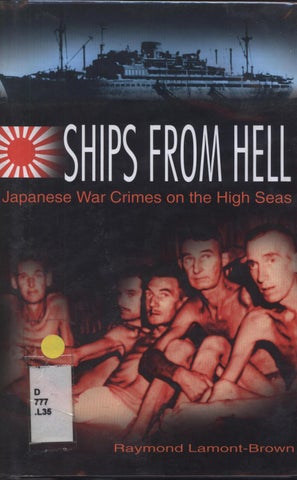
Japanese War Crimes on the High Seas Raymond Lamont-Brown
SUTTON PUBLISHING
....
First published in the United Kingdom in 2002 by Sutton Publishing Limited· Phoenix Mill Thrupp . Stroud· Gloucestershire . GL5 2BU Reprinted in 2002 Copyright © Raymond Lamont-Brown, 2002 All rights reserved. No part of this publication may be reproduced, stored in a retrieval system, or transmitted, in any form, or by any means, electronic, mechanical, photocopying, recording or otherwise, without the prior permission of the publisher and copyright holder. Raymond Lamont-Brown has asserted the moral right to be identified as the author of this work. British Library Cataloguing-in-Publication Data A catalogue record for this book is available from the British Library. ISBN 0-7509-2719-4
Typeset in 12/13.5pt Bembo Mono. Typesetting and origination by Sutton Publishing Limited. Printed and bound in England by J.H. Haynes & Co. Ltd, Sparkford.
CONTENTS Chronology Acknowledgements Preface
X111
Prologue: Samurai of the Sea Introduction 1 Early Shipments of the Damned 2 Workers for the Divine Emperor 3 Kwai PoWs Survive Hell at Sea 4 A Quartet of Naval Massacres 5 Sensuikan Targets: the Killer Submarines 6 Death by Surface Raider 7 The Last Hellship Transports, 1944-5 8 Japanese Navy Involvement in Biological Warfare 9 The Japanese Navy and the Comfort Women 10 Kendari: Tokkeitai Killing Fields Epilogue: Betrayal of the Damned
1 17 30 42 54 68 78 105 115 119 123 130 143
Appendix: Known Japanese Hellships, 1942- 5 Memorials to the War Dead: Japanese Naval Atrocities on Land and Sea Notes Glossary Bibliography Index
149
IX
xv
156 157 165 169 171
Hana wa sakuragi; hito wa bushi. [The cherry is the first amongst blossoms; the warrior is first amongst men.] Service personnel motto, 1941 Since the end of the war I have read that inhuman deeds have been committed by the Army and Navy ofJapan. That was certainly not the intention of the authorities, namely the Sanbo Hombu (General Staff), the Rikugunsho (Ministry of War), the Kaigunsho (Navy Ministry), and myself. We did not even suspect that such things were occurring; the Tenno-Heika (His Majesty the Emperor) in particular, should, considering his humane observances, inspire the contrary sentiments. Such deeds are not tolerated in Japan. The character of the Japanese people is such that neither in ten-chi (heaven nor earth) should such things be tolerated. It would be very bad if men elsewhere in the world should believe that these inhuman deeds arise from the Japanese character. Declaration by former Minister of War and Prime Minister, General Hideki Tojo, during interrogation at Sugamo Prison, March 1946. Over a period of several months the tribunal has listened to witnesses who have described in detail cruelties committed on all war fronts and on such a large scale and indeed with such a fixed pattern that only one conclusion is possible. Those cruelties were authorised in secret either by or with the approval of Japanese Government, by individual members thereof and by commanders of the armed forces. Statement from the judgment of the International Military Tribunal, November 1946.
The evil inspiration behind Japan's war atrocities, General Hideki Tojo, was executed for war crimes at 1.30am on 23 December 1948. On 28 May 1959 Emperor Hirohito gave a personal order to the Shinto priests who administer the Yasukuni-jinja - Japan's main war memorial - to inscribe the names of all Japan's war criminals on the scrolls of the 2,500,000 immortal military dead commemorated at the shrine. In benediction he uttered word"s deemed blasphemous to the memories of the murdered PoWs: 'I have a special appreciation for the families of our war criminals. I know what they have done for Japan. They were among our greatest leaders.'
In 1998 the Japanese film Pride - The Fatal Moment was issued for public release, praising General Hideki Tojo as a heroic samurai in the Japanese tradition and a war hero.
CHRONOLOGY 1941 7 Dec. 8 Dec.
9 Dec. 10 Dec.
23 Dec.
1942 19 Jan. 23 Jan.
4 Feb. 15 Feb. 17 Feb.-l Mar. 28 Feb.-l Mar. 8 Mar.
Chujo Chuichi Nagumo's carrier-based planes attack Pearl Harbor. Ships of the Imperial Japanese Navy sink or capture British and American warships at Hong Kong and Shanghai. Surrender of Siam (Thailand). Japanese occupy Makin Island, Gilbert Islands. Japanese capture Guam. Japanese land-based planes of the 22nd Air Flotilla sink British battleships HMS Prince of Wales and HMS Repulse. Japanese capture Wake Island.
British Borneo surrenders. Japanese occupy Rabaul, New Britain, and Kavieng, New Ireland. First slave-labour gangs of US personnel arrive in China aboard the hellship Nitta Maru. First major massacre of civilians by naval staff at Amboina. Capitulation of Singapore, which becomes transportation port for PoWs. Battle of the Java Sea. Battle of the Sunda Strait. Surrender of Netherlands East Indies. Japanese occupy Lae and Salamaua, New Guinea. Japanese capture Rangoon, Burma.
x
8 Mar. 23 Mar. 28 Mar. Mar.-Apl ApI 30 ApI 7 May
8 May 15 May
CHRONOLOGY
Plans to use PoWs to build railway from Bangkok to Rangoon launched. Japanese occupy Andoman and Nicobar Islands. Japanese occupy the whole of Sumatra. Japanese occupy Admiralty Islands and other key islands in Bismarck Sea, and Halmahera. Transportation of Netherlands East Indies PoWs. Japanese occupy Tulagi. US Navy carrier planes attack Close Support Force of Port Moresby invasion fleet, and sink the light carrier Shoho (ex- Tsurugizakt). Battle of the Coral Sea. Carrier battle in the Coral Sea. Heavy carrier USS Lexington sunk. Toyohashi Maru, the first hellship to be sunk, by HMS
4 Jun.
Trusty. Chujo Chuichi Nagumo's carrier force attacked; Akagi, Kaga and Soryu sunk.
5 Jun. 7 Jun.
Japanese occupy Altu Island. Japanese submarine 1-168 sinks the crippled USS
1 Jul.
First hellship to be sunk by US 'friendly fire': Montevideo Maru sunk by USS Sturgeon (SS 187). Japanese capture Kokoda. US Marines eliminate Japanese at Tulagi. Hellship Lisbon Maru sunk after torpedoed by USS Grouper (SS214). Carrier battle of Santa Cruz Islands.
Yorktown.
29 Jul. 9 Aug. 4 Oct. 15-27 Oct.
By the end of 1942 some fifty-four hells hips had transported around 50,000 PoWs for slave labour.
1943 3 Jan. Feb. 3-4 Mar. 18 Mar.
Imperial Japanese Army eliminated at Buna, Gona. Beginning ofJapanese evacuation from sites like Guadalcanal. Battle of the Bismarck Sea. Massacre of civilians aboard the destroyer Akikase.
CHRONOLOGY
18 ApI Jul.-Aug. Oct.
Sept.-Nov. 24 Nov.
Xl
USAAF P-38 intercepts and kills Shosho Isoroku Yamamoto near Buin. Japanese evacuate Solomon Islands. ImperialJapanese Navy personnel begin slaughter of civilians at Kavieng. Massacre of Pan-American Airways employees at Wake Island. Severe Japanese losses at Villa Lavella and Rabaul. Japanese lose Tarawa.
By the end of 1943 around forty hellships have transported a further 24,000 PoWs.
1944
Feb. Mar. ApI
19-20 Jun. 7 Oct. 24 Oct. 25 Oct.
1945 19 Jan. 17 ApI 5 May
Imperial Japanese Navy involved in transporting biological warfare materials and personnel to the Pacific. Heavy Japanese losses in Marshall Islands. Japanese abandon Truk as main naval base. Transhipment by sea ofPoWs from BangkokRangoon railway site. Japanese lose New Guinea. Last Japanese mass atrocity carried out on Allied merchant seamen following the sinking of MV Behar. Battle of the Marianas. Massacre of PoW s by naval personnel, Wake Island. Battle of Sibuyan Sea; loss ofJapanese battleship Musashi. Battle of Surigao Strait. Battle off Sanar and Cape Engaro.
Moji, the PoW port of entry into Japan, suffers major Allied attacks. Battleship Yamato lost. Results of' civilian atrocity' Operation FUGO discovered in USA.
X11
17 May 2 Sept.
1946 1 Jan.
CHRONOLOGY
Last sea battle. Heavy carrier Haguro sunk by Royal Navy destroyers offPenang, Malaya. Formal surrender ofJapanese accepted by General Douglas MacArthur aboard the battleship USS Missouri in Tokyo Bay.
Establishment of the International Military (War Crimes) Tribunal for the Far East. Thames Maru first hellship to be mentioned in war crimes trial (in the Gozawa Trial, Singapore). War Crimes Tribunals uncover evidence that some 127,000 PoWs were transhipped during the war period in various hellships; deaths estimated at some 21,000, making a death-rate of around 16 per cent.
ACKNOWLEDGEMENTS Text Every effort has been made to trace literary heirs and successors for every quotation used in this book. The passage of time, the death of copyright holders and the moving of address by literary custodians all contribute to the difficulty of tracing copyright ownership, especially those that have reverted from publishers to authors. Nevertheless each quotation is individually acknowledged, where possible, in text and notes. Special thanks are given to the following for helping to trace rights of ownership and specific quotations and sources: Kelvin Smith; Peter Elphick; Syd Sanders, Victoria, Australia; Lance and Mary Gibson, Victoria, Australia; Jim Barnes, Aspley, Australia; Don Wall, New South Wales, Australia; Dr John L. Weste, University of Durham; T.R.]. Coles, Southwest Wales Far East PoW Club; Carol Cooper, Children and Families of the Far East Po Ws Association; Catherine Trippett, Permissions Manager, Random House Group Ltd; Florence Pinard, Subsidiary Rights Manager, Robert Hale; and Myrto Tzanatou, Rights Assistant, Little Brown. Extracts have been taken, with permission, from the following publications: Eric S. Cooper, Tomorrow You Die, E.S. Cooper & Sons, 1995; James D. McEwan, The Remorseless Road, Airlife Publishing, 1997; A.G. Allbury, Bamboo and Bushido, Robert Hale, 1955; and John and Clay Blair, Return from the River Kwai, Futura Publications, 1980. And thanks also go to the estate of the late Lord Russell of Liverpool and Messrs Cassell for permission to use extracts from The Knights if the Bushido, 1958. Documentation Assistance in tracing relevant documents for research for this book is gratefully acknowledged to the following: Dr A.P. van Vliet, Director,
XlV
ACKNOWLEDGEMENTS
Instituut voor Maritieme Historie, The Hague; Dr R.C.C. Pottkamp, Nederlands Instituut voor Oorlogsdocumentatie, Amsterdam; Dr Peter Liddle, Director, The Second World War Experience Centre, Leeds; Dr Rick D.H. van Velden, Algemeen Rijksarchief, The Hague, M. Kakinoma, Japan Information and Cultural Centre, Embassy of Japan, London; Captain Keeichi Kuno, Japanese Defence Attache, Embassy of Japan, London; Stephen Walton, Archivist, Dept of Documents, Imperial War Museum, London; and Kiri Ross-Jones, MSS Dept, National Maritime Museum, London.
Photographs Each photograph is individually acknowledged where it occurs for source and ownership. Particular thanks are due to Terence Kelly for supplying a rare photograph of Hellship survivors, and to William Hodge for the trial site and defendant illustrations, Singapore.
PREFACE On 5 March 1942 my late father was arrested in his room at the Palace Hotel, Shanghai, on the orders of Shosho Koneshita, head of the Shanghai Kempeitai. The Kempeitai, by the by, were the dreaded Japanese military police. At the time my father was working as a civil engineer in the employ of the British firm Babcock & Wilcox Ltd, who had electric power contracts with General Chiang Kai-shek's Kuomintang Government in what was then dubbed the 'intelligence capital of the Far East'. At 4am - the Kempeitai liked to make their arrests at 03.00hrs Tokyo time - he was taken to the already notorious Bridge House Prison. This was the Kempeitai HQ fronting on to Soochow Creek, a part of the Shanghai waterfront known as the Bund of the Whangpoo River. There he was placed in one of the seventeen barred and bolted steel 'cages', some 9ft 4in by 20ft, with around forty other detainees, to await interrogation. Shosho Koneshita, who had established his reign of terror as soon as the Imperial Japanese Army's occupation of Shanghai had been secured by 2 December 1937, was arresting foreign nationals on trumped-up charges of espionage and anti-Japanese propaganda. Under a programme of dehumanising beatings and torture, confessions were extracted when the victims had been pushed to the fringe of insanity. The horrors of interrogation went on for hours, the sound of screaming victims forming a horrific background for those waiting their turn. At that time the Shanghai office of Britain's Consul-General, Sir Herbert Phillips, had been closed, but the Swiss tried to monitor what happened to the Allied civilians who suddenly disappeared into Bridge House Prison. After brutal interrogation to no avail my father was released as a part of the August 1942 repatriation programme for 225 British and Allied civilians, brokered between the Japanese and the British Government with the help of the Swiss Consul-General M. Emile Fontanel. But father's trials were not finished.
XVI
PREFACE
He was taken, with other prisoners, to the Shanghai docks on a stretcher, as he was unable to walk unaided following his beatings by Kempeitai 'liaison officer' Tai-i Hirano. Once at the docks the prisoners were embarked aboard the 17,256-ton liner Kamakura Maru (ex-Chichibu Maru). The ship soon became overcrowded with foreign nationals for repatriation; the tortured victims, sick deportees and assorted 'enemies of the Emperor' were given no medical care. Within months of the repatriation trips the cruise liner was to enter a new role as a PoW 'hellship', and soon Kamakura Maru was to be joined by another soonto-be-notorious hellship, the 16,975-ton liner Tatsuta Maru. While my father was being abused by the Kempeitai, the British Ambassador to Japan Sir Robert Leslie Craigie and his staff had been interned from the outbreak of the war at the embassy compound in Tokyo. Their release was negotiated on 30 July 1942 by the Swiss Minister M. Camille Gorge. All the while the Kempeitai made it as difficult as possible for the staff, hounding them at every opportunity, totally against international diplomatic law. Craigie and his staff were eventually taken to Yokohama and locked below decks in the Tatsuta Maru. The midsummer sun had made the ship into an oven. Overcrowded with repatriated foreigners, Tatsuta Maru left Yokohama for Ito on the Sagami Nada, thence to Shanghai, to rendezvous with Kamakura Maru. One after the other the two liners set off for Lourenr;:o Marques (modern Maputo), the neutral Portuguese port in Mozambique on the Indian Ocean. Here an exchange of evacuees was to be effected, with calls at Singapore and Saigon. After ten days at Lourenr;:o Marques, the Far Eastern evacuees boarded the Khedevial Line's SS El Nil and the P&O Line vessel SS Narconda; my father was a passenger on the latter. On 9 October 1942 the vessels docked at Liverpool to a civic welcome. Just as the British Embassy staff had been hassled and impeded on their way to the Tatsuta Maru by the Kempeitai, on 9 December 1941 life for the US Ambassador to Japan Joseph C. Grew and his staff also became unpleasant - until the Swiss Minister M. Gorge effected their repatriation in June 1942 aboard another Japanese Trans-Pacific liner, the 16,975-ton Asama Maru. Before sailing from Yokohama to Hong Kong the Americans were locked up in the sweltering ship for hours.
PREFACE
XVll
For a while both the Kempeitai and the Tokkeitai (the Imperial Japanese Navy equivalent of the Kempeitat) illegally treated the US diplomats as PoWs. At Hong Kong the ship took on more evacuees and sailed by way of Saigon and Singapore to join the Italian vessel Conte Verde, which had been stuck in Shanghai since the beginning of the war, and a rendezvous at Louren<;:o Marques. Thereafter the Americans were embarked on the US-chartered Swedish vessel Gripsholm, bound for New York. Asama Maru returned to Singapore and Yokohama to take up a role as a hellship. During his repatriati<?n my father first encountered the vessels that would later be transformed into the hellships in which thousands of Allied PoWs would be subjected to Imperial Japanese Forces atrocities. Through my father's diaries of his captivity I too gained my first knowledge of Japanese naval war crimes in the Second World War. These nautical atrocities are much less well-known than those perpetrated by the Imperial Japanese Army, but they deserve an equal airing. My further research into this branch of Japanese war crimes introduced me to the naval equivalent of the Kempeitai, the shadowy but equally bestial and zenophobic Tokkeitai. Just as Kempeitai officers had disappeared, reinvented themselves and merged with the Japanese populace after the Second World War so the Tokkeitai personnel were equally difficult to trace. But this book contains a part of their story, as revealed in the war crimes tribunals. My father's story, and other eye-witness accounts of atrocities, were dismissed as uso wo (lies) by such men as Chief of Intelligence and Propaganda Taro Terasuki. Today, many Japanese still deny that any war crimes ever took place, and there is a renewed attempt in the Japanese media to portray the Japanese as the 'liberators' of the Far East. Just three years after a film called Jiman ('Pride - The Fatal Moment') offered a sympathetic portrayal of Hideki Tojo, hanged for war crimes in 1948, a movie from the Toho Studios was launched in Japan in March 2001 called Merdeka ('Independence'). It glorifies the troops of the Japanese Imperial Army as liberators of fellow Asians, in particular freeing the people of Indonesia from Dutch colonial rule. The irony is, of course, that the same soldiers murdered both Dutch and Indonesians in well-attested incidents during the war.
XVlll
PREFACE
This propaganda line is in keeping with the revived trend among historians of such groups as the Japanese Society for History Textbook Reform, and politicians like those of the ruling Liberal Democrat party, to rewrite history for schoolchildren, glossing over Japanese army and navy war crimes. This rewriting has been endorsed by the Japanese Mombusho, the Ministry of Education. The revised version has been met with dismay in countries that suffered under Japanese occupation, and both the Foreign Minister of the Republic of Korea and the Chinese Ambassador to Japan went public to express their ' deep concerns'. This book is dedicated to the author's late father and his fellow sufferers of the Bridge House Prison, and to all those PoWs, civilian and service, who were murdered by Imperial Japanese Forces in the Second World War. While factions in Japan are intent on rewriting and falsifying history, this book aspires to right the balance.
INDEX NB: For names of US Navy and Imperial Japanese Navy vessels mentioned in the text see under their respective countries. All other vessels are listed in the alphabetical sequence. Abe, Rear-Admiral Hiroaki 33, 76 Adachi, Prof. Sumio 118 Akikaze Massacre 70, 71 Alcoa Polaris 66 Allbury, A.G. 59 Amboina Massacre 68ff Amoito Massacre 134, 135ff Ariizumi, Capt. Tatsunosuke 83, 97, 99, 100, 101-2 Asphasia 95 Ascot 91ff HMS Athelstan 106 Attlee, Prime Minister Clement 148 Augustina 105
Behar 109, 110, 111, 112, 113, 114, 146 HMIS Bengal 107, 108, 109 biological warfare 119ff Blackwood, Flt-Lt W.M. 45-7, 47-8, 158 Bletchley Park 14-15 Bridge House Prison xv, xviii British Chivalry 88-9 British Monarch 105 Burma 17, 31, 51, 52, 53, 54ff, 92, 145, 158 Bushido 9, 16 Cape Douglas 66 Clove 123
Cambodia 55 HMA Centaur 85ff Chifley, Australian Prime Minister J.B. 148 Chiuma, Sub-Lt (Acting) Sazae 139; trial 142 Churchill, Winston S. 18 City of Adelaide 100 comfort women 13, 14,21, 123ff Cooper, Eric S. 49-50 HMS Comwalll05 Cowling, A. 23-4 Craigie, Sir Robert L. xvi Cunningham, Cmdr W.S. 32 Curtins, Australian Prime Minister John 87 Daigo, Vice-Admiral Tadeshige 81, 160 Daisy Moller [ex-Pindos, etc.) 92ff, 160 HMNS de Ruyter 56 Devereux, Maj J.P.S. 32, 33 HMS Dorsetshire 105, 106 Dreher, Capt. A.B. 38 Ebato, Lt Kazuro 93, 94, 95 Edward, Prince of Wales 10 HMS Electra 56 Elysia 106, 107 El Madina 95 HMS Emerald 96
HMS Encounter 56 Enemy Pilot's Law 131 HMS Exeter 56 Etajima Naval College 2ff, 6, 8f[, 13, 75, 82, 97, 132, 133, 139 HMS Flamingo 91 Fletcher, Rear-Admiral F.J. 54 Formosa [Taiwan) 8, 17, 19, 43, 50, 57, 65, 124, 125, 126, 127, 146 Fort McLeod 95 Furuse, Rear-Admiral Takesu 6 Furukawa, Vice-Admiral Tamotsu 132, 135, 137; trial 141-2 Fushimi, Admiral Prince Hiroyasu 10 Geneva Convention [1929) 24, 111 Cenota 106, 161 George, VI 66-7 Giles, Cmdr D.T. 24 Godwin, SgtJ.G. 111, 113 Gorge, M. Camille xvi, 94 Crena 102 Grew, Joseph c. xvi Cripsholm xvii Hamilton, Lt G.c. 26-7 Harada, Vice-Admiral Kaku 81
172
Hatakiyama, Maj-Gen 68, 70 Hatlraki 107 Hellships: conditions aboard 19, 20, 21, 23, 25, 28, 34, 35, 43, 44-5, 46-7, 47-8, 49-50,51-2,52-3,59; food 2, 20, 27, 34, 38, 48, 53; interior construction 20,21, 22, 23, 46; last transports 116ff; loading 23, 166; listings, 149-55; main ports 17,18,28; routes 18, 28, 37, 57-8; shipping tallies 118; rypes 18, 21, 28 [For names see also Appendix pp.149-55) Akikaze x, 70ff Argentina Maru 24 Arisan Marti 116ff Brazil Maru 116ff Byoke Maru 21-2 Celebes Maru 52 Cho Saki Maru 24 Dai fchi Maru 28, 49 Elloura Manl 116ff Pukkai Maru 37 Harugiku Maru 115-16 H oktlsen. Maru 117 JUIl'yo Maru 29 Kachidoki Maru 58, 60, 62, 63, 64, 159 Kamakllra Maru xvi, 39 Kenwa Maru 116 Kibibi Maru 64, 65, 66 King Kong MariA 50, 51 Kyokusai Maru 53 Lisbon Maru x, 25, 26, 29, 41 Maebashi Maru 51 Maros Maru 28, 45, 47, 48 Montevideo Maru x, 25, 41 Nitta Maru ix, 34, 35, 36, 158 Panama Maru 39 Rakuyo Maru ii, 58, 60, 61 , 62, 63, 64, 65, 66, 67, 159 SamdoHg Maru 57 Shitlsei Maru 28
INDEX
Shin'yo Maru 28 Singapore Maru 43, 44, 45 Tamahoke Maru 38 Tatsuta Maru xvi Thames Maru xii, 40 Toltor; Maru 28, 39, 120 Toyohashi Maru x, 52, 53 Ume Maru 37 Yingata Mant 52 Yoshida Maru 44 HMS Hermes 106 Hirohito, Emperor vii-viii, 10, 115, 143 Hitler, Adolf 78 Holland, New Zealand Prime Minister, Sir S.G. 148 HMS Hollyhock 106 Homma, Gen Masaharu 17, 38 Hong Kong 15, 20, 25, 146 Horii, Maj-Gen Tomutaro 85 hospital ships 85, 86, 87, 105, 107,117,156,160 Hozogaya, Admiral Boshino 8 HMS Hoxa 101 Hyokutake; Lt-Gen Harukichi 75 Ichioka , Vice-Admiral Hisochi 81 !ida, Maj-Gen Shojiro 54 Imamura, Admiral Osama 17 Inouye, Admiral Shigeyoshi 8, 32 Imatsato, Cmdr Hitishi 106, 107, 109 Inukai, Prime Minister Tsuyoshi 10 Ishii, Gen. Shiro 119, 122 lshizaki, Vice-Admiral Noburo 106 Isogae, Governor Rensuke 25 ltagaki, Gen . Seishiro 37; trial 144 Japanese Navy and merchant vessels: Aikoku Maru 106-9 Akagi x
Aki Maru 19 Amagi Maru 23-4 Aoba 109, 114 Arabiya Maru 128 Asalti Marti 160 Asama Maw xvi, xvii Awa Maru 117 Chihaya 9 Chikuma 109-14 Chuyo 158 Daikeku Maru 133 Haguro xii Hakoku Maru 106-9 Hanrio KOrl Maru 123 Harukaze 105 HarlOW 3 Hayate 32 Hiei 3 Hikawa Maru 160 Hirato 59,61,65 lkoma Maru 115 Kaga x Kanko Maru 5 Kiku Maru 160 Kongo 3 Kowa Marti 71 Melbol/me Maru 17 Miklltlw 57 Mllro Maru 160 Musashi Maru 59, 60, 65 Na/lkei Maru 59, 60, 65 Oi9 Oryoku Maru 117 Shigure 3 Shikinami 60,65 Shoho x Snook 116 SorY'1 x Takasago Maru 160 Tango Mam 115 Tenno Maru 160 Toile 109-1'4 Yamato xi Yilbari 32, 158 submarines: 1-881,97-102; 1-1 2 103-9; 1-20104; 1-25
173
INDEX
121; 1-2695, 102-3, 161; ~34122;~35122;~37
85-92; I-58 83ff; 1-158 102; /-1 6295,161; 1-16581, 95-7; /-168 x; /-177 81, 86-7; /-401 102; RO-65 104; RO-l1 093-5; RO-111 95 HMNSJalla 56 Judas medal 133, 163 HMS Jupiter 56 Kai-shek, Gen Chiang xv, 13, 31, 147 Kajioka, Rear-Admiral Sadamichi 32, 33 Kamikaze 10,127,144, 147 Kavieng killings 70fT Kawabe, Maj-Gen Masakazu 5 Kaya, Okinori, trial 144 Kempeitai xv, xvi, 11, 13, 14,37, 38, 39, 119, 120, 124, 125, 137,141,145 Kendari Killing Fields 130fT Kimira, Gen Heitaro, trial 144-5 Kitamura, Lt-Cmdr S. 84-5 Koga, Admiral Mineichi 109, 115 Komatsu, Vice-Admiral Teruhisa 8, 78, 80 Komazawa, Vice-Admiral Katsume 81 Kondo, Vice-Admiral Nobutake 8, 54, 57, 84 Korea Uapanese Chosen] 38, 124ff, 147 Kota, Vice-Admiral Takeo 81 Kudo, Cmdr Kameo 103, 104 Kusaba, Maj-Gen Sueyoshi 121, 122 Kusaka, Vice-Admiral Junichi 73 Kusaka, Lt-Cmdr T. 102, 103
Lallgkoeas [ex-Stas.if11rtJ 83ff Layton, Sir G. 105 Lockwood, Vice-Admiral C.A . Jm 59, 60 London Naval Treaty 11930] 79
Louren~o
Marques xvi, xvii Luzon Massacre 6 MacArthur, Gen Douglas 80, 122,143,147,171 McEwan, James 43-4 MacKay, James 111 Maltby, Maj-Gen C.M . 25 Maltby, Air Vice-Marshal Sir Pc. 19 Manchuquo [Manchuria] 8, 30, 39,119,123,127,145,168 Manila, 38 Matsui, Gen lwane 36, 123 Mayuzumi, Capt. Haruo 109, 110, 112, 113, 114 Meiji, Emperor 3, 5, 7, 15 Mii, Cmdr 112,113 Mikawa, Vice-Admiral Gunichi 72,74 Minami, Gen Jiro 37 Miwa, l:tear-Admiral Shigeyoshi 80, 160 Moji 19,39,43,44,65, 117 MOIwdllock 66 Murayama, Prime Minister Tomiichi 128 Muto, Gen Akira, trial 145
Nallcy Mol/er [ex-ROil/ella etc.] 95ff Nagano, Admiral of the Fleet Osami, trial 143-4 Nagaoka, Maj-Gen Takasumi 124 Nagumo, Admiral Chuichi 8, 30, 54,65, 105 Nakagawa, Lt-Cmdr Hajimc 86, 88, 89, 90, 91, 92 Nakamura, Maj-Gen Toshihisa 124 Nel/olle 100 Nomi , Maj-Gen Toshio 125 Nishimura, Maj-Gen Shoji 105 Oishi, Cmdr Tamatso 106, 107, 108,109
Oka, Rear-Admiral, Takasume, trial 144 Okamura, Maj-Gen Yasutsugu 123,124 OlldilJa 107, 108, 109 Onishi, Rear-Admiral Shinzo 72, 74 Operation FUGO 121ff Orizaba 66 Oshima, Hiroshi, ambassador 78, 160 Osugi, Vice-Admiral Morikazu 132, 133, 137, 139; trial 140-1 Osumi, Navy Minister Mireo 10 Ota, Maj-Gen Minoru 70 Peacock, Don 24 Percival, Lt-Gen A.E. 17, 50 Perry, Commodore Matth ew 5 Perseus 96 HMAS Perth 21,56,59,61,63 Poorten, Lt-Gen H. ter 19, 42 HMS Prillce if Wales ix Pusan 37, 38, 39,126,127,128 Putnam, Maj Paul A. 32
Qlleell Mary 66 HMS Repulse ix Rivett, Rohan D. 50-2 Rodrigues, Greg, Snr 120 Roosevelt, President ED. 30, 78 Saigon 57 Saito, Gen Masatoshi 51 Saito, Admiral Yaheita 20 Saito, Gen Yoshitsugu 65 Sakai, Gen Takashi 25 Sakaibara, Gen Shigem.itsu 75, 76 Sakonju, Vice-Admiral Naomasa 98,109,110,112,1 13,146, 161 Sall/kalia 103 Sall/llta 103 Saris, Capt. J. 123
174
INDEX
Shanghai xv-xvi, xvii, 27, 36, 39, 93,123,124,125 Shigemitsu, Foreign Minister Mamoru 94-5, 160 Shimada, Naval Minister Taisho 41, 124; trial 144 Shimizu, Vice-Admiral Mitsumi 79, 80 Shimizu, Lt Tsuruzo 95, 96, 97 Singapore Uapanese ShoHen] 7, 19,21,23,30,39,40,43, 49, 50, 51, 54, 58, 84, 97, 106, 116, 127, 145 HMS Solvra 91 Somerville, Admiral Sir J. F. 92, 95, 106 Sonokawa, Capt. Takawa 135, 137 Spito, A.!, 19-20 Spruance, Rear-Admiral R.A. 54 Stachouwer, Tjarda van S. 19, 20 MV Straat Soenda 92 MV Sut/e} 90ff Suzuki, Gen Teiichi, trial 145 HMS Swall71
Thomas, Sir T.S.w. 19 Tjisalak atrocity 97, 98, 99 Toguri, Iva [Tokyo Rose] 141 Tojo, Gen Hideki vii, viii, xvii, 30,87, 131; trial 145, 147 Tokkeitai xvii, Ilff, 70, 72, 73, 97,114,119,124, DOff, 144,147, 156; torture methods 134 Toyoda, Vice-Admiral Soemu, trial 147 HMS Tradewind 151 HMS Truculent 116,151 Truman, President Harry S. 147 Tsugi, Col. Masaharu 21, 147 Tsukahara, Admiral Nishio 8, 125 Tsukamoto, Lt-Gen Makoto 125
Takagi, Rear-Admiral Takeo 80, 81, 160 Takahashi, Admiral Ito 8; trial 146 Takamatsu, Prince 10 Takasu, Vice-Admiral Shiro 109 Takeshi, Gen Takashina 24 Tamura, Rear-Admiral Ryukichi 70, 71, 72; trial 146 Tanaka, Maj-Gen Raizo 105 Taniguchi, Capt. Gosuke 131, 133,135,137,138,139, 140; trial 141 Terasuki, Taro xvii Terauchi, Gen Hisaichi 57
H.D. Collier 95 Conklin 92 Elysia 106-7 Grouper x Growler 60, 61 Hamm erhead 39 Houstoll 17, 49, 55, 56, 157 Richard Hovey 102 Jolm A.Jolll1sol1 103-4 J ean Nicolet 100ff Lexington x Morrison 101 Missouri xii, 160 Pampanito 60, 61, 62, 63, 64, 65, 66
Unit 731, 119, 122, 128 US Navy and merchant vessels: Ardent 104 A~us 104 Arizona 30 Barb 60, 65, 66
Richard M. Powell 160 QHeenfish 60, 65, 66, 117 Rasher 115 McCroy Reyr/Olds 92 Rockford 104 Seahorse 37, 115 Sealion II 60,61,64,65,66 Stocktor! 101 Sturgeon x, 25 7i.mgier 130 Taylor 160 Jam es A. Wilder 99 Yorktowl1 x HMS vampire 106 Wainright, Lt-Gen J.M. 17 Wake Island 31ff, 121 Wake Island massacre 75ff, 146 Walsh, Col. A.W. 36 War Crimes Tribunals xii, 2, 10, 11,21,39-40,45-6,70,74, 76,113,134,139,140-1, 143ff, 146-7, 164 Whitecross, Private R .H. 52-3
B"~egill158
YakHsa 147 Yamamoto, Admiral Isoroku 8, 54 Yamasaka, Vice-Admiral Shigeaki 82 Yamashita, Gen Hirofumi 30 Yamashita, Gen Tomoyuki 17, 50 Yokohama 34; war cemetery 156 Yokosuka Naval Base 13, 147 Yonai, War Minister Mitsumasa 121 Young, Sir Mark 20 Zerol1g 94