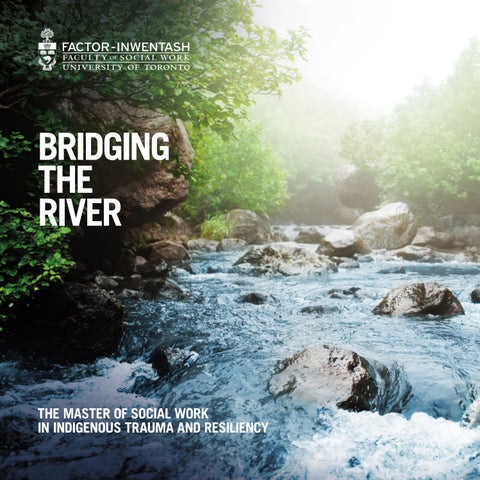
BRIDGING THE RIVER
THE MASTER OF SOCIAL WORK IN INDIGENOUS TRAUMA AND RESILIENCY
STATEMENT OF ACKNOWLEDGEMENT OF TRADITIONAL LAND “We wish to acknowledge this land on which the University of Toronto operates. For thousands of years it has been the traditional land of the Huron-Wendat, the Seneca, and most recently, the Mississaugas of the Credit River. Today, this meeting place is still the home to many Indigenous people from across Turtle Island and we are grateful to have the opportunity to work on this land.” — This statement was developed at the University of Toronto in consultation with First Nations House and its Elders Circle, some scholars in the field and senior University Officials.
Master of Social Work in Indigenous Trauma and Resiliency 1
The MSW-ITR program came from the vision of seven Indigenous women: Kim Anderson, Maria Campbell, Suzy Goodleaf, JoAnn Kauffman, Sylvia Maracle, Rebecca Martell, and Jane Middelton-Moz. They had a dream of how community can change if trauma and healing practices were approached from a culture-based and community-driven lens. In the spring of 2011, the OFIFC and the MiddeltonMoz Institute invited leaders in the ďŹ elds of trauma, education, Indigenous spirituality, healing and leadership, and community intervention to form the Governing Council to envision the MSW-ITR Program. The current Governing Council (pictured) includes: Rebecca Martell, Jane Middelton-Moz, Sylvia Maracle, Suzy Goodleaf, and JoAnn Kauffman.
A UNIQUE PARTNERSHIP CREATES A UNIQUE APPROACH The Master of Social Work in Indigenous Trauma and Resiliency (ITR) was created when the Ontario Federation of Indigenous Friendship Centres (OFIFC) and the MiddeltonMoz Institute approached the FactorInwentash Faculty of Social Work at the University of Toronto, suggesting a unique collaboration to develop capacity in Indigenous communities.
2
As the first of its kind in North America, this two-year Master’s program is dedicated to preparing advanced social work professionals to work with individuals, families and communities who have been affected by historical and generational trauma. It focuses on theoretical knowledge, personal development and skill-building through face-to-face week-long courses, online distance learning and field placements. Grounded in the North American Indigenous values of belonging, cooperation, respect and kindness, and inspired by indigenous traditions
from around the globe, the ITR emphasizes at all times the strong connection between personal, cultural, professional, and academic development, and the importance of building on existing strength and resilience.
University of Toronto
“The MSW-ITR is a holistic, strength-based program that blends Western and Indigenous knowledge. It is a way for Indigenous and non-Indigenous students to reflect on their place in society and gain understanding of Indigenous experience and values. We are learning to foster our own wellness so that we can effectively engage with and support others. Graduates will be equipped to work respectfully with Indigenous communities globally and advocate for policy change on a large scale. This program honours where I come from, my perspective and my world view.� Julie Blair MSW-ITR Student, Class of 2019
ABOUT THE PARTNERS The Middelton-Moz Institute addresses the effects of current, cumulative, generational and historical trauma with individuals, families and communities. With 50 years of experience as a clinician and author, Jane Middelton-Moz has turned her focus in recent years to delivering community intervention as it is proving to be the most effective for working with people and communities struggling with tremendous grief and loss, suicides, sexual and physical abuse, abandonment and neglect, lateral violence, cumulative impacts of historical and generational trauma, and high drop
out rates. She focuses on strength-based approaches to trauma-informed work with individuals, families, organizations, schools and communities and increasing recognition of resiliency. The Ontario Federation of Indigenous Friendship Centres (OFIFC) is an internationally respected non-government organization based in Toronto. It serves member Indigenous Friendship Centres in Ontario through advocacy, research, training, social economics and program management, and has a large training component for front-line workers and a
strong emphasis on culture-based training and program development experience. The Factor-Inwentash Faculty of Social Work at the University of Toronto is the top-ranked social work Faculty in Canada and one of the top two in the world. It is distinguished by its emphasis on the integration of research, theory and practice in both the classroom and practicum education, providing students with the knowledge and skills to work effectively with others in a complex and ever-changing world.
Master of Social Work in Indigenous Trauma and Resiliency 3
“The MSW-ITR has given me a profound awareness of how trauma affects us on all levels, leaving its imprint on families, communities and cultures. I’ve gained a greater understanding of Indigenous culture and developed knowledge and a new toolbox enabling me to work more effectively with clients. I believe that graduates of this program will make an important contribution, working in communities across the globe. We are learning how, as social workers, we can mend bridges that have been broken and work together to heal communities.” Corey Fisher, MSW-ITR Student, Class of 2019
WHAT MAKES THIS FIELD UNIQUE? The ITR is unique for several reasons. First, it was created in partnership between a Faculty of social work known for its emphasis on integrating research with practice and two highly respected community organizations whose combined expertise in community intervention and culture-based program delivery are crucial to equipping traumainformed graduates to work in mental health and social services.
4
Second, it offers students a curriculum that combines the Faculty’s evidencebased practice with healing and ceremony drawn from global indigenous traditions. Third, the learning format means that students are not required to leave their communities for an extended period to complete their degree, which is often a barrier to education. Courses are a hybrid between online components and in-class components, as well as practicum placements that can take place in a student’s own community.
Perhaps most significantly, learners in the ITR are expected to work with faculty to develop individual wellness plans and evaluate them regularly throughout the two-year program. This is meant to assure their mental, spiritual, physical and emotional health as competent professionals. The ITR program works from the belief that those working with others will only be as effective as their own wellness in all areas. A student’s success in this field of study is in part determined by their rigorous attention to wellness.
University of Toronto
WHY IS THIS FIELD IMPORTANT? There is an urgent need to create a space that focuses on resilience and historical knowledge when educating trauma-informed social workers. Inspired by the Truth and Reconciliation Commission’s findings, the ITR is following a unique approach that draws on both the traditional wisdom that each student and faculty brings to the circle, and the very latest scientific knowledge, equipping graduates with the ability to work with individuals, families and communities around the globe in a culturally appropriate manner.
Employing interventions designed to aid communities experiencing high levels of intergenerational trauma, graduates will thereby increase support systems and be able to assist individuals in finding their voice.
Master of Social Work in Indigenous Trauma and Resiliency 5
“The MSW-ITR program has offered me a different way of integrating teachings of ancient tradition and modern western science. When brought together in practice, it has created a lot of room for humility and exploration into what a client and community need based on their histories and background. This course has concretized my belief in healing from the root outwards. I am blessed to have the wisdom and knowledge of elders and peers guiding me in this program. Also to learn from the original people of this land. Meegwetch.” Julia Gibran MSW-ITR Student, Class of 2018
WHAT IS THE IMPACT? The Master of Social Work in Indigenous Trauma and Resiliency is creating a unique space to prepare trauma-informed social workers who work with Indigenous communities in Canada and around the world. The groundbreaking curriculum focuses on training for direct practice in social work. Although this is a new field, the first students are already reporting a rise in self-confidence and increased optimism.
and will learn to identify the effects of trauma, abuse, war and violence in society more generally, thanks to the community wisdom and traditions that form the basis of this partnership. With their new knowledge, training and self-awareness, these social work professionals will have a lasting impact on our world, becoming community activists and leaders who focus on strength, wellness and resilience wherever they practice.
Graduates of this field will gain skills to provide culturally appropriate services to global indigenous communities, 6
University of Toronto
PROGRAM REQUIREMENTS AND COURSE DESCRIPTIONS
Master of Social Work in Indigenous Trauma and Resiliency 7
PROGRAM REQUIREMENTS FOR THE MSW-ITR FIELD OF STUDY
(Candidates entering with a BA/BSc/BSW or equivalent) 1. Degree requirements are normally completed within two years. The maximum time limit for completing the MSW-ITR Field of Study degree requirements is three years from the date of first registration in the program. The program length is 6 sessions (two years) full-time. Typical registration sequence: Fall, Winter, Spring/Summer. 2. There are a total of 5 six-day intensive face-to-face courses held in Toronto; three in the first year, and two in the second year. Each six-day intensive course includes academic learning, experiential learning, and wellness evaluation and activities. Course assessments include self-evaluations and independent study assignments applying course content in the home community context. Each intensive course builds on previous courses; therefore, in-person attendance at the intensive courses is mandatory. mandatory If you miss an intensive course, you cannot take the next one in sequence and will need to wait until it is offered the following year.
8
3. Each online course involves academic learning of the subject, extensive reading or audio learning of course material, chat room connection with fellow students and faculty, written assignments and/or oral or written tests (to be determined by the instructor). 4. The Year 1 practicum (SWK 4516H), Indigenous Trauma and Resiliency Practicum is a requirement for all students without a BSW degree. It is a practicum in a community setting that facilitates integration of traumainformed and evidence-based practice with Indigenous knowledges. The practicum hours must meet the 450-hour minimum. 5. The Year 2 practicum (SWK 4703Y), MSW ITR Practicum III is 450 hours. (1) Students will complete 410 hours in a supervised practice setting (this can include a current work setting, if practicum criteria are met). (2) Students will also complete a community intervention with a supervisor, for which they will receive
40 hours credit upon submission of a successful evaluation. Students are responsible for travel and accommodation costs during the 40-hour community intervention. 6. All students complete 7 half-credit courses (3.5 FCEs) in the first year of the Two-Year Program, and 8 half-credit courses (4.0 FCEs) in the second year, which includes 450 contact hours in a practicum (1.0 FCEs). Students entering the program without a BSW degree also must complete SWK 4102H Social Policy and Social Welfare in the Canadian Context, and SWK 4516H Indigenous Trauma and Resiliency Practicum (450 hours) in year one of the Two-Year Program (1.0 FCEs). Students entering the program with a Bachelor of Social Work degree will be exempted from SWK 4102H and SWK 4516H.
University of Toronto
7. Registration. Students are charged fees by Academic Session, not by course, until all program requirements are completed. Students are advised to take the courses in sequence as indicated in the course timetable. Courses taken out of sequence may need to be completed in the following year, leading to additional tuition costs and delayed completion of the MSW program. 8. Every FIFSW student will be assigned a faculty advisor to provide encouragement and support through the learning process. 9. In the event that a student does not complete two or more required courses, or receives an FZ (inadequate) after repeating any course, normally steps will be taken by the Faculty to recommend the termination of the student’s registration.
CURRICULUM DESCRIPTION
The MSW-ITR curriculum supports students to explore values, resiliency, strengths and effects of trauma within their own cultural backgrounds, and to increase their understanding by interfacing with others from differing cultural backgrounds and experiences. Each of the 5 six-day intensives is built on a foundation of Indigenous values and a focus on the learner’s personal wellness. Students will develop skills in counselling individuals, couples, and families experiencing the effects of current and historical trauma, always while attending to organizational and community contexts. They will also be equipped with the sensitivity and skills to identify cultural, political and religious abuse, war, bullying and lateral violence, and to empower community members to intervene effectively, promoting strength and wellness.
Master of Social Work in Indigenous Trauma and Resiliency 9
DESCRIPTION OF REQUIRED COURSES SWK 4101H Understanding Historical and Multigenerational Trauma This course looks at the transmission of trauma from cultural, communal, familial and individual perspectives. Students critically examine the impact of generational trauma on historical and current risk factors in communities and gain understanding of the importance of resiliency factors in preventing the transmission of generational trauma.
SWK 4108H Sexual Abuse, Sexual Assault and the Family This course examines the dynamics of sexual abuse in the family and explores why abuse, if not healed, increases in subsequent generations. The course also examines types and typologies of perpetrators of sexual assault and child sexual abuse as well as the aetiologies of sexually deviant behaviours. Learners explore strategies for assessment and treatment of offenders and victims of sexual violence.
SWK 4102H Social Policy and Social Welfare in the Canadian Context This course is a requirement for students entering the program without a BSW degree. It emphasizes knowledge of policy development directly related to the colonization of Indigenous peoples in Canada and contemporary policy processes related to the health, education, family life and welfare of Indigenous peoples, families and communities. Students will learn skills needed to analyze social policies and programs, and will gain critical awareness of their link to social, political, economic priorities within and beyond indigenous communities. Attention will also be directed to experiences of Indigenous peoples worldwide and practices in other jurisdictions.
SWK 4109H Trauma and Human Development This course explores the sequential development of the brain and how trauma impacts that development. Learners are provided with an overview of normal development from birth to adulthood as well as development impacted by complex trauma. Learners will be exposed to methods used with children and adults that can assist in trauma integration.
SWK 4106H Social Work Ethics and Indigenous Communities This course provides an overview of social work ethics as defined by the Canadian Association for Social Work and their integration/ intersection with indigenous ethical principles in the community context. The course will address practice ethics in both historical and contemporary contexts, drawing on examples from Canadian and international social work practice.
10
SWK 4110H Trauma and Addiction This course examines the developmental, neurological and familial roots of addictions. Learners explore factors that influence the development of an addicted brain, the biology of addiction and the trauma-addiction cycle. Students critically examine resiliency factors and strategies for prevention, intervention, and healing in individuals, families and communities, particularly in indigenous contexts.
SWK 4111H Trauma-Informed Schools, Community Intervention and the Healing Power of Ceremony This course explores the importance of early intervention with children experiencing complex trauma in schools and care-giving systems and offers steps for effective trauma-informed and strength-based community intervention from the first phone call to the completion of follow-up action plans with the community. Additionally, learners will explore the elements of ritual and ceremony, the moral values and principles embodied in each, as well as the ethical foundation of delivery and the responsibility of those conducting them. Significance will be paid to the importance that ceremony can play in assisting individuals, families and communities to heal from grief and trauma. SWK 4510H Research for Evidence-Based Social Work Practice This course provides a critical overview of the history of research conducted on and for indigenous Peoples and to be a bridge between evidence based social work practice (EBSWP) and indigenous research knowledges. The course will explore current and historical research from indigenous perspectives, including ethics, methodologies, protocols, and practices. By starting from well-defined research questions, learners will consider the various methods that may shed light on questions relevant to indigenous Communities. While the course is not intended to provide intensive training in order to carry out research, the goal is to introduce learners to a variety of research strategies and tools to critically appraise research studies so that the learners will be able to contribute to Indigenous research knowledge.
University of Toronto
SWK 4516H Indigenous Trauma and Resiliency Practicum The MSW-ITR Practicum is a requirement for students without a BSW degree. Building on the direct practicum skills that students have developed through previous experience, this practicum emphasizes social work practice in a community and/or organizational setting where global indigenous and/or trauma-informed perspectives can be applied to service provision or community-driven research. Students are assigned to an approved practicum site and field instructor, and undertake a process of evaluating community needs, selecting a focus for the practicum in collaboration with the field instructor, and implementing a project. The project should include engagement with one or more of the following stakeholder groups: clients, service providers, traditional healers, knowledge holders, researchers, and health, social, or community organizations. Participation and outcomes in the practicum are evaluated in terms of their adherence to both social work and Indigenous principles students have learned in the first year of study. Potential activities for the practicum could include: community or program needs assessment; collaboration in established knowledge-building activities; community outreach; community activism; original research; archiving; etc. SWK 4517H Indigenous and Participatory Research Methods This course draws on indigenous, antioppressive and critical theories as the context for emerging methodologies for respectful, culturally-appropriate and community-relevant research in indigenous and other contexts.
SWK 4703Y MSW ITR Practicum III In this course learners undertake field placement in an area of trauma treatment or service delivery. The learner has the opportunity to apply the knowledge of theories, social work values and ethics and principles of trauma treatment presented in the classroom in working with individuals (children, youth, or adults), groups and families. SWK 4901H Facilitating Training in Indigenous Communities This course prepares learners for the creation and execution of a three-hour workshop on a trauma related topic. Learners study “participant driven training skills” and examine tips for creating a successful presentation from beginning through delivery. Learners explore group dynamics and skills for dealing with people with whom it can be difficult to work. SWK 4902H Indigenous Perspectives on Grief, Loss and Unattended Sorrow This course summarizes the steps in healthy grief resolution and reviews and dispels common myths, attitudes and values that block the grief process. Specific symptomatology present in individuals, families and communities experiencing grief from sudden and violent death due to recurrent suicides/murders in communities will be presented as well as methods to assist families and communities in grief resolution.
SWK 4903H Trauma-Informed Care, Organizations, Supervision and Leadership This course explores the foundations of traumainformed care; the critical understanding of building trauma-informed organizations in order to provide mental, emotional, physical and cultural safety for those seeking counseling and health care; the characteristics of effective trauma-informed leadership; and the necessity of trauma-informed supervision, regular and critical incident debriefing and worker wellness. SWK 4904H Working with Couples and Families in Indigenous Context The course engages learners in a critical analysis of major theories/methods of family therapy in the context of indigeneity, race, ethnicity, sexual orientation and/or other identities and experiences. Learners use their knowledge and creativity to develop effective and culturally sensitive methods of assessing and treating families in their communities. SWK 4905H Seeing the Need, Creating the Solution This course prepares learners to identify gaps in mental health service delivery and create solutions for unmet needs in indigenous communities in urban, rural and international environments. Students learn to identify barriers and strengths in communities and develop skills for leadership and program development of prevention and intervention services. Specific areas of need and intervention addressed include: grieving, suicide, family and community violence, addiction and drug use problems, and post-incarceration re-integration.
Master of Social Work in Indigenous Trauma and Resiliency 11
DESCRIPTION OF REQUIRED COURSES CONTINUED COURSES OF INSTRUCTION: YEAR ONE OF THE TWO-YEAR MSW-ITR FIELD OF STUDY
COURSES OF INSTRUCTION: YEAR TWO OF THE TWO-YEAR MSW-ITR FIELD OF STUDY
SWK 4101H Understanding Historical and Multigenerational Trauma
SWK 4517H Indigenous and Participatory Research Methods
SWK 4102H** Social Policy and Social Welfare in the Canadian Context (BA/BSc Students Only)
SWK 4703Y MSW ITR Practicum III Practicum III is 450 hours, divided into a 410-hour field placement and a 40-hour community intervention.
SWK 4106H Social Work Ethics and Indigenous Communities SWK 4108H Sexual Abuse, Sexual Assault and the Family SWK 4109H Trauma and Human Development SWK 4110H Trauma and Addiction SWK 4510H Research for Evidence-Based Social Work Practice SWK 4516H** Indigenous Trauma and Resiliency Practicum Practicum hours must meet the 450-hour minimum.
SWK 4901H Facilitating Training in Indigenous Communities SWK 4903H Trauma-Informed Care, Organizations, Supervision and Leadership SWK 4111H Trauma-Informed Schools, Community Intervention and the Healing Power of Ceremony SWK 4904H Working with Couples and Families in Indigenous Context SWK 4905H Seeing the Need, Creating the Solution
SWK 4902H Indigenous Perspectives on Grief, Loss and Unattended Sorrow **Students entering the program with a recognized BSW degree are exempted from these courses.
12
University of Toronto
“The ITR represents what a Native American Elder taught me was ‘bridging the river.’ On one side is science — everything we’re learning about attachment, trauma and resilience and the latest neuroscience research. On the other the healing traditions of indigenous people: Native American, First Nations, Tibetan, African and Celtic among others that have worked for hundreds of years. We are bridging the river between cultures, between youth and adults and between communities. When you bridge the river, you have a powerful dynamic to create real change.” Jane Middelton-Moz Executive Director, Middelton-Moz Institute
ADMISSION INFORMATION AND REQUIREMENTS The Factor-Inwentash Faculty of Social Work welcomes your interest in the programs offered at the University of Toronto. Applications are invited from highly qualified individuals who are interested in joining our Faculty for a dynamic and challenging learning experience.
of the diversity found within Canadian communities including but not limited to racialized persons/persons of colour, Indigenous People of North America and the world, LGBTQ persons, persons with differing abilities, mature students, and students from varying faith/spiritual communities.
The University of Toronto is strongly committed to diversity within its community. The University especially welcomes applications from racialized persons/persons of colour, Indigenous People of North America and the world, persons with disabilities, LGBTQ persons, and others who may contribute to the further diversification of ideas. Within its commitment to academic and practice excellence, the Factor-Inwentash Faculty of Social Work seeks to select a student body that is inclusive and reflective
Each year the Factor-Inwentash Faculty of Social Work receives many more qualified applications than spaces available in the program. Having the minimum admission requirements does not in itself guarantee admission to the Factor-Inwentash Faculty of Social Work. The Faculty reserves the right to select the most qualified applicants. All decisions are final. Before completing the application, please read the admission requirements and application instructions outlined on pages 14 to 19 of this program booklet.
14
University of Toronto
ADMISSION REQUIREMENTS
1. Candidates for admission to the ITR Field of Study require an appropriate bachelor’s degree from a recognized university, and shall have achieved at least a mid-B or better in the final year of full-time study or equivalent, in senior level courses (300 or 400 level). Note: According to the School of Graduate Studies Calendar, section 5.1, “an appropriate bachelor’s degree that has appropriate breadth, depth and, where appropriate, an affinity to the graduate program to which the applicant is seeking admission as determined by the School of Graduate Studies”. 2. All applicants must have completed satisfactorily at least three full courses, or their equivalent, in the social sciences, to include a half-credit course in research methodology, preferably in the social sciences. A grade less than mid-B in the required half-credit course in research methodology will lessen the applicant’s probability of admission. 3. Candidates must have at least three years of work experience in the social service/Indigenous services sector.
4. As part of the application process, applicants may be asked to participate in an in-person or Skype interview. 5. Candidates must show evidence of facility in the English language. If your primary language is not English and you graduated from a non-Canadian university where the language of instruction and examination was not English, then you must demonstrate your facility in English by completing one of the tests listed below: • TOEFL Paper-Based Test Score of 580 and TWE Score of 5 • Internet–based TOEFL Test Score of 22/30 for both the Writing and Speaking Sections, with an overall TOEFL Score of 93/120 • ELTS Minimum required score: 7.0 (Academic) with at least 6.5 for each component • The Certificate of Proficiency in English (COPE) — Required score: 76 (with at least 22 in each component and 32 in the writing component)
• International ESL Program, School of Continuing Studies, University of Toronto Required score: a final grade of B in Level 60 Applicants must arrange for their score to be reported electronically to the University of Toronto, by the testing agency. The institution code for U of T is 0982. There is no need to specify a department. For more information on the English language facility requirement please see the School of Graduate Studies website: www.sgs.utoronto.ca JOINid: Every applicant to the University of Toronto is assigned a JOINid. For graduate applicants, the JOINid gives early access to the online resources of the student housing office and the application site for the Ontario Graduate Scholarship program. If you begin studies at U of T, it will become your UTORid, which will allow you to access a number of services such as email, library resources, and Blackboard. When you receive this message from the School of Graduate Studies, at the time of application, be sure to save it as it will contain your personal JOINid.
Master of Social Work in Indigenous Trauma and Resiliency 15
HOW TO APPLY 1. Log in to the online application at https://apply.sgs.utoronto.ca/. 2. Provide the biographical and education information requested. 3. Be prepared to submit contact information for your referees. Be sure to inform your referees that you are doing this and that the University of Toronto, SGS will be contacting them by email. 4. Submit your payment. 5. Arrange to submit official and scanned transcripts from each university and college that you have attended. 6. Be aware of deadline dates. For exact dates, visit the website at: https://socialwork.utoronto.ca/ admissions/msw-itr/
PLEASE READ AND FOLLOW ALL INSTRUCTIONS CAREFULLY.
16
ABOUT THE APPLICATION:
Applications to the FIFSW must be submitted to the School of Graduate Studies (SGS) using an online application which is housed on a secure server at the University of Toronto. The online application allows applicants to manage and submit biographical and educational information, as well as specific documents (MSW-ITR Written Statement, ResumĂŠ, etc.) immediately to the University of Toronto. Applicants can edit an in-progress application and check the status of all documents submitted using a secure password and UserID. An email account is needed to complete the online application, as the University of Toronto will correspond with applicants using email. Applications are considered complete and can be reviewed only after all documentation is received by the FIFSW (this includes reference letters submitted online by referees and official transcripts sent by mail). All documentation must be received at the FIFSW by documentation deadline in mid-November annually. The exact date can be accessed online.
SPECIAL CRITERIA
In order to be considered for enrolment in this program, applicants must have work experience in any of the fields of social work, psychology, addictions, community intervention, nursing or traditional healing and medicines. While this work may resonate with many people, preference will be given to individuals who have both addressed their personal trauma and have done work in the community in a capacity as noted above.
THE APPLICATION PROCESS WILL CONSIST OF TWO STAGES:
1. Review of the application form; 2. Interview for those applicants who pass through the application review stage. Commitment to community healing is a key factor in developing this program and potential learners will be considered based on their ability to identify a personal willingness to learn about themselves, a commitment to community wellness and readiness to take on pertinent projects. University of Toronto
DOCUMENTATION REQUIRED FOR SUBMISSION THROUGH THE SGS WEB BASED ADMISSION APPLICATION:
1. U of T Online Application and Application Fee. Please pay careful attention when making your selection to the Program of Study (POST CODE) on the on-line system. Select: SWITRMSW 2 2. Reference Forms: The University of Toronto, SGS online application system facilitates the online submission of reference letters. Detailed instructions are provided within the system. Two references are required and the reference template is available from our website. You will be asked to provide contact information for your referees, including a valid institutional/organizational email address, if available. Email addresses from generic email providers (e.g., hotmail, yahoo, gmail) will be rejected by the system. Once you confirm your application by proceeding to payment, the system will send an email to each of your referees, who have a valid
email address, inviting them to submit the completed form directly to the application database using a secure interface. The email will include reference instructions and the reference form. It is important to communicate with your referees well in advance of submitting your online application for admission to confirm contact information and ensure they are willing and able to provide a reference by the deadline date.
The Admissions Committee will only review two references. Personal references are not appropriate (e.g. relatives, friends). References are acceptable from the following: • Academic from a university course instructor • Work, volunteer setting, or from a practicum instructor/supervisor • Traditional teacher, mentor, or professional colleague
If a referee does not maintain a valid email address (and therefore submission of a letter of reference online is not possible), or if your referees cannot submit the reference online they may submit the reference to you in a sealed envelope with their signature on the back of the envelope; or they may mail the reference directly to the FIFSW, Admissions Office, University of Toronto, 246 Bloor Street West, Toronto, ON, M5S 1V4. In cases where a referee does not have a valid email address, the applicant is responsible for submitting the reference template directly to their referee. References received in envelopes that are not sealed or appear to have been tampered with will not be considered.
Master of Social Work in Indigenous Trauma and Resiliency 17
HOW TO APPLY CONTINUED IMPORTANT: THREE DEADLINE DATES (Exact dates can be accessed online) 1. Mid-October, annually: Online Application and Application Fee To avoid disappointment, applicants are strongly encouraged to submit the online application, fee, scanned and official transcripts by the October deadline to allow for sufficient time for referees to send in their electronic references.
2. November 1, annually: Final date to submit online application for the September of the following academic year. 3. Mid-November, annually: Final date for receipt of references and other supporting documents (items 3-5 described below). Once you confirm your application by proceeding to payment, the system will send an email to your referees inviting them to submit the completed form directly to the application database using a secure interface. Your referees will be provided with a template of the electronic form.
•
• •
• PLEASE NOTE: Items 3–5 should be submitted in electronic form (Word, PDF, if available) by saving them to the SGS online admissions application. You will submit these from the Document Status web page that is accessible after you have confirmed payment of your application. 3. MSW-ITR Program Application Form. For your convenience, this form is available on our website.
18
4. Resumé: Please include the following headings for the Resumé: • Education: all post-secondary experiences, including degrees/ diplomas not completed or in progress. • Employment; Volunteer Work; Practica and Internships: It is important that you include the duration (number of months/years) and hours per month for each work
•
and volunteer experience. Your Resumé must clearly differentiate if your experience has been paid, voluntary or through practica. Please list volunteer experience separately from paid employment. Please emphasize your work in any of the areas of social work, psychology, addictions, community intervention, nursing or traditional healing and medicines. Research Experience: list projects, publications, and skills. Please indicate any experience you may have practicing with traditional healing and medicines. Please indicate any other training/ workshops/education you have received, including information about the training topic and the length of training. Please indicate any social/cultural training/practices/disciplines that you have received including information about the training topic and the length of training.
University of Toronto
4a. Field Practicum Experience (to be included on the Resumé): The Field Practicum Experience is only required if you have a BSW degree. Describe all of your BSW field practicum experiences. Include your name and Applicant Number, and use the following headings to organize your response.
• Name of Organization • Dates in Placement • Practicum Instructor’s Name, Work Title/Position and Degree Held • Briefly outline your assignments in this Practicum 5. MSW-ITR Written Statement questions. The following essay questions form a critical part of the application, and will be a determining factor in the selection process. While answers should be fully developed, please limit the length of responses to 500 words per question. Please type in a standard 12-point font.
Use separate pages for each question and include your name on each page: i. What experiences motivated you to seek entry to this program? ii. What knowledge and experience do you currently have that are relevant to this program? iii. Describe how you believe an MSW in Indigenous Trauma and Resiliency will assist you in meeting the existing needs in your community. iv. Describe your personal coping strategies in dealing with personal or professional stress. v. Identify one thing you are most excited about learning.
FOR YOUR INFORMATION: • It is critical to ensure that your application is complete, as incomplete applications cannot be processed. Document status can be checked in the “My Applications” section of the SGS online admissions application. The criteria for admission are based on academic standing, work or volunteer experience in the
human services, written statement, and references. • It is your responsibility to ensure that your application has been received. Advise the Admissions Office in writing of any change in your mailing or email address at: admissions.fsw@utoronto.ca • Applicants who have a bachelor’s degree, but do not have the prerequisites must complete all program requirements by August of the year that you will begin the MSWITR program. If you are enrolled in courses for the year prior to the MSWITR start date, please include a list of these courses. • If you are recommended for admission, a non-refundable tuition deposit of $500.00 will be required to hold your place in the program to which you have been admitted.
Master of Social Work in Indigenous Trauma and Resiliency 19
TRANSCRIPTS OF ACADEMIC RECORDS
Transcripts are the only supporting documents that must be submitted both online (electronic) and paper (official). 1. Online Submission: The University of Toronto School of Graduate Studies online application system facilitates the online submission of your academic record(s). Detailed instructions are provided within the system. Once you have confirmed your application by moving to the payment stage, the system permits you to upload your documents. You are required to upload one electronic or scanned transcript from each postsecondary institution attended. Scanned copies of transcripts must be up to date and should include the transcript legend, which is usually printed on the back of the paper transcript. For Canadian Institutions Only: Applicants may upload a PDF file of their academic history from their home university’s student web service instead of a scanned copy of a paper transcript. 2. Paper Submission: The University of Toronto requires one official transcript from each university and college that you have attended. Paper transcripts can be submitted in one of two ways: 2a. Arrange to have an official transcript mailed to the Factor-Inwentash Faculty of Social Work at the address noted below.
or 2b. Arrange to have an official transcript issued to you, that you then submit directly (unopened and in the originally sealed envelope) to the Factor-Inwentash Faculty of Social Work at the address provided below.
20
Mailing Address: Factor-Inwentash Faculty of Social Work Admissions Office University of Toronto 246 Bloor Street West, Room 250 Toronto, ON M5S 1V4 • Academic records must be enclosed in an envelope provided by the institution(s) concerned and sealed and signed across the back of the envelope. • Applicants who have attended universities outside North America should note that notarized English translations must accompany all documentation not written in English. • Transcripts that are received in envelopes that are not sealed or appear to have been tampered with will have to be resubmitted, delaying the processing of your application. • If transcripts are interim, pending completion of studies in progress, official final transcripts must be submitted when available to the Factor-Inwentash Faculty of Social Work, Admissions Office. • Transfer Credit Statement: If you received transfer credits towards your undergraduate degree for courses completed at the college level, and if the number of transfer credits awarded do not appear on the official transcript, we will require an official statement from the university confirming the number of transfer credits awarded. The official statement should be mailed to the address noted above. All official paper transcripts are required at the time of application; please ensure that these are received before the document deadline. Your application will not be considered complete and will not be reviewed by the admissions committee until your official transcripts have been received and the information on the scanned transcript verified.
University of Toronto
“The MSW-ITR is not only an academic journey to support Indigenous people and their communities in addressing trauma and building resiliency to engage them on a healing path. It is also a healing journey for myself and the students taking this program. We are supported and given the tools to address our own trauma and to build resiliency for ourselves. Addressing our own trauma will help us better support individuals, families and communities and be intentional about our own self-care when we get triggered working with Indigenous people and communities.� Daisy Giroux MSW-ITR Student, Class of 2018
Factor-Inwentash Faculty of Social Work Admissions Office University of Toronto 246 Bloor Street West Toronto, Ontario, Canada M5S 1V4 416-978-3257 admissions.fsw@utoronto.ca www.socialwork.utoronto.ca