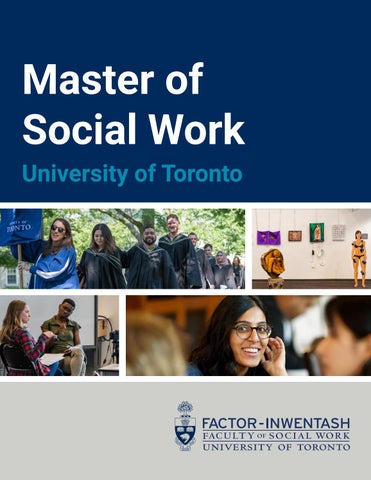
Master of Social Work University of Toronto
We wish to acknowledge the land on which the University of Toronto operates. For thousands of years it has been the traditional land of the Huron-Wendat, the Seneca, and most recently, the Mississaugas of the Credit River. Today, this meeting place is still the home to many Indigenous people from across Turtle Island and we are grateful to have the opportunity to learn, teach, and work on this land.
— Developed in consultaiton with First Nations House, its Elders Circle, scholars in the field and senior University officials
The need for culturally attuned social workers is more urgent than ever A message from Dean Dexter Voisin
Life can be joyous and fun. It can be mundane. But it can also be hard, espcially for those who are economically, racially and socially disadvantaged. Social workers support people through those hard times. Social work scholars seek to understand the complexity of contemporary life, and design programs, services and policies in order to uplift individuals and impact positive societal change. That is why the Factor-Inwentash Faculty of Social Work (FIFSW) exists. We prepare the next generation of social workers to learn the art and science of helping people and communities and to investigate new ways of working together. We are committed to challenging harmful policies, elevating the voices of those who are marginalized and advancing racial, social, and economic justice. FIFSW is ranked #1 among faculties of social work in Canada and #2 among schools of social work globally – a hallmark of our innovation, impact, interdisciplinarity and international reputation, and a reflection of our deep values and commitment to more just and inclusive communities. Our highly applied approach to learning and research is rooted in partnerships with agencies and organizations across Toronto and beyond. This provides invaluable opportunities for our students to engage with and learn from experienced social workers and professionals who represent diverse communities and approaches to collaborative service as part of the Master of Social Work degree. Our students have access to a rich variety of programs at the University of Toronto, which is consistently ranked with the top universities in the world and located in the heart of Toronto, one of the world’s most multicultural urban regions — a terrific city to learn and live. New societal challenges often deepen social inequality, making life harder for already disadvantaged populations. Societies need innovative social workers on the front lines, as well as social work leaders who are committed to guiding and inspiring structural change. We invite you to learn about FIFSW and join us to make a difference in this changing world. In service,
Dexter R. Voisin, PhD Dean & Professor Sandra Rotman Chair in Social Work Factor
1
About FIFSW The University of Toronto’s Factor-Inwentash Faculty of Social Work is a leader in education, research and evidence-based practice that meets the changing needs of individuals and communities. Working with diverse community and institutional partners, our teachers, researchers and students strive to champion and empower society’s most vulnerable. Our mission and goals
What we offer
FIFSW is committed to:
At FIFSW, you will receive:
• Collaborating with diverse partners to address social inequities at local, national and global levels
• Developing and empowering professionals who can
• The opportunity to learn from internationally-
recognized social work educators and researchers with diverse backgrounds who bring community experience and cutting-edge scholarship to the classroom
advocate for social change that meets the changing needs of diverse individuals and communities through social work practice, policy and research
• Direct access to professors who care deeply about
the future of a global profession.
simulation-based learning to help you develop social work practice expertise
• Advancing research, practice, and policy that shapes •
Providing leadership models and ways of knowing that incorporate a range of expertise existing within social work communities around the world
•
teaching and research
•Innovative and applied teaching methods including • An evidenced-based approach to practice that
integrates a critical social justice lens to work with diverse populations in community and institutional settings
Promoting social justice and making professional decisions that are informed by the political context of social work practice and that recognize the effects social work has on BIPOC
Financial support for applicants and registered students.
defined by the needs of a diverse society and demand from the field
through enrolment, curriculum, recruitment of professors, and student support.
• Preparing students for practice in specialized areas, • Engaging in a process of continual self-reflection
on our own biases and racist beliefs, and working to make our pedagogy, scholarship and service delivery challenge rather than reinforce these biases
2
•
• A commitment to ensuring diversity and equity
Community involvement, experience and awards FIFSW’s active and engaged faculty members keep our programs grounded in real-world outcomes. Below are just a few examples.
•
Professor Barbara Fallon’s research reveals the stark disparities between Indigenous and non-Indigenous children and families in the child welfare system. Recognized with a President’s Impact Award, her work has informed the United Nations and Canada’s Senate Committee on Human Rights.
•
Associate Professor Tanya Sharpe launched the Centre for Research and Innovation for Black Survivors of Homicide Victims (The CRIB), an interdisciplinary initiative that works for and with Black communities affected by homicide violence around the world.
• Professor Amanda Grenier’s book, Precarity and
Ageing: Understanding Insecurity and Risk in Later Life, investigates the challenges that many older people face in an era of widening inequality and increased longevity.
• Professor and Associate Dean, Research, David
Brennan founded CRUISElab, an interdisciplinary, community-based research lab that seeks to reduce the impact of HIV on the lives of gay, bisexual, and other men who have sex with men (GBM).
•
Assistant Professor, Teaching Stream Keith Adamson, collaborated with members of the disability community to collaboratively develop and teach a new course on social work and disability practice, with the aim of helping future healthcare professionals see their relationships with clients in a non-hierarchical way.
•
Dean’s Network Award winner Associate Professor Izumi Sakamoto is bringing together social work scholars, practitioners, educators, students and community leaders to document community-based activism, led by migrants and people of colour, against intersecting oppressions such as racism, sexism, and xenophobia.
• Research by Associate Professor Carmen Logie is
examining how social media tools could be used to help adolescents and young people who are refugees in Kampala, Uganda receive information about COVID-19 and express their feelings and concerns. Visit FIFSW’s website to learn more about our faculty, students, partners and alumni. socialwork.utoronto.ca
3
Learning at FIFSW As the need for social services grows and diversifies in North America and around the globe, so too does the need for social workers with more specialized understanding of the complex contexts that affect groups and individuals. In addition to building a strong foundation in the knowledge required of all social workers, FIFSW graduates receive advanced skills training specific to the communities they choose to serve. Mixing theoretical and practical learning, the program produces graduates who are able to think critically about practice and, most importantly, are prepared to enter the field of their choice. FIFSW offers a full time Two-Year MSW program (for those entering without a BSW degree) and an Advanced Standing MSW program (full time or part time, for those entering with a BSW degree). The first year of the Two-Year MSW program is comprised of nine required half-credit courses that provide students with strong foundational knowledge necessary for the social work field.
Across each field of study, FIFSW students have the opportunity to engage in a wide variety of issues, such as homelessness and housing, precarity and aging, sexual diversity and health, neighbourhood violence, community trauma, anti-oppression, elder abuse and immigration — among others. In addition to a variety of electives offered at FIFSW, students may choose from graduate-level electives offered at Faculties and departments across U of T or at other universities with the permission of the Associate Dean, Academic.
4
Students entering Year Two or the Advanced Standing program pursue one of five Fields of Study: • Children and their Families • Gerontology • Human Services Management and Leadership • Mental Health and Health • Social Justice and Diversity
Year one
Did you know?
Required courses:
FIFSW participates in two combined graduate programs and nine collaborative specializations.
• • • • • • • • •
Social Policy and Social Welfare in the Canadian Context, SWK 4102H Elements of Social Work Practice, SWK 4103H Social Work Practice Laboratory, SWK 4105H Foundations of Social Work: Knowledge, Theory and Values that Inform Practice, SWK 4107H Research for Evidence-Based Social Work Practice, SWK 4510H Social Work Practice with Groups, SWK 4602H Social Work Practice with Individuals and Families, SWK 4605H* Social Work Practice in Organizations and Communities, SWK 4654H Social Work Practicum I, SWK 4701H*
Combined degree programs: •
Juris Doctor (Law) and Master of Social Work (JD/MSW) Program — for students who wish to practice in areas where law and social intersect
•
Total Course Load: 9 Half–Credit Courses (H= .5 credit)
Honours Bachelor of Science/ Master of Social Work (HBSc/ MSW) — for exceptional students
registered in the University of Toronto Scarborough Campus (UTSC) Co-op programs in Mental Health Studies.
Year two or Advanced Standing Collaborative specializations: Two-year MSW students declare their field of study by mid-February of the first year, while Advanced Standing students declare their field of study on the MSW Application Form. All fields of study have a minimum of four required half credit-courses, two elective half-credit courses, and a full-year practicum. The Gerontology field of study has five required half-credit courses, two elective half-credit courses, and a full-year practicum. Candidates completing the MSW Program with Advanced Standing must also complete SWK4510 -Research for Evidence-Based Social Work Practice within their year of study.
Master of Social Work In Indigenous Trauma and Resiliency (ITR)
• • • • • • • • •
Addiction Studies Aging, Palliative and Supportive Care Across the Life Course Contemporary East and Southeast Asian Studies Community Development Ethnic and Pluralism Studies Public Health Policy Sexual Diversity Studies Women and Gender Studies Women’s Health
The Master of Social Work, Indigenous Trauma and Resiliency program is creating a unique space to prepare trauma-informed social workers who work with Indigenous communities in Canada and around the world. The groundbreaking curriculum focuses on training for direct practice in social work. Graduates of this field gain skills to provide culturally appropriate services to global indigenous communities, and will learn to identify the effects of trauma, abuse, war and violence in society more generally, thanks to the community wisdom and traditions that form the basis of this partnership. With their new knowledge, training and self-awareness, these social work professionals will have a lasting impact on our world, becoming community activists and leaders who focus on strength, wellness and resilience wherever they practice.
5
Fields of study Children & their families From emerging global health issues to the complex role of social media in how we live to cuts in public education and social programs, children and their families face new and difficult pressures. Social workers play a vital role in helping families manage new realities and thrive. Students in this field of study learn how building on family strengths is key to achieving positive child and youth outcomes; how an ecological developmental perspective contributes to an understanding of child functioning, critical stressors, protective factors, and sites of resilience; and about the prevalence and impact of adverse childhood events through a trauma-informed lens. Spanning multiple levels of social work practice, approaches taught are informed by current research evidence and empirically supported interventions within culturally responsive contexts. It is recognized that knowledge of the polices that impact children and their families is crucial to informing a competent, culturally based, ethical practice. Core Courses in the Children and their Families field of study: Two-Year MSW Full-Time Program • Research for Practice with Children and their Families, SWK 4514H • Social Work Practice with Families, SWK 4608H • Social Work Practice with Children and Adolescents, SWK 4620H • The Intersection of Policy and Practice with Children and their Families, SWK 4625H • Social Work Practicum II, SWK 4702Y • Two elective half-credit courses MSW Program with Advanced Standing Complete above courses plus: • Research for Evidence-Based Social Work Practice, SWK 4510H Total Course Load Equivalent to: • 8 Half-Credit Courses: Year Two of the Two-Year MSW Full-Time Program • 9 Half-Credit Courses: MSW Program with Advanced Standing (H=.5 credit; Y=1 full credit course)
Gerontology Social workers are important agents in assisting older people and their families to meet the challenges of an aging society. In this capacity, social workers provide a variety of services and programs in the community and in institutions that are aimed at enhancing the quality of life of older adults and assisting families. Social workers also play a vital role in the development and implementation of social and economic policies at the provincial and national levels through research on aging, consultation with government and through social advocacy. Core courses of Instruction in the Gerontology field of study: Two-Year MSW Full-Time Program • Principles of Aging, AGE 2000H • Knowledge Building in Social Work, SWK 4513H • Social Work and Aging: Integrated Policy and Practice (full-course), SWK 4612Y • Special Issues in Gerontological Social Work, SWK 4618H • Social Work Practicum II, SWK 4702Y • Two elective half-credit courses, of which one must be from the Collaborative Program in Aging, Palliative and Supportive Care Across the Life Course listing. MSW Program with Advanced Standing Complete above courses plus: • Research for Evidence-Based Social Work Practice, SWK 4510H Total Course Load Equivalent to: • 9 Half-Credit Courses: Year Two of the Two-Year MSW FullTime Program • 10 Half-Credit Courses: MSW Program with Advanced Standing
6
(H=. 5 credit; Y=1 full credit course)
Human services management & leadership A rapidly changing society requires social workers who can serve people on the ground in human service organizations in the nonprofit, for-profit and public sector. We need leaders who can shape and direct these organizations to create and manage innovative programming that is based on the lived experiences of social service user groups. This program provides MSW students with a rigorous, comprehensive grounding in the key values, skills and knowledge required by human service leaders and managers to create and implement programming that is anti-oppressive, innovative, and client-centered, with a focus on equity and inclusion. In this field of study, you will: • develop skills in leadership, nonprofit governance, socail innovation and social entrepreneurship, partnership development and strategic planning • gain an understanding of financial management, including social financing, social enterprise development, accounting, budgeting and forecasting, • develop knowledge and skills in human resource management and labour relations, • learn to manage service delivery including such areas as developing organizational structures, annual planning, program development and evaluation and selecting and maintaining management information systems.
Core Courses of Instruction for Human Services Human Services Management and Leadership: Two-Year MSW Full-Time Program • Human Services Management and Leadership, SWK 4425H • Financial Management and Leadership in Human Service Organizations, SWK 4426H • Human Resource Management in Human Service Organizations, SWK 4427H • Research and Quality Improvement in Human Service Organizations, SWK 4515H • Social Work Practicum II, SWK 4702Y • Two elective half-credit courses MSW Program with Advanced Standing - Complete above courses plus • Research for Evidence-Based Social Work Practice, SWK 4510H Total Course Load Equivalent to: • 8 Half-Credit Courses: Year Two of the Two-Year MSW Full-Time Program • 9 Half-Credit Courses: MSW Program with Advanced Standing (H=.5 credit; Y=1 full credit course) Note: If admitted to the MSW program, student who wish to pursue this field of study must have a minimum of two years of experience.
7
Mental health and health Social workers have key roles to play in assisting individuals, families and communities to cope with physical and mental health concerns. As members of interprofessional health teams, they bring a social justice focus and holistic approach to the examination of the biopsychosocial-spiritual-cultural factors influencing physical and mental health. Social workers understand the impact of oppression, racism and inequity on health and mental health are involved at the micro, mezzo and macro levels. With an emphasis on the social determinants of health and mental health, they strive to enhance wellbeing, empower clients, promote social change, and advocate for equity and access to services. Core courses of Instruction in Mental Health and Health field of study: Two-Year MSW Full-Time Program • The Context of Mental Health and Health Practice, SWK 4412H • Practice Based Research in Mental Health and Health, SWK 4511H • Social Work Practicum II, SWK 4702Y • Two elective half-credit courses Students can then elect to take one of three choices: 1) Social Work Practice in Health, SWK 4622, and Social Work Practice in Mental Health, SWK 4604 2) Social Work Practice in Health, SWK 4622H, followed by Advanced Social Work Practice in Health, SWK 4632H 3) Social Work Practice in Mental Health, SWK 4604 followed by– Advanced Social Work Practice in Mental Health, SWK 4631 MSW Program with Advanced Standing Complete above courses plus • Research for Evidence-Based Social Work Practice, SWK 4510H Total Course Load Equivalent to: • 8 Half-Credit Courses: Year Two of the Two-Year MSW Full-Time Program • 9 Half-Credit Courses: MSW Program with Advanced Standing (H=.5 credit; Y=1 full credit course)
Social justice and diversity This field of study will help you develop critical thinking and practice skills to address growing inequality, exclusion, and marginalization within Canada’s diverse population. Courses draw from a range of knowledge to inform social work practice, including structural, intersectional feminist, antiracist, Indigenous, LGBTQ2S+ and anti-oppressive theories and approaches. Core skills that are addressed include critical clinical practice, reflexivity, policy advocacy and research proposal writing. Core Courses of Instruction in Social Justice and Diversity field of study: Two-Year MSW Full-Time Program • Globalization and Trans-nationalization: Intersections of Policy and Community Practice • Locally and Globally, SWK 4304H • Theoretical Approaches to Defining Social Injustice and Engaging in Social Change, SWK 4306H • Research Knowledge for Social Justice, SWK 4512H • Diversity, Access and Equity in Social Work Practice, SWK 4606H • Social Work Practicum II, SWK 4702Y • Two elective half-credit courses MSW Program with Advanced Standing Complete above courses plus • Research for Evidence-Based Social Work Practice, SWK 4510H Total Course Load Equivalent to: • 8 Half-Credit Courses: Year Two of the Two-Year MSW Full-Time Program • 9 Half-Credit Courses: MSW Program with Advanced Standing
8
(H=.5 credit; Y=1 full credit course)
Come and join us! The Factor-Inwentash Faculty of Social Work (FIFSW) at the University of Toronto welcomes applications from highly qualified individuals who are interested in joining our Faculty for a dynamic and challenging learning experience. U of T is strongly committed to diversity within its community, and welcomes applications from racialized persons/persons of colour, Indigenous People of North America and the world, persons with disabilities, LGBTQ persons, and others who may contribute to the further diversification of ideas. Within its commitment to academic and practice excellence, FIFSW seeks a student body that is inclusive and reflective of the diversity found within Canadian communities including but not limited to racialized persons/persons of colour, Indigenous People of North America and the world, LGBTQ persons, persons with differing abilities, mature students, and students from varying faith/spiritual communities.
9
Admission requirements 1. Candidates for admission to the Two-Year MSW Full-Time Program require an appropriate bachelor’s degree* from a recognized university and a mid-B (73% or better) in the final year of full-time study or equivalent in senior level courses (300 or 400 level). *bachelor’s degree with breadth, depth and, where appropriate, an affinity to the graduate program to which the applicant is seeking admission. 2. Candidates for admission to the MSW Program with Advanced Standing require a Bachelor of Social Work degree from a recognized university and a mid-B (73% or better) in the final year of full-time study (or equivalent). 3. Satisfactory completion of at least three full courses, or their equivalent, in the social sciences, to include a half-credit course in research methodology, preferably in the social sciences. (A grade lower than mid-B in the research methodology course will lessen the applicant’s probability of admission.) 4. Experience (voluntary or paid) in the social services field (or a related field) and knowledge of critical social issues is recommended. Suitability for professional practice in social work will also be considered. 5. Candidates for the MSW Program with Advanced Standing must indicate (1) field of study; and (2) a preference for full-time or part-time studies on the MSW Program Application Form. 6. Evidence of facility in the English language. If your primary language is not English and you graduated from a non-Canadian university where the language of instruction and examination was not English, then you must demonstrate your facility in English by completing one of the tests listed below: • • • • •
TOEFL Paper-Based Test Score of 580 and TWE Score of 5 Internet–based TOEFL Test Score of 22/30 for both the Writing and Speaking Sections, with an overall TOEFL Score of 93/120 IELTS Minimum required score: 7.0 (Academic) with at least 6.5 for each component The Certificate of Proficiency in English (COPE). Required score: 76 (with at least 22 in each component and 32 in the writing component) International ESL Program, School of Continuing Studies, University of Toronto. Required score: a final grade of B in Level 60
Applicants must arrange for their score to be reported electronically to the University of Toronto. For more information on the English language facility requirement please visit the SGS website. Please note that enrollment is limited for part-time studies. Each year, the number of applicants admitted for part-time studies will vary depending on our enrollment. If you indicate part-time studies as your first choice and full-time studies as your second choice, your application for the full-time program will only be considered if there is space.
10
Learn more www.socialwork.utoronto.ca 416-978-3257
•
Online information session & upcoming Q&A webinars
•
Application deadline
•
Application instructions
•
Information about practicum
•
Alumni podcast Series: Profiles in Social Work
Twitter: @UofT_FIFSW Facebook: @UofTFIFSW Factor-Inwentash Faculty of Social Work University of Toronto 246 Bloor Street West Toronto, Ontario, Canada M5S 1V4 11