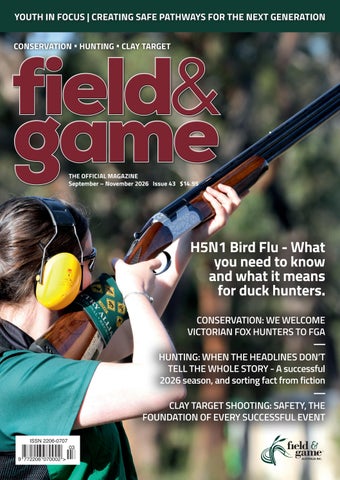
YOUTH IN FOCUS | CREATING SAFE PATHWAYS FOR THE NEXT GENERATION CONSERVATION • HUNTING • CLAY TARGET
THE OFFICIAL MAGAZINE September – November 2026 Issue 43 $14.95
H5N1 Bird Flu - What you need to know and what it means for duck hunters. CONSERVATION: WE WELCOME VICTORIAN FOX HUNTERS TO FGA HUNTING: WHEN THE HEADLINES DON’T TELL THE WHOLE STORY - A successful 2026 season, and sorting fact from fiction
ISSN 2206-0707 ISSN 2206-0707 9 772206 070002 > 9 772206 070002 >
CLAY TARGET SHOOTING: SAFETY, THE FOUNDATION OF EVERY SUCCESSFUL EVENT 03 03
CARNIVAL 2026 WODONGA ALBURY FIELD & GAME
Friday 30th October – Sunday 1st November 2026
NOMINATIONS NOW OPEN ON MCMS www.myclubsmyscores.com.au
SCHEDULE OF EVENTS FRIDAY 30TH OCTOBER ENGLISH SPORTING PAIRS EVENT – 80 TARGET SATURDAY 31ST OCTOBER ASF NATIONAL CHAMPIONSHIP – 100 TARGET SUNDAY 1ST NOVEMBER ASF NATIONAL CHAMPIONSHIP – 50 TARGET
FRIDAY ESP $100 (ADULT) | $50 (JUNIOR) SATURDAY NATIONAL CHAMPIONSHIP $220 (ADULT) | $110 (JUNIOR) CAMPING $15 PER NIGHT
www.fieldandgame.com.au/events/365181
Friday 30th October is Expo Day with all Practice Grounds, Sponsors, Vendors, Music, & Canteen available
Come and see our Sponsors & Vendors!
Collumbo Shooting
From the Editor
T
here’s plenty happening across Field & Game Australia as we head into the final months of 2026, from successful hunting seasons and conservation work to a changing political landscape, growing youth participation and, of course, the National Carnival just around the corner. In June, we welcomed Turlough Guerin as our new CEO. Turlough has already spent considerable Halle Barrake with her first fox time on the road, visiting branches, meeting members and volunteers, and getting to know the organisation. At the same time, Lucas Cooke remains actively involved in developing partnerships and progressing strategic projects. Lucas has made an enormous contribution to FGA, and we continue to benefit from his knowledge, experience and unwavering passion for hunting, conservation and ASF.
The firearms and political landscape also continues to change. With legislative reform underway and the Victorian election approaching, FGA continues to advocate for our members and engage with governments, agencies and elected representatives on responsible firearm ownership, ethical hunting and science-based conservation. There is plenty at stake, and having a strong, informed voice remains important. This issue also looks back at the successful 2026 hunting seasons across the southern states. As those seasons close, attention turns north to the Northern Territory and another opportunity for hunters to experience the Magpie Goose season.
Field & Game Australia Turlough Guerin – Chief Executive Officer Lucas Cooke – Executive Officer - Projects & Partnerships Anne-Marie Blewett – Operations Lead Wayne Peters - Senior Administration and Branch Support Officer Olivia Peachey - Administration and Member Support Officer Chelsea Skinner – Business Accounts Clerk
FGA Board David Anderson – Chairman david.anderson@fieldandgame.com.au Trent Leen – Vice-Chairman trent.leen@fieldandgame.com.au Glenda Anderson glenda.anderson@fieldandgame.com.au Adam Carson adam.carson@fieldandgame.com.au Vicki Norris vicki.norris@fieldandgame.com.au Paul Sharp paul.sharp@fieldandgame.com.au Michaela Shirley michaela.shirley@fieldandgame.com.au
Magazine Production Team Jacqui Maskell – Graphic Designer Anne-Marie Blewett – Operations Lead
External Contributors Karen Davies Ray Agg Ian Burns
Kevin Walshaw Scott King Emma Cox
Print Production
Closer to home, excitement is building for the 2026 FGA National Carnival at Wodonga–Albury from 30 October to 1 November. With a fantastic group of sponsors and vendors behind the event and competitors travelling from across the country, it is shaping up to be a huge weekend.
Tim Michaelides – Managing Director Tim Dunphy – Production Manager (Print & Mail)
Young people feature strongly throughout this edition too. We share stories from school shoots, junior hunters and young members getting involved in different parts of FGA, while also looking at Child Safe Standards and our responsibility to provide safe, welcoming environments for the next generation. See above, young Halle, niece of Geelong Life Member Peter Anderson, with a look of pure joy, harvesting her first fox earlier this year. An excellent example of what good mentoring and genuine involvement can look like.
The views and opinions expressed in articles by individual contributors are those of the author and do not necessarily reflect the views, policies or positions of Field & Game Australia.
Contributor Disclaimer
Historical and other factual information is checked to the best of our ability; however, particularly where articles draw on historical records, personal recollections or third-party sources, some details may be incomplete, inconsistent or subject to differing interpretations.
There’s plenty more inside, the 2027 WET Duck Stamp competition, the history of Browning, one member’s love of his Beretta, conservation projects and a great collection of news and stories from our branches. Thank you to everyone who has contributed to this edition and, as always, to the volunteers, branch committees, sponsors and members who put so much into Field & Game Australia. Enjoy the issue, and I hope to see many of you at Wodonga–Albury in October.
Anne-Marie Blewett
Field & Game (ISSN: 2206-0707) is printed by Complete Colour Printing (84-86 Herald Street, Cheltenham, VIC 3192) for the Publisher Field & Game Australia Inc - www.fieldandgame.com.au Copyright 2026 Field & Game Australia Inc.
Field & Game Australia If you have any feedback of any sort of would like to contribute to Field & Game magazine in any way, drop us a line at editor@fieldandgame.com.au or, you can call on (03) 5799 0960. FIELD & GAME | September – November 2026
3
52
CHILD SAFE STANDARDS - SUPPORTING THE NEXT GENERATION
26
REFLECTION - FOLLOWING FOOTSTEPS - EMMA COX
Contents
29
September - November 2026 Issue 43
DESIGNED WITH PURPOSE - INSPIRING THE NEXT GENERATION OF FEMALE SHOOTERS
Page 6
Page 22
Page 36
Page 48
From the Chairman: Strength in our people
Heart Morass: 20 years on
ASF Safety and Successful Events: Safety First, the foundation of every successful event
Juniors: Junior Shooting Guide The Future Starts here
Page 8 From the CEO: Listening, representing and strengthening Field & Game Australia
Page 10 2026 Seasons: 2026 Hunting Season Wrap Up
Page 12 The Political Landscape: Beyond the Ballot Box - Your Vote Matters
Page 15 Hunting: Sorting Fact from Fiction
Page 17 National Carnival 2026: Meet our Partners behind the 2026 National Carnival 4
Page 24 Bird Flu: H5N1 Bird Flu has arrived in Australia - Part One
Page 28 Reflection: Following Footsteps - Emma Cox
Page 31 Designed with Purpose: Inspiring the next generation of female shooters
Page 32
Page 38 Conversation: 2027 Duck Stamp - A legacy in Art and Conservation
Page 40 Conservation: Pest & Vermin Control - Conservation through action, every hunt makes a difference
Page 42 Conservation: Volunteering ParkConnect - Looking after the places we value
New Branch: Victorian Fox Hunters Field & Game
Page 44
Page 34
Vet Advice: with Karen Davies No Feet No Dog
History: A Century of Excellence, celebrating 100 Years of the Browning B25 Superposed
FIELD & GAME | September – November 2026 | www.fieldandgame.com.au
Page 46 Hunting: Shooting rabbits with the .303 - Ian Burns
Page 52 Bird Flu: H5N1 Bird Flu has arrived in Australia - Part Two
Page 56 Child Safe Standards: Supporting the next generation
Page 58 FIREARMS: Beretta - Scott King - Sometimes you get lucky
Page 62 Branch News: Donald Field & Game - Mates, Memories and Making a Difference
Page 64 Branch News: Golden Rivers Classic - Record numbers for 25th Golden Rivers Classic
58
FIREARMS BERETTA - SCOTT KING - SOMETIMES YOU GET LUCKY
30 NEW BRANCH - VICTORIAN FOX HUNTERS FIELD & GAME
38
CONSERVATION - PEST & VERMIN CONTROL
Page 66
Page 74
Branch News: Grampians Field & Game - End of an era and the start of a new one
Branch News: Pinegrove Field & Game - Passed Members Memorial Shoot
Page 68 Branch News: Sale Field & Game - 49th H&S Gippsland Inter School Championships
Page 69 Branch News: Coleraine Field & Game - Showcasing the Future of Field & Game Australia
Page 72 Branch News: Sunraysia Field & Game Bull & Feathers Championship
32 HISTORY - A CENTURY OF EXCELLENCE, CELEBRATING 100 YEARS OF THE BROWNING B25 SUPERPOSED
Page 75 Branch News: Deniliquin Field & Game Two Man Novelty Shoot A Hit at Deni
Page 76 Branch News: Ararat & Stawell Field & Game - David McMillian 3 Day Memorial Shoot
Page 78 Recipe: Magpie Goose Pastrami
Page 82 Back Page Yarns: What makes a hunter?
Cover Photo: Charlotte Eagleton at the H&S Gippsland Interschool ASF Championship FIELD & GAME | September – November 2026 | www.fieldandgame.com.au
5
FROM THE CHAIRMAN David Anderson
Strength in our people Field & Game Australia is built on volunteers whose dedication is extraordinary to the point of going above and beyond to achieve the best possible outcomes in every area of what we do and yet we continue to be challenged.
I
t has been and continues to be a very frustrating time for everyone in and attached to Field & Game Australia because of the ongoing interference from the un-educated and the un-informed but so-called principled sectors that seem to be focused on changing what it is we do so well. I really don’t think those outside our organisation see the enormous contribution we voluntarily provide every day to this great country and its people. Our conservation efforts are second to none and have made huge positive impacts to wetland health and wildlife habitats.
We do what we do significantly more efficiently and cost effectively than government funded depts, simply because of how we are structured. With minimal over heads and so much volunteer time, we could do so much more and save huge amounts tax payer dollars. Yet some out there want us stopped. Our hunting efforts, again undertaken by volunteers, helps remove introduced predators that attack and kill our native animals, not by a few, but by the thousands. Yet some of the same external voices who want to protect native animals are trying to ban what it is we do. You can’t have pristine wetlands and native animal population growth without a return on effort by those who do all the hard work.Treating responsible gun owners as the problem and trying to price them out of existence and limit their access, is a very short-sighted and unfounded direction to head when science and facts tells the opposite story. What do the decision makers think is going to happen when they again attempt to ban duck hunting. What do those passionate conservationists and hunters do when the reward and 6
recognition are taken away, they retreat and question why they do what they do. You take away their passion, you then take away their reason to protect and improve native and nature. What our branches do on top of conservation and predator control is so much more. The people who come and shoot clay targets monthly, improve their skills, become more competitive and move through the shooting organisations to become globally recognised for their skills, or simply enjoy a great family day out and have fun in their chosen sport. The number of young folks coming through their schools and families who attend our shoots is incredible and they are taught so much more than how to hit a target. They become responsible gun owners, learn to understand rules and regulations and why they exist and the consequences of ignoring those rules. It is so important to grow up with mentors who set values and boundaries for our youth because it flows into everyday life and this is what our seasoned and dedicated branch members do for our communities. It’s all linked and it is such a positive and outstanding contribution that fails to be understood by some elements which is so disappointing. In wrapping up on this point with what we do and the way we do it, the government funds saved could certainly go towards rural road repairs. Last time I spoke, I mentioned the recruiting efforts for our CEO position had been fruitful with the onboarding of Turlough Guerin. Two months in and Turlough finds himself on
FIELD & GAME | September – November 2026 | www.fieldandgame.com.au
a steep learning curve, we are not like any other organisation, and we cover so much more than what our name may indicate which is a lot to wrap your arms around. Turlough has spent a lot of his time understanding who we are, making changes along the way to make us stronger and is out meeting branch committees, members, regulators and sponsors. With all new leaders coming into their roles, it takes time and a steady approach over the full cycle of a year to see what it is that makes us who we are, so please spend your time when you can helping to grow and support Turlough as he navigates our great organisation. Lucas Cooke has been doing much the same, finding his feet in his new role as Executive Officer, who is now leading our projects and focusing his energy and skills in places where limited resources have prevented us from growing. Lucas recently visited several of our close overseas counter parts and supporters including Ducks Unlimited, High & Dry and Delta Waterfowl, who welcome Field & Game openly and provide access to events and sessions that is normally limited or closed to outsiders. It is clear we have built trust and reciprocal interests globally. The value of these types of relationships can be very hard to understand how it helps us, however having worked a lot of my time in many overseas roles, I can share that the benefits in some instances can be hard to describe but are enormous. Communicating and visiting with like organisations from abroad brings a lot of knowledge to the table, and having these relationships prevents us from heading down paths that have been tried by others and prevents us from relearning lessons learnt and helps
I’m not going to repeat what has already been said, but I will touch on the terrific efforts made by both Turlough and Lucas in the world of political advocacy.
from you, and by being curious and being a part of the day gives great credence to being aligned and informed while influencing our direction.
I think we all know this space is changing daily and will again be tested in the November election, which could see us have a very different landscape in front of us.
Additionally, we have the National Carnival just a week after the AGM, the noms are out, the Sponsors are numerous and have been incredibly supportive with their presence and their prizes, we can’t say enough about the value they provide.
They continue to work hard across the political and regulatory environment, sharing, educating and ensuring our position is clear, understood and based on science and fact. We will not waver in any way from what is our strength and our commitment to our membership and the best Interests to native Australia.
us get to where we want to be faster and cost effectively. We welcome openly our overseas colleagues at any time and would be proud to show case Field & Game Australia and our great country.
In closing, we have our AGM rapidly approaching, which I would encourage you all to come along to. Have your say, question the board on their performance or ask questions that need to be asked on any topic.
To have Albury / Wodonga host our most prestigious event of the year is such a great outcome and commitment by them. The grounds are perfect, the volunteers are accommodating and the committee is supportive which all contributes to a great three day event, at a world-class level. If I don’t see you at the Nationals, I hope to see you at the AGM and if I miss you there, I will see you at a monthly shoot somewhere throughout the year.
We value your attendance and the thoughts and ideas that come to the table
Stay safe, and I look forward to hearing from you all.
with 61/75 and Peter Webb with 57/75 while Bill Koopman won the Veterans event with 53/75.
the previous year, held at Benalla and came third in the women’s events.
Jill Hocking – A Historic High Gun Achievement In our previous issue, we featured a story looking back at an outstanding achievement by Cobram shooter Jill Hocking. Unfortunately, some of the details published with that story were incorrect, and we would like to set the record straight.
I
n 1998, Jill achieved a rare competitive feat at a Deniliquin Field & Game Association shoot, becoming the first woman to win the overall High Gun award.
Jill shot 63 of 75 targets, finishing two targets clear of her nearest High Gun opponent and outperforming the field to claim the title. Other Cobram shooters also shot well including Trevor Beach who won AA Grade
The achievement was particularly significant at the time. Jill had already been shooting competitively for around 15 years and had established an impressive record in the sport, with numerous awards, sashes and trophies to her name. Jill had also performed well at the National Titles
We sincerely apologise to Jill for the inaccuracies in our previous article and have also apologised to her personally. We are pleased to correct the record and properly recognise an achievement that remains an important part of Jill’s shooting history and the history of women competing in Field & Game.
FIELD & GAME | September – November 2026 | www.fieldandgame.com.au
7
FROM THE CEO Dr Turlough Guerin
Listening, representing and strengthening Field & Game Australia Field & Game Australia is built on three connected pillars: conservation, responsible hunting and clay target shooting. Each depends on the contribution of our members, volunteers, branches and staff.
D
uring my first two months as CEO, I have spent time listening to members, branch leaders, directors, staff, government agencies and partner organisations. I have also visited facilities and branches across several states, with more visits planned very soon.
Those discussions have reinforced both the strengths of FGA and the areas where we need to improve. Our branches have capable leaders, committed volunteers and strong connections with their communities. They also face practical challenges, including land access, secure tenure, planning approvals, volunteer succession, administrative workload. The direction from here is clear. We need to strengthen support for branches, improve communication, represent members more effectively and better demonstrate the contribution FGA makes through conservation, hunting and clay target shooting.
Stronger advocacy Advocacy will remain a major priority. FGA is increasing its direct engagement with Members of Parliament, government agencies, regulators and other organisations so that decisions affecting our members are informed by practical experience. I have begun participating in the Victorian Firearms Consultative Committee alongside FGA Life Member and former Chairman Bill Paterson. This gives FGA a direct opportunity to raise issues involving licensing, administration, consultation and the practical effects of regulatory change on responsible firearm owners. 8
We have also been actively engaged on the Victorian Firearms Amendment Bill 2026. FGA supports effective action against organised crime and the illegal use and trafficking of firearms. However, new laws must be workable, proportionate and fair. Responsible licence holders should not face unnecessary delay, duplication or administrative burden because of measures intended to address criminal activity. We will continue advocating for procedural fairness, practical implementation, transparent decision-making and proper consultation as the Bill progresses. With the Victorian State Election approaching, this work will intensify. FGA has worked constructively with SSAA Victoria and other hunting and shooting organisations to develop shared priorities where our interests align. This joint work gives the sector a stronger voice, while FGA retains its independent policies and responsibility to represent its own members. Our contribution has helped ensure that the joint advocacy work recognises the role of responsible hunting in wetland conservation, biodiversity management, regional economies and sustainable outdoor recreation. We have also advocated for continued investment in waterbird and habitat science, better management of State Game Reserves, fair access to suitable public land and grants that properly support volunteer-led branches and conservation projects. FGA is also seeking clear commitments from the major and minor parties on hunting, conservation, firearms policy, wetlands, public land and regional investment. Their responses will be shared with members before the election.
FIELD & GAME | September – November 2026 | www.fieldandgame.com.au
Members and branches can support this work by providing National Office with practical examples of regulatory problems, land-access issues, conservation priorities and successful local projects. Specific evidence strengthens our discussions with government and helps ensure we focus on the issues that matter most.
Advancing conservation Conservation remains central to our purpose. Our submission in June to the draft Victorian Waterway Management Strategy argued that volunteer organisations such as FGA should be recognised as delivery partners, not simply as stakeholders to be consulted. FGA members already undertake wetland restoration, nesting-box projects, habitat works, pest and predator control, environmental monitoring and biosecurity activities. Our branches bring local knowledge, practical skills and a long-term commitment to the places in which they operate. Upcoming meetings with the Game Management Authority and the Victorian Environmental Water Holder (VEWH) will provide opportunities to progress this work. With the GMA, our focus will include adaptive harvest management, waterbird and habitat research, season-setting processes, hunter education, State Game Reserves and opportunities for members to contribute to monitoring and conservation. With the VEWH, we will discuss environmental watering, communitymanaged wetlands and how FGA, its branches and the Wetlands Environmental
distinguishes between lawful, responsible hunters and criminal misuse of firearms. Our engagement with government and partner organisations will increasingly connect hunting policy with habitat condition, wetland management, environmental water and regional landmanagement priorities.
Strengthening clay target shooting Clay target shooting is another core part of FGA. Branches require secure tenure, safe and well-maintained facilities, effective planning and a steady flow of volunteers and new participants. Junior development, school programs and major events such as the National Carnival are important pathways into the sport. National Office needs to provide practical support that helps branches operate safely, manage administration and plan for the future. Work is underway to improve FGA’s membership, competition and administrative systems so future investment delivers a secure, practical and cost-effective platform for branches, members and staff.
Taskforce can contribute to project delivery, monitoring and local planning. We are also reinvigorating the activities of the Wetlands Environmental Taskforce Fund. The immediate priorities are to strengthen governance, re-engage its Governors, establish a clearer project pipeline and improve access to grants, donations and research partnerships. This will provide a stronger platform for work at Connewarre, Heart Morass and other wetlands, while helping branches and partners turn conservation proposals into funded and measurable projects. Heart Morass remains an important example of what can be achieved through long-term partnerships, sound planning and sustained volunteer effort. Our objective is to build on that experience and apply the lessons more broadly. Biosecurity is also part of our conservation responsibility. Following recent H5 bird flu detections in Australian wild birds, FGA has kept members informed about reporting unusual bird deaths, avoiding contact with sick or dead wildlife and maintaining good hygiene when moving between wetlands
and rural properties. Our recent public advocacy has also highlighted the practical role that farmers, hunters, fishers, birdwatchers and other outdoor users can play in identifying unusual wildlife events early. People who regularly spend time in these environments are often the first to notice when something is wrong. We will continue contributing constructively to public debate on wetlands, wildlife, invasive species, biosecurity and regional land management. We have knowledge and experience that should be part of those discussions.
Supporting responsible hunting Responsible hunting is closely connected to our conservation role. FGA will continue advocating for sustainable, evidence-based game management, access to suitable public land and appropriate recognition of hunters’ contribution to pest control, wildlife monitoring and regional communities. This means supporting sound science, clear rules and effective compliance. It also means ensuring that regulation
We are also strengthening safety reporting and follow-up. The purpose is not to create unnecessary administration. It is to identify recurring risks, learn from incidents and near misses, and share practical lessons across the organisation.
Our people None of these priorities can be delivered by National Office alone. FGA depends on the people who serve on branch committees, run competitions, maintain grounds, restore wetlands, mentor junior members, manage working bees, support landholders and represent the organisation in their communities. Our direction is to make that contribution easier and more effective. National Office will continue improving communication, strengthening branch support, building constructive relationships with government and partner organisations, and representing FGA confidently on the issues that affect members. The three pillars remain clear: we conserve, we hunt and we compete. Our people make each of them possible. Dr Turlough Guerin CEO – Field & Game Australia
FIELD & GAME | September – November 2026 | www.fieldandgame.com.au
9
2026 SEASONS
2026 Hunting Season Wrap-Up The close of another hunting season provides an opportunity to reflect on the mornings shared in the field, the changing conditions encountered across our wetlands and farmland, and the responsibilities that come with participating in Australia’s hunting traditions.
A
cross Victoria, South Australia and Tasmania, the 2026 duck and quail seasons offered hunters valuable time in the field, while the Northern Territory’s waterfowl season will begin in September. Although experiences differed considerably between regions, the season once again demonstrated the importance of preparation, sound identification, responsible firearm handling and respect for the places in which we hunt.
A full Victorian duck season Victoria’s 2026 duck season opened at 8.00 am on Wednesday 18 March and closed 30 minutes after sunset on Monday 8 June. Hunters were permitted a daily bag limit of nine game ducks, with the Bluewinged Shoveler excluded from the season. The season followed the arrangements established under Victoria’s current game regulations and provided hunters with a full-length opportunity to participate. As always, conditions varied widely. Water availability, local bird movements and access to individual wetlands meant that no two areas, or hunting mornings, were quite the same. Some Victorian wetlands were closed or partly closed during the season to protect threatened species, breeding waterbirds or particular sites. The Game Management Authority continued to update hunters throughout the season, reinforcing the importance of checking current wetland information before travelling. Like many seasons, 2026 didn’t tell the same story everywhere. Some wetlands produced excellent hunting from the opening weekend, while others were quieter than expected following a drier start and variable local conditions. Encouragingly, reports from members suggested bird numbers improved across many areas as the season progressed, reminding us that patience and adapting to the conditions remain two of the most important ingredients for a successful season. 10
Strong compliance across Victoria The GMA’s season-end compliance update provides a useful picture of activity across the state. During the 2026 Victorian duck season, authorised officers conducted 541 wetland and waterway patrols, checked 1,788 Game Licences and inspected 1,139 hunters’ bags. No hunters were detected exceeding the daily bag limit. A total of 33 hunting-related offences were detected. The principal issues involved possession of toxic shot, failing to leave a wing attached to harvested birds and hunting without a valid Game Licence. The GMA advised that infringement notices, official warnings, licence suspensions and further investigations would follow. The absence of any detected overbagging is encouraging. However, the other offences are an important reminder that responsible hunting includes understanding and following every condition, not only bag limits. Using approved non-toxic shot, carrying the correct licence, identifying birds before shooting and retaining the required identifying features on harvested game are fundamental responsibilities for every hunter.
Victorian Stubble Quail Victoria’s Stubble Quail season ran from 4 April to 30 June, with hunting permitted from 30 minutes before sunrise until 30 minutes after sunset. The daily bag limit remained 20 birds. Quail hunting provides a very different experience from a morning on the wetlands. It demands patience, careful observation, good fieldcraft and, for many hunters, the teamwork of a well-trained gundog. The quality of the season can vary considerably between districts, with local rainfall, pasture and cropping conditions influencing where birds are found. While
FIELD & GAME | September – November 2026 | www.fieldandgame.com.au
official 2026 harvest figures are not yet available, the season again provided an important opportunity for hunters to remain active beyond the duck season and to introduce newer participants to another form of game hunting.
South Australia South Australia’s 2026 duck season opened at sunrise on Saturday 21 March and closed at sunset on Sunday 28 June, with a daily bag limit of eight ducks. Hunting access at several game reserves was restricted to nominated dates, and hunters were required to hold the appropriate permits and comply with reserve-specific conditions. While the season framework remained familiar, the hunting itself was anything but. Significant inland rainfall triggered a large-scale movement of nomadic waterfowl away from many of the state’s traditional hunting wetlands and into inland breeding areas. As a result, some locations that would normally hold good numbers of birds proved quieter than expected, while hunters who adapted their approach and targeted resident waterfowl generally enjoyed more consistent success. Although it presented a very different season for South Australian hunters, the widespread inland breeding event has created genuine optimism for waterfowl populations and the potential for strong bird numbers in future seasons. South Australia’s Stubble Quail season opened on 25 April and concluded on 2 August, with a daily bag limit of 15 birds. The extended season provided additional hunting opportunities across suitable agricultural country where lawful access had been obtained, with only Stubble Quail permitted to be taken. A personal reflection on South Australia’s unique 2026 duck season by FGA Director Paul Sharp appears next on page 11.
Tasmania Tasmania’s wild duck season ran from 7 March until 8 June, with a daily bag limit of 10 ducks. The permitted species were Black Duck, Grey Teal, Chestnut Teal, Mountain Duck and Wood Duck. Ref: NRE Tas Tasmania also held a Brown Quail season from 16 May to 28 June, while its fallow deer seasons included an adult male season from 28 February to 5 April and an antlerless season extending from 15 March to 15 November. Ref NRE Tas
by the Top End’s wetlands, seasonal conditions and large concentrations of waterfowl. It is also a jurisdiction where careful planning, local knowledge and compliance with permit and land-access requirements are essential.
A changing biosecurity environment The end of the southern hunting seasons has coincided with a significant development for Australia’s wildlife and biosecurity agencies.
between different wetlands or properties.
More than the harvest Official harvest and participation estimates for the 2026 season will be released later, and these will provide a clearer picture of hunter activity and take. Statistics, however, tell only part of the story. Across the country, the season was built on thousands of individual experiences: first-time hunters learning from experienced mentors, dogs completing a retrieve after months of training, families returning to familiar camps and friends sharing a meal at the end of a long day.
The Northern Territory season ahead
In June 2026, Australia confirmed its first detections of H5 high pathogenicity avian influenza in wild seabirds. As at 19 July, the Australian Government had reported 17 confirmed detections, 10 in Western Australia, five in South Australia and two in New South Wales. At that time, there was no evidence of infection in poultry or of widespread mortality, and the risk to human health remained assessed as low. Ref: AFF
These experiences also carry responsibilities. Hunters are visible representatives of the broader hunting community every time they enter a wetland, cross private property, stop in a regional town or speak about the season.
While southern hunters have packed away their decoys for another year, the Northern Territory’s 2026–27 magpie goose and waterfowl season is still ahead.
Although the detections have involved seabirds rather than the game species commonly pursued by members, hunters should remain alert.
Respectful behaviour, accurate identification, lawful access, responsible firearm use and care for harvested game all help protect the future of hunting.
The season is scheduled to run from 5 September 2026 until 3 January 2027. All hunters must obtain an NT waterfowl hunting permit and comply with the applicable season and area conditions. Ref: NT Govt
Anyone who finds sick or dead birds should avoid touching them, record the location and report the sighting to the Emergency Animal Disease Hotline on 1800 675 888.
As the 2026 southern seasons draw to a close, Field & Game Australia thanks the volunteers, branches, landholders, families and members who supported responsible participation throughout the year.
Tasmania’s 2026 hunting information continued to emphasise the use of non-toxic shot when hunting ducks over waterways and wetlands, the requirement to pass the Waterfowl Identification Test, and the obligation to retain identifying features on harvested birds. Ref: NRE Tas
The Northern Territory offers a distinctly different hunting environment, shaped
Good field hygiene is always worthwhile. Boots, boats, decoys, vehicles, dog equipment and other gear should be cleaned after use, particularly when moving
The equipment may now be cleaned and stored, but the memories—and the planning for next season—have already begun.
When the Ducks went north This 2026 duck season in South Australia will go down as one of high anticipation pre opening with excellent bird numbers in all the traditional wetlands that held water, and wide eyed wonderment of the mass exodus of waterfowl just weeks prior to the commencement of the season. By Paul Sharp
H
uge inland south Australian rainfalls had an immediate impact as all nomadic species that as they tend to do, went and decamped enmass to go breed and take advantage of record desert rainfalls leaving the south eastern wetlands devoid of game virtually overnight.
Seasoned waterfowlers were not perturbed by this development, quite the contrary as this great fortune ensures a mass sustained breeding event that true hunter conservationists dream of! That said resident waterfowl populations that hunters were able to find and figure out how to hunt did really well.
The lower south east coastal lakes for example famous for large numbers of nomadic teal had virtually none all season long but ample mountain duck so switching up hunting methods resulted in fantastic hunts in agreeable weather. Further north on more traditional wetlands found Watervalley closed for the entire season, plenty of water but the nomadic ducks had all flown north. Lake Alexandrena, Tolderol game reserve and 'the Narrows' although slow also produced a steady bag for those with boats and time on their hands, blustery rain was best for keeping the birds moving but boating on these lakes in medium to rough conditions is strongly not recommended for safety reasons.
All in all this season was very different to most and yet very exciting for future waterfowl numbers. If the interior of Australia dries out over 2026-27 and the coastal lakes have reasonable water levels then we could see fantastic numbers of ducks show up fresh from one of the best breeding events in recent history, making for 2027 to potentially be a show stopper! One last thing to add is please get involved in your FGA and join a local conservation program, help a wetland or distribute some henhouse nests for future generations of ducks and duck hunters. See you around the swamps or next season!
FIELD & GAME | September – November 2026 | www.fieldandgame.com.au
11
THE POLITICAL LANDSCAPE
BEYOND THE BALLOT BOX Your Vote Matters We don't all follow politics. But every few years we get a say in who makes the decisions, and it's worth making that vote count.
D
ecember 2025 changed things for firearm owners in Australia.
Following a terrorist attack, governments around the country moved quickly to consider further restrictions on firearms and the people who lawfully own them.
It was arguably the biggest national push for further firearm restrictions since 1996 — perhaps bigger in some respects, because this time governments weren't building a new regulatory system. They were adding more restrictions to one that has already been in place for 30 years. Each state has responded differently. Some have taken a more measured approach. Others have moved quickly with major changes. Some proposals may genuinely improve public safety. Others impose additional restrictions, costs and obligations on people who have done nothing wrong, with little evidence they address the risk used to justify them. FGA will continue to argue that firearm laws should be evidencebased, proportionate and directed at demonstrated risk. But the events of the past year are also a useful reminder of something we sometimes forget. Politics matters. Not because we all need to become political tragics. Most of us have plenty of other things to do. But politicians make decisions that affect whether we can hunt, where we can hunt, what firearms we can own, what it costs us to participate, and sometimes whether activities we have enjoyed all our lives continue at all.
12
Every few years, we get our say too.
their own minds.
And for Victoria, that happens on 28 November this year.
WHY WON'T FGA TELL YOU WHO TO VOTE FOR?
VICTORIA GETS ITS TURN
You might sometimes wonder why FGA doesn't simply come out and tell members which party to support.
Victorian hunters and firearm owners have been through a fair bit politically over the past few years. We had a parliamentary inquiry that recommended ending recreational duck hunting. We have had ongoing debates about public land, game management and access. More recently, the Ken Lay Review has put Victoria's firearm laws back under the microscope.
“Politicians make decisions that affect whether we can hunt, where we can hunt, what firearms we can own, what it costs us to participate, and sometimes whether activities we have enjoyed all our lives continue at all.”
There is a pretty practical reason. FGA has to work with whoever forms government. Our job is to represent our members and advocate for conservation, hunting, community shooting sports and responsible firearm ownership. To do that effectively, we need to be able to sit down with ministers, MPs, departments and advisers from across the political spectrum. Governments change. Ministers change. Seats change hands. If FGA becomes tied to one political party, we risk having that held against our members whenever somebody else is in government. That doesn't help anyone. So, FGA remains politically non-partisan. That certainly doesn't mean we don't have a view. We will support good policy. We will challenge bad policy. We will speak up when governments get things wrong and give credit when they get things right, regardless of which party is responsible.
There have been some good outcomes along the way.
Our job is to put the case for our members as strongly as we can.
Duck hunting survived the parliamentary inquiry. Adaptive harvest management is providing a much better basis for setting seasons. There has also been greater recognition within government that hunting and outdoor recreation deserve a proper place at the table.
Your job as a voter is different.
There are other areas where we remain concerned.
You get to decide which candidates and parties best represent the things that matter to you. And you certainly don't have to be politically neutral when you make that decision.
That's politics.
WE'LL ASK THE QUESTIONS and KEEPING THE CONVERSATION GOING
The important thing now is that Victorians get the chance to look at the record of the people asking for their vote and make up
Between now and the Victorian election, FGA will continue engaging with political
FIELD & GAME | September – November 2026 | www.fieldandgame.com.au
“We will support good policy. We will challenge bad policy. We will speak up when governments get things wrong and give credit when they get things right, regardless of which party is responsible.”
parties, candidates and representatives about the issues that matter to our members. Hunting. Firearm legislation. Public-land access. Conservation. Game management. Community shooting sports. And the future of outdoor recreation. We will continue to advocate for practical, evidence-based policy and make sure the interests of FGA members are represented as the election approaches
MAKE YOUR VOTE COUNT You don't need to become a political expert. You don't need to spend hours studying
preference systems.
It's probably worth the effort.
But take ten minutes before election day to understand the candidates and parties asking for your vote.
VICTORIA
And when you vote, make your preferences your own. A how-to-vote card is just somebody else's suggestion about where you should put your numbers. You don't have to follow it. If you're happy with it, fine. If you're not, change it. For most of us, we're talking about an extra few minutes once every four years.
28 November 2026 Know the candidates. Know their record.
NSW — YOU'RE NEXT New South Wales goes to the polls on 13 March 2027. For NSW firearm owners, there is plenty to think about. The firearms legislation rushed through following the December terrorist attack was, in FGA's view, fundamentally >> flawed.
FIELD & GAME | September – November 2026 | www.fieldandgame.com.au
13
>> There is nothing wrong with reviewing firearm laws after a serious incident. If a change can genuinely make people safer, let's have that discussion. But there should also be room to ask some pretty basic questions. Would this change have prevented what happened? Is it aimed at the people actually presenting the risk? Is there evidence it will make the community safer? Those questions matter when laws impose significant new restrictions on thousands of people who have done nothing wrong. By March next year, NSW voters will have had time to see what those laws mean in practice. They can look at who supported them, who questioned them, and what the various candidates propose to do next.
someone at work when the subject comes up. They might not care about duck hunting. They might never want to own a firearm. That's okay.
VIC 28 NOV 2026
You don't need to convince them to become hunters.
NSW 13 MAR 2027
Just explain why these things matter to you.
QLD · NT · ACT 2028
A lot of people outside hunting and shooting have very little idea how tightly regulated lawful firearm ownership already is. Even fewer know about the conservation work hunters undertake, or the time volunteers put into wetlands, habitat, pest control and community shooting clubs. Sometimes a normal conversation does more good than another angry post on Facebook. And there is a bigger issue here too.
Then they can make up their own minds.
Someone who doesn't care about hunting might care very much about fishing, camping, four-wheel-driving, farming, keeping animals, riding horses or accessing public land.
That's what elections are for.
We won't all agree about every activity.
13 MARCH 2027 FIREARM OWNERS WILL HAVE THEIR CHANCE TO BE HEARD AT THE BALLOT BOX.
HAVE THE CONVERSATION There is one other thing worth doing. Talk about it.
SA 2030 Tasmania has a different electoral cycle. Legislative Council elections are held each May for a rotating group of seats, while the next House of Assembly election is due by 2029 unless called earlier.
YOU DON'T NEED TO BECOME A POLITICAL EXPERT.
But there ought to be room in Australia for people to lawfully do things that aren't everybody else's cup of tea. When something genuinely needs better regulation, regulate it.
Then vote for whoever you think deserves it.
When there is evidence of a problem, deal with it.
FGA will work with whoever Australians elect.
But we should be wary of getting into the habit of simply restricting or cancelling lawful activities because they have become unpopular with the loudest voices in the room.
But who gets elected is up to you.
Not just with other hunters and shooters. We already tend to know what each other thinks.
Today it might be something we do. Tomorrow it might be something your neighbour does.
Talk to your family and your mates. Talk to
That's a conversation worth having.
14
WA 2029
Find out who is standing. Have a look at their record. Read the answers when FGA puts questions to them. Ask your own questions if you get the chance. Talk about the issues with your family and mates. Take a few minutes to understand where your preferences are going.
We shouldn't have to. NEW SOUTH WALES
THE BALLOT BOX IS COMING
FIELD & GAME | September – November 2026 | www.fieldandgame.com.au
Field & Game Australia is politically nonpartisan. We advocate for policies that support conservation, responsible hunting, community shooting sports and lawful firearm ownership, and work constructively with governments and representatives from across the political spectrum.
HUNTING
Sorting Fact from Fiction What the 2026 Season Taught Us About Misinformation
T
he arrival of duck season has become predictable for more reasons than one.
Alongside the opening morning, cooler weather and the excitement of catching up with friends, comes another familiar pattern—a surge of stories, images and opinions shared across social media. Some are accurate. Some lack important context. Others are simply wrong.
In today's digital world, a single photograph or short video can be viewed by hundreds of thousands of people within hours. Unfortunately, once an image or claim begins circulating online, facts often struggle to catch up. That was certainly evident throughout the 2026 Victorian duck season. Many of the stories shared online focused on individual incidents or isolated images that, without the surrounding context, had the potential to paint a very different picture from what was actually occurring across the state. This isn't a new phenomenon, nor is it unique to hunting. But it does highlight an important challenge for anyone trying to have an informed discussion about wildlife management and conservation.
Looking Beyond a Single Image Photographs can be powerful, but they rarely tell the whole story. An image of legally harvested ducks cannot explain that the hunt took place during a declared open season, that the birds were lawfully harvested within prescribed bag limits, or that the season itself was established following scientific assessment of waterbird populations and environmental conditions. Likewise, an isolated incident—while newsworthy—should never be assumed to represent the conduct of an entire hunting community. As with any activity involving thousands of participants, individual incidents deserve to be investigated appropriately. However, they should also be viewed in the context
of the broader season rather than being used to define everyone involved.
The Value of Evidence One of the strengths of wildlife management in Victoria is that it relies on evidence rather than emotion. Season dates, bag limits and regulatory arrangements are informed through scientific monitoring, environmental assessments and ongoing management processes. They are also supported by compliance operations undertaken throughout the season. This year, thousands of licence, bag and field inspections were conducted across Victoria. The overwhelming majority of hunters were found to be complying with the law, demonstrating that responsible and ethical hunting continues to be the norm rather than the exception. Those figures rarely generate the same level of online attention as a controversial image or headline, yet they provide a far more representative picture of how the season unfolded.
A Shared Responsibility As hunters, we also have responsibilities. The way we present ourselves, the photographs we choose to share and the conversations we have online all contribute to how hunting is perceived by the wider community. That doesn't mean avoiding difficult conversations or pretending mistakes never occur. It means ensuring that when we contribute to those discussions, we do so honestly, respectfully and with the benefit of accurate information. The same standard should apply to everyone participating in the public conversation about hunting.
Looking Beyond the Season Perhaps the greatest frustration for many Field & Game Australia members is that public attention often begins and ends with duck season. For a few weeks each year, hunting dominates headlines and social media feeds. Then the conversation moves on. >>
FIELD & GAME | September – November 2026 | www.fieldandgame.com.au
15
>>
Fact Check Claim: Hunters were widely ignoring the rules. Fact: Thousands of compliance checks were conducted during the 2026 season, with the overwhelming majority of hunters complying with the law. What rarely receives the same level of attention is the work that continues throughout the other nine months of the year. While online debate fades, our members continue restoring wetlands, volunteering with Parks Victoria, controlling invasive pest species, assisting landholders and contributing thousands of hours to practical conservation projects. These are the same people who care for the habitats that support Australia's native wildlife long after the season has closed. That broader story deserves to be part of the conversation too.
16
Claim: One incident reflects all hunters. Fact: Individual incidents should be investigated, but they do not represent the conduct of thousands of responsible hunters. Claim: Hunting and conservation don’t mix. Fact: FGA members work yearround restoring wetlands, improving habitat, controlling invasive species and supporting wildlife monitoring
FIELD & GAME | September – November 2026 | www.fieldandgame.com.au
and conservation projects. In closing... There will always be differing views on hunting. What matters is that the conversation is based on facts, evidence and context. Every duck season, social media fills with opinions about hunters and hunting. But when the season ends, the work on the ground continues. FGA members are still restoring wetlands, planting native vegetation, controlling invasive predators and improving habitat long after the headlines have moved on. Conservation isn’t seasonal. It isn’t a headline. It’s a commitment.
NATIONAL CARNIVAL 2026
Meet our Partners Behind the 2026 National Carnival The businesses helping bring Australia's biggest Australian Simulated Field event to life
E
very National Carnival is built on months of planning, many selfless volunteers and the support of businesses that believe in the future of Australian Simulated Field. While competitors arrive focused on targets, scores and championships, there’s another side to the Carnival that continues to grow each year. The Sponsor & Vendor Precinct has become one of the most anticipated parts of the weekend, bringing together internationally recognised manufacturers, Australian distributors, specialist retailers and industry experts in
one location. It provides competitors with the opportunity to compare the latest competition shotguns, explore new products, organise servicing, discuss equipment with the people who know it best and catch up with many of the businesses that continue to support our sport. The 2026 Field & Game Australia National Carnival at Wodonga-Albury promises to be our biggest yet. Across three days of competition, visitors will experience more than 150 championship targets,
over $65,000 in prizes, one of Australia’s largest Australian Simulated Field prize pools and a Sponsor & Vendor Precinct showcasing some of the biggest names in the shooting industry. From world-renowned firearm manufacturers to Australian family businesses, every organisation brings something different to the National Carnival experience. Over the following pages we’d like to introduce the businesses helping make the 2026 National Carnival possible.
FIELD & GAME | September – November 2026 | www.fieldandgame.com.au
17
NATIONAL CARNIVAL 2026
Three Iconic Brands. One Destination. Winchester Australia | Browning | White Flyer
F
ew names are more recognisable within the shooting industry than Winchester Australia.
Joining Winchester at this year's National Carnival will be two brands that have shaped clay target shooting around the world, Browning and White Flyer. For generations, Browning has been trusted by hunters and competition shooters alike, earning a reputation for innovation, reliability and performance on shooting grounds across the globe. Alongside Browning will be White Flyer,
18
one of the world's best-known clay target manufacturers. With a history spanning more than 130 years, White Flyer targets have become synonymous with consistency and quality, helping clubs and competitors deliver the standard of target presentation expected at major events. Together, these three iconic brands represent generations of shooting heritage and innovation, and competitors will have the opportunity to explore their latest products, speak directly with the Winchester Australia team and discover what's new throughout the National Carnival.
FIELD & GAME | September – November 2026 | www.fieldandgame.com.au
Meet Our Vendors While the major sponsors help shape the National Carnival, the event wouldn't be complete without the businesses that bring the Sponsor & Vendor Precinct to life. BEST Vests
Collumbo Shooting
Australian made and purpose-built for competition, BEST Vests continues to produce custom shooting vests designed for comfort, fit and performance. Whether you're purchasing your first vest or upgrading your current one, Kevin and the team will be on hand throughout the weekend.
A family-owned Australian business, Collumbo Shooting supplies a broad range of quality shooting accessories and equipment while continuing to support clay target shooters across the country. Make sure you stop by and catch up with the team during the weekend.
SH Shooting
Selective Hearing Services
With decades of experience in Australia's shooting industry, SH Shooting has built a reputation for knowledgeable service, quality firearms and practical advice. Steve and the team will once again be available throughout the Carnival to discuss the latest products and answer competitors' questions.
Good hearing protection is one of the best investments any shooter can make. As agents for Ear Mold Australia, the team from Selective Hearing Services will be available throughout the Carnival to discuss custom hearing protection specifically designed for shooting sports.
FIELD & GAME | September – November 2026 | www.fieldandgame.com.au
19
NATIONAL CARNIVAL 2026
More Than Five Centuries of Innovation Beretta Australia | Benelli
F
ew companies can genuinely claim to have helped shape the history of firearms.
With more than 500 years of continuous firearm manufacturing, Beretta remains one of the world's most recognised names in shooting sports, combining centuries of craftsmanship with modern technology and design.
Joining Beretta at this year's National Carnival is Benelli, another internationally respected brand renowned for engineering excellence and innovation. Competitors will have the opportunity to meet the Beretta Australia team, explore the latest Beretta and Benelli firearms and discuss the products that continue to be trusted by shooters around the world. Beretta will also be providing complimentary onsite servicing throughout the Carnival, together with information about its Lifetime Service Program, giving owners the opportunity to have their firearms checked by factory-trained technicians while at the event.
Precision without compromise NIOA | Perazzi
F
or many competitors, owning a Perazzi represents the pinnacle of competition shooting.
Handcrafted in Italy for almost 70 years, Perazzi shotguns have earned a worldwide reputation for precision engineering, exceptional balance and uncompromising quality. They continue to be trusted by Olympic athletes and championship shooters around the world. Represented in Australia by NIOA, we'e thrilled to welcome Perazzi to this year's event. They will have a strong presence at the National Carnival, with Brad, Keith and the team available throughout the weekend. Competitors will also have the opportunity to see the recently released Perazzi MR57, while existing Perazzi owners can take advantage of onsite servicing from Thursday 29th October, ensuring their firearms are performing at their very best before competition begins.
NIOA will also proudly support this year's National Handicap Event, demonstrating a genuine commitment and partnership with Field & Game Australia and Australian Simulated Field.
20
FIELD & GAME | September – November 2026 | www.fieldandgame.com.au
Before the First Target Is Thrown Outdoor Trading Company
E
very successful clay target competition begins long before competitors arrive.
Before the first squad is called and before the first target is launched, the equipment behind the scenes needs to perform flawlessly. Outdoor Trading Company has become one of Australia's leading suppliers to clay target clubs, representing Promatic Traps, Promatic Clay Targets and GB Shotshells throughout Australia. Known to many Field & Game members through Lee and Nathan, OTC continues to support clubs with reliable trap technology and quality products that help deliver consistent competition. Visitors to the National Carnival can catch up with the team, learn more about the latest Promatic equipment and discover the GB Shotshell range that will also feature as part of this year's prize pool.
Trusted Brands. Trusted Advice. Outdoor Sporting Agencies
O
utdoor Sporting Agencies has spent many years supplying Australian shooters with some of the world's most respected shooting brands.
Among them is Miroku, whose Japanese craftsmanship has earned the confidence of generations of clay target shooters, together with Blaser, renowned for precision engineering and premium firearms.
The National Carnival provides an ideal opportunity to meet the OSA team, discuss the latest products and explore a wide range of quality firearms and shooting accessories represented by one of Australia's leading distributors.
Supporting Success Top Shot Industries
A
great National Carnival isn't remembered only for the scores—it's remembered for the people, the atmosphere and the rewards that recognise competitors across every grade. Top Shot Industries continues to play an important role in that
experience through its ongoing support of the National Carnival. Visitors can also catch up with the team throughout the weekend, explore their range of shooting products and equipment and learn more about the services they provide to the Australian shooting community.
Built for Australian Conditions Bronze Wing
F
or generations, Bronze Wing has been closely associated with Australian hunting and field shooting.
Their continued support of Field & Game Australia reflects a shared commitment to responsible hunting, quality products and the ongoing
future of our sport. Competitors and visitors will have the opportunity to meet the Bronze Wing team during the Carnival and learn more about the products that continue to support hunters across Australia.
FIELD & GAME | September – November 2026 | www.fieldandgame.com.au
21
HEART MORASS
Heart Morass: 20 Years On A new freshwater inlet marks a major milestone in 20 years of restoration at Heart Morass
T
wenty years after the first property at Heart Morass was acquired for restoration, a major new freshwater inlet has been completed — an important investment in the future management of the wetland.
Completed and commissioned in June by the West Gippsland Catchment Management Authority (WGCMA), the new inlet connects Heart Morass directly to the Latrobe River and provides much greater control over how freshwater is delivered into the wetland. Its completion in Heart Morass’s 20th anniversary year is a fitting milestone for a restoration project that has involved Field & Game Australia members, volunteers and project partners for two decades.
Why a new inlet was needed Heart Morass is the largest of a series of environmentally significant wetlands along the lower Latrobe River near Sale. Historically, these wetlands received freshwater through
22
regular flooding from the river.
More than a decade in the making
Large upstream water extractions have reduced the occurrence of smaller annual floods, while the permanent opening of the Gippsland Lakes to the ocean at Lakes Entrance has contributed to increased salinity.
WGCMA began investigating infrastructure requirements across the Lower Latrobe wetlands, including Heart Morass, in 2014. Detailed designs were completed in 2015, but funding was not available at the time to proceed with construction.
These changes affect the natural variations in water levels and freshwater flows that support wetland vegetation, wildlife productivity and the overall health of the system.
The project gained momentum in 2023 when the Victorian Government announced funding for priority actions identified through the Central and Gippsland Region Sustainable Water Strategy, including new wetland watering infrastructure.
An Environmental Water Entitlement established in 2010 provided a way to divert freshwater from the Latrobe River into Heart Morass. Existing drains, originally constructed to drain the wetland, were used in reverse to bring water back in. While this provided some capacity to deliver environmental water, the three small drains could not efficiently move the volume needed to fill the wetland. A larger structure at the downstream end could deliver greater volumes, but its proximity to the Gippsland Lakes meant the water entering there generally had a higher salt content. A more effective freshwater connection to the Latrobe River was needed.
FIELD & GAME | September – November 2026 | www.fieldandgame.com.au
Following further planning and approvals, construction at Heart Morass commenced in November 2025, with the new inlet completed, commissioned and put into service in June 2026.
What has been built? The project has created a permanent connection between the Latrobe River and Heart Morass through a new 200-metre river offtake channel. Two large stainless-steel water-control gates allow water entering the wetland to be managed, with road culverts installed so the main vehicle access track can cross
the new channel. Soil excavated during construction has also been used to create a walking track within the wetland. The new inlet provides access to a much greater volume of freshwater from the Latrobe River, allowing water to be delivered more quickly and efficiently and giving wetland managers greater control over water levels. It is a substantial improvement on the previous infrastructure which, as WGCMA described it, was in some instances “literally timber planks across a drain.”
What will it mean for Heart Morass? Environmental watering at Heart Morass supports a range of ecological outcomes, including wetland plant germination, suitable conditions for waterbird breeding and salinity management. The new infrastructure means environmental water can be delivered when needed, in greater volumes and with much better control over water levels. It is also part of broader work across the Lower Latrobe wetlands. Minor upgrades at Sale Common have already been completed, while construction of a new inlet at Dowd Morass is expected to commence in late 2026.
WGCMA acknowledges FGA’s land management and the hundreds of thousands of volunteer hours contributed to Heart Morass as central to the ongoing success of the restoration. For members who have been part of that work, the new inlet is another tangible step forward — building on two decades of practical conservation and providing much better capacity to manage the wetland into the future.
Looking ahead The project was funded by the Victorian Government and managed and delivered by West Gippsland Catchment Management Authority in partnership with Field & Game Australia. WGCMA will own and operate the new infrastructure. WGCMA CEO Martin Fuller said the project
builds on the restoration work already undertaken at Heart Morass: “This project builds on the success of wetland restoration at Heart Morass that has only been achievable due to the tireless and committed efforts by Field and Game and the many volunteers. The new wetland watering inlet is the much-needed link in the chain to provide and secure freshwater inflows into the wetland now and into the future. It provides the ability to ensure this significant and productive wetland is around for generations to come.” Twenty years after the Heart Morass restoration journey began, the new inlet is another significant milestone. It builds on what has already been achieved and gives those managing Heart Morass a much better tool to look after the wetland in the years ahead.
Together, these projects will improve and secure freshwater inflows into important wetland habitat across the Lower Latrobe system.
Twenty years of restoration The new infrastructure comes in a significant year for Field & Game Australia, with 2026 marking 20 years since the Heart Morass property restoration story began. Moving the property from intensive grazing to conservation-focused land management was an important part of its recovery. Over the two decades since, considerable work has gone into restoring and maintaining the wetland. Field & Game Australia members, project partners and volunteers have contributed through revegetation, weed and pest control, track and infrastructure maintenance and many other practical conservation activities. FIELD & GAME | September – November 2026 | www.fieldandgame.com.au
23
BIRD FLU by Lucas Cooke
H5N1 BIRD FLU has arrived in AUSTRALIA PART ONE
What is it, how did it get here — and what does overseas experience tell us about what happens next?
F
or years, Australia was the last continent free of the globally circulating H5N1 bird flu strain. That has now changed. H5N1 is here. It deserves to be taken seriously — but understanding what happens next requires looking beyond the frightening photographs and mortality figures. For several years we have been told it was coming. Australia had somehow remained the last continent free of the particular strain of highly pathogenic avian influenza — H5N1 clade 2.3.4.4b — that has swept around the world. That changed in June. The first Australian detection was confirmed in a brown skua found on the south coast of Western Australia. More detections quickly followed, spreading east across the Australian coastline. So H5N1 is here. That sounds ominous — and it is
But before we jump from bird flu has arrived to the sky is falling, it is worth understanding what bird flu actually is. Because bird flu itself is not new to Australia.
FIRST THINGS FIRST — WHAT IS BIRD FLU? “Bird flu” is the everyday name for avian influenza — a group of influenza A viruses that predominantly infect birds. Names such as H5N1, H7N9 or H5N8 come from two proteins on the outside of an influenza virus: haemagglutinin — the H — and neuraminidase — the N. There are many different combinations, and not all bird flu is created equal. Avian influenza viruses are broadly described as either low pathogenicity avian influenza (LPAI) or high pathogenicity avian influenza (HPAI). Technically, that classification relates largely to how the
IF YOU READ NOTHING ELSE…
question is therefore not simply:
H5N1 is here, and it matters. But don’t confuse detection of the virus with population collapse.
“Is H5N1 present?”
H5N1 has caused devastating mortality overseas, particularly in some species and where susceptible birds have been concentrated in large numbers.
“WHAT EFFECT IS IT ACTUALLY HAVING ON THE POPULATION?”
But international experience also shows enormous differences between species, locations and populations. For Australian ducks, the important
24
something we should take seriously.
It is:
International experience tells us to take H5N1 seriously — but also to respond proportionately. Monitor the disease. Measure the population. Target the response. Follow the evidence.
FIELD & GAME | September – November 2026 | www.fieldandgame.com.au
virus behaves in poultry rather than predicting what it will do to every species of wild bird. Low-pathogenic avian influenza viruses occur naturally in wild birds around the world, particularly ducks, geese, gulls and shorebirds. Including here. Field & Game Australia members have been involved in surveillance activities that
have detected avian influenza viruses in healthy Australian wild birds for years. Australia has even experienced highly pathogenic avian influenza before, including H7 outbreaks in poultry. But this H5N1 is different.
WHY IS THIS ONE DIFFERENT?
SO HOW DID IT FINALLY GET HERE? Australia’s first confirmed H5N1 case was a brown skua found sick near Esperance in Western Australia. But there is an important distinction: It was the first bird in which we detected H5N1. It was almost certainly not the first infected bird to reach Australia.
Since around 2020–21, H5N1 clade 2.3.4.4b has spread through Europe, Asia and Africa, crossed into North America, moved down through South America, reached sub-Antarctic islands and eventually Antarctica itself.
A sick bird has to be found. Someone has to recognise that something is wrong. It has to be reported, sampled and tested.
Australia was the final continental holdout. It isn’t anymore.
What happened next is perhaps more revealing than that first detection.
Unlike many influenza viruses historically carried by wild waterfowl, this one has demonstrated an ability to kill substantial numbers of wildlife.
Within days, H5N1 was also confirmed in giant petrels. Then came more migratory seabirds in Western Australia and South Australia. Within weeks there were detections thousands of kilometres apart along the Australian coastline.
Not just birds. Globally, H5 viruses have been detected in numerous mammal species, including seals, sea lions, foxes, cats, dogs and cattle. That ability to jump species is one reason governments are watching it so closely. The other is what it has done to some bird populations overseas.
Wild birds do not present themselves at the border for testing.
By mid-July, all but one of Australia’s first 17 confirmed or presumed detections were migratory seabirds. That doesn’t necessarily tell us whether there was one introduction followed by onward spread, several separate incursions, or some combination of the two.
Genomic analysis will be required to answer that. But it does suggest Australia’s arrival was probably more complicated than one unlucky bird finally bringing H5N1 across the line. As H5N1 spread through more species, breeding colonies and migratory bird populations around the world, the opportunities for infected birds to reach Australia increased. The tide was progressively rising around us. Eventually, Australia’s geographical isolation was no longer enough.
THE LIVING BIRDS MATTER TOO There is something else those arriving birds tell us. A virus that immediately kills every bird it infects doesn’t travel very far in that bird. H5N1 plainly does kill birds — sometimes in enormous numbers. But infection is not invariably fatal, nor does every infected bird immediately become too sick to move. Research has demonstrated that some infected waterfowl can shed virus >> before showing clinical signs and
FIELD & GAME | September – November 2026 | www.fieldandgame.com.au
25
>> sometimes while remaining outwardly asymptomatic. Researchers have also found antibodies in apparently healthy wild birds after H5N1 outbreaks — evidence that at least some birds were exposed and survived.
eventually produce something approaching an endemic relationship. In others, serious outbreaks may continue to recur.
into colonies. Faeces, feathers, bodily fluids and carcasses accumulating in a relatively confined area.
We simply don’t know yet where Australian waterfowl will sit on that spectrum.
That helps explain one of the apparent contradictions of H5N1.
HOW BAD HAS IT BEEN?
If you were designing an environment in which an infectious bird disease could spread quickly, you could do considerably worse.
The same virus capable of causing spectacular mass-mortality events can also travel enormous distances in living wild birds. The carcasses are obvious. The apparently healthy infected bird flying overhead isn’t. There will be birds that die, birds within the incubation period, birds shedding virus without obvious symptoms, and birds that have already been infected and recovered.
Very bad in some places. Surprisingly limited in others. That distinction is important. H5N1 has not produced a uniform wall of death moving across the planet. Different species — and different ecological circumstances — have produced very different outcomes. Some of the most confronting events have occurred amongst colonial seabirds.
In Europe, H5N1 caused extraordinary mortality among northern gannets, great skuas, gulls and terns during 2021–23. Asia has experienced repeated outbreaks as well. South Korea, Japan, China and other parts of East Asia have recorded extensive circulation in wild birds and poultry. Then came South America, where H5N1 caused extensive mortality in seabirds before spilling into marine mammals, including seals and sea lions. Eventually, it reached Antarctica.
Think about the environment.
That progression tells us why H5N1 deserves to be taken seriously.
Thousands of birds breeding side-by-side. Adults arriving and leaving. Chicks packed
But it also tells us: Not every species reacts the same way.
UNDERSTANDING THE MORTALITY STATISTICS
one wetland, one region — or an entire population across a continent?
In the months ahead, we are going to hear some frightening statistics about H5N1.
Over what period?
were found dead across north-west Europe during the 2022 outbreak — an extraordinary mortality event estimated to represent at least 17 per cent of the region’s breeding population.
Over time, exposure, immunity, viral evolution and population turnover will all interact. In some species that may
And some of them will be entirely true. We may hear that 80 per cent of infected birds died, that almost an entire breeding colony was wiped out, or that threequarters of colonies were affected. Those numbers matter. But so does understanding exactly what they measure.
Are we looking at deaths during the peak of an outbreak, or the measurable population change afterwards? And perhaps most importantly — what happened to the wider population? These distinctions matter enormously. Northern gannets provide a good example.
Again, serious. But “20,000 dead birds”, “17 per cent of the breeding population” and “almost all birds lost at a particular affected colony” are three different ways of describing different scales of the same event. None is necessarily wrong. The problem comes when one is presented as though it means another.
There is an old lesson in statistics: a number can be completely accurate and still give you the wrong impression when quoted without its context.
During the European H5N1 outbreak, the virus affected around threequarters of surveyed North Atlantic gannet colonies, and mortality at some individual colonies was extraordinary.
That is particularly important with H5N1.
That is both true and alarming.
Some people will quote them carefully.
READ THE CLAIM CAREFULLY
But “three-quarters of colonies affected” does not mean “three-quarters of all gannets died.”
Others will inevitably quote the most dramatic number available
When you see a mortality figure, ask a few simple questions: 80 per cent of what? Was it 80 per cent of birds deliberately infected in an experiment? Of visibly sick birds? Of birds at one colony? Or 80 per cent of an entire regional population? Where? Was this one island, one breeding colony,
26
The answer is:
When the population was assessed more broadly, the subsequent reduction in occupied nest sites was much smaller — around 8 per cent.
We should expect H5N1 statistics to become part of the public debate around Australian waterbirds and hunting.
So don’t dismiss alarming statistics — interrogate them.
But it is a very different statistic.
Ask what was actually measured. Ask about the denominator. Ask about the geographical scale. Ask whether the figure describes infection, mortality at one location, or change in the wider population.
Sandwich terns provide another example. More than 20,000 adult birds
And then ask the question that matters most for wildlife management:
That is still a significant impact.
FIELD & GAME | September – November 2026 | www.fieldandgame.com.au
WHAT DID IT ACTUALLY DO TO THE POPULATION? Counting dead birds is important. But carcass counts alone cannot tell us whether a population is declining, stable or recovering. That requires proper
DUCKS AREN’T TERNS That sounds obvious. Ecologically, it matters. Overseas experience suggests impacts have often been lower in ducks, geese and swans than in some colonial seabirds, although there are important exceptions. Australia adds another twist. Our waterbirds evolved on an extraordinarily variable continent. When inland Australia floods, birds can appear in enormous numbers, breed rapidly and disperse across huge areas. When wetlands dry, those same birds can move hundreds or even thousands of kilometres in search of water.
population monitoring — looking at abundance, survival, recruitment and what happens in the years following an outbreak.
be based on population-level evidence, not simply whichever mortality statistic makes the best headline.
For game species, harvest then becomes another part of that equation.
READ THE NUMBER. CHECK THE
That is why our response to H5N1 must
MEANS FOR THE POPULATION.
numbers, particularly when dry conditions concentrate birds onto remaining wetlands.
particular species, has H5N1 produced a demonstrated continent-wide collapse of the common duck populations that support regulated hunting.
But photographs of thousands of dead colonial seabirds overseas cannot automatically be treated as a prediction of what will happen to every Australian duck population. The honest answer is: We don’t know yet. And that is why surveillance and population monitoring matter.
WHAT HAS THE REST OF THE WORLD DONE? There is one final piece of international experience worth keeping firmly in mind.
CONTEXT. THEN ASK WHAT IT
In Europe, H5N1 circulation in waterfowl during the 2025–26 winter reached its highest level in five years. Yet the response remains focused on surveillance, biosecurity, targeted disease controls and population monitoring — not simply closing waterfowl hunting across the continent. Likewise, North American waterfowl management remains heavily focused on the things that have always determined whether duck populations prosper: water, habitat, breeding success, recruitment and sustainable harvest. None of that means H5N1 can be ignored.
The rest of the world has been living with H5N1 for some time.
If disease causes measurable population decline, management should respond.
Europe, Asia and North America have now experienced years of widespread H5N1 circulation in wild birds. There have been temporary and localised hunting restrictions around particular outbreaks where authorities considered them appropriate.
But after several years of international experience, there is little basis for assuming that the mere presence of H5N1 automatically makes regulated waterfowl hunting incompatible with healthy waterfowl populations.
That does not mean Australian ducks are protected from H5N1.
Broad bans on waterfowl hunting have not emerged as accepted best-practice disease management.
They can become infected. They can die. And they can certainly gather in very large
Nor, despite devastating local mortality events and serious impacts on
The overseas experience points toward managing the disease and managing the population — not confusing the presence of one with the collapse of the other.
Species such as grey teal and pink-eared duck are particularly nomadic. Pacific black duck and others also move in response to water availability rather than following the predictable continental migrations familiar in Europe and North America. Most Australian game ducks also do not breed in enormous, densely packed colonies comparable with a tern rookery.
CONTINUED ON PAGE 52
FIELD & GAME | September – November 2026 | www.fieldandgame.com.au
>>
27
REFLECTION by Emma Cox
Following Footsteps I
wasn’t allowed to make a sound. That was the rule.
Footstep to footprint.
“Hey look, Dad!” No talking. No crunching. No slipping over “Shhhh!” and making a scene.
Just keep up… and stay quiet.
“Oh… sorry Dad.”
He wasn’t telling me off, he was just telling me.
“Shhhh.”
My heart would pound as I tried to match Dad step for step through the swamp.
I was just a little girl when I started going hunting with him.
Slip. Slide. Slip. Slide.
At the time, I didn’t think of it as anything special. It was just what we did.
My little legs working overtime just to keep up with his big, steady strides. My oversized waders felt like flippers, something I hadn’t quite grown into yet. It didn’t take me long to work out the trick. If I put my feet exactly where his had been, it was easier. Safer. Quieter.
And off we’d go again.
Wake up early. Eat chicken noodles. Head out into the dark. It was fun. Looking back now, I realise how lucky I was. Not every kid gets to grow up like that spending so much time with their dad. Not every kid gets to experience something so exciting… and so nervewracking… at such a young age.
So that’s what I did.
But it wasn’t just about ducks. It was everything else as well.
Jump. Jump. Jump. Jump.
It was paddling out in the dark, barely able
to see a thing, crashing into dead trees and hidden stumps. They were the kind you only ever seemed to find with the front of your skiff. You’d hit one, go flying, try not to laugh… and then remember you weren’t allowed to make a sound. Oops. It was watching things most people will never see. Like two hundred pelicans working together at first light, herding fish in a perfect circle. No noise. No chaos. Just instinct and precision. Dad and I stopped paddling and just floated around thinking no one else would ever get to see this… how lucky were we. It was the stillness, the fog, the cold. And then the sound of hundreds of wings all at once a deep, rushing flutter as ducks lifted, circled, then dropped back in again. The feeling that you weren’t really supposed to be there. But somehow, it was exactly where you belonged. I always wanted to go with Dad. I had my little camo jumper, the one nanna made me with teddy bears on it. When I wore it I felt ten times older than I actually was. My swag had teddy bear sheets too. Not exactly the stereotypical hunter… but I thought I looked the part. Every one of Dad’s dogs was actually my dog….that’s what I told people anyway. I was so proud of them.
Emma and Dad
28
FIELD & GAME | September – November 2026 | www.fieldandgame.com.au
I loved watching them work and the way they just knew what to do.
Emma in skiff
Emma Plucking a Duck
My little fingers would be frozen, shoved into my pockets trying to keep warm. But, the dogs never seemed to feel it. Straight into the water they would go, doing their job. I was always so grateful for them. Especially at the end of the day, when they’d curl up by the campfire, noses nearly touching the coals around Dad’s camp oven. They were the happiest dogs you’d ever see.
I’ll never forget the moment Dad watched me call in my first black duck at Boort and shoot it too. How proud he seemed. Looking back, that was probably one of the best lessons I could’ve been given. Not to be shown everything. But to learn how to work it out myself… and be okay if you don’t get it quite right in the process.
And how I always made sure I was. Because I wasn’t just following his footsteps through the mud. I was following him into something I didn’t fully understand yet, but somehow already knew mattered.
And it wasn’t just Dad who taught me these things.
As I’ve gotten older, I’ve come to realise those mornings were never just about hunting.
I was lucky.
They were about learning how to be me. Resilience.
But there were no long explanations.
I had my older cousin Daniel and my Uncle Brad there too; guiding, including, showing me bits and pieces along the way.
Not many step-by-step instructions.
Different voices. Different styles.
When it came to calling, he just said,
All part of the same world I was trying to understand.
Dad is a magnificent hunter. But he didn’t really “teach” me in the way people might expect. I was always involved with the set-up, the pack up and the hunt.
“Go listen to the ducks….” And that was it. Not much feedback. No “that was good.” No “maybe don’t do that again.”
As a little girl, it all just felt normal. Now I know it wasn’t. But it will always be my normal. What I remember most is
Just… you’ll figure it out Em…it’s an instrument….play it.
The feeling.
So I did.
The quiet.
I listened.
The waiting.
I practised.
The appreciation for the ducks we hunted and ate.
I sounded absolutely terrible. And slowly, over time, I started to get it right.
Patience. Awareness. Respect — for the land, for the animals, for the moment, for the people around me. And maybe most importantly, what it means to share something with someone without needing to say much at all. These days, the boots are bigger. The steps are my own. But every now and then, walking through a wetland, I still catch myself looking down… lining my feet up with Dad old footsteps.
The way Dad would glance over, not saying anything, just checking I was still watching.
Just out of habit. Just out of memory. Because once you learn to follow footsteps like that…You never really stop.
FIELD & GAME | September – November 2026 | www.fieldandgame.com.au
29
MK10 SERIES MK10 Sporter Deluxe
12Ga 28”/30”/32” | 20Ga 30”
MK10 Sporter
MK10 Sporter Black Edition
MK10 Trap High Rib
MK10 Trap Black Edition
12Ga 28”/30”
12Ga 30”
12Ga 32”
MK10 Trap Deluxe
12Ga 30”/32”
12Ga 30”/32”
BUILT TO MOVE WITH YOU
Y O U R L E G A C Y, C R A F T E D F O R G E N E R AT I O N S YOUR TRUSTED PARTNER IN HUNTING & SPORT SHOOTING FOR OVER 75 YEARS. 30
w w w. o s a a u s t r a l i a . c o m . a u
FIELD & GAME | September – November 2026 | www.fieldandgame.com.au
Join the OSA Circle. SCAN & STAY INFORMED
DESIGNED WITH PURPOSE
Inspiring the Next Generation of Female Shooters Creativity, passion and a love of the outdoors have come together in an inspiring Year 12 Visual Communication Design project by Alannah Blackwood of Yarra Valley Field & Game.
C
ombining her school studies with her enthusiasm for hunting and shooting, Alannah chose to focus her major design project on encouraging greater female participation in Field & Game Australia. Recognising that women and girls are becoming an increasingly important part of our community, she set out to create apparel that reflects both the practical needs and style preferences of female shooters while proudly representing the Field & Game brand. Working with permission to use the Field & Game Australia logo and branding, Alannah has developed a professionally designed women's fleece featuring custom graphics created specifically for the project. She was able to produce a high-quality sample garment, bringing her design from concept to reality.
The project demonstrates how the next generation of Field & Game members are finding new and innovative ways to contribute to the future of our organisation. By combining design, manufacturing and genuine passion, she has created a project that celebrates the growing involvement of women in hunting, conservation and clay target shooting. Alannah’s initiative is a wonderful example of how young members can use their talents to strengthen and promote our community. We are delighted that she chose Field & Game Australia as the focus of her studies and appreciate the care and professionalism she has shown throughout the project. We congratulate her on the outstanding work she has completed and wish her every success with the remainder of her Year 12 studies. We look forward to seeing where her creativity and passion take her in the future.
Please note: Alannah’s fleece was created as a one-off sample for her Year 12 design project and is not currently in production or available for purchase. If this changes in the future, we’ll be sure to let members know.
FIELD & GAME | September – November 2026 | www.fieldandgame.com.au
31
NEW BRANCH Victorian Fox Hunters
A New Chapter for a Long-Standing Tradition Welcoming Victorian Fox Hunters Field & Game
S
ome clubs are built overnight. Others evolve over decades.
Victorian Fox Hunters Field & Game belongs firmly in the second category, with a history stretching back more than 30 years and a proud tradition of ethical hunting, camaraderie and supporting rural communities. While the branch has only recently joined the Field & Game Australia family, its story began many years earlier. Originally established by the late Dave Smith, the club operated as a traditional fox hunting crew during the height of Victoria's fox fur trade in the 1980s. Following Dave's passing, Mark Wilde continued the tradition, ensuring the group
32
remained active and connected for many years. In 2021, Mark joined forces with another local crew, creating what became known as the Fox Hunters Social Club. Earlier this year, that group officially incorporated as Victorian Fox Hunters Field & Game, becoming one of Field & Game Australia's newest affiliated branches. Today, the branch has grown to around 50 members, ranging in age from just eight months to 80 years, with many members having hunted together for well over a decade. Supported by a committee of nine, the branch has retained the close-knit culture that has always defined it while looking confidently towards the future. Winter remains the highlight of the calendar, with members carrying on the tradition of organised fox drives every Saturday throughout the season, along with several weekend hunting
FIELD & GAME | September – November 2026 | www.fieldandgame.com.au
trips. Outside the fox season, the branch remains just as active, swapping rifles for ferrets during spring and autumn rabbit outings. As Branch representative Ben Wilkie explains, these days are about far more than pest control. "We get the ferrets out for a run and catch rabbits with the kids. It's always good fun—even for the bigger adult kids." Summer provides another opportunity for members to stay connected, with fishing trips, including the annual Murray cod opening, and social gatherings helping maintain the friendships that have been built over many years. That strong sense of community extends well beyond the club itself. The branch has maintained trusted relationships with local landholders since the 1990s and continues to expand
those partnerships across farms and larger grazing properties throughout the region. Those relationships have been built on reliability, respect and the practical assistance members provide through ongoing predator control. Looking ahead, the committee has ambitious plans that reach well beyond hunting. Future projects include tree planting initiatives, waterfowl breeding programs, reserve rehabilitation, habitat restoration and continued pest management programs on both public and private land. It reflects a philosophy that many Field & Game Australia members will recognise— conservation is most effective when it is practical, local and sustained over the long term. For the branch, joining Field & Game Australia was a natural next step. "We wanted to be more than just another fox crew out of Ballarat. The way the State—and the country—is heading, our way of life is being challenged. By joining Field & Game Australia, we can help demonstrate that hunters are among the world's greatest conservationists while working together to protect our traditions for future generations." It's a sentiment that aligns closely with Field & Game Australia's own vision. Victorian Fox Hunters Field & Game brings with it decades of experience, strong community values and a genuine commitment to ethical hunting and conservation. We are delighted to welcome the committee and members to the Field & Game Australia family and look forward to watching the branch continue to grow in the years ahead. FIELD & GAME | September – November 2026 | www.fieldandgame.com.au
33
HISTORY Ray Agg, Geelong Field & Game Life Member
A Century of Excellence
Celebrating 100 Yposeaed rs of the Browning B25 Super
This year marks the 100th anniversary of one of the most influential sporting firearms ever produced – the Browning B25 Superposed. Few shotguns have left such a lasting mark on hunting and clay target shooting, and even fewer have inspired generations of manufacturers to follow in their footsteps.
D
esigned by the legendary John Moses Browning, the B25 Superposed transformed shotgun design. It became the world's first commercially successful mass-produced over-and-under shotgun and established a design standard that remains evident in countless modern firearms. More than 350,000 B25s have been produced by Fabrique Nationale (FN) in Herstal, Belgium, while many hundreds of thousands of other over-and-under shotguns have borrowed heavily from Browning's original concept.
The Birth of a Legend John Moses Browning (1855–1926) is widely regarded as one of history's greatest firearms designers. Born into a family of gunsmiths in Utah, Browning devoted much of his life to designing firearms that combined strength, reliability and practical innovation. The development of the B25 was no exception. Browning spent years refining the design, producing numerous wooden mock-ups before settling on the final configuration. His attention to detail resulted in a shotgun that was not only elegant but exceptionally robust. The receiver was machined from a single 34
FIELD & GAME | September – November 2026 | www.fieldandgame.com.au
forged steel block and incorporated several innovative features, including a full-width locking bolt, detachable fore-end and selective ejectors. The design produced a shotgun that was stronger than many of its contemporaries while also delivering reduced felt recoil and exceptional handling characteristics. The now familiar over-and-under barrel arrangement also provided shooters with a single sighting plane, a significant advantage over traditional side-by-side shotguns.
Built for Champions The B25 quickly earned a reputation among game hunters and competitive shooters alike. It became a favourite in Olympic competition, live bird shooting and sporting disciplines throughout the world. Over the years the range expanded considerably. A 20-gauge version was introduced in 1949, followed by 28-gauge and .410 models in 1959. Magnum 3-inch chambers also became available during that period. While some early B25s featured solid ribs, ventilated ribs eventually became the standard design seen on most modern competition shotguns. Although many quality over-and-under shotguns are available today, Belgianmade FN Brownings continue to be highly regarded for their craftsmanship, durable actions and the remarkable hand engraving completed by skilled artisans— features that have always positioned them at the premium end of the market.
Browning's Last Great Design The B25 Superposed would become John Moses Browning's final masterpiece. During the final stages of development, Browning travelled regularly to the FN factory in Herstal, Belgium. Tragically, he
passed away there in November 1926 while overseeing the completion of the project. His son, Val A. Browning, continued his father's work, refining several features including the raised ventilated rib and further development of the single selective trigger that would become highly regarded by competitive shooters.
A Remarkable Legacy John Moses Browning's contribution to firearms design extends far beyond the B25. Throughout his career he was granted more than 120 firearm patents and designed many of the world's most influential firearms, including the Browning Auto-5, the Browning Automatic Rifle (BAR), the FN Model 1910 pistol, and the iconic .30 and .50 calibre Browning machine guns that served Allied forces through World War II and for decades afterwards. His partnership with FN also produced the famous Auto-5, introduced in 1902. Approximately three million Auto-5 shotguns were manufactured, making it one of the most successful semiautomatic shotguns ever built.
More Than Just a Shotgun Like many hunters of my generation, I grew up around Browning Auto-5s. We
affectionately called them the "long recoil", "clunkers" or even "pogo sticks", but we loved them all the same. When Australia's National Firearms Agreement and Buyback Scheme came into effect in 1996, many of us reluctantly surrendered our trusted Auto-5s. Fortunately, through a fellow Field & Game member and friend, I was able to purchase a Belgian-made FN Browning B25 Grade B, manufactured during the 1960s and originally built for live bird competition. Every shooter has that one firearm that becomes something more than a tool. It carries memories of days in the field, time spent with mates, and moments that stay with you long after the season has ended. For me, that's my Browning B25. A century after John Moses Browning first conceived the Superposed, it remains one of the finest sporting shotguns ever built— and one that continues to earn its place on clay target grounds and in hunting fields around the world.
FIELD & GAME | September – November 2026 | www.fieldandgame.com.au
35
ASF Safety and Successful Events
Safety First
The foundation of every successful event A successful Field & Game event begins well before the first squad steps onto the ground.
B
ehind every well-run shoot is a group of volunteers who have spent time checking traps, reviewing target flight paths, marking access routes and considering where shooters, trappers, spectators and vehicles will be throughout the day. For members interested in becoming more involved with trap setting or event delivery, safety is the first and most important part of the role. A target can be challenging, creative and enjoyable, but it must also be presented within a ground layout that protects everyone using the site. Good trap setting is not simply about finding an interesting target line. It requires an understanding of the complete shooting environment.
Start with the whole ground Before considering an individual target, setters need to look at the ground as a whole. This includes the location of shooting stations, neighbouring stands, public areas, car parks, walking tracks, trap access points and vehicle routes. A target that appears safe when viewed in isolation may create a risk when its full flight path, the shooter’s possible arc of movement and the location of people elsewhere on the ground are taken into account. FGA’s ground safety checklist requires each ground to be assessed against a series of practical controls before shooting begins. These include confirming that the required 200-metre shot-fall zone is available and that shot will not fall over car parks, public areas or places where people may be walking, shooting or spectating. The checklist also asks organisers to confirm that a competitor cannot point a firearm towards a trapper or towards
competitors on another stand or station. This is an important distinction: safety is not based only on the intended target line. The layout must also allow for the full area through which a firearm could reasonably be moved while the shooter is addressing the target.
Think beyond the unbroken target A clay’s path is only part of the safety assessment. Setters must also consider what happens when a target breaks, either as it leaves the trap or when it is struck by shot. The checklist specifically requires organisers to ensure that clays breaking on release cannot hit the trapper, and that clay fragments from shot targets cannot reach other competitors or spectators. This means reviewing: • the height and angle of the target; • the position of the trap in relation to the shooting station; • the likely location of clay fragments; • the placement of other stands and waiting areas; and • whether changing wind or weather conditions may alter the target’s flight. Targets should be watched from both the shooter’s position and the areas around the trap and neighbouring stations. A target that appears suitable from one location may reveal a different risk when viewed from another.
Safe trap operation Every trap must be in safe working order and throw targets cleanly and consistently. Unreliable traps can create unexpected target paths, broken clays or the need for repeated intervention during an event. Clay supplies along with the battery and safety arm/disarm switch should be stored on the opposite side of the throwing arm and outside its operating radius. Warning signs should also make it clear that unauthorised filling or repairs are prohibited. Always take the hand piece from the 36
FIELD & GAME | September – November 2026 | www.fieldandgame.com.au
shooting station to prevent inadvertent discharge of the trap. Only authorised and competent people should enter a trap area or work on a machine. Before anyone approaches a trap, the station must be made safe and communication between the referee, trapper and event officials must be clear. Always ensure a red flag or appropriate signage is clearly visible at the shooting station to advise shooters that the station/ trap is under some sort of maintenance. Setters also need to consider how traps and stations interact across the course. Quite often, a trap may be visible from another station, so ground setters and trap fillers need to be conscious of this. Where an adjoining station needs to be stopped to allow safe access to a trap, this should be clearly communicated and managed with minimal disruption to the shoot.
walking tracks between stations. This is particularly important at larger events, where participants may be unfamiliar with the ground. Clear directions reduce the likelihood of people taking shortcuts through restricted areas or approaching stations from an unsafe direction.
Vehicles and ATVs ATVs and other light vehicles can be invaluable for moving people, clays and equipment around larger grounds, but they introduce another layer of risk. Pick-up and drop-off points should be located where vehicles can stop safely without creating congestion around shooting stations or pedestrian areas. Vehicle routes should also be kept separate from pedestrian walkways wherever possible. Both requirements are included in FGA’s safety checklist.
Members who want to learn trap setting should initially work alongside an experienced setter. This provides an opportunity to understand not only how different machines operate, but also how target lines, terrain and surrounding activity are assessed before a station is approved.
Routes should be planned before the event begins, rather than developing informally as the day progresses. Drivers must also follow the requirements applying to the vehicle, the site and their level of accreditation.
Shooters, spectators and pedestrian movement
Completing the initial ground check does not mean the safety assessment is finished.
Event safety continues beyond the shooting station.
Wind can alter target flight, wet conditions can affect walking or vehicle routes, and operational changes may place people or equipment in different locations. A trap may be moved, a target adjusted or a station closed and reopened.
Conditions can change
Spectators and waiting competitors should never be positioned in front of the shooter or within an area where they may be exposed to shot, clay fragments or unsafe firearm movement. Safe standing areas should be obvious, and people should not need to guess where they are permitted to walk or wait.
The FGA checklist includes an event record for documenting changes made during the event, including the time, comments, the person responsible and their signature.
The checklist requires shooting stations to be clearly indicated through ropes, signage or designated paths. It also calls for safe
This is an important part of good event management. Where a material change is made, the relevant safety controls
should be reviewed again before shooting recommences.
Getting involved Branches depend on members who are willing to learn how events operate behind the scenes. Trap setting and ground safety can be rewarding areas in which to contribute. They combine practical knowledge, creativity, teamwork and a strong understanding of shooting behaviour. Members interested in becoming involved should speak with the Target Coordinator of the Club Committee, or an experienced ground setter. Starting by assisting with clay loading, observing a ground inspection or helping prepare station access routes can provide a valuable introduction. With experience, members can learn how to: • assess a proposed shooting station; • understand target and shot-fall zones; • identify risks to shooters, trappers and spectators; • safely operate and position traps; • establish pedestrian and vehicle routes; and • respond when conditions change during an event. The best target setters are not simply those who present the most difficult targets. They are the people who create an enjoyable and fair experience while maintaining control of the ground around them. When safety is considered from the outset, it gives referees confidence, allows competitors to focus on their shooting and helps every volunteer deliver an event the branch can be proud of. That is why safety is not an addition to a successful event. It is its foundation.
FIELD & GAME | September – November 2026 | www.fieldandgame.com.au
37
CONSERVATION 2027 Duck Stamp
A Legacy in Art and Conservation
Entries Now Open for the 2027 Field & Game Australia Duck Stamp
T
he Field & Game Australia Duck Stamp has quickly become much more than an annual competition.
Each edition celebrates Australia's native waterfowl through the eyes of talented artists while recognising the wetlands and wildlife that sit at the heart of Field & Game Australia's conservation story. Every stamp becomes part of a growing collection that reflects not only exceptional wildlife art, but also our ongoing commitment to protecting the habitats these remarkable birds depend upon. With each passing year, the collection
38
grows—and so too does the legacy behind it.
protecting the environments that sustain it.
We're delighted to announce that entries are now open for the 2027 Field & Game Australia Duck Stamp Competition.
Since reviving the Field & Game Australia Duck Stamp in 2024, the response from artists and members alike has been overwhelming. Each year has showcased not only remarkable artistic talent, but also a genuine passion for Australia's native ducks and the landscapes they inhabit.
More Than a Stamp Duck Stamps have long been recognised around the world as symbols of conservation, combining outstanding wildlife art with a shared appreciation for wetlands and waterfowl. While Australia's approach is uniquely our own, the principle remains the same—celebrating the beauty of native birdlife while highlighting the importance of
FIELD & GAME | September – November 2026 | www.fieldandgame.com.au
Selecting a winning artwork has become an increasingly difficult task. The inaugural stamp featured the striking Chestnut Teal, beautifully illustrated by Field & Game Australia Board Member Paul Sharp.
Field & Game Australia Duck Stamp Collection
Could this be your artwork?
2027
Entries now open
2026 Blue Winged Shoveler Colin Halden
Competition Details The 2027 competition celebrates the theme:
Australian Native Ducks and Wetlands Entries should be submitted as original paintings or drawings, with high-resolution digital images provided for judging. Finished artwork should measure approximately 10 x 8 inches and submissions are welcomed from both emerging and established Australian artists.
2025 Pink-eared Duck Gayle Newcomb
To enter, simply submit: • A high-resolution image of your completed artwork.
2024 Chestnut Teal Paul Sharp
• A short artist biography. • A brief description of your artwork. Entries should be emailed to: membership@fieldandgame.com.au Entries Close: 30th November 2026.
This was followed by Gayle Newcomb's stunning portrayal of the Pink-eared Duck, a work admired for both its technical excellence and its appreciation of one of Australia's most distinctive waterfowl. The 2026 Duck Stamp continued the collection with Colin Halden’s striking Blue-winged Shoveler, beautifully rendered in acrylic. Now, the search begins for the next artist to join this growing collection.
A Chance to Become Part of FGA History Whether you are an established wildlife artist or someone who simply enjoys
capturing Australia's natural beauty on canvas or paper, the Duck Stamp Competition offers a unique opportunity. The successful artwork will become the official 2027 Field & Game Australia Duck Stamp, reproduced for members, collectors and supporters across Australia. It is an opportunity to contribute to a tradition that celebrates both artistic excellence and Australia's rich hunting and conservation heritage. Long after the competition has closed, your artwork will remain part of Field & Game Australia's story.
Building a Tradition As each new Duck Stamp is released, another chapter is added to Field & Game Australia's history. What began as the revival of a much-loved tradition is becoming an enduring collection that celebrates our native wildlife, Australia's talented artists and the conservation values that unite our members. Perhaps this year's winning artwork will be yours.
FIELD & GAME | September – November 2026 | www.fieldandgame.com.au
39
CONSERVATION Pest & Vermin Control
Conservation Through Action Every Hunt Makes a Difference
W
hen Australians think about conservation, they often picture volunteers planting trees, restoring wetlands or removing rubbish from waterways.
Less visible—but equally important—is the work being carried out by hunters managing invasive pest animals across farms, forests and wetlands every week of the year. For Field & Game Australia members, pest and vermin control is not a seasonal activity. It is an ongoing commitment that supports landholders, protects agricultural production and helps reduce the impact of introduced predators and pests on Australia's native wildlife. Across the country, our members continue to volunteer thousands of hours each year controlling species that have no natural place in Australian ecosystems. Foxes, rabbits, feral cats, feral pigs, wild dogs and other introduced animals remain among the greatest threats to native wildlife, contributing to habitat degradation, predation and declining biodiversity. 40
A National Challenge Australia's native wildlife evolved in isolation over millions of years. Many species are poorly equipped to deal with introduced predators, while herbivores such as rabbits and feral goats continue to damage fragile landscapes through grazing, erosion and competition for food. The impact extends well beyond conservation reserves. Primary producers experience significant losses through livestock predation, crop damage and competition for pasture, while local communities bear the economic cost of managing invasive species across public and private land. No single organisation can solve the problem alone. Effective pest management relies on cooperation between landholders, government agencies, conservation groups and skilled volunteer hunters who are prepared to dedicate their own time and resources to the task.
FIELD & GAME | September – November 2026 | www.fieldandgame.com.au
That is where Field & Game Australia members continue to make a genuine contribution.
More Than Numbers Every year our branches report thousands of volunteer hours invested in pest and vermin control across Australia.
2026–27 Highlights • 10,186 = Volunteer Hours • 20 Branches participating • 3120 Foxes • 5011 Rabbits • 5 Wild Dog • 119 Feral Pigs • 103 Feral Cats • 1162 Other Pest Species • Total Value of Manhours (@2026 Volunteer Rate $45p/h) = $510,149.50 Those figures are impressive, but they only tell part of the story.
While no single control program eliminates invasive species entirely, sustained management reduces their impact and creates better outcomes for both wildlife and agricultural landscapes. Importantly, successful pest management also depends on local knowledge. Field & Game members understand seasonal conditions, animal behaviour and the landscapes they hunt. That practical experience enables them to work safely, ethically and effectively alongside landholders and other stakeholders.
Working with Communities Many of our members undertake pest control in partnership with farmers and regional communities who rely on experienced hunters to assist with managing introduced animals. These relationships are built on trust. Landholders know that ethical hunters respect property, livestock and biosecurity requirements while carrying out an important service that often falls outside the capacity of individual landowners to manage alone. It is another example of how hunting contributes positively to regional Australia.
Looking Beyond the Statistics Each year Field & Game Australia reports the hours contributed and the number of pest animals removed because those figures help demonstrate the scale of our members' commitment. But the true value of this work cannot be measured by numbers alone. It is reflected in healthier habitats, improved outcomes for native wildlife, stronger partnerships with landholders and the willingness of volunteers to continue giving their time, equipment and expertise in support of Australia's environment.
Halle Barrake with her first Fox and contributing to this important work
Behind every statistic is an early morning before work, a late night after work, a property owner seeking assistance, or a volunteer prepared to travel considerable distances at their own expense. It's time that could have been spent elsewhere, yet thousands of hours are freely given because members understand that effective pest control delivers lasting environmental benefits.
Supporting Healthy Landscapes The benefits of responsible pest management extend far beyond reducing animal numbers. Protecting ground-nesting birds from fox predation increases breeding success. Controlling rabbits allows native vegetation to regenerate and reduces soil erosion. Managing feral cats helps protect small mammals and reptiles that are already under pressure from habitat loss.
Every fox removed before the breeding season. Every rabbit controlled before numbers escalate. Every feral predator prevented from taking another native animal. These actions, repeated thousands of times across Australia each year, represent conservation in its most practical form. They rarely attract headlines. But they make a difference.
FIELD & GAME | September – November 2026 | www.fieldandgame.com.au
41
CONSERVATION Volunteering
Conservation in Action Getting involved through Parks Victoria and ParkConnect
F
or many Field & Game Australia members, conservation doesn’t end when the firearm is safely back in its case.
Across Victoria, our members give their time to improve wetlands, reserves and public land through volunteer projects, including activities delivered in partnership with Parks Victoria. From weed control and habitat restoration to maintaining infrastructure and improving access, this work contributes to healthier environments and better outcomes for wildlife. Many of these activities are coordinated through ParkConnect, Parks Victoria’s volunteer management system, which connects individuals and community groups with volunteer opportunities across Victoria.
42
As with any system of this scale, ParkConnect has had its challenges, and FGA members have experienced some frustrations along the way. More recently, Parks Victoria has worked to improve the system and the experience for volunteers, and we welcome those efforts.
vegetation room to regenerate, while maintaining water-control infrastructure can help support healthy wetland environments.
Through the registered Field & Game Australia volunteer group on ParkConnect, members can connect with opportunities to work alongside other volunteers and Parks Victoria staff on practical projects in the field.
It also demonstrates an important part of what Field & Game Australia stands for. Conservation isn’t simply something we advocate for — our members have a long history of getting involved and doing the work.
Conservation You Can See
Many Hands Make Light Work
One of the most rewarding aspects of volunteering is being able to see what your effort achieves.
You don’t need specialist conservation skills to contribute.
Clearing an access track can make wetland management safer and easier. Repairing fencing can protect sensitive habitat. Removing invasive weeds gives native
FIELD & GAME | September – November 2026 | www.fieldandgame.com.au
Much of this work happens quietly, but the benefits can last for years.
Depending on the location and project, activities can include planting, weed control, rubbish removal, general maintenance, fencing, track work and small infrastructure projects.
Opportunities vary across Victoria, giving members with different skills and experience a chance to get involved. Whether you can contribute a few hours or a full day, an extra pair of hands is often valuable. There is also a strong community element. Working bees bring members together away from the shooting ground, providing an opportunity to share knowledge, meet other volunteers and contribute to places we all value.
More Than Volunteer Hours The contribution also matters beyond the individual project. When FGA talks with governments, agencies and land managers about conservation, hunting and access to public land, being able to demonstrate what our members contribute on the ground is important. Our volunteer work provides practical examples of hunters working alongside land managers to improve habitat, care for wetlands and maintain public land. ParkConnect provides a way for volunteer groups to record activities and volunteer hours. This helps recognise the work being undertaken and provides Parks Victoria with information that can assist with volunteer management and future planning.
For FGA, recording those hours also helps us better understand and demonstrate the collective contribution our members make.
Get Involved If you’ve thought about becoming more involved in conservation, joining FGA’s ParkConnect volunteer group is a good place to start. Once registered, members can receive information about relevant volunteer activities and opportunities where additional help is needed. Whether it’s restoring a wetland, maintaining access, controlling weeds or lending a hand at a working bee, every contribution adds to the work already being undertaken by FGA members across Victoria.
Want to Get Involved? Join the Field & Game Australia ParkConnect volunteer group and connect with practical conservation opportunities across Victoria. Visit the FGA Conservation page on our website for step-by-step registration instructions, or contact the FGA National Office for assistance.
FIELD & GAME | September – November 2026 | www.fieldandgame.com.au
43
VET ADVICE with Dr Karen Davies.
No Feet, No Dog Looking After the Hardest-Working Part of Your Hunting Companion
I
’ve spent more than 35 years as a veterinarian, and if there’s one thing I’ve learned from working dogs, it’s this:
No feet, no dog.
Your dog’s nose might find the game and their heart might keep them going all day, but their feet are what get them there. Every kilometre through scrub, every jump across a log, every push through blackberries or flooded creek comes down to four paws taking an absolute hiding. The frustrating part is that many foot injuries are preventable. Even better, the sooner you spot a problem, the quicker your mate is back in the field. Here’s what every hunting dog owner should know. Pads Are Tough… But They’re Not Indestructible A healthy pad is nature’s version of an allterrain tyre. It’s thick, flexible and built to absorb punishment. But like the tyres on your ute, they eventually wear out. Early in the season, or after a dog has had time off, pads are usually softer. Throw them straight into a weekend of tracking and chasing through rocky country and don’t be surprised if they’re lame before
44
Sunday lunch.
Check every toe carefully.
Worn pads start looking smooth and shiny instead of rough and textured. Then comes redness, thinning and eventually raw patches where the outer layer has completely rubbed away or blisters off.
Spread the toes apart and look deep between them. Catching a grass seed early can save weeks of treatment.
The answer isn’t magic creams.
Anyone who’s walked barefoot across bindii lawns or kids Lego knows exactly how your dog feels.
It’s conditioning! Gradually build your dog’s workload before the season starts. Regular walks on gravel roads, bush tracks and different surfaces help develop tougher pads far better than keeping them on grass all week.
Grass Seeds – Small Problem, Big Consequences Grass seeds are probably one of the most common hunting dog injuries I see. They don’t just stick between the toes. They drill. Once they work under the skin they continue travelling, causing painful abscesses that often need surgery to find and remove. If your dog suddenly starts licking one foot, holding it up or develops swelling between the toes after a hunt, don’t assume it’s just a strain.
FIELD & GAME | September – November 2026 | www.fieldandgame.com.au
Bindii Is More Than Just Annoying
One spine usually isn’t a disaster, but there can be incredibly painful and hard to find. Years ago I nursed my only successfully recovered tetanus case, a Ridgeback out hunting with dad. Whether it was the bindii in the feet or Boxthorn between the toes, it was the most harrowing case I have ever managed. Bindii can become lodged between pads and around the nail beds, making every step uncomfortable. Dogs often keep hunting because that’s what they do, but afterwards they’ll spend hours chewing at their feet. Remove any visible spines and inspect carefully once you’re back at the ute.
Sharp Shale Will Win Every Time Rocky country is brutal on feet. Sharp shale acts like broken glass, slicing pads and nails.
Cracked Pads Hurt More Than They Look
weeks on the sidelines.
Dry, cracked pads aren’t just cosmetic.
Field First Aid
Every crack allows dirt and bacteria to work deeper into the tissue.
Every hunting vehicle should carry a basic dog first aid kit.
Small cracks can quickly become painful splits once the dog starts covering kilometres.
Include:
Keeping pads healthy is simple.
Don’t wait until the end of the day to look. Whenever you stop for a drink or lunch, have a quick look underneath your dog. A small cut noticed early is much easier to manage than a deep flap that’s collected dirt for another five hours.
Wetlands Hide More Than Ducks Swamps and wetlands create their own problems. Constant moisture softens pads, making them far easier to tear once the ground becomes rough again. Standing water also contains plenty of bacteria, so even tiny cuts can become infected surprisingly quickly. Mud can hide sharp sticks, wire, broken bottles and fishing hooks. After hunting wetlands, wash the feet with clean water, dry them thoroughly and inspect between every toe.
Skip the internet miracle cures.
• Antiseptic suitable for animals. Betadine/Chlorhexadine
Healthy conditioning and sensible management beat gimmicks every time.
Nail Injuries Are Surprisingly Common Broken nails bleed. Sometimes A lot! Dogs catch nails in roots, fences, blackberry runners and rocky ground all the time. Sometimes only the tip breaks off.
Keep your dog as still as possible and head straight to the nearest veterinary clinic. Time matters.
• Tweezers.
• Booties or protective paw wraps. • Your vet’s phone number and that of the local vet where you are hunting. If you find a cut, flush it with clean saline, remove obvious dirt, apply a light dressing and stop the hunt if the injury is more than superficial. Never use superglue, electrical tape or random chemicals from the shed. They usually make the next vet visit much harder for us.
If the nail is hanging by a thread, don’t keep hunting.
Recovery After a Big Weekend
The exposed quick is extremely painful and sometimes becomes infected.
The hunt doesn’t finish when you get home.
Bandage the foot, control any bleeding and have your vet assess whether the damaged nail needs trimming or removal. Dipping in flour, or plugging with damp soap can help.
Over the next couple of days, keep an eye out for limping, swelling, persistent licking or redness. These are often the first signs that something was missed in the field.
Prevention Beats Treatment
Your dog deserves the same attention.
Don’t waste time trying to identify the snake, our anti-venom covers them all.
• Small scissors.
Sometimes the entire nail tears away.
Most hunting dogs investigate snakes with their nose.
If your dog becomes weak, starts wobbling, vomits or seems unusually quiet, treat it as a possible snake bite.
• Self-adhesive bandage. • Medical tape.
The best hunters spend plenty of time maintaining their gear.
You are highly unlikely to see any evidence. There won’t be bite marks or swelling.
• Sterile gauze pads.
Avoid long periods on hot concrete, wash mud off after hunting, dry the feet properly and use a quality paw balm if pads are becoming excessively dry.
Snake Bites Can Start at Ground Level
Unfortunately, many bites happen to the feet or lower legs because that’s what gets closest first.
• Saline for flushing wounds.
A few simple habits make a huge difference: • Check every foot before leaving home. • Trim nails regularly so they don’t snag. • Build fitness and pad toughness gradually. • Inspect feet during breaks, not just after the hunt.
Give hardworking dogs a chance to recover before heading straight back out next weekend. Pads, muscles and joints all need time to repair. A dog that’s fully recovered will always outperform one that’s still sore.
Final Thoughts A hunting dog will give you everything they’ve got. Most will keep working through pain because that’s what they’ve been bred to do. That’s why it’s our job to notice the problems before they become serious.
• Wash and dry feet thoroughly at the end of the day.
Healthy feet mean more days in the bush, fewer expensive vet visits and a happier dog that’s ready for the next adventure.
• Remove grass seeds, burrs and mud before loading up.
Because at the end of the day, the old saying still holds true:
Five minutes of maintenance can prevent
No feet, no dog.
FIELD & GAME | September – November 2026 | www.fieldandgame.com.au
45
HUNTING by Ian Burns
Shooting rabbits with the .303 Many years ago I purchased a full wood SMLE (sometimes pronounced “smelly”) at The Basin Gun Shop in the Basin Victoria. It had seen very little use and had been meticulously packed in a heavy green/yellow grease, and wrapped in a heavy grease paper.
F
ull description of Short magazine Lee Enfield, a weapon used by the British army, the British Empire and Commonwealth during the first half of the 20th century. This weapon is still found in service in some countries, notably with the Bangladesh Police. I purchased mine with the intent of hand loading to shoot feral pigs. However, the more involved I got with this weapon the more impressed I was with it’s accuracy and versatility.
I had been hand loading for my .222 Rem and .243 Win. For some time, so I knew more than the basics of hand loading and I had a bungalow out back, designated as “The Loading Room”. If my wife couldn’t find me, she knew where I was! The original load for the old .303 (actually .312 diameter) was 37grns of cordite, producing a muzzle velocity of 2440 fps, behind a 174 point nose, flat base projectile. Given maximum range was 3000yds (2743 mtrs).
Not bad for a cartridge made over a hundred years ago! The yanks fooled around with an automatic .30cal. carbine, the M1. Not a patch on the .303.When in the Korean war they encountered the enemy wearing padded vests, the M1 would not penetrate enough to kill the opposition. Best stick with the 30-06, which they did. An absolute powerhouse of a weapon that one. Anyhow, I digress. A variety of projectiles were available for hand loading the .303, the most popular being the 150grn spitzer by Speer. I tried the lighter 125grn, the big round nosed 215grn also. Yes I could get some impressive velocities out of the lighter 125grn, but hey were unstable and would not stick together in a group. The 215grn were worse, could not get them to group any better than 3-4”in five shot groups at 100yds. The 150grn on the other hand proved to be very accurate, but loading for the .303 was a tad different from anything I had encountered. For a
Full wood .303
46
FIELD & GAME | September – November 2026 | www.fieldandgame.com.au
start, the rifle has a rear locking bolt, that was notorious for head spacing problems when hand loading. I also found that the make of case had a big influence as some brands of cases appeared too “brittle” and tended to stretch and split. Bear in mind when the rifle is fired, the brass flows forward from the head to the neck, thinning the head each time the case is fired. Consequently, the neck length “grows”, and needs trimming at intervals. I found Norma was a softer more pliable brass and that’s the one I stuck with. Now, the head spacing was done for a reason, in war times there was no guarantee the rounds chambered would be clean; at times they were dirty and muddy. The rounds needed to be able to feed from the magazine without any problems as well, so they were seated well back from the lans to avoid any feed problems. My 150grn projectiles were shorter than the old factory loads of 174grn, so I had the luxury of seating the projectile out
Dressed and ready for the pot
further and just 10thou from the lans. I could also get them going quicker, around 2800fps. I loaded these with CCI large rifle primers. When all combined, this was a seriously accurate load, to which I spent many hours over the bench at Tynong range fine tuning. Now this is a full wood .303, over 80yrs old. It’s not meant to shoot MOA, however, it came very close. Over the bench I could group 5x shots into one and a half to two inches at 100yds. I had fitted a 3-9x40 Bushnell scope on it, The Basin gun shop had done a great job of fitting a Field side mount for me. My brother and I did a lot of our shooting in the Werribee gorge at Ballan Victoria, a haven then for thousands of rabbits. On many occasions I took my SMLE and he his trusty hornet. What we couldn’t hit between us was not worth mentioning. We both always carried a back pack, muesli bars, fruit, and water. The back pack acted
as a rest for the long shots, it was pretty difficult to shoot off hand with the .303 and scope, I wanted to be able to eat the rabbit afterwards! However, there was a problem shooting over the pack. Due to the fitting location of the side mount, the eye relief on the scope was never right. You had to really lean into it to get a clear picture, subsequently when you fired the recoil sent the scope backwards, hitting you square between the eyes. I tried to avoid lying down over the pack to fire as much as possible, for at the end of the day I would have 2-3 little half moon cuts between my eyes .A small price to pay for a full pack of bunnies. Head shots between 100-200 yds were not uncommon. Back to reloading; on one occasion I actually experienced “head separation” with this rifle, my fault not it’s. As, I mentioned earlier, cases stretch, brass flows, head shows signs of stress (a slight bulge). Well, when I worked the bolt, only the head of the case ejected. The whole
front half of the case was firmly wedged in the chamber. A dangerous situation you never want to repeat. I took the rifle to Noel Thompson at the Basin Gun Shop. He made up a tool like an “easy out” they use for broken bolts, it simply screwed into the chamber, holding tight to the walls of the broken case, then pulled it out with the handle he had fashioned on it. He gave me that tool as a momento to be more careful and watch for the warning signs of case stress. I sold my old .303 shortly after this incidence.
Rifle showing side mount
FIELD & GAME | September – November 2026 | www.fieldandgame.com.au
47
JUNIORS Junior Shooting Guide
The Future Starts Here At Field & Game Australia, we’re passionate about encouraging the next generation of responsible hunters and sport shooters. Young people are the future of our organisation and play an important role in ensuring our traditions of safe firearm use, ethical hunting, conservation and outdoor recreation continue for generations to come.
W
hether your goal is to compete in Field & Game clay target events, head into the bush hunting, or simply learn safe firearm handling, there are a few important steps to follow. While every state and territory has slightly different requirements, the journey is much the same: join a club, learn the rules, complete the required training, and always put safety first. Here’s a state-by-state guide to help point you in the right direction.
This article is intended as a general guide only. Firearms and hunting licence requirements vary between states and territories and may change over time. For the most current information and requirements, please refer to the relevant governing authority in your state or territory.
VICTORIA
Hunting Licence
Firearms Licence
If you intend to hunt game species such as ducks, deer or quail, you’ll also need the appropriate Game Licence.
Young people aged 12–17 can apply for a Junior Firearms Licence. Applicants require: • Be between 12 and 17 years of age. • Completion of an approved Firearms Safety Course. • Written permission from a parent or guardian. • Genuine Reason More information: www.police.vic.gov.au/junior-firearmlicences
Requirements include: • Creating a MyGL account. • Completing the online education modules and tests through the MyGL portal • Successful completion of the Waterfowl Identification Test (WIT) through MyGL for duck hunting. • Please note, a Junior Provisional Game Licence is a free, one time only 12 month permit for Duck and Sambar deer (with hounds) without passing the tests under direct adult supervision Always check current seasons, regulations and bag limits before hunting. Also note, Game Licences for Juniors are free. More information: www.licensing.gma.vic.gov.au/
48
FIELD & GAME | September – November 2026 | www.fieldandgame.com.au
NEW SOUTH WALES Firearms Licence Young people aged 12–18 may apply for a Minor’s Permit. Applicants require: • Parent or guardian consent.
• A genuine reason.
Ages 14 to 17
• Appropriate supervision.
Supervision required: Must be under the continuous supervision of a parent, guardian, or an adult approved by the guardian.
More information: www.police.qld.gov.au/form/minorslicence
Hunting Licence
• Completion of an approved Firearms Safety Course.
Queensland does not have a recreational hunting licence.
• Genuine Reason
Requirements include:
• Supervision by a licensed adult. More information: www.police.nsw.gov.au/online_services/ firearms/permits/firearms_permits/minors
• Landowner permission is essential when hunting pest species on private land. • Hunting is prohibited in national parks and on public land.
Hunting Licence
SOUTH AUSTRALIA
In New South Wales, the General Game Hunting Licence (G-Licence) permits hunting on private land. The Restricted Game Hunting Licence (R-Licence) allows hunting on both private land and declared public lands (like state forests).
Firearms Licence
R-Licence requirements include: • Completion of the NSW Restricted Game Hunting Licence accreditation. • Parent or guardian consent.
Young people aged 12–18 may apply for a Minor’s Permit If they are competing in other states or territories. If using in a SA Range then no licence is required, only direct supervision of a licenced firearms holder for the appropriate category. Minor’s Permits are available for: • Sport/Target Shooting (12–18 years).
• Applying through the NSW Government department responsible for hunting licences.
• Primary Production (15–17 years).
• Obtaining any additional permissions required for hunting on declared public land.
• Completion of safety training.
G-Licence requirements include: • Parent or guardian consent. • Applying through the NSW Government department responsible for hunting licences. • Obtaining any additional permissions required for hunting on declared public land. • Achieved the minimum grade of the WIT Test Private land hunting always requires landowner permission. More information: www.dpird.nsw.gov.au/hunting/huntinglicences/restricted
QUEENSLAND Firearms Licence Young people aged 11–17 may apply for a Minor’s Licence. Applicants require: • Parent or guardian approval. • Completion of an approved Firearms Safety Course.
• Applicants require: • Parent or guardian consent. • A genuine reason. • Participation in competitions held in other jurisdictions • For Primary Production: Evidence of involvement in primary production business More information: www.police.sa.gov.au/services-andevents/firearms-and-weapons/firearmlicenses/apply-for-a-license
Hunting Permit
Licence rule: The supervising adult must hold a valid firearms licence for hunting purposes. Firearm restrictions: Allowed to use registered Category A, B, or H firearms. Hunting permits: Minors aged 14 to 17 must obtain a “Junior” hunting permit from the Department for Environment and Water to legally hunt feral or unprotected native animals. More information: www.environment.sa.gov.au/licencesand-permits/wildlife-permits/hunting
WESTERN AUSTRALIA Firearms Licence Western Australia does not currently issue a dedicated junior firearms licence. Young people may use firearms under lawful supervision, where permitted under the Firearms Act. Licenced clubs can allow young people to use club firearms at licensed ranges subject to conditions. For 12–under 16, written parental consent is required, and the parent must remain at the range; for 16–under 18, written parental consent is required.
Hunting Licence Western Australia does not have a recreational hunting licence. Requirements include: • Landowner permission must be obtained to hunt pest and feral animals on private property. • Local laws and species protections must be followed.
Applications for hunting permits are made through the South Australian Department for Environment and Water – My Portal.
TASMANIA
Ages 12 to 13
Firearms Licence
Supervision required: Must be under the continuous supervision of a parent, guardian, or an adult approved by the guardian.
Young people aged 12–17 may apply for a Minor’s Permit.
Licence rule: The supervising adult must hold a valid firearms licence for hunting purposes.
• Completion of a Firearms Safety Course.
Firearm restrictions: Limited strictly to using registered Category A firearms (such as rimfire rifles or shotguns) or air handguns.
Applicants require: • Parent or guardian approval. • A genuine reason. Supervision by a full firearms licence holder. More information: www.fas.police.tas.gov.au/obtaining-a>> licence/minors-permits/
FIELD & GAME | September – November 2026 | www.fieldandgame.com.au
49
>>
Hunting Licence
NORTHERN TERRITORY
Young people aged 14–17 may obtain the appropriate hunting licence.
Firearms Licence
Requirements include:
Young people aged 10–18 may apply for a Firearms Club Junior Licence.
• Holding the appropriate hunting licence.
Applicants require:
• Landowner permission when hunting on private land. • Compliance with annual hunting season regulations. • Successful completion of the Waterfowl Identification Test (WIT) through the GMA website for wild duck hunting. More information: www.hunting.nre.tas.gov.au/
AUSTRALIAN CAPITAL TERRITORY Firearms Licence Young people aged 12–18 may apply for a Minor’s Permit. Applicants require: • Parent or guardian consent, with the parent or guardian holding a firearms licence. • Completion of safety training. • A genuine reason. More information: www.police.act.gov.au/communitysafety/firearms/firearms-licences/typesof-licences
Hunting Licence The ACT does not have a recreational hunting licence. Requirements include: • Landowner permission must be obtained to hunt pest and feral species on private property. • Hunting is limited to pest and feral species only.
• Parent or guardian consent. • Completion of a safety training course. • Supervision by a firearms licence holder. • A genuine reason. More information: www.nt.gov.au/leisure/hunting-andshooting
Hunting Permit The Northern Territory offers permits for activities such as pig hunting in reserves and waterfowl hunting. Requirements include: • Being added as a nominee to a permit holder if that person is your parent or guardian; or • Having written permission from your parent or guardian. More information: www.nt.gov.au/leisure/hunting-andshooting Please note: Firearms and hunting laws can change from time to time. Before applying for a licence or permit, always check the current requirements with your state or territory firearms registry and hunting authority. WIT – A completed WIT (Waterfowl Identification Test) obtained through the Victorian Game Management Authority My GL online portal can be used in Victoria, New South Wales, South Australia and Tasmania. The required grade varies from state to state.
Joining Field & Game Australia No matter where you live, joining Field & Game Australia is the same in every state You can join online on our website, or by calling the National Office on 03 5799 0960. We have three options for Junior memberships, firstly our Junior 1217 membership. It is our standalone member option and costs $58 per year. Alternatively, if your parent or guardian is already a member of Field & Game Australia you can sign up to be an Additional Family Junior and this membership is only $27 per year. Both memberships receive the same benefits, including: • Recognised as Genuine Reason for Sport/Target Shooting and/or Hunting • Firearms Insurance up to $15,000 per claim • Access to Field & Game ClayTarget events across Australia • Conservation and Hunting Activities • Weekly news and important updates We also have a Super Junior Membership for our kids under 12 years old. This membership doesn’t include a genuine reason or firearms insurance, but you do receive a Certificate of your membership as well as your very own Field & Game earmuffs. Our Super Juniors pay a one-off fee of $27, and this membership lasts right up until your 12th Birthday! www.fieldandgame.com.au/ registration/
50
FIELD & GAME | September – November 2026 | www.fieldandgame.com.au
ASF
Always check online!
Stay Up to Date with 2026 Shoots FGA branches sometimes adjust shoot dates, times, targets, and other details. Make sure you have the latest information before you attend a clay target event. Follow these steps: 1. CHECK THE 2026 SHOOT BOOK ONLINE The FGA website always has the most current details. Make sure you review it before heading to a shoot. 2. FOLLOW THE BRANCH ON SOCIAL MEDIA Visit the branch’s Facebook page or website. Updates on time changes, catering, parking, or other important info are often posted there. 3. PLAN AHEAD AND PRE-NOMINIATE Secure your spot by nominating via My Clubs My Scores or contacting the branch directly. This speeds up check-in and allows the branch to reach you if plans change. View the 2026 Shoot Book: www.fieldandgame.com.au Questions? Call the FGA National Office on 03 5799 0960. FIELD & GAME | September – November 2026 | www.fieldandgame.com.au
51
>>
H5N1 AND HUNTING
PART TWO
What does it mean for hunters, our dogs and future duck seasons? And could hunters become part of Australia's surveillance response? What should we actually do? In Part One, on page 24, we looked at what H5N1 is, how it reached Australia and what several years of overseas experience tell us about its impacts on wild birds.
T
he short version?
Despite the extraordinary amount of H5N1 now circulating in animals around the world, sustained human-to-human transmission has not been identified. Australia's health authorities currently assess the risk to the general public as low. Hunters, however, aren't quite the general public. We pick up birds. We pluck them. We clean them.
H5N1 is serious, but its impacts vary enormously between species and populations. Detection of the virus is not the same thing as population collapse.
Sometimes we finish the job with blood, feathers and assorted bits of duck spread over considerably more of ourselves than we would care to admit.
So now to the questions hunters actually need answered.
So a little additional care makes sense.
Can we catch it? Can our dogs catch it? Should hunting continue? And could hunters actually become part of Australia's response?
CAN PEOPLE CATCH IT? Yes. Humans have been infected with H5N1 since the 1990s. The first recognised human outbreak occurred in Hong Kong in 1997 and was associated principally with infected poultry. Since then, cases have been recorded particularly across Asia, including Indonesia, Vietnam, Cambodia and China, usually following close contact with infected poultry, sick or dead birds, or contaminated environments. More recently, another pathway emerged in the United States after H5N1 spread into dairy cattle. Workers exposed to infected cattle and poultry subsequently became infected. The reassuring part is equally important. 52
WHAT ABOUT THE DOG? For duck hunters, this is where things become a little less academic. Can your retriever catch H5N1? Yes. But documented infections in dogs remain uncommon. A study of 194 hunting dogs in Washington State tested animals that had hunted, trained with or retrieved wild birds while H5N1 was circulating. Four dogs — about 2 per cent — had antibodies suggesting exposure to H5 and N1 influenza viruses. All four had substantial waterfowl exposure. Three had reportedly retrieved birds that were already dead or displaying neurological abnormalities, rather than apparently healthy birds shot during normal hunting.
cases. In Canada, a dog died after chewing on a wild goose infected with H5N1. The practical lesson is simple:
DON’T LET THE DOG EAT DEAD DUCKS. More seriously, don't allow retrieving dogs to investigate, mouth or retrieve birds found dead or obviously sick.
DOES H5N1 MEAN HUNTING SHOULD STOP? This is where the discussion becomes, inevitably, political. There will be calls to cancel duck hunting because H5N1 is present. Some will be straightforward anti-hunting arguments. Others will likely try to invoke a “precautionary principle” by saying things like “the responsible thing is to stop hunting until we know more”. It sounds reasonable - but scientifically, it is incomplete. Precaution does not mean that whenever uncertainty exists we automatically select the most restrictive conceivable option. A sensible precautionary approach asks: What is the risk? What is causing it? What action will reduce it? What evidence tells us that action will work? Is the response proportionate to the risk? We also have the advantage of not being first. Europe, Asia and North America have now been managing widespread H5N1 in wild birds for years.
None reportedly developed significant clinical illness, and researchers found no evidence of onward transmission to other dogs within their households.
And that international experience is important.
There have, however, been individual clinical
Broad bans on waterfowl hunting have
FIELD & GAME | September – November 2026 | www.fieldandgame.com.au
PACK IT IN. PACK IT OUT.
Contain all remains.
Clean up properly.
Good hunters already clean up after themselves.
Carry strong, leakproof bags specifically for carcass waste. Bag heads, wings, entrails, feathers and other remains as you go. Don't leave them scattered around the wetland, boat ramp, car park or campsite.
Wash your hands and clean and disinfect knives, containers, boots and other equipment after handling birds.
H5N1 gives us another reason to make that standard universal. Depending on where and how you hunt, cleaning birds in the field can be the most practical option. But cleaning a bird at the wetland should not mean leaving the remains at the wetland. Heads, wings, entrails, feathers and carcass remains should all leave with you. Discarding carcasses around wetlands — particularly on public land — is poor practice. Burying them on site isn't much better. Apart from what the next wetland user might find, H5N1 gives us good reason to start thinking about all bird remains as potentially infectious material.
CLEAN IT. CONTAIN IT. TAKE IT HOME. Clean in the field where practical. Wear disposable gloves, keep the meat clean and avoid unnecessary contact with blood, faeces and other body fluids.
not emerged as accepted best-practice disease management. Where authorities have considered hunting restrictions necessary, responses have generally been targeted and proportionate — temporary restrictions around active outbreaks or defined disease-control areas, rather than closing hunting across an entire state, province or country. There are examples of exclusion zones extending around 20 kilometres from confirmed outbreaks. These are local disease-control measures responding to particular infection events — not evidence that the presence of H5N1 somewhere within a jurisdiction requires waterfowl hunting everywhere within that jurisdiction to stop. International experience instead points toward surveillance, biosecurity, population monitoring and targeted intervention where the evidence requires it. If H5N1 significantly reduces survival or recruitment in a game species, harvest settings may need to change. That might mean reduced bag limits, shorter seasons, local closures or, if the evidence justified it, temporary protection of a particularly affected species. Sustainable hunting requires sustainable
Pack everything out. Don't discard or bury bird remains on the wetland or other public land. What comes out of the bird comes home with you.
AND REMEMBER THE IMPORTANT DISTINCTION This advice is about birds legally harvested during hunting and obvious hunting casualties. An unexplained dead bird is different.
Treat it as a biosecurity risk.
If you encounter unexplained mortality — particularly multiple dead birds or Keep carcass waste separate from meat birds displaying abnormal behaviour and inaccessible to dogs, cats, poultry — don't collect them as part of your and wildlife. Don't allow contaminated clean-up. Record what you have seen bags, containers or equipment to come and report it. into contact with food or domestic birds. Dispose of it thoughtfully. Where an approved carcassincineration or other appropriate disposal service is available, use it. Otherwise, securely double-bag remains and dispose of them through an appropriate general-waste stream where permitted by local authorities and current biosecurity directions.
populations. But those decisions should follow the evidence. Not precede it.
COULD HUNTING CHANGE THE DISEASE PICTURE? One argument we are likely to hear is that hunters disturb birds and therefore must spread H5N1. But the science is more complicated.
Disease mortality should become another input into adaptive harvest management — not an automatic veto on hunting.
A DOWNED BIRD SHOULD BE RETRIEVED. AN UNEXPLAINED DEAD BIRD SHOULD BE REPORTED. Good hunters leave a wetland cleaner than they found it. H5N1 gives us one more reason to make sure the only thing we leave behind is our footprints.
The extraordinary mortality seen in some densely packed breeding colonies tells us concentration can matter enormously. That raises an interesting question for Australian wetlands. During our traditional hunting period, hunters create intermittent disturbance. Birds move around wetlands and sometimes between them. Could breaking up large, sedentary concentrations reduce repeated exposure to a contaminated local environment? Possibly. Could moving infected birds introduce virus somewhere else? Also possibly. At present, the science does not allow us to confidently say which effect dominates. So rather than guessing:
We know bird movement contributes to the geographical spread of H5N1. On the other hand, avian influenza can also be transmitted through contaminated environments, including water, faeces and secretions. Local bird density matters, as does how long birds remain concentrated in one place.
STUDY IT. Compare hunted and unhunted wetlands. Measure bird density and residency. Track movements. Monitor infection and environmental viral loads. If hunting disturbance increases transmission, hunters should know.
FIELD & GAME | September – November 2026 | www.fieldandgame.com.au
>> 53
>> If it reduces prolonged concentrations and local infection pressure, we should know that too. And if it makes no meaningful difference, disturbance should stop being used as a disease-control argument.
BIOSECURITY HAS TO APPLY TO EVERYONE Australian Government advice is clear: General public advice is clear: unexplained sick or dead wild birds should not be handled. They should record what they have seen and report it. For hunters, as we have already discussed, there is an important distinction between retrieving an obvious hunting casualty and handling an unexplained wildlife death.
54
But the underlying biosecurity principle applies to everyone. Hunters. Birdwatchers. Photographers. And activists and self-appointed “rescuers”. Any person entering a suspected disease event, handling sick or dead birds, accumulating carcasses or transporting them elsewhere risks moving infectious material. That matters because, in previous duck seasons, dead birds have sometimes been collected and later used in public demonstrations. In an H5N1 environment, that practice should be finished. Where birds are suspected of involvement in an H5N1 incident, collection and
FIELD & GAME | September – November 2026 | www.fieldandgame.com.au
transport should be undertaken only by properly authorised and trained people operating under appropriate diseasesurveillance, veterinary, animal-welfare or carcass-management protocols. If existing biosecurity laws prohibit unauthorised movement of potentially infected wildlife, they should be enforced. If existing laws do not adequately prevent the unauthorised collection and movement of potentially infected wildlife, governments should close that gap. That is not about silencing protest. People remain free to oppose hunting. It is about applying exactly the same biosecurity standard to everybody.
HUNTERS CAN HELP
But there is another side to this story — and potentially a significant opportunity. If we really want to understand what H5N1 is doing to Australian ducks, counting dead birds alone will never give us the complete picture. We also need to understand what is happening amongst the birds that remain alive. And hunters may be uniquely placed to help. Australia already has a long history of avian influenza surveillance in wild birds, and hunter-harvested birds have been used in surveillance programs here and overseas. Imagine a coordinated program in which hunters provide samples from legally harvested ducks throughout the season, across numerous wetlands and large areas of the country. Those samples could answer a fundamentally different question:
WHAT IS HAPPENING AMONGST THE BIRDS THAT STILL LOOK HEALTHY ENOUGH TO FLY? PCR testing could identify apparently healthy harvested birds actively carrying or shedding influenza virus. Serology — testing blood for antibodies — could potentially identify birds that had previously been exposed to H5 viruses and survived. Combine those results with species, age, sex, location and date and we could begin building a much richer picture of what H5N1 is actually doing within Australian duck populations. It wouldn't give us a simple “survival rate” — we would still need to know how many birds were exposed in the first place. But it could provide evidence of survival following exposure, alongside information about active infection in birds that appeared healthy. There are practical questions to resolve — sampling methods, laboratory capacity, biosecurity and data quality. But none are reasons not to explore it. Hunters already provide wildlife managers with access to a large, geographically dispersed sample of wild ducks that would otherwise be
expensive and difficult to obtain.
THE SCIENCE BEHIND THE STORY
They also provide thousands of experienced eyes on wetlands.
For readers wanting to dig deeper, these papers provide some of the scientific basis for both parts of this feature.
Properly organised, hunters could contribute at both ends of the surveillance picture:
Couty, M. et al. (2026). The role of wild birds in the global highly pathogenic avian influenza H5 panzootic. npj Biodiversity.
REPORT THE BIRDS THAT ARE SICK OR DEAD. SAMPLE THE BIRDS THAT APPEAR HEALTHY.
A broad review of the global spread of HPAI H5 and its differing impacts on seabirds, waterfowl and other wild birds.
That is an opportunity worth exploring.
ALERT, NOT ALARMED
Wille, M. et al. (2022). Australia as a global sink for the genetic diversity of avian influenza A virus. PLoS Pathogens, 18, e1010150. Research into Australia's distinctive avian-influenza ecology and Australian waterbird movements.
H5N1 deserves respect. It has killed extraordinary numbers of birds overseas, devastated individual populations, crossed into mammals and infected people. Australia is not magically exempt. But what matters now is what actually happens here.
Jeglinski, J.W.E. et al. (2024). HPAIV outbreak triggers short-term colony connectivity in a seabird metapopulation. Scientific Reports, 14, 3126. Examines H5N1 outbreaks, bird concentrations and movements in European seabirds. Yang, Q. et al. (2024). Synchrony of bird migration with global dispersal of avian influenza reveals exposed bird orders. Nature Communications, 15, 1126.
Which Australian species are most susceptible? How widely does H5N1 spread through ducks? What happens to survival, breeding and recruitment? And are particular wetlands or environmental conditions associated with outbreaks?
Examines the relationship between wild-bird movement and geographical dispersal of highly pathogenic avian influenza.
For game species, ultimately we need to answer one question:
Provides Asian evidence of H5N1 circulation amongst wild birds and poultry.
DOES THE POPULATION REMAIN CAPABLE OF SUPPORTING SUSTAINABLE HARVEST?
Brown, J.D. et al. (2024). Antibodies to Influenza A(H5N1) Virus in Hunting Dogs Retrieving Wild Fowl, Washington, USA. Emerging Infectious Diseases, 30(6), 1271–1274.
If the answer changes, management should change with it. That is exactly what adaptive wildlife management is supposed to do. Hunters should not dismiss H5N1 because we want to keep hunting. And opponents of hunting should not use H5N1 as a convenient new argument to achieve an outcome they wanted long before the virus arrived. There is too much at stake for either. H5N1 has arrived. We can improve biosecurity. We can strengthen surveillance. We can help gather better information. And we can change management when the evidence tells us to. Most importantly, we should keep asking the question good wildlife management should always ask:
Seo, S.H. et al. (2024). Evolution and spread of highly pathogenic avian influenza A(H5N1) clade 2.3.4.4b virus in South Korea, 2022–2023. Emerging Infectious Diseases.
The study of 194 hunting dogs discussed in Part Two. Dórea, F.C., Cole, D.J. & Stallknecht, D.E. (2013). Quantitative exposure assessment of waterfowl hunters to avian influenza viruses. Epidemiology and Infection, 141(5), 1039–1049. Examines potential hunter exposure while handling and processing waterfowl and practical riskreduction measures.
CURRENT INFORMATION For current Australian information, reporting requirements and biosecurity advice, refer to the Australian Government Department of Agriculture, Fisheries and Forestry, Australian Centre for Disease Control, Agriculture Victoria and Game Management Authority. International surveillance and disease information is available through the World Organisation for Animal Health (WOAH), World Health Organization (WHO) and European Food Safety Authority (EFSA).
FIELD & GAME | September – November 2026 | www.fieldandgame.com.au
55
CHILD SAFE STANDARDS
Supporting the Next Generation If you've spent any time around a Field & Game Australia branch, you'll know one thing for certain—young people have always been part of what we do.
W
hether it's helping Mum or Dad at a working bee, tagging along on a conservation project, learning safe firearms handling at a school shoot, sitting beside a mentor in a duck hide, or lending a hand around the clubrooms, that's how many of us started. We learnt by watching others. We learnt respect for firearms, respect for wildlife and respect for the people around us.
Those experiences don't just happen. They happen because volunteers give up their weekends to teach, mentor and encourage the next generation. Today, those expectations haven't changed. But the standards expected of sporting clubs, community organisations and volunteer groups have. That's where the Child Safe Standards come in. The Child Safe Standards are designed to help organisations make sure children and young people are safe whenever they participate in organised activities. They aren't about changing who we are or
56
how we operate. They're about making sure every branch has the right policies, processes and support in place so parents can feel confident their children are participating in a safe environment.
It's about protecting young people, supporting volunteers and making sure branches have clear guidance when children and young people are involved in activities.
Across Field & Game Australia, young people are involved in far more than shooting competitions.
One of the things I've enjoyed most over the past few months has been seeing so many young people getting involved across Field & Game Australia. In this issue alone, we feature school shooting programs, young hunters learning from experienced mentors and the story of Halle Anderson harvesting her first fox—a fantastic example of the next generation embracing ethical pest management and responsible hunting.
They're helping restore wetlands, planting trees, controlling pest animals, volunteering at branch events, attending education days and learning skills that many of us were fortunate enough to learn ourselves. As an organisation, we want those opportunities to continue for many years to come.
That's exactly what Field & Game Australia should be encouraging.
Over the coming months, branches will begin receiving practical information and resources to help meet the Child Safe Standards. This will include straightforward guidance, templates and advice that can be adapted to suit the activities undertaken by each branch.
Our future depends on young people wanting to become involved, learning from experienced members and developing the same passion for conservation, hunting and Australian Simulated Field that has been passed from generation to generation.
Importantly, this isn't about creating unnecessary paperwork or making volunteering harder.
The Child Safe Standards are simply one more way of ensuring that can continue.
FIELD & GAME | September – November 2026 | www.fieldandgame.com.au
Victoria’s Child Safe Standards Victoria’s Ch Victoria’s Child Safe Standards Plain language summary
1
1
2
Plain language them to express their culture and to enjoy summary their rights. You don’t allow racism.
2 1
3
Your organisation welcomes Aboriginal Your organisation WELCOME children. You support welcomes Aboriginal them to express their culture and to enjoy children. You support their rights. You don’t allow racism.
Your organisation supports Child safety is important Childorganisation safety is important children to know their rights to be to everyone at all levels in your Your safe organisation. You document welcomes to everyoneAboriginal at all levels infrom yourabuse, informed, and WELCOME involved. YouWELCOME help them to talk openly how you find, avoid, and stop organisation. You document risks of child abuse or harm. children. You support and take part in decisions that affect them.
4 Your organisation tells families and the
5
Plain language how you find, avoid, stopand to enjoy them to express theirand culture summary risks rights. of childYou abuse orallow harm.racism. their don’t
dards a’s Child Safe Standards Victoria’s Child Safe Standards Victoria’s Ch 4 3 2 1
5 4 3 2 1
6 Staff know what they must do to keep
Your organisation children safe from abuse and harm. They community about what you do, and how you understands that every child record, report, and share information about keep children safe from harm and is different and has different child safety when they should. Staff abuse. You help families to have a Your organisation tells families and the needs. You make sure that they can get the Your organisation tells families and the Your organisation who work with children have had the say and to take part in Your decisions organisation supports Your organisation supports Child safety is important information and help that theycommunity need. Child community about what you do, and how you safety is important Your organisation about what you and how background checks theyyou need. that affect their children child. Your organisation understands that their every childdo, to know rights toand be children to know rights to be to everyone atsafe all their levels in your keep children from harm to everyone at all levels in your welcomes Aboriginal keep children safe from harm and WELCOME welcomes Aboriginal is different and has different WELCOME safe from abuse, informed, and
Plain Plain safe from abuse, informed, and a organisation. You document abuse. You help families to have a language organisation. You document children. You support abuse. You help families to they have language children. You support needs. You make sure that can get the involved. You help them to talk openly involved. You help them to talk openly how you find, avoid, and stop say and to take part in decisions how you find, avoid, and stop them to express their culture and8to enjoy say and to take part in decisions them to express their culture and to enjoy information and help that they need. 9 7 and take part in decisions that affect them. summary summary and take part inchild. decisions that affect them. risks of child abuse orallow harm.racism. Your organisation trains that that affect their child. risks of child abuse or allow harm. their rights. You don’t their theiraffect rights. You don’t racism. Your organisation makes Children and their families know
dards a’s Child Safe Standards how to make a complaint and what happens when a complaint is made. Your staff know how to respond properly to complaints.
he ou
and supports staff to keep children safe from abuse and harm. Your staff know the signs of child abuse and harm and what to do if there are issues of abuse and harm.
sure children are safe when they use your services, settings, and activities. This includes when children are online.
7 6 5 4 3 know what they must know do to keep 2childrenStaff Children and their families Your organisation tells families and the Your organisation safe from abuse and harm. They
8 7 6 5 Your organisation trains 4 3and supports Staff know what they must know do to keep Children and their families tells families and the staff to keep Your organisation
10 9 8 7 6 5Your organisation Your organisation makes trains Your Staff organisation know what must know do to keep checks Children and theirthey families
11 10 9 8 7 6Your organisation has written Your organisation trains Your makes Staff organisation know what they must do to keep checks
1
11 10 9 8For more Yourinformation, organisation has written trains
11 10 9For more Yourinformation, organisation has written
1
children safe from abuse and harm. They Your organisation supports how to make a complaint and Your organisation supports Child safety is important community about what you do, and how you how to make a complaint and understands that every child community about what you do, and how you children safe from abuse and understands that every child record, report, and share information about record, report, and share information about children to know their rights to be what happens when a complaint children to know their rights to be to everyone at all levels in your keep children safe from harm and what happens when a the complaint is different and hasthey different keep children safe from harm and harm. Your staff know signs is different and has different child safety when should. Staff child safety when they should. safe from abuse, informed, and is made. Your staff know how to can safe from abuse, informed, and organisation. You document abuse. You help families to have a get e Your organisation Yourthe organisation has written is made. Your staff know how toStaff For more information, needs. You make sure that they abuse. You help families to have athe of child abuse and harm and what toget the checks needs. make sure that they can who work with children have had the about who work with children have had involved. You help them to talk openly policies how you keep respond respond properly to complaints. involved. You help them to talk openly how you find, avoid, and stop say and to take part in decisions contact the Commission properly to complaints. and improves the ways you information and help that they need. say and to take part in decisions do if there are issues of abuse and harm. for and helpthey that theyand need. background checks they need. children safe from abuse and information background checks need. and take part inchild. decisions that affect them. Children Youngthem. People and take part in decisions that affect risks of child abuse or harm. that affect their keep children safe from that affect their child. harm. They are easy to understand, abuse and harm. www.ccyp.vic.gov.au and all staff follow them.
10
he ou
e
11
and supports staffsafe to keep Your organisation sure children are when children safe from abuse and and improves ways you how to make athe complaint and harm. They children safe from abuse and understands that every child they use your services, settings, record, report,safe andfrom share information about keep children what happens when a complaint harm. Your and staff know the signs is different has different and activities. This includes child safety when they should. abuse and harm. is made. Your staff know howwhat toStaffto of child abuse andsure harm and needs. You make that they can when children are online. who work with children have had theget the respond properly to complaints. do if there are issues of abuse and harm. information and help that they need. background checks they need.
Your makes Your organisation contact theorganisation Commission for policies about howchecks you keep and supports staff to keep sure children are safe when and improves the ways you Children and from Young People children safe abuse and they use your services, settings, keep from harm.children They aresafe easy tothe understand, Your staff know signs www.ccyp.vic.gov.au and activities. This includes abuse harm. and all and staff follow them. of child abuse and harm and what to when children are online. do if there are issues of abuse and harm.
11
Yourinformation, organisation has written For more policies how you keep contact about the Commission for children abuse and Childrensafe and from Young People harm. They are easy to understand, www.ccyp.vic.gov.au and all staff follow them.
Children and their families know policies aboutare how you keep and supports staff to keep sure children safe when children safe from from abuse and and improves the ways you how to make a complaint and harm. They children safe abuse and they use your services, settings, record, report, and share information about keep children safe from whatactivities. happens when a complaint harm. They staff areThis easy tothe understand, Your know signs and includes child safety when they should. Staff abuse and harm. is made. Your staff know and howwhat to to and allchildren staff follow them. of child abuse andonline. harm when who work with are children have had the respond properly to complaints. do if there are issues of abuse and harm. background checks they need.
Your organisation makes Your organisation policies about howchecks you keep contact the Commission for sure children are safe when and improves the ways you children safe from abuse and Children and Young People they use your services, settings, keep children from harm. They aresafe easy to understand, and activities. This includes www.ccyp.vic.gov.au abuse and harm. and all staff follow them. when children are online.
For more information, contact the Commission for Children and Young People
www.ccyp.vic.gov.au
FIELD & GAME | September – November 2026 | www.fieldandgame.com.au
57
FIREARMS Beretta by Scott King
Sometimes You Get Lucky Owning a Beretta SO shotgun was never something I realistically expected to happen. It certainly wasn't a goal. It wasn't even a fantasy. And it definitely wasn't something I'd ever planned on trying to explain to my endlessly patient partner.
T
o put it in perspective, Beretta make many models of fine shotguns; the SO series sits at the pinnacle of their range. Hand built with side lock actions and select walnut stocks; the SO series is Beretta's ultimate statement of technological competence from a gunmaker celebrating it’s 500th Anniversary. Like most people who spend time around firearms, beautiful shotguns have always held my attention. Over the years, my shooting journey has been something of an awakening as I learned more about the different makers, their history, quirks and attributes. You start out just wanting something that goes bang and breaks targets. Before long, you're taking notice of brands, models, timber and engraving styles. Watching good shooters at competitions doesn't help. Seeing what they use, how they talk about their guns, their likes and dislikes—it all seeps in. Whether justified or not, it shapes your opinions. Presumably this is why manufacturers continue to sponsor top shooters. We all like to know what the greats of the sport are running, even if most of us will never shoot like them. For many years I've been fortunate to shoot most weekends with the same group of friends, all brought together through a shared love of the sport, in my case and sporting clays. That continuity and fellowship has been as important as the shooting itself. It's meant I've been able to chase improvement, whether as a competitive shooter or a hunter, while genuinely enjoying the journey. As anyone deep into shooting knows, we all develop favourites. My experience with sporting clays started in Brisbane in the 1990s at the Belmont Range, often shooting with my wife's uncle who introduced me to the sport. I graduated from my first Beretta S686 to a Beretta Silver Pigeon. Eventually I left the Beretta
58
fold entirely, moving through an elegant Blaser F16 and finally arriving at my much‑loved "forever" gun: a Blaser F3. When I "sold" the F3 upgrade at home, with crucial help from John Miall and his excellent team, the phrase forever gun was used repeatedly and with great conviction. That was the plan, at least. The nub of my problem started with Rob Sturzaker and Tony Pratt, part of my regular shooting crew. Both Tony and Rob have much cherished SO series guns, and they use them to great effect. Tony's SO‑series is a spectacular example finished with custom engraving, and it's a gun that quietly stops people in their tracks when they see it. It's a subtle masterpiece, if you know, you know. Over the years, Tony, Rob and I have shared plenty of days in the field hunting quail and just as many weekends competing together, trading observations, encouragement, and the occasional well‑earned ribbing. Shooting alongside someone who not only appreciates fine guns but understands why they matter has undoubtedly influenced my own thinking. Seeing Tony's SO and how it shoots, how it carries, and how it reflects his own taste helped normalise the idea that these guns aren't just objects of admiration. They're meant to be used and enjoyed. For those who know Rob around the traps, you'll understand when I say his analytical approach to shooting, combined with outstanding technical skill, makes him an incredibly consistent and seriously competitive shooter. Watching Rob shoot his beloved Beretta SO5 to great effect planted a seed. Maybe, just maybe, this was an attainable pinnacle for me. A hand‑built, competition‑focused precision shotgun made without compromise by master craftsmen from a 500‑year‑old Italian family company. At their heart, Beretta's SO‑series guns
FIELD & GAME | September – November 2026 | www.fieldandgame.com.au
Andrea from Beretta Due, his knowledge and guidance proved invaluable.
are built around a very deliberate and conservative philosophy: conceived in the early 1930’s, the new SO series under and over had to get the mechanics right, don't chase fashion, and build something that will still be doing its job long after its first owner is gone. Everything starts with the hand‑assembled side‑plate action, with its fast lock times, robust springing mounted on removable side plates, and super tight hand made tolerances, leading to superior longevity. The range runs from the SO5 through the SO6 to the flagship SO9 and SO10 with myriad options, each step adding more hand work, refinement and decorative finish, but all sharing the same fundamental architecture that Beretta has evolved carefully over generations. Owners can specify barrel sets, ribs, balance, stock dimensions, walnut grade and engraving style, but these choices aren't just aesthetic, they directly influence how the gun handles and performs. What never changes is the intent: these are shotguns built to be shot hard, maintained properly, and passed on intact, reflecting a lineage where progress is measured, practical and grounded in centuries of accumulated experience. So I started looking. Sensibly, I thought. I began quietly hunting for a second‑hand sporting SO5 that might suit both my needs and, critically, my budget. The idea was simple enough: my beloved Blaser would be moved on to offset the investment, not without regret, I'll add. I reached out to everyone I thought might have a line on an SO5. I found a gun, (unhelpfully) it was a twin‑barrel set Beretta SO6EELL my contact had acquired 20 years ago from a distressed property developer in urgent need of liquidity. It had been tucked away as future trading stock. After some deliberation, I purchased that beautiful 1988 example, complete with a snazzy
green canvas travel case, and I became its next custodian. I should be clear on two things. First, I am exceedingly fortunate to be married to the most patient and understanding person imaginable. Second, I fully appreciate just how lucky I am to now be responsible for this extraordinary piece of functional art, my new forever gun. Properly forever, this time. There was, however, one problem. The gun had been built for an Italian shooter, initials LP, these initials inlayed in gold on the trigger guard, who was right‑handed and, judging by the stock length of pull, probably about five feet tall. I'm six‑foot‑one, left‑handed, and built very differently. All facts known going in, but I've always believed in taking my fences one at a time. Enter Beretta Australia, and specifically Ed Tunbridge, who manages Beretta's special guns. If you ever get the opportunity to visit Beretta in Melbourne and enjoy fine firearms, do it. The showroom is world‑class and entirely befitting the heritage of the brands under the Beretta umbrella. A tour of the Beretta gun room is an unforgettable experience. In discussions with Ed, it was obvious
the SO6 deserved to be treated properly. It needed a full re‑stock to suit me, a fact quickly and bluntly confirmed by the acerbic Beretta master gunsmith Sergei. Ed carefully assessed the gun and outlined the works required, including a mechanical health check. Somewhere along the way, like many good ideas, it wasn't entirely clear how we arrived at the plan, but it soon became settled that I would visit the Beretta factory to have the gun re‑stocked. Seeing the factory had long been a bucket‑list item for me, and given the quality of the SO gun, factory refurbishment felt like the only respectful approach. Ed arranged everything. A visit in October last year, meeting the gun at the factory (no small logistical exercise, I'm told), and time at Beretta Due, the custom shop for the new stock. What followed turned out to be one of the best experiences of my life. The Beretta factory sits at the head of the Gardone Val Trompia valley, about 90 minutes from Milan. Established as a foundry in the 1500s thanks to nearby iron ore deposits, the site reflects generations of firearms history. Beretta proudly records supplying gun barrels to the Vatican in 1526, proof they've been doing this longer
than just about anyone. A word of advice: don't take a taxi from Milan to the factory. Ignorance and poor planning are no defence, and this regrettable episode, now permanently known as Taxigate in my family, is best not dwelt upon. I was met at the Beretta Due factory gate early in the morning by Andrea from the custom team, who greeted me with a smile and English far better than my Italian. What followed feels almost dreamlike in hindsight. Andrea is an engineer by training, having worked in powertrain technology at Lamborghini out of university, before joining Beretta. Patient, knowledgeable, and endlessly accommodating, he guided me through the detailed process of measurement, wood selection, and stock design. First stop was being measured by master stock maker Silvano. This was no spectator sport. Endless mounting and re‑mounting, test gun to shoulder again and again, assessing posture, alignment and mount consistency. A workout both physical and humbling. Silvano's experience was immediately apparent, and his feedback delivered via Andrea will undoubtedly >>
Hard to comprehend the scale of Beretta’s collection of fine arms from across the world held at the Beretta Museum.
FIELD & GAME | September – November 2026 | www.fieldandgame.com.au
59
>> translate into confidence and consistency on the pad. We discussed stock styles. A Monte Carlo was quickly ruled out; I wanted to stay true to the original pattern of the gun. The compromise was a deeper, slightly wider sporting stock to suit me, and a subtly widened forend that retained its original shape. Beretta grades its walnut up to Grade 5 and Exhibition. SO series guns traditionally wear Grade 4 or 5, and the timber rooms are something to behold, racks of spectacular walnut and rare ebony, selected and matched by masters. To reveal the grain, the timber is spritzed not with water, but near‑pure alcohol, avoiding damage while revealing the true character and lustre of the wood. Selecting a slab is exhilarating and faintly ridiculous. Hundreds of exquisite pieces, one jet‑lagged Australian, and copious alcohol vapour in a warm room. Like choosing your favourite child. I know what I picked was stunning, even if the process now feels a little hazy. Silvano then began the painstaking process of shaping and inletting the stock to the SO6 side‑plate action while I watched. These actions are mechanically brilliant but incredibly unforgiving. Tolerances are extremely tight, and perfect wood‑to‑metal fit is essential to ensure strength and long‑term durability. Once roughed out, we headed down to the underground pattern range—an automated dual‑lane setup with adjustable distances and pattern plates. After testing and fine‑tuning for point of aim, Silvano was satisfied. Day one was done. After an in between day exploring the nearby medieval town of Brescia (well worth the
visit), I returned to see the almost‑finished stock. Back to the pattern range to check shot patterns and point of aim, then back to the bench for sub‑millimetre adjustments until the final shape was locked in.
interpreted rather than copied. The engraving on an SO gun never shouts; it rewards time spent looking, revealing depth, balance and restraint that machine engraving simply can't replicate.
From there, the process became a lesson in patience. I met Lena from the chequering shop, and we discussed style and coverage. True to form, I opted for the traditional SO6 diamond pattern. There were so many options, however I wanted to maintain the original style as far as possible.
Adjacent to the studio, we stepped into the case‑making workshop, where bespoke gun cases are built to match the firearm and its owner. These aren't accessories, but extensions of the gun itself, hand‑made, beautifully finished, and tailored to fit barrel sets and action precisely. Timber, leather, hardware and lining all receive the same attention to detail as the gun they protect, combining Italian flair with serious craftsmanship.
In the polishing shop, Andrea walked me through the three finishing options: Natural, Tru‑Oil and Gloss Oil. Heart wanted gloss. Head prevailed. This would be a working gun, used in the field and at the club, so I chose the natural oil finish for practicality and ease of maintenance. Once polished, the newly figured walnut must be oiled daily for four to six weeks until it will absorb no more. My romantic vision of the gun following me home was naively misplaced, but the anticipation is part of the pleasure. Andrea then showed me through the SO production line itself. Only Beretta's most experienced craftsmen, often with more than a decade on the tools work on these guns. Everything is hand built or hand finished. Numbers are small, and depending upon the work and level of customisation can be up to two years in the making. Beretta also runs final fitting and assembly of the premium DT & new SL ranges down this line. From there, we visited the engraving studio. Bathed in natural light, this is where Beretta's master engravers quietly transform steel into art. Watching them work is mesmerising, every line deliberately cut by hand, guided by centuries‑old patterns that are subtly
Our final stop and highlight was the Beretta museum at the family offices near the factory. Reputed to be the largest private firearms museum of its kind, it's difficult to adequately describe. Located in the family villa, it's a visual feast lined in honey coloured walnut showcasing Beretta's manufacturing journey from its earliest days. Display after display of extraordinary firearms tracing centuries of innovation and craftsmanship. A standout for me was a matched pair of SO10EELLs built to celebrate the family patriarch's birthday, housed in a bespoke case that also functions as a working desk, part firearm, part furniture, part competence statement. Finally my new stock was ready and Andrea sent me photos from the factory, simply stunning. *** Just when I thought the story was finished, it had one more chapter left. In early February this year, an email arrived from Ed carrying the kind of news nobody wants about a stock they've waited the
The agony of desicion, Grade 5 wood selection.
60
FIELD & GAME | September – November 2026 | www.fieldandgame.com.au
best part of a year for: “Once again I’m so sorry to share the unfortunate update regarding your stock.” My new stock, the one Silvano had shaped and signed at Beretta Due had broken during the final phase of testing, it had snapped in the neck, a known weakness point. To Beretta's credit, and Ed's in particular, there was no argument and no back‑and‑forth about fault, just problem‑solving. Beretta Italy set about sourcing a replacement blank, and within days Ed had photos through for me to look over. My first reaction wasn't relief that a fix was already underway, it was that the replacement piece, handsome as it was, didn't have the fiddleback, the shimmering, three‑dimensional figure in the grain that had made my original blank so special. It's an unfair thing to judge from a photo, but after standing in the Beretta timber room among racks of Grade 5 and Exhibition walnut, you learn to look past colour and contrast for that movement in the grain. I asked Ed whether Italy could look at alternative blanks with comparable figure, and whether Silvano who had shaped and signed the stock that had just failed could be the one entrusted with its replacement. Ed put both requests to Andrea without hesitation. Word came back within the week, and it addressed more than just looks: the grain running through the neck of the new blank the most heavily stressed part of any stock was, Andrea reported, compact and well‑aligned, “which is exactly what helps reduce the risk of future issues.” It was a polite way of confirming something every serious stocker already knows: the same deep figure that makes a piece of walnut beautiful can, if it runs awkwardly through the wrist, be exactly where a stock lets go.
Fine walnut and structural integrity don't always pull in the same direction, and it was reassuring to see Beretta alive to that tension the second time around. Silvano agreed to take on the remake. Because the fitting, the dimensions and the whole design had already been locked in back in October, the new stock was built to the same measurements Silvano took from me at Beretta Due, on the same pattern, just from a different piece of timber. I decided that if I was getting a second stock out of all this, it should carry something the first one didn't. I asked about adding a small gold oval to the stock, engraved with my initials in italic script, it felt like the right way to mark a stock that, by the time it's finished, will have earned its place on the gun more than most. Andrea flagged a completion window of around late May, and Ed pushed to have the work prioritised and the gun arrived home towards the end of June, but the willingness to own the problem, involve me in every decision, and quietly re‑engineer around the very failure they'd just had, said as much about Beretta as the factory tour itself. *** It wasn't until Bendigo Field & Game's English Sporting competition that I had my first real chance to find out whether all of this made any meaningful difference to my shooting. The first stand was three simultaneous pairs - no easing in, thanks Bendigo! I was nervous as anything. Rob, watching on, offered the kind of advice that only comes from someone who's watched you shoot for years: “Scott, your job here is to get out of the way, point the gun and let it work.” As usual, he was right. I cleaned the stand.
What struck me most wasn't the score, it was the freedom of it — the ability to concentrate purely on the target, knowing the mount was going to be close to perfect every time, and the almost complete absence of felt recoil, which I put down to the alignment of the stock to my body and the generous stocking Beretta had built into it from the outset. Not long after, I was invited to shoot driven birds at Twin Lakes in Nugent, Tasmania with a few friends. The wing shooting was some of the best I've experienced, set against genuinely beautiful Tasmanian countryside, with hospitality from our hosts that matched it. The gun's fit and balance turned out to be a revelation there too, letting me shoot instinctively and connect with birds in conditions that would normally have had me second‑guessing every mount. Having the gun back after everything it took to get here is special in its own right. But the real eye‑opener has been just how much stock fit governs your ability to actually improve as a shooter. If I'd understood that twenty years ago and what a difference it makes, I'd have had a custom stock fitted to my old Silver Pigeon without a second thought. In the end, it was never really always about the gun, it's the fit to you that decides whether you break the target, or take the bird. Visiting the Beretta factory and meeting the people behind the name has given me a far deeper appreciation for what I now own, and the responsibility that comes with it. My sincere thanks go to Ed Tunbridge and the Beretta Australia team, and to everyone at Beretta Due who helped bring this dream gun to life. Sometimes, if you're very lucky, things come together in ways you never planned.
FIELD & GAME | September – November 2026 | www.fieldandgame.com.au
61
BRANCH NEWS Donald Field & Game
Mates, Memories and Making a Difference Donald Field & Game's annual Play in Purple Shoot once again proved that our sport is about far more than shooting and scores. It is about friendship, community and remembering the people who helped shape our clubs.
H
eld on Sunday 5 July, the club's fourth Play in Purple Shoot attracted 70 shooters and raised $1,434 for Pankind, The Australian Pancreatic Cancer Foundation through the day's 50 ASF Handicap and popular MATES Novelty events.
The fundraiser began four years ago in memory of Donald Field & Game life member David "Silly" Pearce, whose passion for shooting and encouragement of others left a lasting mark on the club. Anyone who spent time on the range with Silly will remember his passion for shooting and that huge, cheeky smile of his. Whether it was reminding a new or even experienced shooter that "it needs more lead than you think," or quietly coaching from behind the stand, he genuinely loved seeing people improve and enjoying the sport. Many shooters still catch themselves hearing his advice every time they call “pull” for a target. The club was his second home, and there wasn't much he enjoyed more than
spending a day shooting with his children and mates. This year, David's family once again joined us for the event, with Cherry, Lauren and Jeremy taking part in the shoot, while granddaughter Maisie attended her very first Field & Game event as a spectator. The day also produced some outstanding shooting. Luke Edson from Dorset F&G achieved a Possible in his second round, a significant achievement and a performance worthy of recognition. Funds were raised through donations, the Wood Raffle, the club raffle and by donating $5 from every nomination into the everpopular MATES Novelty event. Fittingly, the Wood Raffle was won by Richard Wilken, David’s former employer, who reflected on how much he had learnt from Silly during the years they worked together. Every dollar raised from the two raffles and a percentage of the MATES nomination has been donated to Pankind to support pancreatic cancer research and improve the lives of those affected by the disease.
The MATES Novelty Shoot continues to be one of the highlights of the day and perfectly captures the joy in shooting with mates. Two shooters stand side by side in mateship to smash some clays. It is competitive, unpredictable and guaranteed to produce plenty of laughs. Looking around the grounds throughout the day, it was hard not to think that this was exactly the sort of event Silly would have loved, good mates, plenty of banter, laughter and a shotgun in hand. Donald Field & Game extends its sincere thanks to everyone who attended, volunteered or contributed to making the day such a success. Thanks also to the businesses and supporters who donated raffle prizes and helped us continue growing this event. Four years on, the Play in Purple Shoot continues to honour Silly's memory in the best possible way, bringing mates together and introducing new shooters to the sport he loved.
Squad on the field: Geoff Blake, Andrew Falla, Hugh Adams (in the stand), Mark Pendlebury and Robert Adams
62
FIELD & GAME | September – November 2026 | www.fieldandgame.com.au
RESULTS Highgun
Highgun trophies donated by The Pearce Family. High Gun off the Gun: Luke Edson (Dorset)
48
High Gun Handicap: Phillip Jardine (Donald)
49
50 ASF Handicap
Sponsored by Warrack Home Timber & Hardware (Wilken Group).
AA
The Gals: Carey Brennan, Sarah O’Brien and Michaela Shirley
1st
Kevin Jacobs (Moe)
49
2nd
Neil Millard (Grampians)
48
3rd
Peter Mitchell (Donald)
48
1st
Jason Parker (Grampians)
48
2nd
Tim Barry (Clunes)
47
3rd
Rob Tonkin (Bendigo)
46
1st
Andrew Falla (Donald)
47
2nd
Garry Steinmann (Swan Hill)
46
3rd
Andrew Donnellon (Donald)
45
1st
Andrew Shaw (Grampians)
46
2nd
Michael Whelan (Donald)
45
3rd
Glenn Meulendyks (Donald)
45
A
B
C
Best Dressed went to Michelle Parker from the Grampians
Mates novelty event: Mother and Son, Cherry and Jeremy Pearce
Ladies
1st
Michaela Shirley (Clunes)
42
2nd
Sarah O’Brien (Donald)
39
3rd
Carey Brennan (Donald)
36
Veterans
1st
Lachy Mclennan (Clunes)
43
2nd
Barrie Crombie (Dunolly)
41
3rd
Greg Munn (Natimuk)
40
Juniors
1st
Mitchell Wilson (Donald)
47
2nd
Hayden Clark (Donald)
43
MATES Novelty Shoot
Highgun (OTG) winner Luke Edson with Cherry Pearce
Prizes for this event were donated by The Pearce Family & club members There were 50 mates shoot in this event. *Results include Handicap of both mates (count back on any draws)
Highgun
Highgun (HCP) winner Phillip Jardine (President Jeremy Jardine to the left)
The Wiggles: Michaela Shirley and Shane Odgers
Kevin Jacobs (Moe) & Peter Mitchell (Donald)
51
1st Luke Edson (Dorset) & Peter Teasdale Minyip)
50
2nd Neil Millard (Grampians) & Jasone Parker (Grampians)
50
3rd Pepe Luciani (Natimuk) & Murray Hill (Minyip)
49
FIELD & GAME | September – November 2026 | www.fieldandgame.com.au
63
BRANCH NEWS Golden Rivers Classic
Record Numbers for 25th Golden Rivers Classic T
he stage was set for another big King’s Birthday weekend of shooting for the 25th Golden Rivers Classic, with 221 shooters pre-nominating for the event held at Echuca Moama, Barrook and Pinegrove. Little did the clubs know that the numbers were about to jump up even further with people travelling from all over Victoria, New South Wales and South Australia to join the three clubs for a massive weekend.
looking targets were missed. With the first few stations of each ground starting out on the simpler side with some harder targets added the further into each course you got, the club were very happy to give away eleven possible badges at the end of the day. These badges went to Zayne Papaluca, Allen Madan, Michael Munro, Angelo Axiak, Jackson Lomer, Brent Irons, Adam Shale, Ryan Wharton, Tom Bilney, Frank Papaluca, and Steve Horneman.
Day 1 kicked off at Echuca Moama Field and Game with the smell of lit fire drums and bacon and eggs wafting around the carpark as shooters started rolling in through the fog to see what targets the club had instore for them.
With 277 shooters in attendance, club president Ricky Keirl was very happy with how the day ran, with all shooting including shoot-offs in nearly every grade and category all wrapped up and presentations underway by 4pm. Those lucky enough to get a grab in their grade or category walked away with Kemen shotgun shells which were generously donated by Spartan Global and an engraved Yeti which Cobram Outdoors
The 3 grounds designed by Daryl Scott, Ricky Keirl and Leo McIntyre offered up a great variety of targets for all shooting abilities, with plenty of cheers as 25’s were shot, and laughs as the more simple-
64
FIELD & GAME | September – November 2026 | www.fieldandgame.com.au
generously donated for all place winners. The High Gun winner on day 1 was James Saliba with a score of 71 out of 75. Day 2 started with some light showers on the drive to Barrook Field and Game, but they had cleared up by the time 8am rolled around and shooting began, with the weather becoming quite a lovely winters day. 282 competitors attended the 3 grounds over the day, testing their shooting abilities on a variety of targets presented at each station by the many volunteers who put their hands up to help out. There were 2 possible rounds of 25 shot on the day, one by Julian Quinn and the other by High Gun winner Bart Brighenti. Bart was the Day 2 High Gun winner with a score of 70 out of 75. He and all of the winners for the day were presented
B
with their prizes of NSI shotgun shells and engraved glasses by major sponsor Glenn from CluBarham, with Bronzewing Australia and NSI Laporte also being valued sponsors of the clubs' day. Day 3 started off with quite a foggy drive to Pinegrove, but the club was set for a great day with the sun shining once you rolled in the front gate. 285 shooters attended the third day of shooting, which was very generously sponsored by Outdoor Trading Company and Rich River Truck Repairs. It was great to have Lee from OTC attend the day, helping with the presentations at the completion of shooting. The 3 grounds offered a great variety of targets, with lots of new shooting areas used by the course setters when setting their stations. There was plenty for shooters to celebrate with eight 25 badges to be presented to Tom Butler, James Saliba, Deni Karanfilovski, Chris Charleson,
Emelene Munro, Frank Cefai, Mick Coll and Craig McNeil. Not to be outdone, Pinegrove also awarded three 50 straight badges. Congratulations to Mick Baldwin, Brent Irons and Ben Gilmore for their great shooting on the day. High Gun for Day 3 with a near perfect score of 74 out of 75 was Mick Baldwin. A big thank you to the volunteers from each club who continue to give up their time and the opportunity to shoot to ensure that each and every one of the 307 shooters who attended this year had an enjoyable weekend. A lot of time and planning goes into successfully running an event like this over 3 different clubs, and it simply wouldn’t happen as smoothly as it does without the volunteers. The scores after 3 days of shooting were close, with multiple shoot offs required to decide winners for the overall event, which was generously sponsored by the three clubs. The Overall High Gun winner was James Saliba from Kilmore with a score of 210/225.
AA
1st Brenton Irons Frankston
208 / 225
2nd Bart Brighenti Wodonga/Albury
208 / 225
3rd Mick Baldwin Shepparton
206 / 225
A
1st Steve Alberton Metro
190 / 225
2nd Deni Karanfilovski Metro
187 / 225
3rd Matt Baldwin Shepparton
186 / 225
1st Brock Bate Benalla
155 / 225
2nd Joanne Russell Traralgon
154 / 225
3rd Cameron Borg Metro
154 / 225
C
1st Luka Jokanovic Frankston
141 / 225
2nd Jaz Ahmat Shepparton
137 / 225
3rd Tania Rettke Benalla
133 / 225
SUB-JUNIOR
1st Wombat Keirl Echuca-Moama
161 / 225
2nd Jayden Barnstable Echuca-Moama
158 / 225
3rd Dane Rosmalen Balranald
143 / 225
JUNIOR
1st Ashtan Papaluca Kilmore
195 / 225
2nd Matthew Nedinis Metro
185 / 225
3rd Brianna Tangey Westernport
173 / 225
LADIES
1st Brooke Tangey – Westernport
186 / 225
2nd Bianca Norris Echuca-Moama
185 / 225
3rd Lyndall Mcneil Timboon
176 / 225
VETERAN
1st Chris Charleson Swan Hill
197 / 225
2nd David Smith Sale
191 / 225
3rd Tony Connell Shepparton
184 / 225
For the daily winners, please see each club's Facebook page for a full recap of their day and the results.
FIELD & GAME | September – November 2026 | www.fieldandgame.com.au
65
BRANCH NEWS Grampians Field & Game
End of an Era and the Start of a New One Grampians Field & Game Australia was established in 2010 by a breakaway group from the Ararat–Stawell club. Beginning with just 16 members, the club quickly grew to 44 members by 2012. by Therese Schram
D
uring the early years, several potential sites were considered for the club’s grounds. Eventually, the Riachella Ground at Wal Wal—located by Mick Greenwood—was selected as the most suitable location. Approval for the site was granted in June 2012.
Over the following 12 months, the club conducted informal shoot days under the guidance of Field & Game Australia until an official monthly shooting date was allocated. The club’s first official shoot was held on 9 February 2013, attracting 52 shooters. Chris Charlson claimed the honour of High Gun for this inaugural event. For the first decade, the club held its shoots on Saturdays before transitioning to Sundays in later years. From very humble beginnings—including a BBQ trailer, two marquee tents and a long-drop toilet—the club steadily developed its facilities through the dedication and hard work of its members. Over time, the grounds expanded to include a nominations hut, clay storage facility, kitchen, three shipping containers, undercover clubrooms, and a fully plumbed toilet and shower block. Shooter attendance grew steadily over the years, increasing from a modest average of around 28 shooters to approximately 60 competitors regularly attending shoots. The final shoot held at the Wal Wal grounds took place on 30 November 2025, attracting an impressive 158 nominated shooters. Jim Sawyer took out High Gun on the day. With the lease agreement for the Wal Wal site coming to an end, the club explored several options for a new home. After careful consideration, the Stawell Clay 66
Target Complex was selected as the new location for Grampians Field & Game.
with 60 nominated shooters attending. High Gun honours went to Pepe Luciani.
Following several months of dedicated work by members and volunteers, the Stawell grounds were prepared to host their first shoot day. The inaugural shoot at the new venue was held on 22 February 2026,
The new club grounds offer exciting opportunities for the shooting community. Currently the facility includes three skeet towers and one operational DTL layout, with the potential for additional
FIELD & GAME | September – November 2026 | www.fieldandgame.com.au
DTL layouts in the future. Once fully established, the club also plans to host evening shoots during daylight saving periods, as well as fun and social shoot days for groups. The club would like to sincerely thank all the members, volunteers, and supporters
who have contributed their time and effort over the years. Their dedication has played a vital role in the growth and success of Grampians Field & Game. Leaving Wal Wal brings back many great memories, but the move to the Stawell Clay Target Complex marks the beginning
of an exciting new chapter for Grampians Field & Game. With the same dedicated members and community spirit that built the club from the ground up, the future looks bright as the club continues to grow and provide a welcoming place for shooters across the region.
FIELD & GAME | September – November 2026 | www.fieldandgame.com.au
67
BRANCH NEWS Sale Field & Game
22nd June 2026
49th H&S Gippsland Inter School Championships Monday, 22nd June, saw 115 students from 12 schools attend the 49th annual H&S Inter-School Clay Target Championship at the Sale Field & Game range.
T
he participating students were from Wellington Shire, but also hailed from as far as Orbost, Wonthaggi, Bass Coast and even Lilydale in Melbourne.
The competitors shoot two rounds of 10 targets each. Categories were junior girls (four students), senior girls (21), junior boys (42) and senior boys (48), plus teams for each participating school. We would like to thank H & S Firearms for their sponsorship of the event and their continued commitment in supporting Sale Field & Game It takes a lot of work to run this type of event and without the help of all who volunteered their time on the day to act as referees, scorers, armourers, kitchen staff or in any of the myriad other tasks that needed to be done the day would not have run so smoothly. The Sale branch extends a sincere thankyou to all who gave of their time to make the day a success.
Junior Girls
1st
Dakota Cook
1st
2nd
Ella Missen
2nd Imogen Carpenter. Ebony Passarin.
3rd
Myah Watson.
Senior Boys
1st
Kai Marcolongo
2nd
Caleb Osler
3rd
Tom Hammond.
Results for the 49th Howard and Schuback Interschool Championship Overall Team Winners
1st Gippsland Grammar Team 1
86/100
2nd
Nagle College
82/100
3rd Gippsland Grammar Team 2
76/100
Individual results as follows: Junior Boys
1st
Myles Witt
2nd
Charlie Hall
3rd
Bryce Russell.
68
Senior Girls
FIELD & GAME | September – November 2026 | www.fieldandgame.com.au
Chloe Hughes-Gage
Overall Winners
Gippsland Grammar Team 1 Pictured below are Baye Pendrick, Caleb Osler, Tom How, Anzak Watkinson and Charlotte Eagleton, alongside Glenda Anderson from Sale Field & Game.
BRANCH NEWS Coleraine
More Than a Competition:
Coleraine Showcases the Future of Field & Game Australia The first thing you noticed wasn't the sound of shotguns; it was the atmosphere.
S
tudents encouraging one another. Volunteers preparing the next squad. Educators checking on competitors with equal measures of encouragement and reassurance. Parents watching proudly from the sidelines. Everyone was focused on doing things the right way.
By the end of the 2026 Coleraine Field & Game Glenelg Division School Shoot, 65 students representing 10 Western Victorian schools had enjoyed another outstanding day of competition. For Coleraine Field & Game, however, the event represents much more than a single day on the calendar. The club has hosted the Glenelg Division School Shoot for approximately 23 years, beginning at its Mount Dundas range before the event moved to the Tahara Recreation Reserve, which has hosted the past five shoots.
and consistency. Competitors work their way through 10 stands, shooting 30 targets in total, with all targets taken as single-barrel shots. Competitors also have one practice shot on the first stand before beginning the competition proper. But while prizes were awarded and winners celebrated, the real success couldn't be measured on a results sheet. It was evident in the confidence of young people, the commitment of volunteers and educators, and the partnerships strengthening regional communities. School shooting programs like Coleraine's represent Field & Game Australia at its very best.
Building More Than Shooting Skills Every student who stepped onto the firing line was learning far more than how to break targets.
That longevity is a testament to the commitment of the club and its volunteers to supporting young people and building strong relationships with local schools. This year is particularly significant, with Coleraine Field & Game also celebrating its 70th anniversary – an impressive milestone in its own right.
They were developing responsibility, concentration, self-discipline, respect and sportsmanship, while learning the importance of safe firearm handling in an environment where safety is never compromised.
The competition itself follows a structured format designed to challenge students while maintaining a strong focus on safety
Throughout the day, volunteers, range officials, educators and students all contributed to a strong safety culture that
reflects the values Field & Game Australia has promoted for generations. For many students, the event was also an opportunity to challenge themselves, build confidence and become part of a supportive community.
The People Behind the Success Successful school shooting programs don't happen by accident. Behind every competitor is a network of committed people whose contributions often go unseen. Educators deserve enormous recognition for championing these programs within their schools. Their willingness to organise students, manage logistics and advocate for the sport creates opportunities that simply would not exist otherwise. One message echoed throughout the day: passionate educators make these programs possible. When those champions retire or move to another school, programs can quickly disappear. That highlights an important lesson for both schools and Field & Game branches. Strong programs are built on relationships, and those relationships need to extend beyond one enthusiastic individual. >> Supporting multiple staff members
FIELD & GAME | September – November 2026 | www.fieldandgame.com.au
69
>> and planning for succession is just as important in schools as it is within our own branches.
Branch Volunteers Equally deserving of recognition are the branch volunteers. Months before the first target is thrown, volunteers are planning, coordinating, preparing equipment, organising safety requirements and ensuring the event runs smoothly. Much of this work is invisible to competitors, but without it, these programs simply couldn't happen. For Coleraine Field & Game, that commitment has been sustained for more than two decades. Hosting the Glenelg Division School Shoot year after year requires not only volunteers on the day, but people willing to invest their time and energy into planning for the future. That long-term commitment is particularly fitting in a year when the club celebrates 70 years of Field & Game history.
Communities Working Together One of the greatest strengths of the Coleraine School Shoot was the sense of partnership. Schools, educators, volunteers, parents and families all played a role in creating a safe, enjoyable and professionally run event. Every participating school deserves recognition for supporting students to take part in an activity that promotes responsibility, discipline and respect. The encouragement provided by parents
and families also helps young people develop confidence while strengthening the community connections that make regional Australia unique. The move from Coleraine Field & Game's Mount Dundas range to the Tahara Recreation Reserve five years ago is another example of how these partnerships can evolve while keeping the event's core purpose intact. These partnerships transform a shooting competition into a genuine community event.
Investing in the Future Perhaps the most important takeaway from Coleraine is what it represents for the future of Field & Game Australia. School shooting programs remain one of the strongest pathways into our organisation. Today's students can become tomorrow's competitors, hunters, conservationists, volunteers, committee members and leaders. Every young person introduced to Field & Game through a safe, welcoming and professionally run program represents an investment in the future of our sport and our organisation. For a club that has now been part of the Field & Game community for 70 years, there is something particularly fitting about continuing to invest in the next generation.
A Model Worth Following The Coleraine School Shoot provides an outstanding example of what can be
achieved when committed volunteers partner with enthusiastic schools. Twenty-three years of hosting the Glenelg Division School Shoot, together with 70 years of club history, demonstrates the value of sustained volunteer commitment and strong community relationships. The event showcased the best of Field & Game Australia: safe firearm education, strong community partnerships, dedicated volunteers and young people embracing challenges with maturity and respect. It also offers inspiration for branches across the country. Where local circumstances allow, engaging with schools can be one of the most rewarding investments a branch can make. These programs build lasting relationships, strengthen communities and introduce new generations to the values that have always defined Field & Game Australia. The scorecards will soon be forgotten, but the lessons learned, friendships formed and future they help build will last much longer. Participating Schools • Baimbridge College • Balmoral College • Casterton Secondary College • Edenhope College • Geelong College • Good Shepherd College • Heywood & District Secondary College • Horsham College • Monivae College • The Hamilton and Alexandra College
Overall Champion School – Geelong College
70
FIELD & GAME | September – November 2026 | www.fieldandgame.com.au
Over 15 Boys
Over 15 Girls
Under 15 Boys
Under 15 Girls
Overall High Gun – Ethan Harvey
Results Overall High Gun
Ethan Harvey – Geelong College
(29/30)
Under 15 Boys
1st Milton Ellis Horsham College
(22/30)
2nd Harry Simson Casterton Secondary College (21/30)
Under 15 Girls
1st Immy Cameron Monivae College
(17/30)
2nd Lola Stanley Good Shepherd College
(11/30)
Over 15 Boys
1st Ayden Nolte Casterton Secondary College (26/30) *won shoot-off 2nd Hugh Coulson Geelong College
(26/30)
Over 15 Girls
1st Annabel Funcke – The Hamilton and Alexandria College (24/30) 2nd Charlotte Braune Monivae College
Overall Champion School
Geelong College
(21/30) Josh Vickery (President – Coleraine F&G) - presentations
FIELD & GAME | September – November 2026 | www.fieldandgame.com.au
71
BRANCH NEWS Sunraysia Field & Game
Bull & Feathers Championship O
n a chilly Sunraysia morning, with the breakfast crew in full swing and those egg and bacon toasties to die for, 78 shooters gathered for a great day out. With the ranges set up, there were targets for everyone, some tough, some slippery, and some that demanded patience and timing. As the day rolled on, Donna kept the kitchen buzzing, the skies stayed dark, but not a single drop fell. When the final scores were tallied, we still weren’t done. Out came the guns, in more ways than one — for the shoot offs. Aiden Salmeron and Travis Casey stepped up for High Gun, while Gerard Mahoney and Jarrod Leersen faced off for A Grade 2nd and 3rd. The crowd gathered, many with a well earned cup of tea after a long day’s shooting. You could’ve heard a pin drop. High Gun was over quickly, nine targets and done...with Aiden taking the win. But the A Grade boys decided to make us wait through 18. Everyone moved inside to settle in. Coomealla Club has proudly sponsored Sunraysia Field & Game for over 20 years, watching the club grow into what it is today. We can’t thank them enough for their support. If you’re visiting or just after a good feed and some live music, Coomie is the place to go.
72
FIELD & GAME | September – November 2026 | www.fieldandgame.com.au
Results High gun was taken out by Riverland’s Aiden Salmeron.
AA
1st
Travis Casey (Broken Hill)
2nd Craig Scheele (Sunraysia) and not far off his dad 3rd
Lincoln Casey (Broken Hill)
A grade
1st
Peter Lucas (Sunraysia)
2nd
Gerard Mahoney (Broken Hill)
3rd
Jarrod Leersen (Sunraysia).
B Grade
1st
Ant Ietto (Sunraysia)
2nd
Jason Hefford (Riverland)
3rd
Lachie Simpson (Sunraysia).
C Grade
1st
Robert Tweedy
2nd
Craig Stephens (Sunraysia)
3rd
Peter Hoare (Broken Hill).
Veterans’
1st
Brian Casey (Broken Hill)
2nd
Gus Clarkson (Sunraysia)
3rd
Snake Wheelan (Bairnsdale)
Ladies
1st
Kellie Richardson (Sunraysia)
2nd
Rowena Gaul (Moe)
3rd
Julie Gillespie (Riverland).
Again, we would like to thank everyone who came to our event, from those who travelled to those who just whipped up the road. By Kellie Richardson
FIELD & GAME | September – November 2026 | www.fieldandgame.com.au
73
BRANCH NEWS Pinegrove
5th April 2026
Passed Members Memorial Shoot Pinegrove Easter Sunday Shoot Results.
P
inegrove Field & Game enjoyed a cracking Easter Sunday Shoot on Sunday, 5 April, with 64 shooters taking to the course. The targets, set by Club President Mick King, provided a fair but challenging day of shooting across all grades. Standout performances on the day saw TWO 25 badge scores recorded!
OPEN EVENT RESULTS AA Grade
1st Sterl Wrigley (Bendigo FGA)
69/75
2nd Danny Martin (Pinegrove FGA) 68/75
A Grade
1st Bill Cole (Kilmore FGA)
64/75
2nd Jim Bradley (Bar rook FGA)
66/75
B Grade
1st Dave Dobbie (Clunes FGA)
51/75
2nd Kruze Willmott (Pinegrove FGA)
61/75
C Grade
1st Geoff Dobbie (Bar rook FGA) 41/75
Huge congratulations to Bill Cole and Sterl Wrigley, with Sterl also claiming High Gun honours.
2nd Don Milojevic (Echuca– Moama FGA)
A big thank you to our sponsor Caffery’s CLAAS Harvest Centre, along with Kez (nominations hut), Kim (canteen), and all our volunteers who once again helped make the day run smoothly.
HANDICAP EVENTS
51/75
3rd David Tredgett (Pinegrove FGA) 39/75
Sub Junior
1st Jayden Barnstable (Echuca–Moama FGA) 75/75 (OTG 53 +22) 2nd Oliver Budge (Bendigo FGA) 66/75 (OTG 43 +23)
Junior
1st Marcus Keirl (Echuca–Moama FGA) 67/75 (OTG 64 +3) 2nd Brodie Hipwell (Shepparton FGA) 61/75 (OTG 52 +9)
Ladies
1st Rowena Gaul (Moe FGA) 68/75 (OTG 59 +9) 2nd Em Kearl (Echuca– Moama FGA) 68/75 (OTG 62 +6)
Veteran
1st Leo McIntyre (Echuca– Moama FGA) 73/75 (OTG 68 +5) 2nd Tony Connell (Shepparton FGA) 68/75 (OTG 65 +3) Thanks to everyone who attended — we look forward to seeing you all at next month’s popular Night/Day Shoot! 74
FIELD & GAME | September – November 2026 | www.fieldandgame.com.au
BRANCH NEWS Deniliquin
Two-Man Novelty Shoot a Hit at Deni Deniliquin Field & Game mixed things up in June with its twoman novelty shoot, attracting 46 shooters for a great day of competition and plenty of fun.
Results
T
he day ran extremely well, with everyone finished and on the road home by 2pm. Zac and his team of Rod W, Rod B, Brock, Dean, Ryan and Norrie put together a cracking course, while Norrie, Rod B, Bronnie, Millie and Sophie kept everyone well fed through the canteen. Jenny, Karen and Kels also kept things running smoothly in the office throughout the day.
A big thank you also goes to Joe Beer, Deni Clothing Co and Premix King for donating raffle prizes, along with Col, Wiggy and Neville from the Deni Clay Target Club for the use of their brand-new machines on pads one and two. A continental target got competitors started, followed by a double rise on the second pad. Marcus Keirl and Ricky Keirl produced the standout performance of the day, taking
HG Marcus Keirl & Ricky Keirl 140/150 OTG 1st
Rod & Dougy
136/150
2nd
Zac & Ryan
135/150
3rd
Patrick & Mark
132/150
4th
Big & Little Edge
132/150
5th
Em & Wombat
131/150
High Gun with an impressive 140/150 off the gun. Congratulations to all involved in another successful day at Deni, and particularly to the volunteers who helped set up, run and support the event.
FIELD & GAME | September – November 2026 | www.fieldandgame.com.au
75
BRANCH NEWS Ararat & Stawell
David McMillan
3 Day Memorial Shoot The Ararat & Stawell Field & Game branch has once again welcomed an outstanding turnout for the annual David McMillan Memorial Shoot, with strong fields contesting the opening three rounds of the four-round series.
R
ound One, held on 31 May, attracted 80 competitors, with shooters enjoying a great day’s competition despite cool conditions. Fortunately, the rain stayed away, allowing everyone to enjoy the event, good food and the warmth of the clubhouse fire.
The shooting was of a particularly high standard. Will Parry opened the day in impressive fashion with a perfect first round, before Leigh Lupton finished strongly with the final 50 targets straight to claim High Gun Overall. Ashley Gervasoni was also all smiles after taking home the lucky door prize. The momentum continued into Round Two on 21 June, with an even larger field of 95 shooters making the trip to Ararat & Stawell. Volunteers once again played a vital role behind the scenes, with organisers acknowledging the efforts of everyone who assisted with nominations, the canteen, setting up and packing down the event. Riley Fitzgibbon claimed High Gun honours with an excellent score of 69/75, while Phil Stowe produced the only perfect 25-target round of the day.
76
By Round Three on 19 July, the series had maintained its strong support, with 81 shooters taking on another challenging course. While the temperatures remained cool, competitors were treated to some welcome sunshine, making for another enjoyable day of shooting. The branch also recognised Matthew Calvert for the considerable time and effort invested in setting the course, together with the many volunteers whose work continues to make the event such a success. Beyond the scores, the David McMillan Memorial Shoot continues to showcase what makes branch events so important. Strong competition, friendly rivalry, dedicated volunteers and the opportunity to catch up with fellow members all contribute to the success of the series. With one round remaining, competitors will no doubt be looking forward to a fitting conclusion to another well-supported memorial event. Field & Game Australia congratulates the Ararat & Stawell branch, all prize winners and every volunteer who has contributed to the success of the series.
FIELD & GAME | September – November 2026 | www.fieldandgame.com.au
19th July 2026 – David McMillan Memorial Day 3 High Gun
1st
21st June 2026 – David McMillan Memorial Day 2 AA
AA
1st
Luke Edson
67
2nd
Jayden Newcombe
64
3rd
Daniel Addison
63
A
1st
Christopher Spiteri
2nd
Angelo Aviak
3rd
Frank Vella
A
1st
Andrew Tink
2nd
Matthew Calvert Matt Polson
1st
Robert Saville
65
2nd
Peter Frost
64
3rd
3rd
Elliot Fletcher
63
B
B
1st
Geoff Hepworth
57
2nd
Dick parry
57
3rd
Boof
52
C
1st
Laurie Clarke
52
2nd
Dylan kukanovski
44
3rd
Shaun Manar
38
Ladies
1st
Nicole Hope
53
2nd
Jordan Barry
50
3rd
Emma Paterson
40
Vets
1st
Phil Stowe
65
2nd
Peter Meekings
61
3rd
Keith Cruickshank
59
Junior
1st
Jack monument
Sub junior
61
1st
Harrison Mahar
38
2nd
Kieran Tink
24
Nick Stebbing
1st
Nathan Kirby
2nd
Darren Weatherall
3rd
Dave Dobbie
C
1st
Chris Resuggan
2nd
Ashley Gervasoni
3rd
Scott Maconachie
Ladies
1st
Michelle Lawrence
2nd
Avalon Launer
Vets
1st
David Paterson
2nd
Peter Meekings
3rd
Phil Stowe
Juniors
1st
Jack monument
2nd
Naomi Sloper
Sub juniors
1st
Abbie Gervasoni
2nd
Kieran Tink
FIELD & GAME | September – November 2026 | www.fieldandgame.com.au
77
RECIPE
Magpie Goose Pastrami Cured magpie goose smoked and served cold Credit: WildGameCook.net Prep Time: 10 mins | Cook Time: 3 hours | Curing Time: 2 days | Servings: 4 people
Equipment • smoker
Ingredients 2 Magpie goose breasts (skin free) Replace with any wild or domestic goose meat • 1 gram Cure #1 – 6.25% • 10 grams flossy or kosher salt • ½ tsp dried thyme • ½ tsp freshly ground black pepper • ¼ tsp celery salt • ¼ tsp garlic powder • tsp ground cumin • Brandy, bourbon, whiskey or rum • woodchips
Instructions 1. Firstly, combine the Cure #1, salt, herbs and spices in a mortar and pestle, and pound together until they are a uniform mixture. Rub this mixture evenly over the surface of the magpie goose breasts, ensuring you massage the mixture into any crevices. 2. Place the magpie goose breasts in an airtight container. Allow the breasts to cure in the fridge for 36 – 48 hours. Then rinse the cure off the breasts, under cold running water, and dry the meat with paper towels. Place the meat, uncovered, on a plate in the fridge for 6 or so hours so the surface dries out. 3. Prepare your smoker, with the aim of holding a steady temperature of between 160°F and 200°F (70°C-93°C). I use a vertical smoker, and half-fill the water pan with very hot (not quite boiling) water to speed up the pre-heating process a little.
breast meat into the smoker and throw a good handful of moistened woodchips and a couple of chunks of wood onto the coals. I used a mix of cherry and oak, but I’m sure any smoking wood will do just fine. Smoke the breasts until they reach an internal temperature of 140°F to 150°F (60°C-66°C), this should take about three hours. Make sure there is a good flow of smoke throughout the cooking time.
4. Remove the magpie goose breasts from the fridge and rub a splash of liquor over them. I used cheap brandy, but will give a little Bundaberg Rum a try next time. Then sprinkle the meat with freshly ground black pepper. Place the
5. Once the meat has reached the required internal temperature remove it from the smoker and allow to cool before slicing. Slice the magpie pastrami thinly; serve with mustard, gherkins, and crusty bread or crackers.
78
FIELD & GAME | September – November 2026 | www.fieldandgame.com.au
Notes Cure #1 is also known as Pink Curing Salt, Prague Powder #1 and Instacure #1. It is readily available from smallgoods and sausage making retailers. The sodium nitrite inhibits bacterial growth, gives the cured meat the characteristic pink colour, and is one of the key components in the bacon-like flavour of cured meats. Follow the direction on the pack carefully, as sodium nitrite is highly toxic in large quantities. Our kitchen scales are not sufficiently accurate to measure one gram increments, so I use an old reloading balance beam scale when fooling around with small quantities of Cure #1, using 15.5 grains of Cure #1 per 500 grams of meat.
FIELD & GAME | September – November 2026 | www.fieldandgame.com.au
79
Advertise with us! Field & Game’s quarterly magazine is distributed to about 16,000 households in March, June, September and December each year.
The magazine holds a wealth of information, articles and photos on all aspects of Field and Game Australia’s activities. No other publication can offer the same targeted, repeated exposure to our shooting members! Call us now to secure your spot. Contact our National Office on 03 5799 0960 or email - editor@fieldandgame.com.au
INSIDE COVER
CENTRE PAGES
80
FIELD & GAME | September – November 2026 | www.fieldandgame.com.au
FIELD & GAME | September – November 2026 | www.fieldandgame.com.au
81
BACK PAGE YARNS with Lucas Cooke
BACK PAGE YARNS with Lucas Cooke
What makes a hunter?
W
e hear plenty about declining hunter numbers. But since moving back to Tasmania after years living on the “North Island”, I’ve started wondering whether the numbers really tell the whole story — and what it actually means to say, “I’m a hunter.” I am, as I’ve said before, something of an “adult-onset hunter”. I didn’t grow up surrounded by hunters, and even today — outside of FGA, of course — there aren’t that many in my immediate circle. Which is perhaps why something has struck me recently. I seem to be finding hunters everywhere. I’m certainly not shy about telling people I hunt when the opportunity presents itself, but I don’t exactly introduce myself that way. Apparently, neither do most other hunters.
Yet give a conversation half a chance to wander in the right direction and plenty seem willing to admit to the same affliction. At an airport. Through family. Around the farm. People I’d never have picked as hunters. “Yeah, I hunt ducks.” Then another one. Then another. Some hunt regularly. Some haven’t been out for years. But there’s little hesitation in how they describe themselves: “I’m a hunter.” It got me thinking about community. Is community about where we live — or how we live, what we value and the people we identify with? Because if it’s the latter, perhaps our 82
hunting community is much bigger than the numbers suggest.
future — but increasingly participate from the sidelines.
Governments, regulators and politicians understandably use the numbers available — licences held or renewed, or estimates of how many people actually hunted in a season.
Life is obviously part of it. Work. Kids. Sport. Family. Money. Distance. A dozen things competing for the same Saturday morning.
Useful measures, certainly. But do they tell us how many hunters there are? Victoria in 2026 is an interesting example. Gamebird licence numbers have fallen significantly as mandatory online education requirements have begun applying to existing hunters when they renew. For someone who hasn’t hunted for several years, or might only get out once or twice a season, it creates another decision: Do I bother renewing this year?
But perhaps there’s something else. Look at places around the world where duck hunting thrives and it doesn’t always seem connected to abundant opportunity. In some places hunters jump through more hoops than we do and may only get a handful of quality hunts each year. Yet hunting thrives. Perhaps it’s culture.
It appears many haven’t. As more licences come through their renewal cycle, presumably others who can’t, won’t, or simply don’t want to complete the training will also disappear from the statistics.
Dinners. Fundraisers. Conservation projects. Dog days. Places where people eat, have a drink, tell stories, raise money for ducks and enjoy each other’s company. Where new hunters meet experienced ones, friendships form and traditions are passed on.
That doesn’t necessarily mean they’ve stopped thinking of themselves as hunters.
Nobody has to fire a shot for it to be part of hunting.
Setting aside the rights and wrongs of mandatory training — a musing for another issue — there’s a question I find more interesting.
I wonder if we’ve lost a little of that.
What stops someone who will happily tell you, “I’m a hunter”, from being more connected to hunting? Maybe they hunt once a year. Maybe they’ve never joined FGA, or haven’t been to a branch event in years. They might own the gear, follow the seasons, talk hunting with their mates and care deeply about its
FIELD & GAME | September – November 2026 | www.fieldandgame.com.au
That’s certainly not to overlook our clay target branches, where volunteers do an amazing job bringing people together regularly for friendly competition and camaraderie. But is gathering together quite the same as having a shared sense of purpose? FGA branches traditionally brought people together around all three parts of what we do — hunting, conservation and clay
target shooting. Quite naturally, that balance has shifted. Clay target shooting is regular. There’s always another shoot to organise and grounds to maintain. The people doing that work become the people leading our committees — often already carrying an enormous workload — and naturally, the focus follows the activity. There’s nothing wrong with that. But at some branches, I think the regular activity has become the purpose rather than one part of it. Hunting and conservation didn’t disappear. Perhaps we just became less deliberate about creating reasons to come together around them. The answer isn’t less clay target shooting. It’s more reasons to come together around the other parts of who we are. Because maybe community isn’t created simply by having a place to meet. It’s created by having a reason to belong. Modern life has changed things too. If I’ve got a free afternoon, I can check the
weather, throw the dog in the ute and sneak out for a hunt. If nobody else is available, I’ll go alone.
Maybe the number we should really worry about isn’t how many people hunted ducks this year.
We don’t necessarily meet beforehand or catch up afterwards. We’ve already spoken on the phone. Photos are shared from the swamp and the group chat tells us how everyone went before breakfast.
It’s how many still think of themselves as hunters — and whether we’re giving them enough reasons to belong.
We’re probably more connected to other hunters than ever. BUT ARE WE SPENDING AS MUCH TIME WITH THEM? Sitting around. Talking rubbish. Hearing the same opening-morning story for the fifteenth time. Planning hunts that may never happen. Simply enjoying being around people who understand why this matters. We spend a lot of time protecting hunting opportunity — and rightly so. But perhaps protecting opportunity is only half the job. We also need to give people reasons to remain part of hunting when they aren’t actually hunting.
Judging by the people I’ve been meeting lately, I suspect there are more of them out there than the statistics suggest. Maybe we just need to get better at finding them.
GOT AN IDEA? Could FGA help bring back more of the social side of hunting in your area? A dinner, a catch-up, a wetland day, a pre-season get-together, a few new friends and a few old stories — or something completely different. I’d genuinely like to hear your ideas. Maybe we just need a few more excuses to get hunters together. Email: Lucas.cooke@fieldandgame.com.au
FIELD & GAME | September – November 2026 | www.fieldandgame.com.au
83