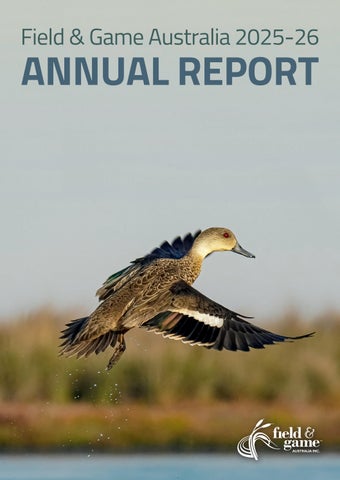
Field & Game Australia 2025-26
ANNUAL REPORT
FIELD & GAME AUSTRALIA | Annual Report 2025-26
1
2
FIELD & GAME AUSTRALIA | Annual Report 2025-26
About Field & Game Australia WHO WE ARE
GUIDE TO THE ANNUAL REPORT
FGA was established in 1958 by hunters who were concerned about the loss of wetland habitat for the game birds they loved to observe and hunt. FGA is now the nation’s most progressive firearm hunting and conservation organisation, with almost seven decades of service to the association’s membership, including hunters, target shooters and conservationists.
This is the annual report of Field & Game Australia (FGA) Inc. (ABN 79 042 436 123) for the financial year ending June 30, 2026. The report provides information from the Board, branches and stakeholders of FGA about the association’s operations and performance and is presented at the Association’s Annual General Meeting (AGM). FGA cannot be held liable for any printing errors in this document.
As FGA approaches 70 years, the organisation represents more than 16,000 members united by interests in target sports, hunting, and the desire to see Australia’s wetlands preserved for future generations. OUR PATRONS PROFESSOR GRAHAME WEBB, BSC (HONS), PhD. THE HONOURABLE DAVID HAWKER, AO. MR MAX DOWNES, BSC, PGD.
ACKNOWLEDGEMENTS Contributors: David Hawker AO; Lucas Cooke, Turlough Guerin, David Anderson. Feedback: We welcome your comments regarding this report. Telephone (03) 5799 0960 with your feedback, or email ceo@fieldandgame.com.au Front Cover Image: Andrew Jeffrey Back Cover Image: Phil Toose
Contents BOARD AND STAFF ��������������������������������������������������������������������������4
HUNTING AND GAME MANAGEMENT ����������������������������������� 18
CHAIRMAN’S YEAR IN REVIEW ���������������������������������������������������5
PEST CONTROL & VOLUNTEER HOURS �������������������������������� 20
FROM THE CHIEF EXECUTIVE OFFICER ������������������������������������6
MEMBERSHIP REPORT ��������������������������������������������������������������� 23
2025–26 FINANCIAL REPORT ������������������������������������������������������8
CLAY TARGET PARTICIPATION �������������������������������������������������� 24
WETLANDS ENVIRONMENTAL TASKFORCE ������������������������� 12
APPENDIX A ������������������������������������������������������������������������������������ 26
WET FINANCIAL REPORT ������������������������������������������������������������ 14
APPENDIX B ������������������������������������������������������������������������������������ 42
FIELD & GAME AUSTRALIA | Annual Report 2025-26
3
Field & Game Australia Board Members 2025-26
David Anderson Chairman
Trent Leen
Glenda Anderson
Adam Carson
Vicki Norris
Paul Sharp
Michaela Shirley
Dr Turlough Guerin
Anne-Marie Blewett
Glenn Falla
Wayne Peters
Chelsea Skinner
Olivia Peachey
CEO 2026
Operations Lead
Branch Liaison Officer
Finance Officer
Membership Services/ Administration
Vice Chairman
FGA team
Lucas Cooke CEO 2025-2026
Conservation & Hunting Manager
FGA National Office Connewarre Wetland Centre
605 Lake Road, Connewarre VIC 3227 Phone: (03) 5799 0960 Email: membership@fieldandgame.com.au
LIFE MEMBERS Dr. Hugh Martin MBE (dec)
John Foster (dec)
Gary Howard OAM
Rick Foster
Ron Bryant (dec)
Rex Cambrey (dec)
Albert Chamberlain (dec)
Russ Bate OAM
Doug Hemingway MBE (dec)
Allan Graham
Graham Eames
Tom Chick
Des Thomas OAM (dec)
Ruby Cato (dec)
Ian McLachlan
Bill Paterson
Phil Brown OAM (dec)
Geoff Proudfoot (dec)
Ron Danby (dec)
David Hawker AO
4
FIELD & GAME AUSTRALIA | Annual Report 2025-26
Chairman’s report This year we saw the appointment of Turlough Guerin as our Chief Executive Officer, taking over from Lucas Cooke. Turlough brings a wealth of knowledge and experience in leading not-for-profit organisations, land management, community awareness and engagement, along with a strong governance approach to help lead the organisation into a stronger position in all that we do. Welcome to Field & Game Australia, Turlough. We look forward to your leadership. The appointment of Turlough does not mean the loss of corporate knowledge or a weakening of our bench strength. In fact, it is the inverse. We have added further capability, with Lucas Cooke moving into the new role of Executive Officer Projects & Partnerships, where his focus on conservation and projects will be much more concentrated, bringing these important areas of our business to the forefront. As both settle into their respective roles and the rhythm starts to build, there is an expectation of seeing results in the areas of growth, financial security, reducing risk and achieving an even distribution of visibility across Conservation, Clay Target Shooting and Predator Control/Hunting, which is where we do our best work. The strengthening of our organisation brings with it a sense of success and added enthusiasm that will benefit us all. Over the past 10 months, elevated and engaged political advocacy has had our attention, while recognising that it is a complex beast. Often done behind the scenes, the demands on decision-makers and our desire to be heard will ebb and flow. This has been, and always will be, part of how it plays out. However, this year has seen a significant increase in our focus, some six to eight times our usual annual level of political engagement. Firearms reform legislation has been, and remains, an area where we have worked alongside other like-minded organisations to align, support each other and ensure we are heard across all areas of politics, both locally and federally. We have done this respectfully, but also in a strong and present manner, to ensure the interests of FGA and our members are well represented. We know we have areas of strong support within political circles, which is greatly appreciated. We also know there are areas where we need to clearly and concisely demonstrate what we do, the
Dave Anderson effort involved and the results we achieve. Our work in wetland conservation, predator control, and the skills and responsibilities associated with firearm ownership and use is a positive story and makes a significant contribution to the communities of which we are all a part. Educating those who may see us in a different light remains a role each and every one of us can take away and share with those we work with, meet and socialise with. We have a strong story to share. Remaining in the area of politics, our horizon could look quite different come November, and our preparation has focused on mapping the best way forward. We have formed a small but dedicated team specifically to develop our best message for each identified electorate we will visit, where we can share our thoughts and concerns while also showcasing how FGA can benefit those communities. It does not stop there. A number of visits to Spring Street have already occurred and will continue in the lead-up to the State election. In terms of our financial strength, we leave the 2025–26 financial year in a strong position, both in adding to our bottom line and commencing capital expenditure, which is a sign of projects progressing and maturing. This investment is focused on four key areas of growth and improvement that most of us are familiar with: our membership management system, our Willowmavin property, alternatives and options for insurance, and the development of our training organisation. People, I cannot say enough about the people of our organisation. I say it every time I get the chance: our people make us who we are. The incredible hours and dedication put in by our volunteers can only truly be understood by getting out there and being a part of it, whether in conservation, hunting or clay target shooting. It can be an overwhelming experience for a newcomer or visitor to see what we do and begin to understand all facets of our organisation. An organisation with such dedicated members also requires the professional and focused efforts of our leadership, our officebased team and a Board that is relentless in wanting the best for our organisation. The combination of our members, volunteers, leaders, staff and Board puts us in a formidable and unified position, bringing together skills, knowledge and experience and strengthening FGA as an organisation of choice. Looking ahead, the next 12 months will see several of our projects move towards implementation, further development of our membership growth strategy, particularly in other states, and a continued focus on reducing operating risks at both organisational and Branch level. It remains an exciting time for us, with a lot of work still to come. As Chair of this great organisation, I remain in awe of what each and every one of you delivers for FGA, the direction we are heading and the support you provide. I look forward to working with you all. Dave Anderson Chairman, Field & Game Australia
FIELD & GAME AUSTRALIA | Annual Report 2025-26
5
From the Chief Executive Officer 2025-26 The 2025–26 year has been another year of progress for Field & Game Australia, but also one of significant challenge and change. For me personally, it is also my final annual report as CEO. Earlier this year, I made the decision to step away as CEO and relocate back home to Tasmania for family reasons. It has been an enormous privilege to lead this organisation, and while I am looking forward to spending more time with my family, I am very pleased that I won’t be leaving FGA. I thank the Board and FGA members for their understanding and support. I will remain with the organisation as an Executive Officer, focusing on strategic projects and providing additional capacity for advocacy, partnerships and external relationships. I am also very pleased to welcome Turlough Guerin as FGA’s new CEO. Turlough brings considerable experience to the role, and I wish him every success in the CEO seat. I look forward to supporting him, the Board and the broader organisation as FGA moves into its next chapter.
A Strong Year for Hunting The year was a positive one for hunting. Despite continued regulatory challenges around licensing costs and training requirements in South Australia and Victoria, all states had good season parameters allowing hunters to get out in the field. Solid duck seasons across the Northern Territory, South Australia, Victoria and Tasmania demonstrated again that well-regulated, sustainable hunting has an important place in Australian wildlife management and outdoor recreation. FGA continued to invest heavily in positive hunting advocacy and building constructive relationships with governments, regulators and wildlife managers. In Victoria, we saw particularly encouraging progress. Two
additional areas of national park were opened to deer hunting, providing new opportunities while recognising the role recreational hunters can play Lucas Cooke in managing deer populations on public land. We have also seen better engagement with Parks Victoria around practical deer management, including at Connewarre and elsewhere.
An Extraordinary Year for Firearms Advocacy The environment changed dramatically following the terrorist attack at Bondi in December 2025. In the aftermath, firearms legislation was suddenly placed firmly back on the political agenda, with the Federal Government and several states moving quickly towards significant changes. For FGA, this meant an enormous advocacy effort to protect the rights and interests of our members — and the broader licensed firearms community — to continue responsibly owning and using firearms for legitimate purposes. At the time of writing, around ten months later, that work continues. Victoria provides an important example of why sustained advocacy matters. The Ken Lay review proposed a range of significant changes to Victoria’s firearms laws, some of which FGA strongly opposed. Ultimately, the Victorian Government did not proceed with numerical caps on firearm ownership, broad firearm reclassifications or a large-scale firearm buyback. While there remain areas of concern, this was a considerably better outcome for responsible firearm owners than it might otherwise have been. Advocacy will continue through the Victorian election in November and into 2027. Regardless of who forms government, our job is to maintain strong relationships across the political spectrum and ensure FGA remains a credible and constructive voice for responsible firearm owners. Nationally, the outcomes have certainly not all been what we would have chosen. But, with the notable exceptions of New South Wales and the ACT, I believe they have been considerably better than they might otherwise have been.
A Stronger Organisation Despite the political challenges, FGA itself remains in a strong position. Membership has continued to grow, our branches remain active, and we have a strong and engaged Board providing direction to the organisation. The financial results contained in this Annual Report are also encouraging. FGA recorded another operating surplus while continuing to invest in staff, advocacy, member services, facilities and organisational capability. Over the past several years, we have deliberately strengthened FGA’s financial position. That is now reflected in a strong balance sheet, substantial cash reserves and very low external liabilities. Only a few years ago, during COVID, FGA — like many organisations — faced considerable financial uncertainty. Today, we have much greater resilience and the capacity not only to
6
FIELD & GAME AUSTRALIA | Annual Report 2025-26
withstand future challenges, but to invest strategically in the organisation’s future. Building reserves was never intended to be an end in itself. It was about ensuring FGA could weather difficult periods, respond when our members need us and pursue worthwhile opportunities when they arise. It has also been encouraging to see strong attendance and engagement at our Presidents’ Meetings and Annual General Meetings. I encourage every branch to participate. For most committees, these meetings represent just two days out of an entire year and provide an opportunity to understand what is happening nationally, contribute to FGA’s direction and connect with other branches.
We Are One Organisation Our strength comes from combining the local knowledge, volunteer effort and community connections of our branches with the resources, advocacy and national reach of FGA.
Conservation, Clubs and Community While political advocacy can dominate the headlines, the work that defines FGA continues every week across the country. Our branches run clay target events, introduce new people to shooting, maintain ranges and facilities, undertake conservation projects and provide places where members can participate safely and responsibly. Our Wetland Environmental Taskforce and branch volunteers continue practical conservation work — restoring wetlands, managing predators and improving habitat. Importantly, we are also modernising that work. Our nesting structure programs are increasingly supported by tracking, monitoring and better analysis of results, including through our growing partnership with Delta Waterfowl and several university research projects.
Looking Forward There is still plenty of work ahead. The arrival of H5N1 avian influenza in Australia will present another significant challenge. It will require hunters, conservation organisations, researchers and governments to work together, and the relationships FGA has built with government and wildlife agencies will become increasingly important. The political environment surrounding firearms and hunting remains challenging, while FGA has significant opportunities to expand its conservation work, training capability, partnerships and influence. We have spent several years strengthening the foundations of the organisation. The opportunity now is to build on them. Turlough will bring his own ideas, experience and leadership to the CEO role, as he should. I am confident he inherits an organisation on sound financial ground, with good people, a committed Board, strong branches and enormous potential.
Thank You Finally, I want to sincerely thank everyone who has supported me during my time as CEO — my staff, our current and former Board members, branch presidents and committees, volunteers, partners and, most importantly, our members. Being CEO of FGA has not been easy — nor should a role like this be — but it has been an extraordinary privilege. I have had the opportunity to work alongside people who give enormous amounts of their own time to conservation, shooting, hunting and their local communities simply because they believe these things are worth protecting. They are. If the past few years have demonstrated anything, it is that FGA is strongest when we stand together. Lucas Cooke Chief Executive Officer, Field & Game Australia
From the Chief Executive Officer June 2026 I commenced as CEO in June 2026, so I was in the role for only the final month of the year covered by this report. The achievements recorded throughout this Annual Report belong to Lucas Cooke, the Board, our staff, branches, members and volunteers who carried FGA through 2025-26. I want to acknowledge Lucas for his leadership of the organisation and for the support he provided during the transition. Since joining FGA, I have made it a priority to get out and see the organisation firsthand. That means visiting branches, meeting members and volunteers, spending time at shooting grounds and wetlands, and listening to what is working and where we can improve. The amount of work undertaken by our members is significant. They run shoots, maintain ranges, restore wetlands, control pest animals, work with land managers, support junior participants and keep branches operating. Much of this work happens quietly. We need to become better at recording it and using that evidence to demonstrate the environmental, community and economic contribution our members make. My focus is on strengthening what already works. That includes supporting branches, improving member service, making our systems simpler and more useful, maintaining sound governance and safety standards, and directing our resources to the areas
where they can have the greatest effect. Turlough Guerin Advocacy will remain a major part of the role. FGA needs strong working relationships with governments, regulators, land managers and other organisations, irrespective of politics. Where decisions affect hunting, clay target shooting or conservation, we need to be involved early, with sound evidence, practical solutions and a clear understanding of the consequences for our members. FGA has a strong history and a solid base to build from. I look forward to continuing to meet members and branches across the country and working with the Board and team to strengthen the organisation and improve how we represent and support our members. Dr Turlough Guerin Chief Executive Officer, Field & Game Australia
FIELD & GAME AUSTRALIA | Annual Report 2025-26
7
2025-26 FINANCIAL REPORTS Field & Game Australia Inc.
Statement of profit or loss and other comprehensive income
Statement of financial position As at 30 June 2026
For the year ended 30 June 2026 Note Revenue
3
Note
2026
2025
$
$
1,899,343
1,776,345
Expenses
2025
$
$
Assets Current assets Cash and cash equivalents
4
2,122,744
1,947,457
Trade and other receivables
5
57,693
61,204
Inventory
6
71,940
81,000
Other
7
192,321
170,279
2,444,698
2,259,940
Administration and office expenses
(69,021)
(66,129)
Advocacy and stakeholder engagement expenses
(7,176}
(14,971)
Cost of sales
(16,653)
(37,521)
Depreciation expense
(31,960)
(30,436)
Non-current assets
Employee benefits expense
(684,698)
(656,402)
Property, plant and equipment
8
1,385,309
1,439,364
National Carnival
(143,486)
(107,650)
Other
9
470,000
470,000
Events, Branches and ASF
(104,238)
(48,536)
Total non-current assets
1,855,309
1,909,364
Information technology and communication expenses
(8,954)
(9,185)
Total assets
4,300,007
4,169,304
Insurance expense
(177,442}
(182,298)
Liabilities
Membership communications and publications expense
(245,902)
(225,396)
Current liabilities 137,873
131,898
Occupancy and property expenses
(57,894)
Other expenses
Total current assets
Trade and other payables
10
(31,397)
Deferred income
11
9,174
13,789
Employee benefits
12
73,866
73,000
(37,038)
(17,945)
Total current liabilities
220,913
218,687
Professional fees
(70,087)
(76,449)
Travel and accommodation expenses
(41,483)
(16,008)
Loss on disposal of asset
(80,218)
-
Surplus before income tax expense
123,093
256,023
-
-
Surplus after income tax expense for the year attributable to the members of Field & Game Australia Inc
123,093
256,023
Other comprehensive income for the year, net of tax
-
-
Total comprehensive income for the year attributable to the members of Field & Game Australia Inc
123,093
256,023
Income tax expense
8
2026
Non-current liabilities Employee benefits
13
24,385
19,000
Unspent funds
14
114 658
114,658
Total non-current liabilities
139,043
133,658
Total liabilities
359,956
352,346
3,940,051
3,816,958
3,940,051
3,816,958
3,940,051
3,816,958
Net assets Equity Retained surpluses Total equity
FIELD & GAME AUSTRALIA | Annual Report 2025-26
15
Statement of changes in equity
Statement of cash flows For the year ended 30 June 2026
For the year ended 30 June 2026 Retained surpluses
Note Total equity
$ Balance at 1 July 2024
$
3,560,935
3,560,935
256,023
256,023
Other comprehensive income for the year, net of tax
-
-
Total comprehensive income for the year
256,023
256,023
3,816,958
3,816,958
Retained surpluses
2025
$
$
Receipts from customers
1,848,645
1,816,822
Payments to suppliers and employees
(1,672,895)
(1,671,510)
175,750
145,312
49,593
42,637
225,343
187,949
Payments for property, plant and equipment
(50,056)
(24,112)
Net cash used in investing activities
(50,056)
(24,112)
-
-
Cash flows from operating activities
Surplus after income tax expense for the year
Balance at 30 June 2025
2026
Total equity
Interest received Net cash from operating activities
19
Cash flows from investing activities
$
$
3,816,958
3,816,958
Surplus after income tax expense for the year
123,093
123,093
Other comprehensive income for the year, net of tax
-
-
Net cash from financing activities
Total comprehensive income for the year
123,093
123,093
Net increase in cash and cash equivalents
175,287
163,837
3,940,051
3,940,051
Cash and cash equivalents at the beginning of the financial year
1,947,457
1,783,620
2,122,744
1,947,457
Balance at 1 July 2025
Balance at 30 June 2026
Cash and cash equivalents at the end of the financial year
4
FIELD & GAME AUSTRALIA | Annual Report 2025-26
9
2025-26 FINANCIAL REPORTS Field & Game Australia Inc.
Notes to the financial statements 30 June 2026
Note 8. Non-current assets - property, plant and equipment
Note 3. Revenue 2026
2025
2026
2025
$
$
$
$
150,323
121,168
1,108,185
1,108,185
Membership revenue
1,580,366
1,474,777
Merchandise revenue
36,807
31,972
227,400
262,617
Advertising revenue
23,250
30,341
Buildings and building improvements - at cost
1,790,746
1,658,258
Less: Accumulated depreciation
(49,008)
-
178,392
262,617
Donations and fundraising income
15,323
20,800
Plant and equipment - at cost
16,035
66,851
Grant income
4,616
8,832
Less: Accumulated depreciation
(2,675)
(30 645)
Interest income
49,593
63,455
13,360
36,206
Other revenue
39,065
25,000
194,275
159,759
108,597
118,087
(131,070 )
(138,597)
1,899,343
1,776,345
63,205
21,162
Office & IT equipment - at cost
46,850
111,658
Less: Accumulated depreciation
(24,683)
(100,465) 11,193
Revenue from contracts with customers National Carnival
Other revenue
Revenue
Note 4. Current assets - cash and cash equivalents
Land - at cost
Motor vehicles - at cost Less: Accumulated depreciation
2026
2025
$
$
22,167
Cash on hand
200
200
Cash at bank
1,024,442
886,405
1,385,309
1,439,364
Term deposits
1,098,102
1,060,852
2,122,744
1,947,457
2026
2025
$
$
470,000
470,000
Note 5. Current assets - trade and other receivables 2026
2025
$
$
Accounts receivable
49,566
61,204
Sundry receivable
8,127
-
57,693
61,204
2026
2025
$
$
71,940
81,000
2026
2025
$
$
192,321
170,279
Note 6. Current assets - inventories
Stock on hand
Note 9. Non-current assets - other
Loan to Wetlands Environmental Taskforce Trust
Note 10. Current liabilities - trade and other payables 2026
2025
$
$
Trade payables
81,896
90,703
Credit card
7,027
8,986
Other payables
Revenue received in advance
FIELD & GAME AUSTRALIA | Annual Report 2025-26
2026
2025
$
$
9,174
13,789
Note 12. Current liabilities - employee benefits
Employee benefits
10
32,208 131,898
Note 11. Current liabilities - deferred income
Note 7. Current assets - other
Prepayments
48,950 137,873
2026
2025
$
$
73,866
73,000
Note 13. Non-current liabilities - employee benefits
Employee benefits
2026
2025
$
$
24,384
19,000
Note 14. Non-current liabilities - Unspent Funds
Fighting Fund
2026
2025
$
$
114,658
114,658
Note 15. Equity - retained surpluses 2026
2025
$
$
Retained surpluses at the beginning of the financial year
3,816,958
3,560,935
Surplus after income tax expense for the year
123,093
256,023
Retained surpluses at the end of the financial year
3,940,051
3,816,958
Note 16. Contingent liabilities The incorporated association had no contingent liabilities as at 30 June 2026 and 30 June 2025. Note 17. Commitments The incorporated association had no commitments for expenditure as at 30 June 2026 and 30 June 2025.
Note 19. Reconciliation of surplus after income tax to net cash from operating activities 2026
2025
$
$
123,093
256,023
Depreciation and amortisation
31,960
21,999
Loss on disposal of assets
80,218
-
Net non-cash write offs
(8,067)
-
Decrease/(increase) in trade and other receivables
3,511
(15,545)
Decrease/(increase) in inventory
9,060
(39,601)
(22,041)
(8,679)
(Decrease)/increase in trade and other payables
5,975
(46,489)
(Decrease)/increase in deferred income
(4,616)
(13,827)
(Decrease)/increase in employee benefits
6,250
34,067
Net cash from operating activities
225,343
187,949
Surplus after income tax expense for the year Adjustments for:
Change in operating assets and liabilities:
Decrease/(increase) in other assets
Note 18. Events after the reporting period No matter or circumstance has arisen since 30 June 2026 that has significantly affected, or may significantly affect the incorporated association’s operations, the results of those operations, or the incorporated association’s state of affairs in future financial years.
FIELD & GAME AUSTRALIA | Annual Report 2025-26
11
Wetlands Environmental Taskforce Chairman’s Report 2025–2026
The past year has been another important one for the Wetlands Environmental Taskforce, with progress across wetland restoration, water management, habitat improvement, environmental education and partnerships. Perhaps nowhere is that progress more evident than at Heart Morass. In 2026, we mark 20 years since the beginning of the Heart Morass property restoration story. What was once a heavily degraded wetland has become one of Field & Game Australia’s most significant long-term conservation projects, supported over two decades by volunteers, project partners and land and water managers. This year also marked an important new chapter for the wetland, with the completion of a new freshwater inlet connecting Heart Morass directly to the Latrobe River. Planning for improved watering infrastructure began more than a decade ago, with investigations commencing in 2014 and detailed designs completed in 2015. Construction finally began in November 2025, with the new inlet completed and commissioned in June 2026. The project includes a 200-metre river offtake channel and two large water-control gates, substantially improving the capacity to deliver freshwater into Heart Morass and manage water levels. This will support important ecological outcomes including wetland vegetation, waterbird breeding and salinity management. It is a significant investment in the future of Heart Morass and builds on many years of restoration and practical land management. West Gippsland Catchment Management Authority has acknowledged FGA’s land management and the hundreds of
12
FIELD & GAME AUSTRALIA | Annual Report 2025-26
thousands of volunteer hours contributed to Heart Morass as central to its recovery.
David Hawker AO
Water, Habitat And Long-Term Management At the Connewarre Wetland Centre, work has continued to build on previous investment in water-control infrastructure, levee repairs, nesting habitat and biodiversity monitoring. An important focus has been continuing to explore opportunities to improve water management at Connewarre. This work involves engagement with relevant agencies and water authorities to better understand the options available to support the wetland into the future. Securing appropriate long-term water management remains important to maintaining the health and resilience of this significant wetland. Our conservation work continues to extend beyond the properties themselves. FGA members and branches contribute to pest and predator management, habitat restoration, nesting infrastructure, weed control, monitoring and other practical projects across a range of landscapes. The management of invasive species remains particularly important. Foxes, feral cats, rabbits, wild dogs, pigs, goats and
other invasive animals place considerable pressure on native wildlife and habitat. Predator control can benefit not only waterfowl, but ground-nesting birds, small mammals, reptiles and other native species. Nesting habitat also remains an important part of our work, building on the establishment of hen houses and nesting-box projects in previous years. These initiatives complement broader habitat and predator-management efforts and demonstrate the value of taking a long-term approach to wetland conservation.
Working Together One of the strengths of WET has always been its ability to work with others. Throughout the year, FGA has continued engagement with government departments, Parks Victoria, catchment management authorities, water authorities and other land managers on habitat restoration, environmental watering, predator management and monitoring. This has included site visits, project development, habitat planning and discussions around future conservation opportunities. FGA also contributed to the Victorian Waterway Management Strategy, drawing on our practical experience at Heart Morass, Connewarre and other wetlands to advocate for stronger partnerships between government agencies, land managers, community organisations and volunteers. Our current conservation footprint includes conservation, monitoring or advocacy involvement across 20 significant Victorian wetland systems. Our relationship with Parks Victoria has also continued to develop. Through ParkConnect, members have opportunities to participate in projects including weed control, habitat restoration, infrastructure maintenance and access improvements. Engagement with Parks Victoria during the year has provided further opportunities to discuss volunteering, public-land management and how community organisations such as FGA can contribute effectively. These relationships matter. The best conservation outcomes are rarely achieved by one organisation working alone, and our ability to combine volunteer effort with the knowledge and resources of land and water managers remains an important part of what WET brings to conservation.
Inspiring The Next Generation Conservation is also about ensuring the next generation understands the value of the environments we are working to protect. Bug Blitz continues to provide an important connection between young people and the natural environment. Since beginning in 2008, the program has engaged more than 50,000 participants, with WET-supported activities continuing at Heart Morass and Connewarre. Programs such as this give young people an opportunity to experience wetlands firsthand and learn about biodiversity, habitat and the many species that depend on healthy wetland systems. Our properties also continue to provide opportunities for schools, community organisations, researchers, photographers, birdwatchers and families to experience and learn about wetland environments. The value of these places extends well beyond their physical boundaries; they provide a practical connection between conservation and the wider community.
The Duck Stamp Continues To Grow The Field & Game Australia Duck Stamp continues to provide another way of celebrating Australia’s waterfowl while raising funds and awareness for conservation. Following Paul Sharp’s Chestnut Teal in 2024 and Gayle
Newcombe’s Pink-eared Duck in 2025, the 2026 competition attracted artists from around Australia. Colin Halden’s depiction of the Blue-winged Shoveler was selected as the winning artwork for the 2026 stamp. The program continues to grow and provides an opportunity to connect art, waterfowl and conservation while generating funds that can be directed back into conservation work.
Preserving Our History WET has also continued work to preserve an important part of Australia’s hunting history through the Australian National Hunting Archive. Following the passing of Max Downes, work commenced with Elizabeth and Malcolm Downes to ensure this significant collection was preserved. During 2026, relocation of the archive to the Connewarre Wetland Centre progressed, including moving files, installing racking and beginning the considerable task of labelling and categorising the collection. While different from our work in the wetlands, preserving this material ensures an important record of Australian hunting, conservation and environmental history is not lost.
Looking Ahead As we reflect on the year, Heart Morass provides a powerful reminder of what long-term commitment can achieve. Twenty years ago, those involved could not have known exactly what the property would become. Its recovery has taken persistence, partnerships, sound environmental management and an enormous contribution from volunteers. The completion of the new freshwater inlet this year is not the end of that story. It provides another tool to help manage Heart Morass into the future and demonstrates what becomes possible when conservation is approached over decades rather than years. There remains much to do across Heart Morass, Connewarre and the many other wetlands and landscapes where our members contribute. We will continue to strengthen partnerships, improve habitat, support sound water management, control invasive species and create opportunities for people to participate in practical conservation. On behalf of the Wetlands Environmental Taskforce, I thank Field & Game Australia members, volunteers, branches, project partners, government agencies and supporters who have contributed throughout the year. The strength of WET has always come from people prepared to give their time, knowledge and effort to the places they value. I look forward to building on that work in the year ahead. David Hawker AO Chairman, Wetlands Environmental Taskforce
FIELD & GAME AUSTRALIA | Annual Report 2025-26
13
2025-26 FINANCIAL REPORTS Wetlands Environmental Taskforce Public Fund
Statement of profit or loss and other comprehensive income For the year ended 30 June 2026 Note
2026 $
$
4
116,973
109,370
Administration and office expenses
(20,106)
(20,825)
Depreciation and amortisation expense
(18,018)
(3,346)
Event expenses
(23,445)
(20,178)
(904)
(579)
Other expenses
(3,209)
(2,781)
Professional Fees
(4,000)
787
Surplus for the year
47,291
62,448
Revenue
As at 30 June 2026
Note
2025
Expenses
Occupancy and property expenses
Statement of financial position 2025
$
$
Assets Current assets Cash and cash equivalents
5
393,887
400,042
Trade and other receivables
6
49.387
19,621
443,274
419,663
2,564,911
2,539,429
Total non-current assets
2,564,911
2,539,429
Total assets
3,008,184
2,959,092
20,169
18,368
20,169
18,368
470,000
470,000
Total non-current liabilities
470,000
470,000
Total liabilities
490,169
488,368
2,518,015
2,470,724
Retained surpluses
2,518,015
2,470,724
Total equity
2,518,015
2,470,724
Total current assets Non-current assets Property, plant and equipment
7
Liabilities
Other comprehensive income
Current liabilities
Items that will not be reclassified subsequently to profit or loss
-
-
Trade and other payables
Total Comprehensive income for the year
-
-
Non-current liabilities
47,291
62,448
Total comprehensive income for the year
2026
8
Total current liabilities
Loan
Net assets
9
Equity
14
FIELD & GAME AUSTRALIA | Annual Report 2025-26
Statement of changes in equity
Statement of cash flows For the year ended 30 June 2026
For the year ended 30 June 2026
Note
2026
2025
$
$
Receipts from operations
73,616
209,564
Payments to suppliers
(49,863)
(68,223)
23,753
141,341
Interest received
13,591
9,554
Net cash from/(used in) operating activities
37,344
150,895
Payments for property, plant and equipment
(43,500)
(13,744)
Net cash from/(used in) investing activities
(43,500)
(13,744)
-
-
Retained earnings
Total equity
$
$
Balance at 1 July 2024
2,408,277
2,408,277
Surplus for the year
62,448
62,448
-
-
62,448
62,448
2,470,724
2,470,724
Retained earnings
Total equity
$
$
Balance at 1 July 2025
2,470,724
2,470,724
Surplus for the year
47,291
47,291
-
-
Net increase/(decrease) in cash and cash equivalents
(6,155)
137,151
47,291
47,291
400,042
262,891
2,518,015
2,518,015
Cash and cash equivalents at the beginning of the financial year Cash and cash equivalents at the end of the financial year
393,887
400,042
Other comprehensive income for the year Total comprehensive income for the year Balance at 30 June 2025
Other comprehensive income for the year Total comprehensive income for the year Balance at 30 June 2026
Cash flows from operating activities
Cash flows from investing activities
Cash flows from financing activities Net cash from/(used in) financing activities
FIELD & GAME AUSTRALIA | Annual Report 2025-26
15
2025-26 FINANCIAL REPORTS Wetlands Environmental Taskforce Public Fund
Notes to the financial statements 30 June 2026 Note 4. Revenue
2026
2025
$
$
Revenue from operating activities
Trade payables
Heart Morass
24,517
30,041
Rent
32,727
-
Gifts & Donations
31,238
27,719
88,482
57,760
Other revenue Grant income
12,028
-
Interest income
13,592
9,554
Other revenue
2,871
42,056
28,491
51,610
116,973
109,370
2026
2025
$
$
Revenue Note 5. Cash and cash equivalents Cash on hand
10
10
Cash at bank
49,781
192,282
Term deposits
344,096
207,750
393,887
400,042
2026
2025
$
$
42,855
15,050
Note 6. Trade and other receivables Trade receivables Accrued income - interest
Note 7. Property, plant and equipment
6,531
4,571
49,386
19,621
2026
2025
$
$
2,277,434
2,277,434
Buildings & building improvements - at cost
229,818
229,818
Less: Accumulated depreciation
(10,661)
-
219,157
229,818
Land - at cost
Plant & equipment - at cost
109,636
66,136
Less: Accumulated depreciation
(53,431)
(46,074)
56,205
20,062
12,115
12,115
2,564,911
2,539,429
Perpetual Lease Lake Bulloke
See Appendix B for full audited financial Reports.
16
Note 8. Trade and other payables
FIELD & GAME AUSTRALIA | Annual Report 2025-26
2026
2025
$
$
18,000
18,000
Other payables
2,169
368
20,169
18,368
2026
2025
$
$
470,000
470,000
470,000
470,000
Note 9. Loan Loan from Field & Game Australia Inc
Note 10. Contingent liabilities The Trust has no known contingent assets or liabilities at the reporting date. Note 11. Events after the reporting period No matter or circumstance has arisen since 30 June 2026 that has significantly affected, or may significantly affect the trust’s operations, the results of those operations, or the trust’s state of affairs in future financial years.
Branch and Member Awards Since 1958, Field & Game Australia members and branches have provided dedicated service to the association, making a positive contribution across all facets of the organisation – from hunting and conservation to clay target participation and the wider Field & Game community. Each year, FGA seeks nominations from across the branch network to recognise branches and individuals whose commitment, achievements and ongoing contribution deserve acknowledgement. These awards celebrate the many ways our members and volunteers contribute to the strength and success of the association, whether through conservation initiatives, pest and vermin control, promotion of Field & Game activities, or dedicated service within their local communities. In 2025, the Board was pleased to recognise the following branches for their outstanding contributions:
2025 Pest & Vermin Control Award 1st Place – Darlington Field & Game 2nd Place – Ballarat Field & Game 3rd Place – Seymour Field & Game
2025 Blue Wing Trophy This year’s Blue Wing Award goes to Rushworth Field & Game, a branch leading by example in wetlands conservation and habitat engineering. Their consistent delivery of projects, strong community engagement, and enthusiasm for sharing their progress—both in the field and online—showcase the spirit of Field & Game at its best. With thriving habitat projects, successful nesting houses and parrot boxes, and meaningful collaborations with other branches and local schools, Rushworth F&G continues to set a high standard for conservation in action.
2025 Media Award – Rushworth Field & Game Recognising the branch’s outstanding efforts in promoting Field & Game activities and sharing the work, events and community of the association with a wider audience across newspaper and social media.
Recognising Our Members Field & Game Australia is built on the contribution of members who give their time, knowledge and experience to support their branches, fellow members and the broader organisation. Our Member Awards recognise those individuals whose contribution goes well beyond simply participating. They acknowledge the people who volunteer year after year, take on leadership roles, support events and conservation activities, mentor others and are always willing to step in when their branch needs them. At the 2025 Annual General Meeting, the Dr Hugh Martin Medal was awarded to Jeffrey Glass, recognising his exceptional and longstanding contribution to Field & Game Australia. Over more than four decades, Jeffrey has supported clay target shooting, conservation and branch activities, including junior and school competitions, fox drives, working bees and the many behind-thescenes jobs that keep a branch running. Member Service Awards were also presented to Robert Lyndon and Mr Neville Vaux, recognising their lengthy and reliable service to their branches and fellow members. Robert was acknowledged for his long-term involvement in branch operations, shooting events, maintenance and conservation activities, while Mr Neville was recognised for more than 35 years of service, including his longstanding support of the branch canteen and events, together with his generous sponsorship and contribution of prizes through his butchery business. These awards are an important opportunity to recognise members whose contribution can sometimes happen quietly in the background, but whose commitment, reliability and willingness to help have a lasting impact on their branches and on Field & Game Australia.
FIELD & GAME AUSTRALIA | Annual Report 2025-26
17
Hunting and Game Management Report 2025–2026 The 2025–26 year has been an important period for hunting and game management across Australia, with stronger use of science in season setting, continued improvements in monitoring and research, and significant engagement by Field & Game Australia with governments, regulators and land managers. For FGA, the focus has remained consistent: sustainable hunting opportunities supported by sound evidence, practical regulation and responsible participation. The year also reinforced the importance of hunters being actively involved in the systems that determine the future of hunting. Good game management requires reliable population data, accurate harvest information, effective compliance, appropriate habitat management and an understanding of what is happening on the ground. Hunters have an important contribution to make in each of these areas.
Adaptive Harvest Management Takes Shape In Victoria One of the most significant developments has been the continued implementation of Adaptive Harvest Management (AHM) for Victorian game ducks. The Victorian Game Duck Harvest Strategy introduced AHM as the framework for determining annual duck season arrangements, using population estimates, harvest data and modelling to establish sustainable settings. The first year provided valuable information. The Game Management Authority estimated that 9,950 active hunters harvested approximately 487,800 game ducks during the 2025 season. Importantly, the results could then be compared against the model used to establish the season settings, providing information to refine the system for subsequent years. That process continued into 2026. The estimated Victorian game duck population increased from approximately four million birds in spring 2024 to 4.9 million in spring 2025. Following further modelling, the daily bag limit for the 2026 season was again set at nine game ducks. The 2026 Victorian season ran from 18 March to 8 June, with seven game duck species available to hunt and the Blue-winged Shoveler excluded. FGA has consistently supported the principle that game management decisions should be based on evidence. AHM is not a static system and will continue to require scrutiny and refinement, but establishing a repeatable framework based on population and harvest data is an important step forward.
A Positive 2026 Season Reports from FGA members during the 2026 season were generally positive, although conditions varied considerably between regions. Some hunters reported good bird numbers and productive hunting, while conditions on several larger public wetlands, including parts of the Kerang and western Victorian systems, were more challenging. Birds were often mobile and responsive to changing water, feed and hunting pressure. This variation is an important reminder that statewide population estimates do not mean birds will be evenly distributed across the landscape. Water availability, habitat, food and climatic conditions continue to influence where birds congregate and how hunters experience a season. South Australia also provided a substantial 2026 duck season, with a daily bag limit of eight ducks, increased from six in 2025 after seasonal surveys indicated improved duck numbers. The South Australian Stubble Quail season ran from 25 April to 2 August with a daily bag limit of 15 birds, while Victoria retained its
18
FIELD & GAME AUSTRALIA | Annual Report 2025-26
annual April-to-June Stubble Quail season with a daily limit of 20. Victorian hunters continued the transition to non-toxic shot for quail following the introduction of the requirement in 2025. Together, these seasons demonstrate the value of game management arrangements that can respond to changing populations and environmental conditions rather than assuming every year will be the same.
Responsible Hunting And Compliance Hunter behaviour remains an important part of maintaining confidence in regulated hunting. The final Victorian compliance results for the 2026 duck season provide useful perspective. GMA conducted 541 wetland and waterway patrols, checked 1,788 Game Licences and inspected 1,139 hunter bags. Across the entire season, 33 offences were detected. Importantly, no hunters were detected exceeding the bag limit, and no infringement or banning notices were issued for public-safety offences. The most common hunting offences related to possession of toxic shot, failure to leave a fully feathered wing attached to harvested birds and invalid or absent Game Licences. These results are significant. They do not suggest there is no room for improvement — there always is — but they provide an evidence-based picture of compliance across thousands of interactions between hunters and regulators. FGA will continue to reinforce the importance of members understanding season arrangements, correctly identifying species, using permitted ammunition, retrieving downed birds and complying with all licence and harvest requirements.
Better Information For Better Decisions One of the most encouraging developments during the year has been continued investment in game-bird research. The GMA and Deakin University commenced the largest Australian study of game-duck movement and survivorship, using satellite tracking devices on Pacific Black Ducks, Australian Wood Ducks, Grey Teal and Chestnut Teal. The research is intended to improve understanding of how game ducks move across the landscape, use habitat and survive over time. This type of research is important because Australian waterfowl do not behave like many Northern Hemisphere migratory species. Their movements can be highly responsive to rainfall, flooding and habitat availability across a vast landscape. FGA supports continued investment in research that improves the evidence available to game managers. Better information about abundance, movement, breeding, harvest and survival ultimately allows better decisions to be made. The same principle applies to research into wounding reduction. During the year, FGA continued to engage with work being undertaken through Victoria's Waterfowl Wounding Reduction Action Plan, including research examining hunter attitudes, behaviours and the environmental or situational factors that may contribute to wounding. FGA's position remains that this work should distinguish clearly between wounding, legal compliance and recommended hunting practice, while using sound research to identify practical opportunities to improve outcomes.
Hunting Beyond Victoria FGA's hunting membership extends beyond Victoria, and maintaining viable hunting opportunities nationally remains important. South Australia again provided open seasons for both ducks and Stubble Quail during 2026, while members in Tasmania also participated in the state's game seasons. In the Northern Territory, preparations continued for the 2026–27 Magpie Goose and waterfowl season. Private-land hunting opened from 15 August 2026, with designated hunting reserves opening from 5 September. The declared daily limits are seven Magpie Geese and ten other permitted waterfowl. FGA continues to maintain an interest in game management arrangements across jurisdictions and to support members with information about season settings, regulation and responsible hunting practices.
Pest And Predator Management Hunting and game management also intersect with the broader management of invasive animals. Across FGA's branch network, members continue to undertake fox, feral cat, rabbit and other pest-animal control on private and public land. This work supports landholders while also reducing pressure on native wildlife. During the year, FGA placed greater emphasis on the broader environmental benefits of targeted predator control. Removing foxes and feral cats from wetland and surrounding landscapes can benefit waterfowl, but the effect extends further to groundnesting birds, small mammals, reptiles and other native species exposed to the same predators. This work increasingly sits alongside habitat improvement and wetland management rather than being treated as a separate activity. Effective wildlife management requires attention to the whole landscape — habitat, water, predators and people.
Working With Government And Land Managers FGA continued to strengthen engagement with regulators, government departments, Parks Victoria and other land managers during the year. A particularly welcome development was renewed engagement with Parks Victoria around volunteerism, public-land management and community participation. Parks Victoria CEO Lee Miezis accepted an invitation to speak directly with FGA branch representatives at the General Presidents Meeting, providing an opportunity for constructive discussion about the role community organisations and volunteers can play on public land. For hunters, access and land management are closely connected. Maintaining healthy public land requires active management, and the people who regularly use these areas can provide considerable knowledge about local conditions, access, pest animals, habitat
and emerging issues. FGA will continue advocating for hunters and community organisations to be treated as constructive partners in these conversations.
Representing Hunters In Policy And Research Throughout 2025–26, FGA continued engaging with governments, agencies, researchers and other stakeholders on matters affecting game management and hunting. This work is not always visible. It includes submissions, meetings, consultation responses, discussions with regulators, participation in research and direct engagement with decision-makers. The objective is not simply to argue for more hunting opportunity. It is to advocate for good game management: decisions based on evidence, regulations proportionate to the risk being managed, continued investment in wildlife research and monitoring, practical access arrangements and recognition of the contribution responsible hunters make to land and wildlife management. That approach becomes increasingly important as governments consider changes to the agencies and structures responsible for outdoor recreation, hunting and game management. FGA will continue to seek specialist game-management expertise within those structures and a genuine role for organisations representing the people who hunt, volunteer and spend considerable time in the landscapes being managed.
Looking Ahead There is much to build on. Adaptive Harvest Management is beginning to provide a stronger evidence base for Victorian duck season decisions. New tracking and monitoring programs are improving knowledge of Australian game birds. Compliance results continue to demonstrate that the overwhelming majority of hunters encountered by regulators are doing the right thing. And across the country, members continue to participate in regulated hunting, pest management and practical conservation. None of this means the future can be taken for granted. Game management needs ongoing investment in science. Hunters need to maintain high standards in the field. Governments need to make decisions based on evidence rather than perception. And organisations such as FGA need to remain actively involved wherever policy affecting hunting, wildlife and public land is being developed. Our role is to make sure the experience of hunters is part of that process, while continuing to support responsible hunting and sustainable wildlife management. That will remain our focus in the year ahead. Field & Game Australia Hunting and Game Management Report 2025–2026
FIELD & GAME AUSTRALIA | Annual Report 2025-26
19
Pest & Vermin Control Volunteer Hours Report Every hour counts – and every hour tells our story Across Field & Game Australia, volunteers contribute an extraordinary amount of time to their branches, communities and the environment each year. From pest animal control and wetland conservation to maintaining grounds, running shoots, managing canteens, organising events and completing the countless jobs that keep our branches operating, volunteering is at the heart of our organisation.
The Impact Of Volunteering Behind every successful branch, event and conservation project are people who have freely given their time to make it happen. Often these contributions are made quietly, without recognition, but collectively they have an enormous impact. Our volunteers help maintain and improve the places we enjoy, support the delivery of clay target shooting and hunting activities, care for wetlands and habitat, and create opportunities for people to come together through their local branches. The value of this contribution extends well beyond the hours themselves. Volunteering builds stronger branches and communities, brings together generations of knowledge and experience, and allows skills to be shared with the next generation of members.
Conservation In Action For many Field & Game Australia members, volunteering also means getting their boots on the ground. Wetland management, habitat restoration, nest box and henhouse programs, wildlife monitoring and pest animal control are practical examples of members contributing directly to conservation outcomes. These activities require time, commitment and often many hands. Whether it is a few hours spent maintaining a wetland or an ongoing conservation project undertaken by a branch, each contribution forms part of a much larger collective effort. It is this willingness to get involved that has long been a defining part of Field & Game Australia.
20
FIELD & GAME AUSTRALIA | Annual Report 2025-26
Stronger Branches, Stronger Communities The same volunteer spirit can be seen across our clay target grounds and branch activities. Members prepare grounds, maintain equipment, set targets, organise competitions, manage canteens, welcome participants and take on committee and administrative roles. Much of this work happens behind the scenes, but without it, our branches simply could not provide the activities and opportunities our members enjoy. Volunteering also creates connection. Working alongside others towards a common goal builds friendships, shares knowledge and strengthens the sense of community that sits at the heart of our branch network.
Capturing Our Pest And Vermin Control Impact One area where we particularly encourage members to record their contribution is pest and vermin control. This work provides an important and measurable contribution to conservation and land management, and reporting it allows Field & Game Australia to build a clearer picture of the collective impact our members are having across the country. Every report adds to that picture. Recording the time spent and pest animals removed gives us valuable information that can help demonstrate our contribution to governments, land managers, stakeholders and the wider community. Importantly, we have made reporting quick and easy. Members can submit their pest and vermin control activity through our website member portal or by filling out a hard copy form, meaning just a few minutes spent recording an activity can help us demonstrate the much bigger story of what our members are achieving. Every hour volunteered makes a difference. By capturing the work we can measure, we can better demonstrate the impact of Field & Game Australia members – on our branches, our communities and the environment.
Pest & Vermin Control Report 1 July 2025 to 30 June 2026
Branch
Species Taken Fox
Feral Feral Feral Rabbit Cat Dog Pig
Feral Goat
Travel Hare Other Time Hrs
Hunting Time Hrs
Expenses
Total Man Hrs @ $45per hr + expenses
Benalla
872
2
30
1
0
0
3
0
0
0
$-
$-
Colac
0
6
0
0
0
0
0
0
0
0
$-
$-
Darlington
75
2
25
0
0
0
12
0
560
1680
$7,000.00
$107,800.00
Echuca/Moama
246
15
137
4
83
0
48
0
110
400
$3,000.00
$25,950.00
Frankston
1
1
11
0
0
0
0
20
12
60
$330.00
$3,570.00
Furneaux
0
0
0
0
2
0
0
0
1
8
$150.00
$555.00
Geelong
203
12
1,770
0
0
0
17
29
124
681
$622.00
$36,847.00
Grampians
203
3
214
0
1
8
96
0
530
2020
$4,850.00
$119,600.00
Kilmore
2
0
130
0
0
0
3
0
10
20
$30.00
$1,380.00
Mornington
110
0
500
0
0
0
10
0
0
0
$1,000.00
$1,000.00
Pinegrove
112
20
430
0
0
0
41
125
100
400
$1,000.00
$23,500.00
Port Phillip
2
0
0
0
0
0
0
0
4
12
$200.00
$920.00
Rushworth
355
3
46
0
0
0
15
0
27
38
$4,750.00
$7,675.00
Rutherglen
5
4
0
0
2
0
7
4
3
30
$30.00
$1,515.00
Sale
12
2
100
0
0
0
6
280
41
40
$750.00
$4,395.00
Shepparton
55
6
35
0
0
0
7
10
130
242
$4,000.00
$20,740.00
Timboon
28
2
6
0
0
0
4
0
16
72
$480.00
$4,440.00
VIC Fox Hunters
550
20
1,000
0
0
0
30
0
300
400
$15,000.00
$46,500.00
Warrnambool
193
5
523
0
31
119
11
212
220
1825
$8,160.00
$100,162.50
Wodonga Albury
96
0
54
0
0
0
32
13
30
40
$450.00
$3,600.00
3,120
103
5,011
5
119
127
342
693
2218
7968
$51,802.00
$510,149.50
Total
FIELD & GAME AUSTRALIA | Annual Report 2025-26
21
22
FIELD & GAME AUSTRALIA | Annual Report 2025-26
Membership Report to March 31, 2026 Field & Game Australia continued to build on its strong membership base throughout the 2025–2026 financial year, with total membership reaching 16,839, up from 16,126 the previous year. This represents an increase of 4.4%, which reflects continued confidence in the organisation and the value of being part of the Field & Game Australia community. Membership remains at the heart of everything we do. Across our branch network, members are connected by shared interests in conservation, hunting and clay target sports, supported by the opportunities, advocacy and community that Field & Game Australia provides. Throughout the year, continued focus has been placed on both new members and strengthening engagement with our existing
membership. Regular communication, renewal initiatives and targeted engagement with lapsed members have helped reconnect people with the organisation, while our branches continue to play an important role in creating opportunities for members to participate, volunteer and stay involved at a local level. The continued growth in membership strengthens Field & Game Australia’s national voice and our ability to represent the interests of members. It also supports the work being undertaken across the organisation, from practical conservation and hunting advocacy to clay target events and participation opportunities around the country. Looking ahead, our focus remains on delivering genuine value to members, supporting our branches and continuing to grow a strong and engaged membership community built around the three pillars of conservation, hunting and clay target sports.
Branch Membership Totals As of March 31, 2026
Branch Membership Totals As of March 31, 2026
Amount
Amount
Ararat & Stawell Field & Game
133
Mallacoota Field & Game
50
Bairnsdale Field & Game
469
MCC Clay Target Club
100
Ballarat Field & Game
698
Metropolitan Field & Game
620
Balranald Field & Game
46
Minyip Field & Game
150
Barmera Moorook Field & Game (SA)
154
Moe Field & Game
346
Bar-rook Sporting Field & Game (NSW)
245
Mornington Field & Game
349
Benalla Field & Game
410
Morwell Field & Game
328
Bendigo Field & Game
469
Mt Wycheproof Field & Game
99
Broome Field & Game
5
Natimuk Field & Game
335
Burdekin Field & Game
9
Northern Territory Field & Game
318
Canberra International Clay Target Club
99
Nugent Field & Game
23
Capricornia Field & Game
31
Orbost Field & Game
56
Casterton Field & Game
90
Pine Grove Field & Game
197
Clunes Field & Game
238
Port Phillip Field & Game
680
Cobram Field & Game
193
Portland Heywood Field & Game
90
Colac Field & Game
286
Queensland Field & Game
101
Coleraine Field & Game
155
Riverland Field & Game
107
Cranbourne Field & Game
338
Rushworth Field & Game
112
Darlington Field & Game
64
Rutherglen Field & Game
90
Deniliquin Field & Game
128
Sale Field & Game
1151
Donald Field & Game
125
Seymour Field & Game
746
Dorset Field & Game
194
Shepparton Field & Game
429
Dunolly Field & Game
53
South East Field & Game
64
Echuca-Moama Field & Game
248
South Gippsland Field & Game
143
Frankston Field & Game
773
Sunraysia Field & Game
309
Furneaux Field & Game
128
Swan Hill Field & Game
221
Geelong Field & Game
974
Tambo Valley Field & Game
35
Goulburn Workers Field & Game
98
Timboon Field & Game
129
Grampians Field & Game
87
Traralgon Field & Game
342
Griffith Field & Game
1
Wagga Wagga Field & Game
144
Huon Field & Game
118
Waikerie Field & Game
5
Keith Field & Game
76
Warrnambool Field & Game
183
Kilmore Field & Game
481
Westernport Field & Game
275
Kingston S.E. Field & Game
84
Wodonga-Albury Field & Game
324
Kyabram Field & Game
115
Yarra Valley Field & Game
357
FIELD & GAME AUSTRALIA | Annual Report 2025-26
23
Clay Target Participation MONTH BRANCH NAME
31Jul-25
31Aug25
30Sep25
31Oct25
30Nov25
31Dec25
31Jan26
28Feb26
31Mar26
30Apr26
31May26
30Jun26
Total
Ararat & Stawell Field & Game
71
41
80
76
73
88
91
63
90
73
79
95
920
Bairnsdale Field & Game Inc.
73
155
63
88
109
-
75
80
159
60
90
63
1,015
Ballarat Field & Game
1,467
179
118
65
188
105
106
140
197
147
-
103
119
Balranald Field and Game
-
-
-
-
19
-
-
9
-
15
-
-
43
Bar-rook Field & Game
61
64
46
43
69
70
97
54
64
60
60
-
688
Benalla Field & Game
51
114
97
74
107
190
-
106
62
123
54
99
1,077
Bendigo Field & Game
42
106
-
89
98
55
76
87
69
80
106
82
890
Casterton Field & Game
45
19
-
100
47
38
-
-
-
37
48
44
378
Clunes Field & Game
81
109
-
-
-
118
-
119
122
72
56
115
792
Cobram Field and Game
68
54
110
-
82
123
90
75
124
69
54
60
909
Colac Field & Game
80
94
78
61
112
97
-
91
76
75
82
72
918
Coleraine Field and Game
27
80
71
64
81
-
-
46
98
54
74
62
657
Cranbourne Field & Game
68
115
81
58
78
57
99
64
99
101
79
111
1,010
Deniliquin Field and Game
22
42
59
51
51
114
-
42
43
54
63
-
541
Donald Field and Game
79
38
37
69
78
-
-
232
-
-
31
62
626
Dorset Field & Game
131
79
59
73
181
80
121
67
67
65
53
64
1,040
Dunolly Field and Game
-
-
-
-
-
-
-
-
-
-
-
-
-
Echuca-Moama Field & Game
51
61
77
84
84
98
75
98
104
62
55
81
930
Field & Game Australia
-
-
-
210
604
-
-
19
-
-
-
-
833
Frankston Field & Game
81
76
-
32
32
89
105
46
69
59
67
25
681
Furneaux Field and Game
27
25
-
47
16
23
24
-
14
25
26
24
251
Geelong Field & Game
24
67
-
80
80
-
-
48
52
54
62
76
543
Goulburn Workers Field & Game
38
30
40
-
34
-
-
-
43
-
70
-
255
Grampians Field and Game
-
47
50
37
158
-
-
59
73
39
67
57
587
Keith Field and Game
64
20
53
-
38
-
-
-
-
25
26
22
248
Kilmore Field & Game
88
113
87
111
86
114
112
226
121
108
187
76
1,429
Kingston S.E Field and Game
37
37
41
31
35
54
59
26
49
37
37
-
443
Mallacoota Field and Game
-
-
21
44
-
42
34
16
18
21
-
-
196
Metropolitan Field & Game Club Inc
86
115
96
115
123
138
-
-
-
-
-
-
673
Minyip & District Field & Game
87
101
89
68
101
55
73
86
156
104
71
75
1,066
Moe Angling Field and Game Inc
92
72
102
49
192
-
100
98
-
83
109
108
1,005
Morwell Field & Game
119
77
65
102
55
124
93
80
97
-
-
-
812
Mt Wycheproof Field and Game
53
74
44
36
-
-
-
61
57
54
66
-
445
Natimuk Field & Game
148
146
115
112
114
138
-
123
189
107
131
93
1,416
Northern Territory Field & Game
34
142
16
11
20
33
19
8
20
24
34
23
384
Pinegrove Field & Game
56
57
117
61
47
91
105
117
59
64
87
335
1,196
Port Phillip Field & Game
88
110
115
123
-
133
361
120
106
108
204
81
1,549
Portland/Heywood Field and Game
33
24
20
55
15
42
-
23
21
25
24
50
332
Riverland Field & Game
69
26
28
32
27
-
-
-
57
37
33
26
335
Rutherglen Field and Game
47
49
31
39
61
67
-
-
48
51
48
65
506
Sale Field & Game
130
137
173
195
210
251
144
157
155
-
-
253
1,805
Seymour Field & Game
162
152
285
146
137
134
-
-
171
177
298
-
1,662
Shepparton Field and Game
78
55
66
135
140
-
-
68
103
57
61
-
763
Sunraysia Field & Game
115
183
38
43
58
65
109
85
105
145
180
133
1,259
Swan Hill Field & Game
46
193
30
80
49
83
-
60
82
-
25
48
696
Tambo Valley Field & Game
-
39
36
43
-
-
-
45
24
-
-
-
187
Timboon Field & Game
40
22
64
44
49
83
182
26
53
-
67
50
680
Traralgon Field & Game
101
128
94
72
64
99
99
94
85
48
-
89
973
Wagga Wagga Field & Game
47
53
52
44
60
50
-
61
50
56
58
55
586
Warrnambool Field & Game
32
53
43
74
37
51
-
67
32
80
38
48
555
Westernport Field & Game
100
112
66
85
80
109
144
92
86
83
83
88
1,128
Wodonga/Albury Field & Game
70
67
38
59
-
-
90
-
91
62
185
-
662
Yarra Valley Field & Game
98
88
99
74
131
-
120
-
-
138
97
98
943
3,419
3,979
3,137
3,607
4,227
3,302
2,837
3,341
3,610
2,871
3,528
3,127
40,985
TOTAL
24
FIELD & GAME AUSTRALIA | Annual Report 2025-26
FIELD & GAME AUSTRALIA | Annual Report 2025-26
25
Appendix A
INDEPENDENT AUDITOR’S REPORT TO THE MEMBERS OF FIELD & GAME AUSTRALIA INC
INDEPENDENT AUDITOR’S REPORT TO THE MEMBERS OF FIELD & GAME AUSTRALIA INC
Report on the Audit of the Financial Report Opinion We have audited the financial report of Field & Game Australia Inc. (the association), which comprises the statement of financial position as at 30 June 2026, the statement of profit or loss and other comprehensive income, the statement of cash flows for the year then ended, notes comprising a summary of material accounting policies and other explanatory information, and the certification by members of the Committee on the annual statements giving a true and fair view of the financial position and performance of the association. In our opinion, the accompanying financial report of Field & Game Australia Inc. is in accordance with the requirements of the Associations Incorporation Reform Act 2012 (Vic), including: (i)
giving a true and fair view of the association’s financial position as at 30 June 2026 and of its performance for the year then ended; and
(ii)
that the financial records kept by the association are such as to enable financial statements to be prepared in accordance with Australian Accounting Standards.
Basis for Opinion We conducted our audit in accordance with Australian Auditing Standards. Our responsibilities under those standards are further described in the Auditor’s Responsibilities for the Audit of the Financial Report section of our report. We are independent of the association in accordance with ethical requirements of the Accounting Professional and Ethical Standards Board’s APES 110: Code of Ethics for Professional Accountants (the Code) that are relevant to our audit of the financial report in Australia. We have also fulfilled our other ethical responsibilities in accordance with the Code. We believe that the audit evidence we have obtained is sufficient and appropriate to provide a basis for our opinion. Emphasis of Matter – Basis of Accounting We draw attention to Note 1 to the financial report, which describes the basis of accounting. The financial report has been prepared to assist the association to meet the requirements of Associations Incorporation Reform Act 2012 (Vic). As a result, the financial report may not be suitable for another purpose. Our opinion is not modified in respect of this matter. Responsibilities of the Committee for the Financial Report The Committee is responsible for the preparation and fair presentation of the financial report in accordance with the financial reporting requirements of the Associations Incorporation Reform Act 2012 (Vic) and for such internal control as the Committee determines is necessary to enable the preparation and fair presentation of a financial report that is free from material misstatement, whether due to fraud or error. In preparing the financial report, the Committee is responsible for assessing the association’s ability to continue as a going concern, disclosing, as applicable, matters related to going concern and using the going concern basis of accounting unless the Committee either intends to liquidate the association or to cease operations, or have no realistic alternative but to do so. The Committee is responsible for overseeing the association’s financial reporting process.
GEELONG OFFICE
35-37 Gordon Avenue Geelong West VIC 3218 T: 03 5221 6111 F: 03 5223 1966 26
MELBOURNE OFFICE
Level 3, 365 Little Collins Street Melbourne VIC 3000 T: 03 9670 4444 F: 03 5223 1966
FIELD & GAME AUSTRALIA | Annual Report 2025-26
POSTAL ADDRESS
PO Box 4115 Geelong VIC 3220
EMAIL WEB
lbw@lbwca.com.au www.lbwca.com.au @lbwca
Liability limited by a scheme Approved under Professional Standards Legislation.
Auditor’s Responsibilities for the Audit of the Financial Report Our objectives are to obtain reasonable assurance about whether the financial report as a whole is free from material misstatement, whether due to fraud or error, and to issue an auditor’s report that includes our opinion. Reasonable assurance is a high level of assurance, but is not a guarantee that an audit conducted in accordance with the Australian Auditing Standards will always detect a material misstatement when it exists. Misstatements can arise from fraud or error and are considered material if, individually or in the aggregate, they could reasonably be expected to influence the economic decisions of users taken on the basis of this financial report. As part of an audit in accordance with the Australian Auditing Standards, we exercise professional judgement and maintain professional scepticism throughout the audit. We also: –
–
– –
–
Identify and assess the risks of material misstatement of the financial report, whether due to fraud or error, design and perform audit procedures responsive to those risks, and obtain audit evidence that is sufficient and appropriate to provide a basis for our opinion. The risk of not detecting a material misstatement resulting from fraud is higher than for one resulting from error, as fraud may involve collusion, forgery, intentional omissions, misrepresentations, or the override of internal control. Obtain an understanding of internal control relevant to the audit in order to design audit procedures that are appropriate in the circumstances, but not for the purpose of expressing an opinion on the effectiveness of the association’s internal control. Evaluate the appropriateness of accounting policies used and the reasonableness of accounting estimates and related disclosures made by the Committee. Conclude on the appropriateness of the Committee’s use of the going concern basis of accounting and, based on the audit evidence obtained, whether a material uncertainty exists related to events or conditions that may cast significant doubt on the association’s ability to continue as a going concern. If we conclude that a material uncertainty exists, we are required to draw attention in our auditor’s report to the related disclosures in the financial report or, if such disclosures are inadequate, to modify our opinion. Our conclusions are based on the audit evidence obtained up to the date of our auditor’s report. However, future events or conditions may cause the association to cease to continue as a going concern. Evaluate the overall presentation, structure and content of the financial report, including the disclosures, and whether the financial report represents the underlying transactions and events in a manner that achieves fair presentation.
We communicate with the Committee regarding, among other matters, the planned scope and timing of the audit and significant audit findings, including any significant deficiencies in internal control that we identify during our audit. LBW BUSINESS & WEALTH ADVISORS
SRIPATHY SARMA Principal Dated: 25 August 2026
GEELONG OFFICE
35-37 Gordon Avenue Geelong West VIC 3218 T: 03 5221 6111 F: 03 5223 1966
MELBOURNE OFFICE
Level 3, 365 Little Collins Street Melbourne VIC 3000 T: 03 9670 4444 F: 03 5223 1966
POSTAL ADDRESS
PO Box 4115 Geelong VIC 3220
EMAIL WEB
lbw@lbwca.com.au www.lbwca.com.au @lbwca
Liability limited by a scheme Approved under Professional Standards Legislation.
FIELD & GAME AUSTRALIA | Annual Report 2025-26
27
28
FIELD & GAME AUSTRALIA | Annual Report 2025-26
FIELD & GAME AUSTRALIA | Annual Report 2025-26
29
30
FIELD & GAME AUSTRALIA | Annual Report 2025-26
FIELD & GAME AUSTRALIA | Annual Report 2025-26
31
32
FIELD & GAME AUSTRALIA | Annual Report 2025-26
FIELD & GAME AUSTRALIA | Annual Report 2025-26
33
34
FIELD & GAME AUSTRALIA | Annual Report 2025-26
FIELD & GAME AUSTRALIA | Annual Report 2025-26
35
36
FIELD & GAME AUSTRALIA | Annual Report 2025-26
FIELD & GAME AUSTRALIA | Annual Report 2025-26
37
38
FIELD & GAME AUSTRALIA | Annual Report 2025-26
FIELD & GAME AUSTRALIA | Annual Report 2025-26
39
40
FIELD & GAME AUSTRALIA | Annual Report 2025-26
FIELD & GAME AUSTRALIA | Annual Report 2025-26
41
Appendix B
INDEPENDENT AUDITOR’S REPORT TO THE COMMITTEE OF FIELD & GAME AUSTRALIA INC AS THE TRUSTEE FOR THE WETLANDS ENVIRONMENTAL TASKFORCE PUBLIC FUND
INDEPENDENT AUDITOR’S REPORT TO THE COMMITTEE OF FIELD & GAME AUSTRALIA INC AS THE TRUSTEE FOR THE WETLANDS ENVIRONMENTAL TASKFORCE PUBLIC FUND Report on the Audit of the Financial Report
Opinion We have audited the financial report being the special purpose financial report, of Wetlands Environmental Taskforce Public Fund (the “Trust”), which comprises the statement of financial position as at 30 June 2026, the statement of profit or loss and other comprehensive income and statement of cash flows for the year then ended, notes comprising a summary of significant accounting policies and other explanatory information, and the certification by the responsible persons’ on the annual statements giving a true and fair view of the financial position and performance of the Trust. In our opinion, the accompanying financial report of the Trust has been prepared in accordance with Div. 60 of the Australian Charities and Not-for-profits Commission Act 2012 (ACNC Act), including: (i)
giving a true and fair view of the Trust’s financial position as at 30 June 2026 and of its performance for the year then ended; and
(ii)
that the financial records kept by the Trust are such as to enable financial statements to be prepared in accordance with Australian Accounting Standards and Division 60 of the Australian Charities and Not-for-profits Regulation 2013.
Basis for Opinion We conducted our audit in accordance with Australian Auditing Standards. Our responsibilities under those standards are further described in the Auditor’s Responsibilities for the Audit of the Financial Report section of our report. We are independent of the Trust in accordance with the auditor independence requirements of the Australian Charities and Not-forprofits Commission Act 2012 (ACNC Act) and the ethical requirements of the Accounting Professional and Ethical Standards APES 110 Code of Ethics for Professional Accountants (the Code) that are relevant to our audit of the financial report in Australia. We have also fulfilled our other ethical responsibilities in accordance with the Code. We confirm that the independence declaration required by the Australian Charities and Not-for-profits Commission Act 2012 (ACNC Act), which has been given to the committee of the trustee entity, would be in the same terms if given to the committee of the trustee entity as at the time of this auditor’s report. We believe that the audit evidence we have obtained is sufficient and appropriate to provide a basis for our opinion. Emphasis of Matter – Basis of Accounting We draw attention to Note 1 to the financial report, which describes the basis of accounting. The financial report has been prepared for the purpose of fulfilling the Trust’s financial reporting responsibilities under the Australian Charities and Not-forprofits Commission Act 2012 (ACNC Act). As a result, the financial report may not be suitable for another purpose. Our opinion is not modified in respect of this matter. Committee’ Responsibilities for the Financial Report The committee of the trustee entity are responsible for the preparation and fair presentation of the financial report in accordance with the financial reporting requirements of the Australian Charities and Not-for-profits Commission Act 2012 (ACNC Act) and for such internal control as the committee of the trustee entity determines is necessary to enable the preparation and fair presentation of the financial report that is free from material misstatement, whether due to fraud or error.
GEELONG OFFICE
35-37 Gordon Avenue Geelong West VIC 3218 T: 03 5221 6111 F: 03 5223 1966
42
MELBOURNE OFFICE
Level 3, 365 Little Collins Street Melbourne VIC 3000 T: 03 9670 4444 F: 03 5223 1966
FIELD & GAME AUSTRALIA | Annual Report 2025-26
POSTAL ADDRESS
PO Box 4115 Geelong VIC 3220
EMAIL WEB
lbw@lbwca.com.au www.lbwca.com.au @lbwca
Liability limited by a scheme Approved under Professional Standards Legislation.
In preparing the financial report, the committee of the trustee entity are responsible for assessing the Trust’s ability to continue as a going concern, disclosing, as applicable, matters related to going concern and using the going concern basis of accounting unless the committee either intends to liquidate the Trust or to cease operations, or have no realistic alternative but to do so. The committee of the trustee entity are responsible for overseeing the Trust’s financial reporting process. Auditor’s Responsibilities for the Audit of the Financial Report Our objectives are to obtain reasonable assurance about whether the financial report as a whole is free from material misstatement, whether due to fraud or error, and to issue an auditor’s report that includes our opinion. Reasonable assurance is a high level of assurance, but is not a guarantee that an audit conducted in accordance with the Australian Auditing Standards will always detect a material misstatement when it exists. Misstatements can arise from fraud or error and are considered material if, individually or in the aggregate, they could reasonably be expected to influence the economic decisions of users taken on the basis of this financial report. As part of an audit in accordance with the Australian Auditing Standards, we exercise professional judgement and maintain professional scepticism throughout the audit. We also: –
Identify and assess the risks of material misstatement of the financial report, whether due to fraud or error, design and perform audit procedures responsive to those risks, and obtain audit evidence that is sufficient and appropriate to provide a basis for our opinion. The risk of not detecting a material misstatement resulting from fraud is higher than for one resulting from error, as fraud may involve collusion, forgery, intentional omissions, misrepresentations, or the override of internal control.
–
Obtain an understanding of internal control relevant to the audit in order to design audit procedures that are appropriate in the circumstances, but not for the purpose of expressing an opinion on the effectiveness of the Trust’s internal control. Evaluate the appropriateness of accounting policies used and the reasonableness of accounting estimates and related disclosures made by the committee of the trustee entity. Conclude on the appropriateness of the committee of the trustee entity’s use of the going concern basis of accounting and, based on the audit evidence obtained, whether a material uncertainty exists related to events or conditions that may cast significant doubt on the Trust’s ability to continue as a going concern. If we conclude that a material uncertainty exists, we are required to draw attention in our auditor’s report to the related disclosures in the financial report or, if such disclosures are inadequate, to modify our opinion. Our conclusions are based on the audit evidence obtained up to the date of our auditor’s report. However, future events or conditions may cause the Trust to cease to continue as a going concern. Evaluate the overall presentation, structure and content of the financial report, including the disclosures, and whether the financial report represents the underlying transactions and events in a manner that achieves fair presentation.
– –
–
We communicate with the committee of the trustee entity regarding, among other matters, the planned scope and timing of the audit and significant audit findings, including any significant deficiencies in internal control that we identify during our audit.
LBW BUSINESS & WEALTH ADVISORS
Sripathy Sarma Principal Dated: 21 August 2026
GEELONG OFFICE
35-37 Gordon Avenue Geelong West VIC 3218 T: 03 5221 6111 F: 03 5223 1966
MELBOURNE OFFICE
Level 3, 365 Little Collins Street Melbourne VIC 3000 T: 03 9670 4444 F: 03 5223 1966
POSTAL ADDRESS
PO Box 4115 Geelong VIC 3220
EMAIL WEB
lbw@lbwca.com.au www.lbwca.com.au @lbwca
Liability limited by a scheme Approved under Professional Standards Legislation.
FIELD & GAME AUSTRALIA | Annual Report 2025-26
43
44
FIELD & GAME AUSTRALIA | Annual Report 2025-26
FIELD & GAME AUSTRALIA | Annual Report 2025-26
45
46
FIELD & GAME AUSTRALIA | Annual Report 2025-26
FIELD & GAME AUSTRALIA | Annual Report 2025-26
47
48
FIELD & GAME AUSTRALIA | Annual Report 2025-26
FIELD & GAME AUSTRALIA | Annual Report 2025-26
49
50
FIELD & GAME AUSTRALIA | Annual Report 2025-26
FIELD & GAME AUSTRALIA | Annual Report 2025-26
51
52
FIELD & GAME AUSTRALIA | Annual Report 2025-26
FIELD & GAME AUSTRALIA | Annual Report 2025-26
53
AUDITOR’S INDEPENDENCE DECLARATION TO THE RESPONSIBLE PERSONS OF FIELD & GAME AUSTRALIA INC AS THE TRUSTEE FOR THE WETLANDS ENVIRONMENTAL TASKFORCE PUBLIC FUND
In accordance with the requirements of section 60-40 of the Australian Charities and Not-for-Profits Commission Act 2012 for the audit of Field & Game Australia Inc as the trustee for the Wetlands Environmental Taskforce Public Fund for the year ended 30 June 2026. I declare that, to the best of my knowledge and belief, there have been: 1.
No contraventions of the auditor independence requirements of the Australian Charities and Not for Profits Commission Act 2012 in relation to the audit; and
2.
No contraventions of any applicable code of professional conduct in relation to the audit
LBW BUSINESS & WEALTH ADVISORS
Sripathy Sarma Principal Date: 21 August 2026
GEELONG OFFICE
35-37 Gordon Avenue Geelong West VIC 3218 T: 03 5221 6111 F: 03 5223 1966 54
MELBOURNE OFFICE
Level 3, 365 Little Collins Street Melbourne VIC 3000 T: 03 9670 4444 F: 03 5223 1966
FIELD & GAME AUSTRALIA | Annual Report 2025-26
POSTAL ADDRESS
PO Box 4115 Geelong VIC 3220
EMAIL WEB
lbw@lbwca.com.au www.lbwca.com.au @lbwca
Liability limited by a scheme Approved under Professional Standards Legislation.
FIELD & GAME AUSTRALIA | Annual Report 2025-26
55