Contract Users’ Newsletter ISSUE 13 DECEMBER 2025
Published by the International Federation of Consulting Engineers (FIDIC)
www.fidic.org
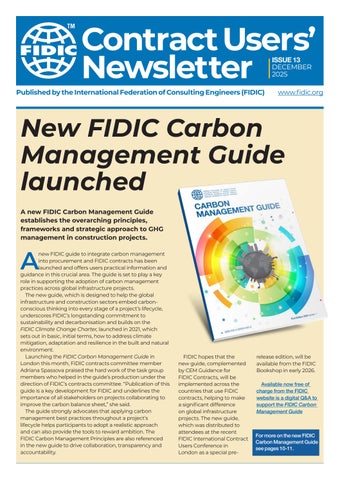
New FIDIC Carbon Management Guide launched A new FIDIC Carbon Management Guide establishes the overarching principles, frameworks and strategic approach to GHG management in construction projects.
A
new FIDIC guide to integrate carbon management into procurement and FIDIC contracts has been launched and offers users practical information and guidance in this crucial area. The guide is set to play a key role in supporting the adoption of carbon management practices across global infrastructure projects. The new guide, which is designed to help the global infrastructure and construction sectors embed carbonconscious thinking into every stage of a project’s lifecycle, underscores FIDIC’s longstanding commitment to sustainability and decarbonisation and builds on the FIDIC Climate Change Charter, launched in 2021, which sets out in basic, initial terms, how to address climate mitigation, adaptation and resilience in the built and natural environment. Launching the FIDIC Carbon Management Guide in London this month, FIDIC contracts committee member Adriana Spassova praised the hard work of the task group members who helped in the guide’s production under the direction of FIDIC’s contracts committee. “Publication of this guide is a key development for FIDIC and underlines the importance of all stakeholders on projects collaborating to improve the carbon balance sheet,” she said. The guide strongly advocates that applying carbon management best practices throughout a project’s lifecycle helps participants to adopt a realistic approach and can also provide the tools to reward ambition. The FIDIC Carbon Management Principles are also referenced in the new guide to drive collaboration, transparency and accountability.
FIDIC hopes that the new guide, complemented by CEM Guidance for FIDIC Contracts, will be implemented across the countries that use FIDIC contracts, helping to make a significant difference on global infrastructure projects. The new guide, which was distributed to attendees at the recent FIDIC International Contract Users Conference in London as a special pre-
release edition, will be available from the FIDIC Bookshop in early 2026. Available now free of charge from the FIDIC website is a digital Q&A to support the FIDIC Carbon Management Guide
For more on the new FIDIC Carbon Management Guide see pages 10-11.
Pinsent Masons LLP 2
A purpose-led professional services business with law at the core
FIDIC Contract Users’ Newsletter
An Award-Winning Professional Services Law Firm Powering Progress Across the Built Environment Delivering ex pert leg a l solution s for every sta ge of y our projec t ------------- ------------------ ------------ ------ -- -------- ------- - -------- -------- - ------- -------- -- ------
Our deep focus on the FIDIC Suite of Contracts is underpinned by decades of hands-on experience across global infrastructure and energy projects. Recognised as the inaugural winner of FIDIC’s Legal or Professional Services of the Year Award, we are trusted advisors in navigating the complexities of FIDIC forms – from straightforward procurement to the most ambitious mega-projects. With a global footprint and a practical understanding of the challenges faced by all stakeholders, our team delivers strategic legal solutions that unlock value at every stage of the project lifecycle. We understand the pivotal role FIDIC plays in shaping procurement across the built environment, and we bring clarity, confidence, and commercial insight to every engagement.
Your Tr usted Pa rtner in Global Constructio n S oluti ons With unrivalled FIDIC expertise and decades of hands-on experience, we simplify complex procurement and deliver tailored solutions to meet the unique demands of every project. Our track record spans the full procurement lifecycle - from early-stage strategy and contract structuring to delivery and dispute resolution - across some of the most complex and high-profile infrastructure developments worldwide. With over 50 years of market leadership, we bring deep sector knowledge and global perspective to every engagement, helping clients navigate risk and unlock opportunity. When disputes arise, our international arbitration practice is recognised for its strength and precision. We resolve multi-claim, cross-border conflicts and technically intricate engineering issues with authority and clarity. Our close relationships with leading arbitral institutions, combined with our presence in key hubs including London, Paris, Singapore, and Beijing, enable us to deliver robust outcomes across jurisdictions. When the stakes are high, our clients trust us to lead. Issue 13 - December 2025
17 Years | G lobal Construc tio n La w Fi rm of the Year Lexology Index 2 9 G loba l O ffi c e s | Across Four Continents
2 000+ | Partners and Lawyers
Proud to be Platinum Sponsors of the FIDIC International Contract Users' Conference 2025 ----------- ------------------
Scan th e QR code to : - Explore our sessions - Meet our speakers - Discover how our FIDIC expertise can support your success
3
FIDIC Contract Users’ Newsletter
Remembering a FIDIC contracts legend The engineer, arbitrator, conciliator, mediator and special advisor to FIDIC, Nael Bunni, has died.
I
t was with great sadness last month that FIDIC announced the death, at 86, of Dr Nael Bunni, one of its special advisors and a real giant in the field of FIDIC contracts for more than three decades. Dr Bunni played a significant role around issues related to risk, liability, insurance, contracts, dispute avoidance and dispute resolution. He had a longstanding involvement in the FIDIC contracts committee, was involved in the development of the 1999 suite of FIDIC contracts and has been a special advisor to the organisation’s contracts committee. He was also closely involved in the development of the 2017 suite of FIDIC contracts and their subsequent reprints, the FIDIC Contracts Guide 2022 and played a key role in the development of many other FIDIC contracts. Right up to the present day, Dr Bunni has been a vital asset for FIDIC and the continued development of its global industry-leading contract and agreement model forms and guides. A regular speaker at FIDIC conferences and construction industry business events, Bunni’s wide expertise in the field of insurance and liability in various legal jurisdictions was always well recognised and valued. He also received FIDIC’s highest accolade, the Prangey Award, in 2018 for his outstanding service to FIDIC and the consulting engineering industry. Commenting on his death, FIDIC’s chief legal and contracts officer, Daduna Kokhreidze, said: “This is a massive loss for the FIDIC community, for the industry and for all of us who worked closely with him. There is no doubt that Nael will be greatly missed. He was always happy to help and share his significant experience and he applied that experience and expertise by authoring many books on FIDIC contracts. He really was a great person – a legend in his field I would
say – and he will be sorely missed by everyone who knew him and who worked with him.” FIDIC president Alfredo Ingletti said: “Dr Bunni was an absolute giant in the field of FIDIC contracts for more than three decades where he played a significant role around issues related to risk, liability, insurance, contracts, dispute avoidance and dispute resolution. His latest contributions are also reflected in the FIDIC Carbon Management Guide, which we have just launched.” Born in Iraq in 1939, Nael Bunni was a chartered engineer, registered chartered arbitrator, conciliator and mediator. Formerly a visiting professor in construction law and contract administration at Trinity College Dublin, he was also a past president of the Association of Consulting Engineers of Ireland (1987-88), past
president of the Chartered Institute of Arbitrators (2000-01) and a past chairman of its Irish branch (1986-89). Between 1994 and 2007, he was a member of the board of directors of the London Court of International Arbitration and from 2004-2012 he was the chairman of the Dispute Resolution Panel of the Institution of Engineers Ireland. He was appointed arbitrator in over 145 cases of dispute, together with many other appointments as facilitator in alternative dispute resolution methods, with parties from more than 50 jurisdictions.
Nael Bunni 1939 – 2025
Issue 13 - December 2025
4
FIDIC Contract Users’ Newsletter
The importance of a human approach to contracts How human nature and cultural diversity impact infrastructure and construction projects.
A
fascinating keynote session at the recent FIDIC International Contract Users Conference in London explored how human nature and cultural diversity impact infrastructure and construction projects. Interviewed by Daduna Kokhreidze, FIDIC’s chief legal and contracts officer, Catherine Karakatsanis, senior vice president of Stantec and immediate past president of FIDIC and Andrea Galli, group CEO of ARX Group and also president of the Swiss Association of Consulting Engineering Firms, offered interesting insights on a topic so central to successful project delivery. Karakatsanis and Galli said that when you were caught up in the minutiae of project work, it can often be easy to forget what infrastructure projects are really trying to achieve, namely a better world, community impact and sustainability. Contracts and planning are important, but human behaviour, trust and culture often decide success or failure,
Issue 13 - December 2025
they said. Galli called it “the bigger picture – the human dynamics that sit above the contract”. Turning to the human factor in project success, even the best-structured contracts, such as FIDIC, can’t remove the human element. How people behave – how they interpret, decide and respond – can drive success or failure. Human behaviour across the team strongly influences project outcomes and both Galli and Karakatsanis had seen moments where trust, tone, or leadership made more difference than technical or contractual issues. Both agreed that everyone in a project ultimately wants the same thing – success. Karakatsanis highlighted the importance of sharing what her team was doing with other project participants, especially where they had gone above and beyond. “It’s really important to be able to relate what you are specifically doing on a project and how this affects the outcome. It’s also a key part of building trust,” she said.
Discussing the influence of human nature on construction projects with (left to right) FIDIC’s chief legal and contracts officer, Daduna Kokhreidze, Catherine Karakatsanis, senior vice president of Stantec and Andrea Galli, group CEO of ARX Group.
Galli agreed on the trust issue. “Every day we have to care about our people. Small actions are important and these all build up. Having an open approach, apologising for mistakes when necessary and never forgetting to praise people for a job well done is also key,” he said. “When the right conditions are in place, something powerful happens – trust. Not the theoretical kind, but the practical trust that changes how people behave. Trust grows when people understand each other’s constraints and see that everyone is working toward the same outcome,” said Galli. People’s thinking and cultures shape decisions, with every party bringing its own culture – national, organisational, even professional – to the table. These affect how decisions are made, how
risks are viewed and how collaboration happens, so trust and proactive preparation are key to helping project teams succeed. Setting up the project from the start to work collaboratively and avoid misunderstandings was crucial, both said. The role of a balanced contract was also important, with even the most balanced contracts, such as FIDIC forms, only being as effective as the people using them. Both agreed that human and cultural diversity can be challenging, but also a strength, if leveraged thoughtfully. Different perspectives can drive innovation, problem-solving and stakeholder engagement and organisations needed to move from simply managing differences to actively leveraging them to drive innovation and achieve better project outcomes.
5
FIDIC Contract Users’ Newsletter
A new era of partnership in project delivery A new innovative FIDIC contract could reshape project execution and provide long-term value for clients, consultants and contractors.
F
IDIC’s upcoming Collaborative Contract Form is aimed at supporting improved collaboration between project participants to achieve clearly defined project outcomes. The contract is appropriate for any project where enhanced cooperation and early contractor involvement is needed, particularly those involving complex, multi-party interactions. The recent FIDIC International Contract Users Conference in London introduced some of the key features of the collaborative form, outlining its unique approach, practical applications and explored how it promotes shared responsibility, collaborative governance and performance-based delivery across the entire project lifecycle. FIDIC hopes that this innovative contract can reshape project execution and provide long-term value for clients, consultants, and contractors alike. It’s an ambitious hope but one that Andrea Chao, partner and lawyer at Bird & Bird in Amsterdam believes is entirely feasible and necessary in a construction industry too often beset by less than harmonious working practices. Chao is the ideal person to comment on this, as she is chairing a special task group which has been asked by the FIDIC contracts committee to prepare a collaborative contract as a new addition to the FIDIC suite of contracts. She also co-drafted the Dutch collaborative early contractor involvement model contract. “The goal with the FIDIC Collaborative Contract is to create wider uptake of collaborative contracts, especially in countries where this is relatively new,” said Chao. “It is not just aspirational – it is a making collaboration SMART and enforceable, specifying what is exactly expected from whom and when, ensuring information flow, getting all parties involved in managing risks, while giving the
comfort of being only responsible for your own actions. “What’s key in a good project approach is acknowledging that there are more than two parties involved. We have a whole supply chain – advisors, engineers etc and decisions between two parties impact other involved parties. Good projects know this and get everyone at the same table. Projects that fail show a silo approach, also between main and subcontractor. By creating a compliance monitoring team (CMT) we aim to reduce this issue. The CMT has representatives of all involved collaborative parties and can unanimously make decisions that bind all parties,” Chao explained. There’s more work needed yet before FIDIC launches its new collaborative contract, but given the hard work of experts to date in honing
“What’s key in a good project approach is acknowledging that there are more than two parties involved,” says Andrea Chao, partner and lawyer at Bird & Bird.
the purpose, structure and innovation behind the new form and the real benefits of collaborative contracting in delivering complex and high-value projects, including enhanced risk sharing, dispute avoidance and performance-based outcomes, there are understandably very high hopes for the new contract when it comes onto the market some time in 2026. Issue 13 - December 2025
6
Construction & White & Case Procurement strategy. Contract preparation and negotiation. Making and responding to claims. Avoidance and resolution of disputes. Whatever the FIDIC matter, our Construction & Engineering team helps clients across the globe build the world of today and tomorrow. “Impressive global track record, with significant work across the world.” Legal Firm of the Year, FIDIC Contract Users’ Awards 2023
whitecase.com/law/practices/construction
7
Unfair Advantage Knowing, not guessing
Press QR code for more info
8
FIDIC Contract Users’ Newsletter
Conference highlights a world of contracts FIDIC’s latest International Contract Users’ Conference in London was another resounding success.
O
pening the FIDIC International Contract Users Conference on 2 December 2025, FIDIC’s president Alfredo Ingletti reminded attendees from 57 countries of the prominence of FIDIC’s contracts. “FIDIC’s contracts are highly influential in the global construction and infrastructure industry. Not only are they widely used on some of the world’s most important and impactful projects, but they are also widely seen as the go-to industry construction contract forms by clients, funders, contractors and engineers on a global scale.” Ingletti also highlighted that FIDIC contracts remain the most widely used international standard forms, which are applied across 170 countries, translated into 32 different languages and provide ongoing support for many key project implementations worldwide. The conference, dispute avoidance and adjudication forum and associated workshops which took place over four days from 1-4 December 2025, were a resounding success with hundreds of contracts and legal experts from around the world gathering to discuss the key issues. The role of the engineer on projects, collaboration, AI, MDB funding, carbon management, pricing and payment, dispute boards, arbitration and the increasing effects of tariffs were all given an airing during the conference. Human nature and cultural impact on project delivery were also brought into the centre of discussions with a dedicated conference session on the first day. A session looking at how FIDIC contracts are being practically applied and adapted to meet the unique needs of various sectors and regions across the world gave an excellent glimpse of the impact these contracts have globally. Jaime Gray, founding partner of the Limabased construction law firm NPG Abogados, gave a fascinating and rapid overview of some of the public and private sector projects across Latin America that were using FIDIC contracts. He reported that the contracts were being used in many Latin American countries including Guatemala, Honduras, El Salvador, Dominican Issue 13 - December 2025
Republic, Nicaragua, Costa Rica, Panama, Colombia, Brazil, Ecuador, Peru, Bolivia, Paraguay and Argentina. This ‘world of contracts’ approach was underlined by other examples of the use of FIDIC forms from other international regions, including endorsement from CERN, the European Organisation for Nuclear Research, one of the world’s largest and most respected centres for scientific research, who have used FIDIC contracts for many years because they are recognised and used globally in many jurisdictions, on all types of projects. Hisham Al Zeir, director for commercial affairs at the Abu Dhabi Projects and Infrastructure Centre (ADPIC), highlighted the use of FIDIC in Abu Dhabi where there were more
than 600 projects currently in progress across the emirate with a with a total value exceeding AED 55bn. Speaking at the conference, which was attended by representatives from contractors, MDBs, legal professionals and engineers, FIDIC’s chief executive officer Susanna Zammataro said that FIDIC contracts were a key part of creating certainty and process on construction projects, but she also made a wider, societal point. “We must remember that these projects are all about delivering access to opportunities to people – after all, that’s what infrastructure does, so we always need to look at the bigger picture and it’s important to understand that in everything that we do,” said Zammataro.
9
FIDIC Contract Users’ Newsletter
New flexible learning options for contracts training from FIDIC Academy Professional development for infrastructure professionals.
F
IDIC Academy, the official training entity of FIDIC, is committed to enhancing the expertise of infrastructure professionals worldwide. Through its Skills Packs the academy caters to the diverse needs of the sector, offering an expansive range of FIDIC contracts, tailored to fit a variety of budgets and training requirements on a global scale. The FIDIC Academy Skills Packs give participants access to world-class professional development without breaking the bank – making investing in career advancement easier and more affordable. Participants are able to dive into an extensive selection of contracts courses that cover crucial aspects of infrastructure operations, via FIDIC contracts education, ensuring infrastructure professionals are well-equipped for projects using FIDIC contracts. All courses are globally accessible, so no matter where you are in the world, the courses are accessible and applicable, preparing industry professionals to operate proficiently and confidently on an international scale. The contracts courses are all live (instructor-led) taught online as part of FIDIC Academy’s public international courses for an interactive learning experience, spread over several weeks. FIDIC Academy takes great pride in providing the highest quality of education and training events and services, therefore it continuously strives to deliver excellence by working with the most qualified and experienced FIDC Certified Trainers. For all FIDIC Academy public international online contracts courses, experts with thorough knowledge of FIDIC contracts and industry business practices are engaged.
This ensures global credibility and recognition, ensuring training is delivered to meet FIDIC’s strict professional and pedagogical standards. This in turn delivers stronger stakeholder confidence, as organisations and participants know they are receiving authoritative, accurate and industryaligned guidance from vetted professionals. The Live Skills Pack applies to the following live online FIDIC contracts courses: y FIDIC Contracts Introductory Course. y FIDIC Contracts Intermediate Course. y FIDIC Claims and Disputes Course. y FIDIC DABs/DAABs Course. y FIDIC Contract Management and Administration Course. y FIDIC EPC/Turnkey Projects Course. For more information about FIDIC Academy courses, click here.
Issue 13 - December 2025
10
FIDIC Contract Users’ Newsletter
New guide will embed carbonconscious thinking on projects FIDIC’s Carbon Management Guide is set to have significant impact on contract management and the integration of a robust carbon measurement and management process.
T
he FIDIC Carbon Management Guide and associated supplementary guidances offers users information on how to integrate carbon management into FIDIC contracts and will play a key role in supporting the adoption of carbon management practices across global infrastructure projects. The guide, launched during the Official FIDIC International Contract Users’ Conference in London on 2 December 2025, will assist the infrastructure and construction sectors embed carbon-conscious thinking into every stage of a project’s lifecycle. It underscores FIDIC’s longstanding commitment to sustainability and decarbonisation and builds on the FIDIC Climate Change Charter, launched in 2021, which sets out in basic, initial terms, how to address climate mitigation, adaptation and resilience in the built and natural environment. Speakers during the conference session to launch the guide said that it had the potential to have a significant impact on contract management and the integration of a robust carbon measurement and management process. Speaking at the launch, Fenwick Elliott partner Jeremy Glover, a member of the task group that produced the guidance, spoke about the importance of using the same language and terminology in the area of carbon management. This was a clear message that came through from stakeholders’ feedback as the guide was developed, he said. He also highlighted the need for collaboration and sharing knowledge so that project participants were aware at all times on issues like risk, the project’s progress and costs. Glover also praised the role of engineers in the development of the guide, whose experiences, insights and all-round knowledge have led to a much more robust end outcome. Issue 13 - December 2025
The new guide introduces the FIDIC Carbon Management Principles and translates them into projectlevel carbon management as well as embedding them into contract-specific mechanisms within individual FIDIC contracts, to move beyond aspirational sustainability goals towards measurable, accountable performance. These principles provide an ethical and practical foundation as follows: y Making the carbon emissions budget a mandatory evaluation criterion transforms procurement into a driver of innovation. y All stakeholders working together to improve the project’s carbon balance sheet creates a common goal. y Prioritising the reduction of greenhouse gas (GHG) emissions rather than the use of offsetting focuses on change now. y Establishing unambiguous calculation methodologies delivers fair competition and contractual certainty. y Maintaining employer responsibility for GHGs removal, rather than transferring risks inappropriately, ensures clarity and certainty. y Recognising the need for continuous improvement helps drive industry transformation forward towards decarbonisation. Significantly, the FIDIC Carbon Management Guide redefines stakeholder roles and responsibilities. Employers become GHG stewards owning the project’s carbon balance sheet. Financing institutions gain tools to drive
11
FIDIC Contract Users’ Newsletter
sustainability through procurement requirements. Contractors compete on GHG emissions efficiency alongside cost and quality and the entire supply chain becomes accountable for transparent GHG emissions reporting and continuous improvement. The core aim of the guide is to assist FIDIC contract users to implement their GHG emissions and removal goals, whilst aligning their projects with the goals of their financing institutions, governments and the world at large. It is envisaged that using the guide throughout the whole lifecycle of a construction project will enhance the value of the project to investors, stakeholders and the communities it serves, whilst significantly strengthening the focus of the industry on sustainable construction and boosting the knowledge and capacity of the engineering and construction ecosystem. Working together, it will motivate the parties to reduce or remove, monitor and control GHG emissions. Recognising that globally there are a wide range of views regarding the consequences of implementing sustainability factors within the procurement, design, construction
of buildings and infrastructure and the operation and maintenance of such assets, FIDIC has prepared the guide in a way that is adaptable, accommodating project-specific criteria seamlessly throughout the entirety of a project’s lifecycle. The application of the Carbon Management Principles set out in the guide to the unique attributes of each project aims to ensure the effective carbon management and achievement of sustainability objectives throughout its lifecycle, solidifying everyone’s commitment to the project’s success. The new guide, which was distributed to attendees at the London conference as a special pre-release edition, will be available for purchase from the FIDIC Bookshop at the end of December (electronic copies) and in January (for hardcopies).
Available now free of charge from the FIDIC website is an online Q&A to support the FIDIC Carbon Management Guide Issue 13 - December 2025
12
FIDIC Contract Users’ Newsletter
The inexorable rise of AI in the contracts arena Emerging AI technologies are influencing the roles, responsibilities and interactions of parties within FIDIC construction contracts.
I
ncreasingly, AI is influencing the way that FIDIC contracts are applied in a fast-changing construction industry landscape. Panellists at a session at the recent FIDIC International Contract Users Conference in London put AI under the microscope and looked at how the industry could use the technology and adapt for greater efficiency. During the session on Artificial Intelligence and FIDIC Contracts, chaired by Stacy Sinclair, partner and head of innovation and technology at Fenwick Elliott, an expert group of panellists looked at how AI technologies are influencing parties working on FIDICbased construction contracts, highlighting practical applications, human oversight and how the industry can adapt for greater efficiency. Some of the issues highlighted in the discussion included feedback and insights from AI providers, the use of AI in contract management and project delivery, enhancing communication and
Issue 13 - December 2025
decision-making through AI, balancing AI outputs with human judgment, potential opportunities for improved efficiency across the project lifecycle and the evolving roles of project participants in an AI environment. Talking about the use of AI in contract management, legal counsel for STRABAG, Gerald Feilecker, highlighted an 18-country pilot study involving 80 professionals where use cases in expert groups, each covering a specific domain of expertise, were aiming to identify where AI shows the most promise and develop prompt templates that ensure optimal performance in targeted use cases.
Pinpointing some “hard truths for contract managers,” Vladimir Milovanovic, CEO of Lupa Technology said that traditional ways of working were breaking under the sheer weight of data volume. “The contract is not the single source of truth – reality lives in uncontrolled channels like inboxes, chat logs, meeting minutes and photos,” he said. Milovanovic claimed that notice and programme obligations are “breached quietly, not out of bad faith, but because nobody sees all the signals in time”. By the time a claim emerges, key people have moved on and only the documents ‘remember’ what happened, said Milovanovic.
Recording the discussion on AI at the FIDIC International Contract Users Conference in London.
Taner Dedezade, barrister and head of chambers at International Construction Chambers, highlighted the use of AI in a multi-tiered FIDIC dispute resolution process, identifying different points in the process where AI could be used to assist. He asked his audience in a poll whether there should be a new AI tier under FIDIC contracts either before the engineer agreement/determination phase, before the DB phase, in the amicable settlement phase or after the request for arbitration was issued. The audience reaction was mixed, with some reticence about adopting the use of AI currently in the FIDIC dispute process. Perhaps there is some way to go yet, but what is abundantly clear is that AI is already being used to assist and enhance contract management and project delivery and this is only going to increase in the future. The industry needs to be ready to deal with this increase and embrace the challenge and opportunities of AI in all its guises.
13
FIDIC Contract Users’ Newsletter
New practice note on dispute board decisions published New practice note highlights awareness of the dispute avoidance function of dispute boards for FIDIC contract users and adjudicators.
F
IDIC has published a new practice note to provide best practice guidance to adjudicators in carrying out their decision-writing function envisioned under the FIDIC forms of contract. FIDIC Practice Note III Decisions: Preparation and Composition, launched during the FIDIC International Contract Users’ Conference in London on 3 December 2025, recognises that decisions are an important part of a dispute board’s and offers a standard of good practice to be expected of dispute board members. The practice note’s introduction highlights that it is helpful to put a dispute board’s (DB) decision in perspective. “The decision in a dispute is an extremely important product of a DB’s role. It is intended to be a legally enforceable document. It is what the Parties are paying for, and it will possibly affect either or both Parties substantially. Given those significant factors, it is essential that due attention is accorded to (i) the decision and (ii) the way in which it is reached. The second of those two is akin to the journey and the first can be looked upon as the arrival. If the journey is properly organised, there is a better chance that the arrival will be satisfactory.” The note details a number of best practice tasks and techniques for producing a dispute board decision covering managing the referral process, review of the referral, establishing the timetable, review of response, jurisdictional challenges, managing additional exchanges, assessment of evidence, hearings, deliberation among DB members, structuring the decision document, compliance with FIDIC contract provisions and formalities and post-decision considerations.
Members of the FIDIC Dispute Avoidance and Adjudication Forum at their meeting during the International Contract Users’ Conference in London on 1 December 2025.
Whilst the practice note is written mainly with a dispute adjudication/ avoidance board in mind, the general principles in it may apply to all types of dispute board decisions under other FIDIC forms and as such the document is expected to be widely used across the international construction industry. The practice note was produced under the general direction of the FIDIC Dispute Avoidance and Adjudication Forum standing group consisting of John Papworth, Suzanne Rattray, Patrizia Palmitessa-Savric, Kok Fong Chow, Lindy Patterson, Taner Dedezade and Yann Schneller, coordinated by FIDIC’s chief legal and contracts officer Daduna Kokhreidze.
Commenting on the launch of the practice note, FIDIC chief legal and contracts officer Daduna Kokhreidze said: “This latest FIDIC practice notice should be a massive help to any dispute board member when they come to write up their decisions. We know projects are run by people and a DB decision will be read by those – and probably other – people. This practice note offers a useful checklist to assist DB members in crafting sound and compelling decisions that are interesting, clearly written, well-reasoned, comprehensible and which address all the issues raised by the parties.” Click here to download FIDIC Practice Note III Decisions: Preparation and Composition. Issue 13 - December 2025
14
FIDIC Contract Users’ Newsletter
Know. Construction law The largest construction and energy law firm in the UK, we are proud sponsors of the FIDIC International Contract Users’ Conference and Awards 2025. We work closely alongside clients to offer a full range of legal services for construction, engineering and energy projects worldwide.
FIDIC experts Procurement experts Dispute resolution experts Construction specialists
Issue 13 - December 2025
15
FIDIC Contract Users’ Newsletter
LAWYERS FOR INTERNATIONAL CONSTRUCTION Contracts | Project Support | Disputes
hfw.com Americas | Europe | Middle East | Asia Pacific Issue 13 - December 2025
16
FIDIC Contract Users’ Newsletter
Role of engineer on projects is ever evolving An important discussion on the key issue of the role of the engineer on projects took place at the recent FIDIC International Contract Users’ Conference in London.
T
he ever-topical subject of the role and impact of the engineer on projects was dissected in some detail at the recent FIDIC contract users’ event in London. Chaired by Vincent Leloup, chair of the FIDIC contracts committee, the session explored the evolving role of the engineer within FIDIC contracts, the importance of effective employer, contractor and engineer engagement and how alignment with FIDIC contract requirements can improve project outcomes. Session panellists, included Maria Vabulis, senior project manager at Sweco International, Enea Sermasi, head of international business development at Politecnica, Nabeel Khokhar, contract manager at Construction Contract Consulting and White & Case partner Ellis Baker, discussed the role and impact of the engineer today and in the future, examining the essential dual role of the Engineer – as both the employer’s agent and also that of a neutral decision maker. They highlighted the challenges faced by the engineer in contract administration and the possible gap between the engineer’s role as expected under a FIDIC contract and the engineer’s own contract with the employer. “The engineer’s role must evolve at two levels. First, as designer of works constructed under the Red Book and as the entity instructed to prepare the Employer’s Requirements under the Yellow Book, it must play a leading role in relation to carbon management and sustainability and in ensuring that the new infrastructure that the world so desperately needs has sufficient resilience to withstand the effect of climate change. Secondly, as the entity responsible for administering the Red and Yellow Books, it must be of the forefront of the deployment of AI and other new technologies to ensure that projects are delivered more efficiently, to ensure that
Issue 13 - December 2025
Vincent Leloup, chair of the FIDIC contracts committee, moderating the conference session on the role and impact of the Engineer on projects at the recent FIDIC International Contract Users’ Conference in London.
new infrastructure is both affordable and is delivered within the tight time timeframes that are needed,” said Ellis Baker. The wide range of issues discussed included looking at the role of the engineer from a contractor’s point of view, the challenges that can occur between the FIDIC conditions and the employer organisations’ governance routines, how design quality affects the engineer’s role, how the engineer’s role should evolve of the next decade and what were the most urgent training needs for project stakeholders currently. The discussion from the floor touched on the evolving responsibilities of the engineer in modern project delivery in a changing industry. The session concluded by highlighting the importance of clear employer roles and informed appointments and the need to promote fairness, neutrality and alignment with FIDIC’s Golden Principles.
17
FIDIC Contract Users’ Newsletter
Winners of 2025 FIDIC Contract Users’ Awards unveiled Best practice using construction contracts is rewarded, as the winners of FIDIC’s annual Contract Users’ Awards are announced.
T
he winners of the 2025 FIDIC Contract Users’ Awards have been announced at a gala dinner event in London on 2 December 2025. The awards, now in their seventh year, recognise excellence in the use of FIDIC contract forms for project delivery and showcase global examples of good practice and collaboration worldwide. From a global collection of entries, the judging panel, chaired by international judge and arbitrator Sir Vivian Ramsey, chose winners across five different categories – Project of the Year, Client of the Year, Consultant of the Year, Trainer of the Year and Legal Firm of the Year. The winners were unveiled at an awards dinner held as part of the Official FIDIC International Contract Users’ Conference. In a video address at the event, the chair of the judging panel Sir Vivian Ramsey said: “These flagship awards recognise excellence in the use of FIDIC contract forms for delivery of projects worldwide, including good practice and the use of the FIDIC Golden Principles. Again, we have had a strong list of entries including organisations, companies and individuals. The judging panel, which I chaired, had a challenging task in choosing winners.” The full list of winners of the 2025 FIDIC Contract Users’ Awards are listed below.
Project of the Year Winner – Gorno Badakhshan Autonomous Oblast (GBAO) Road Project in Tajikistan. Highly Commended – Julius Nyerere Hydropower Project along Rufiji River in Tanzania.
Client of the Year Winner – GED Africa.
The winners of the Legal Firm of the Year, Pinsent Masons, receiving their award from FIDIC’s chief legal and contracts officer, Daduna Kokhreidze.
Consultant of the Year Highly Commended – Dorjkhand Maravdorj (Mongolia).
Trainer of the Year Winner – Ignacio Palacios (Spain). Highly Commended – Julius Nyerere Hydropower Project aloAsel El Housan (United Kingdom).
Legal Firm of the Year Winner – Pinsent Masons (United Kingdom). Highly Commended – LnP Beyond Legal (South Africa). Commenting on the awards, FIDIC CEO Susanna Zammataro said: “As we highlight and celebrate our award winners this evening, we should also recognise the excellent work that our industry is doing to make a real difference to society, to the environment and to people’s lives. Let us never forget that it is those professionals working in the engineering, construction and infrastructure sector that will ensure that we build the sustainable world that we all want to see.” Issue 13 - December 2025
18
Top-tier experts in dispute management, avoidance and resolution CMS is a future-facing law firm: we aim to give you an advantage today by anticipating your challenges of tomorrow. Our dedicated team focuses on resolving disputes arising in the Infrastructure, Construction and Energy sectors. For all your project advisory, risk management, litigation and alternative dispute resolution needs, you are in safe hands with us.
Key contacts at the conference
Jeroen Berlage Partner T +31 20 301 63 06 E jeroen.berlage@cms-dsb.com
Adrian Bell Partner T +44 20 7367 3558 E adrian.bell@cms-cmno.com
Rafal Morek Partner T +48 22 520 83 35 E rafal.morek@cms-cmno.com
cms.law cms.law
ECV AWARDED FIDIC TRAINER OF THE YEAR
FIDIC Affiliate Member
ECV CONSULTANCY LTD ECV has provided engineering consultancy and educational services to the international construction industry worldwide since 1993 with particular emphasis on the FIDIC Conditions of Contract and their practical use. The ECV team of experienced international engineers has developed unique educational courses that optimise interaction between the tutors and participants and their understanding of the FIDIC Contracts Since the introduction of the 1999 FIDIC Contracts ECV through its creation of Modular courses has trained over 35,000 professionals in 92 countries including from World Bank, ADS, AfDB, IADB, MCC, EU, UN Agencies, Government Agencies and the wider international construction industry Educational Services relating to FIDIC 1999-2017/2022 & 2021 Contracts • “In-Person” and “Virtual” 2 day public courses • “In-House” courses tailored to the Clients Requirements • Training in effective Contract Management and Administration • Drafting and editing Employer’s Particular Conditions • Preparation and contractual support with Claims • Assistance with all contractual aspects of Disputes • Contract management Manuals and Work Books ECV provides fast track personal support for all its services Please contact the Managing Director David Heslett, BSc (Hons), CEng, FICE at E-mail: david.heslett@ecvglobal.com or phone: +44 7889 682 116 For more company details visit www.ecvglobal.com
20
Contract Users’ Newsletter
CONTACT US Please send news, views and articles on FIDIC contracts to the newsletter editor Andy Walker at awalker@fidic.org
For contract order queries email FIDIC at fidic.pub@fidic.org
Send general FIDIC enquiries to fidic@fidic.org
Save the date for FIDIC’s 2026 Global Infrastructure Conference in New Delhi FIDIC Global Infrastructure Conference 2026 13-15 September 2026, New Delhi, India.
T
he eyes of the international infrastructure community will be on New Delhi, India, next September as the city hosts the 2026 FIDIC Global Infrastructure Conference. Based around a topical industry theme, the conference will take place against a background of an infrastructure sector playing an even more important global role, as the world grapples with the best ways of making investments in their national 1-4 Decemberto2025 social and physical infrastructure deliver health, wealth and security to their populations. Programme details for the event will be updated on the FIDIC website over the next month and be regularly updated thereafter.
Contract Users’ Conference and Awards
Official FIDIC International Contract Users Conference 2026
Certification Body for Global Consulting Professionals
Certification Body for Global Consulting Professionals
Certification Body for Global Consulting Professionals
FIDIC CERTIFIED ADJUDICATOR
FIDIC CERTIFIED CONTRACT MANAGER
FIDIC CERTIFIED CONSULTING ENGINEER
2022 - 2025
2023 - 2026
2023 - 2026
Certification Body for Global Consulting Professionals
Certification Body for Global Consulting Professionals
Certification Body for Global Consulting Professionals
FIDIC CERTIFIED CONSULTING PROFESSIONAL
FIDIC CERTIFIED TRAINER
FIDIC CERTIFIED PROCUREMENT SPECIALIST
2023 - 2026
The official certification body of the International Federation of Consulting Engineers, committed to providing the highest certification standards for infrastructure professionals.
fcl.fidic.org
FIDIC Global Leadership Forum 15-17 April 2026, Athens, Greece.
30 November – 3 December 2026, London, UK.
FIDIC is grateful for the support it has received from the sponsors of the 2025 Official FIDIC International Contract Users Conference. Thanks go to platinum sponsors White & Case, Pinsent Masons and Lupa Technology and to gold sponsors Fenwick Elliott, CMS, HFW and ECV.