The Yarn Fibershed’s Community Newspaper
Summer 2026
What’s inside? •
Fibershed News and Events
•
Heathy Soils Program Updates
•
Community Events: Transhumance and Flock Together Festivals
•
Stories from Our Producer Network Members
•
Updates from Our Global Affiliate Networks and lots more!
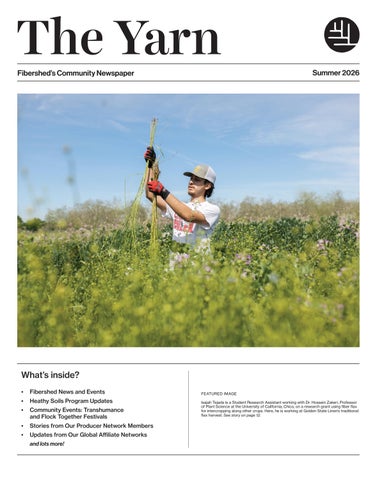
FEATURED IMAGE Isajah Tejada is a Student Research Assistant working with Dr. Hossein Zakeri, Professor of Plant Science at the University of California, Chico, on a research grant using fiber flax for intercropping along other crops. Here, he is working at Golden State Linen’s traditional flax harvest. See story on page 12.
Fibershed is a nonprofit organization that develops regional fiber systems that build ecosystem and community health. Our work expands opportunities to implement climatebenefiting agriculture, rebuild regional manufacturing, and connect end users to the source of our fiber through education. We transform the economic systems behind the production of material culture to mitigate climate change, improve health, and contribute to racial and economic equity.
The Yarn is produced once per year, for our expansive Fibershed Community. All members of the Fibershed Northern California Producer Network receive a copy in the mail as part of their membership benefits.
Editors Rebecca Burgess Bronte Edwards Cassandra Marketos Contributors Rebecca Burgess Melissa Duhaime Bronte Edwards Kelly Egusa Lani Estill Nick Evans Alexandra Farah Cynthia Hathaway Stijntje Jaspers Sarah Keiser Ren Lezeu Courtney Lockemer Travis Meinolf Lynn Moody Lisa and Loren Poncia Thilina Premjayanth Molly Prentzel Nica Rabinowitz Mary Kate Randolph Navit Reid Margaret Seelie Siri Thornson Töne Tobiasson Marcail McWilliams
All photographs, unless otherwise noted Paige Green Photography Graphic Designer Nicole Lavelle Proofreader Susan Davidson Printer Make My Newspaper Chicago, Illinois, USA
fibershed.org © Fibershed 2026
The Yarn
Welcome to The Yarn! This year’s issue of The Yarn includes a beautiful array of narratives written by community members just for these pages. No artificial intelligence was used by our staff to design or craft this paper; it’s all human powered. If you have a story idea that you’d like to share with the community, we encourage you to send your ideas forward. We’ll be putting a call out again next spring for your writing. In the meantime, if you would like to connect with the Producer-led Events Committee to find out more about what is being cooked up by the community and for the community, you can reach out to the team members listed on p. 4. Always feel free to reach out to the staff at the nonprofit; there’s a list of folks on pp. 42–43 who are here to support you. If you have an event you want us to promote, you can email bronte@fibershed.org to add it to the calendar on our website. Just note that some of the folks we work with only have a few hours a week or month to share with us. We’re grateful for the time we have with them, but if you don’t hear back right away, just wait a few days and we’ll circle back with you. We look forward to seeing many of you in November, and in the meantime, we wish you a wonderful summer of farming, designing, shepherding of your animals, and caring for the land and your community.
2026
Contents 4
Producer Network Updates
8
Producer Voices
12
Producer Stories
20
Community Events
22
Fibershed Learning Center
24
Climate Beneficial™ Verified
29
Healthy Soils Program
29
Affiliate Network
38
Perspectives on the Seashore: Special Feature
42
Fibershed Staff Updates
3
Producer Network Updates from Fibershed’s Northern California Producer Network
2026
The Producer Events Committee in Its First Full Year In the second half of 2025, Fibershed events began to be organized and operated by a Producer-led group, the Events Committee, with support from Fibershed staff. Now in our first full year of operation, we are continuing new offerings throughout Northern California, as well as continuing to produce the Spring Market at the Fibershed Learning Center and Winter Market at the Dance Palace in Point Reyes.
Here’s what events we have had thus far in 2026: • Pop-ups at the Berkeley Farmers Markets • Mending circles in Redding • Mushroom/lichen natural dye workshop in Redding • Transhumance Festival in Petaluma • Spring Market at the Fibershed Learning Center
Here’s what’s coming up in fall/winter: • Virtual Producer meetups on October 18 and October 20 • In-person Producer meetups at various locations on October 25. For more information and to RSVP to one or all of the meetups, please check the most recent Producer E-News. • Winter Market at the Dance Palace in Point Reyes Station, on November 14 Interested in joining the Events Committee? Please email Marie for more information at admin@fullcirclewool.com. With Love, Irma Mitton-Rodriguez (San Mateo County), irmwrites@gmail.com Sarah Keiser (Sonoma County), sarah.keiser@wildoathollow.com Marie Hoff (Shasta County, North State, and Oregon border), admin@fullcirclewool.com Charlene Schmid (Solano County, Central Valley), charlene@integrityalpacas.com Helen Krayenhoff (Alameda County, larger Bay Area), kassenhoff@lmi.net If you’d like to support the Events Committee’s work, consider renewing your membership to the Producer Program ($40 annual membership due). Visit fibershed.org/programs/ regional-textile-economies/producer-program to pay online, or send a check to Fibershed at PO Box 221, San Geronimo, CA, 94963. If you can afford to make a larger donation to the Events Committee, 100% of those funds are directed to the Events Committee’s work. Funds are used for renting the Dance Palace, demonstration fees, covering small organizing stipends for Events Committee Members, and covering costs for organizing the Transhumance Festival. Your donation is matched by the nonprofit.
4
Producer Network Membership Renewal
Producer Events Donation
The Yarn
2026
Bay Area Producer Events Events for the Bay Area subregion (Alameda, San Francisco, San Mateo, Santa Cruz, and Santa Clara Counties) are coordinated by Helen Krayenhoff (Kassenhoff Growers, Oakland) and Irma Mitton-Rodriguez (Fruition Farm & Fiber, Pescadero). Our 2026 events are focused on educating consumers and building local demand for products from all around the Northern California Fibershed.
Berkeley Farmers Markets With the support of the Ecology Center, we brought a Fibershed information booth to the South Berkeley Farmers Market from March through June. Each month focused on a different aspect of natural fiber and clothing production. An estimated one thousand people stroll through the market each day, and many stopped by the Fibershed display to ask questions, touch fiber, and take home educational materials. In March we invited market-goers to feel actual yarn samples from eight different producers and then showed them the different breeds of animals that produced that fiber and where they were located. In April we centered our presentation on natural dye plants, using a presentation board of common dye plants, live plants, and dried plant materials, and our natural dye library binder, to spark conversations about clothing dye, clothing fabric type, and the impacts of consumer choices. We tied this back to our Northern California Producer map and distributed a handout on how to create color with plants. In May we expanded our fiber map to include information on flax and linen. Market-goers could see and touch samples of processed, unspun linen strick, flax tow, and 50 percent linen / 50 percent wool yarn from Chicobased producer Golden State Linen, leading to conversations about local growing conditions, how flax fiber is processed, and the prospects for more Northern California linen and biocomposite products. In June the booth (literally and figuratively) wove all these concepts together as we invited market-goers to take part in a community weaving project using Northern California wool, alpaca, and linen yarns and other local materials.
Eco-Printing with Natural Dyes Workshops In addition, we offered three popular hands-on workshops on ecoprinting with natural dyes. At the Downtown Berkeley Farmers Market Chard Rock musical festival in March and at Fibershed’s Spring Market in May, we helped participants create designs using a variety of plant materials, from onion skins and lettuce leaves to flower stems and petals, on Climate Beneficial™ Verified wool from Northern California Producers. At Pescadero’s SpringFest in April, we used mordanted organic cotton bandanas and a combination of food waste, street tree leaves, and dried and fresh natural dye plant materials. With these workshops and our monthly presence at the South Berkeley Farmers Market, we are building a Bay Area interest list of fiber enthusiasts and potential customers to generate a ready-made audience for our fall/winter holiday market booths, at which Northern California Producers can display and sell their products. Expect to see more of us in Berkeley and San Francisco, and around the South Bay later this year!
Market-goers at the Berkeley Farmers Market take part in comunity weaving using Northern California fibers. OPPOSITE PAGE
Examples of Northern California fibers for the public to touch; participants in an Eco-Printing with Natural Dyes workshop show their final products. ABOVE, TOP TO BOTTOM
Photos provided by the Producer Events Committee.
5
The Yarn
2026
Producer Network Welcome to Our New Northern California Producer Network Members! We want to welcome and highlight producers who have joined our Northern and Central California Producer community since the publication of the previous issue of this newsletter. As always, you can find information about local fiber, dyes, and skills within our community, alongside direct links to contact Producers or support their enterprises, in our Producer Directory at fibershed.com/producer-directory. As of June 2026, we have 200+ Producer members in our original Northern California Fibershed.
Soren Dawson
Tamar Ingber
Marin County
Pescadero
Soren is a gardener, dyer, spinner, weaver, knitter, crocheter, basket maker, teacher, and lifelong student. In addition to dye plants, he grows native fiber plants including stinging nettle (Urtica gracilis) and dogbane (Apocynum cannabinum). He sources wool from small farms, individuals, and families throughout Northern California, but mainly within Marin and Sonoma Counties.
Tamar Ingber uses both egg/smoke and tannin-bath methods to transform a raw pelt into a sustainable material for our lives. She loves sharing this process in workshops and one-on-one settings.
deepmoss.net
6
Richard Felipe, Triple F Ranch
Grant Azevedo, Mission Lamb
Hanford
Willits
Triple F Ranch is a fourth-generation pistachio farm located in Hanford. Richard joins the Fibershed community as an awardee of the CDFA Healthy Soils Program. Richard has been stacking practices in his orchard to renew his land health, including compost application, cover cropping, rotational sheep grazing, and producing his own Indigenous microorganisms (IMO).
Mission Lamb is a firstgeneration commercial sheep operation that specializes in directto-consumer pastured lamb. The Azevedo family partners with Kaos Grazing to provide grazing services to support fire mitigation in the region and vineyard grazing. missionlamb.com
Cole Estill, Victory Sheep Company Winnemucca, Nevada
Victory Sheep Company is owned and managed by Cole Estill with the help of his veterinarian wife, Katie, and son Heath. Cole is a fourth-generation rancher and was raised in the sheep and cattle industry. Victory Sheep Company is based out of Winnemucca, Nevada, but it grazes sheep all over both Northern California and Nevada. victorysheepco.com
The Yarn
2026
Fibershed Spring Market by REN LEZEU
Eager gardeners, dyers, and fiber enthusiasts made their way to the Fibershed Learning Center in Point Reyes Station at the beginning of May to enjoy a day of community, learning, and textile-oriented demonstrations at this year’s Fibershed Spring Market. Built on the network of Northern and Central California Producers, the market brings together different elements of the local textile production chain into one place, effectively creating a holistic display of possibilities for individuals looking to try their own hand at one or more of the steps involved in creating a piece of textile work. Visitors to the market get to learn and shop on the gorgeous grounds of the Learning Center amidst lush stands of horsetail and impressive stalks of foxglove. The day was structured around demonstrations that included wet felting, silk dyeing, and eco-printing, which allowed guests to get hands-on experience in textile work. The wet felting demonstration, which was run by Bodega Pastures, encouraged participants of all ages to learn the fundamentals of turning unprocessed wool into felt. Participants could be seen throughout the day applying friction to wet, soapy wool in earnest, gradually meshing the fibers together until they had a finished piece of felt that held itself together. For many this was the first time they had engaged with wool in this way, and the smiles and laughter coming from the picnic tables where the activity took place spoke to their enjoyment of the technique. The second workshop of the day was a demonstration led by Charlene Schmid of Integrity Alpacas & Fiber in dyeing fabric with plants. For this activity, participants watched as hot water pulled the natural pigments out of three different plants to create green, yellow, and orange dyes. Then participants were invited to dip silk handkerchiefs in to dye them. After the silk had soaked for a while and the dye had time to adhere, participants walked about in the sunshine airing out their handkerchiefs so they could see the final outcome. Lovely dyed silks could be spotted tied to bags, hats, and wrists by the proud participants afterward, adding to the cheery spring ambience.
most of the color spectrum, there was a plant to suit everyone’s particular color preferences. Peggy Agnew of Red Creek Farm had two of the most iconic dye plants, madder and indigo, available, along with a wide range along with a wide range of her sheep’s wool and yarn dyed with plants from her own garden that showcased the color possibilities of a wide array of dye plants. For the non-gardeners, there was wool to buy from Coleen Maloney of 5 Creek Farm and Marcail McWilliams of Valley Oak Wool & Fiber Mill, among others, and for those who didn’t feel inclined to make items from scratch, there was an offering of beautiful clothing and home textiles to choose from as well. Elaine Hamblin of Kosa Arts brought forth her offerings of slow fashion apparel, much of it eco-printed and made with Sally Fox’s organic cotton fabric. Just across from her was Lisa Wilde of Wilde Works with her wide display of woven, felted, dyed, and eco-printed textiles for body and home, each piece demonstrating the one-of-a-kind nature of working with the eco-printing process. Once visitors had built up an appetite after learning and shopping all morning, they could opt for delicious onigiri or donburi from Yuko Kineko’s stand, Kinoko. In combining the varied offerings of the Producers with the three handson learning opportunities, the Spring Market succeeded in creating an engaging day of community-centered education. Seeing participants of the workshops cheerfully displaying their felted, dyed, and eco-printed creations, all while continuing the conversation with the producers who had experience in those areas of textile and agricultural work, intertwined into a greater sense of purpose and community. Fibershed has always been about regional textile systems, but education and community are what it fosters in order to make those systems happen, and the Spring Market was a wonderful way to bring community members into the natural textile conversation.
Eco-printing occupied the final workshop slot of the day. In this workshop, Clara Pitt with Kassenhoff Growers demonstrated how to transfer the pigment from flowers and leaves, provided by Kassenhoff Growers, onto wool fabric. Armed with Mexican bush daisy, purple plum leaves, orange cosmos, and other specimens, participants artfully placed the plant matter onto a piece of wool fabric before rolling it tightly around a copper pipe with plastic wrap. Participants placed the wool in a steamer to encourage the pigment to leach into the fabric. It was an exciting surprise for the participants to unroll their fabric and uncover the colorful design they had created. The gasps of wonder and exclamations of delight at what they revealed could be heard with each fresh batch of fabric coming out of the steamer. No two pieces were the same, thanks to each participant’s personal creative choices, which made for a wonderful talking point as they compared the outcomes of their experiment with those of their peers. In addition to the demonstrations, visitors could stroll the grounds and do some shopping for regional, sustainable fiber and dye plants. Starting from the ground up, Charlene Schmid of Integrity Alpacas & Fiber had her wool pellets—and luxurious alpaca yarn—available for those looking to improve their soil health without the use of commercial fertilizers. Helen Krayenhoff of Kassenhoff Growers offered a wide range of dye plants for the home grower to build up their dye garden. With plants ranging across
Rebecca Burgess offers a tour of the Fibershed Learning Center’s dye garden. Photo by Noelle Gaberman. ABOVE
7
The Yarn
2026
Producer Voices Hear from your fellow Northern California Producer Network Members. Want to share a project or an update? How about sharing a call to action, a resource, or a poetic musing? We’re ready for your submissions. Write to affiliates@fibershed.org with the subject “Northern California Producer Voices.” We will fit submissions as we have space and prioritize timely submissions.
Meinolf Weaving School by TRAVIS MEINOLF Craft labor like spinning, weaving, and dyeing, alongside the land and animal stewardship practices that produce the fibers we use, attracts some interesting personalities. You might have experienced this—you might even be interesting yourself! One thing we all have in common is a desire or even need to apply our efforts in a way that has a direct effect on the material world. Whether it be production of a blanket or growing a crop, we want to see it. Truly engaging with these practices requires sustained focus and dedication of time, and I can say for weaving it’s a A LOT of time. This can be isolating—partially because you might have to be down in your cold carport “studio” at all hours untangling threads under some fluorescent lamps, and also because of the hierarchical separation that “mastery” of a subject implies. To combat that isolation, we need community gathering spaces where people with these affinities can meet and work and learn together. My space, Meinolf Weaving School, has been practicing this since June 2022, when I got out of the carport and opened the doors to a storefront in San Anselmo. It has been a lot of work, by everyone who has been here (but especially me!), and has been supported by the community from the start. Every one of my more than twenty looms has been donated by a weaver who wanted to spread the knowledge of the craft, and the same is true of all of our yarns. As I’ve collected more members, we’ve been able to support expansion of the space, and we are starting to support me, too. More people working in the space serves many purposes, but as a teacher, my main focus is pedagogical: more students confronting more problemsolving situations means more experience and proficiency shared, faster. More different types of people working on the same problems means more perspectives, more strategies to try. And finding the way through for the most confused and challenged members of the group can provide ease and sustainability in the long run for people who have more capacity and can just muddle through and do it the “hard way.” Textiles practices are very repetitive, very grounding. In a world where just the daily awareness of global, national, community, family, and our own physical states can feel overwhelming, it is a gift to be able to sit at the loom and throw the shuttle, and watch a pattern build line by line. Having a space to recharge, even just totally disassociate from reality for a minute, but in community, can be life-changing. Communicating about these sometimes intricate, frustrating processes and helping one another with them helps us find strategies for communication in other arenas, and for dealing with other frustrations as well. As someone with nearly thirty years of experience weaving, I am always thrilled to learn some new approach by someone who has no idea what they are doing. And I’m thrilled when it makes me understand why the approach I’ve developed works for me. If you are a “master” of a skill, my humble suggestion is to never let it separate you from others—and if you don’t know anything, come over to San Anselmo and show me how YOU weave! Learn more at meinolfweavingschool.org and follow along on Instagram @meinolfweavingschool.
8
The Yarn
2026
Valley Oak Wool Mill
What’s New with Lani’s Lana?
by MARCAIL MCWILLIAMS
by LANI ESTILL
Things are looking good for Valley Oak Wool Mill. Every year it has gotten better. I’m looking forward to getting out of debt. Last year a local news station created a segment about my mill and the dilemma of local wool processing. The segment also included fellow Fibershed Producer Robin Lynde of Meridian Jacobs. It’s great that the film crews can get good shots of the animals (before I get the wool) and her looms (after I make the yarn). This year I was included in a project for American Sheep Industry (ASI) which is making a project about the California wool industry. I will attend ASI’s small mill meetup in Wyoming this summer, get a tour of Mountain Meadow Wool Mill, and check that off my bucket list!
Lani has been facing several challenges with supply chains and a general slowdown in interest, but that has not stopped progress—only slowed it down a bit. She has left Warner Mountain Weavers and has a studio in Cedarville. This enables Lani to focus on her online business and not so much on foot traffic. When in Cedarville, please visit both Warner Mountain Weavers and Lani’s studio, and soak up the wonder of the fiber world. (Please email Lani at lanislana22@gmail.com ahead of time. The studio is open by appointment.) On the ranch, shearing is done for 2026, and the wool is waiting to be shipped to its next stop in the supply chain. The sheep are all lambed out and grazing in the Warner Mountains. They will stay in the high country until colder weather forces them back down to the ranch in October.
I’m proud that my yarn turnaround time has caught back up to twelve months, instead of the eighteen- to twenty-four-month turnaround that it was. I’m still not able to accommodate brand-new plyed yarn customers, —return customers only—but depending on the intake I receive in May and June, I might be able to open up for new customers. If I did, I would start by breed; Jacob wool works well for me, so I’d like to start there. I would announce that on social media and my website if that happens. The mill can always accommodate new customers for carded products—roving, batting, and carded fluff—as long as it’s a wool type that works for my machinery. Also chunky rug yarns can now be made for any customer, new or returning. Turnaround time for all these products is two to four months. Next year the mill will celebrate ten years under my ownership! How can it be almost ten years already? Usually these film crews ask me what I would say to someone wanting to start a mill. This is a really tough and emotional question for me. Before I started, I had a conversation with a woman who had a mill, and it felt like she was trying to talk me out of it. If I’m honest, I would not recommend it, which is similar to how that owner felt. When I hear of mills that only scour, pick, and card, that feels like a healthier business model, instead of doing the entire spread of raw wool into yarn. If someone was thinking of going into milling, I would recommend starting there. It is not easy. It’s not impossible, but it’s very uncomfortable for a long time. For me I just have to see this out as long as I can; I would regret it if I never tried or gave up too early. Learn more at valleyoakwoolmill.com and follow on Instagram @valleyoakwoolmill.
Lani has several exciting offerings to share with the Fibershed community, including new collaborations, upcoming finished wool products, and a wide selection of fabric currently available. Lani’s latest collaborations include one with Marina Contro of San Francisco and American Woolen, and another with Laura Sansone of the New York Textile Lab and American Woolen. These are two separate projects featuring Climate Beneficial™ Verified wool. Keep an eye out for more information about these exciting new releases. Lani is also working with Mountain Meadow Wool Mill to create finished wool products, including beanies, scarves, and sweaters. It is especially satisfying to make pieces that can immediately keep people warm and comfortable. These items are expected to be released in time for the winter season. Lani still has a beautiful selection of fabric available, with plenty in stock. • Collaborative Cloth: A knit made with wool from Bare Ranch and California Cleaner Cotton™. • 100% Bare Ranch Wool Twill: Available in several colors. • 100% Bare Ranch Wool Plain Weave: Offered in the same range of colors. Available colors include Natural (Snow), Shale, Charcoal, Madder, and Indigo. Pricing has been kept as reasonable as possible: $80 per yard standard price, $65 per yard designer discount. Additional discounts are available for full rolls. Let’s get sewing!
9
The Yarn
2026
Producer Voices On-Ramps for Next-Gen Farmers: My Journey Navigating a Quiet Crisis by BRONTE EDWARDS, FIBERSHED AGRICULTURAL MANAGER
of American farmers who work off-farm to pay their bills, every morning before clocking in at Fibershed, I’m going out and doing my daily chores: checking my livestock, caring for lambs, monitoring grass height and species, and working with other growers of lavender, grapes, or other crops to support a more cohesive system of agriculture that benefits us all and lowers costs where possible so we all can keep penciling the work we love into the next season. As I became more ingrained in this community, I became aware of how fragile our food and fiber system has become, as well as the immense barriers and hurdles I would have to address to become a farmer. Today we see that the average age of American farmers has increased from 56 to 57.5. That number is increasing every year. Farmers age thirty-five and younger, like myself, only represent 8 percent of America’s farmers. It became clear to me that we are at risk of losing not only historical knowledge in an aging workforce, but also access to farmable land. In the last ten years, we have lost 19 million acres of farmland: that’s equivalent to 633 San Franciscos, and the entire state of South Carolina. Historical knowledge and farmable land are the foundation of our industry which is beginning to crack as the majority of Americans with their heads in the sand are unaware of the crisis that is upon us.
As a young chef born and raised in the Bay Area, I had always felt very connected to my food and the farmers that came to our back door multiple times a week sharing with us the bounty of our region’s working lands. Working in restaurants got me interested in not just what proteins were considered “high-end,” but also what the breed of the animal was and what conditions it was raised in. I began to buy books on livestock and ask farmers if I could come for a visit. In my late twenties, I decided to take the leap and transition into the agriculture industry. Getting started was hard. It took me multiple years to build trust within my local agricultural community and find folks that were willing to mentor me. But like many of the folks reading this paper, I quickly fell in love with sheep, the feeling of joy I experienced watching lambs bunch together and scamper around the barn, and the calm that comes over me when I get to turn pairs out onto fresh spring grass after a cold and dreary winter. I knew that I was committed to doing this work. In 2019 I bought a dozen sheep from a friend to begin grazing in vineyards. Unsurprisingly to the folks reading this, I had no idea what I was getting into! I needed help and guidance more than ever, and I became reliant on local families who were kind enough to answer my calls and texts at all hours of the day or night as I began to learn animal husbandry by doing. Today, after years of trials and tribulations, I have managed to grow my flock from twelve to almost one hundred. Like the 60 percent
10
Small family farmers make up 89 percent of our food and fiber system, making Fibershed’s mission of supporting growers, makers, and creators big and small essential for the continuation of this work. Many other members on staff are engaged in agriculture off the clock. Nica, who manages our supply chain network, pairing brands with growers, has her own small flock of Merinos, and Molly, who manages our Affiliate Network, shears sheep for backyard farmers all over San Diego. Although some days balancing a day job and our own agricultural work can be challenging, I believe it makes our organization better. It allows us to take the mission of Fibershed extremely personally, as we know what it’s like to get a call right as you sit down for dinner that the sheep are out. We know what it’s like to help a ewe that’s having a hard birth before dawn. We know what it’s like when the cost of fuel, hay, and other things goes up. That’s why we are spearheading a new chapter of Fibershed work and creating new on-ramps for first-generation farmers. This includes holding community work days at the Fibershed Learning Center and other farms to support creating low-barrier and affordable education for the next generation of farmers on animal husbandry, as a prerequisite experience to more in-depth educational opportunities with our partners at Camp Kaos and the UCCE Hopland Field Station which does hands-on education in shearing, animal husbandry and grazing strategies. Along with building up long-standing partners to support new on-ramps for the next generation, we are also creating new partnerships to take our work to the next level. That’s why we are partnering with the Anne Saxelby Foundation, which specializes in supporting and connecting next-generation farmers with existing commercial farmers. We know that we must be proactive in the continuation of one of the—if not the—oldest types of agricultural work. Sheep grazing on the land to create food and fiber for our communities is not just something of the past, but also something of the future. If you’re interested in joining our movement to support the next generation of farmers with the Anne Saxelby Foundation, please email bronte@fibershed.org.
The Yarn
2026
Tribute to Sandra Guidi, 1960–2025 by LYNN MOODY
My dear, dear friend Sandra Celeste Esteves-Guidi, shepherdess, fiber producer, natural dyer, and Fibershed member, passed away peacefully on November 5, 2025, after a valiant battle with cancer. Sandra is survived by her husband, Robert (Rob), sons Colin and Andrew, daughters-in-law Mira and Lauren, granddaughters Niyah and Isla, and treasured sister, Sylvia Esteves-Cugliani. Following their retirement from public service, Sandra and Rob moved to beautiful Stinson Beach in 2011. Raising olive trees, vegetables, flowers, dye plants, chickens, and Santa Cruz Island sheep brought them much joy as well as hard work. I always regarded their small ranch on the slopes of Mount Tamalpais as amazing—they did more with their 3 acres than I managed with our 120+. I met Sandra about ten years ago, when she contacted me about purchasing some sheep. Sandra and Rob were the first folks to purchase Santa Cruz Island sheep from us, and they gave them a good home for about ten years. Because of her illness and predator issues, she and Rob returned the sheep to us—and they are doing fine. Sandra worked tirelessly promoting the sheep and their wool, and she and Rob became good friends to me and my husband, Jim. Until Sandra’s cancer diagnosis, the two of them came all the way down here every year to help us out on shearing day—Sandra was part of the skirting team, and Rob was an excellent sheep handler. Between times we used to call and text and email back and forth about sheep, wool, yarn, roving, and most of all just to talk. They let me stay at their lovely home when I trekked northward for Fibershed events, and I so appreciated their hospitality, as many of us did. We used to share a vending space (Black Rock Ranch and Blue Oak Canyon Ranch), which certainly enriched the event for me and I hope for her. Sandra had the soul of a poet, as anyone who followed her on Instagram knows. She was creative, and her gorgeous smile reflected her generous spirit. I will miss her, and I’m sure the Fibershed community joins me in that. ABOVE
Photo provided by Sylvia Esteves-Cugliani.
Stemple Creek Ranch Wins Leopold Conservation Award by LISA AND LOREN PONCIA
We are deeply honored to receive the Leopold Conservation Award from the Sand County Foundation, an organization whose tireless work embodies the conservation ethic that has guided our stewardship at Stemple Creek Ranch for the past two decades. We have been privileged to work this land and connect directly with our community, always striving to leave it healthier than we found it. The Sand County Foundation’s commitment to recognizing and supporting landowners who balance productivity with environmental stewardship inspires us daily. Its work amplifies Aldo Leopold’s vision that conservation is not just about preserving nature, but also about fostering a respectful, reciprocal relationship between people and the land. We are grateful to stand among the ranchers and farmers the foundation celebrates, many of them our friends and neighbors, who prove that agriculture and conservation can thrive together. This award reminds us that our work is part of a larger movement, and we are proud to contribute to the legacy the Sand County Foundation continues to build across the country.
11
The Yarn
2026
Producer Stories
Old Crop, New Tricks: How Golden State Linen Is Reviving American Flax by SIRI THORNSON
There’s a real magic to linen, and it only deepens over time. Softening with every wear, naturally antimicrobial, it’s a hardworking fabric that evokes something ancient, elegant, and timeless. Indeed, flax (the plant that produces not only linen fibers but also flaxseeds and linseed oil) has been grown for millennia, with early evidence of cultivation dating to around 5,000 BCE in ancient Mesopotamia. Its sweet sky-blue flowers are a common sight along the Western European coast, from France through Belgium and the Netherlands, where 80 percent of the world’s flax fiber is grown today. Though linen was once a common domestic crop, especially in the seventeenth-century colonies, linen production sharply declined after 1800, as first cotton and then synthetic fibers became cheaper and easier to produce. One by one, domestic linen mills shut down, with production fading out entirely by the 1960s. As the only small-scale processor of flax in the United States, Sandy Fisher and Durl Van Alstyne of Golden State Linen are determined to see the once-thriving American flax fiber industry brought back to life. The story of Golden State Linen, formerly known as Chico Flax, began in the 1980s with Sandy’s blossoming passion for weaving textiles. While learning traditional techniques and finishing practices in Scotland, she discovered a
12
particular fondness for linen. “As a weaver,” said Sandy, “I really like working with the fiber itself. I have a countermarch loom which was designed for it. I love how my loom responds.” Back home in California, she and a group of friends began to wonder if they couldn’t produce their own fibers in a socially responsible and environmentally friendly way. Things came to a head in 2012 when a factory fire in Bangladesh killed 117 people and injured hundreds more. “There was a whole group of us in Chico that really wanted local, responsibly sourced materials. We also wanted something that would respond to our hot environment as far as coolness of wear. We just had this idea, let’s grow linen! Not knowing if we could or not.” After some early hiccups, Sandy and Durl discovered the key: planted in early fall and overwintered to avoid scorching summer heat, flax thrives in their Northern California climate. This technique, combined with regenerative agricultural practices and a healthy dose of patience, produced benefits for both their harvest and the land itself. They noticed the return of earthworms, birds, and native insects thanks to cover cropping, aeration, myceliumrich compost, and the addition of a native hedgerow. The flax itself was flourishing, too, with some plants topping five feet, well above the thirtysix- to forty-inch average. They found a mill that was able to produce yarn for them as a beautiful wool/linen blend, and they even discovered uses for their byproducts, as filler for organic hypoallergenic mattresses, papermaking materials, and straw mulch. Growth, however, rarely travels in a straight line. Near planting time last year, Sandy and Durl received potentially devastating news: they had two weeks to pack up and move. “A couple of our board
The Yarn
members and some other helping hands had Labor Day Weekend off and they pitched in to help us.” A friend lent them space in a garage for storage. It wasn’t ideal, but they managed. Shortly thereafter, a stroke of luck: they caught wind of someone who had two acres of land nearby that wasn’t in use and was ready to plant. “And everything since then has been serendipitous. All sorts of good things have come our way,” said Durl. “Next week, we’re going to start harvesting two acres of some of the most beautiful flax that we’ve ever grown.” The move, while stressful, also had some clarifying benefits. “The other thing that it did for us is that we realized, as much as we liked having the farm and tending and healing that soil, which was a great story itself, it felt kind of scattered. Now we can actually just work on our processing, and focus on improving our break. And we can develop more automation on the other parts, like the scutching and the hackling.” This spring’s harvest party drew both experienced hands and newcomers from many walks of life. Despite hot and windy conditions, volunteers showed up and stayed for hours helping to bring in the flax by hand. “It’s part of a tradition, and it’s a good time,” said Sandy. “Even when I do get my dream harvester, I’ll still have the pulling parties.” This sense of community plays a big part in attracting more growers to the idea of planting flax for fiber, bringing the goal of year-round Californian cultivation ever closer. The effort has not gone unnoticed: Golden State Linen has just been awarded a $10,000 University of California Sustainable Agriculture Research & Education Program grant titled “Regenerative Fiber Flax Production and Processing in Northern California: Education and Outreach to Build Opportunities for Local Growers.” This will help enable Sandy and Durl to
2026
expand operations outside of Chico, with farmers now sowing their flax in Arcata, Petaluma, and Pescadero. Their continued collaboration with Chico State University has also yielded some exciting results. Engineering students have helped design ways to automate processing, and recently the Center for Regenerative Agriculture and Resilient Systems has been experimenting with planting flax between rows of vegetables like chard and even orchard trees. So far the results are promising, showing that this intercropping helps the soil retain moisture. Right now, though, the top priority is getting settled into their new warehouse by the Chico airport, a space that will house their processing operations. They also have plans to fundraise for a new harvester, the kind of machine that would allow them to scale up efficiently. The ultimate dream? A linen mill, or two, in the United States. Though it may not happen in their lifetimes, Sandy and Durl are devoted to paving the way for the return of a full-scale, profitable, American-made flax-to-linen industry. Explained Sandy, “I’d like to at least be able to say that I made some contribution to that.” Find classes, events, and an online shop at goldenstatelinen.co.
Participants helping at Golden State Linen’s traditional harvest, hand-pulling the flax that will be used in its blended yarns of cotton/linen and wool/linen. CENTER Durl Van Alstyne and Sandy Fisher. LEFT AND RIGHT
13
The Yarn
2026
Producer Stories
Wildcat Canyon: A School That Keeps Sheep by SIRI THORNSON
At Wildcat Canyon Community School in El Sobrante, California, the classroom extends well beyond four walls. Nestled in the East Bay hills, this K–8 Waldorf school centers on the idea that children learn best when they’re engaged, getting hands-on experience, and connecting to the living world around them. Here students spend a great deal of their time outdoors, learning, playing, working in the garden, and increasingly, getting to know a flock of Icelandic-Gotland cross sheep—sourced from Fibershed grower Gowan Batiste of Fortunate Farm—that has become a delightful and functional part of life on campus over the last four years. Erin Axelrod serves as Land Steward at Wildcat Canyon and has farmed on the ninety-one-acre property since 2021. Erin sourced the seven gray-andwhite sheep from a friend and moved them onto the campus in early 2022. She and her partner do the shearing, and the fleece is turned into roving: soft bundles of washed and carded fiber ideal for a variety of crafts. That roving is used throughout the school year under lead handwork teacher Melanie Hatch. Handwork, alongside woodwork and clay, is one of the three material arts at the heart of a Waldorf education. In first grade, the children learn to knit small toys: rainbow balls, bunnies, or kitties, all stuffed with roving from the flock. By third grade, the kids are ready for something more ambitious. Starting with a fresh fleece, the class sorts, scours, cards,
14
spins, and dyes the wool before weaving it into a small bag, a project that can take months from start to finish. Melanie stresses that the process matters as much as the finished product, providing a valuable lesson in celebrating imperfection and embracing delayed gratification. “When you make something yourself, you might be disappointed that it’s not perfect,” she explained. “But when you see that it’s useful, and people love it, and you love it, all of a sudden we can handle more imperfection in ourselves as well.” In sixth grade, students design and construct three-dimensional elephants stuffed with the same roving, drawing their own patterns from observation. By seventh grade, they’re making fully articulated Waldorfstyle marionettes, their heads created from compressed wool and their limbs structured with roving-wrapped “bones.” It’s a curriculum built as much around gaining self-knowledge as building skills. Having the sheep on campus cultivates a sense of place and purpose that’s too often missing from our modern, convenience-oriented culture. “We’re not getting wool from Germany or Nebraska,” said Melanie. “Wool is something that we have. So the question becomes, how can we best use it? It’s this very practical way of being with material, with ourselves, and with each other and finding satisfaction and contentment in that. Instead of ordering it from somewhere else, you can use what’s right here in your fibershed, or in your watershed, or in your foodshed.” The sheep’s presence on campus also transforms the wool from a simple raw ingredient into a rich, complex relationship. “Students get introduced to the sheep as young people and then actually start caring for them in third grade in some small ways,” she explained. “They bring them treats, they
The Yarn
see them getting loose, and they watch their hair grow steadily longer, until it’s time to use it. There’s a practicality and a groundedness to that. They experience this sense of place, and they experience the give-and-take of what it is to care and provide for something that creates a reciprocal relationship.” The sheep have also had a beneficial impact on the land itself. When Erin first brought them to the property, one of her concerns was the local abundance of poison hemlock. She reached out to her permaculture teacher, Penny Livingston, who shared a story about grazing dairy goats on hemlock for years. Not only did the goats thrive on the forage, but Penny even drank the milk they produced with no ill effects. Reassured, Erin let the herd loose on a small test patch. “Not only were they fine, they devoured it,” she said. Over time the flock has helped transform sections of the campus once dominated by hemlock into diverse, thriving grassland, an ecological shift achieved through the instincts of hungry ruminants instead of machinery or chemicals. “There are no accidents,” Erin said, echoing the work of researcher Fred Provenza, whose writing on foraging behavior informs her approach. “Animals really have retained the sense of what’s good for them that we’ve lost.” Right now, grazing is managed with portable electric fencing, which Erin’s partner moves regularly to rotate the sheep through different areas. It’s effective but labor-intensive, and navigating the electrified wires can be a bit daunting for some. The next goal is to build permanent paddocks that would provide easier access to the animals at strategic times of year. The longer-
2026
term vision is more ambitious: a full carbon farming and grazing program in which students would help manage the flock’s movements, calculating paddock sizes in math class and learning firsthand how thoughtful animal husbandry can help restore land and mitigate climate change. “It’s really humbling for us to think about how we could evolve our grazing program,” Erin said. “I’m in awe of all of the nuance and intellect it takes to listen to the animals and really co-create a carbon-sequestering plan for their movements that mimics their innate knowledge.” In the meantime, the sheep continue chewing away quietly above the East Bay suburbs, doing their part one mouthful at a time. That the sheep are making an impression on families is clear. At the Transhumance Festival in Petaluma this past year, Erin found herself volunteering next to a woman who, as it turned out, sends her children to Wildcat Canyon. As they got to talking, the parent mentioned that seeing the sheep on campus had been one of the reasons she chose the school. “She told me, ’It is so core to our values to be around animals and to really instill the value of animals on the landscape in our family life,’” Erin recalled. She suspects there are more stories like this one out there just waiting to be heard, from families drawn to an educational environment that prioritizes appreciation of what grows and grazes right outside the classroom door. Seven sheep on ninety-one acres might seem small, but at Wildcat Canyon, small things have a tendency to flourish. Erin Axelrod and Melanie Hatch at Wildcat Canyon Community School in El Sobrante, transforming wool from their flock’s sheep into yarn; tending to the flock on campus; and examples of creative handwork learned in the classroom. LEFT TO RIGHT
15
The Yarn
2026
Producer Stories
Centering Animal Health and Husbandry at Camp Kaos by SIRI THORNSON
Shearing offers an exceptionally intimate view of an animal; as the fleece comes off, the body beneath is revealed. Stephany Wilkes started working as a sheep shearer thirteen years ago throughout the San Francisco Bay Area and Northern California. As her experience grew, so too did her exposure to the sort of health issues that can otherwise remain hidden under layers of wool. What she noticed while on the job increasingly began to trouble her: bottle jaw, overgrown hooves, pregnancy toxemia, and severe worm loads. “It was not out of malice,” she stressed. “It was only lack of knowledge. Nobody wants their animals to be sick or dying.” As much as it frustrated her, the best she could offer her customers at the time was sympathy and a suggestion they get to UC Davis, often the only resource available in a region with a chronic shortage of livestock veterinarians. Meanwhile, in Mendocino, Lake, and Colusa Counties, Robert and Jaime Irwin of Kaos Sheep Outfit hit the same wall from a different direction. Their targeted grazing company manages thousands of sheep across vineyards and rangelands. While their herders excelled at moving and managing stock, animal health was at times a more complicated matter. If mastitis or difficult lambings occurred in remote areas hours from a vet, their staff needed to know how to recognize the signs and treat the animals themselves. So the
16
Irwins began training their own team. As word got around, other graziers asked if they could sit in. The final piece of the puzzle came in the form of Dr. Rosie Busch, the Sheep and Goat Extension Veterinarian at UC Davis School of Veterinary Medicine. Brought in to help train the Kaos crew, she soon found herself becoming part of something larger. When the Irwins secured a six-acre property in Clearlake Oaks, complete with a large shop building for a classroom, the stage was set. In October 2024, they offered their first public class, and Camp Kaos was born. The school’s philosophy is simple: animal husbandry too often gets lost in land management conversations. While classes on fire fuels and soil biology abound, workshops on what a healthy rumen looks or feels like are rare and not always accessible, especially to those who speak English as a second language. The format is hands-on and unhurried. Offerings include live lambing intensives, rumen health, FAMACHA (anemia) certification, hoof care, and herding dog training, and there are hopes of adding a livestock guardian dog management series soon. Stephany, who now serves as program director, is constantly looking for workforce development funds and partnerships that can help subsidize the training. For now, a sliding scale fee structure helps keep programming accessible for new graziers and small flock owners. “I was just trying to create the place I couldn’t find,” she said. Stephany sees the egalitarian mix of producer, grazier, and veterinarian experience as being the key to their success. “Often the most interesting things come from Rob and Jaime seeing one thing, and Rosie seeing another, and all of us working together to try and figure it out.”
The Yarn
Their first class drew over twenty people. Since then attendees have traveled from Minnesota, Tennessee, and Hawaii, a stark indicator of the nationwide need for veterinary-led, hands-on livestock education. Camp Kaos also offers classes in Spanish, funded by the Napa County Resource Conservation District. Taught with a translator fluent in veterinary terminology, the classes are a deliberate effort to reach the Spanishspeaking herders who do so much of this work but are often left out of professional development. The culture that Stephany, the Irwins, and Busch have built is also intentionally nonjudgmental. “We’re truly a safe space,” Stephany said. “Whatever it is, I promise you, we’ve seen it. Our number one priority is being warm and welcoming.” Some experienced shepherds talk through their worst mistakes over group meals. Others discuss mental health, and students compare and contrast their unique landscapes, like the distinct parasite challenges of lush pasture versus dry California hillsides. They also take time to address the emotional weight of animal loss. Shepherds tend to blame themselves when an animal dies, even when the situation was unpreventable. Optional necropsy sessions exist, in part, to show students that some situations lie outside their control. Stephany would love to see the Camp Kaos model inspire others to start similar programs in their own regions, forming a broader community of graziers working together to rebuild the kind of knowledge that used to be passed down through generations. “It’s hard when I hear people say our industry is dying,” she reflected. “I want to ask, ‘Have you helped a young person today? Have you met them where they are? Are you making it affordable?’” If someone is struggling with something, she wants to know.
2026
“We will make a class about it,” she said. “I guarantee you’re not the only one.” Now approaching its two-year anniversary, Camp Kaos is applying for nonprofit status, and Stephany hopes they’ll be able to accept charitable donations soon. In the meantime, she suggests supporting Fibershed as one way to boost Camp Kaos’s efforts, since the organization regularly funds scholarships that enable graziers who could not otherwise afford it to attend classes. For Stephany, this project is about more than just filling a gap in agricultural education. “We have to have something to navigate toward, not just away from,” she said, reflecting on what drives her to keep pursuing this work, even in increasingly challenging times. “If I can see a future, this is the one I want to live in: the sheep are eating the fire risk down, we’re working on defending people’s homes, and we’re producing food and fiber. I can imagine a way through with my community, and it’s not bad. It’s actually really great.” Learn more at campkaos.org.
Camp Kaos team with students at its bilingual animal husbandry camp; Robert and Jaime Irwin of Kaos Grazing, with Stephany Wilkes and Dr. Rosie Busch of UC Davis; Camp Kaos student with working border collie puppies. LEFT TO RIGHT
17
The Yarn
2026
Producer Stories
The Farm Club Model: How One Shepherd Built Community Around Fiber by SIRI THORNSON
Many farmers face a familiar conundrum: customers, neighbors, and even well-meaning strangers often ask if they can come help out. It’s a generous offer and always appreciated, but it can quickly turn into a logistical puzzle. Despite the sincerest of intentions, you can’t just hand someone a shovel and hope for the best, and the alternative can mean spending more hours explaining and training than it would take to do the work yourself. That’s the problem Robin Lynde faced years ago at Meridian Jacobs, in Vacaville, California, where she raises Jacob sheep for high-quality wool. Instead of saying no, she came up with a solution. Why not create a structured way for people to pitch in, connect with the animals, and learn about fiber? The result is Farm Club, a membership model that’s been going strong for well over a decade. “People want to see the place, they want to know about the sheep,” said Robin. “Somehow, I came up with this in-between idea.” Not quite a CSA, not an adopt-a-sheep program, more than a volunteer day; it mixes all these things and then some. And it’s become an integral part of how Meridian Jacobs operates. Founded in 2009, Farm Club offers a number of different tiers priced accordingly—from Basic, which grants access to all prearranged farm activities, up to the I-Want-It-All level, including a fleece or roving, one pound
18
of yarn, a sheepskin, half of a lamb for the freezer, and a discount on classes hosted at the property. All members receive regular emails throughout the year, as well as a daily lambing journal in spring: the births, the challenges, the trials, and the triumphs. Robin started out imagining three days a year when members could visit and participate, but things soon evolved to meet the moment. Sometimes it’s an official work event planned for a weekend. “I try to set them up enough in advance so that people with real jobs can fit it in their schedule,” she said. But other times, “it’s more like okay, who’s available this week to come vaccinate?” Many live two hours away or more, scattered across the Bay Area and into the foothills. Some of them dream of having their own flock someday; others enjoy taking a break from city living and spending the afternoon in greener pastures. Though participation can vary depending on the circumstances, there’s a core group of longtimers who show up regularly and understand how the place runs. When Robin suffered a traumatic brain injury in the fall of 2019, it was Farm Club members who came to the rescue. “The ones that are nearby and experienced, they helped my husband figure out what we were doing with the sheep and manage sales during that holiday season.” For Robin, through all the ups and downs, the common thread has been real, lasting connection. Reflecting on her years with the club members, she said: “These are my friends now.” Siobhan Harlakenden, a fiber artist and longtime club member, found her way to Meridian Jacobs through the Shave ’Em to Save ’Em program, a conservation initiative focused on rare breeds. “I was just delighted to see how welcoming Robin was, and that I could go there and interact with the
The Yarn
sheep,” she recalled. Making regular trips, she bonded with a ewe named Hazel. Hazel gave birth to a friendly ram lamb, and Siobhan formed a deep connection with him. When Robin found herself needing to downsize the herd, Siobhan bought the ram and arranged for him to live out his life among the small flock at the Fibershed Learning Center. Now when she visits him, he comes right up to say hello. These experiences helped shape how Siobhan selects her fleece each year, even if it means taking home something that requires a bit of extra work. “I always pick fleeces from sheep I have a relationship with,” she explained. “I base it more on that rather than who has the most juicy and amazing crimp.” While a recent move has meant she can’t make it to Meridian as often as she’d like, she remains tied to the community. Through Farm Club, she’s met people who have helped set up her new homestead, a spirit of generosity rippling outward in unforeseen ways. When it came time to renovate some pasture at Meridian Jacobs and install a hedgerow funded through the Healthy Soils Program, a club member volunteered to take on a major part of the project. An experienced gardener, she figured out the necessary drip line system, sourced the supplies, and put together a shopping list, working alongside Robin to make sure they could fulfill the grant’s irrigation requirements. “Some people have taken a real interest in certain projects,” said Robin. “That was wonderful.” Last year a member offered a special corespun yarn and art batt carding class at the farm. Yet another suggested that the fields would be the perfect dark-sky location to view a summer meteor shower. Enjoying food, friends,
2026
spinning, and good company, the group sat out in lawn chairs and watched the celestial show unfold. In many ways, it’s the club that has knit Robin’s three different businesses together: the farm itself, her own weaving practice, and her teaching. Members have become a part of the fabric of life at Meridian Jacobs, whether they’re taking classes, lending a hand, attending the annual retreat in San Francisco, or helping to show the sheep at festivals like Lambtown. They’re the ones who know precisely whose back the wool came from. Managing a membership list and figuring out who’s still active, determining who wants what, and keeping it all moving takes time. But for now, with lambing season not long finished and a weaving show looming, Robin has no plans to reinvent the (spinning) wheel. “It’s just part of what it is now,” she said. With Farm Club, she’s created an opportunity to get to know the land, the fiber, the animals, and one another. In an age when so many of us have lost touch with the origins of our materials and community is something we must actively seek out, that's worth a lot. You might come for the sheep, but you’ll stay for the people. Whether or not you do any shoveling is entirely up to you. Learn more at meridianjacobs.com.
Robin Lynde planting a hedgerow with Fibershed and Solano Resource Conservation District staff, funded by the Healthy Soils Program; Robin with her hedgerow starts; Robin’s Jacob sheep flock. LEFT TO RIGHT
19
The Yarn
Community Events Transhumance Festival, 2026 by SARAH KEISER, WILD OAT HOLLOW
The annual Transhumance Festival went swimmingly despite the rainy day. This celebration reintroduces the age-old practice of transhumance— moving livestock from one grazing ground to another in a seasonal cycle. The free public festival includes engaging demonstrations on land stewardship practices, fiber products, soil and watershed health, reconsidering our waste streams, and sharing culture. We had 250 people attend and herd the sheep. We had several Fibershed vendors attend the marketplace. Due to the rainy day, all vendors were in the barn and had great sales. We did not have the Fibershed booth due to the wet weather and the exposure element. Next year we hope to have more Fibershed vendors, a Fibershed informational booth, and the return of our shearing demo—as the sheep will be dry. We highlighted Fibershed’s mission and engaged the public in learning more about what FIbershed does and how to purchase products from our Producers.
20
2026
The Yarn
2026
Community Events Flock Together Festival, 2026: Agriculture Is Not Only Work, But Culture by REN LEZEU
On a pleasantly overcast Saturday, attendees of the 2nd Annual Flock Together Festival gathered at the historic Ridgewood Ranch just south of Willits, California, to enjoy a day of farm festivities. Aimed at “blending the grit of agricultural work with the joy of community gathering,” Flock Together brings work and merriment into the same space for people of all ages to enjoy. With various activities, demonstrations, and performances going on throughout the day, there is something for everyone to take an interest in. Amid the buzz of electric shears and the bleating of sheep, the day kicked off with live sheep shearing demonstrations led by Ruthie King, owner of Headwaters Grazing and a member of Fibershed’s Climate Beneficial Program. The shearing created a continuous backdrop for the rest of the day’s events, which included sheep herding, wool felting and spinning demonstrations, as well as an equipment parade. When I spoke with Ruthie during a moment of rest, she described the incredible sense of community and support at the heart of the ranch and its many operations. While the School of Adaptive Agriculture—an intensive farming vocational program that can trace its roots to the Grange organization, which began in 1867—was what brought her to the ranch originally, she said it was the “history of this place and the culture of participation, working together, and support for each other” that kept her there. Looking at the cluster of people gathered around the fleece sorting table, working quickly so they could receive the next freshly shorn fleece, I could see the kind of teamwork needed to have a successful shearing day.
other is doing and what they need help with,” said Ruthie. About the greater ranch community, she explained how “we live nearby, we work nearby; we try to have a healthy balance between work and life, but we also love our work, so they’re just intertwined.” It is precisely this passion for work and life that weaves throughout the festival and creates such a lively, joyful space. When the equipment parade rolled through, set to the old-timer fiddle tunes of The Baybillies, it became even clearer what Flock Together is really about. “Agriculture is not only work, but culture,” said Ruthie, smiling at the gathering, and for someone who had only ever experienced agricultural work from the sidelines, I finally understood. The festival creates a space where it becomes possible for people outside the agricultural community to see the connections shared by those on the ranch. Seeing the Mendocino Grain Project’s grains and legumes being sold alongside Ruthie’s wool and meat made the possibilities of the local land tangible. Attendees get to hear the sheep, smell the fresh grass and the smoke from the wood fire, and taste the meat, grains, and vegetables grown and raised by the resident projects. Flock Together is altogether an immersive, enlightening display of community work, shared values, and agricultural grit wrapped up in a jubilant celebration of all of those things. It demonstrates the power that comes from a group of people working together to pull something off, to make something happen, and to do it all with care and compassion for one another.
“Service is one of the core values here; service to the land, to each other, and to our surrounding communities,” Ruthie said, reflecting my own thoughts on the selfless service I was coming to acknowledge as the backbone of Flock Together and Ridgewood Ranch. Seeing the different projects together at the festival put that sentiment into perspective, and the community-provided lunch exemplifies that culture of community work and participation. The whole operation, sourced locally and largely by those living and working on the ranch, consists of a delicious variety of homegrown crops and farm-raised meat. Black turtle beans from Santa Rosa, rice from Willows, and meat and vegetables aplenty from Headwaters Grazing and Black Dog Farm came together to create a harmonious meal that fully embodied the values of cooperation and conviviality espoused by Flock Together. “The community here is a really rich work, service, togetherness type of community,” said Ruthie when I asked her about what makes Ridgewood Ranch so special. “Work is a way for us to practice our values together,” she added before addressing something that resides at the heart of agricultural work. “I think a lot of agricultural projects have found their home here because agriculture has to be done in community, you can’t do it alone. You burn out. You just can’t do it alone. Agriculture is meant to be done with support.” Another member of the ranch community, Rachel Britten, owner of the Mendocino Grain Project, also spoke to the need for support and collaboration, recounting how lonely it was when she first started out. “You’re alone a lot of the time, so agricultural work can be quite lonely and isolating,” she said, but then explained how that all changed once she tapped into the culture of support fostered by the ranch community. Both Ruthie's and Rachel’s projects share facilities on the ranch, which means they get to check up on each other regularly. “We get to see what the
ABOVE
Photos by Bronte Edwards and Ryan Heidum.
21
The Yarn
2026
Fibershed Learning Center Workshops and Classes at the Learning Center The Fibershed Learning Center has been hosting workshops on natural dyes, natural fibers and textiles, folkcraft, and other sustainable artistry skills for the last several years, since the dawn of our brick-and-mortar location. New this year, we are heading to the coast with our Sea to Soil Workshop Series in partnership with Seelie Studio. With five workshops happening this summer, you can create natural dye from seaweed and sea urchins, play with seaweed-based bioplastics, and celebrate a new book about bull kelp. We will continue offering the folkcraft topics we have traditionally offered and integrate topics like sheep shearing and wool processing basics, and flax farming and processing as affordable and entry-level educational opportunities for community members of all backgrounds. This spring, staff at Fibershed teamed up with the shepherd of Black Mountain Ranch, Allison Reilly, and legendary shearer John Sanchez for our first-ever Community Shearing Day. Together we offered the community hands-on education about flock care, sheep shearing, and processing wool. More than fifty community members turned out, of all types, ages, and backgrounds. The Learning Center’s flock of Jacob sheep—known for their four horns, striking spotted fleece, and dualpurpose wool—made the perfect teachers as hands of all ages got their first feel for shearing, livestock health, and raw fiber prep. Young people discovering these skills alongside experienced growers is exactly the kind of intergenerational learning that creates the next generation of farmers, shepherds, and makers. The following month, we hosted a workshop on processing flax into linen fibers, taught by Sandy and Durl of Golden State Linen. Learn more about our work in and around the Fibershed Learning Center at fibershed.org/learningcenter.
2026 Classes
Seeking Instructors
Upcoming topics for workshops at the Fibershed Learning Center include beginning sheep shearing and wool processing, exploring oceanic dyes and seaweed-based bioplastics in our Sea to Soil Workshop Series, Wildcrafternoon Children’s Workshop, flax and linen processing, and more. Classes on different subjects are continually being added to our calendar. Visit our website to see an up-to-date, detailed list of upcoming classes.
The Learning Center is expanding our educational offerings and seeking more instructors. In addition to instructors in folkcraft and sustainable artistry, we are also seeking educators on subjects related to nurturing and environmental care, including traditional ecological knowledge, environmental and biological sciences, conservation, gardening, and community engagement.
Add Your Event to Our Public Calendar
If there is a topic on which you’re interested in leading a class, we would love to hear about it. To learn more about teaching with us, or to submit a teacher application or workshop proposal, visit our website at fibershed.org/ learningcenter.
Events led by Fibershed Producers, occurring at Fibershed venues, or echoing Fibershed’s mission can be added to our public community calendar (fibershed.org/events). Do you have a special event coming up? Make a calendar request by emailing Bronte (producer@fibershed.org).
22
If you have any additional questions, concerns, or feedback, you can also reach us at learningcenter@fibershed.org. Please include “Learning Center Education” in the subject line of your email.
The Yarn
2026
Fibershed + Seelie Studio Sea to Soil Workshop Series by MARGARET SEELIE, SEELIE STUDIO
My care for ocean and land health underpins everything I create, including the Sea to Soil Workshop Series for the Fibershed Learning Center. In partnership with my natural dye company, Seelie Studio, I am hosting an incredible lineup of ocean-inspired workshops. From kelp and urchin dyeing to seaweed-based bioplastics and a new bull kelp book, our series promises you’ll get caught in the current of creativity this summer. “It’s not too late to change the climate story from despair to possibility,” according to authors Rebecca Solnit and Thelma Young Lutunatabua. Our Sea to Soil Workshop Series holds fast to this belief, like bull kelp clinging to the rocky depths. But progress doesn’t happen in a vacuum or without inspiration, which is why we are bringing together our communities of ocean and land lovers, creative thinkers, and dreamers for a series designed to inspire, inquire, and explore the possibility of a healthy land and sea—and to have some fun along the way. Our series includes three natural dye workshops, a book signing and panel discussion, and an opportunity to experiment with Sway’s seaweed-based film. Our presenters include Sasha Azbel, Sasha Duerr, Josie Iselin, Ellen Litwiller, Mira Musank, Margaret Seelie, and Krystle Moody Wood. From helping the kelp to connecting more deeply with the world above and below the waves, our series urges you to shape the stories of the sea and soil—where restoration, stewardship, and creativity come together. Contact me (hello@seeliestudio.com) if you have questions about the Sea to Soil Workshop Series, or to get involved with the Fibershed Learning Center or Seelie Studio.
JULY 19
Explore the Mysterious World of the Bull Kelp Forest with Josie Iselin and Ellen Litwiller JULY 25
Create Natural Dye from Sea Urchins with Seelie Studio and Materevolve AUGUST 22–23
Eco-Print Seaweed with Sashoonya
SEPTEMBER 6
Experiment with Seaweed-Based Film with Sway and Fafafoom Studio
Get your tickets at bit.ly/fibershed-eventbrite. ABOVE
Dyeing with Sea Urchin workshop at the Fibershed Learning Center, 2025.
23
The Yarn
2026
Climate Beneficial™ Verified Program Updates As a verification and product label, Climate Beneficial™ Verified (CBV) provides an industry-aligned mechanism to compensate growers for landscape transformation and deliver brands the data and storytelling assets necessary for their climate reporting goals. Over the past year, we launched the B5 or “Beneficial 5” Verification Framework to quantify, monitor, and reward growers for improvements based on outcomes from implemented practices. The framework is designed to deliver maximum value to growers; support whole-farm, place-based planning; and meet brand requirements in the landscape of claims and evolving Scope 3 reporting through outcome measurement of progress over time.
B5 Framework
Beneficial for
Designed and continually evolving through the lived experiences of growers and community members, the framework is built to reflect what is happening on the ground, support whole-farm planning, and reward progress over time.
Increased Carbon Stock
Beneficial for
Increased Water Efficiency
WATER SECURITY
Climate Beneficial™ Fiber Alliance
Beneficial for
Founded in California, the CBV Program has grown into a National Alliance, now called the Climate Beneficial™ Fiber Alliance, supporting fiberproducing communities in the Southeast, Northern Rockies, Northeast, and West Coast.
Soil Health Improvement
SOIL HEALTH
BIODIVERSITY
Reduced Water Pollution Biological Diversity Increased Habitat Preserved Pesticide Risk Reduced
Beneficial for
CARBON CAPTURE
Established through a partnership between Fibershed, Seed2Shirt, NY Textile Lab, and Carbon Cycle Institute, the Alliance works to create market opportunities for growers and ranchers implementing climatebeneficial practices, while strengthening regional supply chains and supporting resilient agricultural economies.
Beneficial for COMMUNITIES
Emissions Reductions Increased Carbon Sequestration Investment into Rural Economies Grower Engagement Value Chain Collaboration
Through regionally led implementation and a shared national verification standard, the Alliance connects verified environmental outcomes on farms and ranches to brands and consumers seeking climate-beneficial fiber.
Fibershed hosted brands, growers, technical advisors, and guest speakers at for a twoday Climate Beneficial Ranch Tour at Black Mountain Ranch in Point Reyes Station, and at Stemple Creek Ranch in Tomales; fourth-generation rancher and co-operator of Stemple Creek Ranch Loren Poncia gives attendees a ranch tour; Fibershed’s Supply Chain Director Nica Rabinowitz teaches attendees about wool and livestock management at Black Mountain Ranch. LEFT TO RIGHT
88
PRODUCERS CBV (Verified) or CBV-T (Transitional) across the Southeast, Northern Rockies, Northeast, and West Coast regions.
24
76 of these producers are located in California: 4 cotton and 72 wool fiber producers, spanning 21 counties. 82 Wool Producers 5 Cotton Producers 1 Flax Producer
Alameda, Amador, Butte, Contra Costa, El Dorado, Humboldt, Kings, Lake, Marin, Mendocino, Merced, Modoc, Nevada, Placer, Sacramento, San Diego, San Luis Obispo, Siskiyou, Solano, Sonoma, Yolo.
The Yarn
2026
Wool
Fibershed Climate Beneficial climatebenficial.com
Wool
New York Textile Lab newyorktextilelab.com
Wool
Fibershed Climate Beneficial climatebenficial.com
Cotton
Fibershed Climate Beneficial climatebenficial.com
159,169 ACRES were enrolled in the Climate Beneficial Agriculture Program in 2025, representing a 189 percent increase over the average acreage implemented in the prior four years.
Cotton
Seed2Shirt Southeastern BLACKollective seed2shirt.com
2016–2024
2025
733
251
984 climate-benefiting practices have been implemented by Producers since the program began in 2016, with 251 carbon farming practices implemented in 2025 alone.
2025 VERIFIED 52 Producers received Certificates of Verification in 2025, after completing required practices and submitting monitoring and verification data, recognizing their commitment to climate-beneficial stewardship and environmental impact.
25
The Yarn
2026
Healthy Soils Program Program Updates The Healthy Soils Program (HSP) is a collaboration of state agencies and departments to support the stewardship of California’s agricultural land. Fibershed is one of fourteen block grant recipients administering the program on behalf of the California Department of Food and Agriculture (CDFA) throughout the state. Through this program, we are offering technical assistance and financial support to growers through March 2028.
IMPACT
MONEY ALLOCATED
GREENHOUSE GASES
This grant directly supports
To date,
60 producers
$4,008,891
The projects implemented by growers so far will lead to
23 wool 6 cotton 31 other crop groups
in the implementation of practices on
5,312 acres in 17 counties.
of direct payments have been allocated and
$1,655,826 distributed to growers for the implementation of climate-benefiting practices.
“We appreciate the opportunity the Healthy Soils Grant has provided for us to initiate and continue practices that build our soil, allowing us to raise healthy animals to build community based on reciprocity and regeneration.” HAZEL FLETT Bodega Pastures, Bodega
4,728 Mg CO2e of greenhouse gas benefits in
reduction and sequestration and
5,481 Mg CO2e over the next 20 years.
“The bird population at the farm has increased thanks to the CDFA grant and Roots Program! It’s so exciting to see this, and I’m not even a bird person! It’s one thing to conceptually understand how planting hedgerows and having a body of water provide habitat for wildlife. But it’s another thing to see it happen in real life. Watching wildlife come to the farm and make it their home has been so unexpectedly moving.” FIONA WONG Mustang Acres, Petaluma
26
The Yarn
2026
It Takes One Black Sheep: Growing Microbes at Triple F Ranch by NAVIT REID
Richard Felipe had a hunch things could be different. As a fourthgeneration farmer, he’d spent his life doing things the way his father had done them, the way everyone around him was doing them in the sun rich, but water poor San Joaquin Valley. He followed all the spraying schedules and tilled the soil to keep the pests down, the weeds out, and his pistachio trees dosed with fertilizer to make them healthy. But margins were getting tighter, and he just wasn’t sure what future there was to be found in his family’s two-hundred-acre pistachio orchard. Standing at a crossroads, he started looking for a different path, one that would give his own children a future on their farm in an ever-shifting world. This led him to explore regenerative farming, and the more he learned, the more he became convinced this could be a way forward. He slowly started trying a few regenerative practices out, but he was still unsure whether it was worth the risk. Then in 2022 his neighbor, also a fourth-generation farmer, went out of business, and suddenly it became all too clear that his farm could be next. Richard knew it was time to dive deep and try everything he could to turn things around: “That moment pushed me to move faster and commit fully. Looking back, I truly believe I’m still here today because of those decisions. That neighbor is gone now, and when I look across the fence line I often wondered, ‘What if?’”. Changing things was no easy task. After decades of farming, where regular disking ripped up the rich ecosystems in the topsoil and constant tractor use for spraying and harvest compacted the soil, the land in Richard’s orchard was hard as a rock. This meant when it rained or the trees were irrigated, water took much longer to infiltrate the soil, if it went in at all. In an area that usually only gets five to sixteen inches of rain per year, every drop mattered. To irrigate all two hundred acres took weeks of continuous watering. In the heat of summer, when temperatures regularly stayed over 100 degrees, it was hard to keep up. By the time they finished with one end of the orchard, it was time to go back and start watering all over again. In his journey to bring health back to his pistachio trees, Richard eventually threw the entire playbook out and began to write his own. He started by asking questions, researching online, and exploring ways to bring the land back to life. This led him to start experimenting with cover cropping, sheep integration, compost, and producing his own Indigenous Microorganisms (IMO). Richard knew all this presented a huge risk. As he began to implement more regenerative practices, there was considerable trial and error. Today he is emphatic that any grower considering such a path should be aware that a transition like this is not always a smooth process. But he believed the change was worth the risk, so he stuck with it and gradually started to see surprising and significant results. Once he started questioning things, Richard quickly realized that to make his trees healthy, he had to make sure the soil the trees were growing in was also healthy. So even though everyone around him said it was a recipe for disaster, he began to cut back on spraying herbicides and pesticides, thinking that if he stopped focusing on killing things and focused more on growing things, it would lead him in the right direction. At the same time, he started spreading compost and IMO and immediately noticed the difference. The compost and IMO added back in the bacteria, fungi, and protozoa that are so crucial to a functioning ecosystem belowground—an ecosystem that for years had been suppressed and destroyed by the continual application of synthetic chemicals aboveground. By removing
27
The Yarn
chemicals and adding in these beneficial microbes, the alleys between the rows of trees sprung back to life. To encourage this, Richard also started planting a cover crop between his trees to help protect the soil and encourage nutrient cycling with the newly reintroduced microbes. With this combination, he saw things really start to take off. Before long Richard’s cover crop grew to be so lush and tall that he needed a way to mow it down. Using a mower was one option, but cutting it left a mat on the orchard floor that didn’t actually integrate the plant matter with the soil and tended to trap moisture in a soupy mess. So he turned to an interesting alternative: sheep. Working with contract grazers, Richard brought in one to two hundred sheep to graze down his cover crop, removing the biomass in time for harvest in the fall, while also integrating the crop residue into the soil through the disturbance from their hooves. Timing was an issue: finding a grazier available when his cover crop was at its peak, and long enough before harvest, was tricky. So was juggling the continual production process of the IMO and the availability of compost to get it delivered at the right time with the winter rains. But the results were undeniable: the roots of the plants in the cover crop and the microbes from the IMO and compost were opening up the soil. Moisture was going into the soil faster and being stored for longer, and the pistachio trees were looking better with each growing season. In the midst of all this, Richard also learned about government incentive programs that help offset the costs of trying out new approaches, which were a good fit for his interest in rebuilding soil health. Though previously skeptical of government programs, he discovered they offered an important financial buffer to shifting his practices, so Richard decided to give them a try. By working with Wild Farm Alliance, he joined the California Department of Food and Agriculture’s Pollinator Habitat Program for support with his cover crop, and through Fibershed he joined the Healthy Soils Program for support in spreading compost. By working with these nonprofits, Richard was able to receive annual grant funding for three years for completing these practices, as well as free assistance in navigating the programs application and administrative processes. At a site visit this spring, Richard proudly pointed to the tractors parked in his barn: “This time of year we’d normally be out with these every day spraying. Now they sit there most of the time, which I don’t mind given the
28
2026
fuel prices nowadays.” After using no synthetic inputs for the past four years and witnessing the drastic improvement in his orchard’s production and overall health with his other efforts, Richard’s entire operation has transformed: “I’ve shifted the way I’m thinking. I don’t farm pistachios—I farm microbes. Healthy microbes drive nutrient cycling, creating healthier soils and more productive trees.” The cover crop now self-seeds, and on a late spring day hums with butterflies, bees, and other pollinators underneath the canopy of trees heavy with nuts. Today Richard uses 20 percent less water to irrigate his trees and is on track to have his best-ever pistachio harvest. The harvest won’t count for much until the nuts are fully off the trees this fall, but in an especially tough year, when few pistachio farmers have much of a crop to speak of, they’re a clear sign that he’s on the right track. “The reduction in conventional input costs has certainly helped, but what excites me most is what we’re seeing in the orchard today. As our soils have become healthier, we’re seeing more life, stronger tree growth, and possibilities we never imagined.” Grazing with sheep has worked so well that this year he took another big leap of faith and started his own herd. Now the proud owner of 125 head of sheep, he’s starting to think about all the different possibilities of using the wool they produce. Should he turn it into pellets to mulch around the trees? Mix it with his compost? Pool it with other wool producers in the state to sell it in bulk for filler in furniture or insulation? Process and spin it into yarn to sell in his family’s on-farm shop? Adding in a whole new line of production is a huge undertaking, and Richard is the first to admit he doesn’t have it all figured out. In time he’ll better understand the best ways to fit the sheep into his operation for his business and family. With all the butterflies and other pollinators showing up to feed on his cover crop, he also wants to start making honey. But despite the many question marks still lingering and all the pitfalls he’s had to overcome to get this far, he said something striking: “I’m excited about the future, and not a lot of farmers can say that these days.”
Affiliate Network Updates from Fibershed’s Global Affiliate Network
The Fibershed Affiliate Network program supports grassroots efforts around the world to strengthen regional textile systems, economies, and community resilience. Across diverse landscapes, Fibershed Affiliates are cultivating relationships among farmers, ranchers, processors, makers, and local institutions, helping grow textile systems that are grounded in ecological stewardship and shaped by the needs and resources of their communities.
2026
To join the Affiliate Network and become part of Fibershed’s global movement, visit fibershed.org/affiliate-directory.
The Affiliate program offers the opportunity for members to highlight their work to a broader audience through member meetings and newsletters, and to share knowledge and resources that contribute to the success of the Network more broadly by furthering the shared soil-to-soil model and mission. This year the network’s focus includes strengthening communication across the Affiliate community, expanding opportunities for connection and collaboration, and welcoming new Affiliates that are already doing meaningful work to grow resilient natural fiber economies in their regions.
ABOVE
Deborah Barker, Southeast England Fibreshed.
29
The Yarn
2026
Affiliate Network: US Michigan Fibershed Explores New Opportunities Through Its Team’s Strong Research and Community Connections by KELLY EGUSA AND MELISSA DUHAIME
When Melissa Duhaime and Maggie Halpern cofounded Michigan (MI) Fibershed in 2022, they knew that one of the foundational steps to take would be a community landscape analysis. Inspired by Fibershed’s Regional Fiber Manufacturing Initiative, they wanted to understand how to support their fibershed by telling the story of who was growing which natural fibers, where they were growing them, and what was happening with them next to understand how much and what kinds of materials were flowing through the soil-to-soil cycle right there in Michigan. They partnered with the University of Michigan’s (U-M) School for Environment and Sustainability (SEAS) and the graduate capstone program with a master’s student consultant team. Supported by MI Fibershed team member and sociologist Dr. Erin Baker, the students conducted interviews of fibershed participants, developed surveys, and analyzed the resulting data to identify the barriers and opportunities across the state’s fibershed. Through this work, the team was struck by the importance of making such a process available to all Affiliate chapters of the Fibershed organization. Not only would it provide tools to Affiliates for understanding their fibersheds, but the Fibershed organization itself would also have consistent, comparable data to more confidently provide support and advocacy efforts. Currently, Fibershed does not have a way of assessing the scale, needs, and impacts of regional fiber economies. Working with colleagues from within the university across interdisciplinary departments, Melissa, also an associate professor of ecology and evolutionary biology at U-M, proposed the idea for a Catalyst Grant from the Graham Sustainability Institute: the development of a qualitative and quantitative survey that could be implemented in any of the seventy-nine Fibershed Affiliate chapters, using MI Fibershed as the testing ground. Melissa and her colleagues were selected as grant recipients in 2025 and, with that funding, they have designed the survey and are now approaching the first major stage of administering it across the state. During this time, the MI Fibershed team has deepened its connection with the community by teaching classes on heritage fiber skills led by team member Mitch Fehrle, traveling across the state to hold and participate in events such as natural fiber–related film screenings, and hosting its flagship activity, now in its fourth year, the Flax-to-Linen Community Grow project, an initiative MI Fibershed began after being inspired as participants in the neighboring Rust Belt Fibershed’s Linen Project in 2022. Working with everyone from backyard growers to urban farmers to schools and community garden projects, MI Fibershed has shared flaxseeds and provided educational meetings for planting, harvesting, and processing the fiber plant, now with over two hundred participants across the state of Michigan. With the goals of raising awareness of flax as a textile natural fiber crop in Michigan and assessing its growth potential in regions around the state, the project has gained momentum in each successive year—beginning with five and now supporting over eighty growers the last two years.
With the coalescing of the different projects, the different departments around U-M, and the community and industry relationships that each individual brought, a new set of projects was born this year: MI Flax Project, THREADS Natural Fibers Research Collaborative, and Roots to Threads U-M SEAS capstone project. • MI Flax Project In 2025 MI Fibershed was selected for NextCycle Michigan’s Accelerator Program, an initiative supported by Michigan’s Department of Environment, Great Lakes, and Energy (EGLE) that provides resources and mentorship to organizations that are developing circular, sustainable, and resilient economies and solutions for communities. In the NextCycle Accelerator Program, the group developed the MI Flax project, an initiative focused on filling flax growing and processing infrastructure gaps. The team of Erin Baker (small business lead), Crystal Starr (community and agriculture lead), and Melissa Duhaime (research lead) won both the People’s Choice and DTE Innovation Awards for its idea pitch at the NextCycle 2025 Fall Showcase. • THREADS Natural Fibers Research Collaborative MI Fibershed is partnering with a new University of Michigan institute working to build a research ecosystem involving the university’s teaching and research activities; farmers, processors, makers, and other community participants in Michigan’s natural fiber supply chain; and industry partners that want to reduce their dependence on unsustainable materials, like petroleum-based plastics and carbon fiber. The goal is to develop several prototypes over the next eighteen months using natural fiber materials grown in Michigan with Climate Beneficial™ practices, together with community and industry partners, to strengthen the region’s natural fibers supply chain. • Roots to Threads U-M SEAS Capstone Project MI Fibershed’s second U-M SEAS capstone cohort will be working on three goals: partnering with OkaTerra, a Michigan-based sustainable furniture company, to measure the carbon and environmental footprint of the Michigan-grown wool that goes into its products as a decisionmaking tool for a company that strives to support healthy land, animals, and people through its production chain; mapping climate, soil, and land use data to explore flax feasibility across Michigan; and creating a MI Fibershed participant and supply chain directory in an interactive ArcGIS StoryMap to visualize the state’s natural fibers supply chain activities. The MI Fibershed team will continue to explore the exciting paths and synergies that partnering with teaching and research institutions has opened to them, as they work toward a future of material circularity and community resilience in their bioregion. Learn more at michiganfibershed.org and follow on Instagram @michigan.fibershed.
OPPOSITE PAGE, TOP RIGHT U-M SEAS capstone cohort. ALL OTHER IMAGES Flax-to-Linen Community Grow project.
30
The Yarn
2026
31
The Yarn
2026
Affiliate Network: U.S.
Gather Sewing Collective by MOLLY PRENTZEL, SOUTHERN CALIFORNIA FIBERSHED
A new member-based studio opened its doors this spring in the Southern California Fibershed: Gather Sewing Collective. Located in San Diego, Gather was created as an inclusive space for skillsharing, creative practice, and community connection through sewing. Members have access to sewing machines and work stations, custom-built illuminated cutting tables, basic materials, tools, and skilled staff for support. With communal learning at its core, all skill levels are welcomed—from those learning foundational skills to longtime makers deepening an established practice while cultivating community through craft. Gather was founded from a shared longing for more communal space to create, in partnership with Maek Friends, a community-based ceramics studio. Learn more at maekcraftcollective.com/gather
Members gather around a cutting table during “Study Hall,” a time for members to get hands-on instruction from staff and collaborate with one another; the studio has Bernina sewing machines, sergers, an industrial walking foot machine, a large-format printer, and a small retail section with fabric, notions, books, and members’ works for sale. TOP TO BOTTOM
32
The Yarn
2026
Piedmont Fiber Lab Weaving Studio by COURTNEY LOCKEMER, PIEDMONT FIBERSHED
Piedmont Fibershed is situated in the center of North Carolina—a region with a rich agricultural heritage deeply intertwined with textile manufacturing. For two centuries, North Carolina was a center of the American textile industry. Textile mills, in turn, were literally and figuratively the center of hundreds of North Carolina communities. In the late twentieth century, globalization and other challenges decimated the industry. But North Carolina’s textile industry remains, if significantly smaller, and harbors great potential. At Piedmont Fibershed, we believe that leveraging North Carolina’s rich textile heritage—spanning generations of farmers, artisans, and textile workers—is key to revitalizing regional textile production. Our mission is to get more people producing and using regionally produced, natural textiles so that we can have healthy, resilient communities. That’s why, a year ago, we took the opportunity to purchase a suite of production-scale handweaving equipment from a closing local business. This equipment presented a rare opportunity for mid-scale manufacturing, and we were determined not to let it leave our state. With this equipment, Piedmont Fibershed launched Piedmont Fiber Lab, a dedicated studio to support creative entrepreneurs working with local and natural fibers. Our weaving studio is equipped with five sixty-inch AVL Industrial Dobby Looms and three sixty-inch AVL Treadle Looms capable of producing batches of up to one hundred yards of artisan-quality fabric. These looms are ideal for weavers, designers, and brands interested in small-scale production. While over one thousand farms in North Carolina produce animal fiber, a recent Piedmont Fibershed study indicates only 25 percent sell what they produce, leaving significant raw materials unused. We need weaver entrepreneurs—designers, artisans, and fiber innovators—to transform these materials at scale into viable products and businesses, supporting farmers and strengthening local economies. Piedmont Fiber Lab provides access to professional equipment, a shared workspace, and expert support—removing barriers to start-up and scaling for these textile innovators. Piedmont Fiber Lab currently offers loom rentals, training, custom weaving services, and weaving yarn for sale. We’re piloting other programs and actively seeking designers, artists, and brands who would like to rent studio space, collaborate on projects, or do residencies. Over the next several months, we’ll work with Piedmont Fiber Lab users and community members to evaluate and tweak these programs and assess what other equipment and services fiber and textile entrepreneurs need. By equipping fiber-based businesses with the space and tools they need to start and to scale up, we’re strengthening the regional textile economy from the ground up. Learn more at piedmontfibershed.org/lab.
33
The Yarn
2026
Affiliate Network: International Updates from European Fibershed
Netherlands and Sri Lanka Fibershed
by STIJNTJE JASPERS, PROGRAM DIRECTOR, FIBERSHED NEDERLAND, AND
by STIJNTJE JASPERS AND THILINA PREMJAYANTH
ADVOCACY LEAD, EUROPEAN FIBERSHED
The strategic focus for 2025 was to accomplish more together, channeling all activities and events toward community engagement, cross-regional collaboration, and collective impact. All scheduled activities are centered around community-led events and advocacy.
One of the great benefits of being part of the global Fibershed movement is the exchange of experiences and knowledge among Affiliates. A good example is the close collaboration between Fibershed Sri Lanka in the Global South and Fibershed Netherlands (NL) in Europe. For several years, Stijntje Jaspers of Fibershed NL has served on the advisory board of Fibershed Sri Lanka, supporting Thilina Premjayanth in its founding and development. In this role, Fibershed NL connected the Dutch State of Fashion with Fibershed Sri Lanka in order to display the results of a gorgeous project years in the making.
For advocacy, Stijntje Jaspers and Töne Tobiasson are closely collaborating and representing Fibershed’s voice in the Make the Label Count coalition. This coalition represents a significant number of natural fiber producers, which helps ensure policymakers take notice. For producers of natural fibers and textiles, it is important to be represented in European decision-making around upcoming laws and regulations.
A few years ago, Thilina Premjayanth of Fibershed Sri Lanka invited fashion designer Shasha Mahanam and anthropology professor Raj Somadewa, both based in Colombo, to spend extended time with the weaving community in Polonnaruwa as part of an immersive residency, with the goal of designing a few pieces of contemporary clothing. No single expert led this residency; everyone simply contributed from their own experience.
European Fibershed Advocacy Roundtables are organized at least two times per year and announced on our LinkedIn page: linkedin.com/ company/europeanfibershed.
Lead local artisan Lalani Pushpalatha and the weaving community demonstrated harvesting, drying, dyeing, and weaving, and showed the range of possible weaves. Professor Raj brought deep historical and ethnographic insights, surfacing connections between archaeological motifs and material culture that informed the design process. Shasha then did research into historic Sri Lankan dress, revealing surprising lineages between traditional dress and Dutch colonial legacies, in addition to striking motifs such as the dramatic sleeves of Kandy-era groom costumes.
European Fibershed was created in 2022 and evolved in a cohesive collaboration across various European fibersheds to build community, strengthen advocacy work, and spark collaborations across European regions where Fibershed is active.
In 2025, for the first time, European Fibershed launched Community Grants. These are an invitation to our growing Producer network to share its vision, experiences, and inspiring examples of working together across different European Fibershed regions. The three grant recipients presented on their projects during online meet-ups. • Wool March, Cynthia Hathaway (Netherlands) • Farm-Scale Linen Spinning, Nick Evans (Scotland) • Northern European Wool Culture, Tommi Pohjakallio (Åland Islands) In July 2026, Töne will be joining European Fibershed as a board member, with a focus on advocacy, alongside Tommi and Martine Nieuwenhuis (Chair). We thank Leena Pesu (Fibershed Finland), who contributed enormously to the strategic direction of European Fibershed and laid the foundations that we can now build on moving forward. Tommi takes the lead on agriculture and producer communities, including the groundwork for the European Fibershed Association. Learn more about Make the Label Count at makethelabelcount.org, European Fibershed at europeanfibershed.org, Fibershed Netherlands at fibershed.nl, and Fibershed Norway at fibershed.no. Contact European Fibershed at info@europeanfibershed.org.
OPEN CALL: 2026/27 European Fibershed Community Grants All European Affiliate organizers, producers, designers, and makers may apply for one of three community grants. Deadline August 31, 2026
34
Apply at bit.ly/euro-fibershed-grant
The collaboration ultimately produced two pieces (a jacket and an accessory) made entirely from rush and reed, alongside a short documentary that follows the work from soil and water to finished garments. Both are now on view in Arnhem at the 2026 State of Fashion Biennale through June 28. Learn more at fibershed.lk, fibershed.nl, and stateoffashion.org/en/biennale-2026.
The Yarn
2026
The Problem with How We Measure by STIJNTJE JASPERS (FIBERSHED NETHERLANDS) AND TÖNE TOBIASSON (FIBERSHED NORWAY), ADVOCACY LEADS AT EUROPEAN FIBERSHED
The following is an article about an advocacy roundtable from March 2026, organized by European Fibershed. The European Union has for several years attempted to position itself as a global leader in shifting to a more sustainable fashion policy. But what if the very tools it uses to measure sustainability are fundamentally flawed, and are thereby systematically disadvantageous to the natural fibers it should be championing? That was the central question at a recent advocacy roundtable organized by European Fibershed, together with Make the Label Count, examining the state of environmental footprint (EF) impact measurement and EU textile legislation. At the heart of the debate is the EU’s Product Environmental Footprint (PEF) methodology, which aims to use life cycle analysis (LCA) to assess the environmental impact of all products. In theory, it is a rigorous scientific tool; in practice, it is a blunt instrument with serious blind spots. Elisabeth van Delden of Make the Label Count illustrated the problem with a striking example: under current methodology, a polyester fleece jacket scores better than a woollen jumper, and a Nordic Swan eco-labeled wool sweater with a 100 percent European value chain scores much worse than an acrylic sweater made in China with an unknown fossil fuel source. This is not because polyester or acrylic are genuinely better for the environment— they aren’t—but among other reasons because the model treats land use as a purely negative factor. A sheep requires grazing land; an oil rig, by comparison, occupies almost none. Cotton, flax, and hemp are penalized by the same logic, especially if they are part of an organic or regenerative farming process. What the model fails to capture is what actually happens on that land, whether it supports biodiversity, sequesters carbon, or restores soil health. Equally damaging is the near invisibility of biodegradability in the final score. While synthetic textiles shed and will eventually become microplastics that never fully break down, unless incinerated, this inconvenient truth barely registers in EU calculations, which amounts to institutionalized greenwashing. What the EU Is Proposing The European Commission is developing the Ecodesign for Sustainable Products Regulation (ESPR), which will initially cover textiles. Current proposals focus on so-called robustness after a certain number of laundry cycles, recyclability scores, recycled content transparency, and production process impacts (here we come back to the aforementioned PEF, however suggested without the fiber formation stage). These are not without merit; Make the Label Count has already submitted a formal response also on behalf of European Fibershed, flagging the shortcomings of existing methods.
of recyclability labeling will solve a crisis rooted in fossil-based synthetic overproduction. What would help is reducing the number of products, the share of synthetic fibers, and the number of chemical treatments. Fibershed’s mission is clear: a bio-economy in which natural and biodegradable materials are the standard—not the exception. Reasons for Cautious Optimism There is movement. The EU’s Technical Advisory Board (TAB) is now discussing biodiversity, soil carbon, and biogenic carbon in its review of the core methodology, partly thanks to advocacy from Make the Label Count and its partners. Whether this will turn out positive for natural fibers remains to be seen (it might be that more land use will still equal more negative impact on biodiversity), although a landmark study published in Agricultural Systems in March 2026 confirms that when biogenic and fossil carbon are properly distinguished in LCA measurements, renewable bio-based materials show dramatically lower environmental impact than their synthetic counterparts. The direction is right. But unless microplastics are included in the core score, and unless the framework values the different types of land use and what this actually does rather than merely how much land is used, Europe’s textile sustainability standards risk rewarding the wrong materials, and penalizing the very fibers that could lead us toward genuine regeneration. The new parameters (and perhaps removal of some of the already “used” sixteen parameters) were supposed to be announced at the beginning of May, with a four-week consultation period following. We are still waiting, so everything is very uncertain. In the meantime, Fibershed Norway has, together with two partners in Sweden and Nord University, received InterReg funding for a three-year project, the Textile Compass, which will unpack these exact shortcomings and attempt to move the needle in the right direction. For the landmark study published in Agricultural Systems, visit iwto.org. Learn more about Make the Label Count at makethelabelcount.org, European Fibershed at europeanfibershed. org, Fibershed Netherlands at fibershed.nl, and Fibershed Norway at fibershed.no.
Why It’s Still Not Enough Töne Tobiasson of Fibershed Norway offered a sharper critique. Only onethird of clothing is discarded because it is worn out; the rest is driven out by changing trends, accidents, or poor fit. The explosive growth in textile volume is fueled by cheap synthetic products, not by quality failures. The assumption that more sustainable clothing automatically gets worn longer simply does not hold. Still, microplastics remain largely outside the EU’s measurement framework—too difficult to quantify and, apparently, to count. But no amount
35
The Yarn
2026
Affiliate Network Wool March, 2026 by CYNTHIA HATHAWAY
Wool March is a project initiated by designer, wool researcher, and shepherding activist Cynthia Hathaway. During the International Year of Rangelands and Pastoralists, 2026, the Wool March will be a crossborder rally walk from Texel to Brussels with Dutch, Belgian, and German shepherds and sheep in the autumn of 2026. Over the four-hundredkilometer walk, Wool March brings into view shepherding, mobile grazing, and the wool from this practice. This rally walk links shepherds, herds, pathways, and landscapes in a celebratory vision of a living cultural heritage, a way of life, and a vital ecosystem service for today’s challenges. Wool March brings attention to extensive mobile grazing’s role in maintaining biodiversity of rangelands and pastures, and their vital role of sequestering carbon. In addition to environmental benefits, shepherding maintains important cultural traditions, including the walking of sheep to and from pasture and local food production. Walking through cities and villages rooted in wool history, local flocks reclaim wool as an ecological material for a variety of uses in agriculture, architecture, and textiles. As many disciplines walk with us, the walk recognizes shepherding practices as vital, tested, and true ways o meet sustainable development goals (SDGs)—in particular, responsible consumption and production, climate action, life on land, and peace, justice, and strong institutions. Currently, shepherding in Europe is threatened by industrial agriculture’s focus on sedentary farming practices, crop farming and the use of pesticides, low wool prices, expansion of land leasing systems, war, and romanticized views of shepherding. Additionally, a number of policies pose direct threats to shepherds, such as upcoming changes to the Common Agricultural Policy and the categorization of wool as a Category 3 animal byproduct. Wool March is producing a Shepherding Declaration and accompanying document, “Reports from the Pasture” to be presented in Brussels to members of the EU Parliament. This call for action is urgent from both a policy and a social perspective to reclaim shepherding as an applied expertise for us all to learn to walk more lightly on the planet. Wool March is supported by a variety of funds representing culture, nature, animals, community practices, cultural heritage, and crowdfunding. European Fibershed has supported this initiative with a European Fibershed Community Grant. Last May, Wool March held a crowdfunding event in support of the organization of the rally walk. It was generously supported by several Fibersheds around the world. On behalf of Cynthia, a huge thank you also to those who ordered the Wool Activist Kits and will contribute to the success of the Wool March with a felted blanket from their herds. Learn more at woolmarch.com and follow on Instagram @woolmarch.
TOP TO BOTTOM
36
Wool March, 2024.
The Yarn
2026
Fantasy Fibre Mill by NICK EVANS, FIBRESHED SCOTLAND
At Fantasy Fibre Mill (FFM), we are convinced that a fairer, environmentally responsible textile industry is possible if we rethink the scale and ownership structures of textile processing machinery. As it stands today, the technology that enables the mass production of garments and other textile products has a troublesome legacy in the dark, satanic mills of the industrial revolution. Since then, industrialized textile production has always been a globalized, colonial, exploitative business. However, we believe this is not an inevitable consequence of mechanization, but rather follows from the choice of using certain machines in certain ways. At FFM we are building machinery that supports community-owned, farm-scale production based on locally available natural fibers. FFM is an essentially collaborative enterprise, and we work with partners all over the world—many of these relationships started thanks to the Fibershed network. The Fibreshed ethos is a foundational element of our work. In the United States, Jordon Masters (currently at Kansas State University) works on spinning machinery for wool, cotton, and silk. Here in the United Kingdom the focus is on flax. Rosie Bristow is a PhD student at Heriot-Watt and works across Scotland, while Nick Evans is based in Totnes, working closely with Zoe Gilbertson’s Liflad to develop a vertically integrated flax-to-linen micro-manufacturing facility, sourcing flax from local agro-ecological growers. We also have an ongoing project in the Netherlands, where Iris Veentjer is working to replicate our machinery for Joline Jolink’s recently established fashion farm. Our machinery development is guided by carefully considered philosophical principles, inspired by E. F. Schumacher’s book Small Is Beautiful, as well as the open-source hardware community. We aim to make machines that are easy and cheap to build, using as many off-theshelf components and readily available materials as possible. We rely on modern and accessible manufacturing techniques like 3D printing and CNC routing, as well as user-friendly control systems like Arduino. This approach has been especially challenging when working on spinning machinery. Textile manufacturing was one of the original engineering disciplines (long before aerospace), and modern spinning is a technologically advanced process. Our approach has been to reinterpret the techniques described in old textbooks through a modern engineering lens. In the context of linen spinning, one of the major challenges was to develop a faller bar-based gill drafting system. This mechanism is critical in controlling the fibers between the front and back rollers of the machine to achieve a fine and consistent yarn. A significant recent improvement means we are now able to spin linen yarn (from heckled fiber bundles) to a specification of 5NM (or approximately 35 WPI). Initial weaving samples show this to be a very versatile yarn, suitable for many applications, from work wear to upholstery. In July we look forward to visiting Leena Peesu of Fibreshed Finland (trip made possible thanks to a European Fibershed Community Grant). Leena has been working on flax-to-linen production for many years and has unearthed some very interesting vintage harvesting and spinning machinery from the 1950s. This machinery is of particular interest as it was also developed with small-scale production in mind and looks in many respects very similar to what we have developed. It is through these moments of exchange that we learn from one another—global knowledge exchange enabling strong local systems of production. Rosie Bristow and Nick Evans from the Fantasy Fibre Mill demonstrate their farm-scale linen spinning machine prototype; turning flax into yarn with the Fantasy Fibre Mill roller breaker; finished yarn. TOP TO BOTTOM
Follow the project on Instagram @fantasyfibremill.
37
Perspectives on the Seashore 2026
Special Feature by REBECCA BURGESS
Point Reyes National Seashore has shaped those of us who live and work in West Marin in profound and meaningful ways. For me, it’s where I first experienced coastal prairies, first connected to the Pacific Ocean, first learned from Coast Miwok people at Kule Loklo village, and first came to know multigenerational farming families. It has fed me (and this whole community) for my entire life. On January 11, 2025, it was disclosed that twelve dairies and ranches would be removed from the National Seashore following closed-door, gag order-enforced mediation instigated by a 2022 lawsuit against the national park’s revised general management plan. These operations represented home and work for approximately 150 residents, third- through fifthgeneration family-owned businesses, 30 percent of the county’s dairies, and 15 percent of the organic milk supply for Straus Family Creamery. The Nature Conservancy entered that mediation, raised $30 million in private donor funds, bought out the ranch owners, and now holds a twenty-year operational lease—renewable for up to forty years—on all sixteen thousand acres of the pastoral zone. Each ranch worker family received $100,000 and a deadline to move in the middle of the school year. To date, between public and philanthropic money, $68 million has been spent to initiate the “rewilding” of this land. These decisions have already forced our public schools to shift their lunch contracts away from local sourcing. The value chain is now opaque— and
ABOVE A member of the last Coast Miwok family to live at Laird’s Landing is campaigning to rematriate
and renovate the site. Photo by David Briggs / Point Reyes Light, originally published with article, “Miwok descendent campaigns for cove,” December 10, 2025, The Point Reyes Light.
ABOVE Mexican farmworkers harvest peas for the frozen market on the Murphy Ranch at Point Reyes in 1951. Photo: Jack Mason Museum of West Marin History.
38
The Yarn
2026
ABOVE For a few more months, six ranch women, ages eleven to eighty, share the tasks of running their small herd. Photo by David Briggs / Point Reyes Light, originally published with article, "Four generations in limbo in
final days at M Ranch," October 22, 2025, The Point Reyes Light.
someone else’s problem. The entire philosophy of Fibershed has and continues to be taking responsibility for one’s material culture, internalizing costs, and repairing watersheds while still feeding and clothing people from those restored landscapes. If we go about it any other way, we are just repeating the ills of colonial and imperial behavior that got us into this predicament. The seashore is a primary example of unresolved, unreconciled colonial wounds, waiting for our attention and care. Prior to the federal government’s purchase in 1962, the land was owned by a swath of private farms and ranches—Japanese, Portuguese, Italian, and Irish immigrants—and in tandem to that, and going back multiple millennia, it was and is the home and food system for Coast Miwok people. The guiding legislation that John F. Kennedy signed established the National Seashore and carved out the sixteen-thousand-acre pastoral zone as a place to retain agriculture through the existing dairies and ranches. All these food systems have brought enhanced plant and animal genetic traditions into these coastal prairies over the course of centuries and millennia. Like all land in the Americas (and elsewhere), the history and layers of colonization are all here. The Coast Miwok, whose ancestral lines trace directly to the National Seashore, were forcibly removed. Millennia of tending the understory, forests, and grasslands for their food, housing, medicine, and clothing were severed, and they were left uncompensated. There’s a long history of county, state, and federal policies directed at
eliminating their culture (language, food, use of fire) and forcing assimilation. Today descendants are members of a federally recognized tribe known as Graton Rancheria; however, many are not enrolled and retain close ties to the land—such as the members of the Coast Miwok Tribal Council and the Alliance for Felix Cove. During World War II, Japanese farmers who owned pea and artichoke farming operations in the National Seashore were forcibly removed to internment camps. Irish immigrants who landed in the Seashore had experienced eight hundred years of colonization by Great Britain before coming to the United States: stomped-out languages, farmers becoming tenants of their own land, forced to export the food they grew and pay high rents to the colonizers. Italian immigration was spurred by class structures that left hundreds of thousands hungry, landless, and without the ability to shift those conditions in their home country. Post-World War II Jewish immigration to the area led to the foundation of the Straus Family Creamery. The members of the family who made it out of Europe to Marshall in West Marin, are the ones who survived, as genocide led by the Nazis claimed the lives of those who couldn’t escape. The immigration from Mesoamerica that defines the culture of the ranch worker community is often described as motivated solely by economic advancement, and while that’s often true, we don’t clearly enough acknowledge why. I see no public discourse on the impacts of the Iran-Contra scandal and the decades-long plague of covert military assistance that the United States poured (and pours) into paramilitaries throughout the region. We’ve kept arms dealers well-funded, protected fruit plantations, and provided corporations access to markets for
39
The Yarn their Coke and Pepsi, while communities throughout Guatemala, Honduras, El Salvador, Nicaragua, and Mexico have been destroyed. I went to a public elementary school in San Rafael (in Marin Country) during the United States’s covert operations in Honduras. One of my classmates in third grade walked from that country to the United States with her aunt. I recall how our school celebrated and welcomed her, while simultaneously the US military was instigating and materially supporting the nightmare her relatives at home were attempting to survive. Sorry for the grim recap here; I share it because the National Seashore debacle illuminated (again) that when people are severed from the land, the reverberations continue to shape our relationships with one another for centuries. Victim and oppressor cycles tend to keep cycling until we consciously aim to arrest their continuance through what is often painful work, and yet denial is easier. But denial keeps us divided, and when larger forces come into our communities, as was done with the National Seashore, and we haven’t done the hard work, we’re easily manipulated into factions that reinforce our ideological comfort zones. Truth and reconciliation is a process I wish our community had done well in advance of the outcome in the National Seashore, but that wasn’t the reality. In talking to friends and allies around the globe, I learned that Canada is farther down that road of reconciliation, and a good example we can learn from. Canadian journalists chronicled the policies and actions that occurred against native populations to form the country. My colleague at Emily Carr University in Vancouver, Craig Badke, told me, “We all cried listening to the morning news on our way to work,
2026 hearing our own history, the mass graves at the boarding schools, the forced assimilation, we all just listened.” Since that time, a large group of rural landholders has formed the Treaty Land Sharing Network. According to its website, “The Treaty Land Sharing Network is a group of rural landholders and Indigenous people who have come together to affirm and implement Treaty relationships. We work to make it safer and easier for Indigenous people to access land to practice their way of life in the prairies. We are committed to engaging in ongoing learning about our shared histories and responsibilities as Treaty people living on these lands.” Again, given that we had not yet done that work with one another at a society-wide scale, it wasn’t surprising to see the full gamut of unconscious behavioral patterns rearing themselves at high velocity into the politics that shaped the outcome in Point Reyes. This decision had no input from the ranch worker community. With relatively no housing in the area, this decision by the power brokers meant moving school districts, away from friends, away from a rural community that is irreplaceable. The Community Land Trust Association of West Marin (CLAM) did some fast-acting acquisitions, and it appears that up to forty people with children in the schools, (or hopefully with some access to local work) will be able to stay in the community. But the effort, funding, and energy required are another story. The motivation of the Nature Conservancy, Resource Renewal Group, Animal Legal Defense Fund, Western Watersheds, and the Center for Biological Diversity—all of which have been involved in continual litigation
ABOVE Cows grazing at the Drakes View Dairy, run by the Nunes family, in 2021. Photo courtesy Straus Family Creamery.
40
The Yarn
2026 want you gone and will litigate until you’re worn down enough to leave. A rangeland ecologist we work with at the Carbon Cycle Institute calls the relationship between the litigious NGOs, ranches, and farms “death by a thousand cuts.” These closures of local dairies and cow/calf operations only push our sourcing of these proteins to California’s Central Valley and beyond. A walking tour of the largest conglomerate dairy operations in the United States would be a fitting educational step for anyone who eats these proteins and yet opposes producing them in their own backyard.
ABOVE The Drakes View Dairy, run by the Nunes family, in 2021. Photo courtesy Straus Family Creamery.
or mediation against the ranchers over many years—has been primarily focused on megafauna and grasslands. Elk were reintroduced in 1978 to Tomales Point at the north end of the National Seashore, and since that time, humans have waged wars with one another through the ungulates. The elk love browsing on cattle-grazed pasture; the ranchers observed that they are as pickier eaters than the cows, and they “liked the fresh sprouts that arose after the cattle had moved through.” Because of this, along with the reality that cows do graze more agnostically than elk and are better at managing invasive species, that the Nature Conservancy is now bringing cattle back to the National Seashore. Currently, it’s through a grazing lease to Dave Evans that was issued just months ago. Evans is the only remaining cow/ calf operation in that area of the pastoral zone, so if you’re going to work with cattle, using his cows does make logical sense. Evans did not enter the mediation that ended everyone else’s businesses. Evans owns the only local slaughterhouse, and years ago he closed the operation to small-scale livestock operators with their own brand names. At this time, only his and his wife’s branded livestock are processed in the Petaluma-based facility. With sixteen thousand acres of pastoral zone in the National Seashore and the only local slaughterhouse, the Nature Conservancy has also cemented a local monopoly to the chagrin of many producers who no longer have access to a location for processing their animals and marketing their meat direct-to-consumer. Back in 2022, when the final lawsuit was filed and political fault lines were drawn. There were no alliances forged between the Coast Miwok and the ranching and dairy community to defend local foodsheds. Sadly, the relationship between National Seashore ranches and dairies and tribal communities was strained. From conversations I had with both, there were long-standing assumptions and beliefs that would take more time to heal than the court’s timelines on rulemaking allowed for. If an alliance had been forged, there might have been a more integrated vision for ecologically cultivated multicultural food systems. For those advocating for removal of the livestock operations, I wanted to better understand how deeply seeded the commitment was and is to eradicate dairies. I did a quick search on the restaurant menu at the Graton Resort and Casino in Rohnert Park, operated by the Federated Indians of Graton Rancheria. I found two distinct eating establishments you can choose from: Tony’s North Beach Pizzeria and the 630 Steakhouse— plenty of cheese, steak, and whipped mashed potatoes laden with butter. Given that we’ve done nothing to move truth and reconciliation forward, it’s unsurprising that Graton secured an alliance with Western Watersheds, Resource Renewal Institute, and the Center for Biological Diversity; these groups’ focus on litigation as a mechanism for removing people from the landscape is black-and-white. If you ranch or you farm on public land, they
To learn more about the “environmental NGO” world, I joined a webinar sponsored by the litigants, Resource Renewal Institute. This online meeting took place well after the mediation terms were agreed to. I witnessed people saying that the founder of the local creamery was “the devil.” I witnessed people saying they wanted to sue the local newspaper for quoting and telling the stories of the ranchers. This group had won the legal battle and forced everyone off the Seashore, but it retained a loathing for the “milk mafia funded by billionaires.” I am not sure who this milk mafia is, and I remain fascinated by the mysterious role it plays in some people’s psyches. Their goal of silencing, erasing, and ridding the pastoral zone of farmers and ranchers appeared to me as a large projected shadow of their own shame and anger as members of a society they were at odds with. And yet, on many levels, we share very similar goals: we all want and need clean water, air, and healthy food, and we all agree that billionaire-funded mafias, if they exist, are not good. And yet, these local dairies and ranches are run by families who experience their work as both environmental protection and food production; they don’t see those outcomes as at odds. The data shows that the ranchers were grazing grasslands that are home to 490 species of birds, one of the largest nesting sites along the Pacific Flyway. Ground-nesting birds in this location exist in higher numbers in livestock-grazed systems than in ungrazed systems, according to Point Blue Conservation Science. Did the dairy and ranch owners still see room for improving their operations, and would they agree to changing silage harvest regimes? Yes. But up until the latest General Management Plan revision was published by the national park, which stimulated the litigants to sue, the ranchers were operating off one-year leases and suffered from what is known as “impermanence syndrome,” a term used by Dr. Lynn Hutsinger, a rangeland scientist at UC Berkeley, in a court affidavit during an earlier lawsuit in 2016. These farming operations received zero investment from banks, NGOs, or the government, when all their neighbors on private land were able to access government and private funds over decades to improve the function of their water and soil stewardship. In the San Francisco Regional Water Quality Control Board District (the east side of Tomales Bay, across the water from the National Seashore), the dairies and ranches were 100 percent successful in reducing the total maximum daily load of particulates to healthy levels with the support of investment and implementation provided by the Marin Resource Conservation District. Given an opportunity to implement best management practices, ranches and dairies can produce food and protect the watershed. It’s been proven. My question is, Could we have put a fraction of the $68 million into producing world-class local farming and ranching operations that enhance the Pacific Flyway habitat; restore native perennial bunchgrasses that comprise an intact coastal prairie; improve the water to the point of it being cleaner leaving the farm than when it entered; protect cultural sites for Coast Miwok tribal members; incorporate cultural burning; enhance precolonial food systems; build enhanced trail systems; and show the world that sophisticated, integrated systems that reconcile rather than polarize are possible? We are capable of that level of intelligence and empathy. I know that it’s possible, and I hold out hope for that future. Recommended Reading: The Paradox of Preservation by Laura Alice Watt, and Stitching the West Back Together, coedited by Gary Paul Nabham, Susan Charnley, and Thomas Sheridan.
41
The Yarn
2026
Fibershed Staff Updates We’re grateful to be able to continue to do this work. Each member of the team is incredibly dedicated, enthusiastic, and beautifully well suited to their work. It’s a great joy to see everyone thriving even when the going gets hard, which it does. We see a future in which markets are consistently tuned for rural communities to thrive, in which regional manufacturing meets all the growers’ needs, in which next-generation farmers and designers are getting
the access to skills and resources they need to get a successful foothold in this system, and in which guardrails are put on fossil carbon so it is phased out and we stabilize Holocene-level temperatures so future generations can exist. This team commits to this future every day, and it’s a joy for us all to serve this community!
Welcome New Affiliate and Policy Team Members Molly Pretznel Affiliate Program Coordinator
molly@fibershed.org
Fibershed Full-Time Staff Alexandra Farah Advocacy Manager and Healthy Textiles Coalition (HTC) Coordinator
Rebecca Burgess Executive Director
harvestingcolor@gmail.com
alexandra@fibershed.org I coordinate Fibershed’s Affiliate Network, which
I serve as Fibershed’s Advocacy Manager and
My work with Fibershed covers each of our program areas related to fundraising, supporting our team with
is woven from more than seventy-five grassroots
Coalition Coordinator, sitting at the intersection of
organizations across the globe working across regions
policy, community, and systems change to help build
strategy, direction, administration, and boots-on-the-
to strengthen place-based textile economies.
a textile economy that is regional, regenerative, and
ground farming work at our Learning Center. I manage
Together these Affiliates are advancing regional fiber
just. My work is focused on California’s landmark textile
the writing and reporting of general operating and
systems shaped by local landscapes, materials, and
extended producer responsibility (EPR) law, SB 707:
earmarked grants. In terms of supporting our community
community knowledge.
The Responsible Textile Recovery Act. I also coordinate
of Producer leaders, this year I’ve had the honor of
My work centers around creating meaningful opportunities for Affiliate leaders to connect with one another, supporting the exchange of knowledge and resources, deepening relationships across the network,
the HTC, a growing collaborative of brands, farms,
working with Charlene Schmid to prepare our site for
manufacturers, researchers, industry experts, NGOs,
the Spring Farmers Market. I’ve fundraised successfully
and advocates working together toward healthier fiber
for the Events Committee to have the resources that
systems, safer materials, and true soil-to-soil circularity.
and strengthening the organizing and advocacy efforts
The coalition is currently working on a science-informed
rooted in each region. This often takes the form of
framework for evaluating emerging textile recycling
monthly Affiliate-led gatherings, newsletters, and one-
technologies—asking honestly whether proposed
on-one conversations that help us stay responsive to
solutions, like chemical recycling, reduce systemic
the needs, ideas, and unique challenges that emerge
harm or quietly reinforce the fossil fuel dependence
through this work.
and overproduction at the root of the problem. It is also
If you’re interested in learning more about this global movement to build resilient natural fiber and textile systems—or want to connect with a Fibershed in your region—I’d love to hear from you.
it needs to organize Producer-focused events across Fibershed’s geographical area. My role is funded by small private donations and our earmarked funding for regenerative agriculture.
Bronte Edwards Climate Beneficial™ Agricultural Manager
working on our Regionally Grown and Sewn project, which invites university campuses to recognize the
bronte@fibershed.org
power in their procurement and use it to build something better: a traceable, fair, and climate-beneficial supply chain from the farm to the finished garment. If any of this sparks something for you, whether you’re curious about EPR laws or want to plug into your own region’s advocacy—please reach out! I’d love to connect.
As Fibershed’s newest team member, I support Producers on the ground in implementing a variety of carbon farming practices. I am a sheep producer in the Bay Area and thus am very familiar with the robust and innovative community that proactively supports our Climate Beneficial™ Verification Program and the
This work is made possible through a foundation
procurement of high-quality wool and fiber goods. I
grant dedicated to advancing textile EPR policy and
stay busy engaging with the agricultural community and
coalition development.
keeping a pulse on the successes and challenges of Fibershed’s wool Producers. My work directly supports Fibershed Producers in the stewardship of their lands with both boots-on-theground technical support and carbon farm planning support. Contact me if you have questions about carbon farming practices or how to integrate sheep grazing on your farm or property. My role is primarily funded by the State of California’s Healthy Soils block grant.
42
The Yarn
2026
Nica Rabinowitz Director of Market and Supply Chain Development, Climate Beneficial™ Verified
nica@fibershed.org I advocate for Fibershed’s network of Climate Beneficial™ Verified (CBV) Producers by building and nurturing partnerships with mills, manufacturers, and brands, with the goal of creating market pathways for
Mary Kate Randolph Climate Beneficial™ Verified Systems Director
My work focuses on stewarding the systems that
large grants in collaboration with the State of California,
Program, supporting its ongoing evolution by balancing
UC Extension, Point Blue Conservation Science, the
scientific rigor with practical, locally grounded solutions
National Center for Appropriate Technology, and a
that help and best reflect the communities we serve.
network of Resource Conservation Districts and other
with both new and existing partners to highlight the
stakeholders, develop resources, and conduct research
value of farm-forward sourcing and the regenerative
to support producers with practical tools to share their
practices that improve soil and water health, biodiversity,
work through the program – seen through the newly
product, I promote California Producers and help bring California-grown CBV cotton and wool to the marketplace. Contact me if you have any ideas for how to share Climate Beneficial fiber and agricultural practices with our regional and global Fibershed communities. My role is currently funded through a regenerative agriculturefocused philanthropic grant and the United States Department of Agriculture Advancing Markets for Producers grant.
issued CBV Certificates of Verification – sent annually
to growers across Northern California for climatebeneficial activities—from the planning stages through project implementation. Our largest grant—the California Department of Food
Measuring, Monitoring, Reporting, and Verification
and Agriculture (CDFA) Healthy Soils Program—was
(MMRV) system, I work to reduce data burden while
awarded in 2023 and has allowed us to offer up to
helping communicate stewardship to unlock incentives
$200,000 of cost-share grant funding per producer for
and market opportunities for Producers in the program.
a range of land stewardship projects. Twenty-one of
Email anytime if you’re curious about the CBV Program’s evolution, have questions or needs around practice reporting, want to share feedback, or have ideas for materials that can better support your work. We always appreciate hearing from you! My role is now funded through a regenerative climate-beneficial data and supporting systems. It
admin2@fibershed.org
nonprofit partners. Through these partnerships, we’re able to provide technical assistance and grant funding
to Producers in the program. Through managing our
agriculture–focused philanthropic grant to serve
Vicki Russo Director of Business Administration
I support Fibershed’s newest line of work: managing
underpin the national Climate Beneficial™ Verified (CBV)
Day to day, I organize and analyze data, coordinate with
By connecting the supply chain from soil to finished
navit@fibershed.org
marykate@fibershed.org
CBV fiber. I develop educational materials and engage
and resilience on croplands and rangelands.
Navit Reid Grants and Programs Manager
was previously funded by the USDA Climate Smart Commodities grant.
your fellow Fibershed Producers have been awarded grants under the current program for projects that will be implemented between 2024 and 2028. Examples of these projects include windbreaks, hedgerows, compost application, prescribed grazing, and mulching. Get in touch if you have projects in mind that could use some additional financial support or you have general questions on how the cost-share reimbursement process works. The Healthy Soils Program fully funds my role, in addition to providing partial funding for a few other staff members. Funds for the current program are made available to CDFA by the California Air Resources Board. Another cycle of the Healthy Soils Program that
My work supports Fibershed’s financial operations specific to cash-flow management, including accounts payable/receivable, aspects of the financial components of our grants, and bank account management. I also support human resources with new-hire onboarding
is funded via Prop 4 state bonds will begin in January 2027. If you’re interested in applying for the upcoming grant cycle, feel free to reach out anytime, and we’ll notify you of funding opportunities when they become available.
and employee benefits management. Additionally, I support general operations. My role is funded by small philanthropic donations.
43
The Yarn
2026
Save the date! Northern California Producer Winter Market The Dance Palace, Point Reyes Station November 14, 2026 fibershed.org/events
Interested in participating in the market? Email Charlene Schmid at charlene@integrityalpacas.com.
ABOVE Products for sale at the 2025 Northern California Producer Winter Market.
44