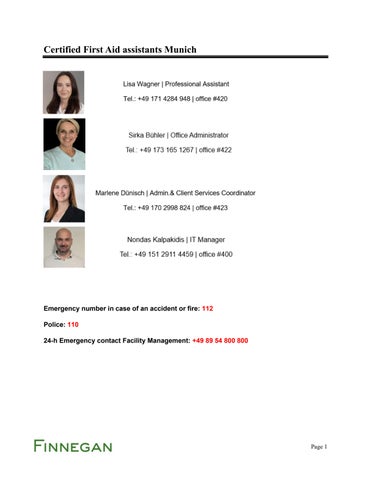
Certified First Aid assistants Munich
Emergency number in case of an accident or fire: 112 Police: 110 24-h Emergency contact Facility Management: +49 89 54 800 800
Page 1
Fire safety assistants Munich
Page 2
Important information First-Aid material from First-Aid boxes in the office
Every employee must report the removal of an item from the First-Aid kit immediately, as Finnegan must keep records of even minor work accidents.
Please contact Sirka Bühler (sirka.buehler@finnegan.com) or Marlene Dünisch (marlene.duenisch@finnegan.com) in the above-mentioned case that the accident can be documented in our electronic First-Aid book. At the Finnegan office in Munich, the First-Aid kits are located in the catering kitchen near the main entrance, the “eat & meet” kitchen and the “relax & play” room in the back of the office.
Assembly point in case of fire and evacuation
Address: Thierschplatz The assembly point for the Munich office is located vis-à-vis the Finnegan main entrance
FINNEGAN FIRE SAFETY REGULATIONS PARTS A, B, and C
Finnegan, Henderson, Farabow, Garrett & Dunner LLP Thierschplatz 6 80538 Munich
In accordance with DIN 14096 The Fire Safety Regulations consist of 43 pages. These Fire Safety Regulations were prepared exclusively for the leased spaces of Finnegan, Henderson, Farabow, Garrett & Dunner LLP in the Lehel Carre and may not be applied to other areas.
Contact Information: Client
Finnegan, Henderson, Farabow, Garrett & Dunner LLP Thierschplatz 6 80538 Munich
Contractor
Gesundarbeiten GmbH Holzstr. 29 82041 Furth
Author
Johannes Huber Occupational Safety Specialist Expert in the Development of Fire Safety Regulations in Accordance with DIN 14096:2014-05 Email: huber-safety@t-online.de
Document Management: Storage location
Property file
Document responsibility
Sirka Bühler and Marlene Dünisch
Version
2.0
Current as of
2026
Document Approval: Position
Name
Finnegan, Henderson, Farabow, Garrett & Dunner LLP Finnegan, Henderson, Farabow, Garrett & Dunner LLP
Sirka Bühler Marlene Dünisch
Date/Signature, /
/
Table of Contents: A
Fire Safety Regulations in accordance with DIN 14096 – Part A
S 08
Notice
B
Fire Safety Regulations in accordance with DIN 14096 – Part B
S 05
Introduction
S 09
Scope of application
S 10
Fire Prevention
S 16
Fire and Smoke Spread
S 17
Escape and Rescue Routes, Assembly Point
S 19
Alarm and Fire Extinguishing Systems
S 21
What to Do in Case of Fire
S 22
Reporting a Fire
S 23
Alarm Signals and Instructions
S 24
Get to Safety
S 25
Attempting to Extinguish the Fire
S 26
Special Precautions
Table of Contents: C
Fire Safety Regulations in Accordance with DIN 14096—Part C
S 30
Introduction
S 31
Fire Prevention
S 36
Reporting and Alerting
S 38
Safety Measures for People, Animals, the Environment, and Property
S 39
Firefighting Measures
S 39
Evacuation Procedures
S 40
Fire Department Response
S 41
Aftercare
S 42
Index Appendix
Preface: Concern for the safety of employees, the need to preserve the building and its associated workplaces, and our responsibility to the general public require that we give fire safety the attention it deserves. These fire safety regulations contain instructions and rules for fire prevention, firefighting, and proper conduct in the event of a fire. The primary goal is to protect life and health and to safeguard property. Time is of the essence in this regard. These Fire Safety Regulations apply to all employees, visitors, external staff, and contractors. Accordingly, all persons employed by Finnegan, Henderson, Farabow, Garrett & Dunner LLP are required to contribute to fire prevention through their conduct. Everyone must familiarize themselves with these fire safety regulations and the posted notice to ensure effective fire prevention and prudent, prompt action in the event of a fire.
In accordance with the fire safety regulations, everyone’s thoughts and actions must be guided by the following principles. 1
Everyone shares responsibility for active fire prevention.
2
In the event of a fire, saving lives always takes precedence over saving property. Smoking bans and prohibitions on handling open flames must be strictly followed and enforced.
3
It must be clear to everyone in the building (visitors and employees): 1
the route of the escape routes.
2
The location of the nearest fire-fighting equipment (fire extinguisher, wall hydrant, fire blanket). Instructions for use of the fire-fighting equipment.
3
Fire Safety Regulations in accordance with DIN 14096: The fire safety regulations in accordance with DIN 14096 consist of Parts A, B, and C. of the fire safety regulations (posted notice) applies to all persons (e.g., Part A
Part B
Part C
customers, employees, visitors, and staff from outside companies) who are scope of these fire safety regulations. of the Fire Safety Regulations (for individuals without specific fire safety responsibilities) is intended for individuals who are present within the scope of of these fire safety regulations (e.g., employees and staff from outside companies). of the Fire Safety Regulations (for individuals with specific fire safety responsibilities) is intended for individuals who, in addition to their general duties, have been assigned specific fire safety responsibilities.
Note: The job titles used in this document apply to all genders.
Introduction: Every fire endangers both human life and property. These Fire Safety Regulations are therefore intended to provide rules for fire prevention, as well as the measures to be taken in the event of a fire. All employees of Finnegan, Henderson, Farabow, Garrett & Dunner LLP must be familiar with the contents of these regulations and are required to observe and comply with the established rules. These Fire Safety Regulations will be provided to every employee. Training on these regulations must be conducted at least once a year and documented.
Fire Safety Regulations in Accordance with DIN 14096, Part A Part A of the Fire Safety Regulations (notice) applies to all persons (e.g., customers, employees, visitors, and contractors) who are present within the scope of these Fire Safety Regulations. The posted notice constitutes Part A of the Fire Safety Regulations. It is attached to this document as an appendix.
Fire 112
Follow the marked
The instructions listed here are intended to provide a clearer understanding of how to handle the actual notice. Depending on local conditions and the type of use, a sufficient number of notices must be posted in a clearly visible location.
Notice: In any case, locations should be chosen where people frequently or even linger. Such locations building entrances,
include:
lobbies, staff and break rooms, information areas and bulletin boards, elevators and elevator lobbies Near fire protection and fire extinguishing equipment
Fire Safety Regulations in accordance with DIN 14096 / Property: Finnegan, Thierschplatz 6, 80538 Munich October 1, 2026
Date of creation:
Fire Safety Regulations in accordance with DIN 14096 Part B Part B of the Fire Safety Regulations (for persons without specific fire safety responsibilities) applies at individuals who are present within the scope of these fire safety regulations on a more than temporary basis (e.g., employees and staff from outside companies).
B1 Scope: B1 1 2
3
The Fire Safety Regulations apply to the leased space of Finnegan, Henderson, Farabow, Garrett & Dunner LLP on the 4th floor of the Lehel Carre. The Fire Safety Regulations apply to all employees of Finnegan, Henderson, Farabow, Garrett & Dunner LLP. They also apply to all employees working on behalf of Finnegan, Henderson, Farabow, Garrett & Dunner LLP. Contractors (construction, repair, installation, and maintenance companies) must, upon be required in writing, upon the award of a contract, to comply with the necessary fire safety requirements and to instruct their employees on the applicable fire safety measures.
In addition to the statutory safety regulations, the rules contained in these fire safety regulations are intended to help protect all persons, property, and buildings from fire damage. Therefore, they must be strictly observed. Everyone should familiarize themselves thoroughly with the fire extinguishers and fire alarms located near them, as well as the necessary actions to take in case of danger. The fire safety regulations must be kept up to date by the person responsible for the documents. Management is responsible for ensuring that these fire safety regulations are regularly reviewed for compliance with fire safety requirements. The building management must designate, by name, a person responsible for fire safety and a deputy. These fire safety regulations are binding instructions. Every employee is responsible for complying with the fire safety regulations in their work area. Each employee must receive instruction on these fire safety regulations from their supervisor or a person designated by the supervisor before beginning work and at least once a year thereafter, in accordance with statutory requirements. The instruction must be documented. These fire safety regulations must be made available to every employee. These fire safety regulations take effect upon publication in Kraß.
B2 Responsibility: B2 Position Finnegan, Henderson, Farabow, Garrett & Dunner LLP Building Management and Facility Management
Company Sirka Bühler and Marlene Dünisch GEMA Building Management GmbH & Co. KG Einsteinring 31 85609 Aschheim-Dornach
B3 Fire Prevention:
B3 1 2 3 4
5 6
Order and cleanliness are essential prerequisites for organizational fire safety. Waste must be disposed of properly. The smoking ban must be observed! Smoking is Smoking is not permitted! In outdoor areas where smoking is permitted, as well as in the entrance areas, sufficient ashtrays must be provided for smoldering tobacco products. Tobacco butts or matches may only be disposed of in non-flammable ashtrays. These must be emptied regularly into suitable nonflammable waste containers with lids that are specifically intended for the disposal of tobacco remnants. Final disposal may not take place until it has been ensured that the tobacco remnants are no longer smoldering. The use of fire and open flames is strictly prohibited and requires prior approval from building management. If devices for keeping food warm are used at events If used for food, only electrically powered food warmers equipped with appropriate safety devices (overheating protection) may be used. Only undamaged and certified devices (VDE—DGUV V3) may be used, in accordance with the respective operating instructions. The food warming devices must be monitored during operation and turned off as soon as possible after use. The maximum load capacity of the electrical outlets must be observed (max. 3,500 watts per circuit). A sufficient number of suitable fire extinguishers must be kept in the immediate vicinity, and on-site personnel must be instructed on how to operate them. The use of fuel paste or liquid fuel is prohibited throughout the entire facility. Smoking is strictly prohibited in rooms containing highly flammable materials!
B3 Fire Prevention:
B3 7
8
At events or other occasions (e.g., the Christmas season), candles are strictly prohibited. Only electric LED candles may be used.
Welding, flame cutting, soldering, angle grinding, or similar hot work require special safety measures (e.g., provision of fire extinguishers, assignment of a fire watch) and written approval from the building management. In addition, a suitable permit must be issued in consultation with the building management. So-called hot work may only be performed in rooms designated for this purpose. Heated surfaces and flying sparks pose a constant ignition hazard. Since sparks can easily fly into cracks, crevices, etc., smoldering fires can be caused there. Often, an open fire does not develop until hours later. Such work may only be performed with special protective measures in place. This also applies to outside contractors. If the work takes place in one of the leased areas, the person responsible for fire safety in that specific leased area must be consulted. For fire-hazardous work and work that requires the fire alarm system to be shut down, all affected tenants and the building management must be notified.
9
Work on fire protection systems and components is prohibited without Prohibited without the express, written permission of the building management. Appropriate compensatory measures must be established during this work.
10
The use of flammable liquids and gases is strictly prohibited. If the use of these substances is unavoidable, prior approval from building management is required, along with a specification of the necessary protective measures. Transportation may only take place in closed, approved containers that are labeled according to their contents. Flammable liquids may only be stored in the designated, approved rooms or cabinets. The provisions of the BetrSichV and TRGS 700 and 800 must be observed.
B3 Fire Prevention:
B3 11
During repair work on the property, flammable building materials, liquids, and gases, as well as other flammable and explosive substances, may only be kept on site in quantities necessary for the progress of the work (daily requirements). To absorb spilled oils, paints, adhesives, and solvents, use suitable, non-flammable absorbents. These must then be disposed of properly and immediately.
12
Flammable liquids and other highly flammable materials must be stored properly and in accordance with regulations. Excessive storage of flammable materials (e.g., packaging materials) is prohibited in rooms not designated for storage purposes. No longer needed highly flammable materials (cardboard, paper scraps) must not be collected near archive rooms (increased smoke production in the event of a fire). They must be disposed of properly on a regular basis. Flammable waste, such as paper, plastic film, or similar materials removed from work areas, must be placed in the designated collection containers. Used batteries and rechargeable batteries must be collected separately. Lithium batteries may only be stored in a special container designated for this purpose until they are disposed of. Swollen or defective lithium-ion batteries must be disposed of properly immediately and must not be stored in office areas.
13
14
15 16
In public areas, waste receptacles (trash cans / Trash cans made of non-combustible material and of sturdy construction to contain any incipient fires within the container (e.g., self-extinguishing containers or those with self-closing, airtight lids). Waste collection containers (trash containers) may be placed inside the building only in rooms designated for that purpose. In outdoor areas, a minimum distance of 5 m from buildings must be maintained. The same applies to the storage of other fire loads such as, e.g., combustible building materials, debris containers, etc.; and for the parking of motor vehicles. Hallways, stairwells, and lobbies that serve as escape and rescue routes must always be kept free of combustible materials. Decorations in the entrance areas must be coordinated with the building management, taking into account the approved fire safety plan.
B3 Fire Prevention: B3 17
18
19
20
Decorative plants are permitted in the entrance areas only if they are kept fresh and regularly pruned of dead free of plant parts. Decorative plants must not obstruct the width of emergency exits and must be placed in a stable manner so they cannot tip over. This requires coordination with the building management, taking into account the approved fire safety plan. This coordination must be documented accordingly. The exterior escape and rescue routes on the property must be kept clear at all times and be safely passable at all times. This also includes the removal of snow and ice during the winter months. This is the responsibility of, among others, the building management. Fire department equipment (such as fire hydrants, fire water supply and withdrawal fittings) must be and must not be obstructed. This also includes the removal of snow and ice during the winter months (building management). The use of portable electrical equipment must always be in accordance with the safety regulations and operating instructions issued by the equipment manufacturer. These devices must be inspected regularly to ensure they are safe to operate. The legally required inspection and safety labels must be present. The management is responsible for organizing the regular inspections of electrical equipment provided by Finnegan, Henderson, Farabow, Garrett & Dunner LLP itself. The building management is responsible for organizing the periodic inspection of electrical equipment that falls under the responsibility of the building operator or building management. The inspection must be documented in writing.
B3 Fire Prevention: B3 21
Fixed and stationary electrical systems and equipment must also be inspected regularly to ensure their operational safety. This is the responsibility of building management and must be documented. If fixed, stationary systems are installed by Finnegan, Henderson, Farabow, Garrett & Dunner LLP itself, management is responsible for inspecting these electrical systems and equipment. The regular inspections must be documented in writing. Electrical systems and permanently installed electrical appliances (fixed electrical appliances) must be installed and operated only by qualified professionals in accordance with generally accepted electrical engineering standards. Blown fuses, defective outlets, and wiring may only be repaired by qualified personnel. The building management must be notified before work is carried out. In the event of defects in technical equipment or signs thereof (e.g., a burning smell, etc.), the power must be shut off immediately if possible. Subsequently, the building management must be notified, and the device must be safely taken out of service.
22
23
24
Technical systems and equipment must be inspected regularly for potential hazards. The use of private, mains-powered electrical appliances is generally prohibited without special authorization. Authorization for the installation and use of electrical devices not purchased or used for business purposes is granted by management. In the generally accessible areas of the property, authorization is granted by the building management. For electrical devices brought into the scope of these fire safety regulations by third parties, a certificate confirming that the required inspection has been performed must be submitted. Heat-generating electrical appliances (e.g., irons, cooking appliances, or coffee makers without an automatic shut-off feature) must be supervised while in use. They must be placed on non-flammable, heatinsulating bases that prevent tipping and at a sufficient distance from flammable materials so that, even in the event of excessive heating, nearby flammable objects cannot be ignited. When setting up electrical appliances, care must be taken to ensure that sufficient heat dissipation is ensured. The ventilation openings of electrical appliances must be kept clear.
B3 Fire Prevention: B3 25
26
27
28
29 30 31
32
When using electric light sources, care must be taken to ensure that The power ratings must not exceed the maximum power ratings of the sockets. To prevent heat buildup, lamps must not be covered or obstructed. The distance from flammable materials specified on the light fixture or in its operating instructions must be maintained. Defective electrical devices must be taken out of service immediately. Electrical circuits and connections must not be loaded beyond the rated capacity of the protective devices. Defective fuses must only be replaced with new and equivalent ones. Before doing so, a qualified electrician must investigate the cause. The same applies to resetting other protective devices, such as circuit breakers and residual current devices. When using batteries and rechargeable batteries, as well as when charging rechargeable batteries, the operating and safety instructions provided by the manufacturer must be followed. To prevent short circuits, lithium batteries must never be stored or transported unprotected and loose. Measures to prevent short circuits include, for example, placing them in their original packaging or in a plastic bag, as well as taping over the terminals. Lithium batteries must be stored exclusively in the special container provided for this purpose. At the end of the workday, ensure that the lights are turned off and that all electrical devices not intended for continuous operation are disconnected from the power supply. Every room containing flammable materials, electrical devices, or similar items must be checked for potential fire hazards. Windows and doors should generally be kept closed. Fans, computer systems, etc., must be turned off. Safety devices must not be turned off. Dust deposits must be regularly removed from surfaces, especially from electrical equipment. Manual shut-off devices for gas, water, and electrical systems must not be covered or obstructed and must be properly labeled. In day-to-day business operations, it is to be expected that outside contractors will be or permanently work on the premises as service providers, performing tasks such as cleaning, repair, maintenance, or construction work. This can give rise to mutual hazards. To avoid these hazards, the contracting entity must implement appropriate, coordinated safety measures and, if necessary, appoint a coordinator. Every employer must ensure that employees of other employers who are working within their area of responsibility have received appropriate instructions regarding their safety and health.
B4 Fire and Smoke Spread: B4 1
To prevent escape routes from filling with smoke, doors must be and kept closed using self-closing devices. Their function must not be impeded by forced measures, such as wedging or tying them shut. Keeping fire and smoke protection doors open is permitted only if it is absolutely necessary for operational purposes. These doors equipped with self-closing mechanisms must be fitted with hold-open devices approved by the building authorities, which are controlled by smoke detectors and close automatically in the event of a fire. Tampering with self-closing doors is prohibited! Fire doors can only fulfill their purpose when they are closed! Until the fire department arrives, any unnecessary supply of air to the source of the fire must be prevented, i.e., fire barriers, windows, and doors must be closed or kept closed. Recommendation: Fire doors must be marked with signs on both sides. (“Keep fire door clear”)
2
Placing objects within the door’s closing area is prohibited.
3
All doors must be closed at the end of the workday and when leaving the building in the event of an evacuation alarm. Downdraft openings for supply and exhaust air in the smoke extraction must be kept clear at all times and marked accordingly. Smoke and heat exhaust systems (RWA systems) allow smoke to escape in the event of a fire. These ventilation openings are normally closed and are opened in the event of a fire using push-button controls. Misuse of this system (e.g., for ventilation) is prohibited. RWA systems must be inspected regularly by a qualified professional to ensure they are functioning properly (building management). If an RWA system has been activated, the building management must be notified.
4
5
B5 Escape and Rescue Routes: Evacuation and rescue routes are hallways, stairwells, and exits to the outdoors. They are marked with safety signs. In case of danger, follow these signs! Any defects in these signs (e.g., faulty lighting) must be corrected immediately. Therefore, they must be reported to building management without delay.
BS Escape and Rescue Routes: B5 1 2 3
4
5 6
7
8
Evacuation routes, emergency escape routes, areas designated for the fire department, parking spaces, and similar areas must be kept clear at all times. Familiarize yourself now with the emergency routes you need to know. Signs and safety markings must be clearly visible at all times visible at all times. Therefore, they must not be covered by objects or obscured by any other means. Evacuation and emergency routes, including exits to the outdoors, must kept clear across their entire width at all times. It is therefore prohibited to place, set down, or store objects within the escape routes. This also applies to wheelchairs, walkers, and strollers. Elevators must not be used in the event of a fire. Emergency exits must be clearly marked from the outside . Escape Routes, Stairs, and Traffic Routes in Buildings and Outdoors must be kept clear across their entire width at all times. Doors in escape routes and emergency exits must not be locked during operating hours. Emergency exits must be accessible at all times in the direction of escape (panic release). Doors along escape routes, including exits to the outdoors, must be easy for people fleeing to open at any time without the need for external aids. They must not be blocked. Some doors along escape routes may be secured against alarm systems (door guards) to prevent unauthorized use. Familiarize yourself with how these systems work in advance, and do not hesitate to activate the alarm locks in an emergency to clear the emergency exit.
B5 Escape and Rescue Routes: B5
9 10
Every employee must be informed of the location and route of escape and rescue routes. Everyone must ensure that these routes remain unobstructed. Safety signs (safety symbols, such as fire safety, emergency, and first-aid facilities), as well as posted “evacuation and rescue plans” that show the routes along escape paths and all fire extinguishing and alarm options, must not be covered or obstructed.
Assembly point: Thierschplatz—by the fountain
Overview Map
B6 Alarm and Fire-Extinguishing Equipment: If a fire breaks out, it must be reported immediately to the fire department (112). Afterward, attempt to bring the fire under control using available resources (fire extinguishers, fire blankets, fire hydrants), while ensuring your own safety. If this is not possible, evacuate the building via the designated escape and emergency routes. Fire alarm systems and equipment must always be operational and in good working order. They must not be obstructed, damaged, removed, or otherwise impaired. Any defects in these systems and equipment must be corrected immediately. Therefore, they must be reported to building management without delay.
B6.1 Alarm Devices B6.1 1 2 3
Automatic fire detectors (smoke detectors) connected to the fire alarm control panel and automatic forwarding to the fire department. (This applies only to the underground parking garage. Automatic fire suppression systems connected to the fire alarm control panel and automatic notification to the fire department. (Does not apply to the office areas) Manual fire alarms (manual fire alarm buttons) at the entrances to Escape and evacuation routes in the underground parking garage. Familiarize yourself now with the locations of the manual fire alarms (hand-held fire alarms).
4
To report a fire to the fire department by phone, the emergency number for the fire department must be clearly displayed near every phone. If a specific area code must be dialed before the emergency number “112,” this must be indicated in numeric form on the respective phone. The fire department can be alerted in your building via telephone. For emergency calls made from a cell phone, there is no need to area code!
Automatic fire detectors are installed in the underground parking garage. These detectors respond to smoke and/or heat. Work that could cause false alarms (e.g., angle grinder work or work that generates dust) may only be carried out after the corresponding detector has been deactivated. Permission for such work must be obtained from building management. In such cases, the detectors may only be deactivated by building management.
B6.2 Fire Suppression Systems B6.2 1
2
3
Firefighting systems and equipment must always operational and in working order. They must not be obstructed, damaged, removed, or otherwise impaired. Defects in these systems and equipment must be corrected immediately. They must therefore be reported to building management without delay. Fire extinguishers are available in all areas of the building, especially in the hallways. These are marked with pictograms. It is recommended that you familiarize yourself with the fire extinguisher’s instruction manual on a regular basis. Used fire extinguishers—or even those that have been only partially used—must be turned over to building management immediately so they can be replaced or replaced. In addition, wall hydrants with rigid fire hoses are available. The use of these hoses is restricted to the fire department or trained personnel (fire safety assistants). The water supply points for firefighting water (marked with a symbol) must always be freely accessible.
Firefighting drills may only be conducted while ensuring personal safety!
B7 Procedures in Case of Fire: As a general rule: Stay calm! Ensure your own safety! Saving lives takes priority over firefighting!
B7 What to Do in Case of Fire: B7 Follow these guidelines:
4
The most important thing to do in the event of a fire is to remain calm and collected. Rash actions, frantic behavior, and shouting can lead to mistakes and panic! Every fire must be reported immediately, or steps must be taken to ensure it is reported. This can be done by calling the fire department at 112 or by pressing a pushbutton alarm (underground parking garage only). Please observe the instructions titled “What to Do in Case of Fire,” the fire safety regulations in accordance with DIN 14096-1 (posted notice). Alert other people in the danger zone by shouting
5
Pay attention to warning signals and follow instructions if necessary.
6
Get yourself and others to safety.
7
Do not use elevators in the event of a fire.
8
Go to the assembly point. Check that everyone is present and report the headcount. Keep the fire department’s access routes clear. The fire department must be be guided by a company employee familiar with the premises. Follow the fire department’s instructions.
1
2 3
9 10 11
Attempt to extinguish the fire. Attempts to extinguish a fire should only be made if they do not endanger one’s own safety; in doing so, one must ensure that escape routes are available.
B8 Reporting a Fire: If you notice a fire, you are required to report it immediately to the fire department (call 112).
B8.1 Automatic Reporting:
B8.1 1
Applies only to the underground parking garage If a fire alarm is triggered by automatic fire detectors or by the activation of an automatic fire suppression system, the fire department is immediately alerted.
B8.2 Manual reporting: B8.2 A fire can be reported either via a manual fire alarm (underground parking garage only) or by phone (112).
1
2
Applies only to the underground parking garage: Reporting a fire using manual fire alarms (hand-held fire alarms) is preferred over reporting it by phone. When reporting a fire via manual fire alarms (hand-held fire alarms), you should subsequently—and after leaving the building—if possible—provide the fire department with further details via cell phone. If you report a fire by phone, never dial the emergency number from room where the fire is, but report the fire from a phone located outside the fire area. On your way to the nearest phone, warn people nearby by shout. If possible, trigger the evacuation alarm by activating a manual fire alarm button.
B8.2 When reporting a fire by phone, the following information is required
Where is the fire?
Address / Location of the fire / Floor Lehel Carre, Thierschplatz 6, 80538 Munich
What is on fire?
Building fire / Vehicle fire / Explosion / etc.
How bad is it?
Extent of damage / Size of fire /
What dangers?
Is there a danger to life and limb? Are there any injured people? How many? Known risks? E.g., hazardous materials, gas cylinders, etc. Wait for follow-up questions. The call is always ended by the emergency dispatch center.
Wait!
B9 Alarm Signals and Instructions: Pay attention to warning signals and instructions! In the event of danger, you are responsible for alerting those around you!
B9 Alarm Signals and Instructions: B9 1
2
When the alarm is triggered (shout), stop working and evacuation. Leave the building via the escape and rescue routes. Proceed directly to the assembly point. Once the emergency response teams and the fire department arrive, their instructions must be followed without exception.
People present will be warned of dangerous situations by a verbal announcement.
3
Do not use the elevator, as a power outage is likely in the event of a fire.
4
The arriving fire department must be informed immediately: Whether there are still people in danger. Whether anyone is missing. How to access the fire. About other hazards—flammable substances, technical equipment
B10 Get to safety: In the event of a fire, leave the danger zone immediately! You should leave the danger zone via the shortest and safest route. In doing so, assist people who are unfamiliar with the area, in need of help, helpless, injured, or otherwise at risk—especially those with limited mobility, older adults, and children. Familiarize yourself with the necessary escape routes.
B10 Getting to Safety: B10 As a general rule: 1
Upon an alarm, ongoing operations must be suspended immediately.
2
Rescuing people takes priority over firefighting and protecting property.
3
Assist vulnerable, disabled, or injured persons (without putting yourself at risk) and take them out of the danger zone. Check rooms to the extent possible without putting yourself at risk . Check whether anyone has been left behind in adjacent rooms or restrooms, and if so, warn them and escort them to safety. (Responsibility of fire safety assistants) The evacuation must take place immediately. All activities must be stopped immediately. This also applies to phone calls and meetings. The evacuation should proceed swiftly but without panic. Use the designated escape routes or emergency exits To prevent fire and smoke from spreading unchecked throughout the building , all doors (including those to individual units) must be closed during the evacuation, but not locked. If possible, turn off heat-generating and fire-hazardous appliances (e.g., stoves, etc.) before leaving the workplace. All equipment not intended for the rescue of persons, the recovery of property, or for Personnel required to assist the firefighters must leave the danger zone During an evacuation, never run back into the building, for example, to retrieve personal belongings. Missing persons must be reported to the fire department immediately. In such cases, it is helpful to provide information about the last known location of the missing person. Assist anyone who is unable to help themselves Proceed to the designated assembly point. Wait for further instructions.
4
5 6
7
9 10 11
Assembly point: Familiarize yourself in advance with the assembly point designated for you. Verify that all employees are present (manager, fire safety assistants).
B11 Attempt to extinguish the fire: Bll
1
2 3 4 5
In the event of an accident, danger, or emergency, every person is obligated to provide assistance to the extent that this reasonably expected given their physical and mental condition, is obligated to provide assistance. In such cases, rescuing people takes priority over fighting fires and safeguarding property. Initial fires must be extinguished immediately using the available fire extinguishers—following the operating instructions. Incipient fires are fires with such low levels of smoke and heat that people can still safely approach the fire with a clear view of the source of the fire. Attempts to extinguish the fire should only be made if they do not endanger your own safety , and be sure to keep escape routes clear! If the first attempt fails, do not make another attempt! If smoke and heat levels increase, leave the danger zone immediately .
6
Flammable objects must be removed from the danger zone of the fire, to the extent possible , from the danger zone of the fire.
7
If a person's clothing catches fire, the flames must be extinguished immediately with a fire extinguisher or water. If necessary, flames can also be smothered by throwing blankets or coats over the person or by rolling the person on the ground. Do not extinguish burning oils, fats, and similar substances with water. There is a risk of a grease explosion. Choose a suitable agent to smother the flames (e.g., a grease fire extinguisher) and cut off the heat source. Notify the fire department! In the event of fires involving electrical equipment, disconnect the power firefighting—if possible—disconnect them from the power source. Maintain the safety distance indicated on the fire extinguisher. Notify the fire department! When using carbon dioxide (CO₂) extinguishers, warning labels must be observed. Exercise caution in confined, poorly ventilated spaces, as the extinguishing agent is a gas with a suffocating effect. Turn off electrical devices. Do not aim water extinguishers at connected electrical devices (risk of electric shock). In the area affected by the fire, keep doors and windows closed for as long as possible until sufficient firefighting personnel and extinguishing agents are available. Avoid drafts; therefore, close all doors if possible. Upon arrival, the fire department assumes command of the scene. Follow the fire department’s instructions.
8
9
10
11 12 13
B11 Attempt to extinguish the fire:
B11 14
- Do not activate the extinguisher until you are in the immediate vicinity of the fire! - Do not extinguish indiscriminately; instead, focus on hot spots or burning surfaces! - Always approach the fire downwind! - Aim the extinguishing jet directly at the source of the fire. - Cover liquid fires with foam from the fire extinguisher! - Fight larger fires with multiple extinguishers at the same time! - Wrap burning people in blankets or similar materials to smother the fire.
B12 Special Safety Rules: Escape routes via hallways, stairwells, or Exits leading directly outdoors are available. Do not enter areas already filled with smoke! It is lifethreatening!
B12. 1 General: B12.1 If the primary escape route is no longer passable due to smoke, an 1 2
3
alternative escape route must be used. If your escape route is blocked by thick smoke, then: Close the door, seal the gaps with wet cloths or similar materials if possible, make yourself known by the window or by other means (e.g., calling 112), and wait for the fire department or other help. If you are caught off guard by smoke, stay low to the ground Walk—or crawl if necessary—and leave the danger zone immediately; find a safe area and make yourself known by calling for help or dialing the fire department’s emergency number!
B12.2 Special Conditions in the Building: B12.2 In the event of a fire, do not use the elevators, 1
but please exit the building via the nearest stairwell.
2 3
In the area of the fire-rated glazing between office units and stairwell vestibules, furniture and other furnishings must not be placed in the immediate vicinity of the fire-rated glazing. In addition, operational and other legal regulations apply, such as accident prevention regulations, VDE guidelines, DIN standards, and VdS information sheets. These are available from building management.
B12.3 Sprinkler System B12.3 The building is equipped with a sprinkler system in the basement levels. 1
2 3 4
The sprinkler system activates due to the effect of temperature at It is deployed locally in the event of a fire and is intended to fight or contain the fire locally. A distance of at least 0.50 m must be maintained between the top edge of objects that obstruct the spray (shelves, stored goods, etc.) and the sprinkler heads. No objects may be hung or attached to the sprinkler heads or pipes.
B12.4 Handling of Persons with Limited Mobility: B12.4 1
In day-to-day business operations, one must also anticipate the presence of people with limited mobility (e.g., wheelchair users). The following points must be observed to ensure the safe evacuation of all individuals. Ground-floor areas can be reached independently by people with limited mobility accessed independently by people with limited mobility. In the event of a fire, it can therefore be assumed that these individuals will also be able to exit the ground floor in the same manner. If one or more attendants are needed for this purpose, it is the responsibility of the on-site staff to ensure that the necessary personnel are present while the individuals with limited mobility are on site.
3
The upper and lower levels are accessed by people with limited mobility via the elevators. In the event of a fire, these must no longer be used. Therefore, only the stairs are available. Self-evacuation may then no longer be possible.
4
In the event of an alarm, people with limited mobility must be evacuated from the danger zone. If using the stairs is possible, they must be used (e.g., visually impaired individuals, individuals using walking aids). If using the stairs is not possible, these individuals must be moved to a safe area on the same floor. This applies in particular to wheelchair users.
5
It is the responsibility of the management of the respective Tenants must ensure that, if there are people with limited mobility present, all necessary precautions are taken to evacuate them safely in the event of an emergency. The evacuation must be completed by the time the fire department arrives. The fire department must be notified immediately if people are or cannot be located. If possible, the person’s last known location must be reported.
6
B13 Areas of Responsibility for Fire Prevention: B13 Building Management 1
2
3
- Approval of work involving special hazards. - Compliance with fire safety regulations during structural modifications. - General: Verification of compliance with fire safety regulations. - Monitoring of the smoke detection system. - Monitoring of fire protection equipment. - Inspection and updating of safety signage. Finnegan, Henderson, Farabow, Garrett & Dunner LLP - Approval of work involving special hazards (in addition to building management). - Compliance with fire safety regulations - Leased space: Verification of compliance with fire safety regulations. - Monitoring of fire safety equipment. - Inspection and updating of safety signage. - Review and update of the fire safety regulations - Training employees in fire safety
All employees: - Turn off the power to electrical appliances in their work area (e.g., electric kettles). - Salvage property, provided this can be done safely and no more urgent measures are required.
Fire Safety Regulations in accordance with DIN 14096 Part C The Fire Safety Regulations in accordance with DIN 14096—Part C are directed at the officials and groups of persons listed below, who, in addition to their general duties, have been assigned specific fire safety duties. It governs the responsibilities and duties of the relevant officials or groups of people.
C1 Introduction: C1 These fire safety regulations are binding instructions for all 1
groups of persons with specific fire safety responsibilities. These fire safety regulations must be provided to them in writing. These fire safety regulations take effect upon publication.
C2 Fire Prevention: C2.1 Building Owners The building owner has the following preventive responsibilities (prior to an actual emergency):
1
Delegate operational responsibility to a qualified company
2
Monitoring and supervising building management
C2.2 Building Management Building management has the decisive economic authority with regard to the technical operation of the building. This includes, for example, the authority to approve structural measures and the decision-making authority regarding the operation or decommissioning of parts of the building (operator responsibility). It has the following preventive tasks (prior to an actual alarm): 1
Ensuring compliance with the fire safety and security rules described in the fire safety plan. Regular reporting to the building owner including documentation of fire safety-related
3
actions. Organization of the monitoring of fire safety regulations that arise from fire safety certifications or plans and occupational safety regulations—including in the event of structural changes or changes in building use.
C2 Fire Prevention: C2.2 Building Management 4
5 6
7 8
9
10
11 12 13 14 15
Responsibility for providing annual fire safety training to its own employees who work in or for the property. Responsibility for instructing third-party contractors working at the property on behalf of building management. Receiving reports of fire safety-related defects and promptly forwarding these reports to the owner. Organizing the rectification of the defects and subsequently verifying that they have been rectified. In the event of a failure or malfunction of fire protection and safety-related , effective compensatory measures must be established, or operations in the affected part of the building must be suspended. Approval and organization of inspections for work that may result in an increased fire hazard (welding, cutting, soldering, or similar processes; bonding flooring; handling solvents /pickling agents, or similar). Such work is permitted only after a suitable permit has been issued in coordination with the building management (see Appendix). In the case of fire-hazardous work and work that requires the fire alarm system to be shut down, all affected residents and the building management must be appropriately consulted. Responsibility for conducting an annual fire safety and safety inspection of the properties in cooperation with the building management and, within the leased areas, with the person responsible for fire safety in the respective leased area. Assistance in organizing regular fire safety and evacuation drills at the property. After every evacuation drill or actual evacuation alarm, a debriefing must be conducted after a reasonable amount of time has passed. Findings must be documented. Individual procedures may need to be adjusted as necessary. Responsibility for the regular review of fire safety documents, such as fire department plans, evacuation and rescue plans, and fire department route maps. Verification of timely maintenance of fire safety and safety equipment, as well as the fire alarm and alarm systems (compliance with inspection intervals—maintenance contract). Responsibility for coordinating with the fire department and property insurers. Monitoring of fire safety regulations resulting from the fire safety certificates/plans for the properties and occupational safety regulations. Ensuring and monitoring fire safety measures during activities involving a fire hazard.
C2 Fire Prevention: C2.2 Building Management 16
Participation in the annual fire safety and security inspection.
17
Responsibility for the timely maintenance of fire protection and Safety equipment, as well as the fire alarm and warning system (compliance with inspection intervals—maintenance contract). Monitoring the functionality and operational safety of fire protection equipment.
18 19 20
21
22
Installing, monitoring, and keeping up-to-date informational and safety signs—this also includes marking supply air openings for smoke extraction. Keeping escape and rescue routes, as well as areas and facilities for the fire department; do not block fire barriers and doors with self-closing mechanisms; keep fire extinguishers and safety-related equipment accessible Responsibility for keeping escape and outdoor rescue routes, as well as access points and facilities for the fire department, such as hydrants and fire water supply fittings Receiving reports of fire safety-related defects and organizing the immediate rectification of such defects. Safety measures must be taken as necessary to compensate for these issues. Reporting reported and discovered defects to building management.
C2.3 Fire Safety Officers The fire safety officer responsible for Finnegan, Henderson, Farabow, Garrett & Dunner LLP shall, with regard to preventive fire safety (prior to an actual fire alarm), identify hazards early, assess them correctly, and, if necessary, propose countermeasures and support management. They must be consulted on all operational decisions concerning fire safety. Their primary responsibility is to establish organizational fire safety measures. In doing so, they may seek advice from external experts and, in particular, the occupational safety specialist. Fire prevention officers must be designated and appointed by the employer in accordance with Section 10 of the Occupational Safety and Health Act. In addition, they have the following duties: Instruct employees on the provisions set forth in the fire safety regulations. 1
2
3
Organizing and conducting regular fire safety and evacuation drills. After every evacuation drill or actual evacuation alarm, a debriefing must be conducted after a reasonable amount of time has passed. Findings must be documented. Individual procedures may need to be adjusted as necessary. Participation in the annual fire safety and security inspection.
4
Participate in the approval and supervision of work that could lead to an increased fire hazard (e.g., welding, cutting, soldering, or similar processes; bonding floors; handling solvents or strippers; etc.).
5
7
Ensuring and monitoring fire safety measures during fire-hazardous activities. (This applies to the premises of Finnegan, Henderson, Farabow, Garrett & Dunner LLP) Monitoring the timely maintenance of fire protection and safety equipment, as well as the fire alarm and warning system (compliance with inspection intervals—maintenance contract). Monitoring the functionality and operational safety of fire protection equipment.
8
Monitoring and keeping informational and safety signs up to date.
9
Reporting Reported and Discovered Defects to Building Management
10
Regular review of fire safety documents, such as fire safety regulations, fire department plans, evacuation and rescue plans, and fire department route maps.
6
11 12
Keep escape routes clear; do not block fire-resistant partitions or doors with self-closing mechanisms; keep fire extinguishers accessible. Regular participation in training sessions on fire safety responsibilities.
14
Fire prevention measures must be regularly coordinated with and implemented in conjunction with the building’s tenants (e.g., inspections). Other duties as specified in their certificate of appointment. Such as:
15
-Compliance with the fire safety regulations in Parts A and B during building operations, when structural changes are made, and when the building’s use changes. - Designating and monitoring fire protection equipment, areas for the fire department (in accordance with DIN 14090), and escape routes. -Installing, monitoring, and keeping informational and/or safety signs up to date, -Approving work involving special hazards (e.g., fire-hazardous work) only after a suitable permit has been issued (permit for fire-hazardous work specifying the protective measures to be taken), -Monitor areas at risk of fire and explosion, -Enforce the smoking ban, -Update fire department plans in accordance with DIN 14095 and evacuation and rescue plans in accordance with Section 55 of the Workplace Ordinance and the fire safety regulations, -Train employees (including those from outside companies) in fire safety, -Conduct fire safety and/or evacuation drills (including in specific areas), -Maintain cooperation with the fire department and the property and casualty insurer. Measures taken must be documented.
13
C2 Fire Prevention: C2.4 Management of Finnegan, Henderson, Farabow, Garrett & Dunner LLP Management has the following preventive responsibilities (prior to an actual emergency): 1
2 3 4
5
6 7 8
9
10 11
Organizing fire safety measures for its own leased space and appointing individuals with specific fire safety duties and ensuring their training. Organizing training for its own employees on the regulations set forth in the fire safety code. Reviewing the fire safety regulations to ensure they address the needs of one’s own leased space. Organizing the monitoring of the fire safety regulations that as set forth in Sections A–C of these Fire Safety Regulations—even in the event of structural modifications or changes in use. Organization and conduct of regular fire safety and evacuation drills. After each evacuation drill or following an actual evacuation alarm, a debriefing must be conducted after a reasonable amount of time has elapsed. Findings must be documented. Individual procedures must be adjusted as necessary. Responsibility for organizing the annual fire safety and security inspection of one’s own leased area. Receiving reports of fire safety-related defects and organizing the immediate rectification of the defects. If necessary, safety measures must be taken to mitigate the risk. Approval and organization of inspections for work that could lead to may lead to an increased fire hazard (welding, cutting, soldering, or similar processes; bonding of flooring; handling of solvents or strippers, etc.). Such work is permitted only after a suitable permit has been issued (see Appendix). For work that poses a fire hazard or requires the fire alarm system to be shut down, all affected residents and the building management must be appropriately involved. Responsibility for the regular review of fire safety documents, such as fire safety regulations, evacuation, and rescue plans. Responsibility for cooperating with the fire department and property insurers. Designation of one or more persons responsible for fire safety , including a representative who serves as a point of contact for the building management.
C3 Reporting and Alerting: C3 In the event of a fire, the alarm plan is used to systematically notify emergency responders (fire department) and responsible persons. When notifying the fire department by telephone, the designated contacts within the building must also be notified in accordance with the alarm plan. The alarm plan is posted in the following locations: With building management. 1
2
At Finnegan, Henderson, Farabow, Garrett & Dunner LLP
Fire Alarms: Fire Department Finnegan, Henderson, Farabow, Garrett & Dunner LLP Finnegan, Henderson, Farabow, Garrett & Dunner LLP Finnegan, Henderson, Farabow, Garrett & Dunner LLP
Sirka Bühler
112 +49 173 1651267
Marlene Dünisch
+49 170 2998824
Munich Office
+49 89 83931 1230
Facility Management
GEMA
+49 8954800742
Evacuation Alarm: Manual, internal alarm Push-button alarm Fire alarm activation Sprinkler activation
By shouting
Office spaces, 4th floor Basement Basement Basement
Siren Siren
Siren
Important phone numbers: Police Fire Department / Emergency Medical Services Building Management
Anastasia Inzenhofer
Munich Public Utilities
GEMA Building Management 089-54800742 GmbH & Co. KG Emergency Service 0800 796 888 000
110 112 Service-vkb@gema-gebaeudemanagement.de
C3 Reporting and Alerting: Alarm Plan Accident and Fire
Assault and Burglary
112
110
WHERE? WHO? WHAT? HOW MANY? WAIT! Contact person: Finnegan, Henderson, Farabow, Garrett & Dunner LLP Finnegan, Henderson, Farabow, Garrett & Dunner LLP
Sirka Bühler
(0)173 1651267
Marlene Dünisch
(0) 170 2998824
Facilities Management
Anastasia Inzenhofer
Service-vkb@eema-fiebaeudemanaRement.de
GEMA Building Management
089-54800742
GmbH & Co. KG Emergency Service
0800 796 888 000
Munich Public Utilities
Immediate Actions Call for help (emergency number 112) – Rescue and warn people – Fight the fire (without putting yourself in danger) – Turn off the power Keep escape routes and fire department access roads clear
C3 Reporting and Alerting: C3 Alarms are triggered for all areas by: Automatic alarm activation by smoke, heat, or push-button detectors. (basement only) Triggering of an alarm by staff, employees, or visitors, 2 reporting—either in person or by phone. An automatic activation as described in 1 is forwarded directly to the fire department.
1
If the alarm is triggered as described in 2, it must be ensured that the alarm (possibly after verification) is forwarded to the fire department. In the basement, this is done via pushbutton alarms and in the office areas via telephone (112).
C4 Safety Measures for People, Animals, the Environment, and Property C4 Injured persons must be rescued and treated. The following applies: First responders must be summoned to treat the injured Urgency Injury Not life-threatening 1 Ambulance (KTW/RTW) at normal speed, no emergency physician—e.g., minor injury, sprain No immediate danger to life, patient responsive; ambulance, 2 no emergency physician, e.g., circulatory disturbance, moderate injury
3
Suspected life-threatening condition; patient only partially responsive. Emergency physician/ambulance e.g., case cannot be assessed, severe injury, shock, heart attack.
4
Life-threatening condition; person unresponsive. Emergency physician/ambulance e.g., respiratory arrest, cardiac arrest—resuscitation required.
C5 Firefighting Measures C5 The tasks of the first responders are coordinated by the fire safety officer or a 1 2
3 4
supervisor. The electrical systems in the areas affected by the fire are shut down.
Firefighting measures shall be carried out provided that doing so does not endanger the personnel . The principles described in Section 11 of Part B of the Fire Safety Regulations must be observed. Activate non-automatic fire extinguishing systems (if available).
C6 Evacuation procedures: C6 In the event of an evacuation, it is very important to prevent panic. The goal is to safely and quickly guide all building safely and quickly. Loud shouting and running should be avoided, as this hinders an orderly evacuation and can cause panic. Security personnel will guide visitors out of the building in accordance with 1 the evacuation plans. (e.g., evacuation assistants, fire safety assistants, safety officers, security personnel) The alarm plan applies
C7 Preparation for the Fire Department’s response: C7 General measures:
1 2 3 4
The fire scene and the immediate vicinity must be cleared. Employees, visitors, and onlookers must be moved far enough away from the fire scene and the immediate vicinity so that firefighters are not obstructed. The areas designated for the fire department (in accordance with DIN 14090) and the water supply points for firefighting must be kept clear or cleared. A guide designated by the building management must be stationed in the access area for the fire department. Their duties: - Provide necessary information and ensure access. This guide must be a person with local knowledge.
C7 Preparation for Fire Department Operations: C7.1 Building Management In the event of an alarm, building management has the following responsibilities
1 2
to determine, in consultation with the fire department, the time at which operations may resume. In the event of an alarm, an employee must go to the property and be available to the incident commander as a point of contact for building services-related matters.
3
Assist in determining the time for resuming operations in collaboration with building management and the fire department
C7 Preparations for the fire department’s response: C7.2 Management In the event of an emergency, management or its on-site representative is responsible for the following tasks. To ensure that these measures are implemented, the management of the respective tenant may enlist the assistance of pre-designated officials who are present in the event of an alarm. 1
In the event of a hazard, the fire department must be alerted and the evacuation alarm must be triggered.
2
Forwarding fire alarms and ordering operational shutdowns.
3
Responsibility for the evacuation—all persons encountered must be instructed to leave the building via the emergency exits and proceed to the assembly point. No one is to remain in the building! Assist people with limited mobility out of the danger zone and, if necessary, care for and provide care (see also Chapter B.12.4). Verify that the assigned areas have been completely evacuated verify that the evacuation of the assigned areas is complete, while ensuring that there is no risk to one’s own life. The fire department must be notified immediately if people are building or could not be located, or if certain areas could not be checked. Assess the fire scene and, if possible, fight the fire at its source. Information about the fire scene must be relayed to the fire department. Set up a assembly point and organize first aid for injured . If the assembly point is not fully suitable for that purpose at the time the building is evacuated, an alternative location must be organized on one’s own responsibility. Implementing the instructions of the fire department’s incident command as well as other authorities and organizations with safety responsibilities (e.g., fire department and police). Prevent re-entry into the building and, if necessary, mark hazardous areas.
4
5 6 7 8
9
10
11
Determine the time for resuming operations (after consultation with the fire department).
C8 Follow-up: C8 After the fire department has left the scene and handed over the damaged area, the respective management must take the following measures: The fire scene must be secured after the fire department has cleared it. 1
2 3 4
5
6
7 8 9
10
Re-entry into the premises is permitted only after authorization by the fire department, the building management, or the management of Finnegan, Henderson, Farabow, Garrett & Dunner LLP or their representatives. Secondary damage following a fire must be minimized by fire watch and by ventilating the fire scene, as well as by promptly removing the water used to extinguish the fire. The fire watch must be equipped appropriately to address the risks of contamination at the fire scene. Due to the owner’s or the To protect victims and prevent harm to third parties (e.g., from hazards such as hazardous substances, structural collapse, etc.), the cold fire scene must be cordoned off to prevent unauthorized third parties from entering and must be clearly and permanently marked. The fire alarm and suppression systems used must be immediately be made ready for use and . Fire extinguishing equipment must undergo a fire safety inspection and safety inspection by qualified personnel. The guidelines in VdS Guideline 2357 (Guideline for Fire Damage Restoration) must be followed. Electrical systems and equipment must be following a fire by qualified personnel to ensure operational safety. The fire safety officer must ensure that operational readiness is restored to monitor fire protection systems (including, where applicable, in specific areas).
A fire scene is always also a “crime scene.” As a general rule, cleanup, structural alterations, or repairs are not permitted until the scene has been cleared by the incident commander and the criminal investigation department. Signature: Position Finnegan, Henderson, Farabow, Garrett & Dunner LLP RGM Facility Management GmbH
Name
Date/Signature
Attachment: 1
Notice Regarding Fire Safety Regulations (Part A) Information Sheet—Proper Use of Fire Extinguishers
3
Emergency Plan
4
Information Sheet on Fire Safety Procedures for Contractors
5
Information Sheet—Work Involving Fire Hazards
6
Training Certification for Contractors
7
List of Persons with Special Fire Safety Responsibilities
FIRE SAFETY REGULATIONS APPENDIX
Property:
Finnegan, Henderson, Farabow, Garrett & Dunner LLP Thierschplatz 6 80538 Munich
APPENDIX The appendix to the Fire Safety Regulations consists of 9 pages. BSO
1
Contact Information: Client
Finnegan, Henderson, Farabow, Garrett & Dunner LLP Thierschplatz 6 80538 Munich
Table of Contents: 1
Notice Regarding Fire Safety Regulations (Part A)
2
Information Sheet—Proper Use of Fire Extinguishers
3
Emergency Plan
4
Information Sheet on Fire Safety Procedures for Contractors
5
Information Sheet—Work Involving Fire Hazards
6
Training Certification for Contractors
7
List of Persons with Special Fire Safety Responsibilities
APPENDIX BSO
2
Appendix 2: Information Sheet – Proper Use of Fire Extinguishers
Wrong
Correct
Always attack the fire from upwind
Extinguish wildfires starting from the front or the bottom
However: Extinguish dripping and flowing fires from top to bottom
Use a sufficient number of extinguishers simultaneously—not one after another
Caution: Always watch for reignition rewarming
Do not reuse fire extinguishers that have been used. Have them refilled and inspected by customer service
APPENDIX BSO
3
Appendix 3: Emergency Plan Accidents and Fires
Assault and Burglary
112
110
WHERE? WHO? WHAT? HOW MANY? WAIT! Contact: Finnegan, Henderson, Farabow, Garrett & Dunner LLP Finnegan, Henderson, Farabow, Garrett & Dunner LLP Facilities Management Munich Public Utilities
Sirka Bühler
0173 1651267
Marlene Dünisch
0170 2998824
Anastasia Inzenhofer GEMA Building Management GmbH & Co. KG Emergency Service
Service-vkb@gema-gebaeudemanagement.de
089-54800742 0800 796 888 000
Immediate Actions Call for help (emergency number 112) – Rescue and warn people – Fight the fire (without putting yourself in danger) – Turn off the power – Keep escape routes and fire department access roads clear
APPENDIX BSO
4
Appendix 4: Information Sheet – Fire-Hazardous Work 1 Welding, flame cutting, and similar work (such as soldering, annealing, or thawing), as
2 3 4
5
6
7
APPENDIX BSO
well as cut-off grinding, may only be performed in each individual case with written authorization (hot work permit) from the responsible party (GEMA Building Management). A hot work permit must be completed for welding, cutting, soldering, thawing, heating, and cut-off grinding operations. All companies commissioned to perform fire-hazardous work must be instructed by the respective client before work begins using the “Information Sheet on Fire-Safe Conduct of Outside Contractors” (see attachment). Before issuing the permit, a careful assessment must be made of the fire hazard at the intended work site and its surroundings. The work site and its surroundings (within a radius of approximately 10 m) must be kept free of flammable materials. Be aware of the danger posed by flying sparks. Flammable materials, such as permanently installed components that cannot be removed from the hazardous area, must be protected so that they cannot be ignited by flames, electric arcs, sparks, weld spatter, heat radiation, or heat conduction. In addition to the person performing the work and their assistants, at least one additional person familiar with firefighting must be available as a fire watch. suitable fire-extinguishing equipment, such as fire extinguishers, must be available in the work area. The following safety measures must be strictly observed in the permit for hot work: - Appointment of a supervisor and provision of a fire watch - Specify the necessary safety precautions (e.g., clearing the work area, covering permanently installed components, eliminating the risk of explosion in containers and piping) - Specify the fire extinguishers and extinguishing agents to be provided - Inspection of the work area upon completion of the work. The work area and its surroundings (including adjacent rooms, etc.) must be carefully inspected by the fire watch during and after the work for smoldering areas, small fire pockets, as well as suspicious heating and suspicious odors. - Monitoring may not be discontinued until there is no longer any suspicious heating and suspicious odors are no longer present. If the fire hazard in the area surrounding the work site that is at risk cannot be completely eliminated before the work is performed, the aforementioned work must not carried out. Alternative work procedures must be used.
5
Appendix 5: Guidance on Fire Safety Practices for Contractors 1 Contractors are required to comply with accident prevention regulations, all other
2
3 4 5 6 7 8 9 10 11 12
13
14 15 16 17 APPENDIX BSO
occupational safety and environmental protection regulations, as well as generally accepted safety and occupational health rules and the fire safety regulations. All work must be planned and carried out in such a way that there is no danger—and none can arise—to employees at the site or to uninvolved third parties. When working on safetycritical systems (e.g., pressure vessels, conveyor systems, and electrical systems), the contractor must carry out repairs in a manner that poses no danger to people or property . Employees of outside contractors must register their arrival and departure with Facility Management each workday when working in areas that are generally accessible and in restricted areas with Facility Management at the start and end of each workday. You must comply with the safety instructions issued by the building administration and facility management must be followed. Contractor employees must use the required personal protective equipment. The necessary tools, hoisting equipment, machines, ladders, scaffolding, and other aids, etc., must be in safe condition and must be used or used. The use of chemicals and cleaning agents must be coordinated with the building management coordination with Facility Management. The responsibility for ensuring the necessary safety measures in the work areas lies with the employees of the contractor. Traffic routes, emergency exits, control panels, fire protection equipment, and other safety equipment must be kept clear. Employees of outside contractors are responsible for maintaining order and cleanliness in their work areas. Waste, packaging, and used materials must be disposed of immediately and at their own expense. Shut-offs of utility services (electricity, water) are permitted only with the approval of the building management. Work involving a fire hazard (hot work such as welding or grinding) must be reported to the building management prior to commencement and must be approved. The issuance of written welding permits is governed by the “Guidelines for Work Involving a Fire Hazard.” Required safety measures, such as fire watch personnel, are the responsibility of contractors. Certain areas of the property are protected by automatic fire alarm systems. Before commencing work that generates heat or dust, consult with building management to determine whether such work could cause a false activation of the fire alarm and extinguishing systems. If fire alarm or suppression systems in specific areas must be taken out of service, appropriate alternative measures must be taken as necessary (e.g., fire watch, provision of additional fire extinguishers). Injuries and incidents must be reported to building management. This also applies to property damage. Any identified accident hazards must be eliminated immediately or reported directly to building management and facility management The person in charge at the outside contractor must check in with Facility and confirm that they are familiar with this information sheet 6
Appendix 6: Signature List Fire Safety Procedures & Fire-Hazardous Work Company
Name
Date
Signature
Company
Trainer (Facility Management; GEMA)
Date
Signature
APPENDIX BSO
7
Appendix 7: List of Persons with Fire Safety Responsibilities Company Finnegan, Henderson, Farabow, Garrett & Dunner LLP
Name Sirka Bühler Marlene Dünisch Munich Office Nondas Kalpakidis
Position
Contact +49 173 1651267 +49 170 2998824 +49 89 839311230 +49 151 29114459
Directory of Certified Fire Safety Assistants Sophia Braun Sirka Bühler Marlene Dünisch Nondas Kalpakidis Lisa Wagner
APPENDIX BSO
8