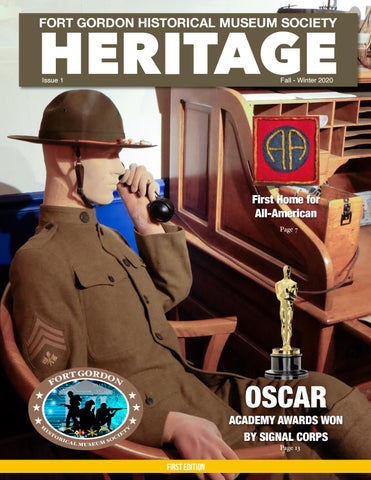
FORT GORDON HISTORICAL MUSEUM SOCIETY
HERITAGE Issue 1
Fall - Winter 2020
First Home for All-American Page 7
OSCAR
ACADEMY AWARDS WON BY SIGNAL CORPS Page 13
FIRST EDITION
Issue No. 1
HERITAGE - WINTER 2020 FORT GORDON HISTORICAL MUSEUMFALL SOCIETY
HERITAGE FIRST EDITION
SPECIAL MESSAGE
The Man Behind The Longest Day
Fort Gordon’s museum is set to close in 2021. Table of Contents
Topic
Page
The Man Behind D-Day
2
Chairman’s Corner
3
Board of Directors
4
History Corner: Mobilization for War
6-10
Family Connection
12
The Oscar Goes to…
13
Destined to Serve
14
A.I. Saves Lives
24
Membership Application
28
COVER PHOTO
Photo and design by
D-Day Invasion Photography by U.S. Army Signal Corps
J
une 6, 1944. D-Day at Normandy. It was the Allied invasion of northern France. Most Americans are familiar with the event and many have seen the movie The Longest Day. But how many Signal soldiers know the Signal connection with the producer of this epic war film, Darryl F. Zanuck? Darryl Zanuck was born in Nebraska in 1902. He moved to California at age six and began working in films by eight. At fifteen he lied about his age to join the Nebraska National Guard and ended up serving on the Mexican Border and in France during WWI. He was only eighteen when the war ended. After the war Zanuck did some writing and sold his first movie script in 1922 to a Hollywood producer. He soon began working with Warner Brothers as a script writer. During this time he wrote plots for the popular Rin Tin Tin movie series. As an executive producer Zanuck was instrumental in helping Warner Brothers make the change to
Lan T. Dalat
Find us on FORT GORDON HISTORICAL MUSEUM SOCIETY
Continues on page 11 Page 2
Issue No. 1
HERITAGE
FALL - WINTER 2020
Chairman’s Corner
Welton Chase, Jr.
Brigadier General US Army (Retired) Chairman of the Board
Dear Teammates,
Over the past several months we have come a long way. With a talented staff, board of directors, advisors, and liaisons from the Army we established a good framework for success by recruiting great people and developing the governance and oversight that will serve our organization well. As we move into phase two, we start our fundraising and will select a final location for the site that will become the home of FGHMS. Once complete, we intend to continue our close partnership with the Army and to formally enter into a public private partnership so we can begin transferring artifacts into the museum.
On behalf of the men and women of the Fort Gordon Historical Museum Society (FGHMS) welcome to this first edition of Our intent is to secure a the HERITAGE! Along with our permanent site near Fort Gordon incredibly talented team I am that would include exhibition honored to present this magazine space and classrooms, space for as part of our mission. As many of the restoration of artifacts, and you know Fort Gordon’s museum administration. is set to close in 2021. Establishing an In order to preserve Our intent is to secure enduring state of the substantial a permanent site near the art physical historical museum, with live contributions to the Fort Gordon that and virtual nation, educate our content, is an would include citizens and prepare exciting endeavor! the next generation of exhibition space and We hope you will Americans for service classrooms, space for tell your friends to the nation, we and neighbors created Fort Gordon the restoration of about what we are Historical Museum artifacts, and doing so they too Society, Corporation can join our team administration. as a duly incorporated and help us Domestic Nonprofit preserve the Corporation under the history of all those who have laws of the State of Georgia with served at Fort Gordon. approved IRS internal revenue code (IRC) Section 501 (c) 3 As we work to accomplish these status. goals, we’ll also expand our virtual presence so you can explore and FORT GORDON HISTORICAL MUSEUM SOCIETY
The HERITAGE is a quarterly publication published by Fort Gordon Historical Museum Society Chairman/Publisher Welton Chase, BG (Ret.) USA Editor in Chief Lan T. Dalat Executive Director Amy Tuschen Director of Outreach Stacy Gerber
enjoy more content. With winter approaching, we’ll begin our first virtual fire side chat. These sessions will include a special guest presenting content and answering questions along with allowing you to meet some amazing veterans. We hope you can make these sessions and that you’ll learn more about the history, service and sacrifice of those who have helped defend the nation. These sessions along with our virtual magazine are just the beginning of our digital footprint. Over the coming months will will offer more content that enables you to interact with the history and artifacts that have kept our country secure. If you have some ideas and/or want to help this team, please join us. Many thanks to our talented team of volunteers who pulled this effort together and to each of you for helping us start this important endeavor. I hope you enjoy this inaugural magazine edition! See you on the high ground,
Welton Page 3
Issue No. 1
HERITAGE
FALL - WINTER 2020
Fort Gordon Historical Museum Society, Corporation is a duly incorporated Domestic Nonprofit Corporation under the laws of the State of Georgia with approved IRS internal revenue code (IRC) Section 501 (c) 3 status.
ORGANIZATION OF FGHMS
FORT GORDON HISTORICAL MUSEUM SOCIETY
Page 4
Issue No. 1
HERITAGE
FALL - WINTER 2020
Get to Know the People Behind Fort Gordon Historical Museum Society
CHAIRMAN OF THE BOARD
Welton Chase, Jr. Brigadier General US Army (Retired)
A retired General Officer and combat Veteran who served in the United States Army for 31 years. He began his career as a young private and upon graduating the US Military Academy Prep School he completed his education at Widener University graduating in 1987 as a Distinguished Military Graduate and an Electrical Engineer. A 2016 Federal Top 100 Information Technology Award Recipient, in 2018 he was appointed by the Secretary of Commerce to the Board of Directors for the First Responder Network Authority and currently serves as a Customer Success Executive at Cisco Systems, Inc. an American multinational fortune 500 technology conglomerate headquartered in San Jose, California.
welton-chase-jr-042ba21
@wmchasejr
DIRECTOR OF OUTREACH A combat Veteran of Operation Iraqi Freedom with more than 30 years of service to the United States Army stemming from a Private as a Signal Intelligence Analyst to a Signal Corps Colonel serving our Nation in numerous leadership positions and staff positions. Retired in Monument, Colorado with her husband Loyd and daughters, Olivia and Lindsey.
Stacy Gerber
Colonel, US Army (Retired)
stacy-gerber-a301bb2b
SPECIAL ADVISOR IN CYBER SECURITY Mr. de Souza has over 20 years of cybersecurity experience and has worked as the Chief Security Engineer for AT&T, where he designed and approved secure networks for MSS (Managed Security Services). Mr. de Souza is an Adjunct Facutlty at George Washington University and American Public University Ambassador. Paul de Souza
Founder/President Cyber Security Forum Initiative
paulcsfi
FORT GORDON HISTORICAL MUSEUM SOCIETY
@PAUL_CSFI Page 5
Issue No. 1
HERITAGE
FALL - WINTER 2020
Mobilization for War
CAMP GORDON APRIL - NOVEMBER 1917
FORT GORDON HISTORICAL MUSEUM SOCIETY
Page 6
Issue No. 1
HERITAGE
FALL - WINTER 2020
The WWI Era CHAPTER 8: The Southeastern Department Section 5: Camp Gordon, GA
H
istory: Named in honor of Lieutenant General J. B. Gordon, C. S. A., a native of Georgia, who also served as Governor of the State. Established July 18, 1917, to serve as training camp for 82d Division (N. A.), which occupied the cantonment, August 1917 April 1918. Construction started June 18, 1917, and continued through 1918. The first inducted men reported September 1 15, 1917; the last, December 16-31, 1918. Approximate numbers received from States and other sources: Alabama, 5,097; Florida, 202; Georgia, 45,401; Illinois, 5,168; Iowa, 6,480; New York, 18,700; Ohio, 9,800; Tennessee, 18,649; other camps, 49,687.
used as camp hospital. Treated all cases arising in camp, and all medical, surgical, and venereal cases from overseas. See p. 265. Infantry Training Center: Number of replacements sent overseas - 273 officers, 28,922 enlisted men. Officers’ Training Schools: Third Series - in operation, Jan. 5 Apr. 19, 1918. See pp. 81, 82. Infantry Central Officers’ Training School - In operation, June 1918 - Feb. 1919. See pp. 86, 87. Demobilization Center: Number processed about 116,228. Other Facilities: See p. 678. Cantonment of 1,435 buildings. Troop capacity 41,162. Construction cost to June 30, 1919 - about $11,217,000. Area Cantonment site proper, 4,672 acres; entire tract, 11,303 acres.
Designated as The 82d Division “All-American” infantry replacement and Command Status: training camp, April 1918, as Commanding Officer reported infantry training center, August 21, 1918, and as directly to War Department, also exercised jurisdiction demobilization center, December 3, 1918. Sale of real of general court-martial till Sept. 24, 1919. estate and buildings ordered, 1920. Abandoned, Camp Commanders: 1917 - Aug. 25, Major September 1921. General Eben Swift; Nov. 25, Brigadier General James Descriptions: Temporary training camp, B. Erwin (ad interim); Dec 27, Brigadier General. located about 14 miles from Atlanta, in DeKalb William P. Burnham (ad interim). County. Facilities - Camp Base Hospital: Opened September 7, 1917. Prior to that date, 4 barrack buildings maned by personnel of F. Hosp. No. 25, were
FORT GORDON HISTORICAL MUSEUM SOCIETY
Page 7
Issue No. 1
HERITAGE
FALL - WINTER 2020
Allied officers from France and United Kingdom visited Camp Gordon, Georgia
FORT GORDON HISTORICAL MUSEUM SOCIETY
Page 8
Issue No. 1
Army nurses assigned to Camp Gordon
HERITAGE
FALL - WINTER 2020
Soldiers conduct physical training
Soldiers information wearing Pandemic mask preventing the spread of Spanish Flu FORT GORDON HISTORICAL MUSEUM SOCIETY
Page 9
Issue No. 1
HERITAGE
FALL - WINTER 2020
328th Infantry Passing and Review at Camp Gordon, GA
Machine-gun training at Camp Gordon FORT GORDON HISTORICAL MUSEUM SOCIETY
Black recruits report to Camp Gordon Page 10
Issue No. 1
HERITAGE
FALL - WINTER 2020
WWII: The Man Behind The Longest Day Cont. from page 2 produced The Grapes of Wrath in 1940 followed by How Green Was My Valley in 1941. In 1942 Zanuck was commissioned a Colonel in the Signal Corps. His first assignment was a military observer attached to the American Embassy in London. During this time he negotiated agreements with the British Minister of Information and the Soviet Film Bureau to coordinate information and training films for the Allies. On 19 August 1942 he accompanied Canadian, British, and
“In 1942 Zanuck was commissioned a Colonel in the Signal Corps. His first assignment was a military observer attached to the American Embassy in London.�
U. S. Army Colonel Darryl F. Zanuck, Signal Corps
sound with the 1927 film The Jazz Singer. He became a studio manager in 1928 and later became chief of production. Zanuck had essentially become the right hand man of Jack Warner in a few short years. Other great hits he produced at the time were Little Caesar (1930) and The Public Enemy (1931). After being denied a share in the ownership of the studio, Zanuck made his next move in the film industry. In 1933 Zanuck became a co-founder of Twentieth Century Pictures. In 1935 the company bought Fox Studios and formed Twentieth Century Fox. He
American troops on the raid at Dieppe, France. Colonel Zanuck was then sent to the Aleutian Islands of Alaska to supervise the production of the first film of a War Department historical film series for public information. This feature film in technicolor, entitled Report from the Aleutians, won a New York Film Critics award. Colonel Zanuck was next assigned to oversee the production of the second feature film in the historical series, At the Front in North Africa. He organized special photographic detachments to cover the amphibious landings. The film incorporated no staged material or special effects.
Continues on page 18 FORT GORDON HISTORICAL MUSEUM SOCIETY
Legion of Merit Medal
Page 11
Issue No. 1
HERITAGE
FALL - WINTER 2020
Family Connection Through Military Service in Korea Story by Hannah McCormick
W
hat is it about family history that fascinates, inspires, and draws us so deeply into selfexploration? How many of us sat at our parent’s or grandparent’s knees with wide eyes and open mouths as they told us about their time in the military- about their loves, losses, and lessons.
First Lieutenant McCormick stands holding the C Company Guidon from her grandfather’s time in Korea.
Even as a young child, the connection to my own family’s military history was ever present. It existed in the flag hung outside my grandfather’s Arlington home; in the tarnished Virginia Military Institute (VMI) class ring collecting dust in my great-grandfather’s bedroom. It existed in the way our National Anthem always gave me a sense of pride that I wasn’t sure I yet deserved. As a young college student, I had no ambition to join the Military. They were interesting stories, I told myself, but not something I though was ever in my future. In a distinct military fashion, however, my original plans changed drastically when at 20 years old, I made the quick decision to join the National Guard. Barely 5 months later I was standing on the stage at Fort Leonardwood, wearing my poorly shaped beret, my uncomfortable basic issue dress shoes, and staring down at three of my retired Army uncles who clapped the loudest and the longest for
Army Captain James B. McCormick commanded Charlie Co. of the Signal Long Lines Bn., directly under Eight Army from 1964-1965.
their first female military member in my family’s history. I have lived a lot of life since that moment. I found myself as a Second Lieutenant, struggling to live up to the sudden expectations and pressures that come with being a Leader in our organization. I began asking my grandfather about his own time as an Officer, hoping to absorb some of his 25 years of experience. As I pieced together the movements of his career I was startled to find parallels in our experiences We both spent
Cont. on page 17 FORT GORDON HISTORICAL MUSEUM SOCIETY
Page 12
Issue No. 1
HERITAGE
FALL - WINTER 2020
Academy of Motion Pictures Arts and Sciences First Award 1942 For Best Documentary
To Prelude to War This film informed soldiers and the public about the war in which they were engaged and the events that led to it. Directed by Frank Capra.
Academy of Motion Pictures Arts and Sciences First Award
1946 For Best Documentary Short Subject
To Seeds of Destiny This film demonstrated the need for a commitment to rebuild war-torn Europe. It helped inform the public about what became known as the Marshall Plan which was instrumental in the postwar recovery of Europe.
FORT GORDON HISTORICAL MUSEUM SOCIETY
Page 13
Issue No. 1
HERITAGE
FALL - WINTER 2020
Destined to Serve
1st Signal Brigade Pr’ Line (aka) Primary Line communications site along main supply route and highway Q-11 vicinity DaLat City, Republic of Vietnam. cir 1968
Story by Lan T. Dalat
I
am proud to be an American and serve in the U.S. Army as a Signal Corps officer. My journey is a testament to the vitality of the promise that is America. As a young boy, I often watched paratroopers landing on the hills across the field from my house near the Vietnamese National Military Academy in Đà Lat. Beyond those rolling hills off in the distance I could see huge billboard-size antenna piquing my youth curiosity and pulling me toward my destiny to serve an organization in a distant land some 30 years in the future. The path I followed transformed me, severely tested my will to survive and equipped me with a zeal to strive for success. My parents sent me to French Lycée Yersin, a
Cont. on page 19 FORT GORDON HISTORICAL MUSEUM SOCIETY
Page 14
Issue No. 1
FORT GORDON HISTORICAL MUSEUM SOCIETY
HERITAGE
FALL - WINTER 2020
Page 15
Issue No. 1
HERITAGE
FALL - WINTER 2020
MEMBERSHIP RECOGNITION
FORT GORDON HISTORICAL MUSEUM SOCIETY
Page 16
Issue No. 1
HERITAGE
FALL - WINTER 2020
Family Connection Through Military Service - Continuation from page 12 time in Colorado, we both worked as Adjutant General (AG) officers, we both enjoyed our job the most when interacting with our Soldiers. My grandfather is now 93, having moved from his long-time home to a retirement center. His photos packed away, his trinkets and collections of memorabilia carefully bubble wrapped and boxed, and his 45 plus years of Federal Service carefully tucked into the folds of his memory. Now, after 8 years of service, I find myself stationed in South Korea working Logistics for 8th Army. My grandfather, who remains as sharp as tack, regaled me with stories of his own time in Korea. He was a Company Commander of a Signal Long Lines Battalion, also under Eighth Army, in the early 60s. “It was the best assignment I ever had,” he tells me. A few weeks ago I received a package with no letter. Out
came a beautiful silk guidon, perfectly preserved. “When I finished my Command in Korea, the Company presented me with their guidon,” he told me over the phone. “It is my favorite piece from my entire career.” Today, I sit in my office in Korea with that guidon in my sights, over 60 years since my grandfather served on the same soil. Real treasures are hard to come by these days, but I managed to find one in the threads of this flag, and in the quaver of my grandfather’s voice as he sang the National Anthem to a crowd of silent friends and family before I journeyed overseas. Now, the pride I feel is no longer just mine, nor is it misplaced, but it is the pride of generations of service members that run in my veins.
Lieutenant Hannah McCormick serves as a Logistics Planner directly under 8th Army at Camp Humphreys, South Korea.
Lt. Hannah McCormick’s grand father Army Captain James B. McCormick commanded Charlie Co of the Signal Long Lines Bn., directly under Eight Army from 1964-1965. FORT GORDON HISTORICAL MUSEUM SOCIETY
Page 17
Issue No. 1
HERITAGE
FALL - WINTER 2020
Cont. from page 11 All of its combat scenes were real. Zanuck received a Legion of Merit for his role. He continued on to supervise production of films during the fighting in Italy, returning to Twentieth Century Fox studio in 1944. In 1962 he completed what many consider his greatest film accomplishment, The Longest Day. Filmed on location in Corsica and Normandy as well as on sets in Paris, the film used the services of fortyeight technical supervisors and a who’s who of Hollywood legends such as John Wayne, Robert Mitchum, Henry Fonda, Eddie Albert, Richard Burton, Sean Connery, Robert Ryan, Sal Mineo, Paul Anka, Red Buttons, Roddy McDowell, Fabian, Edmund O’Brian, and Robert Wagner. At a cost of $10 million, it was a major production and a box office success with $40 million.
Darryl F. Zanuck at the Academy Awards celebration
Zanuck continued producing films such as The Sound of Music (1965), Planet of the Apes (1968), and Tora! Tora! Tora! (1970). He passed away in Palm Springs, California, in 1971.
Signal Corps Regimental Association
FORT GORDON HISTORICAL MUSEUM SOCIETY
Page 18
Issue No. 1
HERITAGE
FALL - WINTER 2020
Cont. from page 14 Catholic school, where they intended for me to benefit from a good education in a war-torn country. Outside of the schoolhouse, my curiosity often led me to a place where I watched the military cadets marching with their weapons and their communications equipment. I was fascinated most by the crackling human voice coming out of the radios during their road marches. At the age of eight, my formal education at the Catholic school was abruptly cut short. Instantly and radically, my life changed on April 30, 1975, when Saigon, Vietnam fell to the communists. The political fabric of short lived Republic of Vietnam unraveled as
the core social and economic policies in which my family had thrived disintegrated.
extraordinary measures were formulated to meet the future goals of our family. It became clear to us even as children that catastrophe loomed around every corner. If we were to survive, high-risk remedies were necessary.
My parents’ past social status and political affiliation brought unwanted changes to our lives in the post war era. They made every effort to raise our family and adjust to life under This period of crisis the new regime. We demanded a desperate were forced to move to response. Our radical Lan T. Dalat at the age a smaller place within reaction propelled us of 8 the ideology of the into an exodus that communist doctrine began before dawn on inside Saigon, which was renamed March 8, 1981. The bright Ho Chi Minh City. These were Southeast Asian sun had not dangerous times for my family. It broken the still of the night when was during this period that my mother, my three siblings and I crept along the edge of the Saigon River. My father remained behind to ensure our safe passage. We left behind everything behind for a perilous journey searching for freedom and opportunities. A week later, our canoe reached the “rendezvous” point in total darkness. Suddenly, I was a boat person, one among thousands of Vietnamese who crammed onto small wooden boats and fled Vietnam. Not knowing the actual outcome and destination, every person on the unseaworthy wooden boat would hope to land on a peaceful and welcoming shore.
Lan T. Dalat (top left) with parents, grand mother, and siblings in Saigon post 1975
After five arduous days enduring rough waves, the small boat’s
Cont. on next page FORT GORDON HISTORICAL MUSEUM SOCIETY
Page 19
Issue No. 1
engine abruptly ceased operation setting us adrift in the open sea thus threaten the possibility of surviving the ordeal. Meanwhile the food and water supply ran so dangerously low that cannibalism was discussed for the ultimate survival. The remaining water was rationed down to one cap full a day until supply ran out. Dehydration and severe hunger caused massive hallucination among the boat people. “Mommy, can you buy me some water? I’m so thirsty.” My little brother desperately asked my mom. “Son, I will buy you all the
HERITAGE
with the plane using the reflection of the sun light. Nothing prevailed. For the next seven days, the boat carrying 138 lives remained adrift on the open South China Sea without any hope for survival. There were no winds, no waves, no land, and no other form of life around our boat. It was a fear of the painful slow death that everyone was afraid to face. There were talks about committing suicide among some elderly rather than facing starvation. Early morning on March 20, 1981, the dying refugees on the wooden
Photo: US Navy 138 Vietnamese refugees fleeing Vietnam on unseaworthy wooden boat.
water you want when we get to shore. Don’t worry, we will be there soon.” My mother attempted to comfort my little brother. It wasn’t clear if she actually saw an airplane flying above or just hallucinating. Nonetheless, my mother pulled out her compact mirror attempting to communicate
boat that had been adrift on the South China Sea for days were awaken by a deafening noise from two low flying jets. The noise woke up everyone from their miserable existence and from their hallucination. “What countries are those jets? Are they Russians or Chinese?” Someone questioned
FORT GORDON HISTORICAL MUSEUM SOCIETY
FALL - WINTER 2020
about the jets. Someone else asked “Were they real or am I hallucinating? Three shots rang out from the bow of the boat took another surprising jolt among the people. A defecting soldier had fired off three rounds into the sky from his AK-47 assault rifle. He attempted to signal the aircrafts to return with his unclear SOS message. “They are definitely real.” A man in the late 40s answered confidently. “Those are Americans and WE ARE SAVED!” The cheer broke out with so much excitement solely based on that speculation. The hidden energy from being near death suddenly emerged and triggered the impulse for survival. The jets disappear into the horizon and never returned. Anxiety set in as everyone anxiously waiting for the return of those jets. I forgot about the hunger. I forgot about the thirst. I was so excited about the possibility of being rescued. On that very hot and dry day on the surface of the calm sea, I vigorously scanned the horizon for any sign of the aircrafts. Not until the sun began to lower toward the horizon, the hopes for rescuing diminished and people began to fade off as they blankly stare out onto the horizon with no signs of hope on their faces. Suddenly, a voice yelled out “I can see the ships. Over there! Over there!” It
Page 20
Issue No. 1
was on the opposite side from where I sat. I could not see to confirm this fact. Everyone’s head was bobbing around trying to spot these ships and the noise inside the boat began to increase as the excitement filled the air. I was able to see for a brief second through the porthole across from me a fleet of ships sailing slowly on the horizon. Pure excitement rushed through my body as I screamed out while looking at my mother and siblings. “I can see the ships!”
HERITAGE
That early evening, US Navy Captain Dan A. Pedersen, commanding officer of the USS Ranger CV-61 ordered his crew of the aircraft carrier to rescue all 138 Vietnamese boat people from the unseaworthy wooden boat drifting on South China Sea. At that point, I was no longer a boat person, I became a refugee. With that new granted status by the United Nations High Commission for Refugee (UNHCR), my family and I along with other refugees were taken to the Philippines
FORT GORDON HISTORICAL MUSEUM SOCIETY
FALL - WINTER 2020
where we were placed temporarily inside Vietnamese Refugee Camp in Puerto Princesa, Palawan, Philippines. We arrived to a dusty camp with bamboo huts that housed more than 3500 other refugees. There, we learned the basics English from the British Volunteers. My teacher, Ms. Muriel Knox filled me with great imaginations and possibilities in a free world. She gave me great insights on the wonderful life and the opportunities that I would be able enjoy in a free country. It was Page 21
Issue No. 1
HERITAGE
FALL - WINTER 2020
there that I learned about the selfless service that the volunteers had provided us. After six months at the refugee camp, I immigrated to the United States of America with my mother and siblings with the help of my mother’s older brother, my uncle and his church in Olympia, Washington. As a legal immigrant in America, I learned to use every tool I owned and to apply them to every lesson I have learned in order to strive in the land of opportunity. For the first few months, my aunt took us into their home where we got our first taste of an American life. Shortly after, we moved away from the American lifestyle and adopted the “Ghetto” culture not knowingly. Our family became independent but living in the shadow of gangs, drugs, and violence. It was there that I quickly realized my existence in that part of the world was not wanted. I encountered prejudice and discrimination while trying to learn how to break away from the violent ghetto culture. I was living among the poorest people in the lowest rent district within the rich and abundance Orange County, California. For years, I questioned the choices my mother had made and the vision we had for America. It wasn’t a life that I had envisioned risking one life to find. Working three jobs in the sweatshop factories, my mother
Lan T. Dalat (right) and siblings take refuge at Vietnamese Refugee Camp in Palawan, Philippines in 1981.
was able to afford the move that took us to another part of Orange County where life and opportunity began to surface for me. It was at Tustin High School that I learned about teamwork and leadership. It was there that running earned me a varsity letter instead of surviving a brutal beating by gang members. It was there that I was trained and mentored by a track coach named Tom Coffee who taught me hard work would achieve success. Meanwhile, my father faced adverse actions from the Vietnamese government. Upon his release from jail for his multiple attempts to escape from Vietnam following our successful rescue by the U. S. Navy, he fled again with great success. His boat landed him in Malaysia where he served as the refugee camp leader. Finally, he reunited with his family after
FORT GORDON HISTORICAL MUSEUM SOCIETY
immigrated to the US two days before my high school graduation. Upon graduation from high school, I enlisted in the U. S. Army Reserve as a way to serve and to get a college education. As a weekend warrior with a specialized training in logistics, I was able to find a fulltime job during the day. At night, I enrolled in a local community college with a determination gain a college level education. My pace for success was much slower than most of my peers since I had to balance my life with a full-time job, a struggling immigrant family, and school. Eventually, I graduated from California State University Fullerton and was commissioned through the Army Reserve Officers’Training Corps program as a Second Lieutenant in the Signal Corps. Prior to that significant day, I sought out to find the skipper who
Page 22
Issue No. 1
HERITAGE
personal and professional life. He had contributed to my career as an Army officer. My first assignment in the Army as an officer was with 1st Signal Brigade, the same unit that had a communication site beyond the hills from my house in Đà Lat, Vietnam. It was not until later that I learned about the significance of Pr’ Line Communications site located in my childhood town.
2nd Lt. Lan T. Dalat assigns to 293rd Signal Co., 36th Signal Bn., 1st Signal Brigade at Camp Carroll, Korea
had rescued my family and me from the South China Sea. I wanted him personally thank him for giving me this opportunity to live and to excel in America. With the help of the Department of the Navy, I was reunited with Captain Dan A. Pedersen who had retired from the Navy several years earlier. He was able to celebrate my success and continued to be a part of my
Today, as a Lieutenant Colonel in the US Army and had returned to serve with the 1st Signal Brigade two more tour of duty as the Executive Officer for 36th Signal Battalion in Daegu and as Director of the United States Army Communications Information Systems Activity - Pacific after my tours at Fort Bragg, North Carolina; Landstuhl, Germany; Naples, Italy and Kandahar, Afghanistan. I had many great opportunities to serve along side with some of the finest Soldiers, Noncommissioned Officers, and Officers who are Signaliers serving all around the world doing what
FORT GORDON HISTORICAL MUSEUM SOCIETY
FALL - WINTER 2020
they do best; provide the “Voice of Command” to the warfighters. It’s an exciting time to serve in the Signal Corps where communications tools enable commanders to fight and win in real time with unlimited ways to access information that shaped sound decisions on the modern battlefield where there is no boundaries. The key to success in this unbounded battlefield is the ability for the commander to have unlimited access to the right information at any time any where in the world while doing it securely. It’s an honor and privilege for me to have the opportunity to serve this great Nation. The United States had adopted me and gave me the same equal opportunities that are available to every American. It’s definitely a country that worth risking one’s life in her defense to ensure that the future generation will have the same freedom and opportunities. I was born in Vietnam but I’m Made in the U.S.A!
Page 23
Issue No. 1
HERITAGE
FALL - WINTER 2020
A.I. SAVES LIVES Story by Jennifer Redmon
L
ast Monday, August 3, 2020, in collaboration with SAVE and The Erika Legacy Foundation, Cisco released the public beta version of https://reportingonsuicide.cisco.com/. This is the story of how we’re using data science to save lives, why this launch matters and how you can help prevent suicide by making small changes in the way you communicate about mental illness. It’s also my story, which I’ve never told publicly. Last Thursday, August 6th, marked the 5-year anniversary of a very close friend’s suicide. Erika (in whose honor her parents created the aforementioned foundation) and I had traveled across 3 continents, jumped out of a plane, designed custom matching pinky rings, and even created a book together. We talked about (almost) everything and kept a Google Sheet listing all of the adventures we’d go on. We quite literally had a
DON’T GIVE UP FORT GORDON HISTORICAL MUSEUM SOCIETY
plan to spend the rest of our lives together. Then, a month before her 30th birthday, she suicided. It broke me. As is common for survivors who have lost someone to suicide, I spent the next 4 years blaming myself for her death. In 2019, Erika’s father, Bill Elkington, and the psychologist he introduced to me after Erika’s death, Peter Comrie, helped me understand how the way we talk about mental illness and suicide often contributes to whether people seek the treatment they need. Or if, as Erika did, they mask their illness so effectively that it becomes life threatening. Inspired by Dr. Dan Reidenberg, whose life’s work I became familiar with via https:// reportingonsuicide.org/ , I cold called Dr. Dan and asked if he’d want to working together to democratize his research. It was clear that even though the science was solid and backed by discerning organizations including the CDC, the guidelines’ adoption levels were low- too low. Dr. Dan accepted my offer and I’m honored to call him a colleague today. Based on his and his and collaborators’ findings, the WHO established reporting on
YOU’RE NOT ALONE Page 24
Issue No. 1
HERITAGE
FALL - WINTER 2020
A.I. SAVES LIVES Continuation from Page 24
suicide as one of the 7 priority areas for suicide prevention and created a resource for media professionals. In late 2019, Dr. Thomas Niederkrotenthaler published shocking research: in cases where reports of celebrity suicides didn’t adhere to the WHO guidelines, the contagion effect increased the national suicide rate by up to 13%. Even though Peter had made aware of suicide’s contagion effect- Erika’s suicide made me statistically between 5–50% more likely to also die by suicide and Peter estimated my personal risk level to be closer to 75%- I had no idea that the contagion effect was so vast. As I sought to better understand the contagion effect, Dr. Dan shared with me that across the board, the risk of whether or not someone else might die by suicide as a result of another’s (celebrity or not) is about 3–5%. To put this number in context, COVID-19’s contagion effect is 5.7%. I’m not a media professional, and chances are, neither are you. But social media, to which more people are turning for their news every day, has blurred the lines between content creator and consumer. This means that the guidelines aren’t just applicable to professionals, but to us amateurs (who post on Facebook, Twitter, LinkedIn etc.) as well. The good news is they’re relatively short: •
•
Don’t discuss, describe, or depict the method and location of someone’s suicide. Doing so has led to an increase in suicides on countless occasions- disproportionally by the same method. Don’t use the stigmatizing term ‘commit(ted)’ suicide. People commit sins and crimes- not illnesses. Instead, say “died by suicide” or “suicided”
FORT GORDON HISTORICAL MUSEUM SOCIETY
Screenshot of Suicide Reporting Guidelines
•
Don’t share the content of a suicide note. It can push people who identify with its contents to suicide instead of pursue treatment.
•
Don’t oversimplify or speculate on the reason for the suicide. We still don’t fully understand suicide and mental illness, but we do know that suicide is never simple.
•
Don’t glamorize, romanticize or sensationalize suicide. If you feel that suicide is glamorous, romantic or sensational, please seek out help from a mental health professional.
•
Keep in mind that the topic of suicide may be triggering for anyone you talk to or who reads your social media posts. Ensure your posts reference a helpline. For example, in the U.S., the National Suicide Prevention Lifeline’s # is 1–800–273–8255;
Page 25
Issue No. 1
HERITAGE
Crisis Text Line can be reached by texting HOME to 741741 (US), 686868 (Canada), or 85258 (UK). Based on this incredible body of research, my partner in good, Dr. Annie Ying, an AI PhD, and I put together the following plan: to create a tool similar to a grammar checker in which users could paste text pre-publication/pre-posting which would highlight any words or phrases that doesn’t comply with the guidelines while providing education and recommendations. Earlier in 2019, I established Cisco’s Data Science and AI for Good program as a channel for Cisconians to give back pro bono and couldn’t be more grateful for the 100+ people who offered to donate their time towards suicide prevention. This list included executive sponsors Chief Data Officer Shanthi Iyer and Head of Data Science Sanjiv Patel, without whom the requisite tools and infrastructure for our vision of a globally scaled platform would have become a massive hurdle. With the volunteers on board, our first step was data labeling, as no repository existed from which we could source the information. Data Scientist Riley Hun established an API-based data pipeline. Architect Edgar Murillo then created an easy-to-use UI in which even non-technical volunteers could read a media report and label which text violated which
FALL - WINTER 2020
guidelines. Many, many nights and weekends later, we’d labeled almost 2,000 articles. I’d like to take this opportunity to give a big shout-out to our top contributors: Dennis Chesky (294 articles), Ross Pfile (242), Zeecil Kimmel (165), Artemio Rimando (119), Perry Mays (107), Jodi MacMillan (95), Meghan Richardson (86), Scott Elliott (79), Gary Bantad (65), Anthony Nasiatka (61), Chris Dolan (54), and Lynne Coughlan (50). We were horrified to discover that only 3% of the articles we’d labeled adhered to all of the guidelines. With the labeled data, Data Scientists Artemio Rimando and Shima Gerani built the string matching based data science model in Python while UX/UI Developer Raphael Tissot build the web site and user experience. This was a multi-month process in which Dr. Dan and his team worked closely with us to ensure that the tool’s functionality met his standards. Now that the public beta version is live, the team is working to improve the tool’s performance (Shima is coding as I write this) and build the product development roadmap based on our media and academic partners’ input to maximize the guidelines’ adoption. And as for you, dear reader, please adopt the guidelines. It will help save lives.
Chief Data & Analytics Evangelist @ Cisco | Director of Data Science and Artificial Intelligence @ The Erika Legacy Foundation | DS for Good Advocate | All view
FORT GORDON HISTORICAL MUSEUM SOCIETY
Page 26
Issue No. 1
HERITAGE
FALL - WINTER 2020
Celebrating 160 Years of Service to the United States, FGHMS is offering a limited edition of the silk pocket square commemorating the U. S. Army Signal Corps’s birthday (1860-2020)
$39.00
To Order: execdirector@fghms.com
FORT GORDON HISTORICAL MUSEUM SOCIETY
Page 27
Issue No. 1
FORT GORDON HISTORICAL MUSEUM SOCIETY
HERITAGE
FALL - WINTER 2020
Page 28
Issue No. 1
HERITAGE
FALL - WINTER 2020
Your Contributions Count
Mail a check to FGHMS 4570 Dewey Drive Martinez, GA 30907
FORT GORDON HISTORICAL MUSEUM SOCIETY
EIN: 84-3609366 Page 29
Issue No. 1
Fort Gordon Historical Museum Society
1st Quarter Fiscal Year 2021
History Throwback Unit of the Quarter First Signal Brigade “First to Communicate” http://issuu.com/usacisa-pacnewsletter
Page 30