THE PUBLICATION OF THE FLORIDA FIRE CHIEFS’ ASSOCIATION
September 2026 • VOLUME 34 NUMBER 9
N
FLOR I
AS
SO
EFS’ HI
FIRE C DA
C I A TI
O
Florida Fire Service is the monthly publication of the Florida Fire Chiefs’ Association, provided to Florida Fire Chiefs’ Association (FFCA) members, by the Florida Fire Chiefs’ Association. Florida Fire Chiefs’ Association P.O. Box 15932 Tallahassee, FL 32317 Phone: (850) 900-5180 Email: info@ffca.org • www.ffca.org FFCA Staff Harold Theus - Executive Director Rachel Pardo - Marketing & Member Services Coordinator Savannah Selski - Meeting & Events Coordinator FFCA Board of Directors Ryan Crawford - President Mike Tucker - 1st Vice President Carlos Aviles - 2nd Vice President Trip Barrs - Immediate Past President Ian Kemp - Secretary/Treasurer Jeff Wagner - Northwest Region Director Brady Rigdon - Northeast Region Director Todd Allen - East Central Region Director Chantal Botting - Southeast Region Director Jason Dougherty - West Central Region Director Gregory DeWitt - Southwest Region Director Harold Theus - Executive Director Terry Parris - Foundation Chair Jeffrey Money - Senior Member
Editorial Submissions magazine@ffca.org (850) 900-5180 Advertising Scott Leisen, Editor in Chief scott@ffca.org (386) 717-0055
Subscription rate for members is $36, which is included in member dues. Archived electronic monthly editions of Florida Fire Service magazine are available at www.ffca.org. Log in as a member and click on the Publications tab. Florida Fire Service September 2026, Volume 34, Number 9 USPS # 016-759 Periodical postage paid in Daytona Beach, Florida, and additional post offices. POSTMASTER: Send address changes to Florida Fire Service, P.O. Box 15932 Tallahassee, FL 32317. Statements of fact and opinion are the responsibility of the authors alone and do not imply an opinion on the part of the officers or the members of FFCA. Copyright 2026 by the Florida Fire Chiefs’ Association. All rights reserved. Materials may not be reproduced without written permission.
4
FLORIDA FIRE SERVICE
September 2026
FROM THE SECTIONS Message from the FFCA President . . . . . . . . . . . . . . .6
6 FEATURES
12
14
16
28
A Heart of Fire . . . . . . . . . . . . . .12 AI in Fire Service Training: Speed with Responsibility . . . . .14 Shifting Times . . . . . . . . . . . . . . .16 Water Cowboys on the Ross Fire . . . . . . . . . . . . . .28
FURTHERMORE God Was There on September 11 .8 Hillsborough County Responds to Fatal Aircraft Crash . . . . . . . .10 Statewide Collaboration Helps North Collier Expand Shoreline Protection .18 A Life of Service That Never Ends .21 Building a Dream . . . . . . . . . . . .24 A Hollywood Ocean Rescue Lifeguard's Instincts Take Over . .26 A Legacy of Service . . . . . . . . . .30 Hollywood Fire Rescue’s Rock the Climb . . . . . . . . . . . .32 Eleven Firefighters. One BIG Accomplishment . . . . . . . . . . . .32 Broward Sheriff’s Office Air Rescue . . . . . . . . . . . . . . .33 Charlotte County Hosts September 11 Memorial Stair Climb . . . . . . . .34 A Chain of Survival . . . . . . . . . . .36 A Promise to Remember . . . . . . . .38 From the Classroom to the Firehouse . . . . . . . . . . . . .40 Building for Tomorrow . . . . . . . . .42 North Florida First Responders Honor Anniversary of 9/11 . . .44 Hollywood Fire Rescue’s Annual September 11 Ceremony . . . . .46 Hollywood Fire Rescue’s Fire Hero 5k Race . . . . . . . . . .46 The Badge May Come Off, But the Family Remains . . . . . . . . . . . .47 First Responders Connect with Families at Hero Expo . . . . . . .48 Advertisers Index . . . . . . . . . . . .48 Seminole County Hosts Grandparent Safety Class . . . . . . . . . . . . . .49 Public Safety Training Center Appropriation . . . . . . . . . . . . .49
8
10
18
21
24
26
30
32
32
33
34
36
Ryan H. Crawford, Fire Chief FFCA President
A
s we move into the fall, much of your Association’s attention is beginning to shift toward the 2027 Legislative Session and the issues that will affect Florida’s fire and emergency services in the years ahead. While the regular legislative session is still several months away, the work necessary to be effective during session begins long before legislators arrive in Tallahassee. Over the past several weeks, your Board, Legislative Committee, staff, and our legislative team have been working to refine what we believe should be the FFCA’s primary legislative priorities for 2027. Our priorities currently focus on four major areas: emergency communications and 911 modernization, EMS reimbursement, firefighter workforce development, and continued support and expansion of the Public Emergency Medical Transport program. Emergency communications will once again be an major issue. Our objective is not simply to preserve existing systems, but to help Florida move toward a modern, interoperable 911 environment that uses technology to reduce unnecessary call transfers and improve the speed at which information reaches the appropriate first responders. At the same time, the FFCA continues to believe that local firerescue agencies must retain the ability to operate PSAPs and emergency communications centers when that model best meets the needs of their communities. Our focus is on creating greater interoperability, stronger performance standards, and better use of NextGen 911 technology rather than viewing consolidation as the only path toward improved performance. EMS reimbursement represents another significant priority for the Association. The traditional reimbursement model largely depends upon transporting a patient to an Emergency Department. Yet the EMS system is increasingly being asked to help place patients 6
FLORIDA FIRE SERVICE
September 2026
in the most appropriate level of care rather than automatically transporting every patient to a hospital. Our proposed priority would seek Medicaid reimbursement when EMS clinicians treat and release a patient, use telehealth, transport to an approved alternative destination, or provide care through a mobile integrated health program. Workforce development, recruitment, and retention will also remain a significant focus. Fire departments throughout Florida continue to compete for qualified firefighters, paramedics, communications personnel, and future leaders. Among the concepts being considered are a firefighter recruitment bonus, expanded cadet programs, fire-service apprenticeships, and improvements to Florida’s out-of-state firefighter equivalency process. Our fourth major priority is protecting and expanding the Public Emergency Medical Transport, or PEMT, program. PEMT has become an important component of the funding structure supporting public fire-based EMS systems throughout Florida. Our intent is to continue working with the Legislature and the Agency for Health Care Administration to preserve that program and identify opportunities for its future expansion. These priorities remain under development, but collectively they reflect what I believe should be a central purpose of our legislative program: identifying statewide challenges facing fire and EMS organizations and bringing practical solutions to policymakers. That work also requires relationships. Earlier this month, I traveled to Coral Gables with FFCA lobbyist Eric Prutsman and attended a legislative leadership dinner. The event provided an opportunity to spend time with incoming leadership and to continue building relationships as we prepare for the next legislative cycle. Meetings like these may not receive the same attention as activity during the legislative session, but they are an
important part of ensuring Florida’s fire chiefs have a voice when public-safety issues are being considered. Another issue receiving considerable attention is Amendment 3 and the broader property-tax discussion occurring across Florida. The Association continues working to ensure that policymakers and the public understand the potential implications of property-tax changes for locally funded fire and emergency services.
Earlier this month, First Vice President Michael Tucker, along with other FFCA members, sheriffs and other public-safety representatives, participated in a public-safety press conference in Lake Mary discussing the Association’s opposition to Amendment 3. I am also scheduled to represent the FFCA at a similar public-safety press conference in Northwest Florida on September 23rd. These events are part of the Association’s broader effort to ensure that the potential effects on fire and EMS funding are included in the statewide discussion.
We are also looking for ways to strengthen our members’ understanding of the legislative process itself. Planning is underway for a Legislative 101 program in Tallahassee during the first quarter of 2027. The program is expected to include presentations on effective legislative advocacy, tours of the new State Emergency Operations Center and Department of Health facilities, and opportunities to visit with elected officials. Continuing education and a certificate of completion will also be provided. I believe this will be a valuable opportunity for members who want to better understand how the legislative process works and how they can effectively represent the interest of their departments, communities, and the Florida fire service. Another important area of focus has been membership recruitment and renewal. A professional association is only as strong as the members who choose to participate in it, and our Executive Director has placed a significant emphasis on strengthening and growing the FFCA membership. In August, Sierra Davila joined the Association in a parttime Customer Service and Membership role and immediately began focusing on renewals and member outreach. In her first month, Sierra had already renewed approximately 300 memberships and continues to actively contact members regarding their renewal status. This effort is about more than maintaining a database. Membership is what gives the FFCA its statewide reach, brings different perspectives into our Sections and committees, strengthens our legislative voice, and allows us to continue providing education and professional development opportunities across the fire service. The Association today represents nearly 2,000 members across Florida, and continued recruitment and retention will remain a priority. I appreciate staff’s work on this and encourage every member to look within their own organization
and identify colleagues who would benefit from becoming more involved in the FFCA. We are now only a few weeks away from the 2026 FFCA Safety & Health Conference, scheduled for October 19–21 at Margaritaville Resort Orlando in Kissimmee. I am especially excited about this year’s keynote programs. Michael Dugan will open the conference with 9/11 Twenty-Five Years Later, and Billy Goldfeder will close the educational program with his presentation on firefighter and fire officer leadership. The broader agenda addresses firefighter health, behavioral health, cancer prevention, occupational exposures, leadership, wellness, and many of the issues that directly affect the long-term health and effectiveness of our personnel. Interest in the conference has been very strong. Vendor space is sold out, and registration and hotel demand continue to reflect a high level of interest in the program. The Association has also made overflow lodging available as the primary room block has been filled. If you have not yet registered, I encourage you to do so soon. Planning is well underway for the 2027 Florida Fire & EMS Conference, scheduled for January 4–8 at the Orange County Convention
Center in Orlando. This remains our largest annual gathering and one of our best opportunities to bring together chief officers, company officers, firefighters, EMS professionals, industry partners, and fireservice leaders from throughout Florida. As I look at everything occurring within the Association, there is a common thread. Whether we are developing our legislative agenda, addressing workforce challenges, protecting funding, engaging in the propertytax discussion, recruiting new members, or investing in education and firefighter health, the FFCA is working to make sure the voice of Florida’s fire service is present where decisions affecting our profession are being made. That responsibility belongs to all of us, and I continue to appreciate our members, including those serving on committees and sections, along with our Board, staff, and partners who generously give their time, expertise, and leadership in support of the FFCA and Florida’s fire service. Thank you for remaining engaged and for everything you continue to do for the communities we serve. Stay safe and keep leading. Ryan Crawford President
Visit us at WWW.FFCA.ORG
7
God Was There on September 11 By Rick Spence
T
his month we commemorated 25 years since the terrorist attacks on our country on September 11, 2001. As a Chaplain, I often get asked questions about where God is whenever any type of catastrophic event occurs. Usually when people ask this question, it is almost a pointed question, somehow implying that God is AWOL or on vacation whenever there was a bad incident. I often get questions like this dealing with the events of Sept 11. My point has always been that God was there in New York City, at the Pentagon, and in Shanksville PA on Sept 11, just like He was there on Sept 10, and just like He is present today in our lives. I saw the videos from that day of truck after truck dropping firefighters off at the Ground Zero. Each of them was fully packed out and carrying forceable entry tools, spare air bottles, and extra hose lines as they went toward those dark and smoky stairwells. I’m sure that at some point in the stairwells some of them may have thought, ‘this may not end well for me.’ But they continued to push on in their attempt to get to the people that were trapped on those floors. Why did they continue? Because each of them knew that the only hope of survival for the people trapped in the Towers depended on the firefighters getting to them. And the people that were trapped in the buildings also knew the only hope they had lied with the firefighters getting to them. A couple of flight attendants on United flight 93 out of New Jersey huddled with a group of men in the back of the plane and told them how to breach the cockpit door. Those men knew the only hope those
8
FLORIDA FIRE SERVICE
September 2026
passengers surviving was on them to take control of the airline. I’m sure at some point they may have thought to themselves, ‘this may not end well for us.’ But that group of men continued and attempted to wrestle control of the plane from the terrorists. Unfortunately, they were unable to gain control of the plane, and it crashed into the ground. But their sacrifice prevented an even more catastrophic event from occurring that day. What causes people to risk their lives to save someone they most likely do not know, have ever met and maybe not even liked? There is something deep inside us that desires to make bad situations better and improve the lot of those who are likely having the worse day of their lives. It is what separates firefighters from most every other profession in the world, that willingness to do almost anything that is humanly possible to save someone else’s life. There was no greater example of sacrificial and unconditional love than those 343 FDNY firefighters heading into the Twin Towers and the men who stormed the cockpit on United flight 93. Those lives were not taken from us; they were given to save others. That desire to help others is what drove us to enter the fire service. It is why we work so hard to make this profession better and safer for those who come behind us. The desire to help and care for others is the one of the strongest tenets of the Bible. Jesus’ entire ministry was dedicated to ministering to those he came into contact with. The spirit that is in Jesus’ heart was present in the hearts of the FDNY firefighters
and the people on United flight 93. That same spirit is still alive and well in the hearts of firefighters today, just as it was on September 11, 2001. The spirit of Jesus Christ was always there; we just need to take the time to realize it and remember it. ALWAYS REMEMBER. NEVER FORGET. “The greatest love you can have for someone else is to give your life for them.” Spoken by Jesus Christ in John 15:13. Rick Spence retired as Assistant Chief from the Reedy Creek Fire Department after 30 years. He is currently the Chaplain for the Florida Fire Chiefs’ Association, Central Florida Fire Chiefs’ Association, Reedy Creek Fire Department, Lake County Fire Department, Clermont Fire Department, Maitland Fire Department, and the Florida Professional Firefighters. He serves as Sergeant of Arms for the Florida Professional Firefighters and International Association of Firefighters. He was selected Florida Professional Firefighter of the Year in 2018. He has been married to his wife Alecia for over 30 years.
Hillsborough County Responds to Fatal Aircraft Crash By Rob Herrin, Public Safety Information Chief, Hillsborough County Fire Rescue
H
illsborough County Fire Rescue crews responded to a fatal aircraft crash in Tampa on the morning of September 3, 2026, quickly extinguishing a heavily involved aircraft fire and securing the scene for a multi-agency investigation. At approximately 8:16 a.m., HCFR’s Emergency Dispatch Communications Center began receiving multiple 911 calls reporting a downed aircraft near the 7600 block of North U.S. Highway 301. Responding crews arrived to find a small aircraft heavily involved in fire. Firefighters immediately initiated fire attack operations, working to contain the blaze and protect the surrounding area. Despite the significant fire conditions encountered upon arrival, crews brought the fire under control in less than 10 minutes. Two occupants of the aircraft were confirmed deceased. No firefighters or other first responders were injured during the response. Following fire suppression operations, HCFR personnel worked alongside the Hillsborough County Sheriff’s Office to secure the scene and preserve the crash site for investigators. Because of the nature of the incident, the investigation
10
FLORIDA FIRE SERVICE
September 2026
was transferred to the Federal Aviation Administration and the National Transportation Safety Board. The response highlighted the importance of coordination between fire rescue, law enforcement, and federal agencies following an aircraft emergency. While the initial priority for HCFR crews was fire suppression and life safety, preserving the integrity of the crash site became an important consideration once the immediate hazards were controlled. Aircraft incidents can present unique challenges for responding firefighters, including rapidly developing fire conditions, aviation fuel, debris fields, and the need to preserve evidence for subsequent investigation. The September 3 response required crews to rapidly address the immediate fire hazard while maintaining awareness that the scene would ultimately become part of a federal investigation. The incident also demonstrated the value of a coordinated public information response.
With significant media interest developing shortly after the crash, HCFR established a designated media staging area away from emergency operations. This allowed public information personnel to provide timely, confirmed information to news organizations while keeping media activity from interfering with responders and investigators. HCFR extends its sincere condolences to the families and loved ones of the two individuals who lost their lives. For Hillsborough County Fire Rescue, the response was another example of the broad range of emergencies firefighters may be called upon to manage, and the importance of training, interagency coordination, and disciplined incident management when responding to an uncommon but highconsequence event.
A Heart of Fire: The Reality and Calling of Women in the Fire Service By FF Nora Erazo
T
he sound of the tones dropping in the middle of the night doesn’t care who you are, what your background is, or how tired you feel. When that alarm sounds, there is only the job, the gear, and the immediate demand for action. Stepping into the fire service as a woman means entering a realm historically built by and for men. In this space, every piece of turnout gear, every tool, and every tradition was designed around a different standard. Yet, for my sisters and me in the fire service who put on the uniform every shift, it was never just a job choice. It was a calling. There is preparation, grind, and mindset. The journey onto the rescue, engine, or ladder truck begins long before the first actual emergency call. For a woman, preparation is an unyielding, daily grind. The physical demands of firefighting dragging a charged 1.75-inch hose line through a smoke-filled hallway, carrying a ground ladder, or forcing entry through a solid door require every ounce of strength, endurance, and technique a body can muster. Muscle isn’t handed out; it is built through relentless hours in the gym, on the drill floor, and in the heat. However, physical strength is only half the equation. The fire service demands a mindset forged in steel. You must cultivate absolute discipline, emotional resilience, and the ability to think clearly when chaos erupts around you. When the adrenaline spikes and ambient temperatures rise, panic is not an option. Developing this mental fortitude requires constant self-assessment, relentless practice, and an uncompromising refusal to give up when your lungs burn and your legs want to quit. To be part of a fire department is to belong to a second family. You share meals, clean the station together, and trust one another with your lives on every scene. The station house is a unique culture built on shared duty and, in the best scenario, deep-rooted camaraderie. Entering this environment as a woman means navigating a delicate balance aligning with the brotherhood while preserving your identity and integrity as a woman.
12
FLORIDA FIRE SERVICE
September 2026
When you earn your spot at the table, so does the bond. The firefighter sitting next to you at the table becomes your brother or sister in every sense of the word. You face the darkest moments of human experience together, from structure fires to tragic medical calls, and you rely on that station family to process the weight of the work.
Despite modern progress, the reality remains that women in the fire service operate under a unique microscope. When a male candidate struggles on a drill, it is often viewed as an individual performance issue. When a female candidate struggles, it can unfairly be projected onto her entire gender. Because of this standard, many of us feel an unspoken pressure: you cannot just be good enough; you have to be exceptional. You have to demonstrate capability over and over again. Every time you throw a ladder, hoist an axe, or manage a complex extrication scene, you are proving that you belong. Capabilities are
demonstrated not through words or complaints, but through smooth execution, mechanical efficiency, professional competence, and calm under pressure. Over time, actions quiet the skepticism. Performance on the fireground is the ultimate equalizer. Why choose a path that requires so much extra friction? The answer lies in the heart. Behind every woman who pulls on turnout gear is a deep, unshakeable desire to serve her community. It is a heart of fire, a genuine passion for showing up on someone’s absolute worst day and bringing order, comfort, and lifesaving skill to the situation. It is the pride of standing tall in a room full of heavy gear, knowing you earned your seat on that apparatus through sweat, discipline, and perseverance. Being a woman in the fire service is neither easy nor gentle. It requires an extraordinary blend of humility and grit, tough skin, and a willingness to constantly sharpen your skills. But for those called to this profession, there is no greater honor. Every woman who steps up, pulls her weight, and stands shoulder-to-shoulder with her crew leaves the fire service stronger than she found it. We do not do it for special treatment; we do it because the drive to serve burns inside us just as bright as the fires we respond to fight. FF Nora Erazo works for Cape Coral Fire Department, wife of an extraordinary man, FF Joel Bran (also a FF with Cape Coral Fire Department), mother of 2 beautiful girls, Fitness Coach, and former Taekwondo Competitor.
AI in Fire Service Training: Speed with Responsibility By Matthew C. Trent
A
rtificial intelligence is rapidly becoming another useful tool for fire service training. If properly used, it can save time, improve organization, and help instructors turn an idea into a lesson much faster. On the contrary, it can produce wrong information that looks polished and sounds correct. That is why AI can be a strong assistant, but it should never be treated as the final authority. One of AI’s biggest benefits is speed. An instructor can give AI a topic, learning goal, policy, or reference document and ask it to build a lesson outline, study guide, quiz, scenario, skills checklist, handout, or draft presentation. Work that once took hours may take only minutes. AI can also lower the reading level of a lesson, organize material by learning goals, create different versions of a test, or turn a long policy into a short review. For a busy training division, that can create more time for hands-on training, coaching, and evaluation. AI can also help instructors generate ideas. It can suggest changes to a scenario, discussion questions, or new ways to explain a difficult topic. It can help create a common format for training across stations and shifts. It can also help with grammar and layout so the instructor can focus on the lesson itself. Now, let’s talk about the risk factors…. The main risk is simple: AI can be wrong. The National Institute of Standards and Technology 14
FLORIDA FIRE SERVICE
September 2026
calls this “confabulation.” Many people call it a hallucination. This happens when an AI system gives false or inaccurate information as if it were true. AI may invent a legal citation, use an old standard, misunderstand a policy, or mix correct facts into a wrong answer. In fire and EMS training, that can create real danger. Bad information may affect a fireground decision, patient care, employee discipline, or firefighter safety. AI may invent a legal citation, use an old standard, misunderstand a policy, or mix correct facts into a wrong answer. In fire and EMS training, that can create real danger. For that reason, AI-created training should never go straight from the computer to the classroom. A fire instructor or subject matter expert should review it first. Important facts should be checked against the original source. If a lesson is based on an SOP, open the current SOP. If it covers Florida firefighter standards, check the current law or rule. If it covers a medical protocol, manufacturer instruction, or adopted NFPA standard, check that source and confirm the correct edition or effective date. AI can build the first draft, but the instructor is still responsible for what is taught. There are also legal issues to consider. As of
September 2026, Florida does not have a general law that requires a fire department to label normal training material simply because AI helped create it. Florida does have an AI disclosure requirement in a specific area involving certain political advertisements, but that law does not create a general disclosure rule for routine fire-service training. Florida has also created a Government Technology Modernization Council to study AI use in government. Existing firefighter training laws still apply. The State Fire Marshal has authority to set minimum firefighter training standards, and participating fire service providers must follow applicable training standards and procedures. AI does not replace those requirements. Public agencies should also think about Florida’s public records law. Documents and other material made or received during official business can fall within the definition of a public record. Depending on how an agency uses AI, prompts, drafts, and final training products may raise records and retention issues. Departments should follow their records policy and ask their records officer when needed. Florida also maintains records-retention schedules specifically applicable to fire departments. Privacy is another concern. Fire and EMS personnel should not place patient
information, confidential employee data, passwords, security details, or other protected information into a public AI system unless the agency has approved that use and the system meets the required legal and security rules. For example, if a HIPAA covered agency uses a cloud service to create, receive, maintain, or transmit electronic protected health information, federal rules generally require proper safeguards and a business associate agreement. Copyright matters too. The U.S. Copyright Office has stated that material created only by AI is not protected in the same way as humancreated work. Human editing, selection, arrangement, and other creative work may still qualify for copyright protection. Instructors should also be careful about using AI to reproduce protected manuals, textbooks, test banks, photographs, or other copyrighted material without proper permission. The best approach is straightforward: use AI as an assistant, not the authority. Let it draft, organize, summarize, and suggest. Then use professional judgment. Check the facts. Protect sensitive information. Record the sources. For high-risk topics, have another qualified person review the material before it is taught. AI can make fire service training faster and more efficient, but speed means little without accuracy. The goal should not be to replace the instructor. The goal should be to give the instructor a stronger starting point and more time to do what technology cannot do well: teach judgment, build skill, evaluate performance, and prepare firefighters to make sound decisions when the outcome matters. As Assistant Chief for North Collier Fire Control and Rescue District, Chief Trent is assigned to the Office of the Fire Chief, where he leads strategic initiatives and executive-level projects that support the District’s mission, priorities, and long-term objectives. Trent holds an Associate’s Degree in Fire Science & Technology, a Bachelor’s Degree in Public Safety Administration, and a Master’s Degree in Public Administration. Matthew has been designated Chief Fire Officer (CFO) by the Center for Professional Safety Excellence (CPSE), Member Grade (MIFireE) by the Institution of Fire Engineers (IFE), achieved Certified District Manager (CDM) from the Florida Association of Special Districts (FASD). Trent holds numerous Florida certifications to include Fire Officer IV, Fire Code Administrator, Live Fire Training Instructor II, Fire Instructor III, Safety Officer, Fire Inspector II, Fire and Life Safety Educator, Hazardous Materials Technician, Fire Investigator, and Pump Operator. Visit us at WWW.FFCA.ORG
15
How an Established Fire Department’s Embrace of Innovation Led to a Fourth Shift, Competitive Pay, and the Beginning of a New Service Era By Ashley López
S
ince its beginning in 1885, Ocala Fire Rescue (OFR) has served with a progressive heart rivaling the largest metropolitan organizations. Propelled by visionary leaders, OFR has consistently positioned itself at the forefront of fire rescue innovation. From transitioning from horsedrawn equipment to motorized vehicles in 1916, to integrating paramedics into our team just a year after the state EMS standards were introduced in 1976, OFR has always embraced change. More recently, our emphasis on mentorship programs in 2017 and Community Paramedicine initiatives in 2018 have drawn nationwide attention for excellence and impactful practices. When the opportunity arose to strengthen our organization’s foundation by adopting Florida House Bill 929 (which encourages fire departments to shift standard firefighter schedules to 42 hours per week to combat physical exhaustion, stress, fatigue, and sleep deprivation), we seized the moment. The bill sparked open discussions about implementing a long-awaited D-shift. While the passage of FL HB 929 was compelling, we knew that establishing competitive pay, implementing a significant work schedule change supported by a
16
FLORIDA FIRE SERVICE
September 2026
workforce increase of over 20%, and navigating extensive negotiations were only the first steps on a transformative journey. Still, we welcomed the challenge with open arms. Thanks to the unwavering support from the City of Ocala’s Council and Administration, along with the backing of IAFF Local 2135, we saw the collective bargaining agreement for 2026-2029 ratified during the Ocala City Council meeting on August 18. Set to take effect on October 1, 2026, the agreement will make OFR one of the most competitive employers for frontline personnel in North Central Florida. Starting pay for Firefighter/Paramedics will begin at $77,890.67 while Firefighter/EMTs will begin at $66,270.27. Additionally, the agreement will propel OFR into the competitive shift market, with a commitment to a 24/72 schedule instead of the current 24/48 by September 30, 2029. The 2026-2029 contract showcases OFR’s commitment to our personnel’s health and safety, as well as the health and safety of the community we are proud to serve. It showcases our willingness to embrace the evolving landscape of fire service in our quest for operational excellence. “We are eager to begin recruitment of the
next generation of public servants that will guard our community,” said Fire Chief Clint Welborn. “Investing in our present and emerging workforce reinforces our commitment to public safety, ensuring both those receiving services and those providing them are well-supported.” For more information about Ocala Fire Rescue’s upcoming recruitment opportunities, please visit www.ocalafl.gov/employment. Ashley Lopez is a strategic public safety communications professional with more than 12 years of experience in government, emergency services, and community engagement. As Public Information Officer for Ocala Fire Rescue, she leads the department’s public affairs, social media, and community engagement efforts. A University of Florida alumna, PIO Lopez holds a B.S. in Recreation, Parks, and Tourism and an Advanced Public Information Officer Certification. She has earned two PIO Deployment Team Mobilization Awards for hurricane response deployments in 2022 and 2024. A trusted storyteller and dedicated public servant, PIO Lopez delivers accurate, compelling communications that strengthen community connections.
Statewide Collaboration Helps North Collier Expand Shoreline Protection By Heather Mazurkiewicz, Public Information Officer, North Collier Fire Control and Rescue District
N
orth Collier Fire Control & Rescue District placed Ocean Rescue Tower 29 in service at Vanderbilt Beach on Sept. 4, becoming the first fire department on Florida’s Gulf Coast south of Sarasota to provide this level of ocean-rescue service. District leaders emphasized that agencies across Florida made the milestone possible by sharing their knowledge, experience, and guidance as North Collier Fire developed its Ocean Rescue program. Fire Chief Eloy Ricardo offered special recognition to Florida Fire Chiefs Association President and South Walton Fire District Fire Chief Ryan Crawford. While fulfilling his responsibilities as FFCA first vice president and transitioning into the presidency, Crawford remained a tremendous source of support, connecting North Collier Fire with South Walton Fire District's experience and assistance. “Chief Crawford and the South Walton Fire District never hesitated to share what they had learned or help us move this vision forward,” Ricardo said. “Their support reflects the very best of Florida’s fire service—
18
FLORIDA FIRE SERVICE
September 2026
departments helping departments so we can better protect the people we serve.” Tower 29 gives lifeguards an elevated vantage point to monitor conditions, educate beachgoers, recognize swimmers in distress, and intervene before an emergency occurs. The dedication culminated as lifeguards raised the green beach-condition flag and radioed Tower 29 into service. North Collier Fire Rescue Boat 41 delivered a water-stream salute as Collier County Sheriff’s Office Air Rescue One flew overhead, symbolizing coordinated protection from the shoreline, water, and air. Tower 29 Dedication Group: North Collier Fire and community leaders gather with Ocean Rescue lifeguards following the dedication and activation of Ocean Rescue Tower 29 at Vanderbilt Beach. On the tower, from left, are North Collier Fire Commissioner James
Calamari, Deputy Chief Mike Jimenez, Collier County Commissioner Dan Kowal, Assistant Chief Tony Camps, Florida State Representative Yvette Benarroch, Fire Chief Eloy Ricardo, Commissioner Chris Crossan, Board Chairman J. Christopher Lombardo and Chief Jorge Aguilera. At ground level, from left, are North Collier Fire Lifeguard/Firefighter Adam Hardy, Lead Lifeguard Joel Cuadrado and Lifeguard Emma Faunce. Protection from Water and Air: North Collier Fire Rescue Boat 41 delivers a waterstream salute as Collier County Sheriff’s Office Air Rescue One flies over Vanderbilt Beach following the official activation of North Collier Fire Ocean Rescue Tower 29.
A Life of Service That Never Ends How Evan Lewis and Cliff Murphy continued serving others through the ultimate gift of life By Samuel Schulze, Multimedia Technician, Marion County Fire Rescue
F
or the men and women of Marion County Fire Rescue, service is more than a job—it is a way of life. Every day, MCFR employees answer calls when others are facing some of their most difficult moments. They run toward emergencies, comfort strangers, help families, and stand beside people who need someone when they are at their most vulnerable. But for two members of the MCFR family, that commitment to service continued even after their final calls. Evan Lewis and Cliff Murphy dedicated their lives to helping others. In death, they continued that mission by becoming organ donors—giving others the opportunity to live. Their stories are heartbreaking. Their loss is deeply felt by their families, friends, coworkers, and the entire MCFR family. Yet through that loss comes an extraordinary reminder of what it truly means to serve.
Evan Lewis
A Final Call for Evan Lewis Following a tragic vehicle accident on June 14th, Evan Lewis faced circumstances that no family ever wants to experience. Evan was in training with Marion County Fire Rescue, working toward a career dedicated to serving his community. He was preparing to answer calls, help those in need, and one day serve the people of Marion County alongside the men and women he had trained with. Tragically, Evan never had the opportunity to publicly serve his community in the role he had worked so hard to achieve. But while Evan’s time with MCFR was cut short, his desire to serve others did not end. As his loved ones gathered and said goodbye, Evan’s journey of service was not yet finished. Evan became an organ donor, and his final journey included an Honor Walk—a solemn tribute recognizing the incredible gift he was about to give to others. An Honor Walk is a powerful moment. Hospital staff, family members, friends, and fellow caregivers gather along the hallway as a donor is escorted to the operating room. It is a final farewell, but it is also a celebration of generosity and the lives that may continue because of one person’s decision to give. For those who knew Evan, it represented something much bigger than a hospital hallway. It represented Evan’s life of service continuing beyond his own. Although he never had the chance to answer a call wearing the MCFR uniform, Evan still found a way to help
others. His final act of service allowed him to touch lives in a way he never could have imagined. Evan may not have had the opportunity to serve his community in the way he had planned, but he ultimately served people he would never meet. A Legacy of Service for Cliff Murphy Not long after Evan’s passing, the MCFR family experienced another devastating loss. On August 27th, Cliff Murphy suffered a sudden cardiac arrest, beginning a heartbreaking journey for his family, friends, coworkers, and the entire Marion County Fire Rescue family. Cliff was a single-certified paramedic, dedicated to providing care to those who needed it most. He was a coworker, a friend, and someone his brothers and sisters in the fire service could count on.
See SERVICE page 22
Cliff Murphy
Visit us at WWW.FFCA.ORG
21
SERVICE continued from page 21 His career was built around helping others. When someone called 911, Cliff answered. When someone needed medical care, Cliff was there. When a fellow first responder needed a hand, Cliff was someone who could be counted on. Service was not simply something Cliff did— it was part of who he was. Cliff was also part of the larger MCFR family in a very personal way. His brother, Cody Murphy, serves with Marion County Fire Rescue as a dual-certified Lieutenant. Together, the Murphy brothers represented the deep family connections that make the fire service more than a profession. It is a brotherhood and sisterhood built on trust, sacrifice, and a commitment to helping others. The suddenness of Cliff’s cardiac arrest on August 27th made his loss even more difficult for those who knew him. One moment, he was part of the MCFR family—the paramedic his coworkers knew they could rely on—and suddenly, his family and colleagues were faced with saying goodbye. And even after his passing, Cliff found another way to help. Cliff donated his organs, continuing his life of service by giving others the gift of life.
22
FLORIDA FIRE SERVICE
September 2026
For a profession built around saving lives, there may be no more profound continuation of that mission. Cliff spent his career helping people through some of their darkest moments. In the end, he gave others the chance to experience more moments of their own. Service Doesn’t End at the Last Call The fire service often talks about a person’s legacy. We talk about the calls they answered, the people they helped, the lives they touched, and the lessons they left behind. Evan and Cliff remind us that a legacy can go even further. Their service did not end when their radios went silent. For Evan, it did not even end before he had the opportunity to make his first public call as an MCFR employee.
For Cliff, it did not end with the cardiac arrest he suffered on August 27th or with his final moments surrounded by those who loved him. It continued through their families. It continued through their coworkers. It continued through the people who knew and loved them. And, through organ donation, it continues through people they may have never met. Organ donation is an extraordinary final act of generosity. One donor can potentially save multiple lives through organ donation and help many more through tissue and eye donation. For the recipients, these gifts can mean another birthday. Another Christmas. Another graduation. More time with a spouse, a parent, a child, or a friend. More life. And that is exactly what Evan and Cliff spent their lives trying to provide. The MCFR Family Remembers Losing a brother or sister in the fire service leaves an emptiness that cannot be filled. There is an empty seat at the table. An empty bunk. A missing voice on the radio. A name that coworkers expect to hear but never will again. For Evan, there is also the painful reminder
of a career that never had the chance to fully begin. He had prepared himself for a life of service, and although he never got the opportunity to answer those calls publicly, his final act ensured that his desire to help others would still be fulfilled. For Cliff, there is the loss of a dedicated paramedic, a trusted coworker, a friend, and a brother. His sudden cardiac arrest on August 27th forever changed the lives of those closest to him. His family now carries the weight of losing him while also carrying the pride of knowing that his final act reflected the same compassion he demonstrated throughout his life. But there is also a responsibility to remember. To tell their stories. To honor who they were. And to recognize the impact they continue to have. Evan Lewis and Cliff Murphy showed that the spirit of service can reach far beyond a career, a station, or a final call. They served while they were here. They prepared to serve others. They answered when people needed them. And they continued to serve when their own lives came to an end. Their final acts were not about recognition.
They were about giving. Giving hope. Giving time. Giving families the chance to keep their loved ones. Giving strangers a second chance at life. That is a legacy worthy of remembering. A Final Tribute For MCFR, Evan and Cliff will always be remembered as members of a family that understands what it means to serve. Their lives remind us that being a firefighter, EMT, or paramedic is not simply about responding to emergencies. It is about giving of yourself for the good of others. Evan’s story reminds us that you do not have to spend decades wearing a uniform to make a difference. Cliff’s story reminds us that the service of a paramedic can reach far beyond the calls they answer. And together, their stories remind us that service does not have to end when life does.
Even when they could no longer answer the call themselves, their final act was still an answer to someone else’s. Evan Lewis. Cliff Murphy. Two lives of service. Two lives deeply missed. Two legacies that continue. Their radios may be silent, but their service continues. Their watch may be over, but their impact lives on. They answered the call—and even in death, they continued to save lives.
Visit us at WWW.FFCA.ORG
23
Building a Dream
Transitional Fire Chief Takes Her Vision of the Fire Service to Deerfield Beach By Dani Moschella, Public Information Officer, City of Deerfield Beach
C
hantal Botting has a monumental task in front of her. As the transitional fire chief for the future Deerfield Beach Fire Rescue, she will be building a fire department from the ground up. She has about 190 people to hire to make that department complete. That includes her executive command staff, firefighters, driverengineers, rescue lieutenants, captains, battalion chiefs, civilian positions, inspectors and fire marshal. There are policies to write, equipment and uniforms to purchase, processes to establish, certifications to obtain and much more. Her to-do list might seem daunting to someone without Botting’s background. With more than 30 years in the fire service, she has served at every operational rank and in numerous administrative leadership roles. She was named in May as Deerfield Beach’s transitional fire chief after the city commission voted to end its public safety contracts with the Broward Sheriff’s Office. BSO will provide most fire rescue services until fall 2027. Sitting in her office inside a BSO fire station, she chuckles and invokes the old ‘How do you eat an elephant’ joke. “One bite at a time,” she said. “The community is
24
FLORIDA FIRE SERVICE
September 2026
going to get the fire service they are looking for.” For Botting, that means a community-driven department that focuses on engagement and involvement, particularly with the youth in Deerfield Beach. She is looking for the same passion and drive in her employees that she has embodied throughout her three-decade-plus career. She envisions them stopping for a quick game of pickup basketball after a call, doing demonstrations at elementary schools or reading to young students. “I want those kids to know that if they are in trouble, they shouldn’t be afraid to call on their fire department,” she said. “You call 9-1-1, and the fire department comes, and we fix it. We get ducks out of drains, cats out of trees. We are the ones who fix problems, and we do it with a smile.” Botting, who serves as the Florida Fire Chiefs Association’s southeast regional director, is a first-generation firefighter. She started as a fire Explorer at age 14. She was so proud to be a part of the program, she wore her Explorer Tshirt to school almost every day. “If there was a fire, they would call us out to roll up hose or hand out water. On Friday nights, we would hang out at the fire station and just listen to the calls come in,” she said. “We learned from the experienced firefighters, and it made me want to be a firefighter more than anything.” She became a volunteer at the fire department while attending school to become
an emergency medical technician. She worked in a local emergency room at night and attended school during the day. When she finished school, she worked for a local ambulance service as well as the hospital and then tackled paramedic school. In April 1996, at age 22, the dream that her parents assumed was a phase came true, and Botting became a Ft. Lauderdale Fire Rescue firefighter. Though there were just a handful of women in the department, it was a positive experience. She relished being part of the tradition of the fire service, as well as the brotherhood and sisterhood among the firefighters. “I was one of the guys, and I was OK with that. I like blending in with the crowd,” she said. “There was a big sense of family. I grew up there.” She was like a sponge, soaking up every bit of advice and training she could from a line of supervisors who, over the years, would become cherished mentors. She continued to grow for the next three
decades, climbing steadily through the ranks. From firefighter-paramedic, she went to driverengineer, operating engines and ladder trucks through city streets. She promoted to lieutenant in 2004 and EMS captain in 2006. Around that time, she and her husband welcomed their first child, Joseph. She earned her bachelor’s degree in organizational leadership when he was 6 months old. In 2008, she promoted to battalion chief. During that time, she helped build five fire stations and had her second child, a girl named Hope who is now a high school senior. Botting’s husband, Scott, is a retired police officer who owns three Bageland restaurants. Joseph followed in his mother’s footsteps to become an Explorer at 14 and is now a rookie firefighter with Ft. Lauderdale Fire Rescue. In 2012, Botting became a division chief and was in charge of a shift of about 130 people. “Other than driving, it was my favorite position. It was like my own little fire department. There were about 130 people on the B shift, the best shift,” she laughs. “It taught me structure, discipline, how to hold people accountable, how to set a culture, family camaraderie. I wanted people to come to work and be happy. I had a phenomenal group of firefighters who made my job so easy.”
In 2016, she was named deputy chief and earned a master’s degree in executive management. She is also a graduate of the Fire Service Executive Development Institute through the International Association of Fire Chiefs. By then, she “had done just about everything in the fire service except fire prevention.” She was even named the interim fire chief for a period in 2018. When she saw the opening in Deerfield Beach, she knew it would be an opportunity to build something special “from the ground up,” she said. Her mission now is to find the right firefighters to build the department. “A good firefighter is someone who cares about people, who cares about the community, who wants to leave something better than the way they found it,” she said. Ironically, that’s exactly what Deerfield Beach City Manager Rodney Brimlow saw in Botting when she interviewed for the transitional chief position. “She is determined to get what she needs to make this happen and give our residents what they need. Community engagement is significant for our residents,” he said. “Chief Botting is determined. She is extremely likeable. She knows her vision, and she knows what she wants to accomplish, and nothing is
going to stand in the way of that.” Joseph, now 20, followed in his mother’s footsteps, becoming a fire Explorer at age 14 and, recently, a Ft. Lauderdale Fire Rescue firefighter. She traded the idea of finishing her career in the department where she started 30 years ago for a unique opportunity in Deerfield Beach– to build a department from scratch, the way she knows she can. “There will always be naysayers, but you have to push forward and keep going, and that’s what I’m going to do,” she said. “We aren’t just building a department. We are building a legacy.” For anyone interested in joining Deerfield Beach Fire Rescue, follow the department on social media and visit www.governmentjobs.com for more information. Visit us at WWW.FFCA.ORG
25
A Hollywood Ocean Rescue Lifeguard's Instincts Take Over By Chai Kauffman, Public Information Manager, Life Safety Educator, City of Hollywood
F
or Hollywood Ocean Rescue Lifeguard Marcelo Lorenzo, the skills he has spent countless hours learning and practicing are designed for one purpose: to save lives. On August 11, 2026, those skills were put to the ultimate test, and not on Hollywood Beach, but thousands of miles away in Aruba, when a family vacation suddenly turned into a lifethreatening emergency. Marcelo was vacationing in Aruba with members of his family when they participated in a speedboattowed tubing excursion. Two tubes traveled alongside one another, carrying members of Marcelo’s family. The outing took a devastating turn when the boat pilot made a wide turn, sending one of the tubes that was carrying Marcelo’s aunt, cousin and father, into an anchored ocean-going catamaran at high speed. The impact was violent, throwing the riders into the catamaran and surrounding water. The entire incident was captured on video. With no emergency responders immediately available in the open water, Marcelo quickly recognized the seriousness of what had happened. He didn't hesitate. Marcelo’s father had become trapped underneath the catamaran. Although conscious, he was holding onto the vessel's netting and needed help getting to safety. Marcelo entered the water, reached his father and grabbed him by his life vest. Using his training and experience, he pulled and swam his father toward the catamaran’s ladder, where he could be brought aboard. But the emergency was far from over. Marcelo located his cousin unconscious and face-down in the water. He immediately assessed her condition, checked for a pulse and worked to keep her afloat while waiting for additional assistance.
26
FLORIDA FIRE SERVICE
September 2026
Employees aboard the catamaran helped Marcelo get his cousin onto the boat, where she remained unconscious throughout the rescue. Marcelo then turned his attention to his aunt, who had suffered a severe fracture to her arm. Drawing on his knowledge of emergency response and improvisation, he used a life vest as an improvised sling to support and stabilize her injured arm while she awaited further medical care. In a matter of moments, Marcelo had gone from vacationer to rescuer, which led to him assessing multiple patients, prioritizing immediate threats and using whatever resources were available to keep his family members safe. For lifeguards, training is about more than learning how to respond when someone is in distress. It is about developing the ability to recognize danger, remain calm under pressure and make critical decisions when seconds matter. Marcelo's experience in Aruba demonstrated those principles in an extraordinary way. Despite the chaos and the deeply personal nature of the emergency, he was able to focus on the immediate needs of those around him.
He entered the water to reach his father, kept his unconscious cousin afloat and provided support for his injured aunt. The situation was especially challenging because Marcelo wasn't responding to strangers on a beach or in a swimming area. He was trying to save members of his own family. Yet his training provided him with a framework for action. His response demonstrated courage, situational awareness and the ability to apply lifesaving skills in an unpredictable and dangerous environment.
Visit us at WWW.FFCA.ORG
27
Water Cowboys on the Ross Fire By Rodney Kwiatkowski, MS, CFO, FM, CFPS, MIFireE, West Manatee Fire Rescue
T
he smoke drew them toward elevated terrain, but the dry Texas landscape made distance hard to judge. West Manatee Fire Rescue (WMFR) Lt. Cameron Frazier and North River Fire District (NRFD) Firefighter Mark Fontana approached a reported spot fire carrying a bladder bag and a shovel. What appeared manageable from below was considerably larger when they reached it. Their water was running low, and the fire was not slowing. They requested additional resources. Then Frazier spotted a nearby pond. The two firefighters refilled the bladder bag more than 10 times, attacked the fire, and moved downed trees to separate the burning area from surrounding fuels. The work was deliberate, physical and far removed from the dramatic images normally associated with a major wildfire. It also captured the character of their deployment: use what is available, trust the firefighter beside you, and keep working until the problem is controlled. They were operating within a fire footprint that had expanded with extraordinary speed. When Florida Strike Team 1101 left for Texas
28
FLORIDA FIRE SERVICE
September 2026
on August 28th, the Ross Fire had already burned approximately 85,000 acres and was only 26% contained. It would eventually grow to approximately 90,400 acres across Palo Pinto and Jack counties. At least 167 structures, including 18 homes, were destroyed, while firefighters were credited with saving an estimated 453 others. The spot fire was one of many assignments during a 16-day, 4,271-mile deployment. By the time Frazier and Fontana demobilized on September 12th, containment had climbed from 26% to 83%. The Ross Fire would not be declared fully contained until four days later, on September 16. Along the way, the two firefighters from neighboring Manatee County departments acquired a fitting nickname: the Water Cowboys. The Call The deployment began differently for each man. On Friday, August 28th, Frazier was training new hires aboard WMFR Fireboat 136 when Capt. Paul Hopkins asked whether he wanted to go to Texas. “Right place and right time,” Frazier recalled.
Fontana received a midmorning call from North River Fire Chief Joseph Sicking while on duty. The opportunity brought several emotions at once. “Immediately, I felt honored and excited to be able to represent Manatee County and the state of Florida,” he said. “I also felt a bit nervous about the task at hand because I wasn’t sure what to expect.” Fontana had responded to many brush fires and completed extensive wildland training, but the scale of the Ross Fire was different. He left Florida determined to work hard and become a dependable resource for the firefighters already battling the incident. “Mark’s performance on the Ross Fire reflects the kind of firefighter he is: hardworking, dependable, and willing to do whatever the mission requires,” North River Fire Chief Joe Sicking said. “We are extremely proud of the effort he gave throughout this deployment and the professional manner in which he represented North River Fire District and our community.” Neither man was a stranger to the other. They had completed technical-rescue and urban search-and-rescue classes together and already understood each other’s work ethic. Fontana considered himself fortunate to have Frazier as his officer. Frazier knew Fontana as a hard worker and a good man. That existing trust gave them a foundation, but the deployment would test whether two firefighters from different departments could operate as one crew. The Road West They departed Manatee County that afternoon aboard North River Tender 534 as part of Florida Strike Team 1101. The cab was packed with equipment and personal belongings. Space was scarce, although Frazier was quick to point out one important advantage: “It had air conditioning.” The long drive gave them time to discuss their lives, careers, and future goals. They also talked through how they could contribute once they arrived. Fontana remembered a mixture of excitement and nervousness inside the truck. Frazier said the second day of travel made the mission feel real, when the strike team was told to reach staging at the incident command post as soon as possible. They arrived at lodging in Fort Worth around 9:30 p.m. August 29th. The incident command post was west of Mineral Wells in Palo Pinto County, with internal staging at a church near Drop Point 25 in Division Whiskey. Their first operational assignment took them to the Hills community, where the crew staged as a tactical water tender and stood ready for structure protection.
Division Whiskey Tender 534’s primary job was to support engine and brush strike teams with water. The assignment required less visible action than direct attack, but every working crew depended on a reliable supply. Fontana operated and maintained the apparatus, using its four-wheeldrive capability to negotiate tight roads, hills, and rough ranch terrain. Frazier served as the officer, handled radio traffic, monitored conditions, and brought crew concerns to the strike team leader. Their operational periods generally ran from 7 a.m. to 7 p.m. Tender 534 moved through different areas of Division Whiskey, shuttling water, supplying other apparatus and assisting with structure protection and spot fires. Frazier credited Fontana’s outgoing personality with helping the crew build relationships throughout the strike team. Those connections, paired with dependable performance, helped establish Tender 534 as a trusted water source. On many days, the crew responded to two or three flare-ups, each requiring them to leave staging, assess access and water needs, and support crews already operating in the division. The assignment also demanded patience. Frazier and Fontana were accustomed to being active, hands-on firefighters. Water-tender operations sometimes meant staging and waiting until another crew called for water. Mental fatigue and monotony could become as real as physical exhaustion. They used area familiarization, movement around the staging area, and daily preplans to stay prepared. When work came, conditions could change quickly. Fontana recalled hiking long distances in gear while carrying equipment toward smoke that looked closer than it was. Heat, dry fuels, wind, and difficult access increased the consequences of every decision. In some areas, the roads were narrow and poorly maintained. Frazier said he trusted Fontana “all day, every day” behind the wheel. Fontana’s knowledge of Tender 534 also influenced apparatus placement when its specifications made his recommendation the safer choice.
Two Firefighters, One Crew Both men described a clear division of labor. Frazier managed communications, strategy, wind direction and safety. Fontana handled driving, pump operations, water supply, fuel mitigation and suppression. At their first spot fire, that preparation immediately paid off: Frazier connected hose to supply other apparatus while Fontana placed Tender 534 into pump and established the necessary pressure. Frazier said they functioned as a crew from the beginning, although it took several days to fully understand how the other worked. Fontana remembered the first spot fire as the moment their planned roles became real. Instead of competing for control, each man completed his assignment and trusted the other. Their accounts show how that trust worked in both directions. Fontana praised Frazier’s radio reports, particularly his ability to describe fire location and estimate the water needed. Frazier credited Fontana with spotting distant fires and identifying safety concerns. During one brushfire operation, Frazier said Fontana made a quick tactical decision to disperse the fuel load, making the fire easier to control and reducing the chance of rapid spread. They occasionally disagreed about travel routes or apparatus placement, but they discussed those decisions afterward. Neither recalled an argument that compromised safety. Their shared objective remained simple: accomplish the mission and return home safely. The Water Cowboys The deployment involved crews from across Florida, including departments from the Panhandle, southwest Florida, and the Tampa Bay region. Fontana was struck by how quickly those personnel worked together. “There were no egos or cold shoulders depending on where you came from,” he said. “We were all one team.” That cooperation carried particular meaning for Frazier and Fontana. They represented separate Manatee County fire departments, but department patches mattered less than the task in front of them. Frazier described Fontana as relentlessly positive, willing to work and ready to help with supplies, luggage, mapping and documentation. Fontana described Frazier as humble, well-rounded, and determined not to quit until the job was finished. Away from the fireline, they marked the trip by buying cowboy hats. Somewhere along the way, “Water Cowboys” became their nickname. It was humorous, but it also fit. Tender 534 was not always the apparatus closest to the flames. It was the apparatus other crews expected to arrive with the water needed to keep their operations moving.
The Trip Home After demobilization inspections, equipment accountability and mileage documentation, the crew left Mineral Wells and traveled to Pearl, Mississippi. They departed Pearl early the next morning and arrived home at approximately 6 p.m. Sept. 13. Both firefighters returned with lessons that extended beyond wildfire tactics. Fontana gained experience operating in a fire environment far larger than anything he had previously encountered. He also saw how personnel who had never worked together could combine their skills around a common mission. Frazier returned with greater patience and experience leading unfamiliar personnel within an unfamiliar organization. Frazier also identified a practical training need. He believes a wider range of firefighters should understand the Incident Command System well enough to follow information, assignments, and responsibilities during large deployments. Rank alone does not determine who may someday represent an agency hundreds of miles from home. “West Manatee Fire Rescue takes tremendous pride in the work Cameron Frazier and Mark Fontana performed during this deployment,” Fire Chief Ben Rigney said. “They came from two neighboring departments, operated as one crew and represented West Manatee Fire Rescue, North River Fire District and all of Manatee County with professionalism, dedication and teamwork. Their service reflects the very best of our local fire service.” Asked whether he would deploy with Frazier again, Fontana did not hesitate. “Absolutely, in a heartbeat,” he said. “We have the camaraderie and the system together to get the job done. It’s the two of us together versus the fire.” Frazier’s answer was equally direct: “Absolutely. We got along from the beginning.” Frazier and Fontana left Manatee County as two firefighters from neighboring departments. More than 4,000 miles later, the Water Cowboys returned as one proven crew.
Visit us at WWW.FFCA.ORG
29
A Legacy of Service, Leadership, and Supporting the People Behind the Call By Mackenzie McClintock, Public Information Officer, South Walton Fire District
F
or 33 years, Assistant Chief Brian Hughes served the communities and firefighters of Northwest Florida. For the past 25 of those years, he has done so as a member of the South Walton Fire District. After more than three decades in public service, Hughes is retiring from the career he built around one central priority: Taking care of the people who take care of everyone else. Hughes’ career has taken him across numerous agencies, and through his work with the Florida Firefighters Safety and Health Collaborative, to firefighters across the state. Before moving into fire service leadership, he established himself on the front lines as a firefighter/paramedic and flight paramedic,
30
FLORIDA FIRE SERVICE
September 2026
also working locally as a nurse. At South Walton Fire District, Hughes became a steady presence within the Operations Division, responding to some of the most significant incidents in the District’s history. But the significance of Hughes’ career cannot be measured solely by the calls he answered. As Assistant Chief, he helped shape how South Walton Fire District cared for its own personnel. His focus was not simply on getting firefighters and lifeguards ready to respond to the next emergency, but on making sure they were equipped to remain healthy, capable, and prepared throughout their careers. He strengthened the District’s annual physical program, expanding screenings to provide personnel with more comprehensive health assessments. He became a statewide advocate for firefighter cancer prevention through his work with the Florida Firefighters Safety and Health Collaborative (FFSHC). His work with the Collaborative eventually received national-level recognition, when the FFSHC became a co-recipient of the Senator Paul S. Sarbanes Fire Service Safety Leadership Award in 2019. He also improved the District’s incident
command systems, helping ensure that the organization behind the response was as prepared as the personnel operating on the front lines. He fueled his efforts with his own experiences on the fireground, striving to find better and more efficient ways to command incidents, protect the community, and improve firefighter accountability. In the months before his retirement, he also spearheaded and developed an in-house physical therapy program, specifically designed to prevent injuries and help personnel maintain the physical demands of the job. It was one of the first of its kind, creating an on-site clinic and physical therapy service for personnel of all divisions to utilize.
Much of this work may be easy to overlook because it often happens away from the many eyes that watch an emergency scene unfold, however, his influence also extended beyond operations and into the everyday culture of the District. Hughes was known for his dry sense of humor, his understated wit and, perhaps just as importantly within the fire service, his ability to put his skills in the kitchen to work. Whether cooking for the crews under his leadership during initiatives like National EMS Week or flipping pancakes for the District’s Fire Prevention Week Pancake Breakfast, Hughes was content to put in the work regardless of what recognition would follow. It was another reflection of the way he approached service: whether standing in command at a major incident, advocating for
firefighter health, or standing behind a griddle, Hughes consistently found ways to contribute. Over 33 years, he has earned numerous honors, helped save lives through his own work, and prepared countless others to do the same. His impact reaches far beyond the individual emergencies he answered or the programs he helped establish. Perhaps the most enduring measure of his service is found in the personnel who will continue to walk through the doors of a fire station, answer the call, and return home to their families. Because of the work Hughes championed, they will do so with greater awareness of their health, better resources to care for their bodies,
and a stronger organizational foundation beneath them. This is a legacy that will never retire. South Walton Fire District is grateful for the 25 years Hughes dedicated to the organization and for the 33 years he devoted to public service. His leadership, experience, and commitment to the people around him have left a lasting mark on the District and the fire service. Chief Hughes, thank you for a career defined not only by the emergencies you answered, but by the people you made better, safer, and healthier along the way. On behalf of your SWFD family, enjoy the next chapter. You have more than earned it.
Visit us at WWW.FFCA.ORG
31
Hollywood Fire Rescue’s Rock the Climb Stair Climb at Hard Rock Casino By Chai Kauffman, Public Information Manager - Life Safety Educator, City of Hollywood
O
n September 11, 2026, some of our Hollywood Fire Rescue firefighters participated in this year’s Rock the Climb 9/11 Memorial Stair Climb at the Seminole Hard Rock Hotel & Casino. This
meaningful climb honors the heroes who lost their lives on September 11, 2001. Participants climb 110 stories, which is the equivalent height of the Twin Towers, in remembrance of those who made the
ultimate sacrifice. Hollywood Fire Rescue is proud of their firefighters for taking on this challenge and honoring the legacy of the heroes who showed extraordinary courage 25 years ago.
Eleven Firefighters. One BIG Accomplishment By John Ringleb, Assistant Fire Chief, Public Information Officer, Palm Bay Fire Rescue
O
n August 6, we proudly celebrated 11 Palm Bay Fire Rescue firefighters who graduated from the Eastern Florida State College Paramedic Program. Surrounded by members of the department, senior staff, and our medical director, these members put in the work, and we’re incredibly proud to see them reach this milestone.
32
FLORIDA FIRE SERVICE
September 2026
Congratulations to our newest Palm Bay Fire Rescue paramedics: J. Nieves. D. Hudson, H. Wharton, R. Calvo, M. Braga, G. Beasley, S. Dickens, J. Ferrara, J. Bliss, J. Carnival, N. Britt We’re proud to have you on our team and even prouder to watch you continue to grow.
Broward Sheriff’s Office Air Rescue in the Florida Everglades By Joseph Dorsette, Assistant Chief of Specialized Services, Broward Sheriff ’s Office Department of Fire Rescue
T
he Broward Sheriff’s Office Department of Fire Rescue (BSODFRES) Air Rescue 85 was dispatched to a downed aircraft in the Florida Everglades in western Broward County. Due to the remote location, initial reports were unconfirmed but indicated that two survivors were outside the aircraft with no apparent injuries. Upon arrival, the Air Rescue flight crew evaluated the scene from overhead and confirmed that both survivors were ambulatory and located near the aircraft. BSODFRES Airboat 106 and the off-road tracked vehicle were unable to access the scene due to geographic obstacles. The Air Rescue 85 crew assumed control of the scene and developed a plan to recover the survivors by shorthaul to a secure location on US-27. Both survivors were safely recovered without significant injury.
Visit us at WWW.FFCA.ORG
33
Charlotte County Hosts Inaugural September 11 Memorial Stair Climb By Ashley Turner, EPIO, Public Safety Public Information Officer, Charlotte County Fire & EMS
T
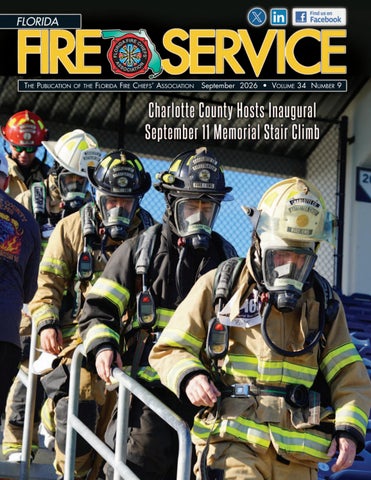
wenty-five years after the Sept. 11 terrorist attacks, more than 300 first responders, families and community members gathered at Charlotte Sports Park with one shared purpose: to remember. Charlotte County Fire & EMS hosted its inaugural 9/11 Memorial Stair Climb on Sept. 11, creating a new annual tradition dedicated to the 343 FDNY firefighters who made the ultimate sacrifice and the thousands of others whose lives were taken that day. Participants climbed 343 stairs, taking one step in honor of each fallen firefighter. The morning began with the presentation of
34
FLORIDA FIRE SERVICE
September 2026
colors, a traditional fire service bell ceremony and remarks from local leaders. Participants were then released in groups throughout the morning. Some climbed in full turnout gear. Others carried American flags or wore FDNY shirts and other symbols of remembrance in honor of those who never made it home. “Twenty-five years later, we still remember their names, their courage and the sacrifice they made while running toward unimaginable danger,” Fire Chief and Public Safety Director Matthew McElroy said. “This climb allowed our fire service family and our community to honor the 343 while remembering every life lost and every family forever changed by the events of Sept. 11. As long as we continue to share their stories and climb in their memory, their legacies will live on.” Every person who entered the stadium
brought a different connection to Sept. 11. Some had responded to Ground Zero in the days following the attacks. Some personally knew someone who lost their life that day. Others were children when the towers fell, and some had not yet been born.
Regardless of age, background or connection, they climbed together. With every flight of stairs, the sound of footsteps became a reminder of the firefighters who climbed into danger while thousands of others escaped to safety. The climb also honored the civilians, law enforcement officers, military personnel and other first responders whose lives were lost, as
well as those who later died from illnesses related to their service at the attack sites. Among those sharing their experiences was Charlotte County Fire & EMS Firefighter/EMT Sacksteder, who deployed with Disaster Medical Assistance Team 2 one week after the attacks. His team established mobile hospital tents near Ground Zero to support those working at the site. Now a 27-year member of the department, Sacksteder said the experience solidified that he had chosen the right career. At the finish, each participant received a commemorative medal. However, the true reward was found in the stories shared, the names remembered and the promise renewed. For Charlotte County Fire & EMS, the first climb was more than an event. It was the beginning of an annual tradition that will
ensure future generations understand why we climb and why we will never forget. One stair. One life. One promise to remember them all.
Visit us at WWW.FFCA.ORG
35
A Chain of Survival: South Walton Responders Reunite with Patient and Civilian Lifesavers By Mackenzie McClintock, Public Information Officer, South Walton Fire District
F
irefighters, 911 Telecommunicators, teachers, and school staff gathered at South Walton Fire District’s WaterColor Fire Station on Thursday, August 13, for a reunion made possible by one extraordinary outcome: a life saved. The gathering marked the presentation of Lifesaving Awards and challenge coins to the people whose actions played a critical role in saving the life of a colleague during a sudden cardiac arrest at The Preschool at Point
36
FLORIDA FIRE SERVICE
September 2026
Washington on May 21, 2026. That morning, school staff member Brianna- young and otherwise healthysuddenly went into cardiac arrest while on campus. The emergency was unexpected, and for her family and coworkers, there was no warning that such a life-threatening event was about to unfold. Her fellow teachers responded immediately. They called 911, followed the instructions provided by emergency dispatchers, located
the school’s automated external defibrillator (AED), and began cardiopulmonary resuscitation (CPR). Before firefighters arrived, school staff had already delivered multiple rounds of CPR and shocks with the AED, providing Brianna with the immediate intervention needed. When South Walton Fire District crews arrived, firefighters continued advanced resuscitation efforts and were ultimately able to achieve a return of spontaneous circulation,
commonly referred to as ROSC, before transporting Brianna for further medical care. Within days, she was back home and continuing her recovery. For the members of the fire service, few experiences carry greater meaning than meeting someone again after responding to their worst day- and seeing them standing there, alive and recovering. Brianna’s survival was not the result of a single intervention. It was the product of a chain of care that began with the people beside her, continued through the 911 communications center and carried forward by firefighters and medical professionals at local hospitals. Each link in this chain ultimately gave her another chance at life.
To recognize these exceptional efforts, SWFD is proud to recognize multiple individuals, both civilians and responders, with lifesaving awards and challenge coins for their work: Civilian Lifesaver Award: Jeania St. John and Hillary Brewster Dispatch Robert Heighton Lifesaving Award: 911 Telecommunicators Kelly Stumm, Unit Dispatcher, and Richard Galpin, 911 Call Taker Fire/EMS Robert Heighton Lifesaving Award: Firefighter/EMTs Kaylynn Cabanas, Marcus Cabanas, and Matthew Christensen; Firefighter/Paramedics Scott Thompson and Gage Brannon; Sergeant/Paramedics Ryan
Fredricks and Chris Moyer; Lieutenant/Paramedic Shawn Hutchins; and EMS Chief Magnum Coker. The awards recognize individual actions, but the story they tell is much larger. In a cardiac arrest emergency, survival depends on a coordinated response, and that response often begins long before an ambulance or fire engine arrives. On May 21, it began in a preschool classroom, with teachers who knew something was wrong and immediately acted. Only a few months later, those same people stood alongside the firefighters and telecommunicators who joined them in the effort to save a life. This time, there was no emergency to manage. There was simply a life to celebrate.
Visit us at WWW.FFCA.ORG
37
A Promise to Remember: Clay County Commemorates 25 Years Since 9/11 By Jenn Samsel, Independent Journalist
T
wenty-five years after the collapse of the Twin Towers, the sacrifices made on September 11, 2001, continue to serve as a reminder of the courage, dedication, and commitment of first responders who answer the call to serve every day. Never Forget. Clay County Fire Rescue, the Clay County Sheriff’s Office, Green Cove Springs Police Department, Governor Ron DeSantis, state and local officials, first responders and community members gathered in Green Cove Springs on September 11 for a remembrance ceremony honoring those who lost their lives. The ceremony followed an honor march through downtown Green Cove Springs. “We honor the extraordinary courage shown
38
FLORIDA FIRE SERVICE
September 2026
by the men and women who chose to run towards danger while others sought safety,” said District 1 Clay County Commissioner John Sgromolo. “Their selfless acts remind us of the very best of the American spirit.” The September 11 attacks killed 2,977 people at the World Trade Center, the Pentagon, and aboard United Airlines Flight 93. DeSantis reflected on his memories of September 11 and the sacrifices made by first responders that day and in the years that followed. “It’s hard to believe that it’s been 25 years since the terrorist attacks on September 11, 2001,” DeSantis said. “We also are mindful of the ongoing void that’s been left for 25 years for the victims’ families and friends.”
He also spoke about the uncertainty first responders face each time they put on a uniform and report for duty. “When you put on that uniform, you don’t know what you’re going to be called upon to do,” DeSantis said. He recognized not only those who responded on September 11, but also those involved in the rescue and recovery efforts afterward. “Be thankful for those people and the sacrifice that they made, not only on that day, but in the days after that,” DeSantis said. He concluded his remarks by honoring the first responders and civilians who acted during the attacks. “May God honor the sacrifices of the first
responders and the civilians who sprang into action against all odds, and may God help those who are continuing to suffer from illnesses related to the September 11th attacks,” DeSantis said. “We won’t forget here in the state of Florida, and we can never forget.” Following the governor’s remarks, the ceremony shifted from speeches to the reading
of the names of first responders who lost their lives on September 11. A total of 441 first responders died as a result of the attacks that day, marking the greatest single-day loss of emergency responders in American history. One by one, officials read their names aloud in Green Cove Springs, honoring the firefighters, law enforcement officers, and emergency personnel who answered the call to serve. At the conclusion of the ceremony, Clay County Fire Rescue Chief Lorin Mock signaled the historic Four Fives, or 5-5-5-5, bell tribute as bagpipes accompanied the memorial. Those gathered stood in silence as the bell sounded and uniformed personnel saluted. Twenty-five years later, their names were still spoken, the bell still sounded, and the promise remained: Never Forget. Visit us at WWW.FFCA.ORG
39
From the Classroom to the Firehouse: Charlotte County Fire & EMS Signing Day Builds a Local Workforce Pipeline By Ashley Turner, EPIO, Public Safety Public Information Officer, Charlotte County Fire & EMS
F
or 11 students enrolled in the emergency medical services programs at Charlotte Technical College, May 26, 2026, represented more than another step toward graduation. It marked the beginning of a potential career serving their own community. Charlotte County Fire & EMS hosted its inaugural Signing Day at Charlotte Technical College to recognize students interested in continuing their careers with the department. Through the initiative, each participant was guaranteed an interview with Charlotte County Fire & EMS once they met the department’s employment qualifications. The event was designed to celebrate the students’ commitment while creating a direct pathway from the classroom to the firehouse. Like traditional signing ceremonies held for student-athletes, Signing Day gave aspiring first responders an opportunity to be recognized for choosing a career in public safety. However, the program was about more than a ceremonial commitment. It allowed the department to begin building relationships with prospective employees while they were still completing their education and preparing to enter the workforce. “Signing Day gave us an opportunity to recognize these students for choosing a profession built on service, sacrifice and responsibility,” Charlotte County Public Safety Director and Fire Chief Matthew McElroy said. “It also allowed us to show them that there is a place for them here at home. We are not simply looking to fill positions, we are working to
40
FLORIDA FIRE SERVICE
September 2026
recruit people who want to build careers, serve their community and become part of our department’s future.” “This is exactly what we want to see for our students at Charlotte Technical College,” Director of Career and Technical Education Dr. Brian Granstra said. “We are preparing them with the skills and experience they need to enter the workforce, but strong partnerships with local employers are what help turn that preparation into opportunity. To see nine of these students move from our classrooms into careers with Charlotte County Fire & EMS is an incredible outcome for our students and our community.” That early connection produced measurable results. Of the 11 students who participated in Signing Day, nine successfully completed the department’s hiring process and accepted positions as firefighter/EMTs. They are scheduled to begin their careers with Charlotte County Fire & EMS in September. The results demonstrate the value of developing recruitment strategies that connect fire and EMS agencies with students before they complete their training. At a time when public safety agencies across Florida are competing for qualified applicants, departments must find ways to become visible, accessible and invested in candidates earlier in their career journeys. Charlotte Technical College provides students with the education and foundational skills needed to begin careers in emergency medical services. Signing Day helped bridge the space between completing that education and
securing employment with a local agency. The initiative also gave students a clearer understanding of the opportunities available within Charlotte County Fire & EMS. While participating did not replace the department’s established hiring requirements, it ensured students would have an opportunity to interview once they obtained the necessary qualifications. Each student still had to successfully complete the department’s hiring and selection process. Nine of them did exactly that. For Charlotte County Fire & EMS, the success of Signing Day reinforced the importance of partnerships between public safety agencies and local educational institutions. These relationships can help students visualize a career path, understand an agency’s expectations and establish connections with the people they may eventually serve alongside. The initiative also supports the department’s broader goal of recruiting and retaining qualified professionals who already have ties to the community. Students trained locally are familiar with the area, and many are personally invested in the people and neighborhoods they will serve. Signing Day began with 11 students willing to take the first step toward a career with Charlotte County Fire & EMS. Just a few months later, nine of them are preparing to report for duty. For those students, the ceremony was not simply a celebration of where they were on May 26. It was a sign of where they were headed next.
Visit us at WWW.FFCA.ORG
41
Building for Tomorrow: The Transformation of Putnam County Fire Rescue By By Clu Wright, Deputy Chief / Fire Marshal, Putnam County Fire Rescue
P
utnam County is changing, and Putnam County Fire Rescue is changing with it. Covering approximately 827 square miles, Putnam County is one of Florida's geographically larger rural counties. The county's population is now estimated at 77,734 residents, representing approximately 6 percent growth since the 2020 Census. That population is spread across incorporated communities, rural residential areas, agricultural lands, industrial properties, and areas that are now experiencing significant residential and commercial development. Providing fire protection and emergency medical services across such a large and diverse area presents challenges very different from those faced by a compact urban fire department. Distance matters. Staffing matters. Station placement matters. Apparatus availability matters. Most importantly, the ability to put trained firefighters and paramedics on an emergency scene quickly matters. Over the past several years, Putnam County Fire Rescue has undertaken one of the most significant expansions in its history. From One Paid Engine to Seven There was a time when Putnam County operated with only one career-staffed fire engine and all volunteer engines. Today, the department has grown to seven career-staffed fire engines, one career–staffed tanker dramatically increasing the availability of trained personnel and fire suppression equipment throughout the county. That change represents much more than six additional engines. Every additional staffed engine places firefighters closer to the citizens they serve. It improves the department's ability to respond simultaneously to multiple incidents, strengthens the initial response to structure fires, provides additional manpower for vehicle crashes and technical incidents, and improves support for the county's emergency medical system. This growth has been accomplished while maintaining an important part of Putnam County's fire service history: its volunteer firefighters and volunteer stations. Putnam County remains a combination fire rescue system, and volunteer personnel continue to provide valuable resources throughout the county. The objective has not been to replace that system, but to strengthen it by establishing a more substantial career response capability
42
FLORIDA FIRE SERVICE
September 2026
while continuing to utilize the resources and dedication of the volunteer fire service. From Multiple ISO Ratings to a Countywide 5/5X Another major accomplishment has been the improvement and standardization of Putnam County's Insurance Services Office Public Protection Classification. Historically, different portions of Putnam County operated under multiple ISO classifications. A resident's or business owner's classification could vary depending upon where the property was located and the fire protection resources available in that area. Today, Putnam County has achieved a countywide ISO classification of 5/5X. That achievement is significant for a geographically large and predominantly rural county. The improvement did not result from one new engine, one new station or one individual program. It was the result of continued improvements throughout the county's overall fire protection system, including staffing, apparatus, training, communications, station coverage, water supply, pre-incident planning and operational capabilities. Water supply is particularly challenging in rural portions of Putnam County where municipal water systems and fire hydrants may not be readily available. Providing effective fire protection in these areas requires the department to maintain and continually improve rural water-supply capabilities. The countywide 5/5X classification provides a measurable indication of the progress Putnam County has made toward providing a more consistent level of fire protection throughout the county. It represents an important transition from multiple fire protection classifications toward one coordinated countywide fire rescue system. Building a Stronger ALS System Emergency medical services represent a significant portion of the department's call volume and responsibilities. Putnam County Fire Rescue has expanded its EMS capability to nine Advanced Life Support rescue units, strategically positioned to provide ALS care throughout the county. In a county covering more than 800 square miles, the placement of those units is critical. A cardiac arrest, stroke, major trauma, respiratory emergency, or other life-threatening event does not become less serious because it occurs twenty or thirty miles from the county's
population center. The challenge for a rural EMS system is bringing advanced medical care to those patients as quickly as possible. The expansion of ALS resources, combined with additional staffed fire companies, gives Putnam County greater flexibility to manage those emergencies while maintaining coverage for the next call.
Station 25: Investing in West Putnam County Another major step forward is the development of Fire Station 25 in West Putnam County. The station is being made possible through state appropriations, demonstrating the importance of partnerships between local government and Florida's legislative delegation in meeting public-safety infrastructure needs. Station 25 was built for the Baden Powell Road area near Hawthorne and will strengthen emergency response capabilities in a portion of the county where travel distance has historically presented challenges. The project represents more than the construction of another fire station. It represents the strategic placement of emergency resources based upon geography, response demands and the future growth of the community. As Putnam County continues to develop, station location and response-time analysis will become increasingly important components of the county's fire rescue planning. Protecting Major Industrial and Energy Facilities Although Putnam County maintains its rural character, the hazards confronting its firefighters are increasingly complex. The county is home to the Seminole Electric generating facilities, representing a significant component of Florida's electrical generation infrastructure. Putnam County is also home to the GeorgiaPacific Palatka paper mill, a major industrial facility with complex fire protection, industrial process, hazardous materials and emergency
response considerations. The development of a new Florida Power & Light battery energy storage facility introduces another emerging hazard to the county. Battery energy storage systems present challenges that previous generations of firefighters rarely encountered. Lithium-ion battery emergencies can involve thermal runaway, flammable gas generation, explosion hazards, stranded electrical energy, reignition and extended incident monitoring. Responding safely to these incidents requires more than conventional structural firefighting knowledge. It requires specialized training, preincident planning, coordination with facility representatives and an understanding of rapidly developing energy technologies. These facilities demonstrate why a modern rural fire department must be prepared for many of the same complex incidents faced by departments serving much larger metropolitan areas. Growth Brings New Challenges At the same time industrial development is occurring, new residential development is changing portions of Putnam County. New subdivisions and housing developments mean additional residents, additional structures, additional traffic and ultimately additional calls for service. A new development does not simply create the possibility of additional structure fires. It creates additional medical emergencies, motor vehicle crashes, fire inspections, plans reviews, public education needs and demands on the county's communications and emergency response infrastructure. For the fire service, responsible growth requires planning before those calls occur. Strengthening the Command Structure As the operational side of Putnam County Fire Rescue has expanded, so has the need for an administrative and command structure capable of supporting it. The department's command staff has developed to include a fire chief and two deputy chiefs with defined areas of responsibility, providing greater oversight of operations, emergency medical services, fire prevention, administration and the other responsibilities associated with a modern combination fire rescue organization. The addition of a deputy chief of training represents another important step in that development.Training cannot be an afterthought in today's fire service. Modern firefighters are expected to understand structural firefighting, emergency medicine, hazardous materials, technical
rescue, lithium-ion battery emergencies, alternative energy systems, incident command, firefighter survival, building construction and an ever-expanding list of specialized hazards. As Putnam County's risks become more complex, establishing dedicated leadership for training helps ensure that the department's personnel are prepared before those emergencies occur. More Than New Fire Trucks It would be easy to measure Putnam County Fire Rescue's progress simply by counting fire engines, rescue units and stations. But apparatus alone does not create a fire department. People do. The real investment has been in firefighters, EMTs, paramedics, officers, communications personnel, fire prevention personnel, training, equipment and leadership. It is about manpower, equipment, training, leadership, stations, communications, water supply and planning. The progression is significant: • From one career-staffed fire engine to seven • Nine ALS rescue units serving more than 800 square miles. • From multiple ISO classifications to a countywide ISO 5/5X. • A new fire station funded through state appropriations. • An expanded command structure consisting of a fire chief, two deputy chiefs and the addition of a deputy chief of training. These improvements represent a fundamental change in Putnam County's ability to respond to emergencies. But perhaps the most important investment has been in the men and women who staff those apparatus and stations. Fire engines do not extinguish fires by themselves. Rescue units do not provide patient care by themselves. Equipment does not operate without trained personnel. The continued investment in firefighters, EMTs, paramedics, officers, communications personnel, fire prevention personnel and training is what ultimately determines the capability of the organization. Preparing for the Putnam County of Tomorrow Putnam County's fire service has changed because Putnam County itself is changing. A county once characterized primarily by rural communities now includes major powergeneration facilities, one of the region's significant paper-manufacturing operations, emerging battery energy storage technology, new residential developments and increasingly complex emergency response demands.
Station 20 Putnam County Fire Rescue has responded to those changes by strengthening its manpower, expanding its apparatus fleet, increasing ALS coverage, improving its ISO classification, investing in stations and equipment, and developing a command and training structure capable of supporting a modern fire rescue organization. The progression from one paid fire engine to seven career-staffed engines is an accomplishment worth recognizing. Achieving a countywide ISO 5/5X classification is another. Operating nine ALS rescue units across approximately 827 square miles demonstrates the commitment necessary to provide emergency medical care in a rural county. And the construction of Station 25, together with continued investment in personnel, equipment and training, demonstrates that the work is continuing. There will always be another challenge. There will be another development, another emerging technology and another type of emergency that requires the fire service to adapt. The responsibility of fire service leadership is to recognize those challenges before the emergency occurs and prepare our personnel to meet them. Putnam County Fire Rescue has come a long way from the days of one career-staffed fire engine and multiple ISO classifications. Prepare for the risk before the emergency occurs, put trained personnel and the right equipment where they are needed, and build a fire rescue system capable of serving not only the Putnam County of today, but the Putnam County of tomorrow.
Station 6 Visit us at WWW.FFCA.ORG
43
North Florida First Responders Honor 25th Anniversary of 9/11 By Jenn Samsel, Independent Journalist
S
t. Johns County Fire Rescue, the St. Augustine Fire Department, Lake City Fire Department, and Bradford County Fire Rescue participated in commemorations marking the 25th Anniversary of 9/11. “A love for each other and our military and
first responders and a sense of pride for our country and the freedoms that we all have,” Lake City Fire Department Fire Chief Josh Wehinger said.
Never Forget.
Lake City Fire Department
Lake City Fire Department
Lake City Fire Department
Bradford County Fire Rescue Bradford County Fire Rescue
Bradford County Fire Rescue 44
FLORIDA FIRE SERVICE
September 2026
St. Augustine Fire Department
St. Johns County Fire Rescue
Photos by: St. Johns County Fire Rescue, Lake City Fire Department and Bradford County Fire Rescue.
St. Johns County Fire Rescue
St. Johns County Fire Rescue
St. Johns County Fire Rescue
St. Johns County Fire Rescue
St. Johns County Fire Rescue
St. Johns County Fire Rescue
St. Johns County Fire Rescue
St. Johns County Fire Rescue
St. Johns County Fire Rescue
St. Johns County Fire Rescue Visit us at WWW.FFCA.ORG
45
Hollywood Fire Rescue’s Annual September 11 Ceremony By Chai Kauffman, Public Information Manager - Life Safety Educator, City of Hollywood
O
n September 11, 2026, Hollywood Fire Rescue held their annual September 11 Ceremony as they honored the 2,977 lives lost and the heroes who made the ultimate sacrifice 25 years ago. Hollywood Fire Rescue was truly grateful to everyone who helped make this year’s ceremony meaningful, especially our guest speakers: • Congressman Jared Moskowitz • City of Hollywood Mayor Josh Levy • Hollywood Fire Chief Jeff Levy • Staff Sergeant Curtis Kauffman, U.S. Marine Corps from U.S. Southern Command Hollywood Fire Rescue was also honored to have a joint Hollywood Fire Rescue and
Hollywood Police Department Honor Guard present the colors and pay tribute to those we remember. A special thank you to the students of South Broward High School for their beautiful rendition of the National Anthem. As
well as one of the Fire Chaplain’s Garland Robertson delivering an inspiring invocation. To everyone who joined the ceremony, Hollywood Fire Rescue thanks you for helping them remember, honor, and never forget!
Hollywood Fire Rescue’s Fire Hero 5k Race By Chai Kauffman, Public Information Manager - Life Safety Educator, City of Hollywood
O
n September 13, 2026, Hollywood Fire Rescue was proud to join fire departments from across the region, first responders, and members of the Hollywood community for the 21st Annual OmegaXL Sport Fire Hero 5K presented by Runner’s Depot at Hollywood Beach! The 3.1-mile run/walk took participants along the scenic Hollywood Beach Broadwalk, with the race starting and finishing at Margaritaville. More than just a race, the Fire Hero 5K is an opportunity to come together to honor and remember our nation’s fallen firefighters while supporting the families and loved ones they leave behind. All proceeds from the event benefit the National Fallen Firefighters Foundation, helping support its mission to honor America’s fallen fire heroes and assist their families. The event also featured special awards recognizing firefighters, fire departments, and the largest team participating.
46
FLORIDA FIRE SERVICE
September 2026
The Badge May Come Off, But the Family Remains Because Purpose Doesn’t Retire By Tiffany Wood, Public Information Officer/Public Educator, Greater Naples Fire Rescue District
F
or firefighters, retirement can mean leaving the station, the uniform and the daily rhythm of the job—but it doesn’t mean leaving behind the people or the purpose that made the fire service such a special part of their lives. Greater Naples Fire Rescue District recently hosted its first Legacy Initiative meeting, bringing together retirees for coffee, conversation and an opportunity to reconnect with their fire family. The conversation centered on retiree inclusion, wellness and continued service, with an
emphasis on something we know matters: staying connected. Retirement is a major transition, especially for first responders. The calls stop, the schedule changes, and the camaraderie that comes with working alongside a crew can suddenly look very different. Creating opportunities for retirees to stay connected can help preserve those relationships and provide a continued sense of belonging and purpose. Their first meeting was a great reminder that the fire service is about more than the
job. It’s about the people, the friendships, the shared experiences and the legacy we leave behind. They’re excited to continue growing the GNFR Legacy Initiative and finding meaningful ways to keep our retirees involved, supported and connected. A special thankyou to 1-800 BOARDUP for providing coffee and donuts and helping make our inaugural meeting a success. The badge may come off, but the family remains. Because once you’re part of the fire service, you’re always part of the fire family. Visit us at WWW.FFCA.ORG
47
First Responders Connect with Families at Hero Expo By Jenn Samsel, Independent Journalist
C
lay County Fire Rescue Station 18 participated in the Hero Expo at Orange Park Mall, giving families a chance to meet some of the men and women who serve and protect their communities. Children engaged with firefighters and law enforcement officers, explored emergency vehicles, and participated in hands-on activities. Educational materials helped young visitors learn more about public safety and the importance of serving their community. A dedicated station allowed families to create heartfelt thank-you cards and messages for first
responders, the heroes who make a difference in Clay County. The program provided by the Orange Park Mall was part of the 250 Acts of Community initiative to commemorate the 250th anniversary of the United States, highlighting one small act of kindness that celebrates service, gratitude, and the power of giving back. “A huge thank you to the Clay County Fire Rescue Station 18, Clay County Sheriff’s Office, and Orange Park Police Department for spending the day with our community,” Orange Park Mall shared. “We loved celebrating our
advertisers index Adver tiser . . . . . . . . . . . . . .Page .Page No.
Adver tiser . . . . . . . . . . . . . .Page .Page No.
ETR Vehicles, Vehicles, LLC 844-612-8148 . . . . . . . . . . . . . . .20 .20
PolicyBuilders 352-395-1349 . . . . . . . . . . . . . . .13 .13
Firefighter Firefighter One 772-262-3160 . . . . . . . . . . . . . . . . 5
Team Equipment, Inc. 800-367-9054 . . . . . . . . . . . .19, .19, 24
Matheny Fire Fire & Emergency Emergency 800-342-0720 . . . . . . . . . . . . . .2, .2, 3
Ten-8 Fire Fire Equipment, Inc. 800-228-8368 . . . . . . . . . . . . . . . 50
Municipal Equipment, LLC 800-228-8448 . . . . . . . . . . . . . . . 17
United Badges Insurance Ser vices 850-841-9992 . . . . . . . . . . . . . . . . 7
NAFECO 800-628-6233 . . . . . . . . . . . . . . . 11
VFIS 800-233-1957 . . . . . . . . . . . . . . .15 .15
Per ma-Fix 352-395-1349 . . . . . . . . . . . . . . . 27
48
FLORIDA FIRE SERVICE
September 2026
everyday heroes.” Photo: Stefani Kuhn, Lt. Peacock, Engineer Coker, Firefighter Pierson, Ff Gomez, Deputy Maylon and Deputy English.
Seminole County Hosts Grandparent Safety Class By Doreen Overstreet, APR, Public Safety Information & Education Officer, Seminole County Fire Department
I
n honor of Grandparents Day, the Seminole County Fire Department (SCFD) encouraged residents to #DoSomethingGrand by helping grandparents gain the knowledge and confidence to keep their grandchildren safe. SCFD recently hosted a free Grandparent Safety Class, where Community Outreach personnel and firefighter/paramedics provided nearly 40 grandparents with handson, practical safety training. • Topics included: • Child and infant CPR • Choking emergencies • Safe sleep practices • Injury prevention • Basic first aid “At the Seminole County Fire Department, we are committed to helping our residents feel prepared when an emergency happens,” said Fire Chief Matt Kinley. “We offer HandsOnly CPR classes through Save a Life Seminole and Safe Sitter classes for youth, and we’ve received many requests from
grandparents for training tailored to their needs. We’re proud to offer this class and help grandparents build the skills and confidence to care for their grandchildren safely.” Each participant received a Certificate of Completion, emergency reference materials and child safety resources to take home and use with their families.
Public Safety Training Center Appropriation By Lisa McDonald, Communications Manager, City of Oviedo
O
n August 17, 2026, during a City Council Meeting, State Senator Jason Brodeur and State Representative David Smith presented the Oviedo City Council with a ceremonial check in the amount of $500,000 for the Oviedo Public Safety Training Center. During the 2026 Florida Legislative Session, the City of Oviedo requested a state appropriation in the amount of $1,000,000 to assist with planning, design and construction of a Public Safety Training Facility. The proposed facility is currently envisioned to include a training building with four story drill tower and class “A” burn annex. Senator Jason Brodeur sponsored the appropriation in the Florida Senate, and Representative David Smith sponsored the appropriations bill in the Florida House of Representatives.
On June 29, 2026, Governor Ron DeSantis signed the FY 2026-27 Florida State Budget, which appropriated $500,000 in funding for Public Safety Training Center. Budget Impact:
The State of Florida appropriated $500,000 toward the planning, design, and construction of the Oviedo Public Safety Training Center.
Visit us at WWW.FFCA.ORG
49
SERVING FLORIDA’S BRAVEST N e w d e l i v e r i e s s tat e w i d e NEW SMYRNA BEACH FIRE DEPARTMENT Chassis/Body: Enforcer, Pumper Engine: PACCAR MX-13, 510 HP Build My Pierce Program TAK-4 Independent Front Suspension HAAS Collision Mitigation Hydraulic Ladder Storage Pump: Waterous CSU, 1500GPM Tank: 750 gallons Job #/Sales Rep: #41639, Robbie Walace
HILLSBOROUGH COUNTY FIRE RESCUE Chassis/Body: Freightliner, BX Tanker Engine: Cummins L9, 360HP Pump: Waterous CXPA, 1000GPM Tandem Rear Axle Rear Direct Tank Fill Tank: 3000 gallons Job #: 41918 Sales Rep: Dustin Bouwer
SEMINOLE COUNTYFIRE FIRERESCUE RESCUE VOLUSIA COUNTY
Chassis/Body: Freightliner, Commercial Wet Side Tanker Engine: Cummins L9, 360 HP Whelen Pioneer Rear Scene Lighting Whelen LED Warning Lights/Side Lighting Pump: Waterous CXPA, 1250 GPM Tank: 3000 gallons Foam: Husky 3, 30 gallons Job #/Sales Rep: #41958, Robbie Wallace
Service Locations:
Florida: Bradenton | DeFuniak Springs | Fort Myers Sanford | Pompano Beach | Georgia: Clayton Co. Cobb Co. | Forsyth | Hall Co. | Alabama: Mobile | Pelham Mississippi: Horn Lake | Richland
Bu i lt o n I n t e g r i t y. D r i v e n to s erv e .
ten8fire.com