THE PUBLICATION OF THE FLORIDA FIRE CHIEFS’ ASSOCIATION
October 2026 • VOLUME 34 NUMBER 10
N
FLOR I
AS
SO
EFS’ HI
FIRE C DA
C I A TI
O
Florida Fire Service is the monthly publication of the Florida Fire Chiefs’ Association, provided to Florida Fire Chiefs’ Association (FFCA) members, by the Florida Fire Chiefs’ Association. Florida Fire Chiefs’ Association P.O. Box 15932 Tallahassee, FL 32317 Phone: (850) 900-5180 Email: info@ffca.org • www.ffca.org
Message from the FFCA President . . . . . . . . . . . . . . .6
14
16
FFCA Board of Directors Ryan Crawford - President Mike Tucker - 1st Vice President Carlos Aviles - 2nd Vice President Trip Barrs - Immediate Past President Ian Kemp - Secretary/Treasurer Jeff Wagner - Northwest Region Director Brady Rigdon - Northeast Region Director Todd Allen - East Central Region Director Chantal Botting - Southeast Region Director Jason Dougherty - West Central Region Director Gregory DeWitt - Southwest Region Director Harold Theus - Executive Director Terry Parris - Foundation Chair Jeffrey Money - Senior Member
18
22
Advertising Scott Leisen, Editor in Chief scott@ffca.org (386) 717-0055
Subscription rate for members is $36, which is included in member dues. Archived electronic monthly editions of Florida Fire Service magazine are available at www.ffca.org. Log in as a member and click on the Publications tab. Florida Fire Service October 2026, Volume 34, Number 10 USPS # 016-759 Periodical postage paid in Daytona Beach, Florida, and additional post offices. POSTMASTER: Send address changes to Florida Fire Service, P.O. Box 15932 Tallahassee, FL 32317. Statements of fact and opinion are the responsibility of the authors alone and do not imply an opinion on the part of the officers or the members of FFCA. Copyright 2026 by the Florida Fire Chiefs’ Association. All rights reserved. Materials may not be reproduced without written permission.
FLORIDA FIRE SERVICE
October 2026
6 FEATURES
FFCA Staff Harold Theus - Executive Director Rachel Pardo - Marketing & Member Services Coordinator Savannah Selski - Meeting & Events Coordinator
Editorial Submissions magazine@ffca.org (850) 900-5180
4
FROM THE SECTIONS
Leadership Before the Promotion . .14 Give Yourself Points for the Wins .16 Serve with Love . . . . . . . . . . . . .18 Still Writing My Story: 23 Years Beyond Breast Cancer . . . . . . .22
FURTHERMORE What To Do When You Get Knocked Down . . . . . . . . . .8 South Walton Honors Life and Legacy of Dan Corcorani . . . .10 Chief Barbara Carpenter Leads a New Chapter . . . . . . . . . . . . . . .12 Marion County Welcomes New Members and Phase II Hiring . .20 Mount Dora Surface Water Rescue Training . . . . . . . . . . . .24 Taking Lifesaving Care to New Heights . . . . . . . . . . . . . .26 Station 25 Brings Faster Emergency Response to West Putnam . . . .28 Florida 2035: The Case for Residential Fire Sprinklers . . . . .30 Englewood Fire Welcomes a New Generation of Leaders . .32 Orange County’s Swiftwater Rescue Team’s First Deployment . . . . . .32 A Sister’s Memory Inspires Cancer Awareness and Scholarships . . .33 Mount Dora Recognized as Gold Helmet Department . . . . . . . . .33 Tampa Fire Rescue Breaks Ground on Fire Station No. 24 . . . . . . . . .34 Orange County Deploys SEEK TICs to Every Front-Run Riding Seat . . . .35 Seminole County Partners with Red Cross to Install Smoke Alarms . .36 Better Together . . . . . . . . . . . . .38 Kitchen Table Talks . . . . . . . . . . .39 Charlotte County Partners with Domino’s for a Slice of Prevention 40 Mount Dora Celebrates Promotions42 South Walton Lifeguard Selected to Lifesaving World Team . . . . . .44 Advertisers Index . . . . . . . . . . . .44 Orange County Complex Elevator Rescue . . . . . . . . . . . .45
8
10
12
20
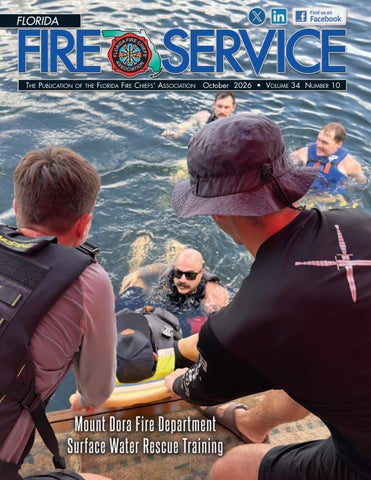
24
26
28
30
32
32
33
33
Ryan H. Crawford, Fire Chief FFCA President
A
s we move into November and approach the end of another busy year, I want to share some of the important work taking place across our Association and Florida’s fire service. From firefighter health and safety to legislative advocacy, strengthening professional partnerships, and planning for the future, there is certainly no shortage of issues deserving our attention. In October, we gathered at Margaritaville Resort in Kissimmee for the FFCA’s annual Safety & Health Conference. It was great to see so many familiar faces, meet new members, and spend time with leaders who share a commitment to improving the health, safety, and well-being of our firefighters. This year’s conference featured outstanding educational sessions, meaningful discussions, and opportunities to learn from some of the most respected voices in our profession. Just as importantly, these gatherings allow us to exchange ideas, share experiences, and take valuable lessons back to our respective departments. I want to recognize and congratulate our FFCA staff and the entire Safety & Health Section, under the leadership of Section Chair Chief John Whalen, for putting together what I believe was one of our best conferences yet! The amount of planning, coordination, and hard work that goes into making an event of this caliber successful cannot be overstated. To everyone involved, thank you for an exceptional job! As fire chiefs, our responsibility extends beyond preparing our members to respond to
6
FLORIDA FIRE SERVICE
October 2026
the next emergency. We must also do everything reasonably within our ability to help ensure they have long, healthy careers and the opportunity to enjoy retirement with their families. That means continuing to prioritize training, cancer prevention, behavioral health, physical fitness, and an organizational culture where firefighter safety is never an afterthought. Partnerships On November 2, I will have the privilege of representing the FFCA at the opening ceremony of the Florida Fire Marshals and Inspectors Association’s annual Fire Prevention Conference in Tampa. I appreciate the invitation and look forward to spending time with our partners at FFMIA. Fire prevention and emergency response are essential components of our public safety mission. The work performed by our fire marshals, inspectors, investigators, and prevention professionals is critical to protecting our members and the communities we serve. Maintaining strong relationships between our organizations helps ensure we are working together on the challenges facing Florida’s fire service. Advocacy and the Upcoming Election Over the past several weeks, the FFCA has continued its public education and advocacy efforts surrounding Amendment 3 and its potential implications for public safety funding. Throughout these discussions, our message has remained consistent. We recognize the importance of property tax relief for Florida
residents. At the same time, it is essential that voters and policymakers understand how changes to property tax revenues could affect the fire, EMS, and other public safety services our communities depend upon. Our responsibility as fire service leaders is to provide accurate information, explain potential operational consequences, and ensure the fire service perspective is represented. I appreciate the fire chiefs and public safety partners throughout Florida who have stepped forward to engage their communities and help communicate these concerns. With the November 3 General Election approaching, I want to encourage our members and their families to exercise your right to vote. This election includes decisions that will influence our state’s leadership, tax policy, and public safety priorities for years to come. In addition to Amendment 3 and other proposed constitutional amendments, voters will elect a U.S. Senator, Governor, Attorney General, Chief Financial Officer and Commissioner of Agriculture, along with numerous legislative and local officials. These elected leaders will play important roles in shaping policies that affect our communities and the fire service. Regardless of political affiliation or personal views on the issues, I encourage everyone to become informed about the candidates and proposed amendments, understand what is at stake, and make their voice heard at the ballot box. Our participation in the democratic process matters.
As we prepare for the 2027 Legislative Session, the FFCA Government Relations Committee remains focused on priorities involving 911 modernization, EMS reimbursement, workforce development, and programs that support the financial sustainability of emergency services. Another important opportunity for FFCA member participation is approaching November 10, when the Department of Financial Services has scheduled a public hearing regarding proposed changes to Rule Chapter 69A-62, Firefighter Employment Standards. These proposed changes address firefighter occupational safety and health requirements and may have significant implications for agencies across Florida. I strongly encourage our members to review the proposed rules, attend the virtual hearing, and provide public comment. Those responsible for implementing these requirements should have an opportunity to provide input before decisions are finalized. Whether you represent a large metro department, a smaller rural organization, or an independent fire control district, your perspective matters. The hearing is scheduled for 1:00 p.m. Eastern, with participation information available through the Florida Administrative Register. Register to receive public hearing alerts through the following link: Register here Planning for the Future Later in November, your FFCA Board of Directors will gather for strategic planning. This will provide an opportunity to evaluate our associations priorities, identify ways to strengthen member services, and establish a clear direction for the coming years. An effective association must continually evaluate how it serves its members and whether its priorities reflect the evolving needs of our
profession. Our responsibility is not simply to maintain what has been built, but to ensure the FFCA continues to grow, remains relevant, and delivers meaningful value to the fire service leaders we represent. I also encourage our members to begin making plans for the 2027 Florida Fire & EMS Conference, January 4–8, at the Orange County Convention Center in Orlando. Our staff is working hard to deliver another outstanding opportunity for education, professional development, and networking. Honoring Those Who Made the Ultimate Sacrifice Finally, I want to call your attention to the Florida Fallen Firefighter Memorial Service, which will be held on the morning of Friday, November 20, at the Florida State Fire College in Ocala. This annual service is one of the most meaningful occasions in our profession. It is a time when we come together to honor firefighters who lost their lives in the line of duty, remember their service and sacrifice, and stand alongside the families and colleagues
who continue to carry their loss. As fire chiefs, we spend much of our time looking ahead, preparing for the next challenge, and making decisions that will shape the future of our organizations. But we must never lose sight of those who came before us and the sacrifices made in service to others. I encourage all our members to attend this year’s memorial service. This is a meaningful way to remind these families that their loved ones have not been forgotten and that their sacrifice will always be remembered by Florida’s fire service. As we approach the final weeks of 2026, thank you to our members, Board of Directors, Section and Committee leaders, Association staff, and our many partners for your continued dedication. The strength of the FFCA comes from those who invest their time, knowledge, and energy into making our profession better. Thank you for your leadership, your involvement, and everything you do for the communities we are privileged to serve. Stay safe and keep leading.
Visit us at WWW.FFCA.ORG
7
What To Do When You Get Knocked Down By Rick Spence
T
here will be many times when the trials of life will knock us down. Sometimes this is a result of our own actions, but many times it is caused by things that are not our fault, or anyone else’s fault. It can be an unexpected medical diagnosis, a disappointment on the job, financial struggles, or any other various kinds of difficulties we face over our lifetime. I have heard it said that there are two types of people: those who are going through trials and those who are getting ready to go through trials. Hopefully, you can take something from this article to help you when you are going through your own trials. First of all, you must know God is not angry at you or punishing you for some action committed against Him. We have a loving and grace filled God, not a vindictive God who is just waiting on us to mess up so He can smack us down. Jeremiah 29:11, “For I know the plans I have for you declares the Lord, plans to prosper you and not to harm you, plans to give you a hope and a future.” Everyone will get knocked down by life at some point. It may be difficult at the time, but you must remember that this is only a phase, a small length of time over the period of your lifetime. You will eventually come out on the other side of this. It is a single event, not a career or lifetime. That is when we need to lean into our faith more than ever and trust that God has a plan for us. We may
8
FLORIDA FIRE SERVICE
October 2026
not understand it, but God does. He has strategically placed people around us specifically for times like this and we need to lean on them, and God. Seek wisdom from those who have gone through similar circumstances and discover how they dealt with these issues. Isaiah 40:31, “Those who trust in the Lord for help will find their strength renewed.” Above all, do not dwell on your own troubles. Channel that energy towards helping or serving others. There are always people going through more difficult times than us, and while that does not bring us much satisfaction, it is very therapeutic to go out and help others, doing things that betters the circumstances of those around us and in our community. Helping others will give you some encouragement and temporary happiness during your time of trouble. Doing things that benefit others will temporarily take your mind off your own issues. This is when we wait on the Lord to act. If we trust God during the good times, then we have to trust Him during the difficult times. Continue to remember, this is only a few pages in our book, not the entire book. Being knocked down does not define who we are, getting up off the floor is what truly defines who we are. We lean too much on our own understanding when God calls us to lean on Him. When we realize we are on the other side of a particular trial, we must realize
that we are much stronger in our faith than we were previously. It also places us in a situation where we are better able to help others when they are dealing with a similar issue. There are many life lessons we learn that we likely would not have learned had we not gone through these painful and difficult times in our lives. It is easy to trust God’s direction in our lives when we are on the mountain top. And we must continue to keep that same trust when we are in the valley. Finishing Isaiah 40:31, “…. They will rise on wings like eagles; they will run and not get weary; they will walk and not grow weak.” Rick Spence retired as Assistant Chief from the Reedy Creek Fire Department after 30 years. He is currently the Chaplain for the Florida Fire Chiefs’ Association, Central Florida Fire Chiefs’ Association, Reedy Creek Fire Department, Lake County Fire Department, Clermont Fire Department, Maitland Fire Department, and the Florida Professional Firefighters. He serves as Sergeant of Arms for the Florida Professional Firefighters and International Association of Firefighters. He was selected Florida Professional Firefighter of the Year in 2018. He has been married to his wife Alecia for over 30 years.
South Walton Honors Life and Legacy of Firefighter/Paramedic Dan Corcoran By Mackenzie McClintock, Public Information Officer, South Walton Fire District
H
undreds of firefighters gathered on a crisp September day in Colorado, carrying the same weight: the absence of someone who they loved and lost. Among them were members of the South Walton Fire District and South Walton Professional Fire Fighters Association Local 3516, there to honor Firefighter/Paramedic Dan Corcoran at the IAFF Fallen Fire Fighter Memorial. After a five-year journey with occupational cancer, Corcoran died March 3, 2025, surrounded by his family, both blood-related and the kind that can only come from enduring long days together on the job. His death left a hole in the South Walton Fire District, one felt by all who worked beside him, the friends who knew him away from the station, the people he served, and most of all,
10
FLORIDA FIRE SERVICE
October 2026
the family who loved him. For more than a year, SWFD and Local 3516 gathered in different ways to honor Corcoran and the life he gave to the fire service. From memorials at home to moments shared among his brothers and sisters, each gathering carried the same purpose: to make sure Dan would never simply become a name on a list. The ceremony in Colorado was another opportunity to say his name, remember his life, tell his stories, and to stand beside the family he left behind. It also represented the final formal ceremony honoring his sacrifices in the line-ofduty, but it was not the end of his story. “Dan gave so much of himself to the fire service, to Local 3516, to SWFD, and to the people he served,” said Josh Pitts, president of South Walton Professional Fire Fighters
Association Local 3516. “Being able to stand with his family and our brothers and sisters from across the country at the memorial was an incredibly meaningful experience. The formal ceremonies may be coming to an end, but Dan’s legacy is truly just getting started.” Every person who gathered in Colorado carried the weight of someone they had lost- a name, a story, a lifetime of memories, and an absence that can never truly be filled. For Dan’s family and the firefighters who loved him, his name now stands among the fallen, but his impact lives within the people who knew him and worked alongside him. They will move forward carrying his memory in all they do, fondly remembering the pride he carried in calling himself a firefighter, friend, father, grandfather, son, and brother to many.
Building the Future: Chief Barbara Carpenter Leads a New Chapter By Jenn Samsel, Independent Journalist
I
nterlachen Lake Estates Volunteer Fire Department recently welcomed its newest Fire Chief, Barbara Carpenter. Carpenter brings more than 34 years of fire service experience, along with a well-rounded background in firefighting, instruction, leadership, and education. She is dedicated to serving the community, committed to strengthening the department for the future, and passionate about education, training, and community outreach. For Carpenter, serving in the fire service has never been about recognition. It has always been about serving the community. “It’s really a service to the community,” Carpenter said. “It’s got to come from the heart.” Carpenter holds Firefighter II certification and is certified as an Emergency Medical Responder. She is also a live-fire instructor and Instructor III. In addition, she works with the Florida State Fire College and the Division of State Fire Marshal, assisting volunteer and combination fire departments across Florida. Carpenter spent more than 20 years with the Interlachen Area Volunteer Fire Department, serving as assistant chief for much of that time. Her career, however, extends well beyond the fire station. Carpenter also spent years as a school teacher, teaching students from pre-K through high school. At one point, she balanced both careers, working full-time as a teacher while serving with the Windsor Volunteer Fire Department as a career firefighter. For Carpenter, the continuous pursuit of learning was crucial to advancing in a profession that has historically been maledominated. “Being a female has had its barriers, but I didn’t let it stop me,” she said. “I just kept going
12
FLORIDA FIRE SERVICE
October 2026
back to school and getting training and certifications and doing what I needed to do to become an officer.” Finding Each Firefighter’s Path Carpenter believes proper training and understanding each firefighter’s goals are important to helping them succeed in the fire service. “The first thing that I ask the people who come in here is, what are their goals?” Carpenter said. “What did you envision when you came to this department?” Not all volunteers follow the same career path. Carpenter considers it part of her responsibility as chief to identify each person’s goals and help them achieve them. Some individuals may choose to attend EMR, EMT, or paramedic school, while others may prefer to pursue additional fire certifications or specialize in wildland firefighting. “My job as a chief is to push them and provide opportunities for them to get that training or go for those certifications,” she said. “If it’s something that they have the heart and the passion for, they need to go for it,” Carpenter said. After years of teaching students in classrooms, Carpenter is now helping develop the next generation of volunteer firefighters. More Than Responding to Calls For Carpenter, her plans for the department extend beyond emergency response. She wants firefighters to become a more visible and proactive part of the community. “I want to do a lot more,” Carpenter said. “I want to do prevention and outreach in our community.” One area she is looking into is the number of calls involving elderly residents, particularly those related to falls. Carpenter hopes to create a program in which department members visit residents at home to help identify potential hazards. She said those visits could include something as simple as checking a resident’s blood pressure or identifying changes around the home that could make it safer and reduce the risk of falls. “We have to get out there and find out who our clientele are,” Carpenter said. “We’ve got to see the people that we’re serving.” She sees it as a shift from simply responding to emergencies toward helping prevent them. Carpenter also wants to implement CPR and first-aid programs in the community. At her
previous department, she regularly offered CPR and first-aid classes to residents and summer camps for children. Moving Forward Carpenter arrived at the Interlachen Lake Estates Volunteer Fire Department in October 2025. She moved into the chief’s role in March 2026. Now she is focused on rebuilding and strengthening the department. “We are restructuring,” Carpenter said. The department has recently welcomed several new members, bringing its roster to about 12 people. Several of those members are pursuing core certifications, including training to become Emergency Medical Responders. Many have also enrolled in the state’s “Grow as You Go” program to work toward their fire certification. Carpenter believes giving volunteers a clear path forward is critical to keeping them involved. “People get stagnant, and they’re not getting certified, and they can’t do anything, so then they just go away,” she said. Her goal is to create the opposite environment — one where members continually learn, earn certifications, and begin responding to calls. “As long as they see that they can constantly get the training and get certified and start going on calls, I think we’ll keep getting people,” Carpenter said. After more than three decades in the fire service, Carpenter remains focused on the same principle that has guided her career — service. For her, the future is about building a volunteer fire department whose members are trained, ready to answer the call, and increasingly connected to the community they serve. “It’s not about looking for recognition from people,” Carpenter said. “It’s really a service to the community.”
Leadership Before the Promotion By Kevin Easton
T
he fire service has a clear chain of command, and for good reasons. On the emergency scene, authority, accountability, and disciplined communication are essential. Everyone needs to understand who is making decisions and what is expected of them. But rank and leadership are different things. Rank grants authority. Leadership earns trust, influences behavior, and helps others succeed. Promotion may expand someone’s responsibilities, but it should never be the starting point for their development as a leader. After 40 years in the fire service, I have come to believe that some of the most consequential leadership in a department happens well before anyone pins on a bugle. I have witnessed some of the most impactful leadership happen by firefighters who have no desire to promote, they just want to master their craft and pass on their knowledge. It happens when an experienced firefighter helps a new member understand the job. It happens when an engineer identifies an equipment problem and follows through until it is corrected. It happens when someone notices a coworker struggling and takes the time to check on them. These actions are likely not to make a monthly report, but they shape the department and it’s people every day.
14
FLORIDA FIRE SERVICE
October 2026
The Example Comes First Every firehouse has members who influence the room. When they take training seriously, others pay attention. When they dismiss a policy, complain about every decision, or treat a new firefighter poorly, others notice that, too. Influence carries responsibility, whether we acknowledge it or not. Members often underestimate how much their daily behavior matters. Checking equipment thoroughly, arriving prepared, treating citizens respectfully, and accepting correction without excuses establish a standard. So does leaving work unfinished or deciding that certain expectations apply only when someone of authority is watching. Our newest firefighters learn from what we tolerate as much as from what we teach. They watch how experienced members speak about the department, how officers handle mistakes, and whether our stated values survive a difficult day. Before we ask someone to follow us, we should consider what our example is teaching them. Take Ownership of What You Can Affect No member controls every decision in a department. That includes the fire chief. Budgets, staffing, governing boards, regulations, and competing priorities all affect
what we can accomplish. It is easy to focus on those limitations until we overlook the responsibilities already within our reach. A firefighter can improve readiness. A company officer can make training more purposeful. A battalion chief can bring consistency across companies. A civilian employee can improve a process that helps the entire organization. Ownership means recognizing a problem, considering a practical solution, and bringing it forward through the appropriate channels. It also means staying involved when the solution requires work. There is a meaningful difference between pointing out that something is wrong and helping make it right. Departments need members who are willing to do both. Don’t just bring forth a problem, bring forth a possible solution. Initiative must remain grounded in discipline. On an emergency scene, members must operate within their assignments and the incident command system. In daily operations, they should understand their authority and communicate with their supervisors. Good leadership strengthens that structure by making useful information and sound recommendations available to the people responsible for decisions. Invest in the Next Member The fire service has long relied on experienced members passing their knowledge to those coming behind them. Formal training matters, but so does the conversation after a call, the explanation during an apparatus check, and the correction during a drill. Teaching requires more than demonstrating how much we know. It requires caring whether someone else learns. That means explaining the reason behind an action (the Why), allowing questions, and providing correction that preserves dignity while maintaining the standard. It means remembering that a new firefighter’s uncertainty is an opportunity to teach. Experience should make us better teachers. When we use it to intimidate or embarrass, we discourage the questions that help people become safer and more capable. One measure of leadership is whether the people around us improve because we are there.
Chiefs Must Make Room for Leadership If we want initiative throughout the organization, those of us in command positions have responsibilities as well. We cannot ask members to take ownership and then dismiss every suggestion. We cannot encourage honest feedback and punish the person who delivers an uncomfortable message. We cannot expect future officers to develop judgment if we never give them an appropriate opportunity to exercise it. Clear expectations, defined authority, and constructive feedback give members room to grow. Assignments involving training, equipment, preplans, community outreach, or program improvement can develop leadership while meeting real department needs. Recognition matters, too. When we acknowledge preparation, mentoring, followthrough, and service, we show the organization what we value. Start Before the Opportunity Arrives For members who aspire to promotion, the best preparation is to practice the habits the next position will require. Be dependable. Learn the organization. Develop others. Bring solutions. Accept responsibility for mistakes. For members who never seek promotion, those same habits remain essential. Every department needs good firefighters, respected, capable people whose influence makes a company stronger. A title can change in a day. Trust develops through repeated actions over time. The next opportunity to lead may be a routine task, a difficult conversation, or a few minutes spent helping someone else improve. We should recognize those opportunities and use them well. Our departments become stronger when leadership is practiced throughout the organization, every day. Kevin Easton is the Fire Chief of the Englewood Fire Department (FL) and has 40 years of fire service experience, serving in positions from firefighter to fire chief. A graduate of the National Fire Academy’s Executive Fire Officer Program, he holds the Chief Fire Officer, Chief EMS Officer, and Chief Training Officer designations. He also serves as a peer reviewer for the Commission on Professional Credentialing (CPC), and a peer assessor for the Commission on Fire Accreditation International (CFAI). His leadership philosophy emphasizes personal responsibility, mentoring, and developing leaders at every level of the organization. Visit us at WWW.FFCA.ORG
15
Give Yourself Points for the Wins: Reflecting on Training, Relationships, and Progress By Matthew C. Trent, Assistant Chief, North Collier Fire Control and Rescue District
T
he fire service knows how to keep score when something goes wrong. We review missed benchmarks, identify performance gaps, and discuss what needs improvement. That willingness to examine our work is essential to serving our communities. But as we approach the end of 2026, we should ask another question: Are we giving ourselves points for our wins? Across Florida, firefighters completed classes, earned certifications, practiced skills, and prepared for greater responsibility. Company officers have coached crews through difficult evolutions. Training divisions have coordinated schedules, developed instructors, and turned lessons into better performance. These accomplishments deserve more than a checkmark before the next assignment. They deserve a moment to sink in! Recognize Progress at Every Level Individual success may mean completing a degree, earning a certification, or becoming comfortable with a challenging skill. It may also be the firefighter who sought feedback, corrected a weakness, and practiced until improvement became consistent. The certificate matters, but so does the effort behind it. Company progress often appears in the details. Assignments become clearer. Communication improves. Crews work with greater coordination and fewer reminders. A company that struggled through an evolution earlier this year may now perform confidently because its members kept doing the work. Department accomplishments may include stronger officer development, consistent training across shifts, or better cooperation between divisions. Leaders should connect individual efforts to those larger results. When members understand their contribution, training becomes something they helped build. Recognition should be specific. “Good job” is appreciated but explaining what improved gives praise meaning. Pour yourself into people by recognizing their effort. Tell the crew how its communication improved. Acknowledge the firefighter who helped a struggling member. Recognize the officer who followed through after the drill ended. Let Success Sink In Our profession requires preparation for what comes next. There is always another class, operational challenge, or skill to maintain. That
16
FLORIDA FIRE SERVICE
October 2026
forward focus serves us well, but it can cause us to rush past meaningful accomplishments. Appreciating success does not lower our standards. It helps people recognize that their effort produced results. Before asking, “What is next?” ask, “What did it take to get here?” These conversations reveal persistence, sacrifice, and teamwork that might otherwise go unnoticed. They remind members that improvement is possible and their contributions matter. Our people deserve to know their work matters. If we only discuss our losses, we never understand how far we have come. Finish 2026 With Purpose The final months offer an opportunity to recognize progress while addressing unfinished work. Review outstanding requirements, revisit skills needing reinforcement, and complete the follow-up that gives training lasting value. Finish evaluations, update records, and ensure members receive needed support. As planning begins for 2027, involve the people doing the work. Ask firefighters which training helped most. Ask officers where crews improved and where additional practice is needed. Discuss whether training was realistic, accessible across shifts, and connected to operational needs. Build the Relationships Behind the Results Much of this work begins at the kitchen table. A sincere question, respectful
disagreement, or officer willing to listen creates room for honest conversation. “When we listen with intention, we often learn something we did not know we needed to hear.” Trust grows when members can admit uncertainty, request help, and offer feedback without being dismissed. It grows when leaders keep commitments and apply expectations consistently. Those relationships must extend across shifts and throughout the organization. Share effective drills. Exchange lessons learned. Recognize another company’s accomplishments. Give instructors and officers opportunities to learn from one another. These everyday exchanges help build a culture where people feel valued and take responsibility for collective success. As 2026 ends, recognize the progress earned, complete the remaining work, and celebrate together. Hard work, education, and training build capability. Strong relationships and trust bring those strengths together, creating the foundation for lasting organizational success.
Shown Here:
VersaPro™ Plus
sales@mecofire.com 1.800.228.8448 www.mecofire.com
© 2022 LION Group, Inc. All rights reserved. VersaPro is a trademark of LION Group, Inc.
TO CHECK IT OUT ONLINE, VISIT WWW.LIONPROTECTS.COM/VERSAPRO
Serve with By Andrew “Drew” Armenis The fire service has always been built on strength, sacrifice, discipline, and courage. We pride ourselves on running toward danger while others run away. We train hard, operate aggressively, and push ourselves physically and mentally to be prepared for someone else’s worst day. But somewhere along the way, many of us normalized something dangerous inside our culture. We normalized humiliation. We normalized emotional isolation. We normalized sarcasm disguised as leadership. We normalized embarrassment as motivation. We normalized the belief that being hard on people somehow made us stronger. And now we are watching the consequences unfold across our profession. Firefighters are struggling silently. Marriages are falling apart. Alcohol abuse continues to rise. Depression is hidden behind jokes and dark humor. And far too many firefighters are taking their own lives. The fire service has become exceptional at saving others while quietly forgetting how to care for its own. This article is not about lowering standards. It is not about becoming soft. In fact, it is the exact opposite. This is about raising the standard. Because operational excellence and how we treat people are not separate things; they are connected. The strongest departments are not only tactically sound; they are emotionally healthy, accountable, professional, and deeply connected to purpose. That is what it means to serve with love. Love in the fire service is often misunderstood. When people hear the word “love,” they sometimes assume it means weakness, passivity, or a lack of accountability. But real leadership love is none of those things. Love is accountability. Love is ownership. Love is correction. Love is protecting the standard. Love is telling the truth when difficult conversations are needed. Love is refusing to let a brother or sister selfdestruct in silence. Accountability is love in action. Weak leaders avoid problems. Strong leaders address them with humility, truth, and professionalism.
One of the most dangerous phrases in the fire service is: “That’s just the way it’s always been.” Tradition can build a strong culture, but unhealthy traditions can quietly destroy people. Many firefighters can remember the exact moment someone in the profession made them feel humiliated, small, embarrassed, or completely alone. Maybe it happened during probation. Maybe it happened on a difficult call. Maybe it happened in front of an entire crew. And many of us carried those moments for years. The dangerous part is that pain often becomes recycled. Hurt people eventually hurt people. The firefighter who was publicly embarrassed sometimes becomes the officer who publicly embarrasses others. The culture repeats itself because nobody stops long enough to challenge it.
FLORIDA FIRE SERVICE
October 2026
The fire service sees humanity at its absolute worst. We witness death, addiction, violence, tragedy, broken families, overdoses, suicides, and suffering daily. Those experiences leave scars whether we admit it or not. For years, many firefighters were taught to suppress emotion instead of process it. We learned to “suck it up,”move on to the next call, and never let anyone see us struggle. But silence is not strength. Isolation is not toughness.
But we must challenge it. Because what we tolerate eventually becomes who we are. Culture is not built by slogans on walls or mission statements in training rooms. Culture is built by daily behavior. It is built by conversations in the kitchen, interactions on emergency scenes, and the way we speak to each other when nobody else is listening. Every firefighter contributes to the culture. Every lieutenant contributes to culture. Every driver engineer contributes to the culture. Every captain contributes to culture. Every chief contributes to culture. Leadership is not limited to rank. Leadership is influence. The culture of a department is shaped by what leaders allow, what they correct, and what they consistently model. If gossip is tolerated, gossip becomes culture. If disrespect is ignored, disrespect becomes culture. If cynicism spreads unchecked, cynicism becomes culture. If emotional isolation is normalized, suffering becomes hidden. But the opposite is also true.
18
If you model professionalism, professionalism becomes culture. If accountability is practiced, accountability becomes culture. If you value compassion, compassion becomes culture. If trust is intentionally built, firefighters begin to feel safe enough to speak before reaching a breaking point. And that matters more than many people realize.
Unprocessed trauma eventually surfaces somewhere in anger, addiction, divorce, burnout, depression, or suicide. The answer is not removing discipline or lowering expectations. The answer is to build a healthier culture where accountability and compassion coexist. We can be aggressive on the fireground and compassionate with people. We can maintain standards without destroying dignity. We can train hard without humiliating others. We can correct mistakes without demeaning someone’s humanity. Compassion is not weakness. Compassion is professionalism. Every emergency call we respond to represents someone’s worst day. For us, it may be that we ignore disrespect; for them, their world may be collapsing in real time. The patient remembers how we treated them. The family remembers our tone; you ignore disrespect; it’s our presence. The elderly resident remembers whether we showed patience or frustration. People may forget our names, certifications, and titles, but they will never forget how we made them feel.
The fire service should strive to deliver more than just technical skill. Service should never become transactional. We should aim to leave people better than we found them. That is where culture becomes visible to the community. Exceptional departments do not simply respond to emergencies. They bring calm into chaos. They bring dignity into suffering. They bring professionalism into painful moments. They deliver excellence through both competence and compassion. Inside the firehouse, that same mindset must continue. We need more firefighters willing to step forward and make things better, rather than criticize problems. Every department has challenges. Every organization has flaws. But transformational cultures are built by people willing to bring solutions rather than complaints.
And when firefighters know they matter beyond their performance, they become healthier, stronger, and more connected as a team. At the end of every shift, we all go home to somebody. We go home to spouses, children, parents, friends, and families who depend on us. The culture we create inside the firehouse eventually follows us home. The way we lead matters. The way we speak matters. The way we treat people matters. Years from now, people may not remember our rank or title. They may not remember every fire we fought or every call we ran. But they will remember the kind of people we were. My hope for the fire service is that we continue pushing for operational excellence while also becoming courageous enough to confront the silent struggles within our profession.
Firefighters do not just need strong tactics. They need a strong culture. They need healthy leadership. They need purpose. They need a connection. They need hope. And maybe, just maybe, one of the most powerful ways we can rebuild the culture of the fire service is by learning to serve with love. Division Chief Andrew Armenis serves as the Fire Marshal and Chaplain for Jupiter Fire Rescue Department. With twenty-five years in the fire service, he has dedicated his career to training, leadership development, and the holistic well-being of firefighters. A survivor turned servant leader, he teaches “PAR Tag Accountability for the Soul” to help agencies build cultures of connection, courage, and care. If you or someone you know is struggling, call or text 988 or visit 988lifeline.org — help is available 24/7.
Leadership means ownership. If something is broken, help fix it. If there is a gap, help close it. If morale is low, help strengthen it. If someone is struggling, reach toward them instead of away from them. The next generation of firefighters is watching us closely. They are learning what leadership looks like from our behavior. They are learning what professionalism looks like from our conversations. They are learning what culture feels like from the environments we create. The question is simple: What are we teaching them? Are we teaching them that leadership is ego? Are we teaching them that humiliation builds toughness? Are we teaching them that emotions should stay buried until people break? Or are we teaching them that true strength includes accountability, professionalism, compassion, courage, and integrity? The future of the fire service will depend heavily on that answer. At Jupiter Fire Rescue Department, we are intentionally building a culture centered on operational excellence, accountability, ownership, professionalism, and service. But we are also intentionally reminding our members that people matter. Every interaction matters. Every call matters. Every firefighter matters.
Visit us at WWW.FFCA.ORG
19
Marion County Welcomes 77 New Members and Launches Phase II Hiring By Samuel Schulze, Multimedia Technician, Marion County Fire Rescue
M
arion County Fire Rescue continues to invest in its people, expand its workforce, and strengthen emergency services for the growing Marion County community. Marion County Fire Rescue (MCFR) reached a historic milestone by welcoming 77 new Firefighter/EMTs, Firefighter/Paramedics, and Paramedics during its New Hire Ceremony, marking another significant step in the agency’s commitment to protecting the citizens and visitors of Marion County. After months of rigorous training, preparation, and dedication, these new members are ready to begin their careers serving communities across the county. From responding to fires and rescuing those in need to delivering lifesaving emergency medical care, each member will play an essential role in MCFR’s mission to provide professional, compassionate, and reliable emergency services. The ceremony represented more than the beginning of 77 careers. It reflected the continued growth of an agency preparing for the future while maintaining its commitment to the people who depend on it every day. Investing in People, Preparing for the Future As Marion County continues to grow, the demand for dependable fire rescue and emergency medical services remains a priority. MCFR is meeting that demand through strategic hiring, workforce development, and continued investment in its personnel. Each new firefighter, EMT, and paramedic brings valuable skills, fresh perspectives, and
20
FLORIDA FIRE SERVICE
October 2026
a shared commitment to public service. Following their training and preparation, these members will report to their assigned stations throughout Marion County, joining the crews who respond around the clock to emergencies ranging from structure fires and motor vehicle crashes to critical medical calls. Their arrival strengthens the agency’s ability to serve residents and visitors while supporting MCFR’s broader efforts to build a highly trained, well-equipped, and prepared workforce. Welcoming 77 new members also represents an opportunity to reinforce the values that define MCFR: professionalism, compassion, integrity, and a commitment to excellence. These principles guide every response and every interaction with the community. Phase II Hiring: Continuing the Momentum Building on the success of the New Hire Ceremony, MCFR is moving into Phase II of its hiring initiative, with applications now open for single-certified Paramedics and Firefighter/Paramedics. The next phase focuses on bringing experienced emergency medical professionals into one of Florida’s fastest-growing and most progressive fire rescue agencies. With competitive starting salaries, comprehensive benefits, and a strong commitment to professional development, MCFR is working to attract qualified candidates who want to make a meaningful difference in their communities. A New Schedule for a New Era MCFR’s long-term vision extends beyond recruitment. The agency is also preparing for
a significant shift in its work schedule, with a 24/72 schedule planned for implementation by October 2029. As the agency plans for this transition, it is also incorporating future staffing needs into its growth strategy, ensuring recruitment and operational planning support the long-term goal. Shaping the Next Chapter of MCFR The addition of 77 new members and the launch of Phase II hiring demonstrates that MCFR is not standing still. The agency is actively preparing for the future by expanding its workforce, strengthening its emergency medical capabilities, investing in employee support, and planning operational improvements. For prospective applicants, these developments present an opportunity to join an organization focused on growth, innovation, and service. Whether pursuing a career as a single-certified Paramedic or a dual-certified Firefighter/Paramedic, candidates can become part of a team dedicated to protecting lives and serving the community. For the newest members, the New Hire Ceremony marks the beginning of that responsibility. They join a department whose work extends far beyond responding to emergencies. Every call answered, every patient treated, and every life protected contributes to the safety and well-being of Marion County. As MCFR welcomes its newest team members and prepares to open the next phase of recruitment, one message remains clear: building a stronger agency begins with investing in the people who serve.
Still Writing My Story: 23 Years Beyond Breast Cancer By Kimberly Stewart-Horan, Division Chief of Communications, Orange County Fire Rescue
B
reast cancer became part of my story long before I ever heard the words, “You have cancer.” I was 11 when I lost my mother to breast cancer. She was 29, less than two months shy of her 30th birthday. Because of my family history, I began having mammograms at an early age. Still, at 36, I discovered a lump myself— between my annual screenings. My husband and I had been married only five months, and we were both part of the Orange County Fire Rescue Department family. He was a firefighter studying for the Engineer’s promotional exam, and I was an Assistant Dispatcher Supervisor in the Communications Center. My daughter from a previous marriage was 10. In the days before my upcoming mammogram, I did what many of us do when something doesn’t seem right: I researched. I read about the different possibilities a breast lump could be and went into the appointment hoping there was another explanation. My husband was on duty that day. We were optimistic, so I told him he didn’t need to come. I remember parking at a meter. My appointment ran much longer than expected. They took images, consulted the doctor, took more images, performed an ultrasound, and repeatedly asked if I was okay. Trying to keep things light, I joked that if they kept me any longer, my parking meter would expire. The technician suggested I get dressed and put more money in it. That was the moment I knew something wasn’t right. Eventually, I was taken into a dimly lit examination room. A doctor I had never met pulled his stool close and told me I needed to see a surgeon immediately. Armed with everything I had researched, I started asking questions. Had he considered this? Had he checked for that? I was still searching for another explanation. He had. He was certain. I had breast cancer. In that moment, I thought about my mother. But almost as quickly, I thought about my daughter.
22
FLORIDA FIRE SERVICE
October 2026
She was 10—almost exactly my age when I lost my mom. I knew what it was like to lose your mother as a child. I had lived it. And I was determined my daughter would not experience that same loss if I had anything to say about it. I never asked, “Why me?” I wasn’t angry. I remember thinking, “Lord, if it has to be someone in my family, I’m glad it’s me.” Not because I believed I was somehow stronger or more capable of handling it than anyone else. I didn’t want it to be someone else I loved. If somebody had to take on this fight, I was willing.
When I looked at my daughter, it was game on. I was not going to leave that little girl without her mother if I had anything to say about it. Cancer was in for the fight of its life because I was ready to fight for mine. From there, we were off to the races. I was diagnosed with Stage II breast cancer and was told I had two types—one fast-moving and the other very aggressive. Over the next three months, I underwent three surgeries. A lumpectomy showed the margins were not clear. Next came a mastectomy and lymph node dissection. There are moments from that time that remain vivid more than two decades later. The night before my mastectomy, I remember standing in front of the mirror and looking at myself—looking at both of my breasts together for the last time. I knew the surgery was necessary, but that didn’t make saying goodbye to a part of my body any easier. I also remember being wheeled into a very cold room and having a radioactive tracer injected into my nipple to help locate the
sentinel lymph node—the first place doctors would look for evidence that the cancer had begun to spread beyond the breast. Painful, clinical, and necessary, it felt like one final, cruel goodbye. The lymph node dissection would help determine whether the cancer had spread and whether additional treatment would be necessary. Cancer was found in my lymph nodes. That finding meant my treatment wasn’t over. I opted to participate in a clinical trial for chemotherapy. When chemotherapy ended, radiation began. I was mapped and tattooed with tiny permanent marks used to precisely position the radiation treatments. Thirty-one treatments followed. By the end, my skin had suffered third-degree burns. But I never fought alone. My husband showed me exactly what “in sickness and in health” meant. He never missed an appointment and was there through every surgery, treatment, and challenge. Whatever I needed, he was there. My family was there, too. We have always been close-knit, and that bond runs especially deep. After my mother died, my family stepped in and raised my sister and me. When cancer came for me 25 years later, they surrounded me once again. They showed up for surgeries, appointments, and everything in between. My sister was beside me. My grandmother was 80 years old at the time, yet there were mornings she was up at 4 a.m. to make sure she was by my side for surgery. Showing up for one another was simply what our family did. And then there was my fire department family. My mailbox filled with cards. People called to check on me, sent flowers, and, because they knew I collected dolls, sent me dolls. The support extended far beyond my dispatch shift. People throughout the department were thinking about me, praying for me, and reminding me that even while I was away, I was still part of the family. One morning, that support quite literally came to get me. My husband and I were driving on I-4 to my very first chemotherapy treatment when we were rear-ended. Of all days, it had to be that
one. We had to wait for FHP, but I needed to get to the hospital. I called our Communications Center and explained what had happened. One of our captains came, picked me up from the accident scene, and drove me to my first chemotherapy treatment. My husband stayed behind to handle the accident and joined me as soon as he could. Years later, that same captain called me when his wife was diagnosed with cancer. This time, someone he loved was beginning her own journey, and he reached out to someone who understood. During radiation, I experienced another unexpected connection. A woman kept looking at me before finally saying, “You look so familiar. I think I have a picture of you in my house.” That certainly got my attention. Her son was one of our firefighters. I had been the dispatcher, and he had been part of the crew on a call that later brought us together for a reunion with the family. A photograph from that reunion was hanging in her home. Now we were sitting together during radiation treatment. Sometimes life reminds us just how connected we really are. Treatment kept me away from work for months. When it was over, I returned to the Communications Center and continued building my career. Eventually came the words I had fought so hard to hear: I was cancer-free. But being cancer-free did not mean the physical journey was over. There would be countless other surgeries in the years ahead, including reconstructive surgeries, and there would be scares that could bring those old emotions rushing back. In 2015, more than a decade into survivorship, another mass was discovered. It was removed, additional reconstructive surgery was required, and I was away from work for several weeks. Thankfully, the mass was benign. No chemotherapy or radiation was needed. Survivorship isn’t always a straight line. Today, 23 years after being told I was cancerfree, I have the privilege of serving as Division Chief of Communications for Orange County Fire Rescue—the same department that surrounded me when I needed it most. Survivorship has also given me another way to serve. Today, I volunteer with the Florida Breast Cancer Foundation and The Beautiful Gate Cancer Support & Resource Center, including its MASS© Program—Mammograms After Sunday Service—which helps connect uninsured and underinsured women with mammography services. That work is deeply personal to me. I
strongly believe a woman’s ZIP code or income should never determine whether she has access to an annual breast cancer screening. And while I believe strongly in screening, my own experience taught me something else: know your body. Pay attention when something changes. I was receiving regular mammograms, yet I found my lump between screenings. For me, volunteering is one way of turning survivorship into service. But perhaps the greatest measure of those 23 years isn’t found in a title, a career milestone, or even the word “survivor.” It’s found at home. That 10-year-old little girl I was determined not to leave turned 34 this year—on my mother’s birthday. And then there is our son. Before cancer entered our lives, my husband and I had planned to try to have a child together. This was his first marriage, and he had no children of his own. We asked about harvesting my eggs before treatment began, but because of the aggressive nature of my cancer, we were told there simply wasn’t time. Treatment was expected to put my body into early menopause, and afterward, every indication was that it had. Following radiation, I was also placed on tamoxifen. About three years after chemotherapy and radiation, I became very ill. With my cancer history, I was sent from one specialist to another as everyone searched for an explanation. Eventually, testing revealed a mass in my uterus, and my oncologist feared the cancer had returned. Then came an ultrasound. I wasn’t facing a recurrence. I was nine weeks pregnant. We were stunned and overjoyed. But almost immediately came another concern. Because tamoxifen is not recommended during pregnancy due to potential risks to a developing baby, my doctor raised a possibility that no expectant parent ever wants to consider. At the OB/GYN appointment, I asked how long tamoxifen would remain a concern after someone stopped taking it. Then I had a confession to make—to my doctor and my husband. Tamoxifen had made me feel terrible for a long time. I repeatedly described what I was experiencing, but I was told the medication couldn’t be responsible. Eventually, frustrated and without telling anyone, I stopped taking it. My husband continued faithfully picking up the prescription each month, and I quietly placed it in a large handbag on the top shelf of my closet. Looking back, stopping a prescribed medication without discussing it with my
medical team was not the right way to handle my concerns, nor is it something I would ever encourage someone else to do. But it was what I had done—and by the time we discovered I was pregnant, I had been off tamoxifen for more than a year. My husband cried, hugged me, and told me it was the first time he had ever been happy that I had been so defiant. At 40? years old, I gave birth to our beautiful, healthy son. After his birth, my concerns about how I had been feeling were finally heard, and I was prescribed a different medication. That experience reinforced something I believe strongly today: listen to your body, speak up when something doesn’t feel right, and keep communicating with your medical team until your concerns are fully addressed. This year, our son turned 20. And this year, I celebrated my 60th birthday. At 36, I wasn’t looking decades ahead. I was focused on the fight in front of me and on being there for my daughter. I could never have imagined all the years ahead would hold— watching that little girl become a woman, a son we once believed we could never have, a career that would take me from Assistant Dispatcher Supervisor to Division Chief, anniversaries with my husband, opportunities to serve others, and countless ordinary days that I now know are anything but ordinary. Twenty-three years after being told I was cancer-free, I have been blessed to live all of it. So, to the woman facing a diagnosis, undergoing treatment, supporting someone she loves, or simply walking through a season when she cannot see what comes next: keep going. There may be birthdays you can’t yet imagine, lives you will touch, and purpose you haven’t discovered. So much life may be waiting for you beyond what you can see today. Breast cancer will always be part of my story. But 23 years after being told I was cancer-free, I’m still here—and I’m still writing the rest of it.
Visit us at WWW.FFCA.ORG
23
Mount Dora Fire Department Surface Water Rescue Training By Misty E. Sommer, Director of Economic Development, & Public Information, City of Mount Dora
T
he Mount Dora Fire Department recently completed Surface Water Rescue training, providing members of its Water Rescue Team with both technical instruction and hands-on experience in lifesaving techniques used during water-related emergencies. The training consisted of two parts. Firefighters first completed an eight-hour online course covering water rescue terminology and techniques, how to operate at the scene of a water emergency, and how to determine when and how to enter the water and when conditions dictate, they should not.
24
FLORIDA FIRE SERVICE
October 2026
The online instruction was followed by a full day of hands-on swim and rescue training. During the practical training, firefighters began at the City Pool, where they participated in swimming exercises and practiced rescue skills in a controlled environment. The team then transitioned to Lake Gertrude for openwater exercises that included swimming, operating the department’s rescue jet ski and practicing techniques used to locate, reach and assist individuals during water emergencies. “Classroom and online training provide our firefighters with the knowledge they need, but
putting those skills into practice on the water is critical,” said Fire Chief Joseph Hightower. “Training in both a controlled environment and on Lake Gertrude allows our team to build confidence with the equipment and techniques they would use during an actual water rescue.” With Mount Dora’s many lakes attracting residents and visitors for recreation throughout the year, the department’s Water Rescue Team provides trained personnel and specialized equipment to respond when emergencies occur on the water.
YOUR NEXT RESCUE.
YOUR CURRENT FLEET. ONE PARTNER. NEW RESCUES
| Horton & AEV. Built around your agency’s needs.
FLORIDA REMOUNTS
| Your module. A new chassis. Close to home.
COLLISION REPAIR
| Repair the damage. Restore your response.
FLEX
| Built by ETR. Configured for your mission.
LET'S PLAN YOUR NEXT FLEET PROJECT. 407-339-6737
etrvehicles.com
Sanford, Florida
Taking Lifesaving Care to New Heights: Hillsborough County Fire Rescue Pioneers Drone-Delivered Whole Blood By Rob Herrin, MSFES/DM, CFO, Public Safety Information Section Chief, Hillsborough County Fire Rescue First-of-its-kind program uses drone technology to deliver lifesaving blood directly to emergency scenes in minutes. When a patient experiences life-threatening blood loss, every minute matters. The ability to begin a blood transfusion before reaching the hospital can mean the difference between life and death. Hillsborough County Fire Rescue (HCFR) is addressing that challenge with the nation’s first drone-based whole blood delivery program, an innovative initiative designed to bring lifesaving blood directly to emergency scenes. Developed in partnership with Tampa General Hospital, OneBlood, and Archer First Response Systems (ArcherFRS), the program uses unmanned aircraft systems to deliver temperature-controlled whole blood to paramedics in the field, allowing transfusions to begin before hospital arrival. An Idea Born from an Operational Challenge Serving approximately 900 square miles and more than one million residents, HCFR faces significant logistical challenges in providing
26
FLORIDA FIRE SERVICE
October 2026
rapid access to specialized medical resources. For Rescue Division Chief Todd Carnell, a 31year veteran of HCFR, one challenge stood out: getting whole blood to patients experiencing life-threatening hemorrhage as quickly as possible. While whole blood transfusions can be critical for patients suffering severe blood loss, equipping every ambulance with blood products presents logistical challenges. Predicting where the next patient requiring a transfusion will be located is nearly impossible. “The problem that I saw, you know, we have a 900-square-mile county and how can we get blood to the most amount of people, blood is a precious commodity; we don’t want to waste it,” Carnell explained. More than two years ago, Carnell began exploring ways to bridge the gap between the availability of whole blood and the patients who urgently need it. His search ultimately led to drone technology and a collaborative effort involving emergency medical services, hospitalbased care, blood banking, and aviation specialists.
Delivering Lifesaving Care in Minutes The program initially covers approximately 70 square miles of unincorporated Hillsborough County, with drone systems positioned at HCFR Fire Station 9 in Sabal Park and Fire Station 37 in Riverview. Each system serves an area of approximately 35 square miles. When a patient requires an emergency transfusion, a paramedic can request whole blood, which is transported by drone directly to the scene. Average delivery times are expected to be less than three minutes, with deliveries to the outer edges of the coverage areas taking approximately five minutes. For patients experiencing traumatic injuries, motor vehicle crashes, shootings, stabbings, postpartum hemorrhage, or other emergencies involving severe blood loss, those minutes could be critical. Rather than waiting until hospital arrival, paramedics can begin administering whole blood at the scene, bringing an important component of advanced resuscitation directly to the patient.
As Carnell emphasized, “When you see one of our drones flying, you will know that it is on a life-saving mission.” Partnerships Make Innovation Possible Turning this concept into reality required extensive coordination among public safety, healthcare, and aviation partners.
HCFR worked alongside Tampa General Hospital, OneBlood, and Sarasota-based ArcherFRS to develop the program and establish the operational framework for delivering whole blood safely and efficiently. The initiative also required federal aviation authorization. HCFR received a Beyond Visual Line of Sight Certificate of Waiver from the Federal Aviation Administration, permitting the two ArcherFRS drone systems to operate beyond the direct visual range of their operators under specified conditions. ArcherFRS provides aircraft monitoring, maintenance, and piloting services. These partnerships demonstrate how collaboration between public safety agencies, healthcare providers, and private industry can produce innovative solutions to longstanding emergency response challenges. Looking Beyond the Horizon The program’s first year will serve as a proof of concept, allowing HCFR and its partners to
evaluate performance, operational effectiveness, and opportunities for expansion. Future plans include increasing each drone’s coverage area to approximately 50 square miles, with the ultimate goal of expanding the service throughout Hillsborough County. But HCFR’s vision extends beyond its own jurisdiction. The department hopes the lessons learned will provide a model for other fire rescue agencies interested in adopting similar technology. “We are excited to get it done, build a roadmap book and give it out to everyone,” Carnell said, underscoring the department’s commitment to sharing its experience with the broader fire service. For HCFR, the program represents more than new technology. It reflects a commitment to challenging traditional approaches, embracing partnerships, and finding better ways to improve patient outcomes. The concept is simple: Rather than waiting for the patient to reach lifesaving resources, find a way to bring those resources to the patient. Sometimes, the next major advancement in emergency medicine begins with a simple question: What if there’s a better way?
Visit us at WWW.FFCA.ORG
27
Fire Station 25 Brings Faster Emergency Response to West Putnam By Jenn Samsel, Independent Journalist
P
utnam County Fire Rescue has officially opened its newest fire station, Station 25, expanding emergency coverage for the Melrose-Hawthorne area and surrounding communities in western Putnam County. County leaders described the new station as a long-awaited investment in emergency response and public safety. Putnam County Fire Chief Richard Back thanked the community for supporting the project and attending the ceremony.
28
FLORIDA FIRE SERVICE
October 2026
“It’s been a long time coming and a great asset to this community right here around us,” Chief Back said. “Thankful for the citizens of Putnam County and the funds toward the facility to protect Putnam County and its visitors.” Station 25 is an entirely new addition to the county’s fire rescue system, not a replacement for an existing station, Chief Back said. The opening brings Putnam County’s number of operating fire engines to seven. Station 25 will initially operate with a two-person engine company providing 24-hour, seven-day-a-week coverage, with plans to eventually increase staffing to three firefighters. Along with the new station, Station 25 has been assigned a brand-new fire engine equipped with
updated firefighting and emergency-response equipment. The facility includes three drive-through bays, eight bunk rooms, an office, four bathrooms, a large day room and a kitchen. “This is more than just a building,” Putnam County Commission Chairwoman Leota Wilkinson said. “It’s a promise to the people of this community that when help is needed, it will be closer, faster and better equipped to respond.” County officials also recognized Florida Rep. Bobby Payne for helping secure about $2 million in state funding for the project. For residents in the surrounding communities, the new station places additional emergency resources closer to home, with the potential to improve response times and strengthen fire protection throughout western Putnam County. A portion of the Station 25 project was its partnership with the Boy Scouts of America, which provided the land needed for construction.
Fire rescue officials view the relationship as more than a land agreement. The station could also become an educational resource for Scouts learning about first aid, fire safety, emergency preparedness, public service, and citizenship. Following the ceremony and ribbon-cutting, firefighters marked the station’s opening with another fire service tradition — an apparatus push-in. Firefighters and guests placed their hands on Station 25’s new engine and pushed it into the bay, symbolically beginning a new chapter of service to the West Putnam community. Chaplain Lt. John Allender then offered a prayer for the firefighters, EMTs, paramedics, and officers who will work from the station, as well as for the apparatus that will respond from
its bays. He also shared a broader hope for Station 25 — that it become “a beacon of hope, professionalism and strength” and help strengthen the relationship between first responders and the residents they serve. For longtime area resident Willa Monroe, the
opening carried special meaning. She said she had waited 67 years to see a fire station serving the community. After decades of waiting, Station 25’s doors are now open, its engine is in the bay, and a new era of fire protection has begun in West Putnam. Visit us at WWW.FFCA.ORG
29
Florida 2035: The Case for Residential Fire Sprinklers A phased plan to protect Florida families, reduce fireground danger, and make home fire protection a statewide priority By Clu Wright | Deputy Chief / Fire Marshal, Putnam County Fire Rescue Remembering lives, strengthening prevention On May 12, 2025, fire swept through a mobile home on North Maryland Avenue in East Palatka. Five people ultimately died, including children, and a firefighter sustained a minor injury during the response. Investigators determined that the fire was accidental. For the families and our community, these were not statistics. They are lives that can’t be replaced. Our county experienced two additional firerelated fatalities later that year. Each loss reinforces the importance of the work already being done across Florida: fire prevention education, smoke alarm programs, inspections, training, and emergency response. Residential sprinklers offer another proven layer of protection that deserves our collective attention. No one can responsibly promise that sprinklers would have saved every victim in a particular incident. We can say that properly designed residential sprinklers are intended to control a developing fire early, while escape is still possible. The East Palatka home reportedly had no smoke detectors. That underscores the need for both working smoke alarms and automatic suppression, not one in place of the other. 30
FLORIDA FIRE SERVICE
October 2026
The evidence supports action NFPA’s analysis of reported home fires from 2017 through 2021 found a civilian death rate 89 percent lower in homes with sprinklers than in homes without automatic extinguishing systems. Civilian injuries were 31 percent lower, firefighter injuries 48 percent lower, and average direct property damage per fire 55 percent lower. In reported home fires large enough to activate sprinklers, they operated 95 percent of the time; when they operated, they controlled the fire in 98 percent of incidents. In 85 percent of the home fires in which sprinklers operated, only one sprinkler activated. These figures challenge the familiar myth that every sprinkler discharges at once. Smoke alarms warn. Sprinklers act. Together, they provide time: time for a child to escape, time for an older resident to move toward an exit, and time for firefighters to arrive to a less developed fire. Firefighters still face smoke and hazardous combustion products, and sprinklers cannot eliminate occupational cancer risk. But reducing fire growth and the intensity of suppression operations is a meaningful safety objective for crews as well as occupants.
The standard is clear. The Florida question remains NFPA 1 is part of the national fire protection framework and addresses protection of occupants as well as the hazards confronting responding firefighters. The national model-code approach includes automatic sprinkler protection for new oneand two-family dwellings. Florida, however, adopts a Florida-specific edition of NFPA 1 and has established distinct statutory conditions for local residential sprinkler requirements under section 633.208, Florida Statutes. NFPA 13D supplies a design standard for these systems; it does not, by itself, require every Florida home to install one. That difference deserves a serious professional conversation. We do not need to criticize the Legislature, the State Fire Marshal’s Office, the building industry, or previous code-development decisions to ask whether the next edition of our fire protection policy should provide stronger protection for the places where families sleep. We have the research, the technology, and the experience of firefighters who respond to these incidents. We should put all three to work.
We cannot prevent every ignition or promise that every sprinkler will save every life. But when a tested means of controlling a developing fire exists, our obligation as fire service leaders is to examine it openly, evaluate its cost and practical limitations, and identify a responsible path forward. This is not about politics or blame. It is about life safety, and firefighter safety is part of life safety. Building on Florida’s existing fire protection efforts Florida’s fire prevention framework reflects years of work by the State Fire Marshal’s Office, fire service organizations, legislators, building officials, and industry partners. Section 633.208, Florida Statutes, provides a specific process for local residential sprinkler requirements, including economic cost-benefit considerations. As Florida plans for the future, that existing framework offers a starting point for discussing whether a consistent statewide approach could provide additional protection. Any statewide approach should respect the practical concerns of builders, homeowners, local governments, and the manufacturedhousing industry. Predictable standards, transparent costs, and workable enforcement can help all parties move forward together. A phased proposal for 2030 through 2035 In my request to the Office of the Florida State Fire Marshal, I proposed a first step: require sprinklers in newly constructed singlefamily homes exceeding 3,500 square feet, including attached garages in the area threshold, effective December 31, 2030. I also urged protection for newly manufactured and mobile homes and educational and financial assistance for implementation. That initial proposal and a broader 2035 goal belong in one practical legislative roadmap. Florida should establish an early phase for larger new single-family homes, then extend prospective statewide sprinkler requirements to new one- and two-family dwellings by January 1, 2035. The 2035 framework should also address new apartments and condominiums under their applicable occupancy and building standards, with particular scrutiny of residential buildings exceeding 5,000 square feet. The phase-in should not delay requirements that already apply to multifamily construction. Manufactured and mobile homes deserve consideration as part of the larger discussion. Their construction and installation are subject to distinct federal and state requirements, including potential federal preemption. A collaborative process with manufacturers, regulators, and legislators can identify a lawful, workable path.
This is a proposal for new construction, not an automatic, unfunded retrofit mandate for every existing home. Any future triggers for substantial renovations, additions, reconstruction, or changes of occupancy should be defined clearly and debated openly. Make the requirement workable everywhere For qualifying one- and two-family homes, NFPA 13D provides the residential sprinkler design framework. NFPA 13R may apply to qualifying low-rise residential occupancies where permitted, and NFPA 13 applies where the building or occupancy requires it. The legislation should coordinate these standards with the Florida Building Code, the Florida Fire Prevention Code, and appropriate installation, inspection, and water supply provisions. A statewide policy must also recognize rural Florida. In communities without municipal water systems, a design may require a properly evaluated private well, storage tank, pump, or another approved water supply arrangement. Standardized plan review, clear guidance, workforce training, and coordination with water utilities will matter as much as the effective date. Cost and feasibility are essential parts of the conversation. A Florida-specific study could assess installation expenses, water supply challenges, insurance effects, incentives, financing options, and the consequences of injuries, deaths, property loss, and fire response. Sound data will help everyone evaluate the options responsibly. An invitation to Florida’s fire service NFPA estimated approximately 2,580 civilian deaths in fires involving one- and two-family homes nationwide in 2024. We have spent decades investing in response times, staffing, apparatus, training, and tactics. Those investments remain essential. But the most successful fireground operation is one in which a developing fire is controlled before crews
must enter a dangerous environment. I respectfully invite the Office of the Florida State Fire Marshal, Florida’s fire chiefs, fire marshals, inspectors, investigators, building officials, sprinkler professionals, homebuilders, manufactured-housing representatives, insurers, water utilities, and legislators to explore this opportunity together. A working group could examine Florida-specific costs and benefits, review technical and legal questions, and consider whether a phased statewide framework is appropriate. I would welcome the opportunity to contribute my experience and work alongside these partners. This proposal is offered in a spirit of cooperation and respect for everyone who serves Florida communities. We share the same purpose: to help families return home safely and to reduce the risks firefighters face. A thoughtful conversation today can shape safer homes for future generations. My hope is that by 2035, Florida will have developed a practical, widely supported path toward broader residential sprinkler protection, one shaped by evidence, collaboration, and a shared commitment to life safety. Sources and editorial references National Fire Protection Association, U.S. Experience with Sprinklers (analysis of 2017–2021 reported fires): download here National Fire Protection Association, Fire Loss in the United States During 2024: download here Florida Statutes, §633.208, and Chapter 633: download here United States Fire Administration, residential fire fatality records, East Palatka, Florida, May 12, 2025. Editorial note: Verified local incident details and cited NFPA figures against primary records before publication.
Visit us at WWW.FFCA.ORG
31
Progress Through Change: Englewood Fire Welcomes a New Generation of Leaders By Todd Dunn, APIO | Director of Public Relations/PIO Englewood Area Fire Control District
I
rish playwright George Bernard Shaw is credited with saying, “Progress is impossible without change.” At the Englewood Fire Department, we are growing quickly because of major leadership changes. Since August, four officers with more than a century of combined experience have retired from the department and started the next chapter of their lives. Those retirements, along with a battalion chief’s promotion to Deputy Chief, opened the door to significant growth for our firefighter leaders. In all, we have promoted ten officers. Battalion Chief Don Pasick was promoted to Deputy Chief. Captain Derek Kemerer and Lt. Ken Camara were promoted to Battalion Chief. Lt. Pete Miles and Lt. Creighton Laster were promoted to Captain. Five firefighters stepped up to their first officer role as Lieutenant: Kevin Dorsett, Spencer Heldenbrand, Dominick Fanti, Cory Krajic, and Jason Franklin. While we will miss the institutional and community knowledge of our newest retirees, Englewood Fire is excited to watch the department continue to grow. We are also eager to see our newest officers find their own leadership styles.
Orange County’s Swiftwater Rescue Team Completes First Deployment By Nicole Griffin, Assistant Public Information Officer, Orange County Fire Rescue
A
head of Hurricane Isaias making landfall in Florida, Orange County Fire Rescue deployed its Swiftwater Rescue Team to assist areas expected to be impacted by the storm. The team was staged in Santa Rosa County due to concerns about rising water levels as heavy rainfall
32
FLORIDA FIRE SERVICE
October 2026
from areas farther north continued to flow into local waterways, creating the potential for flooding. After the storm passed, the team was able to help in the Milton community. Their presence provided additional personnel and resources to help local agencies manage the impacts of the
hurricane. This was the first deployment of OCFRD’s standalone, state-certified Swiftwater Rescue Team since they earned their certification. OCFRD is proud to have this specialized resource capable of responding to swift water emergencies throughout the state.
A Sister’s Memory Inspires Cancer Awareness and Scholarships By Jenn Samsel, Independent Journalist
T
he Shirley Ann Brown Livingston Scholarship Foundation’s third annual walk brought the community together to raise breast cancer awareness and raised $5,000.00 for student scholarships. For foundation director and Bradford County Commissioner Carolyn Brown Spooner, the mission is personal. A two-time breast cancer survivor, Spooner said all three of her mother’s daughters experienced the disease. Her sister, Shirley, died from breast cancer. “She just loved caring for other people,” Spooner said. Bradford County Fire Rescue’s staff participated for the third year. For Fire Chief Ben Carter, the cause is also personal. “Breast Cancer Awareness Month is personal to me. I’ve watched a family member battle breast cancer and come through it successfully, but I also saw how difficult that journey was. That experience reinforced why awareness matters,” Carter said. He said open conversations can encourage people to speak with health care professionals and follow through on recommended
screenings. During October, Fire Rescue personnel wear pink uniforms to make their support visible. “For me, the pink is a reminder of my family member’s fight and a way to honor survivors, those currently in treatment, and the loved ones who stand beside them,” Carter said.
Spooner also emphasized awareness, encouraging women to get mammograms and noting that men can develop breast cancer. For Carter, the message extends to everyone affected by the disease. “Breast Cancer Awareness Month gives us a chance to share information, show support, and remind people that they do not have to face the journey alone,” he said.
Mount Dora Fire Department Recognized as Gold Helmet Department By Misty E. Sommer, Director of Economic Development & Public Information, City of Mount Dora
T
he Mount Dora Fire Department has been recognized by the CDC’s National Institute for Occupational Safety and Health as a **Gold Helmet Department** for its participation in the National Firefighter Registry for Cancer. The recognition means at least half of the department’s active firefighters have voluntarily enrolled in the registry, helping researchers better understand the connection between firefighting and cancer. Each firefighter who participates
contributes to research that can help improve protective equipment, decontamination practices, exposure reduction and cancer prevention for current and future generations of firefighters. Protecting firefighters goes beyond the fireground. As the Mount Dora Fire Department continues to take care of the community, it is also committed to taking care of the firefighters who answer the call every day. Visit us at WWW.FFCA.ORG
33
Tampa Fire Rescue Breaks Ground on Fire Station No. 24 New North Tampa facility will strengthen emergency response and prioritize firefighter health and safety By Vivian Shedd, APIO, Tampa Fire Rescue
T
ampa Fire Rescue (TFR) broke ground on Fire Station No. 24 on Sept. 21, 2026, marking a significant investment in emergency response capabilities to meet the needs of North Tampa's growing community. Fire Chief Barbara Tripp was joined by Tampa Mayor Jane Castor and City Councilman Luis Viera at the future station site, located at 4902 E. Whiteway Drive in Greco Park. TFR personnel, city leadership, project partners, and community members gathered for the ceremonial groundbreaking. The approximately 17,000-square-foot, singlestory facility will feature four apparatus bays, living quarters, administrative spaces, a training tower, and a central utility plant. Its ADAaccessible, single-story design eliminates stairwells and elevators, allowing crews to move more efficiently from their living areas to emergency apparatus when seconds matter. Firefighter health and safety is also a central
34
FLORIDA FIRE SERVICE
October 2026
priority, with design features intended to promote a healthier work environment, improve building efficiency, and reduce exposure to harmful contaminants and carcinogens. “Our firefighters spend a third of their lives in the station, and that building should protect them the same way their gear does,” said Chief Tripp. “Station 24 was designed from the ground up with their health in mind, so when the shift ends, they go home healthy to their families.” Built with resiliency in mind, the station will feature reinforced concrete exterior walls, impactrated openings, and hardened emergency systems to help maintain operations following severe weather. The building will sit above the 100-year floodplain, with stormwater management improvements and Floridafriendly landscaping incorporated throughout the approximately three-acre site.
Orange County Deploys SEEK TICs to Every Front-Run Riding Seat By Nicole Griffin, Assistant Public Information Officer, Orange County Fire Rescue
O
range County Fire Rescue is thrilled to roll out new lifesaving tools to help better serve our community and firefighters. Every riding seat on our suppression and rescue units is now equipped with SEEK thermal imaging cameras (TICs), meaning every on-duty firefighter has immediate access to these compact, powerful tools. These TICs will help guide our first responders through lowvisibility conditions, improving
search and rescue operations and helping crews navigate challenging environments more safely and effectively. “With our previous FLIR cameras, they were attached to a specific unit, so each unit would have one and it would be up to two or four of us to share this technology,” said Firefighter Daniel Bernard of OCFRD. “Now we have these SEEKs attached to our air packs so each person who is assigned an air pack for the day will have access to the technology that will help them see, navigate, and locate the victims much faster.” The fact that each front-run first responder will now have access to this technology is expected to improve the safety of each individual firefighter. “Going in with one versus without one… it makes all the difference,” said Bernard. “This technology is really imperative for firefighter safety, not only for our citizens but for ourselves.
Sometimes there is very limited visibility, if any at all. Being able to actually see layouts of structures and buildings, not having to rely on one person to do that for us, we are able to get in and get out a lot quicker than we were previously.” OCFRD is appreciative of our Orange County leaders, who are dedicated to backing our first responders and championing innovation. “This is a really big deal,” said Bernard. “I know a lot of firefighters are very appreciative of the county investing in us. This puts us in the most advantageous position not only for the citizens but for ourselves as well.”
Visit us at WWW.FFCA.ORG
35
Seminole County Partners with Red Cross to Install Free Smoke Alarms By Doreen Overstreet, Public Safety Information & Education Officer, Seminole County Fire Department
F
ire prevention begins long before an emergency occurs, and having working smoke alarms in every home is one of the simplest and most effective ways to save lives,” said Fire Chief Matt Kinley of the Seminole County Fire Department. “Through our partnership with the American Red Cross, we can connect directly with residents, provide important fire safety education and help ensure families have the tools they need to stay safe. We are grateful for the volunteers and community partners who helped make this initiative possible.” The event was part of the American Red Cross Home Fire Campaign and its Sound
36
FLORIDA FIRE SERVICE
October 2026
the Alarm initiative, which works alongside fire departments and community organizations nationwide to install free smoke alarms and educate families on home fire safety and escape planning. According to the American Red Cross, home fires claim seven lives every day in the United States. Working smoke alarms can reduce the risk of dying in a home fire by half. The Seminole County Fire Department reminds residents to regularly test their smoke alarms, replace alarms according to manufacturer recommendations and develop and practice a home fire escape plan with
Better Together By Benoit Aubin and Joe LaCognata
B
ehind every firefighter is a life beyond the firehouse—a family, a spouse, and a marriage that also deserves care, attention, and support. While firefighters dedicate themselves to protecting their communities, the demands of the job can place unique pressures on the relationships waiting for them at home. Recognizing that even the strongest marriages need intentional care, Fire Rescue Support hosted their inaugural Better Together Marriage Seminar on Saturday, October 24. The seminar brought couples from Marion County Fire Rescue and Ocala Fire Rescue together with one shared purpose: to deepen their understanding of each other, strengthen their connection, and remember that no matter what challenges life brings, they are on the same team. Marriage is one of God's greatest gifts, but it is also one of life's greatest commitments. Every marriage requires intentionality, sacrifice, grace, and continual growth. To say marriage is challenging is an understatement. For firefighter couples, those challenges can be shaped by the unique demands of the job. Long shifts, mandatory overtime, difficult calls, missed holidays, fatigue, changing schedules, and time away from home can affect each partner in different ways. The firefighter may carry the emotional and physical demands of the job, while the spouse may carry much of the responsibility for keeping the home, children, schedules, and daily life moving while their partner is away. Better Together was created to help both partners feel seen, heard, and valued. This is not about deciding whose role is harder or whose sacrifices matter more. It is about helping each partner better understand the parts of the other's world that may not always be visible. Rooted in Ecclesiastes 4:9, which reminds us that “Two are better than one,” Better Together brings together three essential elements: current relationship research, an understanding of fire service culture, and faith. Couples explored practical, research-informed relationship skills while discovering how biblical principles can strengthen connection,
38
FLORIDA FIRE SERVICE
October 2026
commitment, communication, and resilience. Spouses had the opportunity to gain a deeper understanding of what firefighters may bring home from the job, including stress, fatigue, difficult experiences, and the influence of fire service culture. At the same time, firefighters were encouraged to recognize the often-unseen work their spouses do to keep family life running while they serve their communities. Both experiences matter, and both partners play an essential role in building a strong, healthy marriage. Throughout the seminar, couples learned practical ways to communicate more effectively under stress, challenge assumptions, listen with curiosity, navigate conflict without blame, recognize one another’s unseen efforts, and become more intentional about protecting their connection. These skills offer couples tools not only to navigate challenges but also to deepen their understanding of and appreciation for one another. At the heart of Better Together is a powerful reminder: God designed marriage, and He desires for it to thrive. A strong marriage does not happen by chance; it is built with purpose, intention, and commitment. By combining biblical truth, practical relationship skills, and research-informed strategies, Fire Rescue Support hopes to equip couples with the tools they need to strengthen their connection, navigate the unique stresses of the fire service, and build marriages that grow stronger through every season. Because when it comes to marriage, we are not meant to face life's challenges alone. We are better together. Joe LaCognata (right) is the Founder and President of Fire Rescue Support, Inc., where his passion for ministry and commitment to serving those who serve others come together. His journey in emergency services began in 1986 as a volunteer firefighter and EMT. In 1994, Joe answered the call to pastoral ministry, beginning a lifelong
commitment to caring for individuals and families through faith, encouragement, and compassionate support. Throughout his ministry, Joe has maintained a deep connection to the emergency services community through the chaplaincy. He understands the unique emotional, spiritual, and relational challenges faced by first responders and the families who stand beside them. His heart for ministry extends beyond the emergency scene, recognizing the importance of supporting the people behind the uniform and strengthening the families who share in the sacrifices of service. Benoit “Ben” Aubin is a Relationship Educator, Registered Marriage and Family Therapy Intern, Registered Mental Health Counseling Intern, and doctoral student researching the role of trauma in relationships. With more than 20 years of combined experience as a U.S. Navy hospital corpsman, firefighter-paramedic, and mental health professional, Ben brings a unique perspective to the intersection of trauma, mental health, and relationship wellness. His professional focus includes first responder mental health, trauma, peer support, and relationship education. Ben is passionate about translating research and clinical knowledge into practical, evidenceinformed tools that strengthen first responders, couples, and families. Through education and training grounded in the realities of public safety service, he helps individuals and couples develop healthier communication, deepen their connection, and build resilience both at home and in the workplace. Visit www.firerescuesupport.com for more info.
Kitchen Table Talks By Elyssa Walterson, Communications Assistant, Orange County Fire Rescue
T
hroughout the year, Orange County Fire Rescue hosts a variety of trainings. From live fire, to EMS protocols, to special operations training, there’s always someone brushing up on critical skills at our training grounds. This time of year, OCFRD hosts a different kind of training, one that focuses on problems that are a bit harder to see. Our Behavior Health team is dedicated to providing our personnel and retirees with services to support their mental well-being,
whether they are navigating the heavy toll of a career in public safety, or experiencing nonwork-related stressors. Each year, they conduct department-wide training that explores topics such as grief, common stressors, healthy coping skills, and available resources, all within an interactive environment that allows participants share experiences and build each other up. The theme of this year’s training is Kitchen Table Talks, inspired by the idea of kitchen
tables being the heart of the fire house, a place where crews can sit down and speak openly about the challenges they are facing. This is the fifth year OCFRD has conducted this training, and while it’s difficult to measure just how vast its impact has been, multiple personnel have credited these services to saving their lives in a time of crisis. OCFRD is proud to be able to offer these types of services to our personnel, to help protect those that protect us.
Visit us at WWW.FFCA.ORG
39
Serving Up Fire Safety: Charlotte County Partners with Domino’s for a Slice of Prevention By Ashley Turner | EPIO, Public Safety Public Information Officer, Charlotte County Fire & EMS
F
ire prevention doesn’t always have to happen in a classroom or at a community event. Sometimes, it happens right at someone’s front door, with a fire engine in the driveway and a hot pizza in hand. During Fire Prevention Month, Charlotte County Fire & EMS partnered with two local Domino’s Pizza locations and the National Fire Protection Association (NFPA) to deliver an unexpected combination of pizza and public education to residents throughout Port Charlotte. On Oct. 13 and 15, firefighters and fire prevention personnel accompanied Domino’s employees on randomly selected pizza deliveries. Instead of simply dropping off dinner, the teams offered residents an opportunity to have their home’s smoke alarms checked. The incentive was simple: If the home’s smoke alarms were functioning properly, Domino’s covered the cost of the pizza. If the alarms weren’t working, Charlotte County Fire & EMS personnel offered to replace batteries or
40
FLORIDA FIRE SERVICE
October 2026
install new smoke alarms at no cost. The initiative provided a creative way to reach residents who may not attend traditional public education events or actively seek fire safety information. What started as a routine pizza delivery became an opportunity to discuss smoke alarm maintenance, answer questions and reinforce the importance of early warning during a home fire. “Working smoke alarms are one of the simplest and most effective ways to protect your family in the event of a fire,” said Charlotte County Fire Chief Matthew McElroy. “This partnership with Domino’s gives our crews a fun and unique opportunity to connect with residents, check smoke alarms and share important fire safety information.” The effort also supported the 2026 Fire Prevention Week theme, “Charge into Fire Safety™: Safe Charging Is a Superpower,” which focuses on lithium-ion battery safety. Participating Domino’s locations placed educational information on pizza boxes, helping extend the safety message beyond the homes selected for firefighter deliveries. The partnership highlighted the value of collaboration between emergency response crews, fire prevention personnel and local
businesses. While firefighters brought their expertise directly to residents, Domino’s helped make the experience memorable by rewarding customers who had taken steps to protect their families. Although the special deliveries lasted just two days, the department hopes the message continues long after the last pizza box is empty. Residents were encouraged to test smoke alarms monthly, replace alarms that are 10 years old and ensure alarms are installed inside every bedroom, outside sleeping areas and on every level of the home. The initiative also provided an opportunity to promote the department’s smoke alarm program, which helps residents obtain and install smoke alarms. For fire departments looking for new ways to connect with their communities, this partnership demonstrates that effective public education doesn’t always require a large event or elaborate campaign. Sometimes, it simply takes a creative idea, a willing community partner and a shared commitment to keeping residents safe. For Charlotte County Fire & EMS, it wasn’t just about delivering pizza. It was about delivering a potentially lifesaving message, one slice at a time.
Visit us at WWW.FFCA.ORG
41
Mount Dora Fire Department Celebrates Promotions By Misty E. Sommer, Director of Economic Development & Public Information, City of Mount Dora
T
he Mount Dora Fire Department recently celebrated the promotion of 11 members during a pinning ceremony recognizing their professional growth, leadership and continued service to the community. Four firefighters were promoted to Engineer: Obed Acevedo, Carlos Cervantes, Brian Lyon and Vincent Veiga. Four Engineers were promoted to Lieutenant Paramedic: Robert Bridgeman, Michael Clayton, Chris Didier and Marc Mathis.
42
FLORIDA FIRE SERVICE
October 2026
Three Lieutenant Paramedics were promoted to Battalion Chief: Robert DeSimone, who will serve as C Shift Battalion Chief; Casey Forney, who will serve as B Shift Battalion Chief; and Chris Rauth, who will serve as A Shift Battalion Chief. The promotions were formally recognized during a pinning ceremony held August 27 at the Mount Dora Music Hall at the Community Center. Congratulations to each of these members on this important career milestone and their
continued commitment to serving the Mount Dora community. Group photo above left to right: City Manager Vince Sandersfeld, Department Chaplin Jon Carey, Members Recognized for Promotion, Deputy Fire Chief Dara Hennessey, Fire Chief Joseph Hightower.
Visit us at WWW.FFCA.ORG
43
South Walton Lifeguard Selected to 2026 Lifesaving World Championship Team By Mackenzie McClintock, Public Information Officer, South Walton Fire District
C
ompeting on an international stage takes speed, precision, and elite athletic ability. South Walton Fire District (SWFD) lifeguard Noah Cahan has demonstrated all three, earning a selection to the 12-member US Open National Team for the 2026 Lifesaving World Championships in Port Elizabeth, South Africa. He will travel to South Africa in November 2026 to compete against the top lifeguards from across the world. His selection is a tremendous milestone for his career, as this is his first time earning a spot on the national team. Noah will represent the U.S. team in both Flags and Sprints events, bringing the speed, agility, and competitive experience needed to perform at the highest level of lifesaving sport. “Noah represents the best of all of us,” said SWFD Beach Safety Director David Vaughan. “He’s a valued member of our team and the local Emerald Coast
Lifesaving Association chapter not just for his athleticism but also in how he carries himself in every aspect of the job. Our community should be proud of what he’s accomplishing and what this means for the profession of lifeguarding along the Emerald Coast.” Lifesaving sport combines athletic competition with skills and physical abilities that are essential to professional lifeguarding. Events such as beach flags and beach sprints challenge competitors’ speed, reaction time, agility, and conditioning. These disciplines require athletes to perform under pressure while maintaining the physical readiness that supports their work in the open water. Beyond Cahan’s athletic accomplishments, he is a valued member of the SWFD Beach Safety Division, having recently been promoted from Full-Time Lifeguard to the supervisory role of Beach Safety Officer. He consistently demonstrates a strong commitment to his responsibilities, exceptional athletic performance, and a high standard of customer service for all who enjoy South Walton’s beaches. SWFD congratulates Cahan on this achievement and recognizes the hard work that helped earn him a place on the national team. As he prepares for competition in South Africa, the district wishes him continued success and good health in his training.
advertisers index Adver tiser . . . . . . . . . . . . . .Page .Page No. ETR Vehicles, Vehicles, LLC 844-612-8148 . . . . . . . . . . . . . . . 25 Firefighter Firefighter One 772-262-3160 . . . . . . . . . . . . . . . . 5 Matheny Fire Fire & Emergency Emergency 800-342-0720 . . . . . . . . . . . . . .2, .2, 3 Municipal Equipment, LLC 800-228-8448 . . . . . . . . . . . . . . . 17 NAFECO 800-628-6233 . . . . . . . . . . . . . . . 11 PolicyBuilders 352-395-1349 . . . . . . . . . . . . . . . 13 Team Equipment, Inc. 800-367-9054 . . . . . . . . . . . .21, .21, 27 Ten-8 Fire Fire Equipment, Inc. 800-228-8368 . . . . . . . . . . . . . . . 46 United Badges Insurance Ser vices 850-841-9992 . . . . . . . . . . . . . . . . 9 VFIS 800-233-1957 . . . . . . . . . . . . . . . 15 Walton County Sheriff Sheriff ’s Office Office 850-892-6162 . . . . . . . . . . . . . . . 19
44
FLORIDA FIRE SERVICE
October 2026
Training Meets the Challenge: Orange County Complex Elevator Rescue By Kevin Nazario: Battalion Chief, Orange County Fire Rescue
O
n August 8, 2026, Orange County Fire Rescue responded to a resort style hotel in Orlando for six occupants, including a child, trapped inside an express glass elevator between floors. This marked the department's third elevator rescue in just one month, highlighting the importance of specialized training,operational readiness, and the ability to respond to complex rescue situations The first arriving engine company quickly recognized the complexity of the incident and requested a high-angle rescue response. Under the direction of the Incident Commander, Squad 1 and Truck 54 coordinated a technical rescue operation. After securing the elevator against movement, crews accessed the elevator car through its upper hatch and established contact with the occupants. Rescuers fitted each occupant with a harness and utilized a rope system for fall protection, carefully escorting all six individuals up the elevator shaft ladder. The entire removal process was completed in approximately 11 minutes, without injury. Orange County Fire Rescue operates three fully staffed and specially trained Heavy Rescue Squad companies. These personnel regularly
participate in hands-on technical rescue training, designed to develop and maintain proficiency in specialized rescue operations. This training emphasizes technical skills, risk assessment, teamwork, and the ability to adapt
to challenging environments. The successful outcome of this incident demonstrates the importance of recognizing the need for specialized resources early, establishing effective incident command, and maintaining strong coordination between responding companies. Equally important, it reinforces the value of realistic, scenario-based training that prepares personnel to perform safely and efficiently when confronted with uncommon and technically challenging emergencies.
Visit us at WWW.FFCA.ORG
45
SERVING FLORIDA’S BRAVEST N e w d e l i v e r i e s s tat e w i d e ST. JOHNS COUNTY FIRE RESCUE Chassis/Body: Velocity, A scendant Tower, 100' Engine: PACCAR MX-13, 510 HP Build My Pierce program TAK-4 Independent Front Suspension HAAS Collision Mitigation Command Zone Job #: 45054 Sales Rep: Robbie Walace
PORT ORANGE FIRE RESCUE Chassis/Body: Enforcer, Pumper Engine: PACCAR MX-13, 510 HP TAK-4 Independent Front Suspension Pump: Pierce PUC Midship, 2000 GPM Tank: 750 gallons Foam: Husky 3, 20 gallons Job #: 45430 Sales Rep: Robbie Walace
SEMINOLE COUNTYFIRE FIRERESCUE RESCUE HARDEE COUNTY Chassis/Body: Impel, Pumper Engine: Cummins L9, 450HP Build My Pierce Program TAK-4 Independent Front Suspension HAAS Collision Mitigation, Command Zone Pump: Waterous CS, 1250 GPM Tank: 1000 gallons Job #: 41596 Sales Rep: Anthony Autorino
Service Locations:
Florida: Bradenton | DeFuniak Springs | Fort Myers Sanford | Pompano Beach | Georgia: Clayton Co. Cobb Co. | Forsyth | Hall Co. | Alabama: Mobile | Pelham Mississippi: Horn Lake | Richland
Bu i lt o n I n t e g r i t y. D r i v e n to s erv e .
ten8fire.com