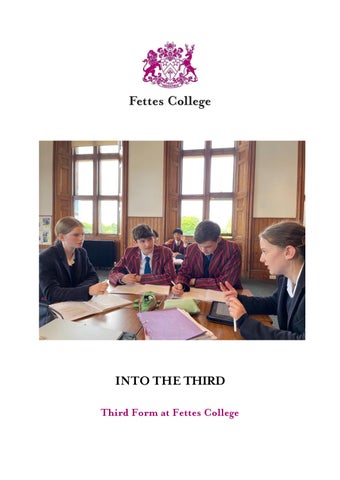
INTO THE THIRD Third Form at Fettes College
Our Curriculum Students in the Third Form study a broad academic curriculum in order to expose them to the wide range of subjects they could study at GCSE and beyond at Fettes College. These subjects include:
• •
Five core subjects (English, Mathematics, Biology, Chemistry and Physics) which they will be expected to continue at GCSE. Two languages out of French, German, Latin, Mandarin and Spanish – one in Column A and one in Column B. Please note: • German, Latin, Mandarin and Spanish are available ‘ab initio’ for beginners, but not French. • Students who already study Latin have the opportunity to study Greek alongside (Gratin) once they have begun the Latin course (more details under “Our Academic Subjects”). Column A French Spanish Mandarin Latin (and Gratin) Study Support
•
• • •
Column B French Spanish Mandarin German Latin (and Gratin) Study Support English as a Foreign Language (EFL)
A range of other subjects that will be available as options for study in Fourth Form such as: Art & Design; Computer Science; Drama; Engineering, Enterprise & Technology; Geography; History; and Music. Support for Learning lessons for students who have additional support needs and would benefit from specialist support. This would be taken instead of one of their Language Options. English as a Foreign Language lessons for students who need this support, at additional cost, in Column B. Physical Education for two periods per week.
In addition, Third Formers have a number of PSHE/tutorial lessons; and ‘Current Issues’ lessons with the Head. They also have Games on Tuesday, Thursday and Saturday afternoons; and opportunities to access super-curricular activities after-school as part of our Activities Programme.
Our Academic Subjects Art and Design The Third Form Art course provides students with a structured yet flexible introduction to the study of Art, combining technical skill development with energetic creative exploration. Students engage with the formal elements of art - including line, colour, texture, shape, and space - while experimenting with a variety of processes and materials. The course explores: 1. Place: The concept of ‘place’ through careful observation of the school environment and broader surroundings. Key artists include Boyle Family and Ingrid Calame. 2. Me: The exploration of self-portraiture and personal identity through artists such as Andy Warhol, Dieter Roth, Paolozzi, and John Stezaker. 3. Us: An examination of collective identity and the affiliations that shape our school experience, including houses, teams, and clubs. Biology The Edexcel IGCSE course starts in the Third Form and builds on the recommendation of the National Curriculum and Curriculum for Excellence for pre-GCSE years. There is an emphasis on the critical thinking and experimental skills of the IGCSE course. Students cover content on the cells, human and plant reproduction and ecology in Third Form in preparation for further study of the structure and function in living organisms; inheritance; human influences on the environment; and the use of biological resources. Chemistry The Edexcel IGCSE chemistry course is a spiral curriculum which starts in the Third form. We cover states of matter, separation techniques, atomic structure, covalent and ionic bonding, chemical formulae and chemical reactions during the Third Form but come back to these foundation concepts in each subsequent year as we build up our understanding of organic, inorganic and physical chemistry. Computer Science Computer Science in Third Form is an exciting introduction to the subject with students undertaking a year long quest to develop the 21st Century skills that are in such high demand. Our course is made up of several core Computer Science concepts including coding in Python; cybersecurity; computational thinking; machine learning and AI – skills that transfer far beyond the Computer Science classroom. Computer science is everywhere, and our students will develop the curiosity that will inspire them keep exploring the many exciting possibilities studying Computer Science can bring. Drama Drama in the Third Form is practical, collaborative and exciting. It focuses on developing skills through physical theatre, interpretation, script work and performance, giving students creative agency and encouraging them to see themselves as theatre-makers. This prepares students for IGCSE Drama, which is 60% practical coursework and 40% written exam, following pathways in either performance or design. There will also be opportunities for theatre trips and the chance to get involved in school productions.
Engineering, Enterprise & Technology (EET) Engineering, Enterprise and Technology (EET) is Design and Technology reimagined for the modern world. It provides an opportunity for students to develop problem-solving skills through real-world, hands-on experience. Using up to date design and manufacturing technologies, students in EET are tasked with developing skills to turn their ideas into a reality. With access to 3D printers, laser cutting and traditional tools, Third Form is all about learning the skills required to unlock the ability to create within the EET workshop. Those choosing to continue into the Fourth Form will get the chance to develop their design proficiency by completing structured projects around engineering sectors before embarking on a project of their own choosing. English The Third Form English curriculum offers our students a rich and varied diet as we seek to cover a wide range of literary and non-fiction texts. In the Autumn Term, students explore an array of different forms of poetry from our own anthology, learn to write analytically and have a go at becoming poets themselves. We explore the murky world of the Gothic through studying an iconic ghost story (novels such as The Woman in Black, Dark Matter, A Christmas Carol, A Skinful of Shadows ) and students embark on producing their own Gothic tales. The Spring Term focus is on Drama whether in the guise of Shakespearean comedy ( Much Ado About Nothing) or a contemporary classic (Noughts and Crosses). Students also produce an Interdisciplinary project, which draws together topics from across subjects and skills developed in English. The Summer Term sees a switch to reading and writing Non-fiction texts, and focuses on their understanding of writing to persuade a point of view. The year concludes with our inter-class debating competition. Throughout the year, students engage with regular discussions with their peers and teachers around reading for pleasure and visit our dedicated Fiction Room at the heart of the school as part of their English lessons. Geography We engage our youngest senior school students by connecting them to global issues within a local framework. Our journey starts with honing map skills through DigiMaps to geolocate our school, homes, and significant locations, providing a strong grounding in the skills needed for the subject. Subsequently, we delve into the geographical landscape of Edinburgh, culminating in an immersive experience that includes a bus tour across the city and an ascent of Edinburgh's dormant volcano, Arthur’s Seat. We then go on to explore diverse topics including Tropical Rainforests, the Arctic, Development challenges, and the environmental impacts of Fast Fashion. History Third Form pupils enjoy a varied study of modern history that both supports their understanding of the world we live in and equips them with the skills that support further study at GCSE or beyond. Autumn Term focuses on the causes and legacy of the First World War, providing students with a chance to explore why conflicts occur and how transformational their consequences can be. Students will also reveal the intimate connection between Fettes College and the Great War. In the Spring Term, we study the Holocaust to examine how political systems can normalise and weaponise hate, paving the way for discrimination, persecution and genocide. In the Summer Term, pupils will focus
on different aspects of social history and the experiences of people facing tumultuous change. Overall, we aim to leave pupils with a love of History as they embrace the stories of the past, appreciate its relevance today and unearth an unquenchable thirst to keep studying it. Latin and Greek Students have the opportunity to study Latin as a beginner ab initio. For more experienced Latin learners, they can either study Latin on its own or ‘Gratin’, a course where Latin and Greek are taught side by side in the space of one option choice. Students will use John Taylor’s Latin to GCSE and Greek to GCSE textbooks, to ensure strong foundations in their language skills. To deepen their appreciation of the ancient world, students also explore Classical Civilisation topics, such as the story of The Trojan War, connecting language learning with the rich history and culture of Greece and Rome. This combination of language and civilisation not only develops analytical and problem-solving skills but also gives students a window into some of the most influential stories, ideas, and traditions of the Western world. Mathematics Mathematics in the Third Form offers a challenging and rewarding opportunity to explore the subject in greater depth and breadth. Students will build a strong foundation in key areas such as number, algebra and geometry, while developing essential problem-solving skills. Through a mix of exploration, reasoning, and application, it will become clear how the different strands of mathematics connect and how they can be used to understand and model the world around us. This is a year for our students to be bold in their thinking, to stay curious, and to aim high in everything they do. Mathematics rewards those who are willing to ask questions, explore different approaches, and persevere through challenges. Whether by spotting patterns, testing ideas, or tackling unfamiliar problems, curiosity can guide learning and support students beyond the foundations. We look to build determined, resilient mathematicians ready for the variety of pathways from Fourth Form onwards. Modern Foreign Languages Now more than ever, modern linguists are in high demand, both at university and in the workplace. Our Third Form programme lays the foundation for students to become confident, curious, and capable global citizens. We are proud to offer courses in French for those with previous exposure, and German, Spanish, and Mandarin from beginner level—giving every student the opportunity to develop their passion for language and culture. Students embark on an exciting journey into the world of modern languages through our innovative and immersive teaching approach. We place a strong emphasis on speaking and authentic communication, empowering pupils to use complex language confidently from the very start of their studies. Our classrooms are vibrant, interactive spaces where students explore how languages are used in real-life situations. Learning is enriched by the support of our foreign language assistants and a variety of competitions that encourage creativity, teamwork, and collaboration. Beyond the classroom, pupils enjoy a rich calendar of cultural experiences, from film nights and national celebrations to exploring international traditions. These activities deepen students’ appreciation of global cultures while strengthening their linguistic skills. Music Diversity and accessibility are the cornerstones of the Music curriculum in the Third Form. Pupils
from all musical backgrounds can find something to access, whilst there is ample room for stretch and challenge for those with more experience. Topics covered include: The elements of music; Programme music and leitmotifs; Film and game music; Pop music 1960s - now; Aspects of music theory; Composition using BandLab. These areas of study provide an excellent grounding for GCSE Music (currently Edexcel), whilst covering a wide range of musical styles and interests. Regular performance opportunities are available through the broad ensemble provision in the department, and through fortnightly Coffee Concerts. Physical Education During Third Form Physical Education lessons, pupils will be in mixed classes covering a wide curriculum of physical activities, including racket sports, swimming, basketball, ball games, tennis and athletics. They will improve their skill sets in each activity, helping them to identify a potential additional sport for assessment if they choose to take GCSE PE. Physics The Third Form Physics course builds a strong foundation in mathematical and experimental skills, preparing students to approach the Edexcel IGCSE syllabus with confidence. Once these core skills are established, students explore two of the eight main topics: Solids, Liquids and Gases and Energy Resources and Transfers. These topics offer plenty of hands-on opportunities to apply their learning, while also connecting new ideas to familiar concepts introduced in Prep School Science.
Current Issues The ability to think critically about issues that are impacting our world is a key skill that we want our students to develop. One lesson per cycle students discuss what is happening in the news, critically evaluate resources and develop more informed opinions. These lessons are taken by the Head and are an opportunity to help grow the students’ knowledge and understanding of their rapidly-changing world.
Games On Tuesday, Thursday and Saturday afternoons, all students participate in the Games programme. This helps embed the habit of regular physical activity and key life skills such as resilience, humility, teamwork and communication. With over 20 sporting options available, both competitively and recreationally, the sporting programme offers something for all students no matter their skill level or interest. With a wealth of exceptional sporting facilities onsite, a walk through our extensive, leafy campus will show you our active, purposeful community.
PSHE Personal, Social, Health and Emotional (PSHE) education is an essential part of our curriculum. There are timetabled PSHE lessons delivered over the course of each week by academic staff, the Medical Centre staff, and the PSHE Prefects, as well as guest speakers. The programme aims to provide all students with an awareness of personal, social, health and emotional issues they are experiencing or could experience, and the opportunity to develop key skills such as resilience, resourcefulness, risk assessment and communication. We hope that you have found this guide useful for understanding our curriculum in Third Form. For any questions, feel free to contact Anushka Chakravarty, Deputy Head (Academic).