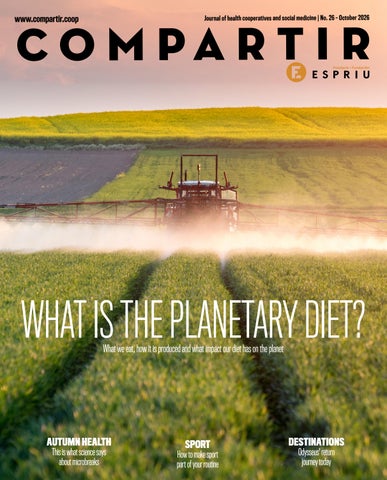
www.compartir.coop
Journal of health cooperatives and social medicine | No. 26 – October 2026
C o m pa r t i r
WHAT IS THE PLANETARY DIET? What we eat, how it is produced and what impact our diet has on the planet
AUTUMN HEALTH This is what science says about microbreaks
SPORT
How to make sport part of your routine
DESTINATIONS Odysseus' return journey today
Staff
Compartir Magazine of healthcare cooperativism www.compartir.coop compartir@fundacionespriu.coop Editorial board: Dr Ignacio Orce, president of the Fundación Espriu and of Assistència Sanitària Dr Enrique de Porres, CEO of ASISA-Lavinia Dr Oriol Gras, trustee of the Fundación Espriu Dr Carlos Zarco, Director General and trustee of the Fundación Espriu
Edition: Factoría Prisma Diagonal 662-664 08034-Barcelona Tel. 639 213 710 www.factoriaprisma.com Director of Factoría Prisma: Angi González Vives Coordination: Laura Martos Design: Xavi Menéndez Printer: Centro Gráfico Ganboa SL Legal deposit: B-46099-2003 ISSN: 2488-6394 ISSN (Internet): 2696-3833 Fundación Espriu Av. de Josep Tarradellas, 123-127 4th floor 08029 Barcelona Juan Ignacio Luca de Tena, 12, 3rd 28027 Madrid Tax ID: G-59117887 Tel.: 934 954 490 fundacionespriu@fundacionespriu.coop www.fundacionespriu.coop
Founded in 1989, the Fundación Espriu brings together the entities that practise the cooperative healthcare model created by Dr Josep Espriu: Autogestió Sanitària, SCIAS, Lavinia and ASISA, which form the Assistència Group and the ASISA Group.
2
Summary
06
HEALTH IN AUTUMN What benefits are provided by the so-called microbreaks between tasks for people with sedentary jobs.
08
GYNAECOLOGY Endometriosis is a disease that is difficult to diagnose and can go unnoticed because menstrual pain is normalised.
10 14 20 SPORT
HEALTHCARE COOPERATIVISM
IN DEPTH
We present seven tips for turning sport into a long-term habit, applicable to any person and lifestyle.
Campaigns, collaborations, policies, grants and medical services are the main new developments in health cooperatives.
The way we eat plays a crucial role in our health, but also in the health of the environment and in climate change.
Editorial
Routine as an ally of health A large part of our lifedoes not take place in extraordinary
moments. It takes place in the everyday. In how we have breakfast on any given Tuesday, in whether we find a moment to walk, in the hours we sleep, in how we work or in our ability to stop for a few minutes in the middle of a busy day. And perhaps that is why we tend to undervalue something as simple as routine. However, our health is built, to a large extent, on what we do every day. Returning to our usual activities after the summer can be a good time to consider how we want to get our routines back. I do not think it is about setting ourselves major changes or chasing perfect behaviour. It is probably much more realistic to ask ourselves what small decisions we can incorporate in a sustained way in order to live better. To do this we need something I consider essential: rigorous, understandable and useful information. Because looking after our health should not consist of following every new recommendation or trend, but of having enough knowledge to be able to make informed decisions. With this aim, in these pages we address very everyday issues, such as the importance of micro-breaks and how to incorporate physical activity until it becomes a habit.
28 32
DESTINATIONS
TRENDS
In the most epic journey in literature, there are fantastic places, but also others that we could recognise today.
We analyse some of the most significant changes in chess in recent years, just a few weeks before the World Championship.
We also broaden our view towards something that is increasingly difficult to separate: our health and the health of the planet. Based on the planetary diet proposed by the EAT-Lancet Commission, we reflect on how our food choices affect both. Looking after ourselves and looking after our environment are not necessarily different paths, and we increasingly understand that they are part of the same conversation. And we also leave room for culture, art and thought. Ulysses' journey, Monet’s gaze and chess remind us that wellbeing has many dimensions and that stopping, observing, learning or enjoying are also part of a healthy life. Because perhaps the return to routine should not be understood simply as going back to our obligations. We do not need to transform our life from one day to the next; sometimes it is enough to start with something small, do it consciously and repeat it.
Carlos Zarco
Director General of the Espriu Foundation
3
Current affairs
Transplants from animals to humans: a near reality?
T
im Andrews, a 66-year-old American with kidney failure caused by type 2 diabetes, has been at the centre of the xenotransplant case with the longest survival recorded so far. With only a 9% chance of receiving a human kidney within five years and a more than 40% risk of dying or being removed from the waiting list, doctors at Mass General Brigham (Boston) transplanted, in January 2025, a pig kidney with 69 genetic modifications to reduce rejection. The organ worked immediately and kept him off dialysis for 271 days, until some lesions made it necessary to remove it. After a few more months on dialysis, at the beginning of 2026 he received a human kidney which, according to a study published in The Lancet, is still functioning normally. The case confirms that xenotransplants have entered a new phase, marked by a
Health renews the ‘Good Practice Manual on Euthanasia’, five years after the law The Organic Law on the Regulation of Euthanasia came into force in Spain in 2021, making the country one of the few in the world where this service is recognised as a right. Since then, the Good Practice Manual on Euthanasia has been the technical reference guide for the autonomous communities to apply the regulation in a homogeneous way. The Interterritorial Council of the National Health System has just approved its second edition, which incorporates the experience accumulated in five years of implementation. Provisional data for 2025, presented by the Ministry of Health to coincide with the fifth anniversary of the law, confirm sustained growth in euthanasia. There have been 565 assisted dying procedures, 0.13% of deaths recorded in Spain, and since 2021 a total of 1,668 people have exercised this right, out of 3,716 applications. Catalonia, Navarre and the Basque Country account for the highest rates in the country.
4
World Day of...
... care and support Every 29 October the International Day of Care and Support is commemorated, proclaimed by the UN General Assembly in 2023. The date recognises the value of care work, paid and unpaid, from direct care for children, older people or people who are ill, to domestic tasks such as cooking or cleaning, and calls for care systems that are robust, inclusive and respectful of human rights. Worldwide, 249 million women and 132 million men carry out this work in a paid capacity. By 2030, the number of people who will need care is expected to reach 2.3 billion, driven by population ageing and child growth. That is why this year the UN is stressing the need to dignify this sector and reduce the gender gap.
Quotes that inspire
"The groundwork of all happiness is health" Leigh Hunt, poet and essayist
271 days without dialysis is the world record for survival with a transplanted pig kidney in a person.
technological race between the United States and China. The clinical company ClonOrgan, in fact, has kept a pig kidney functioning for more than 200 days, while others have carried out the first liver and lung transplants from pigs to people. To date, around twenty xenotransplants have already been carried out worldwide – most of them kidney, and also heart, liver and lung – almost all of an experimental nature. Specialists stress that, despite the advances, this technique is still far from matching the results of transplants between humans, and doubts remain about safety, durability of the organs, risk of infections and cost. Even so, given the chronic shortage of organs, many researchers see pigs as the most viable donor source in the medium term.
Up to 45% of dementia risk could be prevented or delayed Worldwide, more than 57 million people live with dementia, and nearly 10 million new cases are diagnosed every year, of which between 60% and 70% are Alzheimer’s. Although there is no specific cure, the World Health Organization has published new guidelines that put at around 45% the share of risk associated with modifiable factors: tobacco, alcohol, social isolation, physical inactivity, air pollution and poorly controlled hypertension or diabetes are the main ones. The document recommends cognitive training and stimulation, participation in social activities, physical activity, quitting smoking, reducing alcohol and following a healthy diet, and for the first time includes reducing exposure to air pollution. It also recommends managing hypertension, diabetes and cholesterol, as well as using hearing aids when there is hearing
Four in ten cancer cases could be prevented
Cancer claims more than 26,000 lives a day and is already the second leading cause of death worldwide, only behind cardiovascular diseases. According to the latest report by the WHO and the International Agency for Research on Cancer, there are 20.6 million new cases and nearly 10 million deaths every year from this cause. If urgent action is not taken, the number of new diagnoses could reach almost 35 million a year by 2050, almost double the current figure. In this context, the WHO highlights that four in ten cancer cases are linked to risk factors that can be prevented. This is the case for infections such as HPV, hepatitis B and C or the bacterium Helicobacter pylori, as well as alcohol, tobacco, excess weight and lack of physical activity.
loss. By contrast, it does not recommend vitamin B, E or omega-3 supplements without a diagnosed deficiency. The organisation recalls that dementia also represents an annual cost of 1.3 trillion dollars for the world economy, half of it due to unpaid care by relatives.
The report also shows huge inequalities: in high-income countries, 87% of women with breast cancer are still alive five years after diagnosis, compared with only 42% in low-income countries. Fewer than one in three countries includes cancer care in its universal health coverage, and the availability of essential cancer medicines can be up to ten times lower in the poorest countries. Even so, there are also some encouraging advances. For example, tobacco consumption has fallen by 27% since 2010 and 82% of countries now have national cancer control plans, compared with 50% fifteen years ago. The WHO is now calling for a person-centred model, with better coverage, more social protection and research aligned with the real needs of patients.
5
health in autumn
MICROBREAKS:
What does science say? Taking breaks between tasks is a recommendation that has become popular in the workplace. Science supports some methods designed to sustain concentration, take care of the back and slow down the wear and tear of a day spent sitting in front of the screen. by Isabel López
M
aintaining a high level of concentration for several hours is one of the major challenges for professionals, especially in technological, operational and administrative fields. Resolving complex incidents or managing processes requires sustained mental and visual effort which, if poorly managed, leads to fatigue and loss of effectiveness. In neurological terms, studies suggest that maximum concentration can only be sustained for between 45 and 90 minutes; after that time, mental efficiency drops dramatically. In addition, productivity depends less on the hours spent on a task than on making the most of the moments when energy and focus are at their highest.
6
As for a sedentary lifestyle, its effects go beyond tiredness: it is associated with cardiovascular diseases, insulin resistance and muscle and joint problems. A study by the University of California found that sitting for more than 11 hours a day increases the risk of dying by 57%, compared with those who sit for less than 9.5 hours.
Resting without sleeping
Rest is a subjective relationship that each individual establishes with the concept of relaxation
Any brief activity that breaks the physical or mental monotony of the day, from stretching to making a cup of tea or listening to a song, is a window that allows the body to rest. The usual range is between 30 and 180 seconds. Its effect has a physiological explanation related to cortisol, which today spikes in response to stressful situations that are not literally so for the body. Microbreaks reduce this allostatic load, as they prevent the sustained activation of the stress system. By reducing this continuous threat signal, the proper functioning of the immune and endocrine systems is protected.
This technique was documented in the late 1980s in research by the National Institute for Occupational Safety and Health (Ohio) and Purdue University (Indiana), which even then observed a greater sense of calm and fewer corrections in the work that operators subsequently carried out. Even with this evidence, up to now the most widespread use of the technique has been the prevention of injuries in offices. As Felicity Callard, professor at the University of Durham, recalls in an interview with the BBC: “Rest is not a natural state, it is a subjective relationship that each individual establishes with the concept of relaxation”.
Does science support breaks?
A systematic review published in the journal PLoS ONE concludes that microbreaks significantly increase vigour and reduce fatigue; their impact on performance is more modest, but they clearly reinforce subjective wellbeing. Another analysis, by Cogent Engineering, focused on sedentary workers and supported active microbreaks, stating that between 2 and 3 minutes of light exercise every half hour improve physical and mental health without harming productivity. That said, it is advisable not to confuse a microbreak with real rest. Their function is to reduce unnecessary activation which, if maintained, ends up affecting the perception of one’s own health and, objectively, the immune system.
What to do during a microbreak? Eyesight Apply the 20-20-20 rule: every 20 minutes, look away from the screen and focus for 20 seconds on a point about 6 metres away, to relax the ciliary muscles and prevent eye strain. Neck Every hour, perform a slow neck rotation, from side to side and from top to bottom, to release the tension accumulated from looking at the screen. Shoulders Interlace your hands behind your back and stretch your arms backwards in a chest-opening movement, thus counteracting the typical hunched posture in front of the keyboard.
Back Combine opening the chest with a brief backward arch in the chair to reverse the curvature adopted when writing for hours.
Lower back Stand up every 60–90 minutes and do a gentle stretch to the sides or backwards to release the pressure accumulated in the lower part of the back.
Hips Use that same standing break to do some hip rotations, as sitting for long periods limits their natural mobility.
Legs Take a short walk or move your ankles when you get up, especially useful if you spend a lot of time using a computer mouse, to reactivate circulation in the lower limbs.
7
Gynaecology
When does menstrual pain
STOP BEING NORMAL?
Endometriosis affects between 10% and 15% of Spanish women, of whom 30% will have difficulties in becoming pregnant. In addition, diagnosis can be delayed up to 7 or 8 years after the first symptoms, making prevention the most effective cure. by Isabel López
T
he menstrual cycle can provide information about different aspects of health, although on its own it does not allow any disease to be diagnosed. Regularity and duration can give us clues about hormonal and reproductive health, while certain alterations can serve as a warning for stress, weight loss or excessively intense exercise. Changes or extreme symptoms can also give signals to investigate disorders such as perimenopause, polycystic ovary syndrome, anaemia, thyroid disorders or, of course, endometriosis.
Identifying the symptoms of endometriosis
As Dr Débora Labios, head of the Gynaecology and Obstetrics Unit at the HLA Vistahermosa hospital, explains, the most characteristic symptom of endometriosis is intense menstrual pain, especially when it limits usual activity or worsens over time. To understand the cause of this discomfort, it is important to bear in mind that tissue similar to the lining of the uterus, which prepares each month for a possible pregnancy, can grow in other areas of the pelvis and also respond to the menstrual cycle, causing inflammation and pain. At each stage of life different symptoms prevail: in adolescents, this disease usually manifests mainly as very painful periods that may force them to miss classes, while in adulthood pelvic pain or discomfort during sexual intercourse may become more important. Therefore, diagnosis must be based on the set of information that the patient can provide during the consultation. 8
Pregnancy and endometriosis
Approximately 30% of women with endometriosis have difficulties in becoming pregnant, according to the American Society for Reproductive Medicine (ASRM). In Spain, moreover, there is some overlap between the average age of motherhood (33.2 years old) and the average age of diagnosis of the disease (37 years old), bearing in mind that between seven and eight years may elapse from the appearance of the first symptoms to obtaining the diagnosis. In fact, according to WHO data, between 25% and 50% of women who seek medical advice for infertility have endometriosis. In this context, the delay in diagnosis may coincide with a stage of life in which many women are considering motherhood, while the disease itself may make pregnancy more difficult. What is certain, in the words of Dr Débora Labrios, is that there is no exact relationship between the extent of endometriosis and fertility. This disease can make pregnancy more difficult for multiple reasons: altering the anatomy of the pelvis, affecting the fallopian tubes or ovaries, causing inflammation or reducing ovarian reserve. But, on the other hand, there are also many cases in which a natural pregnancy has been possible despite the disease.
Can it be cured?
Endometriosis cannot be definitively cured with medicines, but it can be treated, both with hormonal contraceptives and progestogens –which can reduce ovarian activity and relieve pain–, or, in some cases, treatments that produce a temporary suppression of ovarian function can also be used.
Warning symptoms in menstruation Menstruation can cause discomfort, but we should not assume that it is normal to suffer symptoms that limit our quality of life. Doctor Débora Labios, head of the Gynaecology and Obstetrics Unit at the HLA Vistahermosa hospital, advises paying attention to the following symptoms: May be common
Advisable to seek consultation
Mild or moderate menstrual pain, short in duration and which improves with usual measures.
Intense or disabling pain that worsens over time, does not improve with painkillers or interferes with daily life, work or studies.
Bleeding lasting up to 8 days and with some variation between cycles.
Excessive bleeding that forces you to change protection continuously, causes frequent leaks, anaemia or interferes with daily life.
Cycles between 24 and 38 days in adult women, although there may be some variation between cycles.
Persistent changes such as significant and sustained alterations in the regularity of the cycle.
Pelvic pain absent or limited to the days of menstruation.
Pelvic pain outside menstruation or that also appears at other times in the cycle.
Sexual intercourse, urination and bowel movements without any discomfort.
Pain during or after sexual intercourse, or when defecating or urinating, especially if it appears or worsens with the period.
Other symptoms: absence of intestinal symptoms or excessive tiredness.
Other symptoms: cyclical intestinal symptoms, tiredness or difficulties in achieving a pregnancy.
The choice depends on the symptoms, age, desire for pregnancy, possible side effects and contraindications. To treat the most severe cases, or in those in which the patient does not wish to have more children, a hysterectomy is usually the last option. This surgery, which consists of removing the uterus and sometimes also the ovaries, does not guarantee the disappearance of the disease, and therefore is never presented as a definitive cure.
25–50% of women who seek medical advice for infertility have endometriosis
Against stigmatisation
Menstrual pain is common in more than two out of three women, according to a WHO study, and in many people it causes iron-deficiency anaemia due to heavy blood loss. These figures affect more than two billion women worldwide, making it an issue that deserves special attention in conversations between women, to promote the detection of irregular symptoms and normalise the adaptation of daily activity to the needs of the cycle. 9
sport
How to turn
Practical guide to moving more
SPORT
into a habit
Discover how to turn sport into a sustainable habit with practical tips and the insights of José Antonio Gutiérrez, a specialist in sports medicine. by Silvia Cardona
S
tarting to do sport is usually relatively easy. The difficult part comes later, when the initial motivation disappears, work increases, family commitments appear or you simply do not feel like training.
Start by finding an activity you like Not everyone has to run, go to the gym or play a specific sport. Dancing, walking, cycling, swimming or playing padel can also be ways of staying physically active. That is why, before asking which activity is most effective, it may be more useful to think about which one is most appealing and enjoyable. Starting with activities you already like increases the chances of maintaining them over time.
That is why turning physical activity into a habit should not depend solely on willpower. Regular exercise contributes to cardiovascular and muscular health, helps prevent chronic non-communicable diseases such as type 2 diabetes and is also associated with benefits for mental health and cognitive function. The World Health Organization recommends that adults do between 150 and 300 minutes of moderate aerobic activity per week, as well as strength work at least two days a week. It also points out that any amount of physical activity is better than none. In fact, according to José Antonio Gutiérrez, a specialist in sports medicine and head of Assisport, the starting point should be another: “The basis is to move, and not to do so under a set of specific rules.” The aim, he explains, is for physical activity to help the person feel better, not for it to become an obligation or an unpleasant experience. From that point, we asked ourselves: how can we make exercise stop being something we keep putting off?
10
Find company to build the habit The social dimension can be an especially useful tool for starting to do physical activity and maintaining it. Finding a group of people who do the same activity adds an extra level of commitment and can make exercise more enjoyable. It could be a hiking group, a group class or simply arranging to go out for a walk. According to Dr Gutiérrez, this strategy can be especially powerful among teenagers and young adults, although also in older people.
Design a minimal version of the habit An overly ambitious workout may work well in the first few days but disappear at the first unexpected event. For this reason, it can be useful to have a plan A and a plan B. For example, 45 minutes of strength training as your usual workout and a 15-minute session for the more difficult days. It is not about always doing the perfect workout but about maintaining the habit of incorporating physical activity.
Lower the barriers before you start Sometimes the main obstacle is not the exercise itself, but everything that comes before it: getting clothes ready, travelling, deciding what workout to do in each session, etc. Getting your bag ready, having a pre-selected routine or taking your sports clothes to work are small changes that can make it easier to get started. The key is to ask yourself: what can I prepare today so that starting tomorrow requires less effort?
Make the most of everyday movement Physical activity is not only about going to the gym. Walking, cycling or taking the stairs also counts. It is worth asking yourself: how can I make my day a little more active? Walking during a phone call, getting off public transport one stop earlier or avoiding escalators are small decisions that help increase daily movement.
Do not wait until you feel like it Motivation fluctuates but physical activity itself can generate a feeling of wellbeing that helps you repeat it. During exercise, changes occur in different neurochemical systems, including the release of endorphins. Therefore, instead of waiting for the desire to appear, it can be useful to focus on how we feel after moving and build a routine that makes it easier to take that first step. Set yourself goals which are small and specific Thinking only in terms of long-term goals can be demotivating. In contrast, setting small goals allows you to notice progress and maintain commitment. The goal may be to increase your daily steps or to reach a specific endurance or strength target. To do this, tools such as smart watches or step counters can be used to visualise progress.
11
Emergencies
Caring for and preventing friction blisters
W
e have all had a friction blister on the hand or foot at some point, especially in summer and autumn, when we spend more time on our feet and sweat more. These small sacs of skin filled with fluid usually appear as a response to an external aggression, usually rubbing or heat, as well as skin diseases.
protection on very hot surfaces can cause injuries and blisters on the skin.
Care In general, a blister usually heals in 5 to 10 days if it is treated properly. For this, it is necessary to avoid pressure and friction: no tight shoes, rough fabrics or activities that irritate the area.
The fluid is a mixture of blood plasma, water and proteins that the body has produced to protect the area (like a natural bandage that protects the damaged tissue from infections and knocks). Although it is usually transparent, it can darken if there is blood present. The most common reasons for their appearance are: • Continuous rubbing: repeated contact with rough surfaces, especially when walking barefoot or wearing footwear that does not fit the foot well, can cause blisters. • Excessive sweating: moisture makes the skin softer and more vulnerable, making it easier for friction to end up damaging it. • High temperatures: walking without
It is important to not remove the skin that covers the blister, as it acts as a barrier against bacteria or possible rubbing. It is also not advisable to remove the fluid inside, which usually ends up coming out on its own.
• Infections: certain infections caused by bacteria or fungi can affect the most superficial layers of the skin and cause
You should wash the area with soap and water and cover the blister, to avoid rubbing, with an adhesive bandage, a sterile gauze or a dressing. Natural products such as aloe vera or petroleum jelly can help with healing, once the fluid-filled sac has drained. If the blister shows signs of infection, you should see a doctor as soon as possible.
Can it become infected?
When is it advisable to burst a blister?
A blister may be infected if it shows:
The general recommendation is to not touch blisters and to let them heal and drain by themselves, to avoid possible infections. Only if the blister causes pain or there is a risk that it will burst spontaneously, we could consider draining the fluid under the following conditions:
- Redness of the surrounding
skin and/or a feeling of warmth in the area.
- Sharp pain.
- Oozing of pus.
- Fever or symptoms of general
tiredness.
12
the appearance of blisters. • Circulation problems: poor blood supply can compromise the tissues and promote inflammation, injuries and the appearance of wounds.
- Wash our hands and the affected area and disinfect a needle.
- Make a puncture on one of the edges of the blister. It is important to let the fluid come
out on its own, without squeezing the blister or removing the skin that covers it.
- When all the fluid has come out, wash the blister and apply an antibiotic cream. - Cover with a sterile gauze, which should be changed regularly.
Compartir 13
Cooperatives and social medicine
The ASISA Group recorded revenues of 2,227.6 million euros in 2025, after growing by 19.1% Lavinia S. Coop., sole shareholder of ASISA, holds its 50th Assembly and reviews the strategic pillars for the coming financial years. Lavinia S. Coop., sole shareholder of ASISA, has held its 50th General Assembly in Madrid, at which it analysed the company’s progress and results and ratified its strategy for the coming financial years. After the Assembly, the ASISA Group brought together its main executives in Lisbon and established that, in the medium term, its objective is to continue growing, supported by the transformation of its model and diversifying its activity in order to operate in new insurance lines and continue expanding its own healthcare network. The Assembly, held under the slogan We add life to time, reviewed the development of the strategic plan during the 2025 financial year, in which the ASISA Group achieved consolidated revenues of 2,227.6 million euros, 19.1% more than in 2024. The president of the ASISA Group, Dr Francisco Ivorra, stressed that “the results reflect the strength of our company’s cooperative model and its ability to combine growth, investment and quality of care. The ASISA Group has grown in a very difficult year, marked by the improvement in Muface funding, after a period that generated a great deal of uncertainty in the sector”.
Dr Luis Mayero, director of Lavinia-ASISA and delegate in Madrid; Dr Enrique de Porres, CEO of ASISA; Dr Antonia Solvas, secretary of Lavinia-ASISA and delegate in Barcelona; Dr Francisco Ivorra, president of ASISA-Lavinia; Dr Gregorio Medina, vice-president of Lavinia-ASISA and delegate in Seville, and Mariano Caballero, secretary general of the ASISA Group, during the 50th Lavinia Assembly.
Growth in insurance activity
The Lavinia S. Coop. Assembly analysed the evolution of the ASISA Group’s insurance activity, which grew again in 2025, with the following areas standing out: Growth and diversification: ASISA and ASISA Vida achieved joint revenues of 1,890.52 million euros in 2025, 21.1% more, and ASISA received authorisation from the Directorate-General for Insurance and Pension Funds to operate in the home insurance line. Healthcare activity: HLA Grupo Hospitalario recorded revenues of 725.5 million euros and invested 53 million in modernising and expanding its network, with a special boost to robotic surgery through new Da Vinci systems.
Internationalisation: ASISA Portugal increased its premiums by around 30% and the Group continued to expand its activity in Europe, Latin America and the Middle East; in addition, the Green Cube hospital software is now implemented in 14 countries. Innovation and digital transformation: ASISA renewed its mobile app and private area to facilitate access to telemedicine and move towards a more agile relationship and preventive, personalised care. ESG strategy: The Group reduced its emissions by 82% compared to 2018, exceeding its decarbonisation target for 2030, and strengthened its social, labour, equali ty, training and research initiatives.
ASISA Dental grows in the Region of Madrid with the opening of three new clinics The new ASISA Dental clinics in Fuenlabrada (calle del Humilladero, 1), Leganés (plaza Salvador, 8) and Aluche (calle Illescas, 209) offer a wide portfolio of services, including all dental specialties, and have a team of highly qualified professionals and state-ofthe-art technology.
14
Expansion of ASIDENT Lab
As in the rest of the centres, they also provide emergency services during their usual opening hours.
ASISA Dental has expanded and modernised its own laboratory as part of its commitment to healthcare excellence, an investment through which the company continues to improve the quality of the treatments received by patients in its network of clinics. The new facilities incorporate state-ofthe-art technology and greater production capacity, and provide services exclusively to ASISA Dental clinics.
The incorporation of these clinics in the Community of Madrid is part of ASISA Dental’s expansion plans, and it now has 48 own clinics in Spain.
Coinciding with this new stage, the laboratory has been renamed ASIDENT Lab, a change that strengthens its integration into the ASISA Group.
HLA Grupo Hospitalario strengthens its commitment to robotic surgery The group has incorporated new Da Vinci systems in its hospitals in Murcia, Almería and Jerez de la Frontera (Cádiz) and the most advanced version at HLA Universitario Moncloa. HLA Grupo Hospitalario has strengthened its commitment to robotic surgery with the incorporation of new Da Vinci robots in its hospitals in Madrid, Murcia, Almería and Jerez de la Frontera (Cádiz). In total, the group already has seven operational robots in its centres. The arrival of this technology places HLA La Vega (Murcia), HLA Mediterráneo (Almería) and HLA Jerez Puerta del Sur (Cádiz) at the forefront of robotic surgery in their provinces, and will allow them to perform minimally invasive surgical procedures with greater precision, safety and control by the medical teams. This technology also offers benefits for the patient, such as reduced intraoperative bleeding, reduced pain, a lower risk of complications, faster recovery and a shorter hospital stay, allowing an earlier return to daily activities.
HLA Universitario Moncloa incorporates the most advanced version
In the case of HLA Universitario Moncloa (Madrid), the first centre in the group to install this technology, in 2017, it has incorporated the Da Vinci 5, the latest and most advanced version. The new platform has an advanced intraoperative information management system capable of recording movement data and surgical performance metrics in real time. This analytical capacity, enhanced by artificial intelligence, opens the door to a new era of data-driven surgery, in which each intervention is supported by precise and objective information to optimise both the surgical process and the patient’s clinical outcomes.
ASISA and CEAJE strengthen their alliance to boost competitiveness ASISA and the Spanish Confederation of Young Entrepreneurs Associations (CEAJE) have renewed their collaboration agreement with the aim of continuing to boost the competitiveness of Spanish companies by promoting the health and well-being of their professionals. Health insurance allows companies to offer compensation with a high perceived value, while at the same time optimising the Antonio Magraner, president of CEAJE, and Dr remuneration policy for both the organisation Enrique de Porres, CEO of ASISA, during the signing and its employees. Beyond its contribution to of the renewal of the agreement. attracting and retaining talent, promoting the health and well-being of professionals has a positive impact on productivity, helps to reduce absenteeism and supports the sustainability of organisations.
HLA Universitario Moncloa develops an intelligent ICU based on AI The HLA Universitario Moncloa hospital (Madrid) is promoting, in collaboration with Universidad Europea de Madrid (UEM), an artificial intelligence project applied to intensive care medicine. Within the framework of the project Artificial intelligence and safety in the critical patient, the HLA Universitario Moncloa hospital has deployed its own infrastructure in the ICU for collecting data related to the patient’s progress. The aim of this ecosystem is to improve the patient’s stay in the ICU, being able to predict different types of events related to their progress. “The ICU generates an enormous amount of information every minute. Our challenge is to turn that data into useful, interpretable and actionable signals”, explain sources at HLA Universitario Moncloa.
ASISA extends the cover of its travel insurance policies and adds veterinary assistance ASISA has extended the cover of its ASISA Travel insurance policies to strengthen the protection of its policyholders against unforeseen events that may arise during their trips. Among the main new features, the company has raised to one million euros the maximum coverage limit for medical and healthcare assistance abroad, has added veterinary assistance while travelling and has made the contracting more flexible so that each customer can choose between a modality with trip cancellation and another without this cover.
Up to one million euros for medical and healthcare assistance
The Da Vinci robot at the HLA Universitario Moncloa hospital.
With this extension of cover, ASISA Travel has increased the maximum limit allocated to one million euros for covering the healthcare assistance that the insured person may need during a trip abroad. This extension makes it possible to deal more safely with expenses arising from an illness or accident during the trip, including medical care, diagnostic tests, treatments or hospitalisation.
15
Cooperatives and social medicine
A new campaign that highlights a different way of understanding health The same person, a whole life and a health model that accompanies them at every stage. The new campaign highlights the bond between doctors and users and the cooperative essence of Assistència Sanitària. Assistència Sanitària presented its new advertising campaign in September, a proposal that focuses on the essence of the organisation and on its own way of understanding health. Under the concept Assistència Sanitària, la de los médicos, y la tuya [ Health Assistance, the doctors' and yours[, the campaign highlights its cooperative, non-profit model of doctors and users, and the lasting relationship that is built between them throughout life. The main piece of the campaign is an advertising spot that follows the same person at different moments of their life journey, from birth to old age, with a common element: contact with the healthcare professionals who accompany them in caring for their health. Through this story, the creative concept shows that the relationship with medicine is part of people’s lives and that, for Assistència Sanitària, this relationship goes beyond the provision of a service. The organisation’s model is based on a
community in which doctors and users share a care project and take part in the same way of understanding health.
A model based on cooperation
The new campaign thus recovers one of the main distinguishing elements of Assistència Sanitària compared with the traditional model of insurers. The organisation was created on the initiative of doctors and has maintained throughout its history a cooperative, non-profit model aimed at guaranteeing high-quality healthcare. This way of operating places the relationship between professionals and users at the centre of the project and makes it possible to understand health cover from a perspective that goes beyond taking out a policy.
Presence on television, radio and in public areas
The campaign is present in different formats adapted to the communication channels. For example, the narration of the advertising spot and the radio advert features the voice of the renowned actor Lluís Soler, who lends the campaign his characteristic intensity and personality. His performance accompanies the images and reinforces a message focused on the values that define Assistència Sanitària.
Assistència Sanitària and SCIAS present their 2025 corporate reports The corporate reports of both companies of Grup Assistència for the year 2025 include the main projects, milestones and indicators of the financial year and reflect a particularly significant year for the insurer and the users’ cooperative, which celebrated its 50th anniversary. Assistència Sanitària and SCIAS have made their 2025 corporate reports available to their insured population, collaborating doctors, members and other interested parties. These publications offer an overall view of the activity carried out during the last financial year and of the main progress achieved in the care, social, economic and organisational fields. Both volumes review the most notable events of a year that holds a special place in the history of the SCIAS cooperative, coinciding with the fiftieth anniversary of the start of its activity. Throughout the pages of the reports, the main management data, the projects promoted during 2025, the evolution of the services and the initiatives aimed at continuing to offer quality care to the people who entrust their health to Grup Assistència are presented. The reports also highlight the organisations’ commitment to the values of cooperativism, transparency, vocation for service and continuous improvement, as well as to sustainability and social responsibility. In addition, they highlight the actions carried out to strengthen innovation, efficiency, the well-being of professionals and the group’s positive contribution to its environment. The publications can be consulted and downloaded in the relevant section of the Assistència Sanitària and SCIAS websites.
16
More than 30,000 euros for 33 scholarships to promote postgraduate training in health sciences The eighteenth edition of the programme consolidates an initiative that, since 2008, has benefited 564 professionals with a total investment of nearly 530,000 euros. Last July, Assistència Sanitària awarded the diplomas for the eighteenth edition of its scholarship programme for postgraduate studies in the field of health sciences, an initiative that reaffirms the organisation’s commitment to continuing education, professional excellence and the improvement of the healthcare system. The event, held at Hospital de Barcelona, was chaired by the president of Assistència Sanitària, Dr Ignacio Orce, and the vice-president of SCIAS, Mr Martí Llorach, together with the participation of Dr Rosa Delgado, head of management control at Assistència Sanitària, and Dr Paula Saludes, medical director of Hospital
de Barcelona. The day included the academic lecture Reflections on the future of medical care, given by Dr Carlos Humet, medical director of Hospital de Barcelona for more than 30 years. During his speech, Dr Orce congratulated the scholarship holders and highlighted the value of continuing education in the healthcare field. In this call, Assistència Sanitària awarded 33 scholarships, with a total amount of 30,367.96 euros, intended to finance 50% of the tuition fees for Master’s and postgraduate programmes in health sciences offered by Catalan universities.
FC Barcelona and Assistència Sanitària renew their strategic alliance until the 2030-2031 season FC Barcelona and Assistència Sanitària have agreed to renew their strategic alliance for the next five seasons, until June 2031. The new agreement also extends the insurer’s link with Barça’s sporting activity through the inclusion of the amateur sports teams and the Barça Genuine project, an initiative that promotes sport among people with intellectual disabilities and that represents some of the values that most identify the club.
Hospital de Barcelona promotes continuous improvement through training and the exchange of knowledge Continuing education is one of the pillars of continuous improvement at Hospital de Barcelona. Throughout the year, the centre develops an extensive programme of teaching and outreach activities that enables professionals to update their knowledge, share experiences and delve deeper into advances in the different medical and care specialties. With this set of activities, Hospital de Barcelona maintains a teaching programme that combines specialised training, exchange of experiences and scientific updating. A commitment that helps to continue offering high-quality healthcare.
New vehicles to strengthen home medical care The Home Emergency Service (SUD in its Spanish acronym) has renewed its fleet, an action that reinforces the organisation’s commitment to a care model based on proximity, accessibility and personalised medical care. The renewal strengthens the operational capacity of an exclusive service that each year carries out more than 72,000 home visits and travels
nearly 850,000 kilometres to provide cover in the counties of Barcelona. With a team of 120 professionals, the SUD is one of the most established and best-rated care resources of Assistència Sanitària. Beyond the incorporation of the new vehicles, this action reflects the desire to continue investing in a service that facilitates access to medical care in the patient’s home.
17
Cooperatives and social medicine
Architects of the new global economy Brussels hosted the Cooperative and Mutual Leaders’ Summit (CM50) from 28 to 30 June, a meeting that brought together the executives of the cooperative enterprises with the greatest impact on the global economy. Its aim is to act as architects in designing a new global economy, more equitable and sustainable, in which the value produced by the cooperative sector is doubled, going from 2.7 to 5 trillion dollars in the year 2035. In this context, the director general of the Fundación Espriu, Carlos Zarco, played a leading role by taking part in the panel entitled Cooperative B2B trade as the future of a new global economy. This space addressed directly the B2B market pillar of the CM50, designed to transform multinational intercooperation into a large-scale business growth strategy. Likewise, the Fundación Espriu took part in the presentation of the Healthy Food Systems project, which it promotes in collaboration with the Indian company IFFCO and the Acorn platform of the
cooperative bank Rabobank. Inspired by the innovative One Health approach (‘one single health’) and the debates of the EAT-Lancet commission, this initiative seeks to connect food production and consumption sustainably through three critical areas: regenerative agriculture, pricing mechanisms in the carbon capture market and the promotion of healthy diets. Intercooperation between agricultural, health, financial and food distribution cooperatives constitutes the strategic advantage on which this ambitious project is based. The summit also served to deepen other fundamental commitments of the CM50, among which Coop Cloud stands out, a sovereign digital infrastructure equipped with artificial intelligence to unify the data ecosystems of the cooperative sector and avoid dependence on other platforms.
Carlos Zarco renews his term on the ICA board Between 13 and 18 September 2026, the Panama Convention Centre became the epicentre of the cooperative business community with the holding of the World Conference and General Assembly of the International Cooperative Alliance (ICA). Under the motto Building Bridges: Cooperative Contributions to a World at Peace, more than 1,100 executives and representatives from 80 countries met in the Panamanian capital to define the lines of action of this international body that represents a democratic, people-centred economic model. The central milestone of the meeting was the adoption of the Panama Declaration, a document that formally proclaims cooperative enterprises as indispensable drivers of
18
peace, social justice and global stability. In the framework of the elective General Assembly, held on 15 September, the ICA board of directors was renewed for the 2026–2030 term. The assembly ratified the position of board member of the director general of the Fundación Espriu, Carlos Zarco, representing the health sector. Likewise, Ariel Guarco was re-elected as president of the organisation, while Íñigo Albizuri renewed his position in the governing body representing the Spanish cooperative business sector. Taking advantage of its presence in Panama, the Fundación Espriu delegation maintained an intensive institutional agenda. Among its most notable
meetings, the representatives of the organisation met with the president, Dr Álex Ortega, and the main leaders of the Cooperativa Profesionales de Panamá, an organisation that brings together doctors, strengthening inter-institutional collaboration. At the same time, the Fundación Espriu took part in a strategic meeting with the Ministry of Health of Panama and the representatives of the health cooperatives present in Panama. The meeting, promoted by the Instituto Panameño Autónomo Cooperativo (IPACOOP), a governmental body dedicated to promoting the creation of cooperative enterprises in Panama, aimed to link the Panamanian Government and those responsible for the health
system with health cooperativism on a regional and global scale. The conference also featured a broad programme of parallel events, including a special session dedicated to the cooperative approach to artificial intelligence. For its part, the Cooperative Law Committee organised the 9th Continental Congress on Law and the 2nd International Symposium on
Carlos Zarco, director of the Fundación Espriu, at the CM50.
In the educational field, agreements were established with prestigious universities to incorporate into their curricula the particular features of the cooperative economy. Finally, the commitment to society will materialise in projects aimed at deploying cooperative experience in health, housing and food during the reconstruction phases following crises and natural disasters. This summit represents the consolidation of a strategic path that began in Madrid in May 2025. The reflections and debates of that foundational meeting, sponsored by Assistència Sanitària and Asisa, gave rise to the Contract for a New Global Economy, which the members of the CM50 ratified in Doha during the Second World Social Summit, in November 2025. With the Brussels meeting, the CM50 reaffirms its structure and defines the objectives that will guide its work over the next decade so that the celebration of the next International Year of Cooperatives in 2035 consolidates the cooperative enterprise model as the axis of a new global economy.
The elective General Assembly was held on 15 September.
Cooperative Law, forums in which it was analysed how the legal framework must advance to adapt to the reality of the cooperative enterprise. The Panama meeting has reaffirmed the transformative role of the cooperative enterprise as a driver of economic progress and social cohesion throughout the world.
The UN endorses the leadership of Spanish cooperativism A recent report by the Secretary-General of the United Nations highlights the growing international recognition of the cooperative enterprise as an essential driver of sustainable development, job creation and social inclusion. The document places Spain as one of the main benchmarks in this global drive. Among the key milestones highlighted by the
UN is the adoption of the Comprehensive Law to Promote the Social Economy in Spain, designed to consolidate governance, strengthen the rights of the sector and combat bogus cooperatives. The multilateral body also values the im-
pact of the Strategic Project for the Social and Care Economy, which has mobilised more than 2.5 billion euros and involved more than 4,400 Spanish organisations. In the field of national accounting, Spain is leading the way by publishing its first official Satellite Account, recording 22,363 cooperatives, with output of 120.701 billion euros and 5.8% of national employment. In the international sphere, the report highlights the creation, together with Brazil and Colombia, of the Group of Friends of the Social Economy. The platform offers a space for governments to exchange good practices and public policies.
19
In depth
THE PLANETARY DIET The way we eat not only plays a crucial role in our state of health, but also has a strong impact on the environment. In the near future, food production and consumption will be an essential factor in improving global health indicators and addressing major challenges such as climate change. by Enric Ros
What kind of world will we leave to future
generations? What role does food play in achieving a state of universal good health and ensuring the sustainability of our planet? These and other questions are, implicitly, at the origin of the work entitled Food in the Anthropocene, produced in 2019 (and updated in 2025) by the EAT-Lancet Commission, made up of 37 scientists from 16 countries leading in various disciplines, ranging from human health to environmental sciences. Its conclusions are clear: food is an essential lever to improve, on a global scale, human health and ensure the sustainability of the Earth. The unstoppable global population growth exerts an inevitable pressure on land and water resources, increased by forms of production based on exploitation. Our current model is not sustainable over time, as it entails an incessant increase in the effects of climate change, the loss of biodiversity and an inefficient and unequal distribution of food.
Meeting the Sustainable Development Goals (SDGs) and the Paris Agreement is much more than a merely political goal. It is, in fact, the best way to prevent today’s children from inheriting a degraded planet in which a significant part of the population may suffer from disease and malnutrition. The aim is that around ten billion people, by 2050, will be able to feed themselves through what the committee of experts has called “the planetary diet”.
Food is an essential lever to ensure the sustainability of the Earth
As explained in a conversation with the magazine Compartir Ujué Fresán, a leading researcher in sustainable diets at the Barcelona Institute for Global Health (ISGlobal), states “we produce enough to feed the entire world population, but millions of people still go hungry.
20
At the same time, we waste tonnes of products, and we have a food industry that thinks fundamentally in terms of profitability. The EAT-Lancet report proposes something very important: moving towards a model of diet that is healthy, sustainable and also economically fair and affordable”.
And what does this way of eating consist of? As explained by Dr Walter Willett, professor at Harvard University and co-chair, together with Professor Johan Rockström, of the panel of experts that produced the EAT-Lancet report, this “will require substantial changes (…). Global consumption of fruits, vegetables, nuts, seeds and legumes will have to double, and the consumption of foods such as red meat and sugar will have to be reduced by more than 50%. A diet rich in plant-based foods and with fewer foods of animal origin will confer good health and environmental benefits”.
Five strategies for the great food transformation Ensuring that the proposed diet can be extended to millions of people worldwide means designing a major action plan. EAT-Lancet proposes five essential issues to achieve the desired results: 1. Seek the commitment of multiple institutions at international and national level to move towards healthier diets. 2. Refocus agricultural priorities, moving from a mass food production model to producing healthy foods. 3. Intensify production sustainably, focusing on increasing its quality. 4. Achieve firm and coordinated management of land and oceans. 5. Reduce food loss and waste by at least half.
21
In depth
Work for a sustainable
AGRICULTURE Producing food sustainably also involves transforming the way we farm and manage our resources. To this end, Europe has its sights set on 2040.
In much of Europe, the concentration of eco-
nomic activity in large urban centres has, for a long time, led to a certain deterioration of rural areas. Today, however, we are more aware that agriculture and food production serve to ensure healthy and sustainable diets in a more self-sufficient way. For this reason, in 2025 the European Commission presented a document entitled Vision for agriculture and food which aims to set out a strategic roadmap so that, by 2040, a substantial redefinition can take place. The aim is to have a stronger and more innovative agri-food sector that benefits both farmers and consumers. Below, we summarise some of its main conclusions.
How can we achieve a prosperous agri-food sector?
To meet this goal, the Commission has focused on four key strands.
1. Increase attractiveness: Agriculture must
be a viable and also more desirable career for future generations. This implies support from public authorities, fairer incomes and a strong, well-structured food chain.
2. Prepare for the future: The European agri-
The aim is to develop policies that ensure fairer forms of competition 22
cultural sector must be able to move towards a low-carbon economy. To this end, the European Union (EU) will promote farming practices that help protect natural resources and improve the biological condition of the soil.
3. B e more competitive and resilient:
The aim is to develop policies that prioritise food security, diversify supply chains and ensure fairer forms of competition. The crises that will inevitably come must become a source of new opportunities.
4. Value food and people: Current ways of living
have promoted a type of diet that is globalised, rushed and often excessively disconnected from the local area. We need to reconnect people with food and also with the landscape, traditions and cultural heritage of their surroundings. At the same time, we must work to reduce food waste and respond to social concerns such as animal welfare.
Action is urgent Although the media never stop talking about sustainability, the truth is that we are not doing enough. This is confirmed by the latest European Sustainable Development Report, which can be consulted on the website of the Spanish Network for Sustainable Development (SDSN Spain). The report confirms that, for the moment, no European country has achieved — nor is on track to achieve — the 17 Sustainable Development Goals (SDGs). In fact, the progress recorded has slowed in recent times, even going into reverse (in the case of Spain, for example, we have gone from 20th to 22nd place in the ranking of the 41 countries studied). The most pressing outstanding issues at global scale are: Climate Action (SDG 13), Biodiversity and Ecosystems (SDGs 14 and 15), Responsible Consumption and Production (SDG 12) and achieving Zero Hunger (SDG 2).
What should global production be? The European Commission has proposed limits within which global food production should remain in order to reduce the risk of irreversible or potentially catastrophic changes for the planet.
Earth system process
Climate change
Land-system change
Freshwater use
Nitrogen cycle
Phosphorus cycle
N
P
Nitrogen (N) application
Application of phosphorus (P)
Loss of biodiversity
Control variable
GHG emissions Approximate boundary
5 Gt CO2-eq year−1
Use of cropland 13 M km2
Use of water 2,500 km3 year−1
90 Tg N year−1
8 Tg P year−1
extinction rate 10 E/MSY
Scientific targets for six key Earth system processes and the control variables used to quantify the boundaries.
23
in depth
What is a
HEALTHY DIET? As reported by the EAT-Lancet study, a healthy diet is not limited to preventing the onset of disease, but should promote the fullest possible state of physical, mental and social wellbeing. Reaching a consensus on what a global diet should be is not easy. It involves taking into account many factors, related to global health and also to production that is sustainable and accessible for all citizens, regardless of their economic level.
In general, the conclusion is that an optimal caloric intake should be made up of a diversity of plant-based foods, low amounts of foods of animal origin (prioritising, where possible, the consumption of those that contain unsaturated fats) and more limited amounts of refined grains, highly processed foods and added sugars. As Ujué Fresán points out, it is about “adopting diets fundamentally based on plants and reducing foods of animal origin, and doing so as soon as possible in order to improve global health and sustainability indicators”. In view of this, many people may feel that certain everyday pleasures, such as enjoying meat, fish or dairy products, are under threat, but it is not a question of eliminating them drastically, but of appreciating them to an extent that is fair for individual health and for the planet. What is important is – in Fresán’s words – “to recover a taste for many traditional foods, increasing the proportion of those that are less common in our homes, such as whole grains or nuts”.
The ideal distribution of foods on our plate
Beef, lamb, pork Poultry Eggs Fish
Legumes
Whole grains bles egeta v y h Starc ucts rod Dairy p Animal-based proteins
oils
Added sugars
le getab ed ve turat
24
Unsa
An optimal caloric intake should be made up of a diversity of plant-based foods
Plant-based proteins
Nuts and seeds
A planetary health plate should consist of a volume of approximately half the plate of vegetables and fruit; the other half is shown according to its contribution in calories, and should consist mainly of whole grains, plant protein sources, unsaturated vegetable oils and (optionally) modest amounts of animal-based proteins. For more details, see section 1 of the Commission.
The positive impact of switching to the planetary diet The EAT-Lancet Commission analysed how this dietary change would affect mortality, following three different approaches: Approach
1
2
3
Hypothesis
Based on comparative risk (between the current and desired model)
Focuses on the global burden of disease associated with diet.
Is based on empirical disease risk.
Global burden
19%
22.4%
23.6%
11.1 million
10.8 million
11.6 million
Deaths prevented per year
The Commission’s scientific targets for a planetary health diet, with possible ranges, for an intake of 2,500 kcal/day Macronutrient intake grams per day (possible range)
Calorie intake kcal per day
Whole grains rice, wheat, maize and others
232
811
Tubers or starchy vegetables Potatoes and cassava
50 (0–100)
39
Vegetables All types of vegetables
300 (200–600)
78
Fruit All types of fruit
200 (100–300)
126
Dairy products Whole milk or equivalents
250 (0–500)
153
Protein sources Beef, lamb and pork Chicken and other poultry Eggs Fish Legumes Nuts and seeds
14 (0–28) 29 (0–58) 13 (0–25) 28 (0–100) 75 (0–100) 50 (0–75)
30 62 19 40 284 291
Added fats Unsaturated oils Saturated oils
40 (20–80) 11.8 (0-11.8)
354 96
Added sugars All types of sugars
31 (0–31)
120
Although the planetary health diet, which is based on health considerations, is consistent with many traditional eating patterns, it does not mean that the world’s population must eat exactly the same foods. It does not prescribe an exact diet either. Instead, the planetary health diet outlines empirical food groups and ranges of food intake that, when combined in a diet, would optimise human health. Local interpretation and adaptation of the universally applicable planetary health diet is necessary and must reflect the culture, geography and demography of the population and of individuals.
25
In depth
Interview with Dr Rocío Bueno Martínez
“We have gone from scarcity to excess. We must go back to hearty home-style dishes”
We spoke with Rocío Bueno Martínez, Nutrition Coordinator of the HLA Hospital Group, about what we can do to eat in a healthier and more sustainable way.
Dr Rocío Bueno Martínez Dietitian-nutritionist trained at the University of Alicante and specialised in clinical nutrition. Since 2013 she has been working as a nutritionist at the Vistahermosa Clinic in Alicante, and since 2015 she has been Nutrition Coordinator of Grupo HLA, leading the team of nutritionists at the different centres, as well as the Group’s kitchens. She combines her work in the consulting room with teaching.
26
Although we live, in developed societies, in an era of apparent abundance, it seems that we have more food-related problems than ever. Indeed, we have never produced so much food. And yet, we have never had as many food-related challenges as we do today. We know that our way of eating, on a general societal scale, causes diseases such as obesity or type 2 diabetes, which are already starting to appear even in very young people. At the same time, all this generates various pressing problems for the planet, such as the increase in greenhouse gases and the loss of biodiversity. What has caused us to eat worse today than before? Having such easy and immediate access to food has meant that, in many cases, the concept of a healthy diet has been lost. There is an excess of production, consumption and waste of unhealthy foods, such as processed and ultra-processed products, made with low-quality oils or overly refined flours. In many cases, we have abandoned the Mediterranean diet for a way of eating that seeks immediate gratification.
Is our lifestyle the cause of all these changes? It certainly has a lot to do with it. Today’s stress has led many people to turn eating into a mere formality. Today we find groups of citizens who are very committed to their diet, in some cases even in a way that can become obsessive and others who, on the contrary, have allowed themselves to be carried along by a model that moves completely away from the way our grandparents ate. In Spain, previous generations sometimes ate what they could, but many of them enjoyed better health. We have gone from scarcity to excess. We must leave fast food behind and go back to hearty home-style dishes and bring back salads, pulses and fruit.
the many products that appear to be healthy? Marketing pushes many people to consume more expensive organic products or those with extra protein. In reality, most foods already contain a sufficient amount of natural protein, so it is not necessary to transform them. Nature provides us with what we need. In addition, all Spanish farmers and livestock breeders use products suitable for human consumption, which have passed health checks. Is an organic apple better than an ordinary apple? Perhaps it is better to look at whether it comes from Spain. Ideally, food should always be locally sourced and seasonal. But the challenge of food goes beyond consumer decisions. What can we do on a global scale? The problem cannot be shifted solely onto the citizen. As the EAT-Lancet report shows, we are facing a serious dilemma that requires a collective commitment. There must be global policies that promote improvements in food, from production to consumption. From agriculture to the plate, we must be able to make the whole chain healthier and more sustainable. Going back to simplicity seems to be the key. We can say that plant-based foods take care of the health of the individual and also of the planet. In addition, they cost less to produce and to look after. It is about returning to a simpler model and enjoying the pleasures that come with it. On many occasions, what should be reserved for special occasions has become excessively integrated into everyday life. We see this in current trends such as the obsession with aged meat. Many citizens may feel confused about which foods are truly healthy. How can they make better-informed choices among
“We have abandoned the Mediterranean diet for immediate gratification”
On an individual level, what could we advise our readers to do to improve their diet? Few people go shopping with a plan. They tend to fill the trolley compulsively with products rather than with real food. A first major step is to stop and think about how we eat and see what we can do so that at least 50% of our diet is made up of fruit, vegetables, greens and pulses. There is no need to become obsessed with suddenly turning ourselves into a new person. The best thing is to achieve small goals, incorporating new habits that promote a major change in the long term. Also, to listen to our body and know how to plan properly; to unlearn habits that do not benefit us in order to relearn those we have forgotten. 27
Destinations
The return home of
ODYSSEUS As well as becoming the cinematic phenomenon of the year, Nolan’s ‘The Odyssey’ has rekindled the passion for a classic that recounts the most epic journey in literature. by Neus Duran
M
ythology and reality, history and fantasy are interwoven in Homer’s account of the Greeks’ return home after the Trojan War. Archaeologists and cartographers have dreamed, for centuries, of plotting the mythical route of the Odyssey on a map; one of those that has gained most followers in recent years is the one proposed by Peter T. Struck, of the University of Pennsylvania, which we follow in this article.
HADES
Odysseus travels to the underworld
It is in Sicily, near Mount Etna 6 , where Odysseus seals his fate: to save his men from the Cyclops 28
Princess Nausicaa welcomes him and gives him a ship to return to Ithaca
16 SIRENS
9 OGYGIA 15
He lives a love story of seven years with the nymph Calypso
They cover their ears with wax to avoid their magical song
AEAEA
Circe transforms Odysseus’ men into pigs
11
8 LAESTRYGONIANS
Cannibal giants devour almost the entire crew
LOTUS-EATERS 5
In 1870, Heinrich Schliemann made one of the most important archaeological discoveries in history: Homer’s mighty Troy was real. Its ruins are in the Turkish locality of Hisarlık 1 . It is from there that Odysseus, after ten years of a war to whose end he himself contributed decisively with his wooden horse ruse, sets off to return to Ithaca. He does so with a fleet of twelve ships that puts in at Thrace, in the Balkans. In this locality, which Homer names Ismarus 2 , the crew sack the city and kidnap its women; the locals’ revenge leaves dozens of Greeks dead. At Cape Malea, in the south-east of the Peloponnese 3 , strong winds make the sailors lose their course, and they are forced to endure ten days of terrible storms in nearby Cythera 4 . The Tunisian island of Djerba, according to Struck, would be the place inhabited by the lotus-eaters 5 , who fed on a flower that erased the memory. After eating it, the crew decide that they do not want to return home, but Odysseus forces them back on board.
PHAEACIANS
10
The Greeks eat some flowers that erase the memory and they no longer wish to return to Ithaca
The Greek hero travels through both recognisable places and fantastical settings
Polyphemus, he drives a stake into his single eye, leaving him blind. This unleashes the wrath of the giant’s father, none other than the god Poseidon, who grants his son’s prayer: that Odysseus should not return to his homeland or that, if he does, it should be after losing all his companions. Without leaving Sicily would be Homer’s island of Aeolia 7 , where the crew open the bag of winds and again lose their course. In the land of the Laestrygonians, which Struck places in North Africa 8 , a veritable slaughter takes place: these cannibal giants destroy the fleet and devour most of the crew. Of twelve ships, only the hero’s manages to escape. That single vessel continues its journey towards one of the most iconic settings of The Odyssey, Aeaea 9 . Unlike Bérard, who placed it in the south of Italy, Struck situates it in the Balearic Islands.
ISMARUS
The crew sack the city and kidnap the women of the Cicones, who in turn kill about seventy of Odysseus’ men
2 1 SCYLLA
The monster devours several Greeks
Odysseus blinds the Cyclops Polyphemus, son of Poseidon
6
Odysseus returns home and regains his throne
13
17
CAPE MALEA The ships lose their course
CHARYBDIS
The great whirlpool threatens the ship
AEOLIA
The crew open the bag of the winds and lose their course
After the long war, 12 Greek ships set off for their homeland
ITHACA
12
CYCLOPES
7
TROY
3 CYTHERA 4
Terrible storms
14
THRINACIA
They steal the cattle of Helios, so Zeus punishes them by killing them all, except Odysseus
Here, the sorceress Circe turns the Greeks into pigs, but, thanks to a potion given to him by the god Hermes, Odysseus withstands the goddess’s magic and forces her to free his men. After reconciling, they enjoy her hospitality for a year; before letting them leave, Circe tells Odysseus that he must descend to the underworld to consult the seer Tiresias. Whereas traditionally this was placed in Naples, Struck locates Hades near the Ebro delta 10 . Here, the seer reveals to him the trials to which Poseidon will subject him and warns him not to touch the cattle of the god Helios. In Sardinian waters, the hero withstands the dangerous magical song of the Sirens 11 , who intend to drag him to the bottom of the sea, tied to the ship’s mast and with wax plugs in his ears. In the Strait of Messina 12 and 13 , the crew must sail between Scylla – a monster with six menacing heads that de-
For years, the maps drawn up by the French diplomat Victor Bérard were among the most popular; in recent years, the one proposed by Peter T. Struck, professor of Classical Studies at the University of Pennsylvania, has also gained many followers. This latter one is the one that has been taken as a reference for the text and the infographic of this article.
voured sailors – and Charybdis – which created a giant whirlpool – to reach Thrinacia. On this island the crew, ignoring Circe, steal the cattle of Helios 14 ; Zeus punishes them by killing them all, leaving the hero alone. In Ogygia 15 , which Struck places on the Valencian coast, Odysseus lives a seven-year romance with the nymph Calypso, who (unsuccessfully) promises him immortality if he stays by her side, but homesickness proves stronger and the hero sets off once more. After a brutal storm sent by Poseidon, Odysseus reaches the shores of the island of the Phaeacians, Corsica 16 , exhausted, where he lies on the shore until Princess Nausicaa finds him and helps him to reach Ithaca 17 . On his return home, and after disguising himself as a beggar, he finishes off Penelope’s suitors and brings to an end all his sufferings and one of the greatest epics in literature. 29
Anniversaries
The living legacy of
IMPRESSIONISM
On the centenary of the death of Claude Monet, interest in Impressionism and its impact on the history of art is reborn. The legacy of those who broke with representation to embrace transience and subjectivity remains present in current artistic trends. by Joan Miquel Mas Salom
P
aris, 1874. Industrialisation and technological evolution are celebrated among the upper classes, projecting an exciting future of limitless transformation. The idea of progress spreads through society, although for many this new paradigm may prove overwhelming.
Amid this techno-optimistic whirlwind, photography, a novel technology that makes it possible to capture an instant with precision, has turned painting into an obsolete art with which to depict the world. Artists, who until then had made realism their mission, are left bewildered in the face of it. A generation of painters find themselves driven to seek a new way of understanding painting, its purpose and its function. Claude Monet, who was 34 at the time, opened an exhibition in which this search for a new pictorial language came to fruition. But his groundbreaking ideas did not appeal to the critics of the time. Louis Leroy, taking as his starting point the painting Impression, Sunrise, disparagingly labelled this new wave of Impressionists. He did not know that this term, used with smugness and sarcasm, would in the future serve to describe one of the deepest ruptures ever seen in the art world.
Breaking with tradition
Characterised by the study of colour, favouring pure tones, loose and rapid brushstrokes, the effect of light and its ability to transform objects, Impressionism would abandon the pursuit of realistic representation of the world to embrace the subjectivity of the artist. The rejection of academicism and the painters’ 30
departure from the studio to paint in the open air also contributed to this transformation. Light was now understood as something changeable and shifting, and the same setting could leave different impressions depending on the time of day. Moreover, by leaving the studio, historical themes or the depiction of untamed nature were also abandoned in order to focus on scenes and landscapes of everyday life. An example of this is the famous Ballet Class by Edgar Degas.
3
1
4
Without the impression made by an exhibition of Monet’s Haystacks in Moscow on a young Kandinsky in 1896, he would not have considered that if a composition based on light and colour could leave an effect on the viewer without there being an object represented, painting could dispense with that object and still maintain its purpose. And although they are not direct descendants, would Picasso’s Blue Period or Rothko’s colour landscapes exist at all without the prior step of the Impressionists? Even in 2026, we find the legacy of the Impressionists in the works of artists such as David Hockney who, in his series calledYorkshire, extensively explores the study of perspective, light and landscape, as well as the photographer Olafur Eliasson, who turns light into the main motif of his work.
A fresh perspective
2
1 Claude Monet (1840-1926). Le Pont de l’Europe. The Gare SaintLazare Bridge, 1877. Oil on canvas, 65 × 81 cm. Paris, Musée Marmottan Monet, gift of Eugène and Victorine Donop de Monchy, 1940, inv. 4015 Photo: © Musée Marmottan Monet 2 Claude Monet (1840-1926). Haystacks, End of Summer, 1891. Oil on canvas, 60.5 × 100.8 cm. Paris, Musée d’Orsay, Purchase using funds from an anonymous Canadian donation, 1975, RF 1975 3 Photo: © Musée d’Orsay, dist. GrandPalaisRmn / Patrice Schmid 3 Claude Monet (1840-1926). Water Lily Pond, Green Harmony, 1899. Oil on canvas, 89.5 × 92.5 cm. Paris, Musée d’Orsay, bequest of Count Isaac de Camondo, 1911, RF 2004 Photo: © Musée d’Orsay, dist. GrandPalaisRMN / Laëtitia Striffling-Marcu 4 Claude Monet (1840-1926). Water Lilies, between 1914 and 1917 Oil on canvas, 130 × 153 cm. Paris, Musée Marmottan Monet, bequest of Annie Rouart, 1993, inv. 6085 Photo: © Musée Marmottan Mone
Monet, peindre le temps [Monet, Painting Time], the major exhibition that the Musée de l’Orangerie in Paris is dedicating to Claude Monet to mark the centenary of his death, arises from an attempt to answer the question What does it mean to paint time?. From 30 September 2026 to 25 January 2027, nearly forty paintings make it possible to follow the artist’s career through his obsession with representing time and its transformations. The study of changing light on series that show the same place at different moments sought to answer that question pictorially. The exhibition, which will subsequently travel to Tate Modern in London, from 25 February to 27 June 2027, thus invites us to look again at a body of work we think we know. Beneath his landscapes, his reflections and his famous water lilies, there emerges an artist who devoted much of his life to ensuring that a static image conveys the feeling of constant transformation and change, in keeping with the way the world itself does. 31
Trends
The new rules of
CHESS
Chess is going through a time of change: India has become the great powerhouse of the board, the online community has spread to millions thanks to internet accessibility, where women have a strong presence as content creators, and the new generation of players threatens to replace the current elite. by Laura Martos
W
hen, in 1995, the supercomputer Deep Blue won the first game against a human –none other than former world champion Garry Kasparov–, we could hardly have imagined that it was foreshadowing one of the biggest controversies in professional chess today. Of course, this time, Deep Blue would be embodied by an American teenager who had become famous doing streaming until he found himself face to face with the best player of this century, Magnus Carlsen, who would accuse him of having used an assistance device to win his games. Chess has been on many peo-
32
ple’s lips since the 2019 pandemic, when it moved en masse to the internet as a leisure alternative that made it easy to play games in real time around the world. Of course, the cultural industry knew how to do its bit: the release of the popular series The Queen’s Gambit (2020), based on the book of the same name, written by Walter Tevis and inspired by the life of grandmaster Bobby Fischer, aroused the curiosity of many –and especially many– young people. The specialist platforms of the moment, such as Chess.com or Lichess, recorded unprecedented growth and reached a record number of users. Thousands of people learned to play or improved their knowledge, giving rise to a new wave
of chess players who have modernised the oldest game in the world. Currently, Chess.com has more than 250 million registered users and hosts around 30 million games a day.
The birth of the digital empire
The success of online chess also opened up the possibility for classical players to deploy their skills – whether teaching or entertaining– through social networks, the most obvious example being Hikaru Nakamura, Magnus Carlsen’s eternal rival and number two in the world ranking. Nakamura’s YouTube channel has more than three million users, with videos ranging from games against bots or with special rules to reviews of professional games or educational content for beginners to the game. Close behind are other online chess personalitiesonline, such as Levy Rozman, the Botez sisters, Dina Belenkaya, Nemo Zhou or Judit Polgar, one of the few female role models in competitive chess (and the first to defeat Kasparov, in 2002). Even Carlsen himself, who can often be seen competing in Titled Tuesday, has joined the broadcasting frenzy. The community of chessinfluencers and streamers is also present in Spain, with personalities such as Anna
A face-off sponsored by Netflix In September 2022, the American Hans Niemann (23 years old) defeated Magnus Carlsen in the Sinquefield Cup in Saint Louis (the most watched competition in the world of chess), when he held the title of world number one. It was his second defeat against Nieman in a competition. After the game, the Norwegian withdrew from the tournament and publicly accused Niemann of cheating, although he presented no evidence. Niemann admitted to having cheated in online games during his teenage years, but denied having done so in face-to-face games. The case gained enormous prominence and fuelled all kinds of speculation, including the surreal theory –amplified on X by Elon Musk– that he might have used a hidden device that transmitted the moves to him through anal vibrations. The scandal took a turn when Chess.com analysed the Saint Louis game along with other face-to-face games by Niemann and found no conclusive evidence that he had cheated. Niemann then sued Carlsen, Chess.com and other parties involved for hundreds of millions of dollars; in the end, the conflict ended in an out-ofcourt settlement. Untold: Chess Mates reconstructs the whole case with the participation of Carlsen himself, although the Norwegian never actually apologises for the accusations that publicly called his rival’s reputation into question.
Cramling –daughter of grandmasters Pia Cramling and Juan Manuel Bellón López– or Rey Enigma, a character disguised as a chessboard who claims to be an active professional player. In case anyone still had any doubts about whether chess could be monetised: the answer is a resounding yes.
And where does competitive chess fit in?
As Hikaru Nakamura said in the documentary Untold: Chess Mates, “for the best players, the ranking over the board is the benchmark”. That is the main reason why the controversial figure of Hans Nieman stepped off the screen and travelled the world in search of tournament invitations. Months later he would become a grandmaster and would be able to face in the major competitions some of the faces of the chess elite –who are not necessarily active online– such as Ian Nepomniachtchi (#6), Fabiano Caruana (#3) or Alireza Firouzja (#5). But one thing is clear: it is the internet that has democratised access to learning chess, expanding the pool of players capable of reaching competitions. For example, India had not had any outstanding player until the appearance of Vishwanathan Anand in the eighties. Since then, and progressively, this country has become the main chess power on a global scale, with names such as R. Praggnanandhaa, Arjun Erigaisi or Gukesh Dommaraju, the current world champion. This trend also goes hand in hand with a decrease in the average age of high-level players. The title of youngest grandmaster is held by Abhimanyu Mishra, who achieved it five years ago, at the age of 12, a feat that another chess prodigy, the Argentine Faustino Oro, has matched this year. Gukesh himself became, in 2024, at just 18 years of age, the youngest world chess champion in history. And this year, the match for the world champion title, which will be held from 24 November to 12 December in Geneva, will pit Gukesh against another youngster of just twenty years of age, Javokhir Sindarov (#4). If Bobby Fischer, who was world champion at 29, were to raise his head, he would recognise little of today’s chess, although perhaps –and only perhaps– he would be glad to know the extent of its reach.
33
Disconnection Books
Did you know that...?
The secrets of a poem
W
What we can know, Ian McEwan. Joanthan Cape
The heart can keep beating outside the body hen a person dies, their heart does not stop working immediately or definitively, and it is precisely this that makes heart transplants possible. After the removal of the organ from a donor, the medical team traditionally has 4 to 6 hours to implant it in the recipient, keeping it cold to slow its metabolism. After that time window, the risk that the heart will fail after the transplant increases dramatically. All this is possible because the heart does not need the brain to beat. The key is the sinoatrial node, a group of cells located in the right atrium that functions as a natural p a c e m a ke r. This node generates electrical impulses automatically and rhythmically, between 60 and 100 times per minute, thanks to a property called cardiac automatism. As long as the cardiac muscle receives oxygen and nutrients, it will continue contracting by itself, without connection to the central nervous system. That is why, once it has been implanted in the recipient and blood flow has been restored, the donor’s heart usually starts beating again by itself, without the need for any external stimulus. 34
Moreover, with the new ex vivo perfusion machines, known as heart in a box, the organ is kept beating and oxygenated outside the body, which has made it possible to extend that time window and save hearts that previously would have been discarded because of the distance between donor and recipient. In laboratories, pig hearts have been kept beating for more than an hour connected to perfusion machines that mimic the body’s environment, which makes it possible to study cardiovascular diseases and test new treatments without the need to intervene in living beings. This advance has been especially important for donation after circulatory death, that is, after a definitive failure of circulation, and not due to brain death. In these cases, there is a brief period, called warm ischaemia, between the cessation of circulation and the moment when the heart once again receives oxygen through perfusion techniques. The shorter this period is, the better the cardiac tissue is preserved. Thanks to these protocols, this type of donation could increase the availability of hearts for transplant in our country by up to 10%.
Ian McEwan’s latest novel places us in the year 2119, in a dystopian society that has survived a nuclear accident. In it, the researcher Thomas Metcalfe tries to solve the mystery of a missing love poem, written in 2014 by the poet Francis Blundy for his wife during a famous literary evening.
Is being invisible not being? Five extras meet on a film set and, while they wait for instructions and go unnoticed by everyone, they begin to share their stories, frustrations and desires. Through these invisible but essential characters, Delphine De Vigan reflects on the need to be seen, in her debut in the theatre.
Extras (Los figurantes), Delphine de Vigan. Editorial Anagrama
Women of the Baroque Through the lives of the nuns of the 16th and 17th centuries, the creators of the popular podcast Las hijas de Felipe discover the Baroque convent as a space much more complex than is usually imagined. A place where love, friendship, work, creativity, politics and the economy coexisted.
Convent Wisdom, Ana Garriga and Carmen Urbita. Bloomsbury
Philosophical lessons Sara Barquinero’s new novel approaches the student life of Alicia, a young woman from the provinces who arrives in Madrid to study Philosophy. Her encounter with a professor will lead her to face questions such as consent, inequality and the limits of power relations, while she discovers that being intelligent is not always enough to understand life.
The Cleverest Girl I know, Sara Barquinero. Penguin Random House
Compartir 35
Keep up to date with our articles and reports on health, social economy, culture and lifestyle Follow us on
www.compartir.coop
Subscribe to receive all the new features of the magazine Compartir every month
Av. de Josep Tarradellas, 123-127, 4.ª pl. - 08029 Barcelona Juan Ignacio Luca de Tena, 12, 3.ª - 28027 Madrid Tel.: 934 954 490 • fundacionespriu@fundacionespriu.coop • www.fundacionespriu.coop
Cooperative companies are helping to build a better world