www.compartir.coop
Healthcare cooperatives and social medicine magazine | No. 23 – January 2026
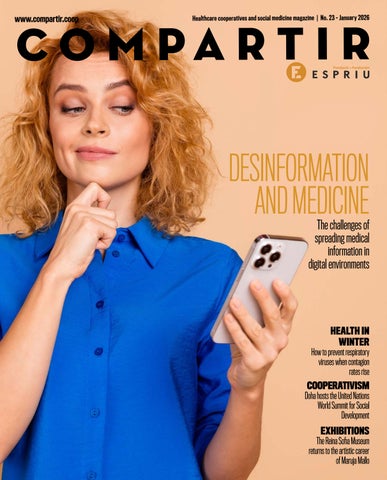
C o m pa r t i r DESINFORMATION AND MEDICINE
The challenges of spreading medical information in digital environments
HEALTH IN WINTER
How to prevent respiratory viruses when contagion rates rise
COOPERATIVISM
Doha hosts the United Nations World Summit for Social Development
EXHIBITIONS
The Reina Sofia Museum returns to the artistic career of Maruja Mallo
Staff
Compartir Healthcare cooperativism magazine www.compartir.coop compartir@fundacionespriu.coop Editorial board: Dr. Ignacio Orce, chairman of the Fundacion Espriu and of Assistencia Sanitaria Dr. Enrique de Porres, CEO of ASISA-Lavinia Dr. Oriol Gras sponsor of the Fundacion Espriu Dr. Carlos Zarco, General Manager and sponsor of the Fundacion Espriu
Publication: Factoria Prisma Diagonal 662-664 08034- Barcelona Tel. 639 213 710 www.factoriaprisma.com Director of Factoria Prisma: Angi Gonzalez Vives Coordination: Laura Martos Design: Xavi Menéndez Printer: Centro Gráfico Ganboa SL Legal Deposit: B-46099-2003 ISSN: 2488-6394 ISSN (Internet): 2696-3833 Fundación Espriu Av. de Josep Tarradellas, 123-127 4.ª planta 08029 Barcelona Juan Ignacio Luca de Tena, 12, 3.ª 28027 Madrid FIN: G-59117887 Tel.: 934 954 490 fundacionespriu@fundacionespriu.coop www.fundacionespriu.coop
Established in 1989, the Fundacion Espriu integrates the bodies that practice the cooperative healthcare model created by Dr. Josep Espriu: Augtogestió Sanitària, SCIAS, Lavinia and ASISA, which form the Assistència Group and the ASISA Group.
2
Summary
06
HEALTH IN WINTER These are the keys for preventing and identifying the symptoms of this season’s most frequent respiratory viruses.
08
NEUROLOGY How can we differentiate a migraine from other common headaches such as tension headaches?
10 14 20
NUTRITION
HEALTHCARE COOPERATIVISM
IN DEPTH
Fibre is essential for digestive, cardiovascular and metabolic health. How can we incorporate it to our daily diet?
Fundación Espriu took part in the United Nations World Summit for Social Development held in Doha on November 2025.
Digital technology has put all kinds of information in our hands. What challenges are being faced by medicine in this new Internet ecosystem?
Editorial
SURFING AMONGST INFORMATION AND NOISE It has never been as easy
to access information about health as it is now. A simple internet search offers immediate answers to any medical query. However, this apparent advantage includes a growing concern in our sector: the proliferation of content without any scientific backing, the widespread items known as fake news and the messages spread by unqualified voices that can generate confusion and put people’s health in danger. Against this backdrop, strict disclosure of information, medicine based on evidence and professional criteria have become essential foundations for citizens who are informed and protected, foundations that we will explain in depth in the In Depth report in this issue. On the health pages, you will be able to find the answers to some of the most frequent queries during these months of the year: keys to distinguish and identify the different respiratory viruses, guidelines to differentiate a common headache from a migraine and practical advice to increase fibre consumption in our daily diet, a nutrient that is essential for our system. We also go over some of the professional events and reports in which our cooperatives have taken part in recent months, paying particular attention to the presence of the Fundación Espriu at the United Nations World Summit for Social Development in Doha held in November, a key space to continue strengthening healthcare cooperativism on an international scale.
28 30
DESTINATIONS
TRENDS
The Great Egyptian Museum is opening its doors in Cairo an unbeatable excuse to plan a getaway to the gateway to the Near East.
‘Flowers for Antonio’ and ‘It’s Never Over, Jeff Buckley’: the documentaries made in 2025 that tell the story of two parallel lives.
We close this issue with a cultural proposal that is still marked by the season, which includes a trip around some of the most eagerly awaited premieres and exhibitions of the end of the year, as well as a selection of recent books that tempt you to enjoy a leisurely last few months of the cold season. We trust that these pages accompany you during the winter with proposals that inspire you to take care both of your health and your time.
Carlos Zarco
General Manager of the Fundacion Espriu
3
Medical news
Several studies expose the invasion of ultra-processed foods in the food industry
A
series of scientific reviews published recently in the magazine The Lancet warn about a drastic change of food paradigm: ultra processed foods have colonised the world diet, promoted by large corporations in their pursuit of profit. As occurred with the tobacco industry last century, a group of giant businesses dominated the market using aggressive tactics to protect their economic interests. It is not just food, but rather industrial preparations artificially designed to make food hyper-palatable and addictive, taking the place of fresh foods and eroding global health on an unprecedented scale. This phenomenon is expanding like an invasive species all over the planet, with particularly virulent penetration in countries with medium and low incomes, where the sales of these products are on the rise at breakneck speed. The business model
From Spain, the WHO warns about the insufficient healthcare response for gender violence The World Health Organisation (WHO) has chosen Spain to present its regional report Care, courage, change, in which it warns about a “seriously insufficient” healthcare response to gender violence in Europe. Although 28.6% of European women have suffered from physical or sexual violence, the health systems of most of the 53 Member States are failing to offer comprehensive cover: just 43% fully integrate this problem in their policies and only 13% guarantee access to safe abortion for the victims. Spain has a position as a positive exception and a benchmark, being one of the 12 countries that have a comprehensive regulation framework, along with early detection protocols in primary care. On a wider scale, the WHO has completed this diagnosis with a global report that quantifies the number of women as 840 million – almost one of every three in the world, who have been victims of violence either sexual or from their partners.
4
World Water Day Held every 22nd of March for the past 33 years, World Water Day this year is immersed in what the experts call the “era of hydric risk,” with an alarming forecast: for 2030, the global demand will exceed the supply by 40%. Beyond making people aware of the vital value of water, the date acts as a countdown to the 2026 UN Conference on Water, which will take place at the end of the year, to transform the diplomatic commitments into a real, tangible implementation. In view of the disruption of the hydrological cycle and the systematic threat that this means for economic and climatic stability, a collaboration is being urged that mobilises capital and innovation, ceasing to treat water as a marginal topic and putting it at the heart of the global survival strategy.
Inspiring quotes
“Enjoy your good health; only the young feel well.” Voltaire, philosopher
The WHO and UNICEF have qualified the proliferation of these products as a systematic, urgent threat.
of this industry is based on transforming cheap raw materials – such as corn, soya, wheat and palm oil, into low nutritional quality edible foodstuffs, which ends up destroying the traditional diets and the local culinary culture. Additionally, its expansion towards developing economies is generalising chronic diseases such as obesity, diabetes and cardiovascular pathologies in vulnerable populations. Supporting this resounding exposure, the World Health Organisation (WHO) and UNICEF have joined together in this warning, qualifying the proliferation of these products as a systematic and urgent threat. While the WHO warns about the danger that they represent for public health, equality and environmental sustainability, UNICEF puts the spotlight on child protection, demanding that human welfare must be given priority over corporate profits.
Deaths due to measles have dropped by 88% since the year 2000, but the cases of infection are on the rise The world immunisation campaigns have managed a historical milestone by reducing death due to measles by 88% between 2000 and 2025, saving almost 59 million lives thanks to the mass deployment of an effective and economic vaccine. However, this success lives alongside a worrying paradox, as although the deaths have dropped, the contagions have shot up reaching 11 million infections per year, exceeding pre-pandemic levels. While regions such as Africa have managed to reduce cases and deaths by way of improving the cover, the virus has taken advantage of the breaches in immunity in other areas such as Europe and Asia. The main challenge faced in order to bring an end to the disease lies in the fact that the current cover – 84% in the first dose and 76% in the second on, continues to be insufficient against the threshold of 95%
These are the conclusions of the World Cooperative Monitor 2025 The 13th edition of the World Cooperative Monitor (WCM 2025), published by the International Cooperative Alliance (ICA) along with the European Research Institute on Cooperative and Social Enterprises (EURICSE), offers an exhaustive panorama regarding the economic and social impact of the largest cooperatives in the world. This annual report, presented within the framework of the International Year of Cooperatives 2025 and the UN’s World Social Summit in Doha, emphasises the contribution of cooperatives to sustainable, inclusive and resilient economies on a global scale. These are three key conclusions from the report regarding healthcare cooperatives: 1. The health sector is beginning to appear in the global top 300 Although the education, health and social work sector represents a smaller portion of the total in the top 300 - with 10 organisations classified in this group, its presence indicates the capacity of the cooperative model for organising care and social care services in many countries.
necessary to stop the transmission. This lack of protection has left over 30 million children vulnerable and has tripled the serious outbreaks with respect to 2021. In spite of this, the healthcare response has not stopped and the reinforcement of the epidemiological monitoring and the diagnosis capacity have allowed 96 countries to manage to eliminate the disease.
2. Unimed is scaling positions in cooperativism When the ranking is analysed by turnover over per capita GDP, the Unimed System (Brazil) holds the fourth position, with a value of over 1.89 million dollars per equivalent inhabitant, exceeding many traditional cooperatives. This underscores the relative economic impact of the cooperative healthcare model in developing countries. 3. The WCM is showing competitiveness on a global scale The WCM highlights the cooperative values – solidarity, democratic participation and social responsibility, as fundamental assets against global challenges, from the preparation for pandemics to the promotion of healthy lifestyles. The growing international visibility is opening the door to potentiating new models for funding, governing and provision of health services centred on the people.
5
Health in winter
RESPIRATORY VIRUSES:
the most frequent types, evolution and prevention
W
ith the arrival of the cold weather, respiratory viruses take on significance again. The drop in temperatures, spending more time in closed spaces or the changes in humidity encourage, amongst other factors, the transmission of pathogens such as ‘flu (influenza), COVID-19 (SARS-CoV-2) or the respiratory syncytial virus (RSV). During the pandemic, sources from the Infectious Diseases Unit of the Internal Medicine Service at the Hospital de Barcelona explain, “the circulation of ´flu, RSV, parainfluenza and metapneumovirus dropped, while other viruses such as rhinovirus/enterovirus and the seasonal coronaviruses remained stable.” After lifting the restrictions, the viruses reappeared in a staggered way and today, the activity and seasonality of respiratory viruses are returning to pre-pandemic patterns. In adults and the elderly, the most important viruses, according to the Infectious Diseases Unit, are ´flu, RSV, rhinovirus, seasonal coronavirus and metapneumovirus. In these groups, the infection can become serious due to the presence of other diseases and due to the actual ageing of the immune system. Co-infections are less frequent in children, “but they increase in the elderly who live in residential centres,” they state. In the case of children under the age of two years, bronchitis continues to be, year after year, one of the respiratory diseases with the greatest impact. This pulmonary infection inflames and congests the bronchioles and is usually caused by respiratory syncytial virus (RSV). It starts out as a cold with a cough, phlegm and at times, a low-grade fever, which rarely exceeds 38.5ºC, but that can derive towards respiratory difficulty which can require hospital valuation.
6
The coexistence of ´flu, COVID-19 and VRS, known as the ‘tripledemic’ is forcing healthcare monitoring and prevention during the coldest months of the year. By Àngela Zorrilla
How to reduce the contagion? The combination of climate change, increase in the population, human-animal contact or the increase in international travel and vulnerable people from a healthcare point of view is encouraging more erratic transmission patterns of respiratory viruses. Sources at the Hospital de Barcelona inform of some steps that can prepare us for the future: for the specialists it is essential, for example, “to strengthen the epidemiological monitoring on an environmental scale and in healthcare centres in a comprehensive way, in addition to strengthening the primary care system and the contingency plans for the sudden increase in cases.” They also coincide in the fact that prevention is the most effective tool for curbing the transmission of respiratory viruses. Amongst the recommendations the following stand out: ash your hands frequently. • W Cover face when coughing or sneezing. • Ventilateyourinterior • Disinfect surfaces.spaces. • Avoid tobacco and smoky environments. • Follow a healthy lifestyle and eat a good diet. • Use face masks in closed spaces when you are ill or if you live with vulnerable • people. arry out the annual vaccination against ´flu and COVID-19, particularly for • Cpeople over the age of 60 years, pregnant women, immunocompromised people and small children according to healthcare criteria.
The most common respiratory infections
What is the triple pandemic or ‘tripledemic’?
The most frequent respiratory viruses are rhinovirus/ enterovirus, respiratory syncytial virus (RSV), influenza A, seasonal coronavirus, adenovirus, parainfluenza and metapneumovirus. They are usually short processes, with a viral origin and that rarely present any complications. However, there are symptoms that should make patients consult their doctor, such as “breathlessness, chest pain, an alteration in the mental state such as confusion, a stiff neck, persistent fever or low blood pressure,” according to sources from the
Infectious Diseases Unit of the Internal Medicine Service at the Hospital de Barcelona. They also recall that this is a symptomatology that must be looked at carefully in cases of vulnerable people, (patients over the age of 65 years, immunocompromised patients, pregnant women, chronic patients or nursing infants.) The experts estimate that the “advances in broad spectrum antivirals, latest generation vaccines and monoclonal antibodies” will be essential in a future when managing all these viruses.
The common cold
´Flu (influenza)
COVID-19
It represents around 80% of acute respiratory infections. It is usually caused by rhinoviruses, although there are over 200 viruses involved, such as seasonal coronavirus, adenovirus, enterovirus and parainfluenza. After two or three days of incubation, nasal congestion, sneezes, sore throat and a slight cough appear. A temperature is not frequent in adults. The symptoms usually get better in less than ten days.
The influenza A and B viruses cause seasonal epidemics every winter. Unlike the cold, ´flu starts suddenly, with a high temperature, muscle pain, headache and a general feeling of being ill. Although it usually disappears within a week, it might cause respiratory complications, particularly pneumonia, in older people, chronic patients, pregnant women and children.
SARS-CoV-2 continues to form part of the epidemiological panorama. Its symptoms may overlap with those of ´flu, although it more frequent for it to cause nasal congestion, a sore through and the loss of the sense of smell or taste. It lasts for a variable length of time: from 5 to 14 days in most cases.
Respiratory Syncytial Virus (RSV) In adult patients, this virus usually appears as a slight cold but in nursing infants and people over the age of 65 years, it can derive into bronchiolitis or pneumonia. The incidence of RSV usually increases slightly before ´flu, with peaks in December and January.
GRIPE (Influenza)
COVID-19 (SARS-CoV-2)
Virus respiratorio sincitial (VRS)
Start
Sudden
Variable
Gradual
Key symptoms
High temperature, muscle pain, Persistent cough, congestion, Phlegm, cough, wheezing. intense headache, dry cough. loss of the sense of smell/taste.
Length
5–7 days
5–14 days
--
Risk
Complications in the elderly, chronic patients and pregnant women
Pneumonia, Long COVID
Bronchiolitis in nursing infants, pneumonia in the elderly
so-called triple pandemic refers to the simultaneous, high circulation of three respiratory viruses: ´flu (influenza), RSV (Respiratory Syncytial Virus) and SARS-CoV-2.
cases of ´flu, above all in adults, new waves of COVID-19, generally less serious, but longer and co-infections of two viruses at the same time that are more frequent than normal. This makes clinical diagnosis more difficult, because the symptoms of these infections overlap and are usually similar.
It is important to explain, as sources from the Infectious Diseases Unit of the Internal Medicine Service at the Hospital de Barcelona point out, that the term “pandemic” is used to describe the impact on the population or care, not because there are really three pandemics occurring at the same time. The
In this context, it is common to observe many cases of bronchiolitis caused by RSV, an increase in the
7
Neurology
How to differentiate a
MIGRAINE
It is essential to evaluate the intensity, the frequency and the symptoms that accompany a headache in order to distinguish a migraine from other common conditions such as a tension headache. By Alba Mora
from other headaches
A
ccording to a recent study by the Spanish Neurology Society, approximately 13% of the adult population in Spain suffers from migraines. This is the equivalent of over 5 million people. It is also the primary headache (that is to say, a headache without any other subjacent cause) for which most patients visit their doctor. The most frequent headache, however, is the tension headache and one of its most common causes is stress.
aches, “resting in a peaceful environment, drinking enough water, avoiding screens or sleeping for a short time” is usually enough. On the other hand, “if the symptoms are intense and sudden, you should go to an emergency service,” she affirms. If the pain is recurrent and it does not get better after a first evaluation by your family practitioner, a neurologist must make the diagnosis. Medications such as analgesics or triptans are used to relieve the pain in primary headaches, although we should always follow the specialist’s indications. Craneal physiotherapy may also improve patients’ quality of life, while there are preventive treatments to reduce the frequency and intensity of the migraines.
Migraine, tension headache and other headaches
Leading a stressful, sedentary life with little rest can have a significant impact on our health, increasing the risk of suffering from cardiac disease and sleep disorders, as well as producing mood swings. These habits are the same ones that can cause intense headaches: excessive use of screens, a common evil in today’s society, is the main culprit, particularly when accompanied by bad posture, visual fatigue or lack of sleep. “Today’s lifestyle habits can act as triggers or factors that worsen the headaches in susceptible people,” according to María Payá Montes, a neurologist specialising in cerebrovascular pathology and headaches at the Hospital General Universitario de Albacete and the Clinica HLA El Rosario. “For this reason, we insist on the importance of looking after your sleep, maintaining regular hours, reducing stress and taking breaks when working with screens, particularly for those who already suffer from headaches.” Suffering from headaches, however, can also be a sign of another disease. Secondary headaches, which generally appear as a result of infections, vascular problems, cervical disorder, tumours or excessive consumption of medicines, must be suitably evaluated to identify and treat the reason behind them. So, when should we visit the doctor? Payá Montes recommends using common sense. For slight head-
8
When the pain becomes incapacitating
For slight headaches, resting in a peaceful environment, drinking water, avoiding screens or sleeping is usually enough
Headaches are the sixth cause of disability in the world. 20% of Spanish patients with migraine have a severe disability. Addi-
tionally, it is particularly incapacitating in young and middle-aged women, who are more likely to suffer from the disease due to hormonal and social factors. “Living with migraines means adapting to a disorder that cannot always be seen, but that can seriously affect the person’s daily life,” Payá Montes affirms. “Those who suffer from it refer to an average loss of over 35% of their productivity and frequent absences or a drop in work yield.” Added to the pain is the emotional impact of the disease and the uncertainty of not knowing when a new crisis will appear.
How to distinguish between a migraine and a common headache? Síntomas Migraine
Recurrent pain that starts on one side and extends to the entire head. It occurs repeatedly or recurrently. It prevents normal daily routines from being carried out. It can be accompanied by nausea, vomiting and sensitivity to light or to noise.
Tension headache
Oppressive pain, like a helmet or band that clamps around the head, particularly around the forehead and the neck. It is usually more intense in the afternoon. It is not as incapacitating as the pain of a migraine. Generally, it is not accompanied by other symptoms. 9
Nutrition
The role of FIBRE in the diet Dietary fibre is crucial for digestive, cardiovascular and metabolic health. These are its benefits, types and how to incorporate it to your daily diet. By Silvia Cardona
F
ibre is a type of carbohydrate that does not provide energy (calories) and that resists digestion and absorption in the small intestine. Through diet, it reaches the digestive system and is fermented thanks to the intestinal microbiota action. It is involved in many functions that affect both the digestive, and the general health, meaning it is an essential part of the diet. There are two main categories of dietetic fibre:
oluble fibre. It helps to slow digestion down and brings • Ssatiety. It is found in foodstuffs such as oats, onions, pulses, apples, bananas and barley.
nsoluble fibre. It increases the volume of the faecal bolus • Iand improves the consistency of the stools, which helps to
prevent constipation. It is found in foods such as brown rice, quinoa, green leafy vegetables, dried fruit and nuts and wheat bran.
Both types of fibre are usually present in most foods of plant origin.
10
A minimum of 5 portions of fruit and vegetables should be eaten per day, the equivalent of 400-600 grams
The main benefits of a fibre-rich diet are: intestinal microbiota, contributing • Itto encourages an optimum digestive health. Prebiotics are a type of fibre that is used as food for the beneficial bacteria that inhabit the intestine. When these bacteria ferment the fibre, short-chain fatty acids (SCFA) are produced, which have very important effects on intestinal health. For example, they strengthen the intestinal barrier, they reduce oxidative stress and they have anti-inflammatory effects.
t helps to regulate the blood sugar levels and to • Ireduce the LDL cholesterol, which reduces the risk of cardiovascular diseases and type 2 diabetes.
greater satiety, which shifts the consump• Ittionbrings of superfluous, undesirable food and it is related to maintaining a healthy weight.
On the other hand, following a low-fibre diet has been associated with a greater risk of suffering from dislipemia, high blood pressure, some types of cancer (particularly bowel and breast cancer), type 2 diabetes and obesity. Often, a low-fibre diet also is translated into a diet that is rich in refined and processed foods, with a low consumption of whole fruit, vegetables, pulses and wholegrain cereals.
How much dietetic fibre should you eat and where can you get it from? The European Food Safety Authority (EFSA) recommends a minimum consumption of 25 grams of fibre per day. According to data from the ANIBES study, in Spain there is an average consumption of 12.7 grams per day, way below the recommended amount. How can we incorporate more fibre into our daily diet? 1. Make sure you eat a minimum of 5 portions of fruit and vegetables per day, the equivalent of 400-600 grams of these foods. These food groups contain few calories and fats; on the other hand, they are rich in vitamins, minerals, fibre and water. It is recommendable to eat a minimum of one portion of vegetables in the main meals (lunch and dinner) and at least 3 portions of whole fruit (not juice) throughout the day. 2. Incorporate dried fruit and nuts (walnuts, hazelnuts, almonds, etc) and seeds (pumpkin, flax, sesame, chia, etc.) in the daily diet. It is recommendable to choose natural or roasted dried fruit and nuts (salt-free). 3. Eat a minimum of 3-4 portions of pulses per week (lentils, chickpeas, dried beans, soya, etc.). Pulses are an important source of proteins and fibre, which provide satiety and encourage intestinal transit. 4. Replace refined cereals with their wholegrain versions, such as bread, pasta and rice, but maintain the wholegrains such as oats, quinoa or buckwheat. These provide a larger proportion of fibre and micronutrients. 5. Avoid eating ultra-processed products, as they are
Food
Fibre content
Food
(g/100g) *
Fibre content (g/100g) *
Wheat bran
42,8
Pistachios
10
Chia seeds
34
Lentils
8
27
Avocados
7
Raspberries
6,7
Wholemeal wheat bread
6
Flax seeds Almonds
13,5
Oats
10,6
*Data obtained from the SFCD (Spanish Food Composition Database) and the USDA Database (United States Department of Agriculture)
usually refined and provide little fibre. Within this category are industrial cakes and biscuits, sweet beverages, refined flours, juices, etc. 6. Accompany the ingestion of fibre with good hydration. Soluble fibre absorbs water forming a kind of gel. This helps to soften the stools and enables them to move through the large intestine (colon). Insoluble fibre, on the other hand, needs water to increase the volume of the stools and to stimulate the intestinal motility. Therefore, the combination of fibre and liquid helps to prevent constipation. If the ingestion of fibre is increased without drinking enough water, it can act as a stopper: the faecal bolus becomes drier and more compact, making it difficult to evacuate. A fibre-rich diet is one of the pillars for maintaining a good intestinal transit, avoiding constipation and encouraging digestive health. However, you must take into account that the increase in eating fibre-rich foods must be progressive, allowing the digestive system to adapt. If not, it is common to experience discomfort such as a bloated stomach or tympanites (accumulation of gases).
11
Emergencies
What to do (and what not to do)
when someone is choking
E
very year, the Spanish emergency services attend thousands of cases of choking, a problem that caused 3,546 deaths in Spain in 2022, according to the Observatory for Prevention of Risks and Accidents (OPRA), being the third cause of unnatural death in the country. Although most cases may be resolved without any complications, when the respiratory tract becomes completely obstructed, the fast action of whoever is close by can save a life. How to recognise when someone is choking Choking occurs when a piece of food or another object partially or totally blocks the passage of air to the lungs. The key is to distinguish between the two situations. If the person can cough, talk or breath, although with difficulty, it is a partial obstruction. In these cases, the safest idea is to encourage the person to cough strongly and monitor their evolution. You should not put your fingers in their mouth or hit their backs unnecessarily, as it could make the obstruction worse. On the other hand, if the person cannot make any sounds, has an ineffective cough, clutches their neck or starts to show signs of suffocation, we are talking about a complete obstruction, a real emergency that requires immediate action while calling 112. Two fundamental manoeuvres come into play here: 1. Hitting the back (5 times). Place yourself behind the person, slightly to one side. Hold them around the chest in order to bend their trunk forward (in this way, if the object comes out, it will not go back in again). With the base of the free hand, hit the back up to five times sharply between the shoulder blades. 2. If this does not work, perform the Heimlich manoeuvre (up to 5 compressions). Place yourself behind the person, put both arms around their waist and close one hand forming a fist just above the navel. Hold onto this fist with the other hand and perform fast compressions inwards and upwards, as if you wanted to shape a J. Alternate five compressions and hitting the back five times until the object comes out or the person recovers their breathing. If at any time, the person loses consciousness, start cardio pulmonary resuscitation (CPR) while waiting for the healthcare team to arrive. And, although the obstruction comes out, it is advisable for the person to be looked at by a professional, particularly if the Heimlich manoeuvre has been applied.
Babies and pregnant women: what changes? Babies (under a year old): The Heimlich manoeuvre should not be performed. The baby should be placed face down over the forearm, with the head lower than the trunk, hitting the back in between the shoulders gently, but firmly five times. If this does not work, the child should be turned face up and five chest compressions should be applied using two fingers, in the centre of the chest. This cycle may be repeated while someone calls 112.
12
Pregnant women (last trimester) or people with abdominal obesity: Abdominal pressure may be ineffective or unsafe. Instead of this, chest compressions are carried out with the arms around the trunk underneath the armpits and pressing inwards at the centre of the breastbone.
Heimlich Manoeuvre. Developed by the American doctor Henry Judah Heimlich in 1974, it is a first aid technique to clear the respiratory tract when an object has blocked the air passage.
What to monitor after the “fright” Although the obstruction has been resolved, a medical valuation is advisable, particularly if the Heimlich manoeuvre has been applied. After choking, abdominal or chest discomfort may appear, along with a hoarse voice, irritation in the throat or small muscular pains. If hours later, a persistent chest pain appears, with difficulty in breathing, coughing blood up or a feeling of a foreign body inside them, the person should go to A&E.
Compartir 13
Cooperatives and social medicine
HLA Mediterráneo and HLA La Vega, prize winners in the TOP 20 IQVIA distinguishes the excellent care in both hospitals due to their results in management, women’s care and the work carried out by the Traumatology and Orthopaedic Surgery Unit. The Almeria HLA Mediterráneo hospital received the award for the best Global Hospital Management in the category of medium-sized hospitals and the prize for the Women’s Area for the second year running at the 26th TOP 20 Hospitals Edition organised by IQVIA, the leading company in the use of data, technology and advanced analytical technologies. On the other hand, the HLA La Vega hospital was acknowledged as the winner in the Musculoskeletal category thanks to the specialists, action protocols and results of its Traumatology and Orthopaedic Surgery Unit. The TOP 20 awards are reference points in the Spanish healthcare area and they are based on a programme in which around 200 public and private hospitals take part obtaining a benchmark with respect to organisations with similar characteristics against which they are measured and the effectiveness or efficiency of their activity is compared in different care areas. The aim of this programme is to improve the results based on indicators of quality, operation and
The TOP 20 awards are benchmarks in the Spanish healthcare area and they are based on a programme in which around 200 public and private hospitals take part.
efficiency, in addition to acknowledging good practices within the sector. The Almeria HLA Mediterráneo hospital was acknowledged for the first time in 2024 with two TOP 20 awards that have been revalidated this year: best global hospital management, within the group of medium-sized private hospitals and in the Women’s Area, specifically in the Obstetrics category. HLA La Vega has won this acknowledgement for the first time this year, emphasising the comprehensive and multidisciplinary focus of the Traumatology and Orthopaedic Surgery Unit, with highly qualified specialists in
the different areas of the locomotor system and a structure that allows personalised care, adapted to each patient to be offered, guaranteeing the best results in diagnosis, treatment and rehabilitation. Dr. Joaquín Carreño, the corporate medical director of the HLA Group, who received the awards on behalf of the Almeria centre, emphasised that “it is a satisfaction for our hospital Group that our centres stand out on a national scale due to their implication in the continuous improvement of their care results. Congratulations to the management and teams of the hospitals of HLA Mediterráneo and HLA La Vega (Murcia).”
HLA Vistahermosa has performed its first operations using the Da Vinci robot The HLA Vistahermosa hospital has opened its Robotic Surgery Unit with the startup of the Da Vincia robotic platform, the first surgical robot in private healthcare in the city of Alicante. This tool, the latest, most advanced for performing surgical operations, is now fully operational. With this type of robotic surgery, the incisions and intraoperative bleeding are reduced, meaning that transfusions are less frequent; additionally, in the post-operatory phase pain is decreased along with the risks of infection. Likewise, both the stay in the post-surgery intensive care units and the total hospital stay are reduced
14
by 40% compared to conventional surgery, which allows patients to return to their normal life much faster. The startup of the Da Vinci robot has considerably increased the surgical capacity of the HLA Vistahermosa hospital, which can now perform the most complex operations with the technology that guarantees greater accuracy and safety and puts the HLA Group at the forefront of the Spanish surgical offering. The Group now has three Da Vinci robots installed in the HLA Universitario Moncloa (Madrid), HLA Universitario El Ángel (Malaga) and HLA Vistahermosa.
The Alicante hospital opened the Robotic Surgery Unit, which has a multidisciplinary team of specialists accredited to use the most advanced robotic technology.
The HLA Universitario Inmaculada hospital receives the Gold Medal
Image from ASISA’s new campaign.
A movement that helps longer lives to be lived more fully ASISA’s new campaign, “Bienvejecer” (Ageing well), attempts to start conversations about the future of health when faced with an increasing life expectancy. ASISA has launched a new advertising campaign, “Bienvejecer”, a project that has arisen with the aim of championing a social movement that inspires the new generations to get ready for a longer and fuller life and that attempts to put ASISA as the perfect specialist to accompany them on this journey. The campaign starts out with an eye-opening fact: in 2040, Spain will become the country with the greatest life expectancy in the world, according to a study carried out in the United States. In view of this new reality, ASISA proposes “Ageing well”, a concept that redefines the traditional idea of ageing, associated with loss or deterioration, to start seeing longevity as a chance to live for longer with full independence and well-being. Carlos Eiroa, ASISA’s Brand, Advertising and Sponsorship Manager, affirms that “it is essential for us to start this debate and for young people know about the tools that are within their reach.”
The Regional Government of Granada has awarded the HLA Universitario Inmaculada hospital with the Gold Medal for Research, Science and Health at the 2025 Honours and Distinctions Gala, an event that showcases people and institutions whose work contributes to enriching the province’s Valeriano Torres, CEO of the HLA Hospital Group and Dr. Francisco Marti, social, cultural and sporting life. In Medical Director of the HLA Universitario Inmaculada hospital received the award. his acceptance speech, Valeriano Torres, CEO of the HLA Hospital Group, emphasised the fact that “the hospital has worked for decades to add and move forward and, thanks to the effort and work, we have become the benchmark private hospital in the Granada province.” This acknowledgement puts the finishing touch to a special year for the centre in Granada of the HLA Group, coinciding with its 50th anniversary.
ASISA Dental continues its expansion with a new clinic in Seville ASISA Dental has strengthened its presence in Andalusia with the opening of a new clinic in Dos Hermanas (Seville). With this new centre, the company is moving forward in its commitment to extend and aid access to quality oral healthcare for all the patients in the province of Seville. The new clinic, located at Glorieta Comunidad Autónoma de Murcia, 1 and which is now fully operational, offers all the odontology specialities and has a team of highly qualified professionals and state-of-the-art technology. As with the other ASISA Dental centres, it also provides an emergency service in the normal opening hours. Altogether, ASISA Dental now has 43 of its own clinics, all of them equipped with advanced technology for oral diagnosis and treatment.
HLA Clínica Montpellier incorporates a CT scan with artificial intelligence
Additionally, aimed at accompanying people on their journey towards “ageing well”, ASISA is developing the Full Life Expectancy Plan, a tool that will be available in the near future and that will put science and technology at the service of people in order for them to be able to look after themselves comprehensively. This preventive medicine plan combines scientific evidence, digital technology and professional accompaniment to promote selfcare using four essential pillars that uphold well-being in the long term (nutrition, physical exercise, sleep and mental health.)
HLA Clinica Montpellier continues promoting the Radiology Service with the incorporation of a state-of-the-art advanced computerised tomography system by Canon Medical Systems that improves care quality and reduces exposure to radiation. From left to right: Victor Palero, Applications Specialist CT/HIT; Victor Ortega, Radiology supervisor; Dr. J.A. Fernandez, a radiologist at the clinic and The Aquilion Serve SP, with 160 Eduardo Gracia, Sales Account Manager. ultra-definition cuts, has artificial intelligence with deep learning and it can optimise the reconstruction of images, minimise the noise and guarantee more accurate diagnoses. The incorporation of this system at the HLA Montpellier clinic will help to reduce the waiting time for patients thanks to an optimisation of the diagnosis.
To back this campaign, ‘bienvejecer.es’ has been created, a website with all the information about this project. Examples of the campaign may be found on ASISA’s YouTube channel.
“This new CT scan means an important advance for our clinic. Not only does it represent an innovative technological leap forward, but it also significantly improves the experience and safety of our patients,” Dri. Ignacio Sagadoy, medical director of the HLA Clinica Montpellier emphasised.
15
Cooperatives and social medicine
Assistència Sanitària leads the doctors’ ranking once again in a key year for the sector The survey by the CCMC on professionals in private medicine places the insurance provider as the best valued organisation for the tenth year running. Alone in its leadership, held for ten years, the Catalonian professional medical associations have chosen Assistència Sanitària as the best insurance provider, company or mutual healthcare organisation. The 2025 edition of the survey by professionals from private medicine of the Catalonian Board of Professional Medical Associations (CCMC in Spanish) confirms, once again, the situation of a sector that evolves rapidly and that is facing up to important structural challenges. Amongst the most relevant results once again the valuation made by the professionals of the insurance providers stands out, a sensitive indicator that shows considerable differences between the different companies. Under this heading, Assistència Sanitària once again holds the first position, maintaining a continued leadership that has now been awarded for ten years running. The result underscores the confidence of the doctors in the relation model offered by the organisation.
An extensive survey
The survey, based on replies by 1,271 doctors who work privately in Catalonia,
shows a panorama in which the professionals particularly value the independence, flexibility and the possibility of conciliation that private practice offers, but they also report unfair retributions. In this context, the ranking of organisations takes on a special relevance. According to the CCMC, only two of the sixteen analysed reached a good score. Assistència Sanitària, which heads the table with 7.48 and holds the first position obtained in all the editions of the survey, is consolidated as the organisation best valued by the doctors. The professionals highlight aspects such as the management of the requests, the clarity of the information and the perception of a close, coherent contact with the clinical practice. All of this, according to the CCMC, contributes to better care and an environment of confidence in a sector where this element is essential. The survey also reflects deep structural changes in private medicine, with an increase in female presence, the reduction of the own consulting rooms and a growing concentration of the activity in centres linked to hospital or insurance
A good reception of the internal vaccination campaign amongst SCIAS personnel The Hospital de Barcelona has completed the annual internal vaccination campaign. The participation of the personnel, both care-givers and the other services, has been particularly high. For several weeks, ‘flu and COVID vaccines have been administered, aimed at strengthening the protection both of the personnel and of the patients and family mem-
16
bers who visit the centre. The initiative, promoted from the management, has been very well received.
At the Hospital de Barcelona they highlight the fact that maintaining high vaccination rates amongst the personnel is a key step to minimise the impact of respiratory diseases during the months with the highest viral circulation. Additionally, it contributes to preserving the continuity of the care and to strengthening the protection of the patients admitted to the centre or with fragile health conditions.
groups. Against this backdrop, the professionals are asking for improvements in retributions, technology, training and transparency, as well as more fluid relationship with the organisations and the review of the low-cost policies. In this context of transformation, Assistència Sanitària’s continuance at the top of the ranking takes on a prominent value, as the doctors perceive it as a benchmark for stability and coherence in line with quality care.
Assistència Sanitària is extending its offer with two new healthcare insurance policies The two new policies respond to the current needs by professionals and families. On the one hand, the Plan Autónomos Plus (Self-employed Plus Plan) combines healthcare, hospitalisation subsidy and cover for accidents and it is designed for professionals who depend directly on their health and wish to protect themselves against unforeseen circumstances. On the other hand, Assistència Reem brings together cover by the most extensive medical teams with the freedom to choose any doctor or centre that does not appear on it, with the refunding of 80% of the expenses in Spain and 90% abroad.
The challenge of longevity and the commitment to intergenerational solidarity The CAC analyses the impact of ageing on the premiums and sets forth a redistribution formula that protects the most vulnerable insurance policy holders. The current demographical transformation, marked by a society with longer life expectancy and with growing medical requirements, has led most insurance providers to promote premium models based on the personalisation of the individual risk age, clinical history, habits or predicted use of the services. This focus, although maximising the economic efficiency in the short term, has a direct impact on the most vulnerable groups. “Extreme personalisation breaks with the insurance’s founding logic as a mutual protection mechanism. When the premiums increase exponentially with age, it ends up generating an expulsion effect for the people who most need medical care.” This is one of the main conclusions reached by Vitor Molina, actuarial head of Assistència Sanitària, at the conference “The challenge of longevity on healthcare insurance policies,” organised by the Professional Association of Actuaries of Catalonia. At the conference, it was shown that this effect does not only have individual implications, but also group ones: people who, once they have retired and have a more limited income, are incapable of assuming growing premiums and therefore, remain outside the private healthcare system at
a time when they are most vulnerable. Within a context of growing territorial inequalities and a constant increase of the population of over 70 years of age – which has risen 9 percent since 1975, this phenomenon takes on a special dimension.
The alternative answer, based on intergenerational solidarity
Against this backdrop, Assistència Sanitària is applying a different formula. The organisation, created by doctors with a vocation for serving patients and controlled by a cooperative, maintains an updating model of premiums that avoids the rate from increasing due to the individual use of the services. The cornerstone of this system is the intergenerational solidarity rate, a mechanism that partially redistributes the cost of the risk linked to age. In spite of it being less attractive in terms of economic efficiency or maximisation of profits, Dr. Ignacio Orce, Chairman of Assistència Sanitària, defends the fact that opting for this formula “is an act of group responsibility and sustainability of the actual healthcare model itself.” He also affirms that “the idea is not for some people paying for others, but rather that everyone contributes to a system that will protect them in the future.”
A 13th successful seminar on pregnancy health The Hospital de Barcelona hosted the 13th Seminar on Pregnancy Health, this time centred on infections during pregnancy and on the early detection of breast cancer through breast milk. On Friday, the 7th of November, the Hospital de Barcelona held the thirteenth edition of the Seminar on Pregnancy Health, an event that has been consolidated as a reference in medical training and up-dating of knowledge in the mother-child health area. The event, organised by Assistència Sanitària with the collaboration of the hospital’s Internal Medicine, Paediatrics and Neonatology services and specialists in Gynaecology and Obstetrics, brought together over 70 healthcare professionals at an open, on-site, free seminar.
Joan Borràs receives the award for professional excellence from the COMB The Barcelona Professional Association of Doctors (COMB in Spanish) has handed out its awards at a new edition of the Prizes for Professional Excellence, which since 2004 have distinguished the doctors and teams who epitomise the essential values of the profession. At this edition Dr. Joan Borràs Marcet, a surgeon from the General and Digestive Surgery Service at the Hospital de Barcelona, was distinguished in the hospital medical care category, in acknowledgement of his career and exemplary dedication. Dr. Borràs, who has been coordinating the centre’s emergency surgery team, has been a benchmark in the implantation of efficient and safe surgical protocols, as well as in the training of new professionals in the digestive surgery field. At the Hospital de Barcelona, this recognition is seen as a sample of the talent, commitment and human quality of the professionals who form part of the institution.
17
Cooperatives and social medicine
The Fundación Espriu highlights the cooperative model at the UN’s Summit for Social Development At the summit, the Member States signed the Doha Declaration, where they committed themselves to promoting inclusive, sustainable economic growth. In the first week of November, Doha (Qatar) was turned into the epicentre of the global debate on social policies with the holding of the United Nations World Summit for Social Development. The meeting brought together 40 heads of State and Government, over 230 ministers and high-level civil servants and around 14,000 guests, amongst them representatives of the Fundación Espriu. The event was also the framework of the official closing ceremony of the International Year of Cooperatives 2025, a milestone that brought an end to a year devoted to highlighting the cooperative movement’s contribution to economic progress and to common welfare. Cooperative leaders from different business sectors took part in the closing ceremony, amongst them, the Director of the Fundación Espriu, Carlos Zarco, who intervened representing the healthcare sector. Zarco recalled that health is the essential foundation of social development: “Without a healthy population, there cannot be any productive economies, resilient communities or long-lasting progress.” In his speech he explained how the cooperative model provides effective solutions to improve access to healthcare services and the health results and how, also, it strengthens and com-
plements the national healthcare systems by way of democratic structures, aimed at the common good. The participants coincided in the fact that the cooperative model, by putting people at the centre of the decision-making process, generates better results in terms of fairness, stability and sustainability. Amongst the most prominent benefits they mentioned a fairer distribution of the surplus and a greater business resilience in the long-term, factors that contribute to a more balanced and inclusive social development than that of traditional mercantile models. During the summit the Doha Declaration was adopted, in which the Member States of the United Nations undertook to promote inclusive and sustainable economic growth, as well as full employment in decent conditions. The document identifies cooperatives and the social economy as key agents and it calls to strengthening their development through public policies, suitable regulatory frameworks and greater access to funding. In this way, the declaration consolidates the line marked out by the recent reports issued by the UN’s Secretary General, recommending the review of laws and regulations to aid the creation and expansion of cooperative companies.
Within the framework of the summit, the international cooperative movement launched the Contract for a new global economy, a call aimed at the public directors to officially acknowledge the cooperative model and integrate its contribution in the national strategies of the Sustainable Development Goals. Likewise, the International Cooperative Alliance presented its 2026-2030 strategy, covering three priorities: putting cooperative values into practice, strengthening cooperativism as a force for the common good and protecting the cooperative identity against external risks. A special edition of the World Cooperative Monitor was also revealed, published on the occasion of the International Year of the Cooperatives. The report revealed that in 2023 the 300 main cooperatives in the world reached a joint invoicing of 2.39 billion a piece of infor-
Three out of every four Europeans back social economy A special Eurobarometer survey by the European Commission reveals that 75% of EU citizens consider that the social economy, integrated by cooperatives, mutual societies, foundations and associations, is an essential foundation on which to build common welfare, with a particularly relevant impact in
18
the areas of health and care. The study, ‘The social economy in the lives of Europeans’, was based on 26,410 interviews carried out in the 27 Member States in May 2025 and it confirms the growing importance of this model in view of the challenges such as
dependence and primary healthcare. According to the results, Europeans perceive the social economy as a leader in key sectors. The healthcare and care area is where a greater impact is acknowledged, ahead of education or housing. The citizens underscore its capacity to offer accessible services,
manage socio-healthcare centres and reduce inequalities by way of the reinvestment of profits in the communities themselves. Over half of those interviewed (56%) have had some kind of link to these organisations over the last five years, either as volunteers, donors or
In Brussels, the Fundación Espriu is strengthening the role of cooperatives in Europe On the 20th of November, Brussels hosted a top-level meeting that put the social economy at the centre of the European debate. Titled Cooperatives building a better world, the dialogue organised by Servimedia at the head offices of the daily newspaper Euractiv and with the collaboration of the cooperative Bidafarma, brought together institutional representatives, experts and business leaders at a key moment for community policies. The General Manager of the Fundación Espriu, Carlos Zarco, took an active part in the event.
Carlos Zarco, Director of the Espriu Foundation, spoke at the closing ceremony representing the Spanish healthcare sector.
mation that confirms the extraordinary economic capacity of the sector and its growing prominence in the global economy. With the closing ceremony in Doha, the International Year of Cooperatives leaves a legacy of a strengthened agenda and a renewed international recognition of the cooperative model as a driving force for social development cohesion and sustainability. The meeting ended with a global-scale announcement: the declaration at the Doha Social Summit of an International Year of Cooperatives every ten years, an acknowledgement that consolidates the role of this business model and strengthens the commitment of organisations such as the Fundación Espriu to social transformation and sustainable developmen .
clients and users. In the Healthcare field, this presence is also translated into a civil society that supports mental health, long-term care or cover in country areas that are underserved. The demand for public support is clear: 88% of Europeans believe that the institutions should back the social economy; 86% demand greater awareness and support to create new organisations and 80% champion direct public funding.
The Netherlands and Ireland have the most favourable perceptions, whilst Greece and Bulgaria show less implantation. The European Vice-president, Roxana Minzatu announced that these conclusions will be integrated into the review of the Social Economy Plan of Action foreseen for 2026. Citizen backing confirms the solidity of a model which, with 11.5 million jobs in Europe, plays an increasingly consolidated role on the continent.
The meeting opened with a message by Roxana Minzatu, Executive Vice-president of the European Commission, who reaffirmed the European commitment to the social economy and advanced that at the beginning of 2026 new initiatives derived from the review of the public contracting directives and of the State Aid Framework will be presented. Minzatu also highlighted the positive impact of the European Plus Social Fund and InvestEU in the growth of the sector and she underscored the specific weight of the cooperative model in Spain. The debate included the participation of the spokesperson from the European Partido Popular, Dolors Montserrat, the Socialist euro-delegate Leire Pajín; the Chairman of Social Economy Europe, Juan Antonio Pedreño; the Chairman of Bidafarma, Antonio Mingorance; and the Chairman of Cooperative Europe, Giuseppe Guerini. Iratxe García, Chairwoman of the Social and Democratic Group of the European Parliament also intervened. Throughout the dialogue, the strategic value of the social economy was reaffirmed, which generates 11.5 million jobs in 4.3 million companies and produces 8% of the European GDP, at the same time as acting as a driving force for territorial cohesion and innovation. Within this framework, Dr. Zarco’s speech underscored the relevance of healthcare cooperatives recalling that, according to the United Nations, they allow access to healthcare services to over 100 million families all over the world. The Director of the Fundación Espriu demanded the strengthening of the cooperative model in university education and amongst young people, as a key element for its continuity.
From left to right: José Manuel Gonzalez Huesa, Director of Servimedia; Antonio Mingorance, Chairman of Bidafarma; Juan Antonio Pedreño, Chairman of the Social Economy Europe; Dolors Montserrat, Spokesperson of the European Partido Popular; Carlos Zarco, General Manager of the Fundación Espriu and Leire Pajín, MEP of the PSOE.
19
In Depth
THE ECOSYSTEM OF DISINFORMATION Digital technology has put an enormous amount of knowledge and information within our reach. At the same time, the mass media linked to the Internet have turned into the perfect breeding ground for the proliferation of half-truths, lies, mistakes and all kinds of hoaxes – which are often self-serving. By Enric Ros
Since
the times when the first publications were recorded, citizens have had to face up to two great obstacles when accessing knowledge. The first is the overload of information, which often ends up causing confusion and anxiety, qualified by some using such eloquent terms as “infoxication” or “infobesity”. This is nothing new: we know that back in the 16th and 17th centuries, after the invention of the printing press, many people complained of the excessive abundance of books. The second challenge is the difficulty of knowing whether the information available to us is really reliable. As explained by the researcher Joanathan Hernández Pérez, from the National Autonomous University of México, in his interesting essay ‘The ecosystem of disinformation: excesses and falsehoods’, fake news “have been with us for centuries, as have the attempts to pursue them, spread them, prevent them and control them.”
An ally of knowledge, but also of fake news
The new technological tools have multiplied incalculably these abovementioned trends. To give a relevant example, today we know that the political propaganda of the 21st century, through social media, can have a decisive effect on political and electoral processes - even putting the quality of our democracies at risk. The “infodiversity” characteristic of the Internet era makes it easier to spread and expand any message, which often causes greater social transparency, but also encourages the creation of ecosys-
20
tems that seek to generate instability or confusion, provoking public opinions or marking out trends in line with the interests of their creators. Added to this complex scenario is the recent generalisation of artificial intelligence (AI), which gives very fast answers to our queries, without specifying in many cases, the sources used or informing us of the bias of the programmers.
The answer to these dilemmas
As indicated by Luis M. Romero-Rodríguez, a professor and researcher at the King Juan Carlos University of Madrid, in an interview published in the Communication and Education Bureau of the Autonomous University of Barcelona, “fake news go beyond the false messages that are being launched on social media or by certain opinion leaders and that go viral.” Rather they involve information belonging to “a propagandistic machinery or from laboratories,” which are copied “by the friendly media without checking their truthfulness. In fact, in this post-truth system, truth is the least important item.” The essential point is “that the message gets out there, that it becomes a hit and that it generates a lot of traffic.” When faced with this situation, we shouldn’t start scaremongering. More often than not, it is essential for us to develop critical thinking in order to be able to calibrate the reliability of the information that we consume. Internet is only a means; we decide whether it should be used to increase our knowledge or to contribute to reaffirming ourselves in an unfounded subjectivity.
“In this post-truth system, truth is the least important item. The essential point is that the message gets out there, that it becomes a hit and that it generates a lot of traffic.”
Citizens faced with disinformation The first study on disinformation in Spain, prepared in 2022 by the University of Navarra and the Unión de Televisiones Comerciales en Abierto (UTECA), in which 1,224 people over the age of 18 years from our country were interviewed, showed a series of interesting conclusions that we have summarised below:
• • • • • •
El 95,8% of Spaniards believe that disinformation is a problem of today’s society. Un 91% affirm that disinformation is a danger to democracy. El 88,1% give their views that people tend to believe more in the messages they receive if they coincide with their way of thinking. However, only 32,8% admit that, in their specific case, they tend to believe more about the information that coincides with their way of thinking. Those surveyed are convinced that 42,1% of the messages and information that they receive are false. Young people think that older people are more prone to being deceived.Older people think the exact opposite.
21
In depth
The market of
PSEUDO-SCIENCE Citizens who consult their symptoms on the Internet can reach mistaken conclusions, due to a lack of knowledge or they may fall into the suggestive traps of treatments that have no scientific studies backing them up. As explained by the French philosopher Éric
Sadin, in his essential essay ‘The era of the individual despot’, today’s technologies are causing a (false) feeling of virtual total independence and they tend to reaffirm our subjectivity. Trapped in the “black hole” of our mobile phones, engrossed in the information that
22
is offered and indifferent to the existence of others, “individuals find themselves wrapped up in their own halos that isolate them from everything that is presumed to be distant or inappropriate to them.” This, in the field of health, can have particularly serious consequences. Science, obviously, does not reflect unfounded opinions, but rather corroborates its research subjecting them to strict verification processes. The temptation to let ourselves be taken in by promises of unproven alternative therapies, “miraculous” supplements or recommendations by people with no professional qualifications must be avoided at all costs, if we don’t want to risk paying a high price. Accordingly, in 2025, the Spanish Ministry of Health launched a campaign “Remedies always backed by scientific evidence”, which seeks to offer clear, accessible and verified information, responding to some of people’s most frequent queries. This is aimed at fighting against the “infoxication” that can be found in an uncontrollable amount of Internet publications.
This risks of consulting “Doctor Google”
In order to talk about the possible changes in patients’ behaviour, we interviewed Dr. Cristian Herrera, a doctor from the Internal Medicine Unit from the Clinica HLA Vistahermosa Alicante. In the words of this prestigious healthcare professional, “in recent times, we find ourselves faced with different people who check the possible illnesses associated to their symptoms on the Internet before visiting the doctor. This means that they make evaluations that might be mistaken or that require diagnosis tests that are not suitable for their case.” At times, when they do not obtain the answer they expected from their doctor, they generate mistrust towards them, which could end up affecting the evolution of their ailment.
“The natural label is not in itself a guarantee, but rather something that should generate For Dr. Jordi Morillas, Head of Service at the Intensive a sense of Medicine Hospital in Barcelona, with whom we have also talked, “there is a before and after regarding ChatGPT. In warning” the era when many patients consulted Google, they used to arrive at the surgery quite confused and with a highly pessimistic view of their possible state of health. Now, with AI, they try to individualise their diagnosis and this makes them have more questions.”
Another common trend is that, as a result of today’s immediacy-based times, patients demand professionals to give them an immediate diagnosis. “There are tests that can take some time. In many cases, a test marks the need to carry out another one after it, which can delay the diagnosis more. There are technical reasons that explain why the doctor needs a certain amount of time to reach a well-founded conclusion,” Dr. Herrera tells us. In Dr. Morillas’ opinion, “the essential point is that the doctor is able to create trust in their patients. In Medicine, we have several words to indicate that we do not know the origin of an illness: idiopathic, essential, cryptogenic, primary… the lack of information is what causes most uncertainty. For this reason, we sit down every day with patients and their families to explain in the most comprehensive way possible everything that we know about their ailment.” Therefore, we must learn to follow the protocols that the accredited professionals give us, without attempting to access to “short cuts” that do not make the correct identification of our possible ailment easier. As is indicated by Dr. Herrera, “the criteria used by the doctors and nurses that look after us will always be more substantiated than any Internet video.”
There are no alternative therapies
As indicated by Dr. Rosa Arroyo, Second Vice-president of the Spanish Medical Association Organisation (OMC) and coordinator of the Observatory Against Pseudoscience at the same organisation, “there is no alternative medicine, there is medicine based on evidence and under this commitment we must continue working (…) on actions such as the promotion of healthcare education and on managing to regulate healthcare publications.” The same opinion is held by Dr. Herrera, who does not hesitate to affirm that “miracle cures are always a lie.” This internist encourages us to leave behind “magical thinking ”, which spreads the unfailing goodness of “natural products”: “A large part of the drugs that have shown their effectivity in clinical studies have been synthetised in laboratories from products that are found in nature. The natural label is not a guarantee in itself, rather something that should generate a sense of warning. We should take into account that most poisons are also natural.” The professionals from the healthcare sector are clear, as shown by Dr. Arroyo, that “the fight against fraud is not a corporativist element,” but rather a “defence of consumers and users’ interests against pseudo-therapies and mala praxis.”
23
In depth
24
The “psychological”
EPIDEMIC
The arrival of COVID-19 ended up revealing a second “silent epidemic”: mental health. The triad formed by anxiety, stress and depression today seems to be more present than ever before in a great deal of information that spreads across social media. According
to the World Health Organisation (WHO), over one thousand million people all over the world suffer from mental health disorders today. These ailments are present in people of all ages, income levels and countries. They are, currently, the second cause of prolonged disability, increasing the number of years of healthy life lost and generating many expenses both for healthcare services and for the patients and their families. As Cristina Sarabia, head of the Psychology Unit at the Clínica Vistahermosa HLA and director of Inicia Sarabia Psicología explains, “when we feel emotional distress, we look for a label to use to explain what is wrong with ourselves. To do this, we use Google and now, artificial intelligence. But, often, this type of identification leads us to a pattern of negative reinforcement by which we end up reaffirming behaviour that is not at all positive.” For Sarabia, self-diagnosis can provide fast relief, until we realise that we still have the same problem that we had before.”
talk about these questions – to deal with problems as complex as these can be.
The importance of consulting professionals
In Sarabia’s words, “we must be able to analyse the information that is given to us and stimulate critical thinking in order to be able to filter the quality and reliability of the sources consulted.” For this accredited psychologist, “you shouldn’t be looking for immediacy or simplification in the responses. AI can reinforce what we want to hear. And the same thing can happen with certain people who spread information.”
Our mental health, in the hands of the Internet
Of course, there are profiles in this field created by significant professionals, but it is often difficult for citizens to identify them correctly. Therefore, when in doubt, it is better to not let yourself be led by unreliable proposals made by people who do not accredit the necessary training. “Let us think about the danger that occurs due to listening to voices without scientific training on subjects such as food disorders, to give an example,” Sarabia adds.
Likewise, emotional fragility can make us more prone to trying to seek out simple solutions – such as asking AI or following recommendations obtained on videos by influencers or youtubers who
Obviously, the best option is always to put yourself in the hands of qualified people, who can correctly identify your situation and propose the most suitable therapy. Recently, the WHO has urged governments from all over the world to develop initiatives that give the correct attention to mental health within their healthcare systems. Taking care of this request is, without any doubt, a crucial matter in order to not let psychological simplifications and “express diagnoses” worsen a problem that is becoming increasingly more urgent in developed societies.
There are several reasons that justify the fact that people who have a concern of an emotional type frequently consult information on the internet. One of the main ones is that, in spite of all the progress made in the spreading of rigorous information, mental health continues to be associated to a stigma that can generate blame or shame in some of those affected.
25
In depth
Strategies to fight against
DISINFORMATION The consequences linked to mala praxis in information processing do not only affect the field of health, but rather all spheres of life. Recently, the European Parliament provided ten keys for identifying disinformation and fighting against its effects, which we have summarised below.
1 Remain alert.
Look beyond the sensationalist headlines, give priority to the in-depth content, pay attention in order to be able to avoid the strategies that are specially designed to generate gimmicky interactions.
26
to decode disin2 Learn formation.
Pay attention to the language used, remaining cautious when we see that it appeals directly to our emotions. Identify misleading language and vague statements. Go to clear, objective sources that provide information based on verifiable facts.
3 Check the source.
Give priority to information from credible sources, which accredit transparent and professional working practices and methods.
4 Check the facts.
Take initiatives to check the veracity of the information before sharing it with other people (especially relevant on the subject of health), particularly on social media. Only spread content when we are certain that it has been reviewed by local data checking organisations.
the 5 Compare information.
In order to not be led by the bias of the recommendation algorithms, you should compare the information on different reliable sources. This will allow you to offset any possible manipulations and fake data.
twice before sharing. 6 Think
When sharing content, you should leave necessary time for reflection. You should also ensure that you have meticulously inspected the information that you share, going beyond the headlines, checking the details and the reliability of the source.
7 Check images and videos.
It is essential to assure the reliability of the descriptive and audiovisual material that accompanies the information, making certain that they have not been manipulated (a particularly sensitive point in the creation of photographs and videos using artificial intelligence) or that have been distorted from their original source.
importance of education and 8 The becoming informed.
Not only should you check the information of the materials that you share, you should also keep up-to-date with the normal strategies that are used in the disinformation campaigns, to avoid becoming victims (or unconscious accomplices) of them. If you have any doubts about the veracity of the information, you can look for help by consulting specialised websites such as the European Parliament’s page on disinformation or the European Observatory of Digital Media.
critical 9 Promote thinking.
Encouraging reflection and debating with other people using prepared arguments makes you more resilient against infoxication and disinformation. Scepticism and lucidity are qualities that protect you against possible manipulations.
of any suspi10 Inform cious content.
Beyond knowing how to avoid the risks, it is essential for you to have a commitment to protect the community. For this reason, if you notice the existence of any unreliable or dangerous information, it is important for you to report it on the corresponding platforms or before the competent authorities following their reglementary procedures.
27
Destinations to 7,000 years old, include treasures from the tomb of the young king Tutankhamon that have never been shown to the public. Designed by the Irish company Heneghan Peng Architects, the building is a work of engineering that is integrated into the desert landscape, strategically located to offer spectacular views of the pyramids.
The boat that transported the pharaoh’s soul to the next life
Visitors have an impressive welcome: on the Great Atrium the vast 11-metre-high statue of Ramses II awaits them, which gives way to the Great Stairway, a path surrounded by mysterious statues that guide visitors towards the galleries. Although it would take a couple of days to visit the entire GEM in detail, there are some essential galleries. On the one hand, the long-awaited complete collection of King Tutankhamon, which is presented for the first time; on the other hand, the solar boat of Cheops, a fascinating funeral vessel with a length of over 43 metres and that is thousands of years old, which was believed to transport the pharaoh’s soul on his journey to the underworld. It is predicted that over 5 million people will visit the museum every year, which will turn it into one of the most important museums in the world, if we take into account the 8.7 million who visited the Louvre last year, the 6.5 million who went to the British Museum and the 5.7 million who patronised the Metropolitan Museum of Art in New York. Visiting the GEM will also be the perfect excuse to plan a getaway for a few days to visit Cairo or even extend your stay in order to discover other essential attractions in Egypt.
Cairo is (finally) opening the
GREAT EGYPTIAN MUSEUM The GEM is destined to become one of the most important cultural centres on the planet, with five million visitors every year; an unbeatable excuse to plan a fascinating getaway to Egypt. By Neus Duran
T
he political instability, the high cost of the building work that continuously became more complex and even COVID-19 have all delayed the opening by over a decade of what is destined to be one of the most important museums in the world, the Great Egyptian Museum. Erected next to the last of the seven wonders of the ancient world, the Great Pyramid of Giza, this monumental complex opened its doors, showing the largest Egyptian collection ever placed on display. The 100,000 objects that are exhibited, some up
28
A few metres from the museum, travellers will find one of the Egyptian capital city’s essential attractions, the pyramids of Guiza. The Pyramids of Cheops, Kefren and Mykerinos and the mythical Sphynx and several temples may be visited and added to the experience, if you wish, you can take a camel ride through the arid sands surrounding the historical monuments. And to enjoy some beautiful views of the enormous city, you must go to the Saladin Citadel, which covers a complex of monuments integrated into the interior of a medieval fortress that rises above the hills of Moqattam. Another corner that is worth a visit is the Coptic District, a peaceful oasis, surrounded by the ancient walls of the Roman fortress of Babilonia, a highly relaxing place to leave behind the hustle and bustle of the metropolis for a few hours. The Christian heart of the city beats here, where travellers can be amazed with the impressive Hanging Church (El-Muallaqa), which appears to float over an ancient Roman gateway. Exploring the narrow alleyways, travellers will discover some historical monuments such
as the Sacred Family Cave Church, in the Sanits Sergius and Bacchus Church or the Synagogue Ben Ezra.
Activities ranging from sailing down the Nile to exploring the reefs of the Red Sea
Beyond Cairo, no trip to Egypt is complete without the timeless experience of sailing down the River Nile. Considered to be the lifeline that gave rise to the civilisation of the pharaohs, a cruise between Luxor and Aswan is not only a means of transport, but rather a calm immersion into the historic landscape. From the deck, you will be able to observe the rural life that has hardly changed in millennia: green fields, date palm trees and picturesque villages, while sliding in between the country’s most important temples. Another essential stop is Luxor. The city, which was once the majestic Thebes, is essentially the largest open-air museum in the world. Here, the impressive temple of Luxor and the gigantic temple of Karnak converge, with huge avenues of sphynxes. Crossing the Nile, on the western bank, is the Valley of the Kings and the Valley of the Queens, with the colourful and well-preserved tombs of the pharaohs. For sea enthusiasts and adventure lovers, Egypt also offers a surprising contrast on its eastern coast: the crystal-clear waters of the Red Sea. Destinations such as Sharm el-Sheij and Hurghada are world famous for offering some of the best diving and snorkelling experiences on the planet. It is a real natural aquarium that houses vibrant coral reefs that are untouched and where you can swim alongside tropical fish of a thousand colours, turtles and even explore fascinating shipwrecks. It is without any doubt, the perfect finishing touch for a journey to this millenary land.
The treasure of the child king, revealed for the first time The jewel of the museum’s crown is the King Tutankhamun collection, shown in its entirety for the first time. The fascination for the pharaoh has lasted since, in 1922, the archaeologist Howard Carter discerned the treasure and pronounced his iconic sentence: “I see wonderful things!” The Tutankhamun galleries bring together over 5,000 objects found in this tomb that was virtually intact including his golden throne, the three funeral beds, his six ceremonial carts and his delicate clothing. And of course, his amazing funeral mask, made of pure gold, quartzite and lapis lazuli, now on show alongside his entire burial paraphernalia.
29
Trends Antonio Flores & Jeff Buckley
A DIALOGUE
AT THE IN-EDIT
The In-Edit Festival, held at the end of 2025, brought together the premieres of two documentary that give the family testimony of two legends who were not sufficiently lucky to live long enough to see their own significance. By Laura Martos
I
n the same way that in Spain it is difficult to not remember the Flores family when we think of the country’s folklore, in the United States, it is difficult to not recall the Buckleys – father and son, as musical emblems of alternative rock. In the tributes, Isaki La Cuesta and Elena Molina have worked meticulously on Flores para Antonio (Flowers for Antonio), and Amy Berg has done the same in It’s Never Over, Jeff Buckley – both broadcasted at the Barcelona In-Edit Festival at the end of 2025 and that are now available on streaming platforms, we discover a dialogue that is virtually invisible about two artists full of sensitivity who, relatively speaking, shared a very similar view of music and of the world.
A ‘collage’ of flowers for Antonio
Antonio González Flores was born in Madrid on the 14th of November, 1961, in the heart of a family of artistes venerated throughout the country. Son of the guitarist Antonio González Batista (El Pescaílla) and the actress and singer Lola Flores, he recorded his first record, Antonio, when he was just 19 years old. Although he received an avalanche of criticism due to his privileged position, his first song was the one that would be covered most: No dudaría (I wouldn’t hesitate). The musical career of the middle child in the Flores family always marked by his strong attraction towards experimentation – from flamenco rock to blues and singer-songwriters, passed by unnoticed until he brought out De Ley, the debut album by his sister Rosario, which he had mainly composed. When his own music became reasonably famous, with his last album, Cosas Mias, possibly his most introspective and personal work,
30
Antonio had (once again) become submerged in the world of drugs.
The 1994 meeting
Cosas mías (1994) Posthumous Ondas Award (1995); 5th platinum record in Spain, posthumous diamond record (2005) and Music Prize for the song ‘Alba’ (1996).
The last months of his life narrowed down to a space where not many certainties fit, a hole that now his daughter, Alba, has tried to fill with anecdotes and thoughts of his nearest and dearest in the documentary that premiered at the end of last year. “I was quite angry with him when he died,” Alba tells her mother, Ana Villa, while they discover the material accumulated in some boxes of mementoes that they had not dared to open before. Beyond the nostalgic testimonies of his closest circle, marked by the voices of his sisters Lolita and Rosario, who encourage Alba to ask “what you never dared to ask,” the healing intention that surrounds this entire project is what ends up drawing a collage of a character much deeper and more interesting, which had remained hidden after the tragic narration of his death in 1995.
Jeff Buckley before ‘Grace’
Grace (1994) Grand Prix International du Disque de l’Académie Charles Cros (1995), many nominations for the MTV Video Music Awards and Rolling Stone (1995) and repeatedly named on the lists of the best albums of all times.
Just as Alba Flores did with the song that bears her name in Cosas mías, Jeffrey Scott Buckley (17th of November, 1966) also had to hold onto the words of a song that his father, Tim Buckley, dedicated to him when he was just a child – I Never Asked to Be Your Mountain, to process the grief of his absence and tragic death (also due to an overdose) at the age of 28 years. But it was thanks to this song, back in 1991, which he covered in a tribute concert to Tim alongside some musicians from the New York downtown scene, which allowed him to start frequenting the stages of the Sin-é Café. There, he also stood out for his many cover versions of Edith
Piaf, Nina Simone or Bob Dylan, and his special admiration for Nusrat Fateh Ali Khan or Led Zeppelin, with which he showed an incredible range – both vocally and regarding different genres which – regretfully, were the spitting image of his father. There, he would also show the world for the first time his version of Hallelujah by Leonard Cohen, the artist’s most popular song and which, in 1994, he would add in his first and only album, Grace. Since the mythification of this debut, which would reach the Billboard 200 after his accidental death in 1977 and which is considered to be one of the best albums of all times, the figure of Jeff has been worthy of mention for decades. His short, intense career has been taken to the cinema three times, although nothing gets close to the long wait – fifteen years - for the director, Amy Berg, to bring together the three main women in his life: his mother, Mary Guibert and his two loves, Rebecca Moore and Joan Wasser, for them to tell Jeff’s story from their personal points of view.
Both artists brought out their first albums in 1994 and became famous after their deaths, gaining many acknowledgements
Therefore, the documentary has arisen as a long-awaited tribute that bears witness to Buckley’s early interest in music, which, according to his mother, could go back to his cradle, when she heard him trying to harmonise with the radio. In spite of fact that the story of this artist is inevitably marked by tragedy, this documentary also manages to make us stop thinking for a few seconds about the what could have been to see what really was: a moral and artistic reference, an organic sound that musicalised vulnerability compared to the grunge that had overloaded the previous decade.
31
Exhibitions
MARUJA MALLO The posthumous rebirth of a key figure of spanish surrealism The Reina Sofia Museum recovers one of the most significant artists of the Spanish 20th century in order to pay back a historical debt By Joan Miquel Mas Salom
M
aruja Mallo decided to live without asking for permission and she marked a before and after in Spanish painting in the 20th century. Although her name has been unfairly relegated to footnotes or appendixes, her importance is comparable to her contemporaries Frida Kahlo or Georgia O’Keeffe. Born in 1902 in Viveiro (Galicia) and brought up in a large family where equality was encouraged, a rarity at that time, from an early age she learned that creativity could be a way of breathing. As a teenager she moved to Avilés and in her twenties she
32
went to Madrid, where she discovered that art was not only a refuge, but rather a road she had to follow. She entered the Royal Academy of Fine Art of San Fernando, where she was one of the first women to pass the entrance exams. There, she submerged herself in the latest ideas, sinking into a sparkling environment, becoming a regular at soirees alongside personalities such as Dalí, Lorca or Buñuel. Her presence in the Generation of the 27, was also not limited to a being an extra for the male personalities. She worked as an illustrator on literary publications such as La Gaceta Literaria, Almanaque Literario or Revista de Occidente and in this way, she began to gain popularity as an artist. Alongside other renowned artists such as Concha Méndez or Margarita Manso, she would end up founding the group known as ‘Las Sinsombrero’ (The Hatless ones).
Photographs courtesy of the Reina Sofía Museum.
And when she came up against a world that was not always ready for an artist like her, she decided to stand up for herself.
From daily routine to modernity
In her first works, Mallo submerged herself in the streets and the people, in pictures in which she liked to recreate festivals and fairs, portraying workers and common people. She praised the hands, the emblem of work, of health and of peace. With bright colours and figures crowded together, the first era portrays a marked social conscience that she would never leave behind. In 1932 however, she travelled to Paris and surrealism dazzled her. She met André Breton, Picasso, Miró and works such as Espantapajaros (Scarecrow) were born in this phase, where the dreamlike and symbolic came together to create their own universe. Her style became more experimental, deeper: geometric, myths, nature reinvented.
Exile: American light and reinvention
The bitter, painful wound of the Civil War forced her to leave Spain, ending up in Buenos Aires, where she spent over two decades. If exile was painful, her creativity transformed it into a seed. In 1939 she concluded her most famous work, Canto de la Espiga (Wheat ears) and she published the book Lo popular en la plástica español a través de mi obra (What is popular in Spanish art because of my work). Even so, in Latin America she discovered new landscapes, new cultures and a lush natural world. This was particularly the case of the beaches in Chile, where the luxuriant nature of
From left to right: Exhibition ‘La religión del trabajo’ (1939), ‘Viajeros del éter’ (1982), ‘Tierra y excrementos’ (1932), ‘La sorpresa del trigo’ (1936), ‘Oro (retrato bidimensional’ (1951), ‘La verbena’ (1927).
the beaches at Punta del Este and Punta Ballena amazed her. All of this inspired her to create her living nature paintings: shells, flowers, masks, organics shapes that talked to magical and scientific elements. During this time, Mallo travelled and exhibited her works in Brazil, Argentina, Chile and New York, where she met and became friends with Andy Warhol. In 1949 she exhibited at the Carroll Carstairs Gallery, after winning the Painting Prize at the 2nd New York Exhibition the previous year with her work: ‘Cabeza de Mujer Negra’ (Black woman’s head).
The complete artist: avant-garde, method and freedom
Between October 2025 and March 2026, the Reina Sofia Museum will host the exhibition Maruja Mallo: Mask and Rhythm, the largest retrospective exhibition ever dedicated to the artist. The show brings together around two hundred pieces (paintings, drawings, sketches, photographs, personal documents) and it proposes a complete journey through her career, from her Madrilenian street fairs to her surrealist architectures and her final fascination for cosmic ideas. The exhibition, organised in line with the criteria that Mallo herself used to structure her work, allows her creative universe to be discovered with an unprecedented depth: her geometric method, her interest in nature, her philosophical thinking and her visionary way of understanding modernity. It is, in short, an unrepeatable opportunity to once again find a figure who is essential in our art. A woman who lived as she painted: with freedom, with accuracy and with an untamable passion for the world that surrounded her.
33
Disconnection
Did you know that….? After the Black death, the Spanish flu was the deadliest pandemic ever
Books
The eternal king of gothic horror stories Victor Frankenstein is a scientist who creates a creature from human remains. When the experiment comes to life, appalled by its appearance, it rejects everything and flees. Now, the classic that Mary Shelley wrote during a night of literary games comes back to life after a careful reinterpretation adapted for the big screen by Guillermo del Toro.
Frankenstein. Mary Shelley. Wisehouse Classics
The Nobel Prize in Literature
T
hroughout history, few forces have shaped human demography and society as brutally as epidemics. The most terrifying example is still the black death (1347-1351), which in just four years, wiped an estimate of between 30% and 60% of the European population off the map, reshaping the medieval world. However, many centuries later, in the twentieth century, humanity faced up to a microscopic murderer that was almost as efficient: the misnamed Spanish flu of 1918. Ironically, the flu did not start off in Spain; it merged in the last months of the First World War – with the debate revolving around whether it originated in a military camp in U.S.A or in France – but it was the Spanish press which, free from military censorship, openly informed about the disease that was decimating the population and even affecting King Alfonso XIII.
The inevitable spreading
This strain of the flu virus (H1N1) was unique and terrifying. Unlike the common flu, which mainly affects children and the elderly, the 1918 strain virulently attacked healthy young people (aged between 20 and 40 years). The virus caused a “storm of cytokines”, an over-reaction of the immune system that made the lungs fill up with liquid, leading to a dev-
34
astating pneumonia and death by asphyxia in a question of days, or even hours. The war was its best ally. The mass movement of troops on ships and trains all over the world spread the virus at breakneck speed. In approximately two years (1918-1920), in three deadly waves, it infected a third of the world population (around 500 million people). It is estimated that it killed between 50 and 100 million people all over the planet, greatly exceeding the total deaths from the First World War. Without any vaccines or antibiotics to treat the secondary pneumonias, the only defence was isolation, gauze face masks and quarantine. The pandemic finally disappeared: the virus mutated to less lethal strains and the immunity of the survivors curbed its advance. Although today we have annual vaccines and antiviral drugs, flu has not disappeared. The World Health Organisation (WHO) estimates that seasonal flu continues to cause between 290,000 and 650,000 respiratory deaths every year around the world. The lessons learnt from 1918 are the foundations for modern epidemiological monitoring, a reminder of the speed with which a respiratory virus can bring the planet to a standstill.
The Melancholy of Resistance, the bestknown novel by the Hungarian writer László Krasznahorkai, Nobel Prize in Literature 2025, is a disturbing, apocalyptic tale, set in a small town where the arrival of a circus with a stuffed whale unleashes chaos, imposing violence and irrationality over harmony. The Melancholy of Resistance. László Krasznahorkai. New Directions
The pain belonging to each generation The main character of Ocean Vuong’s new novel is Hai, a 19-year-old boy on the edge of suicide who decides to jump off a bridge. At this moment he is stopped by Grazina, an old Lithuanian woman with dementia. After this first meeting, Hai starts looking after her, and between the two of them an unexpected and very human relationship grows.
The Emperor of Gladness. Ocean Vuong. Jonathan Cape
Alfaguara Prize for Novels The Alfaguara Prize for Novels 2025 presents the Esterházys, an eccentric couple without a clear past who arrive at a town on the Argentinean coast and start to run an old hotel. These two beings (and their two mysterious children) will sweep away the apparently peaceful, daily dynamics of this small society.
Arderá el viento (The Wind Will Arrive). Guillermo Saccomanno. Alfaguara
Compartir 35
Keep up to date with our articles and reports on health, social economy, culture and lifestyle Follow us on
www.compartir.coop
Subscribe to receive all the new features of the magazine Compartir every month
Av. de Josep Tarradellas, 123-127, 4.ª pl. - 08029 Barcelona Juan Ignacio Luca de Tena, 12, 3.ª - 28027 Madrid Tel.: 934 954 490 • fundacionespriu@fundacionespriu.coop • www.fundacionespriu.coop
Cooperative companies are helping to build a better world