COURSE CATALOG




**Typical full time class schedule below - semester credits.
9th Grade
11th
10th
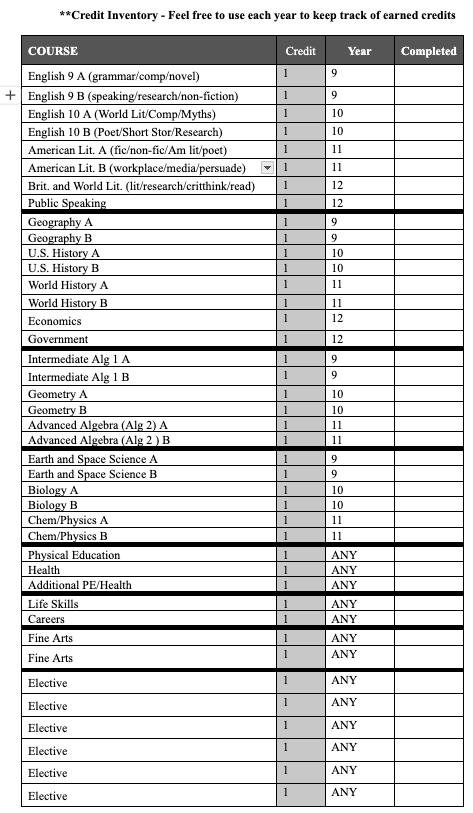
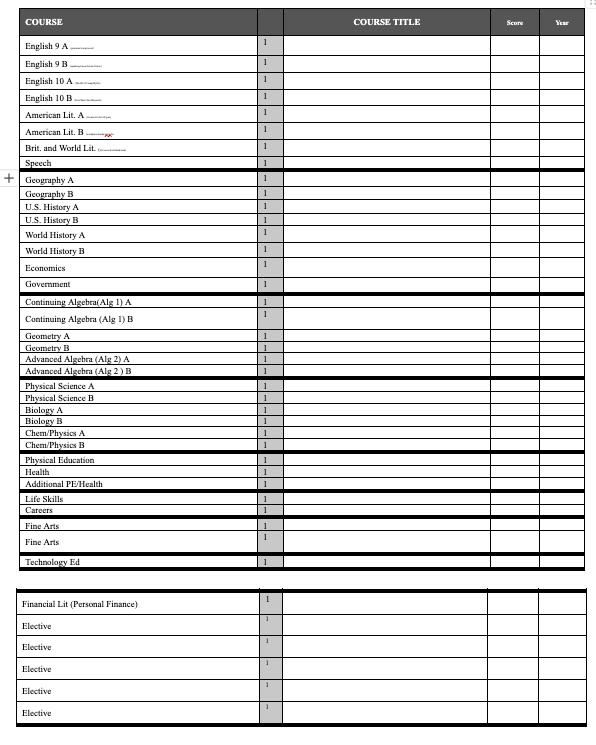
All students need a minimum of 42 credits to graduate.
Credits required for Graduation: *English 8 semester credits
FineArts 2 semester credits *Health 1 semester credit *Electives 5 semester credits * Financial Literacy (Personal Finance) 1 semester credit (11 or 12 gr)
Postsecondary Enrollment Options (PSEO) is a program that allows 10th-, 11th- and 12th-grade students to earn both high school and college credit while still in high school, through enrollment in and successful completion of college-level, nonsectarian courses at eligible participating postsecondary institutions You will be expected to be a responsible, independant, self starting learner The tuition, fees, and required textbooks are at no cost to students MDE Post Secondary Enrollment Options Website
**PSEOAdmission requirements vary depending on the college/university, please visit theAdmissions page of each college/university website of interest to determine what their specific requirements are beyond the below GPAreqs
A12th grade student must have a cumulative GPAof 2.8 or higher. Students must be on track to graduate with cohorts, and be passing all previous semester classes
An 11th grade student must have a cumulative GPAof 3 2 or above Students must be on track to graduate with cohorts, and must be passing all previous semester classes
A10th grade student must have a 3 5 cumulative GPAor above The student is allowed to take 1 CTE (Career and Technical Education) course If the student earns a “C” or higher grade in this first course, she/he is eligible to take additional CTE courses while in 10th grade In order to be eligible, a 10th-grade student must have met the proficiency level of “meets or exceeds” on the 8th-grade MCAreading test If the student did not take the MCA, another reading assessment accepted by the enrolling postsecondary institution can be substituted
1 Request cumulative GPA from iQMN school counselor and read this document: Guidelines for PSEO
2 Research and Apply for PSEO admission at MN College of choice
3 Request transcript by email from iQMN school counselor to send to college
4 Complete the top portion of Notice of Student Registration (NOSR form)
5 Inform iQMN Counselor of PSEO acceptance and classes you plan to take
Students must apply and notify iQMN school counselor by May 30 to be eligible to do PSEO classes for Fall th
**Credits recieved from a post-secondary institution are recorded on your high school transcript and will affect your GPA Grades earned by student also become a part of their permanent college academic record
**For more information about PSEO, contact your iQMN school counselor: Cheryl Bormann chbormann@iqminnesota org (last namesA-L) Karla Cummings kcummings@iqminnesota org (last names M-Z)
All prospective Division I or II college-bound student athletes must be registered with and be certified as eligible by the NCAAInitial-Eligility Clearninghouse to practice, compete, or recieve athletics (Scholarships) aid in their first year at an NCAADivision I or II college or university It is the student’s responsibility to make sure the Clearinghouse has the documents it needs to certify them These documents include a completed online regististration, fee payment, official ACTor SATtest score sent directly from the testing agency, transcript(s) from all high school or programs attended, and a final transcript wit proof of graduation NCAAELIGIBILITYCENTER
**Please let your iQMN counselor know if you plan to play college athletics
Cheryl Bormann chbormann@iqminnesotaorg (last names A-L)
Karla Cummings kcummings@iqminnesota.org (last names M-Z)
ENG108 SUMMIT ENGLISH 9 (9th Grade):
**Full Year
This Summit English 9 course includes engaging and interactive instruction about reading, writing, speaking and listening, and language, with a focus on exploring a wide variety of genres and their elements. Students learn how to carefully read, interpret, and analyze literature and nonfiction works of cultural or historical significance appropriate to grade Throughout the course, students practice narrative, informational, and argument writing Students also develop and deliver presentations and participate in discussions with their peers.
SUMMIT
**Prerequisites: Approval by Teacher or Administration Full Year
The Summit English 9 Honors course includes engaging and interactive instruction about reading, writing, speaking and listening, and language, with a focus on exploring a wide variety of genres and their elements. Students learn how to carefully read, interpret, and analyze literature and nonfiction works of cultural or historical significance appropriate to grade .Throughout the course, students practice narrative, informational, and argument writing. Students also develop and deliver presentations, and participate in discussions with their peers This course includes all the topics in ENG 108 as well as several extension activities Each semester also includes an independent honors project
ENG208 SUMMIT ENGLISH 10 (10th Grade):
**Full Year
The Summit English 10 course includes engaging and interactive instruction about reading, writing, speaking and listening, and language, with a focus on exploring a wide variety of genres and their elements. Students learn how to carefully read, interpret, and analyze literature and nonfiction works of cultural or historical significance appropriate to grade .Throughout the course, students practice narrative, informational, and argument writing Students also develop and deliver presentations and participate in discussions with their peers
ENG209 SUMMIT ENGLISH 10 HONORS (10th Grade Honors):
**Approval by Teacher or Administration Full Year
The Summit English 10 Honors course includes engaging and interactive instruction about reading, writing, speaking and listening, and language, with a focus on exploring a wide variety of genres and their elements. Students learn how to carefully read, interpret, and analyze literature and nonfiction works of cultural or historical significance appropriate to Grade Throughout the course, students practice narrative, informative, and argument writing Students also develop and deliver presentations, and participate in discussions with their peers This course includes all the topics in Summit English , as well as an independent honors project in each semester.
ENG303 SUMMITAMERICAN LITERATURE (11th Grade):
**Full Year
In this course, students read and analyze works ofAmerican literature from colonial to contemporary times, including poetry, short stories, novels, drama, and nonfiction.The literary works provide opportunities for critical writing, creative projects, and online discussions Students develop vocabulary skills and refresh their knowledge of grammar, usage, and mechanics in preparation for standardized tests
ENG 403 SUMMIT BRITISHAND WORLD LITERATURE (12th Grade):
** 1 Semester
Students read selections from British and world literature in a loosely organized chronological framework They analyze the themes, styles, and structures of these texts and make thematic connections among diverse authors, periods, and settings Students complete guided and independent writing assignments that refine their analytical skills They have opportunities for creative expression in projects of their choice. Students also practice test-taking skills for standardized assessments in critical reading and writing.
ENG020 SUMMIT PUBLIC SPEAKING(12 Grade):
** 1 Semester
Students are introduced to public speaking as an important component of their academic, work, and social lives They study public speaking occasions and develop skills as fair and critical listeners, or consumers, of spoken information and persuasion Students study types of speeches (informative, persuasive, dramatic, and special occasion), read and listen to models of speeches, and prepare and present their own speeches to diverse audiences. Students learn to choose speaking topics and adapt them for specific audiences, to research and support their ideas, and to benefit from listener feedback They study how to incorporate well-designed visual and multimedia aids in presentations and how to maintain a credible presence in the digital world Students also learn about the ethics of public speaking and about techniques for managing communication anxiety
**Counts for elective credit. 1 Semester
Students are introduced to the historical importance of journalism in America They study the basic principles of print and online journalism as they examine the role of printed news media in our society They learn investigative skills, responsible reporting, and journalistic writing techniques as they read, respond to, and write their own news and feature articles. Students conduct interviews, research, write, and design their own publications.
:
**Can count for elective credit or fine arts credit 1 Semester
In this course, students explore a range of creative writing genres, including fiction, poetry, creative nonfiction, drama, and multimedia writing.They study examples of classic and contemporary selections, apply what they learn to their own writing, and develop proficiency in the writing process They learn to evaluate the writings of others and apply evaluation criteria to their own work By the end of the course, students will have created a well-developed portfolio of finished written works
MTH128: INTERMEDIATEALGEBRA1 (9 Grade): th
**Prerequisites Algebra 8 Full Year
This SummitAlgebra 1 course is intended to formalize and extend the mathematics that students learned in the middle grades. Because it is built to follow revised middle school math courses, the course covers slightly different ground than previous versions of algebra In this course, students deepen their understanding of linear and exponential relationships by contrasting them with each other Students also apply linear models to data that exhibit a linear trend The course also covers analyzing, solving, and using quadratic functions
MTH129: INTERMEDIATEALGEBRA1 HONORS (9 Grade): th
**Approval by Teacher or Administration Full Year
This SummitAlgebra 1 Honors course is intended to formalize and extend the mathematics that students learned in the middle grades. In this course, students deepen their understanding of linear and exponential relationships by contrasting them with each other Students also apply linear HIGH SCHOOL 30 models to data that exhibit a linear trend The course also covers analyzing, solving, and using quadratic functions This course includes all the topics in MTH128 as well as several extension activities Each semester also includes an independent honors project.
MTH208: SUMMIT GEOMETRY(10th Grade):
**Full Year
This Summit Geometry course builds on the geometry covered in middle school to explore more complex geometric situations and deepen students’ability to explain geometric relationships, moving toward formal mathematical arguments Specific topics include similarity and congruence, analytic geometry, circles, the Pythagorean theorem, right triangle trigonometry, analysis of three-dimensional objects, conic sections, and geometric modeling.
MTH209: SUMMIT GEOMETRYHonors (10th Grade):
**Approval by Teacher or Administration Full Year
This Geometry Honors course builds on the geometry covered in middle school to explore more complex geometric situations and deepen students’ability to explain geometric relationships, moving toward formal mathematical arguments. Specific topics include similarity and congruence, analytic geometry, circles, the Pythagorean theorem, right triangle trigonometry, analysis of three-dimensional objects, conic sections, and geometric modeling This course includes all the topics in MTH208 as well as several extension activities Each semester also includes an independent honors project
**Prerequisite: Intermediate Algebra I Full Year
This SummitAlgebra 2 course, students build on their work with linear, quadratic, and exponential functions, and extend their repertoire to include polynomial, rational, radical, and trigonometric functions. Students also expand their ability to model situations and solve equations, including solving quadratic equations over the set of complex numbers and solving exponential equations using the properties of logarithms The course covers sequences and series, probability distributions, and more advanced data analysis techniques.
MTH309: SUMMITALGEBRA2 HONORS (11 Grade): th
**Prerequisite: Intermediate Algebra I. Teacher approval. Full Year. This SummitAlgebra 2 Honors course, students build on their work with linear, quadratic, and exponential functions, and extend their repertoire to include polynomial, rational, radical, and trigonometric functions Students also expand their ability to model situations and solve equations, including solving quadratic equations over the set of complex numbers and solving exponential equations using the properties of logarithms The course covers sequences and series, probability distributions, and more advanced data analysis techniques.This course includes all the topics in MTH308 as well as several extension activities. Each semester also includes an independent honors project.
**Prerequisites: Geometry and Algebra 2 Full Year
Pre-calculus weaves together concepts of algebra and geometry into a preparatory course for calculus. The course focuses on the mastery of critical skills and exposure to new skills necessary for success in subsequent math courses.Topics include quadratic, exponential, logarithmic,radical, polynomial, and rational functions; matrices; and conic sections in the first semester The second semester covers an introduction to infinite series, trigonometric ratios, functions, and equations; inverse trigonometric functions; applications of trigonometry, including vectors; polar equations and polar form of complex numbers; arithmetic of complex numbers; and parametric equations. Connections are made throughout the course to calculus and a variety of other fields related to mathematics. Purposeful concentration is placed on how the concepts covered relate to each other. Demonstrating the connection between the algebra and the geometry of concepts highlights the interwoven nature of the study of mathematics
Earth and Space Science (9th Grade):
**Full Year
This course provides students with a comprehensive earth science curriculum, focusing on geology, oceanography, astronomy, weather, and climate.The program consists of indepth online lessons, an associated reference book, collaborative activities, and laboratories students can conduct at home The course prepares students for further studies in geology, meteorology, oceanography, and astronomy courses, and gives them practical experience in implementing scientific methods

SCI203 SUMMIT BIOLOGY(10th Grade):
** Full Year
In this comprehensive course, students investigate the chemistry of living things: the cell, genetics, evolution, the structure and function of living things, and ecology.The program consists of in-depth online lessons including extensive animations, an associated reference book, collaborative explorations, virtual laboratories, and hands-on laboratory experiments students can conduct at home
SCI303 SUMMIT CHEMISTRY(11th Grade):
**Prerequisites: 9 and 10 science. Full Year th th
This course gives students a solid basis to move on to future studies The course provides an in-depth survey of all key areas, including atomic structure, chemical bonding and reactions, solutions, stoichiometry, thermochemistry, organic chemistry, and nuclear chemistry The course includes direct online instruction, laboratories, and related assessments, used with a problem-solving book.
SCI403 SUMMIT PHYSICS (11th grade if not taking Chemistry):
**Prerequisites: 9 and 10 science Full Year th th
This course provides a comprehensive survey of all key areas: physical systems, measurement, kinematics, dynamics, momentum, energy, thermodynamics, waves, electricity, and magnetism, and introduces students to modern physics topics such as quantum theory and the atomic nucleus.The course gives students a solid basis to move on to more advanced courses later in their academic careers The program consists of online instruction, laboratories, and related assessments, plus an associated problem-solving book
**Counts as elective credit 1 Semester
This course surveys key topic areas, including the application of scientific process to environmental analysis; ecology; energy flow; ecological structures; earth systems; and atmospheric, land, and water science.Topics also include the management of natural resources and analysis of private and governmental decisions involving the environment Students explore actual case studies and conduct five hands-on, unit-long research activities, learning that political and private decisions about the environment and the use of resources require accurate application of scientific processes, including proper data collection and responsible conclusions.
SCI030E2 Forensic Science
**Counts as elective credit 1 Semester
This course surveys key topics in forensic science, including the application of the scientific process to forensic analysis, procedures and principles of crime scene investigation, physical and trace evidence, and the law and courtroom procedures from the perspective of the forensic scientist Through online lessons, virtual and hands-on labs, and analysis of fictional crime scenarios, students learn about forensic tools, technical resources, forming and testing hypotheses, proper data collection, and responsible conclusions.
SCI32I-CENAnatomy & Physiology I:
**Counts as elective credit. 1 Semester
These courses provide a thorough introduction to the basics required for the study of the human body and how it functions Students receive a general introduction to life functions, the terminology, and phonetic pronunciations used to describe body parts and their locations, as well as an overall review of human development and body processes This course also includes infection control and standard precautions, which emphasizes the importance of maintaining health and safety in the health-care work environment, as well as highlights the latest practices and protocols.
SCI322-CENAnatomy & Physiology II:
**Prerequisite: Completion of Anatomy & Physiology I. 1 Semester
These courses provide a thorough introduction to the basics required for the study of the human body and how it functions Students receive a general introduction to life functions, the terminology, and phonetic pronunciations used to describe body parts and their locations, as well as an overall review of human development and body processes This course also includes infection control and standard precautions, which emphasizes the importance of maintaining health and safety in the health-care work environment, as well as highlights the latest practices and protocols
**Counts as elective credit 1 Semester
In Introduction toAstronomy, you will learn about the history of astronomy from ancient times to modern times.You will identify the movements of the Sun, Moon, planets, and stars across the sky.You will describe the formation of the solar system, and the role of the Sun and Moon in the solar system You will describe the causes of seasons on Earth and the reasons for life on Earth You will learn about stars, galaxies, and the Milky Way You will explain various theories of cosmology, and advantages and disadvantages of space exploration.
**Counts as elective credit 1 Semester
Building upon the prior prerequisite course, dive deeper into the universe and develop a lifelong passion for space exploration and investigation Become familiar with the inner and outer planets of the solar system as well as the sun, comets, asteroids, and meteors Additional topics include space travel and settlements as well as the formation of planets.
HST213 SUMMIT GEOGRAPHYAND WORLD CULTURES (9th grade):
**Full Year
This course examines a broad range of geographical perspectives covering all of the major regions of the world. Students clearly see the similarities and differences among the regions as they explore the locations and physical characteristics, including absolute and relative location, climate, and significant geographical features They look at each region from cultural, economic, and political perspectives, and closely examine the human impact on each region Students take diagnostic tests that assess their current knowledge and generate individualized study plans, so students can focus on topics that need review.Audio readings and vocabulary lists in English and Spanish support reading comprehension
HST303 SUMMIT U.S.HISTORY(10th grade):
**Full Year

This course is a full-year survey that provides students with a view ofAmerican history from the first migrations of nomadic people to NorthAmerica to recent events Readings are drawn from K12'sThe American Odyssey:AHistory of the United States Online lessons help students organize their study, explore topics, review in preparation for assessments, and practice skills of historical thinking and analysis.Activities include analyzing primary sources and maps, creating timelines, completing projects and written assignments, and conducting independent research.
HST103 SUMMIT WORLD HISTORY(11th grade):
**Full Year
In this comprehensive survey of world history from prehistoric to modern times, students focus in depth on the developments and events that have shaped civilization across time The course is organized chronologically and, within broad eras, regionally Lessons address developments in religion, philosophy, the arts, science and technology, and political history The course also introduces geography concepts and skills within the context of the historical narrative. Online lessons and assessments complement World History: Our Human Story, a textbook written and published by K12. Students are challenged to consider topics in depth as they analyze primary sources and maps, create timelines, and complete other projects practicing historical thinking and writing skills as they explore the broad themes and big ideas of human history
HST403 SUMMIT U.S. GOVERNMENTAND POLITICS (12th grade):
** 1 Semester
This course studies the history, organization, and functions of the United States government Beginning with the Declaration of Independence and continuing through to the present day, students explore the relationship between individualAmericans and our governing bodies. Students take a close look at the political culture of our country and gain insight into the challenges faced by citizens, elected government officials, political activists, and others Students also learn about the roles of political parties, interest groups, the media, and the Supreme Court, and discuss their own views on current political issues
HST030 SUMMIT ECONOMICS (12th grade):
**1 Semester
Students are introduced to the basics of economic principles, and they will learn the importance of understanding different economic systems.They will also investigate how to think like an economist. Students will explore different economic systems, including theAmerican free enterprise system, and they will analyze and interpret data to understand the laws of supply and demand. Students will also be presented with economic applications in todayʼs world From economics in the world of business, money, banking, and finance, students will see how economics is applied both domestically and globally Students will also study how the government is involved in establishing economic stability in the American free enterprise system as well as how the U.S. economy has a global impact.
ANTHROPOLOGY:
**Counts as elective credit 1 Semester
What makes us human? Is it our ability to use language, tools, or technology?Trace the history of Homo sapiens and explore our evolutionary trail through an anthropological lens to observe our movement from cave dwellers to modern humans. Learn how we forged our way and developed all the things that make us humans, such as our cultures, languages, and religions.
PSYCHOLOGY:
**Counts as elective credit 1 Semester
In this one-semester course, students investigate why human beings think and act the way they do.This is an introductory course that broadly covers several areas of psychology. Instructional material presents theories and current research for students to critically evaluate and understand. Each unit introduces terminology, theories, and research that are critical to the understanding of psychology and includes tutorials and interactive exercises Students learn how to define and use key psychology terms and how to apply psychological principles to their own lives Unit topics include: Methods of Study, Biological Basis for Behavior, Learning and Memory, Development and Individual Differences, and Psychological Disorders.
Sociology I:
**Counts as elective credit. 1 Semester
This one-semester elective course is intended as a practical, hands-on guide to introduce you to the field of sociology You will explore the evolution of sociology as a distinct social science, learn about sociological concepts and processes, and discuss how the individual relates to society. You will also learn about the influence of culture, social structure, socialization, and social change in today's society.
Sociology II:
**Counts as elective credit 1 Semester
Sociology is the study of people, social life, and society By developing a “sociological imagination,” students examine how society itself shapes human action and beliefs and how in turn these factors reshape society itself. Fascinating online video journeys inform students and motivate them to seek more knowledge on their own.
ART010 SUMMIT FINEARTA/B:
**Can count as fine art or elective credit 1 Semester
This course combines art history, appreciation, and analysis, while engaging students in hands-on creative projects. Lessons introduce major periods and movements in art history while focusing on masterworks and the intellectual, technical, and creative processes behind those works Studio lessons provide opportunities for drawing, painting, sculpting, and other creative endeavors
ART SUMMIT MUSICAPPRECIATION:
**Can count as fine art or elective credit 1 Semester.

This course introduces students to the history, theory, and genres of music. The first semester covers basic music theory concepts as well as early musical forms, classical music, patriotic and nationalistic music, and twentieth-century music The second semester presents modern traditions, including American jazz, gospel, folk, soul, blues, Latin rhythms, rock and roll, and hip hop The course explores the history of music, from the surviving examples of rudimentary musical forms through to contemporary pieces from around the world.
The Courses listed below all can count towards fulfillment of the Fine Arts requirement (as noted in each course description). Student must complete 2 semester credits of any combination of the courses listed below.
Animation
Creative Writing
CulinaryArts I, II
DigitalArts I, II
Digital Photography I, II
Fashion Design
FineArt
Game Design
Image Design & Editing
MusicAppreciation
BUS065 MARKETING 1:
**Can count as tech ed or elective credit 1 Semester
Students find out what it takes to market a product or service in todayʼs fast-paced business environment.They learn the fundamentals of marketing using real-world business examples.They learn about buyer behavior, marketing research principles, demand analysis, distribution, financing, pricing, and product management

BUS075 MARKETING 2:
**Prerequisite: Marketing 1 1 Semester
Students build on the skills and concepts learned in Marketing to develop a basic understanding of marketing principles and techniques The course encourages students to think like an entrepreneur and begin preparing for a career in business and marketing. By the end of the course, students will understand what it takes to start a small business venture.
HST355 Financial Literacy Fundamentals (Personal Finance): Required either 11 or 12 grade yr. th th
**Counts as elective credit 1 Semester
In this course, students will explore their choices as producers, consumers, investors, and taxpayers In addition, they will learn financial literacy skills emphasizing investments, markets, and taxation. Students will apply what they learn to real-world simulation problems.Topics of study include markets from historical and contemporary perspectives; supply and demand; budgeting; understanding creditworthiness and credit reports; saving options; debt reduction; theories of early economic philosophers such asAdam Smith and David Ricardo; theories of value; money (what it is, how it evolved, and the role of banks, investment houses, and the Federal Reserve); Keynesian economics; how capitalism functions, focusing on productivity, wages, investment, and growth; issues of capitalism, such as unemployment, inflation, and the national debt; profiles of individuals who are making their mark in business and economics; and a survey of markets in such areas as China, Europe, and the Middle East
Business & IT Exploration
**Can count as Tech Ed or elective credit 1 Semester
This course is tailored for high school students to develop essential skills and knowledge for the ITindustry Students will be introduced to the basics of computer systems and will learn to use the Internet, word processors, presentation software, spreadsheets, and databases.The curriculum also covers computer programming, networks, and web design and development Additionally, students will explore various career paths in information technology and identify the key skills and certifications required for these careers
OTH171 CulinaryArts 1:
**Can count as fine art or elective credit 1 Semester
CulinaryArts 1 is a one-semester course that is intended to help you gain an understanding of the history and development of culinary arts. This course covers the basics of nutrition, and health, safety, and sanitation In addition, the course explains the basic science principles used in cooking and various cooking methods Finally, the course describes culinary skills required to make a variety of items, ranging from stocks and soups to seafood and poultry to various breads and desserts.
CulinaryArts II
**Can count as fine art or elective credit. 1 Semester


CulinaryArts 2 is a one-semester course that is intended to help you gain an understanding of menu planning, food presentation, and different service styles.This course covers the running of food service establishments and kitchen management skills In addition, the course explains the personal skills and professional traits needed in the food service industry Finally, the course covers career opportunities and career management skills
**Counts as elective credit. 1 Semester
This course introduces students to the unique qualities of young children from infants to age eight, and demonstrates how to work with each child in ways that correspond with their developmental level, and their social and cultural environment The course includes learning theories and research as well as information about the importance of play and technology in a young child’s learning process Other topics covered include readiness, assessment, working with children and families from diverse cultures, working with children with special needs, and the early stages of reading, writing, and general cognitive development.
**Can count as fine art or elective credit 1 Semester
Introduction to Fashion Design is a one-semester course intended to introduce you to the basics of fashion design.This course is designed to provide you insight on the history of fashion and its place in the modern world and to help you understand terms and concepts related to fashion From the inspiration for a garment to creating sketches until the final product takes shape is a long process that involves various activities such as fashion forecasting, predicting consumer demand, drafting the designer’s worksheet, pricing, etc
**Grad Requirement 1 Semester
Students use an informative interactive process to explore career and life options in this one-semester elective.They begin with a thorough examination of their own interests, aptitudes, achievements, and personality styles Instructional material then helps them match job market information, interview techniques, training requirements, and educational paths to potential careers that suit their strengths and personal priorities
Successfully completing this course gives students the ability to identify and describe their personal interests, aptitudes, and lifestyle goals; locate and evaluate information about different careers; identify the skills and knowledge needed for careers of interest and how to obtain them; and create an entrepreneurial business plan
**Grad Requirement 1 Semester
This one-semester elective is designed to increase studentsʼ knowledge of and ability in using the skills necessary for everyday living Life Skills emphasizes defining personal values, goal-setting and planning, and solving problems Instructional material focuses on dealing with media and peer pressure, communicating and relationships, working with others, avoiding and/or resolving conflict, decision-making, wellness and personal safety, aspects of good citizenship, environmental awareness, and how students can contribute to their own community The course is organized in six units that cover the following topics: Course Introduction,Thinking aboutYourself,Thinking forYourself,Taking Care ofYourself, Caring forYour Relationships, and Caring about Your World
**Counts as elective credit. 1 Semester
Regardless of your individual career and academic goals, all of you share one important need:You must be prepared to succeed in the world after high school In this class, we will present valuable information, explore ideas, and develop skills and competencies that will help all of you get a head start in being successful in the workplace and your future careers
** Can count as Health, PE/Health Elective, Elective credit 1 Semester This course focuses on important skills and knowledge in nutrition; physical activity; the dangers of substance use and abuse; injury prevention and safety; growth and development; and personal health, environmental conservation, and community health resources The curriculum is designed around topics and situations that engage student discussion and motivate students to analyze internal and external influences on their health-related decisions The course helps students build the skills they need to protect, enhance, and promote their own health and the health of others.
** Can count as PE, PE/Health Elective, Elective credit 1 Semester. In this course, night grade students learn and practice principles of fitness, wellness, and health to develop habits of healthy living. Guided by their text book, Fitness for Life, students will explore topics that include the physiology of diet and exercise, biomechanics, and team dynamics They will apply their knowledge in daily fitness activities as well as assignments that include personalized exercise and diet plans that develop students' self-assessment skills the varied activities also reinforce how physical fitness catalyzes emotional and mental well-being, self-esteem, and communication skills.
** Can count as PE, PE/Health Elective, Elective credit 1 Semester.
In this course, high school students will study ways to get and stay fit through moderate and vigorous activities, sports, and recreation.They will study the components and benefits of fitness. Students will also study self-management, stress management, and lifestyle practices to achieve and maintain fitness In addition to their reading lessons, students complete a variety of activities, assignments, quizzes, and tests to assess their understanding of the content studied
**Can count as PE/Health Elective or Elective credit. 1 Semester. This course is designed as an ** 1 Semester. Can count as PE, PE/Health Elective, Elective exploration of the healthcare career pathways Students will get an introduction to healthcare careers so that they can better assess which pathway to pursue In this course students explore basic concepts in the broad areas of healthcare, as well as career options in each area Students study the concepts of disease prevention, personal health management, and social work, in addition to other common health related functions. Students complete projects to develop a deeper understanding of the roles these healthcare functions play.
**Can count as PE/Health Elective or Elective credit 1 Semester
This 1 credit course will introduce the student to an overview of good nutrition principles that are needed for human physical and mental wellness. Discussion of digestion, basic nutrients, weight management, sports and fitness, and life-span nutrition is included Application to today's food and eating trends, plus learning to assess for reliable nutrition information is emphasized
Prerequisites: none
**Can count as Fine Arts, Tech Ed or Elective Credit 1 Semester
In this exploratory course, students learn the elements and principles of design, as well as foundational concepts of visual communication. While surveying a variety of media and art, students use image editing, animation, and digital drawing to put into practice the art principles they've learned They explore career opportunities in the design, production, display and presentation of digital artwork They respond to the artwork of others, and learn how to combine artistic elements to create finished pieces that effectively communicate their ideas.
**Can count as Fine Arts, Tech Ed or Elective Credit. 1 Semester

Have you wondered how professional photographers manage to capture that perfect image? Gain a better understanding of photography by exploring camera functions and the elements of composition while putting theory into practice by taking your own spectacular shots! Learn how to display your work for exhibitions and develop skills important for a career as a photographer
**Can count as Fine Arts, Tech Ed or Elective Credit 1 Semester
Have you ever watched a cartoon or played a video game where the animation of characters captivated you so much you wanted to create your own? If so, it’s time to immerse yourself in the world of animation. Meet the industry players such as directors, animators, and 3D modelers. Develop your story by exploring design, the 12 principles of animation, creating a storyboard, and leveraging the tools of the trade Let’s bring your story to life with animation!
**Can count as Fine Arts, Tech Ed or Elective Credit 1 Semester
With this course, students will learn about different video game software and hardware, various gaming platforms, the technical skills necessary to design games, troubleshooting and Internet safety techniques, and the history of gaming. Students will even have the opportunity to create their own plan for a 2D video game! With the knowledge and skills students will gain in this course, they can take their hobby and turn it into a potential career
**Can count as Fine Arts, Tech Ed or Elective Credit 1 Semester
This introductory design course is for students who want to create compelling, professional-looking graphic designs and photos. Students learn the basics of composition, color, and layout through the use of hands-on projects that allow them to use their creativity while developing important foundational skills They use GIMPsoftware to create a graphic design portfolio with a wide variety of projects involving the mastery of technical topics, such as working with layers and masks, adding special effects, and effectively using typefaces to create visual impact.The projects help students develop the skills they need to create and edit images of their own
**Can count as Tech Ed or Elective credit 1 Semester
In this introductory course, students become familiar with the basic principles of a personal computer, including the internal hardware, operating system, and software applications. Students gain practice in using key applications such as word processing, spreadsheet, and presentation software, as well as understand social and ethical issues around the Internet, information, and security
**Can count as Tech Ed or Elective credit. 1 Semester.
This course is designed to introduce students to a contemporary overview of today's computer science The course is non-language-specific and provides a solid foundation using an algorithm-driven approach To keep the course in touch with current issues, material on emerging topics are included, such as privacy, drones, cloud computing, and net neutrality.Traditional computer science topics such as, binary numbers, boolean logic, system software, networking, information security, and language programming are also included
**Can count as Tech Ed or Elective credit 1 Semester
This course provides a comprehensive introduction to the essentials of web design, from planning page layouts to publishing a complete site to the web Students learn how to use HTMLto design their own web pages The course covers basic HTMLtags for formatting text, as well as more advanced tags Through realworld design scenarios and hands-on projects, students create compelling, usable websites using the latest suite of free tools.
WLG100 Spanish I:
**Counts as elective credit Full Year
Students begin their introduction to Spanish by focusing on the four key areas of world language study: listening, speaking, reading, and writing. The course represents an ideal blend of language learning pedagogy and online learning. Each unit consists of a new vocabulary theme and grammar concept, reading and listening comprehension activities, speaking and writing activities, multimedia cultural presentations, and interactive activities and practices which reinforce
WLG200 Spanish II:
** Prerequisite: Spanish I or equiv Counts as elective credit Full Year
Students continue their study of Spanish by further expanding their knowledge of key vocabulary topics and grammar concepts. Students not only begin to comprehend listening and reading passages more fully, but they also start to express themselves more meaningfully in both speaking and writing. Each unit consists of a new vocabulary theme and grammar concept, reading and listening comprehension activities, speaking and writing activities, multimedia cultural presentations, and interactive activities and practices which reinforce vocabulary and grammar There is a strong emphasis on providing context and conversational examples for the language concepts presented in each unit Students should expect to be actively engaged in their own language learning; understand common vocabulary terms and phrases; use a wide range of grammar patterns in their speaking and writing; participate in conversations and respond appropriately to conversational prompts; analyze and compare cultural practices, products, and perspectives of various Spanish speaking countries; and take frequent assessments where their language progression can be monitored By Semester 2, the course is conducted almost entirely in Spanish The course has been carefully aligned to national standards as set forth byACTFL(theAmerican Council on theTeaching of Foreign Languages). vocabulary and grammar.There is a strong emphasis on providing context and conversational examples for the language concepts presented in each unit. Students should expect to be actively engaged in their own language learning; become familiar with common vocabulary terms and phrases; comprehend a wide range of grammar patterns; participate in simple conversations and respond appropriately to basic conversational prompts; analyze and compare cultural practices, products, and perspectives of various Spanish speaking countries; and take frequent assessments where their language progression can be monitored. The course has been carefully aligned to national standards as set forth byACTFL(theAmerican Council on theTeaching of Foreign Languages)
WLG110 French I:
**Counts as elective credit. Full Year
Students begin their introduction to French by focusing on the four key areas of world language study: listening, speaking, reading, and writing. The course represents an ideal blend of language learning pedagogy and online learning Each unit consists of a new vocabulary theme and grammar concept, reading and listening comprehension activities,
WLG210 French II:
** Prerequisite French I Counts as elective credit Full Year
Students continue their study of French by further expanding their knowledge of key vocabulary topics and grammar concepts Students not only begin to comprehend listening and reading passages more fully, but they also start to express themselves more meaningfully in both speaking and writing. Each unit consists of a new vocabulary theme and grammar concept, reading and listening comprehension activities, speaking and writing activities, multimedia cultural presentations, and interactive activities and practices which reinforce vocabulary and grammar There is a strong emphasis on providing context and conversational examples for the language concepts presented in each unit Students should expect to be actively engaged in their own language learning, understand common vocabulary terms and phrases, use a wide range of grammar patterns in their speaking and writing, participate in conversations and respond appropriately to conversational prompts, analyze and compare cultural practices, products, and perspectives of various French-speaking countries, and take frequent assessments where their language progression can be monitored By semester 2, the course is conducted almost entirely in French The course has been carefully aligned to national standards as set forth byACTFL(theAmerican Council on theTeaching of Foreign Languages) speaking and writing activities, multimedia cultural presentations, and interactive activities and practices which reinforce vocabulary and grammar There is a strong emphasis on providing context and conversational examples for the language concepts presented in each unit Students should expect to be actively engaged in their own language learning; become familiar with common vocabulary terms and phrases; comprehend a wide range of grammar patterns; participate in simple conversations and respond appropriately to basic conversational prompts, analyze and compare cultural practices, products, and perspectives of various French speaking countries; and take frequent assessments where their language progression can be monitored.The course has been carefully aligned to national standards as set forth byACTFL(theAmerican Council on the Teaching of Foreign Languages)
WLG120 German I:
** Counts as elective credit Full Year
Students begin their introduction to German by focusing on the four key areas of world language study: listening, speaking, reading, and writing. The course represents an ideal blend of language learning pedagogy and online learning Each unit consists of a new vocabulary theme and grammar concept, reading and listening comprehension activities,
speaking and writing activities, multimedia cultural presentations, and interactive activities and practices which reinforce vocabulary and grammar There is a strong emphasis on providing context and conversational examples for the language concepts presented in each unit. Students should expect to be actively engaged in their own language learning; become familiar with common vocabulary terms and phrases; comprehend a wide range of grammar patterns; participate in simple conversations; respond appropriately to basic conversational prompts; analyze and compare cultural practices, products, and perspectives of various German-speaking countries; and take frequent assessments where their language progression can be monitored The course has been carefully aligned to national standards as set forth byACTFL(theAmerican Council on theTeaching of Foreign Languages).
WLG220 German II:
** Prerequisite: German I or equiv Counts as elective credit Full Year
Students continue their study of German by further expanding their knowledge of key vocabulary topics and grammar concepts. Students not only begin to comprehend listening and reading passages more fully, but they also start to express themselves more meaningfully in both speaking and writing Each unit consists of a new vocabulary theme and grammar concept, reading and listening comprehension activities, speaking and writing activities, multimedia cultural presentations, and interactive activities and practices which reinforce vocabulary and grammar There is a strong emphasis on providing context and conversational examples for the language concepts presented in each unit. Students should expect to be actively engaged in their own language learning; understand common vocabulary terms and phrases; use a wide range of grammar patterns in their speaking and writing; participate in conversations; respond appropriately to conversational prompts; analyze and compare cultural practices, products, and perspectives of various German speaking countries; and take frequent assessments where their language progression can be monitored The course has been carefully aligned to national standards as set forth byACTFL(theAmerican Council on theTeaching of Foreign Languages).
Below is a grid of a typical Middle School student schedule. 6 Period Day: 4 Cores and 2 Electives (each 2 Quarters). Each year MS students get 4 electives.
ENG06AD Language Arts 6
MTH06A Math 6 MN
SCI06ADE3 Earth Science
CS MN State History A
ELECTIVES:
Scheduled together
OTH06 Physical Education 6 MN
ENG07AD Language Arts 7
MTH07A Pre-Algebra
SCI07ADE3 Life Science
ENG08AD Language Arts 8
MTH08A Math 8 MN
SCI08ADE4 Physical Science
HST06A American History Since 1865 SOC08A Intermediate Global Studies
ELECTIVES:
Scheduled together
OTH060E2 Family and Consumer Science
ELECTIVES:
Scheduled together
OTH08 Physical Education 8 MN.
ARTD MS 2D Studio Art. OTH07 Physical Education 7 MN. MUS MS Music.
Scheduled together
Scheduled together
Scheduled together
TCH08E2 Computer Literacy CS Exploring World Languages HLT08DE3 Health 8
HLT06DE3 Health 6
ARTD MS Animation CAR005E2 Middle School Career Exp 1
This course equips students with the essential language arts skills needed throughout their academic careers. Students read and analyze a variety of informational and fictional texts. Instruction and reading strategies accompany reading selections to help engage students in the text and sharpening their comprehension. Students express their ideas and knowledge using standard (formal) English in written and oral assignments. Writing expressive, analytical, and procedural compositions helps students develop communication skills necessary in today’s world. Vocabulary is taught explicitly and through an array of vocabulary acquisition strategies that give students the tools to independently increase their vocabulary. Students study grammar, usage, and mechanics; and practice sentence analysis, sentence structure, and proper punctuation. Portfolios created by students provide a platform for them to set goals, monitor their progress, and reflect on their accomplishments and challenges.The course includes discussion activities that engage students in the curriculum while creating a sense of community This course meets Common Core State Standards.
This course continues the development of comprehension and analysis of informational and fictional texts with an ongoing emphasis on reading strategies. Students express themselves using standard (formal) English in written and oral presentations.Analyzing and practicing the form and structure of various genres of writing enhances students’communication skills Students study a variety of media to understand informational and persuasive techniques, explicit and implied messages, and how visual and auditory cues affect messages Grammar, usage, and mechanics skills are deepened Students continue to widen their vocabulary and apply acquisition strategies Portfolios created by students provide a platform for them to set goals, monitor their progress, and reflect on their accomplishments and challenges.The course includes discussion activities that engage students in the curriculum while creating a sense of community. This course meets Common Core State Standards
Throughout this tablet-ready course, students engage in literary analysis and close reading of short stories, poetry, drama, novels, and informational texts The course focuses on interpretation of literary works, analysis of informational texts, and the development of oral and written communication skills in standard (formal) English. Students read “between the lines” to interpret literature and go beyond the text to discover how the culture in which a work of literature was created contributes to the theme and ideas it conveys Analysis of the structure and elements of informational texts and media helps students develop the skills needed for academic success and the navigating the world Students continue to acquire knowledge and skills in grammar, usage, mechanics, and vocabulary Setting goals, self-monitoring progress, and reflecting on successes and challenges helps students become metacognitive learners.The course includes discussion activities that engage students in the curriculum while creating a sense of community.This course meets Common Core State Standards.
In the Summit Math 6 course, students deepen their understanding of multiplication and division of fractions to apply their knowledge to divide fractions by fractions, with an additional focus on increasing efficiency and fluency. Students gain a foundation in the concepts of ratio and rate as an extension of their work with whole number multiplication and division, and in preparation for work with proportional relationships in Grade 7 Students also make connections among area, volume, and surface area, and continue to lay the groundwork for deep algebraic understanding by interpreting and using expressions and equations
In the Summit Math 7 course, students focus on real-world scenarios and mathematical problems involving algebraic expressions and linear equations and begin to apply their understanding of rational numbers with increased complexity.The course lays the foundation for exploring concepts of angle, similarity and congruence, more formally addressed in Grade 8, as students work with scale drawings and construct and analyze relationships among geometric figures. Students also develop and apply understandings of proportional relationships
K12’s Grade 8 mathematics course prepares students for more advanced study in algebra as students solve linear equations and systems of equations, work with radical and integer exponents, gain conceptual understanding of functions, and use functions to model quantitative relationships To prepare students for more advanced study in geometry, the course emphasizes the Pythagorean theorem and a deepening exploration of similarity and congruence
The Earth Science curriculum builds on the natural curiosity of students By connecting them to the beauty of geological history, the amazing landforms around the globe, the nature of the sea and air, and the newest discoveries about our universe, the curriculum gives students an opportunity to relate to their everyday world. Students will explore topics such as the fundamentals of geology, oceanography, meteorology, and astronomy; Earth’s minerals and rocks; Earth’s interior; plate tectonics, earthquakes, volcanoes, and the movements of continents; geology and the fossil record; the oceans and the atmosphere; and the solar system and the universe Lesson assignments help students discover how scientists investigate the science of our planet
The Life Science program invites students to investigate the world of living things at levels both large and small by reading, observing, and experimenting with aspects of life on Earth. Students explore an amazing variety of organisms, the complex workings of the cell and cell biology, the relationship between living things and their environments, and discoveries in the world of modern genetics. Students tackle such topics as ecology, microorganisms, animals, plants , cells, animals, species, adaptation, heredity, genetics, and the history of life on Earth Lesson activities and assignments help students discover how scientists investigate the living world
The Physical Science program introduces students to many aspects of the physical world, focusing first on chemistry and then on physics The course provides an overview of the physical world and gives students tools and concepts to think clearly about matter, atoms, molecules, chemical reactions, motion, force, momentum, work and machines, energy, waves, electricity, light, and other aspects of chemistry and physics Among other subjects, students study the structure of atoms; the elements and the PeriodicTable; chemical reactions; forces, including gravitational, motion, acceleration, and mass; and energy, including light, thermal, electricity, and magnetism
Minnesota History will cover several periods of Minnesota History, ranging from Early NativeAmericans, to FurTraders, to becoming a territory, to immigration and into the 1900's
This course takes students from the westward movement of the late s to the present Lessons integrate topics in geography, civics, and economics The course guides students through critical episodes in the story ofAmerica Students examine the effect of the settlement of theAmerican West; investigate the social, political, and economic changes that resulted from industrialization; explore the changing role of the United States in international affairs from the late nineteenth century through the end of the Cold War; and trace major events and trends in the United States from the Cold War through the first decade of the twenty-first century
Students study world history, landforms and geography, money and economics, the powers and parallels of political science, sociology, and anthropology in this two-semester course. Social Studies 7 begins with the mysteries of the ancient empires of theAmericas, moves on to the fall of the Roman Empire and the rise of the Franks in Europe, and covers revolutionary Europe, the Industrial Revolution, nationalism and Imperialism, World Wars I and II, colonial India, the United Nations, the Vietnam War, past and current issues in the Middle East, and ancient and modernAfrica.The course concludes with an introduction to the Information and SpaceAges.
Do you like to draw, paint, or take pictures? Whatever medium you prefer, this course will teach you the design elements and principles needed to create a work of art and explore your artistic inspirations You’ll also travel back in time to look at art in different cultures and learn about the art of critiquing Let’s turn your creative dreams into reality!

This one-semester Physical Education course introduces students to the essential principles that can help them live healthy, active lifestyles. Students learn about team sports, dance, and lifetime activities such as yoga/pilates, kickboxing, golf, fitness walking, and badminton They are introduced to a variety of dance styles from around the world, including square dance, folk dance, aerobic dance, hiphop, and rhythmic gymnastics Students learn fitness basics, including target heart rate, fitness testing, goal setting, and weight training, and they learn the importance of warm-up and cool-down sessions The course also addresses the concepts of conflict resolution and making smart choices. Fundamentals of nutrition are covered, as well as the importance of getting adequate rest and maintaining a positive attitude.
In the 6th grade health course, students learn strategies and tools for good health throughout their lives
They learn about how various systems of their bodies function, how to make good nutrition and exercise choices, and how to prevent certain illnesses Students are exposed to ways to keep themselves and their families safe at home and in emergency situations as well.They also learn ways to maintain a positive self-concept and healthy relationships with others.This course gives students knowledge about keeping themselves healthy and have a positive impact on their families and communities now and in the years to come
In this introductory course, students will become familiar with the basic principles of a personal computer, including the internal hardware, the operating system, and software applications Students will gain practice in using key applications such as word processors, spreadsheets and presentation software, as well as understand social and ethical issues around the Internet, information and security This is a twosemester course package. In the first semester, the focus is on the fundamentals, learning and using the applications, and understanding the basic roles and responsibilities of the software, hardware an operating system. In the second semester, the focus is on gathering and analyzing data, and using the right tools and methods to collect and present data This course should not be taken if the student has already completed Computer Literacy
The middle school Family and Consumer Science course focuses on the introduction of skills and knowledge that will help young teenagers transition into the adult roles within the family Students engage in activities to learn more about managing money, entering the world of work, establishing a home and family, preparing nutritious meals, working as part of a team, and caring for the environment and their community Students gain an appreciation for the work of the family and how they as individuals contribute to the well-being of their family and their community
In this one-semester seventh-grade Physical Education course, students are exposed to diverse activities, including rock climbing, orienteering, kickboxing, and table tennis Course content includes multiple training methods, including cross training, plyometric training, core muscle training, and aerobic dance Students learn about stress management exercises, including yoga/pilates and breathing exercises. Fitness basics are presented, including target heart rate, fitness testing, and goal setting. Students learn about static and dynamic balance and about the science behind sports. Principles of strength training are covered, along with safety precautions one should take when lifting weights At the end of this course, students can perform the Presidential Physical FitnessTests and graph their scores
In this World Languages course students will be introduced to 6 different languages within 18 weeks. The languages in this course include Spanish, French, German, Latin, Chinese and Japanese. Each language will be taught in a period of 3 weeks. This multilingual course is designed to give students an opportunity to gain understanding of a language that they might want to further study in the future. Each language is equally represented, thus allowing the student to conceptualize and practice the language one at a time. The course takes a multi-perspective approach for teaching the culture of the people that speak the language along with fundamental communication skills in the target language.Activities that engage students and make language learning exciting and fun will be incorporated to build acquisition. The language will be taught using the communicative method which combines listening, speaking, reading and writing in the target language with the use of multimedia resources
Across the decades, there have been many legendary animated characters, but now is the time forYOU to breathe life into the next great animation! In this course, you will explore the history of animation to understand it’s evolution You’ll also learn the essentials of character development, color theory and design, and the principles of animation while applying your unique animation style to your own animated character.All of your hard work will culminate in your artist’s portfolio so you can show off your hard work. Let’s create a new life!
The grade 8 health course helps students develop the knowledge and skills they need to make healthy decisions to stay active, safe, and informed, as teenagers and as adults The lessons and activities introduce important aspects of the main types of health: emotional and mental health, social health and wellness, and physical health.Among other topics, students explore nutrition, understanding and avoiding disease, violence prevention and safety, body systems, and building character through maintaining healthy relationships They also explore topics related to the use and abuse of tobacco, drugs, and alcohol; green schools and environmental health; dating, abstinence, and human sexuality; and mental and emotional health and disorders The course engages students with relevant health and wellness topics, and real world concepts and health issues. Quizzes and tests assess student understanding of the various health topics and concepts from the course.
In this course students will explore careers in over fifteen different career areas From the energy field to human resources and from law to transportation, they will learn more about what careers are available and what they need to do to get there. In addition, they will examine how to choose the career that is best for them based on their own unique personality and interests as well as how they can begin developing their leadership skills now
Explore and build foundational musical skills with Spotlight on Music This course offers a variety of learning activities that include singing, dancing, virtual instruments, listening maps, authentic sound recordings and playing the recorder The course is organized into nine units Students learn about these musical elements: duration, pitch, design, tone color, expressive qualities and cultural context. Students explore beat, meter, rhythm, melody, harmony, tonality, texture, form, tone color, dynamics, tempo, articulation, style, and music background.
Designed for eighth-grade students, Physical Education 8 teaches students to make informed decisions about fitness activities. Students learn about the role of physical activity in maintaining a healthy quality of life. Each student designs and participates in a fitness program that meets his or her individual fitness needs and interests and learns how to evaluate his or her personal physiological response to exercise. Course content covers the fundamentals of physical fitness and stress management and introduces students to a variety of lifetime sports and games, including canoeing, cycling, tennis, lawn games, and wall ball Students learn how to apply the critical elements of multiple training methods, including aerobics, cardio bands, and kickboxing.