FERCSL
Newsletter
Official Newsletter of the Forum for Ethics Review Committees in Sri Lanka
January 2017 Volume 4 | Issue 1
This Issue:
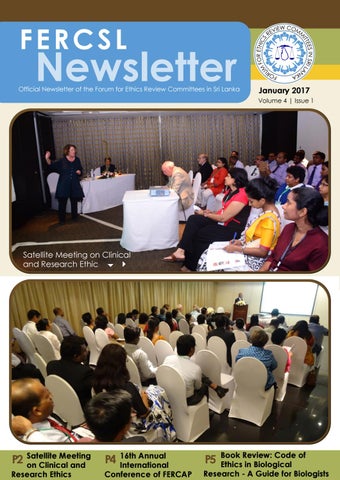
Satellite Meeting on Clinical and Research Ethic
Satellite Meeting on Clinical and Research Ethics
P2
16th Annual International Conference of FERCAP
P4
Book Review: Code of Ethics in Biological Research - A Guide for Biologists
P5
by
Prof. Chandanie Wanigatunge Chairperson FERCSL A two day satellite Meeting on Clinical and Research Ethics was held in Colombo during the 24th Triennial Conference of the Commonwealth Medical Association on 15th and 16th of October 2016. The meeting was a collaborative effort of the Collaborative Institutional Training Initiative (CITI), Biomedical Research Alliance New York (BRANY), USA, Institute of Bioethics, Miller School of Medicine, University of Miami, USA, Association for the Accreditation of Human Research Protection Programmes (AAHRP), USA, Forum for Ethical Review Committees in Asia and the Western Pacific (FERCAP) and the Forum for Ethics Review Committees in Sri Lanka (FERCSL).
Satellite Meeting on Clinical and Research Ethics
AAHARP, USA. It was interesting to note that while The meeting which was well attended by members SIDCER concentrates on the ERC alone, AAHARP of Ethics Review Committees in Sri Lanka provided looks at the institution, the participants with an opportunity to further their knowledge on current aspects of clinical and research ethics. The different options available for ERCs to obtain international recognition was discussed. Dr Christina Torres, Coordinator, FERCAP provided an overview of the SIDCER recognition process which most participants were familiar with. The process of AAHRPP recognition programme was discussed by Ms Elyse Summers, Chief Executive Officer of
Dr Cristina Torres from FERCAP
P2
Ms Elyse Summers from AAHARP
The meeting which was well attended by members of Ethics Review Committees in Sri Lanka provided the participants w i t h a n opportunity to further their knowledge
Prof Harischandra Gambhira, Head, Sri Lanka Unit, UNESCO Chair in Bioethics Haifa
Prof. Paul Braunschweiger, CITI programme
researchers, local investigation sites and ERCs for its accreditation process. The activities of the International Network of the UNESCO Chair in Bioethics Haifa was presented by the Head of its Sri Prof Chandanie Wanigatunge, Chairperson FERCSL discussing the Sri Lankan experience of the role of a National Medical Association in Bioethics and Research Ethics
The two day meeting while enhancing the knowledge of participants also brought home the need for such meetings on a regular basis.
those interested “A Cost Effective Alternative for Research Ethics Education�. While the online programme provides people an opportunity to get a good training, participants highlighted the fact that it was an Dr Susan Miller on Research expensive option, on the Terminally Ill where especially for those from she spoke about the ethics of using investigational countries such as Sri products on those who are Lanka. It was encouraging terminally ill and no hope for to note that CITI an improvement programme was planning Lanka Unit, Professor Harischandra Gambhira. on establishing a centre in Dr Pankaj Shah sharing the Sri Lanka which would Professor Paul Braunschweiger, Senior Executive VP Challenges faced by an allow Sri Lankans to Indian ERC during the Ethics & Managing Director CITI Program presented an access the programme at Review Process overview on The CITI Programme which provides a lower cost. There were interesting presentations on Research on the terminally ill, Ethical issues in Clinical Trials, International Collaborative Research between Developed and Developing Countries, Ethical issues in Digital Health and Publication Integrity. The symposium in Challenges in Ethics Review Process brought together the experiences of ERCs in USA, India and Sri Lanka. The 2 day meeting while enhancing the knowledge of participants also brought home the need for such meetings on a regular basis. Section of the audience
P3
by
Prof. Chandanie Wanigatunge Chairperson FERCSL
The 16th Annual International Conference of the Forum for Ethical Review Committees of Asia and the Western Pacific was held at the King Chulalongkorn Memorial Hospital Campus in Bangkok, Thailand. The 3 day conference was held from 21st to
Prof Anoja Fernando clarifying an issue at the session on Risk based quality management in clinical trials and the role of the ethics committee/IRB
Prof Anoja Fernando and Prof Chandanie Wanigatunge receiving the SIDCER recognition Plaque for ERC SLMA from Prof Kenji Hirayama, Chairperson FERCAP
P4
23rd November 2016 and ended with the General Assembly wh er e th e n ewl y recognized and rerecognized Ethics Review Committees w er e g i v en th e i r recognition plaques and certificates.
This year the ERC of Sri Lanka Medical Association received SIDCER recognition while ERC Faculty of Medicine Colombo was re-recognized for the 2nd time. The SLMA ERC was represented by Prof Anoja Fernando (Chairperson) and Prof Chandanie Wanigatuneg (Secretary) while ERC, Faculty of Medicine Colombo was represented by its chairperson, The conference was Prof Hemantha Senanayake. packed with many interesting talks on current changes in research ethics and their applications. Notable among these were the issues with first-in-human studies which are generally considered safe and the new changes to CIOMS Prof Hemantha Senanayake receiving the guidelines. The SIDCER re-recognition certificate for ERC Faculty of Medicine, Colombo from Prof Kenji conference is also an Hirayama, Chairperson FERCAP opportunity for ERCs in the region to network, share knowledge and expertise. Prof. Hemantha Senanayake from the ERC, Faculty of Medicine Colombo presented a paper on Ethical Issues in Obstetrics and Gynecology Research The Sri Lankan contingent to 16th which was well received Annual International Conference of by the participants. FERCAP
by
and Policy Interventions.
Malik Fernando,
The Section on Further Reading contains a list of 25 papers—mostly on-line publications, including those on research involving human subjects and codes of practice and ethical guidelines of numerous non-biological professions.
MB, ChB (Bristol), MIBiol (SL)
Code of Ethics in Biological Research - A Guide for Biologists, 2016, K. M. Mohotti, PhD (Reading, UK), C. Biol, F. I. Biol and A. J. Mohotti, PhD (Reading, UK), C. Biol, F. I. Biol, Institute of Biology Sri Lanka, Colombo, v + 35, soft cover. ISBN 978-955-8476-06-2.
This little booklet is a welcome publication that was released at the 36th Annual Sessions of the Institute of Biology Sri Lanka. In the Preface written by Dr. Inoka Perera, the President of the Institute, he points out that “The number of laboratory animals used in research is increasing with the creation of new drugs and disease models.” He goes on to state that “The Institute of Biology has a strong emphasis on ethical practices in biological research conducted in Sri Lanka.” The IOB has its own Ethics Review Committee and the information in the booklet is expected to provide guidance to biologists regarding ethical practice. The Booklet is divided into five sections dealing with major topics. The Introduction deals with Scientific Principles and Research Practices; Ethics in Research has sub-sections covering (a) Biological Research, (b) Codes of Conduct, Guidelines and Best Practices and/or Standards in Biological Research, (c) Research with Human and Animal Subjects, including Plants, Microbes and Plant Parts and Research Protocols dealing with Plants, Animals and Microbes; Sharing of Resources, Collaborations and Intellectual Property Rights; Guidance of Ethical Considerations for Biologists in Sri Lanka with sub-sections dealing with Individuals or Teams of Research Scientists, R&D Institutions or Organisations, Supporting or Funding Organisations
There are three Annexures: 1. Code of Ethics for Biologists. This takes the form of Five statements followed by explanatory notes. The five statements are: a) Observe the highest standards of professionalism; b) Show concern for all living beings and environment; c) Be honest; d) Have a scientific attitude; and e) Respect legality. Available at http://iobsl.org/code-of-ethics-for-biologists (Cont. P6 ) P5
Code of Ethics in Biological Research…(Cont. P5) 2. Guidelines for Ethics Review of Research Proposals involving animals in Sri Lanka. Forum of Ethics Review Committees of Sri Lanka, Ethics Review Committee, Faculty of Medicine, University of Colombo. An unabridged copy of the guidelines is reproduced here. This is a welcome development as it acknowledges the value of the work done by the ERC, Medical Faculty Colombo and FERCSL in this area. 3. Status of Applications of Research Ethics in Academic and Research and Development Institutes in Sri Lanka. A Diagnostic Survey conducted by the authors. This analysis is presented in tabular form over eleven (11) pages. Each ‘Measure’ is followed by ‘Benchmark desirable’, ‘Present Status’ and ‘Remarks’. There are 32 ‘Measures’ examined. One of these that has relevance to medical research is the requirement of a Memorandum of Understanding (MOU) when sending biological material out of the country. The
finding was that these were “not common, except in major projects involving funding”. This is probably an area that FERCSL may need to look at, and draft a template of necessary information for its members. Perhaps together with the IOBSL. The ‘Remarks’ column makes recommendations for corrective action wherever necessary.
This booklet has been prepared for the use of members of the Institute of Biology, but members of FERCSL member Committees who work with animals would find it a rewarding read. Printed copies may be available at the IOBSL Office, ‘Vidya Mandiraya’, Vidya Mawatha, Colombo 7 (the SLAAS Building); it is available on the IOBSL website http://iobsl.org/ code-of-ethics-forbiologists.
Write to us! Thank you for taking your time to read this issue of the newsletter. Your comments about the current issue, and ideas for the next issue are what will keep FERCSL Newsletter an interesting and lively one!! Old copies of FERCSL Newsletter can be accessed from the FERCSL website Newsletter archive at www.fercsl.lk/news/newsletter Tell us Events and Activities of your ERC that you would like to share with other ERCs and their members.
We also welcome contributions from all our members. Dr Prasad Ranatunga Editor, FERCSL fercslnews@gmail.com P6
Link to newsletter archive