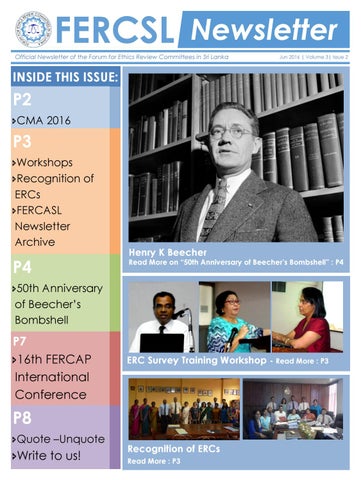
FERCSL Newsletter Official Newsletter of the Forum for Ethics Review Committees in Sri Lanka
Jun 2016 | Volume 3| Issue 2
INSIDE THIS ISSUE:
P2 CMA 2016
P3 Workshops Recognition of ERCs FERCASL Newsletter Archive
P4
Henry K Beecher
Read More on “50th Anniversary of Beecher’s Bombshell” : P4
50th Anniversary of Beecher’s Bombshell
P7 16th FERCAP International Conference
ERC Survey Training Workshop - Read More : P3
P8 Quote –Unquote
Write to us!
Recognition of ERCs Read More : P3
CMA 2016
www.cma2016.org P2
Workshops ERC Survey Training Workshop Dates: 05th June 2016 Time: 9.00am—4.00pm Venue: PGIM Auditorium Conducted by SIDECR/ FERCAP facilitators. This was attended by surveyors and trainees of the SIDECR/ FERCAP surveys and other ERC members. This workshop concluded successfully.
Recognition of ERCs Strategic Initiative for Development of Capacity in Ethics Review (SIDCER) of the World Health Organisation (WHO) with Forum for Ethical Review Committees of Asia Pacific (FERCAP) survey ethical review committees & award recognition for reaching standards.
ERC of Faculty of Medicine of University of Colombo was surveyed for 2nd rerecognition & ERC of SLMA was surveyed for recognition.
FERCASL Newsletter Archive Old copies of FERCSL Newsletter can be accessed from the FERCSL website Newsletter archive at www.fercsl.lk/news/newsletter
P3
Cover Story Research involving humans raises a multitude of issues and had been the subject of concern of researchers and others alike. From time to time codes were laid out to guide researchers to conduct themselves ethically, such as Thomas Percival (1803) and Claude Bernard (1865). But modern era of research ethics begins with Nuremberg Code (1947).
Africa and Italy during World War II.
Henry Knowles Beecher was born as Harry Unangst in Peck, Kansas in 1904 as the son of Henry Unangst, a night watchman and carpenter. He changed his s ur name to Beecher in his 20s, an illustrious Beecher, Henry K. (June 16, 1966). "Ethics surname of a and Clinical Research". New England Journal of distant relative. Medicine 274 (24): 1354–1360 Beecher graduated cum laude in 1932 from Harvard Medical School. Beecher was hired as Anaesthetist-in-chief at Massachusetts General Hospital and Instructor in Anaesthesia at Harvard Medical School in 1936. In 1941 Harvard installed him with the first endowed professorship in anaesthesiology in America. Beecher served in the U.S. Army in North
Henry Knowles Beecher concluded that 12 of (February 4, 1904 – July 25, 1976) t h e m w e r e “unethical or questionably ethical”. He compiled a list of 50 articles published in leading journals which were conducted at leading institutions & funded by government agencies.
In 1959, he published in Journal of American Medical Association (JAMA) an article titled “Experimentation in man” and again in 1963 an article titled “Ethics and experimental therapy”. Both of these were on role conflict faced by physician investigators. But t h ese di d not In 1966, Henry K Beecher published an article generate much of a which is an important landmark in research ethics response. involving humans. June 2016 marks the 50th anni- Then he studied 100 versary of this article, “Ethics and Clinical Re- consecutive articles search” in the New England Journal of Medicine published in Journal (NEJM), which is also called the Beecher’s o f C l i n i c a l Bombshell. Investigation and
P4
Beecher then accepted an invitation to speak before a group of journalists convened by the Upjohn Pharmaceutical Company at Brook Lodge Conference Centre in March 1965. His presentation described 18 cases in which researchers had failed to obtain consent or had harmed the research subjects. He concluded, “What seem to be breaches of ethical conduct in experimentation are by no means rare, but are almost, one fears, universal.” The Boston Globe ran the headline “Are Humans Used as Guinea Pigs Not Told?” in the front-page story on March 24, 1965. New York Times and the Wall Street Journal ran lengthy accounts of his work. Reaction to Beecher’s work was swift and was not limited to being friendly or favourable. His colleagues rebutted his claims with a press conference of their own. Beecher later reported, “I really
Cover Story - continued... was subjected to the most humiliating been exposed in popular media, such as the experience,” when Dr Thomas Chalmers and Willowbrook Study, where mentally retarded Dr David Rutstein, both colleagues at Harvard children were used for studying about infectivity of Medical School, “called a press conference to Known effective treatment withheld (3)– To deterrefute what I said without finding out whether or’ mine the relapse rate of typhoid fever, 25 patients not I could be present. Then Beecher went on to do his landmark article based on his work presented at Brook Lodge. This included 32 additional “unethical research” examples bringing the total to 50 research articles. He submitted the manuscript to JAMA on August 20, 1965. Dr John H. Talbot, Editor of JAMA wrote on October 25, 1965, to Beecher informing that neither of the two reviewers favoured publication and rejected the article. Then Beecher submitted a slightly revised and fully annotated article to the NEJM on November 10, 1965. Six of the seven reviewers recommended against publication. But Dr Joseph Garland, Editor overruled the decision by the editorial board to reject the submission. Garland helped Beecher to revise the manuscript. Reduced the total number of examples to 22. Moderated Beecher’s language. Beecher insisted that the researchers not be named or journal citations be provided, which Garland accepted. But all references were deposited in Garland’s office & were checked for accuracy by him & two of his associates.
were treated with Chloramphenicol, & 157 received symptomatic treatment without Chloramphenicol (mortality – 8% versus 23% respectively). Study of therapy (1)– To evaluate hepatic dysfunction from therapy with triacetyloleandomycin, 50 patients including mentally impaired subjects or juvenile delinquents treated for acne were studied. By the time half the patients had received the drug for 4 weeks, the high incidence of significant hepatic dysfunction led to its discontinuation in the remainder of the group. Physiological studies (9)– A controlled, doubleblind study to further define the hematological toxicity of chloramphenicol by randomly giving 2 or 6 g of chloramphenicol daily. Toxic bone marrow depression developed in 2 of 20 patients given 2 g, & 18 of 21 patients given 6 g daily. Studies to improve the understanding of disease (5)– Liver cancer cells were injected into 22 human subjects as part of a study of immunity to cancer. Subjects were told they were receiving ‘some cells’, but the word cancer was not mentioned. Technical study of disease (3)– The transbronchial approach for left heart catheterization was developed as a new approach in >500 cases; 15 patients had normal hearts & underwent bronchoscopy for other reasons. Bizarre Study (1)– Vesicourethrography was carried out on 26 normal babies less than 48hours old to determine whether urethral reflux can occur in the normal bladder. Multiple spot x-ray films were made during bladder filling & voiding.
As NEJM did not enjoy the same level of circulation as JAMA at that time, Beecher notified the press about his upcoming article. He also warned Few examples from "Ethics and Clinical Research” John Knowles, Director of Massachusetts General Hepatitis. The examples were categorised into Hospital week in advance that the article might stir Known effective treatment withheld, Study of quite a controversy. therapy, Physiological studies, Studies to improve The NEJM published “Ethics and Clinical Research” the understanding of disease, Technical study of on June 16, 1966, as a special article with an editodisease & Bizarre study. rial by Garland. It provoked varied reactions. ArtiHe concludes by pointing out two important comcle was highlighted in the Boston Globe, the Wall ponents in the ethical approach to experimentaStreet Journal and other major periodicals. tion involving humans. The informed consent and He observed that only two of the original 50 articles presence of an intelligent, informed, conscientious, mentioned about obtaining consent. Some examcompassionate, responsible investigator. ples Beecher mentioned in his article had already P5
Cover Story - continued... Beecher’s disclosure had an immediate impact. Many of his earlier articles & Maurice Pappworth’s work in England during the same time contributed to the series of events that followed. Members of Congress inquired from National Institute of Health (NIH) about possible corrective action. NIH through its parent body, the U.S. Public Health Service laid down guidelines to cover federally funded research involving humans. Food and Drug Administration issued “Statement on Policy Concerning Consent for the Use of Investigational Drugs on Humans” on August 30, 1966. Eventually the National Research Act was enacted in 1974 & the National Commission for the Protection of Human Subjects of Biomedical and Behavioural Research The commission’s 1979 Belmont Report is a landmark in regulating the human research to date.
6.
J. Harkness, D. (2001). Laying ethical foundations for clinical research. Bulletin of the World Health Organization, [online] 79(4), p.365. Available at: http:// www.ncbi .nlm.ni h.gov/pmc/arti cles/PMC2566394/ [Accessed 16 Jun. 2016].
7.
Jones, D., Grady, C. and Lederer, S. (2016). “Ethics and Clinical Research” — The 50th Anniversary of Beecher’s Bombshell. New England Journal of Medicine, [online] 374 (24), pp.2393-2398. Available at: http://www.nejm.org/ doi/ref/10.1056/NEJMms1603756#t=article [Accessed 16 Jun. 2016].
8.
Kapp, M. (2006). Ethical and legal issues in research involving human subjects: do you want a piece of me?. Journal of Clinical Pathology, [online] 59(4), pp.335-339. Available at: http://www.ncbi.nlm.nih.gov/pmc/articles/ PMC1860367/ [Accessed 16 Jun. 2016].
9.
Kopp, V. (1999). American Society of Anesthesiologist Newsletter. 1st ed. [ebook] Park Ridge, IL: American Society of Anesthesiologist, p.9. Available at: http:// www.woodli brar ymu se u m.or g/ne ws/ newsle tter/ NL_1999.PDF#page=11 [Accessed 19 Jun. 2016].
10. Lederer,
S.
(2015).
Dying
for
Science:
Historical
But Beecher never intended to impose rules on Perspectives on Research Participants' Deaths. The AMA researchers by those who are outside the Journal of Ethic, [online] 17(12), pp.1166-1171. Available at: http://journalofethics.ama-assn.org/2015/12/mhst1profession. He believed in protecting researchers 1512.html [Accessed 16 Jun. 2016]. independence. Rather than formal rules, he relied 11. Lederer, S. (2016). The Evolution of 'Beecher’s Bombshell'. on informed consent and virtuous researchers to [podcast] More than Meets the IRB. Available at: https:// be the best protection of humans involved in p l a y . g o o g l e . c o m / m u s i c / m / research. D a d h h n i 6 q s a v d 7 6 k w t p i n j e q 5 j e ? Bibliography 1. 2.
3.
4. 5.
t=Susan_Lederer_The_Evolution_of_Beechers_BombshellMore_than_Meets_the_IRB_A_joint_initiative_of_Wash [Accessed 17 Jun. 2016].
Beecher, H. (1966). Ethics and Clinical Research. New 12. Moreno, J. (2005). Is there an ethicist in the house?. England Journal of Medicine, 274(24), pp.1354-1360. Bloomington: Indiana University Press. Black, H. (1965). Are Humans Used as Guinea Pigs Not 13. Stark, L. (2016). The unintended ethics of Henry K Beecher. Told?. The Boston Globe, [online] p.1. Available at: https:// The Lancet, [online] 387(10036), pp.2374-2375. Available secure.pqarchiver.com/boston/doc/276443259.html at: https://laurajmstark.files.wordpress.com/2014/11/final[Accessed 19 Jun. 2016]. 11_06-essay-stark.pdf [Accessed 19 Jun. 2016]. CARLEY, W. (1965). Research & Ethics. The Wall Street 14. The New York Times, (1965). PHYSICIAN SCORES TESTS ON Journal. [online] Av a i lable at: http:// HUMANS; He Asserts Experiments Are Done Without pqasb.pqarchi ver.com/ wsj/doc/133014334.html Consent. [online] p.35. Available at: http:// [Accessed 19 Jun. 2016]. query.nytimes.com/gst/abstract.html? Fink, M., Hayes, M. and Soni, N. (2008). Classic papers in res=9A0CE5DD163EE03ABC4C51DFB566838E679EDE# critical care. London: Springer, pp.474-5. [Accessed 19 Jun. 2016]. Fischer, B. (2005). A Summary of Important Documents in 15. Wikipedia. (2016). Henry K. Beecher. [online] Available at: the Field of Research Ethics. Schizophrenia Bulletin, [online] https://en.wikipedia.org/wiki/Henry_K._Beecher#cite_note 32 (1), pp.69-80. Avai la ble at: http:// -kopp-4 [Accessed 17 Jun. 2016]. www.ncbi.nlm.nih.gov/pmc/articles/PMC2632196/#bib9 [Accessed 17 Jun. 2016].
P6
FERCAP News Conference Announcement and Call for Abstracts*
16th FERCAP International Conference VENUE: King Chulalongkorn Memorial Hospital Campus Bhumi Siri Manglanusorn Building
November 20-23, 2016 Theme: Towards Harmonization of Research Ethics in Asia and the Western Pacific
and The Forum for Ethical Review Committees in Asia & the Western Pacific
The Strategic Initiative for Developing Capacity in Ethical Review
hosted and co-organized by
National Research Council of Thailand
Faculty of Medicine Chulalongkorn University
The Thai Red Cross Society
Conference Schedule Nov. 20, 2016, Sunday (1300 – 1700)
Pre-Conference Training: Leadership Role of the Research Ethics Committee Chair
Nov. 21-22, 2016, Monday
Conference Proper
Nov. 23, 2016, Tuesday
FERCAP Recognition Program and General Assembly
Conference Objectives
To describe concepts, initiatives and best practices in research ethics To describe the role of research ethics committees in promoting good research practices To highlight best practices in ethics review and develop benchmarks towards harmonization To describe the roles of various stakeholders (research ethics committee members, institutions, investigators, sponsors, patients and regulatory authorities) in promoting good research ethics practices To identify trends and future directions of good research governance practices to maintain the highest ethical and scientific standards in health research To develop relevant models of partnerships and alliance building in ethical research governance within the context of diverse Asian cultures and pluralistic socioeconomic-political systems.
Call for Abstract Submission
*Presentation abstracts (approximately 300 words) may be submitted to atoynavarro@yahoo.com and/or cristina.torres@yahoo.com on or before July 31, 2016 on a topic that would fall under any of the suggested themes listed below:
National policy, regulations, guidelines in research ethics Regional harmonization in medicinal product development and ethical research Challenges and issues in upholding ethics in research Ethical issues in international health Patient empowerment in ethical research Role of research ethics committees to promote good research Ethical issues in traditional/ integrative medicine Ethical issues in public health research Ethical issues in socio-behavioral research Ethical issues in drug/ vaccine development Ethical issues in medical device research
Ethical issues in Phase 1 studies Ethical issues in the use of healthy volunteers Ethical issues in academic research P7
Quote
L
et me give you a definition of ethics: It is good to maintain and further life — it is bad to damage and destroy life. And this ethic, profound and universal, has the significance of a religion. It is religion. Albert Schweitzer (1875-1965) a German philosopher, philanthropist, physician, theologian, missionary, and musicologist; who received the Nobel Peace Prize in 1952.
Unquote Write to us!
T
hank you for taking your time to read this issue of the newsletter. Your comments about the current issue, and ideas for the next issue are what will keep FERCSL Newsletter an interesting and lively one!! Tell us Events and Activities of your ERC that you would like to share with other ERCs and their members. We also welcome contributions from all our members. ďƒŽ Dr Prasad Ranatunga
Editor, FERCSL fercslnews@gmail.com
P8