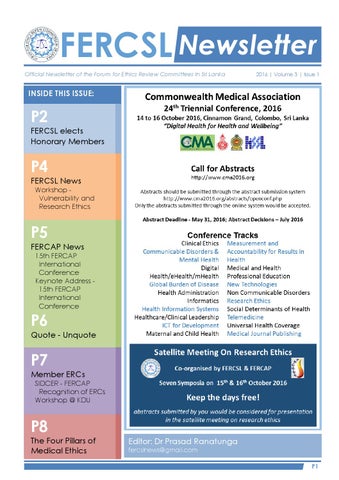
FERCSL Newsletter Official Newsletter of the Forum for Ethics Review Committees in Sri Lanka
2016 | Volume 3 | Issue 1
INSIDE THIS ISSUE:
P2 FERCSL elects Honorary Members
P4 FERCSL News Workshop Vulnerability and Research Ethics
P5
Prof. Anoja Fernando
Prof. Vajira Dissanayake
Read more: P2
FERCAP News 15th FERCAP International Conference Keynote Address 15th FERCAP International Conference
P6 Quote - Unquote
P7 Member ERCs SIDCER - FERCAP Recognition of ERCs Workshop @ KDU
P8 The Four Pillars of Medical Ethics
Editor: Dr Prasad Ranatunga fercslnews@gmail.com P1
FERCSL elects Honorary Members At the Annual General Meeting of FERCSL held on the 22nd January, 2016 the constitution was amended by the addition of a provision for election of Honorary Members in recognition of their contribution to research ethics in Sri Lanka. Dr. Malik Fernando proposed that Professor Anoja Fernando and Professor Vajira H. W. Dissanayake be so elected. The proposal was accepted with acclamation. We give below brief sketches of these two personalities and their contribution to research ethics in Sri Lanka and to the Forum in particular. Prof. Anoja Fernando MBBS (Cey), FRCP (Lond), BA (OU, UK)
establishment of the Forum as the Chair of the SLMA Ethics Review Committee based on her experience as a member of the Forum of Ethics Review Committees in Asia and the Western Pacific (FERCAP). As a result, the Forum came to be associated with the SLMA, where it remains today as an independent body, not under the Council of the SLMA. She has presided over the affairs of FERCSL since its founding till she relinquished her position following a constitution change in 2015 to devote more time to her nonmedical activities, especially her onerous duties as the President of the Girl Guides Association. We wish her well for the future. In the box below is a brief summary of her ethics-related activities.
Prof. Fernando - a past President of the Sri Lanka Medical Association (2001) - is the founder of FERCSL. She proposed the
Emeritus Professor Anoja Fernando retired in November 2010 after 29 years as the Founder Professor of Pharmacology in the University of Ruhuna. She was the Dean of the Faculty of Medicine from 1990 to 1996. She chaired the National Bioethics Committee at the National Science Foundation from 2004 -2008, and subsequently was chair of the Subcommittee on Bioethics of the National Committee on Ethics of Science and Technology at the National Science Foundation. She was a member of the Steering Committee of the Forum for Ethical Review Committees in Asia and the Western Pacific (FERCAP) from 2004 to 2009, and a resource person in several training programmes and ERC surveys conducted by FERCAP in the Asia Pacific region during the past decade. In 2012 she was elected the president of the Asian Bioethics Association. She continues as the chairperson of the Ethics Review Committee of the Sri Lanka Medical Association, to which position she was appointed in 2001. She has, for a number of years, been conducting lectures on Clinical Ethics at the Post Graduate Institute of Medicine. P2
FERCSL elects Honorary Members – continued‌ Prof. Vajira H. W. Dissanayake MBBS, PhD, FNASSL Professor Dissanayake - a past President of the Sri Lanka Medical Association (2012) - is the founder Secretary of FERCSL. He held this post at a time when he was the Secretary of the Ethics Review Committee of the Faculty of Medicine, University of Colombo. Prof. Dissanayake worked indefatigably to get FERCSL off the ground, first setting up a website, drafting the first version of the constitution and then playing a lead role in the development of guidelines for research ethics review in Sri Lanka in 2007 as well as
in the development of guidelines for research using animals in Sri Lanka in 2009. The development and production of these two documents were initiated and carried forward by the ERC, Faculty of Medicine, University of Colombo, where he was Secretary, with the active involvement of members of other ERCC, under the banner of FERCSL. We owe him a great deal for the work he did in having FERCSL established on a firm footing and being readily available with help and advice whenever needed. More information about him appears in the box.
Professor Dissanayake is a Medical Geneticist. He is the Director of the Human Genetics Unit, and Professor in Anatomy in the Department of Anatomy of the Faculty of Medicine, University of Colombo. With a keen interest in promoting ethical research he has been in the forefront of strengthening research ethics review in Sri Lanka. In 2007 he was the recipient of a six month UNESCO fellowship to the Bioethics Department of the National Institutes of Health in Maryland, USA. On his return he spread the message of the importance of clinical ethics and of the role of ethics committees in hospitals. Under his guidance the ERC of the Medical Faculty, Colombo University became the first committee in Sri Lanka to obtain SIDCER recognition in 2009. He has been a member of the steering committee of the Forum for Ethical Review Committees in Asia and the Western Pacific (FERCAP) from 2010 in which capacity he has served as a lead surveyor for FERCAP in ethics review committee surveys done in Thailand and India. He has several publications in international peer reviewed journals on various topics related to bioethics. He was the member of a committee that drew up a draft National Policy on New Genetics and Associated Reproductive Technologies appointed by the National Science and Technology Commission of Sri Lanka in 2003. Currently he serves as a member of the working committee on Biotechnology and Bioethics appointed by the National Science Foundation of Sri Lanka. He was elected a fellow of the National Academy of Sciences of Sri Lanka in 2013. He is currently the President-designate of the Commonwealth Medical Association.
Dr. Malik Fernando Member, ERC, Sri Lanka Medical Association P3
FERCSL News FERCSL Workshop
A workshop on
Vulnerability and Research Ethics Conducted by the FERCSL
Date & Time : 28th March 2016 - 8.30 am to 12.30 noon 12 noon Venue : Lionel Memorial Auditorium, SLMA, No 6, Wijerama Mawatha, Colombo 07 Time 8.30 9.00
Title Registration Overview of vulnerability and Ethics 9.30 Research involving those who lack mental capacity to consent 10.15 Ethics in Research involving Children 11.00 Brunch 11.30 Ethics in Research involving Women
Resource Person Professor Chandanie Wanigatunge Chairperson, FERCSL Dr. Jayan Mendis, Consultant Psychiatrist NIMH Professor Shalini Sri Ranganathan Professor in Pharmacology, Faculty of Medicine, University of Colombo Professor Maithree Wickramasinghe Professor in English, Department of English, University of Kelaniya
12.15 Discussion
Registration: Limited to 100 participants. Prior registration by paying a registration fee of Rs 1000 is mandatory. The registration fee can be paid to Ms Jayarani Tennakoone at SLMA Office
Registration will close at 4pm on 18th March 2016.
Write to us! Tell FERCSL your training needs! FERCSL can organise a workshop to help your ERC.
Email: fercsl2014@gmail.com P4
FERCAP News 15th FERCAP International Conference
Keynote Address - 15th FERCAP International Conference Developing Good Governance Systems to Promote Ethics in Clinical Research Declaration of Helsinki (Ethical Principles for Medical Research Involving Human Subjects) requires that “medical research involving human subjects must be conducted only by individuals with the appropriate ethics and scientific education, training and qualifications”, and that “research on patients or healthy volunteers requires the supervision of a competent and appropriately qualified physician or other health care professional”. This indicates that the Principal Investigator (PI) owes all responsibility about clinical research. The responsibility of PI’s are also clarified in ICH-GCP, which is the SOP of the Declaration of Helsinki. Research Ethics Committee (RES) reviews and approves the individual research protocol submitted by the PI’s; RES has the responsibility to the protocol, but can neither observe nor review the total process of the clinical research. In contrast, the section of “Obligations of the Chief Executive of Research Implementing Entity”, Japanese GCP and the Ethical Guidelines for Medical and Health Research Involving Human Subjects in Japan (Ethical Guideline) request the chief executive of research implementing entity to exercise necessary supervision over the research he/she approved for implementing, in order that it shall be P5
Keynote Address (continued…) carried out appropriately, and shall take ultimate. This means, in Japan, that research institutes such as university hospitals are requested to govern clinical research which are performed in their institutes. It is not clear why the Japanese Government decided this system which differs from the requirement of the Declaration of Helsinki or ICH-GCP. Recently, misconducts in clinical research becomes a serious problem not only in Japan but also in other countries. The governance in research institute as well as in clinical research comes to be more important, and the better system to govern clinical research is required. In Japan, the system of Clinical Research Core Hospital has started since April 2015. Clinical Research Core Hospitals are expected to be an Academic Research Organization (ARO), and contribute to promote clinical research in Japan. Clinical Research Core Hospital is requested to set two committees. One is the Governance Committee of Clinical Research, and the other is the Audit Committee or Board of Corporate Auditors of Clinical Research. This system has just started, and it is under the trial whether the system shall work to keep the good governance of clinical research as expected. It would be our pleasure if this Japanese system gives some idea to develop the governance system of clinical research in other countries.
Hideo Kusuoka, M.D., Ph.D. Director General Osaka National Hospital Quote “Ethics is knowing the difference between what you have a right to do and what is right to do Potter Stewart Associate Justice of the United States Supreme Court October 14, 1958 – July 3, 1981
“People ask, 'Is the science going to run ahead of the ethics?' I don't think that's always the problem. I think it's that the science runs ahead of the politics. Bioethics can alert people to something coming down the road, but it doesn't mean policy and politicians are going to pay attention. They tend to respond when there's an immediate crisis. The job of the ethicist, in some ways, is to warn or be prophetic. You can yell loudly, but you can't necessarily get everybody to leave the cinema, so to speak. Arthur L(eonard) Caplan Interview by Karen Pallarito in The Scientist (Jan 2008), supplement, 74.
Unquote P6
Member ERCs SIDCER - FERCAP Recognition of ERCs The recognition plaques were awarded at the 15th FERCAP Annual Conference in Nagasaki, Japan in November 2015.
ERC of Faculty of Medicine of University of Kelaniya received SIDCER recognition by FERCAP.
The ERC of Faculty of Medical Sciences of University of Sri Jayawardenepura was re-recognised under the SIDCER programme.
Workshop on Evaluation of Research Proposals by ERCs
Successfully held on 16th February 2016 at Staff Development Centre, Faculty of Medicine, KDU. Organised by the ERC, Faculty of Medicine, General Sir John Kotelawala Defence University & FERCSL. P7
The Four Pillars of Medical Ethics
Write to us! Thank you for taking your time to read this issue of the newsletter. Your comments about the current issue, and ideas for the next issue are what will keep FERCSL Newsletter an interesting and lively one!! Tell us Events and Activities of your ERC that you would like to share with other ERCs and their members.
We also welcome contributions from all our members. - Editor, FERCSL fercslnews@gmail.com P8