FERCSL Newsletter Official Newsletter of the Forum for Ethics Review Committees in Sri Lanka
2015 | Volume 2 | Issue 1
INSIDE THIS ISSUE:
P2 Message from the Chairperson, FERCSL
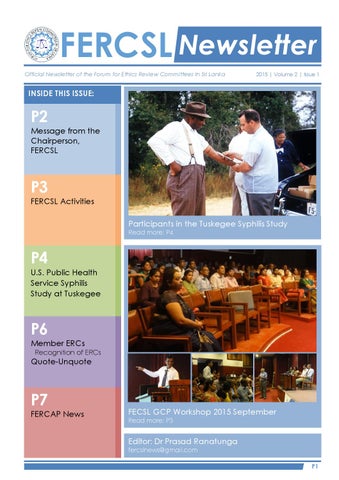
P3 FERCSL Activities Participants in the Tuskegee Syphilis Study Read more: P4
P4 U.S. Public Health Service Syphilis Study at Tuskegee
P6 Member ERCs Recognition of ERCs
Quote-Unquote
P7 FERCAP News
FECSL GCP Workshop 2015 September Read more: P3
Editor: Dr Prasad Ranatunga fercslnews@gmail.com P1
Message from the Chairperson, FERCSL Dear Members of FERCSL, I am greatly honoured and privileged to have been elected Chair of the Forum for Ethics Review Committees in Sri Lanka (FERCSL). I would like to take this opportunity to thank Emeritus Professor Anoja Fernando, the first Chairperson of FERCSL for the yeomen services rendered by her to the development of ethics review processes in Sri Lanka and the pioneering work done by her to make FERCSL what it is today. I am humbled at the thought of following her footsteps but would like to assure you that I shall discharge my duties to the best of my ability in order to make our mission a success. The objectives of FERCSL are aimed at fostering improved understanding and implementation of ethics review of biomedical research in the country. To this end FERCSL organizes workshops and training sessions for both ERC members and researchers to improve the ethical aspects of biomedical research conducted in Sri Lanka. FERCSL also promotes and supports ERCs to apply for recognition under the SIDCER/FERCAP programme. FERCSL activities have been reorganized under the new management committee and I hope the member ERCs will join to make the activities of FERCSL a resounding success.
Prof. Chandanie Wanigatunge Chairperson FERCSL
P2
FERCSL Activities:
Past Events
An International Course on Surveying and Evaluating Ethical Review Practices Organised by FERCSL in collaboration with FERCAP Dates:
1st March 2015
Time:
9.30am - 5.00pm
Venue:
Faculty of Medical Sciences, University of Sri Jayewardenepura
This was attended by surveyors and trainees of the SIDECR/FERCAP surveys.
Workshop on Issues related to Ethical Review of Protocols Dates:
24th July 2015
Time:
8.00am - 4.00pm
Venue:
SLMA Auditorium
This workshop was well attended.
GCP Workshop on Clinical Trials Dates:
8th and 9th October 2015
Time:
8.30am - 3.30pm
Venue:
SLMA Auditorium
This workshop concluded successfully with all the limited number of seats booked well in advance of the deadline.
Write to us! Tell FERCSL your training needs! FERCSL can organise a workshop to help your ERC.
Email: fercsl2014@gmail.com P3
Cover Story
U.S. Public Health Service Syphilis Study at Tuskegee Where the Study Took Place? The study took place in Macon County, Alabama, the county seat of Tuskegee referred to as the "Black Belt" because of its rich soil and vast number of black sharecroppers who were the economic backbone of the region. The research itself took place on the campus of Tuskegee Institute. What it was designed to Find Out? The intent of the study was to record the natural history of syphilis in Blacks. The study was called the "Tuskegee Study of Untreated Syphilis in the Negro Male." When the study was initiated there were no proven treatments for the disease. Researchers told the men participating in the study that they were to be treated for "bad blood." This term was used locally by people to describe a host of diagnosable ailments including but not limited to anaemia, fatigue, and syphilis.
The Tuskegee Study Group Letter inviting subjects to receive "special treatment", which was actually a diagnostic lumbar puncture
What the Men received in exchange for Participation? The men were offered what most Negroes could only dream of in terms of medical care and survivors insurance. They were enticed and enrolled in the study with incentives including: medical exams, rides to and from the clinics, meals on examination days,
ŠEditor FERCSL Newsletter 2015Vol 01-01
Who were the Participants? A total of 600 men were enrolled in the study. Of this group 399, who had syphilis were a part of the experimental group and 201 were control subjects. Most of the men were poor and illiterate sharecroppers from the county.
P4
Cover Story – continued… free treatment for minor ailments and guarantees that provisions would be made after their deaths in terms of burial stipends paid to their survivors. Treatment Withheld There were no proven treatments for syphilis when the study began. When penicillin became the standard treatment for the disease in 1947 the medicine was withheld as a part of the treatment for both the experimental group and control group. How/ Why the Study Ended? On July 25, 1972 Jean Heller of the Associated Press broke the story that appeared simultaneously both in New York and Washington, that there had been a 40year nontherapeutic experiment called "a study" on the effects of untreated syphilis on Black men in the rural south. Between the start of the study in 1932 and 1947, the date when penicillin was determined as a cure for the disease, dozens of men had died and their wives, children and untold number of others had been infected. This set into motion international public outcry and a series of actions initiated by U.S. federal agencies. The Assistant Secretary for Health and Scientific Affairs appointed an Advisory Panel to review the study. While the panel concluded that the men participated in the study freely, agreeing to the examinations and treatments, there was evidence that scientific research protocol routinely applied to human subjects was either ignored or deeply flawed to ensure the safety and wellbeing of the men involved. Specifically, the men were never told about or offered the research procedure called informed consent. Researchers had not informed the men of the actual name of the study, i.e. "Tuskegee Study of Untreated Syphilis in the Negro Male," its purpose, and potential consequences of the treatment or non-treatment that they would receive during the study. The men never knew of the debilitating and life threatening consequences of the treatments they were to receive, the impact on their wives, girlfriends, and children they may have conceived once involved in the Memorandum to the Director of research. The panel also concluded that there were no the Centers for Disease Control choices given to the participants to quit the study when Terminating the Tuskegee Syphilis Study penicillin became available as a treatment and cure for syphilis. Reviewing the results of the research the panel concluded that the study was "ethically unjustified." The panel articulated all of the above findings in October of 1972 and then one month later the Assistant Secretary for Health and Scientific Affairs officially declared the end of the Tuskegee Study. (© Tuskagee University, National Center for Bioethics in Research and Health Care http://www.tuskegee.edu/about_us/centers_of_excellence/bioethics_center/about_the _usphs_syphilis_study.aspx) Cover Photo: Photograph of Participants in the Tuskegee Syphilis Study Source: The National Archives Catalogue https://arcweb.archives.gov/id/956130?q=tuskegee%20study
P5
Member ERCs
Recognition of ERCs Two Sri Lankan Ethics Review Committees have received recognition as having reached Strategic Initiative for Development of Capacity in Ethics Review (SIDCER) of the World Health Organisation (WHO) standards. ERC of Faculty of Medicine of University of Kelaniya was cleared for SIDCER recognition by FERCAP and the ERC of Faculty of Medical Sciences of University of Sri Jayawardenepura was cleared for rerecognition and that the recognition plaques will be awarded at the 15th FERCAP Annual Conference in Nagasaki, Japan in November 2015.
Quote “Adhering to GCP is one thing, but proving that this has been done is another. For a trial to be credible in the eyes of the authorities, investigators must be able to show that the study is in compliance with GCP guidelines. This means documenting every study-related action” Prof. David R Hutchinson 12 Golden GCP Rules for Investigators, Canary Publications, London
“Get out of the way. A truly ethical bioethics should not bog down research in red tape, moratoria, or threats of prosecution based on nebulous but sweeping principles such as “dignity,” “sacredness,” or “social justice.”” Prof. Steven Arthur Pinker The Moral Imperative for Bioethics, The Boston Globe
Unquote P6
FERCAP News
Conference Schedule November 22, 2015 Pre-Conference Training: Risk/ Benefit Assessment in Protocol Review FERCAP Steering Committee Meeting November 23-24 Conference Proper November 24 – FERCAP Recognition Program
Write to us! Thank you for taking your time to read the issue of the newsletter, your comments about the current issue, and ideas for the next issue are what will keep FERCSL Newsletter an interesting and lively one!! Tell us Events and Activities of your ERC that you would like to share with other ERCs and their members.
We also welcome contributions from all our members. - Editor, FERCSL fercslnews@gmail.com
P7