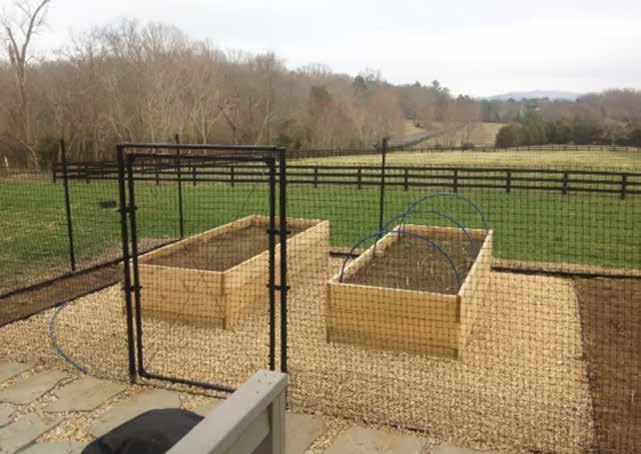
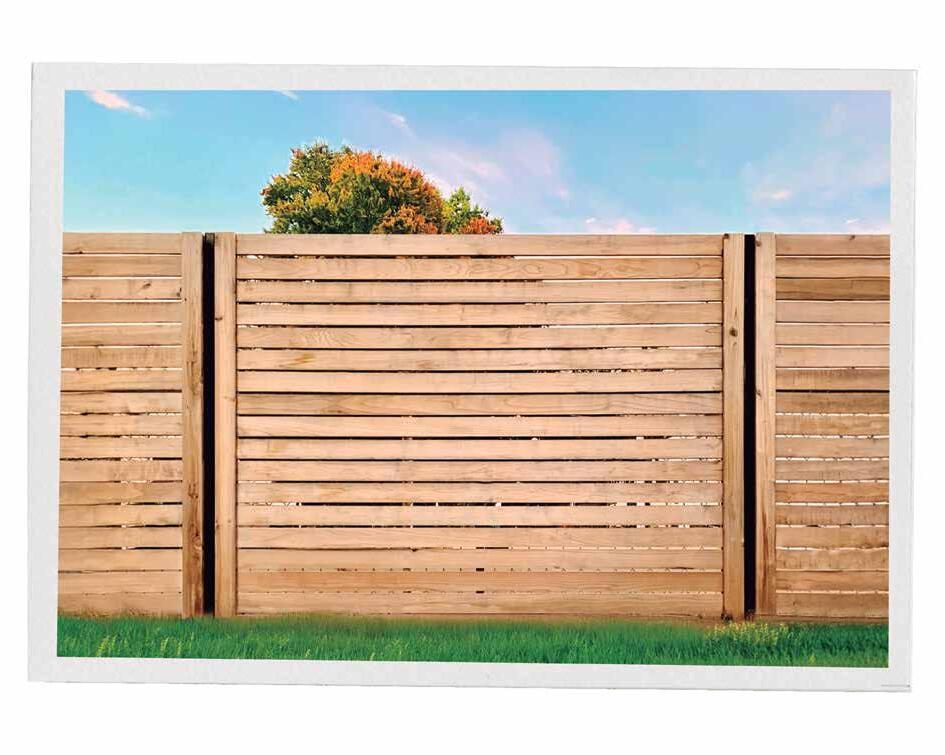
Why Are You Still Dealing with Callbacks on Good Installs?
A practical look at material performance, job control, and what more contractors are changing
If you’ve been in fencing for a while, you already know how this goes.
You wrap up a job. Everything looks solid. Then a few weeks or months later, the phone rings. A board shifted. A gate isn’t lining up. Something needs to be fixed.
Most crews don’t question it. You put it on the schedule, send someone out and handle it. Then you move on. But it’s worth asking, “Why does this keep happening?”
Callbacks rarely show up clearly in your numbers. There’s no neat line item for them. Still, you feel the impact. A crew leaves a paying job to fix an old one. Your schedule tightens.You lose hours you could have billed.
One callback isn’t a big deal. The problem is when it keeps happening. Over a season, it limits how many jobs you can take. It also chips away at your confidence when you finish a project.
At some point, you have to look at what’s causing it. A lot of the time, it’s not your install. It’s the material.
Most crews know what treated pine does. You’ve seen it again and again. It moves, twists, cracks. Weather pushes it around. You can do everything right and still end up back on site fixing it.
That puts you on the hook for something you can’t fully control.
Some contractors are starting to deal with this differently. They’re not changing how they build. They’re changing what they build with.
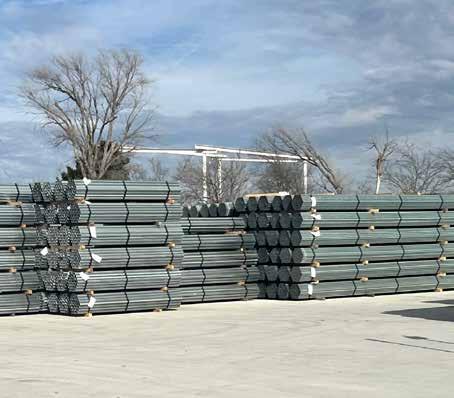
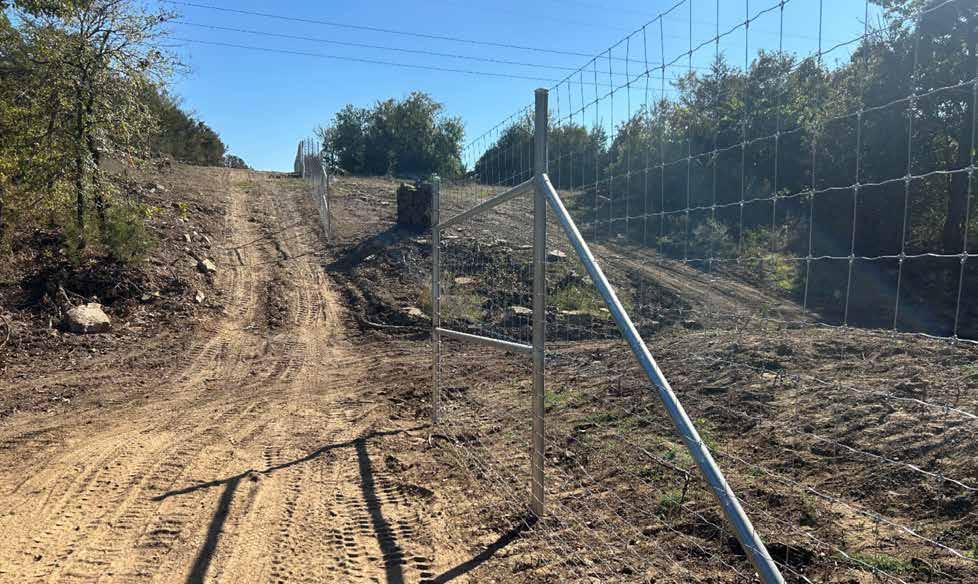
One company out of Hurricane, West Virginia, Ballard Fencing, made that shift about two years ago. It’s a third-generation family business that’s been building fences since 1959.
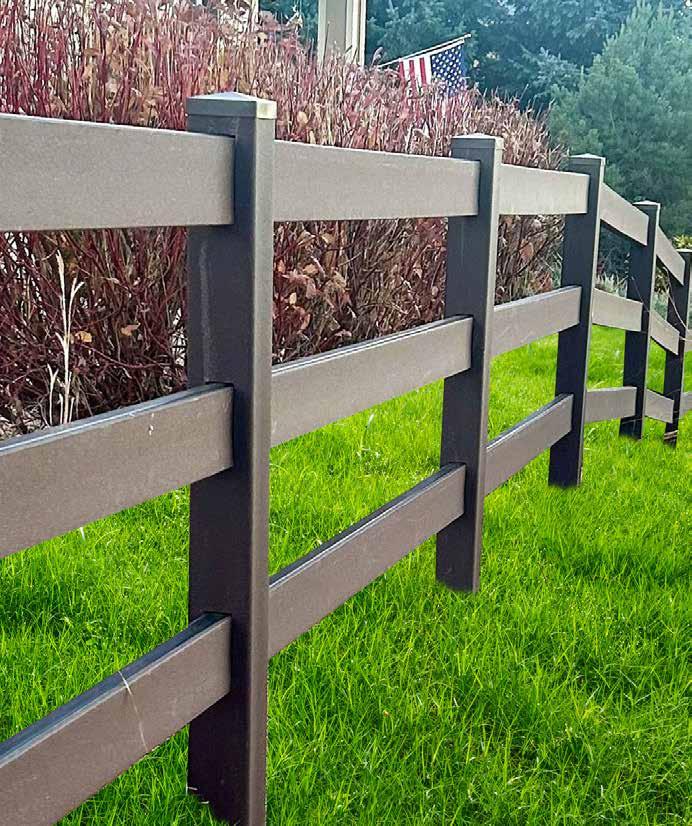
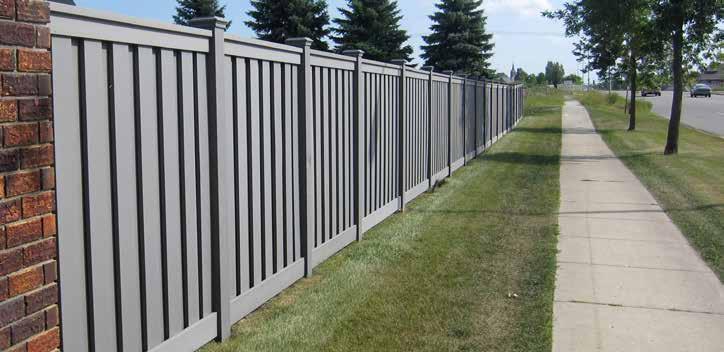
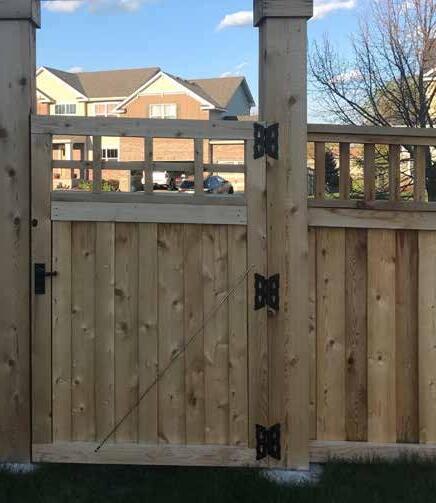
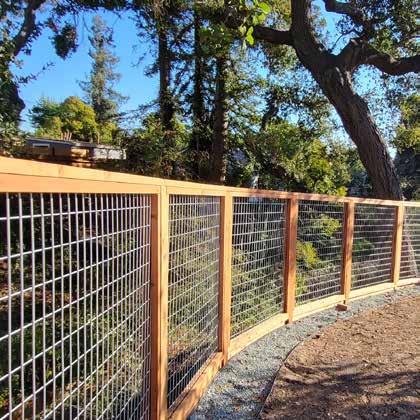
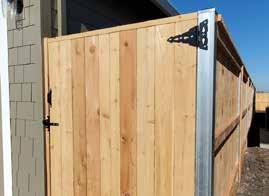
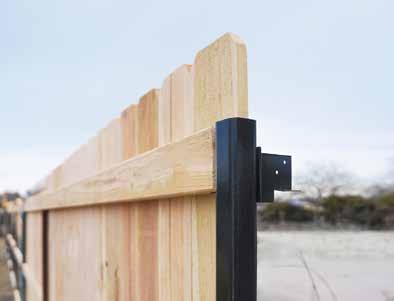
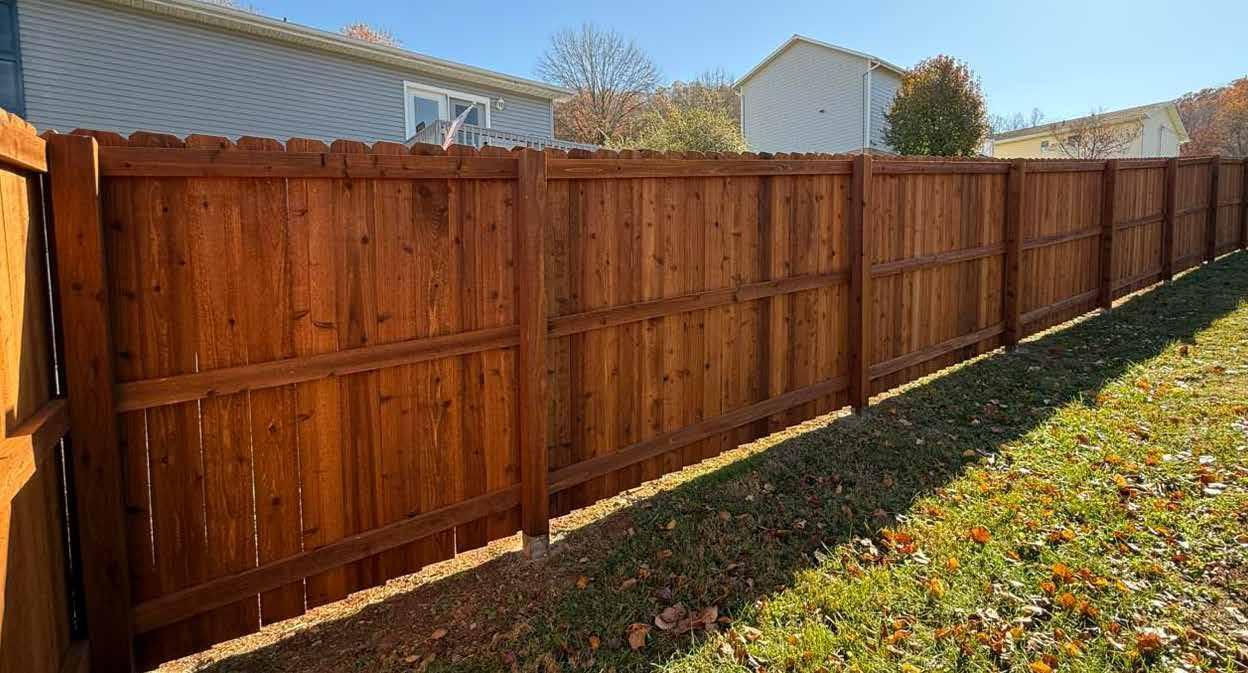
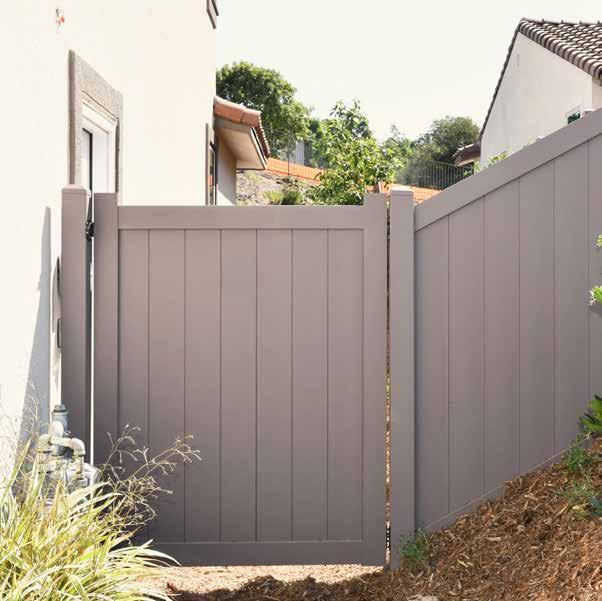
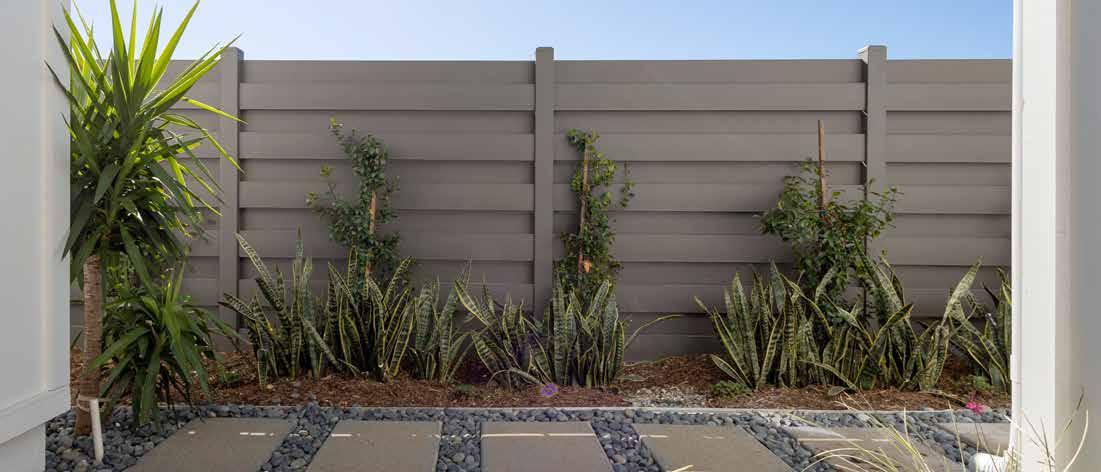
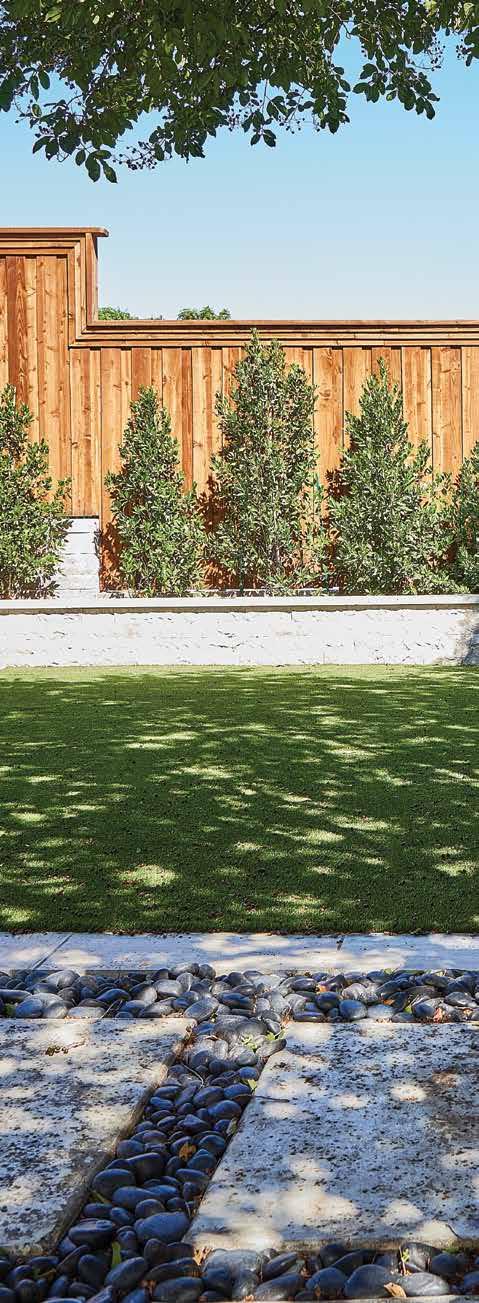
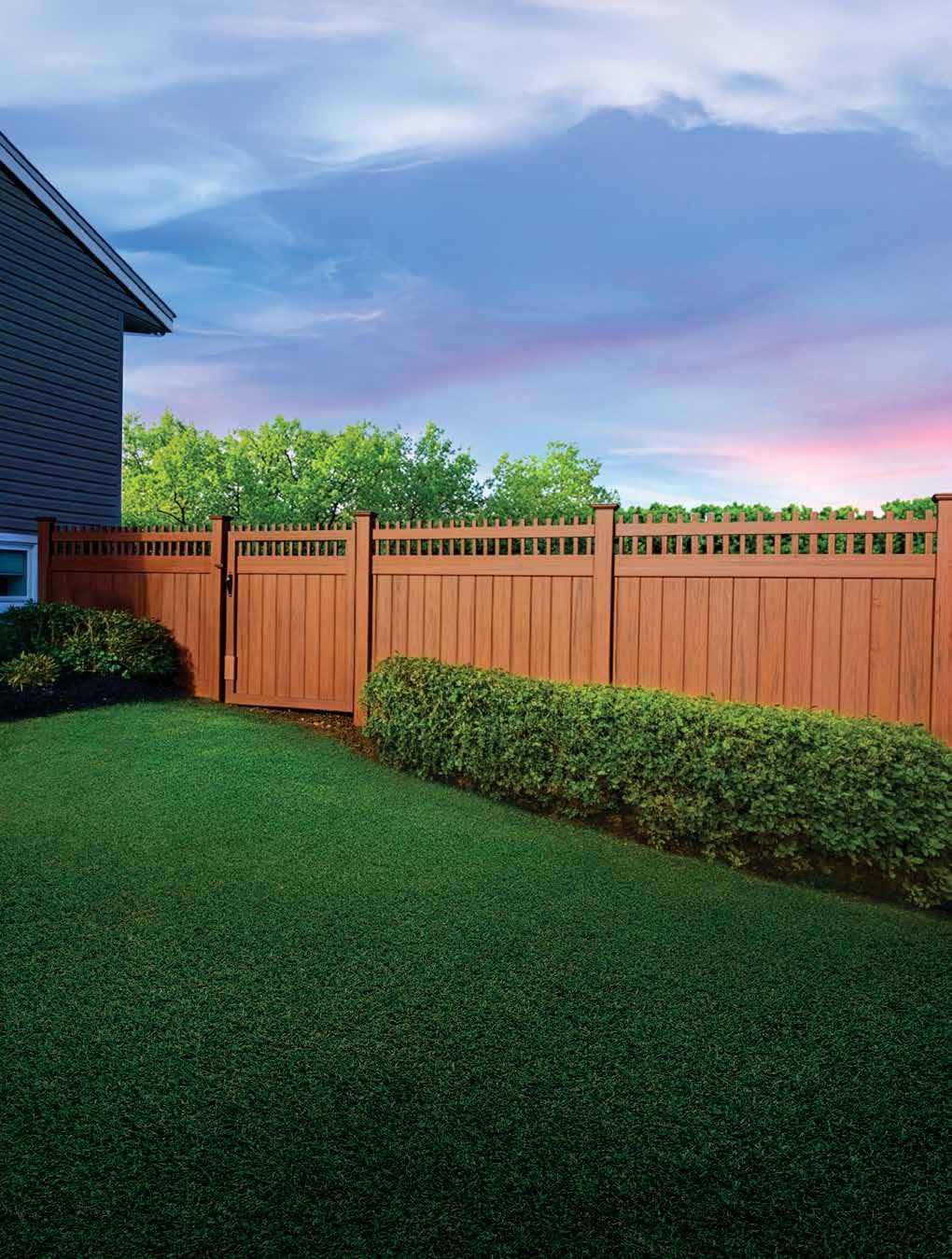
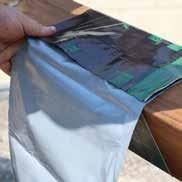
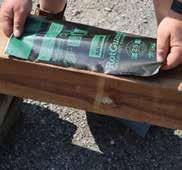
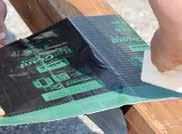
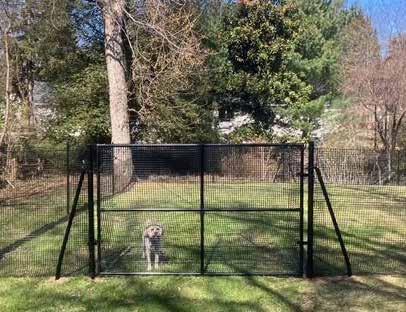
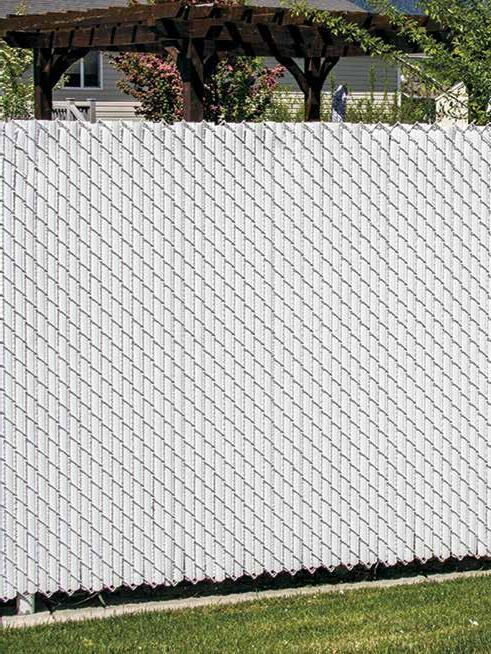
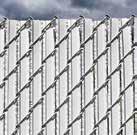
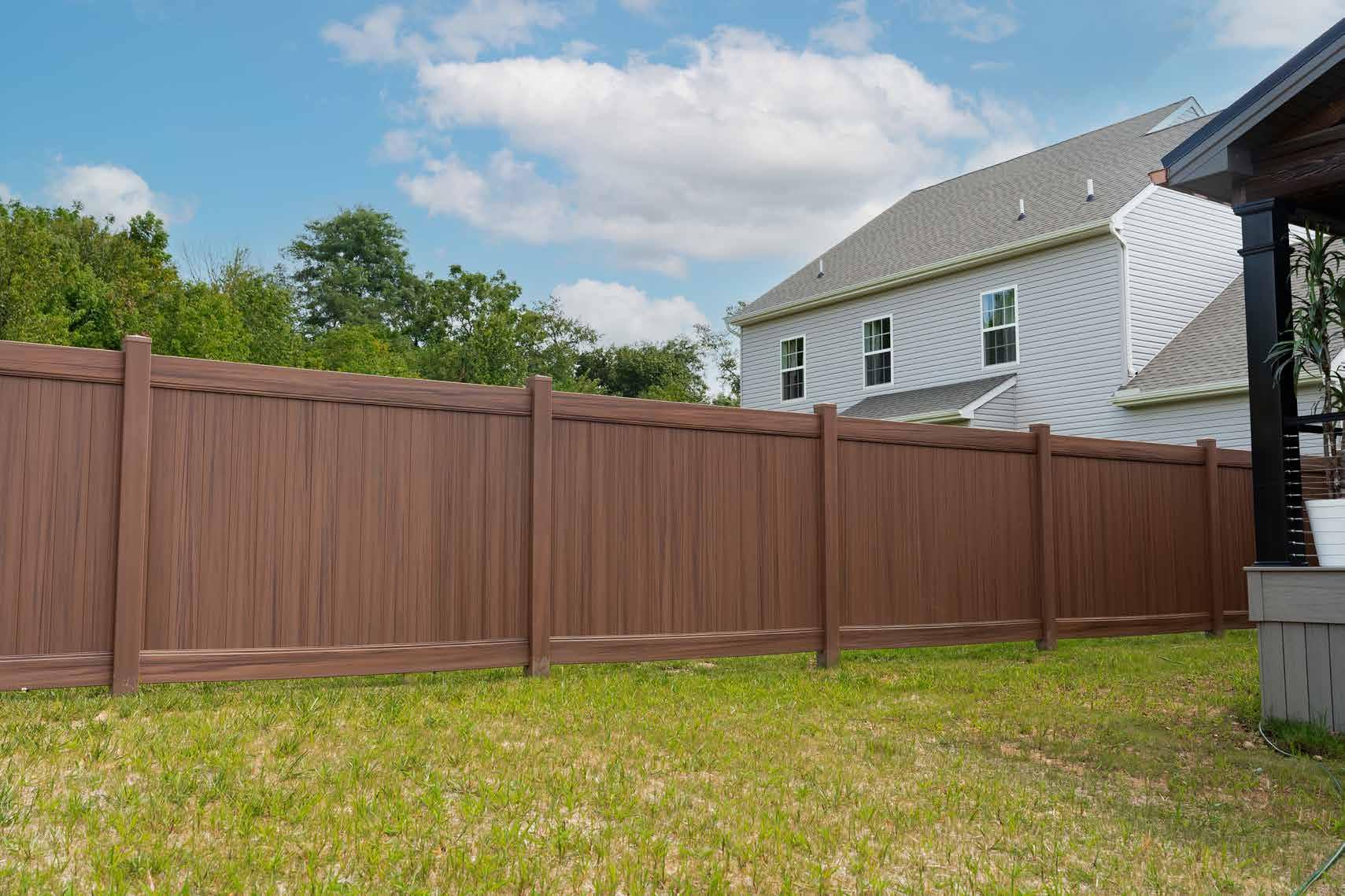
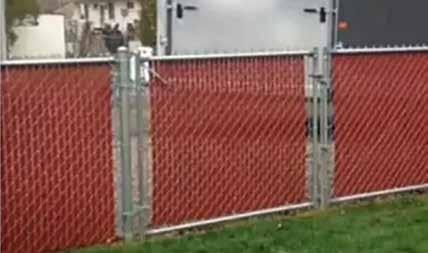
They previously installed a lot of pine and dealt with the same issues most crews deal with. Then they switched to the Gopher Wood™ pre-finished cedar fence system.
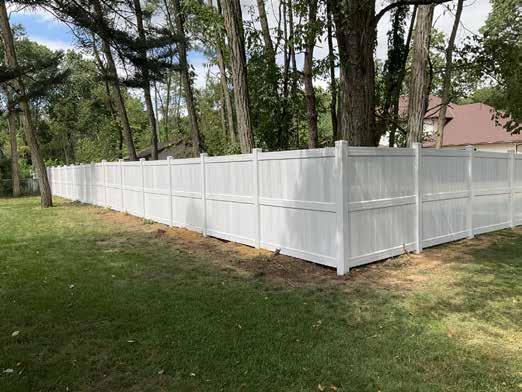
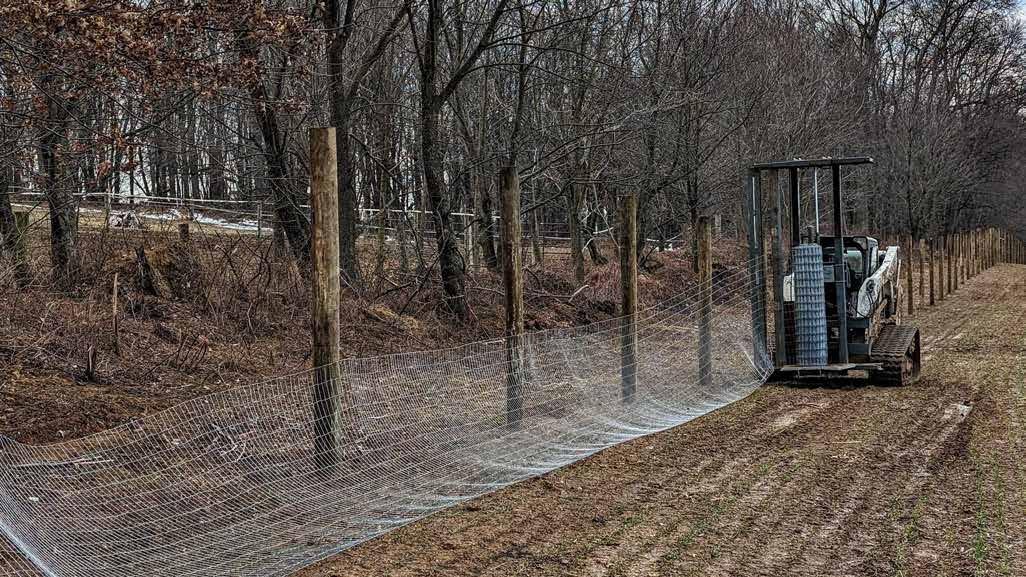
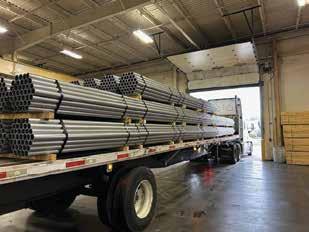
Now, having installed around 45,000 feet of Gopher Wood fence, they report zero callbacks tied to warping, twisting, or movement in the wood. No boards coming back. No gates failing because something shifted.
Because of that, they now offer a one-year warranty on their wood installs. Not as a sales tactic. They trust what they’re putting in the ground. That kind of consistency changes how you run your business.
You don’t have to leave room in your schedule for fixes. Your crews stay focused on new work. You spend less time chasing problems after the job is done.
It also changes how customers respond to you.
When you can clearly explain what they’re getting and what to expect, the conversation gets easier. You’re not warning them about future issues or maintenance. You’re giving them a straight answer. Not to mention, you are eliminating an entire second project for them. For a homeowner, finding a staining contractor, scheduling their services, and trusting another company with their brand new investment is something that might seem daunting. And you just took it off their plate. That helps you close jobs faster.
This doesn’t mean pine has no place. It still works in the right situations, especially if it's stained soon after install with a conditioning stain and sealer.
But if most of your callbacks tie back to how the material behaves after install, then material choice affects more than cost. It affects your time, your schedule, and how people see your work.
Access to pre-finished systems has changed too. It required you to buy in large volumes to make it work. That kept a lot of contractors from trying it. Now fence yards can bring in full truckloads and supply their area. You can also buy by the job and test it without sitting on extra inventory.
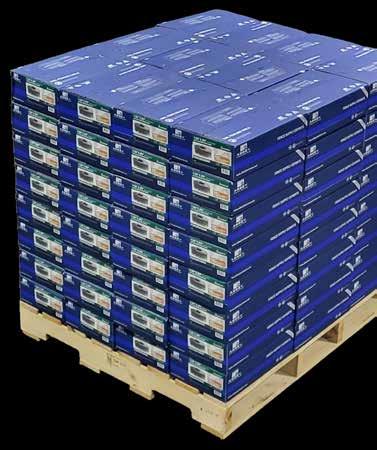
New this season is the opportunity to purchase a job lot allowing you to try it and see how it fits your business.
Being a contractor means you take great pride in your work and getting the job right without callbacks.
Using a factory finished product like Gopher Wood, changes how much of the final result you control which translates into higher margins and happier customers.
If you remove a key repetitive callback, your dayto-day work looks different. You become more efficient and customer success rates improve. This impacts your business reputation and significantly impacts the bottom line.
Find what is behind issues that keep appearing in your business. Small repeatable problems may not seem like much as an isolated incident, but over time they can translate into lost profits.
With Gopher Wood, you can eliminate several of these common repeatable issues.
Learn more at gopherwood.us.
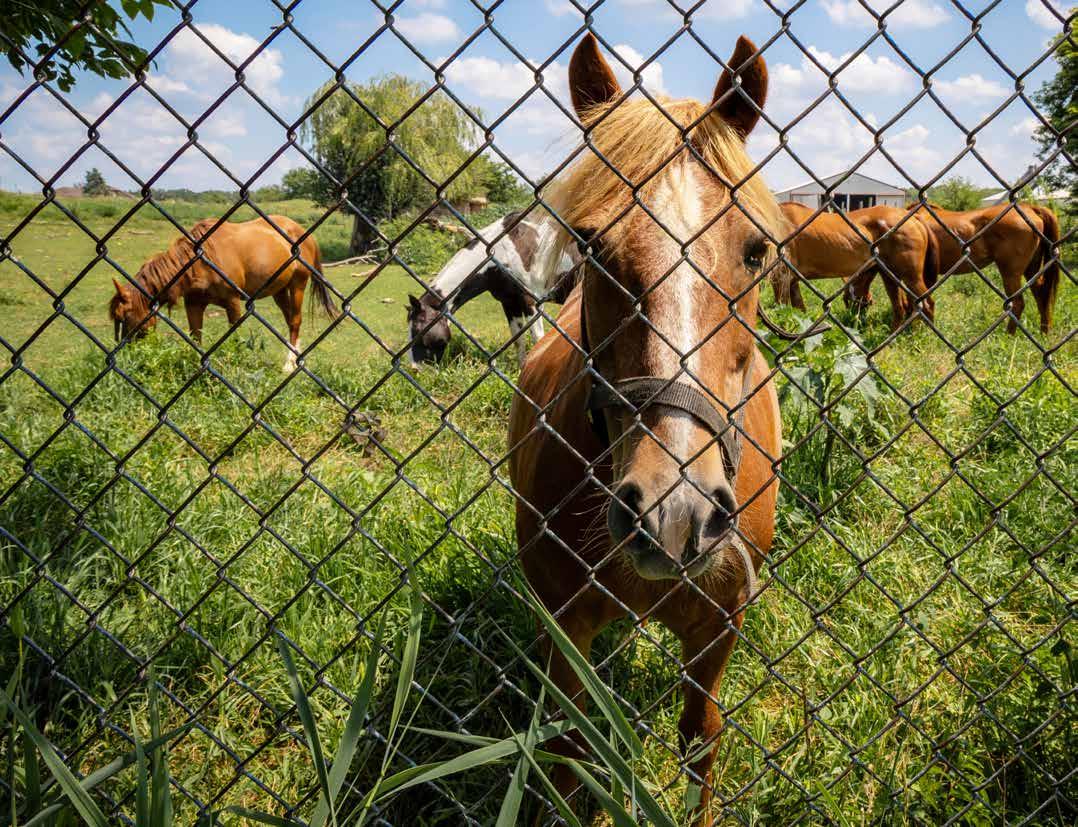
Photo Credit Ballard Fence Company.
Oil-Based Stain Is Evolving.
The Fence Industry Should Pay Attention.
EXPERT™ Professional Wood Care Achieves GreenWise® Certification
For years, oil-based stain has been the standard in the fencing industry, and for good reason. It performs where it matters. It penetrates into the wood, moves with it through seasonal expansion and contraction, and holds up against sun, rain, and long-term exposure. When the job needed to last, oil was the default. That hasn’t really been up for debate.
That performance, however, has always come with trade-offs. Strong odor during application, higher levels of volatile organic compounds (VOCs), and more questions from homeowners, HOAs, and regulators have all been part of the equation. For a long time, those drawbacks were simply accepted. It was the cost of durability.
What’s starting to shift now is the assumption behind that trade-off—and it’s a meaningful shift. Many contractors still think in simple terms: if an oil-based stain performs well, it must carry higher VOC levels. If VOCs are reduced, something in the performance has to ‘give’. That thinking has been around for a long time. It just doesn’t reflect what’s possible anymore.
VOCs, or volatile organic compounds, are the portion of a coating that evaporates into the air during
application and curing. Traditional oil-based systems relied heavily on these solvents to drive penetration and durability. That approach made sense years ago. Today, it’s outdated.
Regulatory bodies like the Environmental Pro tection Agency establish maximum VOC limits by product category, but those limits were never meant to define performance. They set ceilings for emissions, not a benchmark for how well a product should hold up on a fence. Many legacy oil-based systems were formulated close to those allowable limits. That was acceptable at the time. It’s not where the industry is heading.
complaints, homeowners are more comfortable, and jobs tend to move forward with fewer interruptions. It’s a small shift operationally, but it adds up fast over a season.
Advances in coating chemistry have changed the equation. Modern oil-based formulations can still achieve deep penetration and long-term durability without relying on the same VOC levels that were once considered necessary. The trade-off that contractors have worked around for years is starting to disappear.
And this isn’t theoretical; it shows up on the job.
Lower VOC oil-based stains create a noticeably different experience during application. The smell isn’t as aggressive. In tighter residential areas, that matters quickly. Crews spend less time managing
It’s also changing how products are selected. Contractors are asking better questions. Homeowners are more aware of what’s being used on their property. Suppliers and dealers are feeling that pressure and adjusting what they carry.
This is where third-party certification becomes important. “Low VOC” gets used broadly across the industry, and it doesn’t always mean the same thing. Without a defined standard, the term loses weight. Independent programs like GreenWise® Certification set specific VOC thresholds and require verification through testing. That creates clarity. It also removes a lot of guesswork for contractors and suppliers trying to make informed decisions.
HGTV Photo Credit-HGTV’s Rock the Block. EXPERT™Professional Wood Care Stain & Seal in Semi-Transparent Pecan
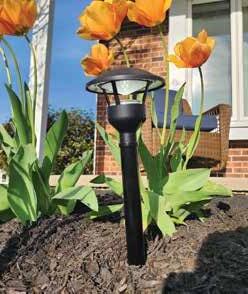
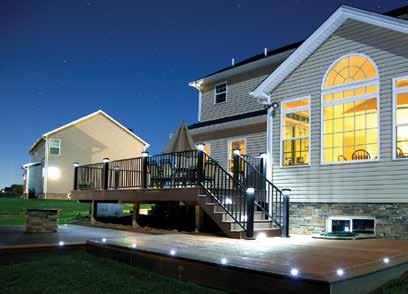
Soft Light Glow Illuminates Visitors
Within that context, recent developments in oilbased stain technology are worth paying attention to. EXPERT™ Professional Wood Care is the first exterior oil based wood stain that has achieved GreenWise® Certification, meeting the program’s ≤100 g/L VOC requirement for this category. Reaching that threshold while maintaining a true oil-based system isn’t easy, and it reflects a different approach to formulation than what has historically been used.
More importantly, it changes the decision contractors have to make. Performance and lower emissions are no longer opposing priorities. You don’t have to choose one over the other.
That’s consistent with what’s being seen in the field. Contractors who have moved to newer lowVOC oil systems aren’t talking about it in technical terms. They’re talking about fewer complaints,
smoother jobs, and finishes that hold up the way they expect. The expectation hasn’t changed. The product still has to perform. This performance is non-negotiable.
Looking ahead, the direction is fairly clear. Homeowners are asking more detailed questions. HOAs are tightening guidelines. States are continuing to adopt stricter VOC regulations and that pressure isn’t going away.
Contractors and suppliers who stay ahead of it will feel the difference. Less time explaining odor and safety concerns. Fewer objections during estimates. An easier path into higher-end projects where product selection plays a role in the decision.
Oil-based stains aren't going anywhere. But it isn’t the same product it was 10 or 15 years ago either.
Trex Named Among “America’s Climate Leaders" by USA Today
Sustainability Pioneer Recognized as the Only Decking Brand on Prestigious National List
The performance that made it the standard—penetration, durability, long-term protection—still holds. What’s changed is how that performance is achieved. Lower VOC oil-based systems are no longer a compromise. They’re where the category is going next.
Learn more at expertwoodcare.com.
EXPERT Stain & Seal products that display the GREENWISE® mark are tested and certified by Coatings Research Group, Incorporated. These products meet or exceed performance and environmental standards established for various specific product types by CRGI’s facility. Visit greenwisepaint.com to view product standards.
Trex Company, the world’s #1 brand of premium, sustainable, wood-alternative decking and railing and a leader in high-performance, low-maintenance outdoor living products, has been recognized as one of “America’s Climate Leaders 2026.” In a list published yesterday by USA Today, Trex was named among 500 U.S. companies making measurable progress in reducing their carbon footprint and taking meaningful climate action.
To compile this year’s ranking, USA Today’s research partner, Statista, evaluated approximately 2,000 companies across industries with revenues exceeding $50 million and publicly available, verifiable emissions data. The list includes those organizations that achieved the greatest reduction in core emissions intensity between 2022 and 2024, specifically Scope 1 and 2 greenhouse gas emissions relative to revenue.
“We are proud to be recognized as one of America’s Climate Leaders, which reflects the measurable progress we’ve made in reducing our operational footprint while continuing to grow our business,” says Amy Fernandez, senior vice president, chief legal officer, secretary and chief sustainability officer at Trex Company. “As Trex celebrates 30 years of innovation this year, this honor is especially meaningful as it underscores a legacy of sustainability that has been core to our business since day one.”
The USA Today recognition is the latest milestone in Trex’s three-decade sustainability journey. Since its founding, the company has been a pioneer in eco-friendly manufacturing, transforming reclaimed wood and recycled plastic film into high-performance outdoor products. The company uses more recycled and reclaimed material than any other decking brand and is one of the largest recyclers of polyethylene film in North America.
“At Trex, sustainability is not a standalone initiative; it’s embedded in how we innovate, manufacture and deliver products that help create more sustainable outdoor living spaces,” Fernandez adds. “From sourcing recycled materials to advancing manufacturing efficiencies, we remain focused on driving solutions that benefit our customers, our communities and the planet.”
Formed in 1996, Trex has built its brand on innovation and environmental responsibility, transforming recycled wood and plastic film into durable, eco-friendly decking solutions. Today, the company offers a comprehensive portfolio of outdoor living products distributed through thousands of retail locations worldwide.
Learn more at trex.com.
Fencing Equipment, Tools & Software
As jobsite demands grow and timelines tighten, contractors are relying on smarter, more specialized solutions to improve accuracy, reduce labor strain and streamline operations. From post drivers and layout tools to estimating platforms and project management systems, new innovations are helping fence professionals work faster, bid more competitively, and deliver consistent results. In this special section, we take a closer look at the equipment and technology shaping the industry.
Titan PHD6400 Post Driver Delivers Heavy-Duty Performance Across Industries EQUIPMENT
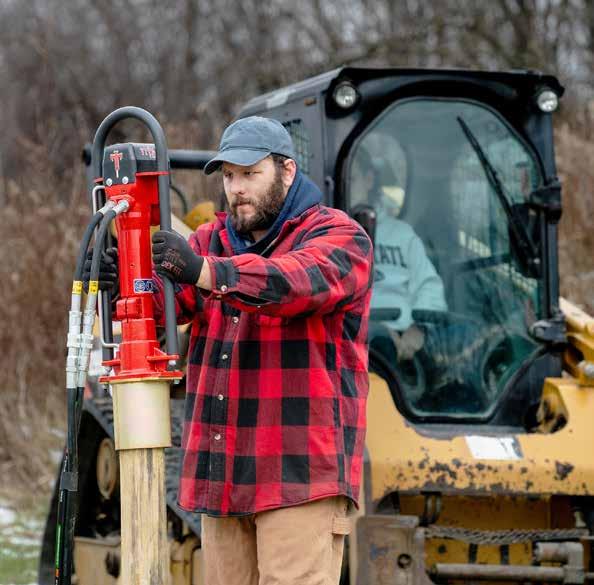
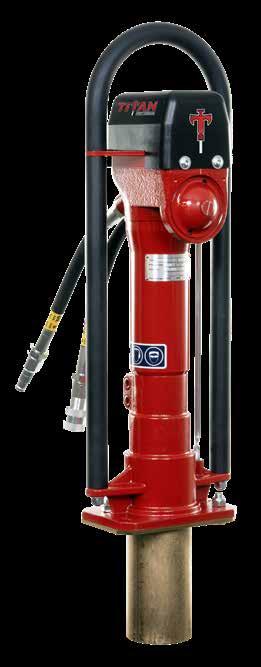
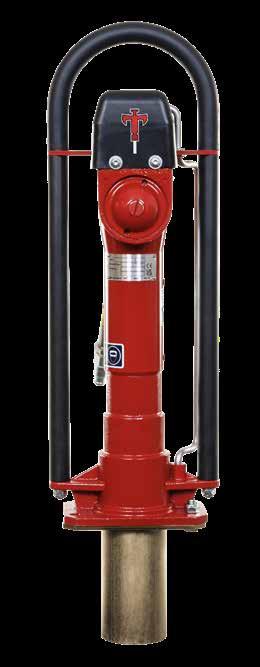
For contractors and crews who drive posts day in and day out, equipment reliability is not a luxury – it’s a necessity. The Titan PHD6400 hydraulic post driver was engineered to meet that demand, offering powerful, maintenance-free operation in a straightforward package built to handle the toughest jobsite conditions.
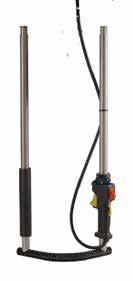
The PHD6400 is a heavy-duty hydraulic post driver designed for professionals working in fencing, road signage, forestry, vineyard installation, crash barrier construction, steel profile driving, anchoring and tent stake installation. Its hydraulic design eliminates the maintenance demands associated with gas-powered alternatives, giving operators smooth, consistent driving force without the downtime.
SIMPLE OPERATION, VERSATILE COMPATIBILITY
Operation is designed to be intuitive. At ground level, the operator sets the driver on the post and engages the trigger. When working at greater heights, the PHD6400 can be placed on the post and activated using a remote valve. Either way, the unit delivers fast, consistent results with minimal operator effort.
One of the PHD6400’s key advantages is its compatibility with a wide range of hydraulic power sources. The driver connects directly to Titan’s own PHP1400 Hydraulic Power Pack or to hydraulic-equipped heavy equipment, including excavators, tractors, loaders and trucks. An oil flow divider allows the unit to operate from virtually any hydraulic source, making it a practical addition to equipment fleets of all sizes.
BUILT FOR ANY CONDITIONS
The PHD6400 is engineered to perform in any weather without compromise. Whether crews are working in extreme heat, cold, rain or dust, the driver’s hydraulic system delivers the same reliable output. That consistency is critical for operations that cannot afford weather-related delays.
“Our PHD6400 hydraulic driver delivers serious power where it counts. Built for extreme reliability and low maintenance, customers value the versatility of running it from our power pack or directly from their skid steer,” says Jamison Speicher of Titan Post Drivers.
Because hydraulic operation requires no engine maintenance, spark plugs or fuel mixing, the PHD6400 reduces long-term operating costs while keeping crews productive. For contractors managing multiple jobsites or large-scale installations, that translates to less downtime and more posts driven per day.
The Titan PHD6400 is available through Titan Post Drivers.
Learn more at titanpostdrivers.com/product/phd6400-hydraulic-driver.
Log Cabin Fence Introduces Modifications to Enhance Post Driving Efficiency and One-Man Operation
Log Cabin Fence continues to advance its line of post driving equipment with new modifications designed to improve efficiency, flexibility and ease of use for both agricultural and commercial fencing professionals.
Known for manufacturing durable, field-proven fencing equipment, Log Cabin Fence has built a reputation for practical innovation that meets the real-world demands of installers. The company’s latest updates reflect that same focus, introducing enhancements that streamline operations and expand capabilities across multiple applications.
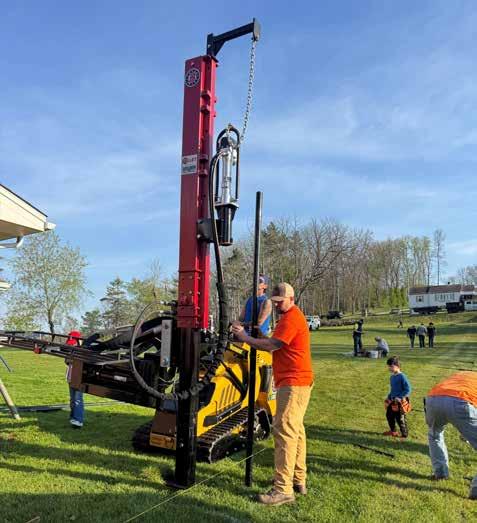
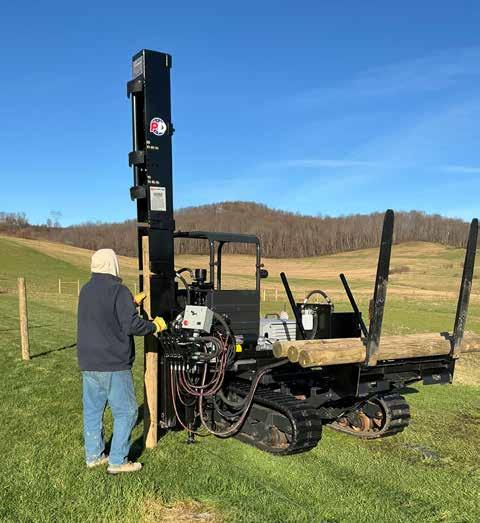
“For agricultural fencing, we manufacture the Log Cabin Pro Driver, which is designed primarily for wood posts ranging from 4 to 9 inches in diameter and 7 to 12 feet in length,” says Clint Iams, owner of Log Cabin Fence. “It also features a built-in auger system, and on our skid steer models, we offer an optional down-pressure auger. The newest development is repurposing slightly used Yanmar rubber track machines to create a lighter-weight, one-man operation unit. We’ve also added remote control capability, allowing a single operator to handle the entire process efficiently.”
This new configuration offers a more compact alternative to traditional skid steer-mounted drivers while maintaining the performance needed for agricultural fencing projects. The oneman operation capability is particularly valuable for contractors looking to maximize productivity
with smaller crews. These units are available starting at $99,000.
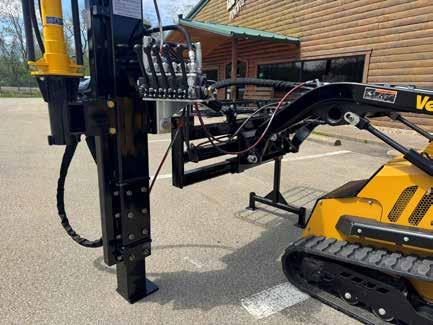
In addition to advancements in agricultural equipment, Log Cabin Fence has also expanded the capabilities of its Billet driver, designed for residential and commercial installers. The Billet line accommodates a wide range of post types, including chain-link/SS 40, I-beams, oil field pipe, and C-posts, and can be mounted to mini skid steers, full-size skid steers, or adapted for multiple platforms to provide maximum versatility.
“Our Billet driver gives installers a variety of options, including the ability to incorporate the hammer of their choice, such as the Rhino HPD 60 or Montana 350,” Iams says.
“With the Rhino HPD 60, users also benefit from suspended driving, allowing posts to be driven more than 15 feet away from the machine using a chain and hoist system.”
Additional features include a tall mast capable of driving 14-foot posts without raising the arms of a mini skid steer, as well as operator-controlled functions located directly on the unit for precise alignment and control. An optional two-
foot extension further increases reach, allowing the driver to extend perpendicular to the machine for added flexibility in tight or complex job sites.
The Billet line starts at $17,900, offering an accessible yet powerful solution for contractors seeking reliable performance across a variety of fencing applications.
With these latest enhancements, Log Cabin Fence continues to deliver equipment that prioritizes efficiency, adaptability, and operator control, all key factors for today’s fencing professionals.
Learn more at logcabinfence.com.
30" 43" 55"
Rethinking the Last Mile: How Under-CDL Delivery Is Changing the Fence Industry
As temporary fencing and site service contractors face mounting pressure from labor shortages, rising insurance costs, and increasingly complex jobsites, a shift in delivery strategy is helping fleets stay competitive. By moving toward under-CDL (UCDL) delivery systems, companies are bypassing traditional commercial licensing hurdles while reducing jobsite liability and unlocking new operational flexibility.
The backbone of most fence delivery operations has long been a one-ton truck pulling a gooseneck or flatbed trailer. While that setup sidesteps CDL requirements, it carries hidden costs that rarely appear on a balance sheet: workers climbing stacked fence panels to offload, the insurance exposure that follows, and equipment rental bills when a job outgrows what the trailer can handle.
THE DELIVERY BOTTLENECK
In many operations, delivery is where profitability starts to erode. A truck leaving the yard under capacity means more trips, more fuel, and more labor hours. On larger projects, contractors without onboard lifting must rent forklifts or telehandlers — a direct cost that cuts into margin on the jobs that should be most profitable.
Bradley Holder, VP of Sales at Donkey Forklifts, says the CDL shortage has become as much a business problem as a staffing one.
"Recruiting commercial drivers is no longer just an HR task — it's a financial hurdle," says Holder. "If a contractor has the inventory and the customers but can't find the driver, the business stagnates."
By keeping Gross Vehicle Weight Rating below the 26,001-pound threshold, contractors can fundamentally change their labor strategy — hiring based on reliability and work ethic, then training new operators in days rather than waiting for CDL holders to become available.
ADDRESSING THE ACTUARIAL RISK
One of the most overlooked hazards in the industry is workers climbing stacked fence bundles on conventional trailers. Stack heights can reach eight to eleven feet, with no guardrails, no stable footing, and no fall arrest systems.
According to the National Safety Council, total work injury costs in 2024 reached $181.4 billion, with falls to a lower level among the top causes of workplace injury. A single serious fall claim can cost a contractor upward of $40,000 in direct costs before OSHA citations.
"The truck-mounted forklift model eliminates that exposure entirely," Holder said. "The operator offloads from ground level — no climbing
required. For underwriters, that's a material distinction that supports a lower workers' compensation risk classification."
Patented auto-locking mounts secure the forklift at the mast's strongest structural point, allowing an operator to mount or dismount in seconds without climbing onto the truck bed — one vehicle handling both delivery and placement, without additional equipment or labor.
NAVIGATING THE "URBAN SQUEEZE"
Urban and suburban jobsites are increasingly part of the temporary fencing landscape, and long, heavy rigs are struggling to keep up. Limited staging areas, tight access points, and traffic congestion put conventional trailer setups at a disadvantage.
Compact delivery systems with smaller footprints can access curbside staging areas, navigate tight turns, and get in and out faster. "Maneuverability isn't just a convenience; it's a safety feature that reduces the risk of jobsite accidents and minimizes disruptions to local traffic," Holder said.
THE RISE OF THE SITESERVICE PROVIDER
The role of the fence contractor is expanding. Customers increasingly want a single company to handle fence, portable restrooms, guard shacks and vacuum systems in one run, a shift that requires equipment capable of supporting multiple load types, not a single-purpose trailer.
Donkey Forklifts' Site
Solution addresses this directly, combining UCDL delivery capability with a lightweight truck-mounted forklift. By reducing overall system weight, contractors preserve more working payload while staying within legal limits, moving more material per trip and completing installs with fewer steps.
THE BIGGER PICTURE
As demands on temporary fencing contractors grow, the companies that succeed will be those that treat delivery as a strategic function, not just a logistics cost.
"The future of temporary fencing will be defined by efficiency as much as capacity," Holder says. "Contractors that move material faster, access tighter jobsites, and reduce dependence on CDL labor will have a meaningful advantage in this market."
To learn more . . . .
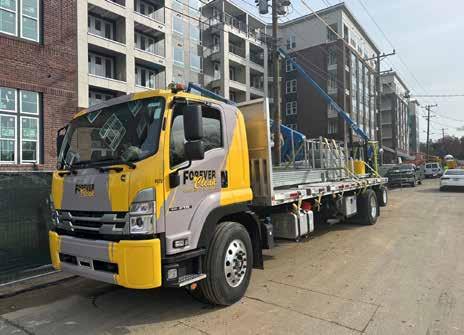
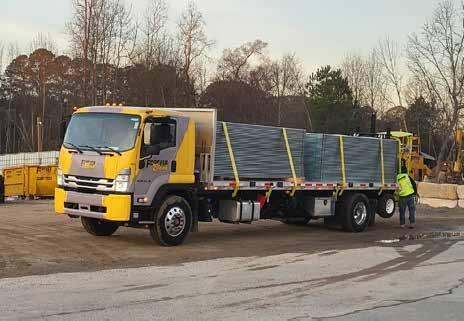
Navigating the 'Urban Squeeze': The compact footprint of the Donkey Site Solution allows for curbside access and easy maneuvering in tight staging areas. As seen here with Forever Clean, shorter rigs allow for faster in-and-out times without disrupting local traffic.
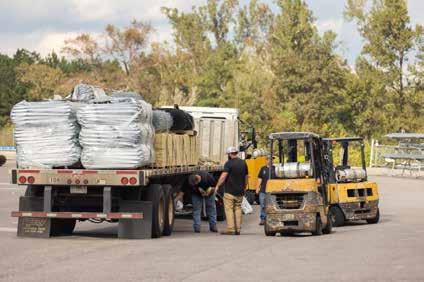
Forever Clean streamlines fence installs with the Donkey Site Solution. A single operator handles offloading and placement from ground level, cutting labor costs and eliminating the safety risks of climbing trailers.
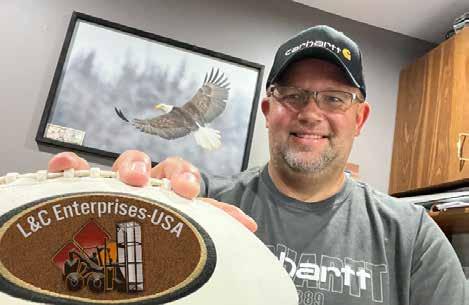
L&C Enterprises-USA Cycles Leadership During Expansion
L&C Enterprises USA, a leading manufacturer in the fencing industry, is proud to announce the transition of leadership to Kevin Sodermark, who has assumed the role of President and Owner of L&C Enterprises USA, dba Delta Fence & Construction. Sodermark succeeds Ron Chouinard, the company’s founder, who announced his retirement in 2025. This leadership transition comes at a time of continued growth and expansion for the Upper Michigan based manufacturing company.
Sodermark has been with L&C Enterprises USA since 2013 and most recently served as vice president. Prior to that role, he worked as foreman for Delta Fence & Construction, L&C’s local fencing business. During the company’s growth, Sodermark played a key role in leading major facility expansion and driving manufacturing success across the company’s fence tie product lines. Most notably, he was instrumental in securing the addition of a third, four slide machine, significantly increasing production of Easy Twist Ties and T-Post Ties. This investment has provided L&C with added flexibility to manage the growing demand for the variety of popular Easy Twist Fence Ties they produce, which are manufactured and distributed throughout North America.
“The demand for Easy Twist Ties has been great,” says Allen Nault, foreman for L&C Enterprises-USA. “Even our vinyl fence ties have seen a good spike in production and sales.”
“Kevin has a track record as a proven decision maker with strong professional fencing sales skills,” says Chouinard, founder and original owner of L&C Enterprises USA. “He brings a unique business vision and the ability to solve problems quickly. His commitment to positioning L&C’s fence tie products will be beneficial to the continued success of the company. I firmly believe both L&C and Delta Fence businesses are in the right hands moving forward.”
Sodermark shared his enthusiasm for the new role, stating, “The part of my job I enjoy most is making sure all the moving parts are working toward the same goals. We’ve experienced record fence tie sales over the past two years, which has made it an exciting challenge to keep pace with demand while balancing building expansion, equipment investments, and the hiring and training of new staff. In 2025, we completed a facility expansion, and with our current and projected fence tie sales, we may soon need additional space to meet demand. That’s a good problem to have.”
L&C Enterprises-USA, dba Delta Fence & Construction, headquartered in Escanaba, Michigan, has been providing fence equipment and fence ties for more than 30 years.
Learn more at lcenterprises-usa.com or deltafenceman.com.
Tight Jobsites Drive Demand for Compact Fence Equipment
As job sites grow tighter and access becomes more limited, contractors are increasingly turning to compact equipment that can deliver full-scale performance without the footprint of traditional machines. EZG Manufacturing, based in Malta, Ohio, has responded to that shift with a lineup of “mini” fence installation equipment designed specifically for walk-behind and small skid steer applications.
Developed with input from fence contractors, the compact lineup includes the Mini Fence Hog, Mini Barbwire Hog and Mini Cement Hog, along with a 4-cubic-foot Mobile Mud Hog mixing unit suited for walk-behind machines. Together, these products are intended to help crews maintain productivity in confined spaces such as residential backyards, pipeline work and other limited-access job sites.
“The need for smaller, more maneuverable equipment has been growing for years,” says Matt Schott, sales representative for fence equipment at EZG Manufacturing. “Contractors are using mini skid steers every day, and they need attachments that match that scale without sacrificing performance.”
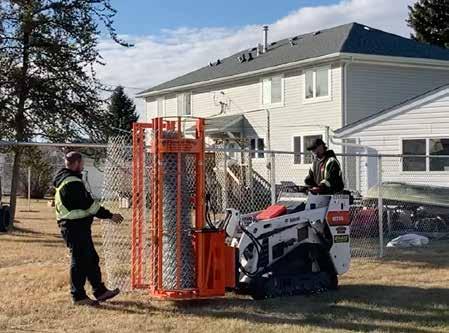
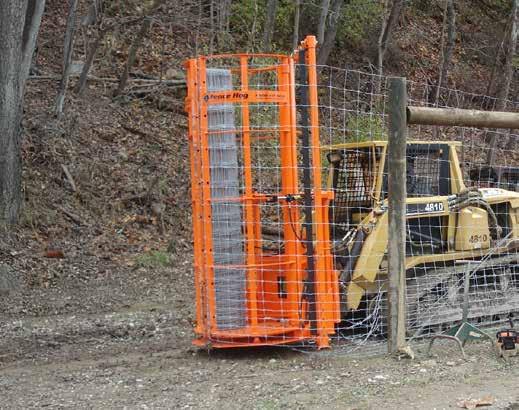
The Mini Fence Hog (Model FHW) is designed to handle and dispense rolls of chain-link or woven wire fencing with minimal labor. Featuring a rotating turntable and a cage system that opens
and tilts to retrieve rolls from the ground, the unit allows a two-person crew to install up to 50 feet of chain-link or 330 feet of woven wire efficiently. It attaches directly to mini skid steers or walk-behind units and includes a universal mounting plate and adjustable dispensing arm for right- or left-side operation.
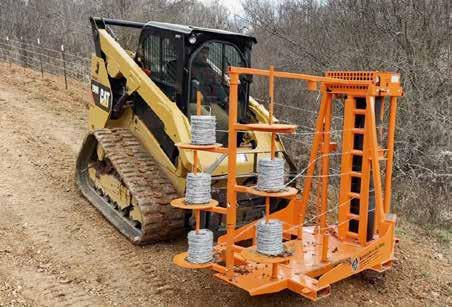
For barbed wire installation, the Mini Barbwire Hog (Model WB-BWH) delivers the same capacity as its full-size counterpart in a more compact form. The unit can dispense up to three rolls of barbed wire simultaneously, totaling
1,320 feet, while a pivoting arm allows contractors to work from either side of the fence line. Its walk-behind design makes it especially useful on smaller jobs or sites where larger equipment cannot operate.
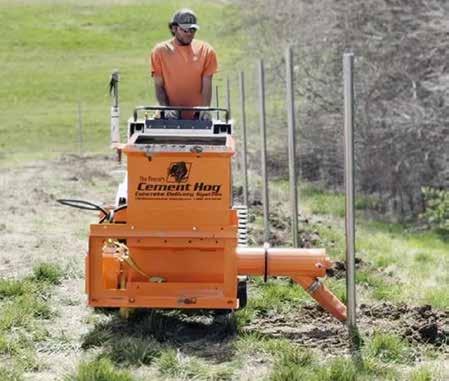
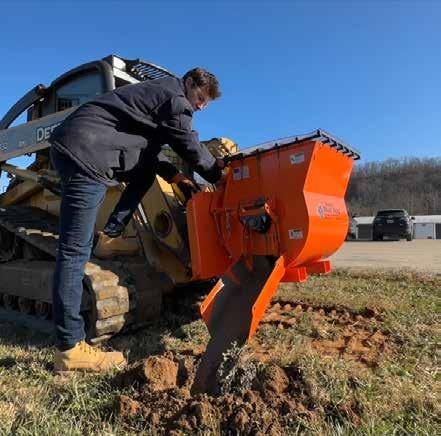
Material handling is addressed with the Mini Cement Hog (Model FCH25), a ¼ cubic yard capacity dispenser engineered for use with mini skid steers. Designed to handle wet or dry materials, including sand, the unit connects to auxiliary hydraulics and delivers consistent material flow directly to the fence post hole. Its compact dimensions allow it to access tight areas while maintaining the durability expected from larger equipment.
In addition to material delivery, EZG’s 4-cubic-foot Mobile Mud Hog provides mixing and placement capabilities for grout, mortar and concrete. The unit attaches directly to walk-behind machines and uses hydraulic-powered paddles and patented rubber blades to maintain consistent mixing. It is capable of handling up to ¾-inch aggregate and unloading up to half a cubic yard in approximately one minute.
Contractors say the combination of mixing, delivery and installation tools in a compact format can significantly reduce manual labor and improve efficiency.
“Being able to mix, move and place material without bringing in larger equipment changes how crews approach smaller jobs,” Schott says. “It is not just about fitting into tight spaces. It is about
MINI FENCE HOG
MINI BARBWIRE HOG
keeping production moving without adding extra steps or manpower.”
Durability and long-term use also remain a focus. EZG’s equipment is built with heavy-duty components and designed to withstand daily jobsite demands, a factor that contractors often cite when evaluating compact equipment options.
As more projects move into residential and space-constrained environments, compact equipment is expected to play a larger role in fence installation workflows. For manufacturers, that means continuing to refine equipment that balances size, capability and ease of use.
“Our goal is to give contractors options,” Schott adds. “Whether they are working on a large commercial install or a tight residential project, they should have equipment that helps them work efficiently and safely.”
With its mini lineup, EZG Manufacturing is positioning itself to meet that demand, offering contractors tools that bring full-scale functionality to smaller machines and more challenging job sites.
Learn more at ezgmfg.com.
REDI Driver’s MegaMulti Focuses on Versatility and Durability
In the world of post driving, versatility is key, particularly for crews handling multiple post types across a range of jobsite conditions. That’s why the REDI Driver MegaMulti has been engineered to offer maximum flexibility without sacrificing power or reliability. It’s designed to tackle a wide variety of applications, making it the go-to choice for professionals across multiple industries.
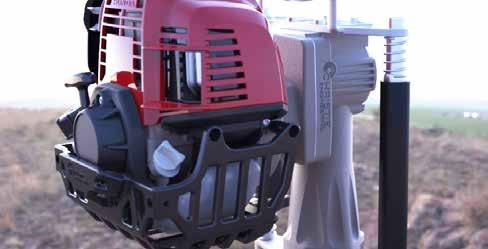
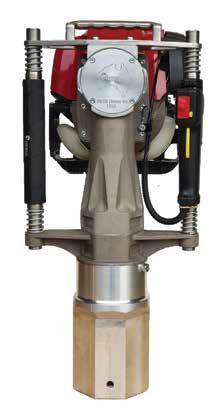
The MegaMulti is powered by the Honda GX50 engine, the same platform used in the company’s Mega107 model. Known for reliability and consistent performance, the GX50 provides the power needed for both large-scale and smaller fencing projects.
According to Lorri Evans, president of Redi Driver, flexibility was a major focus in the tool’s development.
“Contractors today are working with more than one type of post on many jobsites,” says Evans. “We wanted to create a driver that could adapt quickly without requiring constant adjustments or additional tools.”
One of the MegaMulti’s defining features is its Multi Adapter Guide Tube, which allows operators to drive a variety of post profiles up to 3 inches in diameter, including round posts, Postmaster-style posts, and select square profiles. The system is designed to reduce downtime by eliminating the need to frequently swap anvils or reconfigure the driver between applications.
For larger post requirements, the MegaMulti can also be paired with the Mega107 guide tube and a 4-inch driving cap, expanding its versatility even further.
In addition to adaptability, the unit was engineered for heavyduty performance. The MegaMulti features reinforced internal components and a larger piston intended to support longer duty cycles and reduce interruptions during demanding projects.
“Productivity matters, but reliability matters just as much,” adds Evans. “Contractors need equipment that can handle long days in tough conditions while keeping crews moving efficiently.”
The driver is backed by REDI Driver’s three-year warranty on post driver components, along with Honda’s engine warranty coverage.
Learn more at redidriver.com.
Krank Marks 10 Years Building the Operational Layer Behind Heavy Equipment
Over the last decade, Krank, a global leader in heavy equipment technology solutions, has evolved from a focused marketplace into a technology company building the operational infrastructure behind how heavy equipment is managed, inspected, and transacted across its lifecycle.
Founded in 2016 by CEO Mark Turner and co-founder and CTO Khurram Mumtaz, the company was born out of firsthand experience in the construction and industrial sectors, where fragmented workflows, manual processes, and disconnected systems routinely slowed down decision-making and asset movement.
Krank began by tackling inefficiencies in equipment transactions, launching auction and marketplace solutions designed to bring structure and transparency to a traditionally opaque process. Early traction validated the approach, with the platform facilitating millions of dollars in equipment sales across multiple markets.
However, as adoption grew, a more fundamental issue became clear. The real friction was not only limited to buying and selling but it also existed across the entire operational layer: inspections, asset data capture, field workflows, and reporting.
“Early on, we were focused on transactions. Over time, it became clear the bigger opportunity was everything around them. How data is captured, how decisions are made, and how operations run day to day,” says Mumtaz.
This realization marked a turning point, repositioning Krank from a transaction platform into a broader operational layer designed to connect systems, workflows, and real-world execution.
Today, the platform is used by OEMs, dealers, rental companies, and fleet operators across multiple regions. Its infrastructure is designed to operate in complex, high-volume environments, integrating with existing enterprise systems rather than replacing them.
“What’s mattered most is staying close to how the industry actually works,” Turner says. “A lot of what we’ve built has come directly from understanding the gaps in day-to-day operations and being willing to rethink things as we go.”
This evolution is reflected in Krank’s expanding product ecosystem. Its aggregated marketplace, Heavy Kit connects inventory across sellers into a single discovery layer. Alongside this, the Inspeq platform provides a structured, real-time operational layer for inspections and field workflows.
Rather than acting as standalone tools, these systems are designed to work together, linking inspection data, asset condition, and transaction readiness into a unified flow. This approach enables businesses to move from fragmented processes toward more consistent, measurable operations, with greater visibility across teams and locations.
As Krank enters its second decade, the company continues to invest heavily in product development, expanding its operational intelligence layer, deepening integrations, and accelerating deployment across enterprise customers.
With teams operating across the UK and Pakistan, and recent expansion into Australia following the appointment of John O'Sullivan, the business remains focused on rapid iteration, close customer collaboration, and building technology that reflects real-world operational demands.
“What I’m most proud of is the team. They’re a group of people who take ownership and care deeply about what they build. Even after 10 years, it still feels like we’re just getting started,” says Mumtaz.
To learn more, visit krank.com
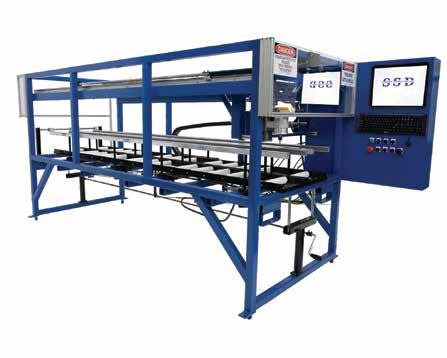
Offer Your Customers Something New – Custom Pickets TOOLS
As ornamental fencing continues to evolve, contractors are looking for new ways to stand out in a competitive bidding environment.
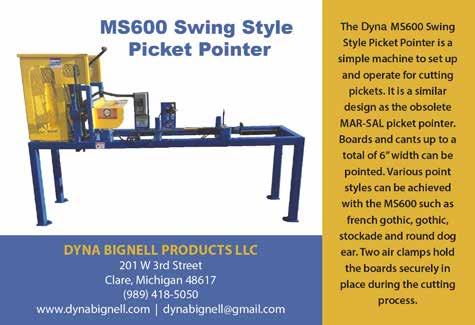
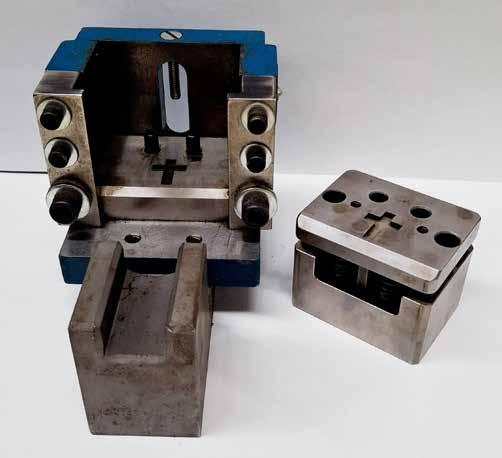
Vogel Tool & Die is addressing that need with its picket pressing and piercing tools, giving fence professionals the ability to produce and customize pickets in-house.
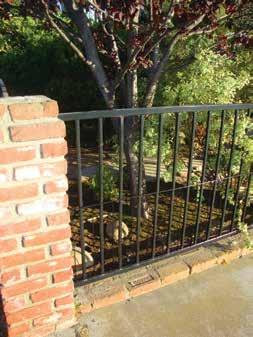
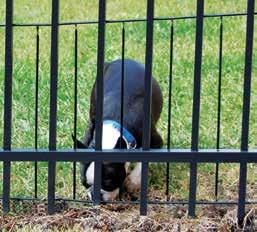
Pressed pickets have long been a staple in ornamental fence design, offering a cost-effective alternative to more elaborate cast components. However, as more contractors compete for the same projects, customization is becoming an increasingly valuable differentiator.
Vogel’s picket pressing tool, often paired with the company’s bench-top hydraulic press, allows shops of all sizes to manufacture spear-point pressed pickets on-site. According to sales manager Larry Siegal, more contractors are moving toward inhouse fabrication in response to rising material costs and extended lead times.
“Many shops are realizing the benefits of controlling their own production,” Siegal says. “When you can produce pickets in-house, you reduce delays and create more flexibility in how you bid and deliver projects.”
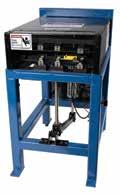
Building on that capability, Vogel also offers a piercing tool designed to add custom designs to pressed pickets, creating a more distinctive finished product. The system features an interchangeable punch and die, allowing contractors to update or change designs without replacing the entire tool. The piercing tool is compatible with Vogel’s bench-top press and can also be integrated into most ironworkers.
While the cross design remains one of the most popular options, the customization potential extends far beyond standard patterns. Contractors can work with Vogel to develop designs tailored to specific clients or industries, ranging from corporate initials and school branding to thematic elements such as hearts for healthcare facilities or dog bones for veterinary clinics.
As demand grows for both efficiency and differentiation, tools that support in-house production and customization are becoming an important part of the modern fencing operation. Vogel’s picket pressing and piercing solutions offer contractors a way to control costs, reduce lead times, and deliver unique designs that set their work apart.
For more information, visit vogeltool.com.
GripEdge Tools Launches 9-Piece
Metric Long Hex Key Set with Rounding Prevention Technology
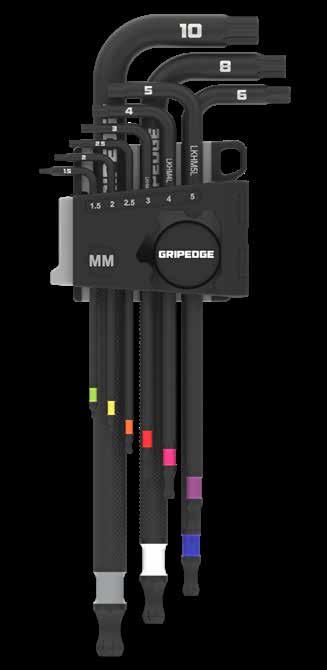
GripEdge Tools has launched its 9-PC RPT™ Long Metric Hex Key Set, a professional-grade hex key solution built for technicians who drive and remove hex fasteners in tight, angled, or obstructed spaces. The set combines patented Rounding Prevention Technology (RPT) and ball-hex geometry with extra-long bars, S2 tool steel construction, Color-Eye-D coding, and a locking wallet-style holder featuring patented C-Grip slot geometry.
"Rounded hex fasteners cost technicians time and frustration every single day," says Jared Kukucka, director of sales and marketing at GripEdge Tools. "Our 9 piece RPT Long Metric Hex Key Set was purpose-built to solve that problem. The patented RPT and ball-hex geometry grips the flat faces of the fastener, not the corners, delivering up to 50 percent more grip on intact fasteners and up to 400 percent more on damaged ones. It's a game-changer for any tech dealing with hex fasteners in tight or obstructed spaces."
In addition to the straight cut tips, each key features ball hex tips that allow up to 20 degrees of pivot for angled access, letting technicians drive fasteners without a straight-on approach. This is valuable in engine bays, suspension components, and confined industrial spaces where direct alignment is not always possible. The extralong bars extend reach into valve covers, transmission housings, and other recessed applications where standard-length hex keys fall short.
The set is built from S2 tool steel with a black manganese finish for corrosion resistance and long-term durability. A round-bar design with a knurled section provides positive hand grip in wet or oily conditions. Large laser-etched markings ensure quick size identification, and Color-Eye-D coding in Black and Grey designates the metric sizes at a glance. The locking, folding wallet-style holder features patented C-Grip slot geometry that retains each key and allows precise one-handed removal.
Continued on p32
GRIPEDGE TOOLS | 9-PC RPT™ LONG METRIC HEX KEY SET
• Use case: Driving and removing hex fasteners in automotive, industrial, marine, and commercial applications, including angled and confinedspace access
• Technology: Patented RPT™ (Rounding Prevention Technology) for flat-face fastener engagement, providing up to 50% more grip on intact fasteners and up to 400% more on damaged fasteners versus standard tools
• Ball hex tips: Up to 20 degrees of pivot for angled access without sacrificing control
• Construction: S2 tool steel with black manganese finish
• Ergonomics: Round-bar design with knurled section for positive hand grip in wet or oily conditions
• Color-Eye-D Coding: Black and Grey denote Metric (MM) for rapid visual size identification
• Markings: Large laser-etched size labels for quick, accurate identification
• Storage: Locking, folding wallet-style holder with patented C-Grip slot geometry for secure retention and precise removal
The GripEdge Tools 9-PC RPT Long Metric Hex Key Set is available through authorized distributors, direct at gripedgetools.com, and the official GripEdge Tools Amazon store.
GATES
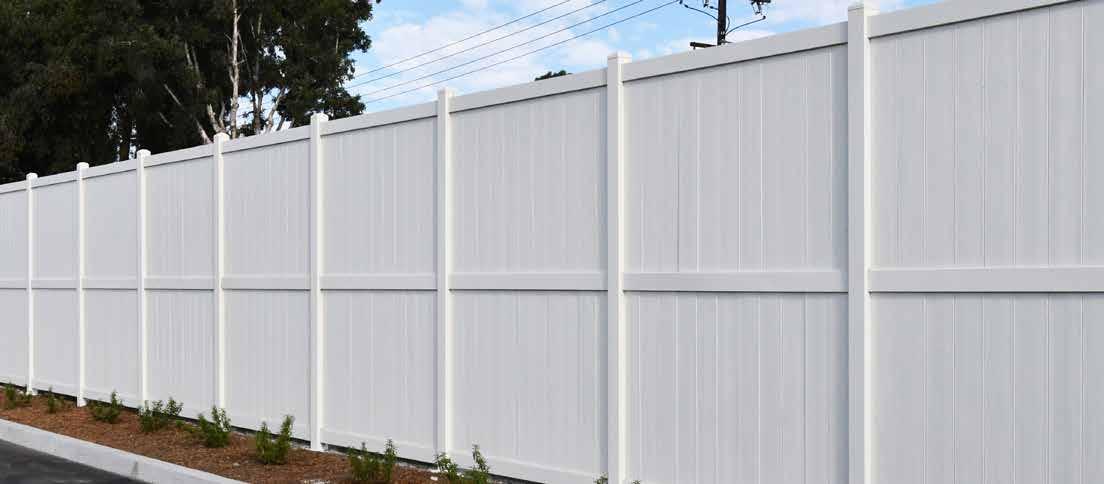
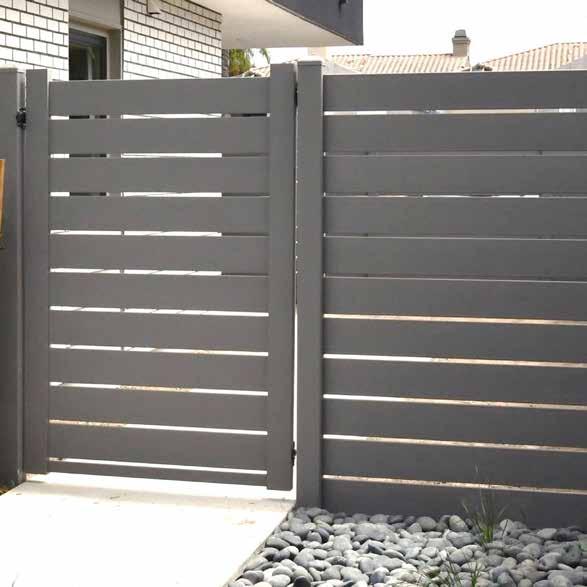
Choose from prefabricated gates or convenient gate kits for easy onsite fabrication and installation.
VERSATILE DESIGN
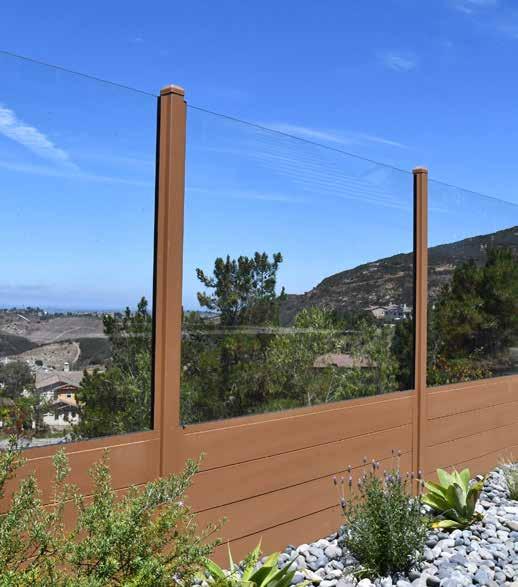
Options ranging from 4’ to 12’ tall, including full privacy, contemporary styles, glass panel compatibility, trail fence and easy to fabricate gate kits.
UNMATCHED STRENGTH – STRONGER THAN A MASONRY WALL NUMEROUS PRODUCT LINES – THE SIMPLEST GATE KITS AVAILABLE
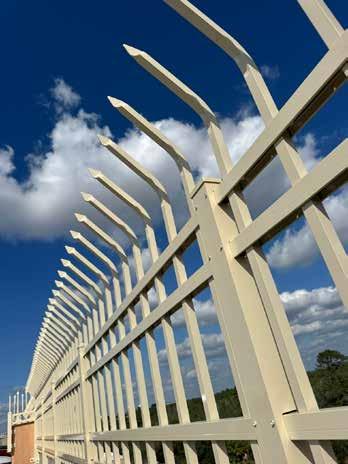
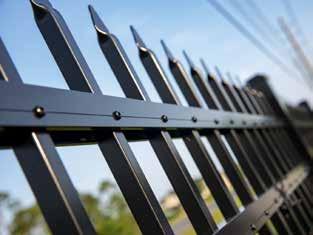
Premium Galvanized Steel Fire Resistant Fence Products – 40% Less Cost than Typical Competing Aluminum Products – Galvanized Steel Fence Products Manufactured in California from G60, G90 or G115 Coils
EXTREME DURABILITY
Intertek dynamic wind load tested for sustained winds up to 130 mph and gusts up to 190 mph (for heights of 6’ to 12’).
STRONGER THAN A MASONRY WALL
MWF Products opened up the masonry market for the fence contractor.
COLOR OPTIONS
Bulk product primed and ready to paint onsite to match any aesthetic. Custom color runs available upon request.
EFFICIENCY
Designed by industry experts with 40+ years of fabrication and installation experience. Built for fast installation and long-term, low maintenance performance.
Our various fencing solutions offer unmatched strength and durability, with 30-40% cost savings, compared to typical competing metal products.
StainTrac Advances Wood Coating with New Gen 4 Pocket and Pocket Plus Systems
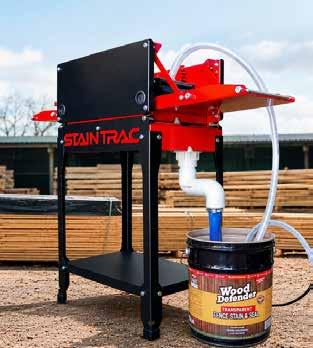
Fence contractors continue to look for ways to improve shop efficiency and reduce laborintensive process. One solution gaining traction is prestaining equipment.The latest developments from StainTrac reflect that trend, with new enhancements to its Gen 4 Pocket and Pocket Plus models designed to increase capacity, improve finish quality, and streamline maintenance.
At the core of the update is expanded material capability. The Gen 4 Pocket system now accommodates 2”x8” boards and posts up to 4x4, while the Pocket Plus has been engineered to process boards up to 2x12 in width, along with 4x4 posts. This added flexibility allows contractors to handle a broader range of materials without switching equipment or workflows.
One of the more notable advancements is the machine’s ability to process 4-inch round rail, a feature not commonly available in comparable systems. In field use, this capability has translated into significant time savings. Tasks that previously required multiple days of manual staining can now be completed in a matter of hours.
The new models are designed to remove excess stain more efficiently. An additional squeegee and wiper brush assembly helps remove excess stain more consistently, resulting in a cleaner, more uniform finish. For contractors focused on appearance and repeatability, this level of control can reduce rework and improve overall product quality.
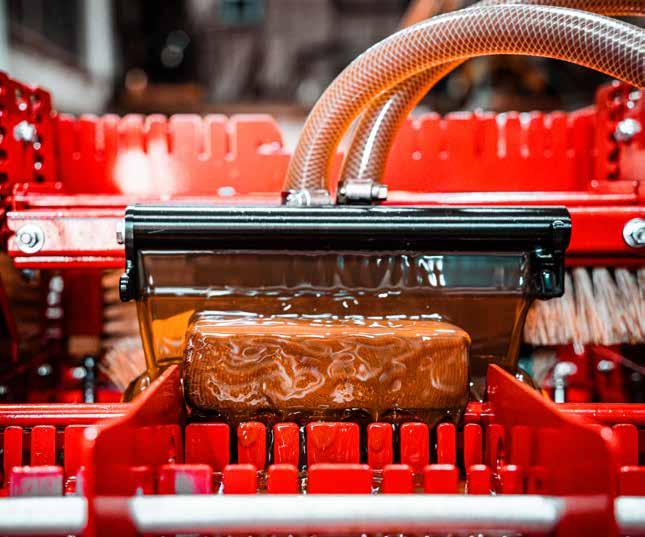
Efficiency gains extend beyond finish quality. StainTrac’s recirculating application system is designed to use approximately 50% less stain than traditional spray methods, helping contractors manage material costs while minimizing waste. The system applies stain through an advanced
FAMILY-OWNED FENCE COMPANY SEEKING ACQUISITION OPPORTUNITIES
Established, family-operated fence company looking to acquire additional locations in the Southeastern and Southern U.S. Preference given to businesses located in Texas, Florida, and Georgia, but all neighboring markets will be considered. Ideal for owners looking to transition with care and preserve their company’s legacy.
Please send information to: fencefamily@yahoo.com
flood tube design that creates a controlled, laminar “waterfall effect,” ensuring even, full-surface coverage in a single pass.
“Consistency is one of the biggest challenges in wood coating,” says Yoshi. “The goal is to apply the right amount of stain evenly, without overuse or missed areas. Systems like this are designed to take variability out of the process.”
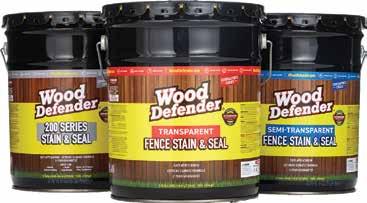
That one-pass capability eliminates the need to flip or rehandle boards, a common bottleneck in manual operations. In addition, when used with compatible products such as Wood Defender transparent stain, the system allows for wet-stack processing, meaning boards can be stacked immediately after coating without sticking or marking. This reduces handling time and the amount of space required for staging materials.
Maintenance and usability have also been addressed in the latest models. A new integrated kickstand and support system provides easier access for cleaning between jobs, while a detachable flood tube assembly simplifies routine maintenance. These changes are aimed at reducing downtime and keeping production moving.
From a throughput standpoint, the systems are built for high-volume environments, with the ability to process more than 600 boards per hour
under optimal conditions. For shops looking to scale operations or handle larger production runs, Yoshi says that level of output can significantly impact overall productivity.
Manufactured in Oklahoma, StainTrac machines are built using readily available, non-proprietary consumables that are readily available online or in box stores, an approach that can simplify repairs and reduce reliance on specialized parts.
Learn more at staintrac.com.
NEW PL ANT GREATER CAPACITY
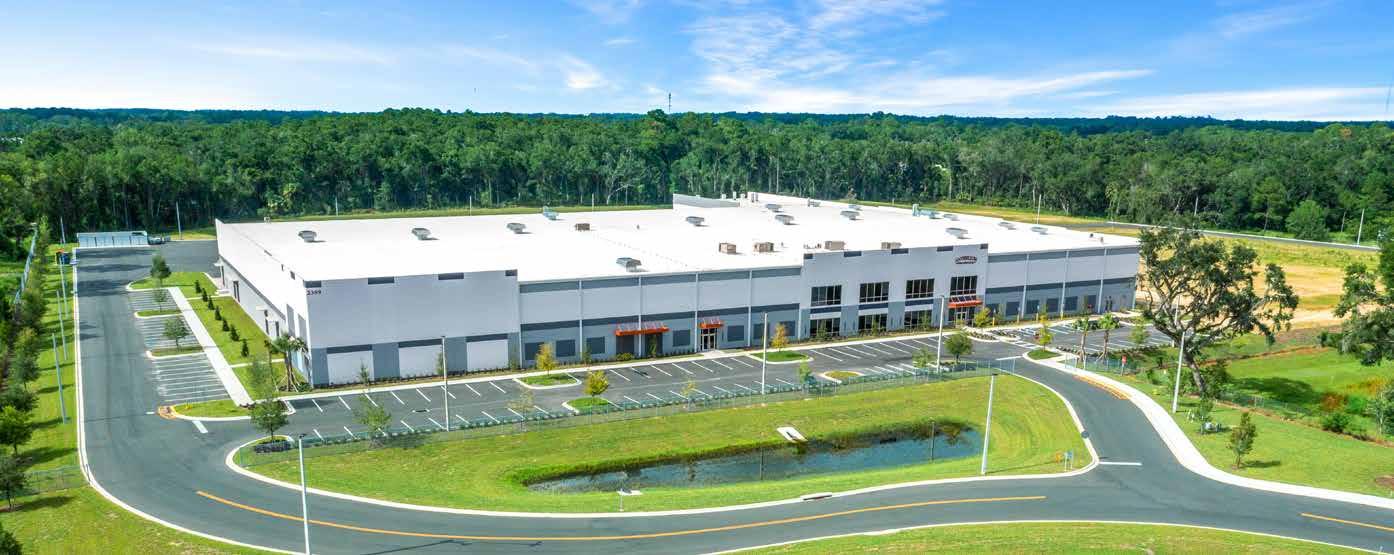
Antebellum Manufacturing delivers a full range of solutions for all your aluminum fencing needs. We provide job lot shipping for projects of any scale, managing every thing from the smallest orders to extensive projects that need multiple truckloads. Our support includes custom CAD drawings and rapid shipping for both residential and commercial common stock .
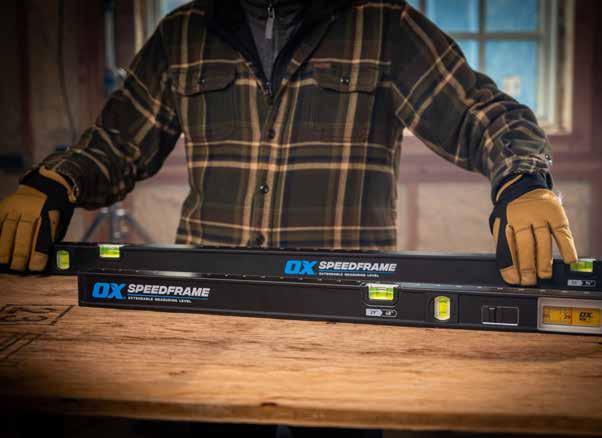
OX Tools Launches OX Pro SPEEDFRAME™, a Multi-Function Measuring and Leveling System for Professional Contractors
OX Tools, a leading manufacturer of professional hand tools, diamond tools, tool storage, and safety products for tradespeople, announces the launch of OX Pro SPEEDFRAME™, a contractor-designed measuring and leveling system created to improve accuracy, reduce rework, and increase efficiency.
SPEEDFRAME™ was created by a 30-year home builder, who experienced firsthand the inefficiencies and inaccuracies that come with traditional measuring tools. With many tradespeople frustrated by time-consuming, multi-step processes and the need for a second set of hands, he set out to create a better solution that could deliver fast, precise measurements.
"Contractors are constantly balancing speed and accuracy on the jobsite, and too often that comes at the expense of time, labor, and materials," says John Cunningham, global CEO of OX Group. "SPEEDFRAME was designed to solve that challenge and give professionals a faster, more precise way to measure, level, and complete work with confidence. It's about eliminating guesswork and helping crews get it right the first time."
ABOUT SPEEDFRAME™:
• A next-gen extendable level and point-topoint measuring tool with a high-precision readout window, SPEEDFRAME is built for fast, accurate, and efficient jobsite performance. Featuring a patented twinrail extension system, it extends smoothly between points with no risk of tipping or tilting, helping ensure precise measurements and reducing costly re-cuts.
• Equipped with dual vials for more accurate level readings, durable end caps, and a 1/2" hook, SPEEDFRAME combines measuring and leveling into a single multi-function tool. Its anodized aluminum construction and CNCmilled surface deliver long-lasting durability
and precision, while a continuous scribing edge allows for consistent line marking even at full extension.
• Designed to streamline workflows and reduce time spent switching between tools, SPEEDFRAME can turn traditional two-person tasks into one-person jobs, saving both time and labor on the jobsite.
• Available in four sizes, 14"–22.5" (extending up to 1.88 feet), 29"–48" (extending up to 4 feet), 53"–96" (extending up to 8 feet), and 78"–144" (extending up to 12 feet), it supports a wide range of professional applications, including framing, remodeling,
window and door installation, and finish carpentry, all while maintaining the durability required for demanding jobsite conditions.
OX Tools is committed to supporting the next generation of tradespeople with practical, prodriven innovations that make jobs easier, faster, and more precise.
SPEEDFRAME is available now at oxtoolsusa.com and Lowe's. OX Tools are also available on Amazon.
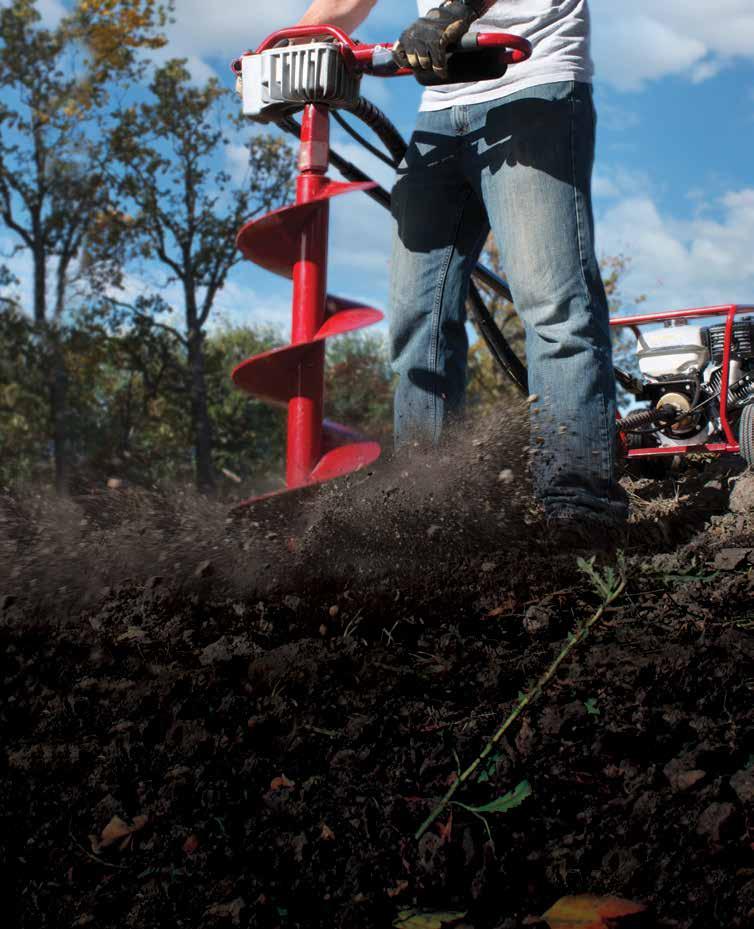
Lightweight and designed for
Cut drilling time in half with rotation speeds up to 360 rpm.
Torque-free digging eliminates kickback and reduces injuries.
one-man operation.
MJC Tools Launches New Line of Asphalt Anchors
Whether you are working on a new or rehab construction infrastructure project, MJC Sales & Marketing Inc. supplies unique products and solutions designed to save time and improve job-site efficiency.
From core drilling units and diamond core bits to tile cutting systems, asphalt anchors, and mechanical anchoring products, MJC is committed to the highest quality materials and offers innovative solutions tailored to each customer.
With over 30 years of experience with contractors, engineers, and distributors, the company also provides on-site training and technical support to facilitate project success.
MJC recently launched two new products, BoltHold anchors from Asphalt Anchors and Rebar Eater Core Bits.
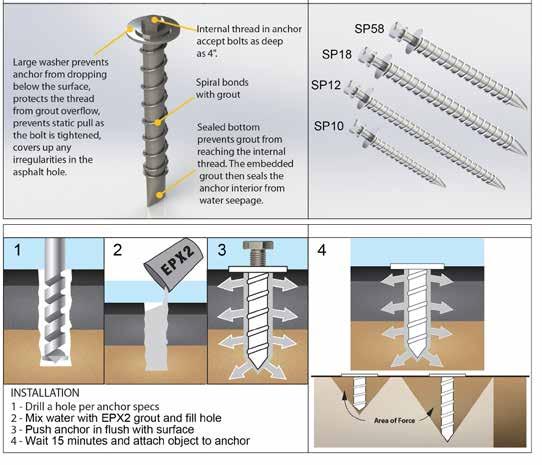
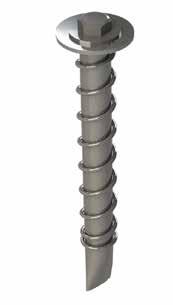
The BoltHod family of anchors are suitable for mounting objects to asphalt surfaces. The larger washer prevents the anchor from dropping below the surface, protects the thread from grout overflow, prevents static pull as the bolt is tightened, and covers up any irregularities in the asphalt hole. The internal thread in anchor accepts bolts as deep at 4 inches. Additionally, the spiral designed bonds with grout and the sealed bottom prevents grout from reaching the internal thread and seals the anchor interior from water seepage.
BoltHold Asphalt Anchors are available in 6 inches, 10 inches, and 12 inches.
For more information, visit mjcconstructionsales.com
When fixing structures to asphalt, the anchors you choose can make all the difference between a job well done and a job that has to be redone. For safe and reliable installations that last, choose Bolthold from MJC Sales & Marketing Inc. The world’s smartest anchor for any kind of installation, including fence post based, wrought iron fencing, temporary fencing and gate track.
Just drill, fill and insert flush.
Top Tools for Fence Repair or Modification
It doesn’t matter what side of the fence you’re on – if an existing chain link or vinyl fence has to be repaired or re-positioned, you’ve got one shot at doing it right. That’s when your tools matter. There are often several tools that could get the job done but Ann Strong, president of Bad Dog Tools, says the right tools make for a better and faster job. “The result? A perfectly performed job and a happy customer who won’t hesitate to make contact again when they have another fence job and will spread the word to others.”
She provides two case studies that demonstrate these results:
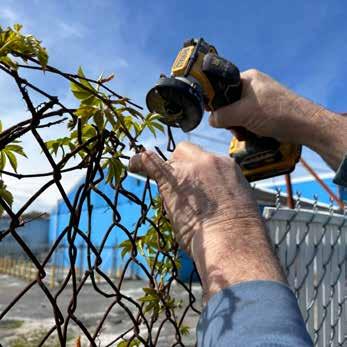
Custom Carwash is expanding and needs the chain link fence you installed six years ago to be repositioned while construction is going on. That means the chain fabric will need to be cut. Could you use bolt cutters or a jigsaw? Sure! They are both tried-and-true methods, but the problem is the cutting is slow and difficult to control. Complicating matters are the vines that have grown through the fence and have pulled in down so it’s no longer flat. A better tool? A 3” grinding wheel. Consider the Bad Dog Tools HDII 3” Endless Cutting and Grinding Wheel mounted on a cut-off
tool. With multiple speeds and cutting a position that allows a view of the material being cut, cuts will be more controlled. Straighter cuts mean less damage to the fabric. And those vines? “The HDII cuts them like they’re butter,” says Strong. “This method allows the fabric to be maintained near to original size. When construction is finished your team can replace the fence in its former position without stretching.”
Jessica and Mike had a top-of-the-line 6’ vinyl fence installed when they put a pool in their backyard. Two years later, they are tired of dragging containers of pool chemicals around to the side gate and want to add a gate adjacent to the driveway. To do that, a panel needs to be shortened to make room for the gate. And, although it wasn’t an issue with the longer piece, there’s a slope complicating matters, so the shorter piece will have the routed slot elongated. Before you reach for the reciprocating saw, consider the duo used on the first project: A 3” grinding wheel on a cut-off tool. “But before you begin cutting, look at the Bad Dog HDII,” says Strong. “It has grit on both the rim and sides of the wheel so you can use it to both cut and grind. Grinding the opening
allows for more control which means a tighter, more precise fit and a sturdier fence. Don’t try this with a resin wheel! You’ll potentially distort the vinyl. The HDII stays cool so it won’t distort or discolor the fence.”
New tools can take you out of your comfort zone, but Strong says they can also be the impetus for looking at how you and your team are approaching retrofits. “If a job can be done faster and better, with a better tool, that benefits your bottom line.”
Visit baddogtools.com to view their products.
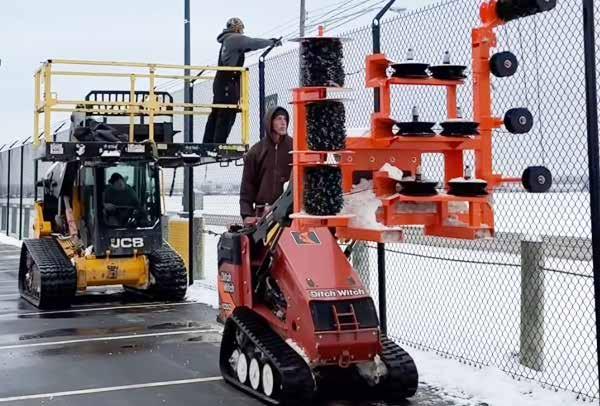
ONE-MAN TRACKED PIPE DRIVER
MINI-SKID STEER PIPE DRIVER
We understand how tiring it can be to work with inefficient and laborious fencing methods.
3 MODELS AVAILABLE
WIRSTR3E ECONOMY No center pivot tilt swivel.
WIRSTR1 BASE Includes center pivot tilt swivel.
WIRSTR2RC FULLY LOADED Tilt swivel, side shift, remote control.
ACCESSORIES & ADD ONS
Extra Clamp Bars
Dual Spindle Table (2 Rolls of Wire)
Expansion Sleeve Set (10’ Tall Wire)
SOFTWARE
Making the Most of Every Second: How Pre-qualified Leads Are Changing Fence Sales
86,400 Seconds a Day. How Many Can mySalesman Help You Get Back?
Every contractor starts the day with the same 86,400 seconds. In a business where margins are tight and schedules are full, how that time is used often determines whether a company is growing or simply staying busy. For many fence contractors, a significant portion of the day is spent not building or installing, but chasing down incomplete leads, clarifying project details and managing back-and-forth communication before a job ever takes shape.
That’s where mySalesman comes in, by offering more structured, prequalified lead generation, where fence customers provide detailed project information upfront. mySalesman was built by contractors who understand the challenges of the industry. It is designed to help teams move faster, operate more efficiently, and create a better experience for customers.
mySalesman guides customers through the early stages of planning before they ever speak with a contractor. Instead of starting from scratch, contractors receive leads that already include mapped layouts, selected materials, measurements, and budget expectations.
need more leads—they need better information,” says Rachel Kroese with mySalesman. “When a customer has already thought through their project, it allows the contractor to step into a real conversation instead of an exploratory one.”
This shift has practical implications for how time is spent in the field and in the office. With more complete information at the outset, Kroese says estimators can walk into conversations with a clear understanding of project scope, reducing the need for repeated follow-ups. Unqualified inquiries can be filtered out earlier, allowing teams to focus on serious buyers who are ready to move forward.
Beyond efficiency, contractors using mySalesman are also seeing improvements in the quality of their sales interactions. Instead of spending time on basic fact-finding, conversations can center on design options, material recommendations, and value – areas where contractors can demonstrate expertise and build trust with customers. The result is often a more streamlined sales cycle, more consistent pricing discussions, and stronger close rates.
For an industry that relies heavily on both skilled labor and effective time management, even small gains in efficiency can have a meaningful impact. Reducing hours spent on administrative tasks and redundant communication allows contractors to reallocate that time toward revenue-generating work, whether that’s closing additional jobs, improving customer service, or expanding operations.
“The biggest shift is not just efficiency, it’s quality,” adds Kroese. “Contractors using mySalesman are seeing higher quality leads, more consistent pricing conversations, improved close rates and better use of sales and estimator time.”
Learn more at mySalesman.com.
Dirt Face Expands Its Fence Industry Platform with Shop Drawings and a New Solution Built for Manufacturers and
Wholesalers
Dirt Face, the all in one software platform purpose built for the fence industry, has launched two major additions to its product lineup: a dedicated Shop Drawings application for fence contractors, and Dirt Face for Manufacturers & Wholesalers, a new business management suite tailored to the companies that supply the trade.
Together, the two releases extend Dirt Face from a contractor focused estimating, scheduling and job management platform into a connected ecosystem that serves both ends of the fence supply chain.
“Many fence contractors are still drawing fences in PowerPoint, paint programs, or full blown CAD packages that were never designed for our trade,” says Roc Demar with Dirt Face. “And on the supply side, manufacturers and wholesalers are juggling QuickBooks, spreadsheet price books, paper catalogs and disconnected websites. Both groups deserve software that actually understands fence.”
A SHOP DRAWING TOOL BUILT SPECIFICALLY FOR FENCE
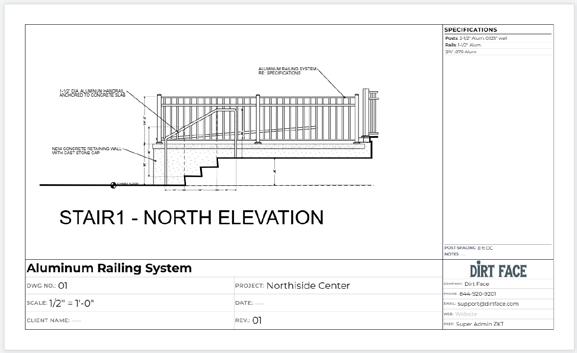
Dirt Face Shop Drawings is a browser based design application engineered from the ground up for fence contractors who need to produce clean, professional shop drawings — fast.
Unlike general purpose CAD, every tool in the application is shaped around how fences are actually built and quoted. Contractors can sketch elevations and plan views, drop in pre built fence profiles (gothic, spear top, flat, dog ear and more), set true scale and units, snap to a grid, and export presentation ready PDFs for permits, customer approvals and field crews.
Key capabilities of the Shop Drawings tool include:
• A fence aware design canvas. Built on a high performance multi layer rendering engine that comfortably handles thousands of objects per drawing, with viewport culling and component caching so panning and zooming stay smooth even on long runs.
• Smart fence components. Pickets, posts, rails, gates and ornamental tops are first class objects — not arbitrary shapes — so they resize, repeat and dimension correctly.
• Editable lines and nodes. Walk the fence the way it really runs: drag nodes, edit segments, follow corners and slopes, and let the tool handle the geometry.
• Dimensions, scale and paper sizes. Choose paper size and orientation, set drawing scale,
and place dimension lines that auto update as the design changes. Imperial and metric units are both supported.
• Design and object libraries. Save reusable assemblies, panels and details to a personal design library, and pull from a shared object library so common parts don't have to be redrawn for every job.
• Templates. Standardize title blocks, borders and notes once, then drop new drawings into the template with a single click.
• AI Drawing Assistant. A built in AI panel can take a photo, sketch or PDF of an existing drawing and turn it into editable vector geometry, including dimension extraction, scale detection and fence specific constraint solving, so contractors can start from a sketch instead of a blank page.
• Image to vector tracing. Drop in a logo, ornamental detail or marketing image and convert it into clean vector paths to use in drawings.
• Snapping, alignment and Boolean operations. Align, distribute, group, ungroup, combine and subtract shapes with the kind of controls professional designers expect.
• PDF export, printing and sharing. Output crisp, scaled PDFs that match the chosen paper size, ready to send to inspectors, customers or installers.
Shop Drawings is available two ways: as a standalone subscription for contractors who only want the drawing tool, and as a bundled module inside the full Dirt Face all in one platform, where drawings tie directly to quotes, jobs and customers.
DIRT FACE FOR MANUFACTURERS & WHOLESALERS
The second expansion is aimed at a part of the industry that has been historically underserved by software: fence manufacturers, distributors and wholesalers.
Dirt Face for Manufacturers & Wholesalers is an all-in-one operating system that replaces the patchwork of accounting software, spreadsheets, paper catalogs and ad hoc websites that many supply side businesses have relied on for years.
The product centers on one big idea: let your contractor customers serve themselves, while you keep full control over pricing, inventory and accounting on the back end.
Capabilities include:
• Customer self service catalogs. Wholesale customers log in and download (or email themselves) a branded PDF catalog priced at their specific tier — no more maintaining one off price books for every account.
• Tiered, rule driven pricing. Configure unlimited customer pricing levels and rules (per category, per product, per customer), preview changes before they go live, schedule price updates, and notify customers automatically.
• Online takeoffs for fence packages. Customers can build their own fence package takeoffs inside the portal, turn them into estimates, save and renew them, then drop them straight into the cart when they're ready to order.
• Full B2B e commerce. Carts, orders, order history, cancellation requests,
backorders with auto notification when stock returns, and downloadable estimate and order PDFs.
• Inventory management. Real time stock tracking, FIFO costing, purchase orders, sales orders, receiving, partial fulfillment, assemblies/ kits, physical counts and adjustments — designed to be GAAP compliant out of the box.
• Multi location support. Manage multiple warehouses or branches, transfer stock between locations, and route orders intelligently.
• POS for the counter. Walk in counter sales, picklists and shipping integrated with the same inventory and customer records used online.
• Reporting that runs the business. Stock levels, low stock alerts, FIFO valuation, transaction history, PO summaries, vendor analysis, inventory turnover (fast/slow/dead stock), and CSV exports for everything.
• QuickBooks Desktop and QuickBooks Online integration. Two way sync for customers, vendors, items, invoices, payments and inventory events — so the back office stays in sync without double entry.
• Integrated payment processing. Accept credit cards and ACH directly inside the portal, with payments flowing through to QuickBooks automatically.
Dirt Face for Manufacturers & Wholesalers is live, with onboarding open to manufacturers, distributors and wholesale fence supply companies.
Taken together, Demar says the two releases reflect Dirt Face's broader vision: a single, connected software ecosystem where the contractor designing a custom gate in Shop Drawings, the homeowner approving the elevation, and the wholesaler shipping the materials are all working from the same data — without anyone retyping it.
To learn more, request a demo, or get started, visit dirtface.com.
“ THE BEAUTY OF WOOD DEFENDER IS THE EASE OF APPLYING THE PRODUCT.
On a custom fence, we’re constantly making adjustments. Even though we’re having to make all the cuts on this pre-stain fence, we can easily brush on more stain. After a couple hours, you would have no idea that the whole fence wasn’t pre-stained.”
HOLLY COTTLES, OWNER FRISCO FENCE
SOFTWARE
Fencify Closes the Gap Between Bid and Built
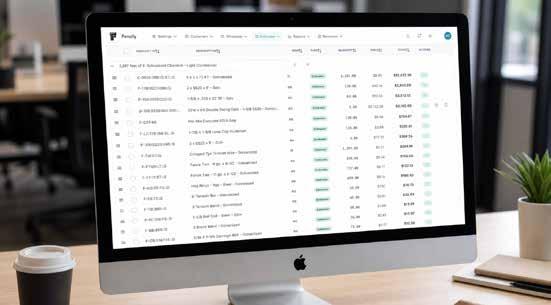
In fencing, the distance between a winning bid and a finished install is often measured in lost time, scrambled paperwork and information that never makes it from the jobsite back to the office. Fencify, a web-based estimating and proposal platform built specifically for fence contractors and wholesale distributors, is targeting that gap.
A year after launching its core estimating engines, Fencify has expanded into a connected workflow that links the field, the front office and the accounting back end. Live integrations now include QuickBooks for invoicing, CardPointe for payments, HubSpot for customer relationships and JobNimbus, Procore and Trello for project management — all designed to slot into the systems fence companies already run.
“Most fence businesses don’t need another tool to learn; they need their existing tools to actually talk to each other,” says Steve Gumlaw, founder of Fencify. “We built Fencify so the estimate, the contract, the schedule and the invoice all share the same source of truth, and that truth flows into
whatever software runs the rest of the business.”
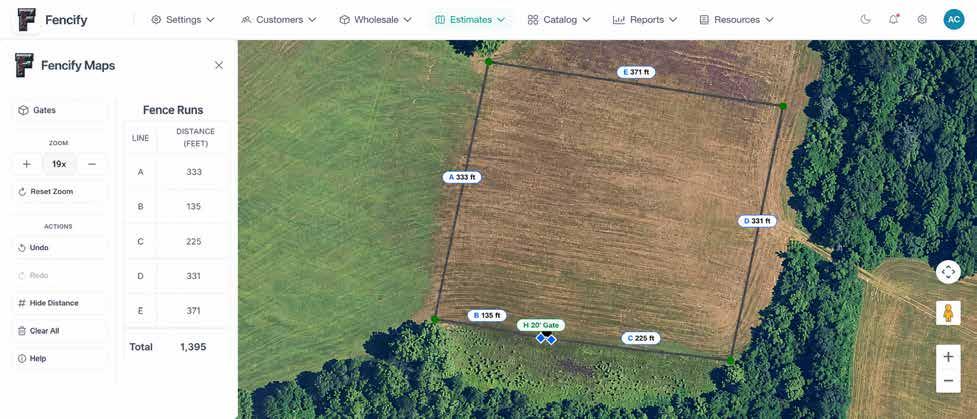
The platform’s newest push is bringing the jobsite into the estimate itself. Estimators can scale layouts directly on Google Maps, sketch fences and gates on screen, and convert hand-drawn site drawings, jobsite photos, video walkthroughs and voice notes into structured estimate data. The result is less re-entry, fewer measurement errors and a tighter handoff from the salesperson in the truck to the team building the proposal.
“There’s always been a wall between what gets captured in the field and what ends up in the bid,” Gumlaw says. “We’re tearing that wall down. A contractor can stand at a fence line, mark it up, talk it through, and have the basics of a proposal already started by the time they’re back in the office.”
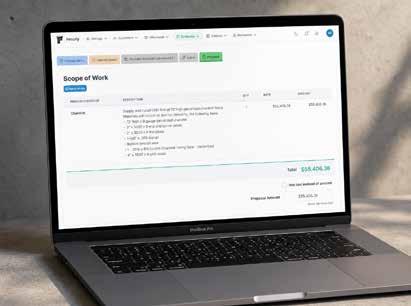
From there, Fencify carries the project through proposal, signed contract, schedule of values, shop drawings and final invoicing — all stored in a single secure database. Built-in reporting
surfaces sales performance, win-loss rates and product trends, giving owners visibility that’s hard to assemble from spreadsheets and disconnected systems.
The platform supports both fence contractors and wholesale distributors, with pre-built estimators for chainlink, aluminum, vinyl and wood and the flexibility to model custom product lines. A growing roster of fence companies across the country now runs daily operations on Fencify.
“We’re not trying to replace the way fence professionals work; we’re trying to remove the friction in it,” Gumlaw says. “Every release this year has been about closing another gap between the bid and the built. There’s plenty more coming.”
Learn more at fencify.io.
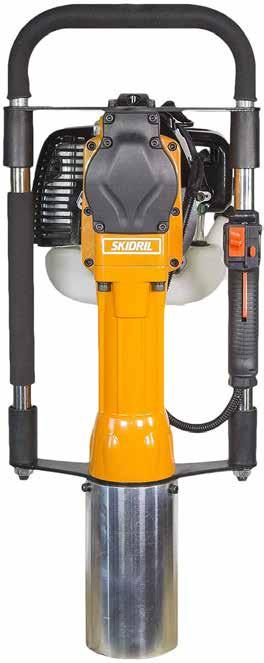
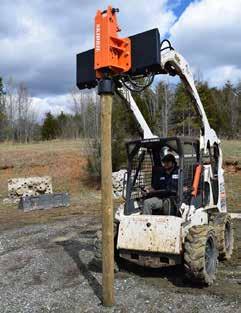
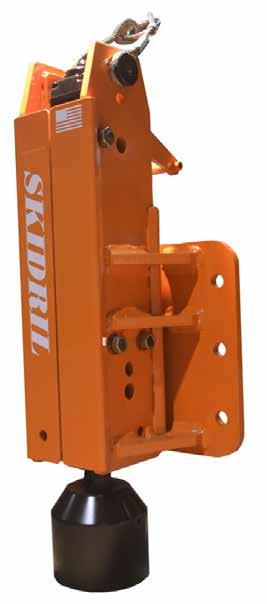
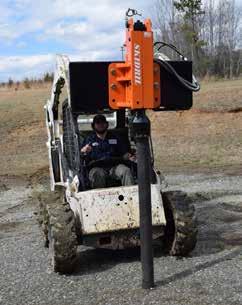
SKIDRIL, the originator of the gas powered post driver, introduces the G2XD high power at a great price!
4” POST DRIVER BIGGER MEANER FASTER TUFFER
• On-Off simplicity
• Simple 4-cycle OHV engine or powerful 2-cycle
• Easy service replacement motors, for low cost repairs
• 2 engine makes available
• Few moving parts
• Drive T-Post, round post up to 4”
• Available Multi-Collet option
• Air cushion dampening for virtually no recoil
• High fuel efficiency 1qt/hr
• Modular design
The Home Depot Expands Pro Digital Experience with Latest Project Management and AI Tools
The Home Depot, the world's largest home improvement retailer, is expanding its Pro digital experience to help professional renovators, remodelers and builders manage their projects, materials and businesses from a single, easy-to-use workspace.
For Pros, time is money, and every minute of their day is critical. The operational friction caused by using disconnected digital tools is a direct barrier to growth. To help solve this, The Home Depot enhanced its digital experience for its Pro Xtra loyalty program members to ensure they have the tools they need to scale their businesses right at their fingertips.
The Home Depot's digital workspace was designed with the real-life needs of Pros and their entire project lifecycle in mind, providing complete visibility and control in one central experience to help them save time, increase efficiencies and stay focused on the job. Moving beyond simple transactions, the updated Home Depot Pro site experience functions as a project management tool with features built for the day-to-day Pro workflow. The site surfaces the tools Pros rely on most front and center, including:
• Project Planning: allows Pros to organize large jobs with personalized delivery preferences, preferred pricing and inventory visibility. Pros have access to the majority
of The Home Depot's product assortment within the Project Planning tool, including millions of items available in stores and fulfillment centers. The recently launched Material List Builder AI integrates directly with the Project Planning tool, which interprets project intent to generate actionable material lists in seconds, helping Pros bid for jobs faster.
• Real-Time Delivery Tracking: Pros can now track down-to-the-minute delivery of big and bulky materials like concrete, drywall and lumber.
• Complex Order Scheduling: Pros can schedule and manage deliveries even when items are coming from multiple locations, ensuring materials reach the jobsite based on availability.
• Purchase History: ongoing enhancements to purchase history that will allow for easy organization and search of previous orders and receipts, making reconciliation much simpler for Pros.
• Shared Access: allows Pros to maintain oversight while empowering their teams with customizable permissions to help keep projects moving and focus on growing their business. Pros can also collaborate directly with their Home Depot Pro team within
the site, providing consistent support and expertise on product selection regardless of whether a Pro is in store or online.
This expanded digital experience is a part of The Home Depot's ongoing investment to grow its ecosystem of capabilities for Pros. The Home Depot will continue to add new features within the platform that meet the evolving needs of today's Pros to provide a frictionless, interconnected experience when managing projects of all sizes and complexities.
"Pros run their business from the truck, the jobsite and our aisles – not a desk," says Mike Rowe, executive vice president of Pro for The Home Depot. "Our upgraded Pro site experience provides tools that work the way Pros do, by integrating project management into their mobile workspace to help them oversee entire jobs, not just individual purchases. And the best part is that all of these tools are available through one supplier."
The Pro digital workspace is available for free to all Pro Xtra members online at www.homedepot.com or within The Home Depot mobile app. In addition to digital tools, The Home Depot offers its Pro Xtra members personalized pricing and custom rewards.
How Fencing Distributors Are Solving Their Biggest ERP Challenges Designing for the Future: How FabCAD is Helping to Elevate the Fence Industry
For many fencing distributors, the systems that helped grow the business to its current size are now creating operational bottlenecks. As inventory management, delivery logistics, and multi-location operations become more complex, companies are increasingly finding that basic accounting platforms and spreadsheet workarounds can no longer keep pace.
“Fencing distributors operate differently than many other industries, especially when it comes to inventory handling and yard management,” says Anna Crean with i-Tech Support, an Acumatica Cloud ERP partner. “Generic ERP systems often require extensive customization because they were not originally designed around the realities of fence distribution and manufacturing.”
One of the biggest challenges in the fence industry is material tracking. Pipe cutting, for example, can create major inventory discrepancies when systems continue to recognize a full 24-foot section after it has already been cut into smaller pieces. Without accurate tracking, inventory reports, job costing, and reconciliation can quickly become unreliable.
Modern ERP configurations designed specifically for fencing operations are addressing those issues through disassembly tracking that records how materials change during production. Instead of simply tracking total footage, the system tracks the actual usable inventory remaining after cuts are made.
Delivery scheduling is another area where many distributors struggle. Traditional ERP delivery modules are often built around service industries and don’t align well with the routing and logistics needs of fencing suppliers. Some distributors are instead implementing
customized scheduling dashboards that allow teams to monitor truck capacity, stop sequencing, and delivery windows in real time.
Inventory visibility and accountability are also becoming a greater focus. Outdoor storage yards can make tracking difficult, particularly when products move frequently or shrinkage occurs. Permanent audit trails and locked pick-list tracking are helping distributors create stronger accountability and reduce inventory discrepancies.
“Contractors and customers expect answers immediately,” says Crean. “If your team cannot quickly see what inventory is available across all locations, it impacts both customer service and operational efficiency.”
Another growing priority is multi-location visibility. Instead of checking warehouses individually, newer systems allow sales teams to see inventory across all locations in a single view, including indoor and outdoor yard stock.
Many of these ERP configurations are no longer theoretical concepts, but tested workflows already being used by fencing businesses. Keith Ford, president of Eagle Fence Distributing, notes that having the right operational infrastructure in place has simplified expansion efforts. “We feel we can add a warehouse or branch in a 30-day window or shorter, because we have the financial backbone all set up and ready to go,” he says.
As fencing operations continue to grow in scale and complexity, distributors are increasingly looking beyond basic accounting platforms toward systems designed specifically around the operational realities of the fence industry.
Learn more at i-techsupport.com/fence-and-perimeter-security/.
When Dave Filippi first saw what Computer Aided Design (CAD) could do, he knew it was a game-changer. As the owner of Colonial Iron Works in 1987, Filippi saw CAD as the way to step his fabrication business up to the next level. With fluctuating material costs, rising competition, and shrinking margins, he believed then — and believes now — that technology is the key to individual shops and the industry as a whole.
"If you can Fab it, you can CAD it," Filippi says. "Our mission has always been empowering customers to be successful through technology. It couldn't be more relevant than it is today."
More than three decades later, FabCAD serves customers across 49 states, Europe, and the South Pacific. This spring, the newest release rolled out, packed with smarter automation, powerful new tools, and time-saving features.
Filippi discovered AutoCAD as Colonial began bidding on larger, more competitive jobs and feeling the growing pains that came with them. "We knew speed and accuracy were critical to scaling up. You can't get where you need to go on a napkin or graph paper. Professional drawings let us punch above our weight and win bigger jobs."
Winning was only half the equation. "Bigger jobs meant higher stakes — we needed accuracy on every job, every time."
As Filippi found success, he wanted to share it. "Not everyone in the industry was ready to embrace technology. I knew we had to evolve, but we had to meet fabricators where they were." He taught CAD seminars at industry conventions, shared component drawings, and began building automation tools.
The result was AutoRail, an automated CAD program built on Autodesk technology and designed around the fabrication workflow. AutoRail flattened the learning curve: someone with no CAD experience could enter dimensions, materials, and specs and generate complete shop drawings with a full Bill of Materials in minutes.
FabCAD is about more than drawings. "Our software isn't just about being a better detailer," Filippi says. "It's about equipping you to compete and grow your business."
Think of FabCAD as a digital Swiss Army Knife across the shop:
• Sales & Marketing: Showcase what your shop can do and win jobs you couldn't previously compete for.
• Design & Concepting: Generate designs fast with dozens of templates and 16,000+ components from leading manufacturers.
• Estimating & Bidding: Quote with accurate materials, quantities, and costs.
• Fabrication & Installation: Improve quality and accuracy with detailed drawings and a complete Bill of Materials.
"My uncle Hank used to say, 'You can't beat education,'" Filippi recalls. "A lot of our focus today is on making our training and customer support best-in-class." Most FabCAD customers come in with little CAD experience and plenty of skepticism. The company offers an extensive video library, 1:1 sessions, and expert support to bridge the gap.
"Seeing the lightbulb moment — when a customer realizes they can do this, and what it'll do for their business — that's what gets me out of bed every morning."
See FabCAD in action and request a demo at fabcad.com.
SPECIAL SECTION
Agriculture, Deer, Wildlife & Pet fencing
From expansive agricultural acreage to residential backyards, fencing plays a vital role in protecting what matters most, whether it’s safeguarding crops and managing livestock; preventing damage while allowing for natural wildlife coexistence, or prioritizing safety and pet owners’ peace of mind. Effective fencing is rooted in purposedriven design – tailored to the land, the animals and the needs of those it serves, making it an essential tool in both productivity and protection.
Pet contAinment is A Missed OpPortunity for fence contractOrs
For many fence contractors, pet containment comes up in nearly every residential estimate, but too often, it’s not treated as a distinct category. Instead, it’s addressed with whatever standard fence is already being proposed. That approach can leave gaps in performance and missed opportunities for additional revenue.
“Most homeowners don’t ask for a specific type of fence, they describe a problem,” says George Horetsky, senior sales representative at Trident Fence. “It’s usually something like, ‘My small dog keeps squeezing through the fence or finding gaps in the yard.’ Contractors who can take that and recommend the right solution are the ones who stand out.”
Traditional wood, vinyl or ornamental fences don’t always solve pet-specific challenges. Smaller dogs can slip through gaps, while athletic breeds can clear lowerheight fences. When those issues aren’t addressed upfront, contractors often face callbacks, modifications, or dissatisfied customers.
That’s where pet-focused fencing approaches can create both a better outcome and a stronger business opportunity. By factoring in animal behavior like jumping and climbing, contractors can recommend solutions that are more tailored to the situation. Increasingly, contractors are turning to low-visibility mesh systems, like
black welded wire dog fencing, that provide secure containment without obstructing the look of the property. These types of systems are in demand from homeowners and can often be incorporated into an existing design without requiring a complete overhaul.
“There’s a real opportunity for contractors to think beyond the standard perimeter,” says Horetsky. “When you match the fence system to the behavior of the animal, you’re not just installing a fence, you’re solving a problem. That leads to fewer issues after the install and better long-term customer satisfaction.”
In many cases, these solutions can also improve. Lightweight materials and modular components can reduce labor time compared to more traditional builds, while still delivering a result that meets the customer’s needs. Complete systems, which include posts, gates and extension options for jumping or climbing animals, allow contractors to adapt installations without significantly changing their process.
Another factor driving interest in pet containment is the growing demand for fences that balance function with aesthetics. Homeowners increasingly want to maintain open sightlines and curb appeal while still keeping pets secure. This has created demand for sleek, lower-visibility solutions that complement, rather than dominate, the property.
“Customers are looking for something that works without making their yard feel closed in,” Horetsky says. “If you can offer that, you’re giving them something they may not even realize is an option.”
For contractors, the shift is less about adding a new product line and more about adjusting how projects are approached. Asking the right questions during the estimate — about pets, behavior, and past issues— can uncover needs that might otherwise go unaddressed. With many of these materials readily available through wholesale supply channels and direct-to-job delivery options, contractors can expand their offerings while maintaining efficiency.
“When you start thinking in terms of the animal challenge, everything changes,” Horetsky adds. “You’re no longer just quoting materials, you’re offering a solution that fits how the customer actually uses their space.”
As competition continues to increase across the fencing industry, that kind of problem-solving approach can help contractors differentiate their business, close more jobs, and build stronger relationships with their customers.
Learn more at tridentfence.com.
Deer fencing: PrActical guidAnce for PrOtecting
crOps, landscApes AnD PrOperty
With an estimated 36 million deer in the United States, deer pressure on farms, vineyards, and residential landscapes continues to grow. That density – roughly one deer for every 10 people –has pushed deer well beyond forest boundaries and into gardens, orchards and backyards, where they can cause significant damage.
“Deer don’t stay in the woods anymore,” says Jonathan Leonard, product specialist with Critterfence. “They’re in neighborhoods, farms, and commercial landscapes, and without a barrier, they will take advantage of whatever food source is available.”
As a result, deer fencing has become one of the most effective and widely used solutions for longterm protection.
WHY DEER FENCES ARE NEEDED
Contractors and property owners typically turn to deer fencing for several key reasons:
Protecting vegetable gardens: Deer can quickly destroy crops, and repellents require constant reapplication.
Preserving landscaping: From hostas to shrubs, deer will browse heavily when food is scarce.
Guarding orchards and vineyards: Highvalue crops justify the investment in perimeter protection.
Improving roadway safety: In some applications, fencing is used to reduce deervehicle collisions.
Reducing tick exposure: Deer carry ticks that can spread diseases such as Lyme disease, which is often transmitted in residential settings.
“Fencing is often the only reliable, long-term solution,” Leonard says. “Repellents and deterrents can help, but they don’t offer consistent protection.”
KEY DIFFERENCES IN DEER FENCE DESIGN
Unlike traditional fencing, deer fences are designed to be tall, durable and to provide relatively low-visibility. They also rely on fewer structural components, which can make them more cost-effective over large areas.
“People tend to overbuild based on what they know about other fence types,” says Leonard. “But deer fencing works differently. It’s about height, layout, and proper material selection, not heavy construction.”
He says core design considerations include:
Full enclosure: Deer will follow a fence line until they find an opening. Any protected area must be completely enclosed, including driveways and access points.
Fence height: While 8-foot fences are sometimes requested, most applications are effectively handled with 7 to 7.5 feet, and smaller garden areas can often use 6-foot fencing. Heights below 6 feet are generally not reliable.
Material selection: Common options include:
• Black galvanized welded wire (durable, low maintenance)
• Black hexagrid steel mesh (cost-effective, requires top support)
• High-strength plastic mesh (lighter and less expensive, but shorter lifespan)
Most metal systems can last 20+ years, while plastic options typically last about half as long.
Posts: Steel posts are commonly used for durability and ease of installation. Wooden posts are less common due to cost and potential for rot.
Spacing: Post spacing typically ranges from 10 to 15 feet, depending on terrain and whether top support wire is used.
INSTALLATION BASICS
Leonard says installation begins with proper layout and preparation. Contractors should mark the fence line, clear the area, and ensure consistent post spacing. Posts are typically driven
Moisture, oxygen and fungi are the #1 cause of wood post failure. RotGuard’s flexible, continuous adhesive barrier protects and prolongs wood post-life.
into the ground rather than set in concrete, except in specific applications like gate systems and some brace posts. Top support or light tensioning is often used to keep fencing straight, particularly with mesh systems. The fencing is installed on the outside of the posts (deer side).
“One of the most common mistakes is not securing the fencing well enough at the bottom,” Leonard says. “If the fence doesn’t sit tight to the ground, deer will find a way under it.”
SECURING THE BOTTOM
Preventing access at ground level is critical. Contractors should use:
• Ground stakes to secure fencing
• Bottom folds (laid outward toward the deer)
• Rodent barriers to prevent smaller animals from creating openings in plastic fencing
GATES AND ACCESS POINTS
Gates are often the most vulnerable part of a deer fence. Proper alignment and installation are essential to ensure there are no gaps when closed.
A LONG-TERM SOLUTION
While deer fencing is not complex, it requires a different approach than standard fence construction. When properly designed and installed, it provides a long-lasting, cost-effective solution for protecting crops, landscapes, and property.
“In most cases, once the fence is up and deer learn they can’t get through it, the problem is solved,” adds Leonard. “It’s one of the few solutions that truly works over time.”
As deer populations remain high and pressure on developed land continues, deer fencing is expected to remain a critical tool for both agricultural and residential applications.
Learn more at critterfence.com.
BUILD A BETTER BUSINESS IN ONE WEEK
Join
Nov. 9-13
• Fence Installation School
• Gate Automation Installation School
Nov. 12 & 13
• Operations Manager School
• Fence Contractor Business School
Nov. 9 & 10
• Sales Training School
• Leadership Academy
Nov. 14
• Certification Testing
Deer Exclusion Fence Protects Veterans Garden
PrOFence AnD Bull Barn fence factOry Join forces for coMmunity garden
PROPERTY: Veterans Garden of Augusta
LOCATION: Stanton, Virginia
PRODUCTS: Bull Barn Fence Woven Wire Fixed Knot 20/96/6
INSTALLATION: ProFence Installation
OVERVIEW
Jordan Foster was the organizing force behind Veterans Garden of Augusta in Staunton, Virginia, providing local veterans with a quiet place for some, as he calls it with his knowing smile, “horticultural therapy.” Foster brought together donated land, gardening supplies, and even fruit trees, but when deer inundated the property and could not be deterred by repellent sprays or hanging mobiles, Foster knew they needed deer exclusion fence.
ProFence stepped up to install 1,000-foot perimeter structure of high quality deer fence using Bull Barn Fence Factory’s high-tensile, Class 3 galvanized, 20/96/6 Fixed Knot Woven Wire.
To say ProFence’s installation of this 8-foot-high woven wire fence provided the security needed to keep the deer out is an understatement, stresses Foster. “I guess having a fence of this caliber professionally installed – Oy! – you get a massive
amount of quality. It’s like Jurassic Park in here – it’s wild!”
The fence has put an end to the deer traveling and sometimes bedding down in the garden, eating the fruits of the veterans’ labor along the way.
BACKGROUND
The Veterans Garden of Augusta is designed to give a relaxing place for veterans to garden and enjoy one another’s company. Foster points out that there are “not a lot of outdoor things for veterans. There are a few hunting and fishing activities for them, but not many places for just relaxing.” Pulling together a donated community garden space provides a unique opportunity for veterans. “We get the camaraderie of being with each other. We have the shared mission of growing food for the community,” he explains. “But, we are also learning skills. It is different than what is typically available for veterans in our community.”
They began the garden with an eye toward growing food staples such as vegetables, pumpkins, squash, potatoes, corn, and carrots. However, when they noticed fruit was missing from the food available in the community food web, they took on growing fruit trees and hoped to eventually include berries. Generous donations brought in significant fruit trees, however, the deer pressure took its toll. Although Foster says they tried “going so far as putting little doodlely things to scare them away,” they could not manage the deer pressure. The donated fruit trees were slowly getting eaten at night. When the persimmon trees had their terminal buds nipped, they knew they would lose their precious trees to the deer without a deer exclusion fence. Foster got on the phone and started calling fencers to donate a fence.
When he saw ProFence’s website, he thought they might be too big of an operation to care about a community garden to help local veterans, but Foster called anyway. “The next morning, they reached right back out and said they would be willing to do it. When they saw a veterans’ organization in need, they jumped right on it to help. And, they helped in a huge way.”
ProFence scheduled a walk through with one of the reps within days of the phone call and were out doing the mapping. The whole process of installation was super smooth. Foster says: “We talked about where we wanted it and considered the utilities. They were a nice crew of guys. ProFence was super responsive. I even talked to the owner.”
ProFence, a family-owned business started in 1989, after 35 years in the agricultural fencing business, knows that professional grade materials are critical for making a fence that is both good looking and durable. The fence should enhance rather than detract from the land’s natural beauty. They point out that woven wire is usually the safer bet when you need a tighter barrier, like for smaller livestock, mixed animals, or properties where you’re trying to reduce escapes and pressure points.
When Bull Barn Fence Factory started manufacturing woven wire fence, ProFence took a close look at their product. Bull Barn Fence
“We have planted honeysuckle, a native vine, that the hummingbirds love. This fence is so strong that it’s not going to have a problem from the weight of the vine when it climbs up,” says Jordan Foster, organizing force behind the Veterans Garden of Augusta
Factory’s General Manager John McConnell knew of ProFence’s great reputation from his years in the fencing industry. “We knew that when Brian Reiff from ProFence liked our fence that was like the ‘Good Housekeeping Seal of Approval!’” says McConnell with a laugh. “We work hard to manufacture great fence at our high standards, and we are happy to see high quality installers and contractors using our products.”
ProFence and Bull Barn Fence Factory join forces to wish the very best to the Veterans Gardens of Augusta and congratulate Jordan Foster for organizing it. Brian Reiff and John McConnell agree that considering all our veterans have done for our country, they deserve a peaceful garden space to relax, and both companies were honored to pitch in and make it a reality.
Learn more at profence.org, bullbarnfence.com and veteransgardenofaugusta.org.
When One fence Has to Do it All: A faMily Business case study
On many rural and agricultural properties, fencing has to serve more than one purpose. It’s not just about keeping deer out; it’s about safely containing what’s inside the fence as well. For the husband-and-wife team behind The Benner Deer Fence Co., Rob and Erin Benner, that challenge is part of daily life.
“We don’t just design these systems—we live with them,” they explain. “If something doesn’t hold up, we see it right away.”
This holds true for their own dog fence installation.
THE CHALLENGE
heavier gauge welded wire provides the rigidity needed for deer control, while also preventing common failure points seen in lighter residential fencing—particularly chewing and deformation.
PROJECT DETAILS
The real test came from the dogs themselves. Ben, a Black Mouth Cur with a strong prey drive, regularly challenges the perimeter. “If there’s something outside that fence, he’s going to try to get to it,” report the Benners. His efforts focused on digging, especially when small animals like groundhogs were involved.
Develop a fencing solution that could handle both deer exclusion and the demands of their medium- to large-breed dogs.
THE SOLUTION
The result is a 6-foot-high welded wire fence system built from 14-gauge wire, coated to 12-gauge for added durability and longevity in outdoor conditions.
From a technical standpoint, the Benners say the material choice is critical. The
Rather than requiring a full system redesign, the solution was a field-adaptable modification. When Ben locked onto a specific spot where a groundhog was entering the fence line, he went straight to work digging in that exact location. Rob and Erin responded by extending the welded wire outward at the base, bending it inward along the ground, and securing it with rebar stakes to create a reinforced dig barrier.
“It’s a simple installation adjustment that contractors can implement quickly,” they note. “But it completely changes the outcome.”
At the same time, the fence needed to withstand repeated physical impact. Porscha, an 85-pound Rottweiler/German shepherd mix, tends to jump and lean against the fence during play and while guarding the property.
“She’s not trying to get out the same way; she’s testing the strength of it,” the Benners explain.
To address this, horizontal tension cables were added along the fence line. This reinforcement helps distribute force across the structure, reducing stress on individual posts and maintaining long-term stability.
Across all scenarios, the welded wire has proven highly resistant to chewing – an important consideration for contractors and property owners evaluating lifecycle costs.
“We’ve seen other materials fail over time,” add the Benners. “This eliminates that issue.”
For fencing professionals, the takeaways are clear:
• Multi-use properties require adaptable systems. A single fence may need to address wildlife pressure, pet containment and structural durability, while remaining costeffective and relatively easy to install.
• Key features such as heavier gauge wire, tension cable reinforcement and digprevention adaptations allow for on-site customization without compromising the overall system.
For The Benner Deer Fence Co., that flexibility comes from hands-on experience. “We’re not working from theory. We’re solving problems as they happen, and that’s what we bring to our customers.”
As agricultural and rural properties continue to evolve, fencing solutions that balance performance, adaptability, and real-world durability are becoming less of a luxury and more of a necessity.
Learn more at bennerdeerfence.com.
Bridging the gaP: no-Weld solutiOns for Multi-species fencing AnD gaMe ManageMent
Traditional steel pipe bracing has long been the gold standard for structural strength and longevity on North American ranches. However, the requirement for professional welding creates significant obstacles. Fence Bullet was born out of a real-world crisis in Eastern Oklahoma when a retired USDA soil conservationist faced a strict county burn ban.
The system utilizes a patented hot-dipped galvanized sleeve and band system that slides over and clamps to several common pipe sizes, eliminating the need for torches or welding.
APPLICATION 1: CATTLE AND COMMERCIAL RANCHING
For standard cattle operations, the priority is rubbing resistance and durability.
• Burn Ban Compliance: Installing corner H-braces and N-braces can proceed during the driest months without fire risk.
• Ease of Access: Unlike welding trucks, which are restricted by terrain, the Fence Bullet system can be installed in creek areas and remote sections accessible only by hand or light ATV.
• Installation Speed: A standard rail fence cross member can be installed in approximately five minutes using only end wrenches.
APPLICATION 2: HIGH-FENCE DEER OPERATIONS
Deer management and breeding operations require specialized structural integrity to maintain biosecurity and prevent herd loss.
• Extreme Heights: High fencing (typically 8 to 11 feet) must withstand immense tension from woven wire. The Fence Bullet connectors are compression-fit and tested to withstand over 10,000 pounds of force, ensuring the structural braces do not buckle under the weight of high-tensile wire.
• Reinforced Bracing: Using Fence Bullet No-Weld Pipe Connectors, managers can construct multi-tier H-braces or N-braces using heavy-duty pipe from 2 3/8-inch pipe to 4 1/2inch OD oil field pipe.
• Habitat Preservation: Game preserves often feature dense timber where welding sparks are a catastrophic liability. The spark-free installation allows managers to build high-strength barriers directly within sensitive trophy-management zones.
The shift toward steel pipe no-w systems is driven by more than just convenience; it is a calculated investment in material longevity, safety, and efficiency.
Whether managing a 100-acre cattle pasture or an elite game breeding facility, the Bullet Fence System brace kits provide a safety-conscious, highstrength alternative to traditional methods. By empowering fence contractors to build "forever" fences with basic tools, operations can reduce costs, eliminate fire risks, and secure livestock faster than ever before.
Learn more at bulletfence.com.
goOd fences Make great Wines in
Argentina
Argentina’s winemaking story dates back to the mid-1500s, when Spanish colonists first planted vines near monasteries to produce communion wine. Over centuries, the industry experienced cycles of expansion and decline, but since the 1990s, Argentina has firmly established itself as a global wine powerhouse, with over 550,000 acres of vineyards.
Today, the country’s vineyards, many of which are along the foothills and rising elevations of the Andes, produce some of the world’s most recognized varietals, including Malbec, Cabernet Sauvignon, and Torrontés. High-altitude growing conditions increase sun intensity and wind exposure, making strong post-and-wire systems essential for vineyard longevity. Many regional grape vines are 50 to 100 years old.
During a recent trip to Argentina, Fence News publisher Charles Harris observed the wide variety of fencing systems during stops at Zapata Vineyard, Kaiken Vineyard, Pulenta Estate and two Uco Valley vineyards, Andeluna and Salentein. And while materials and designs vary, Harris says fencing components were an integral part of every vineyard his group visited, whether small, family-owned farms, or large-scale estates encompassing thousands of acres.
An estimated 60–70% of vineyard trellis systems in Argentina are comprised of wood end and line posts. Large wood end posts were secured with 7-gauge galvanized tension wire as an end post (dead man) at the end of each grape row. Most Argentine vineyards use galvanized wire for vine support and tension systems. Standard trellis setups include 3 to 5 horizontal wires, with one primary fruiting wire and additional catch wires for canopy management.
Continued on p70
E & H TUBING
COMPETITIVE
ADVANTAGE
WHY E & H TUBING?
• Team of experts to support your needs (supply chain, logistics, operational service, metallurgical)
• Aligning the supply chain to provide insight and solutions to lower your metal supply cost
• Strong portfolio of world class/market leading customers
• Opportunity to create great partnership
HOW WE DO IT
• Prime competitively priced products and services focused to meet and exceed our customer’s requirements
• Big enough to be strategically important to our customers
• Nimble enough to be responsive to our customers
• Strong and diverse mill relationships (domestic and foreign)
• Diverse buying strategies (indexed, xed, short term, blends)
PRODUCT OFFERING
• Pipe and Tube
• Cold Rolled
• Galvanized
• Galvannealed
• Hot Rolled/Pickled and Oiled
• Secondary O ering
• Acrylic coated
• Pre-Painted
PRODUCTION CAPABILITIES
• Scarf Removal
• Four tube mills
• Sizes from 1/2“ square to 3.5” round, 22-gauge thru 10-gauge, metric sizes available
• Cut length capabilities 40” to 42’
• Super Shield Acrylic Coating, Microwave Technology
• Secondary Operations ▪ Swaging
▪ Haven Cutting ▪ Notching
▪ Debrush/Deburr
▪ Re-cut
Bird pressure is a growing concern, especially in high-altitude vineyards (3,000–5,000 feet) where native bird populations are more active. Bird netting, or bird cloth, which is similar to shade cloth or sports netting material, is attached during ripening season to prevent crop loss. Bird damage can reduce yields by 30% or more if vineyards are left unprotected. At harvest, this netting is raised to pick the grape.
Harris says his visit opened his eyes to the opportunities for the fencing industry to apply its expertise and materials to vineyard infrastructure and crop protection systems. Products commonly used in fencing, including posts, tension wire, spacers, and netting, play a critical role in supporting vine growth, protecting crops from wildlife and birds, and helping growers improve long-term durability and efficiency across their operation.
Summertime Chaos
by Tony Thornton President, Thornton Fence Consulting Group
As professional fence contractors know all too well, the busiest days of summer can define the success or failure of an entire year. From late spring through the peak summer season, the workload intensifies dramatically. Residential customers want projects completed before family gatherings and vacations. Commercial clients are pushed to meet construction deadlines. General contractors demand tighter schedules. Material deliveries become strained. Crews are stretched thin. Phones ring nonstop. Sales opportunities have increased, but so do operational pressures.
For many fence companies, summer becomes a season of controlled chaos.
The reality is that the busiest days of summer bring more than just additional revenue opportunities. They also bring stress, anxiety, financial pressure, labor shortages, scheduling conflicts, production bottlenecks, customer communication challenges, and operational fatigue. Companies not properly prepared often spend the summer reacting to the hottest fire or the loudest customer, instead of leading. The result can be missed deadlines, declining profits, frustrated customers, exhausted employees, and leadership burnout.
This is exactly why preparation in advance matters so much.
Planning ahead is one of the central things a successful companies does, versus simply “hoping” things work out during peak season. They strategically prepare for the demands before they arrive. Summer success is not built in June or July. It was built months earlier through planning, leadership, systems, culture, financial preparation and operational discipline.
Within my book, The 7 Strategies for the Professional Fence Contractor, the most important theme is “Plan to Succeed: Hope is Not a Strategy,” and this becomes critically important during this time of year. Fence contractors who prepare properly understand their projected workload, staffing requirements, equipment needs, inventory demands, and financial obligations well before summer arrives. They build forecasting systems that allow them to anticipate growth rather than scramble to survive it.
The financial demands during the busiest days are often underestimated. Payroll increases. Overtime expenses rise. Fuel costs escalate. Material purchases accelerate. Additional crews, trucks, trailers, tools, and rental equipment may be needed. Marketing expenses often continue while cash flow becomes compressed due to delayed receivables. Many companies become profitable
on paper while struggling financially because they failed to properly prepare working capital for peak season operations.
Successful contractors understand the importance of financial planning before the season begins. They secure lines of credit early if necessary. They improve collections procedures. They review pricing structures to protect margins. They monitor job costing closely. Most importantly, they recognize that growth without financial control can become dangerous.
Equally important is the people side of the business.
Summer pressure tests company culture more than any other season. Crews work longer hours in extreme heat. Office staff handles increased customer demands. Sales teams face mounting expectations. Managers juggle scheduling conflicts, inspections, production delays and personnel issues simultaneously. Without strong leadership and a healthy culture, stress can quickly spread throughout the organization.
Having an established company culture becomes essential during these demanding months. Strong companies create environments where employees feel supported, valued and part of a larger mission. Leadership communication becomes critical. Team meetings, accountability systems, recognition, safety awareness and morale-building efforts all play an important role in maintaining operational consistency during peak workload periods.
The busiest contractors are often the ones who invested in their people before summer started.
Another major challenge during these busy days is operational efficiency. Fence companies that lack systems frequently experience bottlenecks in estimating, permitting, purchasing, scheduling, installation and invoicing. Small inefficiencies multiply rapidly during peak season which cost profitability.
Understanding and having a consistent workflow procedure for each area of your company is one of the most valuable components of longterm success. Organized companies rely on repeatable systems, defined responsibilities, scheduling procedures, production tracking and communication processes that keep projects moving efficiently. The companies that appear “smooth” during summer are usually the ones that spent the off-season building structure and refining workflows.
Technology also plays a major role. Companies utilizing CRM systems, production software, GPS
tracking, digital scheduling tools, estimating systems and communication platforms gain tremendous advantages during high-volume seasons. Business technology is no longer optional in today’s environment. Technology helps reduce mistakes, improve communication, track profitability and manage workload capacity more effectively.
Perhaps most importantly, successful fence contractors understand that summer is not simply about surviving. It is about maximizing opportunity while protecting the long-term health of the company.
The busiest days can either strengthen a company or expose its weaknesses.
The contractors who consistently thrive during peak season are not necessarily the largest companies. They are usually the most prepared companies. They have clear leadership. They understand their financials. They invest in culture. They develop systems. They communicate effectively. THEY PLAN AHEAD! They build teams that can handle pressure while maintaining professionalism and customer satisfaction.
Summer success in the fence industry is rarely accidental.
It is the result of preparation in advance, disciplined leadership, operational structure, financial awareness, and strategic thinking — exactly the principles outlined in The 7 Strategies for the Professional Fence Contractor.
When the phones start ringing and the schedules begin filling up, preparation becomes the difference between chaos and controlled growth.
Tony Thornton is a 50+ year veteran of the fence industry and is a subject matter expert in all areas of fence and gate automation. His passion is to elevate and promote the fence industry in a professional manner and provides consulting services to support fence industry owners in understanding how to implement effective procedures into their operation and maximize their profitability.
Thornton Fence Consulting Group
4261 East University Drive
PMB #30-108
Prosper, Texas, 75078
Phone: 972-533-3658
Email: info@fenceconsultinggroup.com
Website: www.fenceconsultinggroup.com
Matt Schott
SALES & BUSINESS DEVELOPMENT
EZG MANUFACTURING with
For Matt Schott, success in the fencing industry comes down to understanding the real challenges contractors face every day, and developing solutions that help them work smarter, faster and more efficiently. In his role leading sales and business development for EZG Manufacturing, Schott has built his career around connecting innovation with practical jobsite performance. Fence News spoke with him about his career path and what’s ahead in his industry.
WHAT WAS YOUR BACKGROUND BEFORE JOINING EZG?
I actually grew up about a quarter of a mile from where EZG started in 1998. I was nine or 10 years old when the original building was constructed, so I feel like I’ve always known about EZG. I left Ohio to attend college in West Virginia and majored in marketing. I even interned in the EZG sales department during my senior year of college. After college, I worked in the oil and gas industry for about 10 years.
WHAT LED YOU TO EZG AND HOW LONG HAVE YOU BEEN WITH THIS COMPANY?
I joined EZG 10 years ago. After working in different parts of the country in oil and gas sales, I started to feel like I wanted to move back home and settle down closer to my family. Working at EZG had always been something I was interested in; a possibility that had stayed in the back of my mind since I interned there years before. Thad Skinner, the EZG sales manager at the time, and a longtime friend I had stayed in touch with, talked to me about joining the EZG sales team. That made my decision to move home much easier, knowing I had a job at a company I had known nearly all my life.
FOR THOSE WHO MAY NOT BE FAMILIAR, HOW WOULD YOU DESCRIBE EZG AS A COMPANY?
EZG Manufacturing began in 1998 when our founder, a former mason contractor himself,
realized the equipment on the market simply wasn’t designed for the real-world demands of the jobsite. He developed the Grout Hog®. What started as a way to improve his own workflow quickly evolved into a broader mission: build smarter, safer, and more efficient equipment for contractors everywhere. The company was built on that philosophy and has grown because of it. Today, we serve multiple industries including masonry, fencing, hardscape, and precast and refractory, with a product line that’s been developed directly from contractor feedback and jobsite necessity.
WHAT SETS EZG APART FROM OTHER COMPANIES IN THIS INDUSTRY?
There are a lot of equipment manufacturers, but I like to say that EZG is first and foremost a problem-solving company who makes equipment. We listen; customer feedback drives everything we do. We’re not just producing equipment based on theory, we’re solving real problems we’ve discussed with our customers. Our products are vetted and proven since inception. We’re also different because we do everything in-house in our 185,000 sq. ft. facility, including welding, laser cutting, machining, and powder-coating. This gives us full control over quality, speed, and customization. Our engineering team works closely with our sales team and often with customers to continuously improve our equipment. It’s important to us that our customers get high quality equipment that works well and lasts. We make sure it’s backed by
top-notch service, and that’s what keeps them coming back.
HOW HAS YOUR POSITION WITH EZG EVOLVED SINCE YOU STARTED?
My sales and business development role has expanded as the company has diversified and grown. I learn new product lines and industries as we develop equipment to meet specific needs. Part of my role is also representing EZG in various business associations at regional events. I love this part of my job, and I’ve made some great friends through this involvement. Our sales team works closely with our designers and production team, and I enjoy staying up to date on that side of our business.
WHAT DO YOU ENJOY MOST ABOUT WORKING AT EZG AND IN THIS INDUSTRY?
The people we work with. The relationships we’ve had for so long that our customers feel like part of our family. I enjoy traveling across the country and getting to meet our customers in person, where they work and use the equipment we’ve made for them. That’s the best way to get real-world feedback that helps us continue to improve. It’s very rewarding to work for a company that genuinely cares about ensuring quality is built into every aspect of the work we do. I’ve seen this company grow successfully nearly all my life. Being a part of that growth now is pretty incredible.
EZG HAS DEVELOPED A REPUTATION FOR INNOVATION. HOW DO YOU IDENTIFY OPPORTUNITIES FOR NEW SOLUTIONS?
Our company was founded on innovating to solve problems and that continues to guide our work today. Much of our innovation comes from our customers. We listen to them and work to develop solutions to make their job easier. Our employees are also incentivized to contribute to our innovation process – all ideas are welcome. We want every employee to feel valued and part of a team that works together to help our customers.
HAVE YOU HAD ANY MENTORS IN YOUR CAREER, AND IF SO, CAN YOU SHARE THE IMPACT THEY HAD ON YOUR SUCCESS?
Thad Skinner, who recruited me to come home to EZG, has been a mentor to me. He’s someone I’ve always looked up to. We have a big brother – little brother relationship. I know I can always come to him for advice and to talk through a problem. He’s a great role model.
LOOKING AHEAD TO THE FUTURE AT EZG, WHAT ARE YOU MOST EXCITED ABOUT?
All of it! By that, I mean all the news developments that take place here. There is always a new product in development, an improvement being tested, a challenge we’re working to overcome together. Being a part of that process is exciting. It’s genuinely fun to be a part of something that continues to grow in its success.
WHAT ADVICE FOR CAREER SUCCESS WOULD YOU GIVE TO SOMEONE GETTING STARTED IN THIS INDUSTRY?
Build relationships in the industry you work in – both within your company and outside of it. Keep learning and trust the process of growth. Surround yourself with the right people, work hard and you’ll be successful.
Learn more at ezgmfg.com.
Volunteer Leaders Build Our Industry
by Michael Reed executive director, American Fence Association
When you teach leadership, people often struggle to describe exactly what it is. They know it when they see it, but they do not know the right words to express what they are thinking. In our industry, some of the most meaningful leadership impact happens through volunteer service. In this article, I will describe leadership in the words of our industry’s amazing volunteers.
Every day across the country, industry leaders step forward to teach classes, run chapters, serve on committees, support service projects and contribute their expertise to improve our industry. They are balancing demanding schedules, family responsibilities and company challenges. Yet they still choose to give their time to help others grow.
That is leadership in action.
Over the years, I’ve come to believe that one of the greatest strengths of our industry is the willingness of people to share what they know and invest in others. You see it at chapter meetings, education schools, service projects, standards committees and trade shows. You see it in the way experienced professionals take calls from newer contractors, help solve problems and give their time to improve the industry.
The work of leadership researchers James Kouzes and Barry Posner helps explain why volunteer engagement matters so much. Their Five Practices of Exemplary Leadership provide a practical framework for understanding how volunteers create impact.
LEADERSHIP
PRACTICE 1: MODEL THE WAY
One of the clearest examples of leadership in our industry is the willingness of experienced professionals to become instructors and mentors.
Whether teaching at an AFA Gate Automation Installation School, sharing expertise in the field or helping someone solve a problem, volunteer instructors demonstrate what professionalism looks like. They model craftsmanship, safety, integrity and a commitment to doing things the right way.
More importantly, they help others connect their own values to our profession. There is a shared understanding in our industry that learning matters and that curiosity and continuous improvement are part of being a professional. One longtime instructor shared: “I know I’m supposed to be here for the students, but I walk away learning from the students and my fellow
instructors more than I ever could have expected. That’s why I keep coming back.”
That mindset says a lot about leadership. The best leaders are still learning themselves.
LEADERSHIP PRACTICE 2: INSPIRE A SHARED VISION
Local chapter leaders play a powerful role in bringing people together around a common purpose.
From educational meetings and regional trade shows, to golf tournaments, clay shoots and community events, chapter volunteers create opportunities for people to connect and engage with one another. Those experiences help strengthen relationships across the industry and remind people that they are part of something bigger than their own company.
Strong chapter leaders inspire others to participate by helping people believe they can make a difference together. As one chapter volunteer explained: “Some of my best friends are the people in my local chapter. They’re the people I rely on for advice, for backup equipment and, sometimes even for materials when I need help. That’s what makes this industry special.”
That kind of trust and connection does not happen by accident. It happens because volunteers create strong chapters where relationships can grow.
LEADERSHIP PRACTICE 3: CHALLENGE THE PROCESS
Across the country, volunteers serve on standards committees, safety initiatives and technical working groups focused on solving common challenges. Engineers, contractors, manufacturers, gate professionals, and field experts work collaboratively to develop standards, guidelines and improve best practices.
This work often happens quietly behind the scenes, but its impact is enormous. Safety improvements, installation standards, and operational guidance all come from professionals willing to challenge existing processes and ask how the industry can continue to improve.
Our industry cares deeply about safety, quality, and professionalism, and volunteers move those conversations forward. One volunteer involved in standards development shared: “At the end of the day, everybody involved in this work wants the same thing. We want people to install safe products and then go home safely to their families.
That shared passion for safety is bigger than competition.”
That commitment to making the industry better for everyone reflects real leadership.
LEADERSHIP PRACTICE 4: ENABLE OTHERS TO ACT
Some of the best examples of leadership occur when volunteers bring people together to serve others.
Industry service projects regularly unite competitors around a shared mission. Contractors, suppliers, manufacturers and local volunteers work side by side to support veterans, community organizations, schools and families in need. One contractor reflected after participating in a veteran service project: “Working alongside companies I normally compete against to build a fence for a veteran was eye-opening. By the end of the project, I realized we had a lot more in common than different.”
That is one of the powerful things about volunteer service. It changes how people see each other.
LEADERSHIP PRACTICE 5: ENCOURAGE THE HEART
Perhaps the most important lesson about volunteer leadership is that this industry is truly a community.
People celebrate each other’s successes. They support each other through hardship. They rally around families during illness, loss, natural disasters and difficult business challenges. They also share in weddings, new children, retirements, business growth, and personal milestones.
The industry's uplifting spirit is one of its defining characteristics, but it only becomes visible when people engage. Volunteers help create that culture of encouragement and care. They remind others that leadership is ultimately about people. An AFA supplier who has been in the industry a long time shared it this way:
“Life is going to bring both trials and celebrations, and I’ve learned that I love sharing both with my fence family. They’ve been there for me during difficult times, and they’ve celebrated the good moments right alongside me.”
Volunteer leaders make it happen every day. That sense of connection is what turns our industry into a community.
About the Research
The Five Practices of Exemplary Leadership are based on the research of James Kouzes and Barry Posner and presented in the book The Leadership Challenge. Their four decades of work include 4.6 million surveys and 150,000 interviews from more than 150 countries, and feature leaders from business, the military, government, healthcare, and academia. This extensive body of research is the cornerstone of AFA’s groundbreaking leadership programs. For more, go to leadershipchallenge.com.
Michael Reed has been involved with the American Fence Association for nine years, the last three serving as the executive director. Michael loves AFA's history and culture and believes in the power of associations to solve problems big and small. He's focused on building an AFA that develops leaders, increases professionalism, and plays a leadership role in our industry's growth and success. His passion is leadership, and he's currently finishing his doctoral dissertation on trust and leadership development.
American Fence Association
3751 Main St, Suite 600 #343 The Colony, TX 75056
512-431-5360
michael@americanfenceassociation.com
When securing property is top priority— whether for wildlife, livestock, or agricultural purposes, EZG has the perfect tools for the job.
Stretch-N-Go Hog (SNG6 / SNG4):
Stretches up to ¼ mile without reloading. It features an adjustable brake for tension control and can dispense and tension up to six strands of barbed wire at once. With just two operators required, it’s the perfect solution for efficient, secure livestock and wildlife fencing.
Fence Hog (FH08-36 / FH08-28)
Offers smooth fence dispensing with its rotating base and stretcher bar. Its unique cage mechanism grabs and retrieves fence rolls from the ground, while the tilt adapter ensures easy operation on uneven terrain. Suited for taller fence applications, it’s the perfect olution for building secure barriers in wildlife management and protection projects.
Management Corner Managing Growth Without Burning Out Your Crew
For most fence contractors, growth feels like the goal. More jobs. More crews. More revenue. But during the busiest parts of the season, growth can quickly become a problem if your team is running on empty.
Too often, companies respond to increased demand by simply pushing harder. Longer days, tighter schedules, fewer breaks and constant pressure to move faster may help temporarily, but eventually fatigue catches up. Quality slips. Mistakes increase. Morale drops. And before long, the very growth you worked for starts creating setbacks.
The reality is that burnout rarely happens overnight. It usually builds slowly through poor communication, unrealistic scheduling and a lack of support in the field. Good employees can handle hard work. What wears them down is feeling like there is no end in sight and no appreciation for the effort.
Strong managers recognize that sustainable growth requires more than adding jobs to the schedule. It requires protecting the people doing the work.
That starts with realistic expectations. Every crew has a limit, and overloading schedules week after week often costs more than it gains. Callbacks, damaged equipment, turnover and injuries are expensive. So is losing experienced employees because they feel overworked and overlooked.
longer hours, but improving logistics, reducing downtime, organizing materials better or investing in equipment that makes the job easier.
Communication also matters. Crews are far more willing to work hard during busy stretches when they understand the goals, the timeline and the plan. A team that feels informed and respected will usually outperform one that simply feels pressured.
It is also important to remember that efficiency is not the same thing as exhaustion. Sometimes the best way to improve production is not working
The companies that manage growth successfully are usually the ones that think long term. They understand that protecting their workforce is not separate from growing the business; it is a critical part of it.
Busy seasons come and go. Your crew is what carries your company through all of them.
Common Sense with Animal Fence
by Robert A. Miller, PSP, CDT, CSI Imperial Professional Consulting Services
This month’s edition features special section on agricultural, wildlife, and pet fence solutions. Humans and animals have had a symbiotic relationship for thousands of years, and fence solutions have historically played a role in that relationship. Seems improbable, but the truth is, humans used stone walls, stick fence, and hedge row fencing for thousands of years before chainlink was invented. Barb wire was an innovation in 1874, developed to contain cattle in the expanding rural United States.
Today, the fact is there no “standard” product used to contain animals, or to limit wildlife access. There are parameters and bare minimum requirements, such as horse fence mesh having 2-inch x 4-inch openings to prevent hooves from getting caught. At large, we are often left to our own determination when designing or supplying fence for various animal containment or control. When you discover the fence you are being asked to provide is for animal, the following considerations are critical to a successful project:
1) Ask questions. For example, all dog fence is not created equal. Are you securing a Great Dane or a Chihuahua? Is the dog breed prone to climbing or digging? I had a neighbor who was disappointed in the fence they bought advertised as a “pet fence” after their 70-pound pit bull destroyed it within a few months.
2) Research yourself. If you have a unique situation for a unique animal, do some research and figure out the inherent challenges that might exist for the installation project. I once had a project for a tiger enclosure at a zoo. Turns out that a tiger’s tongue has thousands of hard claw-like keratin spikes that can easily “sand” off coatings. Any paint or organic coating was out for sure, and we made sure everything was stainless steel.
3) Get expert help. If you have any concern over performance or potential danger to the animal, especially if you are dealing directly with a homeowner or hobbyist, get a professional involved. Making the wrong decision could be very costly and even end up in litigation. Don’t put your business at risk because you recommend a fence that turns out to be treacherous to the animal its intended to contain.
4) Don’t question the experts. We had a project once where the enclosure was for chimpanzees. The keeper insisted that this animal was stronger than anticipated and every nut and bolt needed to be secured with an impact wrench and then tack welded. We questioned it and immediately, our integrity was in question for the project. As improbable as it may sound, it turns out that the chimp’s finger strength is greater than that of an impact wrench.
5) Have fun. Some of my favorite projects throughout my career were fence systems for animals. These presented unique situations that only a true fencer could solve. Plus, having interesting photos for social media or advertising can show your true ability to solve unique perimeter enclosure challenges.
Fencing for animals is as diverse as animals themselves! Do some research and make sure your solution is indeed solving the problem at hand. Lastly, show you care. For some people, their animal is their whole world and they are hiring you to help keep it safe. Take honor in that role and show the true professionalism our industry holds.
With nearly 40 years of experience in the fence industry, Robert Miller is president of Imperial Professional Consulting specializing in the perimeter security industry. He is committed to lifelong learning to ensure that the latest trends and standards of the industry are being utilized for complete and effective perimeter security solutions.
Imperial Professional Consulting 586-747-7819 robm@imperialpcs.com imperialpcs.com
DoorBird D31x Series Wins the iF DESIGN AWARD
The D31x Series from DoorBird has been honored with the internationally renowned iF DESIGN AWARD 2026, recognizing its pioneering design language and outstanding functional quality in the field of IP Video Door Stations. Developed for use in multi-tenant buildings and larger building complexes, the series combines sophisticated aesthetics with high-performance IP technology.
The iF DESIGN AWARD is one of the world’s most important design competitions. Each year, more than 10,000 submissions from over 60 countries are evaluated by an independent jury of international design and sustainability experts. Projects are assessed according to key criteria such as idea, form, function, differentiation, and sustainability.
With this award, the D31x Series ranks among the most outstanding design achievements of 2026.
The models of the D31x Series were specifically developed for multi-tenant buildings, residential complexes, and commercial properties with up to 3,000 units. They combine a contemporary design approach with powerful IP technology and offer a wide range of innovative features. Key highlights include an integrated RFID reader and QR code reader, a virtual keypad, Bluetooth, a 4D motion sensor, and a 7-inch touch display module that remains fully operable even in wet conditions. The high-quality Sony STARVIS image sensor delivers razor-sharp Full HD video images.
Another major advantage is the modular design: components such as the display module can be replaced quickly and easily if required – an important benefit for installers, operators, and property owners alike. Thanks to complete remote configuration via app and web browser as well as seamless integration into numerous smart
home and IP access control systems, the D31x Series offers maximum flexibility and everyday convenience.
“Winning the iF DESIGN AWARD confirms our commitment to combining technological innovation with outstanding product design,” says Sascha Keller, CEO of DoorBird. “With the D31x Series, we are delivering a future-proof solution for modern buildings – powerful, flexible, and intuitive to use.”
The award-winning D31x Series is available worldwide via the DoorBird Online Shop and through authorized DoorBird distribution partners.
To learn more, visit www.doorbird.com.
The Supply Train Stops Here!
(If There is No One to Off-Load It)
by Mark Levin, CAE, CSP executive vice president, Chain Link Fence Manufacturers
There was a great article in the Washington Post recently about what has happened to the skilled labor force in the United States. The article noted that the very last of the Baby Boomer generation will be at retirement age in a couple of years, and there just aren’t enough skilled workers taking their places. There hasn’t been an adequate supply of those kinds of workers in about a generation and half.
Being a Baby Boomer myself, I understand one of the reasons this phenomenon is taking place. It is because we Boomers grew up in a time when we thought we were going to live forever, and that we would take over the world (hopefully, making it better). That’s why we stayed around and worked as long as we did – because we could hold onto the prestige, the power and, to some extent, the pride of working well into our “golden years.”
How is that working out?
Well, it turns out there was more was to it than just filling spots in the workforce that younger people should have taken. It has also become a shortage of Boomers who are around to show the next wave of workers why there is no shame in working with your hands as well as your head. There is no “buffer” generation helping raise the awareness of young people that some great careers are available in places such as the fence industry!
From every part of the industry, we are offering young people a chance to earn a good living, and a chance to challenge themselves to carve out a satisfying career in the fence business. Even in the corporate (or conglomerate) settings found in some fence industry companies there are layers of jobs begging for the right people to step up.
For years, too many young people have been told that success relies on a four-year college degree. Other jobs were seen as contingency options. That pendulum needs to start swinging back the other way.
In order for the fence industry to reach its full potential; to be recognized as vital part of the construction industry, a key player in the physical security industry, and a respected partner in economic growth throughout North America, it has to become an attractive first-option for the thousands of young people who are missing out on a great opportunity.
We are not getting our story across. It doesn’t have to boil down to an hourly wage issue or a seniority issue. It needs to be a merit-based reward system, with those people who are willing to learn, willing to work and, yes, willing to lead, getting ahead in fencing companies.
It’s not just attracting new people, either. There needs to be a more systematic employee retention effort going on industry wide. Good people are leaving for a few dollars more an hour because having a long-term future in the fence industry was never on their radar.
In Memoriam
Retention matters just as much. Younger workers want fair pay, training, respect, safe jobsites, modern equipment, and a clear idea of what the path forward might be. Employers in every part of the fence industry (contractors, suppliers, and manufacturers) need to be able to show them the roadmap to a rewarding career.
The labor shortage in our industry is real, but it is also an opportunity to start reversing this trend that has become chronic in fencing. Recruiting earlier, training better, and showing young people that we are serious about investing in them will be the keys to success.
The fence industry has a strong future if it can keep its workforce growing.
As executive vice president of the Chain Link Fence Manufacturers Institute for 38+ years, Mark Levin is also an author and avid promoter of the fence industry. He believes in the successful leadership qualities he promotes, including listening, delegating, consensus building, communications and effective decision-making.
Chain Link Fence Manufacturers Institute 10015 Old Columbia Road, Suite B215 Columbia, Maryland 21046 301-596-2583 info@chainlinkinfo.org www.chainlinkinfo.org
The fence and gate industry mourns the loss of Phillip W. Doyle on May 14. Not only was he an accomplished professional, but also a dedicated volunteer leader, instructor, mentor, and friend. Phillip devoted decades of service to advancing the professionalism, safety, and technical expertise of the fencing industry. Through his leadership and mentoring, he helped shape generations of professionals.
Phillip’s commitment to excellence was reflected in his professional certifications and achievements. He both held and helped shape numerous credentials through IDEA and the American Fence Association, reflecting his deep technical expertise and lifelong dedication to advancing professionalism across the industry.
Phillip served as President of the AFA in 2006 and was later inducted into the AFA Hall of Fame in recognition of his lasting impact on the organization and industry. He received numerous honors, including the Ambassador Award, Distinguished Service Award, Outstanding Service Award, President’s Award, and two Outstanding Committee Achievement Awards.
As Chairman of AFA’s Operator Installer School in 2007, 2008, and 2009, and as an instructor for many years beyond, Phillip invested countless hours helping others develop the technical skills and confidence needed to succeed.
Phillip will be remembered not only for his professional expertise, but also for his humanity. His caring nature, reverence for life, and willingness to drop everything to serve those in need will be deeply missed.
Institute | 2022 Inductee, American Fence Association Hall of Fame
PHILLIP W. DOYLE
Trex Company Appoints Zachary C. Lauer as Chief Operations Officer
Trex Company, Inc., the world’s largest manufacturer of woodalternative composite decking and railing, and a leader in high-performance, low-maintenance outdoor living products, has appointed Zachary C. Lauer as senior vice president, chief operations officer.
Lauer brings more than two decades of experience in operations, supply chain, and manufacturing leadership, including ten years with Trex. Most recently, he served as senior vice president, supply chain and manufacturing. Prior to that, he held the role of group vice president, supply chain, and served in multiple leadership positions, including vice president and senior director of the Company.
“Zach’s deep operational expertise and strong track record of leadership make him the ideal choice to serve as our chief operations officer,” said Adam Zambanini, president and chief executive officer of Trex. “His ability to drive performance across manufacturing and supply chain while fostering innovation in R&D will be critical as we execute on our strategic priorities.”
Before joining Trex, Lauer held numerous senior roles in supply chain, manufacturing, and engineering at Newell-Rubbermaid Company and Federal-Mogul. He holds an MBA from Villanova University and a BS in Aerospace Engineering from the United States Military Academy.
“I’m honored to take on this expanded role at Trex,” said Lauer. “I look forward to working with our talented teams to strengthen our operations, enhance quality and safety, and accelerate meaningful innovation across the organization.”
In this role, Lauer will lead the Company’s manufacturing, supply chain, engineering, and R&D functions, driving operational excellence and enabling Trex’s continued growth.
For more information visit trex.com
by
Fence Veteran Russell Thedford Announces Retirement
Russell Thedford has been involved in the fence and steel wire industry nearly his whole life. His grandfather founded and operated Acme Fence & Iron in Norman, Oklahoma, a manufacturer of chain-link fence and related products. Russell grew up in the business and eventually took ownership of Acme Fence. When Southwestern Wire, Inc. bought the assets of Acme Fence in 1992, Russell continued to work in the sales department. He has been an important and integral part of the growth story and success of Southwestern Wire.
Russell has been a trusted expert in the fence and steel wire industry and has always been willing to assist others. Russell has a particular talent for teaching others and has been a mentor to many who are now experts in the industry. After 33 years, Russell will be missed by all but is looking forward to retirement with his wife, Lindy, and continuing to enjoy all the activities involving his five grandchildren.
• High-impact force
• Uses less than 8 GPM
• Patented accumulator reduces recoil, adds power
• 6” driver tool standard
• Near perfect center of gravity
• Highest hitting force per pound of tool
• Self lubrication prevents damage
• Closed circuit hydraulics creates no exhaust
• Drives wood and steel up to 6” diameter, guard rail and more
• Drives stakes, rods and pins
• Runs off of skid steer loaders and tractors
• Can be slung or hard-mounted
• 1 year parts and labor warranty
Dimensions: 40 x 18 x 12 (main body without quick-mount plate)
AMERICAN FENCE ASSOCIATION (AFA) EVENTS
AmericanFenceAssociation.com
Midwest Chapter Fishing with Fencers
June 5
Sand Springs, Oklahoma
Colorado Chapter
Sporting Clay Shoot
June 6
Wiggins, Colorado
Texas Chapter Summer Family Event with Education
June 19
Kalahari Round Rock
Greater Chicago Chapter: Golf Outing
June 25
Grendale Lakes Golf Club
Glendale Heights, Illinois
Midwest Chapter Event
June 27
TBD
AFA UNIVERSITY
Carolinas Chapter River Float Weekend
July 1 Galax, Virginia
Gulf South Chapter Meeting with Education
August 1 Mobile, Alabama
Indiana/Kentucky Chapter Golf Outing
August 7 The Fort Golf Resort Indianapolis, Indiana
Garden State Fishing Trip
August 9
Charter Boat Miss Michelle III
Point Pleasant Beach, New Jersey
AmericanFenceAssociation.com/schools
Fence Contractor Business School
November 8-14
Fence Installation School
November 8-14
Gate Automation Installation School
November 8-14
Leadership Academy
November 8-14
Operations Manager School
November 8-14
Sales Training School
November 8-14
CANADIAN FENCE ASSOCIATION
Candianfenceassociation.ca
Fence Summit
January 20-22, 2027
Pinnacle Hotel Harborfront
Vancouver, British Columbia
North Central Chapter Golf Outing
August 13
TBD
Northern Ohio Chapter Meeting and Clay Shoot
August 28
Medina, Ohio
Carolinas Chapter by the Sea Event
September 10 Charleston, North Carolina
CFCA Chapter Golf Tournament & Education
September 10
TBD
Women in Fence Forum
September 10 Online Event
Midwest Chapter Golf Tournament
September 18 Afton, Oklahoma
NY/LI Chapter Upstate Winery & Education
October 1
White Plains, New York
Texas Chapter Golf and Casino Night & Education
October 1
TBD
AFA University 2026
November 8
Grapevine, Texas
Women in Fence Forum
November 12 Online Event
CFCA Clay Shoot
December 11
TBD
Jackpot 2027
January 22-23 2027
Harrah's Resort & Casino
Atlantic City, New Jersey
Fencetech 2027
March 1- 5, 2027
Phoenix, Arizona
Fencetech 2028
February 14 -18, 2028
Orlando, Florida
MR. FENCE ACADEMY EVENTS CONTROLLED PRODUCTS SYSTEMS GROUP controlledproducts.com
Fence Week – Indiana
June 8-11
July 21-24
August 4-7
September 15-18
October 13-16
November 2-6
WOOD DEFENDER TRAINING CLASSES
Mansfield, Texas | wooddefender.com
June 26
July 31
August 21
November 25
October 30
November 20
CLFMI
Chainlinkinfo.org
Summer Meeting
June 22-26
Grand Hyatt Vail
Vail, Colorado
Annual Meeting
November 4-6
Hotel Sofitel
Washington, D.C.
HySecurity HVM Pro Authorization Training
June 3-4
San Antonio, Texas
July 8-9
Tampa, Florida
Aug 5-6 Denver, Colorado
Sept 23-24
Tempe, Arizona
ProTech Academy
June 3-4
Atlanta, Georgia
June 24-25
Mount Laurel, New Jersey
July 22-23
Orlanda, Florida
Aug 19-20
San Antonio, Texas
Sept 23-24
Montebello, California
Pacific Pro Installer Summit
October 20-21
Oahu Veterans Center Honolulu, Hawaii
MISCELLANEOUS EVENTS
The Fence Show & Security Expo
October 7-9
South Point Hotel & Casino Las Vegas, Nevada fenceshow.com
WASA 2026 Trade Show
October 21-23rd
Peppermill Resort and Casino Reno, Nevada wasaonline.org/tradeshow
Pool, Spa, Patio and Deck Expo
November 17-19
Ernest N. Morial Convention Center New Orleans, Louisiana poolspapatio.com/deck-expo/home.html
For ad placement, email katie@fencenews.com. For editorial submissions, email editor@fencenews.com. 717-354-8098 sales@greenwayfence.com greenwayfence.com trusted by contractors, valued by craftsmen
If you have a fencing industry event you’d like included in an upcoming issue, please email the information to: editor@fencenews.com.
Next month, our special section on High Security Fencing and Products will spotlight the innovations, products and integrated systems helping to protect property, infrastructure, industrial sites and government facilities. July will include our bi-annual Women in Fencing section to highlight the growing impact of women across the fencing industry, and we’ll also feature hot weather workwear, boots, gear, and apparel designed for comfort, durability, and performance on the jobsite during the summer months.