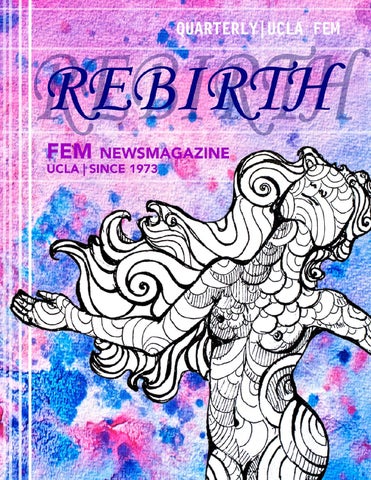
FEM Quarterly: 2013-2014
TABLE OF CONTENTS BECOMING A WOMAN
8
44
STAFF ART
14
THE MYTH OF THE HYMEN
52
THE POWER OF LANGUAGE
20
THE BALKAN GIRLS
58
IS FEMINISM A DIRTY WORD?
24
CONFESSIONS OF AN EX-BULIMIC
62
WHAT IS A FEMINIST?
30
DISTORTED BODY IMAGES
66
ART & POETRY CONTEST
36
REBIRTH AFTER RAPE?
74
THE LIFE AND STRUGGLES OF TRANS* PEOPLE
38
THE WOMAN WHO ARE BOUGHT AND SOLD
82
MOVING PAST OUR COMFORT ZONES
2
FEM Quarterly: 2013-2014
EDITOR’S NOTE When I became a writer for FEM about two years ago, I was in the middle of my sophomore year at UCLA, and remember experiencing this new opportunity as a necessary reinvention of myself. I was still trying to process all of the information I had learned in my freshman cluster class “Sex: From Biology to a Gendered Society,” and was increasingly angry and unhappy as I realized that my gender had influenced many of the ways I was treated throughout my life. I had attended an all-girls highschool, and the last thing many of us wanted to be called were “feminists.” In our minds, “feminist” carried the connotation of “man-hater” and a “radical” that just wanted to start trouble over “nothing.” Although we were taught how to become leaders, how to demonstrate our abilities, and how to command language, there was a clear disconnect between our empowerment and our rejection of the “feminist” we thought we couldn’t understand. While I did not have the language, the dialogue, or any concept of the manifestations of socially
ingrained misogyny, leaving an all-girl classroom and coming to UCLA forced me to experience my gender in a way that I had the privilege to ignore throughout highschool. By my sophomore year at UCLA, I couldn’t overlook the fact that a set of steps on our campus was called “rape trail” or that the songs I heard on the bus at a fraternity “date invite” where about killing a woman who didn’t “put out” or “put out too much.” Being a part of FEM has allowed me to do the research and writing that I needed in order to understand my anger over these discrepancies in treatment and find ways to attempt to change realities that are socially constructed. As I believe in the power of education and awareness, I hope that FEM Newsmagazine will continue to make readers question their assumptions. My personal rebirth: I am no longer superficially empowered by ignorance.
3
FEM Quarterly: 2013-2014
S T A F F EMPOWERMENT Efthimia Johanides Staff Writer
As a feminist, stories empowers me. From the stories conveyed in music (Beyonce anyone?) to the stories told by others of the beauty that is feminism.
Amy Trivers
FEM staff members share what make them feel empowered and why.
Noelle Little
Editor-in-Chief
Content Editor and Staff Writer
I am empowered through singing and dancing. Surrounded by my family who has always encouraged me to bring my stories to life, I sing and dance with abandon; and in these moments, I am free and I know I am loved.
Change empowers me, and in turn, I harness that empowerment to create my own change in the world. It empowers me to be strong, it empowers me to persevere and it empowers me to make a difference.
Alexandria Camarella Copy Editor
I feel most empowered when I am myself. Whether that’s going for a run at the crack of dawn to feel that morning chill against my face, or washing my car while singing along to a mix of 60’s music to punk with not a care in the world.
4
FEM Quarterly: 2013-2014 Natalie Kirsten Staff Writer
I feel empowered when I share my ideas, be that through giving a speech, sculpture, taking part in a discussion, journalism, or participating in any other means of communication. I don’t have to share my ideas with many people or anybody at all to feel empowered.
Mary Kate Morrow
Content Editor and Staff Writer
Vivian Giang Staff Writer
I feel empowered through discussion. It’s frustrating to see people with beliefs that I really disagree with, but through conversation, I have the chance to talk to them and maybe change their minds while feeling like I have made a difference.
Kathryn Burch Staff Writer
I feel empowered through teaching. My students teach me how to be patient and I feel empowered knowing that I help my students achieve what they previously thought was impossible.
Julia Childs Staff Writer
I feel empowered through writing. Whether I’m venting about a bad day or making myself laugh by writing dumb jokes that no one else thinks is funny, I feel strong when I exercise my voice.
5
I feel empowered through helping others, particularly young women. Whether it is giving someone advice or just being there through a particularly difficult time in their life, I find solace in giving others hope.
FEM Quarterly: 2013-2014 Taylor Milam Staff Writer
Financial independence makes me feel empowered. I’m in charge of my life, my choices and my future. By supporting myself, I have the ultimate say on everything.
Lorenia Salgado
Yamuna Haroutunian
Staff Writer
Staff Writer
I am empowered through music. Music is not a medium that bends to reason and rationality, but to emotion and identity. Through music, I can hear the loves, pains, wonders, and triumphs of women.
“I don’t study to know more, but to ignore less.” - Sor Juana Inés de la Cruz I feel empowered by reading. Books have the power to transform us, and for me, it is not simply to acquire new knowledge; it is how can we use that knowledge to make things happen.
Daniela Attia
Shannon Richards
I feel empowered by expressing my personal style. Whether that means wearing purple lipstick or strutting around in a pair of glitter platform-sneakers, there is something truly liberating about styling myself how I want to.
I feel empowered through art and learning. I have been drawing since I was very young and have a love for portrait work. Being able to capture someone’s likeness creates a rush that makes me feel like I can do anything.
Content Editor and Staff Writer
6
Staff Writer
FEM Quarterly: 2013-2014 Dana Yu
Copy Editor and Staff Writer
Haysol Chung
Angelina Murphy
Designer / Illustrator
Content Editor and Staff Writer
I feel empowered by what I choose to wear. I choose clothing and accessories based on my mood or even to improve it. Fashion and style are great ways to tell the world who you are or want to be, despite there being different stereotypes associated with different kinds of clothes.
I feel empowered through yoga. It makes me feel strong, independent, and confident.Yoga has given me an escape that allows me to translate negativity and anxiety into a positive movement.
I feel empowered when I listen to music. There’s something incredibly powerful about the right beat, especially when the lyrics are powerful themselves.
Sara Haas
Designer / Illustrator
I feel empowered through making artwork. Because it’s my own self-expression, there are no rules placed on it. I feel strong by making the images I want to make. I love that in the arts community, personal voice and individuality are encouraged in this way.
Noopur Goel
Designer / Illustrator I feel empowered through my sketchbook. My sketchbook is a mixture of both writing and illustration intertwined together to become a visual diary. It allows me to express my frustrations, learn from my mistakes, and realize my personal power to move forward and fulfill my goals.
7
FEM Quarterly: 2013-2014
FEM Quarterly: 2013-2014
ART|DESIGN: SARA HAAS DANIELA ATTIA
In elementary school, I looked forward to the clock striking 10:30 everyday because that meant it was time for recess. Recess was my opportunity to team up with my friends to play our game of choice: house. While playing house, we would decide who could play who- someone needed to be the mom, the dad, brother, sister, aunt, uncle, and even the pet golden retriever. I, of course, was always the cool older sister or eccentric aunt. Playing house was particularly popular with my classmates mostly because it gave them an opportunity to boss each other around. But for me, playing house was my escape into my deepest fantasy, being an adult.
a woman!” I was bombarded with the idea that having my period meant that I would be declared a woman. The problem with this logic for me, is that I was quite the early bloomer. I had my first period when I was a mere ten years old, entering into the fifth grade. Considering I still had my baby teeth, nothing about this experience made me feel like an adult. I was still searching for another moment that would signify my entrance into womanhood. Another popular myth I believed growing up was that losing my virginity would declare me to be a woman. My closest friends shared so many stories with me throughout high school about their moments when they lost “it”. My best friend even confessed that she cried while having sex for the first time because the moment was so emotionally powerful. The common theme among many of my friends’ first sexual experiences was that losing their virginity changed them. They all felt like they saw the world differently after, and that they felt like they had finally developed into their own version of a woman. In high school, I believed that once I had sex the same experience would happen for me. I somehow thought that having sex would magically morph me into a sophisticated grown-up version of myself. But, reflecting back on this, I realize that this was not the case.
As a little girl, my mind was constantly preoccupied with the potentials of the future. I was always daydreaming about my job as a high-fashion designer in New York, and planning my wedding with my fiancé, Leo DiCaprio. I wanted my life to emulate the lifestyles that I saw in the movies. I wanted to be Kate Hudson in How to Lose a Guy in Ten Days or Jennifer Garner in 13 Going on 30. I longed for the day that I could be in charge of my own life and make my own decisions. As a little girl, the thing I wanted most was to become a woman. The years following, my head became filled with ideas that once specific moments occurred in my life, I would enter into womanhood. One of which was sparked from an episode of the Canadian teen-drama series, Degrassi. The episode featured one of the main characters, Emma, having her period for the first time. When she shares this moment with her best friends, they proudly exclaim, “You’re finally
I am now twenty-years old and a junior in college. I have yet to have sex but I do not think that I am any less of a woman because of this. My experience of becoming a woman was something much different than the common experiences that we are made to believe will lead us into adulthood.
9
FEM Quarterly: 2013-2014 Throughout my childhood, it is pretty safe to say that I did not have to take on much responsibility. I grew up in a household where my parents did not mind taking as much care of their children as they possibly could. My mother, being the Italian goddess she is, has always been such a selfless person. She was the one in our home to cook, clean, and take care of everyone. She never expected my older brother and I to do what a lot of other kids our age had to eventually do – like putting dishes in the dishwasher or having to wash our own clothes. My father especially wanted to do everything in his power to provide for my brother and I. So he never expressed to us that we had to work while we were in school. He wanted us to focus solely on our studies and nothing else. Needless to say, my parents spoiled my brother and I throughout our childhood. I always depended on them to take care of me in every imaginable way. It wasn’t until my senior year of high school
that I began to realize that things were starting to change in my household. My mother was not as patient with me as she normally was. The careless things I would do, such as leaving my muddy boots in the living room or not cleaning up after eating dinner, that normally just annoyed her were now becoming problematic. (Reflecting back on this I want to kick myself for being such an inconsiderate brat). I also began to notice that my dad was home more often than ever before. He was not working nearly as many hours as he normally was. Me being a self-absorbed teenager, I did not think anything significant was the cause of these changes taking place in my home. My mind was consumed by concerns that were only in relation to myself. Thoughts like the color of my prom dress or the specific haircut that I wanted to get before my senior picture were things that I was most worried most about.
Her last day working at the theaters. Although there were many aspects I did not like about that job, it taught me so many valuable things that I would not have been able to learn anywhere else.
10
To say that I was self-absorbed seventeen year-old would be a massive understatement. Weeks into my senior year, my parents became more noticeably anxious with me. Asking them for money for a homecoming dress was not as simple of a request that I was used to. A week before the dance, I realized my comfortable world I was used to living in was being instantly turned upside down. My mom revealed to me that my father lost his job months ago and we had been struggling immensely with finances. She then told me that we had to find somewhere else to live within the coming weeks because we could not afford to keep staying in our home. I was shocked that my parents were able to hide these
FEM Quarterly: 2013-2014 misfortunes from me for such an extended period of time. But mostly I felt sick to my stomache because when I was bugging my parents about the expenses of my dream homecoming dress, they were struggling to find the money to keep a roof over our heads. My irrelevant and selfish needs were an additional burden placed on my parents, and I hated myself for it. After learning about the extremities of my family’s financial situation, I began to look for my first job. I figured getting a temporary position somewhere would take some minor pressures off of my parents. Luckily for me, the local movie theatre in my neighborhood was hiring. Of course, scooping popcorn for rude customers was not my ideal way of spending every weekend of my senior year. But I still appreciated that shitty minimum-wage job because it taught me to look at the world around me differently. For the first time in my life, I was given some sort of responsibility. Yes, the responsibility was simple enough for even a monkey to handle. But, it still gave me the opportunity to perceive myself as self-sufficient. My co-workers and managers would trust me with tasks that I never thought I would be capable of handling. I was learning to figure things out for myself, and stop being as dependenton others to do every imaginable task for me. After two-and-half years of working at the theatres, I felt that I had developed into a capable adult. The most empowering thing about my first job was that I was able to help out my family in some of their hardest times. Putting my loved ones before myself allowed me to realize the responsibilities that come along with growing older. I was finally becoming the woman I always desired to be.
I always felt that my development into womanhood was not nearly as fascinating as the stories I saw in some of my favorite chick-flick films and teenybopper television shows that I cherished as an adolescent. But, a dear friend of mine named Denise, pointed out to me that womanhood can come in a variety of different experiences. They do not have to mimic what is shown to us in the mass media. Denise made this point evident with her very own journey into becoming a woman. Denise went through most of her high school years seeing girls her age get into relationship after relationship. Not having a significant other by the age of sixteen was daunting to her, because she still felt that she was undefined as a person and felt as though she was missing something. Then her senior year came and she met someone who took an instant liking to her. She jumped at the opportunity to start dating him because this was finally her chance to be with someone. After dating for a year, Denise’s peachy first relationship began to hit a sudden snag. Her boyfriend was starting school on the opposite side of the country, at John Hopkins University. The newfound distance between the two opened Denise’s eyes to the many aspects of her relationship that she previously overlooked. Specifically, how he treated her. There were little moments that stuck out to her, like when he would make fun of her quaint little 1998 Honda Accord. Or when he would put down her plans of attending a community college before transferring to a four-year university. There were countless moments that made her realize that he was not a supportive partner.
11
FEM Quarterly: 2013-2014 In actuality, the relationship consisted of him constantly criticizing and trying to change her. Soon after analyzing these realizations, Denise broke up with him. During her very first breakup, she took the time to consider why she wasted so much of her time on a guy that made her feel so badly about herself. Now we all know that a breakup period is one of the most miserable periods in a hormonal teenage-girl’s life. The mere sight of anything that reminds us of our exes can drive us over the edge. But, for Denise the breakup served to be one of the most liberating moments that she has experienced. Her breakup motivated her to finally focus on herself. She was putting herself first, and because of that she was beginning to realize her potential and personal worth as an individual.
She was getting good grades in school, taking on more responsibility at work, and most importantly she was considering herself to be someone who does not have to be defined by a significant other. She was becoming comfortable in her own skin. She was becoming her very own woman.
For some young women, their progression into adulthood is a gradual experience. But for many others around the globe, there are defining moments that take place which signify that a girl has developed into a woman. In Latin-American countries there is a cultural tradition of Quinceañeras. Quinceañeras consist of lavish parties that celebrate a girl’s fifteenth birthday, because that is considered the transition from childhood into adult-
In Jewish cultures, on a girl’s twelfth birthday they are given a Bat Mitzvah, a ritual passage where girls are then considered women who can be held accountable for Jewish ethics and traditions. In the Philippines, when girls turn eighteen they are given a Début, another form of a celebration for the transition of girlhood into womanhood. But not all cultural rites of passage are in accordance with a girl’s age. In the different Native American cultures, at the start of menstruation there are varying kinds of celebrations that take place in order to commemorate a girls entrance into womanhood. According to Cycle Harmony, Navajo tribes give their new women a four day long celebration called, Kinaalda. This includes special dances and cleansing rituals where symbolizing the spiritual closeness to Mother Nature. The Apache tribe has a similar practice for their women called, the Sunrise Celebration. In society, there are a myriad of different beliefs and practices that are considered to lead girls into the process of womanhood. The preoccupation of growing up can derive from images that we see through media vehicles – like on episodes of Degrassi, or through cultural practices- like Quinceañeras and Kinaaldas. Or they can be developed over a period of time through a series of personal experiences. There is not one specific universal experience that triggers the evolution into womanhood. Becoming a woman is something that exists on a personal level; there are some similarities, but still the experiences are profoundly unique and different.
12
FEM Quarterly: 2013-2014
There is not one specific universal experience that triggers the evolution into womanhood. Becoming a woman is something that exists on a personal level; there are some similarities, but still the experiences are profoundly unique and different.
HOW TO BECOME A WOMAN - get a BF / GF - start your period - lose your virginity this message is brought to you by society
13
FEM Quarterly: 2013-2014
ART|DESIGN: SARA HAAS
The Myth of the Hymen NOELLE LITTLE
What exactly is virginity? Is it a social construct? Is it a biological fact? Why do I, a 21 year-old woman, have such a hard time defining something that seemingly defines my entire sexual experience? In order to tackle that question, we have to start with something even more basic than the concept of virginity – the hymen. What exactly is a hymen? Can it be broken? Is it the same for every woman? While one might assume we receive all the same information on a concept as simple as the hymen – there is in fact a lot of myth and misinformation
surrounding the topic. The most basic definition of the word hymen, according to the Oxford Dictionary, is “a membrane that partially closes the opening of the vagina and whose presence is traditionally taken to be a mark of virginity.” If we want to go a step further, we can look to Hanne Blank, the author of Virgin: The
14
Untouched History. She not only offers an expanded definition of what exactly ahymen is – she also puts forth an explanation of how it develops biologically: “When a female fetus is growing during pregnancy, her internal reproductive organs and her vagina develop separately from her external reproductive organs (the labia
FEM Quarterly: 2013-2014 and so forth). The vagina starts out a solid cord that runs from the body wall to the uterus. Between the fifth and seventh months of gestation, that cord slowly hollows out and turns into a tube. But it still doesn’t have an opening to the outside of the body -- it ends at the body wall. Finally the body wall starts to disintegrate at the point where the vagina meets it and an opening forms in the body wall, and becomes the orifice (outlet or opening) of the vagina. What the hymen is is whatever remains of that body wall cling to the inside opening of the vagina after the opening forms. It is the “leftovers” of the sheet of flesh that used to separate the internal genitals from the external ones before the vagina had an opening. The opening(s) in the center of the hymen are the entrance to the vagina.” In short, the hymen is leftover tissue that separates the internal genitals from the external genitals before the opening in the vagina is developed. What is more important for our discussion,
however, is according to medical research, some women are even born without a hymen. Other than its biological definition, the hymen has a social connotation as well. Historically, the presence of what is considered to be an “intact” hymen has been used as proof of a woman’s purity. In other words, if a woman’s hymen is intact, she is still considered to be a virgin. However, according to Columbia Health, the idea of a hymen being “intact” is a myth. The reason behind this being that “hymens vary in shape, size, and thickness” for each woman (and again, not all women have one). “Among the multiple possibilities are hymens that surround the entire vaginal entrance, with an open space in the center (called an annular hymen), and hymens that appear open with a thin line of skin down the middle (a septate hymen). Most hymens don’t fully cover the vaginal entry so that menstrual fluid can leave the body. In rare instances, the hymen can be thick, covering the entire
15
vaginal opening (an imperforate hymen).”
So, the question is, if there are multiple varieties of how hymens do or do not appear in women’s bodies, how can this be used as an indicator of virginity and purity? Returning to Hanne Blank, the concept of virginity is believed by anthropologists to have appeared “about the same time as they [humans] learned how to domesticate animals and plants, during the Neolithic Era.” While the concept of virginity is not the same in every culture, nor has it been the same throughout all of human history, there is a similar underlying message. “Some people have felt that virginity is primarily a physical thing. Others have felt that it is really psychological, or spiritual. Or it might be defined as having some physical elements and some psychological ones as well. Generally, the people who have gotten to make the
FEM Quarterly: 2013-2014 decisions about how virginity is defined have been people in positions of power over young women’s lives. Parents and older relatives, community elders, and especially religious and medical authorities have always had a lot of clout in terms of deciding what the criteria for virginity were at any given time.” In other words, those in positions of power decide what constitutes the concepts of purity and virginity. Generally the two terms are treated in conjunction, with virginity being the key to being a “pure” woman. There are a multitude of roles virginity plays in society. The concept of virginity has been associated with the purity of a woman, the honor of the woman’s family and/or the honor of the individual woman. Additionally, the concept of virginity has been considered a reflection of religious devotion, a dependable birth control method, and a way of ensuring the fatherhood of children. For some, virginity is also a way of displaying devotion to one’s husband – by waiting until marriage to engage in sexual intercourse, certain women feel this to be a reflection of their love. From another point of view,
the concept of virginity can be interpreted as a social construct put in place by men in positions of power to control the lives of women. According to Hanne Blank, throughout much of history, whether or not a woman kept her purity and her virginity “intact” was a very serious matter. “For much of human history, a woman’s life was literally at the mercy of virginity. A woman who lost her virginity before she married was pretty much doomed: she was dishonored, her family was disgraced by her, it was likely that no one would be willing to marry her, and she might be beaten or even killed by her family. This was true whether she had lost her virginity voluntarily or been raped -- it didn’t matter. Women who lost their virginities when they weren’t married were often disowned. This would make them homeless, and leave them without any means of providing for themselves. Many disowned women ended up turning to prostitution to support themselves, not because they wanted to but because they had nowhere to go and owned nothing else that they could sell.
16
In ancient Athens, the law required that young women who lost their virginities before marriage be sold into slavery, because that was all they were worth once they had ruined their reputations and their family honor. Roman law allowed fathers to murder their daughters and the men who had seduced them if the daughters lost their virginities before marriage. The same has been true in many other places
FEM Quarterly: 2013-2014 and times. In some parts of the world, “honor crimes” are still commonplace -- women who lose their virginity before marriage can be beaten, mutilated, or killed by their families. Sometimes this happens just because a father or brother or other male relative thinks she might have done something ‘dishonorable.’” In short, there was a time in history where a woman’s loss of virginity outside of marriage
?
could lead to dishonor, abandonment, and even death. Though it is important to note that honor killings are still existent in certain religious societies today, the majority of modern Western societies view the concept of virginity as not a matter of life and death for women, but rather a personal choice. More often than not, that personal choice is rooted in religious belief. Ultimately, the perpetuation
of this falsity can be harmful to women; especially those who are waiting until marriage and then come to find that their hymen has already been torn or stretched and expect there to be blood or some sort of indicator of “physical change” after their first vaginal sexual intercourse. According to the Huffington Post, that expectation of bleeding during your “first time” in itself is a myth regarding the hymen. “…Anna Knöfel from the Swedish Association for Sexuality Education points out over at Scarleteen that the bleeding-during-firstintercourse is yet another facet of virginity mythology that we’ve accepted as a standard and unnerving feature of the female sexual experience. For many women -- 63 percent
17
according to one small-scale survey -- losing their virginity was neither physically uncomfortable nor messy. Sex educators instead attribute bleeding during coitarche (aka “first sex”) to what Michael Castleman at Psychology Today cringingly called ‘nonsensual, poorly lubricated, piston-like intercourse.’ Throughout a girl’s life there a many different ways a hymen can be torn or stretched, and none of those are related to whether or not the girl is no longer a virgin (meaning never having engaged in vaginal sexual intercourse). The hymen can be torn or stretched from using tampons, engaging in masturbation or even during a gynecological exam. According to Columbia Health, it is even possible to tear or stretch a hymen without inserting anything in to your body – it can happen during strenuous activity such as horseback riding, gymnastics, and dance. What is key to take away from this article is that in no way is the “status” of a woman’s hymen an indicator of virginity and purity. The idea of virginity being something physical is a social construct, and ultimately a myth, that can
FEM Quarterly: 2013-2014 be harmful to women who are not knowledgeable of their own physical bodies. The concept of virginity in itself, however, is not harmful. In fact, Hanne Blanke believes the term to be fairly neutral: “If all you mean is that ‘virginity’ is a name for a sexual status characterized by not ever having engaged in sexual activity with another person, I think that’s pretty neutral, neither positive or negative. In that mode, ‘virginity’ is just a useful way of describing someone’s sexual history.” It is only once the concept is used to shame other women, or at the most extreme to kill other women, that the idea of virginity can be damaging. While there is nothing wrong with believing in the social concept of virginity, or choosing to remain a virgin until marriage, or believing virginity to be a reflection of your moral and religious ideals, there is a danger in believing it to be a physical marker of a difference between women. Ultimately, if one chooses to believe in the concept of virginity in a moral or religious sense, then there is not a problem with that. For some women, virginity is as much a part of their identity as the color of their
hair. If someone chooses not to understand the concept of virginity as a reflection of their morals or overall “purity” as a woman, then that’s fine too. Every woman is entitled to interpret and place as much value on the concept of virginity as they desire – the only harm in the concept of virginity is the myth that it is physically “taken away,” because of the breaking of the hymen, and there is no medical foundation to that claim.
18
While there is nothing wrong with believing in the social concept of virginity, or choosing to remain a virgin until marriage, or believing virginity to be a reflection of your moral and religious ideals, there is a danger in believing it to be a physical marker of a difference between women.
FEM Quarterly: 2013-2014
?
Unicorns, pearls, veils, lilies and the color white are symbols of virginity dating back to the Renaissance.
?
?
FEM Quarterly: 2013-2014
“The Balkans� is a region of Southeastern Europe encompassing many cultural and geographic boundaries.
20
FEM Quarterly: 2013-2014
ART|DESIGN: SARA HAAS
Efthimia’s grandmother and mother stayed at home with the children while the men in the family were working.
The Balkan Girls EFTHIMIA JOHANIDES Growing up as a GreekAmerican, there are many things that you are told to do, like go to Greek school and learn to make moussaka so that one day when you have a family you can speak to them and feed them. I also had to learn other things pertinent to my heritage, like how to dance traditional Greek dances and how to properly order a frappe at a café. I was taught to do well in school and be a good person. One thing I was never told, however, was that I could not achieve anything I would
ever want. As I was reflecting upon this great blessing I started to wonder, as a woman from the Balkans, if other women had the same upbringing. I first spoke to my mother and asked her about her early life as a woman living in Greece in the 1970’s. She told me that almost everyone in her village did not care about educating the women – that the men were supposed to go to school and the women were to simply stay home and be housekeepers.
21
My mother explained that she never really had a choice; she grew up with the mentality that girls were incapable of doing anything but mundane housekeeping tasks, like scrubbing floors and cleaning toilets, and that education was for the men.
It was only when she moved to America in the 1980’s that she was exposed to the idea that women could do things for themselves, that there were other options such as receiving
FEM Quarterly: 2013-2014
higher education and being a part of the workforce. We spoke of modern day Greece, and how education is becoming more and more important for girls. She told me that in major cities, such as Athens and Salonika, girls and boys are made to go to school by their parents. In most villages, however, education is still not a priority for the parents of girls. For more perspective, I spoke with a Bruin from Albania, who wishes to remain anonymous. I asked him about the equality of men and women, particularly in terms of education. He explained that in most Albanian families, the girls
and the boys must attend school and they are expected to do well. However, once the girls reach an age at which they can attend college, they will either attend a university in Western Europe or in Albania, or they will not attend university at all. Most of the boys will attend university and the ones that do not will simply work with family members for family businesses. Fast-forward a few years. The girls that left Albania will have more control over their lives after they have obtained their degrees. For example, they can get married if and when they choose, and they can lead lives of which they are
proud. However, the women that stay in Albania will most likely be married off to a man chosen by their parents and have access to fewer rights within more rigid gender roles.
According to Balkan Insight, “women are virtually the property of their husbands, while the marriage lasts.” Thus, the women will essentially be under the control of their husbands unless they can attend a university outside of Albania and ultimately lead their own lives. I also spoke to a friend who is originally from Kosovo and
ABOVE: The boys in the family had more opportunity to travel, through their soccer team and the military. Riding a camel was Efthimia’s mother’s only real learning experience with something foreign.
22
FEM Quarterly: 2013-2014
wishes to remain anonymous. She stated that the treatment of girls in Kosovo is very different from the treatment of girls in Albania. When asked about the equality of men and women in Kosovo, she stated,
“Gender roles are not strict there. Kosovares are more understanding [than people in neighboring countries] and want their daughters to have an education.” Her response shocked me. I asked her why she thought this was the case only in Kosovo and not necessarily other
countries. She said, “I think it has to do with all the [political] problems that Kosovares had to face coupled with the American influence on the country. Because of all the help the Americans gave during the wars that have happened recently in Kosovo, Kosovares ‘look up’ to the American ways, particularly in equality which was a problem faced in Kosovo for many years.” Thus, women from the Balkans are generally not treated as well as they are in other Western societies. As seen in Kosovo, the adaptation of American ideals definitely aided the treatment of women, but this experience is not not as pervasive in other countries.
23
Will the treatment of women ever fully change in the Balkans? Currently, only the drifting away from traditional ideals can accomplish the needed change.
FEM Quarterly: 2013-2014
DESIGN: SARA HAAS
Confessions of an Ex-Bulimic ANONYMOUS
My bulimia was my best friend throughout my first year of college. I clung onto it because it was the only thing that felt real. I didn’t have to think or pay attention to the world around me. Bulimia gave me a world that required nothing but isolation and my own distorted thoughts. It handed me a predetermined reality, and for a long time – six months – that was enough for me. I was content to deteriorate in my own self-hatred, and it turns out hate can dissolve better than any acid can. It tore everything from me and I was left with nothing. Nothing except for chronic stomach pain, raw knuckles, swollen cheeks and tears in my eyes. Nothing except for the humiliation and anxiety of leaving a restroom and trying to seem “normal.” Nothing except for an addictive, never-ending cycle of hate building upon itself. Every purge emptied by stomach, but nothing could clean out my mind.
My problem was that I somehow thought these two acts were linked – purging the body of food and the mind of thoughts – and I mistook the obsession with bulimia for an empty mind. My mind was not empty; it was simply taken over by something else. What was the root of all of this? Maybe some of you will read this and only take from it the obvious and somewhat shallow message – that this is the story and confession of an ex-bulimic. But this is not my attempt to write an anecdote about myself, nor is it an attempt to give a graphic or in-depth look into the eating disorder itself. Rather, I want to focus on gendered expectations, their omnipresence, and the potential disastrous results they can create. My self-hatred was the product of years and years of unrealistic expectations in every aspect of my life. These expectations surrounded me 360
24
FEM Quarterly: 2013-2014
degrees, and they were relentless. It was my mother giving me unsolicited diet tips from age ten and the “popular” kids in school picking on those who were “fat” or “ugly.” Why are “popular” kids attractive and liked by everybody, whereas the less attractive kids are ostracized? It was the magazine stands at the grocery store telling women how to “lose 40 pounds in just ONE month!” Am I supposed to want that, too? It was my friends and I consequently standing in front of my bedroom mirror listing and comparing our physical flaws. “My thighs are too fat.” “My hips are too wide.” “My nose is too big.” “My stomach isn’t flat enough.” It was the billboards of rail thin women whose images popped into my head while I stood in front of the dressing room mirror. It was the one-size-fits-all clothing at popular stores that did not fit me. “I can’t wear cute clothes if I’m fat,” I thought. It was the actresses in movies who were thin and beautiful and simultaneously found love and happiness. It was the constant message that any trace of fat on my body is evidence of a character flaw.
It was the constant message that “thin” and “beautiful” were attributes to be worshipped. the evidence was everywhere. This message was so ingrained in me that when I arrived at UCLA and had a difficult time acquainting myself in the new environment, I immediately assumed that it was because I was fat and ugly. I couldn’t make close friends, and I blamed it on my
25
4
FEM Quarterly: 2013-2014
physical flaws and not on the fact that I was shy, homesick, and had nothing in common with the people on my dorm floor. The few girls I thought were my friends in the beginning of the year ended up spreading rumors about me; instantly, I became paranoid about who I could trust. One day, I was in the shower when I overheard my suitemate laughing to somebody about how I’d gotten fat since the beginning of the year. That’s when I began my fucked up mission of “beautification.” I told myself I would do this to show people that I could be “beautiful” even though I was friendless and sad.
In reality – and I couldn’t even admit this to myself at the time – I desperately wanted somebody to notice that I was sick, because maybe then they would ask me why. These feelings are not unique; many people, both men and women, experience similar feelings to varying degrees. And many people have also been driven to extremes like I was. Of course, these extreme situations are dependent upon multiple factors within individual personalities, but it does not help that our culture is rampant with distorted views on body image and beauty. The most detrimental idea is that a person could be happier if he or she was just a little slimmer or just a little prettier. We worship the standard idea of “beauty” and all wish to achieve it, but why should a standard even exist, and who defined it? One morning, after six months of continuous binging and purging, I woke up with excruciating stomach pains that prevented me from getting out of bed. My obsession with bulimia, which had originally stemmed from a desire to ignore my feelings
26
FEM Quarterly: 2013-2014
of extreme loneliness, had ironically made me alienate most of the people in my life, so I had nobody to call for help. I laid in bed, scrunched up into a ball due to the stomach pain, and I thought about what had gotten me to this point. Who or what was to blame? Everybody feels the same societal pressure to be beautiful, but I had digested and manifested the pressure in a completely distorted and dangerous manner. I was forced to think about my situation and whether or not I should change it. Somehow, I was lucky enough to realize that I had no choice but to get better, or eventually die from the addiction.
Bulimia left me with nothing – a skeleton of my old self – but it also provided me a clean slate. From the absolute loneliness and emptiness, I was able to start over. At that moment, lying in my bed, I considered my situation and the different options I had. Luckily, the only viable option I saw was the one of escape from Bulimia. I was lucky. Choosing the escape option meant that I saw the irrationality of my actions. It was as though the paralyzing stomach pain had shattered my dream world and exposed the effects of daily, scheduled purging. By sheer determination, I was able to convince myself that the pressures to be perfect – both internal and external – were not worth sacrificing my body or my relationships. Over time, I was able to reevaluate the idea that there is only one standard of beauty, and I was somehow able to accept, at least partially, my own beauty in the form that it is meant to be. I was lucky. There are far too many people who don’t survive.
27
FEM Quarterly: 2013-2014 What do we do for the people who are not as fortunate as I was? I was studying in Young Research Library the other night when I saw a confession scrawled on the bathroom stall:
“I hate being bulimic but I’m still fat.” Somebody else responded underneath: “Well DUH, just stop being bulimic!” Healing requires listening. Healing requires empathy. Healing requires reaching out to people without the fear of being ostracized. Healing requires that we love each other as a community, despite our differences and our pasts and our flaws. It shocks and deeply disappoints me that a fellow woman at UCLA could have such little empathy for another woman reaching out for help anonymously. It is impossible to change society’s standards of beauty overnight. I don’t even know if it is possible for a more heterogeneous idea of beauty to ever become widely accepted. But what we can do, especially within the UCLA community, is stop alienating and judging people. We can create a safe and friendly environment so that body image issues do not have to arise in the first place. Happiness and confidence come from feelings of self-worth; self-hatred and distorted body image stem from depression
about other issues that are usually unrelated to physical appearance. We cannot change the widespread definition of beauty, but we can undermine it. We can stop with the diet tips and the body-bashing and the “thinspiration” and the mean jokes. We can love people simply because they are people, too.
Instead of viewing people as
improvable, we can view them as whole and beautiful just the way they are.
Bulimia is not about being skinny; it is a desperate attempt at acceptance by cleansing the body of imperfections and guilt. This is a generalization, of course. Every person’s situation is unique, and I am not pretending to understand other people’s experiences with eating disorders. What I do know, however, is that eating disorders are not voluntary actions by petty girls who wish to be thin. Although bulimia itself is a disease, it is also a severe symptom of a much larger issue within society.
28
FEM Quarterly: 2013-2014
About the Artwork: A sculpture series by natalie kirsten I created a series of female torsos which show the digression into the depths of an all-consuming eating disorder. I portray various causes, aspects and effects of an eating disorder through a visual transition from concrete to abstract.
29
FEM Quarterly: 2013-2014
ART|DESIGN: SARA HAAS
Eyes of the Media on Body Image JULIA ELISE CHILDS Growing up, I wasn’t considered attractive by “societal standards.” I was cursed with unmanageable curly hair, I was overweight, I was shockingly insecure. I felt constant pressure to be thinner, to have beautiful hair that fell into shiny curls, to be interesting, to be sexy, to be desired. It became an obsession. It constantly nagged at me – the fat that hung on my thighs, the fat that I didn’t see on any women around me. The pep talks I had to give myself before going to the beach in a bikini, the looming questions of how to gain attention from men and how to become the “perfect female”.
I was through trying to decode the route to being a “proper woman”. I turned off from the perceptions of others and decided, simply, that I would take my happiness into my own hands. What this meant is that I began taking better care of myself. I worked out often, ate well. I tried my best to ignore the opinions of the
I constructed a skewed definition of what an ideal woman should be – tall, thin, sexy, funny, friends with only men, outspoken. An ideal woman should reject other females, so as to set herself apart and, in many ways, set herself above her peers. An ideal woman was one I had only seen in images of the media. She lived in the characters of television shows and in Hollywood escapades. She had the body of a prepubescent pop star, the style of an Olsen twin, and the strong reputation of Beyonce. In my naive, teenage mind, I convinced myself that an ideal woman should be an impossibly beautiful form made up of many contradictions. This skewed mindset carried me through the end of my teenage years, halting at the brink of my second decade as a woman in this world. Struggling with depression stemming from extremely low self-esteem, I had given up.
30
FEM Quarterly: 2013-2014
The Media Taught Me I Would Never be Skinny Enough VIVIAN GIANG The National Association of Anorexia Nervosa and Associated Disorders says that “the body type portrayed in advertising as the ideal is possessed naturally by only 5% of American females”. I am not one of those women. I am a woman with wiry arms and what seem to me like large thighs. I am a woman with a face full of
baby fat, with acne and slowly fading acne scars, and awkward glasses that definitely do not make me look like a “hot nerd.” In short, I am a woman unlike the ones you see in magazines. But I wanted to be one so much, for such a long time. I didn’t realize how much it changed me. It was subtle at first. Eating smaller portions, snacking less, getting on the scales a little bit more than I used to. Then my collar bones didn’t stand out enough, my thighs weren’t small enough. My stomach wasn’t flat enough, and then I was eating only one meal a day. I became tired all the time, sleepy, because I never ate enough so I didn’t have any energy. Somehow, that never-changing goal of becoming the sort of woman you would see in a magazine didn’t fade, but became more elusive as I began to feel isolated and alienated from my friends. No one expressed much concern over never being skinny enough, and I felt that I didn’t have a real diagnosed eating disorder, so it didn’t really matter. I wasn’t starving myself, not when I was still eating daily, and I wasn’t purging my meals, so I couldn’t be anorexic or bulimic. Nor did I ever feel a compulsive need to eat, so I wasn’t really bingeing, either. But whatever I was doing, it wasn’t enough. It was never enough to look like the women I saw on TV. The more movies, advertisements, and TV shows I watched, the more inadequate I felt, hiding behind baggy t-shirts and shying away from anything remotely fashionable. I didn’t think anything would fit me or look good on me because my stomach wasn’t perfectly flat and my thighs have stretch marks all over the
31
FEM Quarterly: 2013-2014
men who surrounded me, I didn’t date during this period of time. I quit buying women’s interest magazines like Cosmopolitan magazines that boasted “How to be Sexy” and “Ways to Please Your Man”. I began curling my hair into the thick curls I had desired for so long. I began wearing clothes that I liked, regardless of how they hung on my body. I happily went shopping for bikinis and lingerie, without a support system, alone in fitting rooms, forcing myself to appreciate my half naked body illuminated with harsh fluorescent light. Becoming an advocate of a healthy lifestyle, I stopped consuming mass amounts of alcohol, dropping out of the college party scene early on.
For a blissful period of time, I felt free. Finally, I was free from the negative perception that had plagued me. It felt that suddenly everyone I knew – from employers to childhood friends to family members - had something to say about my physical appearance. All good things, all compliments praising my appearance. I was confused – in the past I had never owned
a scale, I frequently sold my old clothes, I was still stuck in the habit of avoiding photos. I had no way to gauge how my appearance had changed until one day I found an old photo of myself. I was eighteen years old in the picture; I had my naturally frizzy hair, chubby cheeks, larger physique. Looking in the mirror, I realized that I had attained my original ideal of beauty without knowing it. My stomach was flat, my hair perfectly coiled, my cheekbones prominent. I finally, once and for all, was considered attractive.
Body image is an ongoing war. A common complaint I have indulged in is the inescapable feeling of inferiority I am faced with whenever I see a huge billboard boasting a new Victoria’s Secret lingerie advertisement. In that split second, I forget that these women are paid to maintain their body a certain way. They are supposed to have washboard abs, long, lean legs, thin sculpted arms. Instead, I convince myself, that I too must adhere to that standard of beauty, without a personal trainer and a paycheck attached to it.
32
FEM Quarterly: 2013-2014 the place, so I wasn’t perfectly thin like the models I saw in fashion magazines and advertisements. A friend of mine summed this feeling up as,
“Although it is obvious these people are unwell, if you look at the pictures for long enough, the protruding collar bones and hip bones are actually really pretty, and make me want to try purging just to look like that.” But this was a problem I didn’t see most of my friends having. So I felt isolated, drowning in a sea of messages about my ugliness that didn’t seem to affect anyone else. The more time passed, the more I began to consider everything as an example of how imperfect I was. It stopped being just in make-up commercials and magazines with advice on “what clothes best fit your body type.” It was in the studies I read about how obese people were unhealthier. It was in conversations where people were afraid and offended at the idea of being considered fat. And it was in TV shows, where the only fat people were there to be villains or the butt of all the jokes. TV played
such a huge role in my self-esteem, one I am only just beginning to realize. In 2002, the British Journal of Psychiatry published a study led by Dr. Anne E. Becker, focusing on the impact of TV exposure on eating behaviors in young girls in Fiji, where they supported a more robust ideal body for women. The surveys revealed that by the end of the three-year period during which the study took place, self-reported vomiting rose from 0% to more than 11%.
Many of the girls who participated in the research also felt the need to look more like the women they saw on American TV, which they cited as their reasons for trying to lose weight, whether through exercise or by purging.
The study shows that there is a direct correlation, at the very least, between exposure
33
FEM Quarterly: 2013-2014 I forget that those women are models and it is within their profession to appear a certain way. And after letting myself forget enough, I become brainwashed into feeling convinced I must be something other than what I am naturally. However, this nagging feeling of being “tricked” into a standard of beauty that has been constructed by the media, is where the issue lies. By turning off the aspects of my world that naturally triggered remnants of a low self-esteem, I created my own level of confidence. I crafted an appearance that made me feel good – not because of the attention I received in response nor because of the resemblance it held to the media’s standards of beauty. It was incredibly empowering to feel beautiful by my own set of standards. With some research, I realized that I had been practicing media literacy. By looking at my behavioral patterns in terms of responses to images I was exposed to on a daily basis, I was able to deconstruct a fair amount of the harmful mindsets I had created. According to a website dedicated to media literacy, Media Smarts, “to be effective, media literacy interventions need to be long-term; focus on critical thinking, questioning and discussion; invite active involvement through activities, rather than direct instruction; and teach key concepts of media literacy”. In practicing media literacy, a key concept is brought up – much of what we see in the media is an advertisement attempting to sell us a belief or a product. To boil it down to simplistic clichés, “sex sells”, especially in Hollywood right now. Therefore, anything that can be sexualized will be – down to cheap hamburgers being devoured by thin celebrities. Speaking from personal experience, it was helpful to turn
off from things in the media that would trigger extremely low self-esteem. While I couldn’t turn off from everything, by tuning out what was within my control, I was able to reach a sense of clarity.
I still struggle with practicing media literacy. Oftentimes I will find myself obsessing over the way my body fits into some clothes, the way my hips are larger than the women I see on television, the way I don’t see women who resemble myself in fashion magazines. Living in Los Angeles, I catch myself falling prey to beauty advertisements plastered on billboards everywhere - expensive creams that will minimize cellulite, mascara that promises all but a new set of eyeballs, bras that will make me appear thinner, taller and tanner - all products endorsed by beautiful women.
34
FEM Quarterly: 2013-2014 to the media’s ideal body type and disordered eating behaviors, as well as a connection between the media and your self-esteem. The more exposed I became to these images of photoshopped-women, the more I began to hate and punish my body for something that I could never be. For something that the vast majority of women never could be.
The media shoved pictures of “perfect” women down my throat until my self-esteem was so far down that becoming skinnier was one of the most important things in my life.
Maybe if I was skinnier, since I couldn’t really become prettier, people would like me, and I wouldn’t worry that my friends only hung out with me out of pity. That worry increasingly gnawed at me as I spent more time with my friends --watching movies, going out to eat, and constantly seeing skinnier girls look happy and confident in all their relationships. My disordered eating behavior continued throughout most of high school, regardless of whether I wanted it to or not. It started to fade toward the end of my junior year, as I became more internet-savvy. I saw internet communities targeted toward “loving your body” or even just “being content with your body,” and learned of a new category -eating disorder not otherwise specified, or EDNOS. EDNOS was used by psychologists and psychiatrists to categorize people who were extremely concerned with their eating
habits and body image, but did not necessarily fit all the criteria for anorexia or bulimia. I’m still reluctant to label myself as a person who had an eating disorder, especially since I’m not a psychologist. But knowing that there was a category for people who didn’t fit into the media’s portrayal of bulimia or anorexia as the only existing eating disorders, I felt a lot better about myself. Along with this new knowledge, I began to look at the media with a more critical eye. I realized that the media wasn’t a representation of all women, but it was trying to sell the belief that it was, so there could be markets for make-up and Spanx, for Jenny Craig and Weight Watchers. I would ask myself questions – “What is the point of this commercial? What are they trying to sell?” That made the intentions clearer to me. They weren’t trying to improve me, they were trying to wreck me so that I would buy their products and try to “improve” myself. My realizations made it easier to stop believing that there was something wrong with me, and I felt better about myself as a result. Understanding and being able to see more clearly into the media helped me a lot, and it helped other people, too. According to Media Smarts, studies have shown that teaching media literacy skills is a key factor in helping people fight eating disorders and body image issues.
So to say that media is not the problem, that it’s all in my head, seems like a personal insult. Yes, I’ve internalized the media’s idea of what a perfect woman is, and so have millions of women across the globe. But when it’s shoved down my throat at every opportunity, in every possible form of media imaginable, it’s impossible to ignore and even harder to escape.
35
FEM Quarterly: 2013-2014
ART|DESIGN: SARA HAAS
Rebirth After Rape? YAMUNA HAROUTUNIAN experience to a group, Anebel says that ultimately, “group gave me the ability to not feel alone and to take strength from other people.” For patients choosing the therapeutic route, what is most important is reducing the symptoms of PTSD and allowing survivors of abuse to live their daily lives. Political advocacy, on the other hand, has helped Anebel re-frame her understanding of sexual abuse.
The Road to Recovery Over 20 million Americans have survived sexual abuse. On top of shame felt due to the stigma of rape and assault, almost one-third of survivors also suffer from PTSD or depression as a result of their experiences. The process of recovering from rape is different for everyone. Some survivors prefer psychological counselling, while others use political advocacy, and still others choose a spiritual route as their method of recovering.
“There isn’t a set way it works,” said Dr. Nicole Green of UCLA Counseling and Psychological Services. Many survivors use multiple methods to help them recover. Anebel, a member of the UCLA Clothesline Project, told me that she has found healing both through counselling and through her involvement in action groups such as 7000 in Solidarity and SlutWalk. The two avenues have helped her heal in different ways. In terms of therapy, Anebel has done individual counselling, where she underwent prolonged exposure therapy to desensitize her from memories of her abuse, and group therapy with other survivors of sexual violence. Although it was difficult at first to open up about her
“Shame comes from idea that what has happened is acceptable, so getting involved politically reminds you that it wasn’t.” Being involved with SlutWalk, in particular, was empowering for Anebel because it allowed her to refuse shame and publicly own her status as a survivor. The path to recovery is anything but smooth. At any time, a survivor of sexual abuse may be re-traumatized, or triggered, by something around them. Trauma triggers can be any number of things, from particular words, images, and places, and they remind survivors of their abuse in a painful or frightening way. Another struggle, according to Dr. Green, is the feeling of being unsupported.
36
FEM Quarterly: 2013-2014 Pervasive rape culture affects the attitudes of many survivors’ loved ones, and beyond that, it makes the process for seeking legal justice against an abuser difficult or impossible. “It’s one trauma after another,” Green said. Ultimately, though, recovering from abuse is possible. “People can go on to lead very healthy, happy lives after trauma,” Green told me. Finding Peace The recovery process involves understanding how trauma fits in with a survivor’s identity. “Abuse messes with your sense of self,” Anebel explained, and understanding how recovery becomes part of your psyche is an important step forward. So far in this article, I have identified those who have suffered from sexual abuse as “survivors,” because many advocates prefer that term to “victim.”
Survivor is a more powerful identifier because it calls attention to a survivor’s journey. However, Anebel said, “identifying with victimhood is important too.”
“It is important for those who have suffered sexual abuse to remember how much they have survived, and to be proud of it.” Others, Dr. Green said, see recovery as a developmental process instead of an identity. Recovery allows survivors to come to “a place of resilience,” where they can appreciate their own strength. For all survivors of trauma, the healing process continues on a day-to-day basis, and it takes conscious effort. “Recovery is a stance,” Dr. Green said. While her patients may become asymptomatic, the experience remains part of their lives. What is most important is having the courage to seek help. This is easier said than done, of course, but the experience of talking about abuse can be very rewarding. In Anebel’s words,
“Every time you talk about it, it loses a bit of its power.” Resources on Campus:
Part of coming to terms with an experience of an abuse is understanding that the abuse was wrong. “You have to understand that you are a victim of a crime,” Anebel said. Victimhood is a place of powerlessness, but it is the basis for seeing oneself as a survivor. As one of Anebel’s group leaders told her,
37
FEM Quarterly: 2013-2014
DESIGN: HAYSOL CHUNG
The Women Who Are Bought and Sold NATALIE KIRSTEN
Prostitution ads in Brazil.
Brenda Myers-Powell worked as a prostitute for over 25 years in Chicago. In the process of selling her body, she was shot five times, stabbed at least 13 times, beaten unconscious in several incidences, raped on multiple occasions, spent several days in jail, and lost a child. Myers-Powell was
a child with a very low self-esteem which she attributes to sexual abuse at a young age. When she saw the women in their shiny dresses working the corners, she describes, “I decided that I wanted to be shiny too, because I sure didn’t feel shiny inside.”
38
So many girls and women in our country and world at large have a story similar to that of Myers-Powell, a story of unimaginable abuse, sorrow, and poor self-worth. Prostitutes are victims on all fronts; victims of the men who pay to have sex with them, victims of pimps, victims of a society that does
FEM Quarterly: 2013-2014 not treat them properly, and victims of an improper legal system. Women put themselves through abuse and face a harsh dismal reality in order to be thrown a dime. Johns, the men who pay for sex, often assault, mangle or endanger sex workers.
because he paid for her. Often men hire a prostitute so that he can treat her in a way that he couldn’t with a wife or girlfriend. A pimp is meant to provide “protection” to a prostitute but they are unable to come to appointments with them so often his attempts fail and at
Very few women, if any at all, put conscious intention and choice into becoming a prostitute. According to O’Leary and Howard from the Center for Impact Research, 1 in 5 women working as escorts have been raped ten times or more. Dai, a survivor of human trafficking describes such an incidence. After a john refused to pay and she contested, “he grabbed me by the hair, forced me on the floor and raped and beat me.” Johns embody a very demeaning nature. In an interview with Dr. Melissa Farley in regards to a prostitute, one john said “I paid for this. You have no rights. You’re with me now”. Johns act as the dominator; the sex worker has to do what he wants. The idea is that he can beat her and abuse her
times the pimp himself is the perpetrator. Pimps often abuse and punish sex workers when they cannot produce enough income or do not do what he says. Many women enter into the sex industry in the hopes of making good cash. The harshest truth is that often the dime that gets thrown their way often slips through their fingers into the hands of the pimps or “boyfriends” in charge of them. When a prostitute walks the streets on her own, the danger increases even more. In an interview with ABC, Jessi, a prostitute in Philadelphia described, “Friday, the day after Thanksgiving,
39
I got robbed at gunpoint then beaten in the head with a gun.” Due to its illegality, buying sex often takes place away from the watchful eyes of the police so no one is ever there to help someone like Jessi. Prostitutes are at much increased risk of contracting an STD or HIV/AIDS. According to the CDC, 13% of prostitutes are HIV positive. Considering everything a sex worker faces, prostitution is unsurprisingly the most dangerous profession, with an average age of death being only 34. Not only do many prostitutes face explicit physical and emotional dangers but they also face many psychological problems. A john described very grotesquely what he does as “renting an organ for ten minutes” and another describes a prostitute as “something for him to empty himself into, acting as a kind of human toilet.” If this is how johns treat and think of a prostitute, how can we expect these women to feel? These women cannot possibly feel worthy or good about themselves. Prostitutes lead a life of pain, suffering, and desolation. They are victims of the everyday, of the situation around them. Very few women, if any at
FEM Quarterly: 2013-2014 all, put conscious intention and choice into becoming a prostitute. Nekome, a survivor of prostitution, argues “They say prostitution is a choice? I didn’t choose
support herself and still be able to afford childcare for her two-year-old. When times are tough, people can take the quickest and easiest escape route possible even when that
Society and culture already convey to women that their sexuality is a powerful asset and can often get them what they desire. prostitution, it chose me. Just as a child, sexual assault and neglect had chosen me.” According to Boyer and Breault in the Beacon Journal, 75 to 90 percent of all prostitutes were sexually abused as children. A child never chooses to be sexually abused; a child never asks for it to happen; a child will never forget the desecration to his/ her body. Nekome revealed that “my story is about a child who knew before she could reach the tall shelf in the kitchen, that my greatest asset was my body.” For many women, victims of a lack of education and a poor economic situation, prostitution is seemingly the only option. With only an eighth grade education, Nekome had struggled to find a job to
means hurting themselves. Victims of human trafficking seem to pose different questions and concerns. The biggest problem is in defining human trafficking. What divides a trafficked person and a prostitute? Is it that a trafficked person is forced into and has no choice in living a life of selling sex? The only true separation lies in the definition between a woman who is coerced into selling sex and one who is forced. Often a prostitute has little choice in leaving the sex industry as well. FreeIrishWoman speaks of the constraint present in the choices a prostitute has: “Have men on and inside you, or continue to suffer homelessness and hunger. Take your pick. Make your ‘choice.’”
40
At times, a pimp might use manipulation, threats or violence to keep her from leaving. Even when women might have an opportunity to get out, she often can’t or has difficulty without the help of outside organizations. After escaping, women face poor self-worth, PTSD and little chance of finding a job. Few women
have a choice in getting into or getting out of a life of prostitution and so continue to live as victims. There are two different long held stances on prostitution. The first is that of those in favor of the decriminalization of prostitution, often considered the liberal or progressive
FEM Quarterly: 2013-2014 mindset. Similar to the stance reported by the departments of the United Nations, if governments can regulate and inspect brothels and prostitution circuits, they can potentially improve public health. If prostitution is legal, a prostitute can stand on a street corner with a police officer standing nearby keeping an eye on her, or a prostitute would not have to go through a pimp if she could solicit for sex in a decriminalized red light district. Society and culture already convey to women that their sexuality is a powerful asset and can often get them what they desire. Meryl Ruth Moore is a former prostitute who justifies prostituion saying “men expect sex after dinner anyway, so why not skip all that nonsense and get to the cold hard cash?” Sexuality and the willingness to utilize it is everywhere; prostituion has merely taken this idea and attempted to strip away all circumlocution and archaic taboo. A more
liberal mindset would argue that we should just allow for prostitution as a means of sexual liberation. Self-identified ‘sex-positive feminists’ in line with this idea also argue that a woman has the right to do what she wants with her own body. Decriminalizing and liberating the sex industry would be wonderful, but only in an ideal world. If only we lived in the kind of place where abusive johns, power hungry pimps, human trafficking, and all the other negative outcomes of the sex industry didn’t exist. There will always be someone to come along and take advantage of the power structures which are tied to the contructions of gender and sexuality. A person or people who take advantage of a prostitute. A human trafficker who operates under a clean guise of legalized prostitution. The john who beats her up or refuses to pay. Ideally women should have the rights to do as they please with their bodies but when it comes to the dangers of the sex industry, it’s difficult to do that. The contrary argument, that prostitution is immoral and we ought to maintain its criminalization, the more
41
conservative or traditional stance, offers interesting insights as well. The main idea is that it is largely immoral for someone to be able to sell their body to others. Another belief is that our bodies are sacred and shouldn’t be used for monetary gain. The Bible deeply condemns prostitutes, saying that they entice men to sin. Proverbs 23: 27-28 states, “For a prostitute is a deep pit; an adulteress is a narrow well. She lies in wait like a robber and increases the traitors among mankind.” The conservative feminist disapproves because prostitution merely perpetuates men’s domination over women. It gives men too much access to women as sexual objects and is purely degrading. These are arguments behind prostitution laws in the majority of the United States. While selling one’s body for sex truly is degrading and could be understood as immoral, the basis behind most of these arguments is faulty. Some of these arguments hold some weight, but are mostly false. There are many ways that people sell their bodies in our society. Athletes sell their bodies to the sport, models for a photo, or a construction worker for hard
FEM Quarterly: 2013-2014 labor. It’s when it comes to sex that we find it immoral. During a lecture in November 2013 at UCLA, Robert Kurzban argued that people subconsciously make decisions of morality based on self-interest. In many cases, people are interested in their own reproductive success and leveling sexual competition. He continued by saying that this stems from our evolutionary desires to successfully secure a partner who will help raise children, passing our genes on to kin. Following this logic, prostitutes pose a threat to reproductive success because men can have sex with them instead of investing in a partner. People shame prostitutes in the same way we shame sluts today. The conservative feminist should not blame a prostitute for perpetuating men’s domination over women, but should condemn the men who continue to pay for sex. The law
violated her and made her think her body was an object. We can’t incriminate a prostitute to try to get her out the industry, and think that by getting her out of the sex industry, we shelter her from the physical and emotional harm she faces. Similarly, we can’t curse the prostitute for spreading HIV/AIDS or try and protect her by putting her in jail before she contracts it, but
The law and society simply shouldn’t incriminate a woman for the wrong reasons. and society simply should not incriminate a woman for the wrong reasons. We should incriminate those who perpetuate the system. We should incriminate those that
42
FEM Quarterly: 2013-2014 should rail critique the man who refuses to use protection. We can’t prosecute men for wanting to have sex with women but we can prosecute the men who think they have the right to abuse, batter, and rape a woman because he pays her money. Laws in California, other states, and multiple
you’ve been prostituted. You’ve sold your soul for something -whether that be a career or somebody’s expectations” Many a boyfriend and husband expects sex after taking his wife or girlfriend to a nice dinner. A woman may dress more femininely in order to get the job she wants. Women
Few women have a choice in getting into or getting out of a life of prostitution and so continue to live as victims. countries, rightly prosecute those that perpetuate the system and treat prostitutes as the victim. Prostitutes are victims by a plethora of groups, by the society that scorns them, by another facet that ignores their hurt, and by the slew of johns, pimps and law enforcement that treat them wrongly. A prostitute experiences oppression by men and society in the harshest way possible. Hasn’t every woman experienced the oppression in some form or another? Carolyn Vogt Groves who works with former prostitutes at the Genesis House observed, “If you’re a woman in this country,
everywhere are convinced that they need to “sell” their sexuality to get ahead. Women know what it means to be looked at like nothing but a piece of meat and the subsequent blow we take to our self-worth. The prostitute stands in the windows of a brothel as men stroll by assessing if she’s worth his money like a shopper at a meat market. Similar to the prostitute, society shames and scorns the woman who has numerous sexual partners. We must also pay attention to the harm involved when a woman only consents to fill someone’s expectations or who consents but is hurt by
43
a lack of respect. Prostitutes experience oppression by men and society similar to all women in our country but in the rawest, cruelest, and most real manner possible. Because prostitutes experience domination by men in such an intense and concentrated manner, they can provide key insights into feminist theory. By continuing to understand and explore how prostitutes are treated as victims and how they got there, we can understand how women have come to be seen as the lesser sex and how we are treated as such. Observing how the condition of the prostitute improves can demonstrate changes in the condition of women. In order to work towards equal treatment for the sexes, we must start somewhere. So why not start with the most affected group? If we begin to work to change how society treats and views prostitutes, we can make big changes in how women everywhere are treated.
staff ART
FEM Quarterly: 2013-2014
staff ART Relating to Rebirth By: FEM ART|DESIGN Artist: NOOPUR GOEL
Artist: NOOPUR GOEL Oil Painting Series depicting emotinal stages in rebirth [on-going]
Artist: HAYSOL CHUNG
Artist: HAYSOL CHUNG
Artist: HAYSOL CHUNG
Artist: SARA HAAS “Veinous” Mixed-media portrait examining ideal male body image.
Artist: SARA HAAS “Mother Nature� Mixed media composition about rebirth through self-reflection within nature.
ART: SARA HAAS DESIGN: HAYSOL CHUNG
FEM Quarterly: 2013-2014
The Power of Language ANGELINA MURPHY “The beginning of wisdom is the definition of terms.” – Socrates We have all heard countless times how powerful words and language can be. From the time that we are young children we are told, “Think before you speak” or “If you don’t have anything nice to say, don’t say anything at all.” These adages, among others, all arrive at a similar conclusion: what we say and how we say it matters. However, the power of language is not a black and white topic. Although many words may always carry a strong conviction, we have begun to manipulate words. We reclaim them. We redefine them. We use language as a weapon. We use language to disempower. We use language to empower. We use words to serve our best interests; even political rhetoric is manipulated to
serve a particular political party. Some of us are even silenced, unable to use words at all. A slight change in our everyday word choice can make all the difference. Serena Josel, the Director of Public Affairs at Planned Parenthood Los Angeles, spoke to me about how they value the power of language and its effects on each of us. She shares: “One of the things we train [our staff] to do is reflect the language the patient uses. There are some
okay. Whatever language is most comfortable for the patient is the language that we should reflect so the conversation is one where they can really be educated about their options and feel comfortable making a decision that’s best for them. We never want to make a patient feel that they are using the wrong words or that they’re doing something that’s incorrect because that suggests judgment.” Josel describes that our language can make each other feel more or less comfortable. Especially when dealing with emotionally charged topics such as pregnancy and abortion, it is important to be sensitive with what you’re saying in order to create a safe space. This is not exclusive to Planned Parenthood, but amongst our peers as well. We must create a space
Although many words may always carry a strong conviction, we have begun to manipulate words. patients who are talking about their pregnancy, some are talking about their fetus, and some are talking about their baby. We tell our staff that all of those words are
52
FEM Quarterly: 2013-2014 where others feel that they are not being judged, scrutinized, or denied the compassion that they deserve as a human being. The reflection of language can be a powerful tool for potentially traumatizing situations. However, the best way to communicate is to use direct and concise language. Josel continued to describe the importance of direct language. Particularly with political rhetoric where language is manipulated in order to better serve a political party, we must be aware of how words are being used. A recent study that Planned Parenthood conducted in the beginning of 2012 found that many people either did not identify with either pro-choice or pro-life or identified with both. Josel states: “Because the fact is while different people associate with or don’t with these labels, the majority of Americans regularly, in polling and other research, respond that they do believe that abortion should be safe and legally available in most or all circumstances. So we actually have a lot more in common when we
get out of those political, shorthand conversations and get into the real issues that are impacting women and families… It’s a political conversation but there’s also real people so we also try to bring the conversation back to the real women and their real lives and pull it out of this theoretical political conversation.” But despite the use of political rhetoric used to persuade listeners, we are attuned to language and it’s use. Josel puts it best when she says, “voters can pick up right away when someone is trying to spin them or manipulate them with language.” I agree that we are very attuned to language and tone, able to differentiate sincerity over manipulation. However, very often the media distorts facts and language in order to serve a particular political party or group of people. Therefore, if words are supposed to be used to convey specific meanings and definitions, why do we use words that do not necessarily mean what we are trying to say? Perhaps it is the English major in me, but words
53
are very special. They can illustrate our every thought and feeling, they can paint a picture, and they can allow someone else to see inside your own head. Therefore,
Language in general can either create safe or unsafe spaces - it’s really as simple as that. we need to treat words with the dignity and respect that they deserve. And more so, treat each other with the dignity and respect we deserve. Lauren Redding, Online Communications Associate for Feminist Majority Foundation and Ms. Magazine describes: “I think it’s important to mention that language doesn’t just greatly affect women, it affects all people, regardless of their gender identity. I’m a big proponent of having gender-neutral nouns and pronouns that don’t inherently discriminate
FEM Quarterly: 2013-2014
against people who are trans* or don’t conform to a specific gender. Language in general can either create safe or unsafe spaces – it’s really as simple as that. When you have an environment where – not only do people use derogatory words like faggot or bitch to demean a specific population – but you use words (mailman, policewoman, his, hers, etc.) that don’t even apply some members of that community, then you have a real problem on your hands. We need to be teaching children and each other to use language that’s accepting and intersectional of many
different experiences and identities.” Have we entered a time where we no longer carefully construct our sentences and thoughts? Are we too busy manipulating words instead of using words the way they were initially defined to be? It is not news that today’s generation using “gay” or “retarded” with strong negative connotations is problematic. And it’s not necessarily news that some of the strongest insults you can call a male or female are essentially calling them a girl; nobody, guy or gal, wants to be associated as a “bitch.” To be called a female
54
is to be called inferior. Weak. Subordinate. And by continuously using words such as “gay”, “retarded”, “bitch”, or the other vast array of female/ race/sexual orientation/ minority-themed insults, we are perpetuating the use of language to disempower a group of people. Many feminists have reclaimed the words “bitch” or “slut”, amongst other words so they can no longer hold power over us as women. Is this an effective tool? Redding continues to explain, “I really like the idea of reclaiming derogatory words like “bitch” or “slut.” At the University of
FEM Quarterly: 2013-2014 Maryland, I planned the first campus SlutWalk, which is an event that works to reclaim the word slut and put an end to victim blaming. It was incredibly liberating to be walking around the campus holding up signs that say “Sluts love consent” and things like that. I think that reclaiming words can start a really great conversation about what those words mean and how they affect certain populations of people (for example, using the word slut when talking about sexual assault often attributes blame to
“I really like the idea of reclaiming derogatory words like bitch” or “slut.” the survivor). In terms of reclaiming the word slut, SlutWalk has been effective in a lot of ways, I think. It’s gotten people to rethink how they use the word and when they use it. It’s started a great conversation
about victim blaming and violence against women. But again, I’m sure if you asked someone who has experienced racism if they feel we should reclaim the N word, you would get a totally different answer.” But despite our efforts to reclaim words, they are still used as an insult. We have tried to redefine them, but their negative connotations and convictions are still there. I believe in the power of reclaiming words so we are no longer held as prisoners against the belief that we are inferior because of our womanhood. Yet, carefully crafted sentences and word choice does not end at reclamation. We need to stop using a label of a group of people as an insult. No type of person is insulting. Being gay is not insulting. Being a female is not insulting. Being a certain race is not insulting. We are human beings before we are our gender. We are human beings before we are our sexual orientation. We are human beings before we are our ethnicity. We are human beings before our socio-economic class.
55
I believe in the power of reclaiming words so we are no longer held as prisoners against the belief that we are inferior because of our womanhood. And although words can disempower us both as individuals and as a group of people, they can also be used to empower us. Inspire us. Motivate us. Encourage us. Support us. Comfort us. Relieve us. For example, when discussing domestic violence, amongst other things, try and make a conscience effort to use the word “survivor” instead of “victim” or the word “help” instead of “rescue”. Word choice can create a self-fulfilling prophecy. By calling a person a “victim” instead of a “survivor”, you can be disempowering the individual. This topic resonates deeply with Redding: “I am
FEM Quarterly: 2013-2014 a big believer in using the word “survivor” instead of “victim.” I was raped my sophomore year of college but have since become very outspoken about what happened to me. I cringe a little bit every time someone refers to me in an article or news report as a victim because it makes me feel powerless and defeated all over again. Being referred to as a survivor makes me feel empowered and strong. It totally changes the dialogue, both for myself as the subject of the article and the person who is reading it. Simple words change the whole tone of the piece and calling me a survivor instead of a victim invokes very different feelings for the reader. “Victims” should be pitied and rescued; “survivors” should be celebrated and respected.” A slight change in how we speak to and about each other can make all the difference. In turn, if we alter our word choice and everyday conversation, the next generation will follow suit. We would no longer encourage a patriarchal society sprinkled with an inescapable misogynistic
discourse we fall prisoner to. We have to speak up. We must speak up. Not just for us and not just for the future, but also for those who have ever felt, been, or are silenced. Many women and men
56
who have experienced sexual or domestic violence feel silenced. Not only silenced by their abusers, but also silenced from a society that lies heavily on victim blaming, often leaving them feeling
FEM Quarterly: 2013-2014
ashamed or guilty. Rita Smith, the Executive Director of the National Coalition Against Domestic Violence states,“The more we can stand up and say “This is not acceptable, we deserve to be treated with
respect. No one deserves to be abused” and it doesn’t matter who that person is, whether they’re someone we like, whether they’re a family member, whether they’re a sports star, they don’t have a right to hurt
57
other people. And the more we can say that… [we create] a very empowering place for women to be.” We can no longer sit idly by and let injustices occur. We were given a voice to use it. We must speak out for those who can’t. We all make mistakes. I catch myself using not-so-respectful word choice from time to time and I would be lying if I said I’ve never resorted to slang that is seen as problematic. However, I’m trying to make a conscience effort to only use words that mean exactly what I am trying to say. My voice is powerful. My voice can make a difference. And yours can too. So speak up and out for everything you believe in and for those who feel like they cannot speak at all. And remember, there are an infinite amount of words out there- we can definitely come up with a more clever way to say we don’t like something other than essentially, calling it a girl.
ART: SARA HAAS DESIGN: NOOPUR GOEL
FEM Quarterly: 2013-2014
Is Feminism a DIRTY WORD? Restructuring the Movement TAYLOR MILIAM In today’s society, feminism is often seen as a battle that has already been won. Ever overheard someone take a deep, self-righteous sigh before stating, “Men and women have reached equally. I’m tried of women always asking for more more more and wanting these free handouts. It’s ridiculous”? Despite what certain members of the general public might have you believe, women and men are still not equal. Depending on whom you ask, women make anywhere from 77 cents to 81 cents to every white male’s dollar. This number drops to 68 cents for African American women and 58 cents for Latinas in comparison to every white
male’s dollar. While the cliché “money can’t buy happiness” might be true, it can buy power. In order to potentially possess the same economic power as a man, a woman would need to work considerably harder and longer.
tics show that feminism is still needed; they also show that the women’s movement has not achieved the desired equality. So why has the feminist movement dwindled? According to a recent Huffington Post poll, only one-fifth of Americans identify as feminists. This is a shockingly low number, especially considering that most respondents met the basic requirement of a feminist. The author of the article, Emily Swanson, explains, “But asked if they believe that ‘men and women should be social, political, and economic equals,’ 82 percent of the survey respondents said they did, and just 9 percent said they did not.” These statistics seem contradictory and a linger-
So why has the feminist movement dwindled? Even beyond that, women hold only 17% of the seats in Congress and only 6 out of 50 states have a female governor. Perhaps even more shockingly, the United States has fewer female leaders than much of the world. “The United States trails behind much of the world—ranking 90th in the number of women in our national legislature.” Ultimately, these statis-
58
FEM Quarterly: 2013-2014
ing question is still unanswered. Why is there such a huge disconnect between the feminist movement and modern day women (and men)? Jessica Valenti, the author of numerous books about feminism and founder of Feministing.com, attempts to answer this question in her book Full Frontal Feminism. Valenti writes, “… feminism is seen as super anti: anti-men, anti-sex, anti-sexism, anti-everything. And while some of those antis aren’t bad things, it’s not exactly exciting to get involved in something that seems so consistently negative.” Namoi Wolf, famous feminist activist and author of The Beauty Myth, offers a
similar explanation her book Fire with Fire. Wolf writes, “As strong as [women’s] allegiance is to individual women’s issues, most women are deeply resistant to committing themselves to what they see as an unwieldy package of attitudes
whole assortment of convictions they do not necessarily endorse.” But the question remains: where do we go from here? Recently, Marissa Mayer, Yahoo! CEO and female powerhouse stated that she is not a feminist in a PBS Documentary. Her statement sparked a series of angry articles that emerged from the feminist community. After writing said article, Hanna Rosin, a writer for Slate.com changed her tune and wrote a follow-up article. Rosin writes, “If someone as smart and successful as Mayer, someone who tours the country speaking to young women, can’t comfortably call herself a feminist, then maybe we need to take her objection
Why is there such a huge disconnect between the feminist movement and modern day women (and men)? that others have cobbled together. They say with considerable irritation that now they feel uncomfortable merely sticking up for themselves, because they risk being seen as allied to a
59
FEM Quarterly: 2013-2014
seriously. Maybe there is a reason why that PBS documentary was so much better on the history than it was on the modern era. Maybe feminism is a term too freighted with history and it’s time to move on.” Tracy Moore, of Jezebel. com, continues the question, “Why do we even care anymore if women call themselves feminists or not? Is that really so essential to
our goals? Are we trying to win equality, or a popularity
Can’t some of us be ass-kickers without the title? contest for our “ism”? Is the idea to get all women to be feminists, because then everything will be righted? Can’t some of them still be ass-kickers
60
without the title?” Instead of sitting around and arguing about what a feminist should and shouldn’t be or do, perhaps it’s more important to just go do.
61
FEM Quarterly: 2013-2014
ART|DESIGN: HAYSOL CHUNG
What is a Feminist? DANA YU I was already a feminist when the subject of a woman walking around New York City bare-chested came up in class. Almost immediately, there were exclamations of shock and disgust from my classmates, with a couple of token leers and, “Was she hot at least?” from, predictably, a male voice in the class. Someone asked why she would do something like that, in the same tone of voice one would use to ask why some people ate pizza with forks and knives,
or why others voluntarily chose to run. Our teacher responded, “If men can do it, why can’t women?” It’s a valid question; anatomically, the only difference a man’s chest has from a woman’s chest is the lack of extra fatty tissue. It’s society’s over-sexualized view of a woman’s chest that prompts her to cover it up. Right in front of me, a girl scoffed and rolled her eyes. “She’s one of those people, isn’t she?” she asked contemptuously.
62
“A feminist. Why doesn’t she worry about real issues?” The rest of the class made similar noises of scorn, and the subject was dropped fairly quickly and class moved on. But I couldn’t. Not just because a question tormented me (what is it about feminism that makes people roll their eyes?) but also because that sort of idea about feminism follows me everywhere. It’s on the news, in the classroom, talked about in lunch rooms. The ubiquitous
FEM Quarterly: 2013-2014 “Angry Feminist” image is plastered on every metaphorical street corner, and for a lot of people, that’s the only image they get. There’s nothing wrong with being angry. I’m even going to go out on a limb and say that feminists have a right to be angry. But there is something wrong when I don’t feel comfortable admitting that I’m a feminist, not just to strangers, but to friends. There’s something wrong when some of my closest friends mock feminism, despite knowing that I identify as one, and then following it up with, “Oh, but you’re not one of those feminists;” as if that takes the sting out of the wound. There’s something wrong when people say, “I believe in equal rights for men and women, but I’m not a feminist.” So, what is feminism? Maybe it’s more important to ask what feminism isn’t.
people on campus about feminism, their responses were mixed. Most of them associated feminism with protests and fighting – an altogether violent image. “Feminists fight for the rights of women,” explained one person. “They protest.” Another person thought feminism was overrated: “I’m not going to stick up for a woman just for woman’s sake.” Out of the ten people I interviewed, only two people said they considered themselves feminists, even though most aligned with the feminist idea that women should have the same equal rights as men. Similarly, in a study done by the Huffington Post, only about 20 percent
learned about feminism through media, rather than a classroom setting. As such, they were hesitant to label themselves, citing their lack of knowledge about feminism and also acknowledging the stigma of labeling themselves a feminist. Much like my personal experience, people could be reluctant to say they’re feminists because it’s generally considered in its extreme—that is, the so-called “Feminazis.” Recently, a member of UK girl pop group, Little Mix, was cited as saying, “I wouldn’t say we’re feminists: we don’t hate our men.” The irony of this is their music promotes messages in line with feminist thinking: women and girls have the autonomy and capability to do whatever they want to do—to leave a relationship when they’re ready or to stay in one despite outward pressure to leave. So why do they not want to label themselves as feminists? The second sentence: “We don’t hate our men.”
“A feminist. Why doesn’t she worry about real issues?”
COMMON MISCONCEPTIONS ABOUT FEMINISM When I asked a few
of Americans considered themselves feminists, even though 82 percent believed men and women should be equal in the economic, political, and social spheres. Most had
63
FEM Quarterly: 2013-2014 That’s not the only version of this misconception of feminism that seems to run rampant in the media: Feminists hate men. Feminists can’t get boyfriends, which is why they’re feminists in the first place. Twitter is a cesspool where this kind of thinking festers— and it’s not the only one. From Twitter: “Feminists are generally not that feminine. Just saying.” From Tumblr: “I don’t need feminism because I’m not a sexist, misandrist, hypocritical, delusional, immature female with a victim complex and penis envy. Boom.” I’m not even going to get into Facebook. All in all, the message is clear: Feminists are extreme and dangerous. Do not approach unless equipped with proper patriarchy goggles and a hazmat suit. BUT WHY? By definition, feminism is “the belief that men and women should have equal rights and opportunities.” There is no mention of the supposed persecution of men by feminists. Feminism
is equality between the sexes; feminism is not that one sex should overpower the other—even though it’s apparent that men hold most of the power in today’s society. Even though there have been numerous and hefty
percent less than their male counterparts, even at the same work level. Out of the 535 members in Congress, 98 are women, meaning that most legislation on women’s reproductive rights, among other laws concerning women, are voted on mostly by men. Feminism works to combat these inequalities by raising women, not dragging down men. Feminism is not struggling against men, it’s struggling against the patriarchal values of society. Patriarchal values of society refer to the way power in society is structured; men dominate society in positions of power and in individual relationships. As a result, men’s idea of what men and women should act like – namely, that women should be feminine and, therefore, men masculine – saturate society. Women who don’t fall into the traditional feminine mold are told that they ought to, or else they’ll never get married – a dangerous assumption to make as
All in all, the message is clear: Feminists are extreme and dangerous. Do not not approach unless equipped with proper patriarchy goggles and a hazmat suit. changes in how women are perceived within both public and private spheres in the past 50 years, there are still glaring inequalities present. The wage-gap persists, with women of the same education level as men earning 12
64
FEM Quarterly: 2013-2014 not all women want to be married. “No man wants a girl who…” fill in the blank as applies. It puts the power of a relationship in the hands of the man – a wife has to change for him; he is the axis around which her universe revolves. However, feminism also has applications in the liberation of men, especially from this idea of the “Real Man.” Masculinity is as much a social construct as femininity; there are societal expectations for how a man is “supposed” to act, and if you deviate from it, you’re labeled with certain derogatory names, like “pussy” or, worse, “girl”. Feminism is the sort of thinking that is working against that image: men should be able to cry, take pride in their appearance, dislike sports, etc. Just because it’s feminine does not make it bad. Feminism isn’t just about women and women’s rights; it encompasses everyone, whatever sex, freeing them from oppressive societal standards that confine
them to just one box, one position in life. For senior year, my AP Lit teacher assigned The
liberating? Does she drown herself because she can’t face the consequences her shortsighted actions caused, or does she drown herself to escape the trapping society she’s in and thereby escape the societal pressures on her to fit the societal mold of a perfect housewife? It’s all very symbolic and gloomy, and I hated it to be honest, but the more I think about the book, the more I realize how many parallels that book has for me. The realization of my independence was my awakening – but rather than choose either suicide or ignorance, I’ve decided on a third option: feminism.
Feminism is not struggling against men, it’s struggling against the patriarchal values of society. Awakening by Kate Chopin as a summer reading. It’s about a woman, Edna Pontellier, who discovers her own autonomy and freedom after experiencing a small taste of it on a summer holiday. She begins to deny what is traditionally considered wifely and motherly activities and spends her time by herself, for herself, doing things that make her happy. She drifts away from her children, spending most of her time painting and ignoring her other societal responsibilities. She even moves into her own house and begins an extra-marital affair, using the man as a way to satisfy her physical needs. At the end of the book, Edna drowns herself in the sea, and the book ends with ambiguous meaning: Is her suicide cowardly or
65
FEM Quarterly: 2013-2014
Art and Poetry Contest Winners
“A Litany for Survival” CORI BRATBY-RUDD Audre Lorde – “For those of us who live at the shoreline…” Hordes of silence, yet no peace. She’s encased in ice. Frozen. Crystallized. Too afraid to speak Too afraid to move Too afraid to be. Have you ever felt like you wanted to dissolve? Melt into the pavement and evaporate Into the atmosphere, Disband into a million tiny atoms That will never reform? Have you ever felt so empty you wanted to vomit? Just to see if you still have something inside. Do you know the bittersweet taste of misery? Of a type of raw despair that never leaves, Like a shadow constantly trailing, Just like that one friend or maybe an enemy, Who will always fester in your blood? Do you know what its like to scream so silently, That no one can hear you? I do. Well here is the key to breaking the ice To shattering the walls and slaughtering the wait Fuck everything. Anything Just escape. “Speak” Knowing “you were never meant to survive.” Cori is a student at the University of California, Los Angeles.
“I am the Sun” ANTHONY BRYAN CARDENAS
FEM Quarterly: 2013-2014 I chased a dream, and played along to my own glass fairy-tales,
and when I woke up one morning to find a moon-sized hole in my chest,
and it all felt real; running down the streets of the days filled with sunsets.
I could only lie to you and say that I didn’t cry, one bit.
I was convinced that the minute the sun hit the ocean, it was a moment to last forever,
My stars were ripped out of the sky,
and that I’d always feel the soft, warm touch of your hand joined with mine.
my heart ripped out of my chest,
Together, we were a fire, a heat and force so strong, it would take the coldest and strongest to bring us down, and even when they tried, I metamorphosed my tears into knives, screaming out rejection to the idea of leaving you, because my heart could simply never commit again to someone who wasn’t you. We stood in the waiting line of a scorching death list, and suddenly we were skipped, only to emerge alive and brighter than before. I was the sun, and you were the moon. There were no stars, no galaxies, no other planets to break the silence of you and I, for you were the stars, and the galaxies, and all the planets, and together we fell on to an orbital path around each other. You were my everything,
my grass ripped out of the ground,
and my sanity ripped out of myself; glass fairy-tales shattered into a billion pieces. I can’t lie and say they weren’t real, because for as long as I can see the road, I will continue to walk with glass shards under my feet and although I surrender myself to my sadness, I am a Goddess. I am the queen of my own lands and my own waters, and I will re-build my stars and re-build my earth and replace it with happiness. I am a lion, running and roaring through the fields of grass so gracefully, as to only acknowledge the one simple truth. I am alive, and as I step from behind the curtains on to the stage of my life, I will only emerge strong, and content. I am the Sun.
“Camoflaged” SHAR GARCIA Shar is a UCSD graduate and currently works as an art instructor. Visit her website: sshhyness.tumblr.com
“She Was A Hurricane” MADDIE
Maddie is an art student at the University of Texas at Austin. Visit her website: maddiegeorgeart.com
FEM Quarterly: 2013-2014
“Great White and the Amazon Initiative” CHRISTINA RENEE CORTEZ Christina is a student at the University of Southern California.
DESIGN: NOOPUR GOEL + HAYSOL CHUNG
FEM Quarterly: 2013-2014
The Life and Struggles of Trans* People in America SHANNON RAE RICHARDS
For many, the most awkward stage of life is puberty. Hormones are raging as our bodies begin to develop, and luckily it is only a onetime thing for many. But for a minority group, puberty is voluntarily chosen to be repeated. Transgender is defined, at the most basic level possible, as someone who no longer conforms to societal standards of what it means to be a man or woman. It is an umbrella term, meaning that many different types of people use this label to identify with. There are female-to-male trans individuals (FTM), maleto-female (MTF), and some do not identify with either gender constraint, thus using the term third-gender to describe themselves, along with many others. Many people in the LGBTQ community use the word “trans*” when writing to describe all individuals using
the term, since “trans” without the asterisk is primarily used for trans males and trans females. What trans* individuals are commonly diagnosed by a doctor with what is called gender identity disorder. The disorder is defined as an experience of extreme discontent with the sex
community to use the term “transsexuals” in medicine because their identities are not disorders. After an individual comes to realize they are trans*, they have a few options. Some, like drag queens and kings, adopt only a visual representation of the opposite gender for a temporary amount of time. Others begin to request sex reassignment therapy which consists of hormone replacement and sex reassignment surgery. Hormones are not always used to transition, as people may feel comfortable by just having an outward appearance of their chosen identity. Hormones are a large step for most trans* individuals however and have one of the largest effects on the body, minus sex reassignment surgery. For FTM to begin their transition, they must start testosterone therapy, which is usually called “T” for short.
There is a constant struggle with gender identity disorder in the trans* community and gender roles they were assigned with at birth. There is a constant struggle with gender identity disorder in the trans* community because a diagnosis like this continues the idea of the societal construction of gender, which does not apply to everyone and hurts many through the limitations it instills, along with placing an idea that trans* is a mental disorder and can be “treated.” There has been a push from those within the
74
FEM Quarterly: 2013-2014 There are different ways that T can be administered. The most common is through shots given between one and three weeks. Over time, “T” completely changes the individual’s body. Hudson’s FTM Resource Guide identifies the multitude of changes:
• • • • • • •
•
•
FTM TESTOSTERONE THERAPY EFFECTS Thickening of the vocal chords and deepening of the voice Facial hair growth (mustache and/or beard growth) Increased body hair growth (notably on arms, legs, chest, belly, and back) Increased body musculature Enlargement of the clitoris Cessation of menses (monthly periods) Potential hair loss at the temples and crown of the head, resulting in a more masculine hairline; possibly male-pattern baldness Migration of body fat to a more masculine pattern (i.e., fat deposits shifting from hips, thighs and buttocks to the abdomen area) Increased activity of the skin’s oil glands (i.e., skin becomes more oily, which may result in acne)
These changes occur at different times for each individual depending on dosage and the individual’s body. The major changes usually occur within two to five years. Many trans* men stay on testosterone their entire lives due to their ovaries. Estrogen may begin to be reproduced if T levels drop too much, reversing some of the changes listed above. In addition to T, many individuals chose to have top surgery. Top surgery is a removal of the female breasts to make them appear to be male. Top surgery can be done with or without being on T. Binding is another lesspermanent option, but can be much more uncomfortable. This can be done through the purchasing of binding equipment, which are usually more expensive, or the layering of shirts or sports bras. Some options restrict breathing, leave sores, are sweaty, and can actually hurt ribs. Using Ace Bandages creates all of these problems and can even break ribs through prolonged use, along with damaging breast tissue making it more difficult to have top surgery later in life. For MTF trans* individuals,
75
life is a little different. There are two drugs that are used for transition: estrogen and anti-androgens. Estrogen is a hormone that is not produced in the same quantities for men as for women, so trans* women must supplement with a strong dosage. Antiandrogens work to reduce and partially reverse the effects of testosterone and DHT. This allows the estrogen to work better. Obviously, changes in the body are different from FTM trans* individuals. Some of the main changes are:
• • • • • • •
MTF ESTROGEN & ANTIANDROGENS EFFECTS Enlarging of breasts, although they rarely exceed a B cup Body hair will lessen over time Skin becomes softer Redistribution of fat to thighs, hips, and rear Upper body muscle mass will lessen Penile size will shrink Permanent infertility possible
Unfortunately, unlike FTM, voice changes do not occur and speech therapy
FEM Quarterly: 2013-2014 will usually be needed to raise and soften the voice. The hair that makes up a beard will also not disappear, although it may lessen and thin slightly. Within the LGBT* community, trans* erasure is common and is rarely focused on. Trans* erasure happens when the experiences, history, and voices of trans* people are ignored or hidden. Erasure can lead to the rise and support of groups who do not fully acknowledge issues for trans* people, like the Human Rights Campaign. The HRC supported a version of EDNA, the Employment Non Discrimination Act, “that did not include protections
quote from Elizabeth Birch stating that transinclusion in ENDA (the Employment and Non Discrimination Act), a top legislative priority of transgender leaders,would happen “over her dead body.” HRC is not the only group
hostility and abuse focused on one individual can lead to many emotional issues. Trans* individuals have the highest rate of attempted and completed suicide. Laura’s Playground, an online resource center for the trans* community, embarked on a five year study through their online suicide crisis site. They had over 78,800 crises. While concrete data is hard to come by, it is generally accepted that around 50% of the trans* community has thought about, attempted, or completed suicide. Self-harm is not the only thing the trans* community faces. Slurs are unfortunately common within the LBGT* community, along with society as a whole. Tr*nny is used in many circles, and a lot of people do not realize it is a slur. It is used to degrade, dehumanize, and insult trans* people for not meeting societal standards of femininity or masculinity. Queen Emily of Questioning Transphobia has an elegant way of
Trans* individuals have the highest rate of suicide.
based on gender identity and expression, and their endorsements of conservative candidates over more progressive ones.” This included the
with a history of anti-trans* movements. Starting “in 1999, Dianne Hardy-Garcia, who was the executive director of the Lesbian Gay Rights Lobby (now Equality Texas) and an HRC board member, led the succesesful effort to cut transpeople out of the James Byrd Hate Crime Bill There is an overwhelming amount of hostility within the LGBT* community in relation to trans* identity, sexuality, and gender presentation; along with widespread social debate about trans* restroom use, employment, health care, housing, immigration, prisons, and family life by the general population. Extreme amounts of
76
FEM Quarterly: 2013-2014 stating why this word is an issue: “See, the word “[tr*nny]” gets used with alarming regularity in the media, and I’m not sure it actually registers that it is a slur. It’s always so jolly, like it’s a whimsical, fun term that cis people can throw around with abandon. Always with the implication that trans people are laughably pathetic. Because my identity, our history, of itself is a joke. What is missing is that in my personal experience as a trans woman, “[tr*nny]” is a form of hate speech. The last person who called me it literally spat on me. It’s frequently paired with “faggot”– yet no-one sprays that word liberally around the media. When someone spits a word at you, the implication is clear– you’re disgusting, barely even human. And that disgust is worked out violently against the bodies of trans people.” It is a word used when trans* people are being brutally attacked or
murdered. Transgender Day of Remembrance happens every year, and this year it happened on November 20, 2013. It is a day that is rarely publicized by gay rights organizations. In 2013 alone, 238 trans* people were murdered. Keep in mind that not all families are willing to admit
“What is missing always with the implication that trans people are laughably pathetic. Because my identity, our history, of itself is a joke. that a loved one is trans* and may try to cover this fact up when dealing with suicide or murder. There is a list of the trans* individuals murdered in 2012 that gives a more detailed account of when, where, and how they were killed (trigger warning for death and slurs). We must remember that inclusion and solidarity cannot be pushed to the side when attempting to fight for equality.
Interview on Next Page
77
FEM Quarterly: 2013-2014 I am lucky enough to have spent the last year becoming good friends with a trans* man, Charlie, who was kind enough to lend his voice to this article. Taemyn, a trans* man as well, volunteered himself to answer my questions. – SHANNON RAE RICHARDS When did you first realize that you no longer felt comfortable in your own body? Was it a gradual realization or something you knew all along? T: When I was 4 or 5. People were rude because I was bigger than others. C: When I look back at my childhood and adolescence, I can’t decide if I truly knew that I was uncomfortable in my body. There were things I didn’t understand or like, yes, but I wasn’t able to recognize that these feelings were the feelings of discomfort. Things didn’t always add up, I knew that. M y d i s t a s t e f o r overly-feminine clothing, my desire to run around shirtless during the summer with the boys who lived next door, the mortifying feeling that I experienced on the day my grandma took me to the mall to be properly sized for a bra (you can only imagine). I felt overwhelmingly proud of the things I felt made me less stereotypically “feminine”; burping loudly, the protruding veins in my hands, my habit of sitting with my legs wide open, the way the girls in my class never really considered me “one of the girls” when they’d talk about girl things. So I guess I’d say it was a gradual thing. I knew that something felt different, but they were little things that added up over the years, like a pile of misplaced objects. I had feelings that I didn’t understand, and I didn’t know where to put them.
How did you come out to your friends and family? Who did you tell first? Were there any negative reactions? T: I just told them. I told my friends first, and then my “mom” when I began binding. All negatives were from my blood family. C: I came out to the girl that I was dating at the time first, after I had expressed the feeling that I might be transgender. I asked her to experiment with using male pronouns for me for a week, and it felt so good that within a few days I decided I wanted to assume a male identity and present as male thereafter. I came out to the majority of my friends via Facebook, to which I had mostly positive, or at least encouraging reactions. I came out to my dad via text and received a response along the lines of, “I love you no matter what. You’ll always be my daughter.” I came out to my mom, who I live with, via a letter and the response I got was radio silence. That was the most negative reaction I experienced. To this day my mom and I have never fully spoken about my identity and decision to transition. When did you decide to try to start T? How long did the process take you? T: I decided to start T supplements in the summer of 2013. C: I wanted to start taking testosterone as soon as I came out in October of 2010. My
78
FEM Quarterly: 2013-2014 best friend is also a transgender man, so I got to experience him starting testosterone, and being beside him throughout all the changes he had. By the time I came to terms with my male identity, there was no question for me about starting testosterone. I was going to do it. I didn’t start taking testosterone until September 5th, 2013, partly because of my lack of a job from October 2010 - March 2012, and partly because I didn’t know about the option of informed consent. It wasn’t until I learned about informed consent that I started considering that option, and it wasn’t until I became more stable in my own life that I decided I could handle all of the costs and appointments by myself. It took eight months for me to start testosterone at the Los Angeles LGBT center with Dr. Maddie Deutsch because she is the only practicing doctor for transgender/gender non-conforming primary care at the clinic, and there is a subsequently long waitlist to see her. What are the major changes you have notice in your body so far? T: Hair growth on my stomach. C: There have been a lot of changes that I’ve noticed thus far. My voice starting dropping within three weeks, which I believe is the most noticeable change to me and most people around me. My biceps became firm to the touch, which they never were while I was producing estrogen. Hair has started to creep in on the areas it couldn’t grow before - the insides of my
knees, my stomach, my upper arms, my chin. I have a larger appetite, a slightly short temper, and an insatiable libido that in the beginning completely overwhelmed me and my girlfriend. I also have more pimples to pop now, which is an old high school past time of mine. Does this process feel similar to the puberty you have already gone through? T: Nope. I never really went through puberty, because of health problems. C: For the most part, I don’t remember my female puberty. It was alien to me, I hardly paid attention. I remember the day I started my period, because I went into the bathroom stall, pulled down my underwear, saw a dark substance strewn across them and thought I shit myself. You can imagine how comically awful that day was for me. I noticed my body shape changing, but only when I felt pressured to compare myself to other female bodied people. This puberty feels completely different. It’s a lot more fun, even though now that I’m entering my second puberty, I’m the only person who is irrationally hormonal, and all of my friends are years past it. My male puberty is exciting (voice, hair, muscle), and gross (sweat, smell, pimples.) I feel exactly like I should have felt; I feel like a pimply sixteen year old who regrettably forgets to wear deodorant sometimes and can hardly sit still because I can’t stop thinking about sex.
79
FEM Quarterly: 2013-2014 Have you experienced any violence or harsh language due to your identity? T: Harsh language is very apparent. For example; when I posted my coming out video on YouTube, I got lots of negativity. C: Although I am transgender, society doesn’t view me to be at the top of the list of targets for hate and violence. I’m a white, binary identified, heterosexual transman. I can often blend in with anyone else. The only difficulties I’ve faced thus far are being misgendered, or being stared at while I’m out with my girlfriend. For that I know that I’m lucky. Would you consider surgery to “fully” transition in the future?
death - is absurd to me. I am open to the idea of surgery, and know that when I can afford it I will most likely get top surgery, but I know that that isn’t the end for me. I will be transitioning for the rest of my life. Emotionally, physically, mentally, socially, spiritually. Hormones, surgery, legal name changes; that only makes me a man on paper, and possibly to society, but I was a man the day I decided I identified as one. That was the day I transitioned from female to male, from girl to boy, from woman to man. The rest of my life is just my journey of being one. What has been the hardest part of your trans* journey so far? The best?
T: I’ve only decided on top surgery. Bottom surgery seems pointless to me.
T: Just being Trans* is a hard part, especially with how society is. The best has been all the people I connect with because of my transition.
C: I find a problem with the idea of being “fully transitioned,” especially when it involves asking about surgery. “Have you had the surgery?” is one of the first questions a transgender person faces when coming out to someone. Implying that having surgery means you’re fully transitioned aids to the erasure of many trans* identities. Each person’s transition is relative, in my opinion. Some people might consider themselves as “fully transitioned” after only starting hormone replacement therapy and legally changing their name/ gender. Some people might only consider hormones. Some people might not consider hormones at all. The idea that a body can reach a specific end point - other than
C: There have been a lot of hard parts. My parents making progress as slow as molasses, my mom continuing to use my birth name and female pronouns, how long I had to wait to start testosterone, losing a few acquaintances here and there. I’m not sure if there has been a hardest part. It’s all difficult at times. The roughest moments I have are when I’m misgendered in public. While in New York this past March, my girlfriend and I were walking through Columbus Circle to get into central park. As we were walking past some men impatiently waiting for business next to their horsedrawn carriages, one of the men took a step toward us and said, “you ladies care for a ride?” I stared straight ahead with my
80
FEM Quarterly: 2013-2014 girlfriend’s hand in mine, pretending as if I didn’t hear him while I continued to lead us into the park. “I don’t got a problem with the gays!” he said with a mocking undertone, before we had passed him completely. As soon as we were out of sight from him, I collapsed onto a bench and cried. It’s things like that that shatter my view of myself and remind me that not everyone sees me as the man that I am. That reminder is possibly the hardest part, I think. The best part has been everything else. Being addressed as he/him/his, being a boyfriend, being my chosen name, and truly feeling like my life reflects how I feel.
Photograph of: Charlie [featured in interview]
81
FEM Quarterly: 2013-2014
DESIGN: HAYSOL CHUNG
Moving Past Our Comfort Zones
A Catalyst for Second Chances LORENIA SALGADO
When it comes to achieving our goals, it may be essential for us to let go of activities that no longer prove beneficial. It will require a willingness to detach ourselves from personal and social habits that hinder
our potential. By conforming, we may along the way be jeopardizing our innermost convictions. Leaving my job in order to reconsider my educational goals was not an easy decision, given that for
82
many years it had been my social and career safety net. Quitting signified failure. Risking what was so familiar and what appeared to be second nature to start over was something I was not “ready� to willingly
FEM Quarterly: 2013-2014 embark – though people often do things before they are ready.
While my actions were mostly driven within my comfort zone, I was at the same time ignoring my desire for change – to take a chance on my dreams and stop being afraid.
My perplexed sentiments over the gender bias that had hovered around both my personal and work experiences serve to question the assumed roles for women. That is, a female’s success and value is measured in proportion to the waist size of her pants, friends and relationship status – needless to say, school education is not to be regarded of great significance. Those typical standards were draining my conception of what life should be about. The aforementioned values were something that I wasn’t particularly fond of prioritizing. I needed to get out. I wanted to do what was right for me. I left
my job and decided to start over. Demolishing the walls of our comfort zone that we’ve unintentionally built over the years will put us at risk of alienating ourselves and force us to experience unusual circumstances. It will move us towards the unknown. But defying our own aspirations is something we can no longer afford to ignore. Sooner or later, our most heartfelt convictions will eventually cross the boundaries of our comfort zone; and while we may be stepping onto uncharted territory, it will be up to us to to re-define the nature of our triumphs and failures. Stepping away from our comfort zone means risking our personal and career choices to rise, fall, and change in infinite directions. Stepping away from our comfort zone means letting go of preconceived perceptions of the world, the people around us, and most importantly, of ourselves. Stepping away from our comfort zone means to trust our decisions. It means to allow the outcomes of our choices – the triumphs, but most importantly, our failures. Our failures, or as I call them, starting overs, will become one of the most liberating
83
experiences. Through our failures, we eventually gain clarity, and with clarity, we’ll be able to start over.
It is in this sense that failure will be a form of rebirth.
It is a beautiful yet challenging process. When we get to the other side, the past will appear to us like a roadmap, and we will start to understand the experiences we had to go through in order to rediscover our own calling. Letting go of undesirable habitual practices has allowed me to step out of my comfort zone in order to challenge the existing societal gender roles embedded within my community. Leaving my job to start over was not that easy. The process itself – acting outside our comfort zone – will never be without any effort. Nevertheless, the experiences of a once doubtful introverted – dreamer are now making a single stand. Even though my personal and career goals are subject to rise and fall, this moment, this place, this day, is exactly where I am supposed to be.
FEM Quarterly: 2013-2014
QUARTERLY STAFF EDITOR-IN-CHIEF: AMY TRIVERS CONTENT EDITORS:
COPY EDITORS:
ART|DESIGN DIRECTION:
WRITERS:
Daniela Attia Katie Morrow Noelle Little Angelina Murphy
Noopur Goel
ART|DESIGN:
Noopur Goel Haysol Chung Sara Haas
COVER PAGE + ART PAGE+ STAFF PAGE: Noopur Goel BACK PAGE + POETRY PAGE: Sara Haas STAFF EMPOWERMENT + EDITORS NOTE: Haysol Chung
Alex Camarella Dana Yu
Noelle Little Katie Morrow Yamuna Haroutunian Vivian Giang Julia Childs Angelina Murphy Natalie Kirsten Taylor Milam Shannon Richards Daniela Attia Efthimia Johandes Lorenia Salgado Dana Yu