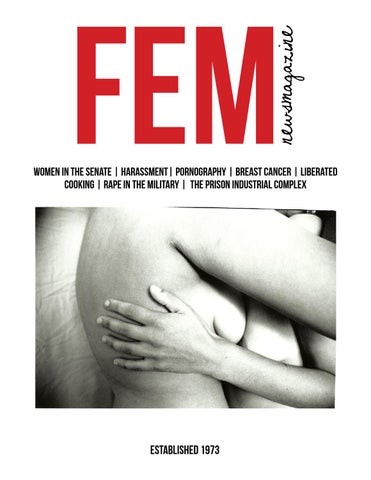
newsmagazine
FEM
WOMEN IN THE SENATE | harassment| pornography | breast cancer | liberated cooking | rape in the military | THE PRISON INDUSTRIAL COMPLEX
ESTABLISHED 1973
IN THIS ISSUE
FEM 2
5
WOMEN IN THE SENATE
15
#THINSPIRATION ON PINTEREST
PAGE PAGE
19
PAGE
PAGE
25
FEMNEWSMAGAZINE.COM
THE PORN DEBATE
25 WAYS TO PRACTICE CONSENT
STAFF
editor-in-chief dominique silva nora daly managing editor copy editor allison green yamuna haroutunian blog editor design editor patricia delgado barbara benoussan copy chief media manager amanda ramont interns allison green jennifer bui jewel pereyra noelle little amanda ramont meghan maloney mary kate morrow amy trivers divya narasimahn angela tu christine nguyen curtis wu bethany white
EDITOR’S When the time came around to start putting together the issue and the excitement of my new position as editor in chief turned in to a complete reality, I knew there were four things I wanted to accomplish. First, I needed to prove that there are many aspects to feminism, and like every community, we may share core beliefs. But I wanted us to remember that we are all individuals who are allowed to disagree with one another. We needed to prove that there is no such thing as a “bad feminist,” and I felt this could be expressed through a debate section. This was an opportunity to have two feminist writers give their opposing opinions on a particular topic; in this issue it was going to be the ever evolving debate on the pornography industry. Since the porn industry has been a frequent topic of conversation after a porn-related proposition was passed in Los Angeles, why not talk about the pros, cons, and thoughts on a what could either be a form of sexual empowerment or objectification (you chose which side you are on). Second, I wanted the writers to have artistic freedom and have a strong voice. I wanted them to have a say in what was going to be in the issue. We sat around in many meetings deciding what our audience needed and wanted to hear. These topics, as you will see, range from the personal to the political. I knew we all have strong voices, and we all have opinions - I wanted those to be expressed in every way possible. And I needed others to know that they are allowed to have a voice too, a really strong and really loud one.
note
Third, I wanted to branch out. Deciding to become a magazine that was strictly online is a big shift from where FEM has been in the past. Although I loved the feeling of being able to carry around an issue, it wouldn’t allow for the audience I wanted to reach that being the world! (We dream big here at FEM). Those in college, and even those who are older, find themselves mainly in a hurry and not being able to travel to UCLA and pick up our issue, so I needed to give them zero excuses to not read our pieces. Also, you know you spend too many hours browsing Facebook and playing with your iPhone (we have an app, you should totes download it) to not kill time on the web reading FEM. The fourth and final thing I hoped to accomplish was to have multiple contributors, and we were successful. The feminist community is a lot bigger than you think, and especially in the surrounding universities. We share experiences with our fellow men and women even if we are miles apart. Allowing for others to be a part of our magazine gave us even more voices this time around and made us realize that no matter the distance, feminism is still relevant, and it is a wonderful wave to be riding on. HAPPY READING (and smash the patriarchy)!
-
alexa shwartz
ment group. She has continued advocating and researching education.
raisa monroe-yavneh learning languages. She one day hopes to write and illustrate graphic novels.
zora raskin writer and poet who studies the intersections of feminism and the prison industrial complex. She is an ardent abolitionist and plans to graduate and continue this work until her dying day.
nur laura caskey
-
pursue her education. She is currently completing an under-
CONTRIBUTERS
jennifer quigley-jones
GENDER POLITICS
Why stop at a but is it enough? bethany white
I
n the aftermath of the 2012 election, the general consensus has been that it was a milestone for women. “Groundbreaking!”, cried ABC. “The year of the woman!”, shrieked CNN. One by one the media have hopped on the bandwagon. “Glass-ceilingsmashing!”, yelped the Huffington Post. Everyone seems to agree that, in the ‘war on women’, the women have achieved a decisive victory. There will be twenty female Senators in 2013, which is an historic number. There are five new female senators, including Elizabeth Warren and Mazie Hirono, who is the first Asian-American woman elected to the Senate. Six female senators were also re-elected. Tammy Baldwin has become the first openly gay senator in United States history. New Hampshire has the first ever all-female congres-
sional delegation. And, deliciously, those wise old Republicans, Todd “Legitimate Rape” Akin and Richard Mourdock, both lost, the former to Democrat Claire McCaskill. “The year of the woman” indeed. It is an infinitely good thing that women are building up their presence in elected office. The more women are elected, the less of a novelty it will become. Once the “first ever” label is out of the way, it will be less significant that a politician is Asian-American, or female, or gay. The more that misogynistic and outdated views on issues like rape are punished at the ballot box, the better. But in the midst of all the celebration, it is still important to recognize how much further there is to go. There are one hundred senators; women still only make up twenty per cent. The American presidency has remained obstinately male. The presidential campaign may have ended in a damning defeat for
proponents of “legitimate rape”, but there were still moments that smacked of lingering sexism. “Binders full of women”, anyone? There are two main things to keep in mind when considering 2012 as “the year of the woman”. The first is the inherent sexism that still persists in political dialogue. In a women’s history class, I learned about women’s endless struggles to vote, to hold office, and to be treated equally under the law. Muller v. Oregon, a 1908 Supreme Court decision, upheld maximum hour laws for women, but not for men. This was based on the idea that women needed protection from long working days because they were primarily responsible for giving birth and raising children. It prioritized women’s family roles over their working lives. Reading the case in 2012, the concept behind the ruling seems absurd and outdated. In class, we were incredulous. But in one of the presiden-
FEM 6 Three notable new faces in the senate:
Tammy Baldwin – Democrat, Wisconsin. The first openly gay senator. Has served in the House of Representatives since 1999, and was the first woman elected to Congress from her state. She has one of the most progressive voting records in Congress.
Mazie Hirono – Democrat, Hawaii. Represents three ‘firsts’: first Asian American senator; first senator born in Japan; and first Buddhist senator. Lost in a race to become Hawaii’s first female governor in 2002.
Elizabeth Warren – Democrat, Massachusetts. Ran a high profile race against Republican incumbent Scott Brown, who won the Massachusetts seat after Ted Kennedy’s death in 2010. She is the first woman senator from Massachusetts.
tial debates in the run up to the election, Katherine Fenton asked the candidates what they would do about the wage gap. Both candidates struggled, before Romney helpfully suggested that he would allow women to go home early, to cook dinner for their children. Romney’s suggestion and the 1908 case are by no means preaching the same idea, but a ghost of the sentiment lingers: that women need special treatment, and that their working lives must be looked at in relation to their inevitable role as mothers. The second thing to keep in mind is the cold hard facts. Since 1789, 97.8% of Members of Congress were men, and even since
the first woman, Jeannette Rankin was elected in 1917, progress has been slow first woman, Jeannette Rankin, was elected in 1917, progress has been slow. That was nearly one hundred years ago, and yet women still do not even make up a
representation globally, the United States is ranked 80th. There are still mountains of obstacles standing in the way of women running for office, one of them potentially being the fundamental idea that underlay Romney’s comments: women just can’t be considered in the same way as men. We should always celebrate achievements. A record number of women in the Senate is always better than a decline; the first openly gay senator, no matter how belated, is far better than none at all. But no matter how “groundbreaking” or “glass-ceiling-smashing” the 2012 election may have been, it’s still important to recognize that there’s still much more progress that needs
-
third of those elected to Congress. There has not yet been a female President, but Great Britain, Germany, France and countless other countries have all had female heads of state. When comparing female
GENDER POLITICS
The Department of Defense Leaves Women Defenseless Figures reveal an ongoing epidemic of sexual assault in the military. noelle little
did you know, There is a
86.5%
chance of your crime staying a secret? and a
92%
chance of avoiding a court-martial altogether?
If you rape a fellow service member while serving in the United States military, the probability that you will be convicted is slim to none. According to recent estimates, there is an 86.5% chance of your crime staying a secret and a 92% chance of avoiding a courtmartial altogether. These harrowing figures illustrate an ongoing epidemic of rape and sexual assault in the military. Within the military, there is a culture of blindly accepting the inevitability of sexual violence due to the conflicting chain-of-command structure that discourages victims from reporting crimes. Many past members who have reported being sexually assaulted by a commanding officer or military colleague have simply been brushed aside and ignored. They have faced extensive ridicule from those not only in their unit, but also from those in command. Many victims will face investigation that includes a review of their sexual history, which is not only incredibly insensitive, but also unrelated to cases of rape. In addition, many members who report incidents of sexual violence have been demoted after having their case ignored - many even discharged. In 2006, a Marine Lt. Elle Helmer reported to her commander that a superior officer had raped her. In spite of the colonel’s objections and discouragement, Helmer sought a thorough medical investigation. She later sent an appeal to the supervisor of her rapist who refused to press charges or punish her rapist. Helmer recalls, “He said to me, ‘You’re from Colorado— you’re tough. You need to pick yourself up and dust
yourself off. I can’t babysit you all of the time.’” No charges were pressed, no punishment was enforced – Helmer’s attacker was simply left to peacefully continue his career in the Marine Corps. Meanwhile, she became the subject of investigation, prosecution and ridicule. She was ultimately forced to leave the Marine Corps while her rapist continues to remain in good standing. Not only was Elle Helmer subject to one of the most gruesome experiences that any woman or man could be subject to, she was then ridiculed and ignored
Dick and Ziering incorporate thorough research of Department of Defense statistics and extensive interviews with rape survivors and their families, senior Pentagon officials and also members of Congress to explore the current state of rape and sexual assault in the US military. It is clear that the inherent conflicts within the chain-of-command structure are at the core of the epidemic of military rape and sexual assault. The Invisible War seeks to close the information gap between high-ranking military officials and the victims of rape
afterwards when she attempted to press charges. No woman, or man, should be ignored or insinuated to be a liar when they are subjected to the violence of rape and sexual assault. Unfortunately, in the US military this is not an isolated incident. A study recently conducted by the US Navy “anonymously reported that 15 percent of incoming recruits had attempted or committed rape before entering the military, twice the percentage of an equivalent civilian population. In 2010, there were 2,617 military victims (women and men), but that represented only about 14 percent of the estimated number of victims; 86 percent did not report they had been sexually assaulted.” It is estimated that the total number of sex crimes in the military in 2012 was over 19,000. According to Department of Defense statistics, over one-fifth of all active-duty female soldiers have been sexually assaulted, leaving women who have been raped in the military with a higher rate of Post Traumatic Stress Disorder (PTSD) than that of men in combat. Today, the occurrence of sexual assault in the U.S. military is almost double that of American civilians and this is not limited to women. According to the Service Women’s Action Network, 46 percent of the roughly 108,000 veterans who experienced Military Sexual Trauma in 2010 were men. In the recently released documentary, The Invisible War, filmmakers Kirby Dick and Amy Ziering seek to bring the public eye to this tragedy occurring behind the scenes of the US military.
by reporting and conveying the emotional and psychological toll of sexual assault. The film and other advocates are urging the military to change the way sexual assaults are handled. Many advocate developing a system of reporting rape that allows the victim to go outside of the chain of command. In addition, many activists seek to move towards breaking a culture some believe promotes sexual violence. The central story of The Invisible War is that of Kori Cioca, a woman who was raped and beaten by a supervisor while serving in the Coast Guard. Throughout the film, audiences see Cioca struggle to emotionally handle her traumatic experience as the Veterans Administration repeatedly refuse to pay for reconstructive surgery for her dislocated jaw. It is jarring to see the juxtaposition between the idealistic vision of the US Military and the reality of what happens to many of our men and women behind the scenes. [But] for Cioca, making the film was therapeutic, “having people listen and look through your documents and not judge you.” Although she says she still loves the military, she wonders if there should disclaimer when you enter: “You might get raped and assaulted. Side effects may include PTSD.” The Invisible War is now available in the US on DVD and digitally through iTunes and Amazon.
The prison in our hearts:
It was May 9th, 2011. “Occupy the capitol. Take back our education.” Inspirational catch phrases ran through our hearts and minds as I and my closest friends boarded buses to Sacramento. Weeks before, we had watched as the people of Wisconsin flooded their capitol building, shutting down state government in an attempt to block a piece of antiunion legislation put forth by their conservative governor. We were hoping to spark a similar movement of bodies. We were still a few months away from the beginning of Occupy Wall Street, but there was something in the air. The day was not what we expected; still, this was a moment that changed my perception of the world forever. As our numbers dwindled the police closed in, announcing that anyone who did not leave the rotunda would be arrested. Apparently, we needed a permit to chant inside the building. As I reluctantly left, the doors immediately slammed behind me. Pressed up against the glass, I watched as my friends linked arms and chanted. They would not be moved willing-
ly. One by one, the police officers picked them off. Some struggled, some gave the officers lip, some just walked silently. All of their backs were straight, their heads high. One by one I saw the police take away the people I loved most, and I could do nothing to help them. The next 12 hours would be chaos as those of us who had not been arrested ran around Sacramento attempting to do jail support for the 72 people who had been arrested. Inside Sac County Jail, my friends were being crammed into small cages, man handled, and injected with unknown vaccines. That is the day they made a soldier out of me. That day I experienced what Cornel West calls “death”. He describes how part of our perceptions must die so that a new consciousness can be born. From that day on I knew I would devote my life to the abolition of the Prison Industrial Complex (PIC). The term ‘industrial complex’ refers to an elaborate and multilayered industry devoted to surveillance, policing, imprisoning, and later patrolling a massive vol-
ume of people. As Angela Davis said, the capitalist system has created a means of concentrating and exploiting the unemployed, the underemployed, and other members of capitalism’s “human surplus”(2003). Currently there are 2.6 million people behind bars in the United States, and over 7 million on parole, awaiting trial, in detention camps, or otherwise wrapped up in the Prison Industrial Complex(Chicago PIC Teaching Collective, 2011). The United States has imprisoned more people than any country ever. This is possible because the PIC is more than an economic institution. It is a cycle that both benefits from and recreates domination and harm. The atrocities that happen within prison are covered up and justified because the people in prison have been labeled as ‘deserving’ of such terrible treatment. Ableism, ageism, classism, homophobia, racism, sexism, xenophobia, and cissexism all intersect to empower the PIC. All of the oppression that may be explicitly or implicitly experienced in our daily lives is violently re-enacted within
the walls of the prison. Outside the prison, bigoted legislation, acts of civil disobedience, lack of access to housing, jobs, health care, and education place certain communities at risk of being tangled up in the PIC. Instead of looking at the structural causes for these problems, the mainstream national narrative describes these communities and people as ‘low life criminals.’ By labeling these people as ‘criminals’ both the law and the public cast a blind eye to their treatment. Most people experience varying degrees of psychological, physical, and emotional trauma within the prison walls. Once they are let out they are disenfranchised from society. Adjusting to life on the outside, sometimes after years or being separated from family and friends, can be a slow and painful process, compounded with the fact that it is incredibly difficult to get job with a felony or misdemeanor on your record. These and other factors contribute to a massive recidivism rate, over 65% in CA (Whatthefolly.com, 2012). As Kris Olsson, an ex-prisoner and the founder of Sisters Inside said, “they put you in there to learn a lesson, but it is never the lesson they think you are going to learn”(2011 Panel, Inside Out Writing Project). She explains
-
-
further that the prison is a violent institution, and it teaches those inside that this violence is necessary for survival. The media is an essential tool of the PIC, giving us images of what a criminal is supposed to look like. Television shows such as Cops, CSI, and Law and Order all paint a similar picture: that those inside are psychotic, usually men of color, and that brave men dressed in blue are here to keep everyone safe. These images show the public what a criminal is supposed to look like, how they think , and where they live. They separate the world into a binary of good people and bad people. A binary that, in reality, does not exist. These images of heartless criminals perpetuate the idea that the PIC keeps us safe. The question I receive most often when discussing abolition is “What do you do with all the rapists and the murders?”[a] It is important to note that the majority of people are in prison for nonviolent offenses, but more deeply, there is an assumption behind this question. An assumption that those who commit these crimes are ‘bad’ people, and that punishment is the only way for them to see the error of their ways. This mentality is not only found on the TV screen, it comes from ‘tough on crime’ politicians on both sides of the isle, prison guards’ unions, private prisons, prison construction companies, investment banks, law enforcement, victims’ rights groups, prosecuting attorneys, and DAs. These people all stand to make huge profits and gain social and political control by promoting this narrative. ‘Public safety’ is a facade, for in reality, the prison does nothing to prevent murder and rape, and in fact perpetuates these
violences. Studies have shown that those who commit violent crimes have often been the victim of violence themselves. Why then are cages, disenfranchisement, physical torture, and denial of resources used as forms of ‘rehabilitation’? In reality, as incarceration levels continue to rise, the United States has not seen any decreases in the number of rapes. This idea that prisons are preventing the rapists from roaming our streets is just another example of how this country uses violence against women to justify further violence (for instance, the idea that what with Iraq would liberate muslim women). If preventing violence against women is truly the goal than continuing the cycles of violence is not the answer. However, when we view those inside as heartless criminals, we dehumanize them. Prisoners become ‘undeserving’ of the public's empathy and therefore can be used by the elite for profit and power. What I witnessed was the PIC being used as a tool of control. A tool to not only suppress political dissent, but to send a message to a potential movement. If you choose to speak out, you will be punished. Hindsight has shown me that May 9th was only the tip of the iceberg. What I witnessed that day was only a piece of much larger system, a system that my race and class has protected me from. That day I had the privilege to walk away from arrest. For communities of color, queer people, trans people, poor people, and life long political activists the PIC is a daily reality. The PIC was created and has been adapted to target these demographics. Take for instance the “school to prison pipeline”. This term describes “a disturbing national trend (continue reading on page 64)
Winning Over Hearts Breast cancer, the poster child for women’s health christine nguyen
T
This year, particularly against the backdrop of the 2012 election, reproductive rights have dominated the discussion on women’s health—while managing to say hardly anything about it at all. Thanks to the ignorance of politicians like Todd Akin and Richard Mourdock, the issue of abortion is now fixated on defining and dealing with rape (a crime for which the only question should be that of clear, communicated consent) and pushing cases of life-threatening pregnancy complications to the periphery. Likewise, the debate over contraceptives has become a matter of religious freedom, without any reference to the sexually transmitted diseases they are used to prevent. Women’s health, insofar that it is visible to the public eye,
has somehow wandered away from the field of medicine and into the arena of sexual politics. Setting aside sex and politics for the moment, what is the biggest women’s health issue today? Ask a room full of women and most would probably reply with “breast cancer.” Breast cancer as an issue is hard not to miss, with pink Yoplait cups offering to donate to X amount to Y foundation if you redeem the code under the lid, the pink bras that hang from tree branches on UCLA’s Bruinwalk directing curious students to an info booth nearby, and the pink, well, everything that characterizes National Breast Cancer Awareness Month every October. But in recent years, some forms
of “breast cancer activism” have seemed to focus more on fostering breast awareness than cancer awareness. In an effort to shock and stand out, breast cancer PSAs, ads, and various merchandise now boast dehumanizing slogans like “Save the Boobies” or “Save Second Base.” In October, college lifestyle website Coed Magazine posted a cringe-worthy list of “The 60 Best Natural Breasts of 2012,” ostensibly in recognition of Breast Cancer Awareness Month but with the following statement of intent: “to pay tribute to the body part we all love so much. [Who] the pair belongs to … is irrelevant—all that matter is is that they’re natural.” Arguably worse than the emphasis on the “body part” is the emphasis on “natural,” which completely
NATURAL BREASTS College lifestyle-website Coed Magazine hosts a cringeworthy contest to “commemorate” Breast Cancer Awareness Month. debases all the cancer victims who undergo mastectomies and afterwards wear prosthetic breasts. Worst of all, however, is when politics has a tangible, detrimental impact on women’s health issues that should by all rights be beyond partisan lines. Such was the case earlier this year, when breast cancer foundation Susan G. Komen for the Cure halted funding for Planned Parenthood’s breast exams because the latter also provided abortion services for its clients. Komen eventually reversed its decision but lost considerable support and, by extension, donations.The obvious problems with sexualizing and politicizing the discourse surrounding women’s health issues are that it objectifies women in general and disrespects victims in particular. A less obvious effect, however, is that it significantly detracts visibility from other important women’s health issues in
which men and/or sexuality play no part. According to the most recent CDC statistics, the leading cause of death in females is not cancer, but heart disease. Granted, cancer comes next, but even in its own category breast cancer is not number one—lung cancer is. Yet when it comes to funding and fundraising, breast cancer pulls in the most money by far. For instance, in 2010 the American Heart Association (AHA), the only significant charity for cardiovascular disease accredited by the U. S. Better Business Bureau, raised $509 million for research, education, and community services. Compare this to the $421 million raised by just one of the several Bureau-accredited organizations for breast cancer, the juggernaut charity that is the Komen foundation. Komen alone raised over 80 percent of the AHA’s total
contributions. This is even without counting contributions from other notable charities like the National Breast Cancer Foundation, the National Breast Cancer Coalition, the Breast Cancer Research Foundation, and a significant portion of donations for non-specific cancer charities like the American Cancer Society. Why the discrepancy? It partly comes down to fear versus fault: many people perceive victims of lung cancer and heart disease as more deserving of their fate than breast cancer victims. While the direct causes of the first two can often be directly traced back to smoking, dietary, and exercise habits; cancer in comparison is more mysterious, inexplicable, and thus more frightening. Such perceptions lead to the argument that breast cancer research should have higher priority for funding. But the extensive (continue reading on page 64)
Immature:
Taylor’s maturation isn’t so swift
amanda ramont
I get it; Taylor Swift is growing up. Or at least, this is what she desperately wants her listeners to believe. She is 22, did you not hear? This means she gets to wear red lipstick whenever the hell she wants to. Right on, Taylor Swift. Quick question though: is Swifty saying it is cool to wear
high heels now? “Begin Again” is feeling a little contradictory to her 2009 smash hit “You Belong With Me,” in which she states, “She wears high heels/I wear sneakers/ she’s cheer captain and I’m on the bleachers.” Now, in “Begin Again,” she is able to let go of the idea that in order to be down to earth, you
cannot care about fashion. She sings, “He didn’t like it when I wore high heels, but I do.” So that is rad. Do not let any man dictate your fashion choices, Taylor! It would be great if Ms. Swift could make up her mind about issues such as these, so I –and the rest of her devoted listeners– know which
FEM 14 level of self-acceptance is okay. I think that, at this point, Taylor Swift is really confused about what constitutes a modern feminist. (That is, if she even considers herself a feminist at all. I should not be so presumptuous.) As a result, her songs tend to present very conflicted ideas. At least her new album “Red,” which was released on October 22, seems to contain far less blatant “slut-shaming” than 2010’s “Speak Now”. As much as I guiltily enjoyed listening to the sophomoric lamentations of a scorned ex, it irked me to hear Swift place such relentless blame on “the other woman” instead of the boyfriend who allegedly betrayed her. In her upsetting vindication anthem “Better Than Revenge,” Taylor chastises the girl who “stole” Joe Jonas from her, stating that “She’s not a saint, and she’s not what you think/ She’s an actress…She’s better known for the things that she does on the mattress.” All right, I should not even have to address how problematic this is. Luckily, Taylor does not seem to be capitalizing on the whole virgin/whore dichotomy anymore. She just seems to be wrestling with the delicate balance between being girly and embracing femininity while also being desirable to men on an intellectual level. It would be really cool if she realized that it’s actually fairly common for girls of a certain age to own James Taylor records. In “Begin Again,” she seems really excited about meeting a guy who appreciates her taste. Because, obviously, girls are not usually interested in tasteful things. She croons, “You said you never met
one girl who/Had as many James Taylor records as you/But I do.” The idea that this is what, in her eyes, makes Swift stand out compared to other girls is kind of a bummer. (That is, it is what makes her stand out on top of the fact that she was supposedly named after James Taylor, which is a fun little piece of trivia in itself.) Does she still consider herself an outcast despite the fact that millions of Americans want to be her? I appreciate the fact that she’s grateful for her success, but I think it’s about time to retire the surprised act. Taylor Swift has never really exemplified maturity, but I think that is why listening to her has always been a cathartic experience. Her lyrics may be unimaginative, but I do not know anyone who would not relish the opportunity to publicly scorn their ex-lovers. I cannot even count with how many girls I have bonded over discussing Taylor Swift’s ever-evolving love life. “Red” is completely infectious, and I have no problem admitting that I find Taylor Swift adorable. I think that it would be fun to spend time with her. The fact remains that she might still have some growing up to do. Her early-twenty-something anthem “22” leaves a lot to be desired and provides pretty solid evidence of Ms. Swift’s stunted growth. Please, is it really still amusing to ridicule hipsters? What does that word even mean anymore? Also, it is just unbelievable that when TSwift goes to parties, she is surrounded by “cool kids” who sneer at her and ask, “Who is Taylor Swift anyway? Ew.” Trust me, Tay. we all know who you are. In
the title track, “Red,” Taylor takes the listener on a journey through the color scale of her emotions, dreamily stating that “Loving him is like driving a new Maserati down a dead end street,” which I can imagine is very relatable to most people. I had a difficult time adjusting to Red’s first single “We Are Never Ever Getting Back Together”. Yet in an unfortunately short amount of time, I found myself unable to shake the absurdly catchy melodies from my mind, itching to sing along to the “weeEEE!” part of the chorus. Basically, this album is good and clean fun. Honestly, my opinion ultimately does not even matter. Haters can hate all they want (For the record, I would not necessarily say that I am a hater. I just call ‘em like I see ‘em.), but she’s still going to be one of the most successful women in the world who does not even need defending. She’s talented (other than a very grating voice), classically beautiful, and, well, white. Her problems are pretty relatable to other white and middle-class girls. Not to say that such relationship issues are not universal, but she is in an advantageous position in that these are the biggest problems in her life. I like to believe that Taylor Swift is a smart young lady, and I sincerely hope that she is more self-aware than people believe. In any case, she will be all right. Hopefully, like all of us young, burgeoning feminists on the brink of self-actualization, she will continue to evolve, flourish, and check herself on the reg.
#thinspiration hinspired culture encouraging eating disorders.”
allison green
epperoni pizza casserole… chocolate caramel brownies… a recipe for Paula Dean’s meatloaf. No these are not excerpts from a comfort foods cookbook; they come from the front page of Pins from my Pinterest.com account. While I have my own personal reservations about Pinterest.com, one of the main reasons I keep logging in is for the visuals of tasty food that I know I could never create. But what ruins my food gawking are the incessant Pins alongside such good food that showcase protruding ribcages, concave stomachs, or incredibly chiseled women all under the hash tag of “Thinspiration”. Posts and blogs catering to pictures of extremely
thin bodies, “self-encouragement”, and lofty weight loss goals have exploded over the internet via numerous websites similar to Pinterest such as Reddit, Tumblr, Facebook, and Instagram. Despite the seemingly good intentions of promoting healthy eating and exercise, thinspired posts have had adverse affects and created controversy for sparking a culture encouraging eating disorders. Since March 2012, Pinterest revised their Terms of Service and Acceptable Use Policy to ban any content that “creates a risk of harm, loss, physical or mental injury, emotional distress, death, disability, disfigurement, or physical or mental illness to yourself, to any other person, or to any animal”. As well as their updated policies against dangerous images, Pinterest also added this disclaimer as pro-anorexic buzzwords are searched: “Eating disorders are not a lifestyle choice, they are mental disorders that if left untreated can cause serious health problems or could even be life threatening. For treatment referrals, information, and support, you an always contact the National Eating Disorders Association helpline at 1-800-931-2237 or www.natio-
THINSPiration Screenshot of keyword “thisnspo” images reveal reveal false perceptions of self-worth through “thinspiration.”
naleatingdisorders.org.” No longer do I see images of women showing off their tape-measured waists or hateful messages like “The voice telling you that you can’t is a lying slut”. I now get a different sort of posts that give women other reasons to lose weight and be thin: pictures of super models and celebrities in haute couture, attractive males, and pictures of traveling. With the tabloid pictures of Angelina Jolie, Keira Knightley, and Emma Stone, again women are looking toward celebrities for body image cues. Interestingly, Pinners also use fashion as a motive for weight loss under the assumption that non-thin bodies cannot wear fashion-forward apparel (implying that the more overweight a person is, the less likely they are to fit clothes or express interest in fashion). Using men as a motive is also an age-old motivation. According to the ongoing stereotype, men like skinny girls—enough said. So why not work hard to achieve the dream man who only seeks your attention after you’ve lost 20 pounds? It also provides more “inspiration” to be thin since all of the Pins of men are shirtless and chiseled.
Lastly, the comments about the availability to travel implies another harmful assumption; only once you get the body you desire can you truly start living and explore the world. This particular Pin shows a checklist for different tourist destinations for when she attains the ideal weight. Why would your weight matter for travelling? So that people can comment on your amazing profile picture in Greece. You can show of your will power by resistings all of the tantalizing foods from around the world. Not too mention, women would want to loose weight to avoid fitting the “fat American” stereotype. The world essentially becomes such a better, more enjoyable place when you are 20 pounds lighter. As a business, Pinterest has done all that it can in terms of legality to create a shift in how women perceive their bodies, but what the organizers of Pinterest fail to recognize is that it is not solely social media itself that fosters insecurity in women—it is deep rooted within each women that posts anything with #thinspo.
book review
“the ice cream girls” allison green One of my most treasured pastimes as a literature major surprisingly is still reading and whenever I have time, I run to the nearest bookstore to pick up the latest Dorothy Koomson novel. I realize I do have an affinity for her stories because she writes as black woman in a predominantly white world, which is similar to the world in which I reside. Because of this unexplored perspective, Koomson address the overlooked “black girl issues” such as non-normative hair care, interracial relationships, and identifying as “the token”. Normally in her novels, her protagonists are single, successful and discover love in unexpected places and with unexpected people. However, in her summer 2012 novel “The Ice Cream Girls” Koomson breaks away from her feel-good, “chick lit” inspiration to a more serious, thought-provoking murder mystery. Deviating from her normal, linear storyline, this drama incorporates flashbacks between two characters: Poppy Carlisle and Serena Gorringe who as teenagers become suspects in the murder of an older man. The description that Koomson gives from her own website implies a different story line than the actually plot: “As teenagers Poppy Carlisle and Serena Gorringe were the only witnesses to a tragic event. Amid heated public debate, the two seemingly glamorous teens were dubbed ‘The Ice Cream Girls’ by the press and were dealt with by the courts. Years later, having led very different lives, Poppy is keen to set the record straight about what really happened, while Serena wants no one in her present to find out about her past. But some secrets will not stay buried – and if theirs is revealed, everything will become a living hell all over
the ice cream girls Serena and Poppy grow up from their “pretty little lying” teenage years only to keep darker secrets as adults.
FEM 18
again . . . Gripping, thought-provoking and heartwarming, The Ice Cream Girls will make you wonder if you can ever truly know the people you love.” So for those who seem intrigued, please read her novel because it truly is a page-turner that gets you just as involved in discovering the true murderer. But I will caution readers that the novel will force you to
is a blonde haired, blue-eyed woman while Serena is black. Koomson addresses the stereotype of the black woman stuck in the prison system and flips it as Serena continues life as normal. The most frustrating of all is that no character in the story knows who actually killed Marcus. Although the common knowledge is that Poppy and Serena were
challenge stereotypes and come to terms with the harsh realities that women face daily.” challenge stereotypes and come to terms with the harsh realities that women face daily. Here are a few spoilers: This is not a “Pretty Little Liars” plot. Although she leads you to believe two popular teenagers get mixed up in a gruesome murder, truthfully, Poppy and Serena are not friends. In fact they are more enemies than anything. They fight over the attention of Marcus who pits one against the other, driving them to a grisly end (in which Marcus gets murdered). Marcus is no heartthrob, homecoming king that the two teenagers fight over. In fact he’s is the charismatic teacher that lures them into a statutory rape relationship. Isolating the two girls and forcing them into sexually and psychologically abusive relationships, Marcus becomes the ominous cloud that haunts both Serena and Poppy in their adult lives. Never attaining closure, neither woman goes a day without his memory, especially since his case is cold and unsolved. This is not a “Nancy Drew” type of book. Poppy and Serena do not work together to solve the crime. Serena wants nothing more to do with the case; Poppy desires the truth. That’s because Serena gets off free from suspicion while Poppy was sentenced 20 years in prison. What is different than the norm is that Poppy
suspects, the actual killer’s identity remains a mystery until the very end of the novel. With the perpetrator’s identity unknown, readers don’t know whether to believe the woman who lost two decades in prison or the woman who lives in fear every day of trying to keep her past a secret. When I opened to Chapter One expecting a familiar successful, sprightly protagonist to only find a grim fictional newspaper account of the murder, I knew this was not my average Koomson tale. She shook up my summer by weaving a tale of two women scarred and debilitated from sexual violence and instead of finding solace in their shared experiences, they are turned against one another by a sadistic predator. Koomson, with her psychology degree, understands the secrecy, shame, and anger behind multiple layers of abuse in women and highlights the effects in the lives of Poppy and Serena. As Serena never tells her immediate family or even her husband about her teenage years, we watch her marriage crumble throughout the plot. Poppy looses 20 years of her life in prison, looses the respect of her parents, and becomes incapable of fostering any type of relationship. Koomson exposes the psychological trauma of abuse and explores the popular trope of a “damaged” woman.
the porn debate:
Pornography has always been a problematic subject for feminists–while some find it an empowering endorsement of female sexuality, others think of porn as exploitation and objectification of women. Neither view is incorrect, and there are feminist opinions on both sides of this debate.
anti-porn katie morrow
Nobody that I know is going to say that sex doesn’t turn him or her on. Nor that the sight of a naked body doesn’t turn them on, or even that the sounds of two people having sex doesn’t turn them on. Last time I checked, these are animalistic instincts that we all possess and you and I both, dear reader, are animals. With the number one searched word on the internet being “sex”, it isn’t much of a wonder that pornography runs as rampantly as obesity in America but there is just as much taboo around addressing porn as there is watch-
people to have sex in any way they please behind doors. I do, however, have a rift with imposing stigmas on how women are supposed to act in the bedroom and the accessibility of minors to see plastic bleached persons viciously attempt to “make love”. In a 1988 study of a random analysis of pornographic films, 60% of the time the video was devoted to explicit portrayals of sexual acts. Of these depictions, 78% were coded and exploitation. I would by no as dominant, and 82% as exploimeans degenerate to our past cen- tive, with men doing almost 80% of sorship of early nude art and sculp- the dominating/exploiting. Where tures nor do I find it harmful for women were shown as dominating it.Porn is the nagging spouse of America, seen but not heardand it’s about time we listened up. One must be clear however when proposing this argument to clarify the difference between art
-
ing/exploiting, their targets were most frequently other woman.” When half of randomly selected tapes contain rape scenes, you’ve got to wonder about the effects on the brains of people who are learning to be stimulated by “mock” rape. When one out of five women in the United States are being sexually assaulted every year, I can’t laugh– I can’t afford to, unlike the financially successfu pigs collecting billions of dollars from undermining of morality. I remember the first time I ever tried to access porn, one day after school, arriving via some pop-up ad from a kid gaming site. I leveled up in the game, answering the “are you 18 years or older” question with a confident “no”, then learning quite quickly that one must lie and say “yes”. I’m not alone, 70% of the viewers of pornography today will be minors. Four different tests spanning from 1984-1988 “found that exposure to one film juxtaposing sexual situations and violence per day for five days lowered the subjects’ anxiety and depressive reactions to the violence of these films over the course of viewing. Subjects who rated the material as progressively less offensive or violent over the course of the series were also more likely to view the victim as responsible for her assault, judged her as offering less resistance to her abuser, and found her less sympathetic, less attractive and less worthy as an individual at the end of the series.” One can only imagine the massive implications that underage exposure of pornography has on mi-
PORNOGRAPHY Post-feminism’s struggle to find a niche in modern day pornography. nors. I’d argue that most kids who playfully dabble and explore their sexuality through porn turn out fine. However, there is that risk, and it is possible there will be lasting damage to developing minds, and such controversial ideas will be projected into actual perceptions. I will never be perfect. I will never be perfect in bed. I will never have
porn star sex nor will I ever expect a partner to perform like a porn star. I don’t want to give in to immediate gratification and animal instincts, I want to have conversation and sensual moments. I want to be a human being and more than anything else in this world, a satisfied woman with a healthy sense of sexuality.
PRO-PORN 23 and 24
meghan maloney
There is a contested belief that I watch more porn than most guys do. Like most of us, my first experience with sex was through the voyeuristic lens of two overly tanned people passionately fucking and grunting. To call it traumatizing is a huge understatement; I embraced it whole heartedly. Ten years later, something that I accidentally stumbled upon has been integrated into my daily routine. Watching porn is as normal to me as taking showers: I don’t do it every day, but I do it often enough where it feels refreshing every time. So, I guess you could say I’m pro-porn. And here’s why you should be, too. Visual pornography has enhanced my sex life. Watching porn has made me become more open to trying new sex positions that I didn’t even know existed, like the Italian hanger...although I admit, that’s not high on my “positions I need to try list.” But I like knowing that I now have the option to try such a creative position when the good ol’ standard missionary gets too boring. As a result, attempt-
ing to emulate what I saw two (or three...sometimes four) porn actors do has in turn created in more satisfying sexual experiences with my partners. And when I don’t have a partner, it becomes the next best substitute to soothe the lonely nights away. Pornography has also helped tremendously with people and couples who are struggling with their sex lives. Pornography has been been prescribed a solution by sex therapists as a remedy to help couples that are struggling with their sex lives achieve more satisfaction in the bedroom (or wherever they choose to “do it”). Watching pornography can also incur more discussions of what kind of sexual practices, fantasies, and desires turn each other on, leading to greater sexual expression and comfort in taking charge with their sex lives.Sandra Leiblum, PhD, a sex therapist and director of psychological services at the New Jersey Center for Sexual Wellness in Bedminster, has stated that “It [pornography] can enhance arousal and interest and be a boon for couples who are having trouble
achieving arousal.” Even discussing about pornography and each individual’s porn viewing habits can help build trust within the relationship, providing a more relaxed, comfortable sexual atmosphere to lead to greater sexual satisfaction. From my own personal experiences, talking about pornography and watching together with a partner has removed the stigma of it being so taboo. It has helped me learn more about them and become more accepting of them, and has helped make our relationship and sex more meaningful as a result. In fact, integrate porn into your date night routine! Order some pizza, bust out some cheap wine, and watch some vintage, retro porn. I promise you, it’ll be cheaper and more hilarious than going to see the latest comedy in theaters. Porn is not beneficial for just its consumers. Pornography is also a profitable business that employs thousands of workers, and brings in revenue for even Los Angeles County. Pornography helps create jobs not just for willing actors; it’s an industry of employment for more socially respectable jobs,
such as for writers, make up artists, light and sound technicians, directors, cameramen, public relation managers, and set designers. It’s a multi-billion business that is remarkably reliable, as it has stood the test of time for millenniums. Statistically speaking, porn shoots pay extremely well, provides safe working conditions due to strict STD and HIV testing, provide a stimulating social environment, helping people in society, and you get to be recognized as a star and have fans. All these alluring factors and conditions make me wonder why I am not pursuing a career doing porn. Visual pornography is a profession that many, such as Sasha Grey, have consciously chosen as their line of work.. Although many antiporn advocates will say that women become psychologically and emotionally destroyed by going into the industry, Sasha Grey has said in many interviews that she feels empowered by her work. Her de-
PORNOGRAPHY
cision to pursue a career in the porn industry does not stem from having a traumatic background of sexual or emotional abuse. Rather, she claims that she has joined the industry where she experiences “self-exploration first hand, and I’m getting to do it in a sexpositive way.” Gray is cognizant of her choice to be in porn, and is benefiting tremendously from it; aside from being awarded as best female porn actress and making a ton of money, she has claimed to have genuinely orgamsed ¾ of the time while doing her shoots. In addition, telling people that they cannot work in a specific industry, particularly porn, further stigmatizes their work and creates the problem that people see with porn. We
Women, too can enjoy browising porn in the comforts of their own home and benefit from it!
-
must respect people in their own choices to do whatever work they choose to do, so long as they are conscious of what they are choosing to do. One of the greatest aspects about porn is how much variety it has. Porn is ANYTHING you WANT it to be. When people think about porn, they think of mainstream conventions of buxom busty blonde women sucking off some nameless, muscular tribal tattooed aggressive asshole. But porn is so much more than that. If you are not into that type of porn, you can skip on over to queer porn, which is more inclusive of body shapes, gender presentation, and sexual practices. And if you’re not into that, you can watch college aged women fondle each other on the dancefloor at some exotic night club. If that doesn’t seem appealing to you, then you’ll be able to find something to tickle your fancy. Porn is incredibly malleable and diverse. It’s up to you to find something you like to watch, and it isn’t too hard to find...unless it’s bestiality and child pornography... Despite the critics, Porn is here to stay. And with good reason. As the saying goes, if you can’t beat them, might as well join them.
10 ways to practice
CONSENT nora daly illustrations by raisa monroe-yavneh
KNOW WHAT 1.yOU WANT Conesent starts with you. Before going into a situation, be sure you know what level of intimacy you would be comfortable with.
2.
ESTABLISH ANd Follow boundaries
An important step in creating an environment of consent is articulating clearly what you want, and listening fully to what your partner wants.
DON’T HAVE 3. EXPECTATIONS If you expect any level of physical intimacy from your partner, you are not practicing consent.
kNOW THE 4.DIFFERENCES if you are in a long-term relationship, you and your partner can set longstanding boundaries. For instance, “I love it when you spank me– you never have to ask before doing that.” Just because you are in a long term intimate relationship, does not mean you have to be intimate ALL THE TIME or specifically when your partner wants to.
ASK BEFORE 5. ACTING There are sexy ways to ask questions during an intimate situation.
DON’T TAKE SILENCE 6. AS CONSENT Silence can mean that your partner is reluctant, or wants to say no, but doesn’t feel comfortable, or is enjoying the level of intimacy you are already sharing. If your partner is silent, ask again, and make sure your partner knows that you will not continue if he or she does not want you to.
DON’T NEGOTIATE THE CONSENT OF 7. your partner When your partner sets a boundary, don’t try to compromise his or her desires. Do not create a situation in which your partner feels pressured to continue, or to do more.
8. FOLLOW YOUR GUT When a situation feels uncomfortable, or awkward, or hesitant, do not ignore those feelings! Nonverbal clues are just as important as verbal clues.
9.
FEEL COMFORTABLE CHANGING YOUR BOUNDARIES
If you have been practicing informed, shared consent with a partner, and you want to redefine the boundaries of your physical intimacy, tell your partner. Consent involves the ability to escalate or de-escalate your physical intimacy without fear of being ignored.
10.
dON’T BE AFRAID To SAY “NO”
Don’t be afraid to say “no,” and if your partner says “no,” don’t do it.
RECLAIMING WORDS: noelle little
CUNT cUNT CUNT
Cunt. I think the best way for me to begin this article is to just come right out and say it. The CWord, c**t, “the rudest, crudest and most taboo word in the English language” or however you want to refer to it – it’s a four-letter word surrounded by a whole lot of controversy. It’s a word we all know and a word many women (and even men) refuse to say. For some, it leaves a nasty taste in their mouth and a sick feeling in their stomach, it makes them squirm, shiver, cringe and gasp. How does one little word have such a strong ability to shock? Or rather, why have we as a society become so worked up about it? According to the Oxford English Dictionary definition, the first usage of the word “cunt” in the English language dates to 1230 the street that was home to London’s red-light district at the time was very literally called Gropecunt Lane. The word “cunt” was a common word used for female genitalia; nothing vulgar about it, nothing insulting about it – just another word for vagina. It began to be publicly associated as a more sexual term with writers such as Chaucer and Shakespeare. Bitch
FEM 30
Magazine writes, “these early literary uses were saucy and irreverent, but not exactly forbidden.” Going up to the 20th century, an era dominated by repressive Victorian customs, the use of “cunt” shifted to being viewed as obscene and worth of a trial – just ask James Joyce and D.H. Lawrence who were both prosecuted for their use of the word. Somehow, the word has slowly
na just seems so foul, so dirty, so ... down there. But wait: isn’t the perfectly neutral word “vagina” enough to send most men screaming from the room? Our aversion to the C-word may simply reflect our cultural aversion to the C. Throughout history, female sexuality has been something entirely misunderstood by men. It is described throughout countless works of literature as mysterious,
and distasteful meaning through the vilification of women’s sexuality and through the fear of something which men did not understand. In today’s society, it is no stretch to say that the reason the word “cunt” and “dick” do not hold the same bite is due to the persisting inequality between men and women. A “cunt” is sexual, it is strong and it is something still that isn’t un-
evolved into an insult which men use to sling at one another (and at women); an insult that is demeaning, crude and offensive to many. But why? Why have some swear words become so commonplace, whereas “cunt” has become so taboo in our modern day culture? Kathleen Deveny, a writer for Newsweek magazine, notes that female genitalia are not the only genitalia to be used as swear words. I can not even begin to count how many times I have used, or heard someone use, the word “dick” without the slightest hesitation. So why is there such a drastic difference? Deveny suggests that the difference in reception may be derived from the male perception of female sexuality. The derogatory term for vagi-
dangerous, a force to be reckoned with, a source of witchcraft – you name it, it’s been said. Women have often been written as using their sexuality to take control of men; in essence, women’s sexuality has been vilified. Lindsay Zoladz of Bitch Magazine writes, The vilification of “cunt” doesn’t just cast female genitalia as something that should remain unspoken (as did “nothing,” a popular and proto-Freudian slang term for ladyparts back in Shakespeare’s day), but it erects restrictive boundaries around expressions of female desire—remember that the more “polite” word, vagina, does not encompass the part of the cunt responsible for pleasure. What Zoladz suggests is that the word “cunt” derived its negative
derstood by many men. Many view women’s acceptance of the term as them accepting defeat – feminism breathing its last dying breath, unable to continue the fight. Others view it as giving into misogyny and allowing men to continue to demean women. I disagree. I advocate continuing to use the word “cunt” without fear and without shame. I advocate using the word with pride. As women, we need to accept the term - cunts exist, they are ours, they are our sexuality. As long as women can grow to love the word “cunt” and realize the power and strength behind it, then one day we may reach a point in history where the word “cunt” isn’t something to cringe because of.
reclaiming words
SLUT SLUT SLUT SLUT SLUT SLUT
a
s I’ve become more involved in activist spaces, I find myself presented with the opportunity to decide what I want certain words to mean to me, what those words mean to others, and the power for personal revolution or cultural shaming possessed within their letters. With so many words leveled against us ladies in order to control our sexuality and sexual expression (oh hey ‘slut, whore, dyke’) or to belittle our anger and assertiveness (what it do ‘cunt, bitch’) us feminists have to ask ourselves the question - to reclaim or not to reclaim? Reclamation is a technique meant to disempower language that supports the marginaliza-
tion of oppressed peoples. Basically, it is the idea that if you take a word that society uses to repress or deny your identity/behavior, but you then embrace that word because you are not ashamed of the identity or behavior it is trying to stifle, then you have taken away the word’s power to harm you. Instead, you are empowered. But can a word ever be universally reclaimed by an oppressed group? Or should it be a personal decision based on an individual’s own experience with that word? And with these concerns began my personal journey into reclamation. Because of my own experience, which - it must be recognized - is the fairly privileged existence of a heterosexual, middle class white
grrrl - I have felt empowered and enlightened by my reclamation of the word slut. But it is wrong for me, or any other feminist who has also personally benefited from a positive understanding of “slut,” to assume that all those who identify as a woman should be or even want to be empowered by that word. So why does proudly ing “slut” work for
ownme?
I interpret slut as a word attached to actions - specifically, the act of a human being (who happens to possess a vagina, a feminine identity and/or feminine gender presentation) exploring, expressing, and engaging in consensual sexual activity. I am not ashamed of this action
because why should I be ashamed of this action. In fact, I am relieved that I engage in activity that might cause me to be labeled a “slut” for the very reason that it means I have not been shamed into suppressing an important part of my humanity. Because I am not afraid of others attaching me to this word’s definition, I am not afraid of being “slutty”, and am therefore not afraid of my sexuality or my body. I am speaking as a woman who has not experienced rape, but as a woman inhabiting this rape culture, I live with the fear of being attacked. The number of female rape survivors I know keeps growing, as does the number of them who have in some way (whether in police interviews, or by friends or family members) been partially blamed for their rape or told not to pursue further legal action, as they would not be able to fully convince authorities that they were actually raped. I refuse to let rape culture turn my sexuality into something negative. The sense of strength I’ve gained through my reclamation is allowing me to not be paralyzed by the fear of my clothing or my sexuality being used as justification for a despicable injustice and violation, because it would never make it my fault. And it was never my friends’ faults, and it was never the fault of any woman anywhere at anytime. I am not afraid of expressing my sexuality, or defending the sexuality of others. I will never let my sexuality be used against me. And I am ashamed to admit it, but once upon a time I was an insecure teenage girl who slutshamed without realizing it. If I thought another girl looked cuter in a short skirt than I did, or if she started dating a cute boy I liked, I would inter-
nally demean her in order to boost my self-esteem. I never uttered the word “slut” towards another girl, but it does not make my attitude any more acceptable. How was judging another girl’s body or relationships going to erase my insecurities? Why did I need to exert that control over her? Understanding slutshaming helped me to understand the social forces that encourage girls to hate each other, and how much I contributed to it when I was a teenager. Reclaiming “slut” has made it so that now, as an adult woman, I know that I have no right to judge or assert an opinion on another woman’s sexuality. I expect the same in return. But don’t trip, I am not naive to how this word is used by other people. When I’m at a frat party and I hear a dude calling the girl he just hooked up with a slut, I’m not thinking “Oh yay! He is reclaiming it too!” Just because I don’t use the word to shame myself or others, it doesn’t mean that now anyone can harmlessly use the word, nor does it mean that others don’t still use the word as a slur. This summer at SlutWalk LA, I had the opportunity to proudly chant “slut” with a group of people wearing as little or as much clothing as they wanted to, and that was an experience full of dignity and strength. I was in a space where all those around me used that word to defy dehumanizing norms. However, once Slut-
no right to judge or assert an opinion on another womsame in return.” Walk ended and my friend and I walked away from the event (no longer in our “slutty” clothes but why is that even relevant), two guys rode by on bicycles and shouted “slut” at us. Didn’t have quite the same feminist ring to it. But I still reclaim slut. Because let’s be real, I’m a slut if I want birth control (‘sup Rush Limbaugh). I’m a slut if I walk down the street, whether I am in sweatpants or a skirt (‘sup street harassers). Basically, if I am a woman and I exist and I do things, someone is going to find a reason to call me a slut. The instances in which it is hurled as an insult are so varied and ridiculous that I have to wonder if the haters are totally sure what “slut” means. To them, it’s just a clump of letters they can throw around whenever they want to make a woman despise herself or feel that she is under their control. And I’m not down with that. So I am giving the word a definition - MY definition - and I am taking it away from ignorant people who don’t know what they are talking about. But remember, this is based on my own experience, which has been more privileged than others. I do not live in a body that has been fetishized or brutalized for (continue reading on page 64)
Self
acceptance amy trivers Recently, I found a picture of myself in second grade. Although I was playfully posing for the camera and making a goofy face, my hands were placed on my hips so that my arms would appear more bony and my stomach was sucked so far in that you could see my ribs. Standing with my legs apart so that my thighs would not touch; I can vividly remember what it was like to feel so imperfect. Ironically, at this point in time, I was skinny for my age, but apparently I did not think I was skinny enough. The first time I was called thunder thighs was in seventh grade. While these words did not stop their assault on my mind until I was able to mentally reclaim my body towards the end of high school, the
amount of times I stood in front of a mirror pulling my legs apart and imagining what I would look like with less “leg� is hard to articulate. My path towards the acceptance of my body was not easy. On this journey, I have learned a more valuable lesson than acceptance. For me, acceptance implies some kind of flaw you learn to live with and empowerment truly resides in the ability to see yourself without physical flaws. I had to make a conscious choice to take the final step past acceptance or toleration, and begin to conceptualize myself as a body that could not be compartmentalized, objectified, or judged whatsoever.
Self-Love
Change
angela tu
divya narasimhan
Sometimes I wonder if I hate you. There are moments I see you And I think, you and I Are the absolute worst match, everything About us conflicts, makes me Wish you didn’t exist I would never want you As you are.
looking in the mirror and what do I see? everything that society throws at me you’re fat, you’re dumb, you’re weird, you suck well guess what guys? I don’t give a fuck you can’t put me down...I am strong but what you do is very wrong. I want to love, learn, forgive and accept I want to belong, I don’t want to reject I want to live, and be happy and free I want to breathe ...and just be me.
The moments pass. Noses, like people, keep on growing.
nora daly
M
ine have fat on them. They touch. They’re sure as hell not dainty or slender. But why should they be? I have spent a lot of time worrying-- and I know I am not the only one-- that nobody could be attracted to me if they realized my upper inner thighs are
fat. One day, it hit me: if I have a lover who I fear would run away at the sight of my upper inner thighs,
that’s not a lover I want around my thighs anyway. The people who would be disgusted won’t get near them– they don’t want to, and I don’t want them to. I love and respect my upper inner thighs. As for the other people whose opinions matter, those I want to be attracted to me? By the time they get close enough to my inner thighs to see the fat, their attention is usually focused elsewhere.
self acceptance
i
held off on writing this piece when it was assigned to me for a number of reasons. The most obvious being, I’m busy. I have classes, boo, I have a life, woo, and I had no idea what to write about. I’m a girl and I guess for most girls it’s easy to have insecurities about their body. In my family it wasn’t like that. We weren’t appearance oriented, which is why among my friends I have a rep of being slightly and perpetually underdressed. I’m of Chinese, Vietnamese and Cambodian descent. How I came to be in California is because my parents are both refugees of war. For them the idea of coming to America was something special. For a lot of people, America was a promise land of opportunities, clean water and rights. For my parents, in a land of opulence and freedom they wanted the best for me. In their minds, my budding education was the key to success. This is going to be a odd selfacceptance piece for some people. I’m not going to talk about my body or a personal characteristic. I am going to talk about how I came to terms with not being smart. I need
to clarify immediately. For those of you reading this, you are probably a UCLA student, staff or faculty. As you probably have guessed, I am a UCLA student. I am not to say that UCLA is filled with inadequate subjects, one of them being me. My later years in life was a struggle to accept the idea that I didn’t need to be perfectly wonderful and the valedictorian of my class to feel fulfilled in my life. I learned to accept the notion that someone existed who had a higher GPA than me and that I didn’t need to know everything or try. I had a breakdown in high school. A lot of my peers remark about how young I am. I was in my junior year and what would be my last year of high school. I had homework everyday, 50 pages per class to read everyday, 7 classes everyday, 1 paper for every class everyday, 4 Advanced Placement classes everyday. I was overwhelmed, burnt out, bullied and a wreck. High school became a symbol of what life shouldn’t be, uneventful, dull, and something to be escaped. I did eventually escape, I went AWOL. I tested out of high school with the idea I should go away somewhere. No where specific, I just needed to be away from that place that had caused me so much misery. I didn’t actually do that though, my Dad convinced me to go to community college. I ended up attending Riverside Community College for two years. As I look back, it’s very different from where I am now, but I learned a few things along the way. When people ask me where I’m from, I say Riverside. In reality, I’ve only lived in Riverside for two
years. But what Riverside gave me, makes it my home. Coming from Orange, about 25 miles northwest of Riverside, the worlds are vastly different. I asked someone to guess where I was from the other day and he guessed Norcal, if that gives you an idea of what Riverside is like. Liberals, vegans, and protesters filled my time in Riverside. They have a vastly different outlook on life. They don’t try to care about things that are trivial. They may stand outside in the cold with signs but it’s for something real, relevant and important. Remember the occupy movement about social and economic equality? It wasn’t well televised in Riverside but I couldn’t go the library for a week because they were blocking the streets. The point I am illustrating is that they taught me to value and worry and stress about only things that matter. I could freak out if I get a C on a quiz or I could freak out about marriage inequality. I value what Riverside taught me because they taught me to only worry about what’s important in my world and my mind. Quizzes, tests, papers, projects, in and of themselves amount to very little in my life. It may be a jumping point for a good grad school or a job but what then, what is my life to be valued and based upon? I didn’t want my life to amount to trivial concerns, I wanted my life to be a springboard for ideas and change in our world. I wanted equality in it’s purest forms. Riverside taught me to let go of “being smart” and embrace whatever mattered to me.
wait. Reality: …in a linen buttondown damp at the armpits, jacket too broad at the shoulders and pants made for a taller woman; flats christine kim nguyen not so much polished as quickly dusted-off; with chapstick for lip gloss, sweat for foundation, flush I am going to prom… for blush, looking harried as I rush Fantasy: …in a sweeping gown in just on time and slump in a chair that bestows glamor without gaudi- in exhaustion. ness; hair swept up in a stylish yet Every glance into a mirror or simple up-do; gliding in high heels window (and there were many) across the dance floor with my meant a jolt of disappointment as date. the mental ideal of myself clashed Reality: …in a dress ridiculously with the real-life image as terriextravagant in both price and style; bly as purple scarves with orange hair curled, sprayed and congealed short-shorts. My eyebrows were into crusty ringlets, fortified by always bushier, my nose stubbier, an army of bobby pins; stumbling and my waistline more nonexistent in stilettos with gracelessness and than I imagined. Amongst all my gore as I accidentally stab the feet photogenic friends, I was the one of several girls unfortunate enough with the stray hairs out of place, to get in my way. the camera glare highlighting specI am walking to class… tacles and oily skin, the slightly asFantasy: …in a sensible col- symmetrical smile, the fuzzy upper lared shirt and sweater; messenger lip and high-definition pimples. bag swinging carelessly over my Every year I hoped among othshoulder; optically illusory jeans er things to receive an Italian hairthat both lengthen and slim down dresser and free magical makeover my legs; looking like a cool con- for my birthday. Every year, these temporary college student gracing wishes were inexplicably denied. the cover of a Harvard admissions Instead, starting my senior year of brochure. high school, I underwent a differReality: …in an oversized T- ent kind of transformation that was shirt and sweater too small for my brought about by something no brother but too large for me; jeans less magical and even more inexthat flare like they were made in plicable: compliments. the 90s; a spitting image of my It may sound anticlimactic, even clueless, awkward high school self. trivial, but these compliments were I am striding to my next job in- not of the obligatory or throwaway terview … kind bestowed by polite relatives Fantasy: ...in a tailored blouse, (“look at you, you’ve grown into jacket and skirt; streamlined, shiny such a lovely young lady”) or doting pumps; with subtly striking make- fathers (“I think you’re the prettiest up, looking confident and profes- girl in the world!”). Instead, they sional as I take a seat in the lobby came in private, honest moments and cross my stockinged legs in with my mom (“you have a natu-
ral charm that trumps any physical beauty I ever had”), in the form of confessions from long-time friends (“you’re the most beautiful person I’ve ever met”)—and finally, in my own quiet whispers in front of the mirror (“maybe you’re not as ugly as you think”). For the first time, I came to feel validated on both an internal and external level. Why should I care about turning the heads of my classmates? Why would I want pedestrians to do a double-take as I waltzed down the street? The people who mattered most to me were holding up a mirror with a reflection that finally felt real. I have accepted that my style may not be “fashionable,” but it is functional, whether on a practical or sentimental level. I will probably never be the elegant, glamorous women who seem to grace the streets of New York (or, at least, the New Yorker), but I do have dorky pajamas that make me look like a Powerpuff girl. I have sweaters that subliminally invite friends and family to cuddle. I have summer wear that is as old as it is oldfashioned, but smells of home, antique drawers and tile-floor naps on hot afternoons. And surrounding me I have the best beholders I could ever ask for, the loved ones that have taught me the most important eye of the beholder is “I.” The camera still hates me—this has not changed. But I have learned that I can hate it right back and still love myself. Photographs, after all, are two-dimensional. They cannot capture the three dimensions of my body, nor the infinite dimensions of my self.
self acceptance
Fuck what you’ve heard dominique silva
I have always been extremely aware of my body. I’m sure it isn't more than the “average” woman, but since I could remember, there wasn't a day that went by where my body wasn’t on the list of things I kept in my head, or in the conversations I had with others. I was not just interested in the way my body worked, but specifically in the way it looked. There were constant comparisons to classmates, and to those women I saw when I flipped through the channels and magazines. “If I could just be thinner, life would be easier, right?” a question I asked myself and often wept over. In middle school, when life became complicated in more ways than one, it was the first time in
which the harmful words came at me faster than I could have ever prepared for. The insults that would pour in, were continuous in regards to my weight. I was never the “bitch”, the “slut”, or the “nerd” - I wasn’t just fat, and to them, it was unacceptable. Being called every synonymous fat word, didn’t stop for awhile after their first occurrence, which all led to a downward spiral of confidence and self-worth. There were multiple diets I tried. Everything from just not eating, to counting calories, to even sitting through Weight Watchers meetings hoping that no one would see me enter, or leave. Being 12, and recognizing the embarrassment that would come from a friend
seeing me leave a place where I not only discussed, but recognized my extra pounds, would destroy me. So, I spent the meetings looking out the windows instead of getting those “how to shed pounds” tips. When I would come back to the next meeting without lowering the scale, it was another sense of embarrassment and shame. I was letting my mom down, the one who paid for this diet, and letting myself down. I wasnt just fat, but I was incapable of control and change. Why couldn't I just eat one less slice of pizza, or eat a handful of grapes instead of chips, this time? The answer was simple, it was because I didn’t WANT to - and that wasn’t a bad thing. Failing every diet I tried even-
FEM 38 tually led to self-loathing. I could sit in front of the mirror for hours and think of every harmful thing someone could say to me, and began to believe that they were true. I would sit there and agree with them, and come up with new insults to myself, all with tear stained eyes. My thighs were entirely too big, my arms were too flabby, and my stomach was a lost cause - I felt that every part of me was disgusting and therefore I was deserving of every negative thing that was said about me. I was not the “normal” looking girl in my class, or even in the world. I felt that no one but me was overweight and no one would ever accept or love me because of this. Because being overweight
lege that my perception of self began to change - for the better. I was beginning to write more on blogging websites and found that there was a community of individuals who were looking to dismantle the Western beauty ideas. They came in multiple shapes, sizes, and colors. They were like me, and they were fighting for us. I began to look at my body in a different way. No, I was not like the supermodels and celebs that graced my magazines and television set, but I was a human, and I was worthy of respect no matter my shape. I woke up one day with the realization that I needed to be grateful for what my body allowed me to do on a daily basis. I was alive and healthy
stead she needed to be happy for the fact that she raised a daughter who loved herself, and who felt that the world around her needed to feel the same. Of course, I still have those days where I feel that life would be easier if I had a supermodel physique, but I don’t and probably never will, so I let those thoughts slip past me, very quickly. I no longer find myself comparing the way my stomach looks to girls in the magazine, but instead I can sit and compliment their body and remember that the girl behind the lens probably has dealt with body issues just like I have, just like we all have. I have grown tired of the way in which we are told to feel and look. If we are overweight we
-
is one of the worst possible things you could be according to society but they are wrong. Sadly, it is hard to break away from these socially constructed western beauty standards. Everywhere I looked, negative body images were being advertised. You weren't supposed to love your body, because it wasn't perfect but what is? I could not get away from the “perfect, normal” looking girl. She always possessed a flat stomach, perfectly toned thighs (that never touched), upper arms that didn’t move when she waved, and hips that weren’t ten times bigger than her waist. I would dwell on these aesthetic features on everyone else, and it wasn’t until col-
(fat is not a synonym with unhealthy, by the way). It wasn’t until I was around 21 or 22 that I began to completely accept my body for what it is - every curve, every inch. I would no longer apologize for the way I looked and I would no longer allow the unclever insults to affect me. Sure, I was fat, its an obvious description, but it isn’t a word that I was going to listen to as an insult. If it was ever said to me again, my response was a simple “thanks for noticing.” I could no longer go home and cry over it - who has that kind of time? I explained to family, specifically my mother, that she needed to stop trying to “help” me by getting me on a perfect diet, but in-
are told to cover up, hide, and be miserable - but that isn't the case. If I feel the need to wear clothing that showcases my thighs and their cellulite, I do it. If my shirt goes up and shows off my not-soflat stomach, I shouldn’t have to sit there and wonder if anyone was disgusted by the sight of an "imperfect" body. AND, I shouldn’t feel as if I am unworthy of being attractive and lovable. Our bodies should not determine our worth. These pressures and ideas that society is continuously playing with are ridiculous and unattainable. I have made a vow to appreciate and love my body, and I have made a vow to help others do the same.
The Perfect Little
Rape Victim nora daly
T
hree years ago, in the span of three months, I was raped twice, by two different men. Both were good friends of mine, both rapes went unreported, and both left me traumatized. It took months to come to terms with what happened. Rape is hard to come to terms with– everyone deals with it differently, and everyone heals in their own way. I was emotionally healed within a few months, and I understood that the answer to all the terrible questions I asked myself after each rape (Was this my fault? Did I deserve this? Since this happened twice, am I fundamentally rape-able? Will sex terrify me now?) was, “no.� Since then, I have accepted what happened, why it happened, and can articulate that. My rapes are another part of my story, another event in my life. Traumatic and terrible at the time, but not painful to recall, because I already experienced that pain. I have spent years living with the reality that I was raped. I recently came out to my father about being a rape victim. I had postponed it for a long time, because I knew it would hurt him. We were in a bar, and he
actually asked me if I had ever been assaulted. I told him I had, and briefly told him what happened. He was understandably upset, sickened, and sad, and he expected the same from me. The thing is, I already experienced those emotions. Talking about it no longer makes me re-experience the violation, the misery, and the loss of self that I experienced in the aftermath of each rape. But when I am telling someone new that I was, I feel compelled to adopt a serious, depressed demeanor. I am afraid that if I do not act like those nights still haunt me, the person I am telling will think that I am lying, exaggerating, or that I must be partly to blame for what happened. Especially when I say it happened twice. I am afraid of reinforcement of the psychological pain I experienced after the rapes, and I am afraid of invalidation of my past pain because I am not constantly experiencing it. The first few times I talked about what happened, it was from a very emotional, vulnerable, self-loathing place; now, I do not want to have to re-live those emotions by play-acting them. I get to claim my sanity, by refusing to let them affect me years later. Relative to how often it happens, rape is not discussed frequently enough. We do not have a good understanding of it. If we
FEM 40
When I talk about my rape matter-of-factly, I get to take power away from the men who victimized me.
could in any way be construed as encouraging the act of violation; after the incident, the PLRV was so completely violated by the attack that she is traumatized, afraid of sexuality, and experiences PTSD-like flashbacks. The person affected truly is a “victim,” meaning that there can be no reclamation of your body or your sanity. Healing is not part of the PLRV narrative. Reclaiming yourself, and your sexuality, and your power, talked about it more, we might have a better under- is not part of the cultural understanding of how rapes standing of what it is, who does it, and who to blame affect people for the years to come. for it. Accusing women of having a role in their own When I tell people that I was assaulted, I want it to violation is part of our cultural paradigm of under- be recognized as rape. So, I feel pressured to play this standing sexual assault. Because of that, if women role of the PLRV. We need to recognize that there are were not completely victimized, it is harder to accept a multitude of ways of healing from sexual assault, and the rape as “real.” If you did not struggle, if you were many of them involve strength. no screaming for help, if you “let” it happen in any I cannot be the PLRV; no matter who I was when way, then your experience of violation can be questioned. If she isn’t covered in bruises, did she really try hard enough to stop it? If you get over your experience quickly, or don’t need counseling, your attack can be questioned. After all, if it was really rape, wouldn’t she still be upset? In telling people my story, I feel compelled to play the “Perfect Little Rape Victim.” There is a social construction of the aftermath of a rape, and fitting the mold legitimizes your experience. The insidious concept of the PLRV is in action both before and after the physical assault– the social idea of what rape is creates I was raped, or whether any single behavior made me the construction of who gets raped. An assault can be more “deserving” of what happened, I will never idenmot clearly labeled rape if the victim was a woman, tify with the “victim” narrative. I am not broken, I am a virgin, in a relationship, wearing loose jeans and a not scared; I am strong. sweatshirt, etc.– women have to fit so many criteria just to prove they had nothing to do with it. The idea is that before the incident, the PLRV did nothing that
I feel robbed of my strength when my healing itself can be used as proof that I was never assaulted in the first place.
an open letter Dear Gloria Steinem, As a queer woman of color, I truly admire you and your work and I had the privilege of seeing you at the October 7th talk at UCLA. I loved many parts of the talk and the fact that you attempted to merge ideas from Second Wave Feminist discourse into a more intersectional discourse. However, I could not help but notice that most of the topics you talked about still marginalized certain groups of people. For example, I know that the title of the lecture was “Women’s Bodies, Women’s Votes,” but most of the topics pertaining to women’s bodies were limited to reproductive justice and rights. I personally find that problematic. First of all, limiting women’s issues to reproductive issues is somewhat patriarchal, as it assumes that the defining aspect of women are women's reproductive capacity. In addition to that, merely focusing on the topic of reproduction takes attention away from other diverse issues that cross with gender issues, such as class, race and sexual orientation issues. Furthermore, I feel that you could focus more on women’s health, not just reproductive health. The fact that you focused on women health more on the reproductive level connoted that all other immediate needs were taken care of, which could translate
into some sort of privilege. As a woman of color, I feel that other healthcare services are just as important as reproductive ones, especially the ones that can take care of me when emergencies occurs. Of course, the use of different medical services differs for many individuals depending on circumstances, but that should not justify the exclusive focus on reproductive rights. In addition to that, I feel that you could delve deeper into the issue of voting in terms of intersectional issues. For example, many individuals in the United States cannot vote due to our country’s citizenship issues that are bent on defining who counts as a “true citizen.” So instead of focusing your effort on encouraging your audiences to vote, why not use your platform to promote the accessibility of voting for all individuals, not just citizens? Obviously, people in the United States are already pressured enough to vote, with the help of media, peers, and the like. Stating the importance of voting frames the issue of voting as an individual’s choice while counting out the social aspect that could prevent one from voting. Speaking of intersectionality, I do appreciate your efforts to be inclusive of different experiences on a racial level. Particularly, my favorite part of the talk was
when you framed reproductive issues within the discourse of reproductive justice, such as mentioning Native American and African American experiences with forced sterilization. Not everyone knows about that sort of history, so thank you for educating audiences about that. However, you did not say anything about trans issues. I understand that categories of identities are diverse and it is difficult to cover all intersectional experiences. However, given that you are controversially known to be transphobic, as shown in your 1983 book Outrageous Acts and Everyday Rebellions where you unsensitively said that trans subjects “surgically mutilate their own bodies” (227), I feel like you owe an explanation to the trans community. And yes, that book was written 29 years ago, but since then, you denied that you are cissexist. I am not trying to accuse you of anything but since some people think you are transphobic, I feel that the best way to disprove this claim is to talk about trans issues and how the feminist movement can support trans individuals. However, during the talk, all we got in terms of trans experiences was your twin-spirited speech, and even then, the topic was meant mainly for describing Native American’s take on gender instead of a rally to end transphobia.
All in all, I feel like in order to be more inclusive of diverse intersectional experiences, it is not enough to just talk about intersectional issues and experiences, although that is a very important part of feminist progress. It is better to engage with intersectional issues, such as sacrificing one’s privilege in order for oppressed others to benefit. I know that you are a big name in the feminist movement and that you use your fame to do good deeds for our society; however, I would love to see you acknowledge the contribution of other women of color or poor feminists who would have not had the privilege to gain as much attention as you. That being said, although the feminist movement is doing their best to accommodate intersectional experiences, I feel that this effort should expand from the academics into our actions. After all, only when we give up our privileges will we see real change occur.
Sincerely, Angela Tu
storytelling
blackwater alexa schwartz I fight but I am forced under. I am disoriented and can’t quite see. I can sense the light above me; it seems within my reach but the effort it takes to reach it is beyond me. It might as well be a mile above my head. When I open my mouth to scream, the water rushes in, its killer instincts too automatic to resist weakening me further. I choke and the scream is silent – might as well have not even tried. How did this happen? One moment I was swimming in shallow water. On a whim, I felt the urge to explore deeper. The water was so cool and inviting. I can’t remember deciding to swim out there, I just did it. And how is it possible that the water is so heavy? It seems to have endless power. If only I were a better swimmer. If only my arms weren’t frail useless sticks. If only I could muster a shred of strength. I remember, as a child, playing in the ocean. I would build my own worlds in the sand. Then I would run into the water and jump over waves. I felt so free, splashing around. Sometimes a really big wave would knock me off my feet and pull me under. I thought it was thrilling, in the same way that it is thrilling to be held by your ankles and spun in circles. It’s thrilling when you’re a kid to relinquish
control. I remember standing up in the water after a while and looking back for my family on the beach. I would panic – they were not where I had left them. Did they go home without me? But after scouring the beach I realized they were farther to the right of where I thought they would be. The ocean had pulled me away and I hadn’t even noticed. I am still a child, and I don’t want to die. More than anything, I regret thinking I could handle those depths. I never should have swum so far. If my parents knew what was happening… no, I can’t think about them right now. I don’t want to die, I haven’t loved anybody yet. Dominus vobiscum. But my body can no longer bear this pain, so I leave it behind. I let the mouth of the river swallow me whole - and thus with a kiss, I die. Et cum spiritu tuo. This is better. This is far away. I see the body down there struggling, but I would rather wait it out. I am thankful for the distance. I can feel the numb memory of the pain of being in the body, but I am okay. It’s only a matter of time, the end. It will be over in a matter of time … He dismounts me and mutters to calm down, he didn’t do anything. I become oriented and realize I am still telling him to stop.
We take turns cleaning up in the bathroom. Down the stairs, out the gate, normal. He walks me to my dorm. The next day he tells me to consider him my guardian angel; a frat boy would have treated me much worse. Now that I am in college I need to grow up. Time changes all memories. This one is forever. Any night I can go back. Sometimes I change the memory and make it a better version. Sometimes I have power: the ability to decide what is true. I decide it is not true. I am sick. I’m a mutilated mutant. I am a thousand pieces, and I don’t belong anywhere. I search for reconciliation but time is all I can hope for. Enough time to mend myself, to regenerate the trust that used to practically flow out of me. Now it is a lucky day if there is a drop of it. I appreciate when I feel like more than a shell – a body that lives on after the soul has moved out. I have become indifferent to the danger at every turn, in every moment. She asked for it. I am drowning, looking for his strange face in strangers, drowned, his black water still fills my mouth and all of me.
windee patterson
I veil you from your gaze that studies The interior of my unfurling cape Hissing vampire fangs Blow out your candlelight Empty on the wings of ebony butterflies Orchestras of ghosts? vapors Serenade a sepulcher of obsidian knives Parched roses find this journey?s grave This yearning has closed the door The owl atop a lonely branch Has closed her eyes to Violin a feather against your lullaby I have given you my ruby blood and the Electric light of my daytime diamond love Your voice slaughtered alabaster doves As it spoke to me of many Let your neck beware sanguinary cries of Crows and wolves of ambivalence beleaguer Turn to look for me once more, forward eyes will feast upon Tormented carcass decay cloaked beneath vacuous fog Sip hemlock from a moldavite goblet In a cemetery of vacant coffins Not even sterile winter winds will igloo you
storytelling
windee patterson
Submarine your hand Beneath my cavansite ocean Pet my manta ray With swaying fingers In between my sea anemone Jacques Cousteau your breath Deeper down my azure mermaid seas Scuba your reflection against The mirrors of my vaulted jewels A puckering clam echoes your name Inviting you to see my treasure trove No pirate’s map or captain’s compass Can navigate my coral jungle Bait your hook and cast your net In the center of my Bermuda Triangle Grip me with the cardiac venom of a jellyfish I am not a piece of sushi remember to keep me wet
liberated cooking
nora daly There are many different reasons to cook a delicious meal, but not a single one of them is my gender. Yep, I’m a woman, but that does not mean I am endowed with the ability to cook tasty food. I cook because I like to enjoy delicious food, I’m too frugal to eat in nice restaurants, and I can. Not cooking to buck the stereotype of women cooking seems like good logic, but ultimately I am still letting a stereotype get in
the way of me doing something I love. During the holidays, I always end up going to potluck parties, and cookies are the best way to go. Vegetarians can eat them (sorry vegans!), you can pretty easily double or triple the recipe, and the dough is delicious. These cookies are holiday-appropriate, delicious, and easy to make.
recipe: Ingredients 1/2 cup of butter, softened 1/3 cup of white sugar 1/2 cup of brown sugar 2 eggs 1 teaspoon of vanilla 2-1/4 cups of white flour 1 teaspoon of baking powder 3/4 teaspoon of baking soda 1/4 teaspoon of salt 1/3 cup unsweetened cocoa 2/3 cup of finely crushed peppermint candies
Method 1. Preheat oven to 350º 2. Whip butter until light and fluffy. Add both sugars, until completely combined. Add eggs and vanilla, whip to blend. 3. In a separate bowl, mix flour, baking powder, baking soda, salt, and cocoa. 4. Combine wet and dry mixtures, then stir in crushed candy. 5. Roll into balls and place onto baking sheet covered with parchment paper. Flatten them. 6. Bake for 9-12 minutes, let cool, and enjoy!
harassment
yamuna haroutunian
I learned to live with street harassment this summer. I had an internship in Little Tokyo that was a 15 minute walk from the nearest Metro station. Every day, without fail, I’d get cat-called some point in that six block walk. No matter how early I left, what I was wearing, or what route I took, there was always some guy who had something to say to me. I hated it, but the only thing I thought I could do was get used to it. One day, a man yelled at me aggressively from his car, then drove off. I couldn’t hear what he said, but his glare and his tone of voice were menacing. Two minutes later, he was back to yell at me again. I suspect he’d driven around the block specifically to come back to hassle me a second time. When he drove off this time, I scurried the last two blocks to my building, looking over my shoulder every three steps. That wasn’t then end of it, though. When I was 30 yards from the building’s gate, I heard a car slow down beside me and felt my stomach drop. But it wasn’t the
same man. This one clearly thought he was being polite. He tried to engage me in a conversation, but I was too shaken up to even look his way. Instead I curtly told him to leave me alone. Amazingly, he was disgruntled that a stranger didn’t want to talk to him as he rolled beside them in his car. As I took the last few steps to my internship, shaky from being accosted three times in five minutes, I wondered what exactly men think I owe them. The Invisible Cage Street harassment is a persistent problem. A study done in the 90s at Indiana University by sociologist Carol Gardner found that 100% of the nearly 300 research subjects could describe several times they had experienced street harassment. The subjects were women from every race, socioeconomic status, and age group. Other studies on street harassment consistently find that at least 80% of women above 18 have experienced some form of street harassment, including catcalling, groping, being followed, being threatened, and assault.
STOP STREET HARASSMENT Two male allies at a Meet Us on the Street rally in Philadelphia, March 2012. Meet Us on the Street is an international initiative launched by Stop Street Harassment in 2011.
For women who cannot afford to drive, harassment is a daily problem. Though in my case I had the privilege of commuting for an unpaid internship, many women must walk or take public transportation to their workplaces, often late into the night. Street harassment disproportionately affects women who are lower income, of color, queer, and young, because these groups are less likely to have the means of circumventing it. Because street harassment predominantly affects women under 25, it seems fitting that some of the largest efforts to combat it are social media-based. There are two organizations in particular, Hollaback! and Stop Street Harassment, that have recently become wellknown for their work in the fight against street harassment.
Hollaback! is an iPhone app that allows users to report instances of harassment in their cities. According to their website, the goal of street harassers is to intimidate and to exert control over those they harass. By showing women where and when instances of street harassment have occurred, Hollaback! is trying to give that power back to the harassees. They plot each harassment on a map of the city, making it much clearer to see what a widespread problem street harassment is. Stop Street Harassment is a non-profit that has organized international anti-street harassment protests since 2008. One of their major focuses is on educating men and boys about street harassment. They recruit male allies to coach others how to treat women
on the street. This approach does not place the burden on women to protect themselves, but rather emphasizes men’s responsibility to consider what implications their actions have on women. According to these groups, street harassment is a form of social control exercised to limit women’s access to public spaces. When I spoke to Stop Street Harassment’s founder, Holly Kearl, she pointed out that many women change their routines, hobbies, and even their jobs to avoid harassment. Women must accommodate the fear of harassment every time they leave the house. Potentially the most damaging aspect of street harassment is that it is so often unspoken or dismissed. For example, after being followed and threatened that day in Little
harassment Tokyo – one of the more terrifying things that has happened to me recently – I stepped into the office of my internship at a nonprofit whose main goal is empowering teen girls, where all of my co-workers were women, and I didn’t feel like the experience was worth mentioning. Because street harassment is such a daily problem, it can seem easiest for victims to overlook it. “It takes a lot of energy to stand up against street harassment,” said Kearl. “Sometimes it’s easier just to deal with it.” Over time, women grow accustomed to staying quiet about street harassment, to the point where it seems improper to bring it up at all. The Short-Term: How We Can Respond to Street Harassment As It Happens In the long term, it shouldn’t be that victims of street harassment are responsible for protecting themselves, but that harassers should be held accountable. However, it’s important to find a way to react to street harassment in a way that preserves victims’ mental and bodily health. There is no one way to react that works for every person in every circumstance. “However you decide to respond is the right response,” said Kearl. “We know ourselves, and we know the right way to decide what is best.” Often there is a temptation to criticize the victim. It’s almost instinctual to wonder if she was too aggressive, or not aggressive enough, in her reaction. In the heat of the moment, victims of harassment are going to react in the ways that they individually need to. Hollaback! Executive Director
Emily May agreed, saying that the type of reaction is not important so long as there is a reaction at all. It doesn’t even matter if the reaction is instantaneous or if it comes later, but having some sort of response is the best way to reduce the trauma of the experience. When I spoke to May, she emphasized the importance of sharing experiences of harassment both as a personal reaction and as something larger, saying that “sharing your story is good for you, but it is also good for the world.” According to May, talking about street harassment can be cathartic. Hearing about others’ experiences can also be reassuring, because shows victims they are not isolated in their experience. Hollaback! encourages people to post their experiences, and to take note of the street harassment that happens around them. May also recognized the importance of intervening bystanders. Standing up for somebody else does involve a personal risk, but the impact of it can be tremendous. A bystander intervention doesn’t just lessen the stress of harassment for the harassee, but it also shames the harasser and empowers the bystander. It’s something to be cautious about, but if a bystander is comfortable stepping in, it can be rewarding. The Long-Term: Changing Attitudes The kind of community-building that comes with discussing experiences of harassment also has the long-term potential to alter the way we fight street harassment at a larger level. At the center of Stop Street Harassment’s mission is cre-
ating a community that will lift the responsibility of handling street harassment from individual harassees. “It shouldn’t be something that women should have to bear on their own,” said Kearl. A community response often, as with Kearl’s work, starts with improving street conditions and reforming the way local police handle reported harassment. More important than that, though, is giving victims of harassment a chance to reclaim spaces that they have been denied access to. That’s why Stop Street Harassment organizes Meet Us On the Street, an annual week-long effort to call attention to street harassment through demonstrations and marches held all over the world. Another aspect of community response is education. Stop Street Harassment makes a specific effort to educate men and boys about the problem of street harassment, hopefully preventing the kind of attitudes that make harassment excusable in the first place. Kearl highlights the importance of defining what kind of behavior constitutes harassment and teaching consent at an early age. Community building always takes time, and the movement against street harassment in its current incarnation is relatively new. Marches and education campaigns are a beginning, and both of these organizations have grown a lot in their first few years. However, it’s important that we are cautious in how we organize our community response. Street harassment affects some people far more than others, and it is a necessity that efforts to combat
STOP STREET HARASSMENT A poster from a event in March in Washington, D.C. for Meet Us on the Street.
harassment are headed by women of color, queer women, and poor women. When I spoke to May about the way Hollaback! is organized, she emphasized the need to give control to local site leaders who know what their communities need better than any centralized authority would. Different sites within Hollaback use drastically different techniques, but this is encouraged. “It isn’t about agreeing,” May explained. “It’s about finding what works.”
Where We Begin The most disturbing aspect of my own experience with street harassment is that I am used to it. It’s not shocking and, in fact, I sometimes almost expect it. When I speak with other harassees, we are always angry about it – but we are never surprised. The extent to which street harassment has been normalized is incredible. For an experience that is so widespread and so damaging to be so frequently brushed off would be, in any other case, ludi-
crous. “For so long it has been seen as a normal experience,” said Kearl. “I really see it as a human rights violation.” It’s important for victims of street harassment to talk about their experiences, or find healing in some other way. It’s important that a community dedicated to finding harassment develops, and it’s important that men and boys be educated. But before that, it’s necessary to take a step back, and realize that street harassment is the farthest thing from normal.
harassment
amy trivers
A
s girls and as young women, we have been taught to fear. We have been told to fear the darkness, fear going somewhere alone, fear strangers, and fear for ourselves should we try to exist outside of these warnings and somehow end up kidnapped, raped, killed, or all three. Growing up I internalized this fear, and at the fragile age of four, I was already practicing how to run away from a kidnapper. I would start at the top of my yard by the street and see how quickly I could run to my front door if I needed to. In this dire scenario sometimes I would prevail and sometimes I would imagine myself being caught. The fear that would shoot through my body is the same fear I still feel when I am walking alone in the dark or am approached by a man I do not know. Except in these situations, I do not have my front door to run to. From men on the street randomly screaming at me “I won’t pay you till you suck my dick bitch!” to men chasing my friends and me in a car through a parking lot, the assault upon my body and conse-
party harassment Although party environments are seen as a way to escape the stresses of daily life, a majority of women report that they are treated worse at parties than in everyday life. quently my personhood has been waged as long as I can remember. I vividly remember tears streaming down the 10th grade faces of my friends and I, as we stood on a street corner waiting to go to the movies, while a car of men yelled “sluts!” at us as they passed. This culture of verbal and sex-
ual harassment that I have been running from my whole life seems to have been accepted or simply ignored by broader society. Speaking to my friends and many women who I barely know, I have learned that these experiences and this ingrained fear is not a singular experience, but a common thread of ex-
istence among women. We can talk about how well our families prepared us to walk alone in dark parking lots without having to explain our different childhoods or backgrounds. We can all relate to the common advice of “stay alert and always look around you,” “scream
States (563 were completed in California). I then spoke with Heidi Hornbacher, Executive Director and Instructor at Impact Personal Safety (www.IMPACTpersonalsafety.com), to explore safety classes not only designed to teach self-defense but to empower and
intensity magnification of a society apt to critique and tear apart, comments such as “Why are you wearing Converse? You would look so much better wearing heels…” have been hurled at me from across a parking lot. Who are these men that feel comfortable scrutinizing
if you need to,” and “run as fast as you can.” Just yesterday, as I was walking out the door at night, my great grandmother felt the need to tell me another horror story of a young woman being attacked late at night before getting into her car. Strangely, or not so strangely at all, my younger brother has never been accosted by these stories, and has told me that he does not know what it is like to fear being alone or fear those simply walking past him on the street. While I envy my brother’s lack of fear, I am more interested in trying to understand the society in which I was forced to develop a paranoid glance in every direction, because everyone told me “you’re a girl, you’re not safe out there.” To more accurately conceptualize the sources and experiences of female harassment, I developed and administered a survey to 602 college age women in the United
critique a society in which female harassment is normalized and perpetuated. My findings detail the extent of women’s battles with harassment, which range from walking down the street to going to parties. Through my survey I found that the majority of college women have been complimented more than fifteen times in the past year by a man they did not know while going about their daily activities. While these statistics may seem benign at first glance, Hornbacher was able to articulate this culture of entitlement in which men feel free to “judge, touch, or comment on women’s bodies.” Stemming from this implied possession of objectified bodies, women are seen as inviting unwanted attention and expected to deal with the repercussions. While women’s clothes, makeup, shoes, hair color, and skin color are brought under the high
and bestowing praise and critique upon women they do not know? Essentially, these “friendly” compliments do not come without pesky strings of attachment to a broader culture which also feels free to degrade and assault women’s bodies and their personhood. Although it might seem striking that the majority of college women in my survey report being called derogatory terms or feeling threatened many times by a man they did not know while going about their daily activities, Hornbacher explained that these numbers are not high enough to reflect what actually takes place in reality. As Hornbacher teaches classes on self-defense and empowerment, she argues that most women can point to an example in the past week or two when they felt afraid for their lives. This mixture of humiliation and fear is not contained to the archetypal situation of
harassment “walking alone late at night or in a dark alley” women are confronted daily with the possibility of sexual harassment and/or assault; while at the same time, are socialized to believe that they are “just girls” who could not fight back if they tried. Consequently, the majority of college women in my survey report that the greatest amount of verbal and sexual harassment takes place within party environments and more specifically, at “frat-parties.” From experience, these parties tend to be places where it is almost unacceptable to fight against “having a good time.” As a “good time” is defined within the parameters of a culture who takes great pains to strictly define rape and assault, so as not to include “liars” or girls who “rape easy” (Wisconsin Legislator Roger Rivard), the saying “don’t rock the boat” is praised while consent is mocked. While
self-reporting of abuse and assault is notoriously low in comparison to reality, the fact that 1 in 3 women in my survey report having oral sex with a man at a party when they did not want to and 1 in 4 women report having sexual intercourse with a man at a party when they did not want to, should disgust us and act as a passionate call to action. These numbers exemplify a culture in which female harassment and assault has been normalized to the point of invisibility, or these experiences would not occur with such frequency. Although fraternities are meant to exemplify scholars, gentlemen and athletes; the raw numbers alone should frighten us. Within these numbers there is no wrongful vilification of a group of men who just want to “have fun,” but the evidence of a horrific problem that needs to be addressed. While sipping our free alcohol and dancing to loud songs, we need to ask ourselves why we continue to patronize places where a majority of women have been sexually harassed or assaulted and why we feel powerless to stop our cul-
-
ture’s acceptance of this mistreatment. According to Hornbacher, there is something we can do. She explained that when we speak out and refuse to allow this behavior to be normalized, we can stop this culture of objectification and violence. With statistics proving that the body’s power is increased by 30-40% when using one’s voice (such as when Serena Williams hits a tennis ball), both literally and metaphorically we are reclaiming our bodies. While she presented statistics ranging from the fact that 1 in 4 women will be sexually assaulted in their freshman year of college, to the reality that 1 in 3 women will be sexually assaulted in their lifetime, to the finding that the average rapist rapes 6-8 times before he is caught; I began to realize that the party culture which claims “hey, we’re all here for a good time, don’t get upset over nothing” is an alcohol fueled version of this same adage that tries to keep women silenced in everyday life. Battling a culture of silence may seem daunting, but in a world where men are trained that “no” means “convince me;” Hornbacher illustrated that communicating personal boundaries with our voices and with our bodies leads to our own empowerment and safety. While some might argue that selfdefense classes only perpetuate
FEM 56 an unequal culture of needing to prepare oneself to be attacked, Impact Personal Safety does not seek to train students to brace oneself for inevitable inequality, but to be empowered and confident enough in the potential of one’s own body and voice that these environments of fear are not only combated but increasingly diminished. Hornbacher explained, “we are the only creatures on the planet who are told our bodies and our voices are powerless; but this socialization can be undone.” While universities seem to be in denial about the true safety of women on their campus, our ability to speak
out and against the accepted fear women face walking home late at night or the accepted assault of women at parties; is the origin of our power. As Impact Personal Safety classes not only teach women the power of their voices and their bodies in self-defense, Hornbacher’s female students are known as those who are more likely to “raise their hand in class, speak up, and defend their positions.” Collectively, we need to raise our voices and defend the explicit position that verbal and/or sexual harassment should never tolerated. We cannot pretend that a culture of objectification and violence will
did you know? 75%
78%
of the time, if a woman does anything at all, her attacker will flee. Most assailants are not looking for a fight, but for an easy target.
of all attacks are perpetrated by single unarmed assailants. We tend to fear weapons, but the probability of an encounter being above the scope of what we can handle is low.
simply correct itself, and we cannot hand off the baton to people we deem more powerful or capable of affecting change. It is our responsibility to claim agency over our own bodies and voices, and by doing so, tear down a power structure which runs on the dissemination of fear. We need to refuse a “hopeful” ignorance that only glances at harassment as if it is “someone else’s problem.” We must develop our voices so that we are not only confident enough to speak out, but loud enough to powerfully state that we will not be silenced. It is time to undo this socialized acceptance of fear.
1 out of 3 women will be sexually assaulted in her life.
1 out of 5 boys
below the age of 18 are subject to sexual assault
frattitudes:
i
nitially when asked to write for Fem, I considered writing something about women in the Middle East (my self-prescribed academic specialism). However, after some consideration of my year as an exchange student at UCLA, I decided there were things closer to home that students needed to hear. In Britain we do not have fraternities or sororities. Part of the glamor of attending an American university for a year abroad was experiencing the US college party lifestyle so frequently seen in teen movies. I was prepared for the amount of drinking, loud music, and skimpy female attire - the same as in any UK nightclub. I was not prepared for the climate of rape that is pervasive within fraternities, and hence typical in US college social life. A woman’s chance of being raped whilst in college in America is between 20 and 25%. The chances of successful criminal persecution are far slimmer - 97% of rapists are never incarcerated, On top of this, cam-
course these figures seemed scary before attending college in America, but also rather intangible. Where were all these scary men lurking? Last year there were exceptional and horrific cases – such as the two harrowing sexual assaults around the UCLA campus in September 2011. But these incidents do not explain the frequency of sexual assault in American colleges. However, the experience of fraternities, shared by myself and other international students appear to bridge the gap. My first excursion into a fraternity took place in October 2011, not during an organized ‘frat party’, but an evening where people I knew had been invited to ‘hang out’. Initially the evening was pleasant, and everything was as expected, until a girl arrived separately me with a few of her friends. From the enthusiasm with which she was pouring every different liquor available into her red cup, it appeared as though she had never drunk before. In response, I turned to the boy next to me and commented that the girl was going to be very drunk, he casually re-
pus police deal with rapes separately from the criminal justice system, and there have been many publicized instances of belittled or ignored rape victims. Of
plied ‘Yeah, she’ll probably get raped’, and continued our conversation. I left immediately, hoping that his was not indicative of wider ‘frattitudes’. My optimism
FEM 58 was soon to be dashed as people offered frequent examples of fraternity rape slogans – ‘No means yes. Yes means anal’ and ‘Beta, Beta – we’re gonna rape ya’. On top of this, myths of drugging girls at frat parties were consistently heeded to me as warnings. An international student was even having (consentual) sex with a boy from a fraternity, as nine of his friends decided to ‘stage an intervention’ and all burst naked into the room. This article by no means intends to apply that all boys in fraternities rape women. Individually, having
‘frat boy’ dancing on a podium, changing the girls he was dancing with every five minutes. Women become easily interchangeable objects. Keeping the attention of a man for an evening offers a sense of female competitive victory, whilst also entailing a male expectation and female obligation to offer something the man desires as thanks or to maintain his interest. Secondly, the copious amounts of alcohol offered to anyone without age verification, encourages abnormal behavior and can also make a victim of sexual assault doubt its intricate details. Alcohol offers the chance for am-
-
spoken to many, these boys seem pleasant, relatively intelligent, and normal. But it changes once the climate of a sexualized fraternity is cultivated. Sex is something you attain, a mark of success in front of your ‘brothers’. The girls are to be conquered; often through copious amounts of alcohol consumption and female competition. The problem is two-fold – the assertive sex-seeking ‘frattitude’ created, and the cultivation of female insecurity through the ‘frat party’ environment. The ‘frat party’ environment encourages female insecurity in two key ways. Firstly, the typical ratio of women to men is roughly four to one, with bouncers outside prohibiting men from entering unless they are on a guest list, whilst allowing any women to enter. This creates a climate of obligation, where male attention is perceived as exceptionally flattering due to sheer amount of female competition. Women are also frequently interchangeable – I viewed one topless
biguity to preclude chances of prosecution. ‘Frat parties’ offer the prime experimental drinking space in American college life – and it is a dangerous one. A final problem is that frattitudes are not confined to isolated houses on designated party nights. These attitudes reflect the way college students interact and expect to be treated. Even students not in fraternities or sororities are shaped by the pervasive climate of rape. Furthermore, your college years shape your future attitudes and behavior – we are teaching men that it is fine to treat women as objects, and women to feel obliged to please men and foster insecurity. The discursive and attitudinal approaches to sex in fraternities have wide-ranging impacts. Frattitudes scared me, and shocked every international student in my year. Is this really the way America wants to shape and define its sexual politics?
FEM FROM
the past peggy carton
What does it mean to have your consciousness raised? Is it a process of becoming objectively aware of the issues of sexism, socialization, motherhood, or gay rights? On our way to becoming liberated, what lies across the path? Talking to a male friend about the issues of equality, I find myself nodding and smiling as I think how wonderfully supportive he is and how well he expounds. I still sit and cringe when my supervisor presents me work he’s put off and intimidates me into working extra hours. Will I raise my hand in a meeting? Do I still think if I express myself will He like me just as much? Will I end up like the old maid school teacher who traded individuality for marriage? The process of consciousness raising as explained in the NOW
Guidelines (2) purports to help a woman “break through her conditioning so that she can completely see and understand how her society has deliberately trained and prepared her to play certain roles, accept certain situations, within the fabric of the culture; above all, how she is trained not to question, not to challenge, not to upset the way things are.� Overcoming fears It is the not-so-simple process of becoming aware of a low selfimage, of fears, inadequacies, of discrimination and of the awesome words social programming. It is turning what I saw as weaknesses into strengths, learning to stand on my own and further to speak out and help others. The play of fear and old images run through all attempts at change, but step by step
FEM 60
the changes come. Slowly I raise my hand at a meeting and express and opinion. One day I tell my employer that I won’t work overtime. Next I lose my fear of being left on my own without support from another. In the end perhaps I take a stand and speak out for women, speak out for all those years behind the closed doors of our unexpressed selves, tied to old roles and patterns. In addition to how we were trained to react and behave as women, awareness of inequality, masculine/feminine stereotypes, lack of opportunity, and violence against women are added to our consciousnesses. Now we are aware, but aware of two worlds, the one we were raised in and the other just beginning to emerge, where the forming roles are varied and changing. Dilemmas appear for each area of change and in trying to be something we call a femi-
-
nist (what is that, anyway?) we feel caught in the middle, ambivalent: Old images Impediments to career success: If I stay in school long enough, maybe He will come along. After all, if I have an established career it might not fit in with His career moves. What if I earn more? Or have a higher degree? I know I should stand on my own, but if I do I might not fit in with His life. Speaking up: It’s true he is boring as hell, but it’s discourteous to interrupt. Besides, he seems so happy talking about his ideas. He wouldn’t be interested in what I’m doing anyway. After all, my ideas are really unimportant and besides, what would I say? Appearance: Now that I’ve mastered the art of dressing for me, of not appearing to walk or talk to capture His interest, I get no attention. So what was that for anyway? To be left out? After all, though we talk sisterhood, there’s still nothing like the attention of a man. Masculine/feminine qualities: The remarks start coming: “What do you women do together at those sessions?” I liked you better before; you were so sweet then. Now you are so aggressive, so angry, so hard to get along with. What are you? Equality doesn’t mean sameness; you’re destroying God-given differences. Pleasing him Still I dream of that white knight riding on his horse to carry me off.
-
The many times I take him off and put myself there, he still appears in all his shining array in everchanging forms and places and all thoughts of self-fulfillment merge into fulfillment of Him. What can I do to make him like me? If He wants a feminist I’ll be one. If He wants a doctor, a passive smiler, a secretary, I’ll make myself over. You can talk equal partners all you want, but who’s going to listen when it comes down to it? Now marriage: My friend was determined to pursue her career after marriage. She made a contract with her husband, a reasonable fellow, that they would have an equal marriage, both pursuing careers, doing housework, cooking and taking care of the children.
fem from the past Now five years later he comes from work exhausted only to find childcare and housework staring him in the face, while she juggles trying to establish a career between breastfeeding and babysitting. He is the embodiment of the taciturn sturdy oak and she the emotive scatterbrain. He secretly wishes for a good housewife and cook or at least someone like him, organized and responsible, and she wishes for a responsive, relaxed
he was just a little overaggressive. He didn’t really mean to hit me, I was just being a little unreasonable. You have to know how to deal with men. But yet, is it my fault for being hit? Maybe if I am nice to him, it’ll make him forget about being angry. Yes, I know I shouldn’t be the victim, shouldn’t have to stand for this, but then, what if I stand up to him and he leaves me? After all, I have no skills and three children to support. Shelters are fine, but
everywhere, sick of talking about feminism, of job statistics and oppression. We all dance together, go out together, live together. Boring. But yet, there we are turning to ourselves for support at last, helping each other to grow, to reach our potential, being there when we take risks and fall flat (Oh, but for a supportive man?!). Questioning The process of change is not so simple. It is not easy to shift be-
husband who would give her room to develop her strengths and skills while still supporting their family. Mother and wife Mother: Of course, the sacredness of motherhood, its joys and sorrows, its external exaltation. Would you give that up? How could you not fulfill your destiny? How could you place your child in a childcare center? Finally, now that I have made it, gone through the passage between then and now, a shining example of the ability of the human being to transform itself by hard work, will there be a liberated He to walk with me hand in hand? But then, what real man would be liberated? What real man would move with his wife’s career? What real man would give me equal time? Violence: It wasn’t really rape,
what about my happy home? Sisterhood The Women’s Movement: Radical lesbian. The infamous word; you might as well start with that one, that’s what is on their minds anyway. I notice you haven’t been wearing a skirt, no make-up, you walk briskly. Must be it. The women’s movement has turned you sour. But no, I’m still the same sweet me, remember, the one you didn’t have to worry about not being nice and polite? I’m still nice; scratch me and you’ll see my mother standing there hiding. Please like me, I didn’t mean it anyway. I really didn’t say those nasty mean words, injustice, violence, and discrimination. The Sisterhood: Sisterhood. That’s all they talk about. I’m getting sick of seeing female bodies
havior that has gone far into our subconscious. If I am passive for 30 years, what do I know of initiating, acting, doing? If I am intuitive, sensitive, and can tune into another, what do I know of having that other tune into me where I am? If I have been trained to think politics is men’s work, what do I know of a class action suit? What do I know of changing a law? If I competed with women for male attention, what do I know of cooperation and solidarity; what do I know of winning my own satisfaction? I’ve learned how to question and perhaps that is enough. To keep up the questioning mode of consciousness raising, to probe my life and come up with new directions, or perhaps a realization that all along we women were worth it.
EDITOR’SPICKS No Character Limit : Truth and Fiction from WriteGirl This summer one of our staff members had the opportunity to intern with WriteGirl, a creative writing and mentoring organization that focuses on empowering at-risk young women. And I was excited to get their latest anthology in my hands. As a writer, and a former teenager, I knew these pages would be lined with brilliant works and relevant topics written with the most sincere of emotions. I feel we tend to hide our voices really easily, because we are told we should, but the making of this book gave girls the opportunity to learn that they should never remain silent. While reading, you are taken
through multiple subjects that make an impact on your life now, or at one point. Discussing everything from music to identity, gives anyone the ability to relate. Although I am no longer a teenage girl, these emotions and subjects are timeless, and beautifully nostalgic. No Character Limit ends with "Write as if the world will change, because it will" - a perfect message to send to women of all ages and by having this book in your hands serves as a reminder: KEEP WRITING, and keep having a loud opinion. You can purchase No Character Limit at www.WriteGirl.org
A Joyful Noise RMX EP - Gossip If you know me, you know I find Beth Ditto to be thee most perfect goddess around, and her music has proved that title to be completely fitting. A Joyful Noise, a full length album Gossip put out earlier this year, was brilliant. The first thing you want to do, or at least what I wanted to do when I clicked play, was don the most Beth Ditto wor-
thy outfit (something skin tight, or just some underwear) and dance. This RMX EP is no different. I mean, there is a remix from Scissor Sisters which makes the album all the more fun. Mix this album in with the old album, it will give you more reasons for dance solos and sweat - which Beth condones.
continue reading THE PRISON IN OUR HEARTS wherein children are funneled out of public schools and into the juvenile and criminal justice systems. Many of these children have learning disabilities or histories of poverty, abuse or neglect, and would benefit from additional educational and counseling services. Instead, they are isolated, punished and pushed out. Public schools are severely under-funded and consequently have an incentive to push out low-performing students who would need more resources and one-on-one attention. This, coupled with the public's demand for a heavy handed response to a series of highly-publicized school shootings, has pushed schools towards embracing zero-tolerance policies that automatically impose severe punishment regardless of circumstances. Under these policies, students have been expelled for bringing nail clippers or scissors to school. Rates of suspension have increased dramatically in recent years—from 1.7 million in 1974 to 3.1 million in 2000 —and have been most dramatic for children of color. (http://www.aclu.org/racialjustice/what-school-prison-pipeline) Once expelled or suspended, students are likely to have little supervision and often fall far behind in their education. If these children fail to “shape up”, the next step is a juvenile detention center. This disenfranchisement is an essential part of the PIC. These ze-
ro-tolerance policies limit certain children’s options. While affluent white students are pressured to pick a prestigious college and excel in AP courses, many poor children of color are forced to navigate the complexities and prejudices of our criminal justice system. While some students have macbooks in their classrooms and college recruits walking the halls, many ‘under performing’ schools have metal detectors and police officers. Instead of resources going towards more teachers or new text books, they go to funding a school that looks more like a prison than a place for growth and learning. The language of the prison system blames the individual. The individual made bad choices, and therefore must be punished. The school to prison pipeline is just one example of how certain demographics are targeted and coerced into entering the revolving door of the prison system. Abolishing the PIC is more than tearing down the walls of the prison. It is a process of understanding how the PIC is a tool of racial control. The PIC both depends on, and creates systematic oppression. [b] I say they made a soldier out of me on May 9th because that day broke my heart. The process of opening our eyes, of dying, is a painful one. I began to see the connections between the police, the media, our government, schools, and the prison system. I now understand that police, cages, and surveillance do not keep us safe, but prevent our true freedom. Ultimately, that day was just the beginning. It gave me a glimpse of
what is a daily reality for millions of people in this country. On that day I found my fight, and I wish I was over-exaggerating when I say that it a fight for our very humanity.
winning over hearts media coverage and overemphasis on breast cancer marginalizes the significant minority of patients for whom lung or heart disease is an inescapable hereditary condition, not a “lifestyle choice.” Breast cancer has also eclipsed in attention and resources other diseases that are prevalent in women and for which scientists have yet to find a cure. These include multiple sclerosis, lupus, and Alzheimer’s disease, the last of which is actually the fifth leading cause of death in women. And as a matter fact, there is a pressing need for gender-specific research in heart disease—that is, studies focusing on the sex differences in cause, presentation, diagnosis and treatment. Though death from cardiovascular disease, Killer No. 1 in the U.S., has significantly declined for men due to medical advances in recent years, women have failed to make the same strides. In the words of Dr. Kathy Magliato (one of the few female cardiothoracic surgeons in the world): “The most common way women present with heart disease is dead, dead on arrival.” The visibility and awareness of breast cancer is so high that many women overreact in fear, even sub-
FEM 64 jecting themselves to more screenings, radiation, and other risky procedures than necessary, or necessarily healthy. Meanwhile, there is a surprising lack of knowledge— on the part of researchers, doctors, as well as the general public—of how heart disease, once thought to be more of a “man’s disease,” manifests differently in women. This ignorance results in the tendency of both the patient and their doctors to misdiagnose or brush off the signs of a heart attack because they don’t necessarily match the well-known chest pain symptoms that typically affect men. Without chest pressure, a woman’s heart attack is a lot less dramatic--but a lot more dangerous. Besides experiencing less common symptoms such as shortness of breath, nausea, sweating, and jaw pain, women have a harder time recovering from a heart attack than men, leading to a higher fatality rate. And researchers in cardiovascular medicine have only recently discovered that the tell-tale constriction of blood vessels found in men with heart disease occurs in women, too, but on a tinier scale that is harder to detect but no less deadly. Thus it is doubly important that women at risk recognize the existing signs of this silent killer and get preventative treatment early on. Doctors have been known to write off their female patient’s concerns, attributing the symptoms to a minor condition such as the flu, indigestion, or even the natural aging process. In some cases, the woman herself will downplay or doubt her symptoms as simple fatigue or stress. We already know
that non-congenital heart disease is largely preventable, regardless of gender. So why is heart disease still the number one cause of death in women? The key lies in something breast cancer activists have long mastered: raising awareness. To cure women of heart disease requires first that heart disease cure its invisibility as a health issue—preferably in a way that avoids the controversy of Komen or the borderline offensiveness of boob-centric PSAs. Breast cancer awareness and research are undoubtedly worthy and topical causes; may their efforts continue to be met with great success and little politics. But we women should be concerned and informed about all—not just sexrelated and sexualized—aspects of our health. So for next October, next year, next election, and the rest of our lives, we must remind ourselves and others that we are not just fighting for boobs, but for human lives that are more than the sum of their body parts.
slut its skin color or nationality. Some women with intersecting identities have expressed profound and extremely important concerns over this reclamation and events like SlutWalk. Black Women’s Blue Print expressed in “An Open Letter from Black Women to the SlutWalk” that As Black women, we do not
have the privilege or the space to call ourselves “slut” without validating the already historically entrenched ideology and recurring messages about what and who the Black woman is. We cannot expect each other to react the same way to this word. With such undeniably diverse experiences, maybe it is less important whether or not to reclaim, but more important that whatever out decision, it creates a personal revolution within us, in that it never results in us suppressing our desires, happiness, or identities. That means when someone calls me a slut, I’m going to say, “Go ahead and call me a slut. You’re right. I am not ashamed of my sexuality and you can’t make me think or do otherwise.” But for another person it might mean saying, “Fuck you. I can have as much sex as I want and that will never make me a slut.” And maybe another person won’t know how to feel because no one has ever called her “slut” before, and she won’t understand why someone wants to make her feel bad for being human, and she will wonder why this happens, and what she wants to do about it. And isn’t that all that matters? That we do something? Whether that means talking to each other, or embracing or rejecting a word’s definition – that we act? That we don’t let linguistic hate and the attitudes behind it ever stop us from doing what we want?
THIS MAGAZINE WAS MADE POSSIBLE WITH THE SUPPORT OF CAMPUS PROGRESS, A PROJECT OF THE CENTER FOR AMERICAN PROGRESS ONLINE AT CAMPUSPROGRESS.ORG
FALL 2012