A publication of Cooperative Baptist Fellowship • www.cbf.net
SUMMER 2026
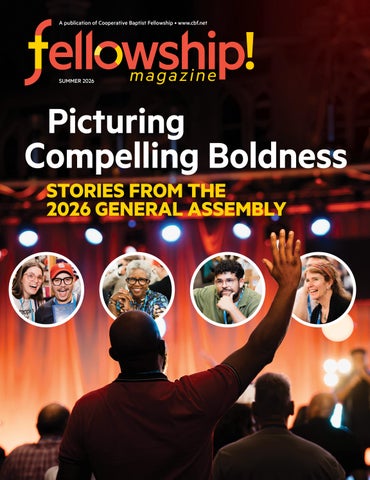
Picturing Compelling Boldness STORIES FROM THE 2026 GENERAL ASSEMBLY
PAUL BAXLEY is Executive Coordinator of the Cooperative Baptist Fellowship.
Images of Christ’s Love This edition of fellowship! magazine includes even more imagery than usual. There are pictures that were taken in the midst of a remarkable General Assembly in Jacksonville, Fla. Stories are told to evoke images of what it means to thrive in ministry in congregational life, demonstrate faithfulness in the midst of disaster and share Christ’s love all over the world. Taken together, this edition is filled with compelling images marked by beauty, joy, faithfulness, hope and love. As I consider the images included in this edition alongside the portraits evoked by words, I can’t help but wonder: In our life as a Fellowship, what image of Christ’s power are we showing the world? What portraits of love and hope are our partner congregations offering communities across the continental United States and Puerto Rico? What images of abundant life emanate from the ministries our field personnel do alongside partners in communities in the United States, Africa, Europe and Asia? What lived renderings of compassion are more than 950 endorsed chaplains and pastoral counselors evoking in their ministries in specialized settings all over the world? What embodiment of love is being shown to immigrants, refugees and asylum seekers because of the courageous public witness of our Fellowship and the sustained care of all of us? And what kind of glimpse are we giving of the kind of community God is fashioning because our Fellowship has grown to be more racially, ethnically, generationally and geographically diverse? As beautiful and engaging as the images in this edition are, I am even more persuaded that the lived experiences of our Fellowship are more inspiring still. In the course of my ministry, I have the opportunity to see so much of our Fellowship’s shared ministry in action. We do offer living imagery that reflects the depth of God’s love and anticipates the inbreaking of God’s reign in ways that should only evoke hope and joy and should invite others to join. In a world filled with images that evoke despair and in a cultural moment when there are so many Baptist and Christian portraits that neither inspire nor evoke joy, the life together to which we have been invited and for which we are being equipped is powerfully important.
We are painting a portrait of a beautiful Baptist Christian life that is faithful and essential. As we continue to commemorate our Fellowship’s 35th anniversary and as we look carefully at the images in this edition and the living portraits of grace and hope all around us, let us give thanks to God. Let us deepen our commitment to Christ and to one another. Let’s serve sacrificially, encourage one another relentlessly and give generously because the lived portrait God is offering to the world through us matters urgently and the most beautiful images are still to come. So many images in our world today are negative. Too many images of Baptist Christians are negative. But in the midst of all of that, I believe we are experiencing and sharing the power of Christ in transforming ways. What image of Christ’s love does your life provide? Does your congregation’s witness offer? Does our Fellowship advance?
A Publication of Cooperative Baptist Fellowship Volume 36, Number 3 Summer 2026 Fellowship! (USPS #015-625) is published 4 times a year in September (Fall), December (Winter), March (Spring), June (Summer) by the Cooperative Baptist Fellowship Inc., 160 Clairemont Avenue, Suite 300, Decatur, GA 30030. Periodicals postage paid at Decatur, GA, and additional offices.
POSTMASTER: Send address changes to: Fellowship! Cooperative Baptist Fellowship 160 Clairemont Avenue, Suite 300 Decatur, GA 30030
2026-27 OFFERING FOR GLOBAL MISSIONS OGM promotional videos and print materials are available to order or download now. See pages 6-7 for more information.
Executive Coordinator Paul Baxley Chief Operating Officer Jeff Huett Editor Aaron Weaver Associate Editor Lauren Lamb Graphic Designer Jeff Langford
E-Mail fellowship@cbf.net Phone (770) 220-1600
8PREPARE HELPING CONGREGATIONS FOR THE UNEXPECTED By Marv Knox
PICTURING COMPELLING BOLDNESS:
STORIES FROM THE 2026 GENERAL ASSEMBLY CREASY DEAN CALLS 12 KENDA CHURCH’S SHIPWRECK A STORY OF HOPE
13 CBF ADVOCACY fAMILIA
CALLS CBF TOWARD 14 BAXLEY “COMPELLING BOLDNESS” MODERATOR TANYA PARKS 18 CBF CHALLENGES THE FELLOWSHIP TOWARD “A BOLDER FUTURE”
20 STEP BOLDLY FOR PEACE GROWTH ON THE UNCOMFORTABLE PATH
RACIAL JUSTICE 22 HONORING TRAILBLAZERS FIXING THE ROAD NIGHT WORSHIP 24 LATE CONFRONTS FEAR
26
WOMEN’S STORIES AS SACRED WORK STAND UP AND SPEAK OUT TOGETHER FOR HOPE CELEBRATES 25 YEARS
30 PORTRAITS OF THRIVING James Briggs and the faithful agility of multi-vocational ministry By Grayson Hester
FROM THE EDITORS We are excited to share the Summer 2026 issue of fellowship! magazine. This issue celebrates the 2026 General Assembly: The Bold Type and the ministries taking place across the Fellowship. Throughout these pages, you’ll see Compelling Boldness come to life through photos from General Assembly and stories of CBF mission work and congregational ministry. We begin with four Mission Bites from CBF field personnel serving in Austria, Indonesia, Poland and North Macedonia. Their reflections offer glimpses into baptisms, unexpected encounters, youth ministry and relationships of encouragement across distances (pp. 4–7). Jay Kieve, CBF’s Director for Leadership Development, Abuse Prevention & Church Safety, shares how the Fellowship is helping congregations prepare for safety threats, abuse concerns and other emergencies before a crisis occurs (pp. 8–10). Much of this issue is devoted to General Assembly in Jacksonville, where Cooperative Baptists celebrated CBF’s 35th anniversary. You’ll find highlights from worship, plenaries, learning experiences, meals and celebrations, along with the commissioning of chaplains and pastoral counselors and recognition of this year’s McCall Racial Justice Trailblazer Award recipients (pp. 12–26). Beginning on page 27, CBF Coordinator of Missions Laura Ayala introduces Disaster Ready Churches, a new CBF Global Missions program that helps congregations prepare to respond effectively when disasters affect their communities. Finally, meet James Briggs, a multi-vocational pastor, educator and football coach whose digital congregation reflects the “faithful agility” explored through CBF’s Portraits of Thriving series (pp. 30–31). We hope you enjoy these stories and photos reflecting Compelling Boldness across CBF life. AARON WEAVER is the Editor of fellowship! Connect with him at aweaver@cbf.net LAUREN LAMB is the Associate Editor of fellowship! Connect with her at llamb@cbf.net SUMMER 2026
| 3
POWER OF BAPTISM
MISSION BITES THE PEOPLE THAT YOU MEET
By Tina Bailey
By Mike
In the spring every year, our church in Graz has a baptism service. This happens after a several-month process of classes helping the members understand deeply what it means to be a Baptist Christian. For some of us born and raised in countries with deep Christian cultures, that may sound strange, but for the people where I serve, choosing to be baptized is a very courageous step. It is a strong witness that indeed the old life has died and a new life in Christ has begun. They know that if news gets back to authorities in their home countries, there can be consequences, yet they take this step because it matters. When I was a child and was baptized, it was a special moment, but there was no risk; it just made sense and was celebrated. But for those I have grown to love, it is so much more. Honestly, I was a bit unprepared for the emotion of it all: the deep tears, the gratitude, the heartfelt hugs after. It really was for each person a transformative moment. One mother even asked us to call her by a new name afterward. For another, it was like a breath of fresh air. And for one young woman, it may have been the final step that convinced the authorities to believe what she says is true. In the end, hers was the first case in which a particularly strict judge granted asylum. I learned so much from each of them and my faith continued to deepen by knowing them. It is an honor. Tina Bailey serves as Cooperative Baptist Fellowship field personnel in Graz, Austria.
One of the great things about living in Indonesia is that almost everything can be fixed. Blow out a flip-flop? There’s a man who rides around the neighborhood whistling his unique call to let you know he’s in the area. You name it, there’s someone nearby to fix it. My normal tailor was home visiting her family during Ramadan, and, before traveling back to the U.S., I needed some quick repairs. So, I ventured around the neighborhood in search of a seamstress. Tucked between a small restaurant and student housing was a little traditional house that I had walked past a few thousand times over the last decade without ever giving it much thought. Inside the house were stacks of fabric, at least six cats and a new friend. I was in a hurry, but culture and the seamstress demanded that I wait. The wait made me late for a meeting, but God is often there in the waiting. So, I waited and asked about her life and faith. While she kicked the pedal and twirled the wheel on her manual Singer sewing machine, she talked about the loss of her husband and the changes in our neighborhood since she was born. She also spoke of her adventures going here and there as a young Baptist evangelist alongside Dutch missionaries. My errand had become a meaningful encounter. Mike and his wife, Brooke, serve as Cooperative Baptist Fellowship field personnel in the United States and Indonesia.
At a baptism service in Graz, Austria, a young woman stands in the baptismal waters with support from CBF field personnel Tina Bailey. For believers who may face consequences for conversion, baptism is a courageous public witness to new life in Christ.
A neighborhood seamstress repairs clothing on a manual Singer sewing machine in Indonesia. A routine errand became an opportunity for Mike to listen to her stories of loss, neighborhood change and evangelism.
4 | fellowship!
A SISTERHOOD OF SUPPORT By Alicia Lee
(Top) Pastor Anna baptizes Alexander while CBF field personnel Gennady Podgaisky (left) and a friend stand with them in the cold water. (Bottom) Family and friends gather after the baptism, which Alexander asked to receive as soon as possible despite the March chill.
TODAY OR TOMORROW
When a partner church asked how they could support and encourage our friend, Natalija, at Emmanuel House, I was at a loss for what to suggest. When it comes to the children’s home, people are quick to offer to purchase clothing and toys, which has been a blessing to the children there. Thanks to the donations, they haven’t needed anything! The specific group asking was a women’s Sunday school class that has been an encouragement to me—through faithful prayer, handwritten notes, thoughtful gifts and financial support. Their prayers and spiritual support remind us of God’s presence. Then it struck me. The way they have been a blessing to me is exactly what our friend Natalija needed. So, I asked the women’s group to consider selecting some devotional books, Bible studies and other materials to encourage Natalija’s faith and spiritual growth and to write personalized notes of encouragement to Natalija for the days when things feel hard, when the children are struggling and the moments when doubt starts to creep in. In the spring, representatives from the church came and brought these gifts of support and encouragement—right around Natalija’s birthday! During their visit to the children’s home, they prayed over Natalija and for the children who would know safety and God’s love through Emmanuel House. We are so grateful for the partnership of churches and individuals who not only encourage us and our work but also encourage those whom we love and work alongside in North Macedonia! Alicia Lee and her husband, Jeff, serve as Cooperative Baptist Fellowship field personnel in Skopje, North Macedonia.
By Gennady Podgaisky
“I want to do it today or tomorrow at the latest,” said Alexander. “It is the middle of March; snow has recently melted, and the water temperature in the lake is probably 38–40°F,” replied Anna, who is the pastor of a Ukrainian congregation in Krakow, Poland. “Can you wait until May or June, when the weather will be warmer?” “No, I want/need to do it as soon as possible,” answered Alexander. That was the conversation we had with a member of my Ukrainian men’s home Bible study group. Recently, he had accepted the Lord as his Savior, started attending church and home Bible study groups and expressed his desire to be baptized. Alexander understood what water baptism was and made a conscious decision to follow Christ’s command. We agreed that the next day, early in the morning, he would be baptized. God provided us with a nice sunny day. It was the sunniest and warmest day of the season. Several friends and family members came to support and witness Alexander’s baptism, including some swans and ducks that were on the lake. Indeed, the water temperature in the local park’s lake was probably 38°F, but Alexander was eager and happy to be plunged into the water and raised to a new life with Christ. Gennady Podgaisky and his wife, Mina, serve as Cooperative Baptist Fellowship field personnel in Poland.
(Left) Natalija Gura, director of Emmanuel House, sits with Alicia Lee in North Macedonia. A women’s Sunday school class from a partner church sent devotional materials and handwritten notes to encourage Natalija in her faith and ministry. (Right) A brightly painted room at Emmanuel House welcomes children into a place of safety, comfort and care.
SUMMER 2026
| 5
I am the vine; you are the branches. John 15:5
“Our ministry here is a ministry of presence. We want people to know that they are loved by us and—more importantly— that they are loved by God.” Jeff Lee CBF field personnel in North Macedonia
Alicia and Jeff Lee are CBF field personnel serving in North Macedonia. Working with local organizations and ministries, they support sustainable farming projects, provide counseling and educational support for families and students, care for refugees and help distribute food to families living in extreme poverty and people neglected by society.
Please Give Today using this QR code, through your church or at www.cbf.net/presence 6 | fellowship!
Presence Matters Planting, tending and harvesting take time and effort. Building relationships takes time and effort, too. CBF believes that long-term presence is essential to making a meaningful impact in the lives of the people among whom our field personnel serve. Your gifts to the Offering for Global Missions ensure the long-term presence of CBF field personnel.
Bible Studies and Worship Resources Free curriculum for all ages is available to download at cbf.net/ogm • Children’s sermons • Responsive readings • Bible studies for adults, youth and children
Promotional Resources I am the vine; you are the branches. John 15:5
Because Presence Matters
I am the vine; you are the branches. If you remain in me and I in you, you will bear much fruit.—John 15:5 Planting, tending and harvesting take time and effort. Building relationships takes time and effort, too. CBF believes that long-term presence is essential to making a meaningful impact in the lives of the people among whom our field personnel serve. Your generosity to the Offering for Global Missions ensures the long-term presence of CBF field personnel.
Please Give Today using this QR code, through your church or at www.cbf.net/presence
“Our ministry here is a ministry of presence. We want people to know that they are loved by us and— more importantly—that they are loved by God.” Jeff Lee CBF field personnel in North Macedonia
Because Presence Matters
Promotional resources are available to order or download at cbf.net/ogm • • • • • •
Leader’s guide Bulletin inserts Campaign poster Impact story videos Social media campaign content and graphics Images from Alicia and Jeff Lee’s ministry in North Macedonia
I am the vine; you are the branches. If you remain in me and I in you, you will bear much fruit.—John 15:5 Planting, tending and harvesting take time and effort. Building relationships takes time and effort, too. CBF believes that long-term presence is essential to making a meaningful impact in the lives of the people among whom our field personnel serve. Your generosity to the Offering for Global Missions ensures the long-term presence of CBF field personnel.
Please Give Today using this QR code, through your church or at www.cbf.net/presence
SUMMER 2026
| 7
EQUIP
Helping Congregations Prepare for the
Unexpected How CBF’s church safety and crisis prevention ministry equips leaders for readiness and response By Marv Knox
What would happen
at your church if someone suffered a heart attack during a worship service? Or if parents reported their child had been abused sexually by a youth ministry volunteer? Or if a tornado struck? Or if someone left a threatening message on the pastor’s voicemail? Designated members of your congregation should not only know what to do in crisis situations, they also should rehearse how to handle them, the Cooperative Baptist Fellowship’s Jay Kieve advised. Kieve is the Fellowship’s director for leadership development, abuse prevention and church safety. In addition to taking the lead on preventing and following up on clergy sexual abuse, he heads up a relatively new CBF ministry focused on church safety and crisis prevention. It’s designed to help congregations both avoid and respond to a broad array of potential dangers. “We want churches to understand they don’t have to figure this out on their own,” Kieve said. “Pastors already have to know too much about too many things. So, they don’t
8 | fellowship!
have to solve crisis and security problems by themselves. We’re here to help.” CBF initiated its safety and prevention program about three years ago, after a mass shooting at a church-run school made national news, Kieve reported. A CBF state coordinator called Kieve, looking for guidance in how to help churches become safer spaces. “He asked, ‘What can we tell churches about preventing this kind of violence?’” Kieve recalled. “I think he asked me because I already was talking about preventing the violence of sexual abuse. My response was, ‘I don’t know, but I’ll try to find out.’” Kieve’s quest to prevent violence led him to join a couple of associations focused on organizational safety and security: The Association of Threat Assessment
Professionals (ATAP) and ASIS International. ATAP is composed of “pros working across governments and industries to identify and manage people behaving in threatening ways,” he said. ASIS International is the organization that “issues standards for the security industry to guide best practices and certify professionals across a few security disciplines,” he said. Kieve also connected with Joshua Villines, a graduate of Mercer University’s McAfee School of Theology, who is an endorsed Baptist police chaplain and is also board certified in behavioral threat assessment. Villines encouraged Kieve to form and help train a Behavioral Threat Assessment and Management—or BTAM—team “to help pastors navigate threatening behavior with evidence-informed guidance,” Kieve said. CBF’s team includes Kieve as coordinator, as well as a clinical mental health professional, an attorney, a human resources expert and an operations specialist. Villines also consults with the team as needed. “The BTAM approach uses tools created by psychologists and criminologists to
evaluate threatening behavior, identify opportunities to mitigate violence and prepare safety plans for targets of the threat,” Kieve said. “If a pastor or a church experiences threatening behavior that requires evaluation and management, our BTAM team can bring perspective and support for the church. “The kinds of targeted violence that BTAM addresses include domestic violence, workplace violence, stalking violence, ideologically motivated violence and other sorts of grievance-inspired violence… And I have triaged or had supportive conversations with pastors about all of those forms of violence.” CBF’s emphasis on church security happened at the right time, Kieve noted. “The world seems to feel a bit more dangerous now, and that opens us to questions about security we hadn’t considered before,” he explained. “Over the past year, requests for safety/security support have risen as CBF churches have considered how they might prepare for actions inspired by serving immigrants or because they have female pastors, among other concerns.” And while such dramatic threats linger in the imagination, CBF’s church safety and crisis prevention program encompasses a broader range of issues. “Once I started talking about the prevention of targeted violence, ministers and churches began asking more general safety- and security-related questions,” Kieve said. “Beyond preventing violence when we have experienced threat, they asked, ‘How should we approach general church safety/ security?’” Working through ASIS International, Kieve obtained guides for helping churches achieve physical security standards and is preparing to obtain professional security certification himself. Security standards can include concerns about high-profile events, such as gun violence in worship. But much more often, they include issues that might seem minor in comparison but are vital nonetheless. So, Kieve consults with churches about the gamut of security—from responding to a shooter or how to eliminate stalker hiding places, to creating protocols for medical
emergencies, as well as eliminating tripping hazards and providing adequate lighting in parking lots. For Kieve, that means thinking practically about every danger that might occur on church property. “I want churches to worry about safety incidents that are more likely to happen, rather than only worrying about the worst things,” he said. “For example, in churches, heart attacks are 70 times more likely to happen than experiences of violent crime. There were way more heart attacks than the 17 homicides that occurred in Protestant churches last year. I want people paying attention to those general safety issues, too.” CBF’s emphasis on church safety and crisis prevention is as much a theological calling as a practical issue, Kieve insisted. “We do not undertake the work of congregational safety from either a point of fear or a sense of confidence in our own power,” he said. “We undertake it to reflect our faith and to create a safe place for people to respond to the call of God in their lives.”
For example, the Psalms assert God is a believer’s fortress, strength and protector. “That doesn’t mean everything will be easy or even peaceful,” he conceded. “But nothing happens that God cannot redeem. There is no person whom God cannot help. Our commitment to safety reflects God’s desire that people will be safe and supported.” Congregational focus on security enables churches “to walk a fine line between openness to all and to safety,” he said. “God cares that God’s people have an opportunity to gather, hear the gospel and find community—but also that people are safe. We should not let wolves pretending to be sheep in with everyone else.” When Kieve consults with congregations about security, he helps them think about the risks—defined as “uncertainty that impacts our plans and goals”—they face. “Most churches don’t do much safety training because risks are low and infrequently experienced,” he observed. “But we do face some risks as we gather as a church.”
(Left) Jay Kieve, CBF director for leadership development, abuse prevention and church safety, leads a church safety and crisis prevention session during the 2026 General Assembly in Jacksonville, Fla. (Below) Participants listen as he explains how congregations can assess risks, prepare response plans and rehearse those plans before an emergency.
SUMMER 2026
| 9
EQUIP In his consultations, Kieve leads churches to evaluate their vulnerability and possible responses to each risk. This task involves five steps: 1. Identify—describe how the church is vulnerable to every risk 2. Protect—determine what can be done to teach about the risk, prevent the risk and secure against the risk 3. Detect—decide how to know when a risk is happening, so the church can… 4. Respond—mobilize people with a plan and resources to protect life and care for victims, so they can… 5. Recover—do what is necessary to return stronger, healthier and safer All this work enables churches to prepare emergency action plans for each identified risk. “By far, the most important point is to have a plan” for each possible emergency, Kieve said. “It needs to be a plan that people know and have rehearsed. And that means putting it in practice—not just writing it down.”
Thinking about the importance of rehearsal for action reminded Kieve of RISKS TO when he was pastor to a volunteer fire chief, CHURCHES and they both attended an event at an FALL INTO FOUR elementary school. “The fire alarm went off, and people were CATEGORIES: just standing around,” Kieve recalled. “This Natural disasters and violent fire chief lost his mind; he was angry. People weather—for CBF churches, were not prepared to respond to what they the most common are floods and knew was an alert to danger. This points to tornadoes an important truth: If we know what to do but Health and safety—which can do not rehearse it, we may not do it.” range from falls, to sudden illness, to Helping churches define their risks, plan heated arguments how to respond to them and then rehearse Targeted violence—which involves those responses has become part of Kieve’s someone acting violently out of calling. In 2025, he conducted nearly 100 grievance or ideology and can include abuse-prevention and behavioral-threat mass violence consultations. Cybersecurity—including fraud, That is difference-making work, stressed information theft and web hijacking Clark Ward, a lay leader and co-chair of congregational care for Williamsburg Baptist Church in Williamsburg, Va. “Jay has been instrumental in the development of a safety and security plan for Williamsburg Baptist Church,” Ward said. “Jay’s ongoing consultation, a site visit and a self-assessment process have advanced safety goals in our church’s strategic plan. We are grateful for Jay’s support, enthusiasm and the CBF network.” Kieve is available as a security resource for churches across the Fellowship. “CBF partnership comes with access to make it happen,” he said. He can be reached at jkieve@cbf.net. But Kieve is not a congregation’s sole resource. “People locally—emergency services and police departments—would be delighted to help you. They want this to happen,” he said. “And the federal government has tremendous planning resources for houses of worship.” He recommended churches contact the U.S. Cybersecurity and Infrastructure Security Agency as well as the Federal Emergency Management Agency. Both government organizations have resources available to congregations for supporting their work to keep people safe, he said. Helping churches get and stay secure is a vital part of CBF’s mission and a source of personal fulfillment, Kieve noted, explaining, “This appeals to me because it’s really hard (Top left and right) Kieve outlines five steps for congregational emergency planning: identify, protect, detect, respond and recover. (Bottom) 2026 General Assembly participants consider how to adapt those to grow in your faith if you don’t feel safe.” steps to risks in their own settings.
10 | fellowship!
DISCOVER FREE
MINISTRY RESOURCES TO HELP YOUR CHURCH THRIVE
FEATURED RESOURCE
Spiritual Practices for Thriving Congregations offers churches practical group exercises to explore and strengthen thriving traits in their context. Authored by Jon Singletary, these guides correspond to the five traits of Thriving Congregations and can be used in a variety of settings.
Called in Context By Colin Kroll and Sammie Carson
www.cbf.net/calledincontext
Blessings
for Every Season The Cooperative Baptist Fellowship’s Year-long Guide to Prayer
2025-2026
www.cbf.net/resources
Kenda Creasy Dean calls church’s shipwreck a story of hope The church may feel like a ship breaking apart, but Kenda Creasy Dean told Cooperative Baptists that shipwreck can become a story of hope. At the opening plenary of the 2026 CBF General Assembly in Jacksonville, hosted by CBF Congregational Ministries, Dean asked what churches may need to release to follow Jesus into a changing religious landscape. Dean is Princeton Theological Seminary’s Mary D. Synnott Professor of Youth, Church and Culture and author of numerous books, including Almost Christian. “How much of the church as we know it are we willing to let go of in order to follow Jesus?” she asked. Drawing on Acts 27–28, Dean invited leaders to see disorientation differently. “The same ship that broke apart was actually the ship that saved them,” she said. “Just because the church as we know it feels like it might be going to pieces, doesn’t mean that God is not still using it to save us.” Young people, Dean said, are already at home on this unfamiliar shore. Their faith may be “unbundled,” with believing, belonging and religious practice no longer tied neatly to congregational participation. “Church is becoming less of a destination and more of a form of accompaniment,” she said. Innovation is not the goal. “God is the innovator,” Dean said. “We’re not called to have great ideas. We’re called to have great love.”
General Assembly photos by Sydnie Cutler
12 | fellowship!
CBF Advocacy
Bacardi Jackson, pictured at right, urged Cooperative Baptists to pair faith with sustained action during the CBF Advocacy Breakfast at the 2026 General Assembly. Jackson, executive director of the ACLU of Florida, said constitutional freedoms require more than concern. “Every day we deliver the message that the rights and liberties of we the people are not negotiable,” she said. Jackson described Florida as an early testing ground for national disputes over voting access, representation, government accountability and constitutional rights. “What happens here does not stay here,” she warned. Rather than moving from crisis to crisis, advocates must build durable partnerships and long-term capacity. “The operative question is not how can we survive this, but how will each one of us … choose to show up?” Jackson asked. “Democracy never defends itself.” Join the CBF Advocacy Network and engage in advocacy mobilization at www.cbf.net/advocacynetwork.
fAMILIA
At the fAMILIA breakfast during the 2026 General Assembly, members and friends of CBF’s Latino network gathered for fellowship, prayer, leadership formation and bold Christian witness. Rubén Ortiz, CBF’s Latino Field Ministries Coordinator, pictured speaking, helps guide fAMILIA’s ministry. fAMILIA also introduced the newest members of EFLAN, its continuing advisory board for spiritual discernment, ministerial care and strategic guidance. This third group continues work begun in 2018. The six-member board draws leaders from Puerto Rico, the Dominican Republic and several regions of the United States. Margie Rivera serves as moderator. Rev. Carlos Malavé, president of the Latino Christian National Network, called Latino leaders at the breakfast to live God’s dream with courage, commitment and faithfulness. Drawing on Acts 4, he said, “They knelt, then the place shook, and then they spoke with courage. The order matters.” Christian boldness, Malavé said, is a fruit of the Holy Spirit that unsettles the world through faithfulness rather than domination. “The kingdom of God is lived. The kingdom of God is modeled,” he said. “It is not conquered through power. It is embodied in love.” fAMILIA members prayed together, renewing their commitment to lead, advocate and build communities rooted in dignity, justice and God’s abundant life. Get connected at www.cbf.net/familia. SUMMER 2026
| 13
BAXLEY CALLS CBF TOWARD “COMPELLING BOLDNESS” “There is a power in the world greater than party affiliation, that there is still a possibility for people to come together on the common ground of faith in Jesus and do things that would otherwise be impossible.” CBF Executive Coordinator Paul Baxley offered that vision during Thursday afternoon worship at the 2026 CBF General Assembly in Jacksonville. As the Fellowship marked its 35th anniversary, Baxley invited Cooperative Baptists to recognize and deepen the “compelling boldness” already taking shape across CBF life. The service moved between English and Spanish through song and scripture, pairing Isaiah 61’s call to justice and healing with the Spirit-filled courage of Peter and John in Acts 4.
14 | fellowship!
“I want you to know that I see signs of compelling boldness at work all across the life of our fellowship already,” Baxley said. “I see congregations courageously asking new questions. I see congregations considering new ways of doing ministry. I see congregations standing courageously in the face of opposition. I see congregations making possible ministries of healing in this world that would otherwise be impossible without them.” Baxley pointed to congregations that convene or support collaborative ministries offering healing to people who are ill, housing to people without homes and shelter to people who are afraid. He also lifted up churches that remain gathering places for people who do not vote alike or share the
same political views. Such congregations, he said, are rare and increasingly endangered spaces in a polarized culture. “I see a community of congregations uniquely equipped to offer a word of advocacy to the world that polarizing partisanship is not the most excellent way,” Baxley said. “I see people of courage from different backgrounds and different political persuasions coming together to do justice and love kindness. Some people say that’s powerful. I say it’s compelling boldness.” Baxley grounded that vision in Acts 4. Peter and John stood before political authorities and religious leaders after healing a man who could not walk. The courage of the two disciples was especially striking because they had fled when Jesus
was arrested and had little prior record of standing firm under pressure. “That’s the boldness of Peter and John,” Baxley said. “It’s a compelling boldness. It’s an astonishing boldness. It’s almost a mesmerizing boldness.” Their courage was not self-generated confidence or heroic resolve, Baxley said. It was evidence of the risen Christ transforming ordinary people. “There’s only one explanation and it is that the risen Jesus has gotten a hold of them, that the boldness they’re exhibiting is a fruit of the Spirit,” he said. “The boldness they are exhibiting is a sign that Christ is alive and at work in them and that as Christ has worked on them, Christ has helped them
overcome their fears so that they are then able to do what they could not do before.” Baxley said he sees that same Spiritshaped courage among CBF-endorsed chaplains and pastoral counselors who enter places most people cannot go, offering compassionate presence without expectation of repayment. He sees it among Global Missions field personnel serving through long-term relationships, women responding faithfully to calls to ministry and Black and brown leaders offering their gifts and shaping the Fellowship’s future. “As we enter our next 35 years and we consider God’s call to a compelling boldness, we’re not working out of nothing,” Baxley said. “God is already at work forming us to be a bold community.”
The witness of Peter and John was sustained by the community to which they returned, Baxley emphasized. They shared what had happened, prayed together and received encouragement for the work ahead. Boldness, in this telling, is not solitary heroism. It grows through a community that remembers the risen Christ, prays for courage and strengthens people to act. “You are surrounded by a community of praying, believing, encouraging, empowering, compelling disciples,” Baxley said. He imagined a Fellowship whose common life would lead others to say, “By the power of Jesus, congregations can still be instruments of healing in communities.” “The only way to account for this,” Baxley said, “they’re companions of Jesus.” SUMMER 2026
| 15
“CBF has transformed what I thought was possible for my calling, allowing me to lean into my interests, passions and gifts that God has provided. I will forever be grateful for how the CBF community has thoughtfully and intentionally cared for me as I discern the next right step in my faith journey.”
NEW GENERATIONS OF LEADERSHIP Over the past five years of Meg’s faith journey, CBF has provided her with a variety of opportunities to serve, resulting in her growing confidence and affirmation that she is where she is meant to be today.
16 | fellowship!
Your gift to CBF’s 35th Anniversary Holy Ambition campaign will expand the opportunities to cultivate God’s call for the next generation of faith leaders.
The Rev. Meg Rooney (left and inset) is a young leader in the Cooperative Baptist Fellowship community. She’s used her gifts serving students on the summer staff of PASSPORT camp as well as at CBF’s annual General Assembly. Meg is a graduate of Emory University’s Candler School of Theology and is currently a Ph.D. student in the Department of Religion at the University of Georgia.
GIVE TODAY
Make your gift using the return envelope or online at:
www.cbf.net/holyambition
SUMMER 2026
| 17
“Where is God calling you to speak boldly?” CBF Moderator Tanya Parks challenges the Fellowship toward “a bolder future” At the 2026 CBF General Assembly in Jacksonville, outgoing Moderator Tanya Parks challenged Cooperative Baptists to carry visible and quieter expressions of boldness into CBF’s future. Parks recalled moving to Slovakia as CBF field personnel in 2012. Others called the decision brave, but “to me it just felt like we were doing the next right thing that God had called us to do,” she said. “The boldness of waking up in a foreign country every day didn’t feel so much like bravery as it did just following God.” In her final remarks, Parks issued three challenges: create spaces of belonging for all, give boldly to sustain Global Missions field personnel and open more doors for women called to ministry. “There are still many spaces where some of our brothers and sisters do not feel welcome and loved,” she said. “How can you advocate within your churches and regions to create spaces of belonging for all?” She also asked churches to invite women into pulpits and pastoral leadership. “Where is God calling you to speak boldly?” Parks asked. “We still have a long way to go, but together, we can create a bolder future for those who will gather in another 35 years.”
18 | fellowship!
Outgoing CBF Moderator Tanya Parks greets participants during 2026 General Assembly in Jacksonville, Fla., concluding her year of service as the Fellowship’s highest-ranking elected officer.
Step BOLDLY for Peace
During the 2026 General Assembly, participants joined Deborah Garrard, founder of be(e) well serve well, for Step BOLDLY for Peace, a sunrise walking meditation across Jacksonville’s Main Street Bridge to Friendship Fountain. The silent, slow walk paused along the St. Johns River for reflection, inviting participants to move together in body and spirit. CBF field personnel Carson Foushee was struck by “the power of our united physical and spiritual movement” as passersby watched the group move forward together that morning. For Joyce Oliver, minister of discipleship at St. Matthews Baptist Church in Louisville, Ky., the early-morning walk offered “a peacefilled respite for her soul” amid busy, productive and caregiving roles. She called it “a timely and beautiful balm” and a fitting expression of stepping boldly. Photo: Jonathan Boggs.
Growth on the uncomfortable path
During “A Leadership Conversation with Michelle Icard” at the 2026 General Assembly, author and parenting expert Michelle Icard invited pastors and church leaders to rethink how children, families and congregations grow through discomfort, failure and healthy risk. Brian Foreman, CBF’s Coordinator of Congregational Ministries, framed the interactive gathering around family ministry and congregational leadership, with Icard’s teaching followed by table conversations. “Where I want people’s kids to be is on the uncomfortable path,” Icard said. “You want to feel some discomfort. First of all, we all know that discomfort is what comes with growth.” Icard described “greenhouse parenting” as creating a comforting, nourishing home while allowing children to encounter the world’s inevitable regret and pain. Adults should resist fixing every problem, she said, so young people can learn to cope and build resilience. “A real rite of passage includes failure,” Icard said. “We have to get okay with the idea that growth includes failure.” She also urged adults to make room for healthy risk. “If kids are not given the opportunity to take risk, they find other ways to take it,” she said. “A risk isn’t a risk unless it creates a certain amount of queasiness in your stomach.”
20 | fellowship!
Ossie McKinney, CBF’s Director of Research and Administration for Outreach and Growth, leads the volunteer 2026 General Assembly Choir during Friday evening closing worship.
(Inset) Isabella Altenbach of Jacksonville’s Hendricks Avenue Baptist Church leads the Assembly in songs of welcome, courage and hope.
(Clockwise from upper left) Laura Davis of CBF Virginia and Rubén Ortiz, CBF’s Latino Field Ministries Coordinator, lead the Assembly in the celebration of the Lord’s Supper; Tammy Snyder, coordinator of CBF Florida and the Caribbean Islands, welcomes the Fellowship during Thursday’s opening plenary; worshipers respond through prayer and song. SUMMER 2026
| 21
Honoring Racial Justice Trailblazers
Rev. Dr. Danielle Ayers and the late Rev. Dr. Robert Parham received the 2026 Dr. Emmanuel McCall Racial Justice Trailblazer Award during the McCall Racial Justice Trailblazer Luncheon at General Assembly. The annual award recognizes CBF individuals and ministries who navigate unequal and unjust areas of life and initiate proactive resolutions resulting in greater equity, opportunity, impact and outcomes for all. CBF Executive Coordinator Paul Baxley and Rev. Kasey Jones, CBF Coordinator for Outreach and Growth, presented the award to Ayers, pictured at right. As pastor of justice at Friendship-West Baptist Church in Dallas, Ayers leads advocacy, civic engagement and public witness. Her work has included organizing against predatory payday lending and advocating for maternal health equity, voting rights and racial justice. “This moment demands moral clarity,” Ayers said. “It demands conviction, courage and commitment. It also demands organizing as a spiritual discipline.” Parham was honored posthumously for building platforms for documentary films, digital journalism and multiracial conversations, including work confronting racism among Baptists. Cliff Vaughn of Good Faith Media accepted the award on behalf of Parham’s family. “I know many of you keep the second death of Robert Parham at bay,” Vaughn said, “and for that I’m grateful.” Learn more and watch videos honoring 2026 McCall Trailblazer award recipients at www.cbf.net/mccall-initiative.
Fixing the Road Rev. Dr. Howard-John Wesley challenged attendees at the Dr. Emmanuel McCall Racial Justice Trailblazer Luncheon to resist forms of Christianity that quote scripture while remaining “light on Jesus.” Wesley, senior pastor of historic Alfred Street Baptist Church in Alexandria, Va., preached from the parable of the Good Samaritan. He warned that people can use scripture to decide whom they may exclude rather than allowing it to expose their own prejudice. “There’s something wrong when your religion, your walk with God, your use of scripture only confirms your convictions but never convicts you of your own sin,” Wesley said. Jesus never identified the ethnicity of the wounded man, Wesley noted, because his suffering alone should have compelled mercy. “The problem was not the brother. The problem was the road,” he said. “That’s what rotten religion does. It always blames the victim, but never wants to acknowledge the system in place.” “We are walking on a crooked road,” Wesley said, “and it’s time for the body of Christ to be concerned about fixing the road.”
22 | fellowship!
(Above right) Isabel and Samantha Gallegos and Kaitlyn Parks volunteered at the Age Level Assembly, where children and youth from preschool through high school had their own bold gathering alongside the main Assembly. (Below left) CBF chaplains gathered Monday, June 15, for training with Allison Gilmore of DuMore Improv to learn about the benefits of humor and resilience in their field.
Young pastors gathered to build friendships and celebrate the shared journey of ministry. From left to right, Naomi Black-Bass, Joseph Bass, Jonathan Hall, Allie Osborne and Anna Beth Cross. SUMMER 2026
| 23
Late Night Worship confronts fear
Hosted by CBF’s Pan African Koinonia, the fifth annual Late Night Worship service continued a tradition rooted in Watch Night worship on Dec. 31, 1862, when enslaved people gathered late into the evening awaiting the freedom promised by the Emancipation Proclamation. Preaching from Psalm 27, Rev. Dr. Prince Raney Rivers (bottom left) challenged Cooperative Baptists to break through fear and embrace bold faith. “Fear keeps us from being bold,” said Rivers, senior pastor of Union Baptist Church in Durham, N.C. “If we don’t break through fear, we won’t see what faith can do.” Rivers offered three movements for confronting fear: tell the truth about God, question what causes fear and “linger with God.” “We cannot forget that activism and mysticism go together, that courage and contemplation are complementary, not contradictory,” he said. “To be bold in our faith without burning out, we’ve got to be committed to community with the Lord.” Rivers closed with a direct charge: “Women and men of God, now is not the time to be afraid. God is keeping you.”
24 | fellowship!
Women’s Stories as Sacred Work
During the Baptist Women in Ministry Annual Dinner, Rev. Dr. Yolanda Pierce (top right, below) challenged Cooperative Baptists to recognize women’s stories as essential to the life of the church. “I’m here tonight to tell you why women’s stories are sacred work,” Pierce said. She described those stories as important, necessary and holy, providing essential material for theological reflection. The evening also celebrated Baptist Women in Ministry’s continuing advocacy for women called to ministry while recognizing leaders whose service has strengthened congregations and the wider Fellowship. Pierce reminded listeners that remembering and sharing these stories is itself an act of justice and discipleship.
(Right) Melissa Hatfield, senior pastor of First Baptist Church in Jefferson City, Mo., engages in a learning session with Michelle Icard. Hatfield was named CBF Moderator-Elect for 2026–2027.
Newly commissioned CBF-endorsed chaplain Christie Thadikonda (right) and his sons celebrate community and worship as members of the General Assembly choir.
Ministers and ministry leaders gather for fellowship with members of the Children’s Ministry Network, Youth Ministry Network and College & Young Adult Ministry Network.
SUMMER 2026
| 25
Stand Up and Speak Out Cooperative Baptists concluded the 2026 General Assembly around the Lord’s Table after receiving a forceful call to Christian witness from Baptist World Alliance Chair Rev. Karl B. Johnson. Preaching from Revelation’s letter to the church at Pergamum, Johnson challenged worshipers to stand up and speak out through lives marked by forthrightness, fearlessness and faithfulness. “The people of God cannot retreat,” Johnson said. “The people of God therefore must rise up.” Johnson, the first Caribbean leader to chair the Baptist World Alliance, serves as pastor of historic Phillippo Baptist Church in Spanish Town, Jamaica. Reflecting on Juneteenth and his own people’s history of enslavement, he urged Cooperative Baptists not to return home unchanged.
“Wherever you are, whichever state, whichever district, whichever community, whichever country you are from, you must stand up and speak out,” he said. Johnson warned that proximity to political power can compromise the church’s witness and called for courage guided by discernment. “To stand up against forces of death requires one to be fearless,” he said. Yet faithfulness, Johnson emphasized, is ultimately an unwavering allegiance to Christ: “No matter what happens, I am going to acknowledge Jesus Christ as my Lord.” He concluded with Revelation’s vision of a new heaven and new earth. “Let that vision spur you by the Spirit of God to stand up and speak out.”
Read stories and watch videos from General Assembly at cbf.net/general-assembly-26
Together for Hope celebrates 25 years Together for Hope marked 25 years of walking alongside rural communities during its “25 Years of Gifts” banquet at General Assembly. Launched as CBF’s Rural Poverty Initiative, the coalition builds on the gifts, relationships and resources already present in communities facing persistent poverty. “How do you write a future instead of a history?” President Jason Coker asked, inviting supporters to imagine the next 25 years. Learn more at tfhope.org.
26 | fellowship!
At their best when their communities endure the worst By Marv Knox
IN
an instant, a disaster delivers destruction that impacts a community for generations, CBF Global Missions Coordinator Laura Ayala observed, but disaster also offers a congregation a rare opportunity to embody Jesus’ love and care for their friends and neighbors. That’s a major reason why CBF Global Missions created Disaster Ready Churches, a program designed to help congregations across the Fellowship respond lovingly and effectively when their communities endure tragedy. Disaster Ready Churches
launched this spring with a pilot cohort of six congregations from California to Puerto Rico. Churches had an opportunity to learn more and sample hands-on training at the 2026 General Assembly this summer, during a disaster response training and a Learning Lab. The program will engage a minimum of 200 churches across the Fellowship during the next three years. The Eula Mae & John Baugh Foundation and the Lilly Endowment Inc. are making the program possible. Participating churches receive support for developing and implementing their disaster response
plans. This involves not only training and coaching, but also assessment tools necessary for deciding which disaster services they are willing and able to provide to their communities. The program will include recording the trainings to create an e-learning library that will be available to other congregations. The Disaster Ready Church program reflects a shift in CBF’s response to disasters, Ayala explained. Historically, the Fellowship has refrained from participating in disaster relief, the first on-the-scene approach that sends workers into disaster areas within
CBF Disaster Response volunteers gather for a training workshop at Hendricks Ave. Baptist Church in Jacksonville, Fla., during the 2026 General Assembly.
CBF Disaster Response Coordinator Kenny Phillips (left) teaches volunteers tarping, or how to install a temporary roof, as part of the hands-on training.
CBF Global Missions Coordinator Laura Ayala (center) leads a discussion on the progress of the pilot churches in the Disaster Ready Church Program.
SUMMER 2026
| 27
A Disaster Response participant paints a wooden star during the Stars of HOPE training. The star carries a message of hope to be shared with survivors and first responders after disasters. CBF field personnel Lita Sample, serving in the San Francisco Bay Area, shared a photo (below) of a church in Pasadena, Calif., following the Eaton Fire in January 2025. Photo by Jose Raul Figueroa.
hours. Instead, CBF has engaged in disaster recovery, a long-haul ministry that keeps providing volunteers for months and even years, until disaster victims are recovering, if not made whole. While the new program does not abandon disaster recovery, it enables churches to prepare for rapid response to local disasters. “When a disaster strikes, whether it is a natural or human-made disaster, the effect always is local,” Ayala explained. “It could be any kind of disaster—a building fire or a wildfire, a flood, a mass shooting, a tornado or hurricane. But whatever the disaster is, the impact always is local.” That’s a major reason why CBF must prepare congregations to respond to disasters, Ayala stressed. “Our congregations are the CBF constituents closest to where disasters happen,” she said. “They know their communities. They can prepare ahead, and we should equip them with what they need to join a response when a disaster starts.” If churches are disaster ready, they can not only respond to a disaster but also know “when to get in, what to commit for, what not to do and when to get out.” CBF congregations won’t replace the best known disaster responders—such as emergency medical personnel, law enforcement, firefighters and partners like the Red Cross—she acknowledged. “But our churches can be prepared to partner with the first responders, the skilled people who arrive
28 | fellowship!
on the scene almost immediately,” she said. “These responders encounter needs our churches can offer,” she added. “They may need space, such as a fellowship hall, for a command center. Perhaps a parking lot, where they can base their operations or a point of distribution. Maybe a church isn’t equipped to feed 2,000 people, but they could feed 100 first responders every day from their kitchen.” Churches also can be prepared to offer pastoral or spiritual care, she said, recalling local needs in the immediate aftermath of the 2025 Central Texas flood that claimed at least 136 lives, including almost 30 girls at a summer camp. “First responders needed people to pray for them. Parents needed someone to provide food, but also spiritual care and love.” Ayala knows firsthand about responding to disasters. She was pastor of First Baptist Church of Rio Piedras in San Juan, Puerto Rico in 2017 when Hurricane Maria ravaged the island. The congregation’s campus became an operations hub for first responders, and the church partnered in recovery efforts that have continued for almost nine years. She recognized both the immediate benefits and long-term blessings of helping people in the wake of disasters. “We learned how to respond in disaster relief,” she said. “We learned how to respond in emergency settings. We were trained by those who knew
how to do it. And then, in early 2020, when an earthquake hit and later the [COVID-19] pandemic arrived, we knew what to do, and we were equipped to respond. No one could come from the continental United States, but we knew what to do.” As CBF’s Global Missions coordinator, she preaches the vital importance of readying churches for disaster. “A church can be part of the network of CBF’s disaster response that is currently happening and also get involved in the local response network,” she said. “So, being there is having a place at the table, getting to know the people involved in all facets of the work. When you know what you are capable of doing, you step in and step up.” Readiness revolves around relationships, which are crucial any time, but particularly following a disaster, Ayala observed. “When you assess what your church is able to provide, you offer that to others and that positions you as a pertinent church within your community, as well. The chief of police, emergency management officials, the Red Cross and the fire chief know who you are. That means you develop a personal relationship. So, when any disaster happens, you can grab a phone and say: ‘This is going on. How can we help?’ “Because of the [disaster response] network, you know there is a need, and you are able to come alongside and be present… When the affected people are prepared,
Applications to become a Disaster Ready Church are accepted on an ongoing basis. The first 200 churches selected will receive a grant to help implement their plans. For more information or to apply, visit cbf.net/drreadychurch or scan the QR code. the church can send in trustworthy, trained people. This is testifying the church cares. We are called to be the hands and feet of Christ. This is a concrete way of being present. It is a different way of sharing the good news of Jesus Christ. It is saying, ‘You are not alone, because we are here, in the name of Jesus Christ.’” The pilot phase of the Disaster Ready Church program began April 1. The six congregations in the initial cohort each have been assigned coaches who are training the churches’ disaster response planning teams. Besides learning about disaster response, team members have been asked to share their interest in disaster response with other church members. “We want to get the whole church interested now, knowing they will be involved later,” Ayala explained. Now, the coaches are leading planning teams through a multi-step process that includes: • Conducting an orientation and engaging key church leaders • Assessing internal and external assets and risks • Identifying a disaster response ministry focus and potential partners • Setting goals and creating an action plan, starting with the local church’s internal needs
• Writing a disaster-ready plan, preparing a budget and securing congregational approval • Integrating the church’s plan with the CBF Disaster Response Readiness Network and participating in disaster response training The assessments are the most important step, Ayala said. “This allows them to identify internal assets—the physical and human assets within the church,” she explained. “It also allows them to discover external assets—their partners in the community. And it enables them to determine both internal and external risks.” That information sets off a chain reaction. “Once they understand their assets and risks, they will decide which area of disaster response they will focus on,” she said. “Then, they will write a plan for responding to those disasters, which will be shared with and approved by the congregation. “After that, we start training the church members—and maybe some friends from outside the church—who may participate in the response. And once they’re part of the Disaster Response Readiness Network, they will continue to receive training opportunities.” A key to the program is enabling and empowering churches to determine which type of disaster or disasters they will take on, Ayala noted. “After all, who is better able to make that decision, other than a local church?”
These decisions often will be determined by location and geography, she predicted. For example, a church in the Northeast may prepare to respond to winter storms, while a church in the South might focus on floods, tornadoes or both. When the disaster ready churches are prepared, they will coordinate with the national hub, but key decisions will take place on the state/regional and local levels, she said. “When a need comes in, we will let the network know. But it is the local people near the disaster who will tell us what is needed, how they will respond and what kind of support they need.” While much of the training with coaches will be online and virtual, the planning teams from the six churches in the initial cohort gathered in Jacksonville, Fla., from June 15–16 during the 2026 General Assembly. They presented reports on their progress and received initial training in providing spiritual care to disaster victims and survivors, among other hands-on learning. The training featured sessions on “Volunteer 101,” or how to manage volunteers, as well as how to conduct emergency tarping and how to manage distribution of supplies, among other skills. A Learning Lab session on Friday, June 19, was held to provide the nuts-and-bolts information about the program and how to apply to participate in future Disaster Ready Church cohorts.
GIVE HOPE & RELIEF IN VENEZUELA www.cbf.net/dr-give Photo: AP Photo/Pedro Mattey
SUMMER 2026
| 29
JAMES BRIGGS
By Grayson Hester
AND THE FAITHFUL AGILITY OF MULTI-VOCATIONAL MINISTRY In our
increasingly digitized and disembodied age of communication, one can’t help but wonder how Jesus might have shared his message in Matthew 18:20, “For where two or three are gathered in my name, I am there among them” (NRSV). Would he have added, “For where two or three are gathered—or hopping on a quick Zoom call, or participating in a Facebook chat, or setting up regular donations via Tithe.ly—in my name, I am there, albeit more so in Spirit than in body, but ‘there’ all the same, among them?” It remains an urgent question in 2026— not so much whether Jesus is spiritually present (as we can assume), but how “gathering” looks, what qualifies as gathering and what even constitutes “church” when four walls are no longer an ironclad part of the deal. One digital congregation living the question, and thriving along the way, is Daybreak Metropolitan Church in North Texas. Their lead pastor and founder James
players on the field and his congregants in the pews equally well—even when there are no pews at all. “Before the COVID-19 pandemic, we were meeting in brick-and-mortar buildings. And Briggs sees what many of us deem as ever since then, we have continued to have flexibility—or even capitulation—as a trait worship on Zoom,” he said. For the past six of thriving: faithful (or strategic, in Briggs’ years, Daybreak has broken molds, opting to words) agility. meet virtually and explore how Jesus might “In order to foster strategic agility, you’ve show up in the digital space, too. got to take the limits off of God, and there Crisscrossing the vast expanses of Texas are so many different ways in which we can week after week is no small feat. All too do that,” Briggs said. “I think one way is being often, the games and events in which young comfortable in once again, saying, ‘I don’t athletes are all but required to participate—if have all the answers to what is in front of me. they want a shot at a career in the Lone To whom can I connect?’” Star State’s famously competitive sports And Briggs knows agility. In addition environment—take place on Sundays, if not to his role as a pastor, he also serves as consuming entire weekends. That makes the an educator and coach in the local school church’s digital-only services all the more system; he is one of a growing cadre of essential. ministers who practice their call multi“We do see ourselves as a vehicle to vocationally. Adaptability and a willingness to make the word of God present and known change course at a moment’s notice serve his to folks who have busy lives,” Briggs said.
James Briggs speaks during a virtual gathering for Daybreak Metropolitan Church in North Texas. Serving as pastor, educator and coach requires the faithful agility at the heart of his multi-vocational ministry.
30 | fellowship!
Visit www.cbf.net/portraits
to watch James Briggs’ video and explore the full Portraits of Thriving series, featuring ministers and congregations living out compelling clarity, rooted relationships, holy tenacity, faithful agility and dynamic collaboration.
Briggs gathers with student-athletes during football practice, creating daily opportunities to influence young people beyond a church building’s walls. “You just never know in what ministry context you’ll be pastoring or preaching, so you’re going to have to learn how to do everything.”
“We’ve got families who have young kiddos who are participating in youth sports and travel teams; when you’re on the move, you still want a word, and we see ourselves as meeting that need.” The parallels between athletics and discipleship are abundant—so much so that even the writer of Hebrews compared a life of faith to a race—which makes Briggs’ three-pronged role not just coincidental, but symbiotic. Shaping lives happens in classrooms, in practices and in sermons. What matters more than the setting in which it occurs is the willingness of a minister (or coach or teacher) to answer the call. “One of the things that’s been a blessing to me with regards to being in ministry and being a teacher and coach,” he said, “is that I know that I am going to be able to have an influence, a positive influence and a spiritual influence, just by being a walking epistle.” This commitment to his communities, both academic and ecclesial, has resulted in genuine thriving on the individual and collective levels alike. When worry finds itself
directed at the well-being of students and of schools, of churchgoers and the houses of worship they attend, places like Daybreak and people like Briggs reveal slightly different stories. The community, even outside the church’s “walls,” has reacted positively. “Coach Briggs is one of those coaches who shows up every day, and when he shows up, he shows up not just for athletics, but he’s involved,” Leslie Slovak, an administrator, said. “His students that have gone on to college still reach out to him for advice. Coach Briggs has never met a stranger, and I think everyone that’s ever met him has the same sentiment.” That said, while the benefits of multivocational and digital-only ministry are clear and many, the unorthodox format comes with challenges. To be involved in multiple helping professions at once can place a significant emotional burden on the person coaching, teaching and preaching; the novelty of such a position can, at times, serve only to compound the difficulty. “It feels lonely sometimes because when you’re in ministry,
you feel the pressure, you feel the weight of producing,” Briggs said. “There’s a pressure, and there’s this sense of lonesomeness, because you just don’t know who else is going about ministry in this very unique and different way.” To assist ministers in these singular positions, CBF has a clergy support ecosystem so that pastors like Briggs, congregations like Daybreak and communities like North Texas can continue to coexist with and uplift one another. Burnout benefits precisely no one, which is why CBF’s Clergy Support seeks to help keep ministers from feeling isolated with resources and peer connections, including folks who consider themselves among the ever-expanding ranks of multi-vocational ministers. “Participating in the Thriving in Ministry program has blessed me essentially because I learned that I was not in a fight all by myself,” he said, “that there are so many other ministers in different areas, different regions of the country who were at work just like I was.” Just as on a sports field or court, everything is achievable when it’s done with a dependable team by your side. “You just never know in what ministry context you’ll be pastoring or preaching, so you’re going to have to learn how to do everything,” Briggs said. “That is what so many multi-vocational pastors do. You do a little bit of everything. And over time, you find yourself connecting with folks who can give you a little bit of advice or who has a contact. That’s the blessing of all of it.” To learn more about how CBF helps ministers thrive, connect with CBF Director of Clergy Support Kelly Adams at kadams@cbf.net. SUMMER 2026
| 31
160 Clairemont Avenue, Suite 300 Decatur, GA 30030 www.cbf.net (800) 352-8741
YOUR GIFT TRANSFORMS LIVES
As a community and school-based counselor, it has been my honor to walk alongside women, children, couples and families as they seek wholeness and transformation in their lives. I have witnessed God heal generational trauma, repair marriages, restore dignity and self-worth, and redeem relationships. Partnerships with individuals and churches across the Cooperative Baptist Fellowship, joining in God’s work in the world, make this transformation possible. Alicia Lee, CBF field personnel, Skopje, North Macedonia
CELEBRATE 35 YEARS OF BEING THE PRESENCE OF CHRIST BY HELPING US REACH OUR $3.5M GOAL Your investment in CBF’s 35th anniversary campaign helps to expand the beautiful kind of Baptist witness God is growing among us. • Building expertise and initiatives to meet the most urgent needs of congregations • Cultivating God’s call for a new generation of leadership • Growing our leadership development services for clergy and lay leadership teams • Sustaining catalytic, entrepreneurial staff presence in growth regions for CBF • Fostering genuine racial justice, reconciliation and repair • Expanding advocacy efforts to equip churches and their leaders
GIVE TODAY!
www.cbf.net/holyambition
QUESTIONS?
Contact Shauw Chin Capps at scapps@cbf.net