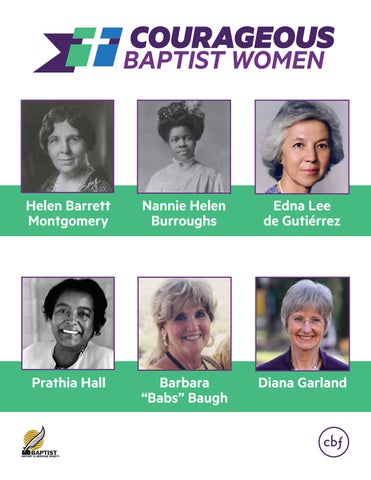
Helen Barrett Montgomery
Nannie Helen Burroughs
Edna Lee de Gutiérrez
Prathia Hall
Barbara “Babs” Baugh
Diana Garland
PRAYER, PERSPIRATION AND PATIENCE The Life of Helen Barrett Montgomery
PRAYER, PERSPIRATION AND PATIENCE
The Life of Helen Barrett Montgomery OVERVIEW Helen Barrett Montgomery was a pioneering Baptist educator who made a new path for others, worked to improve society and supported Christian mission work. In 1921, she became the first woman to lead a large group of Baptist churches in the United States, serving as president of the Northern Baptist Convention. Through prayer, patience and hard work– the “perspiration” in the title–Helen changed many lives. Her life was marked by a deep Christian faith, a passion for helping others, courageous leadership and a determination not to give up.
BIBLE VERSE James 2:14-18: My brothers and sisters, what good is it if people say they have faith but do nothing to show it? Claiming to have faith can’t save anyone, can it? Imagine a brother or sister who is naked and never has enough food to eat. What if one of you said, “Go in peace! Stay warm! Have a nice meal!”? What good is it if you don’t actually give them what their body needs? In the same way, faith is dead when it doesn’t result in faithful activity. Someone might claim, “You have faith and I have action.” But how can I see your faith apart from your actions? Instead, I’ll show you my faith by putting it into practice in faithful action.
SESSION OUTLINE Prepare
Share
Welcome
• • •
• • • •
Make copies of the Student Handout. Review the Story and Bible Verse. Greet students as they arrive. Ask: How do you practice your faith?
Engage • • • •
Distribute the Student Handout. Read and discuss the Bible Verse. Work on the Handout Activity. Transition to Story Time.
•
Tell the story, “The Life of Helen Barrett Montgomery.” Share the photo and caption. Discuss the story and pray. Watch videos about Helen.
Conclude •
Lead students in Bonus Activities as time permits.
STORY
The Life of Helen Barrett Montgomery
Helen Barrett Montgomery was born in Ohio in 1861. Her family later moved to Rochester, New York, where her father studied at a seminary—a school for ministers—and pastored Lake Avenue Baptist Church. Helen attended Wellesley College and studied Greek and literature. In 1887, she married William A. Montgomery. They lived in Rochester and adopted a daughter, Edith. Helen started a women’s Bible class at her church and taught it for 44 years. In 1892, the church officially gave Helen permission to preach, when very few churches allowed women to do so. Helen worked closely with Susan B. Anthony, a leader for women’s rights. In 1893, they founded the Women’s Educational and Industrial Union of Rochester, a group that helped women and children living in poverty. It created public playgrounds, a safe lunchroom called “Noon Rest” for working women, a place where people could get legal help and “milk stations” where families could get safe milk for babies. Helen and Susan also worked to open the University of Rochester to women. University leaders agreed to admit women if they raised money to help pay the costs. After two years, they met their goal! The first 33 women enrolled. Helen also became the first woman elected to the Rochester School Board, a group that helps lead the city’s schools. She worked to give children better lives and a better education. Later, Helen focused on Christian mission work in other countries. She believed women should help decide how mission money and programs were used. Helen raised $1 million for missions—about $23 million today! The money established Christian colleges for women in Asia. Wherever she traveled, Helen urged people to start or strengthen Christian schools for girls. After seeing the power of people praying together, she helped establish the World Day of Prayer, a special day held each year that continues today. Helen served in many leadership roles. In 1921, she became the first woman president of the Northern Baptist Convention, a large group of Baptist churches. She led the group through serious disagreements and helped its members stay united. Her motto was “agreed to differ, but resolved to love.” This meant people could disagree and still choose to love one another. Helen Barrett Montgomery worked for women, people living in poverty and everyday people. She taught, spoke up for others and translated the New Testament from Greek into plain English so more people could understand it. Through prayer, hard work and patience, Helen improved many lives, created safe places and inspired women who came after her. Even when people opposed her work, she did not give up. She kept praying, leading and working to live out her faith.
DISCUSSION AND PRAYER • Ask: What are some ways that Helen Barrett Montgomery showed courage? • Ask: How did Helen Barrett Montgomery help others? • Ask: What can we do to help others as well? • Say: Helen Barrett Montgomery stood up for others. She worked hard to help people living in poverty have what they needed, to help women have more rights and to help everyone be able to read Scripture. She showed courage by not giving up and by standing up for others. She wasn’t afraid to be different, and she used her influence to help others who had less than she did. • Pray: Dear God, thank you for Helen Barrett Montgomery and the courage she showed in standing up for others. Help us to show courage as well. Amen.
LEARN
To learn more about Helen Barrett Montgomery and to see pictures of her, check out: • https://www.thebhhs.org/hbm1 • https://www.thebhhs.org/hbm2 • https://www.thebhhs.org/hbm3
FACT CHECK
📖 Helen Barrett Montgomery published the Centenary Translation of the New Testament, the first full New 🌟 🍼 🙏 🍲
Testament in English ever translated and published by a woman scholar. This New Testament was written in everyday, accessible English for the ordinary reader. Helen Barrett Montgomery was the first woman president of the Northern Baptist Convention, becoming the first woman to lead any major religious denomination in the United States. She was chosen for her proven capability, including her ability to fundraise. In 1893, Helen Barrett Montgomery and Susan B. Anthony founded the Women’s Educational and Industrial Union (WEIU) of Rochester, NY. It provided practical support for poor women and children, including creating public playgrounds, a safe lunchroom for working women and infant “milk stations” to ensure babies had safe milk. In 1915, Helen Barrett Montgomery and Lucy Peabody asked churches to set aside a universal day of prayer for women’s missions. It sparked a movement, and now, over 100 years later, the World Day of Prayer continues. Helen showed Rochester, NY, that Christian love isn’t just a feeling, but is also something active, like providing warm meals, education, justice and healthcare to those who need it most.
ACTIVITIES
Enjoy a New York Breakfast Items needed: Bagels (include gluten-free option, if needed), cream cheese, lox (optional), napkins, plates, plastic knives, water.
Give each child a bagel and allow them to choose if they wish to have cream cheese or any other toppings you have. As they eat their snack, talk about the history of the bagel. It is believed that Eastern European Jewish immigrants brought bagels to New York in the late 1800s, and bagels became popular in the early 1900s. They were so popular, in fact, that there were a few times when there were city-wide bagel famines in New York City! (https://www.thebhhs.org/nybreakfast)
Read the Bible Items needed: different translations of the Bible (i.e. the NIV, the New Living Translation, The Message, the KJV, etc.) or access to www.biblegateway.com
*If using an online version, print copies of various translations of James 2:14-18, John 3:16-17, and Matthew 5:1-12. Encourage children to look at the various translations. Ask children to take turns looking up each passage (James 2:14-18, John 3:16-17 and Matthew 5:1-12) and reading them out loud. Talk about how the translations differ and ask children to point out some of the different words used. Talk about how in Helen Barrett Montgomery’s time, the Bible that was used was the King James Version. The old-fashioned language was hard to understand; so Helen used the Greek she had learned to create a new translation in plainer language for the everyday readers.
Play Outside Items needed: Playground or other play equipment
Take children outside and let them play. (If the weather doesn’t allow this, play indoor games like hide and seek and relay races.) At the end, talk about how Helen Barrett Montgomery, alongside Susan B. Anthony, founded the Women’s Educational and Industrial Union of Rochester, NY. This provided practical support for women and children in the city, including the creation of public playgrounds. Before that, there weren’t any playgrounds where everyone could go play!
DESIGN TEAM
Jessica Asbell Oravec, Writer Aaron Weaver, Editor
Jeff Langford, Designer Amy C. Cook, Designer
PRAYER, PERSPIRATION AND PATIENCE The Life of Helen Barrett Montgomery STUDENT HANDOUT
Helen Barrett Montgomery Game Choose one end of the path as START and the other as FINISH. Take turns rolling the die and moving that many spaces. Read each space aloud. The first player to reach FINISH wins.
FINISH Helen’s congregation licensed her to preach in 1892! Helen taught a women’s Bible class at Lake Avenue Baptist Church for 44 years.
In 1887, Helen married William A. Montgomery.
In 1876, her father became pastor of Lake Avenue Baptist Church in Rochester, NY.
Helen Barrett was born in 1861 in Ohio.
START
In 1893, she and Susan B. Anthony started a group to help women and children.
She did not give up in the face of obstacles.
She helped create public playgrounds and safe lunchrooms.
She and Susan worked hard to open the Univ. of Rochester to female students.
Helen advocated for a World Day of Prayer that still continues today.
She was president of the Woman’s American Baptist Foreign Mission Society.
She believed her Christian faith had to be lived out with actions.
Her motto for leading was: “Agreed to differ, but resolved to love.”
She translated the New Testament in everyday, accessible English.
Helen was the first woman president of the Northern Baptist Convention.
THEBHHS.ORG
CBF.NET
SPECIALIZING IN THE WHOLLY IMPOSSIBLE The Life of Nannie Helen Burroughs
SPECIALIZING IN THE WHOLLY IMPOSSIBLE
The Life of Nannie Helen Burroughs OVERVIEW
Nannie Helen Burroughs was an African American Baptist leader, educator, civil rights pioneer who helped make a new path for others, and a gifted writer and thinker. Her life showed faith in action. For six decades, she worked for Christian education, women’s leadership in the church and fair treatment for all people. Through hard work, bold speeches and writing, Nannie showed that nothing is impossible with God.
BIBLE VERSE Mark 9:22b-24: “If you can do anything, help us! Show us compassion!” Jesus said to him, “‘If you can do anything’? All things are possible for the one who has faith.” At that the boy’s father cried out, “I have faith; help my lack of faith!”
SESSION OUTLINE Prepare • •
Make copies of the Student Handout. Review the Story and Bible Verse.
Welcome • •
Greet students as they arrive. Ask: What impossible thing might God be calling you to do?
Engage • • • •
Distribute the Student Handout. Read and discuss the Bible Verse. Work on the Handout Activity. Transition to Story Time.
Share • • • •
Tell the story, “The Life of Nannie Helen Burroughs.” Share the photo and caption. Discuss the story and pray. Watch videos about Nannie.
Conclude •
Lead students in Bonus Activities as time permits.
STORY
The Life of Nannie Helen Burroughs
Nannie Helen Burroughs was born in Virginia in 1879. Her parents had been enslaved, which means they had been forced to work and were not free. After Nannie’s father died, she and her mother moved to Washington, D.C., so Nannie could get a good education. She did very well in school and graduated with honors in 1896 from Washington Colored High School, the name of a respected school for Black students at that time. When Nannie applied to teach in Washington, she was turned away. Historians believe she faced colorism—unfair treatment because of her darker skin. This painful disappointment made Nannie more determined. She decided to create a school where African American girls could receive an excellent education. Instead of giving up, Nannie trusted God’s purpose and prepared to “specialize in the wholly impossible”—to work on things that seemed completely impossible. She worked several jobs, including working as a janitor, to pay her bills and gain experience. She also became active in church life. Nannie’s dream came true when she founded the National Training School for Women and Girls in 1909. She asked the Women’s Convention, a group of Black Baptist women she had helped start, and the larger Black Baptist community to support the school. Everyone from pastors to women who washed clothes for a living gave what they could. The school educated generations of confident Christian women. Many graduates became teachers, missionaries, businesswomen and community leaders. By starting the school and training more than 2,000 girls and young women, Nannie showed that big change can begin with a bold idea and great trust in God. Nannie believed in the power of education and service. She said Christians should practice what they preach - that they should do what they say they believe. She gave a bold speech called “How the Sisters Are Hindered from Helping” to the National Baptist Convention, a large group of Black Baptist churches. She also wrote a handbook for youth and women’s groups called “What Baptists Believe.” In her speeches and writing, Nannie taught that every person—man or woman, Black or white—has a part in God’s work. Some Baptists called Nannie a prophet because she boldly told the truth about what God wanted. She told Black Baptist ministers not to ignore people’s everyday needs. She challenged churches to face their prejudices—unfair beliefs about other people—and reminded everyone that God’s love rejects every kind of hate. Nannie’s faith and courage remind us that nothing is impossible with God. Her life shows that God can use ordinary people to do extraordinary things and that true faith is lived out through service, learning and standing up for what is right.
DISCUSSION AND PRAYER • Ask: What seemed impossible in Nannie Helen Burroughs’ life? • Ask: How did Nannie show courage? • Ask: How can you show courage in the face of the impossible? How can you be bold in your faith? • Say: Nannie Helen Burroughs was turned down for a teaching job, apparently because of prejudice against her darker skin. She wanted other young women to receive a good education, so she worked hard to start a school for them. She could have given up or let other people’s prejudice—unfair beliefs about her skin color—stop her. Instead, she stood up. She also helped start the Women’s Convention of the National Baptist Convention, a group that gave Black Baptist women more ways to serve and lead. Nannie taught that God’s love is for everyone and that every person has a part in God’s work. • Pray: Dear God, thank you for the faith and courage of Nannie Helen Burroughs. Help us to stand up for what’s right and to follow where you lead us. Amen.
LEARN To learn more about Nannie Helen Burroughs, check out: • http://thebhhs.org/nannie1 • http://thebhhs.org/nannie3 • http://thebhhs.org/nannie2 • http://thebhhs.org/nannie5 • Pictures: http://thebhhs.org/nanniephotos
FACT CHECK
📖 Nannie Helen Burroughs knew the Bible. She talked about biblical heroines like Miriam (Moses’ sister) in 🖋 🏫 🤝
her speech, “How the Sisters Are Hindered from Helping,” to the National Baptist Convention in 1900. This speech helped convince the National Baptist Convention to create the Women’s Convention. She also used her knowledge to write a handbook for youth and women’s groups called “What Baptists Believe.” In Nannie Helen Burroughs’ first year as the corresponding secretary of the Women’s Convention (part of the National Baptist Convention), she traveled over 22,000 miles, delivered 215 speeches, organized 12 new missionary societies and wrote over 9,000 letters. Nannie Helen Burroughs created a school for African American girls with the mission to provide excellent academic, religious and job-training education. Nannie Helen Burroughs believed that following Jesus means loving everyone as a brother or sister. She challenged churches to love their neighbors and to stop excluding people because of their race.
ACTIVITIES
Enjoy a Virginia Staple Items needed: Roasted peanuts or peanut butter crackers; if foods need to be nut-free, use popcorn instead
Give children their snacks. As they are eating, tell them that in the late 1800s and early 1900s (Nannie Helen Burroughs’ time), Virginia was the top producer of peanuts. It was home to 14 of the United States’ 20 peanut processing factories. (If using popcorn instead, talk about how it was a popular snack during that time since it was cheap and easy to make at home.)
Run a Relay Race Items needed: Two batons (empty paper towel rolls or other cylindrical objects that children can hand off), open area such as a long hallway
Mark either end of your course with tape or chairs. Divide children into two teams. Encourage children to stand at various points along your course. (Space them out according to the number of children you have.) Tell children they will run a relay race where each person runs part of the way and then hands off the baton (paper towel roll, etc.) when they reach the next person. That person then runs it to the next person and hands it off. This happens until the last person has crossed the finish line. Play a few rounds and then talk about how Nannie Helen Burroughs helped girls cross the finish line of school by raising money and opening a school for African American girls.
Dream Big Dreams Items needed: Paper, pencils, crayons/markers
Encourage children to think about the big dreams they have. Ask them to name one big dream they have that would make the world a better place. Encourage them to write it down or draw it. Talk about how Nannie Helen Burroughs had a big dream that seemed impossible (that African American girls would receive a good education), but nothing is impossible with God.
DESIGN TEAM
Jessica Asbell Oravec, Writer Aaron Weaver, Editor
Jeff Langford, Designer Amy Cook, Designer
SPECIALIZING IN THE WHOLLY IMPOSSIBLE The Life of Nannie Helen Burroughs STUDENT HANDOUT Create a Thaumatrope
A thaumatrope is a simple spinning toy from long ago. Each side has a different picture. When the toy spins quickly, your eyes make the two pictures look like one picture. Items needed: Glue sticks, thin, sturdy cardboard or cardstock, markers or crayons, pencils, scissors, hole punch, rubber bands (two per person) or string, video and video player. Each child needs two copies of the circle below.
1) Watch the video of how to create a thaumatrope with your class: https://www.thebhhs.org/thaumatrope. Tell children that thaumatropes were very popular in Victorian times, in the late 1800s and early 1900s, when Nannie Helen Burroughs was alive. 2) Cut the circles out and draw whatever picture you wish. Be creative! Draw a different picture on each side. 3) Cut the cardboard into a circle. 4) Add glue to the back of one of your circles. Glue it to your cardboard circle. Next, add glue to the back of your other circle and glue it to the other side of the cardboard circle. Make sure this picture is upside down. 5) Use the hole puncher and punch a hole on each side of the circle (use the blue circles as a guide). 6) Tie a rubber band or piece of string through each hole. 7) Wind up your thaumatrope and then let it go! What happens when it spins?
THEBHHS.ORG
CBF.NET
PIONEERING FAITHFULNESS
The Life of Edna Lee de Gutiérrez
PIONEERING FAITHFULNESS The Life of Edna Lee de Gutiérrez OVERVIEW Edna Lee de Gutiérrez was a pioneering Baptist minister, writer and international leader who helped make a new path for others. Her life showed that faithfulness to God can overcome poverty, differences between cultures and unfair treatment. Throughout her life, she challenged women and men to use their God-given gifts and to refuse to let prejudice or poverty limit them. She taught that everyone could participate in the Kingdom of God, and that everyone has something to give. Her pioneering faithfulness gave other women the courage to stand up for themselves and God’s kingdom.
BIBLE VERSE Matthew 5:3-9: Happy are people who are hopeless, because the kingdom of heaven is theirs. Happy are people who grieve, because they will be made glad. Happy are people who are humble, because they will inherit the earth. Happy are people who are hungry and thirsty for righteousness, because they will be fed until they are full. Happy are people who show mercy, because they will receive mercy. Happy are people who have pure hearts, because they will see God. Happy are people who make peace, because they will be called God’s children.
SESSION OUTLINE Prepare • •
Make copies of the Student Handout. Review the Story and Bible verse.
Welcome • •
Greet students as they arrive. Ask: Who stands up for you?
Engage • • • •
Distribute the Student Handout. Read and discuss the Bible verse. Work on the Handout Activity. Transition to Story Time.
Share • • • •
Tell the story, “Pioneering Faithfulness: The Life of Edna Lee de Gutiérrez.” Share the photo and caption. Discuss the story and pray. Watch videos about Edna.
Conclude •
Lead students in Bonus Activities as time permits.
STORY
Pioneering Faithfulness: The Life of Edna Lee de Gutiérrez
All her life, Edna Lee de Gutiérrez urged women and men to use the gifts God gave them. She taught them not to let prejudice or poverty stop them. Prejudice means unfair thoughts or unfair treatment because of who someone is. Poverty means not having enough money for basic needs. Edna was born in Mexico City in 1934. Her father was a Chinese diplomat, and her mother was a Mexican missionary. Her parents welcomed everyone. They taught Edna that even without much money or food, their family was rich in faith, love, care, encouragement and hope. Edna never forgot this lesson. To her, faith and family were treasures no one could take away. Edna married Rolando Gutiérrez Cortés, a pastor from Nicaragua. Together they led Iglesia Bautista Horeb, or Horeb Baptist Church, in Mexico City. It was a small church in a neighborhood where many families had little money. Edna and Rolando made the church a place for worship, learning, help and hope. In 1985, a powerful earthquake struck Mexico City. Edna gathered the women of the church, and they turned the building into a relief center—a place that gives food, shelter and other help after a disaster. For three months, they fed 6,000 people each day and gave 45 families a place to stay. Through her words and actions, Edna showed God’s faithfulness and care to people living in poverty. She believed that having little money did not stop anyone from serving God. She taught churches to work alongside people, not just do things for them. Everyone could help, and everyone had gifts from God to share. Edna was a bold leader. She encouraged women to lead and to work on problems such as poverty, violence and illiteracy—not being able to read or write. She also led Baptist organizations. These groups help Baptist youth, women and churches work together. They included the Women’s Department of the Baptist World Alliance, the Mexican National Baptist Youth Union, the Nicaraguan Baptist Convention and the Baptist Women’s Union of Latin America. The Baptist World Alliance is a worldwide family of Baptist groups. Edna became its vice president. After Rolando died, she became the pastor of Horeb Baptist Church. Edna’s leadership inspired many women to become pastors, even when others told them they could not. Her courage also inspired her family. One of her daughters, Adalia Gutiérrez Lee, became a Baptist leader too and continues to care for others, just as her mother did. Edna’s life teaches us that faith and family are precious treasures. Her life teaches us to respect people living in poverty and remember that they have gifts to share. We can answer God’s call with courage. We can learn, lead and work together. We can celebrate people from different cultures. When everyone shares the gifts God has given them, we can change the world!
DISCUSSION AND PRAYER • Ask: What are some ways in which Edna Lee de Gutiérrez showed courage? • Ask: How did she help others show courage? • Ask: How can we use the gifts God has given us to take part in God’s work in the world? • Say: Edna Lee de Gutiérrez showed courage by standing up for others, especially the poor. She reminded everyone that all people, regardless of how much they have or who they are, have value to God and have been given gifts by God. She encouraged women to take leadership roles and inspired others to answer God’s call boldly. She also showed how people can work together to make more of an impact for God’s kingdom. • Pray: Dear God, thank you for Edna Lee de Gutiérrez’s faith. Thank you for the many ways that she shared your great love with others. Thank you for the ways that she encouraged others to serve you, even if they did not have very much. Help us to be bold in our faith, just as Edna was. Amen.
WATCH Edna’s daughter, Adalia Gutiérrez Lee, continues her mother’s legacy as she serves as a Baptist Leader: https://www.thebhhs.org/edna1 (4 min, 9 sec)
FACT CHECK
🤝
Edna Lee de Gutiérrez was the daughter of Juan Lee, a Chinese diplomat, and Adalia Ramos de Lee, a Mexican missionary. Edna believed and taught that faith and family are precious treasures. Even when you don’t have many earthly treasures, you are rich when you have faith and family. Edna was a leader: She led Baptist groups for youth, women and churches in different parts of the world. She was president of the Women’s Department of the Baptist World Alliance (1985–1990), vice president of the Baptist World Alliance (elected in 1990), the first woman president of the Mexican National Baptist Youth Union, president of the Nicaraguan Baptist Convention, president of the Baptist Women’s Union of Latin America and was the pastor of Horeb Baptist Church after her husband died. Edna was a helping hand. She organized a relief center at Horeb Baptist Church after the 1985 earthquake in Mexico City. She worked alongside people living in poverty by partnering with them; and she established a home for elderly women and orphaned children.
ACTIVITIES
Enjoy Mexican Street Food Option 1: Quesadillas
Items needed: Soft taco shells, shredded cheese, microwave, plates, napkins
Make quesadillas by sprinkling cheese over the soft taco shell and then microwaving them for 20–30 seconds. Once the cheese is melted, fold it over to make a quesadilla. Serve the children and talk about how quesadillas are a popular street food in Mexico City, where Edna Lee de Gutiérrez lived. Option 2: Ice Pops Items needed: Popsicles, napkins, plates (optional)
Give each child a popsicle, allowing them to choose their flavor. Talk about how Ice Pops are a popular street food in Mexico City, where Edna Lee de Gutiérrez lived. Find other street food ideas here: https://www.thebhhs.org/icepops
Go on a Treasure Hunt Items needed: pictures or names of family members (If names, write on index cards. Names can be actual names, or names like “Mom, Dad, Grandma, Brother, Sister, etc.”); pictures of a cross, a heart, praying hands, the church, friends
Before children arrive, hide pictures (and names) around the room, or in another room. Then, tell children you are going on a treasure hunt. But this treasure is a bit different than how we normally think of treasure. Encourage children to find the pictures and/or names. Once they have found everything, encourage children to sit in a circle and talk about why these things are treasures.
Pioneering Faithfulness: Deliver the Supplies Items needed: a basket and pictures of water, food or a blanket
Set the basket across the room and give each child a picture. Children take turns carrying their pictures to the ‘relief center.’ Explain that a relief center is a place where people get help. Edna Lee de Gutiérrez organized one after the 1985 Mexico City earthquake.
DESIGN TEAM
Jessica Asbell Oravec, Writer Aaron Weaver, Editor
Jeff Langford, Designer Amy C. Cook, Designer
PIONEERING FAITHFULNESS The Life of Edna Lee de Gutiérrez
Name: _________________________________________________
Edna Lee de Gutiérrez Gutierrez U
C
H
I
N
E
S
E
Q M C
L
P
O O
R
D
W
H
L
R
E
B
I
N
J
W O
E
G
S
Z
B
Q Q
G Q
F
A
M
I
L
Y
R
Q M
A
R
U
N
W
S
I
W W
F
A
I
T
H
D
K
X
P
D
I
F
P
M
A
G
E
A
R
T
H
Q
U
A
K
E
A
E
X
F
J
N
Y
C
T
T
R
E
L
I
E
F
D
I
S
R
L
E
Y
N
C
V
M
E
U
B
Y
N
M C
F
V
S
S
H
R
Y
O Q
A
M G
H
G
Z
U
Y
K
J
B
I
H
U
I
I
W C
B
K
M
I
N
I
S
T
R
Y
L
O
I
Q
N
L
W
Y
N
O
I
N
J
U
S
T
I
C
E
N
P
G G
D
T
X
P
B
O
L
D
E
R
U
M
E
X
I
C
A
N
H
V
N
V
M O
D
W
P
A
R
T
N
E
R
S
H
I
P
V
Z
E
Find the following words in the puzzle. Words are hidden , , and . PARTNERSHIP LEADERSHIP EARTHQUAKE COMPASSION INJUSTICE
SUFFERING MINISTRY CHINESE MEXICAN FAMILY
RELIEF FAITH POOR BOLD
Created using the Word Search Generator on Super Teacher Worksheets (www.superteacherworksheets.com)
N
THEBHHS.ORG
CBF.NET
FREEDOM FAITH
The Life of Rev. Dr. Prathia Hall
FREEDOM FAITH
The Life of Rev. Dr. Prathia Hall OVERVIEW Rev. Dr. Prathia Hall was a Baptist preacher, teacher and leader in the Civil Rights Movement. She also helped communities work together, studied and taught faith, and spoke from the experiences of Black women. She was connected with the Progressive National Baptists and American Baptists, two groups of Baptist churches. Churches across the country invited her to preach and speak, and she advised church groups and encouraged young ministers. Throughout her life, she stood up for the freedom of others and urged the church to do the same.
BIBLE VERSE Luke 4:18-21: “The Spirit of the Lord is upon me, because the Lord has anointed me. He has sent me to preach good news to the poor, to proclaim release to the prisoners and recovery of sight to the blind, to liberate the oppressed, and to proclaim the year of the Lord’s favor.” He rolled up the scroll, gave it back to the synagogue assistant and sat down. Every eye in the synagogue was fixed on him. He [Jesus] began to explain to them, “Today, this scripture has been fulfilled just as you heard it.”
SESSION OUTLINE Prepare • •
Make copies of the Student Handout. Review the story and Bible Verse.
Welcome • •
Greet students as they arrive. Ask: Whom would you call courageous?
Engage • • • •
Distribute the Student Handout. Read and discuss the Bible Verse. Work on the Handout Activity. Transition to Story Time.
Share • • • •
Share about Rev. Dr. Prathia Hall. Share the photo and caption. Discuss Prathia’s courage and pray. Watch videos about Rev. Dr. Prathia Hall.
Conclude •
Lead students in Bonus Activities as time permits.
STORY
Who Was Rev. Dr. Prathia Hall?
Prathia Hall was a preacher, a teacher and a leader in the Civil Rights Movement. This movement worked to end unfair laws and unfair treatment of Black people. Born in 1940, Prathia was the daughter of a preacher and grew up learning that God’s love is for everyone. Beginning as a young woman in college, she worked with others in the movement to change unfair laws. She prayed and spoke at many civil rights gatherings. She had even been put in jail after joining a sit-in, a peaceful protest in which people sat down and refused to leave. One night, after several churches had been burned, Prathia prayed at a gathering. In her prayer, she said, “I have a dream.” Dr. Martin Luther King Jr. was there. Many people believe Prathia’s prayer helped inspire the words he later made famous in his “I Have a Dream” speech. Dr. King said Prathia was one of the strongest speakers he had ever heard. Prathia later became pastor of her father’s church in Philadelphia and served there for almost 25 years. She taught at schools that trained pastors and helped many young ministers—especially women—follow God’s call. Prathia believed that God calls everyone and gives every person gifts to use in God’s kingdom, no matter their age, skin color or gender. She worked for “freedom faith”—a faith that helps set people free, breaks down barriers that keep people apart and teaches that all people are equal. She challenged church leaders who would not allow women who were called and prepared to preach. Even when Prathia became very sick with cancer, she kept preaching, teaching and helping others. Prathia Hall’s life reminds us that God gives us dreams of freedom and courage to stand up for what is right. She was a courageous Baptist who stood up for others, even when doing so meant going to jail, so that everyone could be treated fairly.
DISCUSSION AND PRAYER • Ask: What did Rev. Dr. Prathia Hall believe about God’s call?
• Ask: How did she show courage? • Ask: How did Prathia change things? • Say: Rev. Dr. Prathia Hall believed God wants every person to be free and treated fairly. She taught that God sets us free and calls us to help others be free too. Through the Civil Rights Movement, she helped challenge unfair laws. She also taught churches that God gives gifts to both women and men. She called churches to oppose unfair treatment based on race, gender or age. • Pray: Dear God, thank you for courageous women like Rev. Dr. Prathia Hall. Thank you for how she shared your great love with others and for how she challenged the Church to stand up for freedom for everyone. Amen.
FACT CHECK
✊ Prathia was arrested for joining a sit-in.
📣 She said the words “I have a dream” in a prayer before Dr. King’s speech. ⛪ She was one of the first Black women to become a pastor in her denomination. 🏆 A magazine called her one of the best preachers in America. 🎓 She taught future pastors at schools and helped over 200 women prepare for ministry.
WATCH 1) The connection between Prathia Hall and Martin Luther King, Jr. (1 min, 14 sec): https://www.thebhhs.org/prathia1 2) A brief history on Prathia Hall (6 min, 37 sec): https://www.thebhhs.org/prathia2 3) Rev. Dr. Prathia Hall preaching “A Nightmare in Broad Daylight” (28 min, 5 sec): https://www.thebhhs.org/prathia3 4) A Moment in Baptist Black History: Dr. Prathia Hall (1 min, 38 sec): https://www.thebhhs.org/prathia4
ACTIVITIES
Enjoy a Popular Treat Option 1
Items needed: bowls, spoons, ice cream, ice cream scoop, chocolate syrup, cherries, sprinkles
Ice Cream Sundaes: Give each child a bowl of ice cream and encourage them to make their own ice cream sundae. Option 2: Items needed: cups, hot chocolate mix, hot water or water and a microwave
Hot Chocolate: Give each child a cup of hot chocolate. For both options: As they eat or drink, talk about how lunch counters were places inside stores where people could eat. They offered sandwiches as well as treats like ice cream sundaes and milkshakes. Lunch counters became important places for protests during the Civil Rights Movement. (For more information, go here: https://www.thebhhs.org/lunchcounter.)
Learn about the Civil Rights Movement (Scavenger Hunt) Items needed: pictures and facts from https://www.thebhhs.org/scavenger1 or https://www.thebhhs.org/scavenger2
Print copies of pictures and hide them around your room. Encourage children to find them. Ask for volunteers to show their pictures. Talk about what each picture means and how it shows people standing up for everyone’s freedom.
Play Freeze Tag Items needed: stopwatch (or timer on a phone)
For this game, children will play a traditional game of freeze tag with a twist: One person will be the proclaimer (or preacher, depending on what title you’d like to use). Every 60 seconds, the person who is the proclaimer will say, “Be free!” and everyone who is frozen will unfreeze. Play for a few rounds, asking for various volunteers to be the tagger and the proclaimer. Talk about how Jesus came to set us free. Read Luke 4:18-21.
DESIGN TEAM
Jessica Asbell Oravec, Writer Aaron Weaver, Editor Jeff Langford, Designer Amy C. Cook, Designer
FREEDOM FAITH
The Life of Rev. Dr. Prathia Hall STUDENT HANDOUT Create a Quilt
Think about who you are and what you like to do. In each square, draw one part of your life—for example, something you enjoy, your grade, your family or a pet. Share your quilt with others. Hang everyone’s quilts together to tell the stories of your lives.
THEBHHS.ORG
CBF.NET
BAPTIST FREEDOM The Life of Barbara “Babs” Baugh
BAPTIST FREEDOM
The Life of Barbara “Babs” Baugh OVERVIEW Barbara “Babs” Baugh often said, “You can’t out-give God.” She lived with generosity, joy and faith. In 2007, she became president of the Eula Mae and John Baugh Foundation. A foundation is a group that gives money to help others do important work. Over the years, the Baugh family gave nearly $100 million in grants through the Foundation. Babs especially supported Baptist freedom and religious freedom.
BIBLE VERSE Matthew 5:16: In the same way, let your light shine before people, so they can see the good things you do and praise your Father who is in heaven.
SESSION OUTLINE Prepare • •
Make copies of the Student Handout. Review the story and Bible verse.
Welcome • •
Greet students as they arrive. Ask: Who helps you when you need help?
Engage • • • •
Distribute the Student Handout. Read and discuss the Bible verse. Work on the Handout Activity. Transition to Story Time.
Share • • • •
Tell the story, “Baptist Freedom: the Life of Babs Baugh.” Share the photo and caption. Pray. Watch videos about Babs.
Conclude •
Lead students in Bonus Activities as time permits.
STORY
Baptist Freedom: The Life of Babs Baugh
People often say everything is bigger in Texas, and Barbara “Babs” Baugh had a big, joyful personality. She loved bringing joy through music, travel, art and encouragement. From 1985 to 2018, Babs directed the Sonshine Singers, a choir of more than 100 older adults. From fall through spring, the group performed at two nursing homes or retirement communities most Monday mornings. Babs also owned a travel agency for more than 30 years and planned trips around the world. She filled her home with colorful art, including a penguin sculpture named Curby. Curby was made from objects that might otherwise have been thrown away—sent to the curb. Babs loved God’s church and loved being Baptist. In 2007, she became president of the Eula Mae and John Baugh Foundation, which her parents had started. A foundation is a group that gives money to help others do important work. The Baugh Foundation gave grants to Baptist groups and other organizations. It supported groups that welcomed everyone and cared for children and people in need. It also supported work that kept churches informed and protected religious freedom. Over the years, the Baugh family gave nearly $100 million in grants through the Foundation. Babs cared deeply about Baptist freedom. Church freedom means each Baptist church can choose its members, leaders, beliefs and practices. Religious freedom means every person may worship, or choose not to worship, without government interference. Babs and the Foundation supported women in ministry and organizations that treated every person as made in God’s image. Through music, friendship, leadership and generous grants, she helped people and organizations follow God with courage, joy and freedom.
FACT CHECK
🎶 Babs directed the Sonshine Singers from 1985 to 2018. The choir performed at two nursing homes or retirement communities most Monday mornings from September through May. 🌍 She owned a travel agency for more than 30 years and planned trips around the world. 🐧 Her penguin sculpture, Curby, was made from objects that otherwise might have been thrown away. ✊ Babs led the Eula Mae and John Baugh Foundation. A foundation is a group that gives money to help others do important work. 👩 She supported church freedom: each Baptist church can choose its members, leaders, beliefs and practices. ⚖ She supported religious freedom: everyone should be free to worship or not worship without government interference. 🌟 Babs and the Foundation supported women in ministry and organizations that welcomed people who had often been excluded.
STUDENT HANDOUT
Babs Baugh: Giving, Joy and Freedom
Make one copy of the Student Handout for each child. Read the directions aloud. Younger children may work with a partner or an adult. Students first find key words from Babs’s story in the word search. Then they use the clues to complete the crossword. Review the answers together and ask which word best describes Babs.
DISCUSSION AND PRAYER • Ask: How did Babs help others? • Ask: What is religious freedom? Why is it important? • Say: Babs Baugh encouraged and supported others. She led the Eula Mae and John Baugh Foundation. A foundation is a group that gives money to help others do important work. The Baugh Foundation gave grants to Baptist groups and other organizations. It supported groups that welcomed everyone and cared for children and people in need. It also supported work that kept churches informed and protected religious freedom. Baptists also believe in church freedom: each church can choose its own leaders, beliefs and ways of worshiping and serving. • Ask: How can you be an encourager for others? How can you encourage others? How can others encourage you? • Pray: Dear God, thank you for Babs Baugh and the many ways she supported Baptists over the years. Help us to be encouragers to others just as she was. Amen.
WATCH • Thank You, Babs—A tribute to Babs Baugh: https://www.thebhhs.org/baughtribute (15:53) • Babs Baugh’s work to help Mercer: https://www.thebhhs.org/mercerawards (4:18) • Baugh Center for Visual Arts Groundbreaking Ceremony (example of Babs Baugh’s work through the Baugh Foundation): https://www.thebhhs.org/baughceremony (2:09)
ACTIVITIES
Enjoy a Texas Treat Items needed: chips and salsa (or queso); Texas sheet cake; Fritos; plates; napkins; water
Choose one Texas treat to offer. As children eat, explain that Babs was born in Houston and spent most of her life in Texas. She performed in professional music groups, led the Sonshine Singers, planned trips around the world through her travel agency and served churches and community organizations throughout her life.
Run an Obstacle Course Items needed: soft floor markers, mats or tunnels
Create a simple obstacle course. Pair children and encourage them to help each other through it while keeping their eyes open. Then switch roles. Talk about how support can make a difficult task easier. Explain that Babs often worked behind the scenes by giving grants that helped organizations do important work.
From Trash to Treasure Items needed: recycling items (egg cartons, jars, lids, etc.); glue or glue dots; pipe cleaners; art supplies; picture of Babs and Curby
Encourage children to work together to create a mascot for your room using items found in recycling bins. Talk about Babs’s penguin sculpture, Curby, which was made from objects that might otherwise have been thrown away. Curby can help us think about how God can use what others overlook.
DESIGN TEAM
Jessica Asbell Oravec, Writer Aaron Weaver, Editor Jeff Langford, Designer Amy C. Cook Designer
BAPTIST FREEDOM
The Life of Barbara "Babs" Baugh STUDENT HANDOUT
Name:
1. WORD SEARCH: FIND BABS'S KEY WORDS
2. CROSSWORD: REMEMBER BABS'S STORY
Find and circle the 10 words. Words go across, down or diagonally. They do not go backward.
Read each clue and write one letter in each box. Use the story if you need help.
W C H B
A O P
X O
U N P O F O D C
C H
D Y
E
R N T
R
A V
L
O T
B
A
B
S
E
C N R
Y M
B
F
H P
A
Y
E
B H
J
E
L
K
F O U N D A
T
I
O N
R
Z
G Y
B
Z
N D R
J
J
G
R
C
T O P
E
G I
W J
Y O H Q M T
T O R U
I
H A M U
I
W D
F
S
I
C D
X N H G
S
J
T
Z
R Q G R
A N T N B D M
U
I
L
S
2
5
4
6
7
H V W W R
V
8
WORDS TO FIND
BABS BAUGH BAPTIST CURBY FOUNDATION
3
X V A
X
D X
1
9
10
FREEDOM GRANT JOY MUSIC TRAVEL
ACROSS
DOWN
2. Babs worked to protect Baptist and religious ____.
1. A group of people who sing together.
7. A family-run nonprofit that gives grants to help other organizations.
3. Babs used this gift to bring people joy.
8. Babs spread laughter and this wherever she went.
4. Money a foundation gives to help an organization do its work.
9. Matthew 5:16 says to let your ____ shine.
5. The name of Babs's penguin sculpture.
10. Babs owned an agency that helped people plan this.
6. The Christian tradition Babs loved. Courageous Baptist Women curriculum | Baptist History & Heritage Society
BAPTIST FREEDOM
The Life of Barbara "Babs" Baugh TEACHER ANSWER KEY
Babs Baugh: Giving, Joy and Freedom
1. WORD SEARCH: FIND BABS'S KEY WORDS Find and circle the 10 words. Words go across, down or diagonally. They do not go backward.
W C H B B
Z
J
R
C
A O P
X O
U N P O F O D C
C H
D Y
E
R N T
R
A V
L
O T
B
A
B
S
E
C N R
B
F
H P
A
Y
E
B H
L
K
F O U N D A
N D R
J
G
T O P
E
G
Y M
J
E
T
I
O N
I
R
Z
G Y
W J
Y O H Q M T
T O R U
I
H A M U
I
W D
F
S
I
C D
X N H G
S
J
T
Z
X V A
X
R Q G R
A N T N B D M
U
I
L
D X
S
WORDS TO FIND
H V W W R
BABS
FREEDOM
BAUGH
GRANT
BAPTIST
JOY
CURBY
MUSIC
FOUNDATION
TRAVEL
V
2. CROSSWORD: REMEMBER BABS'S STORY Read each clue and write one letter in each box. Use the story if you need help.
1
C H O I
2
F
R 5
7
F
O
E
E 6
C U
N
D
R J
O
Y
3
B A
4
O M
T
P
B 8
D
G
U
R
S
A
I
O
C
ACROSS
DOWN
2.
Babs worked to protect Baptist and religious ____.
1.
A group of people who sing together.
7.
A family-run nonprofit that gives grants to help other organizations.
3.
Babs used this gift to bring people joy.
8.
Babs spread laughter and this wherever she went.
4.
Money a foundation gives to help an organization do its work.
9.
Matthew 5:16 says to let your ____ shine.
5.
The name of Babs's penguin sculpture.
10. Babs owned an agency that helped people plan this.
6.
The Christian tradition Babs loved.
N T
T 9
L
I
G
H
T
R
A
V
S 10
T
E
L Courageous Baptist Women curriculum | Baptist History & Heritage Society
BABS AND CURBY Babs Baugh stands beside Curby, a penguin sculpture made from objects that otherwise might have been taken to the curb and discarded. Its name is a play on the word curb.
THEBHHS.ORG
CBF.NET
FAITH THROUGH SERVICE The Life of Diana Garland
FAITH THROUGH SERVICE The Life of Diana Garland OVERVIEW Diana Richmond Garland was an important Baptist leader, teacher and minister who brought Christian faith and social work together. Social work helps people and families solve problems and get what they need. Diana became the first dean, or leader, of Baylor University’s School of Social Work. The school was later named for her and has trained many students to serve people who are often overlooked. Diana also spoke up for people who had been abused by church leaders and worked to prevent such abuse.
BIBLE VERSE Micah 6:8: He has told you, human one, what is good and what the Lord requires from you: to do justice, embrace faithful love and walk humbly with your God.
SESSION OUTLINE Prepare • •
Make copies of the Student Handout. Review the Story and Bible verse.
Welcome • •
Greet students as they arrive. Ask: How do you live out your faith?
Engage • • • •
Distribute the Student Handout. Read and discuss the Bible verse. Work on the Handout Activity. Transition to Story Time.
Share • • • •
Tell the story, “Faith Through Service.” Share the photo and caption. Discuss the story and pray. Watch videos about Diana.
Conclude •
Lead students in Bonus Activities as time permits.
STORY
Faith Through Service
From a young age, Diana Richmond Garland wanted to help others. She grew up in a time when women who felt called by God to ministry - serving God and other people - were often told they could be a pastor’s wife or a missionary. Diana found a third path: social work, a profession that helps people and families solve problems and get what they need. She showed others how faith and service could work together. Sharing God’s love while helping people find affordable housing, have enough food and build stronger families became Diana’s life’s work. Diana taught Christian family ministry and social work at Southern Seminary in Louisville, Kentucky, a school that trains ministers. Later, she became dean, or leader, of its Carver School of Social Work. She and her husband, David, wrote many books about marriage and family ministry. Their books showed how lessons from the Bible and knowledge about people and families could help churches care for families. Later, leaders at Southern Seminary changed direction. Diana was fired after she defended the social work school and what it taught. The seminary eventually closed the Carver School. The National Association of Social Workers, a large group for social workers, gave Diana the Jack Otis Whistleblower Award, an honor for someone who speaks up when something is wrong. Diana then went to Baylor University in Texas, where she helped create its School of Social Work. She taught students that faith can be at the heart of social work. In April 2015, Baylor renamed the school the Diana R. Garland School of Social Work in her honor. Diana showed that living out faith can take courage. Someone in her work whom she trusted hurt her. Diana then stood up for other people who had been hurt in the same way. She helped churches understand what had happened, care for people who were hurt and prevent it from happening to others. Because of Diana’s work, social workers and churches are better prepared to help people in need. They are also better able to share their faith and the strength that comes from God. Diana’s life showed what it means to do what is right, show mercy and walk humbly with God.
DISCUSSION AND PRAYER • Ask: How did Diana Garland help change social work? • Ask: How did God work in Diana’s life? • Ask: How might God be working in your life? • Say: Diana Garland helped people see that faith and social work are not separate. Social work is one way people can serve others and live out their faith. Hard things happened to Diana: she lost her job after speaking up, and someone she trusted hurt her. She used those experiences to help others. She created a school where students learned to bring faith and service together, and she stood up for people who had been hurt in churches. • Pray: Dear God, thank you for Diana Garland. Thank you for her work to help generations of students see how they can live out their faith through service. Thank you for her kindness and for her courage. Help us to show that same kindness and courage. Amen.
FACT CHECK
📖 Diana Garland wrote or co-wrote nearly 20 books, including Family Ministry: A Comprehensive Guide, Sacred Stories of Ordinary Families, and Church Social Work. 🏫 She took a very small department of social work at Baylor and turned it into a school that has been ranked among the top 100 social work programs. 🙏 She trained social workers to live out their faith through service to others. 🌉 Diana Garland built bridges between churches and schools, and between faith and social services. ⛪ She helped people who had been hurt by the Church to find justice. 💪 She stood up for people whom nobody else listened to. WATCH • Diana Garland talking about the Baylor School of Social Work: https://www.thebhhs.org/garlandssw (4 min, 29 sec) • Video Tribute to Diana Garland: https://www.thebhhs.org/garlandtribute (11 min 23 sec) • Celebrating the 50th anniversary of the Diana Garland School of Social Work: https://www.thebhhs.org/garland50 (8 min)
ACTIVITIES
Enjoy a Sweet Snack:
Items needed: Pecan pie (or strawberries), forks, napkins, plates, water, knife
Say that Diana Garland was born in Oklahoma City and attended Oklahoma Baptist University, where she met her future husband, David Garland. Slice the pie and give each child a piece. Talk about how the official state meal of Oklahoma includes pecan pie and strawberries for dessert.
Create Signs
Items needed: pieces of posterboard (one per person), markers or colored pencils
Ask your class to name some things about God that they want to make sure people know. (God loves us, God is kind, God is there for us, etc.). Encourage children to choose one thing they want people to know about God and write it on their posterboard. Then, color and decorate around it. Talk about how people use signs to bring attention to something and to help others see what is happening. Diana Garland used her voice to bring attention to some bad things that were happening so that others could get the help they needed.
Build a Bridge
Items needed: straws, craft sticks, masking tape, two tables or two chairs
For younger children: Use connecting cubes (Lego duplos or other blocks) along with your craft sticks and masking tape. Cut the tape for the children and encourage them to work together to create a bridge. Help as needed. For very young children, encourage them to build with blocks only. For second grade and up: Encourage children to work together (in pairs or as a whole group) to create a bridge using straws, craft sticks and masking tape. Encourage them to think about how cars would get on their bridge, and what bridges look like in real life. Talk about how Diana Garland was a bridge-builder. She helped people see how faith and social services can work together to support a person’s well-being. (For more ideas for specific grades, go here: https://thebhhs.org/garlandideas.)
EQUIPO DE DISEÑO
Jessica Asbell Oravec, Writer Aaron Weaver, Editor
Jeff Langford, Designer Amy C. Cook, Designer
FAITH THROUGH SERVICE The Life of Diana Garland STUDENT HANDOUT
Social Work Concentration Make two copies of each card for every pair of children. Cut out the cards. With a partner, mix the cards and place them face down. Take turns turning over two cards to find a match. Read each card to learn about social work and why Diana Garland spent her life helping others learn about it.
Social workers have a strong desire to help improve people’s lives. (They really want to help people!)
Social workers help people cope with issues in their lives such as not having a place to live, or food to eat, or a job to pay for things.
Social workers can also help people with disabilities or who are very sick.
Social workers also help families when someone is being hurt by others or not being cared for.
Diana Garland believed that faith and social work can work together.
There are social workers in schools, hospitals, senior centers, prisons, the military and more. They help people have what they need.
Churches can also stand up for others and help them have what they need.
Diana Garland taught that social work is a form of ministry and that churches can help meet people’s needs.
THEBHHS.ORG
CBF.NET
BONUS ACTIVITIES
BONUS ACTIVITIES MISSION PROJECTS Choose which mission project you and your class would like to do based on your community. You may choose more than one!
Standing Up for Others
Prathia Hall focused on standing up for others even when it means being punished. Reach out to people in your community who stand up for others. Maybe it’s an immigration attorney, someone who goes to elementary schools to teach about how to stop bullying, a city council person, etc. a. Week 1: Talk about what it means to stand up for others. Ask children to talk about times when someone has stood up for them or they have stood up for someone else. b. Week 2: Ask someone who stands up for others to come speak to your class about what they do. c. Week 3: Ask someone who works to stop bullying (maybe a school principal, a teacher, or someone who goes into the schools to teach about it) to come speak to your class. d. Week 4: Talk about ways your church can stand up for others in the community. e. Week 5: Choose one way that you will stand up for others this week. f. Week 6: Talk about how the children stood up for others. Offer encouragement for them to continue to stand up for others.
Encourage Others
Babs Baugh focused on practical ways to help support ministries and encourage others. For this project, children will be writing notes of encouragement to various people. a. Week 1: Talk about encouragement and why we need it. Write notes of encouragement to someone you know. b. Week 2: Write notes of encouragement to ministers and church leaders. c. Week 3: Write notes of encouragement to community helpers, like firefighters and police officers. d. Week 4: Write notes of encouragement to community helpers like doctors and nurses. e. Week 5: Write notes of encouragement to your teachers at school. f. Week 6: Write notes of encouragement to your parents.
Foster Care
Diana Garland focused on how faith and social work can be effective together. Reach out to a social worker or organization that works with foster children and see what items they might need. Put together a list of items you will be collecting. a. Week 1: Create posters asking for donations. Put up posters around your church. b. Week 2: Collect donated items from around the church. Encourage children to talk about the things they have that are important to them—a favorite stuffed animal, blanket, etc. Talk about how things like this can bring comfort to children in foster care who may have to move around a lot. c. Week 3: Have a social worker come and talk to your class about foster care and how social workers help children and families. d. Week 4: Collect items from around the church. e. Week 5: Collect and sort items that have been donated. f. Week 6: Deliver the items you have collected.
Disaster Relief
Edna Lee de Gutiérrez organized a relief center to help people after a major natural disaster. Reach out to an organization that helps with disaster relief and find out what is needed most. a. Week 1: Create posters asking for donations. Put up posters around your church. b. Week 2: Collect donated items from around the church. Talk about the things we need to survive in a disaster—a safe place to sleep, clean water to drink, food to eat, etc. Talk about how some people lose everything when disasters happen and need others to provide those things. c. Week 3: Ask someone with experience in disaster relief to come to your class and talk about the various ways they help. d. Week 4: Collect donated items from around the church. e. Week 5: Collect and sort items that have been donated. If it’s money, then talk about how it will be used. f. Week 6: Deliver the items you have collected.
Food
Helen Barrett Montgomery focused on helping poor women and children have the practical support they needed, including safe places to eat and safe milk to drink. Reach out to a food pantry or organization in your area that distributes food to families experiencing hunger. Ask for a list of items that are most needed. a. Week 1: Create posters asking for donations. Put up posters around your church. b. Week 2: Collect donated items from around the church. Ask children to talk about what they like to eat for breakfast, lunch, dinner and what kind of snacks they enjoy. c. Week 3: Ask someone from the organization to come to your class and talk about how they distribute food. d. Week 4: Collect donated items from around the church. e. Week 5: Collect and sort items that have been donated. f. Week 6: Deliver the items you have collected.
School Supplies
Nannie Helen Burroughs focused on education and how it can help change the world. Reach out to a local school or organization that helps children and get a list of school supplies needed. a. Week 1: Create posters asking for donations. Put up posters around your church. b. Week 2: Collect donated items from around the church. Ask children to talk about the school supplies they use every day. c. Week 3: Ask someone from the school or organization to come to your class and talk about how the supplies will be used. d. Week 4: Collect donated items from around the church. e. Week 5: Collect and sort items that have been donated. f. Week 6: Deliver the items you have collected.
PRESCHOOL STATIONS Station 1: Books/Puzzles
Freedom Faith: Read books about leaders of the Civil Rights Movement in the 1960s, such as We Shall Overcome by Bryan Collier, Who Was Martin Luther King, Jr.? by Lisbeth Kaiser, or others located here https://www.thebhhs.org/crbooks. You can also read books about activism located here: https://www.thebhhs.org/activismbooks. Baptist Freedom: Read God’s Dream by Desmond Tutu (https://www.thebhhs.org/godsdream is a video of it being read aloud). Talk about how we are not all the same, but God created each of us. Faith Through Service: Read 21 Elephants by Phil Bildner or other books about being courageous and persevering. (https://www.thebhhs.org/21elephants is a video of the book being read aloud.) Pioneering Faithfulness: Put together puzzles with colors and patterns. Talk about how Edna Lee de Gutiérrez was from a multicultural family. Her parents welcomed everyone and so did Edna. Prayer, Perspiration and Patience: Read books about Susan B. Anthony (like I Am Susan B. Anthony by Nancy Parent, National Geographic Kids Readers: Susan B. Anthony, or Susan B. Anthony (My Itty-Bitty Bio) by Cherry Lake Publishing). Talk about how Helen Barrett Montgomery and Susan B. Anthony worked together to help others. Specializing in the Wholly Impossible: Put together puzzles with letters and numbers. Talk about how Nannie Helen Burroughs started a school for African American girls so that they could get a good education.
Station 2: Art/Music
Freedom Faith: “I Have a Dream” Art. Write “I Have a Dream” on the top of construction paper, one piece per child. Encourage them to imagine their perfect world and draw it. Ask for volunteers to share their drawings. Baptist Freedom: Create a Lantern. Items needed: cardstock, hole punchers or scissors, tape, battery-operated tea light candles
Encourage children to use hole punchers or scissors to make cutouts in their cardstock. Then, use tape to secure the cardstock around the tea light candle. For a tutorial (and pictures), visit: https://www.thebhhs.org/lantern. Faith Through Service: Create a Sign. Items needed: butcher paper, crayons
At the top of your sign, write “God loves you!” Encourage children to draw pictures to add to your sign. Talk about how signs help us know what to do and where to go. Pioneering Faithfulness: Listen to Music from Mexico, where Edna Lee de Gutiérrez was from. Choose which video you would like to show (https://www.thebhhs.org/music1 or https://www.thebhhs.org/music2). Encourage children to listen and learn. Prayer, Perspiration and Patience: Listen to a Children’s Song in Mandarin. Show this video (https://www.thebhhs.org/headtoes) of “Head, Shoulders, Knees, and Toes.” Talk about Helen Barrett Montgomery’s travels to Europe, the Middle East, India, China and Japan to see the needs of women and children there.
Specializing in the Wholly Impossible: Create Bold Paintings. Items needed: paper, paint, paintbrushes (or marbles), disposable plates or bowls for the paint, trays or aluminum pan
Place the paper on the tray or aluminum pan. Encourage children to create bold paintings, either by using a paintbrush or by rolling a marble through paint on their paper. Talk about how Nannie Helen Burroughs was bold in her faith.
Station 3: Play Pretend
Freedom Faith: Play Church. Encourage children to play church. Have someone lead the music, someone “read” Scripture (or just say, “Jesus loves you!”), and ask someone to be the preacher. Encourage children to try different roles. Talk about how Rev. Dr. Prathia Hall was a great preacher. Baptist Freedom: Play Dress Up. Encourage children to get out costumes and play dress up. Talk about how Babs Baugh was often seen sporting colorful outfits (sometimes even a feather boa!) and spreading laughter wherever she went. Faith Through Service: Play School. Encourage children to play school by writing on the board, standing up and “teaching,” drawing, and more. Talk about the different parts of school. Talk about how Diana Garland was a teacher. Pioneering Faithfulness: Pretend to Be Treasure Hunters. Encourage children to go around the room looking for treasure. Praise them for whatever treasure they find. Talk about how Edna Lee de Gutiérrez believed that our biggest treasures are our faith in God and our families. Prayer, Perspiration and Patience: Pretend to Travel the World. Items needed: pictures of landmarks around the world | Tape the pictures around the room. Encourage children to use their hands as binoculars and see the sights. Talk about how Helen Barrett Montgomery traveled the world helping others. Specializing in the Wholly Impossible: Pretend to Give a Speech. Encourage children to stand up in front of the class and say something. (It can be about a food they like, their favorite thing to do, or something about their family.) Talk about how Nannie Helen Burroughs stood up in front of many people to teach that God can and does use both men and women.
Station 4: Games
Freedom Faith: Play Freeze Tag. Items needed: stopwatch (or timer on a phone) | For this game, children will play a traditional game of freeze
tag with a twist: One person will be the proclaimer (or preacher, depending on what title you’d like to use). Every 60 seconds, the person who is the proclaimer will say, “Be free!” and everyone who is frozen will unfreeze. Play for a few rounds, asking for various volunteers to be the tagger and the proclaimer. Talk about how Jesus came to set us free. Baptist Freedom: Do an Obstacle Course. Set up chairs, tunnels, mat and other obstacles for the children. Encourage children to go through the obstacle course, helping each other as needed. Talk about how Babs Baugh helped others.
Faith through Service: Walk Across a Bridge. Set up mats across blue fabric to be the water. Encourage children to walk across the bridge, then run, then stomp, then dance, and any other kind of movement you wish to add. Talk about how Diana Garland helped connect faith and social work. Pioneering Faithfulness: Pack a Relief Kit. Items needed: a basket or reusable bag and pictures of water, food, blankets and other helpful supplies | Place the pictures around the room. Children take turns finding one picture and adding it to the relief kit. Explain that people use relief kits to help families after a disaster. Edna Lee de Gutiérrez organized a relief center after the 1985 Mexico City earthquake. Prayer, Perspiration and Patience: Play on the Playground. Talk about how Helen Barrett Montgomery, alongside Susan B. Anthony, founded the Women’s Educational and Industrial Union of Rochester, NY. This provided practical support for poor women and children in the city, including the creation of public playgrounds. Before that, there weren’t any playgrounds where everyone could go play! Specializing in the Wholly Impossible: Knock Down Walls. Build walls using cardboard blocks and then knock them down! Talk about how Nannie Helen Burroughs worked to knock down walls that stood in her way. Talk about how these were not walls people could see. They were people’s feelings and opinions about African Americans and women.
DESIGN TEAM
Jessica Asbell Oravec, Writer Aaron Weaver, Editor Jeff Langford, Designer Amy C. Cook, Designer